Article

Design of Hollow Spiral Lattice Architectures for Integrated Thermal and Mechanical Performance in Additive Manufacturing

1
Xi’an Modern Control Technology Research Institute, Xi’an 710061, China
2
Department of Mechanical Engineering, National University of Singapore, Singapore 117575, Singapore
3
School Institute of Advanced Structure Technology, Beijing Institute of Technology, Beijing 100081, China
4
School of Aerospace Engineering and Applied Mechanics, Tongji University, Shanghai 200092, China
5
Xi’an Institute of Applied Optics, Reconnaissance Vehicle R&D Center, Xi’an 710065, China
*
Author to whom correspondence should be addressed.
Aerospace 2026, 13(4), 368; https://doi.org/10.3390/aerospace13040368
Submission received: 20 March 2026 / Revised: 12 April 2026 / Accepted: 14 April 2026 / Published: 15 April 2026

Abstract

This study proposes a novel parameterized hollow spiral lattice (HSL) structure designed for additive manufacturing (AM). The structure is composed of two right-handed and two left-handed spiral members. Its unit cell is formed by sweeping a circular ring cross-section along a cylindrical helical path, creating a porous topology that integrates continuous flow channels with structural load-bearing capability. An analytical model correlating key design parameters, including spiral radius, helix angle, and tube inner/outer diameters, with the structural relative density is established. Considering the manufacturability constraints of Laser Powder Bed Fusion (LPBF), an adaptive parametric design framework is developed to simultaneously optimize the geometry, relative density, and process feasibility. Ti6Al4V HSL samples were fabricated using LPBF. Their thermo–mechanical performance was systematically characterized through Computational Fluid Dynamics (CFD) simulations, Finite Element Analysis (FEA), and quasi-static compression experiments. Thermal analysis under internal and internal–external flow conditions reveals that the centrifugal force induced by the spiral geometry generates Dean vortices. This enhances momentum exchange between the central mainstream and near-wall fluid, significantly improving radial mixing, promoting temperature uniformity, and effectively suppressing local hot spots. Mechanically, the HSL exhibits significantly superior specific strength and stiffness compared to traditional body-centered cubic (BCC) and diamond lattices, approaching the performance of cubic topology, thus demonstrating outstanding lightweight load-bearing potential. The developed HSL structure presents a promising innovative design strategy for next-generation applications requiring integrated thermal management and structural load-bearing functions.

1. Introduction

With the continuous advancement of frontier engineering domains such as aerospace hot-section components toward higher power density and extreme service conditions, the synergistic optimization of lightweight structural design and efficient thermal management has emerged as a critical bottleneck limiting performance breakthroughs [1]. Conventional thermal management systems typically adopt a segregated configuration between load-bearing substrates and fluid channels, a paradigm that results in excessive material redundancy and significant degradation of overall system stiffness, rendering them inadequate for the pressing demands of modern equipment for compactness and high integration [2]. The development of load-bearing and thermal management integrated lightweight structures characterized by high thermal conductivity and design flexibility not only reduces overall structural mass and enhances spatial utilization but also enables coordinated optimization of thermal regulation and mechanical support under complex operational conditions [3].
Lattice materials are a class of artificially designed porous metamaterials formed by the periodic arrangement of unit cells connected via rod or thin-wall structures in three-dimensional space, with their core feature lying in the precise topological programming to achieve directional tuning of mechanical properties [4]. Representative configurations include BCC, face-centered cubic (FCC), and triple-periodic minimal surfaces (TPMS), among which the morphology, relative density, and connectivity of unit cells can be engineered to surpass conventional porous materials in specific strength, specific stiffness, and energy absorption capacity, rendering them an ideal platform for lightweight structural design and multifunctional integration [5]. Lattice-based metamaterials, owing to their programmable architectural design, have been increasingly integrated into aerospace engineering applications through AM [6]. Notably, negative Poisson’s ratio lattice structures have enabled variable-camber wing designs for low-speed unmanned aerial vehicles, enhancing aerodynamic adaptability [7]. The Korea Aerospace Research Institute has successfully developed lattice-infused landing gear systems for lunar and Martian landers, significantly improving impact energy absorption [8]. Similarly, Cobra Aero, in collaboration with Renishaw, utilized metal AM to fabricate a monolithic, lattice-structured air-cooled cylinder for UAV engines, with enhanced thermal uniformity compared to conventional finned designs [9]. Furthermore, meter-scale lattice structures have been prototyped as foundational components for lunar surface habitats, with modular assembly enabling scalable construction beyond the build volume of single-printer systems [10].
The porous network not only bears external mechanical loads but also enables the formation of continuous fluid channels, facilitating thermo–mechanical integrated design [11,12]. Owing to the layer-by-layer deposition capability of AM, lattice structures with complex topologies can be fabricated with high precision [13,14]. Ho et al. fabricated a rhombic dodecahedron lattice heat exchanger using LPBF, achieving a 45% enhancement in thermal conductivity compared to conventional designs, significantly outperforming fin-tube structures [15]. Wong and Leong investigated an AlSi10Mg octet truss heat exchanger, optimizing internal geometry through uniform porosity control, demonstrating the unique advantages of AM in enhancing heat transfer efficiency [16]. Dixit et al. employed stereolithography to produce a Gyroid lattice, realizing a 55% improvement in heat exchange efficiency over conventional counterflow designs and achieving monolithic integration in a single-piece fabrication [17].
Hollow-walled lattice materials, as AM-enabled metallic metamaterials, are reshaping the design paradigm of lightweight thermo–mechanical integrated structures by surpassing conventional solid lattices [18]. In thermal management, Han et al. pioneered a bio-inspired interlaced through-channel architecture that enables dynamic self-supporting effects, enhancing load-bearing capacity and energy absorption while maximizing specific surface area to ensure efficient heat conduction under extreme operational conditions [19]. Wu et al. proposed a plate–hollow truss hybrid topology, leveraging strong structure–function coupling to simultaneously elevate ultimate stress and material utilization efficiency [20]. Ye et al. employed genetic algorithm-based multi-objective optimization on TPMS-interpenetrating networks to achieve Pareto-optimal trade-offs between mechanical performance and thermal transport [21]. Wang et al. jointly optimized flow–thermal coupling parameters in lattice sandwich structures using response surface methodology and genetic algorithms, generating Pareto-optimal solution sets across multi-temperature-gradient environments [22]. Yu et al. experimentally demonstrated that spiral-surface heat exchangers improve heat transfer efficiency by 26.4% while reducing pressure drop by 16%, revealing that fluid frequency and isosurface topology dominate thermal transport regulation [23]. Luo et al. found that Kagome and pyramidal cooling channels reduce cold-wall temperatures by approximately 40%, yet concurrently increase overheating risk in hot-wall regions by 9–10%, highlighting the design challenge posed by non-uniform thermal distribution [24]. In mechanical performance, Li et al. integrated thin-walled and rod-based unit cells via nested hollow-wall architectures, achieving a specific energy absorption of 32.13 J/g, exceeding conventional honeycombs and foams [25]. The Ma Qian team fabricated hierarchical node structures in AlSi10Mg using LPBF, shifting failure modes from uncontrolled node fracture to predictable strut buckling, thereby significantly enhancing stress recovery capability [26,27]. Guo et al. developed the partially hollow lattice structure (PHBCC) topology, which outperforms conventional BCC and HBCC configurations by improving specific stiffness, specific strength, and specific energy absorption by 92%, 51.9%, and 22.8%, respectively [28]. Collectively, these advances underscore the comprehensive advantages of novel hollow-lattice topologies in integrated lightweight thermal-management and load-bearing systems.
Spiral curved channel architectures have further expanded the design frontier of thermo–mechanical metamaterials, demonstrating unique advantages in thermal management and mechanical performance modulation. In high-efficiency heat exchange, Cao et al. constructed fully confined spiral channels based on the shell-side flow characteristics of spiral baffle shell-and-tube heat exchangers, revealing that both the Nusselt number and sound pressure level increase synchronously with a rising Reynolds number, underscoring the dominant role of secondary flows induced by spiral flow in heat transfer enhancement [29]. Ma et al. focused on microchannel heat sinks and, through orthogonal design and multi-objective optimization, validated the superior performance of triangular-cross-section spiral channels: under identical hydraulic diameter and Reynolds number conditions, the maximum chip temperature was reduced by up to 12 K compared to straight channels; owing to minimal turning angles that amplify Dean vortex effects, flow velocity increased by 65% under laminar conditions while maintaining the lowest pressure drop among all configurations, achieving a ‘high heat transfer–low resistance’ design paradigm [30,31]. In mechanical performance and energy absorption, Kluge et al. integrated spiral geometries into TPMS porous structures and, via quasi-static compression and impact load experiments, confirmed their concurrent high specific strength and exceptional energy dissipation capacity, mitigating dynamic effects and enabling lightweight load-bearing applications as AM infill structures [32]. Carton et al. proposed a graph-structure-encoded braided lattice design framework, overcoming the stiffness and deformation limitations of conventional periodic lattices, enabling an order-of-magnitude tunability in anisotropic stiffness, up to fourfold elongation, and programmable failure modes—providing a systematic design tool for intelligent metamaterials with nonlinear large-deformation responses [33]. Collectively, these studies demonstrate that spiral curved channel lattices have evolved from single-function flow channels into multidimensional functional units integrating thermal–fluid regulation, mechanical response, and acoustic field manipulation, with design logic transitioning from geometric parameter optimization toward ‘topology–mechanism–performance’ co-design.
Despite extensive advancements in demonstrating the potential of lattice structures for integrated thermal–mechanical functionality and the unique advantages of spiral channels in enhancing heat transfer and reducing flow resistance, a critical disconnect remains between these two domains, preventing the emergence of a unified design framework. Current mainstream lattice architectures—such as TPMS, hollow BCC/FCC—primarily originate from mechanics-driven topology optimization, where sharp junctions between struts induce boundary layer separation and secondary flow losses, leading to elevated local pressure drops. Moreover, these lattices are typically constrained to thin-walled configurations and lack the structural integrity to function as independent fluid channels, severely limiting their adaptability to complex real-world operating conditions. Conversely, research on spiral channels has largely focused on performance evaluation and parametric optimization, with their intrinsic advantages—smooth curvature, low flow resistance, and inherent anti-clogging capability—yet to be systematically integrated into the topological design of load-bearing lattices. To bridge this gap, this study proposes a parametric design methodology for spiral-generatrix hollow lattice structures tailored for AM. The unit cell is constructed by sweeping a circular cross-section along a cylindrical helical curve, with four key parameters, unit cell diameter, overhang angle, inner channel diameter, and outer channel diameter, governing the geometric modulation of curvature and wall thickness. Thermal–fluid and mechanical compression simulations are co-optimized to evaluate the coupled thermo–mechanical performance, while LPBF fabrication of Ti6Al4V specimens validates both manufacturability and simulation fidelity. This integrated approach synergistically merges the fluidic control benefits of spiral channels with the load-bearing capacity of hollow lattices, establishing a novel design paradigm for high-efficiency, application-adaptive thermal–mechanical metamaterials.

2. Design and Experiment

2.1. Design of HSL

2.1.1. Cylindrical Helical Curve

In this paper, a cylindrical helix is adopted as the sweep generator. A three-dimensional solid model is constructed through the sweep operation of a cross-sectional profile along this path. Within a three-dimensional Cartesian coordinate system, the cylinder axis is aligned with the z-axis. The helix is generated by the combined motion of a point: this point moves with a constant linear velocity along a cylindrical generator (i.e., a line parallel to the z-axis), while simultaneously revolving around the z-axis with a constant angular velocity. The resulting trajectory is a continuous and smooth spatial cylindrical helix. Its orthogonal projection onto the x-y plane is a circle centered at the coordinate origin with radius r. For every complete rotation of 2π radians, the axial height increases by a distance P. The parametric equations of this helix can be rigorously expressed as:
x t = r cos t y t = r sin t z t = p 2 π t
where t ∈ [0, 2πn] is the dimensionless angular parameter, and n denotes the number of complete helical turns.
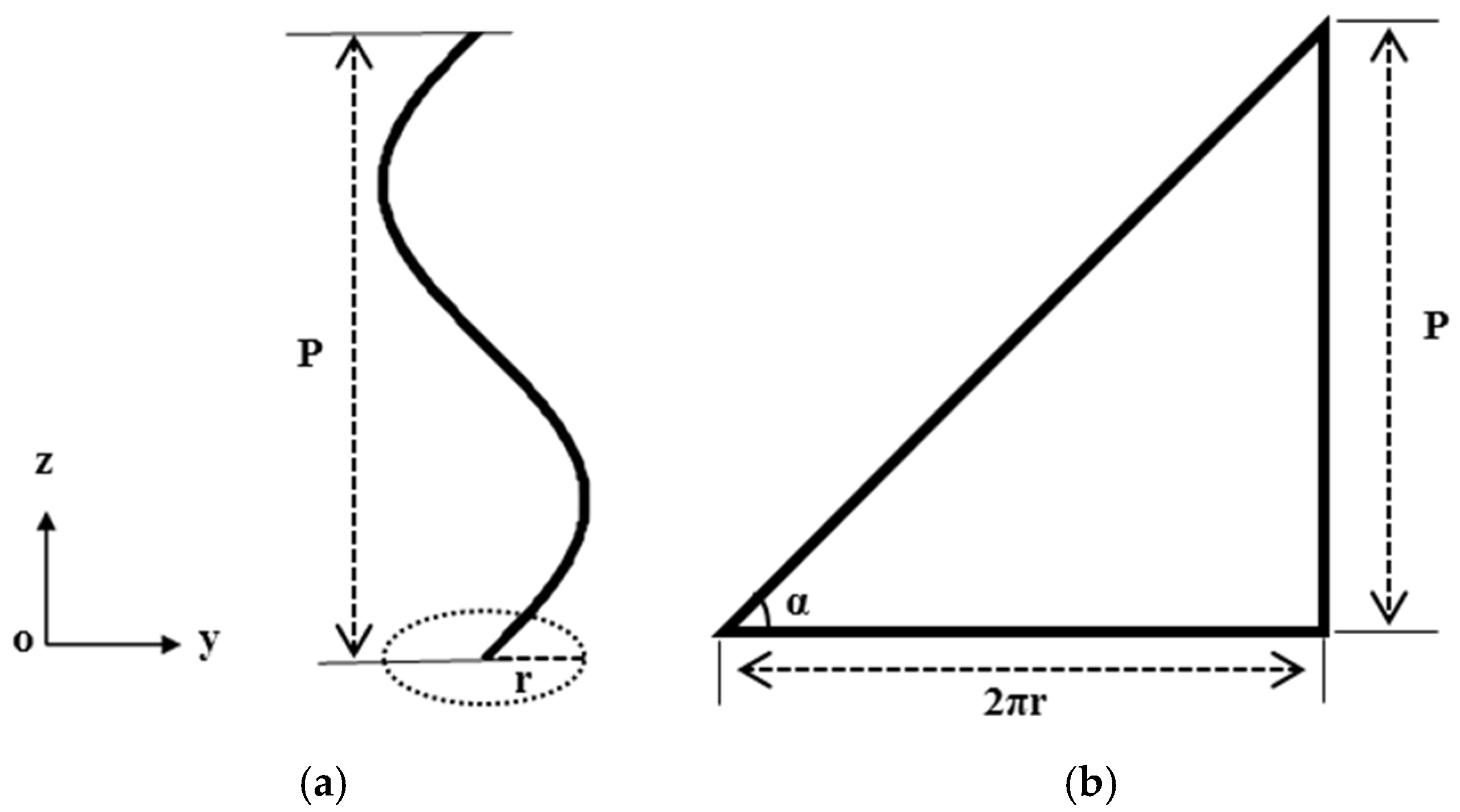
Figure 1a depicts a three-dimensional right-handed helix completing one full cycle, corresponding to a rotation angle of 2π radians. Development of this spatial curve onto a two-dimensional plane yields a straight-line trajectory of identical length, illustrated in Figure 1b. This development reveals a right triangle where the base length equals the circumferential distance 2πr of the helix’s projection circle, and the height corresponds to the lead P. The fundamental geometric parameters defining the helix are:
Radius (r): The radius of the base cylinder.
Lead distance (P): The axial distance advanced per full 2π-radian revolution.
Helix angle (α): The acute angle formed between the helix tangent and the plane perpendicular to the cylinder axis. This angle α is functionally related to r and P, as expressed in Equation (2).
Helices are classified by handedness:
Left-handed: Axial advancement occurs under counter-clockwise rotation when viewed along the direction of advance.
Right-handed: Axial advancement occurs under clockwise rotation when viewed along the direction of advance.
Collectively, these parameters (r, P, α, handedness) define the complete spatial configuration and directional properties of the helical generator.
α = arctan P 2 π r

2.1.2. Parametric Design for HSL

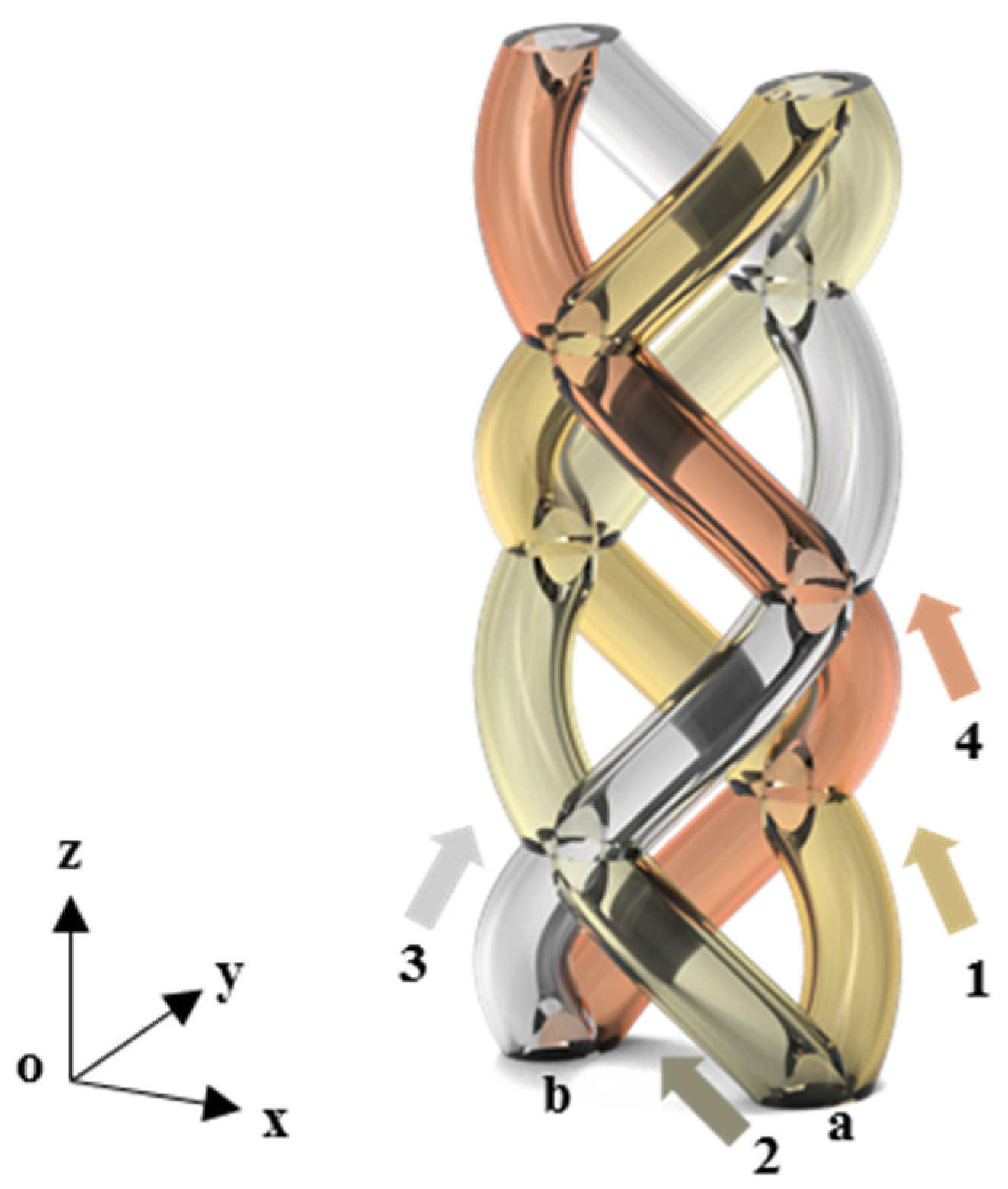
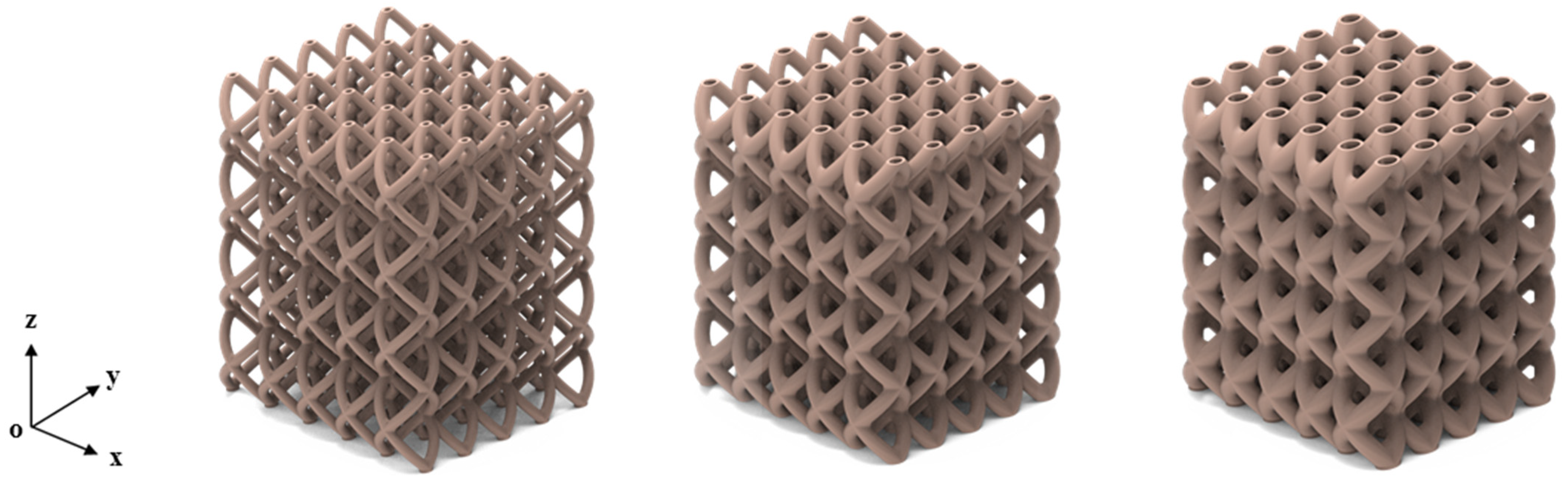
The unit cell of the four-helix symmetric HSL is constructed to overcome the geometric asymmetry and arraying challenges inherent in single-helix designs as shown in Figure 2. Four helical filaments, each with identical radius r and pitch P, originate from two symmetric points: a(r,0,0) and b(−r,0,0). These helices are partitioned into two pairs based on handedness: helices 1 and 3 are right-handed, while helices 2 and 4 are left-handed. Pairs of identical handedness (1–3 and 2–4) remain spatially parallel, whereas oppositely handed pairs (1–2, 1–4, 3–2, 3–4) intersect periodically along the z-axis with a spacing of P/2. A circular cross-section of diameter d is swept along each helical path to generate solid filaments, which are then merged via Boolean union operations to form a single coherent unit cell. The resulting structure contains eight curved solid rods and is bounded by two perpendicular planes at z = 0 and z = P/2. The unit cell exhibits a periodic array spacing of 2r in the x- and y-directions, and P/2 in the z-direction, enabling seamless macroscopic lattice expansion. To fabricate a hollow tubular variant with outer and inner diameters dout and din, respectively, two solid lattice models are generated with diameters dout and din. The inner core is removed via Boolean difference operations, yielding a thin-walled helical pipe lattice. Figure 3 presents the complete HSL structure composed of a 5 × 5 × 4 unit cell, where the helix radius r is 5 mm and with a constant helix angle of 45°.
In the geometric design of cellular structures, the helical mother line radius r, inner and outer pipe radii din and dout, and pitch P are key geometric parameters influencing the relative density of the structure. The analytical model refers to a mathematically derived, closed-form relationship that directly correlates geometric design parameters. As shown in Figure 2, the total volume of the hollow helical pipes within a single unit cell is given by Equation (3), and this volume corresponds to twice the unit cell volume, the minimum bounding cube volume Vmax enclosing the unit cell is determined by Equation (4), and the theoretical relative density ρ is calculated by Equation (5) based on the above two equations. The analytical model enables rapid prediction and inverse design of HSL structures based on engineering requirements, embodying precise analytical relationships rather than approximate or data-driven models.
V = π d o u t 2 d i n 2 2 π r 2 + P 2
V max = 2 r + d o u t 2 P
ρ ¯ = V V max
Table 1 lists the theoretical and actual relative densities of the three lattices shown in Figure 3, where the theoretical relative density is calculated from Equations (3)–(5), and the actual relative density is determined by the ratio of the model’s actual volume to its bounding volume. As the inner diameter increases from 1 mm to 3 mm, the theoretical relative density is consistently lower than the actual value, with a deviation stabilized at approximately 2%; this discrepancy arises from the neglect of spatial overlap regions between the helical pipes, and in engineering practice, the wall thickness can be adjusted to fine-tune the material volume and precisely match the target value.

2.1.3. Design for AM

In the parametric design of lattice structures, geometric parameters, as static intrinsic features, directly govern the macroscopic morphology, mechanical response, and functional performance. Taking spring-type lattices as an example, the core geometric parameters include: the helical radius r, which characterizes the curvature of the helical trajectory; an increase in r, which reduces axial stiffness while enhancing flexibility, but may compromise overall stability; the helical lead angle α, defined as the angle between the helical line and its projection on the cylindrical base, whose increase directs the structure toward axial-dominated load-bearing behavior, enhancing axial compressive stiffness; the inner diameter din, which determines the cross-sectional area of the internal flow channel, directly influencing thermal conduction pathways and cooling efficiency, and is a critical variable for efficient thermal design; the outer diameter dout, which, together with din, defines the wall thickness and directly modulates the relative density and mechanical strength of the structure. These parameters exhibit strong coupling relationships, and their collaborative optimization is a prerequisite for constructing high-performance HSL structures.
The geometric and process parameters exhibit significant nonlinear coupling, with their interaction governed by the physical limits of L-PBF equipment, material thermophysical properties, and dynamic molten pool behavior [34]. During structural design, geometric parameters are not independently adjustable variables but must be co-optimized within the process feasibility domain. Research indicates [35] that the minimum stable printable wall thickness is 0.2–0.3 mm; below this threshold, insufficient molten pool overlap leads to discontinuous melt beads, powder inclusions, and elevated porosity, significantly compromising structural integrity. This constraint is closely correlated with the din and dout, requiring dout − din ≥ 0.6 mm to maintain molten pool thermal stability. For the overhang characteristics of helical channels, the effective overhang angle is determined by the ratio of pitch P to circumference 2πr, and it is recommended to control the helical lead angle α at or above 45° to enhance process reliability. Furthermore, the overall envelope dimensions of the structure (including radius r and pitch P) must be smaller than the build volume of the employed L-PBF system; this constraint constitutes a hard boundary that must be verified at the initial design stage against equipment specifications (e.g., 300 mm × 300 mm × 400 mm) to avoid print failure due to dimensional exceedance.
The geometric parameters of the HSL structure were selected based on a balanced consideration of manufacturability, structural integrity, and experimental control. The helix angle was fixed at 45° to ensure adequate self-supporting capability during LPBF while preserving the intended helical topology. To avoid size effects and ensure printability within a single build, the design constrained the structure to 3–5 unit cells, with an overall length not exceeding 80 mm, leading to a selected spiral radius of 5 mm. The outer diameter was systematically varied between 2 mm and 4 mm, informed by empirical thresholds: outer diameters > 4 mm resulted in insufficient external flow channels and excessive material volume, while diameters < 2 mm compromised internal channel design due to challenges in powder removal. Given the LPBF minimum feature size of 0.3 mm and the practical stability threshold of 0.5 mm, the inner diameter was correspondingly set to 1 mm, 2 mm, and 3 mm for the three cases. The spiral radius and helix angle were held constant across simulations, with only the outer diameter and inner diameter varied. This approach enabled a clear correlation between porosity distribution, internal flow size, and thermal–mechanical response. As summarized in Table 2, the key geometric parameters of the HSL structure are systematically mapped to the operational constraints of AM processes. This adaptive parameterization enables the concurrent optimization of structural performance and manufacturability.

2.2. Thermal Management Simulation

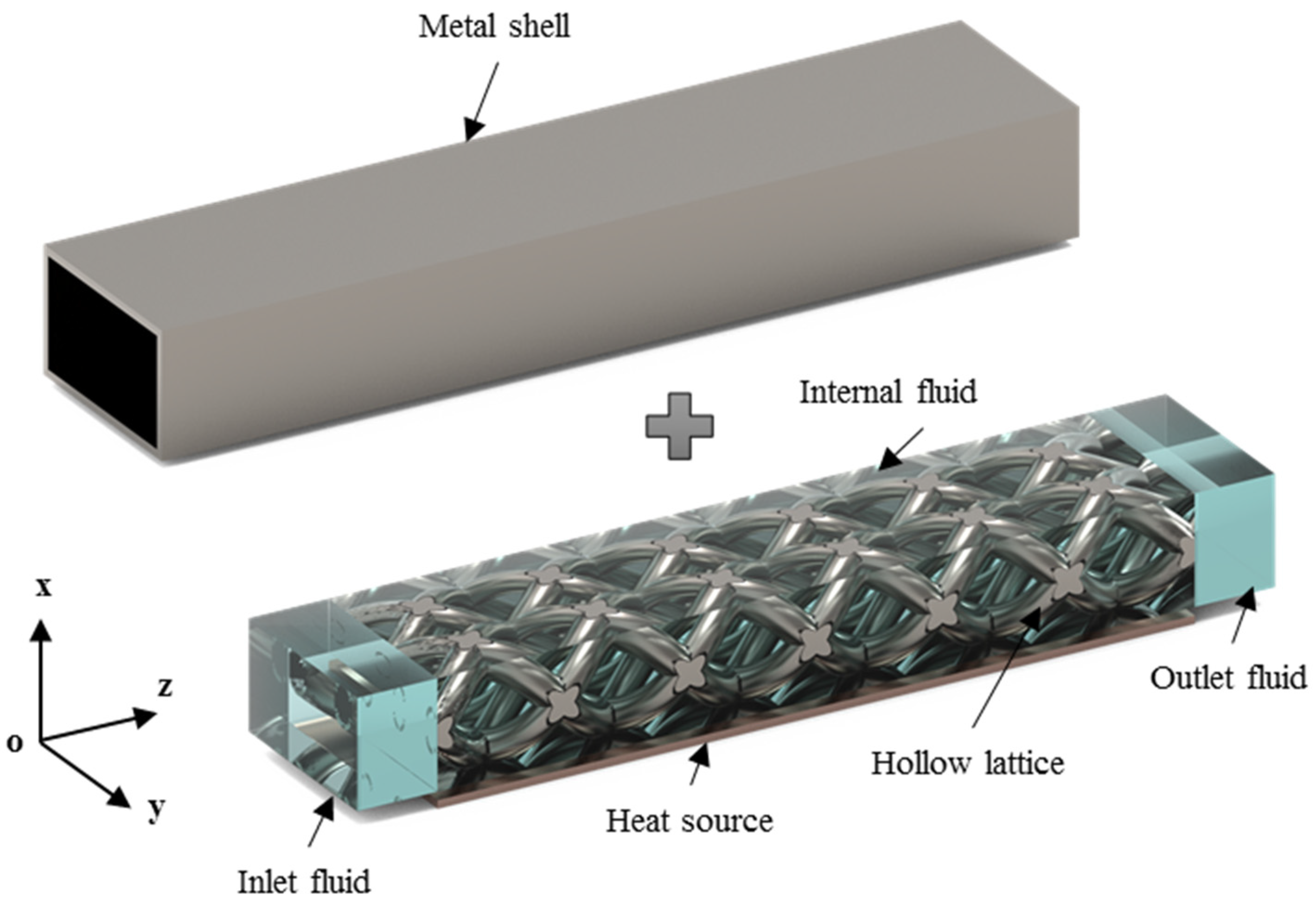
The thermal and heat dissipation performance of the HSL structure is evaluated using a rectangular envelope model of 1 × 2 × 6, balancing computational efficiency with assessment accuracy. Two distinct fluid distribution configurations are defined to reflect practical engineering scenarios: Case 1 and Case 2. In Case 1 (Figure 4), fluid flows exclusively through the internal hollow channel, which is geometrically defined by the envelope of the spiral voids within the metallic HSL. A copper plate, positioned at the origin of the x-axis and in direct contact with the HSL, serves as the heat source, imposing heat flux densities of 2.5 × 10⁷ W/m3 for Case 1 and for 2.5 × 10⁸ W/m3 for Case 2. The fluid inlet is located at the start of the z-axis, with the outlet at its terminus, establishing a unidirectional flow path. In Case 2 (Figure 5), fluid flows simultaneously through both the internal channel and the external annular region formed by the complement of the HSL structure within a surrounding metallic shell, which acts as a fixed outer boundary. The external fluid domain is explicitly resolved as the void space enclosed by the shell but exterior to the HSL, with inlet and outlet regions defined at the z-axis ends to prescribe velocity and thermal boundary conditions. The cooling fluid in both cases is deionized water, and the key material properties employed in the simulations are tabulated in Table 3.
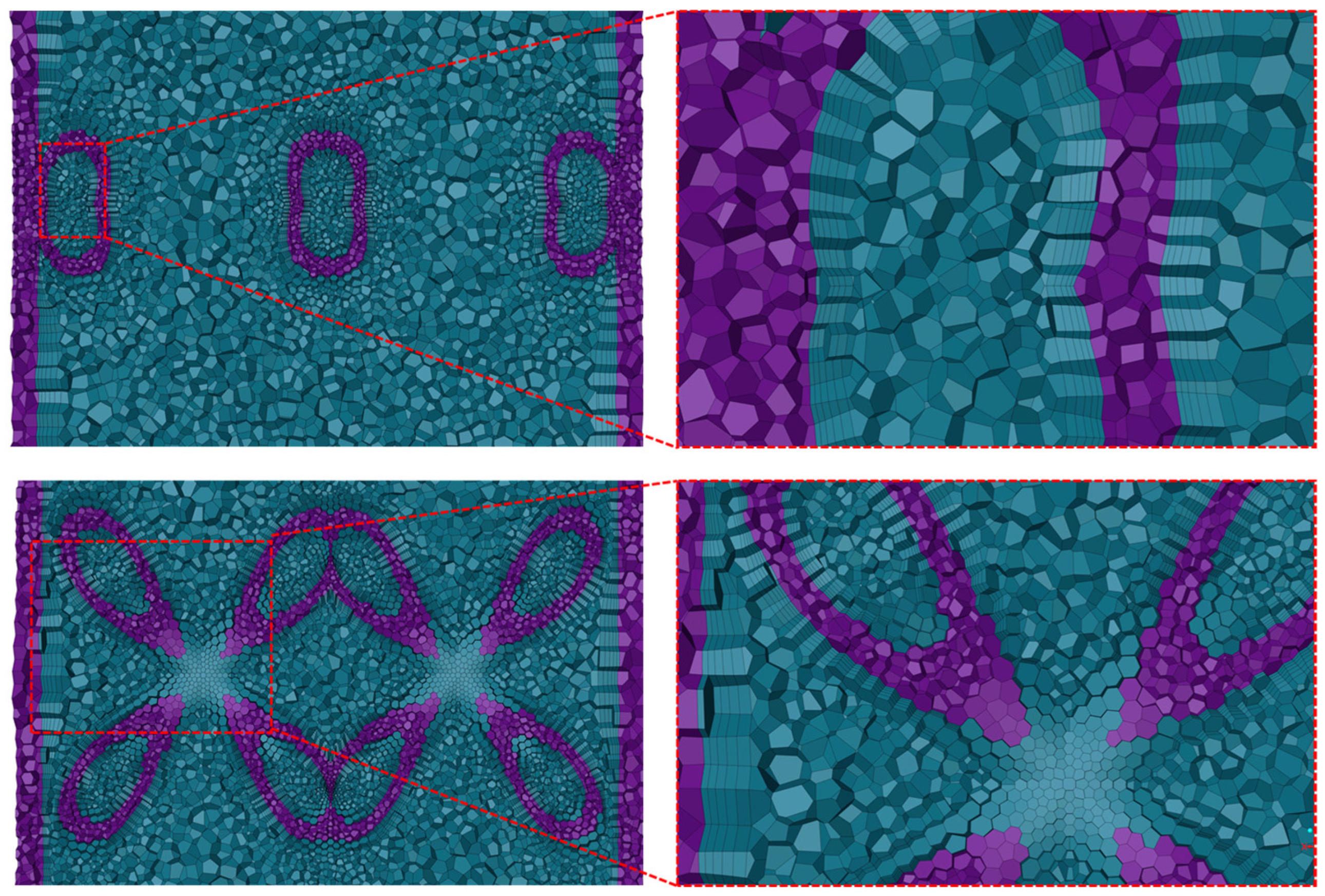
To investigate the heat transfer performance of topology-optimized heat sinks under forced convection, this study employs a commercial CFD solver based on the finite volume method for three-dimensional steady-state numerical simulations, solving the conservation equations of mass, momentum, and energy. Given an inlet velocity of 0.1 m/s and a Reynolds number range of 200–400, the flow is confirmed to be laminar, and thus a laminar model is selected for the CFD solver. The computational domain is discretized using unstructured polyhedral meshes, generated via a workflow that begins with high-fidelity triangular surface meshes, transitions through tetrahedral volumetric meshes, and is ultimately converted into polyhedral cells—a strategy that preserves geometric fidelity while significantly reducing the total element count and enhancing numerical stability and convergence efficiency. To accurately resolve the velocity and temperature gradients near solid walls, five layers of prismatic boundary layers are applied along the walls, with a growth rate of 1.2.
The configurations across all cases are identified by inner diameter din, and the metallic HSL geometry parameters are strictly consistent with those listed in Table 2. The grid element distribution for each computational model is presented in Table 4, with all models maintaining a mesh size on the order of one million elements, a resolution validated by pre-convergence analysis to effectively constrain computational resource consumption while satisfying the dual demands of accuracy and efficiency in steady-state CFD simulations. The boundary conditions are set as: inlet temperature 25 °C and inlet velocity 0.1 m/s. The simulation outputs include the temperature field, velocity field, and pressure field distributions, used to quantitatively compare the thermal performance of different topological configurations. All CFD simulations were performed using ANSYS Fluent 2025. Figure 6 presents the key cross-sectional mesh distribution for the HSL structure with the inner diameter of 2 mm in Case 2, which clearly illustrates the complex, multi-faceted unstructured mesh configuration required to accurately capture the fluid–solid interfaces and resolve the flow behavior within the topology-optimized structure.
In the thermal management simulation, several key assumptions were made to facilitate a focused parametric study of geometric influences on thermal performance. The working fluid was modeled with temperature-independent thermophysical properties to decouple thermal feedback effects and isolate the impact of channel geometry. The flow was assumed to be steady-state, incompressible, and laminar, with no-slip boundary conditions enforced at the channel walls. Transient dynamics and entrance effects were excluded to maintain computational tractability. Furthermore, the internal channel geometry was idealized as perfectly smooth, omitting the surface roughness inherent to LPBF-fabricated structures. These simplifications are consistent with standard practices in the early-stage thermal design of AM lattices, enabling a clear and unambiguous correlation between structural parameters and thermal performance metrics.

2.3. Load-Bearing Performance Evaluation

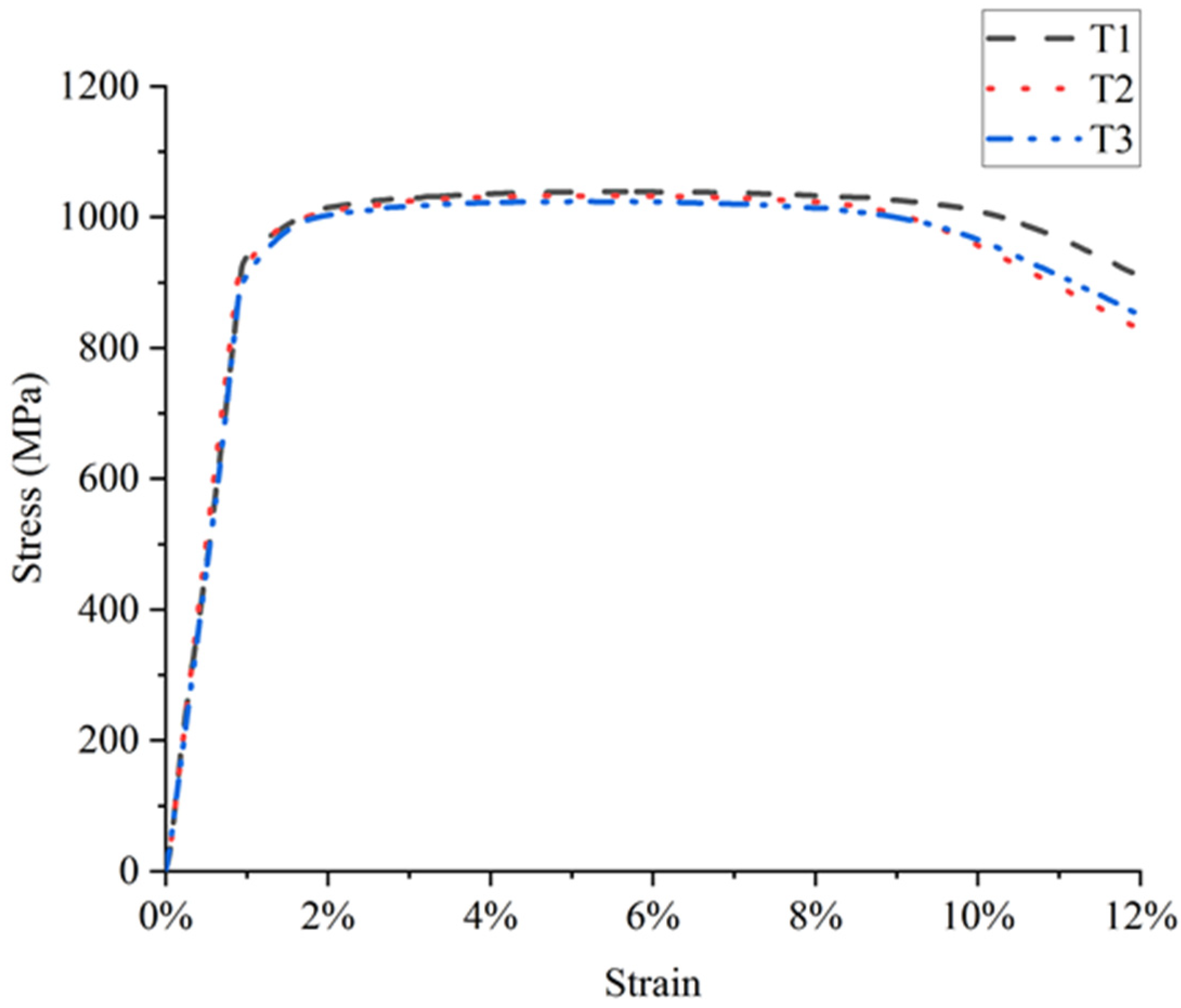
To obtain complete elastoplastic parameters for supporting mechanical performance analysis in numerical simulations, uniaxial tensile tests were conducted in accordance with ASTM E8 standard, with three replicated specimens labeled T1, T2, and T3, demonstrating excellent reproducibility between groups. The test was conducted at 25 °C using equipment YDL-2000 (China Machinery Testing Equipment Co., Ltd., Jilin, China). Based on the stress–strain responses illustrated in Figure 7, a simplified plasticity model incorporating the von Mises yield criterion and isotropic hardening was developed and implemented as the constitutive input for numerical simulations. The elastic modulus E0 of the base Ti6Al4V is 101 GPa, and its yield strength σ0 is 989 MPa. For thermally treated Ti6Al4V LPBF specimens, multiple studies have reported that the elastic mechanical property differences between the build direction (Z) and the build plane (XY) are typically minor. Therefore, we directly employ an isotropic model based on this set of parameters for the computations. The tensile direction of these in situ-fabricated specimens defined by their geometric long axis and principal loading axis aligns precisely with the primary compression axis during the quasi-static compression tests of the HSL structures. In the LPBF process, both the tensile specimens and the HSL lattices share the same z-axis as their dominant build direction. The compressive load in the subsequent mechanical tests was also applied along this z-axis. As such, the uniaxial stress–strain curve derived from this specific build direction accurately captures the mechanical behavior of the structure under its primary load-bearing orientation.
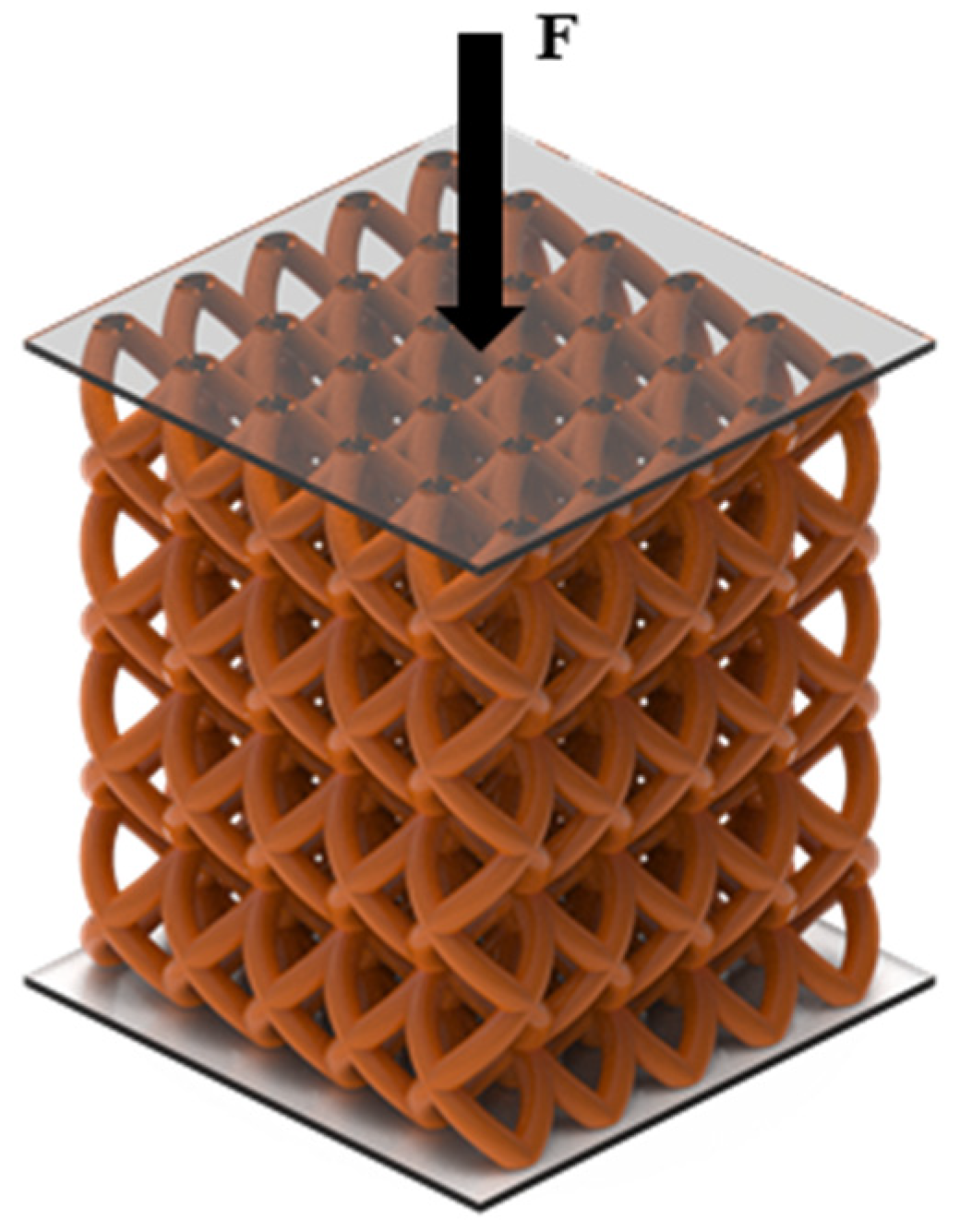
To investigate the mechanical performance of the proposed metamaterial structure, quasi-static simulations were performed using ABAQUS/Standard, in which the HSL metamaterial was discretized using four-node doubly curved shell elements with reduced integration (S4R) to mitigate shear locking while accurately capturing membrane–bending coupling effects. The shell thickness at each node was explicitly defined based on geometric data derived from LPBF process simulations to ensure fidelity, and a structured quad-dominant meshing scheme with uniform element size within each unit cell, scaled to local strut curvature, was employed to maintain consistency across configurations. As illustrated in Figure 8, the numerical model comprises a rigid loading plate, a HSL metamaterial, and a fixed bottom support plate, where the support plate constrains the bottom displacement of the HSL. The loading plate descends vertically at a constant rate of 2 mm/min to induce compression. The interaction between the rigid loading plate, the fixed bottom support plate, and the HSL structure was modeled using the general contact formulation to automatically resolve all potential contact pairs, including self-contact within the lattice and contact with rigid fixtures without manual surface definition, and a penalty-based contact algorithm with a friction coefficient of 0.1 was implemented to accurately represent shear behavior at the interface, thereby ensuring the numerical model reproduces the physical response while maintaining robust convergence and computational tractability.

2.4. Experimental Validation

LPBF technology was employed using a BLTS310 system (Xi’an Bright Laser Technologies Co., Ltd., Shaanxi, China) to fabricate Ti6Al4V HSL superstructures. The feedstock powder was argon-atomized Ti6Al4V with a powder size distribution of Dv(10) = 30.0 µm, Dv(50) = 44.6 µm, and Dv(90) = 66.2 µm. The layer thickness was set to 0.03 mm, with a laser power of 100 W, scanning speed of 750 mm/s, and spot size of 80 μm—a combination that effectively achieves high density and low residual stress, suitable for precise fabrication of complex HSL structures. After printing, the specimens were separated from the build plate using electrical discharge machining, followed by ultrasonic cleaning to remove internal residual powder at a frequency of 30 kHz, temperature of 40 °C, duration of 35 min, and power density of 1.1 W/cm2, using a neutral cleaning agent; a final rinse with anhydrous ethanol was performed to ensure complete removal of contaminants from internal channels.
This study experimentally validates the mechanical performance of the LPBF-fabricated HSL structure, while the thermal performance is evaluated based on the aforementioned CFD simulation results; the existing literature has sufficiently confirmed the high consistency between experiment and simulation in the response of metallic HSL structures. To characterize the surface topography of LPBF-fabricated samples, a super-depth optical microscope (VHX-4000) was employed for high-resolution observation, with emphasis on assessing forming quality and micro-defect distribution. Quasi-static compression tests were conducted on a hydraulic loading system (YDL-2000) at a loading rate of 2 mm/min, corresponding to a nominal strain rate of 5.3 × 10⁻⁴ s−1; the compressive load was applied by the upper platen, while the lower platen was fixed, and a digital camera was positioned on the front face of the specimen to record the entire deformation process. The nominal compressive strain was defined as the ratio of displacement to the initial specimen height, and the nominal compressive stress was calculated as the ratio of applied load to the cross-sectional profile area of the specimen. Two independent specimens were fabricated and tested for each configuration, and the results demonstrated good repeatability and reproducibility in the stress–strain response of each specimen group.

3. Results and Discussion

This section presents a comprehensive discussion of the thermal response, mechanical deformation, and quasi-static compression test results, enabling a unified assessment of the thermo–mechanical behavior of the HSL structure.

3.1. CFD Simulation Case 1: Internal Fluid Flow Only

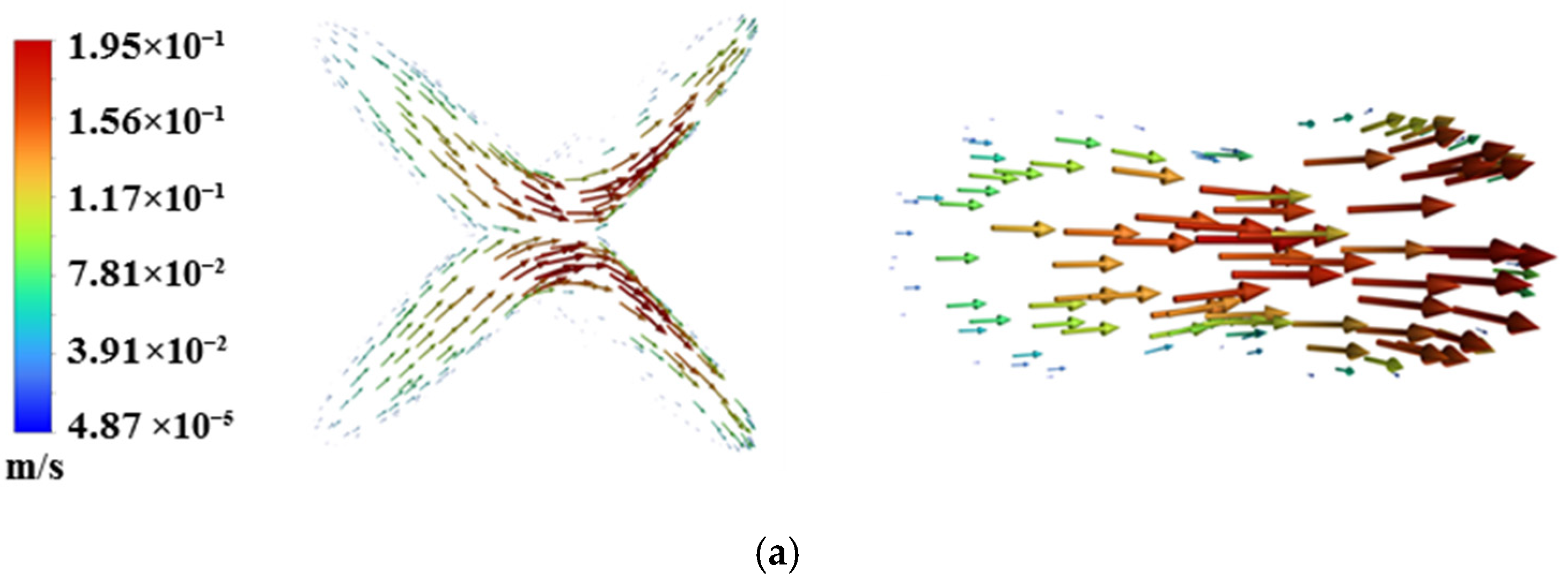
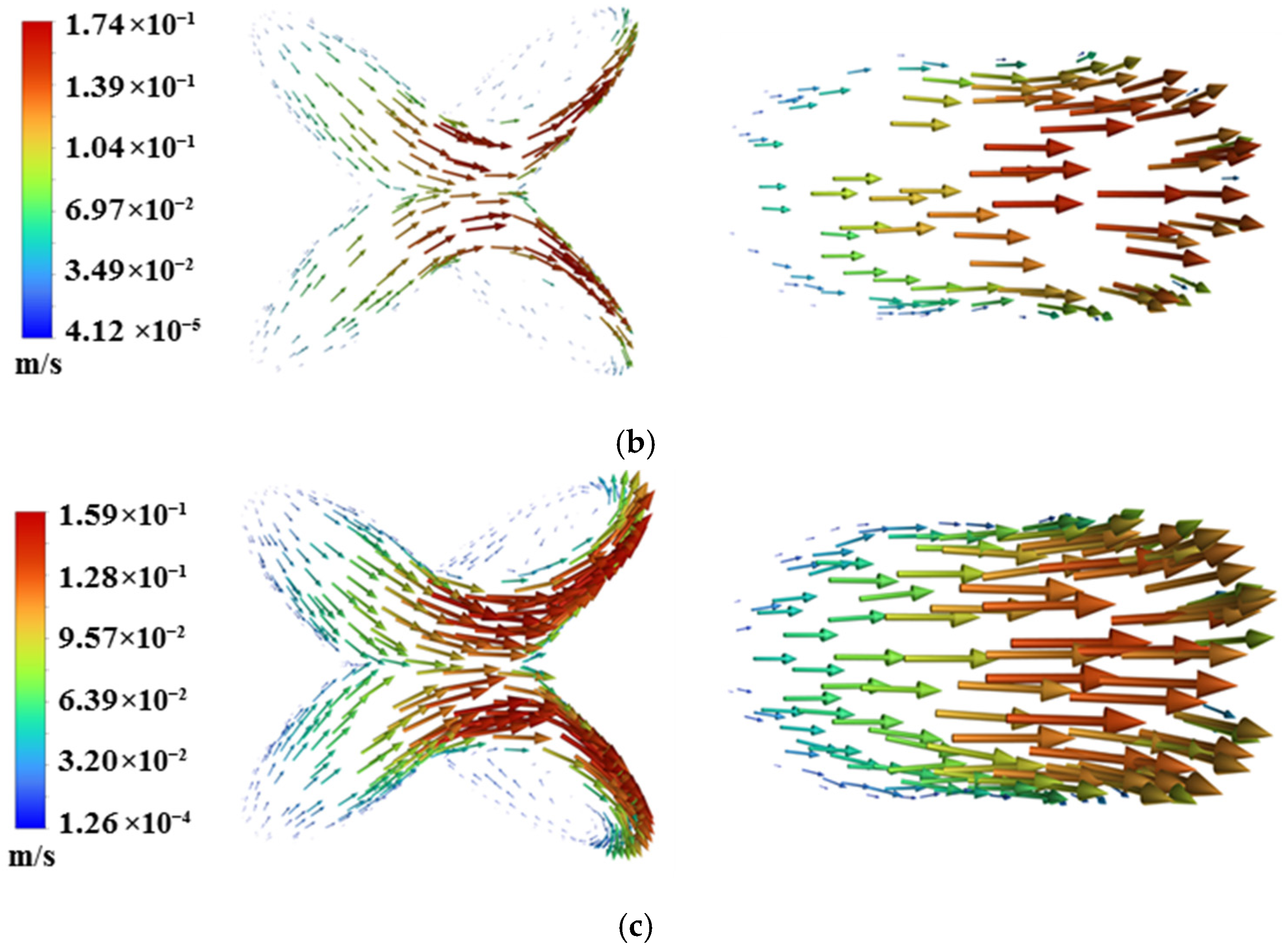
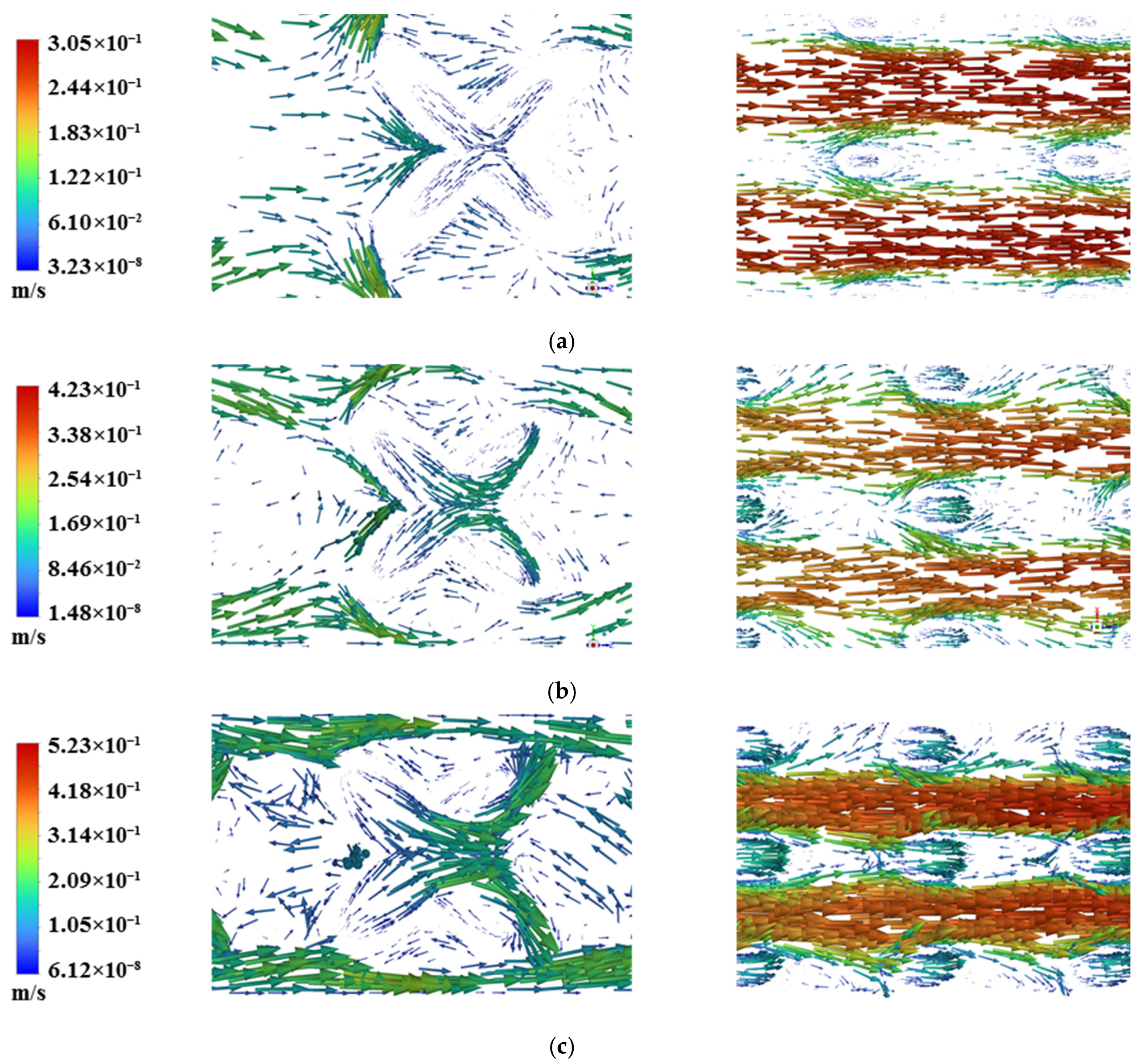
Figure 9 presents the velocity vector distribution on a key cross-section in Case 1 (internal fluid flow only). The results indicate that the maximum fluid velocity is concentrated at the central junctions of the HSL structure. This velocity peak arises from the geometric constriction effect of the flow channel topology: when multiple fluid streams converge into the central region, the local reduction in flow area forces the fluid to accelerate in accordance with the law of mass conservation, forming a distinct high-momentum core. Additionally, the curvature of streamlines observed in the vector plot confirms the presence of secondary flows. Due to the helical geometry of the channels, centrifugal forces induce Dean vortex structures. These transverse vortex motions enhance momentum exchange between the central mainstream and near-wall fluid, improving radial mixing at the cost of additional viscous dissipation.
As the inner diameter increases from 1 mm to 3 mm under a constant inlet mass flow rate, the maximum velocity exhibits a significant decrease, dropping from 0.195 m/s to 0.159 m/s. This 18.5% velocity reduction is primarily attributed to the direct increase in pipe diameter, which lowers the average flow velocity and consequently weakens the inertial focusing effect in the central region. Although a larger diameter reduces flow resistance, it also sacrifices part of the convective heat transfer enhancement provided by high-speed impingement and strong shear effects.
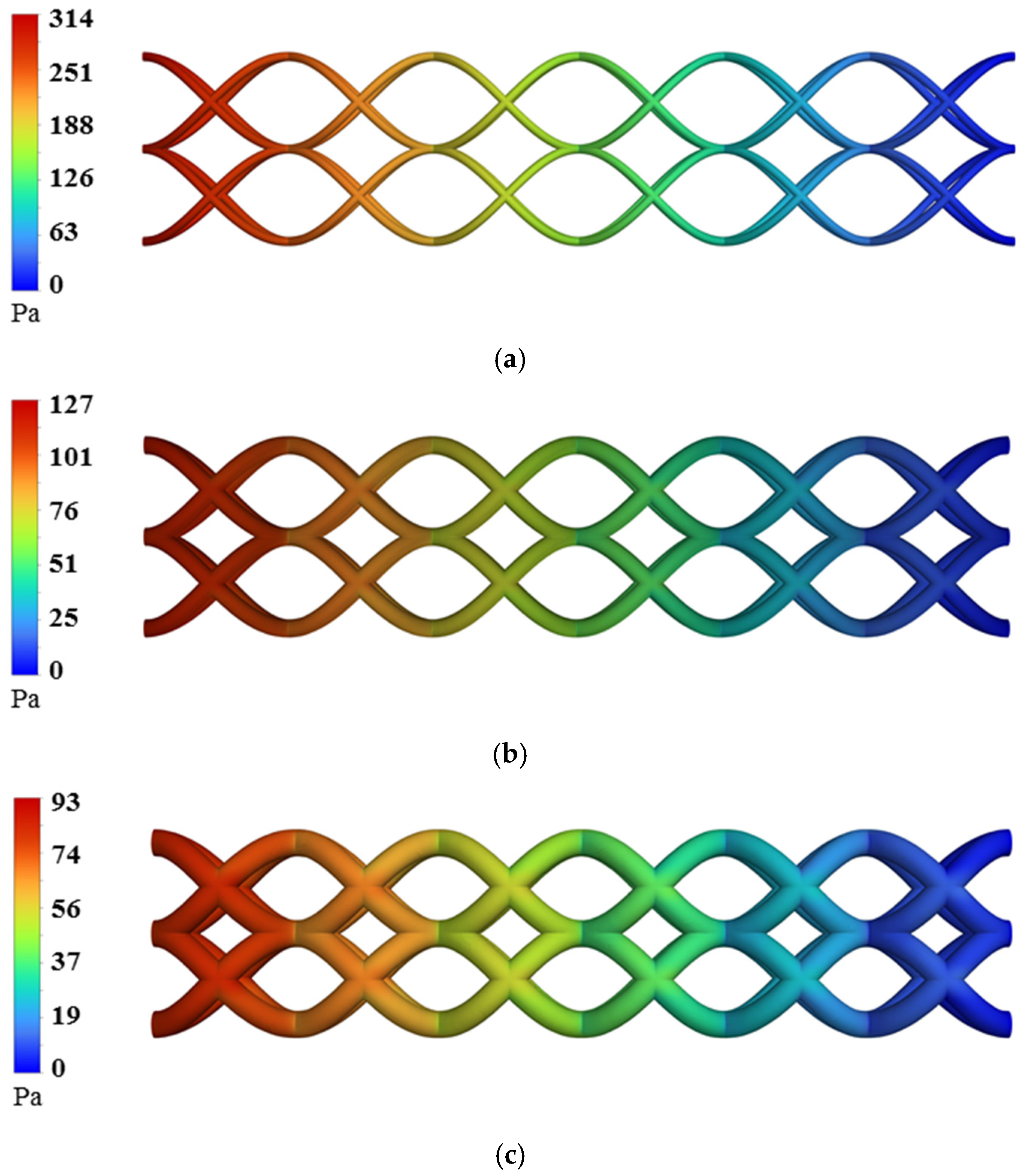
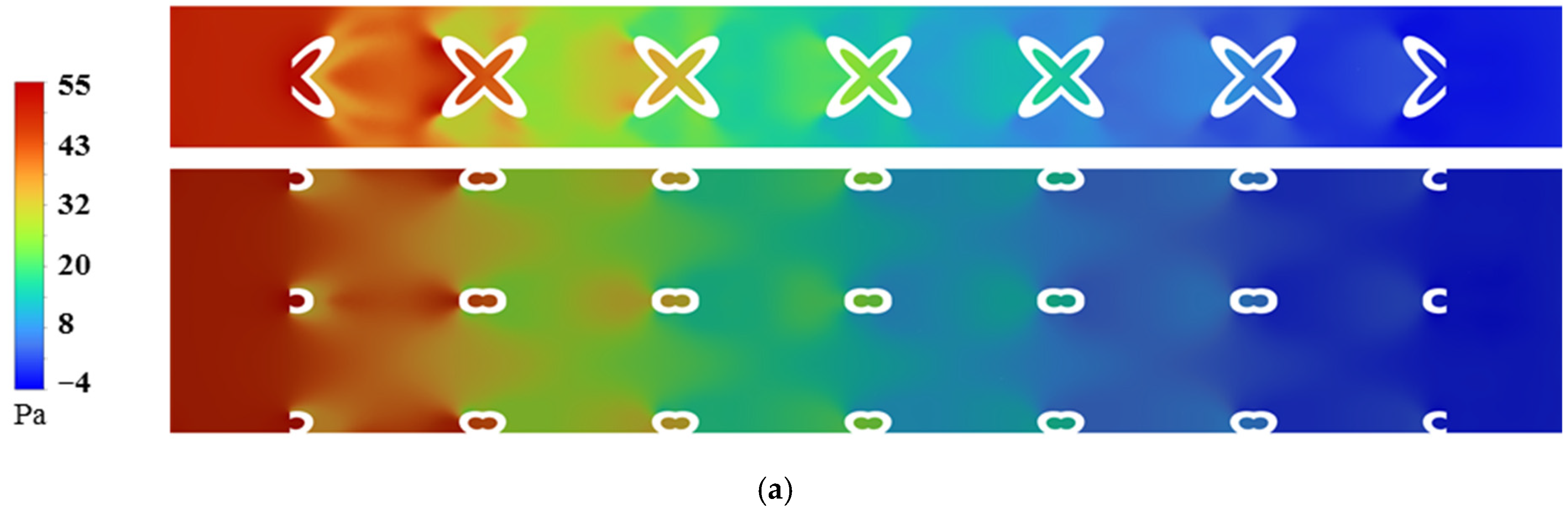
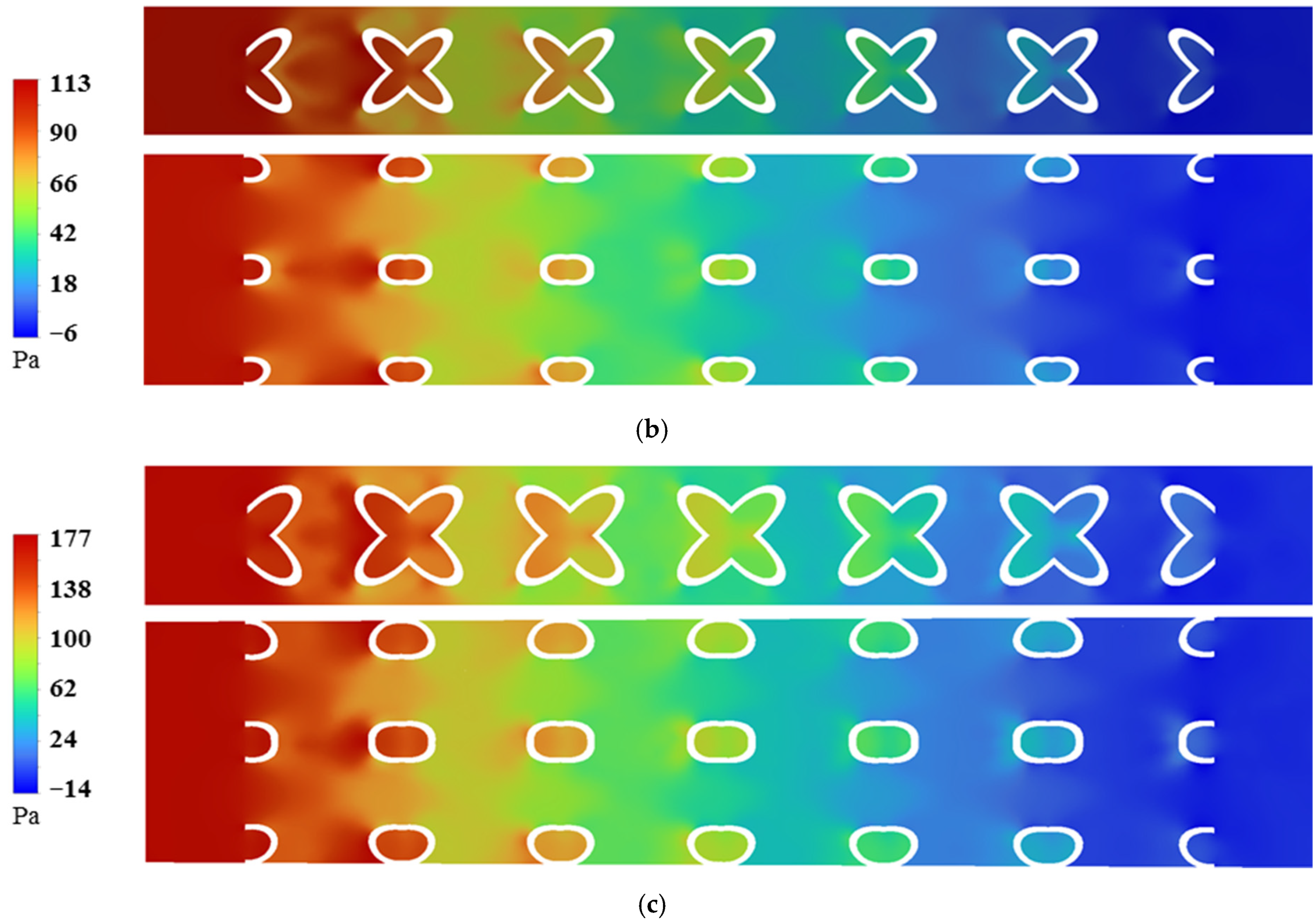
The simulation results, as summarized in Table 5 and illustrated by the pressure and temperature distribution contours in Figure 10 and Figure 11, demonstrate that increasing the channel inner diameter from 1 mm to 3 mm significantly enhances thermal performance while reducing hydraulic resistance. The average temperature at the heat source base decreased from 112.10 °C to 71.60 °C, representing a 36.3% reduction, while the temperature difference across the surface shrank from 25.17 °C to 5.47 °C, indicating a marked improvement in thermal uniformity and a consequent reduction in the risk of thermal stress concentration. Concurrently, the inlet pressure drop declined sharply from 298.23 Pa to 81.33 Pa, a 72.7% reduction, which is consistent with classical laminar flow theory, where increased cross-sectional area reduces hydraulic resistance.
The enlarged channel diameter increases the solid–liquid interface area, thereby compensating for the reduction in the convective heat transfer coefficient. Moreover, with constant wall thickness and increased structural dimensions, the thermal conduction network is optimized, facilitating more efficient heat diffusion through the solid skeleton. The increased fluid volume fraction and reduced flow velocity prolong the thermal residence time, enabling more complete heat absorption by the working fluid—evidenced by the outlet temperature dropping from 62.65 °C to 29.87 °C, confirming that the fluid remains far from thermal saturation and retains substantial heat extraction capacity under larger-diameter conditions.

3.2. CFD Simulation Case 2: Simultaneous Internal and External Fluid Flow

Figure 12 shows the velocity vector distribution on the key cross-section in Case 2 with simultaneous internal and external fluid flows. The results indicate that the internal fluid still has a distinct high-momentum core region and secondary flows, with considerable viscous dissipation; however, the maximum fluid velocity occurs in the external fluid region. The diameter of the internal cylinder enclosed by the spiral line determines the magnitude of the relative velocity. On the cross-section of the cylindrical fluid, the velocity vectors are predominantly aligned in parallel with a relatively uniform distribution, indicating that the flow channel cross-sectional area in this region remains constant, the fluid is in a relatively steady mainstream state, and the viscous dissipation is lower compared to that of the internal fluid. In addition, the larger the rod diameter, the smaller the diameter of the internal cylinder. As the inner diameter of the metallic HSL increases from 1 mm to 3 mm, the maximum velocity increases from 0.305 m/s to 0.523 m/s.
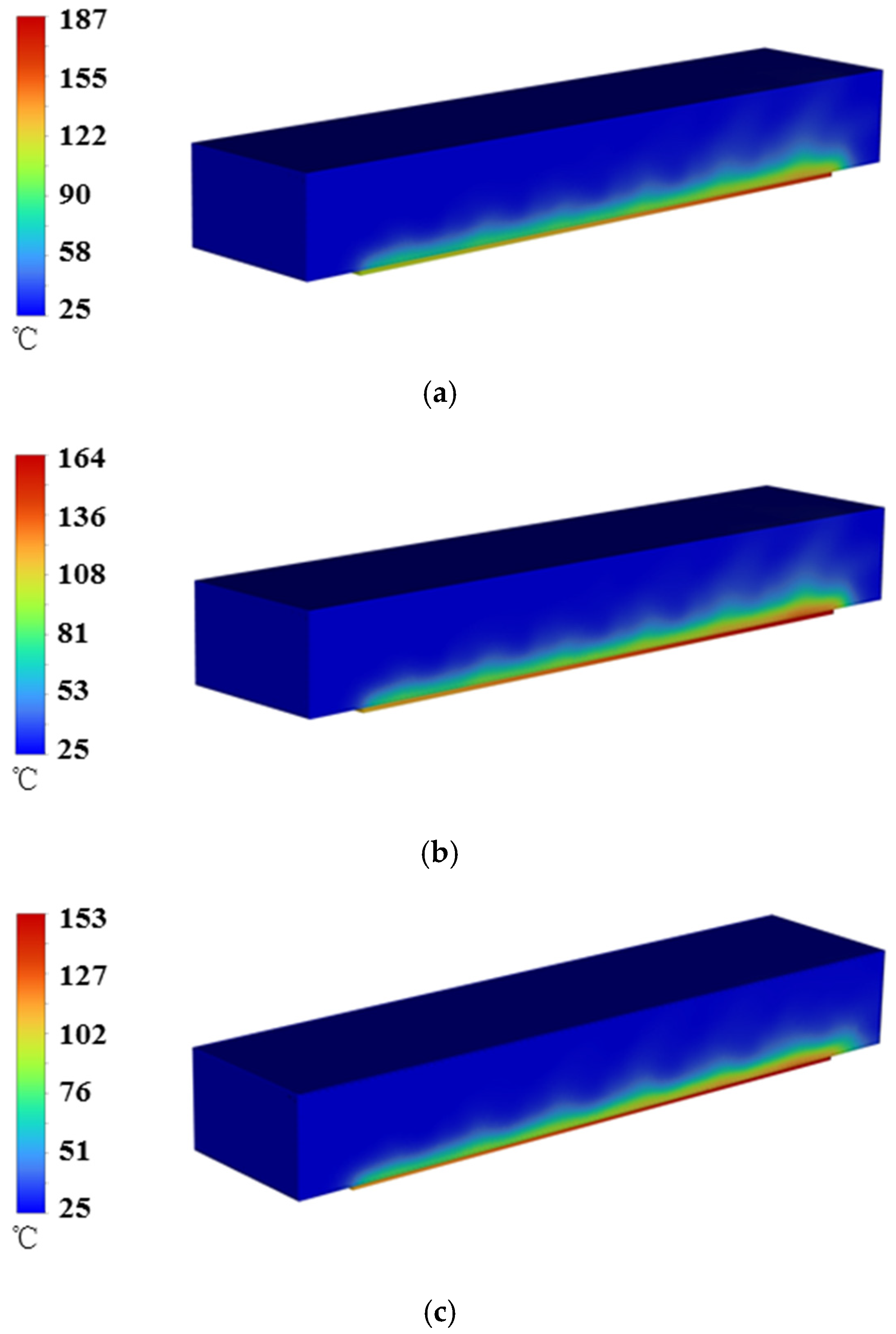
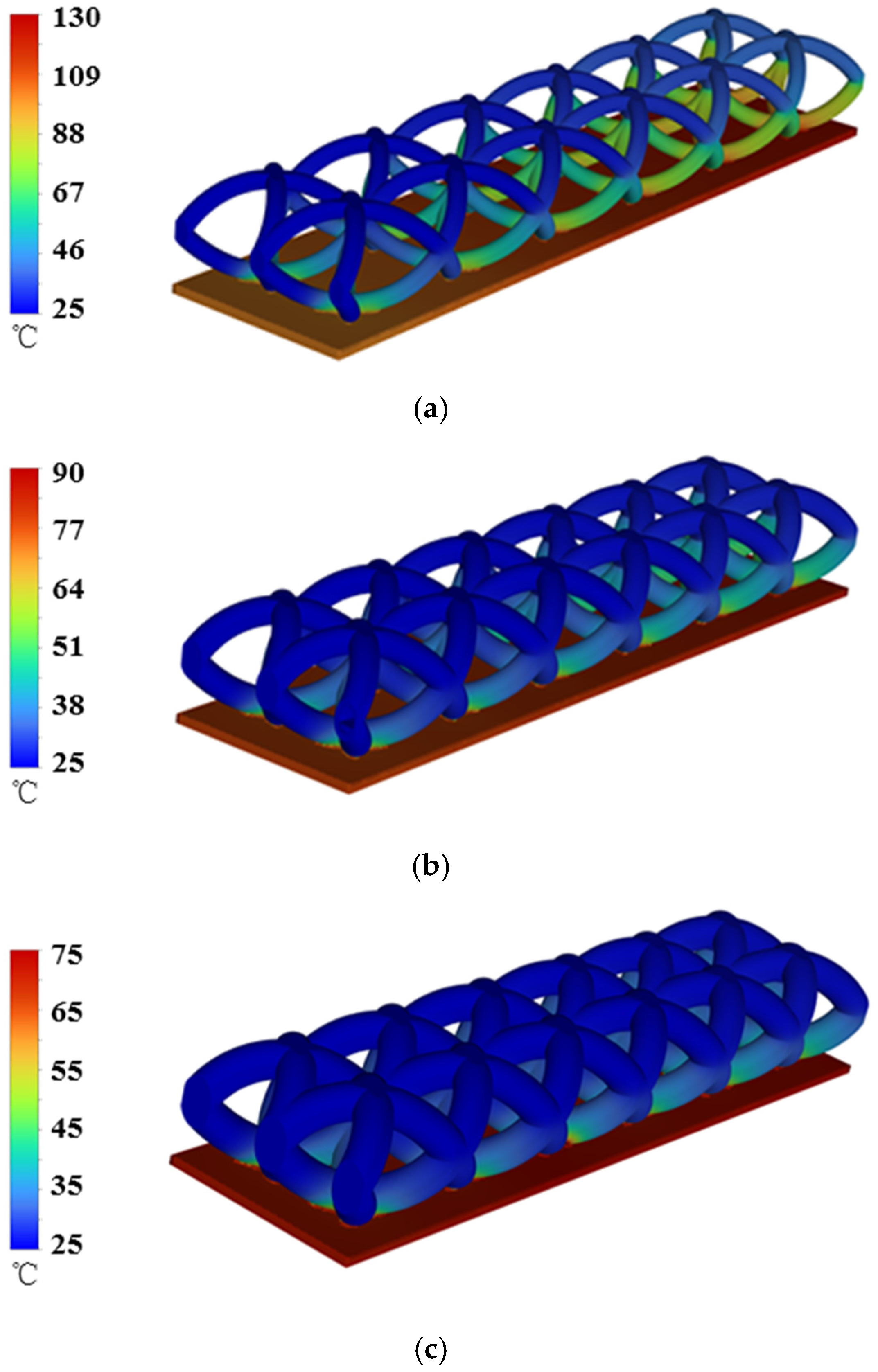
Unlike the single internal flow condition, this configuration constructs a three-dimensional stereoscopic thermal transport network of ‘internal absorption and external dispersion’. Table 6 lists the temperature responses and pressure drop results of each structure in Case 2, while Figure 13 and Figure 14 show the pressure and temperature distribution contour plots, respectively. The simulation results indicate that as the inner diameter increases from 1 mm to 3 mm, the temperature uniformity is significantly improved: the peak base temperature decreases from 187.40 °C to 152.79 °C, the base temperature difference narrows from 66.38 °C to 42.50 °C, and the local hotspots are obviously suppressed. The fluid dynamics analysis reveals a nonlinear resistance jump phenomenon, which is contrary to the rule that the pressure drop decreases as the pipe diameter increases in the single internal flow condition. Under the full-flow condition, the inlet pressure drop increases sharply from 50.85 Pa to 172.19 Pa, with an increase of 238%. The dominant mechanism of this ‘flow resistance penalty’ is the geometric blockage effect of the external flow channel: with the expansion of the inner diameter of the hollow rod, the volume of the HSL rod increases, the porosity of the external fluid domain decreases sharply, the flow channels between the rods become narrow and tortuous, the fluid is forced to accelerate, strong gap vortices and momentum dissipation are generated, and finally flow loss dominated by geometric blockage occurs. In summary, this structure shows a significant trade-off between thermal and flow performance. Although the 3 mm inner diameter structure has the best uniformity, its flow resistance penalty is too high, resulting in a significant increase in pump power. In contrast, the 2 mm inner diameter scheme achieves effective heat source cooling while maintaining a relatively moderate pressure drop level, located at the Pareto optimal frontier of ‘high efficiency and low resistance’, which is the optimal design point for the engineering application of this kind of micro-channel heat dissipation cold plate.
However, the thermal simulation in this paper has limitations. The CFD model employed in this study assumes idealized smooth solid walls; however, the inherent layer-by-layer nature of AM significantly alters the actual thermofluidic performance of fabricated components, introducing systematic deviations between experimental results and idealized simulations. Experimental investigations by Sun et al. [36] on AlSi10Mg alloy heat sinks fabricated via LPBF reveal that manufacturing defects introduce errors primarily through two key mechanisms. First, non-ideal surface topography manifests as pronounced anisotropic roughness characterized by CT and SEM imaging, which shows that the bottom surface roughness (13.30–14.35 μm) is approximately 1.3 times higher than that of the top surface (5.69–6.52 μm). This disparity arises primarily from unmelted powder residues, stair-stepping effects, and balling phenomena, leading to increased fluid boundary layer resistance and consistently higher measured pressure drops compared to simulated values. Second, the thermal properties of the material exhibit significant build-direction dependence. EBSD analysis and thermal conductivity measurements confirm that the thermal conductivity perpendicular to the build direction (160.6 W/(m·K)) is 5.6% higher than that parallel to it (151.3 W/(m·K)), a consequence of non-uniform grain size gradients and texture orientation. The combined effect of surface morphology and material anisotropy results in significant discrepancies between experimentally measured temperature fields and simulation predictions, underscoring the necessity of incorporating actual AM process characteristics into future high-fidelity simulations of thermal management devices. Future work will incorporate transient simulations, fully coupled thermo–mechanical deformation, and roughness-resolved flow models to enhance predictive fidelity under real operating conditions.
A grid convergence study was performed to ensure numerical reliability in the thermal simulation of the HSL channel system with an inner diameter of 2 mm under internal fluid-only conditions as shown Table 7. Six progressively refined mesh configurations ranging from 102,052 to 1,945,092 cells were evaluated under identical boundary conditions, solver settings, and time step sizes. Key response variables, including the heat source bottom average temperature, maximum temperature, and pressure drop, were monitored to assess mesh independence. As mesh resolution increased, both average temperature and pressure drop exhibited a consistent monotonic increase, while the maximum temperature plateaued beyond the 1,357,445 cells, undergoing a minor reduction from 164.15 °C to 163.12 °C, signaling entry into the asymptotic convergence regime. The 1,357,445-cell mesh was selected as the optimal compromise between computational fidelity and efficiency: relative to the medium mesh (590,655 cells), it reduced the average temperature error to 0.85% and the pressure drop error to 2.1%, both below the 2.5% threshold required for reliable thermal management design. In contrast, further refinement to 1,680,480 and 1,945,092 cells yielded improvements of less than 1% in all metrics at a prohibitive increase in computational cost. This selection strictly adheres to the CFD principle of the minimum necessary mesh, ensuring robust, reproducible results without unnecessary resource expenditure.

3.3. Mechanical Performance Evaluation

This chapter systematically evaluates the post-printing HSL quality, then develops a FE mechanical model to perform quasi-static compression simulations. By comparing the experimentally obtained stress–strain curves, deformation modes, and energy absorption characteristics with simulation results, the analysis validates the reliability of the numerical model in predicting structural mechanical behavior. Finally, mechanical performance comparisons are conducted with other lattice configurations.

3.3.1. Geometric Deviation Analysis

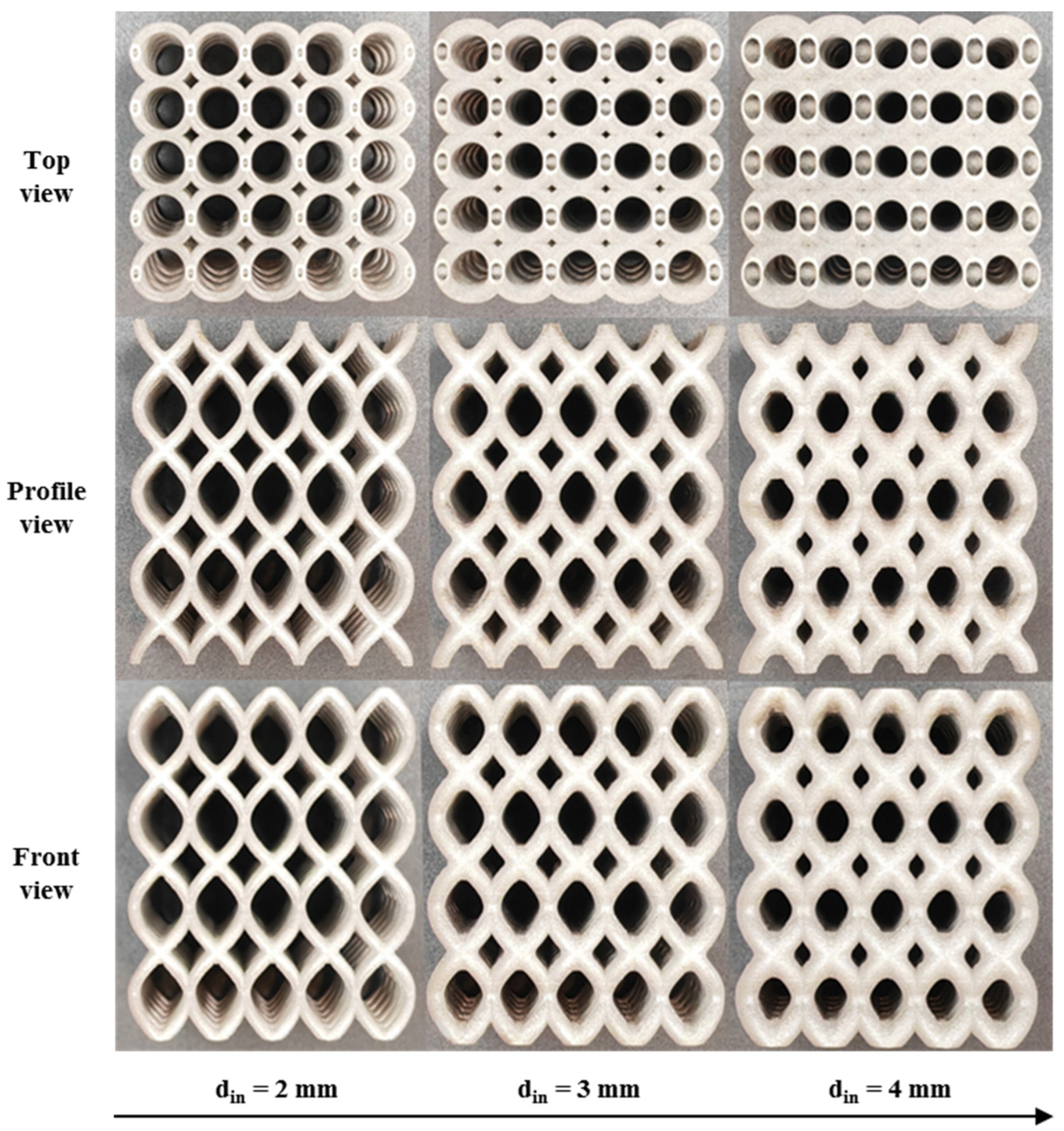
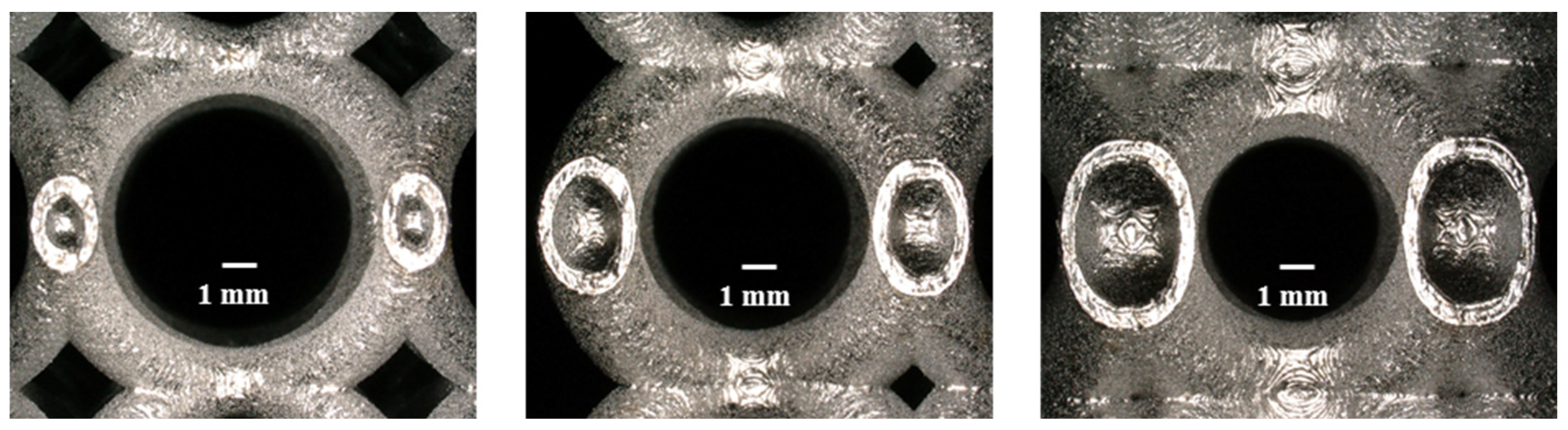
Figure 15 presents the macroscopic morphologies of the formed metal HSL structure from three different perspectives, exhibiting a characteristic metallic matte finish, naturally transitioned edge contours, and the absence of obvious defects. Further observation under optical microscopy in Figure 16 reveals distinct, fine laser melting tracks and stair-step interlayer accumulation effects in localized regions, which are highly consistent with the predefined layer thickness and scan path planning, with no accompanying microcracks or other structural defects. Compared with the CAD model, the formed structure demonstrates high geometric fidelity and surface integrity at both macroscopic and microscopic scales.
Table 8 reveals the mass deviation analysis of the formed HSL structures, with measured deviations of 6.91%, 6.41%, and 5.32% for the three inner diameters, indicating controllable overall deviation and a stable decreasing trend with increasing inner diameter, reflecting good process consistency. This decreasing trend arises from the reduced probability of residual powder inside larger-diameter structures, with the final deviation stabilizing at approximately 5%, within the acceptable range of systematic errors in AM, thereby providing a highly reliable geometric input for subsequent mechanical performance studies.

3.3.2. Compressive Performance

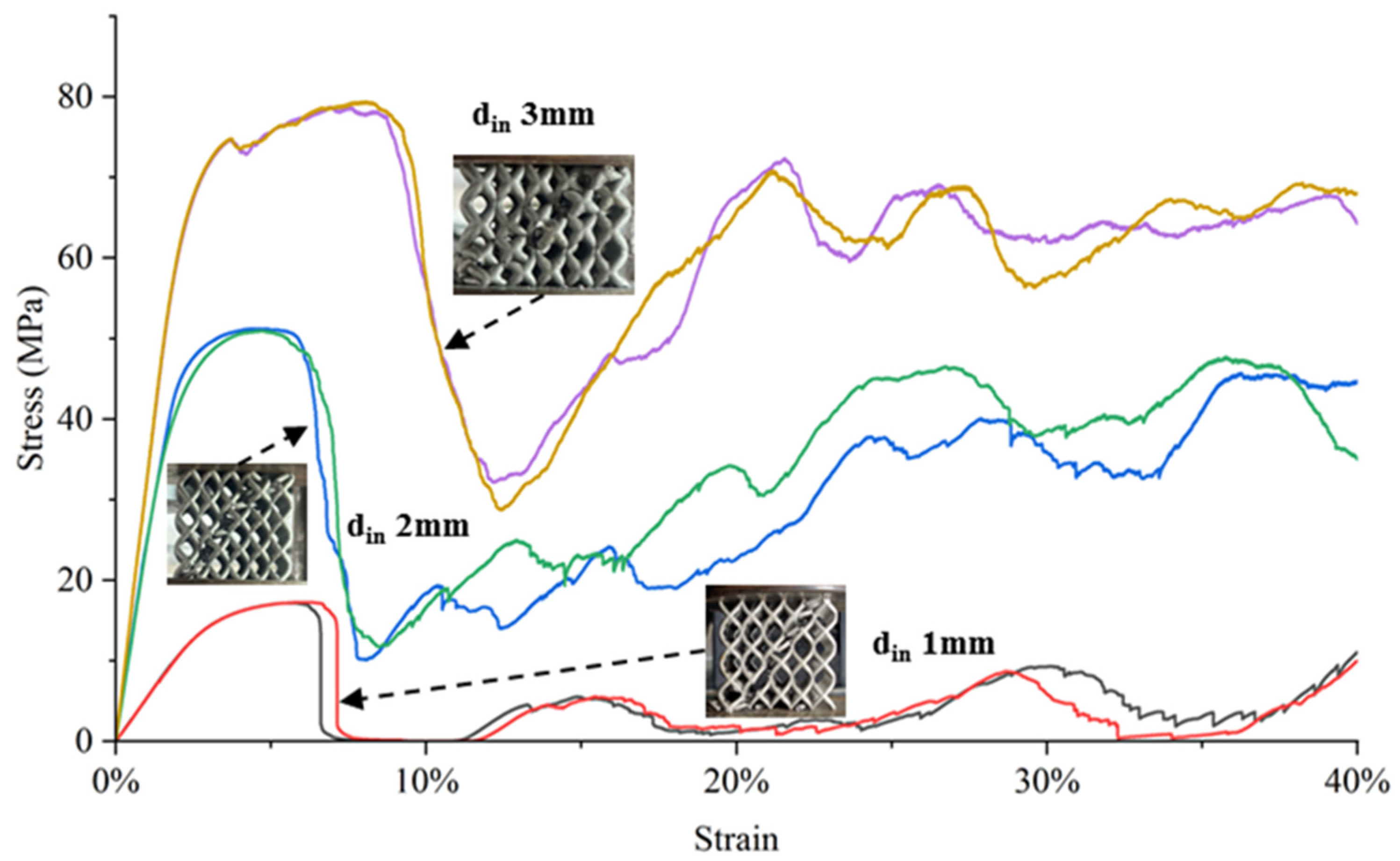
Under quasi-static compression, the stress–strain curves of three HSL structures with different inner diameters are presented in Figure 17. Engineering stress is defined as the applied load divided by the initial cross-sectional area of the HSL superstructure, while engineering strain is defined as the displacement of the platen divided by the initial height of the structure. The three curves exhibit similar overall trends, characteristic of conventional lattice superstructures, and can be divided into three stages: (i) the linear elastic stage; (ii) the post-yield plateau stage; and (iii) the densification stage. In the initial elastic stage, stress increases linearly with strain, and stiffness significantly increases with inner diameter, yielding elastic moduli E of 539.72 MPa, 2458.28 MPa, and 3221.46 MPa for inner diameters of 1 mm, 2 mm, and 3 mm, respectively. The yield strength ρ also increases with inner diameter, reaching 13.22 MPa, 41.69 MPa, and 62.69 MPa. Upon entering the post-yield plateau stage, stress remains relatively constant with increasing strain until reaching a peak value, after which it declines; the corresponding ultimate strengths are 17.21 MPa, 51.09 MPa, and 79.06 MPa. Near the end of the plateau stage and the onset of densification, HSL failure occurs via fracture along approximately 45° shear bands, resulting in complete splitting into two parts for all three configurations, as indicated in Figure 17. The splitting of the metamaterial along the main diagonal in Figure 17 is due to the formation of a shear band under uniaxial or off-axis loading, driven by anisotropic stress distribution inherent in the lattice geometry [37]. In many mechanical metamaterials, the unit cell design, particularly those with diagonal struts or asymmetric topologies, creates preferential pathways for strain localization. When loaded, the structure experiences maximum shear stress along the principal diagonal direction, leading to localized plastic deformation and micro-crack nucleation [38]. This phenomenon is amplified by geometric symmetry breaking, where the diagonal axis aligns with the direction of highest shear strain, causing failure to propagate preferentially along this path rather than perpendicular to the load axis.
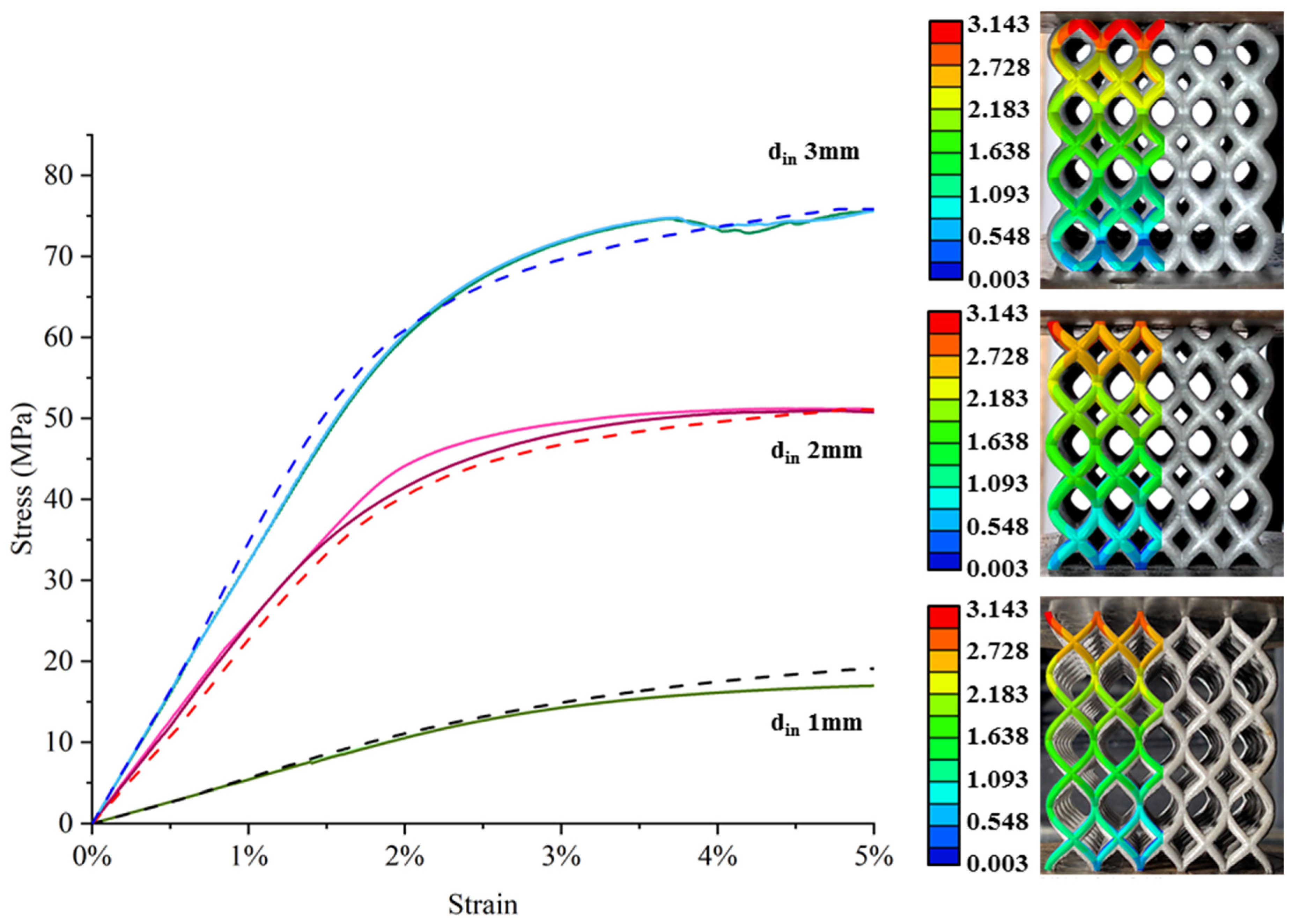
Due to the primary design purpose of this HSL as a fluid heat transfer channel, the energy absorption performance during the yield plateau and densification stages was not further investigated, as significant fracture had already occurred at this point, resulting in the loss of load-bearing and fluid transport functionality. In addition, the simulation was terminated at 5% strain; beyond this point, the structure enters a regime of large plastic deformation, self-contact, and material fracture, phenomena requiring explicit damage modeling, calibrated fracture criteria, and prohibitive computational resources. Since these nonlinear, post-yield dynamics are not central to this study’s objectives, extending the simulation to 0.4 would introduce unnecessary complexity and uncertainty without enhancing the validity of the core conclusions. Figure 18 presents the comparison between experimental and simulated stress–strain curves, showing excellent agreement in overall curve morphology, with prediction errors for both elastic modulus and yield strength within 5%, demonstrating the high reliability of the established simulation model and providing an effective numerical basis for parameter optimization and performance prediction in future gradient design efforts.
The results presented in Figure 17 and Figure 18 were obtained at a room temperature of 25 °C, with thermal loads explicitly excluded, as the deformation induced by thermal effects was found to have negligible influence on load-bearing capacity. Future work will focus on advanced thermo–mechanical coupled experiments to further characterize the performance of HSL systems.

3.3.3. Comparison with Other Cellular Lattices

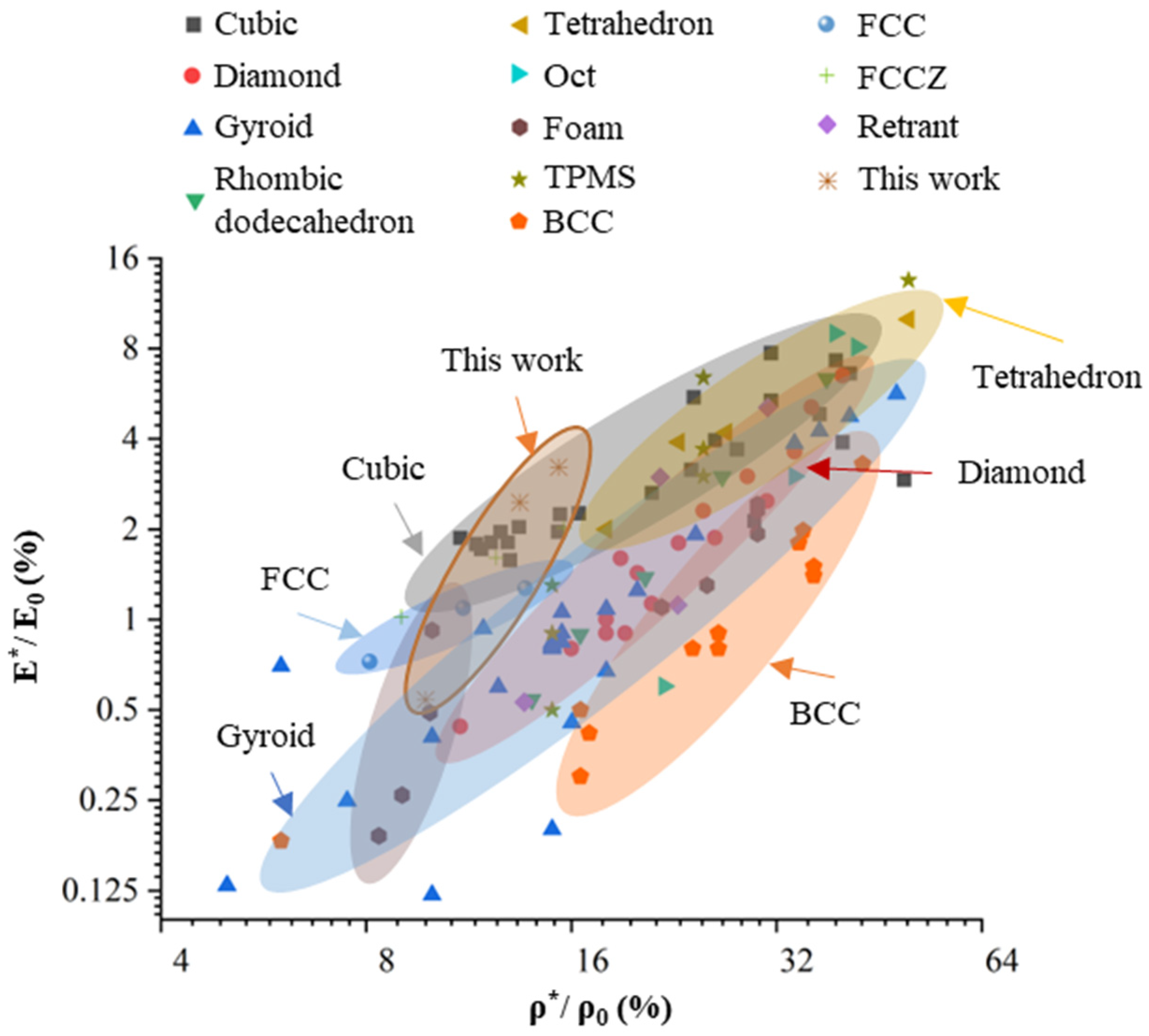
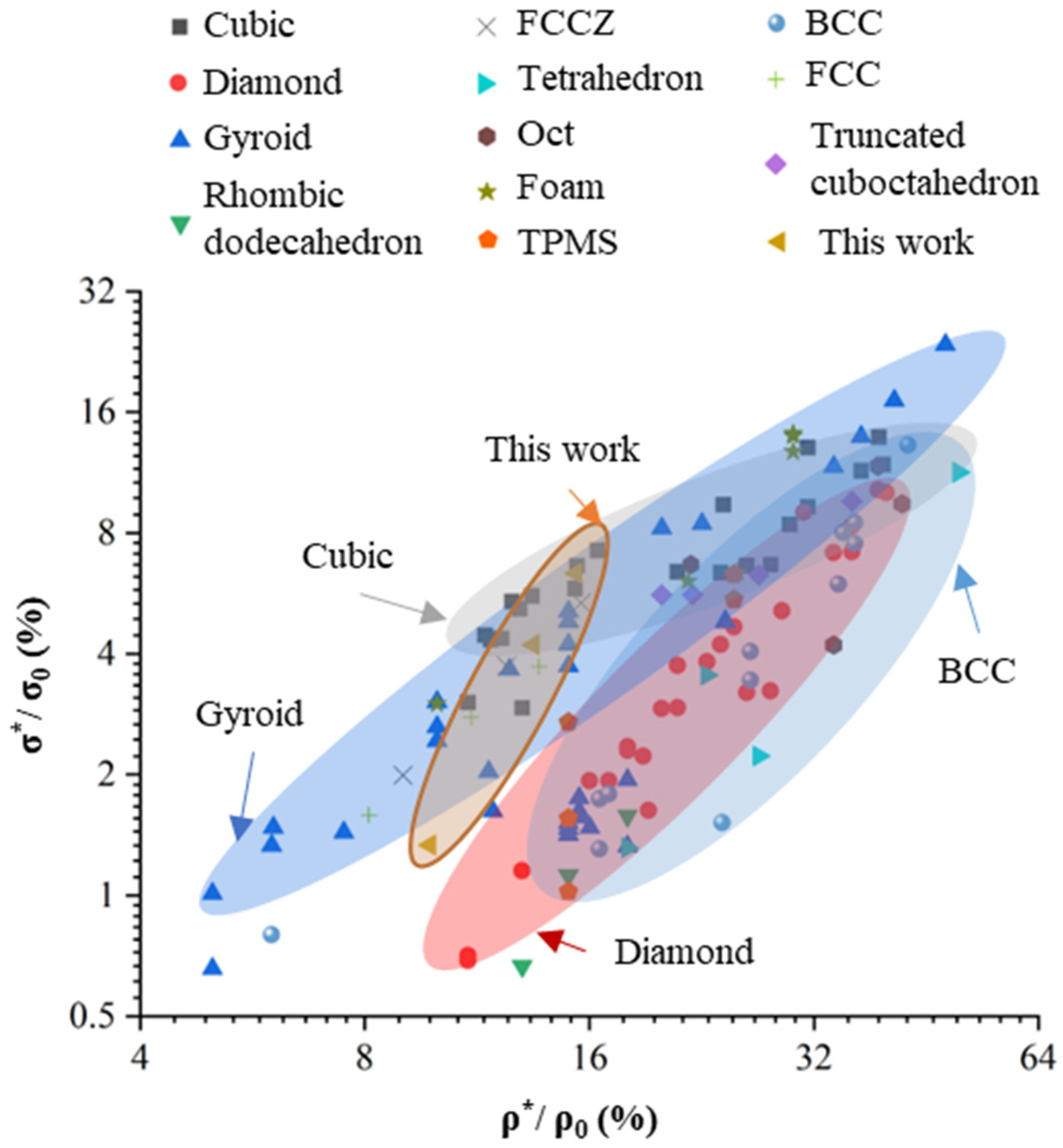
Following the quasi-static compression experiments on the HSL structure, this study systematically evaluated its mechanical performance using the Gibson–Ashby theoretical framework [39] and conducted a comparative analysis with 13 typical lattice topologies in the Ti6Al4V matrix system, as illustrated in Figure 19 and Figure 20. The plot employs the relative density (ρ/ρ0) as the horizontal axis and the normalized yield strength (σ∗/σ0) and normalized elastic modulus (E/E0) as the vertical axes, comprehensively encompassing classical rod-type lattices such as cubic [40,41], diamond [40,41,42,43], octet (OCT) [44], BCC [44], FCC [19] and FCCZ [45], as well as advanced topologies including TPMS [46] structures and Gyroid [46,47,48,49,50,51,52]. Other types of porous materials include rhombic dodecahedron [53,54,55], truncated cuboctahedron [40], re-etrant [56], tetrahedron [57], and foam [54]. Experimental data reveal that the proposed HSL exhibits significant performance advantages at identical relative densities: its elastic modulus and yield strength surpass those of BCC and diamond lattices and are comparable to those of the Gyroid structure, particularly demonstrating superior specific mechanical properties in the medium-to-high density regime (ρ/ρ0 > 10%).
At relative densities below 10%, its mechanical performance is slightly inferior to that of the cubic lattice due to the limited section moment of inertia of the thin-walled tubes; however, as the inner diameter increases from 1 mm to 3 mm, the relative density rises to 14.8%, and the bending section modulus of the tubular cross-section exhibits a fourth-power nonlinear growth, resulting in a rise in the elastic modulus from 0.54 GPa to 3.22 GPa and the yield strength from 13.22 MPa to 62.69 MPa, corresponding to increases of 500% and 374%, respectively. Beyond a relative density of 10%, the structural efficiency of the proposed HSL significantly exceeds that of conventional solid-rod lattices, with its elastic modulus and yield strength maintaining comparable levels to those of the cubic topology. This performance transition arises from the synergistic reinforcement mechanism of the helical topology and hollow tubular units: the helical path enables uniform stress distribution through continuous curvature, mitigating stress concentration at nodes; the hollow cross-section design achieves a larger moment of inertia under identical mass, thereby enhancing the critical buckling load. This structure is particularly suited for extreme applications in aerospace hot-section components and high-power electronic cooling channels that require simultaneous thermal conduction, structural load-bearing, and weight reduction, offering a novel paradigm for the design of next-generation multifunctional integrated lattice materials.

4. Conclusions

In this study, a novel parametrically designed HSL structure is proposed, enabling integrated thermal management and structural load-bearing applications via AM. The HSL structure was fabricated using LPBF technology, with its performance evaluated through CFD simulations and FE analysis, followed by validation via quasi-static compression experiments.
Optical microscopy revealed that the LPBF-fabricated Ti6Al4V specimens were free of visible macroscopic defects such as cracks and pores, with continuous, well-defined microscopic melt tracks, excellent interlayer bonding, and high geometric fidelity. The measured mass deviation gradually decreased from 6.91% to 5.32% as the inner diameter increased and eventually stabilized, confirming that process consistency met the error tolerance requirements.
In terms of thermal performance, the spiral geometry induces Dean vortices via centrifugal force, significantly enhancing momentum exchange between mainstream flow and near-wall regions to improve radial mixing efficiency. Under internal flow conditions, increasing the inner diameter from 1 mm to 3 mm reduced the average heat source temperature by 36.3% and system pressure drop by 72.7%. For combined internal–external flow conditions, the metal HSL and fluid channels synergistically formed a three-dimensional heat dissipation network with ‘internal absorption and external diffusion’ characteristics, effectively improving heat distribution uniformity and suppressing local hot spot formation. However, an excessively large inner diameter caused external flow channel blockage, leading to a sharp pressure drop rise. Through a comprehensive trade-off between thermal performance and flow resistance, a 2 mm inner diameter was identified as the Pareto optimal solution for microchannel cold plate applications, balancing high heat dissipation efficiency with low flow resistance.
Mechanical performance tests demonstrated that structural stiffness and strength improved significantly with an increasing inner diameter: the elastic modulus increased from 0.54 GPa to 3.22 GPa, while yield strength and ultimate strength rose from 13.22 MPa and 17.21 MPa to 62.69 MPa and 79.06 MPa, respectively. Compression failure propagated along an approximately 45° shear band, consistent with the typical buckling–fracture mechanism of lattice structures. Experimentally measured stress–strain curves were highly consistent with simulation results, with prediction errors of elastic modulus and yield strength both below 5%, verifying numerical model reliability.
Compared with BCC and diamond lattices, the HSL exhibited superior elastic modulus and yield strength at equal mass, approaching cubic topology performance. This advantage stems from two core mechanisms: the spiral geometry homogenizes the stress field to suppress nodal stress concentration; and the hollow tubular units significantly increase section moment of inertia at equal mass, greatly improving critical buckling load.
This structure provides a promising design paradigm for thermo–mechanical integrated functional components. The HSL structure holds practical potential in active thermal protection systems, particularly through its unique capability to isolate and independently manage internal and external fluid streams, enabling flexible spatial allocation of liquid fuel and coolant channels based on mission-specific thermal and propulsion requirements in hypersonic vehicles and reusable launch systems. Future development will focus on multi-physics optimization under thermo–mechanical coupling, hybridization with complementary lattice topologies, and tailored fluid property mapping, such as pairing high-specific-heat coolants with low-conductivity fuel streams, to enable next-generation thermal management and high-energy-density propulsion platforms.


Author Contributions

Conceptualization, S.L. and Q.S.; methodology, S.L.; software, Y.P.; validation, Q.S., Y.P. and Y.Z.; formal analysis, G.N.; investigation, Y.Z.; resources, Y.M.; data curation, B.S.; writing—original draft preparation, S.L.; writing—review and editing, J.L.; visualization, J.C.; supervision, Y.Z.; project administration, S.L.; funding acquisition, Y.Z. All authors have read and agreed to the published version of the manuscript.
Funding

This research received no external funding.

Data Availability Statement

The data that support the findings of this study are available upon reasonable request from the corresponding author.

Conflicts of Interest

The authors declare no conflicts of interest.

Abbreviations

The following abbreviations are used in this manuscript:
HSLHollow spiral lattice
AMAdditive manufacturing
LPBFLaser Powder Bed Fusion
CFDComputational Fluid Dynamics
FEAFinite Element Analysis
BCCBody-centered cubic
FCCFace-centered cubic
FCCZFace-centered cubic with Z-struts
TPMSTriple-periodic minimal surfaces
PHBCCPartially hollow body-centered cubic
OCTOctet

References

  1. Zou, T.; Song, Z.; Ou, Y. Nest hybridization of BCC and TPMS lattices: A design for high-efficiency energy absorption in additive manufacturing. Eng. Struct. 2025, 339, 120600. [Google Scholar] [CrossRef]
  2. Wang, X.; Wang, C.; Zhou, X.; Wang, D.; Zhang, M.; Gao, Y.; Wang, L.; Zhang, P. Evaluating Lattice Mechanical Properties for Lightweight Heat-Resistant Load-Bearing Structure Design. Materials 2020, 13, 4786. [Google Scholar] [CrossRef] [PubMed]
  3. Tkalčić, D.; Milovanović, B.; Gaši, M.; Jelčić Rukavina, M.; Banjad Pečur, I. Optimization of Thermal Bridges Effect of Composite Lightweight Panels with Integrated Steel Load-Bearing Structure. Energies 2023, 16, 6474. [Google Scholar] [CrossRef]
  4. Xiong, J.; Mines, R.; Ghosh, R.; Vaziri, A.; Ma, L.; Ohrndorf, A.; Christ, H.J.; Wu, L. Advanced micro-lattice materials. Adv. Eng. Mater. 2015, 17, 1253–1264. [Google Scholar] [CrossRef]
  5. Helou, M.; Kara, S. Design, analysis and manufacturing of lattice structures: An overview. Int. J. Comput. Integr. Manuf. 2018, 31, 243–261. [Google Scholar] [CrossRef]
  6. Le, V.T.; Ha, N.S.; Goo, N.S. Advanced sandwich structures for thermal protection systems in hypersonic vehicles: A review. Compos. Part B Eng. 2021, 226, 109301. [Google Scholar] [CrossRef]
  7. Bai, J.-B.; Li, S.-L.; Liu, T.-W.; Cao, P.-C.; Wu, J.-H. Variable camber structure for aircraft wing based on zero Poisson’s ratio lattice structure. J. Mech. Phys. Solids 2025, 203, 106241. [Google Scholar] [CrossRef]
  8. Yang, J.; Liu, H.; Cai, G.; Jin, H. Additive Manufacturing and Influencing Factors of Lattice Structures: A Review. Materials 2025, 18, 1397. [Google Scholar] [CrossRef]
  9. Khan, N.; Riccio, A. A systematic review of design for additive manufacturing of aerospace lattice structures: Current trends and future directions. Prog. Aerosp. Sci. 2024, 149, 101021. [Google Scholar] [CrossRef]
  10. Gong, C.; Ritchie, R.O.; Wei, X.; Liu, Q.; Xiong, J. Mechanical properties of modular assembled composite lattice architecture. J. Mech. Phys. Solids 2025, 195, 105967. [Google Scholar] [CrossRef]
  11. Chen, Y.; Jia, Z.; Wang, L. Hierarchical honeycomb lattice metamaterials with improved thermal resistance and mechanical properties. Compos. Struct. 2016, 152, 395–402. [Google Scholar] [CrossRef]
  12. Chen, Y.; Tao, Y.; Xu, B.; Ai, S.; Fang, D. Assessment of thermal-mechanical performance with structural efficiency concept on design of lattice-core thermal protection system. Appl. Therm. Eng. 2018, 143, 200–208. [Google Scholar] [CrossRef]
  13. Li, S.; Yuan, S.; Zhu, J.; Wang, C.; Li, J.; Zhang, W. Additive manufacturing-driven design optimization: Building direction and structural topology. Addit. Manuf. 2020, 36, 101406. [Google Scholar] [CrossRef]
  14. Li, S.; Yuan, S.; Zhu, J.; Zhang, W.; Tang, Y.; Wang, C.; Li, J. Optimal and adaptive lattice design considering process-induced material anisotropy and geometric inaccuracy for additive manufacturing. Struct. Multidiscip. Optim. 2022, 65, 35. [Google Scholar] [CrossRef]
  15. Ho, J.Y.; Leong, K.C.; Wong, T.N. Additively-manufactured metallic porous lattice heat exchangers for air-side heat transfer enhancement. Int. J. Heat Mass Transf. 2020, 150, 119262. [Google Scholar] [CrossRef]
  16. Ho, J.Y.; Leong, K.C.; Wong, T.N. Experimental and numerical investigation of forced convection heat transfer in porous lattice structures produced by selective laser melting. Int. J. Therm. Sci. 2019, 137, 276–287. [Google Scholar] [CrossRef]
  17. Dixit, T.; Al-Hajri, E.; Paul, M.C.; Nithiarasu, P.; Kumar, S. High performance, microarchitected, compact heat exchanger enabled by 3D printing. Appl. Therm. Eng. 2022, 210, 118339. [Google Scholar] [CrossRef]
  18. Shu, Z.; Zhao, K.; Li, H.; Gao, L. Multi-scale topology optimization for graded hollow lattice structures with variable wall thickness. Thin-Walled Struct. 2025, 213, 113274. [Google Scholar] [CrossRef]
  19. Han, B.; Song, H.; Wang, Y.; Zhang, Q. Superior compressive behaviour of alveolar biomimetic interlaced hollow lattice metastructures. Virtual Phys. Prototyp. 2025, 20, e2512166. [Google Scholar] [CrossRef]
  20. Wu, J.; Zhang, Y.; Yang, F.; Jiang, F.; Xu, X.; Tan, Y.; Su, L. A hybrid architectural metamaterial combing plate lattice and hollow-truss lattice with advanced mechanical performances. Addit. Manuf. 2023, 76, 103764. [Google Scholar] [CrossRef]
  21. Ye, H.; Tian, F.; He, W.; Wang, S. Mechanical and thermal property analysis and optimization design of hybrid lattice structure based on triply periodic minimal surfaces. Thin-Walled Struct. 2024, 203, 112203. [Google Scholar] [CrossRef]
  22. Wang, J.; Yuan, B.; Pu, H.; Yang, C.; Sun, M.; Guan, Y.; Mu, L.; Dong, M. Multi-objective optimization of 3D-Kagome lattice sandwich structures for improved heat transfer and flow resistance based on response surface method. Int. J. Heat Mass Transf. 2026, 256, 128075. [Google Scholar] [CrossRef]
  23. Yu, X.; Moreira, T.A.; Chen, B.; Rankouhi, B.; Thoma, D.J.; Anderson, M.H.; Qian, X. Data-driven optimization, additive manufacturing and thermohydraulic testing of a high-temperature Gyroid-based TPMS heat exchanger. Appl. Therm. Eng. 2025, 280, 128422. [Google Scholar] [CrossRef]
  24. Luo, S.; Tang, Z.; Song, J.; Liu, J.; Li, D. Transient numerical investigation on coupled heat transfer of regenerative cooling channels with typical lattice sandwich structures. Int. Commun. Heat Mass Transf. 2025, 169, 109751. [Google Scholar] [CrossRef]
  25. Li, J.; Yu, W.; Wang, P.; Zhang, M.; Bai, Y.; Hao, H. A novel nested hollow-walled lattice mechanical metamaterial combining strut and thin wall with advanced stress stability and energy absorption performance. Thin-Walled Struct. 2026, 223, 114477. [Google Scholar] [CrossRef]
  26. Noronha, J.; Dash, J.; Basyal, G.; Haberl, E.; Leary, M.; Brandt, M.; Dekiwadia, C.; Qian, M. Engineering hollow-strut lattice nodes for enhanced load-bearing with cubic symmetry. Int. J. Mech. Sci. 2025, 307, 110923. [Google Scholar] [CrossRef]
  27. Noronha, J.; Dash, J.; Rogers, J.; Leary, M.; Brandt, M.; Qian, M. Titanium Multi-Topology Metamaterials with Exceptional Strength. Adv. Mater. 2024, 36, 2308715. [Google Scholar] [CrossRef]
  28. Guo, Z.; Yang, F.; Li, P.; Li, L.; Zhao, M.; Shi, J.; Zhang, L.; Cai, Y. A partially hollow BCC lattice structure with capsule-shaped cavities for enhancing load-bearing and energy absorption properties. Eng. Struct. 2024, 305, 117777. [Google Scholar] [CrossRef]
  29. Cao, Y.; Ke, H.; Klemeš, J.J.; Zeng, M.; Wang, Q. Comparison of aerodynamic noise and heat transfer for shell-and-tube heat exchangers with continuous helical and segmental baffles. Appl. Therm. Eng. 2021, 185, 116341. [Google Scholar] [CrossRef]
  30. Ma, C.; Guo, Y.; Kong, D.; Lan, Q.; Liu, X. Optimal structural analysis of spiral microchannel based on chip heat dissipation. Int. Commun. Heat Mass Transf. 2026, 171, 110137. [Google Scholar] [CrossRef]
  31. Ma, C.; Guo, Y.; Kong, D.; Liu, X. The analysis of flow and heat transfer characteristics in spiral microchannel heat sinks. Int. J. Heat Fluid Flow 2026, 117, 110106. [Google Scholar] [CrossRef]
  32. Kluge, E.; Bilal, O.R. Ultra-lightweight multi-functional gyroid-based metamaterial for simultaneous sound insulation, vibration suppression, and impact mitigation in all directions. Mater. Des. 2025, 259, 114652. [Google Scholar] [CrossRef]
  33. Carton, M.; Surjadi, J.U.; Aymon, B.F.G.; Xu, L.; Portela, C.M. Design framework for programmable three-dimensional woven metamaterials. Nat. Commun. 2026, 17, 1581. [Google Scholar] [CrossRef] [PubMed]
  34. Abdulhameed, O.; Al-Ahmari, A.; Ameen, W.; Mian, S.H. Additive manufacturing: Challenges, trends, and applications. Adv. Mech. Eng. 2019, 11, 1687814018822880. [Google Scholar] [CrossRef]
  35. Montemurro, M.; Bertolino, G.; Roiné, T. A general multi-scale topology optimisation method for lightweight lattice structures obtained through additive manufacturing technology. Compos. Struct. 2021, 258, 113360. [Google Scholar] [CrossRef]
  36. Sun, Q.; Geng, D.; Guo, J.; Zhou, S.; Chen, M.; Tao, R. Numerical and experimental analysis of hydraulic and thermal performance in additively manufactured topology-optimized heat sinks with different geometric features. Appl. Therm. Eng. 2025, 274, 126619. [Google Scholar] [CrossRef]
  37. Tilton, M.; Borjali, A.; Isaacson, A.; Varadarajan, K.M.; Manogharan, G.P. On structure and mechanics of biomimetic meta-biomaterials fabricated via metal additive manufacturing. Mater. Des. 2021, 201, 109498. [Google Scholar] [CrossRef]
  38. Mazur, M.; Leary, M.; Sun, S.; Vcelka, M.; Shidid, D.; Brandt, M. Deformation and failure behaviour of Ti-6Al-4V lattice structures manufactured by selective laser melting (SLM). Int. J. Adv. Manuf. Technol. 2016, 84, 1391–1411. [Google Scholar] [CrossRef]
  39. Zhong, H.; Song, T.; Li, C.; Das, R.; Gu, J.; Qian, M. The Gibson-Ashby model for additively manufactured metal lattice materials: Its theoretical basis, limitations and new insights from remedies. Curr. Opin. Solid State Mater. Sci. 2023, 27, 101081. [Google Scholar] [CrossRef]
  40. Yavari, S.A.; Ahmadi, S.M.; Wauthle, R.; Pouran, B.; Schrooten, J.; Weinans, H.; Zadpoor, A.A. Relationship between unit cell type and porosity and the fatigue behavior of selective laser melted meta-biomaterials. J. Mech. Behav. Biomed. Mater. 2015, 43, 91–100. [Google Scholar] [CrossRef]
  41. Kadkhodapour, J.; Montazerian, H.; Darabi, A.C.; Anaraki, A.P.; Ahmadi, S.M.; Zadpoor, A.A.; Schmauder, S. Failure mechanisms of additively manufactured porous biomaterials: Effects of porosity and type of unit cell. J. Mech. Behav. Biomed. Mater. 2015, 50, 180–191. [Google Scholar] [CrossRef]
  42. Hrabe, N.W.; Heinl, P.; Flinn, B.; Körner, C.; Bordia, R.K. Compression-compression fatigue of selective electron beam melted cellular titanium (Ti-6Al-4V). J. Biomed. Mater. Res. Part B Appl. Biomater. 2011, 99, 313–320. [Google Scholar] [CrossRef] [PubMed]
  43. Heinl, P.; Körner, C.; Singer, R.F. Selective electron beam melting of cellular titanium: Mechanical properties. Adv. Eng. Mater. 2008, 10, 882–888. [Google Scholar] [CrossRef]
  44. Wang, S.; Liu, L.; Li, K.; Zhu, L.; Chen, J.; Hao, Y. Pore functionally graded Ti6Al4V scaffolds for bone tissue engineering application. Mater. Des. 2019, 168, 107643. [Google Scholar] [CrossRef]
  45. Zhong, H.; Das, R.; Gu, J.; Qian, M. Low-density, high-strength metal mechanical metamaterials beyond the Gibson-Ashby model. Mater. Today 2023, 68, 96–107. [Google Scholar] [CrossRef]
  46. Bobbert, F.S.L.; Lietaert, K.; Eftekhari, A.A.; Pouran, B.; Ahmadi, S.M.; Weinans, H.; Zadpoor, A.A. Additively manufactured metallic porous biomaterials based on minimal surfaces: A unique combination of topological, mechanical, and mass transport properties. Acta Biomater. 2017, 53, 572–584. [Google Scholar] [CrossRef]
  47. Yang, E.; Leary, M.; Lozanovski, B.; Downing, D.; Mazur, M.; Sarker, A.; Khorasani, A.; Jones, A.; Maconachie, T.; Bateman, S. Effect of geometry on the mechanical properties of Ti-6Al-4V Gyroid structures fabricated via SLM: A numerical study. Mater. Des. 2019, 184, 108165. [Google Scholar] [CrossRef]
  48. Yan, C.; Hao, L.; Hussein, A.; Young, P. Ti–6Al–4V triply periodic minimal surface structures for bone implants fabricated via selective laser melting. J. Mech. Behav. Biomed. Mater. 2015, 51, 61–73. [Google Scholar] [CrossRef] [PubMed]
  49. Ataee, A.; Li, Y.; Fraser, D.; Song, G.; Wen, C. Anisotropic Ti-6Al-4V gyroid scaffolds manufactured by electron beam melting (EBM) for bone implant applications. Mater. Des. 2018, 137, 345–354. [Google Scholar] [CrossRef]
  50. Yánez, A.; Cuadrado, A.; Martel, O.; Afonso, H.; Monopoli, D. Gyroid porous titanium structures: A versatile solution to be used as scaffolds in bone defect reconstruction. Mater. Des. 2018, 140, 21–29. [Google Scholar] [CrossRef]
  51. Challis, V.J.; Xu, X.; Zhang, L.C.; Roberts, A.P.; Grotowski, J.F.; Sercombe, T.B. High specific strength and stiffness structures produced using selective laser melting. Mater. Des. 2014, 63, 783–788. [Google Scholar] [CrossRef]
  52. Yan, C.; Hao, L.; Hussein, A.; Raymont, D. Evaluations of cellular lattice structures manufactured using selective laser melting. Int. J. Mach. Tools Manuf. 2012, 62, 32–38. [Google Scholar] [CrossRef]
  53. Zhao, S.; Li, S.J.; Wang, S.G.; Hou, W.T.; Li, Y.; Zhang, L.C.; Hao, Y.L.; Yang, R.; Misra, R.D.K.; Murr, L.E. Compressive and fatigue behavior of functionally graded Ti-6Al-4V meshes fabricated by electron beam melting. Acta Mater. 2018, 150, 1–15. [Google Scholar] [CrossRef]
  54. Cheng, X.Y.; Li, S.J.; Murr, L.E.; Zhang, Z.B.; Hao, Y.L.; Yang, R.; Medina, F.; Wicker, R.B. Compression deformation behavior of Ti–6Al–4V alloy with cellular structures fabricated by electron beam melting. J. Mech. Behav. Biomed. Mater. 2012, 16, 153–162. [Google Scholar] [CrossRef]
  55. Horn, T.J.; Harrysson, O.L.A.; Marcellin-Little, D.J.; West, H.A.; Lascelles, B.D.X.; Aman, R. Flexural properties of Ti6Al4V rhombic dodecahedron open cellular structures fabricated with electron beam melting. Addit. Manuf. 2014, 1, 2–11. [Google Scholar] [CrossRef]
  56. Yang, L.; Harrysson, O.; West, H.; Cormier, D. Compressive properties of Ti–6Al–4V auxetic mesh structures made by electron beam melting. Acta Mater. 2012, 60, 3370–3379. [Google Scholar] [CrossRef]
  57. Melancon, D.; Bagheri, Z.S.; Johnston, R.B.; Liu, L.; Tanzer, M.; Pasini, D. Mechanical characterization of structurally porous biomaterials built via additive manufacturing: Experiments, predictive models, and design maps for load-bearing bone replacement implants. Acta Biomater. 2017, 63, 350–368. [Google Scholar] [CrossRef] [PubMed]
Figure 1. (a) Single right-handed helix; (b) unrolled projection of the helix forming a 2D right triangle.
Aerospace 13 00368 g001
Figure 2. The unit cell of the four-helix symmetric HSL.
Aerospace 13 00368 g002
Figure 3. Three HSLs with different inner diameters.
Aerospace 13 00368 g003
Figure 4. Heat transfer configuration schematic of Case 1.
Aerospace 13 00368 g004
Figure 5. Heat transfer configuration schematic of Case 2.
Aerospace 13 00368 g005
Figure 6. The key cross-sectional mesh distribution.
Aerospace 13 00368 g006
Figure 7. The stress–strain responses of printed material.
Aerospace 13 00368 g007
Figure 8. FE model of the HSL.
Aerospace 13 00368 g008
Figure 9. Velocity distribution of HSL in Case 1 with different din: (a) 1 mm, (b) 2 mm, (c) 3 mm.
Aerospace 13 00368 g009aAerospace 13 00368 g009b
Figure 10. Pressure distribution of HSL in Case 1 with different din: (a) 1 mm, (b) 2 mm, (c) 3 mm.
Aerospace 13 00368 g010
Figure 11. Temperature distribution of HSL in Case 1 with different din: (a) 1 mm, (b) 2 mm, (c) 3 mm.
Aerospace 13 00368 g011
Figure 12. Velocity distribution of HSL in Case 2 with different din: (a) 1 mm, (b) 2 mm, (c) 3 mm.
Aerospace 13 00368 g012
Figure 13. Pressure distribution of HSL in Case 2 with different din: (a) 1 mm, (b) 2 mm, (c) 3 mm.
Aerospace 13 00368 g013aAerospace 13 00368 g013b
Figure 14. Temperature distribution of HSL in Case 2 with different din: (a) 1 mm, (b) 2 mm, (c) 3 mm.
Aerospace 13 00368 g014
Figure 15. HSL structures from three different perspectives.
Aerospace 13 00368 g015
Figure 16. The macroscopic morphologies of the HSL with different din.
Aerospace 13 00368 g016
Figure 17. The stress–strain curves of three HSL structures.
Aerospace 13 00368 g017
Figure 18. The comparison between experimental and simulated stress–strain curves.
Aerospace 13 00368 g018
Figure 19. Log–log plot with the Gibson–Ashby model for relative elastic modulus versus relative density.
Aerospace 13 00368 g019
Figure 20. Log–log plot with the Gibson–Ashby model for relative yield strength versus relative density.
Aerospace 13 00368 g020
Table 1. The theoretical and actual relative densities of the three HSLs.
Inner Diameter (mm)Theoretical Relative DensityActual Relative Density
16.55%8.89%
29.29%12.23%
311.22%13.95%
Table 2. The key geometric parameters of the HSL structure.
Geometric ParameterValueLPBF ConstraintValue
Helical radius5 mmBuild platform maximum size300 mm
Helix angle45°Maximum build height400 mm
din1 mm, 2 mm, 3 mmMaximum overhang angle≥45°
dout2 mm, 3 mm, 4 mmMinimum forming capability≥0.3 mm
Table 3. Main physical property parameters of materials used in CFD simulations.
ExperimentMaterialDensity (kg/m3)Thermal Conductivity (W/(m·K))Specific Heat Capacity (J/(kg·K))Dynamic Viscosity (Pa·s)
HSLTi6Al4V48507.44544.3-
Heat sourcePure copper8978381387.6-
CoolantDeionized water998.20.641820.001
Table 4. The grid element distribution for computational models.
ConditiondinFluidHSLHeat SourceTotal Number
Case 11 mm823,501747,469158,3811,729,351
2 mm445,188372,179155,365972,732
3 mm337,518262,965140,834741,317
Case 21 mm1,546,756820,977159,2542,526,987
2 mm882,346320,202154,8971,357,445
3 mm662,870250,705141,5061,055,081
Table 5. CFD simulation result of Case 1.
Inner Diameter (mm)Heat Source Bottom Average Temperature (°C)Minimum Temperature (°C)Maximum Temperature (°C)Pressure Drop (Pa)
1112.1098.91124.08298.23
280.16475.7484.74113.77
371.6069.4774.9481.33
Table 6. CFD simulation results of Case 2.
Inner Diameter (mm)Heat Source Bottom Average Temperature (°C)Minimum Temperature (°C)Maximum Temperature (°C)Pressure Drop (Pa)
1158.82121.02187.4050.85
2138.41113.93164.15108.33
3132.43110.29152.79172.19
Table 7. Grid convergence study of CFD simulations.
Grid SizeHeat Source Bottom Average Temperature (°C)Maximum Temperature (°C)Pressure Drop (Pa)
102,052130.25163.21100.25
250,520135.35165.98103.58
590,655137.25165.85106.58
1,357,445138.41164.15108.33
1,680,480138.93163.12109.41
1,945,092139.85163.05110.58
Table 8. The mass deviation analysis of the formed HSLs.
din (mm)Actual Mass (g)Real Mass (g)Deviation
169.474.26.91%
2101.4107.96.41%
3125.8132.55.32%
Disclaimer/Publisher’s Note: The statements, opinions and data contained in all publications are solely those of the individual author(s) and contributor(s) and not of MDPI and/or the editor(s). MDPI and/or the editor(s) disclaim responsibility for any injury to people or property resulting from any ideas, methods, instructions or products referred to in the content.