
A Review on Intelligent Combustion Control and Clean-Fuel Strategies for Aviation Heavy-Fuel Piston Engines


Abstract
1. Overview
2. Development Status of Combustion-Chamber Technologies for Heavy-Fuel Aero-Piston Engines
2.1. Basic Principles and Types of Combustion Chambers
2.2. Key Technical Indices and Performance Parameters for Combustor Design
2.3. Development Trends of Advanced Combustor Technologies
3. Emission Characteristics and Influencing Factors of Heavy-Fuel Aero-Piston Engines
3.1. Main Pollutants from Engine Emissions and Their Hazards

3.2. Relationship Between Emissions and the Combustion Process
4. Technical Measures for Emission Reduction in Heavy-Fuel Aero-Piston Engines
4.1. Combustor Optimization Technologies
4.2. Exhaust After-Treatment Technologies
4.3. Impact of Alternative Fuels on Emissions
5. Conclusions and Outlook
Author Contributions
Funding
Data Availability Statement
Acknowledgments
Conflicts of Interest
References
- Pitari, G.; Iachetti, D.; Di Genova, G.; De Luca, N.; Søvde, O.A.; Hodnebrog, Ø.; Lee, D.S.; Lim, L.L. Impact of Coupled NOx/Aerosol Aircraft Emissions on Ozone Photochemistry and Radiative Forcing. Atmosphere 2015, 6, 751–782. [Google Scholar] [CrossRef] [Scilit]
- Matthes, S.; Lee, D.S.; De Leon, R.R.; Lim, L.; Owen, B.; Skowron, A.; Thor, R.N.; Terrenoire, E. Review: The Effects of Supersonic Aviation on Ozone and Climate. Aerospace 2022, 9, 41. [Google Scholar] [CrossRef] [Scilit]
- Shao, L.; Zhou, Y.; Zhao, S.; Yu, T.; Zhu, K.; Ding, S.; Xu, Z. Study of Scavenging and Combustion Processes for Small Two-Stroke Aviation Heavy Fuel Direct Injection Engines. Processes 2023, 11, 583. [Google Scholar] [CrossRef] [Scilit]
- Khan, M.A.H.; Brierley, J.; Tait, K.N.; Bullock, S.; Shallcross, D.E.; Lowenberg, M.H. The Emissions of Water Vapour and NOx from Modelled Hydrogen-Fuelled Aircraft and the Impact of NOx Reduction on Climate Compared with Kerosene-Fuelled Aircraft. Atmosphere 2022, 13, 1660. [Google Scholar] [CrossRef] [Scilit]
- Lang, M.; Sun, Y.; Wang, Y.; Shen, B.; Zhang, Y.; Qian, D. Simulation Study on the Effects of Combustion Chamber Structures on Reactivity Controlled Compression Ignition Engines Under Medium Loads. Chin. Intern. 2024, 45, 18–27+36. [Google Scholar]
- Shao, L.; Zhou, Y.; Geng, T.; Zhao, S.; Zhu, K.; Zhong, Z.; Yan, H.; Yu, T.; Xu, Z.; Ding, S. Advanced combustion in heavy fuel aircraft piston engines: A comprehensive review and future directions. Fuel 2024, 370, 131771. [Google Scholar] [CrossRef] [Scilit]
- Prashanth, P.; Speth, R.L.; Eastham, S.D.; Sabnis, J.S.; Barrett, S.R.H. Post-combustion emissions control in aero-gas turbine engines. Energy Environ. Sci. 2021, 14, 916–930. [Google Scholar] [CrossRef] [Scilit]
- Fritz, T.M.; Dedoussi, I.C.; Eastham, S.D.; Speth, R.L.; Henze, D.K.; Barrett, S.R. Identifying the ozone-neutral aircraft cruise altitude. Atmos. Environ. 2022, 276, 119057. [Google Scholar] [CrossRef] [Scilit]
- Duan, X.; Zeng, D.; Yuna, H.; Pan, S.; Han, W. Effects of Fuel Injection Strategies on Combustion and Emission Characteristics of A Diesel Engine Fueled with N-Butanol and Polyoxymethylene Dimethyl Ether/Diesel Blends. Chin. Intern. Combust. Engine Eng. 2023, 44, 8–16. [Google Scholar]
- Chen, M.; Gong, H.; Huang, F.; Yang, J.; Chen, G.; Wei, F. Research on Combustion and Soot Emission Characteristics of a Dual Direct Injection Engine Based on the Combined Control of Nozzle Arrangements and Injection Parameters. Chin. Intern. Combust. Engine Eng. 2023, 44, 17–25+33. [Google Scholar]
- Zhang, J.; Wuebbles, D.; Pfaender, J.H.; Kinnison, D.; Davis, N. Potential Impacts on Ozone and Climate from a Proposed Fleet of Supersonic Aircraft. Earth’s Future 2023, 11, e2022EF003409. [Google Scholar] [CrossRef] [Scilit]
- Terrenoire, E.; Hauglustaine, D.A.; Cohen, Y.; Cozic, A.; Valorso, R.; Lefèvre, F.; Matthes, S. Impact of present and future aircraft NOx and aerosol emissions on atmospheric composition and associated direct radiative forcing of climate. Atmos. Chem. Phys. 2022, 22, 11987–12023. [Google Scholar] [CrossRef] [Scilit]
- Song, Y.; Zhou, Y.; Zhao, S.; Du, F.-R.; Li, X.-Y.; Zhu, K.; Yan, H.-S.; Xu, Z.; Ding, S.-T. Cyclic coupling and working characteristics analysis of a novel combined cycle engine concept for aviation applications. Energy 2024, 301, 131747. [Google Scholar] [CrossRef] [Scilit]
- Wang, M.; Chang, L.; Hu, X.; Zhu, M.; Zhang, B.; Li, G.; Xu, Z. Investigation on the particle loss and applicability of aviation nvPM measurement methodology for wide particle size ranges. Particuology 2024, 95, 154–165. [Google Scholar] [CrossRef] [Scilit]
- Kinnison, D.; Brasseur, G.P.; Baughcum, S.L.; Zhang, J.; Wuebbles, D. The Impact on the Ozone Layer of a Potential Fleet of Civil Hypersonic Aircraft. Earth’s Future 2020, 8, e2020EF001626. [Google Scholar] [CrossRef] [Scilit]
- Cai, Y.; Liu, C.; Guo, H.J.; Wen, Y.; Wang, Z.; Xie, L.C. Finite Analysis of Temperature and Stress Fields and Structural Improvements for a Heavy-Duty Diesel Piston. Chin. Intern. Combust. Engine Eng. 2020, 41, 1–11. [Google Scholar]
- Pastor, J.V.; García, A.; Micó, C.; Lewiski, F.; Vassallo, A.; Pesce, F.C. Effect of a novel piston geometry on the combustion process of a light-duty compression ignition engine: An optical analysis. Energy 2021, 221, 119764. [Google Scholar] [CrossRef] [Scilit]
- Xu, Z.; Pei, J.; Ding, S.; Chen, L.; Zhao, S.; Shen, X.; Zhu, K.; Shao, L.; Zhong, Z.; Yan, H.; et al. Gas exchange optimization in aircraft engines using sustainable aviation fuel: A design of experiment and genetic algorithm approach. Energy AI 2024, 17, 100396. [Google Scholar] [CrossRef] [Scilit]
- Xu, Z.; Pei, J.; Song, Y. The Optimization of Aviation Technologies and Design Strategies for a Carbon-Neutral Future. Symmetry 2024, 16, 1226. [Google Scholar] [CrossRef] [Scilit]
- Pan, Z.; Deng, Y.; Cheng, L. Regular Analysis of Aero-Diesel Piston Engine between Combustion Chamber Size and Emission. Int. J. Aerosp. Eng. 2019, 2019, 1–12. [Google Scholar] [CrossRef] [Scilit]
- Finkelberg, L.; Kostuchenkov, A.; Zelentsov, A.; Minin, V. Improvement of Combustion Process of Spark-Ignited Aviation Wankel Engine. Energies 2019, 12, 2292. [Google Scholar] [CrossRef] [Scilit]
- Hao, Y.; Wang, G.; Wang, Q.; Li, X. Numerical simulation on structural optimization design of combustion chamber of high strength diesel engine. Energy Sources Part A Recovery Util. Environ. Eff. 2022, 44, 9682–9702. [Google Scholar]
- Xu, Z.; Wang, M.; Chang, L.; Pan, K.; Shen, X.; Zhong, S.; Xu, J.; Liu, L.; Li, G.; Chen, L. Assessing the particulate matter emission reduction characteristics of small turbofan engine fueled with 100% HEFA sustainable aviation fuel. Sci. Total Environ. 2024, 945, 174128. [Google Scholar] [CrossRef] [Scilit]
- Di Blasio, G.; Ianniello, R.; Beatrice, C.; Pesce, F.C.; Vassallo, A.; Belgiorno, G. Additive manufacturing new piston design and injection strategies for highly efficient and ultra-low emissions combustion in view of 2030 targets. Fuel 2023, 346, 128270. [Google Scholar] [CrossRef] [Scilit]
- Sener, R.; Yangaz, M.U.; Gul, M.Z. Effects of injection strategy and combustion chamber modification on a single-cylinder diesel engine. Fuel 2020, 266, 117122. [Google Scholar] [CrossRef] [Scilit]
- Safieddin Ardebili, S.M.; Babagiray, M.; Aytav, E.; Can, Ö.; Boroiu, A.-A. Multi-objective optimization of DI diesel engine performance and emission parameters fueled with Jet-A1—Diesel blends. Energy 2022, 242, 122997. [Google Scholar] [CrossRef] [Scilit]
- Lu, Y.; Pan, J.; Fan, B.; Otchere, P.; Chen, W.; Cheng, B. Research on the application of aviation kerosene in a direct injection rotary engine-Part 1: Fundamental spray characteristics and optimized injection strategies. Energy Convers. Manag. 2019, 195, 519–532. [Google Scholar] [CrossRef] [Scilit]
- Sapra, H.; Hessel, R.; Miganakallu, N.; Stafford, J.; Amezcua, E.; Rothamer, D.; Kim, K.; Kweon, C.; Kokjohn, S. Computational fluid dynamics and Machine learning-based Piston-Bowl optimization for Energy-Assisted compression ignition of low cetane number sustainable aviation fuel blends. Energy Convers. Manag. 2024, 300, 117929. [Google Scholar] [CrossRef] [Scilit]
- Zhang, S.; Zhao, Z.; Wang, L.; Yu, C.; Yang, Z.; Wang, S. Experimental study on the effects of injection pressure on the combustion in a SI aviation piston engine fueled with kerosene. Fuel 2023, 354, 128875. [Google Scholar] [CrossRef] [Scilit]
- Zhu, Z.; Li, Y.; Yang, Z.; Xie, Y.; Sun, C.; Xia, Y. Optimization of combustion chamber geometry for a two-stroke spark-ignited direct-injection opposed-piston rod-less aviation kerosene engine. Fuel 2025, 381, 133503. [Google Scholar] [CrossRef] [Scilit]
- Zhang, J.; Yan, F.; Chen, Z.; Wang, Y. Combustion and Emissions Characteristics of N-Butanol/Diesel Engine and Impact of Injection Strategy and Combustion Chamber Geometry. Chin. Intern. Combust. Engine Eng. 2024, 42, 23–30. [Google Scholar]
- Cui, H.; Zhao, Z.; Zhang, F.; Yu, C.; Wang, L. Effect of pre-chamber volume on combustion characteristics of an SI aircraft piston engine fueled with RP3. Fuel 2021, 286, 119238. [Google Scholar] [CrossRef] [Scilit]
- Xu, Z.; Wang, M.; Li, G.; Hu, X.; Yang, P.; Zhu, M.; Zhang, B.; Chang, L.; Chen, L. Experimental Investigation of Particulate Number Measurement Methodology for Micro-Turbojet Engine Emissions. Aerospace 2024, 11, 548. [Google Scholar] [CrossRef] [Scilit]
- Lv, Y.-G.; Zhang, G.-P.; Wang, Q.-W.; Chu, W.-X. Thermal Management Technologies Used for High Heat Flux Automobiles and Aircraft: A Review. Energies 2022, 15, 8316. [Google Scholar] [CrossRef] [Scilit]
- Stefanizzi, M.; Capurso, T.; Filomeno, G.; Torresi, M.; Pascazio, G. Recent Combustion Strategies in Gas Turbines for Propulsion and Power Generation toward a Zero-Emissions Future: Fuels, Burners, and Combustion Techniques. Energies 2021, 14, 6694. [Google Scholar] [CrossRef] [Scilit]
- Zhou, Y.; Jiang, Y.; Lu, C.; Huang, J.; Pei, J.; Xing, T.; Zhao, S.; Zhu, K.; Yan, H.; Xu, Z.; et al. A review of 5-axis milling techniques for centrifugal impellers: Tool-path generation and deformation control. J. Manuf. Process. 2024, 131, 160–186. [Google Scholar] [CrossRef] [Scilit]
- Ciupek, B.; Brodzik, Ł.; Frąckowiak, A. Research on Carbon Footprint Reduction During Hydrogen Co-Combustion in a Turbojet Engine. Energies 2024, 17, 5397. [Google Scholar] [CrossRef] [Scilit]
- Liu, S.; He, R.; Bi, Y.; Shen, L.; Yan, Z.; Peng, Y. Research on Combustion and Emission Characteristics of Hydrogen/Diesel Dual Fuel Engines at Different Altitudes. Chin. Intern. Combust. Engine Eng. 2024, 45, 29–37+46. [Google Scholar]
- Duan, X.; Yuan, H.; Pan, S.; Yu, Z.; Zeng, J.; Han, W. Effect of Pre-Injection Ratio on Combustion and Emissions of n-Butanol and PODE Blended Diesel Fue. Trans. Csice 2024, 42, 517–525. [Google Scholar]
- Masera, K.; Hossain, A.K. Advancement of biodiesel fuel quality and NOx emission control techniques. Renew. Sustain. Energy Rev. 2023, 178, 113235. [Google Scholar] [CrossRef] [Scilit]
- Cao, D.N.; Hoang, A.T.; Luu, H.Q.; Bui, V.G.; Tran, T.T.H. Effects of injection pressure on the NOx and PM emission control of diesel engine: A review under the aspect of PCCI combustion condition. Energy Sources Part A Recovery Util. Environ. Eff. 2020, 46, 7414–7431. [Google Scholar]
- Xu, Z.; Fan, Y.; Zheng, Y.; Ding, S.; Zhu, M.; Li, G.; Wang, M.; Yu, Z.; Song, Y.; Chang, L.; et al. Emission Reduction Characteristics of Heavy-Fuel Aircraft Piston Engine Fueled with 100% HEFA Sustainable Aviation Fuel. Environ. Pollut. 2025, 368, 125661. [Google Scholar] [CrossRef] [Scilit]
- Palash, S.M.; Masjuki, H.; Kalam, M.; Masum, B.; Sanjid, A.; Abedin, M. State of the art of NOx mitigation technologies and their effect on the performance and emission characteristics of biodiesel-fueled Compression Ignition engines. Energy Convers. Manag. 2013, 76, 400–420. [Google Scholar] [CrossRef] [Scilit]
- Xie, Y.; Liu, G.; Wu, B.; Sun, W. Research on NOx Emission Control of Heavy-Duty Diesel Engine Based on Exhaust Electric Heating Technology. Trans. Csice 2024, 42, 289–298. [Google Scholar]
- Turgut, E.T.; Açıkel, G.; Gaga, E.O.; Çalişir, D.; Odabasi, M.; Ari, A.; Artun, G.; İlhan, S.Ö.; Savaci, U.; Can, E.; et al. A comprehensive characterization of particulate matter, trace elements, and gaseous emissions of piston-engine aircraft. Environ. Sci. Technol. 2020, 54, 7818–7835. [Google Scholar] [CrossRef] [Scilit] [PubMed]
- Durdina, L.; Brem, B.T.; Elser, M.; Schönenberger, D.; Siegerist, F.; Anet, J.G. Reduction of Nonvolatile Particulate Matter Emissions of a Commercial Turbofan Engine at the Ground Level from the Use of a Sustainable Aviation Fuel Blend. Environ. Sci. Technol. 2021, 55, 14576–14585. [Google Scholar] [CrossRef] [Scilit] [PubMed]
- Zhou, Y.; Li, X.; Ding, S.; Zhao, S.; Zhu, K.; Shao, L.; Du, F.; Wang, G.; Xu, Z. Technologies and studies of gas exchange in two-stroke aircraft piston engine: A review. Chin. J. Aeronaut. 2024, 37, 24–50. [Google Scholar] [CrossRef] [Scilit]
- Zhang, W.; Ou, J.; Zhao, W.; Chen, Z.; Jian, W. Effect of Lip Jet Combustion Chamber on the Combustion and Emission Characteristics of a Diesel Engine. Trans. CSICE 2024, 42, 499–507. [Google Scholar]
- Mazuro, P.; Kozak, D. Experimental investigation on the performance of the prototype of aircraft Opposed-Piston engine with various values of intake pressure. Energy Convers. Manag. 2022, 269, 116075. [Google Scholar] [CrossRef] [Scilit]
- Zhou, Y.; Pei, J.; Ding, S.; Zhao, S.; Zhu, K.; Shao, L.; Zhong, Z.; Du, F.; Li, X.; Xu, Z. Theoretical model for high-altitude gas exchange process in multi-fuel poppet valves two-stroke aircraft engine. Energy Convers. Manag. 2024, 301, 118028. [Google Scholar] [CrossRef] [Scilit]
- Liang, Z.; Yu, Z.; Liu, H.; Chen, L.; Huang, X. Combustion and emission characteristics of a compression ignition engine burning a wide range of conventional hydrocarbon and alternative fuels. Energy 2022, 250, 123717. [Google Scholar] [CrossRef] [Scilit]
- Wei, S.; Zhang, Z.; Wu, L.; Sun, L.; Yu, Z. Combustion characteristics of RP-3 aviation kerosene/n-butanol blended fuel in a compression ignition engine. J. Energy Inst. 2024, 115, 101675. [Google Scholar] [CrossRef] [Scilit]
- Xu, Z.; Shi, W.; Wang, M.; Zhong, S.; Zhou, Y.; Pei, J.; Shao, L.; Pan, K.; Song, Y. Performance and combustion characteristics of Heavy-Fuel aircraft piston engines at high altitudes: Comparison between conventional fuels and HEFA sustainable aviation fuel. Sustain. Energy Technol. Assess. 2025, 75, 104210. [Google Scholar] [CrossRef] [Scilit]
- Pan, Z.; He, Q.; Pang, X. Structural Efficiency Analysis of a Piston for Aviation Engines. Aerospace 2022, 9, 718. [Google Scholar] [CrossRef] [Scilit]
- Wang, L.; Zhao, Z.; Xiong, J.; Zhang, R. Study on the active jet spark induced combustion technology for aviation kerosene piston engine. Appl. Therm. Eng. 2023, 229, 120628. [Google Scholar] [CrossRef] [Scilit]
- Kang, Y.; Li, X.; Shen, H.; Chen, Y.; Liu, D.; Chang, J. Effects of combustion chamber diameter on the performance and fuel–air mixing of a double swirl combustion system in a diesel engine. Fuel 2022, 324, 124392. [Google Scholar] [CrossRef] [Scilit]
- An, Y.; Zhang, Y.; Chen, T.; Shi, M.; Wang, Y.; Su, Z.; Pei, Y. Numerical study of ducted fuel injection strategy for soot emissions reduction in a heavy-duty diesel engine. Appl. Therm. Eng. 2025, 260, 125066. [Google Scholar] [CrossRef] [Scilit]
- Wang, J.; Ma, Q.; Nie, J.; Lin, J.; Su, W.; Wu, B. Influence mechanism and optimization of the diesel engine jet disturbance chamber injection strategy for enhanced combustion and thermal efficiency. Appl. Therm. Eng. 2025, 261, 125169. [Google Scholar] [CrossRef] [Scilit]
- Liao, B.; Zhang, F.; Chen, Z.; Qin, T.; Lin, X.; Guo, Y. Effect of injection strategy on an air-assisted direct injection aviation kerosene two-stroke engine. Appl. Therm. Eng. 2023, 233, 121193. [Google Scholar] [CrossRef] [Scilit]
- Wang, J.; Ma, Q.; Shi, M.; Jia, C.; Lin, J.; Wu, B. Optimization of combustion mechanisms and injection strategies for jet disturbance enhanced combustion in heavy-duty diesel engines. Fuel 2025, 381, 133459. [Google Scholar] [CrossRef] [Scilit]
- Wang, Z.; Shen, L.; Lei, J.; Yao, G.; Wang, G. Impact characteristics of post injection on exhaust temperature and hydrocarbon emissions of a diesel engine. Energy Rep. 2022, 8, 4332–4343. [Google Scholar] [CrossRef] [Scilit]
- Caliskan, H.; Ergun, Y.; Karali, H.I.; Caglayan, H.; Hong, H.; Kale, U.; Matijošius, J. Investigating the diesel engine emission performances with various novel emission filters. Energy 2025, 318, 134775. [Google Scholar] [CrossRef] [Scilit]
- Goyal, H.; Jones, P.; Bajwa, A.; Parsons, D.; Akehurst, S.; Davy, M.H.; Leach, F.C.; Esposito, S. Design trends and challenges in hydrogen direct injection (H2DI) internal combustion engines—A review. Int. J. Hydrogen Energy 2024, 86, 1179–1194. [Google Scholar] [CrossRef] [Scilit]
- Siedlecki, M.; Szymlet, N.; Fuć, P.; Kurc, B. Analysis of the Possibilities of Reduction of Exhaust Emissions from a Farm Tractor by Retrofitting Exhaust Aftertreatment. Energies 2022, 15, 7963. [Google Scholar] [CrossRef] [Scilit]
- Liu, W.; Wang, H.; Chen, N.; Han, D.; Li, J.; Zheng, B. Performance study of closed coupled SCR with different substrates in diesel engine after-treatment system. Trans. CSICE 2025, 43, 64–71. [Google Scholar]
- Savva, P.G.; Fessas, Y.; Efstathiou, A.M.; Costa, C.N. Development of a Novel De-NOx Technology for the Aftertreatment of Ship Exhaust Gases. Appl. Sci. 2023, 13, 11356. [Google Scholar] [CrossRef] [Scilit]
- Huo, Y.; Liu, J.; Wu, D.; Shao, Y.; Song, X.; Guo, Z.; Liu, A.; Li, Q.; Chen, J. Contribution of Aftertreatment Technologies to Alleviating SOA and Toxicity Generation from Typical Diesel Engine-Emitted I/SVOCs. Environ. Sci. Technol. 2024, 58, 22722–22732. [Google Scholar] [CrossRef] [Scilit] [PubMed]
- Ma, S.; Liu, F.; Wang, X.; Du, H.; Xu, B. Effects of Cold and Hot EGR on Diesel Engine Performance, Combustion and Emissions. Chin. Intern. Combust. Engine Eng. 2017, 38, 33–40. [Google Scholar]
- Rueda-Vázquez, J.M.; Serrano, J.; Jiménez-Espadafor, F.; Dorado, M. Simultaneous optimization of water addition and exhaust gas recirculation in a hydrogen-fueled compression-ignition engine: Numerical and experimental analysis. Fuel 2024, 374, 132505. [Google Scholar] [CrossRef] [Scilit]
- Tan, P.; Luo, F.; Hu, Z.; Lou, D. Influence of EGR Cooled-Gas Temperature on Performance and Emissions of a Heavy Duty Diesel Engine. Chin. Intern. Combust. Engine Eng. 2018, 39, 39–45. [Google Scholar]
- Sekar, M.; Selim, M.Y.; Saleh, H.E.; Elgendi, M. Utilization of hydrogen and methane as energy carriers with exhaust gas recirculation for sustainable diesel engines. Energy Convers. Manag. X 2024, 23, 100618. [Google Scholar] [CrossRef] [Scilit]
- Munimathan, A.; Rajendran, S.; Raju, K. Exhaust gas recirculation in a compression-ignition engine with nano coated Al2O3-TiO2 and ethanol fuel. Results Eng. 2023, 20, 101414. [Google Scholar] [CrossRef] [Scilit]
- Liang, Z.; Liu, H.; Fan, Y.; Salehi, F.; Zhang, Z.; Wang, C. Applying fischer tropsch and its pentanol blends into an aviation compression ignition engine for PM emissions control. J. Energy Inst. 2024, 116, 101742. [Google Scholar] [CrossRef] [Scilit]
- Liu, R.; Zhao, W.; Wang, Z.; Liu, X. Investigation on performance and combustion of compression ignition aviation piston engine burning biodiesel and diesel. Aircr. Eng. Aerosp. Technol. 2020, 93, 384–393. [Google Scholar] [CrossRef] [Scilit]
- Wang, B.; Ting, Z.J.; Zhao, M. Sustainable aviation fuels: Key opportunities and challenges in lowering carbon emissions for aviation industry. Carbon Capture Sci. Technol. 2024, 13, 100263. [Google Scholar] [CrossRef] [Scilit]
- Andoga, R.; Főző, L.; Schrötter, M.; Szabo, S. The Use of Ethanol as an Alternative Fuel for Small Turbojet Engines. Sustainability 2021, 13, 2541. [Google Scholar] [CrossRef] [Scilit]
- Johari, A.; Singh, S.; Vidya, S. Engine performance analysis for diesel engine using hydrogen as an alternative fuel. Mater. Today Proc. 2022, 56, 342–346. [Google Scholar] [CrossRef] [Scilit]



| Chamber Type | Structural Characteristics | Main Advantages | Main Limitations | Emission/Combustion Features | Typical Application/Research Focus |
|---|---|---|---|---|---|
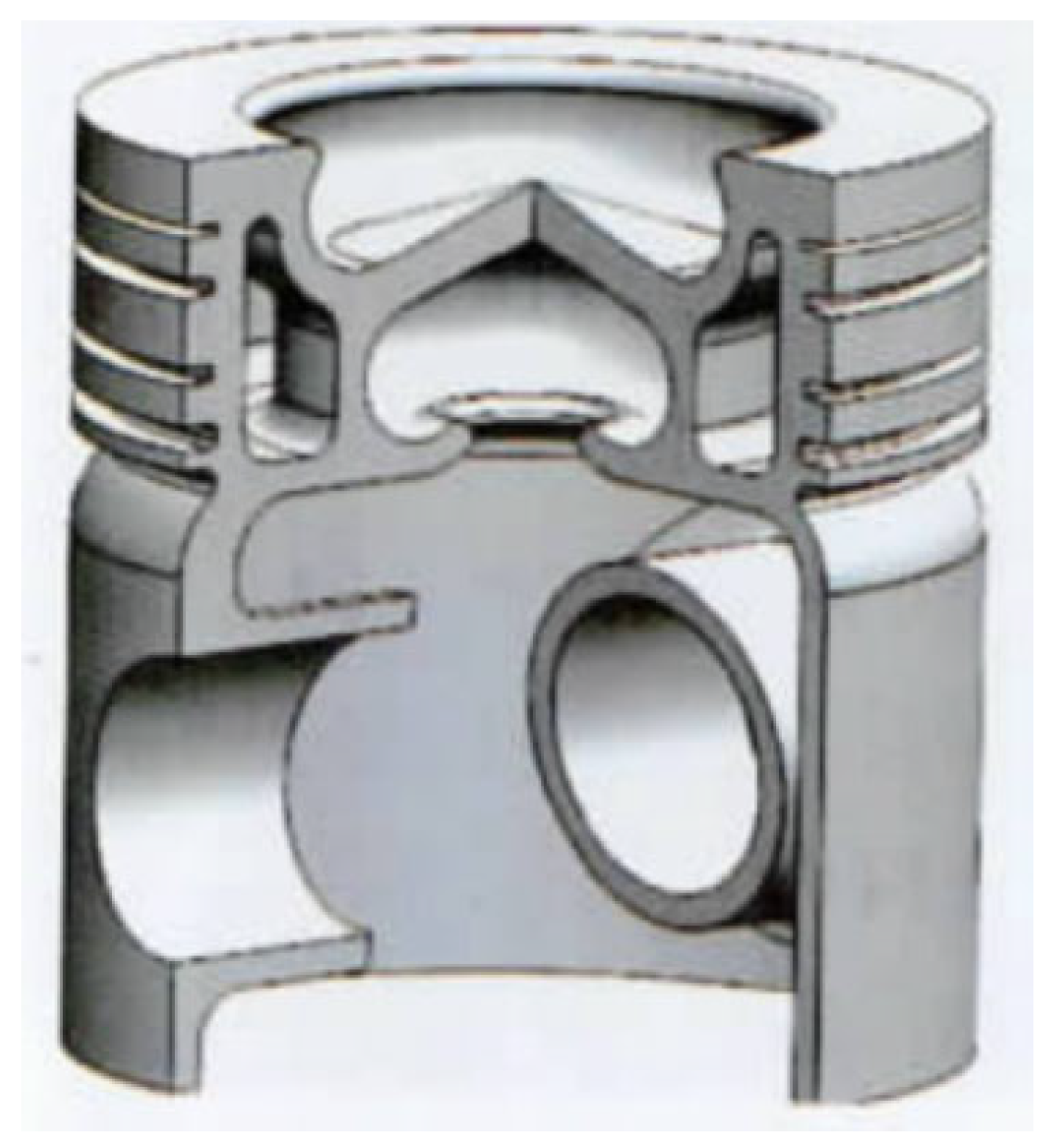
| Open-type/Direct-injection chamber | Combustion cavity integrated into piston crown; fuel injected directly into the main chamber | Simple structure, high combustion efficiency, good fuel economy, suitable for high-pressure common-rail systems | Sensitive to spray–wall interaction and local fuel-rich zones; may increase NOx under high-temperature conditions | Strong atomization and rapid heat release; good overall efficiency, but requires optimization of temperature distribution and soot control | Mainstream configuration in modern aero heavy-fuel piston engines |
| ω-type chamber | Piston-bowl geometry designed to improve in-cylinder flow organization and temperature-field uniformity | Enhances air–fuel mixing, reduces local hot spots, and improves combustion uniformity | Geometry optimization is more complex; performance depends strongly on injection matching | Contributes to simultaneous reduction in NOx and PM by suppressing local high-temperature and fuel-rich regions | Combustion-chamber optimization for emission reduction under aviation operating conditions |
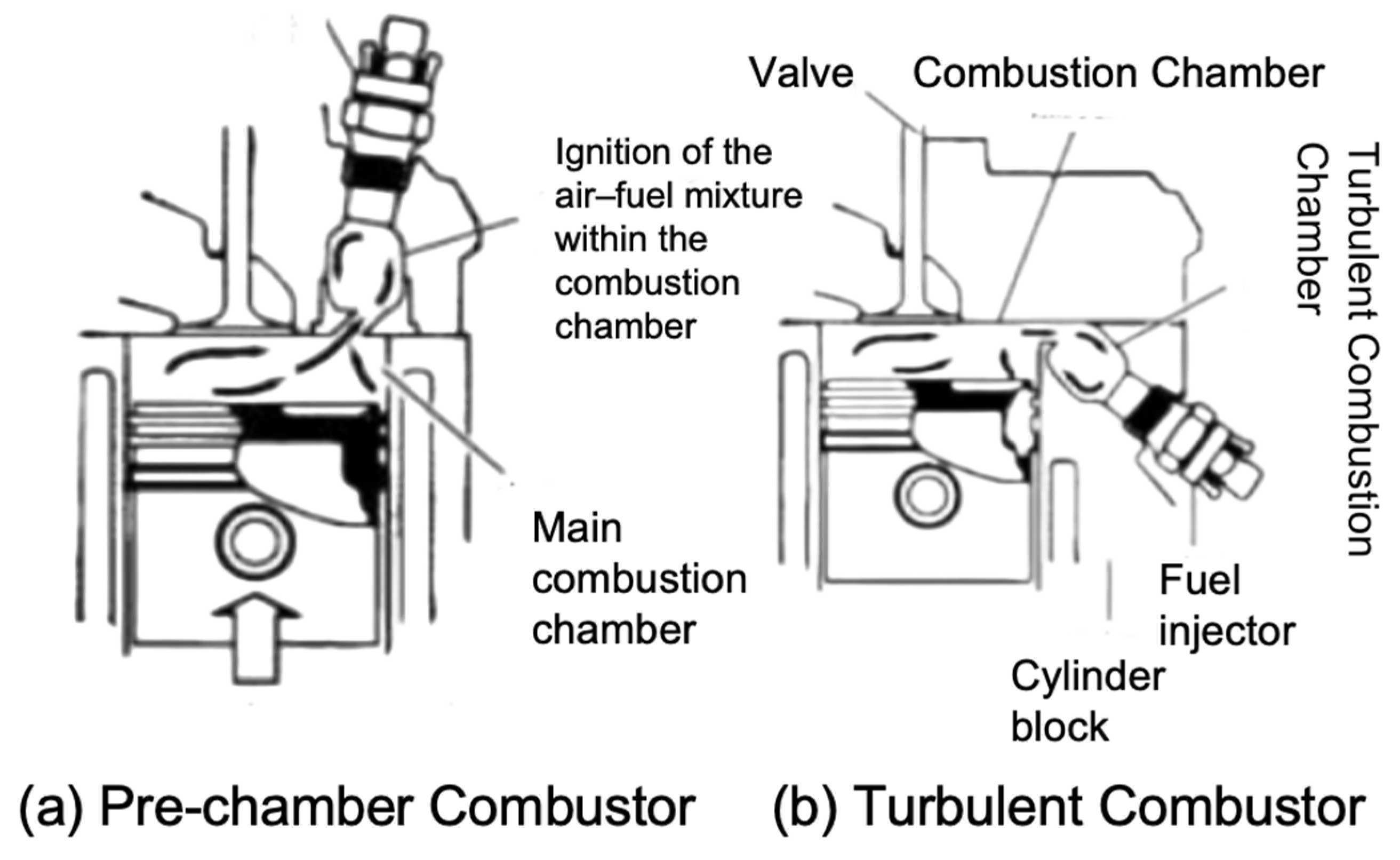
| Pre-chamber combustion system | Auxiliary chamber connected to main chamber; ignition and early combustion occur in the pre-chamber | Improves ignition capability and combustion stability, especially under lean or oxygen-deficient conditions | Higher heat loss and greater structural complexity may reduce thermal efficiency | Favors stable combustion and can reduce NOx under harsh environments, but thermal-management challenges remain | High-altitude, hypoxic, and cold-environment operation |
| Turbulence-enhanced chamber | Chamber geometry designed to intensify swirl, squish, or turbulence | Promotes rapid fuel–air mixing, improves combustion rate and homogeneity | Excessive turbulence may increase heat-transfer loss and design sensitivity | Improves combustion stability and reduces incomplete-combustion products such as CO and HC | Flow-field optimization and combustion-stability enhancement |
| Dimension | Core Content | Current Mainstream Solution | Key Performance Metrics | Technical Bottlenecks | Future Directions |
|---|---|---|---|---|---|
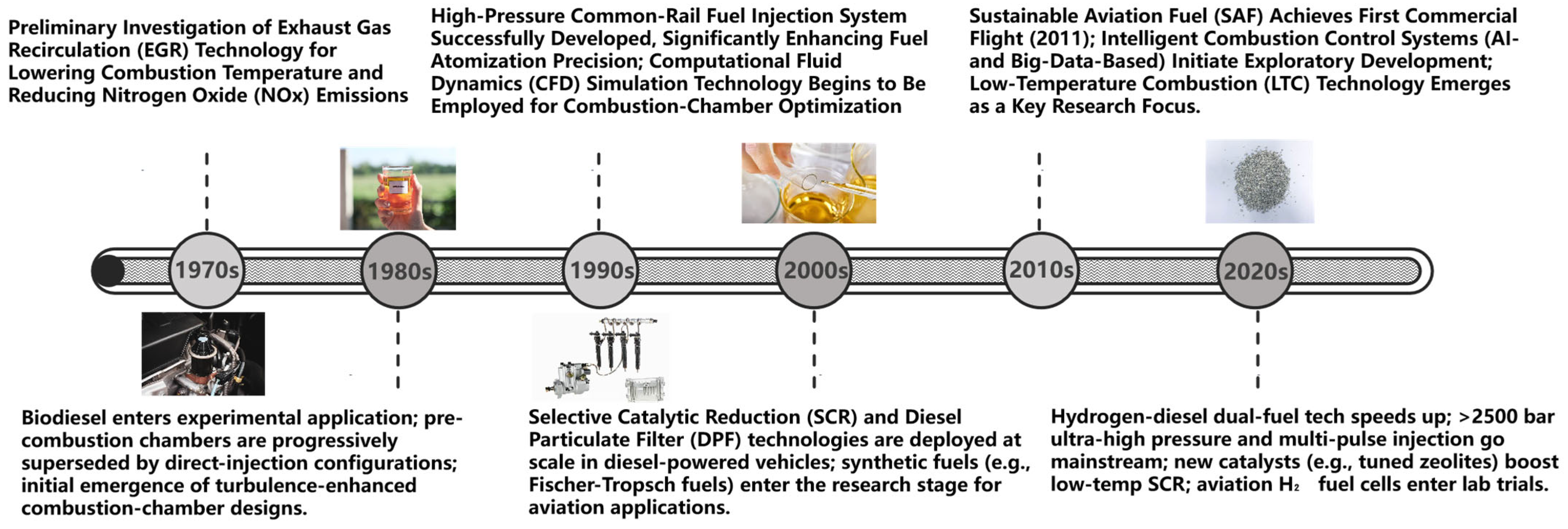
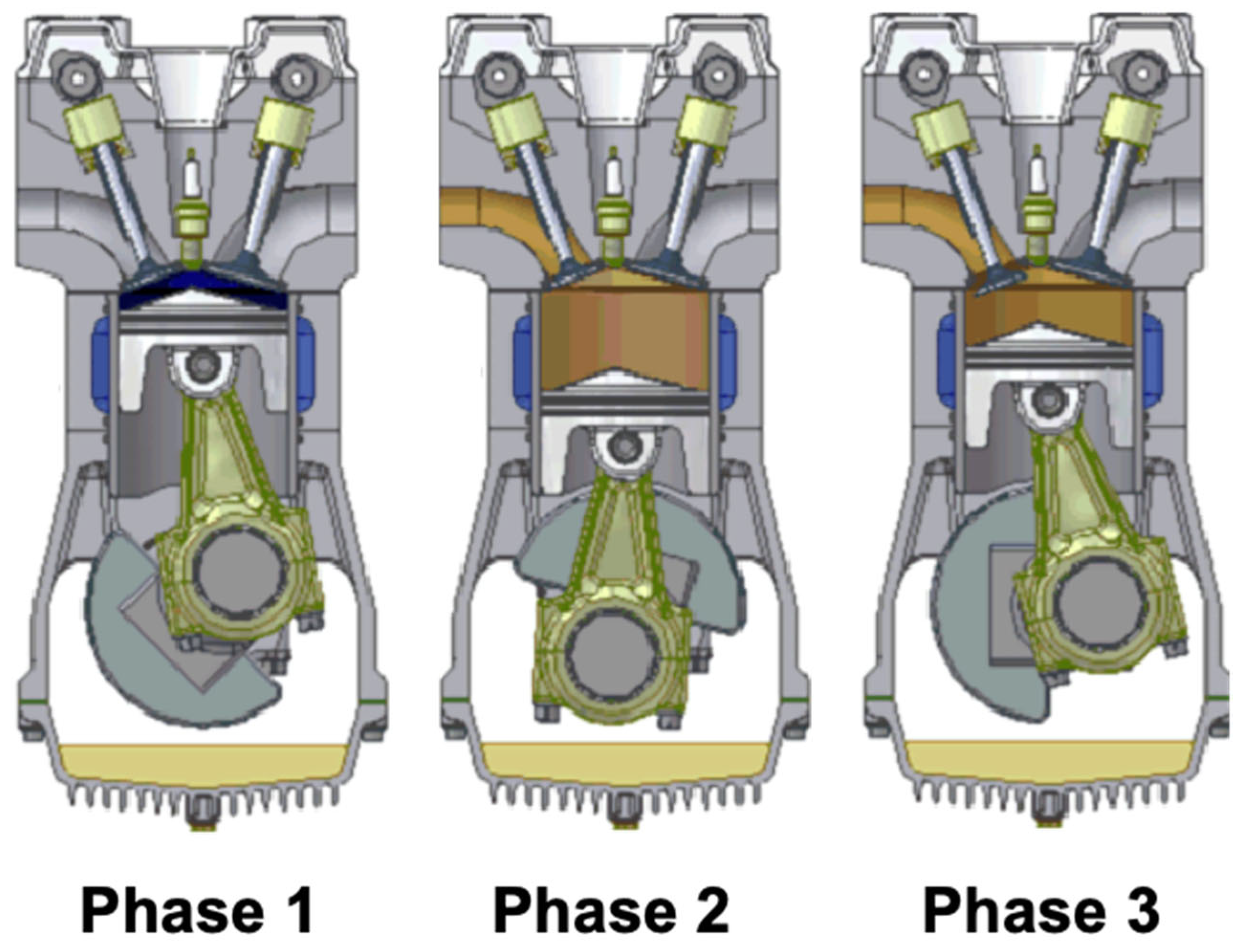
| Combustion Process | Compression → Injection → Auto-ignition → Main Combustion → Expansion and Exhaust | Direct-injection (open) combustion chamber | Thermal efficiency 45–50% | Cold-start/high-altitude ignition difficulties | Low-temperature combustion (LTC), Homogeneous Charge Compression Ignition (HCCI) |
| Combustor Type | Open (ω-type)/Pre-chamber/Turbulence chamber | Open ω-type piston bowl | Combustion efficiency > 95% | High heat loss in the pre-chamber | Adaptive variable-geometry combustion chamber |
| Design Targets | Combustion efficiency, stability, thermal management, flow uniformity | CFD simulation + experimental co-optimization | NOx ≤ 3 g kWh−1 | Large temperature gradients at high load | AI + real-time sensor closed-loop control |
| Fuel-Injection Matching | High-pressure common-rail ≥ 1800 bar, multiple injections | Triple-injection strategy | Spray SMD < 15 µm | Atomization deterioration in extreme environments | Ultra-high-pressure > 2500 bar + AI injection models |
| Advanced Trends | Intelligent combustion management, ultra-lean combustion, hydrogen–diesel dual-fuel | AI-ECU real-time optimization | 30% NOx reduction | Algorithmic throughput and sensor reliability | Digital-twin combustion chamber + additive manufacturing |
| Pollutant | Primary Sources & Formation Mechanisms | Key Influencing Factors | Typical Control Technologies | Latest Research Progress | Future Optimization Directions |
|---|---|---|---|---|---|
| CO | Incomplete combustion due to low temperature, oxygen deficiency, or poor atomization | Injection pressure, spray angle, ambient temperature | High-pressure common-rail injection, combustion-chamber optimization | Optimized injection strategies can reduce CO by ~20% | Adaptive injection + combustion pre-heating |
| HC | Unoxidized fuel or non-uniform mixture formation | Fuel type, injection uniformity, cold start | Multiple injection events, alternative fuels | HEFA fuel significantly reduces HC emissions | Hydrogen–diesel dual-fuel combustion |
| NOX | Oxidation of N2 with O2 under high-temperature combustion | Combustion temperature, oxygen concentration, EGR rate | EGR, SCR, injection-phasing optimization | EGR can cut NOx by >40% | AI-based combustion optimization |
| PM | Soot from incomplete combustion and fuel sulfur content | Injection pressure, fuel properties, DPF efficiency | Ultra-high-pressure injection (>3000 bar), DPF | SAF blends can cut PM by 50% | Novel filter materials + structural optimization |
| Technology | Main Target Pollutants | Core Mechanism | Main Advantages | Main Limitations in Aviation Applications | Representative Optimization Direction |
|---|---|---|---|---|---|
| SCR | NOx | Catalytic reduction of NOx into N2 and H2O using urea-based reducing agents | High NOx conversion efficiency; effective under properly controlled operating conditions | Reduced activity under low-temperature and high-altitude conditions; requires precise urea dosing and thermal management | Low-temperature catalysts, optimized urea injection, altitude-adaptive control |
| DPF | PM | Physical filtration and oxidation/regeneration of soot particles | High PM removal efficiency; effective for soot suppression | Back-pressure increase, regeneration reliability, and durability concerns during long-endurance operation | Low-back-pressure filter materials, intelligent regeneration control, thermal-management optimization |
| DOC | CO, HC | Catalytic oxidation of CO and HC into CO2 and H2O | Improves CO/HC conversion and supports downstream SCR/DPF operation | Catalyst activity is sensitive to exhaust temperature and fuel sulfur content; limited direct effect on NOx | Noble-metal catalyst optimization, integrated DOC + SCR + DPF architectures |
| EGR | NOx | Recirculation of exhaust gas to dilute intake charge and reduce combustion temperature | Effective in-cylinder NOx reduction; can be combined with other technologies | Excessive EGR may deteriorate combustion stability, ignitability, and thermal efficiency | Closed-loop EGR control, coordinated EGR–injection optimization, EGR with water injection or dual-fuel strategies |
| Fuel Type | Main Advantages | Main Limitations | Combustion/ Emission Characteristics | Engine Adaptation Requirements | Representative Research/Optimization Direction |
|---|---|---|---|---|---|
| Biodiesel | Renewable, oxygen-containing, good lubricity, can reduce dependence on conventional fossil diesel | Lower heating value, poor low-temperature flow properties, possible storage-stability issues | Generally reduces PM, CO, and HC emissions; may increase NOx under some conditions | Injection-parameter calibration, cold-start improvement, material compatibility evaluation | Blending optimization, low-temperature performance improvement, NOx-control coordination |
| SAF | Low-carbon potential, cleaner combustion, lower aromatic content, good potential for aviation decarbonization | High production cost, limited supply scale, uncertain long-term compatibility for some engine systems | Can significantly reduce soot and PM emissions; combustion performance depends on composition and blending ratio | Fuel-system compatibility assessment, blend-ratio optimization, long-term durability validation | SAF/diesel blending strategies, life-cycle assessment, engine-specific adaptation studies |
| Hydrogen | Zero-carbon fuel at point of use, fast flame speed, wide flammability limits, strong decarbonization potential | Storage difficulty, low volumetric energy density, safety and onboard integration challenges | Can greatly reduce CO2, CO, HC, and PM emissions; may still face NOx issues under high-temperature combustion | Dual-fuel strategy development, injection/control-system redesign, onboard storage and safety management | Hydrogen–diesel dual-fuel combustion, fuel-cell hybrid propulsion, low-NOx hydrogen combustion strategies |
| Technology Category | Key Measures/ Configurations | Primary Emission Targets | Typical Performance Achieved | R & D Outlook |
|---|---|---|---|---|
| Combustion-Chamber Optimization | ω/M-type piston bowls | NOx, PM, CO, HC | NOx ↓ 12–18%; PM ↓ 15–22%; CO ↓ 30% | AI-driven adaptive geometry + real-time CFD |
| Fuel-Injection System Tuning | >1800 bar common-rail | PM, CO, HC | PM ↓ 18%; CO ↓ 22%; combustion noise ↓ | >2500 bar systems + ML-based injection maps |
| Exhaust After-Treatment | SCR (low-temp zeolite catalysts) | NOx, PM, CO, HC | NOx ↓ > 80%; PM ↓ > 90% | Lightweight, altitude-robust systems; smart regeneration |
| Exhaust Gas Recirculation (EGR) | Cooled/hot EGR | NOx, PM | NOx ↓ 20–35% with minimal fuel penalty | Closed-loop EGR rate control via AI + sensors |
| Alternative and Clean Fuels | HEFA-SAF (100%) | CO2, PM, NOx, HC | PM ↓ 50%; NOx ↓ 35%; net CO2 ↓ 60–100% | Drop-in SAF certification; cryogenic H2 integration |
Disclaimer/Publisher’s Note: The statements, opinions and data contained in all publications are solely those of the individual author(s) and contributor(s) and not of MDPI and/or the editor(s). MDPI and/or the editor(s) disclaim responsibility for any injury to people or property resulting from any ideas, methods, instructions or products referred to in the content. |
© 2026 by the authors. Licensee MDPI, Basel, Switzerland. This article is an open access article distributed under the terms and conditions of the Creative Commons Attribution (CC BY) license.
Share and Cite
Fang, J.; Shi, W.; Zhang, Y.; Wang, M.; He, Y.; Xu, Z. A Review on Intelligent Combustion Control and Clean-Fuel Strategies for Aviation Heavy-Fuel Piston Engines. Aerospace 2026, 13, 345. https://doi.org/10.3390/aerospace13040345
Fang J, Shi W, Zhang Y, Wang M, He Y, Xu Z. A Review on Intelligent Combustion Control and Clean-Fuel Strategies for Aviation Heavy-Fuel Piston Engines. Aerospace. 2026; 13(4):345. https://doi.org/10.3390/aerospace13040345
Chicago/Turabian StyleFang, Jie, Wentao Shi, Yang Zhang, Minghua Wang, Yijie He, and Zheng Xu. 2026. "A Review on Intelligent Combustion Control and Clean-Fuel Strategies for Aviation Heavy-Fuel Piston Engines" Aerospace 13, no. 4: 345. https://doi.org/10.3390/aerospace13040345
APA StyleFang, J., Shi, W., Zhang, Y., Wang, M., He, Y., & Xu, Z. (2026). A Review on Intelligent Combustion Control and Clean-Fuel Strategies for Aviation Heavy-Fuel Piston Engines. Aerospace, 13(4), 345. https://doi.org/10.3390/aerospace13040345