


Abstract
The growing accessibility of small satellite technologies and international cooperation frameworks has enabled many emerging countries to initiate space development activities; however, the mechanisms through which they build and advance satellite development capabilities remain insufficiently theorized, as existing models such as the Space Technology Ladder capture only high-level milestones. To address this gap, this study proposes the Satellite Technology Ladder (SaTL), a structured 16-level framework integrating satellite development methods and satellite size as indicators of technological maturity. We conducted a comprehensive longitudinal analysis of all satellite projects initiated since 1990 across 16 emerging countries, coding each project according to the SaTL scheme and evaluating national trajectories over time. The analysis reveals four distinct developmental trajectories: (1) prolonged dependence on foreign procurement, (2) gradual capability enhancement through externally supported development, (3) expansion of domestic industrial ecosystems following initial collaboration, and (4) independent development from the outset based on pre-existing technological foundations. These findings demonstrate that technological advancement depends not only on technology introduction but also on absorptive capacity, institutional learning, and broader industrial structures. SaTL thus offers a theoretically grounded and empirically validated tool for assessing capability formation and informing policy strategies in emerging spacefaring nations.
1. Introduction
1.1. Background
Over the past two decades, global space activities have undergone a profound transformation. Satellite miniaturization, the widespread adoption of standardized platforms such as CubeSats, and the growing availability of international cooperation programs have dramatically lowered the barriers to entry for space development [1]. It is observed that the rise of low-cost, accessible platforms like CubeSats has fundamentally altered the initial rungs of the Technology Ladder, providing a new entry point for nations to begin their journey toward indigenous space capabilities. The increasing number of countries launching their first satellites via CubeSats since 2010 serves as compelling evidence of this new paradigm. With the introduction of space technology, an increasing number of countries are acquiring satellite capabilities through CubeSats as the simplest style of development. Between 2007 and 2024, 42 countries successfully developed satellites using CubeSats. As a result, a steadily increasing number of emerging countries have initiated satellite programs for purposes including Earth observation, communication, disaster management, and capacity building. Historical analyses of first-satellite programs indicate that many of these countries begin by relying on foreign technological support before gradually shifting toward more autonomous development [2]. Alongside national initiatives, regional institutions—such as the African Space Agency, the Arab Space Coordination Group, and the Latin American and Caribbean Space Agency—have begun playing an increasingly significant role in facilitating knowledge sharing and collective capability formation [3].
Despite these developments, the mechanisms through which emerging countries acquire, internalize, and advance satellite development capabilities remain insufficiently theorized. Existing macro-level frameworks, particularly the Space Technology Ladder (STL), conceptualize national space capability progression through milestones such as LEO/GEO satellite ownership and independent launch capability [4]. While these models provide a useful high-level overview, they lack the granularity needed to capture the incremental learning processes that characterize contemporary satellite development. In the CubeSat era, countries frequently progress through intermediate stages—moving from procurement to externally supported development, and eventually toward domestic subsystem production and indigenous manufacturing. Yet comparative analyses of these processes remain limited, and there is no systematic framework that accounts for both development methods and technological complexity.
The broader literature on technology acquisition and innovation in emerging economies reinforces the importance of absorptive capacity, institutional learning, and industrial foundations as determinants of successful capability formation [5]. Studies in adjacent sectors, such as advanced manufacturing and construction engineering, demonstrate that technology transfer is rarely linear and often depends on organizational readiness, human resource development, and robust domestic networks [6]. In the space sector specifically, recent research emphasizes the heterogeneity of technology sources—including foreign procurement, international cooperation, domestic R&D programs, and foreign direct investment—and the complex ways these sources interact to shape national innovation trajectories [7]. However, existing work does not provide a comparative, cross-national framework capable of explaining why some emerging countries advance rapidly while others remain technologically stagnant.
Against this backdrop, the present study introduces the Satellite Technology Ladder (SaTL), a new analytical framework designed to capture the finer-grained stages of satellite development capability. SaTL differs from STL by focusing exclusively on satellite manufacturing competencies and by integrating two analytically significant dimensions: (1) satellite development methods, which represent increasing levels of technological autonomy; and (2) satellite size categories, which proxy engineering complexity. By combining these dimensions into a 16-level taxonomy, SaTL offers a more precise tool for evaluating technological maturity and for analyzing developmental trajectories over time.
Using comprehensive data on all satellite projects initiated since 1990 across 16 emerging countries, this study reconstructs longitudinal development trajectories and identifies common patterns in capability formation. The contributions of this research are threefold. First, it refines the Technology Ladder concept to reflect the realities of modern satellite development. Second, it offers an empirical, cross-national analysis of how emerging countries progress technologically in the space sector. Third, it provides actionable insights for policymakers and space agencies regarding technology transfer strategies, capacity-building programs, and the development of sustainable space industry ecosystems.
1.2. Purpose
Against this historical background, this study examines how the research and development (R&D) system, once limited to government-led projects in a small number of developed countries—primarily the United States, the Soviet Union, Europe, and Japan—has evolved to include other players, such as developing countries, the private sector, and universities.
The purpose of this paper is to identify the technical level of the space development systems in emerging countries, with a particular focus on satellite development projects, and to analyze the progression of these systems. By defining the technological patterns of each country and examining their developmental trajectories, this study categorizes countries into those that have not established their own development systems and primarily rely on procurement from developed countries, those that have successfully transitioned to their own industries by effectively leveraging cooperation from developed nations, and those currently in the process of acquiring technologies, particularly in satellite development. This approach facilitates international comparisons of technology ladder classifications and aids in analyzing the transition process over time. By introducing SaTL and comparing countries, we will compare countries that have smoothly acquired technology through the introduction of space programs and have connected it to social implementation with countries that have remained at the initial stage of technology introduction and have not progressed further, and clarify what factors influence the acquisition and dissemination of technology.
Specifically, the study will investigate the development of satellite projects in various countries, focusing on the time frame and systems under which these projects were initiated, particularly in nations that embarked on space development relatively recently, after 1990. The research will comprehensively summarize the changes in development systems for each project. Finally, the study will propose a typology that illustrates the nature of these transitions with the discussion of Technology ladder theory and Stakeholder analysis. Although there are several definitions, in this paper, 1000 kg or less is referred to as Small Satellite, 100 kg or less is referred to as Nano Satellite, and 10 kg or less is referred to as CubeSat.
2. Literature Review
2.1. Satellite Development in Emerging Countries
The global expansion of small satellite technologies has reshaped the participation of emerging countries in the space sector. The proliferation of CubeSats, standardized bus architectures, and increasingly affordable launch opportunities has lowered entry barriers and enabled many nations to initiate satellite development for Earth observation, communications, and capacity-building purposes [1]. Early investigations show that developing countries typically launch their first satellites through foreign procurement or educational partnerships with established agencies, which serve both as training platforms and as mechanisms for institutional formation [2]. Over time, several nations—including Argentina, Turkiye, Malaysia, and South Africa—demonstrated gradual transitions from externally supported missions toward more autonomous development, facilitated by universities, aerospace SMEs, and publicly funded research institutions [8]. Parallel to these national initiatives, regional institutions such as the African Space Agency, the Arab Space Coordination Group, and the Latin American and Caribbean Space Agency have begun coordinating shared missions, pooling technical resources, and expanding human capital development programs. While these developments underscore a growing diversification of actors, most existing studies remain descriptive and do not provide systematic frameworks for assessing technological progression.
2.2. Technology Ladder and Capability Accumulation
The Technology Ladder has been widely employed to conceptualize how firms and nations accumulate increasingly sophisticated technological capabilities. Foundational work describes this process as an advancement from basic production toward adaptive engineering and ultimately system-level innovation [9,10]. Applied to the aerospace context, Wood’s Space Technology Ladder (STL) [4] represents an important attempt to classify national space capability milestones across satellite, launch, and operational domains. Although influential, STL faces several limitations when analyzed in light of contemporary satellite development. It aggregates multiple technological fields, thereby obscuring project-level engineering competence; it lacks the granularity needed to distinguish different levels of technological complexity among CubeSats, microsatellites, and larger satellites; and it assumes linear progression, despite empirical evidence showing hybrid and non-linear capability paths in emerging countries [8]. Studies in other sectors likewise demonstrate that latecomer innovation often follows branching trajectories shaped by institutional conditions, industrial specializations, and global value-chain integration [11]. These insights collectively suggest that a more flexible and granular model is needed to capture the dynamics of satellite capability-building.
2.3. Technology Acquisition, International Cooperation, and Learning Dynamics
The literature on technology acquisition in emerging economies offers additional perspective on satellite capability formation. According to absorptive capacity theory, organizations must possess sufficient prior knowledge and learning routines to effectively internalize external technology [5]. For complex engineering sectors such as aerospace, successful capability acquisition requires not only technology transfer but also complementary investments in training, system integration skills, and institutional coordination [10]. International technology transfer (ITT) programs, whether conducted through joint development, turnkey procurement, or university-led missions, play an essential role in accelerating early-stage learning. However, the sustainability of these gains depends on domestic institutional strength and long-term embedding of acquired knowledge in organizational practices [12].
Case studies from Nigeria’s NigComSat program [13], Turkiye’s dual-use satellite efforts [14], and Argentina’s CONAE–INVAP ecosystem illustrate the diversity of outcomes that emerge from different technology sourcing strategies [15]. Recent analyses argue that the interplay between external collaboration, domestic R&D, and industrial ecosystems strongly influence national innovation trajectories [7]. In adjacent sectors, university–industry collaboration has been shown to serve as a crucial engine for tacit knowledge formation and subsystem-level specialization [16]. Collectively, these studies underscore that satellite capability development is a cumulative, path-dependent process shaped by institutional complementarities, inter-organizational networks, and mission-oriented policy interventions.
2.4. Theory Integrates Engineering Complexity with Technology Acquisition Pathways
Although existing studies offer valuable insights into early satellite programs, national innovation systems, and international technology transfer, the literature remains fragmented and lacks a coherent analytical framework capable of capturing satellite-specific capability progression. Current models such as STL do not incorporate two key project-level dimensions central to understanding technological maturity, while this describes the progress of space development capability from the perspective of the national program. These limitations highlight the need for a satellite-focused capability model that integrates engineering complexity with technology acquisition pathways. By utilizing satellite projects—the definitive systems of aerospace technology—as a primary benchmark, this study enables a rigorous assessment of a nation’s space capabilities. This approach facilitates an evaluation of both technological maturity and the broader evolution of national space programs, providing a standardized metric for tracking sectoral development.
In response to this gap, the present study proposes the Satellite Technology Ladder (SaTL), a 16-level taxonomy that systematically classifies satellite development projects by combining development method and satellite size. This framework provides the analytical foundation necessary for conducting longitudinal, cross-national comparisons of capability formation. By grounding satellite capability research within broader theories of technological upgrading, national innovation systems, and latecomer development strategies, SaTL offers a more precise and theoretically consistent approach for evaluating how emerging countries build sustainable space-sector capabilities.
3. Research Method
This study adopts a qualitative–comparative research design to classify satellite development projects in emerging spacefaring nations and to examine their technological trajectories using the Satellite Technology Ladder (SaTL). Because the existing literature lacks standardized analytical instruments for comparing national satellite programs, the methodological approach emphasizes transparency, reproducibility, and cross-validation. The following subsections describe the procedures for data collection, operationalization of SaTL, coding reliability, analytical strategy, and bias mitigation.
3.1. Identification of Target Countries
First, the target countries for investigation are identified. Selected countries are those with relatively short histories of space development and economies that meet the definition of emerging countries. However, to accurately assess the development process of technology acquisition, we exclude countries that are still in the early stages, such as those that have launched only a single satellite. Specifically, countries meeting all three of the following criteria are selected as shown in the Table 1:
Table 1.
Target Countries.
- Classified as emerging countries according to UN standards [17] (World Economic Situation and Prospects 2024)
- Initiated satellite development no earlier than 1990
- Have a track record of developing more than five satellites by 2024
In the countries discussed in Section 3.2, we examined all emerging nations with satellite development achievements and identified the following 16 countries:
3.2. Data Collection and Sampling Strategy
A comprehensive dataset was constructed through systematic collection of satellite mission records launched or initiated between 1990 and 2024. The starting point of 1990 was chosen because it marked the period when small satellite technology became globally widespread, followed by the formalization of the CubeSat standard, significantly lowering barriers to entry for emerging space nations. It also captures over 30 years of project evolution. Data were obtained from official space agency repositories, university satellite program archives, international mission databases such as Gunter’s Space Page [18] and the Nanosats Database [19], peer-reviewed journal articles, conference proceedings, and government or industry reports. To ensure coverage across a broad range of national contexts, a country-by-country saturation strategy was applied, whereby data collection continued until no further verifiable missions or technical details could be identified. Eligibility required that each mission includes documented national involvement, publicly accessible development information, and classification under recognized satellite categories. Missions with insufficient documentation—especially early defense-related satellites—were excluded to avoid inferential bias.
A structured data extraction sheet standardized the collection of mission attributes, including satellite mass, subsystem configuration, development partners, technology procurement routes, training components, and the extent of domestic participation in design and manufacturing.
3.3. Operationalization of the Satellite Technology Ladder (SaTL)
SaTL is formulated as a 16-level classification system derived from the intersection of two analytically critical dimensions: development method and satellite size. To ensure construct validity, both dimensions were defined using explicit, replicable rules.
3.3.1. Development Method Classification
Development method was operationalized along a continuum of technological autonomy, ranging from full procurement to externally supported development, domestically supported development, and fully indigenous development. Coding for this dimension relied exclusively on documented engineering responsibilities rather than policy statements or media claims.
FP1 (Basic Foreign Procurement)
Entirely overseas development. No domestic involvement in design, manufacturing, or testing.
FP2 (Foreign Procurement with Training)
Overseas-led development, but domestic engineers gain formal learning opportunities such as observation, test participation, or short-term training. However, there is no domestic contribution to design or integration.
JD (Joint Development)
Domestic organizations substantially participate as co-developers in subsystem design, integration work, environmental testing, etc. Domestic technical contributions are essential for project execution.
DD (Domestic Development)
Domestic-led satellite design, integration, and testing. External companies play only a partial supporting role; major technical decisions are made domestically.
The following section delineates the boundaries for the four primary development methodologies: Foreign Partner 1 (FP1), Foreign Partner 2 (FP2), Joint Development (JD), and Domestic Development (DD). FP1 characterizes projects where the entire development process occurs within a foreign partner’s nation, typically with no recorded involvement from the emerging nation. Conversely, FP2 refers to projects where the foreign partner maintains primary responsibility, yet the emerging nation participates through activities such as operational training or capacity building. Crucially, if the emerging nation’s involvement is limited to procurement-related tasks—such as conducting final acceptance inspections—the project remains classified as FP1. A prominent example of FP2 is the Kyushu Institute of Technology’s (Kyutech) BIRDS program. While development for these projects occurred in Japan, 2 to 3 students from each of the 13 partner countries were embedded at Kyutech to pursue advanced degrees and contribute directly to the development process [20]. JD denotes projects led primarily by the emerging nation with external technical support. For instance, while Indonesia’s LAPAN-TUBSAT was classified as FP2 due to the dominant role of Berlin Space Technologies (BST), the subsequent LAPAN-A2 and A3 satellites shifted to JD [21]. Although BST provided several subsystems, the development was led by LAPAN within Indonesia. Finally, DD refers to a fully autonomous development process conducted entirely by the emerging nation without overseas intervention [22].
3.3.2. Satellite Weight Classification
Satellite weight is used as an indicator of system complexity. Based on internationally adopted classifications, the following four categories which were proposed by Sweeting [23] are used. Satellite weight strongly correlates with the number of subsystems, integration difficulty, required test items (thermal vacuum, vibration, etc.), and the complexity of power and attitude control systems. An increase in satellite mass necessitates not only a larger structural framework but also a corresponding expansion in the number and sophistication of integrated subsystems. For instance, when larger systems are implemented, enhancing attitude control precision often requires the integration of redundant sensors, while elevated power demands necessitate expanded solar arrays and associated deployment mechanisms. Furthermore, as project budgets scale, more stringent safety and reliability standards are imposed, leading to increasingly rigorous testing protocols. Consequently, satellite mass serves as a robust proxy for system complexity. Utilizing this metric as a classification criterion enables an objective and reproducible evaluation of technical maturity across diverse missions. Therefore, it can be used as a reliable indicator of system complexity. This classification enables the objective and reproducible assessment of differences in technical maturity. The rationale for selecting these four levels is based on the small satellite classification method proposed by Professor Matin Sweeting of the University of Surrey. As this classification is widely used today for identifying satellite sizes, we have adopted the same classification in this paper.
Nano-class: 1–10 kg (primarily CubeSats)
Micro-class: 10–100 kg
Small-class: 100–1000 kg
Large-class: 1000+ kg
In the satellite development systems of the target emerging countries, the development systems and satellite weight categories, as defined in Section 3.3.1 and Section 3.3.2, are classified into 16 levels. These levels correspond to the Satellite Technology Ladder (SaTL), as outlined in Table 2.
Table 2.
Satellite Technology Ladder (SaTL).
Furthermore, while satellite weight is employed as a proxy for technological maturity, the recent proliferation of small satellites—particularly in advanced space-faring nations—has driven the development of sophisticated miniaturization technologies, such as integrated antenna array systems. In these contexts, reduced physical scale is a product of technological advancement rather than a lack of capability; therefore, small-scale platforms will increasingly cease to serve as definitive indicators of technical immaturity. However, as this trend toward high-complexity miniaturization is currently in its nascent stages within the satellite programs of emerging nations, the methodology and findings of this study remain fundamentally robust for the current developmental landscape.
3.4. Coding Procedures and Intercoder Reliability
To minimize subjective judgment and enhance reproducibility, a three-stage coding procedure was adopted. In the first stage, two independent coders classified each mission using SaTL rules based solely on documented sources. In the second stage, to avoid convergence bias, they cross-validated classifications for a specific country (Malaysia) without knowing each other’s rationale. Discrepancies were flagged for adjudication. In the third stage, ambiguous cases were jointly reviewed by the research team using triangulation evidence. Inter-coder reliability was assessed using Cowen’s kappa coefficient, yielding κ = 0.75 for development methods and κ = 1.0 for satellite size. Complete agreement was observed for satellite size due to the availability of clear public information. Although there was some variation in the form of support provided by external partners for the development method, overall, these values showed strong agreement and met the recommended standards for qualitative classification research. To ensure transparency and reproducibility, all coding decisions, justifications, and arbitration notes were recorded in a coding log.
As detailed in Section 3.2, data regarding national satellite projects were sourced from public databases [18,19]. Because these databases often lack granular information on development methodologies, we supplemented our dataset with reputable news media and industry reports. However, a notable limitation is that these public-facing sources are susceptible to survivorship bias; consequently, the documented findings may not fully reflect the complexities or failures inherent in the actual state of development.
3.5. Theoretical Background of the 16-Stage Model of Satellite Technology Ladder (SaTL)
SaTL’s 16-stage structure integrates two distinct theoretical dimensions crucial for explaining the progression of satellite development capabilities. The first dimension (Development Method) is based on the widely recognized stepwise development model in technology transfer and capability formation research: “passive procurement → learning-by-doing procurement → joint development → domestically led development.” The four stages—FP1, FP2, JD, and DD—correspond to increasing learning depth and technological autonomy, aligning with absorptive capacity theory [5] and latecomer industrialization model [24].
The second dimension (Weight Class) uses satellite weight as a proxy for system complexity. It is a fundamental principle in aerospace engineering that increasing weight necessitates more subsystems, greater integration demands, and more stringent testing requirements. Therefore, the hierarchy Nano → Micro → Small → Large and above objectively indicates different stages of technological maturity.
This combined 4 × 4, 16-stage model satisfies (1) independence between dimensions, (2) exhaustiveness in covering capability development stages, and (3) consistent progressivity toward higher stages. It precisely captures the subtle differences in initial capability formation and the progression of technological learning that the existing Space Technology Ladder could not express. Therefore, SaTL provides a highly valid analytical framework for theoretically explaining the development of satellite development capabilities.
3.6. Validity, Limitations, and Bias Mitigation
Several methodological safeguards were implemented to address threats to construct, internal, and external validity. Construct validity was reinforced through the explicit operationalization of classification criteria and the triangulation of independent data sources. Internal validity was strengthened by independent coding, high intercoder reliability, transparent adjudication processes, and conservative inclusion rules designed to avoid overestimating national capabilities. External validity was enhanced through the inclusion of a geographically diverse set of emerging spacefaring nations and the use of internationally accepted satellite size categories aligned with global technological trends since 1990.
Nevertheless, limitations remain. Some missions, particularly defense-related projects, lack sufficiently detailed documentation, introducing potential survivorship bias. Additionally, while SaTL captures two core dimensions of satellite capability—engineering complexity and development method—it does not directly measure institutional learning, systems engineering culture, or national absorptive capacity. These limitations are inherent to large comparative research on technology systems but are mitigated through methodological transparency and systematic application of standardized classification rules.
4. Results
This section provides an overview of the empirical trends derived from the time-series plots of all satellite projects in the 16 emerging countries analyzed in this study. The comprehensive SaTL transition graph, constructed from Appendix A, reveals several notable macro-level tendencies in the evolution of satellite development capabilities. The classification of SaTL levels used in this analysis is based on Table 2, whereas the progression and transitions between these levels are illustrated though the time-series figures.
4.1. Countries Where SaTL Rise Slightly (Type 1)
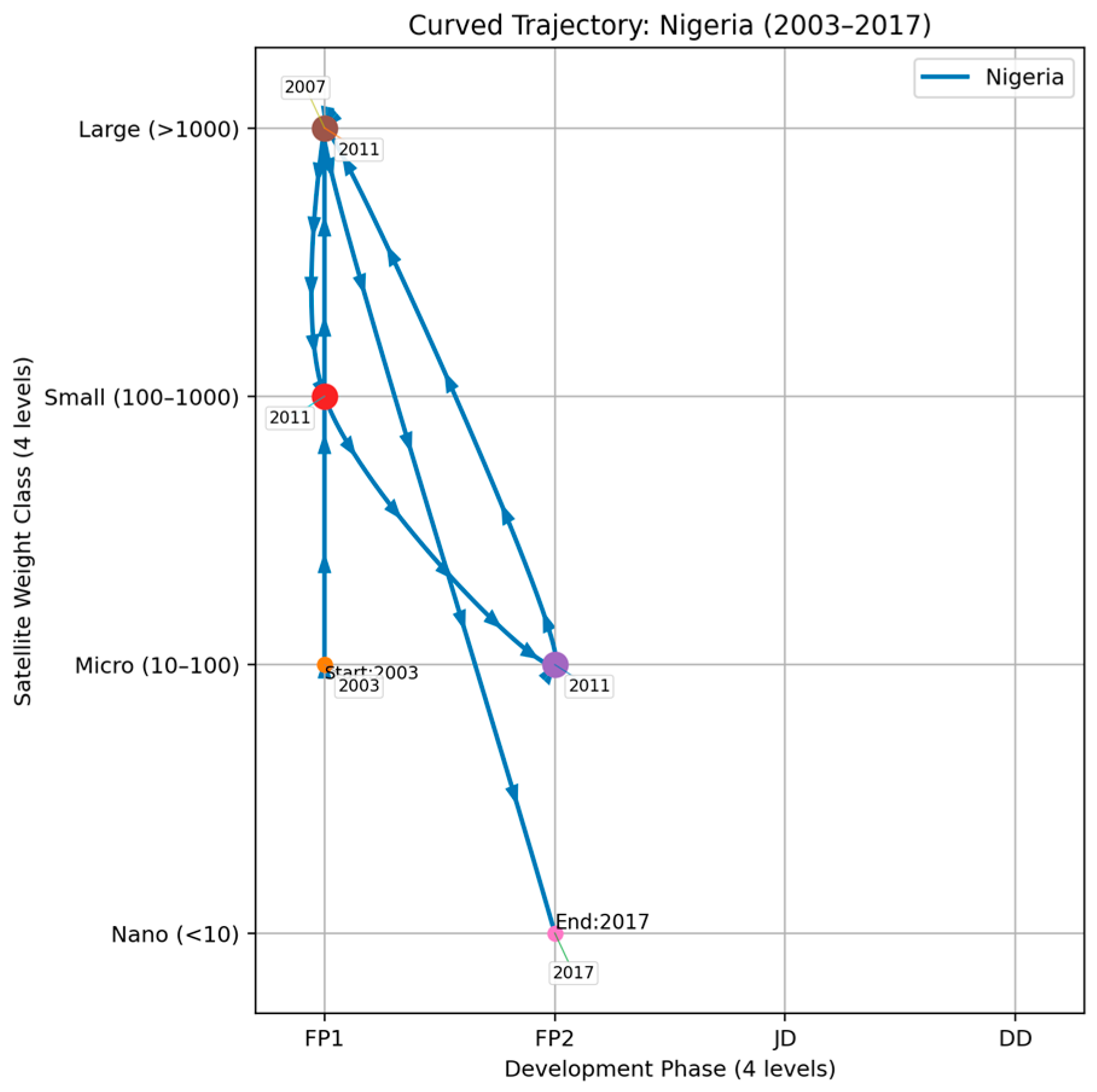
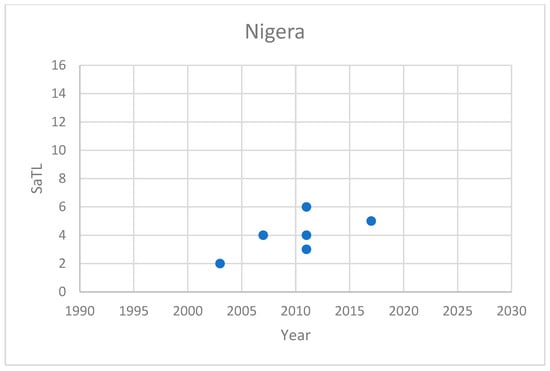
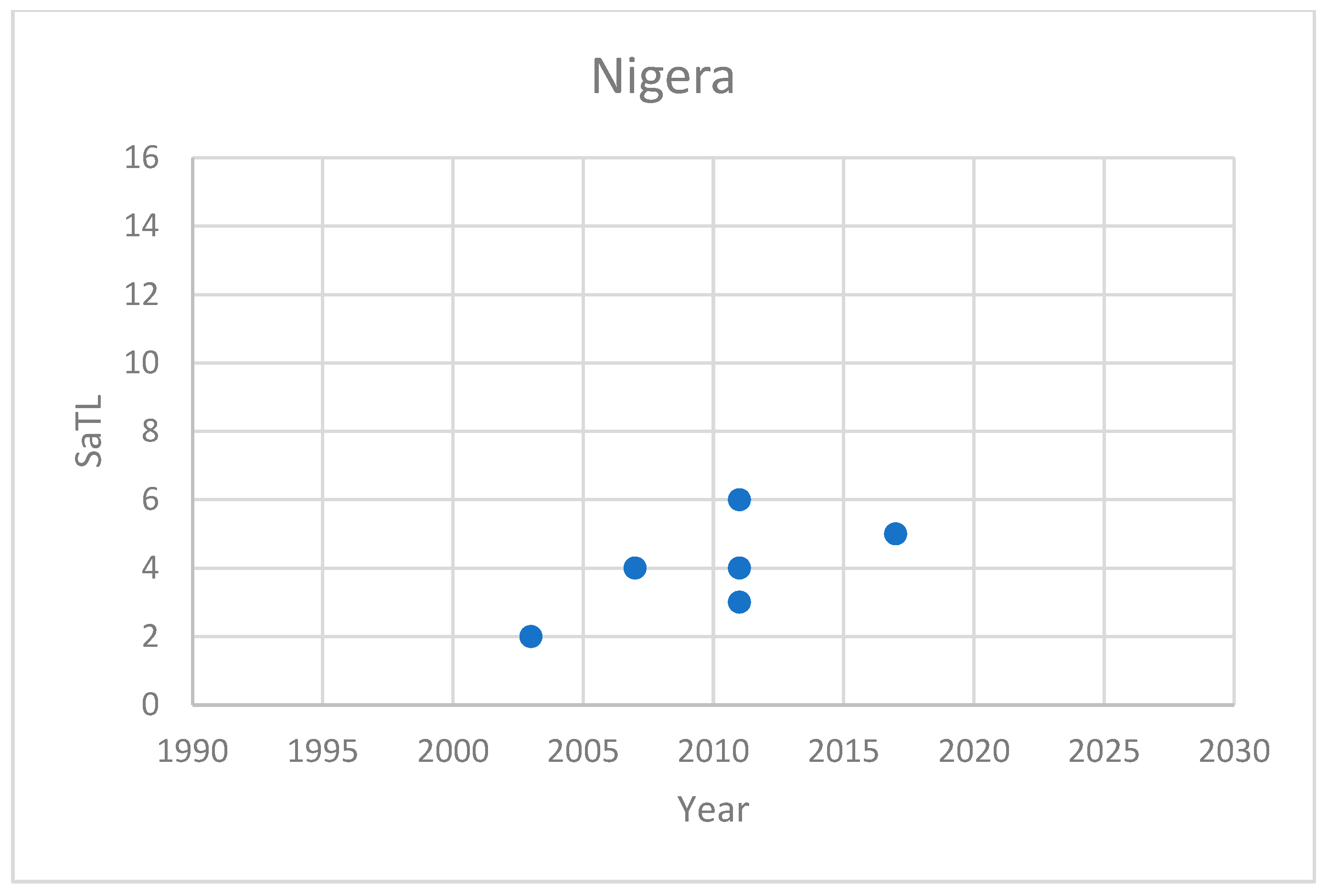
Countries where progress on the Satellite Technology Ladder (SaTL) has stagnated include Nigeria, Algeria and Peru. Nigeria procures satellites from China and the UK-based Surrey Satellite Technology Ltd. (Guildford, UK), but there has been no transition to domestic development. Additionally, the Federal University of Technology Akure (FUTA) developed a CubeSat with support from a Japanese university (Kyutech), though this initiative has not continued. As shown in Figure 1, Nigeria’s SaTL progression remains limited, with only slight increases over time and no sustained advancement toward higher level of domestic capability.
Figure 1.
SaTL of Nigeria.
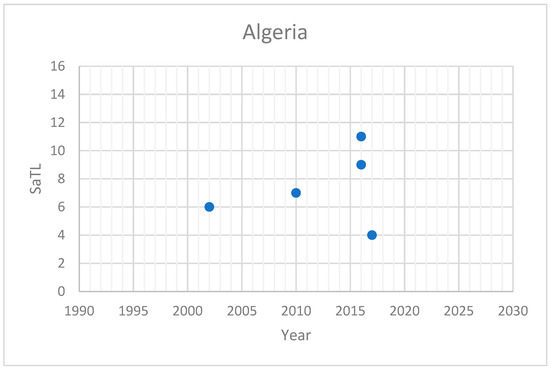
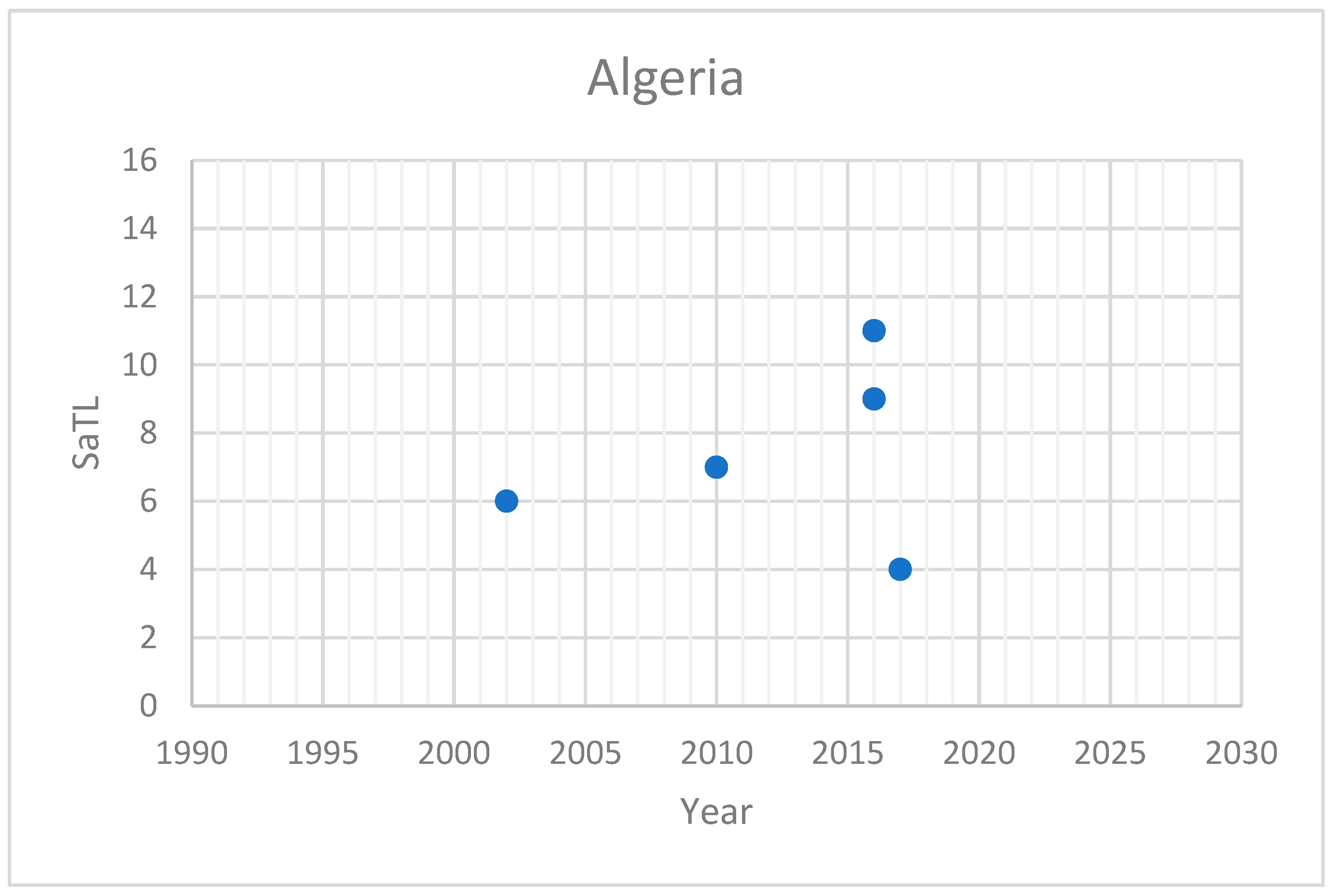
Similarly, Algeria sources satellites from China and Surrey Satellite Technology Ltd., followed by a technical assistance program. However, with support from Surrey, Algeria has begun developing its capabilities domestically and on the way to move transition for domestic satellite development in the future. As shown in Figure 2, this progression is characterized by incremental increases in SaTL levels; however, the trajectory is not strictly monotonic, with some fluctuations observed in later stages.
Figure 2.
SaTL of Algeria.
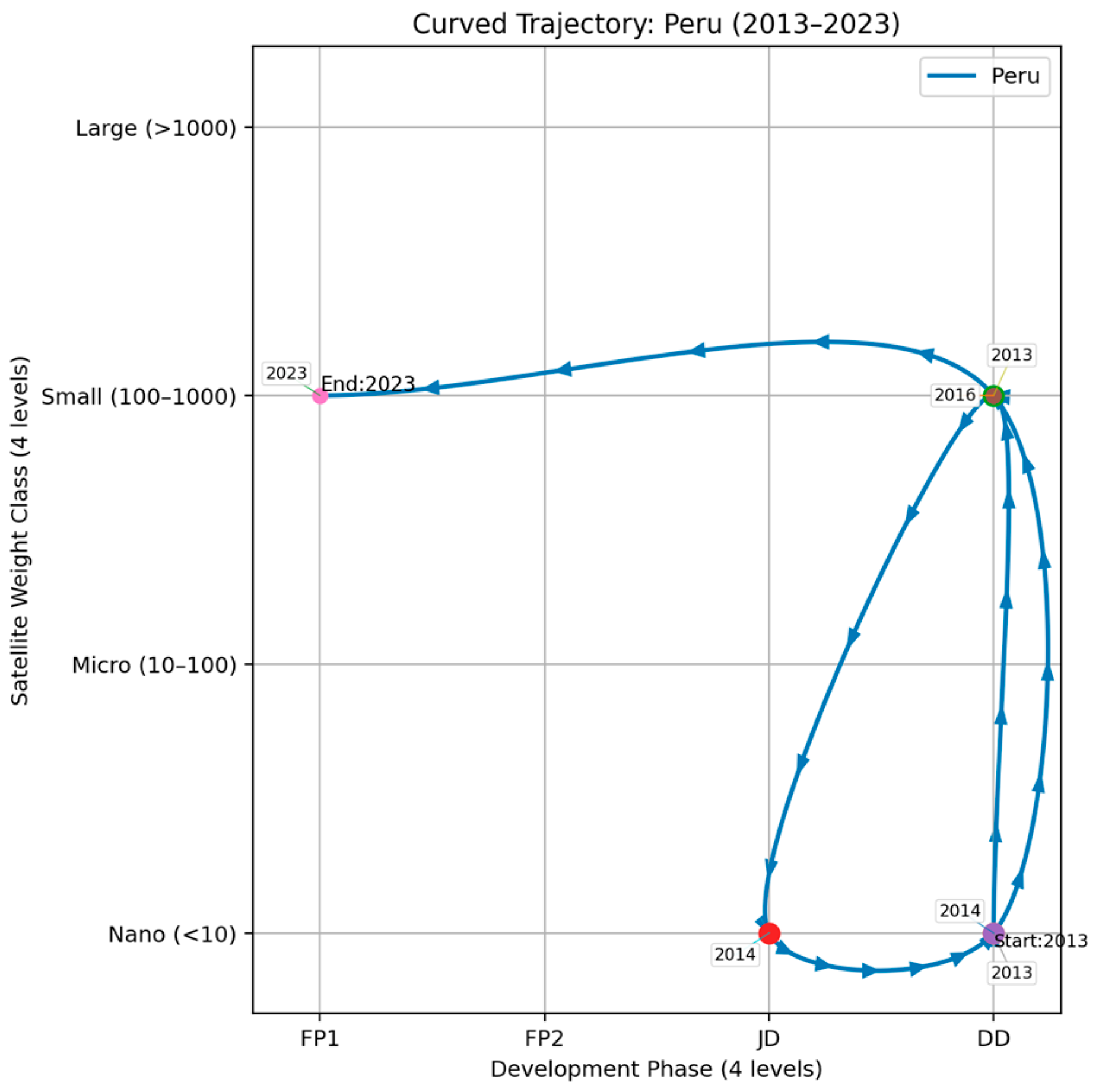
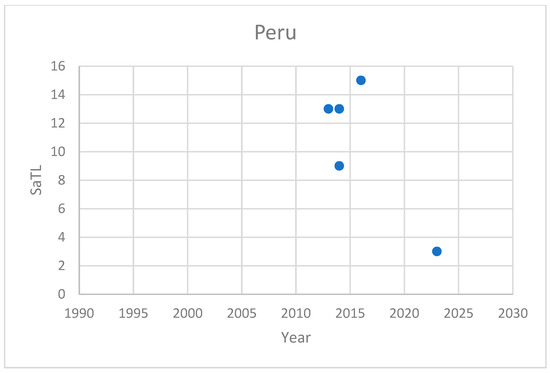
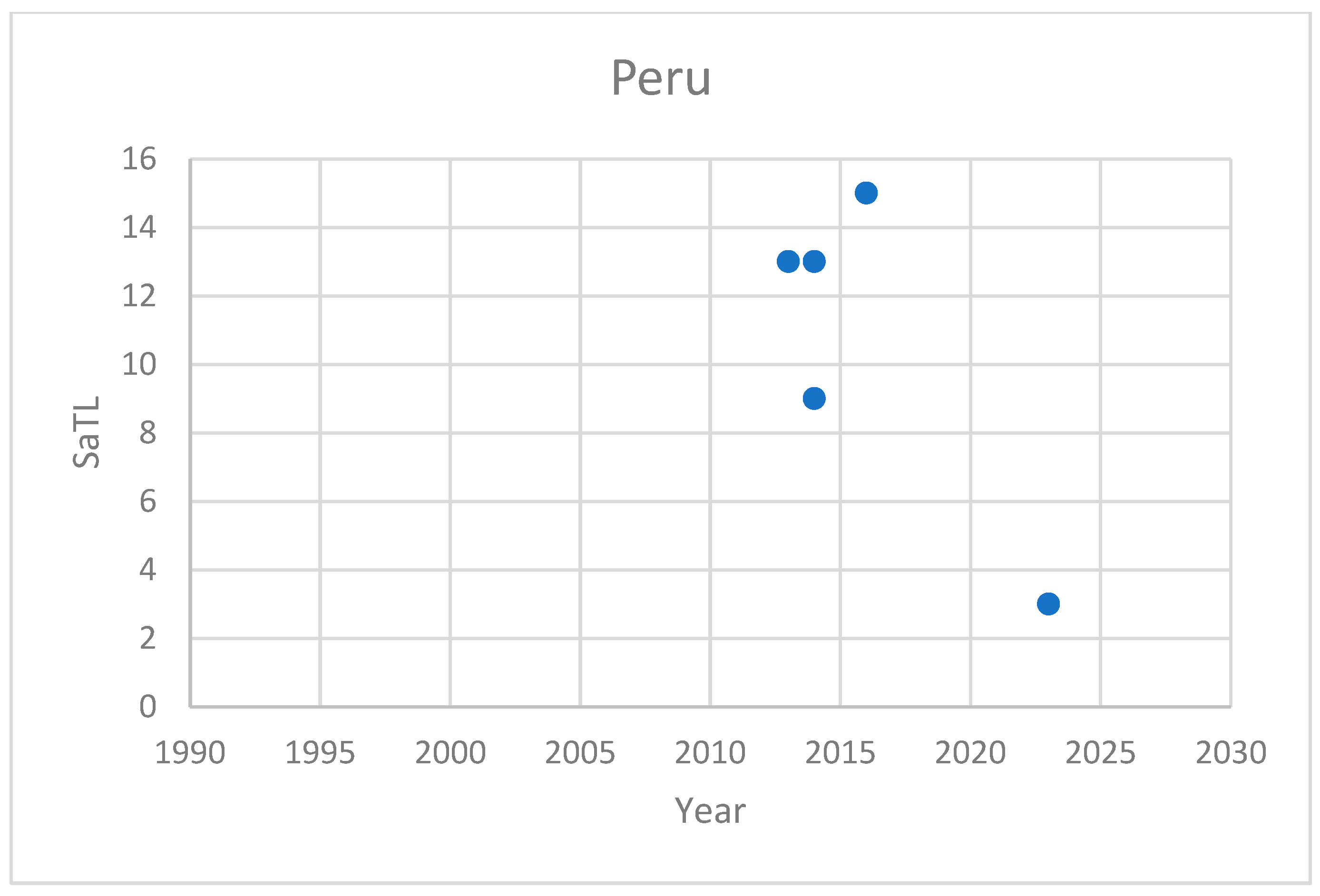
In Peru’s case, as shown in Figure 3, an initial period of attempting to independently develop small-sized satellites centered around domestic universities occurred in the early 2010s. However, since then, the space program has ceased satellite development. Although Peru’s space agency (CONIDA) has a long history, having been established in 1974, it specializes in satellite data utilization and science. Attempts at satellite development after the 2010s have not been sustained.
Figure 3.
SaTL of Peru.
4.2. Countries with Rising SaTL (Type 2)
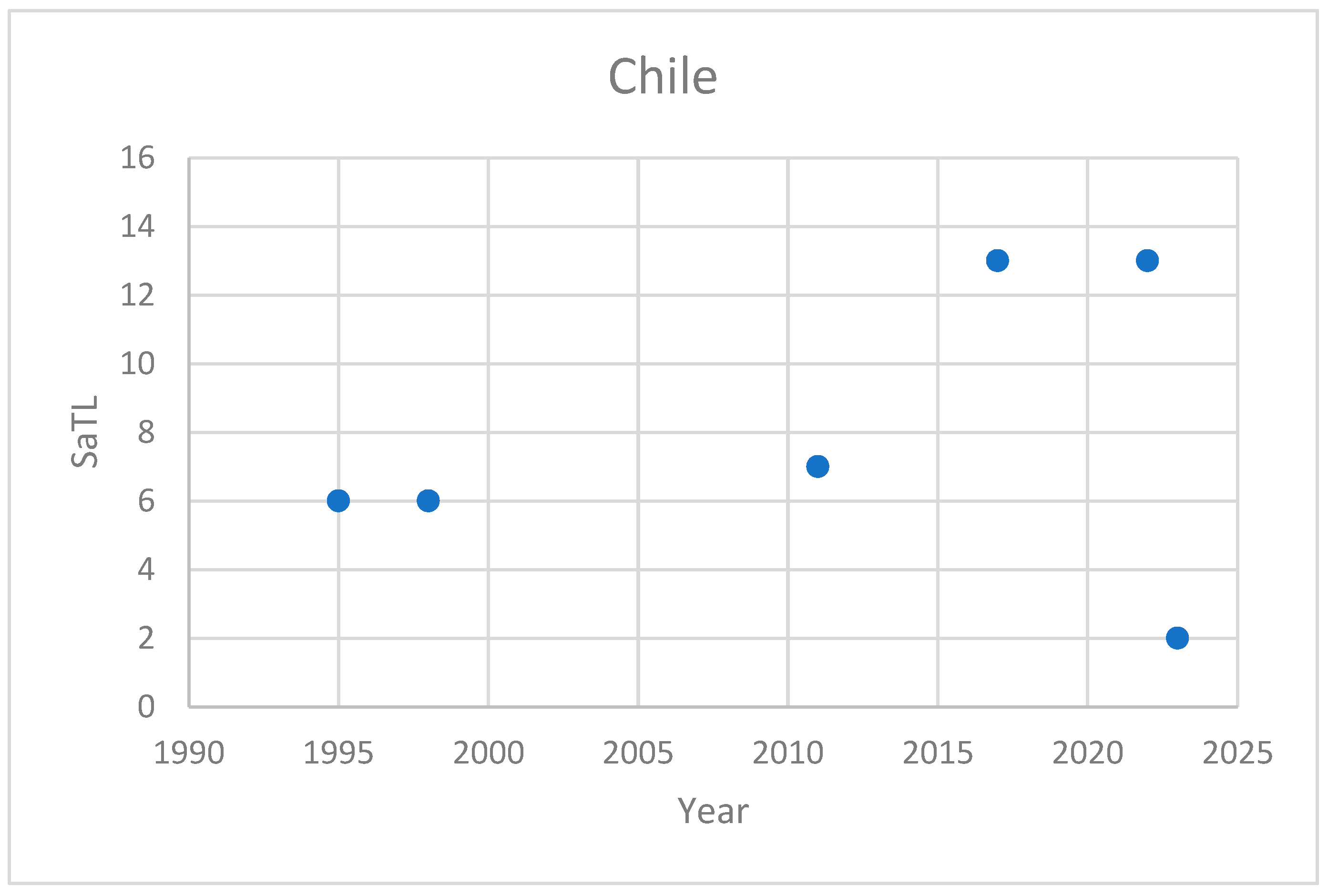
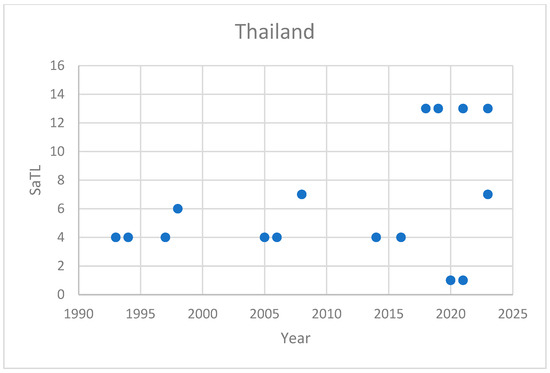
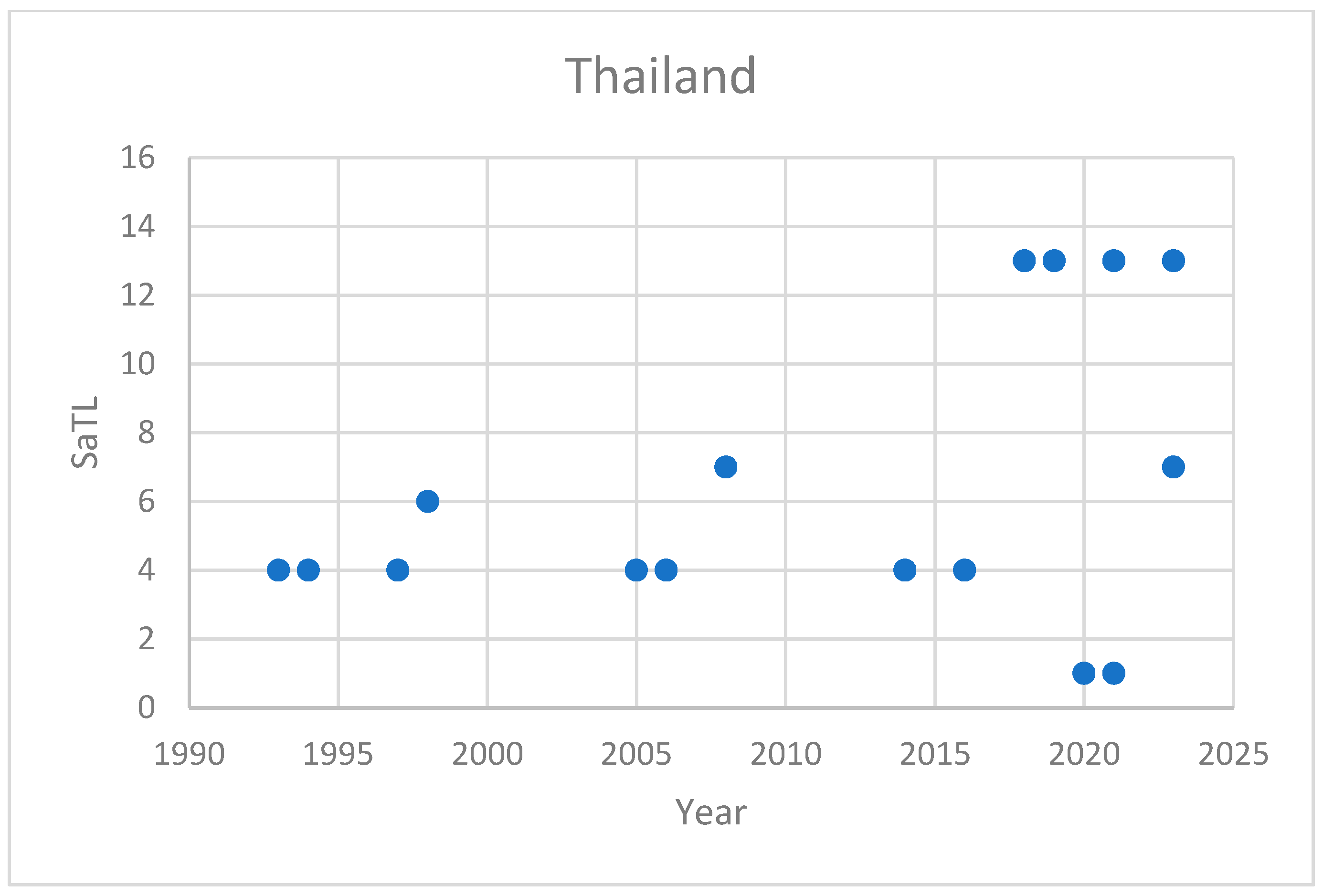
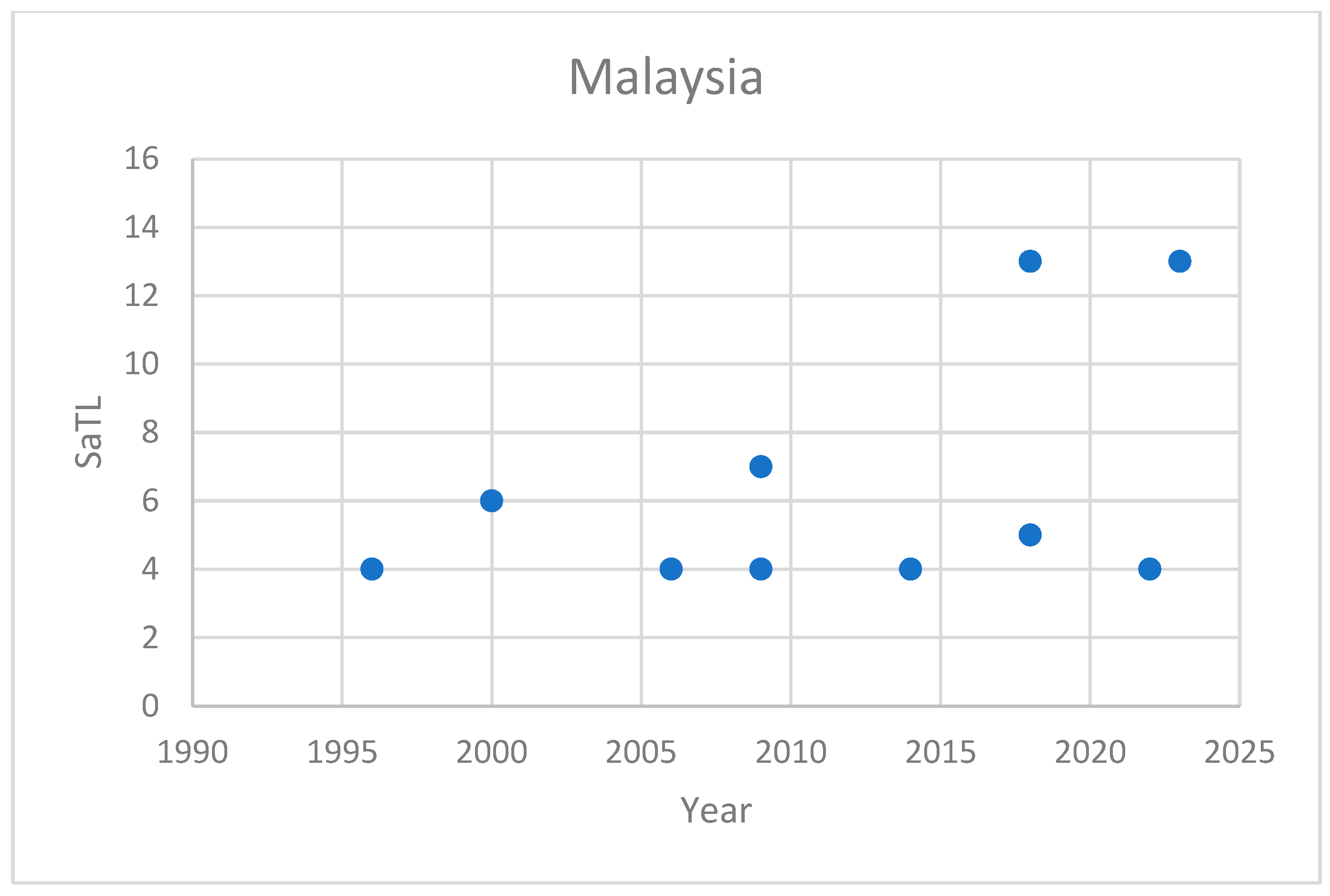
Among the countries where the Satellite Technology Ladder (SaTL) has advanced, Chile, Thailand and Malaysia, have only begun to make significant progress in recent years, despite limited development in the past. As shown in Figure 4, Figure 5 and Figure 6, these countries have had satellites since the 1990s, providing them with an established history in the field; however, until the latter half of the 2010s, their efforts primarily relied on satellite procurement or externally supported development. All of these countries have had satellites since the 1990s, giving them a certain history in the field, but until the latter half of the 2010s, they primarily relied on satellite procurement or externally supported development. Chile has sourced satellites from Surrey Satellite Technology Ltd. and Astrium, while Thailand has procured from American, European, and other international companies, with Malaysia following a similar pattern. However, between the late 2010s and around 2020, these countries have shown a tendency to begin developing satellites using their own technologies, albeit on a smaller scale.
Figure 4.
SaTL of Chile.
Figure 5.
SaTL of Thailand.
Figure 6.
SaTL of Malaysia.
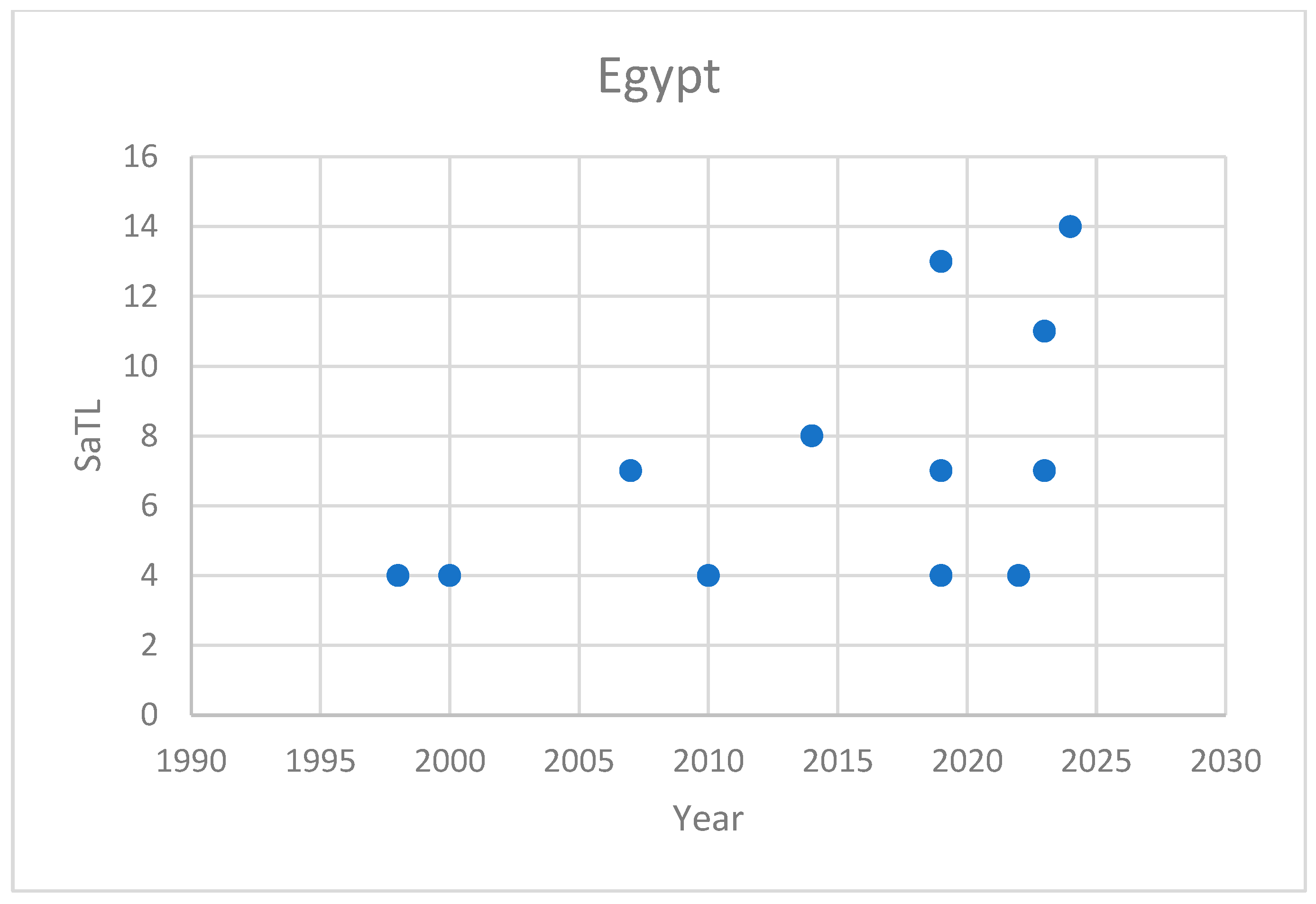
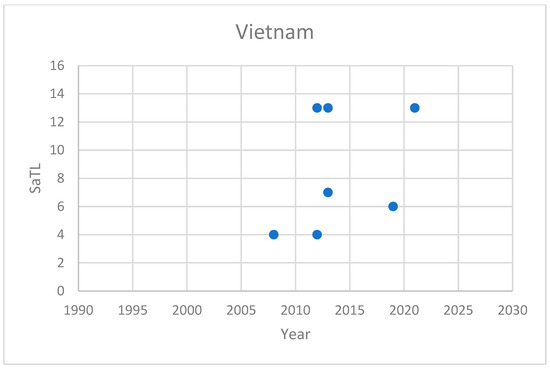
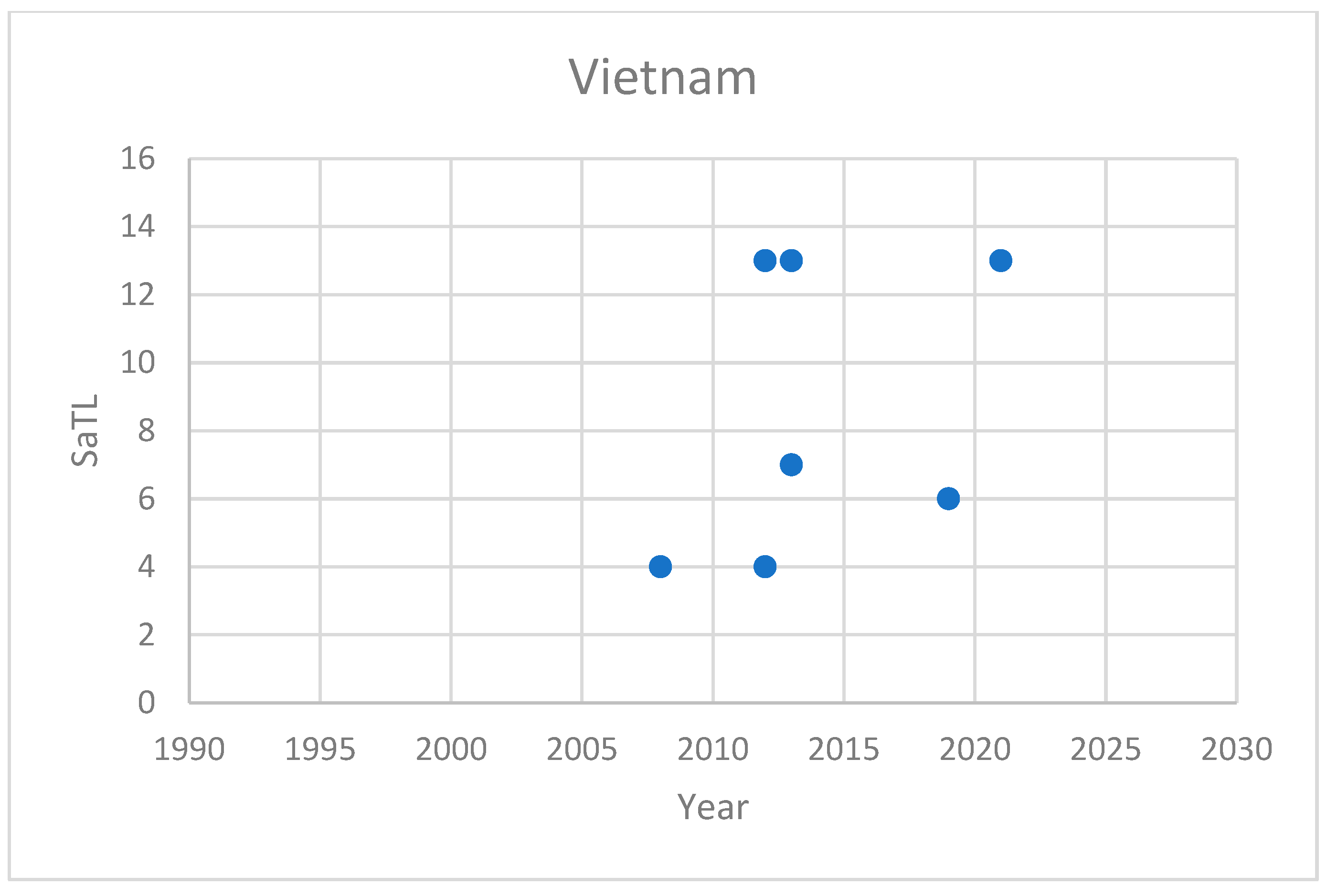
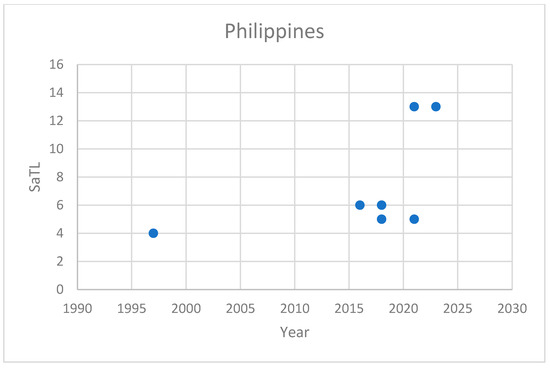
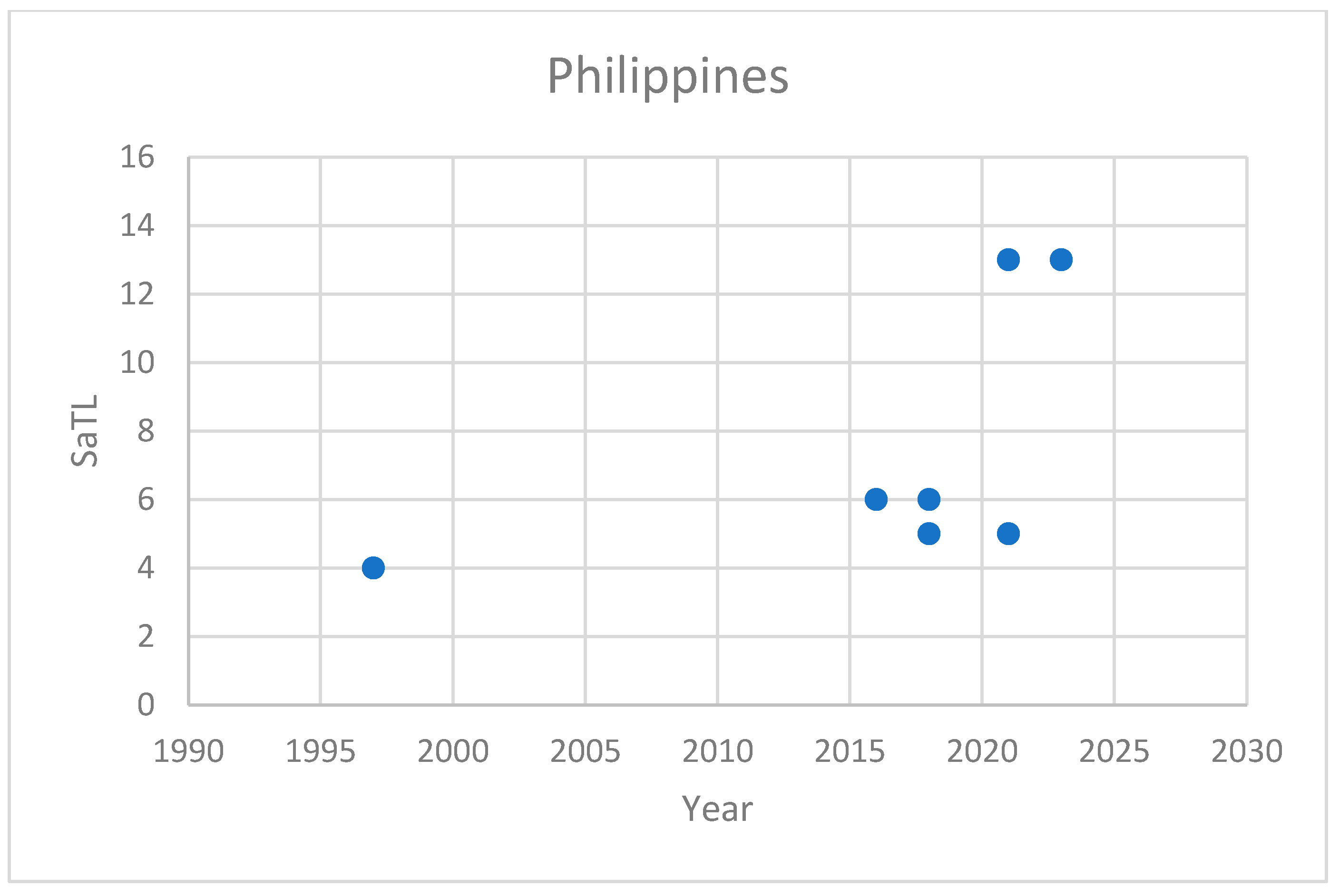
As reflected in Figure 7, Egypt initially procured satellites from European and Ukrainian companies but has since moved towards developing its own CubeSats. Since 2020, Egypt has also started developing medium-sized satellites with support from China. In contrast, Vietnam and the Philippines were late entrants into satellite development, but since 2010, around the time of establishing their respective space agencies, they have strategically aimed to transition to domestic development. Although they are still in the process of developing their own satellites, their focus has been on acquiring technology from abroad, as shown by the later trends in Figure 8 and Figure 9, primarily from Japan.
Figure 7.
SaTL of Egypt.
Figure 8.
SaTL of Vietnam.
Figure 9.
SaTL of Philippines.
4.3. Countries’ Industry Expanding After SaTL Rises (Type 3)
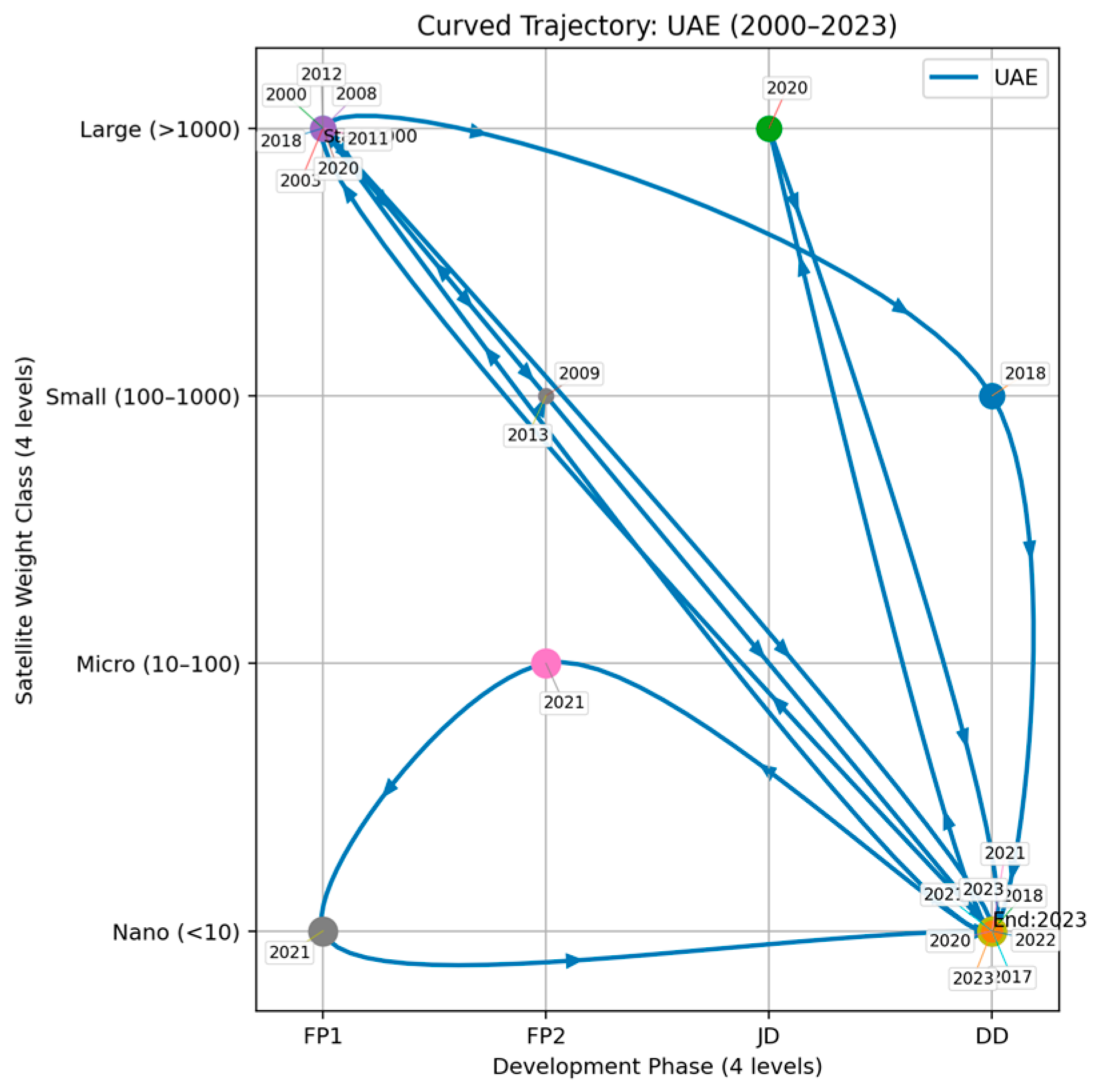
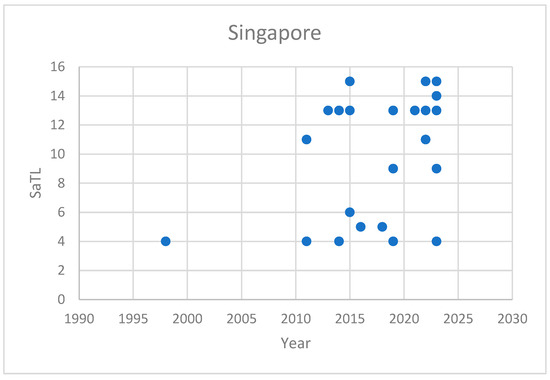
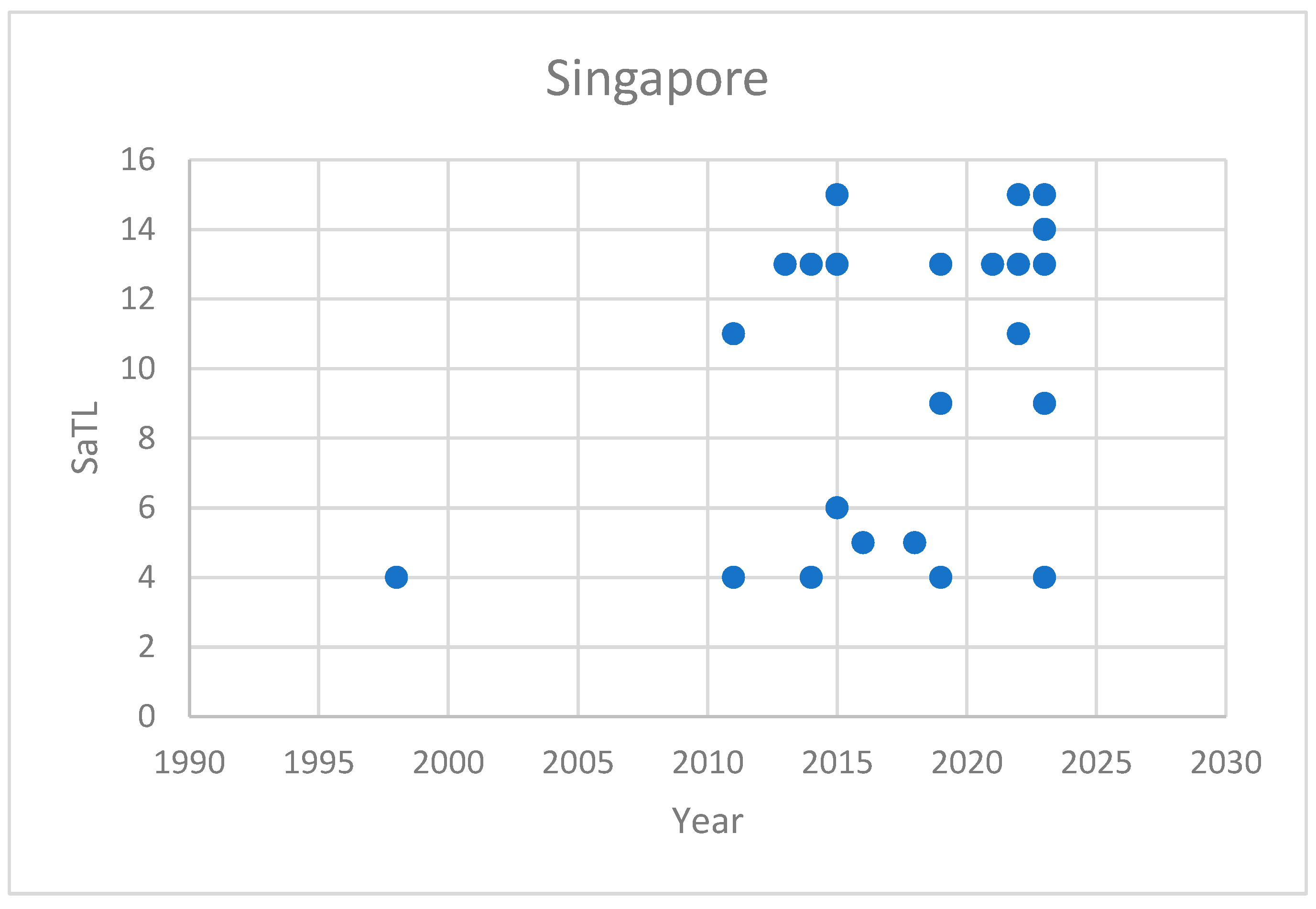
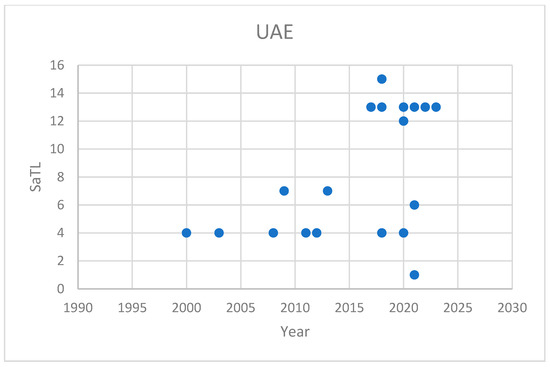
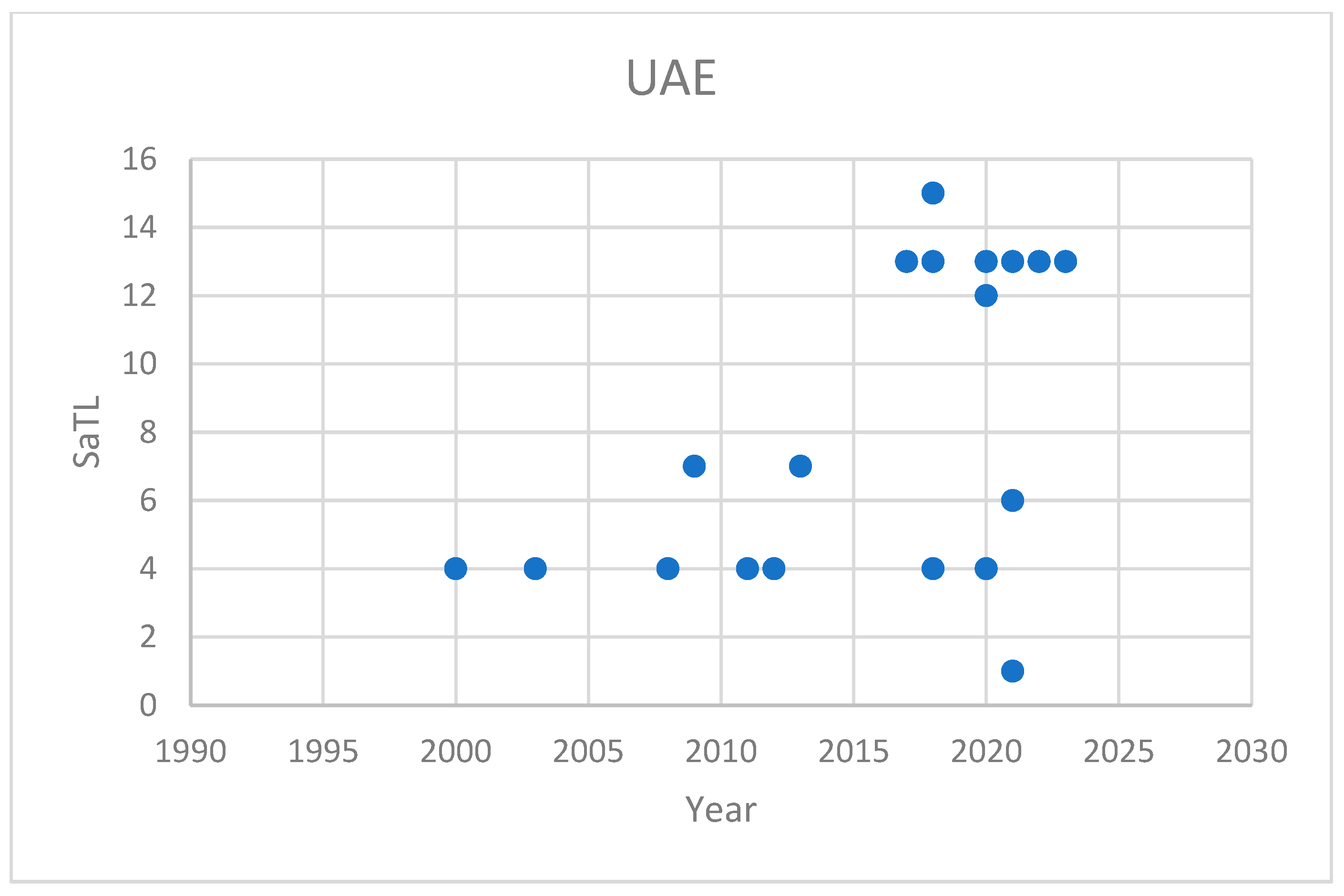
Countries expected to expand their satellite development capabilities following the rise of SaTL include Singapore and the UAE. Although relatively late entrants into satellite projects, both countries began making significant strides since around 2010. Singapore established the Office for Space Technology and Industry (OSTIn) in 2013, while the UAE founded the UAE Space Agency in 2014. Since then, both nations have actively introduced foreign technologies and provided support to domestic universities and companies. Despite being latecomers to satellite technology acquisition, both countries have quickly focused on building domestic development capabilities following the establishment of their space agencies (or equivalent offices in Singapore), as evidenced by SaTL progression shown in Figure 10 and Figure 11. Furthermore, the number of stakeholders involved has expanded, with participation growing from companies to universities. In the case of both countries, it is noteworthy that policies aimed at industrial promotion take precedence over those focused on pure science or academic objectives.
Figure 10.
SaTL of Singapore.
Figure 11.
SaTL of UAE.
4.4. Countries with Higher SaTL Since the Beginning (Type 4)
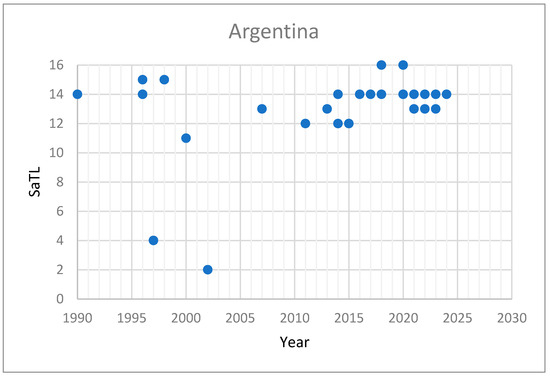
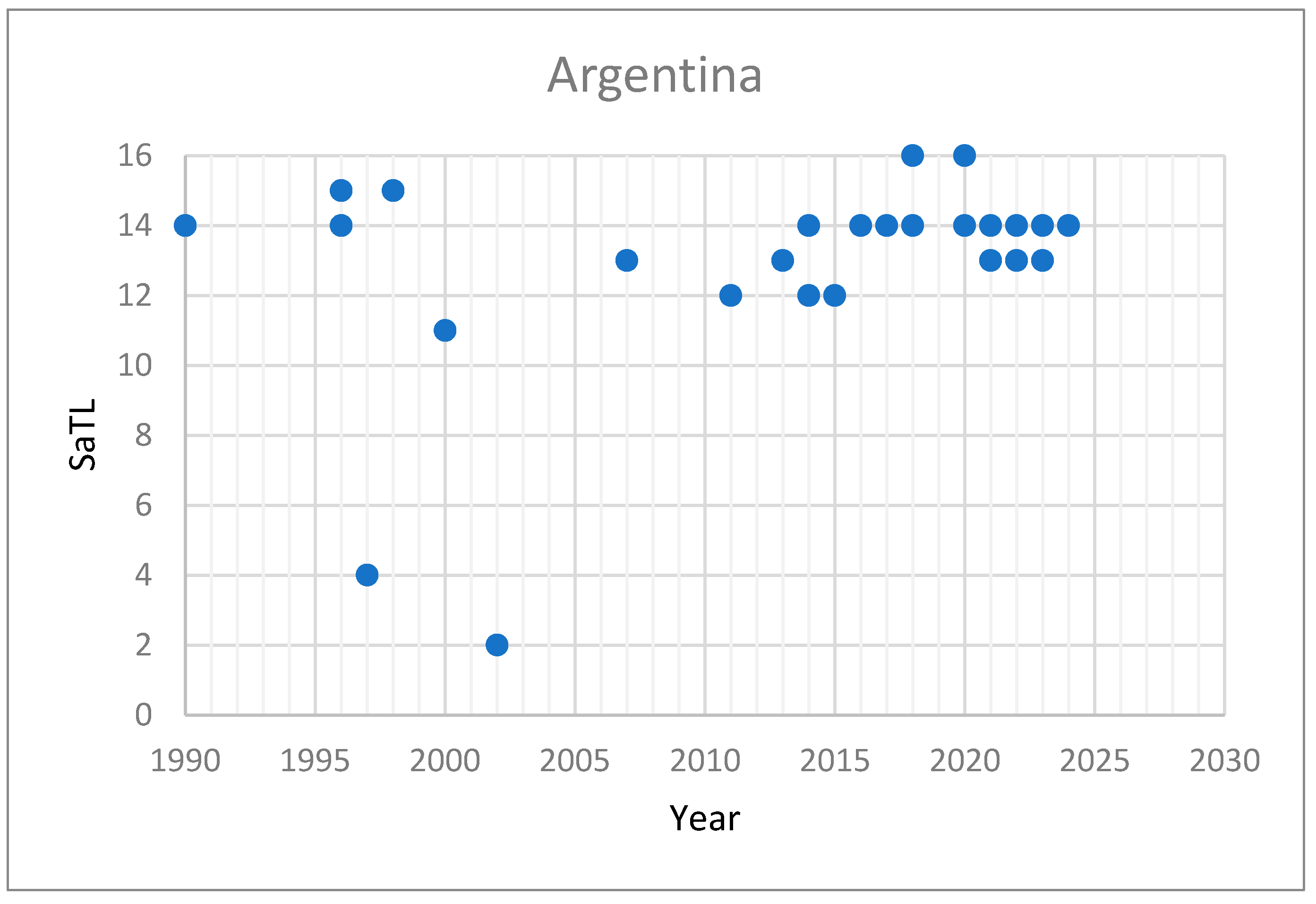
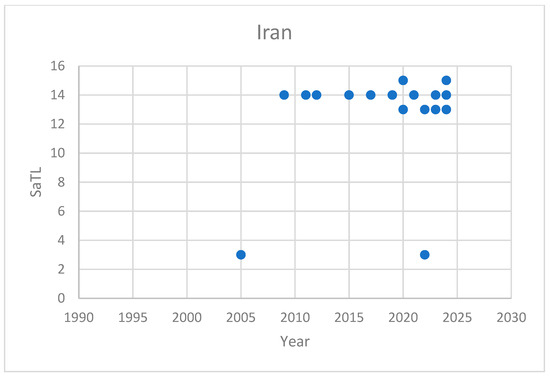
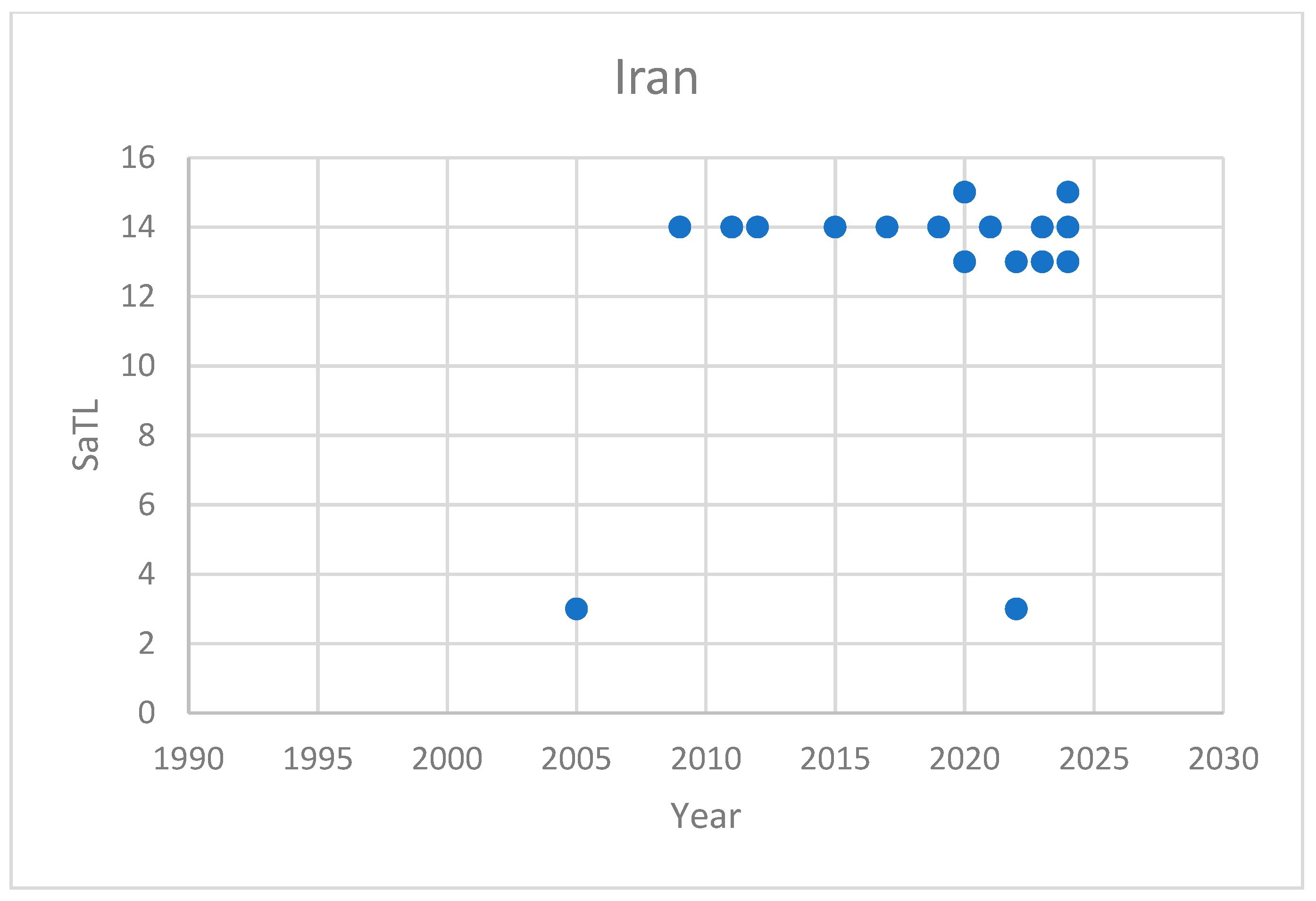
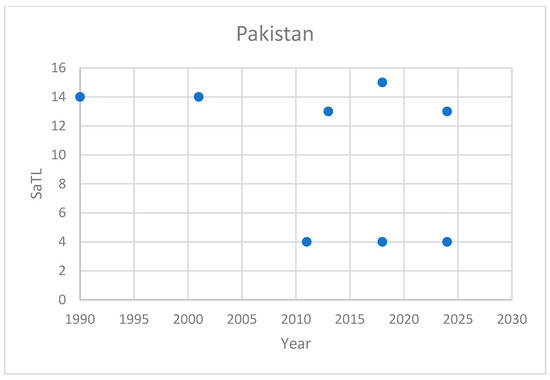
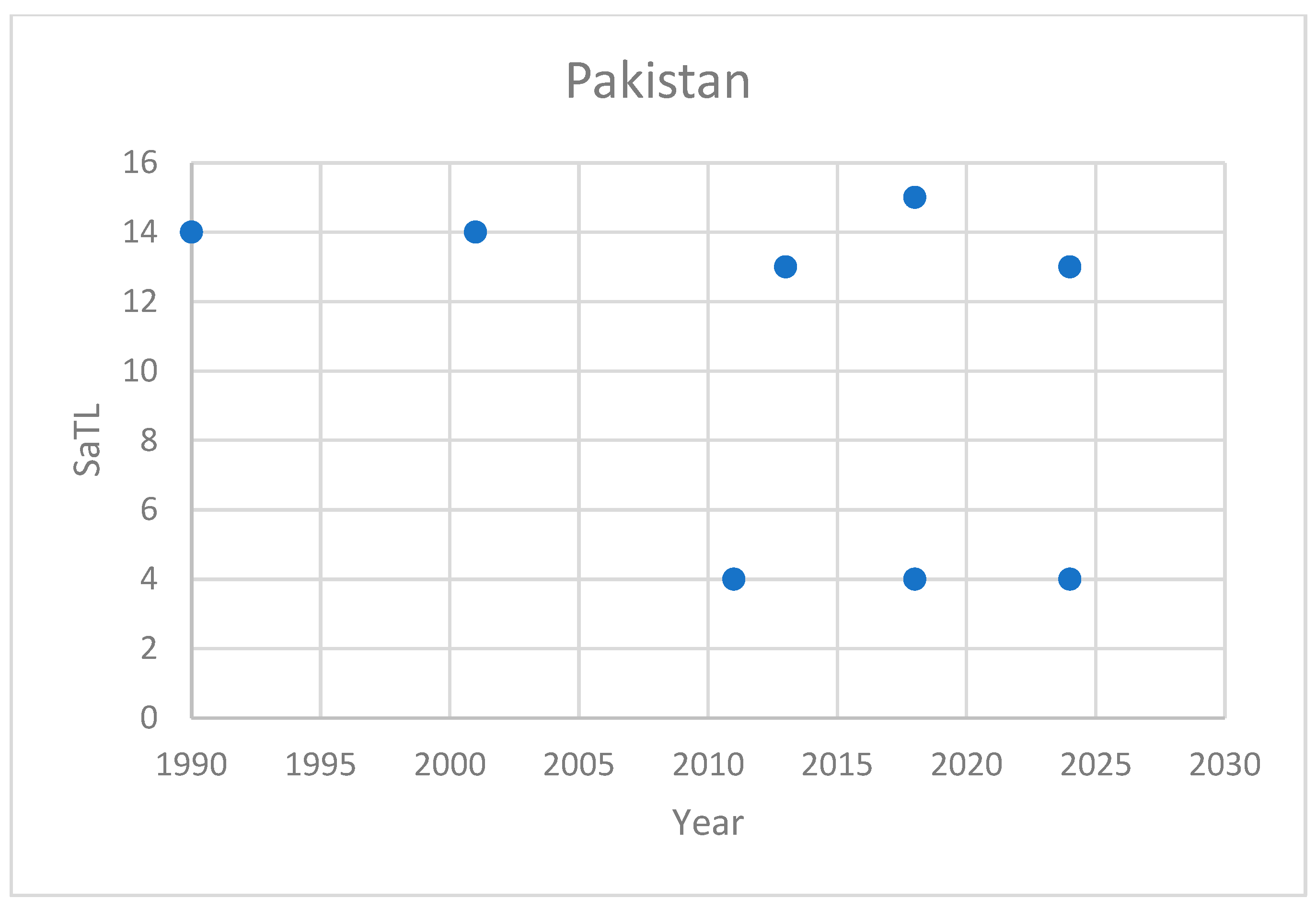
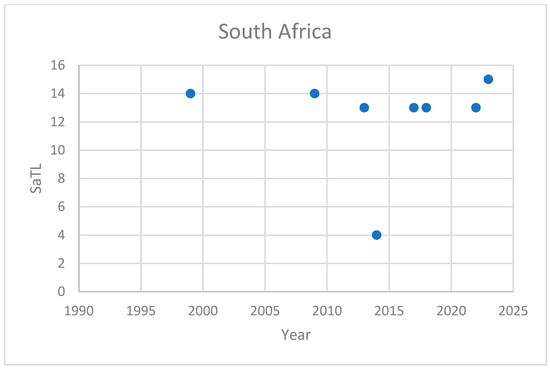
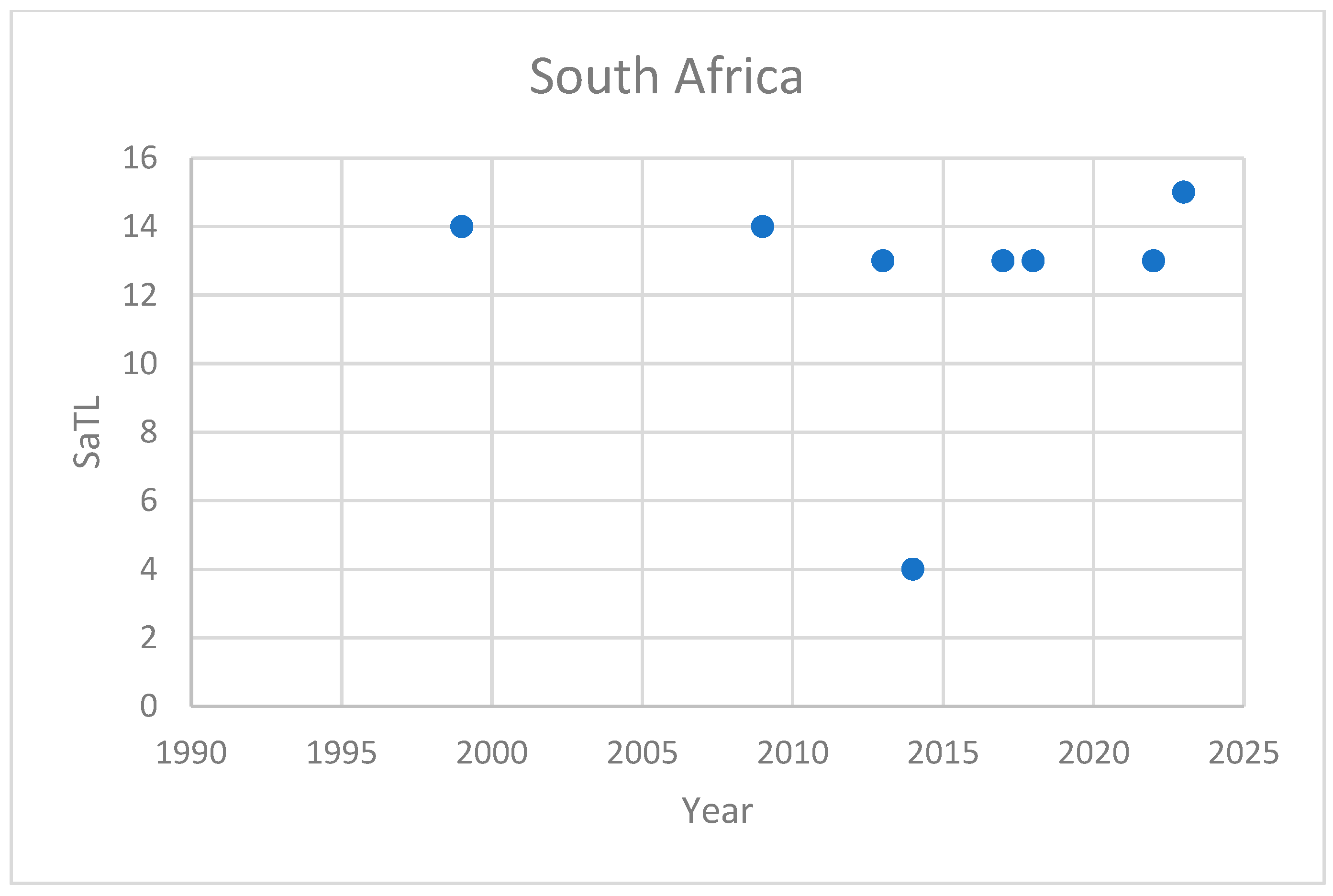
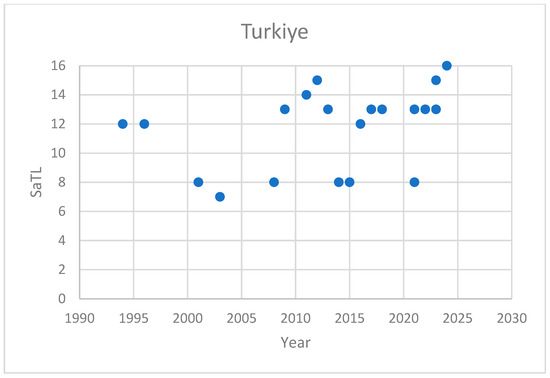
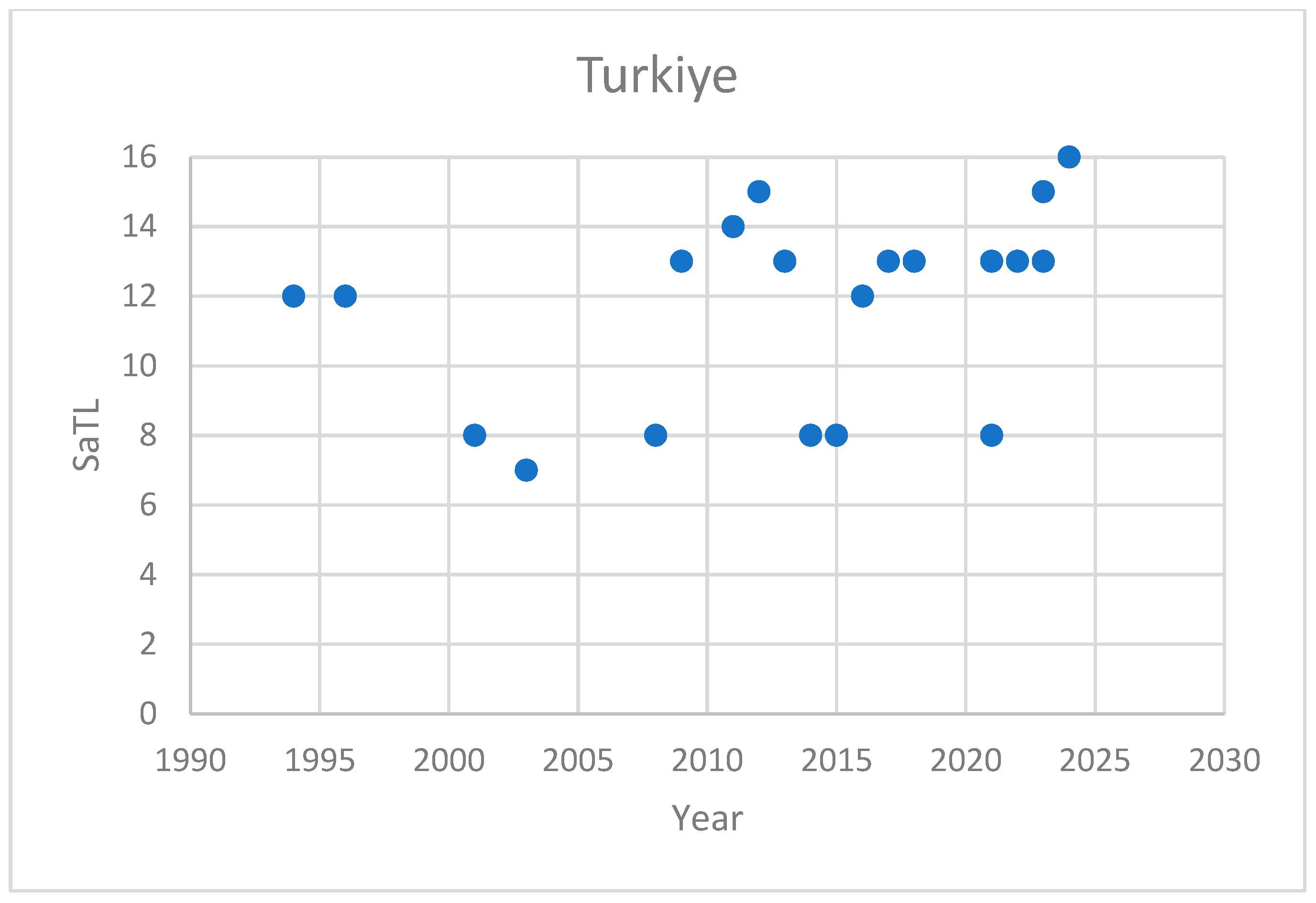
Countries with higher SaTL than initially expected include Argentina, Iran, Pakistan, South Africa, and Turkiye. These countries vary in terms of when they began satellite development, the size of the satellites they produce, and the nature of their missions, all of which are influenced by their economic conditions and technological capabilities. The SaTL progression shown in Figure 12, Figure 13, Figure 14, Figure 15 and Figure 16 indicates that these countries have pursued domestic development from the outset. While it is possible that they have received foreign technology and support not publicly disclosed, even when collaborating with international companies, these efforts have generally been carried out under national leadership. Some countries, such as Argentina, have consistently pursued independent development, while others, like Turkiye, focus on domestic development but aim to enhance local technological expertise through collaboration with foreign companies. A common characteristic among countries with self-development capabilities may be their association with advanced military technologies.
Figure 12.
SaTL of Argentina.
Figure 13.
SaTL of Iran.
Figure 14.
SaTL of Pakistan.
Figure 15.
SaTL of South Africa.
Figure 16.
SaTL of Turkiye.
4.5. Analysis of Satellite Missions Using SaTL
Application of the Satellite Technology Ladder (SaTL) resulted in the classification of 265 satellite missions from 16 emerging spacefaring nations between 1990 and 2024. The distribution of SaTL levels shows a clear concentration of early missions in the lower-left quadrant of the matrix, corresponding to CubeSat-class satellites developed through foreign procurement or externally supported development. Also, only 6.6% of missions reached Levels 15–16, representing indigenous development of small satellites or larger satellites. Countries with multiple universities operating active CubeSat programs—such as Turkiye, Argentina, and South Africa—exhibited significantly higher mission counts, suggesting that academic ecosystems play a central role in early capability accumulation.
A temporal analysis shows a progressive shift from externally supported development to domestically supported and indigenous development over the three decades surveyed. The median SaTL level rose from 6.9 in the early period (1990–2009) to 9.3 in the middle period (2010–2019) and to 10.7 in the most recent period (2019–2024). This upward shift indicates that emerging countries increasingly transition toward more autonomous development practices and larger, more complex satellite platforms.
For each classification from Type 1 to Type 4, a numerical analysis of SaTL was conducted as shown in Table 3. The average values were calculated for each of the following: the average value of SaTL, the number of years required to transition from FP1 to FP2 or JD, the number of years required to transition from the first satellite project to DD, and the increase in weight class among countries that achieved DD.
Table 3.
Data analysis of Satellite Technology Ladder (SaTL).
For Mean SaTL, the average values showed an increasing trend from Type 1 to Type 4. This is a natural result, as Type 4 categorizes countries capable of pursuing independent development from the outset, while Type 1 represents the opposite.
Regarding the number of years to transition from FP1 to FP2/JD, Type 2 took less time than Type 1, while Type 3 took the longest. This is likely because Type 3 countries, being relatively well-funded, implemented FP1 at a fairly early stage, making the transition to the next phase take longer. It is clear that a considerable number of years are required for any Type.
The time required to reach the first DD is clearly shorter for Type 3 than Type 2, though both Type 2 and Type 3 still require considerable time. Type 1 has not reached DD yet.
Regarding DD weight increase, Type 2 again shows a tendency toward less successful scaling up. Type 3 and Type 4 exhibit similar values, indicating that all countries have achieved sizes ranging from CubeSats to microsatellites.
4.6. Analytical Strategy: Cross-National Trajectory Mapping
Once classified, satellite missions were plotted chronologically for each country to visualize technological trajectories. This longitudinal mapping made it possible to identify linear progression, capability leapfrogging facilitated by foreign collaboration, subsystem-specialization pathways, oscillating trajectories, and hybrid models combining academic-led and industry-led development. The analysis used pattern-matching techniques to compare observed trajectories with theoretical expectations derived from the literature on national innovation systems, technological upgrading, and latecomer development. Particular attention was paid to transitions across development methods—especially shifts from externally supported development to domestically supported or indigenous development—as such shifts signify substantial increases in technological autonomy.
In the process of acquiring space technology, particularly satellite technology, emerging countries face numerous challenges, including economic constraints, underdeveloped technological infrastructure such as supply chains, and a limited number of universities and companies with expertise in space technology. However, these challenges can be mitigated by the advantages of adopting technologies already established by developed nations. This approach enables emerging countries to significantly reduce the time required to develop and implement technologies into domestic capability, compared to the extensive periods taken by countries like the United States and the Soviet Union in the history of space development. This two-axis mapping attempts to trace the trajectory of these technological acquisitions.
First, although all countries begin their satellite programs at lower SaTL levels—typically corresponding to procurement-based development of medium- to large-scale satellites—their subsequent trajectories vary markedly. The aggregated plot demonstrates a general downward shift in satellite size over time, reflecting the global diffusion of CubeSats and small satellites as accessible platforms for hands-on technology learning. This shift is particularly pronounced in countries such as Chile, Malaysia, Vietnam, and Thailand, where the appearance of CubeSats coincides with the first observable rise in SaTL levels.
Second, the longitudinal distribution of SaTL values indicates that transitions from procurement-based activities (SaTL Levels 1–4) to external development with foreign support (Levels 5–8) are relatively common among emerging nations. However, upward transitions beyond Levels 8–12—representing domestically executed development with varying degrees of external support—are less frequent and limited to countries with strong institutional or industrial foundations, such as Turkiye, Iran, South Africa, and Argentina. These countries demonstrate not only increased SaTL levels but also broader dispersion across satellite weight classes, suggesting both diversification of development capabilities and expansion of domestic actors involved in satellite projects.
Third, the two-axis diagrams presented in Appendix B (development approach on the X-axis and satellite weight class on the Y-axis) highlight structural patterns that are not immediately visible in SaTL time-series plots alone. Countries with primarily procurement-based programs cluster in the top-left region, whereas those progressing toward independent development consistently shift toward the lower-right region. This movement corresponds to simultaneously adopting smaller satellite platforms for training and increasing the autonomy of development processes. The visualization reinforces the identification of non-linear trajectory groups—some countries exhibit steady, monotonic progression, while others oscillate between development modes depending on partnerships and domestic capacity.
Together, these graphical observations serve as a foundation for the typology presented in the next subsection. They indicate that the evolution of satellite capability acquisition among emerging nations is neither uniform nor strictly incremental. Instead, it reflects a composite of institutional readiness, international collaboration patterns, and the strategic adoption of satellite size as an instrument for phased learning. Building on these empirical insights, the following section classifies the countries into four developmental trajectories that capture these heterogeneous patterns.
5. Discussion
The results of this study reveal substantial diversity in how emerging space nations build satellite capabilities, demonstrating that capability development is shaped by institutional configurations, access to international collaboration, and the presence of domestic industrial structures. Rather than converging on a uniform linear pathway, countries follow a range of developmental trajectories as shown in Appendix B figures, that reflect differences in strategic choices, organizational learning mechanisms, and ecosystem alignment.
5.1. Factors Influencing Trajectory Divergence
Cross-national comparison revealed several structural factors that contribute to divergent SaTL trajectories. Countries that utilize domestic systems enabling collaboration among government agencies, universities, and domestic industry tend to demonstrate more linear and sustained progress in capability development. Institutional stability and continuity of mission, as seen in Argentina and Turkiye, support the gradual accumulation of expertise in subsystems and system engineering capabilities [8,14].
Conversely, nations with fragmented institutional environments or inconsistent funding cycles experience oscillating or plateau patterns. In these contexts, university-led initiatives may dominate early capability-building efforts but fail to translate into sustained industrial or national systems-level capacity.
International technology transfer programs also exert significant influence. Structured partnerships that include long-term training, joint design activities, and hands-on subsystem development—such as the Japanese support programs for the Philippines and Vietnam—facilitate leapfrogging effects by accelerating tacit knowledge acquisition [12]. However, when technology transfer is limited to hardware procurement, the resulting influence on national capability trajectory is minimal.
Finally, domestic industrial participation emerges as a critical determinant of indigenous capability formation. Countries possessing aerospace SMEs or state-owned integrators capable of absorbing transferred technology—such as INVAP in Argentina or TUBITAK UZAY in Turkiye—demonstrate significantly stronger upper range in SaTL trajectories. In contrast, nations lacking such structural complementarities remain dependent on externally supported programs.
5.2. Institutional Ecosystems and International Technology Transfer as a Catalyst
Trajectory divergence is closely linked to the strength of domestic ecosystems. Nations with coordinated university–government–industry structures are more likely to consolidate subsystem knowledge and accumulate higher-level engineering capabilities. In contrast, oscillating or plateau trajectories often arise where such coordination is weak or unstable. These findings echo broader innovation systems scholarship, suggesting that capability-building depends not merely on technical training but also on institutions that retain and deploy accumulated knowledge.
International collaboration plays a catalytic role but is not uniformly transformative. Programs that incorporate hands-on subsystem development, co-design activities, and long-term knowledge exchange contribute meaningfully to upward mobility in SaTL levels. However, procurement-focused or short-duration partnerships rarely embed knowledge deeply enough to shift national trajectories. This highlights the need to distinguish between superficial and substantive forms of technology transfer.
5.3. Implications for Satellite Capability Assessment
The identification of four distinct trajectories challenges the traditional view—common in Technology Ladder literature—that nations progress through standardized, sequential stages. Instead, the evidence supports a more dynamic and path-dependent model of capability formation, aligning with institutionalist perspectives that emphasize complementarities between organizational routines, policy environments, and learning structures. Leapfrogging cases, in particular, highlight the nonlinearity of technological upgrading and suggest that targeted international partnerships can accelerate absorptive capacity under the right institutional conditions.
By capturing the interaction between engineering complexity and development autonomy, SaTL provides an analytical lens that makes visible the subtle transitions that existing national-level frameworks overlook. The framework’s granularity clarifies how early CubeSat programs act as capability incubators but require institutional reinforcement and industrial integration to translate into sustained progress. This diagnostic capability positions SaTL as a useful tool for policymakers seeking to design more effective capability-building strategies.
6. Conclusions
6.1. Summary
This study demonstrates the value of a project-level analytical framework for understanding how emerging nations develop satellite capabilities. By introducing the Satellite Technology Ladder (SaTL) and applying it to a multi-country dataset of 265 satellite missions, the research offers a structured means of comparing technological development paths across diverse national contexts. SaTL’s integration of development autonomy and engineering complexity allows for clearer identification of capability transitions and provides explicit features for describing national trajectories.
The study’s primary contribution lies in offering a replicable methodology and a nuanced conceptual tool for evaluating capability formation beyond coarse national indicators. The typology of trajectories generated through SaTL analysis provides policymakers with actionable insights into how institutional stability, industrial participation, and structured technology transfer shape national advancement. The findings also extend theoretical discussions on latecomer innovation by highlighting the role of nonlinearity, knowledge retention, and ecosystem alignment in enabling or constraining strategic technological upgrading.
6.2. Limitation
While the study relies on publicly available information and focuses primarily on satellite engineering dimensions, future research can expand SaTL to incorporate organizational, regulatory, or systems-engineering factors. Drawing upon Technology Ladder theory, this study examines the trajectory of satellite development in emerging nations, with a dual focus on development methodologies and size. While the proposed 16-step framework provides a structured taxonomy based on these two axes, it is important to clarify that this model does not imply an inevitable linear progression. Despite its streamlined nature, the framework remains a robust analytical tool for categorizing and discussing the discrete stages of national space capacity building. Furthermore, longitudinal case studies, interviews with practitioners, and quantitative analyses of transition probabilities represent promising next steps. Ultimately, this research lays the groundwork for a comprehensive, evidence-based approach to understanding and guiding capability development in the global space sector.
Drawing upon Technology Ladder theory, this study examines the mechanisms through which emerging nations can accelerate technology acquisition, with a particular emphasis on international technology transfer. While this research categorizes various models of international collaborative projects, a critical next step is to analyze empirical case studies to evaluate how specific project-level mechanisms—such as human resource development and in-orbit operations—facilitate organizational and technical learning.
6.3. Future Prospects
6.3.1. Refinement and Expansion of the SaTL Framework
While the current SaTL model provides a granular 16-level taxonomy for assessing technological maturity, significant potential exists to broaden its analytical scope. Future research should aim to integrate institutional and absorptive capacity by incorporating metrics that quantify the structural foundations of national space programs. Such metrics might include the density of domestic supply chains, the annual cohort of specialized aerospace graduates, and the stability of long-term fiscal commitments. Accounting for these variables would provide a more holistic assessment of a nation’s long-term aerospace sustainability.
6.3.2. Policy Implications for Sustainable Capacity Building
The findings of this study underscore that technology transfer is a non-linear process, heavily contingent upon domestic institutional strength. Consequently, future policy frameworks for emerging nations should: (1) Prioritize Knowledge Internalization: Transition from “turnkey” procurement models (FP1) toward Joint Development (JD) and Domestic Development (DD). (2) Foster Tacit Knowledge Transfer: Emphasize collaborative frameworks that facilitate the internalization of complex technical expertise rather than mere hardware acquisition.
Author Contributions
Investigation, Methodology, T.F. and N.M.; Validation, E.S. and R.S.I.A.; Data curation, T.F., E.S. and R.S.I.A.; Writing—original draft preparation, T.F.; writing—review and editing, T.F. and N.M.; visualization, T.F.; supervision, N.M.; project administration, T.F.; funding acquisition, T.F. and N.M. All authors have read and agreed to the published version of the manuscript.
Funding
This research was funded by Japan Society for the Promotion of Science JSPS KAKENHI Grant Number 24 K05084.
Data Availability Statement
The data presented in this study are available on request from the corresponding author due to the research currently being conducted.
Acknowledgments
The authors express gratitude to the members of Minato laboratory of Ritsumeikan University graduate school of technology management for their comments.
Conflicts of Interest
The authors declare that the research was conducted in the absence of any commercial or financial relationships that could be construed as a potential conflict of interest.
Abbreviations
The following abbreviations are used in this manuscript:
| NASA | National Aeronautics and Space Administration |
| ESA | European Space Agency |
| JAXA | Japan Aerospace Exploration Agency |
| STL | Space Technology Ladde |
| SaTL | Satellite Technology Ladder |
| GNSS | Global Navigation Satellite System |
| LEO | Low Earth Orbit |
| GEO | Geostationary Earth Orbit |
Appendix A. List of Satellite Projects in Each Country
Table A1.
Nigeria.
Table A2.
Algeria.
Table A3.
Chile.
Table A4.
Thailand.
Table A5.
Malaysia.
Table A6.
Vietnam.
Table A7.
Philippines.
Table A8.
Egypt.
Table A9.
Singapore.
Table A10.
UAE.
Table A11.
Argentina.
Table A12.
Iran.
Table A13.
Pakistan.
Table A14.
South Africa.
Table A15.
Turkiye.
Table A16.
Peru.
Appendix B. Development Phase and Satellite Weight Class Axis Graphs
- 1.
- Overseas Procurement Model
Figure A1.
Curved trajectory of Algeria.
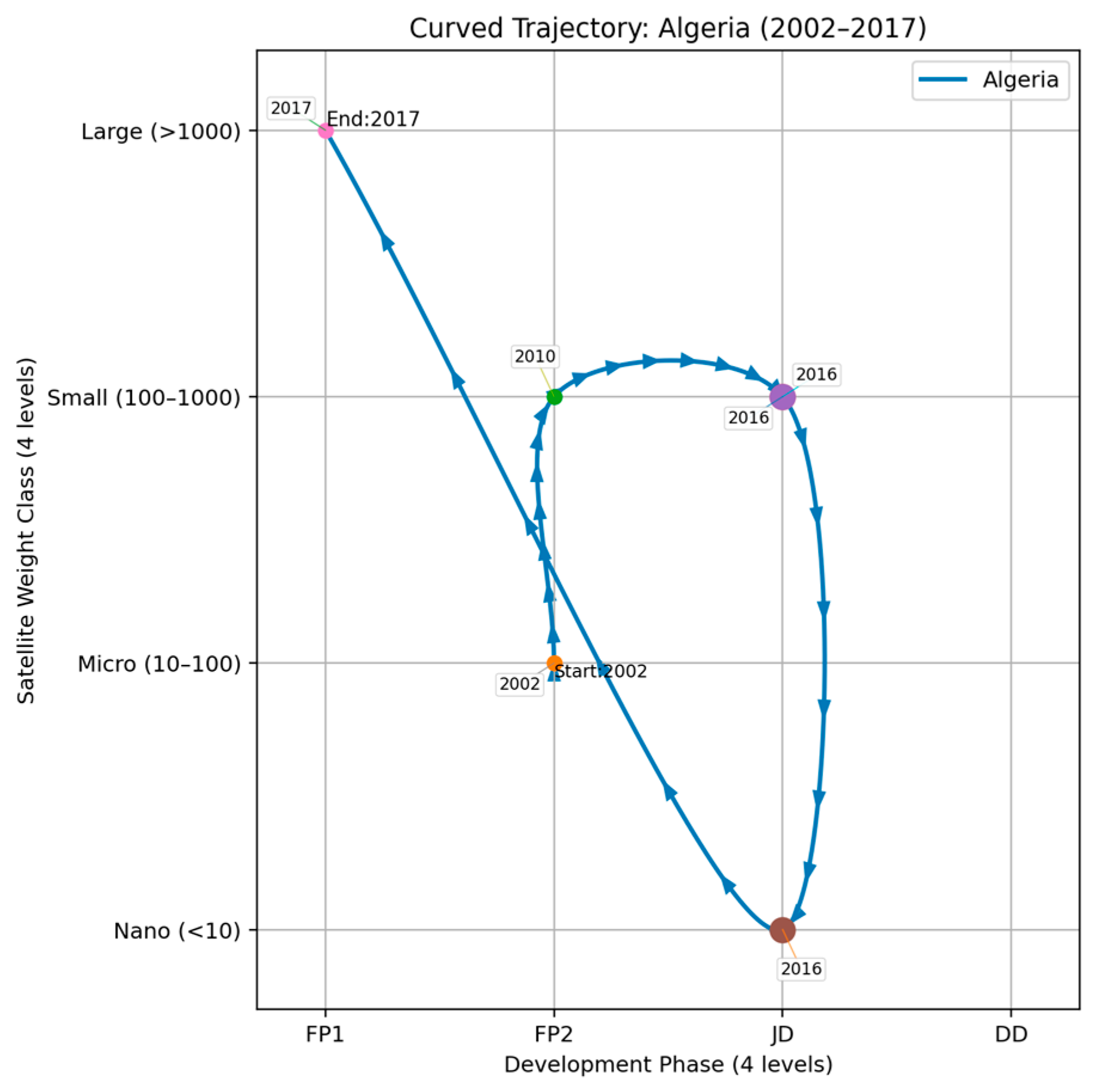
Figure A2.
Curved trajectory of Nigeria.
- 2.
- Overseas Technology Introduction Model
Figure A3.
Curved trajectory of Chile.
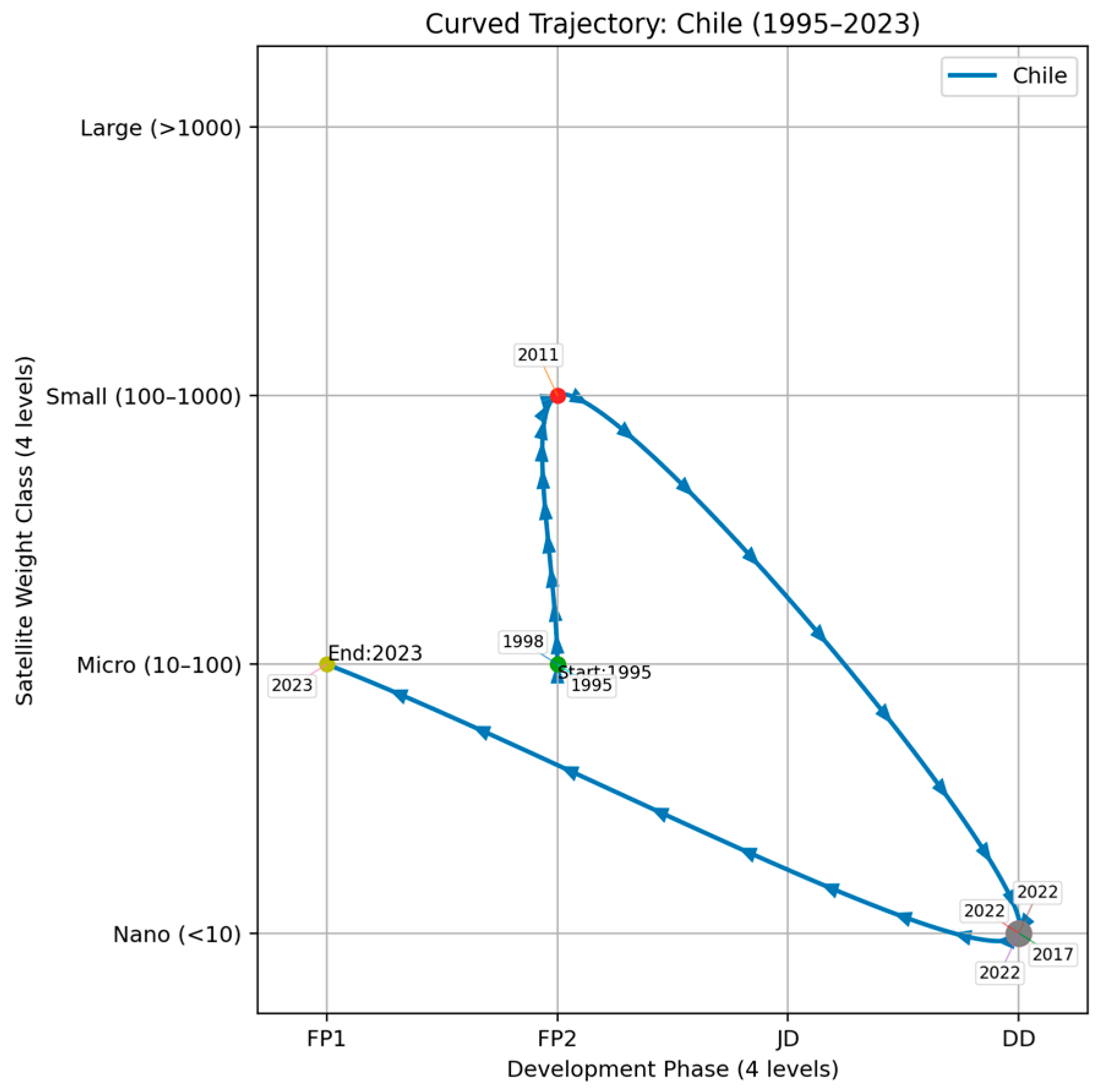
Figure A4.
Curved trajectory of Thailand.
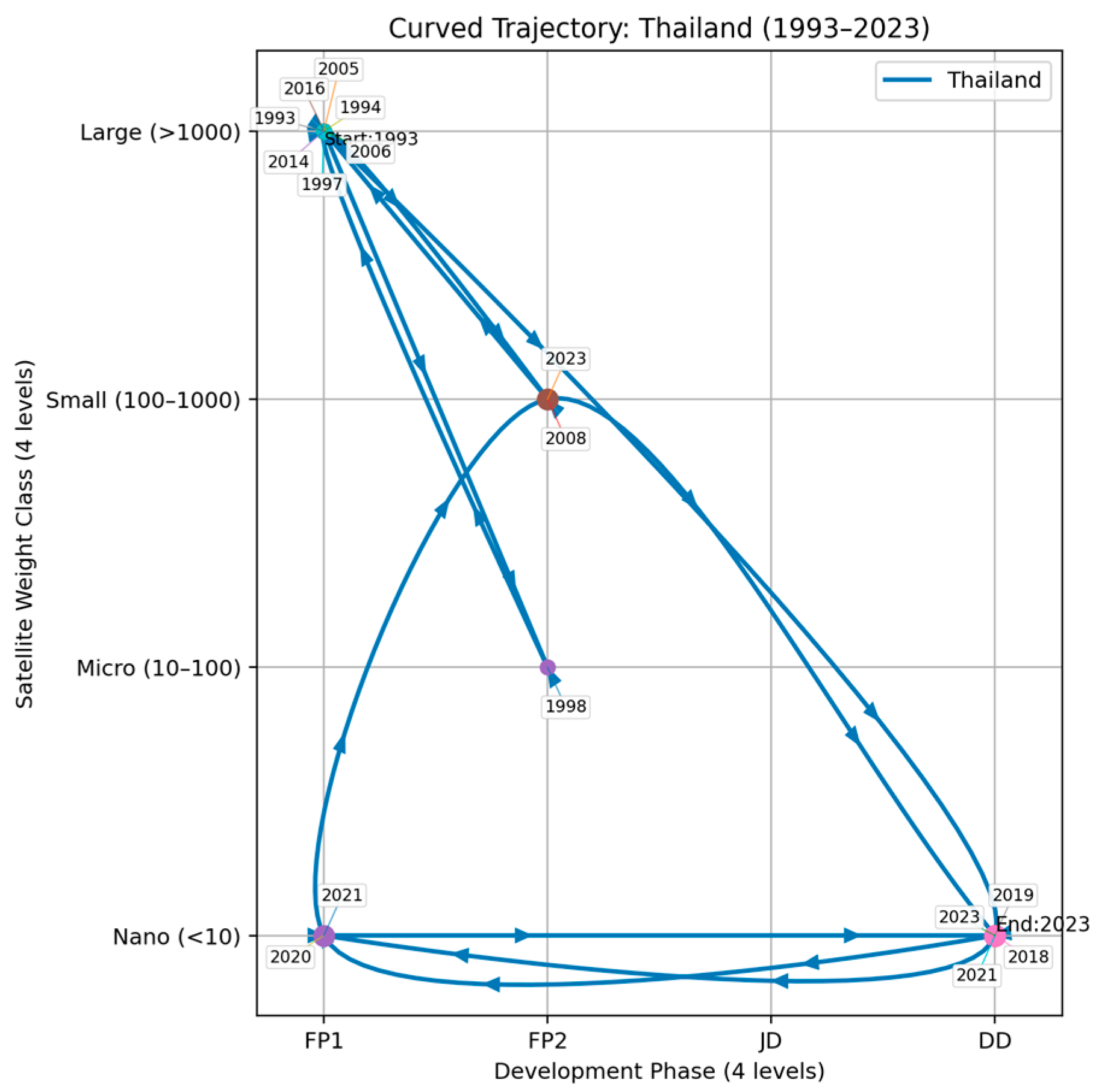
Figure A5.
Curved trajectory of Vietnam.
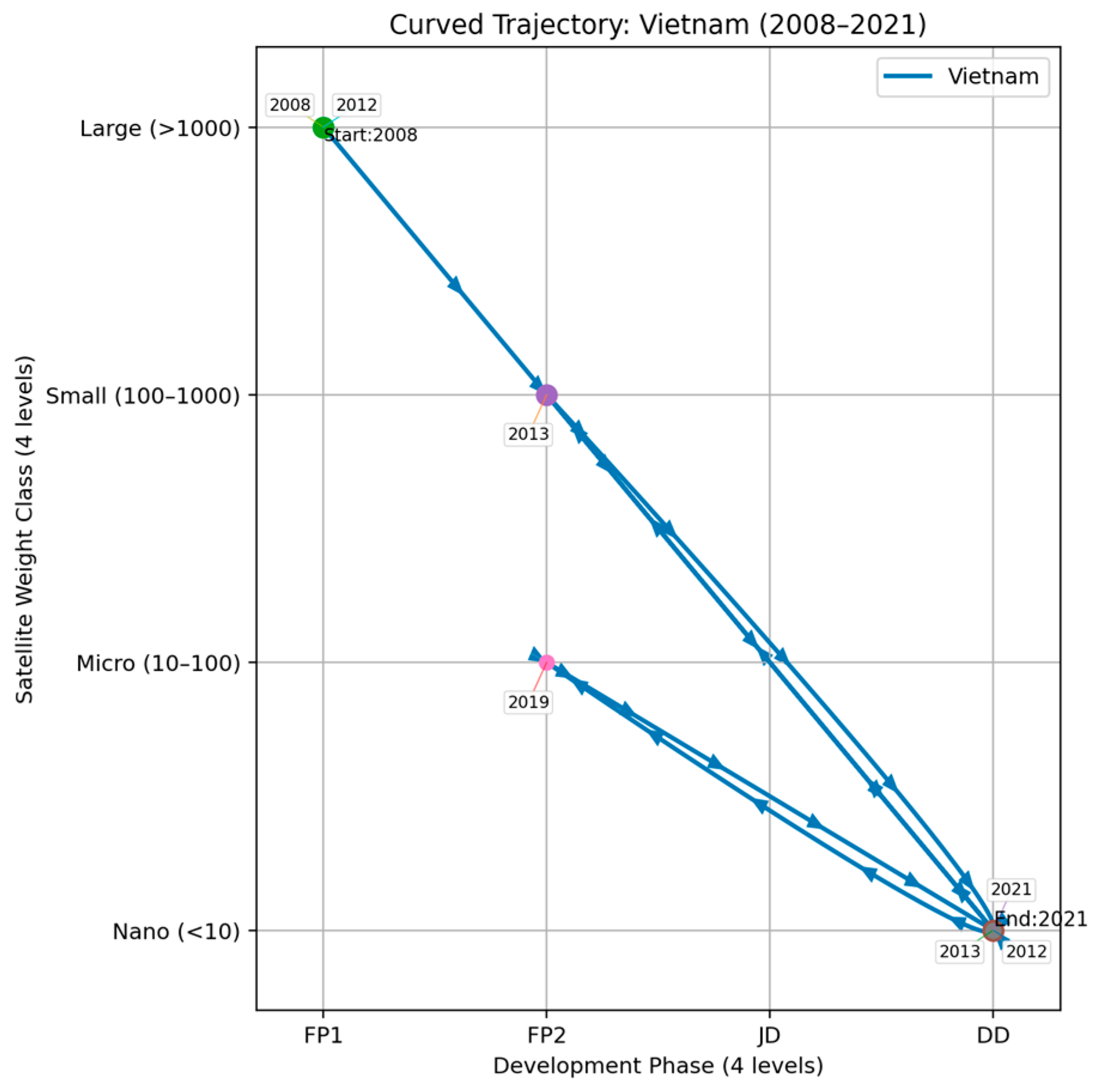
Figure A6.
Curved trajectory of Malaysia.
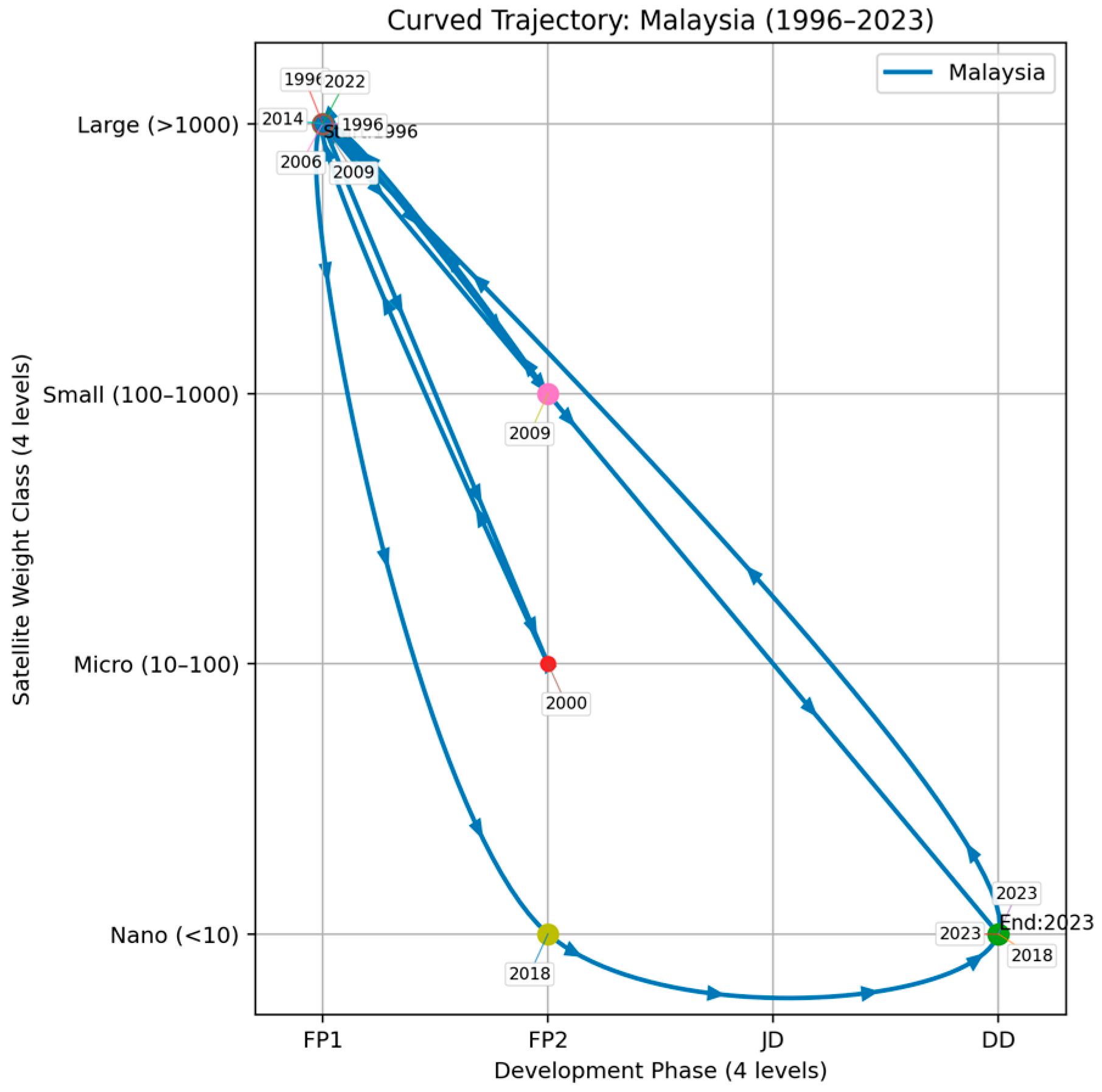
Figure A7.
Curved trajectory of Egypt.
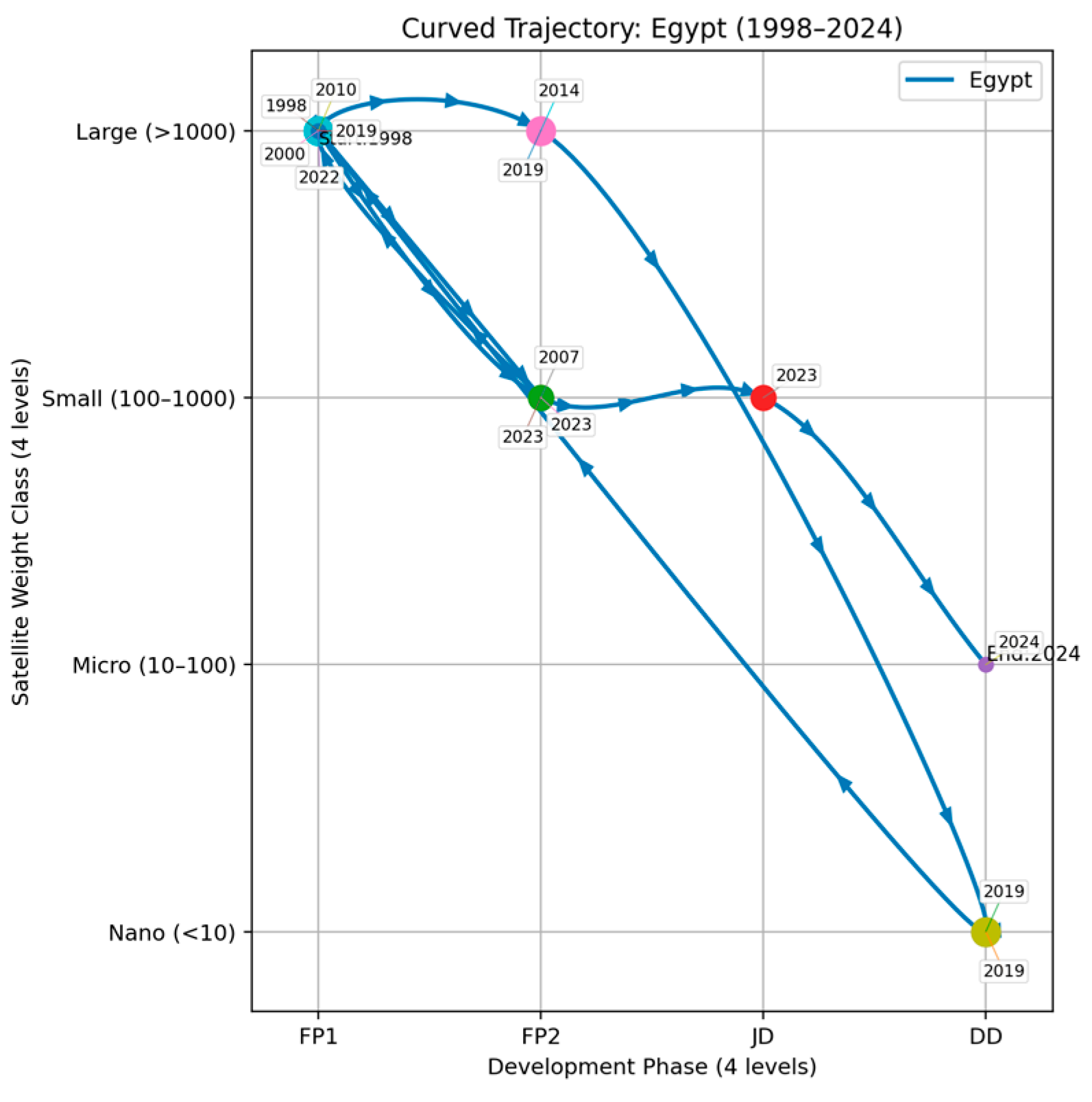
- 3.
- Overseas Collaboration model
Figure A8.
Curved trajectory of Singapore.
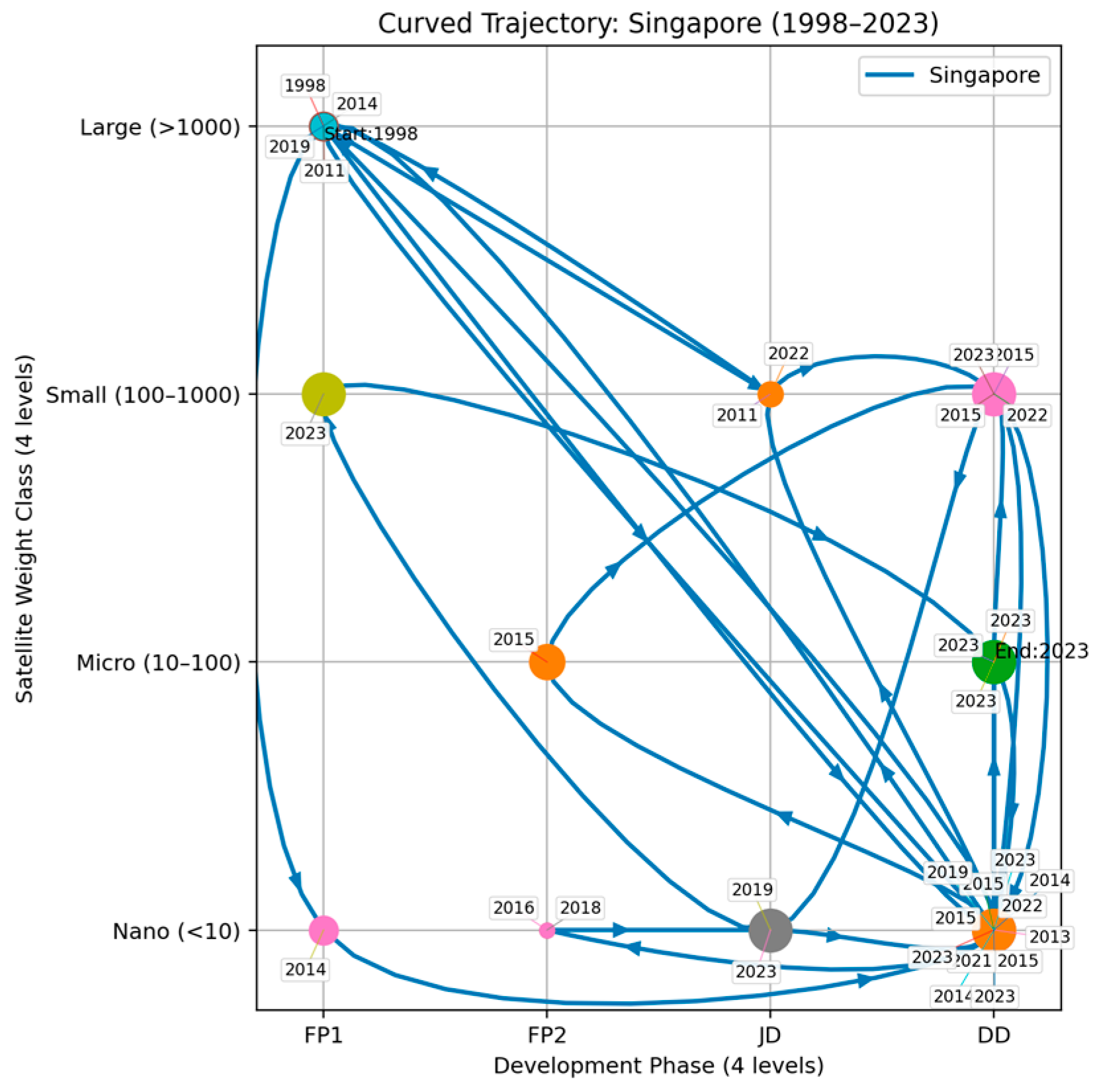
Figure A9.
Curved trajectory of UAE.
- 4.
- Domestic Development Model
Figure A10.
Curved trajectory of Argentina.
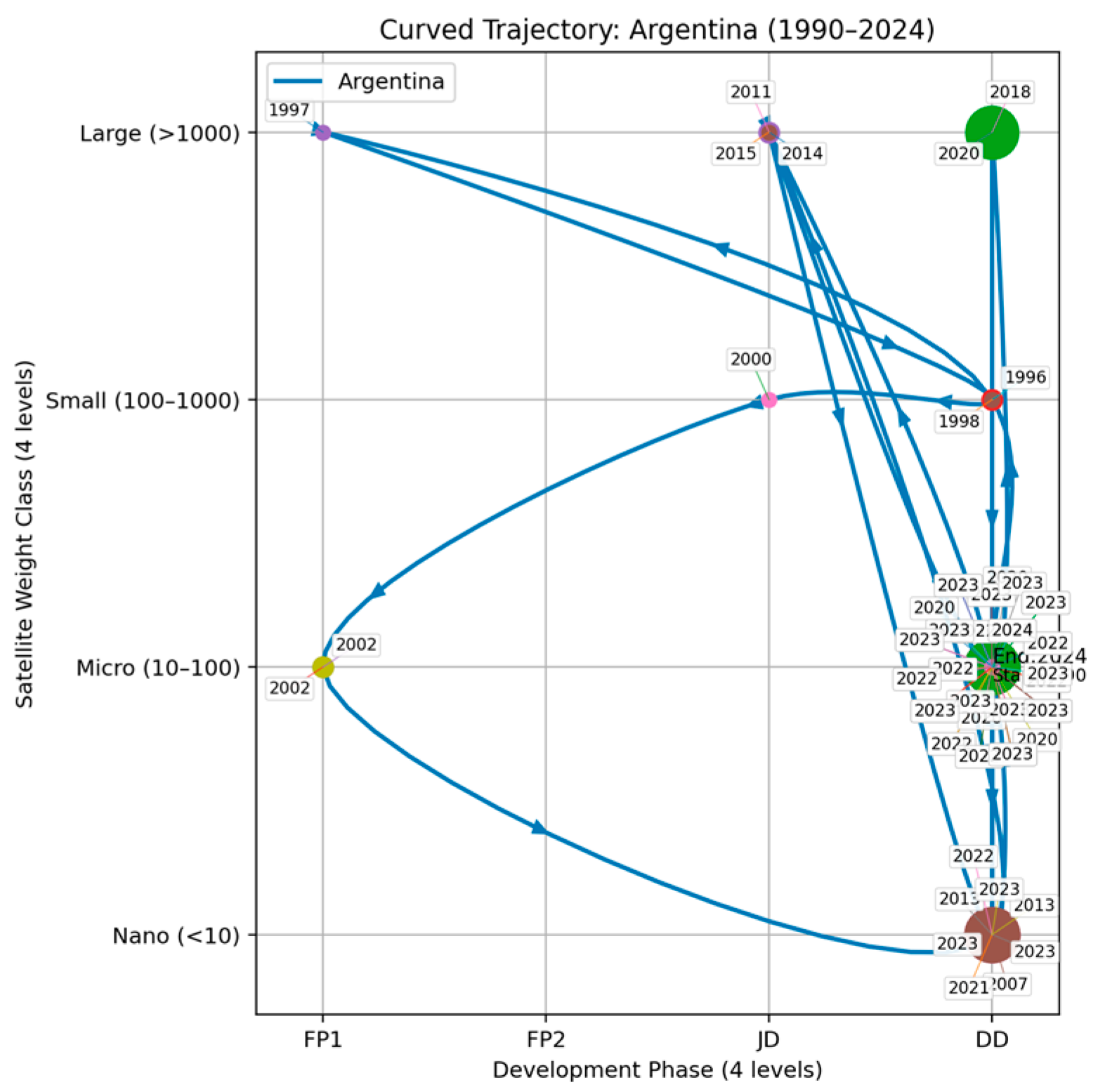
Figure A11.
Curved trajectory of Iran.
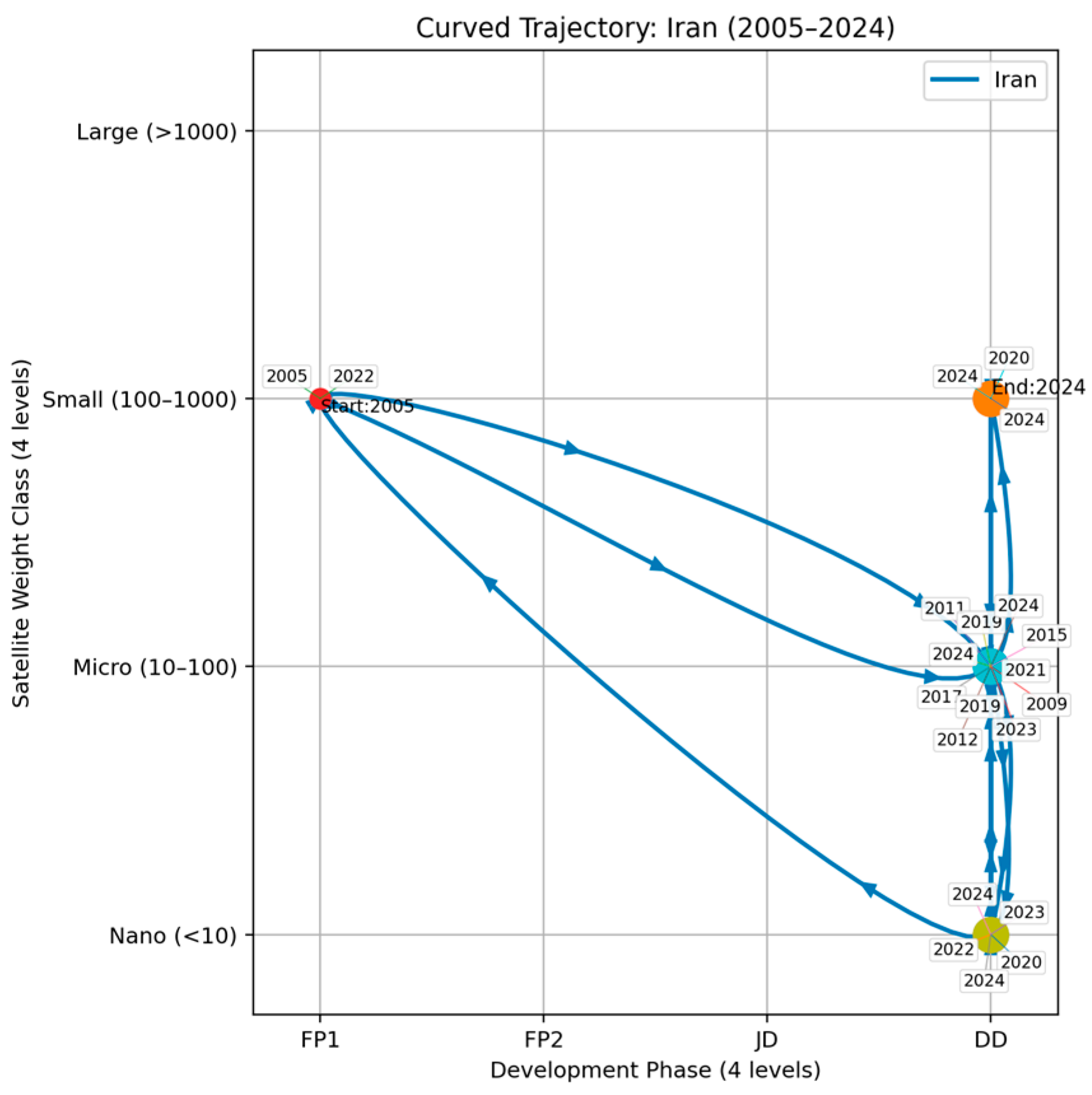
Figure A12.
Curved trajectory of Pakistan.
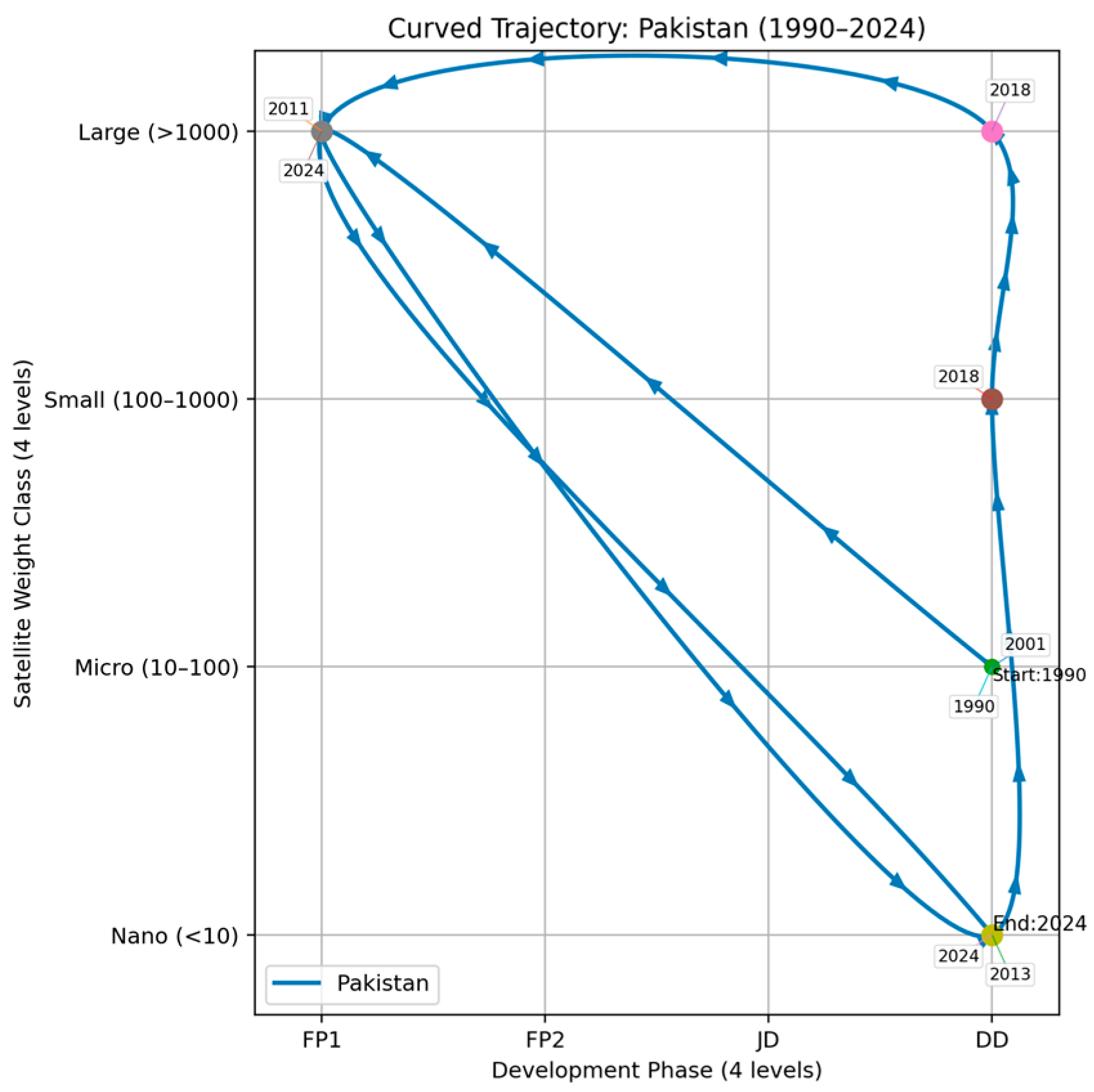
Figure A13.
Curved trajectory of Turkiye.
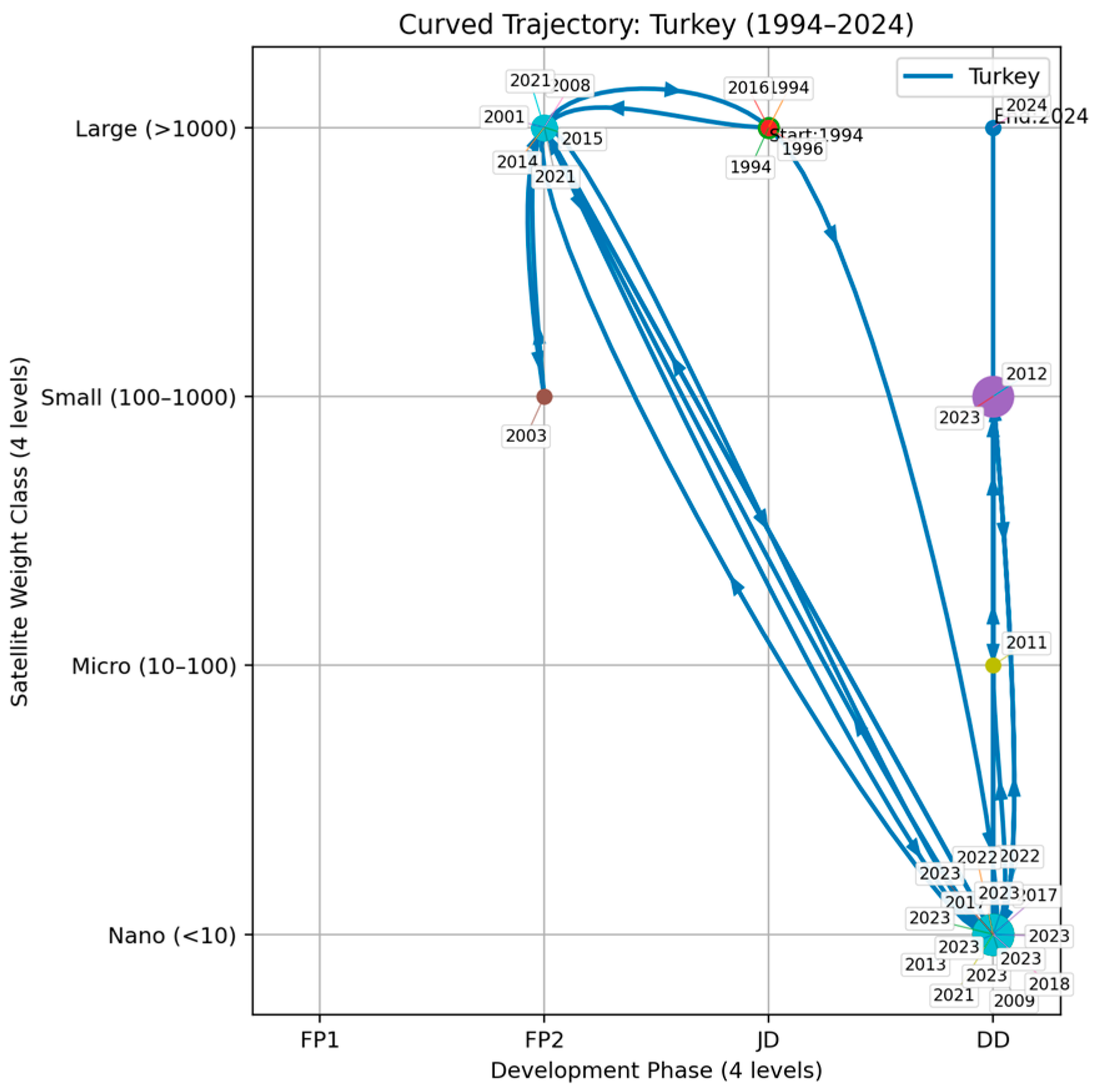
Figure A14.
Curved trajectory of South Africa.
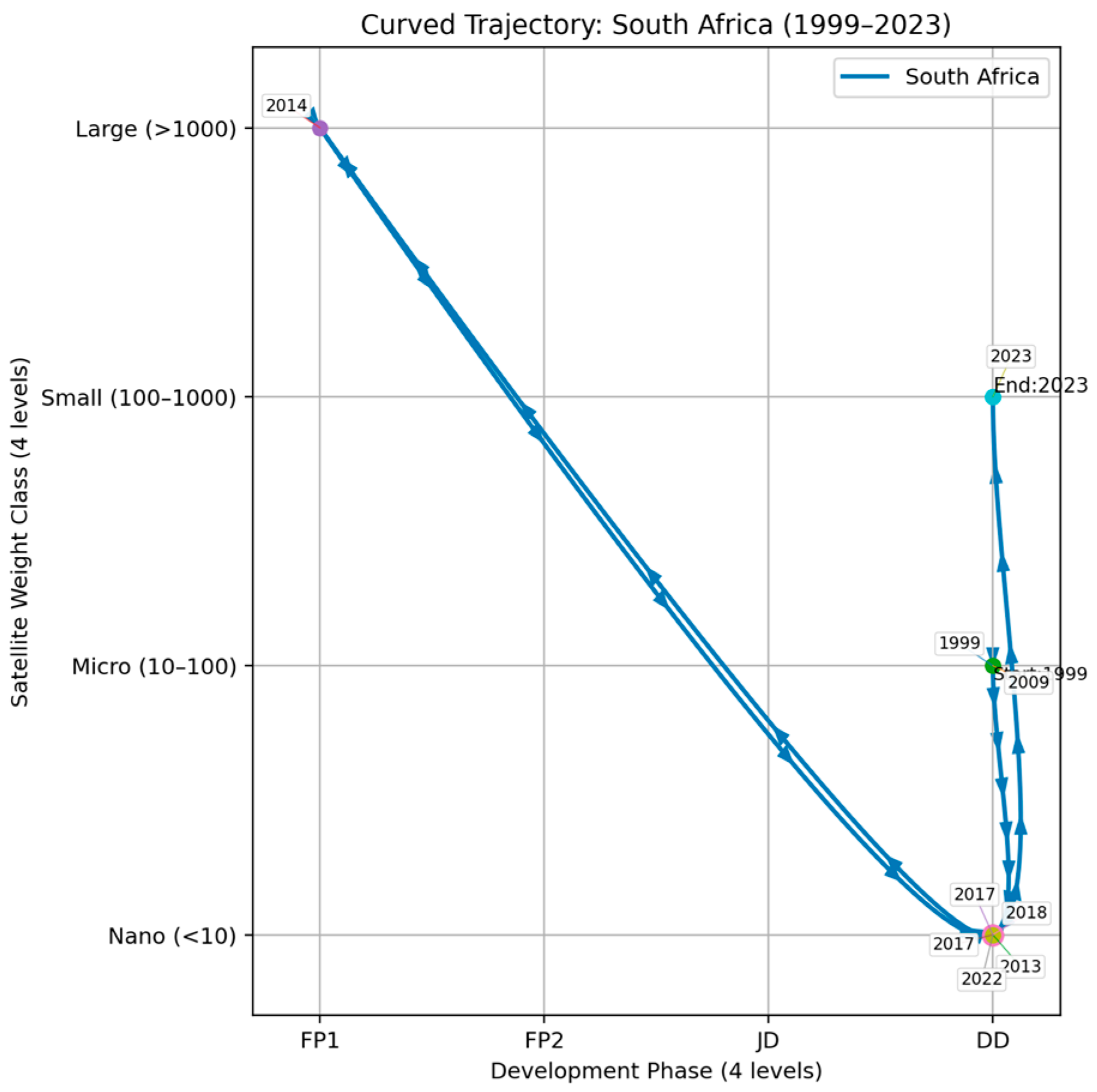
Figure A15.
Curved trajectory of Peru.
References
- Swartwout, M.; Clay, J. University-Class Spacecraft by the Numbers: Success, Failure, Debris. (But Mostly Success). In Proceedings of the 30th Annual AIAA USU Conference on Small Satellites, Logan, UT, USA, 6–11 August 2016. [Google Scholar]
- Berthet, M.; Nakasuka, S.; Cho, M.; Suzuki, K. Country-first domestic satellites: A family tree. Prog. Aerosp. Sci. 2024, 146, 100997. [Google Scholar] [CrossRef] [Scilit]
- Berthet, M.; Corrado, R. Review and comparison of three emerging regional space agencies: The African Space Agency, the Arab Space Coordination Group, and the Latin American and Caribbean Space Agency. Space Policy 2024, 68, 101624. [Google Scholar] [CrossRef] [Scilit]
- Wood, D.; Weigel, A. Charting the evolution of satellite programs in developing countries—The Space Technology Ladder. Space Policy 2011, 28, 15–24. [Google Scholar] [CrossRef] [Scilit]
- Cohen, W.M.; Levinthal, D.A. Absorptive Capacity: A New perspective on Leaning and Innovation. Adm. Sci. Q. 1990, 35, 128–152. [Google Scholar] [CrossRef] [Scilit]
- Osabutey, E.L.C.; Kan, K.A.S.; Senyo, P.K.; Arndt, F.; Roell, C. Technology Transfer Potential in Local and Foreign-Owned Firms in Emerging Economies. Br. J. Manag. 2024, 35, 2063–2080. [Google Scholar] [CrossRef] [Scilit]
- Wang, Y.; Li, Y.; Ding, P.; Guo, B. Technology transfer and innovation efficiency in a large emerging economy: An integrative perspective of absorptive capacity and the technology ladder. J. Technol. Transf. 2025, 50, 2340–2376. [Google Scholar] [CrossRef] [Scilit]
- Lopez, A.; Pascuini, P.; Ramos, A. Climbing the Space Technology Ladder in the South: The Case of Argentina. Space Policy 2018, 46, 53–63. [Google Scholar] [CrossRef] [Scilit]
- Lall, S. Promoting Technology Development: The Role of Technology Transfer and Indigenous Effort. Third World Q. 1993, 14, 95–108. [Google Scholar] [CrossRef] [Scilit]
- Bell, M.; Pavitt, K. The development of technological capabilities. In Trade, Technology and International Competitiveness; Economic Development Institute of the World Bank: Washington, DC, USA, 1995. [Google Scholar]
- Sturgeon, T.J.; Biesebroeck, J.V. Global value chains in the automotive industry: An enhanced role for developing countries? Int. J. Technol. Learn. Innov. Dev. 2011, 4, 181–205. [Google Scholar] [CrossRef] [Scilit]
- Palaco, I.; Kim, S.K.; Park, M.J.; Rho, J.J. Exploring capabilities of international technology transfer intermediaries between emerging and developed countries. J. Technol. Transf. 2022, 47, 307–352. [Google Scholar] [CrossRef] [Scilit]
- James, G.K.; Akinyede, J.; Halilu, S.A. The Nigerian Space Program and Its Economic Development Model. New Space 2014, 2, 23–29. [Google Scholar] [CrossRef] [Scilit]
- Erkan, C.; Kale, I. The role of space in the security and defence policy of Turkey. A change in outlook: Security in space versus security from space. Space Policy 2017, 42, 17–25. [Google Scholar] [CrossRef] [Scilit]
- Blinder, D. Sidereal entrepreneurs and semi-periphery: Privatization of space in Argentina. J. Glob. Faultlines 2025, 12, 196–209. [Google Scholar] [CrossRef] [Scilit]
- Robertson, J.; McCarthy, I.P.; Pitt, L. Leveraging social capital in university-industry knowledge transfer strategies: A comparative positioning framework. Knowl. Manag. Res. Pract. 2019, 17, 461–472. [Google Scholar]
- UN. World Economic Situation and Prospects 2024. Available online: https://desapublications.un.org/publications/world-economic-situation-and-prospects-2024 (accessed on 1 July 2024).
- Gunter’s Space Page. Available online: https://space.skyrocket.de/index.html (accessed on 1 July 2024).
- Nanosats Database. Available online: https://www.nanosats.eu/ (accessed on 1 July 2024).
- Available online: https://www.universityworldnews.com/post.php?story=20251202094636911 (accessed on 21 March 2026).
- Available online: https://www.researchgate.net/profile/Robertus-Triharjanto/publication/259844289_Development_of_Micro-satellite_Technology_at_the_Indonesian_National_Institute_of_Aeronautics_and_Space_LAPAN/links/02e7e52e1c4ac7c79f000000/Development-of-Micro-satellite-Technology-at-the-Indonesian-National-Institute-of-Aeronautics-and-Space-LAPAN.pdf (accessed on 21 March 2026).
- Available online: http://www.germancanadianconcourse.org/gcc2013/content/BST-Company-20131011.pdf (accessed on 21 March 2026).
- Sweeting, M.N. Modern Small Satellites-Changing the Economics of Space. Proc. IEEE 2018, 106, 343–361. [Google Scholar] [CrossRef] [Scilit]
- Hobday, M. Innovation in East Asia: The Challenge to Japan; Edward Elgar Pub: Cheltenham, UK, 1997; pp. 138–142. [Google Scholar]

Disclaimer/Publisher’s Note: The statements, opinions and data contained in all publications are solely those of the individual author(s) and contributor(s) and not of MDPI and/or the editor(s). MDPI and/or the editor(s) disclaim responsibility for any injury to people or property resulting from any ideas, methods, instructions or products referred to in the content. |
© 2026 by the authors. Licensee MDPI, Basel, Switzerland. This article is an open access article distributed under the terms and conditions of the Creative Commons Attribution (CC BY) license.