
Adaptive Autopilot Design and Implementation for Cessna Citation X


 ,
,
Abstract
1. Introduction
1.1. Research Objectives
1.2. Related Work
1.3. Validation Methods
2. Aircraft Description and Simulation Platform
2.1. Cessna Citation X Aircraft Description
2.2. Cessna Citation X Simulink Platform
3. Design Methodology
3.1. Inner-Loop Controllers and Autopilot Design Requirements
3.2. Adaptive Autopilot Architectures
3.3. Aircraft Nonlinear Dynamics
3.4. Nonlinear Actuator Dynamics
3.5. Mathematical Foundations and Control Elements
3.5.1. Dynamic Inversion Controller
3.5.2. Online State Estimation
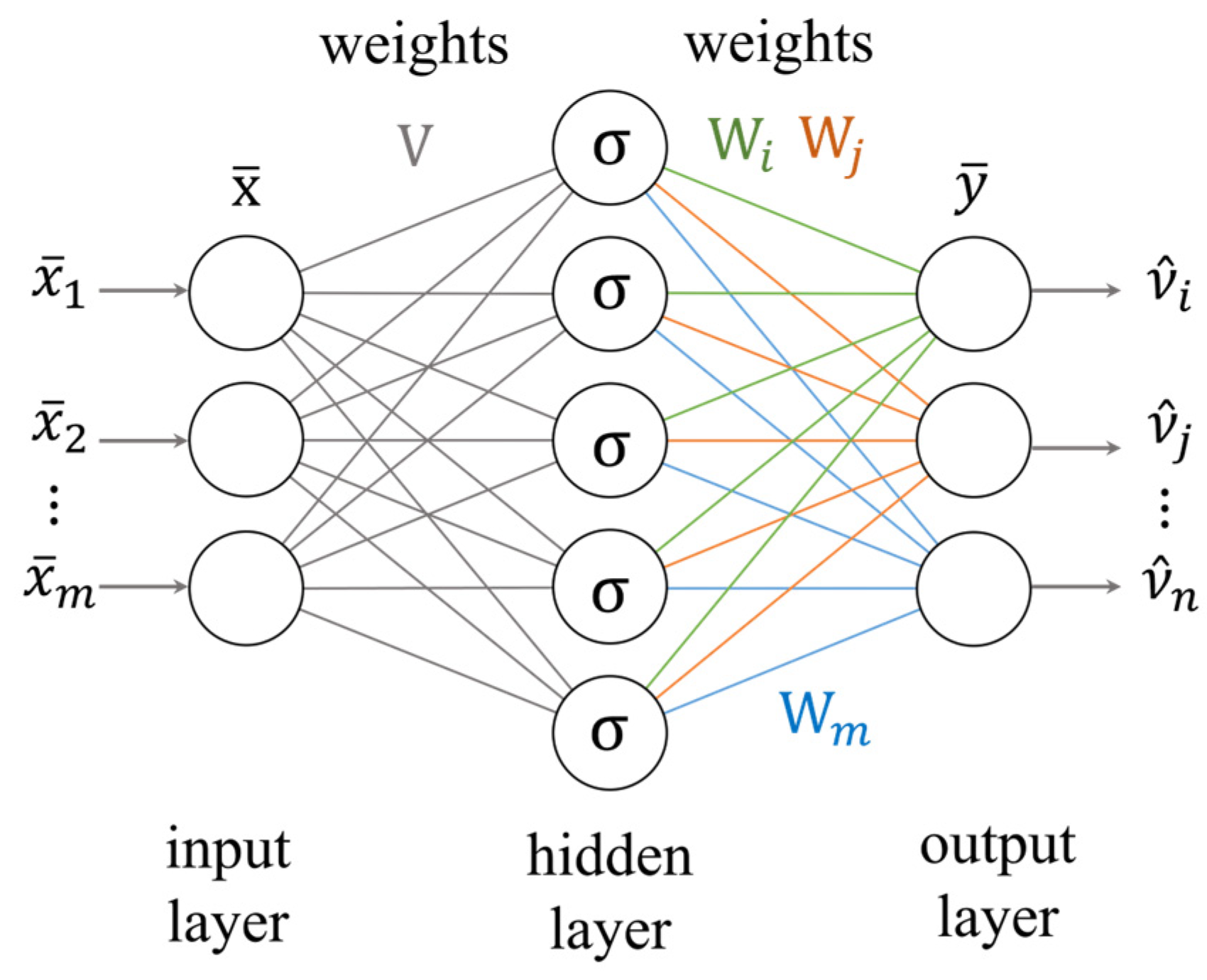
3.5.3. NN Controller
3.5.4. NN Adaptation Laws
3.5.5. PID Controllers
3.6. Longitudinal and Lateral CSAS Inner Loops
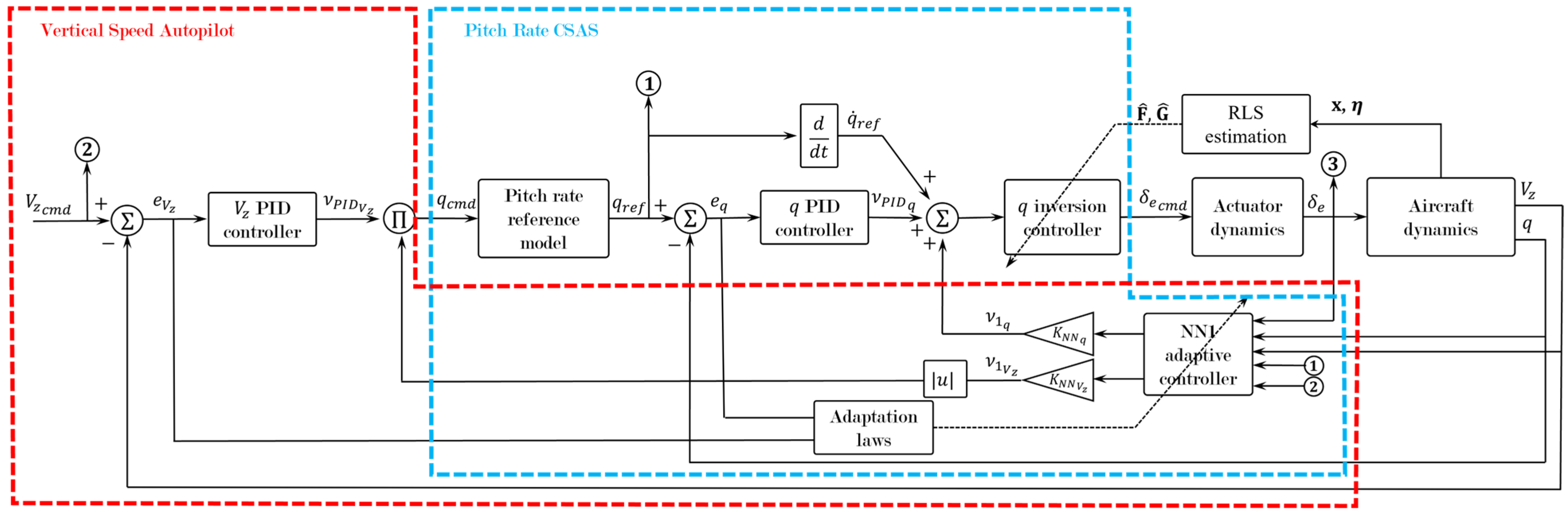
3.7. Pitch Rate CSAS
3.8. Vertical-Speed Autopilot
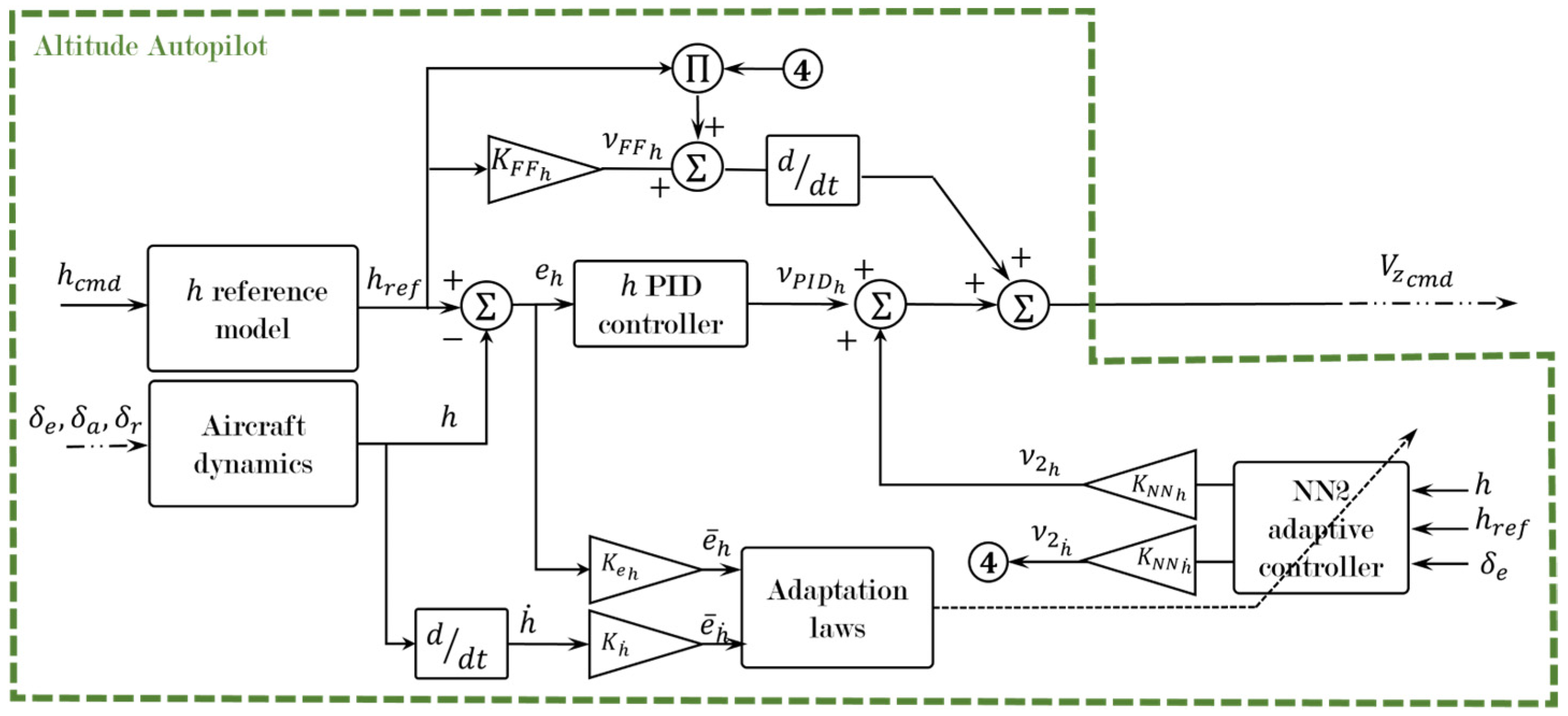
3.9. Altitude Autopilot
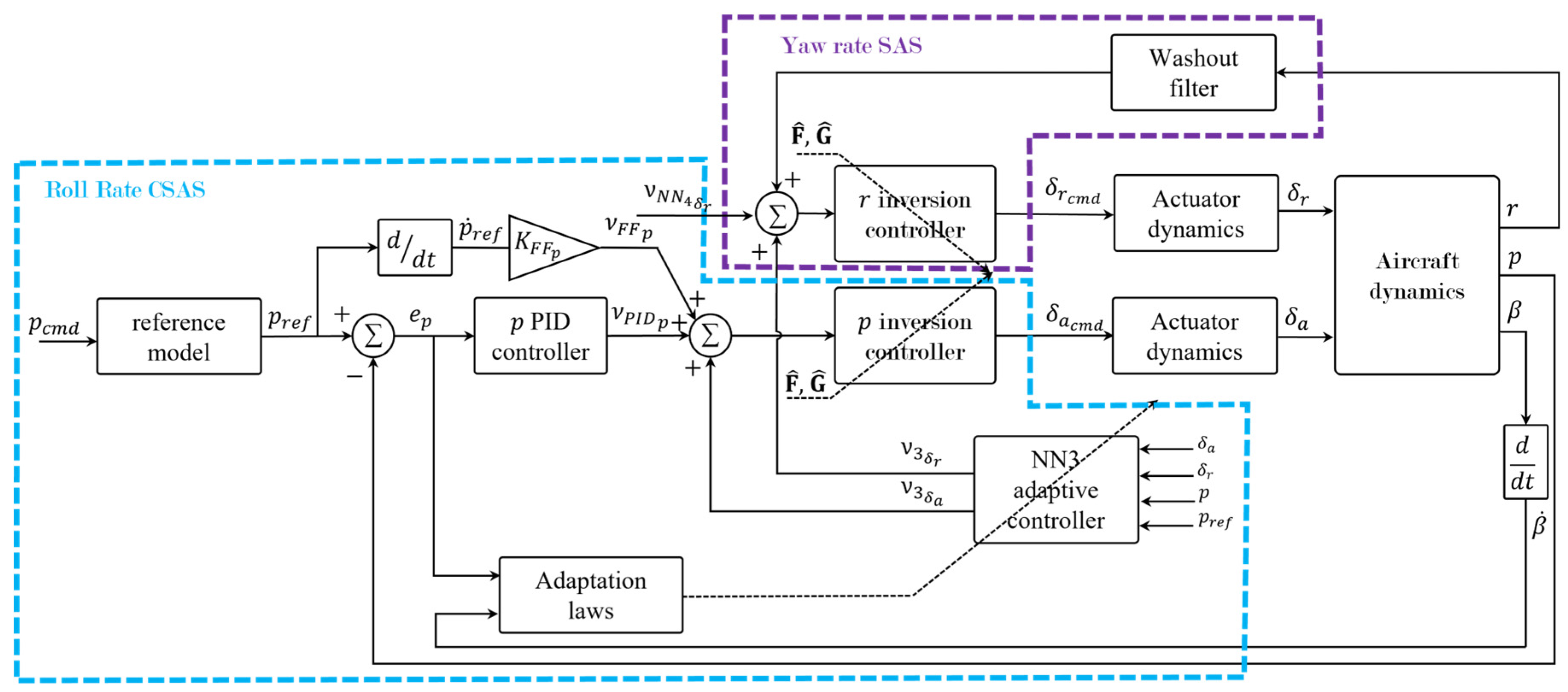
3.10. Roll Rate CSAS and Yaw Rate Stabilization
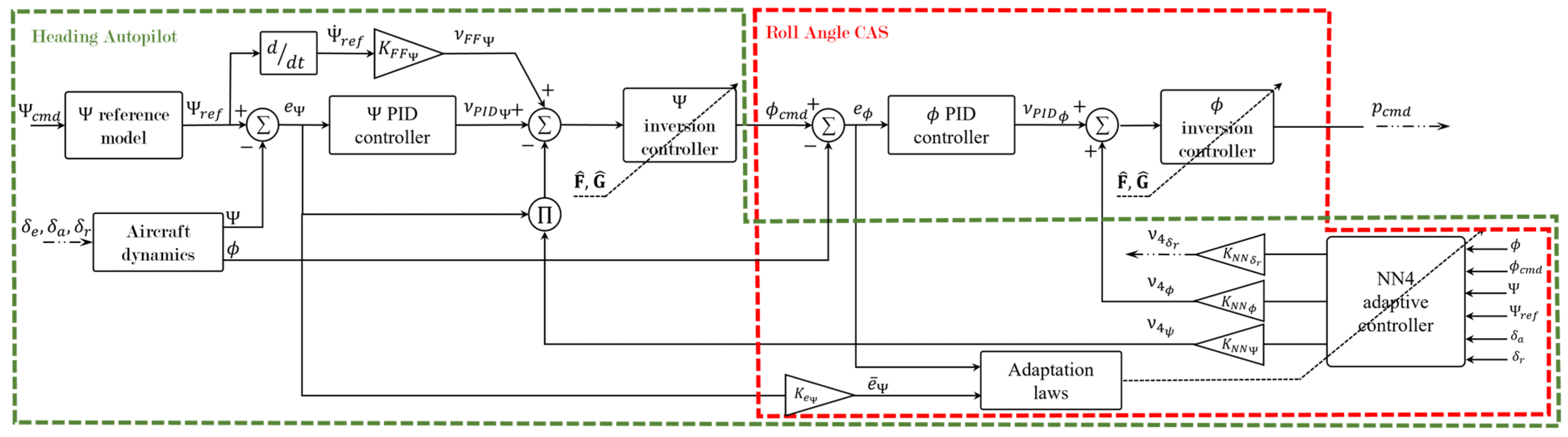
3.11. Roll Angle CSAS
3.12. Heading Autopilot
4. Results
4.1. Control Parameters
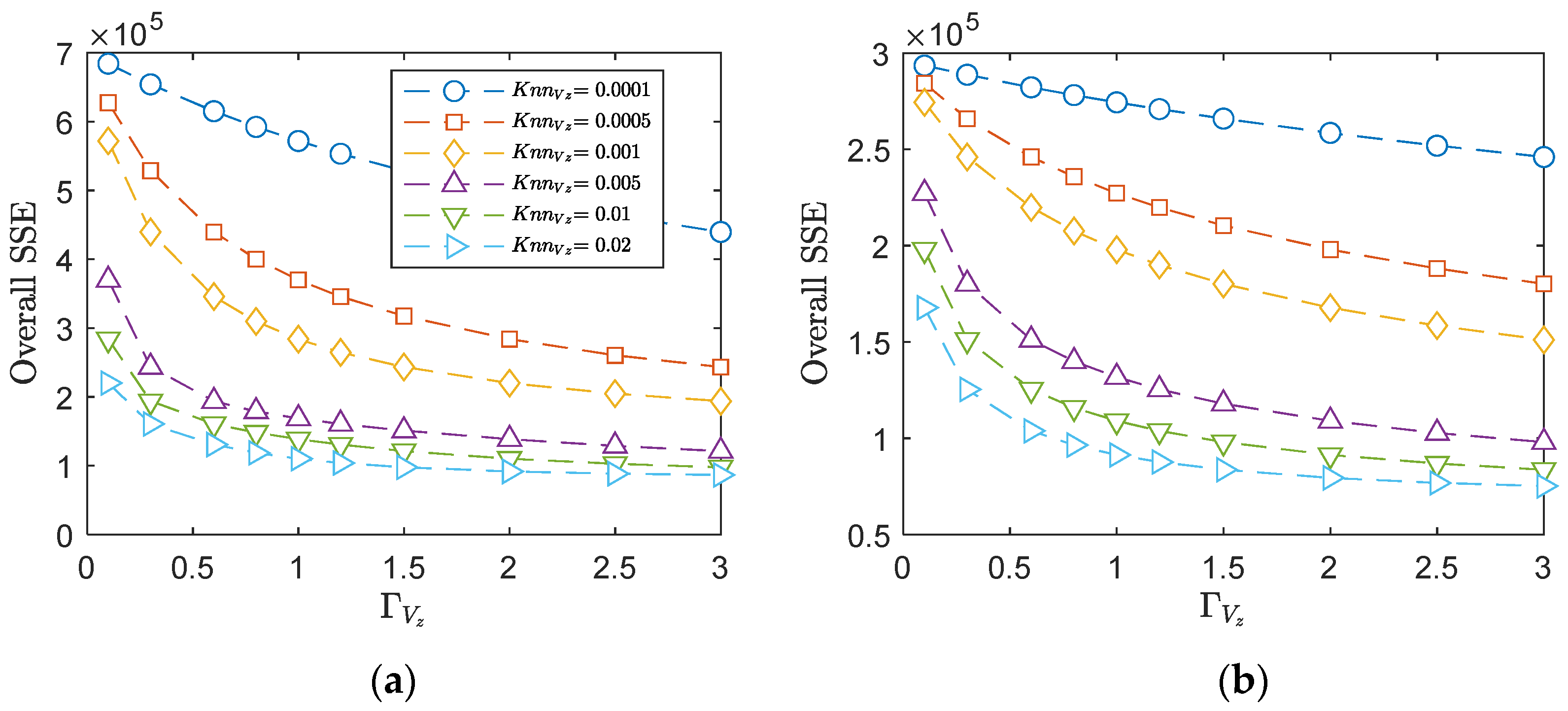
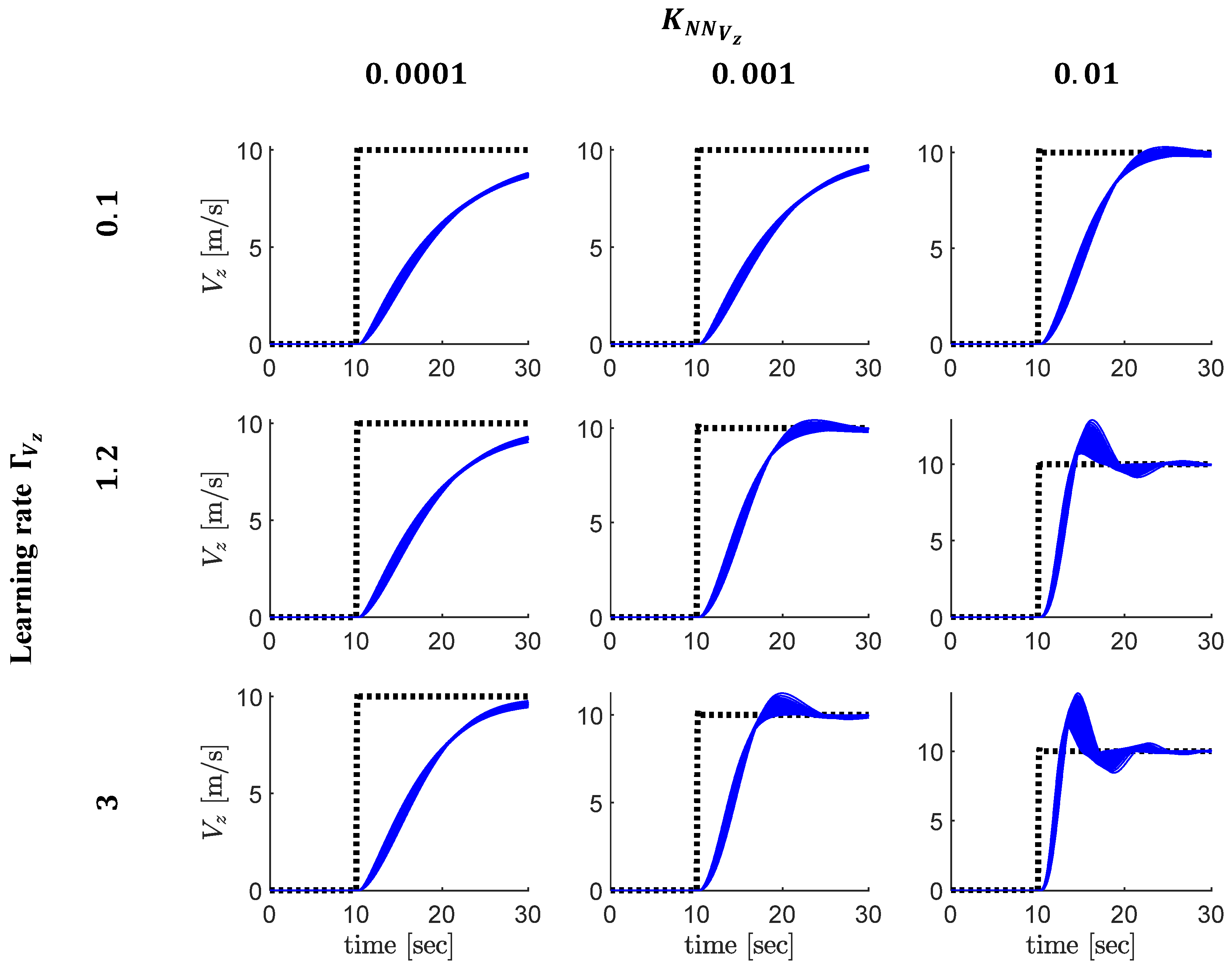
4.2. Vertical-Speed Autopilot Tuning
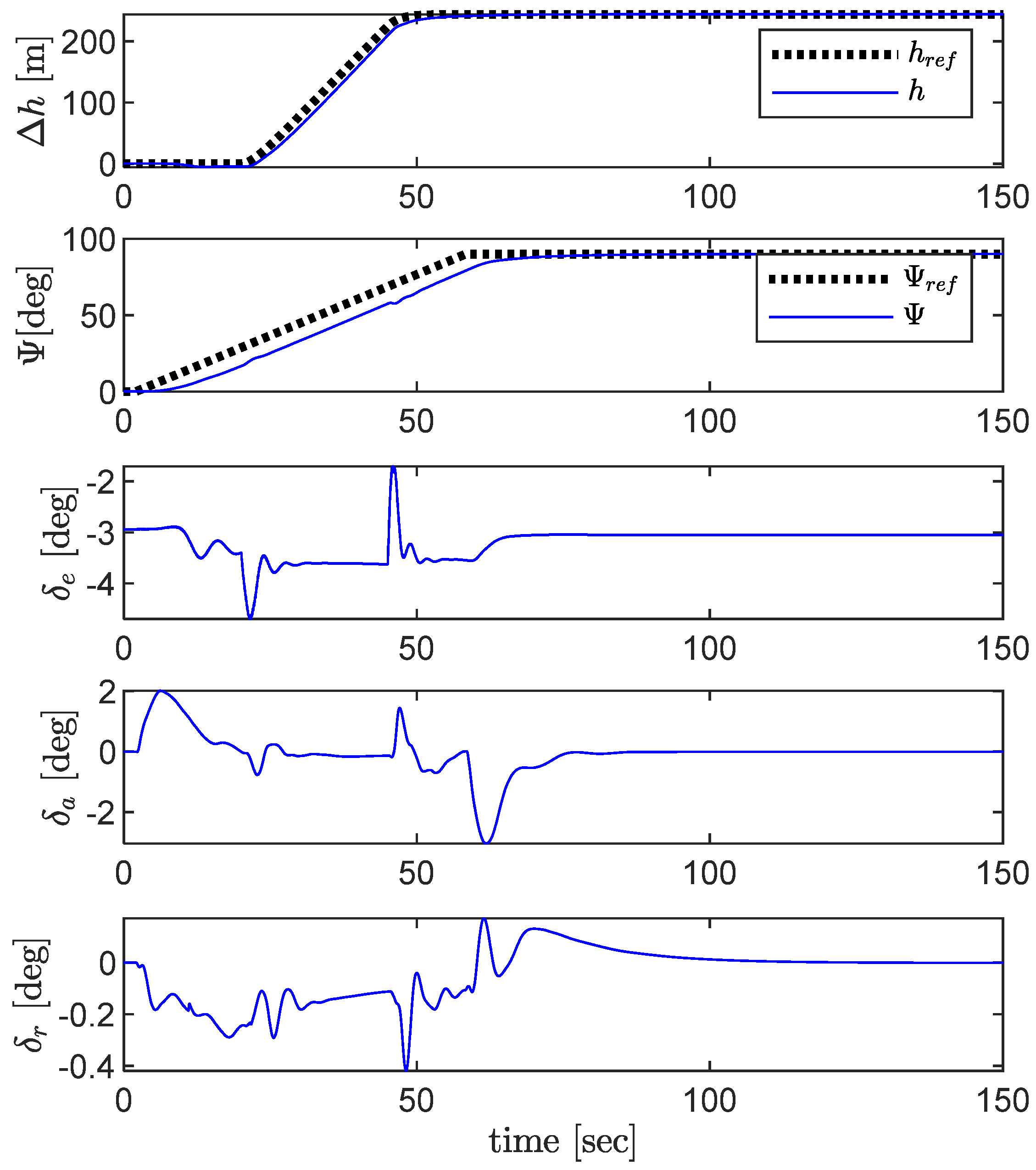
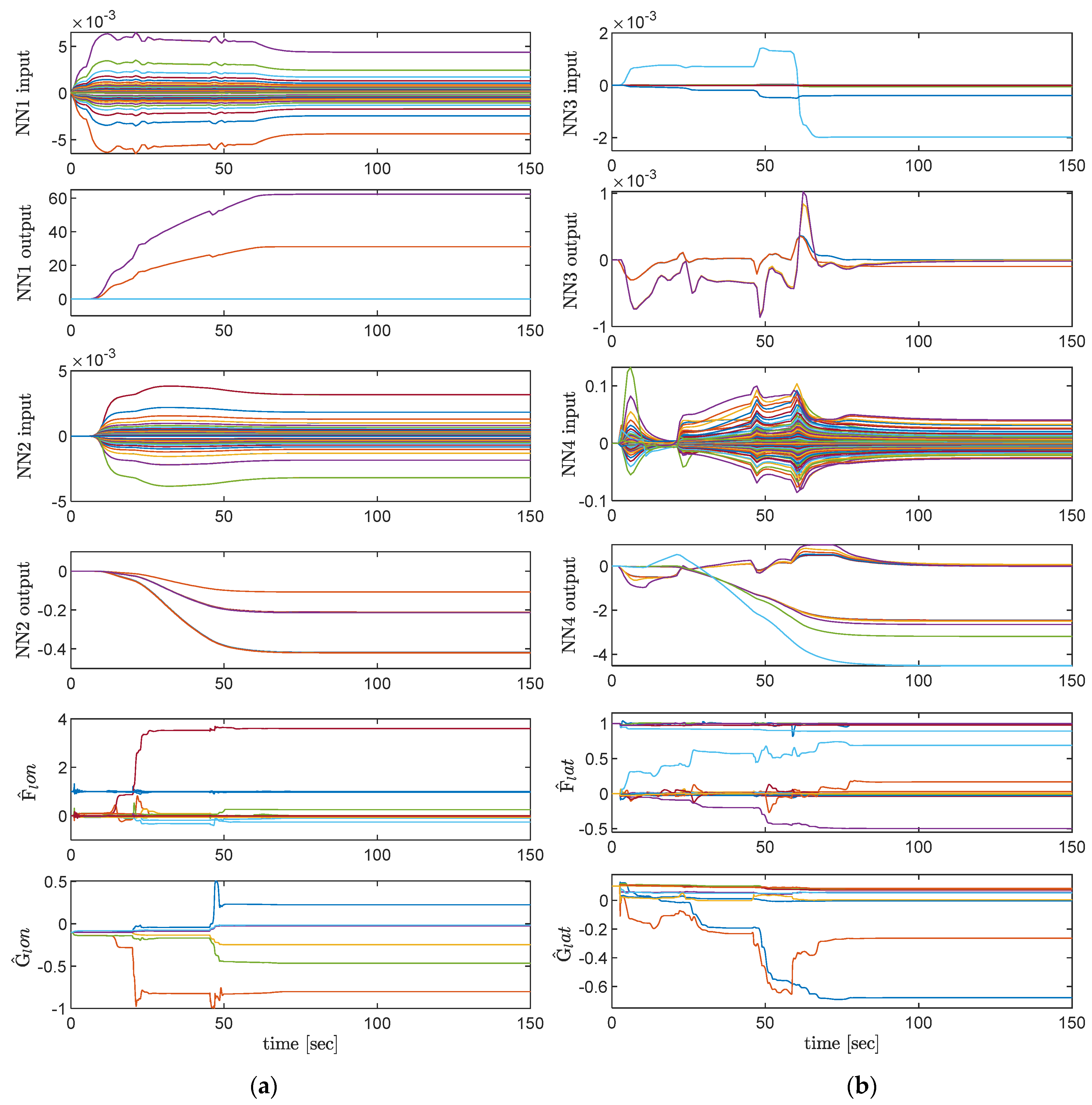
4.3. Altitude and Heading Command at 35,000 ft and 290 Knots
4.4. Validation for the Cessna Citation X Cruise Flight Envelope
4.5. Performance Results
5. Robustness Tests
5.1. Wind and Turbulence Tests
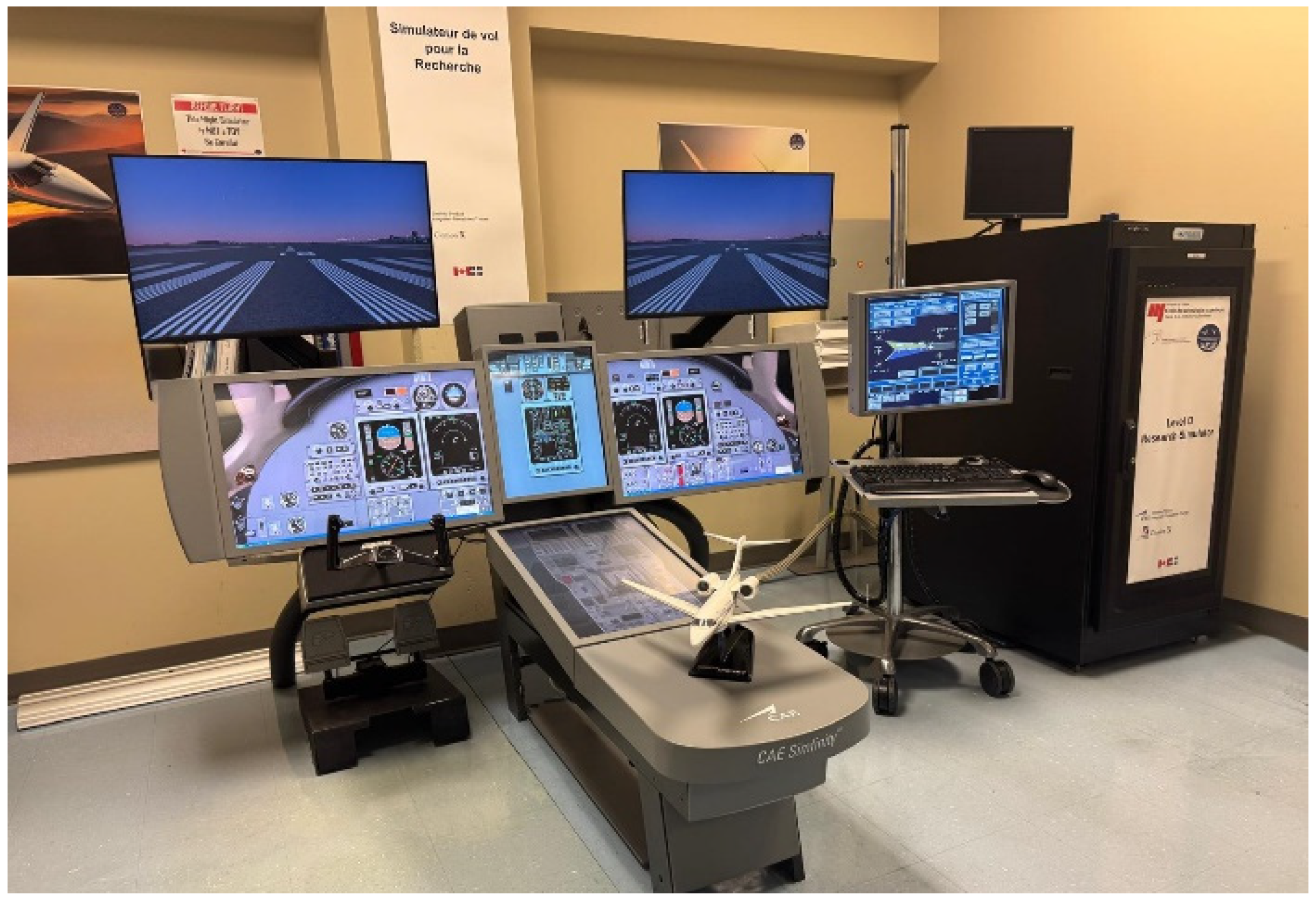
5.2. Flight Simulation Comparison in the RAFS
6. Discussion of Results
6.1. CSAS and Autopilot Architectures
6.2. Tuning and Adaptation
6.3. CSAS and Autopilot Performance
6.4. Robustness Validation
6.5. Stability Assessment
6.6. General Remarks
6.7. Future Works
7. Conclusions
7.1. Research Summary
- Address Loss of Control In-Flight risks through enhanced flight control robustness.
- Reduce the strong dependence of conventional controllers on gain scheduling and linear models.
- Improve adaptability across the cruise flight envelope, while maintaining Level 1 flight quality requirements.
- Bridge the gap between advanced adaptive control methods and practical implementation constraints, including flight quality requirements.
- Designing hybrid adaptive controllers and autopilots combining PID, RLS-based dynamic inversion and neural network controllers.
- Eliminating gain scheduling by enabling a single controller configuration that is valid across the cruise flight envelope.
- Validating the designed controllers and autopilots throughout the cruise envelope of the Cessna Citation X by using a high-fidelity nonlinear flight dynamic model.
- Comparing the adaptive autopilots with the actual autopilots mounted on the Cessna Citation X.
7.2. Conclusions
- The hybrid adaptive controller and autopilots were successfully developed for Cessna Citation X flight dynamics. The proposed system included inner-loop CSAS controllers for pitch rate, roll rate, and yaw rate stabilization, and outer-loop autopilots for vertical speed, altitude, and heading control.
- The controller achieves MIL-STD-1797A Level 1 flight quality across 64 cruise conditions using a single configuration without gain scheduling.
- The RLS estimator and NN adaptation enable accurate online modelling and compensation of uncertainties, ensuring robust performance in the presence of wind gusts and turbulence.
- The proposed controller outperforms baseline PID and PID–RLS designs, providing faster response, improved tracking accuracy, and effective disturbance rejection.
- Validation with high-fidelity RAFS data confirms the practical feasibility, robustness, and real-world applicability of the approach.
Author Contributions
Funding
Data Availability Statement
Acknowledgments
Conflicts of Interest
Nomenclature
| centre of gravity, coordinate of the centre of gravity | |
| f, g | unknown nonlinear functions |
| altitude | |
| online state matrix and its estimate | |
| online control matrix and its estimate | |
| covariance matrix | |
| neural network weight matrices | |
| -th signal | |
| short-period time constant | |
| vertical speed | |
| full state, longitudinal state and lateral state vectors | |
| NN input vector | |
| mass | |
| roll, pitch, and yaw rates | |
| longitudinal, lateral, and vertical velocity components | |
| elevator, aileron and rudder deflections | |
| Dutch-roll damping and frequency | |
| short-period damping and frequency | |
| -th state | |
| time step | |
| heading angle | |
| unknown parameters’ vector and its estimate | |
| unknown nonlinear functions | |
| sideslip angle and its derivative | |
| pitch angle | |
| forgetting factor | |
| scalar parameter | |
| roll time constant | |
| control input vector | |
| tangent sigmoid function and its gradient |
Abbreviations
| ARI | Aileron–Rudder Interconnect |
| CAS | Calibrated Airspeed |
| CSAS | Control Stability Augmentation System |
| FCS | Flight Control System |
| LARCASE | Research Laboratory of Active Controls, Avionics, and AeroSErvoelasticity |
| NN | Neural Network |
| PID | Proportional–Integral–Derivative |
| RAFS | Research Aircraft Flight Simulator |
| RLS | Recursive Least Squares |
References
- Wiegmann, D.A.; Shappell, S. A Human Error Analysis of Commercial Aviation Accidents Using the Human Factors Analysis and Classification System; U.S. Department of Transportation, Federal Aviation Administration: Oklahoma City, OK, USA, 2001.
- Federal Aviation Administration. Human Factors Guide for Aviation Maintenance; Federal Aviation Administration: Washington, DC, USA, 2009.
- Stevens, B.L.; Lewis, F.L.; Johnson, E.N. Aircraft Control and Simulation: Dynamics, Controls Design, and Autonomous Systems; John Wiley & Sons: Hoboken, NJ, USA, 2015. [Google Scholar]
- Atmaca, D.; Stroosma, O.; van Kampen, E.-J. Design and Piloted Simulation of Envelope-Protected Control for Flying Wing Aircraft. J. Guid. Control Dyn. 2026, 1–16. [Google Scholar] [CrossRef] [Scilit]
- Reynolds, O.R.; Pachter, M.; Houpis, C. Full Envelope Flight Control System Design Using Quantitative Feedback Theory. J. Guid. Control Dyn. 1996, 19, 23–29. [Google Scholar] [CrossRef] [Scilit]
- Ferrier, Y.; Nguyen, N.T.; Ting, E.; Chaparro, D.; Wang, X.; de Visser, C.C.; Chu, Q.P. Active Gust Load Alleviation of High-Aspect Ratio Flexible Wing Aircraft. In Proceedings of the 2018 AIAA Guidance, Navigation, and Control Conference, Kissimmee, FL, USA, 8–12 January 2018. AIAA 2018-0620. [Google Scholar]
- Khalil, A.; Fezans, N. Gust Load Alleviation for Flexible Aircraft Using Discrete-Time Preview Control. Aeronaut. J. 2021, 125, 341–364. [Google Scholar] [CrossRef] [Scilit]
- Efremov, A.V.; Mbikayi, Z.; Efremov, E.V. Comparative Study of Different Algorithms for a Flight Control System Design and the Potentiality of Their Integration with a Sidestick. Aerospace 2021, 8, 290. [Google Scholar] [CrossRef] [Scilit]
- Horn, J.F. Non-Linear Dynamic Inversion Control Design for Rotorcraft. Aerospace 2019, 6, 38. [Google Scholar] [CrossRef] [Scilit]
- Moncayo, H.; Perhinschi, M.; Wilburn, B.; Wilburn, J.; Karas, O. Extended Nonlinear Dynamic Inversion Control Laws for Unmanned Air Vehicles. In Proceedings of the AIAA Guidance, Navigation, and Control Conference, Minneapolis, MN, USA, 13–16 August 2012; p. 4675. [Google Scholar]
- Steffensen, R.; Steinert, A.; Smeur, E.J. Nonlinear Dynamic Inversion with Actuator Dynamics: An Incremental Control Perspective. J. Guid. Control Dyn. 2023, 46, 709–717. [Google Scholar] [CrossRef] [Scilit]
- Doff-Sotta, M.; Cannon, M.; Bacic, M. Data-Driven Robust Model Predictive Control of Tiltwing Vertical Takeoff and Landing Aircraft. J. Guid. Control Dyn. 2025, 48, 203–211. [Google Scholar] [CrossRef] [Scilit]
- Andrianantara, R.P.; Ghazi, G.; Botez, R.M. Model Predictive Controller with Adaptive Neural Networks and Online State Estimation for Pitch Rate Control of the Cessna Citation X. In Proceedings of the AIAA SCITECH 2024 Forum, Orlando, FL, USA, 8–12 January 2024. AIAA 2024-0118. [Google Scholar]
- Haykin, S. Adaptive Filter Theory: International Edition, 5th ed.; Pearson: London, UK, 2013. [Google Scholar]
- Mahadi, M.; Ballal, T.; Moinuddin, M.; Al-Saggaf, U.M. A Recursive Least-Squares with a Time-Varying Regularization Parameter. Appl. Sci. 2022, 12, 2077. [Google Scholar] [CrossRef] [Scilit]
- Mohseni, N.; Bernstein, D.S. Recursive Least Squares with Variable-Rate Forgetting Based on the F-Test. In Proceedings of the 2022 American Control Conference (ACC); IEEE: Piscataway, NJ, USA, 2022; pp. 3937–3942. [Google Scholar]
- Xiaoqian, T.; Feicheng, Z.; Zhengbing, T.; Hongying, W. Nonlinear Extended Kalman Filter for Attitude Estimation of the Fixed-Wing UAV. Int. J. Opt. 2022, 2022, 7883851. [Google Scholar] [CrossRef] [Scilit]
- Grigorie, T.L.; Botez, R.M.; Popov, A.V.; Mamou, M.; Mébarki, Y. A Hybrid Fuzzy Logic Proportional-Integral-Derivative and Conventional on-off Controller for Morphing Wing Actuation Using Shape Memory Alloy Part 1: Morphing System Mechanisms and Controller Architecture Design. Aeronaut. J. 2012, 116, 433–449. [Google Scholar] [CrossRef] [Scilit]
- Hashemi, S.M.; Botez, R.M.; Grigorie, L.T. Adaptive Fuzzy Control of Chaotic Flapping Relied upon Lyapunov-Based Tuning Laws. In Proceedings of the AIAA Aviation 2020 Forum, American Institute of Aeronautics and Astronautics, Online, 15 June 2020. [Google Scholar]
- Hosseini, S.M.; Ghazi, G.; Botez, R.M. New Type-2-Fuzzy-Logic-Based Control System for the Cessna Citation X. J. Aerosp. Inf. Syst. 2024, 21, 846–864. [Google Scholar] [CrossRef] [Scilit]
- Ge, S.S.; Hang, C.C.; Lee, T.H.; Zhang, T. Stable Adaptive Neural Network Control; Springer Science & Business Media: London, UK, 2013; Volume 13. [Google Scholar]
- Liu, S.; Lyu, W.; Zhang, Q.; Yang, C.; Whidborne, J.F. Neural-Network-Based Incremental Backstepping Sliding Mode Control for Flying-Wing Aircraft. J. Guid. Control Dyn. 2025, 48, 600–614. [Google Scholar] [CrossRef] [Scilit]
- Emami, S.A.; Castaldi, P.; Banazadeh, A. Neural Network-Based Flight Control Systems: Present and Future. Annu. Rev. Control 2022, 53, 97–137. [Google Scholar] [CrossRef] [Scilit]
- Pedro, J.; Meyer, N. Neural Network-Based Dynamic Inversion Controller for Fighter Aircrafts. IFAC Proc. Vol. 2007, 40, 946–951. [Google Scholar] [CrossRef] [Scilit]
- Li, Y.; Liu, K.; Wen, C.-Y.; Liu, X.; Zhang, W.; Zheng, Y. Fast Fixed-Time Incremental Backstepping Fault-Tolerant Control for Aircraft with Asymmetric Wing Damage. Aerosp. Sci. Technol. 2025, 164, 110405. [Google Scholar] [CrossRef] [Scilit]
- Dai, P.; Feng, D.; Zhao, J.; Cui, J.; Wang, C. Asymmetric Integral Barrier Lyapunov Function-Based Dynamic Surface Control of a State-Constrained Morphing Waverider with Anti-Saturation Compensator. Aerosp. Sci. Technol. 2022, 131, 107975. [Google Scholar] [CrossRef] [Scilit]
- Ma, W.; Liu, S.; Huang, W. Robust Prescribed-Time Observer-Based Sliding Mode Control: Theoretical Design and Flight Control Applications. ISA Trans. 2025, 167, 1446–1457. [Google Scholar] [CrossRef] [Scilit] [PubMed]
- Federal Aviation Administration. Roadmap for Artificial Intelligence Safety Assurance; Federal Aviation Administration: Washington, DC, USA, 2024.
- European Union Aviation Safety Agency. EASA Artificial Intelligence Concept Paper—Issue 2: Guidance for Level 1 & 2 Machine-Learning Applications; EASA: Cologne, Germany, 2024. [Google Scholar]
- Agogino, A.; Brat, G.; He, Y.; Hulse, D.; Lipkis, R.; Pressburger, T.; Gopinath, D.; Irshad, L.; Katis, A.; Mavridou, A.; et al. Recommendations on Evidence and Process for Certification of Learning-Enabled Components in Aerospace Systems; National Aeronautics and Space Administration, Ames Research Center: Moffett Field, CA, USA, 2024.
- Geronel, R.; Botez, R.; Bueno, D. Dynamic Responses Due to the Dryden Gust of an Autonomous Quadrotor UAV Carrying a Payload. Aeronaut. J. 2023, 127, 116–138. [Google Scholar] [CrossRef] [Scilit]
- Yu, Z.; Zhang, Y.; Jiang, B.; Su, C.-Y. Distributed FTCC of Multi-UAVs Under Actuator Fault and Input Saturation. In Fault-Tolerant Cooperative Control of Unmanned Aerial Vehicles; Springer: Cham, Switzerland, 2023; pp. 51–76. [Google Scholar]
- Yue, F.; Zonghua, S.; Liaoni, W.; Yongshun, W.; Bin, X.; Weng Khuen, H.; Yancheng, Y. Nonlinear Adaptive Flight Control System: Performance Enhancement and Validation. Chin. J. Aeronaut. 2023, 36, 354–365. [Google Scholar] [CrossRef] [Scilit]
- Andrianantara, R.P.; Ghazi, G.; Botez, R.M. Neural Network Adaptive Controller with Approximate Dynamic Inversion for Pitch Control of the Cessna Citation X. In Proceedings of the AIAA Aviation 2023 Forum, San Diego, CA, USA, 12–16 June 2023. AIAA 2023-3798. [Google Scholar]
- Quintin, E.; Andrianantara, R.P.; Ghazi, G.; Botez, R.M. Neural Network Adaptive Controller with Approximate Dynamic Inversion for the Cessna Citation X Lateral Control. In Proceedings of the AIAA Scitech 2024 Forum, Orlando, FL, USA, 8–12 January 2024. AIAA 2024-0261. [Google Scholar]
- Boughari, Y.; Ghazi, G.; Botez, R.M.; Theel, F. New Methodology for Optimal Flight Control Using Differential Evolution Algorithms Applied on the Cessna Citation X Business Aircraft—Part 1: Design and Optimization. INCAS Bull. 2017, 9, 31–44. [Google Scholar] [CrossRef] [Scilit]
- Ghazi, G.; Botez, R.M. Lateral Controller Design for the Cessna Citation X with Handling Qualities and Robustness Requirements. In Proceedings of the 62nd CASI Aeronautics Conference and AGM, Montreal, QC, Canada, 14–16 October 2015. [Google Scholar]
- Nguyen, N. Hybrid Adaptive Flight Control with Model Inversion Adaptation. In Advances in Flight Control Systems; InTech: London, UK, 2011; Volume 18, p. 19. [Google Scholar]
- Park, O.; Shin, H.-S.; Lee, H.-I.; Antonios, T. Optimal and Adaptive Control Design Using Recursive Least Square with a New Exponential Forgetting Factor. In Proceedings of the International Conference on Robot Intelligence Technology and Applications; Springer: Cham, Switzerland, 2021; pp. 116–128. [Google Scholar]
- Ghazi, G.; Botez, R. Development of a High-Fidelity Simulation Model for a Research Environment. In Proceedings of the SAE 2015 AeroTech Congress & Exhibition, Seattle, WA, USA, 15 September 2015. [Google Scholar]
- Hosseini, S.M.; Bematol, I.; Ghazi, G.; Botez, R.M. Enhanced Fuzzy-Based Super-Twisting Sliding-Mode Control System for the Cessna Citation X Lateral Motion. Aerospace 2024, 11, 549. [Google Scholar] [CrossRef] [Scilit]
- Andrianantara, R.P.; Ghazi, G.; Botez, R.M. Nonlinear Adaptive Longitudinal Controller and Flight Qualities Validation for a Business Aircraft. Aeronaut. J. 2026, 1–27. [Google Scholar] [CrossRef] [Scilit]
- Department of Defense. Flying Qualities of Piloted Aircraft; Department of Defense: Washington, DC, USA, 1997.
- Soares, F.; Burken, J. A Flight Test Demonstration of On-Line Neural Network Applications in Advanced Aircraft Flight Control System. In Proceedings of the 2006 International Conference on Computational Intelligence for Modelling Control and Automation and International Conference on Intelligent Agents Web Technologies and International Commerce (CIMCA’06); IEEE: Piscataway, NJ, USA, 2006; pp. 136–142. [Google Scholar]
- Narendra, K.; Annaswamy, A. A New Adaptive Law for Robust Adaptation without Persistent Excitation. IEEE Trans. Autom. Control 1987, 32, 134–145. [Google Scholar] [CrossRef] [Scilit]
- Williams-Hayes, P. Flight Test Implementation of a Second Generation Intelligent Flight Control System; NASA: Washington, DC, USA, 2005; p. 6995.
- Smith, T.; Barhorst, J.; Urnes, J.M. Design and Flight Test of an Intelligent Flight Control System. In Applications of Neural Networks in High Assurance Systems; Springer: Cham, Switzerland, 2010; pp. 57–76. [Google Scholar]
- Andrianantara, R.P.; Ghazi, G.; Botez, R.M. Flying Qualities Assessment for Nonlinear Adaptive Control Validation on the Cessna Citation X Longitudinal and Lateral Dynamics. In Proceedings of the AIAA Scitech 2025 Forum, Orlando, FL, USA, 6–10 January 2025. AIAA 2025-1826. [Google Scholar]
- Lavretsky, E.; Wise, K.A. Robust Adaptive Control. In Robust and Adaptive Control: With Aerospace Applications; Springer: London, UK, 2024; pp. 469–506. [Google Scholar]
- Lewis, F.L.; Yeşildirek, A.; Liu, K. Neural Net Robot Controller: Structure and Stability Proofs. J. Intell. Robot. Syst. 1995, 12, 277–299. [Google Scholar] [CrossRef] [Scilit]
- Kim, B.S.; Calise, A.J. Nonlinear Flight Control Using Neural Networks. J. Guid. Control Dyn. 1997, 20, 26–33. [Google Scholar] [CrossRef] [Scilit]






| Performance | Maximum Value |
|---|---|
| Cruise speed | 648 km/h [350 knots] |
| Mach number | 0.92 |
| Range | 5725 km [3091 nm] |
| Altitude | 15,544 m [51,000 ft] |
| Takeoff weight | 16,193 kg [35,700 lb] |
| Zero-fuel weight | 11,067 kg [24,400 lb] |
| Gross thrust | 28,655 N [6442 lbf] |
| CSAS/Autopilot | Controlled State | Limitations | Specifications |
|---|---|---|---|
| Pitch Rate CSAS | ±1.2°/s [±0.0017 rad/s] | Smooth and controlled longitudinal maneuvers; Level 1 flight quality. | |
| Vertical-Speed Autopilot | ±9.14 m/s [±1800 ft/min] | Ensures safe climb and descent rates while allowing rapid altitude changes in emergencies. | |
| Altitude Autopilot | no overshoot | Enhances safety and passenger comfort during climb/descent transitions. | |
| Roll Rate CSAS | ±2.5°/s [0.43 rad/s] | Guarantees smooth, controlled lateral maneuvers; Level 1 flight quality. | |
| Roll Angle CSAS | ±27.5° [0.47 rad] | Maintains safe load factors and prevents structural overstress. | |
| Heading Autopilot | heading rate of 3°/s [0.052 rad/s] | Complies with civil and military standard turn rates. |
| Characteristics | Values |
|---|---|
| Natural frequency | 20 rad/s |
| Maximum deflection | 14° |
| Minimum deflection | −19° |
| Damping ratio | 0.8 |
| Rate limit | 20°/s |
| Initialize , Set and Compute using Equation (14) Compute using Equation (12) Compute using Equation Update if abs ( then else compute using Equation (15) |
| Control Elements | Equations | |
|---|---|---|
| Pitch rate reference model | ||
| Pitch rate error dynamics | ||
| NN1 controller input vector | ||
| NN1 adaptation laws | ||
| PID controller | ||
| NN1 output signals | ||
| Elevator control law | (23) |
| Control Elements | Equations | |
|---|---|---|
| Error dynamics | ||
| PID controller output | ||
| NN1 controller | See Table 5 | |
| Pitch rate command | (24) |
| Control Elements | Equations | |
|---|---|---|
| Error dynamics | ||
| NN2 inputs | ||
| NN2 adaptation laws | ||
| PID controller | ||
| Feedforward controller | ||
| NN2 output signals | ||
| Command law | (25) |
| Control Elements | Equations | |
|---|---|---|
| Roll rate reference model | ||
| Error dynamics | ||
| NN3 inputs | ||
| NN3 adaptation laws | ||
| PID controller | ||
| Feedforward controller | ||
| Yaw rate washout filter | ||
| NN3 outputs | ||
| Aileron control law | (27) | |
| Rudder control law | (28) |
| Control Elements | Equations | |
|---|---|---|
| Error dynamics | ||
| NN4 inputs | ||
| PID controller | ||
| NN4 adaptation laws | ||
| NN4 outputs | ||
| Command law | (29) |
| Control Elements | Equations | |
|---|---|---|
| Error dynamics | ||
| PID controller | ||
| Feedforward controller | ||
| Command law | (30) |
| Control Elements | Parameters | Values |
|---|---|---|
| PID controller | , , | , , |
| RLS longitudinal state estimation | , , , , | , , , 0.0001 rad/s 0.005 rad |
| NN1 controller | , learning rate , learning rate hidden layers, neurons | , 0.02, 0.8 , |
| Pitch rate reference model | , | , rad/s, 0.35 s |
| PID controller | , , | , , |
| PID controller | , , | , , |
| feedforward controller | ||
| NN2 controller | , , learning rates , , , hidden layers, neurons | 2, 0.05 1, 1, 2 , 1, 30 |
| Control Elements | Parameters | Values |
|---|---|---|
| PID controller | , , | −1, −1, 0 |
| feedforward controller | −0.1 | |
| Yaw damper, washout filter | , | 3, 2 s |
| NN3 controller | learning rates , , , number of layers number of neurons | 0.1, 0.3, 2, 1 1 30 |
| reference model | , , | 0.5, 3 rad/s, 0.5 |
| RLS lateral state estimation | , , | , , , 0.0001 rad/s, 0.001 rad/s |
| PID controller | , , | 0.03, 0, 0 |
| PID controller | , , | 0.2, 0, 0.1 |
| feedforward controller | ||
| NN4 controller | , , , learning rates , , , hidden layers, neurons | 0.001, 0.0001, 0.005, 0.1 0.5, 4, 4, 1, 1, 1 1, 30 |
| Signal | Damping | Frequency, rad/s | Rising Time, s | Settling Time, s | Overshoot, % |
|---|---|---|---|---|---|
| Pitch rate controller | 0.59–0.77 | 4.3–5.3 | 0.25–0.29 | 1–1.85 | 6–28 |
| Roll rate controller | 0.33–0.47 | 2.8–3.03 | 1.37–1.49 | 1.5–3.5 | 4.3% |
| Roll angle controller | - | - | 8–10 | 13.2–15.2 | 7.2–20 |
| Vertical-speed autopilot | - | - | 5–8 | 10–15 | 11–34 |
| Altitude autopilot | - | - | 2.8–4.8 | 3.4–6.7 | 1% |
| Heading autopilot | - | - | 3.5–23 | 3–31 | 1% |
Disclaimer/Publisher’s Note: The statements, opinions and data contained in all publications are solely those of the individual author(s) and contributor(s) and not of MDPI and/or the editor(s). MDPI and/or the editor(s) disclaim responsibility for any injury to people or property resulting from any ideas, methods, instructions or products referred to in the content. |
© 2026 by the authors. Licensee MDPI, Basel, Switzerland. This article is an open access article distributed under the terms and conditions of the Creative Commons Attribution (CC BY) license.
Share and Cite
Andrianantara, R.P.; Ghazi, G.; Botez, R.M.; Roger, H.; Partaix, L.; Coyotl, D.M. Adaptive Autopilot Design and Implementation for Cessna Citation X. Aerospace 2026, 13, 318. https://doi.org/10.3390/aerospace13040318
Andrianantara RP, Ghazi G, Botez RM, Roger H, Partaix L, Coyotl DM. Adaptive Autopilot Design and Implementation for Cessna Citation X. Aerospace. 2026; 13(4):318. https://doi.org/10.3390/aerospace13040318
Chicago/Turabian StyleAndrianantara, Rojo Princy, Georges Ghazi, Ruxandra Mihaela Botez, Hugo Roger, Louis Partaix, and Daniel Mancera Coyotl. 2026. "Adaptive Autopilot Design and Implementation for Cessna Citation X" Aerospace 13, no. 4: 318. https://doi.org/10.3390/aerospace13040318
APA StyleAndrianantara, R. P., Ghazi, G., Botez, R. M., Roger, H., Partaix, L., & Coyotl, D. M. (2026). Adaptive Autopilot Design and Implementation for Cessna Citation X. Aerospace, 13(4), 318. https://doi.org/10.3390/aerospace13040318