Article

A Next-Generation Hybrid Approach for Data-Driven Fuel-Efficient Flight Control of Commercial Aircraft

1
Department of Aircraft Frame and Power-Plant, Firat University, 23119 Elazig, Turkey
2
İzmir Aeronautical Vocational School of Higher Education, University of Turkish Aeronautical Association, 35920 Izmir, Turkey
*
Author to whom correspondence should be addressed.
Aerospace 2026, 13(3), 289; https://doi.org/10.3390/aerospace13030289
Submission received: 31 January 2026 / Revised: 5 March 2026 / Accepted: 16 March 2026 / Published: 19 March 2026
(This article belongs to the Section Aeronautics)

Abstract

In this study, a novel hybrid optimization approach is proposed to minimize the fuel consumption of commercial aircraft by taking flight-related and meteorological constraints into account during the cruise phase. The new method, the Decision Tree–Robust Multiple Regression–Harris Hawks Optimization Algorithm (DRHA), incorporates data segmentation based on decision trees, modeling of robust multiple regression, and the Harris Hawks optimization algorithm. In this context, a PID speed controller for a Boeing 737-800 aircraft was developed by employing a Software-in-the-Loop (SIL) framework that establishes real-time data exchange between MATLAB/Simulink and the FAA-approved X-Plane flight simulator. Within this framework, a simulation-based fuel consumption dataset was obtained from 1032 different scenarios encompassing various combinations of altitude, speed, aircraft weight, wind speed, and wind direction, thus aiming to reflect a wide range of realistic flight operating conditions. According to comparative analysis outcomes, the proposed DRHA approach significantly outperformed conventional statistical and machine learning-based methods in modeling fuel consumption equations. Namely, a mean absolute error (MAE) and R2 value are achieved with values of 1.24 and 0.90, respectively. Moreover, PID controller parameters are optimized under varying conditions thanks to the DRHA method, yielding between 0.07% and 5.33% fuel savings compared to manually tuned controllers. Tests performed under different altitudes, aircraft weights, and wind conditions confirm the algorithm’s robustness and adaptability. The proposed method is anticipated to offer scalable and adaptable solutions for various types of aircraft and real-time control systems.

1. Introduction

The compound annual growth rate (CAGR) for passenger transport is envisaged to be 3.6% between 2019 and 2043, while that of cargo transport is estimated at 3.2% over the same period [1]. Such growth is expected to result in elevated air traffic, fuel consumption, and noise pollution [2]. The environmental impact of gas emissions resulting from fuel consumption is highly detrimental. Considering the environmental consequences associated with fuel use, aviation authorities, airlines, aircraft manufacturers, and engine manufacturers have undertaken a series of key initiatives to address this concern [3]. Aircraft fuel consumption is directly affected by dynamic equations governing flight performance, such as aerodynamic drag and thrust forces, engine performance, and flight regime. As a result, these equations constitute key parameters that influence optimal fuel usage. Since aircraft dynamics demonstrate nonlinear and underactuated characteristics, the related control problems become increasingly complex, thereby drawing significant attention in both academic research and industrial applications [4]. Therefore, the stability, performance quality and robustness of flight control systems against disturbances and noise during operation are of critical importance. Recently, the field of aviation has made significant advancements by emphasizing the development of performance and control strategies. When considering the nonlinear dynamic behavior of aircraft, extensive research has been carried out to design control systems that ensure accurate trajectory tracking, asymptotic stability, and convergence. Aircraft control systems have been continuously evolving to meet the specific requirements of various operational environments and have been adapted accordingly by means of tailored solutions [5].
Several studies have been carried out in the literature about the modeling of aircraft and the design of flight control. When comparing various control methods, it can be realized that the Proportional–Integral–Derivative (PID) [6], Sliding Mode Control [7], Backstepping [8], Finite-Time Lyapunov Stability-based Control [9], Passivity-based Control [10], and Model Predictive Control (MPC) [11] are most commonly employed. Moreover, the PID method has gained widespread attention from both industry and researchers owing to its basic structure and facility of application [12]. Conventional flight control systems often employ PID controllers since these are simple and easy to integrate into hardware across diverse applications. Nevertheless, in realistic flight environments, PID controllers may not perform adequately under conditions that involve uncertainties and external disturbances, primarily due to the necessity of precisely tuning the controller coefficients. These effective control parameters are often determined by means of a trial-and-error process, which can be time-consuming and prone to inaccuracies. To tackle the challenges associated with manual tuning, researchers have developed various automated parameter optimization techniques, including modern metaheuristic and swarm intelligence-based algorithms, as well as reinforcement learning approaches [13].
Metaheuristic algorithms have ensured effective solutions for several flight control problems, such as navigation, path planning, obstacle avoidance, fault-tolerant control, and flight stabilization. It could be specified that the most used metaheuristic algorithms for flight control optimization are Genetic Algorithms (GA), Harris Hawks Optimization (HHO) [14], Particle Swarm Optimization (PSO) [15], Grey Wolf Optimizer (GWO), and Artificial Bee Colony (ABC) optimization [16,17]. These algorithms are employed to optimize the control parameters of controllers since they have a key role in achieving stable and efficient flight performance. Numerous studies have demonstrated that these algorithms yield highly effective results in tuning controller parameters for flight control applications, which leads to significant improvements in system stability, response time, and trajectory tracking accuracy [18].
Flight simulation software has emerged as a viable alternative to real flight testing in areas such as aircraft design, flight data generation, pilot training, and autopilot development. Flight simulators are preferred due to factors such as time loss, high cost, and potential safety risks related to real flight tests. Recent advancements in this field have enabled highly accurate simulations. These simulators enable opportunities to analyze the dynamic behavior of aircraft, introduce disturbances, observe parameter uncertainties, and visualize an aircraft’s three-dimensional motion [19]. In the literature, flight simulators such as FlightGear, Microsoft Flight Simulator, and X-Plane are frequently utilized in autopilot development studies [20]. Particularly, X-Plane becomes prominent for its flexibility and advanced capabilities due to offering users the ability to design custom aircraft tailored to specific needs. Additionally, the flight simulator certified by the Federal Aviation Administration (FAA) enhances the reliability of its simulation results. As a result, many companies such as Cessna, Cirrus, and Boeing, along with numerous researchers, prefer X-Plane for developing and testing control strategies [21].
Thanks to data analysis, predictive methods are employed to develop equation-based models that obtain the relationships between variables within a system. For this purpose, techniques such as regression analysis, polynomial regression, support vector machines (SVMs), and decision trees have been commonly used in the literature to construct sets of equations, thereby transforming the behavior of the system into a mathematical model. However, solving these equations manually is often challenging and time-consuming. While various optimization methods have been proposed in the literature to solve such equations, they often find local rather than global optima. To tackle this limitation, recent studies have employed metaheuristic algorithms to solve these equations and achieve globally optimal solutions.
In this study, an attempt is made to minimize the fuel consumption of a Boeing 737-800 aircraft. To achieve this, Software-in-the-Loop (SIL) simulations are carried out by data exchange via UDP between MATLAB/Simulink and the X-Plane flight simulator. A PID speed controller is designed to maintain a determined altitude for the B737-800. A total of 1032 SIL simulations are performed by altering parameters such as altitude, speed, weight, wind speed and direction, as well as PID controller coefficients. These simulations are used to establish a dataset incorporating fuel consumption data belonging to the B737-800 aircraft. The collected data are modeled by applying artificial intelligence, metaheuristic algorithms and statistical methods to develop a fuel consumption equation based on the identified input variables. Based on these equations, the Decision Tree–Robust Multiple Regression–Harris Hawks Optimization Algorithm (DRHA), which is used for the first time in the literature, is proposed to determine the optimal PID controller coefficients.

1.1. Problem Statement

PID control is one of the main pillars of modern flight systems. To provide the stability and precision of aero vehicles such as aircraft and drones, it is commonly employed. Moreover, this algorithm can find deviations during flight and perform real-time corrections according to observational data. The accurate tuning of PID parameters is of high importance for achieving stable flight performance and ensuring precise responses to control commands for aero vehicles. Meteorological factors and flight dynamics have a significant impact on PID control. Since sudden changes in wind speed and direction can affect the stability of the aero vehicle, a PID control algorithm should be more sensitive and adaptive against these perturbations. Similarly, factors involving air density, temperature, and humidity can complicate the prediction of aerodynamic loads during flight. To overcome such changing conditions, it is essential to adaptively optimize PID parameters.

1.2. The Requirements of PID Optimization

The optimization of PID parameters is of high significance for flight safety and efficiency. Namely, inconveniently tuned PID parameters can result in excessive oscillations of control surfaces, delayed system responses, or even loss of control. Therefore, optimization of PID parameters benefits from maximizing flight performance and tailoring the control algorithm to the specific design characteristics of the aero vehicle. Moreover, the optimization of PID parameters plays a critical role not only in ensuring stability and precision but also in enhancing energy efficiency. A properly optimized control system minimizes power demand from the engines, thereby reducing energy consumption and extending the range of the aircraft. Consequently, the optimization of PID parameters is an integral component of flight systems in terms of both performance and cost-effectiveness.

1.3. The Scope of the Study

The constant changes in aerodynamic forces, environmental disturbances, and operational conditions during the fundamental flight phases, such as takeoff, climb, cruising, and landing, make it difficult for PID-based control systems to achieve consistent performance with fixed parameters in all situations. Based on this requirement, this study proposes a novel optimization framework that can maintain stable speed control while reducing fuel consumption, particularly during the cruising phase, for a Boeing 737-800 aircraft. In this study, PID parameters are considered not only in terms of classical control performance but also as decision variables affecting fuel consumption. For this purpose, aircraft weight, altitude, wind speed, wind direction, flight speed, and PID coefficients are evaluated together; thus, the control problem is structured as a single-objective optimization problem based on fuel minimization under realistic flight conditions.
The fundamental originality of the proposed approach lies in addressing the fuel minimization problem within a two-stage and integrated structure. In the first stage, a data-driven model representing fuel consumption dependent on flight and control variables was established by harnessing data obtained from Software-in-the-Loop simulations performed in the MATLAB/Simulink X-Plane environment. In the second stage, this model was used directly as an objective function, and the PID coefficients and speed values that ensure minimum fuel consumption were determined using an optimization algorithm. Thus, this study differs from studies in the literature that focus solely on PID tuning or only on fuel consumption estimation, offering a unique approach that combines simulation-based data generation, data-driven fuel modeling, and optimization-based control parameter determination processes in a single hybrid framework. In this context, the proposed method presents a systematic and feasible decision support structure that considers both fuel efficiency and control applicability for a Boeing 737-800.

2. Methodology Background

2.1. System Description

In this study, PID control algorithms are applied to a Boeing 737-800 passenger aircraft, which is a narrow-body commercial jet with an approximate length of 39.5 m and a wingspan of 35.8 m. The aircraft is capable of cruising at a speed of approximately 840 km/h at an altitude of 12.5 km with a maximum take-off weight of 79,015 kg [22]. The Boeing 737-800, which is equipped with advanced avionics systems, is designed to respond with high precision to both manual and automated flight control inputs.

2.2. Dataset Obtainment

In engineering-oriented R&D studies, time and cost are of critical importance. In real-time applications of aircraft, uncertainties in mathematical models and external disturbances such as weather conditions often prevent stable flight. In some cases, these instabilities can result in accidents, leading to significant time and cost losses. In this regard, high-fidelity simulation techniques, such as Model-in-the-Loop Simulation (MILS), Software-in-the-Loop Simulation (SILS), Processor-in-the-Loop Simulation (PILS), and Hardware-in-the-Loop Simulation (HILS), are extensively utilized to mitigate the mentioned disadvantages and to evaluate system performance more reliably [20]. On the other hand, flight simulation software such as X-Plane, FlightGear, and Microsoft Flight Simulator is used to mimic the actual flight behavior of aircraft [23]. As mentioned above, Cessna, Cirrus, and Boeing have adopted X-Plane as an engineering tool, and many researchers use it to test and validate their studies [21]. Furthermore, X-Plane is capable of communicating with external processes via the User Datagram Protocol (UDP). Thanks to UDP, real-time flight data such as speed, altitude, heading, and position can be retrieved from X-Plane, while control commands can be sent to the throttle, flaps, and flight control surfaces, which enable active control of the aircraft. This communication facilitates the implementation of Software-in-the-Loop Simulations (SILSs) by enabling data exchange between MATLAB and X-Plane for conducting test scenarios [19].
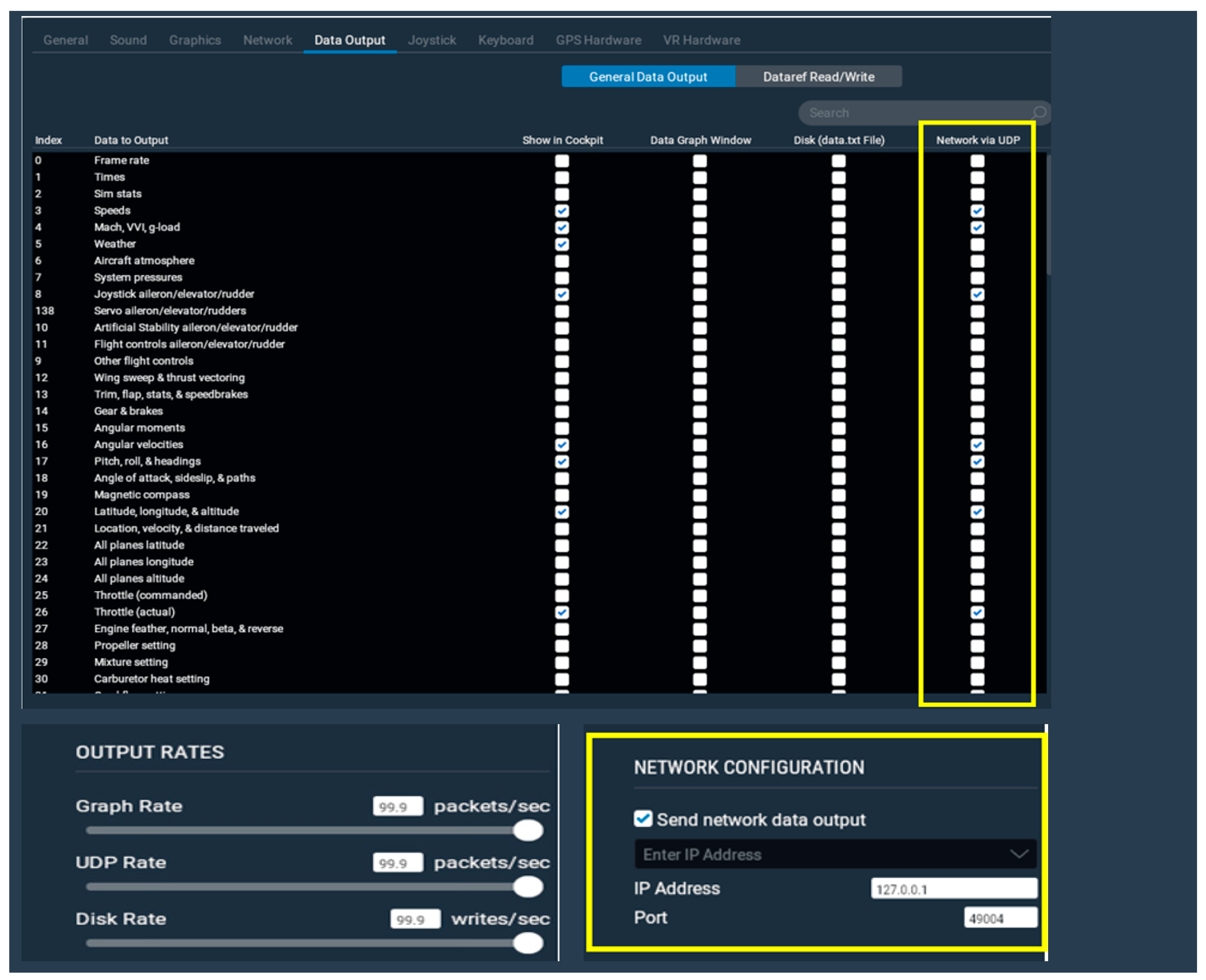
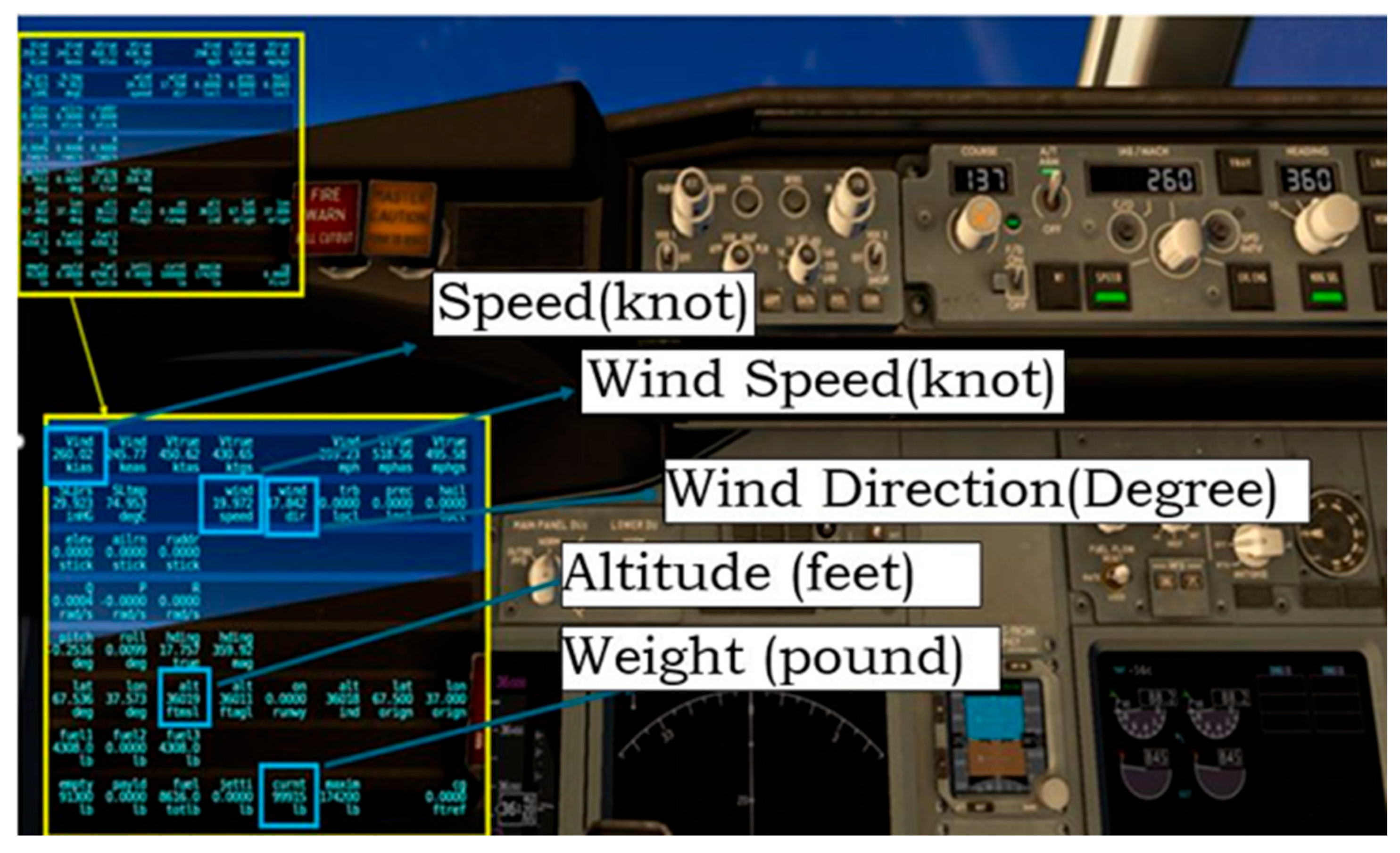
The X-Plane allows the transfer of flight data to other platforms via UDP using environments such as MATLAB R2023b (version 23.2), Python 3.11.15, FlyWithLua NG v2.7.32, and C++17. It supports the transmission of multiple data sets, including parameters such as airspeed, altitude, latitude, and longitude. The types of data that can be transmitted from X-Plane are illustrated in Figure 1. To enable data exchange, certain configurations must be made through the X-Plane settings menu. The basis of this transfer process is formed by the data packets continuously broadcast over the network by X-Plane. The “Data Output” tab in the simulation’s settings menu is the central interface where this data stream is managed. Researchers or developers can use this tab to select the data groups to be exported (e.g., aircraft velocity vectors, real-time position information, or engine parameters) and define the network protocol, target IP address, and port number to which this data will be transmitted. This configuration establishes a real-time, uninterrupted data bridge between the X-Plane simulator and the outside world. Environments such as MATLAB or Python can process these structured data packets by listing the specified port, allowing researchers to analyze simulation data with their own algorithms, visualize it, or feed it into external systems such as unmanned aerial vehicle autonomy software. This flexible architecture transforms X-Plane from merely a pilot training tool into a powerful Hardware-in-the-Loop Simulation platform for flight dynamics research, control system design, and human–machine interface studies. As shown in Figure 1, users must navigate to the “Network via UDP” section to select the specific data they wish to send or receive. Since the data transfer occurs over UDP using an IP address, the field labelled “IP address” should be set to “127.0.0.1” and the “Port” field to 49004.
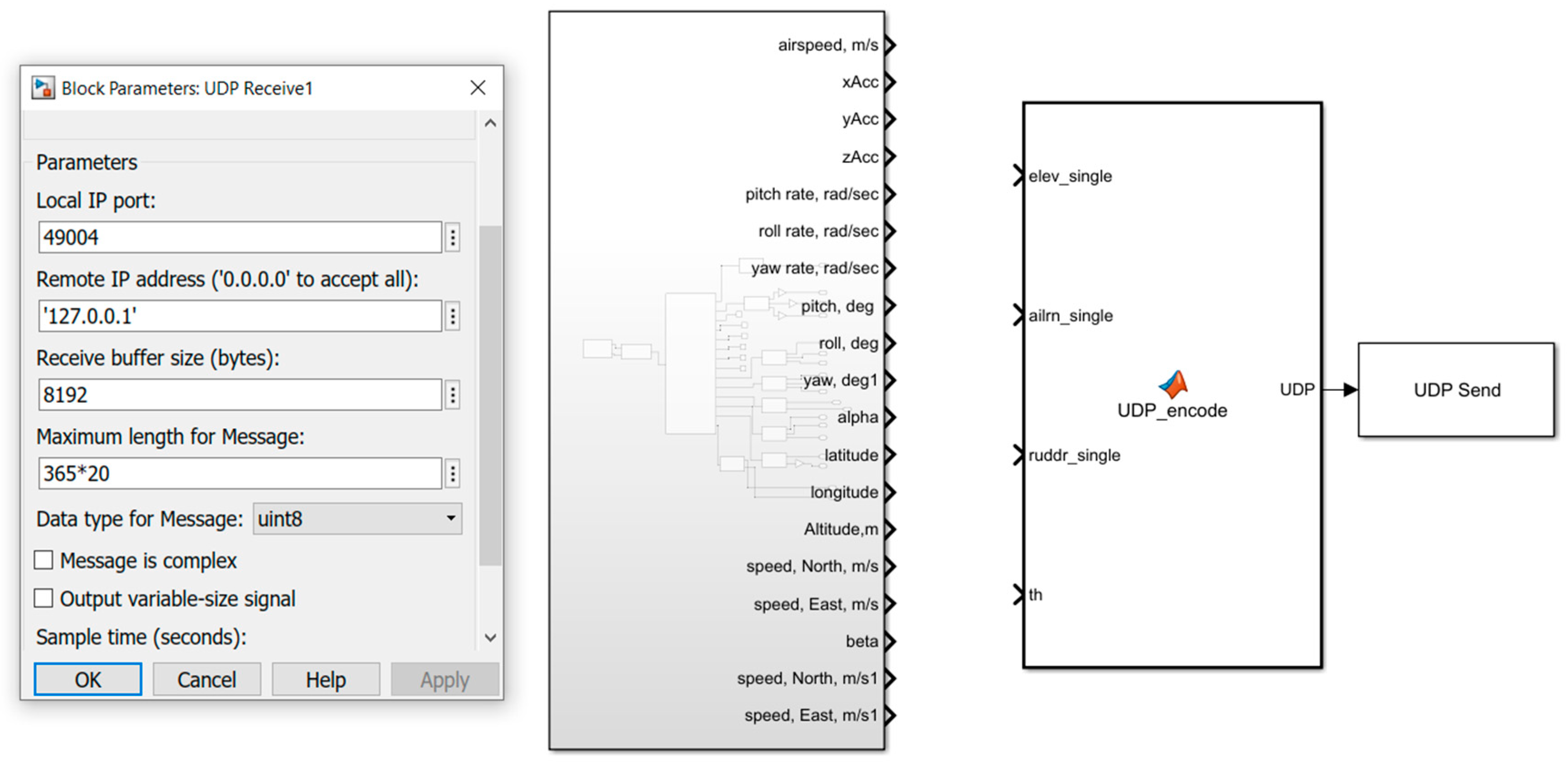
In this study, Software-in-the-Loop Simulations (SILSs) are conducted between MATLAB/Simulink and X-Plane to enable data exchange. The MATLAB/Simulink configuration page is shown in Figure 2. In this interface, the IP address and the port number must be set to “127.0.0.1” and “49004” respectively. Additionally, the index numbers of the selected data in Figure 1 must match the index numbers entered in Figure 2.
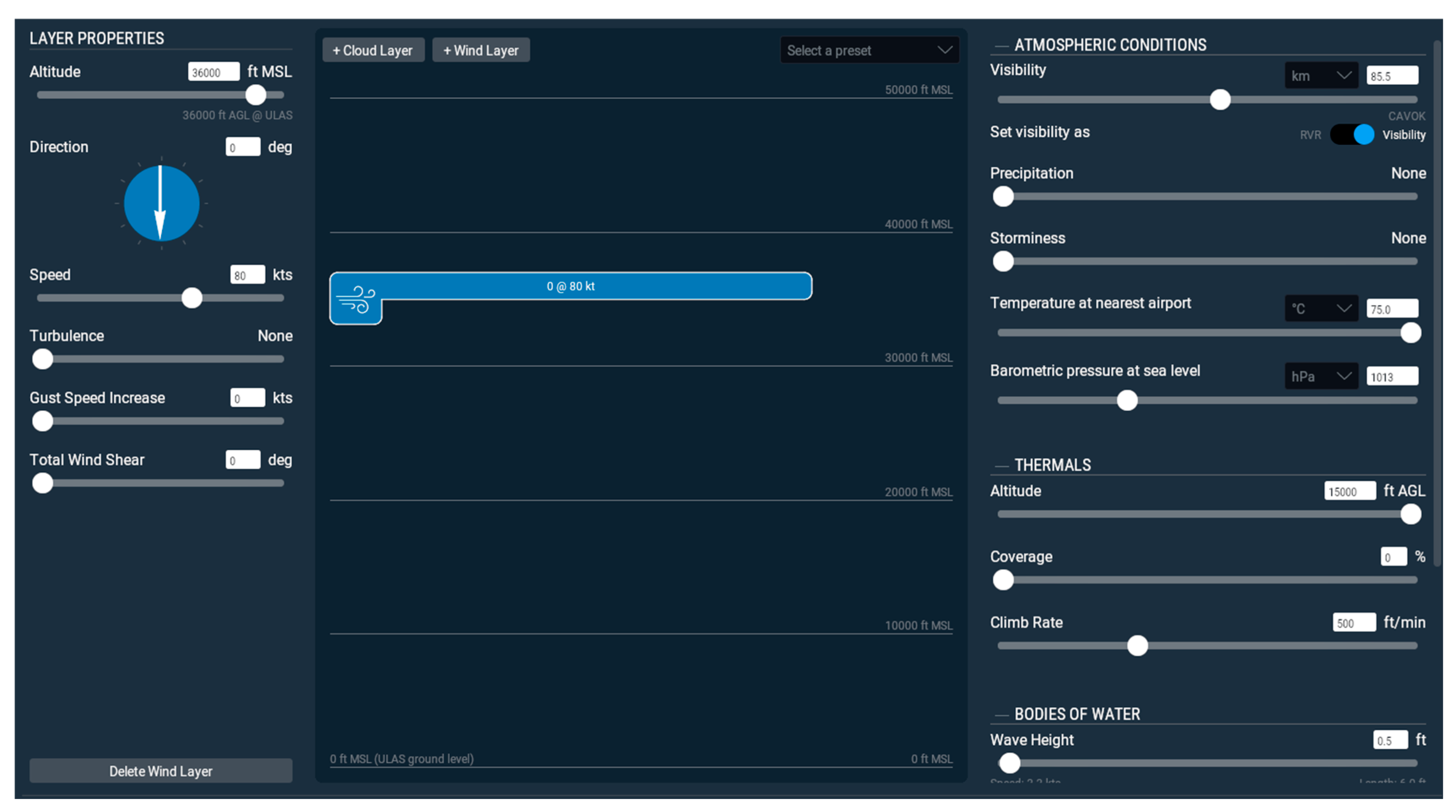
The X-Plane allows simulation studies under various weather conditions where wind and turbulence are influential. To simulate these conditions, specific settings must be configured within X-Plane. After launching the X-Plane 11 interface, the “Weather” tab should be selected to access the mentioned settings. The weather configuration panel in X-Plane is shown in Figure 3. Under the “Layer Properties” section, wind speed and direction can be adjusted, thereby enabling realistic simulation scenarios. Moreover, aircraft weight is a critical parameter that directly affects the flight controller. Therefore, it is important to consider the weight of aircraft during flight simulations. X-Plane allows users to modify aircraft weight accordingly.
The aim of this study is to minimize fuel consumption by controlling the speed of a B737-800 aircraft performing a cruising flight at a specific altitude. To this end, a PID speed controller has been designed. However, manually adjusting the PID controller coefficients is a difficult and time-consuming process. Furthermore, it is known in the literature that various metaheuristic optimization algorithms are commonly used in adjusting these coefficients. Therefore, to evaluate the effectiveness of the proposed method, both the manual adjustment approach and the proposed hybrid method were compared under the same simulation infrastructure.
To examine the behavior and stability of the designed controller under different operating conditions, the fundamental flight and meteorological parameters affecting fuel consumption were systematically varied in the X-Plane 11 flight simulator. In this context, altitude, speed, aircraft weight, wind speed, and wind direction variables were considered; the minimum and maximum values for these variables are presented in Table 1. The data obtained from the X-Plane simulator and the corresponding variable names are shown in Figure 4.
Simulations were performed under the assumption that the B737-800 aircraft maintains different cruising conditions at a specified speed. For each parameter combination, initial tuning was performed using iterative tuning based on trial-and-error and expert knowledge in the SIL environment, followed by manual fine-tuning to obtain the final controller coefficients. The PID coefficients were determined to provide balanced performance by considering speed tracking accuracy, overshoot, settling time, steady-state error, and fuel consumption together under nominal cruising conditions. The resulting manually tuned PID controller was tested and compared with the proposed method under the same flight scenarios and operating conditions.
Each simulation was run for 100 s, and the fuel consumption values under the relevant PID coefficients were transferred to and recorded in the MATLAB/Simulink environment. The 100 s simulation duration provides a sufficient time window to observe both the transient behavior (rise and settling times) and steady-state performance of the PID controller within the same time interval. Preliminary analyses confirmed that the system reached steady state within this time and that performance metrics could be reliably evaluated. This process provided a simulation-based fuel consumption dataset containing a total of 1032 different scenarios. This dataset formed the basis for evaluating controller behavior and fuel consumption performance under different flight and environmental conditions. The resulting dataset of 1032 scenarios serves as the primary data source not only for comparative prediction analysis but also for constructing the fuel consumption objective function to be used in the second phase. Thus, the optimization phase was carried out not directly on the simulator, but on a data-driven fuel model derived from the simulator.

3. Methods

In this study, the objective is to reduce the fuel consumption of a B737-800 aircraft flying at different flight conditions. To achieve this goal, a PID speed controller is designed. The equation of the speed controller is presented in Equation (1).
u = K p e ( t ) + K I 0 t e ( t ) + K d d e ( t ) d t
where e(t) represents the difference between the reference speed and the actual speed.
The methodology section of this article consists of two main stages. In the first stage, methods used to develop a fuel consumption model based on the simulation data of the B737-800 aircraft are presented. This model is constructed as a function of the variables “KP”, “KI”, “KD”, “Weight”, “Wind Direction”, “Wind Speed”, “Aircraft Speed”, and “Altitude.” In the second stage, the methods for determining the controller parameters that yield minimum fuel consumption based on the developed model are described.

3.1. Modeling of the Fuel Consumption Equation

Machine learning, statistical methods, and a reinforced hybrid metaheuristic algorithm are employed to develop the fuel consumption equations. These methods are analyzed comparatively, and the equation yielding the best prediction is selected for the optimization stage. The ultimate goal of this study is to find the decision variables that minimize the fuel consumption function J . In the first stage, a surrogate fuel consumption model of the form J = F ^ K p , K ı , K d , W a i r c r a f t , V w i n d , θ w i n d , V a i r c r a f t , h a l t i t u d e is obtained from the simulation data. In the second stage, this surrogate model is used as the objective function, and the decision variables K p , K ı , K d and speed values are optimized to give the minimum fuel consumption under the relevant flight conditions.

3.2. Statistical Approaches

In this study, eight different statistical methods are employed for obtainment and comparison of prediction equations based on relevant variables. Multiple regression analysis is preferred for analyzing the effects of multiple independent variables on a dependent variable. There are several advantages of the method, such as the facility of application and interpretation. Additionally, the effect of each variable on the model can be clearly observed [24]. Robust regression is included in the study as it reduces the influence of outliers, provides more reliable predictions, and prevents model degradation when outliers are present in the data [25]. Polynomial regression is utilized in the analyses due to its ability to capture nonlinear patterns in the data, produce models that better fit the data as the degree increases, and approximate linear models by generating first-degree equations [26,27,28]. Non-parametric regression is employed for its flexibility in making predictions without requiring model assumptions and for its capacity to produce models well-adapted to the data structure [29]. On the other hand, ridge regression is selected as another method to address multicollinearity issues, improve model generalizability by shrinking coefficients, and prevent overfitting [30]. Additionally, methods for variable selection are applied to identify significant variables and simplify models, enhancing model interpretability [31]. A summary of these methods is provided in Table 2.

3.3. Machine Learning Algorithms

Another method considered in the development of the fuel consumption equation in this study is artificial intelligence. Machine learning algorithms such as XGBoost, Random Forest, SVM, and K-Nearest Neighbor are utilized for generating prediction equations and compared with other methods. These techniques are selected in this study due to their distinct features and are employed as tools to achieve an optimal fuel consumption model. Among the machine learning algorithms used, XGBoost (Extreme Gradient Boosting) is chosen for its high prediction accuracy on large and complex datasets and its ability to prevent overfitting [32]. The Random Forest algorithm is employed due to its capacity to combine multiple decision trees and to calculate the importance of each feature [33]. A Support Vector Machine (SVM) is utilized for developing fuel consumption equations because it produces highly accurate models for nonlinear data, performs efficiently on high-dimensional datasets, and has mechanisms to prevent overfitting [34]. K-Nearest Neighbor (KNN) is also adopted in the study for its ease of implementation, flexibility, and lack of assumptions about the underlying model [35].

3.4. Decision Tree–Robust Multiple Regression–Harris Hawks Optimization Algorithm (DRHA)

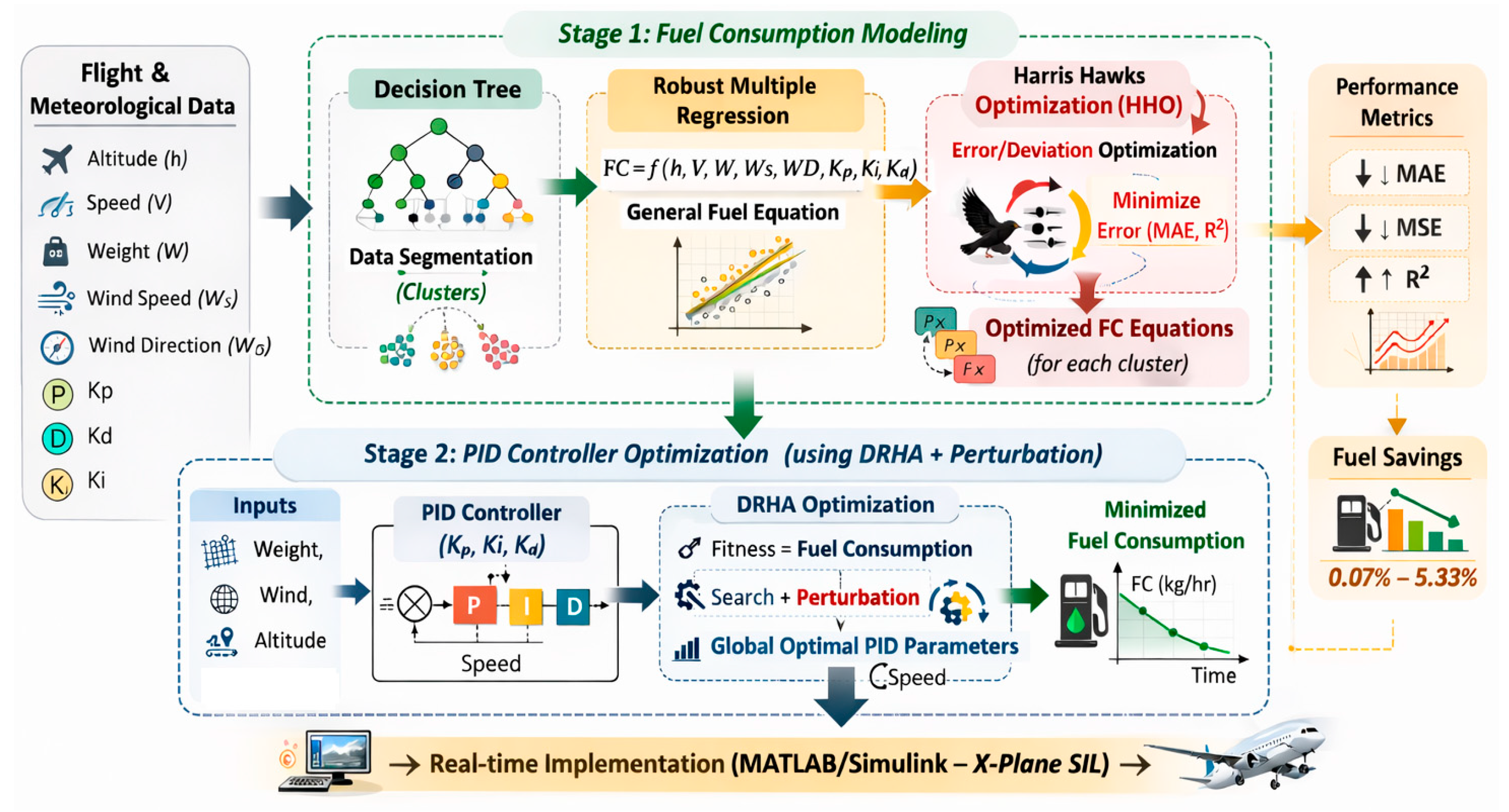
In this study, three well-known methods are combined to propose a novel hybrid approach, used for the first time in the literature. The dataset is divided into small relational clusters utilizing decision trees. A general fuel consumption equation is developed through robust regression, and the error/deviation values of the fuel consumption equation for each cluster are optimized by employing the Harris Hawks Optimization algorithm. As a result, optimal fuel consumption equations are generated for each cluster. Using the same hybrid structure, PID controller parameters for each aircraft weight, wind speed, wind direction, and altitude value are optimized to minimize fuel consumption.
In the first stage of the method, the dataset was divided into more homogeneous sub-regions by harnessing a decision tree algorithm in order to more accurately represent the heterogeneous fuel consumption behavior observed in different flight regimes. The aim of this stage is not to establish completely independent regression models for each cluster, but to add cluster-specific correction terms to the global robust regression model. In this context, the initial dataset was defined as follows:
D = x i , y i i = 1 N
Here, x i 8 represents the input vector (Kp, Ki, Kd, weight, wind speed, wind direction, velocity, and altitude) and y i represents the corresponding fuel consumption value. Based on this information, the dataset is divided into C discrete subsets corresponding to leaf nodes using the decision tree algorithm:
D = c = 1 C D c
Each D c cluster represents a relational subregion defined by the regional decision boundaries formed by the decision tree. The splitting process was performed to minimize intra-node variance (mean-squared error criterion), thus ensuring a more homogeneous data distribution within each cluster.
In the first stage, a global fuel consumption model was obtained by utilizing the Robust Multiple Regression method based on the Huber loss function:
F C E = β 0 + j = 1 8 β j x j + ε c l u s t e r
In Equation (12), ε c represents the deviation/correction term for the relevant set.
When a new input vector arrives, this data is assigned to the appropriate cluster via the decision tree, and the prediction is made using the robust regression equation along with the error term of the relevant cluster.
The cluster-specific error terms ε c were optimized using the Harris Hawks Optimization (HHO) algorithm. This optimization process minimizes the following error function:
min ε c i D c y i y ^ i 2
This structure allows for the preservation of global model stability without forming completely independent local regression models; however, prediction accuracy is improved by correcting for regional behavioral differences. The aim is to reduce biases arising from data heterogeneity and achieve higher R2 performance with lower MAE and MSE values.
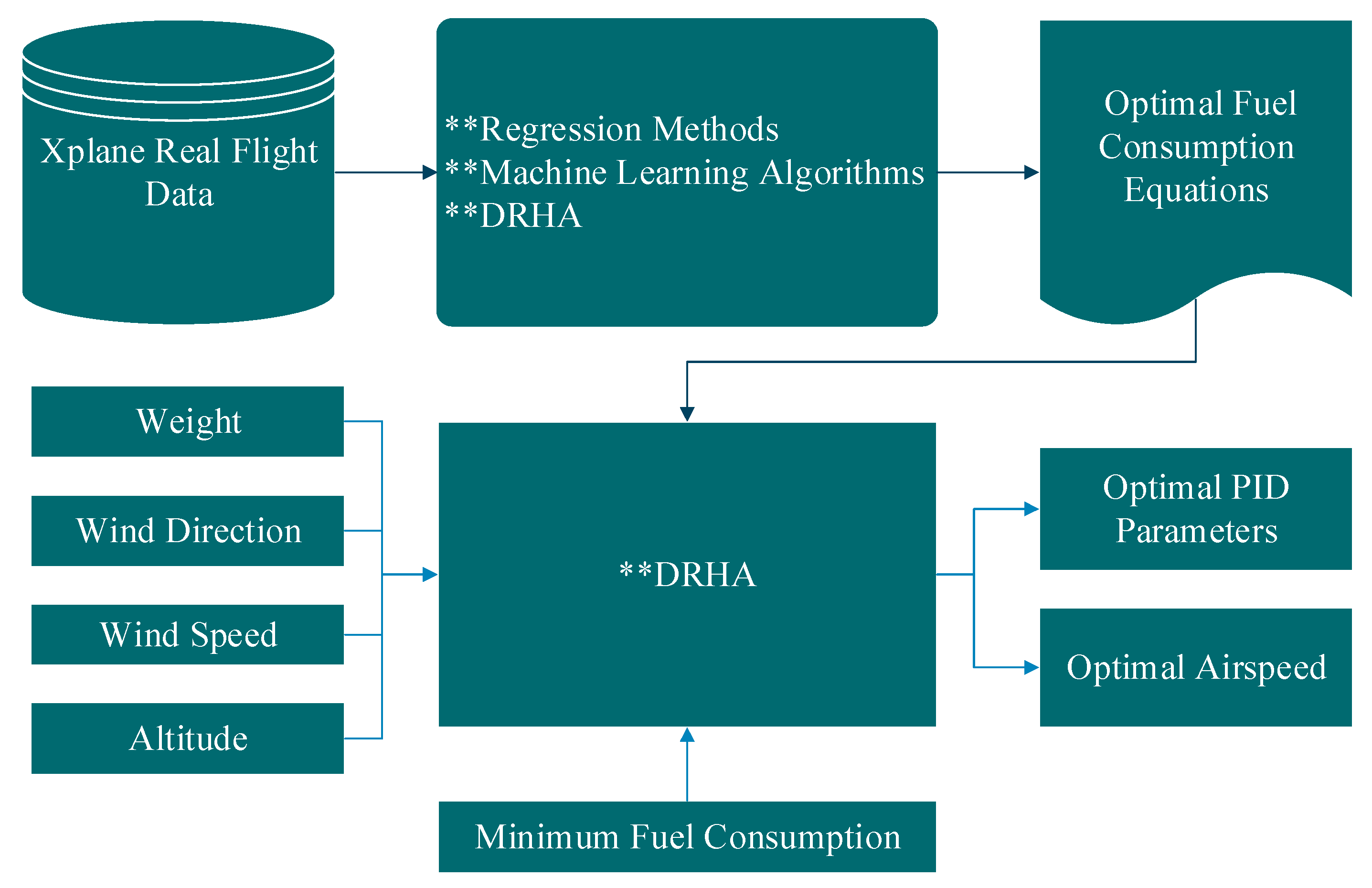
In summary, the proposed DRHA framework consists of two phases. In the first phase, a surrogate fuel consumption model is established by employing robust multiple regression and cluster-specific error correction terms optimized with HHO, based on data obtained from the SIL dataset. In the second phase, this surrogate model is used directly as the objective function to determine the optimal decision variables (PID gains and speed value) that minimize fuel consumption under the given flight and meteorological conditions. Furthermore, a perturbation mechanism is integrated into the search process in the second phase to prevent early convergence and to prevent the algorithm from getting stuck in local optimum solutions. In this mechanism, if no improvement is observed after a certain number of iterations, the available best solution is perturbed in a controlled manner, thus redirecting the search process to different regions to avoid local optimums and improve solution quality. A flowchart of the method is shown in Figure 5, and the related algorithm is presented in Algorithm 1.
Algorithm 1: HHO Algorithm with perturbation mechanism [36,37].
I n p u t s : N = N u m b e r   o f   i n d i v i d u a l s , T = U p p e r   l i m i t   o f   i t e r a t i o n s
O u t p u t s :   X t = H a w k s   p o s i t i o n   v e c t o r , X r a b b i t = P o s i t i o n   o f   t h e   p r e y
X i = X 1 , X 2 , X 3 , , X n   X = I n i t i a l   r a n d o m l y   g e n e r a t e d   p o s i t i o n s
w h i l e T h e   s t o p p i n g   c o n d i t i o n   h a s   n o t   b e e n   m e t   d o
  E v a l u a t e   t h e   s u i t a b i l i t y   o f   t h e   h a w k s
  S h i f t   t h e   l o c a t i o n   o f   t h e   r a b b i t   o r   p r e y   ( X r a b b i t b e s t   p o s i t i o n )
  f o r   e a c h   m e m b e r   o f   t h e   h a w k   p o p u l a t i o n   ( X i )   d o
   S e t   n e w   v a l u e s   f o r   i n i t i a l   e n e r g y   E 0   a n d   j u m p   s t r e n g t h   J .
   E 0 = 2 r a n d 1 , J = 2 1 r a n d
   D e t e r m i n e   t h e   u p d a t e d   v a l u e   o f   E   b a s e d   o n   t h e   e q u a t i o n   i n   ( E q u a t i o n   ( 16 ) ) .
   E = 2 E 0 1 t T (14)
   i f   ( | E | 1 )   t h e n E x p l o r a t i o n   p h a s e
    C h a n g e   t h e   p o s i t i o n   v e c t o r   a c c o r d i n g   t o   E q u a t i o n s   6   a n d   ( 7 )
    X t + 1 = X t r a n d r 1 X t r a n d 2 r 2 X t X t r a b b i t X t m r 3 L B + r 4 U B L B (15)
    X t m = 1 N i = 1 N X t i (16)
   i f   ( E < 1 )   t h e n E x p l o i t a t i o n   p h a s e
    i f   ( r 0.5   a n d   | E | 0.5 )   t h e n S o f t   b e s i e g e
     C h a n g e   t h e   p o s i t i o n   v e c t o r   b a s e d   o n   E q u a t i o n s   17   a n d   ( 18 ) .
     X t + 1 = X t E J X t r a b b i t X t (17)
     X t = X t r a b b i t X t (18)
    e l s e   i f   ( r 0.5   a n d   | E | < 0.5 )   t h e n H a r d   b e s i e g e
     R e c a l c u l a t e   t h   e l o c a t i o n   v e c t o r   u s i n g   t h e   e q u a t i o n   i n   E q u a t i o n   ( 19 ) .
     X t + 1 = X t r a b b i t E X t (19)
    e l s e   i f   ( r < 0.5   a n d   | E | 0.5 )   t h e n S o f t   b e s i e g e
     G r a d u a l l y   a c c e l e r a t e   d i v e s
     R e v i s e   t h e   l o c a t i o n   v e c t o r   u s i n g   t h e   r u l e   g i v e n   i n  Equations (20)–(23)
     Y = X t r a b b i t E J X t r a b b i t X t (20)
     Z = Y + S L F D (21)
     L F X = 0.01 u σ ϑ 1 β , σ = Γ 1 + β s i n π β 2 Γ 1 + β 2 β 2 β 1 2 1 β (22)
     X t + 1 = Y     i f   F ( Y ) < F X t Z     i f   F ( Z ) < F X t (23)
    e l s e   i f   ( r < 0.5   a n d   | E | < 0.5 )   t h e n H a r d   b e s i e g e
     G r a d u a l l y   a c c e l e r a t e   d i v e s
     R e v i s e   t h e   p o s i t i o n   v e c t o r   b y   a p p l y i n g   t h e   e q u a t i o n   i n (24)–(26).
     Y = X t r a b b i t E J X t r a b b i t X t m (24)
     X t + 1 = Y     i f   F ( Y ) < F X t Z     i f   F ( Z ) < F X t (25)
     Z = Y + S L F D (26)
  P e r t u r b a t i o n   M e c h a n i s m   ( I f   t h e   b e s t   s o l u t i o n   d o e s   n o t   i m p r o v e   d u r i n g   a   g i v e n   i t e r a t i o n ,   c o r r u p t   t h e
p o p u l a t i o n   r u l e   b a s e d   a n d   g e n e r a t e   n e w   s o l u t i o n s ) .
In the application section of the study, a fuel consumption prediction is performed by using 1032 flight data samples obtained from X-Plane. Of the total data, 80% is allocated for training and 20% for testing. In this regard, a computer equipped with 16 GB of RAM, an AMD Ryzen 5 5600H processor, and Radeon Graphics operating at 3.30 GHz is employed. A hybrid algorithm combining the regression and machine learning methods described in the aforementioned Section 3 is employed for the prediction task. Details of the application are illustrated in Figure 6.

3.5. Performance Metrics of Regression Analysis

In order to assess the accuracy of both modeling methods, two distinct error metrics are measured: mean square error (MSE) and mean absolute error (MAE). These metrics help quantify the deviation between actual observations and model predictions. Additionally, the coefficient of determination (R2) is determined for each model to evaluate goodness-of-fit, with values ideally nearing one [38,39]. The related formulas are provided in Equations (27)–(29)
M S E = 1 n i = 1 n ( y i y ^ i ) 2
M A E = 1 n i = 1 n y i y ^ i
R 2 = 1 i = 1 n ( y i y ^ i ) 2 i = 1 n ( y i y ¯ i ) 2
where y i , y ^ i and y ¯ denote real, predicted and mean values, respectively.

4. Result and Findings

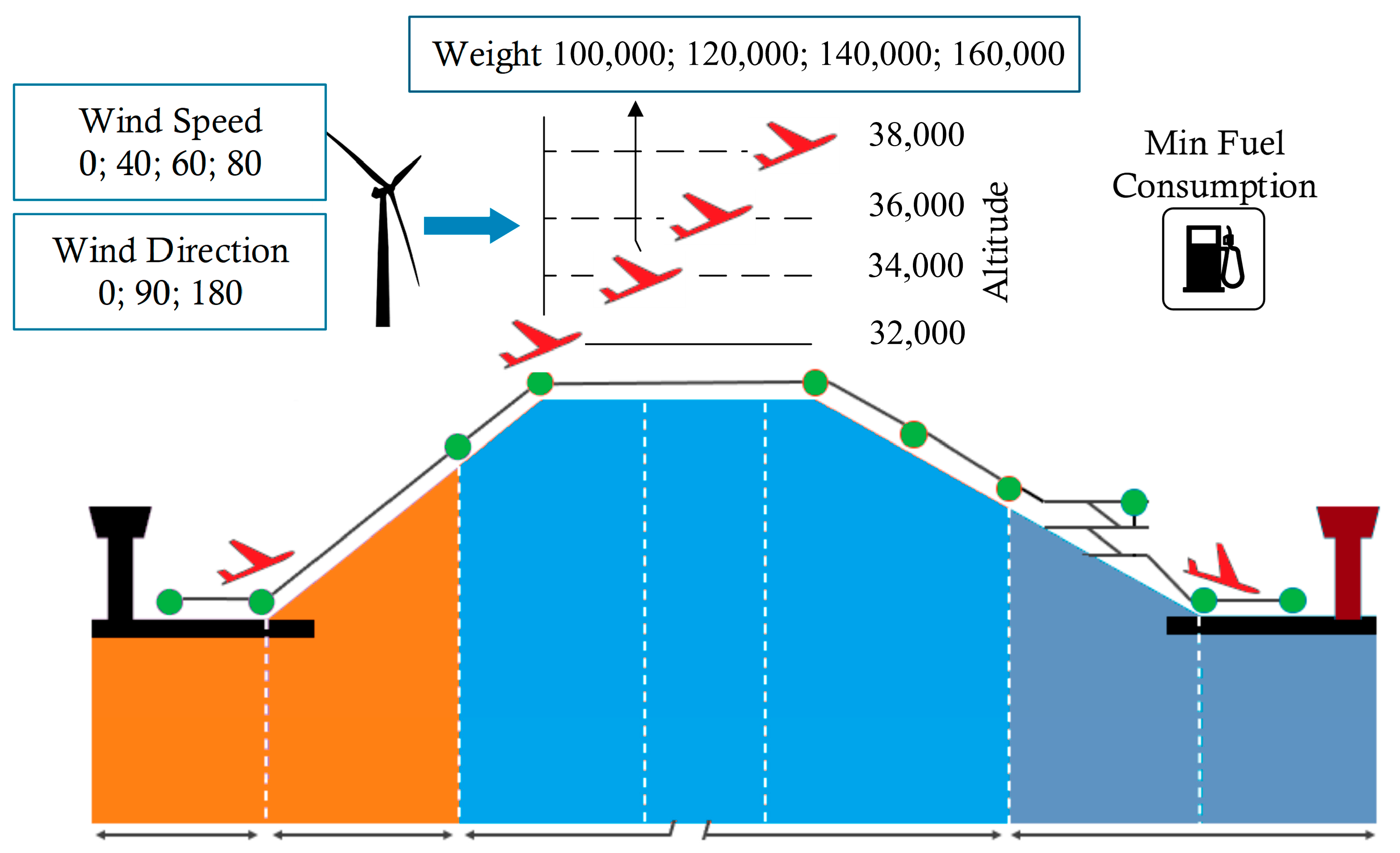
In this study, the main goal is to minimize fuel consumption by controlling the speed of a Boeing 737-800 aircraft at different altitudes, aircraft weights, wind speeds and directions. The simulation studies are performed in MATLAB/Simulink, and the results are validated by using the X-Plane 11 flight simulator. For the simulation studies, parameters such as altitude, speed, aircraft weight, wind speed, and wind direction are altered along with the PID controller coefficients. The fuel consumption values of the Boeing 737-800, performing the cruise phase at different altitudes, are obtained from the X-Plane flight simulator. Each simulation is run for 100 s, resulting in a dataset comprising 1032 samples. Based on this data, the controller coefficients are optimized by employing a hybrid method (DRHA) that integrates the HHO metaheuristic algorithm and Robust Multiple Regression with artificial intelligence-based prediction models. Moreover, the optimized PID controller coefficients obtained from this process are updated, which demonstrates improvements in fuel consumption compared to manually tuned PID controller coefficients. The PID controller coefficient values obtained via optimization, along with the manual PID controller coefficients, are further tested in simulations extended to 600 s, and the results are compared. In the simulations, the initial fuel quantity is set to 8700 pounds. The simulations are carried out at altitudes of 32,000, 34,000, 36,000, and 38,000 feet and total aircraft weights of 100,000, 120,000, 140,000, and 160,000 pounds under both windy and calm conditions. In addition, the application studies regarding regression models were carried out by utilizing the NCSS 2025 (v25.0.1) program. The equations were obtained from the outputs of this program. The obtained results are presented in the figures as follows.
Among the evaluated methods, DRHA is found to yield the best results and is subsequently utilized in the second stage to determine the optimal PID parameters. Furthermore, the optimization process is carried out for 188 different combinations of altitude, aircraft weight, wind speed, and wind direction. The results are then validated by comparing them with simulation outcomes obtained from X-Plane, thereby testing the accuracy and effectiveness of the method. The related analysis results are presented in Table 3.
When Table 3 is examined, it is observed that the best Regression Model is “Robust Multiple Regression”, and this statistical model is used within the DRHA Algorithm. The results obtained according to this hybrid model are shown in the DRHA row of Table 3. According to the results in Table 3, the best fuel consumption model was generated using the DRHA algorithm. The generated prediction model is shown in Equation (30), as follows. The coefficients of Equation (30) were estimated by employing a Huber-loss-based Robust Multiple Regression approach rather than ordinary least squares.
F C E = F u e l _ C o n s u m p t i o n _ E q u a t i o n K p = Proportional   gain   of   the   PID   controller K ı = I ntegral   gain   of   PID   controller K d = Derivative   gain   of   a   PID   controller A W = A ircraft   Weight W w i n d = Wind   Speed θ w i n d = Wind   Direction V = Aircraft   Speed h = A ltitude ε c l u s t e r = Error   term   belonging   to   the   cluster
FCE = 59.0500 + 1.3237 K d + 11.9656 K ı 0.0216 K p + 0.0002 A W 0.0019   W w i n d + 0.0060 θ w i n d + 0.3670 V 0.0001 h + ε c l u s t e r
In the next stage, a mathematical model was established utilizing this equation and optimized using the DRHA method. The basic mathematical structure of the model is shown below in Equation (31).
min ( FCE )
K p _ l o w e r _ b o u n d Opt _ K p K p _ u p p e r _ b o u n d K ı _ l o w e r _ b o u n d Opt _ K ı K ı _ u p p e r _ b o u n d K d _ l o w e r _ b o u n d Opt _ K d K d _ u p p e r _ b o u n d V l o w e r _ b o u n d O p t _ V V u p p e r _ b o u n d ( A W & W w i n d & θ w in d & h ) ( A W & W w i n d & θ w in d & h ) ( A W & W w i n d & θ w in d & h ) ( A W & W w i n d & θ w in d & h )
Based on the information above, details regarding the application of the two-stage solution method and the resulting gains are shown in Figure 7.
The application is tested under different conditions, harnessing the solution architecture shown in Figure 7, and the results obtained are shown comparatively in the graphs below.
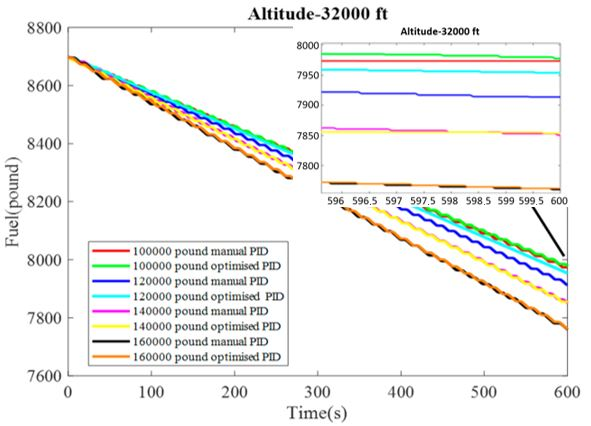
The simulation results for an altitude of 32,000-feet are presented in Figure 8. As can be seen from the figure, after 600 s of simulation, when compared to flight results with real-time X-Plane, fuel consumption is reduced by 0.754% for an aircraft weight of 100,000-pounds, 5.33% for 120,000-pounds, 0.527% for 140,000-pounds, and 0.251% for 160,000-pounds, thanks to the DRHA approach.
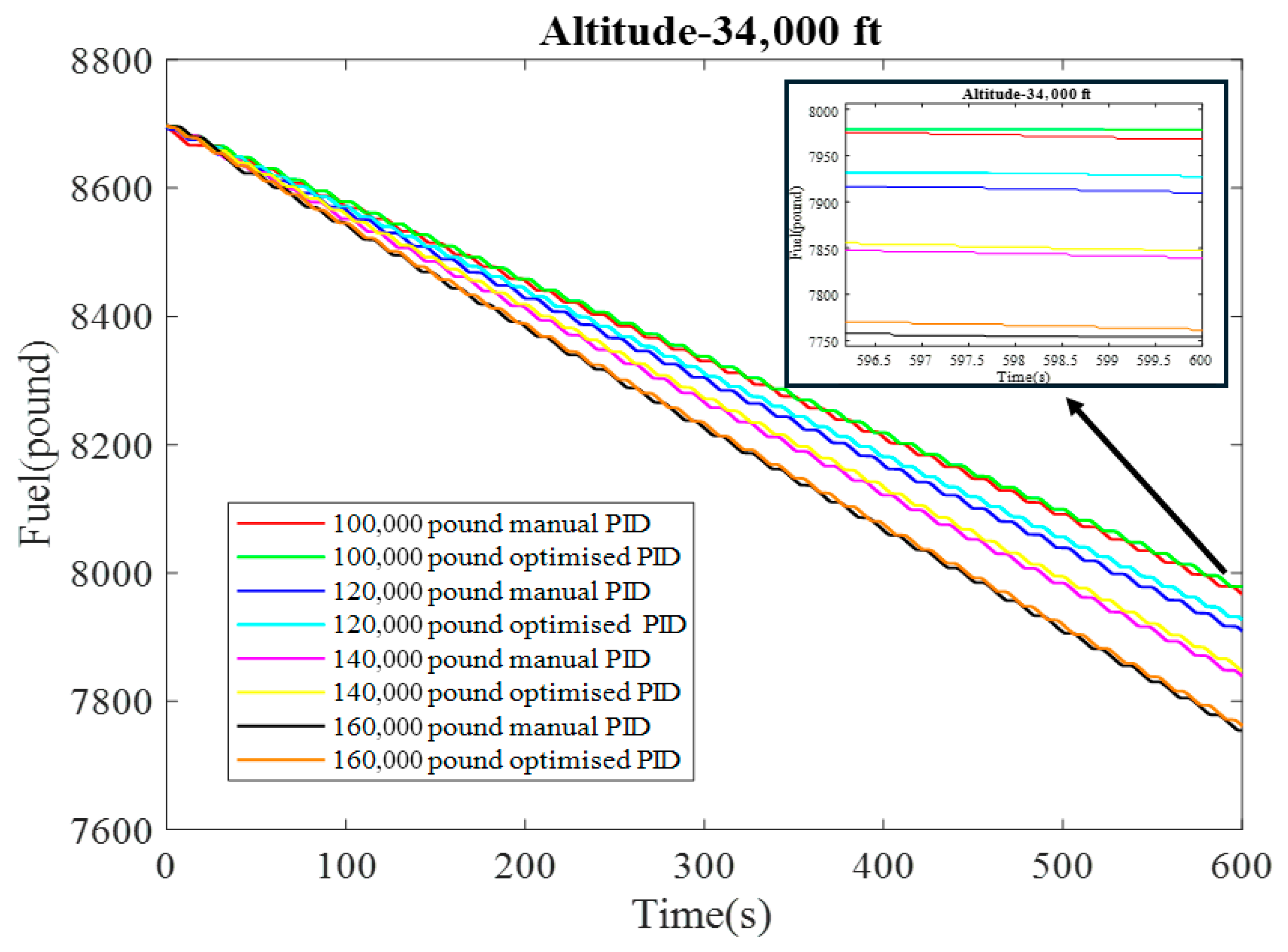
The simulation results for an altitude of 34,000-feet are presented in Figure 9. As illustrated in the figure, after 600 s of simulation, fuel consumption is reduced by 0.99% for an aircraft weight of 100,000-pounds, 2.035% for 120,000-pounds, 1.030% for 140,000-pounds, and 0.731% for 160,000-pounds.
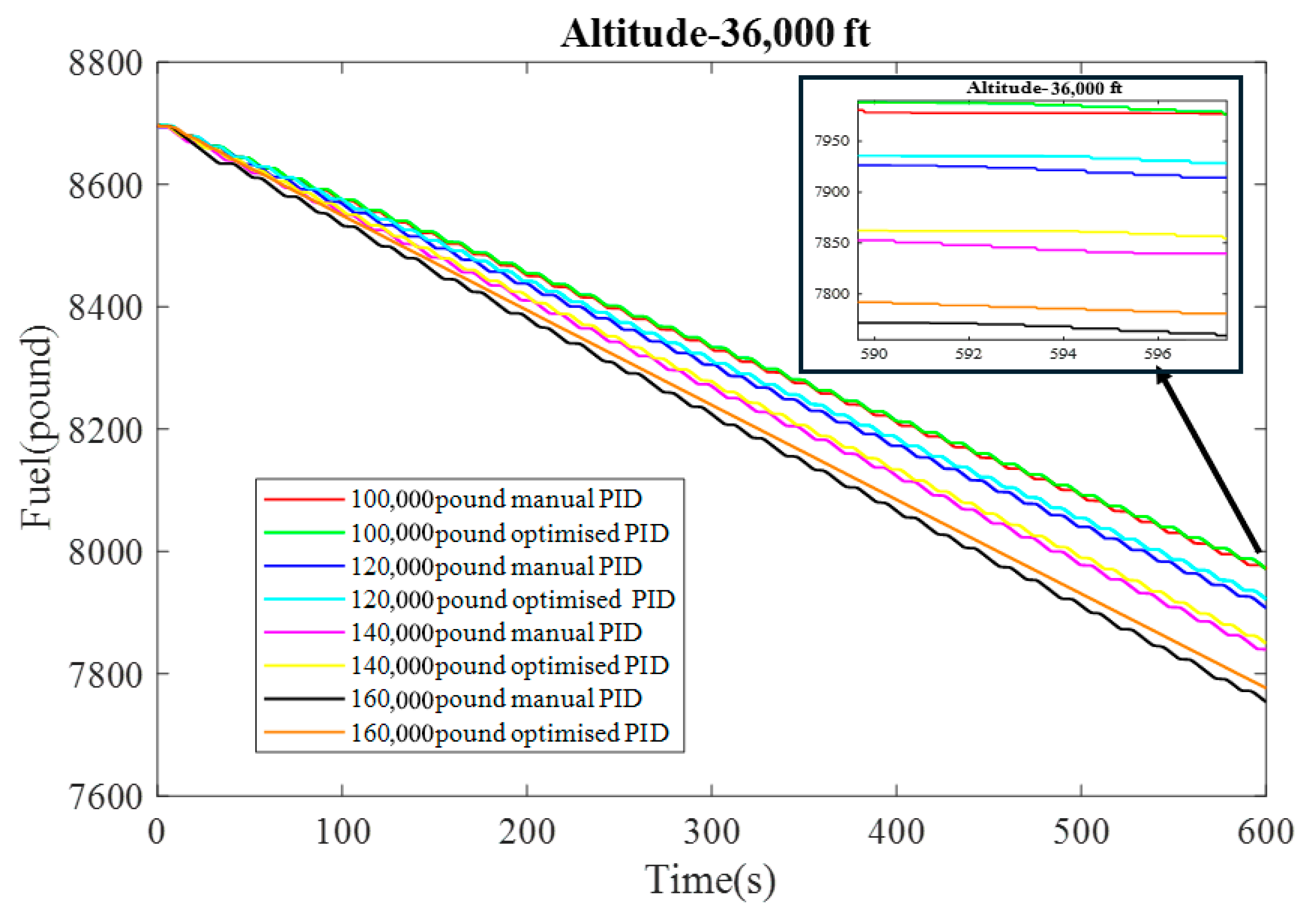
The simulation results for an altitude of 36,000-feet are presented in Figure 10. As shown in the figure, after 600 s of simulation, fuel consumption is reduced by 0.071% for an aircraft weight of 100,000-pounds, 1.320% for 120,000-pounds, 1.276% for 140,000-pounds, and 2.388% for 160,000-pounds.
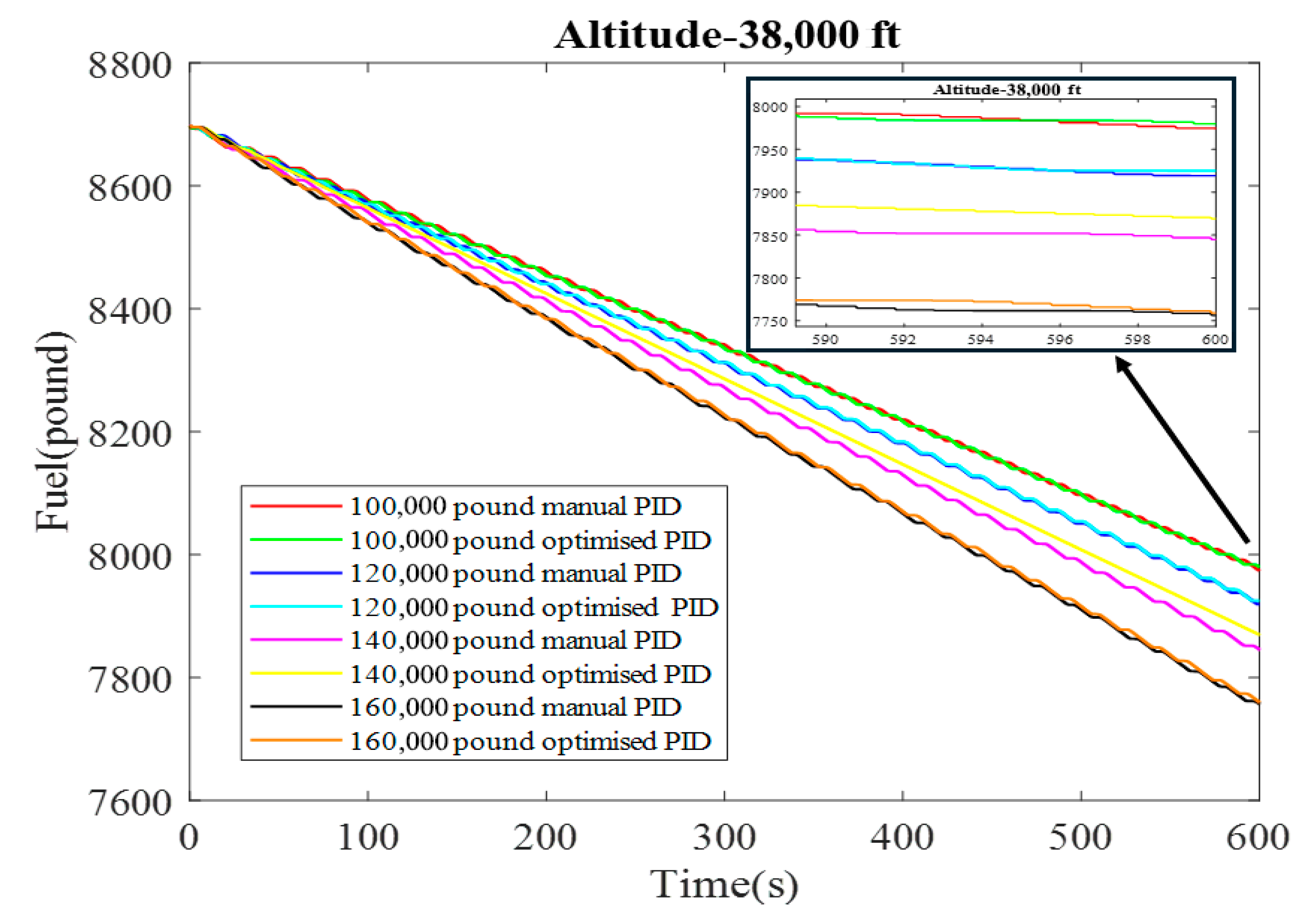
The simulation results for an altitude of 38,000-feet are presented in Figure 11. As shown in the figure, after 600 s of simulation, fuel consumption is reduced by 0.920% for an aircraft weight of 100,000-pounds, 0.799% for 120,000-pounds, 2.852% for 140,000-pounds, and 0.296% for 160,000-pounds.
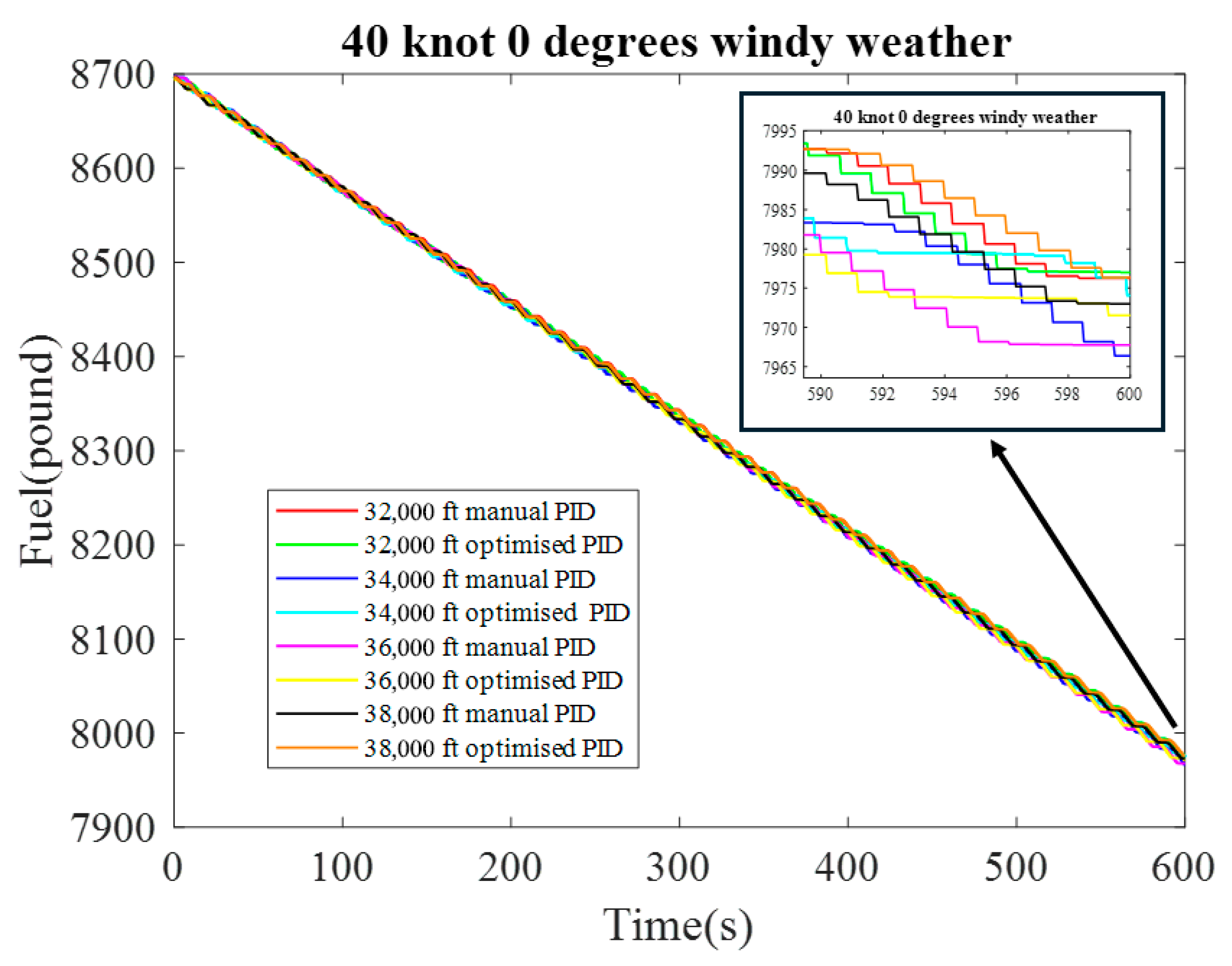
The simulation results of fuel consumption at different altitudes for an aircraft with a total weight of 100,000-pounds are presented in Figure 12. In this study, the aircraft is tested under the influence of a 40-knot wind speed at a 0-degree wind direction. As shown in the figure, after 600 s of simulation, fuel consumption is reduced by 0.103% at an altitude of 32,000-feet, 1.234% at 34,000-feet, 0.714% at 36,000-feet, and 0.461% at 38,000-feet.
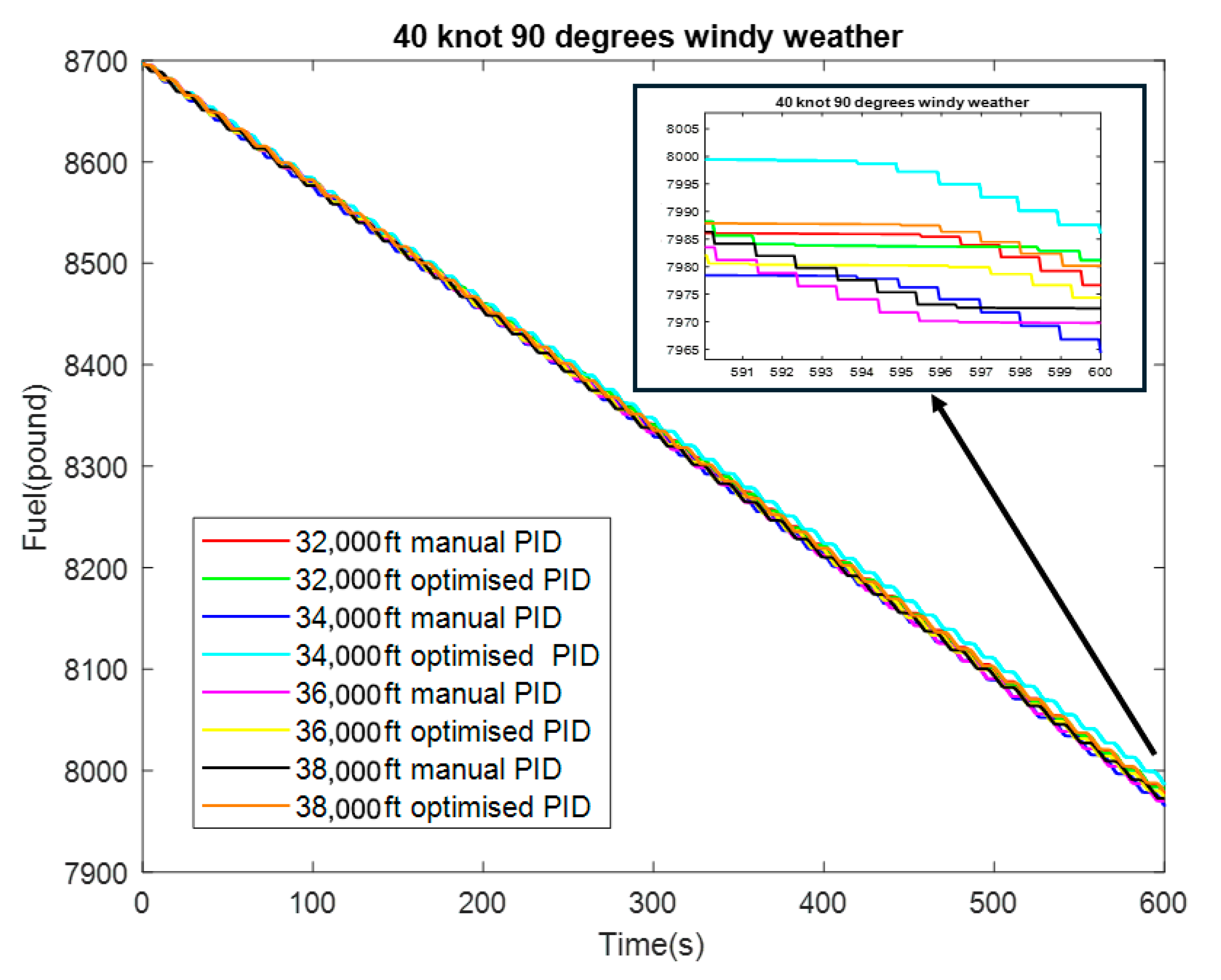
The test results under the influence of a 40-knot wind speed at a 90-degree wind direction on the aircraft are presented in Figure 13. In the simulation studies, the aircraft weight is set to 100,000-pounds. As shown in the figure, after a 600 s simulation, fuel consumption is reduced by 0.620% at 32,000-feet, 2.811% at 34,000-feet, 0.685% at 36,000-feet, and 1.052% at a 38,000-feet altitude.
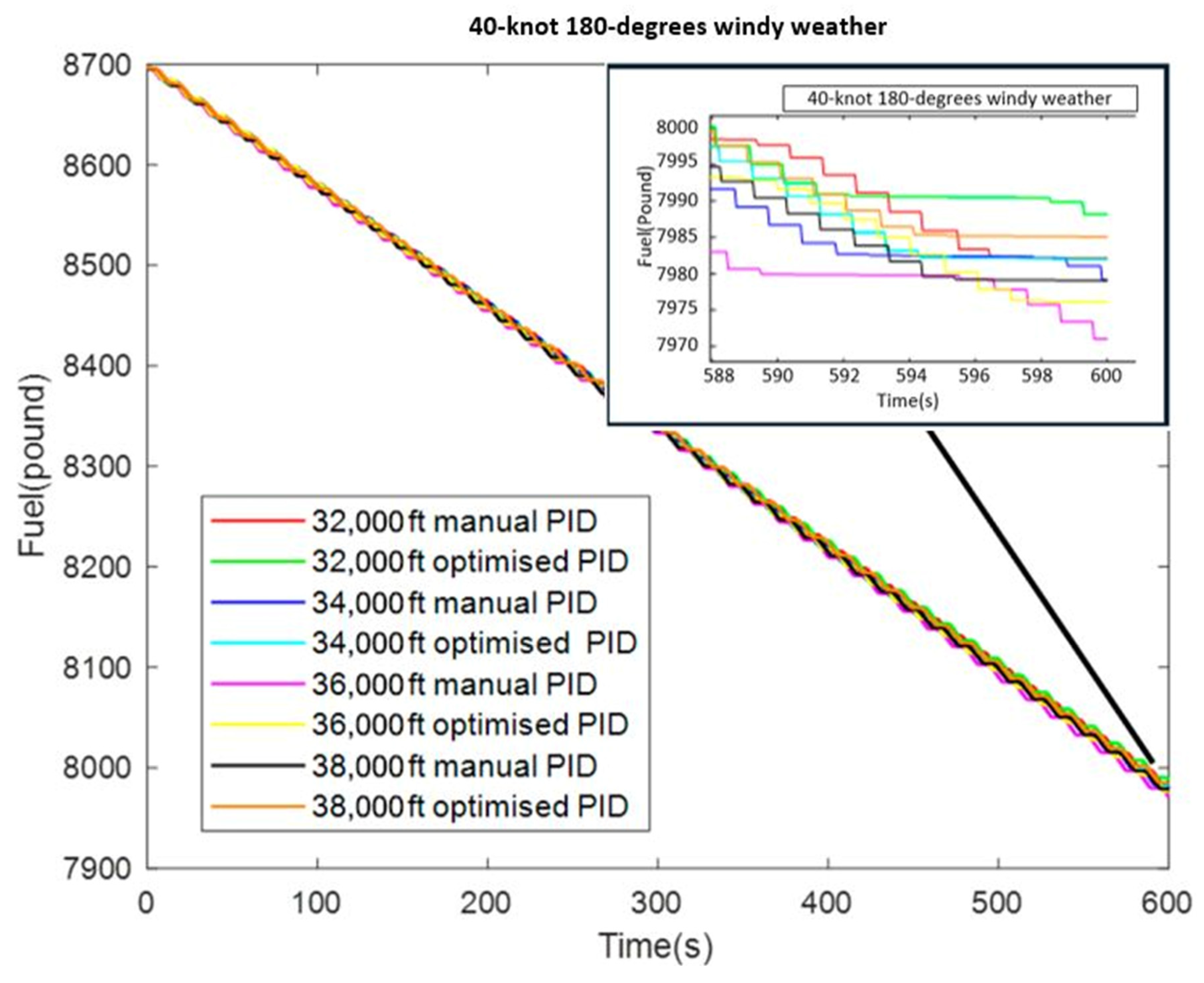
The test results under the influence of a 40-knot wind speed at a 180-degree wind direction on the aircraft are presented in Figure 14. In the simulation studies, the aircraft weight is set to 100,000-pounds. As shown in the figure, after a 600 s simulation, fuel consumption is reduced by 0.684% at 32,000-feet, 0.586% at 34,000-feet, 0.579% at 36,000-feet, and 0.676% at a 38,000-feet altitude.
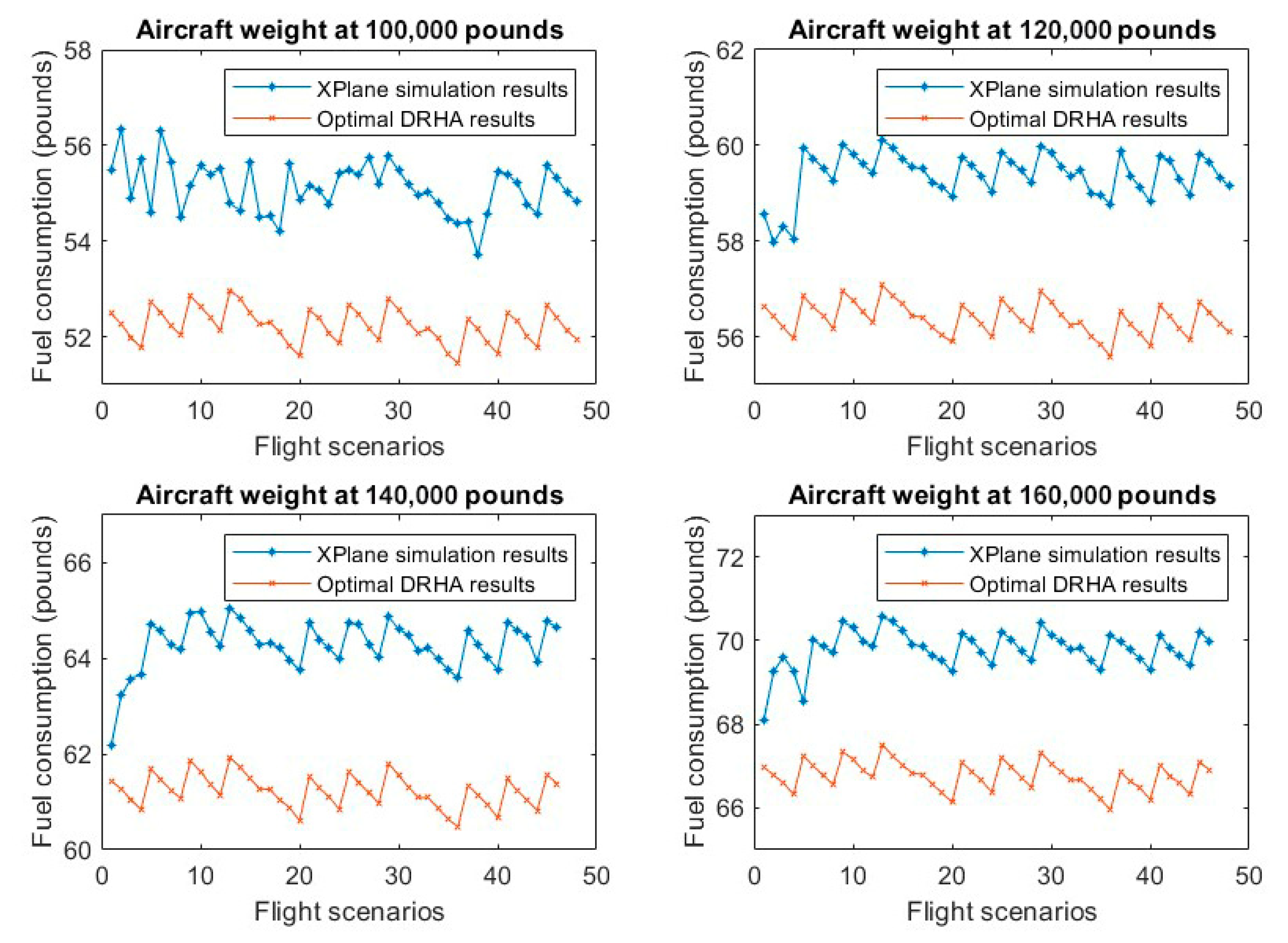
Based on the application results presented in Figure 15, it could be observed that the DRHA algorithm successfully achieves minimum fuel consumption across different aircraft weights, altitudes, wind speeds, and wind directions. In the figure, the X-Plane simulation result demonstrates the best values (minimum fuel consumption) obtained for the relevant input variables as a result of real-time simulation performed on X-Plane. The optimal fuel consumption values obtained as a result of the DRHA algorithm are expressed in the “Optimal DRHA Result” column.
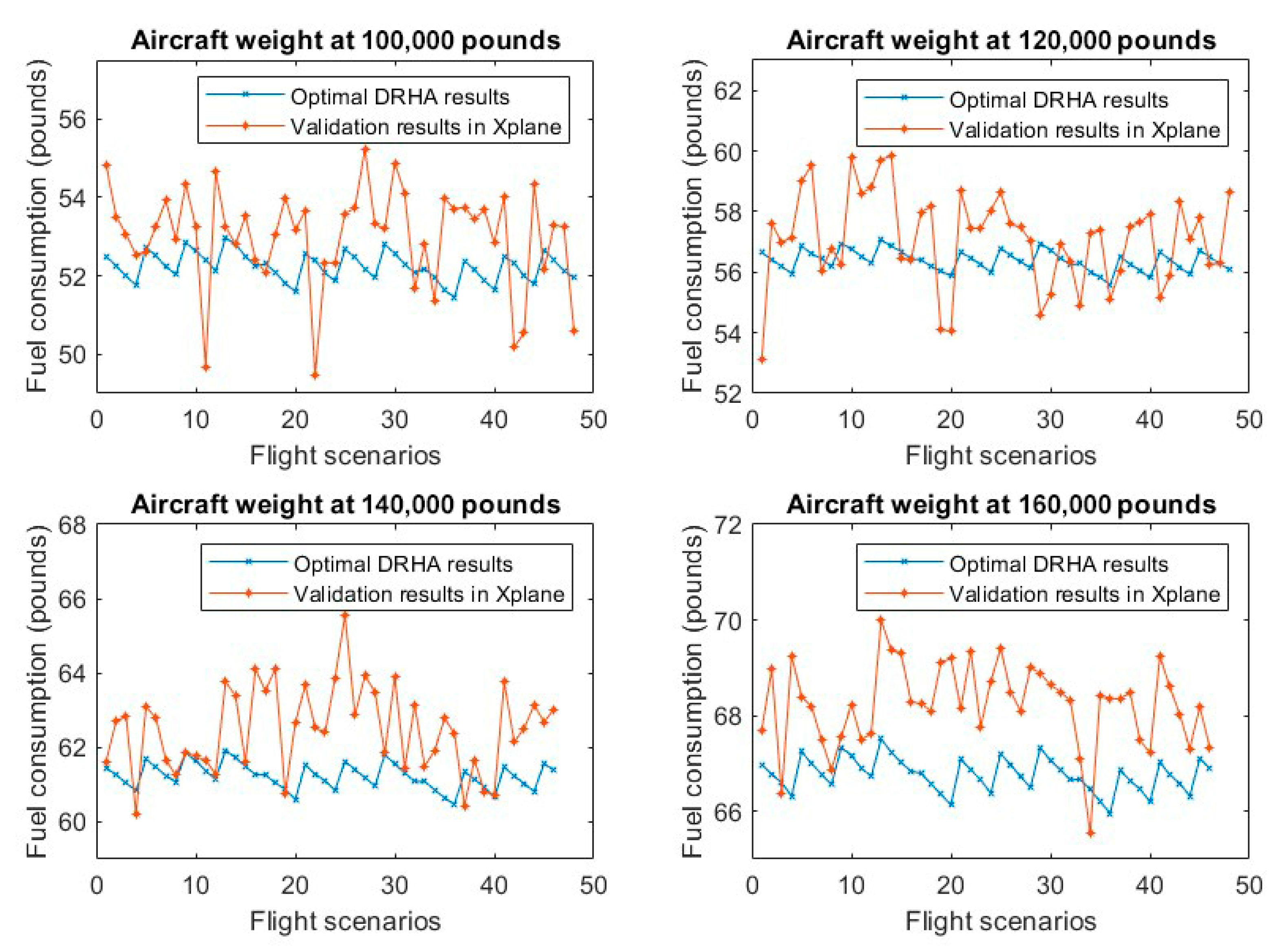
To evaluate the consistency of the DRHA-based optimum solution obtained in this study, the PID controller coefficients and velocity values found in the optimization phase were reapplied to the MATLAB/Simulink–X-Plane closed-loop Software-in-the-Loop (SIL) simulation environment. Thus, the results predicted by the developed fuel consumption equation were compared with the simulation results obtained again in the X-Plane environment under the same flight conditions. Therefore, the process performed here should not be considered an independent external validation with real flight data, but rather as a simulator-based validation/confirmation process based on retesting the solution found as a result of optimization in a high-accuracy original simulation environment.
When the results in Figure 16 and Table 4 are examined together, it is seen that there is a low level of error and deviation between the optimum results obtained with the DRHA algorithm and the validation results obtained again in the X-Plane SIL environment. The differences between the two results may stem from approximation errors in the developed fuel consumption equation, the nonlinear behavior of the system, and the fact that some dynamic effects represented in the X-Plane environment could not be fully reflected by the regression-based model. However, the low MAE, MSE, and percentage deviation values obtained indicate that the proposed method largely preserves the optimum solution not only in the mathematical model but also in the original high-accuracy simulation environment in which the data was generated. This finding demonstrates that the proposed approach can provide both computational efficiency and simulation consistency.
Lastly, when evaluating the algorithm in terms of solution time, it was determined that optimal values were obtained in less than 2 min in all scenarios.
To statistically analyze the proximity of the developed fuel consumption equation to real systems, the “Optimal DRHA Result” and “Validation of Optimal DRHA in Xplane” results were compared, and the obtained results are presented in Table 4.
According to the results in Table 4, when the optimal fuel consumption results obtained from the DRHA algorithm are compared with the data obtained from the actual system (X-Plane), low levels of error and deviation were detected between the two methods. The mean absolute error (MAE) ranged from “1.29” to “1.51”, while the mean square error (MSE) remained between “2.30” and “2.84”. The errors at this level could be assessed as relatively low and indicate a high degree of similarity between the modelled system and the actual data. This finding demonstrates that the results obtained from the prediction equation can be reliably used in practice.


5. Conclusions

In this study, a novel hybrid method developed for commercial aircraft, the DRHA algorithm, is successfully applied to optimize PID control parameters and aircraft speed with the aim of minimizing fuel consumption during flight. A dataset generated by 1032 different simulation scenarios performed on a Boeing 737-800 passenger aircraft realistically represents flight conditions and enables a comprehensive evaluation of the algorithm’s performance. One of the main contributions of this study is the development of a versatile solution architecture that integrates both data-driven and nature-inspired optimization techniques, in contrast to traditional parametric modeling approaches. It is shown that the difficulties and potential for error in manually adjusting PID control parameters are effectively solved via this hybrid system. Moreover, the optimal variables in the study provide consistent improvements in terms of fuel consumption not only under specific flight conditions but also across various scenarios:
The SIL simulations with the optimized coefficients demonstrate improved fuel efficiency compared to those using manually tuned PID control parameters.
The DRHA algorithm is compared with commonly used regression and machine learning models in the literature and emerges as the most successful method, which demonstrates statistically significant lower error rates and higher R2 values.
Tests at altitudes throughout 32,000 and 38,000 feet and aircraft weights ranging from 100,000 to 160,000 pounds yield reductions in fuel consumption between 0.07% and 5.33% thanks to the proposed DRHA method.
When considering validation results, the mean deviation between the optimal DRHA and validation in X-Plane changes between 2.12% and 2.51% throughout flight scenarios.
Consequently, the application of PID control algorithms to this specific aircraft offers significant benefits from both engineering and operational perspectives. In future studies, the proposed DRHA approach could be embedded into real-time flight systems to enable on-the-fly optimization during actual flight operations. Additionally, testing the control algorithm within Hardware-in-the-Loop (HIL) systems is crucial for demonstrating its applicability in the transition to real flight scenarios. By integrating deep learning, reinforcement learning, or evolutionary algorithms, new hybrid architectures can be developed to support multi-objective optimization, enhancing both flight safety and environmental sustainability. In this context, new objective functions—such as flight comfort, vibration reduction, and route deviation minimization—can be integrated into the system alongside fuel efficiency.

Author Contributions

U.Ü.U. was responsible for the development, analysis, reporting, and visualization of the metaheuristic and artificial intelligence algorithms within the article. Z.K. was responsible for conducting simulation studies using Xplaine and Matlab and interpreting the results. H.A. was responsible for preparing the technical information related to the engines, deepening the literature review, creating the problem set, and reporting the results. All authors have read and agreed to the published version of the manuscript.
Funding

Firat University Research Fund (SHY.25.10).

Data Availability Statement

Dataset available on request from the authors.

Acknowledgments

The authors would like to thank FUBAP (SHY.25.10) for financial support. ChatGPT was employed as a supporting tool in the preparation of figures, equations and visual layouts presented in this study. DeepL and Google Translate were used during the writing and translation processes of the manuscript to improve linguistic clarity and consistency. The scientific content, analyses, and interpretations of the study are entirely the responsibility of the authors.

Conflicts of Interest

The authors declare no conflict of interest.

References

  1. Airbus. Global Market Forecast 2023. 2023. Available online: https://www.airbus.com/sites/g/files/jlcbta136/files/2023-06/Airbus%20Global%20Market%20Forecast%202023-2042%20Presentation.pdf (accessed on 2 January 2026).
  2. Poles, D.; Nuic, A.; Mouillet, V. Advanced aircraft performance modeling for ATM: Analysis of BADA model capabilities. In Proceedings of the 29th Digital Avionics Systems Conference, Salt Lake City, UT, USA, 3–7 October 2010; IEEE: New York, NY, USA, 2010. [Google Scholar]
  3. Senzig, D.A.; Fleming, G.G.; Iovinelli, R.J. Modeling of terminal-area airplane fuel consumption. J. Aircr. 2009, 46, 1089–1093. [Google Scholar] [CrossRef]
  4. Xu, D.; Deng, Y.; Duan, H. Parameter tuning for active disturbance rejection control of fixed-wing UAV based on improved bald eagle search algorithm. Aircr. Eng. Aerosp. Technol. 2024, 96, 1152–1164. [Google Scholar] [CrossRef]
  5. Doakhan, M.; Kabganian, M.; Azimi, A. Cooperative payload transportation with real-time formation control of multi-quadrotors in the presence of uncertainty. J. Frankl. Inst. 2023, 360, 1284–1307. [Google Scholar] [CrossRef]
  6. Beard, R.W.; McLain, T.W. Small Unmanned Aircraft: Theory and Practice; Princeton University Press: Princeton, NJ, USA, 2012. [Google Scholar]
  7. Yang, Y.; Yan, Y. Attitude regulation for unmanned quadrotors using adaptive fuzzy gain-scheduling sliding mode control. Aerosp. Sci. Technol. 2016, 54, 208–217. [Google Scholar] [CrossRef]
  8. Su, Z.; Wang, H.; Shao, X.; Huang, Y. A robust back-stepping based trajectory tracking controller for the tanker with strict posture constraints under unknown flow perturbations. Aerosp. Sci. Technol. 2016, 56, 34–45. [Google Scholar] [CrossRef]
  9. Mokhtari, M.R.; Cherki, B. A new robust control for minirotorcraft unmanned aerial vehicles. ISA Trans. 2015, 56, 86–101. [Google Scholar] [CrossRef]
  10. Ruggiero, F.; Cacace, J.; Sadeghian, H.; Lippiello, V. Passivity-based control of VToL UAVs with a momentum-based estimator of external wrench and unmodeled dynamics. Robot. Auton. Syst. 2015, 72, 139–151. [Google Scholar] [CrossRef]
  11. Ülker, H.; Baykara, C.; Özsoy, C. Design of MPCs for a fixed wing UAV. Aircr. Eng. Aerosp. Technol. 2017, 89, 893–901. [Google Scholar] [CrossRef]
  12. Ansarian, A.; Mahmoodabadi, M.J. Multi-objective optimal design of a fuzzy adaptive robust fractional-order PID controller for a nonlinear unmanned flying system. Aerosp. Sci. Technol. 2023, 141, 108541. [Google Scholar] [CrossRef]
  13. Khoud, K.B.; Bouallègue, S.; Ayadi, M. Design and co-simulation of a fuzzy gain-scheduled PID controller based on particle swarm optimization algorithms for a quad tilt wing unmanned aerial vehicle. Trans. Inst. Meas. Control 2018, 40, 3933–3952. [Google Scholar] [CrossRef]
  14. Izci, D.; Ekinci, S.; Demirören, A.; Hedley, J. HHO algorithm based PID controller design for aircraft pitch angle control system. In Proceedings of the 2020 International Congress on Human-Computer Interaction, Optimization and Robotic Applications (HORA), Ankara, Turkey, 26–28 June 2020; IEEE: New York, NY, USA, 2020. [Google Scholar]
  15. Zatout, M.S.; Rezoug, A.; Rezoug, A.; Baizid, K.; Iqbal, J. Optimisation of fuzzy logic quadrotor attitude controller–particle swarm, cuckoo search and BAT algorithms. Int. J. Syst. Sci. 2022, 53, 883–908. [Google Scholar] [CrossRef]
  16. Cai, Z.; Lou, J.; Zhao, J.; Wu, K.; Liu, N.; Wang, Y.X. Quadrotor trajectory tracking and obstacle avoidance by chaotic grey wolf optimization-based active disturbance rejection control. Mech. Syst. Signal Process. 2019, 128, 636–654. [Google Scholar] [CrossRef]
  17. Hassani, H.; Mansouri, A.; Ahaitouf, A. Optimal backstepping controller for trajectory tracking of a quadrotor UAV using ant colony optimisation algorithm. Int. J. Comput. Aided Eng. Technol. 2023, 18, 39–59. [Google Scholar] [CrossRef]
  18. Yacef, F.; Bouhali, O.; Hamerlain, M.; Rezoug, A. PSO optimization of integral backstepping controller for quadrotor attitude stabilization. In Proceedings of the 3rd International Conference on Systems and Control, Algiers, Algeria, 29–31 October 2013; IEEE: New York, NY, USA, 2013. [Google Scholar]
  19. Kaviyarasu, A.; Saravanakumar, A.; Logavenkatesh, M. Software in Loop Simulation based Waypoint Navigation for Fixed Wing UAV. Def. Sci. J. 2021, 71, 448–455. [Google Scholar] [CrossRef]
  20. Tahir, M.A.; Mir, I.; Islam, T.U. A review of UAV platforms for autonomous applications: Comprehensive analysis and future directions. IEEE Access 2023, 11, 52540–52554. [Google Scholar] [CrossRef]
  21. Yu, L.; He, G.; Zhao, S.; Wang, X.; Shen, L. Design and Implementation of a Hardware-in-the-Loop Simulation System for a Tilt Trirotor UAV. J. Adv. Transp. 2020, 2020, 4305742. [Google Scholar] [CrossRef]
  22. B737. Available online: https://www.boeing.com/commercial/737ng (accessed on 1 March 2026).
  23. Do, M.-H.; Lin, C.-E.; Lai, Y.-C. Validation of the Flight Dynamics Engine of the X-Plane Simulator in Comparison with the Real Flight Data of the Quadrotor UAV Using CIFER. Drones 2023, 7, 548. [Google Scholar] [CrossRef]
  24. James, G.; Witten, D.; Hastie, T.; Tibshirani, R. An Introduction to Statistical Learning; Springer: Berlin/Heidelberg, Germany, 2013; Volume 112. [Google Scholar]
  25. Fox, J. Applied Regression Analysis and Generalized Linear Models; Sage Publications: Newbury Park, CA, USA, 2015. [Google Scholar]
  26. Montgomery, D.C.; Peck, E.A.; Vining, G.G. Introduction to Linear Regression Analysis; John Wiley & Sons: New York, NY, USA, 2021. [Google Scholar]
  27. Draper, N.R.; Smith, H. Applied Regression Analysis; John Wiley & Sons: New York, NY, USA, 1998; Volume 326. [Google Scholar]
  28. Seber, G.A.; Lee, A.J. Linear Regression Analysis; John Wiley & Sons: New York, NY, USA, 2003. [Google Scholar]
  29. Wasserman, L. All of Nonparametric Statistics; Springer Science & Business Media: New York, NY, USA, 2006. [Google Scholar]
  30. Hoerl, A.E.; Kennard, R.W. Ridge regression: Biased estimation for nonorthogonal problems. Technometrics 1970, 12, 55–67. [Google Scholar] [CrossRef]
  31. Tibshirani, R. Regression shrinkage and selection via the lasso. J. R. Stat. Soc. Ser. B Stat. Methodol. 1996, 58, 267–288. [Google Scholar] [CrossRef]
  32. XGBoost, C.T.G.C. A scalable tree boosting system. In Proceedings the 22nd ACM SIGKDD International Conference on Knowledge Discovery and Data Mining; Association for Computing Machinery: New York, NY, USA, 2016; pp. 785–794. [Google Scholar]
  33. Breiman, L. Random forests. Mach. Learn. 2001, 45, 5–32. [Google Scholar] [CrossRef]
  34. Cortes, C.; Vapnik, V. Support-vector networks. Mach. Learn. 1995, 20, 273–297. [Google Scholar] [CrossRef]
  35. Cover, T.; Hart, P. Nearest neighbor pattern classification. IEEE Trans. Inf. Theory 1967, 13, 21–27. [Google Scholar] [CrossRef]
  36. Heidari, A.A.; Mirjalili, S.; Faris, H.; Aljarah, I.; Mafarja, M.; Chen, H. Harris hawks optimization: Algorithm and applications. Future Gener. Comput. Syst. 2019, 97, 849–872. [Google Scholar] [CrossRef]
  37. Kusoglu, M. Adaptation of the Improved Hawk Algorithm to Multi-Objective Optimization Problems; Bilecik Seyh Edebali University, Institute of Natural Science: Bilecik, Turkey, 2021. [Google Scholar]
  38. Toraman, S.; Dursun, O.O.; Aygun, H. Prediction of noise of commercial aircraft based on itself specifications by using machine learning methods. J. Air Transp. Manag. 2025, 125, 102779. [Google Scholar] [CrossRef]
  39. Toraman, S.; Aygun, H.; Dursun, O.O. Machine learning application to forecasting performance and thermodynamics parameters of small turbojet engine. J. Therm. Anal. Calorim. 2025, 150, 505–519. [Google Scholar] [CrossRef]
Figure 1. Data available for transmission from X-Plane.
Aerospace 13 00289 g001
Figure 2. MATLAB/Simulink configuration page.
Aerospace 13 00289 g002
Figure 3. X-Plane weather configuration panel.
Aerospace 13 00289 g003
Figure 4. Variable names and values retrieved from X-Plane.
Aerospace 13 00289 g004
Figure 5. Flow diagram regarding modeling of fuel consumption.
Aerospace 13 00289 g005
Figure 6. Details of the applied study.
Aerospace 13 00289 g006
Figure 7. DRHA framework for full-efficient flight control and PID parameter optimization.
Aerospace 13 00289 g007
Figure 8. Simulation results for fuel consumption at 32,000-feet altitude.
Aerospace 13 00289 g008
Figure 9. Simulation results for fuel consumption at 34,000-feet altitude.
Aerospace 13 00289 g009
Figure 10. Simulation results for fuel consumption at 36,000-feet altitude.
Aerospace 13 00289 g010
Figure 11. Simulation results for fuel consumption at 38,000-feet altitude.
Aerospace 13 00289 g011
Figure 12. Simulation results under the effect of 40-Knot wind at 0 degrees.
Aerospace 13 00289 g012
Figure 13. Simulation results under the effect of 40-knot wind at 90-degrees.
Aerospace 13 00289 g013
Figure 14. Simulation results under the effect of 40-knot wind at 180-degrees.
Aerospace 13 00289 g014
Figure 15. Comparative results of fuel consumption between X-Plane and DRHA method.
Aerospace 13 00289 g015
Figure 16. Comparative results of fuel consumption between DRHA method and validation in X-Plane.
Aerospace 13 00289 g016
Table 1. Maximum and minimum values for simulation variables.
VariableUnitMinimum ValueMaximum Value
AltitudeFeet32,00038,000
Speed Knots260300
WeightPounds100,000160,000
WindKnots080
Wind DirectionDegrees0180
Table 2. Applied statistical methods.
MethodRef.DefinitionEquations
Multiple
Regression
[24]It is a classical regression method that models the linear relationship between one dependent variable and multiple independent variables. y = β 0 + β 1 x 1 + β 2 x 2 + + β p x p + ε (2)
Robust
Regression
[25]Robust regression reduces sensitivity to outliers by estimating the regression coefficients using robust loss functions (e.g., Huber loss) instead of ordinary least squares. min β i = 1 n ρ ( y i x i T β )
ρ : H u b e r f u n c t i o n
(3)
Polynomial Regression
(1. Degree)
[26]It is a basic regression method that assumes a linear relationship between the dependent and independent variables. y = β 0 + β 1 x 1 + ε   y = β 0 + β 1 x 1 + β 2 x 2 + β 3 x 3 + β 4 x 4 + ε (4)
Polynomial Regression
(3. Degree)
[27]It is used to model nonlinear relationships of third degree between dependent and independent variables. y = β 0 + β 1 x 1 + β 2 x 2 + β 3 x 3 + ε (5)
Polynomial Regression
(4. Degree)
[28]Complex nonlinear relationships between variables are modelled using fourth-degree polynomial terms. y = β 0 + β 1 x 1 + β 2 x 2 + β 3 x 3 + β 4 x 4 + ε (6)
Non-parametric Regression[29]Flexible predictions are made without assuming a predefined functional form. Example: kernel regression. f ^ ( x ) = i = 1 n K ( x x i h ) y i i = 1 n K ( x x i h ) (7)
Ridge
Regression
[30]It addresses multicollinearity by shrinking the coefficients and includes an L2 penalty term min β i = 1 n y i x i T β 2 + λ j = 1 p β j 2 (8)
Lasso
Regression
[31]It is a method that can perform variable selection by shrinking some regression coefficients to zero and utilizes an L1 penalty term. min β i = 1 n y i x i T β 2 + λ j = 1 p β j (9)
Table 3. Comparative results of methods for modeling of fuel consumption.
MethodsMAEMSER2
Multiple Regression1.9788897.761470.827794
Robust Multiple Regression1.2587662.9414620.900374
Polynomial Regression (1 Degree Equation)1.9821037.7793130.827504
Polynomial Regression (3 Degree Equation)2.22875510.173890.782312
Polynomial Regression (4 Degree Equation)2.20414610.619320.762406
Non-parametric Regression1.82871112.526890.7445
Ridge Regression1.9121327.1023930.827541
Lasso Regression1.8866036.8773380.828803
XGBoost1.82713722.177330.5369
Random Forest1.8133245.8736050.80722
SVM1.2727242.9263340.901268
K-Nearest Neighbor1.52580642.313260.456887
DRHA1.24663812.900131 0.9019717
Table 4. Statistical analysis of the results of “Optimal DRHA Result” and “Validation of Optimal DRHA in Xplane”.
Aircraft Weight (lb)MAEMSEMinimum Deviation Between Two Results (%)Maximum Deviation Between Two Results (%)Mean Deviation Between Two Results (%)
100,000 1.292.30%0%5.91%2.43
120,000 1.442.82%0.02%6.66%2.51
140,000 1.342.80%0.01%5.99%2.12
160,000 1.512.84%0.33%4.43%2.21
Disclaimer/Publisher’s Note: The statements, opinions and data contained in all publications are solely those of the individual author(s) and contributor(s) and not of MDPI and/or the editor(s). MDPI and/or the editor(s) disclaim responsibility for any injury to people or property resulting from any ideas, methods, instructions or products referred to in the content.