
A Simulation and TOPSIS Approach to the Satellite Constellation Design Problem
 , ,
, ,  and
and
Abstract
1. Introduction
Literature Review
2. Background
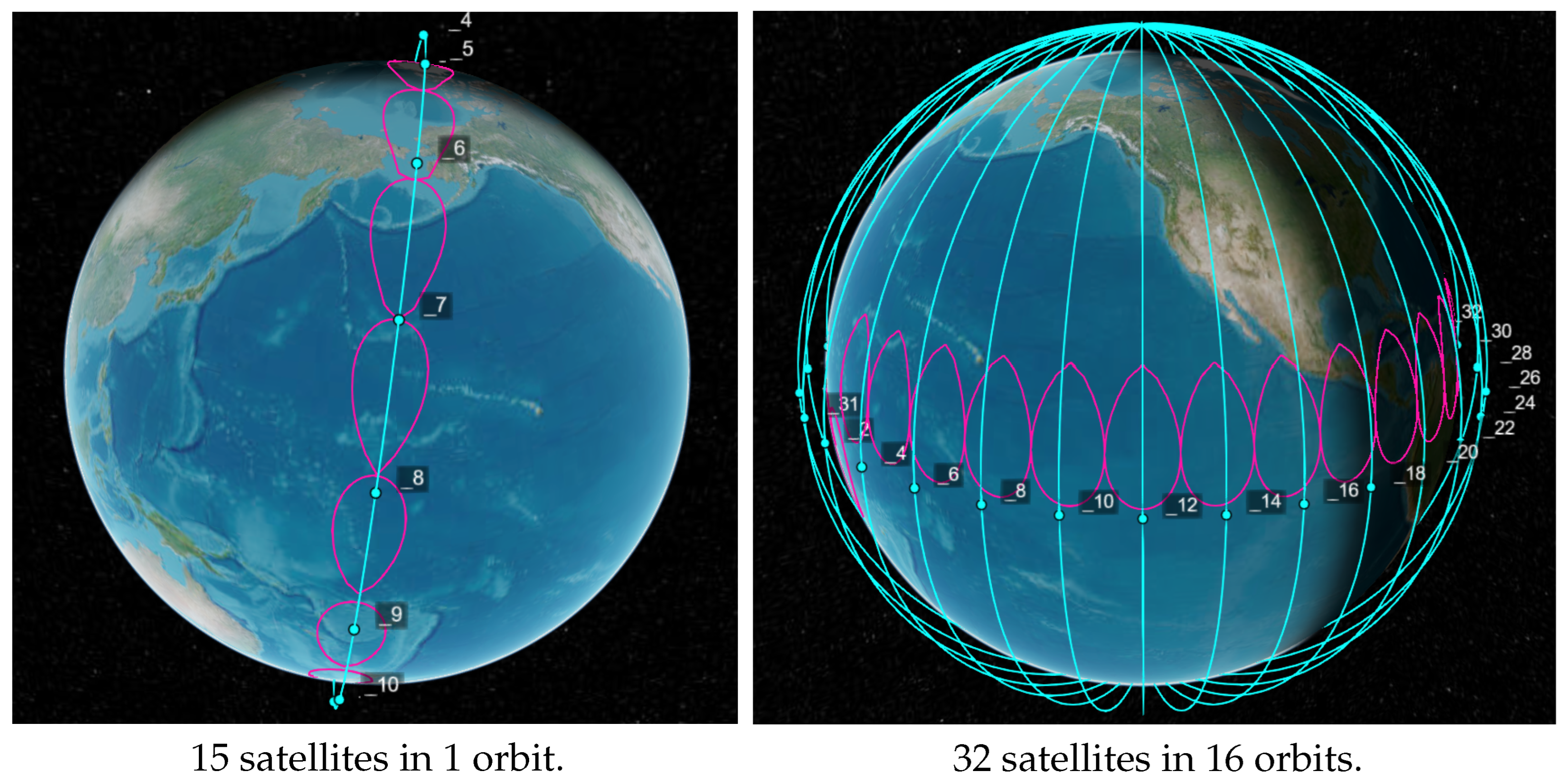
2.1. Constellation Pattern
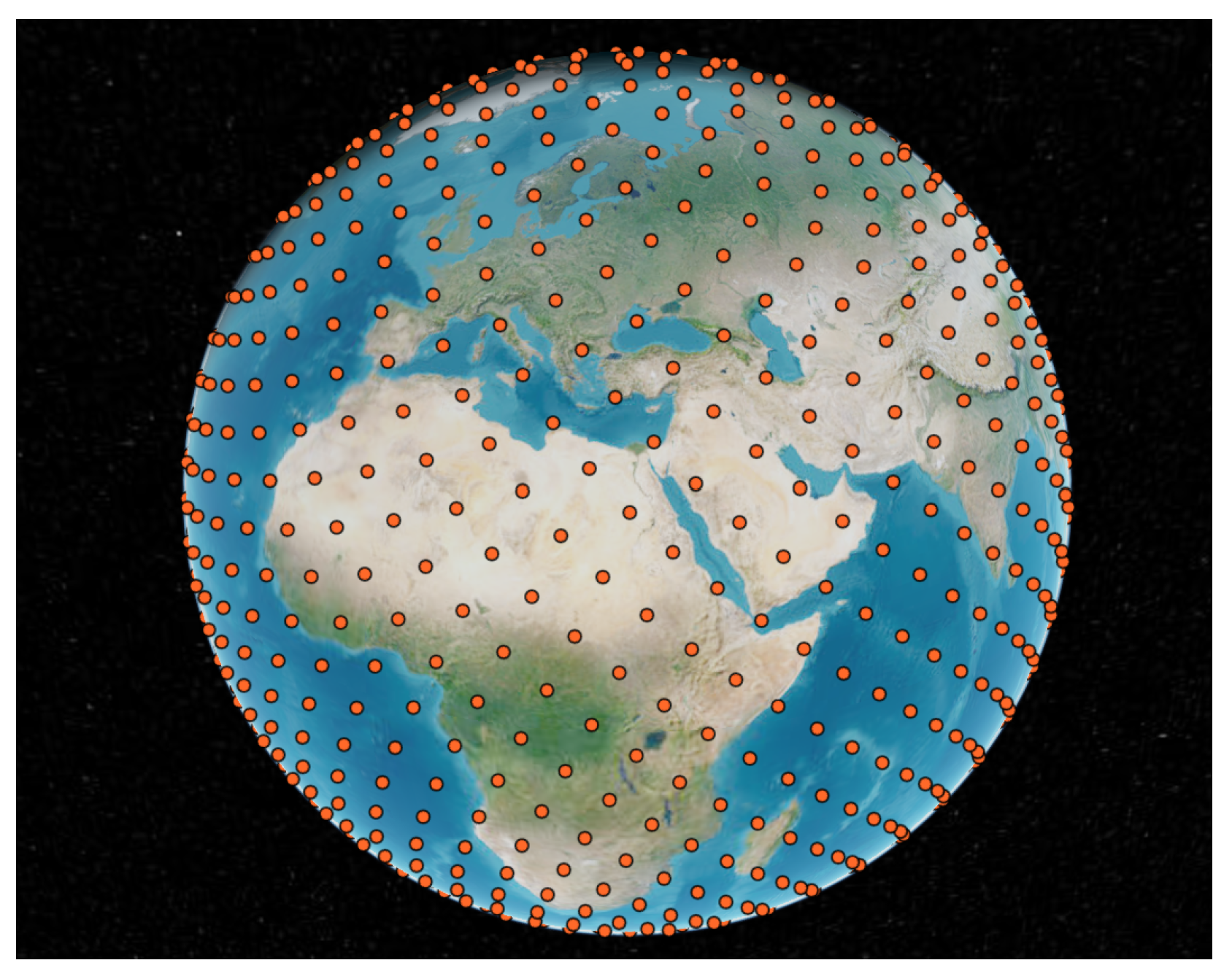
2.2. Coverage Analysis
2.3. Evaluation Method
- 1.
- The decision matrix, X, is normalized per criteria, such that the scale of the criteria has no effect on the outcome. Each element in X is normalized asThe normalized decision matrix will be denoted .
- 2.
- The normalized decision matrix is scaled by the corresponding weights, such that:
- 3.
- The ideal solution, , and anti-ideal solution, , are defined. Although, multiple methods exist, see Ishizaka and Nemery [25], however in this paper they are defined aswhere and include the indices associated with maximization and minimization criteria, respectively.
- 4.
- The euclidean distance to the ideal, , and anti-ideal, , are calculated for each solution i:
- 5.
- The relative closeness for solution i can then be calculated asThe value of , with 1 being the preferable outcome since this is equivalent to a small distance to and a large distance to . The different solutions can now be ranked based on the relative closeness, with the best solution being the one with the highest value.
3. Methodology
3.1. Solution Space
- The altitude of the satellites in the constellation.
- The beam width of the antenna.
- The mounting angle of the antenna, which decides the orientation of the beam.
- The inclination, i.
- The total number of satellites, T.
- The number of orbital planes, P.
- The phasing between adjacent planes, F.
3.2. Criteria
3.3. Weighing of Criteria
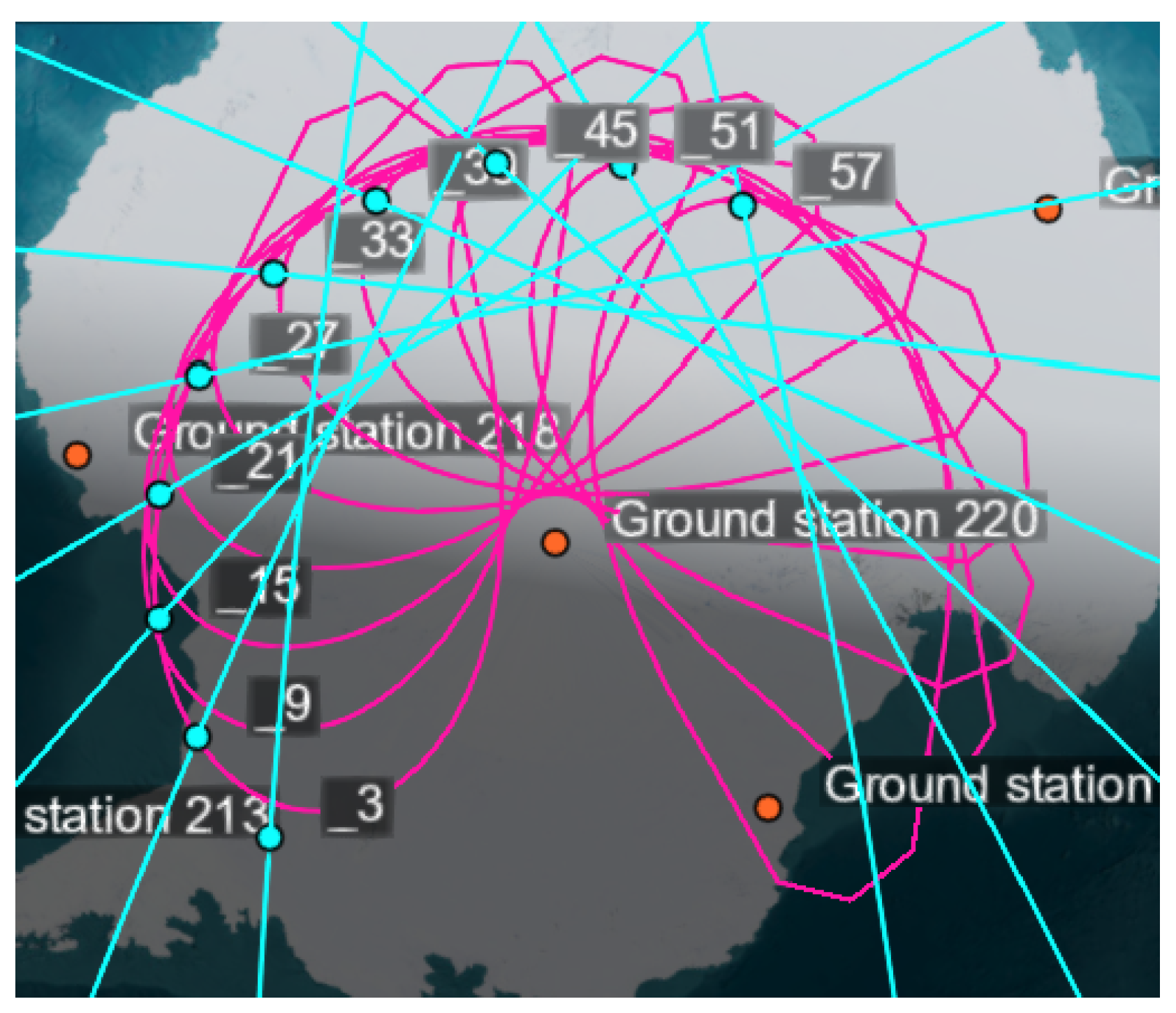
3.4. Simulation
4. Results
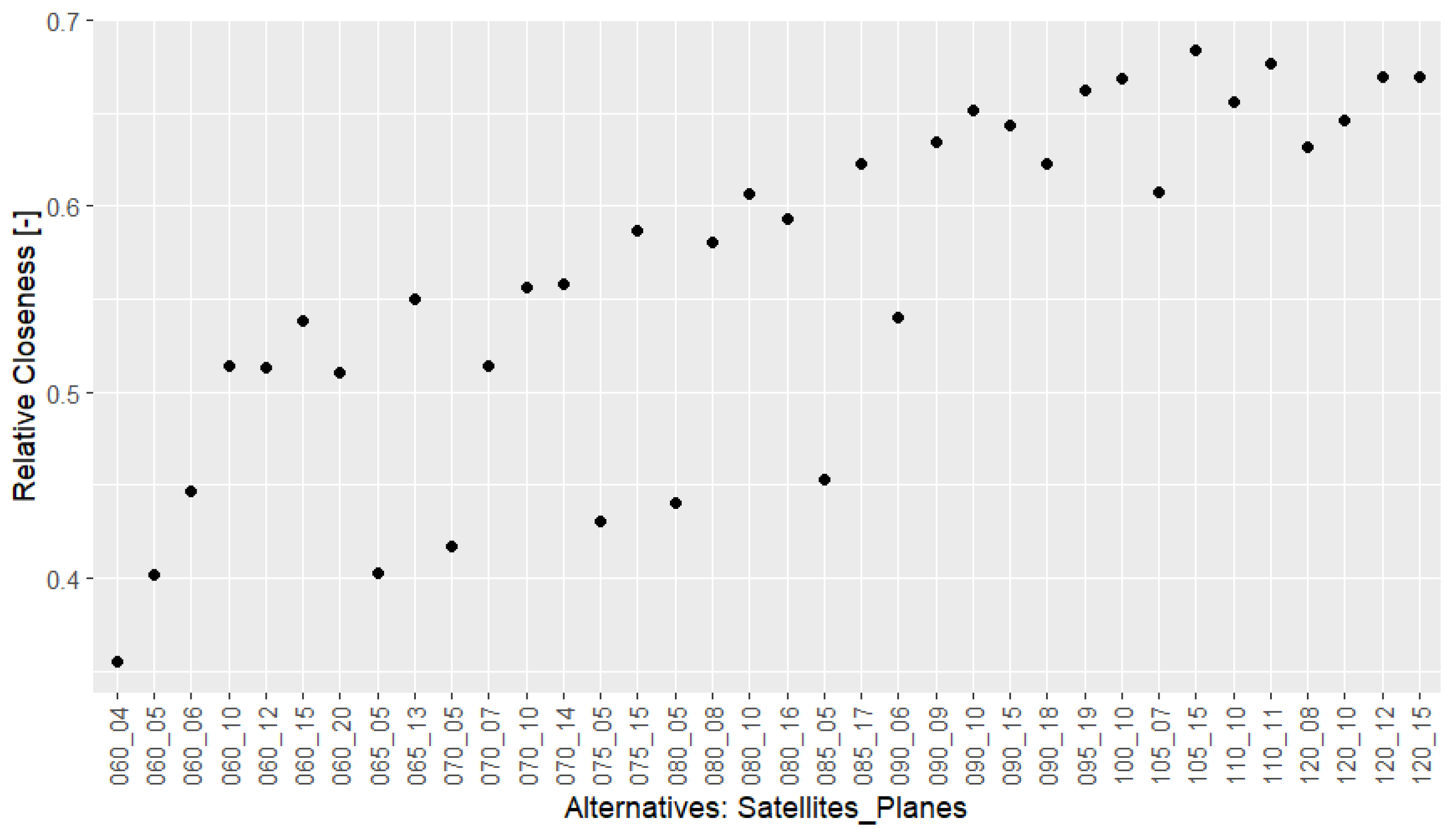
4.1. Application of Evaluation Method
4.2. Sensitivity Analysis
Effect of Satellite Cost
4.3. Final Recommendation
4.4. Exploration of Best Solution
5. Discussion
6. Conclusions
Future Work
Author Contributions
Funding
Data Availability Statement
Acknowledgments
Conflicts of Interest
Appendix A. Area of Footprint

Appendix B. Result of Simulation

| Satellites | Orbital Planes | Cost, Million USD | Percent Coverage (Earth) | Percent Coverage (North) | Percent Coverage (Equator) | Maximum Gap, Minutes | Mean Response Time, Min:Sec |
|---|---|---|---|---|---|---|---|
| 60 | 4 | 64.8 | 26.38 | 63.23 | 17.15 | 405 | 43:41 |
| 60 | 5 | 66.0 | 26.28 | 62.63 | 17.20 | 372 | 30:11 |
| 60 | 6 | 63.6 | 26.27 | 63.33 | 17.22 | 359 | 21:58 |
| 60 | 10 | 66.0 | 25.99 | 60.69 | 17.28 | 311 | 9:49 |
| 60 | 12 | 63.6 | 25.61 | 56.27 | 17.19 | 315 | 8:28 |
| 60 | 15 | 64.5 | 25.72 | 57.85 | 17.20 | 276 | 8:15 |
| 60 | 20 | 66.0 | 23.83 | 41.52 | 17.24 | 271 | 8:49 |
| 65 | 5 | 71.0 | 28.27 | 65.52 | 18.64 | 380 | 29:50 |
| 65 | 13 | 68.9 | 27.92 | 63.55 | 18.64 | 297 | 7:22 |
| 70 | 5 | 76.0 | 30.21 | 68.72 | 20.07 | 373 | 29:32 |
| 70 | 7 | 74.2 | 30.03 | 67.76 | 20.07 | 331 | 15:54 |
| 70 | 10 | 76.0 | 30.02 | 68.42 | 20.06 | 308 | 8:40 |
| 70 | 14 | 74.2 | 29.19 | 59.01 | 20.07 | 296 | 6:41 |
| 75 | 5 | 81.0 | 32.19 | 72.03 | 21.42 | 374 | 29:17 |
| 75 | 15 | 79.5 | 31.47 | 66.24 | 21.44 | 297 | 6:4 |
| 80 | 5 | 86.0 | 33.76 | 73.92 | 22.89 | 374 | 29:2 |
| 80 | 8 | 84.8 | 34.01 | 73.96 | 22.84 | 321 | 11:43 |
| 80 | 10 | 86.0 | 34.01 | 74.34 | 22.93 | 305 | 7:47 |
| 80 | 16 | 84.8 | 32.66 | 60.86 | 22.93 | 296 | 5:32 |
| 85 | 5 | 91.0 | 35.09 | 75.52 | 24.06 | 369 | 28:50 |
| 85 | 17 | 90.1 | 34.93 | 67.96 | 24.33 | 297 | 5:2 |
| 90 | 6 | 97.2 | 37.92 | 79.52 | 25.77 | 354 | 20:12 |
| 90 | 9 | 95.4 | 37.61 | 76.40 | 25.77 | 312 | 8:43 |
| 90 | 10 | 96.0 | 37.85 | 78.65 | 25.75 | 303 | 7:6 |
| 90 | 15 | 99.0 | 37.30 | 74.16 | 25.73 | 295 | 4:39 |
| 90 | 18 | 95.4 | 35.95 | 62.18 | 25.76 | 296 | 4:40 |
| 95 | 19 | 100.7 | 38.24 | 69.28 | 27.13 | 278 | 4:14 |
| 100 | 10 | 106.0 | 41.49 | 81.64 | 28.69 | 311 | 6:34 |
| 105 | 7 | 113.4 | 43.26 | 82.95 | 30.05 | 342 | 14:13 |
| 105 | 15 | 114.0 | 43.07 | 81.13 | 30.07 | 281 | 3:42 |
| 110 | 10 | 122.0 | 44.89 | 83.61 | 31.50 | 300 | 6:12 |
| 110 | 11 | 116.6 | 44.81 | 83.21 | 31.50 | 302 | 5:5 |
| 120 | 8 | 129.6 | 48.49 | 86.10 | 34.27 | 322 | 10:8 |
| 120 | 10 | 132.0 | 48.27 | 85.04 | 34.36 | 299 | 5:53 |
| 120 | 12 | 127.2 | 48.31 | 85.64 | 34.37 | 292 | 3:56 |
| 120 | 15 | 129.0 | 48.30 | 84.69 | 34.36 | 282 | 3:2 |
References
- The Unseen Impact of Satellites on Our Daily Lives. Available online: www.evona.com/blog/impact-of-satellites-on-daily-life/ (accessed on 16 September 2025).
- Adilov, N.; Alexander, P.; Cunningham, B.; Albertson, N. An Analysis of Launch Cost Reductions for Low Earth Orbit Satellites. Econ. Bull. 2024, 42, 1561–1574. [Google Scholar]
- ESA Space Economy Report. 2025. Available online: https://space-economy.esa.int/documents/tJMabTj61KkdGVOtF6SKw6wGSxicen6ajUWamCG3.pdf (accessed on 17 September 2025).
- AIS Data. Available online: www.dma.dk/safety-at-sea/navigational-information/ais-data (accessed on 13 December 2024).
- VDES (AIS 2.0). Available online: www.sternula.com/vdes-ais-2-0/ (accessed on 9 December 2024).
- Sternula: Connecting the Oceans. Available online: www.sternula.com/ (accessed on 9 December 2024).
- Satellite Ground Station. Available online: https://satellitegroundstation.com/ (accessed on 17 September 2025).
- Walker, J.G. Some circular orbit patterns providing continuous whole earth coverage. J. Br. Interplanet. Soc. 1971, 24, 369–384. [Google Scholar]
- Cakaj, S.; Kamo, B.; Lala, A.; Rakipi, A. The Coverage Analysis for Low Earth Orbiting Satellites at Low Elevation. Int. J. Adv. Comput. Sci. Appl. 2014, 5, 6. [Google Scholar] [CrossRef]
- Pachler, N.; del Portillo Barrios, I.; Crawley, E.; Cameron, B. An Updated Comparison of Four Low Earth Orbit Satellite Constellation Systems to Provide Global Broadband. In Proceedings of the 2021 IEEE International Conference on Communications Workshops, Montreal, QC, Canada, 14–23 June 2021; pp. 1–7. [Google Scholar]
- Wertz, J. Mission Geometry: Orbit and Constellation Design and Management: Spacecraft Orbit and Attitude Systems; Microcosm Press: El Segundo, CA, USA, 2001. [Google Scholar]
- Liang, J.; Chaudhry, A.U.; Yanikomeroglu, H. Phasing Parameter Analysis for Satellite Collision Avoidance in Starlink and Kuiper Constellations. In Proceedings of the 2021 IEEE 4th 5G World Forum (5GWF), Montreal, QC, Canada, 13–15 October 2021; pp. 493–498. [Google Scholar]
- Su, Y.; Liu, Y.; Zhou, Y.; Yuan, J.; Cao, H.; Shi, J. Broadband LEO Satellite Communications: Architectures and Key Technologies. IEEE Wirel. Commun. 2019, 26, 55–61. [Google Scholar] [CrossRef]
- Conti, M.; Circi, C. Design of halo orbit constellation for lunar global positioning and communication services. Astrodynamics 2025, 9, 231–245. [Google Scholar] [CrossRef]
- Cornara, S.; Beech, T.W.; Belló-Mora, M.; Janin, G. Satellite constellation mission analysis and design. Acta Astronaut. 2001, 48, 681–691. [Google Scholar] [CrossRef]
- Savitri, T.; Kim, Y.; Jo, S.; Bang, H. Satellite Constellation Orbit Design Optimization with Combined Genetic Algorithm and Semianalytical Approach. Int. J. Aerosp. Eng. 2017, 2017, 17. [Google Scholar] [CrossRef]
- Huang, J.; Liu, X.; Ye, X.; Li, X.; Xiao, W.; Liu, W.; Zuo, Y. Optimal Design of LEO Constellation for Communication and Navigation Fusion Based on Genetic Algorithm. In Proceedings of the China Satellite Navigation Conference (CSNC 2021); Springer: Singapore, 2021. [Google Scholar]
- Qin, C.; Gao, Y.; Wang, Y. The optimization of low Earth orbit satellite constellation visibility with genetic algorithm for improved navigation potential. Sci. Rep. 2025, 15, 30798. [Google Scholar] [CrossRef]
- Liu, M.; Gao, X.; Yang, M.; Yang, D.; Zhang, M.; Ge, Y.; Gong, Y.; Jiang, H. LEO Satellite Constellation Design Method for Continuous Coverage. In Advances in Guidance, Navigation and Control: Proceedings of 2020 International Conference on Guidance, Navigation and Control, ICGNC 2020, Tianjin, China, 23–25 October 2020; Springer: Singapore, 2021; pp. 3295–3307. [Google Scholar]
- Wang, X.; Zhang, H.; Bai, S.; Yue, Y. Design of agile satellite constellation based on hybrid-resampling particle swarm optimization method. Acta Astronaut. 2021, 178, 595–605. [Google Scholar] [CrossRef]
- Imoto, Y.; Satoh, S.; Obata, T.; Yamada, K. Optimal constellation design based on satellite ground tracks for Earth observation missions. Acta Astronaut. 2023, 207, 1–9. [Google Scholar] [CrossRef]
- Huang, S.; Colombo, C.; Bernelli-Zazzera, F. Multi-criteria design of continuous global coverage Walker and Street-of-Coverage constellations through property assessment. Acta Astronaut. 2021, 188, 151–170. [Google Scholar] [CrossRef]
- Tan, C.; Xu, Y.; Luo, R.; Li, Y.; Yuan, C. Low Earth orbit constellation design using a multi-objective genetic algorithm for GNSS reflectometry missions. Adv. Space Res. 2023, 71, 2357–2369. [Google Scholar] [CrossRef]
- Thakkar, J.J. Multi-Criteria Decision Making, 1st ed.; Springer: Singapore, 2021. [Google Scholar]
- Ishizaka, A.; Nemery, P. Multi-Criteria Decision Analysis: Methods and Software, 1st ed.; Wiley: Chichester, West Sussex, UK, 2013. [Google Scholar]
- Bellman, R.E.; Zadeh, L.A. Decision-Making in a Fuzzy Environment. Manag. Sci. 1970, 17, 141–164. [Google Scholar] [CrossRef]
- Sorin, N.; Dzitac, S.; Dzitac, I. Fuzzy TOPSIS: A General View. Procedia Comput. Sci. 2016, 91, 823–831. [Google Scholar] [CrossRef]
- Tyagi, M.; Kumar, P.; Kumar, D. A Hybrid Approach using AHP-TOPSIS for Analyzing e-SCM Performance. Procedia Eng. 2014, 97, 2195–2203. [Google Scholar] [CrossRef]
- Trivedi, P.; Shah, J.; Moslem, S.; Pilla, F. An application of the hybrid AHP-PROMETHEE approach to evaluate the severity of the factors influencing road accidents. Heliyon 2023, 9, e21187. [Google Scholar] [CrossRef]
- Sahoo, S.K.; Goswami, S. A Comprehensive Review of Multiple Criteria Decision-Making (MCDM) Methods: Advancements, Applications, and Future Directions. Decis. Mak. Adv. 2023, 1, 25–48. [Google Scholar] [CrossRef]
- Wang, T.C.; Chang, T.H. Application of TOPSIS in evaluating initial training aircraft under a fuzzy environment. Expert Syst. Appl. 2007, 33, 870–880. [Google Scholar] [CrossRef]
- Rehman, S.; Khan, S.A.; Alhems, L.M. Application of TOPSIS Approach to Multi-Criteria Selection of Wind Turbines for On-Shore Sites. Appl. Sci. 2020, 10, 7595. [Google Scholar] [CrossRef]
- Madi, E.N.; Garibaldi, J.; Wagner, C. An exploration of issues and limitations in current methods of TOPSIS and fuzzy TOPSIS. In Proceedings of the 2016 IEEE International Conference on Fuzzy Systems (FUZZ-IEEE), Vancouver, BC, Canada, 24–29 July 2016. [Google Scholar]
- Butler, J.; Jia, J.; Dyer, J. Simulation techniques for the sensitivity analysis of multi-criteria decision models. Eur. J. Oper. Res. 1997, 103, 531–546. [Google Scholar] [CrossRef]
- Bana E Costa, C.A. A methodology for sensitivity analysis in three-criteria problems: A case study in municipal management. Eur. J. Oper. Res. 1988, 33, 159–173. [Google Scholar] [CrossRef]
- Alp, M.; Tohum, M.C.; Omaygenç, D.; Bodur, H.; Makas, E. Launch Vehicle Selection with TOPSIS: Multi-Criteria Decision Making for Space Mission. In Proceedings of the 2023 10th International Conference on Recent Advances in Air and Space Technologies (RAST), Istanbul, Turkiye, 7–9 June 2023; pp. 1–7. [Google Scholar]
- Vasegaard, A.E.; Picard, M.; Hennart, F.; Nielsen, P.; Saha, S. Multi criteria decision making for the multi-satellite image acquisition scheduling problem. Sensors 2020, 20, 1242. [Google Scholar] [CrossRef] [PubMed]
- HE, X.; LI, H. Analytical solutions for Earth discontinuous coverage of satellite constellation with repeating ground tracks. Chin. J. Aeronaut. 2022, 35, 275–291. [Google Scholar] [CrossRef]
- Zong, P.; Kohani, S. Optimal satellite LEO constellation design based on global coverage in one revisit time. Int. J. Aerosp. Eng. 2019, 2019, 4373749. [Google Scholar] [CrossRef]
- Singh, L.A.; Whittecar, W.R.; DiPrinzio, M.D.; Herman, J.D.; Ferringer, M.P.; Reed, P.M. Low cost satellite constellations for nearly continuous global coverage. Nat. Commun. 2020, 11, 200. [Google Scholar] [CrossRef]
- Deccia, C.M.A.; Wiese, D.N.; Nerem, R.S. Using a Multiobjective Genetic Algorithm to Design Satellite Constellations for Recovering Earth System Mass Change. Remote Sens. 2022, 14, 3340. [Google Scholar]
- Gorr, B.; Selva, D.; Gao, H.; Ellis, E.; Morgan, J.; Stroud, M.; Allen, G.; Li, Y. Design of a satellite constellation for monitoring inland water quality. Acta Astronaut. 2024, 219, 875–888. [Google Scholar] [CrossRef]
- Ng, K.W.; Tian, G.L.; Tang, M.L. Dirichlet and Related Distributions: Theory, Methods and Applications; Wiley Series in Probability and Statistics; Wiley: Hoboken, NJ, USA, 2011. [Google Scholar]
- Smallsat Rideshare Program. Available online: www.spacex.com/rideshare/ (accessed on 9 November 2024).
- The Arctic Region. Available online: www.arcticcentre.org/EN/arcticregion (accessed on 21 January 2025).
- Marques, R.; Bouville, C.; Bouatouch, K.; Blat, J. Extensible Spherical Fibonacci Grids. IEEE Trans. Vis. Comput. Graph. 2021, 27, 2341–2354. [Google Scholar] [CrossRef] [PubMed]
- The MathWorks, Inc. MATLAB: Satellite Mission Analysis, R2024b. Natick, MA, USA. Available online: https://se.mathworks.com/help/aerotbx/satellite-mission-analysis.html?stid=CRUXlftnav (accessed on 26 November 2024).
- Meyer, P.; Bigaret, S.; Hodgett, R.; Olteanu, A.L.; Palma, D.; Choicharoon, A.A. MCDA: Support for the Multicriteria Decision Aiding Process, R Package Version 0.1.0. 2023. Available online: https://rdrr.io/cran/MCDA/ (accessed on 26 November 2024).





| T | P | T | P | T | P | T | P |
|---|---|---|---|---|---|---|---|
| 60 | 4 | 70 | 5 | 80 | 16 | 100 | 10 |
| 60 | 5 | 70 | 7 | 85 | 5 | 105 | 7 |
| 60 | 6 | 70 | 10 | 85 | 17 | 105 | 15 |
| 60 | 10 | 70 | 14 | 90 | 6 | 110 | 10 |
| 60 | 12 | 75 | 5 | 90 | 9 | 110 | 11 |
| 60 | 15 | 75 | 15 | 90 | 10 | 120 | 8 |
| 60 | 20 | 80 | 5 | 90 | 15 | 120 | 10 |
| 65 | 5 | 80 | 8 | 90 | 18 | 120 | 12 |
| 65 | 13 | 80 | 10 | 95 | 19 | 120 | 15 |
| Criteria | Weight |
|---|---|
| Cost | 0.2 |
| Coverage Percent (Earth) | 0.3 |
| Coverage Percent (North) | 0.1 |
| Coverage Percent (Equator) | 0.04 |
| Maximum Coverage Gap | 0.3 |
| Mean Response Time | 0.06 |
| 060_15 | 065_13 | 075_15 | 080_10 | 085_17 | 090_10 | 095_19 | 100_10 | 105_15 | 110_11 | 120_12 | 120_15 |
|---|---|---|---|---|---|---|---|---|---|---|---|
| 2 | 3 | 21 | 2 | 11 | 51 | 156 | 18 | 503 | 56 | 116 | 61 |
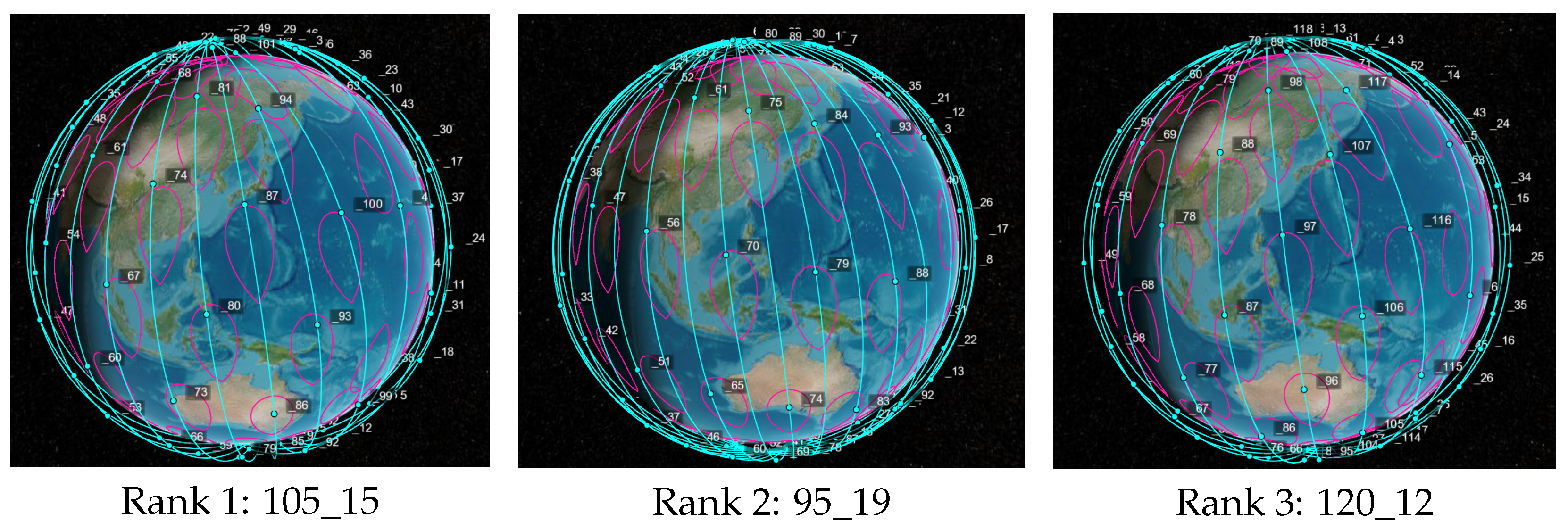
| Rank | 1 | 2 | 3 |
|---|---|---|---|
| Satellites | 105 | 95 | 120 |
| Orbital Planes | 15 | 19 | 12 |
| Cost, Million USD | 114.0 | 100.7 | 127.2 |
| Percent Coverage (Earth) | 43.07 | 38.24 | 48.31 |
| Percent Coverage (North) | 81.13 | 69.28 | 85.64 |
| Percent Coverage (Equator) | 30.07 | 27.13 | 34.37 |
| Maximum Gap, Minutes | 281 | 278 | 292 |
| Mean Response Time, Min:Sec | 3:34 | 4:14 | 3:56 |
Disclaimer/Publisher’s Note: The statements, opinions and data contained in all publications are solely those of the individual author(s) and contributor(s) and not of MDPI and/or the editor(s). MDPI and/or the editor(s) disclaim responsibility for any injury to people or property resulting from any ideas, methods, instructions or products referred to in the content. |
© 2026 by the authors. Licensee MDPI, Basel, Switzerland. This article is an open access article distributed under the terms and conditions of the Creative Commons Attribution (CC BY) license.
Share and Cite
Kramer, M.S.; Christensen, F.; Hjort, V.; Nielsen, P.; Vasegaard, A.E. A Simulation and TOPSIS Approach to the Satellite Constellation Design Problem. Aerospace 2026, 13, 284. https://doi.org/10.3390/aerospace13030284
Kramer MS, Christensen F, Hjort V, Nielsen P, Vasegaard AE. A Simulation and TOPSIS Approach to the Satellite Constellation Design Problem. Aerospace. 2026; 13(3):284. https://doi.org/10.3390/aerospace13030284
Chicago/Turabian StyleKramer, Mikkel Søby, Frederik Christensen, Veronica Hjort, Peter Nielsen, and Alex Elkjær Vasegaard. 2026. "A Simulation and TOPSIS Approach to the Satellite Constellation Design Problem" Aerospace 13, no. 3: 284. https://doi.org/10.3390/aerospace13030284
APA StyleKramer, M. S., Christensen, F., Hjort, V., Nielsen, P., & Vasegaard, A. E. (2026). A Simulation and TOPSIS Approach to the Satellite Constellation Design Problem. Aerospace, 13(3), 284. https://doi.org/10.3390/aerospace13030284