1. Introduction
The unique operating characteristics of helicopter rotors result in a highly complex aerodynamic environment for the blades, in which strongly nonlinear phenomena such as blade–vortex interaction (BVI) are commonly encountered [
1]. From a structural mechanics perspective, a rotor blade can be modeled as a flexible cantilever beam. When these complex, unsteady aerodynamic loads act directly on the blade and are coupled with the structural response, blade deformations—including flapping, lagging, and torsion—may be induced, resulting in structural vibrations. In severe cases, such vibrations can compromise flight stability or lead to fatigue damage of the rotor blades. Moreover, these dynamic loads are transmitted to the fuselage through the rotor hub, thereby affecting the fatigue life of the airframe, the reliable operation of onboard equipment, and the ride comfort of occupants. Consequently, the rapid and accurate prediction of structural loads on helicopter rotor blades is of critical importance.
In recent decades, significant progress has been achieved in aeroelastic modeling methodologies for rotorcraft. Traditional approaches are primarily physics-based and typically rely on the combination of structural beam theories and simplified aerodynamic models. From the structural modeling perspective, rotor blades are commonly idealized as flexible beam structures. The Euler–Bernoulli beam formulation [
2], the modified Bauchau and Hong’s beam model [
3], and geometrically exact beam theory [
4] have been widely employed to describe the elastic deformation of rotor blades, offering reasonable computational efficiency while maintaining physical consistency. In particular, the geometrically exact beam framework utilizes the variational asymptotic method to reduce the fully three-dimensional geometrically nonlinear elasticity problem into a one-dimensional geometrically exact beam model coupled with a two-dimensional variational asymptotic cross-sectional analysis [
5]. With further developments, additional refinements—such as inertia-load-based dynamic deflection modeling [
6] and fully intrinsic governing equations—have been introduced to account for structural effects, including initial twist and curvature in composite rotor blades [
7].
On the aerodynamic side, these structural models are typically coupled with appropriately simplified flow representations to construct unsteady aerodynamic load models based on airfoil characteristics. Common approaches include Theodorsen’s unsteady aerodynamic theory [
8], dynamic inflow theory [
9], free-wake methods [
10], and the Peters–He finite-state dynamic wake model [
11], all of which enable computationally efficient time-domain analysis. While these methods are attractive in terms of efficiency and implementation simplicity, they may exhibit limitations in accurately capturing complex flow phenomena, such as flow separation and other strongly nonlinear effects. Consequently, their aerodynamic fidelity may be reduced under conditions involving pronounced unsteady nonlinear aerodynamics.
At an earlier stage, NASA [
12] pioneered the application of CFD to rotor aerodynamic analysis and loosely integrated the CFD solver with the structural dynamics code CAMRAD, demonstrating encouraging performance in subsequent validations. Building upon these efforts, the University of Maryland [
13] performed coupled simulations of the SA349/2 rotor using a CFD solver integrated with the computational structural dynamics (CSD) code UMARC; however, certain limitations in convergence and accuracy were reported. With the progressive maturation of Reynolds-averaged Navier–Stokes (RANS)-based CFD techniques [
14], aerodynamic predictions have achieved substantially improved accuracy and broader applicability compared with earlier reduced-fidelity models. As a result, coupled CFD/CSD approaches have been increasingly applied to forward-flight simulations of the UH-60A rotor [
15,
16] and its scaled HART II model [
17]. It is widely recognized that aerodynamic load prediction remains one of the dominant sources of modeling uncertainty and computational cost in rotor aeroelastic analysis.
At present, the accurate characterization of complex unsteady rotor flows still largely relies on high-fidelity simulations, whose substantial computational cost poses challenges for control-law development and multidisciplinary design optimization of rotor blades. Moreover, in rotor aeroelastic analysis, the aerodynamic module often constitutes one of the primary sources of modeling uncertainty and computational expense due to the strongly nonlinear and highly unsteady nature of rotor flows. Therefore, improving the efficiency and fidelity of aerodynamic prediction remains a central issue in practical aeroelastic simulations. In this context, the development of ROMs that can accurately capture unsteady flow physics while significantly reducing computational cost has emerged as an important research focus.
In recent years, full-order flow-field decomposition methods based on feature extraction have attracted considerable attention [
18,
19]. These approaches aim to achieve a high-fidelity representation of the flow field while retaining the dominant dynamical characteristics of the system. Among them, modal decomposition has been extensively developed as a representative reduced-order modeling (ROM) technique. The core idea is to extract low-dimensional modal bases from flow-field snapshots collected over a finite time interval using decomposition algorithms, and to reconstruct high-dimensional unsteady flow fields through linear combinations of these modes, thereby accurately describing the temporal evolution of flow variables. Representative examples include Proper Orthogonal Decomposition (POD) [
20] and Dynamic Mode Decomposition (DMD) [
19].
POD was first introduced into fluid mechanics by Lumley [
21] for the analysis of turbulent flows. It was subsequently applied to the dimensional reduction in CFD models based on the Euler equations and to reduced-order aerodynamic modeling of two-dimensional airfoils [
22]. Later studies demonstrated that unsteady flow features could be effectively represented through linear combinations of POD modes following global flow-field decomposition [
23]. At present, POD has been widely applied to flow past circular cylinders [
24], airfoil aerodynamics [
25], and the dynamic analysis of wings.
DMD, proposed by Schmid [
19], is a data-driven method for the analysis of dynamical systems. Each DMD mode is associated with a distinct frequency and growth (or decay) rate, and the corresponding eigenvalues directly characterize the stability and growth behavior of the flow. Building upon the standard DMD framework, Proctor et al. [
26] integrated control theory and proposed the Dynamic Mode Decomposition with Control (DMDc) method, which extends DMD by incorporating system inputs and enables the simultaneous identification of both system and control matrices. DMDc has since been successfully applied in studies of unsteady aerodynamic modeling [
27,
28] and aeroelastic response prediction [
29,
30].
This study proposes a data-driven ROM approach in which high-fidelity full-order CFD simulations are first performed, followed by POD-based dimensionality reduction to extract the dominant flow features. Unlike conventional POD-based ROMs that primarily focus on modal reconstruction or regression-based surrogate modeling, the present framework directly identifies the input–output dynamical relationship of sectional unsteady aerodynamic loads within the reduced subspace through DMDc-based state-space identification. The resulting reduced representation is then used to construct an unsteady aerodynamic model with improved dynamical consistency. The identified aerodynamic model is further coupled with a CSD model based on a geometrically exact beam formulation derived from Hamilton’s principle. In addition, a loosely coupled aeroelastic strategy is adopted, which helps maintain satisfactory prediction accuracy while significantly reducing the overall computational cost [
31,
32].
2. Data-Driven ROM Methods and Numerical Simulation
2.1. Proper Orthogonal Decomposition
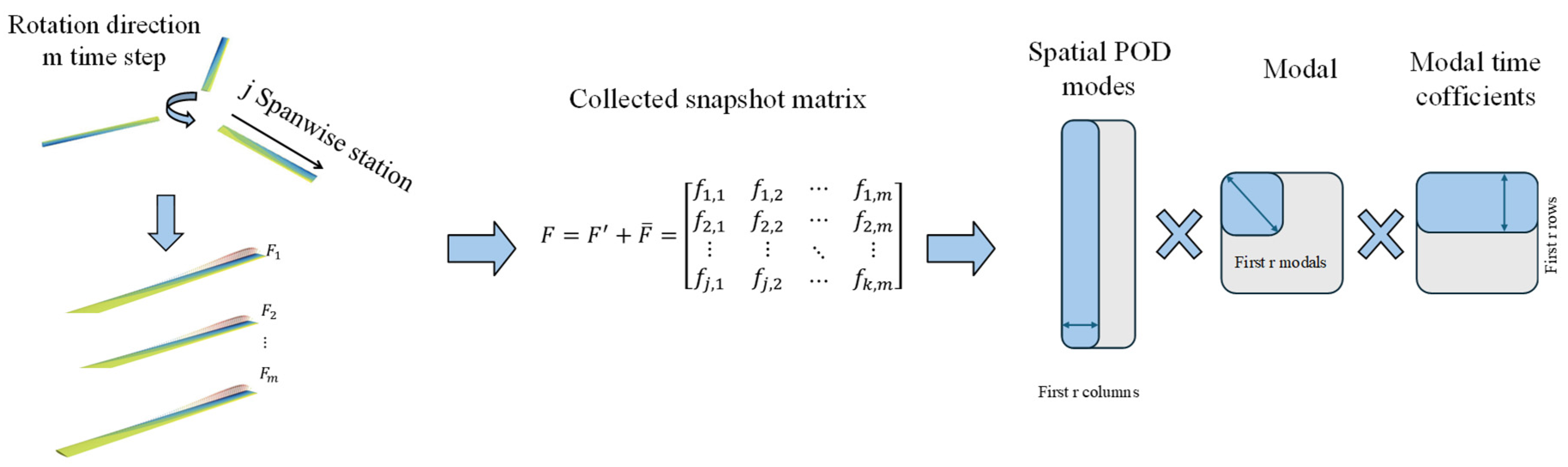
During the flow-field simulations, sequences of unsteady aerodynamic force snapshots are sampled from the flow field to form the basis of the data-driven modeling process. These snapshots are assembled into a snapshot matrix, in which each column represents the aerodynamic load distribution at a given time instant. POD is then applied to the snapshot matrix to extract a set of dominant spatial modes, allowing for the projection of high-dimensional aerodynamic data onto a low-dimensional subspace. The corresponding temporal coefficients characterize the time evolution of the unsteady aerodynamic loads and serve as the reduced-order representation for subsequent modeling.
In the above formulation,
denotes the aerodynamic force snapshot obtained from the flow-field simulations. The snapshots are sampled from the continuous aerodynamic force history
at a fixed time interval
, and can be expressed as
To isolate the unsteady aerodynamic response, the steady component is removed from the aerodynamic force data.
In Equation (3), denotes the total aerodynamic force obtained from the flow-field simulations. The steady component is obtained by time averaging, and the remaining fluctuating part represents the unsteady aerodynamic contribution. The unsteady aerodynamic force is further expressed as a linear superposition of POD modes, where represents the -th spatial mode and is the corresponding temporal coefficient.
To characterize the spatial features of the unsteady aerodynamic force modes in the flow field, the POD method is employed to extract the dominant modes of the system. The snapshot matrix of the unsteady aerodynamic forces,
is decomposed using singular value decomposition (SVD) as
where
,
, and
. The matrices
and
consist of the left and right singular vectors, respectively, representing the spatial modes (mode shapes) and the temporal modes associated with the unsteady aerodynamic forces. The matrix
is a diagonal matrix whose diagonal entries are the singular values. The matrices
and
can be written as
where
and
denote the
-th spatial mode and the corresponding temporal mode, respectively. The singular value matrix
is defined as
An energy-based truncation criterion is adopted to determine the reduced-order subspace. The singular values
reflect the energy content of the corresponding modes, and the cumulative energy ratio of the first
modes is defined as
The reduced-order basis is constructed by retaining the first
modes such that the cumulative energy ratio
is greater than or equal to 99%.
Therefore, the SVD of the unsteady aerodynamic snapshot matrix can be simplified as
where
,
, and
denote the truncated left singular vectors, singular value matrix, and right singular vectors, respectively.
Figure 1 shows the overall workflow of the POD.
2.2. DMDc–Based State-Space Identification
The POD-based dimensionality reduction yields a low-dimensional representation of the unsteady aerodynamic forces in terms of a set of dominant spatial modes and their corresponding temporal coefficients. While POD effectively captures the energetic content of the system, it does not explicitly provide a dynamical model governing the temporal evolution of these coefficients. To address this limitation, the DMDc method is subsequently employed to identify a reduced-order state-space model that describes the time evolution of the POD modal coefficients under prescribed inputs.
The core idea of DMDc is to analyze the relationship between the system state at the next time step,
, and the current measured state
together with the control input. It is commonly assumed that this relationship can be approximated by a linear state-space model, which can be expressed as
where
and
denote the state vector and the control input vector, respectively, with
representing the POD modal temporal coefficients in the present study. The matrices
and
are the system and control matrices to be identified.
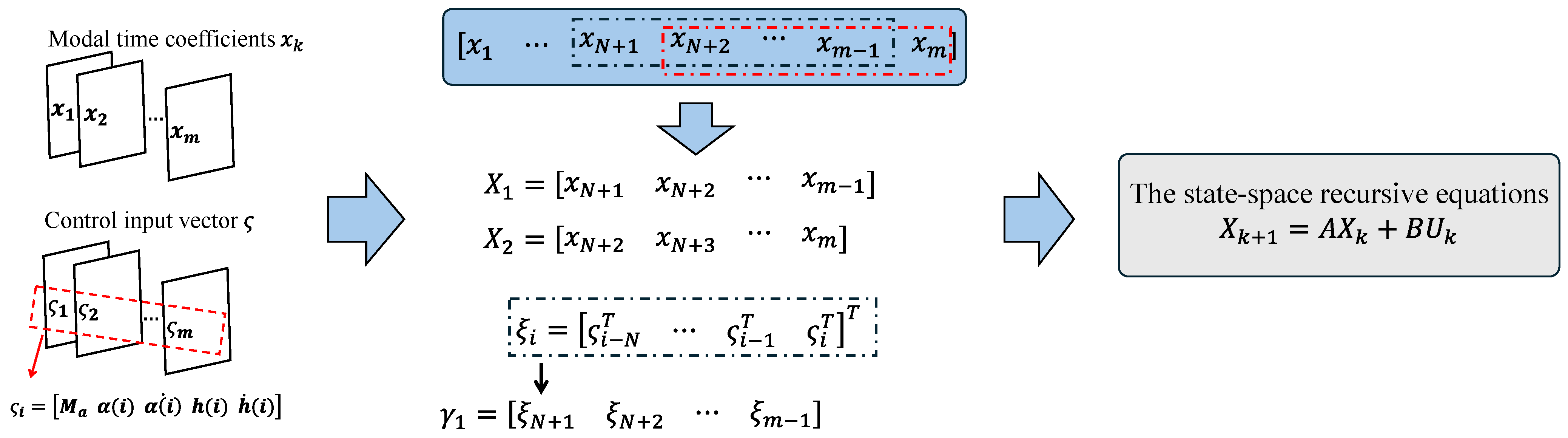
In general, aerodynamic models take the structural displacement vector as the system input. To account for the time-dependent nature of the aerodynamic system, both the displacement vector and its history over a prescribed time window are considered. Accordingly, the model input is constructed in the following form:
where
denotes the structural motion displacement vector of the rotor blade model,
represents the number of delayed inputs,
denotes the freestream Mach number (incoming flow velocity),
and
are the pitching angle and pitching angular velocity of the airfoil section, respectively, while
and
correspond to the plunging displacement and plunging velocity. Different input delay selections influence the SVD characteristics of the augmented matrix constructed from the time coefficient snapshots and the external inputs. Typically, two or more delayed input terms are introduced to effectively represent the aerodynamic lag and memory effects inherent in unsteady aerodynamics.
The system and control matrices
and
are identified using a least-squares approach by minimizing the prediction error between the measured and reconstructed states, which can be written as
Based on the foregoing analysis, Equation (9) can be rewritten as
All parameters to be identified are assembled in the matrix
, whose optimal estimate can be expressed as
The superscript
indicates the Moore–Penrose pseudoinverse. The parameter matrix is subsequently identified through the SVD of
.
Figure 2 presents the DMDc identification process. Consequently, a reduced-order time-domain dynamical model can be obtained.
2.3. Performance Evaluation of Prediction Models
In order to quantitatively evaluate the predictive accuracy of the ROM [
33], several statistical error metrics are employed, including the mean absolute error (MAE), mean squared error (MSE), root mean squared error (RMSE), and the coefficient of determination (
).
For the MAE, it is used to quantify the average magnitude of the differences between the predicted results and the CFD reference data, providing an intuitive measure of the overall prediction accuracy without emphasizing extreme deviations. It is defined as
Second, the mean squared error (MSE) and root mean squared error (RMSE) place greater emphasis on larger deviations due to the squared error term, making them more sensitive to peak discrepancies between the predicted and reference values. These metrics are therefore particularly suitable for assessing errors at higher amplitudes. They are expressed as
Finally, the coefficient of determination
is employed to evaluate the overall goodness of fit between the ROM predictions and the CFD results, reflecting how well the reduced-order model captures the global trend of the aerodynamic response. It is given by
In Equations (15)–(17) are defined as follows,
denotes the total number of time samples used in the error evaluation;
refers to the aerodynamic coefficients under consideration, namely the lift coefficient
or the moment coefficient
,
represent the aerodynamic coefficients obtained from the CFD simulations at the
-th time step and
is prediction from the reduced-order model at the
-th time step,
denotes the mean value of the CFD results over all samples, which is given by
2.4. Computation Structural Dynamic Model
To compute the structural loads of the rotor blade, large deformation effects are considered. Based on the Green strain tensor, the strain and kinetic energy expressions of the blade are established, and the governing dynamic equations are derived via Hamilton’s principle [
34].
where
is the virtual variation in strain energy;
is the virtual variation of kinetic energy;
is the virtual work of external loads.
The variation in the kinetic energy can be written as
Here,
denotes the mass matrix of the blade,
represents the nonlinear force vector, and
is the generalized displacement vector, including the translational and rotational displacements in the
,
, and
directions.
The variation in the blade strain energy can be expressed as
Here,
and
denote the aerodynamic force and aerodynamic moment acting on the blade, respectively;
represents the generalized force induced by aerodynamic loading; and
is the generalized force coefficient matrix, which can be expressed as
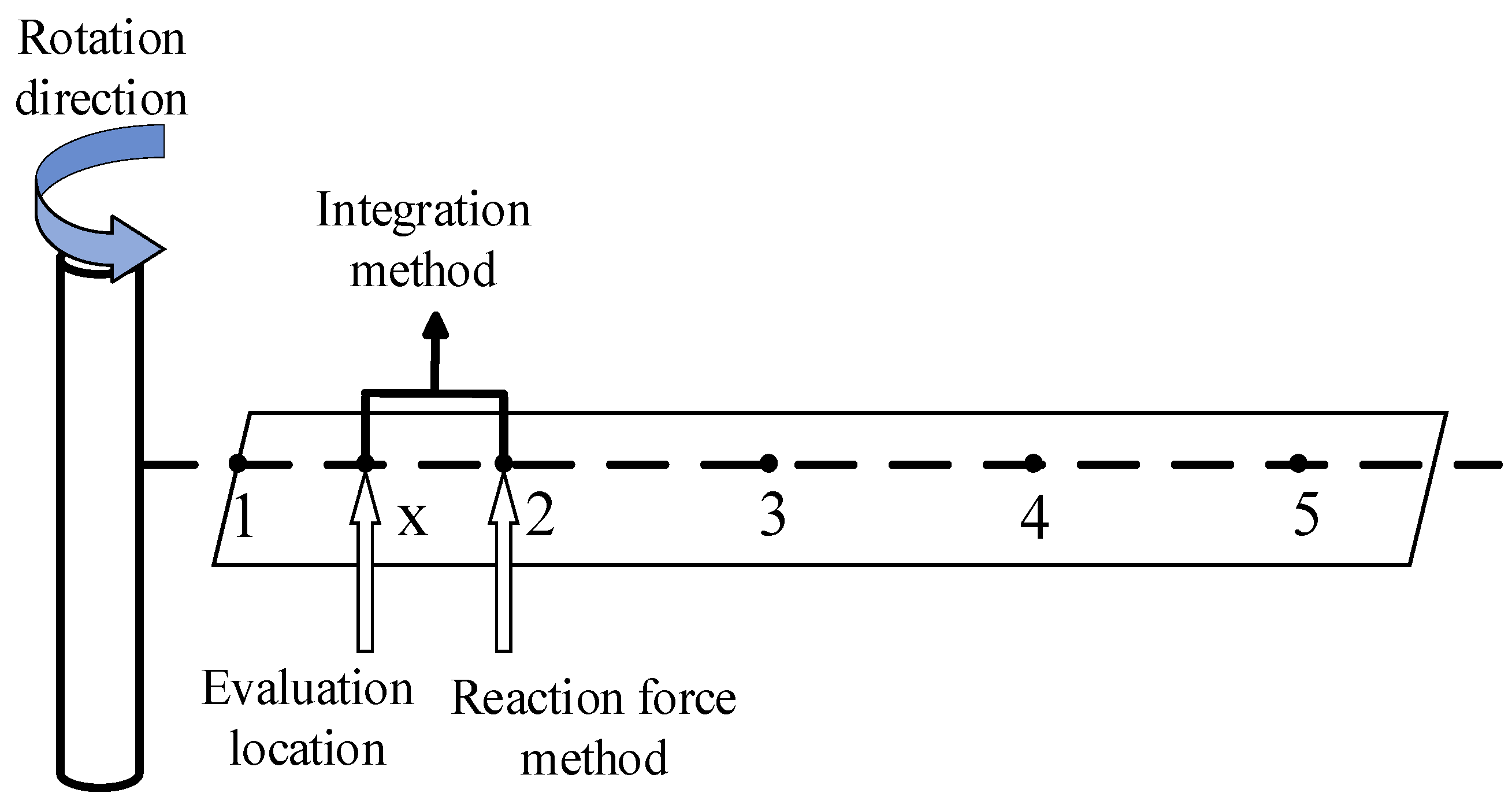
After solving for the structural response of the rotor blade, a hybrid computational approach is adopted in this study to evaluate the blade structural loads, as illustrated in
Figure 3.
The load at the sectional location corresponding to point
can be expressed as
Here,
and
denote the blade shear force and bending moment at node 2, which are obtained using the reaction force method. The subsequent integral term represents the distributed load between the sectional location of point
and node 2 and is evaluated using the force integration method.
2.5. Aeroelastic Coupling Method
In order to ensure sufficient accuracy while maintaining high computational efficiency, a loosely coupled strategy is employed to realize data transfer between the flow-field and structural domains. The aerodynamic loads acting on the rotor disk, including lift, drag, and moments, are first obtained from the flow-field domain and applied to the structural solver to compute the blade response. The resulting blade deformation is then fed back into the POD–DMDc reduced-order aerodynamic model, where the aerodynamic loads are updated after each coupling iteration.
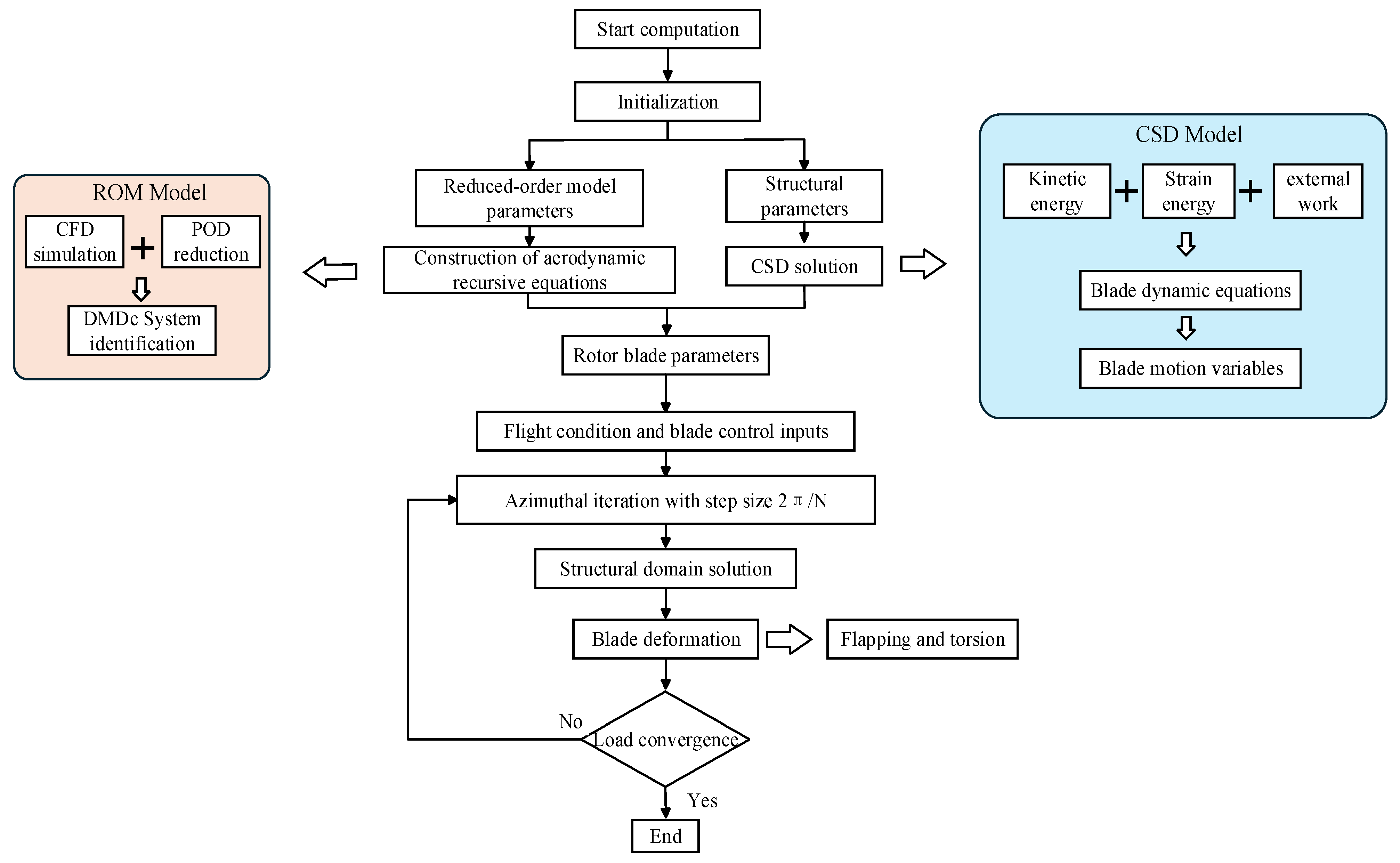
Figure 4 presents the overall computational procedure of the proposed framework, and the detailed steps are summarized below.
Step 1: An initialization procedure is first performed by prescribing the blade control inputs and conducting a trim calculation. After initialization, the blade motion input parameters are determined.
Step 2: Based on the aerodynamic results obtained from CFD simulations, the parameters of the reduced-order model are identified, and a complete reduced-order aerodynamic model is constructed.
Step 3: Using the initialized motion input parameters, the sectional aerodynamic loads acting on the blade are computed.
Step 4: The aerodynamic loads obtained in Step 3 are then transferred to the structural module. With the established structural model, the radial structural response and blade deformations, including flapping and torsional deformations, are evaluated.
Step 5: The blade deformations obtained in Step 4 are taken as inputs to the aerodynamic surrogate model to predict the aerodynamic coefficients (e.g., lift and moment coefficients) for the subsequent cycle.
Step 6: While keeping the control inputs unchanged, Steps 3 through 5 are repeated until the blade structural deformation no longer varies with the iteration count, indicating convergence of the coupled solution.
5. Coupled ROM–CSD for Rotor Aeroelastic Analysis
In the present study, the rotor blade is modeled based on the blade element theory. The rotor blade is divided along the radial direction into a series of airfoil sections. Then, the unsteady aerodynamic loads at each blade section are evaluated independently based on the local flow conditions and motion states.
For each blade element, the sectional aerodynamic responses are determined by the local effective angle of attack and inflow velocity, which are influenced by the blade kinematics, including pitching and plunging motions. The aerodynamic forces and moments obtained at each section are then integrated along the blade span to reconstruct the total aerodynamic loads acting on the rotor blade.
Within this framework, the ROM developed for two-dimensional airfoil aerodynamics is employed to efficiently predict the unsteady sectional aerodynamic loads. By combining the blade element theory with the validated ROM, the proposed approach provides an efficient and accurate aerodynamic modeling of the three-dimensional rotor while significantly reducing the computational cost compared to high-fidelity CFD simulations.
SA349/2 Forward Flight Test Case
A validation study is conducted based on the experimental data of the SA349/2 rotor under Flight Test 2 reported in Ref. [
43]. In this case, the collective pitch is set to 6.93°, with the lateral cyclic pitch angles of 1.45°, longitudinal cyclic pitch angles of 1.04°, and the advance ratio is 0.14. The corresponding rotor blade parameters are adopted in the present
Table 3. The geometric dimensions of the rotor blade as well as the sectional properties (e.g., density and stiffness distributions) are taken from Ref. [
43].
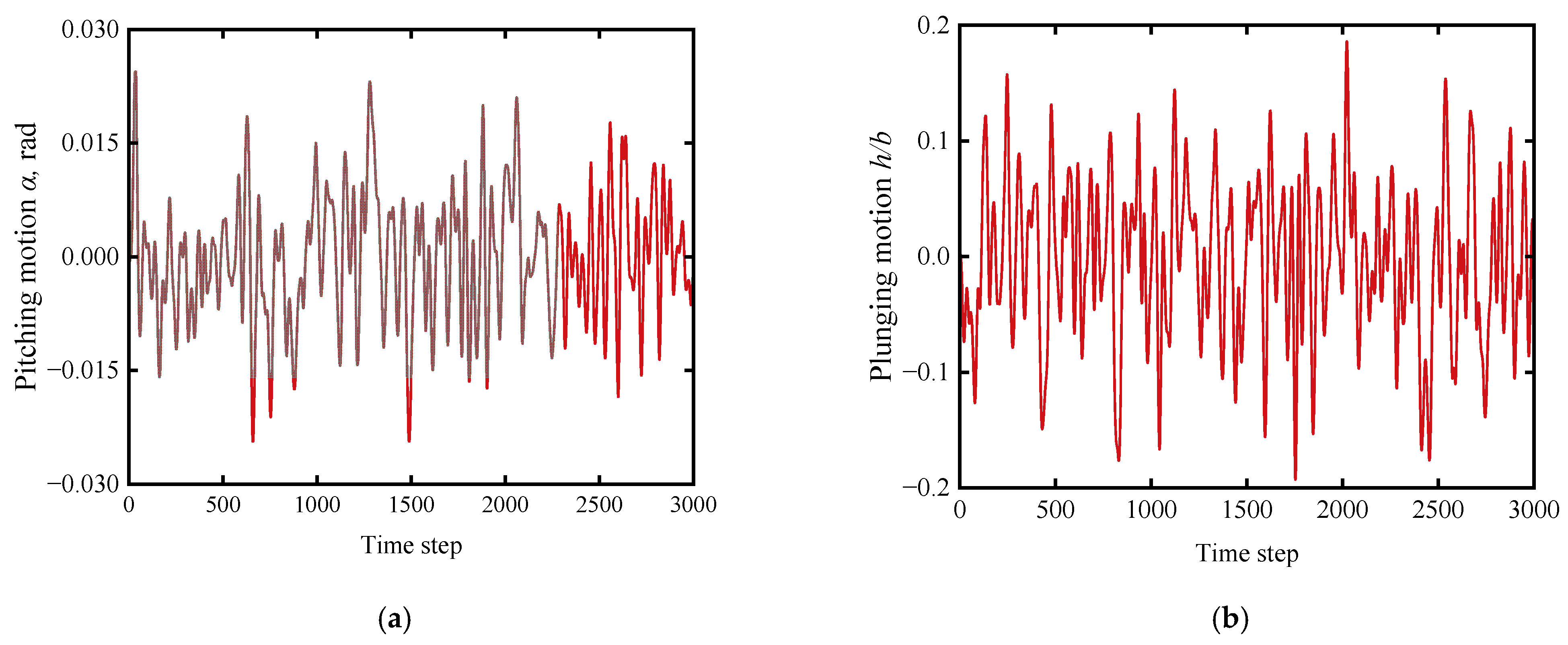
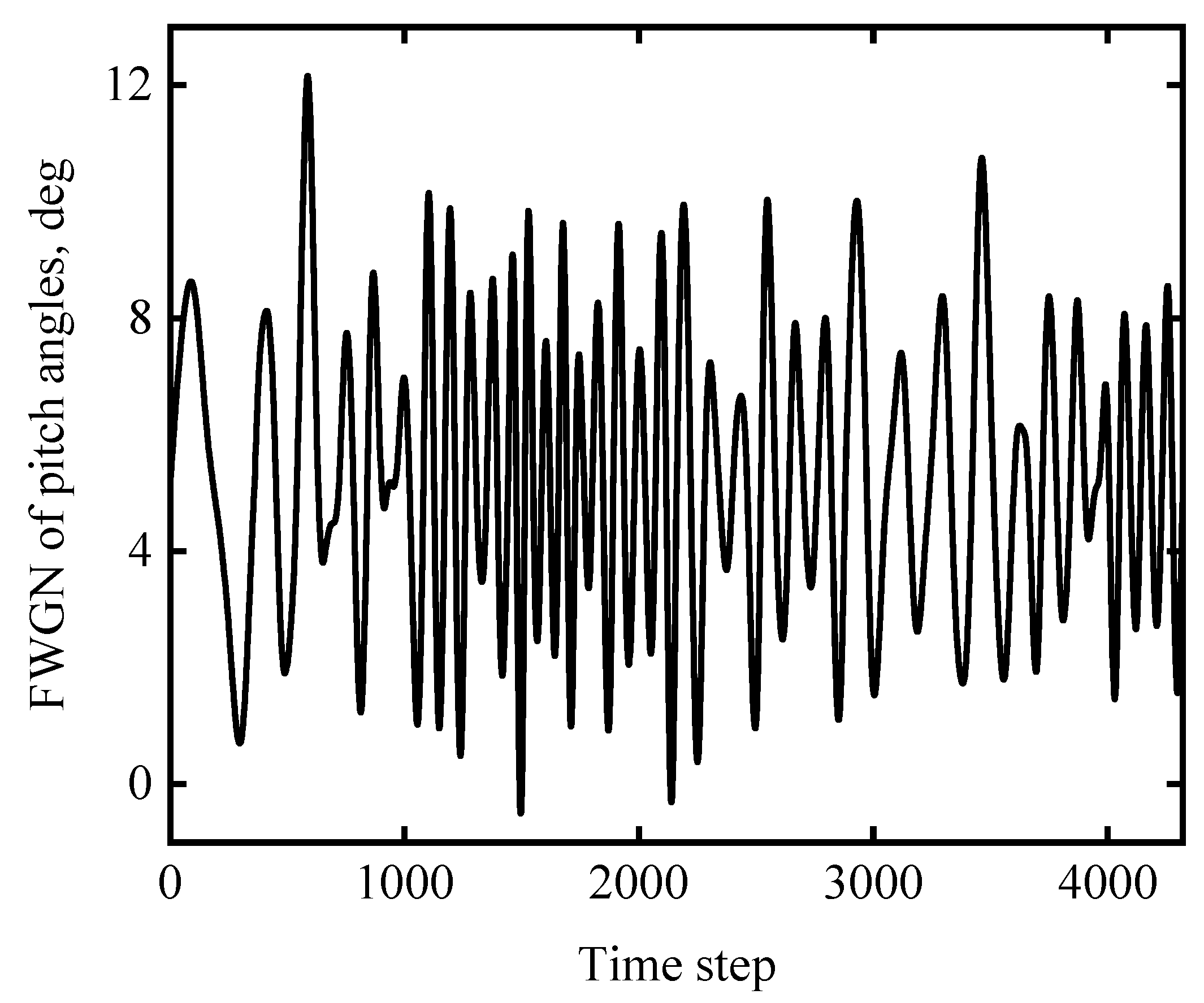
For the rotor blade, the ROM is established based on the blade element formulation. The periodic pitch motions of the blade sections are generated using FWGN, as illustrated in
Figure 12. In the CFD simulations of the rotating rotor blade, the time step is selected as the time required for the rotor to rotate by
, ensuring sufficient temporal resolution of the unsteady aerodynamic responses. A total of 4321 time steps are generated, corresponding to 12 complete rotor revolutions. High-fidelity CFD simulations are then performed to obtain the sectional airfoil aerodynamic loads at different radial blade locations. Among the generated data, the first 3961 time steps (11 revolutions) are used for ROM training and system identification, while the remaining one revolution is reserved for validation of the predictive capability of the established ROM.
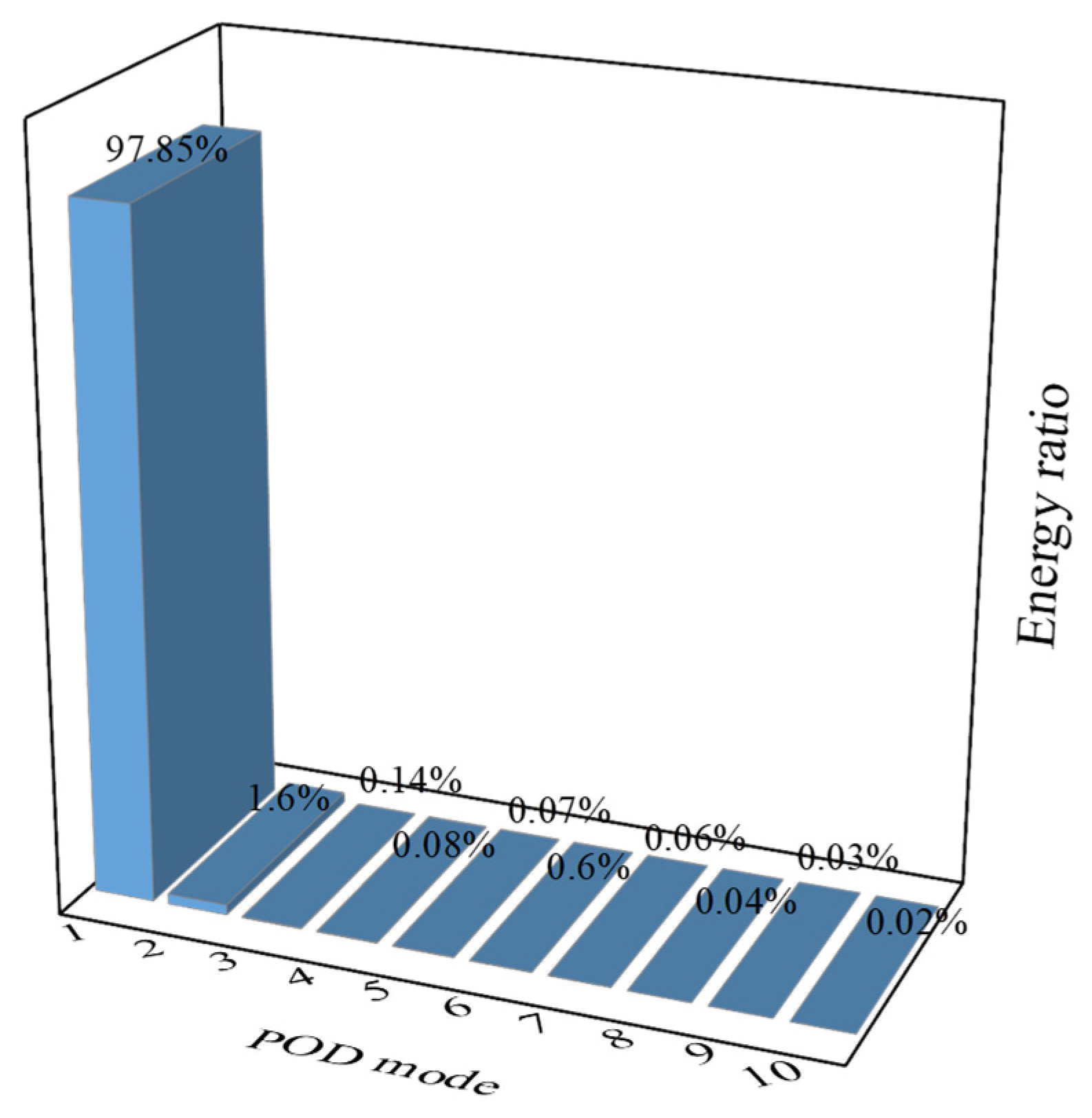
Figure 13 shows the energy ratios of the first ten POD modes (basis modes). The first mode is dominant, accounting for more than 97% of the total energy. The first two modes represent more than 99% of the total energy, which indicates that the main flow features are well preserved by these modes.
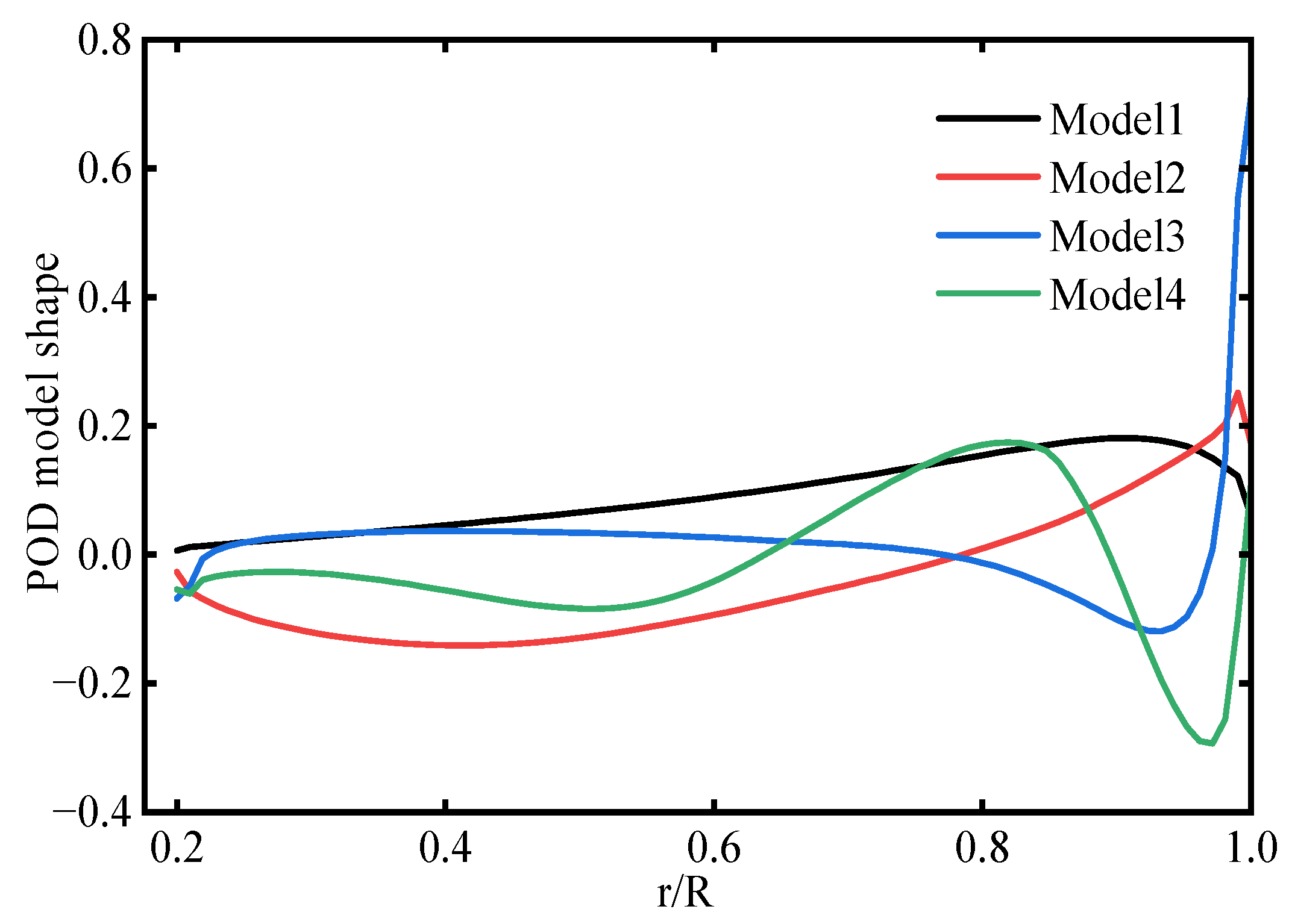
In addition to the numerical accuracy assessment, the physical significance of the dominant modes is briefly discussed. As shown in
Figure 14 First four POD spatial modes of the rotor blade along the radial direction. The first four POD spatial modes exhibit spanwise distributions along the blade. The leading POD modes primarily capture the large-scale periodic aerodynamic response associated with blade pitching motion and represent the dominant energy-containing structures in the unsteady flow. Higher-order modes contribute to finer-scale flow variations and additional harmonic content. From the DMDc perspective, the identified modes correspond to the characteristic frequencies of the forced rotor/airfoil motion, indicating that the reduced-order model successfully captures the essential dynamic behavior of the unsteady aerodynamic system. This observed physical consistency further supports the reliability of the proposed POD–DMDc-based method for aeroelastic applications.
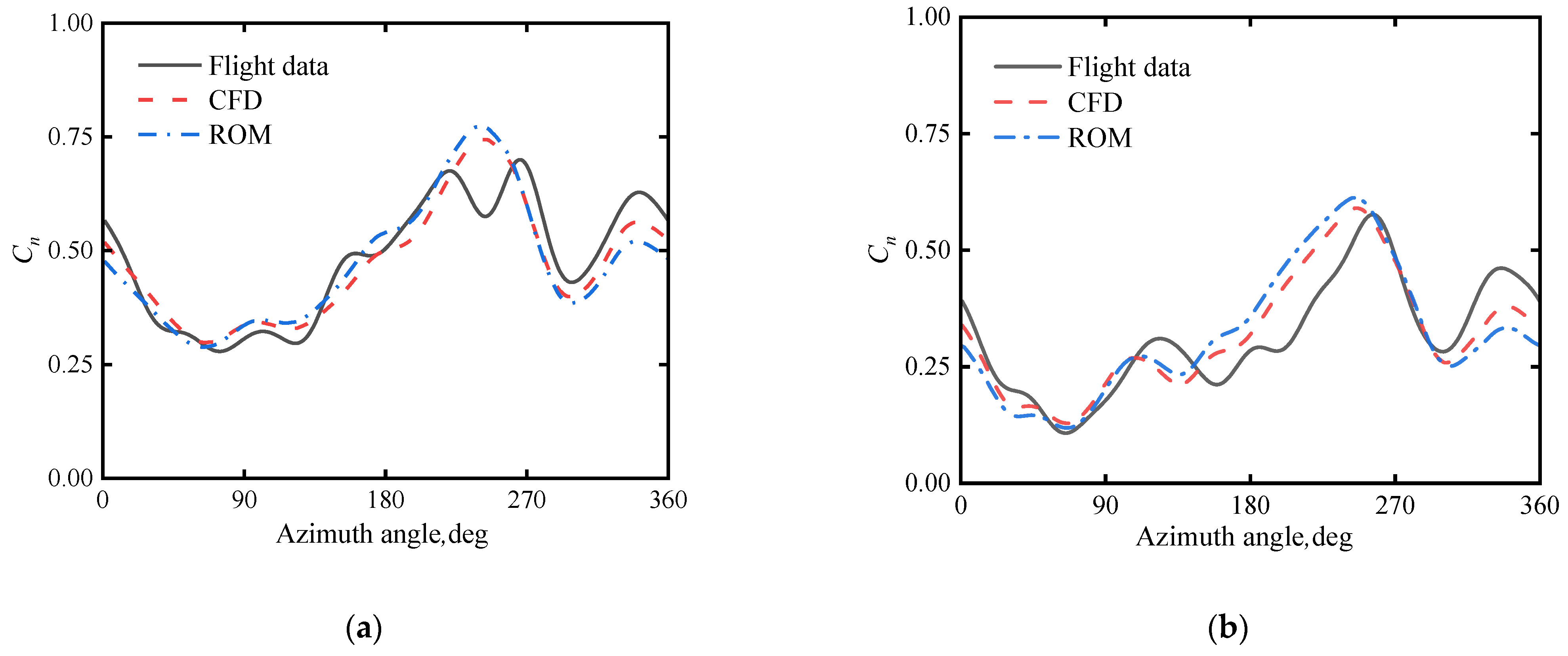
Figure 15 shows the comparison of the normal force coefficients at the 0.75 R and 0.88 R blade sections under forward-flight conditions. In the present study, a loosely coupled aeroelastic framework is adopted. For a three-bladed rotor, the aerodynamic solution is obtained over a 120° azimuthal rotation, and the complete rotor-disk aerodynamic loads are reconstructed by phase-shifting and assembling the aerodynamic responses of individual blades. The reconstructed aerodynamic loads are subsequently transferred to the structural solver to compute the blade structural response over a full rotor revolution, completing one aeroelastic data-exchange cycle. This coupling strategy inevitably introduces discrepancies between the numerical predictions and the experimental measurements. The computational time is reduced from approximately 80 h on 96 CPU cores to a few minutes per simulation case, representing several orders of magnitude savings in computational cost.
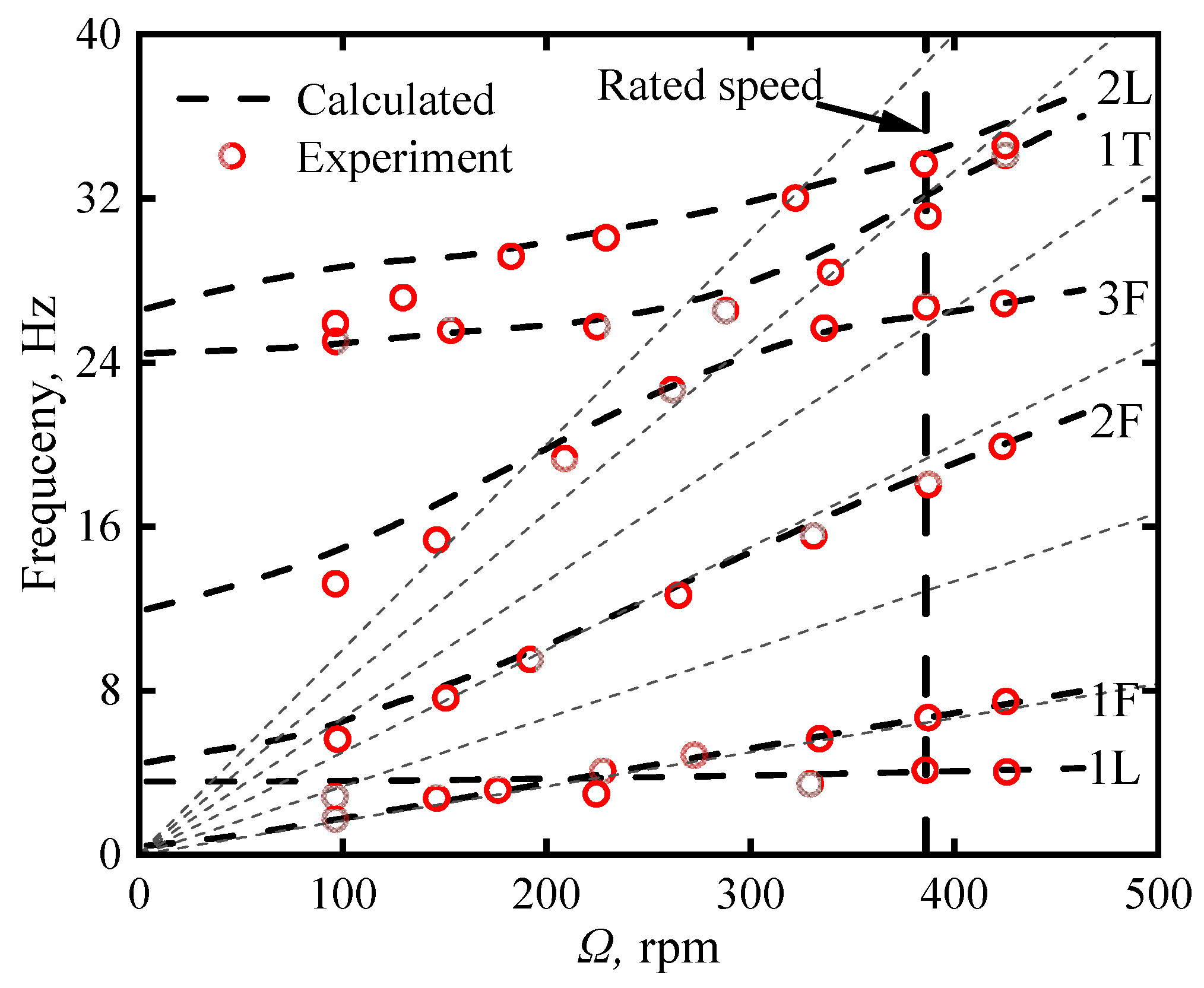
In addition, the natural frequencies of the SA349/2 rotor were calculated, including the three flap modes, the two lag modes, and the first torsional mode, which are denoted by F, L, and T, respectively, as shown in
Figure 16. The results indicate that the CSD module exhibits slight discrepancies at low rotational speeds, whereas a good agreement is achieved at the nominal operating speed.
Table 4 presents a comparison between the natural frequencies of the SA349/2 rotor obtained in the present study and the experimental data available in the literature. A reasonable level of agreement is observed between the two sets of results.
As shown in
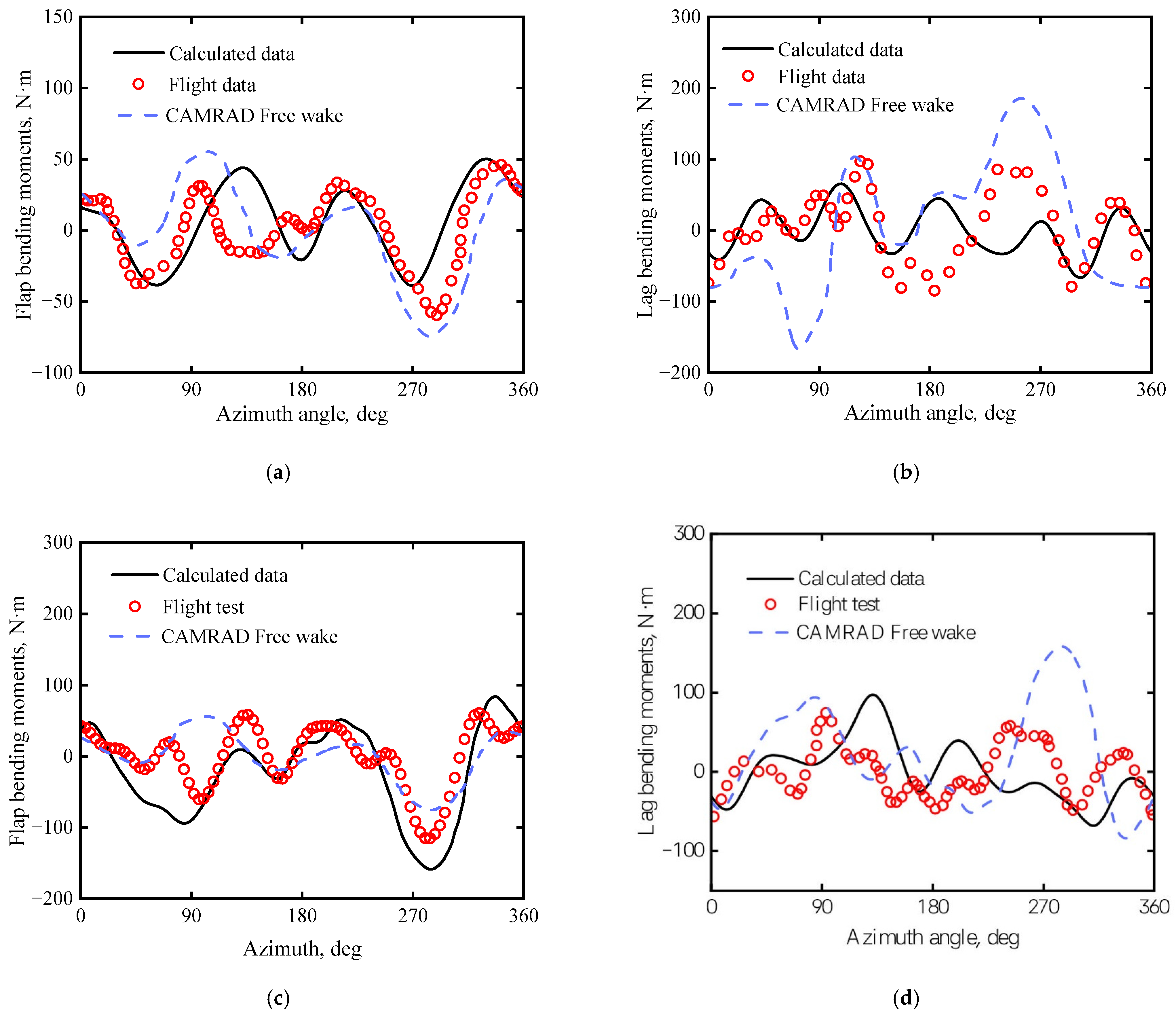
Figure 17, the calculated data shown in the figure are obtained from the ROM–CSD coupled model. The flight-test data presented in the figure are taken from Ref. [
43], while the CAMRAD computational results are taken from Ref. [
44]. The observed discrepancies may be attributed to the simplified aerodynamic modeling and the absence of high-frequency unsteady effects in the CSD formulation. In particular, when the blade rotates into the retreating side, larger deviations are observed at the outboard blade sections, where strong nonlinear aerodynamic effects associated with dynamic stall are not fully captured by the present modeling framework. Overall, the coupled CSD predictions show good agreement with the experimental data in terms of both phase and amplitude, demonstrating the capability of the proposed model to capture the unsteady bending loads of the SA349/2 rotor.
Within the blade-element framework, the model may not fully capture certain physical mechanisms in regions where three-dimensional flow features become pronounced, such as tip-loss effects, root interactions, and strong spanwise flows under highly unsteady conditions. In addition, under the loosely coupled strategy, the phase lag introduced by the finite information exchange frequency between the aerodynamic and structural solvers may weaken some transient aerodynamic features. For the SA349/2 rotor, the presence of the hydraulic damper also affects the measured structural loads, particularly in the lead–lag response (as shown in
Figure 17, the flap bending moment exhibits better agreement than the lag component). However, the publicly available experimental data [
43] provide only an equivalent dissipation coefficient, which limits the ability of the present model to fully reconstruct the detailed damper dynamics. This modeling uncertainty may also contribute to some of the observed discrepancies. Despite the above factors, the coupled ROM–CSD predictions still show overall good agreement with the experimental measurements and the CAMRAD [
44] results, indicating that the proposed approach is able to achieve a reasonable balance between computational efficiency and predictive accuracy for the operating conditions considered in this study and demonstrates promising potential for engineering applications.
6. Conclusions
In this paper, a ROM model for unsteady aerodynamic load prediction and aeroelastic analysis is developed and validated. The study progresses from two-dimensional airfoil motions to three-dimensional rotor blade applications, and further to a coupled ROM–CSD simulation of a full rotor system. The main conclusions are summarized as follows:
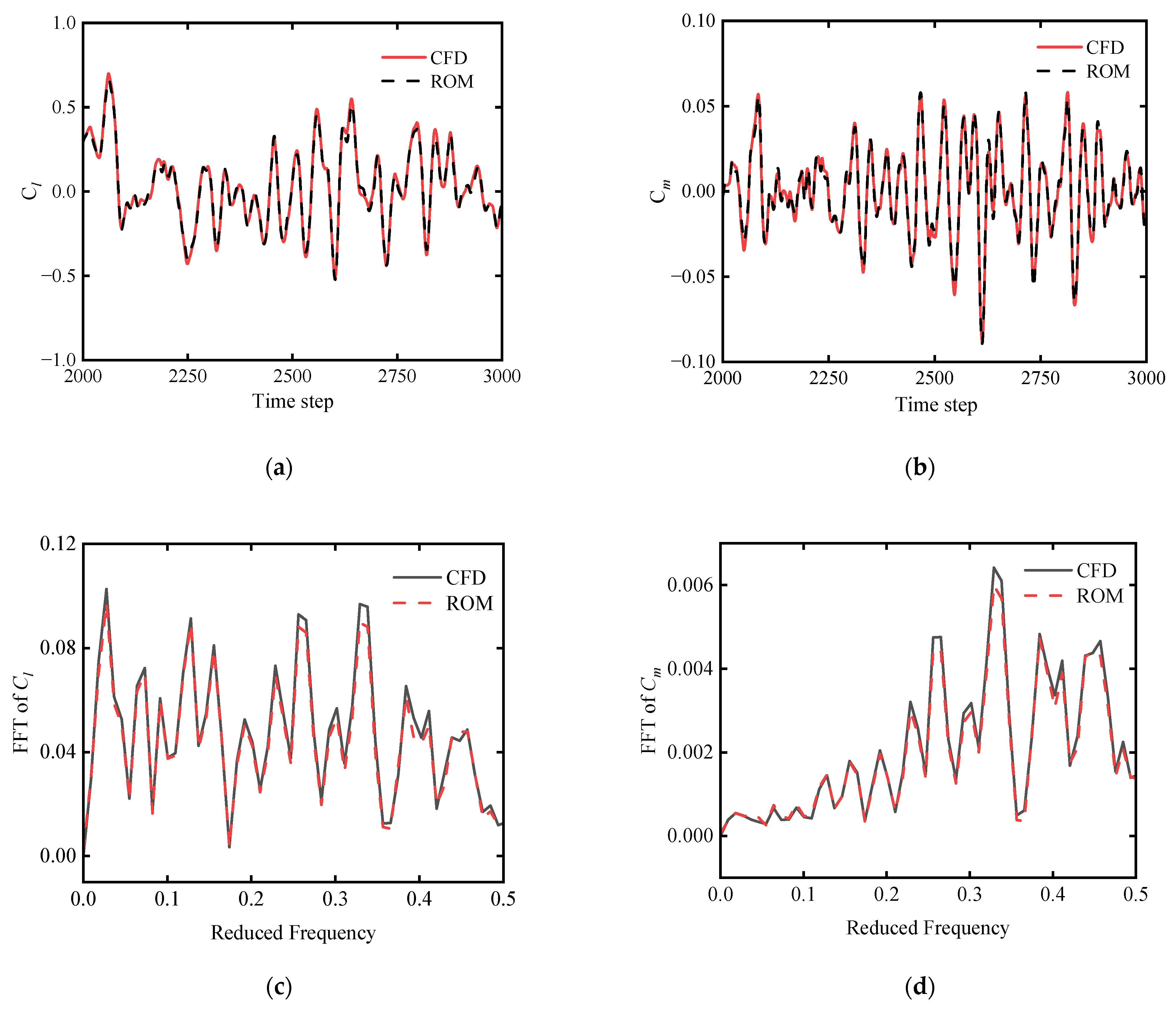
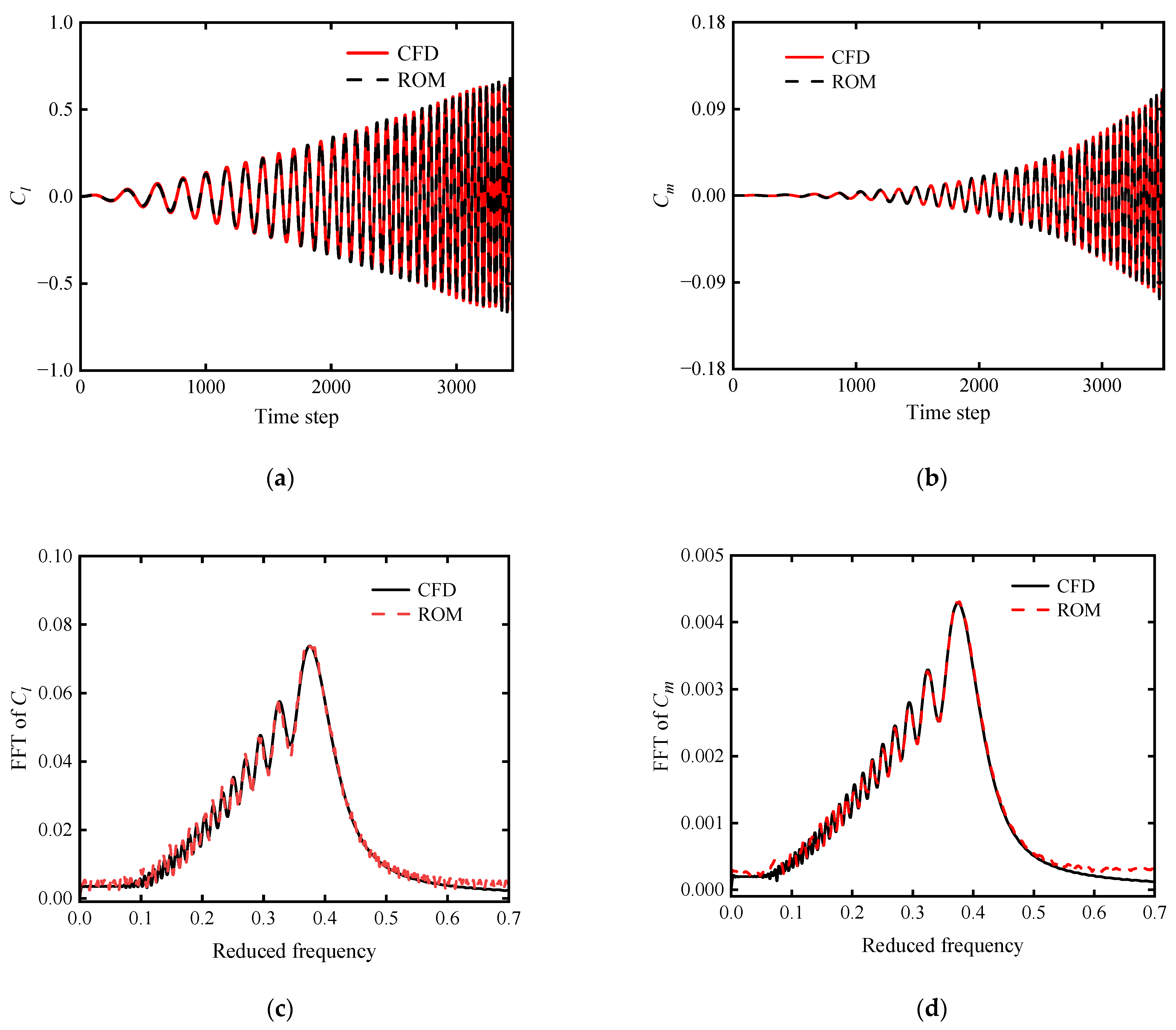
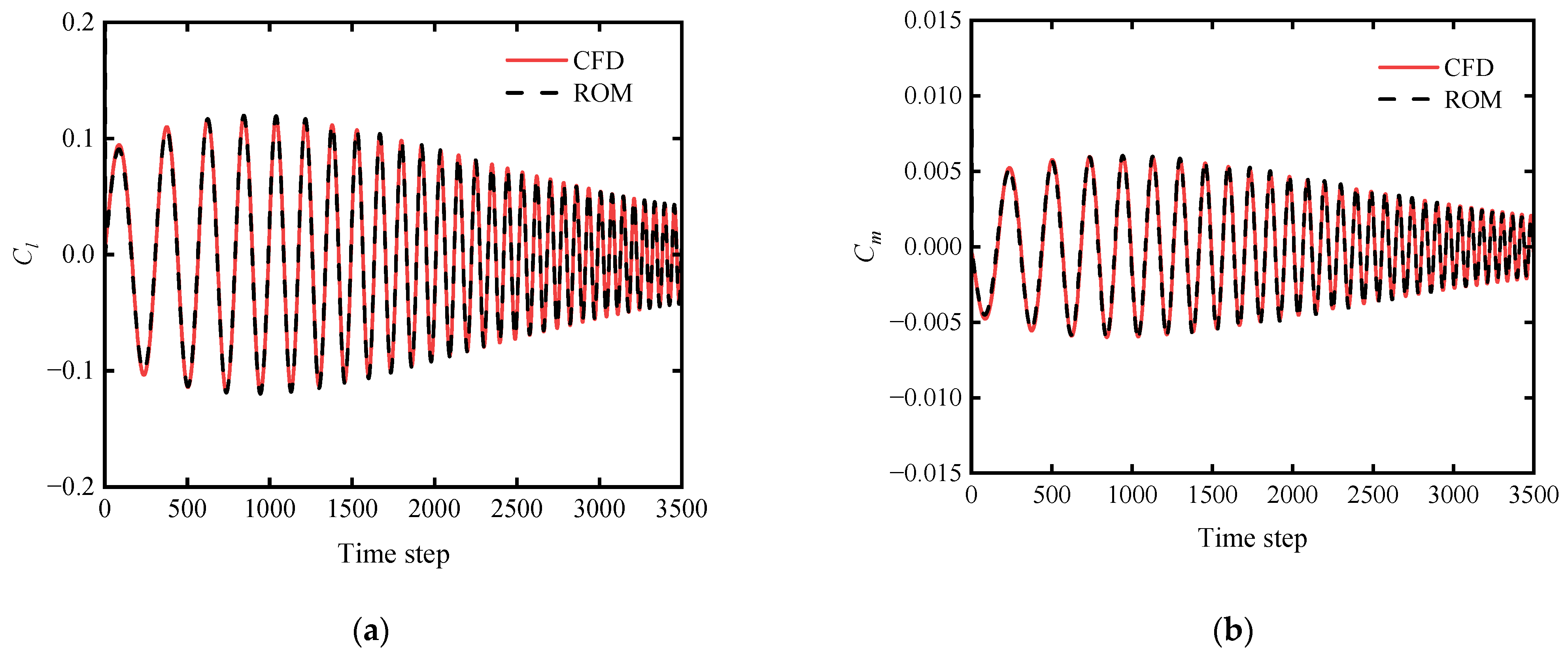
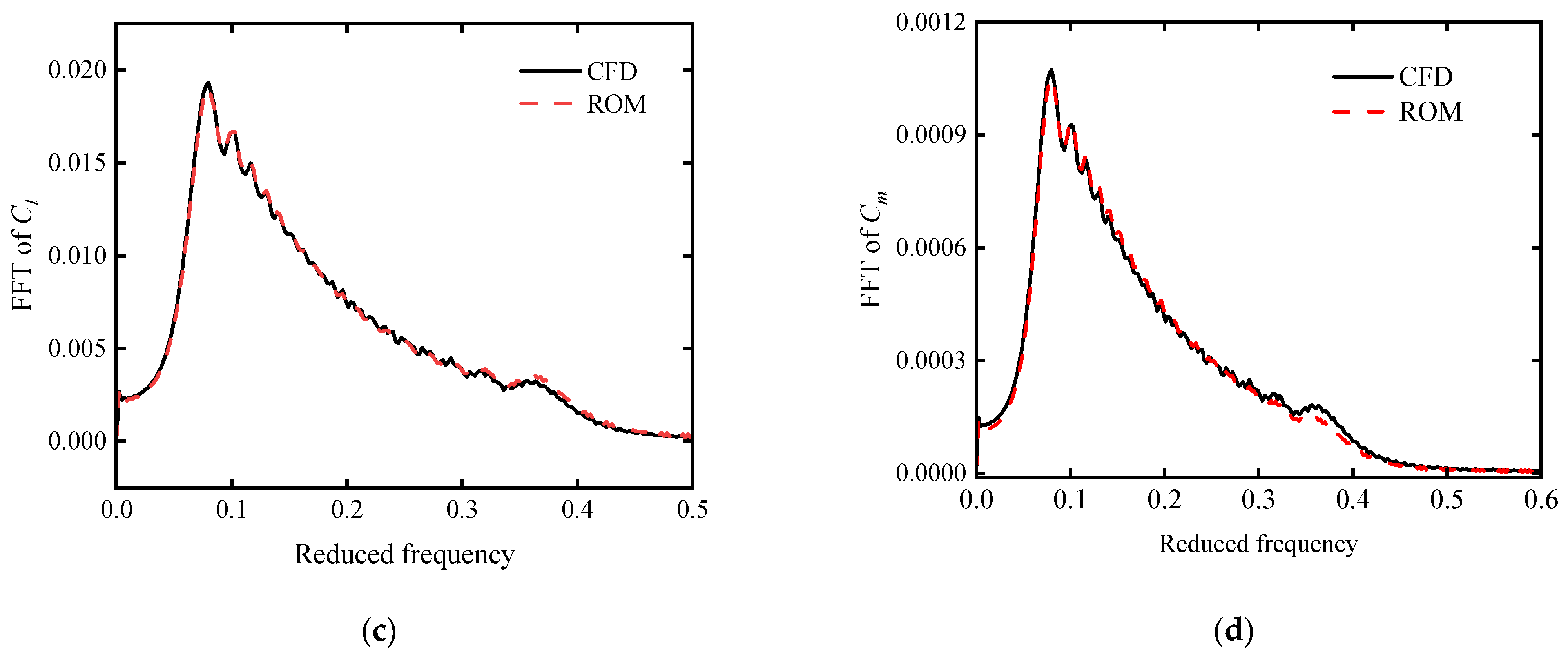
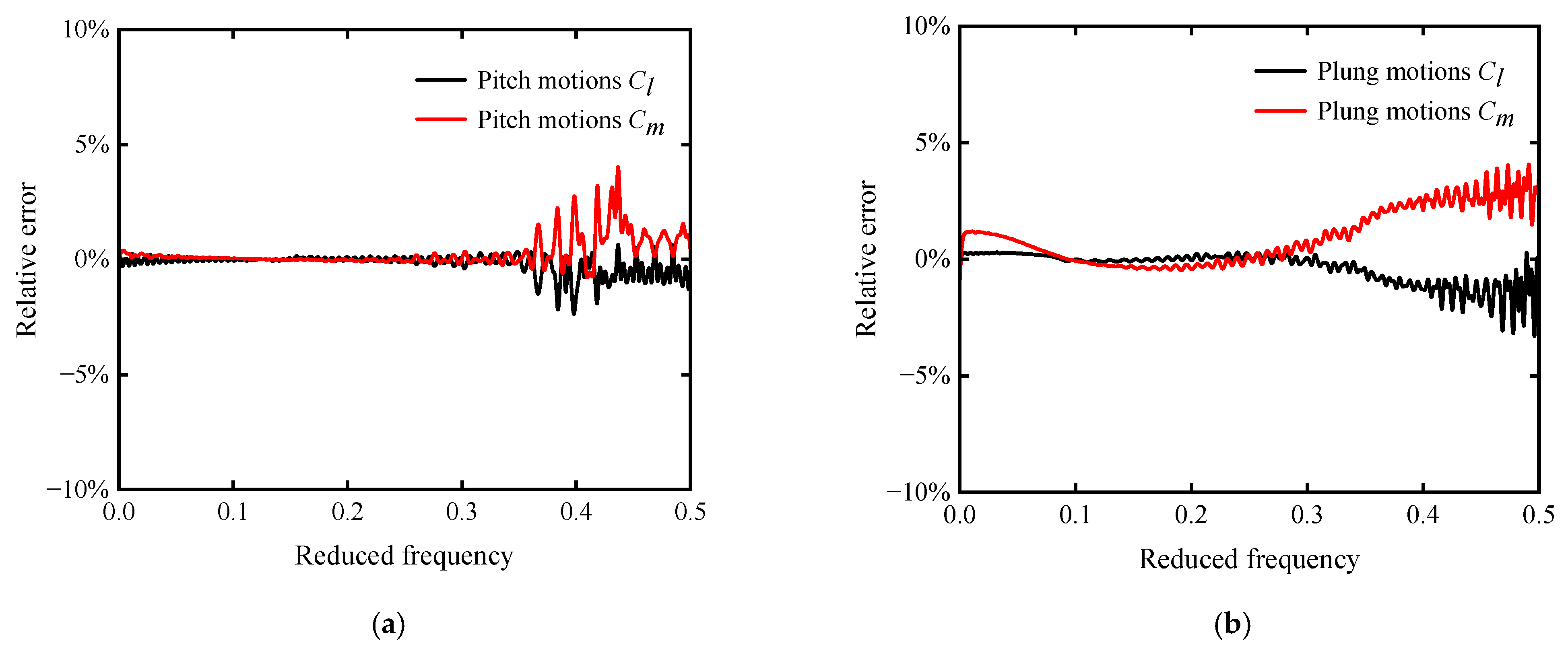
A ROM for unsteady aerodynamics is first established based on two-dimensional airfoil cases under independent pitching and plunging motions. Time-domain and frequency-domain comparisons demonstrate that the ROM accurately reproduces the dominant unsteady aerodynamic responses obtained from CFD simulations, including both amplitude evolution and phase characteristics. Quantitative error metrics, including MAE, MSE, RMSE, and , indicate high prediction accuracy for both lift and moment coefficients. Specifically, the coefficient of determination exceeds 99.03% in cases, confirming the robustness and reliability of the proposed ROM under different motion excitations.
The ROM model is successfully extended to three-dimensional rotor blade applications using sectional modeling. Broadband periodic excitations generated by frequency-weighted Gaussian noise (FWGN) ensure sufficient excitation of the aerodynamic system. Comparisons of sectional normal force coefficients at multiple radial stations show good agreement among ROM predictions, CFD results, and available flight test data, confirming the robustness of the reduced-order model in forward flight conditions.
A loosely coupled aeroelastic strategy is adopted to integrate the ROM with a CSD solver. The natural frequencies of the SA349/2 rotor blade, including flap, lag, and torsional modes, are accurately predicted and show close agreement with flight test results and experimental data, with the maximum relative error of the predicted natural frequencies remaining below 3.5%. These results confirm the reliability of the structural modeling and the correctness of the modal characteristics used in the aeroelastic simulations.
Coupled ROM–CSD simulations are performed to predict the flap and lag bending moments at different radial locations along the blade. The predicted bending moments show good agreement with experimental measurements in terms of both amplitude and phase. The results indicate that unsteady aerodynamic loads and structural responses become more pronounced toward the outboard blade regions. It is noted that relatively larger discrepancies are observed at the outer blade sections when the blade rotates into the retreating side, which may be attributed to the strong nonlinear aerodynamic effects associated with dynamic stall and reverse-flow phenomena in the retreating-blade region, leading to increased modeling errors in the structural response prediction.
Although CFD-based approaches have significantly improved aerodynamic prediction accuracy compared with traditional reduced-order models, efficiently incorporating high-fidelity aerodynamic information into aeroelastic analysis and load prediction still requires further methodological development. To address this issue, the present study constructs a reduced-order model by identifying the linear dynamical relationship of sectional unsteady aerodynamic loads over small time steps. Within the framework of blade element theory, the aerodynamic response of each blade section is evaluated in an approximately independent manner. Under these assumptions, the dominant sectional aerodynamic characteristics can be effectively represented using high-fidelity two-dimensional aerodynamic data while maintaining good computational efficiency. This strategy aims to retain, to the greatest extent possible, the unsteady aerodynamic physics resolved by CFD while substantially reducing the computational burden in subsequent aeroelastic load prediction and potential optimization applications.
Nevertheless, further improvements remain possible. Future work will focus on extending the present method to higher advance ratios and more complex maneuvering flight conditions, where stronger nonlinear aerodynamic effects may arise (particularly near the blade tip, root region, or under strongly three-dimensional unsteady flow conditions). In addition, future developments of the aerodynamic modeling will incorporate three-dimensional aerodynamic effects to further improve prediction accuracy and broaden the applicability of the proposed method.