
Article

Orbit-Prior-Guided Target-Centered Stacking for Space Surveillance and Tracking Under Dynamic-Platform Optical Observations

Changchun Institute of Optics, Fine Mechanics and Physics, Chinese Academy of Sciences, Changchun 130033, China
*
Author to whom correspondence should be addressed.
Aerospace 2026, 13(3), 279; https://doi.org/10.3390/aerospace13030279
Submission received: 6 February 2026 / Revised: 28 February 2026 / Accepted: 3 March 2026 / Published: 17 March 2026
(This article belongs to the Special Issue Advances in Space Surveillance and Tracking)

Abstract

In visible-light optical observations for Space Surveillance and Tracking (SST) from ground-based dynamic platforms, attitude disturbances and field-of-view discontinuities frequently undermine interframe geometric consistency, leading to energy diffusion and unstable gain in multi-frame stacking for faint space objects. We propose orbit-prior- guided target-centered stacking (OPG-TCS), a tracking-oriented post-processing method designed to stabilize target energy accumulation and improve enhancement reliability under dynamic observation conditions. OPG-TCS performs frame-wise astrometric calibration using star fields (WCS) and leverages projected orbit priors to predict target pixel locations, enabling local cropping and target-centered alignment/stacking without relying on full-frame geometric consistency. We evaluate OPG-TCS on multiple real-world dynamic-platform sequences and compare it with direct stacking and representative robust baselines. Signal-to-noise ratio (SNR) is used as the primary metric, while auxiliary indicators of peak prominence, energy concentration, and shape consistency are employed to assess robustness across varying stacking depths. The results show that OPG-TCS provides stable enhancement over different frame counts; in representative 50-frame fusions, its relative SNR surpasses direct stacking by 33.7–97.8%. These findings suggest that OPG-TCS offers a practical and robust enhancement strategy for SST-oriented observation of faint space objects, supporting more reliable detection and subsequent tracking analysis.

1. Introduction

1.1. Background

With the continuous increase in the number of spacecraft in orbit, medium and high Earth orbits—particularly the Geostationary Earth Orbit (GEO)—have become critical orbital resources for high-value spacecraft used in communications, navigation, and meteorology. Continuous observation and status monitoring of this region form a vital foundation for space situational awareness (SSA) and space security. This requires maintaining long-term “in-orbit situational awareness” within the congested GEO belt while relying on high-precision measurement and orbit determination capabilities to perform collision risk assessments and operational status evaluations [1,2]. Among multi-source SSA methods, ground-based visible-light optical telescopes offer advantages such as flexible deployment, wide coverage, and relatively controllable costs, making them a longstanding cornerstone of optical monitoring for medium-to-high orbits [3,4].
Compared to fixed stations, dynamic platforms (e.g., shipborne sea-based, vehicle-mounted, airborne) offer superior mission adaptability in SSA scenarios: First, dynamic platforms can rapidly adjust observation latitude/longitude and station geometry through maneuverable deployment, significantly expanding accessibility and observation windows across different GEO longitude segments while supporting cross-regional emergency observations and ad-hoc mission support. Second, dynamic platforms offer superior meteorological avoidance and environmental selection capabilities (e.g., evading local cloud cover, terrain obstructions, and certain light pollution), enhancing effective observation duration and data acquisition continuity. Third, engineering feasibility is supported by existing validation work on dynamic platform-based acquisition, tracking, and pointing (ATP) systems [5]. However, attitude disturbances and visual axis jitter introduced by dynamic platforms compromise inter-frame geometric consistency, making stable detection and precise measurement of faint space objects under single-frame low signal-to-noise ratio conditions more challenging. Therefore, for low signal-to-noise ratio space objects under a dynamic platform, researching multi-frame stacking enhancement and robust alignment strategies constrained by orbit-prior information to improve detectability and measurability holds significant application value for target discovery, catalog maintenance, and subsequent tracking analysis [6].

1.2. Related Work

Optical detection of faint space targets in medium-to-high orbits (especially GEO) has traditionally focused on “star field/background suppression + sequence detection decision-making.” Sun et al. proposed an early processing workflow for faint targets in GEO optical observations, emphasizing the suppression of stellar and noise interference through multi-frame statistical characteristics and image preprocessing to enhance weak target detectability [7]. Subsequently, Xi et al. proposed a low-false-alarm detection framework for optical sequences. Building upon star and noise removal, they introduced time-indexed filtering and staged decision-making to accommodate detection requirements for both continuous and discontinuous trajectory targets, reporting high detection probabilities under low-SNR conditions [8]. More recently, Zheng et al. leveraged the imaging characteristic of “overall stellar motion with GEO targets remaining relatively stationary” in staring mode to propose the Min-Stacking approach for star suppression. This method achieves star suppression by taking the minimum value across multiple frames on a per-pixel basis, reducing reliance on image registration. Combined with global threshold segmentation for rapid target extraction, it emphasizes real-time performance and engineering applicability [9]. Additionally, some studies explore deep learning for candidate extraction and screening. For instance, Dai et al. employ PP-YOLOv2 to extract candidate targets and enhance weak target detectability through multi-frame fusion [10]. Meanwhile, Liu et al.’s modular detection framework integrates processing modules such as point target enhancement and temporal consistency analysis, aiming to robustly construct target detection workflows for engineering deployment [11]. Other studies focus on optimizing systematic workflows and conducting experimental evaluations for space debris observation, demonstrating holistic design and performance validation in engineering practice [12].
Concurrently, cross-frame alignment and geometric consistency modeling form the critical foundation for multi-frame observation methods. Astrometric calibration provides a physically consistent geometric framework for cross-frame reprojection and registration by mapping image pixel coordinates to a unified celestial coordinate system. Blind astrometric calibration tools (e.g., astrometry.net) enable astronomical solving of images without prior knowledge, offering a practical pathway for large-scale star field image registration [13]. The FITS World Coordinate System (WCS) specification further standardizes the “pixel-to-celestial sphere” coordinate representation, enabling geometric processing of different observation frames within a unified reference system [14,15]. High-precision catalogs (e.g., Gaia DR3) provide the data foundation for star matching and solving accuracy, driving advancements in high-precision astrometric calibration and subsequent measurement tasks [16].
Regarding multi-frame enhancement, the fields of planetary defense and small-body observation have established a sequence enhancement paradigm represented by synthetic tracking (essentially a motion assumption superposition of “shift-and-add”): by compensating and stacking short-exposure sequences within candidate velocity spaces, both detection sensitivity and trailing loss reduction can be achieved simultaneously, thereby enhancing the detectability and measurement accuracy of faint targets [17]. This approach offers significant insights into “how to perform effective multi-frame fusion under complex motion and low-SNR conditions.” However, when applied to high-orbit observations from dynamic platforms, it requires adaptation and reconstruction to account for practical constraints such as platform disturbances, geometric instability, and target-motion priors.
The key divergence among existing methods in dynamic-platform observation scenarios lies in one approach that tends to enhance detectability within the image domain through robust statistics or star-suppression operators but typically assumes relatively stable inter-frame geometric relationships within the sequence. Another category relies on precise registration or motion assumption compensation (e.g., shift-and-add/synthetic tracking), yet suffers from geometric instability and computational constraints under attitude disturbances and field-of-view discontinuities. Balancing geometric robustness and engineering feasibility under a low signal-to-noise ratio remains the core challenge for multi-frame enhancement on dynamic platforms.

1.3. Contributions of This Work

This paper proposes an orbit-prior-guided target-centered stacking (OPG-TCS) strategy for enhancing multi-frame stacking of visible-light sequence images of medium-to-high orbit space objects acquired by dynamic-platform telescopes. The strategy comprises three components: First, astrometric calibration establishes a unified geometric reference across frames, providing a reliable pixel-celestial sphere mapping relationship, laying the foundation for cross-frame geometric consistency. Second, orbit-prior information is integrated with temporal interpolation for target position prediction across frames, transforming unstable full-frame registration into alignment constraints within a target-centered reference frame. Finally, local cropping around predicted target positions enables target-centered alignment stacking. Combined with sub-pixel resampling and robust design, this approach achieves stable energy accumulation and background suppression under stellar field interference and field-of-view discontinuity. Using real-world observation sequences from a dynamic platform, this paper conducts systematic experiments under varying frame stacking and multiple contrast strategies. Comprehensive evaluation of enhancement effectiveness and robustness is performed using metrics such as signal-to-noise ratio, energy concentration, and localization stability, validating the proposed method’s advantages in dark target enhancement and subsequent detection applicability. OPG-TCS is formulated as a post-processing image enhancement module in optical SST workflows rather than a standalone detection algorithm, and it is intended to bridge image preprocessing and target extraction via temporal multi-frame fusion to facilitate downstream detection and tracking. This paper aims to provide a verifiable, engineering-ready post-processing solution for enhancing faint targets in visible-light observation sequences on dynamic platforms. The experimental results demonstrate that the proposed OPG-TCS achieves more stable enhancement gains across varying frame overlays and platform disturbance conditions. Under representative 50-frame fusion conditions, it delivers a significant improvement in signal-to-noise ratio compared to Direct Stacking, validating the method’s effectiveness and engineering applicability in dynamic-platform observation scenarios.

2. OPG-TCS: Orbit-Prior-Guided Target-Centered Stacking

2.1. Overall Methodology Framework and Processing Workflow

Under dynamic-platform optical observation conditions, maintaining stable field-of-view coverage and geometric consistency across multiple frames is often challenging. Faint space targets typically exhibit signals approaching the noise level in single frames, which substantially limits the practical effectiveness of traditional multi-frame image fusion methods that rely on full-frame alignment or reliable single-frame target detectability. Based on the review in Section 1.2, it is evident that establishing inter-frame consistency solely through global image alignment or stellar reference systems often fails to achieve stable and effective target signal accumulation under field-of-view discontinuities and extremely low signal-to-noise ratios [5].
To address these challenges, this paper proposes an orbit-prior-guided target-centered stacking method that integrates astrometric calibration information with orbit-prior constraints. This method no longer uses the entire image or background stars as the primary alignment reference. Instead, it employs the predicted pixel positions of the target across frames as reference points. It organizes the local cropping and stacking of multi-frame images within a target-centered reference frame. This transforms the multi-frame image fusion process from one dependent on full-field geometric consistency to one constrained by the local spatial consistency of the target.
OPG-TCS is a post-processing image enhancement technique rather than a standalone detection algorithm. Within a typical SST workflow, it can be positioned between image preprocessing and target extraction as a temporal multi-frame fusion module, enhancing faint targets by aggregating time-domain information to facilitate subsequent detection and tracking.
From a holistic workflow perspective, the OPG-TCS method takes a sequence of raw multi-frame observation images as input, sequentially performing imaging preprocessing, establishing imaging geometric references, target position prediction, and executing target-centered multi-frame alignment and fusion. Logically, each processing stage forms a progressive chain from data normalization to geometric constraint introduction, culminating in target-oriented multi-frame image fusion—establishing a complete multi-frame processing pipeline for engineering implementation.
During image preprocessing, raw observation images undergo format parsing and temporal information organization, providing a unified data foundation for subsequent multi-frame processing. Subsequently, astrometric calibration is performed using stellar information within the field of view, establishing a mapping relationship between image pixel coordinates and celestial coordinates [13,14,15]. This process provides a unified geometric reference for multi-frame images, serving as a necessary prerequisite for introducing orbit-prior information and enabling target position prediction, though it does not directly contribute to weak target enhancement.
After obtaining the imaging geometric reference, precise orbit-prior information of the target is introduced to perform a target position prediction at each observation time. This prediction is projected onto the image pixel coordinate system to derive the expected position of the target in each frame. This prediction serves as spatial guidance information for subsequent multi-frame processing, defining the possible distribution area of the target on the image plane.
Building upon this foundation, the OPG-TCS method centers on the target position prediction. It extracts fixed-size local subregions from each frame and performs multi-frame alignment and stacking within the target-centered reference frame. Through this strategy, the multi-frame fusion process no longer relies on pixel-level precision consistency across the entire field of view. Instead, it focuses on spatially consistent representations of the target’s local region, effectively mitigating the impact of dynamic-platform attitude variations and field-of-view discontinuities on fusion results.
The aforementioned processing flow constitutes the overall framework of the OPG-TCS method, whose logical structure is illustrated in Figure 1. Subsequent sections will detail key components within this methodological framework, including the characteristics of dynamic-platform observation data, astrometric calibration and geometric modeling, orbit-prior projection, and the target-centered multi-frame fusion strategy.

2.2. Characteristics and Processing Strategies for Dynamic-Platform Observation Data

Under dynamic-platform conditions, optical telescope imaging inevitably suffers from platform attitude variations and pointing errors. Although target-tracking control typically incorporates platform attitude information during observations, residual errors persist between the calculated attitude and the actual optical axis pointing due to limitations in attitude measurement accuracy, control loop delays, and mechanical structural characteristics. This makes it difficult to maintain complete target stationariness on the image plane [4].
For medium-to-high orbit space objects, their low brightness often results in single-frame signal intensities approaching background noise levels. Under residual attitude error, extended exposure times cause point spread functions to stretch or diffuse, reducing peak intensity and degrading point-like resolvability. Thus, while longer exposure times may accumulate more energy, they do not necessarily enhance the detectability of faint point targets or improve subsequent measurement stability.
Given these imaging characteristics, to maximize point-like resolution of targets and stars while minimizing motion blur from platform vibrations, this study employs a short-exposure time strategy, with no single exposure time exceeding 200 milliseconds, to acquire continuous multi-frame image sequences. While this approach partially mitigates single-frame diffusion, it further reduces the target signal per frame, making stable detection challenging through direct reliance on thresholds or morphological features. Simultaneously, due to tracking residuals and platform micro-vibrations, the target may still exhibit positional drift between frames, and background structures change with the field of view. Consequently, observation data for faint targets on a dynamic platform typically exhibits the following characteristics: low single-frame signal-to-noise ratio, uncertain changes in target position between frames, and background structures varying with the field of view.
These data characteristics indicate that the observation of faint targets on dynamic platforms fundamentally involves the organization and accumulation of multi-frame information. Under such observation conditions, target enhancement relies on the effective utilization of multi-frame information within time series. Establishing a robust spatial correlation between frames and achieving stable fusion under complex field-of-view variations represents a critical challenge requiring focused resolution in subsequent processing.

2.3. Astrometric Calibration and World Coordinate System Solving Workflow

Multi-frame optical observation images acquired under a dynamic platform exhibit difficulty in maintaining stable consistency within the image plane coordinate system due to platform attitude variations and pointing errors. To establish a unified and physically meaningful spatial reference for subsequent processing, this study performs astrometric calibration on each frame. This maps image pixel coordinates to the celestial coordinates, enabling the characterization of inter-frame geometric relationships within a unified coordinate framework during cross-frame analysis.
This paper employs a star field-based WCS solving workflow: first, stellar sources are extracted from the images and matched against high-precision catalogs; subsequently, the mapping parameters between pixel coordinates ( u , v ) and celestial coordinates ( α , δ ) are estimated and written into the image header file as FITS-WCS keywords. Considering potential distortions in real optical systems, this paper employs the WCS-SIP (TAN-SIP) model for unified expression, where SIP denotes Simple Imaging Polynomial distortion terms for higher-order corrections. This model consists of three components, including “spherical-to-tangent-plane projection + linear transformation + polynomial distortion correction”, ensuring compatibility with mainstream astronomical software [18,19].

2.3.1. Celestial Sphere to Tangent Plane (TAN Projection)

Projecting any celestial coordinate ( α , δ ) onto the tangent plane’s intermediate coordinates ( ξ , η ) , with a reference celestial coordinate ( α 0 , δ 0 ) (corresponding to CRVAL in WCS) as the projection center, can be expressed as:
D = sin δ sin δ 0 + cos δ cos δ 0 cos ( α α 0 )
ξ = cos δ sin ( α α 0 ) D ,   η = sin δ cos δ 0 cos δ sin δ 0 cos ( α α 0 ) D
where ( ξ , η ) is a local plane coordinate system centered on the reference point, used to transform spherical geometry into plane geometry, facilitating the subsequent establishment of a linear relationship with pixel coordinates.

2.3.2. Linear Mapping from Pixels to Cut Planes (CD Matrix)

Using reference pixel ( u 0 , v 0 ) as the origin, define pixel offsets Δ u = u u 0 , Δ v = v v 0 . The linear portion of the WCS is represented by the CD (Coordinate Description) matrix as:
x y = C D Δ u Δ v ,   C D = C D 11 C D 12 C D 21 C D 22
where ( x , y ) represents the cutting plane coordinates, while CD simultaneously encodes pixel scale and rotational relationships, enabling different frames of imagery to be described and reprojected under unified geometric parameters.

2.3.3. SIP Polynomial Correction for Optical Distortion

To account for nonlinear distortions in the actual imaging system, WCS-SIP introduces polynomial corrections to pixel shifts:
Δ u = Δ u + A ( Δ u , Δ v ) , Δ v = Δ v + B ( Δ u , Δ v ) .
Among them
A ( Δ u , Δ v ) = p + q m A p q ( Δ u ) p ( Δ v ) q , B ( Δ u , Δ v ) = p + q m B p q ( Δ u ) p ( Δ v ) q .
Here, m denotes the order of the SIP polynomial, and A p q , B p q are the coefficients to be estimated. In practice, the distortion-corrected pixel shifts ( Δ u , Δ v ) are first computed using Equation (4) (with A ( Δ u , Δ v ) and B ( Δ u , Δ v ) defined in Equation (5)) and then substituted into Equation (3) to compute the corresponding tangent-plane coordinates, thereby improving the accuracy of cross-frame geometric descriptions.

2.4. Precise Orbit Data Acquisition and Preprocessing

Under dynamic-platform conditions, the single-frame signal of faint space targets approaches background noise levels, making it difficult to reliably characterize their temporal position changes relying solely on image domain information. Therefore, this paper introduces a precise orbit prior as an external temporal constraint to describe the target’s spatial position evolution during the observation period and provide physically consistent guidance for subsequent target center alignment.
The precision orbit file used in this study provides the target’s geocentric position r k = x k , y k , z k T (meter) and corresponding timestamp t k at discrete ephemeris times. To align with image observation times, the observation time t i for each frame is first read from the image header information and uniformly converted to UTC time (consistent with orbital time). Subsequently, one-dimensional cubic interpolation is applied to each of the ( x , y , z ) components to obtain continuous position estimates at the observation time:
r tar ( t i ) = J c   t i ; { ( t k , x k ) } ,   J c   t i ; { ( t k , y k ) } ,   J c   t i ; { ( t k , z k ) } T
Here, J c ( ) denotes the cubic orbit interpolation operator. This step transforms the discrete precision track into a continuous orbit prior that can be queried at any observation time, providing temporally consistent input for subsequent projection of track information onto the image domain and delimiting the potential distribution range of the target on the image plane.
Previous studies have shown that meter-level precise orbit determination for geostationary satellites had already reached approximately 1 m as early as 2010 [20]. More recent progress further indicates that decimeter-level orbit products can be achieved in high-precision services (reported in 2024) [21]. In this study, the employed precise orbit prior has a meter-level position uncertainty, which is sufficiently small for the subsequent target-centered localization and stacking.

2.5. Geometric Mapping from Orbit Prior to Image Pixel Coordinates

After obtaining the WCS geometric reference for each frame, the target spatial positions described by the orbit prior can be mapped to predicted positions in the pixel domain, thereby introducing the “orbit prior to pixel alignment anchor” geometric interface into the image processing workflow [22].
For frame i , construct the topological line-of-sight vector based on the interpolated target geocentric position r tar ( t i ) and the geocentric position r site ( t i ) of the observation station at the same time.
v i = r tar ( t i ) r site ( t i )
Normalize to obtain the direction vector v ^ i . From v ^ i , calculate the corresponding right ascension and declination ( α i , δ i ) of the target’s line of sight in the celestial coordinate system at that moment. Further, through the inverse transformation of the frame’s WCS, map ( α i , δ i ) to the pixel domain to obtain the predicted pixel coordinates of the target:
( x i , y i ) = f wcs i 1 ( α i , δ i )
where f wcs i 1 ( ) denotes the mapping from celestial coordinates defined by the i t h frame WCS to pixel coordinates. By repeating this process across multiple frames, a sequence of predicted target position predictions corresponding to the observation sequence is obtained, providing the geometric foundation for subsequent local processing of target centers and target-centered multi-frame fusion.
The predicted target pixel coordinates ( x i , y i ) are represented as floating-point values, which provides sub-pixel precision. These sub-pixel coordinates are directly used as the target-centered reference for subsequent cropping/stacking and for centering the evaluation window, and no additional image-domain centroid refinement is applied in this work.

2.6. Target-Centered Multi-Frame Image Fusion

After obtaining the target position prediction pixel position sequence ( x i , y i ) , this paper performs local cropping centered on the target in the pixel domain and completes multi-frame stacking and target-centered multi-frame fusion under a target-centered reference frame. Specifically, for frame i , there is local cropping of a fixed-size sub-image C i (uniformly set to 1024 × 1024 in this study’s experiments) at position ( x i , y i ) . The fusion result is obtained by accumulating the average across all valid frames:
I OPG-TCS = 1 N i = 1 N C i
When target positions near image edges cause the cropping window to exceed its bounds, the frame is excluded from fusion to prevent invalid pixels from introducing cumulative bias. By shifting the stacking reference frame from the image’s fixed coordinate system to the target-centered reference frame, the fusion process no longer relies on the strong assumption of full-field geometric consistency. Instead, it focuses on consistency within the target’s local region, thereby maintaining more stable target energy accumulation even under conditions of dynamic-platform attitude disturbances and field-of-view discontinuities.

3. Experimental Design

This section conducts experimental validation of the orbit-prior multi-frame image fusion method proposed in Section 2. By comparing different image stacking strategies under identical observation data conditions, it quantitatively evaluates the effectiveness and applicability of the proposed method in enhancing faint targets within dynamic-platform observation scenarios. The experimental design and evaluation metrics provide the basis for the results analysis in Section 4.

3.1. Data Sources and Observation Conditions

The experimental data originates from observation image sequences captured during the actual operation of a dynamic-platform optical observation system, targeting medium-to-high orbit space objects. The observation tasks were conducted under clear, moonless night conditions. Imaging was performed in the visible light band with a single-frame exposure time of less than 200 ms to minimize motion blur caused by relative movement between the platform and the target while meeting continuous observation requirements. Due to platform attitude disturbances and field-of-view discontinuities, the geometric relationships between frames vary significantly over time. The target signal in a single frame approaches the background noise level, exhibiting typical characteristics of observing faint targets from a dynamic platform.
To ensure the reliability of subsequent geometric processing chains, astrometric calibration is performed on each frame, and the star field is used as a geometric reference for WCS solving. Typically, at least 80 stars per frame are available for matching in the data, providing sufficient constraints for WCS solving and cross-frame geometric consistency assessment. All experiments in this paper are based on real observational data without introducing artificially enhanced or simulated synthetic processing. To minimize the impact of external observational condition fluctuations on conclusions, comparative analyses were conducted during observation periods with relatively stable background conditions. This ensures that differences between fusion strategies primarily reflect variations in algorithmic processing paths and reference frame selection.

3.2. Comparative Experimental Protocol

To evaluate the effectiveness of OPG-TCS under dynamic/moving-platform optical observation conditions, we compare four multi-frame fusion/enhancement strategies using identical observation data and a consistent preprocessing workflow: direct stacking (DS); the Sun pipeline [7], based on morphological processing and median-based star/background suppression; the Min-Stacking method proposed by Zheng et al. [9]; and OPG-TCS. For a fair comparison, all methods are executed under the same constraints on the number of stacked frames N and the output region/size used for evaluation; the only differences lie in (i) the inter-frame alignment reference system, (ii) whether orbit-prior information is incorporated, and (iii) the fusion operator.
These baselines were selected to cover three representative categories of multi-frame enhancement under dynamic-platform conditions: (i) direct stacking without explicit alignment (DS) as the fundamental lower-bound reference under inter-frame geometric inconsistency; (ii) a conventional hand-crafted pipeline with robust star/background suppression (Sun pipeline) representing classical image-processing strategies; and (iii) a recent robust-statistics fusion operator (Zheng Min-Stacking) designed for low-SNR and complex backgrounds. This categorization enables a fair comparison with OPG-TCS by separating the effects of alignment reference, orbit-prior incorporation, and fusion operator design.
To avoid selection bias, we apply a unified valid-frame set within each sequence across all methods. Specifically, a frame is excluded for all methods if it contains missing or unavailable geometric information (e.g., failed astrometric calibration/WCS solving, unavailable orbit-prior projection, or target-centered cropping exceeding image boundaries). In our data, WCS solving failures are most commonly caused by an insufficient number of detectable stellar sources within the field of view, which prevents reliable astrometric calibration. Unavailable orbit-prior projection usually indicates that the target is outside the effective field of view due to pointing/tracking errors, and thus no valid target pixel prediction can be obtained. In all these cases, the corresponding frame is directly discarded from multi-frame stacking, since excluding invalid frames is the most reliable choice for stable accumulation and fair comparison. All results are evaluated using the unified metric system defined in Section 3.3 and consistent source-region/background estimation strategies.
The compared methods are summarized as follows: (i) DS performs pixel-wise accumulation/averaging in the original image coordinate system without explicit registration, serving as an alignment-free baseline under platform disturbances and field-of-view discontinuities. (ii) The Sun pipeline follows the workflow in [7] to perform background and star suppression using robust operations (e.g., morphological filtering and median-based statistics), representing a representative “robust/statistical enhancement” strategy. In our implementation, the Sun pipeline is reproduced using a two-stage gray-scale morphological top-hat restoration, followed by temporal median fusion. Smear elimination and star-trail suppression are achieved by structuring elements aligned with the charge-transfer direction and the estimated trail direction, respectively, with the main parameters set to a structuring-element length of 9 pixels and a global threshold of μ + 3 σ using a robust noise estimate. (iii) Min-Stacking (Zheng) applies the robust min-combination operator in [9] to generate fused enhancement results, used to assess the applicability of such robust operators under low-SNR and complex-background conditions. In our implementation, Zheng’s Min-Stacking baseline computes the pixel-wise minimum across N frames, I min ( x , y ) = min t I t ( x , y ) , followed by global thresholding and connected-component filtering. The threshold is set to μ + 3 σ , with 8-connectivity and a minimum area of 2 pixels, and the target location is estimated by intensity-weighted centroiding on the stacked image. (iv) OPG-TCS leverages WCS geometric references from astrometric calibration and precise orbit-prior predictions to estimate target pixel locations across frames, then performs local cropping and stacking in a target-centered reference frame, thereby shifting the requirement from full-field geometric consistency to local target consistency.
We did not include learning-based methods as additional baselines because our objective was to evaluate a geometry- and orbit-prior-driven fusion strategy rather than an end-to-end detector. In the considered optical SSA sequences, both targets and stars occupy only a small fraction of pixels and exhibit weak appearance/geometry cues, while the single-frame SNR can be extremely low; consequently, learning-based approaches typically require large-scale, representative annotations and careful domain adaptation to achieve stable generalization across platforms and observing conditions. Moreover, training data and label availability are often limited for real dynamic-platform observations, making it difficult to construct a fair, reproducible, and well-tuned learning baseline within the scope of this work. We therefore focus on representative non-learning baselines with transparent parameter settings and leave learning-based comparisons as a potential extension.
Prior-uncertainty sensitivity setting: To evaluate the robustness of OPG-TCS under imperfect prior information, we inject zero-mean Gaussian perturbations into the predicted target pixel coordinates before cropping and stacking. Specifically, for each frame, we perturb the predicted pixel coordinates as ( u t , v t ) = ( u t + Δ u ,   v t + Δ v ) , where Δ u ~ N ( 0 , σ 2 ) and Δ v ~ N ( 0 , σ 2 ) are independent random variables with the same distribution. We test σ { 0 , 0.5 , 1.5 , 3 } pixels and report the four metrics after stacking N = 5 , 10 , 25 , 50 frames on a representative sequence. In our imaging system, the plate scale is approximately 6 arcsec/pixel; thus, these perturbation levels correspond to angular offsets of about 0, 3, 9, and 18 arcsec, respectively. Although the ephemeris is meter-level, the effective pixel prediction error is dominated by end-to-end projection uncertainties (WCS residuals, timing offsets, pointing/tracking errors, and coordinate transformations). Thus, we inject pixel-level perturbations as a conservative robustness test rather than a proxy for orbit-only errors.

3.3. Performance Evaluation Metrics

To quantitatively evaluate the enhancement effects of different multi-frame fusion methods under observation conditions of faint targets on dynamic platforms, this paper employs four commonly used metrics: signal-to-noise ratio (SNR) [23], peak significance (PS) [24], 80 percent energy radius ( r 80 ) [25], and ellipticity [26]. To ensure a fair comparison, all four metrics are computed under consistent analysis window and background estimation strategies: A fixed-size analysis window Ω is defined, centered at the target position prediction location. In this work, Ω is implemented as a fixed local analysis window of 1024 × 1024 pixels centered at the predicted target location. Background statistics are computed from the remaining pixels within this window, excluding a 15 × 15 pixels neighborhood around the target centroid to avoid target leakage into the background estimation. Robust statistical estimation is applied to the neighboring background region to obtain the background mean μ b and background noise standard deviation σ b . Here, the SNR is defined using window integration: first calculate the total window brightness F = x Ω I ( x ) , then subtract the background to obtain the net signal F ^ = F N μ b .
SNR = F ^ σ b N
Peak significance is used to characterize the prominence of local peaks relative to background noise, defined as
PS = I max μ b σ b
where I max is the peak value within the analysis window.
Energy concentration is characterized by the 80% energy radius r 80 . Within the analysis window, background subtraction is first performed, and the negative values are truncated to zero, yielding S i = max I i μ b , 0 . The total energy is defined as S tot = i Ω S i . Taking the target center ( x c , y c ) as the reference, the distance from pixel i to the center is denoted as d i .
r 80 = min r   |   d i r S i S tot 0.8
Ellipticity is used to describe the anisotropy of the target brightness distribution. Within the target window, the second-order central moments are computed as
x , y ( x x c ) p ( y y c ) q I ( x , y )   ( p + q = 2 )
together with the zeroth-order moment
μ 00 = x , y I ( x , y )
based on which a normalized second-order moment matrix is constructed:
C = 1 μ 00 μ 20 μ 11 μ 11 μ 02
Since C is a 2 × 2 symmetric matrix, its eigenvalues can be obtained by standard eigen-decomposition or in closed form as
λ 1 , 2 = tr ( C ) ± tr ( C ) 2 4 det ( C ) 2 , λ 1 λ 2 .
The corresponding second-moment ellipse has principal-axis scales a λ 1 and b λ 2 (semi-major and semi-minor axes, respectively). Therefore, the ellipticity is finally given by
e = 1 λ 2 λ 1

3.4. Validation of the Effectiveness of Astrometric Calibration Alignment Under a Dynamic Platform

In optical observations from dynamic platforms, attitude disturbances and field-of-view discontinuities cause time-varying inter-frame translation and rotation, which can compromise frame-to-frame geometric consistency. This section provides a sanity check for the astrometric calibration and reprojection chain under the considered dynamic conditions. Specifically, we solve a per-frame WCS using the star field and reproject frames to a common celestial reference before stacking. The detailed WCS solving procedure is described in Section 2.3 . Here, we focus only on verifying whether the astrometric calibration–reprojection chain remains stable, rather than comparing target enhancement performance.
We evaluate the alignment effectiveness using verifiable visual criteria. When the WCS solving and reprojection are stable, stars in the WCS-aligned stack should appear as compact point-like clusters without systematic ghosting, streaking, or directionally consistent trailing. Conversely, unstable solutions or residual misregistration typically lead to blurred, doubled, or elongated stellar structures with consistent directional patterns. In addition, space objects may still exhibit short linear trails in the WCS-aligned stack due to genuine relative motion over the observation timescale. Therefore, the coexistence of point-like stellar clusters and near-linear target traces serves as intuitive evidence that the geometric reference construction is reliable and that the dominant residual structures originate from target motion rather than registration failure.

4. Experimental Results and Analysis

This section validates the enhancement performance of OPG-TCS for multi-frame observations of faint targets on a dynamic platform, based on the evaluation metrics and experimental setup defined in Section 3. First, visual comparisons of multiple representative observation sequences demonstrate the trend of target energy aggregation as the number of fused frames increases (Section 4.1). Subsequently, quantitative statistics are presented for metrics, including the SNR, the PS, r 80 , and ellipticity, under different stacking conditions, along with relative improvement margins under N = 50 (Section 4.2). Finally, a diagnostic analysis of geometric consistency under dynamic-platform disturbances is performed by integrating platform pointing variations with WCS stacking phenomena, to elucidate the applicability boundaries of different fusion strategies (Section 4.3).

4.1. Comparison of Visual Enhancement Effects from Multi-Frame Stacking

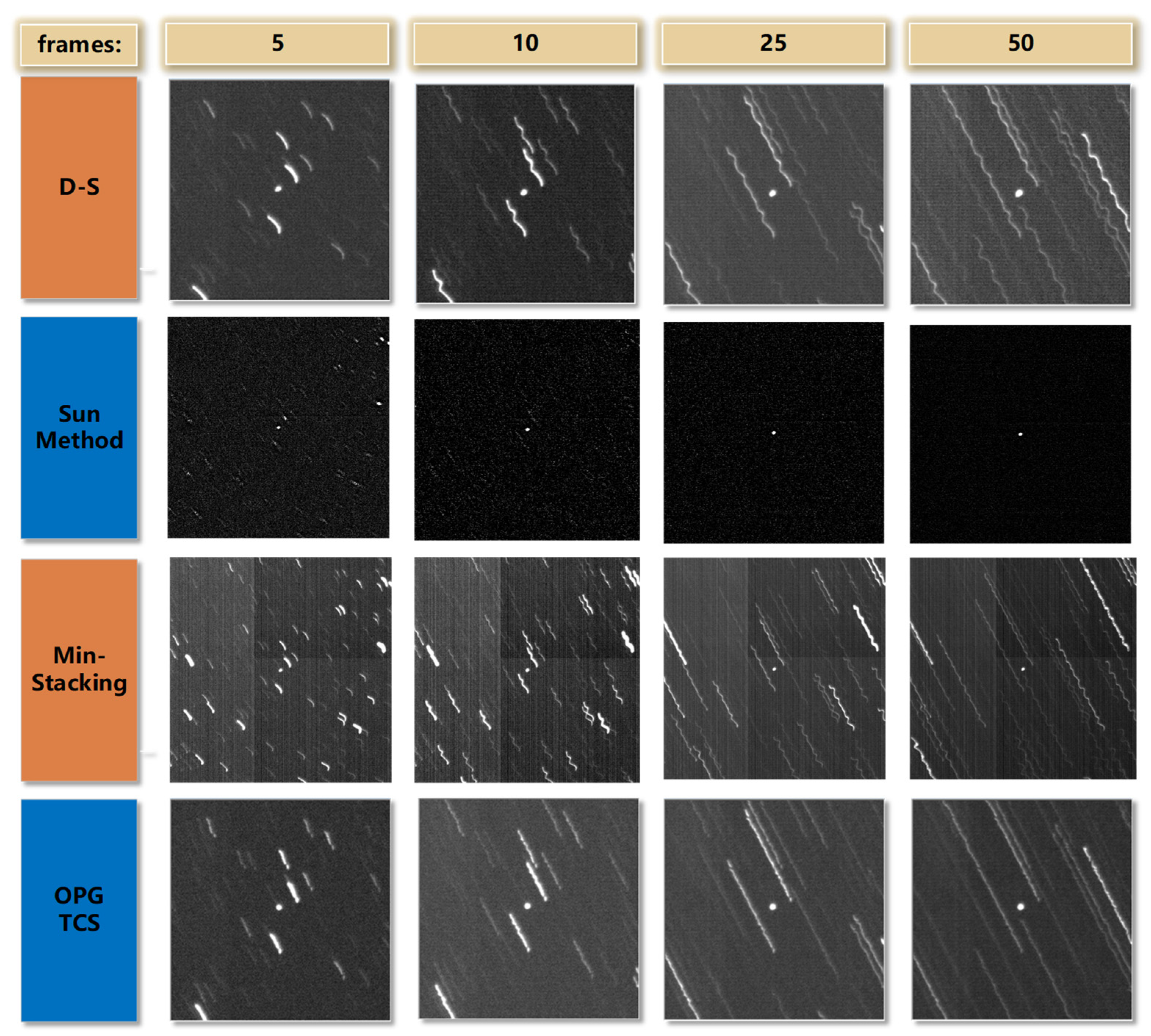
As the number of stacked frames increases, all methods can suppress random noise and enhance local contrast to some extent, but their enhancement behaviors exhibit significant differences. When platform disturbance and target relative motion coexist, DS tends to exhibit energy accumulation as local diffusion or structural stretching, making it difficult for the target to stably aggregate within the same pixel neighborhood. The Sun method demonstrates more pronounced suppression of background and stellar responses, effectively weakening background texture and stellar structure. However, its output dynamic range differs from direct accumulation-based results, resulting in relatively limited visual enhancement of the target. Min-Stacking enhances certain local responses but exhibits greater sensitivity to background structural variations and noise, with non-target responses showing significant sequence-dependent fluctuations. In contrast, orbit-prior-guided target-centered stacking demonstrates more stable target energy aggregation trends across different sequences and stacking frame counts. Notably, at higher stacking frame counts, target brightness concentration increases markedly, features become more compact, and the overall enhancement effect appears clearer, as illustrated in Figure 2.

4.2. Quantitative Performance Enhancement and Statistical Analysis

This section provides quantitative evidence for the performance of OPG-TCS under dynamic-platform observations. Detailed results on three representative sequences are reported in Section 4.2.1, followed by multi-sequence statistical analysis in Section 4.2.2 and a robustness evaluation under prior uncertainty in Section 4.2.3.

4.2.1. Quantitative Results on Three Representative Sequences

To quantitatively evaluate the enhancement performance of different multi-frame fusion strategies for faint-target observation on dynamic platforms, we conduct repeated comparative experiments on real dynamic-platform observation sequences under stacking sizes N = { 5 , 10 , 25 , 50 } . Considering the manuscript length and readability, three representative sequences are selected from the full dataset for detailed presentation. Specifically, Sequence A corresponds to a scenario with pronounced platform attitude disturbances and stronger field-of-view variations, Sequence B represents a case with relatively mild attitude perturbations and more stable viewing conditions, and Sequence C is selected to represent a faint-target enhancement case where the per-frame signal is weak and the enhancement outcome is more sensitive to accumulation stability. These three sequences jointly cover typical dynamic-platform conditions and provide representative evidence for both disturbed and relatively stable scenarios, as well as faint-target detection difficulty.
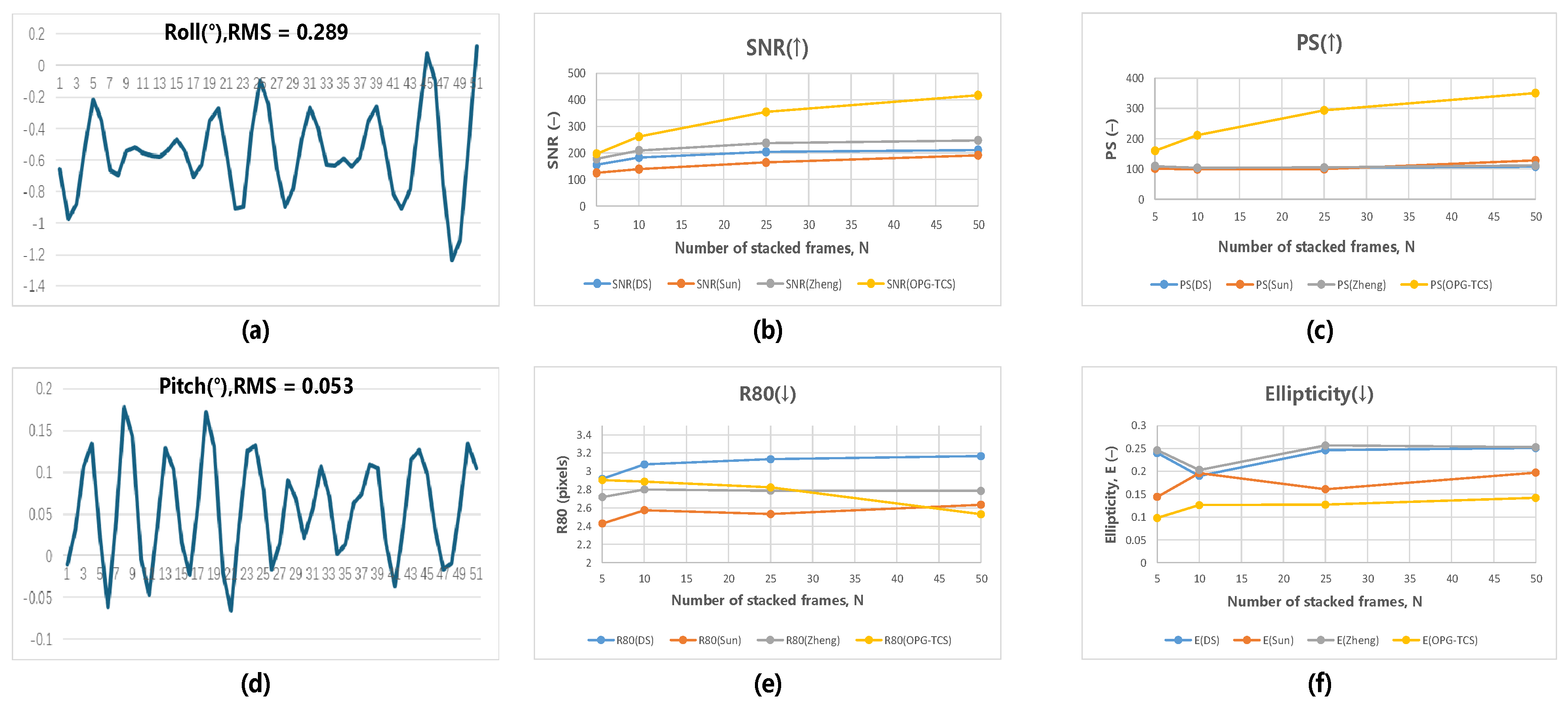
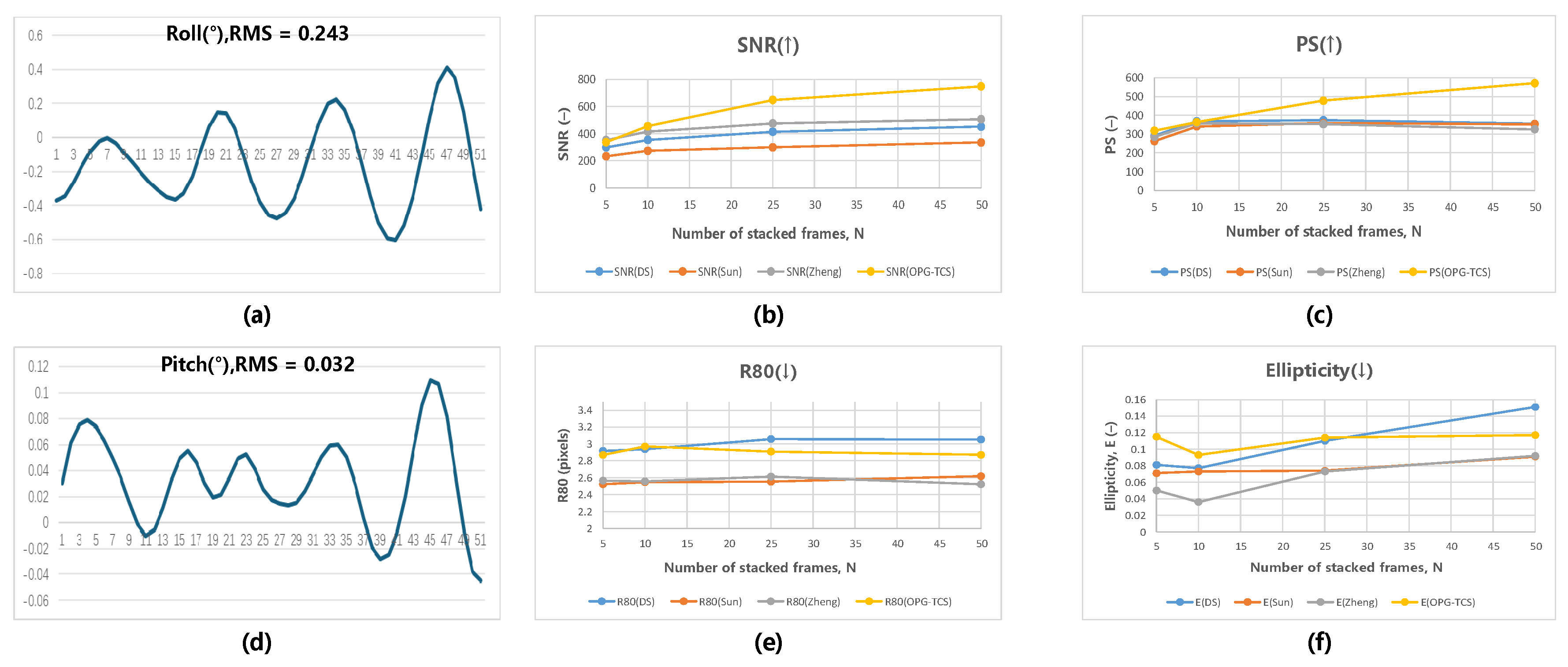
For each selected sequence, we compare direct stacking (DS), the Sun method (Sun), Zheng’s Min-Stacking (Min-Stacking), and the proposed OPG-TCS. The evaluation metrics follow the definitions in Section 3.3, including the SNR, the peak significance (PS), the 80% energy radius r 80 and ellipticity e . A larger SNR and PS indicate better target saliency and detectability, whereas smaller r 80 and e imply better energy concentration and shape stability. To characterize the dynamic observing background, platform attitude perturbation curves (roll/pitch) are also provided for Sequences A and B to facilitate interpretation of performance differences under varying disturbance conditions.
  • Sequence A: pronounced attitude perturbations
The quantitative results of Sequence A are summarized in Table 1, and the corresponding attitude perturbations and metric trends as a function of N are shown in Figure 3. Under pronounced disturbances, DS tends to suffer from diffusion and limited accumulation, while OPG-TCS maintains a more stable enhancement trend as N increases. At N = 50 , OPG-TCS achieves SNR = 417.33 and PS = 350.46, demonstrating clear advantages in detectability-related metrics. The compactness/shape-related metrics further indicate that target responses can be more stably accumulated in the target-centered reference frame under severe inter-frame inconsistency.
  • Sequence B: relatively mild attitude perturbations
The quantitative results of Sequence B are summarized in Table 2, and the corresponding attitude perturbations and metric trends are shown in Figure 4. Compared with Sequence A, the platform attitude variations are milder and all methods generally benefit from increasing N . Nevertheless, OPG-TCS still preserves a stronger accumulation advantage in detectability. At N = 50 , OPG-TCS reaches SNR = 748.12 and PS = 571.37, indicating robust signal integration under relatively stable observation conditions. Meanwhile, the compactness-related metrics suggest that some background/statistics-based baselines can remain competitive in preserving point-source morphology when disturbances are weak, whereas the primary strength of OPG-TCS lies in maintaining stable cross-frame accumulation for detection-oriented enhancement.
  • Sequence C: faint-target enhancement case
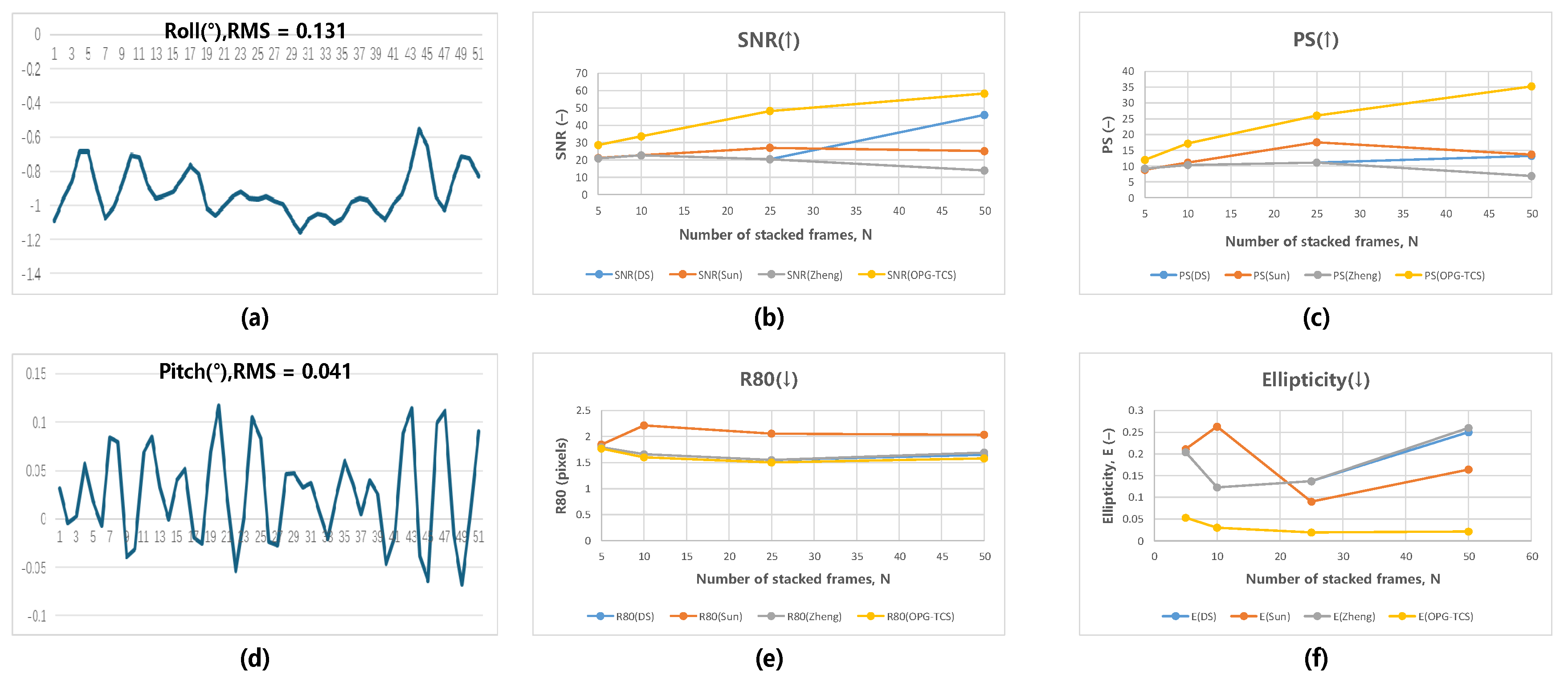
To further demonstrate the effectiveness of OPG-TCS under challenging faint-target conditions, we additionally include Sequence C for detailed analysis. The quantitative results are summarized in Table 3, and the metric trends with respect to N are shown in Figure 5. OPG-TCS exhibits consistent gains with increasing N and achieves markedly higher detectability-related metrics than the baselines. At N = 50 , OPG-TCS attains SNR = 58.258 and PS = 35.252, confirming that the proposed target-centered stacking strategy can still provide robust multi-frame signal integration when the per-frame target signal is weak. The corresponding compactness and shape metrics further support that the fused target responses remain stable under this low-visibility setting.
Overall, these three representative cases provide intuitive quantitative evidence under different dynamic-platform disturbance conditions and target visibility levels. In the next subsection, we further summarize the performance over the full dataset and provide statistical significance analysis across all sequences.

4.2.2. Statistical Performance over Eight Sequences

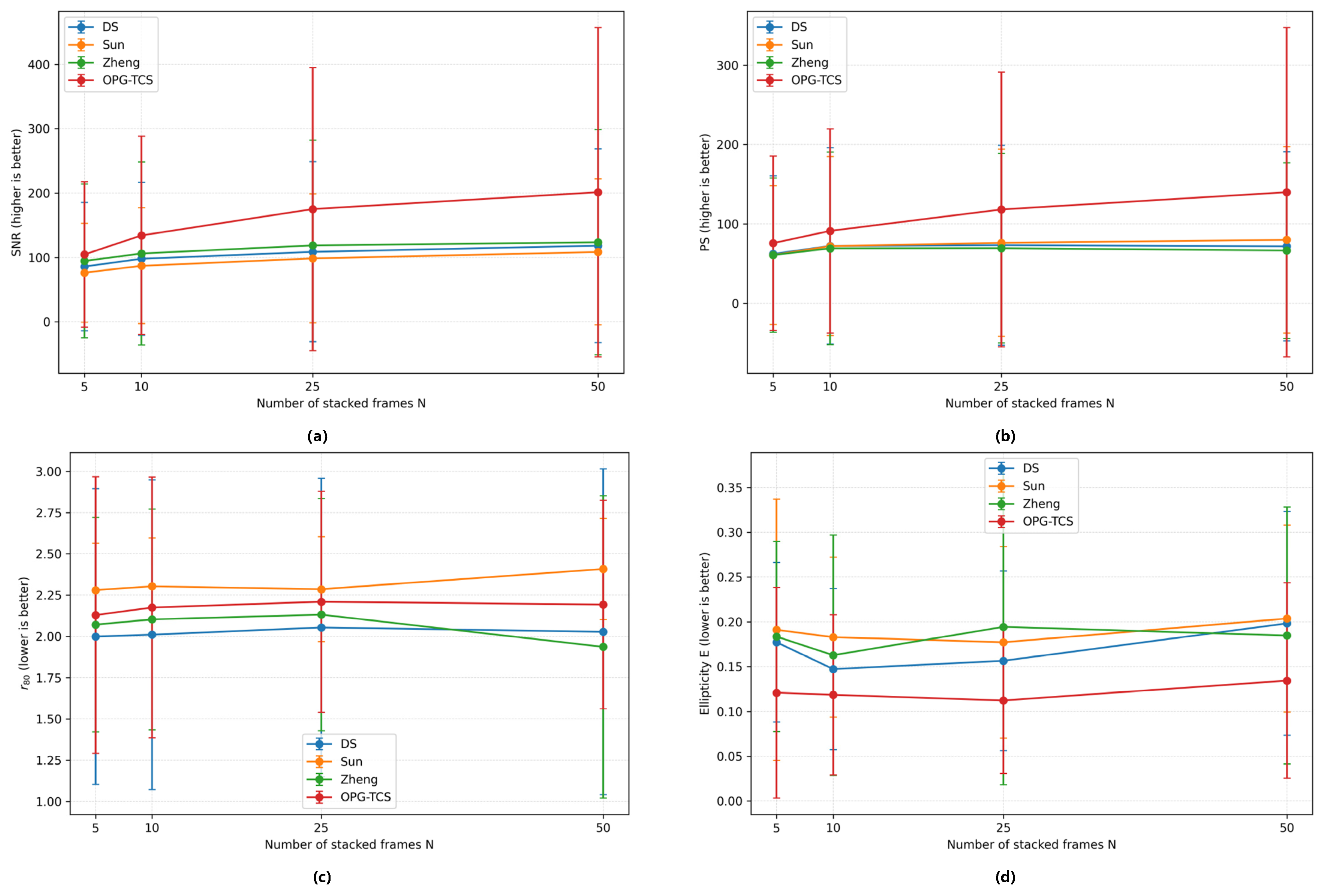
To further verify that the observed gains are not limited to individual cases, we conduct an overall statistical evaluation on the full dataset consisting of eight dynamic-platform observation sequences. For each sequence, we compute the four metrics under stacking sizes N = { 5 , 10 , 25 , 50 } for all compared methods. Figure 6 summarizes the cross-sequence mean ± standard deviation trends as a function of N , where OPG-TCS demonstrates consistently stronger accumulation in detectability-related metrics with increasing stacking length.
To quantify the overall performance margins and assess statistical significance, we perform paired tests on a per-sequence basis at N = 50 , which corresponds to the largest stacking length and thus represents the most informative operating point for multi-frame enhancement. To unify the metric direction, we define the relative improvement for SNR/PS as m OPG m base / m base , while for r 80 and e we use the relative reduction m base m OPG / m base , such that positive values always indicate better performance of OPG-TCS. The averaged relative gains and the corresponding paired Wilcoxon signed-rank test results are reported in Table 4.
For an SNR at N = 50 , OPG-TCS yields statistically significant improvements over all baselines, achieving average relative gains of 97.5% ± 90.2% over DS, 78.8% ± 56.6% over the Sun method, and 180.5% ± 148.4% over Min-Stacking, with p = 0.0078 for all three paired comparisons. For PS, OPG-TCS also exhibits clear advantages: the average PS gains are 124.7% ± 99.0% over DS ( p = 0.0156 ) and 191.3% ± 126.7% over Min-Stacking ( p = 0.0078 ) , while the comparison against the Sun method is marginal (74.2% ± 76.1%, p = 0.0547 ), indicating that background-/statistics-based strategies can remain competitive in peak significance for some relatively mild or favorable sequences.
Regarding compactness-related metrics, the statistical trends are mixed. Ellipticity is significantly reduced by OPG-TCS compared to DS (24.2% ± 37.5%, p = 0.0391 ) and the Sun method (37.3% ± 37.5%, p = 0.0156 ), indicating improved suppression of directional elongation in the fused target responses. In contrast, r 80 shows mixed and statistically non-significant changes across sequences (Table 4), suggesting that the compactness behavior may depend on the specific disturbance pattern, local background statistics, and the interaction between residual subpixel misalignment and metric sensitivity. Overall, these multi-sequence statistics support that the proposed OPG-TCS delivers robust and statistically significant gains in detectability (SNR/PS) across dynamic-platform observations, while compactness-related improvements (especially r 80 ) may vary among sequences.

4.2.3. Robustness Under Prior Uncertainty in Target Pixel Prediction

Following the prior-uncertainty sensitivity setting described in Section 3.2, we evaluate the robustness of OPG-TCS under imperfect target pixel predictions by injecting zero-mean 2D Gaussian perturbations into the predicted target pixel coordinates before target-centered cropping and stacking. Specifically, ( u t , v t ) = ( u t + Δ u , v t + Δ v ) with Δ u , Δ v ~ N ( 0 , σ 2 ) , where σ { 0 , 0.5 , 1.5 , 3 } in pixels. The upper bound σ = 3 pixels is selected based on an end-to-end error-budget analysis of the orbit-to-pixel projection chain: the time-tagging uncertainty (~10 ns) yields a negligible angular error for the considered medium-to-high orbit targets; after mount calibration, the residual pointing/tracking error is within ~2 arcsec; the astrometric calibration residual (including the WCS solution and distortion modeling) is within ~5 arcsec; and the residual error after atmospheric-refraction correction is within ~2 arcsec, while other error terms are negligible in our implementation. Even when these contributions are conservatively combined, the expected bound remains well below 18 arcsec; therefore, σ = 3 pixels (≈18 arcsec under our plate scale) is used as a conservative operational upper bound for worst-case robustness evaluation, whereas σ = 0.5 and 1.5 pixels correspond to approximately 3 and 9 arcsec, respectively. All metrics are computed under the same evaluation protocol described in Section 4.2.1 and Section 4.2.2 for stacking sizes N = { 5 , 10 , 25 , 50 } .
Table 5 summarizes the quantitative degradation of OPG-TCS with increasing projection uncertainty. As expected for target-centered stacking, the detectability-related metrics decrease as the prediction error grows, while compactness-related metrics deteriorate due to energy dispersion. At small perturbation levels ( σ = 0.5   px ) , the SNR remains largely stable across stacking sizes; for N = 50 , the SNR changes from 367.883 at σ = 0 to 362.901 at σ = 0.5   px . In contrast, PS exhibits a more noticeable reduction; for N = 50 , PS decreases from 319.734 to 259.652, indicating that peak-based saliency is more sensitive to residual mis-centering. When the perturbation increases to σ = 1.5   px , the degradation becomes more evident, particularly for PS, which is consistent with the dilution of peak intensity caused by accumulated misalignment in the target-centered reference frame. Under a larger perturbation ( σ = 3   px ) , a severe failure mode is observed. For N = 50 , the SNR decreases to 228.653 and the PS to 48.167, while the energy concentration degrades substantially; r 80 increases from 2.931 at σ = 0   px to 5.673 at σ = 3   px , confirming pronounced energy spreading in the fused response.
To summarize the robustness trend, Table 5 reports the metric variations with respect to the perturbation level σ . Overall, the results indicate that OPG-TCS is stable under small pixel-level uncertainties, while performance degrades as the perturbation magnitude increases. This behavior is consistent with the target-centered stacking mechanism: accurate target localization is required to preserve coherent energy accumulation, and increasing projection errors effectively convolve the target response with a random jitter kernel, thereby reducing peak saliency and enlarging the energy radius.

4.3. Geometric Consistency Analysis Under Dynamic-Platform Disturbances

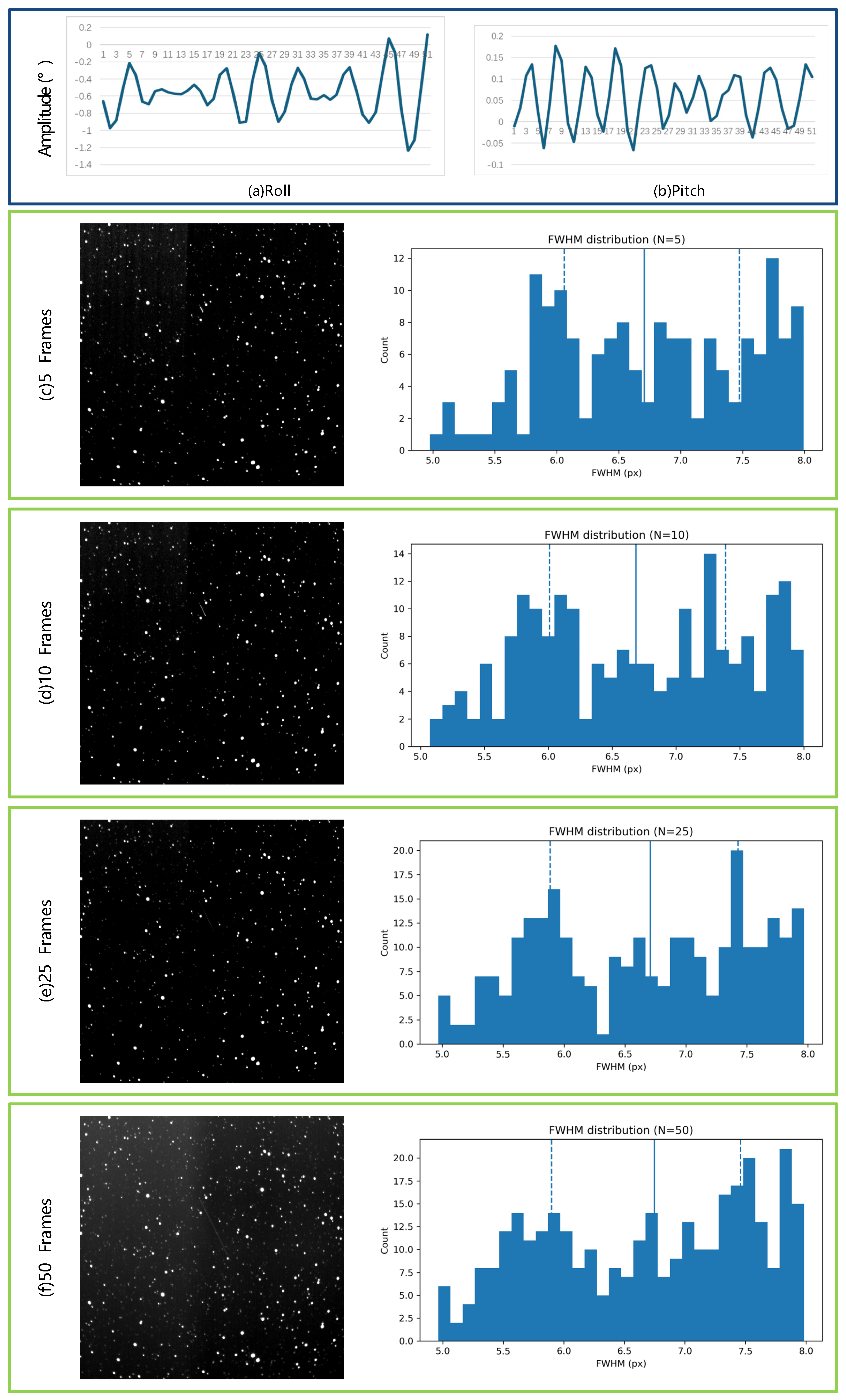
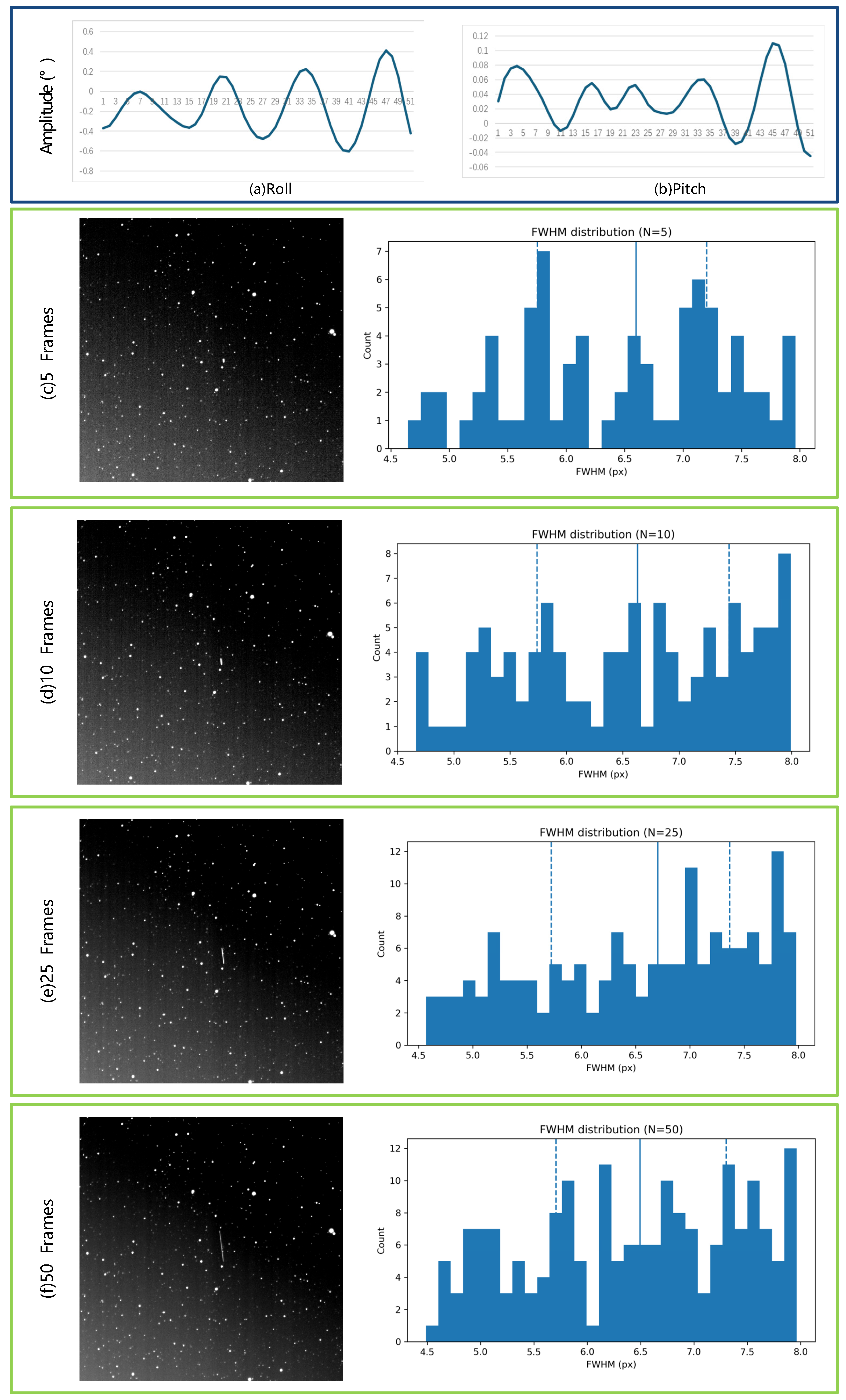
In dynamic-platform observation sequences, platform attitude perturbations and field-of-view jumps can cause rapid changes in the inter-frame imaging geometry, thereby affecting whether stable cross-frame geometric alignment can be established in the star-reference frame. To verify whether our data still satisfy the basic assumption of WCS-based registration and stacking under disturbed conditions, we select two representative observation sequences (Figure 7 and Figure 8) for diagnostic analysis. First, the temporal variations of the platform pointing in roll (roll) and pitch (pitch) are provided to characterize the disturbance amplitude and fluctuation frequency over the corresponding time intervals. Then, astrometric calibration is performed independently for each frame, and all frames are reprojected into a unified celestial reference frame for WCS stacking; the stacking results for the N = { 5 , 10 , 25 , 50 } frames are shown. Finally, the distribution of stellar full width at half maximum (FWHM) is used as a quantitative indicator to evaluate whether the stellar PSF exhibits systematic broadening with different stacking lengths, thereby reflecting the stability of geometric alignment and potential degradation introduced by resampling.
From the two sequences, we observe that although the attitude disturbance patterns differ (the roll/pitch curves in Figure 7 exhibit higher-frequency fluctuations with occasional abrupt local changes, whereas those in Figure 8 are smoother but show pronounced low-frequency trends), the overall star field still maintains good spatial consistency after frame-wise astrometric calibration and unified reprojection. Specifically, (1) during stacking from N = 5 to N = 50 , stellar images do not show increasingly pronounced “ghosting” or elongation with larger N , indicating that registration errors in the star-reference frame are generally controllable; (2) for both sequences, the FWHM distributions remain similar across different N , with comparable medians and interquartile ranges, and the median (solid line) does not exhibit a systematic shift as N increases, suggesting that WCS stacking does not introduce observable cumulative PSF broadening. These results indicate that, for the dynamic-platform data considered in this work, despite the presence of attitude perturbations and pointing variations, star-field-based WCS solving and reprojection can still provide a stable global geometric reference for multi-frame stacking, satisfying the “star-reference-frame consistency” requirement for subsequent fusion processing.

5. Discussion

This section discusses the experimental results from a broader perspective, focusing on the underlying mechanisms, comparative advantages, and applicability boundaries of the proposed OPG-TCS method for Space Surveillance and Tracking (SST), particularly in dynamic-platform optical observations where stable detection and measurement are prerequisites for subsequent tracking and catalog maintenance.

5.1. Interpretation of Performance Gains Under Dynamic-Platform Disturbances

The experimental results demonstrate that OPG-TCS consistently achieves more stable and monotonic performance improvements with increasing stacking length N , particularly under pronounced platform attitude disturbances. Unlike direct stacking (DS), whose SNR and PS gains tend to saturate or even degrade as inter-frame geometric inconsistency accumulates, OPG-TCS benefits from constructing a target-centered reference frame guided by orbit priors. This design effectively decouples target energy accumulation from global frame-to-frame geometric instability, allowing coherent signal integration even when platform roll, pitch, and field-of-view variations are significant. This stabilization is beneficial for SST pipelines because it increases detection reliability and reduces the variability of target measurements when initiating or maintaining tracks under dynamic observation conditions.
The observed suppression of energy diffusion and directional elongation (as reflected by reduced r 80 and ellipticity) indicates that the proposed strategy mitigates the adverse effects of inter-frame misalignment that commonly arise in dynamic-platform observations. These results suggest that the performance gains of OPG-TCS are not merely incremental improvements over existing stacking strategies, but stem from a fundamentally different alignment paradigm that shifts the focus from full-frame geometric consistency to target-centered geometric stability. From an SST perspective, preserving energy concentration under disturbance helps avoid gain instability, which can otherwise hinder track initiation across varying stacking depths.

5.2. Comparison with Background- and Statistics-Based Enhancement Strategies

Comparative experiments reveal that background- and statistics-driven approaches, such as Min-Stacking and the Sun method, can exhibit competitive performance under relatively mild disturbance conditions, particularly in terms of point-source compactness. This behavior explains why, in some sequences with smoother platform motion, OPG-TCS does not always yield the minimum r 80 among all methods.
However, these methods inherently rely on implicit assumptions about background stationarity or star-field behavior, becoming increasingly fragile under strong attitude perturbations or abrupt field-of-view changes. In contrast, OPG-TCS explicitly leverages orbit priors to maintain geometric coherence in the target-centered reference frame. As a result, its primary advantages manifest in enhanced detectability and peak significance (SNR/PS), as well as in the robustness of cross-frame accumulation, rather than in purely morphological compactness under ideal conditions. This emphasis aligns with SST practice, where robust detectability and repeatable target measurements are often more critical than achieving the most compact point-source appearance under ideal conditions.
This trade-off highlights an important distinction between enhancement strategies optimized for static or quasi-static platforms and those designed for dynamic-platform scenarios, where robustness to geometric instability becomes a dominant factor.

5.3. Role of WCS Accuracy and Geometric Consistency in Multi-Frame Fusion

The WCS-based geometric consistency diagnostics indicate that, despite platform attitude disturbances and pointing variations, frame-wise astrometric calibration and reprojection can still provide a stable global reference for multi-frame stacking. The absence of systematic FWHM broadening across different stacking lengths confirms that WCS alignment does not introduce cumulative PSF degradation in the examined dynamic-platform datasets. This supports the feasibility of using star-based astrometric calibration as an operational reference in SST optical tracking, especially for follow-up observations where star fields remain available.
It is worth noting that the effectiveness of OPG-TCS does not require extremely high absolute astrometric precision; rather, it depends on maintaining consistent relative geometric mappings across frames. This observation underscores that, in dynamic-platform observations, geometric stability and consistency are often more critical than nominal single-frame astrometric accuracy for successful multi-frame fusion. Such relative consistency is typically sufficient to support downstream SST tasks that depend on stable inter-frame measurement geometry rather than milliarcsecond-level absolute astrometry.

5.4. Limitations of OPG-TCS

Although OPG-TCS demonstrates stable enhancement gains under dynamic-platform observation conditions, several practical limitations should be acknowledged. First, the method relies on per-frame astrometric calibration to establish a physically consistent geometric reference. In practice, this requires that a sufficient number of stellar sources can be reliably detected and matched in each frame, so that the WCS solution remains stable and the orbit-to-pixel mapping is meaningful. When the star field becomes sparse or the stellar measurements degrade, the robustness of the WCS solving stage may be reduced, which may further limit the overall applicability of the proposed workflow.
Second, OPG-TCS introduces additional computational overhead compared with purely image-domain stacking baselines. The main cost comes from astrometric calibration and WCS-related processing, together with orbit-prior projection, while the subsequent target-centered cropping/alignment operations are relatively lightweight. To provide a transparent engineering reference, we profiled the main processing stages on a workstation quipped with an AMD Ryzen 7 5800H CPU, 32 GB RAM, and an NVIDIA RTX 3070 GPU, using 16-bit 4096 × 4096 frames. In our current implementation, per-frame WCS solving takes approximately 12–14 s, star-catalog association takes approximately 2.8–5 s, orbit-to-pixel projection takes approximately 0.9 s, and target-centered cropping/stacking takes approximately 0.021 s. Therefore, the end-to-end processing time is approximately 15.7–19.9 s per frame, where WCS solving is the primary bottleneck. From a computational-complexity perspective, the dominant term arises from full-frame source extraction and WCS solving over P = H × W pixels, whereas orbit projection is O ( 1 ) per frame, given the WCS model evaluation, and target-centered stacking is O ( S ) , with S = h × w being the cutout size (fixed to 1024 × 1024 in this work). These observations explain why the current pipeline is most suitable for offline post-processing and near-real-time analysis depending on implementation and hardware, while strict real-time deployment primarily depends on optimizing and/or amortizing the WCS solving stage.
Third, the effectiveness of OPG-TCS is inherently linked to the availability and accuracy of orbit priors. For cooperative targets with high-quality ephemerides, the orbit-guided pixel prediction can provide a stable alignment anchor. However, for non-cooperative objects such as space debris, orbit prediction errors and uncertainty in the prior may introduce pixel-level offsets in the predicted target position, which can degrade target-centered alignment quality and reduce the achievable enhancement gain. This limitation motivates the sensitivity analysis with pixel-level prior perturbations presented in this work.
Finally, it is worth noting the operational regime in which OPG-TCS tends to be most beneficial. When platform motion becomes more aggressive—particularly when inter-frame rotation and field-of-view discontinuity are pronounced—methods that implicitly depend on global image-plane consistency, such as direct accumulation without a reliable alignment anchor, are more likely to suffer from energy diffusion and unstable gain. In contrast, OPG-TCS leverages an orbit-guided target-centered reference frame and therefore tends to preserve more stable local accumulation, making its relative advantage more evident under stronger platform-induced geometric instability.

5.5. Future Work

Future work will focus on improving the robustness, computational efficiency, and operational flexibility of OPG-TCS under realistic observing constraints. First, we will further investigate adaptive strategies for handling orbit-prior uncertainty, including uncertainty-aware cropping and alignment as well as a more systematic characterization of the tolerance range under different prior error levels. Second, we will explore computational optimizations of the overall pipeline, with particular emphasis on the WCS solving stage that dominates the current runtime. The optimization directions include algorithmic acceleration, parallel implementation, and reuse of intermediate products when applicable, with the goal of improving processing efficiency and facilitating deployment in near-real-time operational pipelines. Third, we will examine how the enhanced measurements produced by OPG-TCS can support downstream tasks, including improved detection readiness, tracking continuity, and orbit refinement in catalog maintenance workflows.

6. Conclusions

This paper proposed an orbit-prior-guided target-centered multi-frame fusion method (OPG-TCS) for enhancing faint space targets observed from dynamic platforms. By combining frame-wise astrometric calibration with orbit-prior-based target position prediction, the proposed approach constructs a target-centered reference frame that enables stable energy accumulation under platform attitude disturbances and field-of-view variations.
Extensive experiments on real dynamic-platform observation sequences demonstrate that OPG-TCS achieves more stable and consistent improvements in detectability and peak significance compared with direct stacking and representative background-based enhancement methods. The method effectively suppresses energy diffusion and shape degradation under strong disturbances, while maintaining robust performance across different stacking lengths. Geometric consistency diagnostics further confirm that WCS-based alignment provides a reliable global reference for multi-frame fusion in dynamic-platform scenarios.
These results indicate that OPG-TCS offers a practical and robust solution for faint-target enhancement in dynamic-platform optical observations, with potential applications in space situational awareness and related observation tasks.

Author Contributions

Conceptualization, L.Q.; methodology, L.Q., J.L., H.L. and Z.W.; software, L.Q.; investigation, L.Q. and J.L.; resources, J.L., H.L. and Z.W.; supervision, J.L., H.L., Z.W., J.W. and K.Y.; project administration, J.L., J.W. and K.Y.; writing—original draft preparation, L.Q.; writing—review and editing, J.L., H.L. and Z.W. All authors have read and agreed to the published version of the manuscript.

Funding

This work was supported in part by the Technology Innovation Guidance Program of Jilin Province under Grant numbers 20240404002ZP and in part by the Xuguang Talent Program of the Changchun Institute of Optics, Fine Mechanics and Physics, Chinese Academy of Sciences.

Data Availability Statement

Restrictions apply to the availability of the data. The observation image sequences and orbit-prior data used in this study are not publicly available due to institutional regulations and confidentiality constraints, but may be available from the corresponding author upon reasonable request and with permission of the data owner.

Acknowledgments

The authors thank the editors and anonymous reviewers for their constructive suggestions.

Conflicts of Interest

The authors declare no conflicts of interest.

References

  1. Abbot, R.I.; Wallace, T.P. Decision Support in Space Situational Awareness. Linc. Lab. J. 2007, 16, 297–335. [Google Scholar]
  2. Kazemi, S.; Azad, N.L.; Scott, K.A.; Oqab, H.B.; Dietrich, G.B. Orbit Determination for Space Situational Awareness: A Survey. Acta Astronaut. 2024, 222, 272–295. [Google Scholar] [CrossRef]
  3. Schildknecht, T. Optical Surveys for Space Debris. Astron. Astrophys. Rev. 2007, 14, 41–111. [Google Scholar] [CrossRef]
  4. Kuhn, J.; Lodieu, N.; López, R.R.; Arteaga-Marrero, N.; Cunnyngham, I.; Fernández-Izquierdo, P.; Padrón-Brito, A.; Tamayo-Guzmán, D.; Ruiz-Sabina, A.; Sola-La-Serna, P.; et al. Creating Ground-Based Telescopes for Imaging Interferometry: SELF and ELF. Light Adv. Manuf. 2025, 6, 459–473. [Google Scholar] [CrossRef]
  5. He, D. Shipborne Acquisition, Tracking, and Pointing Experimental Verifications towards Satellite-to-Sea Laser Communication. Appl. Sci. 2019, 9, 3940. [Google Scholar] [CrossRef]
  6. Zhai, C.; Shao, M.; Saini, N.; Choi, P.; Evans, N.; Trahan, R.; Nazli, K.; Zhan, M. Near-Earth Object Observations Using Synthetic Tracking. Publ. Astron. Soc. Pac. 2024, 136, 034401. [Google Scholar] [CrossRef]
  7. Sun, R.; Zhan, J.; Zhao, C.; Zhang, X. Algorithms and Applications for Detecting Faint Space Debris in GEO. Acta Astronaut. 2015, 110, 9–17. [Google Scholar] [CrossRef]
  8. Xi, J.; Wen, D.; Ersoy, O.K.; Yi, H.; Yao, D.; Song, Z.; Xi, S. Space Debris Detection in Optical Image Sequences. Appl. Opt. 2016, 55, 7929–7940. [Google Scholar] [CrossRef]
  9. Zheng, K.; Xu, C.; Zhang, Y.; Qiu, J.; Wang, X. Geostationary Orbit Target Detection Based on Min-Stacking Method. Aerospace 2025, 12, 834. [Google Scholar] [CrossRef]
  10. Dai, Y.; Zheng, T.; Xue, C.; Zhou, L. Effective Multi-Frame Optical Detection Algorithm for GEO Space Objects. Appl. Sci. 2022, 12, 4610. [Google Scholar] [CrossRef]
  11. Liu, J.; Yu, F.; Yang, Y.; Wu, Y. Modular Detection Framework for Space Targets in Short-Exposure Imagery. Adv. Space Res. 2026; in press. [Google Scholar] [CrossRef]
  12. Reynaud, F.; Abrate, M.; Coretti, A.G.; Bertaina, M.E.; Frasson, A.; Montanaro, A.; Bonino, R.; Sirovich, R. Space Debris Detection from Orbit: A Prototype Detector Study. J. Space Saf. Eng. 2026; in press. [Google Scholar] [CrossRef]
  13. Lang, D.; Hogg, D.W.; Mierle, K.; Blanton, M.; Roweis, S. Astrometry.Net: Blind Astrometric Calibration of Arbitrary Astronomical Images. Astron. J. 2010, 139, 1782–1800. [Google Scholar] [CrossRef]
  14. Greisen, E.W.; Calabretta, M.R. Representations of World Coordinates in FITS. Astron. Astrophys. 2002, 395, 1061–1075. [Google Scholar] [CrossRef]
  15. Calabretta, M.R.; Greisen, E.W. Representations of Celestial Coordinates in FITS. Astron. Astrophys. 2002, 395, 1077–1122. [Google Scholar] [CrossRef]
  16. Vallenari, A.; Brown, A.G.A.; Prusti, T. Gaia Data Release 3-Summary of the Content and Survey Properties. Astron. Astrophys. 2023, 674, A1. [Google Scholar]
  17. Shao, M.; Nemati, B.; Zhai, C.; Turyshev, S.G.; Sandhu, J.; Hallinan, G.; Harding, L.K. Finding Very Small Near-Earth Asteroids Using Synthetic Tracking. Astrophys. J. 2014, 782, 1. [Google Scholar] [CrossRef]
  18. Ping, Y.; Zhang, C.; Lu, C. The Representation of OTA Images’ Astrometric Results with WCS-SIP Coefficients. Acta Astron. Sin. 2017, 58, 79–88. [Google Scholar] [CrossRef]
  19. Shupe, D.L.; Moshir, M.; Li, J.; Makovoz, D.; Narron, R.; Hook, R.N. The SIP Convention for Representing Distortion in FITS Image Headers. In Astronomical Data Analysis Software and Systems XIV Astronomical Society of the Pacific Conference Series; Shopbell, P.L., Britton, M.C., Ebert, R., Eds.; Astronomical Society of the Pacific: San Francisco, CA, USA, 2005; Volume 347, p. 491. [Google Scholar]
  20. Gao, W.; Zhou, W.; Tang, C.; Li, X.; Yuan, Y.; Hu, X. High-Precision Services of BeiDou Navigation Satellite System (BDS): Current State, Achievements, and Future Directions. Satell. Navig. 2024, 5, 20. [Google Scholar] [CrossRef]
  21. Guo, R.; Hu, X.; Tang, B.; Huang, Y.; Liu, L.; Cheng, L.; He, F. Precise Orbit Determination for Geostationary Satellites with Multiple Tracking Techniques. Chin. Sci. Bull. 2010, 55, 687–692. [Google Scholar] [CrossRef]
  22. Fiore, S.; Vananti, A.; Schildknecht, T. A High-Level Motion Control Scheme for Satellite Tracking Using Optical Feedback. In Proceedings of the 9th European Conference on Space Debris, Bonn, Germany, 1–4 April 2025; ESA Space Debris Office: Darmstadt, Germany, 2025. [Google Scholar]
  23. Zhang, Y.; Wang, H.; Li, H.; Sun, J.; Liu, H.; Yin, Y. Optimization Model of Signal-to-Noise Ratio for a Typical Polarization Multispectral Imaging Remote Sensor. Sensors 2022, 22, 6624. [Google Scholar] [CrossRef] [PubMed]
  24. Patton, R.A.; Caiazzo, I.; Johnston, C.; Bauer, E.; Götberg, Y. The Rotation of Magnetic White Dwarfs; Max Planck Institut für Astrophysik (MPA): Garching, Germany, 2023. [Google Scholar]
  25. Tan, H.; Ma, D. Recommended Optical System Design for the SSST. Appl. Opt. 2020, 59, 3508–3517. [Google Scholar] [CrossRef] [PubMed]
  26. Asztalos, S.; de Vries, W.H.; Rosenberg, L.J.; Treadway, T.; Burke, D.; Claver, C.; Saha, A.; Puxley, P. Properties of Ellipticity Correlation with Atmospheric Structure from Gemini South. Astrophys. J. 2007, 659, 69–75. [Google Scholar] [CrossRef]
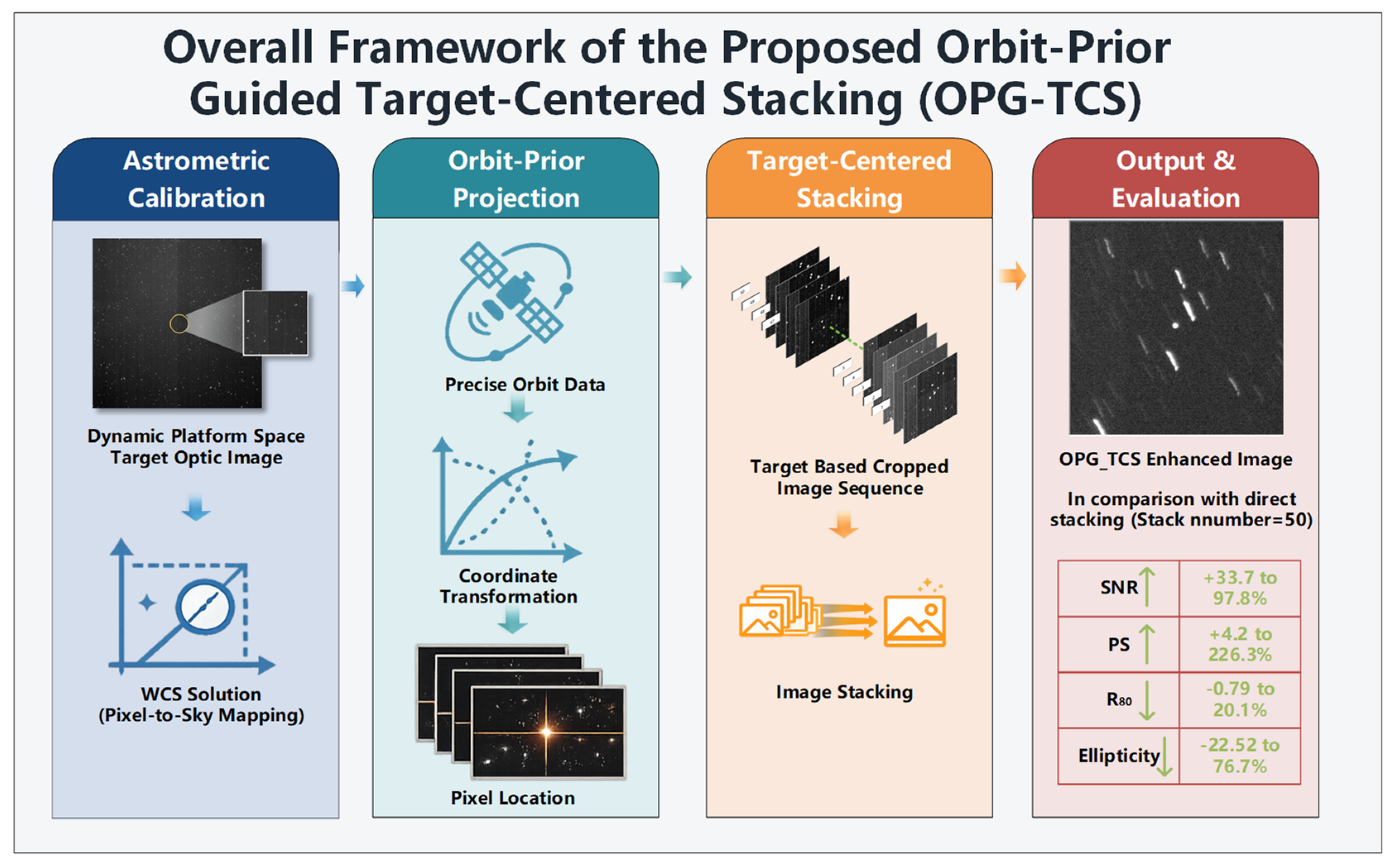
Figure 1. Overall framework of the proposed orbit-prior-guided target-centered stacking (OPG-TCS).
Aerospace 13 00279 g001
Figure 2. Comparison of visual enhancement effects from multi-frame fusion ( N = 5 , 10 , 25 , 50 ). The rows are, in order: direct stacking (DS), the Sun method (Sun), Min-Stacking (Zheng), and OPG-TCS.
Aerospace 13 00279 g002
Figure 3. Platform attitude perturbations and quantitative metrics of Sequence A as a function of the number of stacked frames ( N = 5 , 10 , 25 , 50 ) : (a) roll (°); (d) pitch (°); (b) SNR (↑); (c) PS (↑); (e) r 80 (↓); and (f) ellipticity (↓). The compared methods include direct stacking (DS), the Sun method (Sun), Min-Stacking (Zheng), and the proposed OPG-TCS.
Aerospace 13 00279 g003
Figure 4. Platform attitude perturbations and quantitative metrics of Sequence B as a function of the number of stacked frames ( N = 5 , 10 , 25 , 50 ) . (a) Roll (°); (d) pitch (°); (b) SNR (↑); (c) PS (↑); (e) r 80 (↓); and (f) ellipticity (↓). The compared methods include direct stacking (DS), the Sun method (Sun), Min-Stacking (Zheng), and the proposed OPG-TCS.
Aerospace 13 00279 g004
Figure 5. Platform attitude perturbations and quantitative metrics of Sequence C as a function of the number of stacked frames ( N = 5 , 10 , 25 , 50 ) . (a) Roll (°); (d) pitch (°); (b) SNR (↑); (c) PS (↑); (e) r 80 (↓); and (f) ellipticity (↓). The compared methods include direct stacking (DS), the Sun method (Sun), Min-Stacking (Zheng), and the proposed OPG-TCS.
Aerospace 13 00279 g005
Figure 6. Cross-sequence statistical trends of quantitative metrics versus the number of stacked frames N over eight dynamic-platform observation sequences. The curves report the mean values with error bars indicating the standard deviation (mean ± std) across sequences for four methods (DS, Sun, Zheng, and OPG-TCS): (a) SNR (higher is better), (b) PS (higher is better), (c) r 80 (lower is better), and (d) e ellipticity (lower is better).
Aerospace 13 00279 g006
Figure 7. Platform attitude perturbations and WCS-stacking geometric consistency diagnostics for a dynamic-platform observation sequence (Sequence A). (a) Roll and (b) pitch versus time; (cf) WCS-stacked images and stellar FWHM histograms for the N = 5 , 10 , 25 , 50 frames. In each histogram, dashed lines indicate the median and the first/third quartiles. No evident FWHM broadening is observed with increasing N , suggesting stable PSFs and consistent WCS alignment under attitude disturbances.
Aerospace 13 00279 g007
Figure 8. Platform attitude perturbations and WCS-stacking geometric consistency diagnostics for a dynamic-platform observation sequence (Sequence B). (a) Roll and (b) pitch versus time; (cf) WCS-stacked images and stellar FWHM histograms for N = 5 , 10 , 25 , 50 frames. In each histogram, dashed lines indicate the median and the first/third quartiles. No evident FWHM broadening is observed with increasing N , suggesting stable PSFs and consistent WCS alignment under attitude disturbances.
Aerospace 13 00279 g008
Table 1. Quantitative performance comparison of four stacking strategies on Sequence A under different stacking numbers (N = 5, 10, 25, 50).
MetricMethodN = 5N = 10N = 25N = 50
SNR ↑DS155.4183.056203.989211.025
Sun124.95139.041164.635191.38
Zheng177.695209.105237.07247.454
OPG-TCS196.948261.751354.713 417.33
PS ↑DS105.397102.954103.372107.416
Sun100.87998.64799.079128.181
Zheng109.199103.38104.75111.008
OPG-TCS159.672211.121293.624350.463
r 80 DS2.9183.0763.1333.167
Sun2.4292.5742.5322.633
Zheng2.7182.8012.7872.785
OPG-TCS2.9042.8882.8242.53
e DS0.240.190.2460.251
Sun0.1440.1960.1610.197
Zheng0.2460.2030.2570.253
OPG-TCS0.0980.1260.1270.142
↑ indicates that larger values correspond to better performance, whereas ↓ indicates that smaller values are preferred.
Table 2. Quantitative performance comparison of four stacking strategies on Sequence B under different stacking numbers (N = 5, 10, 25, 50).
MetricMethodN = 5N = 10N = 25N = 50
SNR ↑DS297.701353.044413.24451.044
Sun232.691272.74298.642334.547
Zheng351.947414.514474.896505.645
OPG-TCS335.779454.99648.016748.117
PS ↑DS292.201368.059374.497354.948
Sun262.559340.754358.383352.499
Zheng284.772358.012352.942325.512
OPG-TCS317.843363.931478.308571.374
r 80 DS2.9172.9373.0583.052
Sun2.5222.5452.5532.618
Zheng2.5652.5572.6132.523
OPG-TCS2.8692.972.9092.871
e DS0.0810.0770.110.151
Sun0.0710.0730.0740.091
Zheng0.050.0360.0730.092
OPG-TCS0.1150.0930.1140.117
↑ indicates that larger values correspond to better performance, whereas ↓ indicates that smaller values are preferred.
Table 3. Quantitative performance comparison of four stacking strategies on Sequence C under different stacking numbers (N = 5, 10, 25, 50).
MetricMethodN = 5N = 10N = 25N = 50
SNR ↑DS20.86822.72420.35745.954
Sun21.13122.72926.9425.089
Zheng20.86822.72420.35713.923
OPG-TCS28.62933.61948.16858.258
PS ↑DS9.21310.3411.10113.21
Sun8.79511.11217.53613.662
Zheng9.21310.3411.1016.867
OPG-TCS11.94817.14225.98235.252
r 80 DS1.7951.661.5491.65
Sun1.8472.2142.0542.033
Zheng1.7951.661.5491.69
OPG-TCS1.7691.6021.5021.58
e DS0.2040.1230.1370.25
Sun0.2110.2630.090.164
Zheng0.2040.1230.1370.26
OPG-TCS0.0530.030.0190.021
↑ indicates that larger values correspond to better performance, whereas ↓ indicates that smaller values are preferred.
Table 4. Statistical comparison of OPG-TCS against three baselines over eight sequences at N = 50 . Relative gains are reported as mean ± std and median [IQR] across sequences; p-values are obtained by the paired Wilcoxon signed-rank test (two-sided).
MetricComparisonRelative Gain (%) (Mean ± Std)Relative Gain (%) (Median [IQR])Signed Absolute Gain (Mean ± Std)Wilcoxon p (Two-Sided)
SNR ↑vs. DS97.5 ± 90.259.4 [93.2]83.062 ± 107.7680.0078
vs. Sun78.8 ± 56.697.1 [104.9]92.846 ± 149.0220.0078
vs. Zheng180.5 ± 148.4143.1 [232.1]77.709 ± 82.2990.0078
PS ↑vs. DS124.7 ± 99.0114.6 [137.4]68.211 ± 100.2050.0156
vs. Sun74.2 ± 76.185.5 [118.7]59.990 ± 99.5440.0547
vs. Zheng191.3 ± 126.7203.9 [184.0]73.440 ± 104.6300.0078
r 80  ↓vs. DS−24.5 ± 45.6−5.2 [47.9]−0.165 ± 0.4790.3125
vs. Sun9.6 ± 20.713.1 [36.8]0.216 ± 0.5150.2500
vs. Zheng−29.2 ± 45.3−8.0 [61.2]−0.256 ± 0.4060.2500
e vs. DS24.2 ± 37.527.5 [37.2]0.064 ± 0.0820.0391
vs. Sun37.3 ± 37.533.0 [52.0]0.069 ± 0.0480.0156
vs. Zheng−9.9 ± 91.220.4 [86.9]0.050 ± 0.1070.3125
↑ indicates that larger values correspond to better performance, whereas ↓ indicates that smaller values are preferred.
Table 5. Quantitative robustness results of OPG-TCS under pixel-domain perturbations of the predicted target center. σ denotes the standard deviation of zero-mean 2D Gaussian noise (pixels). Metrics are reported for N = { 5 , 10 , 25 , 50 } , where SNR/PS are maximized, and r 80 /ellipticity e are minimized; r 80 is measured in pixels.
Metricσ (Pixel)N = 5N = 10N = 25N = 50
SNR ↑0.0188.505251.9336.467367.883
0.5183.322223.003286.051362.901
1.5170.918217.366300.904352.017
3.0128.581142.025173.472228.653
PS ↑0.0147.988194.092281.637319.734
0.5114.098148.374198.865259.652
1.585.449102.822107.788127.687
3.043.42443.76340.33248.167
r 80  ↓0.02.8222.7962.8322.931
0.53.0113.0893.0553.069
1.53.4173.7043.6893.876
3.05.9165.755.3825.673
e 0.00.0980.1120.1160.153
0.50.0430.1170.1350.142
1.50.1660.1930.1450.13
3.00.1880.2950.230.192
↑ indicates that larger values correspond to better performance, whereas ↓ indicates that smaller values are preferred.
Disclaimer/Publisher’s Note: The statements, opinions and data contained in all publications are solely those of the individual author(s) and contributor(s) and not of MDPI and/or the editor(s). MDPI and/or the editor(s) disclaim responsibility for any injury to people or property resulting from any ideas, methods, instructions or products referred to in the content.