Article

Insights into Conflict Detection and Resolution Integration in AI-Enhanced Air Traffic Control Systems


by
Javier A. Pérez-Castán
1,*,
Álvaro Albalá Pedrera
1,
Lidia Serrano-Mira
1,
Tomislav Radišić
2,
Ivan Tukarić
2,
Kristina Samardžić
2 and
Luis Pérez Sanz
1
1
School of Aeronautical Engineering and Space, Universidad Politécnica de Madrid, Plaza Cardenal Cisneros, 28040 Madrid, Spain
2
Faculty of Transport and Traffic Sciences, University of Zagreb, Borongajska Cesta, 10000 Zagreb, Croatia
*
Author to whom correspondence should be addressed.
Aerospace 2026, 13(3), 213; https://doi.org/10.3390/aerospace13030213
Submission received: 26 January 2026 / Revised: 19 February 2026 / Accepted: 22 February 2026 / Published: 27 February 2026

Abstract

Artificial intelligence (AI) is a cutting-edge technology that can replicate knowledge, operation and, at some point, understanding at a human-like level. The AWARE project aims to develop an AI assistant application (ASA) designed to support air traffic control (ATC) operations by building a platform based on enhanced artificial situational awareness. One of the pillars of the ASA system is to develop a set of functionalities that mimic the behavior of human actions based on the development of technical tools. Regarding safety issues, conflict detection and resolution (CD&R) is the pillar to identify conflicts and avoid mid-air collisions. The goal is to build a CD&R that can be embedded into the ASA system and generate outputs that can be usable and valuable for ATC. CD&R tool is based on two subsystems: The CD component identifies potential separation minima infringements, while the CR module produces explainable resolution maneuvers with standardized syntax for seamless ATCO integration. CD uses a deterministic algorithmic approach grounded in trajectory prediction models, while CR implements a hierarchical decision-making architecture that emulates expert ATCO cognitive processes within a client-service paradigm where pilots serve as end-users.

1. Introduction

Air traffic is constantly increasing, making rapid technological development an imperative necessity to meet this escalating demand. The Single European Sky ATM Research (SESAR) program is the European Union’s comprehensive initiative designed to tackle the evolution of the air traffic management (ATM) system. One of SESAR’s core mandates is to investigate the feasibility of implementing new technologies within the ATM framework, focusing particularly on the air traffic control (ATC) system. Automation stands as a critical pillar to ensure that the continued rise in air traffic can be managed safely.
This work is part of the Achieving Human–Machine Collaboration with Artificial Situational Awareness (AWARE) project. AWARE [1] is a SESAR project that focuses on achieving seamless human–machine collaboration in ATM through the development of an artificial situational awareness (ASA) system. The core output of the project is an artificial intelligence (AI) assistant application designed to reduce the workload of air traffic controllers (ATCOs). The ASA system is designed covering different ATC functionalities, such as coordination, transfer, quality of service and conflict detection and resolution (CD&R). One of the main requirements is that this system aims to be transparent and consistent with the ATCO’s operational way of working. Consequently, the development of a new CD&R tool embedded within an AI system is required, with the primary objective of being interpretable and transparent for ATCOs.
CD&R is the most critical automated tool concerning situational awareness and safety for ATCOs. The goal of a CD&R tool is to provide information to the ATCOs about future separation infringements between aircraft and providing conflict-free resolution maneuvers to avoid conflicts. Conflict and collision risk models are employed to analyze the safety level within the ATM system. However, conflict detection (CD) is distinct from conflict risk analysis as it operates on a tactical level (providing separation) rather than a strategic level (airspace design). CD tools are engineered to assist ATCOs in the prompt identification of conflicts in the airspace. ATC tools function by automating CD&R, which effectively reduces the ATCO’s workload and aids them in preventing separation infringements.
Numerous researchers have devised various methods to calculate and optimize these tools. Krozel et al. [2] proposed that these can be categorized into four key areas, based on criteria of being static, dynamic, uncertainty-based, or probabilistic. Paielli et al. [3], have introduced innovative methods grounded in tactical pairwise trajectory analysis. Furthermore, a significant body of work relies on complex probabilistic models to better understand and manage trajectory uncertainty [4,5,6]. State-of-the-art research is focusing on AI techniques to improve CD performance by reducing metric uncertainty [7,8,9]. On the other hand, conflict resolution (CR) constitutes the next stage in the automation of separation provision execution by ATCOs. CR’s primary goal is to provide a viable, conflict-free solution within a specific time horizon [10,11]. The main challenge lies in developing a tool that provides maneuvers consistent with the ATCOs’ operational behavior in real-time. Much previous research has implemented various optimization methods aimed at providing not only a viable maneuver but also one that minimizes a specific criterion, such as workload, flight time, or the distance flown by the aircraft [12,13].
The primary limitations of conventional models lie in their inability to provide solutions adaptable to different scenarios and users, scalability issues about information storage and management and the absence of explainability. AI can manage larger volumes of information than conventional systems and can adapt to different environments through technologies such as knowledge graphs [14]. Conventional CD&R systems typically operate as “black boxes,” providing resolution advisories without transparency regarding the underlying decision-making process. Research has demonstrated that ATCOs require different types of explanations depending on their operational goals, such as documenting decisions for future reference, or differentiating between similar conflict scenarios [15,16]. This lack of explainability undermines controller trust and acceptance, as ATCOs cannot validate whether the proposed solution aligns with their operational expertise and situational awareness [17].
In addition, the introduction of AI agents collaborating with the ATCOs in real-time demands the development of tools that are transparent to the ATCO [17]. The objective of introducing CD&R within an AI agent is to equip it with knowledge and decision-making capabilities for CD&R comparable to those of a human controller, while going further by leveraging all relevant information deemed necessary to validate resolution maneuvers. This requires providing maneuvers that align with the ATCOs’ way of working, while also offering insights into the decisions made by the AI. This concept is currently known as eXplainable AI (XAI) and is one of the requirements aligned with EASA guidelines for future AI certification [18,19]. Recent research on CD&R in ATM has increasingly emphasized the need for XAI to ensure operational trust and accountability in safety-critical environments. Several projects have proposed AI-based decision support tools in which transparency and explainability are treated as core design requirements, rather than optional interface features [20]. This system tries to help ATCOs understand, validate, and appropriately calibrate their reliance on CD&R. Westin et al. presented a personalized and transparent AI support system for ATC CD&R, showing that varying levels of advisory transparency and model conformance significantly affect controllers’ acceptance [15]. Hurter et al. [21] showed that user-centered XAI designs can improve situation awareness and support more informed human–AI collaboration in en-route conflict management tasks. AISA is the predecessor project to the AWARE Project [22], in which the capacity to automate 80% of monitoring tasks was demonstrated, enabling workload reduction by combining a reasoning engine with machine learning to evaluate complex interactions, extract conclusions, and explain the reasoning underlying them.
Therefore, this work develops a CD&R tool within the AWARE project whose purpose is to expand the knowledge of these tools, achieving knowledge similar to that of ATCOs. This has been achieved by calculating and storing key information that is not stored in current tools and that serves the AI to explain its answers. After the introduction, the CD&R design and metrics used are presented. Section 3 details the development and application to a specific scenario to show the results that the CD&R calculates. Section 4 discusses the importance of the different metrics calculated to explain the solutions to the ATCOs. Lastly, Section 5 summarizes main conclusions and further work.

2. Methodology for Integrating CD&R Tool into AI-Based Systems

ASA is the system that will work in conjunction with the en-route ATCO team. It operates as an agent that acquires situational awareness comparable to that of the ATCO, based on the information it receives, and is able to analyze, reason, and execute specific tasks for which it has been designed in alignment with ATC actions. CD&R is one of the different tasks ASA can do similar to ATCO labor. ASA is composed of several modules based on AI techniques [1], while the CD&R tool itself has not been developed using AI-based techniques. The operational concept in which the AI-based ASA tool will be used is an en-route upper airspace environment. Both the aircraft and the ASA system must adapt to, and be capable of complying with, the various operational requirements similar to those of CWP, including flight-plan processing, synchronization of radar information via Mode S transponder or other surveillance sources and voice and datalink (CPDLC) communications. In particular, ASA, acting as the AI agent, receives information from multiple aeronautical sources such as FIXM, AIXM, surveillance radar data, and meteorological information, all stored and accessed through knowledge graph technology [14,23], in line with the AWARE solution concept. It is designed to receive the same tactical-horizon information available at the CWP used by the ATCO, while additionally leveraging strategic information on which the AI-based modules have been trained.
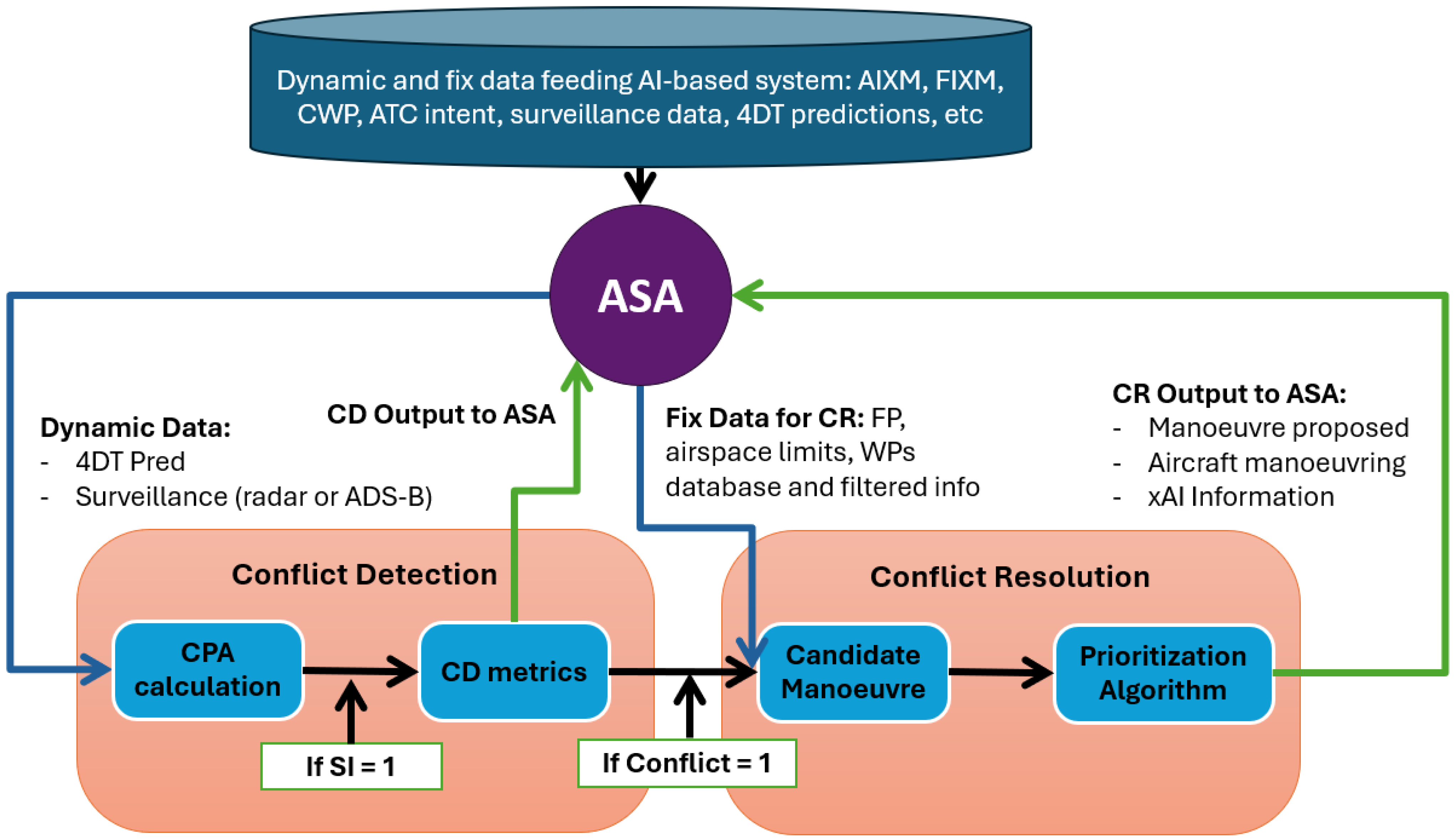
Among the tasks performed by ATCOs are conflict prediction and the application of valid resolution within the airspace. The objective is to develop a CD&R tool enabling the AI-based system (ASA) to achieve knowledge and performance levels comparable to those of ATCOs. One of the main requirements is that CD&R must be able to work in real time environment. The architecture of the CD&R within ASA framework is shown in Figure 1:
The ASA system provides the information required for CD&R. This implies that all the required data is filtered and provided by AI-based system and not directly from the controller working position (CWP). CD&R is designed to work in a short-term horizon (maybe medium depending on the literature), although the validity of the predictions depends directly on the 4-dimensional trajectories’ (4DT) accuracy. 4DT predictions are extracted from the POLARIS ATM system. Similar to current ATCO’s way of working, CD&R not only identifies conflicts but also situation of interest (SI). SIs are defined as any aircraft pair that crosses infringing a specific separation closer to the separation minima (10 nautical miles—NM—in this work and 1000 feet—ft) and conflict as any aircraft pair that crosses infringing en-route separation standards (5 NM and 1000 ft). This criterion has been included because typically ATCOs need information about aircraft pairs that will not lose the separation minima, but they will intersect closer to the separation minima value.
CD&R is composed of two modules (CD and CR) that perform independently, and each module receives and provides different information depending on their needs.
  • CD input dynamic data: 4DT predictions are provided by the system based on 4D format (position + time) and surveillance information. CD provides several outputs related to typical CD metrics (aircraft involved, minimum separation, etc.) and operational info (aircraft status).
  • CR demands data from different sources: from the CD it needs 4DT predictions and calculated safety metrics, from ASA it demands info filtered from the flight plan (FP) (e.g., next available waypoints), geographical location of those waypoints (WPs), and wind. CR provides output considering maneuver solutions and aircraft involved for this maneuver.
One of the main challenges associated with the future implementation of AI-based tools that not only provide support but can also take decisions is the question of who bears responsibility during decision-making and the execution of separation tasks [21,24,25]. The implementation of this tool within the AWARE project follows the levels of automation defined by EASA, which propose the following allocation:
  • Advisory mode, aligned with Level 2A human and AI-based system cooperation, is characterized by the AI-based ASA receiving information from the CD&R module about potential conflicts and proposed resolution maneuvers. In this mode, the controller remains responsible for all tasks and decisions, while using these inputs as decision-support. This simplifies the ATCO’s task of computing potential resolution maneuvers by providing a valid solution together with its underlying rationale, if workload conditions allow the controller to assess it.
  • Execution mode, aligned with Level 2B human and AI-based system collaboration, is characterized by the AI-based ASA providing information from the CD module and autonomously executing the CR action after informing the ATCO for a given period of time. This period must be configurable according to controller workload and design requirements; as an initial value, 30 s was selected in the experiments. In this mode, the AI proposes a resolution maneuver to the ATCO, who must be aware of it and decide whether to accept or reject it. If accepted, the AI executes the maneuver. Thus, although the AI is in charge of executing the maneuver, responsibility formally remains with the ATCO, who is fully aware of the action the AI is about to implement.
Nevertheless, the definition, characterization, and implementation of these modes of operation, together with their associated requirements and characteristics, must be further assessed in future work to determine their operational and regulatory feasibility.

2.1. Conflict Detection Principles

The conflict detection goal is to identify aircraft pairs in which the separation minima can be infringed on the basis of the look-ahead time (LAT). LAT is considered in this work as 15 min, although this value can be customizable depending on the system and user needs. This value is directly related to the required thresholds for the rate of false and missed alerts, whose main driving factor in this CD module is the trajectory prediction. The main limiting factor is the accuracy of the trajectory prediction used as input. Therefore, the LAT requirement and the selected time horizon depend directly on the quality of the trajectory predictor, which is the primary element used to assess separation in this CD module. The poorer the prediction, the higher the rate of false and missed alerts, and consequently the shorter the admissible LAT must be. Therefore, further work will meet specific requirements about rate of false and missed alerts.
The CD module works in a two-stage calculation process for each aircraft pair that has been identified in the area of responsibility (AoR):
  • CPA calculation: it calculates the evolution of the separation between an aircraft pair (new entrant aircraft and any of the aircraft within the airspace) for the whole set of 4DT predictions. The CPA is identified as the position where the aircraft pair reaches the predicted minimum distance. To achieve this the following inputs are required:
    • Aircraft callsign.
    • Actual position (latitude, longitude, altitude and time).
    • 4DT Prediction (latitude, longitude, altitude and time).
CPA calculation is performed based on a severity factor that combines horizontal and vertical separation. To avoid discrepancies due to horizontal and vertical ranges in separation minima, it combines vertical separation adapted to the range of horizontal separation. The goal is to use a common scale to calculate the minimum separation between trajectories.
S e v = S e p l o n + S e p v e r t S m i n H m i n
For instance, an aircraft pair crossing with a separation at the CPA of 0 ft vertically and 2.5 NM horizontally has a Euclidean distance of 2.5 NM at the minimum value. However, an aircraft pair crossing at 0 NM horizontally and 500 ft vertically has a Euclidean distance of 0.08 NM (5000 ft). Without combining the separation ranges, the minimum values are dominated by vertical rather than horizontal separations.
2.
CD metrics: Based on the CPA information, 4DT predictions and operational variables, the following CD metrics are calculated only for SI and conflicts:
  • Aircraft pair: Identifiers of aircraft pairs involved in an SI (situations of interest) or conflict.
  • Vertical and horizontal separation: Variables that calculate the horizontal and vertical separation of an aircraft pair based on 4DT predictions.
  • SI: Binary variable (1 or 0) if an aircraft pair satisfies the SI requirements:
S I = 1   i f   h o r i z o n t a l   s e p a r a t i o n < 10 N M   &   v e r t i c a l   s e p a r a t i o n < 1000   f t
  • Conflict: Binary variable (1 or 0) if an aircraft pair matches Conflict requirements.
C o n f l i c t = 1   i f   h o r i z o n t a l   s e p a r a t i o n < 5 N M   &   v e r t i c a l   s e p a r a t i o n < 1000   f t
  • Closest Point of approach (CPA): Geographic coordinates of both aircraft (CPA of aircraft 1 and CPA of aircraft 2) at the expected minimum separation.
  • Minimum Separation at CPA (MinSep): Expected minimum separation at CPA (combined longitudinal and vertical).
  • Time/Distance to CPA: Time (sec) or distance (NM) from the actual location to the CPA location.
  • Actual status of the aircraft: it details the actual performance of the aircraft (climbing, descending or cruise).
  • Status of the aircraft at the CPA: it details the performance of the aircraft at the CPA (climbing, descending or cruise).
The actual and projected states of the aircraft at the CPA are calculated to determine the operational phase (cruise, climb, or descent) both at the present time and at the predicted CPA. These metrics provide information similar to ATCO’s situational awareness of the air traffic situation. It is critical for the CR module, as it aligns with the tactical considerations used by ATCOs. For instance, if an aircraft is projected to be in a descending phase at the CPA, the proposed resolution maneuvers should avoid contradictory instructions, such as climb instructions.

2.2. Conflict Resolution Principles

The CR module proposes aircraft maneuvers designed to resolve existing conflicts without inducing secondary conflicts within a defined time horizon. To minimize computational complexity and avoid non-essential maneuvering, the CR evaluates resolution strategies only for identified conflicts, SI are not preemptively assessed. However, the CD module continuously monitors aircraft pairs during each cycle. As a result, if an SI evolves into a conflict, the CR module triggers instantly.
CR module builds upon the information provided by the CD module and ASA fix data. They are:
  • 4DT predictions.
  • CD metrics.
  • Next WPs (latitude, longitude coordinates).
  • Cruise flight level (CRZ) authorized in the FP.
  • Exit flight level (XFL) of AoR.
  • Airports of origin (ADEP) and destination.
  • AoR geographical boundaries.
It computes several alternative solutions depending on what is most suitable for both aircraft in each situation. Within this module, modifications to the predicted aircraft trajectories are calculated, and all candidate solutions that could be applied to either aircraft in each considered pair are stored separately. These solutions are subsequently re-evaluated by the CD module in order to determine which of them achieves the intended outcome, namely generating a new trajectory that removes the original conflict while simultaneously avoiding the creation of new conflicts with other aircraft in the sector.
CR provides solutions for each conflict between a single aircraft pair independently. In cases where an aircraft has multiple conflicts with different aircraft at the same time, it does not seek to find a solution that resolves them all simultaneously. However, there may be solutions between an aircraft pair that, when resolved, also resolve a conflict between the aircraft performing the maneuver and other aircraft than the one involved in the initially resolved conflict.
As previously noted, a key strength of the CR tool is its design centered on ATCO operational point of view. A typical operational sequence of the CR tool is summarized as follows: (1) the CR calculates a solution, (2) the IA displays the solution to the ATCO, (3) the ATCO implements the solution, and (4) the aircraft executes the instruction. The validation process of the CR considers two different concepts. To account for this entire process, it was deemed necessary to evaluate trajectory feasibility not only at the moment of CR activation but also by considering potential implementation delays. Given a 30 s validity window, two additional trajectories are analyzed: (1) a nominal modified trajectory (15 s delay) and (2) a latest modified trajectory (30 s delay). Each of these three trajectories is processed by the CD module to identify potential separation infringements. The CD results for all three scenarios are then jointly evaluated according to the following criteria:
  • A solution is considered conflict-free only if all three trajectories remain clear of conflicts.
  • If at least one of the three trajectories results in a conflict or a SI violation, this information is logged to inform the controller and restrict the solution’s validity.
Consequently, the validity window for any proposed maneuver is restricted to 30 s following the execution of the CR module. This duration, defined as validity time, establishes the temporal limit for the operational relevance of the solution. Upon expiration of this window, the CR module triggers a recalculation to verify conflict resolution based on updated 4DT predictions. However, this validity window is a customizable value that can be adaptable for the scenario, users and operational requirements.
To ensure effective human–machine collaboration, the CD&R tool is developed following principles of XAI. It means that for each decision or recommendation produced by the tool, the information describing the underlying reasoning is explicitly stored. In addition, all generated information is intended to be accessible and understandable for controllers. This approach allows ATCOs to understand the rationale behind each proposed maneuver. In this way, the tool not only automates CD&R reasoning but also can reinforce situational awareness, reduce workload, and ensure that operational decisions remain under human supervision. Within this framework, output variables generated for each pair of conflicting aircraft are explained in Table 1.
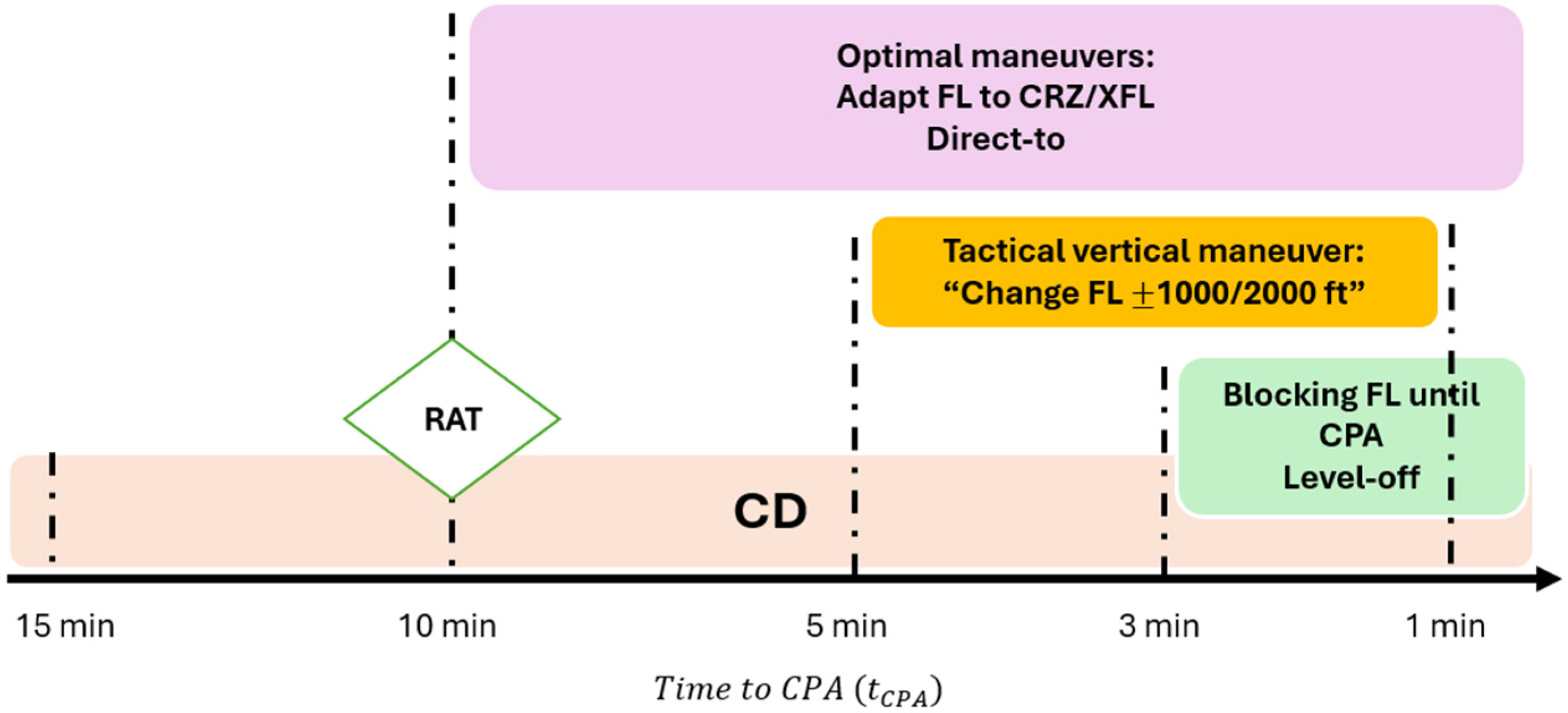
The operation of the CR tool depends on the actual (local) time and the time to the CPA. The objective of considering the time to CPA is twofold: on one hand, it aims to reduce computational cost by decreasing the number of maneuvers to be calculated, and on the other hand, to provide maneuvers that are operationally meaningful and have an impact on operational efficiency consistent with these margins. Figure 2 shows time horizons considered for interaction between CD and CR.
The most efficient maneuvers are computed starting from the resolution activation time (RAT). However, other measures impacting operational efficiency are constrained by shorter lead-times to the CPA (e.g., a 5 min threshold for FL changes and 3 min for FL block or level-off maneuvers). These temporal limits are currently proposed thresholds that require further validation against real-world concepts of operations in collaboration with ATCOs during future development phases. Crucially, the architecture of the CR module accounts for the fact that ATCO decision-making logic and intervention strategies vary significantly based on the available temporal buffer to resolve a conflict. Since multiple maneuvers can typically resolve a conflict between an aircraft pair under nominal conditions, a prioritization algorithm is required to select the optimal advisory. This selection process is governed by a set of deterministic logical rules, structured as a decision tree. Within this framework, potential solutions are categorized and filtered based on predefined operational constraints and safety criteria to ensure the most efficient resolution is presented to the controller.
Finally, the potential interaction between this CD&R tool for separation management and airborne collision avoidance systems (ACAS) has been considered. ACAS represents the last safety barrier to prevent collision, whereas an MTCD tool is designed to prevent losses of separation. The time horizon for this CD&R tool begins with CR activation (RAT) 10 min before the CPA, and as aircraft approach each other, the system recalculates potential solutions based on the constraints imposed by the algorithm. In the en-route airspace for which this tool has been designed, the ACAS system operates at sensitivity levels 6 and 7, where resolution advisories are triggered 35 s before collision [26,27]. The ACAS system is highly complex and takes into account multiple variables related to performance, short-term trajectory, and proximate aircraft; therefore, the MTCD tool should not produce incompatibility with ACAS maneuvers. To avoid such incompatibility, the CD&R limits the provision of maneuvers in the last 1 min time horizon by not proposing FL changes of ±1000/2000 ft.

2.2.1. CR Maneuvers

In the development of the CR, conflicts are considered as situations that occur between pairs of aircraft, so the proposed solutions are calculated for both aircraft involved. To achieve this objective, a set of applicable maneuvers has been defined, depending on the situation, for the different aircraft. This set of maneuvers are limited to horizontal and vertical maneuvers. Route modifications using vectors or speed adjustments are not considered in this study due to their complexity and because they do not provide a direct solution to the controller. Future work should incorporate these maneuvers as additional solution options and enable scenario-specific customization to better address diverse operational contexts.
-
Adaptation of actual FL to approved CRZ in the FP or XFL.
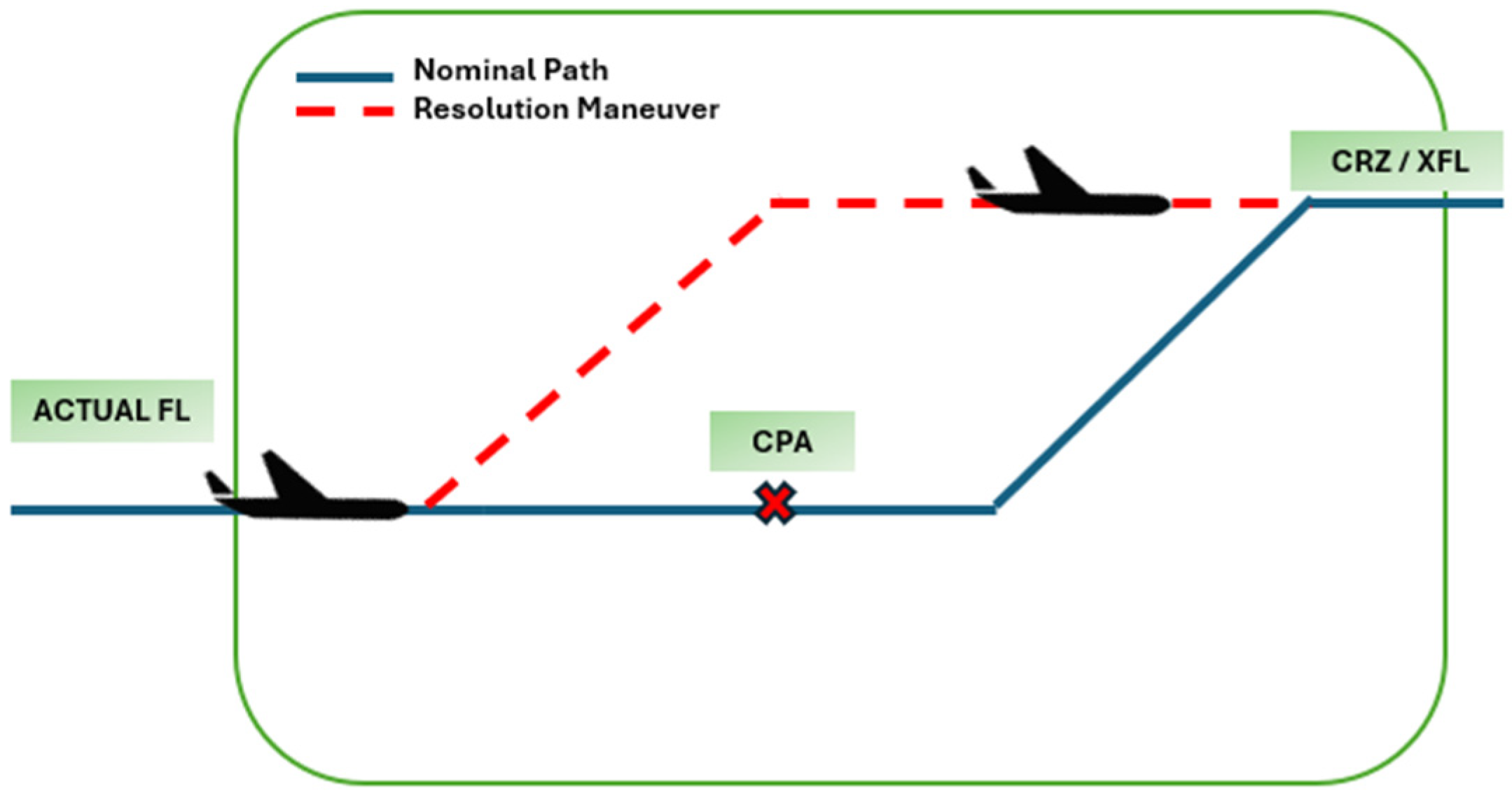
This resolution maneuver is considered the most efficient for two reasons: (1) it allows an aircraft to avoid a conflict with another aircraft and take advantage of the maneuver to reach the CRZ that has been approved in its FP or XFL with a single authorization from the controller, and (2) it reduces fuel consumption by allowing the aircraft to climb earlier than initially planned to a higher FL. This situation usually occurs when both aircraft are flying at cruise altitude and one of the two aircraft is not operating at its CRZ or XFL, which is pending of further climb to its CRZ or XFL. The logic is:
i f   F L < ( C R Z | X F L ) F L t o   m a t c h   ( C R Z | X F L )
However, this logic has an upward purpose, so the following restrictions must be applied:
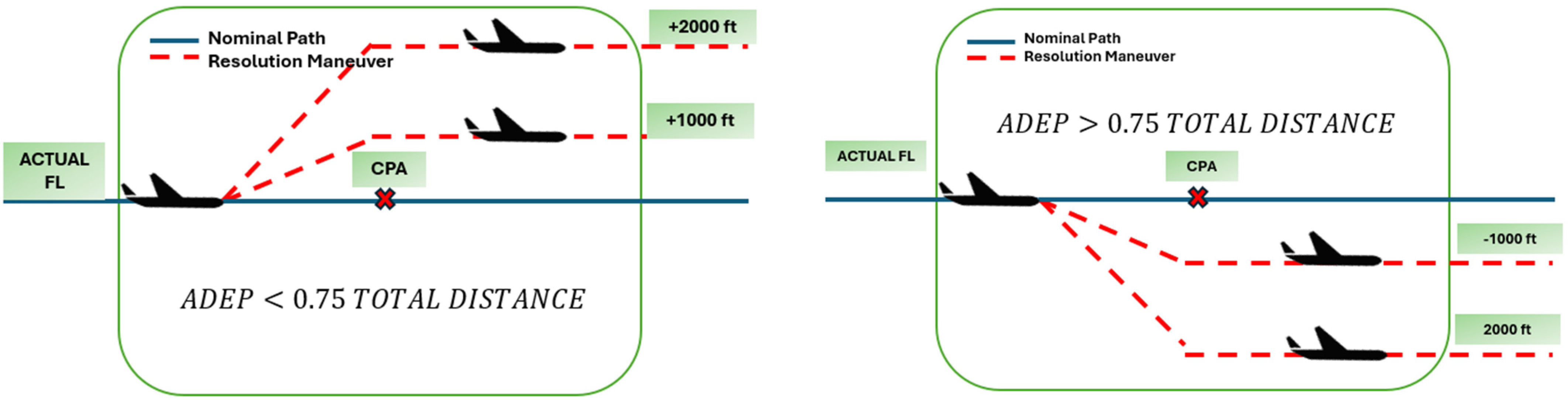
An aircraft should not be cleared to climb to its CRZ or XFL if it is already in the descent phase or near the top of descent. Due to data limitations as there is no top of descent it has been considered that if the aircraft’s position is beyond 75% of its originally scheduled route, the solution does not apply (i.e., it is in the last part of its route):
i f   d i s   t o   A D E P < 0.75   t o t a l   d i s t a n c e c l i m b ,   o t h e w r i s e   n o t  
A conceptual drawing is included to clearly visualize the solution in Figure 3.
-
Direct-to solution limited to first and second next WPs of the FP.
In combination with vertical solutions, direct-to maneuver modifies the horizontal trajectory in order to resolve the conflicts detected by the CD module flying direct to next WPs. To implement such a change in the aircraft’s path, it is necessary to know the WPs included in the FP. This maneuver allows the aircraft to reduce the distance flown, thereby improving the efficiency of the trajectory.
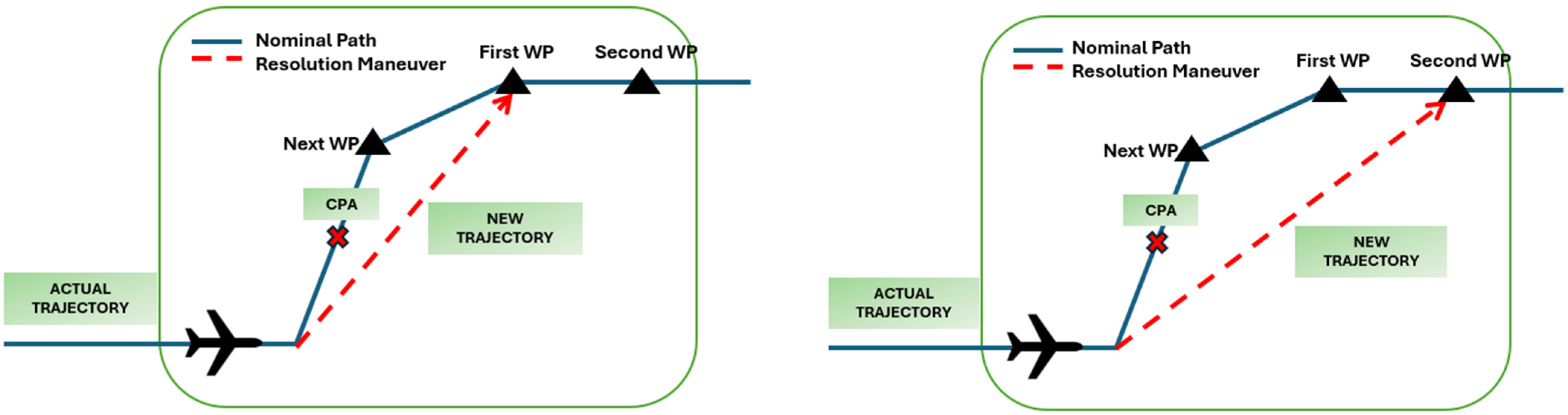
Once this prediction and the position of each WP are known, the logic naturally leads to considering, as a first-order solution, a trajectory modification in which the aircraft proceeds directly to the next WP (the first and the second WP). Regardless of whether the conflict is resolved by applying this change, the possibility of flying directly to the subsequent WP is also evaluated (i.e., the third next WP). This process is applied to both aircraft involved in each detected conflict, since a valid proposal may be obtained for either of the two aircraft concerned. Figure 4 shows the two potential solutions that have been implemented to this function covering the first and second waypoint in the FP.
-
Blocking the climb or descent of an aircraft until CPA.
There are certain cases in which both aircraft are flying at their CRZ or XFL, which are different for each one, but due to the trajectory they follow (climbs or descents that modify that initial FL), a conflict arises after a certain amount of time. In these cases, the optimal solution is for one of the two aircraft to maintain its actual FL instead of following the predefined trajectory in the FP.
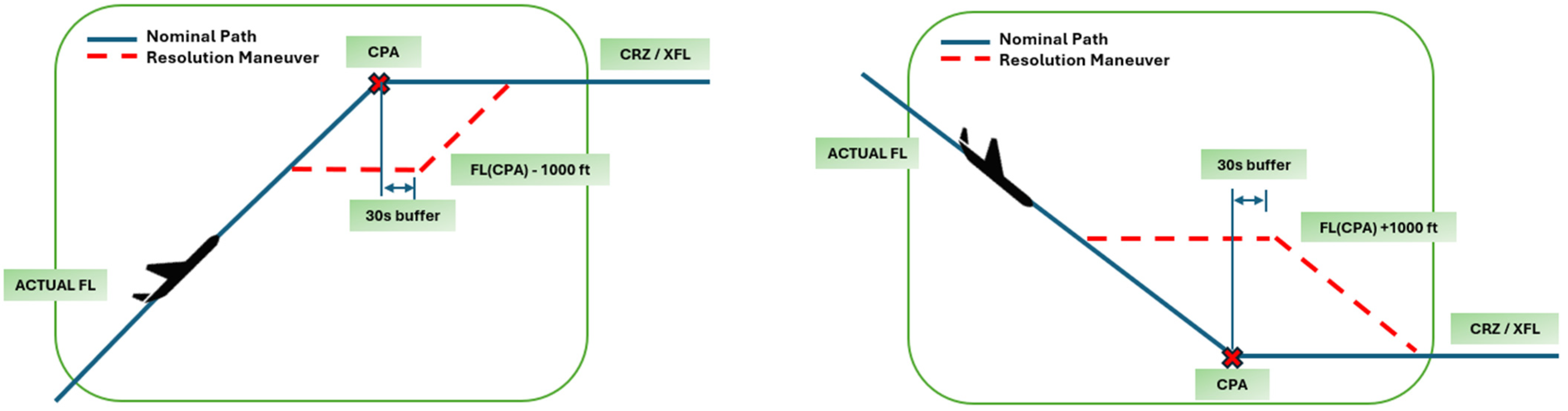
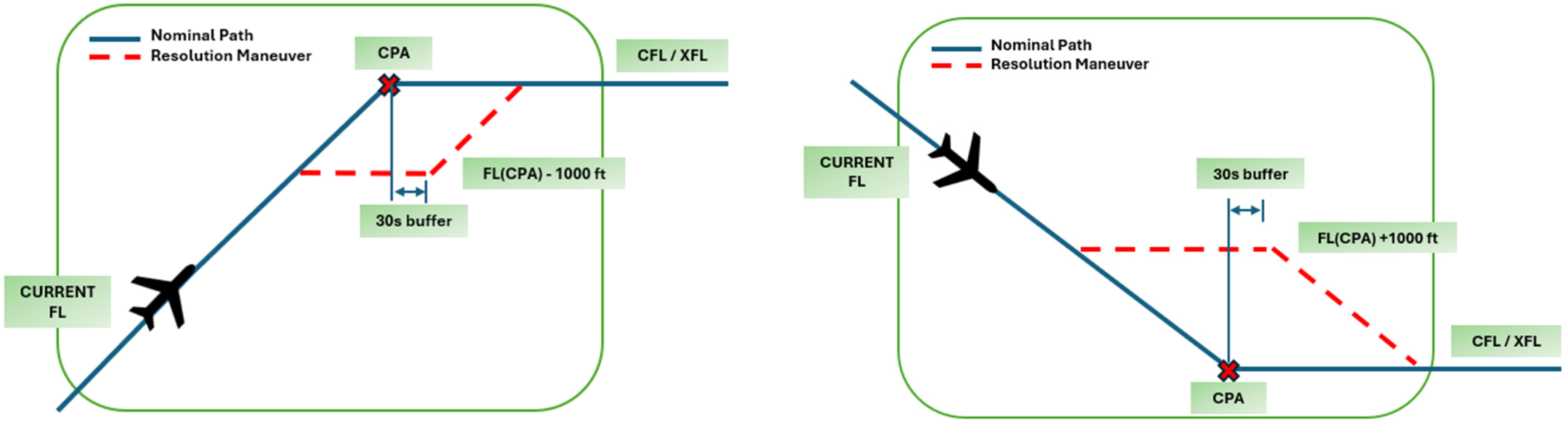
In order to avoid the conflict, one aircraft maintains its actual FL for the necessary time until the CPA has passed (a buffer of 30 s is added as offset). Once the conflict has been avoided, ATCO must return the aircraft to continue its climb or descent trajectory. A conceptual drawing of this solution can be seen in Figure 5.
-
Changing the aircraft’s FL by ±1000/2000 ft
This solution consists of shifting either aircraft in each conflicting pair to different flight levels, considering up to four distinct options: a climb or descent of 1000 feet, and a climb or descent of 2000 feet. The function generates four solution proposals for both aircraft involved in the conflict and subsequently checks—through the application of functions from the CD module during the validation process—which of these options are conflict-free. Similar to restrictions implemented in “Adaptation of actual FL to approved CRZ in the FP or XFL”, the distance to the departure and arrival airports is also considered. If the aircraft performing the action is close to the departure airport, a descent is not allowed; similarly, when the aircraft is close to its destination, a climb is blocked. These conditions are not optimal, since the intention is to approximate the effect of the TOC and TOD points along the trajectory in further work. However, as the available input data do not include information about these two critical points, a distance-based condition relative to the departure and arrival airports is applied to achieve a similar functionality.
Therefore, this solution is computed independently for each of the two aircraft in every conflicting pair. As a result, two new trajectory predictions are generated for each aircraft in the pair, according to distance-based condition. A conceptual illustration of the proposals included in this solution is shown in Figure 6.
-
Level-off aircraft’s climb/descend to a FL lower/upper than that of the CPA
There are certain cases in which an aircraft in a climbing/descending phase is in conflict with another aircraft. Although it seems similar to the case ‘Blocking the climb or descent of an aircraft until CPA’, there are differences since in the previous maneuver the aircraft is flying leveled and will not start climbing/descending until the CPA has been passed. This creates the need for a specific solution that allows a climbing/descending aircraft to level-off maintaining vertical separation assurance of 1000 ft. The proposed solution for this problem is to maintain the aircraft’s climb up to the FL right below/upper one at which the conflict would occur, that is, CPA’s FL. ATCOs must return the aircraft to its original path considering a buffer of 30 s after Time to CPA. These conditions are illustrated in Figure 7.

2.2.2. CR Prioritization Algorithm

Once different solutions have been proposed for each conflict, a decision must be made as to which is the best option, not only to resolve the conflict but also in relation to other aspects such as the variation from the original route or the effect they may have on other aircraft in the sector. For this reason, the tool also includes the implementation of a prioritization algorithm based on logical rules. These logical rules constitute a decision tree where solutions are grouped based on defined conditions with up to five prioritization criteria that determine which solution is optimal for resolving the conflict in question. These criteria were initially defined through consultation with ATC experts, with the aim of prioritizing generalized solutions over scenario-specific ones during the CR decision-making process. In addition, the prioritization algorithm has been designed to provide solutions that mimic ATCO resolutions but do not necessarily coincide exactly with those that an individual controller would apply in a specific scenario. This is because the CD&R module, through the information provided by the AI-based system, has access to a more comprehensive picture of the overall traffic situation than a single ATCO may have at any given time [28]. Consequently, the system may propose a maneuver that a controller would not select in a particular case, but which remains consistent with that controller’s usual resolution strategies and is, given the full traffic context, more efficient or beneficial at the scenario level.
  • Safety: This criterion prioritizes solutions that are free from SIs or conflicts beyond the evaluated time horizon. Solutions that generate an SI or conflict more than 10 min in the future have a potential safety impact, as ATCOs would need to reassess the long-term SI or conflict and respond appropriately. Therefore, even if solutions with conflicts beyond 10 min are valid, they are ranked below those that generate no conflict in terms of priority. This criterion also favors solutions that minimize the controller’s workload. Some maneuvers simplify the controller’s task by modifying the actual trajectory without requiring subsequent actions to return the aircraft to its original trajectory (for example, a ±1000/2000 ft FL change requires a later return to the original FL).
  • Aircraft Efficiency: This criterion favors solutions that provide a positive impact on distance, time, or fuel consumption for the aircraft. Solutions that do not impose a forced FL change are considered beneficial for flight performance. In particular, the ‘Adapt FL to CRZ or XFL’ solution ranks highest, as it allows the aircraft to reach its approved CRZ or XFL with a single clearance from the controller. Additionally, this solution reduces fuel consumption by allowing an earlier climb to a higher FL than the original trajectory.
The next most favorable solution is ‘Direct-to’ or horizontal trajectory change, as it does not force a FL change and reduces the distance flown by the aircraft. By skipping a WP, the aircraft follows a more direct path to its destination, improving route efficiency. The remaining solutions rank equally below these two in terms of aircraft efficiency.
3.
Impact on Flight Level: If no solutions exist that avoid FL changes, preference is given to solutions that minimize the impact on the aircraft’s actual FL. For FL change solutions and the ‘Below FL’ solution, maneuvers that result in the smallest difference between the actual FL and the new FL are prioritized. This favors ±1000 ft climbs or descents over ±2000 ft, while for ‘Below FL’ the prioritization depends on the specific altitude difference in each case.
4.
Distance to CPA: If, after considering the previous criteria, two proposals remain equally ranked for a given conflict, priority is given to the solution involving the aircraft farthest from the CPA. This prioritization is based on a common operational safety principle in ATM, since an aircraft farther from the conflict provides a larger margin for both ATCO communication and maneuver execution.
5.
Minimal Route Impact: If this criterion is reached without being able to prioritize a single proposal above the others for the conflict, it indicates that only horizontal trajectory change solutions (‘Direct-to’) remain. In this situation, the solution with the least impact on the route is prioritized. Since these solutions involve skipping WPs from the original route, the preferred proposal is the one that skips the fewest WPs. Therefore, ‘Direct-to’ solutions directing the aircraft to the second WP are prioritized over those directing it to the second WP.
6.
No conflict-free Maneuver Available: If there is no valid maneuver that resolves the conflict, none of the above criteria can find a preferred solution. In such cases, the tool provides a visual alert to the ATCO, indicating that a conflict exists for which no solution has been found, and displays the relevant information from the CD module as part of the tool’s output. This ensures that conflict detection functionality is kept at all times, and the ATCO must independently determine an alternative solution outside the options considered by the tool. This solution forces ATCOs to apply vectoring so that their calculations are out of the scope of this study.
Once the prioritization criteria have been defined, they are applied to the set of proposed solutions so that ultimately only one solution is retained for each conflict. This significantly reduces the variability of the output information to the ATCO and keeps a logical order for the application of different solutions by the ATCO once these proposals are communicated by the tool or AI assistant. Finally, for the calculated set of solutions, the best solution for each conflict is obtained and provided to the ATCO.

3. Results

This section presents the results obtained during the development and implementation of the CD&R tool, integrated with the ASA AI system as part of the AWARE project. First, the operational scenario used to test the tool is described. Subsequently, the performance results of the CD&R tool are presented.

3.1. Scenario Description

To evaluate the feasibility of the proposed CD&R system, the study utilized operational datasets provided by the AWARE project, focusing on a subset of flights within Swiss airspace from 4 July 2025. To facilitate the testing of conflict resolution capabilities, entry times into the airspace were intentionally modified to induce separation infringements.
The system was developed using Python® 3.12 and executed on a workstation equipped with an Intel® CORE™ i3-6100 CPU @ 3.7 GHz, 8 GB of RAM, and an NVIDIA GeForce GT710 GPU.

3.2. CD Results

For the scenario described, the CD tool requires less than one second to compute all aircraft pairings, thereby validating its suitability for real-time applications. Nevertheless, future work should focus on further optimizing these computational processing times. For a sample of 10 aircraft, 45 aircraft pairs are generated. The CD module exclusively calculates future separation based on 4DT predictions. For encounters identified as SI and conflict, a full computation of all CD metrics is performed. Table 2 presents an example of the results obtained for three different cases
Metrics are computed exclusively for SI scenarios (Case 2) and active conflicts (Case 3). In addition to standard CD parameters, Case 3 identifies the encounter as a short-term conflict TimetoCPA is 2 min), noting that EWGXXX is maintaining cruise level (FL 370) while EZSXXX is in a descending phase (from FL390 to FL370). These metrics replicate the operational situational awareness of an ATCO and characterize the conflict geometry to ensure the CR module generates the most appropriate advisories.

3.3. CR Results

As detailed in the CR tool operational description, Case 3 meets the necessary criteria to trigger and compute potential resolution maneuvers. In this specific instance, the CR module requires 1 to 2 s to evaluate the full set of possible maneuvers and execute the prioritization algorithm. Consistent with the observations for the CD module, future development should aim to further reduce these computational overheads and optimize processing times. Table 3 shows the results of applying all the functions to that specific aircraft pair.
The primary outputs derived from these tables are summarized as follows:
  • Conflict-Free Solutions for EWGXXX: The only valid (conflict-free) solutions consist of “direct-to” maneuvers toward the 2nd and 3rd waypoints. These solutions remain valid for 30 s from the local timestamp. Neither maneuver requires a post-ATC clearance to return the aircraft to its original FP; however, they do necessitate coordination with the adjacent sector, as the 2nd and 3rd waypoints are located within the subsequent AoR.
  • Vertical Maneuvers for EWGXXX: FL change maneuvers (+1000 or +2000 ft) were evaluated for EWGXXX, as the aircraft is within the initial 75% of the distance from the ADEP. Both maneuvers were rejected due to a predicted conflict with AFRXXX cruising at FL380 and an SI with ETZSXXX.
  • Direct-to Maneuvers for EZSXXX: Direct-to maneuvers for EZSXXX are invalid. The deviation from its original trajectory during descent induces a conflict with AFRXXX, identified by the CD following trajectory modification.
  • Flight Level Constraints for EZSXXX: EZSXXX is restricted to FL descent maneuvers due to its actual descent phase. However, neither option is valid, as both lower FL result in conflicts with other aircraft.
  • Level-off Constraints: The level-off maneuver for EZSXXX is unavailable, as it would maintain the aircraft at FL380, the same altitude as AFRXXX. Similarly, the level-off maneuver for EWGXXX was not applied because the aircraft is not in a climb phase.
  • Tactical Constraints: Maneuvers related to the “Blocking the climb or descent until CPA” function were not executed, as neither aircraft is currently transitioning from cruise to climb/descend.
Upon calculating all potential maneuvers defined in the CR module, the prioritization algorithm applies predefined logic rules to determine the optimal solution for each aircraft pair. For this scenario, the optimal solution—or the ranking of solutions provided by the AI-based ASA system—is presented in Table 4.
In this instance, the algorithm has identified that, among the valid options, the direct-to maneuver toward the 2nd waypoint must be prioritized, as it entails a minimal deviation from the aircraft’s original trajectory. Furthermore, this temporal modification is projected to have a lower impact on subsequent sectors compared to the direct-to maneuver toward the 3rd waypoint.
All solutions presented in Table 3 and Table 4 were calculated for a 30 s window (validity time 07:16:50). If the ATCO executes a CR maneuver, a new 4DT prediction is generated, and the CD&R system re-evaluates the updated state. Upon expiration of this validity period, the CR module recalculates alternative solutions in the case a conflict persists based on the most recent 4DT data.
Finally, the developed CD&R enables the AI-based ASA system to provide not only resolution maneuvers but also to advance the explainability of CR outputs to an ATCO. The variables defined during the solution computation provide a foundation—a standpoint—that allows the system to achieve a level of situational awareness comparable to that of an ATCO. This framework enables the machine to reason and justify the selection of a specific solution among all feasible alternatives.

4. ATCO’s Insights from Experiments

During the development of the HORIZON project AWARE, a series of experiments was conducted to evaluate both the operational concept and the developed AI-based tool. These validation exercises took place at the Malmö Area Control Center (ACC) facilities in November 2025. The primary objective was to evaluate the tool functionality and presentation of the AI in collaboration with ATCOs, identify functional discrepancies within the tool, and gather qualitative feedback regarding its future implementation as an ATCO decision-support system.
Throughout the sessions, the ATCOs were provided with the opportunity to observe and analyze the operational logic of the CD&R tool. The implementation of the CD&R tool within the human–machine interface (HMI) of the CWP was realized in this first test through the appearance of pop-up windows alongside the labels of the aircraft involved in a conflict, which were color-coded. Within this pop-up, the maneuver selected by the CD&R tool’s prioritization algorithm was displayed. In this manner, the ATCO could utilize this resolution maneuver through the interface by using left-click (acceptance) or right-click (cancelation).
Following the experiments, individual and focus group interviews were conducted with nine ATCOs representing various air navigation service providers (ANSPs) from multiple units and airspaces (en-route and TMA, fixed-route and free-route). The presence of different ANSPs was illustrative due to the different technological maturity of the tools they use. The core themes of their recommendations, concerns, and perspectives on how this tool could enhance future operational workflows are summarized below:
ATCOs consistently reported that heterogeneity in separation minima and letter of agreements (LoAs) across adjacent sectors is a major driver of complexity. For example, some sectors operate with a horizontal separation minimum of 10 NM, while adjacent sectors may work with 3, 5, 8, or 20 NM. Aircraft are frequently handed over with a separation that is compliant in the upstream sector but not in the downstream one, forcing the receiving controller to tactically “re-shape” the traffic to meet their own minima. In addition to formal LoAs, controllers highlighted the importance of informal local arrangements that are not captured in written agreements but strongly influence how traffic is actually transferred (e.g., preference for vertical rather than horizontal separation at handover in certain terminal control areas—TMAs). These practices are part of the implicit “local culture” and are invisible to generic automation.
Conflict detection practices vary depending on the availability and maturity of technical support:
  • In some units, ATCOs lack any medium-term conflict detection tool and rely on mental projection using heading, speed, and flight plan information.
  • Others employ more advanced tools that highlight potential conflicts using color coding and dedicated displays, including time to CPA and separation at CPA.
  • Several ATCOs expressed a desire for richer, more intuitive representations of the CPA, ideally including a three-dimensional depiction of the relative geometry, rather than purely numeric indicators.
ATCOs also noted that existing CD tools typically do not account for conflicts that would materialize in adjacent sectors beyond their AoR. Anticipation of such downstream problems relies heavily on individual experience and coordination with neighboring sectors.
A recurrent theme is the mismatch between predicted trajectories and actual aircraft behavior, particularly due to wind and speed restrictions. ATCOs routinely use radar-derived groundspeed and rate-of-climb/descent to refine their mental prediction, and they are acutely aware that trajectory predictors based on infrequent meteorological updates often misrepresent where aircraft will actually be.
Across interviews, ATCOs described a broadly consistent hierarchy of preferred CR maneuvers, constrained by airspace type and available time:
  • First-line actions tend to be horizontal (direct-to or vectors) and speed control, used to sequence traffic, open gaps, or adjust relative positions well in advance (particularly in TMA).
  • Vertical maneuvers (level changes) are generally seen as more intrusive and are typically considered only when horizontal and speed solutions are insufficient or constrained by LoAs and sector geometry.
  • In TMAs, controllers are particularly reluctant to disturb continuous climb/descent profiles. Level-offs are systematically described as a last resort, especially in climbing, because of their negative impact on fuel burn, environmental performance, and subsequent vertical profile (steeper required descent later).
  • When a level-off is unavoidable for a pair of climbing/descending aircraft, ATCOs systematically prefer to allow the descending aircraft to continue, holding or adjusting the climb of the other one. This is motivated both by fuel/efficiency considerations and by the operational drawbacks of interrupting a continuous descent.
ATCOs also reported tactical use of stepwise climbs/descents (altitude “stairs”) and parallel headings to allow faster aircraft to overtake slower ones while maintaining acceptable separations. When rate-of-climb/descent (ROCD) information is available and reliable, some units explicitly incorporate it into their vertical resolutions; in others, ROCD is used more qualitatively, based on local experience and current wind conditions.
ATCOs emphasized that CR strategies are strongly dependent on airspace type:
  • In TMAs, speed control is the primary lever for sequencing and separation on arrival flows, while departures are often managed through SID design and limited speed adjustments.
  • In en-route free-route airspace, direct routings are constrained by FIR/UIR boundaries, downstream ANSP responsibilities, and FP compliance. As a result, CR often rely on heading vectors rather than direct-to-waypoint clearances, especially when the direct would take the aircraft to a different ACC than filed.
  • The time horizon available also shapes strategy. With longer lead times, ATCOs prefer subtle speed or heading adjustments; with shorter horizons, they resort to more drastic measures such as larger vectors or vertical maneuvers.
All interviewed controllers reported working with buffers beyond the formal separation minima. These buffers are currently applied due to the uncertainty associated with aircraft trajectory evolution, surveillance systems, data processing, and meteorological conditions. In the future, as these systems improve, such buffers should be reduced or eliminated. Nonetheless, these buffers are adapted to the nominal minima and airspace context based on current situation:
  • In TMAs with 3 NM minima, buffers of 1–3 NM were considered appropriate.
  • In en-route sectors with 5–10 NM minima, buffers of 2–5 NM were considered appropriate.
Importantly, controllers try to resolve emerging conflicts well before reaching the formal minimum, using these buffers as “psychological safety margins” that take into account prediction uncertainty, pilot performance, and coordination delays.
ATCOs expressed considerable interest in an automatic CR tool based on AI as a decision-support capability, but articulated several conditions for acceptability:
  • They overwhelmingly prefer an assistance mode over full automation, mainly due to concerns about accountability and responsibility. ATCOs emphasized that they remain legally and ethically responsible for the safety of aircraft and therefore must retain the final decision authority.
  • For assistance mode (or advisory mode), they would prefer to have extensive and informative output from the tool as early as possible. In other words, they would prefer to have explainable output as they have enough time to assess and validate proposed resolutions (e.g., why vertical resolution and not horizontal, is this solution creating another conflict). For full automation (or execution mode), they would prefer this tool to be more of a safety net before STCA. This means the tool will execute conflict resolution only when ATCOs do not have time or good situational awareness to identify, validate and execute CR on their own.
  • ATCOs consistently asked for “what-if” functionality, enabling them to explore candidate resolutions before issuing clearances, rather than being presented with a single prescriptive solution.
  • Many ATCOs expressed a preference for multiple alternative solutions, especially under low or moderate workload, so that they can select the one that best fits local constraints, traffic picture, and personal style. Under high workload, some ATCOs would accept a single, clearly prioritized solution, provided they trust the system and can apply it quickly.
  • A major theme was trust calibration. ATCOs provided examples where a tool might propose a resolution (e.g., crossing at 7 NM based on prediction) that is technically safe but conflicts with established local practice and intuition, thereby increasing rather than reducing workload, as they feel compelled to monitor the outcome more intensively.
ATCOs also described usability expectations for such a tool: conflict alerts should be timely but non-intrusive, with the ability to acknowledge and temporarily suppress alerts they have already assessed and re-activate them later if required. They emphasized that any CR tool must respect existing operational constraints and be consistent with the way the sector actually works, including idiosyncratic local practices and network-level considerations (delays, prioritization of late flights, environmental performance).
The interviews also uncovered a set of systematic mismatches between the behavior/capabilities of the CR prototype and the expectations and working methods of ATCOs. These discrepancies are further work for the refinement of both the algorithmic design and the human–machine interface as shown in Table 5.
As evidenced by the information synthesized in this section, there is significant heterogeneity in ATCOs’ operational methodologies, influenced by airspace configuration, training, ANSP affiliation, and individual human factors. This inherent variability is difficult to encapsulate within a single CD&R framework; consequently, a ‘one-size-fits-all’ solution is inadequate. Future developments must incorporate the aforementioned elements as core requirements, ensuring they are adaptable to specific operational contexts and individual scenarios. In this regard, the integration of AI represents a critical advancement in achieving personalized adaptability for each ATCO.

5. Conclusions

This paper has presented the design, implementation and initial evaluation of a CD&R tool integrated within the ASA AI Assistant developed in the SESAR AWARE project. The proposed system addresses one of the most safety-critical ATM functions by combining a deterministic, trajectory-based CD module with a CR module explicitly designed to emulate operational ATCO reasoning while remaining compatible with real-time constraints. The CD module computes CPA and a rich set of safety-related metrics using 4DT predictions, thereby replicating the core elements of human situational awareness. Building on these metrics, the CR module generates a structured set of candidate maneuvers which are then filtered and ranked through a rule-based prioritization algorithm based on five criteria: safety, aircraft efficiency, impact on flight level, distance to CPA and minimal route impact. The architecture also accounts for implementation delays by validating each proposed maneuver against three trajectories (nominal, 15 s and 30 s delay), guaranteeing that only consistently conflict-free solutions within a 30 s validity window are presented to the controller. The CD&R tool has been developed under XAI principles: for each conflict and selected maneuver, the system stores and exposes human-oriented reasoning attributes (e.g., which aircraft is maneuvered, why the solution is conflict-free, whether coordination or post-maneuvers are required and until when the solution remains valid), thereby enabling ATCOs to understand and verify the AI recommendations. Qualitative feedback from ATCO-in-the-loop experiments confirms that this design direction addresses key operational needs—such as transparency, respect for local working methods and explicit control of liability—while also highlighting remaining gaps related to the integration of LoAs, free-route specific constraints, workload-adaptive levels of automation and richer visualization of CPA geometry.
Future work will focus on three main lines. First, the CD&R algorithms will be further optimized and extended to include additional maneuver families (e.g., speed control and vectoring) and more accurate trajectory prediction models, including improved wind and procedure constraints. Second, the prioritization and presentation of solutions will be adapted to workload, airspace type and ATC protocols. Third, large-scale validation campaigns with diverse ANSPs and traffic configurations should be conducted to quantify operational benefits, refine XAI explanations and support future certification and deployment of AI-based CD&R assistance in safety-critical ATC

Author Contributions

Conceptualization, J.A.P.-C., L.P.S., L.S.-M. and T.R.; methodology, J.A.P.-C., L.P.S. and L.S.-M.; software, Á.A.P., I.T. and K.S.; validation, J.A.P.-C., L.P.S. and T.R.; investigation, J.A.P.-C., L.S.-M. and Á.A.P.; resources, J.A.P.-C. and L.P.S.; data curation, Á.A.P., I.T. and K.S.; writing—original draft preparation, J.A.P.-C. and Á.A.P.; writing—review and editing, J.A.P.-C., L.P.S., L.S.-M., I.T., K.S. and T.R.; supervision, L.P.S. and T.R.; project administration, J.A.P.-C. and T.R.; funding acquisition, J.A.P.-C. and T.R. All authors have read and agreed to the published version of the manuscript.

Funding

This project has received funding from the SESAR 3 Joint Undertaking under grant agreement No 101167442 under European Union’s Horizon Europe research and innovation program.

Data Availability Statement

The datasets presented in this article are not readily available because all the information is property of AWARE consortium and is part of an ongoing study.

Acknowledgments

The authors would like to acknowledge their participation to the rest of AWARE consortium.

Conflicts of Interest

The authors declare no conflicts of interest.

Abbreviations

The following abbreviations are used in this manuscript:
ACCArea Control Center
ADEPAirport of Departure
AIArtificial Intelligence
ANSPAir Navigation Service Provider
AoRArea of Responsibility
ASAArtificial Situational Awareness
ATCAir Traffic Control
ATCOAir Traffic Control Officer
ATMAir Traffic Management
AWAREAchieving Human–Machine Collaboration with Artificial Situational Awareness
CDConflict Detection
CD&RConflict Detection and Resolution
CRZCruise Flight level
CPAClosest Point of Approach
CRConflict Resolution
CWPController Working Position
EASAEuropean Aviation Safety Agency
FLFlight Level
ftFeet
FPFlight Plan
LATLook-Ahead Time
LoALetter of Agreement
NMNautical Miles
RATResolution Activation Time
ROCDRate of Climb/Descent
SISituation of Interest
TMATerminal Control Area
WPWaypoint
XAIExplainable Artificial Intelligence
XFLExit Flight Level
4DT4-dimensional Trajectory

References

  1. AWARE Consortium. D2.1 Concept of Operations for AWARE; AWARE Consortium: Bangkok, Thailand, 2025. [Google Scholar]
  2. Krozel, J.; Peters, M.E.; Hunter, G. Conflict Detection and Resolution for Future Air Transportation Management—TR97138-01; NASA: Washington, DC, USA, 1997.
  3. Paielli, R.A.; Erzberger, H.; Chiu, D.; Heere, K.R. Tactical Conflict Alerting Aid for Air Traffic Controllers. J. Guid. Control Dyn. 2009, 32, 184–193. [Google Scholar] [CrossRef]
  4. Paielli, R.A.; Erzberger, H. Trajectory Specification for Terminal Air Traffic: Pairwise Conflict Detection and Resolution. In Proceedings of the 17th AIAA Aviation Technology, Integration, and Operations Conference, Denver, CO, USA, 5–9 June 2017. [Google Scholar]
  5. Matsuno, Y.; Tsuchiya, T. Stochastic 4D Trajectory Optimization for Aircraft Conflict Resolution. In Proceedings of the IEEE Aerospace Conference Proceedings, Big Sky, MT, USA, 1–8 March 2014. [Google Scholar]
  6. Rodríguez-Sanz, Á.; Gómez Comendador, F.; Arnaldo Valdés, R.M.; Pérez-Castán, J.A.; González García, P.; Najar Godoy, M.N.G. 4D-Trajectory Time Windows: Definition and Uncertainty Management. Aircr. Eng. Aerosp. Technol. 2019, 91, 761–782. [Google Scholar] [CrossRef]
  7. Wang, Z.; Liang, M.; Delahaye, D. Data-Driven Conflict Detection Enhancement in 3d Airspace with Machine Learning. In Proceedings of the 2020 International Conference on Artificial Intelligence and Data Analytics for Air Transportation, AIDA-AT, Singapore, 3–4 February 2020. [Google Scholar] [CrossRef]
  8. Pérez-Castán, J.A.; Pérez-Sanz, L.; Serrano-Mira, L.; Saéz-Hernando, F.J.; Rodríguez Gauxachs, I.; Gómez-Comendador, V.F. Design of an ATC Tool for Conflict Detection Based on Machine Learning Techniques. Aerospace 2022, 9, 67. [Google Scholar] [CrossRef]
  9. Wang, Z.; Liang, M.; Delahaye, D.; Wu, W. Learning Real Trajectory Data to Enhance Conflict Detection Accuracy in Closest Point of Approach Problem. In Proceedings of the 13th USA/Europe Air Traffic Management Research and Development Seminar, Vienna, Austria, 17–21 June 2019. [Google Scholar]
  10. Lehouillier, T.; Nasri, M.I.; Soumis, F.; Desaulniers, G.; Omer, J. Solving the Air Conflict Resolution Problem Under Uncertainty Using an Iterative Biobjective Mixed Integer Programming Approach. Transp. Sci. 2017, 51, 1242–1258. [Google Scholar] [CrossRef][Green Version]
  11. Pérez-castán, J.A.; Comendador, F.G.; Arnaldo, R.M.; Navarrete, C.; Cidoncha, A. Conflict Resolution Algorithms for the Integration of Continuous Climb Operations in a Terminal Maneuver Area. In Proceedings of the 30th Congress of the International Council of Aeronautical Sciences, Daejeon, Republic of Korea, 25–30 September 2016; p. 10. [Google Scholar]
  12. Liang, M.; Delahaye, D.; Maréchal, P. Integrated Sequencing and Merging Aircraft to Parallel Runways with Automated Conflict Resolution and Advanced Avionics Capabilities. Transp. Res. Part C Emerg. Technol. 2017, 85, 268–291. [Google Scholar] [CrossRef]
  13. Pham, D.T.; Tran, N.P.; Alam, S.; Duong, V.; Delahaye, D. A Machine Learning Approach for Conflict Resolution in Dense Traffic Scenarios with Uncertainties. In Proceedings of the 13th USA/Europe Air Traffic Management Research and Development Seminar, Vienna, Austria, 17–21 June 2019. [Google Scholar]
  14. Ahmad, B.; Schütz, C. Towards Data Analytics Using Contextualized Knowledge Graphs. In Proceedings of the International Conference on Informatics & Problem Solving (ICIPS 2025); Springer: Luxor, Egypt, 2025; pp. 1–14. [Google Scholar]
  15. Westin Science, C.; Borst, C.; van Kampen, E.-J.; Nunes, T.M.M.; Boonsong, S.; Hilburn, B.; Cocchioni, M.; Bonelli, S. Personalized and Transparent AI Support for ATC Conflict Detection and Resolution: An Empirical Study. In Proceedings of the 12th SESAR Innovation, Budapest, Hungary, 5–8 December 2022. [Google Scholar]
  16. Trapsilawati, F.; Wickens, C.; Chen, C.-H.; Qu, X. Transparency and Conflict Resolution Automation Reliability in Air Traffic Control. In Proceedings of the 19th International Symposium on Aviation Psychology, Dayton, OH, USA, 8–11 May 2017. [Google Scholar]
  17. Fennedy, K.; Hilburn, B.; Nadirsha, T.N.M.; Alam, S.; Le, K.-D.; Li, H. Do ATCOs Need Explanations, and Why? Towards ATCO-Centered Explainable AI for Conflict Resolution Advisories. In Proceedings of the First US-Europe Air Transportation Research and Development Symposium (ATRDS 2025), Prague, Czech Republic, 24–27 June 2025. [Google Scholar]
  18. EASA. EASA Concept Paper: First Usable Guidance for Level 1 Machine Learning Applications; EASA: Köln, Germany, 2021. [Google Scholar]
  19. EASA. Artificial Intelligence Roadmap A Human-Centric Approach to AI in Aviation; EASA: Köln, Germany, 2020. [Google Scholar]
  20. Hurter, C.; Degas, A.; Guibert, A.; Durand, N.; Ferreira, A.; Cavagnetto, N.; Islam, M.R.; Barua, S.; Ahmed, M.U.; Begum, S.; et al. Usage of More Transparent and Explainable Conflict Resolution Algorithm: Air Traffic Controller Feedback. Transp. Res. Procedia 2022, 66, 270–278. [Google Scholar] [CrossRef]
  21. Hurter, C.; Degas, A.; Guibert, A.; Poyer, M.; Durand, N.; Veyrie, A.; Ferreira, A.; Cavagnetto, N.; Bonelli, S.; Ahmed, M.; et al. Examining Decision-Making in Air Traffic Control: Enhancing Transparency and Decision Support Through Machine Learning, Explanation, and Visualization: A Case Study. In Proceedings of the 16th International Conference on Agents and Artificial Intelligence; SCITEPRESS—Science and Technology Publications: Setúbal, Portugal, 2024; pp. 622–634. [Google Scholar]
  22. AISA Consortium. Deliverable 5.2 Report on HumanMachine Distributed Situation Awareness; AISA Consortium: Zagreb, Croatia, 2022. [Google Scholar]
  23. AISA Consortium. D4.1. Proof-of-Concept KG System; AISA Consortium: Zagreb, Croatia, 2021. [Google Scholar]
  24. de Albuquerque, H.C.; Raj, P.; Prakash Yadav, S. Toward Artificial General Intelligence: Deep Learning, Neural Networks, Generative AI, 1st ed.; Walter de Gruyter GmbH & Co KG: Berlin, Germany, 2023; ISBN 3111323560. [Google Scholar]
  25. ICAO. Annex 19—Safety Management; ICAO: Montréal, QC, Canada, 2013. [Google Scholar]
  26. EUROCONTROL. ACAS Guide Airborne Collision Avoidance Systems; EUROCONTROL: Brussels, Belgium, 2025. [Google Scholar]
  27. ICAO. Doc 9863 Airborne Collision Avoidance System (ACAS) Manual; ICAO: Montréal, QC, Canada, 2021. [Google Scholar]
  28. Pham, D.-T.; Ali, H.; Fennedy, K.; Hsieh, M.-H.; Alam, S.; Duong, V. Human-AI Hybrid Paradigm for Collaborative Air Traffic Management Systems. In Proceedings of the SESAR Innovation Days, Rome, Italy, 12–15 November 2024. [Google Scholar]
Figure 1. CD&R architecture within ASA framework.
Aerospace 13 00213 g001
Figure 2. Time activation horizons for CR maneuvers.
Aerospace 13 00213 g002
Figure 3. Scheme of the solution: adapting FL to CRZ|XFL.
Aerospace 13 00213 g003
Figure 4. Scheme of the solution: direct-to first (left) and second next (right) WP.
Aerospace 13 00213 g004
Figure 5. Scheme of the solution: blocking the climb (left) or descent (right) until CPA.
Aerospace 13 00213 g005
Figure 6. Scheme of the solution: changing the aircraft’s FL by + (left) and − (right) 1000/2000 ft.
Aerospace 13 00213 g006
Figure 7. Scheme of the solution: level-off aircraft’s climb (left) and descent (right) to an adjacent FL of the CPA.
Aerospace 13 00213 g007
Table 1. Reasoning of output metrics for explainable CR.
Questions for ExplainabilityInformation Required for ATCOs
Which aircraft are involved in a conflict?Callsigns of both aircraft pair involved
Which aircraft is selected to apply a maneuver?Callsign of the aircraft selected to apply a maneuver
Which maneuver?The type of maneuver proposed by the solution
When will occur the CPA?Time to CPA
What is the distance to the CPA?The distance in nautical miles of each of the aircraft in the pair from the CPA.
Is conflict-free the solution?The validity of the proposed solution, i.e., whether it is conflict-free or not
If not, why not?Information about there is a conflict or SI with other aircraft
Until when is valid the solution proposed?The validity time of the proposed solution
Is coordination required with other ATCO?It indicates whether coordination with other ATCOs is required, particularly if the CPA, actual location of one aircraft is outside the AoR boundaries, or the proposed maneuver modifies actual authorized exit/entry point
Must ATCO perform a post-maneuver to return aircraft to FP?It indicates if the proposed maneuver needs a post-maneuver clearance to return the aircraft to its original FP
Table 2. Tabular example of CD outputs.
CD MetricCase1Case 2 (SI)Case 3 (Conflict)
Aircraft PairELYXXX–AHOXXXRAMXXXX–AFRXXXEWGXXX–EZSXXX
Local time7:16:207:16:207:16:20
FL_Ac1380400370
FL_Ac2360380390
Vertical separation at CPA (ft)170016.616.6
Horizontal separation at CPA (NM)51.19.81.5
MinDis (NM)-9.91.6
SI011
Conflict001
CPA_Ac1-43.1688 N; 2.0069 W42.0899 N; 3.9386 W
CPA_Ac2-43.0472 N; 2.1561 W42.0955 N; 3.9051 W
DistoCPA_Ac1 (NM)-127.515.02
DistoCPA_Ac2 (NM)-127.715.06
TimetoCPA (sec)-17 min 6 s2 min 1 s
Status_Ac1_actual-CruiseCruise
Status_Ac2_actual-CruiseDescent
Status_Ac1_CPA-DescentCruise
Status_Ac2_CPA-CruiseDescent
Table 3. Tabular example of CR maneuvers for aircraft pair EWGXXX and EZSXXX.
Aircraft to SolveManeuverCommentsValidityValidity TimePost ATC ClearanceCoordination
EWGXXXDirect-to 2ndValidYES7:16:50NOYES
EWGXXXDirect-to 3rdValidYES7:16:50NOYES
EWGXXXFL +1000 ftConflict with AFRXXX and SI with EZSXXXNO7:16:50--
EWGXXXFL +2000 ftConflict with AFRXXX and SI with EZSXXXNO7:16:50--
EZSXXXDirect-to 2ndConflict AFRXXXNO7:16:50--
EZSXXXDirect-to 3rdConflict AFRXXXNO7:16:50--
EZSXXXFL −1000 ftConflict AFRXXXNO7:16:50--
EZSXXXFL −2000 ftConflict EWGXXXNO7:16:50--
EZSXXXLevel-offConflict AFRXXXNO7:16:50--
Table 4. CR output after applying the prioritization algorithm.
OrderAircraft to SolveManeuverValidityValidity TimePost ATC ClearanceCoordination
1EWGXXXDirect-to 2ndYES7:16:50NOYES
2EWGXXXDirect-to 3rdYES7:16:50NOYES
Table 5. Summarize of main discrepancies between tested CR Tool and ATCO’s point of view.
ATCOs’ Practice/ExpectationBehavior of CR Prototype (as Perceived)
Role of the tool (assistance vs automation)ATCOs expect the tool to support their decision-making while they retain full responsibility and authorityThe prototype is perceived as tending towards automation, providing “the” solution rather than transparent support. One element to develop in the future is about liability of conflict resolution in case something is wrong. Currently the whole responsibility is for ATCOs but with an AI-based system with CR functions, the liability distribution should be clarified
Number of proposed solutionsATCOs typically generate multiple candidate resolutions (Plan A/B/C) and select one based on context, constraints, and personal judgmentThe prototype is often seen as offering a single “optimal” solution. However, it must adapt depending on the ATCO way of working and workload. High-workload scenarios demand lower number of possible maneuvers than lower-workload. Additionally, ATCO’s individual approaches implies that preferred solutions are highly subjective
Alignment with local practices and intuitionLocal strategies (e.g., avoid crossings at small lateral distances even if above minima, prefer continuous descents, specific patterns of vectoring) are well internalized by ATCOsThe tool may propose solutions that are formally safe (e.g., crossing at 7 NM) but at odds with established local practice
Treatment of LoAs and local arrangementsATCOs operate within a complex mosaic of LoAs and informal local arrangements (different minima, XFL/CRZ constraints, handover preferences)The prototype appears to encode only formal separation rules, not the full richness of LoAs and undocumented local arrangements
Airspace type and free-route specificsIn free-route airspace, ATCOs rely heavily on heading vectors and FIR-constrained routing; directs are limited by flight plan and ACC ownershipThe tool’s logic appears closer to fixed-route environments, privileging direct-to-waypoint solutions that may not be acceptable in free-route operations
Use of actual radar data vs predicted trajectoriesATCOs continuously adjust their mental picture using real-time radar data, operational speed, and observed ROCD, particularly under complex wind conditionsThe prototype must feed into their knowledge the information from an operational perspective and weather into predicted trajectories
Consideration of speed and procedural constraintsATCOs routinely apply speed restrictions (e.g., 250 knots in TMA), procedure-based speeds, and sector-specific constraints when resolving conflictsThe tool is perceived as not fully accounting for speed restrictions and procedural constraints in its proposed trajectories
Treatment of vertical vs lateral solutionsATCOs systematically prioritize lateral and speed solutions, reserving level-offs and major vertical changes as last resort, especially in TMAs to preserve continuous profilesThe tool may treat vertical, lateral, and speed maneuvers more symmetrically, sometimes favoring vertical solutions that ATCOs would avoid
In addition, ATCOs rarely use FL change ±1000/2000 ft with climbing maneuvers due to limited aircraft performance in climbing or en-route phase
Alert management and time horizonsATCOs want timely alerts but also the ability to acknowledge and temporarily silence alerts once assessed, with reactivation if conditions changeSome existing CD&R functions continue to display or sound alerts even after the controller has consciously decided to monitor rather than act immediately
Network-level and efficiency considerationsATCOs routinely integrate efficiency factors into their choice of resolutionThe prototype can provide optimal solutions that consider network-level considerations that are out of the scope of ATCOs
Adaptation to workload levelUnder high workload, ATCOs might accept a single, quickly applicable solution; under low workload, they prefer multiple options to build trust and understandingThe CR tool must adapt to different levels of automation depending on ATCOs workload. High workload scenarios demand only one trustable solution and several options
Disclaimer/Publisher’s Note: The statements, opinions and data contained in all publications are solely those of the individual author(s) and contributor(s) and not of MDPI and/or the editor(s). MDPI and/or the editor(s) disclaim responsibility for any injury to people or property resulting from any ideas, methods, instructions or products referred to in the content.