Article

Probing the Curing Reaction of HTPB Propellant with Low-Field NMR

1
Xi’an North Huian Chemical Industry Co., Ltd., Xi’an 710302, China
2
School of Chemistry and Chemical Engineering, Northwestern Polytechnical University, Xi’an 710000, China
*
Authors to whom correspondence should be addressed.
These authors contributed equally to this work.
Aerospace 2026, 13(2), 172; https://doi.org/10.3390/aerospace13020172
Submission received: 9 January 2026 / Revised: 8 February 2026 / Accepted: 10 February 2026 / Published: 11 February 2026
(This article belongs to the Section Astronautics & Space Science)

Abstract

Hydroxyl-terminated polybutadiene (HTPB) propellants are widely used in aerospace applications owing to their excellent mechanical performance and storage stability, which are primarily governed by the crosslinked network formed during curing. Understanding the evolution of this network is therefore essential for optimizing propellant formulations and curing parameters. In this work, the curing behaviors of HTPB-based propellant slurries employing two representative curing agents, toluene diisocyanate (TDI) and isophorone diisocyanate (IPDI), were systematically investigated under isothermal conditions at 60 °C using low-field nuclear magnetic resonance (LF-NMR), combined with infrared spectroscopy, dynamic mechanical analysis, and macroscopic mechanical testing. The curing time and crosslink density of both propellant systems were quantitatively determined by LF-NMR crosslink densitometry, while transverse relaxation time measurements were used to monitor the mobility evolution of different molecular segments during curing. The results show that with increasing curing time, the crosslink density and crosslinked chain content progressively increased, whereas the free chain content decreased, accompanied by a transient increase and subsequent decrease in dangling chains. The curing endpoints of the HTPB/TDI and HTPB/IPDI propellants were determined to be approximately 1.25 days and 5.5 days, with corresponding final crosslink densities of 2.438 × 10⁻⁴ and 2.007 × 10⁻⁴ mol mL−1, respectively. Excellent agreement between LF-NMR results and complementary characterization techniques confirms LF-NMR as an effective tool for studying curing reaction and network evolution in complex solid propellant systems.

1. Introduction

Hydroxyl-terminated polybutadiene (HTPB) propellant is a composite material consisting of a thermosetting polymer matrix loaded with solid oxidizer, metallic fuel, and minor additives. It is widely employed in aerospace and other fields due to its excellent comprehensive performance. In research on composite solid propellants, macroscopic mechanical properties and storage life have long been key focus areas. The crosslinked network structure of the propellant significantly governs its mechanical behavior; a well-formed network is essential for achieving superior mechanical properties and extending storage life [1]. Therefore, investigating the evolution of the network structure during the curing process is of great importance for optimizing propellant formulations and material properties.
In HTPB propellants, the binder reacts with the curing agent to form a three-dimensional network that firmly binds the solid fillers. Commonly used curing agents include toluene diisocyanate (TDI) and isophorone diisocyanate (IPDI) [1]. Current techniques for characterizing the propellant curing process primarily include thermal analysis [2,3,4], rheological testing [5,6], and infrared spectroscopy [7]. However, these methods possess limitations, such as the inability to monitor the curing reaction in real time and the frequent need for sample destruction. In contrast, low-field nuclear magnetic resonance (LF-NMR) technology offers a non-destructive approach for real-time, in situ monitoring of the curing reaction by establishing a correlation between the transverse relaxation time (T2) and crosslink density. As an advanced and novel methodology, LF-NMR has shown promising preliminary results in propellant curing research. For instance, Jia et al. [8] utilized LF-NMR to investigate the effect of a burning-rate catalyst on the curing reaction, finding that the catalyst reduced the activation energy and accelerated the process. Ke Li et al. [9] measured the crosslinking density and transverse relaxation time of HTPB binder samples using an LF-NMR technique. Du et al. [10] reviewed the application of LF-NMR in aging assessment of energetic materials and highlighted its potential for determining propellant crosslink density and monitoring the curing process. Du et al. [11] discussed LF-NMR applications in food, pharmaceuticals, polymers, and chemical reaction monitoring. Chen et al. [12] combined LF-NMR, DSC, and FT-IR to study the crosslinking density, hydrogen bonding, and thermal properties of in situ prepared HTPE, demonstrating that the in situ method yielded superior performance compared to traditional processing. Although LF-NMR has been extensively applied in polymer science [13,14], its application in solid propellant research has not yet been systematically explored [15].
In this work, the curing processes of propellant slurries with two curing systems (TDI and IPDI) were monitored in real time using a combination of low-field nuclear magnetic resonance (LF-NMR), infrared spectroscopy, dynamic mechanical analysis (DMA), and macroscopic mechanical property testing. The formation of the crosslinking network in different propellant systems was analyzed at the molecular level, providing a scientific basis for optimizing the formulation design and curing process parameters of HTPB-based propellants.

2. Experimental Methods

2.1. Materials and Preparation

HTPB was supplied by Liming Research Institute of Chemical Industry, Henan, China. IPDI, TDI and RDX were obtained from Gansu Yinguang Chemical Industry Group Co., Ltd., Baiyin, China. Ammonium perchlorate (AP) was provided by Dalian Gaojia Chemical Co., Ltd., Dalian, China. All materials were used as received without further purification. Two different curing system propellants were formulated for the experiments as follows: (1) HTPB/TDI propellant: 12.4 %HTPB, 15 %Al, 62.6 %AP, 10 %RDX, and R = 1.0 curing parameter in the formula; (2) HTPB/IPDI propellant: 12.4 %HTPB,15 %Al, 62.6 %AP, 10 %RDX, and R = 1.0 curing parameter in the formula. Table 1 shows the particle size distribution of solid fillers.

2.2. Low-Field NMR Measurement and Data Analysis

The online monitoring of the HTPB propellant curing reaction was performed using the Carr–Purcell–Meiboom–Gill variable echo delay (CPMG-VD) sequence of the low-field NMR crosslinking densitometer, in which the sampling bandwidth: 250 KHz, waiting time: 4000 ms, number of echoes: 300, cumulative number of times: 32, start time: 0.2 ms, and end time: 20 ms. The propellant slurries were put into the liquid chromatography vials (with the height of the sample at about 2 cm), and the sample was put into the 60 °C sample bath for holding, so that the temperature of the sample is the same as the temperature of the sample tank. The software automatically acquired data every 30 min according to the set temperature program. Low-field nuclear magnetic resonance measures crosslinking density based on the principle of proton transverse relaxation time (T2). The denser the polymer crosslinking network, the more significant the restriction on molecular chain motion, and the shorter the relaxation time. The relaxation signal is inverted through inverse Laplace transform, establishing a quantitative correlation between relaxation time and crosslinking density. The sampled data during the curing process were inverted and fitted using the discrete multi-exponential fitting method, and the crosslink density, crosslinked chain content A%, dangling chain content B%, free chain content C%, and the corresponding transverse relaxation times of the three kinds of chain segments (T2A, T2B, and T2C) were obtained during the curing process at the same time. The fitting equations are as follows:
M ( t ) = A e x p ( t / T 2 A ) n + B e x p ( t / T 2 B ) + C e x p ( t / T 2 C ) + D
where A is the signal share of the crosslinked chain, T2A is the relaxation time corresponding to the crosslinked component, B is the signal share of the dangling chain, T2B is the relaxation time corresponding to the dangling chain, C is the signal share of the free chain, T2C is the relaxation time corresponding to the free chain; n = 1.357.

2.3. Infrared Spectra Acquisition

Infrared spectra were acquired for propellant slurries with different curing periods. Infrared spectra acquisition conditions: ATR mode for spectral acquisition, number of scans: 32, resolution: 8 cm−1, wave numbers range: 500 cm−1~4000 cm−1.

2.4. Dynamic Mechanical Thermomechanical Analysis

The dynamic thermo-mechanical analysis was carried out using a single cantilever beam fixture with a sample size of 12 mm × 4 mm × 2 mm, a temperature range of −120 °C to 80 °C, a temperature increase rate of 3 °C/min, a frequency of 1 Hz, and an amplitude of 2 μm.

2.5. Static Mechanical Testing

The test was conducted according to GJB770B-2020 [16] methods 413.1 (Maximum tensile strength, breaking strength, maximum elongation and elongation at break Unidirectional tensile method) and 413.2 (Initial modulus Unidirectional tensile method).

3. Results and Discussion

3.1. On-Line Monitoring of Curing Reaction

3.1.1. Crosslink Density

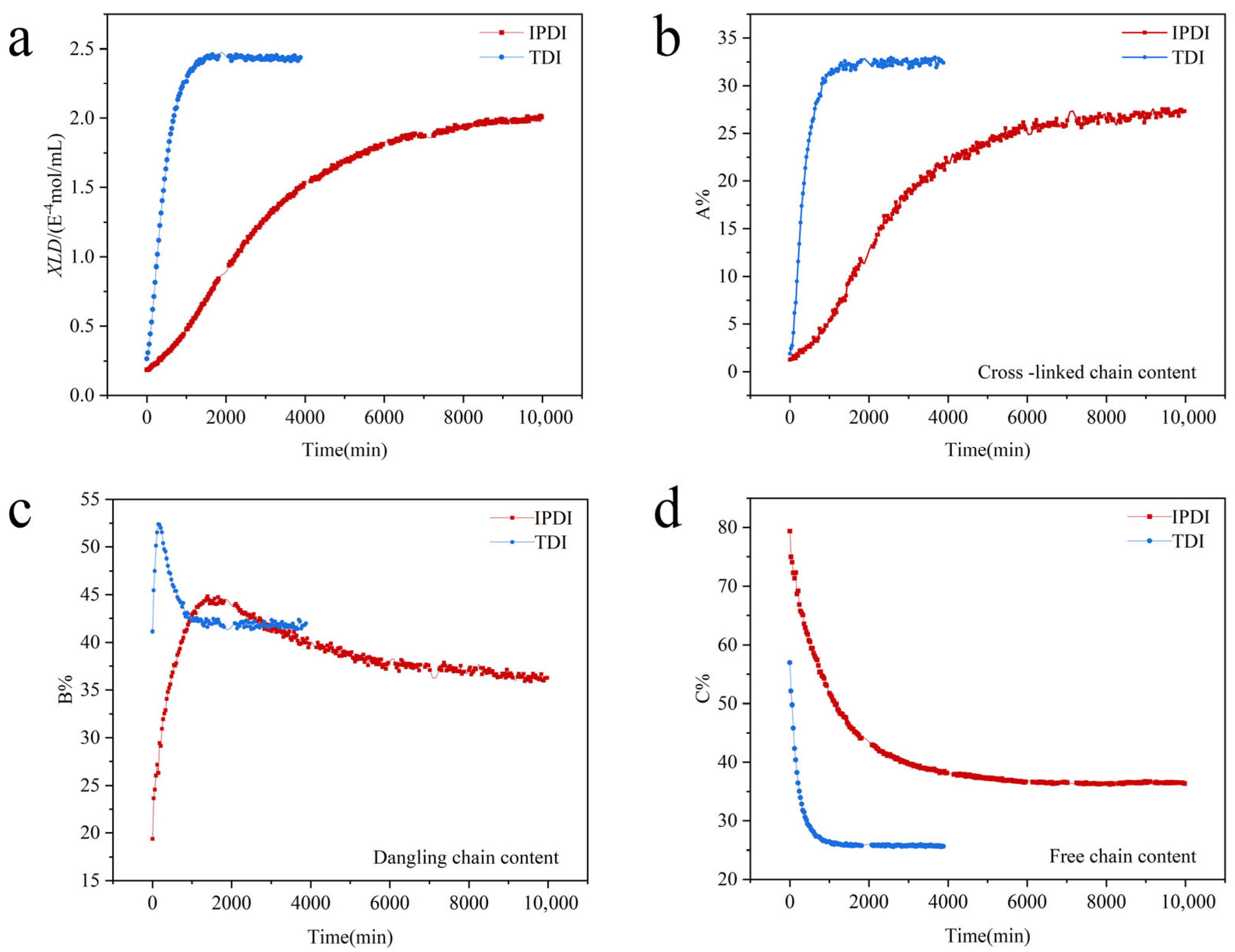
Figure 1a shows the evolution of crosslink density (XLD) as a function of curing time for HTPB propellant slurries cured with TDI and IPDI. The XLD values were obtained by fitting the LF-NMR relaxation data, yielding excellent correlation coefficients of 0.9996 and 0.9998 for the HTPB/TDI and HTPB/IPDI systems, respectively, indicating high reliability of the fitting results. Based on the XLD evolution, the curing process can be divided into three successive stages. In the initial stage, the high mobility of hydrogen protons corresponds to a minimal crosslink density. This is followed by the crosslinking stage, during which the crosslink density increases continuously due to the formation of chemical and physical crosslinks. Finally, in the post-curing stage, the crosslinked network becomes stabilized and the crosslink density reaches a plateau.
The reactions of TDI and IPDI with HTPB proceed via nucleophilic addition. In TDI, the conjugated benzene ring and the presence of two highly reactive –NCO groups lead to rapid consumption of –NCO groups in the early curing stage, forming a high density of aromatic urethane bonds. In contrast, IPDI features an alicyclic structure and significant steric hindrance, which resulted in lower –NCO reactivity, a slower curing rate, and an extended curing time [17]. Consistent with these mechanistic differences, the HTPB/IPDI system required approximately 5.5 days to complete curing, compared to only about 1.25 days for the HTPB/TDI system. The final crosslink density of the HTPB/IPDI propellant was 2.007 × 10⁻⁴ mol/mL, lower than that of the HTPB/TDI system (2.438 × 10⁻⁴ mol/mL). This difference can be attributed to the greater chain flexibility and lower hydrogen-bonding density in IPDI-derived networks, resulting in a comparatively looser crosslinked structure than the more rigid aromatic urethane network formed in the TDI-cured propellant.
The curing reaction of HTPB propellant follows the nth-order reaction kinetic model, which is specifically expressed as:
α = ( ρ t ρ 0 ) ( ρ ρ 0 )
d α d t = k ( 1 α ) n
where α is the conversion rate, ρt is the crosslink density at time t, ρ0 is the crosslink density at t = 0, ρ is the crosslink density at full cure, n is the order of reaction, k is the reaction rate constant, min−1. The reaction rate constant is calculated from the conversion data based on the change in crosslink density over time. Both systems exhibit a reaction order of n ≈ 1. As shown in Table 2, the reaction rate constant of the HTPB/TDI system is 6.8 times that of the HTPB/IPDI system, which is consistent with the fact that the reactivity of TDI isocyanate is 5~10 times that of IPDI.

3.1.2. Content of Crosslinked Chain, Dangling Chain and Free Chain

The curing reaction and evolving network structure of HTPB propellants, utilizing TDI and IPDI as curing agents, are delineated in Figure 1b–d through the quantitative evolution of three distinct chain populations: crosslinked, dangling, and free chains.
A direct comparison of the crosslinked chains reveals markedly different curing profiles (Figure 1b). The HTPB/TDI system cured rapidly, with its crosslinked chain content increasing from 1.8% to 33% within 1800 min. Conversely, the HTPB/IPDI system required approximately 8000 min to achieve a comparable rise, from 1.2% to 27%. This divergence is fundamentally attributed to the superior reactivity of TDI’s aromatic –NCO groups, which facilitates swift urethane formation and network establishment, as opposed to the steric hindrance and differential reactivity of the alicyclic –NCO groups in IPDI. The dynamics of the dangling chains provide further insight into the network development (Figure 1c). Both systems exhibited a characteristic initial increase in dangling chain content, attributable to early-stage chain expansion, diffusion-limited reaction events, and side reactions [4,15]. However, this initial accumulation was more pronounced in the HTPB/IPDI system. The preferential reaction of IPDI’s less sterically hindered secondary –NCO group rapidly created localized crosslinks, increasing micro-viscosity and trapping a larger population of unreacted chain ends as dangling chains [18,19]. In contrast, the synchronous reaction of TDI’s two highly active –NCO groups resulted in a more uniform initial network with fewer dangling defects. As curing proceeded, these dangling chains were gradually consumed through slower diffusion and reaction. Intriguingly, the final cured network of the fast-reacting HTPB/TDI system retained a higher dangling chain content (41%) than the slower HTPB/IPDI system (36%)—an apparent paradox that can be resolved by integrating network topology and the dominant effect of urethane hard-segment rigidity. The rapid cure of TDI resulted in locally dense, heterogeneous crosslinking that kinetically traps dangling chains, preventing their full consumption during curing. More importantly, TDI formed rigid aromatic urethane hard segments, whose intrinsic rigidity far outweighed the modulus-lowering effect of dangling chain defects. In contrast, the prolonged cure of IPDI permitted more extensive diffusion and network relaxation, leading to a more uniform and compositionally “mature” structure with fewer dangling defects; meanwhile, IPDI formed flexible alicyclic urethane hard segments, which contributed less to network rigidity even with fewer defects. This combined effect explains why the HTPB/TDI system maintained a higher modulus despite its higher dangling chain content, clarifying the key distinction between hard-segment rigidity and defect density in governing network mechanical properties.
The consumption of free chains (Figure 1d) corroborates this overall picture. A rapid initial decrease was observed for both systems, being more abrupt for HTPB/TDI. The subsequent slower decline in the HTPB/IPDI system can be rationalized by its more open network morphology, which allowed greater mobility for unreacted species.

3.1.3. Transverse Relaxation Time

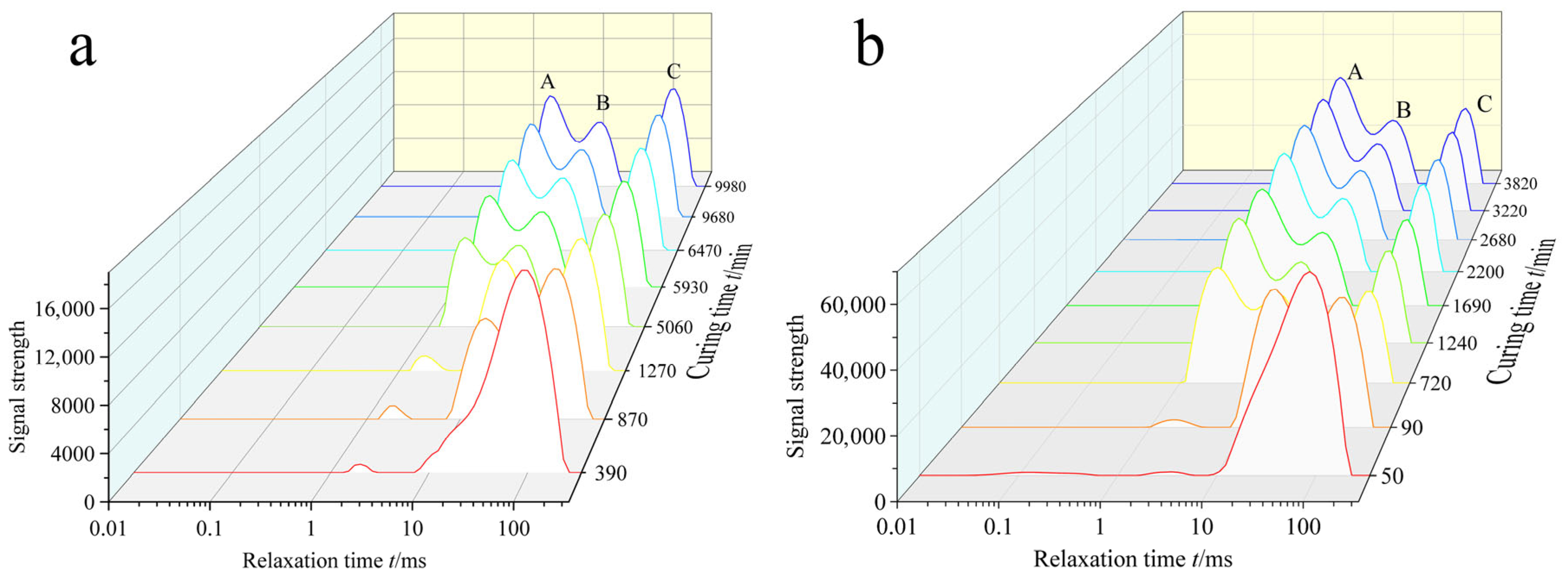
The transverse relaxation time (T2) obtained from LF-NMR serves as a sensitive probe for characterizing the dynamic behavior of molecular chain segments in curing HTPB propellants. By applying the inverse Laplace transformation to perform spectral peak deconvolution of the T2 relaxation time, the continuous relaxation signals are converted into T2 distribution spectra, thereby quantitatively characterizing the evolution of T2 relaxation time distribution throughout the curing process of the two propellant systems is shown in Figure 2.
As curing progressed, the initial single proton peak systematically shifted toward shorter T2 values and broadened progressively, eventually resolving into three distinct peaks. This tri-modal distribution corresponds precisely to the crosslinked chains, dangling chains, and free chains. Throughout this process, the signal intensity of the crosslinked chains gradually increased while their T2 values continued to shorten. The curing reaction was considered complete when the peak shapes and T2 values stabilized. Even at the endpoint, the T2 distribution remained resolved into three peaks, indicating the presence of not only fully formed crosslinked chains but also residual dangling chains and free chains composed of unreacted small molecules.
A notable kinetic difference is observed between the two curing systems: when the main T2 peaks reached a comparable value, the HTPB/TDI system required only 50 min, whereas the HTPB/IPDI system needed 390 min, underscoring their distinct curing reactions. The respective T2 values of the three chain segments at the curing endpoint were 2.161 ms, 8.629 ms, and 113.073 ms for the HTPB/TDI system, and 2.285 ms, 8.797 ms, and 119.013 ms for the HTPB/IPDI system.

3.2. Infrared Spectra

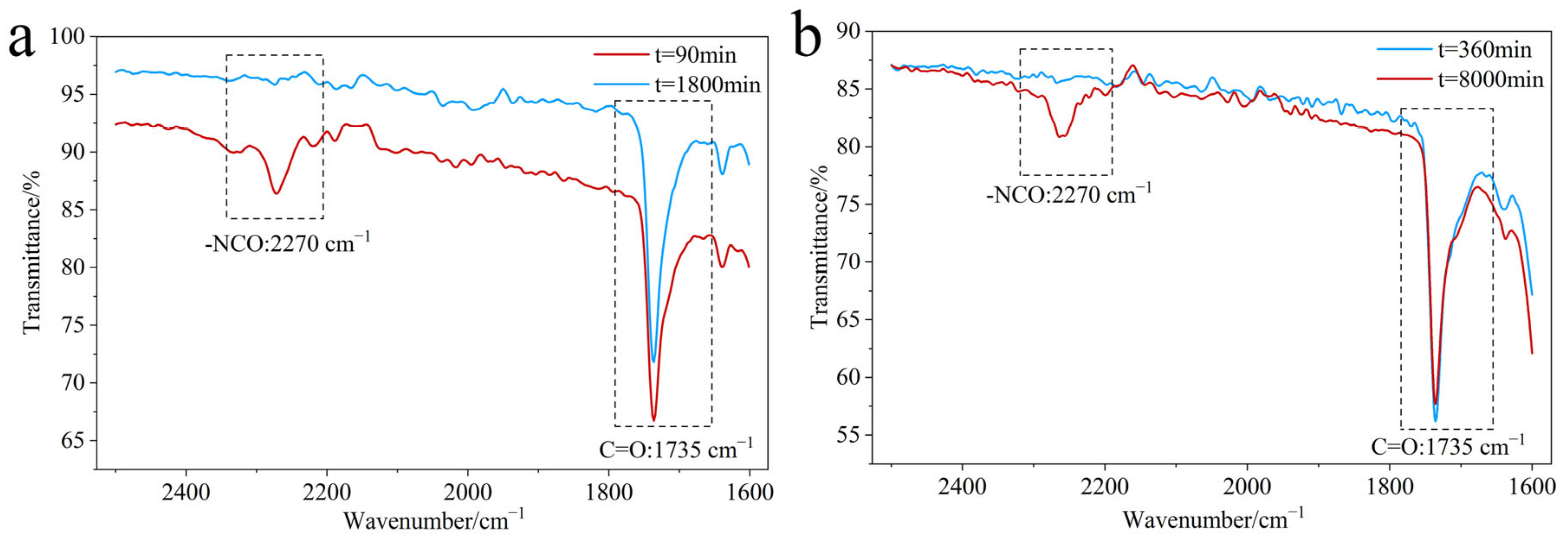
To critically validate the accuracy of LF-NMR for online monitoring of the HTPB propellant curing process, a comparative Fourier transform infrared (FT-IR) study was conducted on the TDI and IPDI curing systems (Figure 3). The results reveal a striking contrast in curing reaction between the two systems. In the HTPB/IPDI system (Figure 3b), the intensity of the –NCO characteristic peak at 2270 cm−1 diminished progressively, while the urethane C=O peak at 1735 cm−1 intensified correspondingly. The –NCO absorption was completely absent only after 8000 min, indicating the conclusion of the curing reaction. In sharp contrast, the –NCO peak in the HTPB/TDI system (Figure 3a) disappeared within merely 1800 min, demonstrating a significantly higher curing rate. Most importantly, the curing endpoints identified by FT-IR show strong correlation with the crosslinking density evolution measured by LF-NMR (Figure 1a): the crosslinking density of the HTPB/IPDI system stabilized after 8000 min, whereas that of the HTPB/TDI system plateaued around 1800 min. This consistency not only confirms the agreement between the two analytical techniques but also firmly validates the reliability of LF-NMR for real-time monitoring of propellant curing.

3.3. Dynamic and Static Mechanical Properties

3.3.1. Dynamic Thermo-Mechanical Analysis

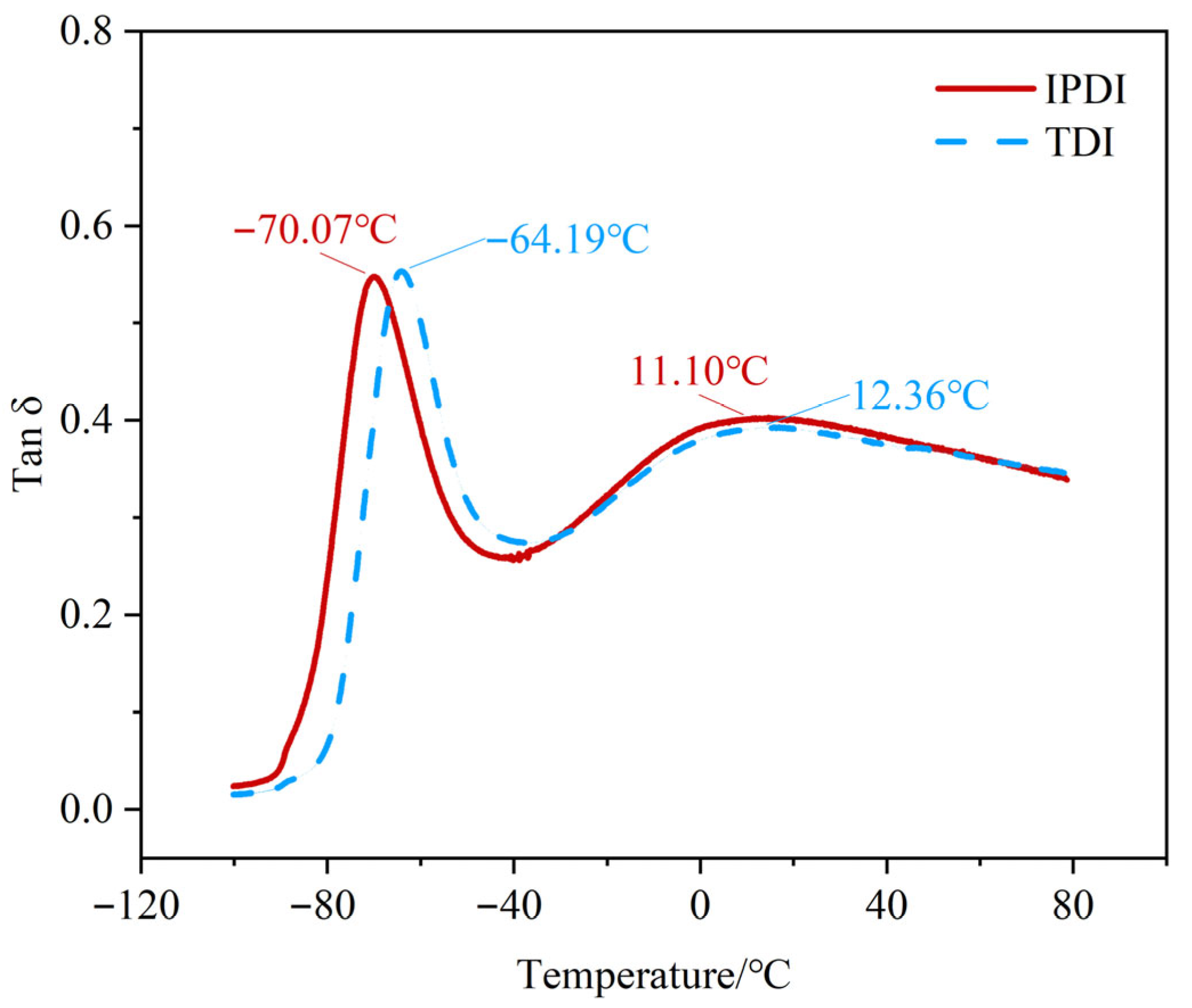
Figure 4 presents the dynamic mechanical properties of the two propellant systems. The tan δ curves exhibit two distinct transitions: a sharp, intense β-transition (soft segment) at −80 °C to −50 °C, and a broad, low-intensity α-transition (hard segment) at 0 °C to 50 °C. Specifically, the HTPB/TDI system shows higher transition temperatures for both segments (α: 12.36 °C; β: −64.19 °C) compared to the HTPB/IPDI system (α: 11.10 °C; β: −70.07 °C), with the HTPB/TDI system exhibiting narrower peak profiles.
These thermal transitions reflect fundamental differences in molecular structure and segmental mobility. The rigid benzene ring and aromatic urethane linkages in HTPB/TDI promote strong hydrogen bonding (enhanced by -NH conjugation with the benzene ring), facilitating the formation of ordered, dense hard-segment domains. This results in restricted molecular mobility, manifesting as higher transition temperatures for both hard and soft segments. In contrast, the alicyclic structure of IPDI exhibits lower polarity and reduced hydrogen bonding capacity, leading to more flexible hard segments with lower transition temperatures. Consequently, the soft segments in HTPB/IPDI experience less constraint from the hard domains, resulting in a lower glass transition temperature.
Overall, the HTPB/TDI system demonstrates higher structural order in hard-segment domains, more pronounced microphase separation, and restricted chain mobility, shifting the entire DMA spectrum to higher temperatures. These dynamic mechanical observations align consistently with the higher crosslinking density and shorter transverse relaxation times derived from LF-NMR measurements, confirming the distinct network architectures and molecular dynamics of the two curing systems.

3.3.2. Static Mechanical Properties

The crosslinked network structure fundamentally governs the molecular mobility and mechanical behavior of the material. An increase in crosslink density results in restricted segmental motion, enhanced rigidity, and elevated elastic modulus, thereby determining the macroscopic mechanical properties. Uniaxial tensile properties of the two curing systems are summarized in Table 3. While both systems exhibit comparable tensile strength, the HTPB/IPDI system demonstrates significantly higher elongation at break along with a lower elastic modulus compared to the HTPB/TDI system.
This mechanical behavior is attributed to distinct network architectures. The alicyclic structure of IPDI facilitates the formation of a looser, more homogeneous crosslinked network with HTPB. This structural characteristic accounts for the lower crosslink density and reduced modulus. Furthermore, the uniform network morphology effectively minimizes stress concentration points. Consequently, the HTPB/IPDI system exhibits superior elongation capability across various temperatures, consistent with its lower crosslink density and higher proportion of dangling and free chains as revealed by LF-NMR analysis.

4. Conclusions

In this work, the curing behavior and network evolution of HTPB propellants employing TDI and IPDI curing systems were systematically investigated using LF-NMR in combination with infrared spectroscopy, dynamic mechanical analysis, and mechanical testing. LF-NMR was successfully demonstrated as an effective and non-destructive technique for real-time monitoring of the curing process, enabling quantitative evaluation of crosslink density and dynamic evolution of different molecular segments at the molecular level. Distinct curing reactions were observed for the two systems, with the HTPB/TDI propellant completing curing within approximately 1.25 days, whereas the HTPB/IPDI system required about 5.5 days, reflecting the higher reactivity of aromatic TDI compared to sterically hindered alicyclic IPDI. The network evolution exhibited characteristic trends, including a progressive increase in crosslinked chains, a concomitant decrease in free chains, and a transient accumulation of dangling chains, all of which were effectively captured through T2 relaxation analysis. These structural differences translated directly into macroscopic properties: the TDI-cured propellant showed higher crosslink density and elastic modulus, while the IPDI-cured system exhibited enhanced elongation at break associated with a lower crosslink density. The strong agreement between LF-NMR results and complementary characterization techniques validates the reliability of this approach for propellant curing analysis. Overall, this study not only deepens the understanding of structure–property relationships in HTPB-based propellants but also establishes LF-NMR as a powerful tool for the design and optimization of solid propellant formulations.

Author Contributions

Conceptualization, M.Y. and J.L.; Methodology, M.Y. and W.H.; Validation, W.H. and J.L.; Investigation, M.Y., H.Z. and J.L.; Resources, J.C.; Data curation, M.Y. and J.L.; Writing—original draft, M.Y. and H.C.; Supervision, F.W., T.W. and J.C.; Project administration, J.C. All authors have read and agreed to the published version of the manuscript.

Funding

This research was funded by the Xi'an North Huian Chemical Industry Co., Ltd.

Data Availability Statement

The original contributions presented in this study are included in the article. Further inquiries can be directed to the corresponding authors.

Conflicts of Interest

Authors Mengrui Yu, Heng Chang, Jinxiang Liu, Fei Wang, Wenhua Hu, Hua Zhang and Jiangbo Chen were employed by the company Xi’an North Huian Chemical Industry Co., Ltd. The remaining authors declare that the research was conducted in the absence of any commercial or financial reationships that could be construed as a potential conflict of interest.

References

  1. Wang, H.B. Study on Curing System of Four-components HTPB Composite Propellants. Ph.D. Thesis, Hunan University, Hunan, China, 2007. (In Chinese) [Google Scholar]
  2. Yang, W.; Ding, Z.; Zhu, C.; Li, T.; Liu, W.; Luo, Y. A Study of Hydroxyl-Terminated Block Copolyether-Based Binder Curing Kinetics. Polymers 2024, 16, 2246. [Google Scholar] [CrossRef] [PubMed]
  3. Korah Bina, C.; Kannan, K.G.; Ninan, K.N. DSC Study on the Effect of Isocyanates and Catalysts on the HTPB Cure Reaction. J. Therm. Anal. Calorim. 2004, 78, 753–760. [Google Scholar] [CrossRef]
  4. Lee, S.; Choi, J.H.; Hong, I.-K.; Lee, J.W. Curing Behavior of Polyurethane as a Binder for Polymer-Bonded Explosives. J. Ind. Eng. Chem. 2015, 21, 980–985. [Google Scholar] [CrossRef]
  5. He, L.; Zhou, J.; Dai, S.; Ma, Z. Influence of Combustion Modifiers on the Cure Kinetics of Glycidyl Azide Polymer Based Propellant-Evaluated through Rheo-Kinetic Approach. Polymers 2019, 11, 637. [Google Scholar] [CrossRef] [PubMed]
  6. Jiang, X.R.; Li, Z.; Lu, R. Study on Transition Law of Thixotropic Characteristics of HTPB Propellant Slurry during Solidification. Chin. J. Propuls. Technol. 2020, 41, 1178. (In Chinese) [Google Scholar]
  7. Zhang, Y.F.; Xu, S.L.; Huang, Z.P. Near infrared spectroscopy study on the curing reaction kinetics of nitrate plasticized GAP with N100. Chin. J. Rocket Technol. 2025, 48, 102–107. (In Chinese) [Google Scholar] [CrossRef]
  8. Jia, L.; Xie, W.X.; Du, J.J. Influence of Combustion Catalyst on the Curing Reaction of Propellant by LF-NMR. Chin. J. Solid Rocket Technol. 2015, 38, 697–706. (In Chinese) [Google Scholar]
  9. Li, K.; Zheng, J.; Zhang, X.; Du, Y. Research on the Structure of Composite Solid Propellant Cross-Linked Network by Nuclear Magnetic Resonance. In Proceedings of the Advances in Materials, Machinery, Electrical Engineering (AMMEE 2017); Atlantis Press: Paris, France, 2017; pp. 122–128. [Google Scholar]
  10. Du, J.; Jia, L.; Wang, F.; Yu, S.L.; Wang, Q.; Chang, H. Application of LF-NMR in Aging Property Evaluation of Explosives and Propellants. Chin. J. Energ. Mater. 2019, 27, 1017–1024. (In Chinese) [Google Scholar]
  11. Yu, H.Y.; Myoung, S.; Ahn, S. Recent Applications of Benchtop Nuclear Magnetic Resonance Spectroscopy. J. Magnetochemistry 2021, 7, 121. [Google Scholar] [CrossRef]
  12. Chen, K.; Wen, X.; Li, G.; Pang, S.; Luo, Y. Improvement of Mechanical Properties of in Situ -Prepared HTPE Binder in Propellants. J. RSC Adv. 2020, 10, 30150–30161. [Google Scholar] [CrossRef] [PubMed]
  13. Ducruet, N.; Delmotte, L.; Schrodj, G.; Stankiewicz, F.; Desgardin, N.; Vallat, M.; Haidar, B. Evaluation of Hydroxyl Terminated Polybutadiene-isophorone Diisocyanate Gel Formation during Crosslinking Process. J. Appl. Polym. Sci. 2013, 128, 436–443. [Google Scholar] [CrossRef]
  14. Grootveld, M.; Percival, B.; Gibson, M.; Osman, Y.; Edgar, M.; Molinari, M.; Mather, M.L.; Casanova, F.; Wilson, P.B. Progress in Low-Field Benchtop NMR Spectroscopy in Chemical and Biochemical Analysis. J. Anal. Chim. Acta 2019, 1067, 11–30. [Google Scholar] [CrossRef]
  15. Azoug, A.; Constantinescu, A.; Nevière, R.; Jacob, G. Microstructure and Deformation Mechanisms of a Solid Propellant Using 1 H NMR Spectroscopy. J. Fuel 2015, 148, 39–47. [Google Scholar] [CrossRef]
  16. GJB 770B-2020; Test Methods for Gunpowder. Technology and Industry for National Defence Publish: Beijing, China, 2020.
  17. Lucio, B.; De La Fuente, J.L. Rheokinetic Analysis on the Formation of Metallo-Polyurethanes Based on Hydroxyl-Terminated Polybutadiene. J. Eur. Polym. J. 2014, 50, 117–126. [Google Scholar] [CrossRef]
  18. Ma, H.; Liu, Y.C.; Cai, T.; Guo, J.W.; Hu, T.P.; Luo, J.; Zhang, J. Study on the Curing Process of HTPB/IPDI Binder System under Different Catalysts Conditions. Chin. J. Energ. Mater. 2017, 25, 360–365. (In Chinese) [Google Scholar]
  19. Wu, X.Y.; Cui, Q.Z.; Xu, J. Curing Reaction Kinetics of HTPB/TDI Bonding System. Chin. J. Energ. Mater. 2016, 24, 1097–1101. (In Chinese) [Google Scholar]
Figure 1. (a) XLD vs. time curves of two propellant slurries; (b) A% vs. time curves of two propellant slurries; (c) B% vs. time curves of two propellant slurries; (d) C% vs. time curves of two propellant slurries.
Aerospace 13 00172 g001
Figure 2. T2 relaxation time of two propellant slurries during curing: (a) HTPB/IPDI System; (b) HTPB/TDI System.
Aerospace 13 00172 g002
Figure 3. FT-IR spectra of two propellant slurries during curing: (a) HTPB/TDI System; (b) HTPB/IPDI System.
Aerospace 13 00172 g003
Figure 4. DMA test results of two propellants.
Aerospace 13 00172 g004
Table 1. Particle size distributions of the solid fillers.
Solid Fillers D 50 / μ m D 10 / μ m D 90 / μ m
AP (5–10 μ m )6.632.0715.4
AP (40–60 mesh)400.6272.5568.2
AP (100–140 mesh)167.8114.7245.2
RDX28.77.9070.9
Al24.713.642.1
Table 2. Parameters of the curing kinetic equation.
Propellantk/min−1Kinetic EquationR2
HTPB/TDI system2.71 × 10−3 d α d t = 10 2.567 ( 1 α ) 0.99
HTPB/IPDI system3.96 × 10−4 d α d t = 10 3.402 ( 1 α ) 0.99
Note: k is the reaction rate constant; R2 is the correlative coefficient.
Table 3. Mechanical properties of two propellants.
PropellantT/°C σ m /MPa ε b /% ε m /% E 0 /MPa
HTPB/TDI system200.9658.852.07.85
500.8252.547.65.42
−402.5177.060.048.0
HTPB/IPDI system200.9472.160.96.53
500.8057.949.64.38
−402.3383.168.041.5
Note: σ m is tensile strength; ε b is the elongation at break; ε m is the maximum elongation; E 0 is the modulus of elasticity.
Disclaimer/Publisher’s Note: The statements, opinions and data contained in all publications are solely those of the individual author(s) and contributor(s) and not of MDPI and/or the editor(s). MDPI and/or the editor(s) disclaim responsibility for any injury to people or property resulting from any ideas, methods, instructions or products referred to in the content.