Article

Shock Angle Characteristics and Test Analysis of Hypersonic Wide-Speed-Range Cruise Aircraft

School of Mechanical Engineering, Nanjing University of Science and Technology, Nanjing 210094, China
*
Author to whom correspondence should be addressed.
Aerospace 2026, 13(2), 170; https://doi.org/10.3390/aerospace13020170
Submission received: 6 January 2026 / Revised: 8 February 2026 / Accepted: 9 February 2026 / Published: 11 February 2026
(This article belongs to the Special Issue Hypersonic Aerodynamics and Propulsion)

Abstract

Hypersonic aircraft represent a cutting-edge technology in aerospace engineering, where the shock angle serves as a critical aerodynamic parameter. However, existing studies remain limited by significant prediction errors for the shock angle. This study employs a combination of numerical simulation and wind tunnel test techniques to analyze the shock angle characteristics of hypersonic wide-speed-range cruise aircraft. Consequently, a numerical simulation analysis model for the shock angle of such aircraft was established. Shock angle measurement tests were conducted at various Mach numbers in a pulsed combined high-enthalpy wind tunnel. Comparing the simulation results to the wind tunnel results revealed a numerical error of 4.08%, validating the accuracy of the numerical model. Shock angles at Mach numbers 6, 7, 8, 9, 10, 12, 15 and 20 were analyzed in the numerical simulations, and a nonlinear fitting method was used to determine the functional relationship between the shock angle and Mach number. The results indicate that as the Mach number increases, the shock angle progressively decreases, and its attenuation rate diminishes. The shock angle exhibits an exponentially decreasing relationship with the Mach number, approaching 10.708° as the Mach number approaches infinity. This study provides methodological support and data references for predicting shock wave characteristics and designing aerodynamic hypersonic aircraft.

1. Introduction

As a critical aerodynamic parameter, the shock angle directly influences flight stability, thermal load distribution and structural design [1,2]. Under wide-speed-range cruise conditions, the nonlinear evolution of the shock angle becomes particularly complex. Existing theoretical models are often constrained by high prediction errors, necessitating integrated approaches combining high-accuracy numerical simulation and test validation [3,4]. The hypersonic (Ma > 5) aircraft represents a cutting-edge aerospace technology with significant strategic value in military reconnaissance, long-range strikes, space exploration and high-speed transportation [5,6].
Rankine and Hugoniot developed the Rankine–Hugoniot relations [7,8], laying the theoretical framework for abrupt changes in thermodynamic parameters across shock fronts. Busemann [9] introduced the theory of shock polar lines, providing graphical tools for understanding shocks. Shapiro [10] established the fundamental model for shock angles in compressible fluids. The shock angle theory originates from classical gas dynamics [11]. Anderson [1] systematically elucidated the mechanisms of hypersonic flow. Joumaa [12] derived analytical expressions for the maximum wedge angle and shock angle, discussing the application scenarios and limitations of the expressions. Prandtl and Meyer proposed the theory of supersonic expansion waves, laying the foundation for studying flow parameter relationships between the shock angle, Mach number and deflection angle [13].
When a vehicle flies at high Mach numbers, the surrounding flow field undergoes extreme aerodynamic heating and complex physicochemical processes. During this process, gas molecules undergo phenomena such as vibrational excitation, dissociation and ionization, collectively termed the real gas effect. Anderson [1] systematically expounded the fundamental principles of high-temperature gas dynamics, providing a comprehensive theoretical and knowledge framework for understanding and researching hypersonic real gas effects. Maus [14], whilst analyzing anomalous pitch moments in the Space Shuttle, observed that ground wind tunnel data aligned well with flight data when aerodynamic models accounted for air dissociation. Candler [15] developed Direct Simulated Monte Carlo (DSMC) methods and high-fidelity computational fluid dynamics programs capable of directly simulating microscopic physical processes within shock layers, providing powerful tools for understanding non-equilibrium effects. Park [16] established multiple chemical kinetic models, with his two-temperature model—separating vibrational temperature from translational–rotational temperature—significantly enhancing the prediction accuracy for vibrational relaxation and dissociation rates. Gupta [17] systematically compiled thermodynamic data and transport properties for eleven air composition models, establishing a standard database for finite-rate chemical reaction calculations in most hypersonic CFD software(Fluent V19.0+). Bertin [18] discussed the impacts of real gas effects in high-enthalpy flows on engineering design. The core challenge in physical modeling lies in accurately describing the thermochemical non-equilibrium processes within air. Hornung [19] explored the complex coupling mechanism between real gas effects and transition processes. Theoretical models often neglect viscous effects and real gas effects [20], leading to insufficient reliability in engineering applications. Knight [3] assessed the impact of real gas effects on the predictive accuracy of hypersonic aerothermal heating. Stemmer [21] employed high-fidelity DNS computations to reveal thermochemical non-equilibrium effects on obstacle flow around hypersonic boundary layers. Hao [22] examined the influence of vibrational non-equilibrium effects on hypersonic shock/laminar boundary layer interactions. Rahmani [23] employed a high-order WENO scheme to investigate the interaction between real gas effects and shock disturbances around blunt bodies. Urzay [24] analyzed the interactions between real gas effects and turbulence. Zanardi [25] utilized Physically Informed Neural Networks (PINNs) for efficient simulation of hypersonic thermochemical non-equilibrium effects. Rui [26] discovered that non-Boltzmann distributions of oxygen molecular vibrational energies influence dissociation rates under high-temperature non-equilibrium conditions. As aerospace applications advance towards higher Mach numbers, future research necessitates further breakthroughs in real gas effect modeling and high-fidelity simulation capabilities.
Many scholars have conducted in-depth research on high-accuracy shock-capturing formats, adaptive mesh techniques and simulations of complex physical effects. Wilcox [27] developed the k-omega turbulence model, which is widely applied in hypersonic simulations using the Fluent software(Fluent V19.0+). Nagdewe [28] compared the performance of HLLC and AUSM schemes in simulating hypersonic flows, demonstrating their ability to more precisely capture flow features like shock waves. Addressing the thermochemical non-equilibrium effects essential in hypersonic flows, Prakash [29] proposed a fifth-order accurate shock-fitting method. Jun [30] proposed a shock-fitting technique based on unstructured moving meshes, maintaining stability even under irregular shock conditions. Li [31] analyzed the application of high-order DG methods in hypersonic flow simulations. Ben [32] introduced an adaptive meshing technique that automatically refines the mesh near the shock wave based on flow field characteristics, yielding more accurate shock angles. Maeda [33] described an improved scheme to suppress numerical instabilities caused by strong shock computations at high Mach numbers. Huang [34] developed a shock-capturing method combining adaptive mesh refinement with positivity preservation techniques. With significant advances in numerical simulation techniques, Wang [35] enhanced the shock angle prediction accuracy using the SST k-omega model. Ren [36] conducted an in-depth analysis of the numerical stability issues in second-order Godunov-type schemes when simulating strong shocks at high Mach numbers.
Shock angle test analysis methods primarily rely on wind tunnel tests. Bingham [37] simulated the interaction between the bow shock wave of a hypersonic aircraft and an externally generated shock wave in a Mach 7.3 shock tunnel. White [38] investigated shock wave/turbulent boundary layer interactions near the expansion angle in a shock tunnel. Settles [39] detailed the application of a shadowgraph system in shock visualization. Murray [40] conducted a shock angle measurement test at Mach 8.9, although these experiments did not cover multiple flight conditions. Mudford [41] proposed a novel “free-flight” test method in a Mach 6 wind tunnel, enabling accurate acquisition of shock angle for models under hypersonic conditions. China’s JF-12 hypersonic shock tunnel [42,43] can reproduce Mach 5–9 flight environments under laboratory conditions, employing a shadowgraph system to obtain shock distributions on aircraft surfaces. Giepman [44] conducted shock studies at Mach 1.6~2.3, focusing on supersonic flight. Barber [45] noted that existing work has predominantly targeted narrow-speed-range systems, with limited data available for wide-speed-range systems. Saiprakash [46] utilized a high-speed shadowgraph system to visualize the flow field development around a pointed cone model at high Mach numbers and measured the shock angle. Shock angle variations across a wide speed range exhibit nonlinear trends [47]. In summary, researchers in this field face the following challenges at present: traditional shock angle prediction methods exhibit high error rates, numerical simulation models for shock angles lack precision, and a quantitative understanding of shock angle evolution across wide-speed-range aircraft remains insufficient.
Therefore, this study innovatively combines high-precision numerical simulation technology with pulsed high-enthalpy wind tunnel tests to investigate the shock angle for hypersonic wide-speed-range cruise aircraft. Consequently, a high-precision numerical simulation model for the shock angle is developed and validated through wind tunnel tests, revealing the relationship between the shock angle and Mach number. In particular, the functional relationship between the shock angle and Mach number is fitted to enable the prediction of the shock angle under extreme operating conditions. This study provides methodological support and data references for predicting shock wave characteristics, as well as for the aerodynamic design of hypersonic aircraft.

2. Model and Methodology for Shock Angle Study

2.1. Aircraft Model

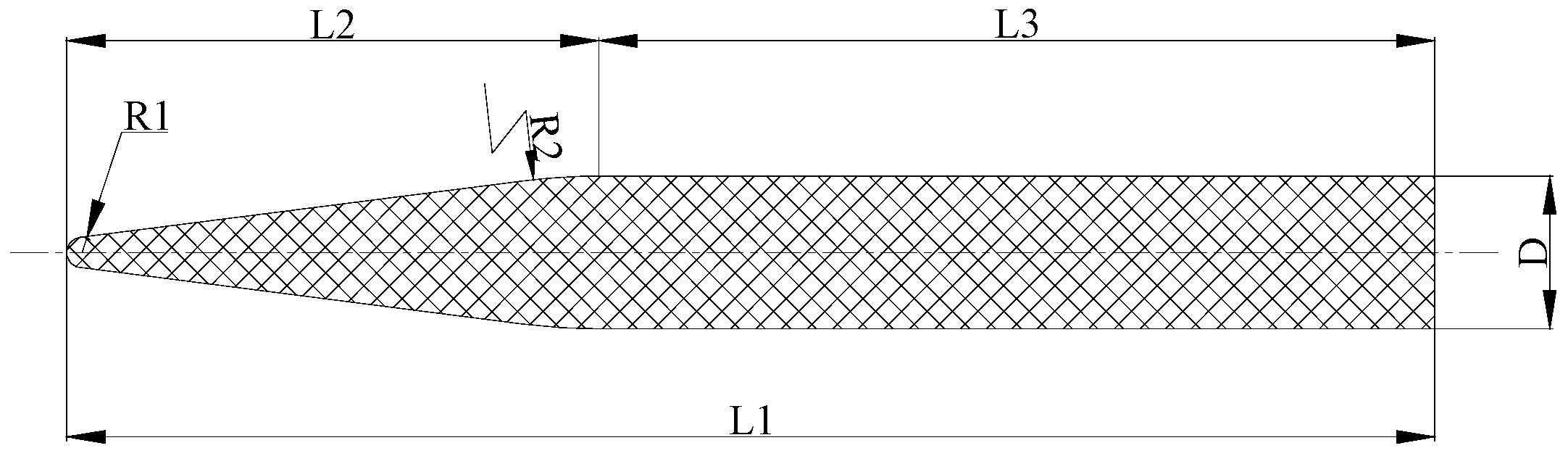
A hypersonic cruise aircraft model was constructed using SolidWorks2018, as shown in Figure 1. The aircraft primarily consists of a nose section and a fuselage.
The aerodynamic dimensions of the aircraft are illustrated in Figure 2. The aircraft diameter is D = 80   mm . The total axial length of the aircraft is L 1 = 9 D = 720   mm . The axial length of the nose section (conical portion) is L 2 = 3 . 5 D = 280   mm . The axial length of the fuselage section (constant cross-section portion) is L 3 = 5 . 5 D = 440   mm . The nose radius is R 1 = 0 . 1 D = 8   mm . The arc radius between the nose section and the fuselage is R 2 = 4 D = 320   mm .

2.2. Numerical Simulation and Test Methods for Shock Angle

2.2.1. Numerical Simulation and Test Analysis Methods

First, we establish a hypersonic cruise aircraft and fluid domain model based on SolidWorks. Subsequently, we perform mesh generation on the fluid domain model using Pointwise. Then, we conduct a numerical simulation of the shock angle for the aircraft under various Mach number flight conditions using Fluent, thereby establishing a numerical simulation analysis model for the shock angle of hypersonic wide-speed-range cruise aircraft. Shock angle measurement tests at various Mach numbers were conducted in a pulsed combined high-enthalpy wind tunnel. Finally, the shock angle characteristics of the aircraft at various Mach numbers were analyzed by integrating the numerical simulation and the wind tunnel test results. The numerical simulation and test analysis method for the shock angle of hypersonic cruise aircraft is illustrated in Figure 3.

2.2.2. Establishment of Shock Angle Numerical Simulation Analysis Model

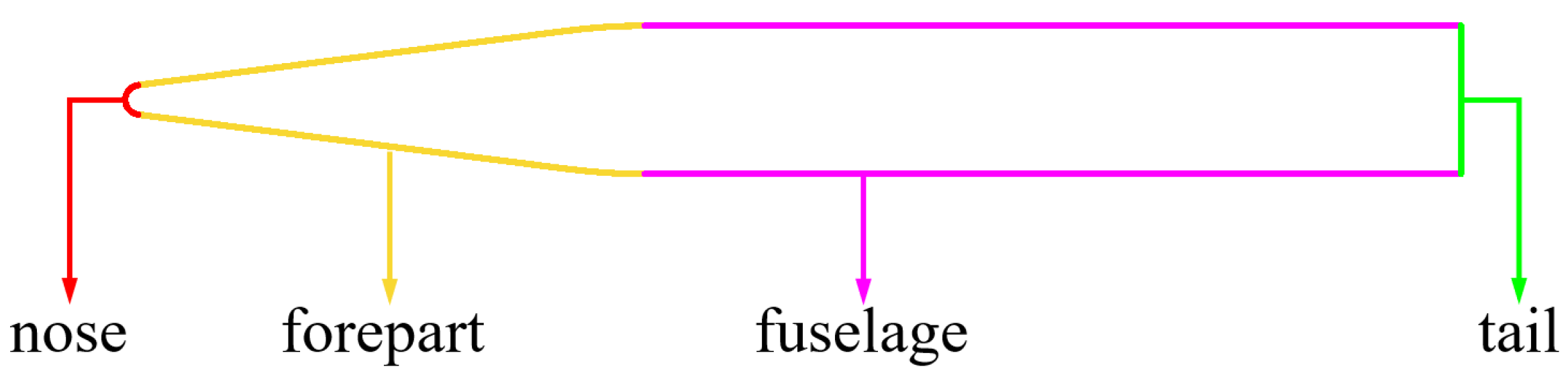
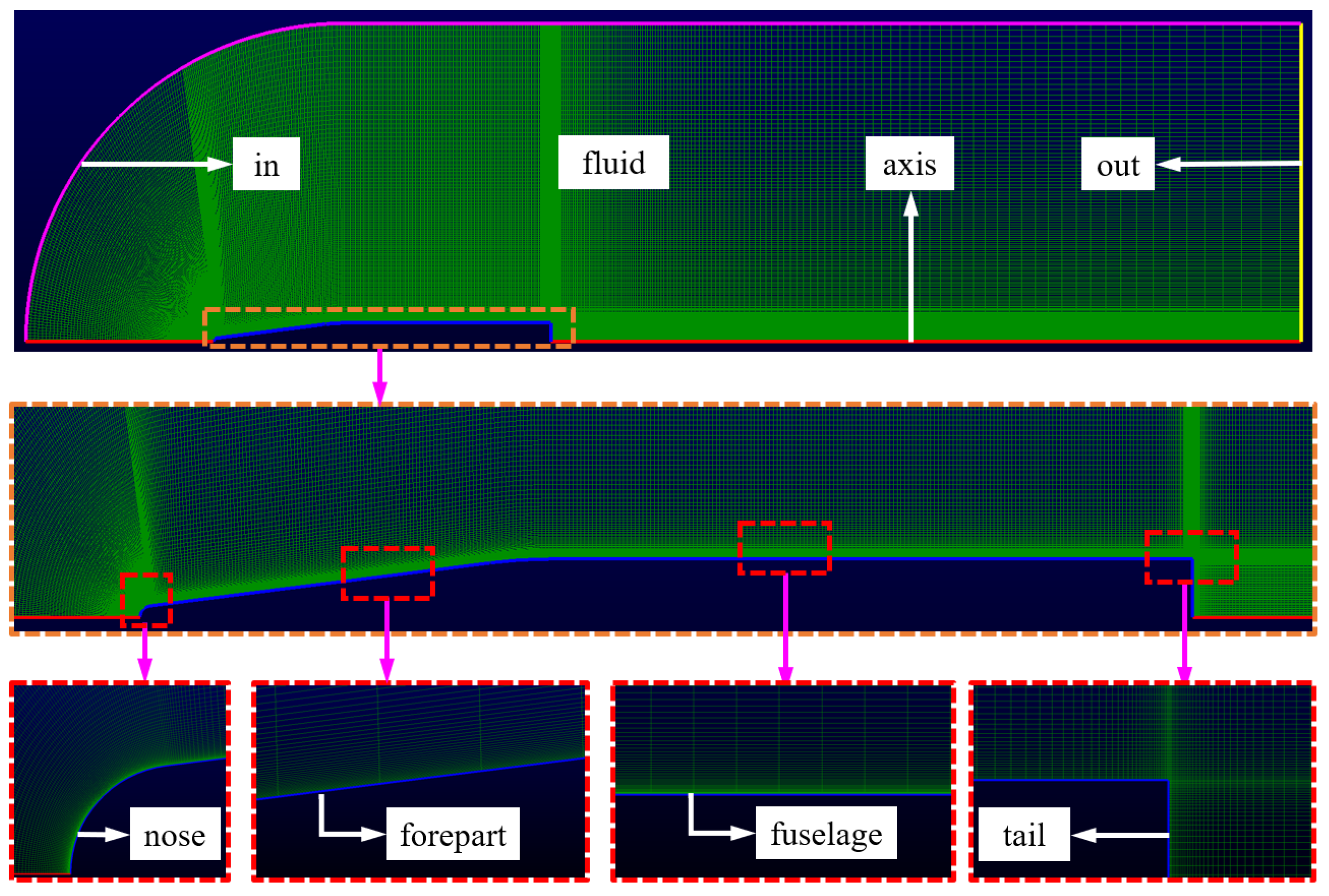
Due to the axisymmetric structure of the cruise aircraft, an axisymmetric two-dimensional (2D) model replaces the three-dimensional (3D) model for numerical simulation to enhance computational efficiency. The boundary naming scheme is illustrated in Figure 4. The aircraft boundary consists of the nose, forepart, fuselage and tail, with all boundary types set as the wall.
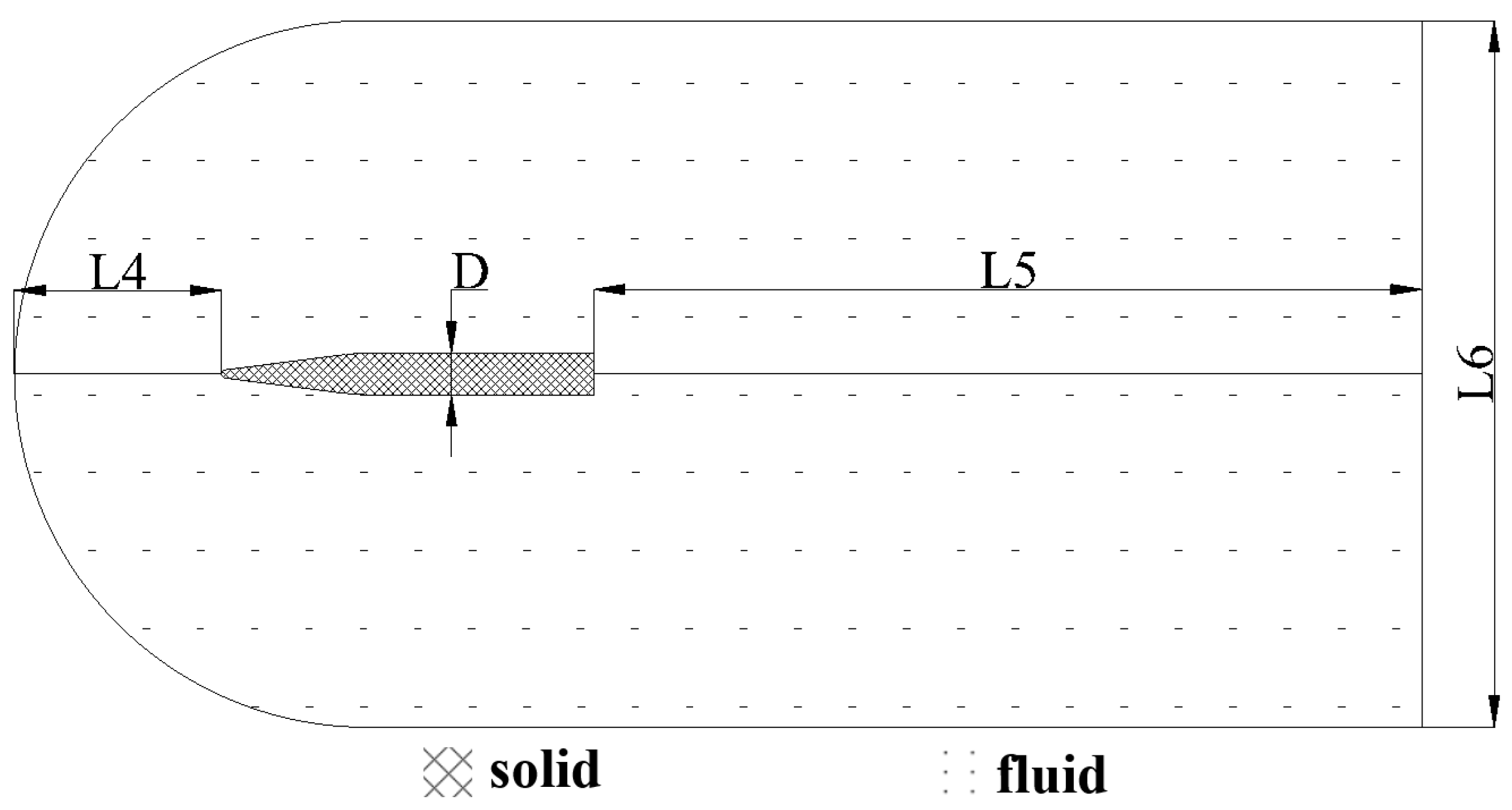
The external flow domain model for the aircraft was established in SolidWorks. The schematic diagram of the fluid domain dimensions is shown in Figure 5. The distance between the fluid domain inlet and the aircraft is 5 times the aircraft diameter, i.e., L 4 = 5 D = 400   mm . The distance between the fluid domain outlet and the aircraft is 20 times the aircraft diameter, i.e., L 5 = 20 D = 1600   mm . The radial diameter of the flow domain is 17 times the aircraft diameter, i.e., L 6 = 17 D = 1360   mm .
The fluid domain boundary consists of an inlet (in), an outlet (out) and an axis of symmetry (axis). The inlet boundary is a pressure far field, the outlet boundary is a pressure outlet, and the axis of symmetry boundary is axisymmetric. Due to the significant gradient in aerodynamic characteristics of the boundary layer at hypersonic speeds, it is essential to appropriately set the height of the first mesh layer in the boundary layer on the aircraft surface. This enhances the quality of the fluid domain mesh and improves computational accuracy. The first boundary layer height in the numerical simulation is calculated using Equation (1) [13]. Here, ρ is air density, ρ = 0.194   kg / m 3 ; V c is the incoming flow velocity, V c = 1770   m / s ; L is the characteristic length scale, L = 0.72   m ; μ is the dynamic viscosity coefficient, μ = 1.4216 × 10 5   kg / ( m s ) ; R e is the Reynolds number; C f is the friction drag coefficient; τ w is the wall shear stress; u τ is the friction velocity; y + is the dimensionless wall distance, y + = 4 ; h * is the boundary layer height correction factor, h * = 2 ; and h is the first boundary layer height, which is calculated using Equation (1) (i.e., h = 0.0096   mm 0.01   mm ). The distribution of the dimensionless wall distance on the wall surface obtained through numerical simulation is shown in Figure 6. The results indicate that the dimensionless wall distance ranges between 2.7 and 4.8, falling within the viscous sublayer. Therefore, setting the first boundary layer height to 0.01 mm in the numerical simulation is appropriate.
R e = ρ V c L μ C f = 0.026 R e 1 / 7 τ w = 1 2 C f ρ V c 2 u τ = τ w ρ h = h * y + μ u τ ρ
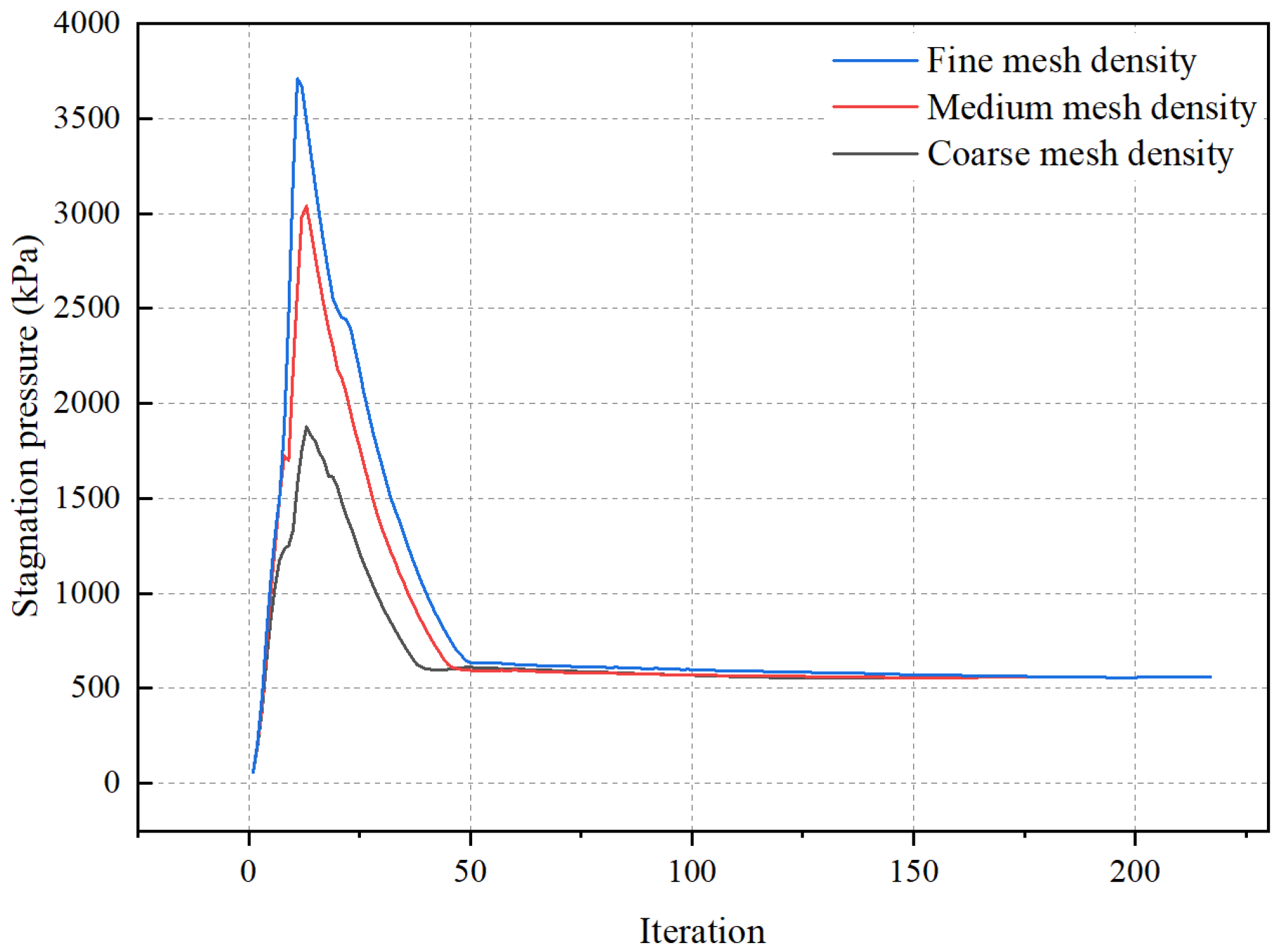
To avoid excessive computational errors caused by overly coarse meshes while preventing increased computational resource consumption due to overly fine meshes, this study conducts mesh independence verification. Mesh independence verification demonstrates that numerical simulation results are unaffected by mesh density, validating the reliability and stability of computational outcomes. Three meshes with varying densities—coarse, medium and fine—were generated. The influence of these meshes on simulation results was analyzed by monitoring the stagnation pressure. The parameters and results for the different mesh densities are shown in Table 1. The numerical simulation iteration results for the stagnation pressure at the different mesh densities are shown in Figure 7. The results indicate that the calculations for stagnation pressure converge for all three mesh densities, and the computational results for different meshes no longer show significant variation with increasing mesh density. Considering both computational accuracy and computational cost, the medium-density mesh is selected for numerical simulation.
A schematic diagram illustrating the naming of fluid domain boundaries and the boundary layer refinement is shown in Figure 8. The fluid domain was meshed using the Pointwise software(Pointwise V18.6), generating 129,575 structured mesh cells. The Minimum Orthogonal Quality (MOQ) of the mesh is 0.91. Generally, a MOQ greater than 0.2 indicates acceptable mesh quality. The mesh quality of this model is significantly higher than 0.2, earning it an excellent rating.
The fluid domain medium in this study is air, employing the ideal gas assumption in numerical simulations, neglecting chemical reactions such as vibration excitation, dissociation and ionization. Viscosity follows Sutherland’s law. The free-stream pressure is 12,044.5 Pa, and the free-stream temperature is 216.65 K. A numerical simulation analysis model for the shock angle of hypersonic wide-speed-range cruise aircraft was established using the Fluent software(Fluent 2022R2). This model investigates the shock angle behavior under various Mach number flight conditions. The simulation employs an axisymmetric two-dimensional spatial domain. A pressure-based solver is employed. The turbulence model selection is the SST k-omega [48,49,50] turbulence model. Viscous heating and compressibility effects are accounted for in the steady-state calculation. The turbulence intensity and turbulence viscosity ratio are set to 1%. The pressure–velocity coupling strategy is Couple. The flux type is Rhie–Chow distance-based. The spatial discretization method is Green–Gauss cell-based. The pressure method is second order. The density, momentum and energy methods are second-order upwind. The turbulent kinetic energy and specific dissipation rate methods are first-order upwind [51].

2.2.3. Shock Angle Wind Tunnel Measurement Test

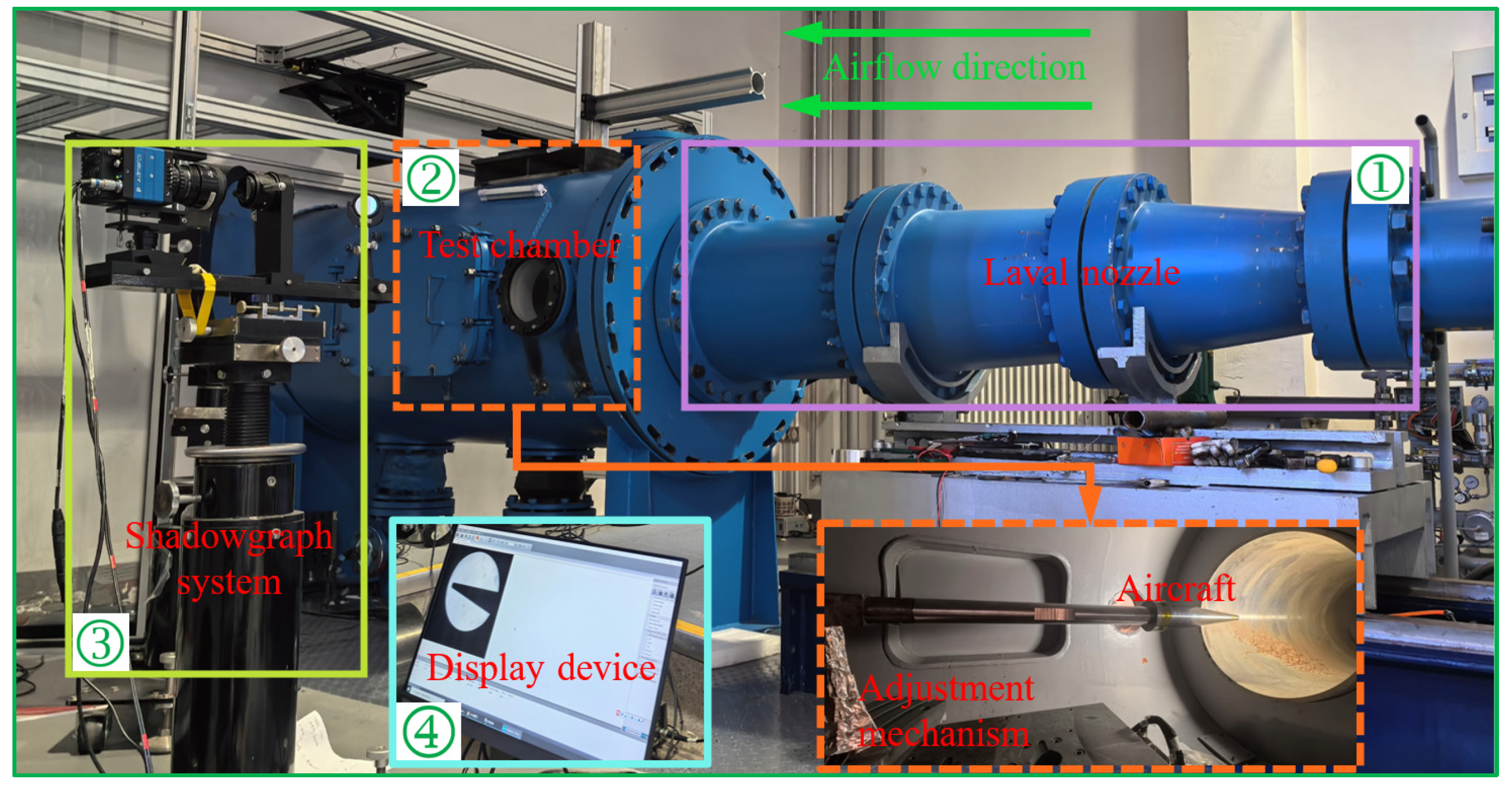
The FL-63 wind tunnel is a pulsed combined high-enthalpy facility featuring two operational modes: Ludwig tube and shock tube. The Ludwig tube mode simulates flight conditions at Mach numbers ranging from 3.0 to 4.5, while the shock tube mode replicates conditions at Mach numbers from 5.0 to 10.0. The FL-63 wind tunnel can be used to conduct aerodynamic thermal load measurement, engine ignition and flow visualization and measurement tests. The wind tunnel primarily consists of a Laval nozzle, test chamber, shadowgraph system and display equipment. The test chamber houses angle-of-attack and sideslip angle adjustment mechanisms along with the aircraft. This study selected the shock tube mode of the FL-63 wind tunnel to conduct tests for cruise aircraft at flight Mach numbers of 6, 7 and 8. The test plan for obtaining the aircraft shock wave diagram is illustrated in Figure 9. During testing, airflow within the wind tunnel is accelerated through the Laval nozzle to achieve hypersonic velocity. This airflow is directed onto the aircraft installed within the test chamber. Generated shock waves are continuously captured and recorded by the shadowgraph system. The resulting shock waves are captured throughout the process by the shadowgraph system, with the shock wave patterns stored on computer terminals via display equipment. Finally, the hypersonic aircraft shock angle wind tunnel measurement tests are completed through post-processing.
The FL-63 wind tunnel operates using dry air. This wind tunnel can accommodate test models measuring 1.2 m in length and 0.2 m in diameter. The model material is nickel-based superalloy Inconel 718, with dimensions within the wind tunnel’s permissible range. Given the short test duration (20 ms), thermal conduction effects are negligible, meaning the model’s initial thermal state does not significantly influence the shock angle. The shock angle uncertainty in the wind tunnel test is ±0.1°, falling within a reasonable error range. In the shock tube operating mode of the FL-63 wind tunnel, the typical total temperature is approximately 950 K. Additionally, the short duration of the wind tunnel operation is insufficient to induce significant oxygen dissociation. Under wind tunnel test conditions, the vibration relaxation time is approximately 100 ms, with vibrations not fully stabilized. The dissociation time exceeds 103 s, and the dissociation reaction is completely frozen. Therefore, treating the wind tunnel flow as an ideal gas is a reasonable approximation during the experimental validation phase. The operating state parameters of the wind tunnel test are shown in Table 2.

3. Results Analysis

3.1. Analysis of Numerical Simulation Results

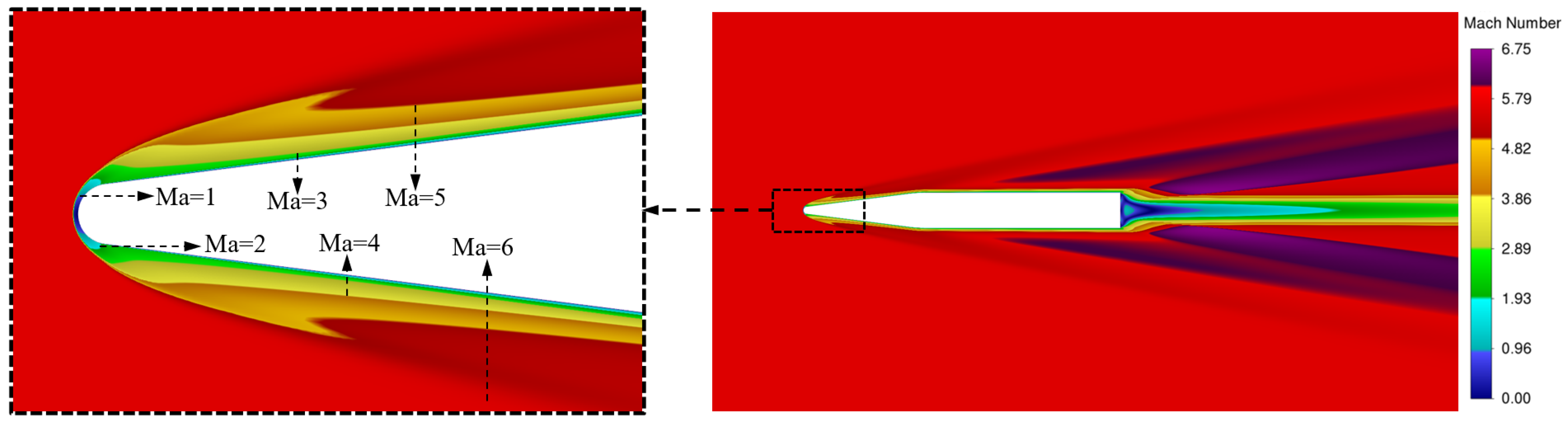
The results for flight conditions at Mach numbers 6, 7, 8, 9, 10, 12, 15 and 20 were obtained using the numerical simulation analysis model for the shock angle of hypersonic wide-speed-range cruise aircraft. The Mach contour plot for the flight condition at Mach 6 is shown in Figure 10. The contour plot reveals that the Mach number undergoes a deceleration and stagnation process along the fluid domain from the inlet toward the aircraft’s stagnation point, sequentially experiencing Ma = 6, Ma = 5, Ma = 4, Ma = 3, Ma = 2 and Ma = 1.
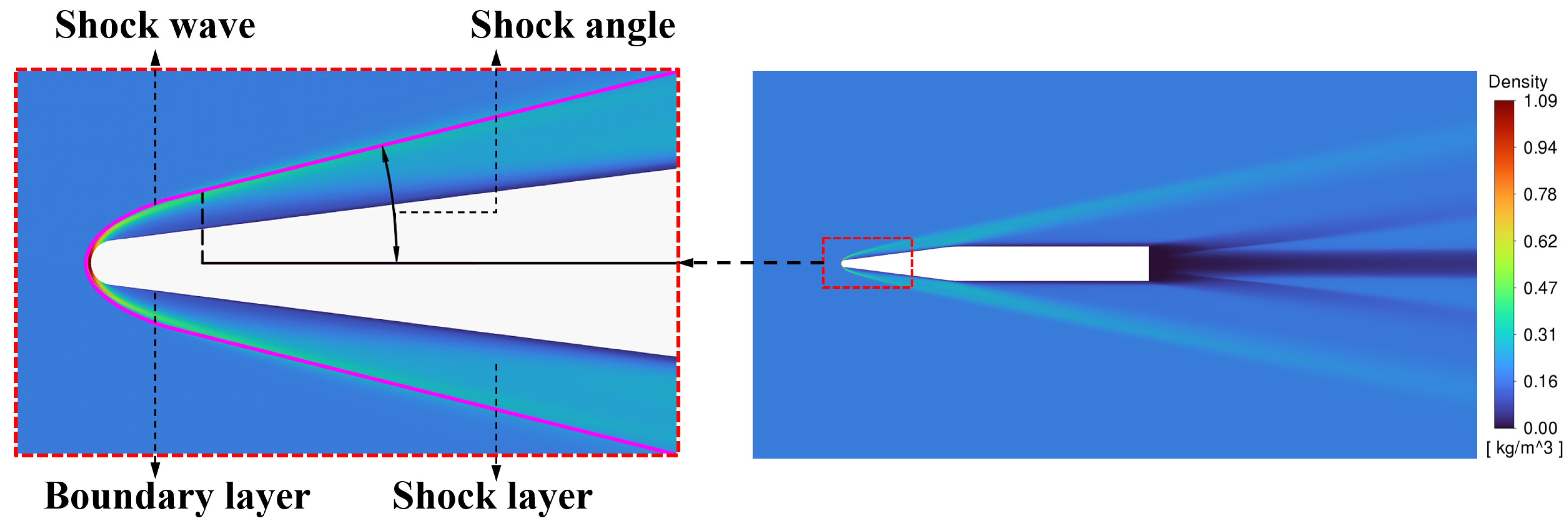
The density contour plot for the flight condition at Mach 6 is shown in Figure 11. A bow-shaped shock wave forms along the aircraft wall, with a boundary layer developing near the wall surface. The region between the wall and the shock wave constitutes the shock layer. The shock angle is the angle between the shock wave front and the direction of the incoming flow. When the shock angle is 90°, the shock is a normal shock. When the shock angle is less than 90°, the shock is an oblique shock. At the aircraft’s stagnation point, the shock is a normal shock, while at all other locations, it is an oblique shock.
The classical oblique shock theory [13] establishes the relationship between the shock angle ( β ), flow deflection angle ( θ ) and Mach number ( M a ), expressed by Equation (2). This relationship is derived from the assumptions of an ideal gas, inviscid, adiabatic, steady and one-dimensional flow model.
tan θ = M a 2 sin 2 β 1 M a 2 γ + 1 2 sin 2 β + 1 tan β
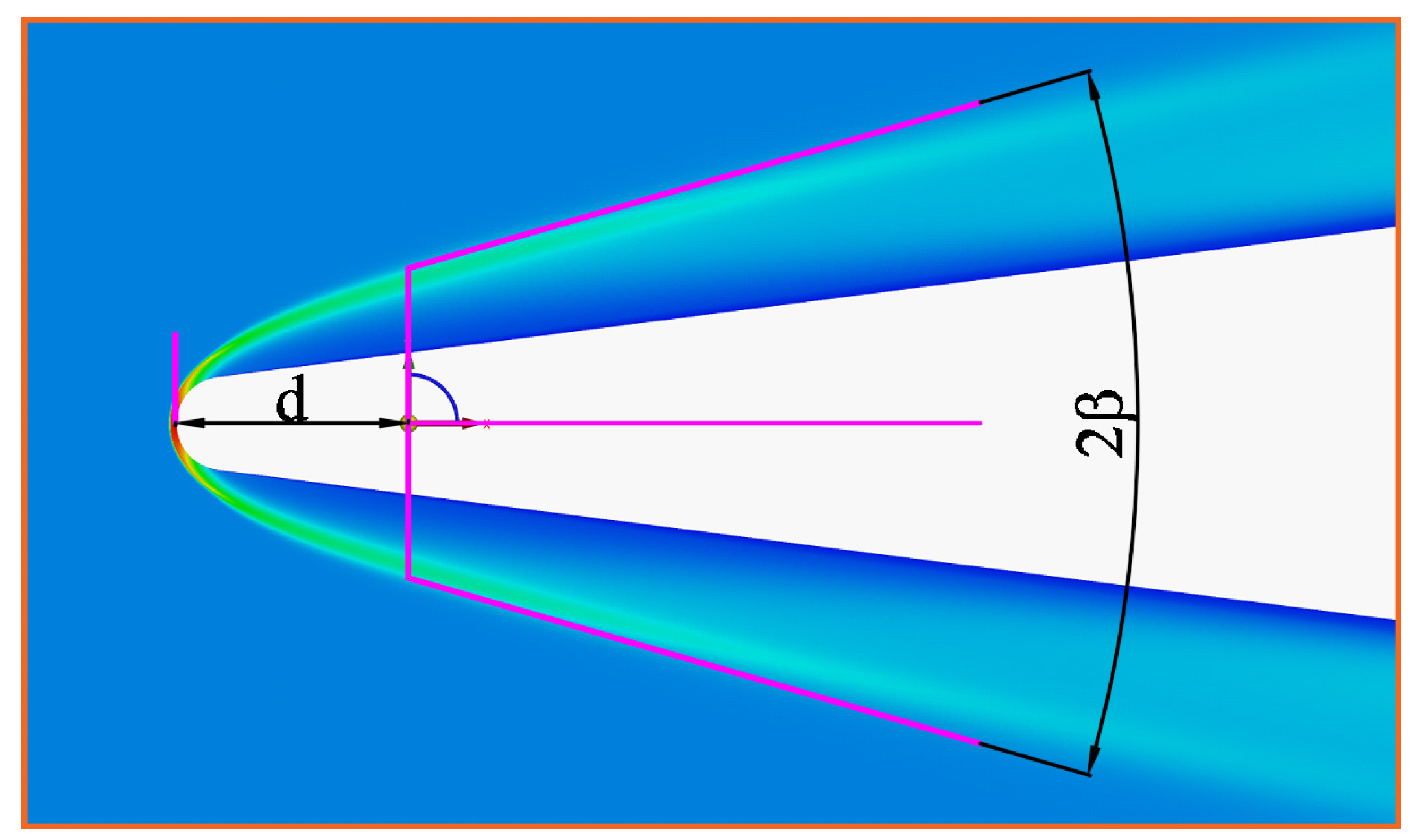
The shock angle equation is theoretically applicable to an infinitely long tapered model. In practical applications, to mitigate aerodynamic heating effects, the nose of an aircraft is often designed with a blunt-nose configuration. The blunt-nose model generates a bow shock near the stagnation point, which gradually transitions into an oblique shock. The shock intensity in the far downstream region is significantly less pronounced than in the upstream region. The upstream shock exerts a more pronounced effect on the aircraft, and the wind tunnel test captures the far downstream shock less effectively. Considering both the shock distribution characteristics and the shock capture efficiency in the wind tunnel test, the measurement reference point was therefore positioned upstream of the oblique shock. The shock angle smoothly varies with the aircraft structure. The axial distance from the measurement reference point to the aircraft’s stagnation point is set as d = 0 . 5 D = 40   mm . The shock angle obtained from the numerical simulation analysis model for hypersonic wide-speed-range cruise aircraft is denoted by β . A schematic diagram of the numerical simulation shock angle measurement is shown in Figure 12. The shock angle solved from Equation (2) is denoted by β t   . The absolute value of the difference between the numerical shock angle and the theoretical shock angle is denoted by δ a , i.e., δ a = β β t   .
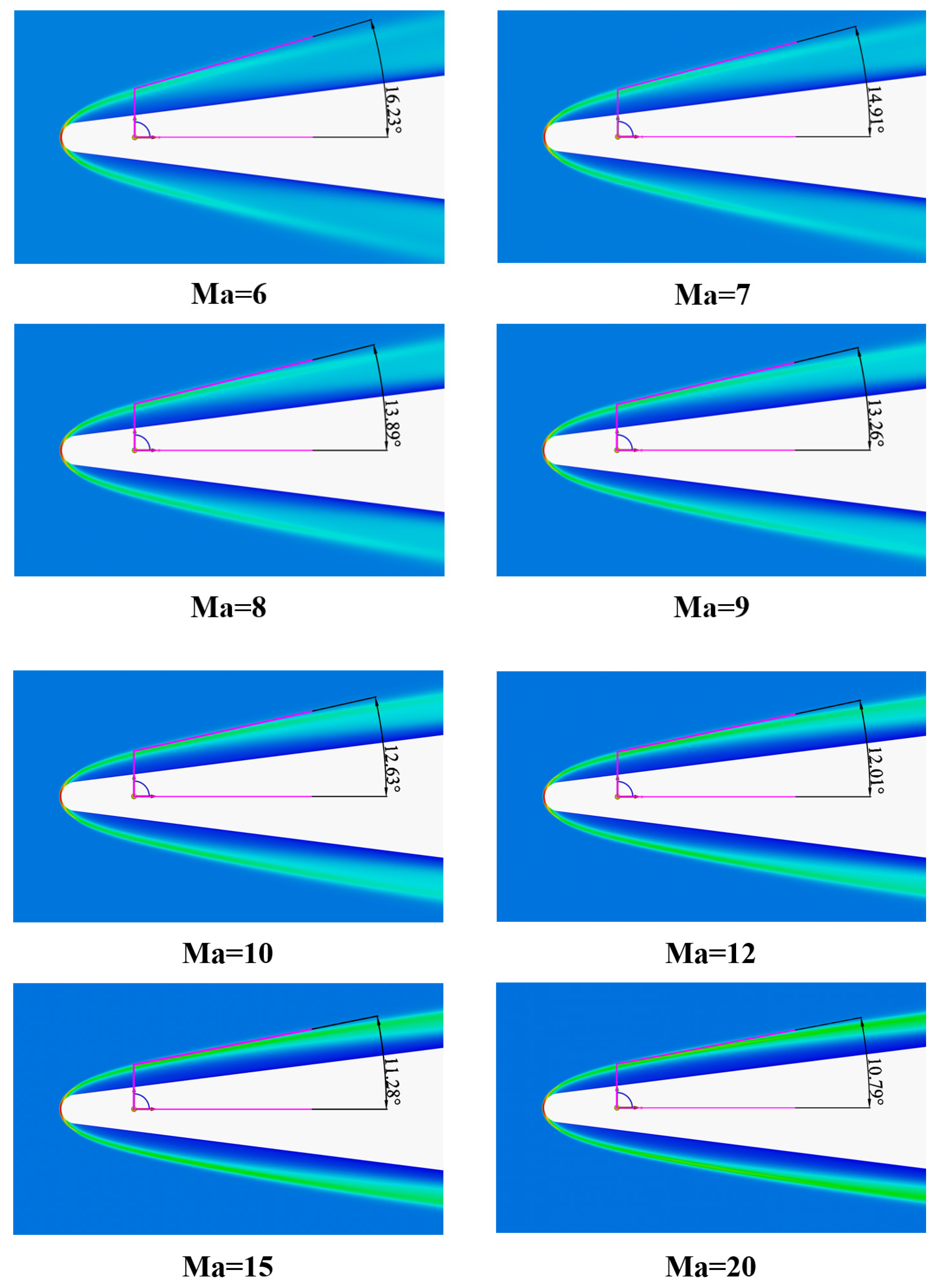
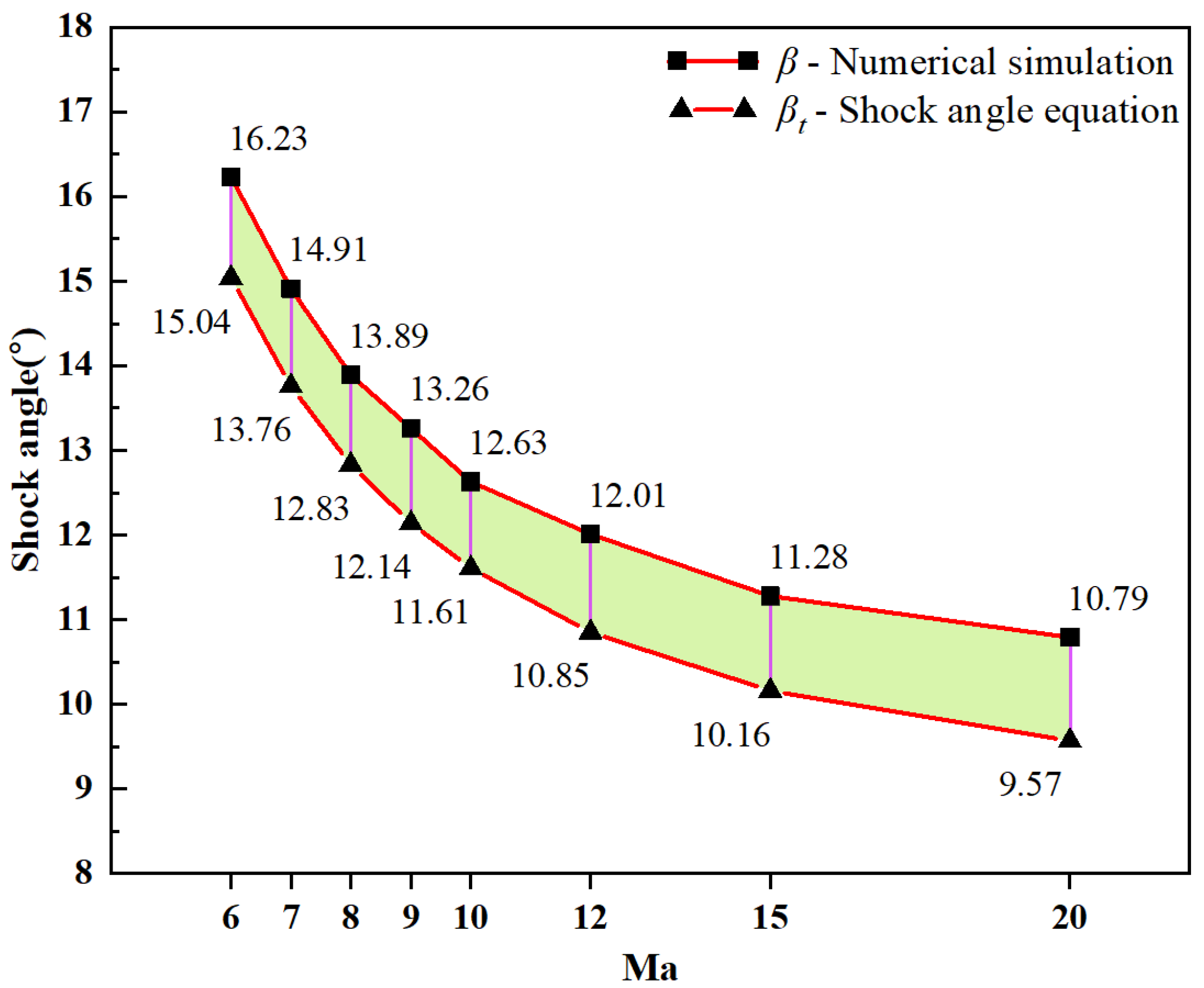
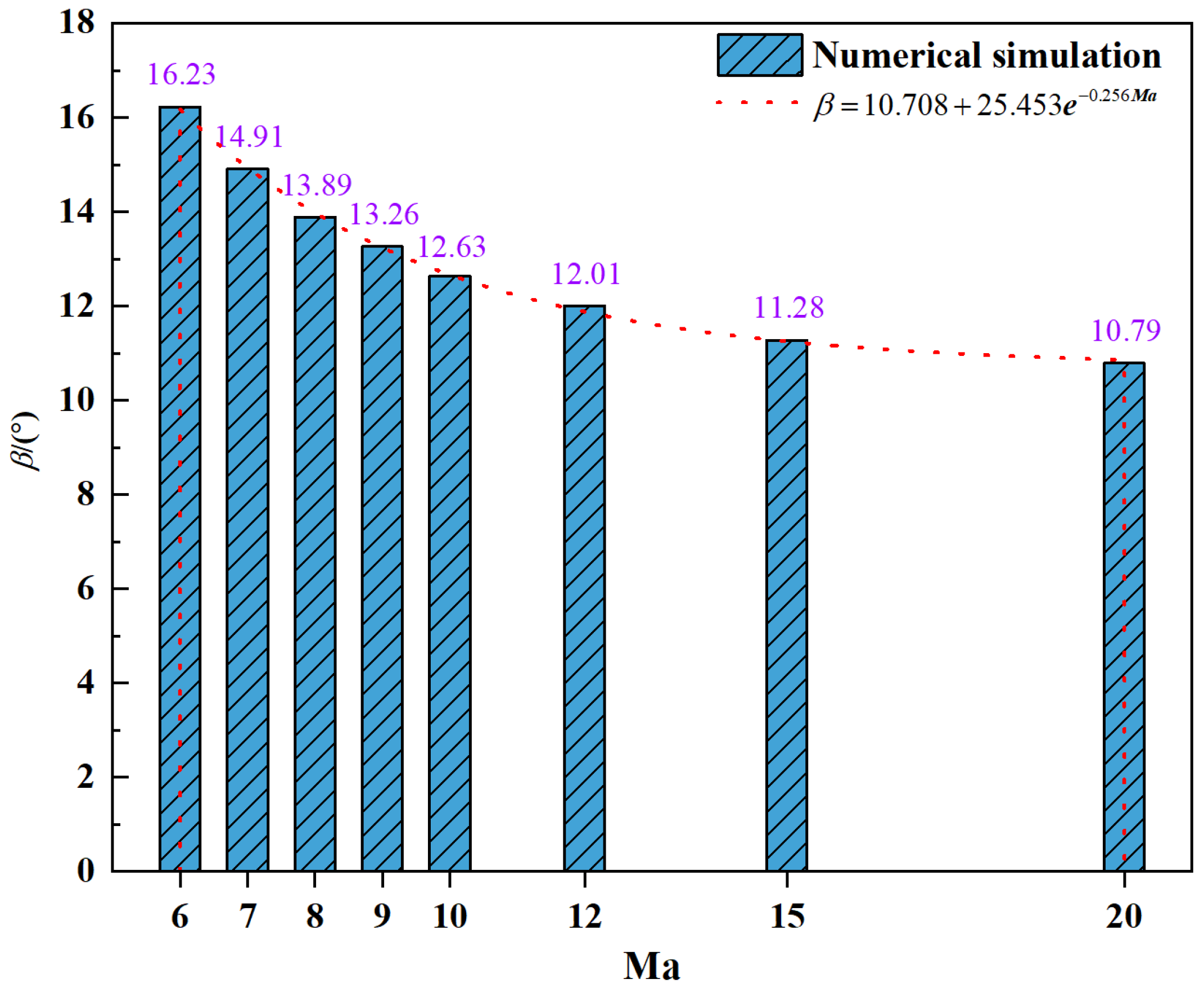
Numerical simulation techniques yielded shock angle measurements for hypersonic cruise aircraft operating at Mach numbers 6, 7, 8, 9, 10, 12, 15 and 20. Density contour plots for various Mach numbers and flight conditions are shown in Figure 13. Shock angles at various Mach numbers are listed in Table 3. When M a = 6 , β = 16.23 ° , β t = 15.04 ° and δ a = 1.19 ° . When M a = 7 , β = 14.91 ° , β t = 13.76 ° and δ a = 1.15 ° . When M a = 8 , β = 13.89 ° , β t = 12.83 ° and δ a = 1.06 ° . When M a = 9 , β = 13.26 ° , β t = 12.14 ° and δ a = 1.12 ° . When M a = 10 , β = 12.63 ° , β t = 11.61 ° and δ a = 1.02 ° . When M a = 12 , β = 12.01 ° , β t = 10.85 ° and δ a = 1.16 ° . When M a = 15 , β = 11.28 ° , β t = 10.16 ° and δ a = 1.12 ° . When M a = 20 , β = 10.79 ° , β t = 9.57 ° and δ a = 1.22 ° . A comparison of the shock angles obtained from numerical simulations at various Mach numbers and those derived from the theory is shown in Figure 14. From Mach 6 to Mach 20, the shock angle obtained from numerical simulation consistently exceeded that derived from the theory, i.e., β > β t . The maximum difference is δ a max = 1.22 ° , and the minimum difference is δ a min = 1.02 ° , indicating significant discrepancies between the two methods. From Mach 6 to Mach 20, the shock angle from numerical simulation decreased by 5.44°. From Mach 6 to Mach 9, it decreased by 2.97°. From Mach 9 to Mach 12, it decreased by 1.25°. From Mach 12 to Mach 15, it decreased by 0.73°. From Mach 15 to Mach 20, it decreased by 0.49°. During hypersonic flight, as the Mach number increases, the shock angle progressively decreases while the rate of decrease becomes increasingly gradual.

3.2. Comparison Analysis of Wind Tunnel Test and Numerical Simulation

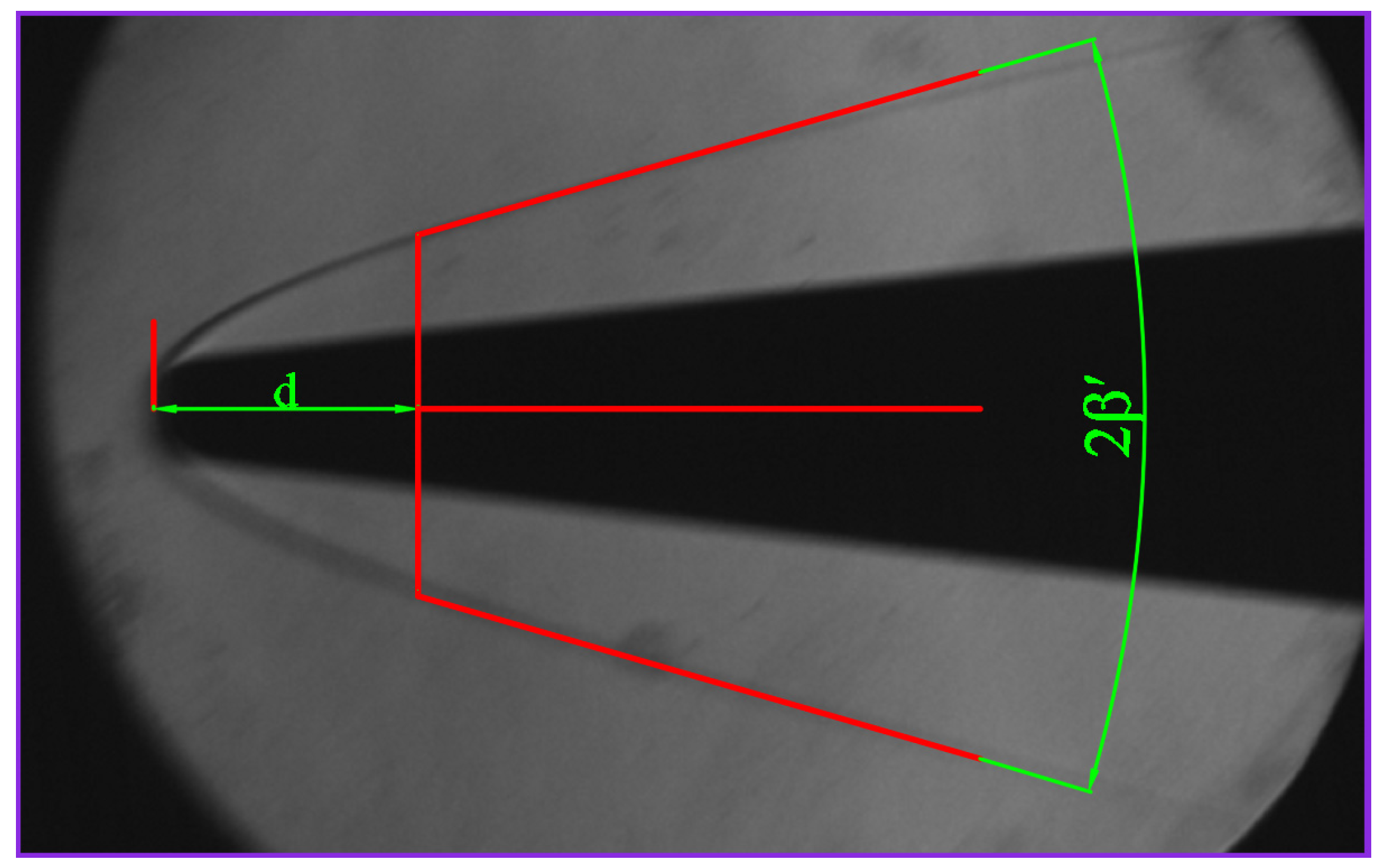
The axial distance from the measurement reference point to the aircraft’s stagnation point in the wind tunnel test is set as d = 0 . 5 D = 40   mm . The shock angle derived from wind tunnel analysis is denoted by β ' . The schematic diagram of shock angle measurement in a wind tunnel test is shown in Figure 15.
The absolute value of the difference between the numerical shock angle and the experimental shock angle is denoted by δ . The numerical simulation shock angle error ε is defined as the ratio of the absolute value of the difference between the numerical shock angle and the experimental shock angle at the same Mach number condition to the experimental shock angle, as given by Equation (3).
ε = δ β = | β β | β
The absolute difference between the theoretical shock angle and the experimental shock angle is denoted by δ t . The theoretical shock angle error ε t is defined as the ratio of the absolute value of the difference between the theoretical shock angle and the experimental shock angle at the same Mach number condition to the experimental shock angle, as given by Equation (4).
ε t = δ t β = | β t β | β
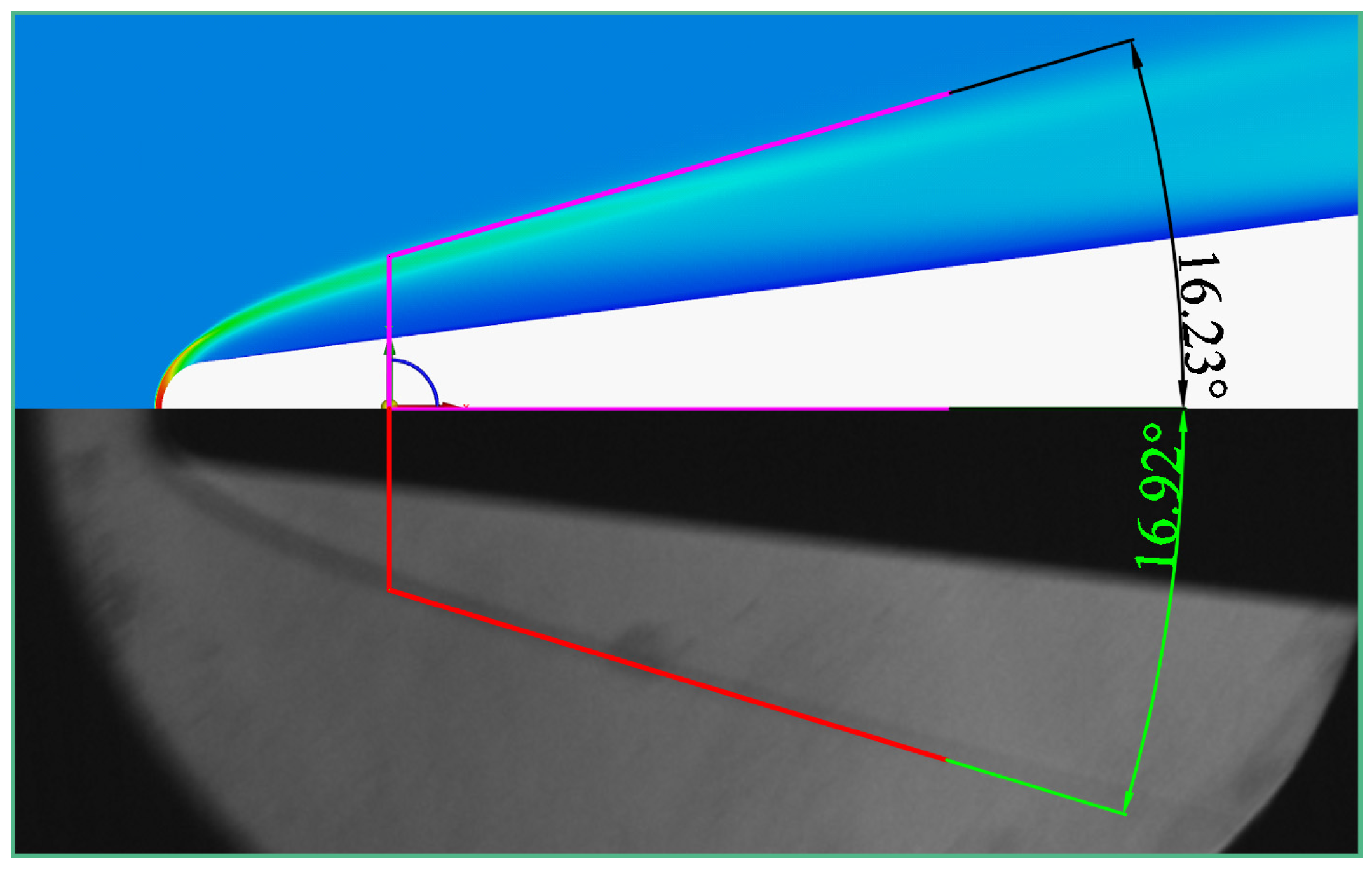
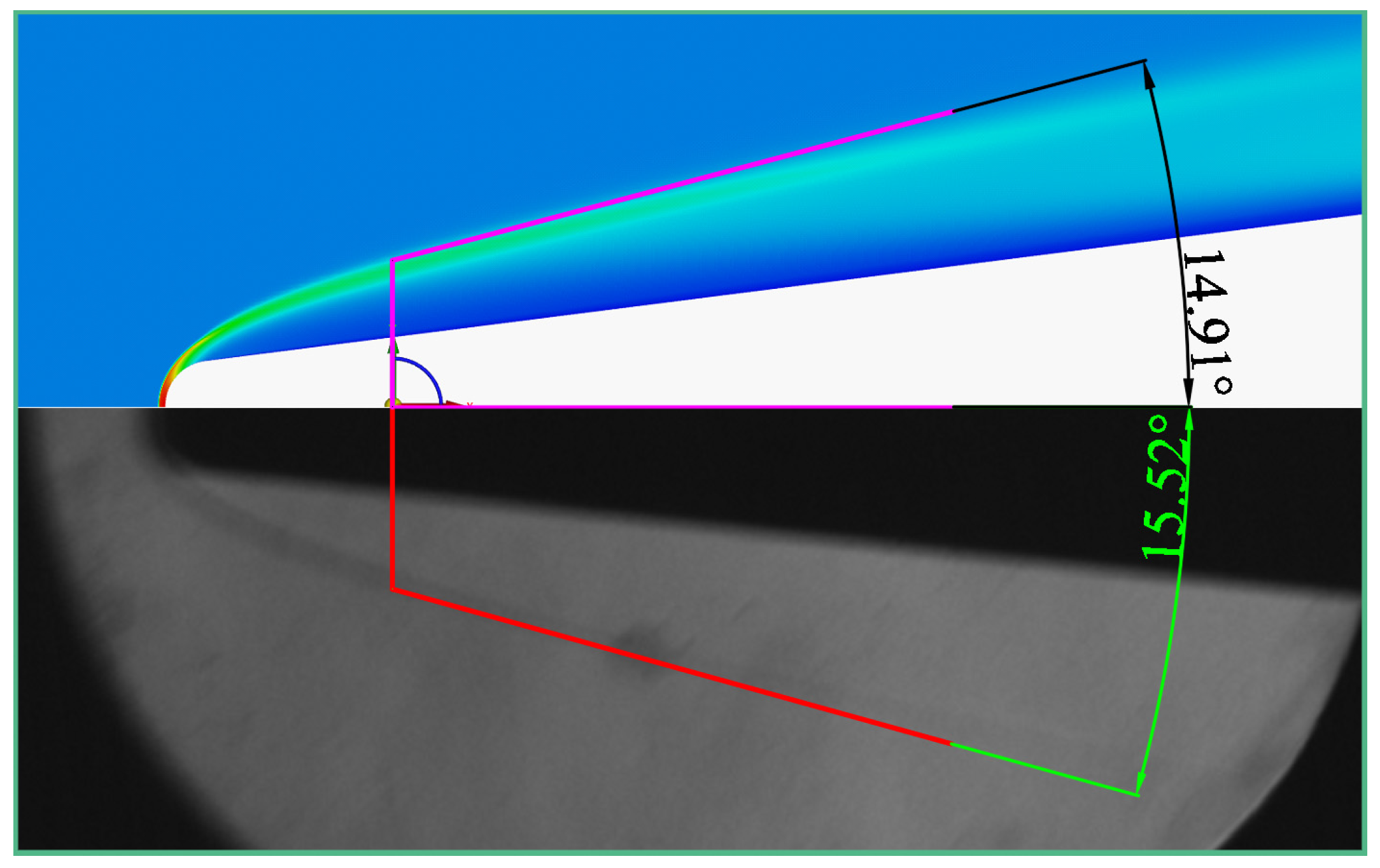
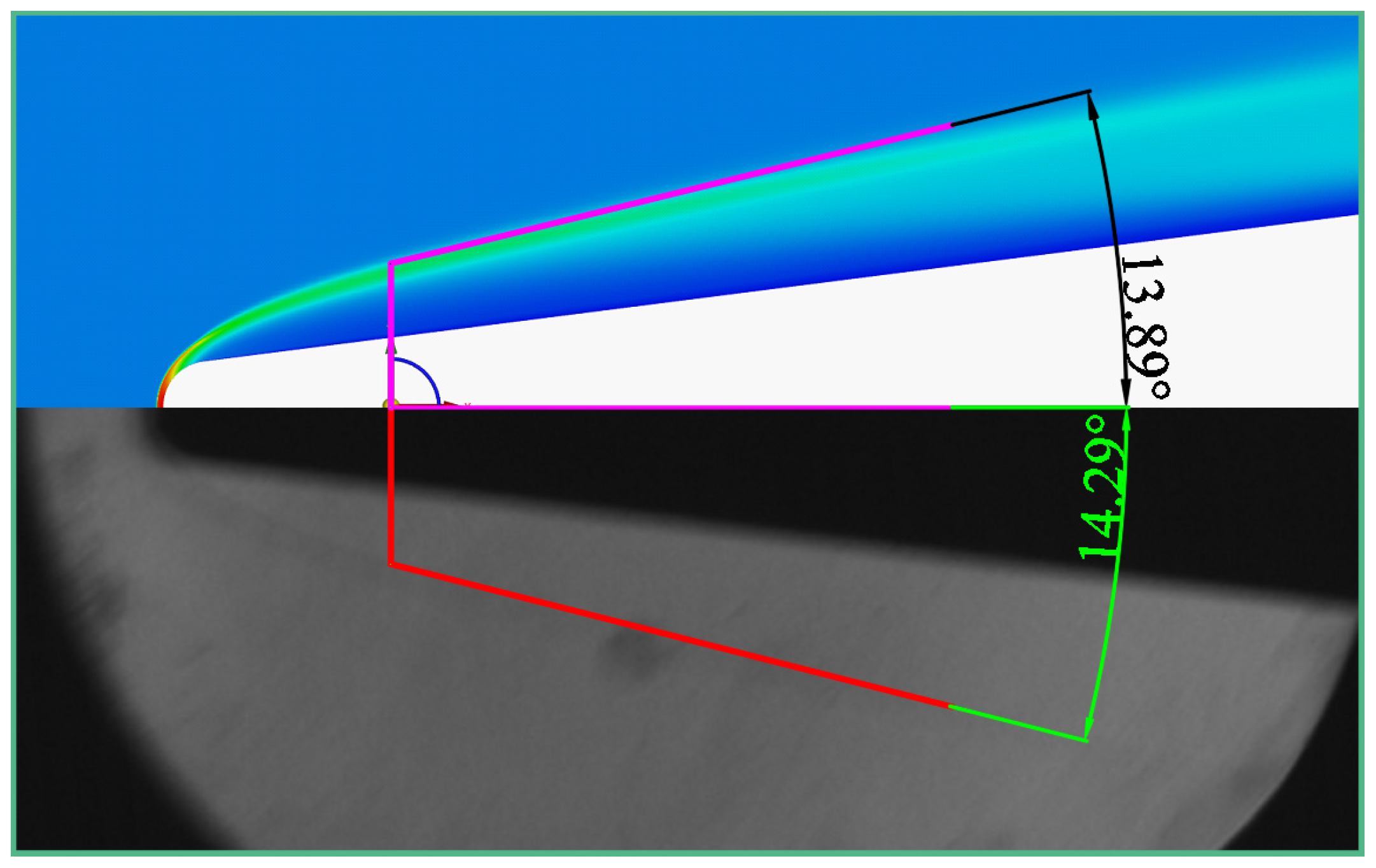
The wind tunnel test yielded shock angle measurements for the hypersonic cruise aircraft operating at Mach numbers 6, 7 and 8. When M a = 6 , β ' = 16.92 ° and β = 16.23 ° . A comparison of the shock angle between the numerical simulation and the wind tunnel test at Mach 6 flight conditions is shown in Figure 16. When M a = 7 , β ' = 15.52 ° and β = 14.91 ° . A comparison of the shock angle between the numerical simulation and the wind tunnel test at Mach 7 flight conditions is shown in Figure 17. When M a = 8 , β ' = 14.29 ° and β = 13.89 ° . A comparison of the shock angle between the numerical simulation and the wind tunnel test at Mach 8 flight conditions is shown in Figure 18. The comparison results indicate good consistency between the shock distributions analyzed via numerical simulation and the wind tunnel test.
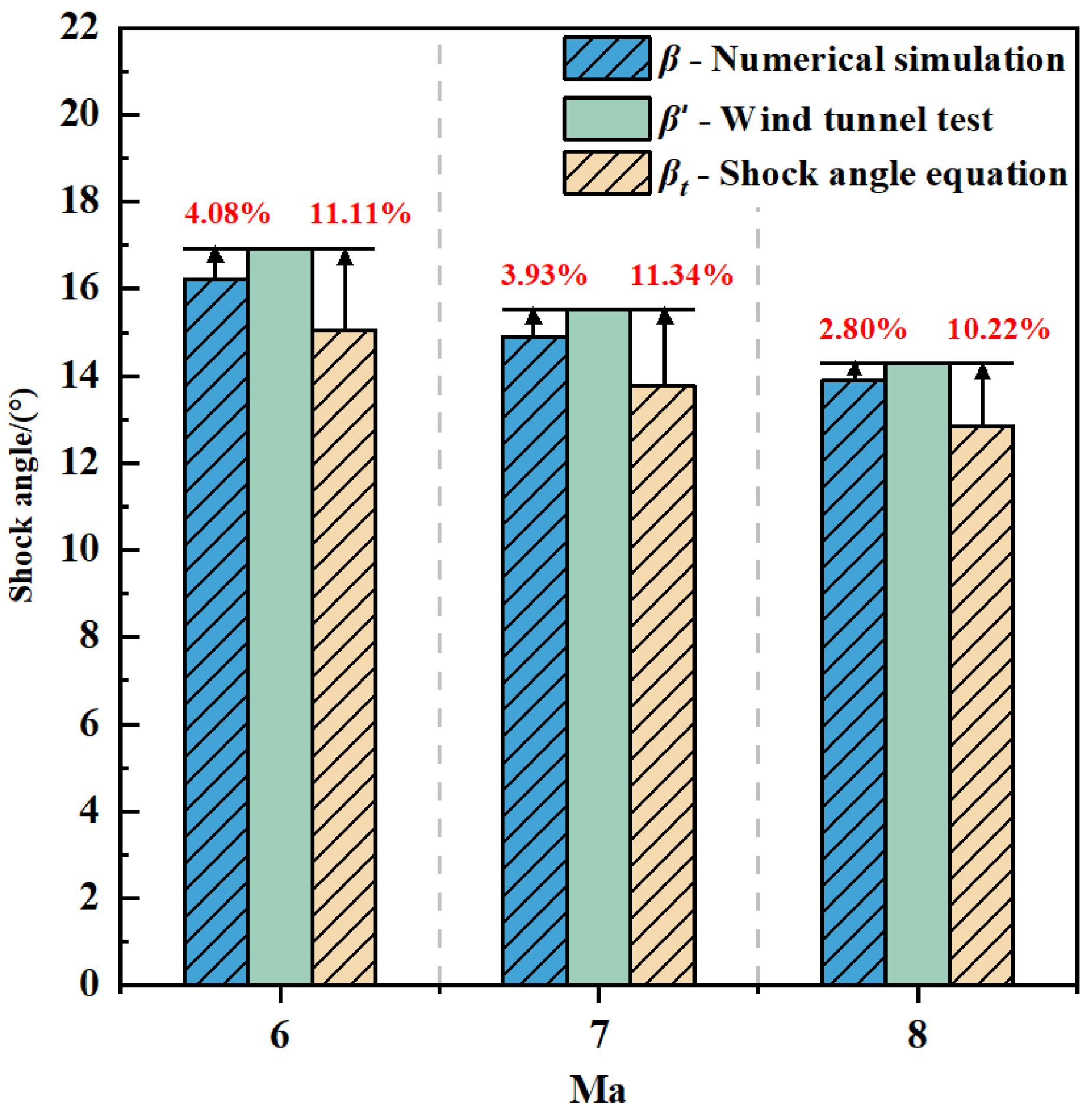
The comparison of results from the theory, numerical simulation and wind tunnel test is detailed in Table 4, and the comparison between the shock angle error in the numerical simulation and that in the theory is shown in Figure 19. When M a = 6 , δ = 0.69 ° , δ t = 1.88 ° , ε = 4.08 % and ε t = 11.11 % , the numerical simulation method improves the shock angle accuracy by 7.03% compared to the shock angle equation. When M a = 7 , δ = 0.61 ° , δ t = 1.76 ° , ε = 3.93 % and ε t = 11.34 % , the numerical simulation method improves the shock angle accuracy by 7.41% compared to the theory. When M a = 8 , δ = 0.40 ° , δ t = 1.46 ° , ε = 2.80 % and ε t = 10.22 % , the numerical simulation method improves shock angle accuracy by 7.42% compared to the theory. The results indicate that the maximum error in the numerical shock angle is 4.08%, while the maximum error in the theoretical shock angle is 11.34%. Thus, at the same Mach number, the numerical simulation method achieved at least 7.03% higher accuracy in the shock angle compared to the theoretical analysis. In summary, the numerical simulation analysis model for the shock angle of hypersonic wide-speed-range cruise aircraft presented in this paper demonstrates high accuracy and reliability.

3.3. Shock Angle Prediction Analysis

The numerical shock angles at various Mach numbers and flight conditions are shown in Table 3. A functional relationship between the numerical simulation shock angle and Mach number was derived through nonlinear data fitting. The fitting results indicate that the shock angle exhibits an exponential monotonic decreasing relationship with Mach number. The shock angle fitting curve is depicted in Figure 20. The shock angle fitting function is given as Equation (5):
β = β ( M a ) = 10.708 + 25.453 e 0.256 M a
As the Mach number approaches infinity, taking the limit of the fitted shock angle function yields the aircraft’s limiting shock angle of 10.708°. From Mach 6 to infinity, the shock angle decreases by 5.522°, while from Mach 20 to infinity, it decreases by only 0.082°. The analysis results indicate that as the Mach number increases, the shock angle diminishes progressively, whilst the rate of shock angle decay also diminishes. Beyond Mach 20, the shock angle remains essentially unchanged.
lim M a β ( M a ) = lim M a ( 10.708 + 25.453 e 0.256 M a ) = 10.708 °
The fitting function proposed in this study is based on specific geometric configurations and the ideal gas assumption and is applicable for predicting shock angle trends within the Mach number range of 6 to 20. This fitting function can be applied to blunt-nosed conical configuration vehicles and blunt-nosed conical–cylindrical composite configuration vehicles. For hypersonic vehicles with similar cone angles (14°~15°) or similar aspect ratios, this function provides preliminary design references. Under actual high-enthalpy or extremely high Mach number conditions, modifications using real gas models are required.

4. Conclusions

This study combined numerical simulations and a wind tunnel test to simulate the characteristics and patterns of shock angle variation at various Mach numbers for hypersonic wide-speed-range cruise aircraft and predicted the shock angle under extremely high-Mach-number conditions. As this study is based on specific geometric configurations and the ideal gas assumption, modifications using real gas models are required for analyses under actual high-enthalpy or extremely high-Mach-number conditions. The key conclusions are as follows.
(1)
A numerical simulation analysis model for the shock angle of hypersonic wide-speed-range cruise aircraft was established. Through comparison with wind tunnel test results, the maximum error in the shock angle from the numerical simulation analysis was 4.08%, validating the accuracy and reliability of the numerical simulation;
(2)
Numerical simulation enabled the analysis of shock angles at Mach numbers 6, 7, 8, 9, 10, 12, 15 and 20, revealing the variation in the shock angle at various Mach numbers. During hypersonic flight, a bow shock forms on the aircraft’s surface. As the Mach number increases, the shock angle diminishes progressively, and the rate of shock angle decay also decreases;
(3)
Compared to the wind tunnel test, the numerical simulation method achieved 7.03% higher accuracy in shock angle prediction than the theory at the same Mach number;
(4)
Nonlinear data fitting yielded a functional relationship between the shock angle and Mach number, showing an exponentially decreasing trend. As the Mach number approaches infinity, the shock angle converges to 10.708°.

Author Contributions

Conceptualization, S.G. and S.M.; methodology, S.G. and S.M.; software, S.G.; validation, S.G. and Z.A.; investigation, K.J.; data curation, S.G. and K.J.; writing—original draft preparation, Z.A.; writing—review and editing, S.G. and K.J. All authors have read and agreed to the published version of the manuscript.

Funding

This research received no external funding.

Data Availability Statement

The datasets used and analyzed during the current study are available from the author on reasonable request.

Conflicts of Interest

The authors declare no conflicts of interest.

Abbreviations

The following abbreviations are used in this manuscript:
2DTwo-dimensional
3DThree-dimensional
MOQMinimum Orthogonal Quality

References

  1. Anderson, J.D., Jr. Hypersonic and High-Temperature Gas Dynamics, 2nd ed.; AIAA: Reston, VA, USA, 2006. [Google Scholar] [CrossRef]
  2. Ognjanovic, O.; Maksimovic, S.; Vidanovic, N.; Segan, S.; Kastratovic, G. Numerical aerodynamic-thermal-structural analyses of missile fin configuration during supersonic flight conditions. Therm. Sci. 2017, 21, 3037–3049. [Google Scholar] [CrossRef]
  3. Knight, D.; Chazot, O.; Austin, J.; Badr, M.; Candler, G.; Celik, B.; de Rosa, D.; Donelli, R.; Komives, J.; Lani, A.; et al. Assessment of predictive capabilities for aerodynamic heating in hypersonic flow. Prog. Aeosp. Sci. 2017, 90, 39–53. [Google Scholar] [CrossRef]
  4. Raje, P.; Parish, E.; Hickey, J.; Cinnella, P.; Duraisamy, K. Recent developments and research needs in turbulence modeling of hypersonic flows. Phys. Fluids 2025, 37, 39. [Google Scholar] [CrossRef]
  5. Boretti, A. Hydrogen hypersonic combined cycle propulsion: Advancements, challenges, and applications. Int. J. Hydrogen Energy 2024, 55, 394–399. [Google Scholar] [CrossRef]
  6. Meng, X.; Bai, P.; Cao, C.; Liu, C. Low-Speed Performance Analysis of Double Swept Waverider with Wing Dihedral. J. Aerosp. Eng. 2025, 38, 04024124. [Google Scholar] [CrossRef]
  7. Hugoniot, H. Mémoire sur la propagation du mouvement dans un fluide indéfini (premiere partie). J. Mathématiques Pures Appliquées 1887, 3, 477–492. [Google Scholar]
  8. Courant, R.; Friedrichs, K.O. Supersonic Flow and Shock Waves; Springer Science & Business Media: Berlin/Heidelberg, Germany, 1999; Volume 21. [Google Scholar]
  9. Busemann, A. Verdichtungsstösse in ebenen Gasströmungen. In Vorträge aus dem Gebiete der Aerodynamik und verwandter Gebiete: Aachen 1929; Springer: Berlin/Heidelberg, Germany, 1930; pp. 162–169. [Google Scholar]
  10. Shapiro, A.H. The Dynamics and Thermodynamics of Compressible Fluid Flow; Ronald Press: New York, NY, USA, 1954. [Google Scholar]
  11. Zel’Dovich, Y.B.; Raizer, Y.P. Elements of Gasdynamics And the Classical Theory of Shock Waves. Phys. Today 1970, 23, 58. [Google Scholar] [CrossRef]
  12. Joumaa, H.K. Analytic characterization of oblique shock waves in flows around wedges. arXiv 2018, arXiv:1802.04763. [Google Scholar] [CrossRef]
  13. White, F.M.; Xue, H. Fluid Mechanics; McGraw-Hill Education: New York, NY, USA, 2021. [Google Scholar]
  14. Maus, J.R.; Griffith, B.J.; Szema, K.Y.; Best, J.T. Hypersonic Mach number and real gas effects on Space Shuttle Orbiteraerodynamics. J. Spacecr. Rocket. 1984, 21, 136–141. [Google Scholar] [CrossRef]
  15. Candler, G.V. The computation of hypersonic ionized flows in chemical and thermal nonequilibrium. AIAA Pap. 1988, 5, 88–511. [Google Scholar] [CrossRef]
  16. Park, C. Nonequilibrium Hypersonic Aerothermodynamics; John Wiley & Sons: Hoboken, NJ, USA, 1990. [Google Scholar]
  17. Gupta, R.N. A Review of Reaction Rates and Thermodynamic and Transport Properties for an 11-Species Air Model for Chemical and Thermal Nonequilibrium Calculations to 30,000 K. In NASA RP-1232; NASA: Washington, DC, USA, 1990. [Google Scholar]
  18. Bertin, J.J. Hypersonic Aerothermodynamics; American Institute of Aeronautics and Astronautics: Reston VA, USA, 1994. [Google Scholar]
  19. Hornung, H.G. Hypersonic Real-Gas Effects on Transition. In Proceedings of the IUTAM Symposium, DLR-Göttingen, Germany, 12–14 August 2004; Springer: Dordrecht, The Netherlands, 2006. [Google Scholar]
  20. Jiang, Z. Feeling High Temperature Gas Dynamics; Springer: Berlin/Heidelberg, Germany, 2006; Volume 28, pp. 1–7. [Google Scholar]
  21. Stemmer, C.; Birrer, M.; Adams, N.A. Hypersonic boundary-layer flow with an obstacle in thermochemical equilibrium and nonequilibrium. J. Spacecr. Rocket. 2017, 54, 899–915. [Google Scholar] [CrossRef]
  22. Hao, J.; Wen, C.Y. Effects of vibrational nonequilibrium on hypersonic shock-wave/laminar boundary-layer interactions. Int. Commun. Heat Mass Transf. 2018, 97, 136–142. [Google Scholar] [CrossRef]
  23. Rahmani, S.; Hejranfar, K. Numerical study of shock-disturbances interaction in hypersonic inviscid flows with real gas effects using high-order WENO scheme. Comput. Fluids 2021, 229, 105079. [Google Scholar] [CrossRef]
  24. Urzay, J.; Di Renzo, M. Engineering aspects of hypersonic turbulent flows at suborbital enthalpies. In Annual Research Briefs; Center for Turbulence Research: Stanford, CA, USA, 2021; pp. 7–32. [Google Scholar]
  25. Zanardi, I.; Venturi, S.; Panesi, M. Towards Efficient Simulations of Non-Equilibrium Chemistry in Hypersonic Flows: A Physics-Informed Neural Network Framework. In AIAA SCITECH 2022 Forum; AIAA: Reston, VA, USA, 2022. [Google Scholar]
  26. Xiong, R.; Han, Y.; Cao, W. Vibrational non-Boltzmann effects on the dissociation rate of oxygen. Phys. Chem. Chem. Phys. 2023, 25, 19073–19081. [Google Scholar] [CrossRef]
  27. Wilcox, D.C. Turbulence Modeling for CFD.; DCW Industries: La Canada, CA, USA, 2006. [Google Scholar]
  28. Nagdewe, S.; Shevare, G.; Kim, H. Study on the numerical schemes for hypersonic flow simulation. Shock Waves 2009, 19, 433–442. [Google Scholar] [CrossRef]
  29. Prakash, A.; Parsons, N.; Wang, X.; Zhong, X. High-order shock-fitting methods for direct numerical simulation of hypersonic flow with chemical and thermal nonequilibrium. J. Comput. Phys. 2011, 230, 8474–8507. [Google Scholar] [CrossRef]
  30. Liu, J.; Zou, D.; Xu, C. An unsteady shock-fitting technique based on unstructured moving grids. Acta Aerodyn. Sin. 2015, 33, 10–16. [Google Scholar]
  31. Wang, L.; Shi, L.; Zhou, W. The Application of Discontinuous Galerkin Method on Hybrid Grids for Hypersonic Flows. J. Numer. Methods Comput. Appl. 2016, 37, 85–94. [Google Scholar]
  32. Ben Ameur, F.; Lani, A. Physics-Based Mesh Fitting Algorithms for Hypersonic Flows Simulations. In AIAA Scitech 2019 Forum; American Institute of Aeronautics and Astronautics: Reston, VA, USA, 2019. [Google Scholar]
  33. Maeda, Y.; Hiejima, T. An improved shock wave capturing method in high Mach numbers. Phys. Fluids 2022, 34, 096107. [Google Scholar] [CrossRef]
  34. Huang, L.; Jiang, Z.; Lou, S.; Zhang, X.; Yan, C. Simple and robust h-adaptive shock-capturing method for flux reconstruction framework. Chin. J. Aeronaut. 2023, 36, 348–365. [Google Scholar] [CrossRef]
  35. Wang, H.; Zeng, Y.; Xiong, D.; Yang, Y.; Sun, M. Improvement of shock wave and compressibility effects in SST turbulence model. Acta Aeronaut. Astronaut. Sin. 2024, 45, 128694. [Google Scholar]
  36. Ren, W.; Xie, W.; Zhang, Y.; Yu, H.; Tian, Z.; Zhu, J. Numerical stability analysis of Godunov-type schemes for high Mach number flow simulations. Phys. Fluids 2024, 36, 066107. [Google Scholar] [CrossRef]
  37. Bingham, G.J.; Davidson, T.E. Investigation of Simulation of Shock-Shock Interaction in Hypersonic Gasdynamic Test Facility. 1964. Available online: https://api.semanticscholar.org/CorpusID:107479630 (accessed on 6 February 2026).
  38. White, M.; Ault, D. Expansion corner effects on hypersonic shock wave turbulent boundary-layer interactions. J. Propul. Power 1996, 12, 1169–1173. [Google Scholar] [CrossRef]
  39. Settles, G.S. Schlieren and Shadowgraph Techniques. In Visualizing Phenomena in Transparent Media; Experimental Fluid Mechanics Series; Springer: Berlin/Heidelberg, Germany, 2001. [Google Scholar] [CrossRef]
  40. Murray, N.; Hillier, R.; Williams, S. Experimental investigation of axisymmetric hypersonic shock-wave/turbulent-boundary-layer interactions. J. Fluid Mech. 2013, 714, 152–189. [Google Scholar] [CrossRef]
  41. Mudford, N.; O’Byrne, S.; Neely, A.; Buttsworth, D.; Balage, S. Hypersonic Wind-Tunnel Free-Flying Experiments with Onboard Instrumentation. J. Spacecr. Rocket. 2015, 52, 231–242. [Google Scholar] [CrossRef]
  42. Liu, Y.; Wang, Y.; Yuan, C.; Luo, C.; Jiang, Z. Aerodynamic force and moment measurement of 10° half-angle cone in JF12 shock tunnel. Chin. J. Aeronaut. 2017, 30, 983–987. [Google Scholar] [CrossRef]
  43. Yuan, C.; Jiang, Z. Experimental investigation of hypersonic flight-duplicated shock tunnel characteristics. Acta Mech. Sin. 2021, 37, 422–433. [Google Scholar] [CrossRef]
  44. Giepman, R.; Schrijer, F.; van Oudheusden, B. A parametric study of laminar and transitional oblique shock wave reflections. J. Fluid Mech. 2018, 844, 187–215. [Google Scholar] [CrossRef]
  45. Barber, T.A.; Majdalani, J.; Maicke, B.A. Review of Gaps, Obstacles, and Technological Challenges in Hypersonic Applications (Gotchas). Int. J. Energ. Mater. Chem. Propuls. 2018, 17, 19–61. [Google Scholar] [CrossRef]
  46. Saiprakash, M.; SenthilKumar, C.; Sunil, G.; Rampratap, S.; Shanmugam, V.; Balu, G. Visualization of Shock Wave Phenomenon around a Sharp Cone Model at Hypersonic Mach Number in a Shock Tunnel using High Speed Schlieren Facility. J. Appl. Fluid Mech. 2019, 12, 461–468. [Google Scholar] [CrossRef]
  47. You, Y.; Zheng, X.; Ding, X.; Tang, Y.; Zhu, C. Design and Investigation of Variable Mach Number Waverider for a Wide-Speed Range Based on Three-Dimensional Shock Waves. J. Nanjing Univ. Aeronaut. Astronaut. 2022, 54, 937–948. [Google Scholar] [CrossRef]
  48. Menter, F. 2-Equation Eddy-Viscosity Turbulence Models for Engineering Applications. AIAA J. 1994, 32, 1598–1605. [Google Scholar] [CrossRef]
  49. Menter, F.R.; Kuntz, M.; Langtry, R. Ten years of industrial experience with the SST turbulence model. Heat Mass Transf. 2003, 4, 625–632. [Google Scholar]
  50. Yu, Z.; Hongbo, W.; Mingbo, S.; Chao, W.; Xu, L. SST turbulence model improvements:Review. Acta Aeronaut. Astronaut. Sin. 2023, 44, 027411. [Google Scholar]
  51. Tu, J.; Yeoh, G.H.; Liu, C.; Tao, Y. Computational Fluid Dynamics: A Practical Approach; Elsevier: Amsterdam, The Netherlands, 2023. [Google Scholar]
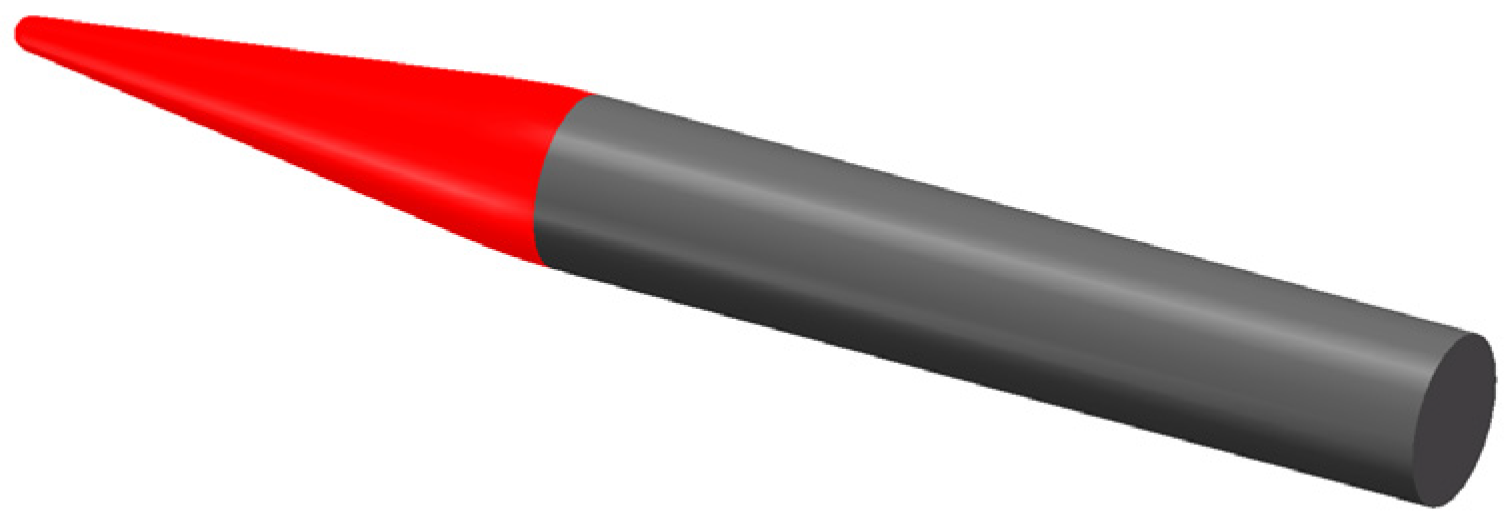
Figure 1. Hypersonic cruise aircraft.
Aerospace 13 00170 g001
Figure 2. A schematic diagram of the aircraft’s aerodynamic dimensions.
Aerospace 13 00170 g002
Figure 3. Schematic of shock angle numerical simulation and test analysis method.
Aerospace 13 00170 g003
Figure 4. Aircraft boundary naming.
Aerospace 13 00170 g004
Figure 5. Schematic diagram of fluid domain dimensions.
Aerospace 13 00170 g005
Figure 6. The distribution of the dimensionless wall distance on the wall surface.
Aerospace 13 00170 g006
Figure 7. Numerical simulation results of stagnation pressure for different mesh densities.
Aerospace 13 00170 g007
Figure 8. Schematic diagram of fluid domain boundary naming and boundary layer refinement.
Aerospace 13 00170 g008
Figure 9. Test plan for shock angle wind tunnel measurement using FL-63.
Aerospace 13 00170 g009
Figure 10. Mach contour plot at Ma = 6.
Aerospace 13 00170 g010
Figure 11. Density contour plot at Ma = 6.
Aerospace 13 00170 g011
Figure 12. Schematic diagram of shock angle measurement in numerical simulation.
Aerospace 13 00170 g012
Figure 13. Density contour plots and shock angles at various Mach numbers.
Aerospace 13 00170 g013
Figure 14. Comparison of shock angles between numerical simulation and equation at various Mach numbers.
Aerospace 13 00170 g014
Figure 15. Schematic diagram of shock angle measurement in wind tunnel test.
Aerospace 13 00170 g015
Figure 16. Comparison of shock angle between numerical simulation and wind tunnel test at Ma = 6.
Aerospace 13 00170 g016
Figure 17. Comparison of shock angle between numerical simulation and wind tunnel test at Ma = 7.
Aerospace 13 00170 g017
Figure 18. Comparison of shock angle between numerical simulation and wind tunnel test at Ma = 8.
Aerospace 13 00170 g018
Figure 19. Comparison of shock angle error between numerical simulation and equation analysis.
Aerospace 13 00170 g019
Figure 20. Nonlinear fitting curve of shock angle.
Aerospace 13 00170 g020
Table 1. Parameters and results for different mesh densities.
Mesh DensityFirst Boundary Layer Height (mm)Number of MeshesIteration Step CountStagnation Pressure (kPa)
Coarse0.0183,695144556
Medium0.01129,575182559
Fine 0.01181,455217560
Table 2. Operating parameters of the wind tunnel test.
Nominal Mach NumberActual Mach NumberAngle of Attack (°)Sideslip Angle (°)Total Pressure (kPa)Total Temperature (K)
66.02002512920
76.97002690951
88.03002787971
Table 3. Shock angles from numerical simulation and theory at various Mach numbers.
M a 678910121520
Numerical β 16.2314.9113.8913.2612.6312.0111.2810.79
Theoretical β t   15.0413.7612.8312.1411.6110.8510.169.57
Discrepancy δ a 1.191.151.061.121.021.161.121.22
Table 4. Comparison of shock angle analysis via different methods.
M a 678
Experimental β ' 16.9215.5214.29
Numerical β 16.2314.9113.89
Theoretical β t   15.0413.7612.83
Numerical discrepancy δ 0.690.610.40
Theoretical discrepancy δ t   1.881.761.46
Numerical error ε 4.08%3.93%2.80%
Theoretical error ε t 11.11%11.34%10.22%
Disclaimer/Publisher’s Note: The statements, opinions and data contained in all publications are solely those of the individual author(s) and contributor(s) and not of MDPI and/or the editor(s). MDPI and/or the editor(s) disclaim responsibility for any injury to people or property resulting from any ideas, methods, instructions or products referred to in the content.