


Abstract
The establishment of a sustained human presence on the Moon is critically dependent on the ability to utilize local resources, primarily the production of oxygen for life support and propellant. The ROXY (Regolith to Oxygen and metals conversion) process is a molten salt electrolysis technology designed for this purpose. This paper presents an economic analysis of a ROXY pilot plant capable of producing over one ton of oxygen per year. We evaluate the economic viability by analyzing development, transportation, and operational costs against the potential revenue from selling oxygen and metals within a nascent lunar economy. A key aspect of this analysis is the perspective of an early customer in habitation life support systems preceding that of much higher propellant production demand. The analysis contextualizes this paradigm by recognizing that the primary economic driver for oxygen production is the larger future market for propellant; however, early life support demand may incentivize a paradigm-shift from Earth-based consumable resupply. Scenarios based on varying transportation costs and development timelines are evaluated to determine the internal rate of return (IRR) and time to break even (TTBE). The results indicate that the ROXY pilot plant is economically viable, particularly in near-term scenarios with higher transportation costs, achieving a positive IRR of up to 47.4% when both oxygen and metals are sold. The analysis identifies facility mass, driven by the robotics subsystem, as the primary factor for future cost-reduction efforts, concluding that ROXY is a technically and economically sound pathway toward sustainable lunar operations.
1. Introduction
The international ambition for a permanent and sustainable human presence on the Moon, as outlined in roadmaps by major space agencies, is fundamentally dependent on the successful implementation of In Situ Resource Utilization (ISRU) [1,2,3,4]. The ability to “live off the land” is widely recognized as a paradigm-shift for space exploration, enabling mission architectures that are more affordable, sustainable, and largely independent from Earth-based supply chains [5,6,7,8]. Projections for the burgeoning cislunar economy estimate the ISRU market to be worth over $60 billion by 2040, with the production of oxygen being a primary driver [9,10,11,12].
Oxygen is the most critical consumable resource required on the Moon, essential for both crew life support in habitats and as an oxidizer for rocket propellants [13,14]. The lunar regolith, the loose layer of dust and rock covering the Moon’s surface, offers a vast and readily available feedstock, containing approximately 45% oxygen by mass bound within various metal oxides [10,15]. Numerous technologies are being developed to extract this oxygen, including carbothermal reduction, hydrogen plasma reduction, and various forms of electrolysis as most promising [16,17,18]. However, many of these processes face significant technical hurdles, such as the need for gaseous reactants, complex product separation, high operating temperatures leading to material compatibility issues, and corrosive process environments [19,20].
The ROXY (Regolith to Oxygen and metals conversion) process, an advanced form of molten salt electrolysis developed by Airbus, was conceived to overcome these challenges [19,20,21]. By employing an yttria-stabilized zirconia (YSZ) solid oxide membrane (SOM), ROXY enables the direct, one-step extraction of pure oxygen from regolith, while also leaving behind a mixed metallic alloy product [10]. This process operates at a lower temperature (850 °C) compared to other ISRU processes, requires no gaseous consumables, and substantially mitigates internal corrosion issues, resulting in a simpler, more robust, and efficient system architecture [19,22].
The development pathway for ROXY follows a staged scaling approach, beginning with ground-based laboratory models, progressing to a small-scale lunar demonstration mission (Mini-ROXY) [22], and leading towards industrial-scale operational plants [10]. A critical intermediate step in this roadmap is the pilot plant, designed to produce resources at a scale of approximately one ton per year [19]. This scale is assumed to be sufficient to support early habitat life support systems and serves to validate the technology’s performance and economic viability, before committing to much larger, more capital-intensive facilities [10,14], as described in the next chapter. While previous studies have analyzed the systems and economics of large-scale ISRU plants [23,24,25], this paper presents the first detailed economic analysis of a ROXY pilot plant, grounded in a mature conceptual design. The objective is to provide a quantitative assessment of its economic viability, incorporating a detailed user-and-customer perspective, and to identify the key drivers for future optimization.
2. Methods
In this section, the methods used for the economic analysis of the ROXY pilot plant are described. A description of the expected customers for the produced oxygen and metals on the Moon in Section 2.1 precedes the technical concept of the ROXY pilot plant in Section 2.2. The methodology and assumptions of the economic analysis, which includes the description of the Cost and Revenue Model, is found in Section 2.3.
2.1. An Early Customer Perspective: Habitation Consumable Demand
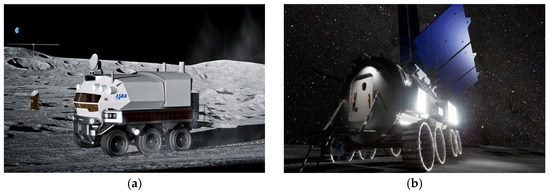
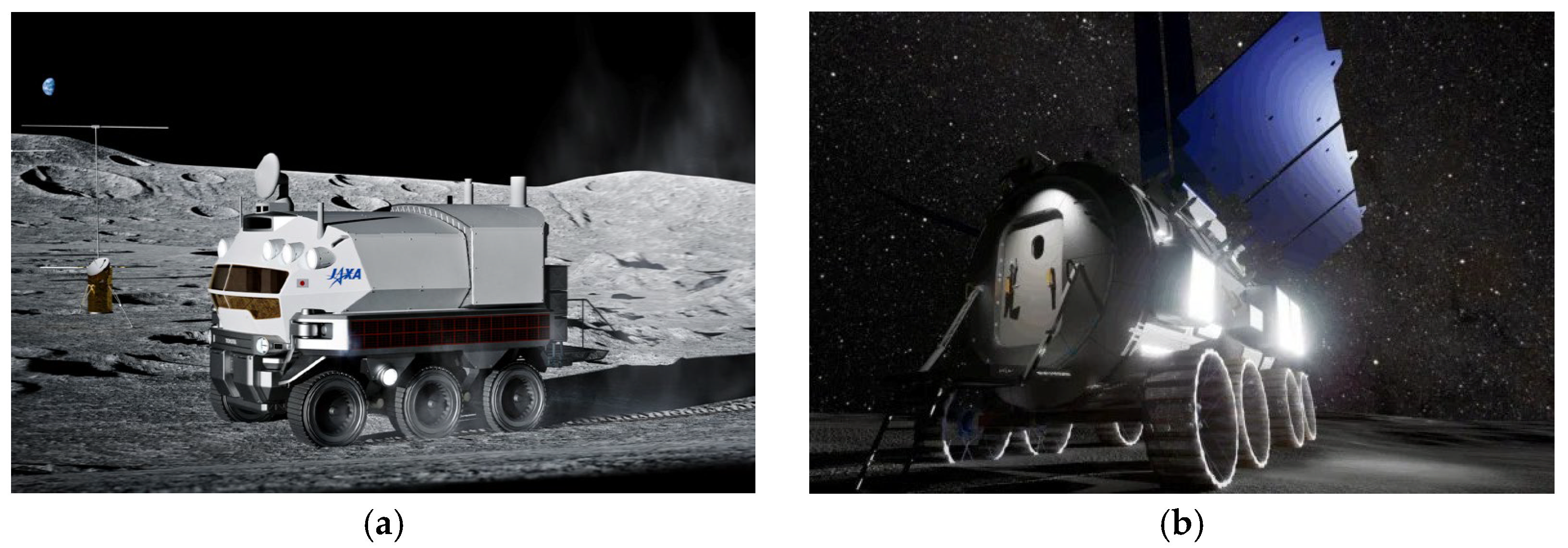
While the largest future market for ISRU-derived oxygen is propellant for landers and deep-space vehicles, the first and most immediate customers will likely be operators of habitation systems supporting early crewed lunar missions [14]. Such initial missions will exhibit a demand for oxygen and water dependent upon mission duration, crew size, and habitation system design, inclusive of the supporting extravehicular activity (EVA) and environmental control and life support (ECLS) system architectures. While the National Aeronautics and Space Administration (NASA) and China National Space Administration (CNSA) are leading various efforts for early crewed lunar missions, two detailed habitation concepts supporting NASA’s Artemis campaign provide sufficient insight for estimating initial habitation consumable demand: the Japan Space Agency (JAXA) Pressurized Rover (PR) and the Italian Space Agency (ASI) Multi-Purpose Habitat (MPH), as shown in Figure 1 [14,26]. Both the PR and MPH have chosen open-loop ECLS architectures due to limitations in initial delivered mass, power constraints, and the relatively short mission durations with small crew sizes [27,28]. Fulfilling the recurring consumable demand of such early habitation concepts with local resources offers a powerful opportunity to de-risk ISRU technologies at a manageable scale while simultaneously reducing the significant logistical burden of Earth-based resupply [14].
Figure 1.
(a) JAXA Pressurized Rover (PR) concept, credit: Toyota [29]. (b) ASI Multi-Purpose Habitat (MPH) concept, credit: ASI [30].
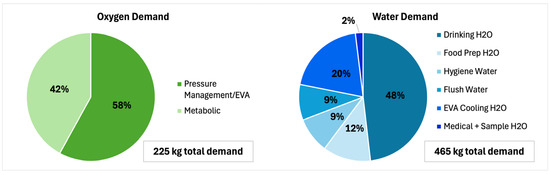
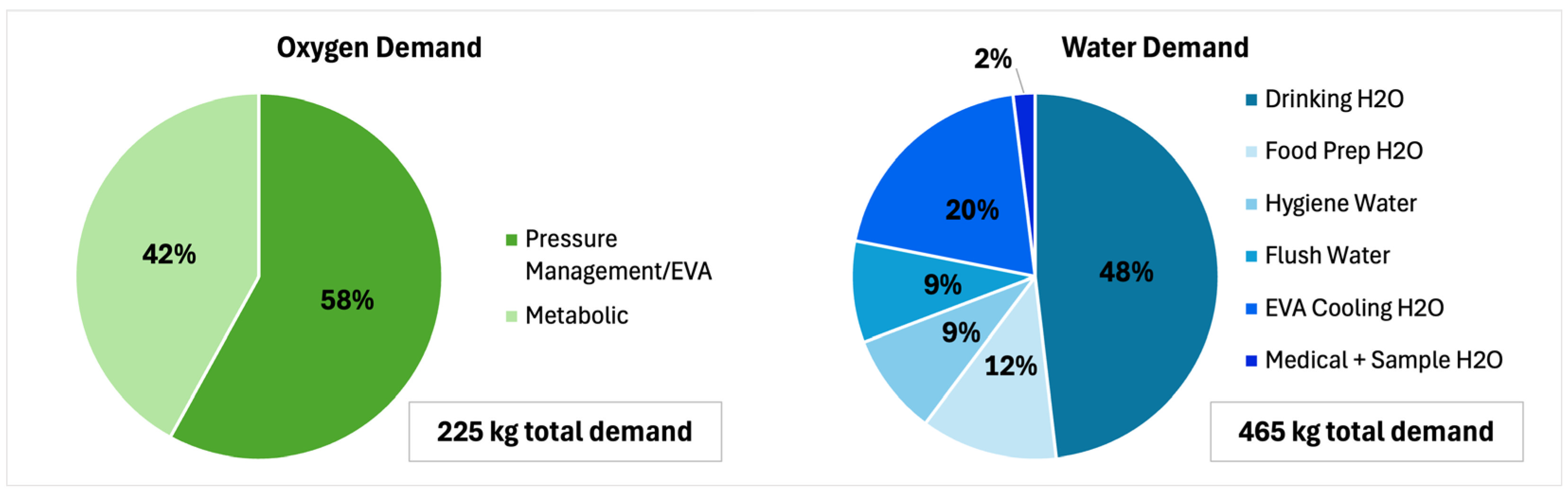
An analysis for a representative 28-day Artemis mission with a total of four crew members using both the PR and MPH estimates a raw consumable need of approximately 225 kg of oxygen and 465 kg of water, where an average O2 metabolic rate of 0.84 kg/crewmember-day was assumed [14]. As indicated in Figure 2, the EVA architecture (i.e., EVA frequency, duration, and use or omission of airlocks) is a major driver of oxygen demand. The PR’s concept of performing a full cabin depressurization requires ~43% more oxygen for repressurization compared to the MPH, which is assumed to have a dedicated, smaller-volume airlock [14].
Figure 2.
Oxygen and water demand for a 4-crew, 28-day Artemis mission utilizing both PR and MPH. This demonstrates the major drivers for demand, with EVA methodology being a significant factor for oxygen [14].
The consumable demand associated with other early habitation concepts, such as those which may support CNSA’s International Lunar Research Station (ILRS), can similarly be quantified if mission duration, crew size, and habitation system design is known.
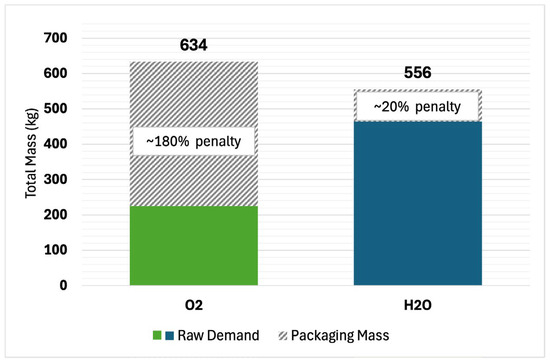
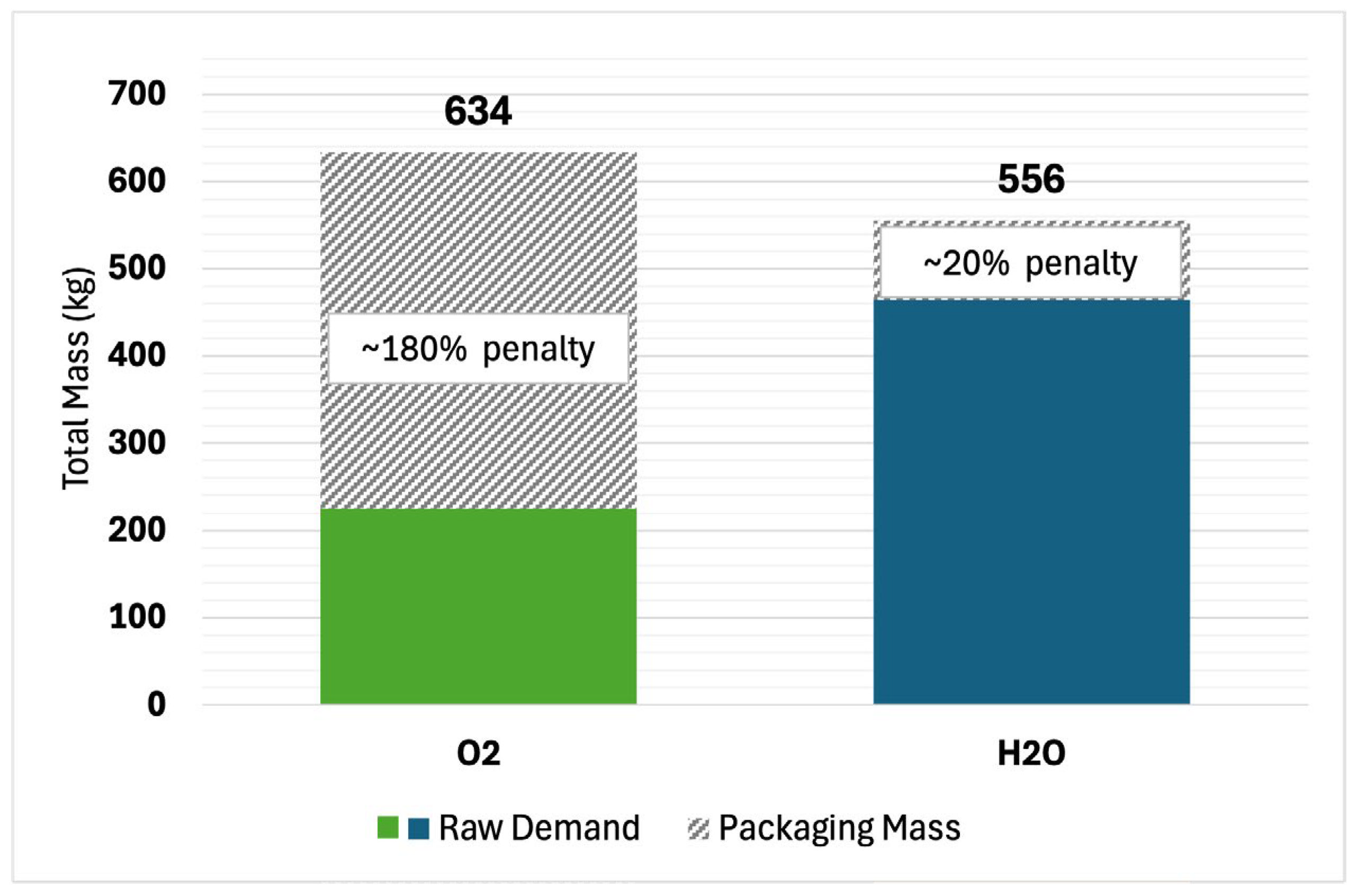
This raw consumable demand, however, does not represent the full logistical mass that must be delivered to the lunar surface and thereby the possible value in mass savings to an early habitation customer. Consumables must be transported in specialized containers and packaging, which adds a significant mass penalty. Based on International Space Station (ISS)-heritage systems, like the Nitrogen Oxygen Recharge System (NORS) tanks and Contingency Water Containers (CWCs), the “packaging factor” is substantial [14,31]. As detailed in Figure 3, water delivery incurs a mass penalty of about 20%, while high-pressure gaseous oxygen delivery is far less efficient, with a mass penalty of 170–200% [14].
Figure 3.
Comparison of oxygen and water demand and resulting additional packaging mass (i.e., mass penalties) for a representative 4-crew, 28-day Artemis mission architecture featuring the PR and MPH. Mass penalties associated with packaging oxygen for transport from Earth indicate inefficient operations and possible advantages of ISRU [14].
While an alternative to consumable resupply for habitation life support systems is the use of regenerative ECLS systems, which recycle water and oxygen onboard, these systems have a higher initial mass, volume, and power cost to the customer [32]. ISRU can offer a similar value as regenerative ECLS with respect to oxygen for habitats, but with the additional prospects of generating metallic alloys while being extensible to lucrative propellant production [14].
2.2. ROXY Pilot Plant Concept
The ROXY pilot plant forms the technical basis of this economic analysis. The design was developed through an iterative, three-step scaling process to bridge the gap between laboratory models and a ton-scale production facility [19]. A detailed technical description of the ROXY process, the pilot plant and its subsystems are presented in Birch et al. [19] and Birch [10]; this section provides a high-level summary and key technical results used as inputs to the economic analysis.
The ROXY process is a molten salt electrolysis method operating at 850 °C, capable of reducing the mixed metal oxides found in raw regolith (predominantly consisting of SiO2 (~45 wt.%), Al2O3 (~20 wt.%), CaO (~15 wt.%), MgO (~10 wt.%), FeO (~5 wt.%) and TiO2 (~2 wt.%), but dependent on lunar excavation site [33]). ROXY uses a SOM to selectively transport oxygen ions from dissociated regolith oxides in the cathode to a separate anode, where pure oxygen gas is evolved. This approach prevents contamination of the metallic product and corrosion of the reactor. After the batch reduction process, the cathode contains a mix of reduced metals and solidified salt, which must be separated. The chosen method is salt evaporation (vacuum distillation), where the mixture is heated to vaporize the salt for collection and recycling, leaving behind the salt-free metal alloy whose composition may vary from site to site. This “mongrel alloy” resulting from the ROXY process is not a market-ready pure metal or an alloy with a defined composition, and thus will have to undergo downstream post-processing for separation and refinement, to be used for in situ manufacturing and construction purposes. By utilizing both products generated in the ROXY process, waste production and the total volume of regolith required to meet the mission demands is minimized. The process is currently at a Technology Readiness Level (TRL) of 3–4.
The ROXY pilot plant is conceived as a specialized processing unit designed to operate as an integrated node within a broader lunar surface infrastructure. As such, the system boundaries for this analysis assume that several key functions are provided as external services. These include: regolith excavation, physical size sorting (sieving to <1 mm) to prevent mechanical clogging and delivery to the plant’s intake port; a stable lunar power supply grid to meet the plant’s operational energy demands; transportation logistics for the initial delivery of the plant and subsequent resupply of consumables; and downstream storage and distribution systems for the produced oxygen and metallic alloy products [19]. Consequently, the mass, power, and cost models presented in this paper are focused on the core processing facility itself, with the costs of these external services accounted for as operational expenditures, rather than as part of the plant’s capital mass or design, development, test, and evaluation (DDT&E) costs.
The ROXY pilot plant is designed to achieve a target oxygen production of around one ton per year (over four times the calculated raw oxygen demand for early lunar habitation), with the equivalent mass of mixed metallic alloy product. This production target is 3–4 orders of magnitude above current ROXY facilities and is thus considered to be a reasonable intermediate development step on route to future operational facilities, an additional 2 orders of magnitude above the pilot plant productivity [19].
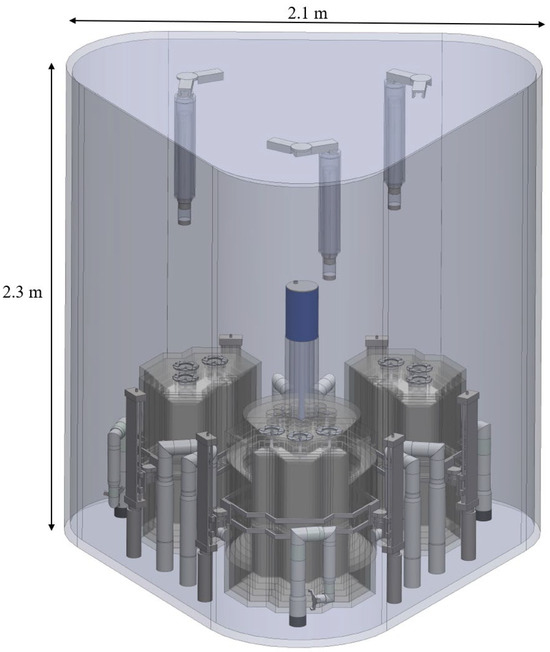
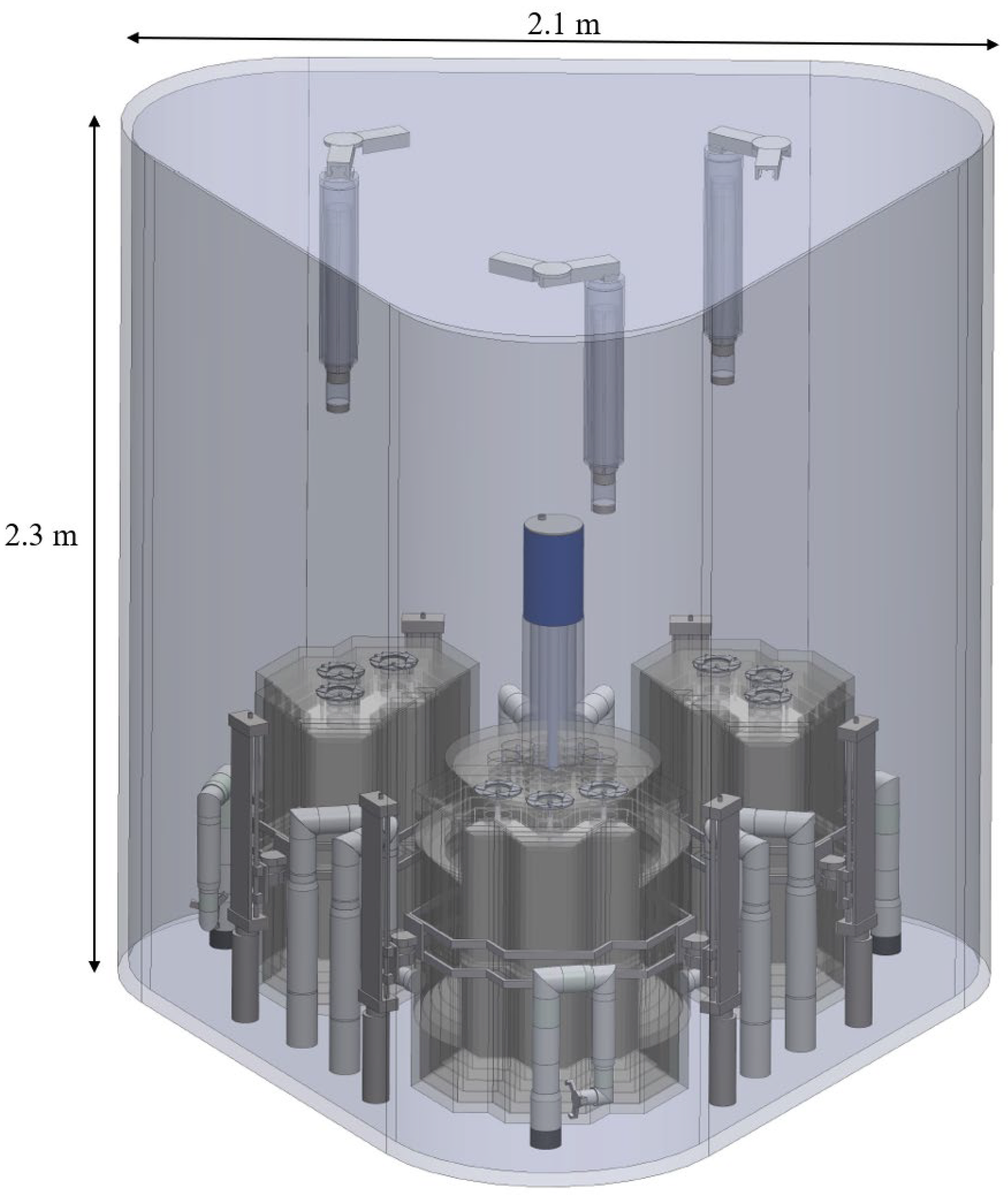
The core of the plant consists of nine individual ROXY reactors, which are arranged in three clusters to optimize thermal management and robotic access (Figure 4) [19]. A key design feature is the high degree of automation. A suite of specialized robotic arms is responsible for specific operational tasks, including transferring cathodes between the reactors and the salt evaporation chamber, and replacing life-limited components, like the anode assemblies [19]. This robotic operation maximizes the plant’s productive uptime during the lunar day for the specific configuration of the reactors [19].
Figure 4.
CAD model of the ROXY pilot plant. The design features three clusters of three reactors each, a central salt recycling unit, and integrated robotics, housed within a 2.1 m × 2.3 m enclosure [19].
From the CAD model (Figure 4) and prepared bill of materials, the mass of the ROXY pilot plant was determined using uncertainty margins based on standards used in ESA projects. A margin of 20% (50% in case of low-maturity assemblies) was used on assembly level, and 20% on systems level. The entire system, including a central salt evaporation chamber for recycling the molten salt electrolyte and the enclosure, has a total mass of 1172 kg [19].
To determine the oxygen production of the ROXY pilot plant, a performance model of ROXY was developed by Birch [10]. To ensure transparency regarding the production capacity used as the basis for the revenue model, the key input parameters to the performance model are summarized in Table 1. The assumed maximum current density of 0.375 A/cm2 through the YSZ is significantly derated compared to the theoretical capability of YSZ membranes (>1.0 A/cm2) [34], and the operational time is strictly limited to the lunar day, with additional margins for thermal cycling. These conservative inputs provide a high level of confidence that the calculated oxygen and metallic alloy production of 1155 kg/year each represents a reliable lower bound. Technical optimization (i.e., higher current density and night-time operation) would likely lead to an increase in productivity.
Table 1.
Key electrochemical input parameters to the electrochemical and performance model of ROXY to determine the oxygen-ion current though the cell [10].
The plant’s performance is quantified using three Figures of Merit (FOMs), which relate the oxygen output to the primary cost drivers of mass, power, and consumables [19]:
- •
- FOM1 (Mass Efficiency): Yearly O2 yield/Facility Mass. This is the inverse of the plant’s “mass payback” time. The target is ≥ 1.0 yr−1.
- •
- FOM2 (Power Efficiency): Yearly O2 yield/Power Consumption. This measures the energy effectiveness of the process for the entire facility, including electrolysis, robotics, and thermal control systems. The target is to be as high as possible.
- •
- FOM3 (Reactor Consumable Efficiency): Yearly O2 yield/Yearly Consumables Mass. This quantifies the logistical dependency on Earth for resupply. The target is ≥ 10.
The conceptual design of the pilot plant successfully meets these targets, as can be seen in Table 2, showing the key results of the performance model. Crucially, the thermal analysis only considering steady-state operation shows that the ohmic heat generated by the electrolysis process itself is greater than the heat lost to the environment. This means the plant is self-heating during steady-state operation, resulting in a net-positive energy balance [10,19]. This finding aligns with analyses of similar SOM-based electrolysis systems, which show that scaled-up plants operate with high energy efficiency, close to the thermodynamic optimum of the reaction [20,36].
Table 2.
Results from the performance model of the ROXY pilot plant, required as input to the economic analysis. yr. = year, * anode and cathode components, ** incl. cell voltage, reactor heater and robotics power [10].
2.3. Methodology for Economic Analysis
The economic analysis assesses the financial viability of the pilot plant that produces 1155 kg of oxygen per year over a 10-year operational lifetime, preceded by a DDT&E phase for the ROXY pilot plant. The methodology is based on establishing comprehensive cost and revenue models to calculate key financial performance metrics [10,37].
2.3.1. Cost Model
Total Life Cycle Costs are aggregated from three primary categories: development, transportation, and operations.
- •
- Design, Development, Test & Evaluation (DDT&E): The non-recurring engineering cost to bring the pilot plant to flight readiness is a significant upfront investment. For this analysis, it is estimated using a parametric cost model developed at the University of Maryland, based on historical NASA programs, which is well-suited for early-stage conceptual designs of space systems, where system mass serves as a primary cost driver [38]. The model utilizes a typical cost estimating relationship of a two-term power law equation, where the coefficients and are the regression coefficients, as shown in (1):The coefficients ( , , , & ) cover the full scope of Phase A–D and are selected based on the system type. For the ROXY pilot plant, a first-of-its-kind advanced technology system, a ‘scientific instrument’ cost estimating relationship was chosen as the most representative analogue, with coefficients listed in Table 3 [38].Table 3. Coefficients used for a ‘scientific instrument’ cost estimating relationship [38].The model was used to determine the DDT&E cost based on the pilot plant’s total mass (m) of 1172 kg, which yielded a cost of 178 M$ (approx. 164 M€ at current rates). This value was rounded up 200 M€ to account for conversion rate fluctuations and unknowns associated with new product development (NPD). This estimate is considered conservative, as the model does not apply a learning curve for the plant’s nine recurring reactor units, which would typically lower the cost in a more detailed analysis [10].
- •
- Cost of Capital: To account for the carrying cost of the investment over the development and pre-operational timeline, a debt financing rate of 4% per annum is applied to all non-recurring upfront costs.
- •
- Launch & Integration Delay: A one-year delay is applied between the completion of development and the start of lunar operations to account for launch window availability and integration. During this period, no revenue is generated, and a holding cost of 0.5 M€ is incurred to cover labor for a standby team and storage.
- •
- Transportation Costs: This category includes the one-time cost to deliver the 1172 kg facility to the lunar surface and the recurring annual cost to deliver 115 kg of life-limited consumables (primarily anode and cathode assemblies) [10]. Two cost points are used for the analysis scenarios: a near-term estimate of 1 M€/kg and an optimistic long-term forecast of 0.1 M€/kg [10].
- •
- Operational/Labor Costs: These are the annual costs incurred once the plant is active on the Moon:
- ○
- Ground Support: A team of five full-time equivalents (FTEs) is assumed for mission control and monitoring from Earth, at a total cost of 0.5 M€/year [10].
- ○
- Power: The plant consumes 45,243 kWh of electrical energy per year, with operations only during the lunar day [19]. The cost of this power is speculative and is scaled based on the transportation cost scenarios, according to models for space-based solar power [39,40]. This results in an annual power cost of 45 M€ in the high transport cost scenario and 4.5 M€ in the low-cost scenario [10].
- ○
- Regolith Delivery: The cost of excavating and delivering the required 2310 kg of regolith per year is assumed to be 1% of the cost to transport that same mass from Earth [10]. This also includes labor for regolith excavation operations.
2.3.2. Revenue Model and Financial Metrics
The analysis considers two revenue scenarios: one based on the sale of oxygen only, and a second based on the sale of both oxygen and the co-produced metallic alloy. In both cases, the market value of the products on the Moon is benchmarked against the cost of Earth-based supply.
Crucially, the value is pegged to the mass of the product only, not the total packaged mass required for transport. For oxygen, which requires heavy, high-pressure containers, this is a deliberately conservative assumption. The true landed cost of 1 kg of oxygen from Earth is nearly three times its own mass (see above) [14]. By not accounting for the container mass in the revenue model, the market value of locally produced oxygen is significantly underestimated. Furthermore, it is assumed that the products, i.e., oxygen and metals, are sold to lunar service providers, who handle final processing and distribution and require payment for their services. As mentioned in Section 2.2, the metallic product will have to undergo downstream post-processing steps to separate and refine the metals after the reduction process. We therefore assume the revenue is split 50:50 between the ROXY plant operator and the service providers. This approach means that if the ROXY plant is found to be viable under these conservative revenue projections, its actual economic performance would likely be much stronger. Therefore, the revenue for 1 kg of product is assumed to be 50% of the transportation cost for 1 kg of mass without packaging [10].
Two key financial metrics are used to evaluate the investment’s viability:
- •
- Internal Rate of Return (IRR): This is the discount rate at which the net present value of all cash flows (both positive and negative) from the project equals zero. It represents the effective rate of return on the investment.
- •
- Time to Break Even (TTBE): This is the total time, measured from the start of the project (Year 0), until the cumulative cash flow turns positive.
2.3.3. Scenarios and Assumptions
To provide a robust assessment under conditions of high uncertainty, four primary scenarios were defined by combining the high and low transportation costs with a “fast” (5-year) and “slow” (7-year) development timeline, with an additional 1 year to account for launch and integration delays. All scenarios assume a 10-year operational life [10]. A sensitivity analysis was also performed on the facility mass, assessing the economic impact of achieving a moderate 25% and an aggressive 50% mass reduction through future design optimization [41]. The primary scenarios are outlined in Table 4.
Table 4.
Scenarios for Economic Analysis. For each case, two sales scenarios were evaluated, (a) oxygen only and (b) oxygen and metals. * Near-Term Scenario, ** Long-Term, † Fast, †† Slow.
3. Results of the Economic Analysis
The economic analysis was conducted for both the “Oxygen-Only” and the more comprehensive “Oxygen and Metals” sales scenarios. As expected, the inclusion of revenue from the metallic co-product dramatically improves the economic outlook in all cases.
3.1. Oxygen-Only Sales Scenario
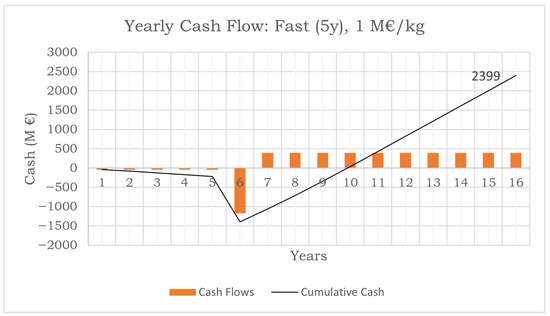
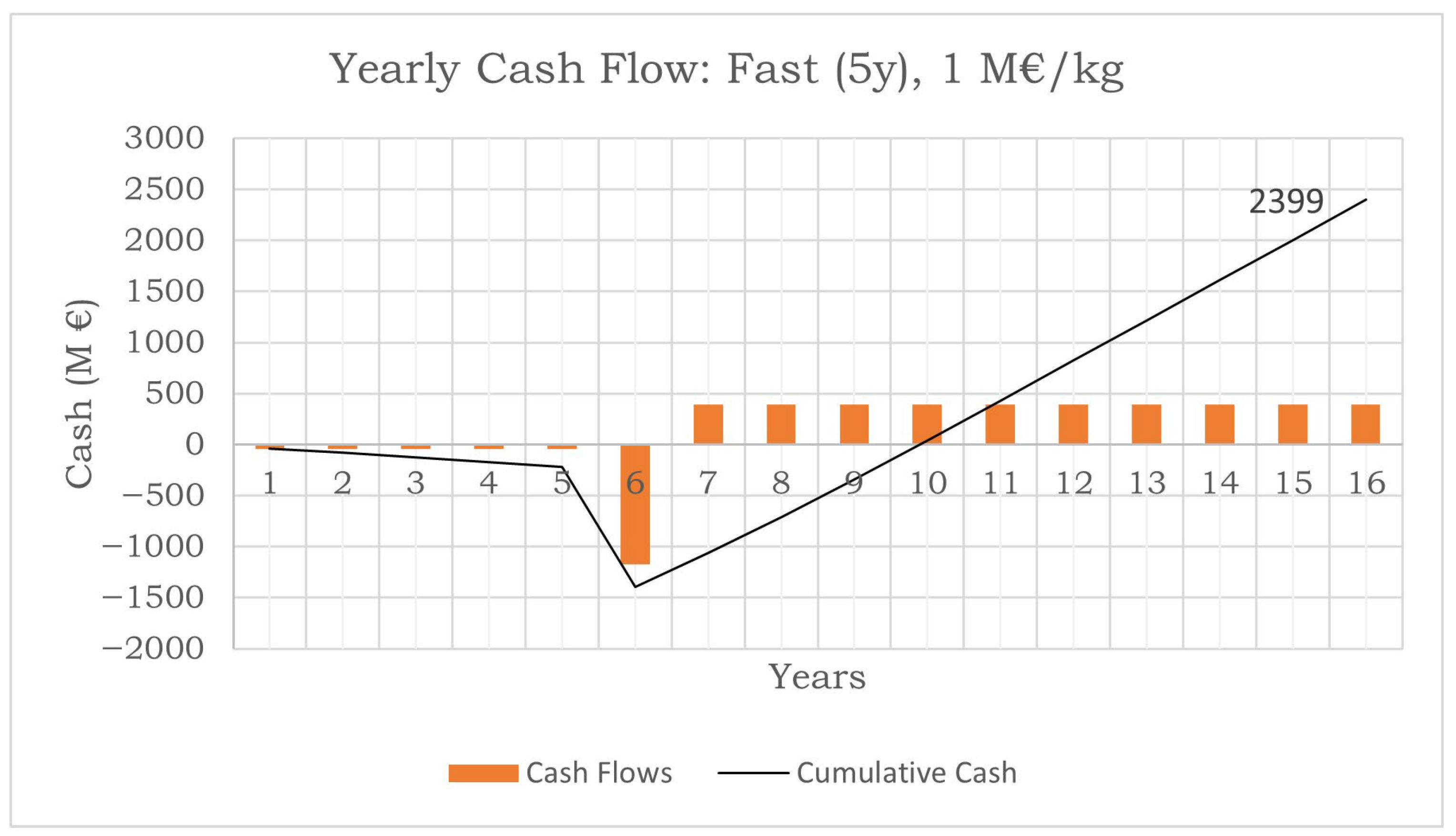
When considering revenue from only the 1155 kg of oxygen produced annually, the economic viability of the pilot plant is highly dependent on near-term, high transportation costs. The reference scenario (Case 1) yields a positive IRR of 19.9% with a TTBE of 10 years (4 years of operation, see Figure 5). This is considered an attractive return for a high-risk space infrastructure project [10]. However, in long-term scenarios, where transportation costs fall to 0.1 M€/kg, the IRR drops into the negative, making the investment unattractive without considering the value of the metallic co-products [10].
Figure 5.
Yearly and Cumulative Cash Flow for the Oxygen-Only Reference Scenario and high transportation costs. The analysis shows a development phase (year 0–5), a large initial investment for transport (year 6), and subsequent positive returns leading to a break-even point at 10 years [10].
3.2. Oxygen and Metals Sales Scenario
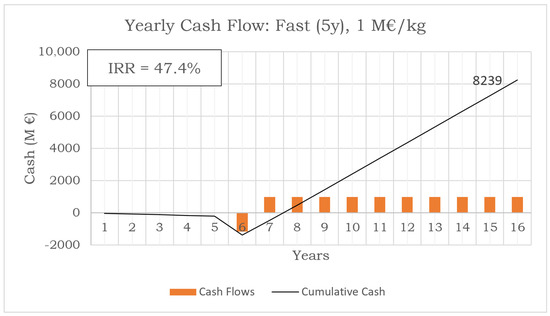
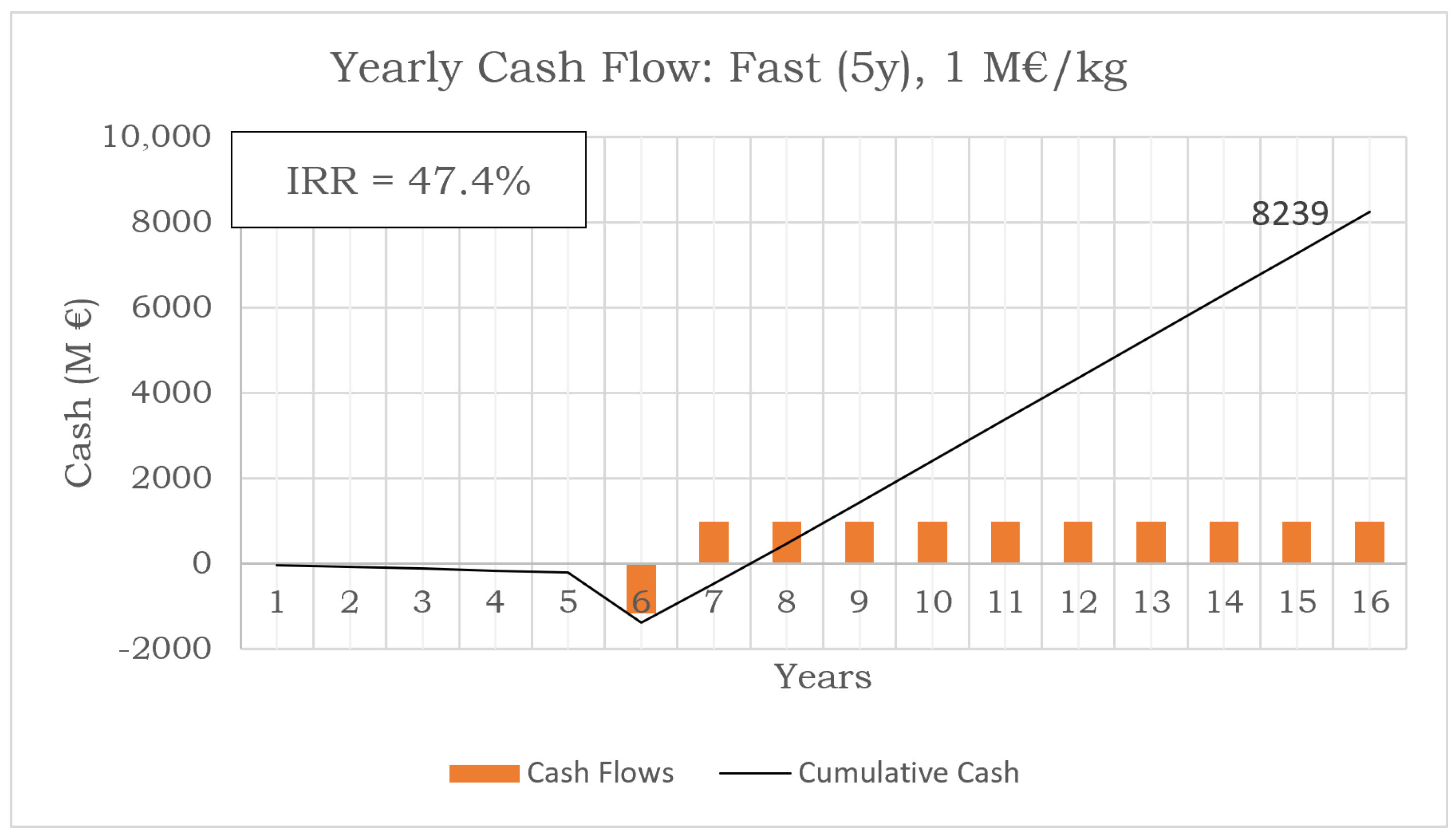
When the revenue from an equivalent mass of metallic alloy is included, the business case becomes exceptionally strong across almost all scenarios. In the reference case (Case 1), the IRR jumps to 47.4% and the TTBE shortens to just 7.5 years (1.5 years of operation), with a total cumulative revenue of over 8.2 B€ after 10 years of operation (Figure 6) [10]. Even in the challenging long-term scenario with low transport costs (Case 4), the IRR is a healthy 13%. The inclusion of the metal products provides a significant revenue stream that makes the overall project far more resilient to fluctuations in transportation costs and market conditions.
Figure 6.
Yearly and Cumulative Cash Flow for the Oxygen & Metals Reference Scenario and high transportation costs. With revenue from both products, the annual income doubles, leading to a much faster break-even point at 7.5 years and a significantly higher final revenue [10].
3.3. Sensitivity and Summary of Results
The sensitivity analysis confirms that facility mass is the most critical parameter for optimization. To assess the economic impact of future design improvements, three facility mass scenarios were defined: the nominal mass (100%) and two scenarios with a moderate (75%) and an aggressive (50%) mass reduction [10]. These reductions directly affect the initial transportation and development costs, as shown in Table 5.
Table 5.
Facility Mass Scenarios [10].
The following tables summarize the key financial metrics—TTBE, IRR, and Total Revenue—for all four main scenarios and the three mass fractions [10]. Table 6 shows the results for the “Oxygen-Only” sales scenario.
Table 6.
Results for the Oxygen-Only Scenario. * exceeding assumed plant operation time of 10 years [10].
Table 7 shows the significantly improved results for the “Oxygen and Metals” scenario, which considers the sale of both products.
Table 7.
Results for the “Oxygen and Metals” Scenario [10].
The data clearly shows how strongly the economic viability depends on mass. In the reference scenario alone (Case 1, “Oxygen and Metals”), a 50% reduction in facility mass boosts the IRR from 47.4% to a remarkable 65.9%. This highlights that future mass optimization is the most important lever for maximizing the project’s profitability.
4. Discussion
The economic viability of the ROXY pilot plant is overwhelmingly driven by two upfront capital expenditures: the cost of transportation to the Moon and the cost of development. Both are driven by the facility’s mass. The mass breakdown of the pilot plant design reveals that the robotics subsystem is the largest contributor, accounting for 40% of the total mass [10]. This identifies a clear and high-priority target for future optimization. The current robotics concept was designed for maximum operational flexibility and redundancy; future design iterations focused on simplifying the operational sequence and utilizing more lightweight mechanisms could yield substantial mass savings and, therefore, a significant improvement in the economic case.
A key strategic insight from the analysis is that the business case for this pilot plant is strongest by utilizing a near-term customer through habitation before growing into a propellant-based market. The high current cost of transportation from Earth creates a high-value market for locally produced resources. As transportation costs inevitably decrease with the advent of new launch systems, the economic advantage of local production over Earth-based resupply diminishes, making the high upfront DDT&E cost harder to recoup [42]. This suggests a strategic imperative to develop and deploy ISRU capabilities early in the lunar exploration timeline to maximize their economic impact and accelerate the establishment of a self-sustaining lunar economy [43,44].
The business case considering the revenue from oxygen and the metallic product is clearly preferred compared to the revenue from oxygen only. This analysis conservatively assumes the direct sale of the produced mixed metallic alloy at a value benchmarked against Earth-supply costs. It is acknowledged that this represents a simplification of the value chain, since the metallic product will have to undergo post-processing. Further processing, such as transportation to a separate facility for refining into pure metals or specific alloys for construction and manufacturing, is assumed to be covered by the 50% value discount applied in the revenue model. Nevertheless, detailed techno-economic analysis of this downstream processing represents a valuable area for future work. These could include the transportation of the mixed metallic alloy to additional facilities for separation and purification into pure metals or well-defined alloys to be used for construction materials.
When compared to other proposed ISRU processes, the ROXY technology offers distinct advantages that contribute to its favorable economic profile. Its lower operating temperature (850 °C vs, e.g., >1500 °C for Molten Regolith Electrolysis) mitigates material challenges and reduces thermal management requirements [19,45]. Furthermore, the use of a SOM to directly produce pure oxygen eliminates the need for a complex and failure-prone downstream gas processing system, which is a significant drawback of processes like carbothermal reduction [10,19]. These factors lead to a simpler, more reliable, and ultimately more cost-effective and sustainable system.
Finally, unlike other ISRU processes that target only oxygen extraction from specific metal oxides in the regolith, the ROXY process is inherently designed for high material efficiency, by being capable of reducing almost all regolith constituents in one process. By converting the regolith feedstock into two useful product streams—oxygen and a mixed metal alloy—the process utilizes nearly 100% of the ingested mass. This dual-production capability minimizes the generation of waste tailings and reduces the total volume of regolith that must be excavated to meet a given resource demand, aligning the pilot plant’s operation with the principles of responsible and sustainable lunar exploration, as voiced by several authors [46,47].
5. Conclusions
This work demonstrates that a lunar pilot plant based on the ROXY process is both technically and economically viable. The proposed conceptual design meets its performance targets, producing 1155 kg of oxygen per year with a facility mass of 1172 kg and achieving an energy-positive thermal balance during steady-state operation that makes its power consumption highly efficient [19].
From an economic perspective, the pilot plant represents a highly profitable investment for oxygen and metals production on the Moon, particularly in near-term mission architectures with high Earth-to-Moon transportation costs. When accounting for revenue from both oxygen and metals, the reference case yields an impressive IRR of 47.4% with a payback period of just 7.5 years [10]. The primary drivers of this viability are the high market value of locally produced resources and the inherent efficiency and robustness of the ROXY process. The analysis clearly indicates that future development efforts should prioritize the reduction in the facility’s total mass, with a focus on simplifying and optimizing the robotics subsystem.
By providing a robust and efficient means of producing essential resources, the ROXY pilot plant serves as a critical enabling technology. It not only supports the immediate needs of habitation systems but also paves the way for industrial-scale ISRU, which is the cornerstone of a sustainable, long-term human presence on the Moon and the expansion of a vibrant lunar economy [7]. What is proposed herein is the opportunity to demonstrate use of local resources and reduce Earth-based reliance while proving a local economic capability that is ultimately extensible to propellant production.
Future work should expand upon this analysis by developing a detailed economic model of the metallic product value chain, including the costs and potential revenues associated with post-processing the alloy into high-value construction materials. Additionally, refining transportation cost models as the lunar logistics market matures will further increase the fidelity of these economic projections.
Author Contributions
Conceptualization, T.F.B. and A.S.; methodology, A.S.; validation, J.E.J. and U.P.; formal analysis, T.F.B.; investigation, T.F.B., A.S. and J.E.J.; resources, T.F.B.; data curation, T.F.B., A.S. and J.E.J.; writing—original draft preparation, T.F.B. and A.S.; writing—review and editing, T.F.B., A.S., G.P. and J.E.J.; project administration, G.P.; funding acquisition, G.P. and A.S. All authors have read and agreed to the published version of the manuscript.
Funding
This research was funded by Airbus.
Data Availability Statement
Restrictions apply to the datasets. The datasets presented in this article are not readily available because the data is confidential for commercial reasons. Requests to access the datasets should be directed to the corresponding author.
Acknowledgments
We would like to acknowledge M. Altenburg, E. Monchieri and M. Franz (Airbus Defence and Space), C. Lieblein (TU München, Germany), C. Offenhäusser (FH Aachen, Germany), M. Schatz, S. Maass, E. Auer, M. Propst, F. Spraul (DHBW Friedrichshafen, Germany) for the technical development of the ROXY pilot plant presented in this work. We would like to acknowledge S. Quanz and H. Kolvenbach at ETH Zurich for the support received during the study by Birch [10], upon which the work presented here is based.
Conflicts of Interest
Author Achim Seidel was employed by the company Airbus Defence and Space. The remaining authors declare that the research was conducted in the absence of any commercial or financial relationships that could be construed as a potential conflict of interest.
Abbreviations
The following abbreviations are used in this manuscript:
| ASI | Italian Space Agency |
| CAD | Computer-Aided Design |
| CNSA | China National Space Administration |
| CWC | Contingency Water Containers |
| DDT&E | Design, Development, Test & Evaluation |
| ECLS | Environmental Control and Life Support |
| EVA | Extravehicular Activity |
| FOM | Figure of Merit |
| FTE | Full-Time Equivalents |
| ILRS | International Lunar Research Station |
| IRR | Internal Rate of Return |
| ISRU | In Situ Resource Utilization |
| ISS | International Space Station |
| JAXA | Japan Space Agency |
| MPH | Multi-Purpose Habitat |
| NASA | National Aeronautics and Space Administration |
| NORS | Nitrogen Oxygen Recharge System |
| PR | Pressurized Rover |
| ROXY | Regolith to Oxygen and Metals Conversion |
| SOM | Solid Oxide Membrane |
| TRL | Technology Readiness Level |
| TTBE | Time to Break Even |
| YSZ | Yttria-Stabilized Zirconia |
References
- International Space Exploration Coordination Group. The Global Exploration Roadmap. 2024. Available online: https://www.globalspaceexploration.org/wp-content/isecg/GER2024.pdf (accessed on 19 October 2025).
- NASA. Moon to Mars Objectives, National Aeronautics and Space Administration. 2022. Available online: https://www.nasa.gov/wp-content/uploads/2022/09/m2m-objectives-exec-summary.pdf (accessed on 13 November 2025).
- European Space Agency. ESA’s Terrae Novae 2030+ Strategy Roadmap; ESA: Paris, France, 2021. Available online: https://destination-orbite.net/documentations/Terrae_Novae_2030+strategy_roadmap.pdf (accessed on 13 November 2025).
- Crawford, I.; Anand, M.; Cockell, C.; Falcke, H.; Green, D.; Jaumann, R.; Wieczorek, M. Back to the Moon: The Scientific Rationale for Resuming Lunar Surface Exploration. Planet. Space Sci. 2012, 74, 3–14. [Google Scholar] [CrossRef] [Scilit]
- Zhang, P.; Dai, W.; Niu, R.; Zhang, G.; Liu, G.; Liu, X.; Bo, Z.; Wang, Z.; Zheng, H.; Liu, C.; et al. Overview of the Lunar In Situ Resource Utilization Techniques for Future Lunar Missions. Space Sci. Technol. 2023, 3, 0037. [Google Scholar] [CrossRef] [Scilit]
- Crawford, I.A. The long-term scientific benefits of a space economy. Space Policy 2016, 37, 58–61. [Google Scholar] [CrossRef] [Scilit]
- Wang, C.; Zhang, G.; Wang, Y.; Song, L. A Review of Lunar Environment and In-Situ Resource Utilization for Achieving Long-Term Lunar Habitation. Galaxies 2025, 13, 103. [Google Scholar] [CrossRef] [Scilit]
- Maharaj, S.; Nassar, E.; Uraiqat, R.; Vesudeva, K.; Jing, A. A Concept of Operations for a Sustainable Human-Centered Lunar Settlement by Integrating State-of-the-Art ISRU Technologies. In Proceedings of the 9th European Conference for Aeronautics and Space Sciences (EUCASS), Lille, France, 27 June–1 July 2022; Available online: https://www.eucass.eu/doi/EUCASS2022-6167.pdf (accessed on 13 November 2025).
- Jones, C.A.; Pensado, A.R.; Clark, M.A.; Grande, M.L.; Ivanco, M.L.; Judd, E.L.; Klovstad, J.J.; Reeves, D.M. Cost Breakeven Analysis of Lunar In-Situ Propellant Production for Human Missions to the Moon and Mars (Report No. 20205007564). In Proceedings of the AIAA ASCEND 2020, Virtual, 16–18 November 2020; NASA Langley Research Center: Hampton, VA, USA, 2020. [Google Scholar]
- Birch, T.F. Concept and Performance Analysis of a Scaled ROXY Process. Master’s Thesis, ETH Zurich, Zürich, Switzerland, March 2025. [Google Scholar]
- Scatteia, L.; Perrot, Y. Lunar Market Assessment: Market Trends and Challenges in the Development of a Lunar Economy; PwC: London, UK, 2021; Available online: https://www.pwc.com.au/industry/space-industry/lunar-market-assessment-2021.pdf (accessed on 13 November 2025).
- Luxembourg Space Agency. Opportunities for Space Resources Utilization—Future Markets and Value Chains—Study Summary. 2018. Available online: https://space-agency.public.lu/dam-assets/publications/2018/Study-Summary-of-the-Space-Resources-Value-Chain-Study.pdf (accessed on 13 November 2025).
- Leger, D.; Ghaffari-Tabrizi, F.; Shaw, M.; Rasera, J.; Dickson, D.; Valentin, B.; Morlock, A.; Thoresen, F.; Cowley, A. Modeling energy requirements for oxygen production on the Moon. Proc. Natl. Acad. Sci. USA 2025, 122, e2306146122. [Google Scholar] [CrossRef] [Scilit] [PubMed]
- Johnson, J.E. Habitation Life Support Breakeven Analysis for Lunar-derived Oxygen and Water. In Proceedings of the 54th International Conference on Environmental Systems (ICES-2025-284), Prague, Czech Republic, 13–17 July 2025. [Google Scholar]
- Heiken, G.; Vaniman, D.; French, B.M. Lunar Sourcebook: A User’s Guide to the Moon; Cambridge University Press: Cambridge, UK, 1991. [Google Scholar]
- Xu, Y.; Pang, S.; Cong, L.; Qian, G.; Wang, D.; Li, L.; Wu, Y.; Wang, Z. Overview of in-situ oxygen production technologies for lunar resources. Int. J. Miner. Metall. Mater. 2025, 32, 233–255. [Google Scholar] [CrossRef] [Scilit]
- Schlüter, L.; Cowley, A. Review of Techniques for In-Situ Oxygen Extraction on the Moon. Planet. Space Sci. 2019, 181, 104753. [Google Scholar] [CrossRef] [Scilit]
- Sanders, G.; Kleinhenz, J. In Situ Resource Utilization (ISRU) Envisioned Future Priorities—Update, 9 March 2023; NASA: Washington, DC, USA, 2023. Available online: https://www.nasa.gov/wp-content/uploads/2023/06/live-isru-efp-new-3-21-23-tagged-1.pdf (accessed on 13 November 2025).
- Birch, T.; Seidel, A.; Monchieri, E.; Altenburg, M.; Offenhäusser, C.; Lieblein, C.; Pöhle, G.; Redlich, C.; Pal, U.; Schatz, M.; et al. Conceptual Design and Viability Analysis of a Lunar ROXY Pilot Plant. In Proceedings of the 54th International Conference on Environmental Systems (ICES-2025-108), Prague, Czech Republic, 13–17 July 2025. [Google Scholar]
- Seidel, A.; Altenburg, M.; Monchieri, E.; Strigl, F. ROXY An economically viable process to produce oxygen and metals from regolith. In Proceedings of the 51st International Conference on Environmental Systems, Saint Paul, MN, USA, 10–14 July 2022. [Google Scholar]
- Seidel, A.; Häming, M.; Monchieri, E.; Adrian, A.; Joumel, P.; Quadbeck, P.; Fereres Rapoport, S.; Pal, U.; Spierings, A. An electrochemical viable lunar ISRU process for oxygen and metal production and related benefits for terrestrial applications. In Proceedings of the 72nd International Astronautical Congress (IAC) (IAC-21-A3,2C,3), Dubai, United Arab Emirates, 25–29 October 2021. [Google Scholar]
- Seidel, A.; Monchieri, E.; Altenburg, M.; Franz, M.; Birch, T.; Pöhle, G.; Redlich, C.; Pal, U. Oxygen from Regolith: The Mini-ROXY Lunar Demonstration Instrument and Mission. In Proceedings of the 54th International Conference on Environmental Systems (ICES-2025-107), Prague, Czech Republic, 13–17 July 2025. [Google Scholar]
- Ikeya, K.; Javier Guerro Gonzalez, F.; Kiewiet, L.; Michel-Alexandre, C.; Cilliers, J.; Starr, S.; Hadler, K. Hybrid lunar ISRU plant: A comparative analysis with carbothermal reduction and water extraction. Acta Astronaut. 2025, 230, 148–168. [Google Scholar] [CrossRef] [Scilit]
- Guerrero-Gonzalez, F.J.; Zabel, P. System analysis of an ISRU production plant: Extraction of metals and oxygen from lunar regolith. Acta Astronaut. 2023, 203, 187–201. [Google Scholar] [CrossRef] [Scilit]
- Shishko, R. A Comparison of Previously Published Papers on the Economics of Lunar In Situ Resource Utilization (ISRU); Jet Propulsion Laboratory 2019; California Institute of Technology: Pasadena, CA, USA, 2019. [Google Scholar]
- Human Spaceflight: Mission Analysis and Design; Larson, W.E., Pranke, L.C., Eds.; McGraw-Hill: Columbus, OH, USA, 1999. [Google Scholar]
- Parodi, P.; Ricci, L.; Musso, J.-P.; Illiano, S.; Mugnuolo, R. Overview of ASI Multi-Purpose Habitation (MPH) Module development and ECLSS Preliminary Concept Design. In Proceedings of the 54th International Conference on Environmental Systems (ICES), Prague, Czech Republic, 13–17 July 2025. [Google Scholar]
- Yamazaki, C.; Ikeda, N.; Kamiyoshi, S.; Wada, M.; Menjo, R.; Matsumoto, H.; Takeda, J.; Kimura, N.; Ushioda, Y.; Morinaka, M.; et al. Overview of JAXA Pressurized Rover development and ECLSS Design. In Proceedings of the 53rd International Conference on Environmental Systems (ICES), Louisville, KY, USA, 21–25 July 2024. [Google Scholar]
- Toyota Corp. Lunar Cruiser Design Update: A Newly Designed 1/5 Scale Model Will be Exhibited at Expo 2025 Osaka, Kansai, Japan ‘Future Life Village’, Toyota Motor Corporation Official Global Website. Available online: https://global.toyota/en/mobility/technology/lunarcruiser/20250331.html (accessed on 10 August 2025).
- ASI. L’Agenzia Spaziale Italiana e Thales Alenia Space Firmano un Contratto per lo Sviluppo del Modulo Lunare MPH. Available online: https://www.asi.it/2025/07/lagenzia-spaziale-italiana-e-thales-alenia-space-firmano-un-contratto-per-lo-sviluppo-del-modulo-lunare-mph/ (accessed on 10 August 2025).
- Lynch, C.; Goodliff, K.E.; Stromgren, C.; Vega, J.; Ewert, M.K. Logistics Rates and Assumptions for Future Human Spaceflight Missions Beyond LEO. In Proceedings of the AIAA ASCEND, Las Vegas, NV, USA, 23–25 October 2023. [Google Scholar] [CrossRef] [Scilit]
- Stromgren, C.; Burke, C.; Cho, J.; Cirillo, W.; Owens, A.; Howard, D. Regenerative ECLSS and Logistics Analysis for Sustained Lunar Surface Missions. In Proceedings of the IEEE Aerospace Conference, Big Sky, MT, USA, 5–12 March 2022. [Google Scholar] [CrossRef] [Scilit]
- Long-Fox, J.; Britt, D. Characterization of planetary regolith simulants for the research and development of space resource technologies. Front. Space Technol. 2023, 4, 1255535. [Google Scholar] [CrossRef] [Scilit]
- Barnett, S.; Voorhees, P.; Park, B.-K.; Zhang, Q. HydroGen Seedling: Degradation Characterization and Modeling of a New Solid Oxide Electrolysis Cell Utilizing Accelerated Life Testing; DOE Hydrogen and Fuel Cells Program, FY 2019 Annual Progress Report; Northwestern University: Evanston, IL, USA, 2019. [Google Scholar]
- Guan, X.; Pal, U.B.; Jiang, Y.; Su, S. Clean Metals Production by Solid Oxide Membrane Electrolysis Process. J. Sustain. Metall. 2016, 2, 152–166. [Google Scholar] [CrossRef] [Scilit]
- Moudgal, A.; Buasai, S.; Wu, Y.J.; McMahon, A.; Hazerjian, J.M.; Luu, V.; Ly, A.; Asadikiya, M.; Powell, A.; Pal, U.; et al. Finite Element Analysis and Techno-economic Modeling of Solar Silicon Molten Salt Electrolysis. JOM 2020, 73, 233–243. [Google Scholar] [CrossRef] [Scilit]
- Blair, B.R. Modeling PPP Economic Benefits for Lunar ISRU, NewSpace Analytics. In Proceedings of the 2017 LEAG Annual Meeting, USRA HQ, Columbia, MD, USA, 11 October 2017; Available online: https://www.hou.usra.edu/meetings/leag2017/presentations/wednesday/blair.pdf (accessed on 13 November 2025).
- University of Maryland. Lecture 7: Cost Estimation and Engineering Economics; Institutional Report, ENAE 483/788D—Principles of Space Systems Design. University of Maryland: College Park, MD, USA, 2024.
- Rodgers, E.; Gertsen, E.; Sotudeh, J.; Mullins, C.; Hernandez, A.; Le, H.N.; Smith, P.; Joseph, N. Space-Based Solar Power; NASA Office of Technology, Policy, and Strategy: Washington, DC, USA, 2024. [Google Scholar]
- Gosavi, S.; Mane, H.; Pendhari, A.; Magdum, A.; Deshpande, S.; Baraskar, A.; Jadhav, M.; Husainy, A. A Review on Space Based Solar Power. J. Therm. Energy Syst. 2021, 6, 16–24. [Google Scholar] [CrossRef] [Scilit]
- Owens, A.; de Weck, O. Sensitivity Analysis of the Advanced Missions Cost Model. In Proceedings of the 46th International Conference on Environmental Systems (ICES), Vienna, Austria, 10–14 July 2016. [Google Scholar]
- Jones, H.W. Take Material to Space or Make It There? AIAA 2023-4618. In Proceedings of the ASCEND, Las Vegas, NV, USA, 23–25 October 2023. [Google Scholar] [CrossRef] [Scilit]
- Gertsch, L. Space Resources Science. Bull. AAS 2021, 53, 1–7. [Google Scholar] [CrossRef] [Scilit]
- Metzger, P.T.; Muscatello, A.; Mueller, R.P.; Mantovani, J. Affordable, rapid bootstrapping of space industry and solar system civilization. J. Aerosp. Eng. 2013, 26, 18–29. [Google Scholar] [CrossRef] [Scilit]
- Schreiner, S.S.; Sibille, L.; Dominguez, J.A.; Hoffman, J.A. A parametric sizing model for Molten Regolith Electrolysis reactors to produce oxygen on the Moon. Adv. Space Res. 2016, 57, 1585–1603. [Google Scholar] [CrossRef] [Scilit]
- United Nations. Treaty on Principles Governing the Activities of States in the Exploration and Use of Outer Space, including the Moon and Other Celestial Bodies (The Outer Space Treaty); United Nations Treaty Series; United Nations: New York, NY, USA, 1967. Volume 610, pp. 209–210. Available online: https://www.unoosa.org/oosa/en/ourwork/spacelaw/treaties/outerspacetreaty.html (accessed on 13 November 2025).
- NASA. Responsible Exploration: Ethical, Legal, and Societal Implications of the Artemis campaign and NASA’s Moon to Mars Architecture. In 2024 Moon to Mars Architecture Concept Review White Paper; NASA: Washington, DC, USA, 2024; Available online: https://www.lpi.usra.edu/lunar/strategies/resources/M2M_ACR2024_ResponsibleExploration.pdf (accessed on 13 November 2025).

Disclaimer/Publisher’s Note: The statements, opinions and data contained in all publications are solely those of the individual author(s) and contributor(s) and not of MDPI and/or the editor(s). MDPI and/or the editor(s) disclaim responsibility for any injury to people or property resulting from any ideas, methods, instructions or products referred to in the content. |
© 2026 by the authors. Licensee MDPI, Basel, Switzerland. This article is an open access article distributed under the terms and conditions of the Creative Commons Attribution (CC BY) license.