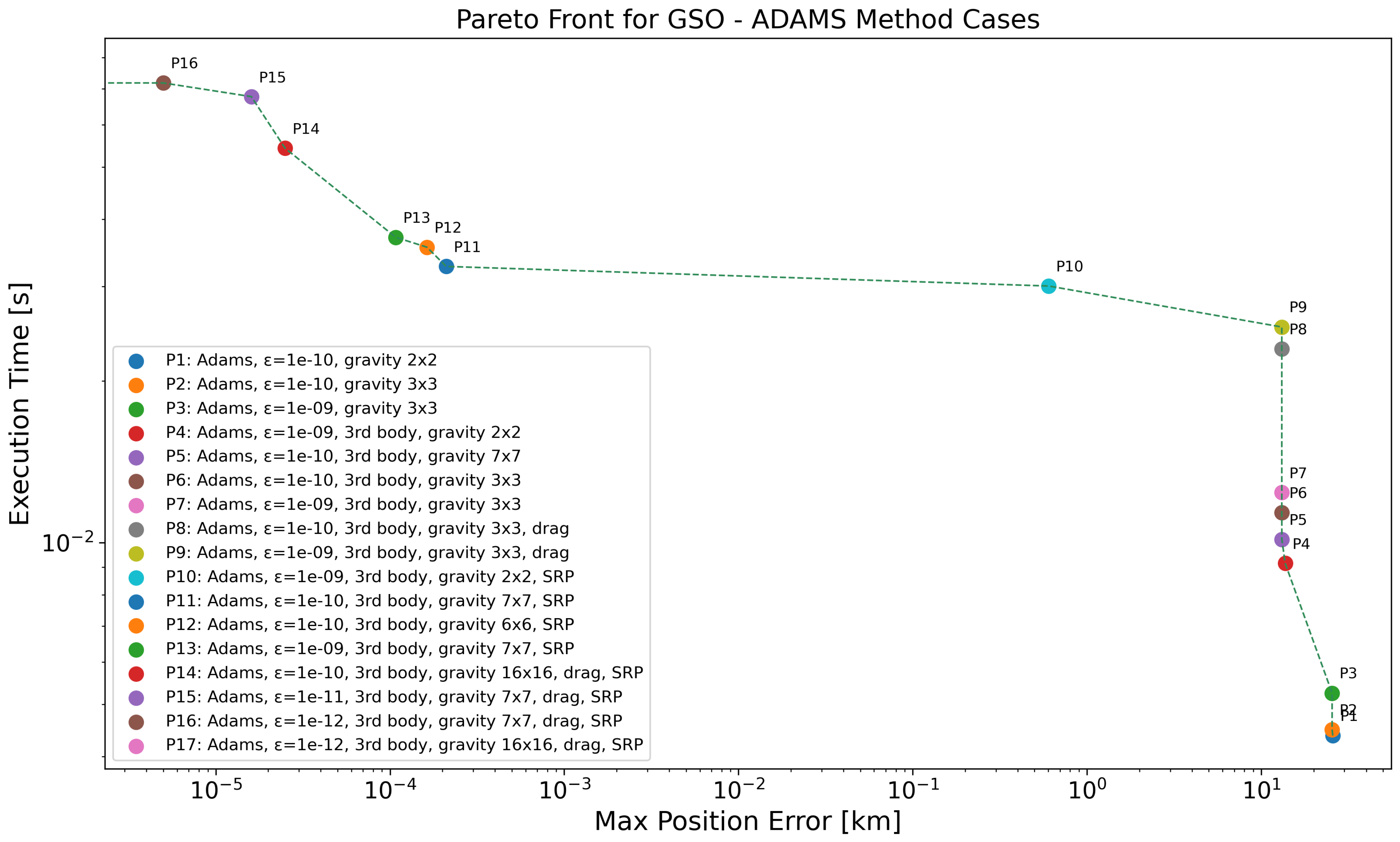
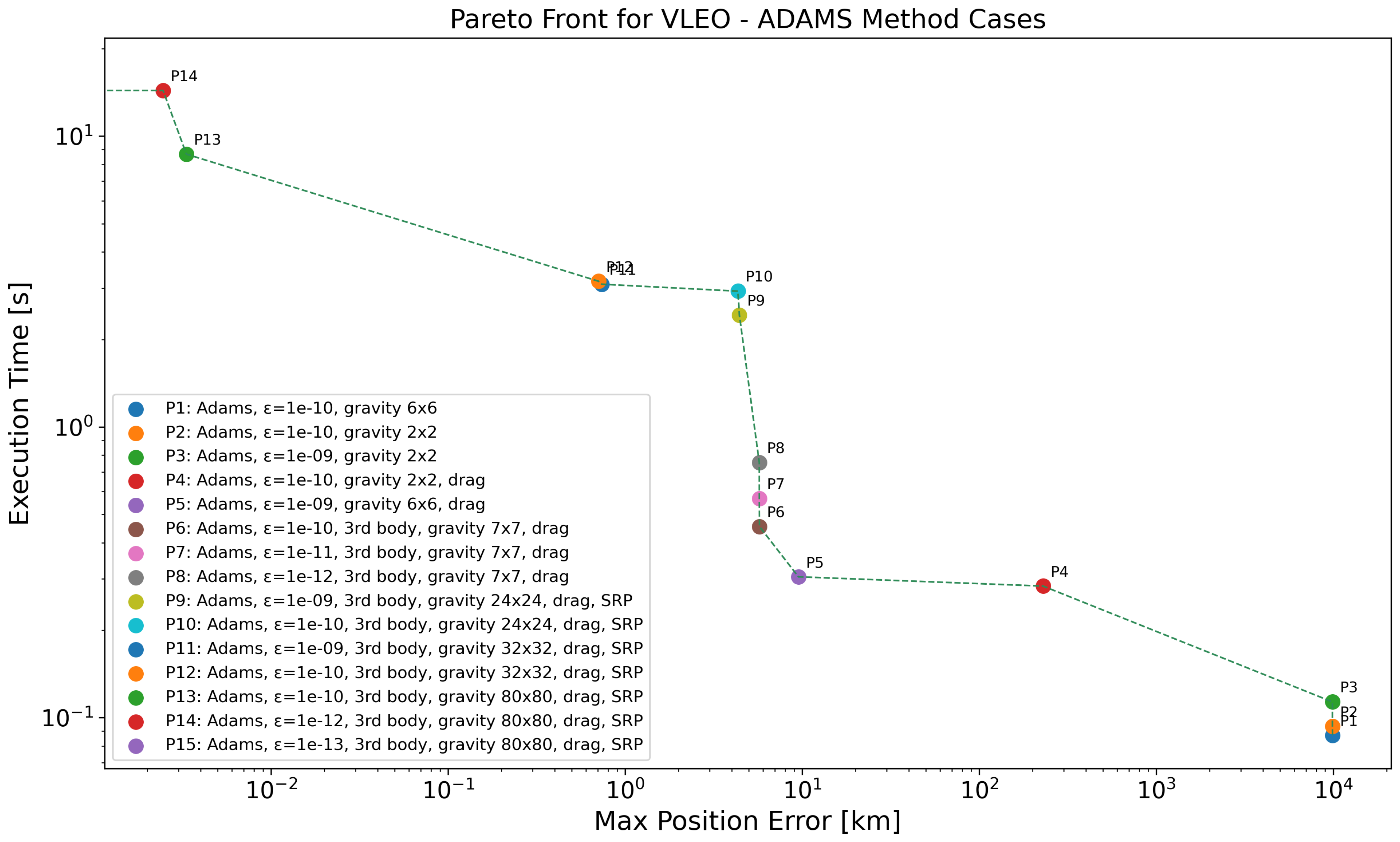
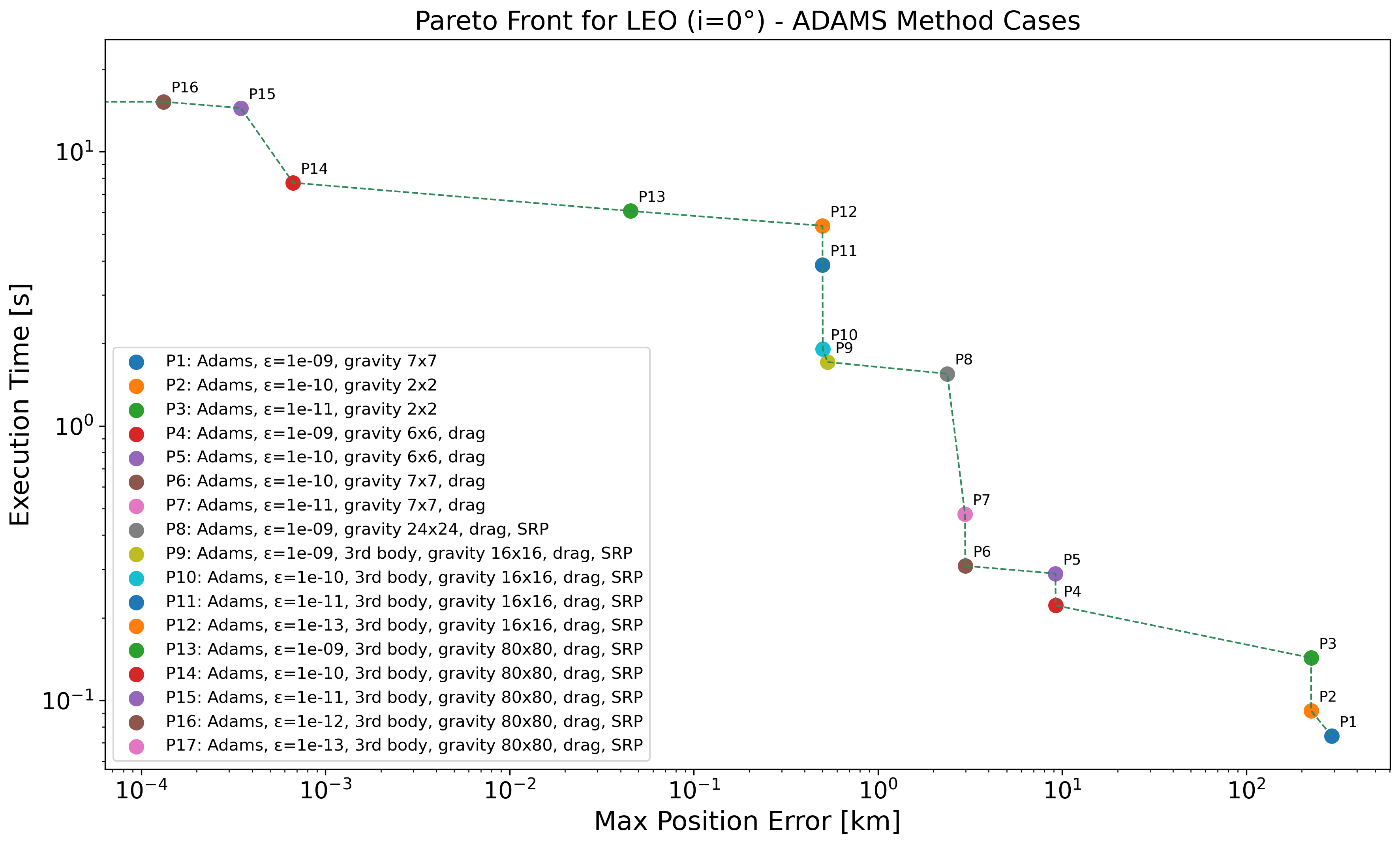
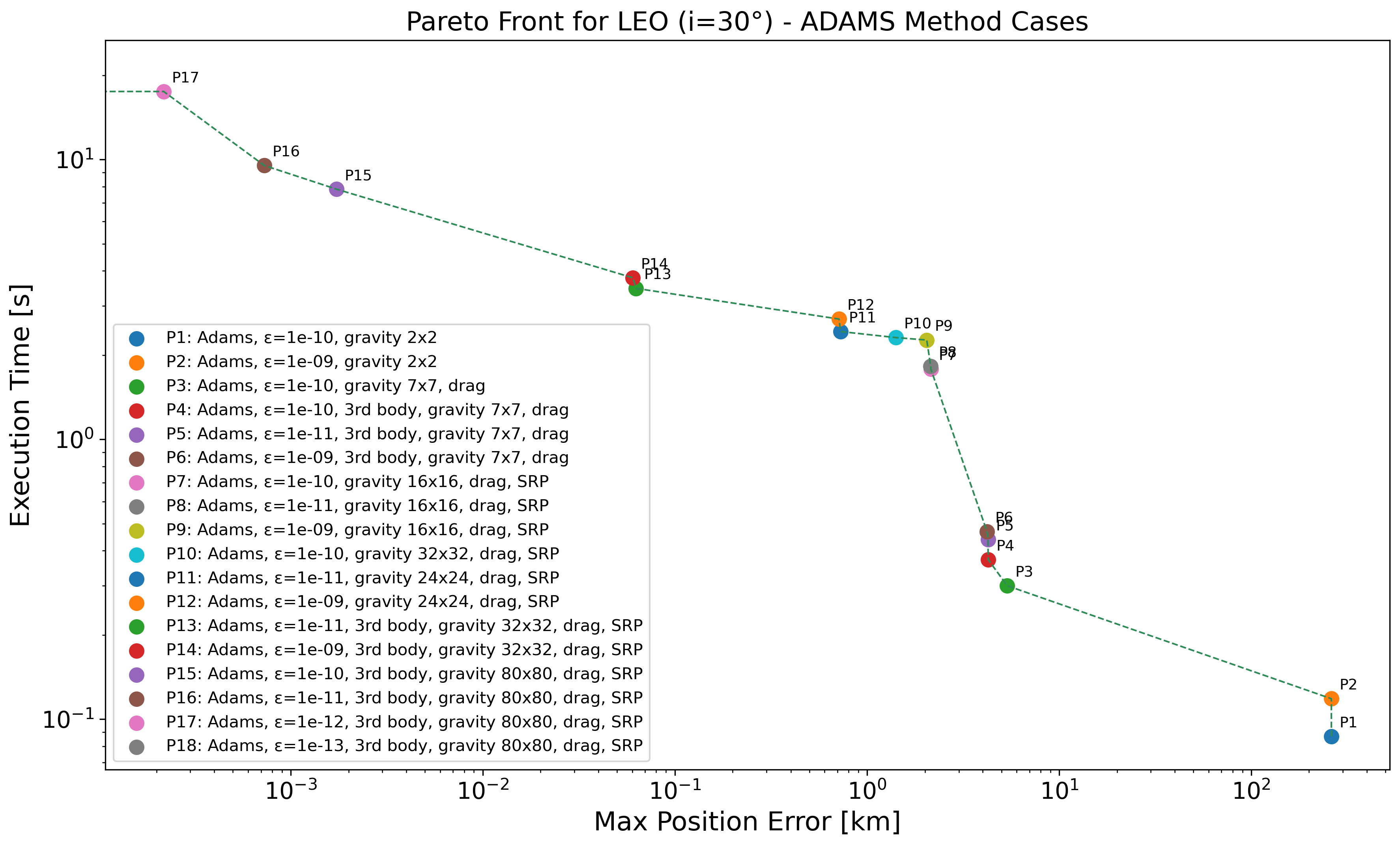
The presented results in the form of Pareto fronts and related data analysis on various propagators, labeled as P1, P2, P3, etc., for scenarios defined in
Table 3, offer valuable insights into the trade-offs between computational efficiency and accuracy in orbit prediction for each specific regime. Each case (P1, P2, P3, etc.) represents a distinct combination of ABM method tolerance and perturbation models, showcasing the impact of these factors on runtime and maximum position error. The consistent use of the ABM integration method across all cases allows for a direct comparison of the effects of varying tolerances and perturbations. Lower tolerance values generally lead to higher accuracy but at the expense of longer execution times. Additionally, the introduction of additional perturbations, such as higher-order gravity models, third-body effects, drag, and SRP, progressively refines the accuracy of orbit predictions.
4.1. VLEO Regime
Figure 2 and
Table 6 show the results for the Very Low Earth Orbit (VLEO) scenario using the ABM integrator. As expected, the position error is strongly influenced by both the integrator tolerance and the inclusion of perturbations. Propagators P1 to P3, which use simplified dynamics and loose tolerances (
to
), exhibit very large errors on the order of
km, indicating that high-order gravity and atmospheric drag are indispensable in this regime, even if they require additional computational cost. A major improvement in accuracy is seen from P3 to P4, where the introduction of atmospheric drag reduces the error by more than an order of magnitude (from
km to 229 km), with execution time increasing by a factor of roughly
. Between P4 and P6, the gravity model is refined and third-body effects are added, reducing the error by two additional orders of magnitude (down to ∼5.7 km) at the cost of a double increase in runtime (from
s to
s). Interestingly, tightening the integrator tolerance (P7 and P8) yields minimal gain in accuracy but incurs growing computational cost, confirming that accuracy improvements in this range are limited more by model fidelity than by numerical resolution. The inclusion of SRP (P9–P10) has a moderate effect on accuracy, bringing the error down from
km to
km, while more than doubling the execution time. However, a substantial improvement is observed when refining the gravity model to
(P11–P12), which brings the error below 1 km for the first time. At this point, the trade-off becomes steep: pushing the error further down to millimeter level (P13–P14) and eventually to
km (P15) requires increasingly tighter tolerances and a highly resolved
gravity model, with the runtime growing from ∼3 s to over 16 s.
At this point it is important to remember that all stated errors refer to the considered perturbations only. As stated before, for real accuracy we must include all perturbations that can produce an effect of the same order of magnitude of the measured error, which was not the case for the higher accuracy results considered in this illustrative analysis. The measured accuracies are still relevant to determine the relative importance of the considered perturbations, and how much computational time they can take, and the inclusion of high-order geopotential terms assures that any orbital inclination-induced resonance is detected. In the limit, we could even use the analytical Keplerian exact solution and determine the effect of each perturbation individually. But in this case, the computational cost can be affected by the absence of other perturbation terms and be less realistic.
From this analysis, it is evident that for the VLEO regime, the most critical perturbation affecting accuracy (in addition to refining the gravity model) is atmospheric drag as seen in the significant accuracy improvements from P3 to P4, as expected. While SRP and third-body effects contribute to further refinements, their impact is comparatively smaller.
4.2. LEO Regime
In the Pareto-front analysis for the Low Earth Orbit (LEO) with an inclination of 0° regime depicted in
Figure 3 and
Table 7, we observe that propagator P1, which uses a coarse gravity model (
) and a loose tolerance of
, achieves the fastest runtime at
s, but with a high position error after seven days of propagation of approximately 291 km. Tuning only the integrator tolerance (P2–P3) has little effect on the final accuracy unless the gravity model is also adapted. A major drop in error occurs with the inclusion of atmospheric drag starting from P4, reducing the error to
km while increasing the runtime to
s. Further minor gains in accuracy and runtime are achieved in P5 and P6 through slight improvements in both model and tolerance. Between P6 and P7, tightening the tolerance from
to
yields minimal improvement (
km to
km) but increases the runtime by over 50%, illustrating diminishing returns when accuracy is limited by model fidelity. Significant improvement is achieved with P8 to P10 through the introduction of more complex perturbations. P8 incorporates a
gravity model and SRP, lowering the error to
km, but at a cost of over
s of runtime. Adding third-body effects (P9) and increasing the gravity resolution to
drastically reduces the error to
km, a nearly fivefold improvement for a modest increase in execution time. However, tightening tolerances from P10 to P12 brings negligible additional gains in accuracy, with the error plateauing around
km, while runtime increases significantly, from
s to over
s. To surpass this plateau, a further refinement of the gravity model is needed. Propagator P13, which uses an
gravity model, drops the error to
km, with a runtime of
s. The next set of configurations (P14–P16) apply increasingly tight tolerances (
to
) while maintaining the same high-fidelity model reaching an
position error order and different execution times. The last propagator P17 achieves near-zero position error (
km), but at the expense of execution times that exceed 19 s.
In the LEO regime with an inclination of 30° (see
Figure 4 and
Table 8), the overall trade-off between execution time and position accuracy mirrors the trend observed in the equatorial case. As before, low-complexity propagators such as P1 and P2, using a coarse gravity model (
) and loose tolerances, produce the highest errors (above 260 km) but complete within
s. Accuracy improves significantly by refining the gravity model and adding perturbations, with P3 through P6 demonstrating how increasing model fidelity—e.g., moving to a
gravity field and including drag and third-body effects—reduces the error below 5 km without excessive computational cost. Notably, compared to the
case, some propagators here show slightly worse accuracy at similar configurations, likely due to the more complex dynamical environment introduced by orbital inclination. For instance, P4 through P6 yield position errors in the range of
–
km, higher than their
counterparts. Conversely, the most accurate configurations—P17 and P18—achieve nearly zero error, as before, but require longer runtimes due to higher-order gravity models (
) and tighter tolerances (
). Intermediate propagators such as P13 and P14 offer an effective balance, with errors around 60 m and runtimes under 4 s. These cases are particularly noteworthy as they incorporate all major perturbations (SRP, drag, third-body) but maintain moderate model complexity. Overall, while the Pareto front shape remains similar to the equatorial case, slight shifts in error magnitude emphasize the influence of inclination in orbital perturbation sensitivity, which can lead to surprises.
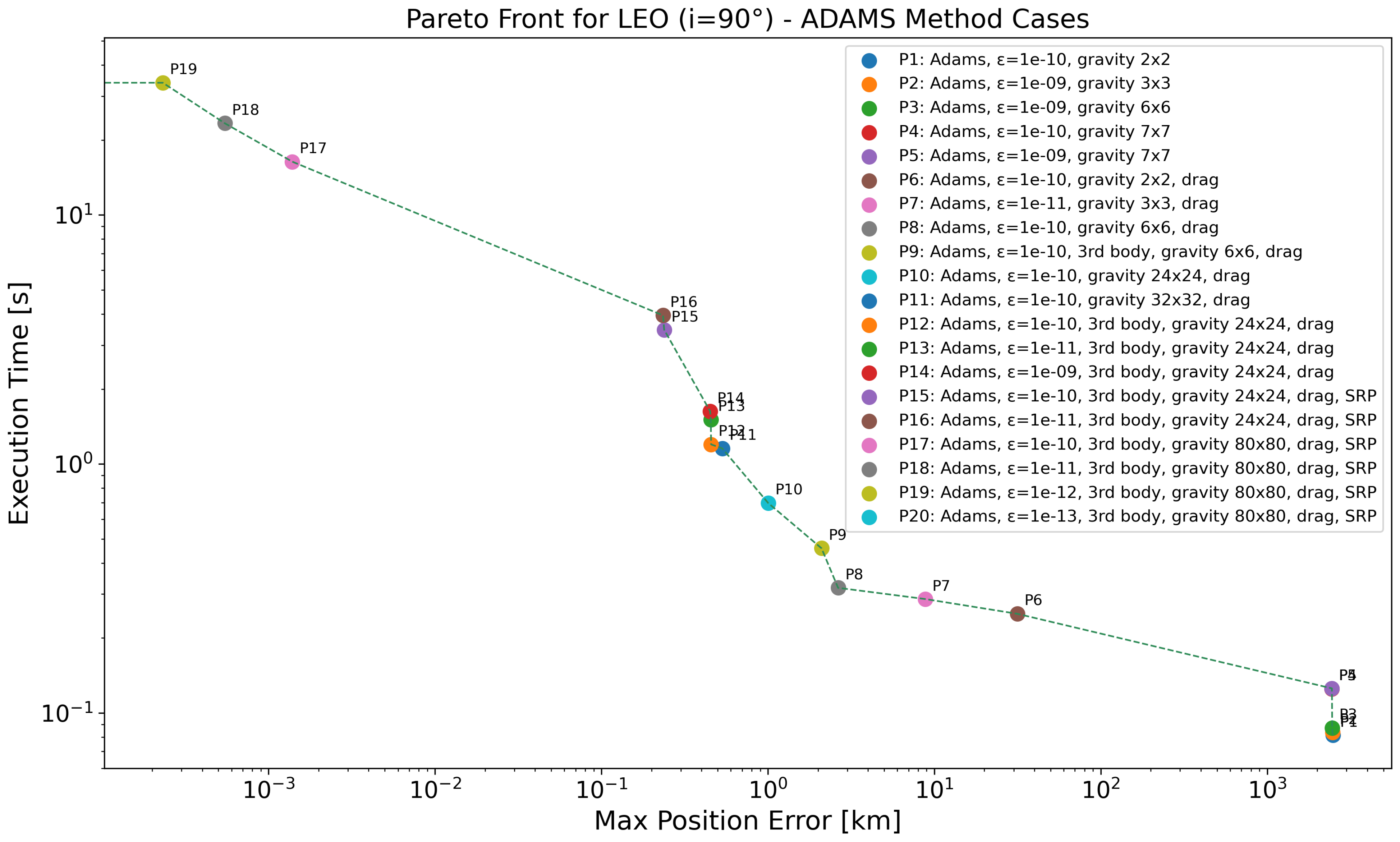
For LEO orbits with an inclination of
(see
Figure 5 and
Table 9), the Pareto front again illustrates a clear trade-off between execution time and accuracy, though with some differences compared to the lower-inclination cases. The simplest configuration, P1, using a
gravity model and a tolerance of
, results in the highest position error of
km but offers the fastest execution time of just
s. Subsequent propagators (P2–P5) gradually refine the gravity model up to
and slightly adjust tolerances, but the position error remains essentially unchanged, hovering around
km—indicating that for polar orbits, gravitational perturbations alone do not yield substantial accuracy gains unless atmospheric drag is also modeled. The inclusion of drag in P6 leads to a dramatic accuracy improvement, bringing the error down to
km. As seen in the
and
cases, the combination of drag with a progressively refined gravity model and tighter tolerances continues to significantly enhance accuracy. For instance, P10–P14, which all include drag and high-resolution gravity (up to
) with or without third-body effects, bring the position error into the sub-kilometer range. The best trade-offs in this region are observed in P11 and P12, with errors of approximately
km and
km, respectively. As with lower inclinations, further inclusion of SRP and a gravity model extended to
(P17–P20) yields incremental gains, with the most accurate configuration, P20, achieving a near-zero position error of
km, albeit at the cost of the highest execution time (
s). The curvature of the Pareto front becomes more pronounced here, showing a steep cost in time for relatively minor accuracy improvements beyond P17.
When comparing the three LEO scenarios, it is evident that atmospheric drag plays an increasingly dominant role in accuracy as inclination increases. At , gravitational refinement alone suffices for moderate accuracy gains, whereas at , drag becomes essential to move off the high-error plateau. The polar case also presents a longer tail on the Pareto front, requiring more computational effort to reach sub-kilometer precision—highlighting the stronger sensitivity of high-inclination orbits to combined perturbative effects.
This analysis shows that in the LEO regime, accuracy is primarily driven by model complexity, especially the inclusion of atmospheric drag, third-body effects, and high-resolution geopotential models. Beyond a certain point (e.g., in the LEO case, from P13 onward), the main avenue to improved accuracy is tightening the integrator tolerance—but this leads to a steep increase in computational cost, confirming that each gain in precision must be balanced against the practical limits imposed by runtime.
4.3. SSO Regime
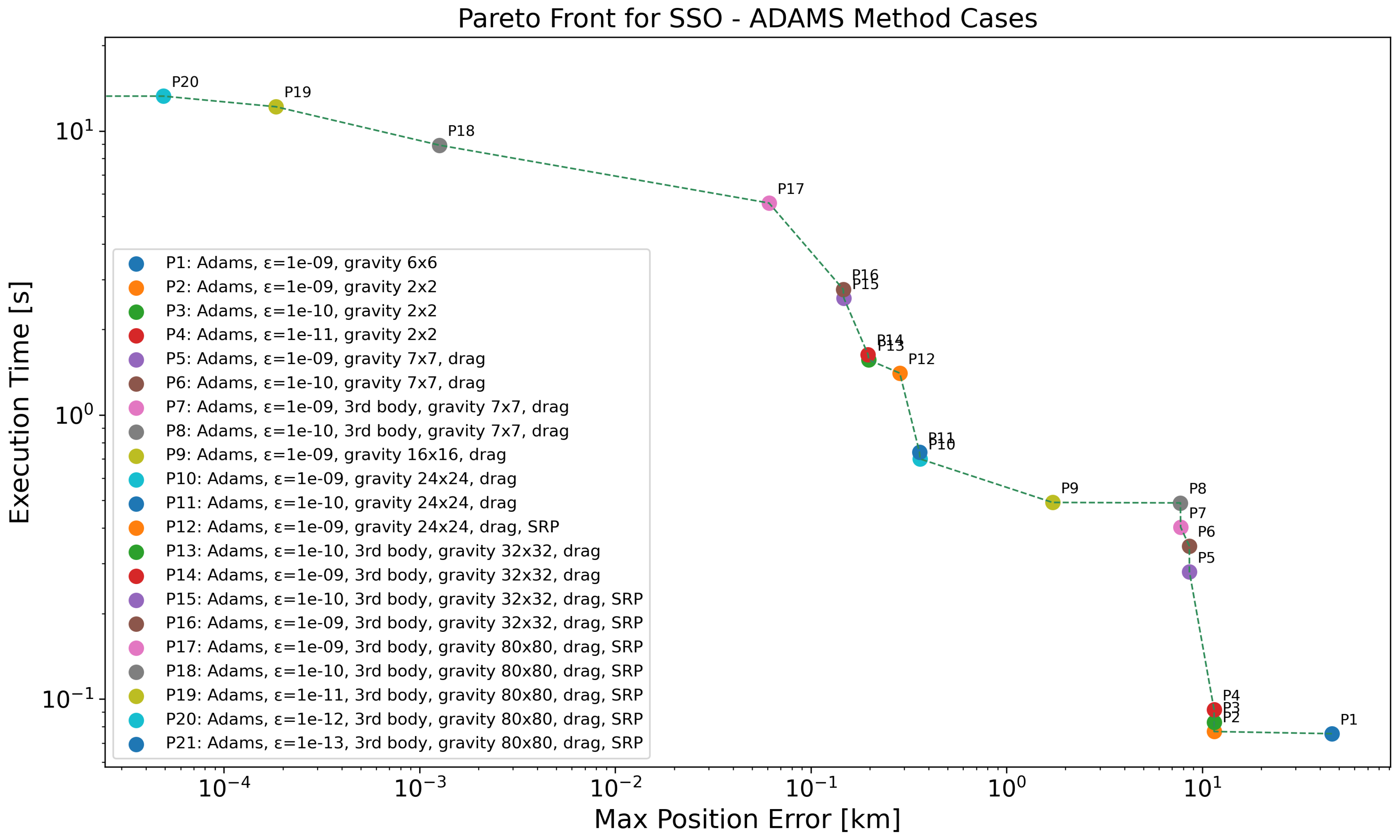
The Pareto front for the Sun-Synchronous Orbit (SSO) case, shown in
Figure 6 and detailed in
Table 10, compared to the LEO cases, demonstrates higher sensitivity to the inclusion and resolution of perturbation models. Notably, low-resolution gravity models (
,
) yield position errors in the range of 10–45 km, indicating that such configurations could be insufficient for a more precise propagation in this regime. Increasing the gravity model resolution and enabling drag leads to substantial improvements in accuracy. For example, configurations using gravity up to
with drag reduce the error to below 1 km, with marginal increases in computational cost. The addition of third-body perturbations and SRP further improves accuracy. With a
gravity model and full perturbation modeling, errors are reduced to below
km, while execution time increases beyond 2 s. The most accurate configurations (
gravity, full perturbations, and decreasing tolerances from
to
) progressively reduce the error to machine precision (
km), albeit at a significantly higher computational cost, reaching up to 16 s.
Interestingly, despite using a more detailed gravity model, P1 (with the 6 × 6 gravity field) yields a higher maximum position error compared to P2 (with the 2 × 2 gravity model), even though all other parameters are identical. This is counterintuitive, as a higher-order gravity model is generally expected to produce more accurate results. However, the difference in error—approximately km vs. km—is relatively small and both results are of the same order of magnitude. A possible explanation could be numerical sensitivity introduced by higher-order gravitational harmonics, which might amplify integration errors under certain conditions, especially in combination with the very tight tolerance () used.
4.4. HEO Regime
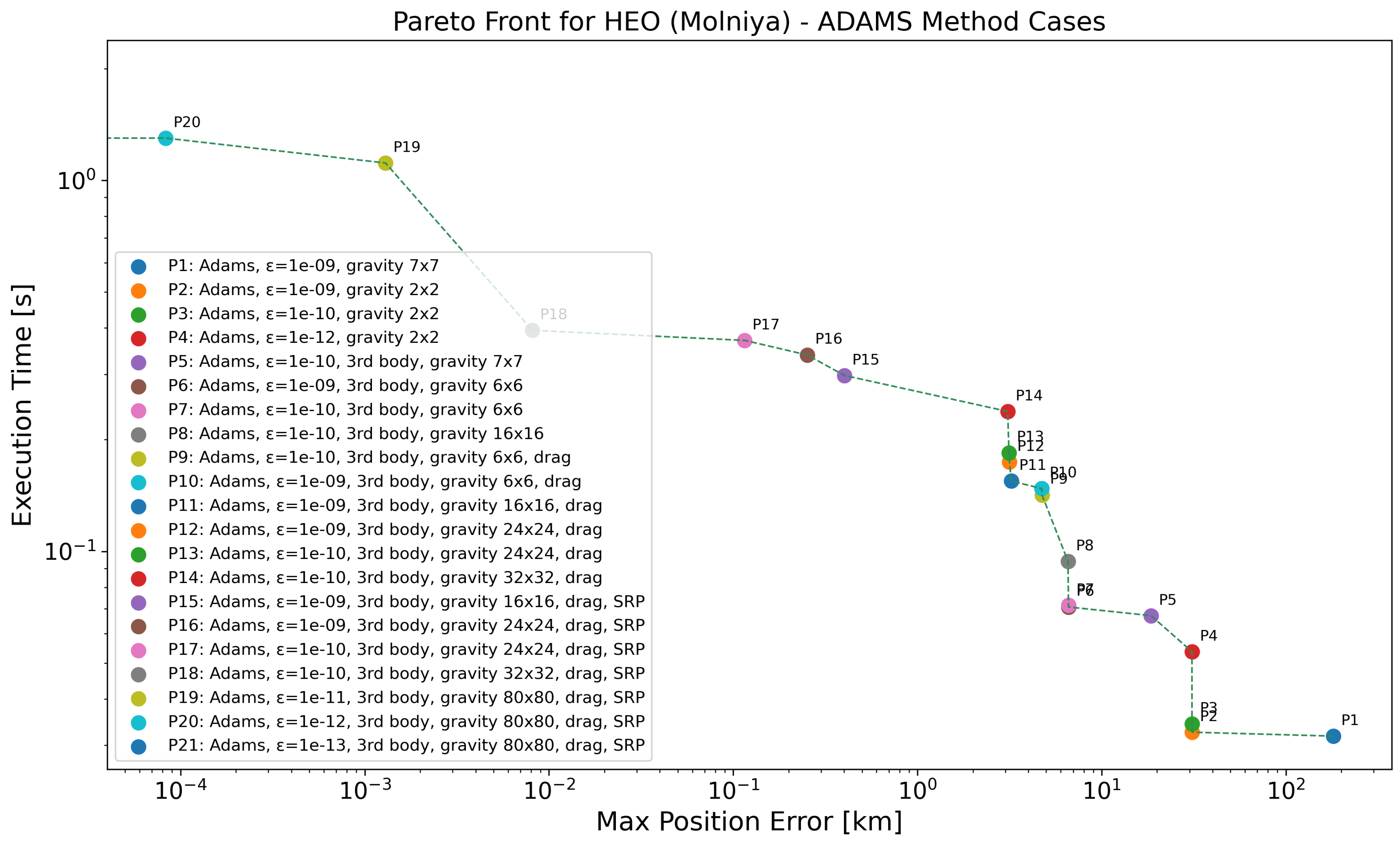
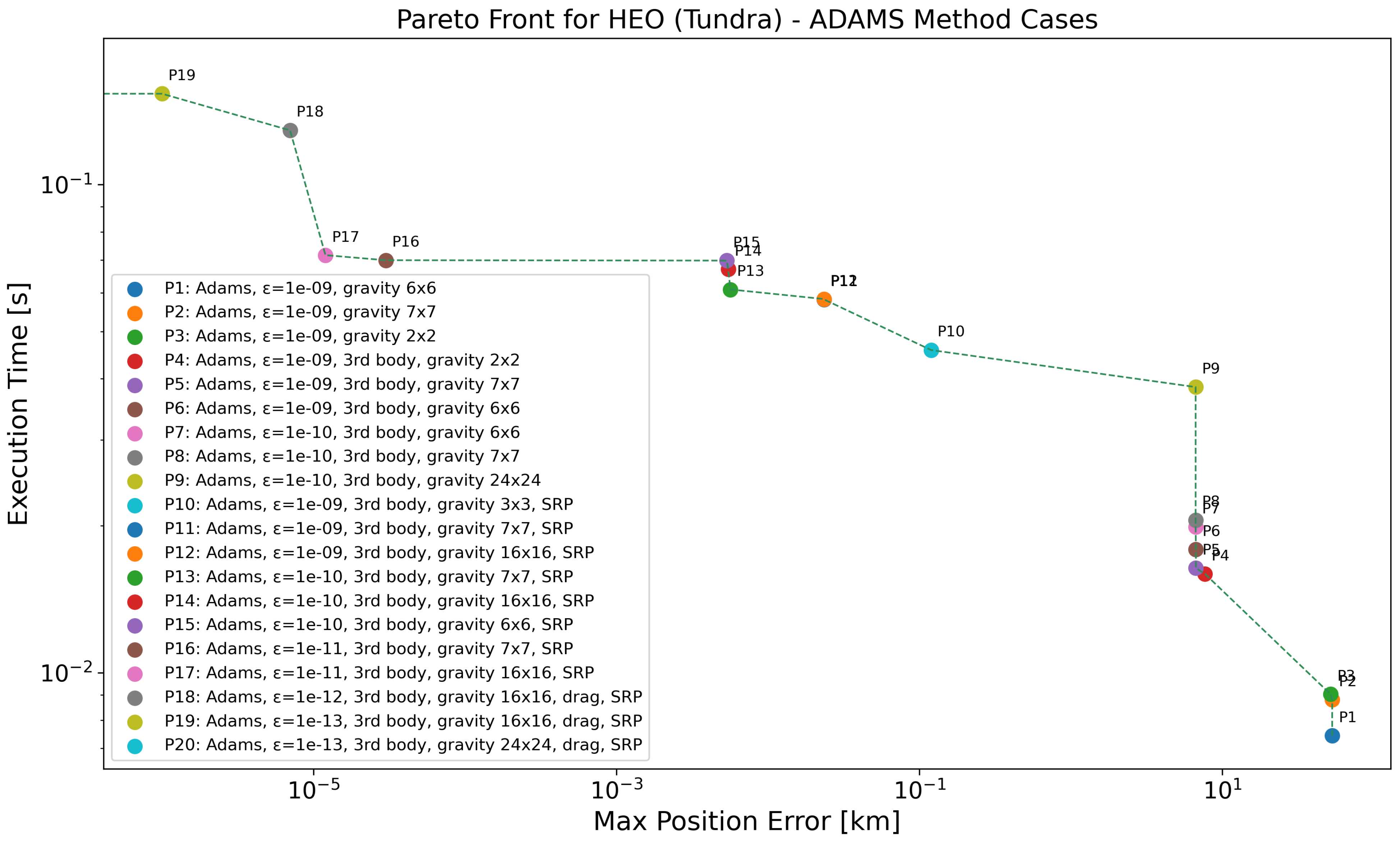
The Pareto-front analysis for the Highly Elliptically Orbit (HEO) cases can be seen in
Figure 7 and
Table 11 for the Molniya orbit and in
Figure 8 and
Table 12 for the Tundra orbit. In the case of Molniya, both the execution times and position errors are noticeably higher, especially when using low-resolution gravity models and not considering drag perturbation. The low perigee altitude makes atmospheric drag a significant perturbation here and achieving numerical convergence in such dynamic conditions can be more difficult. This reflects the complexity of accurately propagating such highly eccentric orbits. The progressive addition of perturbing forces—third-body effects, atmospheric drag, and SRP—combined with finer gravity resolutions, leads to significant improvements in accuracy, albeit at a substantial increase in computational cost. The most accurate results are achieved with full perturbation modeling and high numerical tolerances, though these configurations also correspond to the highest execution times. For the Tundra orbit, the execution times are overall lower and the position errors less pronounced, except in the case of the coarsest gravity model (
), which yields significant inaccuracies. When moderate to high gravity resolutions are employed, the addition of third-body and SRP effects rapidly improves accuracy, achieving sub-kilometer and even submeter errors with moderate computational load. Compared to Molniya, the Tundra orbit appears to be less sensitive to modeling choices, allowing for more efficient propagation while still maintaining high precision.
An interesting and counterintuitive behavior is observed in the initial entries of both the Molniya and Tundra tables. Specifically, using a higher-degree gravity model ( or ) yields a significantly larger position error compared to using a lower-degree model, even though the tolerance and other force models are kept identical.
For the Molniya case, P1 ( gravity) results in a maximum position error of km, whereas P2 ( gravity) shows a much lower error of only km.
For the Tundra case, a similar trend is observed: P1 and P2 ( and gravity) yield errors of approximately km, while P3 ( gravity) gives a slightly better accuracy of km.
This behavior is not expected, as increasing the gravity model resolution should, in principle, lead to more accurate propagation. A plausible explanation lies in the interplay between model complexity and numerical integration tolerance. When a more detailed gravity field is used without tightening the integration tolerance accordingly (in this case, ), the propagator may fail to accurately resolve the higher-frequency gravitational variations. This can lead to the accumulation of numerical errors and poorer accuracy overall. Additionally, in highly dynamic orbits like Molniya or Tundra, a mismatch between the fidelity of the physical model and the numerical solver’s precision can exacerbate convergence issues or trigger instability in the solution. Thus, when increasing model complexity, especially for high-eccentricity orbits, it becomes essential to also refine the tolerance to maintain numerical consistency. This highlights the importance of co-designing model fidelity and solver accuracy when aiming for reliable orbital propagation.
While both orbits fall within the HEO regime, the analysis reveals distinct performance characteristics. The Molniya orbit, with its higher eccentricity and low perigee and rapid motion, imposes greater numerical challenges, requiring finer tolerances and more complex perturbation modeling to achieve precise results—reflected in longer execution times. The Tundra orbit, though still elliptical, is more stable and symmetric, enabling accurate predictions with less computational effort. This is expected, as the Tundra orbit remains at significantly higher altitudes, resulting in minimal atmospheric drag and lower sensitivity to higher-order geopotential terms. Overall, the Tundra orbit offers a more favorable trade-off between accuracy and speed, whereas the Molniya orbit demands higher computational investment to reach similar levels of precision.
4.5. GEO Regime
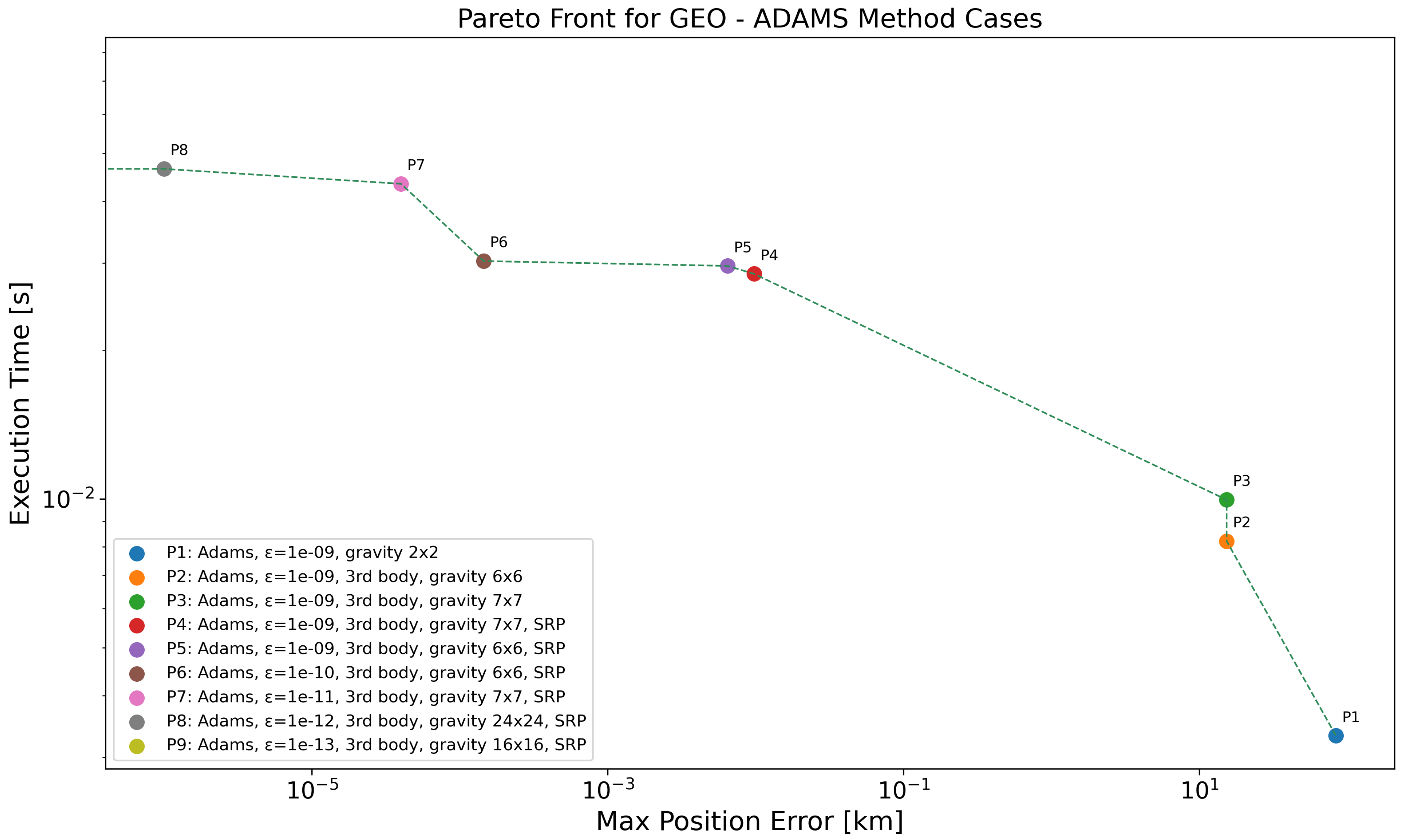
The Pareto-front analysis for the Geostationary Orbit (GEO) regime (see
Figure 9 and
Table 13) highlights how variations in gravity model resolution and numerical tolerance affect both accuracy and computational performance. In this case, the dominant factor influencing propagation accuracy is the gravity model resolution. The coarsest model (
) results in significant position errors, with P1 reaching
km. Increasing the resolution to
(P2) leads to a reduction in error to
km. However, further changes to the model resolution (P3) do not significantly improve accuracy unless additional perturbations such as SRP are included (P4, P5). These configurations reduce the error to the meter or submeter level. Tighter numerical tolerances (P6-P9) yield progressively higher accuracies, with P9 achieving near-zero error (
km) at a still reasonable computational cost of
s.
These results show that for GEO propagation, improving the gravity model resolution and including relevant perturbations (e.g., SRP and third-body effects) are generally more impactful for improving accuracy than refining the numerical tolerance—up to a certain point. Specifically, looking at propagators P1–P5, the accuracy improvements are mainly driven by the addition of perturbations and higher-order gravity terms, with relatively modest increases in execution time. However, from P6 on, the propagators to achieve a lower position error use lower tolerances. An observation can be made when comparing P8 and P9: although P9 achieves a significantly lower position error ( km) than P8 ( km), it uses a coarser gravity model ( vs. ) but a much tighter numerical tolerance ( vs. ). This indicates that once a sufficiently high-fidelity dynamical model is reached (as in P7 or P8), further improvements in accuracy can still be achieved by refining the numerical tolerance, even when using a slightly lower-resolution gravity model. This is consistent with the fact that the influence of the geopotential decreases with increasing altitude.
While gravity is a fundamental component in orbit propagation across all regimes, the dominant non-gravitational perturbations vary significantly. In LEO, atmospheric drag plays a major role in orbit evolution and must be accurately modeled alongside gravity to achieve reliable results. In contrast, GEO propagation is unaffected by drag; instead, accuracy depends more heavily on the inclusion of third-body effects and SRP, once a sufficiently high-fidelity gravity model is used. The results indicate that refining the gravity model from to yields substantial accuracy improvements in both regimes, but further enhancements—such as finer tolerances and other perturbations perturbations—are more critical in GEO due to the long-term accumulation of small forces. Nonetheless, all Pareto-optimal solutions in this regime require relatively low computation times, making high-accuracy propagation feasible even for time-sensitive applications.
4.6. GSO Regime
Although both GEO and GSO are geosynchronous orbits, GSO trajectories—such as the one analyzed here with an inclination of
—exhibit distinct dynamical behaviors that affect propagation accuracy and computational cost (see
Figure 10 and
Table 14). The coarsest gravity models (P1 and P2), using only
and
harmonics, result in position errors above 25 km, highlighting their insufficiency in capturing the complex dynamics of inclined geosynchronous orbits. Introducing third-body perturbations (e.g., P4) leads to a modest improvement in accuracy, reducing the error to around 13 km. However, varying tolerances or mid-level gravity models alone (P3, P5–P9) do not substantially impact accuracy unless key perturbations—such as SRP—are included. The most noticeable accuracy improvements occur when SRP is added (P10 onward). For example, P10 reduces the error to under 1 km by combining SRP with a coarse gravity model and third-body effects. Finer gravity models and tighter tolerances (P11–P13) bring the error into the sub-millimeter range, while the most accurate propagators (P14–P17) achieve position errors as low as
km. These cases include comprehensive perturbation modeling—namely high-order gravity (up to
), SRP, drag, and third-body effects—with tolerances of
or better, and yet require less than
s of execution time. Overall, the results show that the combination of SRP and third-body effects is essential for achieving high-accuracy propagation in GSO, particularly when gravity models of moderate or high resolution are employed. While drag is also included in the most precise propagators, its contribution appears to be minor in this regime.
Despite their shared geosynchronous nature, GEO and GSO exhibit different sensitivities to perturbations. In GEO (equatorial), a moderate gravity resolution (e.g., ) combined with SRP and third-body effects is sufficient to achieve high accuracy, with drag playing virtually no role. In contrast, GSO orbits with high inclination are more sensitive to the fidelity of the gravitational model and particularly benefit from the inclusion of SRP and third-body effects. Coarse gravity models—even with low tolerances—fail to capture the complex dynamics of GSO, leading to large position errors unless complemented by these additional perturbations. Additionally, the accuracy gains in GSO require a more comprehensive force model, but come at little extra computational cost compared to GEO, making precise propagation feasible even for inclined geosynchronous missions.
4.7. Discussion Across Orbital Regimes
This study identifies the most suitable propagator for each orbital regime—VLEO, LEO, SSO, HEO (Molniya and Tundra), GEO, and GSO—by analyzing the trade-off between execution time and positional accuracy. One significant observation from our analysis is the substantial influence of gravity models with fewer terms () across all orbital regimes. Another consistent trend emerges across all cases: higher-order gravity models and selective perturbation additions are key to accuracy, but their benefits must be balanced against runtime cost. In VLEO and LEO, where drag plays a major role, the most accurate configurations require models with drag and gravity up to , with tolerances of to . In SSO and Molniya, similar gravity models and tolerances are required to mitigate the effects of both drag and SRP. For Tundra, GEO, and GSO, third-body perturbations and SRP dominate, and the most accurate solutions are obtained with gravity models of and tolerances of , achieving errors on the order of – in under 10 s. We also have observed shorter execution times required to achieve maximum accuracy for GEO and GSO orbits compared to other regimes. This discrepancy arises from the diminished influence of atmospheric drag and gravity terms in GEO orbits, allowing for simpler models while maintaining accuracy.
The findings also show that using a lower-degree gravity model (e.g., or ) results in large propagation errors across all orbital regimes. While increasing its order—to for GEO and GSO cases, to for HEO (Tundra), and to for the HEO(Molniya), SSO, LEO, and VLEO cases—significantly improves accuracy (up to ) with moderate increases in computation time, the best trade-offs are reached with gravity models of to . Importantly, no significant gains are observed for gravity models beyond , despite substantial increases in execution time. Thus, is a practical upper limit for achieving high accuracy efficiently.
4.8. Pareto Front Application
With the growing rate of conjunction alerts—driven by the sharp increase in the number of space objects in orbit—the choice of an appropriate orbit propagator becomes increasingly critical, especially when accurate and timely collision risk assessments are required. In such a context, the choice of an appropriate orbit propagator becomes critical not only for individual collision risk assessments but especially when screening large catalogs of objects to detect potential conjunctions. This task often requires propagating the orbits of thousands of satellites over several days and checking for intersection conditions among all combinations of objects with potentially close approaches. Under these conditions, the execution time of a single orbit propagation cannot be considered in isolation. Even a modest increase in computation time per object may lead to a significant cumulative impact when applied across an entire database. Similarly, this concern extends to scenarios where multiple propagation runs are needed for a single object, such as during maneuver optimization or when iteratively refining a mitigation strategy. In both cases, selecting an efficient propagator that balances accuracy and runtime can be relevant. In practical terms, high-accuracy propagators are required in scenarios such as final collision-risk assessment or maneuver verification, where meter-level precision is critical, whereas faster, lower-fidelity propagators are preferable for large-scale catalog screening or preliminary analysis where only coarse accuracy is needed.
To illustrate how Pareto-front analysis can support such decisions, consider the results shown in
Figure 3 and
Table 7 for the LEO equatorial case using the ABM method. Suppose a user sets a runtime constraint of under
s. In this case, propagators P1, P2, and P3 are viable options. However, all three produce large position errors—ranging from 225 to nearly 291 km after seven days of propagation—making them unsuitable for precise conjunction analysis despite their speed. If the constraint is relaxed to allow execution times up to
s, propagators P4 through P7 become accessible. Among these, P6 and P7 offer a much-improved trade-off, with position errors reduced to around 3 km. These configurations incorporate drag and use a gravity model of at least
, demonstrating that relatively modest increases in model fidelity and runtime yield substantial accuracy improvements. For applications that can tolerate runtimes up to 2 s, propagators P8, P9, and P10 are notable. In particular, P10 achieves a position error of just
km in under 2 s. These configurations include more complex dynamics, such as SRP, atmospheric drag, and third-body effects, with gravity models up to
. For missions requiring the highest accuracy—such as final verification in high-risk conjunction scenarios—configurations P13 through P17 should be considered. These include full perturbation modeling with a high-resolution
gravity model and increasingly strict numerical tolerances. Accuracy improves progressively from tens of meters (P13) down to near-zero levels with P17, which achieves a position error of
km. However, this comes at a cost: P17 requires over 19 s to execute. A key insight from the Pareto front is the importance of selecting the most cost-effective configuration for a given accuracy target. While P14, for example, achieves sub-kilometer accuracy in 7.7 s, P15–P17 offer only marginal improvements in precision at significantly higher computational cost. This highlights the role of Pareto optimization in avoiding unnecessarily costly configurations: by selecting the optimal combination of perturbation modeling and tolerance, users can avoid computational waste without compromising on accuracy.
To quantify the operational impact, consider the task of propagating 100 satellites for one week. Using P6, which executes in s per propagation, would result in a total runtime of approximately 31 s. In contrast, using P17, the most accurate configuration, would take nearly 1940s—over an hour. This represents a speed-up factor of more than 60 times with a position error that is still within 3 km. Depending on the acceptable error threshold for the application, such efficiency gains can make the difference between a practical and an unfeasible approach, especially when hundreds or thousands of satellites must be propagated daily.
This example demonstrates how Pareto-front analysis enables mission analysts and satellite operators to make informed trade-offs between execution time and propagation accuracy, tailored to specific operational constraints. As mega-constellations in LEO continue to expand, the risk of collisions amplifies, requiring informed decisions on orbit propagators. Whether screening a large space object database for conjunctions or iteratively optimizing maneuver strategies, the choice of propagator directly influences the scalability and responsiveness of the entire process. In time-critical environments—or when processing large volumes of data—selecting the most efficient configuration becomes key to ensuring reliable and timely conjunction assessments.