
CNN-LSTM Assisted Multi-Objective Aerodynamic Optimization Method for Low-Reynolds-Number Micro-UAV Airfoils


Abstract
1. Introduction
- (1)
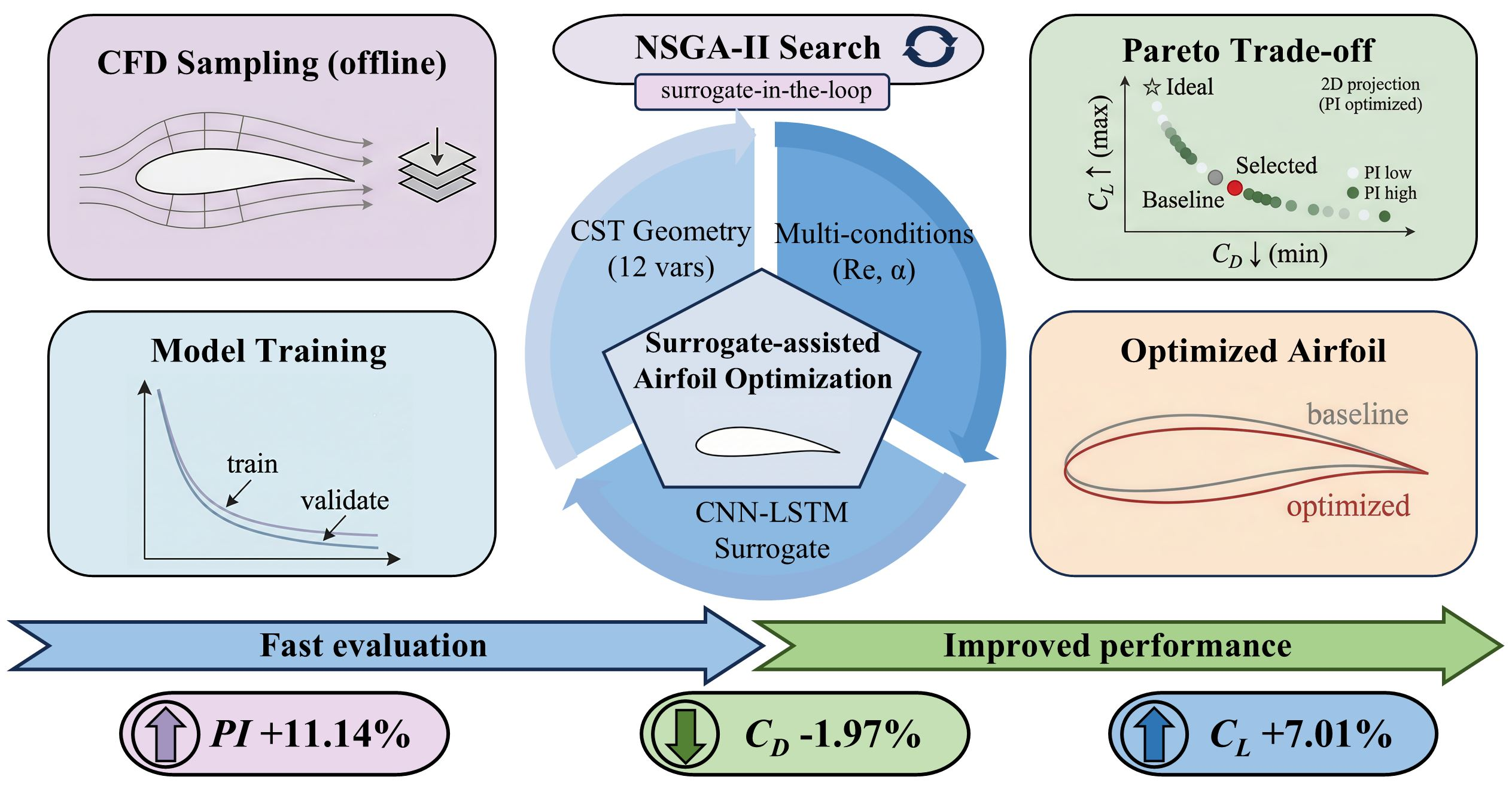
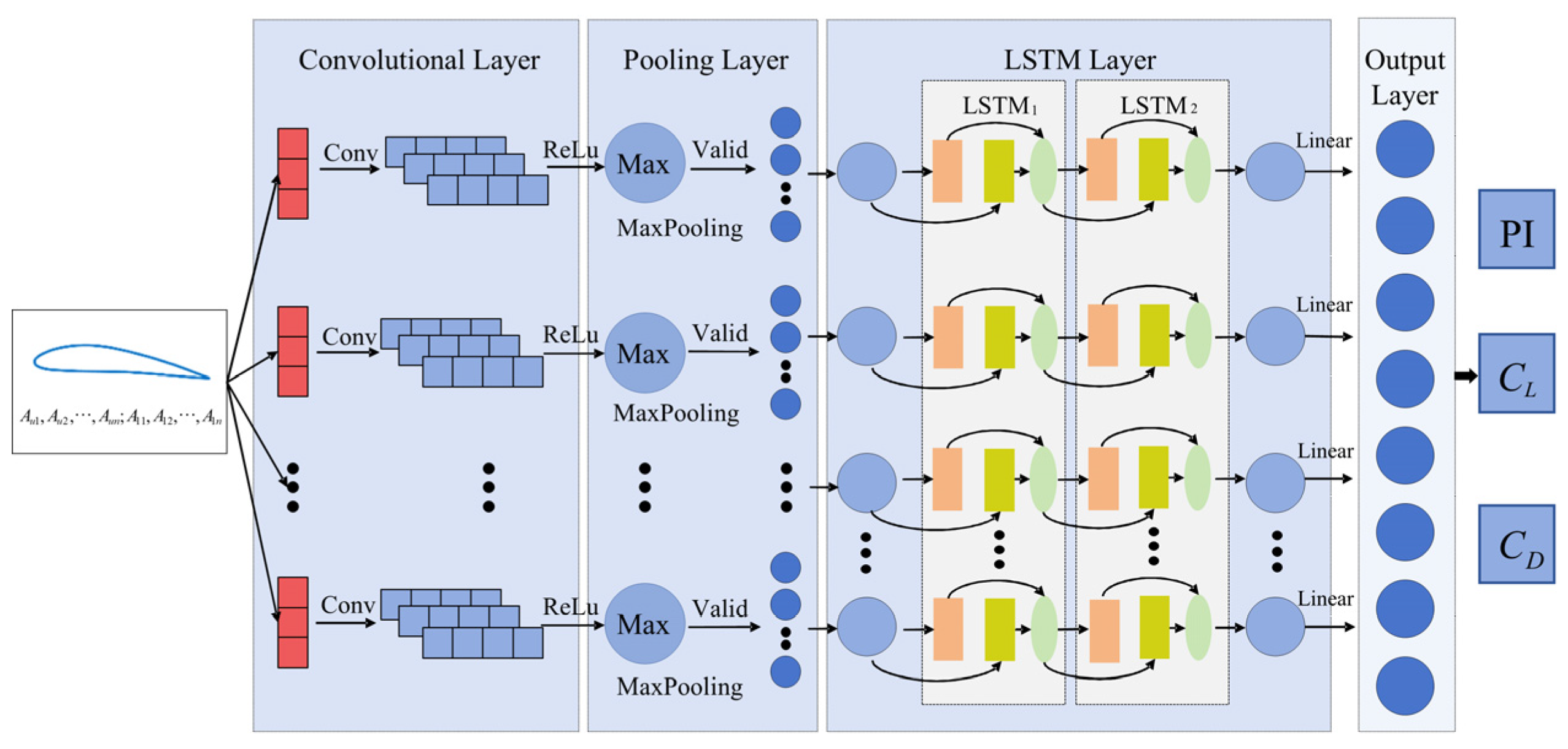
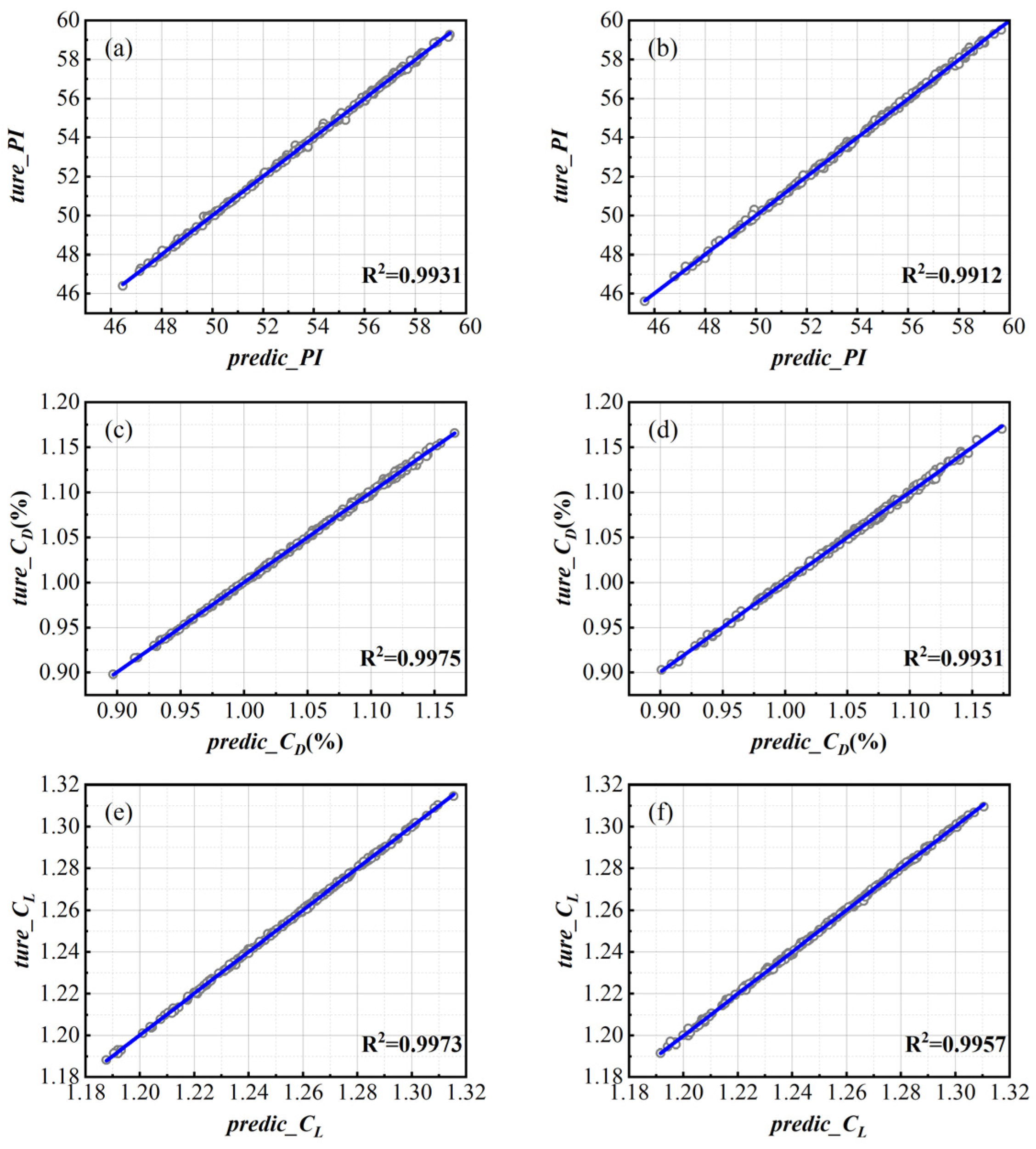
- Tri-condition, nine-output surrogate formulation. We cast the prediction task as a joint mapping from CST-based geometry to {(drag coefficient), lift coefficient, } at three representative operating conditions—cruise, forward flight, and maneuver—for the same airfoil. A compact CNN encoder for geometry, combined with an LSTM aggregator over operating conditions, improves cross-condition consistency and extrapolation robustness compared with Single-CNN, Multi-CNN, and LSTM-only baselines.
- (2)
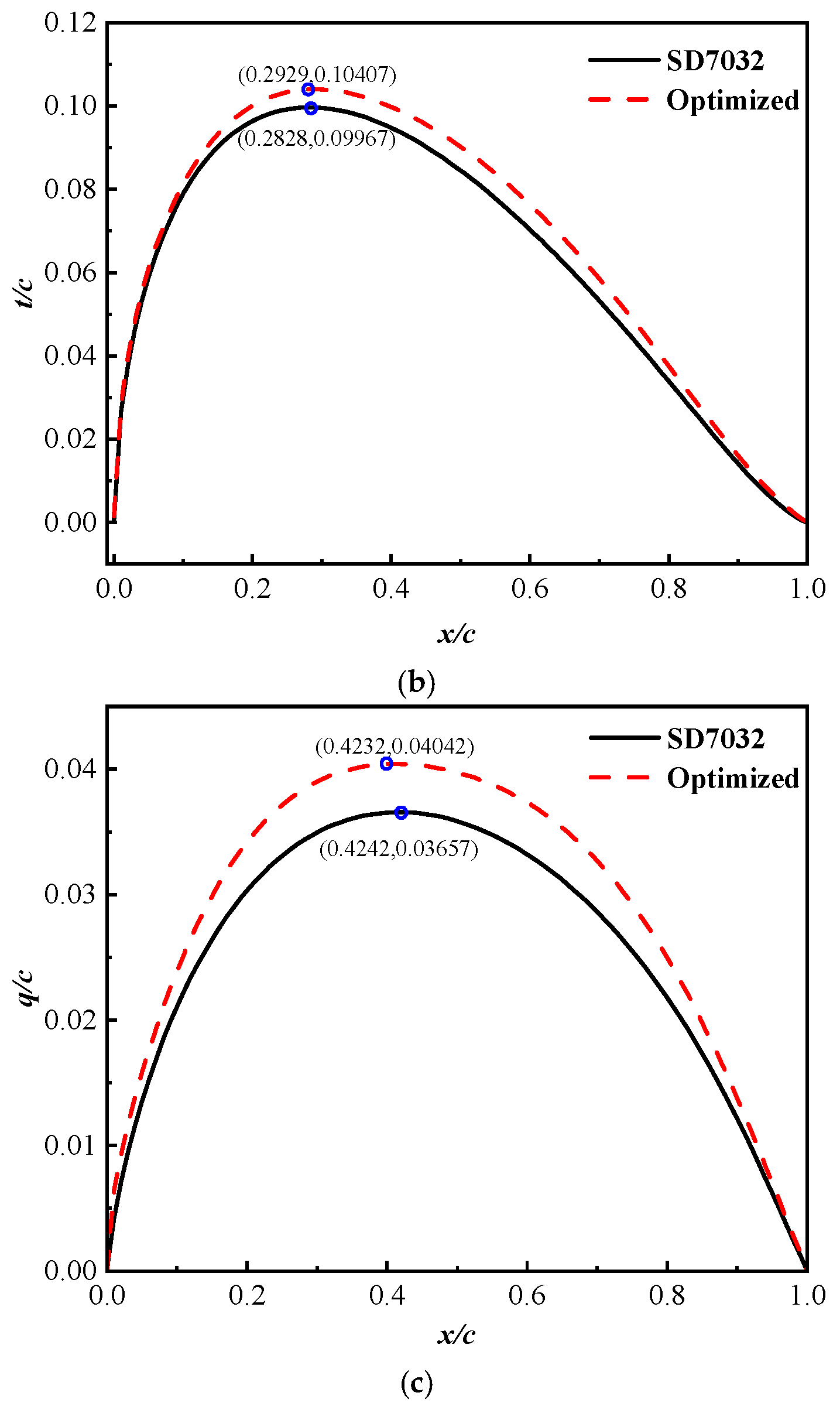
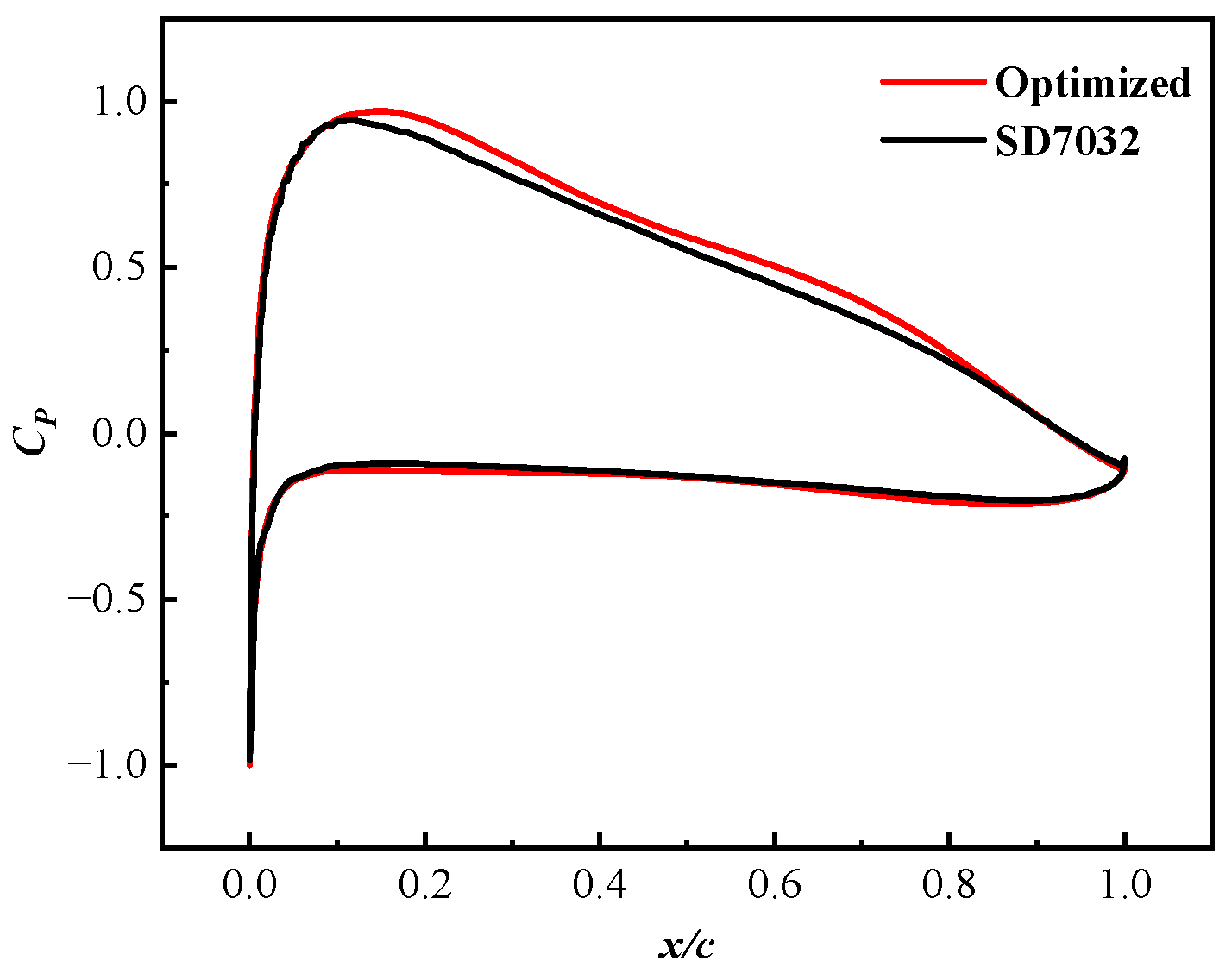
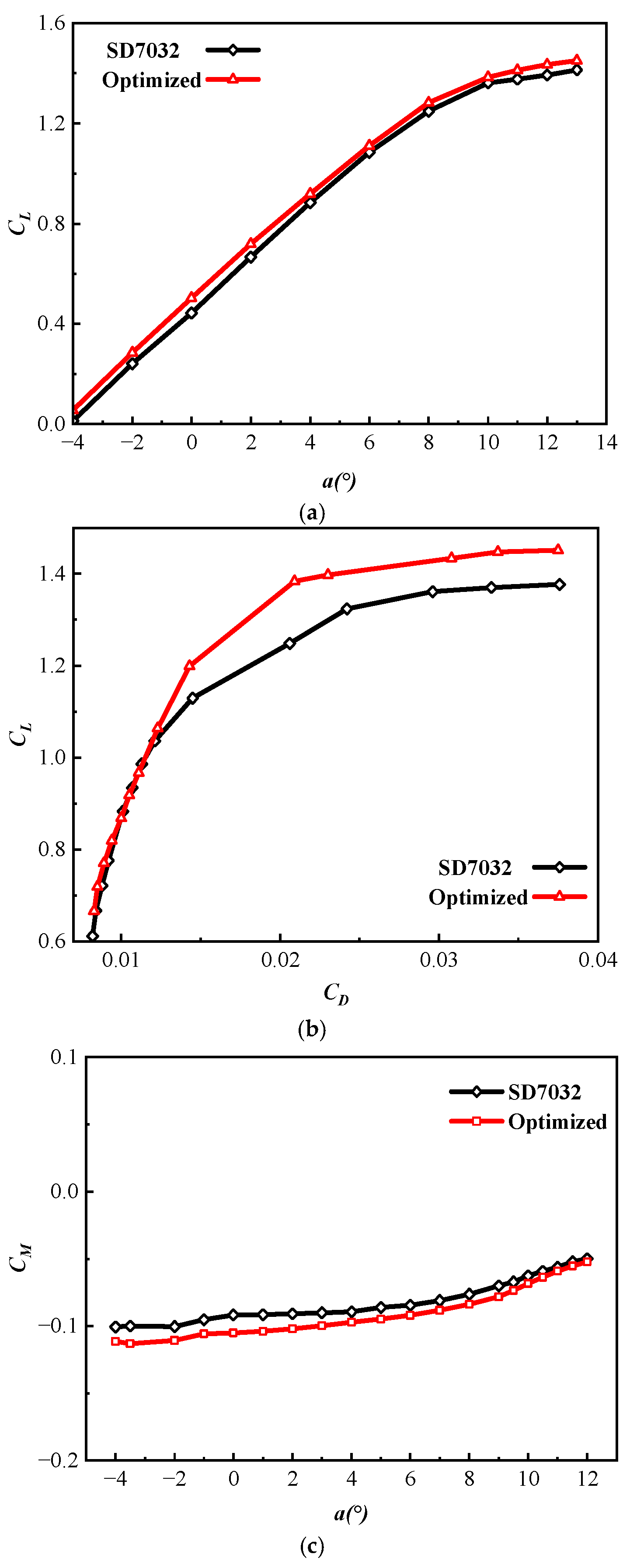
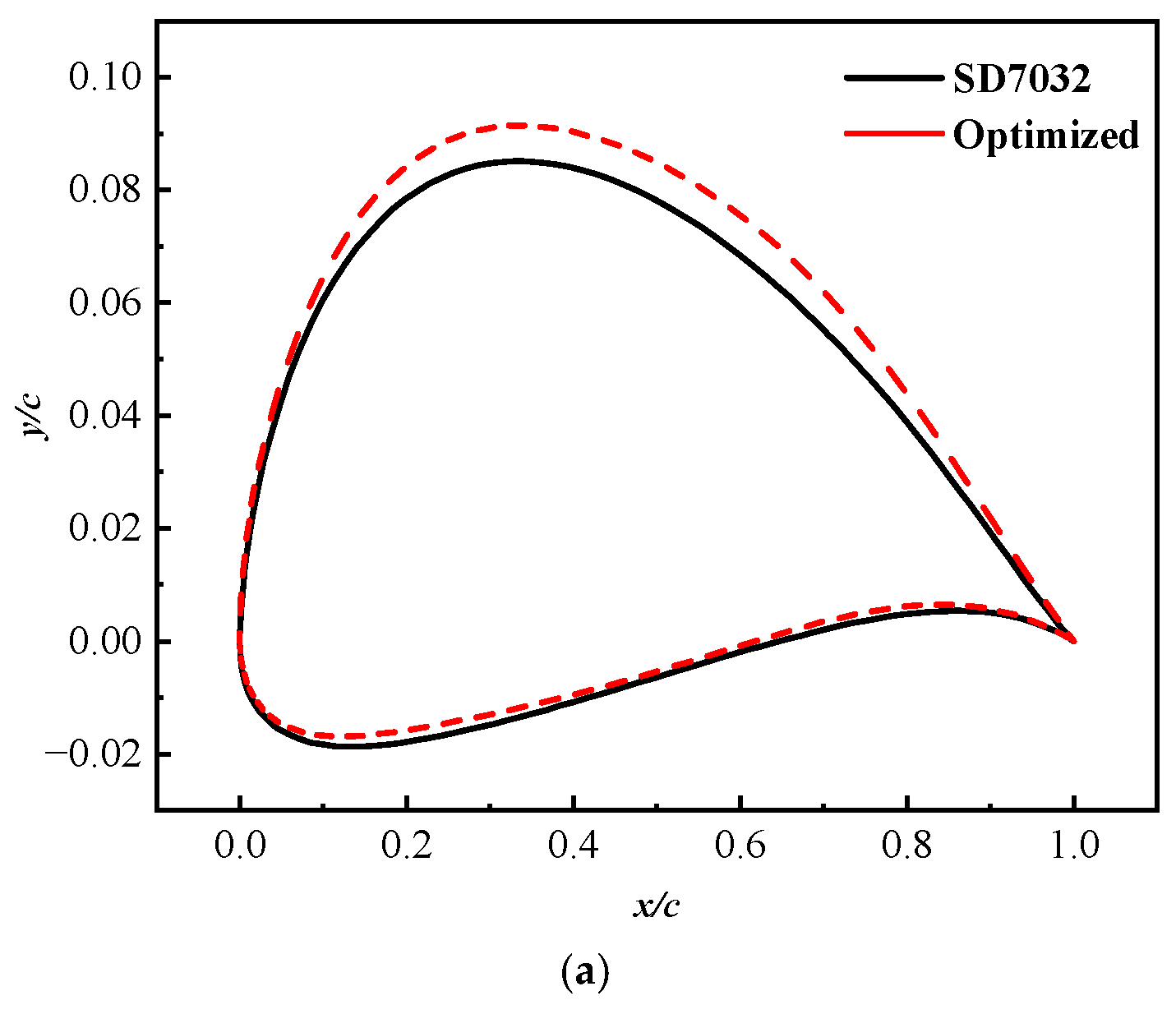
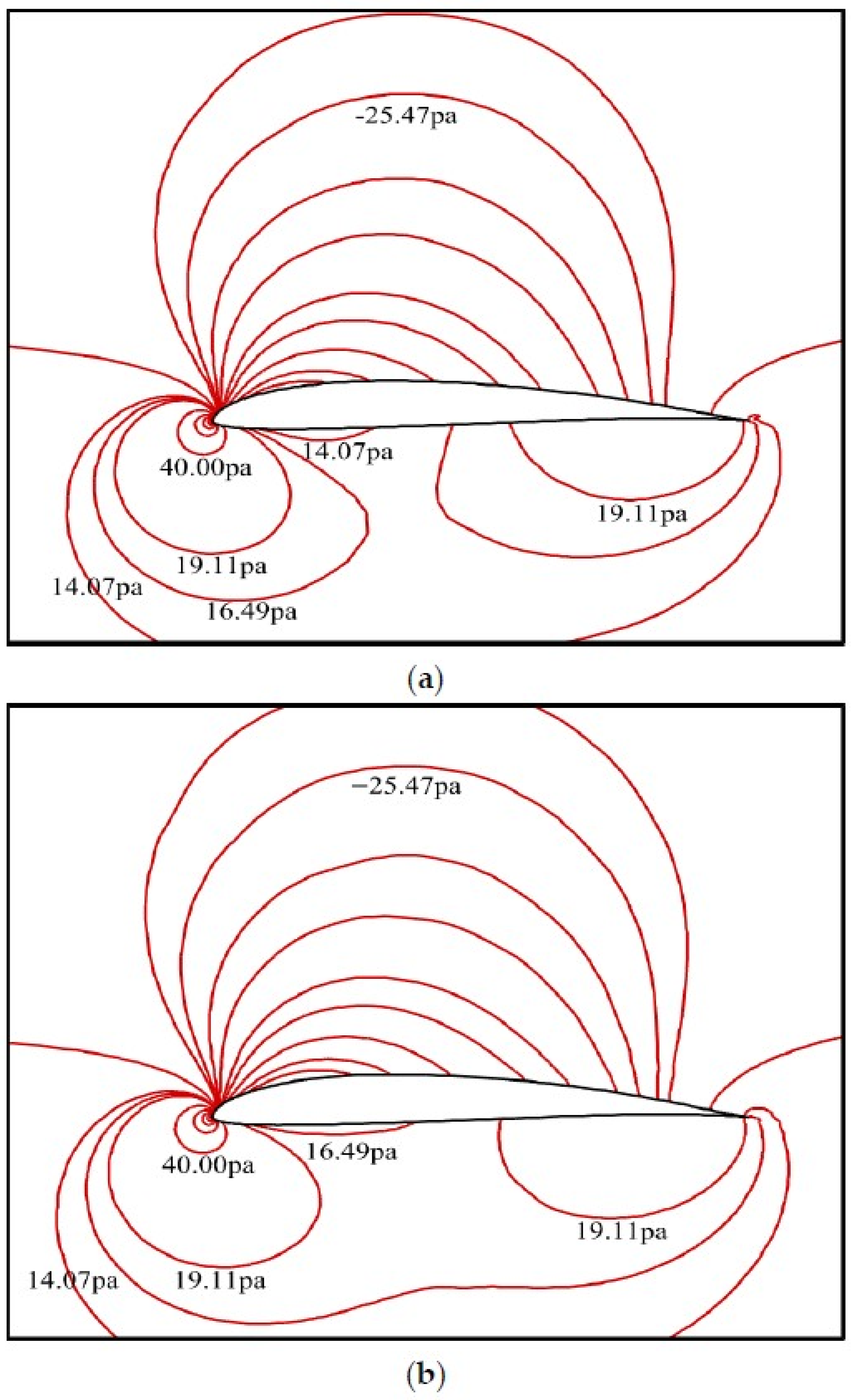
- Dedicated low-Re CFD–CST pipeline tailored to micro-UAV airfoils. We construct a reusable low-Re dataset and workflow by linking validated CFD settings (mesh adequacy and turbulence-model scope) with Latin-hypercube sampling of SD7032-based CST geometries and further connect the optimization outcomes to interpretable aerodynamic and geometric evidence (e.g., thickness/camber distributions, pressure coefficient curves, flow fields, and polar curves). This pipeline provides consistent labels for all geometries and operating conditions and is documented with mesh adequacy, turbulence-model scope, and coefficient-level validation.
- (3)
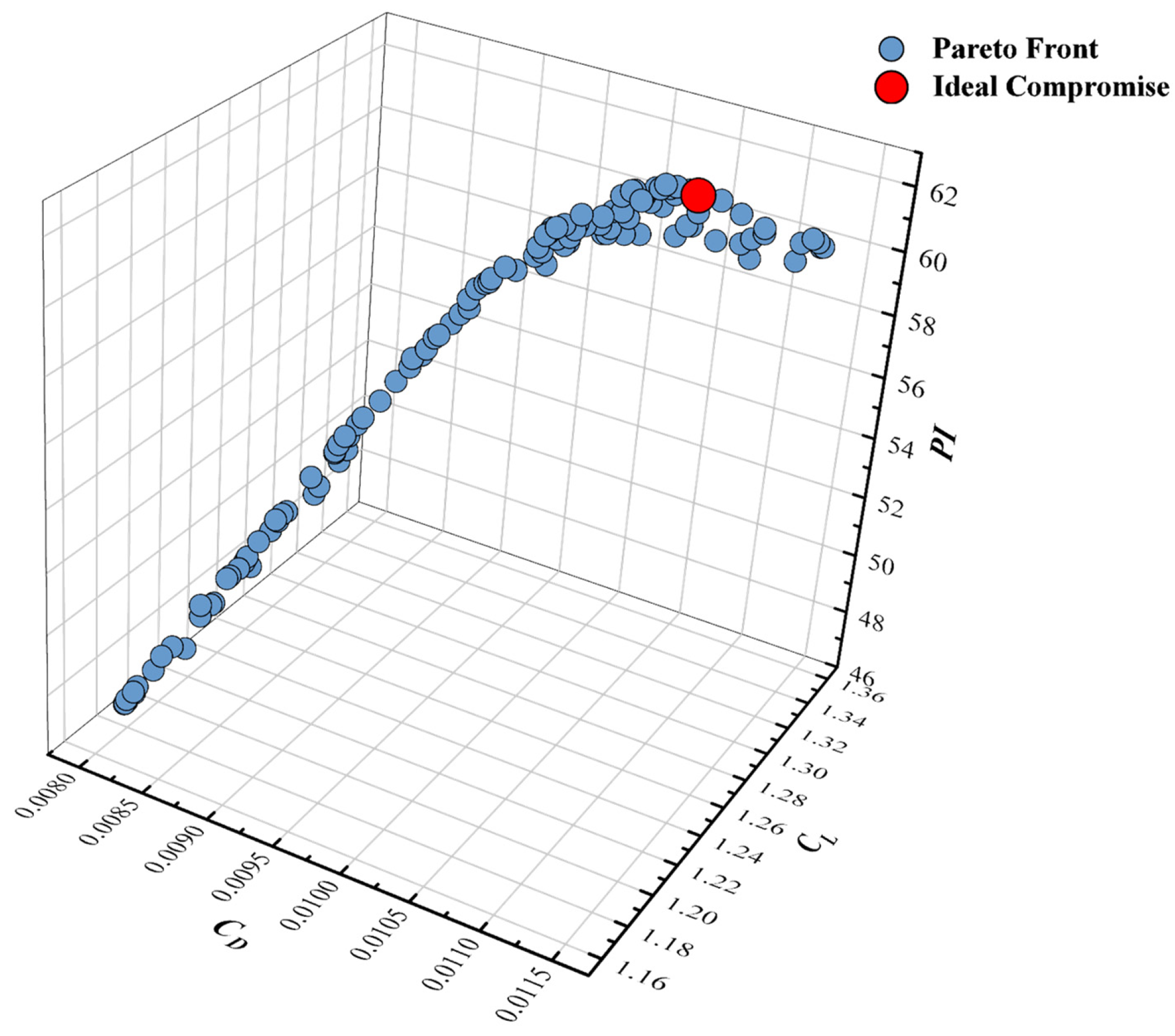
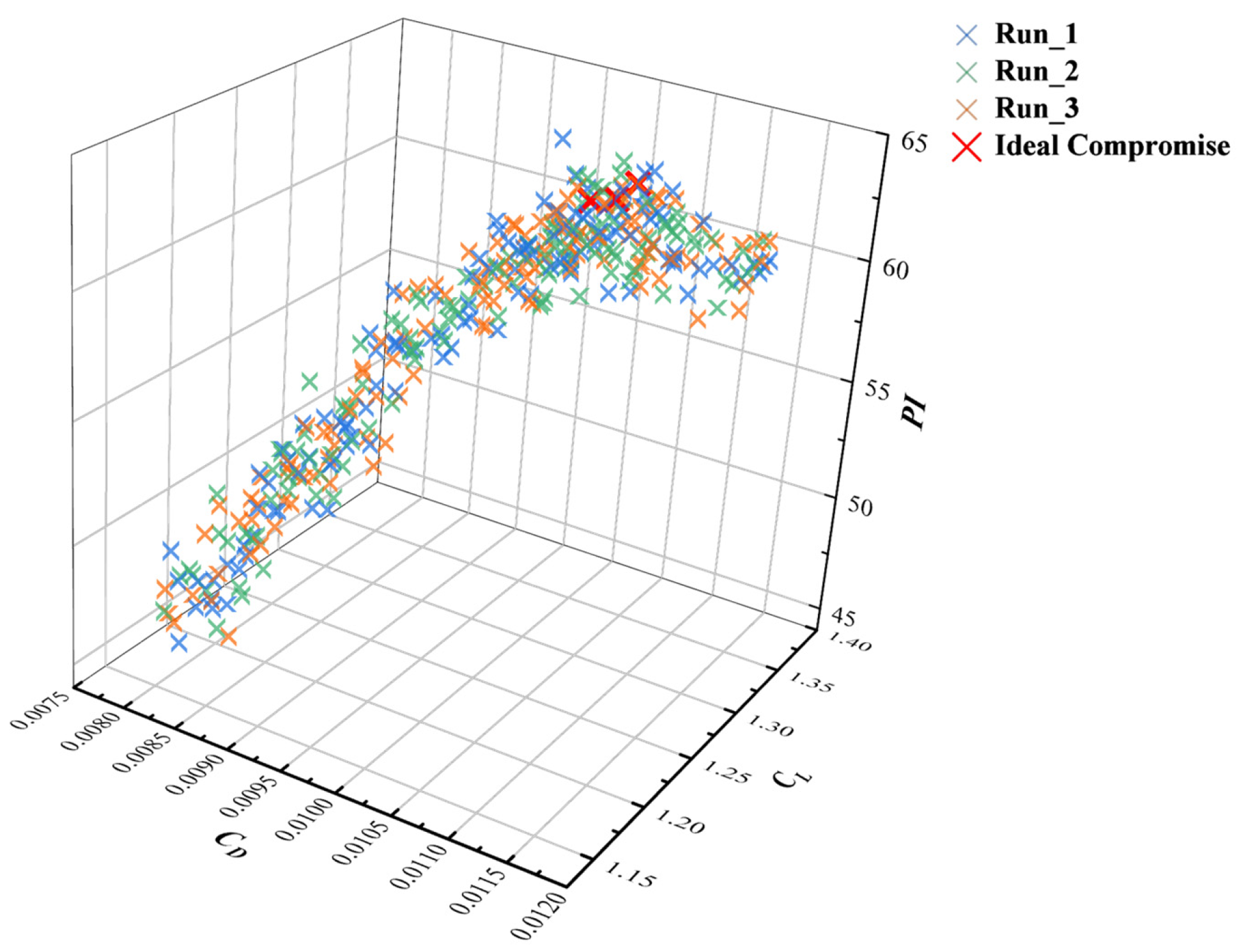
- Constrained three-objective optimization with robustness analysis. We embed the CNN–LSTM surrogate into an NSGA-II framework that simultaneously maximizes the cruise-condition power factor , minimizes forward-flight drag , and maximizes maneuver-condition lift , under thickness, internal-area, and pitching-moment constraints. Beyond a single optimization run, we quantify optimization stability through repeated runs, Pareto-front overlays, and statistics of the objective distributions.
2. Methodology
2.1. Numerical Computation Method
2.2. CST Parameterization
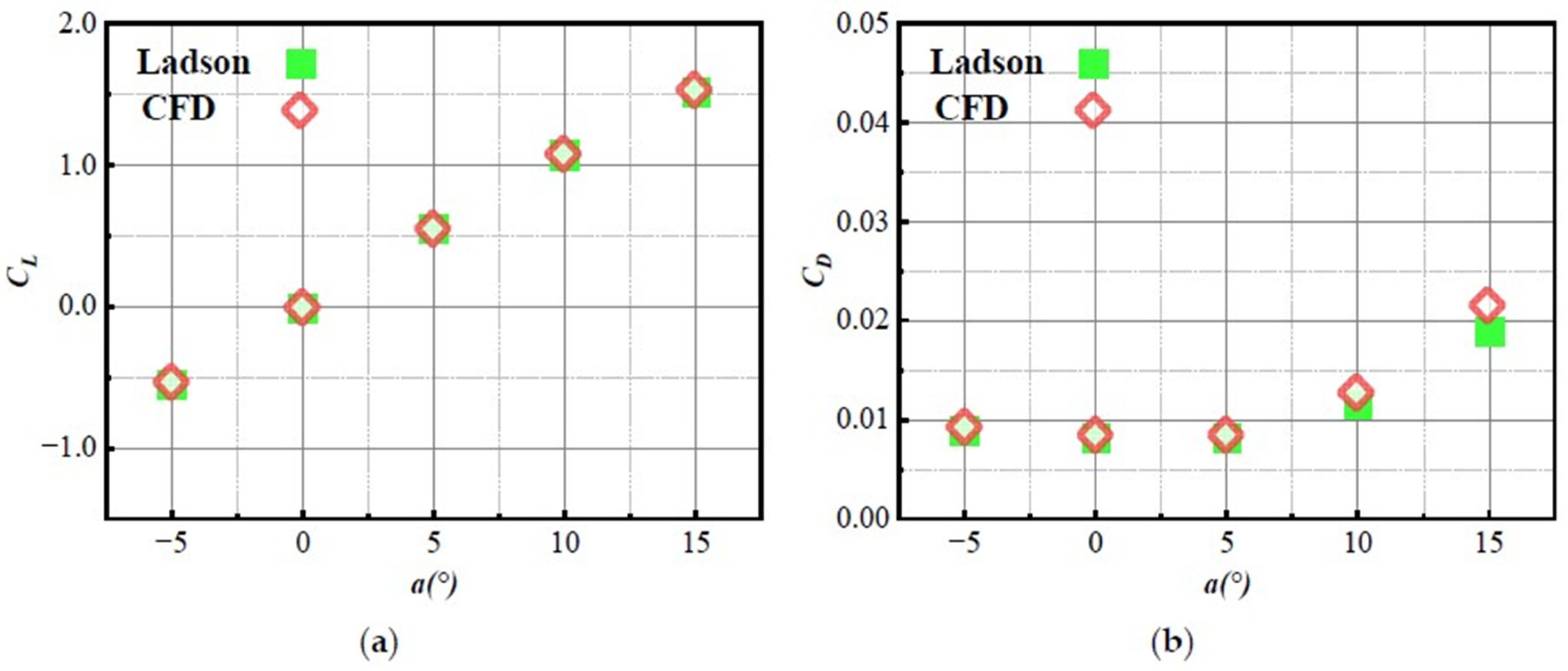
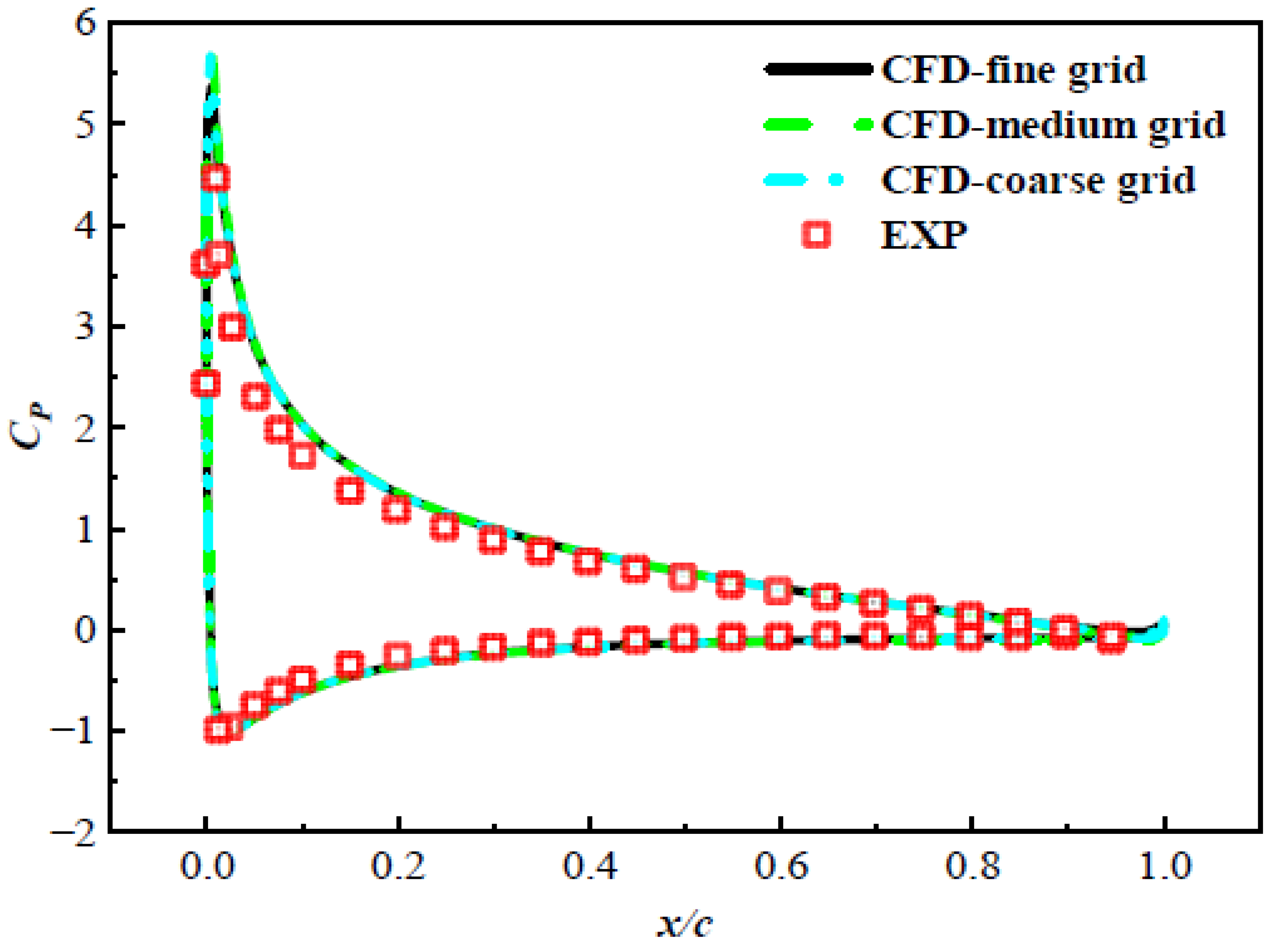
2.3. CFD Validation
2.4. CNN-LSTM Architecture
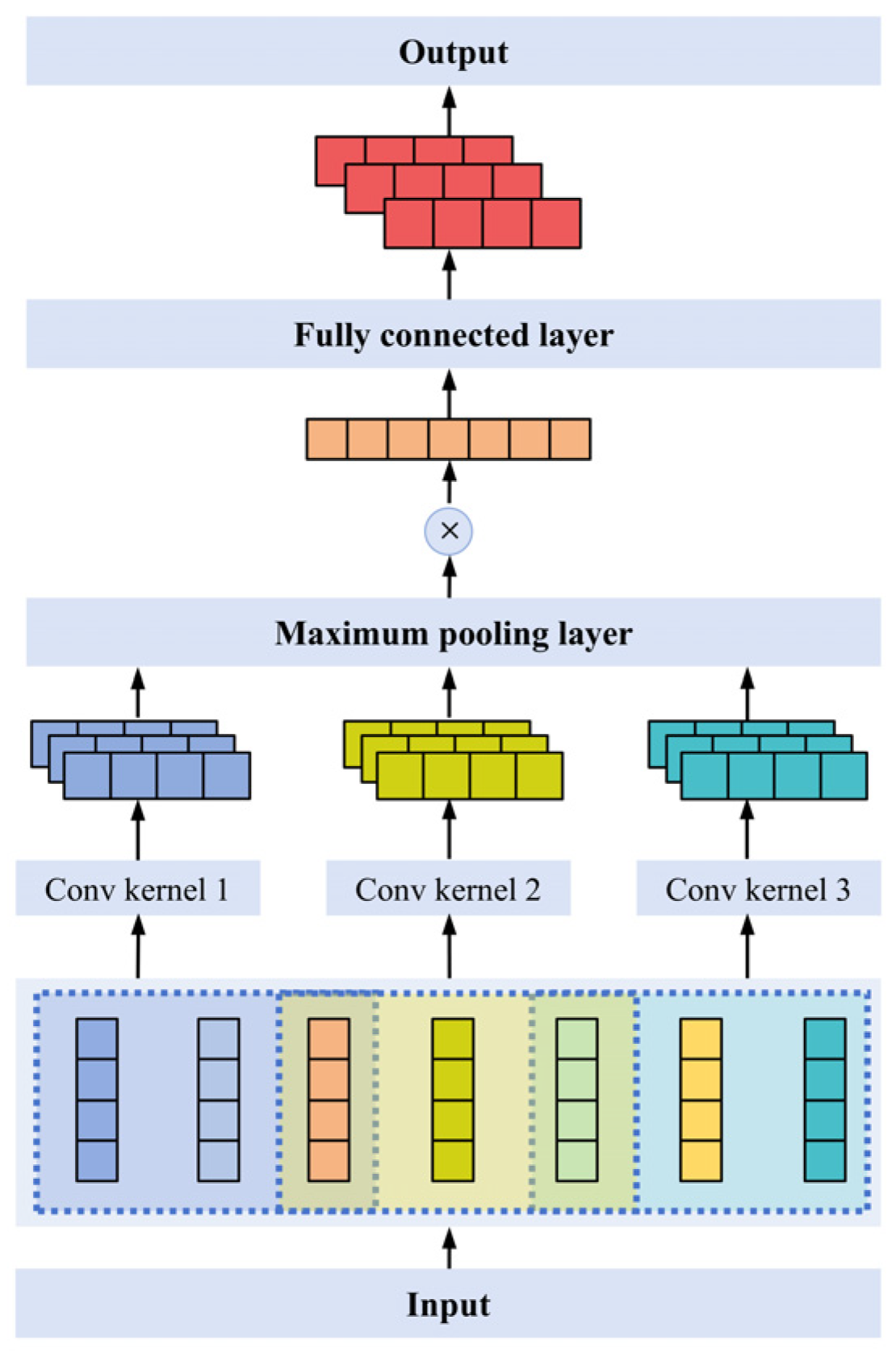
2.4.1. Convolutional Neural Network (CNN)
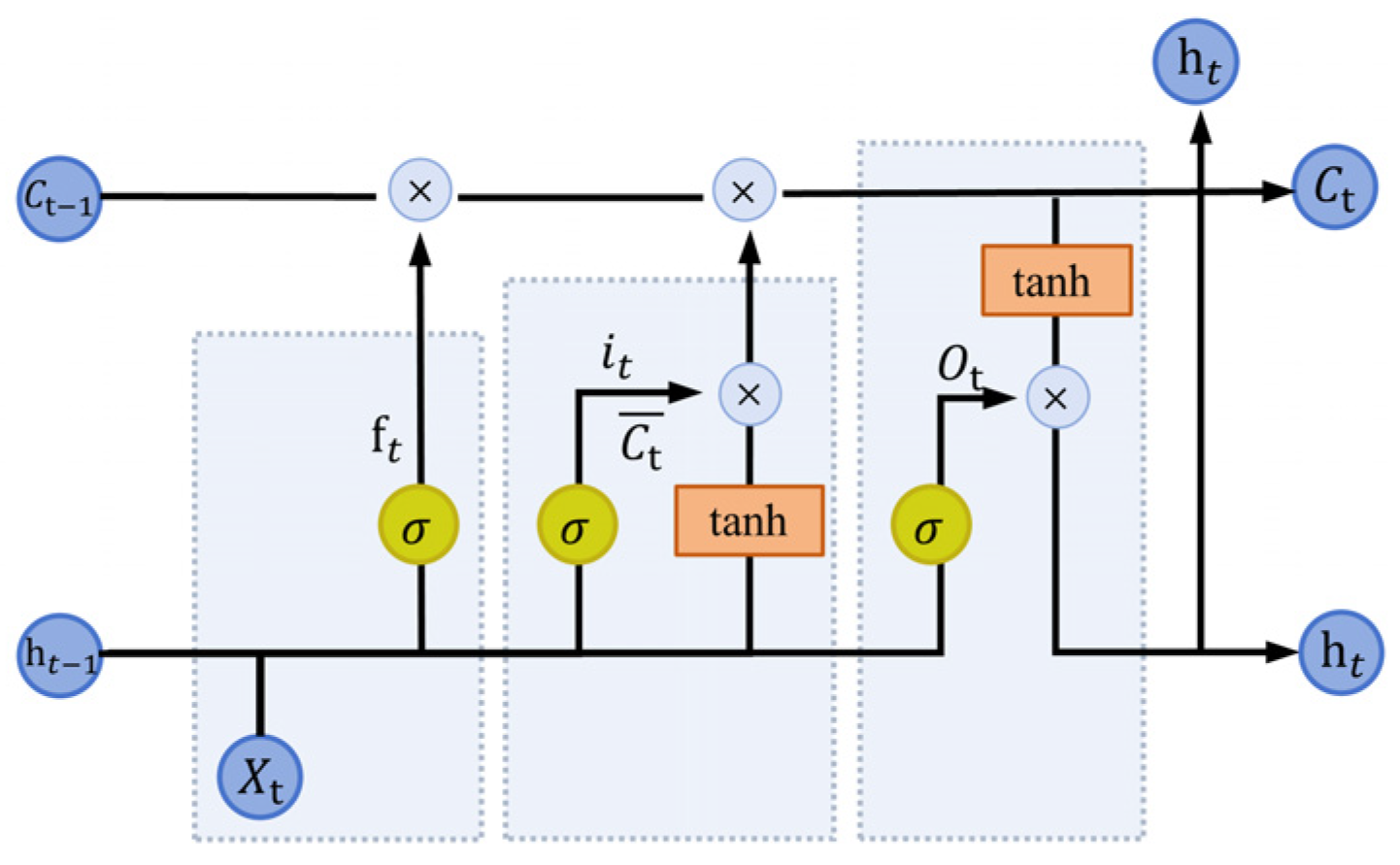
2.4.2. Long Short-Term Memory (LSTM)
2.4.3. CNN-LSTM Model
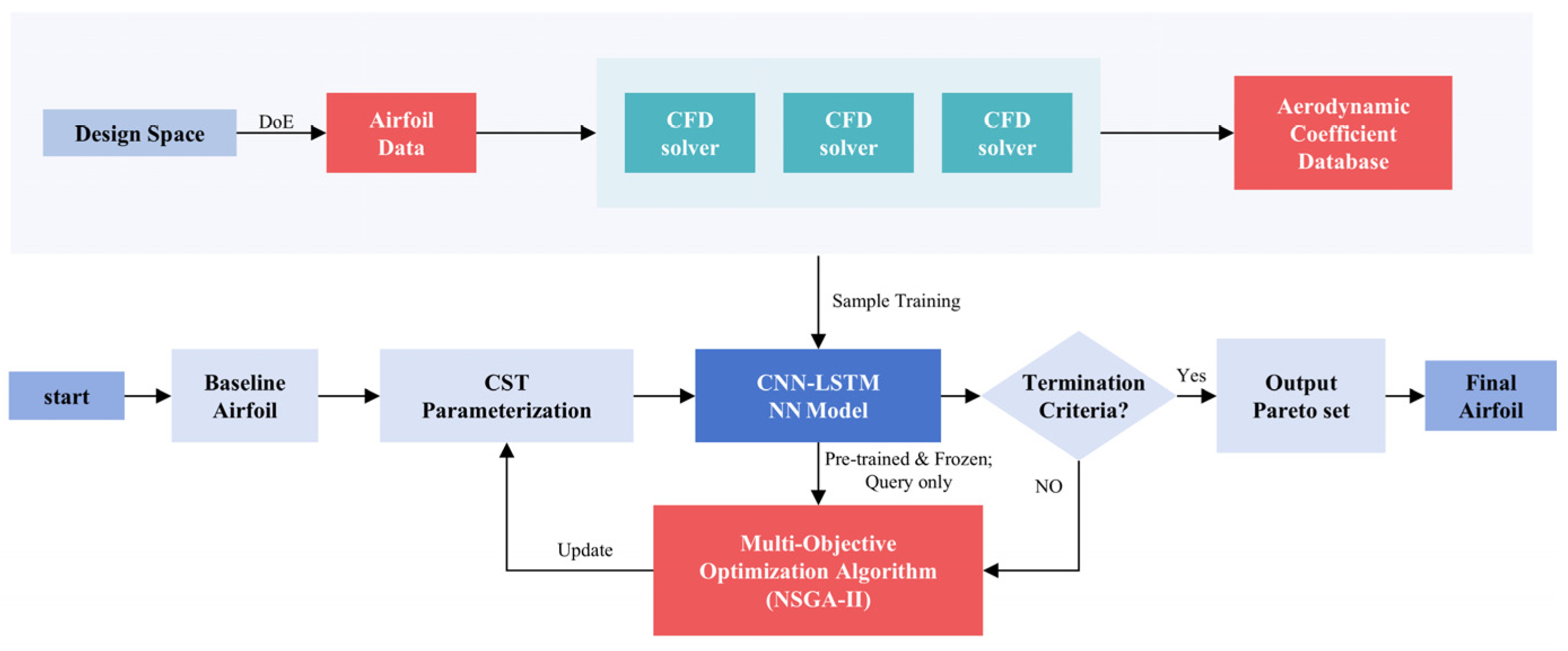
2.5. Optimization Framework
- Parameterizing the airfoil;
- Inputting design variables into the Deep Predictive Neural Network (pre-trained and frozen; only queried to evaluate objectives) to predict the airfoil’s aerodynamic coefficients;
- Updating design variables using the optimization algorithm;
- Checking the optimization termination criteria.
3. CNN–LSTM Surrogate Modeling and Validation
3.1. CNN-LSTM Modeling
3.1.1. Model Architecture
- (1)
- Local Sensitivity Modeling with CNN
- (2)
- Dynamic Response Modeling with LSTM
- (3)
- Engineering Advantages of the CNN-LSTM Architecture
3.1.2. Bayesian Optimization of Hyperparameters
3.1.3. Data Processing and Accuracy Measurement
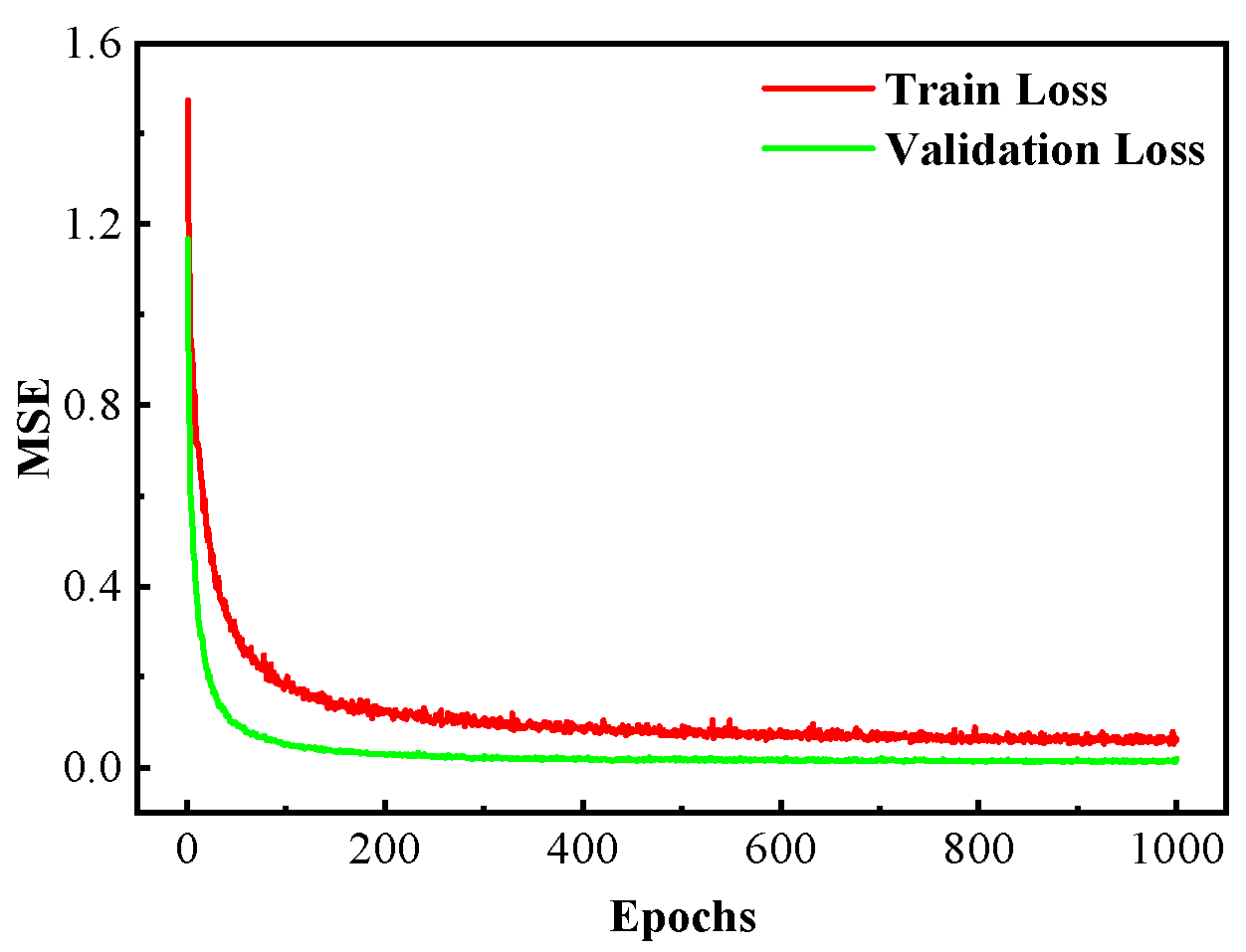
3.1.4. Evaluation Metrics and Validation Strategy
3.2. Verification of Aerodynamic Optimization Method
3.2.1. Experimental Design and Comparative Models
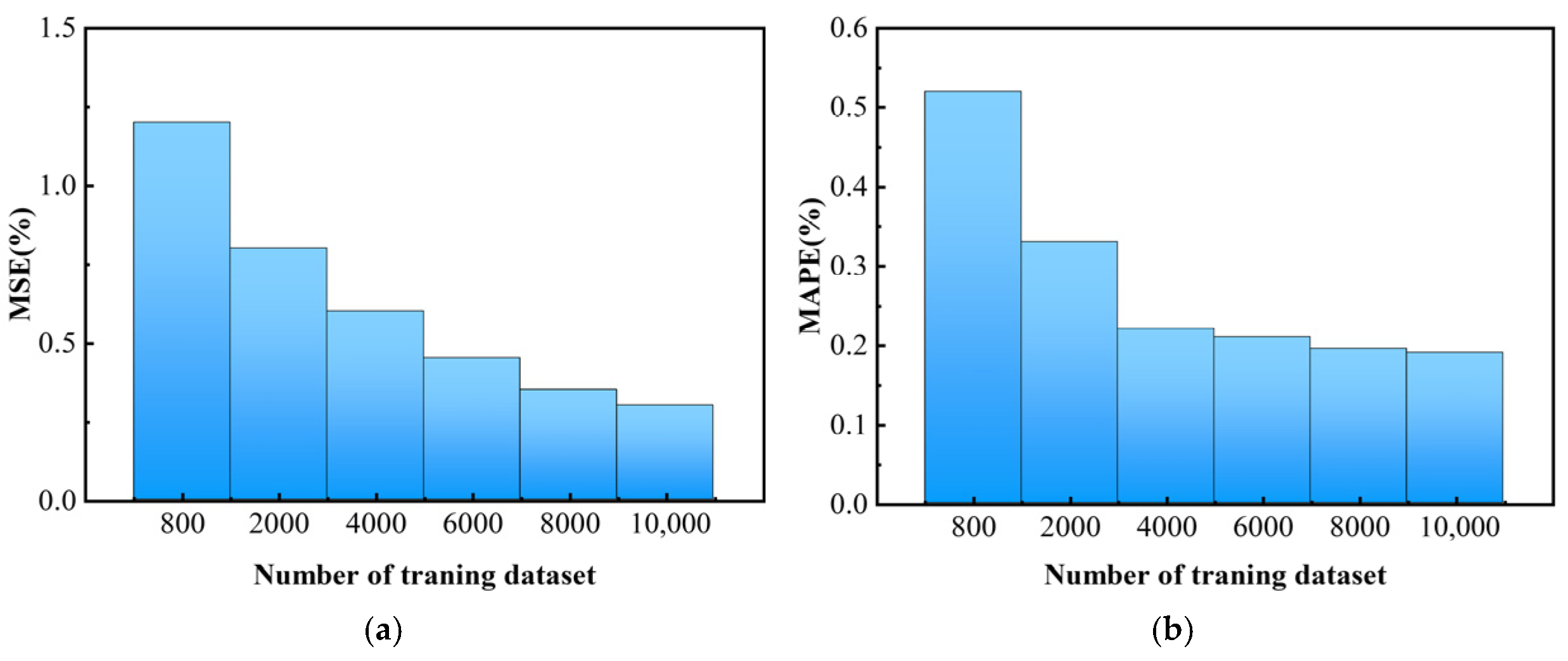
3.2.2. Prediction Accuracy Analysis
3.2.3. Generalization Capability Verification
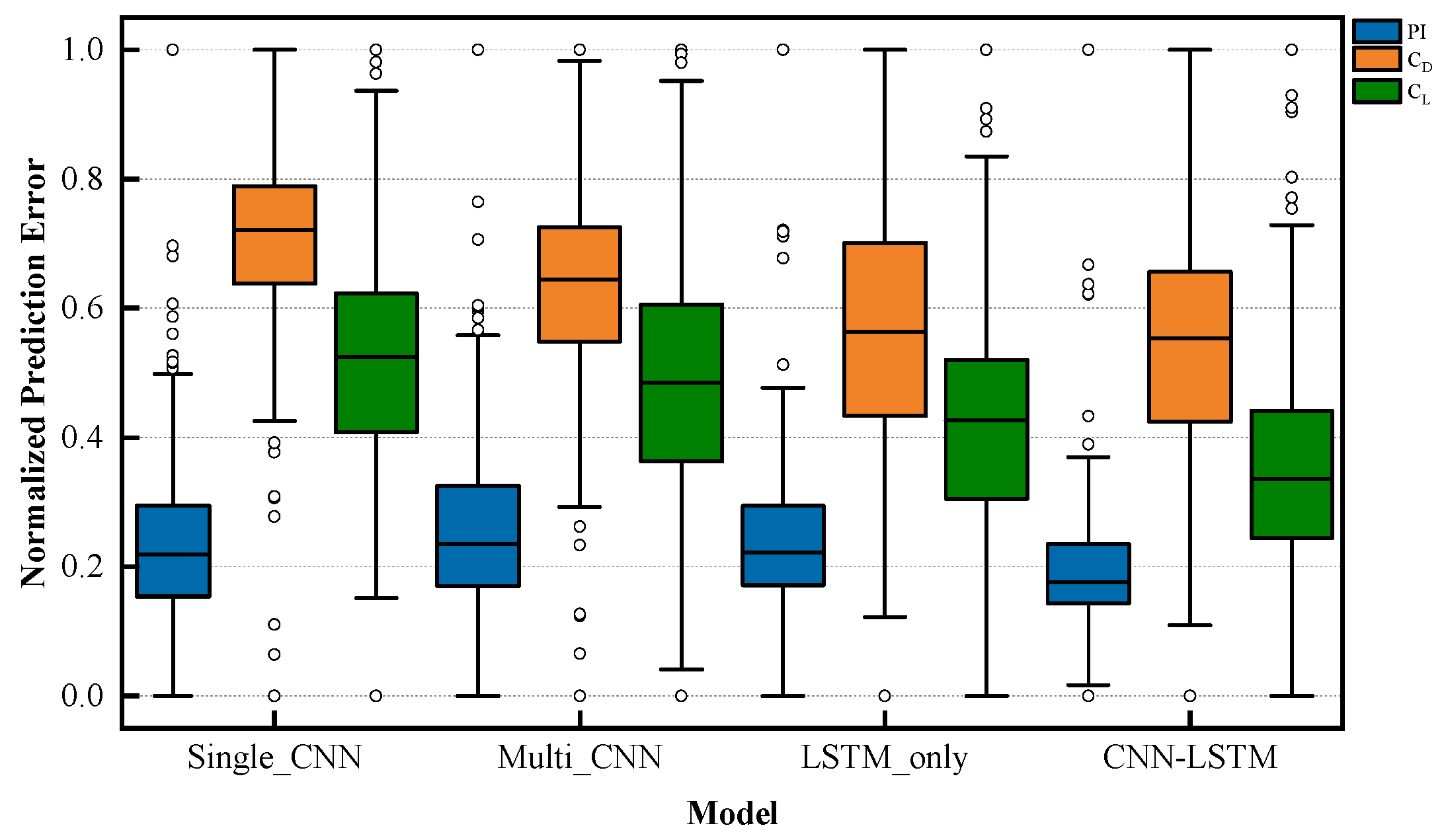
3.2.4. Statistical Validation
3.2.5. Computational Efficiency Assessment
3.2.6. Comprehensive Discussion
4. Problem Description
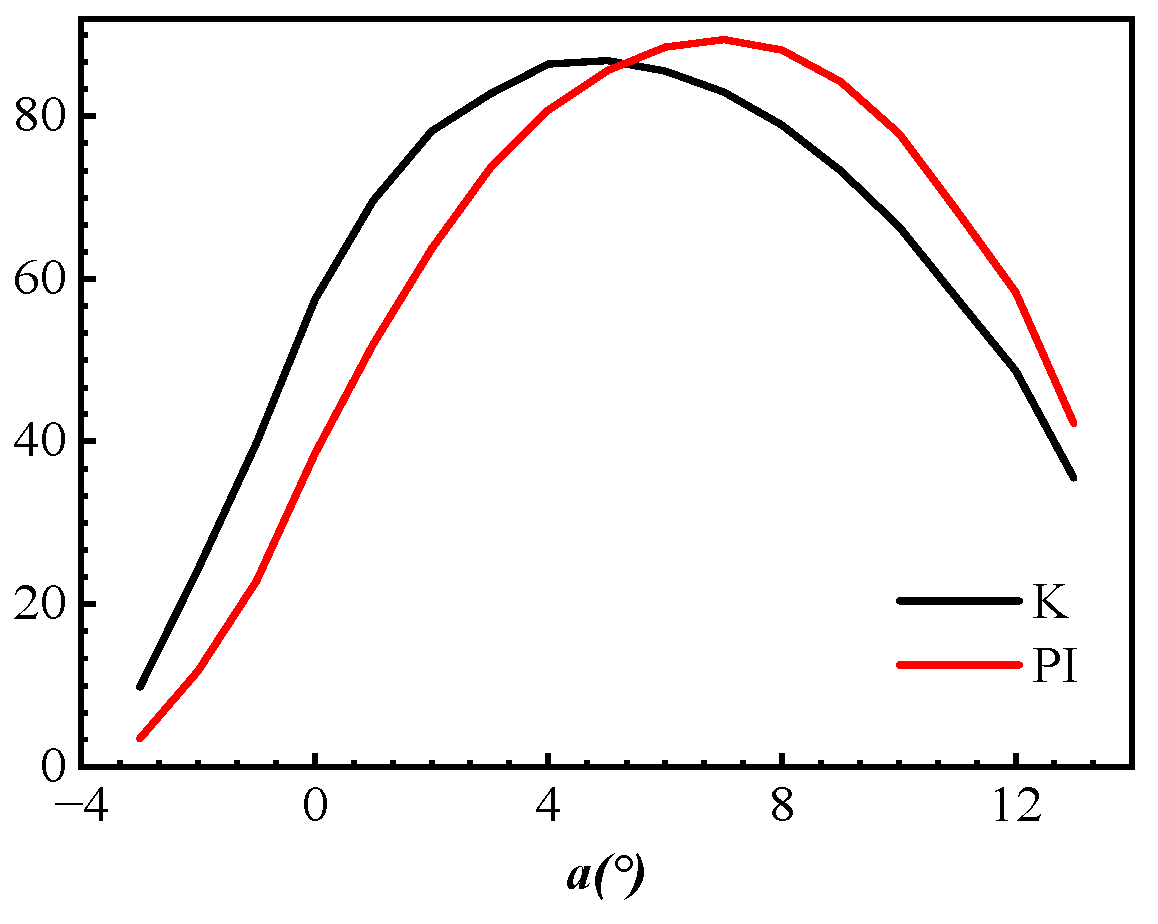
4.1. Aerodynamic Optimization Objectives at Low Reynolds Numbers
4.2. Design Requirements for Multiple Operating Conditions

| Design Point | Parameter | Objective | Constraint |
|---|---|---|---|
| No. 1 | |||
| No. 2 | |||
| No. 3 |
5. Results and Discussion
5.1. Aerodynamic Coefficient Prediction
5.2. Airfoil Optimization and Discussion
5.3. Model Deployment Efficiency and Engineering Adaptability
6. Conclusions
Author Contributions
Funding
Data Availability Statement
Conflicts of Interest
Appendix A
| Design Point | (RelMAE% [95%CI]) | (RelMAE% [95%CI]) | (RelMAE% [95%CI]) |
|---|---|---|---|
| No. 1 | 4.92 [4.26, 5.59] | 1.83 [1.60, 2.10] | 5.58 [4.34, 7.04] |
| No. 2 | 3.02 [2.71, 3.33] | 1.30 [1.17, 1.46] | 2.96 [2.61, 3.30] |
| No. 3 | 4.40 [3.88, 4.96] | 1.57 [1.38, 1.78] | 5.71 [4.86, 6.69] |
Appendix A.1. Turbulence-Model Sensitivity at Low-Re (Literature-Backed)
Appendix A.1.1. Scope Mapping and Acceptance Bands
- |Δ| ≤ 2–3%, |Δ| ≤ 5–8% → acceptable for label consistency;
- larger or systematic near-stall deviations → out of scope for the present coefficient-level surrogate.
Appendix A.1.2. Literature Selection and Harmonization
| Regime and Transition | Models Compared | Key Finding | Suitability for Our Labels (Acceptance-Band †) |
|---|---|---|---|
| Pre-stall, no transition | SA vs. SST k–ω | aligned; mild–moderate sensitivity; SST slightly better on | Suitable—: pass; : pass |
| Near-stall, no transition | SA vs. SST k–ω | sensitivity rises with α; inter-model spread increases | Caution—: pass; : borderline |
| Pre-stall, with transition | SA/SST vs. γ– | Transition improves fit; higher setup/runtime cost | Suitable—: pass; : pass; routine labeling not required |
| Near-stall, with transition | SA/SST vs. γ– | Notable improvement near stall; watch convergence/calibration | Recommended—: pass; : pass |
Appendix A.1.3. Cross-Study Synthesis (Qualitative)
- (1)
- Trend consistency: SA, SST k–ω, and γ–/variants produce broadly similar –α trends pre-stall.
- (2)
- Sensitivity asymmetry: exhibits larger inter-model spread than , especially as α increases.
- (3)
- Transition effects: Transition-aware models (γ–/variants) improve near stall and mitigate separation-bubble artifacts, with added cost and setup complexity.
- (4)
- Numerical stability: SA is typically robust and cost-effective for generating consistent coefficient-level labels.
Appendix A.1.4. Decision for This Study
Appendix A.1.5. Limitations and Future Work
Appendix A.2. Statistical Validation of Ablation Results (Paired Wilcoxon; Holm–Bonferroni)
Appendix A.2.1. Test Scope and Protocol
Appendix A.2.2. Full Results Table
| Metric | Comparator (vs Proposed) | p (Wilcoxon, Raw) | q (BH-FDR) | Median Δ Absolute Error (%) | 95% CI (BCa) | |
|---|---|---|---|---|---|---|
| Single-CNN | 3.00 × 10⁻⁵ | 6.00 × 10⁻⁵ | −0.52 | −0.56 | [−0.72, −0.41] | |
| Multi-CNN | 1.50 × 10⁻³ | 3.00 × 10⁻³ | −0.38 | −0.38 | [−0.52, −0.25] | |
| LSTM-only | 2.00 × 10⁻⁶ | 6.00 × 10⁻⁶ | −0.60 | −0.66 | [−0.85, −0.48] | |
| Single-CNN | 7.00 × 10⁻² | 1.00 × 10⁻¹ | −0.20 | −0.49 | [−0.66, 0.02] | |
| Multi-CNN | 1.10 × 10⁻¹ | 1.40 × 10⁻¹ | −0.16 | −0.37 | [−0.50, 0.03] | |
| LSTM-only | 8.00 × 10⁻⁵ | 1.60 × 10⁻⁴ | −0.45 | −0.74 | [−0.94, −0.18] | |
| Single-CNN | 4.00 × 10⁻² | 6.00 × 10⁻² | −0.24 | −0.47 | [−0.65, −0.06] | |
| Multi-CNN | 6.00 × 10⁻² | 8.00 × 10⁻² | −0.21 | −0.47 | [−0.66, 0.00] | |
| LSTM-only | 3.00 × 10⁻³ | 6.00 × 10⁻³ | −0.35 | −0.70 | [−0.92, −0.30] |
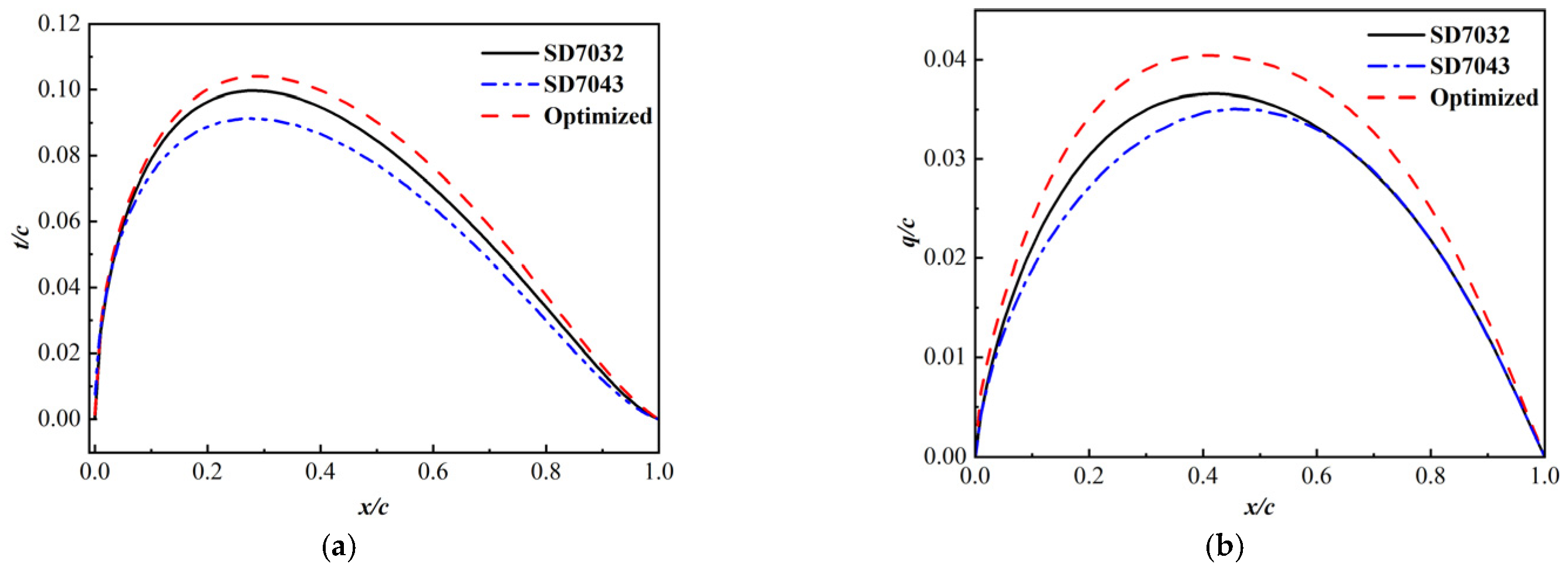
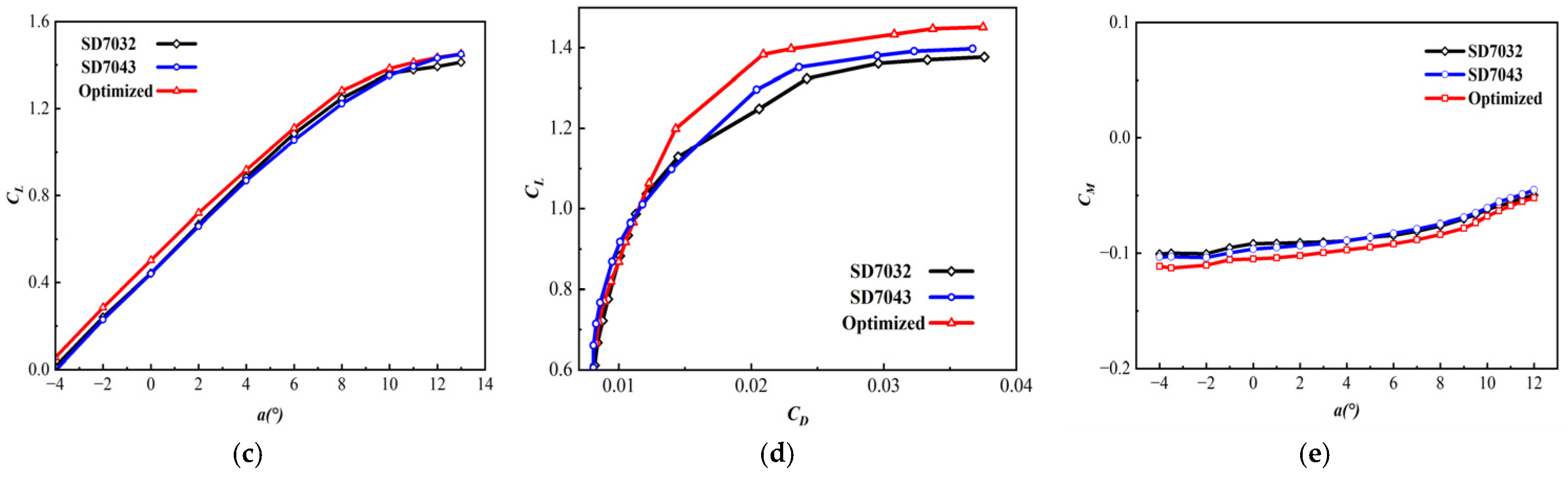
Appendix A.3. Comparison with SD7043 Reference Airfoil

References
- Zhang, L.; Zhang, J.-Y.; Li, T.; Zhang, Y.-D. Multi-objective aerodynamic optimization design of high-speed train head shape. J. Zhejiang Univ. Sci. A 2017, 18, 841–854. [Google Scholar] [CrossRef]
- Yao, S.; Guo, D.; Yang, G. Three-dimensional aerodynamic optimization design of high-speed train nose based on GA-GRNN. Sci. China Technol. Sci. 2012, 55, 3118–3130. [Google Scholar] [CrossRef]
- Peter, J.E.; Dwight, R.P. Numerical sensitivity analysis for aerodynamic optimization: A survey of approaches. Comput. Fluids 2010, 39, 373–391. [Google Scholar] [CrossRef]
- Zhang, C.; Chen, H.; Xu, X.; Duan, Y.; Wang, G. Impact of geometric forms on the effectiveness and physical features of POD-based geometric parameterization. Aerosp. Sci. Technol. 2025, 157, 109776. [Google Scholar] [CrossRef]
- El Adawy, M.; Abdelhalim, E.H.; Mahmoud, M.; Ahmed Abo Zeid, M.; Mohamed, I.H.; Othman, M.M.; ElGamal, G.S.; ElShabasy, Y.H. Design and fabrication of a fixed-wing Unmanned Aerial Vehicle (UAV). Ain Shams Eng. J. 2023, 14, 102094. [Google Scholar] [CrossRef]
- Wallach, R.; Mattos, B.; Girardi, R.; Curvo, M. Aerodynamic Coefficient Prediction of Transport Aircraft Using Neural Network. In Proceedings of the 44th AIAAAerospace Sciences Meeting and Exhibit, Reno, NV, USA, 9–12 January 2006. [Google Scholar]
- Hasegawa, K.; Fukami, K.; Murata, T.; Fukagata, K. CNN-LSTM based reduced order modeling of two-dimensional unsteady flows around a circular cylinder at different Reynolds numbers. Fluid Dyn. Res. 2020, 52, 065501. [Google Scholar] [CrossRef]
- Yilmaz, E.; German, B. A Convolutional Neural Network Approach to Training Predictors for Airfoil Performance. In Proceedings of the 18th AIAA/ISSMO Multidisciplinary Analysis and Optimization Conference (Aerospace Research Central, 2017), Denver, CO, USA, 5–9 June 2017; pp. 1–19. [Google Scholar]
- Tang, X.; Li, P.; Peng, R.; Lu, X. Aerodynamic shape optimization design of low Reynolds number airfoil. Energy Energy Conserv. 2020, 56, 192–200. [Google Scholar] [CrossRef]
- Li, J.; Zhang, M.; Tay, C.M.J.; Liu, N.; Cui, Y.; Chew, S.C.; Khoo, B.C. Low-Reynolds-number airfoil design optimization using deep-learning-based tailored airfoil modes. Aerosp. Sci. Technol. 2022, 121, 107309. [Google Scholar] [CrossRef]
- Lukić, N.; Ivanov, T.; Svorcan, J.; Simonović, A. Numerical investigation and optimization of a morphing airfoil designed for lower Reynolds number. Aerospace 2024, 11, 252. [Google Scholar] [CrossRef]
- Zhang, J.; Qu, C.-X.; Yi, T.-H.; Li, H.-N. Damage detection for decks of concrete girder bridges using the frequency obtained from an actively excited vehicle. Smart Struct. Syst. 2021, 27, 101–114. [Google Scholar]
- Chen, X.; Guo, Z.; Yi, F.; Li, H.; Liu, G. Aerodynamic shapeoptimization and design of airfoils with low Reynolds number. Acta Aerodyn. Sin. 2014, 32, 300–307. [Google Scholar] [CrossRef]
- Chen, X.; Guo, Z.; Wang, R.; Liu, G.; Zhang, C.; Guo, Q. Aerodynamic optimization of low Reynolds number airfoil based on improved Hicks-Henne shape functions. In Proceedings of the 2012 2nd International Conference on Aerospace Engineering and Information Technology(AEIT 2012), Nanchang, China, 7–8 May 2012; 2012; pp. 173–179. [Google Scholar]
- Li, D.; Yang, L.; Wei, C.; Zhang, T. Study on Multi-point Aerodynamic Optimization Method of Low Reynolds Number Airfoil. Aeronaut. Sci. Technol. 2020, 31, 16–25. [Google Scholar] [CrossRef]
- Abbasi, H.A.; Soltani, M.R. Aerodynamic Optimization of Low Reynolds Number Airfoils Using a Genetic Algorithm. Aerosp. Sci. Technol. 2015, 45, 234–241. [Google Scholar] [CrossRef]
- Jiang, T.; Jiang, L. Optimization of UAV Airfoil Based on Improved Particle Swarm Optimization Algorithm. Int. J. Aerosp. Eng. 2022, 2022, 2828198. [Google Scholar] [CrossRef]
- Colonius, T.; Brunton, S.L. Surrogate-Assisted Optimization of Low Reynolds Number Airfoils Using Kriging Models. J. Fluid Mech. 2021, 915, A123. [Google Scholar] [CrossRef]
- Rao, K.S.; Abhilasha, A.N.; Das, A.; Sivapragasam, M. Aerodynamic shape optimization at low Reynolds number using multi-level hierarchical Kriging models. Optim. Eng. 2024, 26, 479–505. [Google Scholar] [CrossRef]
- Wauters, J.; Couckuyt, I.; Knudde, N.; Dhaene, T.; Degroote, J. Multi-objective optimization of a wing fence on an unmanned aerial vehicle using surrogate-derived gradients. Struct. Multidiscip. Optim. 2019, 61, 353–364. [Google Scholar] [CrossRef]
- Park, K.; Jung, J.; Jeong, S. Multi-objective shape optimization of airfoils for Mars exploration aircraft propellers. Int. J. Aeronaut. Space Sci. 2022, 24, 9–23. [Google Scholar] [CrossRef]
- Liu, F.; Zhang, Q.; Han, Z. MOEA/D with gradient-enhanced kriging for expensive multiobjective optimization. Nat. Comput. 2022, 22, 329–339. [Google Scholar] [CrossRef]
- Karali, H.; Inalhan, G.; Tsourdos, A. Advanced UAV design optimization through deep learning-based surrogate models. Aerospace 2024, 11, 669. [Google Scholar] [CrossRef]
- Brunton, S.L.; Noack, B.R.; Koumoutsakosp, P. Machine learning for fluid mechanics. Annu. Rev. Fluid Mech. 2020, 52, 477–508. [Google Scholar] [CrossRef]
- Ling, J.L.; Kurzawski, A.; Templeton, J. Reynolds averaged turbulence modelling using deep neural networks with embedded invariance. J. Fluid Mech. 2016, 807, 155–166. [Google Scholar] [CrossRef]
- Sun, G.; Wang, C.; Wang, L.; Tao, J.; Wang, S.; Wang, X.; Zhou, S.; Li, Z.; Hu, Y. Application and prospect of artificial intelligence in aerodynamic design. Civ. Aircr. Des. Res. 2021, 3, 1–9. [Google Scholar] [CrossRef]
- Li, J.C.; Du, X.S.; Martins, J.R.R.A. Machine learning in aerodynamic shape optimization. Prog. Aerosp. Sci. 2022, 134, 100849. [Google Scholar] [CrossRef]
- Kutz, J.N. Deep learning in fluid dynamics. J. Fluid Mech. 2017, 814, 1–4. [Google Scholar] [CrossRef]
- Bakar, A.; Li, K.; Liu, H.; Xu, Z.; Alessandrini, M.; Wen, D. Multi-objective optimization of low Reynolds number airfoil using convolutional neural network and non-dominated sorting genetic algorithm. Aerospace 2022, 9, 35. [Google Scholar] [CrossRef]
- Du, X.; He, P.; Martins, J.R.A. Rapid airfoil design optimization via neural networks-based parameterization and surrogate modeling. Aerosp. Sci. Technol. 2021, 113, 106701. [Google Scholar] [CrossRef]
- Liu, J.; Chen, R.; Lou, J.; Hu, Y.; You, Y. Deep-learning-based aerodynamic shape optimization of rotor airfoils to suppress dynamic stall. Aerosp. Sci. Technol. 2023, 133, 108089. [Google Scholar] [CrossRef]
- Wu, H.; Chen, R.; Lou, J.; You, Y.; Huang, L.; Xu, M.; Ruan, Y. A gradient aerodynamic optimization method based on deep learning. Phys. Fluids 2024, 36, 057117. [Google Scholar] [CrossRef]
- Sekar, V.; Jiang, Q.; Shu, C.; Khoo, B.C. Fast flow field prediction over airfoils using deep learning approach. Phys. Fluids 2019, 31, 057103. [Google Scholar] [CrossRef]
- Sekar, V.; Zhang, M.; Shu, C.; Khoo, B.C. Inverse design of airfoil using a deep convolutional neural network. AIAA J. 2019, 57, 993–1003. [Google Scholar] [CrossRef]
- Chen, L.L.; Guo, Z. Application of different turbulence models in low-Reynolds-number flow. Mod. Appl. Phys. 2016, 7, 48–52. [Google Scholar] [CrossRef]
- Kulfan, B.M. Universal Parametric Geometry Representation Method. J. Aircr. 2008, 45, 1–17. [Google Scholar] [CrossRef]
- Ladson, C.L. Effects of Independent Variation of Mach and Reynolds Numbers on the Low-Speed Aerodynamic Characteristics of the NACA 0012 Airfoil Section. NASA-TM-4074; In NASA Technical Memorandum; National Aeronautics and Space Administration (NASA): Washington, DC, USA, 1988; pp. 1–97. [Google Scholar]
- Jiang, G.; Liu, Y.P.; Wang, Z.Y. Wind tunnel test and numerical calculation of aerodynamic noise of wind turbine airfoils. Noise Vib. Control. 2024, 44, 280–287. [Google Scholar] [CrossRef]
- Zhou, W.T.; Chang, S.J. Numerical analysis of aerodynamic characteristics of free-rotating wraparound fins projectile. J. Harbin Inst. Technol. 2023, 55, 113–122. [Google Scholar] [CrossRef]
- Donahue, J.; Anne Hendricks, L.; Guadarrama, S.; Rohrbach, M.; Venugopalan, S.; Saenko, K.; Darrell, T. Long-Term Recurrent Convolutional Networks for Visual Recognition and Description. In Proceedings of the IEEE Conference on Computer Vision and Pattern Recognition (CVPR), Boston, MA, USA, 7–12 June 2015; pp. 2625–2634. [Google Scholar]
- Yang, L.; Shami, A. On hyperparameter optimization of machine learning algorithms: Theory and practice. Neurocomputing 2020, 415, 295–316. [Google Scholar] [CrossRef]
- Giunta, A.A.; Wojtkiewicz, S.F., Jr.; Eldred, M.S. Overview of Modern Design of Experiments Methods for Computational Simulations. In Proceedings of the AIAA 2003-649, Reno, NV, USA, 6–9 January 2003. [Google Scholar]
- Wang, W.; Wang, J.; Liang, Z.; Li, J. Entropy generation theory based design methodology for multi-objective airfoil shape optimization. Acta Aerodyn. Sin. 2019, 37, 827–833. [Google Scholar] [CrossRef]
- Liu, J.Q.; Chen, R.Q.; Lou, J.H.; Han, X.; Wu, H.; You, Y. Aerodynamic shape optimization of high-speed helicopter rotor airfoil based on deep learning. Acta Aeronaut. Astronaut. Sin. 2024, 45, 529828. [Google Scholar] [CrossRef]
- Zhang, J.; Wang, J.; Geng, Y.; Guo, R. Technology challenges for high altitude long endurance solar powered UAV. Aeronaut. Sci. Technol. 2020, 31, 14–20. [Google Scholar] [CrossRef]
- Deb, K.; Pratap, A.; Agarwal, S.; Meyarivan, T. A fast and elitist multiobjective genetic algorithm: NSGA-II. IEEE Trans. Evol. Comput. 2002, 6, 182–197. [Google Scholar] [CrossRef]







| BPO | CST Parameters | RMSE of CST Fitting of Upper Airfoil | RMSE of CST Fitting of Lower Airfoil |
|---|---|---|---|
| 3 | 4 | 0.00407167 | 0.00241547 |
| 4 | 5 | 0.00245478 | 0.00208179 |
| 5 | 6 | 0.00143571 | 0.00156391 |
| Quantity | RMSE (%) | R2 (%) | nRMSE (%) |
|---|---|---|---|
| 0.7624 | 99.811 | 0.53 | |
| 0.0512 | 91.065 | 5.59 |
| Item | ||||
|---|---|---|---|---|
| EXP | 1.081 | / | 0.0117 | / |
| Coarse grid | 1.099 | 1.66 | 0.0137 | 17.09 |
| Medium grid | 1.089 | 0.74 | 0.0124 | 5.98 |
| Fine grid | 1.083 | 0.185 | 0.0119 | 1.71 |
| very-fine | 1.084 | 0.28 | 0.0121 | 3.42 |
| Hyperparameter | Range | Result |
|---|---|---|
| Learning Rate | [0.00001, 0.01] | 1.0 × 10⁻⁴ |
| Batch Size | [8, 128] | 16 |
| Optimizer | [Adam, SAM] | Adam |
| Model | Input (Dimension) | Output (Dimension) | Architecture |
|---|---|---|---|
| Single-CNN | 14 | 3 | 3 Conv1D + FC |
| Multi-CNN | 42 | 9 | 3 Conv1D + FC |
| LSTM-only | 14 | 9 | 2 LSTM +FC |
| CNN–LSTM (Proposed) | 14 | 9 | 3 Conv1D + 2 LSTM + FC |
| Model | |||
|---|---|---|---|
| Single-CNN | 1.58/1.95 | 1.47/1.82 | 1.52/1.88 |
| Multi-CNN | 1.40/1.72 | 1.35/1.68 | 1.52/1.85 |
| LSTM-only | 1.68/2.01 | 1.72/2.15 | 1.75/2.12 |
| CNN–LSTM (Proposed) | 1.02/1.25 | 0.98/1.18 | 1.05/1.30 |
| Model | Median | IQR | Median | IQR | Median | IQR |
|---|---|---|---|---|---|---|
| Single-CNN | 0.2191 | 0.1407 | 0.7210 | 0.1594 | 0.5252 | 0.2140 |
| Multi-CNN | 0.2349 | 0.1550 | 0.6445 | 0.1753 | 0.5041 | 0.2037 |
| LSTM-only | 0.2048 | 0.1352 | 0.5991 | 0.1709 | 0.4670 | 0.1859 |
| CNN-LSTM (Proposed) | 0.1823 | 0.1204 | 0.5569 | 0.1552 | 0.4427 | 0.1678 |
| Model | (min) | (s) |
|---|---|---|
| Single-CNN | 24 | 0.18 |
| Multi-CNN | 31 | 0.25 |
| LSTM-only | 29 | 0.30 |
| CNN-LSTM (Proposed) | 30 | 0.23 |
| Objective | Mean Value | Relative Error |
|---|---|---|
| 0.01037 | 0.76% | |
| 1.3133 | 1.07% | |
| 62.7133 | 0.12% |
| Coefficient | Baseline | Optimized | Δ/% |
|---|---|---|---|
| 55.82 | 62.039 | 11.14 | |
| 0.01031 | 0.01011 | −1.97 | |
| 1.2188 | 1.3042 | 7.01 |
| What Is Timed | CFD Solver (Per Case) | CNN-LSTM (CPU) | Notes |
|---|---|---|---|
| Per-case time (latency, batch = 1) | ≈180 s | ≈0.23 s | Speedup = 180/0.23 ≈ 7.8 × 10² (≈3 orders) |
| Training (offline, 6000 samples) | N/A | ≈30 min | One-time, not incurred at deployment |
| Hyperparameter tuning (offline) | N/A | ≈1 h | Optional; once per study |
| Data preparation (offline) | N/A | ≈20 h | Dataset curation; excluded from speedup |
Disclaimer/Publisher’s Note: The statements, opinions and data contained in all publications are solely those of the individual author(s) and contributor(s) and not of MDPI and/or the editor(s). MDPI and/or the editor(s) disclaim responsibility for any injury to people or property resulting from any ideas, methods, instructions or products referred to in the content. |
© 2026 by the authors. Licensee MDPI, Basel, Switzerland. This article is an open access article distributed under the terms and conditions of the Creative Commons Attribution (CC BY) license.
Share and Cite
Peng, J.; Li, E.; Wang, H. CNN-LSTM Assisted Multi-Objective Aerodynamic Optimization Method for Low-Reynolds-Number Micro-UAV Airfoils. Aerospace 2026, 13, 78. https://doi.org/10.3390/aerospace13010078
Peng J, Li E, Wang H. CNN-LSTM Assisted Multi-Objective Aerodynamic Optimization Method for Low-Reynolds-Number Micro-UAV Airfoils. Aerospace. 2026; 13(1):78. https://doi.org/10.3390/aerospace13010078
Chicago/Turabian StylePeng, Jinzhao, Enying Li, and Hu Wang. 2026. "CNN-LSTM Assisted Multi-Objective Aerodynamic Optimization Method for Low-Reynolds-Number Micro-UAV Airfoils" Aerospace 13, no. 1: 78. https://doi.org/10.3390/aerospace13010078
APA StylePeng, J., Li, E., & Wang, H. (2026). CNN-LSTM Assisted Multi-Objective Aerodynamic Optimization Method for Low-Reynolds-Number Micro-UAV Airfoils. Aerospace, 13(1), 78. https://doi.org/10.3390/aerospace13010078