
Online Synchronous Coordinated Assignment and Planning for Heterogeneous Fixed-Wing UAVs


Abstract
1. Introduction
- Considering the varying optimal cruising speeds of heterogeneous UAVs, how can a set of targets be optimally assigned to ensure each FW-UAV completes its MTR within an equal and minimized mission duration?
- Subsequent to MTA, how can kinematically feasible trajectories be generated for each FW-UAV under dynamic environmental constraints, while simultaneously guaranteeing temporal synchronization among FW-UAVs throughout the whole process?
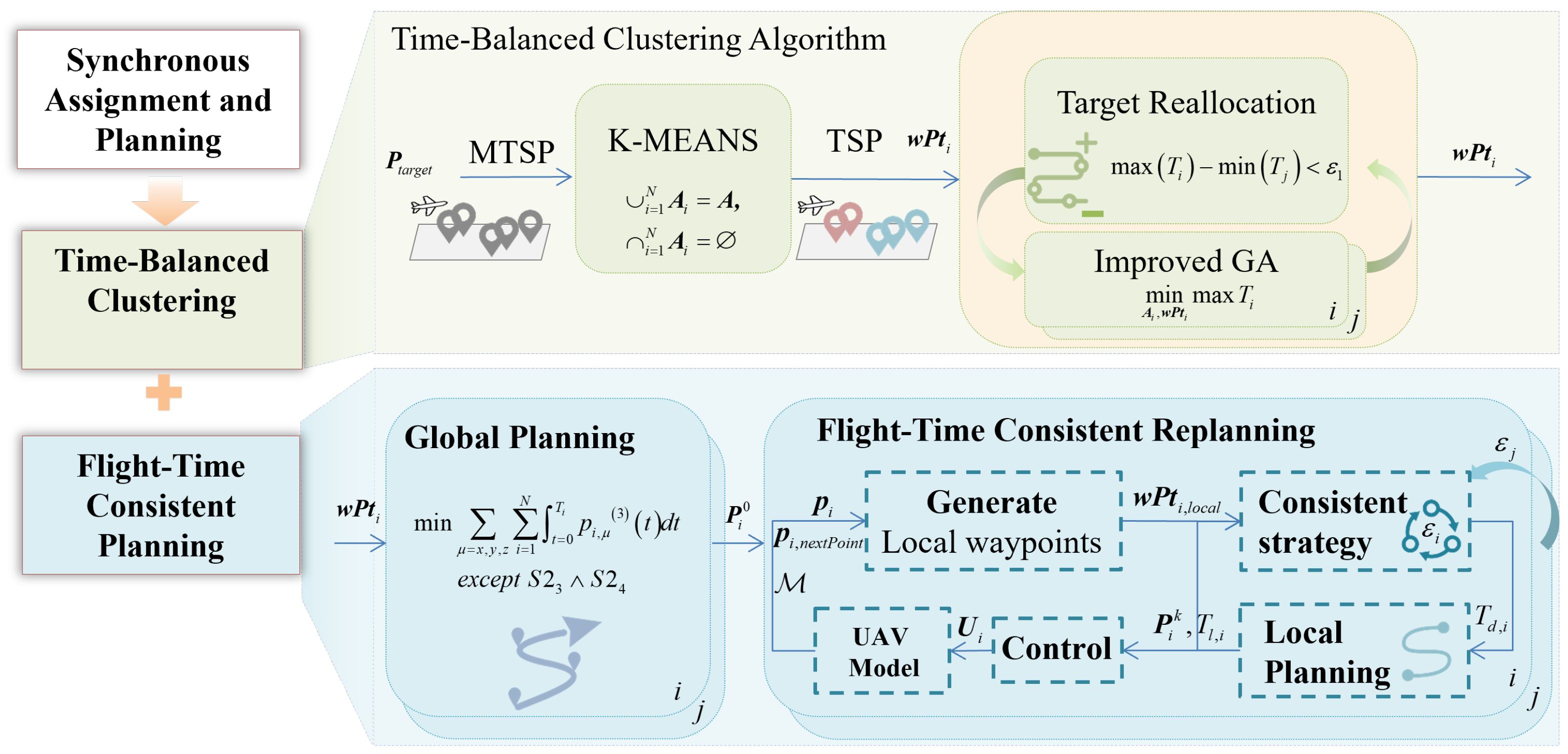
- A new practical time-balanced clustering algorithm is proposed for heterogeneous FW-UAVs. This method minimizes the overall mission duration and balances individual UAV flight durations by strategically reallocating targets and optimizing the intra-cluster visiting sequence. By decoupling temporal coordination from route optimization, the proposed approach achieves significantly improved computational efficiency for time-coordinated MTA problems, which is further validated through theoretical time-complexity analysis and extensive numerical simulations.
- A practical replanning flight-time synchronization mechanism is proposed, which adaptively adjusts the replanning duration for each UAV. Inspired by consensus-based coordination principles, this mechanism enables the synchronization of flight times, and a rigorous convergence proof is provided to guarantee persistent synchronization.
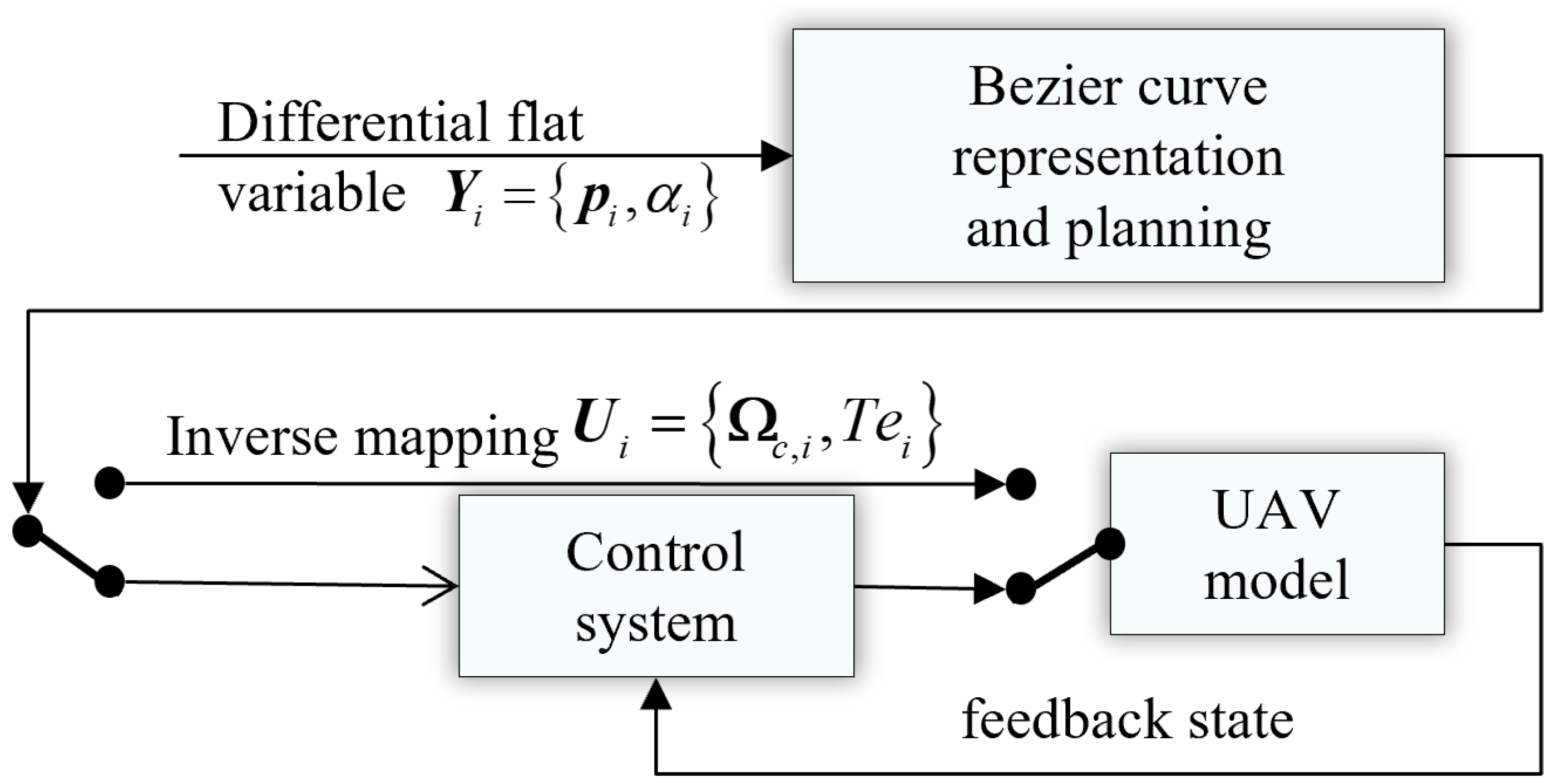
- An online trajectory planning algorithm is developed using the DF property of FW-UAVs. This planner operates under stringent kinematic constraints, ensures collision avoidance in unknown and dynamic environments, and rigorously respects terminal time constraints. The applicability of DF to fixed-wing UAVs is explicitly derived and discussed, extending its use beyond conventional rotary-wing platforms.
2. Preliminaries
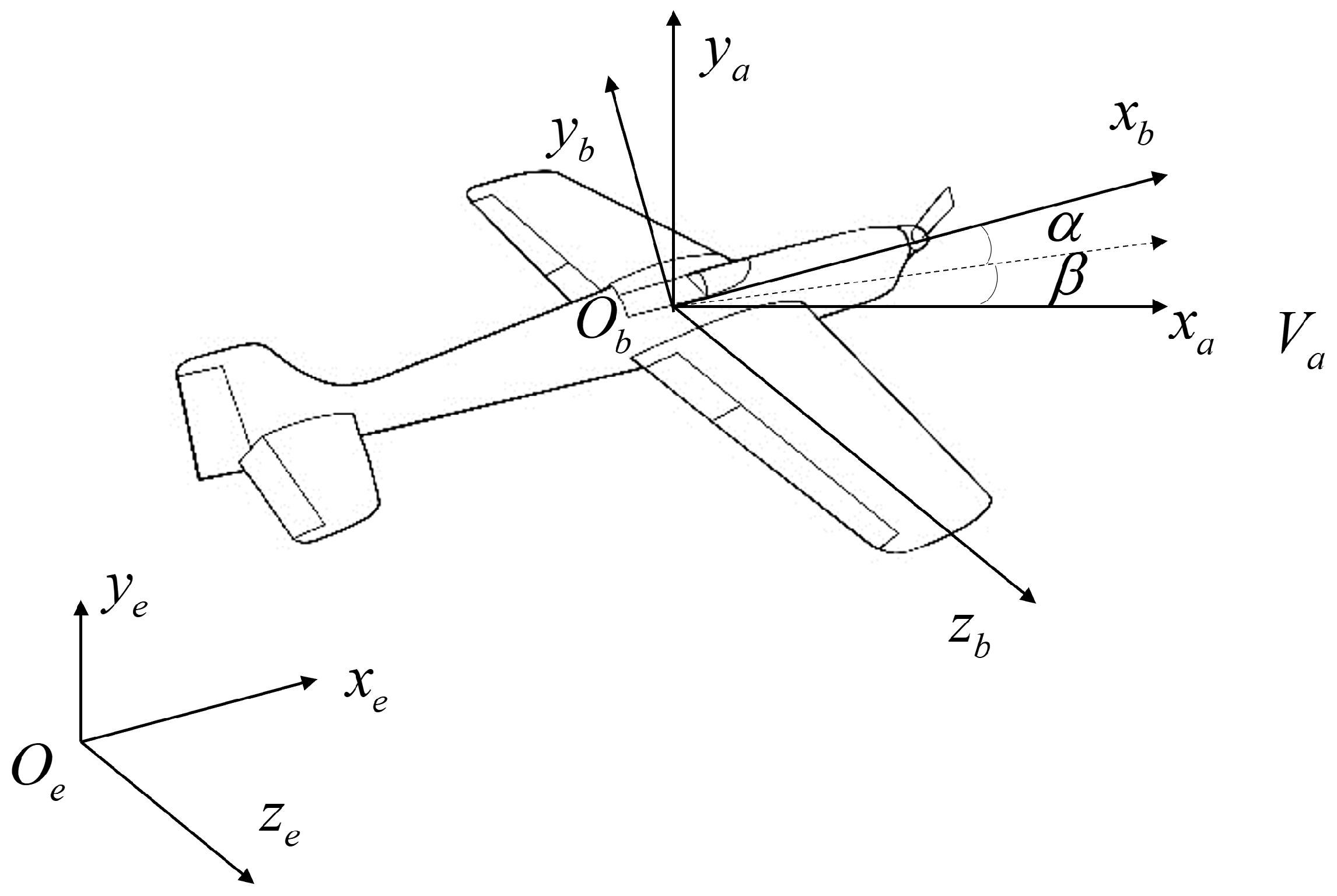
2.1. FW-UAV Model
- 1.
- The wind speed is below 3 m/s, so sideslip can be neglected;
- 2.
- The aerodynamic forces generated by control-surface deflections are negligible due to the imposed limits on control-surface ranges.
2.2. Graph Theory
2.3. Problem Formulation
3. Time-Balanced Clustering Algorithm for MTA
3.1. Cluster-Based Target Reallocation Strategy
| Algorithm 1 Time-Balanced Clustering Algorithm for MTA |
| Input: Number of UAVs N, optimal cruising speeds , and target positions . |
| Output: Adjusted target clusters , waypoint sets , and minimized mission duration T. |
| 1. Initialization |
| For do |
| End For |
| 2. Iterative Refinement |
| While and do |
| 2.1. Calculate the center position and flight time for each cluster: |
| 2.2. Sort. Sort UAVs in descending order of flight time . |
| 2.3. Iterative Refinement |
| For each UAV in the sorted order do |
| While and do |
| If do |
| Else |
| calculate and update T |
| End If |
| End While |
| End For |
| 2.4. Optimize inter-order |
| For do |
| End For |
| pruning |
| End While |

| Simulation Parameter | Value |
|---|---|
| Iteration in K_MEANS | [32] |
| Threshold | |
| N | |
| Max Generations in GA | 35 × |
| Population Size | 80 |
| Roulette Wheel Probability in Selection Operator | |
| Random Probability in Selection Operator | |
| Unchanged Probability in Selection Operator | |
| Crossover Operator Rate | |
| Mutation Rate |
3.2. Time Complexity Analysis
4. Flight-Time-Consistent Algorithm Based on DF for TP
4.1. Flight-Time-Consistent Replanning Strategy
| Algorithm 2 Flight-Time-Consistent Algorithm |
| Input: current time t, environmental map , communication graph matrix L, and so on. |
| 1. Initialization |
| To satisfy constraints when neglecting the obstacle avoidance |
| constraints . |
| , |
| 2. Replanning strategy |
| To satisfy all constraints . |
| While do |
| Calculate |
| Calculate |
| While do |
| End While |
| Update , and . |
| check() |
| End While |
- 1.
- 2.
- In Equation (15), and are both bounded as . Due to the definitions of and , this bound holds naturally.
- 3.
- The communication topology L contains at least one spanning tree.
4.2. DF Based Planning Algorithm for TP
- Y is differentiable;
- The system states X and control inputs U can be expressed as functions of Y and its finite-order derivatives and
- ;
- As , ;
- When , , which reaches a maximum value.
5. Simulation and Analysis
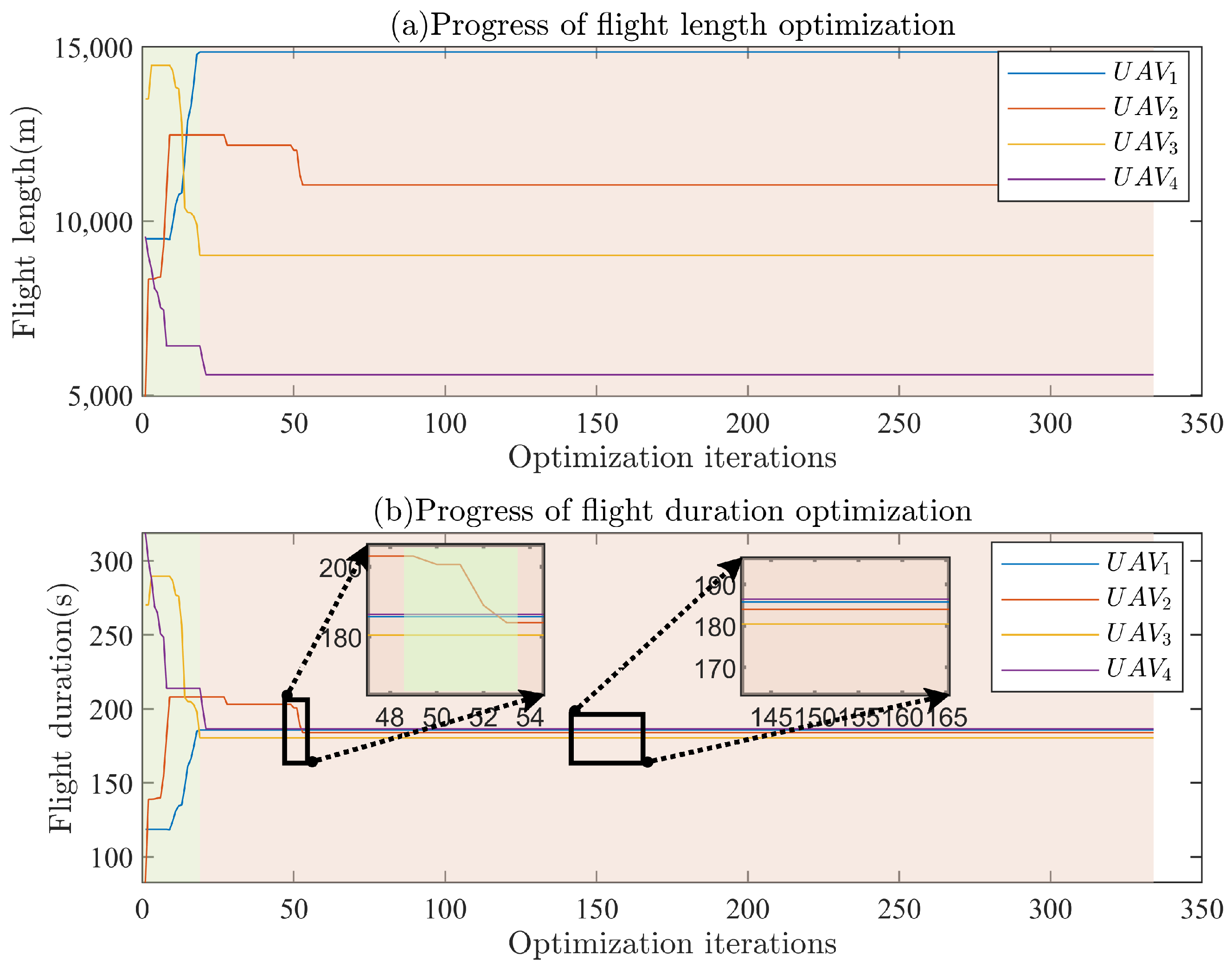
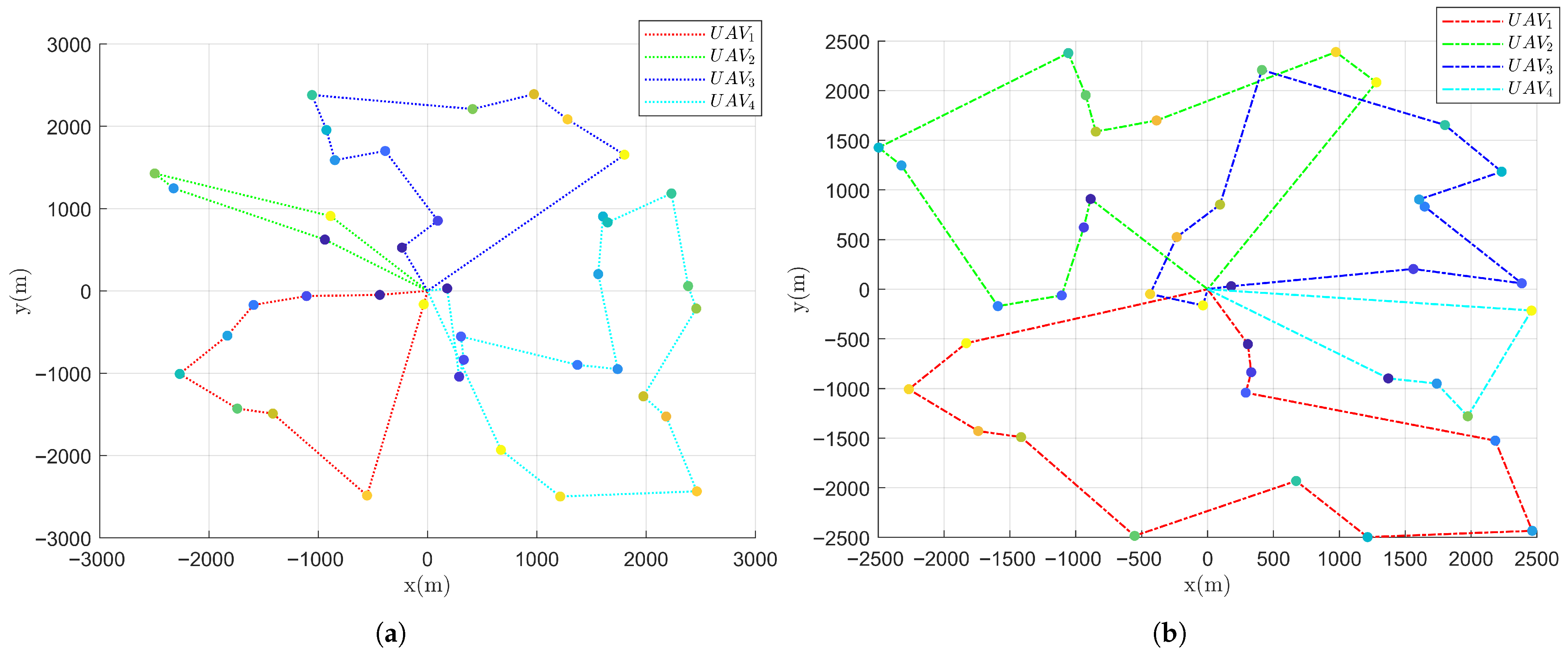
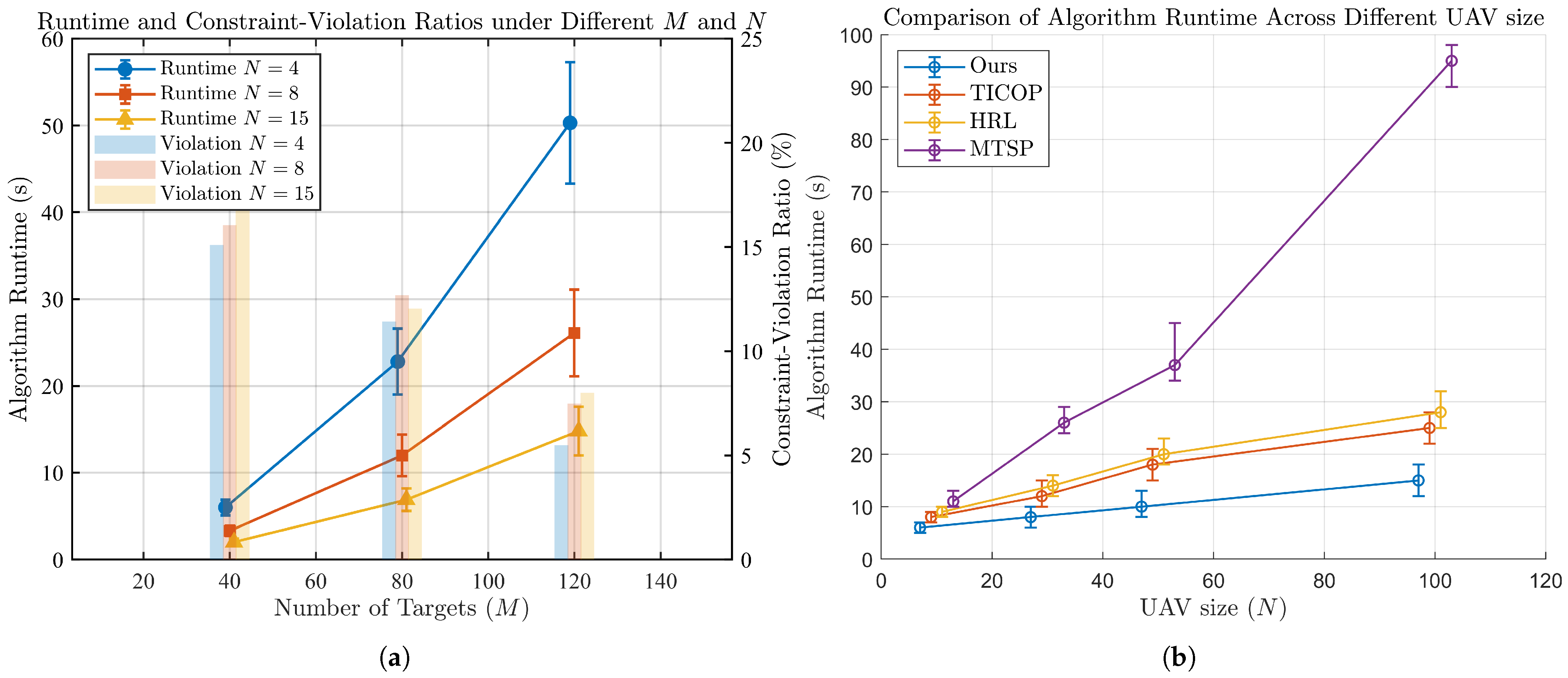
5.1. Time-Balanced Clustering Simulation
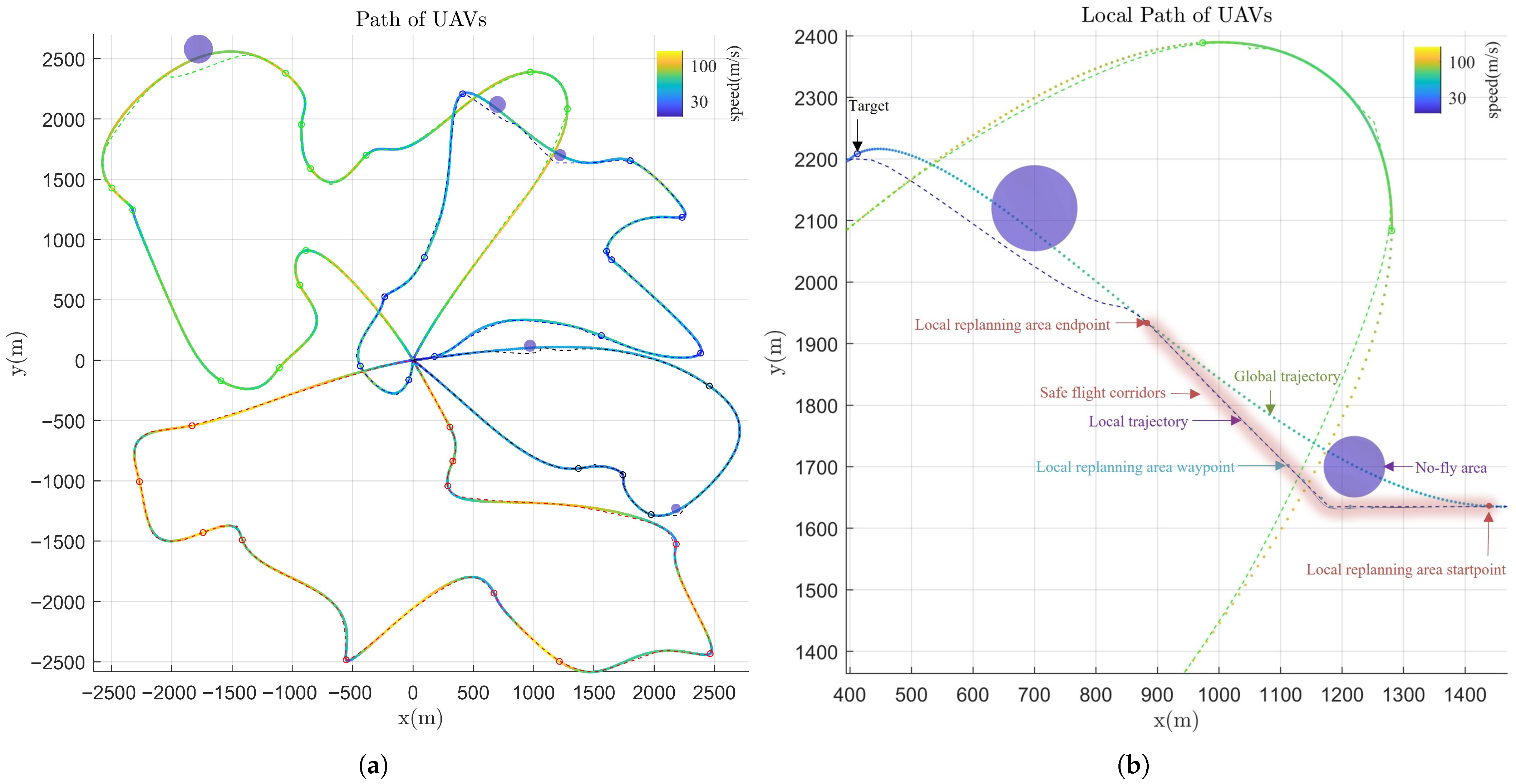
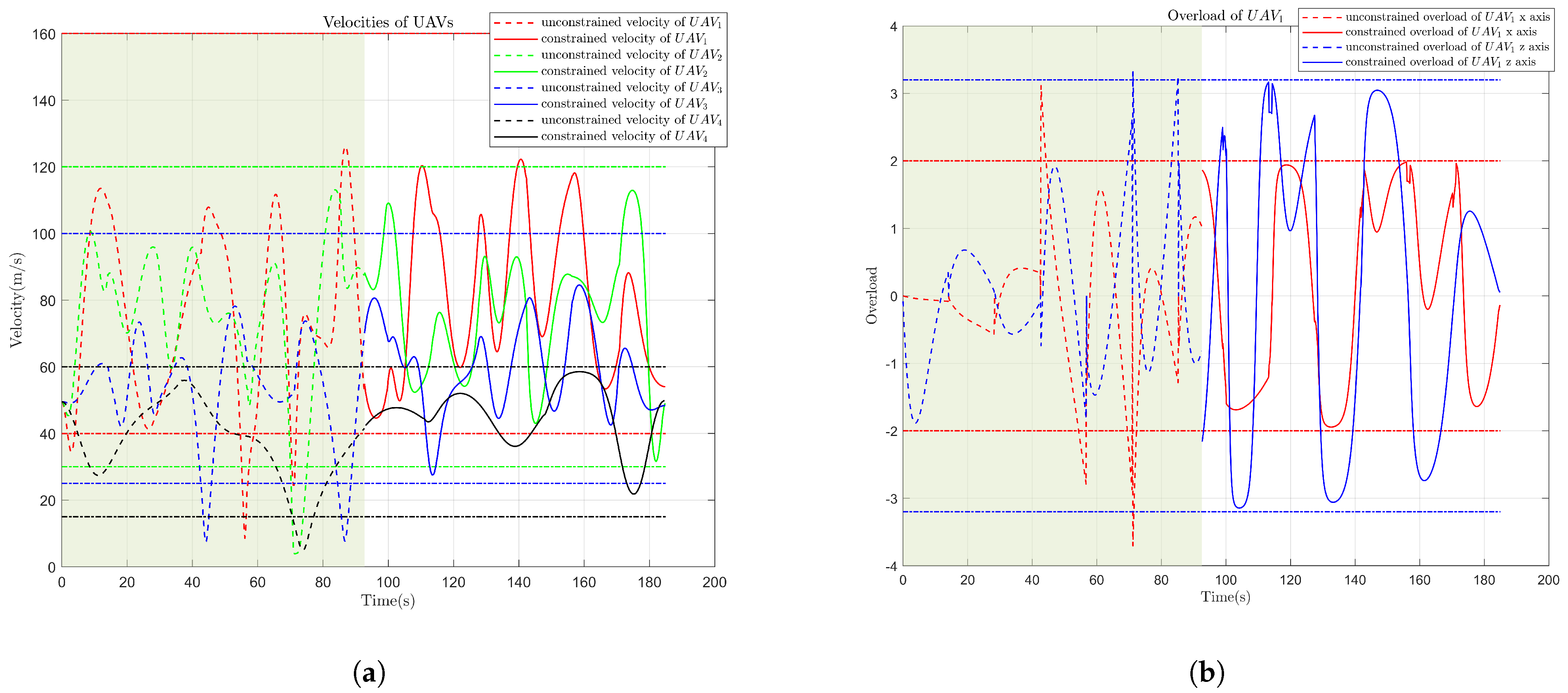
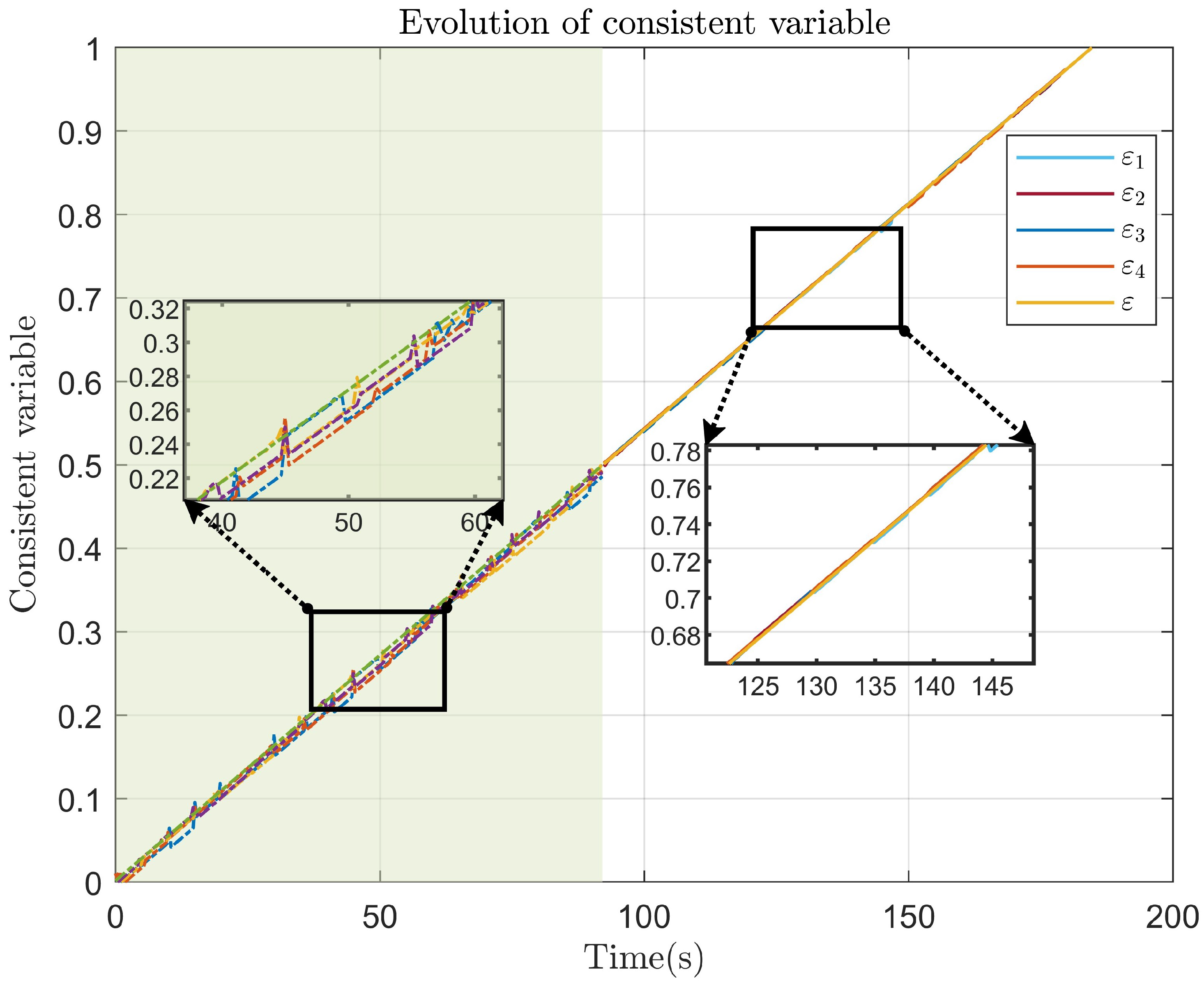
5.2. Flight-Time-Consistent Planning Simulation
6. Conclusions
Author Contributions
Funding
Data Availability Statement
Conflicts of Interest
References
- Lu, Q.; Qiu, Y.; Guan, C.; Wang, H.; Zhu, M.; Xu, B.; Li, W.; Fan, Z. Coordinated multi-UAV reconnaissance scheme for multiple targets. Appl. Sci. 2023, 13, 10920. [Google Scholar] [CrossRef]
- Hu, L.; Xi, B.; Yi, G.; Zhao, H.; Zhong, J. A multiple heterogeneous UAVs reconnaissance mission planning and re-planning algorithm. J. Syst. Eng. Electron. 2022, 33, 1190–1207. [Google Scholar]
- Pang, Q.; Hu, Y.; Li, W.; Zhao, Y.; Zhu, L. Research on multi-UAV cooperative reconnaissance mission planning methods: An overview. Telecommun. Eng. 2019, 59, 741–748. [Google Scholar]
- Mahmud, I.; Cho, Y. Detection avoidance and priority-aware target tracking for UAV group reconnaissance operations. J. Intell. Robot. Syst. 2018, 92, 381–392. [Google Scholar] [CrossRef]
- Jia, G.W.; Wang, J.F. Research review of UAV swarm mission planning method. J. Syst. Eng. Electron. 2021, 43, 99–111. [Google Scholar]
- Xue, W.; Qi, J.; Shao, G.; Xiao, Z.; Zhang, Y.; Zhong, P. Low-rank approximation and multiple sparse constraint modeling for infrared low-flying fixed-wing UAV detection. IEEE J. Sel. Top. Appl. Earth Observ. Remote Sens. 2021, 14, 4150–4166. [Google Scholar] [CrossRef]
- Kovacik, L.; Novak, A.; Kazda, A.; Lusiak, T. Automatic Commercial Aircraft Formation Flight. In Proceedings of the NTAD 2019, Praha, Czech Republic, 19–20 September 2019; IEEE: Piscataway, NJ, USA, 2019; pp. 106–109. [Google Scholar]
- Mosterman, P.J.; Sanabria, D.E.; Bilgin, E.; Zhang, K.; Zander, J. A heterogeneous fleet of vehicles for automated humanitarian missions. Comput. Sci. Eng. 2014, 16, 90–95. [Google Scholar] [CrossRef]
- Bänziger, T.; Kunz, A.; Wegener, K. Optimizing human–robot task allocation using a simulation tool based on standardized work descriptions. J. Intell. Manuf. 2020, 31, 1635–1648. [Google Scholar] [CrossRef]
- Liu, X.-F.; Zhang, J.; Wang, J. Cooperative particle swarm optimization with a bilevel resource allocation mechanism for large-scale dynamic optimization. IEEE Trans. Cybern. 2023, 53, 1000–1011. [Google Scholar] [CrossRef]
- Pendharkar, P.C. An ant colony optimization heuristic for constrained task allocation problem. J. Comput. 2015, 7, 37–47. [Google Scholar] [CrossRef]
- Lu, W.; Liu, H.; Ren, Z.; Gao, Q.; Liu, D.; Wang, X.; Guo, M. Task assignment with minimum cost for multi-UAV system via reinforcement learning. In Proceedings of the 2023 42nd Chinese Control Conference (CCC), Tianjin, China, 24–26 July 2023; IEEE: Piscataway, NJ, USA, 2023; pp. 1654–1658. [Google Scholar]
- Kucera, J.; Novak Sedlackova, A.; Voumik, L.C. Synthetic Data and Image Processing Tools, Immersive 3D and Digital Contact Tracing Technologies, and Cognitive Artificial Intelligence and Spatial Computing Algorithms in the Metaverse Interactive Environment. Rev. Contemp. Philos. 2023, 21, 85–101. [Google Scholar] [CrossRef]
- Patel, R.; Rudnick-Cohen, E.; Azarm, S.; Otte, M.; Xu, H.; Herrmann, J.W. Decentralized task allocation in multi-agent systems using a decentralized genetic algorithm. In Proceedings of the International Conference on Robotics and Automation (ICRA), Paris, France, 31 May–31 August 2020; IEEE: Piscataway, NJ, USA, 2020; pp. 3770–3776. [Google Scholar]
- Choi, H.J.; Kim, Y.D.; Kim, H.J. Genetic algorithm based decentralized task assignment for multiple unmanned aerial vehicles in dynamic environments. Int. J. Aeronaut. Space Sci. 2011, 12, 163–174. [Google Scholar] [CrossRef]
- Geng, N.; Chen, Z.; Nguyen, Q.A.; Gong, D. Particle swarm optimization algorithm for the optimization of rescue task allocation with uncertain time constraints. Complex Intell. Syst. 2021, 7, 873–890. [Google Scholar] [CrossRef]
- Li, S.; He, X.; Xu, X.; Zhao, T.; Song, C.; Li, J. Weapon-target assignment strategy in joint combat decision-making based on multi-head deep reinforcement learning. IEEE Access 2023, 11, 113740–113751. [Google Scholar] [CrossRef]
- Elango, M.; Nachiappan, S.; Tiwari, M.K. Balancing task allocation in multi-robot systems using k-means clustering and auction based mechanisms. Expert Syst. Appl. 2011, 38, 6486–6491. [Google Scholar] [CrossRef]
- Li, X. Dynamic multiobjective optimization for thrust allocation in ship application. Ocean Eng. 2020, 218, 108187. [Google Scholar] [CrossRef]
- Zhu, D.; Zhou, B.; Yang, S.X. A novel algorithm of multi-AUVs task assignment and path planning based on biologically inspired neural network map. IEEE Trans. Intell. Veh. 2021, 6, 333–342. [Google Scholar] [CrossRef]
- Puente-Castro, A.; Rivero, D.; Pazos, A.; Fernandez-Blanco, E. A review of artificial intelligence applied to path planning in UAV swarms. Neural Comput. Appl. 2022, 34, 153–170. [Google Scholar] [CrossRef]
- Li, M.; Zhang, H. AUV 3D path planning based on A* algorithm. In Proceedings of the Chinese Automation Congress (CAC), Shanghai, China, 6–8 November 2020; IEEE: Piscataway, NJ, USA, 2020; pp. 11–16. [Google Scholar]
- Yan, Z.; Pan, X.; Yang, Z.; Yue, L. Formation control of leader-following multi-UUVs with uncertain factors and time-varying delays. IEEE Access 2019, 7, 118792–118805. [Google Scholar] [CrossRef]
- Wang, X.; Liu, H.; Gao, Q. Data-driven decision making and near-optimal path planning for multiagent system in games. IEEE J. Miniaturization Air Space Syst. 2023, 4, 320–328. [Google Scholar] [CrossRef]
- Sujin, B.; Kshirsagar, P.R.; Tak, T.K.; Sonekar, S.V. Enhancing UAV Path Planning in Dynamic Environments with RRT, BFOA, and Generative AI-based Predictive Models. In Proceedings of the 5th International Conference on Pervasive Computing and Social Networking (ICPCSN), Salem, India, 14–16 May 2025; IEEE: Piscataway, NJ, USA, 2025; pp. 752–758. [Google Scholar]
- Luo, Y.; Song, J.; Zhao, K.; Liu, Y. UAV-cooperative penetration dynamic-tracking interceptor method based on DDPG. Appl. Sci. 2022, 12, 1618. [Google Scholar] [CrossRef]
- Liu, Y.; Zhang, X.; Zhang, Y.; Guan, X. Collision free 4D path planning for multiple UAVs based on spatial refined voting mechanism and PSO approach. Chin. J. Aeronaut. 2019, 32, 1504–1519. [Google Scholar] [CrossRef]
- Lu, G.; Cai, Y.; Chen, N.; Kong, F.; Ren, Y.; Zhang, F. Trajectory generation and tracking control for aggressive tail-sitter flights. Int. J. Robot. Res. 2024, 43, 241–280. [Google Scholar] [CrossRef]
- Liu, T.; He, X.; Niu, Y.; Li, J.; Li, Z. TICOP: Time-critical coordinated planning for fixed-wing UAVs in unknown unstructured environments. IEEE Robot. Autom. Lett. 2024, 9, 9629–9636. [Google Scholar] [CrossRef]
- Hauser, J.; Hindman, R. Aggressive flight maneuvers. In Proceedings of the 36th IEEE Conference Decision Control (ICDC), San Diego, CA, USA, 12 December 1997; pp. 4186–4191. [Google Scholar]
- Rudolph, G. Convergence Properties of Evolutionary Algorithms; Verlag Dr. Kovač: Hamburg, Germany, 1997. [Google Scholar]
- Amorim, R.C.; Makarenkov, V. On k-means iterations and Gaussian clusters. Neurocomputing 2023, 553, 126547. [Google Scholar] [CrossRef]
- Hart, P.E.; Nilsson, N.J.; Raphael, B. A formal basis for the heuristic determination of minimum cost paths. IEEE Trans. Syst. Sci. Cybern. 1968, 4, 100–107. [Google Scholar] [CrossRef]
- Elango, P.; Mohan, R. Trajectory optimisation of six degree of freedom aircraft using differential flatness. Aeronaut. J. 2018, 122, 1788–1810. [Google Scholar] [CrossRef]
- Liu, T.; Li, J.; Zou, F.; Wang, B.; Niu, Y. Differential flatness-based trajectory planning and tracking for fixed-wing aircraft in clustered environments. In Proceedings of the 42nd Chinese Control Conference (CCC), Tianjin, China, 24–26 July 2023; IEEE: Piscataway, NJ, USA, 2023; pp. 3627–3631. [Google Scholar]
- Vinayak, A.; Zakaria, M.A.; Baarath, K.; Majeed, A.P.P.A. A novel Bézier curve control point search algorithm for autonomous navigation using N-order polynomial search with boundary conditions. In Proceedings of the IEEE International Intelligent Transportation Systems Conference (ITSC), Indianapolis, IN, USA, 19–22 September 2021; pp. 3884–3889. [Google Scholar]
- Wang, Y.; Li, H.; Shen, Q. A hierarchical multi-task and multi-agent assignment approach: Learning DQN strategy from execution. IEEE Trans. Autom. Sci. Eng. 2025, 22, 14712–14722. [Google Scholar] [CrossRef]
- Sun, G.; Xie, W.; Niyato, D.; Du, H.; Kang, J.; Wu, J.; Sun, S.; Zhang, P. Generative AI for Advanced UAV Networking. IEEE Netw. 2025, 39, 244–253. [Google Scholar] [CrossRef]


| Symbol | Meaning |
|---|---|
| N | Number of UAVs |
| M | Number of reconnaissance targets |
| Q | Number of no-fly zones |
| Set of target positions | |
| A | Target index set |
| Ordered target position set of UAV i | |
| Ordered target index set of UAV i | |
| Set of no-fly zone positions | |
| Number of targets of UAV i | |
| Center of the target cluster of UAV i | |
| Set of optimal cruising speeds for UAVs | |
| Post-optimization trajectory of UAV i | |
| Current position of UAV i | |
| Local replanning region of UAV i | |
| Ordered local target set in the replanning region of UAV i | |
| Number of waypoints in the replanning region of UAV i | |
| Number of Bézier curve segments |
| Simulation Parameter | Value |
|---|---|
| Number of UAVs N | 4 |
| Number of targets M | 40 |
| Number of no-fly zones Q | 8 |
| Optimal cruise speed | m/s |
| Bézier curve degree | 8 |
| Safe radius of UAV | 10 m |
| Radius of static no-fly zones | m |
| Smooth parameters and | |
| A* grid length | 5 m |
| Corridor width | 30 m |
| Detection range | 200 m |
| Forward field of view | |
| Dual feasibility tolerance in MOSEK | |
| Primal feasibility tolerance in MOSEK | |
| Infeasibility tolerance in MOSEK |
Disclaimer/Publisher’s Note: The statements, opinions and data contained in all publications are solely those of the individual author(s) and contributor(s) and not of MDPI and/or the editor(s). MDPI and/or the editor(s) disclaim responsibility for any injury to people or property resulting from any ideas, methods, instructions or products referred to in the content. |
© 2026 by the authors. Licensee MDPI, Basel, Switzerland. This article is an open access article distributed under the terms and conditions of the Creative Commons Attribution (CC BY) license.
Share and Cite
Wang, X.; Zhang, J.; Ma, Z.; Cao, C.; Liu, H. Online Synchronous Coordinated Assignment and Planning for Heterogeneous Fixed-Wing UAVs. Aerospace 2026, 13, 69. https://doi.org/10.3390/aerospace13010069
Wang X, Zhang J, Ma Z, Cao C, Liu H. Online Synchronous Coordinated Assignment and Planning for Heterogeneous Fixed-Wing UAVs. Aerospace. 2026; 13(1):69. https://doi.org/10.3390/aerospace13010069
Chicago/Turabian StyleWang, Xindi, Jiansong Zhang, Zhenyu Ma, Chuanshuo Cao, and Hao Liu. 2026. "Online Synchronous Coordinated Assignment and Planning for Heterogeneous Fixed-Wing UAVs" Aerospace 13, no. 1: 69. https://doi.org/10.3390/aerospace13010069
APA StyleWang, X., Zhang, J., Ma, Z., Cao, C., & Liu, H. (2026). Online Synchronous Coordinated Assignment and Planning for Heterogeneous Fixed-Wing UAVs. Aerospace, 13(1), 69. https://doi.org/10.3390/aerospace13010069