Article

Maintaining an Acceptable Level of Safety Performance at the Airport: Case Study of Split Airport


1
University of Zagreb, Faculty of Transport and Traffic Sciences, 10000 Zagreb, Croatia
2
Split Airport, 21217 Kaštel Štafilić, Croatia
*
Author to whom correspondence should be addressed.
Aerospace 2026, 13(1), 61; https://doi.org/10.3390/aerospace13010061
Submission received: 13 November 2025 / Revised: 10 December 2025 / Accepted: 5 January 2026 / Published: 7 January 2026
(This article belongs to the Collection Air Transportation—Operations and Management)

Abstract

This research investigates the process of determining and maintaining the Acceptable Level of Safety Performance (ALoSP) at an airport, utilizing a case study conducted at Split Airport. The study illustrates how the ALoSP framework, originally developed for State-level application under ICAO Annex 19, can be systematically adapted and implemented at the organizational level within the Safety Management System (SMS) of an aviation service provider. The aim of the study is to systematically demonstrate the process by which an airport defines, monitors, and maintains its ALoSP through the application of Safety Performance Indicators (SPIs), Safety Performance Targets (SPTs), and alert thresholds within the framework of Safety Performance Management (SPM). Main results show that Split Airport consistently maintained its safety performance at an acceptable level throughout a ten-year monitoring period (2015–2024), with a small number of deviations observed in certain safety performance indicators. The findings highlight the airport’s robust safety culture, strong data-driven monitoring, and proactive use of both leading and lagging SPIs to anticipate and prevent safety issues. The study confirms that the ALoSP framework can successfully support continuous safety improvement and regulatory compliance at the organizational level, offering a practical example for other aviation service providers.

1. Introduction

A Safety Management System (SMS) in aviation is a systematic method for overseeing safety that integrates key organizational structures, responsibilities, policies, and procedures [1]. Its main objective is to maintain the safe operation of aircraft through effective safety risk management. SMS functions as a continuous improvement framework focused on identifying hazards, collecting and analyzing safety data, and consistently assessing risk levels [2,3,4]. The ultimate goal is to proactively detect and reduce potential risks before they lead to accidents or incidents.
An effective SMS should be aligned with the organization’s regulatory standards and safety objectives [5,6,7]. It includes essential elements that facilitate hazard identification and risk management, ensuring that the necessary tools and information are accessible for operational purposes. These tools should be appropriately tailored to the organization’s specific activities and scaled to match its operational size and constraints, thereby supporting well-informed safety decisions [8,9].
The International Civil Aviation Organization (ICAO) provides the regulatory basis for aviation safety management systems (SMSs) through its Standards and Recommended Practices (SARPs). These are specifically presented in ICAO Annex 19—Safety Management and further elaborated in the ICAO Doc 9859—Safety Management Manual (SMM) [1,10]. Organizations are required to ensure that their SMS conform to these fundamental regulations, as well as any supplementary standards applicable to their specific operations. For example, airports must comply not only with ICAO Annex 19 and ICAO SMM but also with the requirements outlined in ICAO Annex 14—Aerodromes [11].
The ICAO SMS framework defines four core components and twelve key elements that represent the fundamental requirements for developing an effective and operational SMS [10,12].
The safety policy establishes the fundamental principles, strategies, and procedures that direct an organization’s SMS toward achieving its safety objectives. It reflects senior management’s commitment to integrating and continually improving safety throughout all areas of the organization [13]. Building on this policy, the organization must set clear safety objectives that provide a basis for monitoring and assessing safety performance.
To achieve safety objectives, operators are required to manage the safety risks linked to their operations. This is accomplished through Safety Risk Management (SRM), a process that entails identifying hazards, evaluating the related risks, and implementing appropriate mitigation strategies [10,14].
The Safety Assurance (SA) component is centered on evaluating the effectiveness of safety risk controls. Operators are required to implement systems that continuously track safety performance and measure how well the established controls function [4,15,16]. Safety performance should be assessed against the predefined indicators and targets of the SMS to confirm that the organization’s safety objectives are being achieved [17].
Safety promotion plays a vital role in fostering a strong safety culture and advancing the organization’s safety objectives [10,18]. A positive safety culture is demonstrated through the collective values, attitudes, and behaviors of personnel toward safety. This culture can be enhanced through continuous training, the development of technical competencies, and the encouragement of open communication and exchange of safety-related information.
Safety Performance Management (SPM) is essential for evaluating and controlling an organization’s overall safety performance. It helps organizations address critical questions: what are the most significant safety risks, which safety objectives must be met, which risks should be prioritized, how to track progress toward achieving objectives, and what safety data and information are needed for decision-making [19,20,21,22,23]. When effectively implemented, SPM enables an organization to determine whether its operations and processes align with and support its safety objectives. This is achieved mainly through the establishment of Safety Performance Indicators (SPIs), which serve as measurable metrics for tracking safety performance [10]. The overall SPM framework integrates elements of safety assurance, data from Safety Data Collection and Processing Systems (SDCPS), safety analysis methods, and safety promotion initiatives.
A key aspect of an effective airport SMS is the continuous monitoring of SPIs, along with corresponding Safety Performance Targets (SPTs) and alert levels, which collectively help determine whether the operator’s safety objectives are being achieved.
As per ICAO SMM, Acceptable Level of Safety Performance (ALoSP) represents “the minimum level of safety performance of civil aviation in a State, as defined in its State Safety Program, or of a service provider, as defined in its Safety Management System, expressed in terms of Safety Performance Targets and Safety Performance Indicators” [10].
ALoSP does not represent a single numerical value but rather a collection of performance targets and indicators that define what is deemed “acceptable” for an aviation system, taking into account its specific context such as size, complexity, available resources, and operating environment [24,25,26].
ALoSP represents a balance between assessing the absence of negative outcomes (such as accidents or serious incidents) and the presence of safety-supporting mechanisms (such as reporting systems, safety culture, and training). It is closely linked to the implementation of a State Safety Program (SSP) and service providers’ SMSs, where achieving ALoSP indicates that the system is not only compliant but operates at an acceptable level of safety performance [27]. Establishing realistic SPIs and SPTs requires sufficient safety data, analytical tools, and modeling resources (e.g., historical records and occurrence databases) [28,29]. However, the limited availability of such data poses a significant challenge in determining ALoSP.
Key steps in determining ALoSP include understanding the operational system and context, selecting relevant SPIs and SPTs, setting-up alert or trigger thresholds, collecting and using available data, comparing actual performance against targeted one, reviewing and adjusting as necessary.
The concept of ALoSP was originally developed and implemented at the state level, as an integral part of the SSP, in accordance with ICAO Annex 19 and ICAO SMM [1,10]. At this level, the ALoSP represents a reference framework by which a State defines the minimum acceptable level of safety performance in civil aviation, expressed through SPIs and SPTs. In this way, the State establishes the boundary between “acceptable” and “unacceptable” risk, taking into account the complexity of the national system, traffic flows, infrastructure and organizational capacities, and regulatory requirements [10].
However, although the ALoSP is primarily intended for national aviation authorities, in practice the concept is increasingly being transferred to the level of aviation service providers—for example, airports, airline operators, air navigation service providers and aircraft maintenance organizations—who integrate it within their own SMS. This application arises from the need to systematically monitor safety performance within individual organizations, and not only at the State level [22,30,31,32,33,34].
Service providers should define their own safety performance that is consistent with the national ALoSP, in order to ensure vertical alignment between the SSP and the SMS [10]. In other words, the organizational ALoSP represents an operational translation of the State concept—a set of internal indicators, targets and thresholds that reflect how effectively safety is managed in the specific operational context of the provider concerned.
In such cases, the ALoSP within SMS allows the organization to measure its own safety performance against set targets, identify deviations from acceptable limits, proactively manage risks within the operational environment, and demonstrate compliance with State safety expectations to regulatory authorities.
Examples of such practices can be found in some airports [35,36] and air navigation service providers [36,37], where locally defined ALoSP frameworks are a key tool for managing and monitoring the effectiveness of safety measures.
Recent regulatory developments place increasing emphasis on aviation safety performance, particularly through ICAO’s Global Aviation Safety Plan (GASP) [38,39] and Global Aviation Safety Roadmap [40], and through the European Union Aviation Safety Agency (EASA) documents such as the EASA European Plan for Aviation Safety and the EASA Acceptable Level of Safety Performance (ALoSP) [37,41], which highlight the obligation of service providers to develop measurable, data-driven SPIs and align them with national safety objectives. The role of predictive analytics, risk-based decision-making, and harmonized performance frameworks across aviation organizations, represent a shift from compliance-based oversight to continuous monitoring and performance improvement. These principles directly support the organizational application of ALoSP explored in this study.
Research on organizational-level performance management further reinforces the need for robust SPI frameworks. Numerous studies have demonstrated how safety culture, training systems, and internal reporting mechanisms influence safety performance outcomes [27,42,43,44,45]. For example, some studies examine how organizations optimize safety performance through integrated risk management processes, while some discuss the interaction between performance indicators and organizational safety culture [46]. Such research shows that SPIs not only measure outcomes but also reflect internal maturity and managerial capability.
Empirical comparisons of airport safety performance indicators have emerged in recent years. Some studies evaluate airport incident patterns and SPI-based monitoring, showing how traffic volume, infrastructure complexity, and reporting culture affect SPI outcomes [47]. These studies outline the importance of contextualizing SPI data through operational interpretations of deviations and alert-level analyses.
This paper presents how airport manages their safety performance, with a detailed description of each step of determining and maintaining ALoSP, following the ICAO prescribed methodology and organizational SPM framework. This includes monitoring the safety performance indicators, defining target values, calculating and setting-up alert thresholds for unacceptable performance, and finally comparing achieved level of safety performance against targeted level of performance, i.e., determining airport’s ALoSP. In order to show how organizational ALoSP is determined and maintained, a case study was conducted at Split Airport.

2. Data Collection and Methodology

This chapter describes collected data and methods used to conduct the analysis of airport’s safety performance and its process of maintaining an acceptable level of safety performance.

2.1. Data Collection

This paper analyzes the safety performance of an airport—specifically, how it establishes, achieves, and maintains an acceptable level of safety performance. To carry out this analysis, data on the airport’s safety performance were required. Such data were collected from the case-study airport, i.e., Split Airport, to evaluate its safety performance, calculate the achieved safety levels, and assess whether it meets acceptable standards.
Split Airport, also called Saint Jerome Airport, is one of nine airports in Croatia, situated in the Resnik area west of Kaštel Štafilić, approximately 25 km from Split. Its primary operations involve passenger, cargo, and aircraft handling for both domestic and international air traffic. Key components of the airport’s infrastructure include maneuvering areas such as the runway (05/23) and apron, as well as the passenger and cargo terminals, control tower, access roads, parking areas for buses and cars, and various service and commercial facilities [13,48].
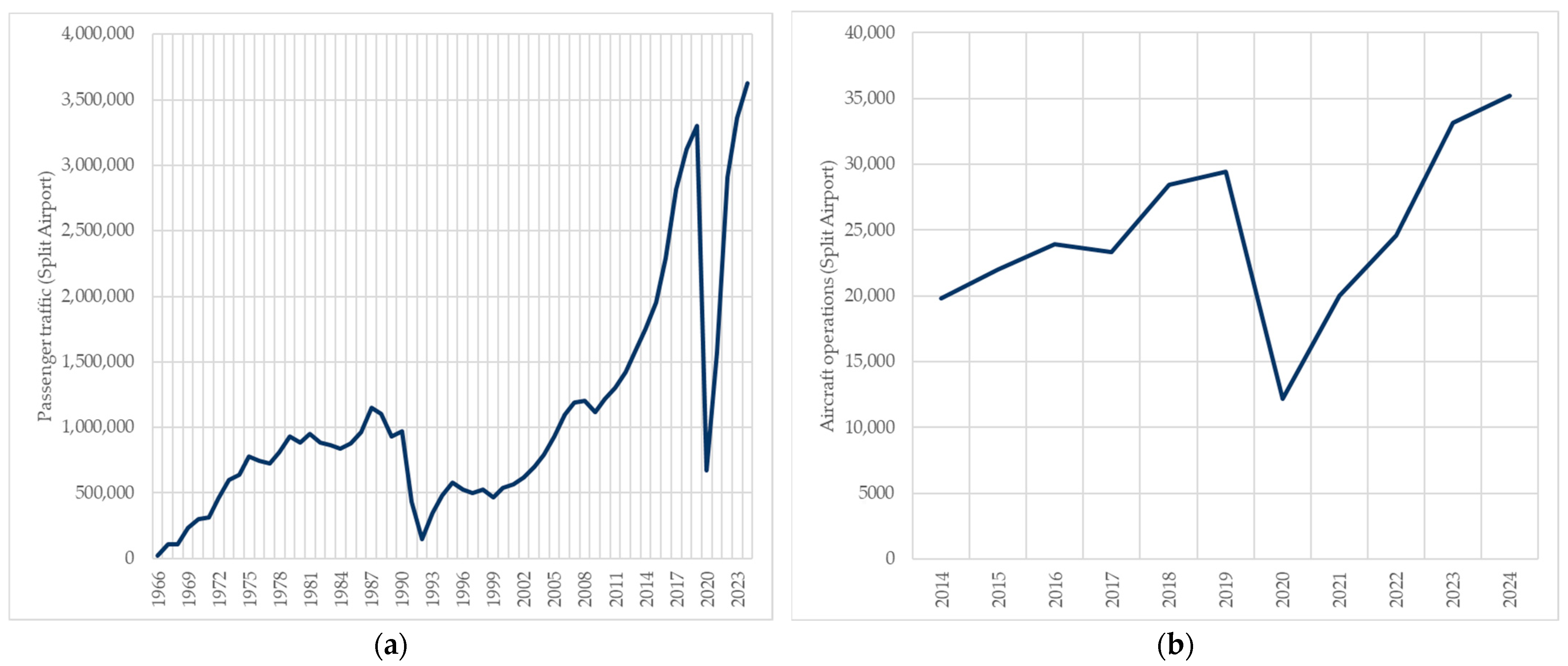
Split Airport began operations on 15 November 1966. Passenger traffic increased steadily each year until 1988, when growth halted as a result of the economic crisis. The airport was closed in September 1991 due to the war but reopened in April 1992 [48].
In 2019, Split Airport became Croatia’s second busiest airport after Zagreb Airport, serving 3.3 million passengers. To accommodate rising traffic, especially in summer, a major expansion completed that year tripled the terminal’s size and increased capacity to 5 million passengers annually. The original terminal was renovated for some international departures, while the new facilities handle check-in, arrivals, and domestic flights. The project also included a covered bridge over state road D409, connecting the terminal to new parking, bus, and rental car areas [13,48].
In 2020, Split Airport experienced a major 79% decline in traffic due to strict pandemic restrictions. Passenger numbers began to recover gradually (Figure 1), reaching 50% of 2019 levels by 2021. That year, Split Airport became the busiest airport in Croatia for the first time, handling 1.6 million passengers and surpassing Zagreb Airport. Recovery continued, with 2.9 million passengers in 2022, 3.4 million in 2023, 3.6 million passengers recorded in 2024, and 3.7 million in 2025 (recorded by October 2025) [49,50].
Split Airport upholds high safety standards and is committed to continuously enhance its safety management system. The airport applies both reactive and proactive approaches to collect and analyze safety data. Safety management is supported by advanced software, Galiot Aero SMS [50,51], which enables robust and effective proactive safety management.
This analysis utilized a dataset containing actual safety performance indicators from Split Airport. As part of its safety assurance framework, the airport has defined a comprehensive set of safety performance indicators (SPIs) along with corresponding safety performance targets (SPTs). These indicators are monitored monthly to track safety performance [50]. The list of SPIs and SPTs of the Split Airport SMS are presented in the following Table 1.

2.2. Methodology

A key element of SPM is the establishment of SPIs, which assess how effectively an organization manages safety. SPIs are tailored to each organization’s specific operations and needs, helping management evaluate progress toward safety objectives [10,52,53]. These indicators may include data on accidents, incidents, non-conformities, and related occurrences.
SPIs can be either quantitative (numerical) or qualitative (descriptive or subjective). They are also categorized as leading or lagging indicators [26,54,55,56,57,58]. Leading SPIs, also known as process or active indicators, monitor actions and processes designed to prevent incidents, reflecting a proactive approach to safety and supporting adaptation to operational changes. Lagging SPIs, or outcome-based indicators, measure past events such as accidents and incidents, and are used to evaluate an organization’s overall safety performance.
Each SPI should clearly define what it measures, its goal, calculation method, responsible personnel, data sources, and the frequency of reporting and analysis. Two thresholds are established for every SPI: a safety performance target (SPT), which represents the desired performance level, and an alert or trigger level (three versions), which indicates when the SPI values exceed desired limits [10].
Determining target and alert levels involves calculating the mean (average) and standard deviation of SPI values over a defined period, typically one year, during which the indicators are tracked and recorded monthly [10,24].
Formula (1) is applied to determine the mean (average) of the observed SPI values, where μ(SPI) represents the average SPI value, SPIi denotes individual observed SPI values, and n is the total number of observations in the dataset:
μ S P I = i = 1 n S P I i n .
The following formula illustrates how to calculate the standard deviation for the observed set of SPI values:
σ S P I = i = 1 n ( S P I i μ ( S P I ) ) 2 n ,
where σ(SPI) represents the standard deviation of the observed SPI values.
The target level, or SPT, is determined to be equal to or lower than the mean (average) of the observed SPI values, as shown in the following formula:
T a r g e t μ S P I ,
where μ(SPI) represents the mean (average) value of the observed SPI values.
Besides being determined as equal or lower than the mean (average) of the observed SPI values, SPTs may be set as a fixed target set by an operator, regardless of μ(SPI), which allows aviation service providers to set SPT based on operational characteristics or strategic priorities, i.e., if mean-based approach is not appropriate [10].
Alert settings function as statistical warnings to detect unusual trends in SPI data. Three alarm levels are activated depending on how many consecutive values exceed the defined thresholds, indicating possible issues that may require mitigative or corrective action. The first alarm is triggered after three or more consecutive exceedances, the second after two or more, and the third after one or more.
The values for the three alarm levels are determined using the following formulas:
A l e r t 1 = μ S P I + σ ( S P I ) ,
A l e r t 2 = μ S P I + 2 σ ( S P I ) ,
A l e r t 3 = μ S P I + 3 σ ( S P I )
where μ(SPI) represents the mean (average) value and σ(SPI) represents the standard deviation value of the observed SPI values.
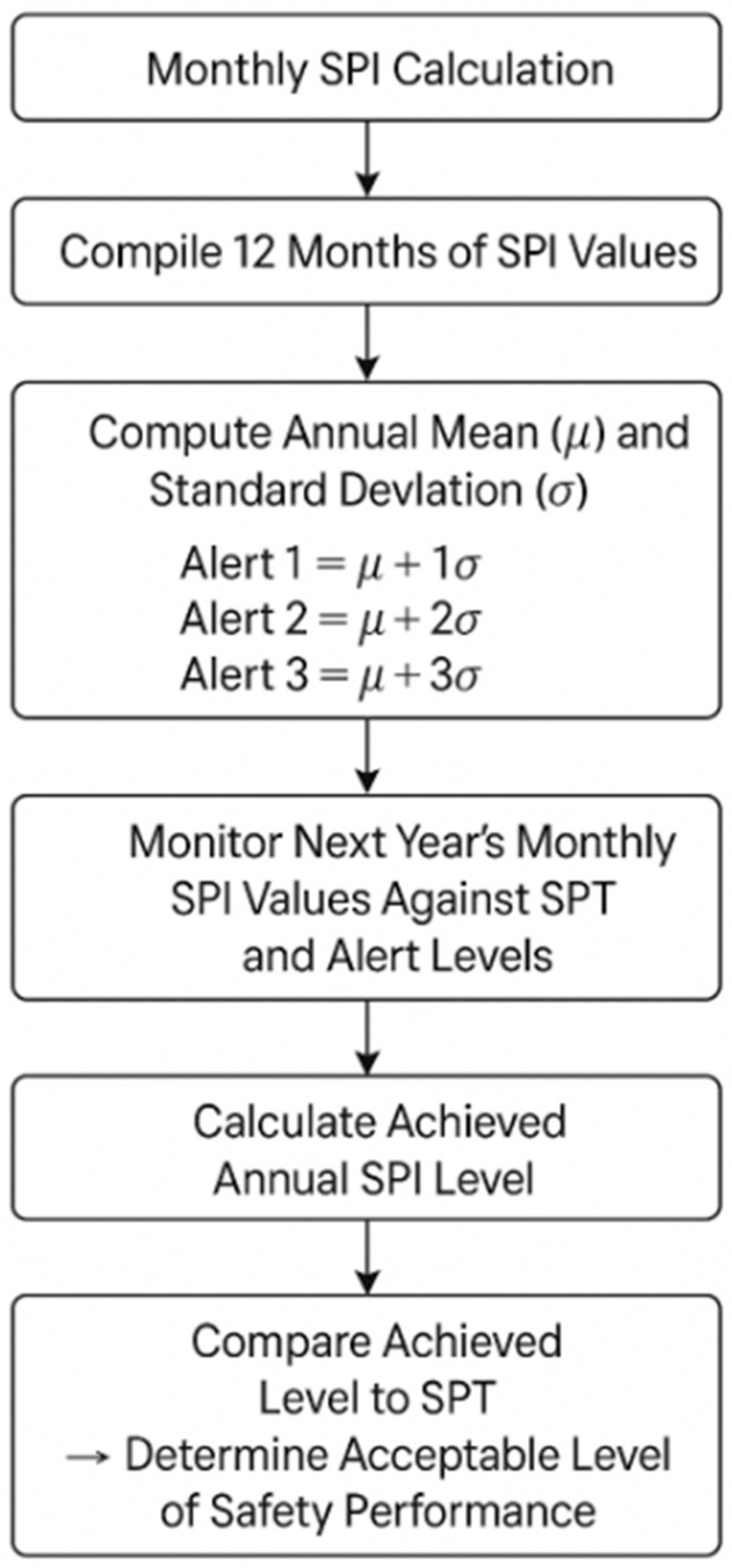
The relationship between monthly SPI calculations, annual mean values, alert levels, and the determination of ALoSP follows a linear and sequential structure. First, each SPI is calculated monthly by dividing the number of safety-related events by the number of aircraft operations for that month. These monthly ratios form a 12-month dataset from which an annual mean and standard deviation are derived, representing the baseline safety performance for that indicator. Using these two statistics, three alert levels are generated to signal abnormal deviations. During the subsequent year, actual monthly SPI values are compared continuously against both the annual mean (or set SPT) and alert thresholds. SPTs may be set as a fixed target set by an operator, or as the mean (average) value of the observed SPI values (from the preceding period). At the end of the monitoring cycle, the achieved level of safety performance is assessed by comparing the annual SPI mean with the predefined SPT. If the achieved annual SPI does not exceed the SPT and no alert-level breaches occur, the SPI is considered to have achieved its acceptable level of safety performance, contributing to the airport’s overall safety performance.
Figure 2 shows a flowchart of relationship among monthly SPI calculations, annual mean values, alert levels, and the determination of ALoSP.
The safety performance of each SPI is assessed at the end of every monitoring cycle (typically a twelve-month period) based on two criteria: whether the target was met and whether any alerts were triggered.
Using this information, the organization can maintain and continuously enhance its safety performance to an acceptable level.

3. Determining an Acceptable Level of Safety Performance at the Airport: Case Study of Split Airport

As part of its safety performance management, Split Airport has established a comprehensive set of SPIs and corresponding SPTs, which are monitored on a monthly basis [50]. Sample of data on SPI-8 Passenger handling at the gate and its related SPTs, from January 2014 to December 2024, is presented in Table 2. All monthly data of all 25 SPIs in the form of recorded events and calculated SPI values (expressed in events per operations), covering the period from January 2014 to December 2024, are shown in Appendix A.
Table 3 shows the calculation (as per formulas in Section 2.2) of achieved level of safety performance of SPI-8 Passenger handling at the gate at Split Airport in 2018 with number of recorded events, number of operations, calculated values of SPI-8 in each month in the preceding 1-year period (expressed in events per operations), i.e., in 2017, mean of the SPI (based on preceding 1-year period, i.e., 2017), Alert 1, 2 and 3 (based on preceding 1-year period, i.e., 2017), calculated values of SPI-8 in each month in 2018 (expressed in events per operations), and mean of SPI in 2018, i.e., achieved level of safety performance in 2018.
Calculations of achieved levels of safety performance for SPI-8 Passenger handling at the gate, at Split Airport, for the period 2015–2024, are presented in Table 4. The three alert levels are also calculated for each year, according to the formulas outlined in Section 2.2. Analogously, the calculations of achieved levels of safety performance with accompanying three alert levels for all other SPIs monitored at Split Airport, for the period 2015–2024, are presented in Appendix A.
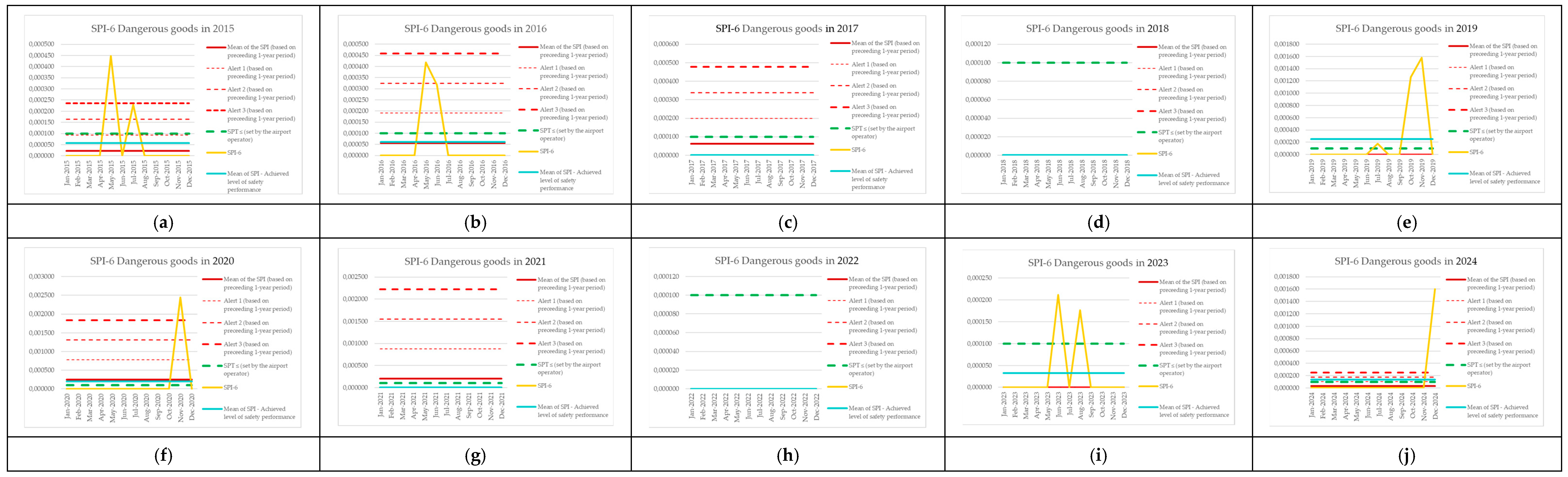
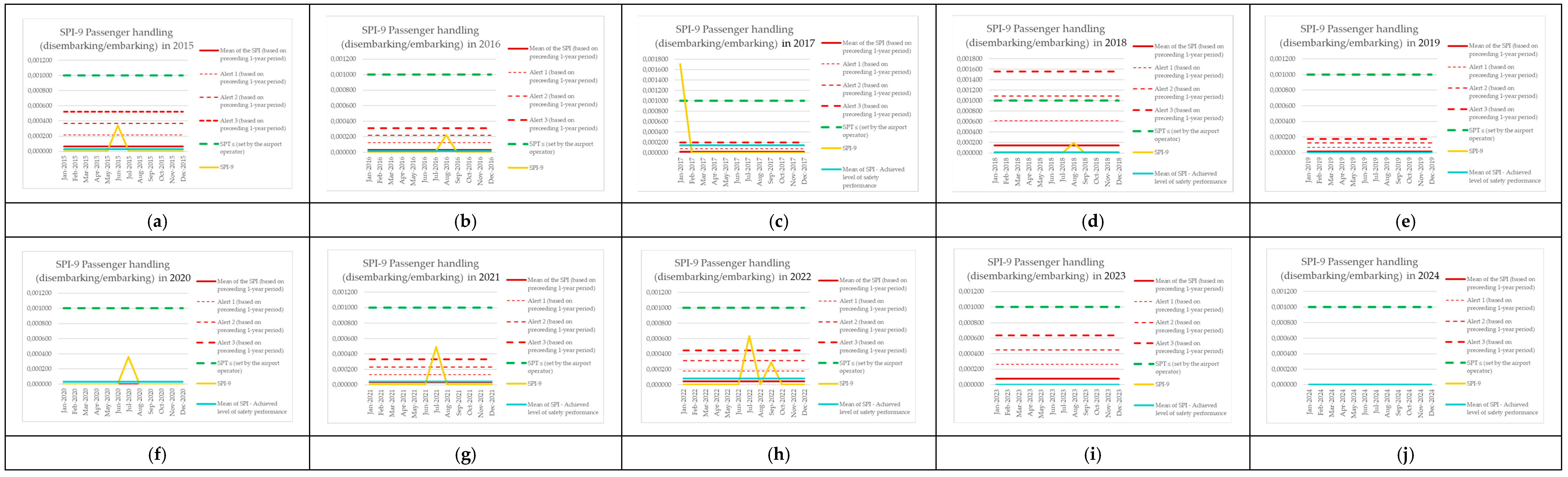
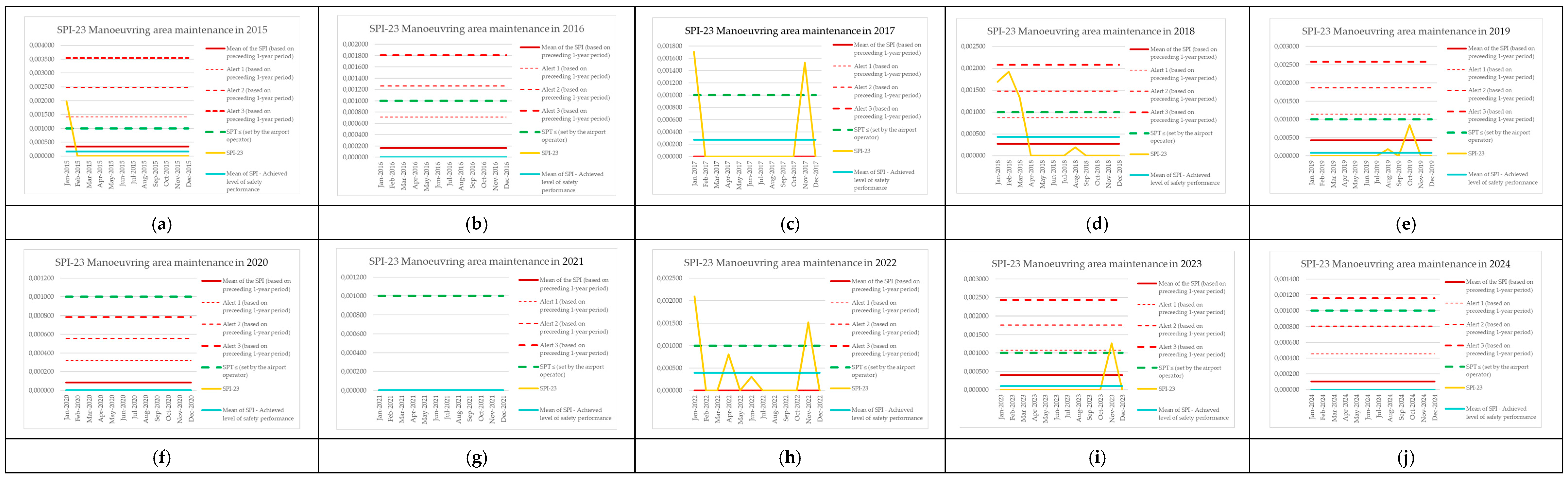
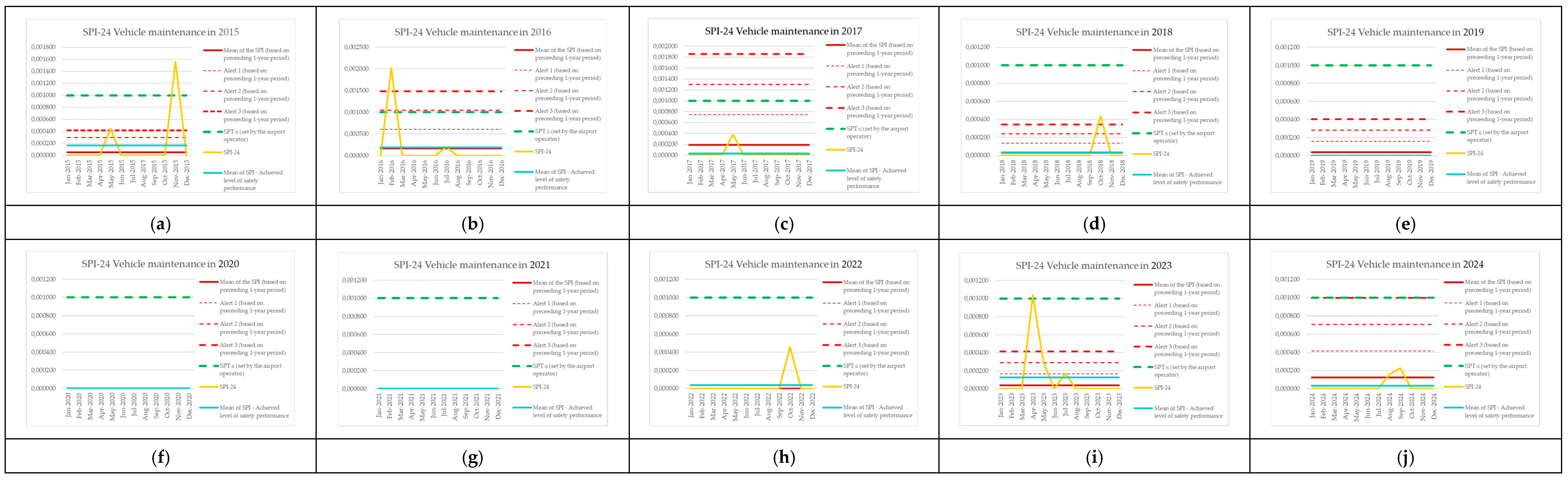
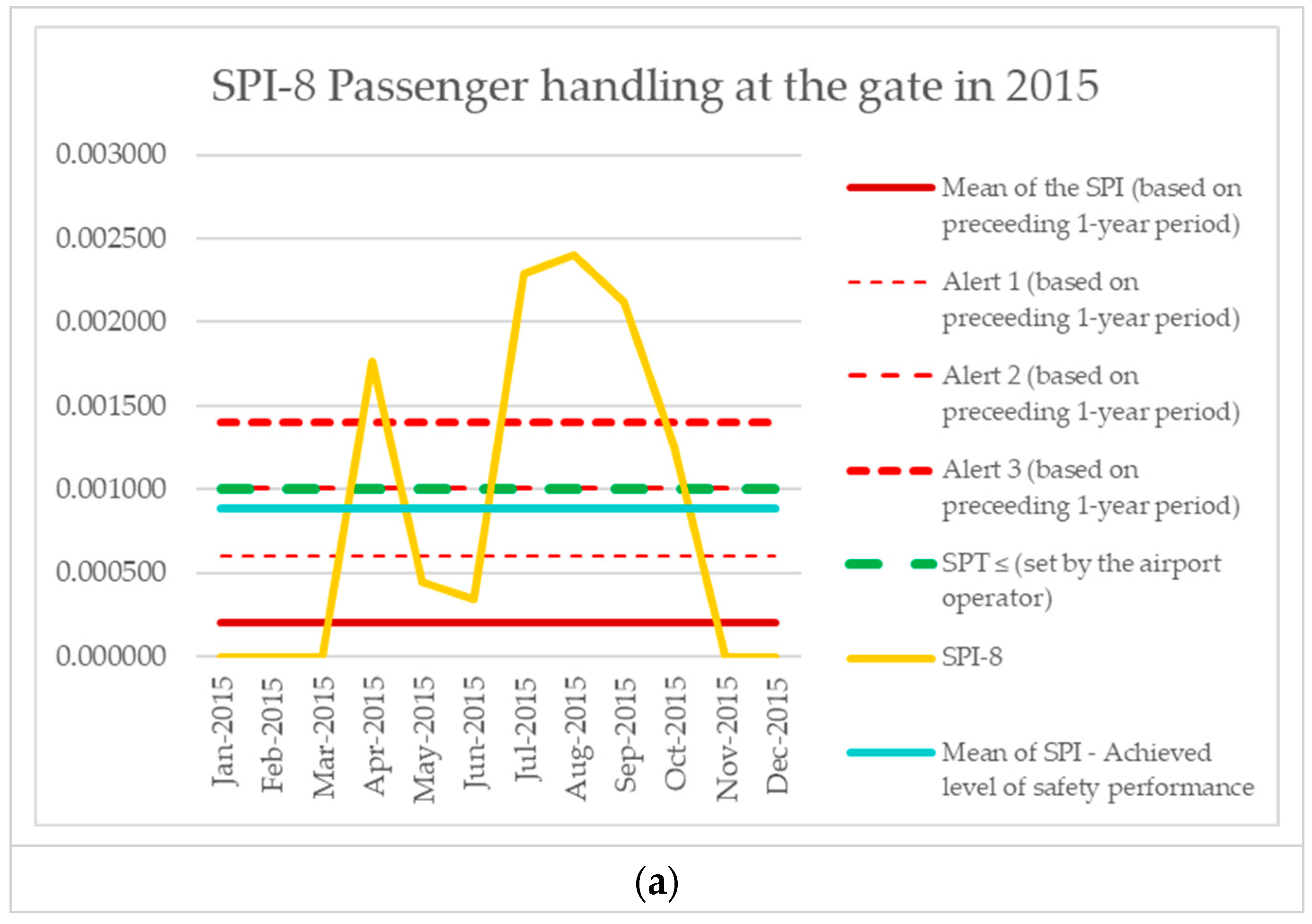
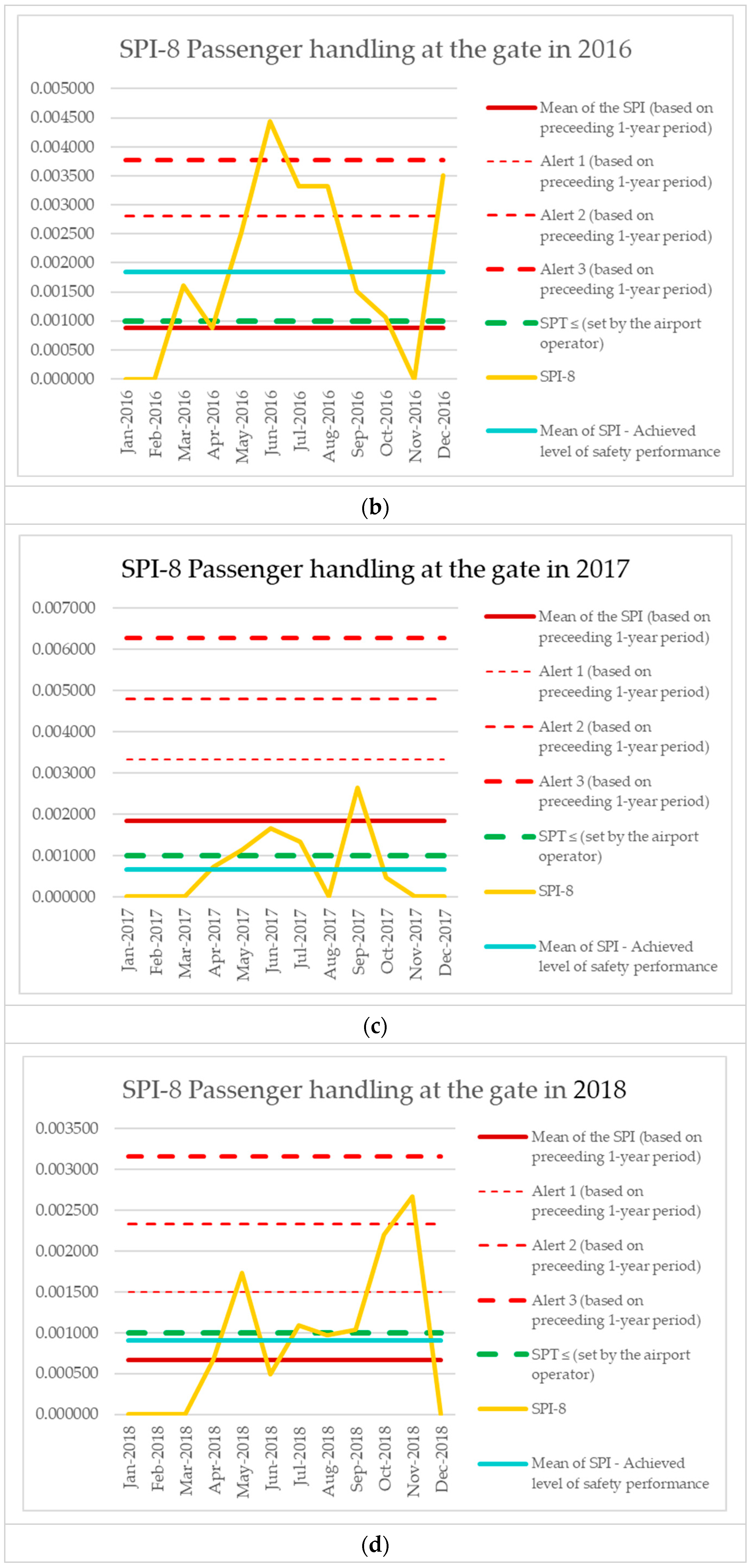
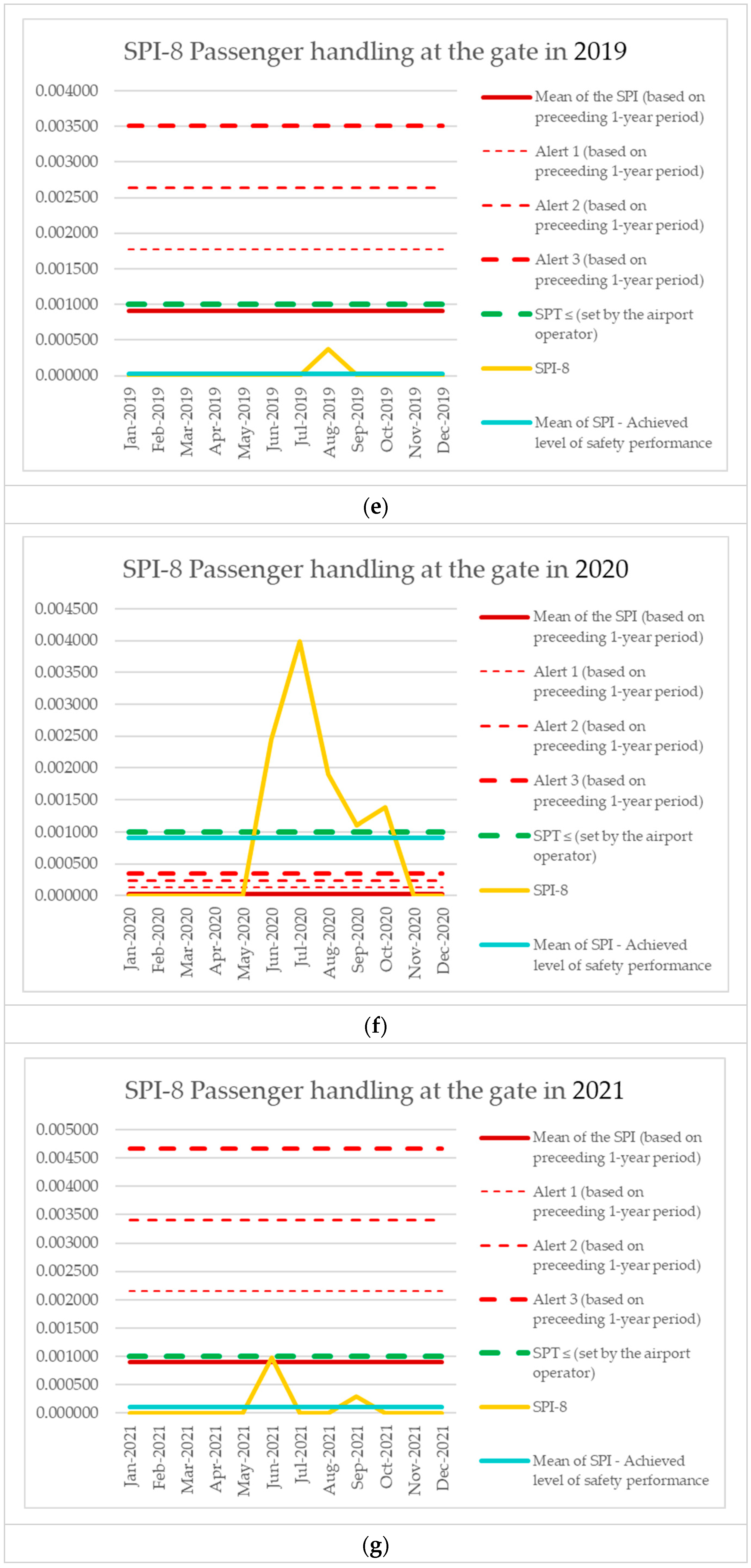
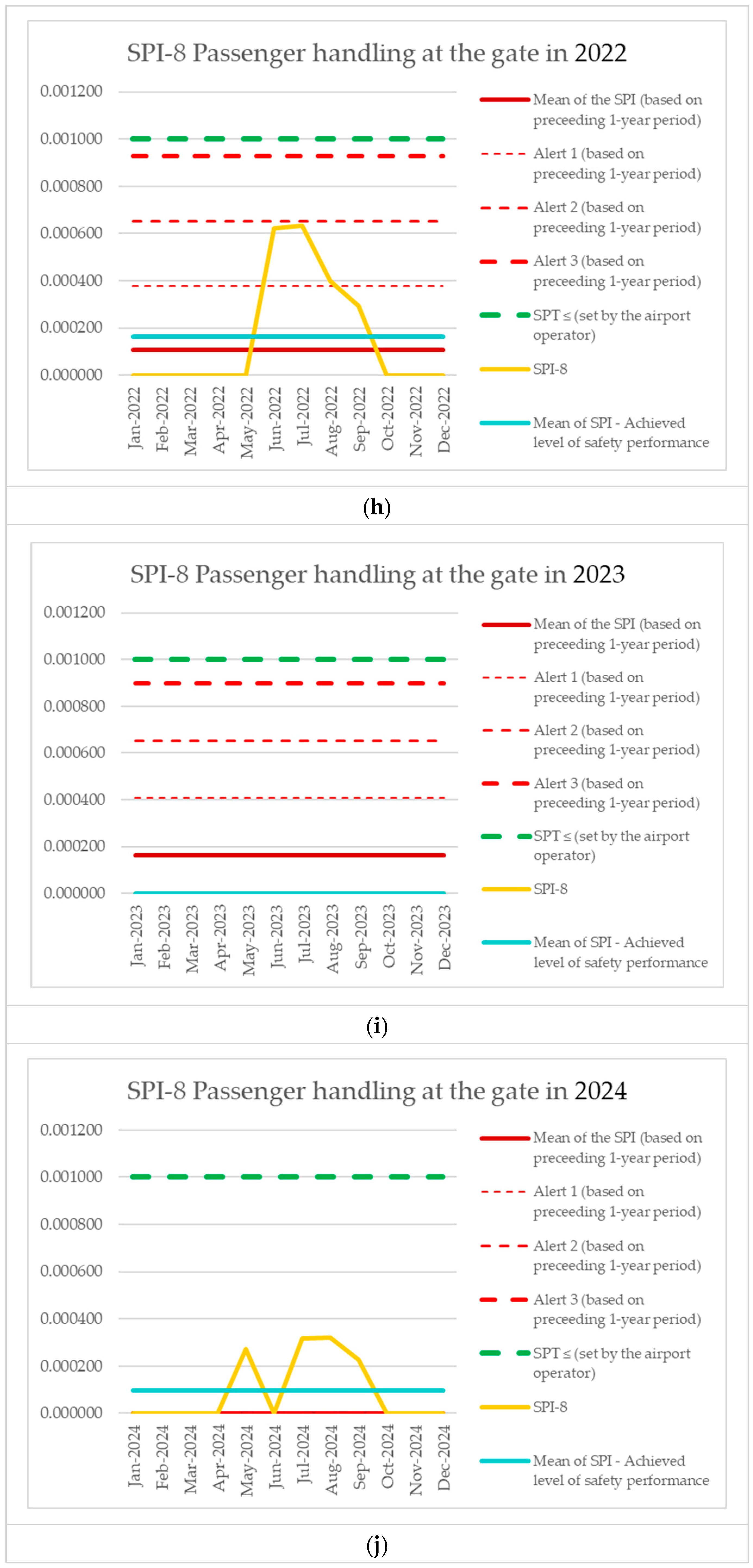
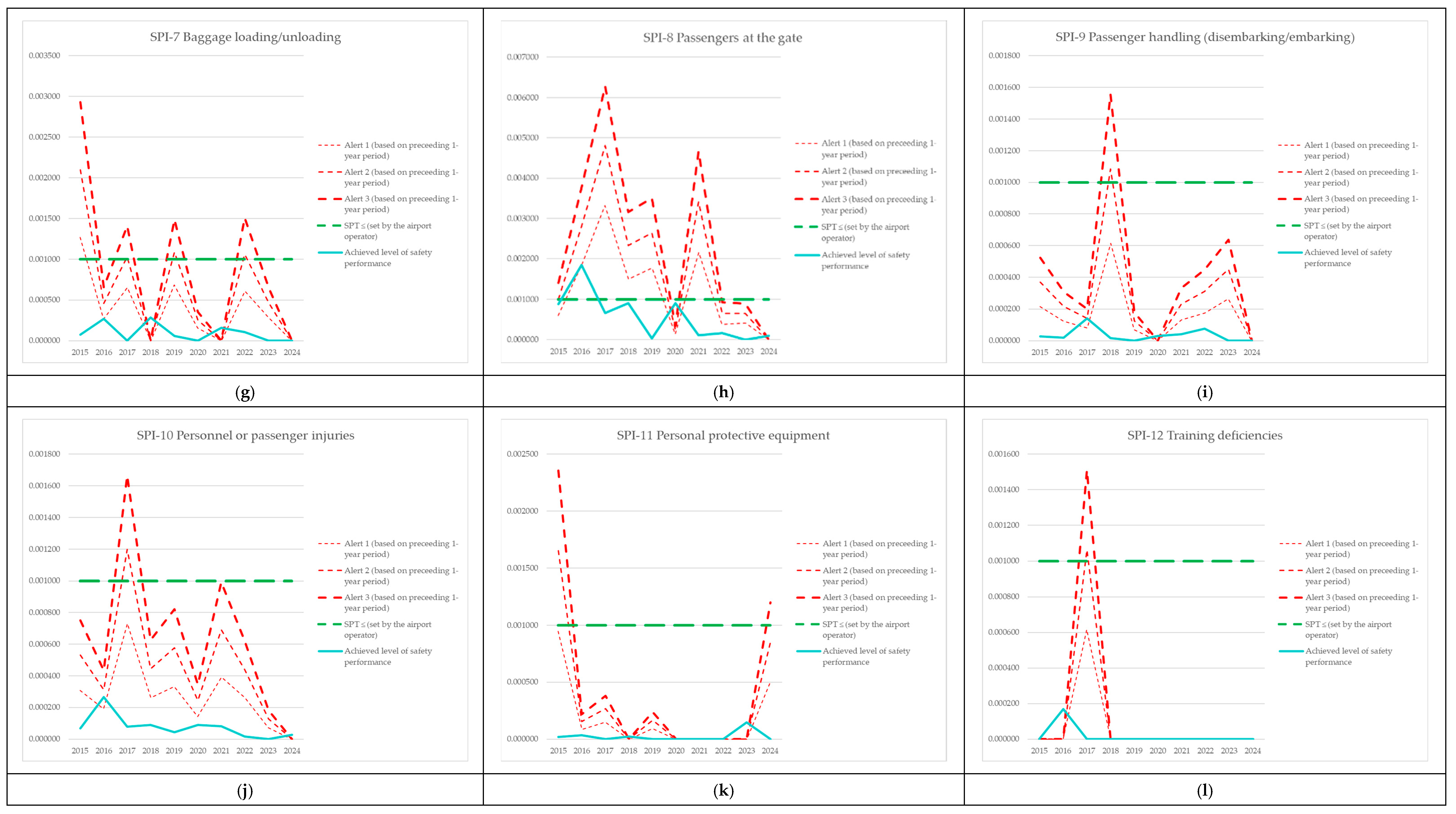
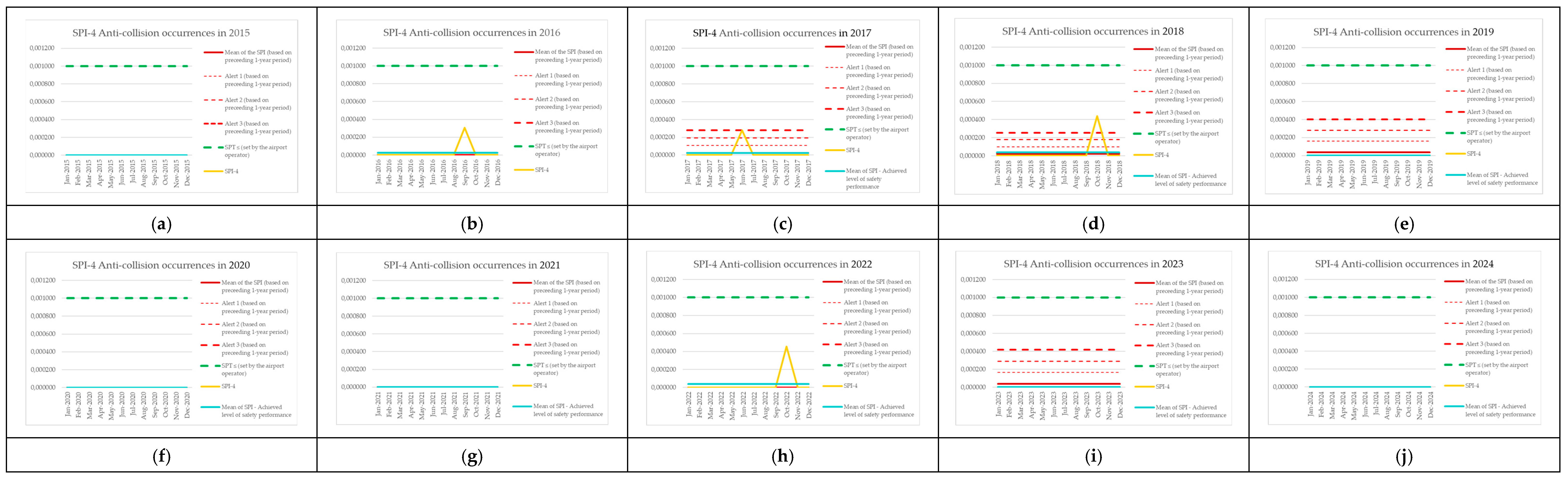
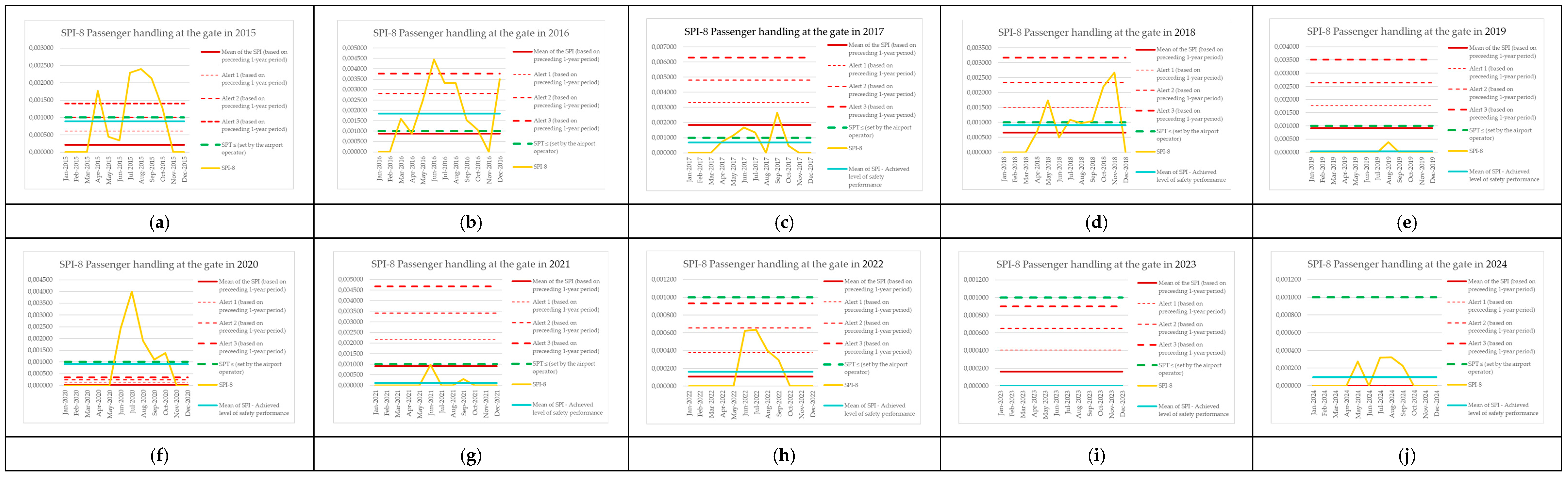
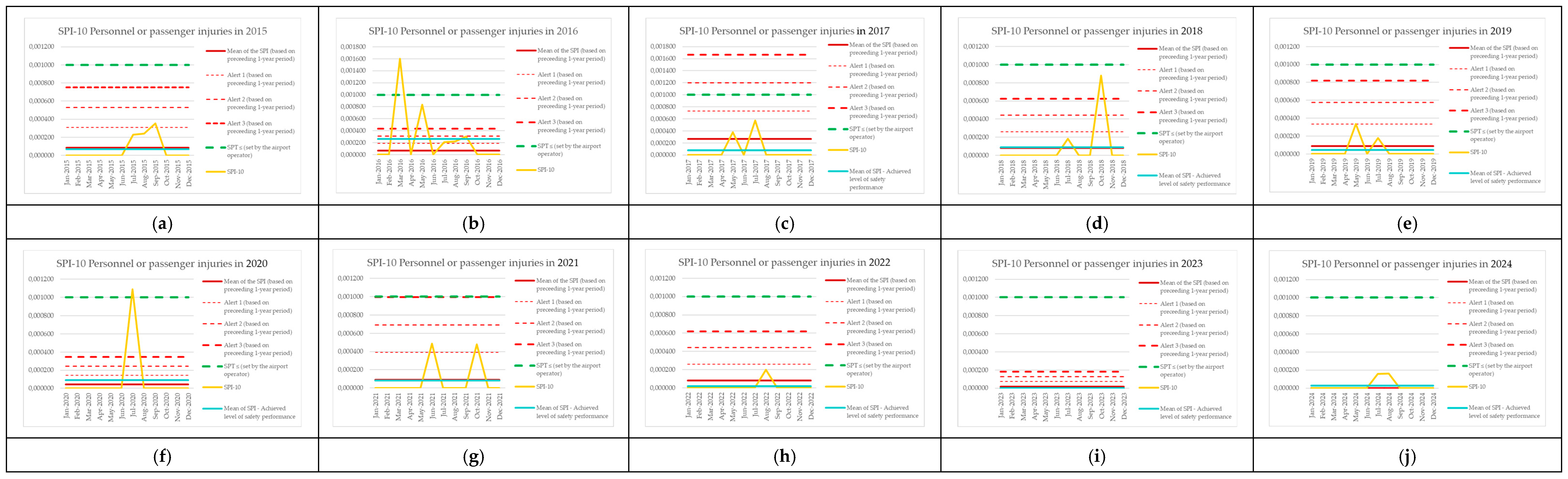
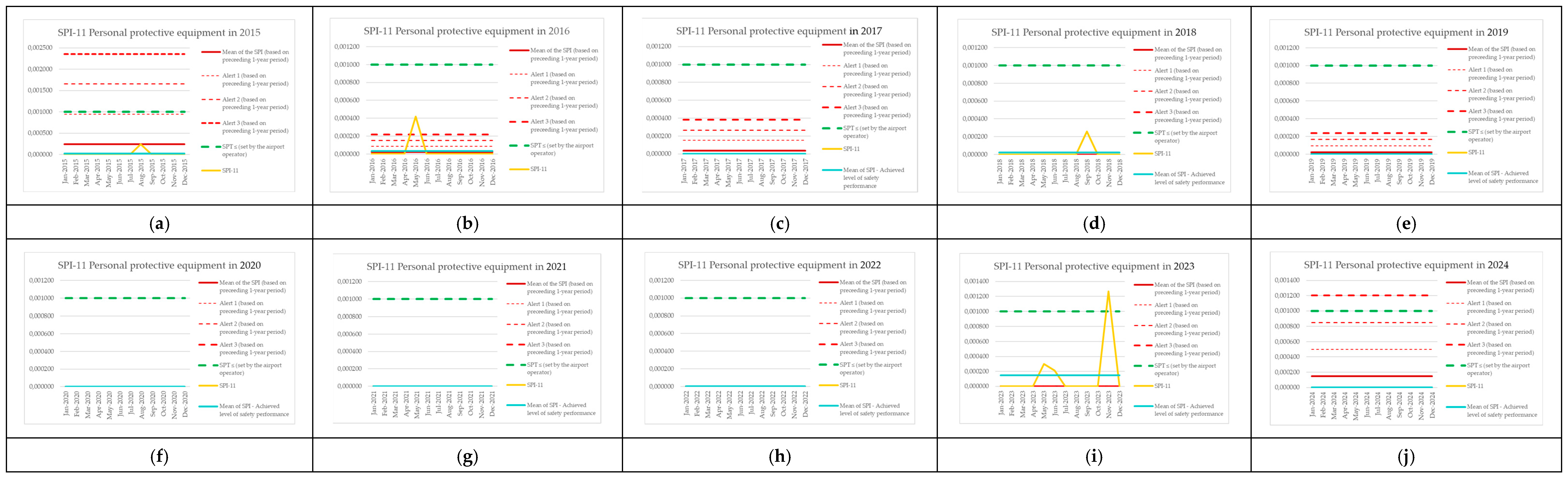
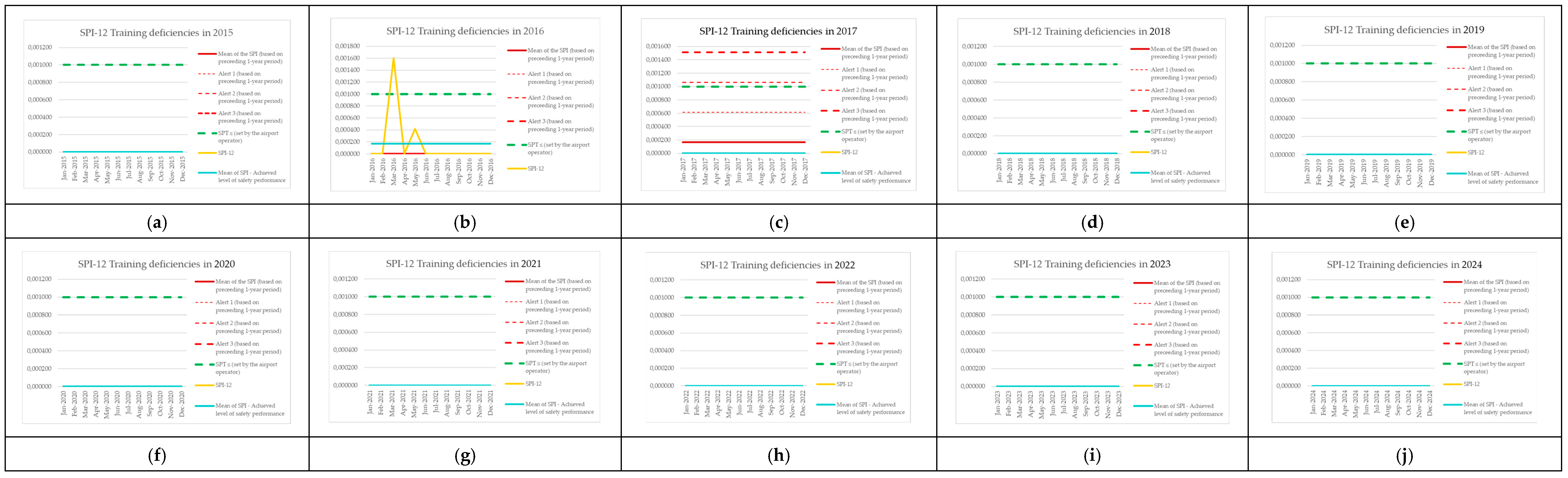
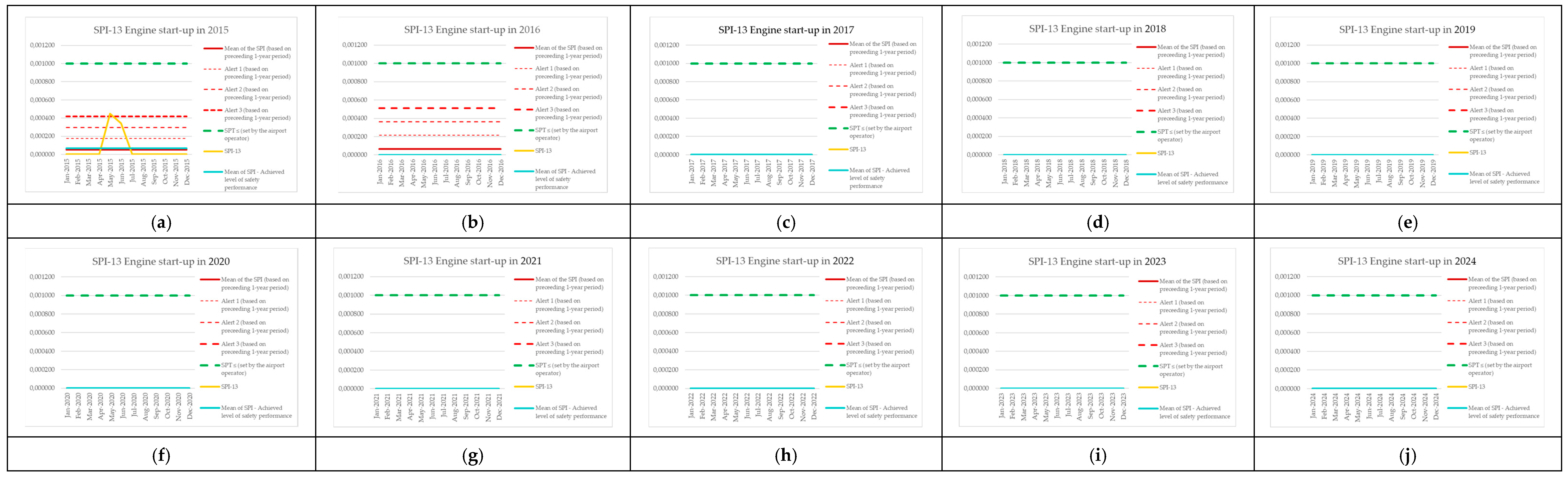
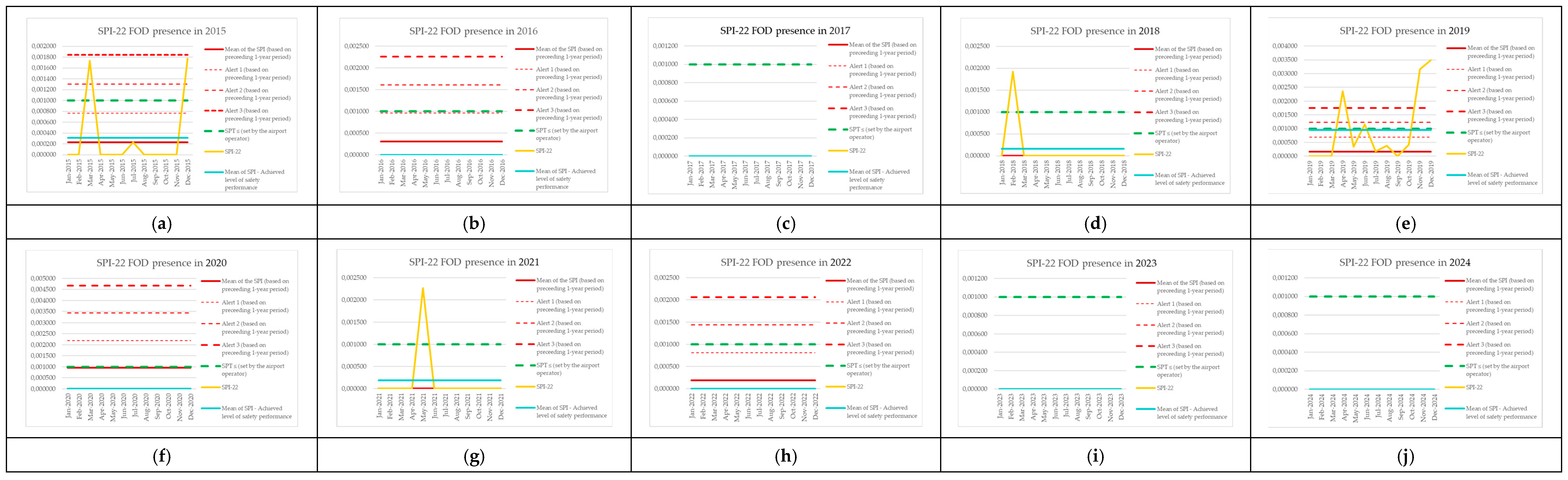
Figure 3 illustrates the monthly monitoring of SPI-8 values at Split Airport, showing whether they met the established target level and avoided the three defined alert levels. The figure presents the achieved level of safety performance for each year (from 2015 to 2024), revealing that, except for 2016, the achieved values consistently remained below the set target, indicating effective safety performance management at Split Airport. Analogously, illustrations of achieved levels of safety performance with accompanying three alert levels for all 25 SPIs monitored at Split Airport, for the period 2015–2024, are shown in Appendix A.
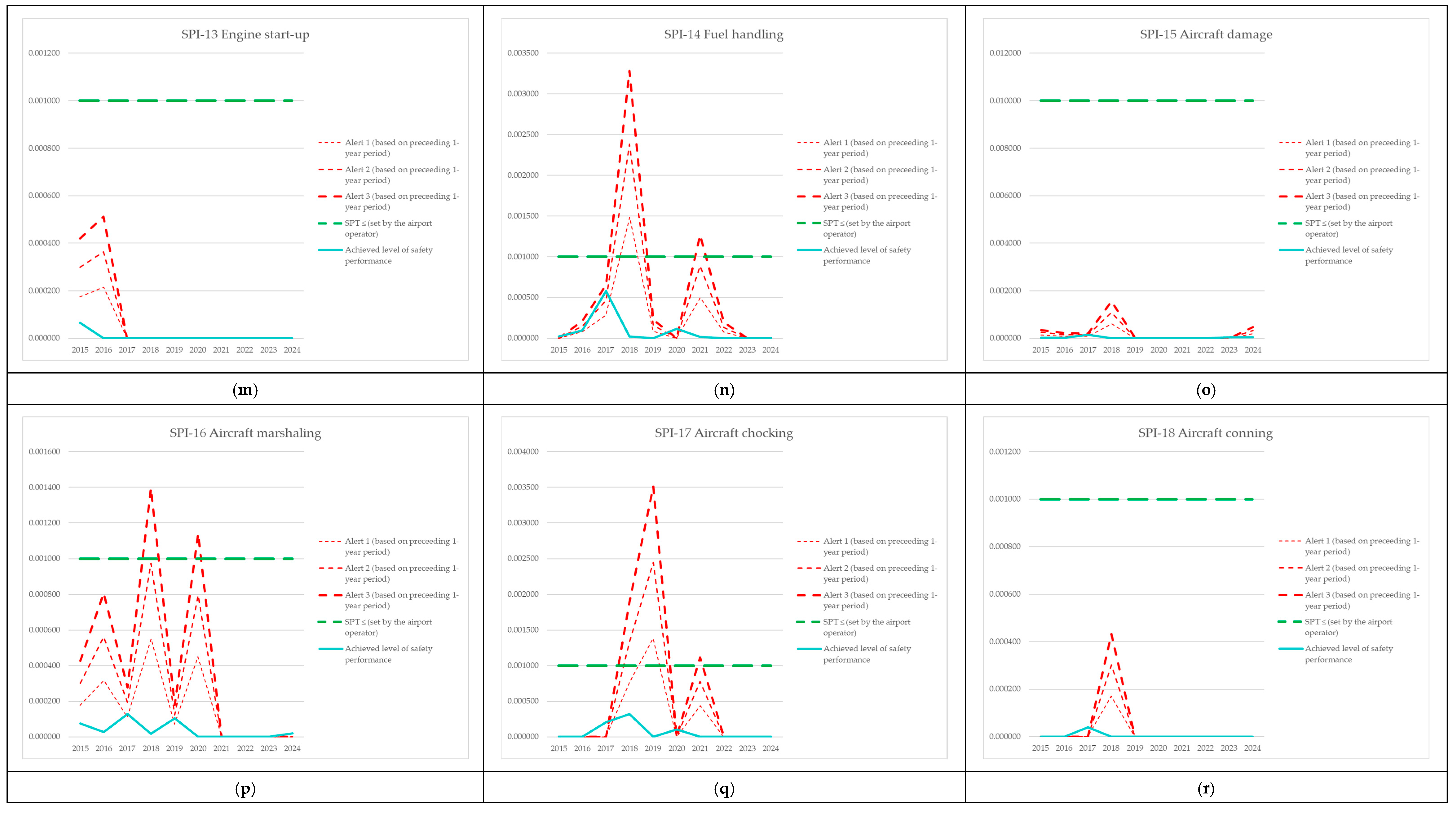
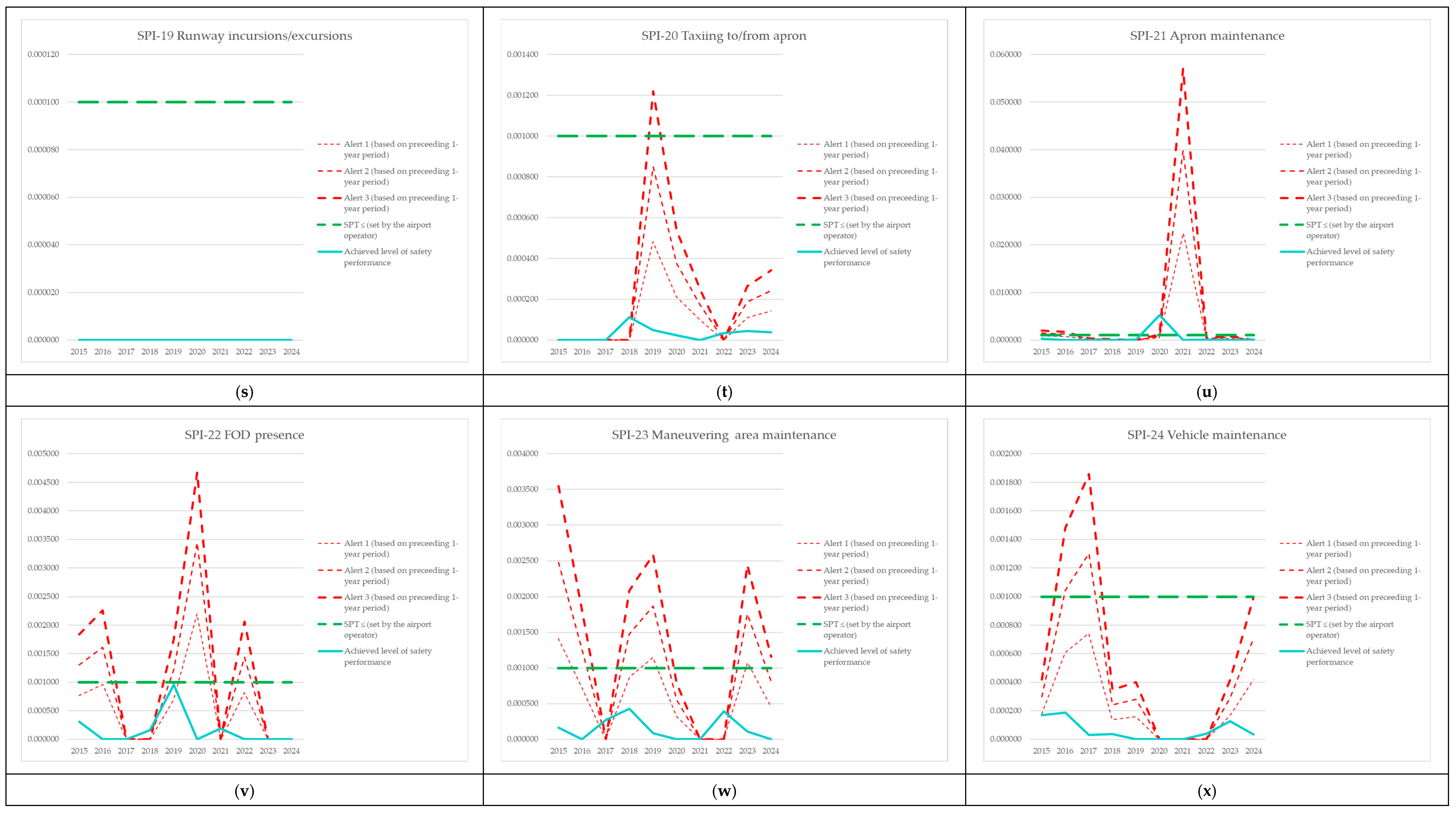
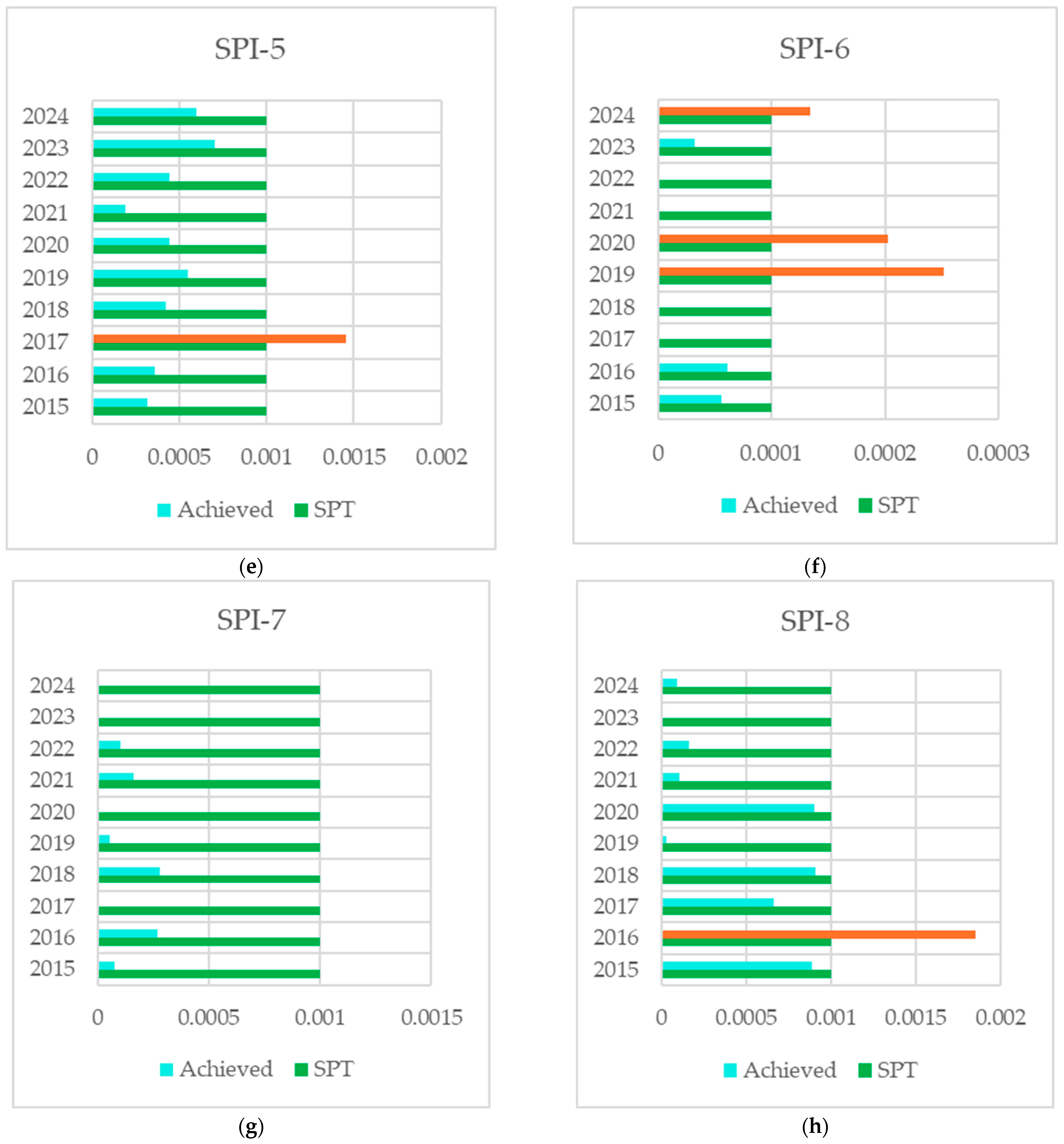
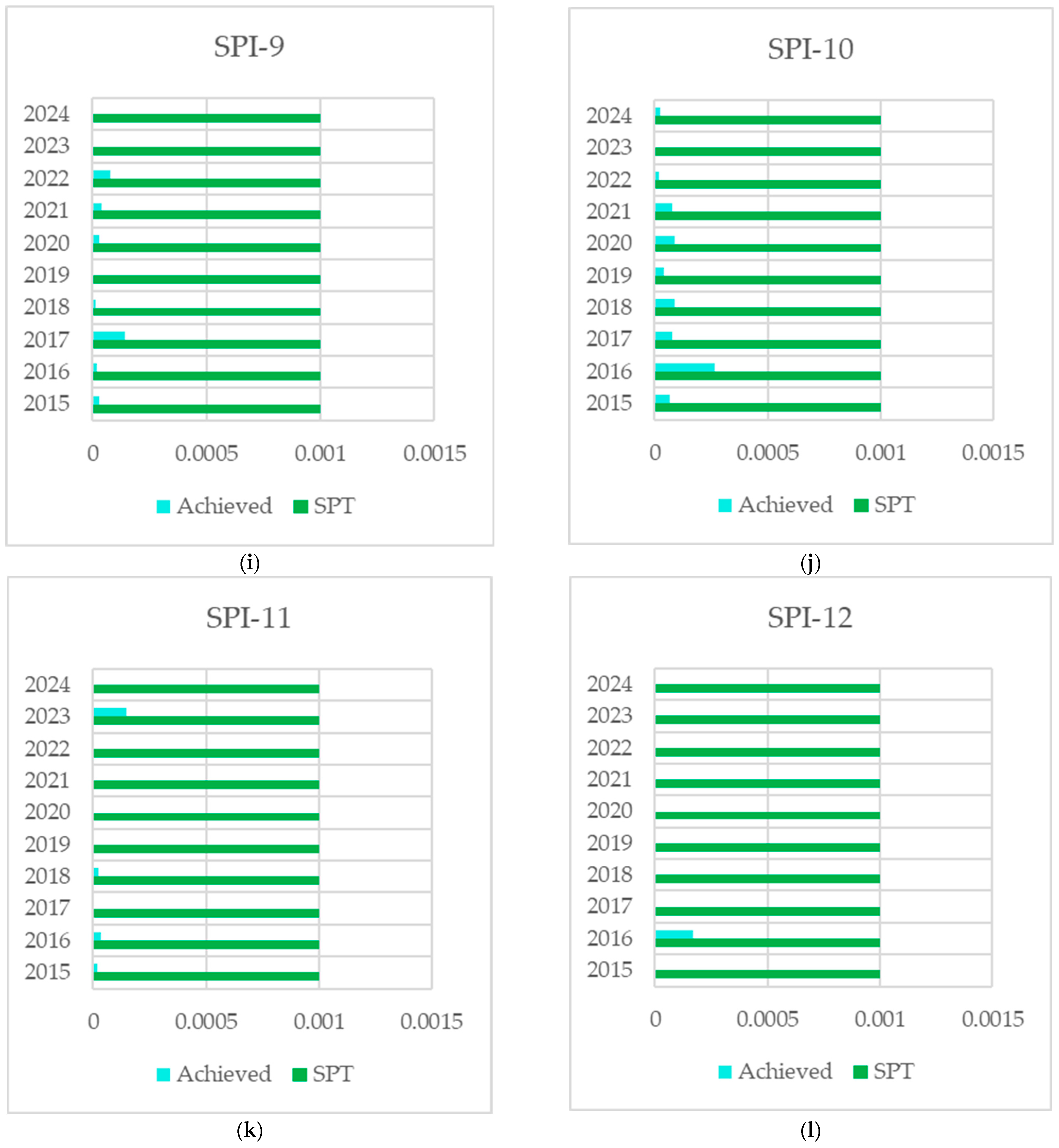
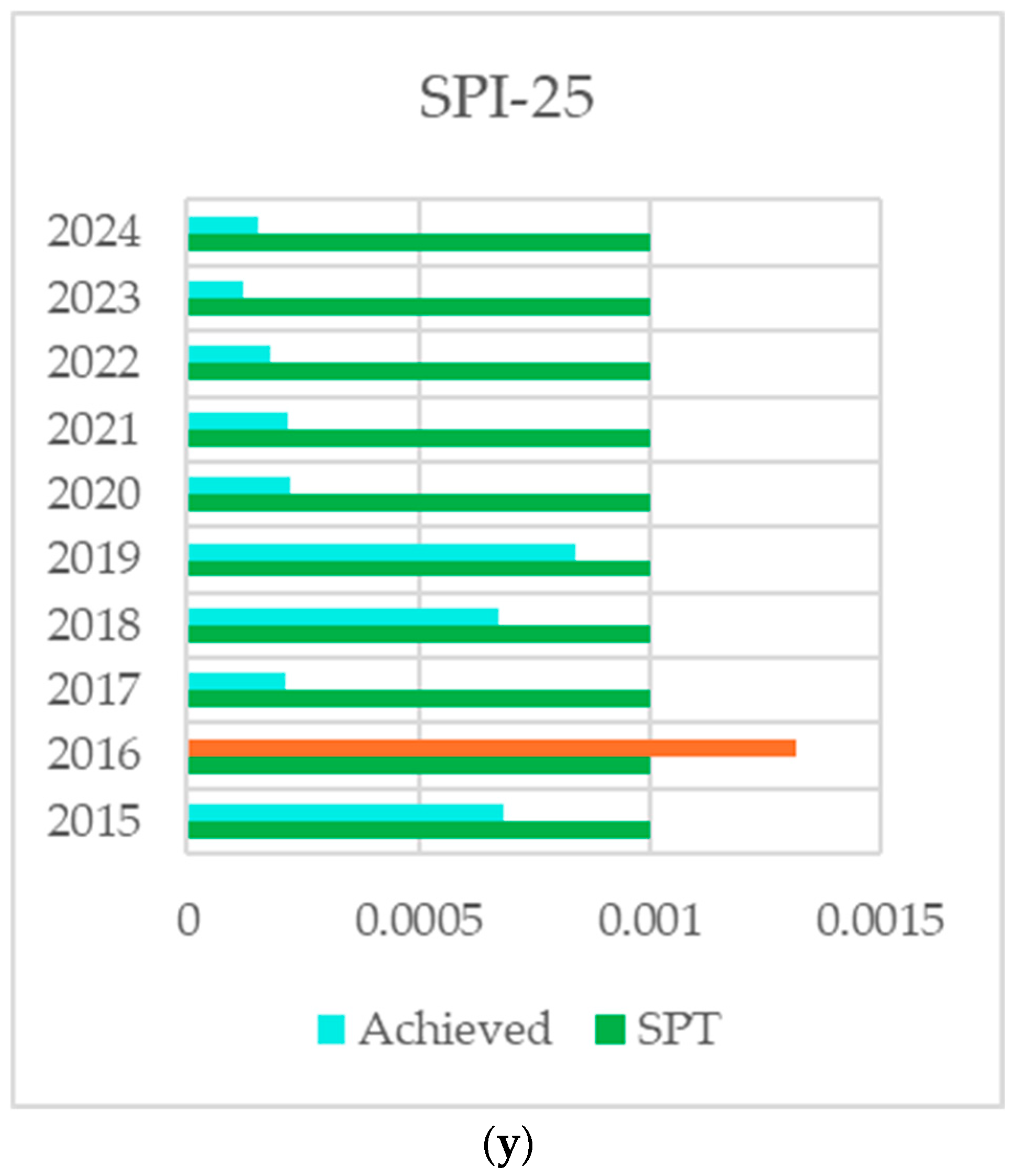
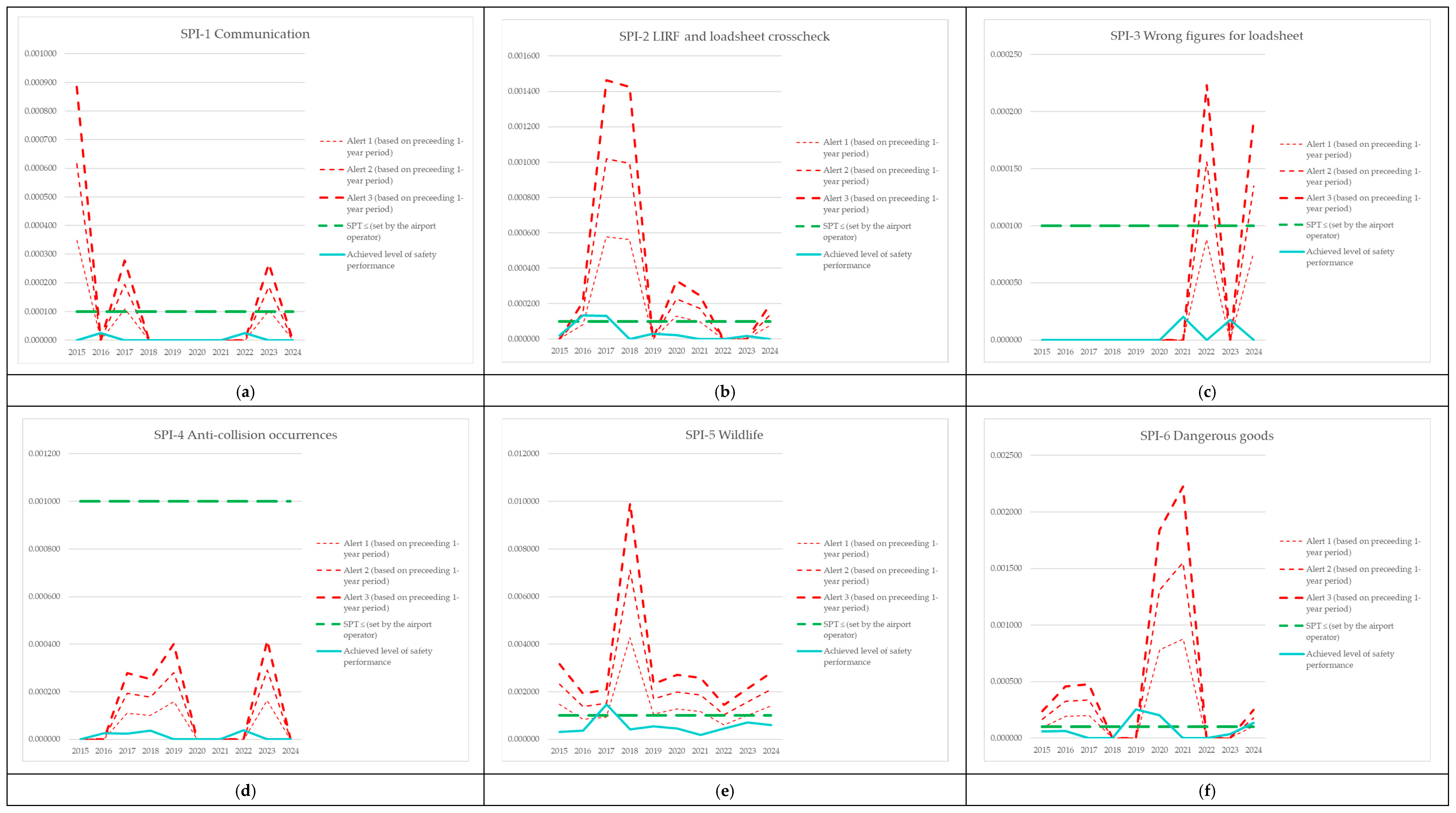
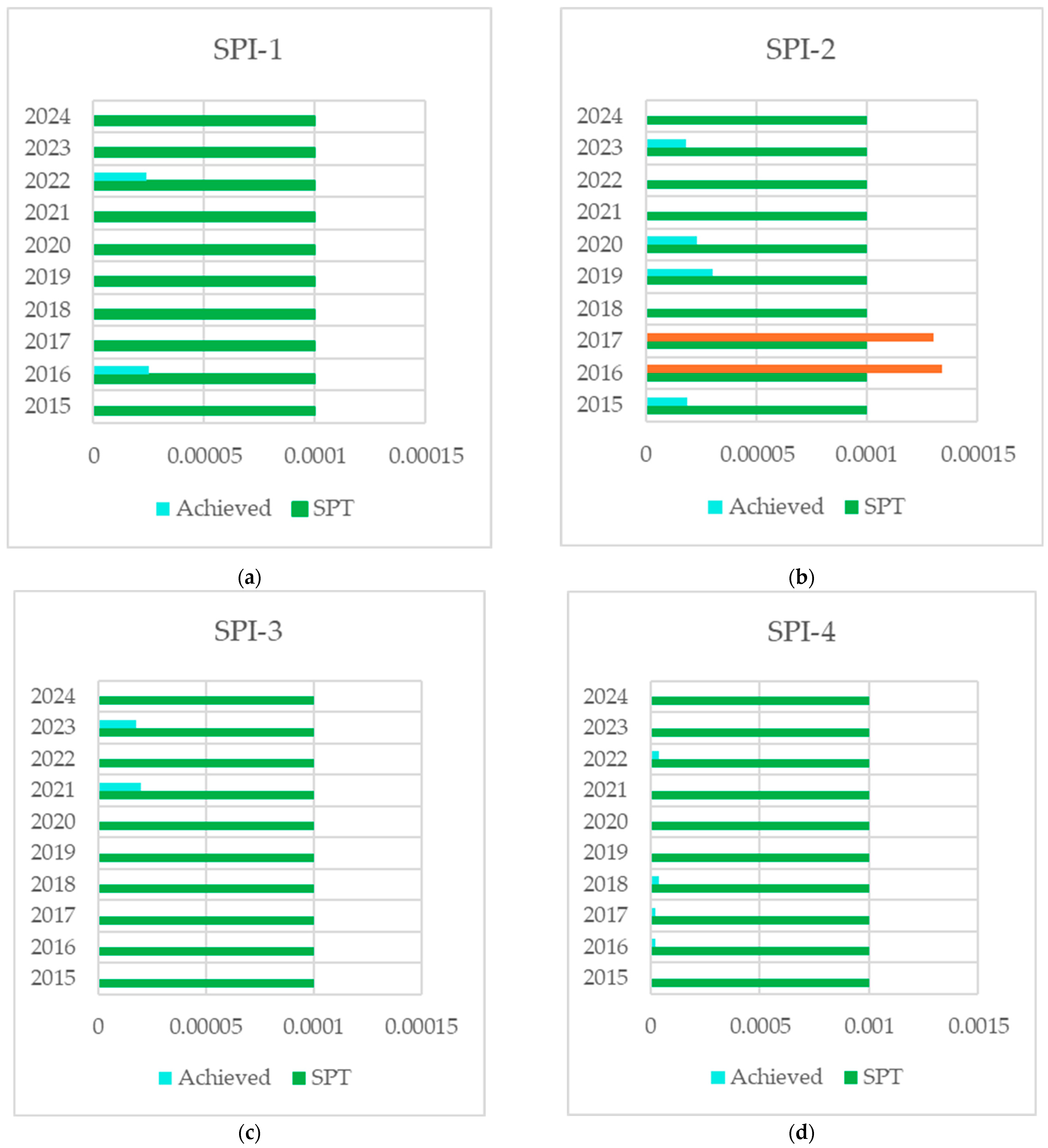
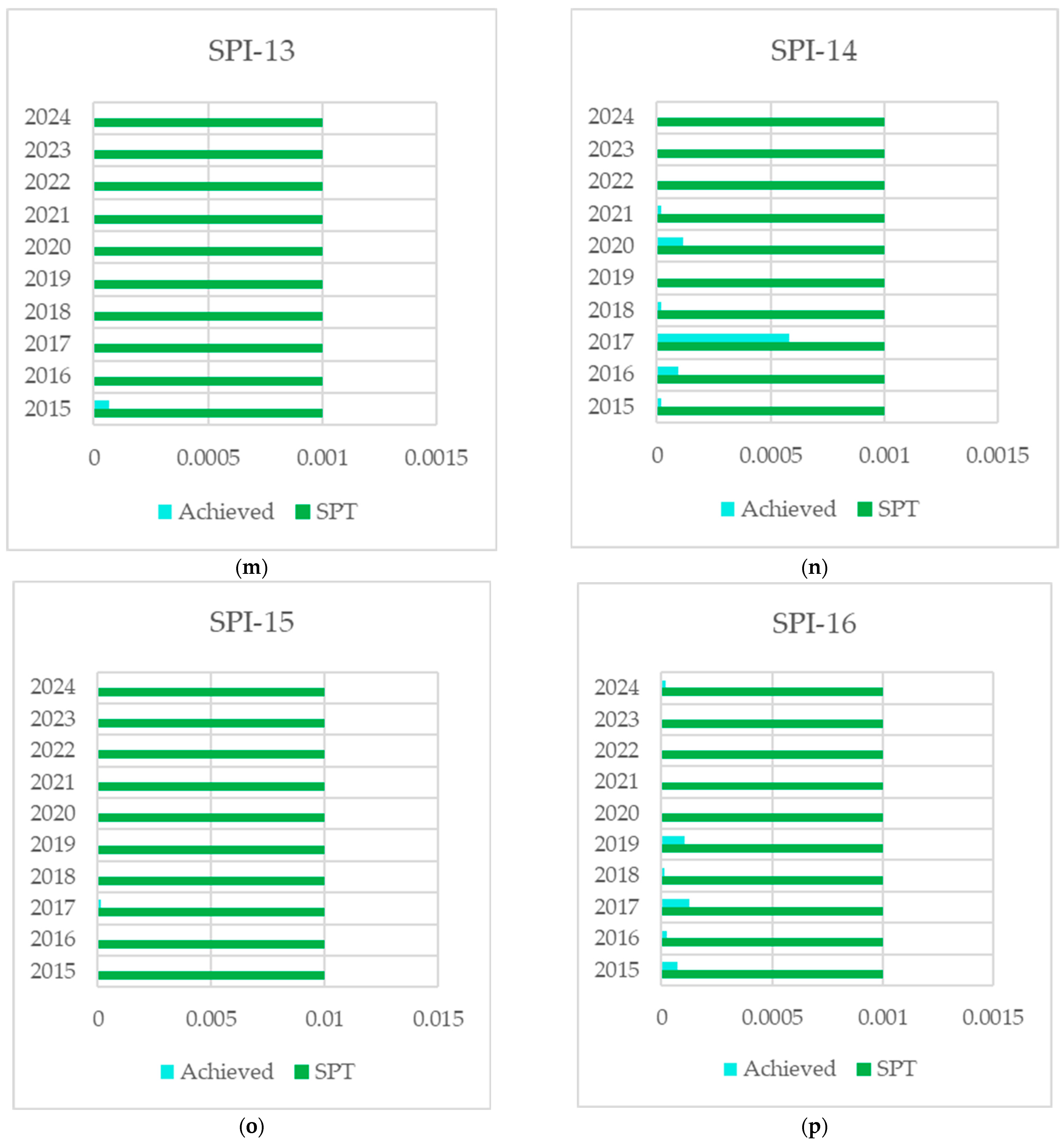
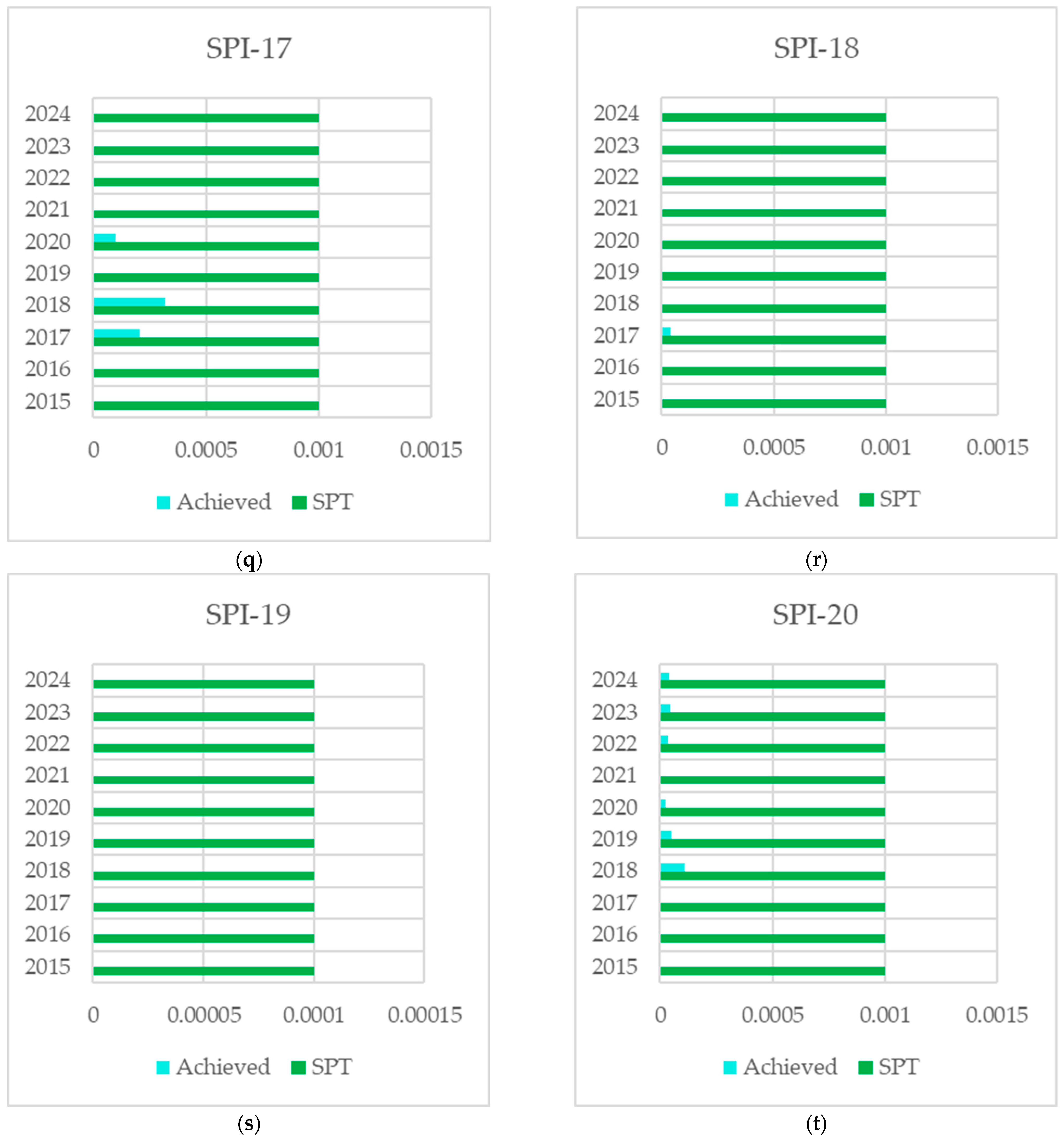
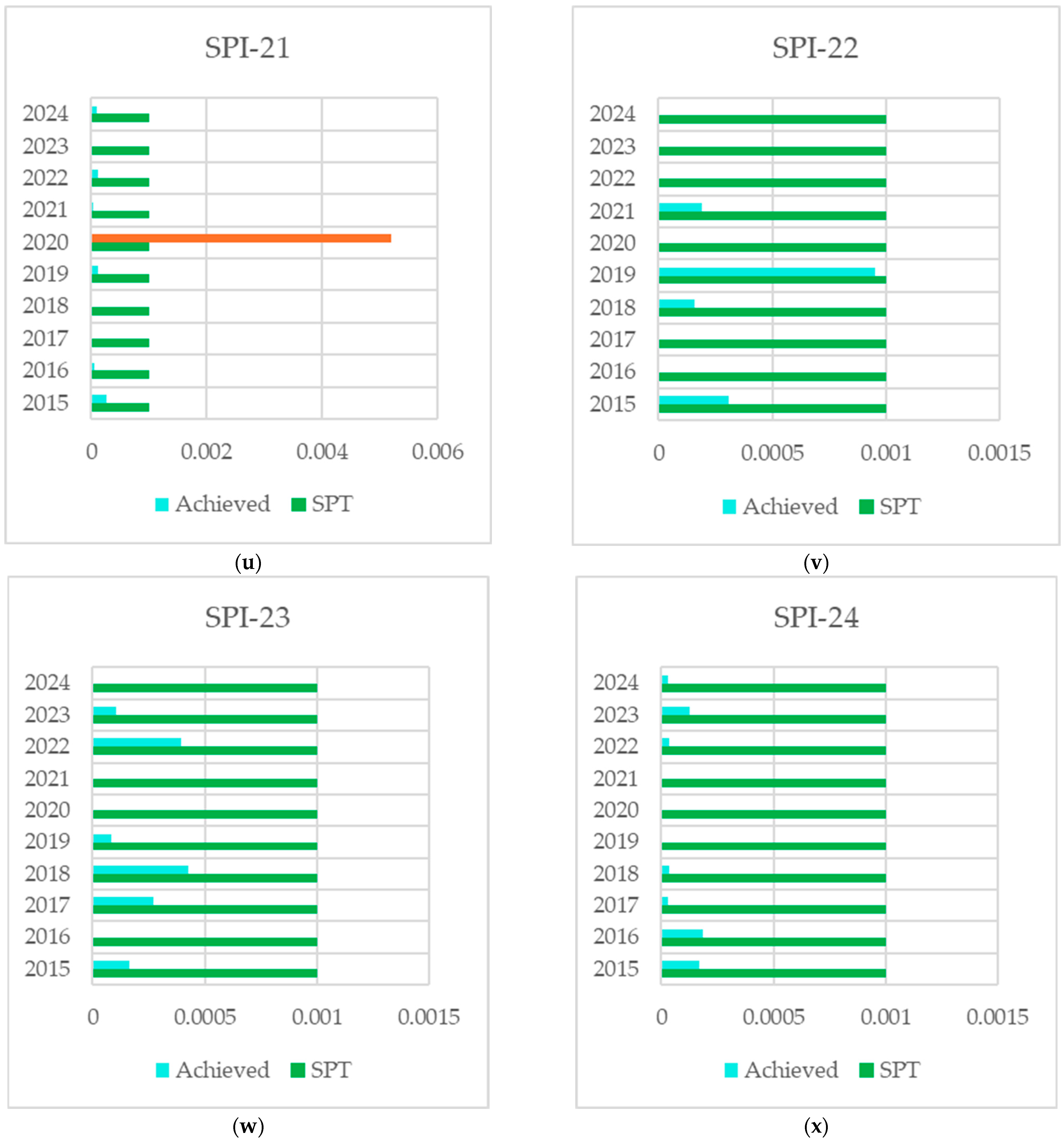
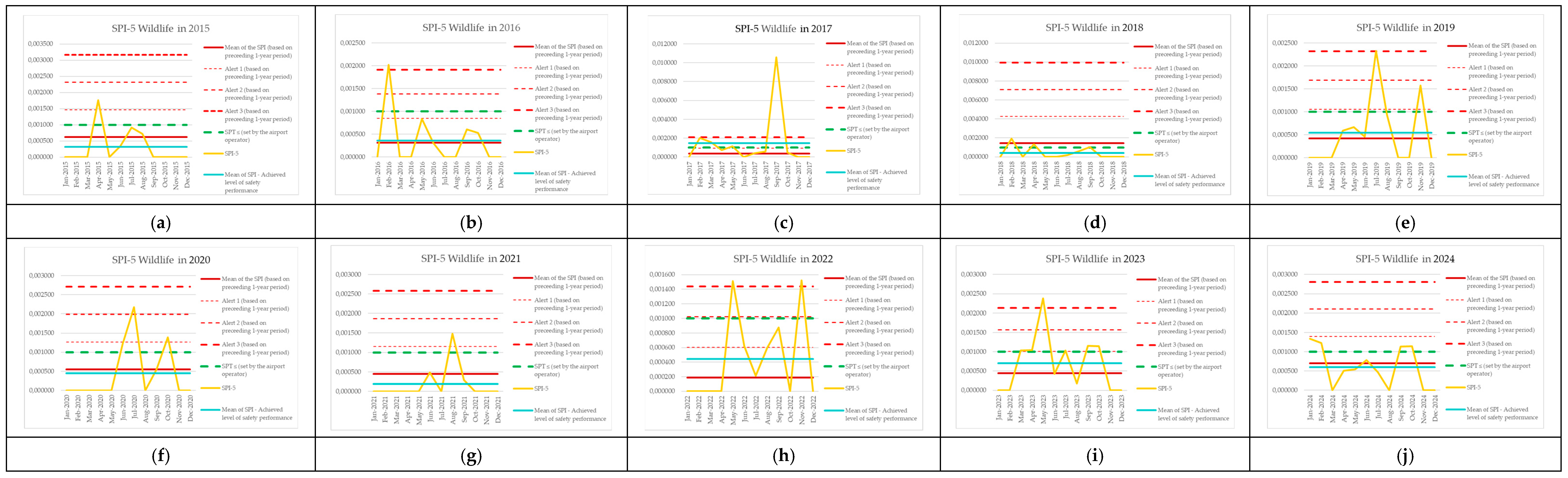
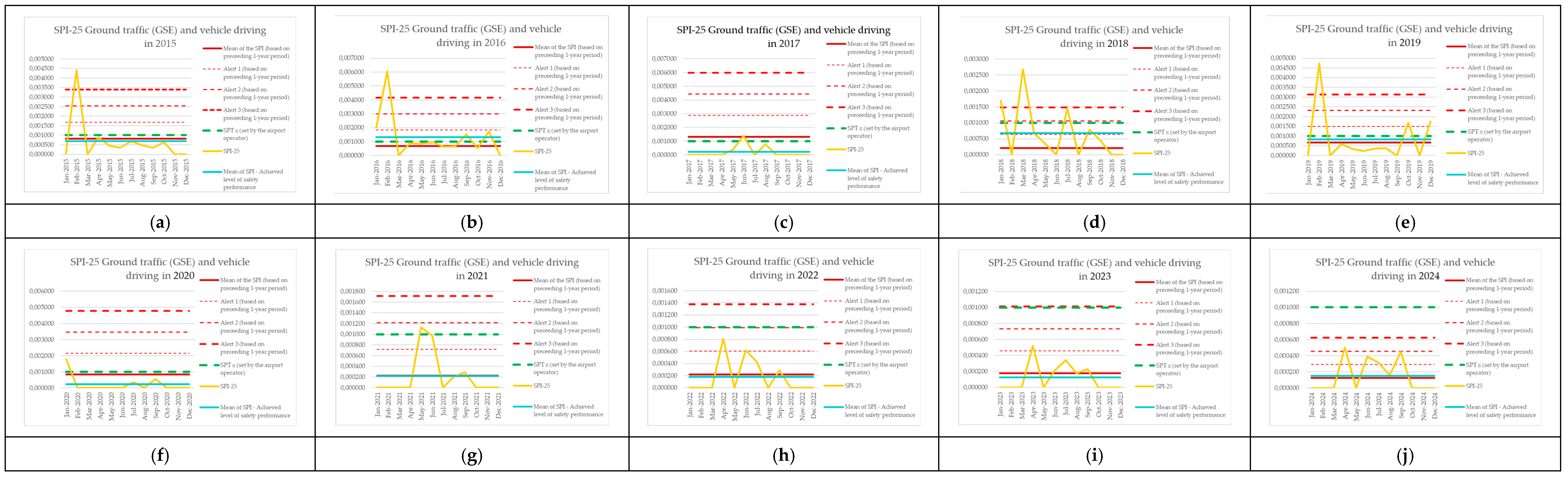
The set target level, achieved level of safety performance and three alert levels of all 25 safety performance indicators, are presented in Figure 4, for each year of the observed time period from 2015 to 2024. For example, as shown in Figure 4a,c,d,g,i–t,v–x in the ten-year period, achieved levels of safety performance were below the set target level for every year of the observed period. As per Figure 4b,e,f,h,u,y achieved levels of safety performance breached set target level in six areas of monitoring which points to the critical safety issues at Split Airport, i.e., regarding LIRF and loadsheet crosscheck (SPI-2), wildlife (SPI-5), dangerous goods (SPI-6), passenger handling at the gate (SPI-8), apron maintenance (SPI-21), and ground traffic (GSE) and vehicle driving (SPI-25). Breaches occurred in 2016, 2017, 2019, 2020, and 2024. Other years mark no breaches in any area of monitoring.
Throughout the monitoring period, SPI-1 to SPI-4 (communication, loadsheet errors, anti-collision events) demonstrate low-frequency but highly critical events that are predominantly influenced by human–machine interface issues, workload peaks, and seasonal traffic growth. Minor increases (e.g., SPI-2 in 2016–2017) correspond with intensive summer-season operations, indicating potential process saturation and reinforcing the need for periodic procedural refreshers and tighter cross-check mechanisms. Their safety implication is significant, i.e., even small fluctuations in these indicators represent vulnerabilities in core aircraft-handling processes that directly affect flight preparation and ground safety.
Wildlife occurrences (SPI-5) show periodic spikes (e.g., 2017) that correlate with seasonal migratory patterns, vegetation cycles, and construction-related disturbances in the airport environment. These deviations emphasize the dynamic nature of environmental hazards and the need for adaptive wildlife management programs, such as habitat control and enhanced monitoring technologies. FOD occurrences (SPI-22), although less volatile, similarly reflect the influence of apron congestion and maintenance workload, especially during peak seasons.
Breaches in 2019, 2020, and 2024 for SPI 6 (dangerous goods) reflect increased cargo diversification, temporary staffing shortages during the COVID-19 operational downturn, and procedural handovers among ground handlers. DG mishandling is a latent high-risk precursor to operational emergencies, and the airport intensified the DG refresher training and standardized procedures.
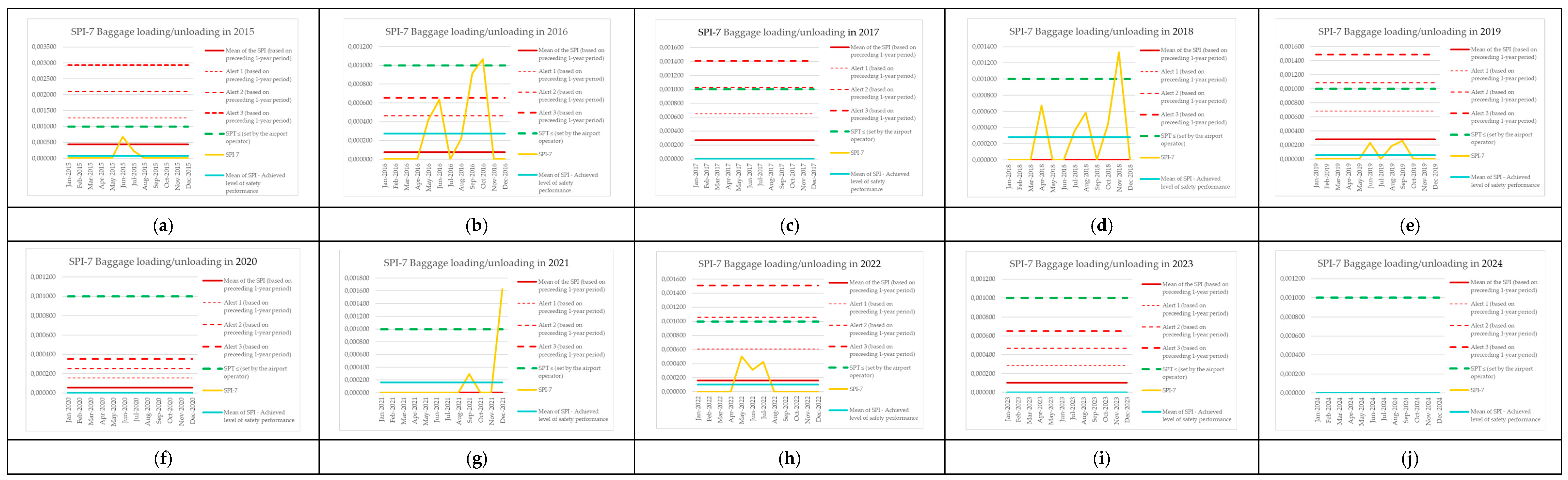
SPI-7 to SPI-12 (passenger and baggage handling, training, protective equipment, injuries) reveal patterns linked to personnel competencies, training cycles, and staffing variability. For example, SPI-8 in 2016 shows a sharp increase consistent with operational strain before terminal expansion (as per Table 4). Trends in these indicators show that increases correspond to organizational transitions, such as rapid seasonal recruitment or changes in terminal configuration. Their safety implication lies in the early-warning value, i.e., they enable detection of systemic safety issues before manifesting as more severe events (injuries, aircraft damage).
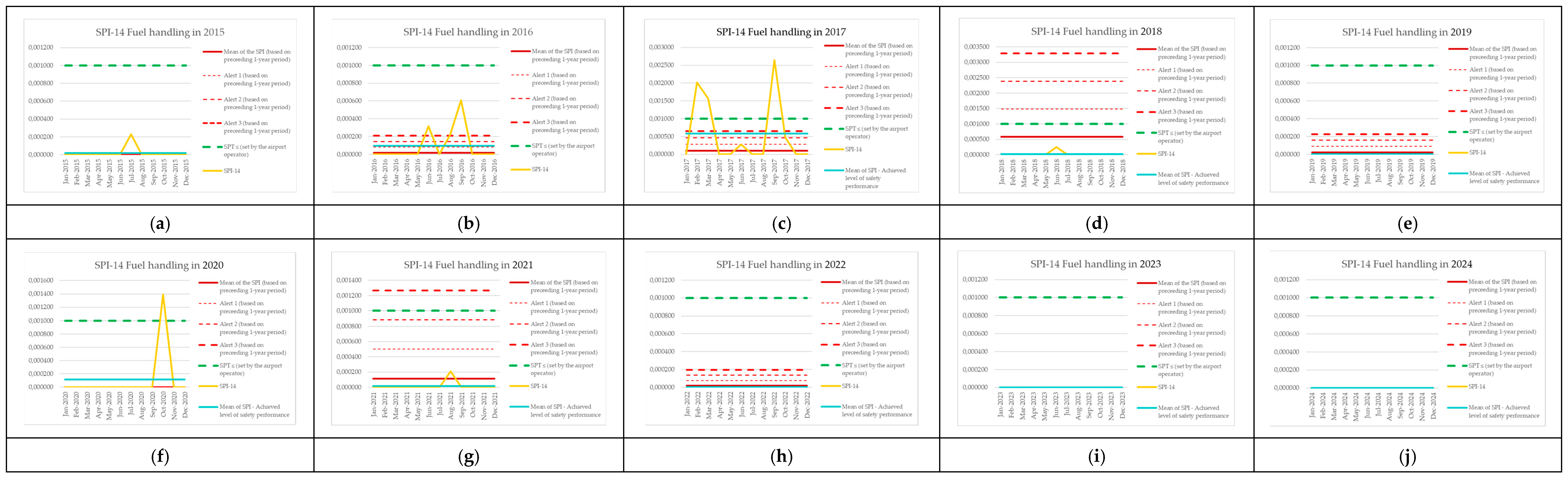
For SPI-13 to SPI-18 (engine start, fuel handling, aircraft ground movements) most values fall well below SPTs, indicating stable performance. Occasional spikes (e.g., SPI-14 in 2017) stem from coordination gaps between multiple contractors or weather-related fueling delays. These SPIs reveal how effectively standard procedures are executed under irregular operating conditions.
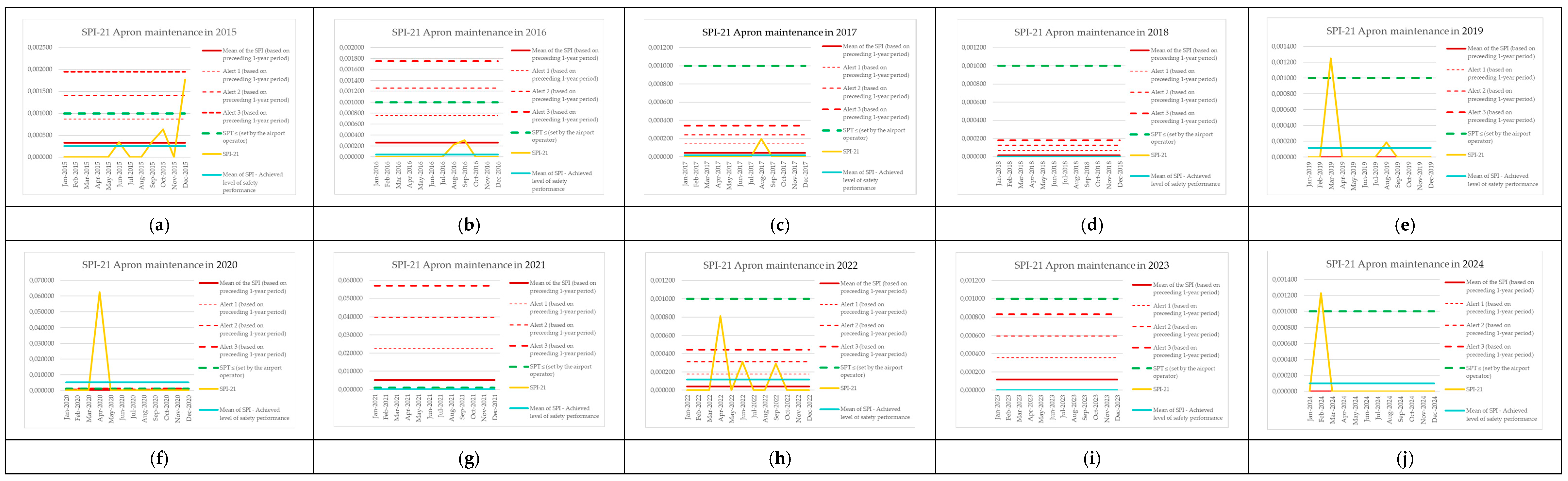
Indicators SPI-19 to SPI-25 (runway/taxiway/apron operations and ground traffic) reflect infrastructural, environmental, and human-factor interaction. Deviations in SPI-21 (apron maintenance) in 2020 and SPI-25 (ground traffic and vehicle driving) in 2016 and 2024 correspond with increased construction/maintenance activities, seasonal congestion, and adherence to airside driving rules.
Based on the results, it is evident that Split Airport places strong emphasis on safety and responds promptly to emerging issues, demonstrating exemplary practices in safety performance management.
The following Table 5 shows the comparison of set target levels vs. achieved levels of safety performance, i.e., determining an acceptable level of safety performance (ALoSP) at Split Airport. If the achieved level is below or equal to set SPT, it is considered to be an acceptable level of safety performance or ALoSP. Where the acceptable level has been achieved, it is marked in green letters with “YES”, and where it is not achieved, it is marked in red letters with “NO”.
Figure 5 shows the illustrated summary of achieved levels of safety performance at Split Airport, through all 25 monitored SPIs. If the achieved level of safety performance is acceptable it is marked in light green color. The breaches, i.e., “unacceptable” levels are marked in orange color.

4. Discussion and Conclusions

The findings of this study comply with the theoretical background and earlier research discussed in the paper. As highlighted in the ICAO Safety Management Manual (Doc 9859) [10], the effectiveness of SMS depends heavily on an organization’s ability to monitor its safety data, understand what that data represents, and take action when needed. This is clearly presented at Split Airport, where long-term SPI trends show both areas where operations are strong and areas where the system occasionally comes under pressure. Additionally, ICAO’s Safety Management Manual [10] points out that safety performance indicators and alert levels should serve as proactive warning signals, and not just numbers to be recorded. Split Airport’s repeated return of SPI values to acceptable levels after short-term deviations shows that these indicators function as intended in real operations. ICAO Annex 19 [1] also emphasizes that safety performance monitoring needs to combine both predictive and reactive elements. This principle is reflected in the way the airport’s SPIs behave over time, e.g., training-related indicators, human-factors issues, wildlife indicators, and others complement one another to give a full oversight of system safety performance. Similar guidance appears in EASA’s safety performance management principles [22,30,31,32,33,34], which highlight that safety objectives must remain flexible and responsive to real operational conditions. Split Airport’s data clearly shows this, as periods of construction activity, seasonal peaks in traffic, and temporary resource shortages all create noticeable shifts in some SPIs; they also confirm the link between changing operational environments and safety performance. Other analyses of airport safety occurrences [36,37] add that maneuvering area operations, interactions between staff and equipment, and adherence to procedures are among the most sensitive parts of airport systems. This aligns with the behavior of Split Airport’s SPIs for ground handling issues, apron maintenance, and vehicle-movement deviations, i.e., areas where even small disruptions can influence adverse safety outcomes. Further research cited in this paper shows that reporting culture and organizational maturity significantly affect SPI stability (e.g., [24,25,26,28,29]). This corresponds well with Split Airport’s dataset, which demonstrates strong data quality and consistent patterns over time. Other referenced studies, such as those highlighting the predictive value of leading indicators [26,54,55,56,57,58], the effect of seasonal traffic patterns on SPI variability [49,50], and the influence of infrastructure configuration on SPI trends [13,48], also support the interpretation of results in this research. Finally, the findings align with studies emphasizing organizational resilience (e.g., [27]), which define resilience as the ability of a system to withstand operational pressures and quickly return to desired performance levels.
The results of this study provide a comprehensive overview of how Split Airport systematically determines, monitors, and maintains its Acceptable Level of Safety Performance (ALoSP) through a structured Safety Management System (SMS). The results demonstrate a mature Safety Performance Management (SPM) framework where the organization not only meets regulatory compliance but also actively uses data-driven indicators to maintain proactive safety management. By analyzing 25 Safety Performance Indicators (SPIs) over a ten-year period (2015–2024), the study highlights the airport’s consistent achievement of Safety Performance Targets (SPTs), with only limited exceedances, thus evidencing a high level of operational safety and effective risk control.
The longitudinal analysis revealed that, across most safety areas, the achieved levels of safety performance remained below or equal to the predefined SPTs throughout the observed period. This outcome signifies that the airport has been operating within its defined ALoSP boundaries, maintaining an acceptable level of safety despite fluctuations in operational activity and external pressures such as the COVID-19 pandemic. Only six out of the 25 SPIs experienced exceedances of their set targets: LIRF and loadsheet crosscheck (SPI-2), Wildlife (SPI-5), Dangerous goods (SPI-6), Passenger handling at the gate (SPI-8), Apron maintenance (SPI-21), and Ground traffic (GSE) and vehicle driving (SPI-25). These deviations occurred sporadically in 2016, 2017, 2019, 2020, and 2024 and were promptly addressed by the airport’s safety management team. The limited number and temporal distribution of breaches reflect an organization capable of timely identifying emerging risks and implementing corrective actions before they escalate into systemic safety issues.
Deviations, i.e., minor increases, in SPI-2 (LIRF and loadsheet crosscheck) during 2016–2017 corresponded with intensive summer-season operations, indicating process saturation and the need for refresher training and strengthened loadsheet crosscheck mechanisms. SPI-5 (wildlife occurrences) showed episodic spikes (e.g., 2017) correlated with migratory periods, vegetation cycles, and construction-related disturbances, highlighting the dynamic nature of environmental hazards and reinforcing the need for adaptive wildlife management strategies. SPI-6 (dangerous goods incidents) deviated in 2019, 2020, and 2024 due to increased cargo diversification, temporary staffing shortages during COVID-19, and procedural inconsistencies among ground handlers; these findings prompted enhanced DG training and standardized handling procedures. The increase in SPI-8 (passenger handling at the gate) in 2016 aligned with operational strain prior to terminal expansion, as documented in airport operational records. Deviations in SPI-21 (apron maintenance) in 2020 and SPI-25 (GSE & vehicle driving) in 2016 and 2024 were associated with construction activities, increased congestion, and varying airside driving movements.
Detailed analysis of SPI-8 (Passenger handling at the gate), presented as a representative example, shows that the achieved safety levels were generally below the set SPT (≤0.001) in almost all years except 2016. This deviation was influenced by increased operational demand prior to the 2019 terminal expansion, introducing temporary process strains. However, the improvement trend observed from 2017 onward confirms that corrective and preventive measures, such as enhanced ground handling procedures, personnel training, and process standardization, were effective. Similar cyclical or one-off exceedances were observed in wildlife and ground traffic–related indicators (SPI-5 and SPI-25), which are often linked to environmental and infrastructural factors rather than organizational deficiencies. Their quick return to acceptable limits points to the adaptability of Split Airport’s safety management system and the responsiveness of its safety culture.
The results also show Split Airport’s balanced use of both leading and lagging indicators. Leading indicators (e.g., training deficiencies, equipment maintenance, and apron inspections) capture the preventive side of safety management, whereas lagging indicators (e.g., incidents, load sheet errors, and wildlife occurrences) measure the consequences of safety risks that have materialized. By combining these complementary perspectives, the airport achieves a holistic understanding of its operational safety status. This aligns with ICAO and EASA recommendations, which advocate a shift from purely reactive monitoring of accidents toward proactive, process-based measurement of system resilience. The fact that the majority of leading indicators remained below alert thresholds over the decade suggests a stable internal safety culture that anticipates and mitigates potential hazards before they result in adverse occurrences.
A key strength of the approach applied in this study lies in the statistical methodology used to calculate mean SPI values and standard deviations for three alert levels. The introduction of three progressive alert thresholds allows for early detection of unusual trends and supports evidence-based decision-making. The alert system operates as an internal “safety thermostat,” distinguishing between normal operational variability and significant deviations requiring management intervention. The observed low frequency of alert activations indicates that the airport’s SPM system successfully maintains operations within its expected control limits. Moreover, the consistent adherence to SPTs across multiple operational domains demonstrates the effectiveness of using historical data as a basis for target setting and continuous improvement.
The period analyzed also covers substantial operational fluctuations caused by the COVID-19 pandemic. The 79% drop in traffic in 2020 and the subsequent recovery through 2025 presented unique safety management challenges, including personnel turnover, procedural adaptations, and fluctuating workload levels. Despite these pressures, the airport maintained acceptable safety levels across all SPIs, indicating system robustness and adaptive capacity. This resilience is an essential characteristic of an effective SMS, as it ensures that safety performance does not deteriorate during periods of change or operational stress.
An important insight from the results is the demonstration that the ALoSP concept, originally developed for State-level implementation under ICAO Annex 19, can be successfully operationalized at the service-provider level. Split Airport’s experience exemplifies how ALoSP can be translated into concrete organizational practices through internally defined SPIs, SPTs, and alert thresholds. By aligning its performance framework with the national State Safety Program (SSP), the airport ensures vertical consistency between State safety objectives and organizational execution. This integration fosters accountability, transparency, and measurable safety outcomes at the service-provider level, strengthening the overall aviation safety system.
The stable results across the ten-year monitoring period also illustrate the maturity of Split Airport’s safety culture. Continuous monitoring, systematic data analysis, and proactive safety assurance activities demonstrate a learning organization that values improvement and prevention over mere compliance. The airport’s use of Galiot Aero SMS software further enhances its capability to manage safety information, conduct trend analysis, and maintain traceable safety records. These practices align with international standards and contribute to a data-rich environment where management decisions are evidence-based, and safety management is both timely and transparent.
Although Split Airport’s safety performance is commendable, the few instances of target breaches highlight opportunities for refinement. The occurrences related to, e.g., wildlife, ground traffic, and dangerous goods, suggest the need for enhanced coordination between operational departments, more sophisticated monitoring technologies (e.g., wildlife radar systems or vehicle tracking), and continuous staff training. Moreover, while the dataset spans ten years, expanding the monitoring framework to include predictive modeling, could strengthen the airport’s capacity to forecast potential safety degradations. Another challenge is the dependence on sufficient and high-quality safety data; i.e., airports with limited reporting culture may find it difficult to replicate such detailed analyses without robust data management systems.
While the ICAO-prescribed three-alert system provides structure and statistical rigor, it has some shortcomings. It assumes normal distribution of SPI values and steady operational conditions, which is not always representative of airport environments. SPIs with rare events (e.g., SPI-19 Runway incursions) may produce unrealistic means and standard deviations, reducing sensitivity to meaningful changes. However, high-volume SPIs may generate alerts driven by short-term operational variability rather than real safety degradation. The method also does not incorporate seasonal patterns, traffic peaks, construction activity, etc., which make it necessary for safety managers to apply expert judgment alongside alert triggers.
This case study contributes to both industry practice and academic understanding by providing a replicable framework for assessing and maintaining organizational ALoSP. Practically, it offers a model for airports and other aviation service providers to integrate safety performance monitoring into everyday operations. Theoretically, it demonstrates how statistical methods and multi-level indicators can operationalize abstract safety objectives into measurable, actionable performance metrics. The approach bridges the gap between regulatory expectations and practical implementation, serving as an example of how safety performance management can mature into a dynamic, feedback-driven process rather than a static compliance exercise.
In summary, this research confirms that Split Airport has successfully established and maintained its ALoSP over a decade of monitoring through a robust and data-driven SMS framework. The achieved results validate the airport’s proactive approach to safety performance management, its capability to detect and address deviations promptly, and its alignment with international aviation safety standards. The methodology presented in this study, i.e., integrating SPIs, SPTs, alert levels, and achieved performance analysis, provides an example for other service providers seeking to enhance their safety performance and demonstrate compliance with ICAO’s performance-based safety standards.

Author Contributions

Conceptualization, D.B.; methodology, D.B.; software, D.B. and J.P.; validation, D.B., J.P., M.Ž. and M.M.; formal analysis, D.B. and J.P.; investigation, D.B. and J.P.; resources, M.Ž. and M.M.; data curation, D.B. and J.P.; writing—original draft preparation, D.B. and J.P.; writing—review and editing, D.B. and J.P.; visualization, D.B.; supervision, D.B. All authors have read and agreed to the published version of the manuscript.

Funding

This research received no external funding.

Data Availability Statement

Data supporting reported results can be found in this paper. Data was gathered and analyzed via the means and methods described in this paper.

Conflicts of Interest

Authors Mirko Žužul and Mate Melvan are employed by the Split Airport. The remaining authors declare that the research was conducted in the absence of any commercial or financial relationships that could be construed as a potential conflict of interest.

Abbreviations

The following abbreviations are used in this manuscript:
ALoSPAcceptable Level of Safety Performance
ICAOInternational Civil Aviation Organization
SASafety Assurance
SDCPSSafety Data Collection and Processing Systems
SMMSafety Management Manual
SMSSafety Management System
SRMSafety Risk Management
SPIsSafety Performance Indicators
SPMSafety Performance Management
SPTsSafety Performance Targets
SARPsStandards and Recommended Practices
SSPState Safety Program

Appendix A

Table A1 shows monthly data of number of aircraft operations at Split Airport for the period 2014–2024.
Table A1. Number of aircraft operations at Split Airport for the period 2014–2024 [50].
YearJanuaryFebruaryMarchAprilMayJuneJulyAugustSeptemberOctoberNovemberDecember
20144383925141032194225543872395425921470504528
20155044545761132223229424374416228261582640564
20164924946241142239031484824451832801876582570
2017586496640137826443594521650783782116654554
20185905207481486287840525504513638422272750646
20196646348001698299243185576532038482372634574
202056747437016194818275736761807720410341
202131427435858788320514084472834352090613615
20224785245881233198532124724501234222192657602
20236987849681922335447215822567943483488789598
202474881210141987366451226328622144103502798624
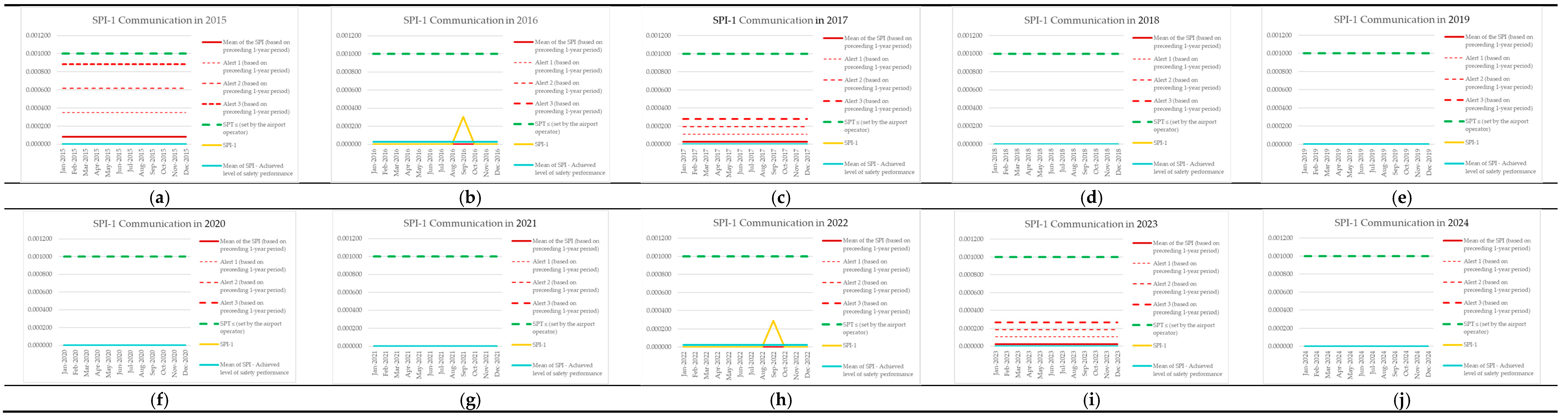
At Split Airport, SPIs are monitored monthly, and Table A2 shows monthly data on SPI-1 Communication in the form of recorded events [50] and calculated SPI values (events per operations), covering the period from January 2014 to December 2024. SPI values are calculated as a ratio of the number of events presented in Table A2 (e.g., in April 2014) and the corresponding number of aircraft operations (e.g., in April 2014) shown in Table A1. There are only three recorded events regarding communication issues, one in April 2014, one in September 2016, and one in September 2022, in an 11-year observed time period.
Table A2. SPI-1 Communication—number of events and calculated SPI values.
YearJanuaryFebruaryMarchAprilMayJuneJulyAugustSeptemberOctoberNovemberDecember
20141
0.000969 *
2015
20161
0.000305 *
2017
2018
2019
2020
2021
20221
0.000292 *
2023
2024
* Calculated SPI values—ratio of number of events (e.g., in April 2014) and corresponding number of aircraft operations (e.g., in April 2014).
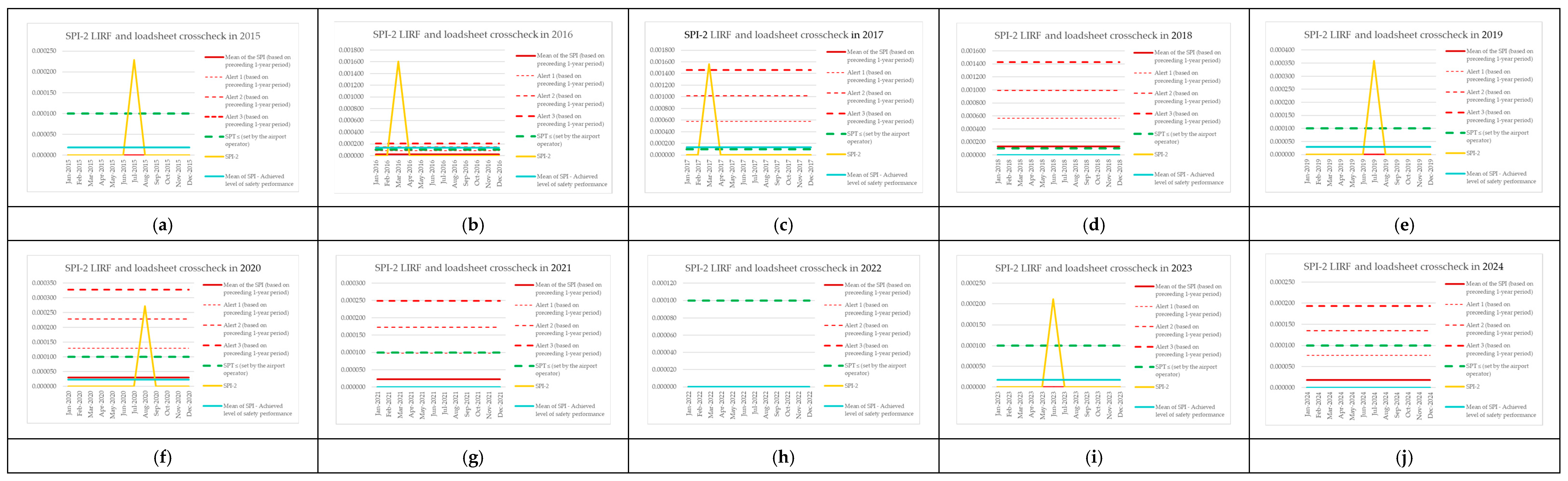
Table A3 shows monthly data on SPI-2 LIRF and loadsheet crosscheck in the form of recorded events [50] and calculated SPI values (events per operations), covering the period from January 2014 to December 2024. SPI values are calculated as ratio of number of events (Table A3) and corresponding number of aircraft operations shown in Table A1.
Table A3. SPI-2 LIRF and loadsheet crosscheck—number of events and calculated SPI values.
YearJanuaryFebruaryMarchAprilMayJuneJulyAugustSeptemberOctoberNovemberDecember
2014
20151
0.000229 *
20161
0.001603 *
20171
0.001563 *
2018
20192
0.000359 *
20201
0.000272 *
2021
2022
20231
0.000212 *
2024
* Calculated SPI values—ratio of number of events (e.g., in July 2015) and corresponding number of aircraft operations (e.g., in July 2015).
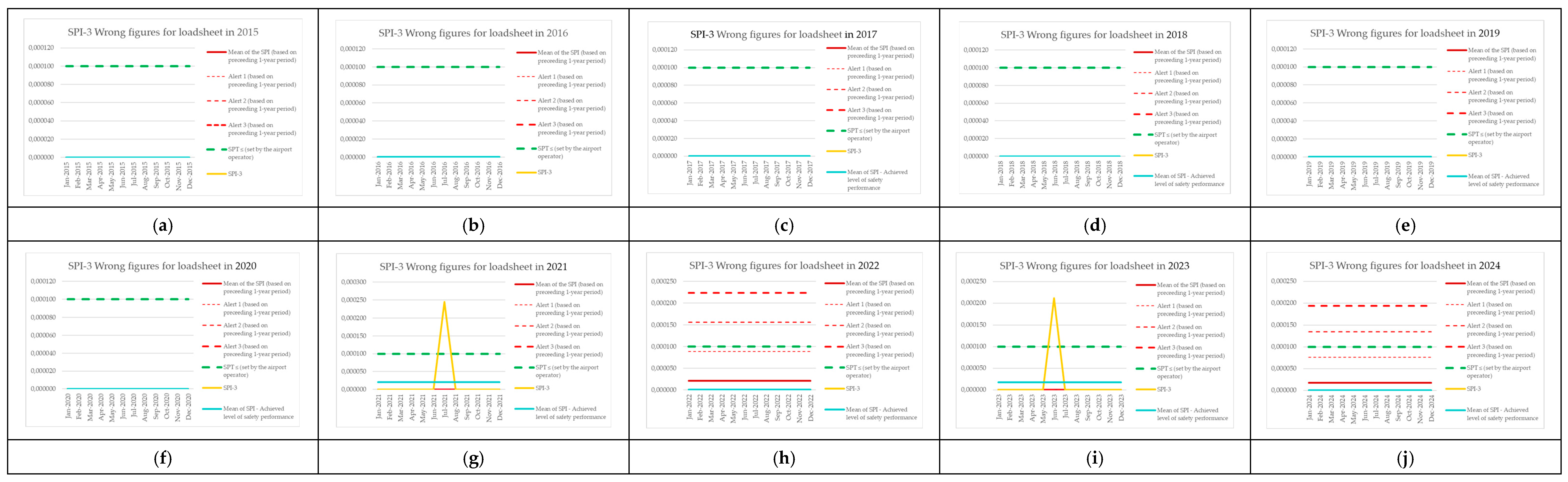
Table A4 presents monthly data for SPI-3 Wrong figures for loadsheet, including recorded events [50] and the corresponding SPI values (events per operation) from January 2014 through December 2024. The SPI values are obtained by dividing the number of events in Table A4 by the aircraft operations listed in Table A1. There are only two recorded events regarding this SPI, one occurred in July 2021 and another in June 2023, in an 11-year observed time period.
Table A4. SPI-3 Wrong figures for loadsheet—number of events and calculated SPI values.
YearJanuaryFebruaryMarchAprilMayJuneJulyAugustSeptemberOctoberNovemberDecember
2014
2015
2016
2017
2018
2019
2020
20211
0.000245 *
2022
20231
0.000212 *
2024
* Calculated SPI values—ratio of number of events (e.g., in July 2021) and corresponding number of aircraft operations (e.g., in July 2021).
Monthly data for SPI-4 Anti-collision occurrences are shown in Table A5, which includes both event data [50] and calculated SPI values (events per operations) for the period January 2014 to December 2024. SPIs are calculated by relating event totals in Table A5 to the aircraft operations in Table A1.
Table A5. SPI-4 Anti-collision occurrences—number of events and calculated SPI values.
YearJanuaryFebruaryMarchAprilMayJuneJulyAugustSeptemberOctoberNovemberDecember
2014
2015
20161
0.000305 *
20171
0.000278 *
20181
0.00044 *
2019
2020
2021
20221
0.000456 *
2023
2024
* Calculated SPI values—ratio of number of events (e.g., in September 2016) and corresponding number of aircraft operations (e.g., in September 2016).
Table A6 summarizes monthly SPI-5 Wildlife data, reporting event occurrences [50] alongside SPI values (events per operations) for January 2014–December 2024. The SPI values result from dividing events by the aircraft operations in Table A1.
Table A6. SPI-5 Wildlife—number of events and calculated SPI values.
YearJanuaryFebruaryMarchAprilMayJuneJulyAugustSeptemberOctoberNovemberDecember
201410.001945 *10.000515 *100.002583 *10.000253 *20.000772 *20.001361 *
20152
0.001767 *
1
0.000339 *
4
0.000914 *
3
0.000721 *
20161
0.002024 *
2
0.000837 *
1
0.000318 *
2
0.000609 *
1
0.000533 *
20171
0.002016 *
1
0.001563 *
1
0.000726 *
3
0.001135 *
2
0.000383 *
3
0.000591 *
4
0.010582 *
1
0.000473 *
20181
0.001923 *
2
0.001346 *
1
0.000182 *
3
0.000584 *
4
0.001041 *
20191
0.000589 *
2
0.000668 *
2
0.000463 *
13
0.002331 *
5
0.000939 *
1
0.001577 *
20201
0.001222 *
6
0.002176 *
1
0.000553 *
1
0.001389 *
20211
0.000488 *
7
0.001481 *
1
0.000291 *
20223
0.001511 *
2
0.000623 *
1
0.000212 *
3
0.000599 *
3
0.000877 *
1
0.001522 *
20231
0.001033 *
2
0.001041 *
8
0.002385 *
2
0.000424 *
6
0.001031 *
1
0.000176 *
5
0.001149 *
4
0.001147 *
20241
0.001337 *
1
0.001232 *
1
0.000503 *
2
0.000546 *
4
0.000781 *
3
0.000474 *
5
0.001134 *
4
0.001142 *
* Calculated SPI values—ratio of number of events (e.g., in March 2014) and corresponding number of aircraft operations (e.g., in March 2014).
In Table A7, monthly records of SPI-6 Dangerous goods events [50] and their SPI calculations (events per operations) are provided for the period spanning January 2014 to December 2024. SPI values are derived using event totals and the aircraft operations data in Table A1.
Table A7. SPI-6 Dangerous goods—number of events and calculated SPI values.
YearJanuaryFebruaryMarchAprilMayJuneJulyAugustSeptemberOctoberNovemberDecember
20141
0.000258 *
20151
0.000448 *
1
0.000229 *
20161
0.000418 *
1
0.000318 *
2017
2018
20191
0.000179 *
3
0.001265 *
1
0.001577 *
20201
0.002439 *
2021
2022
20231
0.000212 *
1
0.000176 *
20241
0.001603 *
* Calculated SPI values—ratio of number of events (e.g., in July 2014) and corresponding number of aircraft operations (e.g., in July 2014).
Table A8 covers monthly SPI-7 Baggage loading/unloading data, including events [50] and SPI indicators (events per operations), from January 2014 to December 2024. These SPI indicators are calculated by relating the events in Table A8 to the aircraft operations recorded in Table A1.
Table A8. SPI-7 Baggage loading/unloading—number of events and calculated SPI values.
YearJanuaryFebruaryMarchAprilMayJuneJulyAugustSeptemberOctoberNovemberDecember
20141
0.002551 *
1
0.001945 *
1
0.000392 *
1
0.000386 *
20152
0.000679 *
1
0.000229 *
20161
0.000418 *
2
0.000635 *
1
0.000221 *
3
0.000915 *
2
0.001066 *
2017
20181
0.000673 *
2
0.000363 *
3
0.000584 *
1
0.00044 *
1
0.001333 *
20191
0.000232 *
1
0.000188 *
1
0.000259 *
2020
20211
0.000291 *
1
0.001626 *
20221
0.000504 *
1
0.000311 *
2
0.000423 *
2023
2024
* Calculated SPI values—ratio of number of events (e.g., in February 2014) and corresponding number of aircraft operations (e.g., in February 2014).
Table A9 shows monthly data on SPI-8 Passenger handling at the gate in the form of recorded events [50] and calculated SPI values (events per operations), covering the period from January 2014 to December 2024. SPI values are calculated as ratio of number of events (Table A9) and corresponding number of aircraft operations shown in Table A1.
Table A9. SPI-8 Passenger handling at the gate—number of events and calculated SPI values.
YearJanuaryFebruaryMarchAprilMayJuneJulyAugustSeptemberOctoberNovemberDecember
20141
0.000392 *
5
0.001291 *
2
0.000772 *
20152
0.001767 *
1
0.000448 *
1
0.000339 *
10
0.002286 *
10
0.002403 *
6
0.002123 *
2
0.001264 *
20161
0.001603 *
1
0.000876 *
6
0.00251 *
14
0.004447 *
16
0.003317 *
15
0.00332 *
5
0.001524 *
2
0.001066 *
2
0.003509 *
20171
0.000726 *
3
0.001135 *
6
0.001669 *
7
0.001342 *
1
0.002645 *
1
0.000473 *
20181
0.000673 *
5
0.001737 *
2
0.000494 *
6
0.00109 *
5
0.00097 *
4
0.001041 *
5
0.002201 *
2
0.002667 *
20192
0.000376 *
20202
0.002445 *
11
0.003989 *
7
0.001904 *
2
0.001107 *
1
0.001389 *
20212
0.000975 *
1
0.000291 *
20222
0.000623 *
3
0.000635 *
2
0.000399 *
1
0.000292 *
2023
20241
0.000273 *
2
0.000316 *
2
0.000321 *
1
0.000227 *
* Calculated SPI values—ratio of number of events (e.g., in June 2014) and corresponding number of aircraft operations (e.g., in June 2014).
Table A10 displays monthly SPI-9 Passenger handling (disembarking/embarking) event data [50] and SPI values (events per operations) between January 2014 and December 2024. The SPI values are calculated by dividing the events listed in Table A10 by the aircraft operations shown in Table A1.
Table A10. SPI-9 Passenger handling (disembarking/embarking)—number of events and calculated SPI values.
YearJanuaryFebruaryMarchAprilMayJuneJulyAugustSeptemberOctoberNovemberDecember
20141
0.000515 *
1
0.000253 *
20151
0.000339 *
20161
0.000221 *
20171
0.001706 *
20181
0.000195 *
2019
20201
0.000363 *
20212
0.000489 *
20223
0.000635 *
1
0.000292 *
2023
2024
* Calculated SPI values—ratio of number of events (e.g., in May 2014) and corresponding number of aircraft operations (e.g., in May 2014).
In Table A11, the monthly data of events regarding SPI-10 Personnel or passenger injuries [50] and their corresponding SPI values (events per operations) is presented for the years 2014–2024. The SPI values are derived from the ratio of events in Table A11 to aircraft operations in Table A1.
Table A11. SPI-10 Personnel or passenger injuries—number of events and calculated SPI values.
YearJanuaryFebruaryMarchAprilMayJuneJulyAugustSeptemberOctoberNovemberDecember
20142
0.000783 *
1
0.000258 *
20151
0.000229 *
1
0.00024 *
1
0.000354 *
20161
0.001603 *
2
0.000837 *
1
0.000207 *
1
0.000221 *
1
0.000305 *
20171
0.000378 *
3
0.000575 *
20181
0.000182 *
2
0.00088 *
20191
0.000334 *
1
0.000179 *
20203
0.001088 *
20211
0.000488 *
1
0.000478 *
20221
0.000199 *
2023
20241
0.000158 *
1
0.000161 *
* Calculated SPI values—ratio of number of events (e.g., in June 2014) and corresponding number of aircraft operations (e.g., in June 2014).
Monthly data on SPI-11 Personal protective equipment in the form of recorded events [50] and calculated SPI values (events per operations), covering the period from January 2014 to December 2024, are shown in Table A12. SPI values are calculated as ratio of number of events (Table A12) and corresponding number of aircraft operations shown in Table A1.
Table A12. SPI-11 Personal protective equipment—number of events and calculated SPI values.
YearJanuaryFebruaryMarchAprilMayJuneJulyAugustSeptemberOctoberNovemberDecember
20141
0.002551 *
1
0.000392 *
20151
0.00024 *
20161
0.000418 *
2017
20181
0.00026 *
2019
2020
2021
2022
20231
0.000298 *
1
0.000212 *
1
0.001267 *
2024
* Calculated SPI values—ratio of number of events (e.g., in February 2014) and corresponding number of aircraft operations (e.g., in February 2014).
Monthly SPI-12 Training deficiencies data are shown in Table A13, featuring both event data [50] and SPI calculations (events per operations) for the 2014–2024 timeframe. These SPI values are based on the event data and the aircraft operations listed in Table A1. There are only two recorded events regarding training deficiencies, in March and May 2016, in 11-year observed time period.
Table A13. SPI-12 Training deficiencies—number of events and calculated SPI values.
YearJanuaryFebruaryMarchAprilMayJuneJulyAugustSeptemberOctoberNovemberDecember
2014
2015
20161
0.001603 *
1
0.000418 *
2017
2018
2019
2020
2021
2022
2023
2024
* Calculated SPI values—ratio of number of events (e.g., in March 2016) and corresponding number of aircraft operations (e.g., in March 2016).
Table A14 presents monthly SPI-13 Engine start-up events [50] and the associated SPI values (events per operation) from January 2014 through December 2024. SPI values are determined by dividing the events in Table A14 by the aircraft operations referenced in Table A1.
Table A14. SPI-13 Engine start-up—number of events and calculated SPI values.
YearJanuaryFebruaryMarchAprilMayJuneJulyAugustSeptemberOctoberNovemberDecember
20141
0.000253 *
1
0.000386 *
20151
0.000448 *
1
0.000339 *
2016
2017
2018
2019
2020
2021
2022
2023
2024
* Calculated SPI values—ratio of number of events (e.g., in August 2014) and corresponding number of aircraft operations (e.g., in August 2014).
In Table A15, monthly data on SPI-14 Fuel handling, including event numbers [50] and SPI indicators (events per operations), are compiled for 2014–2024. These indicators are calculated as the ratio of events to operations as provided in Table A1.
Table A15. SPI-14 Fuel handling—number of events and calculated SPI values.
YearJanuaryFebruaryMarchAprilMayJuneJulyAugustSeptemberOctoberNovemberDecember
2014
20151
0.000229 *
20161
0.000318 *
1
0.000221 *
2
0.000609 *
20171
0.002016 *
1
0.001563 *
1
0.000278 *
1
0.002645 *
1
0.000473 *
20181
0.000247 *
2019
20201
0.001389 *
20211
0.000212 *
2022
2023
2024
* Calculated SPI values—ratio of number of events (e.g., in July 2015) and corresponding number of aircraft operations (e.g., in July 2015).
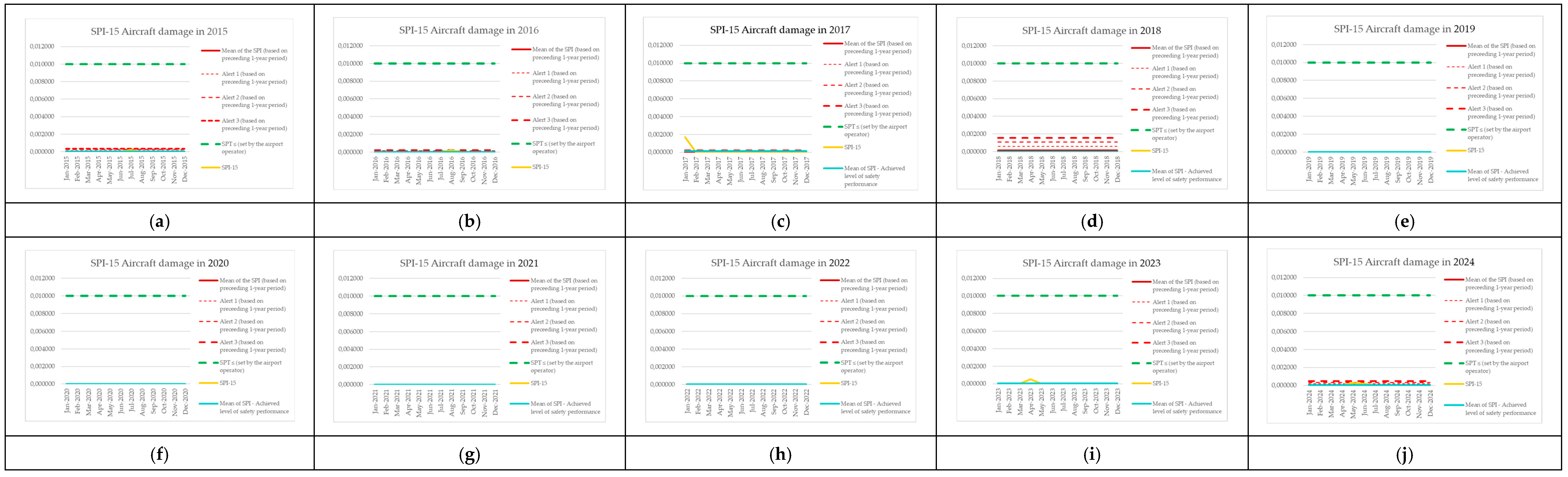
Table A16 presents monthly data on SPI-15 Aircraft damage in the form of recorded events [50] and calculated SPI values (events per operations), covering the period from January 2014 to December 2024. SPI values are calculated as ratio of number of events (Table A16) and number of aircraft operations listed in Table A1.
Table A16. SPI-15 Aircraft damage—number of events and calculated SPI values.
YearJanuaryFebruaryMarchAprilMayJuneJulyAugustSeptemberOctoberNovemberDecember
20141
0.000386 *
20151
0.000229 *
20161
0.000221 *
20171
0.001706 *
2018
2019
2020
2021
2022
20231
0.00052 *
20241
0.000273 *
1
0.000195 *
* Calculated SPI values—ratio of number of events (e.g., in September 2014) and corresponding number of aircraft operations (e.g., in September 2014).
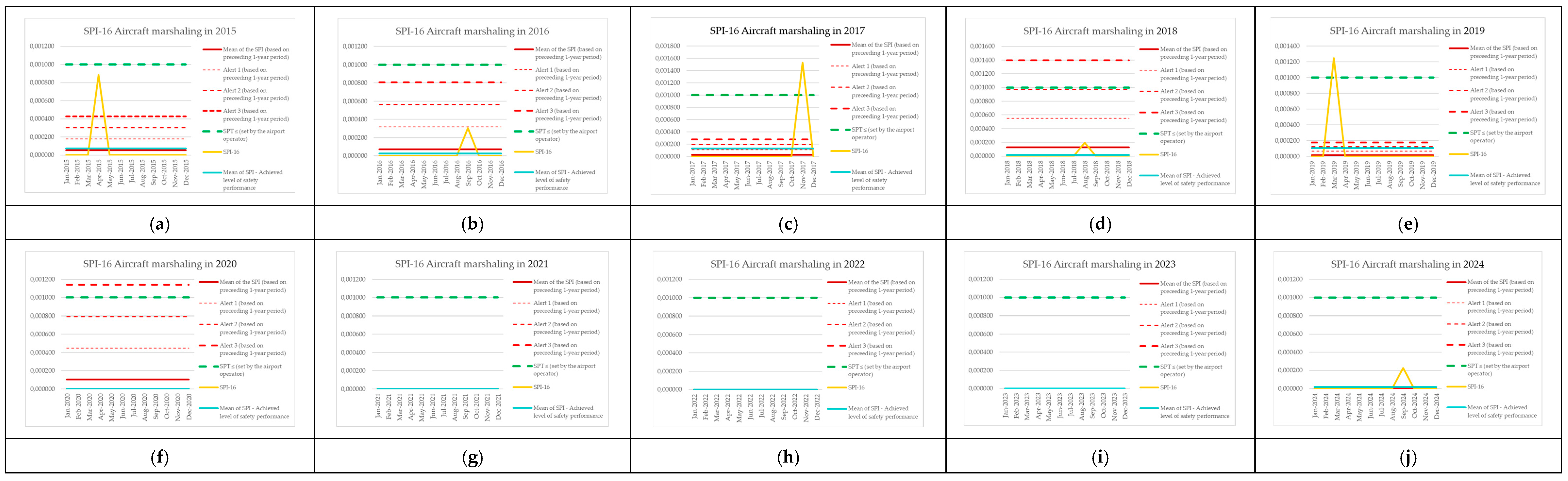
The monthly dataset for SPI-16 Aircraft marshaling is shown in Table A17, comprising recorded events [50] and SPI values (events per operations) for 2014–2024. SPI values result from dividing events by the related aircraft operations detailed in Table A1.
Table A17. SPI-16 Aircraft marshaling—number of events and calculated SPI values.
YearJanuaryFebruaryMarchAprilMayJuneJulyAugustSeptemberOctoberNovemberDecember
20141
0.000392 *
1
0.000258 *
20151
0.000883 *
20161
0.000305 *
20171
0.001529 *
20181
0.000195 *
20191
0.00125 *
2020
2021
2022
2023
20241
0.000227 *
* Calculated SPI values—ratio of number of events (e.g., in June 2014) and corresponding number of aircraft operations (e.g., in June 2014).
Table A18 shows monthly data on SPI-17 Aircraft chocking in the form of recorded events [50] and calculated SPI values (events per operations), covering the period from January 2014 to December 2024. SPI values are calculated as ratio of number of events (Table A18) and corresponding number of aircraft operations shown in Table A1.
Table A18. SPI-17 Aircraft chocking—number of events and calculated SPI values.
YearJanuaryFebruaryMarchAprilMayJuneJulyAugustSeptemberOctoberNovemberDecember
2014
2015
2016
20171
0.002016 *
1
0.000473 *
20182
0.003846 *
2019
20201
0.001222 *
2021
2022
2023
2024
* Calculated SPI values—ratio of number of events (e.g., in February 2017) and corresponding number of aircraft operations (e.g., in February 2017).
Monthly data for SPI-18 Aircraft conning, including event data [50] and SPI ratios (events per operation), are provided in Table A19 for the 2014–2024 period. The ratios are computed from event totals and the aircraft operations listed in Table A1. There was only one recorded event in October 2017, regarding this SPI, in an 11-year observed time period.
Table A19. SPI-18 Aircraft conning—number of events and calculated SPI values.
YearJanuaryFebruaryMarchAprilMayJuneJulyAugustSeptemberOctoberNovemberDecember
2014
2015
2016
20171
0.000473 *
2018
2019
2020
2021
2022
2023
2024
* Calculated SPI values—ratio of number of events (e.g., in October 2017) and corresponding number of aircraft operations (e.g., in October 2017).
Table A20 compiles the monthly SPI-19 Runway incursions/excursions events [50] and SPI ratios (events per operations) from January 2014 to December 2024. These ratios stem from dividing the events recorded in Table A20 by the aircraft operations data in Table A1. As presented, Split Airport has no record of events regarding runway incursions or excursions in an 11-year observed time period.
Table A20. SPI-19 Runway incursions/excursions—number of events and calculated SPI values.
YearJanuaryFebruaryMarchAprilMayJuneJulyAugustSeptemberOctoberNovemberDecember
2014
2015
2016
2017
2018
2019
2020
2021
2022
2023
2024
In Table A21, monthly SPI-20 Taxiing to/from apron events [50] are listed together with calculated SPI values (events per operation) for the years 2014 through 2024. SPI values are obtained via the ratio of events to aircraft operations in Table A1.
Table A21. SPI-20 Taxiing to/from apron—number of events and calculated SPI values.
YearJanuaryFebruaryMarchAprilMayJuneJulyAugustSeptemberOctoberNovemberDecember
2014
2015
2016
2017
20181
0.001337 *
20191
0.000589 *
20201
0.000272 *
2021
20221
0.000212 *
1
0.000199 *
20231
0.000298 *
1
0.000229 *
20242
0.000454 *
* Calculated SPI values—ratio of number of events (e.g., in March 2018) and corresponding number of aircraft operations (e.g., in March 2018).
Table A22 provides monthly event records [50] and SPI ratios (events per operations) for SPI-21 Apron maintenance spanning January 2014–December 2024. SPI ratios use the number of events and aircraft operations from Table A1.
Table A22. SPI-21 Apron maintenance—number of events and calculated SPI values.
YearJanuaryFebruaryMarchAprilMayJuneJulyAugustSeptemberOctoberNovemberDecember
20142
0.001938 *
1
0.000515 *
1
0.000392 *
1
0.000386 *
1
0.00068 *
20151
0.000339 *
1
0.000354 *
1
0.000632 *
1
0.001773 *
20161
0.000221 *
1
0.000305 *
20171
0.000197 *
 
2018
20191
0.00125 *
1
0.000188 *
20201
0.0625 *
20212
0.000489 *
20221
0.000811 *
1
0.000311 *
1
0.000292 *
2023
20241
0.001232 *
* Calculated SPI values—ratio of number of events (e.g., in April 2014) and corresponding number of aircraft operations (e.g., in April 2014).
Monthly data on SPI-22 FOD presence are summarized in Table A23, showing both recorded events [50] and SPI levels (events per operation) for 2014–2024. The SPI levels are derived by dividing event totals by operations shown in Table A1.
Table A23. SPI-22 FOD presence—number of events and calculated SPI values.
YearJanuaryFebruaryMarchAprilMayJuneJulyAugustSeptemberOctoberNovemberDecember
20141
0.001946 *
1
0.000392 *
1
0.000386 *
20151
0.001736 *
1
0.000229 *
1
0.001773 *
2016
2017
20181
0.001923 *
20194
0.002356 *
1
0.000334 *
5
0.001158 *
1
0.000179 *
2
0.000376 *
1
0.000422 *
2
0.003155 *
2
0.003484 *
2020
20212
0.002265 *
2022
2023
2024
* Calculated SPI values—ratio of number of events (e.g., in March 2014) and corresponding number of aircraft operations (e.g., in March 2014).
Table A24 outlines the monthly SPI-23 Maneuvering area maintenance events [50] alongside calculated SPI ratios (events per operations) between January 2014 and December 2024. These ratios are calculated with reference to the aircraft operations in Table A1.
Table A24. SPI-23 Maneuvering area maintenance—number of events and calculated SPI values.
YearJanuaryFebruaryMarchAprilMayJuneJulyAugustSeptemberOctoberNovemberDecember
20144
0.003876 *
1
0.000253 *
20151
0.001984 *
2016
20171
0.001706 *
1
0.001529 *
20181
0.001695 *
1
0.001923 *
1
0.001337 *
1
0.000195 *
20191
0.000188 *
2
0.000843 *
2020
2021
20221
0.002092 *
1
0.000811 *
1
0.000311 *
1
0.001522 *
20231
0.001267 *
2024
* Calculated SPI values—ratio of number of events (e.g., in April 2014) and corresponding number of aircraft operations (e.g., in April 2014).
The monthly SPI-24 Vehicle maintenance dataset in Table A25 includes events [50] and SPI indicators (events per operation) for the years 2014–2024. These indicators are based on event counts and the corresponding operations shown in Table A1.
Table A25. SPI-24 Vehicle maintenance—number of events and calculated SPI values.
YearJanuaryFebruaryMarchAprilMayJuneJulyAugustSeptemberOctoberNovemberDecember
20141
0.000253 *
1
0.000386 *
20151
0.000448 *
1
0.001563 *
20161
0.002024 *
1
0.000207 *
20171
0.000378 *
20181
0.00044 *
2019
2020
2021
20221
0.000456 *
20232
0.001041 *
1
0.000298 *
1
0.000172 *
20241
0.000161 *
1
0.000227 *
* Calculated SPI values—ratio of number of events (e.g., in August 2014) and corresponding number of aircraft operations (e.g., in August 2014).
Table A26 lists monthly events of SPI-25 Ground traffic (GSE) and vehicle driving [50] together with SPI values (events per operations) for January 2014 to December 2024. The SPI values are calculated as ratio of the number of events to the aircraft operations presented in Table A1.
Table A26. SPI-25 Ground traffic (GSE) and vehicle driving—number of events and calculated SPI values.
YearJanuaryFebruaryMarchAprilMayJuneJulyAugustSeptemberOctoberNovemberDecember
20141
0.002283 *
1
0.001946 *
1
0.000969 *
1
0.000515 *
6
0.002349 *
1
0.000258 *
3
0.000759 *
1
0.00068 *
20152
0.004405 *
1
0.000883 *
1
0.000448 *
1
0.000339 *
3
0.000686 *
2
0.00048 *
1
0.000354 *
1
0.000632 *
20161
0.002032 *
3
0.006073 *
1
0.000876 *
2
0.000837 *
3
0.000953 *
3
0.000622 *
3
0.000664 *
5
0.001524 *
1
0.000533 *
1
0.001718 *
20171
0.000378 *
5
0.001391 *
4
0.000788 *
20181
0.001695 *
2
0.002674 *
1
0.000673 *
1
0.000347 *
8
0.001453 *
3
0.000781 *
1
0.00044 *
20193
0.004732 *
1
0.000589 *
1
0.000334 *
1
0.000232 *
2
0.000357 *
2
0.000376 *
4
0.001686 *
1
0.001742 *
20201
0.001764 *
1
0.000363 *
1
0.000553 *
20211
0.001133 *
2
0.000975 *
1
0.000212 *
1
0.000291 *
20221
0.000811 *
2
0.000623 *
2
0.000423 *
1
0.000292 *
20231
0.00052 *
1
0.000212 *
2
0.000344 *
1
0.000176 *
1
0.000229 *
20241
0.000503 *
2
0.00039 *
2
0.000316 *
1
0.000161 *
2
0.000454 *
* Calculated SPI values—ratio of number of events (e.g., in January 2014) and corresponding number of aircraft operations (e.g., in January 2014).
Calculations of achieved levels of safety performance for all SPIs, at Split Airport, for the period 2015–2024, are presented in Table A27. The three alert levels are also calculated for each year, according to the formulas outlined in Section 2.2.
Table A27. Calculation of three alert levels and achieved levels of safety performance of SPIs at Split Airport for the period 2015–2024.
Safety Performance Indicator (SPI)2015201620172018201920202021202220232024
SPI-1
Communication
Alert 1 (based on preceding 1-year period)0.0003490.0000000.0001100.0000000.0000000.0000000.0000000.0000000.0001050.000000
Alert 2 (based on preceding 1-year period)0.0006160.0000000.0001940.0000000.0000000.0000000.0000000.0000000.0001860.000000
Alert 3 (based on preceding 1-year period)0.0008840.0000000.0002780.0000000.0000000.0000000.0000000.0000000.0002670.000000
SPT ≤ (set by the airport operator)0.0010.0010.0010.0010.0010.0010.0010.0010.0010.001
Achieved level of safety performance0.0000000.0000250.0000000.0000000.0000000.0000000.0000000.0000240.0000000.000000
SPI-2
LIRF and loadsheet crosscheck
Alert 1 (based on preceding 1-year period)0.0000000.0000820.0005760.0005620.0000000.0001290.0000980.0000000.0000000.000076
Alert 2 (based on preceding 1-year period)0.0000000.0001450.0010190.0009940.0000000.0002280.0001730.0000000.0000000.000135
Alert 3 (based on preceding 1-year period)0.0000000.0002090.0014620.0014260.0000000.0003270.0002480.0000000.0000000.000193
SPT ≤ (set by the airport operator)0.0010.0010.0010.0010.0010.0010.0010.0010.0010.001
Achieved level of safety performance0.0000190.0001340.0001300.0000000.0000300.0000230.0000000.0000000.0000180.000000
SPI-3
Wrong figures for loadsheet
Alert 1 (based on preceding 1-year period)0.0000000.0000000.0000000.0000000.0000000.0000000.0000000.0000880.0000000.000076
Alert 2 (based on preceding 1-year period)0.0000000.0000000.0000000.0000000.0000000.0000000.0000000.0001560.0000000.000135
Alert 3 (based on preceding 1-year period)0.0000000.0000000.0000000.0000000.0000000.0000000.0000000.0002230.0000000.000193
SPT ≤ (set by the airport operator)0.00010.00010.00010.00010.00010.00010.00010.00010.00010.0001
Achieved level of safety performance0.0000000.0000000.0000000.0000000.0000000.0000000.0000200.0000000.0000180.000000
SPI-4
Anti-collision occurrences
Alert 1 (based on preceding 1-year period)0.0000000.0000000.0001100.0001000.0001580.0000000.0000000.0000000.0001640.000000
Alert 2 (based on preceding 1-year period)0.0000000.0000000.0001940.0001770.0002800.0000000.0000000.0000000.0002900.000000
Alert 3 (based on preceding 1-year period)0.0000000.0000000.0002780.0002540.0004020.0000000.0000000.0000000.0004160.000000
SPT ≤ (set by the airport operator)0.0010.0010.0010.0010.0010.0010.0010.0010.0010.001
Achieved level of safety performance0.0000000.0000250.0000230.0000370.0000000.0000000.0000000.0000380.0000000.000000
SPI-5
Wildlife
Alert 1 (based on preceding 1-year period)0.0014670.0008460.0009370.0042780.0010570.0012670.0011570.0006060.0010070.001399
Alert 2 (based on preceding 1-year period)0.0023150.0013800.0015150.0071000.0016910.0019870.0018700.0010230.0015680.002100
Alert 3 (based on preceding 1-year period)0.0031640.0019150.0020920.0099230.0023240.0027070.0025820.0014400.0021290.002800
SPT ≤ (set by the airport operator)0.0010.0010.0010.0010.0010.0010.0010.0010.0010.001
Achieved level of safety performance0.0003120.0003600.0014560.0004230.0005470.0004450.0001880.0004450.0006990.000596
SPI-6
Dangerous goods
Alert 1 (based on preceding 1-year period)0.0000930.0001900.0002000.0000000.0000000.0007810.0008770.0000000.0000000.000105
Alert 2 (based on preceding 1-year period)0.0001640.0003240.0003390.0000000.0000000.0013100.0015510.0000000.0000000.000178
Alert 3 (based on preceding 1-year period)0.0002360.0004580.0004770.0000000.0000000.0018390.0022260.0000000.0000000.000250
SPT ≤ (set by the airport operator)0.00010.00010.00010.00010.00010.00010.00010.00010.00010.0001
Achieved level of safety performance0.0000560.0000610.0000000.0000000.0002520.0002030.0000000.0000000.0000320.000134
SPI-7
Baggage loading/unloading
Alert 1 (based on preceding 1-year period)0.0012700.0002680.0006500.0000000.0006850.0001560.0000000.0006090.0002860.000000
Alert 2 (based on preceding 1-year period)0.0021010.0004610.0010280.0000000.0010870.0002550.0000000.0010580.0004690.000000
Alert 3 (based on preceding 1-year period)0.0029310.0006540.0014060.0000000.0014880.0003540.0000000.0015080.0006520.000000
SPT ≤ (set by the airport operator)0.0010.0010.0010.0010.0010.0010.0010.0010.0010.001
Achieved level of safety performance0.0000760.0002710.0000000.0002830.0000570.0000000.0001600.0001030.0000000.000000
SPI-8
Passenger handling at the gate
Alert 1 (based on preceding 1-year period)0.0006040.0018490.0033270.0014980.0017740.0001350.0021580.0003800.0004070.000000
Alert 2 (based on preceding 1-year period)0.0010030.0028120.0048050.0023300.0026410.0002390.0034120.0006540.0006520.000000
Alert 3 (based on preceding 1-year period)0.0014030.0037750.0062840.0031610.0035090.0003430.0046670.0009280.0008970.000000
SPT ≤ (set by the airport operator)0.0010.0010.0010.0010.0010.0010.0010.0010.0010.001
Achieved level of safety performance0.0008860.0018480.0006660.0009060.0000310.0009030.0001060.0001620.0000000.000095
SPI-9 Passenger handling (dis/embarking)Alert 1 (based on preceding 1-year period)0.0002170.0001220.0000800.0006140.0000700.0000000.0001300.0001760.0002640.000000
Alert 2 (based on preceding 1-year period)0.0003690.0002160.0001410.0010860.0001240.0000000.0002310.0003120.0004500.000000
Alert 3 (based on preceding 1-year period)0.0005220.0003100.0002020.0015570.0001780.0000000.0003310.0004470.0006370.000000
SPT ≤ (set by the airport operator)0.0010.0010.0010.0010.0010.0010.0010.0010.0010.001
Achieved level of safety performance0.0000280.0000180.0001420.0000160.0000000.0000300.0000410.0000770.0000000.000000
SPI-10 Personnel or passenger injuriesAlert 1 (based on preceding 1-year period)0.0003080.0001910.0007310.0002620.0003320.0001440.0003910.0002610.0000720.000000
Alert 2 (based on preceding 1-year period)0.0005300.0003130.0011980.0004440.0005760.0002440.0006920.0004410.0001270.000000
Alert 3 (based on preceding 1-year period)0.0007520.0004350.0016650.0006260.0008200.0003450.0009930.0006210.0001820.000000
SPT ≤ (set by the airport operator)0.0010.0010.0010.0010.0010.0010.0010.0010.0010.001
Achieved level of safety performance0.0000690.0002640.0000790.0000880.0000430.0000910.0000810.0000170.0000000.000027
SPI-11 Personal protective equipmentAlert 1 (based on preceding 1-year period)0.0009490.0000860.0001510.0000000.0000940.0000000.0000000.0000000.0000000.000499
Alert 2 (based on preceding 1-year period)0.0016520.0001530.0002660.0000000.0001660.0000000.0000000.0000000.0000000.000850
Alert 3 (based on preceding 1-year period)0.0023560.0002190.0003820.0000000.0002380.0000000.0000000.0000000.0000000.001201
SPT ≤ (set by the airport operator)0.0010.0010.0010.0010.0010.0010.0010.0010.0010.001
Achieved level of safety performance0.0000200.0000350.0000000.0000220.0000000.0000000.0000000.0000000.0001480.000000
SPI-12
Training deficiencies
Alert 1 (based on preceding 1-year period)0.0000000.0000000.0006160.0000000.0000000.0000000.0000000.0000000.0000000.000000
Alert 2 (based on preceding 1-year period)0.0000000.0000000.0010630.0000000.0000000.0000000.0000000.0000000.0000000.000000
Alert 3 (based on preceding 1-year period)0.0000000.0000000.0015110.0000000.0000000.0000000.0000000.0000000.0000000.000000
SPT ≤ (set by the airport operator)0.0010.0010.0010.0010.0010.0010.0010.0010.0010.001
Achieved level of safety performance0.0000000.0001680.0000000.0000000.0000000.0000000.0000000.0000000.0000000.000000
SPI-13
Engine start-up
Alert 1 (based on preceding 1-year period)0.0001750.0002140.0000000.0000000.0000000.0000000.0000000.0000000.0000000.000000
Alert 2 (based on preceding 1-year period)0.0002970.0003630.0000000.0000000.0000000.0000000.0000000.0000000.0000000.000000
Alert 3 (based on preceding 1-year period)0.0004190.0005110.0000000.0000000.0000000.0000000.0000000.0000000.0000000.000000
SPT ≤ (set by the airport operator)0.0010.0010.0010.0010.0010.0010.0010.0010.0010.001
Achieved level of safety performance0.0000660.0000000.0000000.0000000.0000000.0000000.0000000.0000000.0000000.000000
SPI-14
Fuel handling
Alert 1 (based on preceding 1-year period)0.0000000.0000820.0002810.0014830.0000890.0000000.0005000.0000760.0000000.000000
Alert 2 (based on preceding 1-year period)0.0000000.0001450.0004660.0023840.0001570.0000000.0008830.0001350.0000000.000000
Alert 3 (based on preceding 1-year period)0.0000000.0002090.0006510.0032860.0002250.0000000.0012670.0001930.0000000.000000
SPT ≤ (set by the airport operator)0.0010.0010.0010.0010.0010.0010.0010.0010.0010.001
Achieved level of safety performance0.0000190.0000960.0005810.0000210.0000000.0001160.0000180.0000000.0000000.000000
SPI-15
Aircraft damage
Alert 1 (based on preceding 1-year period)0.0001390.0000820.0000800.0006140.0000000.0000000.0000000.0000000.0000000.000187
Alert 2 (based on preceding 1-year period)0.0002450.0001450.0001410.0010860.0000000.0000000.0000000.0000000.0000000.000331
Alert 3 (based on preceding 1-year period)0.0003520.0002090.0002020.0015570.0000000.0000000.0000000.0000000.0000000.000475
SPT ≤ (set by the airport operator)0.010.010.010.010.010.010.010.010.010.01
Achieved level of safety performance0.0000190.0000180.0001420.0000000.0000000.0000000.0000000.0000000.0000430.000039
SPI-16
Aircraft marshaling
Alert 1 (based on preceding 1-year period)0.0001780.0003180.0001100.0005500.0000700.0004500.0000000.0000000.0000000.000000
Alert 2 (based on preceding 1-year period)0.0003020.0005620.0001940.0009730.0001240.0007950.0000000.0000000.0000000.000000
Alert 3 (based on preceding 1-year period)0.0004260.0008060.0002780.0013950.0001780.0011410.0000000.0000000.0000000.000000
SPT ≤ (set by the airport operator)0.0010.0010.0010.0010.0010.0010.0010.0010.0010.001
Achieved level of safety performance0.0000740.0000250.0001270.0000160.0001040.0000000.0000000.0000000.0000000.000019
SPI-17
Aircraft chocking
Alert 1 (based on preceding 1-year period)0.0000000.0000000.0000000.0007680.0013840.0000000.0004400.0000000.0000000.000000
Alert 2 (based on preceding 1-year period)0.0000000.0000000.0000000.0013290.0024470.0000000.0007780.0000000.0000000.000000
Alert 3 (based on preceding 1-year period)0.0000000.0000000.0000000.0018890.0035100.0000000.0011160.0000000.0000000.000000
SPT ≤ (set by the airport operator)0.0010.0010.0010.0010.0010.0010.0010.0010.0010.001
Achieved level of safety performance0.0000000.0000000.0002070.0003210.0000000.0001020.0000000.0000000.0000000.000000
SPI-18
Aircraft conning
Alert 1 (based on preceding 1-year period)0.0000000.0000000.0000000.0001700.0000000.0000000.0000000.0000000.0000000.000000
Alert 2 (based on preceding 1-year period)0.0000000.0000000.0000000.0003010.0000000.0000000.0000000.0000000.0000000.000000
Alert 3 (based on preceding 1-year period)0.0000000.0000000.0000000.0004310.0000000.0000000.0000000.0000000.0000000.000000
SPT ≤ (set by the airport operator)0.0010.0010.0010.0010.0010.0010.0010.0010.0010.001
Achieved level of safety performance0.0000000.0000000.0000390.0000000.0000000.0000000.0000000.0000000.0000000.000000
SPI-19 Runway incursions/excursionsAlert 1 (based on preceding 1-year period)0.0000000.0000000.0000000.0000000.0000000.0000000.0000000.0000000.0000000.000000
Alert 2 (based on preceding 1-year period)0.0000000.0000000.0000000.0000000.0000000.0000000.0000000.0000000.0000000.000000
Alert 3 (based on preceding 1-year period)0.0000000.0000000.0000000.0000000.0000000.0000000.0000000.0000000.0000000.000000
SPT ≤ (set by the airport operator)0.00010.00010.00010.00010.00010.00010.00010.00010.00010.0001
Achieved level of safety performance0.0000000.0000000.0000000.0000000.0000000.0000000.0000000.0000000.0000000.000000
SPI-20
Taxiing to/from apron
Alert 1 (based on preceding 1-year period)0.0000000.0000000.0000000.0000000.0004810.0002120.0000980.0000000.0001110.000143
Alert 2 (based on preceding 1-year period)0.0000000.0000000.0000000.0000000.0008500.0003750.0001730.0000000.0001880.000243
Alert 3 (based on preceding 1-year period)0.0000000.0000000.0000000.0000000.0012200.0005370.0002480.0000000.0002640.000342
SPT ≤ (set by the airport operator)0.0010.0010.0010.0010.0010.0010.0010.0010.0010.001
Achieved level of safety performance0.0000000.0000000.0000000.0001110.0000490.0000230.0000000.0000340.0000440.000038
SPI-21
Apron maintenance
Alert 1 (based on preceding 1-year period)0.0008670.0007570.0001430.0000710.0000000.0004640.0224820.0001760.0003550.000000
Alert 2 (based on preceding 1-year period)0.0014080.0012560.0002430.0001250.0000000.0008090.0397570.0003120.0005920.000000
Alert 3 (based on preceding 1-year period)0.0019490.0017540.0003420.0001800.0000000.0011540.0570310.0004470.0008290.000000
SPT ≤ (set by the airport operator)0.0010.0010.0010.0010.0010.0010.0010.0010.0010.001
Achieved level of safety performance0.0002580.0000440.0000160.0000000.0001200.0052080.0000410.0001180.0000000.000103
SPI-22
FOD presence
Alert 1 (based on preceding 1-year period)0.0007650.0009600.0000000.0000000.0006920.0021970.0000000.0008150.0000000.000000
Alert 2 (based on preceding 1-year period)0.0013020.0016080.0000000.0000000.0012230.0034380.0000000.0014410.0000000.000000
Alert 3 (based on preceding 1-year period)0.0018400.0022570.0000000.0000000.0017550.0046800.0000000.0020670.0000000.000000
SPT ≤ (set by the airport operator)0.0010.0010.0010.0010.0010.0010.0010.0010.0010.001
Achieved level of safety performance0.0003110.0000000.0000000.0001600.0009550.0000000.0001890.0000000.0000000.000000
SPI-23
Maneuvering area maintenance
Alert 1 (based on preceding 1-year period)0.0014110.0007140.0000000.0008740.0011470.0003200.0000000.0000000.0010770.000456
Alert 2 (based on preceding 1-year period)0.0024780.0012620.0000000.0014780.0018650.0005540.0000000.0000000.0017580.000806
Alert 3 (based on preceding 1-year period)0.0035460.0018100.0000000.0020820.0025830.0007880.0000000.0000000.0024400.001157
SPT ≤ (set by the airport operator)0.0010.0010.0010.0010.0010.0010.0010.0010.0010.001
Achieved level of safety performance0.0001650.0000000.0002700.0004290.0000860.0000000.0000000.0003950.0001060.000000
SPI-24
Vehicle maintenance
Alert 1 (based on preceding 1-year period)0.0001750.0006060.0007430.0001360.0001580.0000000.0000000.0000000.0001640.000416
Alert 2 (based on preceding 1-year period)0.0002970.0010440.0013000.0002410.0002800.0000000.0000000.0000000.0002900.000706
Alert 3 (based on preceding 1-year period)0.0004190.0014820.0018580.0003450.0004020.0000000.0000000.0000000.0004160.000997
SPT ≤ (set by the airport operator)0.0010.0010.0010.0010.0010.0010.0010.0010.0010.001
Achieved level of safety performance0.0001680.0001860.0000320.0000370.0000000.0000000.0000000.0000380.0001260.000032
SPI-25 Ground traffic (GSE) and vehicle drivingAlert 1 (based on preceding 1-year period)0.0016740.0018440.0028710.0006370.0014930.0021490.0007190.0006040.0004570.000290
Alert 2 (based on preceding 1-year period)0.0025350.0030010.0044220.0010600.0023140.0034600.0012150.0009910.0007340.000457
Alert 3 (based on preceding 1-year period)0.0033950.0041590.0059740.0014840.0031360.0047710.0017110.0013780.0010120.000624
SPT ≤ (set by the airport operator)0.0010.0010.0010.0010.0010.0010.0010.0010.0010.001
Achieved level of safety performance0.0006860.0013190.0002130.0006720.0008370.0002230.0002180.0001790.0001230.000152
Figure A1 shows monitoring of SPI-1 Communication at the Split Airport, which is monthly calculated as SPI value, i.e., as the ratio of monthly number of events and number of aircraft operations, with set target level (SPT) by the airport operator for each year, calculated values of three alert levels for each year based on preceding historical data, and calculated yearly achieved level of safety performance for the observed time period from 2015 to 2024.
Figure A2 presents the SPI-2 LIRF and loadsheet crosscheck monitoring results for Split Airport. The SPI is computed monthly as the ratio between events and aircraft operations. The figure also includes the yearly SPT levels defined by the airport operator, three alert thresholds derived from historical data, and the annual achieved level of safety performance from 2015 to 2024.
In Figure A3, the SPI-3 Wrong figures for loadsheet at Split Airport is displayed, with SPI values calculated each month by dividing the number of events by aircraft operations. The figure also shows annual target values, three yearly alert limits based on prior data, and the achieved level of safety performance for each year between 2015 and 2024.
Figure A4 illustrates monthly SPI-4 Anti-collision occurrences at the Split Airport, where the SPI is obtained as the ratio of events to aircraft operations. It also depicts the airport operator’s annual SPT, the three alert thresholds derived from previous years, and the yearly performance outcomes from 2015 to 2024.
As shown in Figure A5, Split Airport’s SPI-5 Wildlife is monitored monthly through SPI values calculated from event and aircraft operations. The figure includes the operator-established annual SPTs, three alert levels calculated from past data, and the recorded yearly safety performance from 2015 to 2024.
Figure A6 shows monitoring of SPI-6 Dangerous goods at the Split Airport, which is monthly calculated as SPI value, i.e., as the ratio of monthly number of events and number of aircraft operations, with set target level (SPT) by the airport operator for each year, calculated values of three alert levels for each year based on preceding historical data, and calculated yearly achieved level of safety performance for the observed time period from 2015 to 2024.
In Figure A7, the monthly SPI-7 Baggage loading/unloading data for Split Airport are presented as SPI ratios calculated from events and aircraft operations. It further shows yearly SPTs set by the operator, three alert levels calculated from earlier data, and the safety performance achieved in each year from 2015 to 2024.
Figure A8 shows monitoring of SPI-8 Passenger handling at the gate at the Split Airport, which is monthly calculated as SPI value, i.e., as the ratio of monthly number of events and number of aircraft operations, with set target level (SPT) by the airport operator for each year, calculated values of three alert levels for each year based on preceding historical data, and calculated yearly achieved level of safety performance for the observed time period from 2015 to 2024.
Monthly SPI-9 Passenger handling (disembarking/embarking) monitoring at Split Airport is shown in Figure A9, where SPI equals the number of events divided by aircraft operations. Yearly SPTs, three alert levels based on historical data, and recorded performance for 2015–2024 are also included.
Figure A10 shows monitoring of SPI-10 Personnel or passenger injuries at the Split Airport, which is monthly calculated as SPI value, i.e., as the ratio of monthly number of events and number of aircraft operations, with set target level (SPT) by the airport operator for each year, calculated values of three alert levels for each year based on preceding historical data, and calculated yearly achieved level of safety performance for the observed time period from 2015 to 2024.
Figure A11 displays monthly SPI calculations for SPI-11 Personal protective equipment at Split Airport, obtained by events and aircraft operations. The yearly SPTs, alert thresholds based on historical data, and annual safety-performance outcomes between 2015 and 2024, are included.
Figure A12 shows monitoring of SPI-12 Training deficiencies at the Split Airport, which is monthly calculated as SPI value, i.e., as the ratio of monthly number of events and number of aircraft operations, with set target level (SPT) by the airport operator for each year, calculated values of three alert levels for each year based on preceding historical data, and calculated yearly achieved level of safety performance for the observed time period from 2015 to 2024.
Shown in Figure A13 are the SPI-13 Engine start-up data for Split Airport, calculated each month as the events-to-operations ratio. The figure further presents annual targets, three alert levels drawn from previous data, and the safety performance achieved from 2015 to 2024.
Figure A14 shows monthly monitoring of SPI-14 Fuel handling at the Split Airport, which is monthly calculated as SPI value, i.e., as the ratio of monthly number of events and number of aircraft operations, with set target level (SPT) by the airport operator for each year, calculated values of three alert levels for each year based on preceding historical data, and calculated yearly achieved level of safety performance for the observed time period from 2015 to 2024.
In Figure A15, monthly values of SPI-15 Aircraft damage for Split Airport are calculated as the ratio of events to aircraft operations. The figure also shows SPTs for each year, three alert levels based on earlier trends, and annual performance results for 2015–2024.
Figure A16 shows monitoring of SPI-16 Aircraft marshaling at the Split Airport, which is monthly calculated as SPI value, i.e., as the ratio of monthly number of events and number of aircraft operations, with set target level (SPT) by the airport operator for each year, calculated values of three alert levels for each year based on preceding historical data, and calculated yearly achieved level of safety performance for the observed time period from 2015 to 2024.
Figure A17 shows monthly data of SPI-17 Aircraft chocking at the Split Airport, calculated as SPI value, i.e., as the ratio of monthly number of events and number of aircraft operations, with set target level (SPT) by the airport operator for each year, calculated values of three alert levels for each year based on preceding historical data, and calculated yearly achieved level of safety performance for the observed time period from 2015 to 2024.
Figure A18 shows monitoring of SPI-18 Aircraft conning at the Split Airport, which is monthly calculated as SPI value, i.e., as the ratio of monthly number of events and number of aircraft operations, with set target level (SPT) by the airport operator for each year, calculated values of three alert levels for each year based on preceding historical data, and calculated yearly achieved level of safety performance for the observed time period from 2015 to 2024.
The SPI-19 Runway incursions/excursions monitoring for Split Airport is shown in Figure A19. Monthly SPI values arise from dividing events by aircraft operations. The figure also features yearly SPT thresholds, three alert levels set using historical records, and the yearly performance achieved from 2015 to 2024.
Figure A20 shows monitoring of SPI-20 Taxiing to/from apron at the Split Airport, which is monthly calculated as SPI value, i.e., as the ratio of monthly number of events and number of aircraft operations, with set target level (SPT) by the airport operator for each year, calculated values of three alert levels for each year based on preceding historical data, and calculated yearly achieved level of safety performance for the observed time period from 2015 to 2024.
In Figure A21, monthly SPI values for SPI-21 Apron maintenance at Split Airport are illustrated, determined as events-to-operations ratios. Annual SPT levels, alert thresholds based on historical data, and corresponding safety performance for 2015–2024 are also included.
Figure A22 shows monitoring of SPI-22 FOD presence at the Split Airport, which is monthly calculated as SPI value, i.e., as the ratio of monthly number of events and number of aircraft operations, with set target level (SPT) by the airport operator for each year, calculated values of three alert levels for each year based on preceding historical data, and calculated yearly achieved level of safety performance for the observed time period from 2015 to 2024.
Displayed in Figure A23 are the monthly values of SPI-23 Maneuvering area maintenance at Split Airport, obtained by dividing the number of events by aircraft operations. The figure includes yearly targets, historically derived alert thresholds, and performance outcomes between 2015 and 2024.
Figure A24 shows monitoring of SPI-24 Vehicle maintenance at the Split Airport, which is monthly calculated as SPI value, i.e., as the ratio of monthly number of events and number of aircraft operations, with set target level (SPT) by the airport operator for each year, calculated values of three alert levels for each year based on preceding historical data, and calculated yearly achieved level of safety performance for the observed time period from 2015 to 2024.
Monthly data on SPI-25 Ground traffic (GSE) and vehicle driving for Split Airport is shown in Figure A25, with SPI calculated as the events-to-operations ratio. Yearly SPTs, three alert thresholds derived from past data, and yearly achieved safety performance levels for 2015–2024, are included.
Figure A1. Monitoring safety performance indicator SPI-1 Communication at the Split Airport—monthly calculated SPI values obtained as ratio of monthly number of events and number of aircraft operations, set target levels (SPT) by the airport operator for each year, calculated values of three alert levels for each year based on preceding historical data, and calculated achieved level of safety performance for each year: (a) in 2015; (b) in 2016; (c) in 2017; (d) in 2018; (e) in 2019; (f) in 2020; (g) in 2021; (h) in 2022; (i) in 2023; (j) in 2024.
Aerospace 13 00061 g0a1
Figure A2. Monitoring safety performance indicator SPI-2 LIRF and loadsheet crosscheck at the Split Airport—monthly calculated SPI values obtained as ratio of monthly number of events and number of aircraft operations, set target levels (SPT) by the airport operator for each year, calculated values of three alert levels for each year based on preceding historical data, and calculated achieved level of safety performance for each year: (a) in 2015; (b) in 2016; (c) in 2017; (d) in 2018; (e) in 2019; (f) in 2020; (g) in 2021; (h) in 2022; (i) in 2023; (j) in 2024.
Aerospace 13 00061 g0a2
Figure A3. Monitoring safety performance indicator SPI-3 Wrong figures for loadsheet at the Split Airport—monthly calculated SPI values obtained as ratio of monthly number of events and number of aircraft operations, set target levels (SPT) by the airport operator for each year, calculated values of three alert levels for each year based on preceding historical data, and calculated achieved level of safety performance for each year: (a) in 2015; (b) in 2016; (c) in 2017; (d) in 2018; (e) in 2019; (f) in 2020; (g) in 2021; (h) in 2022; (i) in 2023; (j) in 2024.
Aerospace 13 00061 g0a3
Figure A4. Monitoring safety performance indicator SPI-4 Anti-collision occurrences at the Split Airport—monthly calculated SPI values obtained as ratio of monthly number of events and number of aircraft operations, set target levels (SPT) by the airport operator for each year, calculated values of three alert levels for each year based on preceding historical data, and calculated achieved level of safety performance for each year: (a) in 2015; (b) in 2016; (c) in 2017; (d) in 2018; (e) in 2019; (f) in 2020; (g) in 2021; (h) in 2022; (i) in 2023; (j) in 2024.
Aerospace 13 00061 g0a4
Figure A5. Monitoring safety performance indicator SPI-5 Wildlife at the Split Airport—monthly calculated SPI values obtained as ratio of monthly number of events and number of aircraft operations, set target levels (SPT) by the airport operator for each year, calculated values of three alert levels for each year based on preceding historical data, and calculated achieved level of safety performance for each year: (a) in 2015; (b) in 2016; (c) in 2017; (d) in 2018; (e) in 2019; (f) in 2020; (g) in 2021; (h) in 2022; (i) in 2023; (j) in 2024.
Aerospace 13 00061 g0a5
Figure A6. Monitoring safety performance indicator SPI-6 Dangerous goods at the Split Airport—monthly calculated SPI values obtained as ratio of monthly number of events and number of aircraft operations, set target levels (SPT) by the airport operator for each year, calculated values of three alert levels for each year based on preceding historical data, and calculated achieved level of safety performance for each year: (a) in 2015; (b) in 2016; (c) in 2017; (d) in 2018; (e) in 2019; (f) in 2020; (g) in 2021; (h) in 2022; (i) in 2023; (j) in 2024.
Aerospace 13 00061 g0a6
Figure A7. Monitoring safety performance indicator SPI-7 Baggage loading/unloading at the Split Airport—monthly calculated SPI values obtained as ratio of monthly number of events and number of aircraft operations, set target levels (SPT) by the airport operator for each year, calculated values of three alert levels for each year based on preceding historical data, and calculated achieved level of safety performance for each year: (a) in 2015; (b) in 2016; (c) in 2017; (d) in 2018; (e) in 2019; (f) in 2020; (g) in 2021; (h) in 2022; (i) in 2023; (j) in 2024.
Aerospace 13 00061 g0a7
Figure A8. Monitoring safety performance indicator SPI-8 Passenger handling at the gate at the Split Airport—monthly calculated SPI values obtained as ratio of monthly number of events and number of aircraft operations, set target levels (SPT) by the airport operator for each year, calculated values of three alert levels for each year based on preceding historical data, and calculated achieved level of safety performance for each year: (a) in 2015; (b) in 2016; (c) in 2017; (d) in 2018; (e) in 2019; (f) in 2020; (g) in 2021; (h) in 2022; (i) in 2023; (j) in 2024.
Aerospace 13 00061 g0a8
Figure A9. Monitoring safety performance indicator SPI-9 Passenger handling (disembarking/embarking) at the Split Airport—monthly calculated SPI values obtained as ratio of monthly number of events and number of aircraft operations, set target levels (SPT) by the airport operator for each year, calculated values of three alert levels for each year based on preceding historical data, and calculated achieved level of safety performance for each year: (a) in 2015; (b) in 2016; (c) in 2017; (d) in 2018; (e) in 2019; (f) in 2020; (g) in 2021; (h) in 2022; (i) in 2023; (j) in 2024.
Aerospace 13 00061 g0a9
Figure A10. Monitoring safety performance indicator SPI-10 Personnel or passenger injuries at the Split Airport—monthly calculated SPI values obtained as ratio of monthly number of events and number of aircraft operations, set target levels (SPT) by the airport operator for each year, calculated values of three alert levels for each year based on preceding historical data, and calculated achieved level of safety performance for each year: (a) in 2015; (b) in 2016; (c) in 2017; (d) in 2018; (e) in 2019; (f) in 2020; (g) in 2021; (h) in 2022; (i) in 2023; (j) in 2024.
Aerospace 13 00061 g0a10
Figure A11. Monitoring safety performance indicator SPI-11 Personal protective equipment at the Split Airport—monthly calculated SPI values obtained as ratio of monthly number of events and number of aircraft operations, set target levels (SPT) by the airport operator for each year, calculated values of three alert levels for each year based on preceding historical data, and calculated achieved level of safety performance for each year: (a) in 2015; (b) in 2016; (c) in 2017; (d) in 2018; (e) in 2019; (f) in 2020; (g) in 2021; (h) in 2022; (i) in 2023; (j) in 2024.
Aerospace 13 00061 g0a11
Figure A12. Monitoring safety performance indicator SPI-12 Training deficiencies at the Split Airport—monthly calculated SPI values obtained as ratio of monthly number of events and number of aircraft operations, set target levels (SPT) by the airport operator for each year, calculated values of three alert levels for each year based on preceding historical data, and calculated achieved level of safety performance for each year: (a) in 2015; (b) in 2016; (c) in 2017; (d) in 2018; (e) in 2019; (f) in 2020; (g) in 2021; (h) in 2022; (i) in 2023; (j) in 2024.
Aerospace 13 00061 g0a12
Figure A13. Monitoring safety performance indicator SPI-13 Engine start-up at the Split Airport—monthly calculated SPI values obtained as ratio of monthly number of events and number of aircraft operations, set target levels (SPT) by the airport operator for each year, calculated values of three alert levels for each year based on preceding historical data, and calculated achieved level of safety performance for each year: (a) in 2015; (b) in 2016; (c) in 2017; (d) in 2018; (e) in 2019; (f) in 2020; (g) in 2021; (h) in 2022; (i) in 2023; (j) in 2024.
Aerospace 13 00061 g0a13
Figure A14. Monitoring safety performance indicator SPI-14 Fuel handling at the Split Airport—monthly calculated SPI values obtained as ratio of monthly number of events and number of aircraft operations, set target levels (SPT) by the airport operator for each year, calculated values of three alert levels for each year based on preceding historical data, and calculated achieved level of safety performance for each year: (a) in 2015; (b) in 2016; (c) in 2017; (d) in 2018; (e) in 2019; (f) in 2020; (g) in 2021; (h) in 2022; (i) in 2023; (j) in 2024.
Aerospace 13 00061 g0a14
Figure A15. Monitoring safety performance indicator SPI-15 Aircraft damage at the Split Airport—monthly calculated SPI values obtained as ratio of monthly number of events and number of aircraft operations, set target levels (SPT) by the airport operator for each year, calculated values of three alert levels for each year based on preceding historical data, and calculated achieved level of safety performance for each year: (a) in 2015; (b) in 2016; (c) in 2017; (d) in 2018; (e) in 2019; (f) in 2020; (g) in 2021; (h) in 2022; (i) in 2023; (j) in 2024.
Aerospace 13 00061 g0a15
Figure A16. Monitoring safety performance indicator SPI-16 Aircraft marshaling at the Split Airport—monthly calculated SPI values obtained as ratio of monthly number of events and number of aircraft operations, set target levels (SPT) by the airport operator for each year, calculated values of three alert levels for each year based on preceding historical data, and calculated achieved level of safety performance for each year: (a) in 2015; (b) in 2016; (c) in 2017; (d) in 2018; (e) in 2019; (f) in 2020; (g) in 2021; (h) in 2022; (i) in 2023; (j) in 2024.
Aerospace 13 00061 g0a16
Figure A17. Monitoring safety performance indicator SPI-17 Aircraft chocking at the Split Airport—monthly calculated SPI values obtained as ratio of monthly number of events and number of aircraft operations, set target levels (SPT) by the airport operator for each year, calculated values of three alert levels for each year based on preceding historical data, and calculated achieved level of safety performance for each year: (a) in 2015; (b) in 2016; (c) in 2017; (d) in 2018; (e) in 2019; (f) in 2020; (g) in 2021; (h) in 2022; (i) in 2023; (j) in 2024.
Aerospace 13 00061 g0a17
Figure A18. Monitoring safety performance indicator SPI-18 Aircraft conning at the Split Airport—monthly calculated SPI values obtained as ratio of monthly number of events and number of aircraft operations, set target levels (SPT) by the airport operator for each year, calculated values of three alert levels for each year based on preceding historical data, and calculated achieved level of safety performance for each year: (a) in 2015; (b) in 2016; (c) in 2017; (d) in 2018; (e) in 2019; (f) in 2020; (g) in 2021; (h) in 2022; (i) in 2023; (j) in 2024.
Aerospace 13 00061 g0a18
Figure A19. Monitoring safety performance indicator SPI-19 Runway incursions/excursions at the Split Airport—monthly calculated SPI values obtained as ratio of monthly number of events and number of aircraft operations, set target levels (SPT) by the airport operator for each year, calculated values of three alert levels for each year based on preceding historical data, and calculated achieved level of safety performance for each year: (a) in 2015; (b) in 2016; (c) in 2017; (d) in 2018; (e) in 2019; (f) in 2020; (g) in 2021; (h) in 2022; (i) in 2023; (j) in 2024.
Aerospace 13 00061 g0a19
Figure A20. Monitoring safety performance indicator SPI-20 Taxiing to/from apron at the Split Airport—monthly calculated SPI values obtained as ratio of monthly number of events and number of aircraft operations, set target levels (SPT) by the airport operator for each year, calculated values of three alert levels for each year based on preceding historical data, and calculated achieved level of safety performance for each year: (a) in 2015; (b) in 2016; (c) in 2017; (d) in 2018; (e) in 2019; (f) in 2020; (g) in 2021; (h) in 2022; (i) in 2023; (j) in 2024.
Aerospace 13 00061 g0a20
Figure A21. Monitoring safety performance indicator SPI-21 Apron maintenance at the Split Airport—monthly calculated SPI values obtained as ratio of monthly number of events and number of aircraft operations, set target levels (SPT) by the airport operator for each year, calculated values of three alert levels for each year based on preceding historical data, and calculated achieved level of safety performance for each year: (a) in 2015; (b) in 2016; (c) in 2017; (d) in 2018; (e) in 2019; (f) in 2020; (g) in 2021; (h) in 2022; (i) in 2023; (j) in 2024.
Aerospace 13 00061 g0a21
Figure A22. Monitoring safety performance indicator SPI-22 FOD presence at the Split Airport—monthly calculated SPI values obtained as ratio of monthly number of events and number of aircraft operations, set target levels (SPT) by the airport operator for each year, calculated values of three alert levels for each year based on preceding historical data, and calculated achieved level of safety performance for each year: (a) in 2015; (b) in 2016; (c) in 2017; (d) in 2018; (e) in 2019; (f) in 2020; (g) in 2021; (h) in 2022; (i) in 2023; (j) in 2024.
Aerospace 13 00061 g0a22
Figure A23. Monitoring safety performance indicator SPI-23 Maneuvering area maintenance at the Split Airport—monthly calculated SPI values obtained as ratio of monthly number of events and number of aircraft operations, set target levels (SPT) by the airport operator for each year, calculated values of three alert levels for each year based on preceding historical data, and calculated achieved level of safety performance for each year: (a) in 2015; (b) in 2016; (c) in 2017; (d) in 2018; (e) in 2019; (f) in 2020; (g) in 2021; (h) in 2022; (i) in 2023; (j) in 2024.
Aerospace 13 00061 g0a23
Figure A24. Monitoring safety performance indicator SPI-24 Vehicle maintenance at the Split Airport—monthly calculated SPI values obtained as ratio of monthly number of events and number of aircraft operations, set target levels (SPT) by the airport operator for each year, calculated values of three alert levels for each year based on preceding historical data, and calculated achieved level of safety performance for each year: (a) in 2015; (b) in 2016; (c) in 2017; (d) in 2018; (e) in 2019; (f) in 2020; (g) in 2021; (h) in 2022; (i) in 2023; (j) in 2024.
Aerospace 13 00061 g0a24
Figure A25. Monitoring safety performance indicator SPI-25 Ground traffic (GSE) and vehicle driving at the Split Airport—monthly calculated SPI values obtained as ratio of monthly number of events and number of aircraft operations, set target levels (SPT) by the airport operator for each year, calculated values of three alert levels for each year based on preceding historical data, and calculated achieved level of safety performance for each year: (a) in 2015; (b) in 2016; (c) in 2017; (d) in 2018; (e) in 2019; (f) in 2020; (g) in 2021; (h) in 2022; (i) in 2023; (j) in 2024.
Aerospace 13 00061 g0a25

References

  1. International Civil Aviation Organization (ICAO). Annex 19 to the Convention on International Civil Aviation: Safety Management, 2nd ed.; International Civil Aviation Organization: Montreal, QC, Canada, 2016. [Google Scholar]
  2. Ferguson, M.D.; Nelson, S. Aviation Safety: A Balanced Industry Approach, 1st ed.; Delmar: New York, NY, USA, 2014. [Google Scholar]
  3. Wang, B.; Wu, C.; Shi, B.; Huang, L. Evidence-Based Safety (EBS) management: A new approach to teaching the practice of Safety Management (SM). J. Saf. Res. 2017, 63, 21–28. [Google Scholar] [CrossRef]
  4. Bartulović, D. Predictive safety management system development. Trans. Marit. Sci. 2021, 10, 135–146. [Google Scholar] [CrossRef]
  5. Yeun, R.; Bates, P.; Murray, P. Aviation safety management systems. World Rev. Intermodal Transp. Res. 2014, 5, 168–196. [Google Scholar] [CrossRef]
  6. Canders, M.F. Peer reviewed Safety Management System (SMS): Collaboration for continuous improvement (literature review). Int. J. Aviat. Aeronaut. Aerosp. 2016, 3, 1–14. [Google Scholar] [CrossRef][Green Version]
  7. Ewertowski, T.; Kuźmiński, P. The safety management and organizational resilience system maturity of aviation organizations during the COVID-19 pandemic: Comparison of two approaches to achieving safety. Sustainability 2024, 16, 1682. [Google Scholar] [CrossRef]
  8. Cusick, S.K.; Cortes, A.I.; Rodrigues, C.C. Commercial Aviation Safety, 6th ed.; McGraw-Hill: New York, NY, USA, 2017. [Google Scholar]
  9. Stroeve, S.; Smeltink, J.; Kirwan, B. Assessing and advancing safety management in aviation. Safety 2022, 8, 20. [Google Scholar] [CrossRef]
  10. International Civil Aviation Organization (ICAO). Safety Management Manual (SMM) [Doc 9859 AN/474], 4th ed.; International Civil Aviation Organization: Montreal, QC, Canada, 2018. [Google Scholar]
  11. International Civil Aviation Organization (ICAO). Annex 14—Aerodromes (Volume I), 9th ed.; International Civil Aviation Organization: Montreal, QC, Canada, 2022. [Google Scholar]
  12. Stolzer, A.J.; Sumwalt, R.L.; Goglia, J.J. Safety Management Systems in Aviation, 3rd ed.; CRC Press: Boca Raton, FL, USA, 2023. [Google Scholar]
  13. Bartulović, D. Development of Predictive Safety Management Methodology in Aviation. Ph.D. Dissertation, University of Zagreb, Faculty of Transport and Traffic Sciences, Zagreb, Croatia, 9 December 2022. Available online: https://repozitorij.fpz.unizg.hr/islandora/object/fpz:2944 (accessed on 17 May 2025).
  14. Kıvanç, E.; Tuzkaya, G.; Vayvay, Ö. Safety management system and risk-based approach in aviation maintenance: A systematic literature review. Saf. Sci. 2025, 184, 106755. [Google Scholar] [CrossRef]
  15. Chen, M.; Chen, Y.; Ma, S. Identifying Safety Performance Indicators for Risk Assessment in Civil Aviation. In Proceedings of the 10th International Conference on Quality, Reliability, Risk, Maintenance, and Safety Engineering (QR2MSE 2020), Shaanxi, China, 8–11 October 2020. [Google Scholar] [CrossRef]
  16. Chen, M.; Luo, M.; Zhang, Y.; Chen, Y. A Framework to Quantitatively Assess Safety Performance for Civil Aviation Organization. In Proceedings of the 10th International Conference on Digital Human Modeling and Applications in Health, Safety, Ergonomics and Risk Management (DHM 2019) as part of International Conference on Human-Computer Interaction (HCII 2019), Orlando, FL, USA, 26–31 July 2019. [Google Scholar] [CrossRef]
  17. Dillman, B.; Ziakkas, D.; Cutter, J. Selection and Implementation of Evidence-Based Safety Performance Indicators in Aviation Training. In Proceedings of the Applied Human Factors and Ergonomics International Conference (AHFE 2022), New York, NY, USA, 24–28 July 2022. [Google Scholar] [CrossRef]
  18. O’Conner, P.; O’Dea, A.; Kennedy, Q.; Buttrey, S.E. Measuring safety climate in aviation: A review and recommendations for the future. Saf. Sci. 2011, 49, 128–138. [Google Scholar] [CrossRef]
  19. Di Gravio, G.; Mancini, M.; Patriarca, R.; Costantino, F. Overall safety performance of air traffic management system: Forecasting and monitoring. Saf. Sci. 2015, 72, 351–362. [Google Scholar] [CrossRef]
  20. Chen, W.; Li, J. Safety performance monitoring and measurement of civil aviation unit. J. Air Transp. Manag. 2016, 57, 228–233. [Google Scholar] [CrossRef]
  21. Patriarca, R.; Di Gravio, G.; Cioponea, R.; Licu, A. Safety intelligence: Incremental proactive risk management for holistic aviation safety performance. Saf. Sci. 2019, 118, 551–567. [Google Scholar] [CrossRef]
  22. Kaspers, S.; Karanikas, N.; Roelen, A.; Piric, S.; De Boer, R.J. How does the aviation industry measure safety performance? Current practice and limitations. Int. J. Aviat. Manag. 2019, 4, 224–245. [Google Scholar] [CrossRef]
  23. Sun, H.; Wang, C.; Li, Q.; Zhang, B. Research on ICAO Safety Performance Monitoring Algorithm. In Proceedings of the IEEE 3rd International Conference on Civil Aviation Safety and Information Technology (ICCASIT), Changsha, China, 20–22 October 2021. [Google Scholar] [CrossRef]
  24. Kobaszyńska-Twardowska, A.; Gill, A. Analysis of safety indicators in air transport. Combust. Engines 2025, 200, 128–135. [Google Scholar] [CrossRef]
  25. EUROCONTROL, 2017. Acceptable Level of Safety Performance (ALoSP) Implementation in EUROCONTROL Member States. Available online: https://www.eurocontrol.int/sites/default/files/content/documents/single-sky/pru/publications/other/alosp-implementation-in-eurocontrol-member-states-jun-2017.pdf (accessed on 29 July 2025).
  26. Errico, A.; Travascio, L.; Vozella, A. Analysis of safety metrics supporting air traffic management risk models. Eng. Proc. 2025, 90, 43. [Google Scholar] [CrossRef]
  27. Georgiev, K. Aviation safety training methodology. Heliyon 2021, 7, e08511. [Google Scholar] [CrossRef] [PubMed]
  28. Wilke, S.; Majumdar, A.; Ochieng, W.Y. A framework for assessing the quality of aviation safety databases. Saf. Sci. 2014, 63, 133–145. [Google Scholar] [CrossRef]
  29. Oster, C.V., Jr.; Strong, J.S.; Zorn, K. Analyzing aviation safety: Problems, challenges, opportunities. Res. Transp. Econ. 2013, 43, 148–164. [Google Scholar] [CrossRef]
  30. MacLean, L.; Richman, A.; MacLean, S. Benchmarking airports with specific safety performance measures. Transp. Res. A Policy Pract. 2016, 92, 349–364. [Google Scholar] [CrossRef]
  31. Bartulović, D.; Steiner, S. Predictive analysis of airport safety performance: Case study of Split Airport. Aerospace 2023, 10, 303. [Google Scholar] [CrossRef]
  32. Hsu, Y.L.; Li, W.C.; Chen, K.W. Structuring critical success factors of airline safety management system using a hybrid model. Transp. Res. E Logist. Transp. Rev. 2010, 46, 222–235. [Google Scholar] [CrossRef]
  33. Tyagi, A.; Tripathi, R.; Bouarfa, S. Learning from past in the aircraft maintenance industry: An empirical evaluation in the safety management framework. Heliyon 2023, 9, e21620. [Google Scholar] [CrossRef]
  34. Di Gravio, G.; Patriarca, R.; Mancini, M.; Costantino, F. Overall safety performance of the Air Traffic Management system: The Italian ANSP’s experience on APF. Res. Transp. Bus. Manag. 2016, 20, 3–12. [Google Scholar] [CrossRef]
  35. Cunha, D.A.; Andrade, M.; Prado, L.A.; Santana, L.O.; Gonçalves da Silv, M.P. RISK assessment in airport maintenance runway condition using MCDA-C. J. Air Transp. Manag. 2021, 90, 101948. [Google Scholar] [CrossRef]
  36. Panagopoulos, I.; Atkin, C.; Sikora, I. Developing performance indicators lean-sigma framework for measuring aviation system’s safety performance. Transp. Res. Procedia. 2017, 22, 35–44. [Google Scholar] [CrossRef]
  37. European Union Aviation Safety Agency (EASA). Acceptable Level of Safety Performance (AloSP)—Implementation Guidance within the European Union Framework. Available online: https://www.easa.europa.eu/sites/default/files/dfu/2021-05-31_alosp_for_publication.pdf (accessed on 28 July 2025).
  38. International Civil Aviation Organization (ICAO). Global Aviation Safety Plan [Doc 10004], 2023–2025th ed.; International Civil Aviation Organization: Montreal, QC, Canada, 2022; Available online: https://www.icao.int/sites/default/files/safety/GASP/Documents/10004_en.pdf (accessed on 4 December 2025).
  39. International Civil Aviation Organization (ICAO). Global Aviation Safety Plan [Doc 10004], 2026–2028th ed.; International Civil Aviation Organization: Montreal, QC, Canada, 2025; Available online: https://www.icao.int/sites/default/files/safety/GASP/Documents/Doc.10004.2026-2028.GASP_.EN_.pdf (accessed on 4 December 2025).
  40. International Civil Aviation Organization (ICAO). Global Aviation Safety Roadmap [Doc 10161], 2nd ed.; International Civil Aviation Organization: Montreal, QC, Canada, 2025; Available online: https://www.icao.int/sites/default/files/safety/GASP/Documents/Doc-10161-Ed-2-Advanced-Version.pdf (accessed on 4 December 2025).
  41. European Union Aviation Safety Agency (EASA). European Plan for Aviation Safety. Available online: https://www.easa.europa.eu/en/domains/safety-management/european-plan-aviation-safety (accessed on 4 December 2025).
  42. Liou, J.J.H.; Yen, L.; Tzeng, G.H. Building an effective safety management system for airlines. J. Air Transp. Manag. 2008, 14, 20–26. [Google Scholar] [CrossRef]
  43. Onyegiri, I.E.; Oke, S.A. A grey relational analytical approach to safety performance assessment in an aviation industry of a developing country. Eng. Appl. Sci. Res. 2017, 44, 1–15. [Google Scholar] [CrossRef]
  44. Luxhøj, J.T. Predictive safety analytics for complex aerospace systems. Procedia Comput. Sci. 2013, 20, 331–336. [Google Scholar] [CrossRef]
  45. Ancel, E.; Shih, A.T.; Jones, S.M.; Reveley, M.S.; Luxhøj, J. Predictive safety analytics: Inferring aviation accident shaping factors and causation. J. Risk Res. 2015, 18, 428–451. [Google Scholar] [CrossRef]
  46. Chang, Y.H.; Shao, P.C.; Chen, H.J. Performance evaluation of airport safety management systems in Taiwan. Saf. Sci. 2015, 75, 72–86. [Google Scholar] [CrossRef]
  47. Leva, M.C.; Del Sordo, D.; Mattei, F. Day-to-day performance management in a small regional airport and management of change for safer operations. Cogn. Technol. Work 2015, 17, 237–248. [Google Scholar] [CrossRef]
  48. Split Airport. Saint Jerome Airport Homepage. Available online: https://www.split-airport.hr/ (accessed on 12 November 2025).
  49. Split Airport. Saint Jerome Airport Statistics. Available online: https://www.split-airport.hr/statistics/ (accessed on 29 July 2025).
  50. Split Airport. Internal Documentation on SPIs and SPTs Data for Period 2014-2024; Split Airport: Kaštel Štafilić, Croatia, 2025. [Google Scholar]
  51. Galiot Aero. Galiot SMS—Safety Management System. Available online: https://www.galiot.net/products_SMS.html (accessed on 30 July 2025).
  52. Kaspers, S.; Karanikas, N.; Roelen, A.; Piric, S.; Van Aalst, R.; De Boer, R.J. Exploring the diversity in safety measurement practices: Empirical results from aviation. J. Saf. Stud. 2016, 2, 18–29. [Google Scholar] [CrossRef]
  53. Ioannou, C.; Harris, D.; Dahlstrom, N. Safety management practices hindering the development of safety performance indicators in aviation service providers. Aviat. Psychol. Appl. Hum. Factors 2017, 7, 95–106. [Google Scholar] [CrossRef]
  54. Reiman, T.; Pietikäinen, E. Leading indicators of system safety—Monitoring and driving the organizational safety potential. Saf. Sci. 2012, 50, 1993–2000. [Google Scholar] [CrossRef]
  55. Safety Management International Collaboration Group (SM ICG). Measuring Safety Performance Guidelines for Service Providers. Available online: https://skybrary.aero/sites/default/files/bookshelf/2395.pdf (accessed on 29 July 2025).
  56. Ali, M.X.M.; Arifin, K.; Abas, A.; Ahmad, M.A.; Khairil, M.; Cyio, M.B.; Samad, M.A.; Lampe, I.; Mahfudz, M.; Ali, M.N. Systematic literature review on indicators use in safety management practices among utility industries. Int. J. Environ. Res. Public Health 2022, 19, 6198. [Google Scholar] [CrossRef]
  57. Pérez-Castán, J.A.; Gómez Comendador, F.; Cardenas-Soria, A.B.; Janisch, D.; Arnaldo Valdés, R.M. Identification, categorisation and gaps of safety indicators for U-Space. Energies 2020, 13, 608. [Google Scholar] [CrossRef]
  58. Sieberichs, S.; Kluge, A. How just culture and personal goals moderate the positive relation between commercial pilots’ safety citizenship behavior and voluntary incident reporting. Safety 2021, 7, 59. [Google Scholar] [CrossRef]
Figure 1. Passenger traffic and airport operations at Split Airport: (a) Number of passengers at Split Airport in the period from 1966 to 2024.; (b) Airport operations at Split Airport in the period from 2014 to 2024 [13,49,50].
Aerospace 13 00061 g001
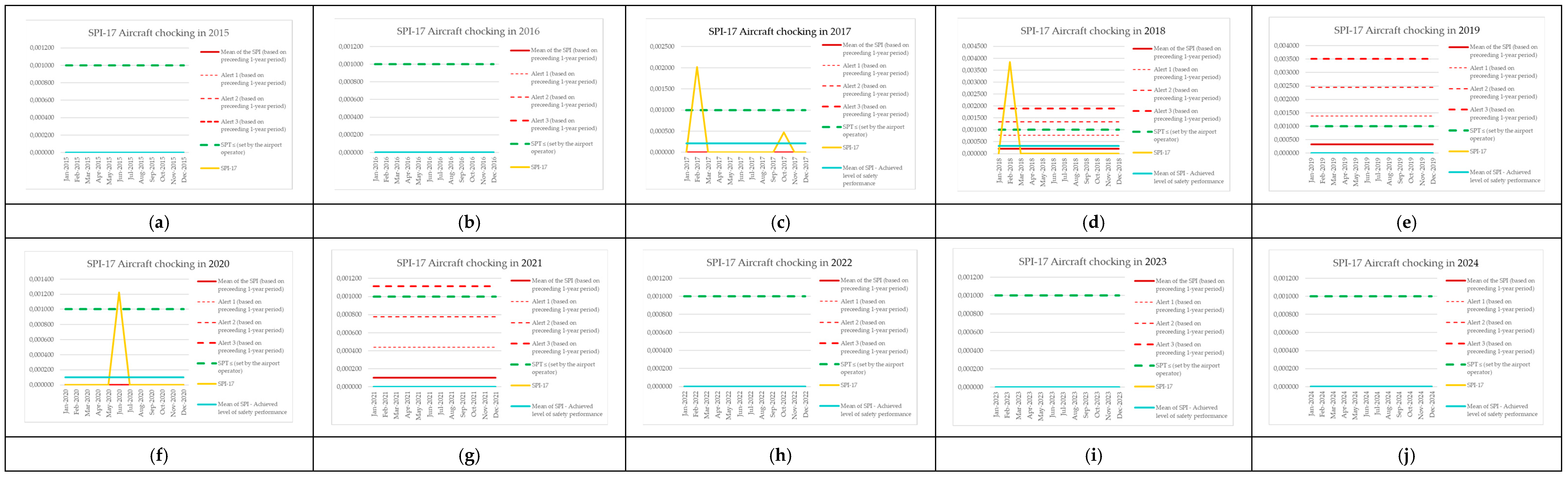
Figure 2. A flowchart of linear and sequential structure of determining ALoSP.
Aerospace 13 00061 g002
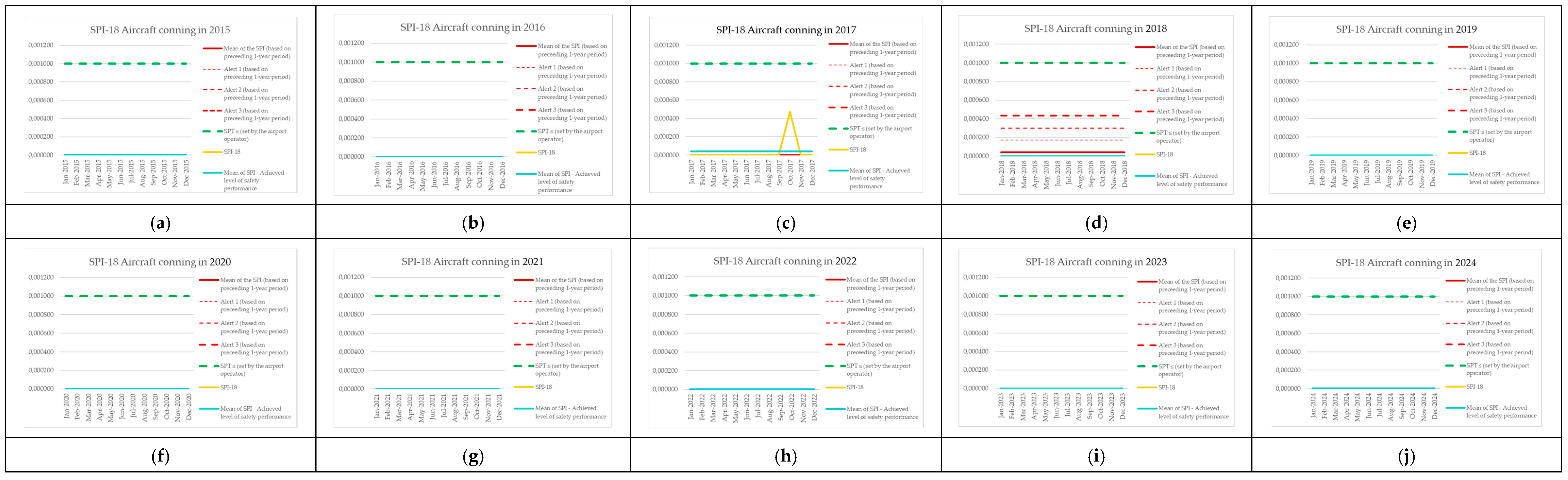
Figure 3. Monitoring monthly SPI-8 values vs. set target level (SPT), three alert levels and achieved level of safety performance: (a) in 2015; (b) in 2016; (c) in 2017; (d) in 2018; (e) in 2019; (f) in 2020; (g) in 2021; (h) in 2022; (i) in 2023; (j) in 2024.
Aerospace 13 00061 g003aAerospace 13 00061 g003bAerospace 13 00061 g003cAerospace 13 00061 g003d
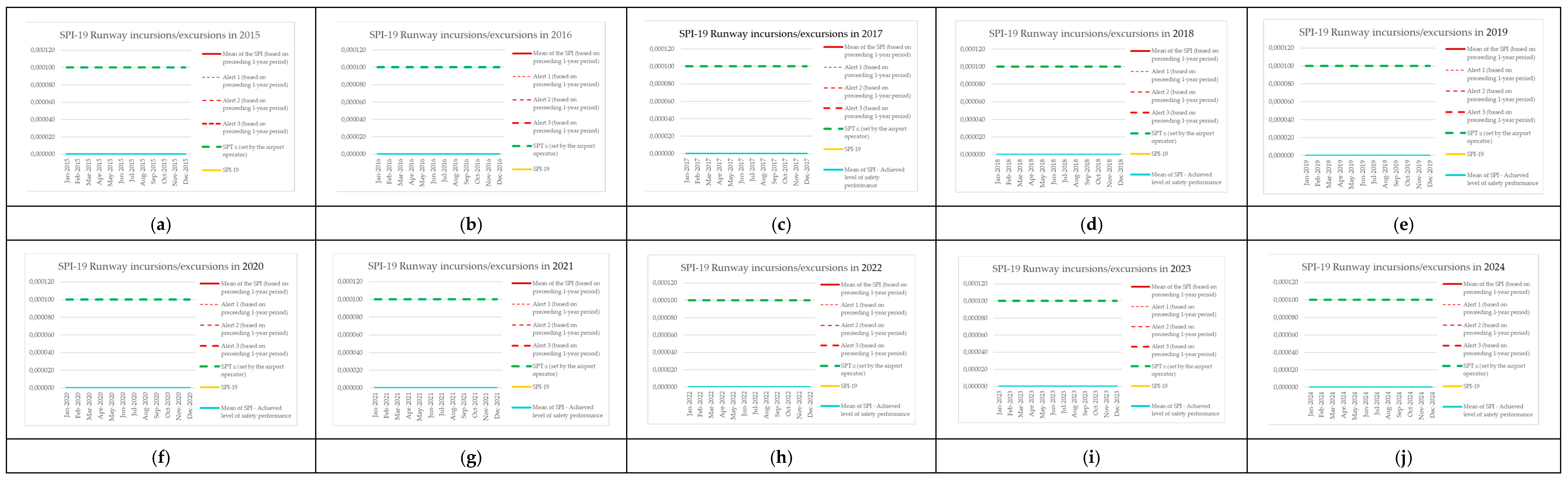
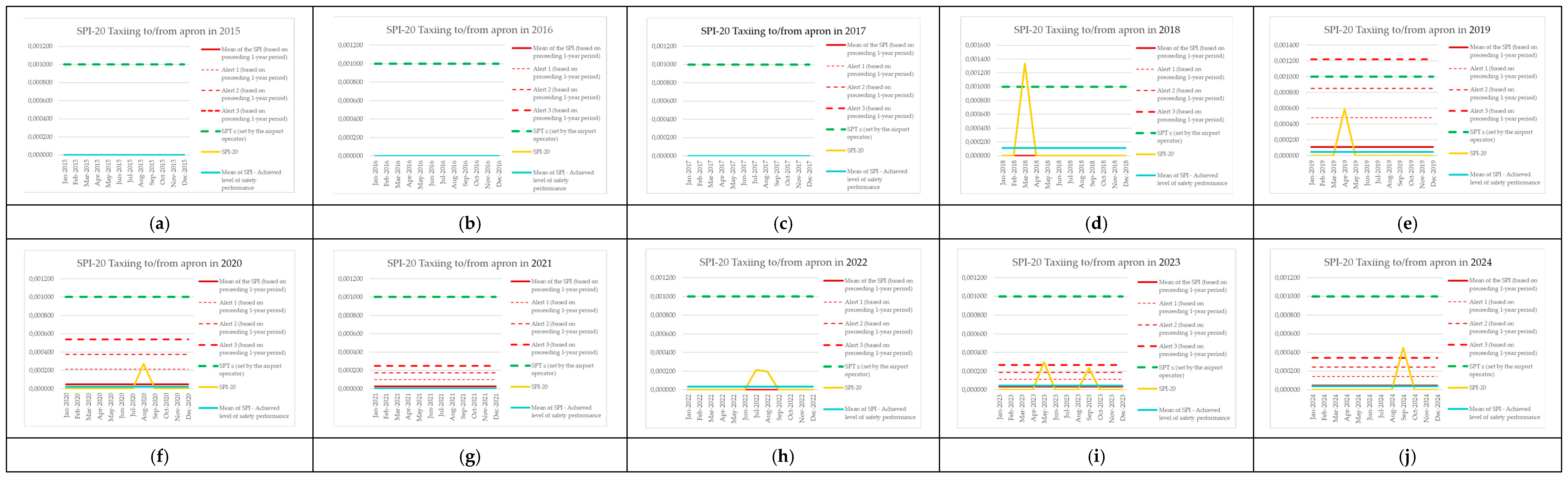
Figure 4. Overview of achieved safety performance at the Split Airport—SPI’s achieved levels of safety performance, set target levels (SPT) and alerts for each SPI the period 2015–2024: (a) SPI-1 Communication; (b) SPI-2 LIRF and loadsheet crosscheck; (c) SPI-3 Wrong figures for loadsheet; (d) SPI-4 Anti-collision occurrences; (e) SPI-5 Wildlife; (f) SPI-6 Dangerous goods; (g) SPI-7 Baggage loading/unloading; (h) SPI-8 Passenger handling at the gate; (i) SPI-9 Passenger handling (disembarking/embarking); (j) SPI-10 Personnel or passenger injuries; (k) SPI-11 Personal protective equipment; (l) SPI-12 Training deficiencies; (m) SPI-13 Engine start-up; (n) SPI-14 Fuel handling; (o) SPI-15 Aircraft damage; (p) SPI-16 Aircraft marshaling; (q) SPI-17 Aircraft chocking; (r) SPI-18 Aircraft conning; (s) SPI-19 Runway incursions/excursions; (t) SPI-20 Taxiing to/from apron; (u) SPI-21 Apron maintenance; (v) SPI-22 FOD presence; (w) SPI-23 Maneuvering area maintenance; (x) SPI-24 Vehicle maintenance; (y) SPI-25 Ground traffic (GSE) and vehicle driving.
Aerospace 13 00061 g004aAerospace 13 00061 g004bAerospace 13 00061 g004cAerospace 13 00061 g004dAerospace 13 00061 g004e
Figure 5. Summary of achieved levels of safety performance at Split Airport in 2015–2024: (a) SPI-1 Communication; (b) SPI-2 LIRF and loadsheet crosscheck; (c) SPI-3 Wrong figures for loadsheet; (d) SPI-4 Anti-collision occurrences; (e) SPI-5 Wildlife; (f) SPI-6 Dangerous goods; (g) SPI-7 Baggage loading/unloading; (h) SPI-8 Passenger handling at the gate; (i) SPI-9 Passenger handling (disembarking/embarking); (j) SPI-10 Personnel or passenger injuries; (k) SPI-11 Personal protective equipment; (l) SPI-12 Training deficiencies; (m) SPI-13 Engine start-up; (n) SPI-14 Fuel handling; (o) SPI-15 Aircraft damage; (p) SPI-16 Aircraft marshaling; (q) SPI-17 Aircraft chocking; (r) SPI-18 Aircraft conning; (s) SPI-19 Runway incursions/excursions; (t) SPI-20 Taxiing to/from apron; (u) SPI-21 Apron maintenance; (v) SPI-22 FOD presence; (w) SPI-23 Maneuvering area maintenance; (x) SPI-24 Vehicle maintenance; (y) SPI-25 Ground traffic (GSE) and vehicle driving.
Aerospace 13 00061 g005aAerospace 13 00061 g005bAerospace 13 00061 g005cAerospace 13 00061 g005dAerospace 13 00061 g005eAerospace 13 00061 g005fAerospace 13 00061 g005g
Table 1. List of SPIs and SPTs in observed dataset at the Split Airport [50].
MarkFull Name of the SPIShort Name of the SPISet Target (SPT 1 for SPIs)
SPI-1Communication occurrencesCommunication≤1/10,000≤0.0001
SPI-2LIRF and loadsheet crosscheck omissionsLIRF and loadsheet crosscheck≤1/10,000≤0.0001
SPI-3Incidents related to wrong figures for loadsheetWrong figures for loadsheet≤1/10,000≤0.0001
SPI-4Anti-collision occurrencesAnti-collision occurrences≤1/1000≤0.001
SPI-5Occurrences related to wildlifeWildlife≤1/1000≤0.001
SPI-6Dangerous goods incidentsDangerous goods≤1/10,000≤0.0001
SPI-7Occurrences related to baggage loading/unloadingBaggage loading/unloading≤1/1000≤0.001
SPI-8Occurrences related to passenger handling at the gatePassenger handling at the gate≤1/1000≤0.001
SPI-9Occurrences related to passenger handling (disembarking/embarking)Passenger handling (disembarking/embarking)≤1/1000≤0.001
SPI-10Personnel or passenger injuriesPersonnel or passenger injuries≤1/1000≤0.001
SPI-11Occurrences related to personal protective equipmentPersonal protective equipment≤1/1000≤0.001
SPI-12Training deficienciesTraining deficiencies≤1/1000≤0.001
SPI-13Engine start-up incidentsEngine start-up≤1/1000≤0.001
SPI-14Occurrences related to fuel handlingFuel handling≤1/1000≤0.001
SPI-15Aircraft damage occurrencesAircraft damage≤1/100≤0.01
SPI-16Aircraft marshaling occurrencesAircraft marshaling≤1/1000≤0.001
SPI-17Aircraft chocking incidentsAircraft chocking≤1/1000≤0.001
SPI-18Aircraft conning incidentsAircraft conning≤1/1000≤0.001
SPI-19Runway incursions/excursionsRunway incursions/excursions≤1/10,000≤0.0001
SPI-20Occurrences related to taxiing to/from apronTaxiing to/from apron≤1/1000≤0.001
SPI-21Apron maintenance incidentsApron maintenance≤1/1000≤0.001
SPI-22Occurrences related to FOD presenceFOD presence≤1/1000≤0.001
SPI-23Occurrences related to maneuvering area maintenanceManeuvering area maintenance≤1/1000≤0.001
SPI-24Vehicle maintenance incidentsVehicle maintenance≤1/1000≤0.001
SPI-25Occurrences related to ground traffic (GSE) and vehicle drivingGround traffic (GSE) and vehicle driving≤1/1000≤0.001
1 Value of the Acceptable Level of Safety Performance (ALoSP) is equal or less than value of Safety Performance Targets (SPT), i.e., fixed (set) target value of airport’s SPIs expressed in specific number of occurrences versus specific number of aircraft operations.
Table 2. Example of monthly data on SPI-8 Passenger handling at the gate at Split Airport for the period 2014–2024 with number of recorded events, number of operations, calculated values of SPI-8, and accompanying safety performance target (SPT) set by the airport operator.
YearNumber of EventsNumber of Aircraft OperationsSPI-8 Value (Calculated Ratio)SPT [Set by the Airport Operator]
January-2014043800.001
February-2014039200.001
March-2014051400.001
April-20140103200.001
May-20140194200.001
June-2014125540.0003920.001
July-2014538720.0012910.001
October-20240350200.001
November-2024079800.001
December-2024062400.001
Table 3. Calculation of achieved level of safety performance of SPI-8 Passenger handling at the gate at Split Airport in 2018.
Monitoring PeriodNumber of Aircraft OperationsNumber of Events (SPI-8)SPI-8 (Preceding 1-Year Period)Mean of the SPI (Based on Preceding 1-Year Period)Alert 1 (Based on Preceding 1-Year Period)Alert 2 (Based on Preceding 1-Year Period)Alert 3 (Based on Preceding 1-Year Period)SPT ≤ (Set by the Airport Operator)SPI-8 [Events per Operations]Mean of SPI—Achieved Level of Safety Performance
January-2018586 0.0000000.0006660.0014980.0023300.0031610.0010.0000000.000906
February-2018496 0.0000000.0006660.0014980.0023300.0031610.0010.0000000.000906
March-2018640 0.0000000.0006660.0014980.0023300.0031610.0010.0000000.000906
April-2018137810.0007260.0006660.0014980.0023300.0031610.0010.0006730.000906
May-2018264430.0011350.0006660.0014980.0023300.0031610.0010.0017370.000906
June-2018359460.0016690.0006660.0014980.0023300.0031610.0010.0004940.000906
July-2018521670.0013420.0006660.0014980.0023300.0031610.0010.0010900.000906
August-20185078 0.0000000.0006660.0014980.0023300.0031610.0010.0009740.000906
September-201837810.0026460.0006660.0014980.0023300.0031610.0010.0010410.000906
October-2018211610.0004730.0006660.0014980.0023300.0031610.0010.0022010.000906
November-2018654 0.0000000.0006660.0014980.0023300.0031610.0010.0026670.000906
December-2018554 0.0000000.0006660.0014980.0023300.0031610.0010.0000000.000906
Table 4. Calculation of three alert levels and achieved levels of safety performance at Split Airport for the period 2015–2024 for SPI-8 Passenger handling at the gate.
YearAlert 1 (Based on Preceding 1-Year Period)Alert 2 (Based on Preceding 1-Year Period)Alert 3 (Based on Preceding 1-Year Period)SPT ≤ (Set by the Airport Operator)Achieved Level of Safety Performance
20150.0016740.0025350.0033950.0010.000686
20160.0018440.0030010.0041590.0010.001319
20170.0028710.0044220.0059740.0010.000213
20180.0006370.0010600.0014840.0010.000672
20190.0014930.0023140.0031360.0010.000837
20200.0021490.0034600.0047710.0010.000223
20210.0007190.0012150.0017110.0010.000218
20220.0006040.0009910.0013780.0010.000179
20230.0004570.0007340.0010120.0010.000123
20240.0002900.0004570.0006240.0010.000152
Table 5. Determining an acceptable level of safety performance at Split Airport through 25 SPIs in the period from 2015 to 2024.
SPIsSP Levels2015201620172018201920202021202220232024
SPI -1SPT0.00010.00010.00010.00010.00010.00010.00010.00010.00010.0001
Achieved0.0000000.0000250.0000000.0000000.0000000.0000000.0000000.0000240.0000000.000000
AcceptableYES *YESYESYESYESYESYESYESYESYES
SPI-2SPT0.00010.00010.00010.00010.00010.00010.00010.00010.00010.0001
Achieved0.0000190.0001340.0001300.0000000.0000300.0000230.0000000.0000000.0000180.000000
AcceptableYESNO **NOYESYESYESYESYESYESYES
SPI-3SPT0.00010.00010.00010.00010.00010.00010.00010.00010.00010.0001
Achieved0.0000000.0000000.0000000.0000000.0000000.0000000.0000200.0000000.0000180.000000
AcceptableYESYESYESYESYESYESYESYESYESYES
SPI-4SPT0.0010.0010.0010.0010.0010.0010.0010.0010.0010.001
Achieved0.0000000.0000250.0000230.0000370.0000000.0000000.0000000.0000380.0000000.000000
AcceptableYESYESYESYESYESYESYESYESYESYES
SPI-5SPT0.0010.0010.0010.0010.0010.0010.0010.0010.0010.001
Achieved0.0003120.0003600.0014560.0004230.0005470.0004450.0001880.0004450.0006990.000596
AcceptableYESYESNOYESYESYESYESYESYESYES
SPI-6SPT0.00010.00010.00010.00010.00010.00010.00010.00010.00010.0001
Achieved0.0000560.0000610.0000000.0000000.0002520.0002030.0000000.0000000.0000320.000134
AcceptableYESYESYESYESNONOYESYESYESNO
SPI-7SPT0.0010.0010.0010.0010.0010.0010.0010.0010.0010.001
Achieved0.0000760.0002710.0000000.0002830.0000570.0000000.0001600.0001030.0000000.000000
AcceptableYESYESYESYESYESYESYESYESYESYES
SPI-8SPT0.0010.0010.0010.0010.0010.0010.0010.0010.0010.001
Achieved0.0008860.0018480.0006660.0009060.0000310.0009030.0001060.0001620.0000000.000095
AcceptableYESNOYESYESYESYESYESYESYESYES
SPI-9SPT0.0010.0010.0010.0010.0010.0010.0010.0010.0010.001
Achieved0.0000280.0000180.0001420.0000160.0000000.0000300.0000410.0000770.0000000.000000
AcceptableYESYESYESYESYESYESYESYESYESYES
SPI-10SPT0.0010.0010.0010.0010.0010.0010.0010.0010.0010.001
Achieved0.0000690.0002640.0000790.0000880.0000430.0000910.0000810.0000170.0000000.000027
AcceptableYESYESYESYESYESYESYESYESYESYES
SPI-11SPT0.0010.0010.0010.0010.0010.0010.0010.0010.0010.001
Achieved0.0000200.0000350.0000000.0000220.0000000.0000000.0000000.0000000.0001480.000000
AcceptableYESYESYESYESYESYESYESYESYESYES
SPI-12SPT0.0010.0010.0010.0010.0010.0010.0010.0010.0010.001
Achieved0.0000000.0001680.0000000.0000000.0000000.0000000.0000000.0000000.0000000.000000
AcceptableYESYESYESYESYESYESYESYESYESYES
SPI-13SPT0.0010.0010.0010.0010.0010.0010.0010.0010.0010.001
Achieved0.0000660.0000000.0000000.0000000.0000000.0000000.0000000.0000000.0000000.000000
AcceptableYESYESYESYESYESYESYESYESYESYES
SPI-14SPT0.0010.0010.0010.0010.0010.0010.0010.0010.0010.001
Achieved0.0000190.0000960.0005810.0000210.0000000.0001160.0000180.0000000.0000000.000000
AcceptableYESYESYESYESYESYESYESYESYESYES
SPI-15SPT0.010.010.010.010.010.010.010.010.010.01
Achieved0.0000190.0000180.0001420.0000000.0000000.0000000.0000000.0000000.0000430.000039
AcceptableYESYESYESYESYESYESYESYESYESYES
SPI-16SPT0.0010.0010.0010.0010.0010.0010.0010.0010.0010.001
Achieved0.0000740.0000250.0001270.0000160.0001040.0000000.0000000.0000000.0000000.000019
AcceptableYESYESYESYESYESYESYESYESYESYES
SPI-17SPT0.0010.0010.0010.0010.0010.0010.0010.0010.0010.001
Achieved0.0000000.0000000.0002070.0003210.0000000.0001020.0000000.0000000.0000000.000000
AcceptableYESYESYESYESYESYESYESYESYESYES
SPI-18SPT0.0010.0010.0010.0010.0010.0010.0010.0010.0010.001
Achieved0.0000000.0000000.0000390.0000000.0000000.0000000.0000000.0000000.0000000.000000
AcceptableYESYESYESYESYESYESYESYESYESYES
SPI-19SPT0.00010.00010.00010.00010.00010.00010.00010.00010.00010.0001
Achieved0.0000000.0000000.0000000.0000000.0000000.0000000.0000000.0000000.0000000.000000
AcceptableYESYESYESYESYESYESYESYESYESYES
SPI-20SPT0.0010.0010.0010.0010.0010.0010.0010.0010.0010.001
Achieved0.0000000.0000000.0000000.0001110.0000490.0000230.0000000.0000340.0000440.000038
AcceptableYESYESYESYESYESYESYESYESYESYES
SPI-21SPT0.0010.0010.0010.0010.0010.0010.0010.0010.0010.001
Achieved0.0002580.0000440.0000160.0000000.0001200.0052080.0000410.0001180.0000000.000103
AcceptableYESYESYESYESYESNOYESYESYESYES
SPI-22SPT0.0010.0010.0010.0010.0010.0010.0010.0010.0010.001
Achieved0.0003110.0000000.0000000.0001600.0009550.0000000.0001890.0000000.0000000.000000
AcceptableYESYESYESYESYESYESYESYESYESYES
SPI-23SPT0.0010.0010.0010.0010.0010.0010.0010.0010.0010.001
Achieved0.0001650.0000000.0002700.0004290.0000860.0000000.0000000.0003950.0001060.000000
AcceptableYESYESYESYESYESYESYESYESYESYES
SPI-24SPT0.0010.0010.0010.0010.0010.0010.0010.0010.0010.001
Achieved0.0001680.0001860.0000320.0000370.0000000.0000000.0000000.0000380.0001260.000032
AcceptableYESYESYESYESYESYESYESYESYESYES
SPI-25SPT0.0010.0010.0010.0010.0010.0010.0010.0010.0010.001
Achieved0.0006860.0013190.0002130.0006720.0008370.0002230.0002180.0001790.0001230.000152
AcceptableYESNOYESYESYESYESYESYESYESYES
* SPT achieved (green color) = acceptable. ** SPT not achieved (red color) = unacceptable.
Disclaimer/Publisher’s Note: The statements, opinions and data contained in all publications are solely those of the individual author(s) and contributor(s) and not of MDPI and/or the editor(s). MDPI and/or the editor(s) disclaim responsibility for any injury to people or property resulting from any ideas, methods, instructions or products referred to in the content.