1. Introduction
Satellite communication is crucial for achieving global coverage, enabling convenient satellite network services for users worldwide [
1,
2,
3]. The 3rd-generation partnership project (3GPP) introduced non-terrestrial network (NTN) technology in the 5th-generation new radio (5G NR) as a vital supplement to terrestrial cellular communication, and released the first NTN standard supporting satellite communication in 2022. Satellite communication is also explicitly included in the 6th-generation (6G) vision defined by the international telecommunication union (ITU) [
4,
5].
In recent years, constellations represented by Starlink and OneWeb have driven the development of low-Earth-orbit (LEO) mega-constellation networks, characterized by large scale, wide coverage, low latency, and high bandwidth capabilities [
2]. With the rapid advancement of satellite communications, satellite direct-to-device (DTD) has gradually emerged as a new focus in satellite communications, offering enormous industrial application prospects [
6,
7,
8]. To support satellite DTD, satellites are typically equipped with large-scale phased array antennas (PAAs) to enhance antenna gain and meet the link requirements. Additionally, they operate in the sub-6 GHz frequency band to mitigate link loss.
Current satellite communication systems generally adopt a multi-beam architecture. However, co-channel interference between beams in multi-beam systems remains unavoidable. Existing multi-beam satellite communication systems typically employ a multi-color reuse scheme. Although this scheme can mitigate interference between adjacent beams, it is limited by low spectrum resource reuse capability. To further utilize limited spectrum resources, multi-beam satellite communication can adopt a full frequency reuse (FFR) scheme, where all beams use the same frequency band. Nevertheless, this also introduces more significant co-channel interference between beams and across satellites. Researchers have addressed the inter-beam interference caused by FFR among different beams in [
9,
10]. Given the ever-growing demand for high throughput, the FFR scheme and precoding technology are regarded as the most critical technologies. During the standardization process of 3GPP, many companies have proposed to further improve system throughput using multiple-input–multiple-output (MIMO) technology in Release 20 and future 6G NTN [
11,
12,
13,
14].
1.1. Related Work
Numerous investigations have been focused on multi-beam joint transmission techniques in satellite communication systems. For fixed multi-beam satellite systems, the design of joint multi-user linear precoding for the forward link was explored in [
15], and an iterative algorithm that alternates between the optimization of precoding vectors and power allocation strategies was proposed therein. In the context of geostationary-Earth-orbit (GEO) multi-beam high-throughput satellite (HTS) communications, a user scheduling and power allocation approach based on regularized zero-forcing (RZF) precoding was put forward in [
16]. A hopping beam design scheme grounded in minimum mean square error (MMSE) precoding was introduced in another study by [
17]. Regarding low-Earth-orbit (LEO) satellite communications, hybrid analog–digital precoding has been the focus of research in [
18,
19]. Additionally, the joint optimization of beam directions alongside the allocation of spectrum, time, and power resources in dynamic multi-beam LEO satellite networks was examined in [
20]; the proposed method is capable of enhancing the number of supported users and boosting system throughput. Nevertheless, all the aforementioned works, from [
15,
16,
17,
18,
19,
20], require that instantaneous channel state information (iCSI) be obtained by the satellite transmitter, a requirement that poses considerable challenges in practical satellite communication systems [
21].
Imperfect channel state information (CSI) has been explored in several studies to enhance the robustness of transmission strategies in satellite communications. In the framework of FFR, a robust multi-group multicast beamforming design tailored for satellite downlinks was proposed in [
22]. This design was based on a beam-domain channel model that incorporated the effects of channel phase uncertainty. Concurrently, robust multi-group multicast precoding techniques for frame-structured multi-beam satellite communication systems were delved into, and a user clustering approach relying on partial CSI was introduced in [
23,
24]. A zero-forcing (ZF) precoding scheme using partial CSI was further proposed in [
25], though this scheme is limited to GEO HTS systems and solely utilizes antenna patterns and path loss information. While these methods all leverage imperfect CSI to improve the robustness of their transmission schemes, a key requirement remains that the transmitter must still acquire partial CSI. An energy-aware opportunistic routing strategy to guarantee the maximum data transfer rate was proposed in [
26]. A robust precoding method based on deep reinforcement learning, applicable to LEO satellites operating under imperfect CSI conditions, was investigated in [
27]. A downlink precoding method based on sum-rate maximization was proposed in [
28]. However, the designs in [
27,
28] necessitate iterative computations, which result in extremely high computational complexity.
In summary, as presented in
Table 1, existing multi-beam satellite precoding research can be broadly categorized into iCSI-based and partial CSI-based approaches. iCSI-based schemes [
15,
16,
17,
18,
19,
20] acquire instantaneous channel state information through frequent feedback. However, the frequent channel estimation and feedback processes consume a substantial amount of limited system overhead, and the long round-trip transmission delay in satellite communications may exceed the channel coherence time, rendering the obtained iCSI outdated. Existing partial CSI-based precoding [
22,
23,
24,
25,
26,
27,
28] still requires the transmitter to acquire partial channel state information. Moreover, these precoding designs lack closed-form solutions and require iterative computation, leading to extremely high computational complexity that is unsuitable for satellite payload implementation.
1.2. Motivations and Contributions
To bridge the above gap, this paper focuses on addressing two unresolved issues: first, designing a low-complexity precoding method with a closed-form expression to reduce computational complexity while achieving near-optimal transmission performance for multi-beam LEO satellite communications; second, significantly reducing the difficulty and system overhead associated with statistical channel state information (sCSI) acquisition. To this end, this paper investigates the downlink precoding design based on sCSI for multi-beam LEO satellite communications.
The major contributions are summarized as follows:
We establish the downlink channel and signal transmission models for orthogonal frequency division multiplexing (OFDM)-based multi-beam LEO satellite communication systems.
We propose to design downlink precoding using sCSI and derive closed-form solutions for statistical-zero-forcing (statistical-ZF), statistical-regularized zero-forcing (statistical-RZF), and statistical-minimum mean square error (statistical-MMSE) precoding. sCSI includes the array response vectors of each user on the satellite side and the average downlink channel power. Compared with iCSI, sCSI is substantially easier to acquire at the transmitter. Precoding vectors based on sCSI can be computed over a longer sCSI update period, reducing the computational requirements for on-board processing.
We propose a method to calculate sCSI using information such as satellite position and user position. Thus, users only need to periodically report their position information without estimating and feeding back CSI, which significantly reduces system overhead.
We present numerical simulation results to demonstrate that the proposed method can substantially improve the system sum-rate performance.
1.3. Organization
The remainder of this paper is organized as follows.
Section 2 introduces the system model, including the channel model, signal transmission model, and system architecture. Conventional iCSI-based precoding methods are presented in
Section 3. In
Section 4, the proposed sCSI-based precoding methods are detailed.
Section 5 describes the sCSI acquisition method.
Section 6 provides the simulation results and analysis. Finally,
Section 7 concludes this paper.
2. System Model
This section establishes the downlink channel and signal transmission model for LEO satellite communications. First, the channel and signal models are derived for the OFDM-based multi-beam LEO satellite communication system. Second, the statistical characteristics of the downlink satellite channel are analyzed, which lays a theoretical foundation for the acquisition of sCSI in subsequent sections. Then, the system architecture of the downlink precoding scheme at the satellite transmitter is presented, along with the corresponding signal model for downlink precoding.
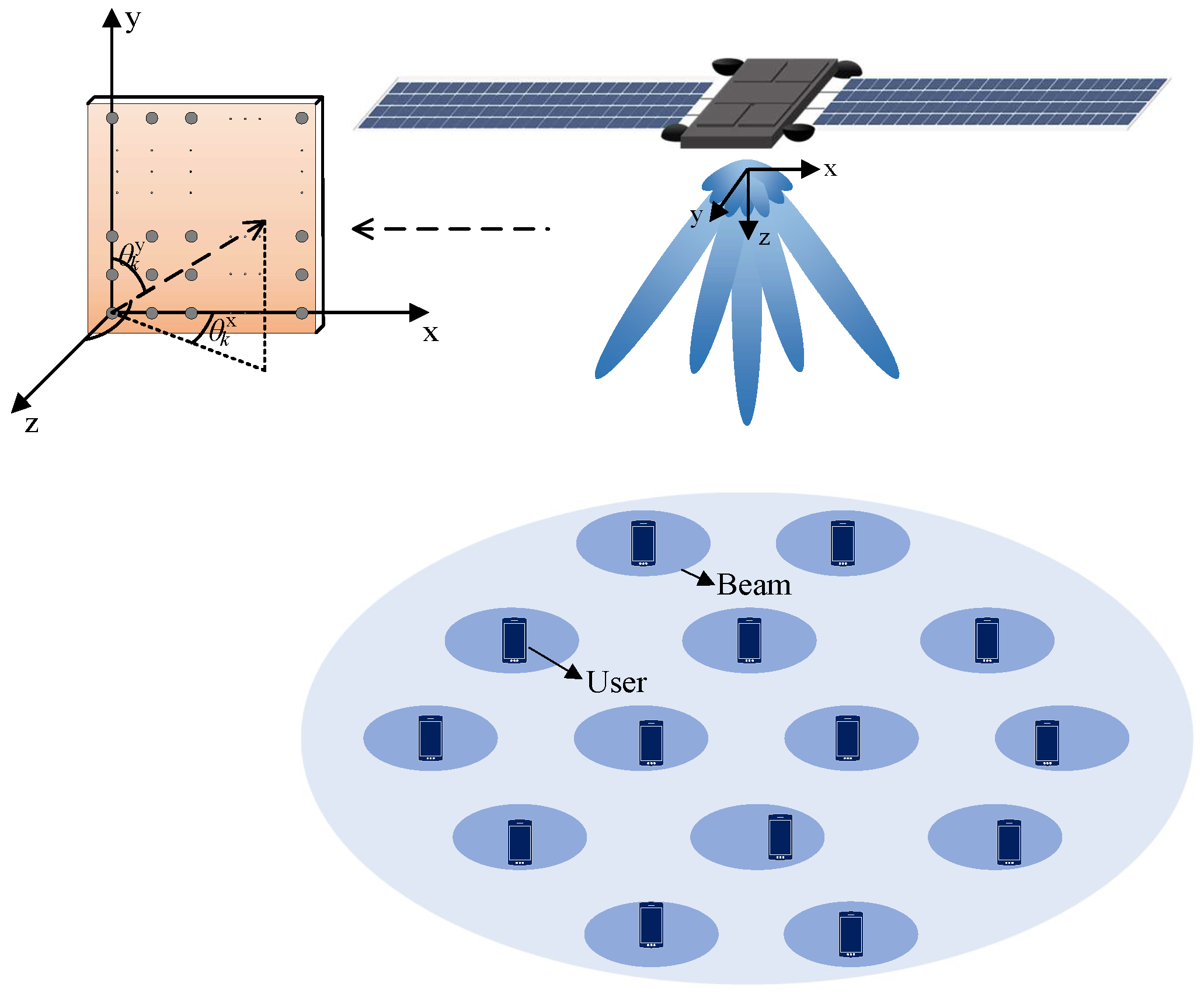
Consider an OFDM-based broadband multi-beam LEO satellite communication system. As shown in
Figure 1, the satellite is equipped with a uniform planar array (UPA) antenna, where the number of antennas along the x-axis and y-axis is
and
, respectively, and the total number of antennas is
. Each user is equipped with a single antenna. The satellite generates
K downlink beams through a beamforming network (BFN) to serve
K users simultaneously, with
.
For the downlink, the channel response between the satellite and user
k can be expressed as
where
,
represents the number of multipaths for user
k,
denotes the channel complex gain,
is the Doppler shift,
is the propagation delay, and
is the array response vector at the satellite. The Doppler shift
is the sum of the large Doppler
caused by the high-speed movement of the satellite and the conventional Doppler
caused by the movement of the user. The propagation delay
consists of the minimum satellite–ground propagation delay
and the multipath delay
on the user side. Since scatterers in satellite communication systems are distributed near users and there are no scatterers on the satellite side, the angular spread of the multipath arriving at the satellite is almost zero, and the angles of different paths at the satellite are similar [
21,
28]. Therefore, the channel on the satellite side exhibits a single-path characteristic, i.e.,
, and
can be expressed as
where
and
denote the directional cosines of user
k with respect to the x-axis and y-axis, respectively, which reflect the space domain property of the channel for user
k.
and
are given by
where
and
represent the angles of departure (AoDs) of user
k.
can be written as
where
is the downlink carrier wavelength, and
and
denote the number of antenna elements and the adjacent antenna distance along the v-axis with
at the satellite, respectively.
Let , , and be the number of subcarriers, the length of the cyclic prefix (CP), and the sampling period, respectively. Then, the CP duration is and the time duration of the OFDM symbol including CP is , where is the time duration of the CP and is the time duration of the OFDM symbol excluding the CP.
Defining
as the downlink transmitted symbol over the
r-th subcarrier at the
s-th OFDM symbol for user
k, the transmitted symbol in the time domain can be written as
where
. Let
be the downlink beamforming vector for user
k, which satisfies
. The downlink transmitted symbol can be denoted as
Then, the downlink received signal at user
k can be expressed as
where
denotes the additive white Gaussian noise (AWGN) of the user
k within the
s-th OFDM symbol.
After performing Doppler and delay compensation on the user side, the compensated downlink time-domain received signal is given by
where
denotes the downlink equivalent impulse response of user
k after Doppler shift and delay compensation, which can be expressed as
where
denotes the equivalent channel gain of the
l-th path for user
k after time–frequency compensation. Compared with the original channel response
, the Doppler shift and propagation delay in the equivalent channel response
have been significantly reduced. From Equation (
8), the downlink equivalent channel frequency response
of user
k is given by
where
.
The downlink frequency-domain received signal of user
k over the
r-th subcarrier at the
s-th OFDM symbol is given by
where
is the AWGN noise with a mean of 0 and a variance of
, and
denotes the downlink channel vector of user
k, which can be expressed as
where
.
For brevity, the OFDM symbol index
s and subcarrier index
r are omitted, and
is defined as the downlink channel vector of user
k over a certain subcarrier. Based on the physical multipath channel model [
28],
can be modeled using the Rician distribution, which can be expressed as
where
is the Rician factor,
denotes the line-of-sight (LOS) component of user
k,
is a complex Gaussian random variable, and
represents the downlink average channel power of user
k, i.e.,
By implementing linear precoding at the downlink transmitter and omitting the subcarrier index
r and OFDM symbol index
s, the downlink received signal of user
k can be expressed as
where
denotes the beamforming matrix composed of
K beamforming vectors;
is the downlink transmit power allocated to user
i satisfying
, with
being the total downlink transmit power; and
represents the downlink precoding vector for user
k satisfying
. Equation (
15) can be rewritten in matrix form as
where
is the received signal vector of the
K users,
represents the channel matrix between the satellite and the
K users,
is the downlink transmit signal vector,
is the noise vector,
denotes the precoding matrix for the
K users, and
is the power allocation matrix.
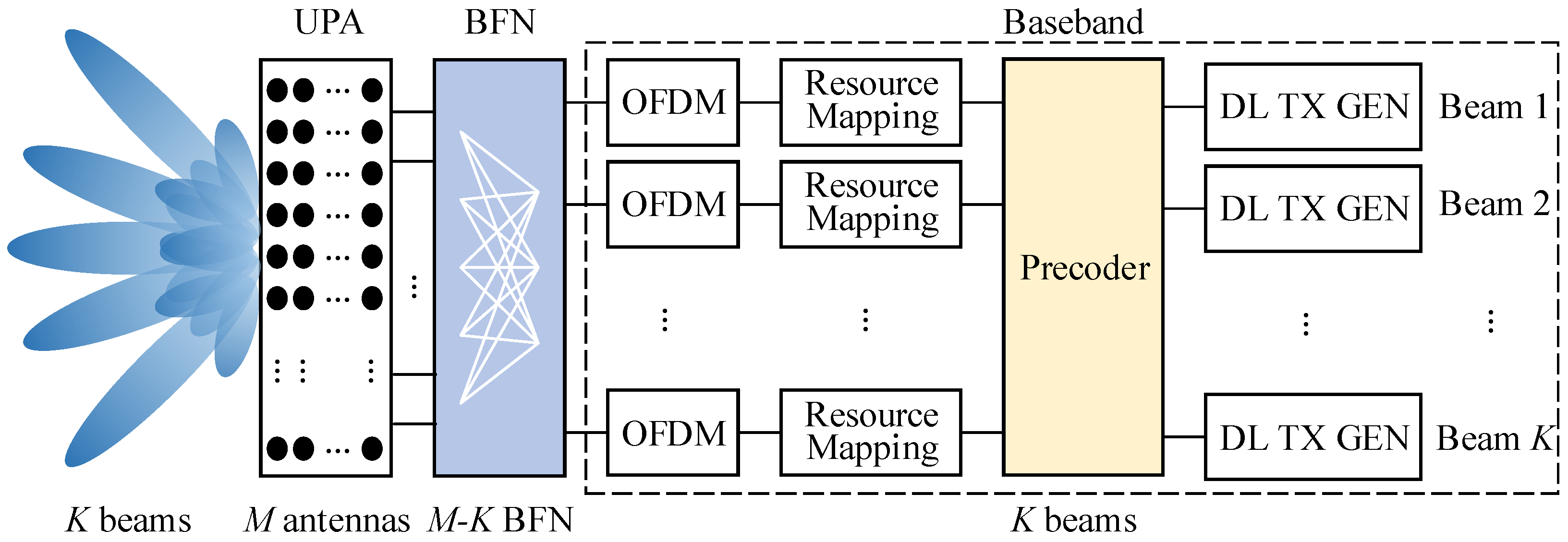
Figure 2 presents the system architecture of the downlink transmitter in a multi-beam LEO satellite communication system. First, the satellite transmitter schedules a group of users using the same time–frequency resources in each beam, and the downlink transmitter for each user generates frequency-domain transmit signals. Subsequently, the downlink precoder generates the transmit signals for each beam, and the time-domain transmit signals for each beam are formed through resource mapping and OFDM modulation. Finally, the BFN is utilized to generate transmit signals for each antenna element.
3. Conventional iCSI-Based Precoding
The ZF precoding can achieve a unit response in the desired direction and forces the response in the directions of interfering users to be zero, thereby eliminating inter-user interference (IUI), which satisfies
. Thus, the precoding vector of user
k can be expressed as
where
is the normalization factor that makes
.
When the channel correlation among users is high, the channel correlation matrix becomes an ill-conditioned matrix. ZF precoding will amplify noise under the condition of low signal-to-noise ratio (SNR), resulting in the degradation of system performance. To address this issue, a regularization factor is introduced into ZF precoding, and thus the RZF precoding vector for user
k is given by
where
is the normalization factor that makes
.
The MMSE precoding aims to design a precoding matrix
that minimizes the mean square error (MSE) between the transmitted signals
and the received signals
for all users. The MMSE precoding vector for user
k can be expressed as
where
is the normalization factor that makes
.
It can be observed from the aforementioned precoding vector expressions that the transmitter needs to obtain the iCSI of all users in advance when designing precoding. However, in LEO satellite communication systems, it is extremely difficult for the transmitter to acquire iCSI due to channel characteristics such as large propagation delay, Doppler shift, and high dynamic characteristics [
21].
In LEO satellite mobile communication systems, the round-trip transmission delay induced by long propagation distances typically ranges from several milliseconds to over ten milliseconds. For ground user terminals moving at high speeds, the typical channel coherence time is only several milliseconds. Therefore, whether for time division duplexing (TDD) or frequency division duplexing (FDD) systems, there exists the problem of iCSI obsolescence caused by long propagation delays.
Specifically, in TDD systems, the estimated results of uplink CSI are directly used for downlink transmission. When the downlink signal arrives at the user, the previously estimated uplink CSI may have become outdated. Even if the large Doppler effect caused by satellite motion is compensated, considering only the Doppler shift generated by terminal movement, the typical channel coherence time in high-speed motion scenarios is several milliseconds. In contrast, the round-trip transmission time in satellite scenarios often ranges from several milliseconds to more than ten milliseconds, which exceeds the channel coherence time and leads to the obsolescence of the acquired iCSI. In FDD systems, each user first estimates the downlink CSI and then feeds it back to the satellite, resulting in significant overhead for channel estimation and feedback. Similarly, when the feedback-downlink CSI arrives at the satellite, it will also become outdated because the satellite–ground transmission time exceeds the channel coherence time. Therefore, the large transmission delay in satellite communication systems causes the obsolescence of iCSI, and the overhead of frequent channel feedback is also unbearable.
5. sCSI Acquisition
According to the precoding vector expressions based on sCSI in
Section 4, the required sCSI information only includes the array response vector
on the satellite side and the downlink channel average power
of each user. In LEO satellite communication systems, the array response vector and channel average power are closely related to the position information of the satellite and users. Based on the position information reported by users, the difficulty in acquiring sCSI can be significantly reduced.
For the array response vector
, the satellite calculates the angles
of each user relative to the x-axis and y-axis of the satellite array antenna based on information such as the position of the scheduled user, satellite position, and satellite attitude. Then, the direction cosines
can be calculated according to Equation (3), and
is further calculated according to Equations (
2) and (
4).
For the average channel power
, the satellite can obtain it through downlink channel estimation and feedback from each user. However, this will increase the overhead of channel estimation and system feedback. This paper proposes an approximation method based on link gain, which is given by
where
denotes the radiation gain of the antenna element on the satellite side, which is related to the antenna pattern and the angle
of user
k relative to the satellite antenna;
represents the gain of the user receive antenna, which can be reported to the satellite along with position information; and
is the distance between the satellite and user
k, which can be calculated using the positions of the satellite and the user. Therefore, the sCSI-based precoding method can obtain the sCSI parameters through computation, eliminating the need for users to feed back any CSI. Consequently, the system overhead associated with channel estimation and feedback is significantly reduced. The sCSI acquisition algorithm is summarized as Algorithm 2.
| Algorithm 2 sCSI acquisition |
| Input: the coordinates and receive antenna gain of each user, the satellite coordinates, the satellite antenna gain , the satellite antenna number M, and the wavelength . |
| Output: and of each user. |
| 1: For |
| 2: Calculate the angles and by the coordinates of user k and the satellite. |
| 3: Calculate the direction cosines according to Equation (3). |
| 4: Calculate according to Equations (2) and (4). |
| 5: Calculate according to Equation (43). |
| 6: end |
In addition, for satellite constellations, the elevated satellite density at high latitudes gives rise to an expanded inter-satellite coverage overlap region. To alleviate inter-satellite interference, satellites are designed to deactivate partial beams and reduce their coverage scales adaptively. From the user perspective, this leads to more frequent satellite handover events, which in turn affect the acquisition and update processes of sCSI. To tackle this challenge, each satellite is able to periodically send the user location data within its current service coverage to neighboring satellites through inter-satellite links. The subsequent serving satellites can thereby pre-acquire the user positions, compute the sCSI for these users accordingly, and thus reduce the adverse performance impacts induced by satellite handovers.
6. Simulation Results
This section presents simulation results to verify the performance of the proposed downlink precoding based on sCSI. The simulation parameters are shown in
Table 2. The satellite is equipped with a UPA, with an antenna spacing of half a wavelength and array sizes of
,
,
, and
, respectively. Each user employs a single antenna. The transmit gain of each antenna element on the satellite side is 6 dB, and the receive gain of the user’s antenna is 0 dB. The satellite transmit power is 5–30 dBW. The number of users is 32, 64, and 96, respectively. The downlink carrier frequency is 2 GHz, the system bandwidth is 10 MHz, the subcarrier spacing is 15 kHz, and the fast Fourier transform (FFT) length is 1024. The 3GPP NTN channel model is adopted [
31], where parameters such as the multipath number, path loss, shadow fading, and Rician factor are calculated according to the simulation scenario, with the first path being the LOS path. The noise variance of the user is
, where
is the Boltzmann constant,
is the noise temperature, and
is the downlink system bandwidth. The downlink beamforming vector adopts the discrete Fourier transform (DFT) codebook based on user positions. Monte Carlo simulations are employed to verify the performance of the proposed method. The simulation results are obtained by averaging over 1000 independent Monte Carlo trials, and the initial random seed value is fixed to 100. The performance is evaluated under the dense urban scenario. We evaluate the system performance using the downlink ergodic sum rate, which is defined as
Poisson disk sampling is adopted to generate the spatial angles of users within the satellite coverage area [
28,
32]. Let
denote the maximum nadir angle of the satellite; then, the nadir angle of each user satisfies
, i.e., the spatial angle satisfies
.
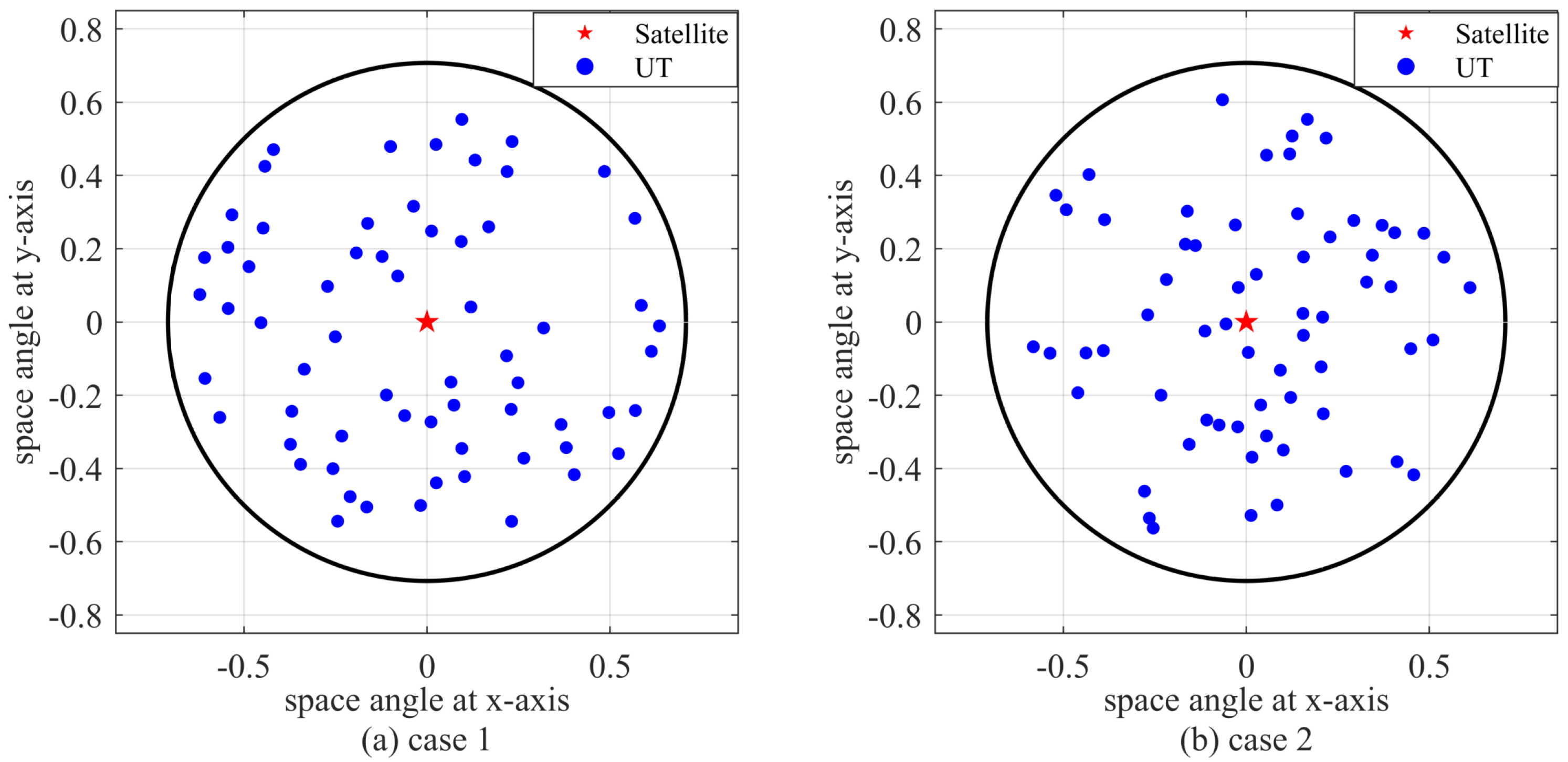
Figure 3 presents two user distribution cases with different minimum distances between users:
Figure 3a shows a user distribution case with the minimum distance of the users being
, while
Figure 3b depicts a user distribution case with the minimum distance of the users being
. In the figures, the black line represents the edge of the satellite coverage area, the red star denotes the spatial angle of the satellite, and the blue dots represent the spatial angles of the users.
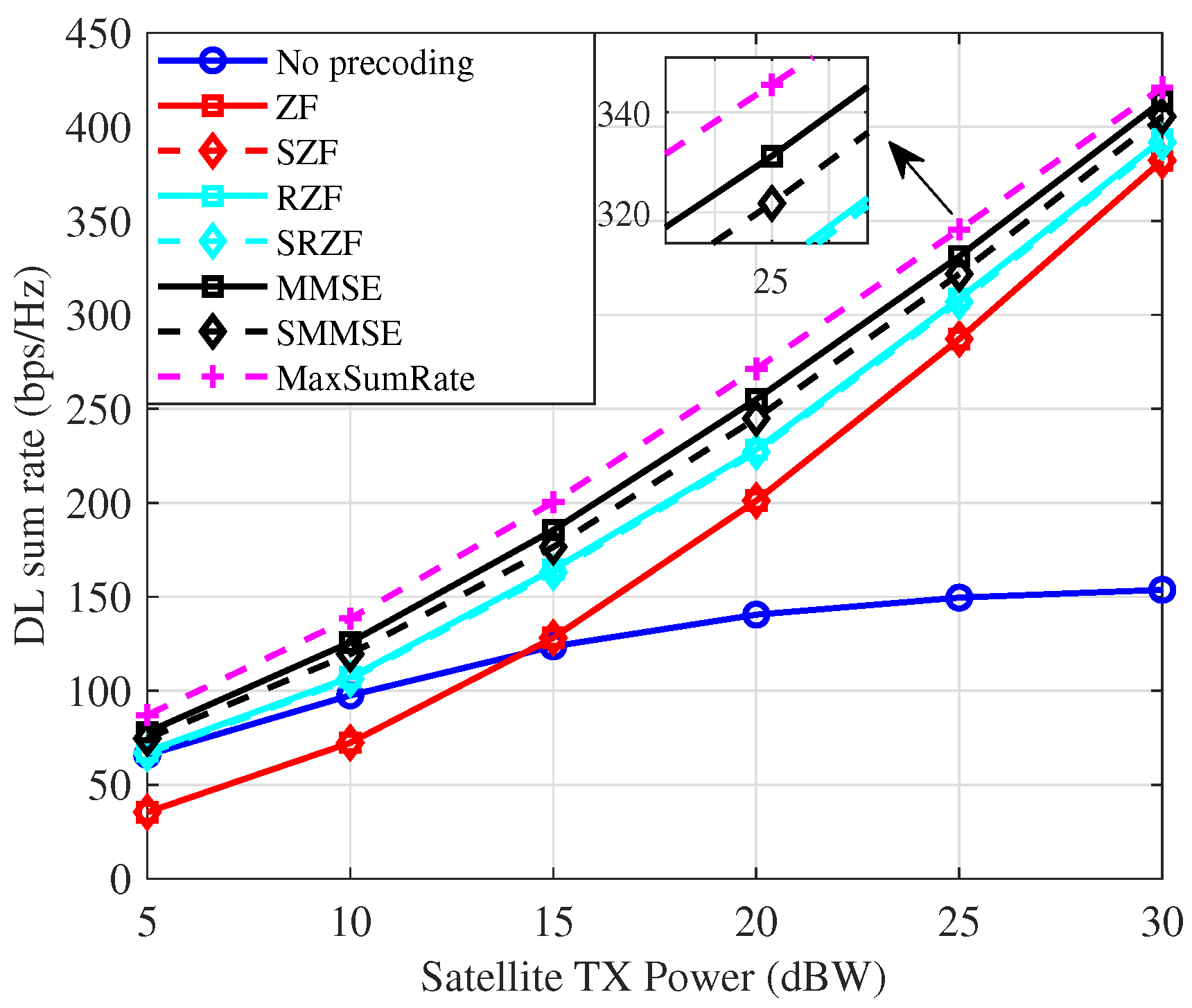
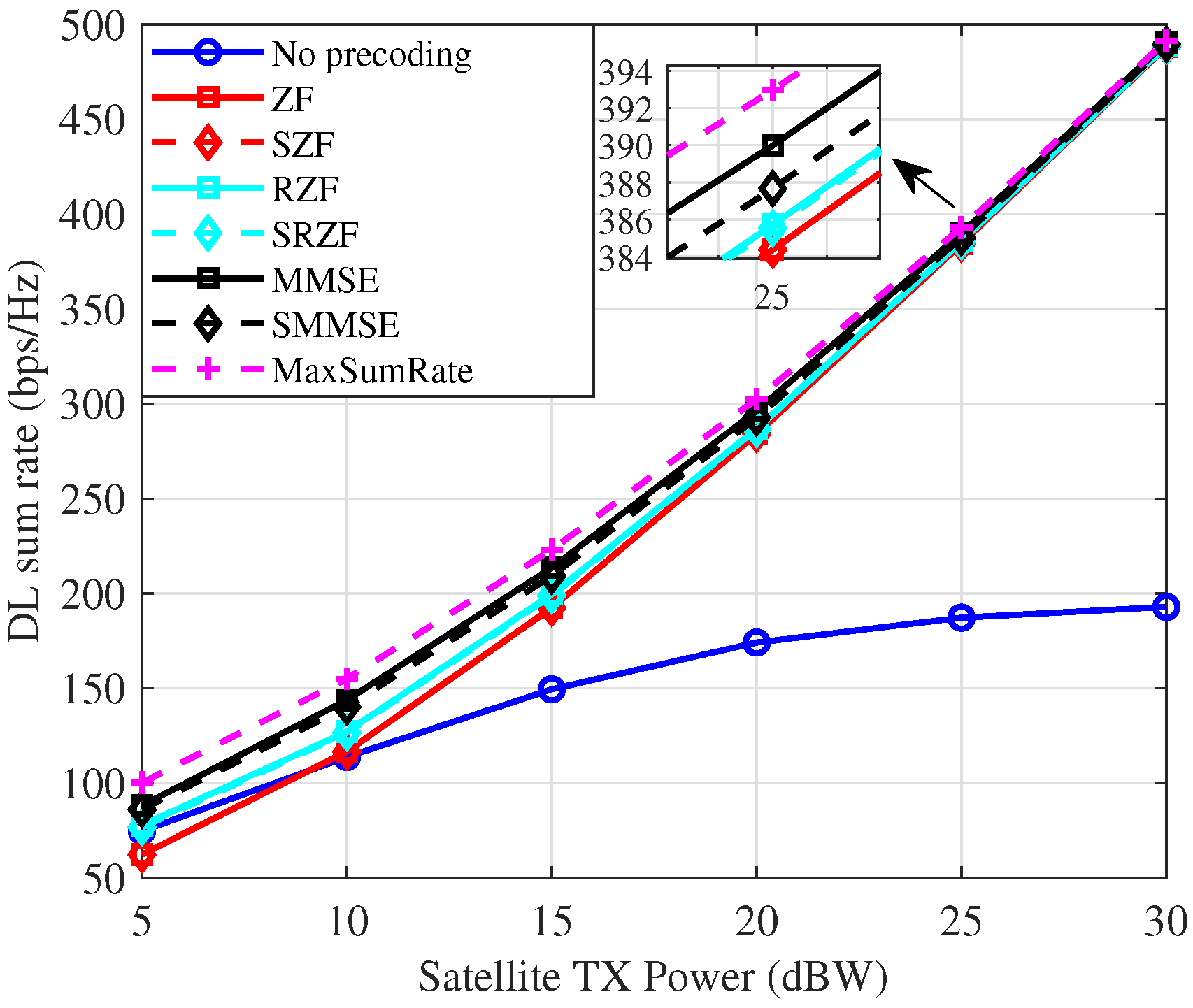
Figure 4 illustrates the downlink sum rate performance of the precoding schemes based on iCSI and sCSI under user distribution Case 1. In the figure,
“ZF” denotes the ZF precoding based on iCSI;
“SZF” represents the proposed statistical-ZF (SZF) precoding based on sCSI;
“RZF” stands for the RZF precoding based on iCSI;
“SRZF” denotes the proposed statistical-RZF (SRZF) precoding based on sCSI;
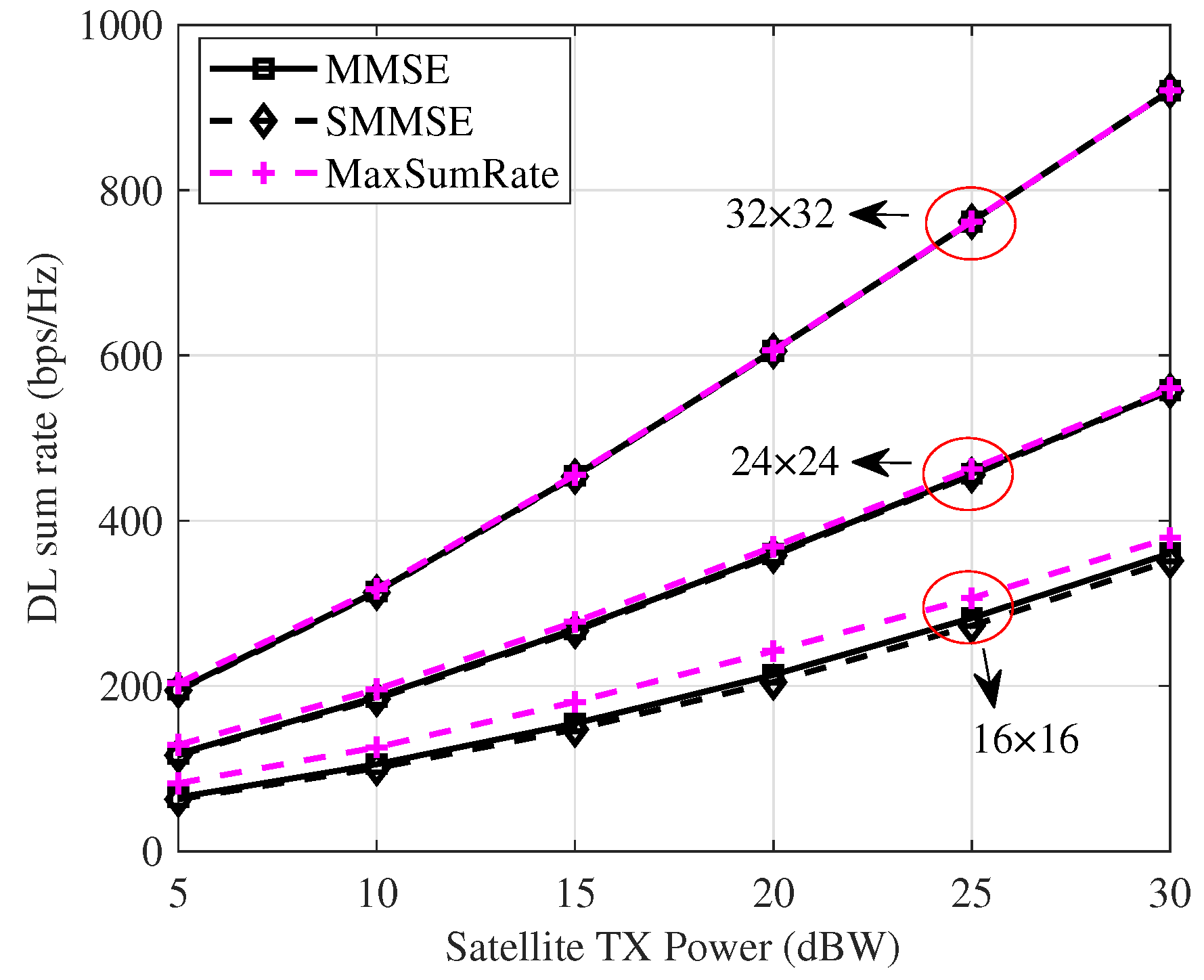
“MMSE” indicates the MMSE precoding based on iCSI;
“SMMSE” represents the proposed statistical-MMSE (SMMSE) precoding based on sCSI.
“MaxSumRate” represents the precoding method proposed in [
28], which maximizes the sum rate based on iCSI.
It can be observed that compared with the transmission without precoding, multi-beam precoding can significantly improve the downlink transmission performance. When the satellite transmit power is 25 dBW, the sum rate gain reaches 106%. Furthermore, the performance of the proposed sCSI-based precoding can approach that of iCSI-based precoding with negligible performance loss, and it can also approximate the optimal transmission performance of sum-rate maximization achieved by iCSI-based methods. Specifically, when the satellite transmit power is 25 dBW, the performance of statistical-MMSE based on sCSI can achieve 99.5% of that of the iCSI-based MMSE precoding, while the performance losses of statistical-RZF and statistical-ZF are only 0.05% (i.e., achieving 99.95% of the iCSI-based counterparts). In addition, when the transmit power is low, the downlink SNR is small and noise dominates, resulting in the inferior performance of ZF precoding compared with RZF and MMSE precoding. As the transmit power increases, the downlink SNR improves, and the performance of ZF precoding gradually approaches that of RZF and MMSE precoding, with the performance curves of different methods eventually converging. A detailed comparison of the above schemes is presented in
Table 3.
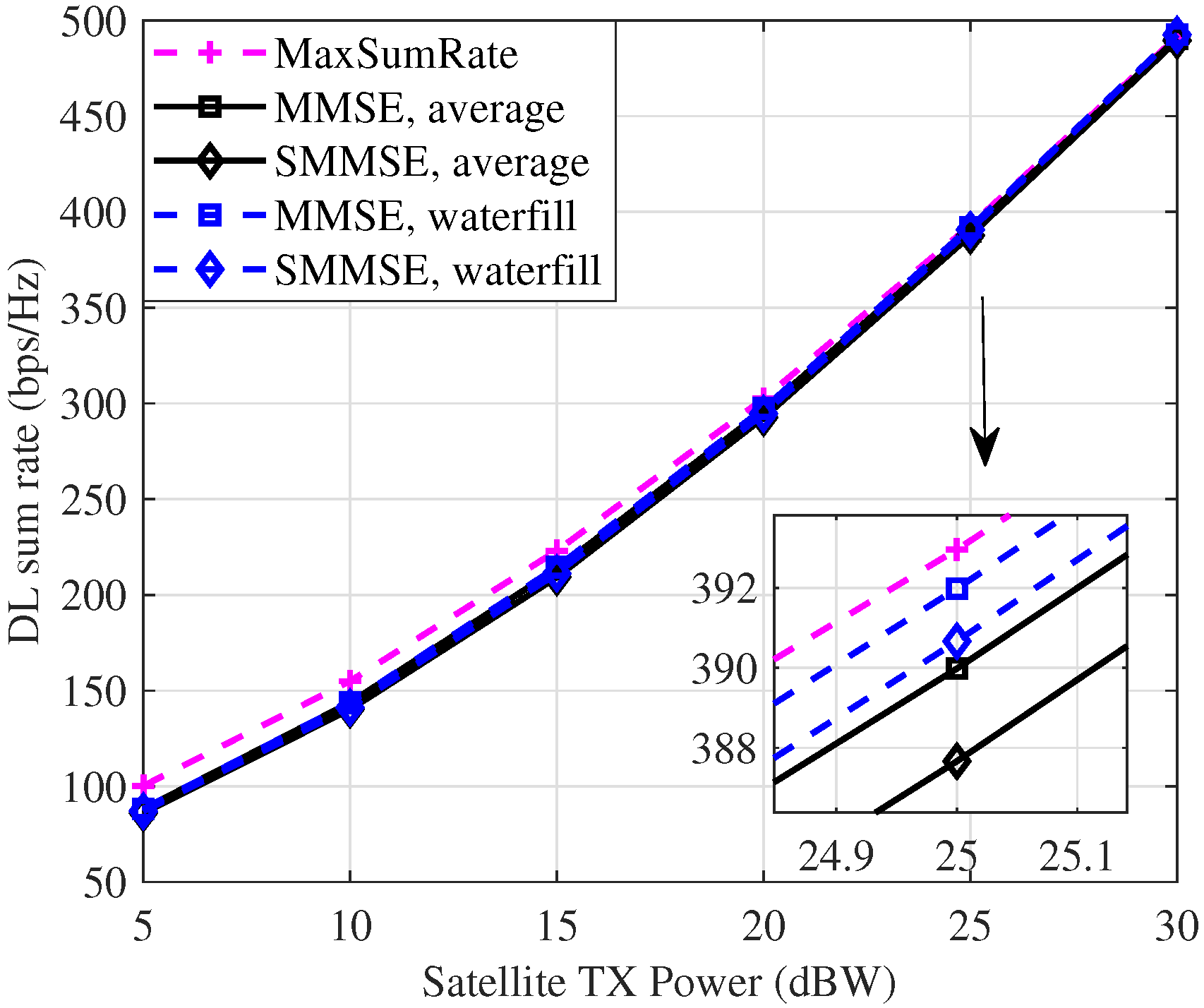
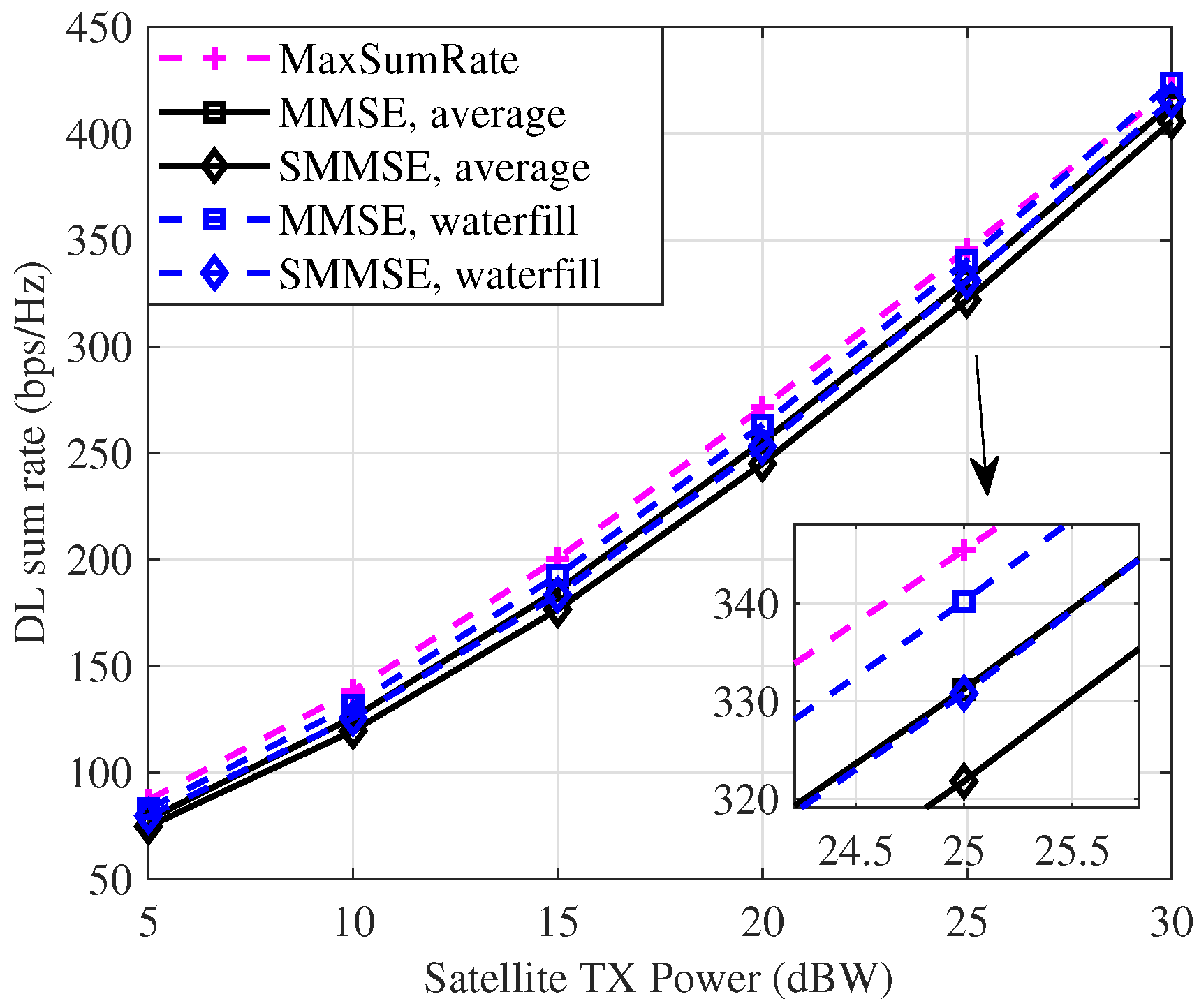
Figure 5 presents the performance comparison of the proposed method with different power allocation strategies under user distribution Case 1. As shown in the results, the optimal transmission performance based on sum-rate maximization with iCSI outperforms all other counterparts. It is worth noting that in the precoding design oriented toward sum-rate maximization, the transmit power assigned to different users is tailored to their channel conditions. In contrast, an equal power allocation strategy across users will lead to a noticeable degradation in the system sum-rate performance. Nevertheless, the adoption of a waterfilling-based power allocation scheme enables the proposed method to achieve enhanced sum-rate performance, thus bringing it closer to the optimal transmission performance of sum-rate maximization.
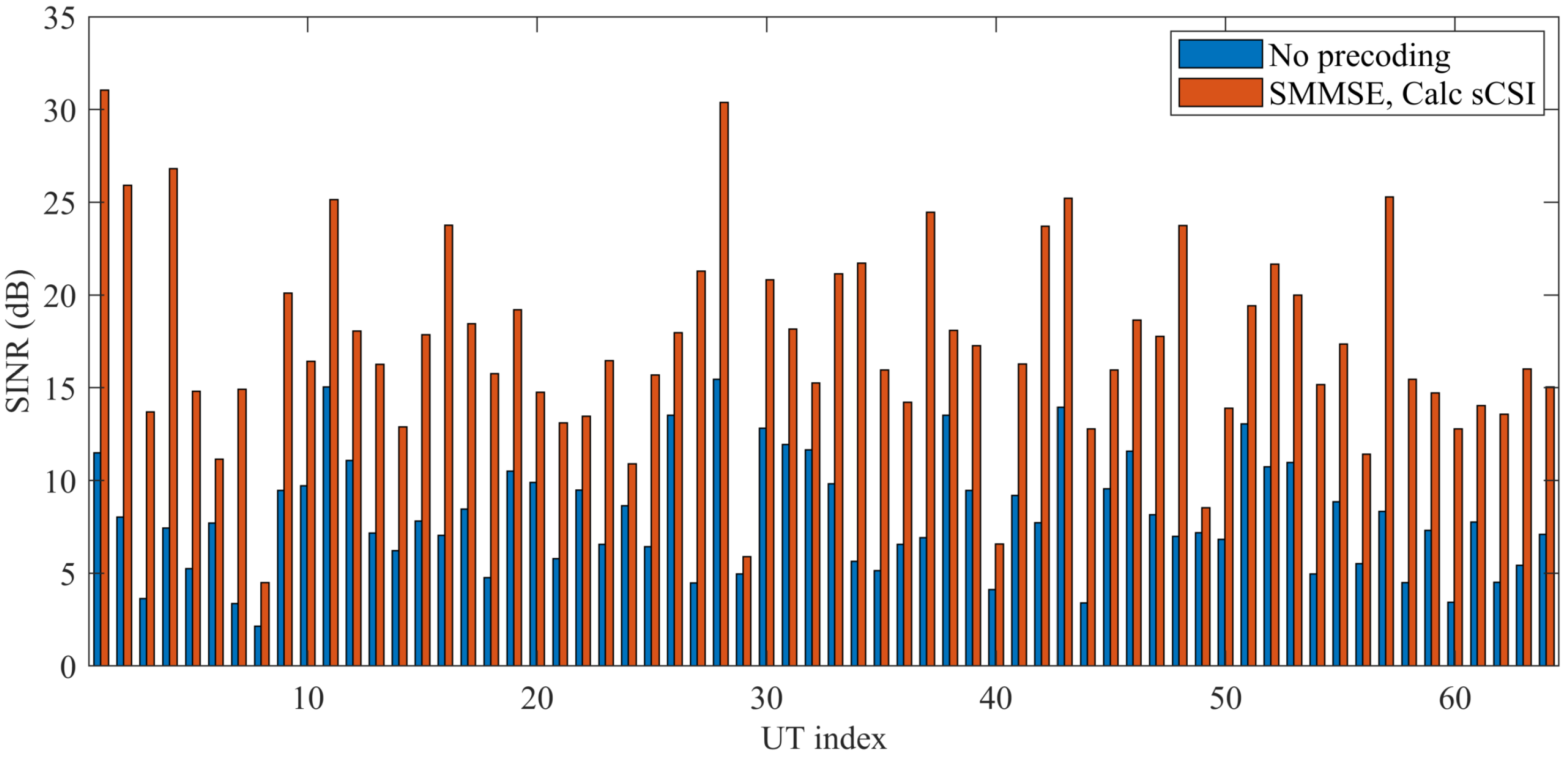
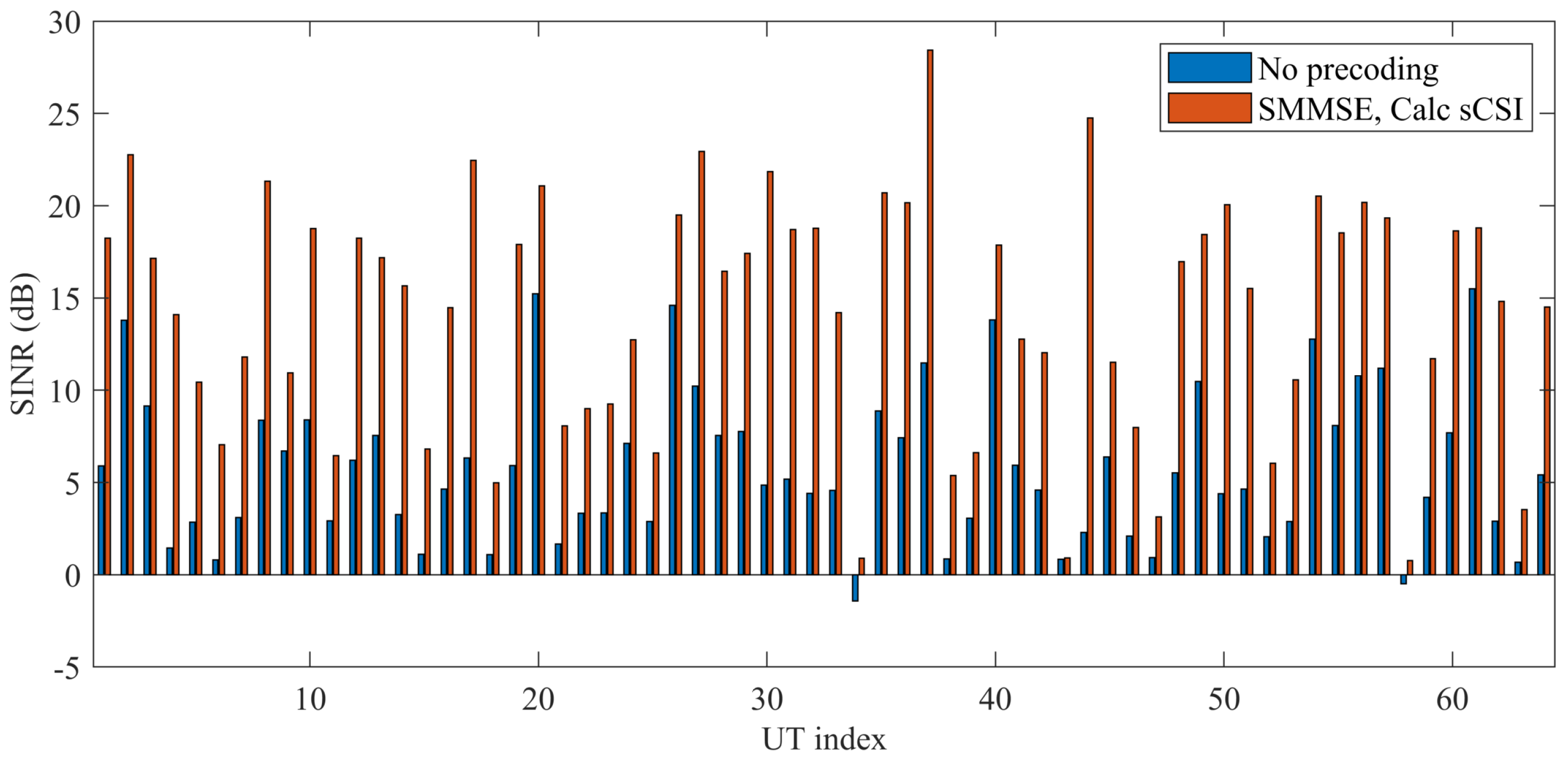
Figure 6 shows the received signal-to-interference-plus-noise ratio (SINR) of different users under user distribution Case 1. We can see that compared with the transmission scheme without precoding, the received SINR can be significantly improved by adopting the multi-beam precoding method.
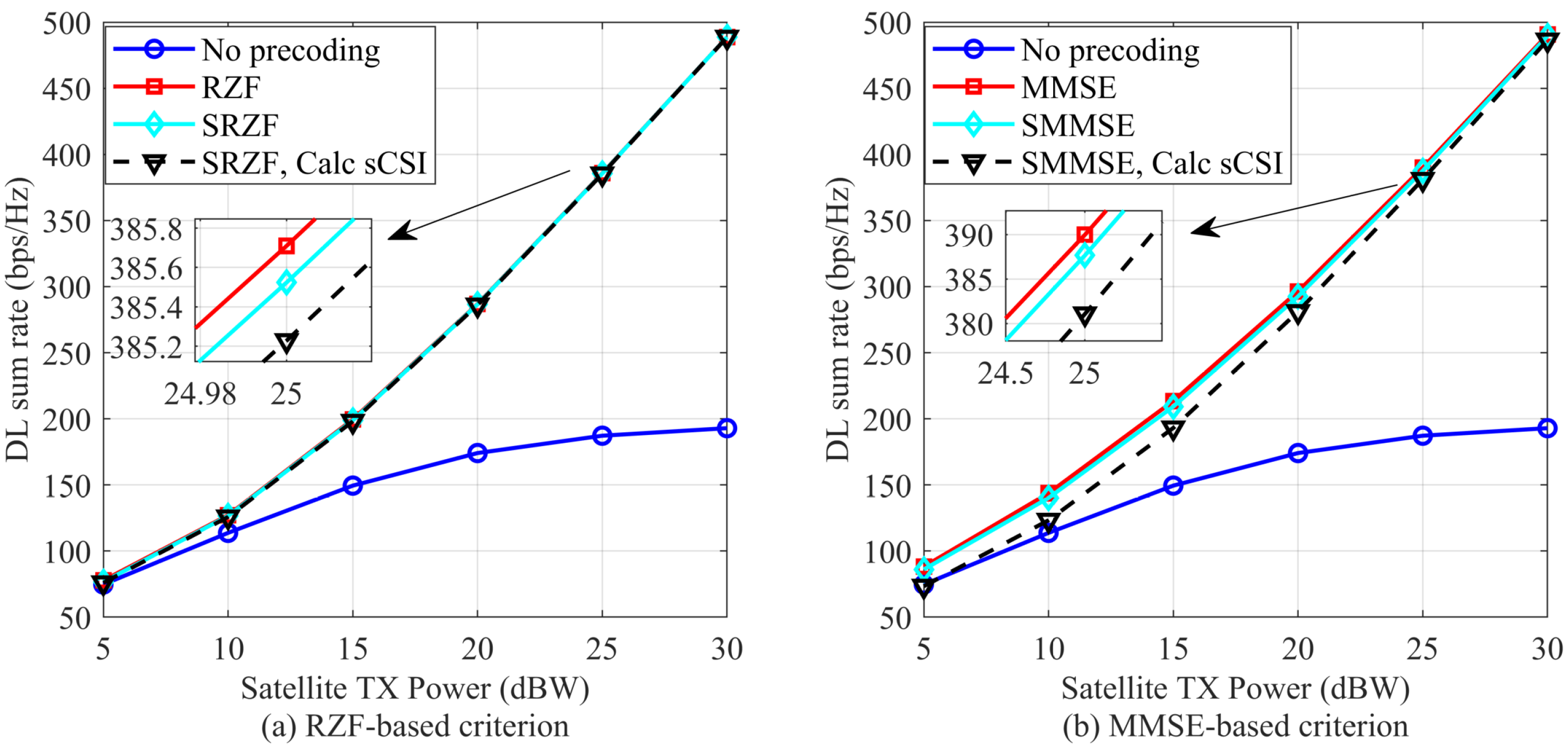
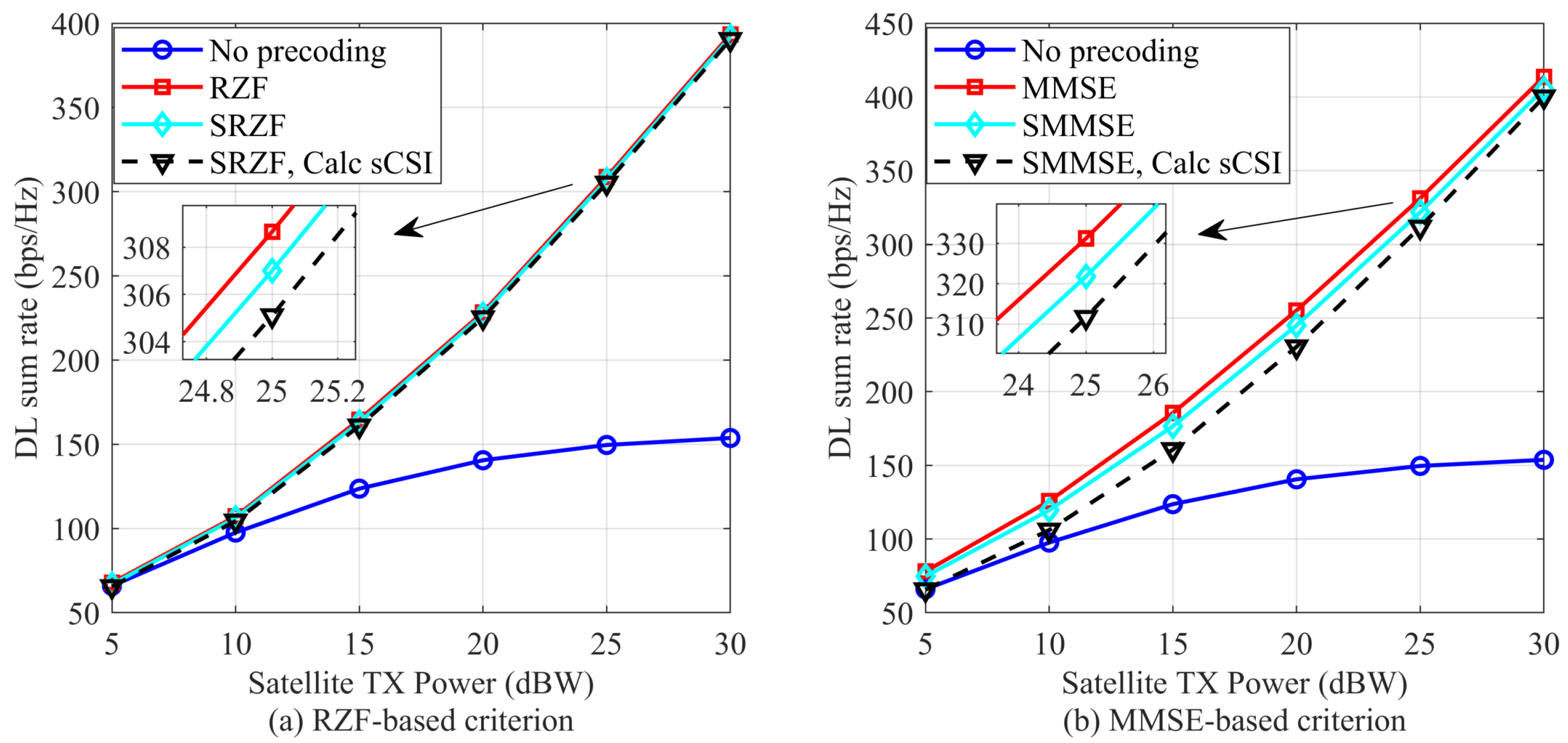
Figure 7 presents the downlink sum rate performance of the precoding schemes based on iCSI, accurate sCSI, and calculated sCSI, adopting the RZF and MMSE criteria under user distribution Case 1, respectively. Compared with the transmission performance based on accurate sCSI, the transmission performance of the proposed sCSI calculated from position information incurs an extremely small and almost negligible loss. Specifically, when the satellite transmit power is 25 dBW, the performance loss of the statistical-RZF precoding based on the calculated sCSI is only 0.08%, while that of the statistical-MMSE precoding based on the calculated sCSI is merely 1.70%.
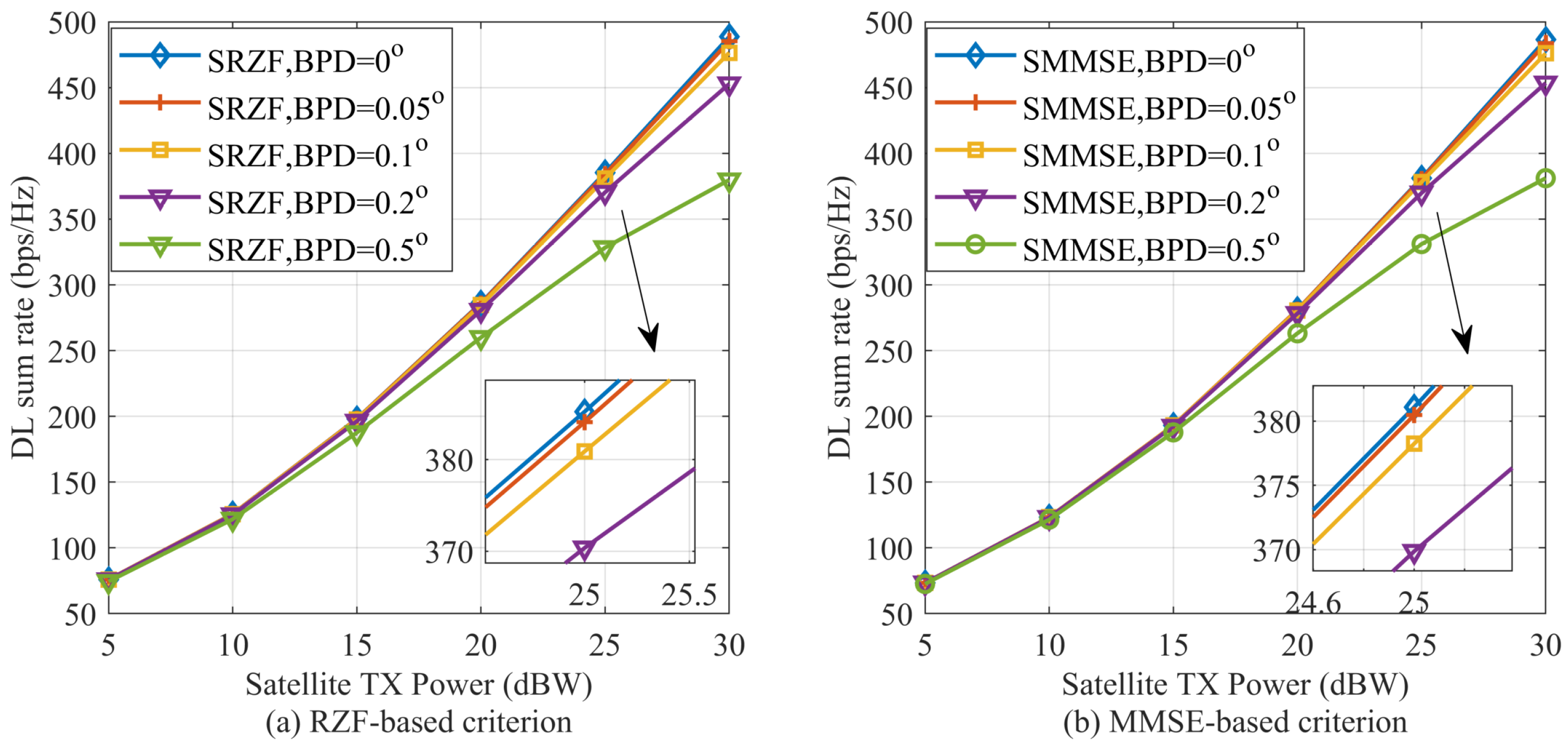
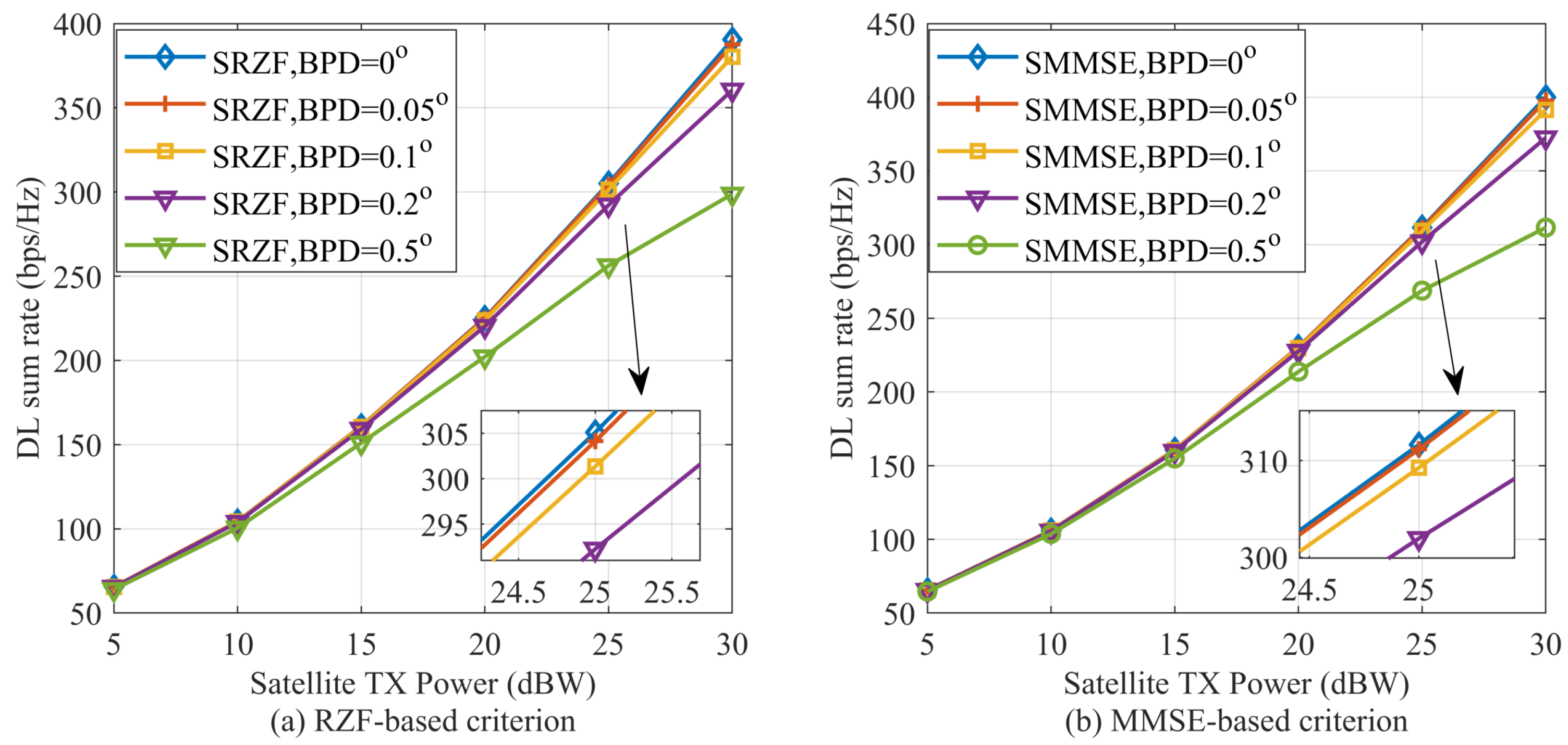
Figure 8 shows the impact of different beam pointing deviations (BPDs) on the transmission performance of the proposed precoding under user distribution Case 1. The large-scale PAAs are widely adopted in LEO communication satellites. However, after the satellite is in orbit, various non-ideal factors, such as satellite orbital errors, attitude errors, coordinate calculation accuracy, beam calculation errors, array installation accuracy, and array deformation caused by thermodynamic factors, lead to deviations in the actual beam pointing, thereby resulting in a degradation of system performance [
33,
34]. It can be observed from the figure that the proposed method exhibits better robustness against BPD. Specifically, when the satellite transmit power is 25 dBW, the performance losses caused by 0.1° and 0.2° BPD are only 1.13% and 3.86%, respectively, for statistical-RZF precoding, while the performance losses induced by 0.1° and 0.2° BPD are merely 0.75% and 2.95%, respectively, for statistical-MMSE precoding.
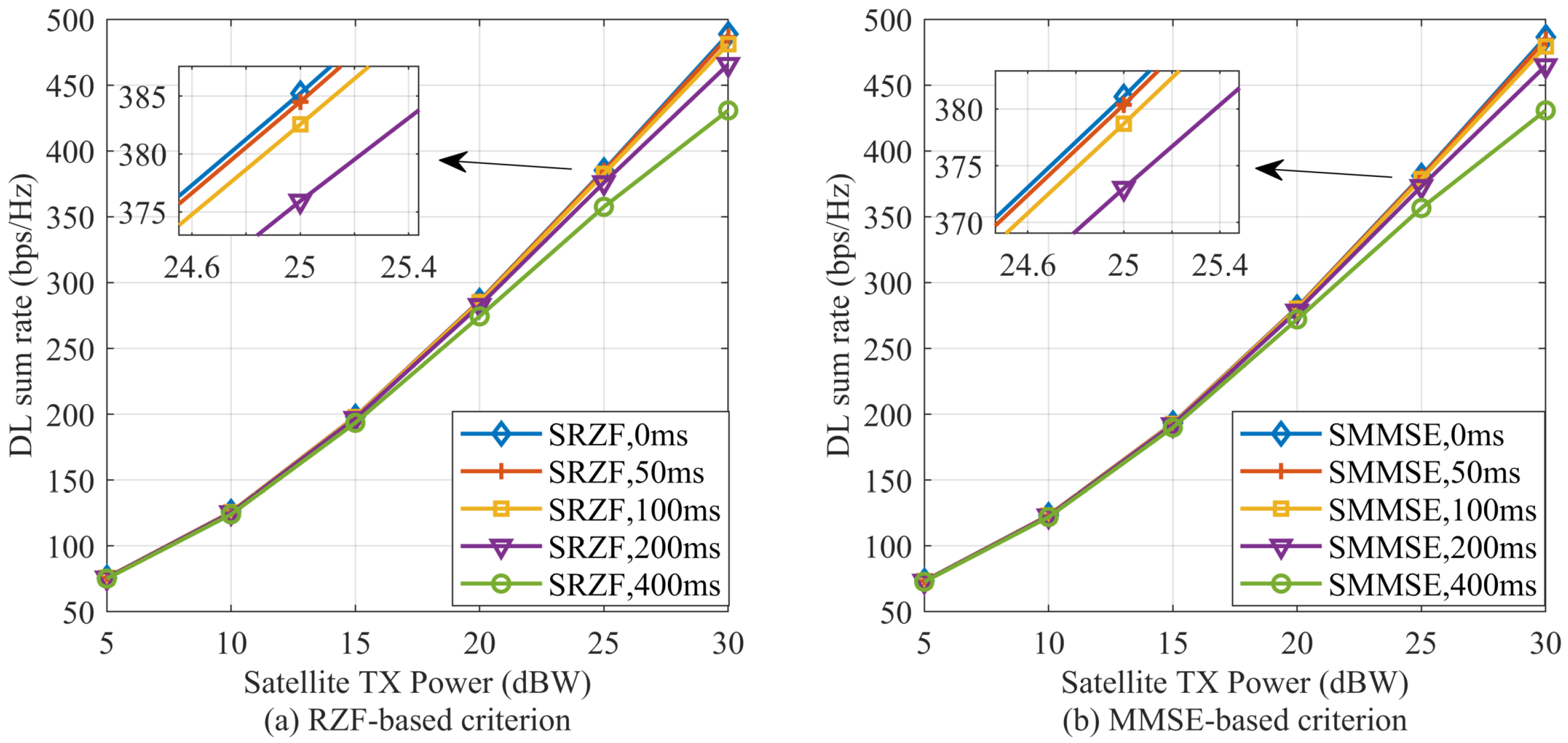
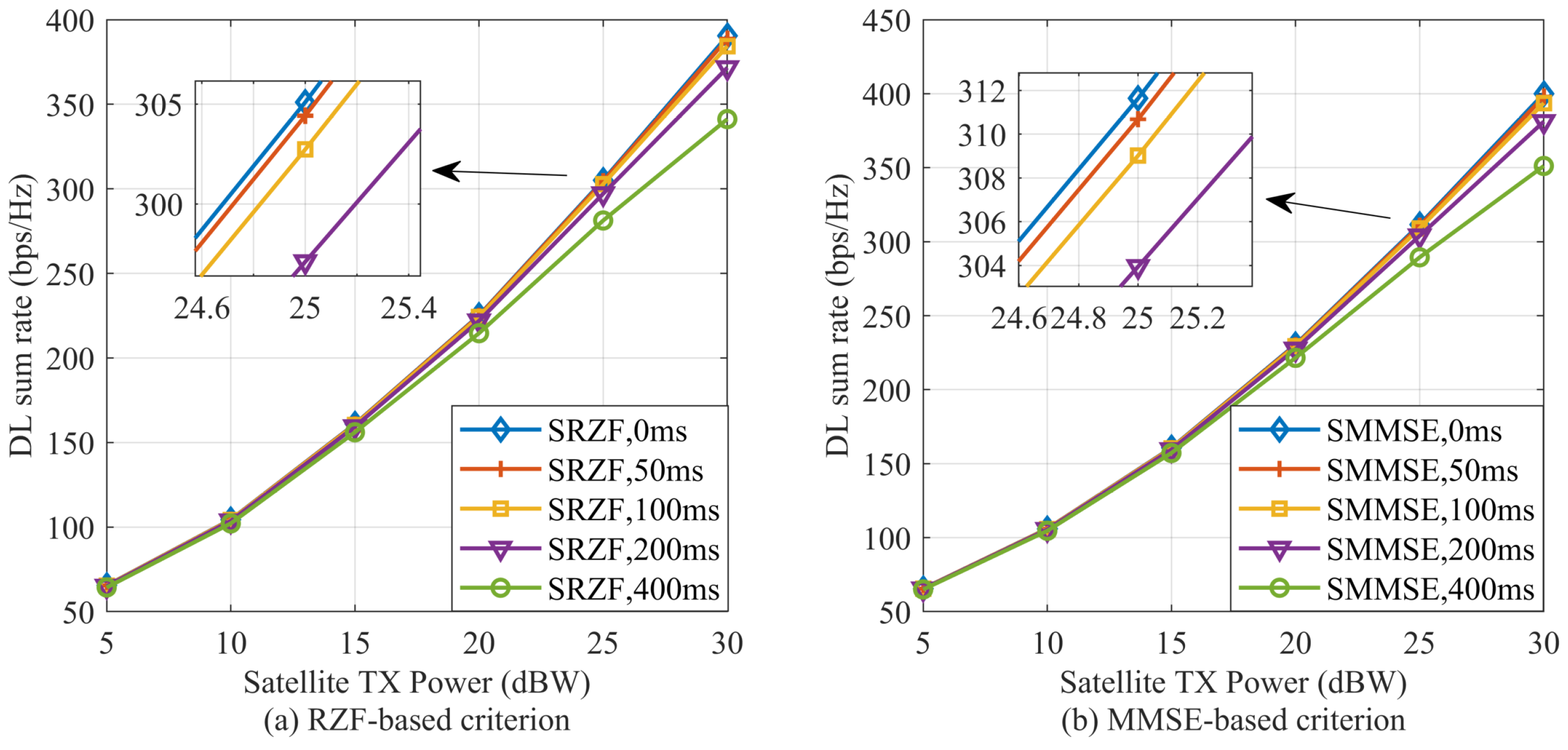
Figure 9 illustrates the impact of different sCSI update periods on the precoding performance under user distribution Case 1. It can be observed that even with an update period of 200 ms, the downlink sum rate performance loss is extremely small, even negligible. Specifically, when the satellite transmit power is 25 dBW, the performance losses of statistical-RZF and statistical-MMSE precoding with a 200 ms update period are 2.41% and 2.12%, respectively. This indicates that the calculation of precoding vectors can be completed within a relatively long sCSI update period, reducing the computational complexity of on-board payload processing.
Figure 10 illustrates the downlink sum rate performance of the precoding methods based on iCSI and sCSI under user distribution Case 2, in which the minimum distance between users is reduced, and some users have close spatial angles, resulting in increased inter-user interference. It can be observed from the simulation results that compared with the transmission method without precoding, multi-beam precoding can significantly improve the system sum rate performance. The sum rate of the statistical MMSE precoder is improved by 115%. The performance of the proposed sCSI-based precoding can approach that of the iCSI-based precoding with a small performance loss. Specifically, when the satellite transmit power is 25 dBW, the performance of statistical-MMSE based on sCSI can achieve 96.9% of that of the iCSI-based MMSE precoding, while the performance loss of statistical-RZF is only 0.07%. In addition, when the transmit power is low, the downlink SNR is small and noise dominates, resulting in the inferior performance of ZF precoding compared with RZF and MMSE precoding. Furthermore, compared with
Figure 4, the minimum distance between users in user distribution Case 2 is smaller, which means that the inter-user interference is increased. In this case, the system sum-rate performance is lower than that in user distribution Case 1. As can be seen from the comparative simulation results of the two cases, the better the user scheduling (i.e., the lower the inter-user interference), the better the system sum-rate performance achieved by precoding transmission. Meanwhile, the performance gap between sCSI-based precoding and iCSI-based precoding becomes narrower.
Figure 11 presents the performance comparison of the proposed method with different power allocation strategies under user distribution Case 2. The sum-rate performance of statistical MMSE precoding with equal power allocation reaches 93.31% of the optimal transmission performance based on sum-rate maximization precoding. However, when the water-filling power allocation scheme is adopted, the performance of statistical MMSE precoding can reach 96.79% of this optimal transmission performance.
Figure 12 shows the received SINR of different users under user distribution Case 2. In this case, the minimum distance between users decreases, which leads to a sharp increase in interference among some users and a subsequent drop in the received SINR. However, the adoption of the multi-beam precoding method results in a significant improvement in the received SINR of users.
Figure 13 presents the downlink sum rate performance of the precoding schemes based on iCSI, accurate sCSI, and calculated sCSI, adopting the RZF and MMSE criteria under user distribution Case 2, respectively. Compared with the transmission performance based on accurate sCSI, the transmission performance of the proposed sCSI calculated from position information incurs an extremely small and almost negligible loss. Specifically, when the satellite transmit power is 25 dBW, the performance loss of the statistical-RZF precoding based on the calculated sCSI is only 0.62%, while that of the statistical-MMSE precoding based on the calculated sCSI is merely 3.16%.
Figure 14 shows the impact of different BPDs on the transmission performance of the proposed precoding under user distribution Case 2. It can be observed from the figure that the proposed method still exhibits excellent robustness against various BPD values. Specifically, when the satellite transmit power is 25 dBW, the performance loss caused by a BPD of even 0.2° is extremely small.
Figure 15 illustrates the impact of different sCSI update periods on the precoding performance under user distribution Case 2. Similarly, even with an update period of 200 ms, the downlink sum rate performance loss is extremely small, even negligible. Specifically, when the satellite transmit power is 25 dBW, the performance losses of statistical-RZF and statistical-MMSE precoding with a 200 ms update period are 2.62% and 2.57%, respectively.
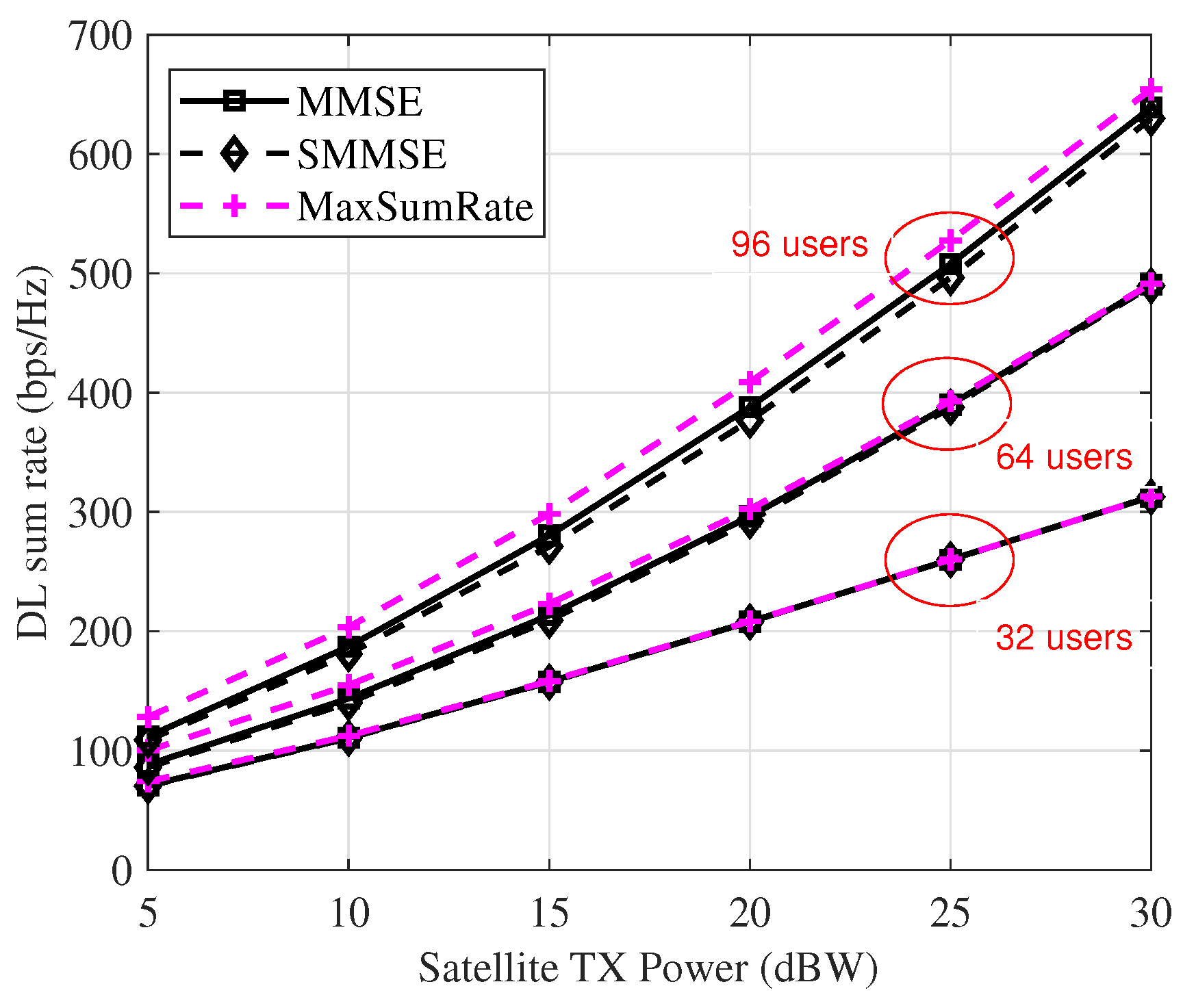
Figure 16 presents the comparison of downlink sum rate performance under different numbers of users and beams for user distribution Case 1, where the satellite is equipped with a 20 × 20 UPA. It can be observed that the system downlink sum-rate performance improves as the number of users increases. However, as the number of users further increases, the inter-user interference rises accordingly, and the performance gap of the sCSI-based precoding method also widens. Despite this trend, the performance of the proposed sCSI-based precoding can approach both the optimal transmission performance derived from sum-rate maximization and the performance of iCSI-based precoding, which verifies the superiority of the proposed method under varying user numbers.
Figure 17 illustrates the sum-rate performance comparison when the satellite is equipped with different antenna numbers. As the number of antennas increases, the antenna array gain increases, and the system sum-rate performance is improved accordingly. Moreover, a larger number of antennas enables more refined beams, which reduces inter-user interference and narrows the performance gap of the proposed method. It is demonstrated that the proposed sCSI-based precoding method can approach both the optimal transmission performance and the iCSI-based precoding performance across all tested antenna number configurations.
7. Conclusions
In this paper, we investigate the downlink precoding design for multi-beam LEO satellite communication systems based on sCSI. First, we establish the downlink channel and signal transmission models for OFDM-based LEO satellite communication systems. Then, we propose to design downlink precoding using sCSI and derive closed-form solutions for statistical-ZF, statistical-RZF, and statistical-MMSE precoding. The required sCSI only includes the array response vectors of each user on the satellite side and the average downlink channel power, which are closely related to the position information of the satellite and users. Compared with iCSI, sCSI is substantially easier to acquire at the transmitter. Precoding vectors based on sCSI can be computed over a longer sCSI update period, reducing the computational requirements for on-board processing. Subsequently, we propose a method to calculate sCSI using information such as satellite position and user position. Thus, users only need to periodically report their position information without estimating and feeding back CSI, which significantly reduces system overhead. Ultimately, we present numerical simulation results to demonstrate that the proposed method can substantially improve the system sum-rate performance. Notably, the proposed method requires users to obtain their own coordinates, which are generally accessible via the global navigation satellite system (GNSS). However, GNSS outages or interference will either hinder users from acquiring coordinate information or degrade positioning accuracy. Future work will focus on developing more robust user positioning methods to eliminate reliance on GNSS. In addition, the proposed sCSI-based precoding framework can be extended to hybrid analog–digital architectures. Specifically, the joint optimization of analog beamforming vectors and statistical digital precoding vectors can be investigated, considering constraints such as limited RF chains, phase shifter quantization errors, and on-board equipment power consumption. Furthermore, the sCSI-based precoding method can be extended to multi-satellite scenarios, which will substantially reduce inter-satellite information exchange.