Starting from missions’ typical high-level functionalities, some FSM macro-modes, such as INIT, including all the required early operations procedures, nominal routine (NOM) and safe mode (HOLD), are identified, and the connecting transitions among them are defined. Then, the logic underlying each mode is described, accounting for either the relevant requirements to be satisfied, the mission’s operations and the actual functioning of the spacecraft’s components. Secondly, to verify compatibility with the spacecraft’s design and operations, the logic’s design is supported and consolidated through analyses involving the spacecraft subsystems, such as the attitude determination and control (ADCS), power generation and management, and on-board data handling. During such a process, particular attention is paid to the design of the nano-satellite’s FDIR and to its translation into the FSM logic, which shall be achieved by means of monitoring functions that perform the Fault Detection (FD) and the safe routines, which are devoted to the Fault Identification (FI) and, possibly, fault correction. Afterwards, the derived FSM logic is represented in detail with the Specification and Description Language (SDL), which allows the formal verification of the FSM and bridges the high-level definition to the final on-board software implementation.
Despite mission-specific objectives, a large number of functionalities need to be always granted by a general nano-satellite’s on-board software. These include not only common low-level tasks, such as the boot and start-up of the system, the communication with peripherals and the monitoring of on-board components, but most importantly high-level functionalities. The latter range from on-board tasks as communication with ground, power generation, distribution and storage, and (for the more complex nano-satellites’ missions) the attitude determination and control of the spacecraft; up to operational functionalities, related to the ground planning and operation of the satellites, which are tightly related to the mission phases.
3.1. High-Level Design
In this section, a generally applicable backbone structure for the on-board software of nano-satellites is proposed and discussed. The design follows an FSM-based approach, in which the software backbone is defined directly in terms of the software modes.
The key insight behind the definition of the FSM modes lies in recognizing the distinct underlying working principles required to accomplish different high-level software functionalities. In other words, the FSM modes are derived by grouping together some functionalities that can be implemented using the same set of drivers. It is important to emphasize that this identification process focuses exclusively on high-level software functions, since low-level functionalities are assumed to be continuously active throughout the entire operation of the software.
For a small-sized spacecraft software, three main high-level functionality groups—based on similar working principles—are identified:
- 1.
Tasks that must be executed only once during the mission, typically at the beginning of space operations, for which full satellite autonomy is essential, since the system is not yet capable of communicating with the ground.
- 2.
Tasks that require repeated execution, where ground control and planning are preferable.
- 3.
Tasks that may also be executed repeatedly during the mission, but whose occurrence depends on contingencies and, therefore, cannot be planned in advance or addressed immediately by the ground mission control.
The above-mentioned high-level clustering can be mapped into three fundamental software macro-modes, which form the basis of the nano-satellite software structure. Specifically, these modes are referred to as INIT (Initialization), NOM (Nominal) and HOLD (hold and safe mode).
- 1.
The INIT mode covers all the operations that start with the spacecraft’s first switch-on in space, and must be executed only once (e.g., system boot, appendages deployment and initial detumbling). The driving principle here is the one-time, successful execution of a sequence of tasks. Moreover, since batteries are often the primary power source for these types of missions, such autonomous tasks must be completed within a limited timeframe. It is therefore proposed to base this mode on time-tagged commands, which are repeatedly executed until either the success of each task is confirmed or the allocated timeout expires. Such a software mode should be employed during the first part of the LEOP (Launch and Early Operations Phase) mission phase.
- 2.
The NOM mode relies on regular communication with the ground and is typically employed during spacecraft commissioning as well as throughout all nominal mission phases. In this mode, operations are based on scheduled commands uploaded from the ground during communication windows. Each command is associated with a scheduled execution time, at which the on-board software triggers its operation.
- 3.
The HOLD mode consists of automatic routines triggered when an error is detected and cannot be resolved, or more generally, when immediate ground contact would be required but is not available during the occurrence. Therefore, the driving principle of HOLD mode is to maximize spacecraft survivability by increasing the probability of establishing communication with the ground and maintaining a positive power balance.
Each of the three major software modes requires both entry and exit transitions, which can generally be automated or commanded by ground.
- 1.
INIT mode is primarily defined by its time-triggered nature. Entry occurs when the elapsed time since the first switch-on of the on-board computer in space is below a predefined threshold. This threshold should be established and validated through analyses and tests. Then, INIT mode is exited once this time threshold is exceeded, triggering a transition to HOLD mode. This transition is motivated by the fact that HOLD ensures a positive power balance while maintaining basic system functionalities and maximizing the chances of achieving first ground contact.
- 2.
NOM mode can only be entered through a ground command, following a successful communication contact established in HOLD mode and requiring the upload of a command schedule. Exit from NOM mode, on the other hand, is driven by contingencies—i.e., failures or non-nominal conditions detected on board—which trigger an automatic transition to HOLD mode.
- 3.
HOLD mode can be entered either from INIT or NOM in response to on-board events. Exit from HOLD is possible only through ground intervention, which commands the transition to NOM mode.
In addition to the macro-modes defined above, to ensure that all possible anomalies on board can be addressed, it is proposed to integrate each FDIR function into the software FSM through dedicated monitors and routines, as outlined below:
FD (Fault Detection). The integrated monitors continuously check the system variables required for the correct operation of the platform. These monitors should be tailored to the specific FSM mode in use.
FI (Fault Isolation). When a monitor detects a failure, dedicated routines are responsible for fault isolation. The most severe outcome of such a procedure is a request to transition the entire system into HOLD mode, where nominal platform functions are halted to establish fast and safe communication with the ground.
FR (Fault Recovery). Recovery functions are embedded within the previous FI routines. Once an anomaly has been isolated, the software may attempt autonomous corrective actions, i.e., rebooting the component related to the failure. Only a limited set of autonomous recovery actions should be implemented on board, specifically those required for immediate intervention to prevent catastrophic system loss. In all other cases, recovery should involve ground control. For this purpose, the system remains in HOLD mode while awaiting ground commands.
It is proposed that FDIR monitors and routines operate in all system modes, with the sole exception of INIT. This is because the INIT phase is inherently designed to execute tasks, verify their accomplishment, and repeatedly attempt them until success is achieved. During NOM mode, parameter monitors and FI-FR routines run in parallel with the scheduled tasks. Furthermore, in HOLD mode, the monitors and FI-FR routines remain active. Indeed, the proposed approach offers the advantage of enabling autonomous fault isolation and recovery attempts, under specific conditions, before interrupting current tasks and awaiting ground intervention. In this way, prompt recovery can be attempted immediately at the time of failure, while simple fault cases may be resolved on board, ultimately reducing mission downtime and improving operational continuity.
The main challenge of nano-satellite missions lies in achieving mission objectives with a low-cost design, which inherently involves accepting higher levels of risk. Compared to larger-scale missions, both the probability and severity of failures are often greater, due to factors such as the absence of redundancies, tighter design margins in power and telemetry budgets, and the typically reduced scope of testing campaigns for small spacecraft. Therefore, a key advantage of adopting the proposed macro-modes is the ability to implement a modular and linear FSM. Unlike hierarchical structures, this approach is more easily portable across different missions and can be readily adapted to specific requirements. Nevertheless, mission-specific factors strongly influence the design output. However, the approach to be adopted during the detailed design phase can still be standardized by identifying and exposing the major software parameters of interest.
The process should begin with a thorough understanding of the functionality of the nano-satellite’s COTS components, to determine which parameters can be monitored and which commands can be issued. Any missing or custom software elements should be identified and addressed in the earliest design stages. In addition to designing, implementing, and testing low-level software components, the FSM routines should be verified through a multidisciplinary approach—ensuring a holistic perspective on the mission software while also accounting for subsystem-specific requirements. Detailed design should follow system engineering principles and proceed iteratively, so that mission-specific components, tasks, and operations can be progressively incorporated. It is also recommended to conduct multidisciplinary analyses across different subsystems to validate the expected software behaviour. In particular, simulations and analyses should include attitude determination and control, power budgets, and housekeeping telemetry budgets. Some key FSM-related trade-offs that typically involve multiple subsystems include:
Defining the priorities and timing of the INIT mode tasks sequence;
Selecting a restricted set of parameters to monitor and defining the related FI-FR routines;
Determining which events to log and assessing their severity.
The output of the detailed FSM design shall be the clear schematics of the different modes, comprehensive parameter monitoring lists, and schematics of the FI-FR routines.
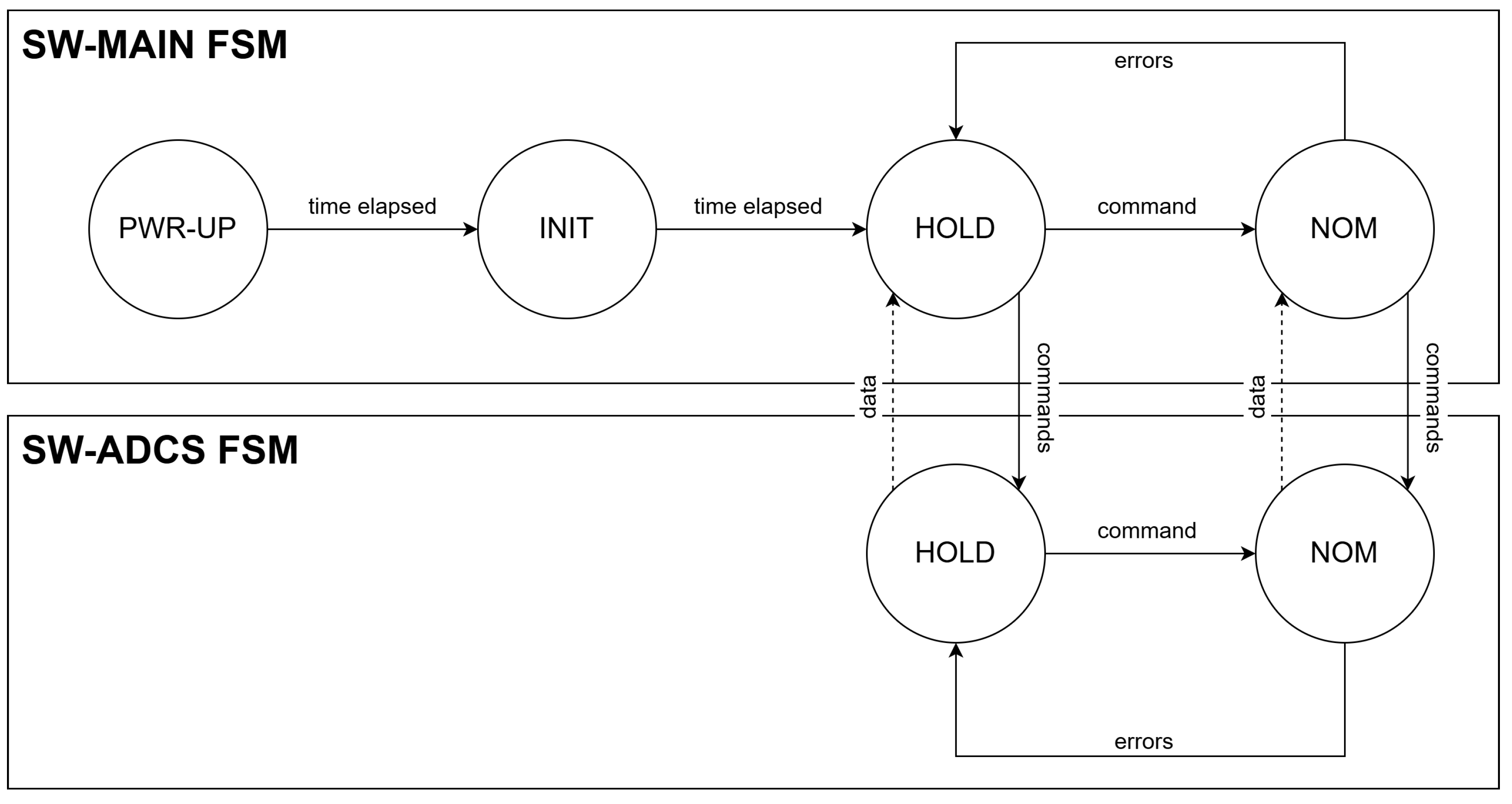
In general, for nano-satellite design, the OBC board is decoupled from the ADCS board. Therefore, it is essential to define and fix the interface between the two. The main onboard computer serves as the central interface for all spacecraft components, including the scientific payload, power and telecommunication modules, and the ADCS board itself. In contrast, the ADCS system interfaces with all attitude determination sensors and control actuators. In the following, the two onboard computers will be referred to as OBC-MAIN and OBC-ADCS. Following the proposed methodology, the OBC software high-level structure is divided into three main modes—INIT, NOM, and HOLD—corresponding to the three primary functionality principles for nano-satellite software. The INIT mode boots the system, the ADCS, and the main communication system, enabling rapid establishment of the first ground contact. Additionally, it handles the deployment of folded appendages (e.g., communication antennas and solar arrays) and performs satellite detumbling. The NOM mode is used for routine operations: executing attitude manoeuvres, commanding the scientific payload, maintaining communication with ground, and monitoring the critical satellite parameters. Finally, the HOLD mode focuses on minimizing power consumption, establishing fast communication with the ground, controlling the ADCS to maximize power generation, and handling non-nominal situations such as tumbling or unexpected wheel saturation. The software running on each OBC—referred to as SW-MAIN and SW-ADCS—is structured according to its own FSM, reflecting the functionality principles described above. The two systems are interfaced through structured data commands and monitoring parameters within a master-slave logical architecture. Specifically, SW-ADCS is subordinated to the commands and requests defined by SW-MAIN. This high-level structure is illustrated in
Figure 5. Both FSMs follow the same architecture defined by the three main modes, with the exception that SW-ADCS does not implement INIT, as it is unnecessary given its subordination to SW-MAIN. The master-slave relationship is justified by the fact that SW-ADCS exchanges monitoring data with SW-MAIN while only receiving commands, ensuring coherent operation across both systems.
The transitions between modes, along with their respective entry and exit conditions, are defined in accordance with the general-purpose methodology. HOLD serves as the INIT exit condition, as it is designed to maintain a positive power balance and seek ground contact, while the first schedule upload triggers the transition to NOM mode. Both software systems incorporate FI-FR routines, which continuously monitor vital parameters to detect potential failures or errors—SW-MAIN for the general system and SW-ADCS for the ADCS subsystem.
In the following sections, each software mode will be analyzed in more detail, distinguishing between the two software systems: SW-MAIN and SW-ADCS.
3.1.1. MAIN
As shown in
Figure 5, the FSM of the SW-MAIN is divided into three main modes: INIT, NOM and HOLD. The design of each mode is hereby briefly described.
INIT Mode
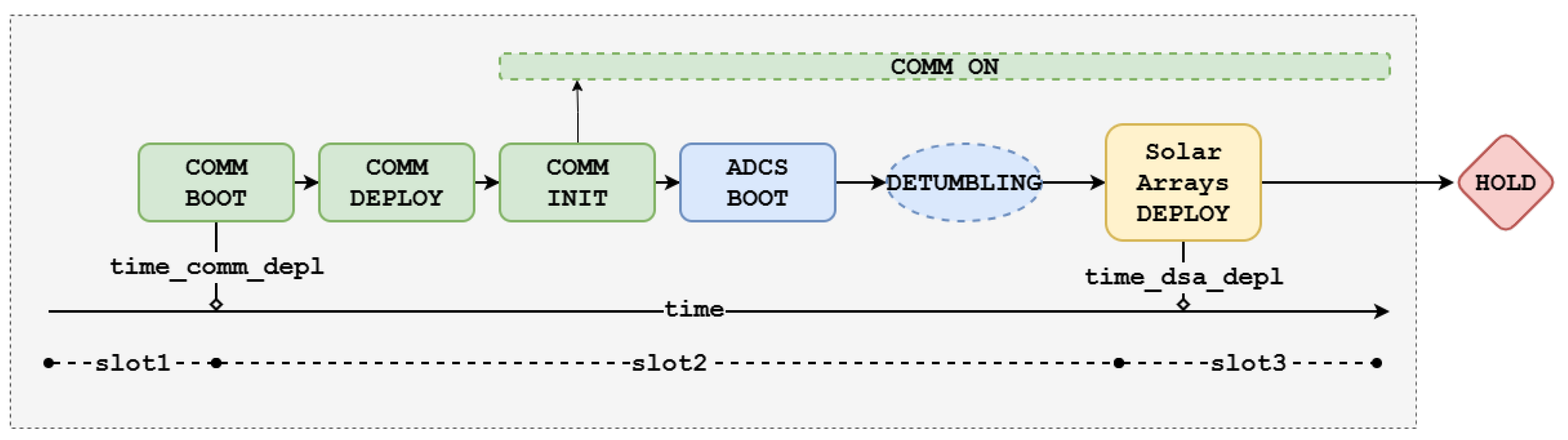
In SW-MAIN INIT mode, every operation is time-tagged. Nominally, the correct operational sequence is illustrated in
Figure 6 and described in the following list. Since the process is time-tagged, all operations are confined to specific time slots, within which the software cyclically attempts to execute each task, as shown again in
Figure 6.
- 1.
The OBC-MAIN board powers on and performs its automatic boot sequence.
- 2.
Once the OBC is operational, it waits until the end of the short slot 1, then boots the main communication link, and deploys its antennas, if any. If both the boot and deployment are successful, the COMM system is commissioned, and the board begins transmitting beacon messages to establish first ground contact.
- 3.
After COMM commissioning, the INIT mode boots the OBC-ADCS board.
- 4.
If the ADCS boot is successful, the software commands the ADCS to activate detumbling mode to reduce angular velocity before attempting deployment of the solar arrays, which cannot withstand high rotational rates.
- 5.
At the conclusion of slot 2, the software commands the deployment of the spacecraft’s solar arrays, even if detumbling is not yet fully complete. This is because the risk of deploying solar panels at a high tumbling rate is considered lower than the risk of depleting the batteries while keeping the panels folded during prolonged detumbling.
Upon completion of this process, the OBC system autonomously transitions to HOLD mode. This INIT mode is intentionally structured to ensure the prompt and reliable deployment of the solar panels, as their availability is a mission-critical requirement for spacecraft survival. Failure to deploy the panels would severely compromise platform operability and result in mission loss. This consideration emphasizes the necessity of adopting a time-tagged rather than event-tagged design for the INIT phase, thereby guaranteeing solar panel deployment at a predetermined time, even if preceding operations have failed.
NOM Mode
The SW-MAIN nominal mode is based on the considerations introduced in
Section 3.1. In this configuration, the software executes commands defined within a schedule that is periodically uploaded from the ground during satellite operations. These scheduled commands are not limited to single actions but are instead implemented as Scripted Commands. Two categories of Scripted Commands are defined: Routine Scripted Commands, primarily employed during nominal operations, and Commissioning (or Contingency) Scripted Commands, used exclusively during the spacecraft commissioning phase or during contingency operations. The principal classes of Routine Scripted Commands are the following:
Manoeuvre commands: Employed to request attitude manoeuvres from the ADCS. Inputs to this script include the guiding polynomial and the preferred actuator.
Observation commands (start, make, stop): Used to activate and terminate scientific observation mode, employing the scientific payload in conjunction with the Iridium system as a low-latency communication channel.
Data transfer commands: Used to transfer data acquired by the scientific payload into the OBC-MAIN internal memory.
Communication window commands (start, make, stop): Employed to manage communication opportunities with the ground. Input arguments include the selected communication channels and the targeted ground stations, nominally via the S-band telecommunication system.
By contrast, the Commissioning/Contingency Scripted Commands executed in NOM mode include activities related to the commissioning of the ADCS, TT&C, and EPS subsystems, as well as the payload, or to counteract the possible anomalies that may occur to one or more subsystems or components (i.e., missed deployment, error in the communication link, temperature range exceed, etc.).
Scripted Commands—both routine and commissioning—can be uploaded and modified from the ground, thereby ensuring operational flexibility. In addition, the schedule may include basic low-level actions and functions to be executed as required. As previously discussed, while Scripted Commands are executed in NOM mode, monitors and FI-FR routines remain active and periodically executed, thereby ensuring the FDIR capabilities of SW-MAIN and, by extension, of the entire satellite’s system.
HOLD Mode
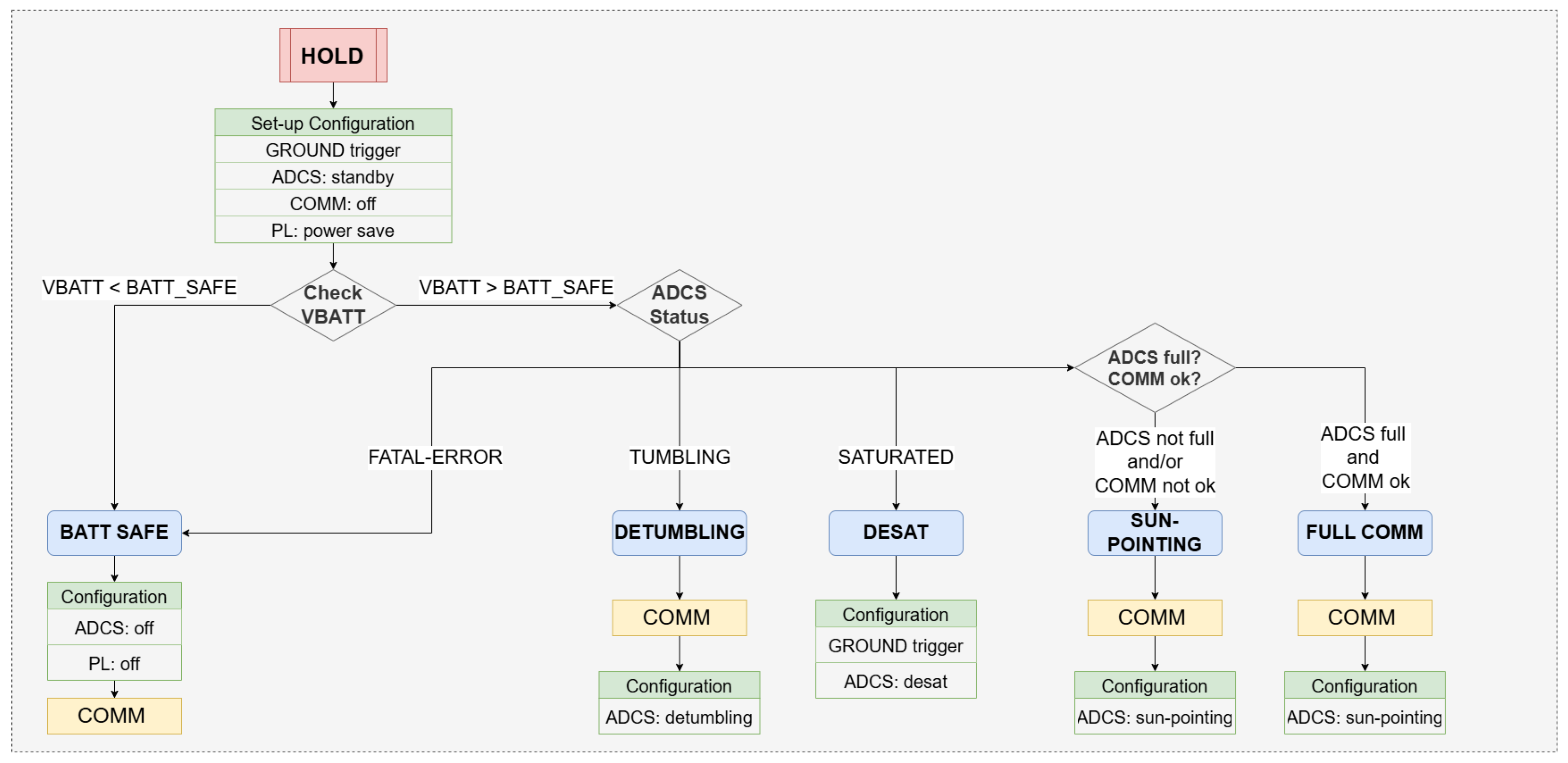
As introduced earlier, certain nominal monitors may trigger a transition into HOLD mode due to component errors or failures. The logical architecture of the HOLD mode follows a tree structure, in which system checks define branching conditions that ultimately lead to specific actions. Two main parameters govern the functioning of HOLD: the battery voltage and the ADCS status. Battery voltage is critical for assessing the remaining power available on the platform, while the ADCS status provides outputs in terms of either direct SW-ADCS requests or subsystem availability, thereby determining the satellite’s operating mode. The logical scheme of HOLD is illustrated in
Figure 7.
Upon entry into HOLD, the on-board computer set the communication systems in the default configuration, places the ADCS in standby, and sets the payload to power-save mode. In the event of errors originating from either the ADCS or the payload, their shutdown is enforced through the invocation of dedicated procedures. Following these initialization operations, the process enters the main central loop, which continuously monitors battery voltage and ADCS status. Exit from this loop is only possible through the reception of a ground command.
Depending on the conditions of the battery and ADCS, the process may follow one of five distinct branches (as shown in
Figure 7): fatal error, detumbling, desaturation, safe ADCS, or nominal ADCS. A low battery voltage can directly trigger the fatal error branch if it falls below a predefined threshold. In such a critical condition, no operations are executed, as the system will automatically shut down. In all other cases, the primary function of the FSM is to select the most suitable communication channel available and to establish ground contact as rapidly as possible.
3.1.2. ADCS
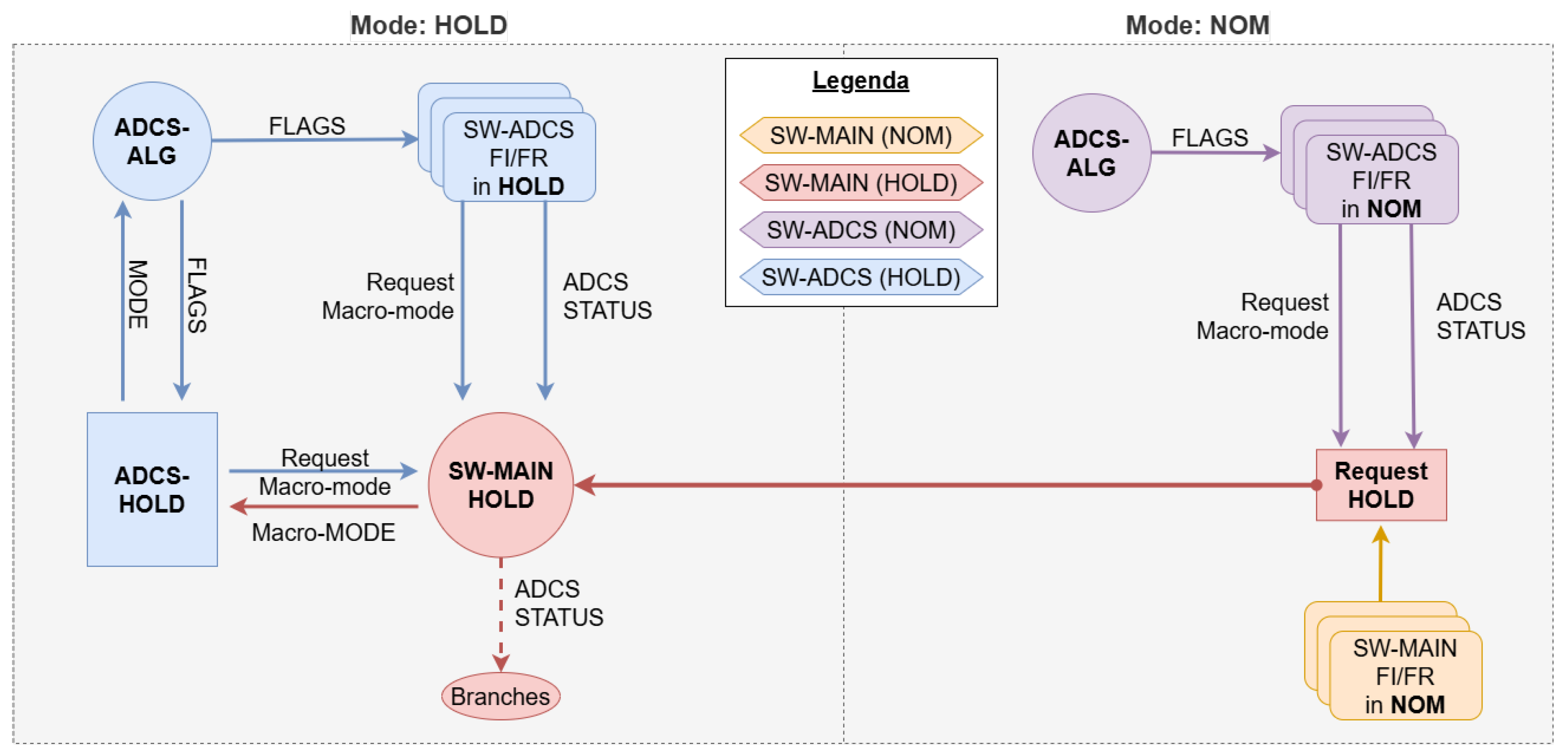
As shown in
Figure 8, the FSM of the SW-ADCS is divided into two main modes: NOM and HOLD. The design of each mode is hereby briefly described.
NOM Mode
The SW-ADCS NOM mode governs the nominal interaction between the ADCS algorithms and the associated monitors and FI-FR routines of the ADCS COTS components. The software architecture is organised into two primary elements: the ADCS algorithm and the ADCS monitors. The ADCS algorithm is responsible for guidance, navigation, and control (GNC) functions, and its operative mode is directly commanded by the SW-MAIN schedule. In parallel, the ADCS continuously monitors and evaluates the algorithm-generated flags to ensure the safe operation of the ADCS software, sensors, and actuators.
In the event of an error or failure, if the corresponding FI-FR procedure is unable to resolve the anomaly, the fault is escalated to SW-MAIN, which triggers a transition to the HOLD mode. This operational structure reflects the
master–slave interaction described in
Section 3.1, where SW-ADCS is subordinated to the control of SW-MAIN. The logical architecture of the SW-ADCS NOM mode is illustrated in the right-hand side of
Figure 8.
HOLD Mode
The SW-ADCS HOLD mode maintains the coupling between the ADCS algorithms, monitors, and FI-FR routines, while introducing an additional element that becomes active exclusively in this mode: the ADCS-HOLD logic. This component is responsible for selecting the appropriate ADCS operative mode in accordance with the requests and instructions issued by the SW-MAIN HOLD tree logic. Once the SW-MAIN system transitions to HOLD mode—regardless of whether the transition was triggered by an ADCS-related anomaly—the SW-ADCS likewise enters its corresponding HOLD mode. In this configuration, the software is structured around three main actors: the ADCS algorithm, the ADCS monitors, and the ADCS-HOLD logic, as depicted on the left-hand side of
Figure 8.
The ADCS algorithm retains its role from the NOM phase, continuing to process mode commands and expose status flags. The monitors, although slightly modified in HOLD mode, still provide information on ADCS status and mode availability, while also requesting macro-modes (defined as sets of operative modes characterised by common subsets of sensors and actuators). The newly introduced ADCS-HOLD logic acts as the interface between the SW-MAIN HOLD procedure and the ADCS algorithm. Specifically, it processes macro-mode requests received from the monitors and, based on the availability of the requested macro-modes, selects and commands the first compatible operative mode to the ADCS algorithm.
3.2. MAIN Mode Manager Implementation
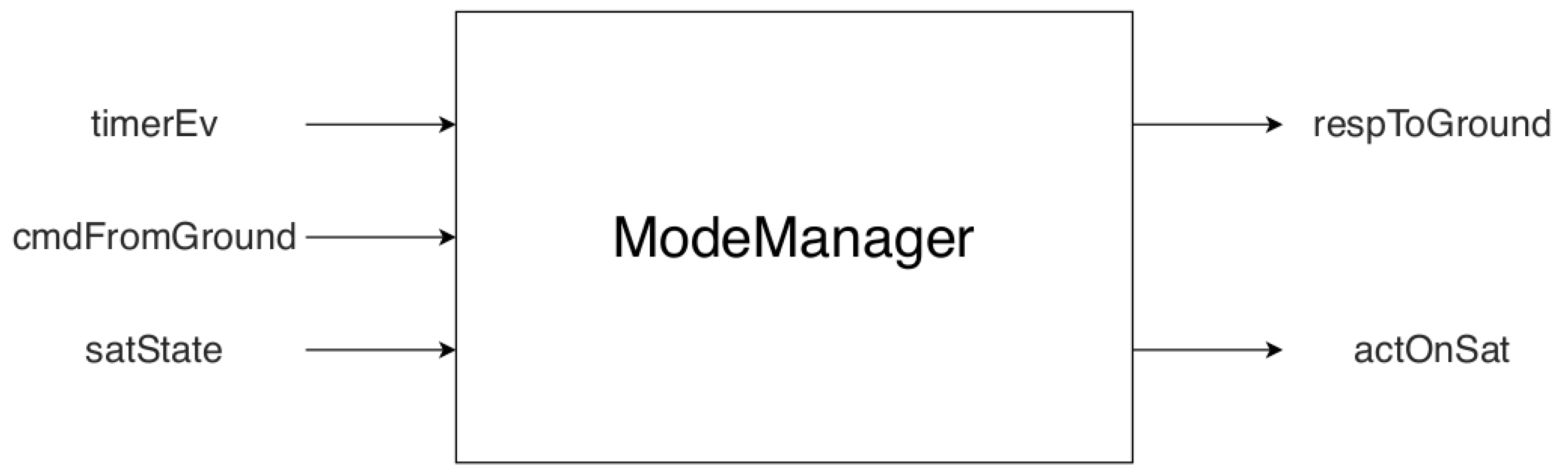
The ModeManager is a software component that implements a cascading FSM whose overall objective is the control of the operating steps of the satellite. The ModeManager receives three inputs and provides two outputs (see
Figure 9).
Inputs—The timerEv signal is an n-bit vector where n is the number of timers in the computing platform of the satellite affecting the operations of the ModeManager. Each bit of the timerEv vector is associated with a specific timer, and when the bit is set signals the ModeManager that the corresponding timer has expired. Notably, the actual implementation of the ModeManager features a single timer due to the resource limitations of the employed hardware platform. The cmdFromGround signal feeds the ModeManager with the command received from the ground station. The satState signal groups the set of signals which show the state of the satellite to the ModeManager.
Outputs—The respToGround signal is used to convey responses to the ground station starting from a received command, i.e., cmdFromGround. The actOnSat signal defines the generic set of signals used to steer the components of the satellite in response to the transitions of the cascading FSM implemented in the ModeManager.
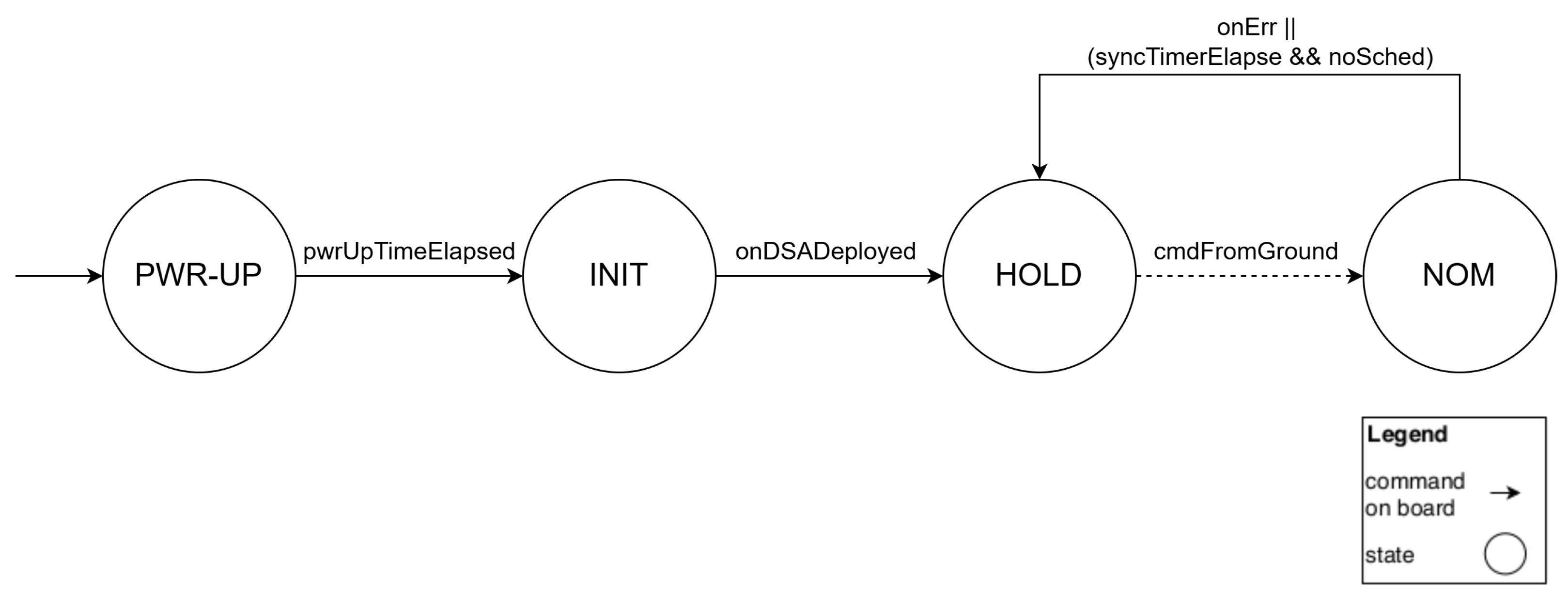
This section describes the cascading FSM implemented in the ModeManager. The proposed architecture implements a two-level FSM. The outer finite state machine defines four operating modes, i.e., PWR_UP, INIT, HOLD, and NOM. Each operating mode defines a specific overall state of the satellite and the corresponding available actions. For each operating mode, the ModeManager implements a custom finite state machine to execute the actions.
Definition of the operating modes—
Figure 10 shows the top view of the FSM as composed of four operating modes, i.e., PWR_UP, INIT, HOLD, and NOM. The PWR_UP operating mode is a temporary wait state used to let the board power up properly. At the end of the brown period, the FSM moves into the INIT state. In the current implementation, the PWR-UP operating mode is a placeholder for future development, and its traversal is instantaneous. The INIT operating mode oversees the initialization procedures for all the peripherals of the satellite. At the end of the INIT, the FSM moves to the HOLD waiting for a command from the ground station before moving the system to the nominal operating mode, i.e., NOM. The HOLD mode represents the debug state of the cascading FSM to provide a communication link to the ground station to inspect the state of the satellite, solve anomalies, and send specific commands from the ground to the satellite. Notably, the HOLD mode is the destination operating mode at the end of the procedures of INIT or in case of errors during the operations of the satellite. The NOM mode defines the operating mode where the satellite executes the commands from the schedule received from the ground station.
Transitions of the operating modes—At power up, the outer FSM enters the PWR-UP mode. At the end of a predefined time period, i.e., pwrUpTimeElapsed, the outer FSM moves to the INIT mode to perform the initialization of the peripherals of the satellite in terms of communication links, ADCS, and solar panels. The outer FSM moves to the HOLD operating mode at the end of the procedures of INIT. Notably, a command from the ground is required to move the outer FSM from the HOLD mode to the NOM one (see cmdFromGround signal in
Figure 10). Once in the NOM mode, the ModeManager performs the operations according to the schedule received from the ground and returns to the HOLD mode due to errors or exceptional behaviors.
Interlocked transition mechanism and FSM structure—The cascading FSM implements a finite state machine for each operating mode. To ensure consistency between the currently active operating mode and the executed finite state machine, the cascading FSM implements an interlocked transition mechanism. Each FSM has a unique entry point state, and its name is obtained as the concatenation of the name of the corresponding operating mode and the string _INIT. For example, INIT_INIT is the entry state INIT’s FSM. For each FSM, the entry state is a dummy state that only checks for the transition of the cascading FSM to the correct operating mode. Once the operating mode has been correctly updated the FSM moves to the next state. Notably, the transition of the state happens first and the operating mode one follows. The interlocked transition mechanism is meant to strengthen the relation between each operating mode and the corresponding set of executed actions. The rest of this part details the operations within each macro state.
INIT operating mode—The INIT operating mode oversees the procedures to boot the communication system, starts the ADCS and deploys the solar panels.
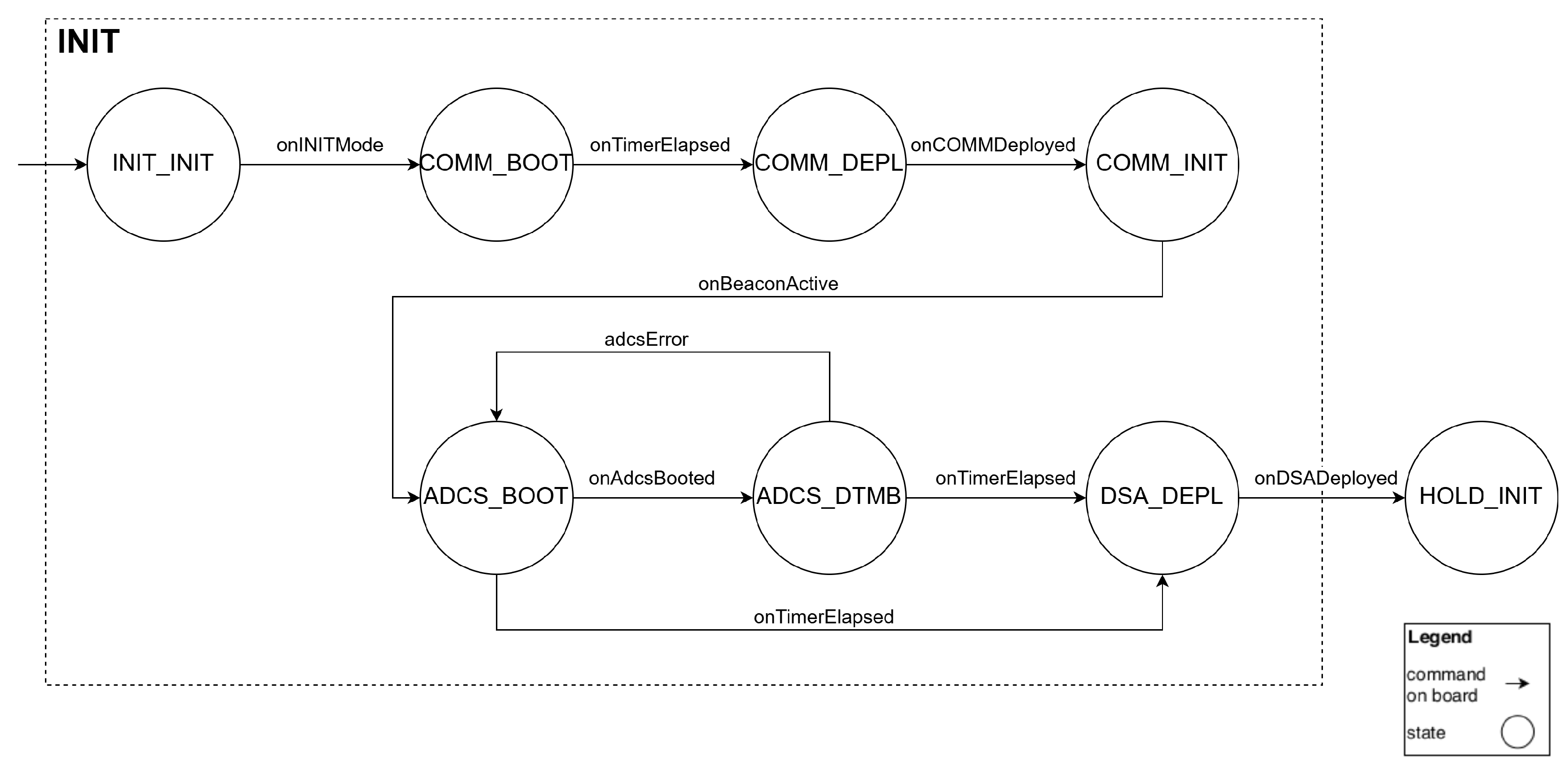
Figure 11 shows the state diagram of the finite state machine that implements the INIT operating mode. At the end of the interlocked transition mechanism, the FSM enters the COMM_BOOT state. A timer is set, and the logic of the state tries to boot the communication system. The FSM moves to the COMM_DEPL state when the timer expires, regardless of the outcome of the COMM_BOOT procedures. Such behaviour is meant to allow multiple attempts to power up the COMM module, still capping the time spent in the state. Notably, the solar panel deployment, i.e., DSA_DEPL state, must be entered within a fixed time period to start recharging the batteries, thus avoiding aborting the mission. The COMM_DEPL state oversees the procedures to deploy the communication if the boot of the COMM module was successful, acting as a bypass state otherwise. The logic of the COMM_INIT state is meant to activate a task to periodically send a beacon before moving the FSM to the ADCS_BOOT state. The ADCS_BOOT and ADCS_DTMB states oversee the activation of the ADCS module. After the ADCS power-up procedure in the ADCS_BOOT state, the FSM moves to the ADCS_DTMB state that oversees the actual module activation. A timer is set at the beginning of the ADCS_BOOT state. The timer sets the maximum time to perform the power-up and the ADCS_DTMB of the ADCS before deploying the solar panels, i.e., DSA_DEPL. In case of errors in the ADCS_DTMB state, the FSM tries to reboot the ADCS while the timer keeps decreasing. When the timer expires, the FSM moves to the DSA_DEPL state regardless of the state of the ADCS. It is important to note that the procedures within the INIT operating mode are executed in strict order, even in the case of errors. Any raised error is accounted by setting the corresponding flags in the status register of the ModeManager. At the end of the INIT procedures, the FSM enters the HOLD operating mode that allows for checking the status of the components of the satellite. Notably, the specification requires that the FSM of the INIT operating mode is executed once across the entire life of the satellite, i.e., across reboots and/or power-on cycles. To implement such behaviour, the computing platform must offer a permanent storage component that allows storing the information INIT_DONE at the end of the first execution of the INIT FSM. Such information is then read at the beginning of the FSM of INIT, allowing the ModeManager to conditionally skip the execution of the FSM. The actual software implementation has been changed in two states of the FSM of INIT. First, additional instructions have been added at the end of the logic implementing the interlock mechanism in the INIT_INIT state. The additional logic implements a reading function, i.e., readPeripheral(), to get persistent information (INIT_DONE) before moving to the next state of the FSM of INIT. If the information is set, i.e., the INIT FSM has been executed in the past, the ModeManager moves directly to HOLD_INIT also changing the operating mode. If the information is clear the ModeManager continues the execution of the INIT FSM. Second, additional instructions have been added to the final state of the FSM of INIT, i.e., DSA_DEPL, to set the INIT_DONE information in the permanent storage component.
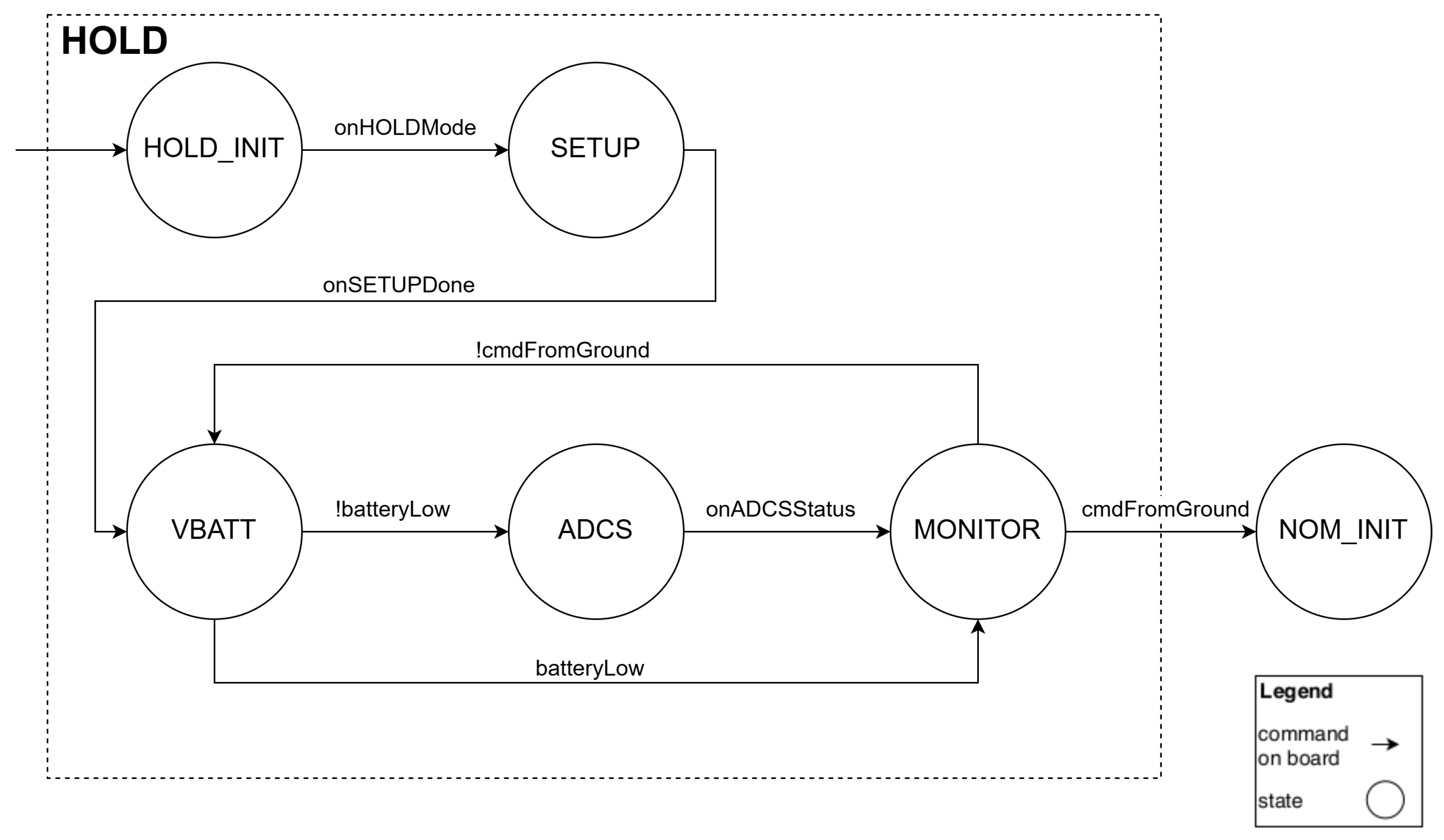
The HOLD operating mode—At the end of the procedures within the INIT operating mode, the cascading FSM enters the HOLD operating mode. Notably, the system can also enter into the HOLD operating mode in case of errors during the execution of the procedures in the NOM operating mode. As for any operating mode transition, the cascading FSM enters the INIT state, then it waits for the transition of the operating mode to complete the interlock transition mechanism. At the end of the interlock transition mechanism, the FSM moves from the HOLD_INIT to SETUP, thus starting the execution of the procedures related to the HOLD operating mode as depicted in
Figure 12.
SETUP oversees the procedures that must be executed once for each transition to the HOLD operating mode. At the end of SETUP, the FSM loops across three states, i.e., VBATT, ADCS, MONITOR, until a specific command from the ground moves the FSM to the NOM operating mode. The VBATT state checks the state of the battery. If the battery is low the FSM enters the MONITOR state; otherwise, the FSM enters the ADCS state. The ADCS state checks the status of the ADCS before moving to the MONITOR state. The MONITOR state performs two actions. First, it checks the status of all the other components. Second, it decodes any command from the ground to move the FSM to the NOM operating mode. The importance of constantly checking the status of the batteries and the ADCS motivates the implementation of two states, i.e., VBATT and ADCS, respectively, while all the monitoring of the remaining components is performed in the MONITOR state. Notably, the FSM keeps looping across the VBATT, ADCS, and MONITOR states until a command from the ground forces the transition to NOM.
The NOM operating mode—The NOM state is at the core of the cascading FSM as it steers the activities of the satellite in nominal operating conditions. In particular, the NOM state performs the following three macro activities:
Communicates with the ground;
Orchestrates the execution of the commands in the schedule;
Continuously monitors the state of the satellite.
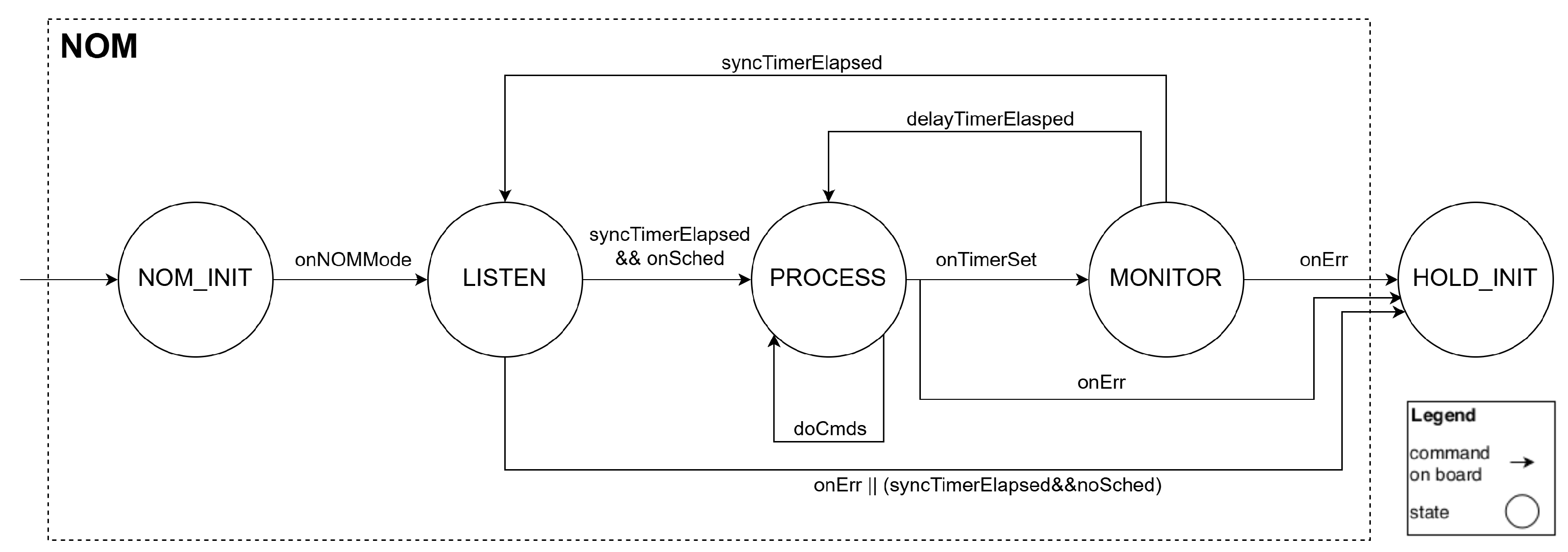
Figure 13 details the state diagram of the FSM of the NOM mode of operation. At the end of the interlocked transition procedure between the NOM_INIT state and the NOM operating mode, the FSM moves from NOM_INIT to LISTEN. The LISTEN state is meant to communicate with the ground to receive two types of commands: requests and new schedules. A request is any command that requires the satellite to provide data to the ground, while the schedule represents a set of operations, ordered in time, that the satellite must perform at the end of the listen period. Notably, the listen period happens periodically, and it defines the time window allowing any communication with the ground. From the operative standpoint, a timer is configured when the FSM enters the LISTEN state. During the listening period, such a timer can be reconfigured by employing a proper request from the ground. When the timer expires, the FSM moves to PROCESS if a proper schedule has been set, moving to HOLD_INIT otherwise. A proper schedule can be either a new schedule received in the current listening period or a previously unfinished schedule. Notably, a new schedule received from the ground overwrites the partially completed schedule, if any. In the LISTEN state, the timer works as a checker to prevent the FSM from remaining in the LISTEN state after the end of the listen period. Moreover, the FSM moves to HOLD_INIT in case any error is raised during the operations within the LISTEN state. The PROCESS state oversees the processing of the schedule whose semantics are discussed later. The commands in a schedule can be either actions or delays. Action requires an actuation on the satellite that is supposed to happen in zero time, i.e., the time consumed to act should be negligible compared to the dynamics of the schedule. A delay requires to setup a timer. Once a delay command is executed, the timer is set, and the FSM enters the MONITOR state (setTimer). Notably, the FSM enters the HOLD_INIT state in case an error is raised during the operations performed in the PROCESS state. The MONITOR state implements a control loop that continuously checks the status of each component in the satellite. In case of an error or a faulty reported status from a component, the FSM moves to the HOLD_INIT state. When the timer expires, i.e., the one set in the PROCESS state, the FSM moves either to LISTEN or back to PROCESS depending on the command that forces the setup of the expired timer. In particular, the FSM moves to LISTEN if the timer has been set as part of the execution of a sync with ground command (syncTimerElapsed). Otherwise, the FSM moves back to PROCESS since the timer has been set as part of the execution of a schedule operation that imposes a delay before continuing the execution (delayTimerElapsed).
The ModeManager Component
Three components of both the primary and failover deployments compose the Finite State Machine implementation: the ModeManager component, containing the custom-made FSMTransition and Procedures. The ModeManager component contains the main logic to drive the execution of the FSM, which can be thought of as 2 layers: modes and states.
Modes. They are the upper layer: 4 macro-states that mirror the 4 main mission phases (PWR-UP, INIT, HOLD, NOM) (see
Figure 10). Transitions between them can be either commanded from ground or result from on-board conditions. The INIT phase shall only be executed once, so after its end
startupMode parameter is set to HOLD. Furthermore, HOLD mode follows INIT regardless of its outcome, given that the required operations until the first ground contact is established are the same. Nominal mode is entered only if commanded from the ground. The actual mode is saved as a parameter called
Mode. A component action called
recoverToHOLD is used whenever HOLD is commanded externally (ground or FR-FI routines); otherwise, the logic of the component takes care of it.
recoverToNOM is dedicated to commanding the NOM phase from ground.
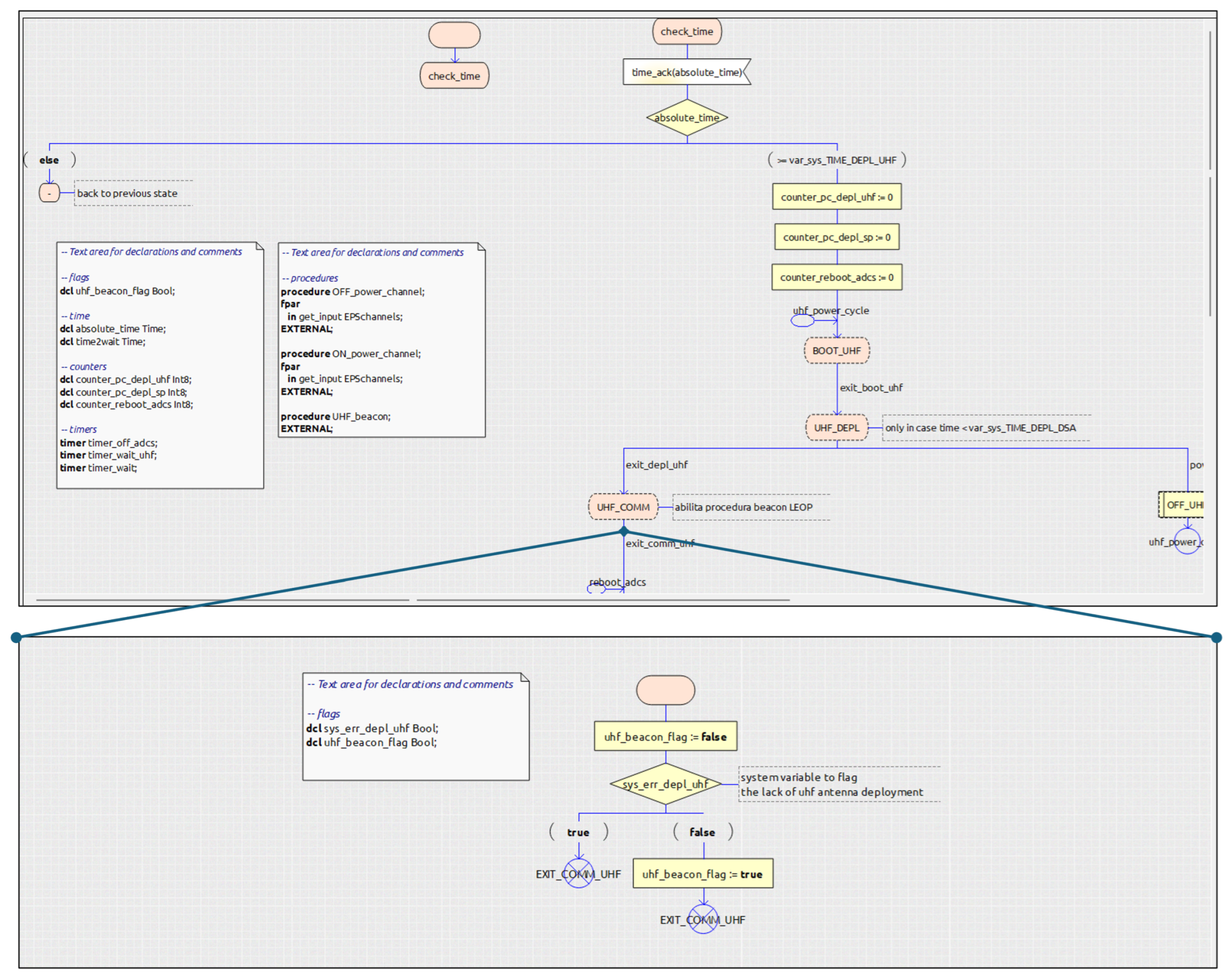
States. They are the lower layer: the actual logic as described with the SDL language in
Section 3.1. They are implemented only for the INIT and HOLD modes, since PWR-UP is only used to differentiate what mode comes next between INIT (only for the first power-up) and HOLD, so it does not require a complex logic; NOM mode does not have its own logic since during the NOM phase commands will be scheduled from ground. The code implementation for a state is divided into two functions or handlers, an exit and an enter one. The actual—the one in execution—and the next states are saved as parameters called
State and
NextState, respectively.
A periodic task of ModeManager, called update run, with a chosen period corresponds to a step of the FSM and is composed of two parts: the execution of exit handler of the actual state and the execution of the enter handler of the next state. The latter will become the actual state for the next run of update. FSMTransition takes care of changing the NextState parameter: at the end of the execution of a state the corresponding action of the script is called in ModeManager and executed in FSMTransition. Instead each action of the Procedures component script is a software procedure or an auxiliary action that implements a timer (Timers are implemented as a single ModeManager Procedures command delay and the time to wait as command argument.). In the enter handler the relevant software procedure of the Procedures component is called. In the exit handler, the logic prescribe different outcomes, depending on the conditions set by the counters. If a specific condition is met, there is no state transition but just a call to the Procedures component. Instead for the other branches of the logic, executeStateTransition, which group together a call to the FSMTransition component and another private function needed for the transition, is called and the FSM proceeds as described above.
The schedule. The schedule is a particular message sent from the ground to the satellite during the listen period, and it represents the timed sequence of commands that the satellite must execute at the end of the listen period. The commands in a schedule can be either actions or delays. Action requires an actuation on the satellite that is supposed to happen in zero time; i.e., the time consumed to act should be negligible compared to the dynamic of the schedule. A delay requires setting up a timer. As discussed later, the PROCESS state within the NOM FSM oversees the execution of the commands. The rest of this part discusses the grammar of the schedule and its implementation in ModeManager.
The grammar of the schedule. A schedule starts from the first nonterminal, MSG, which consists of one or more OP separated by the non-terminal SEP (“#” in this case). The OP token represents a command. The separator SEP is a symbol that separates two consecutive OPs. In particular, the separator is removed for fixed-length commands. The proposed grammar supports actions (OP_CODES) and time synchronization with ground (SYNC) commands. Each action requires an attribute whose meaning depends on the actual operating code. Notably, an action can request to set up a time delay to pause the execution of the subsequent commands in the schedule. Each time synchronization with ground command requires a number that encodes the time delay before the actual synchronization.
An example of a schedule generated by this grammar is the following:
ine
op3 0x01 0x00 0x12 op0 0x00 0x00 NULL timer_op_code 0x01 0x00 0x20 op0 0x01 0x00 0x02 op2 0x01 0x00 0x0A sync_op_code 0x01 0x00 0xFF
ine |
White spaces are added solely to improve readability; the actual schedule is a sequence of fixedlength commands and attributes without white spaces.
The example parses as follows: op 3 and op 0 will be executed immediately with attributes 0x12 and NULL, respectively. NULL represents an empty attribute. Then, the timer_op_code 0x20 part of the schedule sets a time delay of s. When the timer expires, op0 and op2 will be executed one after the other with attributes 0x02 and 0x0A. The last command in the schedule, i.e., sync_op_code 0xFF, sets a delay of 0xFF seconds before setting up the satellite to receive from the ground station.
The parser of the schedule—The parser implementation features a byte-level processMsg function that represents the entry point of the parser. The InBuffer contains the schedules as an array of uint8_t, i.e., unsigned integer of 8 bits. The parser decodes each instruction of the schedule by reading the opCode byte. The next two bytes specify the number of bytes to pass as operation argument: the first two bytes of which represent an unsigned integer in little endian order (that is, LSB first) whose value is copied into the variable opNumAttribute. The next bytes are read and stored into the opAttribute variable. Such variable is then processed accordingly inside the called operation specified by the opCode. The current implementation allows the parser to distinguish between three different operations, while additional commands can be easily added by adding else-if statements. The MODEMANAGER_NOM_CMD_EMPTY_BUF operational code defines the end of the schedule. The MODEMANAGER_NOM_CMD_TIMER operational code requires configuring a timer to delay the execution of the next instruction in the schedule. The MODEMANAGER_NOM_SCHEDULE_TIMER requires configuring a timer that forces the transition to the LISTEN state once expired. Then, the specific operations are executed according to the decoded operational code.
The schedule implementation—The ModeManager implements the schedule using a variable-length encoding scheme where the size of the OP_CODE is 1 byte, the number of attributes are 2 bytes and the actual arguments cover the rest of the bytes. To this end, each command within the schedule is encoded using 3 + OpNumAttribute bytes and schedules that includes sync with ground (ground passages) can be sent from the ground to the satellite within a single message. For instance, a schedule can be sent in one message that contains separation bytes by synchronization with ground command. The possibility of encoding long schedules within the same message allows for a single sending from the ground still ensuring the operation of the satellite across multiple passages/listen periods. Notably, the sending of a schedule from the ground overwrites the currently active schedule in the satellite, if any.
3.3. ADCS Mode Manager Implementation
The attitude and determination control subsystem (ADCS) is governed by a low-level mode manager that executes cyclically on the on-board computer. Its responsibilities are threefold:
Monitor the health and availability of sensors and actuators;
Trigger safe recovery actions on anomalies;
Select and initialise the appropriate ADCS control mode as commanded by the main mission FSM, while respecting the current set of available sensors/actuators.
In addition, the mode manager persists its configuration to non-volatile storage and restores it at boot to ensure deterministic behaviour after reboots or power cycles.
3.3.1. Sensor Monitoring and Safe Recovery
At each cycle, the mode manager logic pools a set of hardware status flags for Sun sensors, IMU and gyroscopes, magnetometers, GNSS receiver, magnetorquers, reaction wheels, thermocouples, and power interfaces [
19]. For each device class it maintains error and recovery counters and, upon detecting a fault, executes a dedicated safe procedure. Faults are detected from missing communication acknowledgments, error flag rises, anomalies in measurements as detected from ADCS algorithms, and power channel statuses [
20]. These procedures are minimally invasive and tailored to the device:
Power-cycle or reinitialize the affected device (e.g., toggle power channel or power-on switches, then retry identification/measurement).
Fall back to redundant sensing paths (e.g., switch from IMU angular rates to standalone gyroscopes, or from fine Sun sensors to the coarse Sun sensors) when primary data remain unavailable after retries.
Derive availability flags from the set of individual device statuses, and expose them to the control logic.
If the manager determines that essential measurements are simultaneously unavailable (e.g., no Sun and magnetic field information) or both actuation branches are lost (e.g., no magnetorquers and insufficient active reaction wheels), it raises a request for hardware safe mode to the main FSM and marks the ADCS status as in fatal-error. Otherwise, it keeps attempting local recovery and continues operating in a degraded but controlled state.
3.3.2. Mode Selection and Initialisation Under Constraints
Mode transitions are driven by a commanded macro-mode coming from the main FSM (e.g., detumbling, Sun pointing, inertial pointing, communication mode, science mode, etc.). On reception of a new command, the manager:
- 1.
Recomputes availability of sensing/actuation resources from the latest status.
- 2.
Applies a rule-based mapping from the commanded macro-mode and the availability flags to a concrete control initialisation sequence. For instance:
If reaction wheels are available, Sun pointing is initialised with momentum management control algorithms; otherwise, the manager enables magnetorquers and selects a magnetic control configuration.
If Sun sensors are not available, a commanded Sun-pointing mode is automatically degraded to a safe solar-acquisition variant that relies on solar arrays power data [
21].
If GPS or gyroscope measurements are missing, full-Sun modes are degraded to direct Sun-pointing.
- 3.
Executes a hardware bring-up sequence consistent with the chosen control law (e.g., power channel enables, and power-on lines for individual units, sensor configuration, etc.), with timing guards between steps.
- 4.
Programmes the ADCS algorithms parameters (e.g., mode number, control block, feature toggles such as continuous desaturation enable, albedo corrections, calibration flags) and confirms that the algorithm is running.
This approach ensures that the commanded objective is honoured when possible and gracefully degraded when prerequisites are not met, while keeping the main FSM agnostic of low-level hardware contingencies.
3.3.3. Configuration Persistence and Restoration
The manager maintains a compact configuration structure containing: (i) supervisory flags (e.g., watchdog enable, time-keeping synchronisation), (ii) last known ADCS status, (iii) per-device status masks and counts, (iv) ADCS algorithms settings (e.g., requested mode, feature toggles, active wheel set, desaturation indices, etc.), and (v) guidance target references (e.g., angular-rate, quaternion, and ground-station targets). The structure is serialised to non-volatile storage as a set of byte and word channels.
On power-on or reboot, the manager attempts to read the stored configuration; if any field is invalid or uninitialized, defaults are applied and a log event is raised. Fatal ADCS status at boot triggers writing defaults and re-reading to ensure a clean baseline. After restoration, the configuration is mirrored back into the live variables and ADCS bus, so that algorithm parameters, active device masks, and last valid macro-mode are consistent with the recovered state. To avoid resuming from unstable transients, if the last mode was a manoeuvre state lacking a persistent attitude profile (e.g., slewing), the manager forces a safe acquisition mode (e.g., solar acquisition) as the starting point.
Following a successful start and a few healthy cycles, the manager marks the running flight image as stable via the boot control interface. This prevents unnecessary rollbacks and provides traceability for subsequent configuration commits.
By combining device-specific safe procedures, availability-aware mode mapping, and robust configuration persistence, the low-level ADCS mode manager provides deterministic recovery from common on-orbit faults while honouring high-level mission commands. It confines complexity to the ADCS boundary, reduces the number of special cases exposed to operations, and shortens the ground validation loop for corrective updates.