Article

An Overview of DC-DC Power Converters for Electric Propulsion

1
School of Automation Engineering, University of Electronic Science and Technology of China, Chengdu 611731, China
2
School of Aeronautics and Astronautics, University of Electronic Science and Technology of China, Chengdu 611731, China
3
Huawei Technologies Co., Ltd., Shenzhen 518129, China
*
Author to whom correspondence should be addressed.
Aerospace 2026, 13(1), 36; https://doi.org/10.3390/aerospace13010036 (registering DOI)
Submission received: 11 November 2025 / Revised: 18 December 2025 / Accepted: 18 December 2025 / Published: 29 December 2025
(This article belongs to the Section Astronautics & Space Science)

Abstract

Electric propulsion (EP) has become a pivotal technology in modern space exploration, enabling prolonged mission durations, increased payload capacity, and precise deep-space navigation through its superior thrust efficiency and low propellant consumption. However, the performance of EP systems is fundamentally limited by the power processing unit (PPU), with the DC-DC power converter serving as the core of the PPU. Existing research on DC-DC converters often focuses on generic topologies, failing to address the divergent power demands of distinct EP types and the harsh space-specific constraints. This review aims to fill this gap by systematically analyzing DC-DC power converters tailored for EP systems. First, the core requirements of converters across major EP categories are classified. Then, converter topologies are compared by evaluating the suitability for EP operational and space constraints. Moreover, high step-up conversion techniques are explored that bridge the gap between low-voltage spacecraft buses and thruster power needs. Furthermore, this review highlights emerging technologies driving EP converter advancement, such as wide-bandgap semiconductors for improved power density and efficiency, planar magnetics for miniaturization, and direct-drive architecture for simplified Hall-effect thruster integration. It also identifies unresolved challenges, including balancing power density with thermal robustness, mitigating radiation-induced degradation, and suppressing electromagnetic interference (EMI). Finally, it outlines future research directions, such as optimizing WBG-compatible converter topologies, developing advanced thermal management solutions, and standardizing EP-specific design guidelines. This work provides a practical reference for PPU engineers, linking converter design to EP unique demands and space constraints while guiding innovations to advance EP technology for next-generation space missions, from low-Earth orbit satellites to interplanetary exploration.

1. Introduction

In recent years, electric propulsion (EP) has emerged as a cornerstone of modern space exploration, reshaping mission paradigms with its superior thrust efficiency, high specific impulse, and minimal propellant consumption [1]. These advantages enable prolonged mission duration, increased payload capacity, and precise navigation to distant celestial targets. Moreover, for a better understanding of the role of EP, an example of the EP system in the satellite is shown in Figure 1, where EP is in blue. The technological and commercial progress of EP can be found in Table 1. Compared with conventional chemical propulsion, EP reduces propellant mass, making it indispensable for commercial satellite operations and ambitious deep-space goals [2,3,4]. To achieve these goals, continued research of EP is aimed at increasing power output, refining thruster architecture, and investigating new propulsion mechanisms [5,6]. Leading space agencies such as the European Space Agency (ESA) and National Aeronautics and Space Administration (NASA) have validated EP potential through missions like ESA BepiColombo (Mercury exploration) and the NASA Evolutionary Xenon Thruster (NEXT) ion thruster program, further driving its adoption across the low-Earth orbit (LEO) to interplanetary scenarios [7,8]. ESA and NASA also collaborate with industrial and academic partners, as well as other space agencies, which has been instrumental in pooling resources to accelerate EP technology development [9,10,11,12].
However, the performance of EP systems is fundamentally constrained by the power processing unit (PPU) [13]. The subsystem that converts the spacecraft’s low-voltage bus power (28∼100 V) into the specialized electrical power required by thrusters and the DC-DC power converter is the core of the PPU [14]. It directly determines critical EP characteristics. For example, Hall-effect thrusters (HETs) rely on DC-DC converters to deliver stable kV-level anode voltages, while pulsed plasma thrusters (PPTs) need converters capable of generating 100∼500 A pulsed currents. Without a tailored DC-DC converter design, even advanced thrusters cannot achieve their intended efficiency or reliability, making the converter a bottleneck for EP system advancement [15].
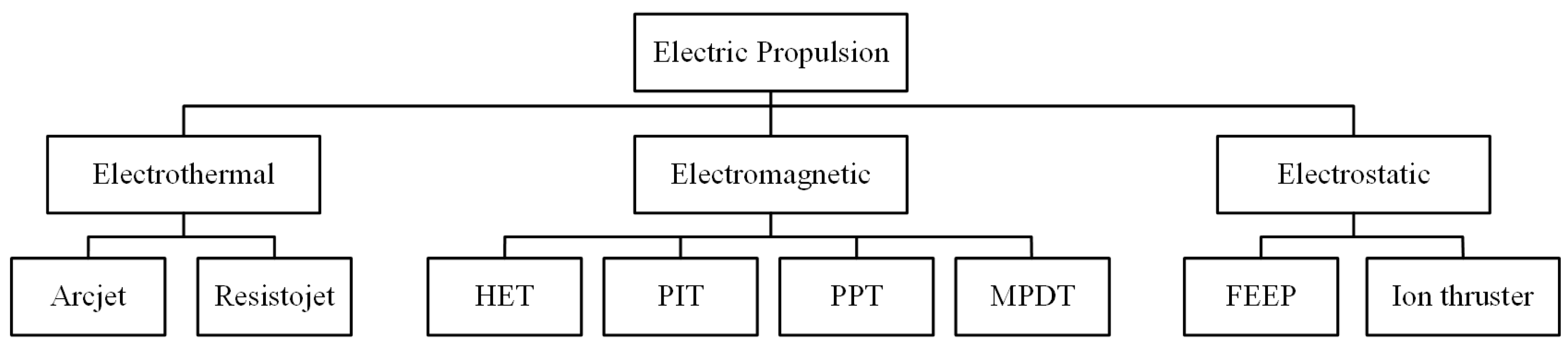
A critical gap exists in the current research; despite the widespread application of EP, different EP types impose drastically distinct requirements on DC-DC converters, and few reviews address these differences or the unique space constraints of EP. Electrostatic EP systems (ion thrusters and field emission electric propulsion (FEEP)) demand ultra-high voltage (1∼30 kV) to ensure beam stability. Electromagnetic systems (HET and PPT) require either continuous high-voltage or pulsed high-current operation [16]. Electrothermal systems (resistojets and arcjets) prioritize high-current, low-voltage supplies (10∼50 A, 28∼100 V) for propellant heating. Compounding these differences, EP converters must withstand harsh space environments, total ionizing dose (TID) up to 100 krad(Si) for deep space, extreme thermal cycling (−150 °C to +150 °C), vacuum-induced outgassing to avoid thruster optics contamination, and cosmic ray-induced single-event effects (SEEs). Existing reviews predominantly focus on generic DC-DC topologies or terrestrial applications, lacking a dedicated analysis of how converter design must align with EP’s voltage/current demands and space-specific constraints [17,18]. EP technologies can be broadly classified into three categories (Figure 2): electrothermal (resistojets and arcjets), electromagnetic (HET, PPT, magneto-plasma dynamic thrusters (MPDT)), and electrostatic (ion thrusters and FEEP) [19]. Each category relies on distinct physical principles for thrust generation, thermal expansion, Lorentz force, or Coulomb acceleration, translating to unique power needs for PPU. In conclusion, the power converter acts as a vital interface between the spacecraft’s power system and EP thrusters, ensuring that delivered power is properly transformed, regulated, and conditioned to achieve optimal performance and safe operation. While several studies [20,21,22] have reviewed step-up converters for general applications, a dedicated analysis for the specific requirements of PPU remains lacking, which is the gap this paper aims to address.
This review aims to fill the aforementioned gap by systematically examining DC-DC power converters for EP systems. It clarifies converter requirements across major EP types (especially for step-up converters) and compares the suitability of different converter topologies, which are
  • Non-isolated converters (buck, boost, buck–boost, Cuk, SEPIC, Zeta);
  • Isolated converters (forward, flyback, push–pull, half-bridge, full-bridge);
  • Bidirectional converters (dual active bridge);
  • Voltage-fed and current-fed converters;
  • Soft-switching converters (ZVS/ZCS and resonant topologies);
  • High step-up conversion techniques (magnetic coupling, voltage multipliers, switched components, multistage configurations).
We also discuss emerging technologies such as wide-bandgap devices and planar magnetics, as well as challenges related to space environmental constraints, electromagnetic interference (EMI)/electromagnetic compatibility (EMC), and thermal management. By linking converter design to EP’s operational and space constraints, this work serves as a practical reference for PPU engineers and highlights unresolved challenges to advance EP technology.
The rest of this article is organized as follows: Section 2 discusses requirements of power converters for EP. Section 3 presents the classification of power converters and their respective characteristics. Section 4 introduces the techniques to enable the high step-up conversion. Section 5 discusses the recommended power converters for EP. Section 6 proposes the possible research topic and outlines the challenges. Finally, Section 7 concludes this paper.

2. Requirements of EP DC-DC Power Converters

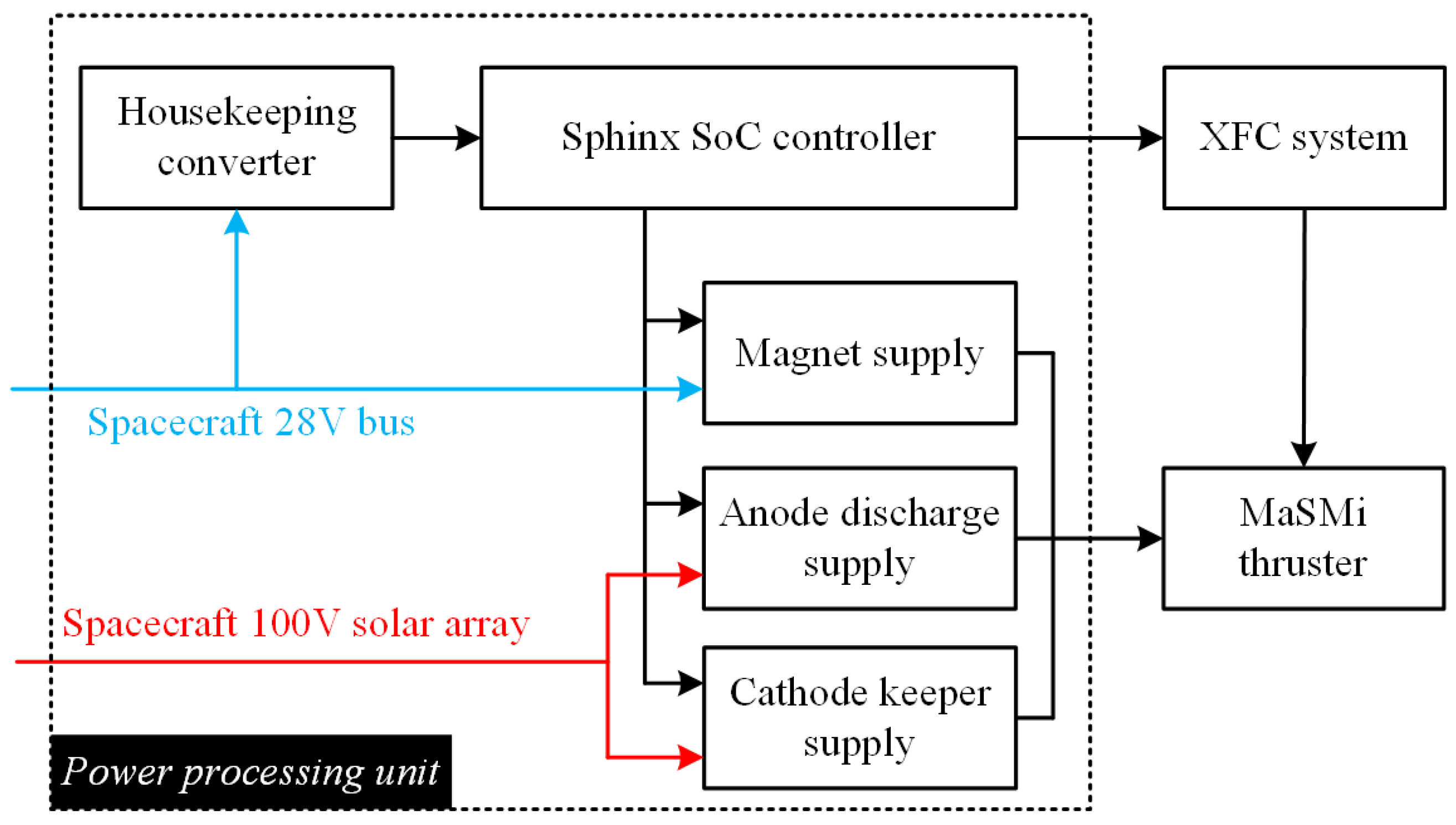
DC-DC power converters are critical components in EP-PPU, responsible for efficiently converting and conditioning electrical power to drive electric thrusters. The performance directly dictates the overall effectiveness and success of space missions. The converters must meet key requirements, high conversion efficiency to minimize energy loss and reduce thermal management burdens, a wide input voltage range to accommodate diverse spacecraft power sources and operational scenarios, precise power regulation for accurate thrust control across mission phases, and comprehensive fault detection and protection mechanisms to prevent system damage. From a practical implementation standpoint, compact, high-power-density designs are imperative to comply with spacecraft mass and volume constraints, while radiation hardening, effective thermal management, and adherence to EMI/EMC standards ensure reliable operation without interfering with other onboard systems. In EP-PPU, this translates into concrete design constraints for the individual supplies in Figure 3 (discharge, cathode keeper, magnet, heater, housekeeping, and XFC). Since the space environment and qualification requirements directly determine the admissible converter configurations, the voltage and current ratings chosen under the derating rules are described below, as well as the creepage/clearance distances and material selections that can be used on the PCB and in magnetic components.
Beyond these foundational requirements, EP-PPU power converters face extremely harsh and unique space-specific constraints, all closely aligned with ECSS and NASA standards. In terms of radiation tolerance, they must withstand TID exposure of tens of krad(Si) for low-Earth orbit (LEO) missions and up to 100 krad(Si) or higher for geostationary or deep-space missions. They also need to mitigate SEE, such as Single-Event Burnout (SEB) and Single-Event Gate Rupture (SEGR), where commercial 1200 V SiC devices may experience SEB at 1/3 of their rated voltage, prompting the use of SEE-mitigated components and redundant circuit designs. Thermal design in a vacuum is constrained by the absence of convective heat transfer and extreme temperature swings (–150 °C to over 150 °C), leading to a reliance on passive thermal management, components that maintain stable parameters across wide temperature ranges, and thermal matching of materials to prevent structural damage from differing expansion coefficients. Derating under cosmic rays is mandatory: 50% voltage derating for SiC devices to counter single-event leakage current (SELC) and SEB, 20% or more current derating for inductors/transformers to offset cosmic ray-induced lattice damage and overheating, with more conservative strategies for long-term deep-space missions compared to short-duration LEO missions. Long-life magnetic materials require high-temperature stability, radiation resistance, and low magnetic aging, with radiation-stable NiZn and MnZn ferrites as common choices. Outgassing constraints demand compliance with NASA’s JSC SP-R-0022 [23] and ECSS-Q-ST-70-02C [24], requiring Total Mass Loss (TML) ≤ 1.0% and Volatile Condensable Materials (VCMs) ≤ 0.1% to avoid contaminating sensitive components (thruster optics and solar panels), achieved through low-outgassing materials. PCB creepage/clearance in vacuum must adhere to the ECSS-Q-ST-70-12C [25] ≥ 3 mm/kV requirement to prevent arcing, with low-outgassing, radiation-resistant PCB materials and optional conformal-coating omission when spacing is sufficient. Qualification and reliability requirements from ECSS are rigorous, such as ECSS-E-ST-10-12C (radiation) [26], ECSS-E-ST-31C (thermal control) [27], ECSS-Q-ST-70-02C (outgassing) [24], and ECSS-E-ST-20-07 (EMI) [28], alongside burn-in, mechanical shock, and long-term reliability assessments. Taken together, these constraints not only define the environment in which the EP power converters must operate but also bound their achievable power density and strongly influence the rating and choice of semiconductor devices, magnetic cores, insulation distances, and PCB technologies used in the PPU.
Each EP system spans electrothermal, electromagnetic, and electrostatic categories with distinct operational characteristics that dictate unique power converter requirements. While HETs demand high-voltage, low-current outputs, other EP types require tailored power conversion, ranging from high-current, low-voltage to ultra-high-voltage, micro-current configurations. Key parameters of some EP systems in a comparative table are shown in Table 2. As an example, the architecture of a typical PPU is depicted in Figure 3, with the Jet Propulsion Laboratory’s ASTRAEUS system for the MaSMi (Magnetically Shielded Miniature) HET serving as a representative case [29]. This thruster configuration requires three dedicated power supplies, a high-voltage discharge supply for the anode to enable high-specific-impulse operation, a cathode keeper supply for ignition, and a magnet supply to power the thruster’s electromagnets. In addition, the PPU must provide power to its internal housekeeping circuits and the xenon flow controller (XFC). To address these requirements, the PPU employs a carefully engineered power distribution scheme. Previous studies [30,31] indicate that HETs generally require five distinct electrical inputs, discharge power, inner and outer magnet currents, cathode keeper voltage, and heater power. When evaluating overall system efficiency, power losses within the PPU must be comprehensively accounted for. These losses primarily originate from three mechanisms, resistive dissipation in magnetic components and semiconductors, residual energy stored in inductive elements at the end of each switching cycle, and power consumption by trigger and control circuits. Understanding these loss mechanisms is essential for optimizing energy utilization in the PPU, as they directly influence the efficiency and performance of the complete propulsion system. Systematic analysis and mitigation of these loss factors, in conjunction with the radiation, thermal, outgassing, creepage/clearance, and qualification constraints described above, provide the basis for sizing and evaluating the power converters used in EP-PPU [32,33].

3. Classification of EP DC-DC Power Converters

A critical step in designing EP PPU is the strategic selection of a DC-DC converter topology. This choice is not merely a matter of generic electrical function but must be driven by the divergent power profiles of EP thrusters and the stringent limitations of the space environment. To systematically evaluate which converter families are best suited to meet these unique EP-PPU challenges, we categorize them based on key operational and structural characteristics pertinent to space applications. As illustrated in Figure 4, and following the organizational logic in [20], this classification considers input/output voltage relationships, isolation requirements, switching mechanisms, and modulation techniques [34,35]. This framework provides a foundation for understanding not just fundamental principles, but more importantly, the suitability, trade-offs, and necessary design adaptations of each converter type when deployed in the demanding context of EP systems.

3.1. Non-Isolated Power Converters

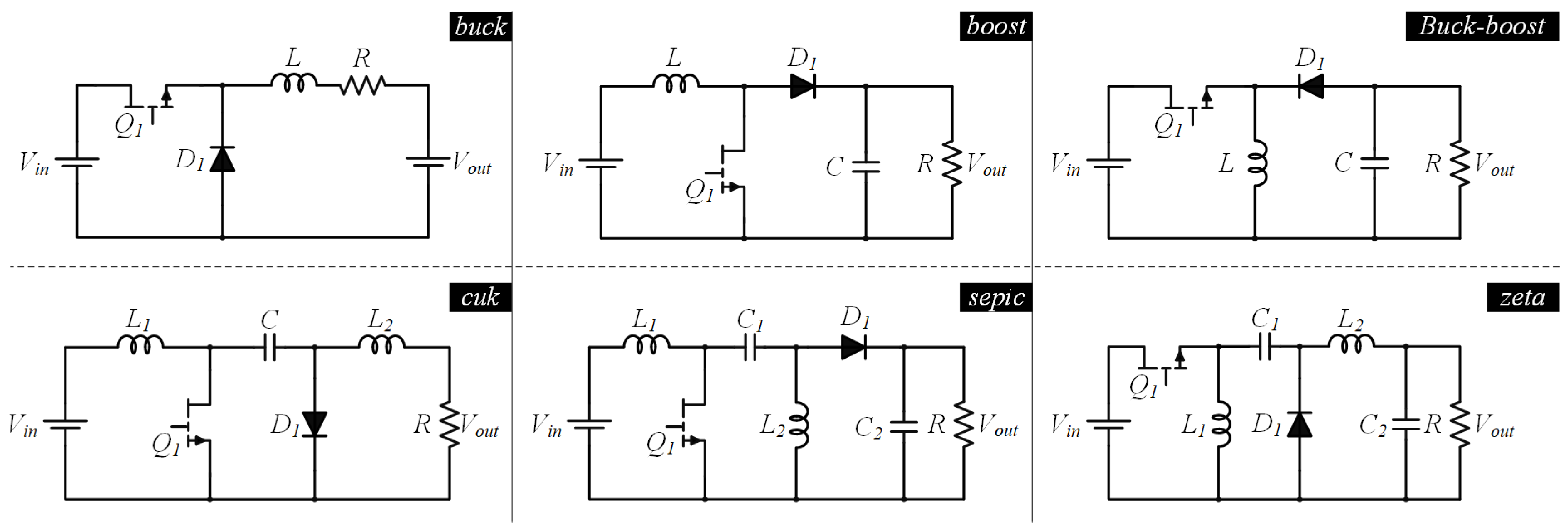
In EP-PPU applications, non-isolated converters offer compact and lightweight solutions for subsystems where galvanic isolation is not critical. Common topologies includes buck, boost, buck–boost, Cuk, single-ended primary inductance converter (SEPIC), and Zeta configurations, as illustrated in Figure 5. These circuits are widely documented in the literature and provide fundamental step-up or step-down voltage conversion capabilities. A comparative summary of their characteristics is provided in Table 3.
Given its inherent step-down operation, the buck converter is unsuitable for the high-voltage primary supplies of most EP thrusters. It finds targeted application within PPUs for low-voltage, high-current auxiliary subsystems, such as powering resistojet heaters or driving solenoid valves, as demonstrated in the Rosetta Mars Express mission for a 28 V coil supply [36]. For these roles, EP-specific design demands include extremely low output current ripple to prevent thermal fatigue in heater elements and careful management of continuous conduction losses under vacuum thermal constraints. While stable with positive-impedance loads, its control loop must be hardened against noise from adjacent high-power switching stages. Furthermore, its hard-switching behavior, characterized by high d i / d t , is a significant source of conducted EMI, necessitating rigorous filtering and layout practices to comply with spacecraft EMC standards like ECSS-E-ST-20-07.
The boost converter is frequently adopted in EP-PPUs for moderate step-up applications, including charging PPT capacitors and powering certain HET auxiliary circuits. For instance, a radiation-hardened design stepped a 24 V bus to 500 V for PPT operation [37], employing component derating to counter cosmic ray effects. Similarly, zero-voltage-switching (ZVS) isolated boost variants have converted 100 V to 300 V for thruster discharge [38], while parallel configurations offer redundancy [39]. However, its non-isolated nature introduces significant EMI challenges. Continuous input current ripple and high switch node d v / d t necessitate careful filtering and shielding to protect bus communications. Moreover, the topology’s right-half-plane (RHP) zero complicates control during high pulsed currents, often requiring current-mode or feedforward techniques to maintain regulation.
The buck–boost converter, while less prevalent than unidirectional topologies in EP-PPUs, offers a valuable capability, bidirectional (step-up/step-down) conversion with output polarity inversion. This makes it particularly suitable for PPU housekeeping and auxiliary power management, where it must accommodate wide spacecraft bus voltage variations while generating medium-voltage rails for critical functions such as thruster ignition, diagnostic circuits, or pre-charging PPT capacitors [40]. Its inherent flexibility supports stable operation across diverse bus conditions, though its application is often balanced against the increased complexity and potential EMI from its inverting switching node.
The Cuk converter is uncommon in EP but presents a niche solution for sensitive auxiliary loads requiring inverted output polarity with inherently low input and output current ripple, potentially benefiting low-noise systems like cathode heaters. Conversely, the SEPIC converter is valued in EP for non-inverting conversion over a wide input range, making it suitable for bus-sensitive supplies such as cathode keeper circuits where stable ignition depends on tight regulation despite bus fluctuations. However, its need for two inductors and a series capacitor increases mass and raises reliability questions in radiation environments [41]. Similarly rare, the Zeta converter shares the SEPIC’s non-inverting characteristic and could serve low-to-medium power auxiliary subsystems needing stable conversion under wide input variations, such as precision actuator drives, though its practical adoption in flight PPUs remains limited.

3.2. Isolated Power Converters

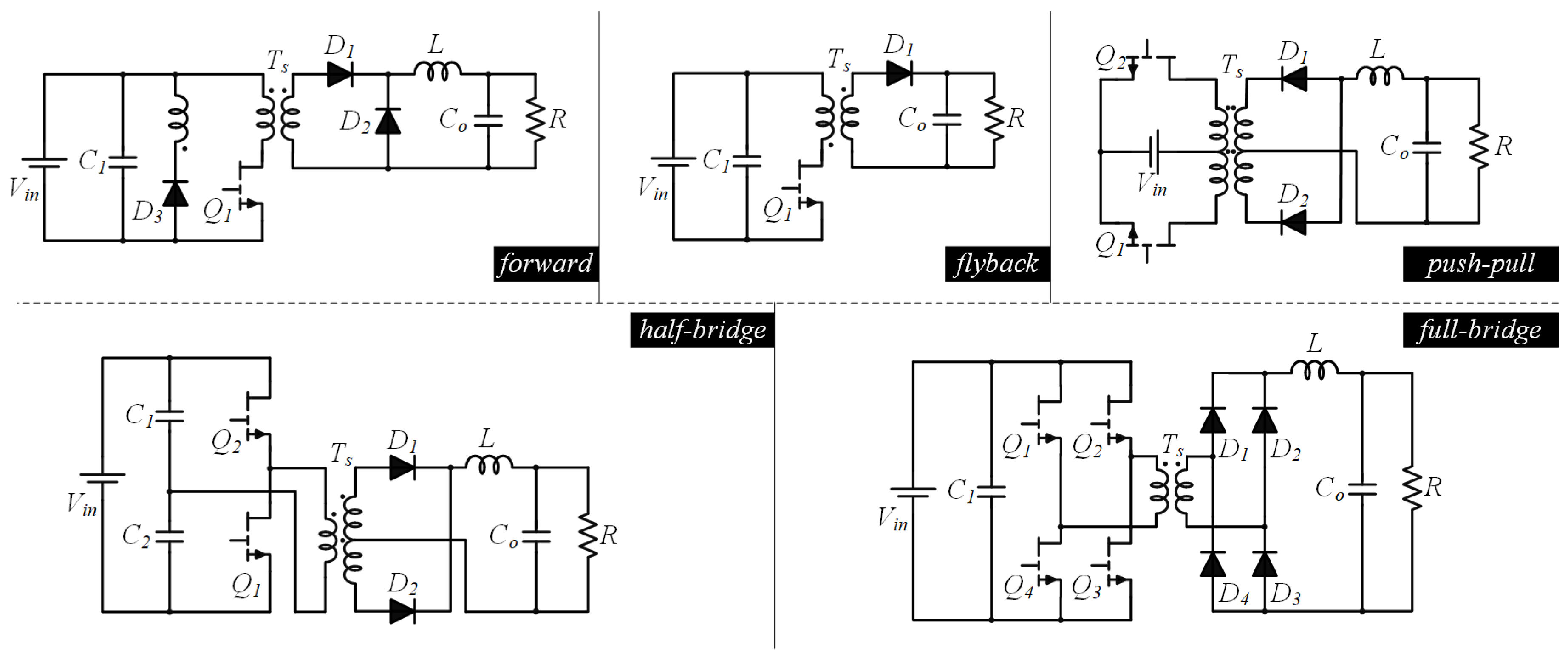
Isolated power converters, employing transformers to achieve galvanic separation, are essential in EP-PPUs for interfacing the spacecraft bus with high-voltage thrusters while providing crucial noise immunity and safety. It comprises several established topologies, including forward, flyback, push–pull, half-bridge, and full-bridge configurations, as illustrated in Figure 6. A comparative analysis of these converter topologies is presented in Table 4.
In EP-PPU, the forward converter is commonly employed for medium-power, isolated step-up conversion, such as generating intermediate bus voltages. A key design challenge is transformer core reset in each switching cycle to prevent saturation, typically addressed with an auxiliary winding or active clamp, though self-resonant reset techniques can reduce associated losses [42]. The topology offers a fast transient response and stable regulation, aligning well with moderately dynamic EP loads like thruster electromagnets. However, its hard-switching operation produces significant switching noise, with common-mode (CM) interference readily coupled through transformer inter-winding capacitance, necessitating effective EMI suppression to meet stringent spacecraft EMC requirements.
The flyback converter is well suited for EP auxiliary and bias supplies due to its simple structure and low component count, aligning with space constraints. However, its transformer requires an air gap to prevent saturation, and voltage spikes across the switch necessitate snubber or active clamp circuits. It has been used, for instance, to charge high-voltage capacitors in electrospray systems [43] and PPTs [44]. For pulsed loads like PPT banks, adaptive PWM or peak-current control is needed to manage inrush and ensure stability. The high-voltage transformer must be carefully designed to withstand kilovolt stress, with the turns ratio and leakage inductance optimized to limit overshoot. EMI remains a significant challenge due to discontinuous currents and high d v / d t , requiring effective suppression to protect sensitive spacecraft systems.
The push–pull converter is favored in EP for medium-to-high power isolated conversion, such as powering HET electromagnets or regulating spacecraft buses [45,46]. Its symmetrical operation enables efficient transformer utilization and continuous input current, supporting stable drives for inductive thruster loads. However, it demands precise gate timing to prevent shoot-through, a radiation-sensitive issue requiring robust dead-time control. Output ripple at twice the switching frequency necessitates filtering to avoid interfering with thruster control electronics, while high-voltage outputs mandate increased vacuum insulation and creepage distances to prevent arcing. Although balanced switching reduces differential-mode (DM) noise, high d v / d t transitions still generate significant CM EMI via parasitic capacitances, posing an EMC challenge in tightly integrated PPUs.
The half-bridge converter is widely used in EP for high-voltage supplies, such as converting 28 V to 1.2 kV for HETs and ion thrusters [47]. Its asymmetrical excitation risks transformer DC saturation, necessitating precise volt-second balance, especially critical when driving high-current, inductive HET magnets. The transformer must employ low-outgassing, radiation-hardened insulation, with winding techniques that minimize leakage inductance to suppress voltage spikes, while adhering to ECSS-Q-ST-70-12C creepage/clearance rules for vacuum arcing prevention. For spacecraft integration, the topology’s high d v / d t across switches and windings generates substantial CM EMI, requiring careful filtering and shielding to meet stringent onboard EMC standards.
The full-bridge converter is a cornerstone topology for high-power EP applications, such as HET discharge supplies and ion thruster grid accelerators, efficiently stepping hundreds of volts from the solar array to kilovolt levels [48,49,50,51,52]. Its symmetrical transformer drive maximizes power handling and minimizes saturation risk. However, the four-switch structure increases complexity and single-point failure susceptibility. Switches face high current stress during HET operation, necessitating robust thermal management and cosmic ray derating, especially for SiC MOSFET in deep space. The topology provides excellent regulation and dynamic response for both steady-state and transient EP loads. Transformer design must adhere to strict vacuum creepage/clearance standards (e.g., ECSS-Q-ST-70-12C) to prevent arcing. EMI is a major concern, as the full-bridge generates significant differential and common-mode noise, often requiring mitigation techniques like phase-shift modulation.
Further innovation in isolated converters for EP is exemplified by hybrid topologies (e.g., [53]), which integrate the advantages of multiple base topologies while addressing space-specific trade-offs, such as balancing high efficiency with radiation tolerance, minimizing size/weight with long-life components, and ensuring compatibility with ECSS/NASA environmental and reliability standards, driving continued evolution in EP-PPU power conversion methodology.

3.3. Bidirectional Power Converters

Power converters for EP-PPU are categorized by power flow into unidirectional and bidirectional types, each designed to meet spacecraft constraints. The energy in unidirectional converters flows from source to load without reverse power capability, which makes it essential for the power delivery from the spacecraft bus to the thruster. Unidirectional topologies, such as flyback and full-bridge converters, could supply the high-voltage, low-current anode discharge (1∼3 kV, <1 A) in a HET, where components are sized to handle continuous forward power flow, and thermal stress is concentrated on the output rectifiers and transformer windings, necessitating radiation-hardened diodes and efficient heat sinking in vacuum. An example for the application of the unidirectional converter is in NASA’s NEXT ion thruster PPU, which employs a phase-shifted/PWM dual full-bridge topology [54]. The unidirectional converter provides stable, regulated outputs but must accommodate unique load characteristics such as the negative incremental impedance of HETs or the pulsed current demands of PPTs. Control loops are typically voltage-mode or current-mode, often incorporating feedforward or adaptive gain to maintain stability during thruster startup, throttling, or shutdown, while ensuring that output impedance remains positive across the operating range to avoid oscillation. For outputs exceeding several kilovolts (as in ion or FEEP thrusters), additional transformer layers of insulation and increased creepage distances are mandatory. The absence of bidirectional flux excitation simplifies core selection but requires careful reset design in single-ended topologies. Regarding EMI constraints, unidirectional converters generate significant conducted and radiated noise at switching harmonics. Therefore, mitigation methods need to be considered.
Bidirectional converters are critical for scenarios involving energy storage integration or power flow reversal, such as regenerative braking in advanced EP systems. The bidirectional topologies, most notably the dual active bridge (DAB), were specifically developed for EP applications to accommodate bidirectional power exchange between the spacecraft bus and thruster discharge system [55]. Under EP load behavior, bidirectional converters offer flexible power control but introduce dynamic complexity. When driving negative-impedance loads like HET, the converter must maintain stability in both power directions, often requiring advanced control strategies such as phase-shift modulation with adaptive dead-time compensation to avoid circulating currents and ensure smooth mode transitions.

3.4. Voltage-Fed/Current-Fed Power Converters

Power converters for EP are classified by input configuration into voltage-fed, current-fed, and impedance-source types, each designed to meet stringent spacecraft constraints. The voltage-fed converter, where the input stage behaves as a voltage source (typically by a capacitor), is commonly employed in low-to-medium power EP. Voltage-fed topologies like the boost or forward converter subject their switching devices to high peak currents during turn-on, especially when driving capacitive or highly dynamic loads such as energy storage capacitors in PPTs. This results in significant switching losses and potential voltage overshoot due to parasitic inductances. A voltage-fed converter in a 12.5 kW HERMeS thruster can be found in [56], where it is the main discharge supply. The converter is fed from the spacecraft bus 95∼140 V and converts to the 800 V thruster supply voltages. Voltage-fed converters typically exhibit a fast dynamic response and avoid the RHP zero inherent in current-fed designs, making them suitable for loads requiring quick regulation. However, the input current can be discontinuous or high-ripple, which may interfere with sensitive power sources like solar arrays.
The current-fed converter, which utilizes an inductive input to present a current source characteristic, is especially valuable for high-power step-up applications such as discharge supplies for HET. The input inductor smooths the current drawn from the bus, reducing stress on the source, but places high voltage stress on the active switches during turn-off. It is a particular concern in radiation environments where single-event transients can exacerbate overvoltage risks. An example of the current-fed converter is evident in the 1.5 kW PPU-140 subsystem for the NASA Psyche mission [53], where the converters are grouped to be used for high-voltage generation. The current-fed converter inherently limits inrush current and provides natural protection against output short circuits, making it suitable for thrusters with dynamic or pulsed loads. However, the control is complicated by the presence of an RHP zero in the transfer function. Moreover, the current-fed converter generates significant CM noise due to high d v / d t across the transformer and switches, with noise coupled through the transformer’s inter-winding capacitance. The impedance-source (Z-source) converter is rarely reported in the EP literature. It could offer a unique advantage for high-reliability fault-tolerant power conversion, particularly in scenarios requiring inherent immunity to shoot-through and open-circuit faults, such as in mission-critical thruster supplies.

3.5. Soft-Switching Power Converters

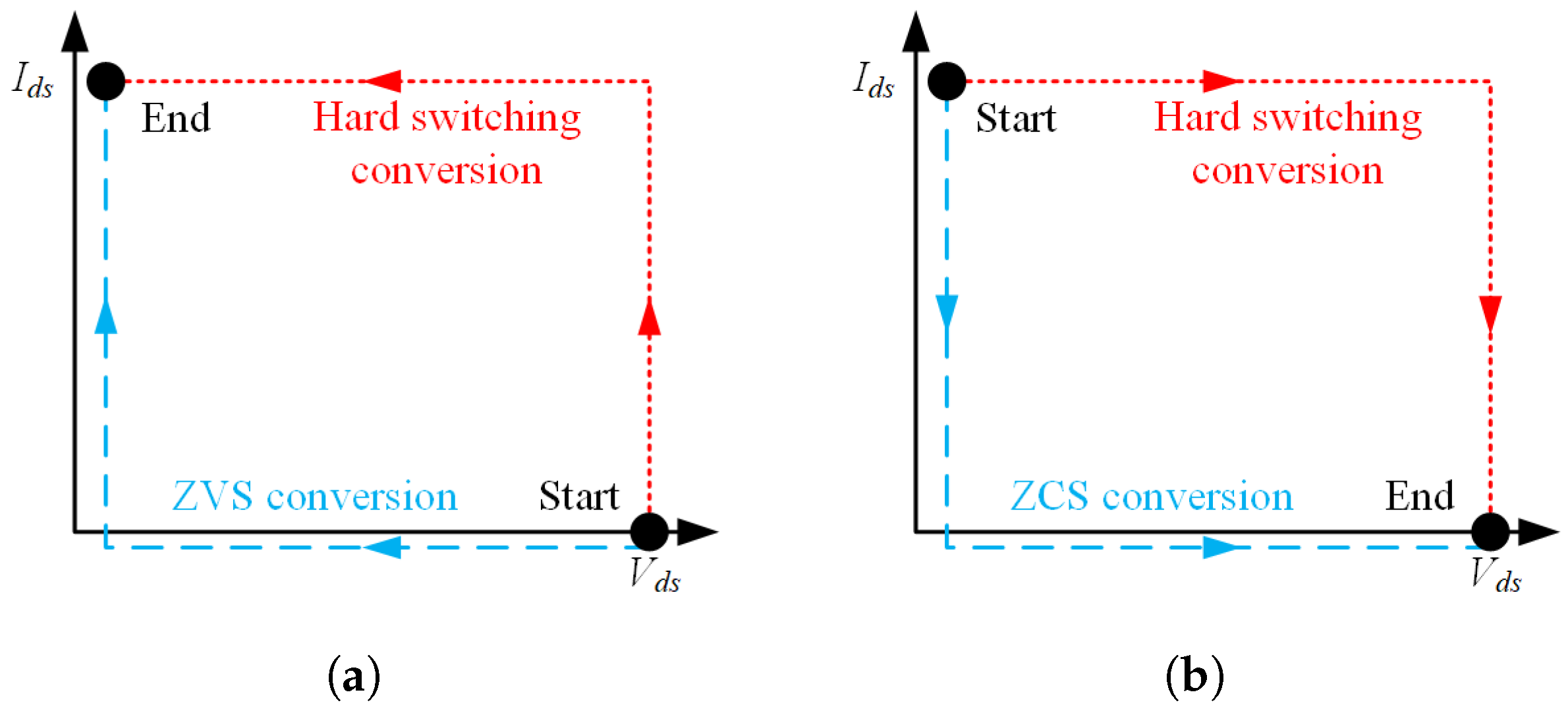
Soft-switching techniques, achieving zero-voltage (ZVS) or zero-current (ZCS) switching, mitigate the high losses and stress of hard-switching, reducing EMI and extending radiation-hardened semiconductor life in EP applications like HET and ion thruster supplies (Figure 7). Space-qualified soft-switching PPUs have demonstrated high efficiency, 96.4% at 1 kW [57] and 92.5% at 500 W [58], confirming their suitability for high-performance EP systems. The soft-switching converters include multiple implementations, such as load-resonant topologies with dedicated resonant networks, active snubber-assisted switch cells, and isolated structures integrated with hermetically sealed transformers. Load-resonant converters are especially advantageous for high-power EP applications, enabling elevated switching frequencies while preserving efficiency and reducing system size and weight. Space-qualified resonant network configurations include series/parallel resonance, L C C [59], L L C [60], and higher-order tanks such as L C L C [61,62,63] and C L L L C [64]. The design of these networks follows established equivalence principles tailored to space constraints, with systematic selection methodologies accounting for radiation-induced parameter shifts detailed in [65,66,67]. The comprehensive review of multi-element resonant tank architectures for space applications provides further guidance for implementation in [68]. Although with these merits, the dynamic response can be slower than hard-switching counterparts, and maintaining ZVS or ZCS under light loads or during rapid load changes may require variable frequency control, adding complexity to the control design. Leakage inductance of the transformer is often utilized as part of the resonant tank but must be controlled to prevent excessive voltage spikes, while inter-winding capacitance can affect resonance and CM noise. Soft-switching converters inherently generate lower EMI due to reduced d v / d t and d i / d t during switching transitions, but resonant oscillations in the tank can still produce high-frequency noise that requires filtering.

3.6. Common-Terminal Power Converters

Power converters can be categorized by terminal configuration into common-terminal and non-common-terminal architectures. Common-terminal configurations, where input and output share a ground reference, are a defining feature of non-isolated topologies like buck, boost, and buck–boost converters. It is primarily used where galvanic isolation is not required, such as in auxiliary power subsystems. However, the shared ground means faults or transients on the output can directly propagate to the input bus, posing a risk to PPU electronics. The converter is found in small-satellite Hall thrusters’ PPU, with a modular design where a shared-bus approach resembles a common-terminal converter concept [69]. The common-terminal converter provides a fast transient response and straightforward control due to its simpler structure, but it may struggle with noise coupling from high-power switching stages elsewhere in the PPU. For loads like resistojet heaters that require stable DC, input and output filtering is essential to suppress noise injected into the shared ground, and control loops must be designed to reject disturbances from bus voltage variations caused by other thrusters operating concurrently. Common-terminal converters can be significant sources of conducted noise because their switching currents flow directly through the shared ground plane, potentially creating ground loops and injecting noise into other subsystems. Non-common-terminal configurations maintain galvanic separation between input and output circuits via transformers. This isolation is essential for high-voltage applications such as primary discharge supplies for HET. The transformer in non-common-terminal converters is a primary path for CM noise coupling via inter-winding capacitance, which can interfere with low-voltage sensors and communication buses. The application example can be found in the design of PPU-500 for the ST-40 Hall thruster, which includes distinct converter modules for discharge, electromagnet, cathode heater/keeper, valves/heaters, and standby supply. The discharge converter uses a bridge topology with phase-shifted output control. Other subsystems are powered by separate, smaller converters that confirm non-common-terminal PPU architecture [70].

3.7. Minimum-Phase Power Converters

The controller design for EP power converters must account for phase characteristics, which critically impact stability under space constraints. Non-minimum-phase (NMP) topologies, such as boost and flyback converters used for thruster capacitor charging, possess a right-half-plane (RHP) zero that inherently limits bandwidth, induces inverse transient response, and challenges stability, especially when driving loads with negative differential resistance like HETs, risking sustained oscillations. Their continuous conduction mode (CCM) operation can also produce high-frequency noise from switching and instability-induced ringing. In contrast, minimum-phase (MP) converters, including buck, forward, and LLC-resonant topologies, lack RHP zeros, offering superior stability, faster dynamics, and well-damped transients, making them suitable for precision supplies such as thruster electromagnets. They achieve a higher control bandwidth and reduce oscillation risk with inductive loads, though pulsed loads still require careful output filtering and possibly adaptive control to prevent sag/overshoot. While MP converters typically generate less high-frequency noise, they still emit switching-related EMI. Examples of NMP and MP applications in EP are noted in [71,72], respectively.

4. Techniques to Enable High Step-Up Conversion

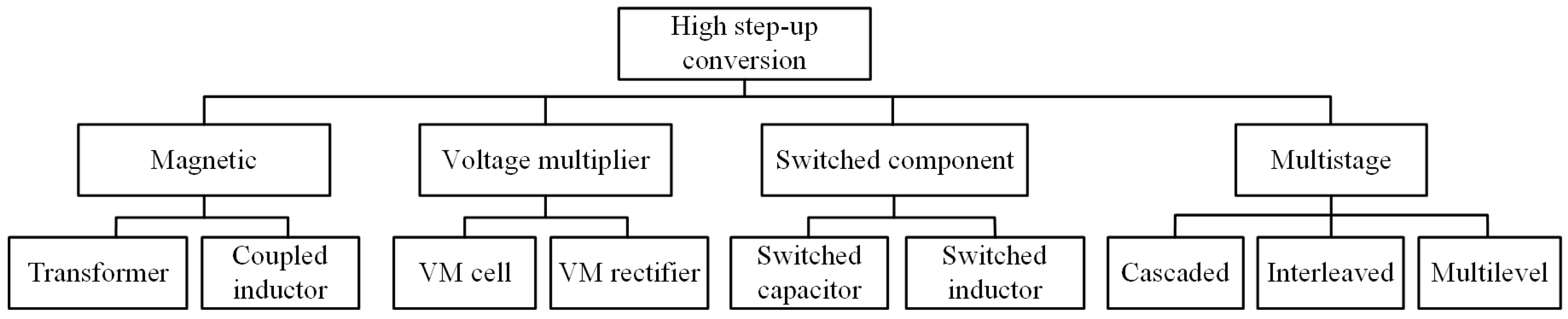
The implementation of high step-up conversion techniques (see Figure 8) in EP facilitates the development of more compact and lightweight PPU designs. They can be classified into magnetic, voltage multiplier, switched component, and multistage. Characteristics of each will be discussed as follows.

4.1. Magnetics

Magnetic coupling is extensively used in EP to achieve high step-up conversion in both isolated and non-isolated DC-DC converters, improving voltage gain while minimizing magnetic core count. Isolated transformer-based designs offer galvanic separation and flexible turns-ratio selection, whereas built-in (non-isolated) variants combine direct and magnetically transferred power for enhanced efficiency and inherent saturation avoidance. Leakage inductance, though a design challenge, can be harnessed for soft-switching in resonant topologies like the L L C converter, beneficial for high-voltage EP supplies [73]. In non-isolated converters, coupled-inductor techniques, including tapped-inductor configurations (switched, diode, or rail-tapped), deliver high gain with reduced turns ratios, albeit at the expense of higher RMS currents and the need for clamp/snubber circuits. Such structures can also cancel input current ripple in boost-derived topologies. Secondary windings are often employed as series voltage sources, with clamp capacitors and diodes recovering leakage energy. Active-clamp circuits and optimized snubbers further suppress voltage spikes and raise efficiency. Charge-pumping and switched-capacitor methods integrated with magnetic coupling enable substantial step-up gains. In addition, impedance-network-based converters utilizing magnetic coupling have shown promise for high-gain EP applications [74], offering compact solutions to bridge the large voltage gap between spacecraft buses and thruster requirements.

4.2. Voltage Multiplier

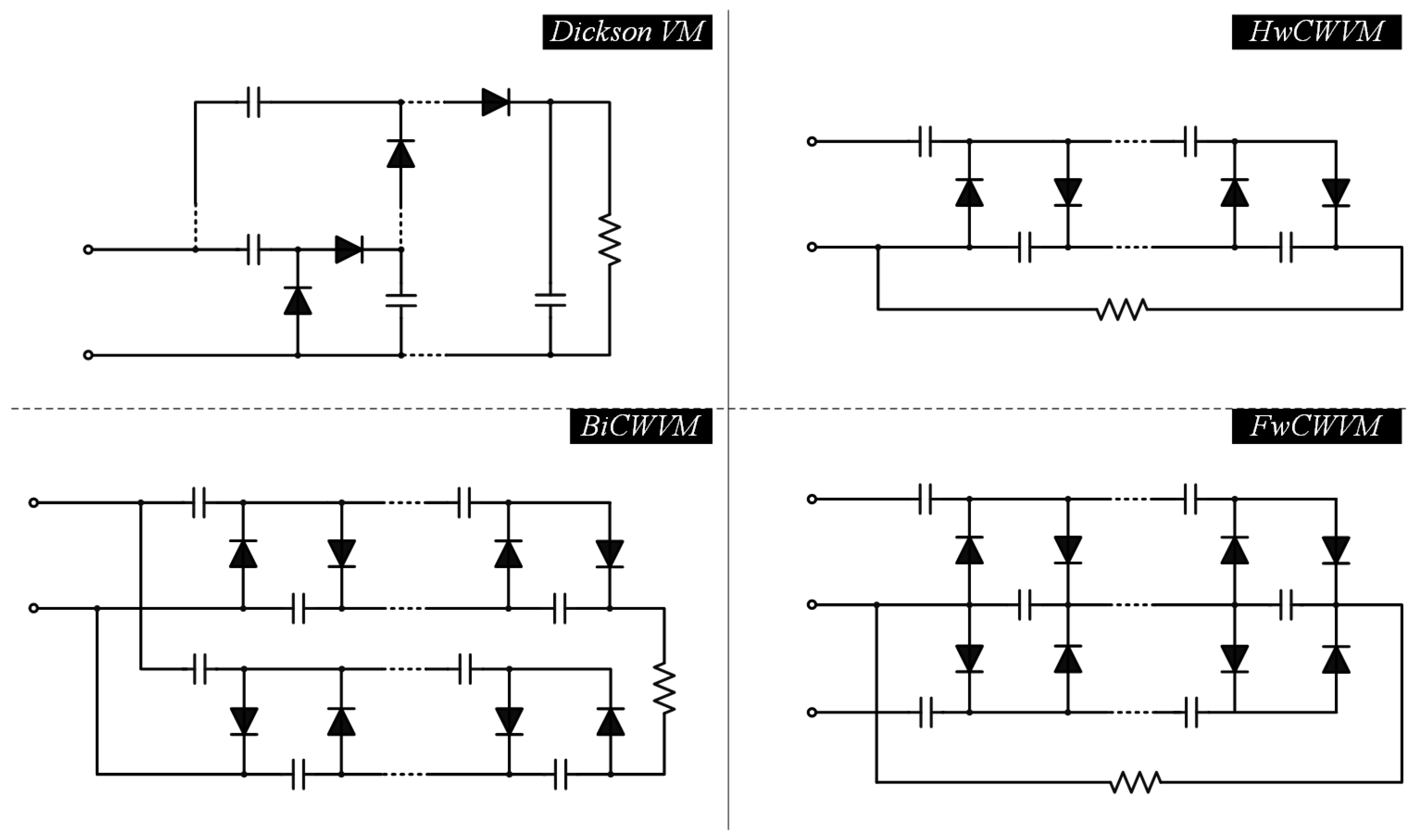
Voltage multiplier circuits provide cost-effective and structurally straightforward solutions in EP for generating high DC output voltages through strategic arrangements of diodes and capacitors. These circuits can be broadly divided into two structural categories, as shown in Figure 9. The first category, Voltage Multiplier Cells (VMCs), offers simplicity and is widely adopted in voltage-boosting applications. Configurations range from basic diode-capacitor networks to more advanced designs incorporating auxiliary switches or inductors for enhanced performance. The introduction of small inductors in certain VMC implementations enables ZCS operation, improving efficiency and reducing switching losses. Cascading multiple VMC stages can achieve ultra-high voltage gains while maintaining moderate component stress. The second category, Voltage Multiplier Rectifiers (VMRs), employs diode–capacitor networks at the output stage of converters with alternating or pulsating input waveforms. Half-wave VMR topologies, including the Greinacher voltage doubler and Cockcroft–Walton multiplier, provide different multiplication factors with distinct advantages in component stress distribution and conversion efficiency. Full-wave VMR configurations offer additional multiplication stages, such as voltage quadruplers and triplers, which are increasingly implemented in modern DC-DC converters for efficient high-voltage generation. Various cascaded VMR arrangements can be tailored to meet specific voltage multiplication requirements in practical applications [75,76,77,78,79,80,81,82,83,84,85,86,87].
In voltage multiplier circuits, particularly in high-voltage implementations such as Cockcroft–Walton voltage multipliers (CWVMs), diode reverse-recovery characteristics significantly influence overall efficiency and performance. During the transition from conduction to blocking states, diodes exhibit a finite reverse-recovery period, which can induce voltage spikes and current surges within the circuit. These transient phenomena contribute to increased power loss and output voltage ripple. As a result, diode selection should prioritize devices with fast recovery times and minimal recovery charge to optimize circuit efficiency. The implementation of snubber networks or voltage clamping techniques can further mitigate reverse-recovery effects, thereby enhancing multiplier performance [88].
The nonlinear junction capacitance of diodes also substantially affects voltage multiplier operation. This capacitance varies with applied voltage, introducing nonlinear behavior during switching transitions. Such variations alter capacitor charging and discharging dynamics across multiplier stages, potentially causing output waveform distortion, voltage spikes, and elevated ripple. Design considerations must therefore account for these capacitance characteristics during diode selection to maintain stable voltage regulation and conversion efficiency. Accurate modeling and analysis of junction capacitance behavior are essential for performance optimization and minimizing adverse effects arising from capacitance non-linearity [89].

4.3. Switched Component

The switched-capacitor (SC) technique, frequently implemented through charge pump (CP) circuits, provides effective voltage boosting in various power converter topologies in EP. CP circuits achieve voltage elevation exclusively through capacitive energy transfer, without magnetic components, offering advantages in structural modularity and compatibility with integrated circuit fabrication. However, SC-based converters typically suffer from high inrush currents during switching transitions, which can compromise both power density and conversion efficiency. A common mitigation strategy involves incorporating an output inductor to form a hybrid buck-type converter, thereby limiting current transients.
The voltage lift (VL) technique represents another established approach for enhancing output voltage in DC-DC converters. This method charges a capacitor to a reference voltage (typically the input voltage) and strategically employs this stored charge to elevate the output potential. VL techniques are often realized through dedicated VL cells integrated into step-up converter topologies. For instance, the self-lift (SL) cell, formed by combining a basic VL cell with an SL structure, can be extended to a double self-lift configuration through additional diodes and capacitors. Such developments enable the construction of high-order SL-based converters capable of substantial voltage gain [90,91,92].

4.4. Multistage

A well-established approach for achieving high voltage gain involves the multistage interconnection of converter modules through cascaded, interleaved, or multilevel configurations in EP. Cascaded connections offer a straightforward method for voltage amplification, with topologies such as the quadratic boost converter providing enhanced gain while maintaining structural simplicity. Hybrid cascaded systems further extend this capability by combining different DC-DC converter types to meet high-voltage requirements. Interleaved converters utilize multi-phase switching to reduce input current ripple and increase power density. Meanwhile, multilevel DC-DC topologies, particularly advantageous in high-power applications, can eliminate magnetic components, resulting in reduced size and weight. Modular multilevel structures employing single DC sources provide design flexibility, while cascaded multilevel arrangements improve system reliability and cost-effectiveness. A significant challenge in these multi-source architectures lies in extracting maximum power from individual input sources. The concept of partial power processing has been introduced to address this limitation, whereby only a fraction of the total power requires processing, thereby optimizing overall system efficiency.

5. Discussion of EP Converters

EP thrusters exhibit remarkable diversity in operational characteristics, spanning power requirements (from μ W-level microthrusters to kW-class HET), environmental adaptability (vacuum and extreme thermal cycling), efficiency targets, and control methodologies. The thruster’s power rating serves as a foundational selection criterion: high-power systems demand converters with robust current/voltage handling capabilities, while low-power microthrusters require ultra-stable μ A-scale current control. These capacity requirements must be balanced with spacecraft-specific constraints.
Environmental considerations for EP converters extend beyond terrestrial extremes, demanding components to be stable across wide thermal ranges (−150 °C∼+150 °C). Vibrational stresses require ruggedized packaging, and while humidity is irrelevant in vacuum, outgassing constraints become critical to prevent thruster contamination. Efficiency optimization is non-negotiable, and energy conservation directly extends mission duration and minimizes thermal loads, which must be dissipated solely through radiative cooling due to the absence of convection. Consequently, converter topologies with high inherent efficiency and minimal switching losses are prioritized.
Control strategies must be suitable for both thruster dynamics and space reliability. Voltage-oriented control is preferred for steady-state thrusters (e.g., HET anode discharge), while current-oriented control suits pulsed systems (e.g., PPT discharge), with hybrid control adopted for transient-prone scenarios. Control circuits must integrate radiation mitigation, using SEE-hardened ICs with redundant state estimators to counter single-event upsets and adaptive algorithms to compensate for total-ionizing-dose-induced parameter drift. Modulation techniques such as phase-shift modulation (to reduce EMI) and resonant modulation (to lower component stress) further enhance compatibility and extend the lifetime of radiation-tolerant semiconductors in orbit.
Non-isolated power converters must address space-specific challenges, including using radiation-stable magnetic materials, adhering to strict PCB creepage/clearance standards to prevent vacuum arcing, and implementing current derating to mitigate cosmic ray-induced losses. Isolated converters become indispensable when interfacing with disparate voltage systems or when safety mandates complete electrical separation to protect avionics from high-voltage transients. Bidirectional converters enable seamless energy transfer in systems with storage. The choice between voltage-fed and current-fed converters reflects operational needs. Voltage-fed types offer simplified control for auxiliary loads, while current-fed converters excel at high-voltage step-up and continuous current delivery for applications like ion thruster grid supplies. Soft-switching techniques minimize switching losses and thermal stress, using radiation-stable resonant components. Common-terminal converters simplify integration in mass-constrained systems. For systems with frequent load variations, minimum-phase converters are preferred for their faster, more stable dynamic response.
Magnetic component selection is tightly coupled to thruster characteristics and space durability. Transformers use high-temperature-stable ferrites and Litz wire, while inductors are sized for current demands and use radiation-hardened cores. High-efficiency designs like planar magnetics with integrated cooling align with EP’s efficiency goals. When direct output is insufficient, voltage multiplier circuits are employed. Semiconductor selection prioritizes performance and reliability. Wide-bandgap (WBG) devices (silicon carbide (SiC) and gallium nitride (GaN)) are preferred for their high-voltage and high-temperature capabilities but require rigorous space qualification for radiation immunity. For lower power, derated radiation-tolerant Si MOSFETs remain an option. For precise regulation or ultra-high gain, multistage architectures (cascaded, interleaved, modular) offer flexibility, distribute voltage stress, lower ripple, and can provide redundancy to meet EP’s mission-critical reliability demands.

6. Challenges and Future Works

Power converters within EP-PPU face critical challenges requiring further research. A primary objective is achieving high power density to minimize size and mass, balanced against competing demands for high efficiency, operational reliability, and thermal robustness. The space environment imposes severe constraints, demanding that converters withstand mechanical vibration, ionizing radiation, and extreme thermal cycling. Electromagnetic compatibility (EMC) also requires careful attention. Future research should prioritize several key technological initiatives. Advanced converter topologies, including multilevel architectures, resonant networks, and soft-switching methodologies, are essential for enhancing efficiency, power density, and operational flexibility. The integration of WBG semiconductors, such as SiC and GaN devices, will enable significant improvements in switching frequency, power density, and efficiency. Concurrently, the development of integrated magnetic components and advanced power module packaging will support more compact and thermally efficient designs. Advanced control algorithms and protection mechanisms require refinement to maintain optimal performance under variable conditions, while thermal management solutions must evolve to address rising power densities. Modular and scalable design approaches will provide the adaptability needed for diverse thruster configurations and power levels. As shown in Table 5, topology selection should prioritize matching core power requirements with voltage/current adaptability. Researchers should align initiatives with project phases, prioritizing device replacement and integration in the short term, while focusing on architectural innovation and algorithm optimization in the long term. All EP systems must comply with ECSS/NASA standards, and while key constraints are highlighted for each type, actual development requires supplemental derating and design adjustments based on specific mission profiles.

6.1. Harsh Constraints of Space Environment

As the core component of EP PPU, DC-DC power converters not only need to match the unique load characteristics of different thrusters but also must withstand the harsh constraints of the space environment, which brings multiple critical technical challenges that require in-depth analysis and targeted solutions.
A prominent challenge for DC-DC converters in EP applications is the negative impedance characteristic of HET. During HET operation, its anode load exhibits a decrease in voltage with increasing current, forming a negative differential resistance (NDR) region. This characteristic conflicts with the output impedance of conventional DC-DC converters which is usually designed for positive impedance loads, easily triggering system-level instability such as voltage/current oscillations and even thruster shutdown. For the isolated full-bridge or L L C -resonant converters recommended for HET, stability analysis must integrate the NDR model of the thruster. On one hand, the converter’s output impedance needs to be optimized, increasing output capacitance or introducing active impedance compensation to ensure that the total impedance of the converter–thruster system remains positive in all operating ranges. On the other hand, control strategies should be adjusted, such as adopting voltage-oriented control with feedforward of the thruster operating state, or MPC with embedded negative impedance recognition, to suppress transient oscillations during thruster startup/shutdown and mode switching. For NMP converters widely used in EP systems, the negative impedance load further exacerbates the inherent instability of the converter, requiring collaborative optimization of RHP zero suppression (such as DCM operation) and load impedance matching to ensure thrust precision and system reliability.
EP converters in space also face severe radiation threats, including TID, SEE, and SEU, which lead to diverse component failure modes. For TID effects, long-term exposure to ionizing radiation (up to 100 krad(Si) for deep-space missions) causes cumulative degradation of semiconductor devices (such as threshold voltage drift of SiC MOSFETs, leakage current increase in GaN HEMT) and magnetic components (permeability decline in NiZn/MnZn ferrite cores), reducing converter efficiency and even causing functional failure. To mitigate TID, radiation-tolerant control IC and passivated WBG devices are adopted, and magnetic cores are selected with low-radiation aging characteristics. For SEE, commercial 1200 V SiC devices may experience SEB at 1/3 of their rated voltage, while GaN HEMTs face risks of SEGR. SEU in control circuits can cause logic confusion and incorrect switching of power devices. Countermeasures include 50% voltage derating for SiC devices, redundant circuit design for control modules, and integration of SEE-mitigated gate drives to block transient high currents induced by cosmic rays. Additionally, SEU in the PWM controller can lead to abnormal duty cycles, requiring the design of state monitoring and self-recovery mechanisms to ensure continuous operation of the converter.
High-voltage EP converters (such as 1∼30 kV supplies for ion thrusters/FEEP) impose extreme electrical stress on MOSFETs (Si/SiC/GaN). The high-voltage switching process causes voltage overshoot across the device due to parasitic inductance in the circuit, which may exceed the device’s breakdown voltage. For SiC MOSFETs with a rated voltage of 1200 V, the overshoot voltage under cosmic ray derating requirements must be controlled within 600 V to avoid breakdown. Moreover, the high d v / d t during switching (especially for WBG devices) induces gate-source voltage spikes, leading to false turn-on or gate oxide damage. Thus, gate drive circuits need to incorporate RC snubbers or active clamping to limit d v / d t and ensure stable gate voltage. Furthermore, high-current operation (10–50 A for resistojet heaters) causes thermal stress in MOSFETs, with junction temperature rising sharply in vacuum environments without convective cooling. This requires matching low-thermal-resistance packaging and optimizing layout for radiative heat dissipation, while setting current derating (20% or more) to offset lattice damage and overheating induced by cosmic rays. In addition, the reverse-recovery effect of freewheeling diodes in high-voltage converters generates current surges, further increasing the stress on MOSFETs, necessitating the selection of fast-recovery SiC diodes and the design of soft-switching topologies to reduce switching losses and stress.
The vacuum environment of space eliminates convective heat transfer, making radiative cooling the only effective heat dissipation method for EP converters, which creates severe thermal bottlenecks. High-power converters generate large amounts of heat from magnetic components and semiconductors, but the low radiative heat transfer efficiency leads to localized overheating. To address this, passive thermal management measures, such as low-thermal-resistance substrates and thermal matching of materials, further requires an integrated design of planar magnetics with radiative heat sinks or the adoption of heat pipes for heat redistribution to increase the radiation area. Extreme temperature cycling (−150 °C to +150 °C) causes thermal fatigue of components. Mismatched thermal expansion coefficients of PCB materials and metal connectors lead to solder joint cracking, while magnetic cores experience permeability fluctuations with temperature, affecting converter voltage regulation accuracy. Solutions include selecting materials with consistent thermal expansion coefficients and using temperature-compensated magnetic cores and optimizing the control algorithm to compensate for parameter drift caused by temperature changes. The high-power-density design of converters to meet spacecraft mass/volume constraints exacerbates thermal accumulation, requiring trade-offs between power density and thermal robustness, such as adopting modular designs to disperse heat sources and avoid thermal concentration.
High-voltage EP converters face severe insulation and corona discharge risks in vacuum environments, where the breakdown voltage of air is drastically reduced, and surface flashover is more likely to occur than in atmospheric conditions. PCB creepage/clearance must meet ECSS-Q-ST-70-12C standards to prevent arcing between high-voltage pins. For converters with ultra-high output voltage, conformal coating may be omitted to reduce outgassing only if the spacing is sufficient, and radiation-resistant, low-outgassing PCB materials are used to avoid insulation degradation. Corona discharge occurs in vacuum when the local electric field exceeds the corona inception voltage, causing material erosion and performance degradation of high-voltage components. This requires optimizing the electrode shape and selecting insulation materials with high corona resistance. The outgassing of insulation materials may form conductive films on the insulation surface, reducing insulation performance and triggering flashover. Thus, low-outgassing materials must be used, and vacuum baking is performed before launch to remove volatile substances. In addition, for high-voltage transformers/inductors, hermetic sealing is adopted to prevent insulation aging caused by vacuum and radiation, ensuring long-term stable insulation performance of the converter in space.

6.2. Direct-Drive Architecture

Direct-drive architecture (DDA) in HET, illustrated in Figure 10, represents a simplified configuration wherein the thruster interfaces directly with PPU, eliminating the conventional thruster electronics unit (TEU). This integrated approach offers several systemic advantages for space propulsion applications. The removal of the dedicated TEU substantially reduces system complexity while enhancing operational reliability through component count reduction. Electrically, this architecture improves power transfer efficiency by minimizing intermediate conversion losses, thereby increasing the useful power delivered to the thruster. Structurally, the consolidated design achieves significant mass and volume savings, critical parameters for spacecraft systems, while simultaneously improving launch efficiency and potential payload capacity. From a performance perspective, DDA enables higher effective thrust output and enhanced spacecraft maneuverability through optimized power delivery. The architectural simplification also contributes to extended mission lifetime prospects by reducing potential failure mechanisms and improving overall system robustness.
Despite its advantages, the implementation of DDA in HETs presents several technical challenges requiring further investigation. Efficient power management remains critical, necessitating advanced power electronic solutions capable of maintaining high efficiency under substantial power levels. Integration with existing spacecraft systems may introduce interface compatibility issues, underscoring the need for standardized electrical and data interfaces. System reliability must be enhanced through comprehensive fault-tolerance mechanisms and redundancy strategies to address potential single-point failures inherent in simplified architectures. Thermal management represents another significant challenge, demanding innovative cooling technologies and advanced materials to maintain operational stability under high-power conditions. Performance optimization through high-fidelity modeling and experimental validation is essential for improving thrust efficiency, specific impulse, and operational longevity. Furthermore, DDA implementations should incorporate modular and scalable designs to accommodate diverse mission profiles and spacecraft configurations. Addressing these challenges will be crucial for enabling the widespread adoption of DDA across various space missions, from small satellite platforms to deep-space exploration initiatives.

6.3. Planar Magnetics

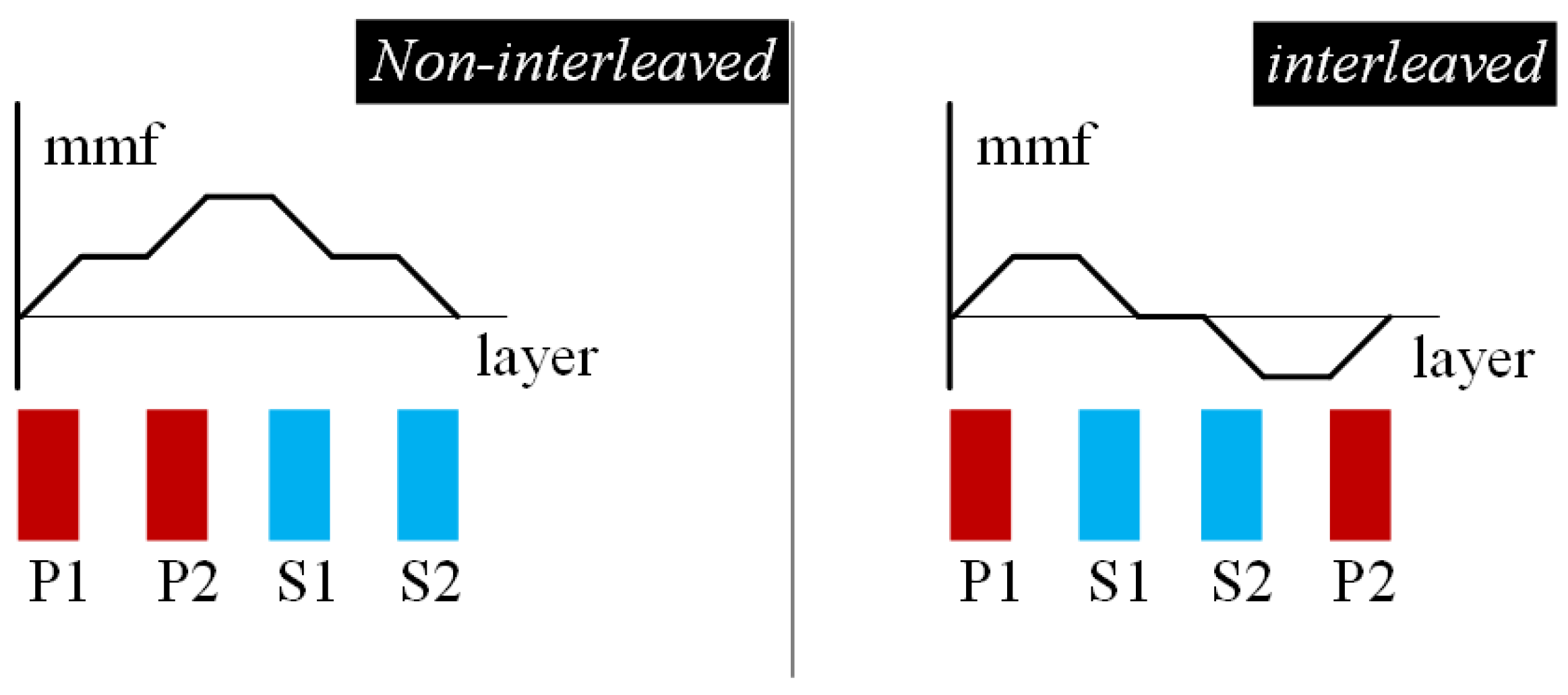
Planar magnetic components, utilizing flat PCB-based winding structures, present distinct challenges and opportunities for power converters in EP [93]. The high-frequency operation typical of EP systems exacerbates core losses and winding losses due to skin and proximity effects, demanding careful optimization of both magnetic materials and winding configurations [94]. Thermal management represents another critical consideration, as the high surface-area-to-volume ratio of planar structures complicates heat dissipation in high-power applications. Effective thermal strategies, such as thermal vias or integrated heat sinks, require thorough investigation. Manufacturing advantages, including improved integration and automation potential, are counterbalanced by challenges in maintaining consistent winding precision, insulation integrity, and assembly reliability [95]. The limited conductor cross-section in planar layouts constrains current carrying capacity, often necessitating advanced winding approaches like litz wire or parallel conductor arrangements. Furthermore, planar magnetics exhibit heightened sensitivity to parasitic elements, particularly inter-winding capacitance and leakage inductance, necessitating meticulous design to minimize their impact on converter performance. Core material selection critically influences saturation characteristics, loss behavior, and thermal stability, highlighting the need for advanced magnetic materials specifically engineered for high-frequency planar applications. The development of accurate modeling methodologies, including analytical models, finite element analysis, and specialized design tools, remains essential for optimizing planar magnetic components in high-power, high-frequency environments. Future research should prioritize advanced winding configurations (Figure 11), integrated cooling mechanisms, high-frequency magnetic materials, parasitic suppression techniques, and application-specific design methodologies tailored to the demanding requirements of EP power converters.

6.4. Wide-Bandgap Devices

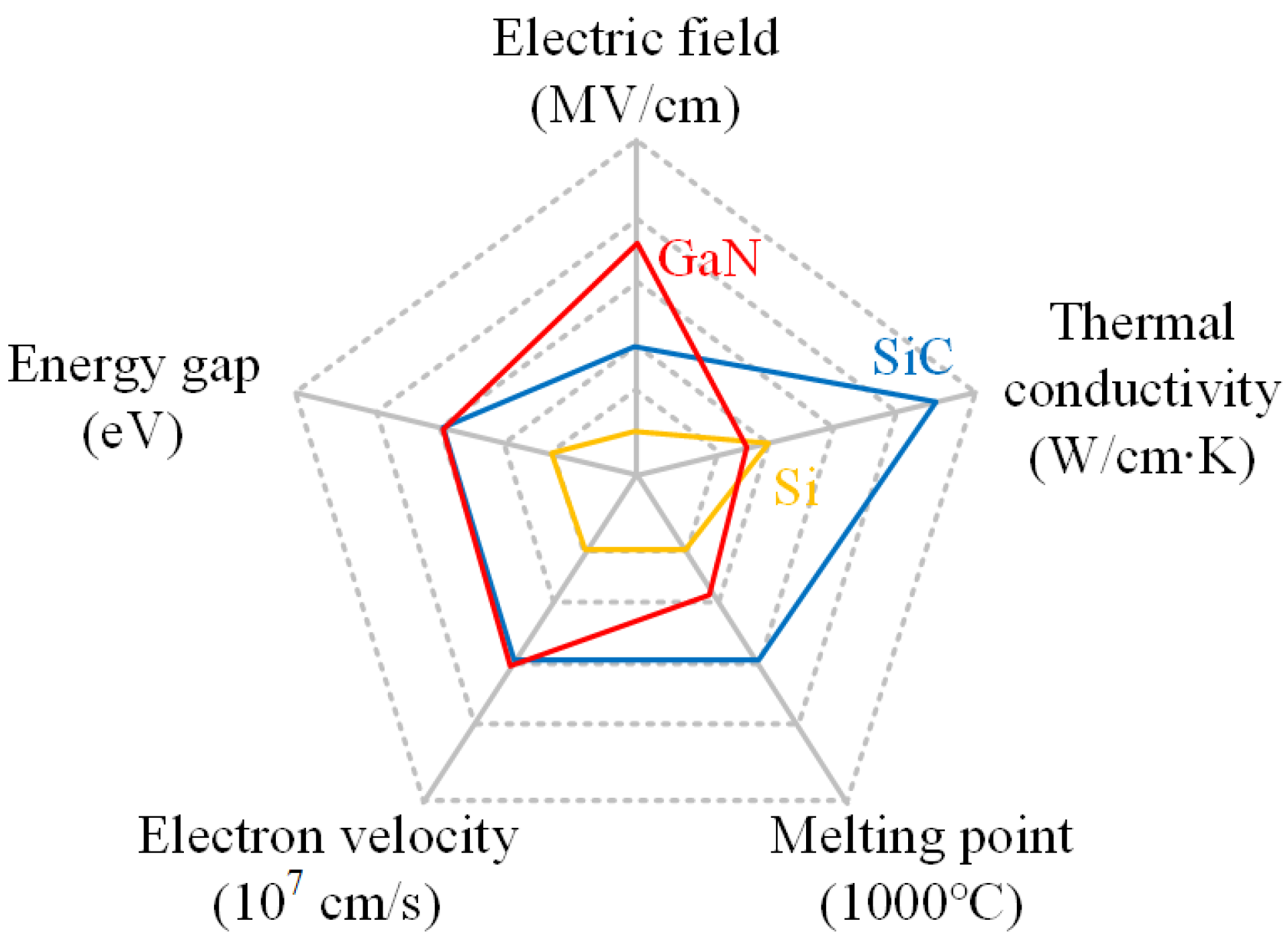
The integration of WBG power devices into EP-PPU introduces both significant advantages and distinct technical challenges [96,97]. As illustrated in Figure 12, WBG semiconductors enable substantially higher switching frequencies than conventional silicon devices, though this capability demands careful optimization of both converter topologies and passive components to maintain high efficiency and minimize losses. Effective thermal management becomes critically important due to the elevated power densities and rapid switching characteristics of WBG technology, requiring advanced cooling strategies to ensure reliable operation and prevent thermal instability [98,99]. The implementation of specialized gate drive circuits is equally essential to achieve precise switching control while reducing electromagnetic noise. Packaging and interconnection structures must be engineered to withstand high-frequency, high-voltage, and high-current conditions without performance degradation from parasitic elements. Furthermore, verifying long-term reliability under the extreme operational conditions of EP necessitates comprehensive testing and qualification methodologies to ensure device durability throughout mission lifetimes.
GaN power devices provide significant performance benefits, including exceptional switching speed, high breakdown voltage, and superior thermal conductivity, rendering them highly suitable for advanced power electronic applications [100]. However, several technical challenges currently limit their widespread implementation. Reliability concerns, such as gate oxide degradation, current collapse phenomena, and thermal instability under high-power operation, require further investigation to ensure long-term operational integrity [101,102]. The fast switching capability of GaN devices necessitates sophisticated gate drive circuits with precise timing control and noise immunity, demanding specialized design expertise [103,104,105]. Furthermore, GaN performance proves particularly sensitive to parasitic circuit elements, where stray inductance and capacitance can substantially compromise efficiency and generate undesirable voltage overshoot [106,107]. Economic considerations, including higher manufacturing costs compared to silicon-based alternatives, along with compatibility challenges when integrating into existing power architectures, present additional barriers to adoption. Addressing these limitations through continued research in device physics, circuit optimization, and standardization will be essential for fully leveraging the advantages of GaN technology across diverse power conversion applications.
SiC power devices demonstrate superior performance characteristics, including high conversion efficiency, elevated switching frequency capability, and robust high-temperature operation [108,109]. Nevertheless, several application challenges require careful consideration. The rapid switching transitions of SiC technology generate elevated EMI and high-frequency noise, necessitating implementation of advanced filtering and shielding techniques to prevent disruption to adjacent electronic systems [110,111,112]. Drive circuit design presents additional complexity, as SiC devices typically require higher gate drive voltages and sophisticated control timing to ensure optimal switching performance. Device protection represents another critical consideration, with SiC components exhibiting heightened sensitivity to voltage transients and overvoltage conditions. Effective thermal management remains essential for maintaining junction temperatures within safe operating limits and ensuring long-term reliability [113]. Furthermore, manufacturing costs currently exceed those of conventional silicon devices, potentially limiting adoption in cost-constrained applications. Addressing these challenges through innovative circuit topologies, advanced control methodologies, and optimized thermal designs will be crucial for maximizing the performance benefits of SiC technology in EP.
Future research directions for WBG power devices in EP encompass several critical development pathways. Innovative power converter topologies require exploration to fully utilize the high-frequency capability, efficiency, and power density advantages inherent to WBG semiconductors. The integration of WBG technology with planar magnetic components presents opportunities for developing compact, high-performance power conversion modules. Advanced gate drive architectures must be refined to optimize switching dynamics and minimize losses under high-frequency operation. Thermal management solutions, including advanced heat sink designs and direct liquid-cooling techniques, need further development to address the significant thermal fluxes generated by high-density WBG systems. Reliability assessment constitutes another essential research direction, requiring detailed investigation of failure mechanisms and lifetime prediction through accelerated testing and physics-based modeling. System integration approaches should focus on seamless interoperability between WBG power stages, control electronics, and sensing subsystems to achieve fully optimized propulsion drives. The establishment of comprehensive standards and design guidelines will be instrumental in facilitating the widespread adoption and commercial maturation of WBG-based power processing technologies for EP.

6.5. EMI

Switching oscillations in power converters manifest as high-frequency voltage and current transients during semiconductor device commutation. These parasitic oscillations, originating from circuit parasitic elements that form unintended resonant networks during switching transitions, not only generate significant EMI but also increase power losses, elevate component stress, and potentially compromise system reliability. Mitigating these oscillation effects requires careful attention to circuit layout optimization, strategic component selection, and implementation of specialized damping techniques. Effective suppression approaches include the application of snubber networks, impedance matching strategies, optimized grounding schemes, and high-frequency filtering, with robust converter designs typically relying on advanced simulation methodologies combined with experimental verification to accurately characterize and address switching oscillation phenomena [114,115].
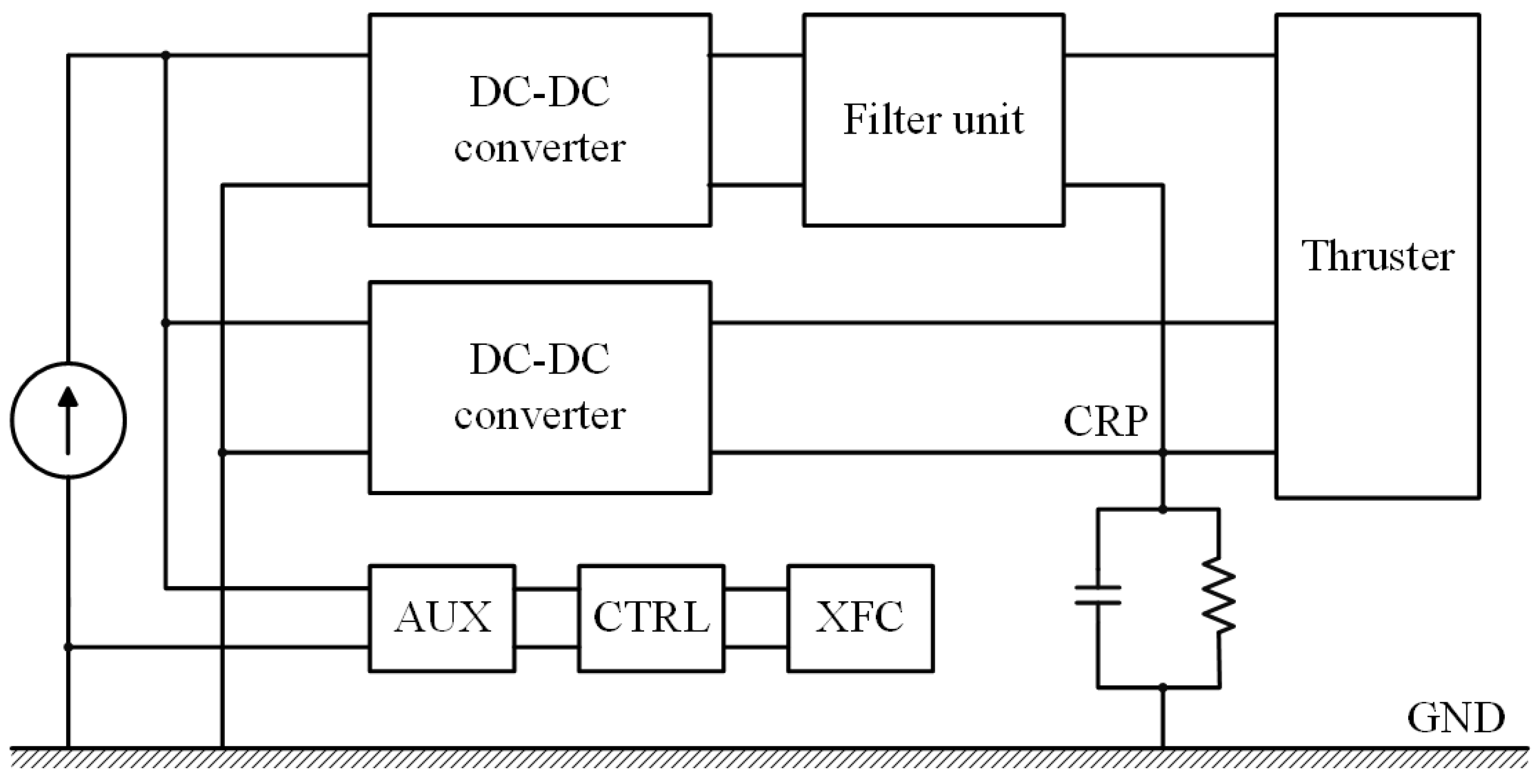
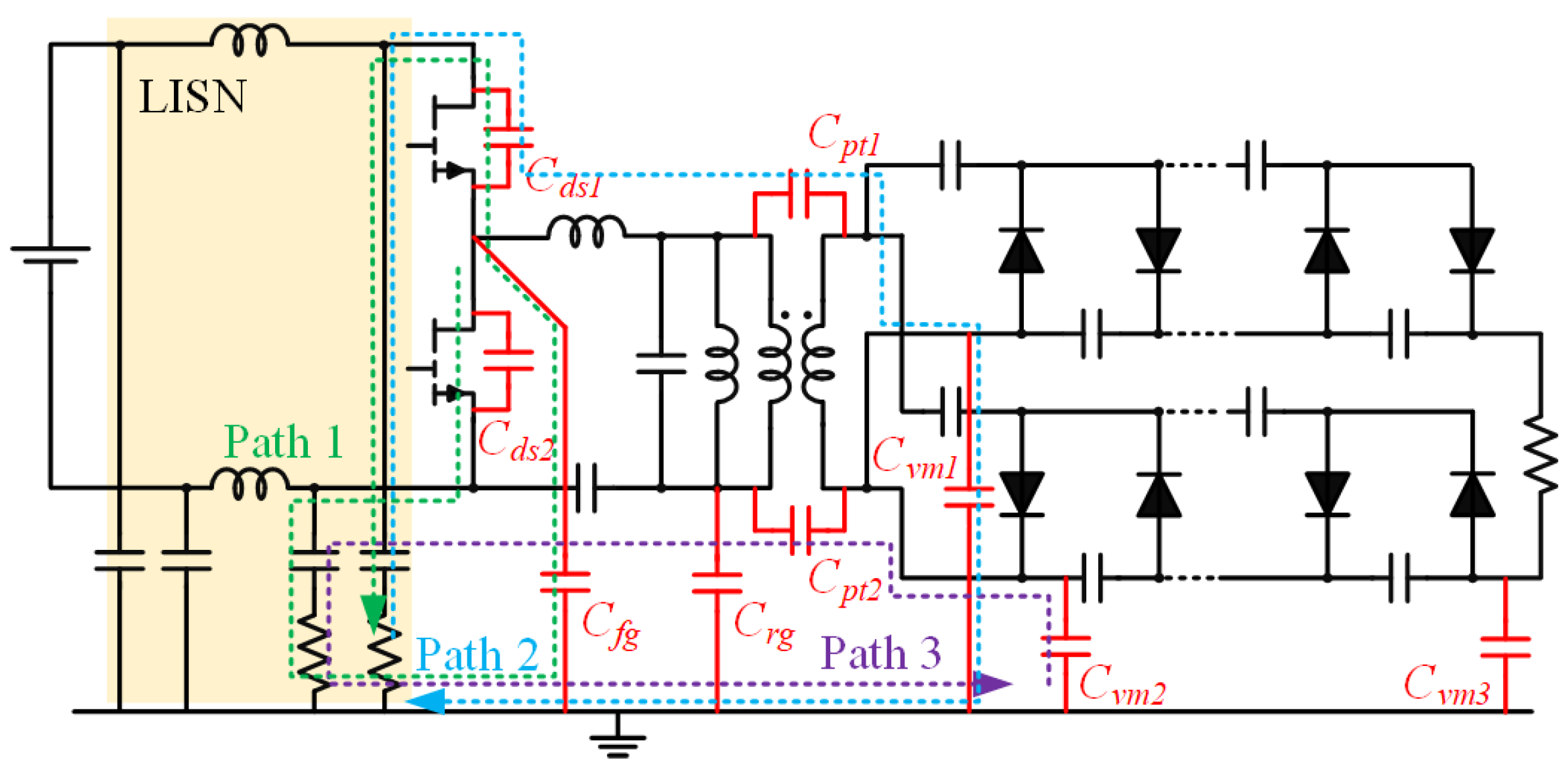
Switching transients in power converters, characterized by rapid voltage ( d v / d t ) and current ( d i / d t ) transitions, further excite resonant behavior in parasitic inductive and capacitive elements, generating substantial EMI across both conducted and radiated spectra. Conducted EMI (150 kHz∼30 MHz) comprises CM and DM components with distinct propagation paths. For isolated power converters (as depicted in Figure 13), CM noise is primarily coupled through the isolation transformer’s inter-winding parasitic capacitance and leakage inductance, crossing the galvanic isolation boundary to interfere with sensitive load equipment, while system interconnects can also act as unintended CM noise conduits. DM noise, by contrast, stems from high d i / d t in the switching loop, impacting the stability of XFC and thruster magnet supply. High-frequency switching of EP converters exacerbates this EMI, seriously threatening the normal operation of the spacecraft bus and sensitive avionics, and radiated EMI can further disrupt satellite communication and navigation systems, leading to signal distortion or loss of lock.
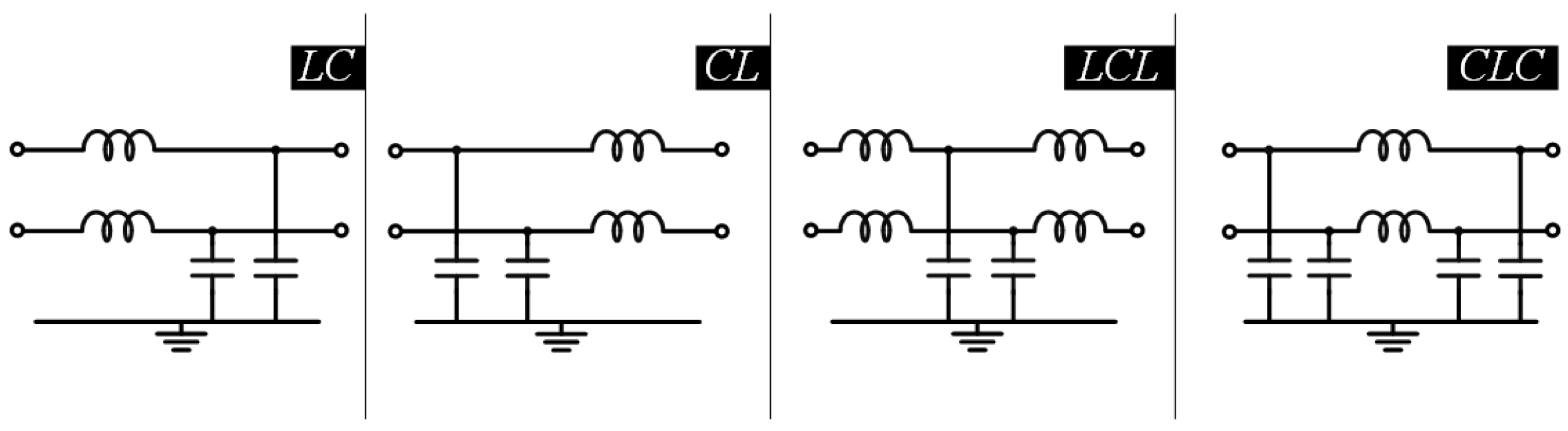
To mitigate these EMI issues, EMI filters are usually adopted (see Figure 14). For CM noise, strategies include implementing dedicated CM filters, optimizing grounding schemes to cut off noise propagation paths, and adding electromagnetic shielding to block cross-isolation interference, collectively enhancing EMC while maintaining reliable power transfer [116]. For DM noise, soft-switching topologies are adopted to reduce switching d v / d t and d i / d t , and shielded planar magnetics are used to suppress magnetic field radiation. In addition, converter PCB layouts must comply with ECSS-E-ST-20-07 standards, with creepage/clearance increased to ≥3 mm/kV and high-power switching regions separated from low-power control regions to minimize EMI coupling, ensuring that the converter EMI stays below the spacecraft bus’s anti-interference threshold.
Key challenges in EMI control for EP converters include maintaining EMC with adjacent onboard systems, complying with stringent regulatory standards, and implementing effective noise suppression without sacrificing converter efficiency or power density. Future research should prioritize the development of advanced filtering methodologies, optimized PCB layout techniques to minimize EMI coupling, and accurate simulation tools for EMI prediction. Additional promising directions involve investigating novel shielding materials, implementing active EMI cancellation circuits, and establishing standardized EMI testing protocols specifically tailored for EP applications, all of which will significantly improve the EMC of propulsion power converters and enhance their reliability and operational robustness [117,118,119].

7. Conclusions

This review presents a systematic analysis of DC-DC power converters for EP PPU, addressing the gap between generic power conversion research and the unique demands of EP applications. This work clarifies how converter design must align with the divergent power needs of electrothermal, electromagnetic, and electrostatic EP categories while overcoming harsh space constraints such as extreme radiation, thermal cycling, vacuum outgassing, and EMI. Key findings emphasize topology-specific optimization, non-isolated converters offer compact solutions for non-critical isolation scenarios, and isolated topologies ensure compatibility with sensitive avionics for high-power EP systems. Soft-switching techniques mitigate losses and EMI, enabling higher frequencies to meet size/weight limits, and high step-up methods bridge low-voltage spacecraft buses to thrusters’ kV-level/high-current demands. Emerging technologies show transformative potential, WBG semiconductors boost power density and efficiency, planar magnetics enable miniaturization, DDA for HETs reduces complexity by eliminating the TEU, and modular designs enhance reliability via redundancy. Unresolved challenges include balancing power density with efficiency/thermal robustness, mitigating radiation-induced effects, suppressing EMI for high-frequency WBG converters, and standardizing EP-specific design/test guidelines. Future research should focus on WBG-optimized topologies, advanced thermal management, and space-stressor performance modeling, expanding WBG/planar component qualification for deep-space missions. DC-DC power converters are critical to unlocking EP’s full potential for next-generation space missions. By integrating topology-specific design, emerging materials, and space-adapted strategies, researchers can develop converters meeting EP’s stringent requirements, guiding innovations for ambitious exploration, from small satellite constellations to interplanetary missions.

Author Contributions

Conceptualization, M.D. and H.L.; methodology, M.D.; software, H.L.; validation, M.D., S.Y. (Shan Yin) and B.T.; formal analysis, M.D.; investigation, M.D.; resources, S.Y. (Shan Yin); data curation, S.Y. (Sulan Yang); writing—original draft preparation, M.D.; writing—review and editing, B.T.; visualization, S.Y. (Sulan Yang); supervision, Y.C.; project administration, Y.C. and H.L.; funding acquisition, H.L. All authors have read and agreed to the published version of the manuscript.

Funding

This research was funded in part by the Major Science and Technology Special Projects of Sichuan Province under Grant M112022ZDZX0036, and in part by the Aircraft Swarm Intelligent Sensing & Cooperative Control Key Laboratory of Sichuan Province.

Institutional Review Board Statement

Not applicable.

Informed Consent Statement

Not applicable.

Data Availability Statement

No new data were created or analyzed in this study. Data sharing is not applicable to this article.

Conflicts of Interest

Author Shan Yin was employed by the company Huawei Technologies Co., Ltd. The remaining authors declare that the research was conducted in the absence of any commercial or financial relationships that could be construed as a potential conflict of interest.

References

  1. O’Reilly, D.; Herdrich, G.; Kavanagh, D.F. Electric propulsion methods for small satellites: A review. Aerospace 2021, 8, 22. [Google Scholar] [CrossRef]
  2. Tummala, A.R.; Dutta, A. An overview of cube-satellite propulsion technologies and trends. Aerospace 2017, 4, 58. [Google Scholar] [CrossRef]
  3. Polzin, K.; Martin, A.; Little, J.; Promislow, C.; Jorns, B.; Woods, J. State-of-the-art and advancement paths for inductive pulsed plasma thrusters. Aerospace 2020, 7, 105. [Google Scholar] [CrossRef]
  4. OReilly, D.; Herdrich, G.; Schafer, F.; Montag, C.; Worden, S.P.; Meaney, P.; Kavanagh, D.F. A coaxial pulsed plasma thruster model with efficient flyback converter approaches for small satellites. Aerospace 2023, 10, 540. [Google Scholar] [CrossRef]
  5. Mazouffre, S. Electric propulsion for satellites and spacecraft: Established technologies and novel approaches. Plasma Sources Sci. Technol. 2016, 25, 033002. [Google Scholar] [CrossRef]
  6. Lev, D.; Myers, R.M.; Lemmer, K.M.; Kolbeck, J.; Koizumi, H.; Polzin, K. The technological and commercial expansion of electric propulsion. Acta Astronaut. 2019, 159, 213–227. [Google Scholar] [CrossRef]
  7. Schmidt, G.; Jacobson, D.; Patterson, M.; Ganapathi, G.; Brophy, J.; Hofer, R. Electric propulsion research and development at NASA. In Proceedings of the International Astronautical Congress, Bremen, Germany, 1–5 October 2018; Number GRC-E-DAA-TN57334. Glenn Research Center: Cleveland, OH, USA, 2018. [Google Scholar]
  8. Pencil, E.J. Recent electric propulsion development activities for NASA science missions. In Proceedings of the 2009 IEEE Aerospace Conference, Big Sky, MT, USA, 7–14 March 2009; IEEE: Piscataway, NJ, USA, 2009; pp. 1–9. [Google Scholar]
  9. Gollor, M.; Bourguignon, E.; Glorieux, G.; Wagner, N.; Palencia, J.; Galantini, P.; Dechent, W.; Franke, A.; Schwab, U.; Tuccio, G. Electric propulsion electronics activities in Europe 2016. In Proceedings of the 52nd AIAA/SAE/ASEE Joint Propulsion Conference, Salt Lake City, UT, USA, 25–27 July 2016; p. 5032. [Google Scholar]
  10. del Amo, J.G. Electric Propulsion at the European Space Agency (ESA). In Proceedings of the 36th International Electric Propulsion Conference, IEPC-2019-105, Vienna, Austria, 15–20 September 2019. [Google Scholar]
  11. del Amo, J.A.G.; Cara, D.M.D. European Space Agency Electric Propulsion Activities. In Proceedings of the International Electric Propulsion Conference, Boston, MA, USA, 19–23 June 2022. [Google Scholar]
  12. del Amo, J.A.G. Electric Propulsion activities at ESA; Technical Report; European Space Agency: Paris, France, 2023. [Google Scholar]
  13. Bontempo, J.J.; Brigeman, A.N.; Fain, H.B.; Gonzalez, M.C.; Pinero, L.R.; Birchenough, A.G.; Aulisio, M.V.; Fisher, J.; Ferraiuolo, B. The NEXT-C Power Processing Unit: Lessons Learned from the Design, Build, and Test of the NEXT-C PPU for APL’s DART Mission. In Proceedings of the AIAA Propulsion and Energy 2020 Forum, Virtual Event, 24–28 August 2020; p. 3641. [Google Scholar]
  14. He, Y.; Woolston, M.; Perreault, D. Design and implementation of a lightweight high-voltage power converter for electro-aerodynamic propulsion. In Proceedings of the 2017 IEEE 18th Workshop on Control and Modeling for Power Electronics (COMPEL), Stanford, CA, USA, 9–12 July 2017; pp. 1–9. [Google Scholar] [CrossRef]
  15. Rafalskyi, D.; Martínez, J.M.; Habl, L.; Zorzoli Rossi, E.; Proynov, P.; Boré, A.; Baret, T.; Poyet, A.; Lafleur, T.; Dudin, S.; et al. In-orbit demonstration of an iodine electric propulsion system. Nature 2021, 599, 411–415. [Google Scholar] [CrossRef] [PubMed]
  16. Bapat, A.; Salunkhe, P.B.; Patil, A.V. Hall-effect thrusters for deep-space missions: A review. IEEE Trans. Plasma Sci. 2022, 50, 189–202. [Google Scholar] [CrossRef]
  17. Reza, M.; Faraji, F.; Andreussi, T. Characterization of a high-power Hall thruster operation in direct-drive. Acta Astronaut. 2021, 178, 392–405. [Google Scholar] [CrossRef]
  18. Matsunaga, Y.; Watanabe, H.; Cho, S.; Funaki, I.; Kusawake, H.; Kajiwara, K.; Kurokawa, F.; Takahashi, T. Control algorithm for a 6 kW hall thruster. J. Electr. Propuls. 2022, 1, 29. [Google Scholar] [CrossRef]
  19. Sanromán Reséndiz, M. Electric Design of the Power Processing Unit for Pulsed Plasma Thrusters for CubeSat Applications. Master’s Thesis, Aalto University, Espoo, Finland, 2020. [Google Scholar]
  20. Forouzesh, M.; Siwakoti, Y.P.; Gorji, S.A.; Blaabjerg, F.; Lehman, B. Step-up DC–DC converters: A comprehensive review of voltage-boosting techniques, topologies, and applications. IEEE Trans. Power Electron. 2017, 32, 9143–9178. [Google Scholar] [CrossRef]
  21. Dalla Vecchia, M.; Martinez, W.; Driesen, J. An overview of power conversion techniques and topologies for DC-DC voltage regulation. In Proceedings of the IECON 2020 the 46th Annual Conference of the IEEE Industrial Electronics Society, Singapore, 18–21 October 2020; pp. 1241–1248. [Google Scholar] [CrossRef]
  22. Ravindran, R.; Massoud, A.M. State-of-the-art DC-DC converters for satellite applications: A comprehensive review. Aerospace 2025, 12, 97. [Google Scholar] [CrossRef]
  23. Craig, J.W. Vacuum Stability Requirements of Polymeric Material for Spacecraft Application; Technical Memorandom; Johnson Space Center: Houston, TX, USA, 1984. [Google Scholar]
  24. ECSS ECSS-Q-ST-70-02C; Space Product Assurance—Thermal Vacuum Outgassing Test for the Screening of Space Materials. ECSS Standard: Noordwijk, The Netherlands, 2008.
  25. ECSS ECSS-Q-ST-70-12C; Space Product Assurance—Measurement of Thermo-Optical Properties of Thermal Control Materials. ECSS Standard: Noordwijk, The Netherlands, 2023.
  26. ECSS ECSS-E-ST-10-12C; Space Engineering—Methods for the Calculation of Radiation Received and Its Effects, and a Policy for Design Margins. ECSS Standard: Noordwijk, The Netherlands, 2022.
  27. ECSS ECSS-E-ST-31C; Space Engineering—Thermal Control General Requirements. ECSS Standard: Noordwijk, The Netherlands, 2018.
  28. ECSS ECSS-E-ST-20-07; Space Engineering—Electromagnetic Compatibility. ECSS Standard: Noordwijk, The Netherlands, 2022.
  29. Conversano, R.W.; Barchowsky, A.; Vorperian, V.; Chaplin, V.H.; Becatti, G.; Carr, G.A.; Stell, C.B.; Loveland, J.A.; Goebel, D.M. Cathode & electromagnet qualification status and power processing unit development update for the ascendant sub-kW transcelestial electric propulsion system. In Proceedings of the Annual Small Satellite Conference, Logan, UT, USA, 1–6 August 2020. [Google Scholar]
  30. Pinero, L.R.; Kamhawi, H.; Drummond, G. Integration testing of a modular discharge supply for NASA’s high voltage hall accelerator thruster. In Proceedings of the 31st International Electric Propulsion Conference (IEPC 2009), Ann Arbor, MI, USA, 20–24 September 2009; Number E-17195. Glenn Research Center: Cleveland, OH, USA, 2010. [Google Scholar]
  31. Fang, M.; Zhang, D.; Qi, X. A novel power processing unit (PPU) system architecture based on HFAC bus for electric propulsion spacecraft. IEEE J. Emerg. Sel. Top. Power Electron. 2022, 10, 5381–5391. [Google Scholar] [CrossRef]
  32. Pinero, L.; Scheidegger, R.; Bozak, K.; Birchenough, A. Development of high-power hall thruster power processing units at NASA GRC. In Proceedings of the 51st AIAA/SAE/ASEE Joint Propulsion Conference, Orlando, FL, USA, 27–29 July 2015; p. 3921. [Google Scholar]
  33. Jain, P. Resonant power conversion: Insights from a lifetime of experience. IEEE J. Emerg. Sel. Top. Power Electron. 2020, 9, 6561–6576. [Google Scholar] [CrossRef]
  34. Baddipadiga, B.P.R.; Prabhala, V.A.K.; Ferdowsi, M. A family of high-voltage-gain DC–DC converters based on a generalized structure. IEEE Trans. Power Electron. 2017, 33, 8399–8411. [Google Scholar] [CrossRef]
  35. Daryaei, M.; Khajehoddin, S.A.; Mashreghi, J.; K. Afridi, K. A new approach to steady-state modeling, analysis, and design of power converters. IEEE Trans. Power Electron. 2021, 36, 12746–12768. [Google Scholar] [CrossRef]
  36. Jensen, H.; Laursen, J. Power Conditioning Unit for Rosetta/Mars Express. In Proceedings of the Sixth European Space Power Conference; Porto, Portugal, 6–10 May 2002, Wilson, A., Ed.; ESA Special Publication: Noordwijk, The Netherlands, 2002; Volume 502, p. 249. [Google Scholar]
  37. Rezaeiha, A.; Anbarloui, M.; Farshchi, M. Design, development and operation of a laboratory pulsed plasma thruster for the first time in west Asia. Trans. Jpn. Soc. Aeronaut. Space Sci. Aerosp. Technol. Jpn. 2011, 9, 45–50. [Google Scholar] [CrossRef]
  38. Tomescu, B.; Clayton, P.; Staley, M.; Waranauskas, J.; Kendall, J.; Saghri, S.; Malone, S.; Delgado, J.; Nelson, N.; Esquivias, J. High Efficiency, Versatile Power Processing Units for Hall-Effect Plasma Thrusters. In Proceedings of the 2018 Joint Propulsion Conference, Cincinnati, OH, USA, 9–11 July 2018; p. 4642. [Google Scholar]
  39. Promislow, C.; Little, J. Operation and performance of a power processing unit for inductive pulsed plasma thrusters operating at high repetition rates. IEEE Trans. Plasma Sci. 2022, 50, 3065–3076. [Google Scholar] [CrossRef]
  40. Huang, X.; Lan, J.; Chen, N.; Fang, T.; Ruan, X.; He, X. A novel two-stage DC/DC converter applied to power processing unit for astronautical ion propulsion system. In Proceedings of the 2019 IEEE International Conference on Industrial Technology (ICIT), Melbourne, VIC, Australia, 13–15 February 2019; pp. 343–348. [Google Scholar] [CrossRef]
  41. Chen, Y.K.; Lai, Y.C.; Lu, W.C.; Lin, A. Design and implementation of high reliability electrical power system for 2U NutSat. IEEE Trans. Aerosp. Electron. Syst. 2021, 57, 614–622. [Google Scholar] [CrossRef]
  42. Rampelli, P.K.; Deekshit, R.; Reddy, D.S.; Singh, B.K.; Chippalkatti, V.; Kanthimathinathan, T. Multiple-output magnetic feedback forward converter with discrete PWM for space application. In Proceedings of the 2012 IEEE International Conference on Power Electronics, Drives and Energy Systems (PEDES), Bengaluru, India, 16–19 December 2012; pp. 1–6. [Google Scholar] [CrossRef]
  43. Hansel, G.J. Power Conversion and Scaling for Vanishingly Small Satellites with Electric Propulsion. Ph.D. Thesis, Massachusetts Institute of Technology, Cambridge, MA, USA, 2014. [Google Scholar]
  44. Kang, B.; Low, K.S.; Soon, J.J.; Tran, Q.V. Single-switch quasi-resonant DC–DC converter for a pulsed plasma thruster of satellites. IEEE Trans. Power Electron. 2016, 32, 4503–4513. [Google Scholar] [CrossRef]
  45. Shin, G.H.; Shin, G.S.; Nam, M.R.; Kang, K.I.; Lim, J.T. High voltage DC-DC converter of pulsed plasma thruster for science and technology satellite-2 (STSAT-2). In Proceedings of the 2005 International Conference on Power Electronics and Drives Systems, Kuala Lumpur, Malaysia, 28 November–1 December 2005; IEEE: Piscataway, NJ, USA, 2005; Volume 2, pp. 926–931. [Google Scholar]
  46. Gollor, M.; Breier, K. Compact High Voltage Power Processing For Field Emission Electric Propulsion (FEEP). In Proceedings of the 29th International Electric Propulsion Conference, Princeton University, Princeton, NJ, USA, 31 October–4 November 2005. [Google Scholar]
  47. Fu, M.; Zhang, D.; Zhang, D.; Zhang, X. Design and analysis of a novel coupled converter with high-voltage insulation protection in magnetic isolated way. IET Power Electron. 2021, 14, 1995–2006. [Google Scholar] [CrossRef]
  48. Singh, A.K.; Das, P.; Panda, S. High voltage high frequency resonant DC-DC converter for electric propulsion for micro and nanosatellites. In Proceedings of the 2014 IEEE 36th International Telecommunications Energy Conference (INTELEC), Vancouver, BC, Canada, 28 September–2 October 2014; IEEE: Piscataway, NJ, USA, 2014; pp. 1–5. [Google Scholar]
  49. Scheidegger, R.J.; Santiago, W.; Bozak, K.E.; Piñero, L.R.; Birchenough, A.G. High Power Silicon Carbide (SiC) Power Processing Unit Development. In Proceedings of the Electrochemical Society (ECS) Meeting, Phoenix, AZ, USA, 11–15 October 2015; Number GRC-E-DAA-TN25100. Glenn Research Center: Cleveland, OH, USA, 2015. [Google Scholar]
  50. Mallmann, A.; Forrisi, F.; Mache, E.; Blaser, M.; Hall, K.W. High Voltage Power Supply for T5 Gridded Ion Thruster. In Proceedings of the 36th International Electric Propulsion Conference, IEPC-2019A512, Vienna, Austria, 15–20 September 2019; Volume 7. [Google Scholar]
  51. Matsunaga, Y.; Takahashi, T.; Watanabe, H.; Goto, D.; Cho, S.; Kusawake, H.; Kurokawa, F.; Kajiwara, K.; Funaki, I. Wide-output range power processing unit for 6-kW hall thruster. IEEE Trans. Aerosp. Electron. Syst. 2021, 58, 1609–1620. [Google Scholar] [CrossRef]
  52. Li, Z.; Peng, Z.; Song, F.; Zhang, Y.; Xi, H. Ion Electric Propulsion System Design Considerations for Beam Sparkle. IEEE Access 2024, 12, 15572–15581. [Google Scholar] [CrossRef]
  53. Malone, S.; Aghazadeh, F.; Lenguito, G.; Staley, M.; Kerl, T.; Tomescu, B.; Snyder, J.S. Deep space power processing unit for the psyche Mission. In Proceedings of the 36th International Electric Propulsion Conference, Vienna, Austria, 15–20 September 2019; Electric Rocket Propulsion Society: Brook Park, OH, USA, 2019; pp. 2019–2280. [Google Scholar]
  54. Pinero, L.R.; Bond, T.H.; Okada, D.; Phelps, K.; Pyter, J.; Wiseman, S. Modular 5-kW power-processing unit being developed for the next-generation ion engine. In Research and Technology 2000; Glenn Research Center: Cleveland, OH, USA, 2001. [Google Scholar]
  55. Bekemans, M.; Bronchart, F.; Scalais, T.; Franke, A. Configurable high voltage power supply for full electric propulsion spacecraft. In Proceedings of the 2019 European Space Power Conference (ESPC), Juan-les-Pins, France, 30 September–4 October 2019; IEEE: Piscataway, NJ, USA, 2019; pp. 1–5. [Google Scholar]
  56. Herman, D.A.; Santiago, W.; Kamhawi, H.; Polk, J.E.; Snyder, J.S.; Hofer, R.R.; Parker, J.M. The Ion propulsion system for the solar electric propulsion technology demonstration mission. In Proceedings of the Nano-Satellite Symposium (NSAT), Kobe-Hyogo, Japan, 4–10 July 2015; Number IEPC-2015-008/ISTS-2015-b-008. Glenn Research Center: Cleveland, OH, USA, 2015. [Google Scholar]
  57. Kondo, H.; Kurokawa, F. Evaluation of LLC resonant converter in anode power supply for all-electric satellites. In Proceedings of the 2020 9th International Conference on Renewable Energy Research and Application (ICRERA), Glasgow, UK, 27–30 September 2020; IEEE: Piscataway, NJ, USA, 2020; pp. 414–417. [Google Scholar]
  58. Liu, Z.; Chen, W.; Peng, L.; Zheng, L. Development of a Three-Phase LCC Resonant Converter with a High-Voltage Rise Ratio for the Power Processing Unit. In Proceedings of the 2023 3rd International Conference on Energy, Power and Electrical Engineering (EPEE), Wuhan, China, 15–17 September 2023; IEEE: Piscataway, NJ, USA, 2023; pp. 682–686. [Google Scholar]
  59. Zhang, H.; Tong, C.; Wang, Z. Normalized analysis and optimal design of DCM-LCC resonant converter for high-voltage power supply. IEEE Trans. Ind. Electron. 2020, 67, 4496–4506. [Google Scholar] [CrossRef]
  60. Kim, J.; Park, M.; Lee, B.; Lai, J. Analysis and design of LLC converter considering output voltage regulation under no-load condition. IEEE Trans. Power Electron. 2020, 35, 522–534. [Google Scholar] [CrossRef]
  61. Zhao, B.; Zhang, X.; Zhang, Z. Sequential offline-online-offline measurement approach for high-frequency LCLC resonant converters in the TWTA applications. IEEE Trans. Ind. Electron. 2020, 67, 1568–1579. [Google Scholar] [CrossRef]
  62. Zhao, B.; Zhang, X. An efficiency-oriented two-stage optimal design methodology of high-frequency LCLC resonant converters for space travelling-wave tube amplifier applications. IEEE Trans. Ind. Electron. 2020, 67, 1068–1080. [Google Scholar] [CrossRef]
  63. Yin, S.; Xin, X.; Wang, R.; Dong, M.; Lin, J.; Gu, Y.; Li, H. A 1-MHz GaN-based LCLC resonant step-up converter with air-core transformer for satellite electric propulsion application. IEEE Trans. Ind. Electron. 2022, 69, 11035–11045. [Google Scholar] [CrossRef]
  64. Zhang, X.; Jing, J.; Guan, Y.; Dai, M.; Wang, Y.; Xu, D. High-efficiency high-order CL-LLC DC/DC converter with wide input voltage range. IEEE Trans. Power Electron. 2021, 36, 10383–10394. [Google Scholar] [CrossRef]
  65. Tan, X.; Ruan, X. Equivalence relations of resonant tanks: A new perspective for selection and design of resonant converters. IEEE Trans. Ind. Electron. 2016, 63, 2111–2123. [Google Scholar] [CrossRef]
  66. Khoshsaadat, A.; Moghani, J.S. Fifth-order T-type passive resonant tanks tailored for constant current resonant converters. IEEE Trans. Circuits Syst. I Regul. Pap. 2018, 65, 842–853. [Google Scholar] [CrossRef]
  67. Yu, S.-Y.; Chen, R.; Viswanathan, A. Survey of Resonant Converter Topologies; Technical Report; Texas Instruments: Dallas, TX, USA, 2018. [Google Scholar]
  68. Outeiro, M.T.; Buja, G.; Czarkowski, D. Resonant power converters: An overview with multiple elements in the resonant tank network. IEEE Ind. Electron. Mag. 2016, 10, 21–45. [Google Scholar] [CrossRef]
  69. Fu, M.; Zhang, D.; Li, T. New electrical power supply system for all-electric propulsion spacecraft. IEEE Trans. Aerosp. Electron. Syst. 2017, 53, 2157–2166. [Google Scholar] [CrossRef]
  70. Petrenko, O.; Alekseenko, O.; Tolmachov, V. Power Processing and control unit of the electric propulsion system. J. Rocket-Space Technol. 2023, 32, 15–22. [Google Scholar] [CrossRef] [PubMed]
  71. Marmol, A.; Zamiri, E.; Purraji, M.; Murillo, D.; Díaz, J.T.; Vazquez, A.; de Castro, A. Dual control strategy for non-minimum phase behavior mitigation in DC-DC boost converters using finite control set model predictive control and proportional–integral controllers. Appl. Sci. 2024, 14, 10318. [Google Scholar] [CrossRef]
  72. Sarfi, G.; Beik, O. MW-scale high-voltage direct-current power conversion for large-spacecraft electric propulsion. Electronics 2024, 13, 1455. [Google Scholar] [CrossRef]
  73. Zhao, Z.; Zhu, J.; Dai, Y.; Wang, J.; Yang, Y.; Peng, Z.; Xu, Q.; Ning, Y.; He, S. Lightweight Design of Magnetic Integrated Transformer for High Voltage Power Supply in Electro-aerodynamic Propulsion System. IEEE Trans. Power Electron. 2023, 38, 10501–10515. [Google Scholar] [CrossRef]
  74. Veeramraju, K.J.; Eisen, J.; Rovey, J.L.; Kimball, J.W. A New Discontinuous Conduction Mode in a Transformer Coupled High Gain DC-DC Converter. In Proceedings of the 2022 IEEE Applied Power Electronics Conference and Exposition (APEC), Houston, TX, USA, 20–24 March 2022; IEEE: Piscataway, NJ, USA, 2022; pp. 237–244. [Google Scholar]
  75. Santoja, A.; Barrado, A.; Fernandez, C.; Sanz, M.; Raga, C.; Lazaro, A. High voltage gain DC-DC converter for micro and nanosatellite electric thrusters. In Proceedings of the 2013 Twenty-Eighth Annual IEEE Applied Power Electronics Conference and Exposition (APEC), Long Beach, CA, USA, 17–21 March 2013; IEEE: Piscataway, NJ, USA, 2013; pp. 2057–2063. [Google Scholar]
  76. Singh, A.K.; Das, P.; Panda, S. Analysis, design and implementation of quadrupler based high voltage full bridge series resonant DC-DC converter. In Proceedings of the 2014 IEEE Energy Conversion Congress and Exposition (ECCE), Pittsburgh, PA, USA, 14–18 September 2014; IEEE: Piscataway, NJ, USA, 2014; pp. 4059–4064. [Google Scholar]
  77. Kang, B.; Low, K.S. A single-switch high voltage quasi-resonant DC-DC converter for a pulsed plasma thruster. In Proceedings of the 2015 IEEE 11th International Conference on Power Electronics and Drive Systems, Sydney, NSW, Australia, 9–12 June 2015; IEEE: Piscataway, NJ, USA, 2015; pp. 509–513. [Google Scholar]
  78. Katzir, L.; Shmilovitz, D. A matrix-like topology for high-voltage generation. IEEE Trans. Plasma Sci. 2015, 43, 3681–3687. [Google Scholar] [CrossRef]
  79. Katzir, L.; Shmilovitz, D. A 1-MHz 5-kV power supply applying SiC diodes and GaN HEMT cascode MOSFETs in soft switching. IEEE J. Emerg. Sel. Top. Power Electron. 2016, 4, 1474–1482. [Google Scholar] [CrossRef]
  80. Baddipadiga, B.P.; Strathman, S.; Ferdowsi, M.; Kimball, J.W. A high-voltage-gain DC-DC converter for powering a multi-mode monopropellant-electrospray propulsion system in satellites. In Proceedings of the 2018 IEEE Applied Power Electronics Conference and Exposition (APEC), San Antonio, TX, USA, 4–8 March 2018; IEEE: Piscataway, NJ, USA, 2018; pp. 1561–1565. [Google Scholar]
  81. Quraan, M.; Zahran, A.; Herzallah, A.; Ahmad, A. Design and model of series-connected high-voltage DC multipliers. IEEE Trans. Power Electron. 2020, 35, 7160–7174. [Google Scholar] [CrossRef]
  82. Park, S.; Yang, J.; Rivas-Davila, J. A hybrid Cockcroft-Walton/Dickson multiplier for high voltage generation. IEEE Trans. Power Electron. 2020, 35, 2714–2723. [Google Scholar] [CrossRef]
  83. Abbasi, M.; Emamalipour, R.; Cheema, M.A.M.; Lam, J. A constant frequency step-up resonant converter with a re-structural feature and a PWM-controlled voltage multiplier. In Proceedings of the 2021 IEEE Applied Power Electronics Conference and Exposition (APEC), Phoenix, AZ, USA, 14–17 June 2021; IEEE: Piscataway, NJ, USA, 2021; pp. 343–348. [Google Scholar]
  84. He, Y.; Perreault, D.J. Lightweight high-voltage power converters for electroaerodynamic propulsion. IEEE J. Emerg. Sel. Top. Ind. Electron. 2021, 2, 453–463. [Google Scholar] [CrossRef]
  85. Zhao, W.; Jiang, Y.; Wu, J.; Huang, Y.; Zhu, Y.; An, J.; Wan, C.A. Space High-Voltage Power Module. Front. Energy Res. 2021, 9, 642920. [Google Scholar] [CrossRef]
  86. Quraishi, A.; Dworski, S.; Ma, C.; Ryan, C.; Ferreri, A.; Vincent, G.; Larsen, H.; Azevedo, E.R.; Dingle, E.; Garbayo, A.; et al. Development of Porous Emitter Electrospray Thruster Using Advanced Manufacturing Processes. In Proceedings of the International Electric Propulsion Conference, Cambridge, MA, USA, 19–23 June 2022. [Google Scholar]
  87. Ouhammam, A.; Mahmoudi, H.; Ouadi, H. Design and control of high voltage gain DC–DC converter for CubeSat propulsion. CEAS Space J. 2024, 16, 97–115. [Google Scholar] [CrossRef]
  88. Wen, H.; Gong, J.; Zhao, X.; Yeh, C.; Lai, J. Analysis of diode reverse recovery effect on ZVS condition for GaN-based LLC resonant converter. IEEE Trans. Power Electron. 2019, 34, 11952–11963. [Google Scholar] [CrossRef]
  89. Zhou, S.; Chen, Q.; Zhang, B.; Gao, J.; Chi, K.T.; Xu, L. Effects of Nonlinear Junction Capacitance of Rectifiers on Performance of High Voltage Power Supplies. IEEE Trans. Power Electron. 2023, 38, 15693–15706. [Google Scholar] [CrossRef]
  90. Veeramraju, K.J.P.; Kimball, J.W. An improved power processing unit for multi-mode monopropellant electrospray thrusters for satellite propulsion systems. In Proceedings of the 2019 IEEE Energy Conversion Congress and Exposition (ECCE), Baltimore, MD, USA, 29 September–3 October 2019; IEEE: Piscataway, NJ, USA, 2019; pp. 1302–1309. [Google Scholar]
  91. Kang, B.; Low, K.S.; Ng, K.J. Capacitor Charging by Quasi-Resonant Approach for a Pulsed Plasma Thruster in Nano-Satellite. IEEE Trans. Plasma Sci. 2020, 48, 1271–1278. [Google Scholar] [CrossRef]
  92. Coday, S.; Barchowsky, A.; Pilawa-Podgurski, R.C. A 10-level gan-based flying capacitor multilevel boost converter for radiation-hardened operation in space applications. In Proceedings of the 2021 IEEE Applied Power Electronics Conference and Exposition (APEC), Phoenix, AZ, USA, 14–17 June 2021; IEEE: Piscataway, NJ, USA, 2021; pp. 2798–2803. [Google Scholar]
  93. Ngoua Teu Magambo, J.S.; Bakri, R.; Margueron, X.; Le Moigne, P.; Mahe, A.; Guguen, S.; Bensalah, T. Planar Magnetic Components in More Electric Aircraft: Review of Technology and Key parameters for DC–DC power electronic converter. IEEE Trans. Transp. Electrif. 2017, 3, 831–842. [Google Scholar] [CrossRef]
  94. Ouyang, Z.; Andersen, M.A.E. Overview of planar magnetic technology—Fundamental properties. IEEE Trans. Power Electron. 2014, 29, 4888–4900. [Google Scholar] [CrossRef]
  95. Lee, F.C.; Li, Q.; Nabih, A. High frequency resonant converters: An overview on the magnetic design and control methods. IEEE J. Emerg. Sel. Top. Power Electron. 2020, 9, 11–23. [Google Scholar] [CrossRef]
  96. Millán, J.; Godignon, P.; Perpiñá, X.; Pérez-Tomás, A.; Rebollo, J. A survey of wide bandgap power semiconductor devices. IEEE Trans. Power Electron. 2014, 29, 2155–2163. [Google Scholar] [CrossRef]
  97. Rafin, S.S.H.; Ahmed, R.; Haque, M.A.; Hossain, M.K.; Haque, M.A.; Mohammed, O.A. Power Electronics Revolutionized: A Comprehensive Analysis of Emerging Wide and Ultrawide Bandgap Devices. Micromachines 2023, 14, 2045. [Google Scholar] [CrossRef]
  98. Yang, Z.; Williford, P.R.; Jones, E.A.; Chen, J.; Wang, F.; Bala, S.; Xu, J. Factors and considerations for modeling loss of a GaN-based inverter. IEEE Trans. Power Electron. 2020, 36, 3042–3052. [Google Scholar] [CrossRef]
  99. Dong, M.; Li, H.; Yin, S.; Wu, Y.; See, K.Y. A postprocessing-technique-based switching loss estimation method for GaN devices. IEEE Trans. Power Electron. 2020, 36, 8253–8266. [Google Scholar] [CrossRef]
  100. Jones, E.A.; Wang, F.F.; Costinett, D. Review of commercial GaN power devices and GaN-based converter design challenges. IEEE J. Emerg. Sel. Top. Power Electron. 2016, 4, 707–719. [Google Scholar] [CrossRef]
  101. Barchowsky, A.; Kozak, J.P.; Grainger, B.M.; Stanchina, W.E.; Reed, G.F. A GaN-based modular multilevel DC-DC converter for high-density anode discharge power modules. In Proceedings of the 2017 IEEE Aerospace Conference, Big Sky, MT, USA, 4–11 March 2017; IEEE: Piscataway, NJ, USA, 2017; pp. 1–10. [Google Scholar]
  102. Conversano, R.W.; Barchowsky, A.; Lobbia, R.B.; Chaplin, V.H.; Lopez Ortega, A.; Loveland, J.A.; Lui, A.D.; Becatti, G.; Reilly, S.W.; Goebel, D.; et al. Overview of the ascendant sub-kw transcelestial electric propulsion system (astraeus). In Proceedings of the 36th International Electric Propulsion Conference, Vienna, Austria, 15–20 September 2019; pp. 2019–2282. [Google Scholar]
  103. Boomer, K.; Scheick, L.; Hammoud, A. Body of Knowledge (BOK): Gallium Nitride (GaN) Power Electronics for Space Applications. In Proceedings of the NASA Electronic Parts and Packaging Program Electronics Technology Workshop, Greenbelt, MD, USA, 17–20 June 2019; Number GRC-E-DAA-TN70017. Glenn Research Center: Cleveland, OH, USA, 2019. [Google Scholar]
  104. Zhao, X.; Chen, C.; Lai, J.; Yu, O. Circuit design considerations for reducing parasitic effects on GaN-based 1-MHz high-power-density high-step-up/down isolated resonant converters. IEEE J. Emerg. Sel. Top. Power Electron. 2019, 7, 695–705. [Google Scholar] [CrossRef]
  105. Cook, T.; Grainger, B.; Amirahmadi, A.; Barchowsky, A.; Stell, C. Soft-Switching GaN-Based Isolated Power Conversion System for Small Satellites with Wide Input Voltage Range. In Proceedings of the Annual Small Satellite Conference, Logan, UT, USA, 1–6 August 2020. [Google Scholar]
  106. Minghai, D.; Shan, Y.; Yingzhe, W.; Hui, L. Performance Evaluation of 40-V/10-A GaN HEMT Versus Si MOSFET for Low-Voltage Buck Converter Application. In Proceedings of the 2020 IEEE 9th International Power Electronics and Motion Control Conference (IPEMC2020-ECCE Asia), Nanjing, China, 29 November–2 December 2020; IEEE: Piscataway, NJ, USA, 2020; pp. 3428–3435. [Google Scholar]
  107. Meng, W.; Zhang, F.; Dong, G.; Wu, J.; Li, L. Research on losses of PCB parasitic capacitance for GaN-based full bridge converters. IEEE Trans. Power Electron. 2021, 36, 4287–4299. [Google Scholar] [CrossRef]
  108. Reese, B.; McPherson, B.; Schupbach, M.; Lostetter, A. Silicon carbide power processing unit for Hall effect thrusters. In Proceedings of the 2012 IEEE Aerospace Conference, Big Sky, MT, USA, 3–10 March 2012; IEEE: Piscataway, NJ, USA, 2012; pp. 1–6. [Google Scholar]
  109. Wu, Q.; Wang, M.; Zhou, W.; Liu, G.; Wang, X.; You, C. Analytical Switching Model of a 1200V SiC MOSFET in a High-voltage, High-frequency Pulsed Power Converter for Plasma Generation. In Proceedings of the 2019 IEEE Energy Conversion Congress and Exposition (ECCE), Baltimore, MD, USA, 29 September–3 October 2019; IEEE: Piscataway, NJ, USA, 2019; pp. 1911–1917. [Google Scholar]
  110. Piñero, L.R.; Scheidegger, R.J.; Aulsio, M.V.; Birchenough, A.G. High input voltage discharge supply for high power hall thrusters using silicon carbide devices. In Proceedings of the International Electric Propulsion Conference (IEPC2013), Washington, DC, USA, 6–10 October 2013; Number NASA/TM-2014-216607. Glenn Research Center: Cleveland, OH, USA, 2013. [Google Scholar]
  111. Ikpe, S.A.; Lauenstein, J.M.; Carr, G.A.; Hunter, D.; Ludwig, L.L.; Wood, W.; Iannello, C.J.; Del Castillo, L.Y.; Fitzpatrick, F.D.; Mojarradi, M.M.; et al. Long-term reliability of a hard-switched boost power processing unit utilizing SiC power MOSFETs. In Proceedings of the 2016 IEEE International Reliability Physics Symposium (IRPS), Pasadena, CA, USA, 17–21 April 2016; IEEE: Piscataway, NJ, USA, 2016; p. ES–1. [Google Scholar]
  112. Boomer, K.; Lauenstein, J.M.; Hammoud, A. Body of Knowledge for Silicon Carbide Power Electronics; Technical Report; National Aeronautics and Space Administration: Washington, DC, USA, 2016. [Google Scholar]
  113. Jayant Baliga, B. Silicon Carbide power devices: Progress and future outlook. IEEE J. Emerg. Sel. Top. Power Electron. 2023, 11, 2400–2411. [Google Scholar] [CrossRef]
  114. Liu, T.; Wong, T.T.Y.; Shen, Z.J. A survey on switching oscillations in power converters. IEEE J. Emerg. Sel. Top. Power Electron. 2019, 8, 893–908. [Google Scholar] [CrossRef]
  115. Dong, M.; Li, H.; Yin, S.; See, K.Y.; Wu, Y.; Xin, X. Mitigation of Deane and Hamill phenomenon in gallium nitride high-voltage power supply for electric propulsion system application. High Volt. 2023, 9, 252–265. [Google Scholar] [CrossRef]
  116. Dong, M.; Li, H.; Zhong, Q.; Wu, Y. Common mode noise analysis of buck-boost converter for hybrid energy storage systems. In Proceedings of the 2018 IEEE International Symposium on Electromagnetic Compatibility and 2018 IEEE Asia-Pacific Symposium on Electromagnetic Compatibility (EMC/APEMC), Suntec City, Singapore, 14–18 May 2018; IEEE: Piscataway, NJ, USA, 2018; pp. 1013–1017. [Google Scholar]
  117. Coletti, M.; Ciaralli, S.; Gabriel, S.B. PPT development for nanosatellite applications: Experimental results. IEEE Trans. Plasma Sci. 2014, 43, 218–225. [Google Scholar] [CrossRef]
  118. Dong, M.; Li, H.; Yin, S.; Zhao, Z.; Wu, Y. Common-mode noise analysis and suppression of a GaN-based LCLC resonant converter for ion propulsion power supply. In Proceedings of the 2021 Asia-Pacific International Symposium on Electromagnetic Compatibility (APEMC), Nusa Dua-Bali, Indonesia, 27–30 September 2021; IEEE: Piscataway, NJ, USA, 2021; pp. 1–4. [Google Scholar]
  119. Dong, M.; Li, H.; See, K.Y.; Yin, S.; Zhao, Z.; Fan, F.; Wu, Y. Comparison Study on EMI Performance of SiC and Si diodes in Cockcroft-Walton Voltage Multiplier. In Proceedings of the 2022 Asia-Pacific International Symposium on Electromagnetic Compatibility (APEMC), Beijing, China, 1–4 September 2022; IEEE: Piscataway, NJ, USA, 2022; pp. 694–697. [Google Scholar]
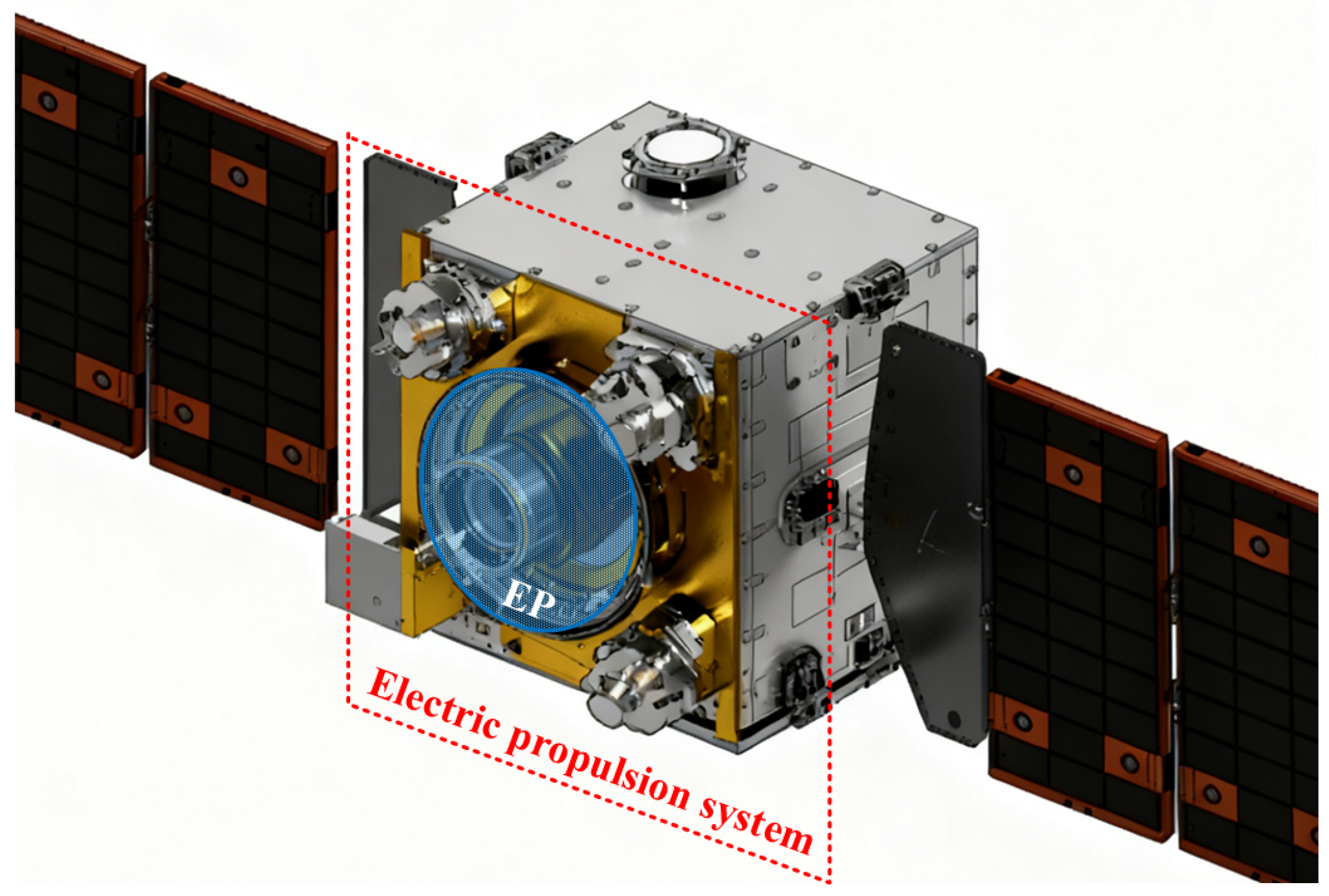
Figure 1. Electric propulsion systems in the satellite.
Aerospace 13 00036 g001
Figure 2. Classification of the main electric propulsion devices.
Aerospace 13 00036 g002
Figure 3. System-level power processing unit block diagram.
Aerospace 13 00036 g003
Figure 4. Classification of power converters.
Aerospace 13 00036 g004
Figure 5. Non-isolated converters: buck, boost, buck–boost, cuk, sepic and zeta.
Aerospace 13 00036 g005
Figure 6. Isolated converters: flyback, forward, push–pull, half-bridge and full-bridge.
Aerospace 13 00036 g006
Figure 7. Ideal switching conversion: (a) ZVS turn-on conversion; (b) ZCS turn-off conversion.
Aerospace 13 00036 g007
Figure 8. Broad categorizations of voltage-boost techniques used for DC-DC converters.
Aerospace 13 00036 g008
Figure 9. Schematic of Dickson voltage multiplier, half-wave CWVM (HwCWVM), bipolar CWVM (BiCWVM), and full-wave CWVM (FwCWVM).
Aerospace 13 00036 g009
Figure 10. Schematic of direct-drive approach in a Hall thruster propulsion system.
Aerospace 13 00036 g010
Figure 11. MMF distribution of non-interleaved structure (left) and interleaved structure (right).
Aerospace 13 00036 g011
Figure 12. Wide-bandgap material properties.
Aerospace 13 00036 g012
Figure 13. CM noise conduction path of a GaN HEMT-based resonant step-up converter.
Aerospace 13 00036 g013
Figure 14. Conventional EMI filters: L C , C L , L C L , and C L C .
Aerospace 13 00036 g014
Table 1. EP developing history [5,6,11].
YearWhoWhat
1906Robert GoddardHand-written notes on EP
1911Konstantin TsiolkowskyPublished EP concept
1929Hermann OberthFull chapter on EP in W e g e   z u r   R a u m s c h i f f a r t
1951Lyman SpitzerDemonstration of feasibility of EP
1954Ernst StuhlingerIn-depth analysis of EP system
1964US, USSRSuccessful use of EP in space (Zond-2, SERT-1)
1980sUS, USSRCommercial use of resistojets and Hall thrusters on GEO platforms (Intelsat-V 2)
1998USDeep-space probe with EP (Deep Space 1)
2000sEuropeTransfer to the moon (Smart-1), Earth gravity field measurement (GOCE)
2010sUS, EuropeAll-electric platform reaches GEO (Boing 702SP, Eurostar E3000EOR)
2018EuropeMercury’s mission BepiColombo
Table 2. Comparison of the converter requirements by different EP types [6,9,13,29,31,32].
EP TypeCore Power Supply RequirementsKey Converter Design ConstraintsSpace-Specific Standards Compliance
HETAnode: 1∼3 kV, 0.1∼1 A; Magnet: 28 V, 5∼20 AHigh efficiency; SEE mitigation; vacuum thermal managementECSS-E-ST-10-12C (radiation);
ECSS-Q-ST-70-02C (outgassing)
Ion thrusterAnode: 1∼5 kV, 10∼100 mA; Grid: 0.5∼2 kVUltra-low ripple; low-outgassing components; high-voltage regulationECSS-E-ST-10-12C;
ECSS-Q-ST-70-02C
PPTDischarge: 24∼48 V, 100∼500 A (pulses)Fast dynamic response; compact design; vacuum creepage/clearance ≥ 3 mm/kVECSS-E-ST-20-06C (components); ECSS-Q-30-11A (derating)
FEEPEmitter: 10∼30 kV, 1∼10 μ AUltra-high-voltage stability; low-outgassing; radiation-tolerant control ICsECSS-Q-ST-70-02C;
ECSS-E-ST-10-12C
ResistojetHeater: 28∼100 V, 10∼50 AHigh current handling; thermal cycling tolerance; EMI suppressionECSS-E-ST-20-07 (EMI);
ECSS-E-ST-31C (thermal control)
Table 3. Comparison of non-isolated power converters.
TopologyMeritsDrawbacksPower Level (W)
bucksimple, high efficiency, low output ripplelimited step-down capability1∼ 10 2
boostsimple, high efficiencylimited step-up capability, challenged voltage regulation1∼ 10 2
buck–boostflexible voltage conversion, simple, high efficiencycomplex, sensitive to load variations.1∼ 10 5
Cukflexible voltage conversion, low ripple, voltage inversion capabilitycomplex, limited by duty cycle10∼ 10 2
SEPICnon-inverting voltage conversion, wide input voltage range, continuous input and output currentscomplex, lower efficiency, sensitive to component tolerances1∼ 10 2
Zetanon-inverting voltage conversion, higher efficiency, reduced ripplelimited by duty cycle, limited availability of integrated circuits1∼ 10 2
Table 4. Comparison of isolated power converters.
TopologyMeritsDrawbacksPower Level (W)
forwardsimple, good efficiency, low cost, high reliabilitylow transformer utilization factor, limited voltage capability 10 2 10 3
flybacksimple, low cost, high reliabilitylow transformer utilization factor, limited voltage capability, higher output ripple voltage10∼ 10 2
push–pullsimple, good efficiency, low cost, high reliability, reduced voltage stress on componentsbalancing issue, complex control requirements 10 2 10 3
half-bridgelow cost, good efficiency, lower voltage stress, high low transformer utilization factorlow reliability, careful consideration of dead-time management, complex driven circuit 10 2 10 3
full-bridgehigh low transformer utilization factor, reduced output ripple, flexibility in control, suitable for high-frequency operation, resilience to load variationshigh cost, low reliability, complex driven circuit, complex control requirements, higher EMI, high voltage stress on components 10 2 10 5
Table 5. EP converter topologies and future development.
EP TypePower-Level RequirementRecommended Converter TopologiesKey Focus for Future Development
HETMedium–high powerisolated full-bridge; L L C ; DDAOptimize WBG-compatible topologies; integrate planar magnetics; develop DDA-specific fault-tolerant control algorithms
Ion thrusterMedium powerforward/flyback; high-order resonant converter L C L C ; Voltage multiplierWide input voltage adaptation design; radiation-hardened control ICs; active EMI suppression technology
PPTPulsed high powerboost; quasi-resonant; bidirectional DABOptimize pulse current rising edge control; SEB protection for SiC devices; integrated pulsed energy storage modules
FEEPMicro-powerflyback; Dickson voltage multiplier; soft-switching quasi-resonantApplication of miniaturized planar magnetics; high-voltage breakdown protection design; low-power radiation-hardened drive circuits
ResistojetLow–medium powerbuck-boost; interleaved boost; voltage-fed converterOptimization of multi-phase interleaved topologies; high-temperature stable magnetic materials; efficient passive heat dissipation structures
ArcjetMedium powerSEPIC; Soft-switching ZVS boost; modular multilevel converterReplacement of silicon devices with WBG devices; application of magnetic integration technology; standardized EMC filter modules
MPDTHigh powerisolated full-bridge; current-fed; multi-module cascadedDevelopment of high-power DDA architecture; integrated liquid cooling; adaptive compensation algorithms for radiation-induced parameter drift
Disclaimer/Publisher’s Note: The statements, opinions and data contained in all publications are solely those of the individual author(s) and contributor(s) and not of MDPI and/or the editor(s). MDPI and/or the editor(s) disclaim responsibility for any injury to people or property resulting from any ideas, methods, instructions or products referred to in the content.