Investigation of the Damage Mechanisms Influencing the Short Crack Behavior of Inconel 625 Under Variable Amplitude Fatigue Loading




Abstract
1. Introduction
2. Materials and Methods
2.1. Material Information
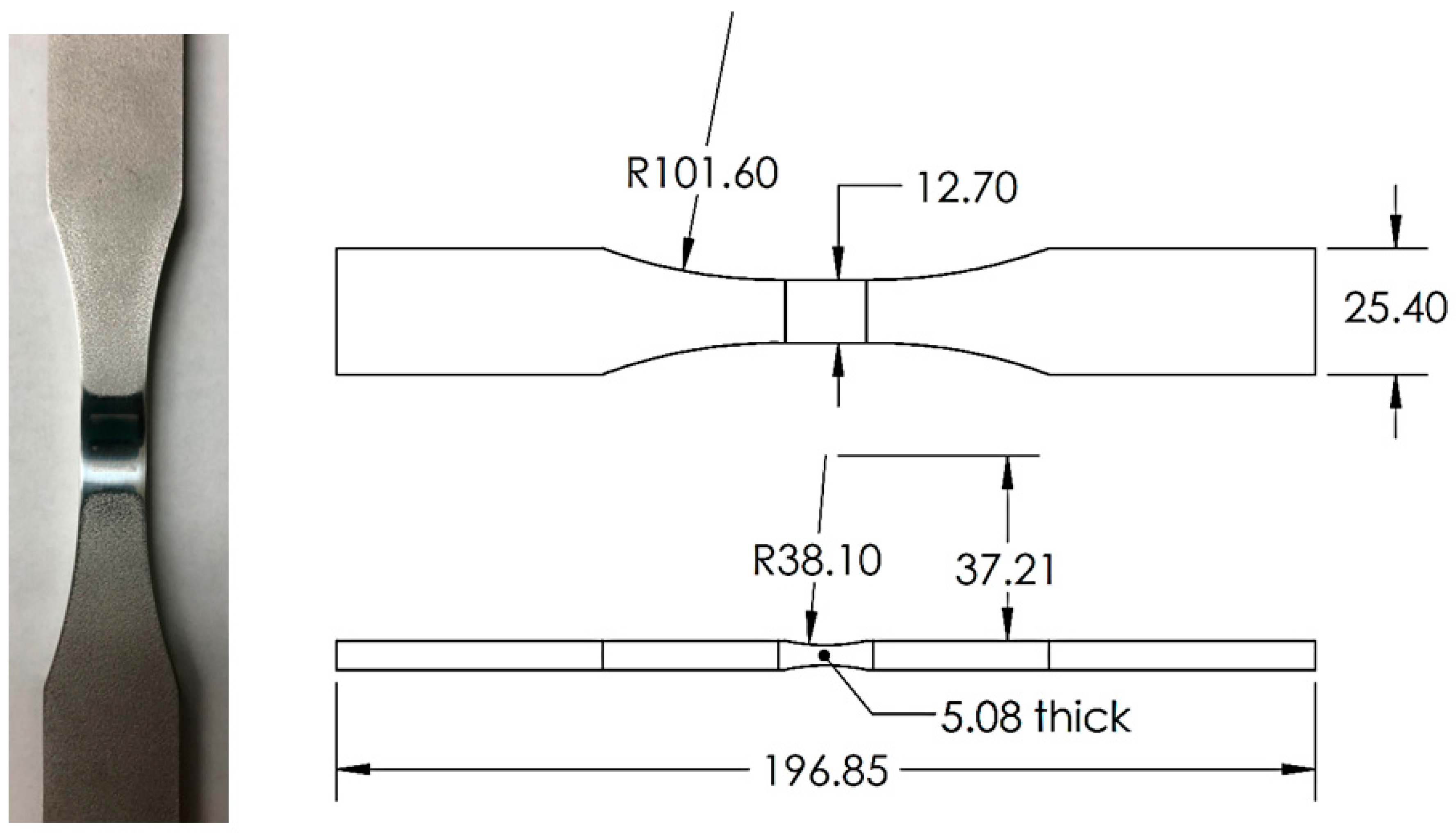
2.2. Specimen Information
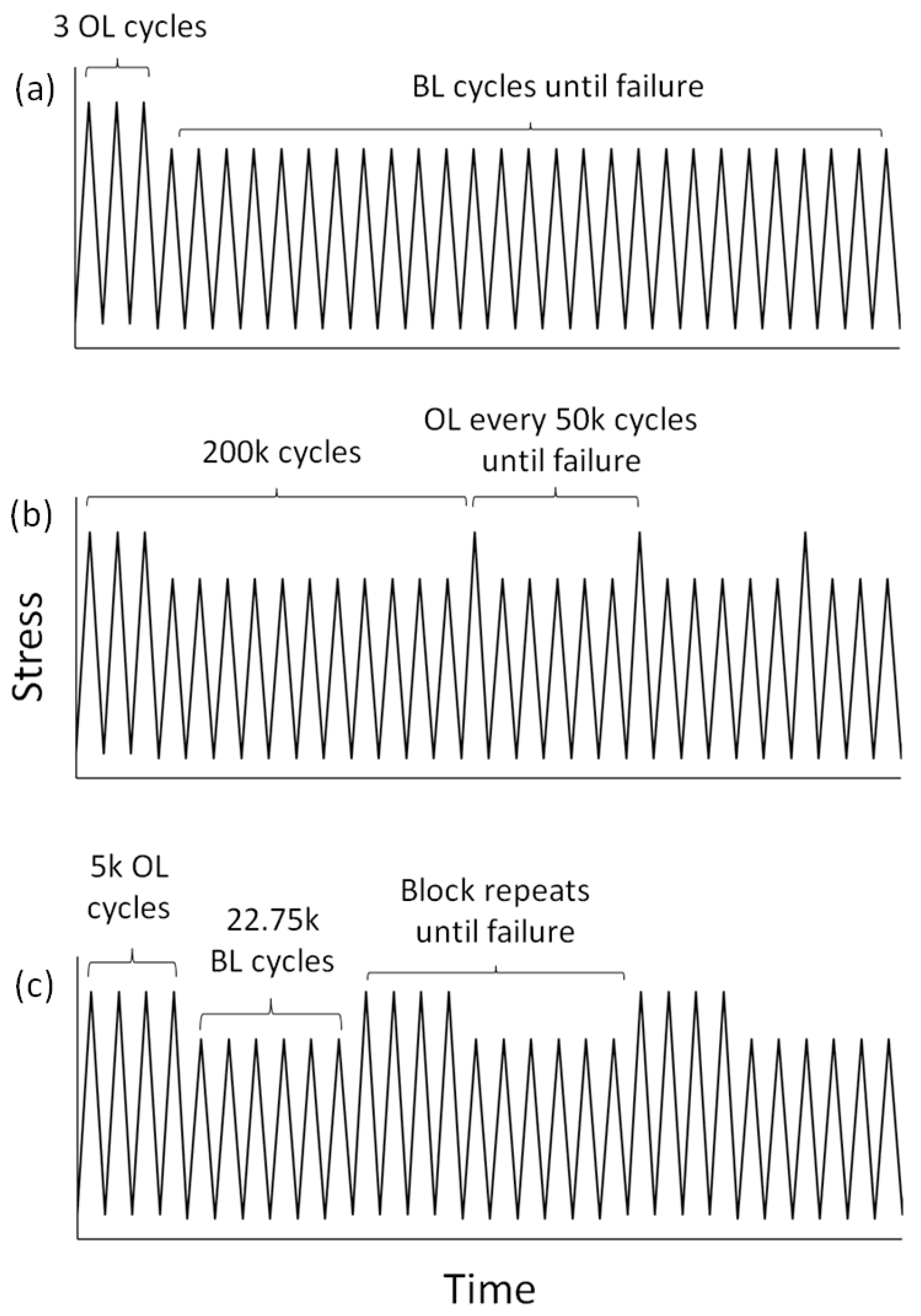
2.3. Experimental Procedure
3. Results
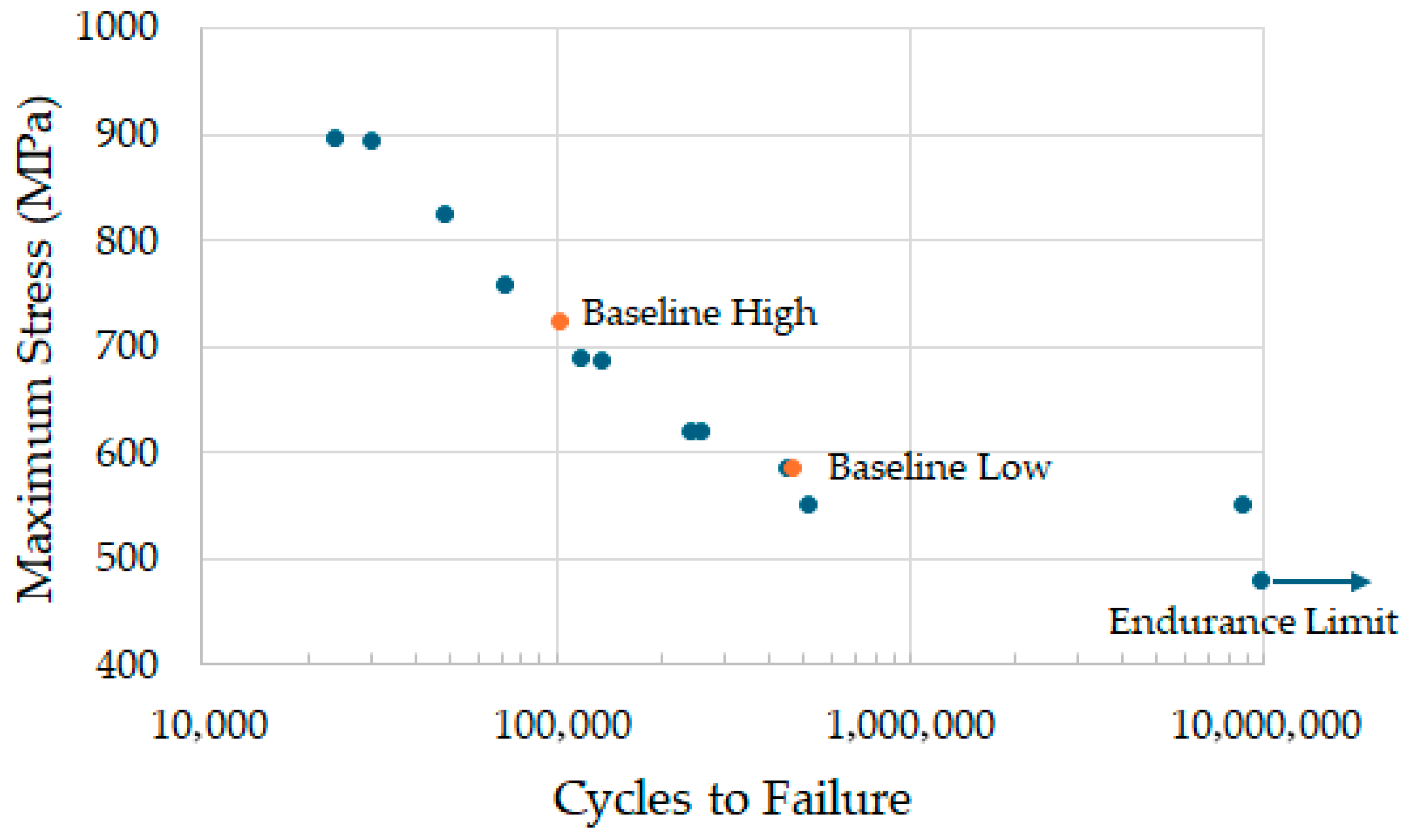
3.1. Fatigue Life
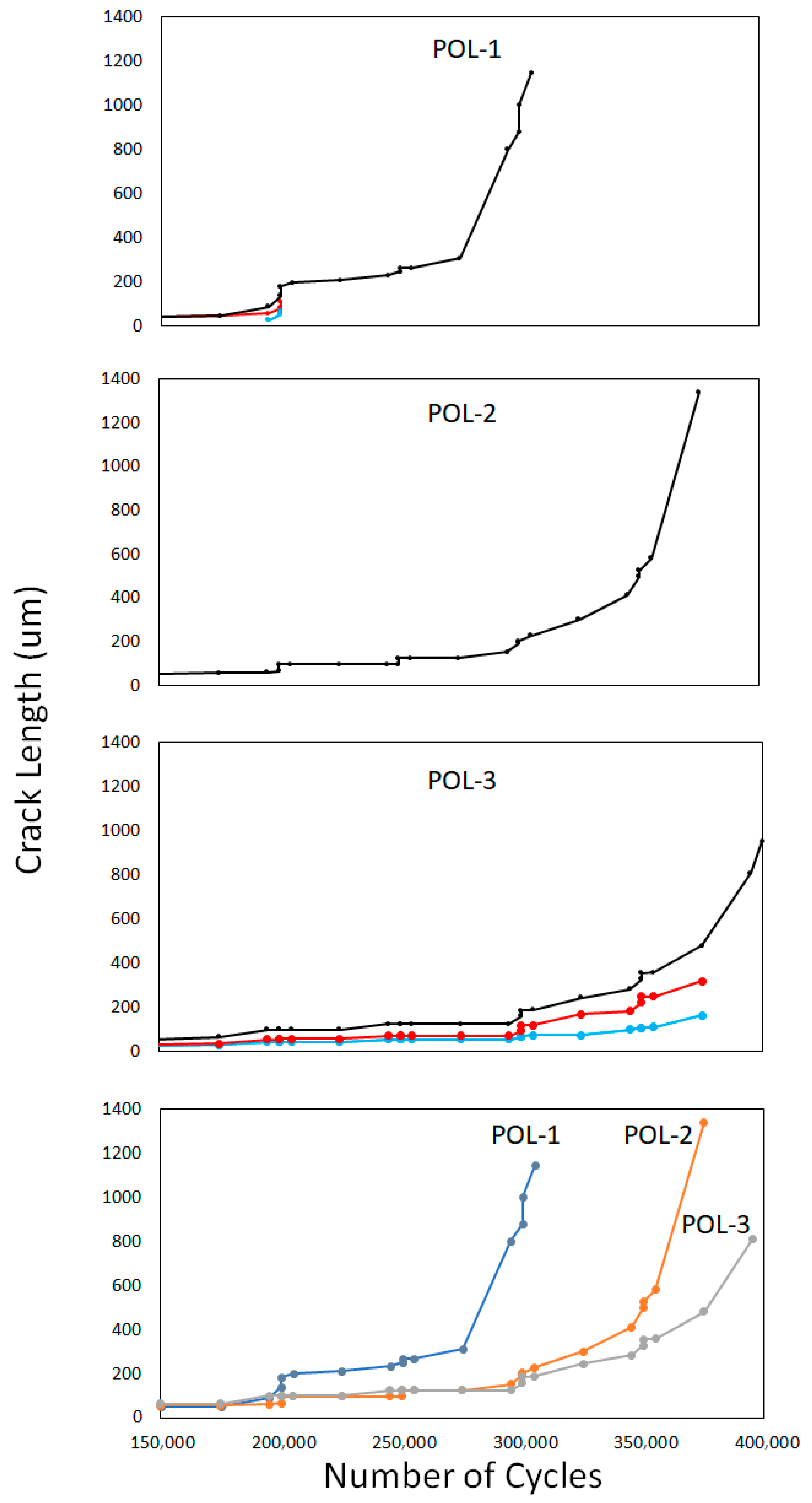
3.2. Crack Length Measurements for Periodic Overload Tests
3.2.1. General Fracture Surface Observations
3.2.2. Fracture Surface Observations for Load Level Changes
4. Discussion
4.1. Overall Trends and Comparisons to Linear Damage Accumulation
4.2. Fatigue Damage Regime
4.3. Quantification of Overload Effects
4.4. Mechanistic Analysis
4.4.1. Mean Stress Rearrangement and Cyclic Hardening/Softening
4.4.2. Microstructural Barriers
4.4.3. Plastic-Induced Crack Closure
4.4.4. Compressive Residual Stresses (Crack Tip Shielding)
4.4.5. Crack Tip Blunting
4.5. Mechanistic Basis for Observed Crack Growth Behavior
5. Conclusions
Author Contributions
Funding
Data Availability Statement
Acknowledgments
Conflicts of Interest
Correction Statement
Abbreviations
| AF | Acceleration factor |
| BL | Base level |
| DIC | Digital imaging correlation |
| EDM | Electrical discharge machining |
| H-L | High-low |
| IN625 | Inconel 625 |
| LDR | Linear damage accumulation |
| OL | Overload |
| PICC | Plasticity-induced crack closure |
| POL | Periodic tensile overload |
| VAF | Variable amplitude fatigue |
References
- Dufailly, J.; Lemaitre, J. Modeling very low cycle fatigue. Int. J. Damage Mech. 1995, 4, 153–170. [Google Scholar] [CrossRef]
- Kanvinde, A.M.; Deierlein, G.G. Cyclic void growth model to assess ductile fracture initiation in structural steels due to ultra low cycle fatigue. J. Eng. Mech. 2007, 133, 701–712. [Google Scholar] [CrossRef]
- Wei, Z.; Harting, M.; Gerke, S.; Brnig, M. Ductile damage analysis under extreme low-cycle biaxial shear loadings: Experiments and simulations. Int. J. Solids Struct. 2025, 313, 113292. [Google Scholar] [CrossRef]
- Zhou, S.; Huang, M.; Hffner, C.; Stebner, S.; Cai, M.; Wei, Z.; Yang, B.; Mnstermann, S. Microstructure-sensitive crystal plasticity and fatigue indicator modeling for LZ50 steel. Int. J. Fatigue 2025, 203, 109302. [Google Scholar] [CrossRef]
- Zhou, S.; Yang, B.; Xiao, S.; Yang, G.; Zhu, T. Interpretable machine learning method for modelling fatigue short crack growth behaviour. Met. Mater. Int. 2024, 30, 1944–1964. [Google Scholar] [CrossRef]
- Chong-Myong, P.; Ji-Ho, S. Crack growth and closure behavior of short fatigue cracks. Eng. Fract. Mech. 1994, 47, 327–343. [Google Scholar] [CrossRef]
- Simpson, C.A.; Kozuki, S.; Lopez-Crespo, P.; Mostafavi, M.; Connolley, T.; Withers, P. Quantifying fatigue overload retardation mechanisms by energy dispersive X-ray diffraction. J. Mech. Phys. Solids 2019, 124, 392–410. [Google Scholar] [CrossRef]
- Song, S.-H.; Lee, K.-R. Analysis of short and long crack behavior and single overload effect by crack opening stress. KSME Int. J. 1999, 13, 865–878. [Google Scholar] [CrossRef]
- Zhu, S.P.; Hao, Y.Z.; de Oliveira Correia, J.A.; Lesiuk, G.; De Jesus, A.M. Nonlinear fatigue damage accumulation and life prediction of metals: A comparative study. Fatigue Fract. Eng. Mater. Struct. 2019, 42, 1271–1282. [Google Scholar] [CrossRef]
- Fatemi, A.; Yang, L. Cumulative fatigue damage and life prediction theories: A survey of the state of the art for homogeneous materials. Int. J. Fatigue 1998, 20, 9–34. [Google Scholar] [CrossRef]
- MacDougall, C.; Topper, T. The influence of variable amplitude loading on crack closure and notch fatigue behaviour. Int. J. Fatigue 1997, 19, 389–400. [Google Scholar] [CrossRef]
- McClung, R.; Sehitoglu, H. On the finite element analysis of fatigue crack closure—2. Numerical results. Eng. Fract. Mech. 1989, 33, 253–272. [Google Scholar] [CrossRef]
- Pippan, R.; Hohenwarter, A. Fatigue crack closure: A review of the physical phenomena. Fatigue Fract. Eng. Mater. Struct. 2017, 40, 471–495. [Google Scholar] [CrossRef]
- Wheeler, O. Spectrum loading and crack growth. J. Basic Eng. 1972, 94, 181–186. [Google Scholar] [CrossRef]
- Colin, J.; Fatemi, A.; Taheri, S. Fatigue behavior of stainless steel 304L including strain hardening, prestraining, and mean stress effects. J. Eng. Mater. Technol. 2010, 132, 021008. [Google Scholar] [CrossRef]
- Akita, M.; Nakajima, M.; Uematsu, Y.; Tokaji, K.; Jung, J.W. Some factors exerting an influence on the coaxing effect of austenitic stainless steels. Fatigue Fract. Eng. Mater. Struct. 2012, 35, 1095–1104. [Google Scholar] [CrossRef]
- Sinclair, G. Investigation of the coaxing effect in fatigue of metals. Proc. Am. Soc. Test. Mater. 1952, 52, 743–751. [Google Scholar]
- Huang, X.; Wang, L.; Hu, Y.; Guo, G.; Salmon, D.; Li, Y.; Zhao, W. Fatigue crack propagation behavior of Ni-based superalloys after overloading at elevated temperatures. Prog. Nat. Sci. Mater. Int. 2016, 26, 197–203. [Google Scholar] [CrossRef]
- Grimshaw, C.S.; Miller, K.J.; Rees, J.M. Short fatigue crack growth under variable amplitude loading: A theoretical approach. In Short Fatigue Cracks; Miller, K.J., de Los Rios, E.R., Eds.; Mechanical Engineering Publications: London, UK, 1992; pp. 449–465. [Google Scholar]
- He, L.; Akebono, H.; Sugeta, A. Effect of high-amplitude loading on accumulated fatigue damage under variable-amplitude loading in 316 stainless steel. Int. J. Fatigue 2018, 116, 388–395. [Google Scholar] [CrossRef]
- Hectors, K.; De Waele, W. Cumulative damage and life prediction models for high-cycle fatigue of metals: A review. Metals 2021, 11, 204. [Google Scholar] [CrossRef]
- Suresh, S. Fatigue of Materials; Cambridge University Press: Cambridge, UK, 1998. [Google Scholar]
- Dowling, N.E. Mechanical Behavior of Materials eBook; International Edition; Pearson Higher Education: London, UK, 2013. [Google Scholar]
- Jurcevic, R.; DuQuesnay, D.; Topper, T.; Pompetzki, M. Fatigue damage accumulation in 2024-T351 aluminium subjected to periodic reversed overloads. Int. J. Fatigue 1990, 12, 259–266. [Google Scholar] [CrossRef]
- Pompetzki, M.; Topper, T.; DuQuesnay, D.; Yu, M. Effect of compressive underloads and tensile overloads on fatigue damage accumulation in 2024-T351 aluminum. J. Test. Eval. 1990, 18, 53–61. [Google Scholar] [CrossRef]
- Bosch, A.; Vormwald, M. Modeling short crack propagation under variable structural and thermal loadings. Fatigue Fract. Eng. Mater. Struct. 2021, 44, 1652–1674. [Google Scholar] [CrossRef]
- He, L.; Akebono, H.; Kato, M.; Sugeta, A. Fatigue life prediction method for AISI 316 stainless steel under variable-amplitude loading considering low-amplitude loading below the endurance limit in the ultrahigh cycle regime. Int. J. Fatigue 2017, 101, 18–26. [Google Scholar] [CrossRef]
- Kamaya, M.; Kawakubo, M. Loading sequence effect on fatigue life of Type 316 stainless steel. Int. J. Fatigue 2015, 81, 10–20. [Google Scholar] [CrossRef]
- Lee, S.; Liaw, P.; Choo, H.; Rogge, R. A study on fatigue crack growth behavior subjected to a single tensile overload: Part I. An overload-induced transient crack growth micromechanism. Acta Mater. 2011, 59, 485–494. [Google Scholar] [CrossRef]
- Roychowdhury, S.; Dodds, R., Jr. Effects of an overload event on crack closure in 3-D small-scale yielding: Finite element studies. Fatigue Fract. Eng. Mater. Struct. 2005, 28, 891–907. [Google Scholar] [CrossRef]
- Su, M.; Hu, C.; Xu, L.; Feng, C.; Han, Y.; Zhao, L. Fatigue short crack growth: Overload-induced acceleration/retardation behavior. Int. J. Fatigue 2023, 175, 107772. [Google Scholar] [CrossRef]
- Bichler, C.; Pippan, R. Effect of single overloads in ductile metals: A reconsideration. Eng. Fract. Mech. 2007, 74, 1344–1359. [Google Scholar] [CrossRef]
- Ren, D.; Jiang, Y.; Zhang, Y.; Hu, X. A Comparative Study of Selective Laser Melting Processed Inconel 625 Superalloy: Fatigue Performances under Constant Amplitude Loading and Single Tensile Overload. J. Phys. Conf. Ser. 2020, 1065, 012131. [Google Scholar] [CrossRef]
- Steinbock, J.G.H. Development of Crack Growth Rate at Multiple Overload. In Proceedings of the 12th International Conference on Fracture (ICF-12), Ottowa, ON, Canada, 12–17 July 2009. [Google Scholar]
- Sun, Y.; Wu, H.; Du, H.; Yao, Z. Investigation of strain fatigue behavior for Inconel 625 with laser shock peening. Materials 2022, 15, 7269. [Google Scholar] [CrossRef]
- Celli, D.; Shen, M.-H.H.; George, T.; Scott-Emuakpor, O.; Holycross, C. Development of a Fatigue Damage and Lifing Assessment Method for Inconel 625 and Aluminum 6061-T6. In Proceedings of the Turbo Expo: Power for Land, Sea, and Air, Charlotte, NC, USA, 26–30 June 2017; American Society of Mechanical Engineers: New York, NY, USA, 2017; p. V07AT31A006. [Google Scholar]
- Poulin, J.-R.; Brailovski, V.; Terriault, P. Long fatigue crack propagation behavior of Inconel 625 processed by laser powder bed fusion: Influence of build orientation and post-processing conditions. Int. J. Fatigue 2018, 116, 634–647. [Google Scholar] [CrossRef]
- Federal Aviation Administration. Metallic Materials Properties Development and Standardization; Battelle Memorial Institute: Washington, DC, USA, 2013. [Google Scholar]
- ASTM E466-21; Standard Practice for Conducting Force Controlled Constant Amplitude Axial Fatigue Tests of Metallic Materials. ASTM: West Conshohocken, PA, USA, 2021.
- ASTM E647; Standard Test Method for Measurement of Fatigue Crack Growth Rates. ASTM: West Conshohocken, PA, USA, 2024.
- Fleishel, R.; Cauthen, C.; Daniewicz, S.; Baker, A.; Jordon, J.B.; TerMaath, S. Characterization of Surface Fatigue Crack Nucleation and Microstructurally Small Crack Growth in High Strength Aluminum Alloys. Front. Mater. 2021, 7, 590747. [Google Scholar] [CrossRef]
- Palmgren, A. The service life of ball bearings. Z. Vereines Dtsch. Ingenieure 1924, 68, 339–341. [Google Scholar]
- Miner, M.A. Cumulative damage in fatigue. J. Appl. Mech. 1945, 12, A159–A164. [Google Scholar] [CrossRef]
- Jordon, J.; Bernard, J.; Newman, J., Jr. Quantifying microstructurally small fatigue crack growth in an aluminum alloy using a silicon-rubber replica method. Int. J. Fatigue 2012, 36, 206–210. [Google Scholar] [CrossRef]
- Suresh, S.; Ritchie, R. Propagation of short fatigue cracks. Int. Met. Rev. 1984, 29, 445–475. [Google Scholar] [CrossRef]
- Pittinato, G. SEM/TEM Fractography Handbook; Metals and Ceramics Information Center: Gaithersburg, MD, USA, 1975; Volume 75. [Google Scholar]
- Barter, S.A.; Wanhill, R.J. Fatigue Crack Growth Markers to Aid Quantitative Fractography; ASM International: Almere, The Netherlands, 2024. [Google Scholar]
- Schroeder, C.J.; Parrington, R.J.; Maciejewski, J.O.; Lane, J.F. Fractography; ASM International: Almere, The Netherlands, 2024. [Google Scholar]
- Sansoz, F.; Brethes, B.; Pineau, A. Propagation of short fatigue cracks from notches in a Ni base superalloy: Experiments and modelling. Fatigue Fract. Eng. Mater. Struct. 2002, 25, 41–53. [Google Scholar] [CrossRef]
- Richart, F.E., Jr. A Procedure for Evaluating Cumulative Damage in Fatigue. Ph.D. Thesis, University of Illinois at Urbana-Champaign, Urbana, IL, USA, 1948. [Google Scholar]
- Marco, S.; Starkey, W. A concept of fatigue damage. Trans. Am. Soc. Mech. Eng. 1954, 76, 627–632. [Google Scholar] [CrossRef]
- McDowell, D. An engineering model for propagation of small cracks in fatigue. Eng. Fract. Mech. 1997, 56, 357–377. [Google Scholar] [CrossRef]
- Kitagawa, H. Applicability of fracture mechanics to very small cracks or the cracks in the early stage. In Proceedings of the 2nd International Conference on Mechanical Behaviour of Materials, Boston, MA, USA, 16–20 August 1976. [Google Scholar]
- James, M.; De Los Rios, E. Variable Amplitude Loading of Small Fatigue Cracks in 6261-T6 Aluminium Alloy. Fatigue Fract. Eng. Mater. Struct. 1996, 19, 413–426. [Google Scholar] [CrossRef]
- Colin, J.; Fatemi, A. Variable amplitude cyclic deformation and fatigue behaviour of stainless steel 304L including step, periodic, and random loadings. Fatigue Fract. Eng. Mater. Struct. 2010, 33, 205–220. [Google Scholar] [CrossRef]
- Smith, K.; Watson, P.; Topper, T. A Stress-strain Function for the Fatigue of Metals. J. Mater. 1970, 5, 342. [Google Scholar]
- Rios, E.D.; Xin, X.; Navarro, A. Modelling microstructurally sensitive fatigue short crack growth. Proc. R. Soc. Lond. Ser. A Math. Phys. Sci. 1994, 447, 111–134. [Google Scholar]
- Hanlon, T.; Kwon, Y.-N.; Suresh, S. Grain size effects on the fatigue response of nanocrystalline metals. Scr. Mater. 2003, 49, 675–680. [Google Scholar] [CrossRef]
- Turnbull, A.; De Los Rios, E. The effect of grain size on the fatigue of commercially pure aluminium. Fatigue Fract. Eng. Mater. Struct. 1995, 18, 1455–1467. [Google Scholar] [CrossRef]
- Hussain, K. Short fatigue crack behaviour and analytical models: A review. Eng. Fract. Mech. 1997, 58, 327–354. [Google Scholar] [CrossRef]
- Künkler, B.; Düber, O.; Köster, P.; Krupp, U.; Fritzen, C.-P.; Christ, H.-J. Modelling of short crack propagation–Transition from stage I to stage II. Eng. Fract. Mech. 2008, 75, 715–725. [Google Scholar] [CrossRef]



| Property | Value | Source |
|---|---|---|
| Elastic modulus | 207 Gpa | Experimental |
| Yield stress | 446 MPa | Experimental |
| Ultimate stress | 914 MPa | Experimental |
| Fatigue endurance limit | 483 MPa | [38] |
| Paris law (C) | 1.38 10−12 | [37] |
| Paris law (m) | 3.48 | [37] |
| Threshold (∆K) | 7.2 MPa | [37] |
| 45 µm | Material data sheet |
| Element | Mass (%) per Sample | Average | St. Dev. | |||
|---|---|---|---|---|---|---|
| 1 | 2 | 3 | 4 | |||
| Aluminum | 0.2 | 0.3 | 0.2 | 0.2 | 0.2 | 0.062 |
| Silicon | 0.3 | 0.3 | 0.2 | 0.2 | 0.3 | 0.063 |
| Titanium | 0.2 | 0.2 | 0.2 | 0.2 | 0.2 | 0.023 |
| Chromium | 22.1 | 22.1 | 22.4 | 22.1 | 22.2 | 0.157 |
| Manganese | 0.3 | 0.3 | 0.3 | 0.3 | 0.3 | 0.019 |
| Iron | 4.4 | 4.5 | 4.5 | 4.4 | 4.4 | 0.038 |
| Nickel | 56.0 | 56.2 | 56.4 | 55.8 | 56.1 | 0.266 |
| Niobium | 2.7 | 2.9 | 2.9 | 2.9 | 2.9 | 0.103 |
| Molybdenum | 9.0 | 9.5 | 9.6 | 9.4 | 9.4 | 0.263 |
| Tantalum | 0.7 | 0.7 | 0.8 | 0.6 | 0.7 | 0.072 |
| Loading Type | OL Stress (MPa) | BL Stress (MPa) | Number of Specimens | Description |
|---|---|---|---|---|
| Constant amplitude, low | - | 586 | 1 | Constant amplitude fatigue at 586 MPa |
| Constant amplitude, high | - | 724 | 1 | Constant amplitude fatigue at 724 MPa |
| High-Low | 724 | 586 | 3 | 3 cycles at 724 MPa followed by 586 MPa loading until failure |
| Block loading | 724 | 586 | 3 | Blocks of 5k cycles at 724 MPa followed by 22.75k cycles of 586 MPa loading, repeated until failure |
| Periodic Overload | 724 | 586 | 3 | 3 cycles at 724 MPa followed by 586 MPa loading for 200k cycles, a single 724 MPa cycle was then applied for every 50k of 586 MPa cycles until failure |
| Specimen ID | OL Cycles | BL Cycles | Total Cycles | Average | Coefficient of Variation (%) |
|---|---|---|---|---|---|
| CH-1 | 103,249 | - | 103,249 | 103,249 | - |
| CL-1 | - | 470,302 | 470,302 | 470,302 | - |
| HL-1 | 3 | 353,656 | 353,659 | 329,947 | |
| HL-2 | 3 | 369,619 | 369,622 | 16.8 | |
| HL-3 | 3 | 266,556 | 266,559 * | ||
| B-1 | 69,577 | 295,750 | 365,327 | 364,052 | |
| B-2 | 70,708 | 318,500 | 389,208 | 7.1 | |
| B-3 | 60,000 | 277,521 | 337,621 | ||
| POL-1 | 6 | 314,172 | 314,178 | 366,078 | |
| POL-2 | 7 | 381,820 | 381,827 | 12.6 | |
| POL-3 | 8 | 402,222 | 402,230 ** |
| Specimen ID | 724 MPa LDR Damage | 586 MPa LDR Damage | Total LDR Damage | Average Total LDR Damage | Coefficient of Variation (%) |
|---|---|---|---|---|---|
| HL-1 | 3 × 10⁻⁵ | 0.75 | 0.75 | 0.70 | |
| HL-2 | 3 × 10⁻⁵ | 0.79 | 0.79 | 16.7 | |
| HL-3 | 3 × 10⁻⁵ | 0.57 | 0.57 | ||
| B-1 | 0.67 | 0.63 | 1.30 | 1.28 | |
| B-2 | 0.68 | 0.68 | 1.36 | 7.6 | |
| B-3 | 0.58 | 0.59 | 1.17 | ||
| POL-1 | 6 × 10⁻⁵ | 0.67 | 0.67 | 0.78 | |
| POL-2 | 7 × 10⁻⁵ | 0.81 | 0.81 | 12.6 | |
| POL-3 | 8 × 10⁻⁵ | 0.86 | 0.86 |
| Loading | Single-Multi Slip Transition Region (µm) |
|---|---|
| CA, 724 MPa | 900–1200 |
| CA, 586 MPa | 1200–1800 |
| H-L | 900 *–1500 |
| POL | 900–1200 |
| Block | 500–1200 |
| Formula | Basis | Value |
|---|---|---|
[40,52] | Crack is shorter than the characteristic microstructural dimension | 225–450 µm |
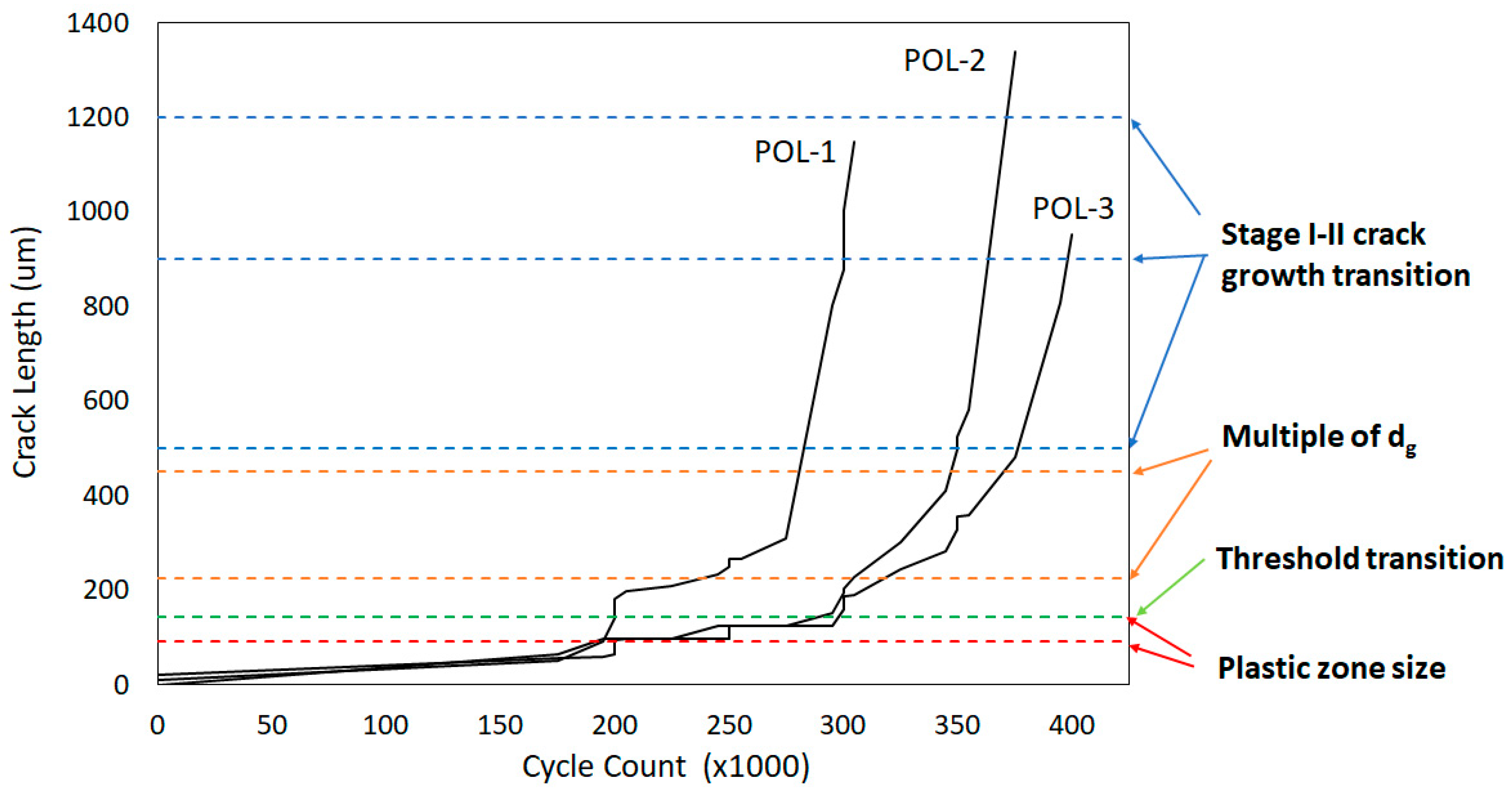
| Plastic zone size is too small to apply smeared/homogeneous material properties in fatigue crack growth | 144 µm (@586 MPa) 91 µm (@724 MPa) | |
| [53] | Transition behavior is dictated by endurance limit vs. threshold SIF | 142 µm |
| observed | Stage I to stage II crack growth transition | 900–1200 µm (@586 MPa) 500–1200 µm (@724 MPa) |
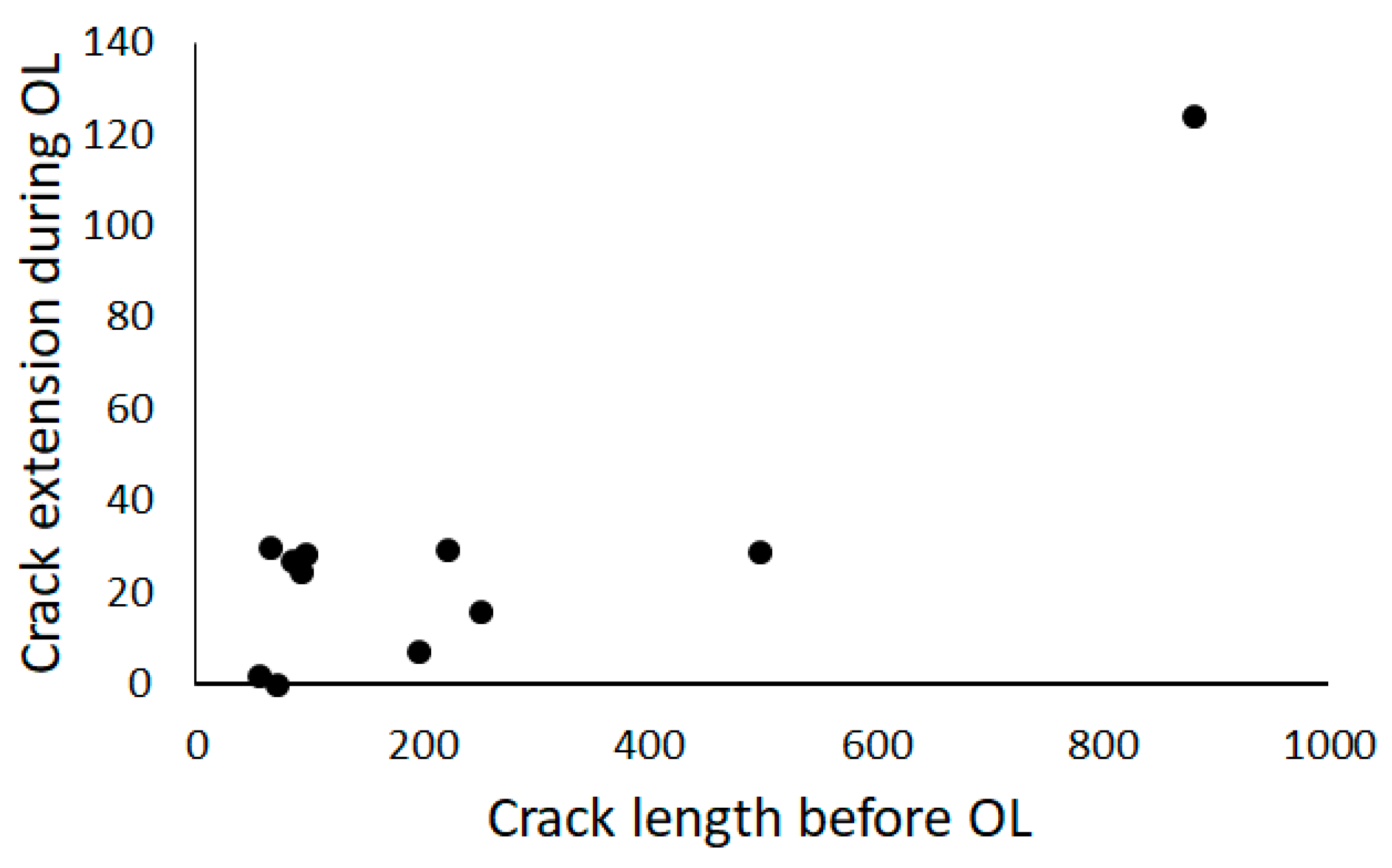
| Specimen | Overload | aOL-1 | Δa | 5k AF | 25k AF | 25k AF (w/OL) |
|---|---|---|---|---|---|---|
| POL-1 | 200k ** | 140 | 42 | 0.346 | 0.311 | 0.771 |
| 250k | 249 | 16 | 0.000 | 1.118 | 1.520 | |
| 300k | 880 | 124 | 1.823 | N/A * | N/A * | |
| POL-2 | 200k | 65 | 30 | 0.083 | 0.045 | 3.035 |
| 250k | 96 | 29 | undefined | undefined | undefined | |
| 300k | 195 | 7 | 0.571 | 1.389 | 1.494 | |
| 350k | 496 | 29 | 0.667 | 4.166 | 4.315 | |
| POL-3 | 200k | 98 | 0 | undefined | undefined | undefined |
| 250k | 124 | 0 | undefined | undefined | undefined | |
| 300k | 159 | 27 | 0.096 | 1.675 | 2.431 | |
| 350k | 327 | 28 | 0.042 | 1.493 | 1.831 |
Disclaimer/Publisher’s Note: The statements, opinions and data contained in all publications are solely those of the individual author(s) and contributor(s) and not of MDPI and/or the editor(s). MDPI and/or the editor(s) disclaim responsibility for any injury to people or property resulting from any ideas, methods, instructions or products referred to in the content. |
© 2025 by the authors. Licensee MDPI, Basel, Switzerland. This article is an open access article distributed under the terms and conditions of the Creative Commons Attribution (CC BY) license.
Share and Cite
Fleishel, R.; Abedi, R.; TerMaath, S. Investigation of the Damage Mechanisms Influencing the Short Crack Behavior of Inconel 625 Under Variable Amplitude Fatigue Loading. Aerospace 2026, 13, 3. https://doi.org/10.3390/aerospace13010003
Fleishel R, Abedi R, TerMaath S. Investigation of the Damage Mechanisms Influencing the Short Crack Behavior of Inconel 625 Under Variable Amplitude Fatigue Loading. Aerospace. 2026; 13(1):3. https://doi.org/10.3390/aerospace13010003
Chicago/Turabian StyleFleishel, Robert, Reza Abedi, and Stephanie TerMaath. 2026. "Investigation of the Damage Mechanisms Influencing the Short Crack Behavior of Inconel 625 Under Variable Amplitude Fatigue Loading" Aerospace 13, no. 1: 3. https://doi.org/10.3390/aerospace13010003
APA StyleFleishel, R., Abedi, R., & TerMaath, S. (2026). Investigation of the Damage Mechanisms Influencing the Short Crack Behavior of Inconel 625 Under Variable Amplitude Fatigue Loading. Aerospace, 13(1), 3. https://doi.org/10.3390/aerospace13010003