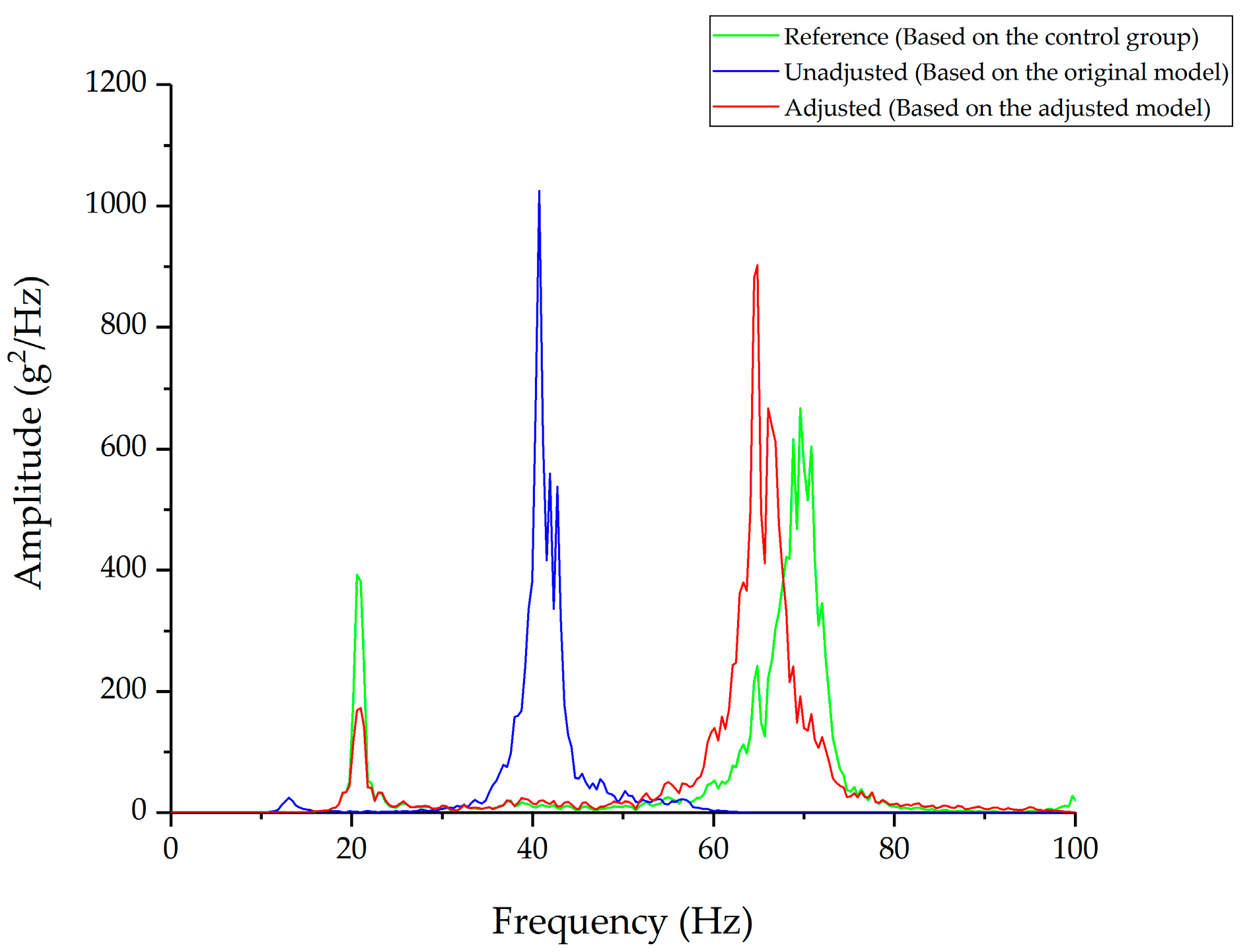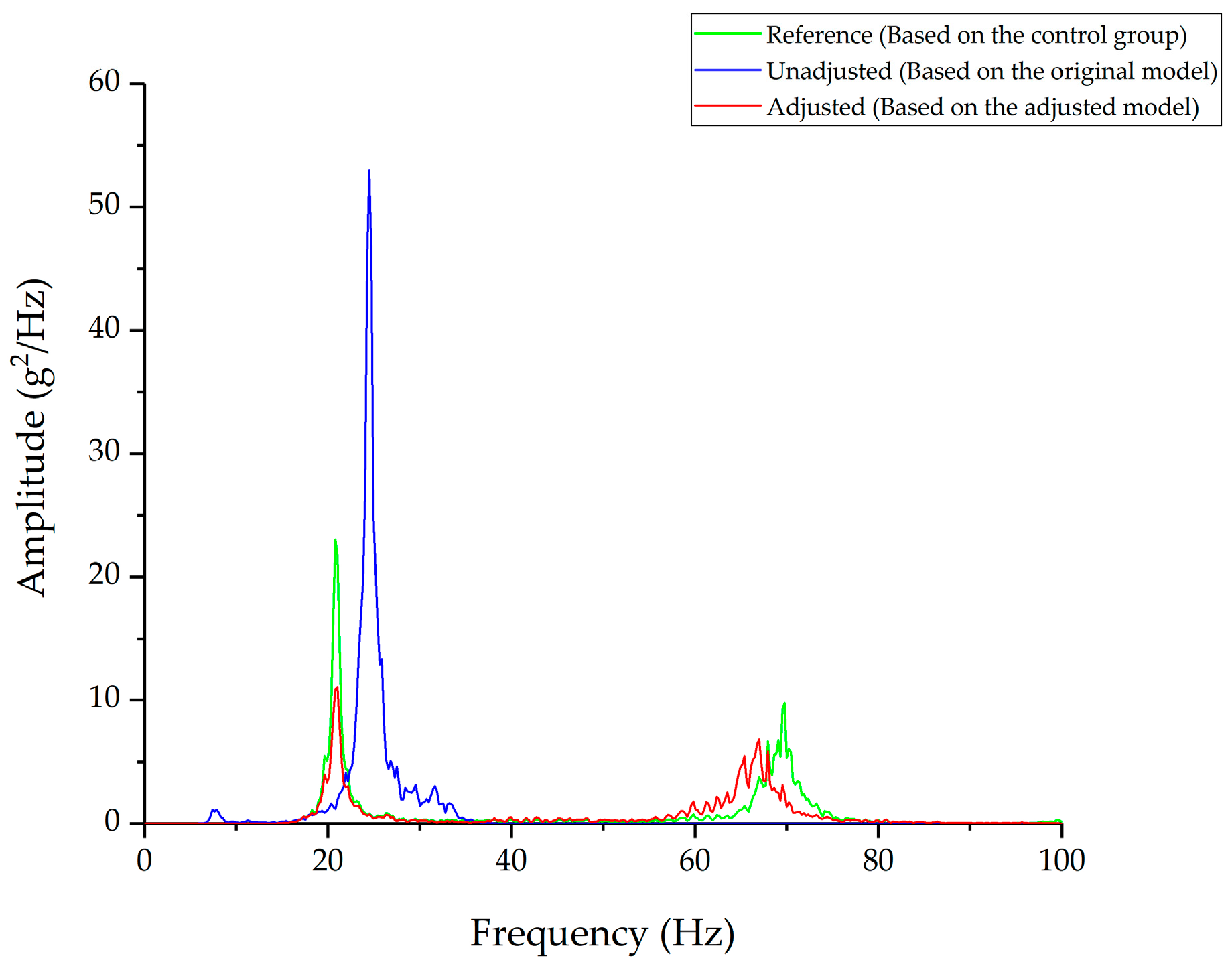

A Multi-Objective Point Response Prediction Method for Vertical Tail Buffeting Based on Elastic Scaling Transformation


Abstract
1. Introduction
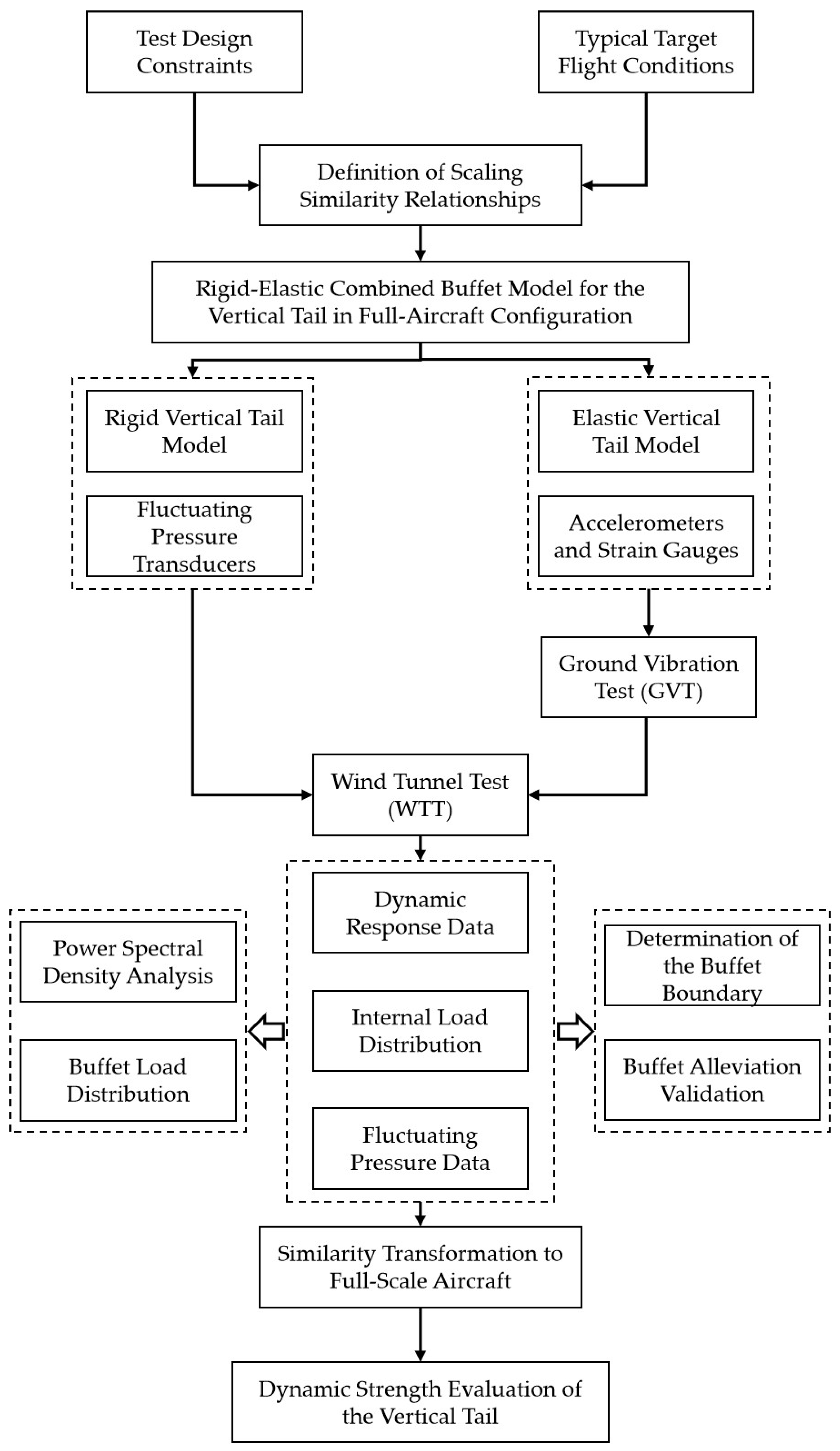
2. Prediction Method of Buffeting Response Based on Wind Tunnel Test
3. Scaling Transformation Relations of the (Rigid/Elastic) Hybrid Model
4. Multi-Objective Point Response Prediction Method for Vertical Tail Buffeting
4.1. Construction of the Adjusted Model Based on Elastic Scaling Transformation
4.2. Predicted Response Workflow for Multiple Objective Points of Buffeting
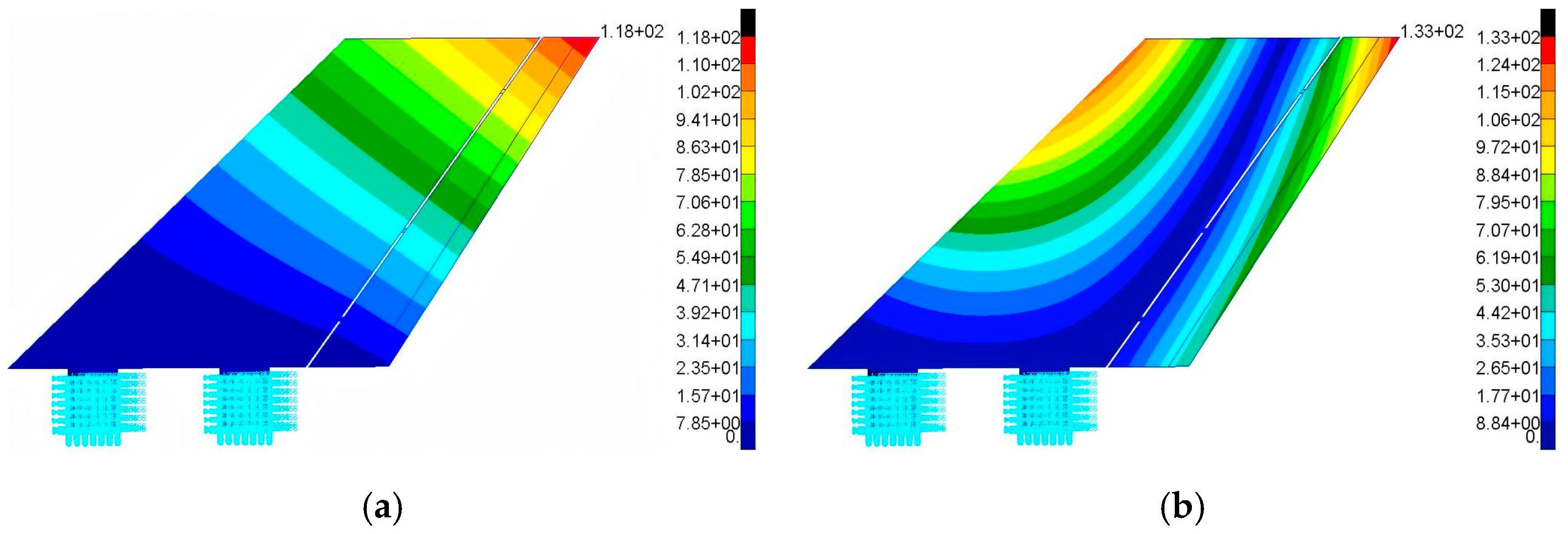
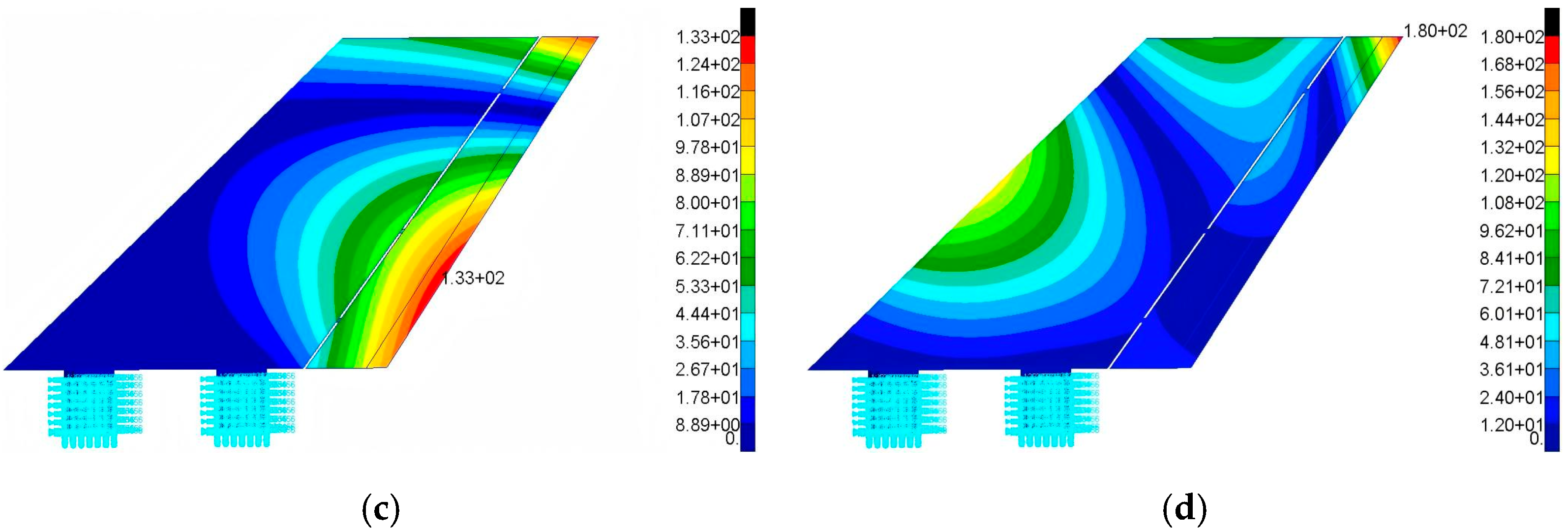
- Design and fabricate an elastic vertical-tail model that satisfies scaling transformation for the initial objective flight condition; generate its finite element (FEM) mesh and perform modal simulation to obtain the modal shape vectors, generalized masses, and natural frequencies for the modes of interest.
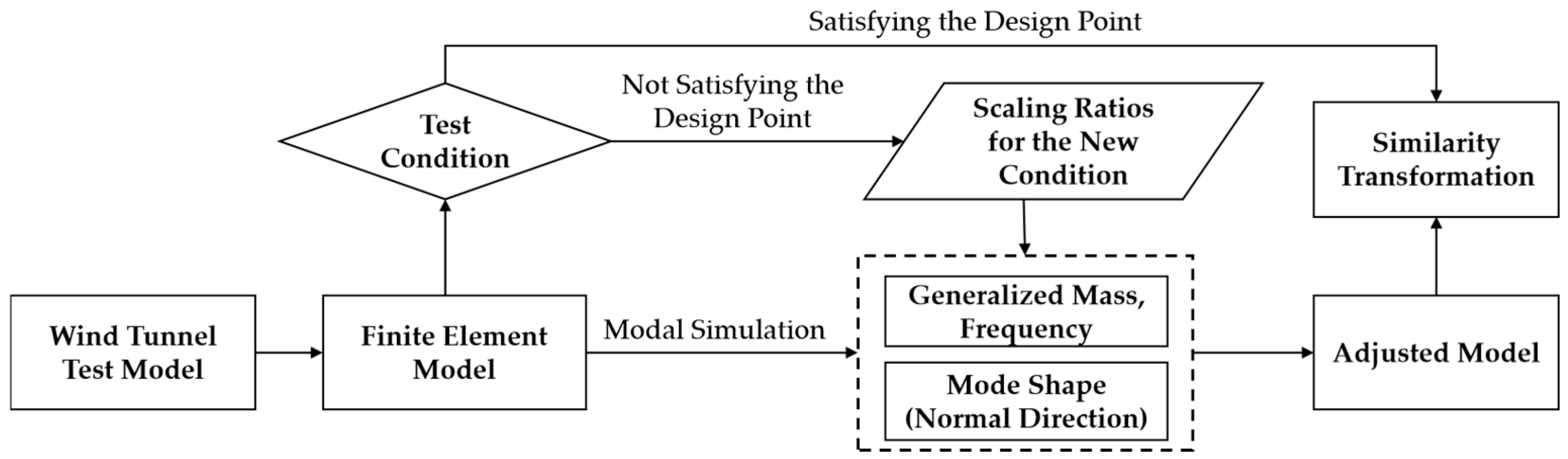
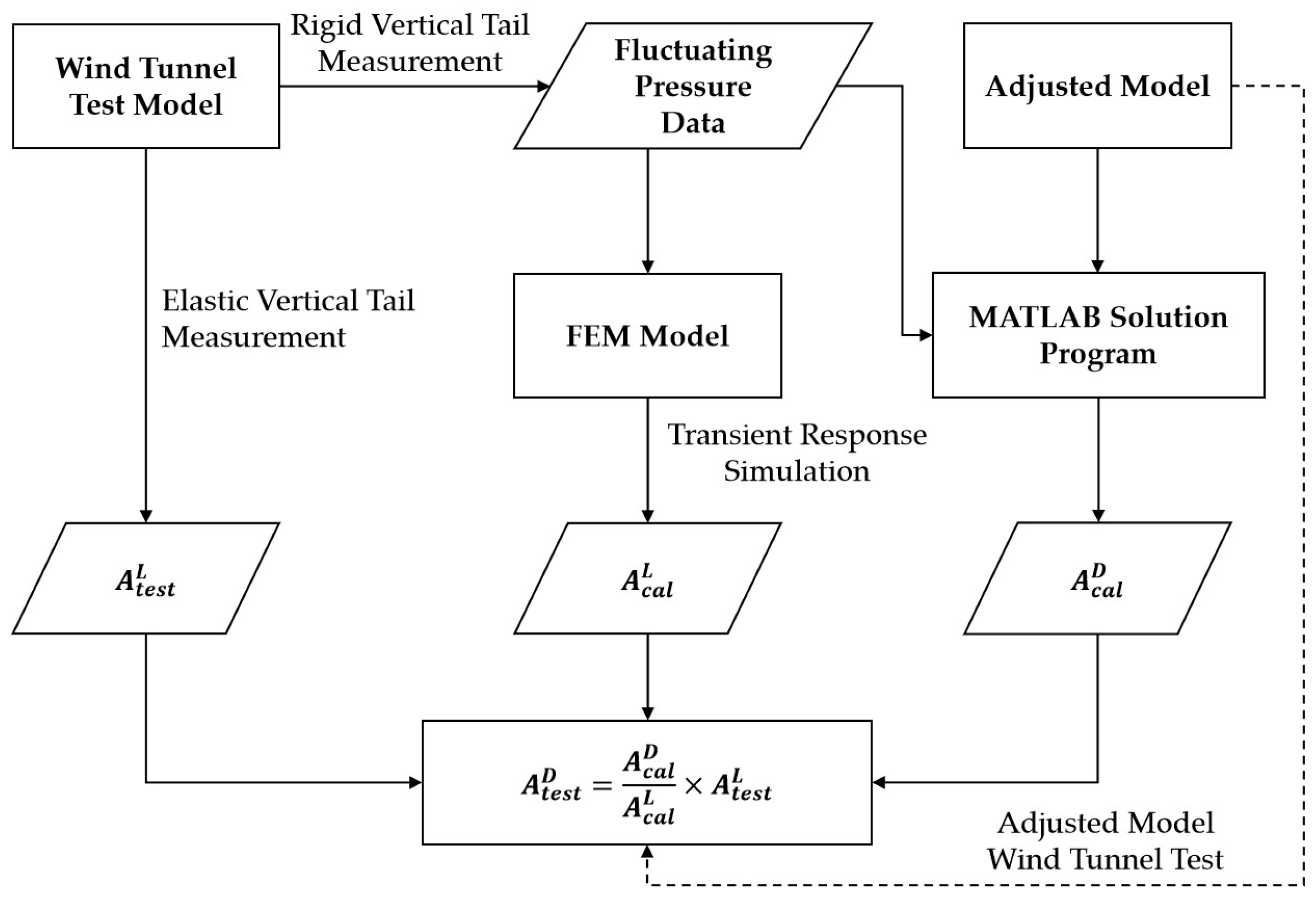
- Determine the mass and frequency scaling ratios required for scaling transformation under the new objective flight condition; adjust the generalized masses and frequencies of the initial design model accordingly to construct the Adjusted Model (see the flowchart in Figure 3).
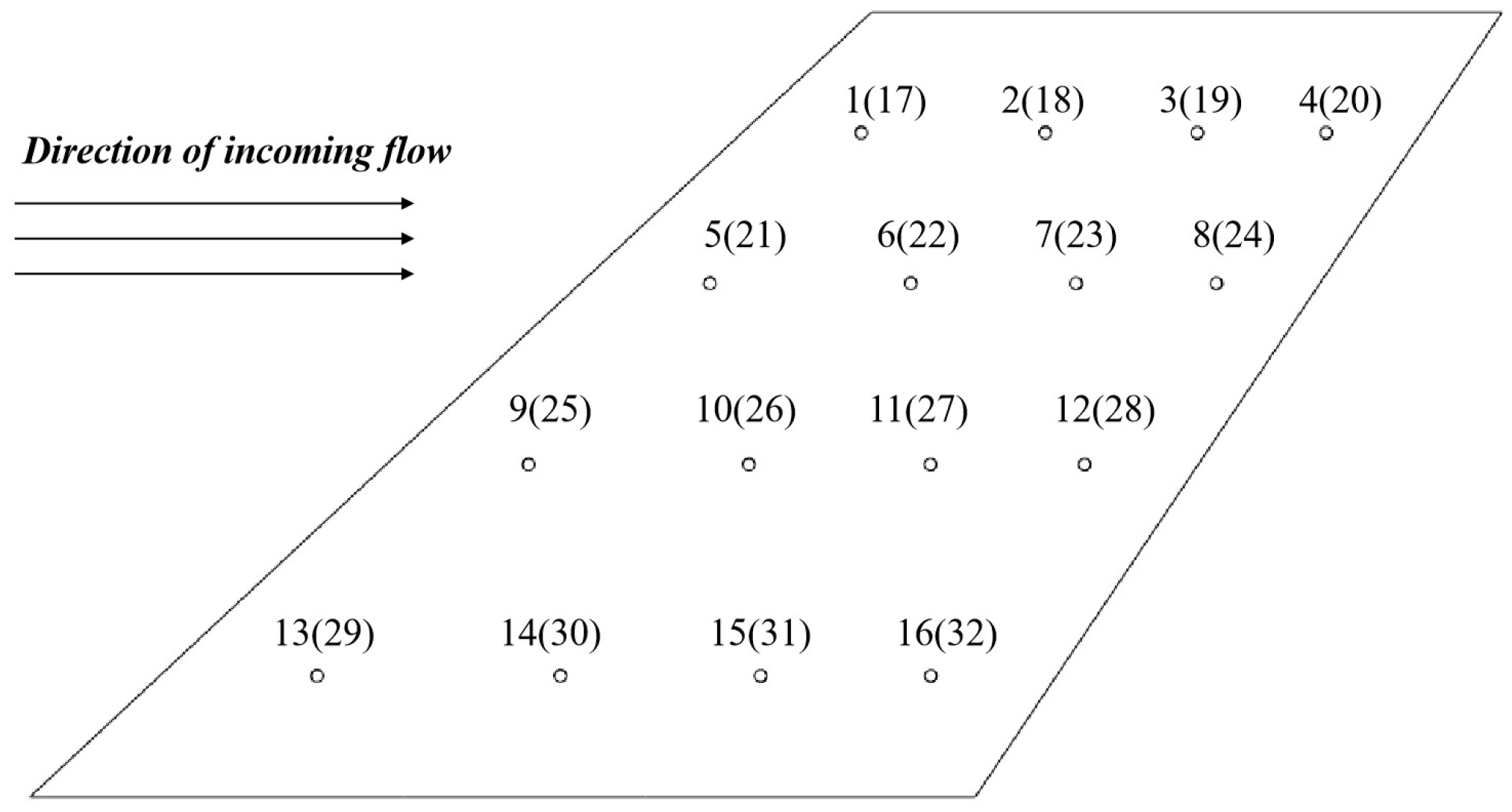
- Process the fluctuating pressure data measured on the rigid tail model in the wind-tunnel test; partition and apply these pressure loads to the Adjusted Model. Using the dynamic response solver (MATLAB), compute the acceleration response at the wing-tip position, denoted as .
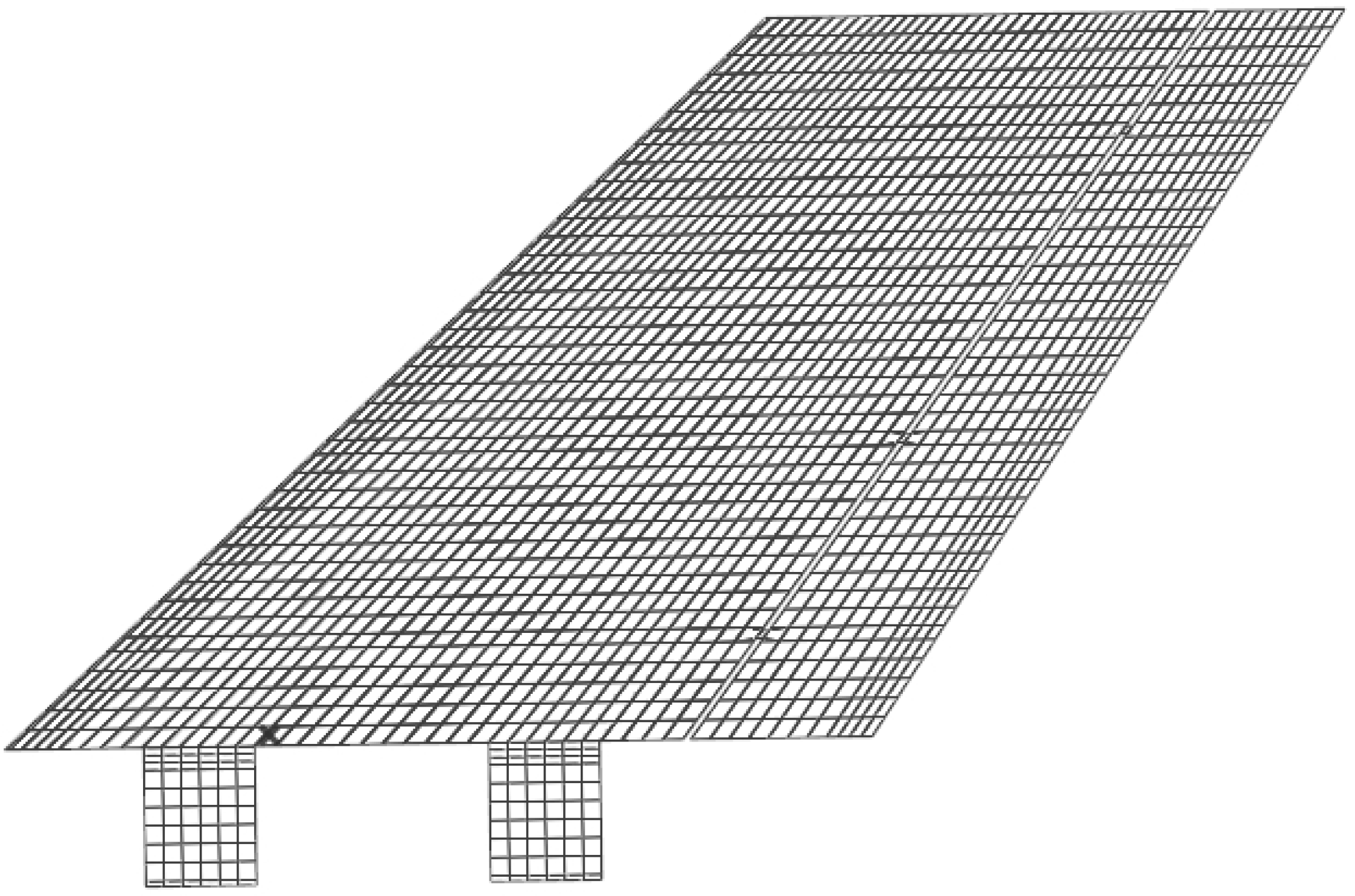
- Use the FEM model of the elastic vertical tail from Step 1, apply the same partitioned fluctuating pressure loads, and perform a transient-response simulation in Nastran software to obtain the acceleration response at the wing-tip, denoted as .
- Process the acceleration response data measured on the elastic vertical tail model in the wind tunnel. Since this model was designed to satisfy the similitude relation for the initial objective condition, its measured wing-tip acceleration RMS is denoted as .
- Let the Adjusted Model’s acceleration RMS at the current test condition be . Then enforce the relation ; this equation implies that the error factors between the initial design model and the Adjusted Model are consistent, so their computed results and the test data should scale proportionally.
5. Design and Testing of the (Rigid/Elastic) Hybrid Model
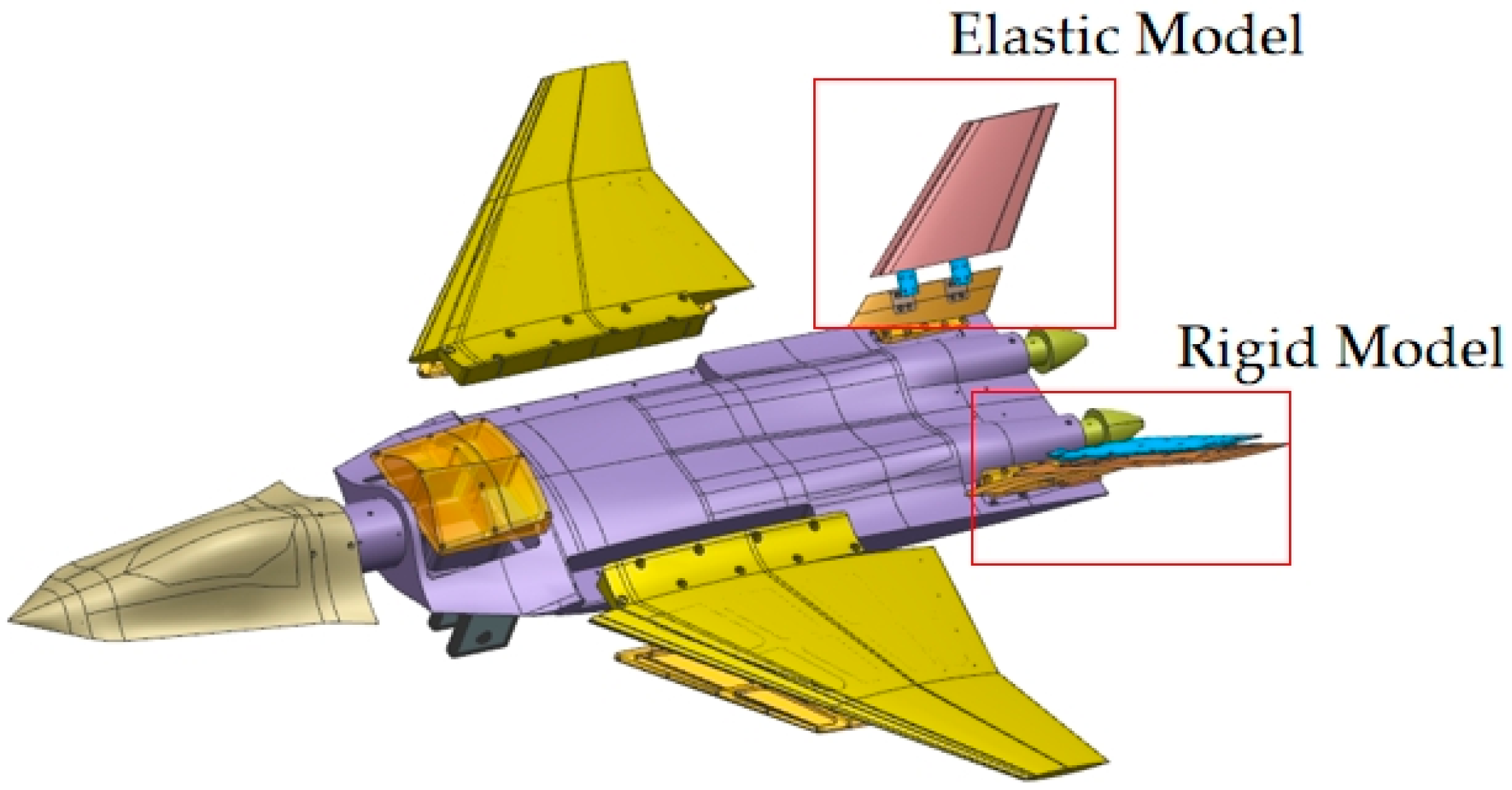
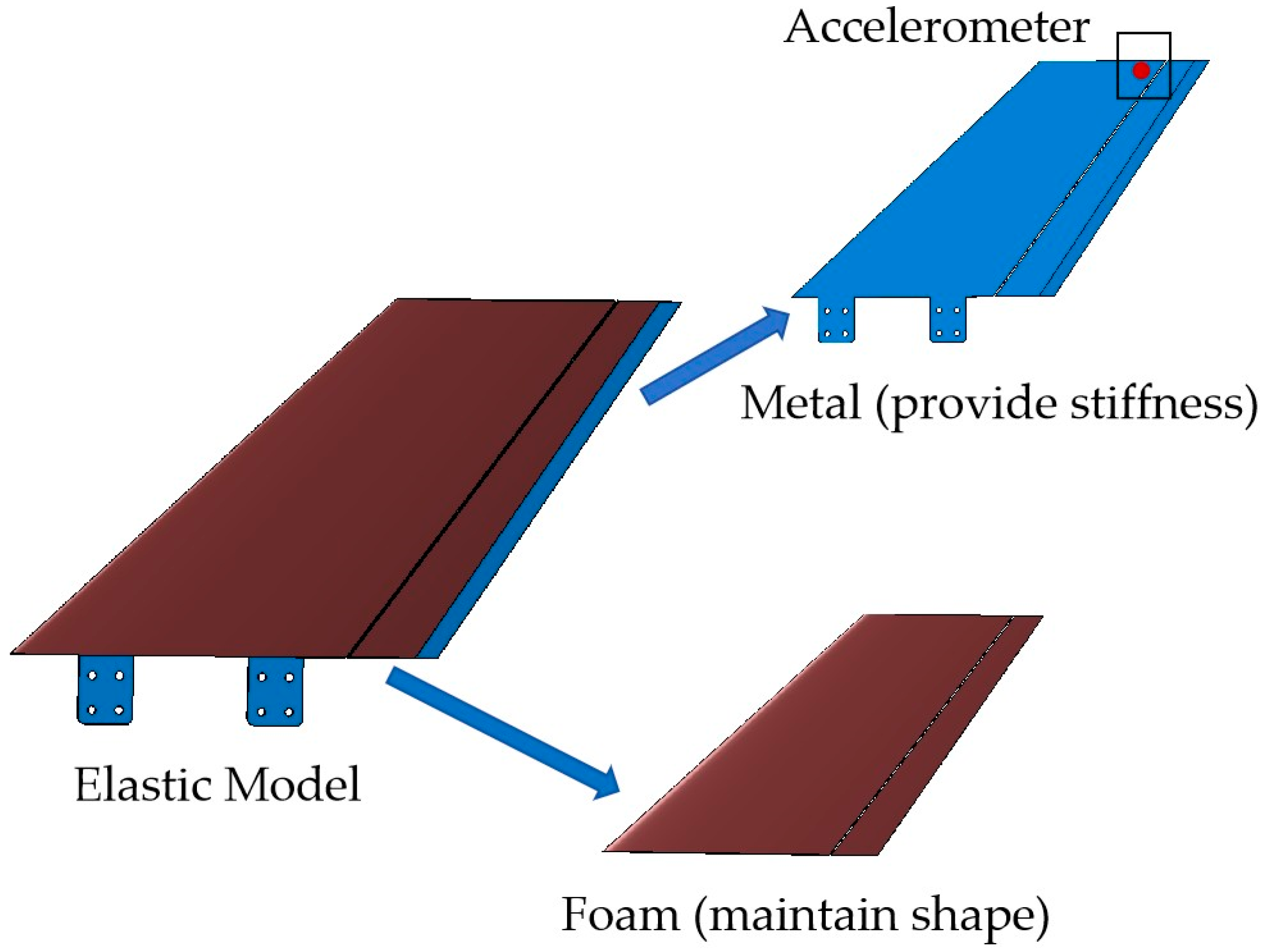
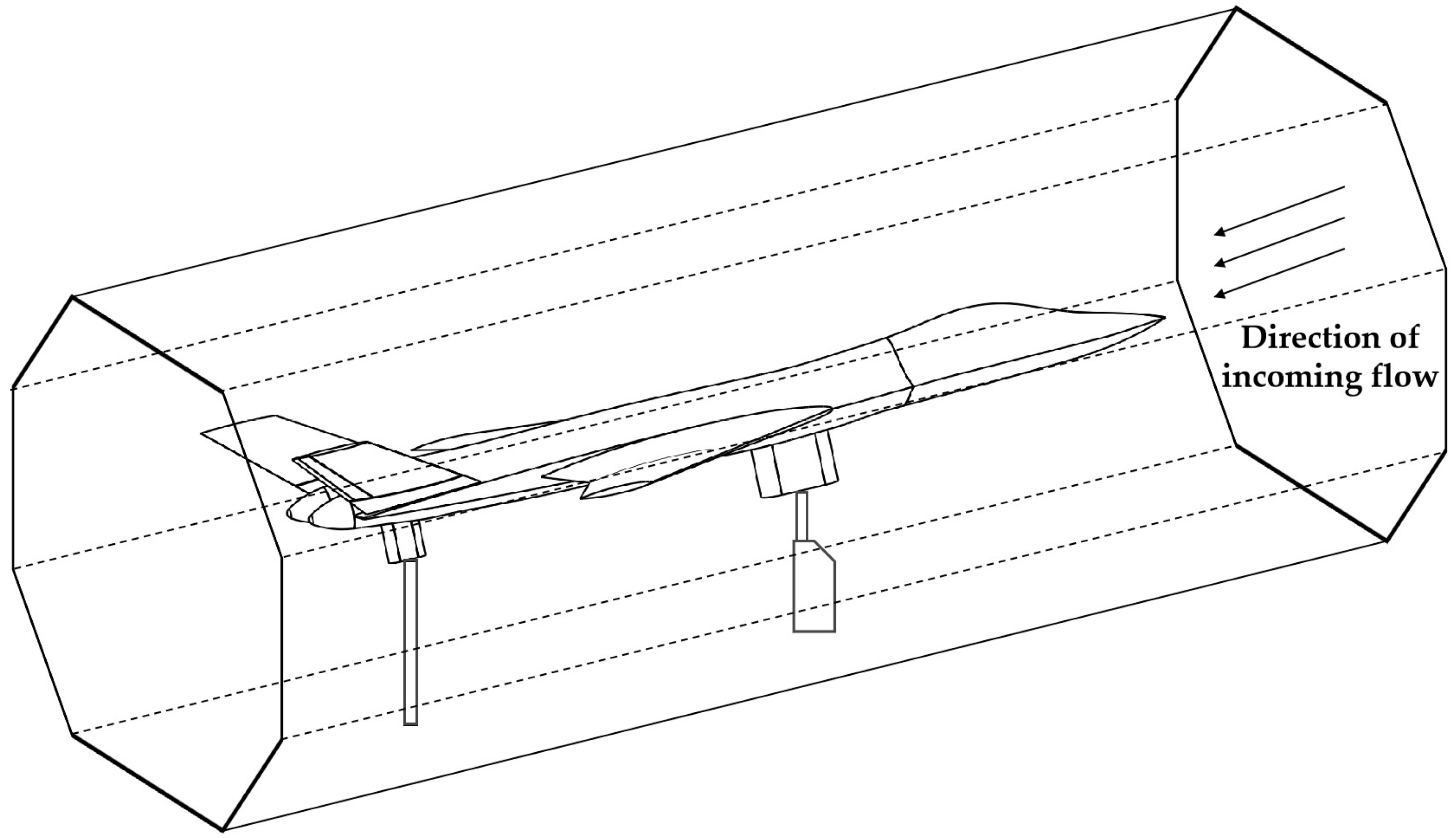
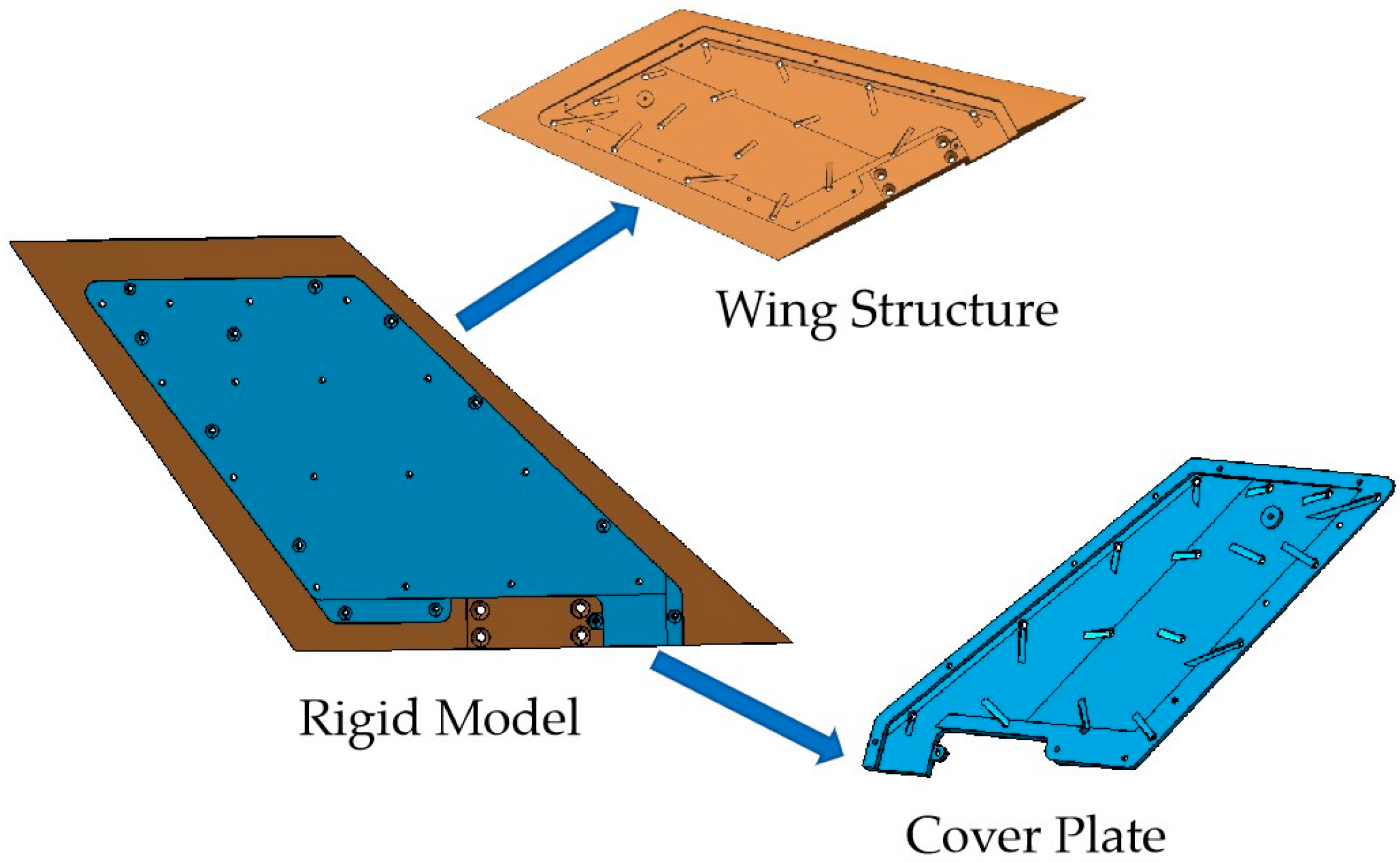
5.1. Design of the Buffeting Wind Tunnel Test Model
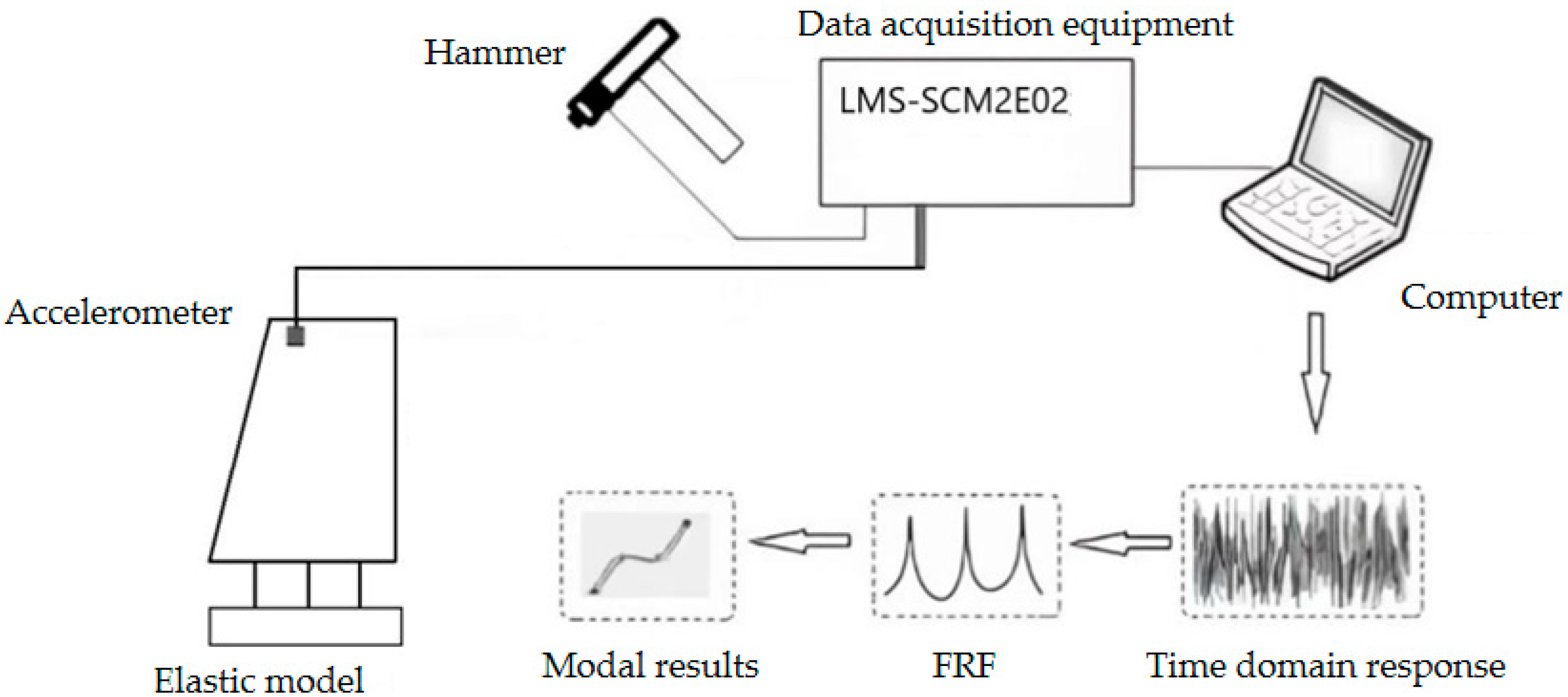
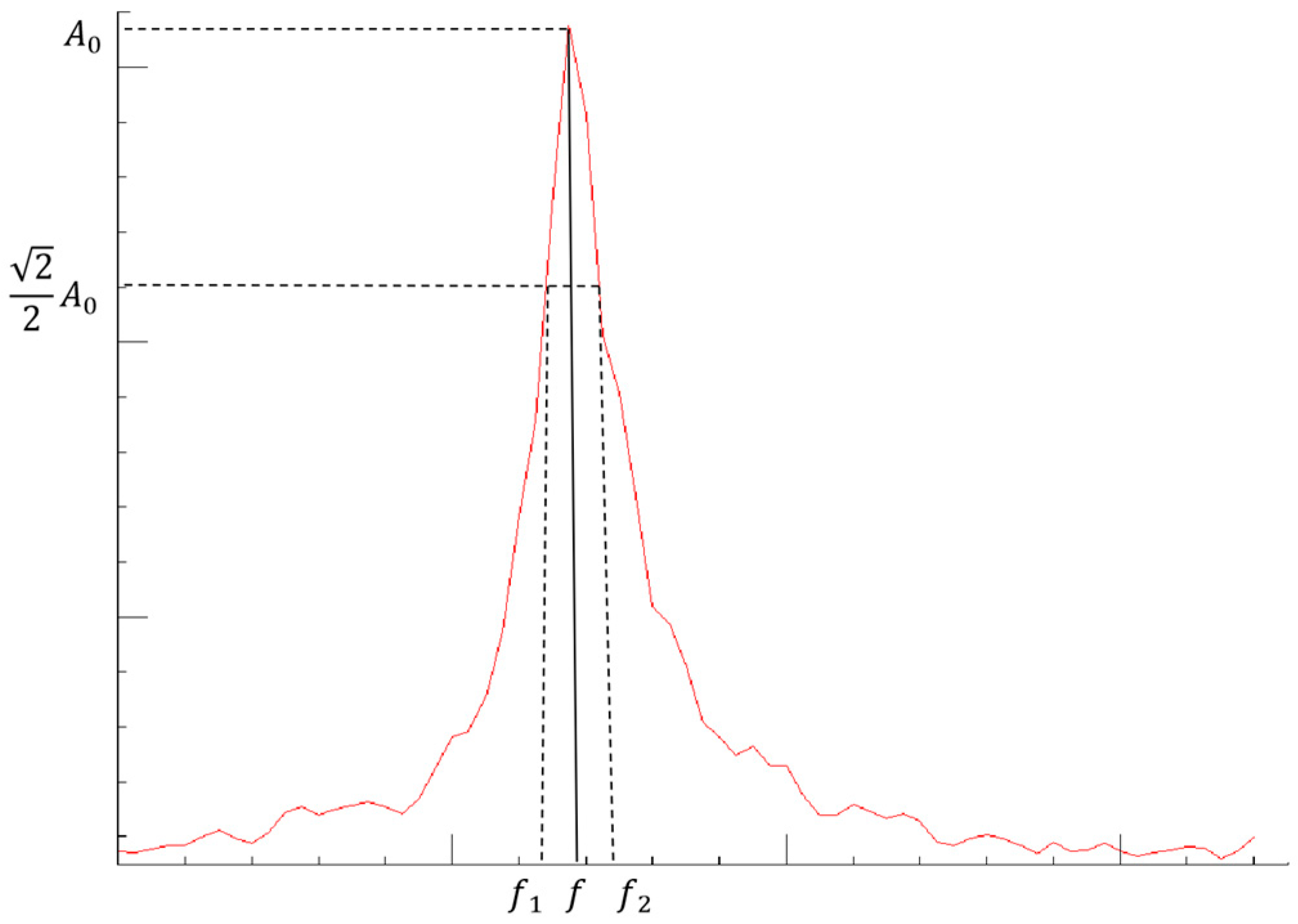
5.2. Ground Vibration Test of the Elastic Vertical-Tail Model
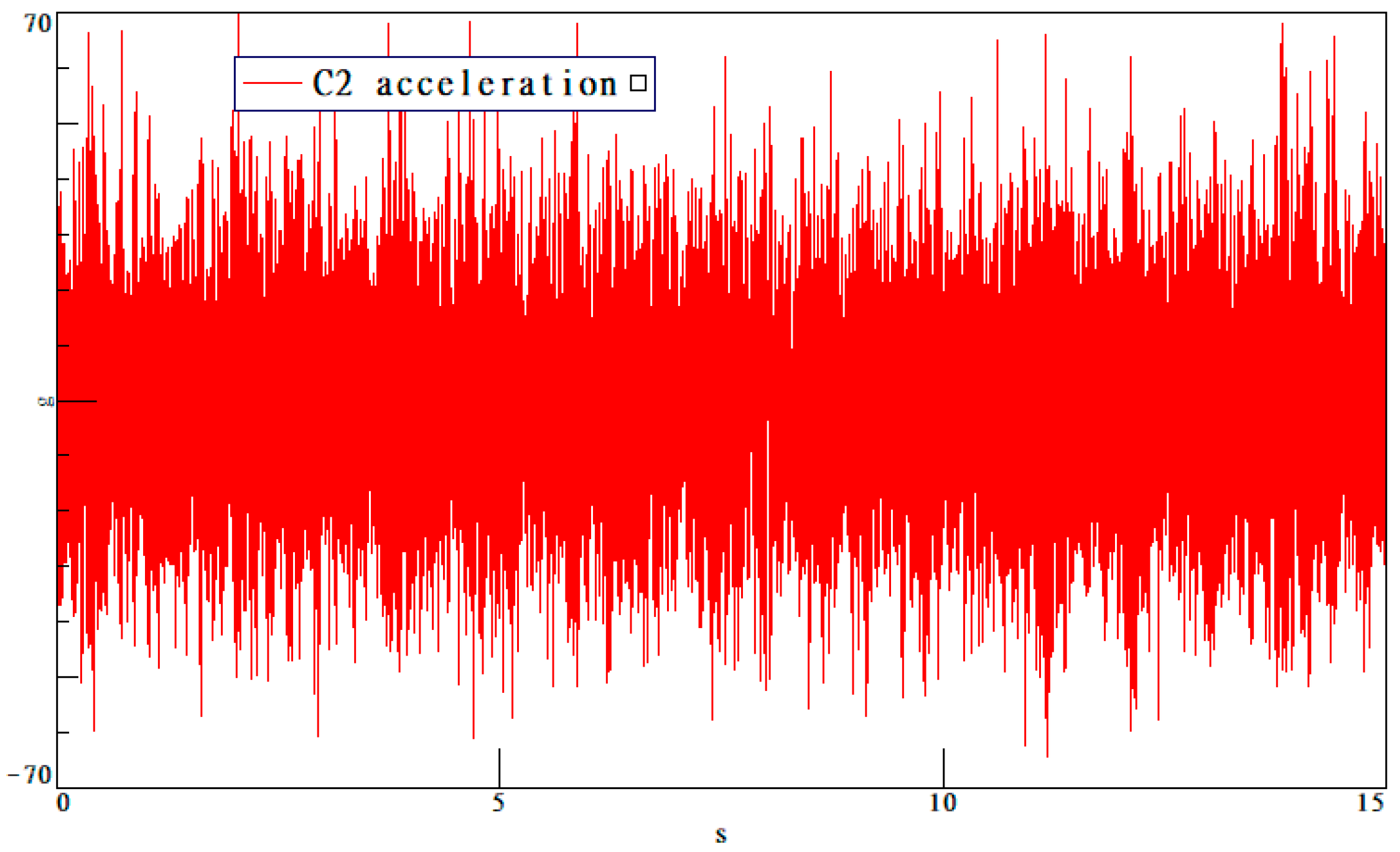
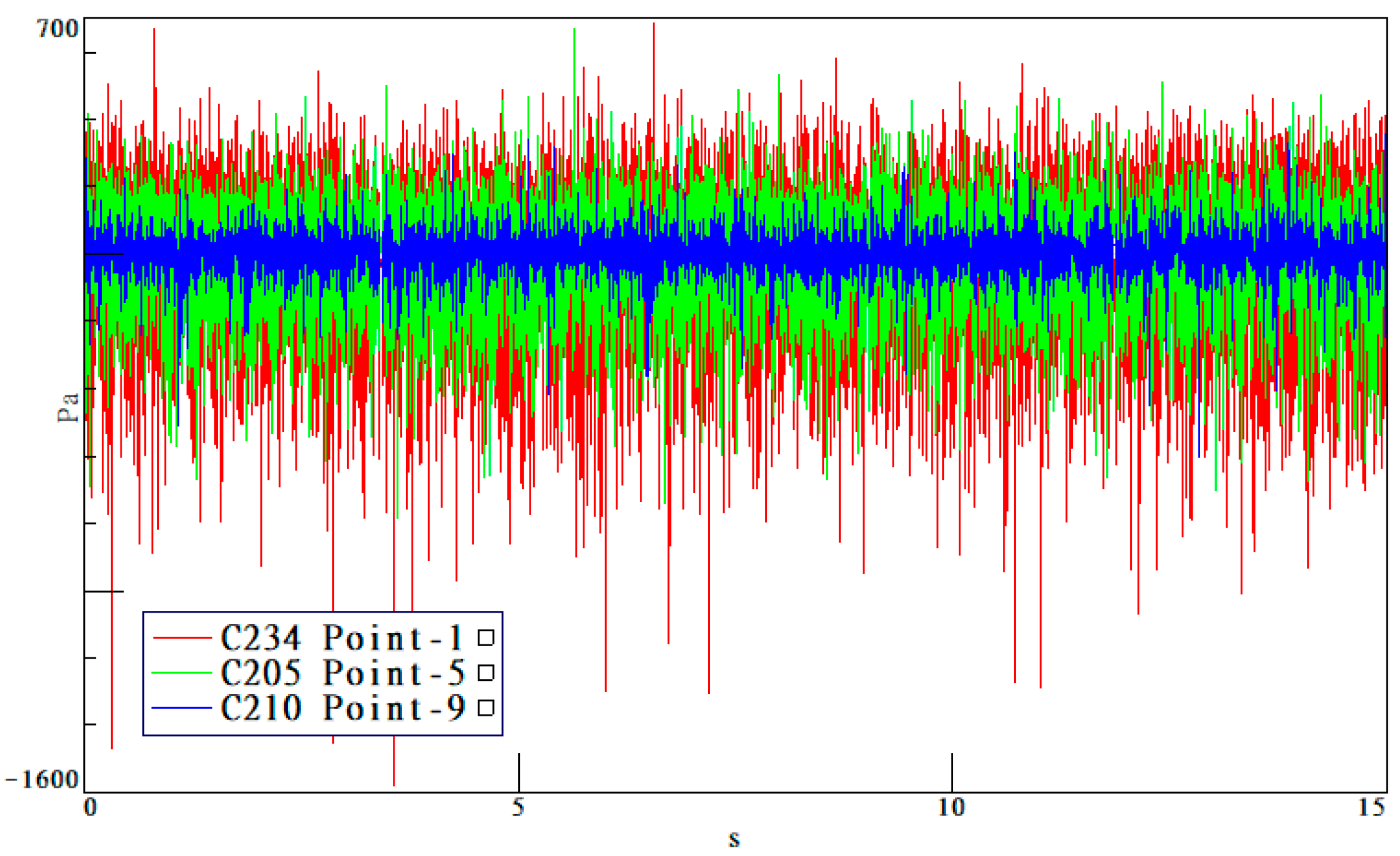
5.3. Wind-Tunnel Buffeting Test of the Model
6. Application of the Multi-Objective Point Response Prediction Method
6.1. Numerical Method Validation
6.2. Comparison of Predicted Responses
7. Conclusions
Author Contributions
Funding
Data Availability Statement
Conflicts of Interest
References
- Li, J.; Yang, Q.; Xiao, C.; Yang, Y.; Mu, R.; Zhang, J.; Ji, P. Investigation of Flow and Twin-Vertical Tail Buffet Characteristics of Leading- Edge Extension Configuration. Acta Aeronaut. Astronaut. Sin. 2006, 27, 395–398. [Google Scholar] [CrossRef]
- Moses, R.; Huttsell, L. Fin Buffeting Features of an Early F-22 Model. In Proceedings of the 41st Structures, Structural Dynamics, and Materials Conference and Exhibit, Atlanta, GA, USA, 3–6 April 2000. [Google Scholar] [CrossRef][Green Version]
- Shi, R. Modern Fighter Structural Dynamic Strength Design Guide, 1st ed.; Aviation Industry Press: Beijing, China, 2012; pp. 412–505. [Google Scholar]
- Hwang, C.; Pi, W.S. Aircraft Wake Flow Effect and Horizontal Tail Buffet. J. Aircr. 1979, 16, 282–284. [Google Scholar] [CrossRef]
- Chen, Z.; Zhang, L.; Liu, Y. Experimental Investigation on Buffet Load Characteristics of a Wide-body Aircraft Horizontal-tail in Take-off Configuration. J. Phys. Conf. Ser. 2024, 2820, 012024. [Google Scholar] [CrossRef]
- Guan, D. Aeroelastic Testing, 1st ed.; Beijing University of Aeronautics Press: Beijing, China, 1986; pp. 134–148. [Google Scholar]
- Lee, B.; Murty, H.; Jiang, H. Role of Kutta Waves on Oscillatory Shock Motion on an Airfoil. AIAA J. 1994, 32, 789–796. [Google Scholar] [CrossRef]
- Healey, M. F/A-18 E/F Vertical Tail Buffet, Design, Analysis and Test. In Proceedings of the 44th AIAA/ASME/ASCE/AHS/ASC Structures, Structural Dynamics, and Materials Conference, Norfolk, VA, USA, 7–10 April 2003. [Google Scholar] [CrossRef]
- Guillaume, M.; Gehri, A.; Stephani, P.; Vos, J.B.; Mandanis, G. F/A-18 Vertical Tail Buffeting Calculation Using Unsteady Fluid Structure Interaction. Aeronaut. J. 2011, 115, 285–294. [Google Scholar] [CrossRef]
- Meyn, L.; Lanser, W.; James, K. Full-Scale High Angle-of-Attack Tests of an F/A-18. In Proceedings of the 10th Applied Aerodynamics Conference, Palo Alto, CA, USA, 22–24 June 1992. [Google Scholar] [CrossRef]
- Lee, B.; Brown, D. Wind Tunnel Studies of F/A-18 Tail Buffet. In Proceedings of the 16th Aerodynamic Ground Testing Con-ference, Seattle, WA, USA, 18–20 June 1990. [Google Scholar] [CrossRef]
- Meng, D.; Sun, Y.; Wang, Y.; Li, W. Numerical Simulation of Fluctuating Pressure of Fighter Vertical Tail. Acta Aeronaut. Astronaut. Sin. 2016, 37, 2472–2480. [Google Scholar] [CrossRef]
- Elmekawy, A.; Kandil, O.A.; Baysal, O. F/A-18 Twin-Tail Buffet Modeling Using Nonlinear Eddy Viscosity Models. J. Aircr. 2016, 53, 1106–1112. [Google Scholar] [CrossRef]
- Han, B.; Xu, M. Prediction of Vertical Tail Buffet Using CFD/CSD Coupling Method. Math. Probl. Eng. 2021, 2021, 1–9. [Google Scholar] [CrossRef]
- Delgado-Gutiérrez, A.J.; Candon, M.J.; Marzocca, P.; Levinski, O. Aerodynamic Loads Estimation on a Twin Vertical-Tail Configuration Based on the Single-Step Lattice Boltzmann Method Simulation. In Proceedings of the AIAA SCITECH 2024 Forum, Orlando, FL, USA, 8–12 January 2024. [Google Scholar] [CrossRef]
- Ye, Z.; Wang, G.; Zhang, W. Fundamentals of Fluid-Structure Coupling and Its Application, 2nd ed.; Harbin Institute of Technology Press: Harbin, China, 2016; pp. 285–288. [Google Scholar]
- Zhang, W.; Gao, C.; Ye, Z. Research Advances of Wing/Airfoil Transonic Buffet. Acta Aeronaut. Astronaut. Sin. 2015, 36, 1056–1075. [Google Scholar] [CrossRef]
- Gao, C.; Zhang, W.; Ye, Z. Study on the Effects of Elastic Characteristics on Transonic Buffet Onset. Eng. Mech. 2017, 34, 243–247. [Google Scholar]
- Anderson, W.D.; Patel, S.R.; Black, C.L. Low Speed Wind Tunnel Buffet Testing on the F/A-22. J. Aircr. 2006, 43, 879–885. [Google Scholar] [CrossRef]
- Zou, C.; Li, B.; Liang, L.; Wang, W. Active Vertical Tail Buffeting Suppression Based on Macro Fiber Composites. In Proceedings of the Conference on Sensors and Smart Structures Technologies for Civil, Mechanical, and Aerospace Systems, Las Vegas, NV, USA, 20 March 2016. [Google Scholar] [CrossRef]
- Zhang, Q.; Ye, Z. Novel Method Based on Inflatable Bump for Vertical Tail Buffeting Suppression. J. Aircr. 2015, 52, 367–371. [Google Scholar] [CrossRef]
- Jin, W.; Yang, Z.; Meng, D.; Chen, Y.; Huang, H.; Wang, Y.; He, S.; Chen, Y. Strength Design and Test of Advanced Fighter All Moving Twin V-tail Buffet. Acta Aeronaut. Astronaut. Sin. 2020, 41, 523473. [Google Scholar] [CrossRef]
- Sun, Y.; Cheng, P.; Yu, J. Aeroelastic Correction for Nonlinear Aerodynamic Data in Wind Tunnel Tests. J. Exp. Fluid Mech. 2024, 38, 74–82. [Google Scholar] [CrossRef]
- Jasper, R.; Benedikt, H.; Clemens, J.; Hübler, C.; Rolfes, R. Multi-Objective Model Updating of Tower Structures Featuring Closely Spaced Modes. In Proceedings of the 11th European Workshop on Structural Health Monitoring (EWSHM 2024), Potsdam, Germany, 10–13 June 2024. [Google Scholar] [CrossRef]
- Liu, D.; Zhang, P.; Lv, B.; Guo, H.; Yu, L.; Chen, Y.; Lu, B. Simulation on Buffet Response and Mitigation of Variant-Tailed Aircraft in Maneuver State. Vibration 2024, 7, 503–520. [Google Scholar] [CrossRef]
- Pototzky, A.S.; Moses, R.W. A Method to Analyze Tail Buffet Loads of Aircraft. In Proceedings of the RTO/AVT-123: Symposium on Flow Induced Unsteady Loads and the Impact on Military Applications, Budapest, Hungary, 25–29 April 2005. [Google Scholar]
- Patel, S.; Black, C.; Anderson, W.; Zapata, F. F/A-22 Vertical Tail Buffet Strength Certification. In Proceedings of the 46th AIAA/ASME/ASCE/AHS/ASC Structures, Structural Dynamics and Materials Conference, Austin, TX, USA, 18–21 April 2005. [Google Scholar] [CrossRef]
- Guan, D. Manual of Aircraft Aeroelastic Mechanics, 1st ed.; Aviation Industry Press: Beijing, China, 1994; pp. 215–239. [Google Scholar]
- Ji, C.; Wu, Y.; Hou, Y.; Zhu, J.; Liu, W.; Bai, K.; Liu, Z. Experimental Study of Aerodynamic Damping Characteristics of a Launch Vehicle with Boosters in Transonic Flow. J. Exp. Fluid Mech. 2020, 34, 24–31. [Google Scholar] [CrossRef]
- Zhang, Y.; Lin, J. Fundamentals of Structural Dynamics, 1st ed.; Dalian University of Technology Press: Dalian, China, 2007; pp. 28–38. [Google Scholar]
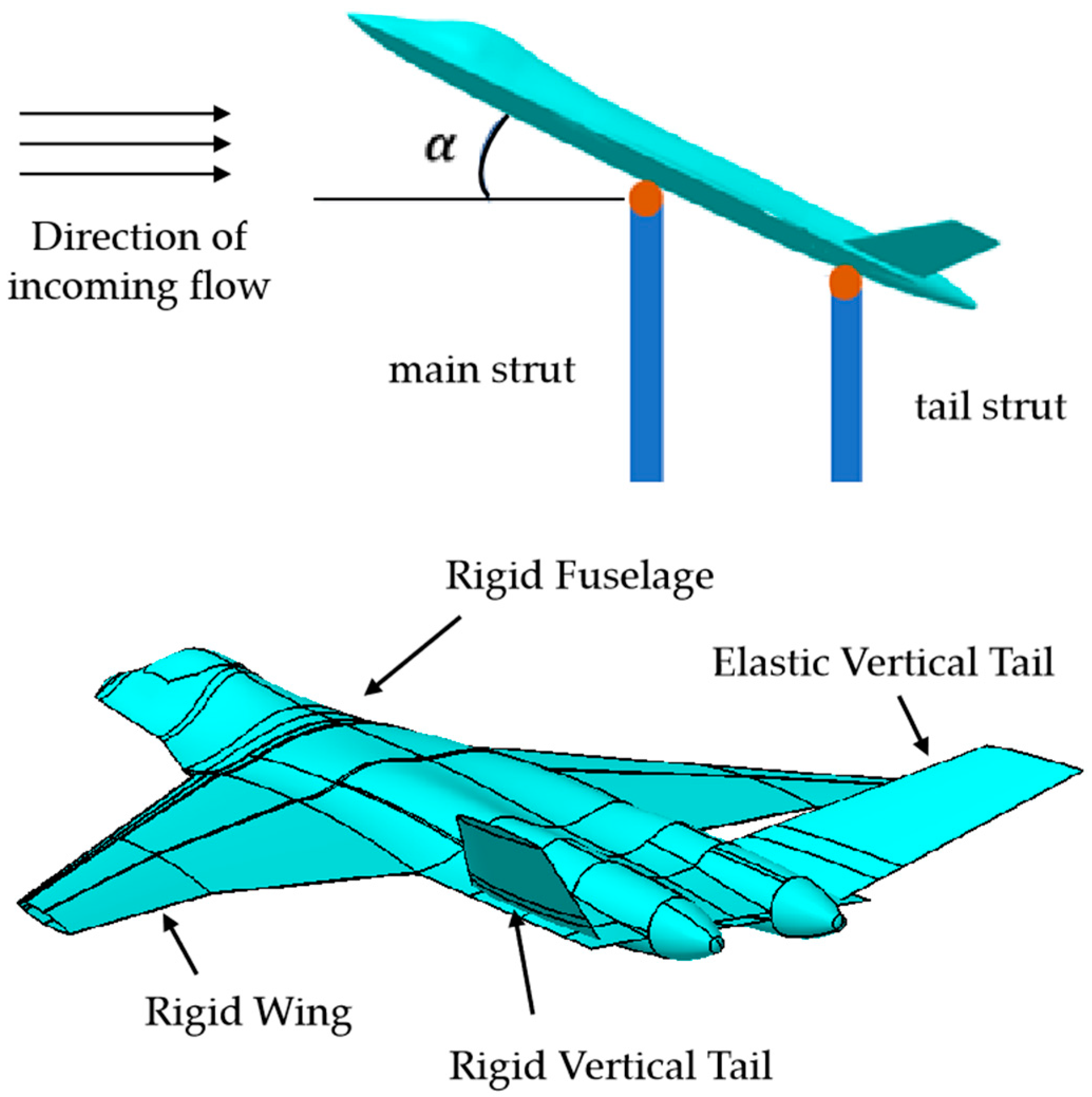















| Modal | Simulation Results/Hz | GVT Results/Hz | Theoretical Results/Hz | Relative Error |
|---|---|---|---|---|
| 1st Bending | 15.83 | 15.72 | 15.80 | −0.51% |
| 1st Torsional | 28.71 | 29.50 | 28.60 | 3.15% |
| 2nd Bending | 50.75 | 54.09 | 53.10 | 1.86% |
| 2nd Torsional | 73.25 | 78.69 | 77.10 | 2.07% |
| No. | Wind Speed/(m/s) | Angle of Attack/(°) |
|---|---|---|
| 1 | 40 | 20 |
| 2 | 40 | 23 |
| 3 | 40 | 26 |
| 4 | 40 | 29 |
| 5 | 40 | 32 |
| 6 | 40 | 35 |
| 7 | 40 | 38 |
| 8 | 40 | 41 |
| 9 | 40 | 44 |
| 10 | 40 | 47 |
| 11 | 40 | 50 |
| 12 | 40 | 53 |
| 13 | 40 | 56 |
| 14 | 40 | 59 |
| 15 | 40 | 62 |
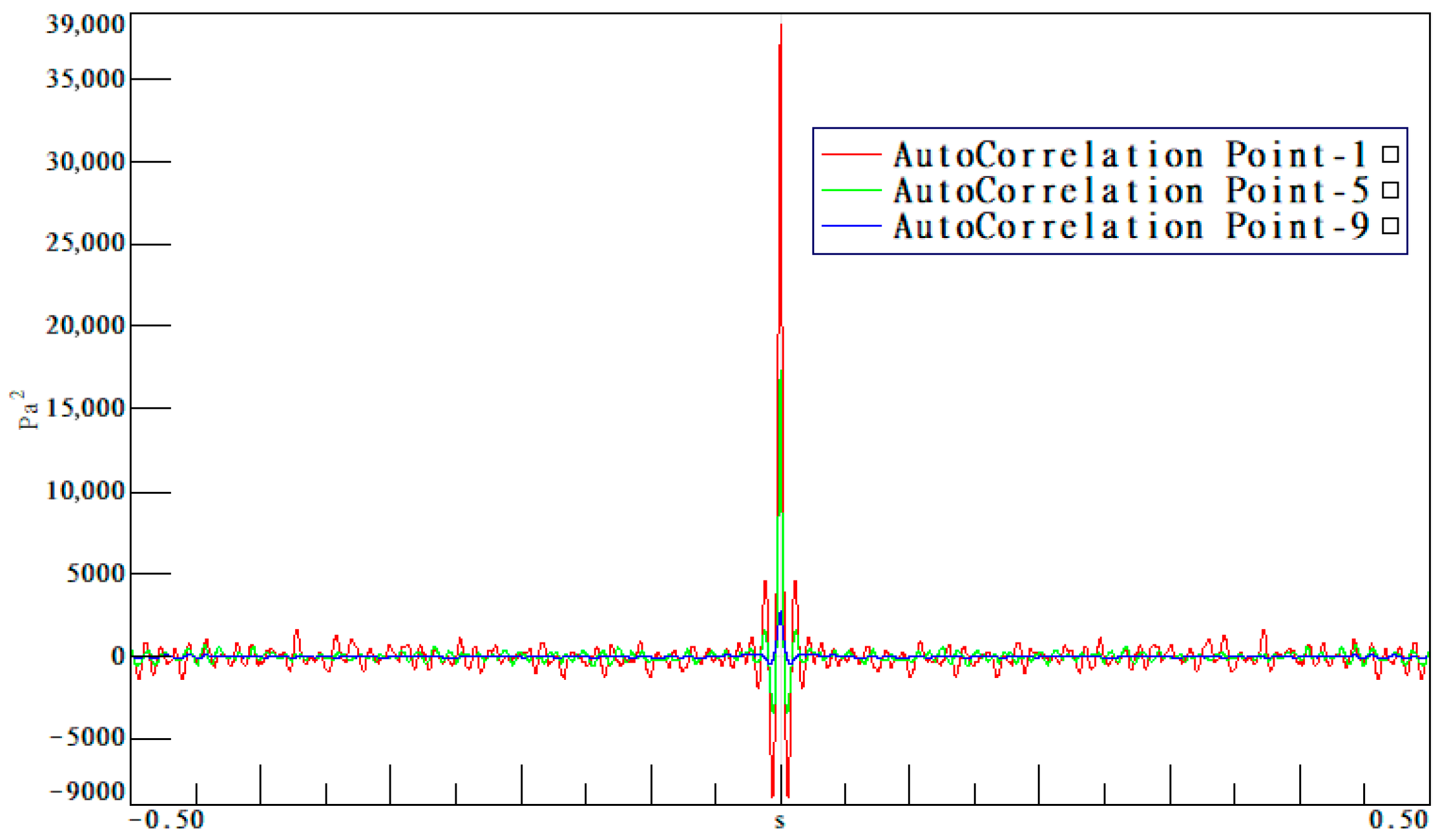
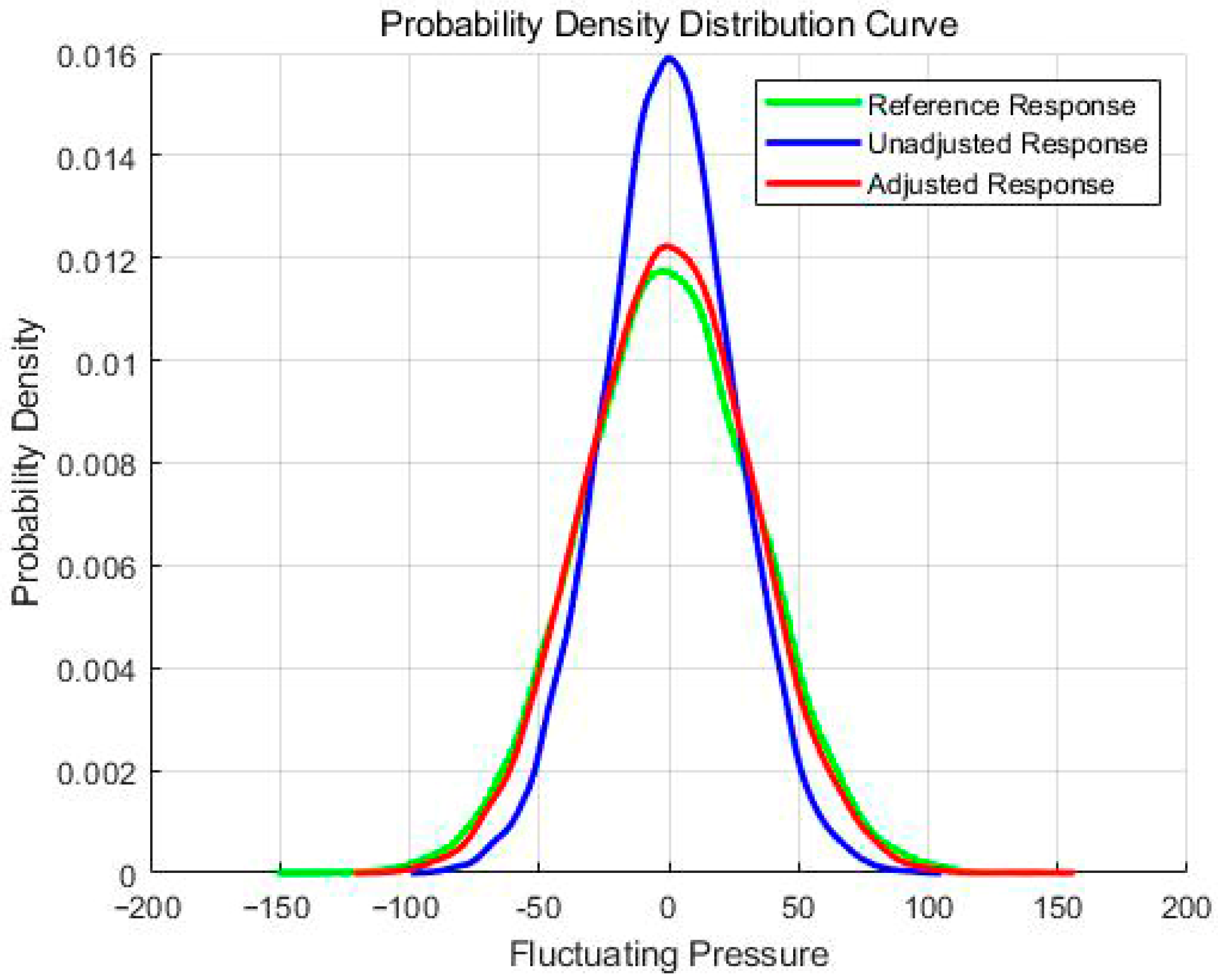
| Data Segments | Mean Point 1/Pa | RMS Point 1/Pa | Mean Point 2/Pa | RMS Point 2/Pa | Mean Point 3/Pa | RMS Point 3/Pa |
|---|---|---|---|---|---|---|
| 5 s | 2.21 | 191.01 | −2.95 | 132.71 | −0.09 | 52.86 |
| 10 s | −2.84 | 194.85 | −0.81 | 131.69 | 0.54 | 52.51 |
| 15 s | −1.71 | 192.63 | 0.07 | 131.68 | −0.98 | 52.53 |
| 20 s | −0.01 | 196.02 | 0.04 | 131.93 | 0.05 | 52.55 |
| Frequency Band/Hz | Damping/% |
|---|---|
| 0~35 | 1.14 |
| 35~86 | 7.51 |
| 86~165 | 7.06 |
| 165~250 | 2.63 |
| Flight Condition | /km | /° | |
|---|---|---|---|
| 1 | 4 | 0.3 | 26 |
| 2 | 4 | 0.5 | 26 |
| 3 | 6 | 0.3 | 23 |
| 4 | 6 | 0.5 | 23 |
| 5 | 8 | 0.3 | 20 |
| 6 | 8 | 0.5 | 20 |
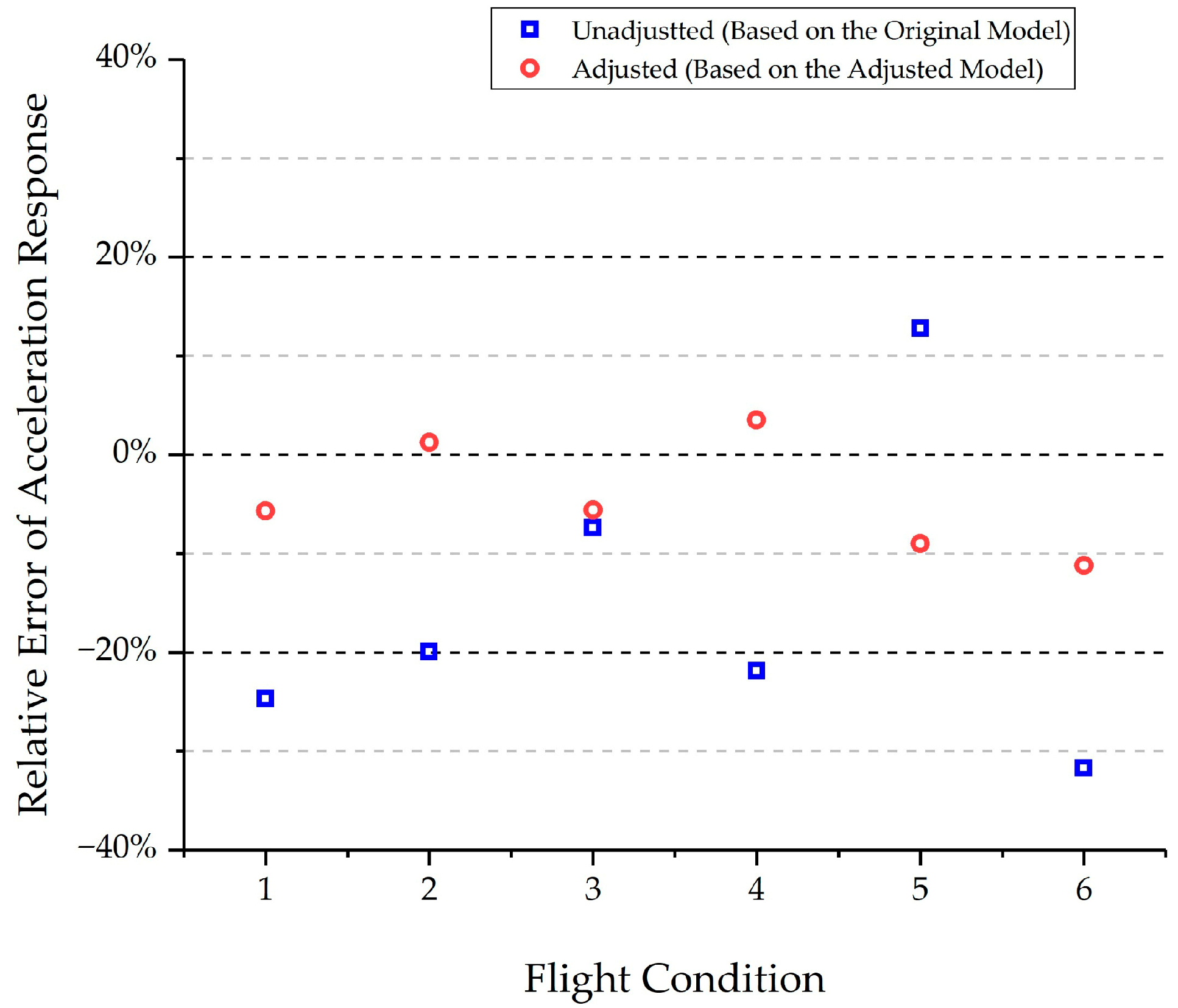
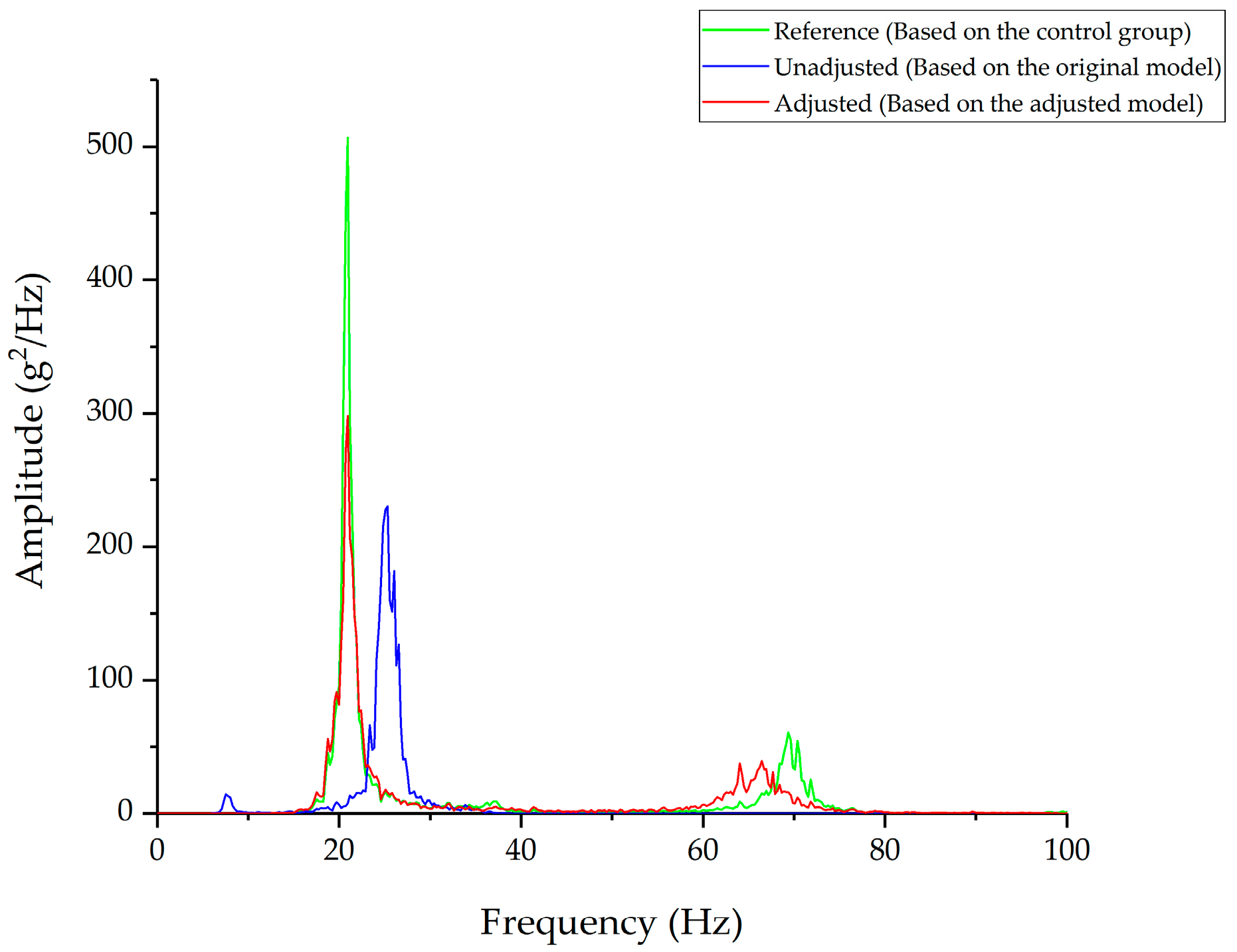
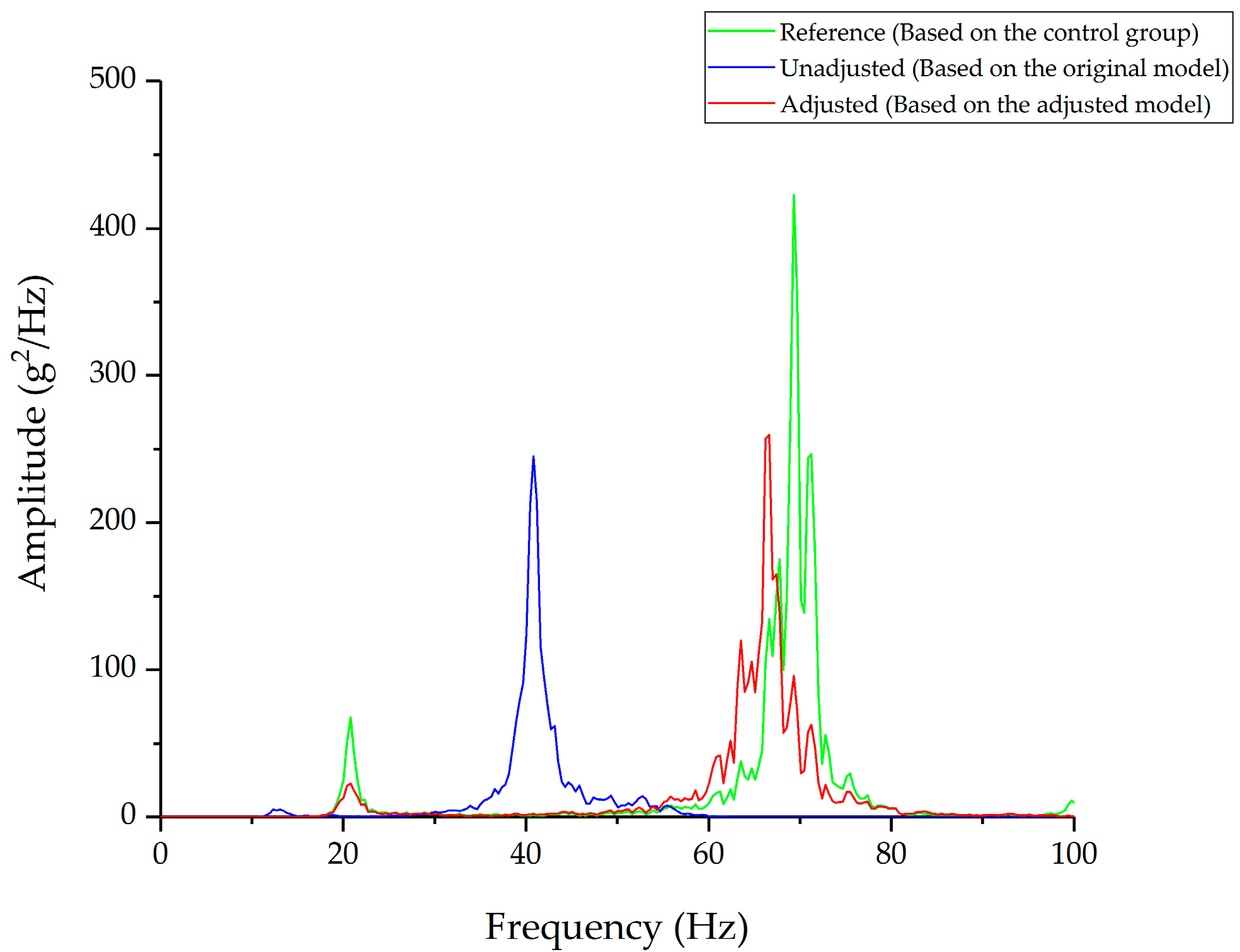
| Flight Condition | Reference Response/g | Unadjusted Response/g | Relative Error | Adjusted Response/g | Relative Error |
|---|---|---|---|---|---|
| 1 | 33.92 | 25.54 | −24.69% | 31.99 | −5.68% |
| 2 | 88.60 | 70.95 | −19.92% | 89.72 | 1.26% |
| 3 | 22.11 | 20.48 | −7.38% | 20.88 | −5.58% |
| 4 | 72.82 | 56.89 | −21.87% | 75.38 | 3.52% |
| 5 | 9.26 | 10.44 | 12.75% | 8.43 | −8.98% |
| 6 | 42.49 | 29.01 | −31.72% | 37.73 | −11.20% |
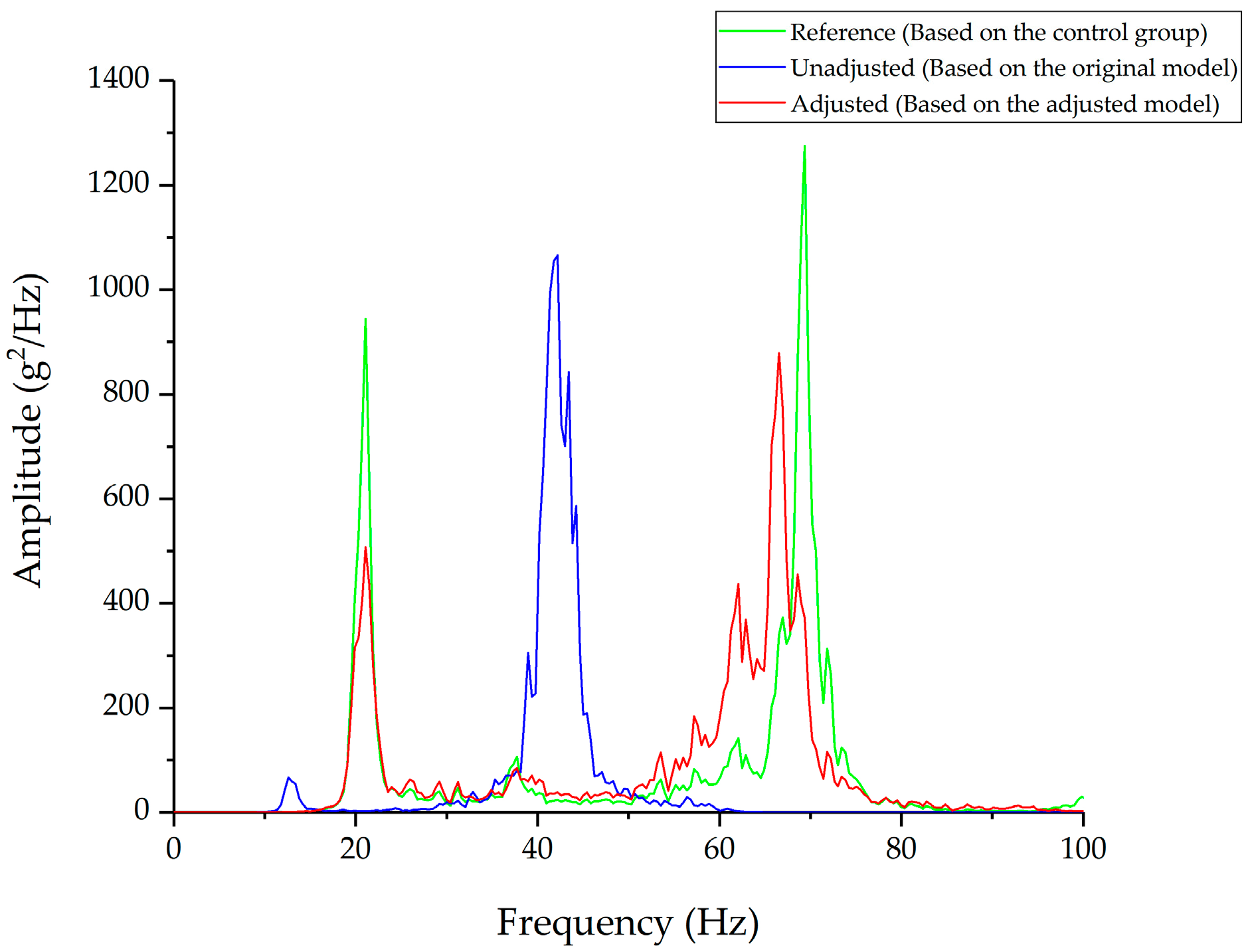
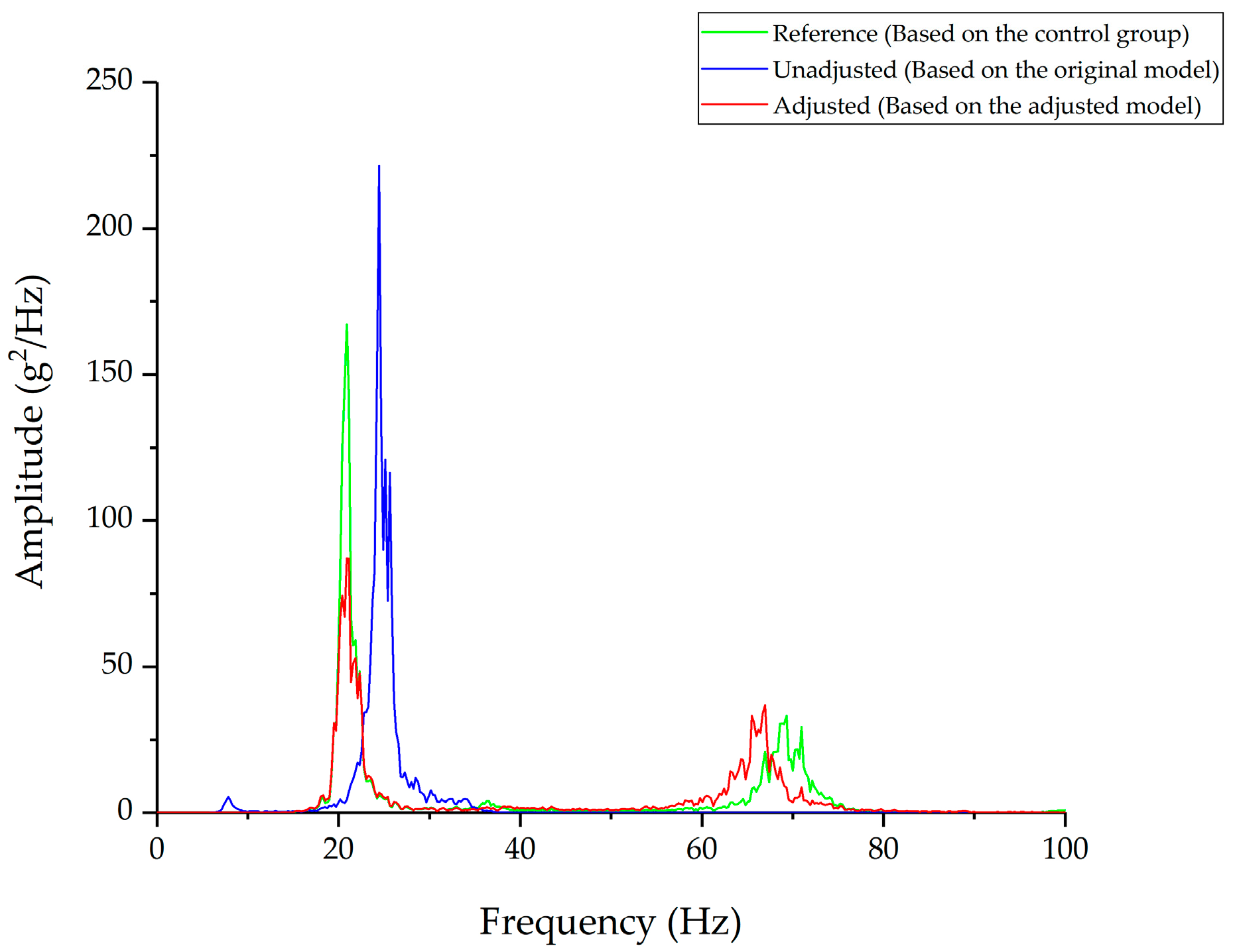
| Flight Condition | Reference Frequency/Hz | Adjusted Frequency/Hz | Relative Error |
|---|---|---|---|
| 1 | 20.94 | 20.96 | 0.10% |
| 2 | 21.10 | 21.12 | 0.09% |
| 3 | 20.89 | 20.91 | 0.10% |
| 4 | 20.57 | 20.96 | 1.90% |
| 5 | 20.80 | 21.03 | 1.11% |
| 6 | 20.80 | 20.83 | 0.14% |
| Flight Condition | Reference Frequency/Hz | Adjusted Frequency/Hz | Relative Error |
|---|---|---|---|
| 1 | 69.38 | 66.46 | −4.21% |
| 2 | 68.98 | 66.54 | −3.54% |
| 3 | 69.30 | 66.93 | −3.42% |
| 4 | 69.62 | 64.87 | −6.82% |
| 5 | 69.79 | 67.01 | −3.98% |
| 6 | 69.32 | 66.63 | −3.88% |
Disclaimer/Publisher’s Note: The statements, opinions and data contained in all publications are solely those of the individual author(s) and contributor(s) and not of MDPI and/or the editor(s). MDPI and/or the editor(s) disclaim responsibility for any injury to people or property resulting from any ideas, methods, instructions or products referred to in the content. |
© 2025 by the authors. Licensee MDPI, Basel, Switzerland. This article is an open access article distributed under the terms and conditions of the Creative Commons Attribution (CC BY) license.
Share and Cite
Liang, Z.; Feng, W.; Qian, W.; Jin, W.; Ai, X.; Li, Y. A Multi-Objective Point Response Prediction Method for Vertical Tail Buffeting Based on Elastic Scaling Transformation. Aerospace 2026, 13, 11. https://doi.org/10.3390/aerospace13010011
Liang Z, Feng W, Qian W, Jin W, Ai X, Li Y. A Multi-Objective Point Response Prediction Method for Vertical Tail Buffeting Based on Elastic Scaling Transformation. Aerospace. 2026; 13(1):11. https://doi.org/10.3390/aerospace13010011
Chicago/Turabian StyleLiang, Zhihai, Weizhe Feng, Wei Qian, Wei Jin, Xinyu Ai, and Yuhai Li. 2026. "A Multi-Objective Point Response Prediction Method for Vertical Tail Buffeting Based on Elastic Scaling Transformation" Aerospace 13, no. 1: 11. https://doi.org/10.3390/aerospace13010011
APA StyleLiang, Z., Feng, W., Qian, W., Jin, W., Ai, X., & Li, Y. (2026). A Multi-Objective Point Response Prediction Method for Vertical Tail Buffeting Based on Elastic Scaling Transformation. Aerospace, 13(1), 11. https://doi.org/10.3390/aerospace13010011