
An Impact Strain Monitoring and Simulating Method for Large-Size Composite Skin Panel with Optical Fiber Sensors


Abstract
1. Introduction
2. Methods
2.1. Strain Relationship for Different Impact Loads
2.2. Strain Relationship for Different Impact Locations
3. Experiments
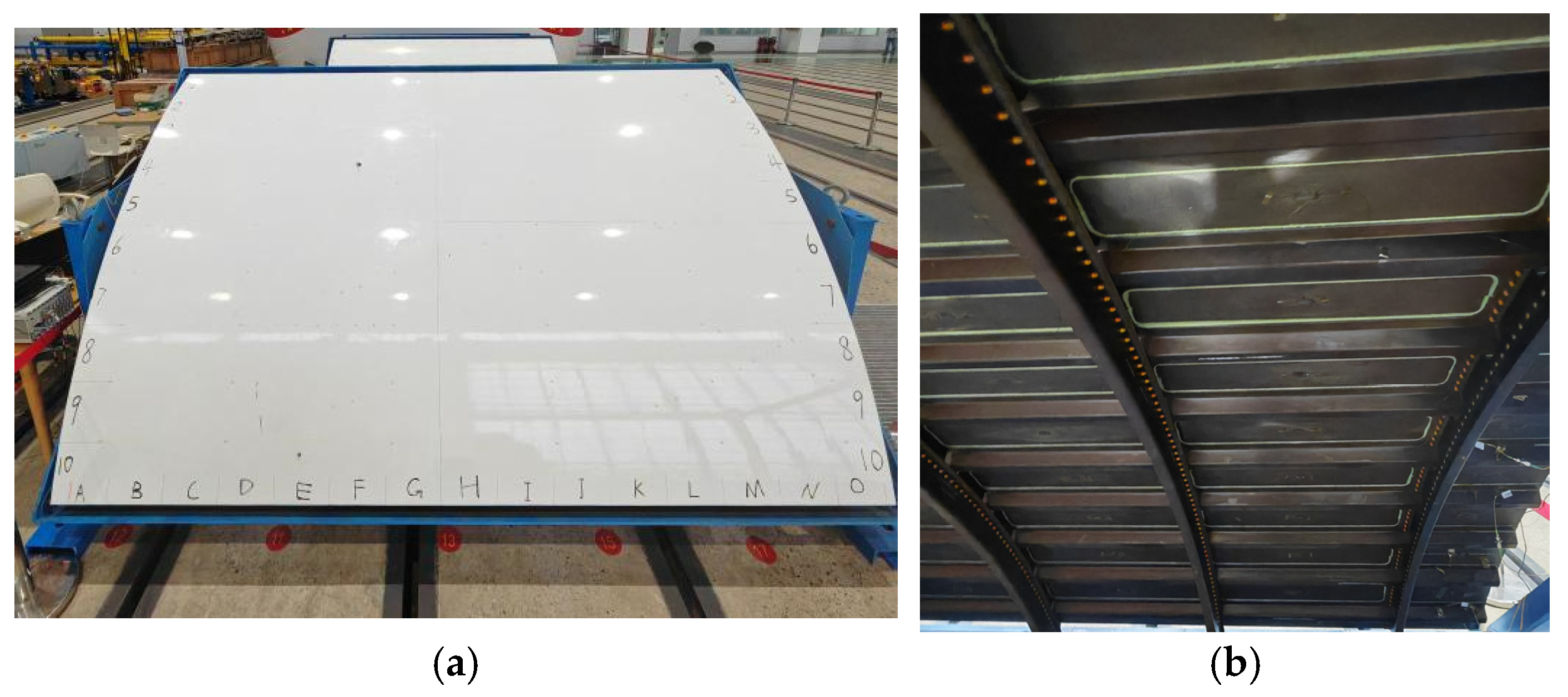
3.1. Specimens
3.2. Impact Tests
4. Results and Discussion
4.1. Simulation Results Verification
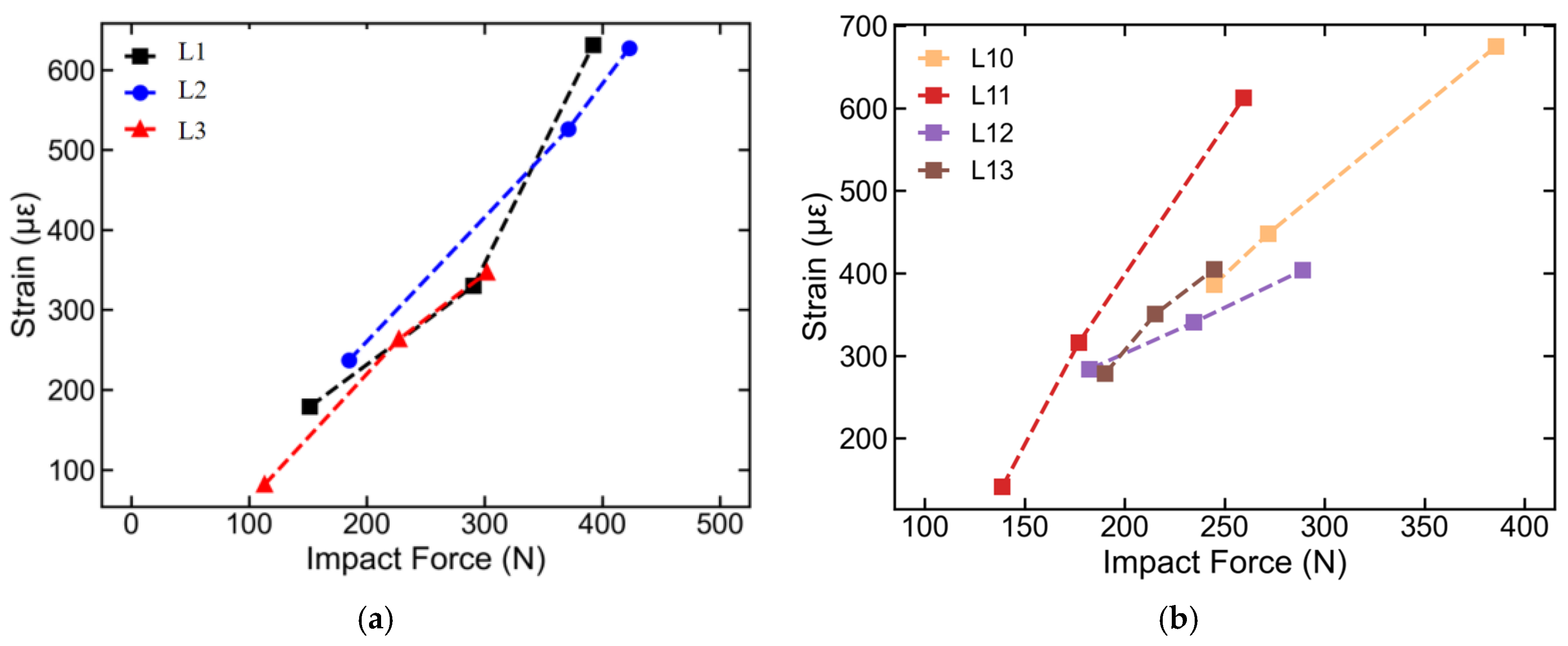
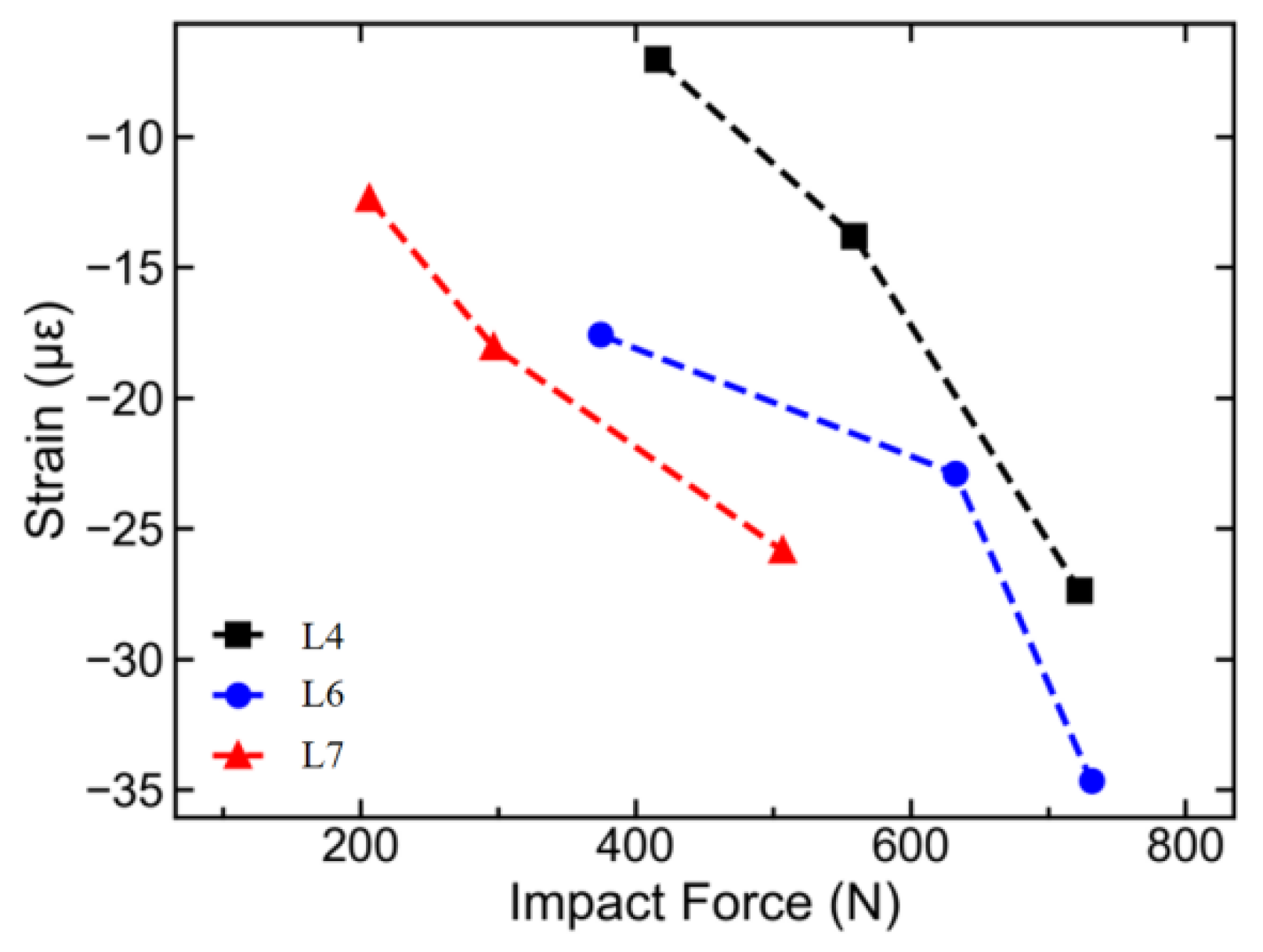
4.2. Strain Relationship for Different Impact Loads Verification
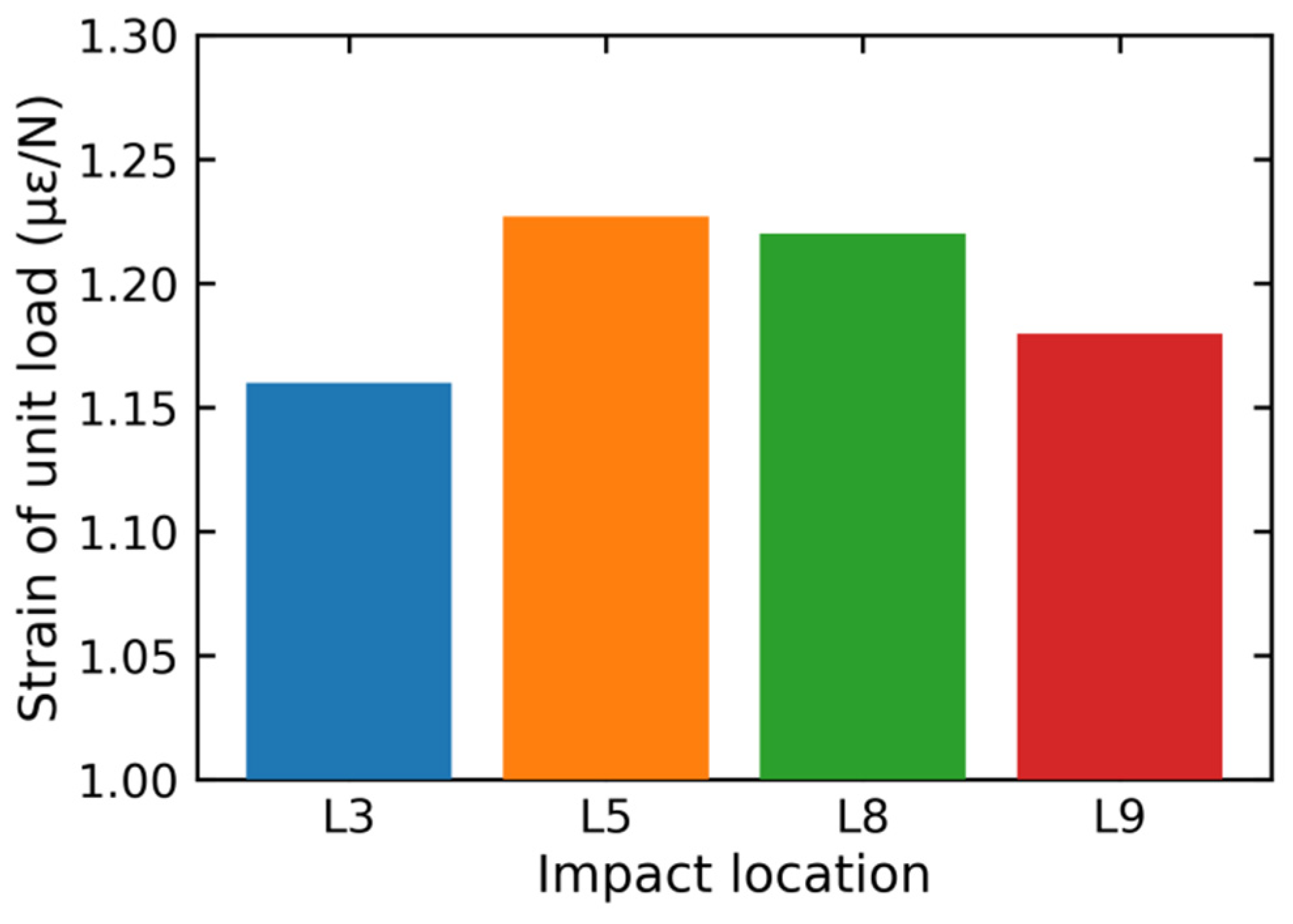
4.3. Strain Relationship for Different Impact Locations Verification
4.4. The Influence of Sensor Integration on Manufacturing Processes
4.5. The Applicability Limits of the Method with Respect to Laminate Thickness and Structural Configuration
5. Conclusions
- (1)
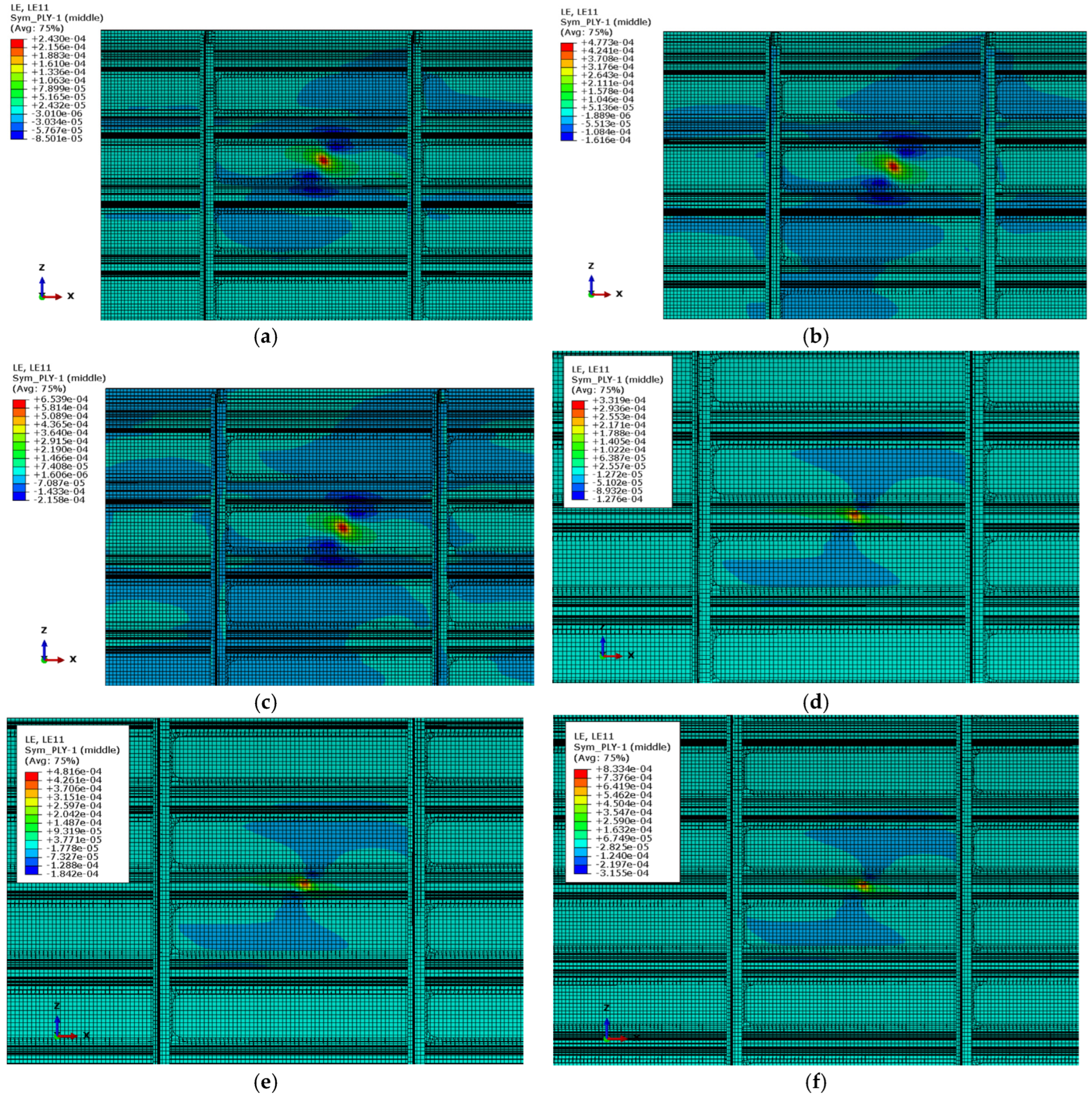
- The proposed simulation modeling approach for large-size composite skin panels accurately predicts the strain responses of these structures under low-speed impacts. The experimental measurement yielded a 95% confidence interval for strain per unit load of 1.15–1.25 µε/N, while the simulation predicted an interval of 1.43–1.45 µε/N. The two intervals do not overlap, with a percentage difference of 18%. Although the simulation overestimates, the deviation remains within the upper limit of the 20% engineering tolerance acceptable for verifying low-speed impact response in composite materials [21].
- (2)
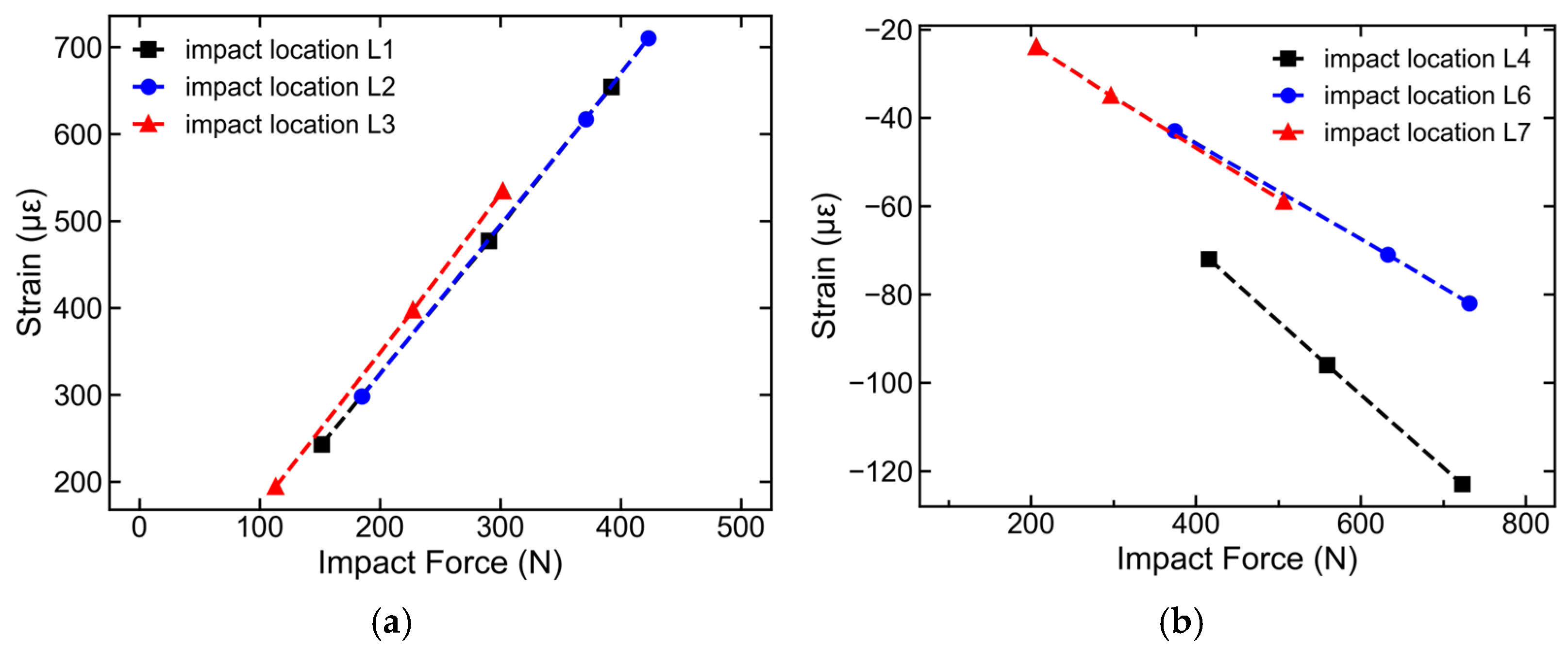
- The strain extremums during impacts exhibit a linear relation with the impact forces. The demonstrated linear relation allows designers to reduce the complex low-velocity impact problem to an elastic beam/plate calculation, enabling rapid down-selection, load extrapolation and field inversion while maintaining engineering accuracy—thus significantly improving the efficiency and economy of the entire chain from design and certification to maintenance of composite structures.
- (3)
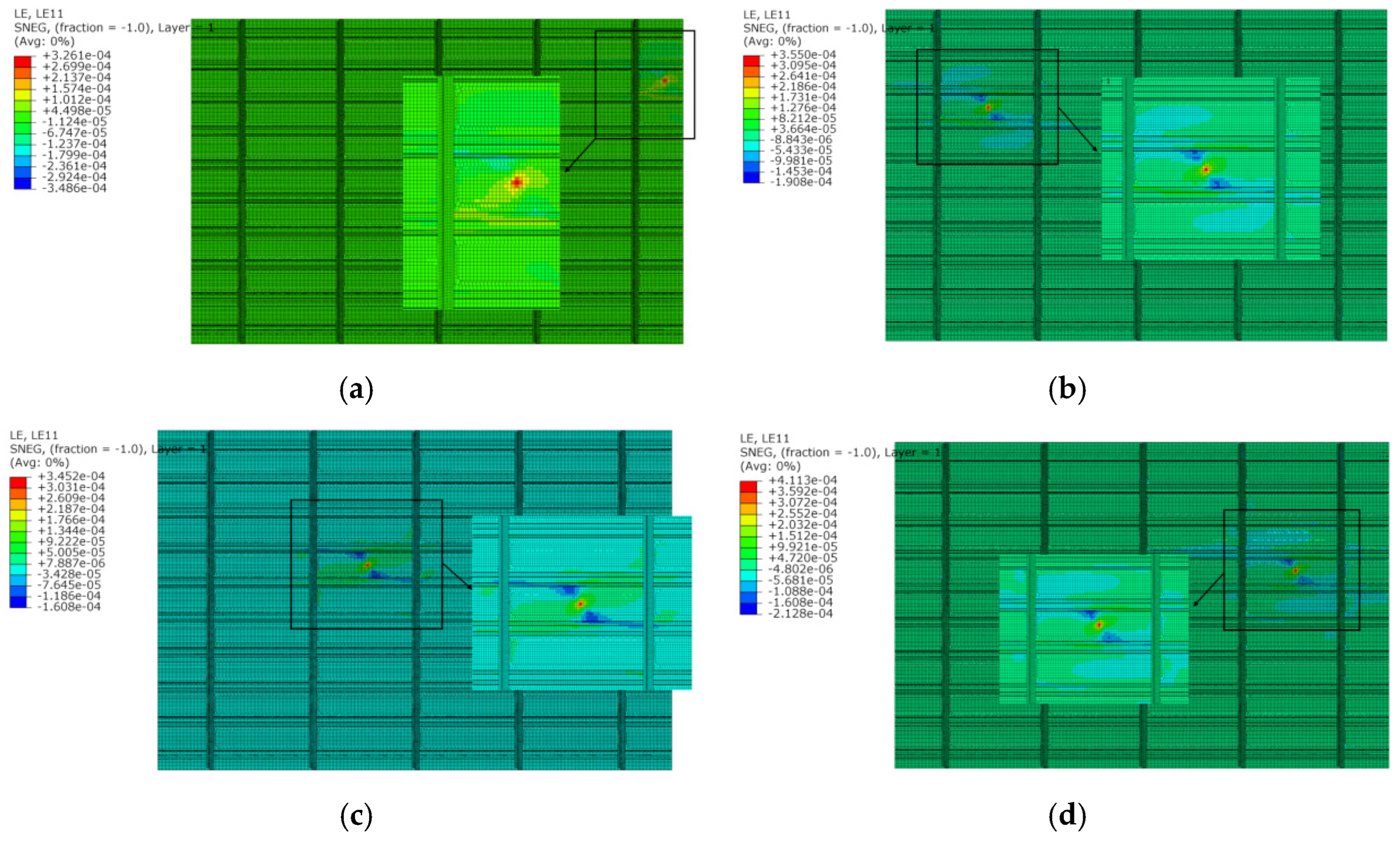
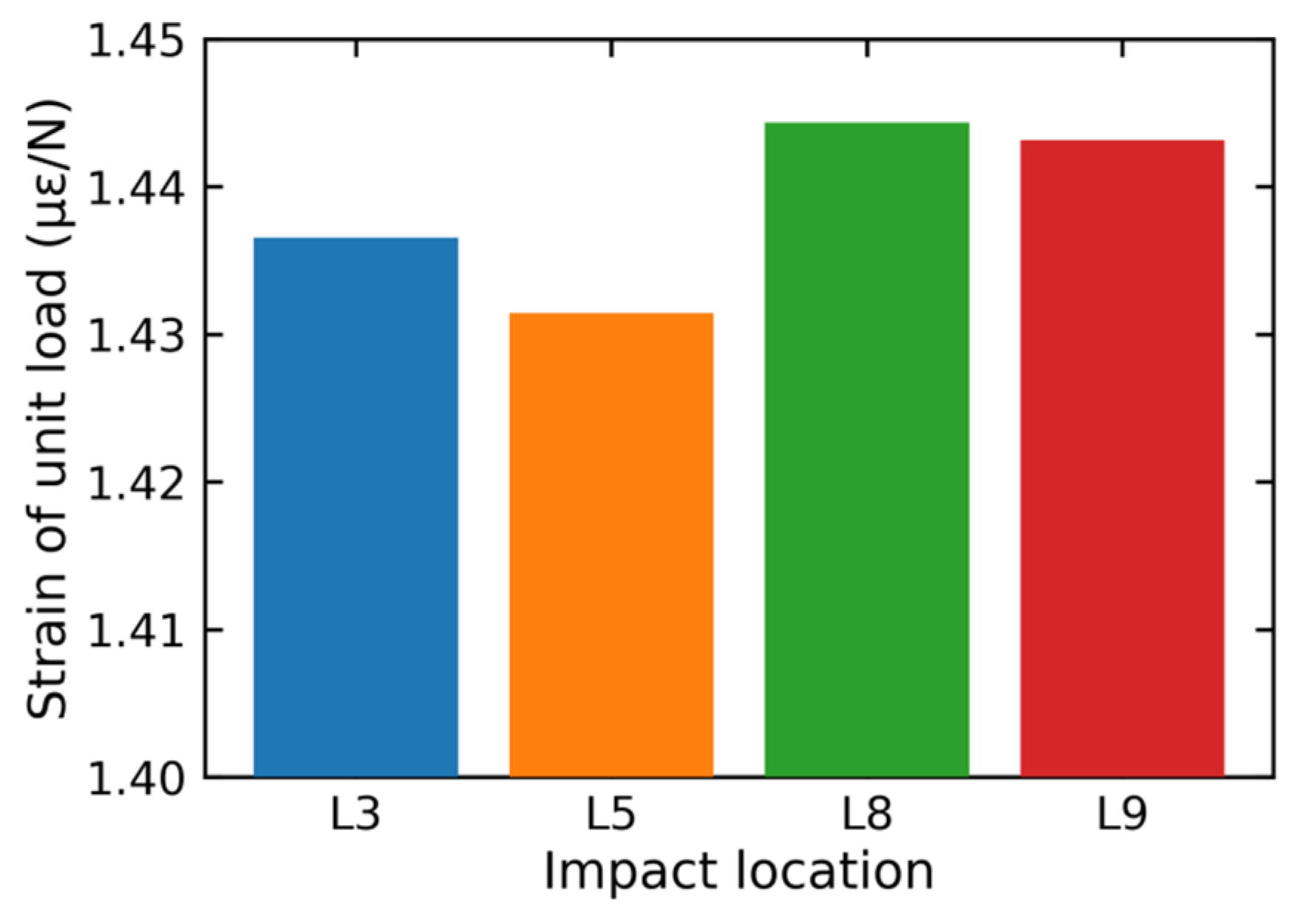
- At impact positions located centrally between two adjacent frames and two stringers, the mean absolute percentage differences in strain extremums per unit load of experimental and simulation results were 0.34% and 2.24%. The reasons for variations include differences in local stiffness at various positions, boundary effects, errors in sensor placement and inaccuracies in the impact location during manual tapping.
Author Contributions
Funding
Data Availability Statement
Conflicts of Interest
References
- Li, L.; Liu, W.; Wang, Y.; Zhao, Z. Mechanical performance and damage monitoring of CFRP thermoplastic laminates with an open hole repaired by 3D printed patches. Compos. Struct. 2023, 303, 116308. [Google Scholar] [CrossRef]
- Barile, C.; Casavola, C.; Pappalettera, G.; Kannan, V.P. Damage monitoring of carbon fibre reinforced polymer composites using acoustic emission technique and deep learning. Compos. Struct. 2022, 292, 115629. [Google Scholar] [CrossRef]
- Rezasefat, M.; Beligni, A.; Sbarufatti, C.; Amico, S.C.; Manes, A. Experimental and numerical study of the influence of pre-existing impact damage on the low-velocity impact response of CFRP panels. Materials 2023, 16, 914. [Google Scholar] [CrossRef] [PubMed]
- Wang, Z.; Zhao, M.; Liu, K.; Yuan, K.; He, J. Experimental analysis and prediction of CFRP delamination caused by ice impact. Eng. Fract. Mech. 2022, 273, 108757. [Google Scholar] [CrossRef]
- Pawan, P.; Avitabile, P. Prediction of full field dynamic stress/strain from limited sets of measured data. In Structural Dynamics, Volume 3, Proceedings of the 28th IMAC, A Conference on Structural Dynamics, New York, NY, USA, 1–4 February 2010; Springer: New York, NY, USA, 2011. [Google Scholar]
- Matthew James, N. Structural Analysis and Testing of a Carbon-Composite Wing Using Fiber BRAGG Gratings. Master’s Thesis, Mississippi State University, Lee Boulevard, MS, USA, 2013. [Google Scholar]
- Derkevorkian, A.; Masri, S.; Alvarenga, J.; Boussalis, H. Strain-Based Deformation Shape-Estimation Algorithm for Control and Monitoring Applications. AIAA J. 2013, 51, 2231–2240. [Google Scholar] [CrossRef]
- Vazquez, S.L.; Tessler, A.; Quach, C.C.; Cooper, E.G.; Parks, J.; Spangler, J. Structural Health Monitoring Using High-Density Fiber Optic Strain Sensor and Inverse Finite Element Methods; No. L-19083; NASA: Washington, DC, USA, 2005.
- Lally, E.M.; Reaves, M.; Horrell, E.; Klute, S.; Froggatt, M.E. Fiber optic shape sensing for monitoring of flexible structures. In Sensors and Smart Structures Technologies for Civil, Mechanical, and Aerospace Systems, Proceedings of the SPIE Smart Structures and Materials + Nondestructive Evaluation and Health Monitoring, San Diego, CA, USA, 11–15 March 2012; SPIE: St Bellingham, WA, USA, 2012; Volume 8345. [Google Scholar]
- Nishio, M.; Mizutani, T.; Takeda, N. Structural shape reconstruction with consideration of the reliability of distributed straindata from a Brillouin-scattering-based optical fiber sensor. Smart Mater. Struct. 2010, 19, 035011. [Google Scholar] [CrossRef]
- Abayazid, M.; Kemp, M.; Misra, S. 3d flexible needle steering in soft-tissue phantoms using fiber bragg grating sensors. In Proceedings of the IEEE International Conference on Robotics and Automation, Karlsruhe, Germany, 6–10 May 2013. [Google Scholar]
- Rajan, G.; Ramakrishnan, M.; Semenova, Y.; Ambikairajah, E.; Farrell, G.; Peng, G.-D. Experimental study and analysis of a polymer fiber Bragg grating embedded in a composite material. J. Light. Technol. 2014, 32, 1726–1733. [Google Scholar] [CrossRef]
- Yi, J.; Zhu, X.; Zhang, H.; Shen, L.; Qiao, X. Spatial shape reconstruction using orthogonal fiber Bragg grating sensor array. Mechatronics 2012, 22, 679–687. [Google Scholar] [CrossRef]
- Yu, J.; Liang, D. Impact localization system for composite barrel structure using fiber bragg grating sensors. Optik 2019, 182, 201–210. [Google Scholar] [CrossRef]
- Di Sante, R. Fibre optic sensors for structural health monitoring of aircraft composite structures: Recent advances and applications. Sensors 2015, 15, 18666–18713. [Google Scholar] [CrossRef] [PubMed]
- Rickman, S.L.; Richards, W.L.; Christiansen, E.L.; Piazza, A.; Pena, F.; Parker, A.R. Micrometeoroid/orbital debris (MMOD) impact detection and location using fiber optic bragg grating sensing technology. Procedia Eng. 2017, 188, 233–240. [Google Scholar] [CrossRef]
- Shrestha, P.; Park, Y.; Kwon, H.; Kim, C.-G. Low velocity impact monitoring of composite wing structure under simulated wing loading condition using fiber Bragg grating sensors. In Proceedings of the 25th Optical Fiber Sensors Conference (OFS), Seoul, Republic of Korea, 24–28 April 2017. [Google Scholar]
- Shrestha, P.; Kim, J.-H.; Park, Y.; Kim, C.-G. Impact localization on composite structure using FBG sensors and novel impact localization technique based on error outliers. Compos. Struct. 2016, 142, 263–271. [Google Scholar] [CrossRef]
- Jiang, M.; Sai, Y.; Geng, X.; Sui, Q.; Liu, X.; Jia, L. Development of an FBG sensor array for multi-impact source localization on CFRP structures. Sensors 2016, 16, 1770. [Google Scholar] [CrossRef] [PubMed]
- Niri, E.D.; Farhidzadeh, A.; Salamone, S. Determination of the probability zone for acoustic emission source location in cylindrical shell structures. Mech. Syst. Signal Process. 2015, 60, 971–985. [Google Scholar] [CrossRef]
- Jiang, X.; Wang, H.; Zhu, J. Peridynamic nmodelingofcompositelalaminate under low-velocity impactusing energy-basedcriteria. Acta Mater. Compos. Sin. 2024, 41, 2126–2136. (In Chinese) [Google Scholar]



| Density | ρ = 1.6 × 10⁻⁹ t/mm3 |
| Young’s modulus | E11 = 160 × 103 MPa E22 = E33 = 8.63 × 10³ MPa G12 = G13 = 3.0 GPa, G23 = 4.4 GPa |
| Poisson’s ratio | ν12 = ν13 = 0.33, ν23 = 0.35 |
| Test Number | Impact Force/N | Impact Location | Description |
|---|---|---|---|
| 1-1 | 152 | L1 | Load–strain relationship verification |
| 1-2 | 291 | ||
| 1-3 | 392 | ||
| 2-1 | 185 | L2 | |
| 2-2 | 371 | ||
| 2-3 | 423 | ||
| 3-1 | 113 | L3 | |
| 3-2 | 227 | ||
| 3-3 | 302 | ||
| 4-1 | 416 | L4 | |
| 4-2 | 559 | ||
| 4-3 | 723 | ||
| 5-1 | 374 | L6 | |
| 5-2 | 633 | ||
| 5-3 | 732 | ||
| 6-1 | 206 | L7 | |
| 6-2 | 297 | ||
| 6-3 | 507 | ||
| 7-1 | 227 | L3 | Location–strain relationship verification |
| 7-2 | 248 | L5 | |
| 7-3 | 239 | L8 | |
| 7-4 | 285 | L9 |
| Test Number | Target Force (N) | Achieved Force (N) | Impact Location | Strain of Experiment (με) | Strain of Simulation (με) |
|---|---|---|---|---|---|
| 1-1 | 100~400 | 152 | L1 | 178 | 243 |
| 1-2 | 291 | 330 | 477 | ||
| 1-3 | 392 | 631 | 654 | ||
| 2-1 | 185 | L2 | 237 | 298 | |
| 2-2 | 371 | 526 | 617 | ||
| 2-3 | 423 | 607 | 710 | ||
| 3-1 | 113 | L3 | 106 | 194 | |
| 3-2 | 227 | 263 | 397 | ||
| 3-3 | 302 | 346 | 534 | ||
| 4-1 | 400~800 | 416 | L4 | −7 | −72 |
| 4-2 | 559 | −14 | −96 | ||
| 4-3 | 723 | −27 | −123 | ||
| 5-1 | 374 | L6 | −17 | −43 | |
| 5-2 | 633 | −23 | −71 | ||
| 5-3 | 732 | −35 | −82 | ||
| 6-1 | 206 | L7 | −12 | −24 | |
| 6-2 | 297 | −18 | −35 | ||
| 6-3 | 507 | −26 | −59 | ||
| 7-1 | 200~300 | 227 | L3 | 263 | 326 |
| 7-2 | 248 | L5 | 304 | 355 | |
| 7-3 | 239 | L8 | 291 | 345 | |
| 7-4 | 285 | L9 | 336 | 411 |
Disclaimer/Publisher’s Note: The statements, opinions and data contained in all publications are solely those of the individual author(s) and contributor(s) and not of MDPI and/or the editor(s). MDPI and/or the editor(s) disclaim responsibility for any injury to people or property resulting from any ideas, methods, instructions or products referred to in the content. |
© 2025 by the authors. Licensee MDPI, Basel, Switzerland. This article is an open access article distributed under the terms and conditions of the Creative Commons Attribution (CC BY) license (https://creativecommons.org/licenses/by/4.0/).
Share and Cite
Feng, J.; Dong, H.; Cao, K.; Zhang, Y. An Impact Strain Monitoring and Simulating Method for Large-Size Composite Skin Panel with Optical Fiber Sensors. Aerospace 2025, 12, 1070. https://doi.org/10.3390/aerospace12121070
Feng J, Dong H, Cao K, Zhang Y. An Impact Strain Monitoring and Simulating Method for Large-Size Composite Skin Panel with Optical Fiber Sensors. Aerospace. 2025; 12(12):1070. https://doi.org/10.3390/aerospace12121070
Chicago/Turabian StyleFeng, Jianfei, Hao Dong, Kang Cao, and Yongjie Zhang. 2025. "An Impact Strain Monitoring and Simulating Method for Large-Size Composite Skin Panel with Optical Fiber Sensors" Aerospace 12, no. 12: 1070. https://doi.org/10.3390/aerospace12121070
APA StyleFeng, J., Dong, H., Cao, K., & Zhang, Y. (2025). An Impact Strain Monitoring and Simulating Method for Large-Size Composite Skin Panel with Optical Fiber Sensors. Aerospace, 12(12), 1070. https://doi.org/10.3390/aerospace12121070