Article

Preliminary Proof of the Feasibility of a Novel Mission Concept and Spacecraft Trajectory for Exploring Uranus with Small Satellites

by
Dylan Barnes
1 and
Paula do Vale Pereira
2,*
1
Georgia Institute of Technology, Atlanta, GA 30332, USA
2
Department of Mechanical and Aerospace Engineering, University of Central Florida, Orlando, FL 32816, USA
*
Author to whom correspondence should be addressed.
Aerospace 2025, 12(12), 1069; https://doi.org/10.3390/aerospace12121069
Submission received: 30 September 2025 / Revised: 15 November 2025 / Accepted: 17 November 2025 / Published: 30 November 2025
(This article belongs to the Special Issue Spacecraft Trajectory Design)

Abstract

Following recommendations from the 2023–2032 Planetary Science and Astrobiology Decadal Survey, we propose a novel Uranus exploration mission that is centered on using constellations of small spacecraft to observe the Uranus system. Using the method of patched conics and system-level design, we present a Pre-Phase A mission concept to launch a 4500 kg spacecraft on a Jupiter–Uranus gravity assist transfer trajectory with a transfer time of six years, having the spacecraft arrive at Uranus in 2039 after launching in 2033. To maintain the quality of data collection while minimizing mass, we propose that the spacecraft will be composed of a carrier spacecraft with a 3848 kg wet mass, which would be used primarily for communications and orbital transfers, and a constellation of CubeSats with a combined wet mass of 640 kg, which would house the instrumentation. In this paper, we discuss the feasibility of the proposed mission concept and we demonstrate that a CubeSat constellation mission to Uranus can be not only viable but also a fuel and cruise time optimization opportunity, delivering 16 exploration spacecraft to Uranus in six years.

1. Introduction

The 2023–2032 “Origins, Worlds, and Life” Planetary Science and Astrobiology Decadal Survey (OWL) [1] has recommended a Uranus Orbiter and Probe mission (UOP) [2] as the highest-priority concept for a new Flagship mission for planetary science and exploration. First discussed in the previous decadal survey [3], the current decadal suggests that the Uranus Orbiter should launch in the early 2030s, indicating a bold plan that will require out-of-the-box thinking to become successful.
The initial UOP proposal submitted in support of the decadal survey describes a 7200 kg spacecraft to be launched in the early 2030s with a 13-year transfer time along an Earth-Earth-Jupiter-Uranus trajectory and a 4.5 year science mission phase [2]. The multiple flyby maneuvers would lead to an arrival time of around 2044. This early 2030s launch time frame is becoming increasingly unlikely considering that the launch date is seven years away as of the writing of this paper. However, there are different ways in which we could launch a mission in such a compressed timeline. If the mass of the spacecraft is reduced or the excess energy of the launch vehicle is increased, alternate trajectories become possible. This is because if the launch vehicle has more energy than what is required to place a payload on a certain escape trajectory, it is possible to use that excess energy to turn the orbit into a hyperbolic trajectory, reaching other planetary bodies faster and with higher velocities. This reduces the spacecraft’s fuel requirements, which allows for more aggressive maneuvers further from Earth. Such accelerated trajectories have historical precedent: Voyager 2 reached Uranus approximately 8 years after launch [4], and New Horizons passed Uranus’s orbit just over 5 years after launch [5,6].
In addition to accelerating the transfer time, more direct trajectories also result in fewer maneuvers and thus in a lower complexity and risk for the mission. A shorter transfer time also allows for a longer science mission phase, as the spacecraft will have spent less time in space when it arrives at its destination, decreasing the hardware degradation accumulated before the start of the actual mission. There are also marked scientific benefits to arriving at Uranus faster. The unique axial tilt of Uranus results in a long seasonal pattern: it takes 84 years for Uranus to complete one full cycle from southern solstice to equinox to northern solstice to equinox, and back to southern solstice [7]. From approximately 2020 until approximately 2040, the northern hemisphere will be facing sunlight while the southern hemisphere will be in darkness [8], heading into an equinox in 2049 [9]. Arriving around 2040 would make the spacecraft a spectator of the change from solstice to equinox, allowing us to observe the transition between seasons and providing unique insights that may be lost if the spacecraft were to arrive after the transition had already taken place. In case an Uranus Flagship mission doesn’t become possible for a planetary arrival at or before the upcoming equinox, we believe there is a possibility that a lower-budget pathfinder mission—such as the one described here—could launch in the early 2030’s and support the flagship UOP by collecting data ahead of the Flagship. While the mission proposed here would not completely replace the UOP, it could be a promising contingency option that captures the Uranian behavior in a unique solstice-to-equinox transition while staying under a cost cap significantly lower than that of typical flagship missions. It would also have a shorter mission development timeline, potentially allowing for the early 2030s launch window.
With the goal of answering as many questions from the OWL as possible, our new mission concept to Uranus would be able to supplement and provide bounding measurements ahead of the data collected by the initially proposed UOP spacecraft. Of the twelve thematic questions posed by the most recent decadal, UOP seeks to at least partially address eleven, answering questions about origins, processes, habitability, and interconnection. Of particular interest are the questions about how ice giants like Uranus form, what external factors are altering the planet, satellites, and ring compositions, and what interior structure produces Uranus’s complex magnetosphere. With the goal of supporting the Flagship mission, we propose a constellation of CubeSats be flown to Uranus at an accelerated timeline via a carrier spacecraft, allowing a glimpse into the Uranian system before it enters into equinox.
Despite these ambitious plans, many of the instruments proposed here have space heritage onboard observation satellites, and even CubeSats. The UOP orbiter plans to carry a Magnetometer, a variety of visible and IR cameras, a Spectrometer, a Fields & Particle Suite, and a Radio Science suite. The UOP probe plans to carry an Atmospheric Structure Instrument, a Mass Spectrometer, an UltraStable Oscillator, and a Hydrogen Sensor. Many of these instruments are or can be made relatively light, and even the heavier instruments, such as the spectrometers, have new, miniaturized versions being released [10].
It is important to note that, although challenging, formation flights among multiple spacecraft have been successfully performed in the past [11]. One example is the GRACE mission, which used two spacecraft to perform precise measurements of the gravitational potential of the Earth [12]. Other examples are the DICE mission, which used two CubeSats in formation to measure ionospheric plasma density and magnetic fields [13], the AeroCube-4 mission, which was composed of three CubeSats and demonstrated changes in orbital position between themselves [14], ESA’s Cluster II mission, which uses four spacecraft in formation to study Earth’s magnetic field [15], and the Magnetospheric Multiscale mission (MMS), which also studies Earth’s magnetic field and its interactions with the Sun [16]. It is also important to note that other missions composed of CubeSats with a carrier spacecraft have been proposed, such as the CROWN Near-Earth Asteroid Surveillance Constellation [17].
In addition to the unique benefits of CubeSats, there are also unique challenges. These challenges primarily stem from the difficulty of designing CubeSats to be used in deep space due to their small size. However, with current and emerging technologies, there are ways in which deep space CubeSats can be successful, as demonstrated by the MarCO [18], the LICIACube [19], and the CAPSTONE [20] missions. In the following sections of this paper, we will discuss the goals of the proposed mission and how the technical challenges of the proposed CubeSat constellation can be solved.

2. Methods for Trajectory Generation

The interplanetary trajectories presented in this paper were generated through a MATLAB script that used the method of patched conics, Lambert’s problem, ref. [21] and planetary ephemeris data from the NASA/Caltech Jet Propulsion Laboratory’s Horizons database [22]. To operate the script, a user must input their desired range of dates for launch, Jupiter flyby, and Uranus arrival. The script references the ephemerids of Earth, Jupiter, and Uranus for those dates and calculates numerical solutions to Lambert’s problem for each date combination. This generates the initial and final state vectors of a trajectory that achieves the desired transfer between the different planetary spheres of influence.
Next, the script calculates the necessary powered Jupiter flyby for each date combination, connecting the ending state vectors of the first Lambert transfer and starting state vectors of the second Lambert transfer. This step returns both the required Δ V and the hyperbolic perijovian where the burn would take place. In the final Δ V calculation, the script determines the required retrograde burn to enter a stable Uranus capture orbit for each date pair trajectory, given a user-supplied periuranion and orbital eccentricity, using the vis-viva equation and the definition of elliptical orbits.
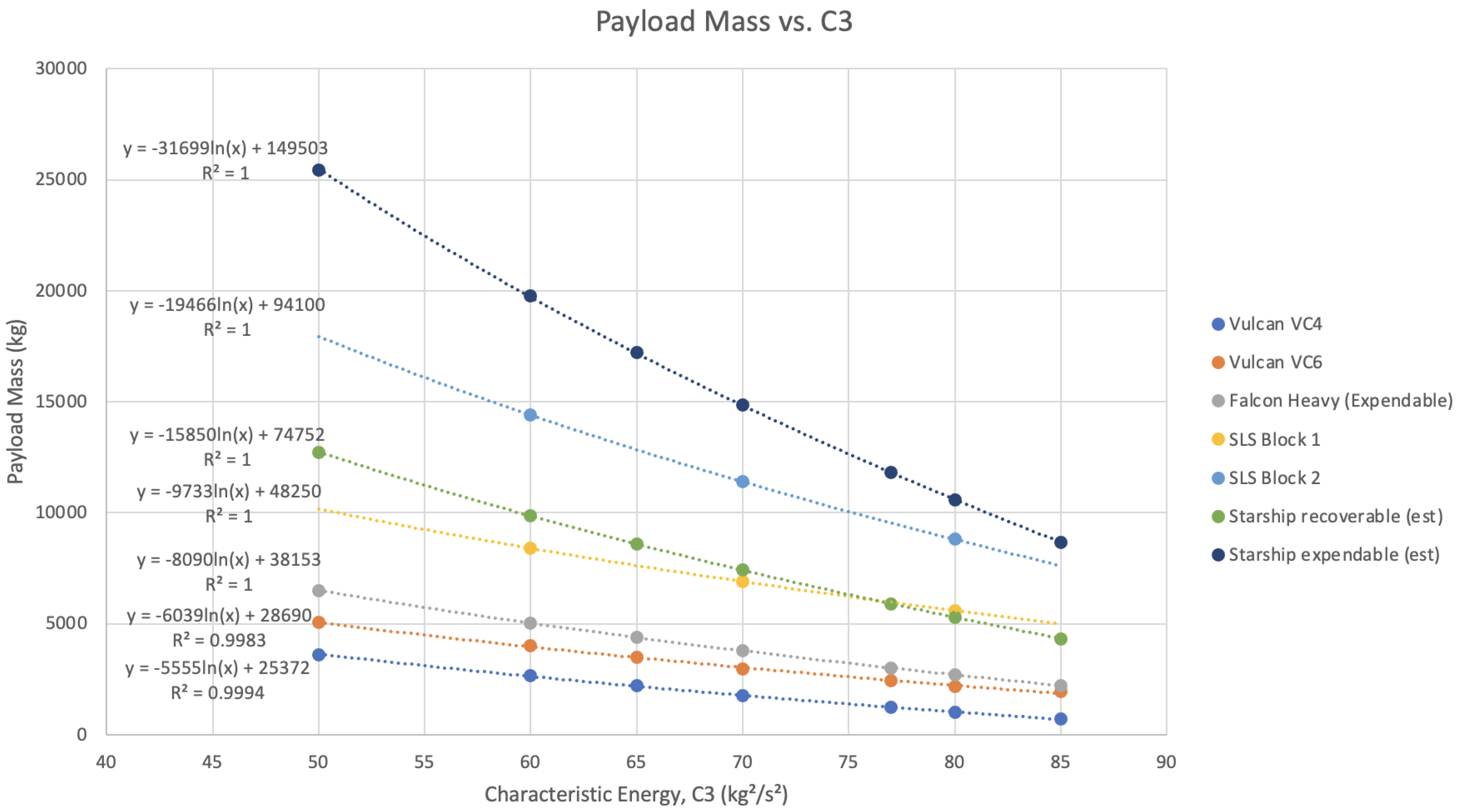
As the script supplies the necessary hyperbolic excess energy for a given trajectory, we are able to calculate the required characteristic energy (C3) that the launch vehicle must impart to the spacecraft. By only using the launch vehicle to supply the C3, we are able to save fuel mass and volume on the spacecraft itself. This C3 allows for the calculation of the maximum feasible wet mass of the spacecraft by using the capabilities of the launch vehicle. The relationship between maximum payload mass and C3 can be seen in Figure 1 for a variety of different launch vehicles.
These data are available on the public NASA Launch Services Program Performance Website [23]. Payload mass-to-orbit curves are not publicly available for Starship, so values were approximated based on Falcon Heavy characteristics and comparative lift to LEO.
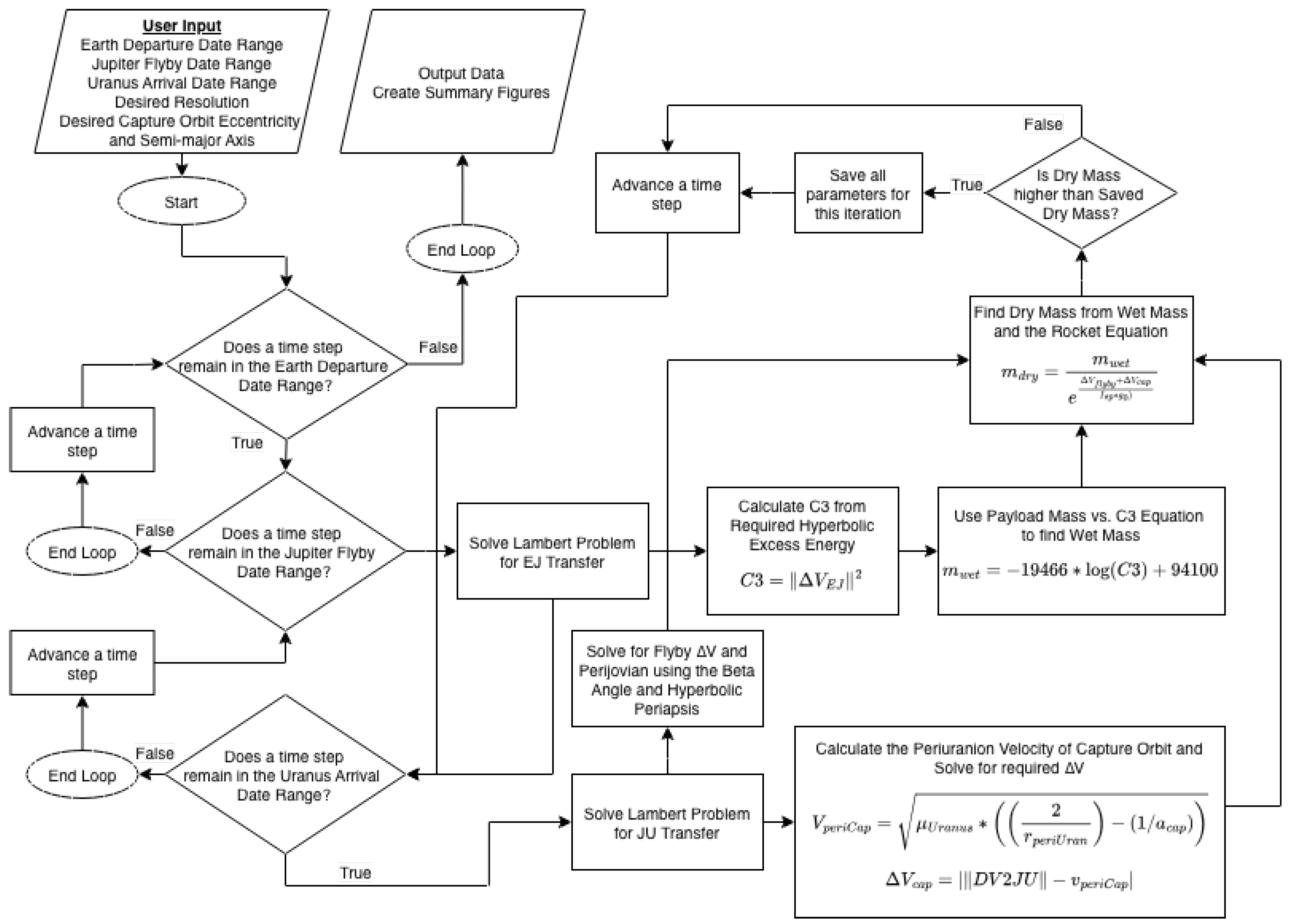
The maximum mass allowance can then be used to find the required fuel mass for all other necessary Δ V s. By using the rocket equation, we are able to calculate the ratio of wet mass to dry mass, which we can then use to find the maximum allowable dry mass for the spacecraft, and therefore obtain the required fuel mass. This allows for a realistic constraint when designing the payload and bus. The script calculates this information for all possible date combinations and then outputs the solution that maximizes the dry mass of the spacecraft, as well as figures that provide a visual summary. Example of these figures are Figures 4 and 5. A block diagram visualization of the script can be seen in Figure 2.

3. Mission Concept

3.1. Interplanetary Transfer Trajectory

The proposed 6-year trajectory requires significant excess energy from the launch vehicle. The most powerful currently commercially available option is to use a Falcon Heavy Expendable Launcher [24]. Using this 6-year trajectory with a Falcon Heavy Expendable Launcher would allow the delivered spacecraft to have a wet mass of around 1600 kg at launch. While this is substantial, it is not enough for this mission design, as a wet mass of at least 3000 kg is desired. Therefore, we must look into launch vehicles that are projected to be active in the early 2030s, including the SpaceX Starship and the Space Launch System (SLS) [25,26]. For this analysis, we used the SLS Block 2 as our launch vehicle and a SpaceX Merlin 1D Vacuum engine [27] as the spacecraft thruster. The SLS Block 2 would be able to deliver a 4500 kg wet mass spacecraft to an interplanetary transfer from Earth to Jupiter, where a gravity assist flyby would slingshot the spacecraft to Uranus. It is also worth noting that Starship has a higher projected performance than SLS Block 2, and so would also work as a launch vehicle.
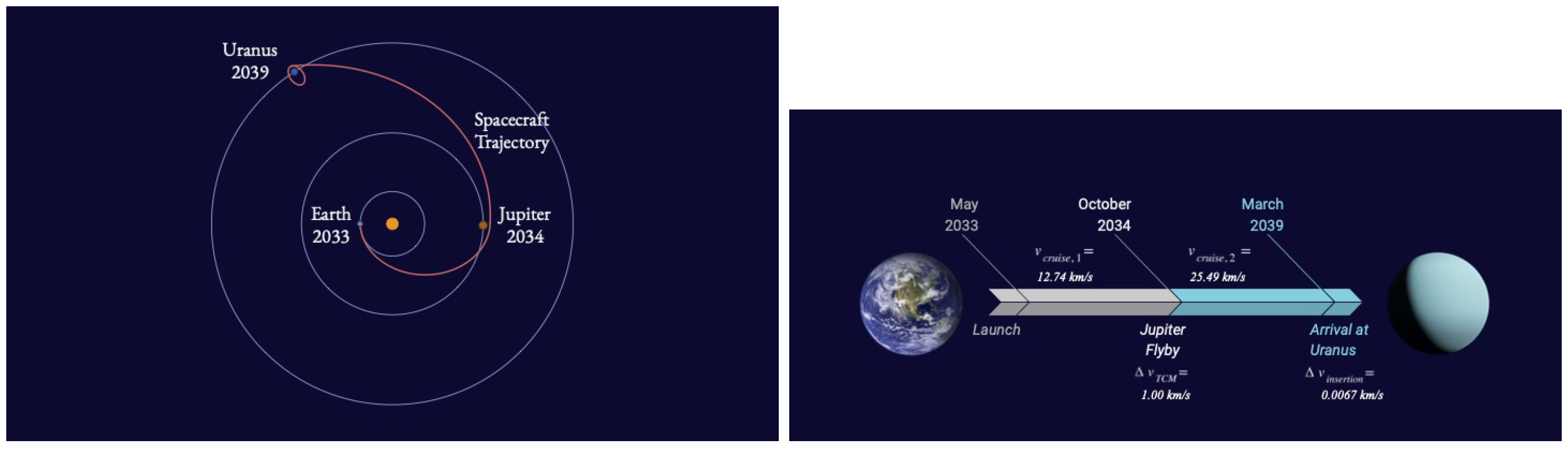
If the spacecraft is launched on 5 May 2033, using only the excess energy of the launch vehicle, it would reach Jupiter’s sphere of influence to perform a powered gravitational slingshot maneuver on 1 October 2034. This slingshot would occur at an altitude of about 2.23 million kilometers (approximately 32 Jovian radii [RJ]) from Jupiter’s atmosphere and would require an additional Δ V of 1.00 km/s to perform the powered flyby and redirect the spacecraft to Uranus. Such a maneuver would increase the spacecraft’s heliocentric velocity by a factor of 2.00, going from 12.74 km/s to 25.49 km/s, providing the necessary Δ V to reach Uranus on 18 March 2039. Both the transfer and capture burn will be undertaken by the carrier spacecraft, rather than the CubeSats individually, as is discussed further in Section 3.2. This flyby altitude avoids the majority of the Jovian radiation bands, which are strongest under 5 RJ and have a maximum radius of between 50–100 RJ depending on the solar system environment [28]. We recognize that a 2033 launch date would require an accelerated mission development and fabrication timeline, but it would produce the most efficient transfer trajectory. However, if it becomes clear that a 2033 launch date is not possible, a smaller, lighter spacecraft than the proposed UOP is still valuable, as it would still allow for a shorter transfer time.
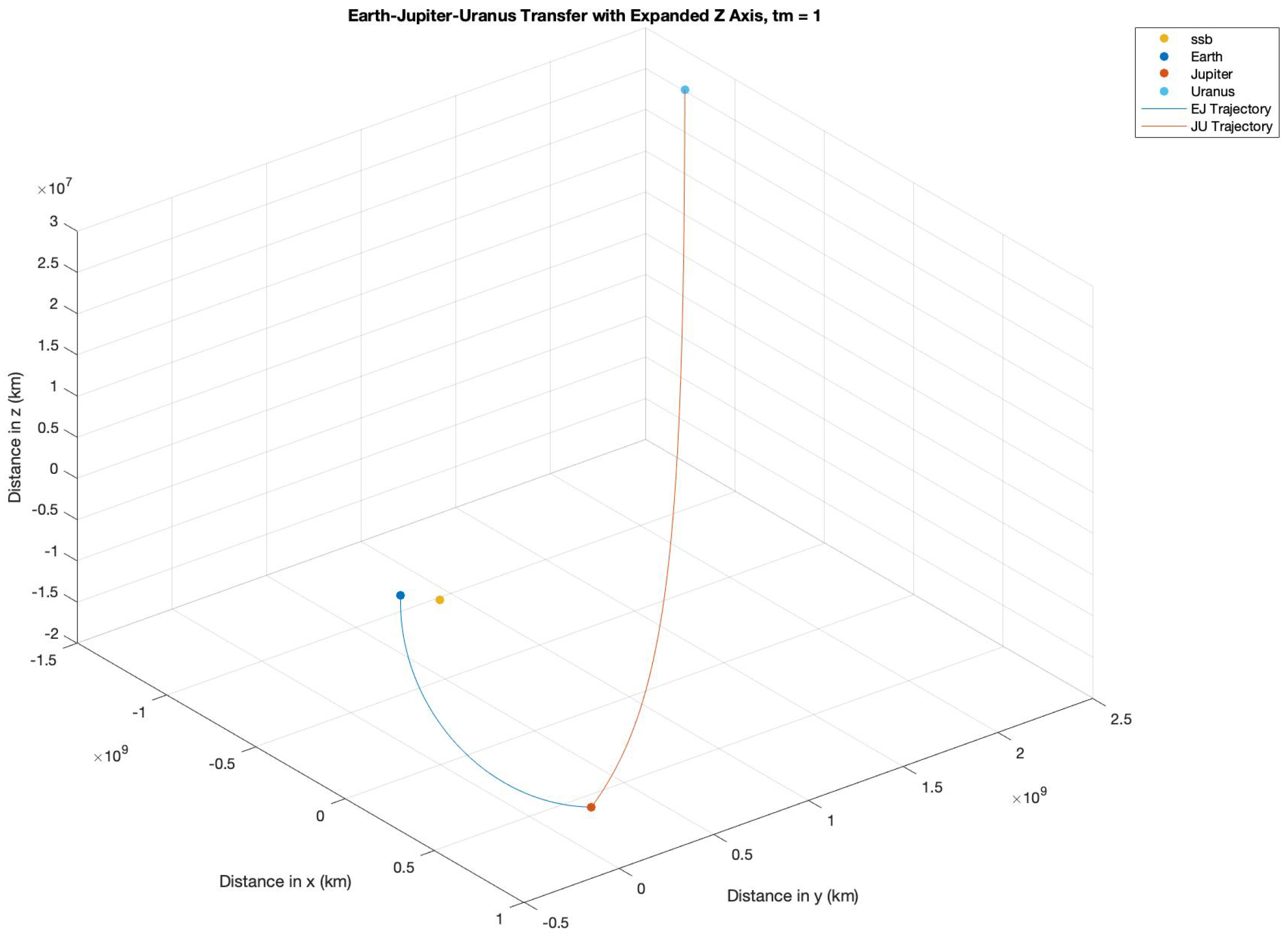
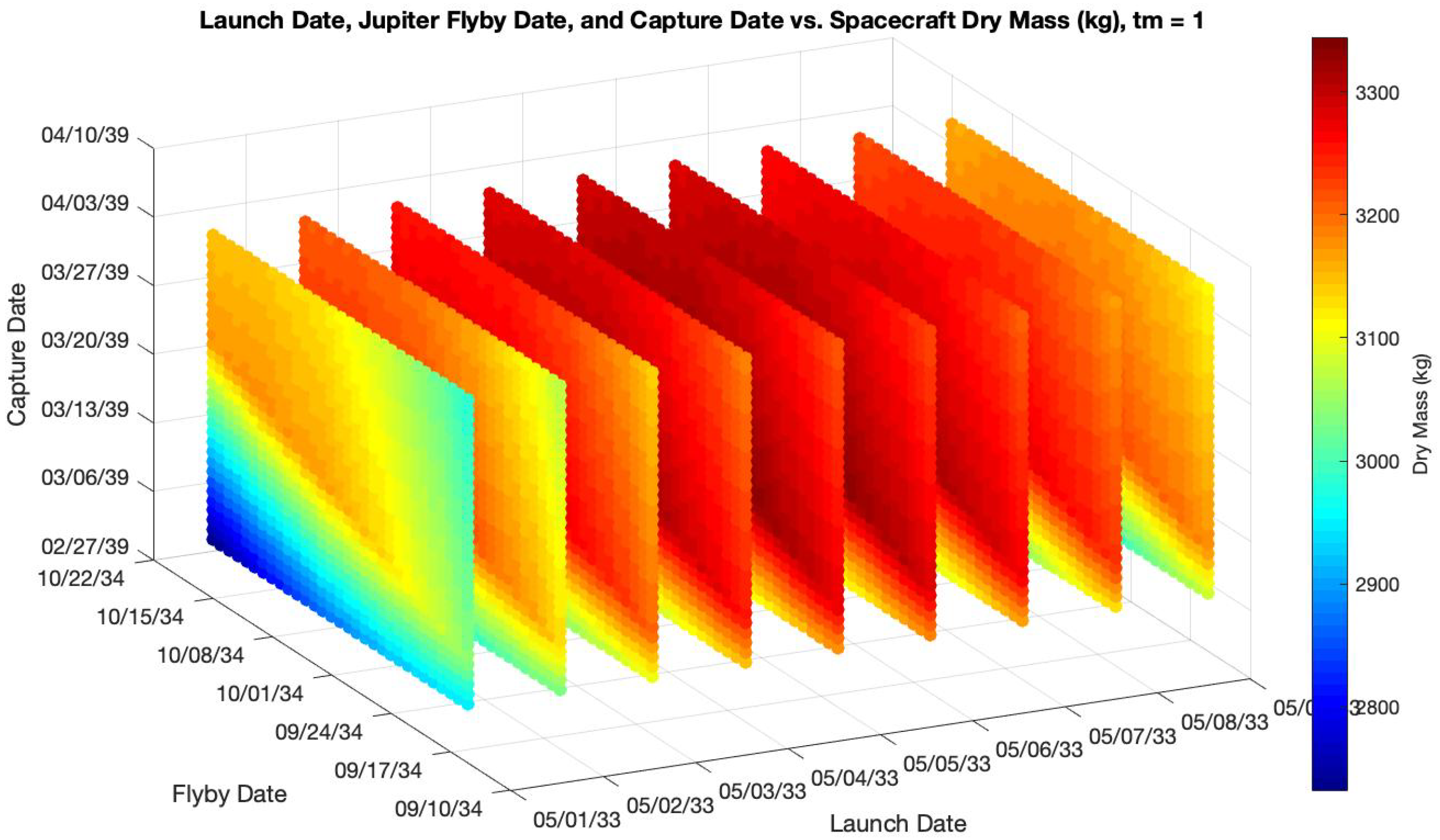
Upon arriving at Uranus’s gravitational sphere of influence, the spacecraft would perform an insertion burn with a Δ V of 0.0067 km/s to enter into a highly eccentric, highly inclined elliptical orbit of eccentricity 0.8 and semi-major axis of 147,794.5 km (5.83 Uranian radii [RU]). The burn would take place around the new periapsis for maximum efficiency. This capture orbit provides a good balance between fuel consumption and orbital placement, having a periapsis of 4000 km (0.158 RU) above the surface of the planet and an apoapsis of 240,000 km (9.46 RU) above the surface of the planet. Such an orbit provides a wide variety of perspectives for data collection while also providing time for data transfer and battery replenishment. Additionally, because the orbit is highly inclined, the spacecraft will be able to image the entirety of Uranus over multiple orbits. A graphical overview of the transfer trajectory and transfer thrust timeline can be seen in Figure 3. The fuel requirements for this trajectory have been sized such that there is a 35% fuel margin. A representation of the dry mass optimized trajectory for a given range of launch, flyby, and arrival dates is shown in Figure 4. A graphical representation of the trajectory is shown in Figure 5.

3.2. Mission Definition

Instead of one large spacecraft, we propose using a constellation of CubeSats and a carrier spacecraft, with the CubeSats collecting data and the carrier primarily being used for interplanetary transportation and as a communications relay with the Earth. Using CubeSats to collect data provides two main advantages when compared to a larger, traditional spacecraft. First, because the sensors are part of a distributed system, it is possible to perform data collection in ways that would otherwise be impossible, such as observing the same phenomena from different angles to reconstruct a 3D representation, measuring the fluctuations in gravity around Uranus through a radio link between two different spacecraft in the same orbit, performing radio occultation measurements to determine atmospheric composition, or studying plasma and magnetic field phenomena as seen with Cluster II or MMS. Second, any individual CubeSat is able to be specialized around a specific instrument to a much greater degree than a multipurpose spacecraft would, allowing for more specialized operation and a greater rate of data collection. As will be further detailed in the next pages, the CubeSats were divided into four groups, where each group is composed by n identical satellites. Each of those groups has its own set of instruments, so the spacecraft becomes specialized in a kind of task. The groups are called “Group A”, “Group B”, “Group C”, and “Group D”.

3.2.1. Mission Statement and Objectives

Our mission plans to use a constellation of CubeSats to analyze the composition, interior, atmosphere, and magnetosphere of Uranus, investigate its rings, and study its moons and their evolution throughout time. Based on this mission statement, we derive six mission objectives—five science-driven objectives and one technology demonstration objective:
1.
Science Objective 1: Measure the internal composition of Uranus.
2.
Science Objective 2: Measure the atmospheric structure, dynamics, climate, circulation, and meteorological patterns of Uranus.
3.
Science Objective 3: Measure the composition and structure of the Uranian moons and rings and discover their geological history.
4.
Science Objective 4: Measure the structure dynamics, and ion composition of Uranus’s magnetosphere and ionosphere.
5.
Science Objective 5: Determine how Uranus interacts with its environment, moons, and rings.
6.
Technology Demonstration Objective: Demonstrate that a constellation of CubeSats can perform missions meaningful to the scientific community.
If the science objectives are achieved, this mission will contribute to answering multiple questions from the OWL, including large portions of thematic questions 1, 2, 4, 5, 7, 8, 10, and 11 [1].

3.2.2. Concept of Operations

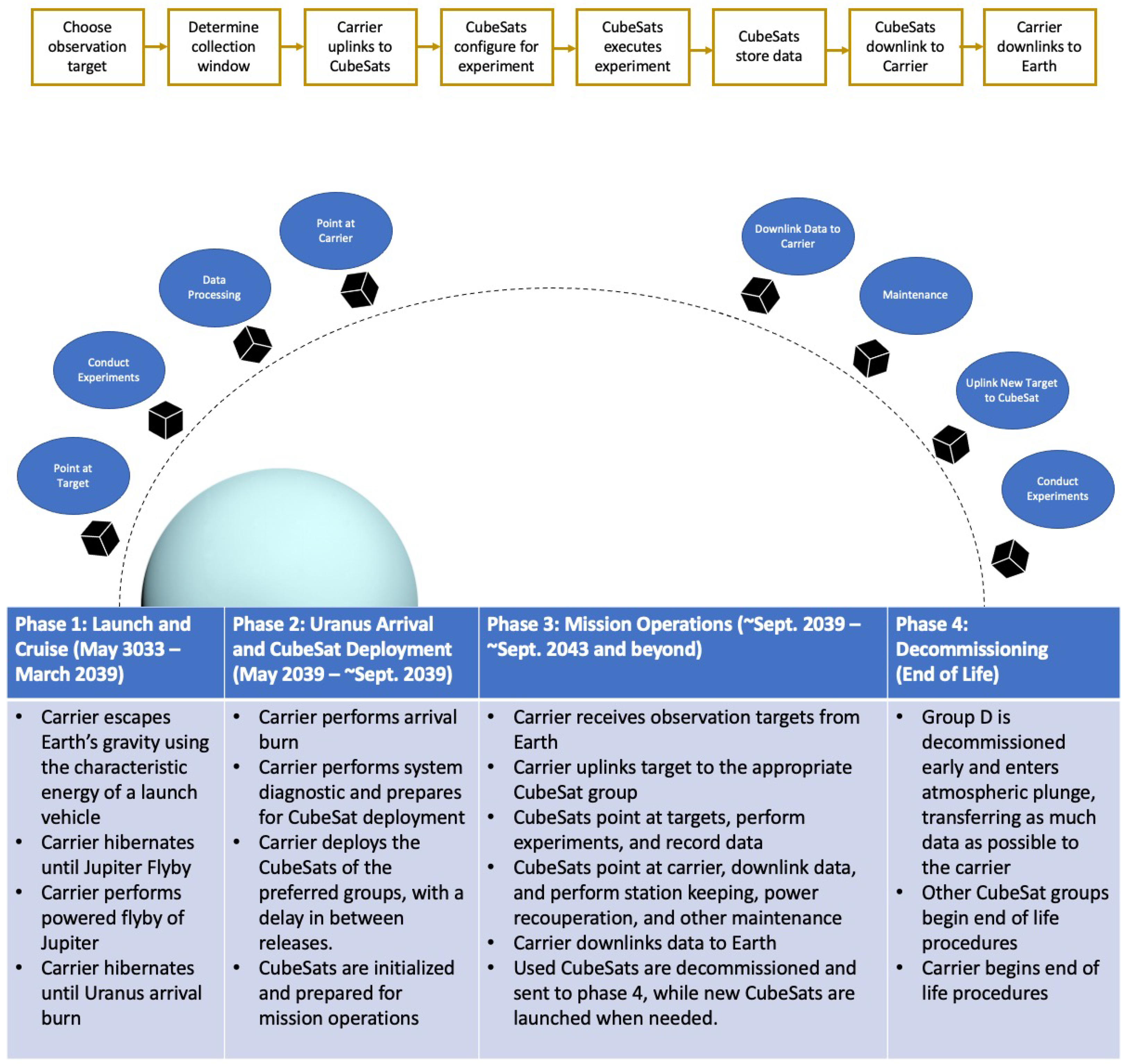
A Concept of Operations, or ConOps, is a mission “plan” that takes into account the mission objectives, science instruments, and all budgets created. It details the factors that drive mission design, allowing for an iterative design process in conjunction with the technical budgets. At the pre-phase A stage, this is more of a high-level overview than a detailed plan, but it still provides valuable insight. The ConOps can be seen in Figure 6.
Within the ConOps, we detail our nominal mission operation cycle and a high level mission timeline. The nominal mission operations cycle is centered around communications with Earth through the carrier spacecraft. The cycle begins when the carrier receives an observation target and appropriate collection window from Earth. It will then uplink that data to the appropriate CubeSats. The CubeSats will configure for the experiment and execute it, collecting the data. The CubeSats will then downlink the data back to the carrier spacecraft, which will downlink it to Earth. When not performing an experiment or transferring data, the CubeSats will be performing maintenance or be in a standby mode. Maintenance includes station keeping and recharging the battery after a high-draw task, for example.
The high level mission timeline shows the major steps between the proposed launch in 2033 and end of life/decommissioning, and is split into phases. Phase 1 is the launch and interplanetary cruise. Major events include the escape from Earth’s gravity well, the powered Jovian flyby, and the arrival at Uranus. Phase 2 includes Uranus arrival and CubeSat deployment. This involves the capture burn to get into orbit around the planet, diagnostic routines, and the deployment of the CubeSats. Phase 3 is the mission operations phase, where the spacecrafts are actively performing observations. This involves constant communication with Earth and the mission operation cycle detailed above. Finally, phase 4 is the decommissioning of the spacecraft. CubeSat group D will be the first to decommission, as they are to perform atmospheric plunges. This will require the undivided attention of the carrier spacecraft to maximize the data gathered. After group D has been decommissioned, the other CubeSat groups follow, with the carrier spacecraft the final spacecraft to shut down.

3.2.3. Science Traceability Matrix

A Science Traceability Matrix (STM) is typically needed to translate the mission science objectives into the list of required instruments. The focus of this work is to show that achieving valid scientific objectives is something a constellation of CubeSats could do. Hence, we are not designing the instruments that would go onboard the spacecraft, nor are we characterizing instruments requirements or performance. Our goal is to show that certain types of instruments that could answer the science goals would fit with the available size, weight, and power of a CubeSat bus. As a consequence, we are purposefully omitting some columns of typical STMs, like instrument requirements and projected performance. Our truncated Science Traceability Matrix (tSTM) only includes the science objectives, the physical parameters that need to be determined for the science objective to be answered, and their associated observables. The tSTM is shown in Table A1 in Appendix A and summarized in the paragraphs below. Finally, note that the third column lists potential instruments that could be used to measure the associated observables, not necessarily instruments that have already flown onboard CubeSats.
To study the interior composition of Uranus and its ice-rock ratios, a combination of in situ sampling and remote sensing is necessary. This mission would simultaneously investigate the internal chemical processes, vertical mixing, and dynamic transport over different scales, ranging from milliseconds to days.
To investigate Uranus’s atmospheric structure, dynamics, climate, circulation, and meteorological patterns, we will determine the vertical mixing by measuring deep vortices, storms, wave patterns, and non-equilibrium species distribution. Measurements of the dynamics and rotation rates of Uranus through time-dependent mapping of gravity and magnetic fields, radio occultations, and planet seismology will also be performed and used as inputs into comprehensive deep circulation models. This mission will also investigate stratosphere interactions and their correlation with the planet’s seasons through measurements are multiple time scales, ranging from milliseconds to days. Finally, imaging at multiple ranges of wavelength (from infrared to ultraviolet) and radio measurements will determine the characteristics of not only the cloud top but also lower layers of the atmosphere and the convective movements between those layers.
To measure the composition, structures, and geologic history of the moons and rings of Uranus, we will catalogue small moons and fine structures of the rings, and measure spectra from the moons and rings in a variety of wavelengths from near infrared to near ultraviolet. We will explore the internal composition of the larger moons through magnetic sounding and gravitational investigations. Finally, we will map the topography and the variations in spectra of the moons through imaging in multiple frequencies.
To understand the magnetosphere and ionosphere of Uranus, the mission will perform particle and field measurements, coupled with simultaneous aurora optical and thermal observations. The spacecraft will also measure the ionospheric composition changes using magnetospheric plasma analyses and ion/neutral composition measurements. To analyze the thermospheric and ionospheric variations and thermal properties of Uranus across different latitudes and time frames, we will use radio occultations, infrared, and ultraviolet spectral limb scans.
To determine how Uranus interacts with its environment, moons, and rings, the effects of tidal dissipation on Uranus’s angular momentum will be measured through satellite orbital acceleration. External factors, from micrometeoroids to comets, affecting Uranus’s atmospheric chemistry and dynamics will be monitored through time-series imaging and spectral data. Additionally, the influence of seasonal solar insolation on Uranus’s atmosphere will be analyzed by using long-term data on temperature, haze, and gas levels. This approach offers valuable insights into the processes governing this remote gas giant’s behavior.

3.3. Spacecraft Design

3.3.1. CubeSat Design Overview

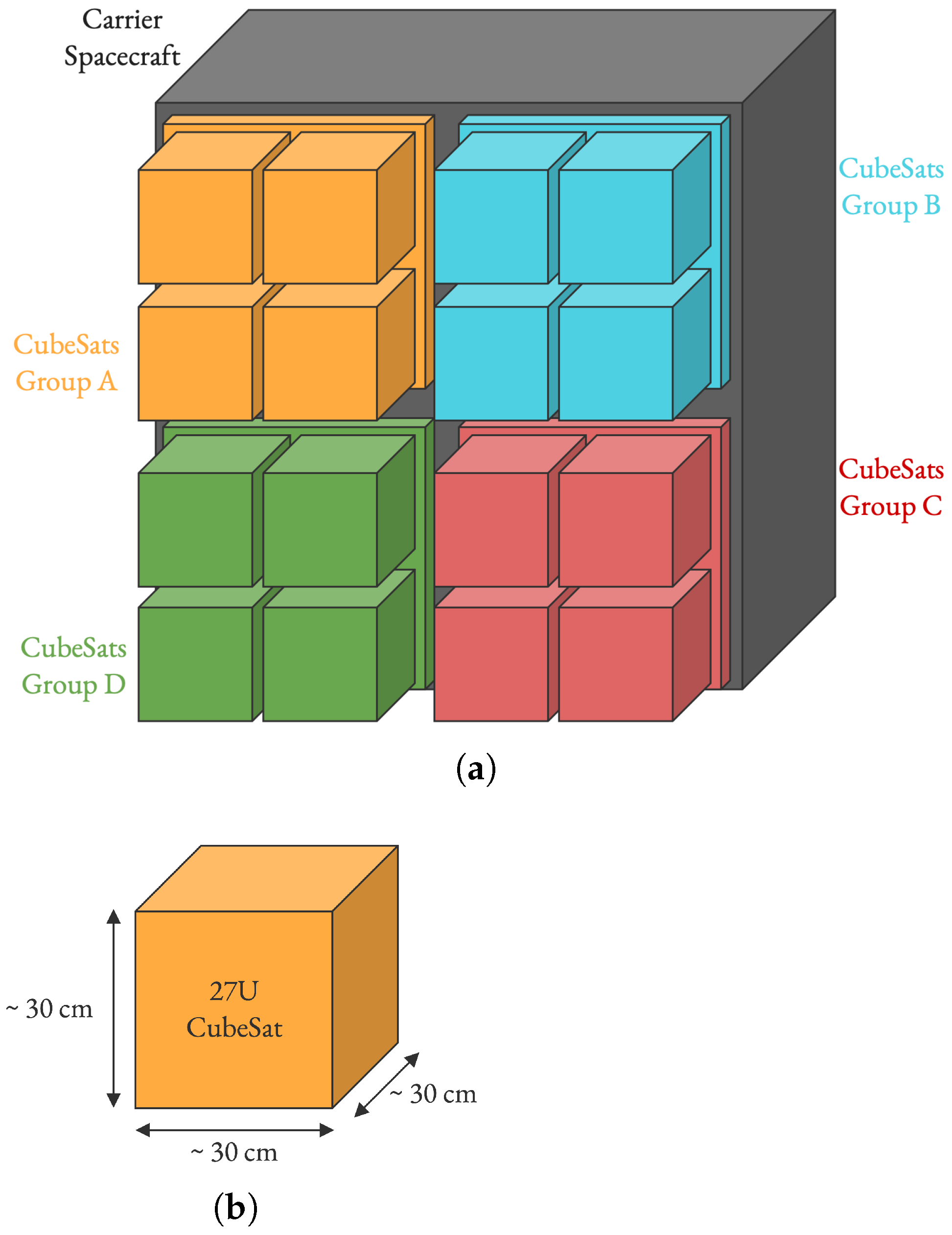
As mentioned in Section 3.2, we plan to use a CubeSat constellation to carry the instruments to collect data during this mission. Specifically, we propose to send a carrier spacecraft with 16 individual 27U CubeSats (a U, meaning Unit, is a standard measurement of volume used when discussing CubeSats, being equal to 1 d m 3 , or 1 L). Each CubeSat contains its own subsystems and is a fully functioning, independent spacecraft in all ways except their ability to communicate with the Earth, as they communicate with the carrier using one of its three antennas, and then the carrier downlinks the data to Earth, effectively treating the carrier as a communications relay to boost the transmission power and gain. A schematic representation of a carrier and 16 27U CubeSats is shown in Figure 7.

3.3.2. Example Instrument Selection

While our main goal is to develop a bus concept that could be suitable for an array of different instruments (which would be selected in the future), it is useful to have examples of instruments for the purposes of visualizing what effects they might have on the design of the spacecraft. As such, we have selected a shortlist of possible instruments from the Cassini [29] spacecraft and other planetary science missions as, like them, this mission aims to answer questions about the formation and evolution of planetary bodies of the outer solar system. This shortlist can be seen in Table 1.
From this shortlist, we selected four instruments that are most likely to be applicable to answering a wide variety of questions (more details available at [33]). Because none of the selected instruments are CubeSat sized, we make a comparison between the instruments that have flown on previous missions and Commercial-Off-The-Shelf (COTS) instruments that have CubeSat flight heritage, understanding that the true instruments that would fly on this mission would likely be somewhere between the two extremes in terms of mass and power requirements. This comparison can be seen in Table 2, where a historical instrument is described with a COTS equivalent shown below it.
As per Section 3.3.1, we propose grouping the 16 CubeSats into four groups of four, with each group being specified around one type of data being collected, and therefore around specific instruments. Group A contains the CubeSats studying the magnetosphere and charged particles, and thus are equipped with the three magnetometers and a boom to reduce interference, along with a plasma sensor to characterize loose ions. Group B studies composition remotely through a multispectral imager. Other possible instruments would be other kinds of cameras, or a spectrometer. Group C is comprised of the CubeSats measuring gravity, and thus studying the interior of the planet and moons. These measurements would be taken similarly to those of the GRACE mission, which used a K-band radio link with another satellite to measure the slight accelerations due to local gravity anomalies. These two satellites must be on the same orbital plane and around 100 km apart, making CubeSats a natural choice. Thus, this group is equipped with an additional K-band radio and antenna in addition to the radio and antenna used to communicate with the carrier spacecraft [40]. Finally, Group D is built to do atmospheric plunges, diving into the atmosphere and collecting in situ atmospheric samples before breaking down, and therefore has a hot wire anemometer, utilizes the accelerometers in its ADCS system as instruments, and will also use its radio to calculate Doppler shift.

3.3.3. Power Subsystem

Because this mission operates beyond Jupiter (5 AU), using solar power would be extremely limiting for our power budget. Thus, we choose to rely on nuclear power. Previous deep space missions have used Radioisotope Thermoelectric Generators (RTGs), or in more recent years multi-mission Radioisotope Thermoelectric Generators (MMRTGs) that provide on the order of 110 W while occupying 212 L volume and 45 kg, which are far too large for CubeSats [41].
Instead, we propose using an emerging technology, the thermoradiative cell (TRC) [42]. A TRC generates electricity by taking advantage of a temperature gradient, such as that between a nuclear heat source and the vacuum of space. It is more efficient than an MMRTG, having an order of magnitude increase in mass specific power (producing ∼30 W/kg vs the ∼3 W/kg typically produced by RTGs) and using only 0.2 L of space [43]—a three orders of magnitude decrease in volume. This makes the TRC far more accessible for smaller spacecraft, such as CubeSats. TRCs do not have flight heritage yet, but the technology is quickly evolving and could be ready for use by the time an Uranus mission gets into the detailed design stage.
To provide the heat that the TRC requires for producing electricity, we propose using two individual General Purpose Heat Sources (GPHSs). These are the same nuclear heat sources inside the RTGs and MMRTGs that have launched previously on other missions, with one MMRTG containing eight GPHSs. As each GPHS generates ∼250 W of heat, we can calculate that the TRCs will generate ∼33.86 W of electricity. It is worth noting that, since we are proposing to launch 16 CubeSats, we would be using 32 GPHSs, which is the equivalent of four MMRTGs (without considering another MMRTG for the carrier spacecraft). This is a significant amount of radioactive material, especially considering that New Horizons, one of the most recent deep space mission, only used three MMRTGs. We understand that there are multiple cost, timeline, and political implications of requiring such a large amount of GPHSs. However, given how far Uranus is from the Sun, using nuclear power is the only way in which a constellation of CubeSats could be feasible with the currently available technology.
In addition to the power generation, we also propose a battery to act as a buffer for high power draw operations, such as data transfer or thruster firing. As a preliminary design, we have sized and accounted for a lithium ion battery that holds two hours of standard power consumption. A summary of the power budget can be seen in Table 3. Regular baseline operations can be seen in the first section of the table, while any component that is either not regularly engaged or has a significantly different peak power consumption compared to standard operations can be found in the Short Term Operations section. Finally, any component that differs between different groups of spacecraft can be seen in the Group Specific section with their group listed.

3.3.4. Radiation Prevention

Radiation presents a significant design challenge to any spacecraft, but especially CubeSats as they generally have less shielding and use fewer radiation hardened components. There are two main sources of ionizing radiation: environmental and internal radiation, both of which can be mitigated through shielding, but also through using radiation hardened or resistant components, both of which raise the total lifetime radiation dose the spacecraft can withstand.
Environmental radiation is primarily mitigated through external shielding, or shielding on the outside of the spacecraft. While in transit to Uranus, the CubeSats are protected by the carrier spacecraft itself, requiring no additional mass on the part of the CubeSat and lowering lifetime radiation dose significantly. Once a CubeSat has been released into orbit around Uranus, however, it must rely on its own shielding. For similar missions, it has been projected that 100 mils (2.54 mm) of aluminum shielding is enough to mitigate radiation for standard, radiation hardened electronics for the lifetime of this mission [50].
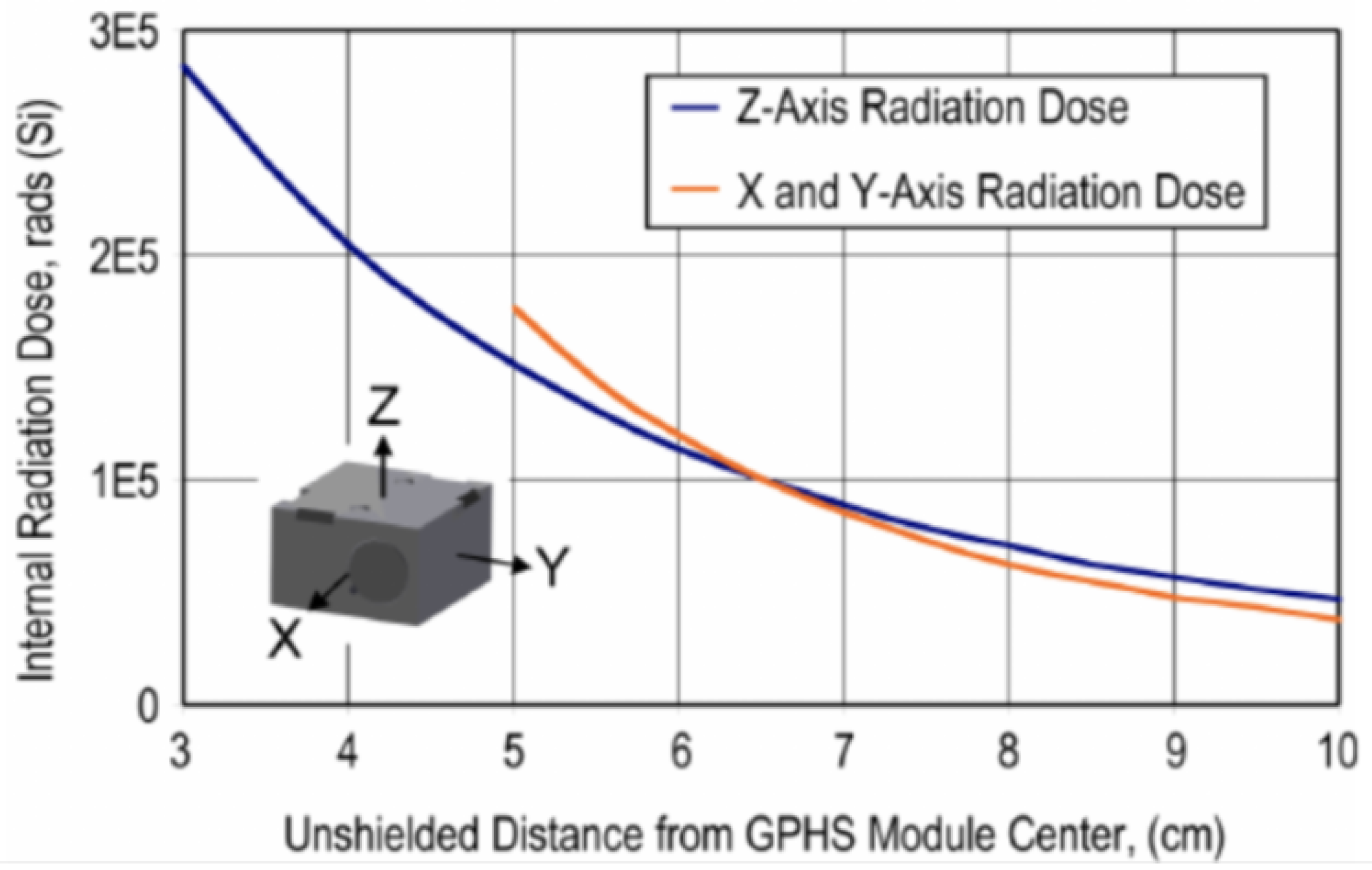
Internal radiation from the decay of the nuclear heat source also needs to be shielded against. This shielding surrounds the heat source, leading to a lower required mass of material than the equivalent external shielding. We used Equation 1 to determine the required shielding thickness given the worst case lifetime radiation dose, which we can find from Figure 8:
I = I 0 e μ r ,
where I 0 is the incident radiation intensity, I is the residual radiation intensity, r is the thickness of the shielding material, and μ is the linear attenuation coefficient of the material being used as shielding.
Doubling the maximum radiation dose because of the two GPHSs and assuming no mutual shielding, we can reduce the lifetime radiation dose to 1 krad with an aluminum shield 0.445 cm thick, which is well within the bounds of most components. The mass of the internal and external shielding can be calculated by multiplying the shield thickness by the surface area it is shielding. The total shield mass was calculated to be 5.255 kg. Most other deep-space spacecraft endure much higher lifetime radiation doses. Cassini, for example, was designed such that its sensitive subsystems and instruments were able to withstand 20 krad solely from external sources of radiation [50]. However, CubeSats do not have the same historical testing, and many COTS components that are being used for reference have not been built to be radiation hardened. Therefore, we decide to err on the side of caution in this stage of development.

3.3.5. Thermal Subsystem

Because the only method of heat transfer with the environment in space is radiation, and with the goal of finding the worst case scenario of maximum heat loss, we approximated the heat loss by considering the spacecraft as a black body that absorbs no radiation and emits a 30 °C. As we are treating the spacecraft as a black body, we can use the Stefan-Boltzmann Law, shown as Equation (2), to determine the thermal energy lost as radiation at any given temperature.
P = A ϵ σ T 4
where P is the power lost, A is the surface area, which for a standard 27U CubeSat is 0.54 m2, ϵ is the emissivity, which for a black body is 1, σ is the Stefan–Boltzmann constant, and T is the absolute temperature of the emitter. Taking the optimum temperature range of a lithium ion battery as the working range (10 °C–30 °C) as it is the most temperature sensitive component on the spacecraft, we can calculate that the we will loose a maximum of 197 W at 10 °C and 259 W at 30 °C.
As discussed in Section 3.3.3, we use two GPHSs to generate heat, totaling to 500 W of thermal heat being generated. Of those, 33.86 W is directly converted into electricity, leaving the question of how much heat is radiated away into space by the TRCs and how much is maintained by the spacecraft. Assuming that thermoradiative cells have a similar efficiency to solar panels, we retain 30% of the waste heat, meaning that we retain around 140 W of waste heat, which is outside of the working range defined by the lithium-ion battery. However, this is only the case if we were to attempt to maintain a uniform temperature throughout the entire CubeSat within the battery’s temperature range. We understand that internal temperature is not a constant in spacecraft outside of theory and that, in reality, there are additional effects, such as planetshine and albedo, but this analysis shows a workable result for a preliminary thermal calculation.
To account for the fact that internal temperature is not a constant in spacecraft, we plan to primarily use passive thermal control, as we are concerned with managing the heat we already have, so we have to generate as little as possible. However, we will likely still need some form of active heat control to regulate the temperature of the electronics or thruster lines. In this iteration of our design, we propose using Kapton heaters [47] as recommended by [52] with a capacity of 10 W. This is an initial number pending computational thermal analysis. There is also the option of using radioisotope heater units (RHUs), which provide 1 W each. They are heavier than electronic heaters but require no electricity.

3.3.6. Communications Subsystem

The communication system presents a unique challenge when designing a CubeSat, as spacecraft communications are often one of the most power-intensive subsystems of a mission [53], and antenna size is directly related to signal strength [54]. As CubeSats are generally designed to be small, low-power spacecraft, these challenges leave them at a disadvantage when compared to traditional spacecraft. However, it is possible to overcome these design challenges through the use of carefully selected hardware and engineering budget calculations.
The first important point to recognize is that a CubeSat on its own is unable to communicate with the Earth when in orbit around Uranus. This led to the decision to use the carrier spacecraft as a communications relay, drastically shortening the distance across which the CubeSats would have to transmit. However, even with this reduction, the CubeSats will still be required to transmit across, at maximum, the full major axis of the Uranus capture orbit, which is a distance of almost 300,000 km. This is made more difficult as most CubeSat-sized radios have a maximum output of around 2 W, which is insufficient to transmit that distance, even when using a high-gain antenna.
We mitigate this issue through several factors. First, we recognize that if the CubeSat was attempting to transmit at its true boundary case of the major axis, Uranus would be in the middle of the transmission line and completely block the signal. Because of this, we can reduce the transfer range by about the diameter of Uranus, which is 50,000 km. Second, we can increase the power of the CubeSat’s radio by adding an amplifier to increase the transmission power to 5 W. Third, we can add a low noise amplifier to the receiver on the carrier spacecraft, effectively boosting the signal-to-noise ratio. Finally, we can recognize that a similar problem has already been solved. The MarCO CubeSats were required to communicate between the Earth and Mars and, in doing so, encountered a similar challenge. The solution was an antenna designed for a CubeSat form factor but having a gain an order of magnitude higher than the best COTS antennas for CubeSats [55]. Similarly, the carrier spacecraft utilizes an antenna heavily based on the New Horizons antenna for communication with the Earth and a smaller, generic high-gain dish antenna for communication with the CubeSats [5,54,56]. All of these factors lead to a converging solution with modern, flight-tested hardware. A breakdown of the communications budget for a worst case (longest distance) scenario can be seen in Table 4. This link closes with a margin of 7.2 dB, which is more than our required 6 dB minimum margin.

3.3.7. Data Budget

As we are not proposing specific instruments, but rather using general types of instruments as examples, any data budget created with a specific instrument in mind may differ greatly from what we describe in this subsection. That being said, one data budget has been created for the A CubeSat group as detailed in Section 3.3.2, which are the magnetometer CubeSats. The data collection characteristics for this instrument were based on the MAG instrument from Cassini [57]. A full breakdown for the data budget over one day for group A can be seen in Table 5.
As per Table 5, it will take approximately one day for the CubeSats to transfer one full day’s worth of data to the carrier spacecraft. Thus, for example, any one CubeSat may collect data for half a day and then transmit the data to the carrier for the next day before repeating. The three antennas on the carrier provide much needed flexibility and dataflow options to remain in contact with 16 CubeSats regularly.

3.3.8. Pointing Budget

The two key performance measures of the CubeSat’s Attitude Determination and Control System (ADCS) are its ability to point at the carrier spacecraft with little enough error to transmit and receive a signal and its ability to stay focused on a single point on Uranus at any time to be able to accomplish the desired scientific measurements. Before calculating those performance measures, however, we must first calculate our pointing budget, which is presented in Table 6. The budget results in a maximum slew rate of 1.03 °/s and a maximum angular acceleration rate of 0.10 °/s2.
To calculate the ability to point at the carrier spacecraft correctly, we compare the angular error in the pointing budget to the angular beam width of the CubeSat’s antenna. The CubeSat’s antenna has a beam profile such that most of the power is within ±10° of the direction it points [55]. When this is compared to the error value of 0.01°, we see that the carrier will easily be within the beam of the antenna. The sensors used for ADCS are two star trackers, a horizon sensor, and a three-axis inertial mass unit (IMU), collectively labeled under GNC sensors in other budgets.
To calculate if the spacecraft can stay pointed at a single spot on Uranus at any time, we look at the most severe case, which is when the spacecraft is at periapsis looking toward the center of the planet. If the angular velocity of the spacecraft at that point is less than or equal to the maximum slew rate, the spacecraft can focus on any one point at any point in the orbit. To calculate the angular velocity, we use the Vis-Viva equation to get the spacecraft’s velocity at periapsis. From that equation, we get that the spacecraft’s velocity is 20.0 km/s. As stated in Section 3.1, the altitude at periapsis is 4000 km, so we can calculate the angular velocity with Equation (3).
ω = v h ,
where ω is angular velocity and h is the orbital altitude. We find the angular velocity at periapsis to be 0.005 radians/s or less than 0.3 °/s, which is less than the maximum slew rate of 1.03 °/s. This means that the pointing budget closes, and the CubeSats are capable of pointing for both science and communication purposes.

3.3.9. Mass and Size Budget

We found that CubeSat mass and volume were not limiting factors in this design, given that CubeSat sized parts are being used. The full mass and volume breakdown can be seen in Table 7, which shows that the mass margin is of 18.1 % and the volume margin is of 34.9 %. While the mass and volume budgets close, the respective final margins are lower than optimal for this point in the design. As this design matures, it may become necessary to adjust the number of CubeSats carried so that the remaining number can be larger or more massive.

3.3.10. Carrier Spacecraft Design

For this mission, the carrier spacecraft serves two main purposes: be the method by which the CubeSats are transported to Uranus, and the method by which they communicate with Earth. To better fulfill both purposes, the carrier is designed to be a more traditional spacecraft for deep space exploration, especially when compared to the CubeSats, as it needs to have the size and mass to support large and heavy components, such as MMRTGs and large antennas, while also being able to contain all 16 CubeSats which, when arranged as compactly as possible, still take up 0.432 m3 without any kind of support structure.
While transporting the CubeSats to Uranus, the carrier’s main purpose is to provide a shell to keep the CubeSats together, but also to provide additional shielding from ionizing radiation and micrometeoroids. This gives the CubeSats a longer lifetime once released, as they have not gathered as much lifetime radiation than they would have otherwise. Additionally, by containing the CubeSats within the carrier, we gain access to liquid bipropellant thrusters for the orbital insertion burn and Jovian flyby, which are both more powerful and efficient than the cold gas thrusters on the CubeSats themselves. This means that we require far less fuel to place the spacecraft in the same orbit than we would using the less efficient thrusters. This also allows us to save the propellant in the CubeSats themselves for station keeping and desaturation.
Once the spacecraft reaches Uranus’s orbit and the carrier spacecraft releases the CubeSats, it transitions into being a communications relay. This design decision is because, as described in Section 3.3.6, a CubeSat does not have the power and antenna gain to transfer data back to Earth directly. Thus, the CubeSats transfer data to the carrier, which communicates back to earth. When communicating with the CubeSats, the carrier uses one of its three high gain antennas (0.5 m diameter dish), having each antenna being equipped with its own individual radio. This allows the carrier to be in contact with three CubeSats simultaneously, greatly increasing the data transfer rate. To communicate with the Earth, the carrier would use one final, larger antenna and a more powerful radio to communicate via NASA’s Deep Space Network (DSN) [58] over the X-band, which is what was used by New Horizons [5]. There is no significant absorption of the X-band by Uranus’s atmosphere [59], thus appearing to be a viable frequency range. This communication setup will inherently require a lot of power, and as such the carrier will likely require at least one MMRTG.
At times when the carrier is not utilizing all of its antennas to communicate with the CubeSats, it could also accomplish science objectives by using the different frequency receivers to study Uranus. The carrier could also carry additional instruments that are too large to on the CubeSats, but more detailed analysis is necessary before such a decision can be made. However, any additional mass for the carrier would likely go toward power generation or fuel, and thus expanding mission longevity, rather than adding instruments to said spacecraft and diluting its purpose.

4. Discussion and Conclusions

This work demonstrates that a CubeSat constellation mission to Uranus is likely a viable solution for answering many aspects of the 2023–2032 Planetary Science and Astrobiology Decadal Survey’s thematic questions and can support the UOP by collecting data that the UOP cannot. We have shown that there is a unique scientific benefit to launching a lighter spacecraft on a lower fuel and cruise time trajectory, arriving at Uranus in around six years so that we can observe the shift from the northern solstice to the equinox and thus observing a planet wide change in climate. Arriving in time to observe such phenomenon is only possible with an early launch date, efficient flyby strategies, and a low spacecraft mass—all of which are crucial features of the mission we are proposing here. This timeline acceleration also results in a mission with lower complexity, lower personnel upkeep costs, and more potential of high-return scientific mission extensions.
We have shown that a constellation of CubeSats can return valuable data using similar types of instruments as those of larger spacecraft. We also argue that using a constellation of smaller spacecraft presents improvements over the coverage and revisit rates of the planetary surface compared to a traditional spacecraft. Additionally, using a constellation allows the distributed system to collect data that would otherwise be inaccessible or much more difficult to obtain, such as mapping the gravitational field of Uranus or creating a three-dimensional representation of phenomena by observing it from multiple angles using multiple spacecraft. Finally, we have shown that the standard technical budgets (electrical energy, radiation, thermal balance, communications link, data volume, pointing, fuel, mass, and volume) for this mission appear to close with adequate margins, confirming the potential feasibility of the mission architecture.
Moving forward, we plan on gathering more concrete information regarding the instruments that could become the satellite payloads, finalizing the STM, and reaching realistic values on the power, size, data, and pointing constraints of the payloads of each group of CubeSats. We also plan to dive deeper into the mission development process, bringing the concept from a Pre-Phase A level of detail into a more mature Phase A concept, with mission plans and requirements. Potential future directions include studying the constellation dynamics to create navigation plans that include autonomous maneuvers and station keeping.


Author Contributions

Conceptualization, D.B. and P.d.V.P.; methodology, D.B.; software, D.B.; validation, D.B.; formal analysis, D.B.; investigation, D.B.; resources, D.B.; data curation, D.B.; writing—original draft preparation, D.B.; writing—review and editing, D.B. and P.d.V.P.; visualization, D.B.; supervision, P.d.V.P.; project administration, D.B. and P.d.V.P. All authors have read and agreed to the published version of the manuscript.

Funding

This research received no external funding.

Institutional Review Board Statement

Not applicable.

Data Availability Statement

All ephemeris data has been obtained from the NASA/Caltech Jet Propulsion Laboratory’s publicly available Horizons database, found at https://ssd.jpl.nasa.gov/horizons/app.html/ (accessed on 30 October 2025). Software is not hosted online, but can be provided upon request. All spacecraft component data is publicly available.

Acknowledgments

This work was performed while D.B. and P.d.V.P. were part of the Florida Institute of Technology (Florida Tech) as an M.S. Student and Assistant Professor respectively. No generative AI was used in the development of this project.

Conflicts of Interest

The authors declare no conflicts of interest.

Appendix A

This is the truncated science traceability matrix mentioned in Section 3.2.3. It provides the science objectives, the physical parameters that need to be determined for the science objective to be answered, and their associated observables for this proposed mission.
Table A1. The truncated Science Traceability Matrix shows how the science objectives are related to potential instruments that would compose the payload of the CubeSats in this mission.
Science ObjectivesScience Measurement Requirements
Physical Parameter Observables and Potential Instruments
Measure the internal composition of Uranus.Chemical composition, thermal emissions, optical emissions, high-energy emissions, radio emissions, gravitational fields.In Situ and Remote Sensing for Composition: Spectrometry (Optical & X-ray), Mass Spectrometry, Particle Detectors, Neutron Spectroscopy, Plasma Sensor Gravity Field Measurements: Superconduction Gravimeters, Accelerometers, Doppler Shift, Radiometric Tracking, Differential Spacecraft Acceleration
Measure the atmospheric structure and dynamics of Uranus.Deep vortexes, storms, wave patterns, non-equilibrium species distribution, time-dependent mapping of gravity and magnetic fields, radio occultations, and seismology.Vertical Mixing: Infrared Spectroscopy Internal Dynamics: Gravimeter, Magnetometers, Magnetic Resonance Spectrometers
Measure the climate, circulation, and meteorological patterns of Uranus.Multiwavelength emission of cloud tops and lower atmospheric layers at local and global scales and at short and long time scales.Multiwavelength Remote Sensing: Cameras, Spectrometers, Radiometers, and Photometer Meteorology: Spectrometer, Radiometers, Imagers, Mass Spectrometers, Infrared Spectrometer, Anemoeter, Radiosondes, Barometers
Determine what processes lead to the structure, content, and dynamics of Uranus’s magnetosphere and ionosphere.Plasma, particle, and magnetic field observations, ion/neutral composition measurements, thermal properties at various latitude and altitudes in Uranus across latitudes.Ionospheric Measurements: Mass Spectrometer, Magnetometer, Radio Occultation, Spectral Scans, Particle Detectors (Solid-state, Scintillation, Gas), Caloriemeter, Electrostatic Analyzer Thermospheric Measurements Spectrometers, Spectrophotometers, Radiometers, Infrared sensor, Plasma sensor, Langmuir probes, Ion drift meters
Determine how Uranus interacts with its environment, moons, and rings.Tidal dissipation on Uranus’s angular momentum, micrometeoroid and comet impacts, influence of seasonal solar insolation on Uranus’s atmosphere.Planetary Tidal Dissipation: Accelerometers, Gravimeters, Radio tracking, Time-series imaging and spectral data

References

  1. National Academies of Sciences, Engineering, and Medicine. Origins, Worlds, and Life: A Decadal Strategy for Planetary Science and Astrobiology 2023–2032; The National Academies Press: Washington, DC, USA, 2022. [CrossRef]
  2. Simon, A.; Nimmo, F.; Anderson, R.C. Uranus Orbiter & Probe; Technical report; NASA: Washington, DC, USA, 2021.
  3. National Research Council. Vision and Voyages for Planetary Science in the Decade 2013–2022; The National Academies Press: Washington, DC, USA, 2011. [Google Scholar] [CrossRef]
  4. Warwick, J.W.; Evans, D.R.; Romig, J.H.; Sawyer, C.B.; Desch, M.D.; Kaiser, M.L.; Alexander, J.K.; Carr, T.D.; Staelin, D.H.; Gulkis, S.; et al. Voyager 2 Radio Observations of Uranus. Science 1986, 233, 102–106. [Google Scholar] [CrossRef]
  5. Guo, Y.; Farquhar, R.W. New Horizons Mission Design. Space Sci. Rev. 2008, 140, 49–74. [Google Scholar]
  6. APL. New Horizons: The Path to Pluto and Beyond. Available online: https://pluto.jhuapl.edu/Mission/The-Path-to-Pluto-and-Beyond.php (accessed on 30 October 2025).
  7. Wallace, L. The Seasonal Variation of the Thermal Structure of the Atmosphere of Uranus. Icarus 1983, 54, 110–132. [Google Scholar] [CrossRef]
  8. Hofstadter, M.D.; Butler, B.J. Seasonal change in the deep atmosphere of Uranus. Icarus 2003, 165, 168–180. [Google Scholar] [CrossRef]
  9. NASA Jet Propulsion Laboratory Uranus. Available online: https://www.jpl.nasa.gov/images/pia01391-uranus/ (accessed on 30 October 2025).
  10. Paschalidis, N.P. Mass Spectrometers for Cubesats. In Proceedings of the 2nd Planetary CubeSat Science Symposium, Greenbelt, MD, USA, 26 September 2017. [Google Scholar]
  11. Chung, S.J.; Bandyopadhyay, S.; Foust, R.; Subramanian, G.P.; Hadaegh, F.Y. Review of Formation Flying and Constellation Missions Using Nanosatellites. J. Spacecr. Rocket. 2016, 53, 3. [Google Scholar] [CrossRef]
  12. Kang, Z.; Tapley, B.; Bettadpur, S.; Ries, J.; Nagel, P.; Pastor, R. Precise Orbit Determination for the GRACE Mission Using Only GPS Data. J. Geod. 2006, 80, 322–331. [Google Scholar] [CrossRef]
  13. Fish, C.; Swenson, C.; Neilsen, T.; Bingham, B.; Gunther, J.; Stromberg, E.; Burr, S.; Burt, R.; Whitely, M.; Crowley, G.; et al. DICE Mission Design, Development, and Implementation: Success and Challenges. In Proceedings of the 26th Small Satellite Conference Proceedings, Logan, UT, USA, 13–16 August 2012. [Google Scholar]
  14. Gangestad, J.W.; Hardy, B.S.; Hinkley, D.A. Operations, Orbit Determination, and Formation Control of the AeroCube-4 CubeSats. In Proceedings of the 27th Small Satellite Conference Proceedings, Logan, UT, USA, 10–15 August 2013. [Google Scholar]
  15. Escoubet, C.P.; Masson, A.; Laakso, H.; Goldstein, M.L.; Dimbylow, T.; Bogdanova, Y.V.; Hapgood, M.; Sousa, B.; Sieg, D.; Taylor, M.G.G.T. Cluster After 20 Years of Operations: Science Highlights and Technical Challenges. J. Geophys. Res. Space Phys. 2021, 126, e2021JA029474. [Google Scholar] [CrossRef]
  16. Burch, J.L.; Moore, T.E.; Torbert, R.B.; Giles, B.L. Magnetospheric Multiscale Overview and Science Objectives. Space Sci. Rev. 2016, 199, 5–21. [Google Scholar] [CrossRef]
  17. Zhou, X.; Li, X.; Huo, Z.; Meng, L.; Huang, J. Near-Earth Asteroid Surveillance Constellation in the Sun-Venus Three-Body System. Space Sci. Technol. 2022, 2022, 9864937. [Google Scholar] [CrossRef]
  18. Schoolcraft, J.; Klesh, A.; Werne, T. MarCO: Interplanetary Mission Development on a CubeSat Scale. In Space Operations: Contributions from the Global Community; Springer International Publishing: Cham, Switzerland, 2017. [Google Scholar]
  19. Tortora, P.; Di Tana, V. LICIACube, the Italian Witness of DART Impact on Didymos. In Proceedings of the 5th International Workshop on Metrology for AeroSpace Proceedings, Torino, Italy, 19–21 June 2019. [Google Scholar]
  20. Gardner, T.; Cheetham, B.; Forsman, A.; Meek, C.; Kayser, E.; Parker, J.; Thompson, M.; Latche, T.; Rogers, R.; Bryant, B.; et al. CAPSTONE: A CubeSat Pathfinder for the Lunar Gateway Ecosystem. In Proceedings of the 35th Small Satellite Conference Proceedings, Virtual, 7–12 August 2021. [Google Scholar]
  21. Lancaster, E.R.; Blanchard, R.C. Technical Note D-5368: A Unified Form of Lambert’s Theorem; Technical report; NASA: Washington, DC, USA, 1969.
  22. NASA Jet Propulsion Laboratory Horizons System. 2023. Available online: https://ssd.jpl.nasa.gov/horizons/ (accessed on 30 October 2025).
  23. Program, N.L.S. Available online: https://elvperf.ksc.nasa.gov/Pages/Default.aspx (accessed on 13 April 2024).
  24. SpaceX Falcon Heavy. Available online: https://www.spacex.com/vehicles/falcon-heavy/ (accessed on 13 April 2024).
  25. SpaceX Starship. Available online: https://www.spacex.com/vehicles/starship/ (accessed on 13 April 2024).
  26. Green, J.L.; Cooke, D.; Beckman, A.W.; Ramos, K.M. Scientific Discovery and Societal Benefits with SLS Unique Launch Capability. In Proceedings of the ASCEND 2023, Las Vegas, NV, USA, 23–25 October 2023. [Google Scholar] [CrossRef]
  27. NASA. SpaceX Falcon 9 v1.2 Data Sheet. Available online: https://sma.nasa.gov/LaunchVehicle/assets/spacex-falcon-9-v1.2-data-sheet.pdf (accessed on 13 April 2024).
  28. Bolton, S.J.; Thorne, R.M.; Bourdarie, S.; de Pater, I.; Mauk, B. Jupiter’s inner radiation belts. In Jupiter. The Planet, Satellites and Magnetosphere; Bagenal, F., Dowling, T.E., McKinnon, W.B., Eds.; Cambridge University Press: Cambridge, MA, USA, 2004; Volume 1, pp. 671–688. [Google Scholar]
  29. NASA. Cassini Mission; NASA: Washington, DC, USA, 2021.
  30. NASA. Cassini Spacecraft; NASA: Washington, DC, USA, 2021.
  31. NASA. 2001 Mars Odyssey; NASA: Washington, DC, USA, 2003.
  32. NASA. Microlab 1; NASA: Washington, DC, USA. Available online: https://weebau.com/satellite/M/microlab%201.htm (accessed on 30 October 2025).
  33. Barnes, D.; Cummings, A.; do Vale Pereira, P. COMMUTE: Cubesat swarm Orbital Maneuvers for a Mission to study Uranus’ aTmospheric Environment. In Proceedings of the 37th Small Satellite Conference, Logan, Utah, 5–10 August 2023. Weekend Poster Session 2, SSC23-WP2-38, 2023. [Google Scholar]
  34. AAC Clyde Space. Three Axis Satellite Magnetometer. Available online: https://www.aac-clyde.space/what-we-do/space-products-components/adcs/mag-3 (accessed on 30 October 2025).
  35. Cenko, S.B.; Bellm, E.C.; Gal-Yam, A.; Gezari, S.; Gorjian, V.; Jewell, A.; Kruk, J.W.; Kulkarni, S.R.; Mushotzky, R.; Nikzad, S.; et al. CUTIE: Cubesat Ultraviolet Transient Imaging Experiment. In Proceedings of the American Astronomical Society Meeting Abstracts #229, Washington, DC, USA, 3–7 January 2017; American Astronomical Society Meeting Abstracts. Volume 229, p. 328.04. [Google Scholar]
  36. Zarnecki, J.C.; Banaszkiewicz, M.; Bannister, M.; Boynton, W.V.; Challenor, P.; Clark, B.; Daniell, P.M.; Delderfield, J.; English, M.A.; Fulchingnoni, M.; et al. The Huygens Surface Science Package. In Huygens: Science, Payload and Mission; Wilson, A., Ed.; ESA Special Publication; European Space Agency: Pairs, France, 1997; Volume 1177, p. 177. Available online: https://adsabs.harvard.edu/full/1997ESASP1177..177Z (accessed on 30 October 2025).
  37. Tursdale Technical Services Ltd. The Specification of Hot Wire Anemometer Manual PCE-423. Available online: https://www.industrial-needs.com/manual/manual-pce-423.pdf (accessed on 30 October 2025).
  38. Dragonfly Aerospace. Mantis Imager. Available online: https://dragonflyaerospace.com/products/mantis/ (accessed on 30 October 2025).
  39. Paradigma Technologies. K Band Transmitter. Available online: https://paradigma-tech.com/k-band-transmitter/ (accessed on 30 October 2025).
  40. NASA. The NASA GRACE Fact Sheet. Available online: https://science.nasa.gov/earth/earth-observatory/grace-fact-sheet/ (accessed on 30 October 2025).
  41. NASA. Multi-Mission Radioisotope Thermoelectric Generator (MMRTG); NASA: Washington, DC, USA, 2020.
  42. Wang, J.; Chen, C.H.; Bonner III, R.; Anderson, W. Thermo-Radiative Cell - A New Waste Heat Recovery Technology for Space Power Applications. In Proceedings of the AIAA Propulsion and Energy 2019 Forum, Indianapolis, IN, USA, 19–22 August 2019. [Google Scholar] [CrossRef]
  43. Polly, S.; Landis, G.A.; Hubbard, S.M. Radioisotope thermoradiative cell power generator. In Proceedings of the 2023 IEEE 50th Photovoltaic Specialists Conference (PVSC), San Juan, PR, USA, 11–16 June 2023. [Google Scholar]
  44. NASA. State-of-the-Art of Small Spacecraft Technology—Guidance, Navigation, and Control; NASA: Washington, DC, USA, 2023.
  45. CubeSpace Satellite Systems. Cubewheel Gen 1. Available online: https://www.satnow.com/products/reaction-wheels/cubespace/38-1187-cubewheel-large (accessed on 30 October 2025).
  46. NASA. State-of-the-Art of Small Spacecraft Technology—Avionics; NASA: Washington, DC, USA, 2023.
  47. Tempco. Kapton® Heater Wattage and Watt Density Information. Available online: https://www.tempco.com/Tempco/Resources/Engineering-Data/Wattage-and-Watt-Density-Information/Kapton-Heater-Wattage-and-Watt-Density-Information.htm (accessed on 30 October 2025).
  48. NASA. State-of-the-Art of Small Spacecraft Technology—Communications; NASA: Washington, DC, USA, 2023.
  49. Moog. 2021. Available online: https://www.moog.com/news/operating-group-news/2021/small-sat-2021.html (accessed on 30 October 2025).
  50. Abelson, R.; BALINT, T.; Coste, K.; Elliott, J.; Randolph, J.; Schmidt, G.; Schriener, T.; Shirley, J.; Spilker, T. Expanding Frontiers with Standard Radioisotope Power Systems; Technical report; National Aeronautical and Space Administration: Washington, DC, USA, 2004.
  51. Abelson, R.; Balint, T.; Noravian, H.; Randolph, J.; CM, S.; Schmidt, G.; Shirley, J. Enabling Solar System Exploration with Small Radioisotope Power Systems. In Proceedings of the AGU Fall Meeting Abstracts, San Francisco, CA, USA, 5–9 December 2005. [Google Scholar]
  52. NASA. State-of-the-Art of Small Spacecraft Technology—Thermal Control; National Aeronautical and Space Administration: Washington, DC, USA, 2023.
  53. Wertz, J.R.; Everett, D.F.; Puschell, J.J. Space Mission Engineering: The New SMAD; Microcosm Press: Hawthorne, CA, USA, 2011. [Google Scholar]
  54. Australian Space Academy. Space Communication Calculations. 2023. Available online: http://www.spaceacademy.net.au/spacelink/spcomcalc.htm (accessed on 30 October 2025).
  55. Hodges, R.E.; Chahat, N.E.; Hoppe, D.J.; Vacchione, J.D. The Mars Cube One deployable high gain antenna. In Proceedings of the 2016 IEEE International Symposium on Antennas and Propagation (APSURSI), Fajardo, PR, USA, 26 June–1 July 2016; pp. 1533–1534. [Google Scholar] [CrossRef]
  56. UNP. Uiversity Nanosatellite Program—Mission Design Course Budget Templates. Available online: https://universitynanosat.org/resources/mission-design-course (accessed on 30 October 2025).
  57. NASA. MAG Technical Write-up. Available online: https://science.nasa.gov/mission/cassini/spacecraft/cassini-orbiter/magnetometer/mag-technical-write-up/ (accessed on 30 October 2025).
  58. NASA/Caltech Jet Propulsion Laboratory. NASA/Caltech Jet Propulsion Laboratory Deep Space Network Services Catalog. 2015. Available online: https://deepspace.jpl.nasa.gov/files/820-100-H.pdf (accessed on 30 October 2025).
  59. Lindal, G.F.; Lyons, J.R.; Sweetnam, D.N.; Eshleman, V.R.; Hinson, D.P.; Tyler, G.L. The atmosphere of Uranus: Results of radio occultation measurements with Voyager 2. J. Geophys. Res. Space Phys. 1987, 92, 14987–15001. [Google Scholar] [CrossRef]
Figure 1. Payload mass vs. C3 for a selection of launch vehicles.
Aerospace 12 01069 g001
Figure 2. Block diagram of the algorithm used to generate trajectories and calculate mass allowance.
Aerospace 12 01069 g002
Figure 3. Visualization of proposed cruise trajectory with accompanying transfer thrust timeline. Δ V T C M is the Δ V required for the trajectory correction burn for the gravity assist. Δ V i n s e r t i o n is the Δ V required to enter the capture orbit around Uranus. Not to scale.
Aerospace 12 01069 g003
Figure 4. Visualization of the maximum dry mass of the spacecraft for a given range of launch, flyby, and arrival dates. This result has been optimized for maximum dry mass by iterating through a launch range from March 2028 to June 2034, a flyby range from January 2034 to December 2036, and an arrival range from June 2035 to May 2040 with a resolution of one day.
Aerospace 12 01069 g004
Figure 5. Graphical representation of the trajectory described in Figure 4. The z axis in this figure is two orders of magnitude smaller than the x and y axes.
Aerospace 12 01069 g005
Figure 6. ConOps. Gives details about the proposed mission timeline, steps, and operations cycle.
Aerospace 12 01069 g006
Figure 7. (a) Schematic representation of the Carrier Spacecraft/CubeSat concept. (b) Schematic representation of the 27U CubeSats. Visualization of CubeSats and Carrier Spacecraft.
Aerospace 12 01069 g007
Figure 8. GPHS 13-year radiation dose. With a 4.5 year science phase, we assume that the radiation from 13 years will be greater than the lifetime radiation from a six year transfer and 5 year science phase [51].
Aerospace 12 01069 g008
Table 1. Shortlist of possible instrumentation for a mission to Uranus, sourced from similar planetary science missions in the past [12,30,31,32].
AcronymNameMission
INMSIon and Neutral Mass SpectrometerCassini
UVISUltraviolet Imaging SpectrographCassini
GRSGamma Ray SpectrometerOdyssey
CIRSComposite Infrared SpectrometerCassini
MAGMagnetometerCassini
OTDOptical Transient DetectorMicroLab-1
RPWSRadio and Plasma Wave ScienceCassini
CAPSCassini Plasma SpectrometerCassini
VIMSVisible and Infrared Mapping SpectrometerCassini
MKIMicrowave K-band InstrumentGRACE
MIMIMagnetospheric Imaging InstrumentCassini
ISSImaging Science SubsystemCassini/Huygens
Table 2. Comparison of traditional deep space instruments to CubeSat sized alternatives.
InstrumentPower Requirements (W)Mass (kg)COTS or Historical
MAG [30]3.13.0Historical
Magnetometer (3) [34]1.3–3.00.3COTS
CAPS [30]14.512.5Historical
Plasma Sensor [35]50.1COTS
Huygens SSP [36]104.2Historical
Anemometer [37]0.5<1 1COTS
CIRS [30]26.439.2Historical
Multispectral Imager [38]2.6–4.60.5COTS
MKI [30]>3 13.0Historical
K-band Transmitter [39]21COTS
1 When precise information was not found, bounding values were estimated by the authors.
Table 3. Power budget summary. Components in all CubeSat groups that run constantly are under baseline operations. Components in all CubeSat groups that are only engaged short term or have a peak power draw significantly different from the average power draw are under short term operations. Finally, instruments or other components which are only part of one group are under group specific components.
Baseline Operations
ComponentPower Contribution (W)Group
Generator (GPHS & TRC)+33.861Universal
GNC Sensors [44]−3.7Universal
Reaction Wheels (4, avg) [45]−0.76Universal
Computer [46]−10Universal
Memory (2) [46]−0.6Universal
Clock [44]−1.5Universal
Heaters [47]−10Universal
Total+7.301
Short Term Operations
Radio [48]−2.6Universal
Amplifier [48]−8Universal
Cold Gas (6) [49]−<63Universal
Reaction Wheels (4, peak) [45]−9.2Universal
Group Specific Components
Plasma Sensor [35]−5A
Magnetometer (3) [34]−3A
Multispectral Imager [38]−4.6B
K-Band Transmitter [39]−2C
Anemometer [37]−0.5D
Table 4. Link budget summary. The link margin is 7.2 dB whereas the required link margin is 6 dB, showing the convergence of the budget.
General Information
CharacteristicValueUnit
Distance244,000km
Transmitter Information [55]
CharacteristicValueUnit
Frequency8.425GHz
Bit rate0.100Mbps
Transmit Power5.0W
Transmit Power37.0dBm
Transmit antenna gain29.2dBi
Transmit system losses−4dB
EIRP62.2dBm
Path loss−218.71dB
Receiver Information [54,56]
CharacteristicValueUnit
Receive antenna diameter0.5m
Antenna Efficiency80%
Receive antenna gain31.9dBi
Receive amplifier13.0dBi
Noise Temperature150.0K
Receive system noise figure−176.84dBm/Hz
Total Received Power−107.6dBm
Receiver system losses−4dB
Cross polarization loss0dB
Link Margin Computation
CharacteristicValueUnit
Received Eb/No15.2dB
Required Eb/No8.0dB
Link margin7.2dB
Required link margin6dB
Table 5. Data budget summary for magnetometer CubeSat group. The summary shows that each CubeSat required one pass to downlink all data, which is a reasonable timeframe. Sample overhead and downlink overhead were combined into one column simple titled Overhead.
Group A
SubsystemDescriptionSizeFrequencyDurationSample TotalOverheadTotal
(Bytes)(sample/s)(s)(Bytes)(Bytes)(Bytes)
CDHSOH (State of Health)8186,4002,246,40072,4122,318,794
EPSSOH (State of Health)38186,4004,838,400155,9434,994,325
ADCSSOH (State of Health)4186,4001,900,80061,2741,962,056
PAYSOH (State of Health)80.586,4001,123,20036,2151,159,397
ADCSReaction wheel Data1186,4001,641,60052,9211,694,503
ADCSSensor Data1286,4003,283,200105,8243,389,006
THMRTD Data6186,4002,073,60066,8432,140,425
EPSSwitch Data60.3386,400684,28822,070706,340
EPSBus Data2186,4001,728,00055,7061,783,688
PAYMagnetometer336186,40030,585,600985,68731,571,269
InputsResults
CharacteristicValueUnitsCharacteristicValueUnits
Pass Time360minute(s)Number of passes to downlink all data1pass(es)
Number of passes in a day1pass(es)Number of days to downlink all data1day(s)
Radio Data Rate100,000bpsTotal Bytes Generated (1 Day)51,719,803Bytes
Total number of images for experiment10imagesTotal Bytes with Margin68,787,338Bytes
Margin33%Total (kB)67,175kB
Table 6. CubeSat pointing budget summary. It is worth noting that most of the error comes from position uncertainty, rather than an error in angle.
Error SourceError Value (°)Error Value (m)
Position Knowledge Error0.00840035,772.27
Mechanical alignment0.0002781182.95
ADCS0.0016677097.67
Thermal0.0008333548.84
Totals0.01117847,601.72
Inputs
CharacteristicValueUnit
Range244,000km
Range Knowledge Error0.001km
Momentum storage0.0108Nms
Torque0.001Nm
High Moment of inertia0.60kg-m2
Momentum Results
CharacteristicValueUnit
Max Slew Rate1.03°/s
Max Angular Acceleration0.10°/s2
Table 7. Mass and volume budget. Shows a summary of masses and volumes of components used in other budgets, as well as the remaining margins compared to the maximum allowable mass and volume.
Universal Components
ComponentMass (kg)Size (L)Group
Generator (GPHS,9.3831.491Universal
Shielding, & TRC)
GNC Sensors0.365<1 1Universal
Reaction Wheels (4)0.60.267Universal
Radio0.0940.2Universal
Computer1<3.125 1Universal
Memory0.08<1 1Universal
Clock [44]0.0160.004Universal
Amplifier10.0121Universal
60 Ah Battery7.235.469Universal
Antenna [55]11.67, undeployedUniversal
Cold gas thrusters (6) [49]0.4200.0705Universal
Fuel tank0.69.819Universal
Structure3.621727Universal
Total24.77115.572Universal
Margin15.22911.426
Margin, %38.1%42.3%
Electronics and20% (8 kg)7.5% (2 L)Universal
Harnessing buffer
Final margin7.2299.426
Final margin, %18.1%34.9%
Group Specific Components
ComponentMass (kg)Size (L)Group
Plasma Sensor [35]0.10.5 1A
Magnetometer (3) [34]0.50.3A
Multispectral Imager [38]0.31B
K-Band Transmitter [39]10.8C
Anemometer [37]<1 10.125 1D
1 When precise information was not found, bounding values were estimated by the authors.
Disclaimer/Publisher’s Note: The statements, opinions and data contained in all publications are solely those of the individual author(s) and contributor(s) and not of MDPI and/or the editor(s). MDPI and/or the editor(s) disclaim responsibility for any injury to people or property resulting from any ideas, methods, instructions or products referred to in the content.