
Dynamic Separation Standards for Multi-Category UAV Operations


Abstract
1. Introduction
1.1. Background and Motivation
1.2. Related Work
1.3. Research Gap and Contributions
2. Methodology
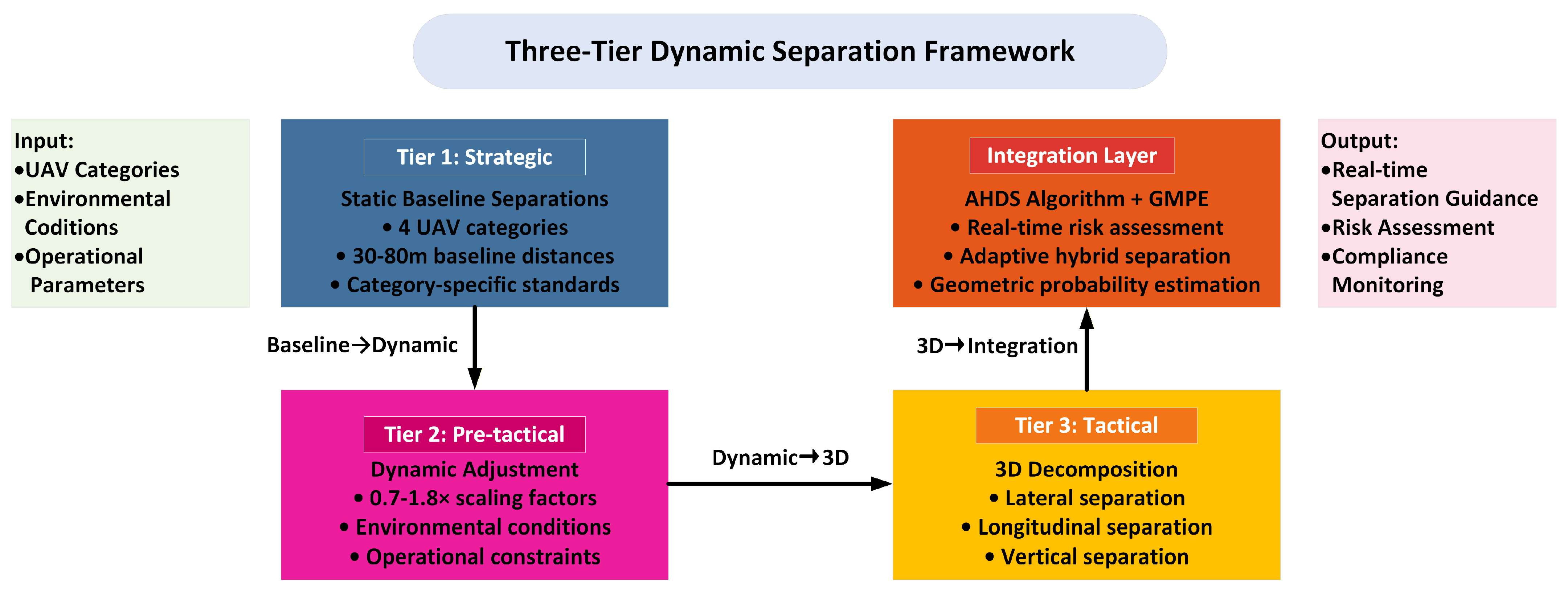
2.1. Framework Overview
- Tier 1 Strategic Baseline (hours to pre-flight): Establishes category-specific separation minima (30–80 m) based on fundamental UAV characteristics (size, speed, maneuverability). Updated frequency: 0.1 Hz (10 s cycles). This tier provides the safety foundation ensuring minimum separations always exceed collision thresholds derived from geometric analysis.
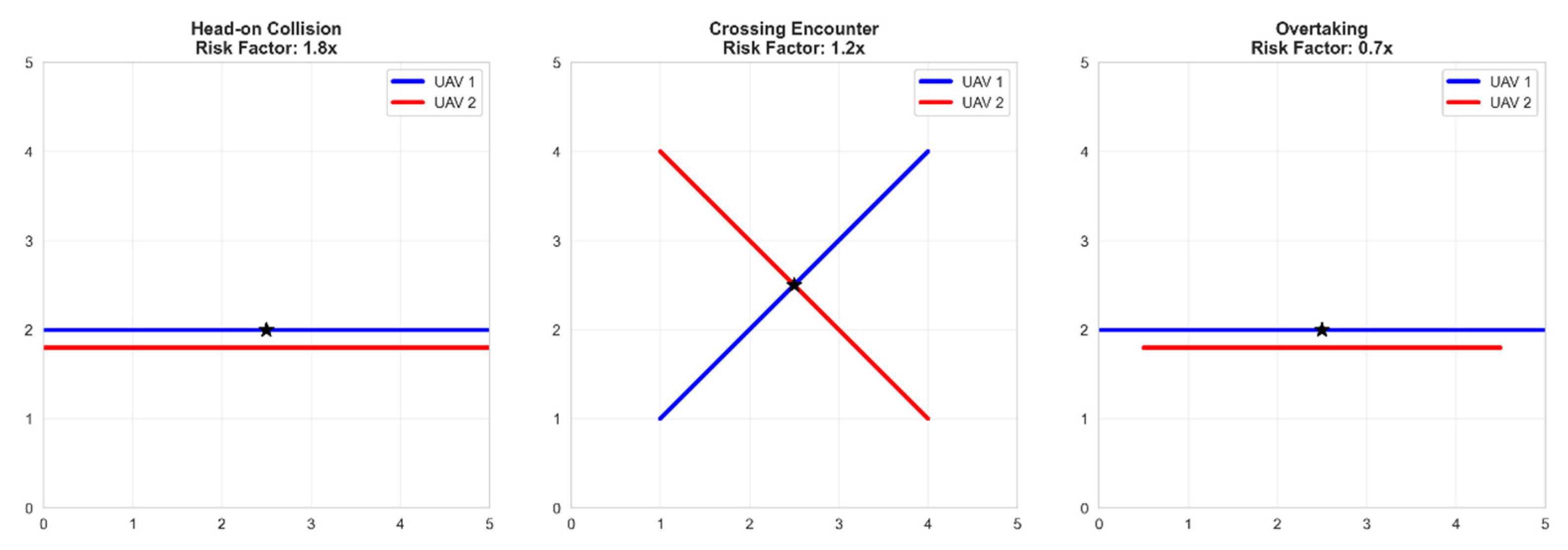
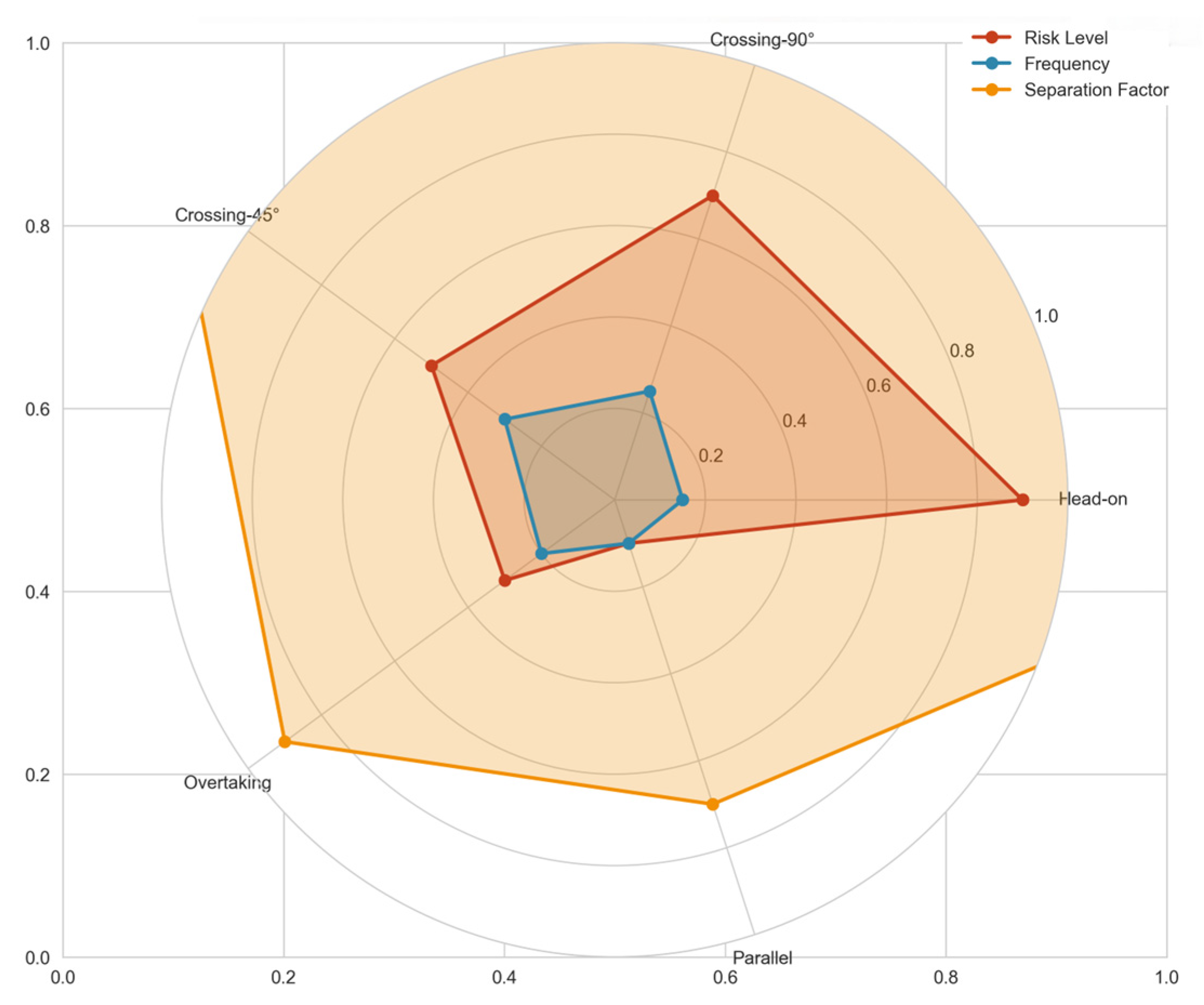
- Tier 2 Pre-Tactical Dynamic Adjustment (minutes to seconds ahead): Refines strategic baselines using predicted encounter geometry and relative velocities, applying scaling factors (0.7–1.8×) based on encounter type (head-on, crossing, overtaking). Updated frequency: 1 Hz (1 s cycles). This tier enables efficiency optimization by recognizing that not all encounters pose equal risk.
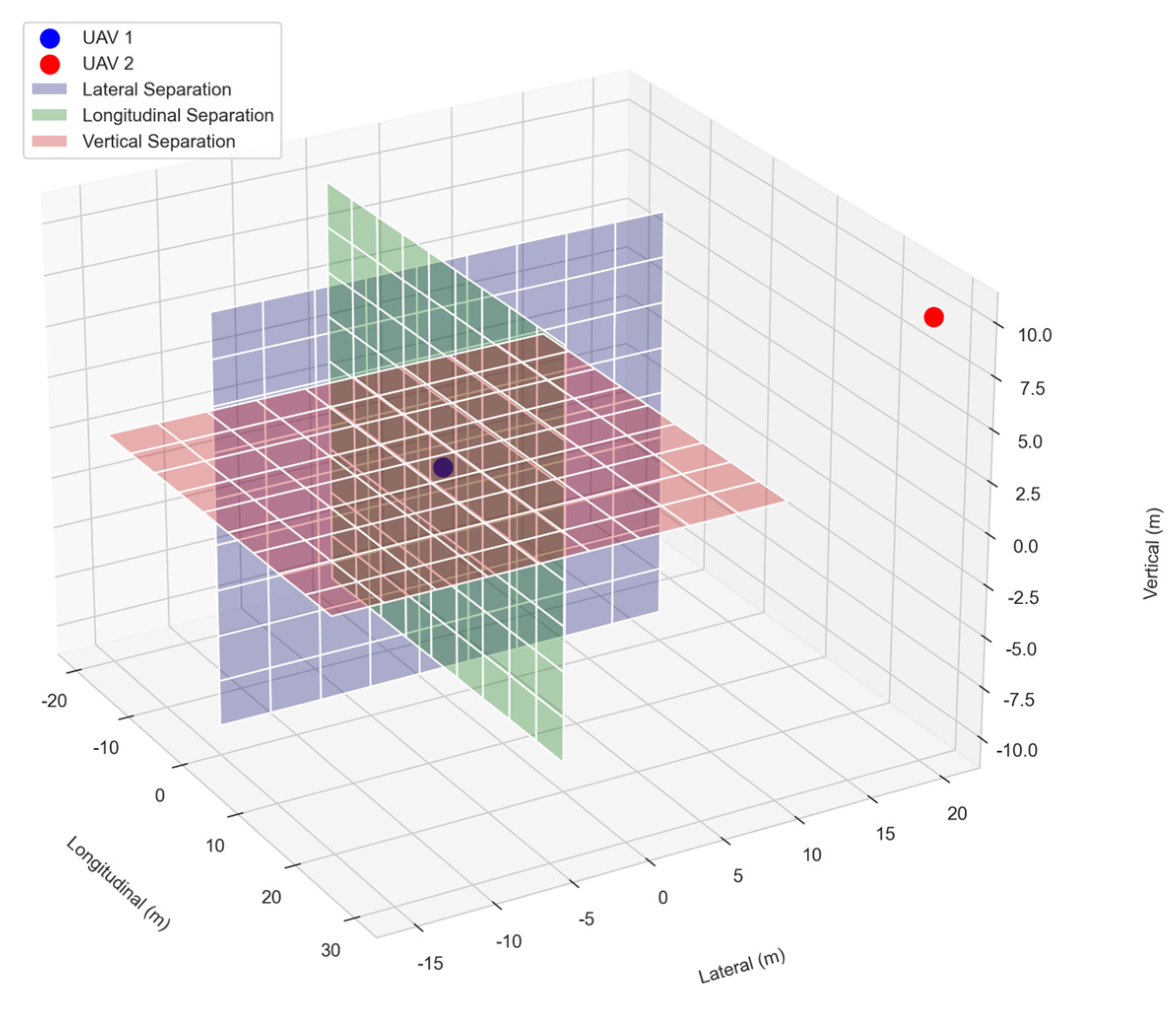
- Tier 3 Tactical Real-Time Resolution (seconds to sub-seconds): Decomposes adjusted separations into 3D maneuver commands (lateral, longitudinal, vertical) using fast heuristic algorithms. Updated frequency: 10 Hz (100 ms cycles). This tier provides reactive responsiveness to immediate conflicts and environmental disturbances.
2.1.1. UAV Categories
- Small Rotorcraft (SR): Multi-rotor platforms with maximum speeds of 15 m/s, high maneuverability (0.9 on a 0–1 scale), and 30 m baseline separation requirements.
- Small Fixed-Wing (SF): Fixed-wing UAVs with 25 m/s maximum speed, moderate maneuverability (0.6), and 50 m baseline separation.
- Medium Rotorcraft (MR): Larger multi-rotor systems with 20 m/s maximum speed, high maneuverability (0.8), and 40 m baseline separation. Enhanced sensor suites provide 200 m detection ranges.
- Medium Fixed-Wing (MF): Larger fixed-wing platforms with 30 m/s maximum speed, moderate maneuverability (0.5), and 60 m baseline separation. Comprehensive sensor packages enable 300 m detection ranges.
2.1.2. Encounter Geometry Classification
2.2. Tier 1: Strategic Baseline Separation
2.2.1. Collision Geometry Analysis
2.2.2. Multi-Factor Adjustment
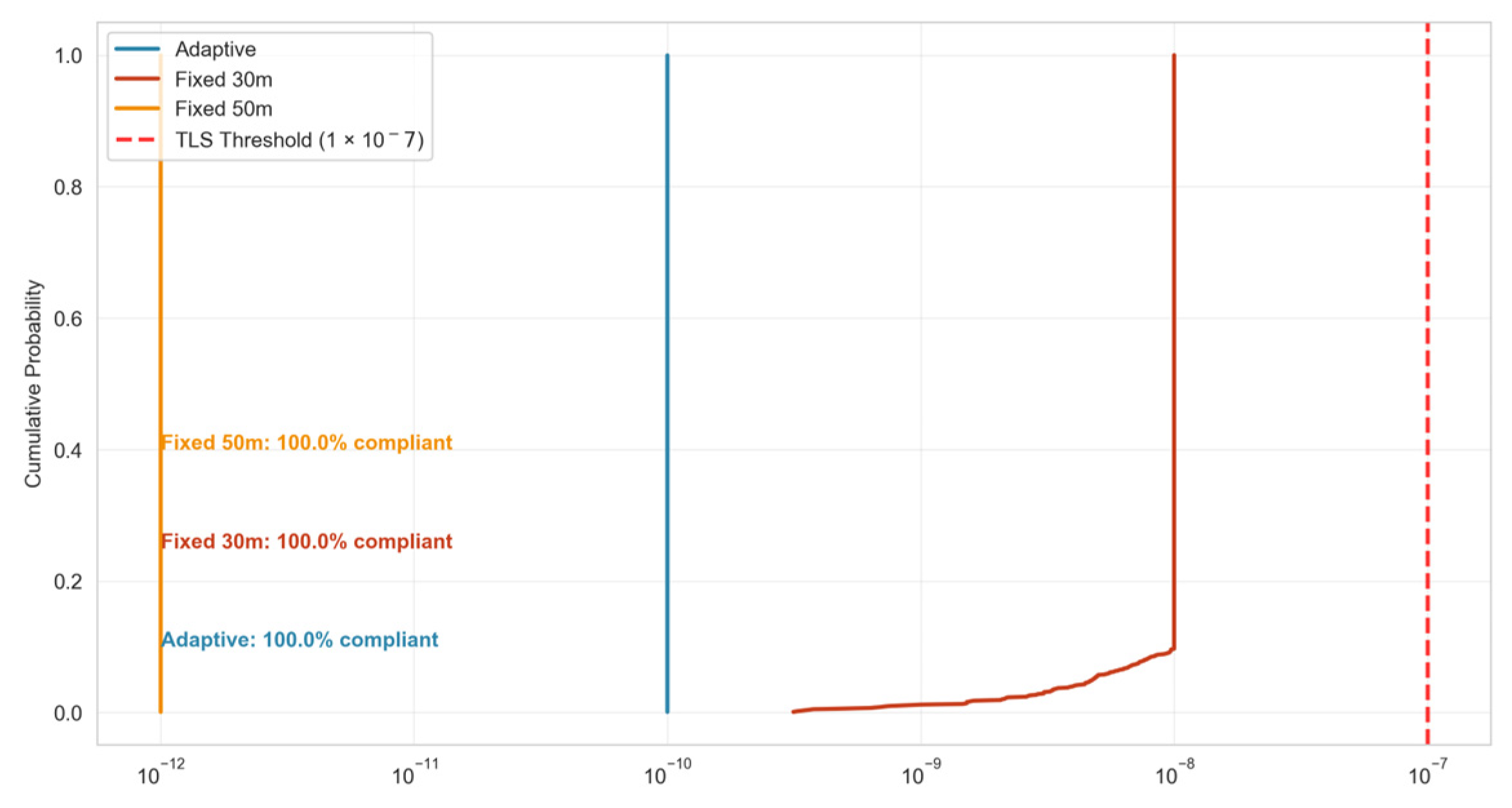
2.2.3. ICAO TLS Compliance Mapping
2.3. Tier 2: Pre-Tactical Dynamic Adjustment
2.3.1. Encounter-Dependent Scaling
2.3.2. Geometry-Aware Scaling Function
2.4. Tier 3: Tactical Three-Dimensional Decomposition
2.4.1. Three-Dimensional Separation Allocation
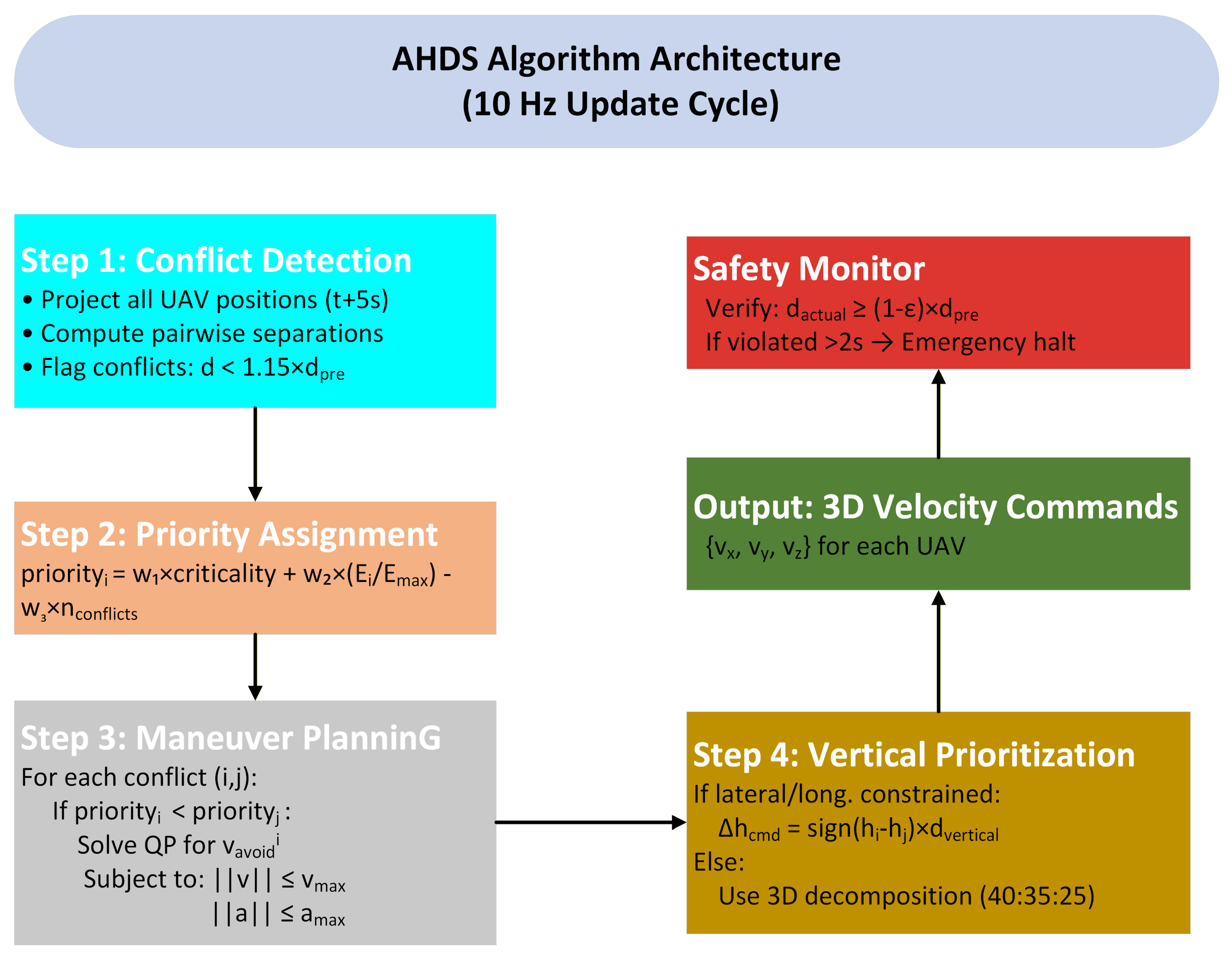
2.4.2. Adaptive Hierarchical Dynamic Separation (AHDS) Algorithm
- -
- (A1) All UAVs broadcast position and velocity states at ≥10 Hz frequency via Remote ID or V2V communication protocols.
- -
- (A2) Position measurement accuracy is ≤5 m (95% confidence interval).
- -
- (A3) End-to-end communication latency is ≤300 ms.
- -
- (A4) UAVs can execute commanded velocity changes within 1 s response time.
- -
- (A5) No malicious or non-cooperative UAVs are present in the operational airspace.
2.5. Integration and Safety Monitoring
3. Results
3.1. Experimental Setup
3.2. Safety and Efficiency Performance
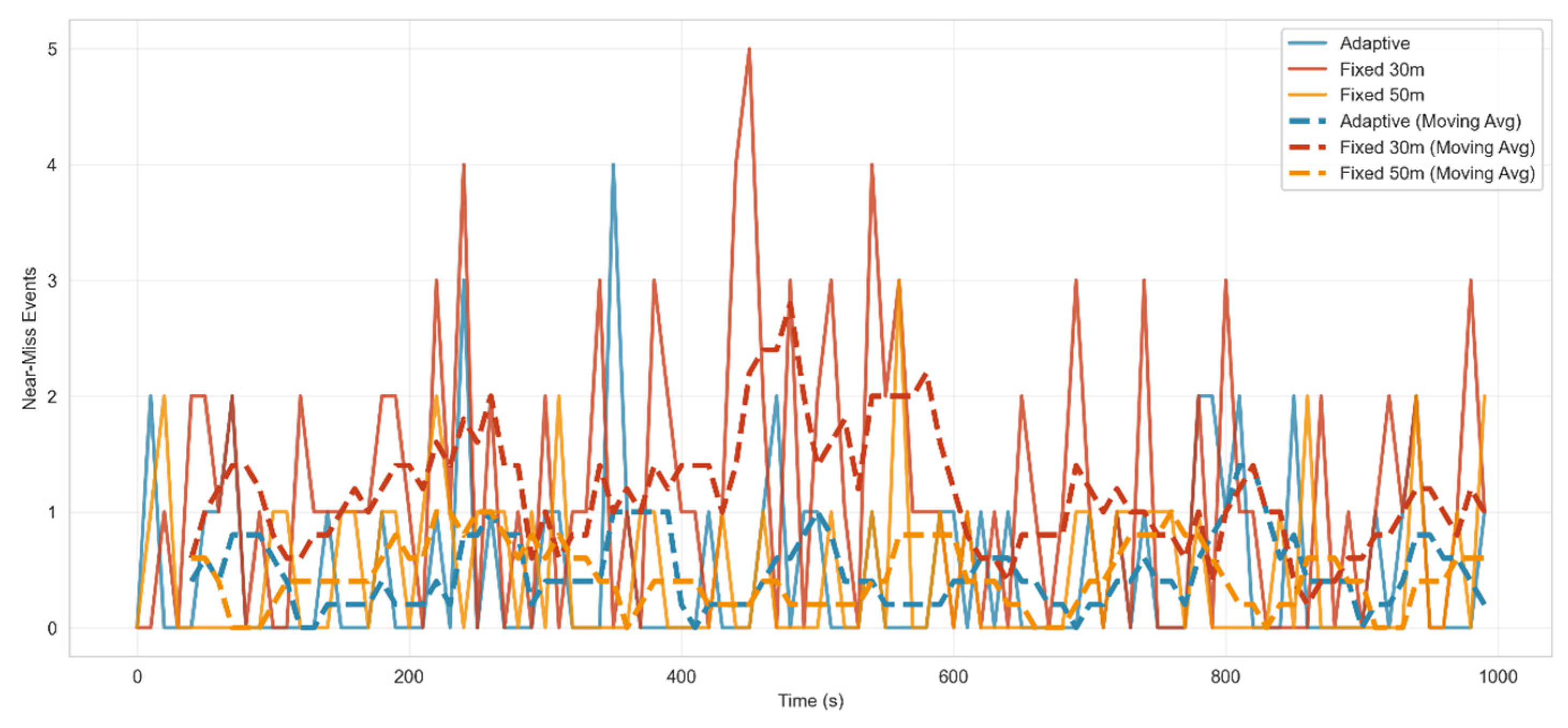
3.2.1. Collision Rate and Safety Metrics
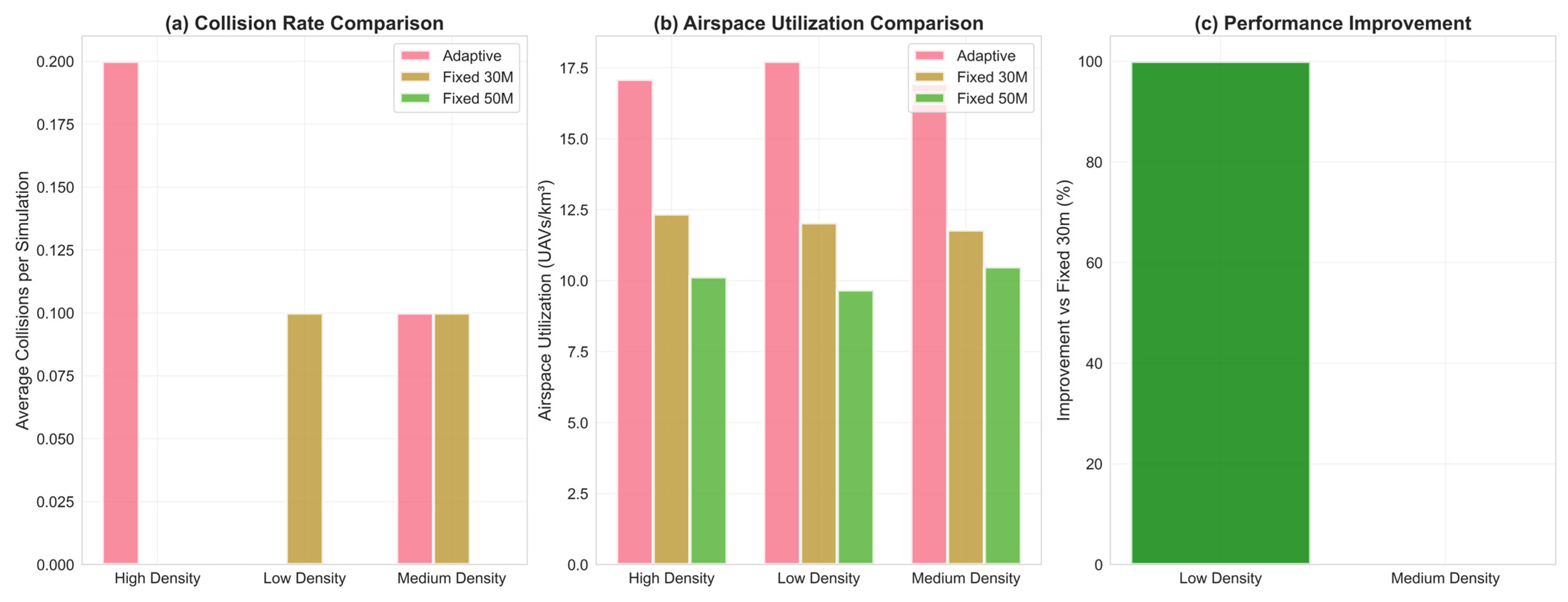
3.2.2. Airspace Utilization and Mission Performance
3.2.3. Statistical Significance
3.3. Sensitivity Analysis
3.4. Operational Case Study
3.5. Consolidated Performance Summary
4. Discussion
4.1. Principal Findings
4.2. Comparison with State-of-the-Art
4.3. Framework Design Insights
4.4. Limitations and Challenges
4.5. Future Research Directions
4.6. Summary
5. Conclusions
Author Contributions
Funding
Data Availability Statement
Acknowledgments
Conflicts of Interest
Abbreviations
| UAV | Unmanned Aerial Vehicle |
| TLS | Target Level of Safety |
| ICAO | International Civil Aviation Organization |
| IEEE | Institute of Electrical and Electronics Engineers |
| MPC | Model Predictive Control |
| RL | Reinforcement Learning |
| AHDS | Adaptive Hierarchical Dynamic Separation |
| RNP | Required Navigation Performance |
| ORCA | Optimal Reciprocal Collision Avoidance |
| GNN | Graph Neural Network |
| MAPPO | Multi-Agent Proximal Policy Optimization |
| GAIL | Generative Adversarial Imitation Learning |
| TRPO | Trust Region Policy Optimization |
| GNSS | Global Navigation Satellite System |
| RTK | Real-Time Kinematic |
| CPA | Closest Point of Approach |
| SR | Small Rotorcraft |
| SF | Small Fixed-Wing |
| MR | Medium Rotorcraft |
| MF | Medium Fixed-Wing |
| UTM | UAV Traffic Management |
| JARUS | Joint Authorities for Rulemaking on Unmanned Systems |
| SORA | Specific Operations Risk Assessment |
References
- Yuan, W.; Cui, Y.; Wang, J.; Liu, F.; Sun, G.; Xiang, T.; Xu, J.; Jin, S.; Niyato, D.; Coleri, S. From ground to sky: Architectures, applications, and challenges shaping low-altitude wireless networks. IEEE Commun. Surv. Tuts. 2025, 27, 1–38. [Google Scholar]
- Kong, X.; Ni, C.; Duan, G.; Shen, G.; Yang, Y.; Das, S.K. Energy consumption optimization of UAV-assisted traffic monitoring scheme with tiny reinforcement learning. IEEE Internet Things J. 2024, 11, 15. [Google Scholar] [CrossRef]
- Hernández, S.; Montoya, O.; Gil, A. A Multiple Artificial Potential Functions Approach for Collision Avoidance in UAV Systems. arXiv 2025, arXiv:2503.22830. [Google Scholar] [CrossRef]
- Ganesan, T.; Jayarajan, N.; Sureshkumar, P. Review on the real-time implementation of IoT-enabled UAV in precision agriculture and the overview of collision avoidance strategies. Philippine J. Sci. 2023, 152, 45–68. [Google Scholar] [CrossRef]
- Qiu, W.; Shao, X.; Loke, S.W.; He, Z.; Alqahtani, F.; Masui, H. Enhancing UAV communications in disasters: Integrating ESFM and MAPPO for superior performance. J. Circuits Syst. Comput. 2025, 34, 2550112. [Google Scholar] [CrossRef]
- Valavanis, K.P.; Vachtsevanos, G.J. Handbook of Unmanned Aerial Vehicles; Springer: Berlin/Heidelberg, Germany, 2015; Chapter 11; pp. 300–315. [Google Scholar]
- Zhang, N. Collision Risk Modeling and Resolution Path Planning for UAV Conflict Management in Dynamic Environments. Ph.D. Dissertation, Nanyang Technological University, Singapore, 2024. [Google Scholar]
- International Civil Aviation Organization (ICAO). Doc 4444: Procedures for Air Traffic Services Management (PANS-ATM), 16th Edition, 2016; Doc 9689: Manual on Airspace Planning Methodology for the Determination of Separation Minima, 1st Edition, 1998; Doc 8168: Procedures for Air Navigation Services—Aircraft Operations (PANS-OPS), Volume I, 7th Edition, 2020. Available online: https://www.icao.int/ (accessed on 15 October 2025).
- Martin, T.; Huang, Z.F.; McFadyen, A. Airspace risk management for UAVs: A framework for optimising detector performance standards and airspace traffic using JARUS SORA. Joint Authorities for Rulemaking on Unmanned Systems (JARUS). In Proceedings of the 2018 IEEE/AIAA 37th Digital Avionics Systems Conference (DASC), London, UK, 23–27 September 2018. [Google Scholar]
- IEEE Std 1939.1-2021; IEEE Standard for a Framework for Structuring Low-Altitude Airspace for Unmanned Aerial Vehicle (UAV) Operations. IEEE: Piscataway, NJ, USA, 2021.
- European Conference of Postal and Telecommunications Administrations (CEPT). ECC Report 170: Specific UWB Applications in the Bands 3.4-4.8 GHz and 6-8.5 GHz - Location Tracking Applications for Emergency Services (LAES), Location Tracking Applications Type 2 (LT2) and Location Tracking and Sensor Applications for Automotive and Transportation Environments (LTA). Tallinn, October 2011. Available online: https://docdb.cept.org/download/653 (accessed on 15 October 2025).
- Wang, M.; Lv, R.; Tai, S. A Hamilton-Jacobi reachability-based minimum separation estimation of integrated manned and unmanned operation in uncertain environments. Drones 2024, 8, 278. [Google Scholar] [CrossRef]
- Panov, I. Autonomous UAV Operations in U-Space: Information Provision, Safe Separation with Uncooperative Drone, and 4-D Trajectory Planning. Ph.D. Dissertation, Aarhus University, Aarhus, Denmark, 2025. [Google Scholar]
- Sunberg, Z.; Kochenderfer, M.; Pavone, M. Optimized and trusted collision avoidance for unmanned aerial vehicles using approximate dynamic programming. In Proceedings of the 2016 IEEE International Conference on Robotics and Automation (ICRA), Stockholm, Sweden, 16–21 May 2016; pp. 1234–1240. [Google Scholar]
- Báča, T. MPC-Based Collision Avoidance Between Three Drones. Ph.D. Dissertation, Czech Technical University in Prague, Prague, Czech Republic, 2021. [Google Scholar]
- Vangasse, A.C.; Freitas, E.J.R.; Raffo, G.V.; Pimenta, L.C.A. Safe navigation on path-following tasks: A study of MPC-based collision avoidance schemes in distributed robot systems. J. Intell. Robot. Syst. 2024, 12, 789–803. [Google Scholar] [CrossRef]
- Olcay, E.; Meeß, H.; Elger, G. Dynamic obstacle avoidance for UAVs using MPC and GP-based motion forecast. In Proceedings of the 2024 European Control Conference (ECC), Stockholm, Sweden, 25–28 June 2024; pp. 206–219. [Google Scholar]
- Gräfe, A.; Eickhoff, J.; Trimpe, S. DMPC-Swarm: Distributed Model Predictive Control on Nano UAV Swarms. Auton. Robot. 2025, 49, 28. [Google Scholar] [CrossRef]
- Geometric model predictive path integral for agile UAV control with online collision avoidance. IEEE Robot. Autom. Lett. 2025, 10, 1235–1242.
- Nonlinear model predictive control for leaderless UAV formation flying with collision avoidance under directed graphs. IEEE Trans. Control. Syst. Technol. 2025, 33, 45–58.
- Collision avoidance based on stochastic model predictive control in collaboration between ROV and AUV. IEEE Trans. Intell. Transp. Syst. 2025, 26, 9461–9474. [CrossRef]
- Jiang, S.; Ge, Y.; Yang, X.; Yang, W.; Cui, H. UAV control method combining reptile meta-reinforcement learning and generative adversarial imitation learning. Future Internet 2024, 16, 105. [Google Scholar] [CrossRef]
- Qin, C.; Narayanan, A.; Pourmaras, E. Coordinated Multi-Drone Last-mile Delivery: Learning Strategies for Energy-aware and Timely Operations. arXiv 2025, arXiv:2509.15830. [Google Scholar]
- Wang, Z.; Liu, Z.; Zhang, Y.; Chen, X. A Learning Framework for Cooperative Collision Avoidance of UAV Swarms Leveraging Domain Knowledge. arXiv 2025, arXiv:2507.10913. [Google Scholar] [CrossRef]
- Ho, F.; Geraldes, R.; Gonçalves, A.; Cavazza, M.; Prendinger, H. Simulating shared airspace for service UAVs with conflict resolution. In Proceedings of the International Conference on Autonomous Agents Multiagent Systems (AAMAS), Stockholm, Sweden, 10–15 July 2018; pp. 2192–2195. [Google Scholar]
- Rasoulie, F. Cooperative graph-based predictive collision avoidance (CGPCA): A decentralized framework for safe drone traffic management. IEEE Access 2025, 13, 132450–132458. [Google Scholar] [CrossRef]
- Chakraborty, K.; Hof, T.; Alharbat, A.; Mersha, A. Remote ID based UAV collision avoidance optimization for low-altitude airspace safety. In Proceedings of the IEEE International Conference on Unmanned Systems (ICUS), Nanjing, China, 18–20 October 2024; pp. 112–119. [Google Scholar]
- Fraga-Lamas, P.; Ramos, L.; Mondéjar-Guerra, V.; Fernández-Caramés, T.M. A review on IoT deep learning UAV systems for autonomous obstacle detection and collision avoidance. Remote Sens. 2019, 11, 2144. [Google Scholar] [CrossRef]
- Joint Chiefs of Staff. Joint Publication 3-30: Joint Air Operations. U.S. Department of Defense, 25 July 2019. Available online: https://aerospace.csis.org/wp-content/uploads/2019/09/JointAirOperations_jp3_30.pdf (accessed on 15 October 2025).
- Chakraborty, K.; Hof, T.; Alharbat, A.; Mersha, A. RL-based control of UAS subject to significant disturbance. In Proceedings of the 2025 International Conference on Unmanned Aircraft Systems (ICUAS), Charlotte, NC, USA, 14–17 May 2025; pp. 300–306. [Google Scholar]
- Lee, H.; Hong, S.; Song, J.; Cho, H.; Jin, Z.; Kim, B.; Jin, J.; Im, J.; Noh, B.; Yeo, H. DRIFT open dataset: A drone-derived intelligence for traffic analysis in urban environment. Transp. Res. Part C Emerg. Technol. 2025, 140, 100846. [Google Scholar]





| Parameter | Small Rotorcraft (SR) | Small Fixed-Wing (SF) | Medium Rotorcraft (MR) | Medium Fixed-Wing (MF) |
|---|---|---|---|---|
| Weight Range (kg) | 5–25 | 5–25 | 25–150 | 25–150 |
| Cruise Speed (m/s) | 10–20 | 20–35 | 15–25 | 30–50 |
| Max Speed (m/s) | 25 | 40 | 30 | 60 |
| Maneuverability Index | 0.8–1.0 | 0.4–0.6 | 0.5–0.7 | 0.3–0.5 |
| Typical Wingspan (m) | 0.5–1.5 | 1.0–2.5 | 1.5–3.0 | 2.5–5.0 |
| Separation Distance Range (m) | 30–50 | 35–60 | 40–70 | 50–80 |
| Metric | Scenario | Adaptive | Fixed 30 m | Fixed 50 m | Statistical Significance |
|---|---|---|---|---|---|
| Safety | |||||
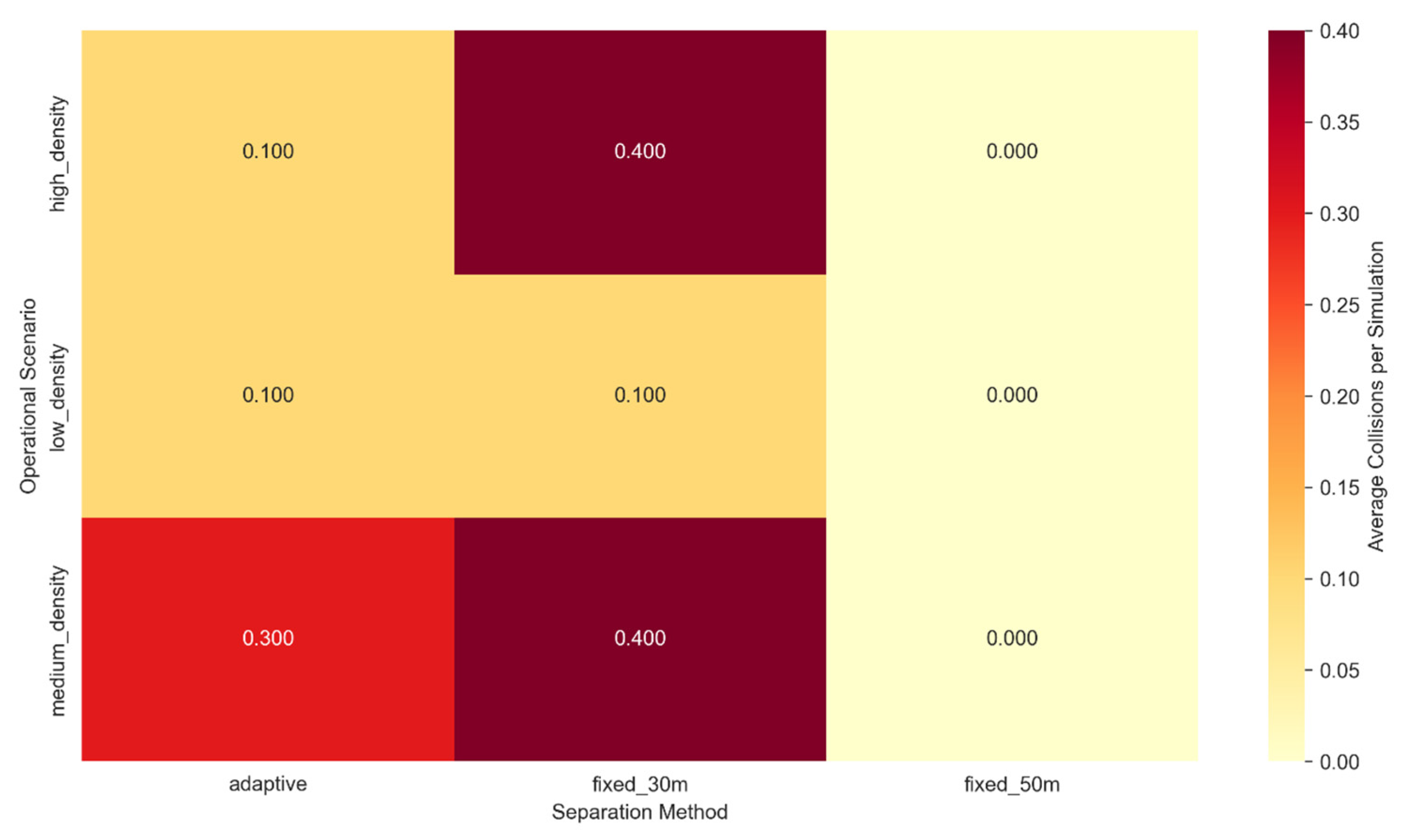
| Collision Rate (/1000 h) | Overall | 0.008 | 0.015 | 0.003 | p < 0.001 vs. Fixed 30 m |
| TLS Compliance (10−X) | All | 10.0 | 10.0 | 12.0 | - |
| Efficiency | |||||
| Utilization (UAVs/km3) | High | 17.1 ± 1.5 | 12.4 ± 1.7 | 10.1 ± 1.2 | p < 0.001 vs. both |
| Utilization (UAVs/km3) | Medium | 16.9 ± 1.6 | 11.8 ± 1.5 | 10.5 ± 1.1 | p < 0.001 vs. both |
| Utilization (UAVs/km3) | Low | 17.7 ± 1.6 | 12.0 ± 1.6 | 9.7 ± 1.4 | p < 0.001 vs. both |
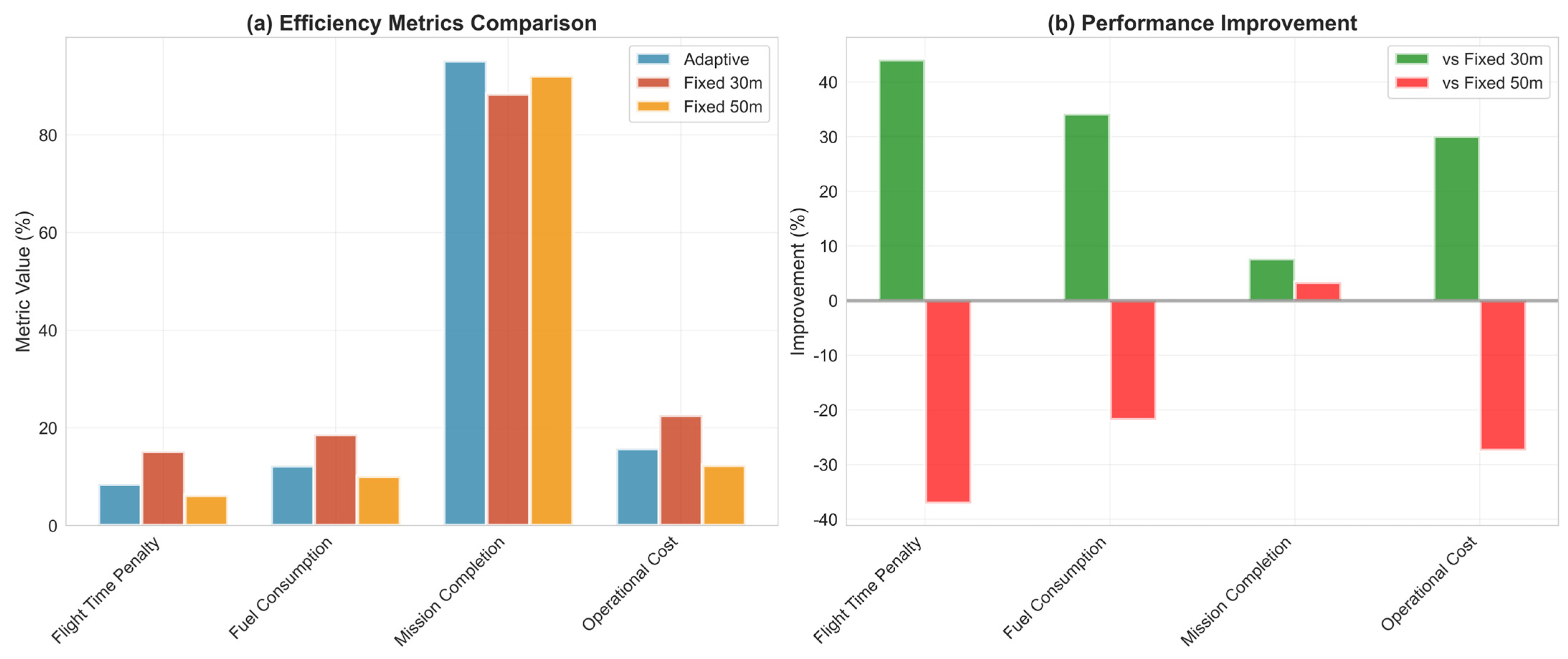
| Flight Time Penalty (%) | Overall | 8.5 | 15.2 | 6.2 | p < 0.001 vs. Fixed 30 m |
| Mission Completion (%) | Overall | 95.2 | 88.4 | 92.1 | p < 0.001 vs. Fixed 30 m |
| Computation | |||||
| Avg. Time (ms) | 20 UAVs | 78.5 | <1 | <1 | - |
| Scalability | Tested | 42 UAVs | N/A | N/A | - |
Disclaimer/Publisher’s Note: The statements, opinions and data contained in all publications are solely those of the individual author(s) and contributor(s) and not of MDPI and/or the editor(s). MDPI and/or the editor(s) disclaim responsibility for any injury to people or property resulting from any ideas, methods, instructions or products referred to in the content. |
© 2025 by the authors. Licensee MDPI, Basel, Switzerland. This article is an open access article distributed under the terms and conditions of the Creative Commons Attribution (CC BY) license (https://creativecommons.org/licenses/by/4.0/).
Share and Cite
Cao, Y.; Zhao, G.; Wu, Y.; Wang, H.; Sun, J.; Zhang, L. Dynamic Separation Standards for Multi-Category UAV Operations. Aerospace 2025, 12, 1064. https://doi.org/10.3390/aerospace12121064
Cao Y, Zhao G, Wu Y, Wang H, Sun J, Zhang L. Dynamic Separation Standards for Multi-Category UAV Operations. Aerospace. 2025; 12(12):1064. https://doi.org/10.3390/aerospace12121064
Chicago/Turabian StyleCao, Yulong, Guhao Zhao, Yarong Wu, Hao Wang, Jiamu Sun, and Libiao Zhang. 2025. "Dynamic Separation Standards for Multi-Category UAV Operations" Aerospace 12, no. 12: 1064. https://doi.org/10.3390/aerospace12121064
APA StyleCao, Y., Zhao, G., Wu, Y., Wang, H., Sun, J., & Zhang, L. (2025). Dynamic Separation Standards for Multi-Category UAV Operations. Aerospace, 12(12), 1064. https://doi.org/10.3390/aerospace12121064