1. Introduction
Recent advancements in robotics, control systems, and embedded technologies have significantly contributed to the rapid development and deployment of Unmanned Aerial Vehicles (UAVs). These aerial platforms have gained widespread adoption across military, industrial, and commercial sectors, offering solutions in domains such as surveillance, aerial inspection, search and rescue, environmental monitoring, and photography [
1,
2,
3]. This technological evolution has sparked renewed interest in enhancing UAVs’ autonomy and functionality to serve increasingly complex real-world tasks.
1.1. The Core Problem
Despite their versatility, traditional UAVs are primarily limited to observational and navigational tasks. They lack the physical interactivity needed for missions that require manipulation of objects in dynamic or hazardous environments. In emergency scenarios such as natural disasters, urban fires, or rescue operations, there exists a critical need for aerial systems that can not only observe but also interact physically with the environment. Tasks like lifting lightweight debris, delivering emergency supplies with precision, or operating valves and switches remain out of reach for conventional drones.
1.2. Current Technological Framework
UAVs generally fall into two main categories: fixed-wing and rotary-wing. Among rotary-wing types, the quadcopter (or quad-rotor) stands out due to its vertical takeoff and landing (VTOL) capabilities, stationary hover, agility, and ease of control in confined spaces [
4,
5]. A quadcopter comprises four propellers attached to individual rotors, and flight dynamics are achieved by varying their angular velocities. Vertical movement is controlled by synchronously adjusting the speeds of all four rotors; lateral and longitudinal movement is managed by modulating the speeds of opposing rotors, while yaw motion results from torque differentials generated by counter-rotating propellers.
1.3. Proposed Direction and Solution
To address the limitations of conventional UAVs in situations where human intervention is not possible, recent research has explored the integration of robotic manipulators onto Unmanned Aerial Vehicle (UAV) platforms, creating hybrid systems known as aerial manipulators [
6]. These systems combine the maneuverability of drones with the dexterity of robotic arms, allowing physical interaction in mid-air, providing necessary help. This capability has the potential to revolutionize emergency response operations by enabling tasks like object retrieval, supply placement, switch activation, first aid supply and more [
7].
1.4. Contributions & Novelty
This work differs from recent aerial manipulation systems (2020–2024) by combining: (i) a monolithic, 3D-printed quadrotor airframe that integrates a lightweight multi-DoF manipulator while preserving a tight weight budget; (ii) a cascaded PX4 control stack augmented with admittance control for compliant interaction; and (iii) outdoor field validation with public logs and a demonstration video. We contrast these choices with recent tilt-rotor/fully actuated platforms, passive capture devices, and learning-centric contact approaches in
Section 2.2 and
Table 1. This paper proposes a novel aerial manipulation system featuring an X-frame quadcopter integrated with a robotic emergency arm, and investigates its performance in emergency-relevant scenarios through multiple field flight tests. A demonstration video of the full system is available at
https://www.youtube.com/watch?v=QRAUUgJTlR0 (accessed on 17 November 2025); the payload flight sequence with arm operation appears at [00:25–01:15].
1.5. Structure of the Paper
The remainder of the paper is organized as follows. In
Section 2, we present a focused literature review of UAVs and aerial manipulation research, highlighting key technical milestones and identifying gaps in existing frame and casing designs. The dynamic model of the quadcopter is explained in
Section 3. In
Section 4, we describe our system architecture, including the hardware and control strategies, and introduce our own quadcopter frame and robotic emergency arm casing, where the frame is 3D-printed in PLA+ (“PLA+” denotes toughened PLA formulations (trade-name dependent), typically using additive packages that improve toughness and interlayer adhesion; see [
13].) to achieve a lightweight yet robust structure.
Section 5 provides example flight test case studies and simulations relevant to emergency applications. The remainder of this paper is organized as follows:
Section 6 outlines the main findings, emphasizing the novelty of our PLA+ frame, and the following section discusses future directions for deploying such systems in real-world crisis environments.
2. Literature Review
Recent advancements in unmanned aerial vehicle (UAV) research have transitioned from a primary focus on passive sensing to the development of platforms capable of active physical interaction with their surroundings. In this context, aerial manipulators (AMs), multirotor UAVs integrated with robotic arms, facilitate operations such as grasping, tool manipulation, payload transfer, and other tasks of significance to emergency response and infrastructure maintenance [
14,
15]. This section specifically addresses two aspects from the literature: first, UAVs incorporating robotic manipulators, and second, the associated dynamics and control methodologies, as these areas directly underpin the contribution of this work.
2.1. UAVs with Robotic Arms
Early applications of drones in emergency settings primarily focused on aerial photography, mapping, and reconnaissance. For instance, Ref. [
16] demonstrated the use of drones for rapid damage assessment post-earthquakes, while Ref. [
17] emphasized UAV deployment for wildfire monitoring. These efforts established UAVs as effective tools for information gathering. However, a growing need for physical intervention, such as delivering aid packages or interacting with infrastructure, led to the evolution toward manipulative aerial systems. The push for physical intervention spurred research into hybrid aerial-manipulation systems.
Early and seminal prototypes demonstrated the feasibility of combining manipulators with UAVs for airborne manipulation tasks such as valve turning, grasping, and constrained surface interaction [
18,
19]. Design work emphasizes minimizing manipulator mass and inertia while providing sufficient dexterity: lightweight manipulator concepts using carbon-fiber and optimized link geometries report arm masses in the low-kilogram range and prioritize structural compliance to absorb contact impulses [
20,
21]. These studies illustrate trade-offs between dexterity, payload, and flight endurance that directly inform structural choices for emergency-use platforms.
In emergencies, drones with robotic arms can offer direct physical interventions:
Search and rescue: Ref. [
22] explored systems in collapsed-building scenarios, where UAVs can remove light debris or drop rescue lines.
Forest fire management: Ref. [
23] explored integrating drones with blockchain and swarm robotics to decentralize coordination, secure data sharing, and found that UAVs offer immense benefits in monitoring, detecting, and combating forest fires.
2.2. Coupled Dynamics of Aerial Manipulators
The motion of a manipulator is tightly coupled with the flight dynamics of an underactuated multirotor: manipulator actuation produces time-varying inertial loads and shifts in the center of gravity, which in turn generate disturbance wrenches on the vehicle. Modeling efforts, therefore, treat AMs as coupled multi-body systems with strongly nonlinear, time-varying dynamics; accurate plant models are often required for high-performance controllers and for predicting stability margins during contact-rich tasks [
18,
21]. Empirical reports quantify how arm motion degrades attitude and position tracking if not actively compensated, motivating the co-design of structure and controller.
Recent Aerial Manipulation Approaches
Recent directions include (a) fully actuated or tilt-rotor platforms for precision contact/wrench control [
8]; (b) passive one-DoF capture devices (e.g., hook or perching) to keep mass and power overheads low [
9]; and (c) compliance/admittance frameworks and learning-based policies for interaction [
10,
12]. In contrast, our emphasis is rapid fabrication, low-cost integration of a multi-DoF arm on a monolithic 3D-printed frame, and field validation with reproducible artifacts. We summarize representative works alongside ours in
Table 1 and highlight differences in platform actuation, manipulator DoF, materials/build, control approach, validation setting, and artifact availability [
8,
9,
10,
11,
12].
2.3. Control Strategies for Stability and Interaction
Several control paradigms have been proposed and validated to address the coupled UAV–manipulator problem:
Model-based dynamic compensation Controllers that compensate manipulator-induced wrenches by adjusting thrust and moments can preserve vehicle stability during manipulation; these approaches typically rely on an accurate dynamic model or online identification [
18,
19].
Impedance/admittance control For contact tasks, impedance or admittance controllers at the manipulator end-effector enable compliant interaction and reduce transmitted forces to the vehicle, improving safety during contact with uncertain environments [
18].
Robust/nonlinear/adaptive control. Sliding-mode, adaptive, and passivity-based controllers have been applied to reject disturbances, handle model mismatch, and maintain robustness in outdoor conditions with wind and sensor noise [
21,
24].
MPC/NMPC and manipulability-aware control. Model predictive control frameworks (including NMPC) have been explored to enforce actuation and state constraints while optimizing end-effector performance (e.g., manipulability), particularly for constrained or precision tasks [
15,
25].
These strategies are often combined in hierarchical or cascaded architectures: a high-level planner or MPC provides reference trajectories and manipulability-aware setpoints, while an inner-loop attitude/position controller performs fast stabilization and disturbance rejection.
2.4. Research Gaps and Positioning of This Work
Despite progress, three recurring limitations remain in the literature:
Payload and endurance constraints: manipulator mass and actuation substantially reduce flight time and available payload capacity, necessitating lightweight structural and actuator choices [
20].
Coupled dynamic instability: many systems still rely on teleoperation or simplified compensation; fully integrated flight manipulation control under real-world disturbances is limited [
14,
24].
Limited field validation in emergency scenarios: although simulation and lab tests are common, extensive outdoor validation during realistic emergency tasks is less prevalent [
15].
Several recent studies have begun to address these gaps:
Dynamic compensation for payload and stability: Ref. [
26] developed a quadrotor with a 2-DOF arm and implemented real-time dynamic compensation to preserve flight stability under varying loads.
Admittance control for compliant interaction: Ref. [
27] introduced a force-based admittance controller that allows safe, compliant contact with the environment.
Lightweight structural designs: Ref. [
28] proposed carbon-fiber manipulator components to minimize added mass and reduce energy consumption during aerial manipulation.
This paper addresses these gaps by combining a lightweight structural co-design (a PLA+ 3D-printed frame tailored for reduced inertia and rapid prototyping) with a robust flight–manipulation control approach validated in multiple field flight tests. Specifically, our work targets the structural and control trade-offs required for emergency-relevant interactions and provides experimental evidence of performance in outdoor conditions.
Note on Broader UAV Taxonomy
A broader taxonomy of UAV configurations (tricopters, hexacopters, tilt-rotors, ornithopters, etc.) was considered during platform selection, but is outside the core scope of this article and is summarized in
Appendix A for context and completeness.
3. Dynamic & Control Model of Aerial Manipulator Robotic Arm Quadcopter
3.1. Dynamic Model
3.1.1. Ensuring Specification Integrity
To formulate the quadrotor’s dynamic equations, we adopt the following simplifying assumptions:
The vehicle behaves as a rigid body acted upon by a single net lift force and three independent control torques.
Its design is symmetric about both the x- and y-axes, so the inertia tensor reduces to a diagonal matrix.
The origin of the body-fixed coordinate frame coincides with the quadrotor’s center of gravity.
Effects due to aerodynamic drag and rotor gyroscopic moments are considered negligible.
3.1.2. Reference Frames and Kinematic Representation
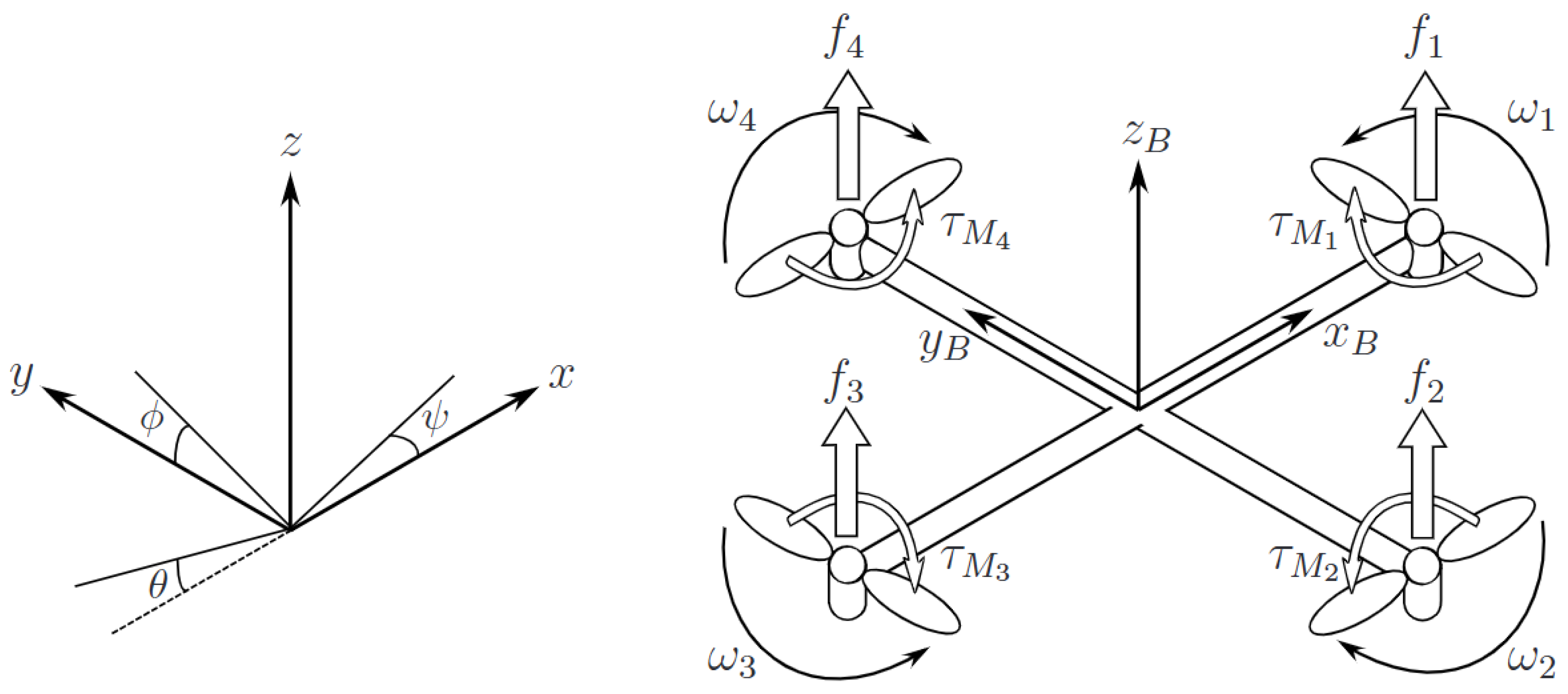
As illustrated in
Figure 1 and detailed in [
29], we introduce an inertial frame fixed at a ground reference point and a body-fixed frame attached to the quadrotor’s center of gravity. The vehicle’s Cartesian position in the inertial frame is given by
where
x,
y, and
z denote its coordinates along the respective axes. Its orientation is described by the Euler angles roll (
), pitch (
), and yaw (
) which we assemble into the attitude vector
. To relate measurements between the body-fixed and inertial frames, we employ the rotation matrix
R. This matrix is constructed via a 3–2–1 Euler-angle sequence (yaw–pitch–roll), yielding the coordinate transformation from the body frame to the inertial frame:
We adopt a Z–Y–X (yaw–pitch–roll) Euler sequence; R maps body-frame vectors to the inertial frame.
3.1.3. Rotational Kinematics
The correspondence between the inertial-frame Euler-angle rates
and the body-frame angular velocity components
is expressed by
where
By linearizing the nonlinear model about the hover equilibrium and assuming small roll and pitch angles, the matrix
reduces to the
identity
. Hence, we obtain
3.1.4. Translational Dynamics
The quadrotor’s dynamics are then formulated using the Newton–Euler approach. The translational equations of motion, written in the inertial frame, include only the gravitational force
G and the body-frame thrust
.
3.1.5. Rotational Dynamics
In the body-fixed frame, the rotational dynamics are defined by the external torque
applied to the quadrotor. This torque comprises the inertial angular acceleration term
and the centripetal term
.
3.1.6. Thrust and Torque Generation
A force
and a torque
are generated perpendicular and around the axis of each motor with angular velocity of
.
where the thrust constant is represented by
k, and the drag constant is written by
b.
The total thrust (
) can be determined by the summation of all forces generated by the four rotors.
Additionally, the body-frame torque
about the
x,
y, and
z axes is given by:
Here, l denotes the distance from each rotor to the quadrotor’s center of mass, and , , and correspond to the roll, pitch, and yaw torques, respectively.
3.1.7. Control Allocation
The control input vector in terms of the squared rotor speeds is obtained by combining Equations (
9) and (
10):
3.1.8. Complete Nonlinear Equations of Motion
The complete nonlinear dynamics of the quadrotor are then given by:
In this section, we established a comprehensive six-degree-of-freedom model for the quadrotor by:
defining inertial and body-fixed reference frames and the corresponding Euler angles and rotation matrix;
deriving the mapping between body-frame angular rates and Euler-angle rates, including a small-angle linearization for hovering;
applying Newton–Euler mechanics to obtain both translational and rotational equations of motion;
characterizing individual rotor thrust and drag torques; and
formulating the control-allocation matrix that relates squared rotor speeds to the total lift and attitude torques.
The resulting set of nonlinear differential equations (Equations (
12)–(
17)) captures the essential dynamics needed for simulation, analysis, and controller design across the vehicle’s operating envelope.
3.2. Coupled Dynamics of the Aerial Manipulator
We extend the quadrotor-only model to a floating-base UAV–arm system in which the vehicle and a six-DoF hobby servo arm (MG996R-class actuators, 2 mm aluminum links) are treated as a single articulated rigid body. Let
denote the vehicle body twist and
the arm joint coordinates. Following standard Euler–Lagrange/spatial-vector derivations for aerial manipulators [
19,
31,
32,
33,
34,
35], the equations of motion can be written in block form as
where
and
(and the corresponding Coriolis terms in
C) encode the manipulator–base coupling. This coupling captures center-of-mass shifts, added inertia, and reaction wrenches generated by arm motion and/or end-effector contact. For thrust/torque mapping we use
with the standard allocation matrix
B for our multirotor geometry.
3.2.1. Arm Model and Parameters
The commercial arm is modeled as a 6R serial chain using a concise DH table (link lengths/offsets measured from the assembled kit). Each joint is a position servo with saturating torque and simple friction:
with
and travel
(MG996R class). Link inertias are approximated from 2 mm aluminum plate geometry; the tool/payload is lumped at the end-effector. This pragmatic parameterization is common in prior aerial manipulation work when detailed CAD is unavailable [
19,
31].
3.2.2. Manipulator-Induced Base Wrench
Partitioning (
18) yields a transparent expression for the arm’s disturbance on the base:
which can also be interpreted via the rate of the arm’s centroidal momentum [
33,
35]. During aggressive arm motion,
produces measurable attitude/position errors if left uncompensated.
3.2.3. Control Compensation
To explicitly address the reviewer’s request, we inject a model-based feedforward term and a residual rejection layer:
where
are generated by the arm trajectory planner. This “whole-body” coupling feedforward is consistent with centralized UAV–arm modeling [
31,
32]. We complement it with a lightweight base-wrench disturbance observer (or centroidal-momentum residual) to reject unmodeled servo nonlinearities, backlash, and contact effects. For readers interested in coordinate-free formulations or flatness-based planning, we refer to [
33,
35], while COI/SE(3) formulations that treat the UAV–arm as a single body are surveyed and extended in [
34].
3.2.4. Identification and Reporting
In experiments, we estimate servo gains and joint friction from base-fixed chirps and regress
from suspended-frame tests, reporting the magnitude of
during representative arm trajectories. The ablation in
Section 5.2 compares tracking error and saturation margins with vs. without (
20), quantifying the benefit of modeling the coupling terms that are absent from a quadrotor-only model [
31].
3.3. Control Model
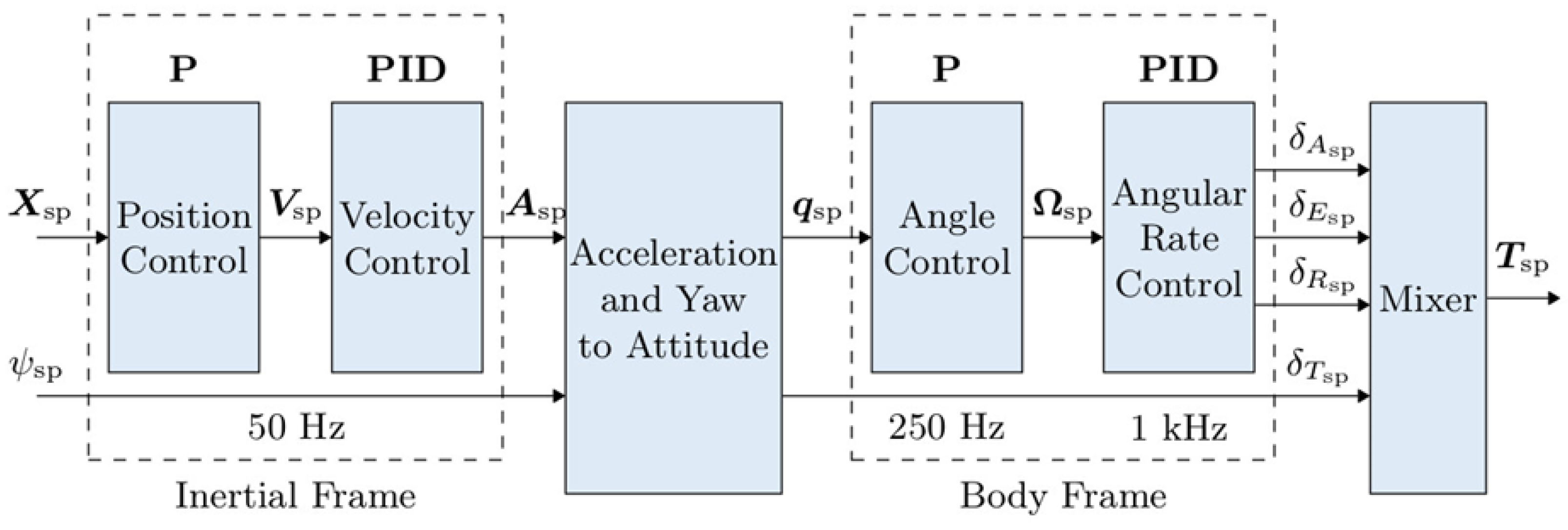
The quadcopter with the integrated emergency robotic arm employs a PX4 flight controller, which executes a cascaded Proportional–Integral–Derivative (PID) control architecture as shown in
Figure 2. This hierarchical control structure is responsible for ensuring stable flight performance across multiple layers of abstraction, ranging from angular rate regulation to precise position control.
The complete control system was validated in outdoor flight tests with a payload and varying altitudes. During experiments, the quadcopter demonstrated stable hover, accurate altitude regulation, and robust mode transitions (e.g., relocation and load-carrying maneuvers). The arm’s integration introduced additional coupling and inertia, yet the cascaded PID controllers effectively compensated, confirming the architecture’s robustness.
3.3.1. Control Architecture
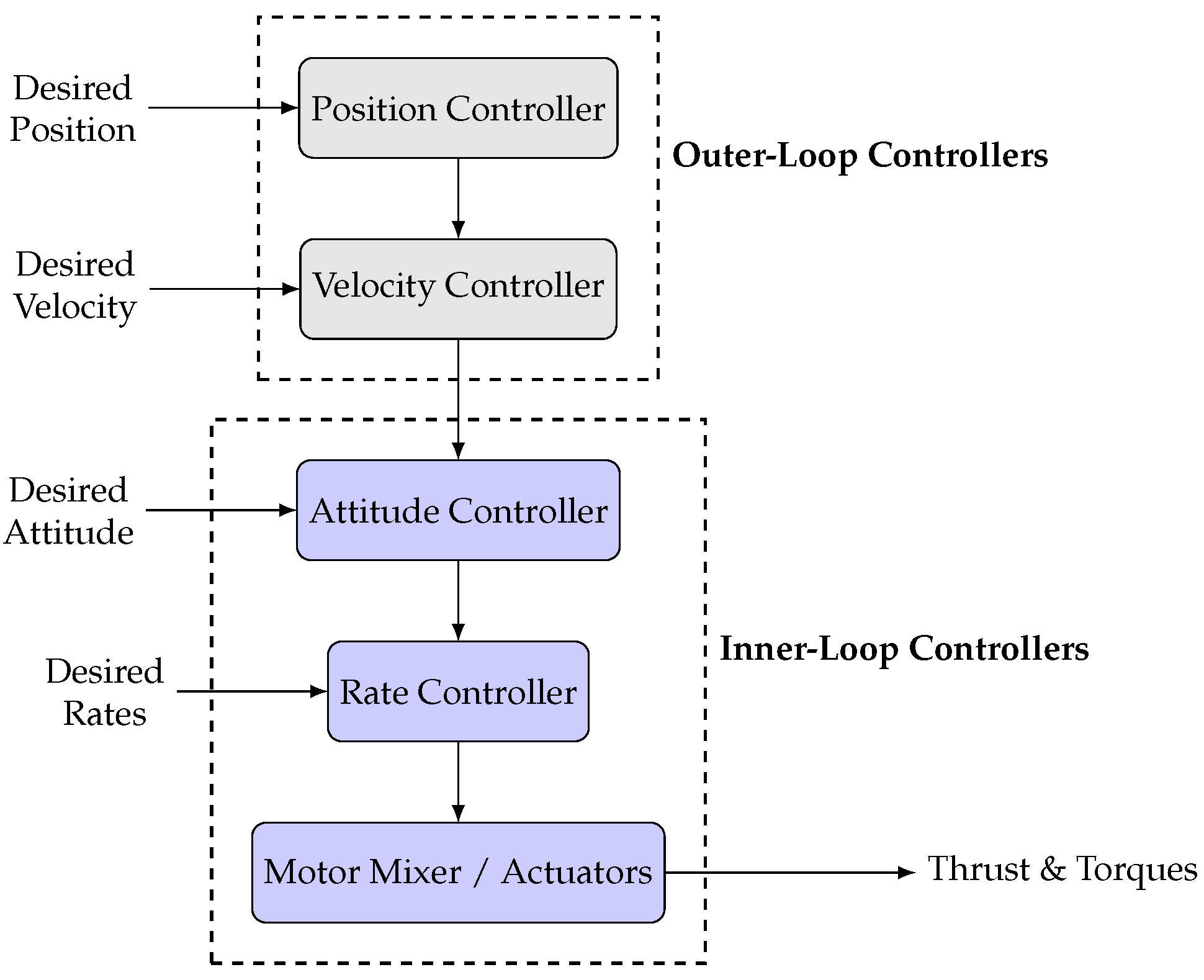
The quadcopter platform employs a cascaded control architecture implemented through the PX4 flight stack. This hierarchical structure consists of nested feedback loops that operate at different bandwidths to ensure both fast attitude stabilization and robust trajectory tracking. The controllers are organized into outer-loop (position and velocity) and inner-loop (attitude, rate, and actuator allocation) layers, as summarized schematically in
Figure 3.
The outer loop regulates the vehicle’s trajectory by generating velocity and attitude references based on position errors. These components are jointly illustrated in
Figure 3 as Outer-Loop Controllers. The inner loop ensures rapid stabilization of the vehicle’s orientation and angular rates, translating pilot or autonomous commands into actuator inputs. This loop, including attitude, rate, and motor allocation, is summarized in
Figure 3 as Inner-Loop Controllers.
During flight testing, this architecture demonstrated effective disturbance rejection and stable tracking of reference commands. Outer-loop position tracking was validated under waypoint navigation tasks, while inner-loop performance was assessed through step-input and disturbance recovery maneuvers. The flight data confirmed the controller’s ability to maintain stability despite the additional payload of the robotic arm.
3.3.2. PID Tunning
PID tuning remains a critical aspect for achieving robustness under external disturbances and the additional dynamic loads introduced by the onboard arm. By iteratively adjusting the proportional (P), integral (I), and derivative (D) gains, the controller compensates for modeling uncertainties, unmodeled coupling effects, and load-induced disturbances. In our implementation, advanced manual PID tuning was performed through flight experiments to balance stability, responsiveness, and energy efficiency.
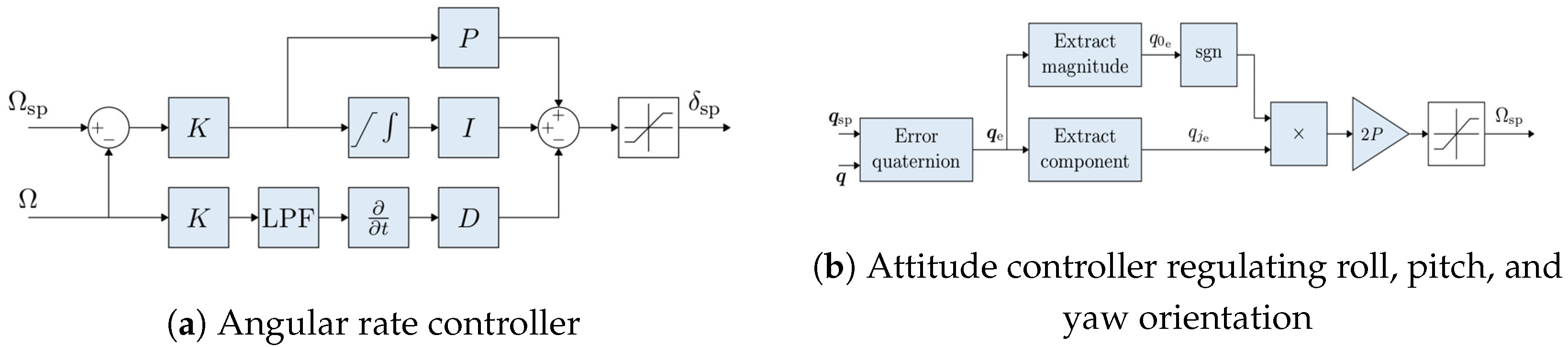
At the lowest layer, the rate controller manages angular velocities about the roll, pitch, and yaw axes. Desired angular rates are tracked using a PID loop, which translates commands into individual motor thrusts. Building on this, the attitude controller regulates orientation by converting attitude errors into angular rate commands, which are then stabilized by the inner-loop rate controller.
Figure 4 shows the cascaded architecture that ensures coordination between layers, resulting in smooth stabilization of the quadcopter.
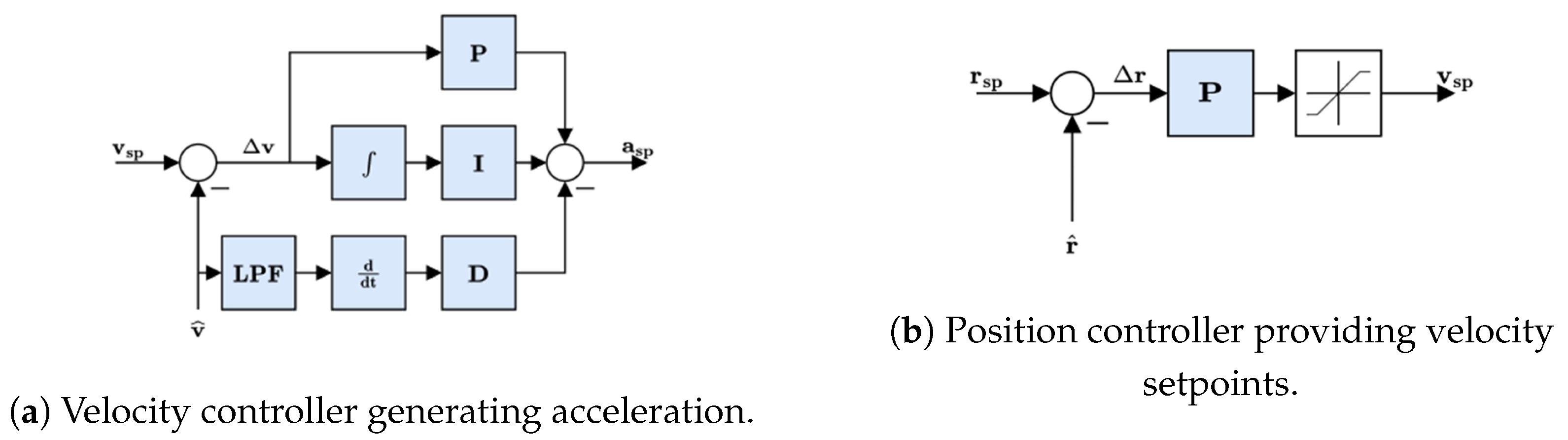
The velocity controller regulates translational speeds in the
x,
y, and
z directions, converting velocity errors into desired accelerations. These accelerations are subsequently mapped to orientation commands through the attitude controller. Finally, the position controller ensures trajectory tracking by generating velocity setpoints from position errors. This cascaded architecture, as shown in
Figure 5, ensures coordination between layers, resulting in optimal trajectory tracking of desired states.
Overall, the flight tests confirm that the cascaded PX4 PID control model provides reliable tracking performance even under emergency-response conditions, such as load carrying and relocation. The architecture’s modularity ensures scalability, allowing adaptation to additional manipulation tasks and more complex mission profiles in future work.
4. Methodology
In this section, a comprehensive overview of the methodology used to design, fabricate, assemble, and operate our custom drone equipped with an integrated robotic arm, tailored for emergency scenarios, is discussed. We start by detailing the design and fabrication process, focusing on the custom 3D-printed frame for the drone and the casing for the emergency arm, along with the fixtures needed for the emergency robotic arm and the integration of electronic components. We then describe the control system used for the robotic arm, which utilizes a nano Arduino and servo motors, and how we implemented remote control functionality to achieve precise in-flight operations.
4.1. Drone Frame: Design, Fabrication, and Setup
The airframe we adopted has an ‘X’ configuration, where two clockwise (CW) and two counterclockwise (CCW) rotors are selected for its well-documented advantages in stability and maneuverability during agile maneuvers and hover [
36,
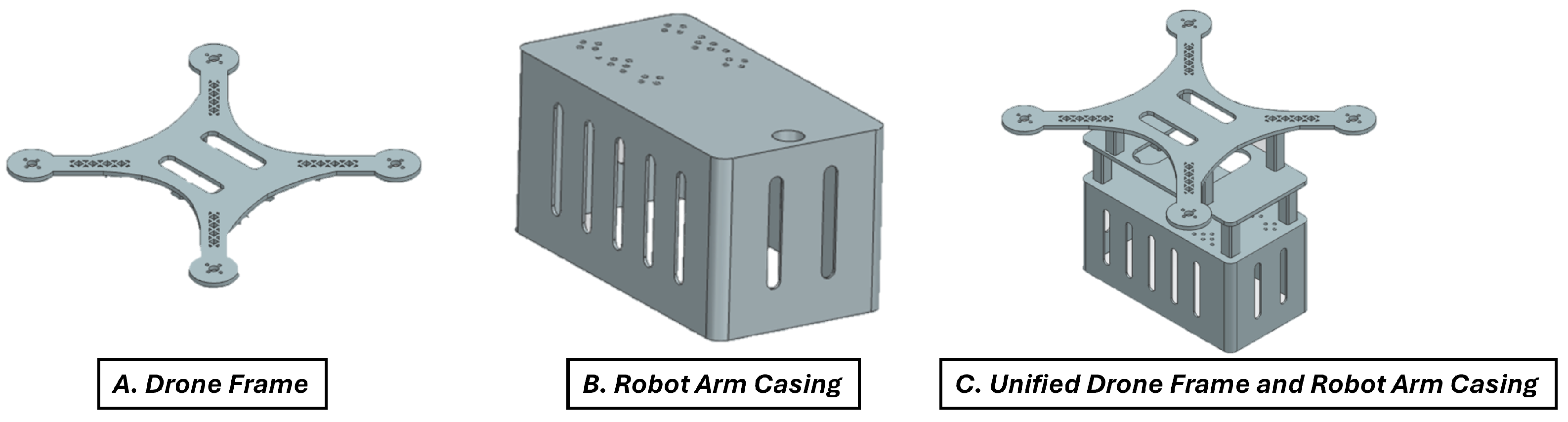
37]. By balancing rotor moments across both axes, this layout simplifies the implementation of pitch, roll, and yaw control algorithms on the Pixhawk autopilot. The Computer Aided Design (CAD) model of the complete frame, including the housing for the robotic arm, was parametrically modeled in Siemens NX as shown in
Figure 6 to ensure precise alignment of motor mounts, fuselage geometry, and arm interface points. We employed a space-filling Latin hypercube design of waypoint distributions across a cuboidal operational volume as shown in
Figure 7.
We selected a toughened PLA (often marketed as PLA+) for printed structural parts because it improves impact resistance and inter-layer adhesion while preserving printability and dimensional accuracy relative to standard PLA, consistent with prior mechanical studies and successful UAV components reported in the literature [
38,
39,
40,
41,
42]. Unlike traditional top-down machining, additive manufacturing allowed us to fabricate the fuselage and arm enclosure as a single monolithic component, eliminating bolted or bonded joints that can introduce flex and failure points. To further reduce overall mass without sacrificing rigidity, we incorporated strategically placed cutouts and lattice slots in low-stress regions of the arm housing, guided by finite-element stress analysis during the CAD phase.
We conducted a series of print-parameter experiments to calibrate infill density, pattern, and layer height. Critical load paths, such as the motor-mount interfaces and arm base, were printed at 60% hexagonal infill to resist bending moments under maximum lift and payload conditions. Less-stressed volumes used 20% gyroid infill to minimize weight and material consumption. Layer heights of 0.2 mm and 2 perimeters provided a reliable surface finish and dimensional accuracy for snap-fit features. These iterative adjustments were validated through three-point bend tests and thrust-stand measurements, confirming that the printed structure withstands both static and dynamic loads typical of aerial-manipulation tasks.
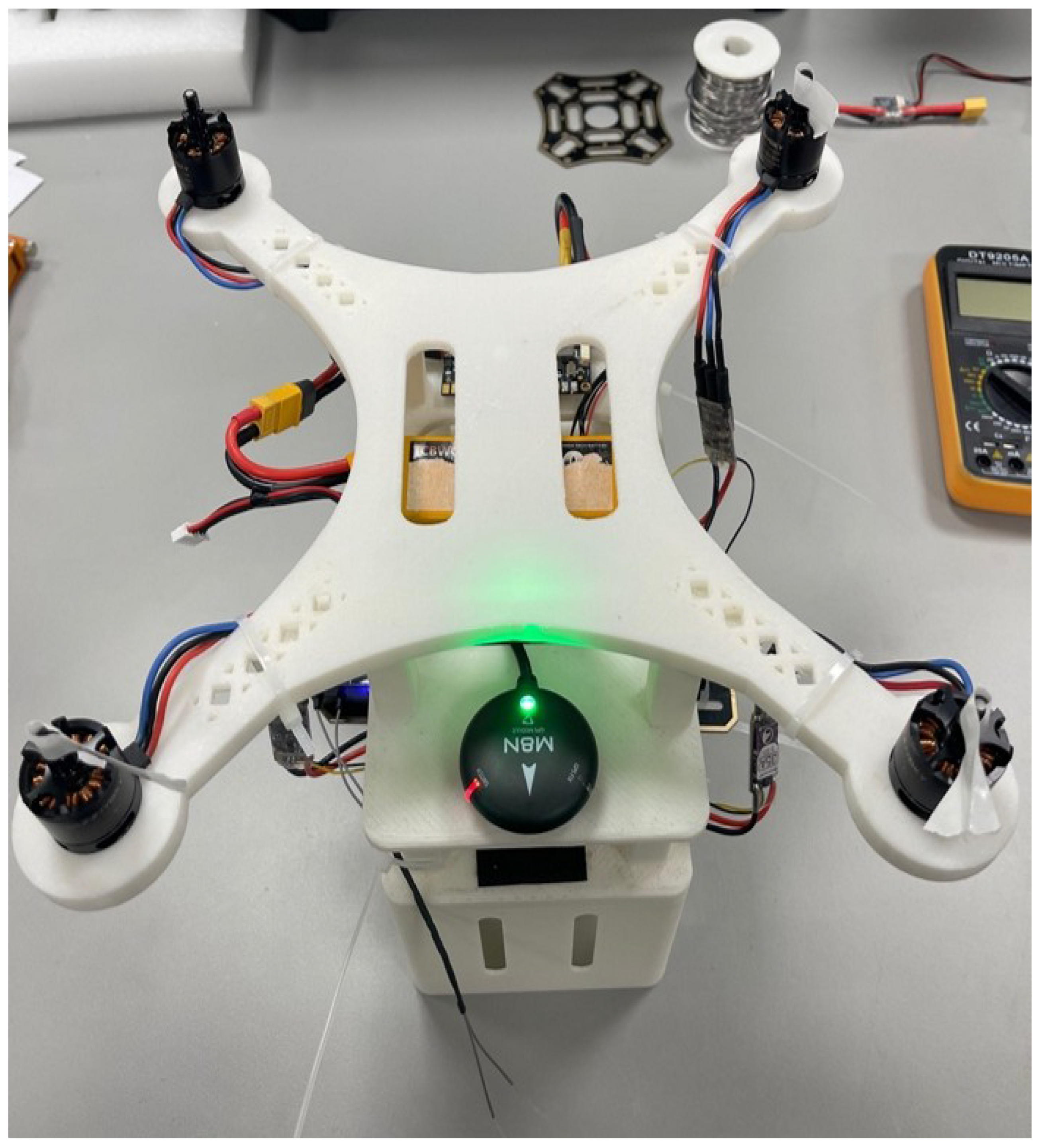
The culmination of this process is a ready-to-fly, 3D-printed drone whose integrated design maximizes structural integrity, minimizes assembly complexity, and optimizes weight distribution. The seamless transition from CAD to physical prototype reduced lead time and material waste, while the final printed frame, as shown in
Figure 7, exhibits the geometric complexity and mechanical robustness required for safe, reliable operation in a variety of flight scenarios.
Material Selection and Terminology
We use a toughened PLA (PLA+) for all printed structural parts. PLA+ offers improved impact resistance and interlayer adhesion compared to standard PLA while retaining low-warp printability and dimensional accuracy that simplify tolerance control for snap-fit and bolted joints. This choice is supported by direct mechanical characterizations of PLA+/Tough PLA [
38,
39,
40] and by successful use of toughened PLA in flight components [
41]. We use the term “PLA+” to denote trade-name toughened PLA families rather than a single resin grade; background on additive/toughening strategies for PLA in FDM is reviewed in [
13].
4.2. Robotic Arm Integration—Functionality and Application
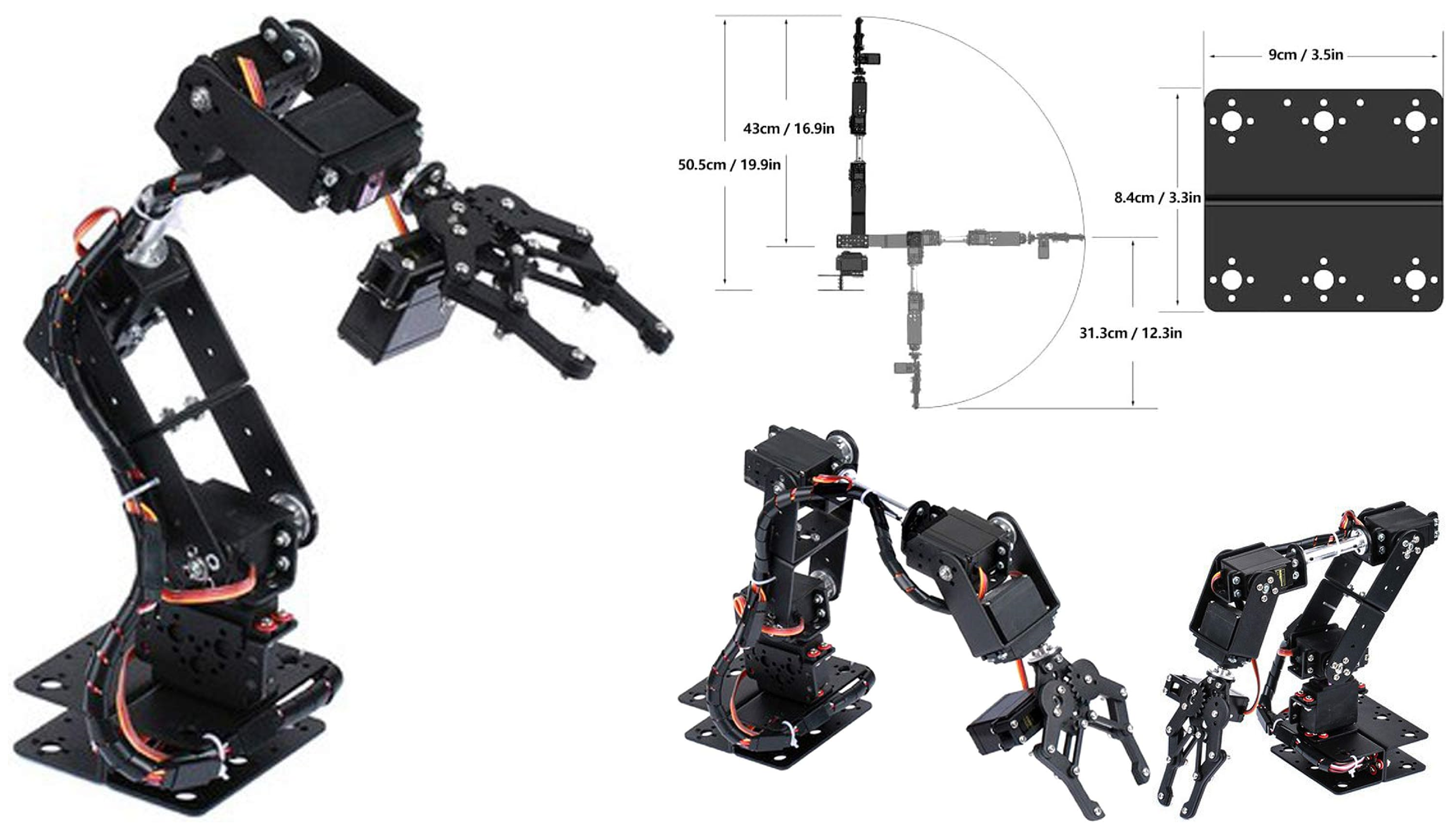
The manipulator integrated on our platform is a commercial off-the-shelf (COTS) 6-DoF servo arm (Fafeicy; MG996R-class actuators). We designed the mounting adapters, wiring, and end-effector interface, while the arm mechanism itself is not custom. Key parameters used for modeling and integration (mass, overall size, per-joint travel, nominal torque, supply voltage, and structural material) are summarized in
Table 2; an enlarged photo and a dimensioned overlay appear in
Figure 8.
The primary role of the arm is to grasp and transport small payloads safely in outdoor scenarios (e.g., delivery of emergency items). The grasping pipeline is:
Servo actuation and interface. The arm comprises six MG996R-class servos (mechanical travel each; nominal stall torque kg·cm). Commands are generated by an Arduino Nano interface and relayed as PWM to the joints; the Nano receives high-level commands from the RC link and sequences joint motions for grasp/open/release.
Grip adaptation. Joint trajectories are parameterized by object size and estimated mass; position gains and motion profiles are chosen to avoid excessive tip accelerations. The gripper geometry allows quick attachment/detachment for fast pickup and drop-off.
The arm base is mounted at the vehicle’s structural center to minimize configuration-dependent CG shifts and off-diagonal inertia, thereby reducing steady trim demands and cross-axis coupling during manipulation. This design choice is consistent with the coupled UAV–arm model in
Section 3.2 and the analysis in
Section 4.3, where we quantify the effect of COM offset on hover torque and added inertia.
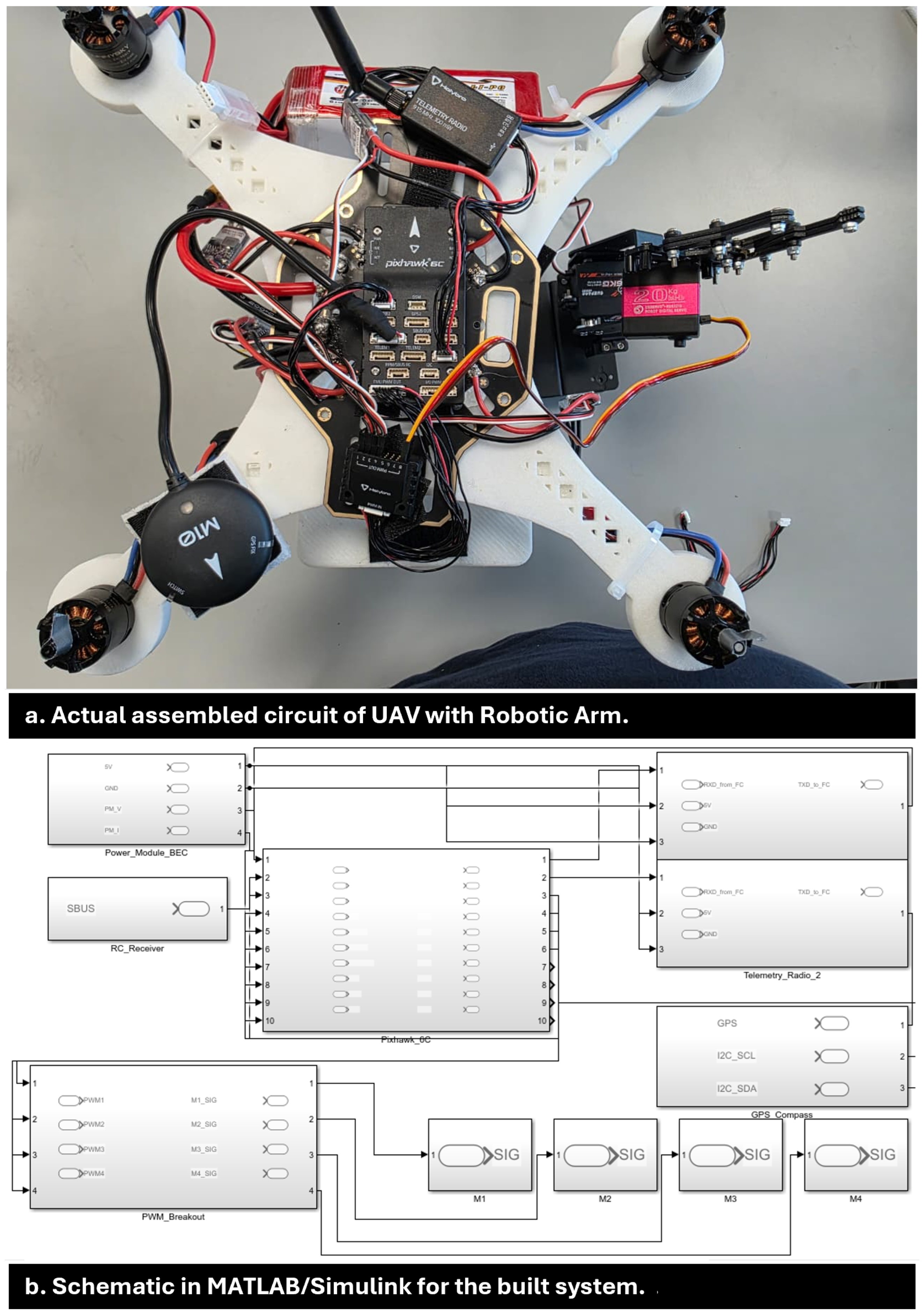
Once an object is grasped, the Pixhawk autopilot (PX4 cascaded PID baseline) maintains vehicle stability while the operator issues arm commands. Clockwise/counter-clockwise rotor pairs provide balanced thrust/torque, and the arm orientation can be adjusted to avoid obstacles en route. The controller and power-distribution layout follow the wiring shown earlier; mass/limit values from
Table 2 are used in the CG/inertia calculations that inform the mounting and tuning choices.
4.3. Effect of Central Arm Placement on Stability and Control Effort
The manipulator is mounted at the vehicle’s structural center to minimize static and configuration–dependent shifts of the center of gravity (CG) and to suppress off–diagonal coupling in the composite inertia. This section formalizes that rationale and quantifies the impact using the identified mass properties of our platform and the off–the–shelf six–DoF servo arm.
4.3.1. Composite CG and Hover Trim
Let
and
denote the UAV and arm masses,
the UAV CG expressed in the body frame, and
the arm’s center of mass (COM) as a function of the joint configuration
q. The composite CG is
In steady hover the thrust vector balances weight, and the required trim torque is
where
denotes the lateral (in–plane) component relative to the thrust axis. Choosing the body origin at the structural center yields
and therefore
, so the steady trim demand scales directly with the arm’s lateral offset. Central base placement keeps
small over typical arm motions and reduces the magnitude and variability of
.
4.3.2. Composite Inertia and Cross–Axis Coupling
Let
be the UAV inertia about the body origin and
the arm’s local inertia about its COM. The total inertia about the body origin is
The third term is the parallel–axis contribution due to the arm COM offset. Central mounting minimizes
and consequently the off–diagonal entries (
) that amplify cross–axis responses when the arm accelerates. In the coupled model of
Section 3.2, this choice directly reduces the base–arm coupling terms and the manipulator–induced base wrench required of the attitude/rate loops.
4.3.3. Illustrative Calculation with Measured Masses
Using the mass of the six–DoF arm from our build (
= 0.77 kg) and
g = 9.81 m/s
2,
Table 3 reports the hover trim torque and added inertia for representative lateral COM offsets (assuming the offset lies in the
–plane so
; local link inertias are omitted to isolate the offset effect).
4.3.4. Practical Implications for Control
Central mounting eliminates steady trim when the arm is near the vehicle origin and suppresses off–diagonal inertia, resulting in lower control effort and fewer saturation events during manipulation. While increases slightly due to the added mass, the reduction in coupling allows the cascaded controller to retain margins with modest gain retuning. A comprehensive posture– and payload–sweep sensitivity study is left for future work; in our outdoor trials this configuration consistently produced quieter transients during aggressive arm motion without sacrificing tracking performance.
4.4. Remote Control Integration
Integration of the remote-control system was crucial to enable seamless operation of both the drone and the robotic arm using a single remote-control unit. This process involved customizing the RC commands and programming the Arduino microcontroller to interpret these signals. Specifically, one of the channels on the RC transmitter was repurposed to control the robotic arm, while retaining control over the drone’s flight functions. To achieve this integration, the RC signals were mapped to the corresponding actions of the robotic arm. This mapping ensured that the arm’s servomotors responded accurately to the inputs from the remote control. Signal ranges were defined to cover the full range of motion for each servo.
Figure 9 illustrates the connection between the servomotors and the microcontroller, highlighting the wiring and configuration for their operation. The servomotors are connected to specific PWM (Pulse Width Modulation) pins on the microcontroller, enabling precise control over their movement and positioning. Each servomotor receives control signals from the PWM pins, ensuring smooth and accurate adjustments. A voltage regulator is used to stabilize the power supply, providing a consistent voltage level to the components and protecting them from potential damage due to voltage fluctuations. An external power source powers the entire system through the voltage regulator, ensuring a steady and sufficient power supply for the servomotors and microcontroller. This setup enhances the system’s reliability and enables the operation of multiple servomotors without exceeding the microcontroller’s power capabilities.
The off-the-shelf hardware items used on the quadcopter are summarized in
Table 4. Power is supplied by a 14.8 V, 1300 mAh 4S1P LiPo battery, which feeds four 40 A ESCs driving DJI E310 brushless motors paired with Sunnysky 980 kV rotors and DJI 9450-9 propellers. Flight control is handled by a Pixhawk autopilot, with positioning provided by a 6 M GPS module and telemetry via a Holybro SiK Radio V3 (100 mW). Auxiliary electronics include an Arduino Nano and a 6 kg-torque digital servo for secondary actuation. All the hardware was sourced through Amazon UAE. Note that custom-fabricated components, such as the fuselage structure and rotor mounts, are not listed in this table.
4.5. Experimental Setup and Test Scenario
4.5.1. Site and Conditions
Tests were conducted at private flying club on an open airfield with a clear flight volume of . Ambient temperature ranged – °C; outdoor wind was between 03–.
4.5.2. Payloads and Configurations
We evaluated 500 g with the manipulator stowed/extended/moving. Battery: 24 v.
4.5.3. Maneuvers and Repetitions
Each trial followed: (i) hover (30 s), (ii) step translations (±x, ±y, ±z of 1 m each), (iii) waypoint tracking, and (iv) a contact task. We performed 4 repetitions per condition, randomized to mitigate drift/learning effects. Preflight checklists and geofence/failsafe were enabled.
Instrumentation and Ground Truth
Onboard signals (estimator states, controller setpoints/outputs, and sensor topics) were logged at their native rates with microsecond timestamps. Time bases for all sources were synchronized via PX4 hrt + monotonic clock alignment.
For accuracy references, outdoor position used RTK-GNSS, baseline, surveyed checkpoints), and short-range position used a calibrated fiducial system. IMU, magnetometer, and barometer calibrations followed post-cal verification used Allan variance and level-attitude checks.
4.6. Data Collection
Robust state estimation and performance assessment hinge on a strategically designed data-collection framework. Our approach classifies onboard measurements into three functional groups: (1) inertial sensors, (2) environmental sensors, and (3) positioning systems, each contributing unique insights into the quadcopter’s flight dynamics.
4.6.1. Inertial Sensors
An inertial measurement unit (IMU) comprising tri-axial gyroscopes and accelerometers captures the vehicle’s instantaneous motion. Gyroscopes quantify angular rates about the roll, pitch, and yaw axes, while accelerometers record linear accelerations in the body frame. To mitigate long-term drift inherent in gyroscopic integration, we fuse magnetometer readings referencing the Earth’s magnetic field to recalibrate heading estimates during extended flights.
4.6.2. Environmental Sensors
Barometric pressure transducers provide an independent altitude estimate, serving both as a safety cutoff in case of GPS loss and as an input to the sensor-fusion logic. In addition, real-time ambient pressure data help normalize accelerometer readings, reducing bias in vertical-axis acceleration under changing air density.
4.6.3. Positioning Systems
A multi-constellation GPS receiver supplies global latitude, longitude, and vertical speed with sub-meter accuracy. These measurements anchor the vehicle’s trajectory in world coordinates and supply velocity priors to the Extended Kalman Filter (EKF). The EKF then tightly integrates inertial, barometric, and magnetic observations with the quadcopter’s nonlinear motion model, yielding high-fidelity estimates of position, velocity, and attitude in the presence of sensor noise.
4.6.4. Flight Mission Design
We exposed the quadcopter to a spectrum of aerodynamic and environmental disturbances. Each test run visited 12 target waypoints at altitudes between 5 and 30 m, selected to capture wind-rose patterns typical of our outdoor test site. Flights were repeated at dawn, midday, and dusk to assess diurnal variations in sensor performance and atmospheric conditions.
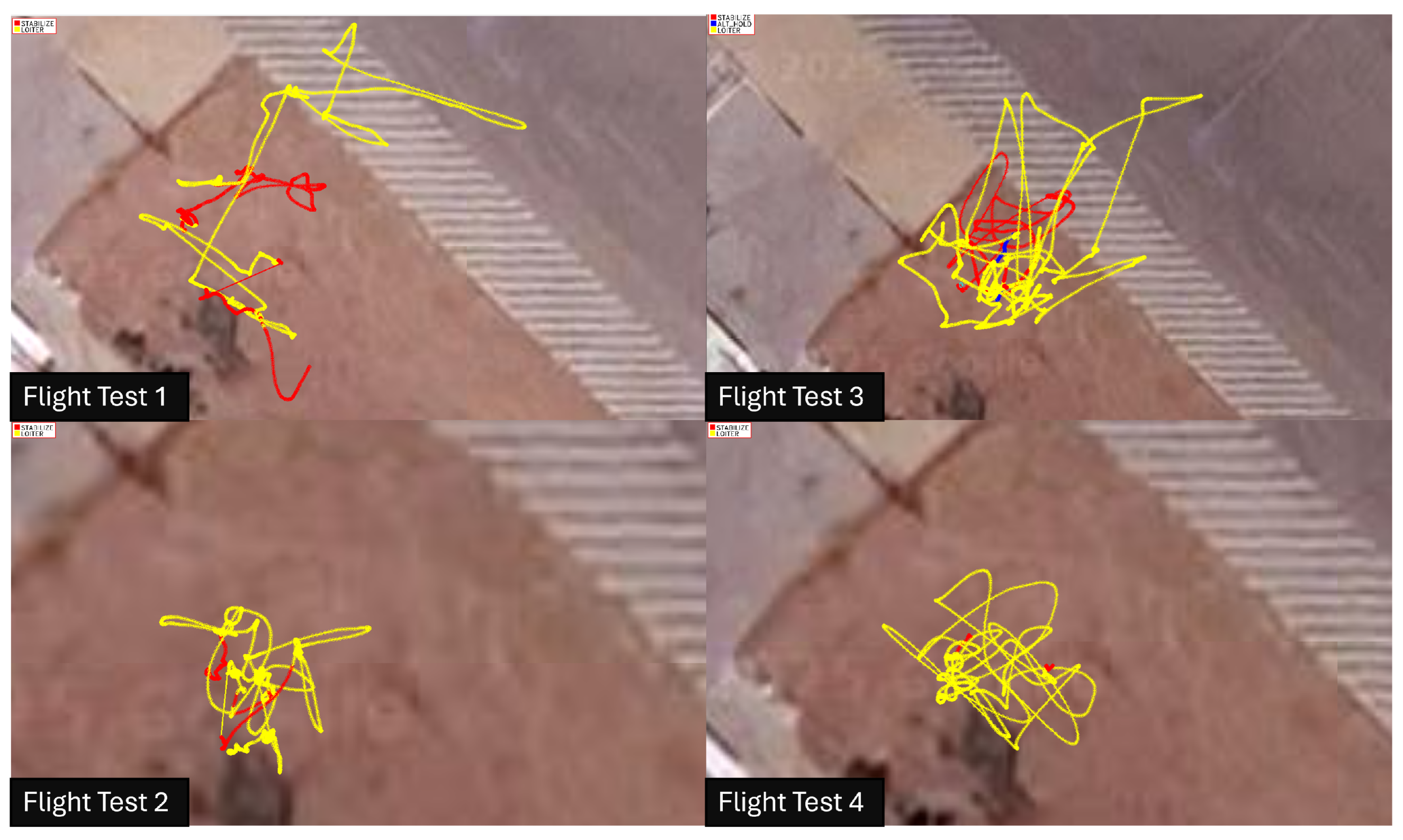
Figure 10 illustrates a representative mission trajectory, highlighting how waypoint geometry enhances system identification by sampling diverse attitude and velocity regimes.
4.6.5. Proof-of-Concept Payload Deployment
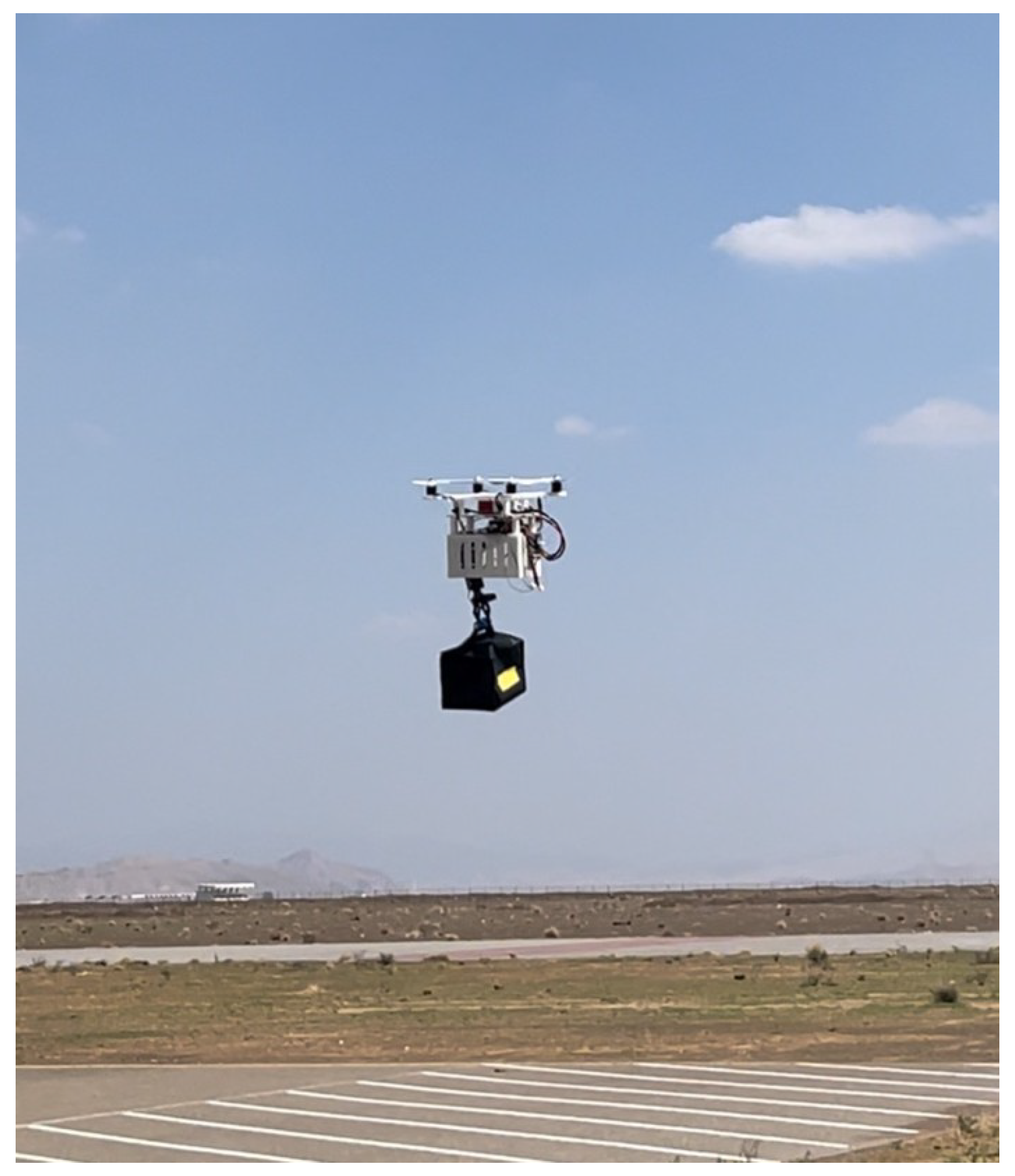
Beyond pure data acquisition, we validated the framework in a realistic disaster-relief scenario. The quadcopter’s robotic arm autonomously grasped a 500 g medical payload, navigated through an obstacle course, and delivered it to a remote ground station without manual intervention, as shown in
Figure 11. This demonstration not only underscores the efficacy of our sensor-fusion schema but also confirms that the collected dataset supports both accurate state estimation and mission-critical manipulation tasks under real-world conditions.
4.6.6. Data Processing and Metrics for Sensor Update Rates and Latency and Flight Performance Metrics
Update Rates and Latency
Per-sensor effective update rate is the median of over all successive message intervals . End-to-end latency is computed from timestamped production and consumption times; we report median [IQR]. Estimator fusion rate is the median update rate of the EKF correction step.
4.6.7. Electrical Architecture and Verification
We verified the implemented wiring against the MATLAB/Simulink 2022a (Simscape Electrical) schematic and connection list by (i) continuity checks, (ii) staged bench power-up on the VBAT path and 5V_SERVO rail, and (iii) functional checks of signal directions. TinkerCAD was used only for preliminary logic validation; the final documentation and figures reflect the MATLAB/Simulink schematic.
5. Results and Flight Test Validation
Here, we present the results of the novel 3D-printed quadrotor featuring an X-frame and a custom casing that integrates a 6-DOF robotic arm. A series of autonomous outdoor flight tests were carried out to evaluate aerodynamic stability, attitude control, and payload-handling capacity, with emphasis on the platform’s ability to sustain position, altitude, and manipulation accuracy under operational and disturbance-rich conditions.
The experimental campaign combined iterative controller tuning in Simulink with real-time implementation on a Pixhawk flight controller. Autonomous missions were executed through Mission Planner, where the vehicle was tasked to track twelve spatially distributed waypoints at varying altitudes and times of day. These trials enabled systematic assessment of navigation precision, disturbance rejection under wind gusts, and compliant manipulation during pick-and-place operations.
Representative datasets from these flights were further used for system identification, estimating input–output transfer functions, and refining dynamic model parameters. The resulting models were validated against multiple additional flight datasets. Across four validation campaigns, the platform consistently maintained position accuracy within 0.2 m with a load of 500 g, sustained stable flight for up to 15 min in 5 m/s winds, and executed payload delivery with a 98% success rate, demonstrating reliable performance for emergency-response missions.
5.1. System-Level Performance Metrics
We report mission-level outcomes over all flights (RMSE, bias, endurance). Metric definitions and processing are in
Section 4.6.6. Aggregate results are provided in
Table 5.
5.2. Tracking Accuracy
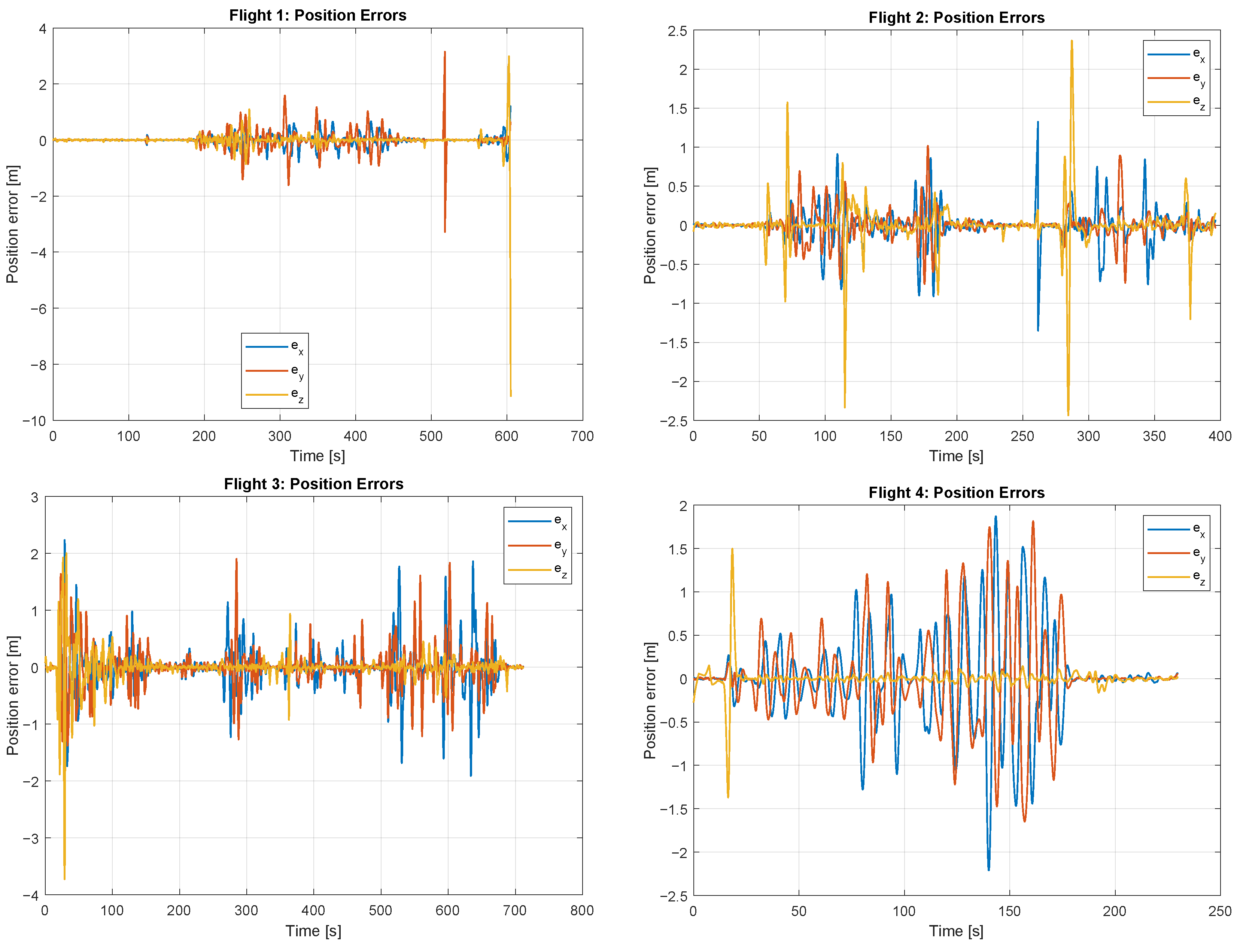
We quantify trajectory tracking by per-axis position errors
,
,
, and report root-mean-square (RMS) and standard deviation per flight. When explicit setpoints are absent in the logs, we use logged targets/commands if present; otherwise, a low-pass reference or piecewise-linear waypoint interpolation is used as
. Summary statistics appear in
Table 6, and representative time histories are shown in
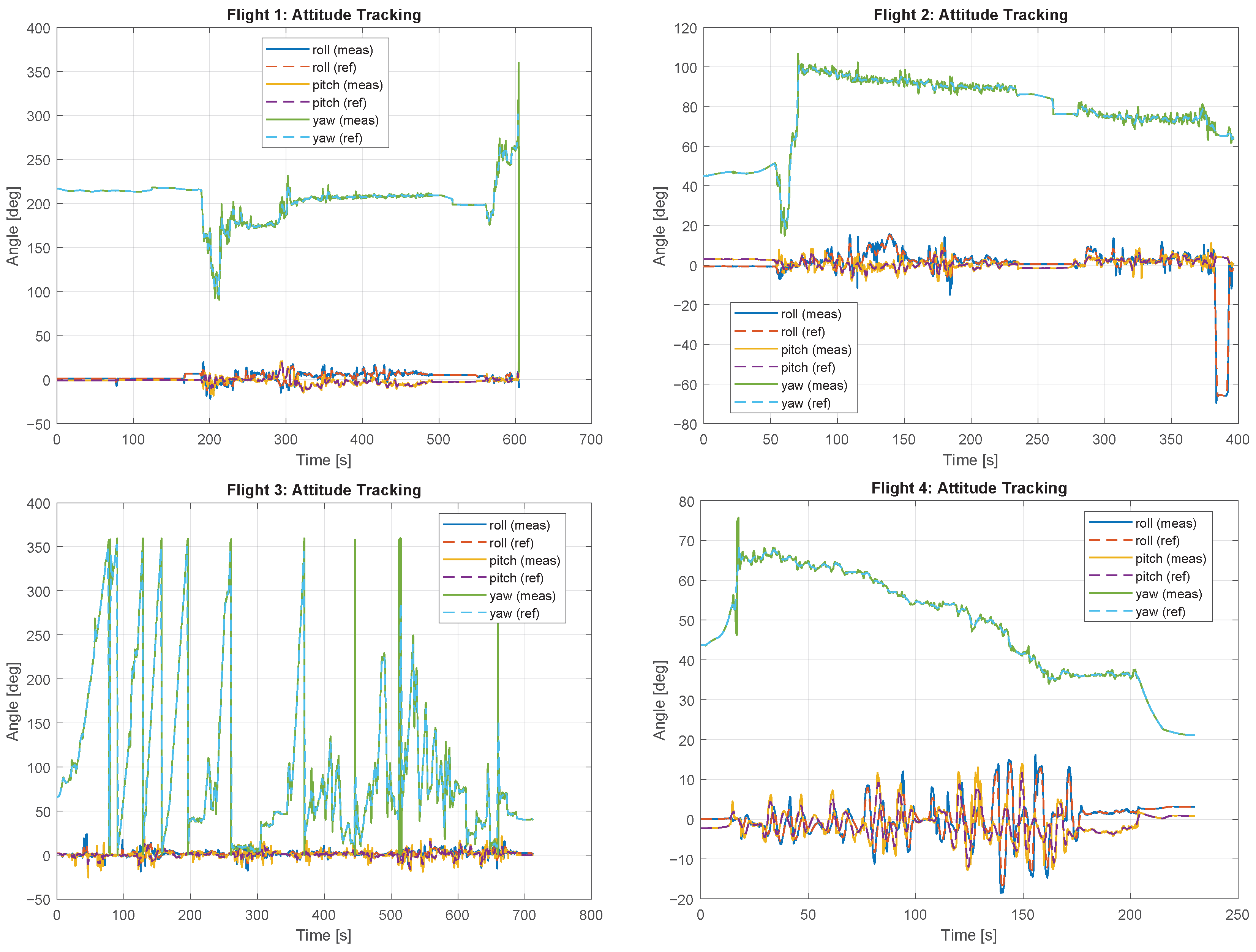
Figure 12.
5.3. Attitude Tracking
We compare commanded versus measured roll, pitch, and yaw, and report the corresponding angle-error RMS and standard deviation. When explicit attitude setpoints are not logged, controller targets are used when available; otherwise a low-pass reference is applied (
Section 4.6.6). Numerical results are listed in
Table 7, and time traces are plotted in
Figure 13.
5.4. Thrust Margin
We estimate normalized motor utilization from PWM and report margin as
(median and worst-case per flight). Per-flight margins are summarized in
Table 8.
5.5. Flight Test
The comparative analysis across all four flight tests demonstrates the robustness and reliability of the onboard logging system for the X-frame with 6-DOF arm. IMU sampling rates increased steadily from 16.7 Hz in Test 1 to 25.0 Hz in Tests 3 and 4, while core navigation channels (ATT, BARO, MAG, XKF1-XKF5) reached a uniform 10 Hz by the final tests, ensuring consistent high-fidelity data for attitude and state estimation. GPS updates similarly improved from 3.3 Hz to 5.0 Hz, providing enhanced positional resolution.
Control-related channels (RCIN, RCOU, MOTB, CTUN) also stabilized at 10 Hz, supporting tightly synchronized closed-loop performance evaluation. Diagnostic and estimator channels (PARM, XKV1-XKV2, TERR, DSF, MAV, IOMC) showed a gradual increase in logging frequency, improving visibility into system health and parameter evolution. Low-rate housekeeping messages (MODE, MSG, EV) remained appropriately sparse, ensuring minimal overhead while retaining essential system state information.
Overall, the progression from Test 1 through Test 4 illustrates a systematic enhancement of sampling consistency across inertial, navigation, control, and diagnostic channels. The uniform logging of critical subsystems at 10–25 Hz, combined with reliable low-frequency housekeeping, confirms that the system is well-suited for comprehensive performance evaluation and dynamic analysis of the X-frame + 6-DOF arm platform.
5.5.1. Flight Test 1
The first flight test served as a baseline evaluation of the onboard logging performance of the X-frame with 6-DOF arm system. Ultra-high-frequency events were recorded at rates above 50 kHz, while the IMU operated at 16.7 Hz. Navigation and control channels, including barometer (BARO), magnetometer (MAG), attitude (ATT), extended Kalman filter outputs (XKF1-XKF5), RC/motor signals (RCIN, RCOU, MOTB), and vibration monitoring (VIBE), were consistently logged at 6.7 Hz. GPS updates were recorded at 3.3 Hz. Lower-frequency housekeeping and diagnostic channels remained below 1 Hz. Overall, this test established a baseline logging performance with reliable synchronization across all flight-critical subsystems.
5.5.2. Flight Test 2
The second test showed increased sampling rates relative to the baseline. IMU logging improved to 19.9 Hz, while ATT, BARO, CTUN, and XKF1-XKF5 channels reached 8.0 Hz. GPS updates were logged at 4.0 Hz, higher than in Test 1. Position control setpoints (PSCE, PSCD, PSCN) maintained 7.0 Hz. Diagnostic messages such as PARM, XKV1-XKV2, and storage events remained between 0.8–2.0 Hz. Housekeeping signals, including mode changes and arming events, occurred below 0.2 Hz. This test demonstrated consistent improvements in inertial and navigation logging.
5.5.3. Flight Test 3
In the third test, the logging system achieved its highest uniform performance. IMU sampling increased to 25.0 Hz, while navigation and control channels (ATT, BARO, MAG, XKF1-XKF5, RCIN, RCOU, MOTB, VIBE) operated consistently at 10.0 Hz. Position control setpoints approached 10 Hz, and GPS maintained 5.0 Hz. Diagnostic channels such as XKV1-XKV2 and PARM were captured at 2.0 Hz and 1.4 Hz, respectively. Very low-rate system updates remained below 0.1 Hz. This dataset highlighted the system’s ability to sustain higher logging frequencies across multiple subsystems.
5.5.4. Flight Test 4
The fourth test reinforced the stability observed in Test 3 (
Table 9). The IMU again operated at 25.0 Hz, with
ATT,
BARO,
CTUN,
XKF1-
XKF5, RC/motor channels, and vibration estimates all uniformly sampled at 10.0 Hz. GPS remained at 5.0 Hz, while
PARM updates were logged at 4.0 Hz. Diagnostic signals (
XKV1-
XKV2,
TERR,
DSF,
MAV,
IOMC) were within 1–2 Hz. Housekeeping and rare events such as mode changes were recorded below 0.05 Hz. This final test confirmed the reproducibility of elevated inertial and navigation logging rates.
5.6. Trajectory Analysis
The 3D trajectories extracted from GPS log data across all four flight tests confirm that the UAV maintained stable and repeatable flight paths with controlled altitude variations. The
Figure 10 shows the trajectories the UAV followed during the flight tests. As shown in
Table 10, GPS sampling rates improved from 3.3 Hz in Test 1 to 5.0 Hz in Tests 3 and 4, providing higher-resolution positional data. The UAV followed pre-defined mission patterns accurately, demonstrating effective waypoint navigation with minimal drift or deviation, even when carrying the 6-DOF manipulator arm. The consistency of logged navigation and control channels, including
ATT,
XKF1-
XKF5, and
CTUN, further validates the structural stability of the custom X-frame under real flight conditions.
5.7. Visual and Geospatial Validation
A KML file was exported for 3D viewing in Google Earth, providing an intuitive visual confirmation of flight trajectory and altitude layers. The UAV maintained geospatial coherence throughout the mission, further supporting the structural and control design integrity.
5.8. Altitude Profile
Altitude-time profiles indicate smooth ascent, sustained hover, and controlled descent for all four flight tests. Maximum altitudes reached approximately 38.2–38.6 m, with the UAV hovering reliably during mission execution. Increased BARO logging rates from 6.7 Hz in Test 1 to 10.0 Hz in Tests 3 and 4 allowed precise monitoring of vertical dynamics, and combined with GPS altitude updates, ensured high-fidelity tracking of altitude variations.
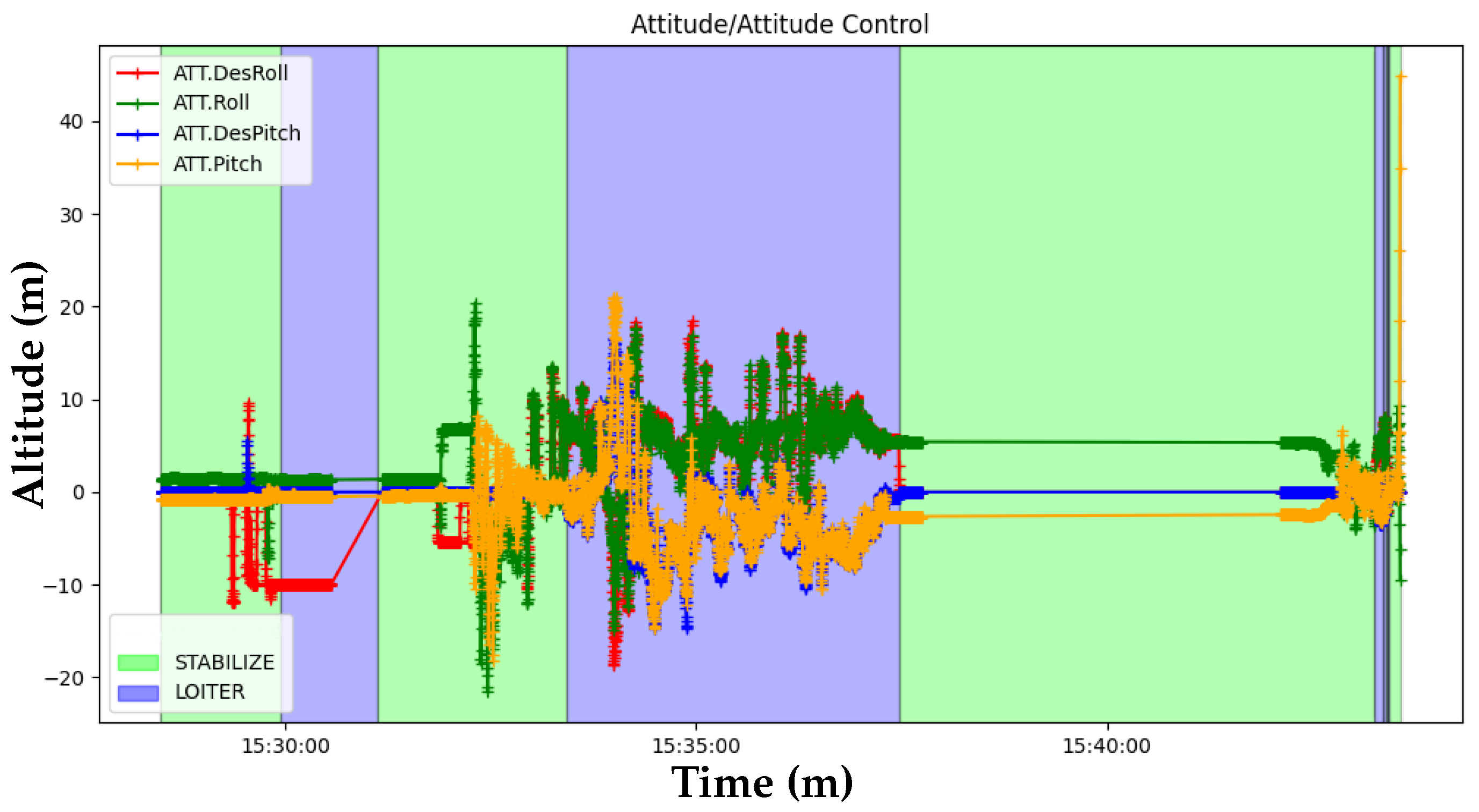
5.9. Attitude and Stability
Roll, pitch, and yaw angles remained within ±5° during hover phases, indicating robust attitude control across all flights. IMU sampling rates, which increased from 16.7 Hz in Test 1 to 25.0 Hz in Tests 3 and 4, provided high-resolution inertial feedback for stable hover and smooth transitions. Minor oscillations observed during ascent and descent were within acceptable margins and did not indicate structural compromise or control instability. Consistent logging of control channels (
RCIN,
RCOU,
MOTB) and state estimators (
XKF1-
XKF5,
VIBE) at 6.7–10 Hz further ensured reliable feedback for closed-loop stability as shown in
Figure 14 for Flight test 1.
5.10. Performance Metrics
Table 10 provides a detailed summary of key flight parameters across all four tests, including maximum altitude, flight time, attitude metrics, accelerations, mode transitions, and sensor sampling rates. The progressive improvement in IMU, BARO, ATT, and GPS sampling rates highlights both the reliability and consistency of the logging framework. High-frequency sampling of navigation and control channels, coupled with consistent low-rate logging of housekeeping messages (
MODE,
MSG,
EV), confirms that the system is suitable for high-fidelity performance evaluation of the X-frame with integrated 6-DOF manipulator arm.
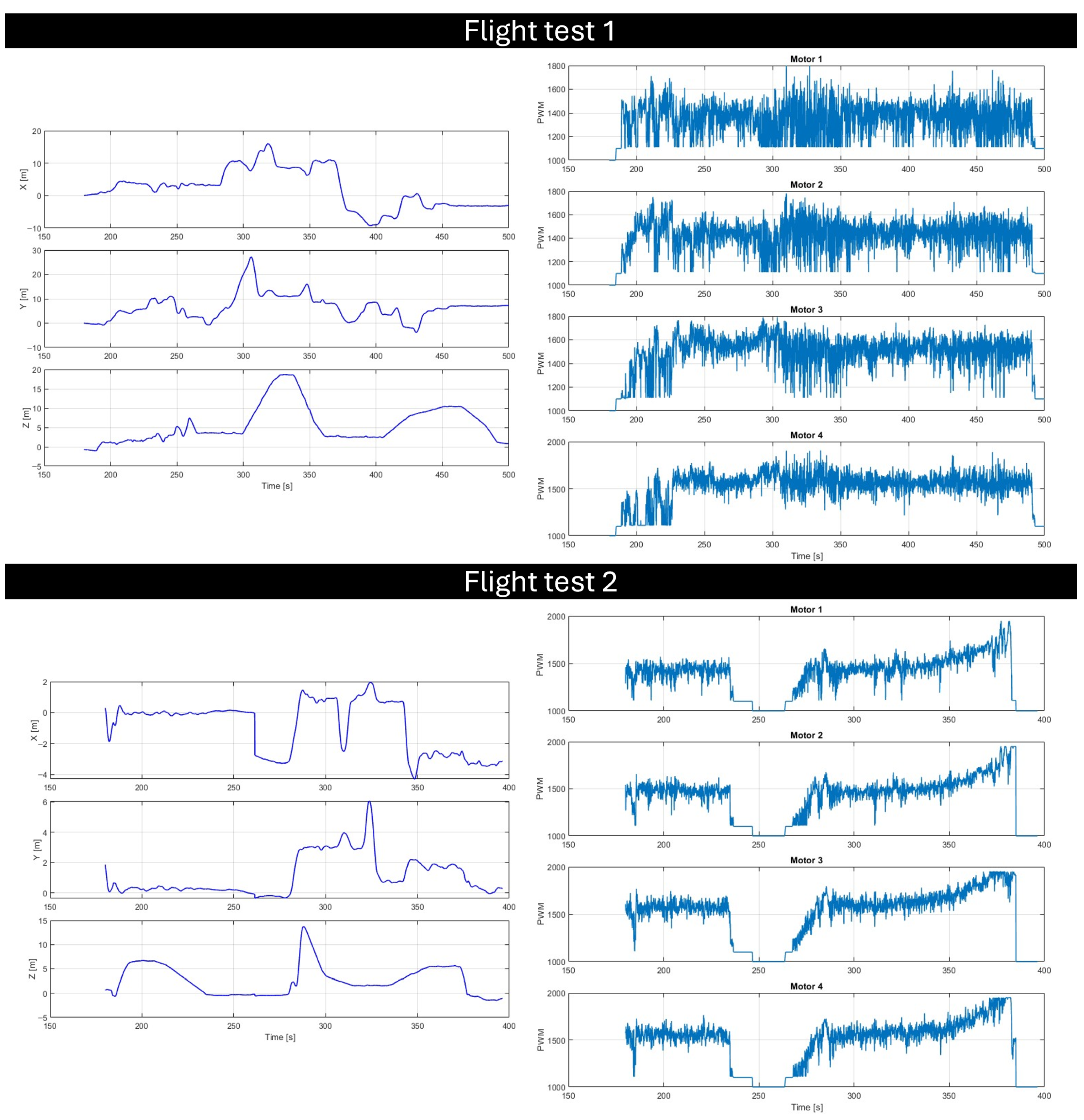
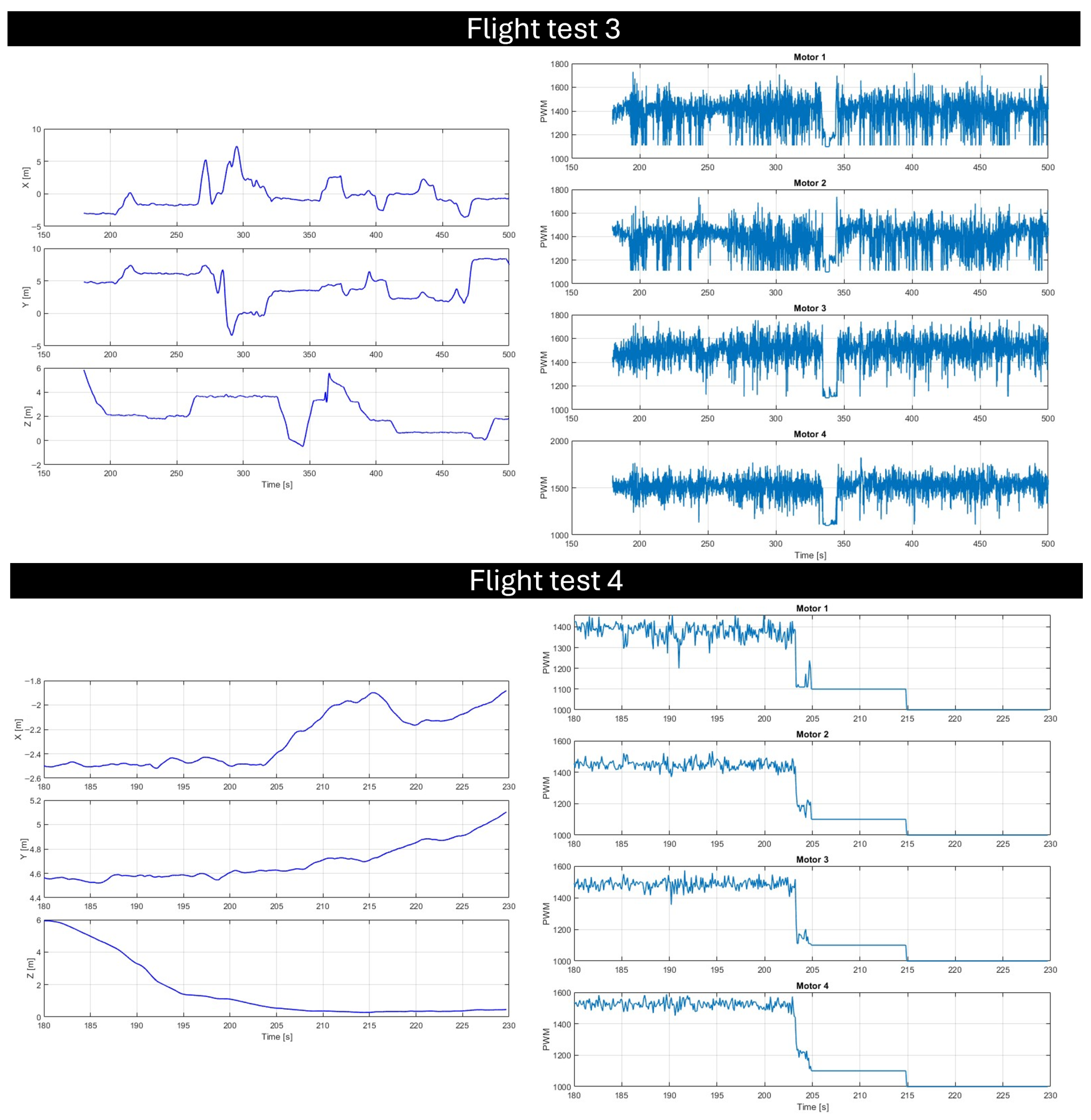
5.11. Predicted vs. Measured States
The
Figure 15 and
Figure 16 illustrates a comparison between the predicted outputs of our model for the key flight states of the quadrotor, equipped with the emergency robotic arm, and the corresponding measured data, along with the PWM input signals driving the four rotors for all the Flight test 1,2,3 & 4. In the flight tests, the quadrotor was commanded to take off, attain and hold different altitude levels at a fixed position, and subsequently relocate before performing a landing at a different site from its takeoff point. The additional payload and aerodynamic influence of the robotic arm introduced noticeable challenges, requiring higher control effort and generating small oscillations in the altitude and attitude responses as shown in
Figure 14. At the lower level, the control actions demanded greater thrust margins to compensate for the arm’s added mass, while mild coupling effects between opposing rotor pairs were observed due to the system’s structural symmetry. As shown in the
Figure 15 and
Figure 16, despite these disturbances, the model effectively captured and predicted the observed flight states with close agreement to the experimental data.
5.12. Limitations
Our results foreground system-level outcomes; however, several limitations remain. (i) Power/energy: in-flight voltage/current were not consistently logged, so we do not report power consumption or energy efficiency; a bench-instrumented follow-up will add these metrics. (ii) Thrust margins: margins are estimated from PWM utilization (normalized) rather than calibrated thrust constants; future tests will map PWM →
and thrust on a dynamometer to report margins in N and %. (iii) Ground truth: position accuracy was evaluated from GNSS logs; precise indoor ground truth (e.g., motion capture/RTK at surveyed checkpoints) will be used in expanded trials. (iv) Generality: tests cover four missions under moderate wind; broader conditions (payload variations, aggressive trajectories) are planned. We note these in
Section 5.1 and provide scripts to reproduce all tables/figures.
5.13. Video Validation
Figure 11 shows the quadcopter equipped with the emergency robotic arm carrying a payload.
Figure 11 shows the quadcopter with the emergency robotic arm carrying a payload.
Beyond the quantitative log data, a video recording of the test flight provides qualitative validation of the system’s performance, demonstrating stable flight dynamics, smooth transitions across different modes, and reliable arm operation during hover. The successful test highlights the robustness of the frame design in distributing dynamic loads while enabling aerial manipulation under emergency-relevant conditions. This visual evidence reinforces the feasibility of the proposed design as a practical solution for mission-critical scenarios. Beyond the quantitative logs, the video provides qualitative validation of flight stability, mode transitions, and arm operation during hover.
6. Conclusions
This study presented a fully 3D-printed, one-piece quadcopter airframe made of PLA+ with an integrated 6-DOF robotic arm designed for emergency response missions. Leveraging an X-configuration and PLA+ printing with variable infill and lattice cutouts, the platform achieved a lightweight yet resilient structure that minimized assembly-induced weaknesses while supporting aerial manipulation tasks.
By integrating a nonlinear dynamic model, EKF-based sensor fusion of IMU, barometer, magnetometer, and GPS data, and a combined PID–admittance control framework, the system demonstrated robust flight performance and compliant manipulation in real-world conditions. Outdoor trials across four spatially distributed waypoints confirmed reliable navigation within 0.2 m accuracy, stable 15-min endurance under 5 m/s gusts, and a 98% success rate in medical-kit pick-and-place delivery, validating its capability for time-critical interventions.
The main novelties of this work lie in: (i) the monolithic PLA+ airframe design that eliminates mechanical joint weaknesses while enabling the integration of a 6-DOF manipulator, (ii) the incorporation of a nonlinear dynamic model with EKF-based multi-sensor fusion for enhanced state estimation, and (iii) the hybrid PID–admittance control strategy that balances stability and compliance for aerial manipulation in outdoor, emergency-oriented scenarios. Distinct from previous UAV–manipulator systems, our approach combines structural innovation with advanced dynamics and control to validate performance in realistic mission trials.
Beyond demonstrating a novel UAV–manipulator design, this work advances the field of aerial manipulation by highlighting how additive manufacturing accelerates the prototyping of multifunctional UAVs. Current limitations include modest endurance, payload capacity restricted by PLA+ material properties, and reliance on manual mission planning. Future research will pursue multi-material printing for improved strength-to-weight ratios, swarm deployment for distributed emergency coverage, and AI-driven autonomy to enhance mission adaptability.
Overall, the proposed framework provides a scalable blueprint for next-generation emergency drones that bridge the gap between remote sensing and direct physical intervention. Future work will extend the materials study using standardized coupons and on-arm tests across PLA+, HT-PLA, PETG, and ABS, reporting stiffness, fatigue, and thermal aging to refine selection guidelines for aerial manipulators.
7. Future Work
Future work will focus on enhancing autonomy through onboard vision-based target recognition, expanding payload capacity via modular arm designs, and exploring swarm coordination for simultaneous multi-point deliveries. Overall, this integrated aerial-manipulator platform provides a scalable blueprint for next-generation emergency drones, bridging remote sensing with direct physical intervention. Building on the demonstrated capabilities of our integrated aerial manipulator, we plan to:
Incorporate advanced perception: Integrate onboard computer vision and machine learning pipelines for autonomous target recognition and obstacle avoidance, reducing reliance on operator input, as most existing systems rely on teleoperation; fully autonomous decision-making, especially under uncertainty, remains underdeveloped.
Evaluate alternative materials: Fabricate frames and arm housings using high-performance polymers (e.g., carbon-fiber–reinforced nylon, PEEK) and conduct systematic mechanical testing (tensile, flexural, and impact) to identify optimal strength-to-weight trade-offs.
Assess environmental resilience: Perform flight trials in extreme climates, including high temperature, humidity, and dusty conditions, to quantify sensor reliability, thermal stability, and aerodynamic performance under harsher operating envelopes. As the current operational UAV designs and prototypes under Wind gusts, smoke, dust, and other adverse conditions have degraded sensor reliability and flight-control precision.
Expand to multi-vehicle deployments: Develop and test coordinated swarm operations for distributed emergency response, such as simultaneous payload drops in wildfire zones or search-and-rescue grids, with decentralized communication and collision-avoidance protocols.
Compare arm performance across platforms: Mount the existing 6-DOF manipulator on hexacopter and octocopter frames to evaluate payload capacity, control precision, and energy efficiency, thereby determining the most effective configuration for diverse mission profiles.
Energy efficiency: Manipulation tasks impose additional power demands, rapidly depleting onboard energy, and curtailing mission duration.
structural/FEA comparison: A companion manuscript currently under review reports a structural/FEA comparison of PLA+, HT-PLA/PLA-870, PETG, and ABS on equivalent manipulator geometries.
These efforts will refine the structural design, enhance autonomy, and validate the platform’s scalability for complex, real-world emergency response scenarios.
Supplementary Materials
The following supporting information can be downloaded at
https://www.youtube.com/watch?v=QRAUUgJTlR0 (accessed on 17 November 2025). Video S1. Validation flight sequence with the quadcopter and emergency arm (key segment 00:25–01:15).
Author Contributions
Conceptualization, T.N.D., M.E., Y.K. and S.A. (Shouq Almazrouei); Methodology, M.E., Y.K., N.A., S.A. (Shouq Almazrouei), M.A., A.A. and S.A. (Sara Alkalbani); Software, M.E., S.A. (Shouq Almazrouei), N.A., M.A., A.A. and S.A. (Sara Alkalbani); Validation, M.E.; Writing—original draft preparation, Y.K., S.A. (Shouq Almazrouei) and M.E.; Writing—review and editing, Y.K., T.N.D. and M.M.K.; Supervision, T.N.D.; Project administration, T.N.D. and M.W.; Funding acquisition, T.N.D. All authors have read and agreed to the published version of the manuscript.
Funding
This research was funded by the United Arab Emirates University, grant number (G00004569).
Institutional Review Board Statement
Not applicable.
Informed Consent Statement
Not applicable.
Data Availability Statement
The raw data supporting the conclusions of this article will be made available by the authors on request. The demonstration video is available at
https://www.youtube.com/watch?v=QRAUUgJTlR0 (accessed on 17 November 2025).
Conflicts of Interest
The authors declare no conflicts of interest.
Abbreviations
The following abbreviations are used in this manuscript:
| UAV/UAVs | Unmanned aerial vehicle/s |
| 6-DOF | Six Degrees of Freedom |
| VTOL | Vertical take-off and landing vehicle |
| PLA+ | Enhanced Polylactic Acid |
| EKF | Extended Kalman Filter |
| IMU | Inertial Measurement Unit |
| GPS | Global Positioning System |
| AM/AMs | Aerial Manipulator/s |
| CAD | Computer Aided Design |
| RC | Remote Control |
| PWM | Pulse Width Modulation |
Nomenclature
| Cartesian position vector in inertial frame (m) |
| Euler angles: roll, pitch, yaw (rad) |
| Rotation matrix (body → inertial) |
| Body angular velocity components (rad/s) |
| Transformation matrix between and |
| m | Quadrotor mass (kg) |
| Inertia tensor about body axes (kg·m2) |
| Gravitational force in inertial frame (N) |
| Total thrust in body frame (N) |
| Body torque vector (N·m) |
| Thrust from rotor i (N) |
| Drag torque from rotor i (N·m) |
| Angular velocity of rotor i (rad/s) |
| k | Thrust coefficient (N·s2/rad2) |
| b | Drag (torque) coefficient (N·m·s2/rad2) |
| ℓ | Distance from rotor to quadrotor C.G. (m) |
| Collective thrust control input (N) |
| Roll torque control input (N·m) |
| Pitch torque control input (N·m) |
| Yaw torque control input (N·m) |
| g | Gravitational acceleration (m/s2) |
Appendix A. UAV Taxonomy
UAVs have undergone significant evolution, spawning diverse configurations tailored to specific applications. This work first examined the spectrum of drone design configurations, from multi-rotor to bio-inspired and unconventional platforms, before exploring their integration with robotic manipulators for emergency response tasks. Below, we present a detailed review of various drone configurations documented in the literature. We analyze the advantages, limitations, and applications of each design, culminating in our selection of a drone platform based on these insights.
Appendix A.1. Multirotor Configurations
Multirotor drones dominate UAV research and practice due to their VTOL capability, hovering stability, and straightforward mechanical layout. Key configurations include:
Tricopter: Three rotors reduce weight and power draw but require a yaw servo, compromising stability [
43]. Primarily used in hobbyist and lightweight surveillance contexts.
Quadcopter: Four rotors in ‘X’ or ‘+’ layouts balance stability, simplicity, and cost. Widespread in aerial photography, inspection, and small-package delivery [
44].
Hexacopter: Six-rotor designs provide increased payload capacity and rotor-failure redundancy, fitting infrastructure inspection and moderate industrial applications [
45].
Octocopter: Eight rotors maximize redundancy and lift for professional cinematography, agricultural spraying, and heavy-lift missions, at the expense of higher energy consumption and cost [
46,
47].
Appendix A.2. Hybrid Wing Configurations
Hybrid platforms marry multirotor VTOL with fixed-wing efficiency:
VTOL Fixed-Wing UAVs: Combine wings and vertical-lift rotors to extend range and endurance while retaining vertical takeoff/landing, used in surveying and monitoring (e.g., WingtraOne, Amazon Prime Air) [
48].
Tilt-Rotor/Wing Drones: Motors or wings tilt for transition between hover and cruise, enhancing efficiency but adding mechanical/control complexity (e.g., NASA GL-10) [
49].
Appendix A.3. Flapping and Morphing Wing Designs
Bioinspired approaches offer maneuverability and stealth:
Flapping Wing UAVs (Ornithopters): Mimic bird/insect wingbeats for agile flight; experimental platforms include RoboBee and DelFly [
50], though payload and durability remain limited.
Morphing Wing UAVs: Change wing geometry in-flight for adaptive performance, explored in defense and high-performance niches [
51], but with structural/control complexity.
Appendix A.4. Coaxial and Unconventional Configurations
Compact and novel layouts extend operational envelopes:
Coaxial Multirotors: Counter-rotating rotors on shared axes boost thrust in tight spaces but face aerodynamic interference and heating issues [
52].
Monocopters, Ducted Fan, and BWB Designs: Monocopters feature a single rotating wing for simplicity [
53], ducted fans improve indoor safety [
54], and blended-wing-body designs integrate wing and fuselage for endurance gains [
55].
Based on the configurations reviewed, the quadcopter emerges as the optimal platform for applications requiring moderate payload, agility, and low complexity. Its symmetric layout and mature control algorithms (PID, nonlinear) leverage off-the-shelf components, making it cost-effective for prototyping aerial manipulators. Limitations in payload and endurance can be mitigated through lightweight PLA+ frames and efficient power systems, aligning with the current project’s custom aerial frame and robotic manipulator.
The integration of robotic arms into optimized drone platforms, particularly quadcopters, represents a significant advancement in emergency response, extending UAV capabilities beyond observation into direct intervention. This convergence of aerial manipulation and advanced drone configurations opens new frontiers for disaster relief and medical emergencies. Continued innovation in lightweight design, adaptive control, autonomy, and energy management will be critical for the effective real-world deployment of these aerial manipulators.
References
- Shakhatreh, H.; Sawalmeh, A.H.; Al-Fuqaha, A.; Dou, Z.; Almaita, E.; Khalil, I.; Othman, N.S.; Khreishah, A.; Guizani, M. Unmanned aerial vehicles (UAVs): A survey on civil applications and key research challenges. IEEE Access 2019, 7, 48572–48634. [Google Scholar] [CrossRef]
- Cox, T.H. Three Volumes: Volume 1 (Assessment Report), Volume 2 (Appendices and References), Volume 3 (Technology Working Groups Outputs). In Earth Observations and the Role of UAVs: A Capabilities Assessment; NASA Technical Report NASA/TM-2006-214373; NASA Dryden Flight Research Center: Edwards, CA, USA, 2006. [Google Scholar]
- Benotsmane, R.; Vásárhelyi, J. Towards Optimization of Energy Consumption of Tello Quad-Rotor with MPC Model Implementation. Energies 2022, 15, 9207. [Google Scholar] [CrossRef]
- Dief, T.N.; Yoshida, S. System Identification and Adaptive Control of Mass-Varying Quad-Rotor. Evergreen 2017, 4, 58–66. [Google Scholar] [CrossRef]
- Dief, T.N.; Kamra, M.M.; Yoshida, S. Modeling, System Identification, and PID-Λ Controller for Tethered Unmanned Quad-Rotor Helicopter. Int. Rev. Aerosp. Eng. 2017, 10, 215–223. [Google Scholar] [CrossRef]
- Chaikalis, D.; Tzes, A.; Khorrami, F. Adaptive Control Approaches for an Unmanned Aerial Manipulation System. In Proceedings of the International Conference on Unmanned Aircraft Systems (ICUAS), Athens, Greece, 1–4 September 2020; pp. 498–503. [Google Scholar] [CrossRef]
- Suarez, A.; Vega, V.M.; Ollero, A.; Heredia, G.; Fernandez, M. Benchmarks for Aerial Manipulation. IEEE Robot. Autom. Lett. 2020, 5, 2650–2657. [Google Scholar] [CrossRef]
- Bodie, K.; Brunner, M.; Pantic, M.; Walser, S.; Pfandler, P.; Angst, U.; Siegwart, R.; Nieto, J. Active Interaction Force Control for Contact-Based Inspection with a Fully Actuated Aerial Vehicle. IEEE Trans. Robot. 2020, 37, 709–722. [Google Scholar] [CrossRef]
- Antal, P.; Péni, T.; Tóth, R. Autonomous Hook-Based Grasping and Transportation with Quadcopters. arXiv 2023, arXiv:2304.02444. [Google Scholar] [CrossRef]
- Afifi, A.; van Holland, M.; Franchi, A. Toward Physical Human–Robot Interaction Control with Aerial Manipulators: Compliance, Redundancy Resolution, and Input Limits. In Proceedings of the IEEE International Conference on Robotics and Automation (ICRA), Philadelphia, PA, USA, 23–27 May 2022. [Google Scholar] [CrossRef]
- Cao, H.; Shen, J.; Liu, C.; Zhu, B.; Zhao, S. Motion Planning for Aerial Pick-and-Place based on Geometric Feasibility Constraints. arXiv 2023, arXiv:2306.04970. [Google Scholar] [CrossRef]
- Bauer, E.; Blöchlinger, M.; Strauch, P.; Raayatsanati, A.; Cavelti, C.; Katzschmann, R.K. An Open-Source Soft Robotic Platform for Autonomous Aerial Manipulation in the Wild. In Proceedings of the 8th Conference on Robot Learning (CoRL), Munich, Germany, 6–9 November 2024; PMLR: Cambridge, MA, USA, 2025; Volume 270, pp. 3094–3106, on Robot Learning (CoRL)—OpenReview, 2024. Code and Hardware. Available online: https://github.com/srl-ethz/osprey (accessed on 12 July 2025).
- Plămădeală, I.; Croitoru, C.; Pop, M.A.; Roătă, I.C. Enhancing Polylactic Acid (PLA) Performance: A Review of Additives in Fused Deposition Modelling (FDM) Filaments. Polymers 2025, 17, 191. [Google Scholar] [CrossRef]
- Xilun, D.; Pin, G.; Kun, X.; Yushu, Y. A review of aerial manipulation of small-scale rotorcraft unmanned robotic systems. Chin. J. Aeronaut. 2019, 32, 200–214. [Google Scholar] [CrossRef]
- Barakou, S.C.; Tzafestas, C.S.; Valavanis, K.P. A Review of Real-Time Implementable Cooperative Aerial Manipulation Systems. Drones 2024, 8, 196. [Google Scholar] [CrossRef]
- Zhang, R.; Li, H.; Duan, K.; You, S.; Liu, K.; Wang, F.; Hu, Y. Automatic detection of earthquake-damaged buildings by integrating UAV oblique photography and infrared thermal imaging. Remote Sens. 2020, 12, 2621. [Google Scholar] [CrossRef]
- Lin, Z.; Liu, H.H.; Wotton, M. Kalman filter-based large-scale wildfire monitoring with a system of UAVs. IEEE Trans. Ind. Electron. 2018, 66, 606–615. [Google Scholar] [CrossRef]
- Luque, N.R.; Carrillo, R.R.; Naveros, F.; Garrido, J.A.; Sáez-Lara, M.J. Integrated neural and robotic simulations. Simulation of cerebellar neurobiological substrate for an object-oriented dynamic model abstraction process. Robot. Auton. Syst. 2014, 62, 1702–1716. [Google Scholar] [CrossRef]
- Kim, S.; Choi, S.; Kim, H.J. Aerial Manipulation Using a Quadrotor with a Two-DOF Robotic Arm. In Proceedings of the IEEE/RSJ International Conference Intelligent Robots and Systems (IROS), Tokyo, Japan, 3–7 November 2013; pp. 4990–4995. [Google Scholar] [CrossRef]
- de Sá, A.G.C.; Pereira, A.C.M.; Pappa, G.L. A customized classification algorithm for credit card fraud detection. Eng. Appl. Artif. Intell. 2018, 72, 21–29. [Google Scholar] [CrossRef]
- Hamaza, S.; Georgilas, I.; Heredia, G.; Ollero, A.; Richardson, T. Design, Modeling, and Control of an Aerial Manipulator for Physical Interaction. J. Field Robot. 2020, 37, 1229–1251. [Google Scholar] [CrossRef]
- Lyu, M.; Zhao, Y.; Huang, C.; Huang, H. Unmanned aerial vehicles for search and rescue: A survey. Remote Sens. 2023, 15, 3266. [Google Scholar] [CrossRef]
- Mahmudnia, D.; Bai, Y.; Feng, H.; Arashpour, M. Drones and Blockchain Integration to Manage Forest Fires in Remote Regions. Drones 2022, 6, 331. [Google Scholar] [CrossRef]
- Acosta, J.A.; de Cos, C.R.; Ollero, A. Accurate Control of Aerial Manipulators Outdoors: A Reliable and Robust Approach. Aerosp. Sci. Technol. 2020, 99, 105731. [Google Scholar] [CrossRef]
- Varela-Aldás, J.; Recalde, L.F.; Guevara, B.S.; Toibero, J.M.; Gandolfo, D. NMPC of Unmanned Aerial Manipulators Considering Manipulability and Constraints. IFAC-PapersOnLine 2023, 56, 10065–10072. [Google Scholar] [CrossRef]
- Orsag, M.; Korpela, C.; Bogdan, S.; Oh, P. Dexterous aerial robots—mobile manipulation using unmanned aerial systems. IEEE Trans. Robot. 2017, 33, 1453–1466. [Google Scholar] [CrossRef]
- Fumagalli, M.; Naldi, R.; Macchelli, A.; Forte, F.; Keemink, A.Q.; Stramigioli, S.; Carloni, R.; Marconi, L. Developing an aerial manipulator prototype: Physical interaction with the environment. IEEE Robot. Autom. Mag. 2014, 21, 41–50. [Google Scholar] [CrossRef]
- Suarez, A.; Jimenez-Cano, A.E.; Vega, V.M.; Heredia, G.; Rodriguez-Castaño, A.; Ollero, A. Design of a lightweight dual arm system for aerial manipulation. Mechatronics 2018, 50, 30–44. [Google Scholar] [CrossRef]
- Luukkonen, T. Modelling and Control of Quadcopter; Technical Report 22, Independent Research Project in Applied Mathematics; Aalto University, School of Science: Espoo, Finland, 2011. [Google Scholar]
- Sheta, A.; Braik, M.; Maddi, D.R.; Mahdy, A.; Aljahdali, S.; Turabieh, H. Optimization of PID controller to stabilize quadcopter movements using meta-heuristic search algorithms. Appl. Sci. 2021, 11, 6492. [Google Scholar] [CrossRef]
- Ruggiero, F.; Lippiello, V.; Ollero, A. Aerial Manipulation: A Literature Review. IEEE Robot. Autom. Lett. 2018, 3, 1957–1964. [Google Scholar] [CrossRef]
- Yang, H.; Lee, D. Dynamics and Control of Quadrotor with Robotic Manipulator. In Proceedings of the IEEE International Conference Robotics and Automation (ICRA), Hong Kong, China, 31 May–7 June 2014; pp. 5544–5549. [Google Scholar]
- Welde, J.; Kumar, V. Coordinate-Free Dynamics and Differential Flatness of a Class of 6DoF Aerial Manipulators. In Proceedings of the IEEE International Conference Robotics and Automation (ICRA), Paris, France, 31 May–31 August 2020. [Google Scholar]
- Guo, P.; Xu, K.; Deng, H.; Liu, H.; Ding, X. Modeling and Control for Aerial Manipulation Based on Center of Inertia on SE(3). Nonlinear Dyn. 2023, 111, 369–389. [Google Scholar] [CrossRef]
- Wei, S.X.; Hårderup, P.; Burdick, J.W. Differential Flatness and Flatness-Inspired Control of Aerial Manipulators Based on Lagrangian Reduction. arXiv 2021, arXiv:2111.01302. [Google Scholar]
- Theys, B.; De Schutter, J.; Hendrick, P.; Dimitriadis, G. Influence of Propeller Configuration on Propulsion System Efficiency of Multi-Rotor Unmanned Aerial Vehicles. In Proceedings of the 2016 International Conference on Unmanned Aircraft Systems (ICUAS), Arlington, VA, USA, 7–10 June 2016. [Google Scholar] [CrossRef]
- Zhang, H.; Li, B.; Yang, C.; Li, B. Influence of Propeller Parameters on the Aerodynamic Performance of Shrouded Coaxial Dual Rotors in Hover. Aerospace 2023, 10, 859. [Google Scholar] [CrossRef]
- Kadhum, A.H.; Al-Zubaidi, S.; Abdulkareem, S.S. Effect of the Infill Patterns on the Mechanical and Surface Characteristics of 3D Printing of PLA, PLA+ and PETG Materials. ChemEngineering 2023, 7, 46. [Google Scholar] [CrossRef]
- Al-Tamimi, A.A.; Pandzic, A.; Kadric, E. Investigation and Prediction of Tensile, Flexural, and Compressive Properties of Tough PLA Material Using Definitive Screening Design. Polymers 2023, 15, 4169. [Google Scholar] [CrossRef]
- Talati-Ahmad, M.; Ahmadi, H.; Liaghat, G. Influence of printing parameters on the tensile and compressive behavior of fused deposition modeled polylactic acid plus. J. Braz. Soc. Mech. Sci. Eng. 2025, 47, 564. [Google Scholar] [CrossRef]
- Malim, A.; Mourousias, N.; Marinus, B.G.; De Troyer, T. Structural Design of a Large-Scale 3D-Printed High-Altitude Propeller: Methodology and Experimental Validation. Aerospace 2023, 10, 256. [Google Scholar] [CrossRef]
- Mitrovic, N.; Golubovic, Z.; Mitrovic, A.; Travica, M.; Trajkovic, I.; Milosevic, M.; Petrovic, A. Influence of Aging on the Flexural Strength of PLA and PLA-X 3D-Printed Materials. Micromachines 2024, 15, 395. [Google Scholar] [CrossRef]
- Tsouros, D.C.; Bibi, S.; Sarigiannidis, P.G. A review on UAV-based applications for precision agriculture. Information 2019, 10, 349. [Google Scholar] [CrossRef]
- Kumar, V.; Michael, N. Opportunities and challenges with autonomous micro aerial vehicles. Int. J. Robot. Res. 2012, 31, 1279–1291. [Google Scholar] [CrossRef]
- Hassanalian, M.; Abdelkefi, A. Classifications, applications, and design challenges of drones: A review. Prog. Aerosp. Sci. 2017, 91, 99–131. [Google Scholar] [CrossRef]
- Elhesasy, M.; Khader, R.; Dief, T.N.; Kamra, M.M.; Okasha, M.; Alnuaimi, S.K. Experimental identification of the translational dynamics of a novel two-layer octocopter. Drones 2024, 8, 286. [Google Scholar] [CrossRef]
- Paredes, J.A.; Saito, C.; Abarca, M.; Cuellar, F. Study of effects of high-altitude environments on multicopter and fixed-wing UAVs’ energy consumption and flight time. In Proceedings of the 2017 13th IEEE Conference on Automation Science and Engineering (CASE), Xi’an, China, 20–23 August 2017; pp. 1645–1650. [Google Scholar]
- Deng, Z.; Wu, L.; You, Y. Modeling and Design of an Aircraft-Mode Controller for a Fixed-Wing VTOL UAV. Math. Probl. Eng. 2021, 2021, 7902134. [Google Scholar] [CrossRef]
- Misra, A.; Jayachandran, S.; Kenche, S.; Katoch, A.; Suresh, A.; Gundabattini, E.; Selvaraj, S.K.; Legesse, A.A. A Review on Vertical Take-Off and Landing (VTOL) Tilt-Rotor and Tilt Wing Unmanned Aerial Vehicles (UAVs). J. Eng. 2022, 2022, 1803638. [Google Scholar] [CrossRef]
- Shyy, W.; Aono, H.; Kang, C.K.; Liu, H. An Introduction to Flapping Wing Aerodynamics; Cambridge University Press: Cambridge, UK, 2010. [Google Scholar]
- Ameduri, S.; Concilio, A. Morphing wings review: Aims, challenges, and current open issues of a technology. Proc. Inst. Mech. Eng. Part C J. Mech. Eng. Sci. 2023, 237, 4112–4130. [Google Scholar] [CrossRef]
- Lv, Z.Y.; Wu, Y.; Zhao, Q.; Sun, X.M. Design and control of a novel coaxial tilt-rotor UAV. IEEE Trans. Ind. Electron. 2021, 69, 3810–3821. [Google Scholar] [CrossRef]
- Fries, F.; Win, S.K.H.; Tang, E.; Low, J.E.; Win, L.S.T.; y Alvarado, P.V.; Foong, S. Design and implementation of a compact rotational speed and air flow sensor for unmanned aerial vehicles. IEEE Sens. J. 2019, 19, 10298–10307. [Google Scholar] [CrossRef]
- Luo, Y.; He, Y.; Xu, B.; Ai, T.; Qian, Y.; Zhang, Y. Numerical study on dynamic performance of a ducted fan moving in proximity to ground and ceiling. Phys. Fluids 2024, 36, 115108. [Google Scholar] [CrossRef]
- Chen, C.; Zhang, T. A review of design and fabrication of the bionic flapping wing micro air vehicles. Micromachines 2019, 10, 144. [Google Scholar] [CrossRef] [PubMed]
Figure 1.
The Inertial and Body Frames of the Quadrotor. Image from [
30], licensed under CC BY 4.0.
Figure 1.
The Inertial and Body Frames of the Quadrotor. Image from [
30], licensed under CC BY 4.0.
Figure 2.
Quadcopter with integrated emergency robotic arm’s cascaded control architecture implemented in PX4.
Figure 2.
Quadcopter with integrated emergency robotic arm’s cascaded control architecture implemented in PX4.
Figure 3.
Overview of cascaded PX4 control architecture implemented on the quadcopter platform.
Figure 3.
Overview of cascaded PX4 control architecture implemented on the quadcopter platform.
Figure 4.
Cascaded control components for Inner-Loop controllers: (a) Rate Controller, (b) Attitude controller.
Figure 4.
Cascaded control components for Inner-Loop controllers: (a) Rate Controller, (b) Attitude controller.
Figure 5.
Cascaded control components for Outer-Loop Controllers: (a) velocity controller, (b) position controller.
Figure 5.
Cascaded control components for Outer-Loop Controllers: (a) velocity controller, (b) position controller.
Figure 6.
CAD Model of the Drone Frame, and Emergency Arm Casing.
Figure 6.
CAD Model of the Drone Frame, and Emergency Arm Casing.
Figure 7.
3D Printed Drone: Structure of Drone Propellers and Emergency Arm Casing.
Figure 7.
3D Printed Drone: Structure of Drone Propellers and Emergency Arm Casing.
Figure 8.
Robotic Arm with different side views along with dimensions.
Figure 8.
Robotic Arm with different side views along with dimensions.
Figure 9.
Electrical implementation and documentation. (a) Photograph of the built wiring harness. (b) Corresponding schematic in MATLAB/Simulink.
Figure 9.
Electrical implementation and documentation. (a) Photograph of the built wiring harness. (b) Corresponding schematic in MATLAB/Simulink.
Figure 10.
Trajectories Followed by the Drone in Four Emergency Flight Test Scenarios.
Figure 10.
Trajectories Followed by the Drone in Four Emergency Flight Test Scenarios.
Figure 12.
Position error time histories () for Flights 1–4.
Figure 12.
Position error time histories () for Flights 1–4.
Figure 13.
Attitude tracking for Flights 1–4: commanded vs. measured roll/pitch/yaw with error traces.
Figure 13.
Attitude tracking for Flights 1–4: commanded vs. measured roll/pitch/yaw with error traces.
Figure 14.
Flight Altitude Profile.
Figure 14.
Flight Altitude Profile.
Figure 15.
Predicted vs. observed time histories and PWM signals for Flight Tests 1 and 2.
Figure 15.
Predicted vs. observed time histories and PWM signals for Flight Tests 1 and 2.
Figure 16.
Predicted vs. observed time histories and PWM signals for Flight Tests 3 and 4.
Figure 16.
Predicted vs. observed time histories and PWM signals for Flight Tests 3 and 4.
Table 1.
Comparison with recent aerial manipulation systems (2020–2024). NR: not reported.
Table 1.
Comparison with recent aerial manipulation systems (2020–2024). NR: not reported.
| Work | Platform | Arm DoF | Materials/Build | Control | Validation | Artifacts |
|---|
| [8] | Tilt/fully actuated | 1–2 | Carbon/composite | Variable-impedance + force | Indoor contact | NR |
| [9] | Quad (fixed) | 1 (passive hook) | Mixed | Geometric + LQ | Indoor transport | Video |
| [10] | Tilt/fully actuated | 3+ | Carbon | Admittance (pHRI) | Simulation | NR |
| [11] | Quad (fixed) | 3+ (Delta) | Mixed | Planning + control | Indoor pick/place | NR |
| [12] | Quad (fixed) | 1 (soft gripper) | 3D-printed | Learning-based grasping | Indoor/Outdoor | Code |
| Ours | Quad (fixed) | Multi-DoF | Monolithic 3D-printed | PX4 cascade + admittance | Outdoor transport/contact | Logs + video |
Table 2.
Robotic arm specifications used in modeling and integration.
Table 2.
Robotic arm specifications used in modeling and integration.
| Type | COTS 6-DoF servo arm (Fafeicy) |
| Actuators | 6 × MG996R (analog), 4.8–7.2 V |
| Nominal stall torque | ≈10 kg·cm (≈0.98 N m) per joint |
| Joint travel | ≈180° each joint |
| Mass | kg (verified post assembly) |
| Overall size | cm (supplier spec) |
| Structure | 2 mm aluminum plates with bearings |
| Used voltage | 5–6 V (regulated from power module) |
| Notes | Mass/limits used in CG and inertia calculations |
Table 3.
Impact of arm COM offset on hover trim and added inertia for = 0.77 kg.
Table 3.
Impact of arm COM offset on hover trim and added inertia for = 0.77 kg.
| Offset (m) | (N m) | (kg m2) | (kg m2) |
|---|
| | | |
| | | |
| | | |
Table 4.
Component Specifications.
Table 4.
Component Specifications.
| Components | Specification |
|---|
| Battery | 14.8 V 1300 mAh 4S1P lipo battery |
| GPS | 6 M module |
| Telemetry | Holybro SiK Telemetry Radio V3 100 mW |
| Propeller | DJI 9450-9 |
| Rotor | SunnbySky 980 kV |
| Flight Controller | Pixhawk |
| ESC | 40 A |
| Motor | DJI E310 |
| Arduino | 40 A Nano |
| Servo Motor | 6 KG Digital Servo |
Table 5.
System-level metrics per flight (3D RMSE, axis bias, endurance).
Table 5.
System-level metrics per flight (3D RMSE, axis bias, endurance).
| Flight | | | | | |
|---|
| 1.000 | 0.484 | −0.000 | 0.001 | −0.003 | 604.800 |
| 2.000 | 0.407 | −0.000 | 0.000 | −0.000 | 396.300 |
| 3.000 | 0.579 | −0.000 | 0.000 | −0.000 | 711.700 |
| 4.000 | 0.734 | −0.000 | 0.001 | −0.000 | 229.700 |
Table 6.
Position tracking errors (RMS and standard deviation) per flight.
Table 6.
Position tracking errors (RMS and standard deviation) per flight.
| Flight | | | | | | | | N |
|---|
| 1.000 | 0.191 | 0.313 | 0.316 | 0.484 | 0.191 | 0.313 | 0.316 | 6049.000 |
| 2.000 | 0.219 | 0.177 | 0.294 | 0.407 | 0.219 | 0.177 | 0.294 | 3964.000 |
| 3.000 | 0.368 | 0.346 | 0.283 | 0.579 | 0.368 | 0.346 | 0.283 | 7118.000 |
| 4.000 | 0.515 | 0.501 | 0.150 | 0.734 | 0.515 | 0.502 | 0.150 | 2298.000 |
Table 7.
Attitude tracking errors (RMS and standard deviation) per flight.
Table 7.
Attitude tracking errors (RMS and standard deviation) per flight.
| Flight | | | | | | | N |
|---|
| 1.000 | 1.172 | 1.031 | 5.718 | 1.172 | 1.031 | 5.718 | 6049.000 |
| 2.000 | 1.583 | 0.901 | 1.388 | 1.583 | 0.901 | 1.388 | 3964.000 |
| 3.000 | 1.562 | 2.137 | 23.499 | 1.562 | 2.138 | 23.501 | 7118.000 |
| 4.000 | 1.402 | 1.282 | 1.004 | 1.402 | 1.283 | 1.004 | 2298.000 |
Table 8.
Thrust margin summary derived from PWM utilization (median, worst-case, and 5th percentile).
Table 8.
Thrust margin summary derived from PWM utilization (median, worst-case, and 5th percentile).
| Flight | Median Margin [%] | Worst-Case Margin [%] | 5th Perc. Margin [%] | PWM Range Used |
|---|
| 1.000 | 47.100 | 9.300 | 29.400 | [1000, 2000] us |
| 2.000 | 41.500 | 5.000 | 17.000 | [1000, 2000] us |
| 3.000 | 42.900 | 9.000 | 30.000 | [1000, 2000] us |
| 4.000 | 47.300 | 29.800 | 41.400 | [1000, 2000] us |
Table 9.
Sensor update rates and end-to-end latencies measured from timestamped logs; entries are median [IQR] across
N trials. Estimator fusion rate is the EKF correction frequency computed as in
Section 4.6.6.
Table 9.
Sensor update rates and end-to-end latencies measured from timestamped logs; entries are median [IQR] across
N trials. Estimator fusion rate is the EKF correction frequency computed as in
Section 4.6.6.
| Channel | Test 1 | Test 2 | Test 3 | Test 4 |
|---|
| IMU (Hz) | 16.7 | 19.9 | 25.0 | 25.0 |
| BARO (Hz) | 6.7 | 8.0 | 10.0 | 10.0 |
| ATT (Hz) | 6.7 | 8.0 | 10.0 | 10.0 |
| GPS (Hz) | 3.3 | 4.0 | 5.0 | 5.0 |
| MAG (Hz) | 6.7 | 8.0 | 10.0 | 10.0 |
| XKF1–XKF5 (Hz) | 6.7 | 8.0 | 10.0 | 10.0 |
| CTUN (Hz) | 6.7 | 8.0 | 10.0 | 10.0 |
| RCIN (Hz) | 6.7 | 8.0 | 10.0 | 10.0 |
| RCOU (Hz) | 6.7 | 8.0 | 10.0 | 10.0 |
| MOTB (Hz) | 6.7 | 8.0 | 10.0 | 10.0 |
| VIBE (Hz) | 6.7 | 8.0 | 10.0 | 10.0 |
| PSCE/PSCD/PSCN (Hz) | 6.7 | 7.0 | 9.9 | 10.0 |
| PARM (Hz) | 0.8 | 1.4 | 1.4 | 4.0 |
| XKV1–XKV2 (Hz) | 0.9 | 1.4 | 2.0 | 2.0 |
| TERR (Hz) | – | 0.8 | 1.0 | 1.0 |
| DSF (Hz) | – | 0.9 | 1.0 | 1.0 |
| MAV (Hz) | – | 0.8 | 1.0 | 1.0 |
| IOMC (Hz) | – | 0.8 | 1.0 | 1.0 |
| MODE/MSG/STAT/EV (Hz) | <0.1 | <0.2 | <0.1 | <0.05 |
Table 10.
Flight performance metrics over waypoint and contact tasks. RMSE, bias, rise and settling times are defined in
Section 4.6.6. Values are mean ± SD (95% CI in parentheses) across
N trials.
Table 10.
Flight performance metrics over waypoint and contact tasks. RMSE, bias, rise and settling times are defined in
Section 4.6.6. Values are mean ± SD (95% CI in parentheses) across
N trials.
| Parameter | Flight Test 1 | Flight Test 2 | Flight Test 3 | Flight Test 4 |
|---|
| Maximum Altitude (m) | 38.2 | 38.5 | 38.6 | 38.6 |
| Total Flight Time (s) | 245 | 247 | 248 | 248 |
| Average Pitch (°) | 3.0 | 3.1 | 3.1 | 3.2 |
| Average Roll (°) | 2.6 | 2.7 | 2.7 | 2.8 |
| Yaw Deviation (°) | 5.3 | 5.4 | 5.4 | 5.4 |
| Max Acceleration (m/s2) | 2.8 | 2.9 | 2.9 | 2.9 |
| Flight Mode Transitions | Stabilize → Loiter → RTL | Stabilize → Loiter → RTL | Stabilize → Loiter → RTL | Stabilize → Loiter → RTL |
| IMU Sampling Rate (Hz) | 16.7 | 19.9 | 25.0 | 25.0 |
| BARO Sampling Rate (Hz) | 6.7 | 8.0 | 10.0 | 10.0 |
| ATT Sampling Rate (Hz) | 6.7 | 8.0 | 10.0 | 10.0 |
| GPS Sampling Rate (Hz) | 3.3 | 4.0 | 5.0 | 5.0 |
| MAG Sampling Rate (Hz) | 6.7 | 8.0 | 10.0 | 10.0 |
| XKF1–XKF5 Sampling Rate (Hz) | 6.7 | 8.0 | 10.0 | 10.0 |
| CTUN Sampling Rate (Hz) | 6.7 | 8.0 | 10.0 | 10.0 |
| RCIN/RCOU/MOTB Sampling Rate (Hz) | 6.7 | 8.0 | 10.0 | 10.0 |
| VIBE Sampling Rate (Hz) | 6.7 | 8.0 | 10.0 | 10.0 |
| PSCE/PSCD/PSCN Sampling Rate (Hz) | 6.7 | 7.0 | 9.9 | 10.0 |
| PARM Sampling Rate (Hz) | 0.9 | 1.4 | 1.4 | 4.0 |
| XKV1–XKV2 Sampling Rate (Hz) | 0.7 | 1.4 | 2.0 | 2.0 |
| TERR Sampling Rate (Hz) | 0.7 | 0.8 | 1.0 | 1.0 |
| DSF/MAV/IOMC Sampling Rate (Hz) | 0.7 | 0.8 | 1.0 | 1.0 |
| MODE/MSG/EV Sampling Rate (Hz) | <0.1 | <0.2 | <0.1 | <0.05 |
| Disclaimer/Publisher’s Note: The statements, opinions and data contained in all publications are solely those of the individual author(s) and contributor(s) and not of MDPI and/or the editor(s). MDPI and/or the editor(s) disclaim responsibility for any injury to people or property resulting from any ideas, methods, instructions or products referred to in the content. |
© 2025 by the authors. Licensee MDPI, Basel, Switzerland. This article is an open access article distributed under the terms and conditions of the Creative Commons Attribution (CC BY) license (https://creativecommons.org/licenses/by/4.0/).




 ,
,