Article

Design of a Deployable Pantograph Rib Structure-Based Parabolic Antenna
1
Department of Mechanical and Aerospace Engineering, Korea Aerospace University, Goyang 10540, Republic of Korea
2
Department of Autonomous Vehicle Engineering, Korea Aerospace University, Goyang 10540, Republic of Korea
3
STEPLab. Ltd., 43, Bogyongdong-ro, Yuseong-gu, Daejeon 34202, Republic of Korea
*
Authors to whom correspondence should be addressed.
These authors contributed equally to this work.
Aerospace 2025, 12(12), 1055; https://doi.org/10.3390/aerospace12121055
Submission received: 9 October 2025 / Revised: 16 November 2025 / Accepted: 24 November 2025 / Published: 27 November 2025
(This article belongs to the Special Issue Space System Design)

Abstract

Space mesh antennas require large-diameter reflectors to achieve aperture surfaces with high gain. To date, many pioneering studies have pursued deployable mechanisms capable of achieving high deployment ratios, primarily focusing on ring and umbrella structures for spaceborne antennas. In this work, a conceptual design of a Deployable Pantograph Rib structure-based parabolic Antenna (De-PaRA) is presented by employing pantograph structures that ensure high stowage efficiency. This approach addresses the shortcomings of conventional space antenna mechanisms. In parallel, this study aims to overcome the structural safety issues that may arise from insufficient axial stiffness of the rib geometry after deployment. To achieve these objectives, superelastic shape memory alloy (SMA) wires were integrated along the antenna ribs to reinforce axial stiffness while maintaining constant inter-rib spacing. Modal analysis demonstrated that SMA wire integration increases the axial stiffness by approximately 2-fold, with eigenfrequency rising from 9.932 to 14.3 Hz. A prototype with a 1.6 m deployed diameter, achieving a volume deployment ratio of 58.8, was quantitatively evaluated through multi-body dynamics simulations and experiments. These results demonstrate reliable deployment operation and mechanical feasibility.

1. Introduction

The limited volume within a launch vehicle fairing has been identified as a technical constraint, which motivates extensive research efforts aimed at reducing the specific density of space structures [1]. One empirical approach for reducing the specific density of objects lifted into space is to develop deployable mechanisms, also referred to as reconfigurable mechanisms [2,3,4]. In general launch scenarios, these mechanisms are kept in a fully stowed state; however, once the satellite reaches its mission orbit, they are deployed when triggered. From a mechanical point of view, the efficiency of deployable space structures has primarily been assessed based on deployment ratios, which are defined as the ratio between the stowed and deployed diameter or volume [5,6,7]. The higher the deployment ratio, the higher the stowed efficiency; however, it must be noted that deployable space structures with high efficiency often result in increased complexity in the deployment process and system [7]. Moreover, such system complexity can lead to poor reliability, potentially causing mission failure. Therefore, both efficiency and reliability should be considered during the design phase to achieve desired outcomes [8].
Satellite antennas, which belong to the family of large deployable structures, have been actively studied to accommodate specific missions such as telecommunication and earth observation [9,10,11,12]. Pioneering studies have focused on parabolic and ring-truss antennas [6,13,14,15,16,17,18,19,20,21,22,23]. For the former, parabolic antennas feature straightforward mechanisms that are beneficial for achieving high reliability upon deployment. However, they typically suffer from relatively low stowed efficiency [6,21,22,23]. To address these open challenges, a miniaturized umbrella-type antenna has been introduced, utilizing a spatially arranged hinge [22]. Herein, each rib of the proposed antenna included five beams and two connectors. The mechanism, which deploys a total of six ribs with a single actuator, achieved both lightweight design and high stowed efficiency. Nonetheless, the reflector shape has undergone undesired deformations mainly due to undesired movements of the rib support and thermal effects, which can lead to poor mechanical performance.
Meanwhile, Urata et al. proposed a Wrapped-rib-type parabolic mesh antenna for integration with a 150 kg class small SAR satellite [23]. The parabolic strip cut from a spring steel plate was wrapped around the central hub. A total of 24 ribs (which were fully stowed via wrapping) were deployed by the inherent elasticity of the strips. This antenna effectively reduces cost and manufacturing time, making it suitable for small satellites, while also exhibiting higher accuracy than conventional antennas. Despite these advantages, aligning the antenna’s feed with mesh reflector still remains an open challenge. Moreover, the deformation of the reflector varies depending on the measurement environment due to the presence of gravity.
As regards the ring-truss antenna structure, it deploys into a ring to form a reflective surface. Although such a ring-truss antenna requires additional systems (i.e., a cable network to create precise reflective surfaces), high stowed efficiency can be accomplished [24]. For instance, a variety of models of Northrop Grumman’s AstroMesh (AM) reflector have been investigated, ranging from the initial model (the so-called AM) to the AM-1, AM-Lite, and AM-2 models [13,14,18]. Moreover, the ring-truss antenna structure has been further developed by utilizing pantograph mechanisms [7,15,17,20]. The pantograph represents a specific structure where scissor-like components are arranged in series, allowing the force to be continuously transmitted from one point to the next. For these reasons, the pantograph-based ring-truss antenna enables the continuous transmission of force with a single actuator; thereby, many pioneering studies have been performed using underactuated systems [16,25]. In addition to such promising potential, the design is straightforward, allowing the entire system to be simplified while achieving both high reliability and stowed efficiency [16,26]. Despite such promising mechanical characteristics, the actuator is eccentrically placed at a specific location on the antenna that misaligns with the center of gravity. Such inhomogeneous distribution in actuator stiffness can induce asynchronous deployment, resulting in undesired satellite attitude [18,27]. To avoid these issues, specific approaches to synchronize the deployment speed of all pantograph cells are necessary, such as gears or cables [18].
With these considerations in mind, this work presents a novel deployable reflector mechanism that addresses three key limitations: the low stowage efficiency of umbrella-type antennas, the complex synchronization requirements of ring-truss designs, and the insufficient axial stiffness of pantograph structures. The primary objective is to design and manufacture a parabolic reflector antenna in which all components are deployed synchronously with a single actuator while achieving high stowed efficiency (deployment ratio of 58.8). To accomplish this, the mesh structure is directly attached to the ribs in order to create the parabolic reflector surface, the pantograph structure ensures synchronized deployment with minimal auxiliary components (e.g., gears), and superelastic SMA wires are employed to enhance axial stiffness.

2. Design of Deployment Mechanism

2.1. Concept Designs

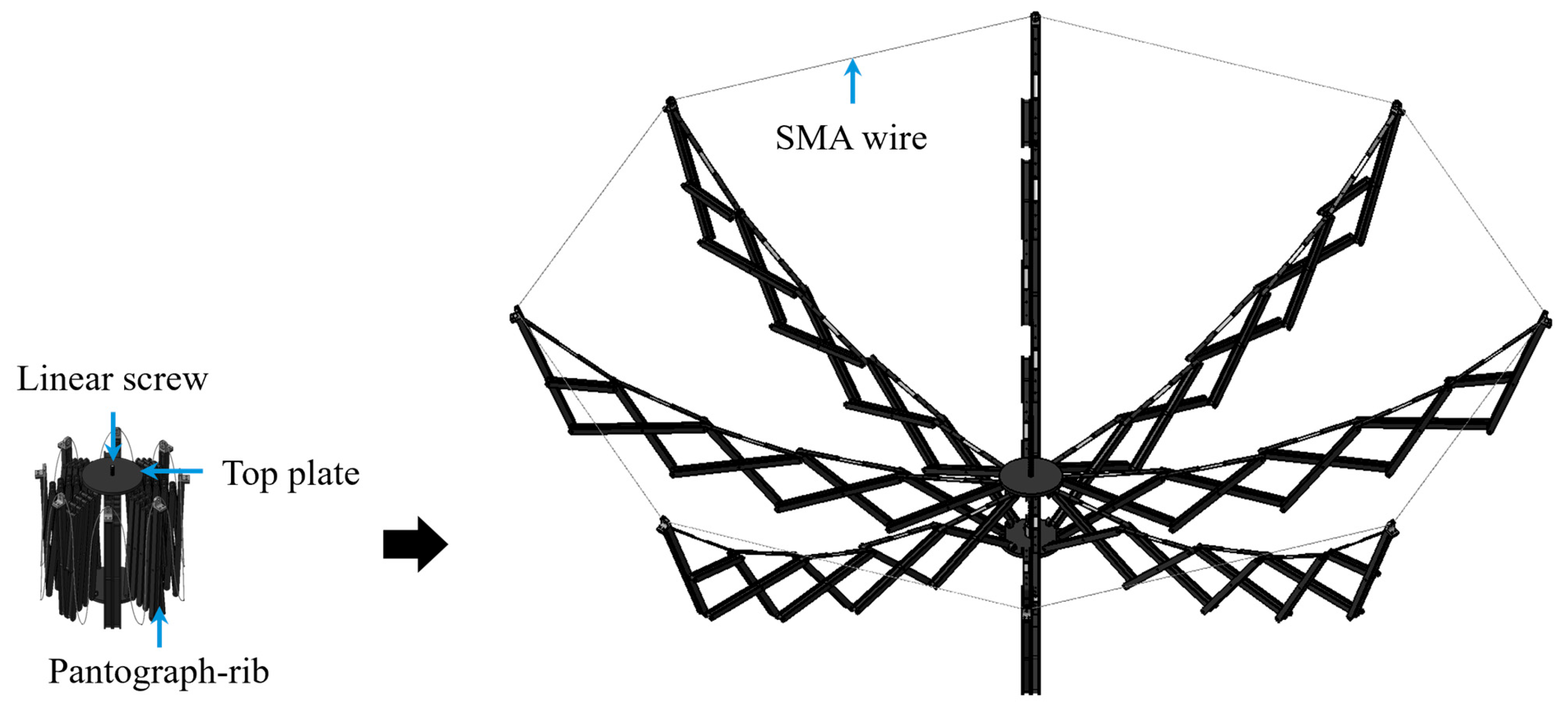
Figure 1 shows the conceptual design of the Deployable Pantograph rib structure-based Parabolic Antenna (De-PaRA) and its deployment process. The deployable mechanism consists of an eight-rib pantograph structure designed to form a parabolic reflector surface. The folded ribs deploy outward from the center toward the reflective surface as the linear screw stepping motor rotates counterclockwise. Since the screw is integrated with the top plate, the top plate can exhibit translational motions in the vertical direction. Accordingly, as the top and bottom plates move closer together, the entire pantograph structure expands radially, forming a parabolic reflector surface.

Detailed Designs: Stiffness Enhancement

The proposed antenna mechanism has low longitudinal stiffness in the ribs when fully deployed, which leads to weak axial stiffness of the antenna. Such low-stiffness antennas can lead to structural integrity issues, resulting in low-frequency vibration due to reaction wheels used for satellite attitude control. In particular, given that radio frequency (RF) performance is strongly influenced by structural stiffness of the antenna, it is critical that the antenna’s structural stiffness be enhanced. For these reasons, the antenna structure employs an active smart material along the circumferential direction at the end of the ribs. Among active smart materials, SMA represents a particular alloy composed of titanium and nickel. In principle, once external forces exceeding the critical stress are applied at a temperature above its operating temperature, the SMA exhibits a superelastic effect due to a phase transition in its metallic crystal structure, resulting in a wide elastic range [28]. Due to this effect, the SMA exhibits strong resistance to plastic deformations. Furthermore, the energy dissipation during the phase transformation provides excellent damping performance, which is beneficial for suppressing structural vibrations. While such high flexibility could result in hysteresis during loading and unloading due to energy dissipation, this can be compensated by considering structural rigidity and flexibility [29]. With these considerations in mind, SMA wire was chosen to enhance the structural stiffness of the antenna while maintaining a constant distance between the ribs during deployment.
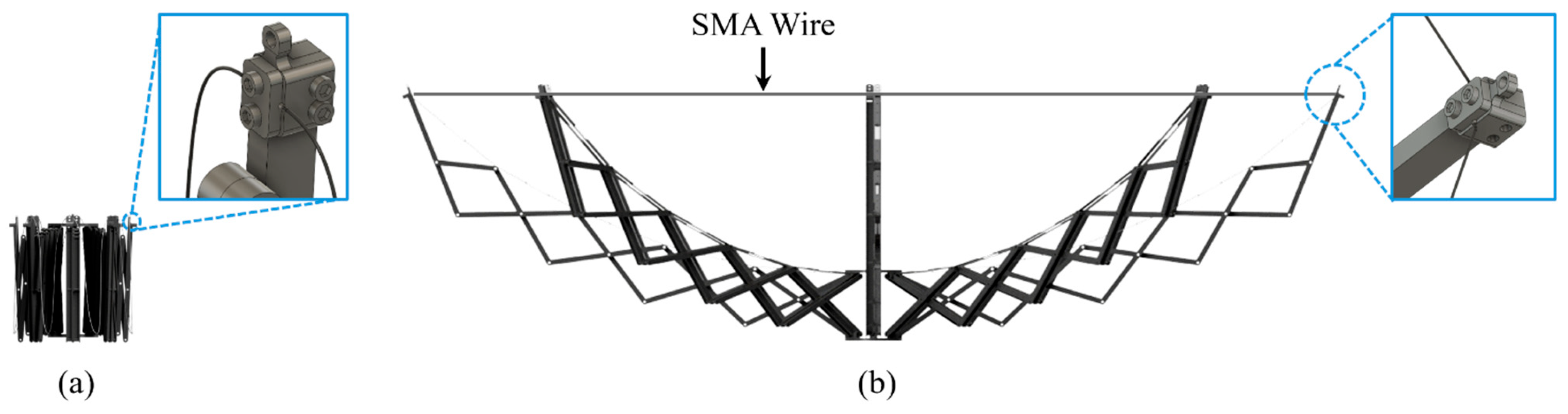
Figure 2 shows the SMA wire interface and the integration of the SMA wire with De-PaRA. The SMA wire interface is attached to the end of the rib structure. By adjusting the distance between each rib and fixing the SMA wire, tensile stress is applied to the SMA wire upon full deployment, thereby maintaining a constant distance among the ribs.

2.2. Parametric Modeling

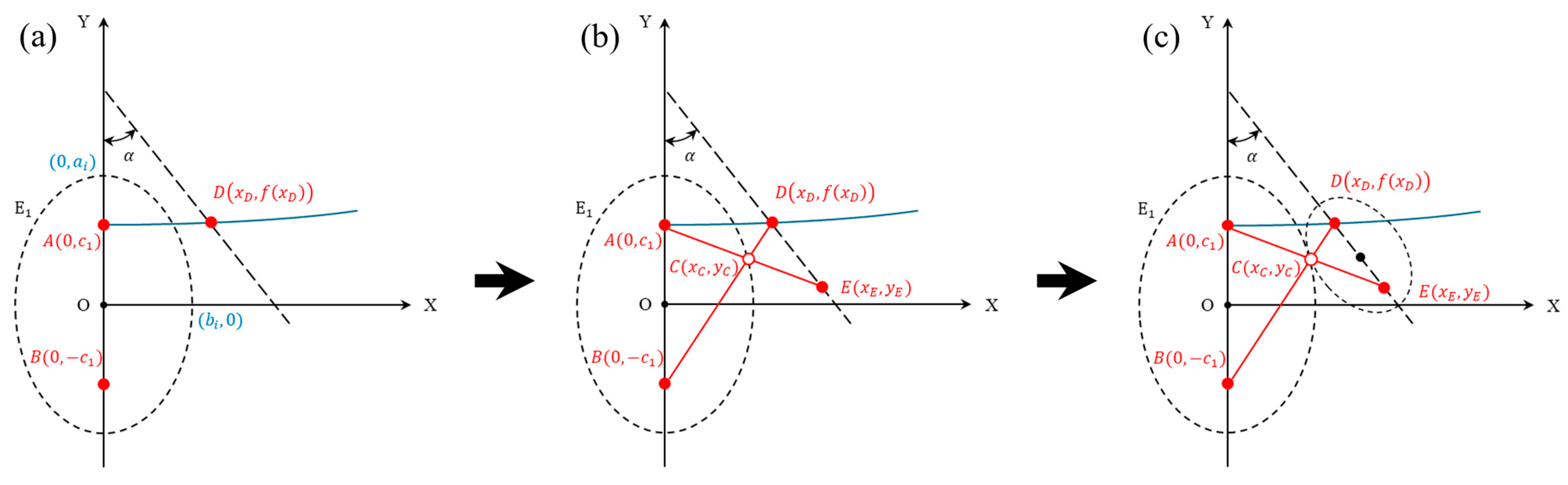
The reflector is directly attached to the ribs to ensure the surface accuracy of the reflector without a cable network. In parallel, to improve the stowed efficiency of the ribs, the Four Parameter Method (which refers to a geometric analysis) is performed for the pantograph structure design, as depicted in Figure 3 (similarly reported in [20]). This method represents a specialized technique for parabolic antenna rib design. Unlike simple pantograph structures used in horizontal deployable arrays, the pantograph mechanism incorporates rotational motion relative to the parabolic focus, utilizing the geometric characteristics of ellipses. When fully deployed, the structure forms the same parabolic shape as conventional designs. However, this approach maximizes stowage efficiency by optimizing the rib folding geometry in the stowed configuration. Ellipses tangent to each other are drawn along a fitting curve. The tangent point of the two ellipses acts as the middle point of the Scissor-Like Element (SLE), and the foci of each ellipse become the endpoints of the SLE. The blue curve in Figure 3a represents the fitting curve y = f x , which refers to the curve of the antenna reflector.
More specifically, the design framework of the pantograph structure is as follows. First, when the value of α (which represents the angle between two SLEs and is a parameter that varies with the desired fitting curve) is given, the coordinates of the fitting point D are defined as x D , f x D . Additionally, given that the semi-major, -minor axes, the focal distance, and the foci are a 1 ,   b 1 ,   c 1 and A 0 , c 1 ,   B 0 ,   c 1 , respectively, the initial ellipse E 1 can be written, as:
x b 1 2 + y a 1 2 = 1
In Figure 3b, a single segment of the SLE, BD, is formed by connecting points B and D. This segment BD intersects with ellipse E 1 to form point C, which acts as the rotational joint of the SLE. The coordinates of C x C , y C satisfy the following equation:
x C b 1 2 + y C a 1 2 = 1  
y C = k x C c 1
k = f x D + c 1 x D
Then, the coordinates of point C x C , y C are written, as:
x C = k c 1 + a 1 k 2 + 1 k 2 + a 1 2 b 1 2
y C = k   ·   k c 1 + a 1 k 2 + 1 k 2 + a 1 2 b 1 2 c 1
A line connecting points A and C is extended along the AC direction to obtain point E, intersecting the axis of the SLE. Then, the coordinates of E x E , y E satisfy the following.
x E x C = y E c 1 y C c 1
y E = tan π 2 + α   ·   x E x D f x D
According to Equations (7) and (8), the coordinates of E are as follows:
x E = cot α   ·   x D y D c 1   ·   x C cot α   ·   x C + y C c 1
y E = cot α   ·   x C   ·   c 1 + cot α   ·   x D f x D   ·   y C c 1 cot α   ·   x D + y C c 1
As shown in Figure 3c, points D and E form the foci of the next tangent ellipse, E 2 . The sum of the lengths of CD and CE is equal to the length of the semi-major axis of E 2 . Therefore, the parameters a 2 ,   b 2 and c 2 of ellipse E 2 are described as:
c 2 = 1 2 x D x E 2 + f x D y E 2
a 2 = 1 2 x D x C 2 + f x D y C 2 + x E x C 2 + y E y C 2
b 2 = a 2 2 c 2 2
The parabolic reflector surface with the desired pantograph structure can be obtained via iterative calculations. This way, it is possible to prevent an increase in antenna height during stowage compared to the conventional rib structure design. Simultaneously, the antenna with high stowed efficiency can be accomplished.

2.3. Simulation and Experimental Setups

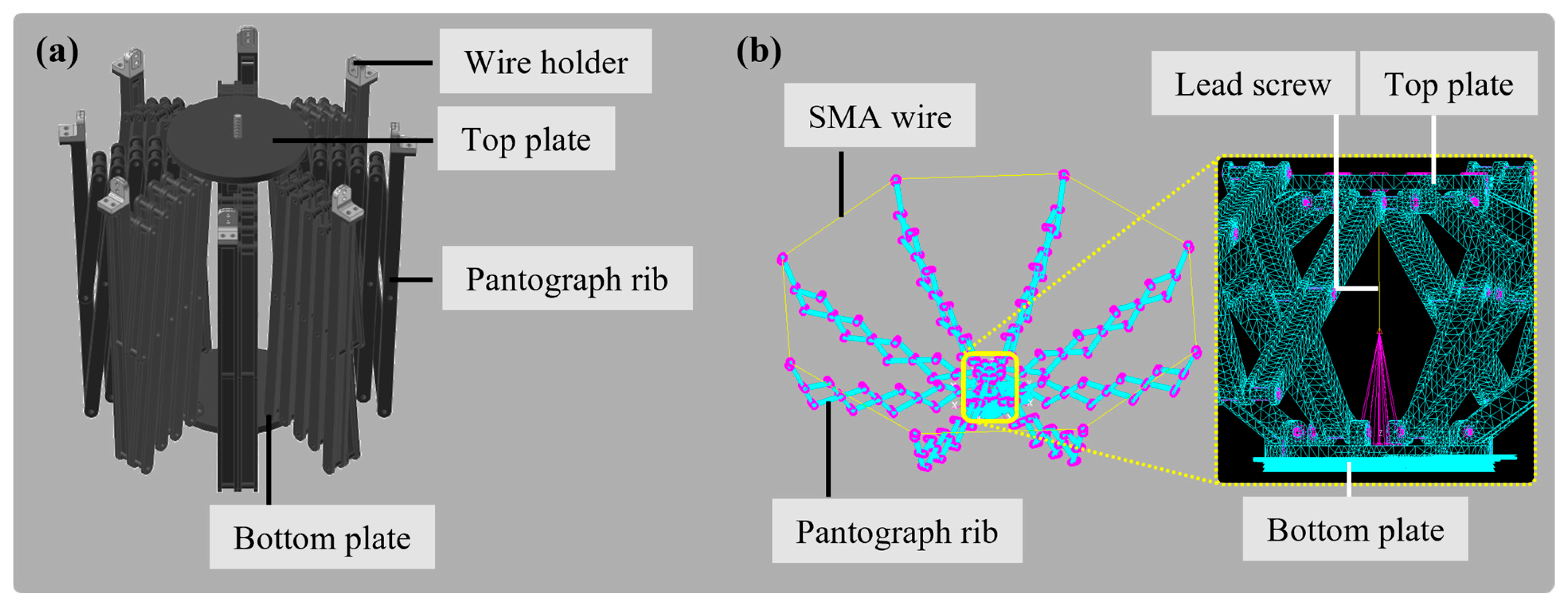
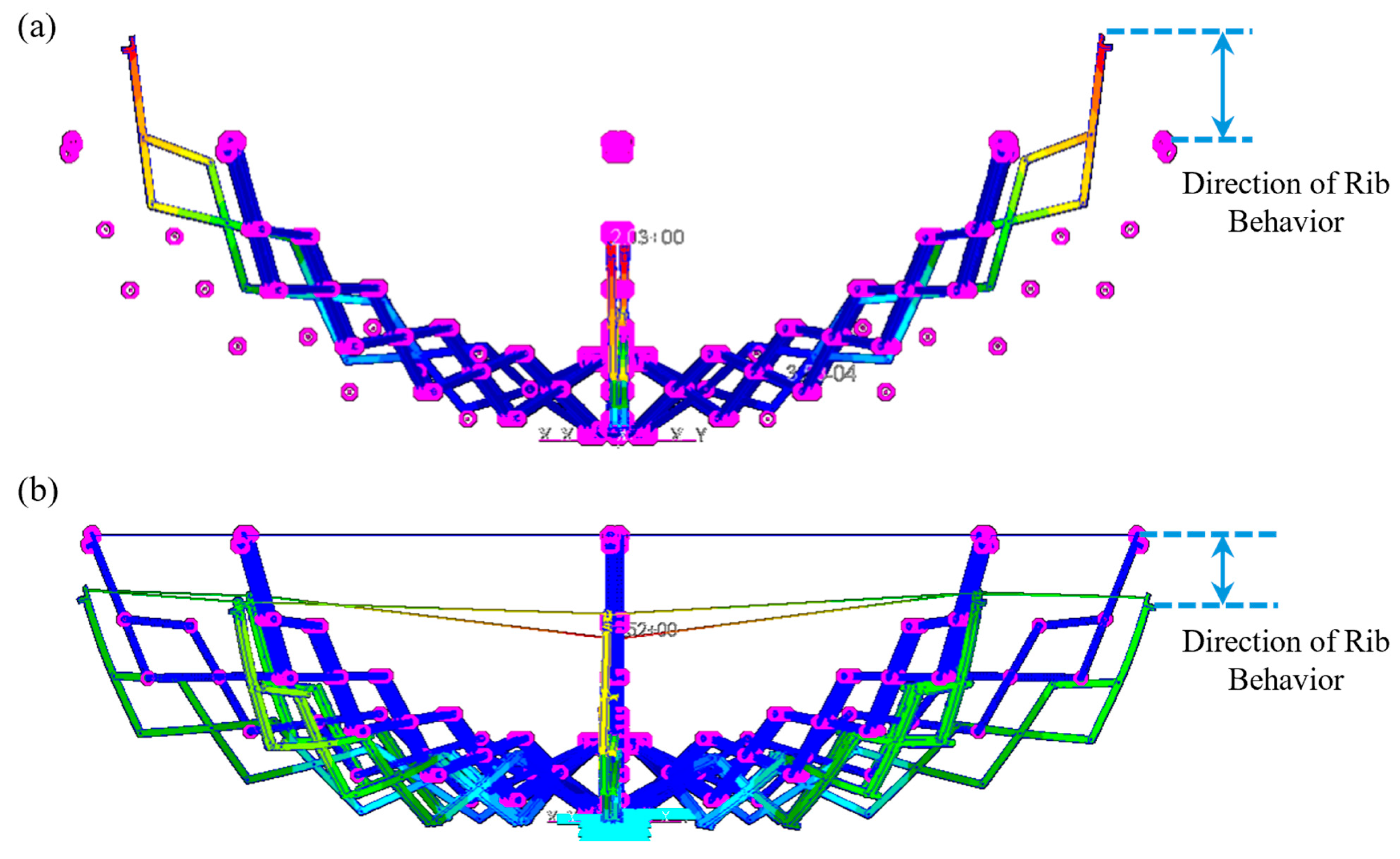
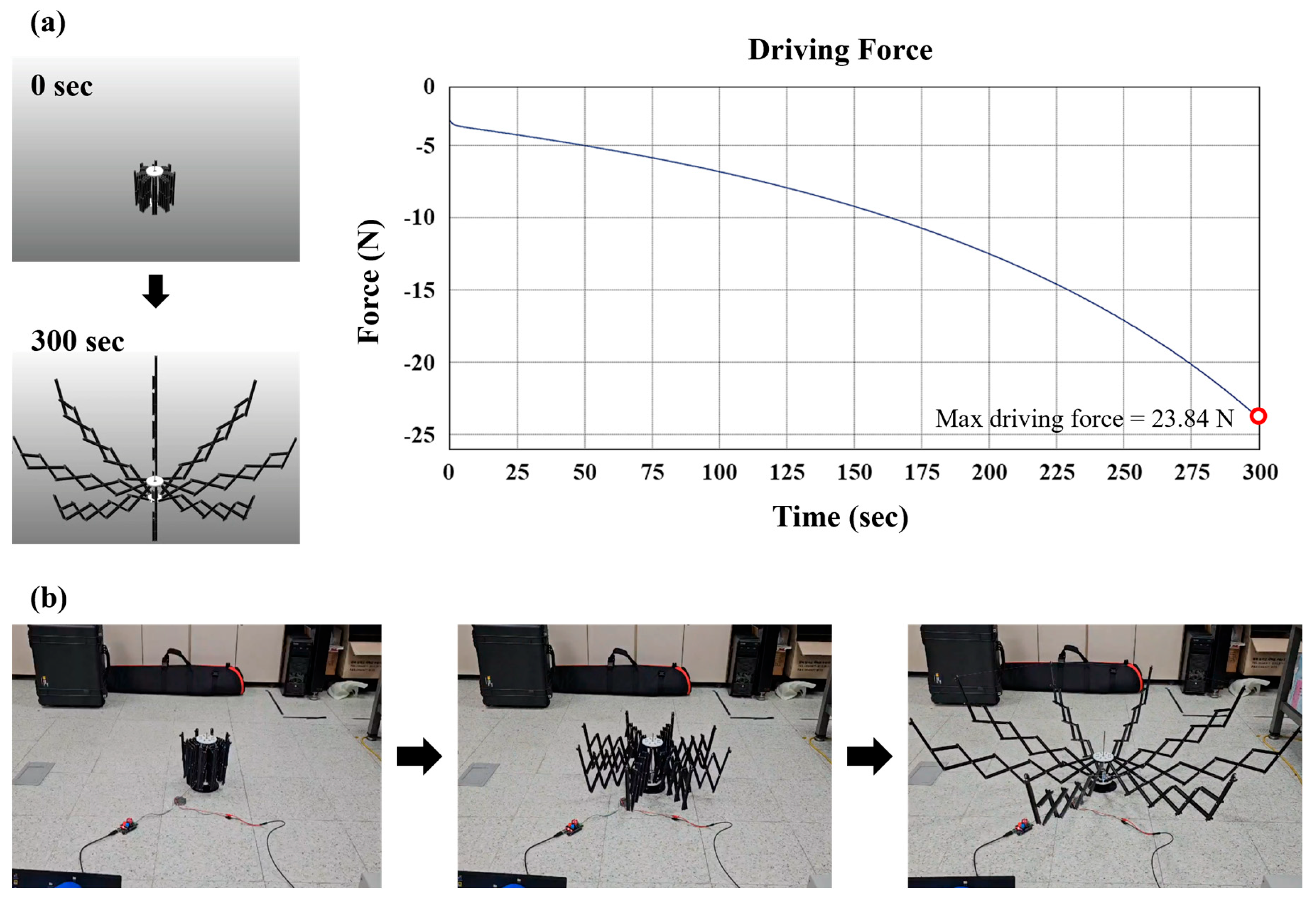
As regards theoretical analysis, simulations employed space-grade CFRP for pantograph ribs and AL6061 for top and bottom plates to assess space-material feasibility, as detailed in Table 1. Multi-Body Dynamics (MBD) simulation in RecurDyn (RecurDyn 2024, FunctionBay, Seongnam-si, Republic of Korea) was conducted to analyze the deployment dynamics characteristics of the deployable antenna mechanism and determine the actuation force required for antenna deployment under gravity, as shown in Figure 4a. To verify the effectiveness of the SMA wire structure, modal analysis was performed using MSC Patran/Nastran (MSC Patran/Nastran 2024.2, MSC Software, Newport Beach, CA, USA), where beam elements were applied to model the SMA wires, as shown in Figure 4b. The resulting mode shape was analyzed, and the natural frequency was investigated based on the mode that exhibited axial rib behavior. Based on these simulation results, a 3D-printed prototype was fabricated and experimentally validated. Experimental studies on the antenna structure were carried out to investigate the deployment ratio and reliability of the pantograph rib structure, as well as the effectiveness of the SMA wire structure. A comparative study between the experimental results and the analytical approach using MBD was then performed.

3. Results and Discussion

The proposed De-PaRA was designed and analyzed to validate its feasibility. The detailed specifications are summarized in Table 2. The mechanism achieves a stowed diameter of 225 mm and a deployed diameter of 1600 mm, resulting in a diameter deployment ratio of approximately 7.1. In experiments, the prototyped deployable antenna operated at a driving speed of approximately 0.33 mm/s, resulting in a full deployment time of about 5 min.
To address the inherent weakness in axial stiffness after deployment, superelastic SMA wires were applied along the antenna rib. Modal analysis was performed to quantify the stiffness. The stiffness enhancement can be quantified using the relationship between natural frequency and structural stiffness. The natural frequency is expressed as:
f n = 1 2 π k m
where fn is the natural frequency, k is the structural stiffness, and m is the mass. Equation (14) can be written as:
k = 4 π 2 f n 2 m
The natural frequency of the axial mode was measured at 9.932 Hz and 14.3 Hz, respectively, without and with SMA wire integration. Assuming that k1 and k2 represent the stiffness without wire and with wire, the corresponding stiffness values are
k 1 = 4 π 2 9.932 2 m
k 2 = 4 π 2 14.3 2 m
Given that the mass of the SMA wire is negligible compared to the total antenna mass, the mass of the overall antenna structure is invariant; thus, the stiffness ratio can be determined as:
k r a t i o = k 2 k 1 = 4 π 2 14.3 2 m 4 π 2 9.932 2 m = 2.073
These results demonstrate approximately a twofold increase in axial stiffness through SMA wire integration. The enhanced stiffness is critical for maintaining rib spacing and ensuring reflector surface accuracy during operation, as illustrated in Figure 5. It presents the mode shapes (linear eigenvectors) of the proposed antenna with and without the SMA. The color contour (as depicted in Figure 5) represents the magnitude of the normalized mode shape component. As the color changes from blue to red, the overall antenna structure undergoes relatively larger deformations. The superelastic properties of the SMA wire provide passive stiffness enhancement without requiring active control systems, making this approach particularly suitable for deployable space structure.
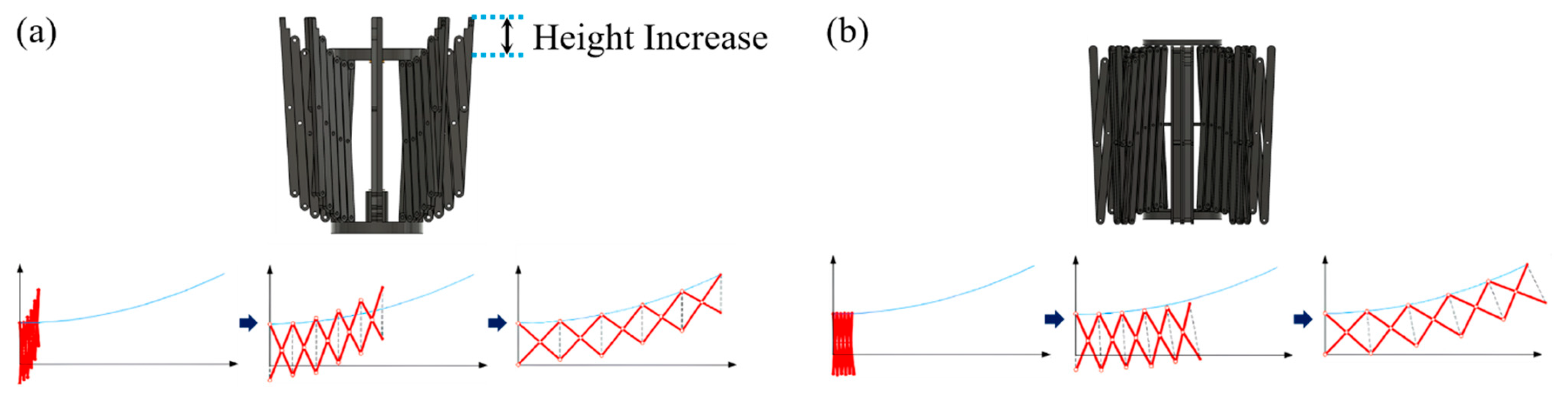
To optimize the rib geometry, the Four Parameter Method was applied, which enabled the formation of a precise parabolic reflector surface during deployment while preventing unnecessary increases in the stowed height, as depicted in Figure 6. This approach contributed significantly to improving the overall compactness and efficiency of the antenna.
A comparative analysis with umbrella- and ring-truss–based antennas shows that the proposed mechanism provides competitive deployment performance in both diameter and volume ratios as summarized in Table 3. The stowed and deployed volumes correspond to a volume deployment ratio of 58.8, which is significantly higher than previous approaches [30,31,32]. Specifically, the diameter deployment ratio of 7.1 exceeds that of TAS-I (3.47), V-Space (6.32), and OSS (3.51), while the volume deployment ratio of 58.8 surpasses TAS-I (12.06), V-Space (39.89), and OSS (46.62). These results highlight that the proposed De-PaRA offers superior stowage performance relative to existing deployable antenna designs.
As a result of the multibody dynamics simulation, the maximum driving force required was estimated to be 23.84 N for the space-qualified CFRP-Al6061 configuration, as shown in Figure 7a. The driving torque for the screw mechanism was analytically identified, taking frictional effects into account, and the actuator was selected accordingly. Both the simulation and experimental results showed that the De-PaRA was deployed stably into the designed parabolic shape, as shown in Figure 7b. Furthermore, the mechanism successfully completed 10 consecutive deployment cycles, thereby satisfying the minimum requirement set by the ECSS standard for validating the effectiveness of deployable structures. In a nutshell, our results demonstrate that the proposed De-PaRA provides superior stowage performance, enhanced axial stiffness, and reliable deployment. These results validate De-PaRA’s strong potential as a practical solution for large-aperture spaceborne antennas.

4. Conclusions and Future Work

In this study, a deployable mesh antenna mechanism employing a pantograph rib structure was designed, analyzed, and experimentally validated. The proposed mechanism (referred to as De-PaRA) addresses the inherent limitations of conventional umbrella- and ring-type deployable antennas by simultaneously achieving high stowage efficiency and reliable deployment. By directly integrating the reflector surface with the rib structure and employing the Four Parameter Method in the geometric design, the De-PaRA was able to create a precise parabolic reflector surface while minimizing unnecessary increases in stowed height. Meanwhile, the comparative analysis revealed that the deployment ratios of the De-PaRA were much higher than those in previous studies [30,31,32], thereby demonstrating superior compactness and efficiency. To overcome the inherent weakness in axial stiffness following deployment, superelastic shape memory alloy (SMA) wires were incorporated along the antenna rib. The modal analysis results revealed that the reinforced structure exhibited approximately a twofold increase in axial stiffness, effectively maintaining rib spacing and enhancing reflector surface precision. Moreover, both multibody dynamic simulations and cyclic experimental tests verified stable operation with 10-cycle repeatability, thus validating the feasibility and reliability of the proposed mechanism. Therefore, these findings confirm that the pantograph rib–based deployable mechanism provides a lightweight, compact, and robust solution for large-aperture spaceborne antennas.
Despite these promising outcomes, we see that the proposed mechanism needs to be studied further toward full space qualification. First, the structural and material performance of the De-PaRA must be rigorously evaluated under space environments, including thermal cycling, vacuum, and radiation, to ensure long-term durability and operational stability. Second, the radio-frequency performance of the deployed reflector—particularly gain, efficiency, and radiation pattern—requires experimental validation. Third, scalability studies are essential to adapt the mechanism to larger apertures while maintaining favorable mass-to-stiffness ratios and deployment reliability. In addition, overall system robustness can be enhanced by incorporating redundant actuation schemes, fail-safe SMA configurations, and autonomous deployment monitoring and control strategies. Finally, system-level integration analyses are required to examine the dynamic interactions between the antenna and satellite bus subsystems, particularly the effects of disturbances induced by reaction wheels and attitude control systems.
In conclusion, we envision that by addressing these challenges, the De-PaRA can progress from a laboratory-scale demonstration to a fully space-qualified technology, thereby contributing to the realization of high-performance satellite communication and Earth observation missions that demand compact stowage, reliable deployment, and high-gain performance.

Author Contributions

Conceptualization, H.K., K.-W.K., H.-U.O. and B.K.; methodology, H.K., K.-W.K., H.-U.O. and B.K.; software, H.K., K.-W.K. and S.J.; validation, H.K. and S.J.; investigation, H.K. and K.-W.K.; writing—original draft preparation, H.K. and K.-W.K.; writing—review and editing, S.J., H.-U.O. and B.K.; supervision, H.-U.O. and B.K.; project administration, H.-U.O. and B.K.; funding acquisition, S.J., H.-U.O. and B.K. All authors have read and agreed to the published version of the manuscript.

Funding

This work was supported by a 2024 Korea aerospace university faculty research grant.

Data Availability Statement

The original contributions presented in the study are included in the article, further inquiries can be directed to the corresponding authors.

Conflicts of Interest

Hyun-Ung Oh was employed by STEPLab., Ltd. The authors declare that the research was conducted in the absence of any commercial or financial relationships that could be perceived as potential conflicts of interest.

References

  1. Boyd, I.D.; Buenconsejo, R.S.; Piskorz, D.; Lal, B.; Crane, K.W.; De La Rosa Blanco, E. On-Orbit Manufacturing and Assembly of Spacecraft; JSTOR: New York, NY, USA, 2022. [Google Scholar]
  2. Rahmat-Samii, Y.; Densmore, A.C. Technology trends and challenges of antennas for satellite communication systems. IEEE Trans. Antennas Propag. 2014, 63, 1191–1204. [Google Scholar] [CrossRef]
  3. Duan, B. Large spaceborne deployable antennas (LSDAs)—A comprehensive summary. Chin. J. Electron. 2020, 29, 1–15. [Google Scholar] [CrossRef]
  4. Ullah, M.A.; Keshavarz, R.; Abolhasan, M.; Lipman, J.; Esselle, K.P.; Shariati, N. A review on antenna technologies for ambient RF energy harvesting and wireless power transfer: Designs, challenges and applications. IEEE Access 2022, 10, 17231–17267. [Google Scholar] [CrossRef]
  5. Qi, X.; Huang, H.; Li, B.; Deng, Z. A large ring deployable mechanism for space satellite antenna. Aerosp. Sci. Technol. 2016, 58, 498–510. [Google Scholar] [CrossRef]
  6. Duan, B.; Zhang, Y.; Du, J. Large Deployable Satellite Antennas; Springer: Berlin/Heidelberg, Germany, 2020. [Google Scholar]
  7. Wang, B.; Zhu, J.; Zhong, S.; Liang, W.; Guan, C. Space deployable mechanics: A review of structures and smart driving. Mater. Des. 2024, 237, 112557. [Google Scholar] [CrossRef]
  8. Li, T. Deployment analysis and control of deployable space antenna. Aerosp. Sci. Technol. 2012, 18, 42–47. [Google Scholar] [CrossRef]
  9. Zhang, Y.; Li, N.; Yang, G.; Ru, W. Dynamic analysis of the deployment for mesh reflector deployable antennas with the cable-net structure. Acta Astronaut. 2017, 131, 182–189. [Google Scholar] [CrossRef]
  10. Kodheli, O.; Lagunas, E.; Maturo, N.; Sharma, S.K.; Shankar, B.; Montoya, J.F.M.; Duncan, J.C.M.; Spano, D.; Chatzinotas, S.; Kisseleff, S. Satellite communications in the new space era: A survey and future challenges. IEEE Commun. Surv. Tutor. 2020, 23, 70–109. [Google Scholar] [CrossRef]
  11. Kang, H.; Hwang, B.; Kim, S.; Lee, H.; Koo, K.; Joe, S.; Kim, B. A Conceptual Design of Deployable Antenna Mechanisms. Aerospace 2024, 11, 938. [Google Scholar] [CrossRef]
  12. Kim, S.; Kang, H.; Do, R.-H.; Koo, K.-R.; Kim, B. Design of large deployable mechanism with frustum shape satellite antenna. J. Aerosp. Syst. Eng. 2024, 18, 64–70. [Google Scholar]
  13. Thomson, M. Astromesh deployable reflectors for ku and ka band commercial satellites. In Proceedings of the 20th AIAA International Communication Satellite Systems Conference and Exhibit, Montreal, QC, Canada, 12–15 May 2002; p. 2032. [Google Scholar]
  14. Thomson, M.W. The AstroMesh deployable reflector. In Proceedings of the IEEE Antennas and Propagation Society International Symposium. 1999 Digest. Held in conjunction with: USNC/URSI National Radio Science Meeting (Cat. No. 99CH37010), Orlando, FL, USA, 11–16 July 1999; IEEE: New York, NY, USA, 1999; pp. 1516–1519. [Google Scholar]
  15. Yan, X.; Fu-ling, G.; Yao, Z.; Mengliang, Z. Kinematic analysis of the deployable truss structures for space applications. J. Aerosp. Technol. Manag. 2012, 4, 453–462. [Google Scholar] [CrossRef]
  16. Datashvili, L.; Endler, S.; Wei, B.; Baier, H.; Langer, H.; Friemel, M.; Tsignadze, N.; Santiago-Prowald, J. Study of mechanical architectures of large deployable space antenna apertures: From design to tests. CEAS Space J. 2013, 5, 169–184. [Google Scholar] [CrossRef]
  17. Tserodze, S.; Medzmariashvili, E.; van ’t Klooster, C.M.v.t.; Chkhikvadze, K.; Muchaidze, M.; Nikoladze, M.; Chapodze, A.; Sigua, I.; Sanikidze, M. New design modifications of the supporting ring for a large deployable space reflector. CEAS Space J. 2021, 13, 175–182. [Google Scholar] [CrossRef]
  18. Zhao, J.; Yang, J.; Xiao, Y.; Ma, X. Deployment strategy and dynamic analysis of large ring truss antenna. Int. J. Aerosp. Eng. 2022, 2022, 4725423. [Google Scholar] [CrossRef]
  19. Choi, J.-S.; Park, T.-Y.; Chae, B.-G.; Oh, H.-U. Development of Lightweight 6 m Deployable Mesh Reflector Antenna Mechanisms Based on a Superelastic Shape Memory Alloy. Aerospace 2024, 11, 738. [Google Scholar] [CrossRef]
  20. Shi, Z.; Li, T.; Tang, Y.; Li, M.; Zhou, X.; Qian, J. Design and analysis of scissor-like hoop truss deployable antenna mechanism with arbitrary curvature support ribs. Acta Astronaut. 2024, 219, 24–40. [Google Scholar] [CrossRef]
  21. Rahmat-Samii, Y.; Haupt, R. Reflector antenna developments: A perspective on the past, present and future. IEEE Antennas Propag. Mag. 2015, 57, 85–95. [Google Scholar] [CrossRef]
  22. Hasanzade, V.; Sedighy, S.H.; Shahravi, M. Compact deployable umbrella antenna design with optimum communication properties. J. Spacecr. Rocket. 2017, 54, 782–788. [Google Scholar] [CrossRef]
  23. Urata, K.N.; Sri Sumantyo, J.T.; Santosa, C.E.; Viscor, T. Development of an L-band SAR microsatellite antenna for earth observation. Aerospace 2018, 5, 128. [Google Scholar] [CrossRef]
  24. Bo, H.; Yundou, X.; Jiantao, Y.; Zheng, D.; Luyao, G.; Yongsheng, Z. Type synthesis of deployable mechanisms for ring truss antenna based on constraint-synthesis method. Chin. J. Aeronaut. 2020, 33, 2445–2460. [Google Scholar] [CrossRef]
  25. Siriguleng, B.; Zhang, W.; Liu, T.; Liu, Y. Vibration modal experiments and modal interactions of a large space deployable antenna with carbon fiber material and ring-truss structure. Eng. Struct. 2020, 207, 109932. [Google Scholar] [CrossRef]
  26. Morterolle, S.; Maurin, B.; Dube, J.-F.; Averseng, J.; Quirant, J. Modal behavior of a new large reflector conceptual design. Aerosp. Sci. Technol. 2015, 42, 74–79. [Google Scholar] [CrossRef]
  27. Han, B.; Xu, Y.; Yao, J.; Zheng, D.; Li, Y.; Zhao, Y. Design and analysis of a scissors double-ring truss deployable mechanism for space antennas. Aerosp. Sci. Technol. 2019, 93, 105357. [Google Scholar] [CrossRef]
  28. Yuan, H.; Zhao, W.; Zhang, H.; Fan, Z.; Tian, X.; Zhang, K.; Tan, C. Room-temperature superelasticity in Mg–Sc shape memory alloys revealed by first-principles calculations. J. Mater. Res. Technol. 2024, 30, 9592–9600. [Google Scholar] [CrossRef]
  29. Hwang, B.; Park, H.; Joe, S.; Kim, B. Topologically Optimized Fingerless Versatile Gripper Actuated by a Shape Memory Alloy Coiled Garter Spring. Adv. Eng. Mater. 2023, 25, 2300289. [Google Scholar] [CrossRef]
  30. Contu, S.; Meschini, A.; Rigato, R. Development status of Large Reflectors at TAS-I. In Proceedings of the 2019 IEEE Indian Conference on Antennas and Propogation (InCAP), Ahmedabad, India, 19–22 December 2019; pp. 1–4. [Google Scholar]
  31. Chahat, N.; Hodges, R.E.; Sauder, J.; Thomson, M.; Rahmat-Samii, Y. The deep-space network telecommunication CubeSat antenna: Using the deployable Ka-band mesh reflector antenna. IEEE Antennas Propag. Mag. 2017, 59, 31–38. [Google Scholar] [CrossRef]
  32. Angevain, J.-C.; Ihle, A.; Rodrigues, G.; Santiago-Prowald, J. Large deployable spaceborne reflector antennas in Europe: Progress status and perspectives. In Proceedings of the 2019 13th European Conference on Antennas and Propagation (EuCAP), Krakow, Poland, 31 March–5 April 2019; pp. 1–5. [Google Scholar]
Figure 1. Conceptual design of the Deployable Pantograph rib structure-based Parabolic Antenna (De-PaRA).
Aerospace 12 01055 g001
Figure 2. The deployable rib structure-based antenna at (a) stowed state, (b) deployed state.
Aerospace 12 01055 g002
Figure 3. Parameter sets and the design procedure of the deployable rib structure-based antenna. (a) Initial ellipse and fitting point, (b) intersection points and SLE axis, (c) second ellipse formation.
Aerospace 12 01055 g003
Figure 4. Simulation models of De-PaRA (a) multi-body dynamics in RecurDyn for deployment analysis and (b) finite element model in MSC Patran/Nastran for modal analysis.
Aerospace 12 01055 g004
Figure 5. Modal analysis results showing axial mode frequencies (a) without SMA wire (9.932 Hz), (b) with SMA wire (14.3 Hz).
Aerospace 12 01055 g005
Figure 6. Comparative results of the stowed height of De-PaRA (a) without Four Parameter Method, (b) with Four Parameter Method.
Aerospace 12 01055 g006
Figure 7. Multi-body dynamics simulation and deployment experiment results, (a) driving force analysis in RecurDyn and (b) experimental deployment validation.
Aerospace 12 01055 g007
Table 1. Material parameters for simulation.
PartMBD PropertiesFEM Properties
MaterialDensity [kg/m3]MaterialElement Type
Top plateAL60612700AL60613D (Tetrahedral 10)
Bottom plateAL60612700AL60613D (Tetrahedral 10)
Pantograph ribCFRP1910CFRP3D (Tetrahedral 10)
Wire holderAL60612700--
SMA wire--SMA1D (Beam)
EnvironmentGravity-
Table 2. Specification of the deployable rib structure-based antenna.
UnitSpecification
Deployment methodMotor-driven (Screw type)
Number of ribs8
Stowed diameter [a]225 mm
Deployed diameter [b]1600 mm
Stowed volume [c]0.001225 m3
Deploy volume [d]0.7231 m3
Diameter deployment ratio [b/a]Up to 7.1
Volume deployment ratio [d/c]Up to 58.8
Table 3. Comparative analysis of the deployable rib structure-based antenna.
Diameter Deployment RatioVolume Deployment Ratio
Proposed antenna7.158.8
TAS-I (Petal-rib) [30]3.4712.06
V-Space (Wrapped-rib) [31]6.3239.89
OSS (Wrapped-rib) [32]3.5146.62
Disclaimer/Publisher’s Note: The statements, opinions and data contained in all publications are solely those of the individual author(s) and contributor(s) and not of MDPI and/or the editor(s). MDPI and/or the editor(s) disclaim responsibility for any injury to people or property resulting from any ideas, methods, instructions or products referred to in the content.