Abstract
This paper studies spacecraft control under communication congestion, multi-source uncertainties, and input constraints. To reduce communication load, a static event-triggered mechanism is used so that transmissions occur only when necessary. Unknown nonlinearities are estimated online by a radial basis function neural network (RBFNN). To address sensor outliers and external disturbances, an event-triggered stubborn composite disturbance observer (ESCDO) is proposed, and sufficient conditions are derived to ensure its globally uniformly bounded stability. Based on this, an MPC-based composite anti-disturbance controller is designed to satisfy input constraints, and conditions are provided to guarantee the uniform bounded stability of the closed loop. Numerical simulations are conducted to demonstrate the effectiveness of the proposed approach.
1. Introduction
On-orbit servicing of spacecraft has attracted significant research attention in recent years, with applications including in-orbit fuel replenishment [1,2], space debris removal [3,4,5,6], and spacecraft maintenance [7,8,9]. The successful realization of these technologies depends on the precise control of spacecraft systems. Typically, spacecraft transmit measurement data to information-processing terminals, including space stations and ground stations [10], via wireless communication links, after which they receive and execute the corresponding control commands. However, during on-orbit servicing operations [11], the limited capacity of on-board communication equipment, together with the inherent multiple-input multiple-output (MIMO) characteristics of spacecraft, places a considerable burden on the already limited communication bandwidth when large volumes of measurement data must be transmitted [12,13,14]. This frequently results in packet loss [15] and transmission delays [16]. In addition, signal transmissions in the space environment are particularly vulnerable to electromagnetic interference and other disturbances [17], which can lead to anomalies in the measurement data. Such anomalous data points, which deviate from the expected measurement trends, are classified as outliers [18] and present substantial challenges for control system reliability. To alleviate communication bandwidth constraints, time-triggered [19] or event-triggered [20] mechanisms have been employed to reduce the data transmission volume. Although these methods effectively reduce the communication burden, they introduce undesirable artifacts such as chattering in the system state, making them unsuitable for high-precision spacecraft relative motion control tasks. Furthermore, to address the outlier problem, state observers incorporating limiting functions have been proposed [21].
In addition, spacecraft operating in the complex space environment is subject to multi-source uncertainties [22,23]. These uncertainties can be categorized into internal uncertainties and external uncertainties. The former include elastic disturbances generated by flexible devices such as antennas and solar panels [24], and actuator noise [25]; the latter arise from environmental disturbances encompassing gravity gradient torque, solar radiation, and geomagnetic torque [26]. From a modeling perspective, these disturbances can be classified into modelable disturbances [27] and unmodeled dynamics [28]. To mitigate the adverse effects of these disturbances, disturbance observers have been developed and extensively implemented in control systems for disturbance estimation [27]. For modelable disturbances that can be described by an exogenous system (model disturbance), a disturbance observer (DO) can utilize information from the exogenous system to render the error dynamics of the observer system asymptotically stable [29]. Conversely, when confronted with slowly time-varying disturbances that defy precise mathematical modeling but exhibit bounded derivatives, researchers have developed an extended state observer (ESO) [30,31]. Furthermore, for unknown nonlinear terms in the system, radial basis function neural networks (RBFNNs) are employed for estimation [32]. Moreover, a number of studies have investigated disturbance observation in the presence of measurement outliers. In [33], a discrete-time outlier-resistant ESO is designed for a discrete-time Nash equilibrium seeking problem. In [34], a stubborn ESO under the impact of outliers is designed for an event-triggered -Nash equilibrium seeking problem to estimate external disturbances. Despite these advances, existing composite DOs (CDOs) designed for multi-source uncertainties utilize the actual system output as the observer input, failing to account for the impact of sensor outliers on estimation performance. This critical oversight fails to leverage real measurement data for real-time and accurate estimation of unknown states and uncertainty terms. Specifically, when using high-gain observers, outliers can be amplified, substantially reducing estimation accuracy and even leading to disruptions in the closed-loop system. Consequently, the design of a composite disturbance observer to estimate multi-source uncertainties with measurement outliers is the motivation for this study.
Input constraints, arising from the inherent physical limitations of spacecraft actuators [28,35], present significant challenges for precise control performance. To address these constraints, researchers have introduced model predictive control (MPC) methods to obtain control inputs that satisfy the input constraints [36]. MPC is a receding-horizon strategy that optimizes a finite-horizon cost subject to system dynamics and constraints, applies only the first control action, and repeats the procedure at subsequent update instants. MPC is widely used when constraints are explicit design requirements and when trade-offs among tracking accuracy, control effort, and constraint satisfaction must be balanced [37]. Stability and feasibility are typically ensured through suitable terminal ingredients and/or robust design, while practical implementations often incorporate disturbance estimates to improve prediction fidelity [38]. When controlled systems are subject to disturbances, robust MPC [39] and tube-based MPC [40] have been developed to attenuate the adverse effects of perturbations. However, there has been insufficient research on MPC methods that account for both communication effects and multi-source uncertainties. Consequently, the development of an MPC method that addresses systems affected simultaneously by communication effects and multi-source uncertainties constitutes another motivation for this study.
In this paper, we design a composite anti-disturbance control strategy based on tube-based MPC for spacecraft systems that simultaneously experience communication congestion, sensor outliers, multi-source uncertainties, and input constraints. The major contributions of this paper are as follows:
- (1)
- An event-triggered stubborn composite disturbance observer (ESCDO) is proposed to estimate the system state and multi-source disturbances in the presence of outliers.
- (2)
- A composite anti-disturbance controller based on a tube-based MPC scheme is introduced to accommodate input constraints and suppress the effects of multi-source uncertainties.
- (3)
- Easy-to-check conditions are established to guarantee uniform bounded stability for both the ESCDO and the closed-loop system.
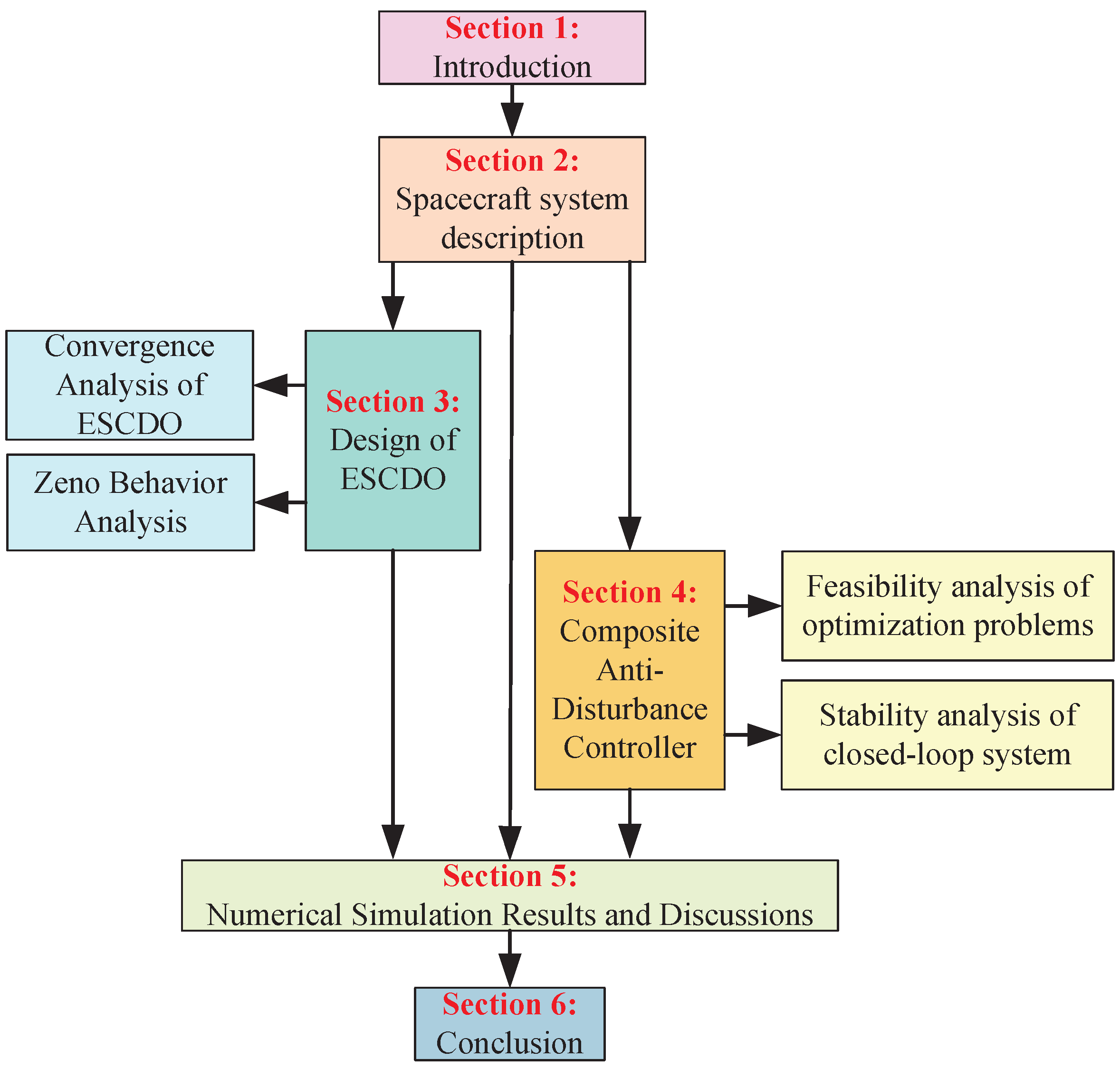
To ground the study, we consider spacecraft operating over bandwidth-limited links and subject to sporadic measurement outliers, multi-source disturbances, and actuator constraints—conditions under which periodic communication and classical observers either waste bandwidth or become brittle, and where constraint handling is often decoupled from disturbance rejection, risking infeasibility and loss of stability. Motivated by these coupled challenges, Section 2 formulates the control problem and modeling assumptions, including an outlier-corrupted measurement model, a multi-source disturbance channel, and input/communication constraints. Section 3 develops an ESCDO robust to outliers, and establishes convergence of the disturbance-estimation error while excluding Zeno behavior. Section 4 proposes an MPC-based composite anti-disturbance controller that enforces input constraints, with sufficient conditions ensuring feasibility of the optimization and uniform bounded stability of the closed loop. Section 5 presents a numerical case study validating the approach, and Section 6 concludes with limitations and directions for future research. The narrative structure of the paper is shown in Figure 1.
Figure 1.
The narrative structure of this paper.
2. Problem Formulation and Preliminaries
System Model
In this paper, the Clohessy-Wiltshire equation [41] has been employed, and the ideal dynamic of the spacecraft is assumed to be
where is the spacecraft system state with and being the relative position and velocity components on three coordinate axes, respectively; the system control input constrained by with ; the unknown continuous nonlinear function related to the system state; the output of the spacecraft system; , and are system matrices with appropriate dimensions.
Given the significant distance between ground stations, tracking spacecraft, and target nodes, as well as the high volume of telemetry data, transmitting all measurements through satellite ground links poses a substantial risk of congestion-related delays and data loss.
To mitigate data congestion, we adopt an event-triggered mechanism, in which telemetry data are transmitted only when predefined conditions are satisfied, substantially reducing the data volume compared to conventional time-triggered approaches. In addition, telemetry data transmission is highly susceptible to interference from cosmic rays and atmospheric electromagnetic signals, resulting in measurement fluctuations (outliers). Taking this phenomenon and the event-triggered mechanism into account, the spacecraft relative motion model system (1) and (2) can be rewritten as a hybrid system
where is the event-triggering moment; the wireless telemetry data transmitted at the event-triggering moment; the outlier in wireless transmission; indicates the presence of outliers. indicates the presence of outliers, while denotes the absence of outliers. Furthermore, satisfies the Bernoulli distribution and for a constant . is the external disturbance satisfying with being a known constant. is generated by the following exogenous system
where is the state of disturbance ; and are known matrices.
Remark 1.
The assumptions on uncertainties and disturbances in this study are adopted from [32]. Reference [32] investigates the control of a tethered spacecraft under multi-source uncertainties and provides clear descriptions and models of the relevant uncertainty and disturbance sources. These effects are representative of the perturbations encountered by spacecraft during on-orbit operations. Accordingly, the uncertainty and disturbance assumptions used here are consistent with practical on-orbit conditions.
Remark 2.
This work employs a relative-motion model of the spacecraft. However, the classical form of this model holds only under idealized assumptions that neglect perturbations such as the effect and atmospheric drag. In contrast, the present study does not assume an ideal environment: the relative motion is modeled under external disturbances—e.g., gravity-gradient torque, solar radiation pressure, and geomagnetic torque—as discussed in the introduction. These effects act on the spacecraft as exogenous torques (and associated forces); therefore, the model adopted here explicitly incorporates such disturbances rather than relying on the idealized relative-motion equations.
3. The Estimation of System State and Multi-Uncertainties
In this part, we design an RBFNN to estimate the unknown continuous nonlinear function in system (3). Furthermore, an ESCDO is proposed to estimate the system state , multi-source disturbances and in the presence of outliers.
3.1. Design of the RBFNNs
As stated in [42], a continuous nonlinear function defined on a compact set can be approximated by the following RBFNN
where , and are the ideal weight vector, the vector-valued function, and the networked reconstruction error, respectively. Furthermore, is norm-bounded satisfying with and being known constants. Note that is also continuously differentiable with and . Then, system (3) can be rewritten as
where and with being the estimation of . Then, systems (7) and (8) can be rewritten as
where , ,
3.2. ESCDO Design
In this part, an ESCDO is designed as
where is the estimation of with ; L is the ESCDO gain matrix satisfying with , and as given parameters; is the variable based on the inter-sample prediction term ; , , are adjustable parameters without direct physical meaning. Their purpose is to ensure convergence of the observer’s estimation error in the designed ESCDO. is the event-triggered mechanism condition designed as
where
with and being two adjustable positive parameters. and represent the event triggered and the event not triggered, respectively. is the saturation function with a non-negative dynamic variable as its upper limit. The specific expression of is
where , .
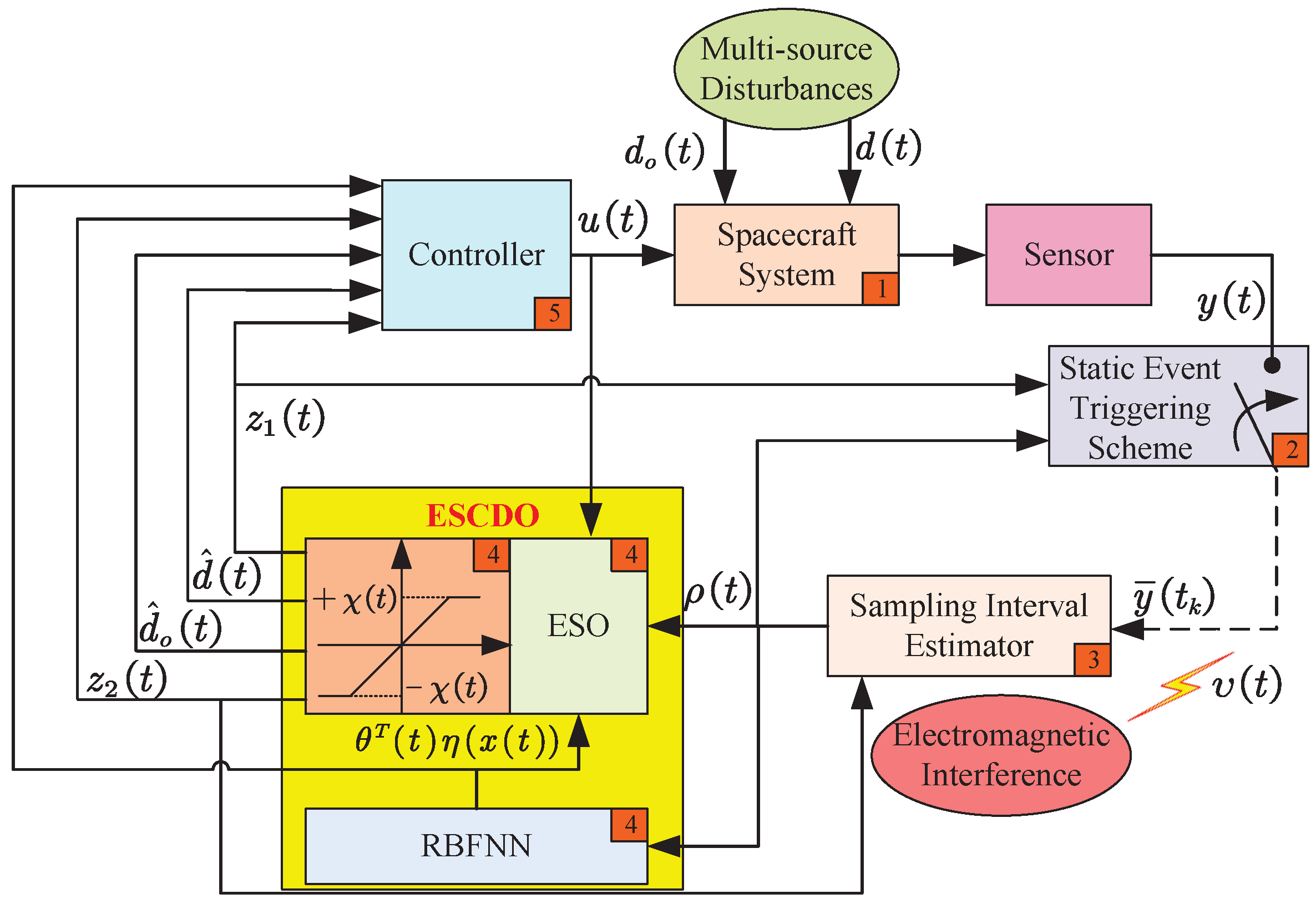
The control structure diagram of the spacecraft system under communication congestion, multi-source uncertainties, and the input constraint is given in Figure 2.
Figure 2.
The control structure diagram of the spacecraft system.
Lemma 1.
For the nonlinear function , if and are elements in the polyhedron
where and represent the i-th line of matrices C and H, respectively, then the following inequality
holds for any positive definite diagonal matrix Υ.
Lemma 2.
For a given symmetric matrix
where , the following three conditions are equivalent
- (1) ;
- (2) ;
- (3) .
Definition 1
([43]). For a set Θ, the positive definite function satisfies the inequality for any initial state , where Δ is a bounded positive real number; is a vector and . Then, the set is called the attraction domain of the estimation error system (16).
Definition 2
Definition 3
([45]). System (3) is said to be uniformly bounded if, for all , there exists a constant such that
holds for all and .
Remark 3.
For the inter-sample predictor, it is easy to obtain that the prediction estimation error is which has been given in the paper. When the static event-triggered mechanism is not triggered, we have . Then, there exists for if , which is the output of the inter-sample estimator. From the static event-triggering condition (15), it follows that during intervals in which no event is triggered, inequality holds. This inequality characterizes the relationship between the estimator’s prediction accuracy between sampling instants and the static event-triggering parameters and . For the same and , large values of and ϵ make it less likely to trigger data transmission, i.e., they correspond to a higher tolerance to the estimator’s prediction error. By appropriately selecting and ϵ, it is possible to maintain a suitable event-triggering frequency while ensuring high prediction accuracy of the inter-sample predictor.
3.3. Convergence Analysis of the ESCDO
To verify the effectiveness of the proposed ESCDO, we analyze the convergence of observation errors and present sufficient conditions for achieving uniformly bounded stability of (16) and (17).
Theorem 1.
holds, where and are given positive constants, then and estimation error system (16) is uniformly bounded stable with
where
If there exist positive definite symmetric matrix , positive diagonal matrix Υ, matrix O, positive constants and such that the following linear matrix inequality (LMI)
Proof.
For estimation error system (16), the Lyapunov candidate function is chosen as
where is a symmetric positive definite matrix and is a given positive constant. Then, the derivative of can be obtained as
where and with .
Then, it follows
By Young’s inequality and given in (14), there exist positive real numbers , and such that
hold. Substituting (25)–(28) into (24), it follows
Substituting (14) into (29), it gives
Integrating (32) in the interval for all , (21) is obtained. This implies that exponentially converge to a bounded constant . By selecting , inequality (22) can be converted to the LMI (20) according to the Schur’s supplementary in Lemma 2. Furthermore, (18) and (19) hold for any . Therefore, estimation error system (16) is uniformly bounded stable. This completes the proof. □
3.4. Analysis of Zeno Behavior
To ensure the event-triggered mechanism (15) avoids Zeno behavior, this subsection analyzes the minimum triggering interval of the mechanism (15), thereby proving the absence of Zeno behavior. To obtain the minimum triggering time interval, the following lemma is given first.
Lemma 3.
If there exist positive constants , and that can make the continuous differentiable nonnegative function , satisfy
then there is a time interval and a positive integer r that makes
hold.
Proof.
Choose a positive constant r which gives rise to . Denote and
where and for . Therefore, it is easy to obtain that holds for all .
By integrating both sides of (34), we have
From (35), the expression of can be obtained as
To ensure hold for , the following inequality must hold
which yields . Therefore, by letting and , it gives
This completes the proof. □
Next, a lemma is used to prove that Zeno behavior will be absent and the minimum interval between two trigger times is given.
Lemma 4.
Proof.
Considering , it is easy to obtain
Besides, we have
Denote
By Lemma 3, there exists an interval such that for any the following inequality
Therefore, the proposed event-triggered mechanism (15) will not lead to Zeno behavior. This completes the proof. □
4. Design of the Composite Anti-Disturbance Controller
In this section, we design a composite anti-disturbance controller for the spacecraft system by integrating the disturbance estimations obtained from the ESCDO and the MPC. First, we formulate the MPC optimization problem subject to robust state constraints. Then, we establish sufficient conditions to guarantee the recursive feasibility of the optimization scheme. Finally, we prove the uniform bounded stability of the closed-loop system under the proposed composite anti-disturbance controller.
4.1. The MPC Scheme
The nominal system of (7) is denoted as
where is the nominal state; is the nominal control input with being the optimal control signal generated by the MPC scheme designed subsequently. Then, we design the composite anti-disturbance controller of the spacecraft system as
where is the optimal control signal generated by the MPC scheme designed subsequently; is the estimation of ; is the nominal state of system (7); K is the feedback gain such that is stable; is the estimation of .
To obtain , a new constrained optimization problem is constructed for the spacecraft system as
Prob 1:
subject to
Denote
where denotes the prediction of the state from time to time s; denotes the prediction of the MPC input signal from time instant to time instant s; is the sampling period with ; T is the prediction horizon satisfying ; is a given constant; and are symmetric matrices representing the weight matrix of appropriate dimensions; is a symmetric matrix denoting the terminal penalty matrix to be designed; ; where obtained by
Lemma 5
([39]). For system (40), there exists a constant such that: (1) The set is a control invariant set with the control input , i.e., means , and , ; (2) for any , the inequality holds with .
Remark 4.
In this work, the MPC scheme is responsible for generating the optimal control input. By incorporating the disturbance compensation term provided by the ESCDO into the system dynamics, we derive the state constraints that the system must satisfy, as expressed in (44). In addition, the formulated MPC optimization problem explicitly handles the input constraint (43) acting on the system. Finally, the proposed MPC framework simultaneously enforces both input and state constraints while producing an optimal control action that drives the system state to converge to a neighborhood of the equilibrium point.
Remark 5.
Due to the fact that MPC is an online optimization method, its computational complexity is an important indicator for determining the amount of computing resources occupied by the algorithm. Next, a simple analysis will be provided to examine the computational complexity of the model predictive control method proposed in this article. We discretize the continuous-time problem with sampling period h and prediction horizon T, giving steps and the linear dynamics for where represents the integer interval from 0 to . Let n and m be the state and input dimensions, and let p denote the number of per-step inequality constraints. Stacking variables as , the stage cost as yields a sparse quadratic program
where H, f, E, b, G and g are parameters obtained from the Prob 1. In a primal–dual interior-point method, each Newton iteration solves a Karush-Kuhn-Tucker (KKT) condition linear system whose coefficient matrix inherits a block-tridiagonal sparsity pattern along the horizon. The local (per-stage) block that couples with the active constraints has dimension approximately . Factorizing such a block via Riccati recursion requires flops. Due to that the blocks are processed sequentially across the N states, one Newton step costs . In this paper, we have , and such that the computational complexity of the proposed MPC is .
4.2. Recursive Feasibility
System (7) can be rewritten as
where ; and . From Theorem 1, it is easy to obtain that and . Furthermore, there exists
which yields
with . Considering term , it is easy to obtain that by Theorem 1 and the definition of .
Subsequently, it can be obtained from (48) that
holds for . is stable, which means that the eigenvalues of are negative. Therefore, it gives from (49) that and hold with
Thus, we have
with .
Lemma 6.
If Prob 1 is feasible at time , then it is feasible at time under the sampling period satisfying
where and .
Proof.
Consider a possible solution at time for Prob 1 as
where is a feasible solution of Prob 1 at time ; is the optimal control input obtained at time ; and is a feasible state of Prob 1 at time .
Rewrite as
with . Thus, we have
From (51), there also exists
with at time .
Using the triangle inequality, the following inequality can be obtained by (52)
Using Gronwall–Bellman inequality, we have
For time , the dynamics of the feasible state is obtained as
Using Gronwall–Bellman inequality, (55) can be further obtained as
for .
From (55), it is easy to obtain
As Prob 1 is feasible at time , there exists . Since , we have . Based on Lemma 5, we have for . Furthermore, there exists for . Therefore, for , which means that (43) holds at time . Furthermore, it is easy to obtain from Lemma 5 that
which yields
As , we have .
For , the feasibility of (44) is given as follows. Construct a function as
It is easy to obtain for . Based on (57) and for , we obtain
Therefore, (44) holds for . This completes the proof. □
4.3. Stability Analysis of the Closed-Loop System
In this subsection, we establish uniform bounded stability of the closed-loop system under the proposed controller (41) using easy-to-check sufficient conditions.
Theorem 2.
Proof.
According to Lemma 6, if Prob 1 is feasible at time , it is also feasible at time under the given condition. Denote as the feasible cost of Prob 1 at time with and given in Lemma 6. The optimal cost at time is denoted as . Define
Based on (45), is split as , where
Considering with for , we have
With obtained from Lemma 6, (60) can be further converted as
For , we have for such that
Using (53) and , we have for such that
Then, is obtained as
Considering , we have
Therefore, there exists
which yields
Combining , and , it follows
Let the sampling period satisfy
Then, holds. As is a feasible cost at time , we can conclude that the optimal cost at time is not greater that , i.e., . This indicates
That is, the state is asymptotically stable, i.e., . From (46), it can be obtained that
Remark 6.
This paper addresses the spacecraft control problem under the influence of multi-source disturbances, outliers, and constraints. To specifically handle these factors, we have designed an ESCDO based on a static event-triggered mechanism, and a composite disturbance-rejection controller based on MPC using the disturbance estimates. Due to the complexity of the factors involved, it is challenging to address the problem using a single approach. Therefore, this paper designs targeted solutions for each factor based on its characteristics, ultimately leading to the proposed results.
5. Results and Discussions
This study employs a spacecraft relative motion model to validate the effectiveness of the proposed method. The parameters of system (3) and (4) are as follows [41]
with . The constraint of control input is for . The parameters of in (5) are given as
The disturbance and the nonlinear term are considered as
respectively.
Furthermore, the parameters of the ESCDO in (11)–(13) are given as
For LMI (20), the parameters are chosen as
The parameters of the MPC scheme are given as
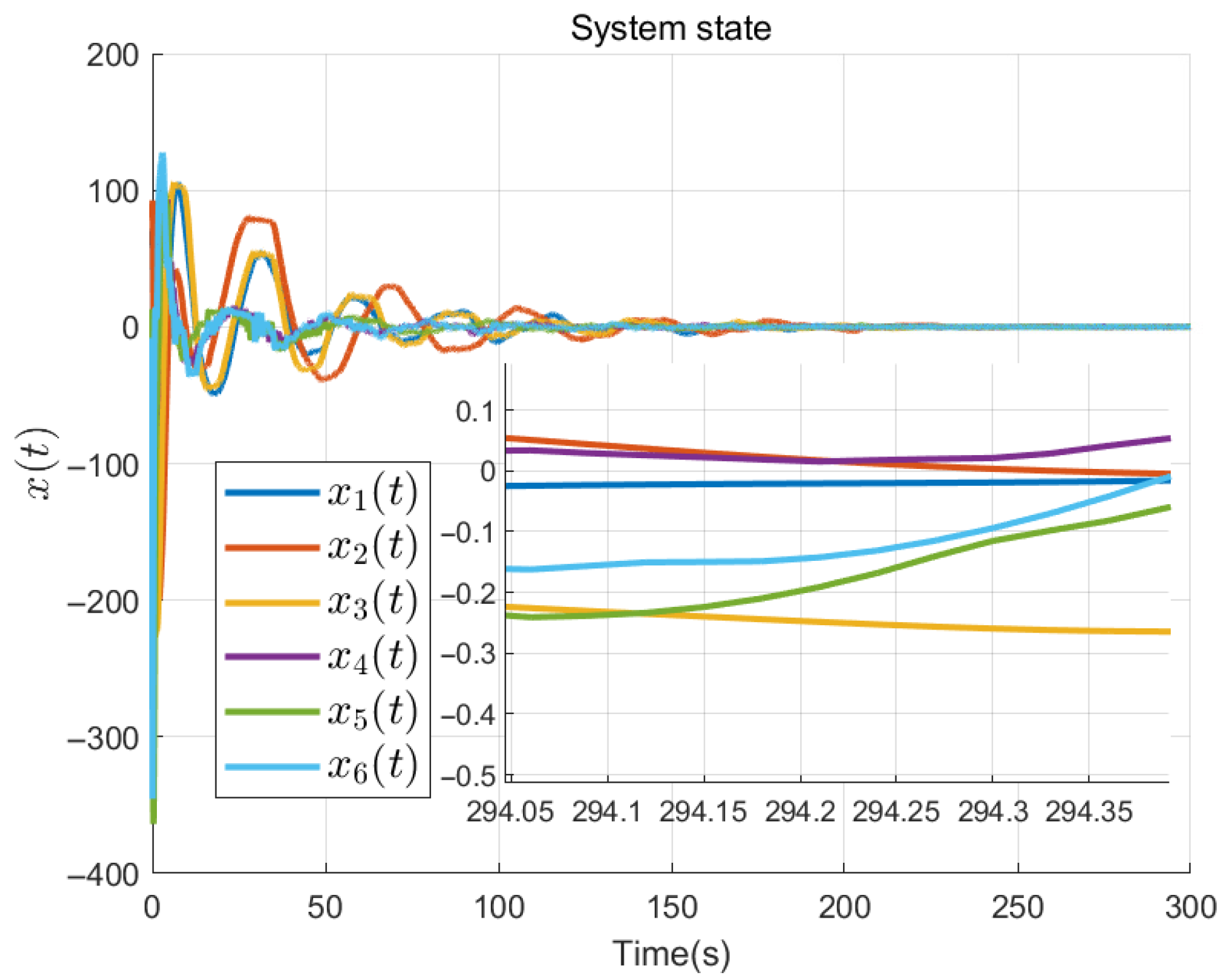
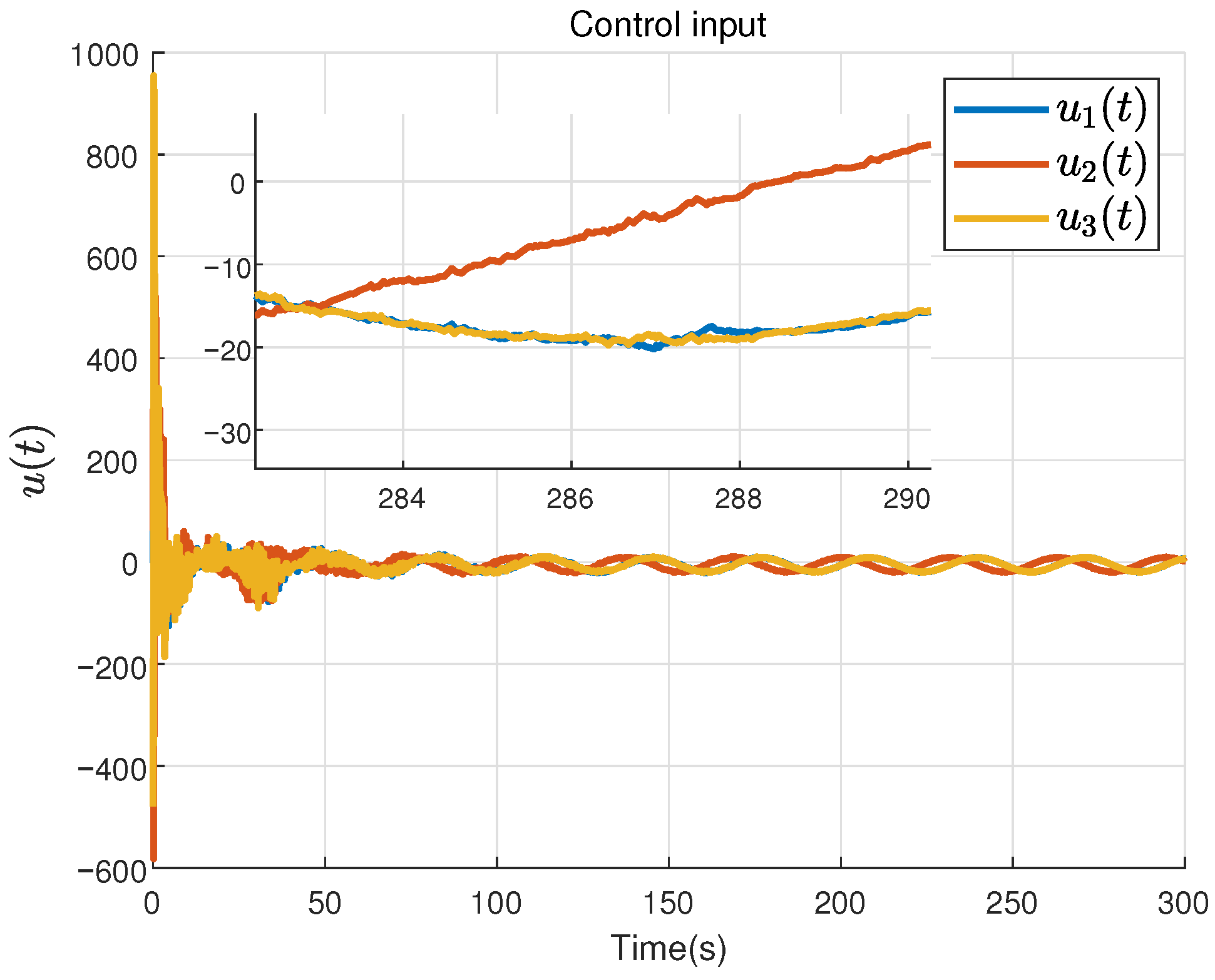
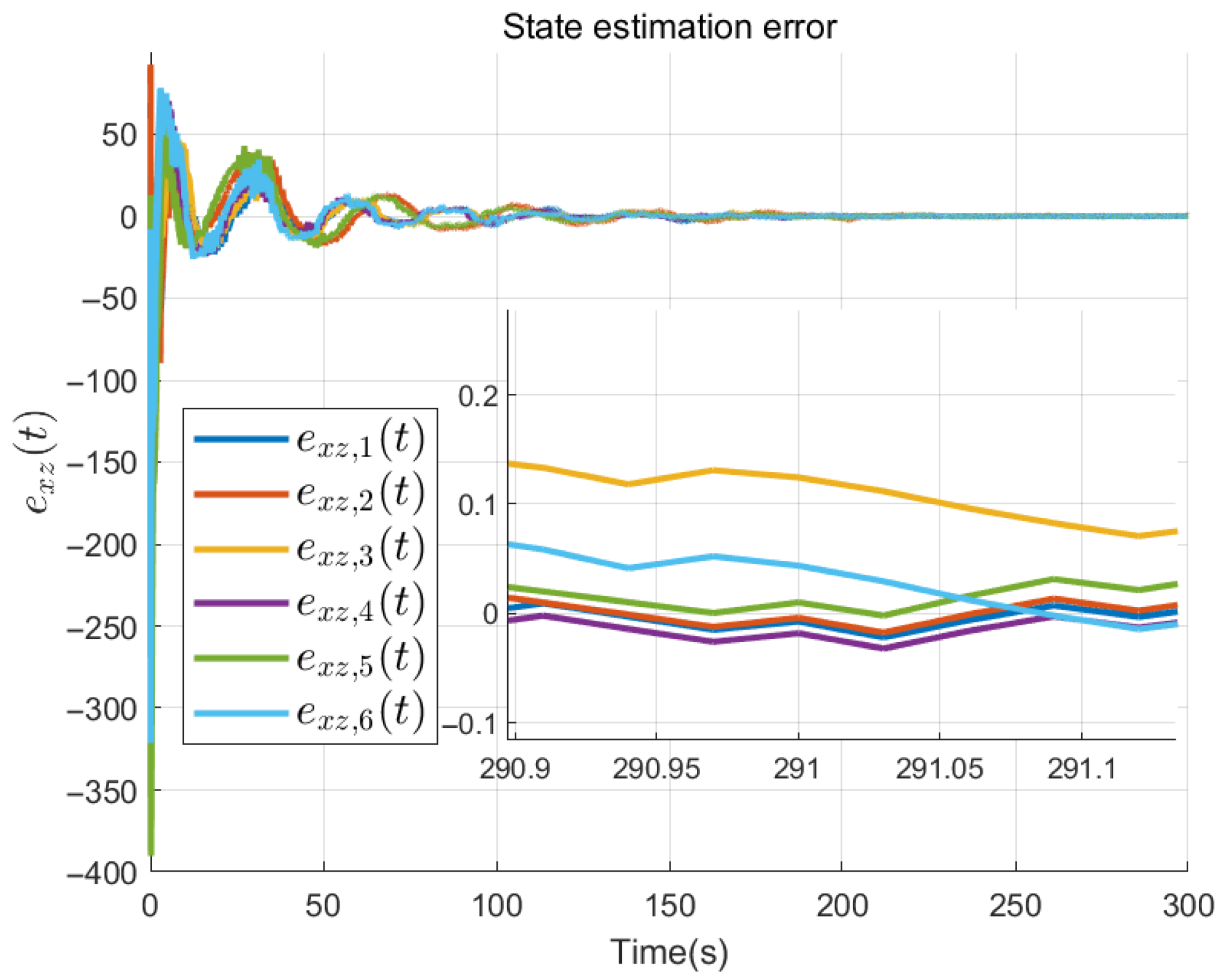
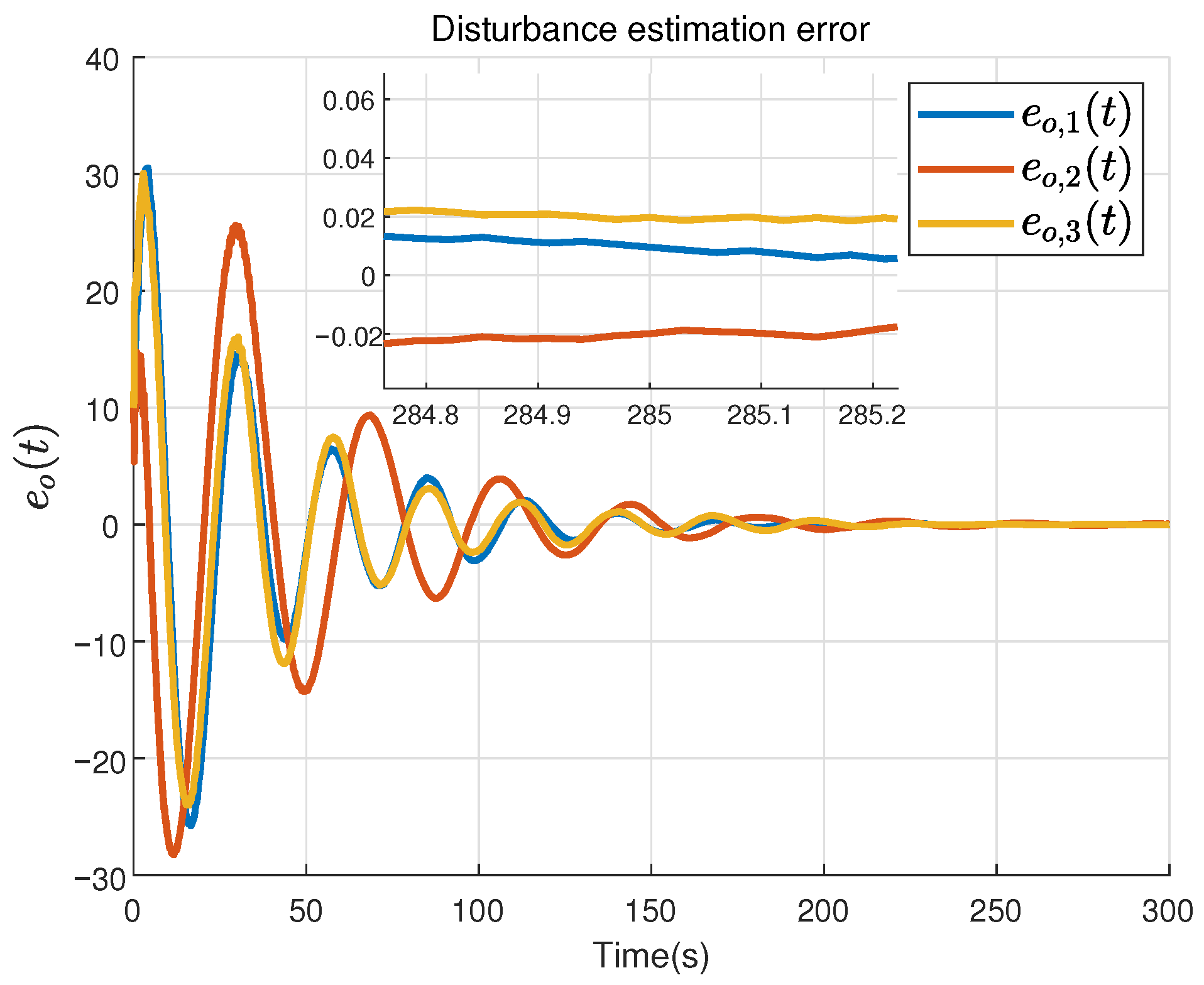
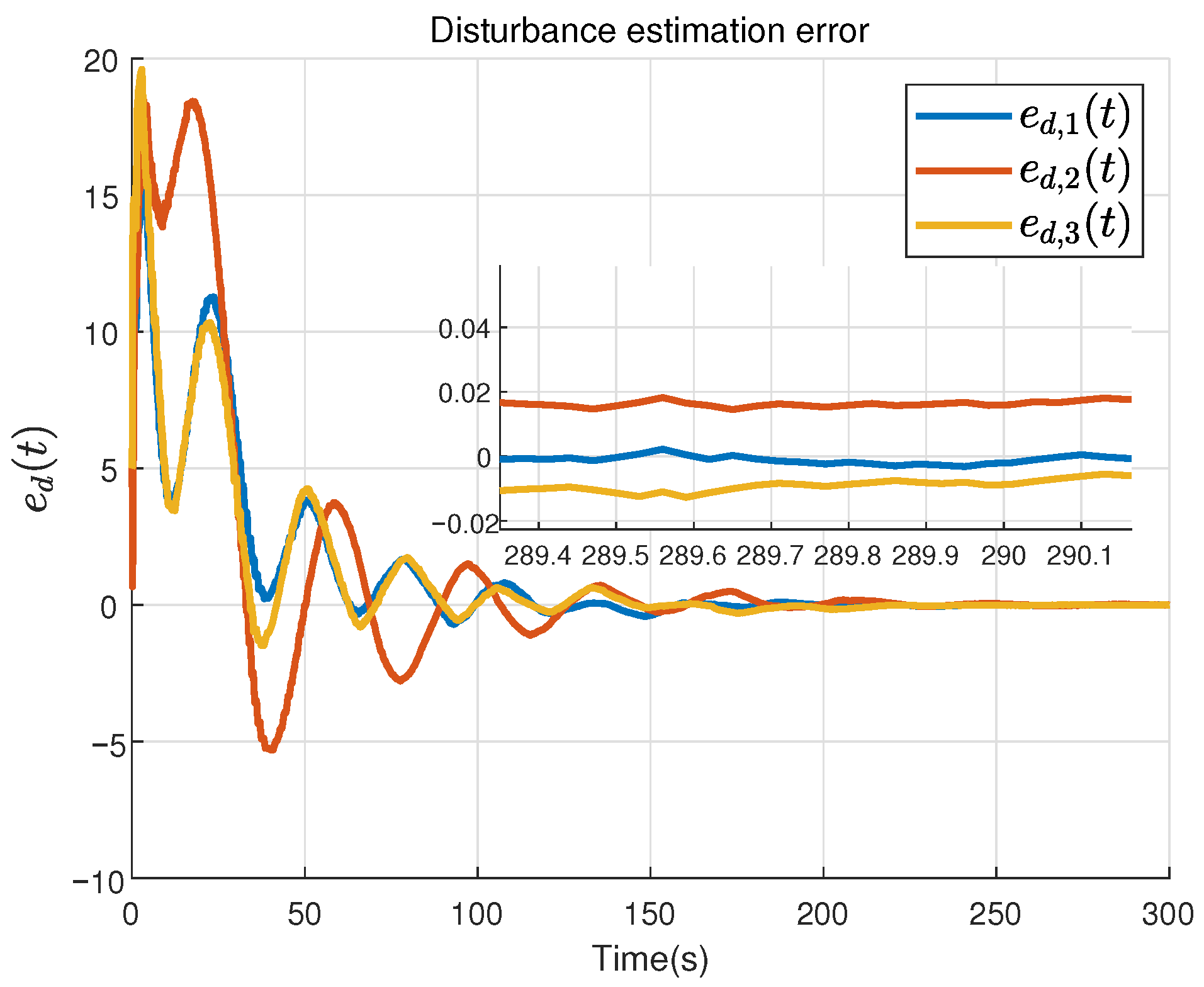
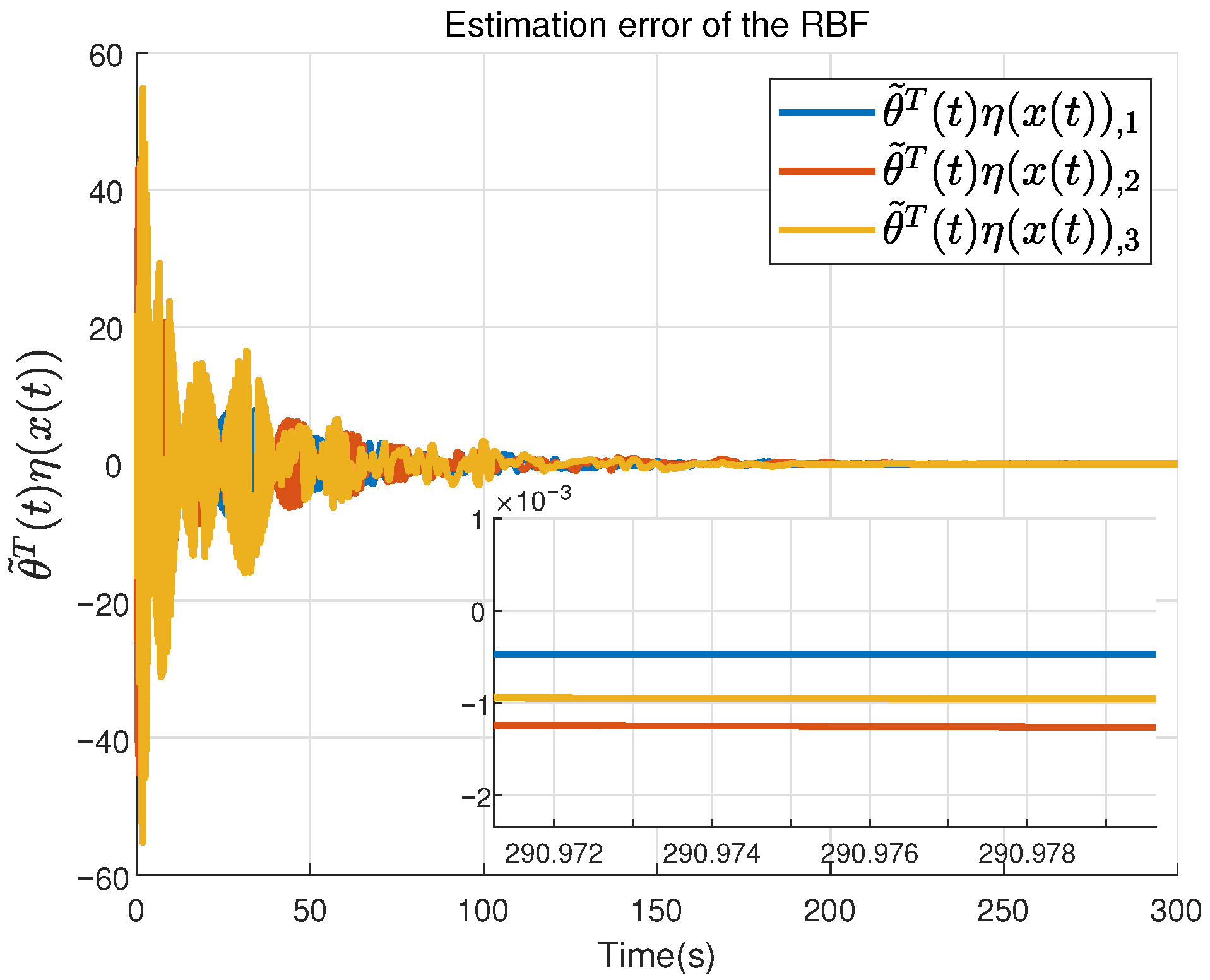
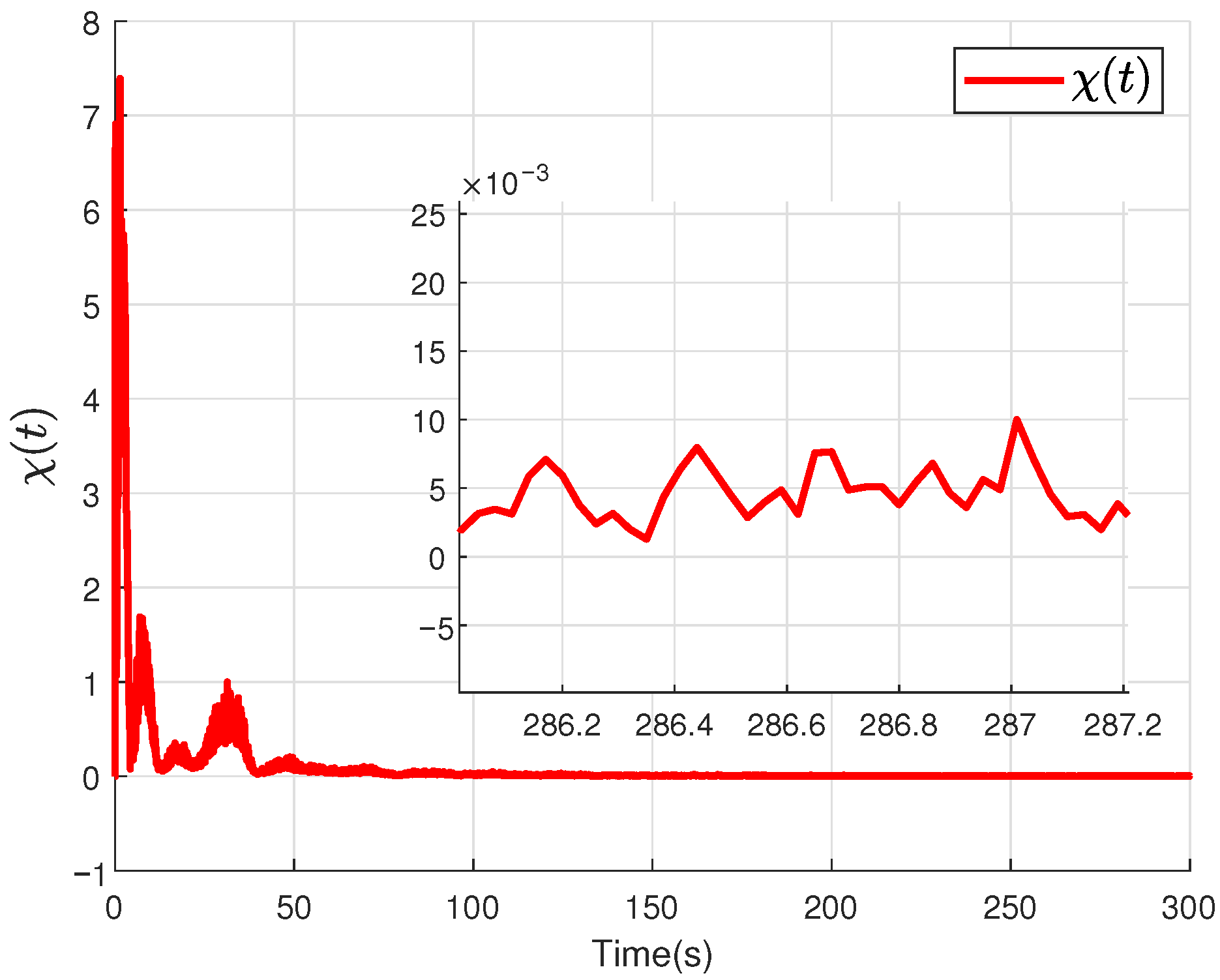
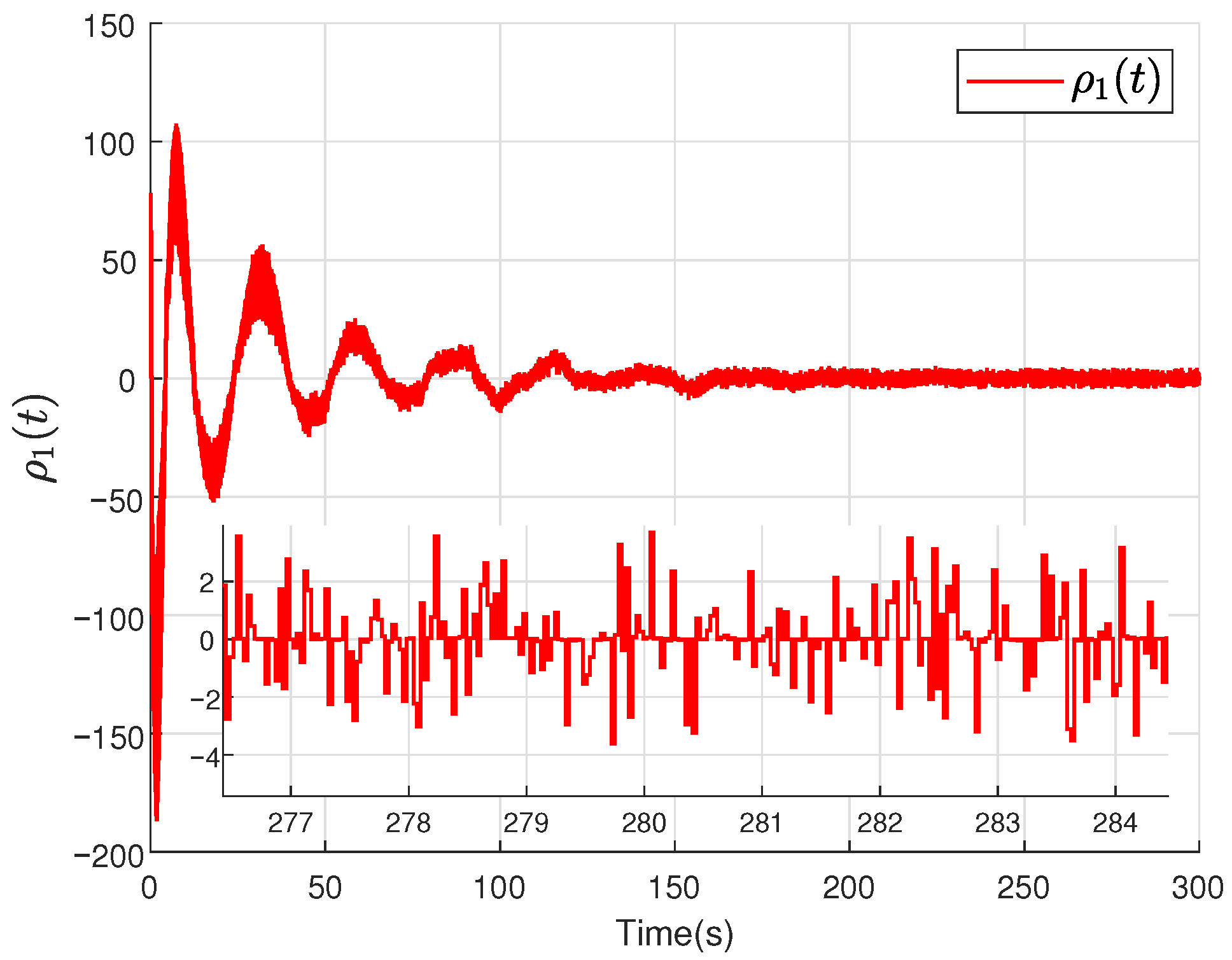
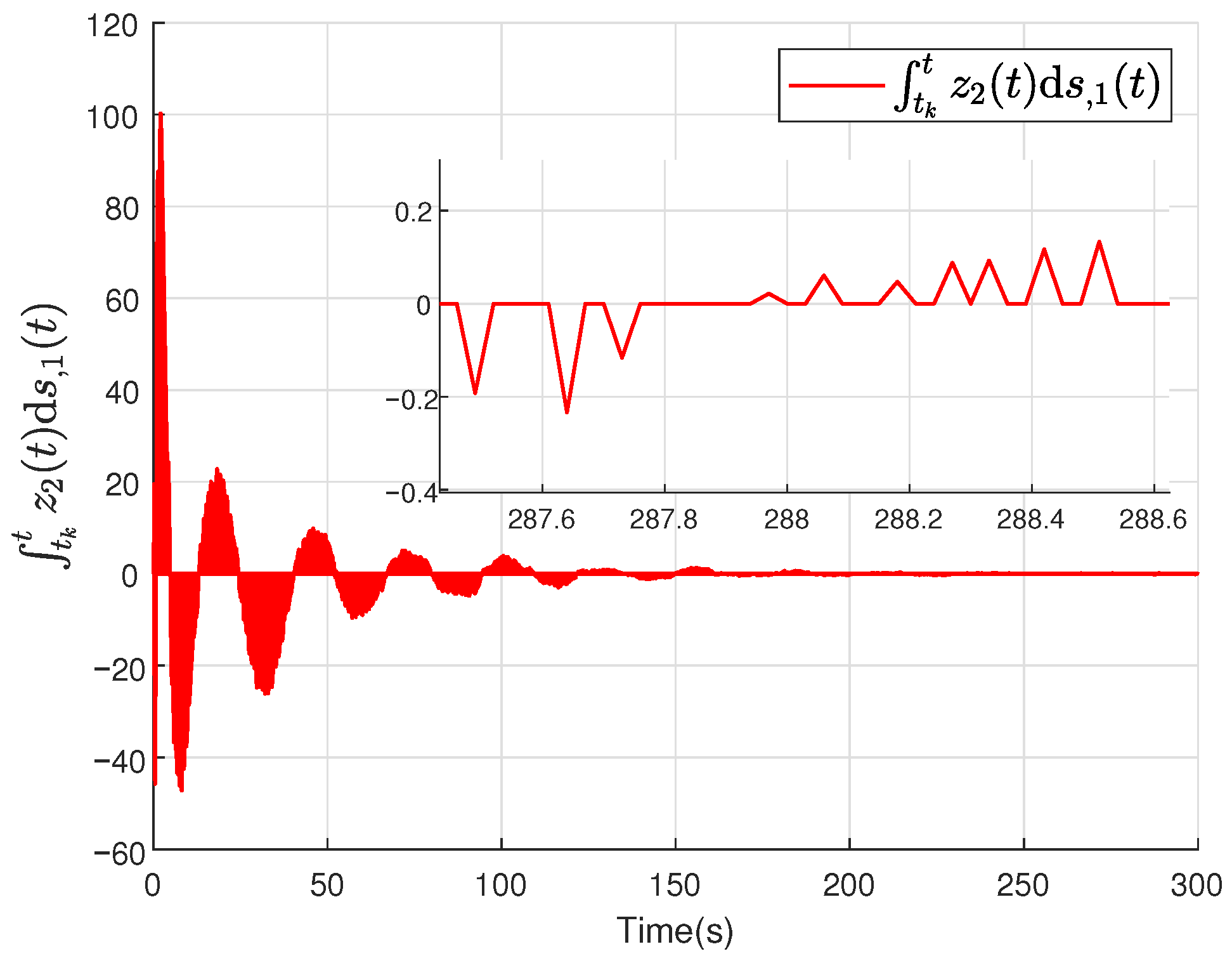
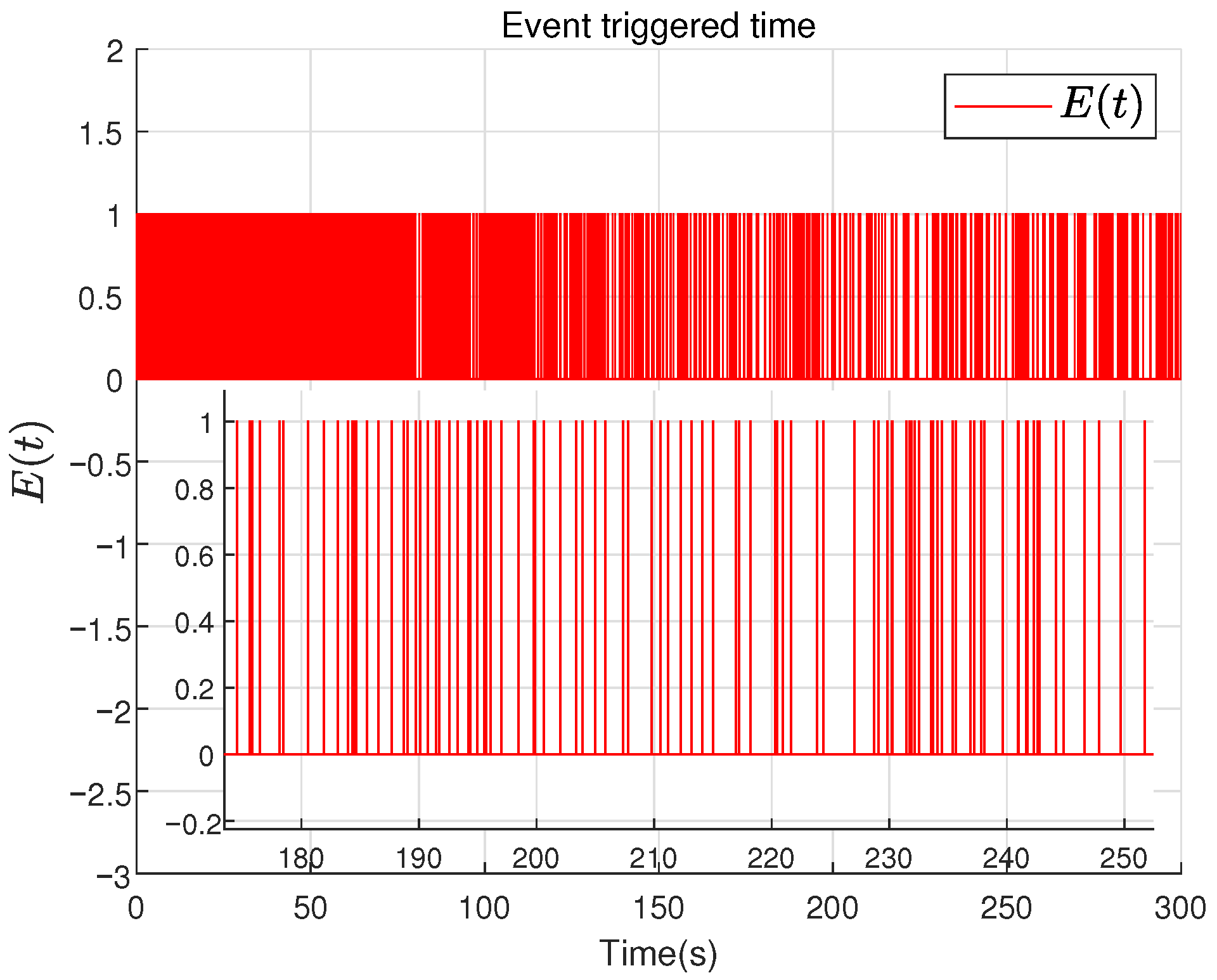
Figure 3, Figure 4, Figure 5, Figure 6, Figure 7, Figure 8, Figure 9, Figure 10, Figure 11 and Figure 12 gives the simulation results of the spacecraft system under the above parameters. For the convenience of result display, the variable with subscript i represents the i-th element of this variable. Figure 3 shows the curves of the spacecraft system state under the proposed controller and the ESCDO. Figure 4 shows the curves of the control input of the system. Figure 5, Figure 6 and Figure 7 detail the estimation error , and by using the proposed ESCDO, respectively. Figure 8 shows the first element of estimation error of the RBFNNs. Figure 9 indicates the upper limit of the saturation function . Figure 10 shows the first element of . Figure 11 shows the inter sample estimation term between two event-triggered instant. Figure 12 shows the triggering status of the event triggering mechanism throughout the entire simulation time. The entire simulation duration is , and the sampling period is , indicating 10,000 samples are taken during the simulation. Out of 10,000 samples, the number of times is 1665, which means that only of the time needs to send the output , saving of communication resources.
Figure 3.
The state of the spacecraft system.
Figure 4.
The control input of the spacecraft system.
Figure 5.
The estimation error of the system state .
Figure 6.
The estimation error of disturbance .
Figure 7.
The estimation error of disturbance .
Figure 8.
The estimation error of the RBFNNs.
Figure 9.
The upper limit of the saturation function .
Figure 10.
The first element of the .
Figure 11.
The first element of the term .
Figure 12.
The event-triggered variable .
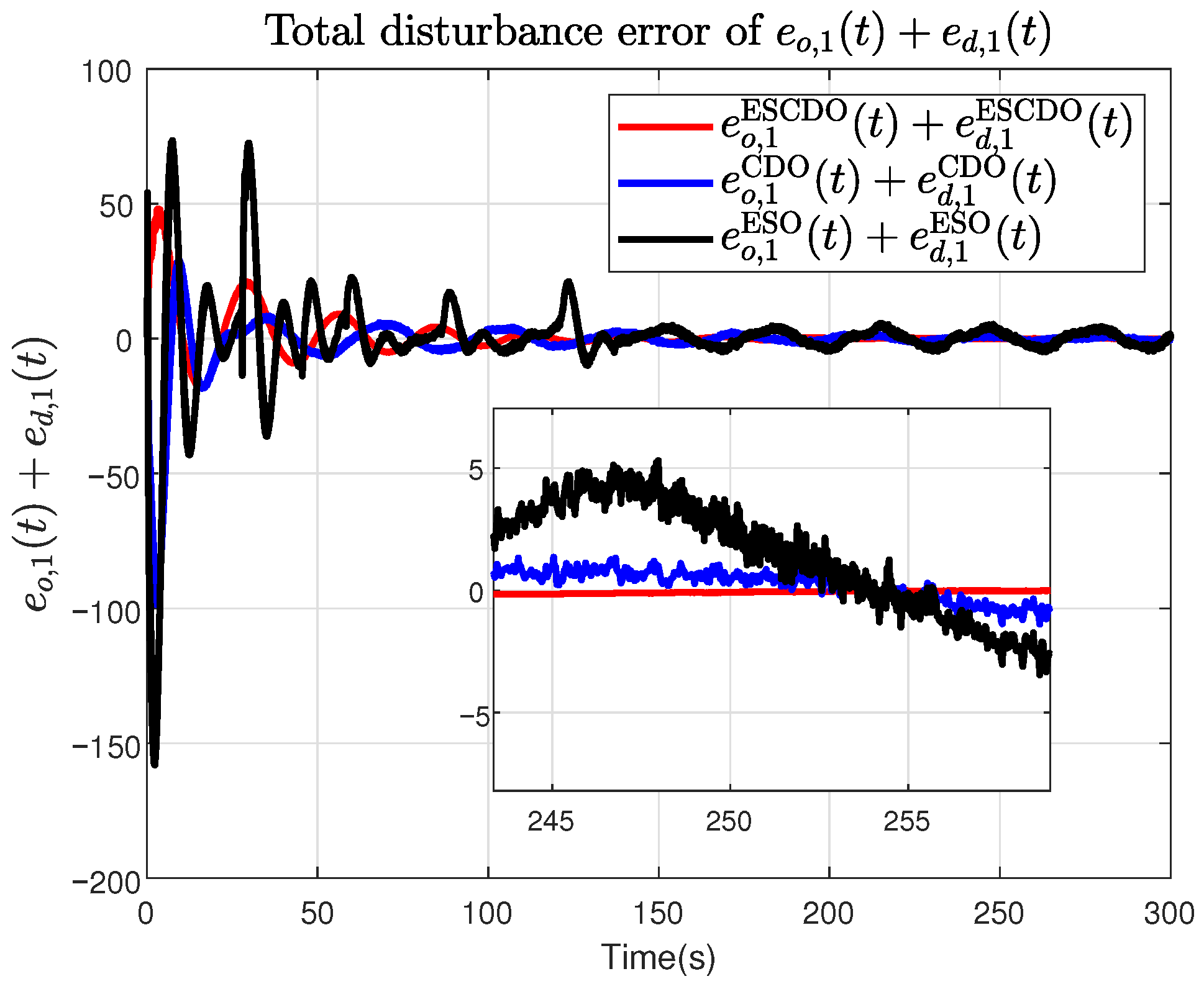
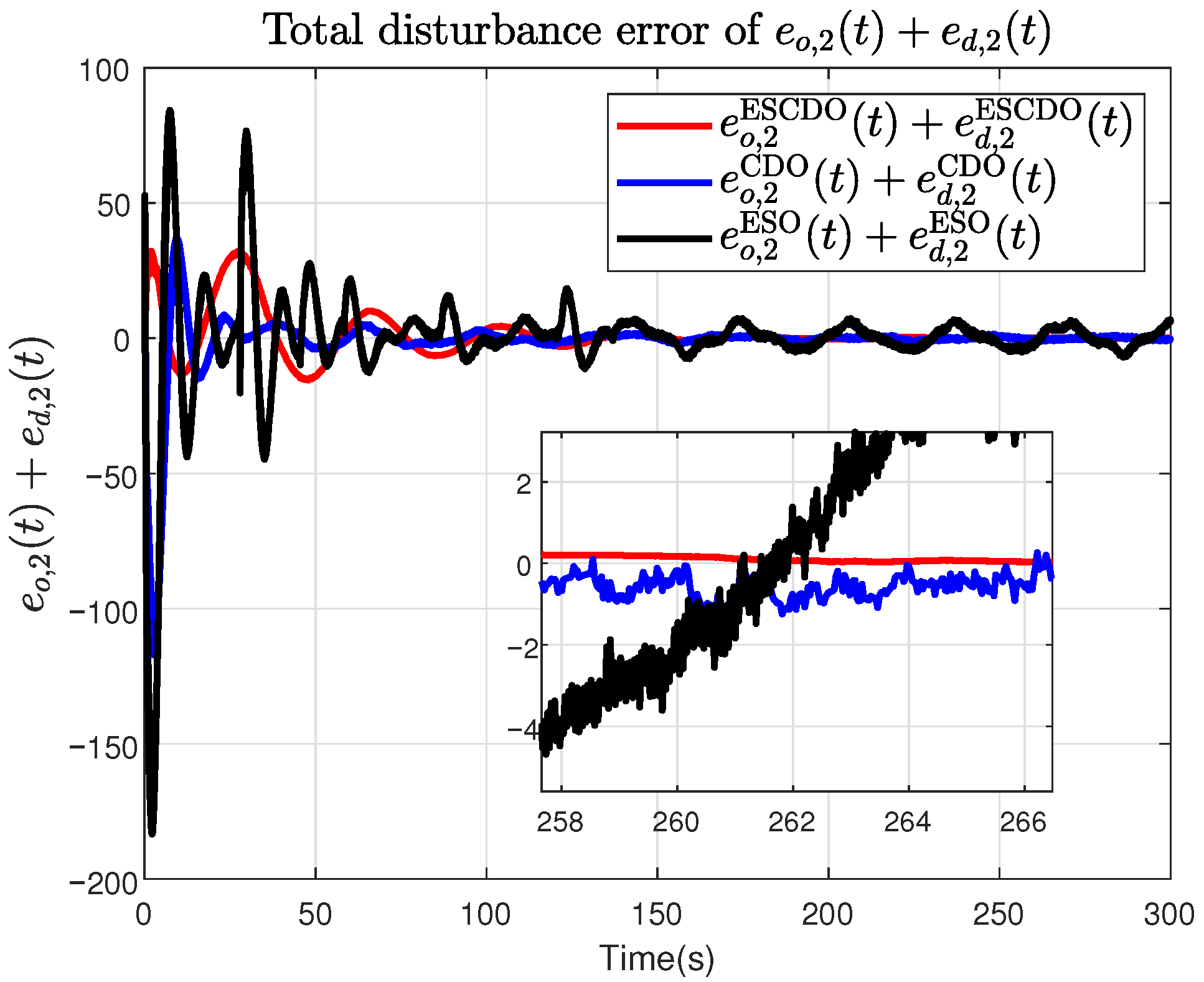
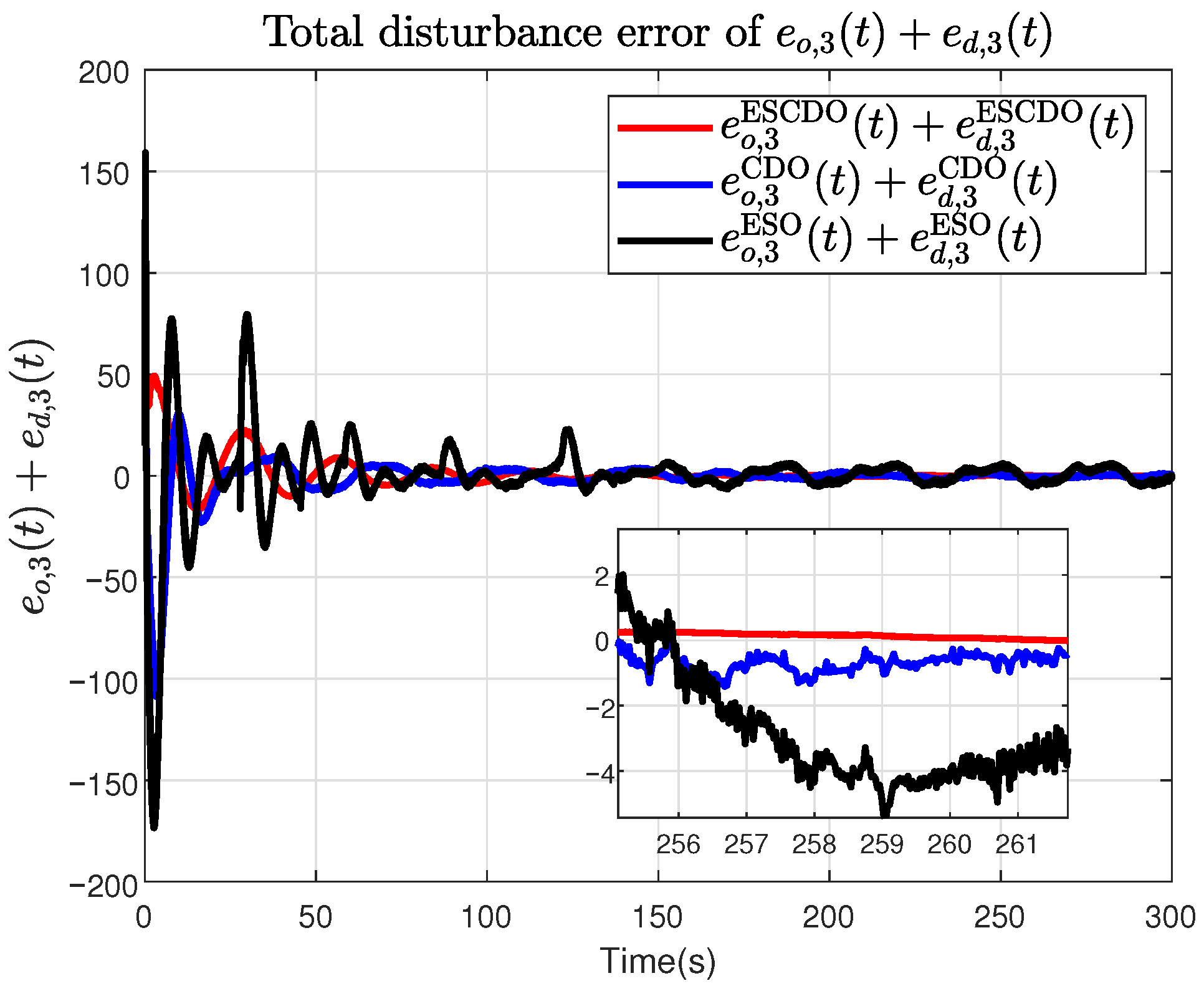
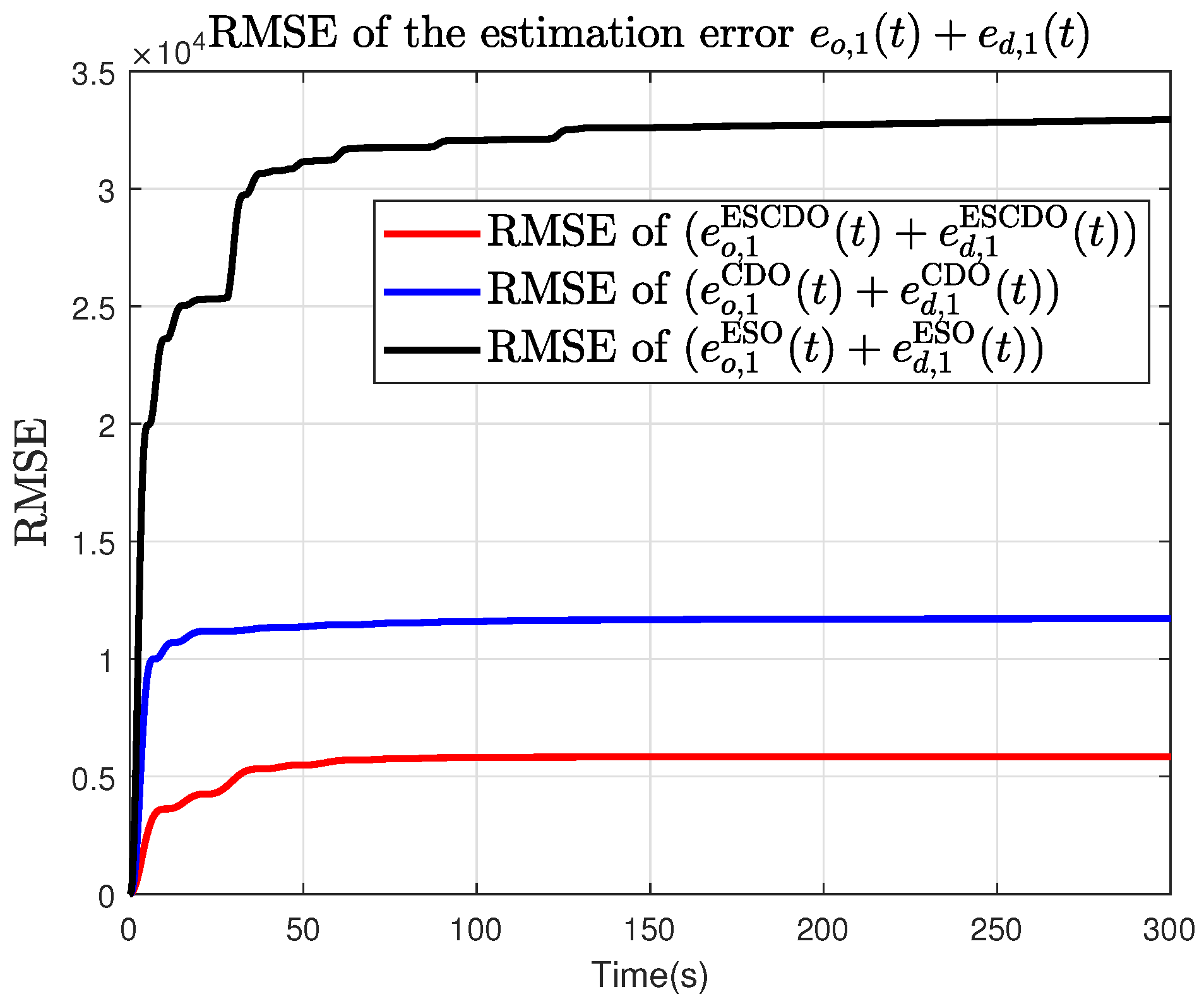
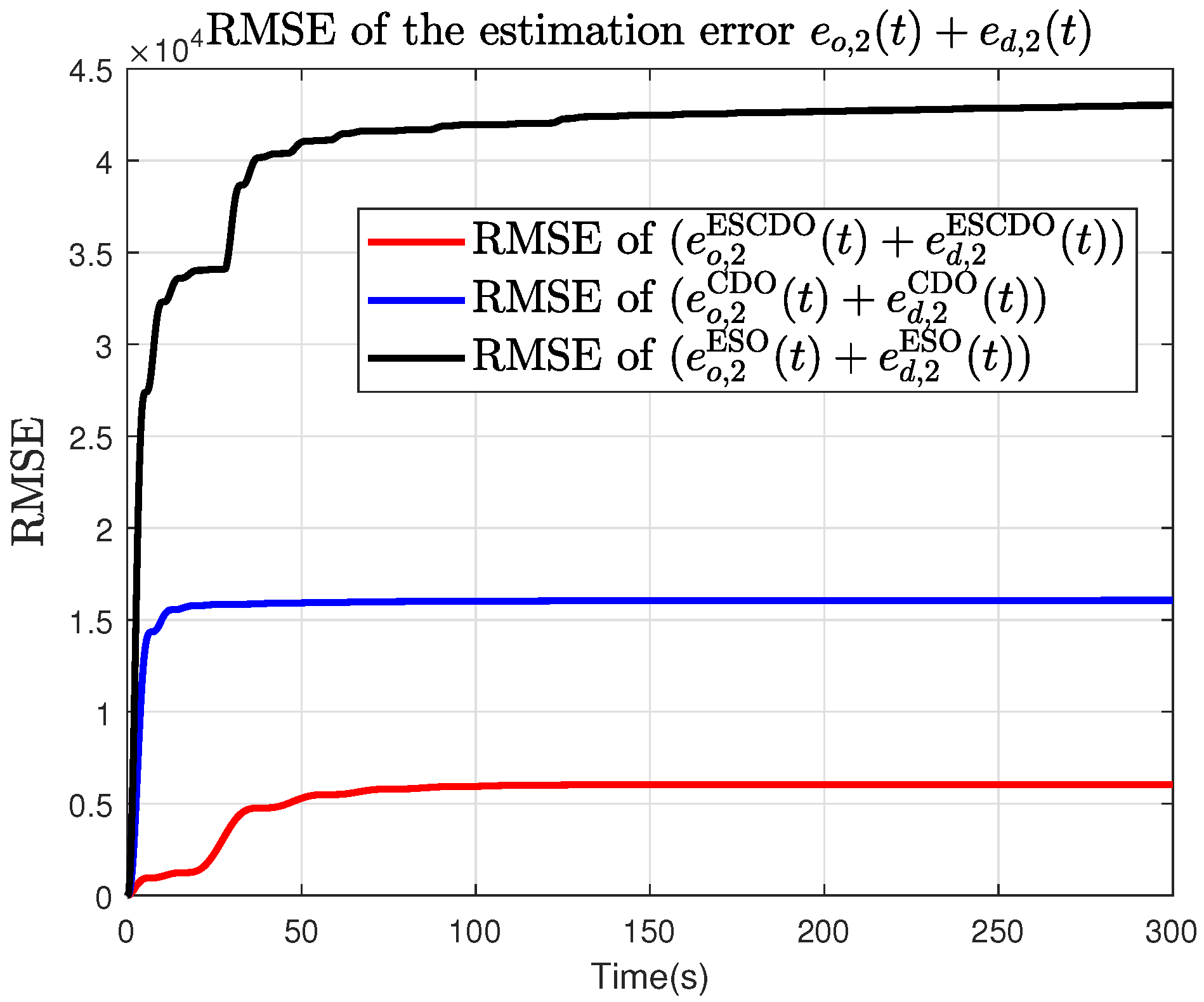
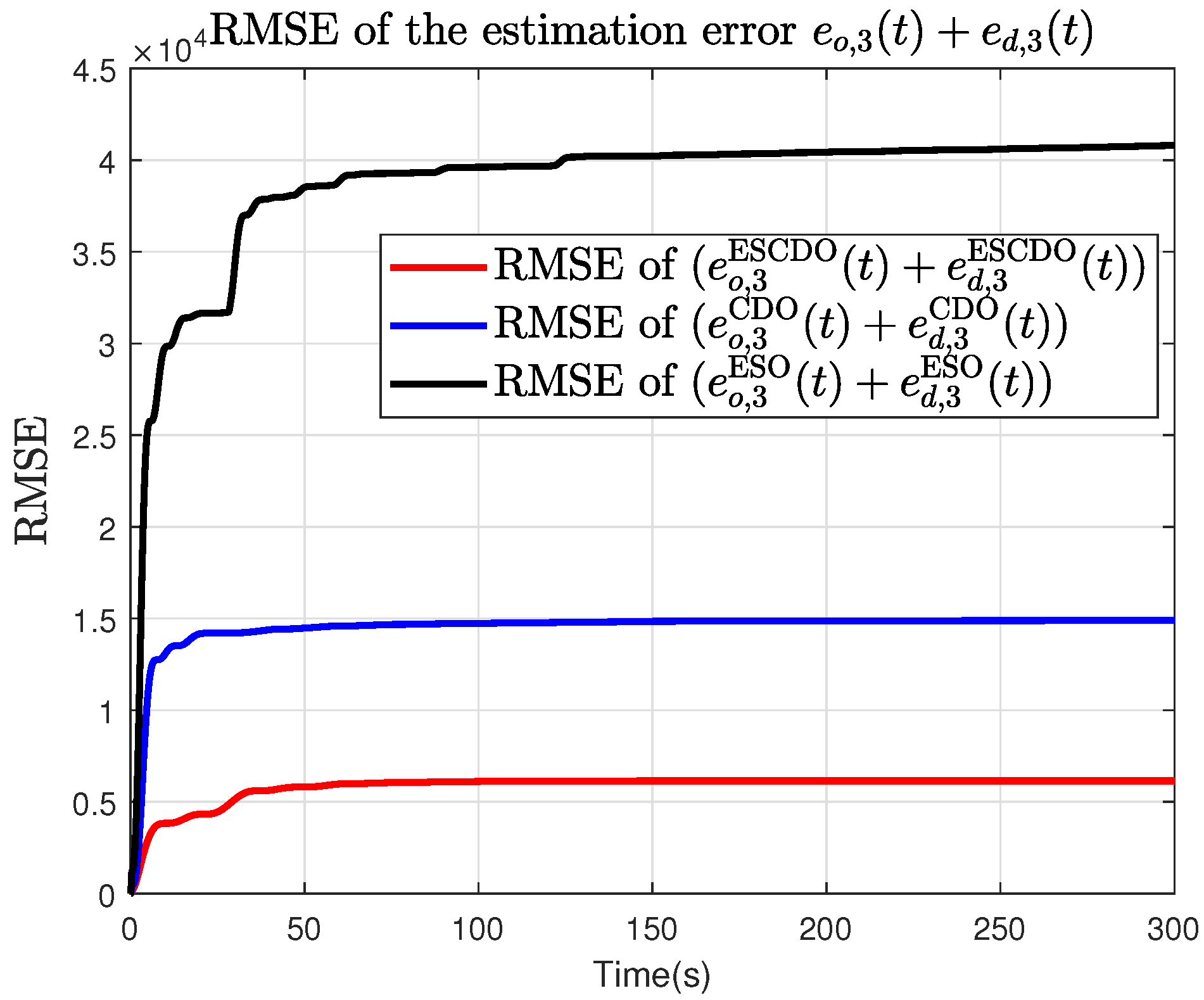
To more clearly demonstrate the effectiveness of the proposed ESCDO, the conventional CDO in [22] and ESO in [34] are used as baselines for comparison. The comparison focuses primarily on the estimation accuracy of the lumped disturbance (overall disturbance estimation error) and the root-mean-square error (RMSE). The parameters used for ESCDO, CDO, and ESO in the comparative simulations are listed in Table 1. Since the quantity that ultimately affects the closed-loop system is the estimation error , is adopted as the comparison criterion. The results are shown in Figure 13, Figure 14 and Figure 15. In Figure 13, Figure 14 and Figure 15, and () represent the i-the element of and , respectively. Superscripts ESCDO, CDO and ESO denote the errors obtained under observers ESCDO, CDO and ESO, respectively. In addition, we analyze the estimation error under the RMSE metric, yielding the results in Figure 16, Figure 17 and Figure 18. Accordingly, the RMSE of at the end of the simulation under ESCDO, CDO and ESO is given in Table 2, respectively.
Table 1.
Parameters used in ESCDO, CDO and ESO, respectively.
Figure 13.
The total estimation error under ESCDO, CDO and ESO, respectively.
Figure 14.
The total estimation error under ESCDO, CDO and ESO, respectively.
Figure 15.
The total estimation error under ESCDO, CDO and ESO, respectively.
Figure 16.
The RMSE of the total estimation error under ESCDO, CDO and ESO, respectively.
Figure 17.
The RMSE of the total estimation error under ESCDO, CDO and ESO, respectively.
Figure 18.
The RMSE of the total estimation error under ESCDO, CDO and ESO, respectively.
Table 2.
RMSE of at the end of the simulation under ESCDO, CDO and ESO.
From Figure 13, Figure 14 and Figure 15, it can be seen that the proposed ESCDO yields the smallest disturbance estimation error , whereas the ESO-alone scheme performs the worst. Moreover, Figure 16, Figure 17 and Figure 18 show that the proposed ESCDO achieves the smallest RMSE, whereas the ESO method yields the largest RMSE. This indicates that, over the entire simulation horizon, the estimation accuracy of our approach surpasses that of both CDO and ESO, thereby further validating the effectiveness of the proposed method.
The simulation results demonstrate the effectiveness of the proposed method. The method not only accurately estimates unknown nonlinear terms and multi-source disturbances in the spacecraft system but also, through an event-triggered mechanism, greatly reduces communications frequency. This ensures system state convergence while conserving communication resources.
The open-source simulation code with license CC-BY 4.0 in the paper and provided the corresponding link https://github.com/2018100049/Paper-Simulation/tree/main (accessed on 1 October 2025).
6. Conclusions
This paper investigates control of spacecraft systems under communication congestion, multi-source uncertainties, and input constraints. To reduce data transmissions and mitigate congestion risk, a static event-triggered scheme is proposed; between successive triggering instants, an inter-sample predictor is introduced to preserve output continuity. Furthermore, an ESCDO is constructed to simultaneously estimate system states and multi-source disturbances in the presence of outliers, wherein a saturation function is embedded to attenuate outliers induced by electromagnetic interference and related factors. Building on this observer, a composite anti-disturbance controller based on tube-MPC is designed to suppress multi-source uncertainties and ensure convergence of the system states. Easily verifiable sufficient conditions are established to guarantee the uniform bounded stability of both the ESCDO and the closed-loop system. Numerical simulations demonstrate the effectiveness of the proposed approach.
Although the proposed control framework achieves satisfactory robustness against communication congestion, multi-source disturbances, and input constraints, several factors may lead to performance degradation in practical implementations. First, the static event-triggered mechanism reduces communication load but may cause delayed control updates when the system dynamics vary rapidly, resulting in larger transient tracking errors. The inclusion of a non-zero triggering threshold to avoid Zeno behavior further introduces conservatism, which can reduce control precision during fast disturbances. Second, the RBFNN only provides an approximate estimation of unknown nonlinearities within its activation domain; limited basis coverage or improper adaptation rates may lead to residual estimation errors that deteriorate closed-loop performance. Third, the ESCDO mitigates the impact of sensor outliers, but its “stubborn” property may introduce estimation lag when external disturbances change abruptly. Additionally, the asynchronous triggering between the controller and observer can temporarily freeze the disturbance estimation, reducing compensation accuracy. Finally, the MPC-based controller is affected by model mismatch and input saturation: when control inputs reach their limits, the system cannot apply the optimal action, leading to slower convergence and increased steady-state error. Overall, these factors jointly constrain the achievable tracking accuracy and anti-disturbance capability, implying an inherent trade-off between communication efficiency, computational feasibility, and control performance.
To further enhance closed-loop performance, several potential improvements can be considered in the future study. First, introducing an adaptive or dynamic event-triggering mechanism could adjust the triggering threshold according to system states or disturbance intensity, thereby reducing unnecessary transmissions while preserving timely control updates. Second, integrating adaptive learning rates or forgetting factors into the RBFNN structure would allow faster convergence under time-varying nonlinearities. Third, a joint design of the ESCDO and MPC layers could be explored to synchronize the observer and controller updates, minimizing estimation delays during rapid disturbance variations. Finally, developing robust MPC formulations that explicitly account for model mismatch and input saturation may further improve performance and extend the applicability of the proposed method to real spacecraft systems.
Author Contributions
Conceptualization, J.C.; methodology, Y.X.; software, L.L.; validation, Y.X., and Y.Y.; formal analysis, J.C.; investigation, L.L.; resources, J.C.; data curation, Y.X.; writing—original draft preparation, J.C.; writing—review and editing, L.L.; visualization, Y.X.; supervision, Y.Y.; project administration, Y.X.; funding acquisition, J.C. and Y.X. All authors have read and agreed to the published version of the manuscript.
Funding
This research was funded by National Natural Science Foundation of China grant number 62403353, National Key Laboratory of Space Intelligent Control grant number HTKJ2023KL502011 and Key Project of the Research Plan for CAHE Higher Education Science (25RH0202).
Data Availability Statement
Data are contained within the article.
Conflicts of Interest
The authors declare no conflicts of interest.
Abbreviations
The following abbreviations are used in this manuscript:
| ESCDO | Event-triggered-based stubborn composite disturbance observer |
| RBFNN | Radial basis function neural network |
| MPC | Model predictive control |
| MIMO | Multiple input multiple output |
| DO | Disturbance observer |
| ESO | Extended state observer |
| RBFNNs | radial basis function neural networks |
References
- Chen, X.Q.; Yu, J. Optimal mission planning of GEO on-orbit refueling in mixed strategy. Acta Astronaut. 2017, 133, 63–72. [Google Scholar] [CrossRef]
- Oshima, K. Regularizing fuel-optimal multi-impulse trajectories. Astrodynamics 2024, 8, 97–119. [Google Scholar] [CrossRef]
- Nishida, S.I.; Kawamoto, S.; Okawa, Y.; Terui, F.; Kitamura, S. Space debris removal system using a small satellite. Acta Astronaut. 2009, 65, 95–102. [Google Scholar] [CrossRef]
- Wijayatunga, M.C.; Armellin, R.; Holt, H.; Pirovano, L.; Lidtke, A.A. Design and guidance of a multi-active debris removal mission. Astrodynamics 2023, 7, 383–399. [Google Scholar] [CrossRef]
- Li, D.; Li, Z.H.; He, Y.L.; Chu, J.J.; Jiang, Y. Debris falling forecast method for spacecraft disintegrating separation. Astrodynamics 2023, 7, 455–463. [Google Scholar] [CrossRef]
- Kosuge, K.; Kojima, H. Prediction and experimental verification of tether net entanglement for space debris capture. Astrodynamics 2024, 8, 223–236. [Google Scholar] [CrossRef]
- Pirovano, L.; Armellin, R. Detection and estimation of spacecraft maneuvers for catalog maintenance. Acta Astronaut. 2024, 215, 387–397. [Google Scholar] [CrossRef]
- Yin, W.; Shi, Y.; Shu, L.; Gao, Y. Autonomous navigation of an asteroid orbiter enhanced by a beacon satellite in a high-altitude orbit. Astrodynamics 2024, 8, 375–400. [Google Scholar] [CrossRef]
- Zhang, P.; Wu, D.; Baoyin, H. Real-time hybrid method for maneuver detection and estimation of non-cooperative space targets. Astrodynamics 2024, 8, 437–453. [Google Scholar] [CrossRef]
- Liang, J.; Liu, X.; Wang, R.; Yang, L.; Li, X.; Tang, C.; Zhao, K. LTP for Reliable Data Delivery From Space Station to Ground Station in the Presence of Link Disruption. IEEE Aerosp. Electron. Syst. Mag. 2023, 38, 24–33. [Google Scholar] [CrossRef]
- Du, R.; Liao, W.; Zhang, X. Feasibility analysis of angles-only navigation algorithm with multisensor data fusion for spacecraft noncooperative rendezvous. Astrodynamics 2023, 7, 179–196. [Google Scholar]
- Xu, C.; Wu, B.; Wang, D.; Han, F. Distributed prescribed-time attitude consensus for multiple spacecraft via quantized communication. Adv. Space Res. 2023, 71, 4302–4314. [Google Scholar] [CrossRef]
- Cinelli, M.; Ortore, E.; Mengali, G.; Quarta, A.A.; Circi, C. Lunar orbits for telecommunication and navigation services. Astrodynamics 2024, 8, 209–220. [Google Scholar] [CrossRef]
- Sajjad, N.; Mirshams, M.; Hein, A.M. Spaceborne and ground-based sensor collaboration: Advancing resident space objects’ orbit determination for space sustainability. Astrodynamics 2024, 8, 325–347. [Google Scholar] [CrossRef]
- Chen, J.; Qi, T.; Chen, J. Optimal networked state estimation in the presence of multi-channel correlated packet losses. Automatica 2023, 153, 110855. [Google Scholar] [CrossRef]
- Viadero-Monasterio, F.; Nguyen, A.T.; Lauber, J.; Boada, M.J.L.; Boada, B.L. Event-triggered robust path tracking control considering roll stability under network-induced delays for autonomous vehicles. IEEE Trans. Intell. Transp. Syst. 2023, 24, 14743–14756. [Google Scholar] [CrossRef]
- Khaleel, A.; Basar, E. Electromagnetic interference cancellation for RIS-assisted communications. IEEE Commun. Lett. 2023, 27, 2192–2196. [Google Scholar] [CrossRef]
- Li, J.; Wang, Z.; Dong, H.; Ghinea, G. Outlier-resistant remote state estimation for recurrent neural networks with mixed time-delays. IEEE Trans. Neural Netw. Learn. Syst. 2020, 32, 2266–2273. [Google Scholar] [CrossRef]
- Ma, W.; Zhang, B. Periodic time-triggered hybrid control for DC–DC converter based on switched affine system model. IEEE Trans. Ind. Electron. 2022, 70, 311–321. [Google Scholar] [CrossRef]
- Chen, J.; Chen, B.; Zeng, Z. Adaptive dynamic event-triggered fault-tolerant consensus for nonlinear multiagent systems with directed/undirected networks. IEEE Trans. Cybern. 2022, 53, 3901–3912. [Google Scholar] [CrossRef]
- Wang, Y.; Yuan, Y.; Yang, H. Stubborn observer for leader-following consensus of nonlinear multiagent systems with application to spacecraft. IEEE Trans. Cybern. 2022, 54, 2383–2395. [Google Scholar] [CrossRef]
- Xu, Y.; Yuan, Y.; Zhou, D. The composite-disturbance-observer based stochastic model predictive control for spacecrafts under multi-source disturbances. J. Frankl. Inst. 2021, 358, 7603–7627. [Google Scholar] [CrossRef]
- Li, W.; Song, Y.; Cheng, L.; Gong, S. Closed-loop deep neural network optimal control algorithm and error analysis for powered landing under uncertainties. Astrodynamics 2023, 7, 211–228. [Google Scholar] [CrossRef]
- Likins, P.W.; Fleischer, G.E. Results of flexible spacecraft attitude control studies utilizing hybrid coordinates. J. Spacecr. Rocket. 1971, 8, 264–273. [Google Scholar] [CrossRef]
- DeLorenzo, M. Sensor and actuator selection for large space structure control. J. Guid. Control Dyn. 1990, 13, 249–257. [Google Scholar] [CrossRef]
- Sidi, M.J. Spacecraft Dynamics and Control: A Practical Engineering Approach; Cambridge University Press: Cambridge, UK, 1997; Volume 7. [Google Scholar]
- Yuan, Y.; Xu, Y.; Wang, Z.; Yi, X.; Lu, G. Disturbance-observer-based model predictive control for discrete-time noncooperative game over undirected graph. IEEE Trans. Syst. Man Cybern. Syst. 2023, 53, 5970–5982. [Google Scholar] [CrossRef]
- Yu, Y.; Yuan, Y.; Liu, H. Backstepping control for a class of nonlinear discrete-time systems subject to multisource disturbances and actuator saturation. IEEE Trans. Cybern. 2021, 52, 10924–10936. [Google Scholar] [CrossRef]
- Wei, X.; Guo, L. Composite disturbance-observer-based control and H∞ control for complex continuous models. Int. J. Robust Nonlinear Control IFAC-Affil. J. 2010, 20, 106–118. [Google Scholar] [CrossRef]
- Guo, B.Z.; Wu, Z.H.; Zhou, H.C. Active disturbance rejection control approach to output-feedback stabilization of a class of uncertain nonlinear systems subject to stochastic disturbance. IEEE Trans. Autom. Control 2015, 61, 1613–1618. [Google Scholar] [CrossRef]
- Zhao, L.; Li, Z.; Li, H.; Liu, B. Backstepping integral sliding mode control for pneumatic manipulators via adaptive extended state observers. ISA Trans. 2024, 144, 374–384. [Google Scholar] [CrossRef]
- Wang, Q.; Yu, Y.; Zhang, F.; Huang, P. Neural-network-based backstepping control for the post-capture tethered space combination using HDO. Neurocomputing 2023, 521, 79–88. [Google Scholar] [CrossRef]
- Yuan, H.; Zhao, L.; Yuan, Y.; Xia, Y. Event-Triggered Mechanism-Based Discrete-Time Nash Equilibrium Seeking for Graphic Game With Outlier-Resistant ESO. IEEE Trans. Cybern. 2024, 54, 5178–5190. [Google Scholar] [CrossRef] [PubMed]
- Yuan, Y.; Ma, C.; Guo, L.; Zhang, P. Event-triggered Nash equilibrium seeking for multiagent systems with stubborn ESO. IEEE Trans. Syst. Man Cybern. Syst. 2022, 53, 1347–1358. [Google Scholar] [CrossRef]
- Wang, Y.; Yan, X.; Ye, Z.; Xie, H.; Liu, S.; Xu, X.; Tong, X. Robust template feature matching method using motion-constrained DCF designed for visual navigation in asteroid landing. Astrodynamics 2023, 7, 83–99. [Google Scholar] [CrossRef]
- Xu, Y.; Yuan, Y.; Wang, Z.; Li, X. Noncooperative model predictive game with Markov jump graph. IEEE/CAA J. Autom. Sin. 2023, 10, 931–944. [Google Scholar] [CrossRef]
- Xie, H.; Dai, L.; Lu, Y.; Xia, Y. Disturbance rejection MPC framework for input-affine nonlinear systems. IEEE Trans. Autom. Control 2021, 67, 6595–6610. [Google Scholar] [CrossRef]
- Dai, L.; Cannon, M.; Yang, F.; Yan, S. Fast self-triggered MPC for constrained linear systems with additive disturbances. IEEE Trans. Autom. Control 2020, 66, 3624–3637. [Google Scholar] [CrossRef]
- Li, H.; Shi, Y. Robust distributed model predictive control of constrained continuous-time nonlinear systems: A robustness constraint approach. IEEE Trans. Autom. Control 2013, 59, 1673–1678. [Google Scholar] [CrossRef]
- Yang, H.; Li, B.; Zuo, Z.; Zhao, H. Tube-Based MPC for LPV systems with external disturbances using interval predictors. IEEE Trans. Ind. Inform. 2023, 20, 3060–3069. [Google Scholar] [CrossRef]
- Hogan, E.A.; Schaub, H. Relative motion control for two-spacecraft electrostatic orbit corrections. J. Guid. Control Dyn. 2013, 36, 240–249. [Google Scholar] [CrossRef]
- Xia, K.; Huo, W. Robust adaptive backstepping neural networks control for spacecraft rendezvous and docking with input saturation. ISA Trans. 2016, 62, 249–257. [Google Scholar] [CrossRef]
- Li, Y.; Lin, Z. Design of Saturation-Based Switching Anti-Windup Gains for the Enlargement of the Domain of Attraction. IEEE Trans. Autom. Control 2013, 58, 1810–1816. [Google Scholar] [CrossRef]
- Chiang, H.D.; Wang, T. On the number and types of unstable equilibria in nonlinear dynamical systems with uniformly-bounded stability regions. IEEE Trans. Autom. Control 2015, 61, 485–490. [Google Scholar] [CrossRef]
- Peuteman, J.; Aeyels, D.; Sepulchre, R. Boundedness properties for time-varying nonlinear systems. SIAM J. Control Optim. 2000, 39, 1408–1422. [Google Scholar] [CrossRef]
Disclaimer/Publisher’s Note: The statements, opinions and data contained in all publications are solely those of the individual author(s) and contributor(s) and not of MDPI and/or the editor(s). MDPI and/or the editor(s) disclaim responsibility for any injury to people or property resulting from any ideas, methods, instructions or products referred to in the content. |
© 2025 by the authors. Licensee MDPI, Basel, Switzerland. This article is an open access article distributed under the terms and conditions of the Creative Commons Attribution (CC BY) license (https://creativecommons.org/licenses/by/4.0/).