
Optimization of a Walker Constellation Using an RBF Surrogate Model for Space Target Awareness

Abstract
1. Introduction
- (1)
- The application of a surrogate optimization algorithm to LEO Walker constellation design, integrating Optimal Latin Hypercube Sampling (OLHS) [11] and a Radial Basis Function (RBF) [12] surrogate model to effectively reduce computational load, enhance optimization efficiency and precision, and avoid local optima.
- (2)
- Modeling of continuous temporal coverage: The establishment of a coverage effectiveness evaluation model under spatiotemporal distributions of multiple targets in different orbits, with the optimization goal of minimizing the number of satellites, supporting the dynamic adjustment of Walker-Delta constellation parameters.
2. Radial Basis Function Surrogate Model
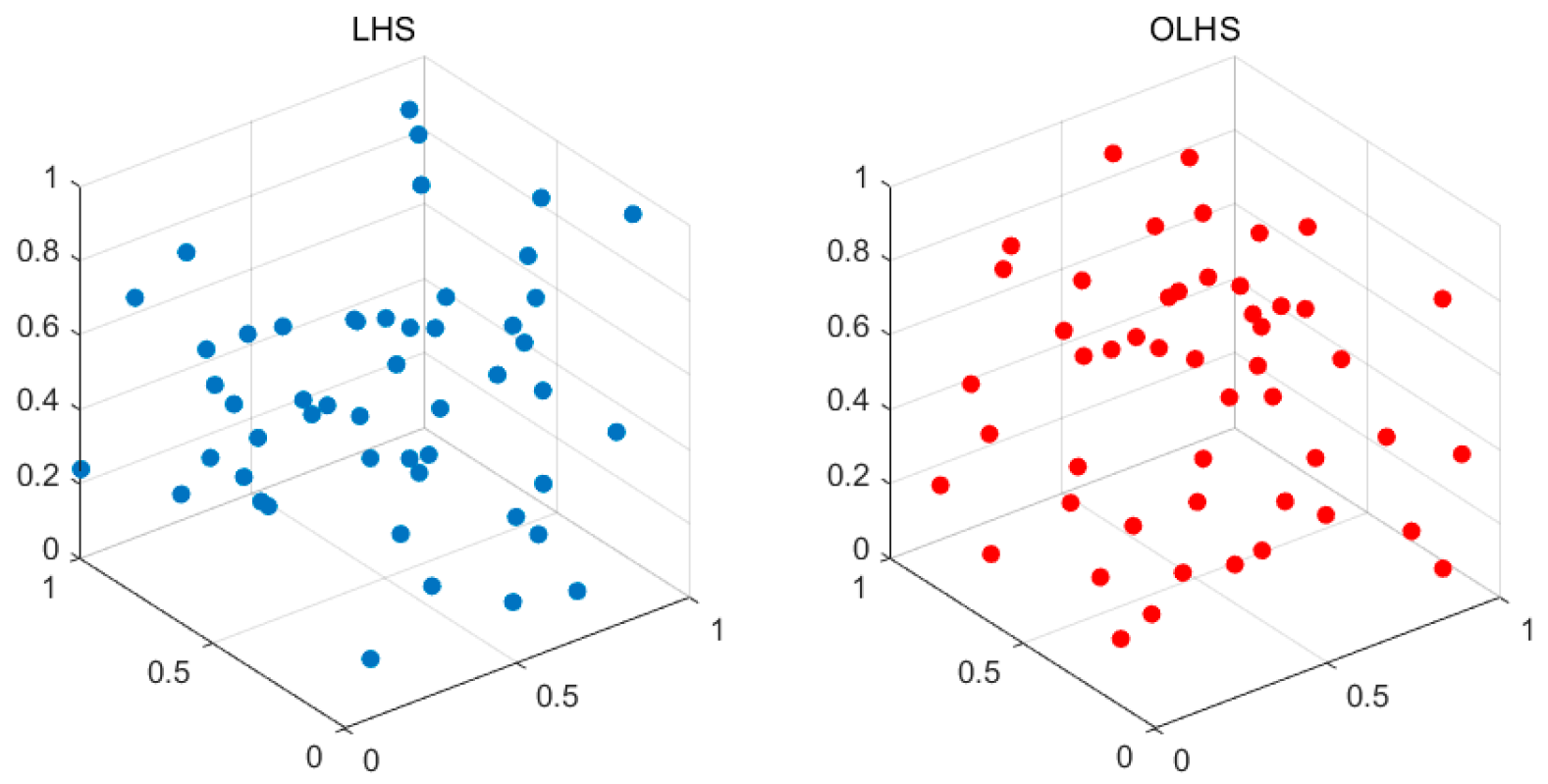
2.1. Latin Hypercube Design
2.2. Radial Basis Function
2.3. Surrogate-Based Optimization Algorithm
- (1)
- Surrogate Construction Phase;
- (2)
- Minimum Search Phase;
| Algorithm 1: Surrogate-based Optimization Algorithm |
| Input: Objective function
, parameter bounds
, initial sampling size
, termination criteria, initial scale value, weight parameter
Output: Optimal solution with minimum value, or None if no solution found. |
|
3. Constellation Optimization Design Based on RBF Surrogate Model
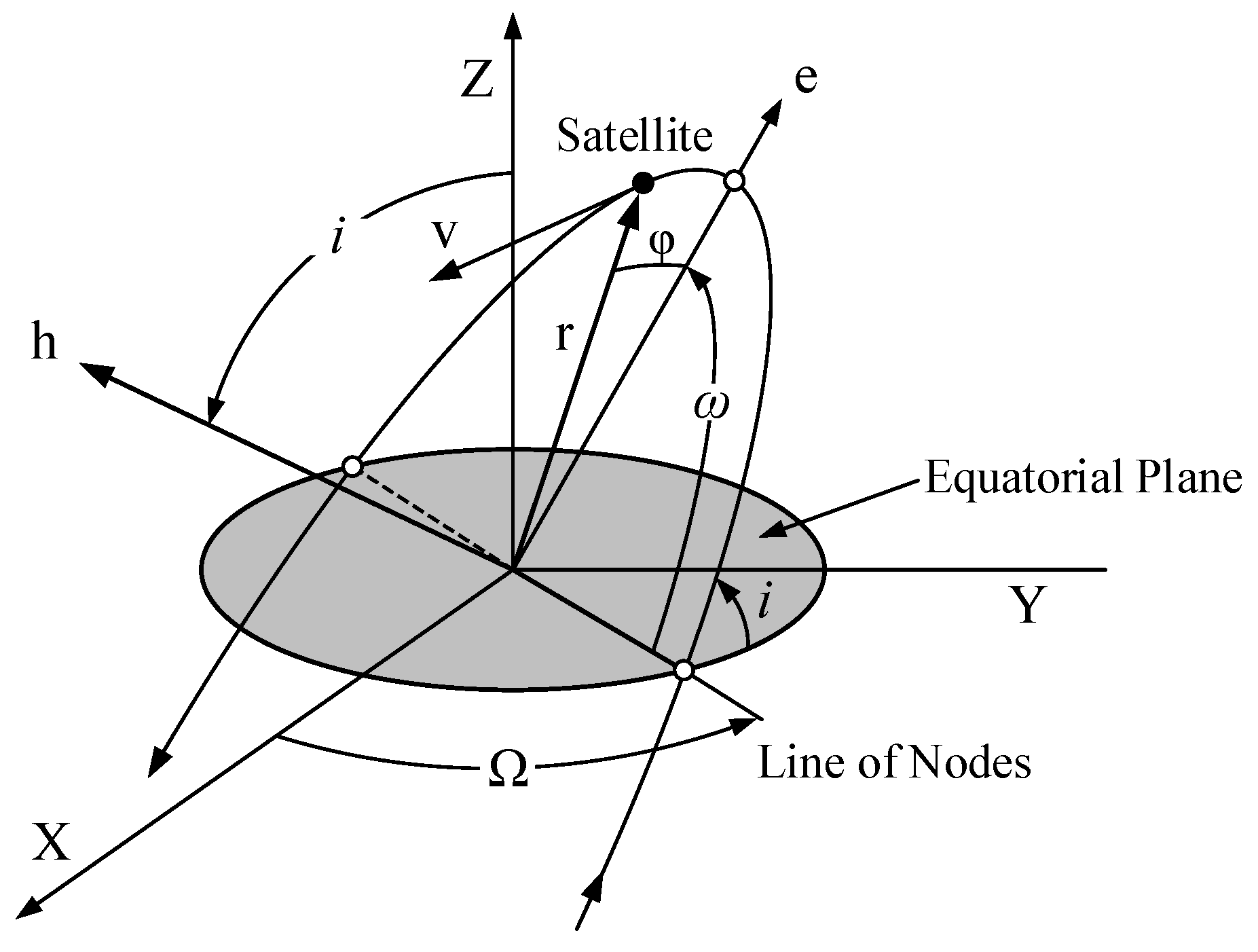
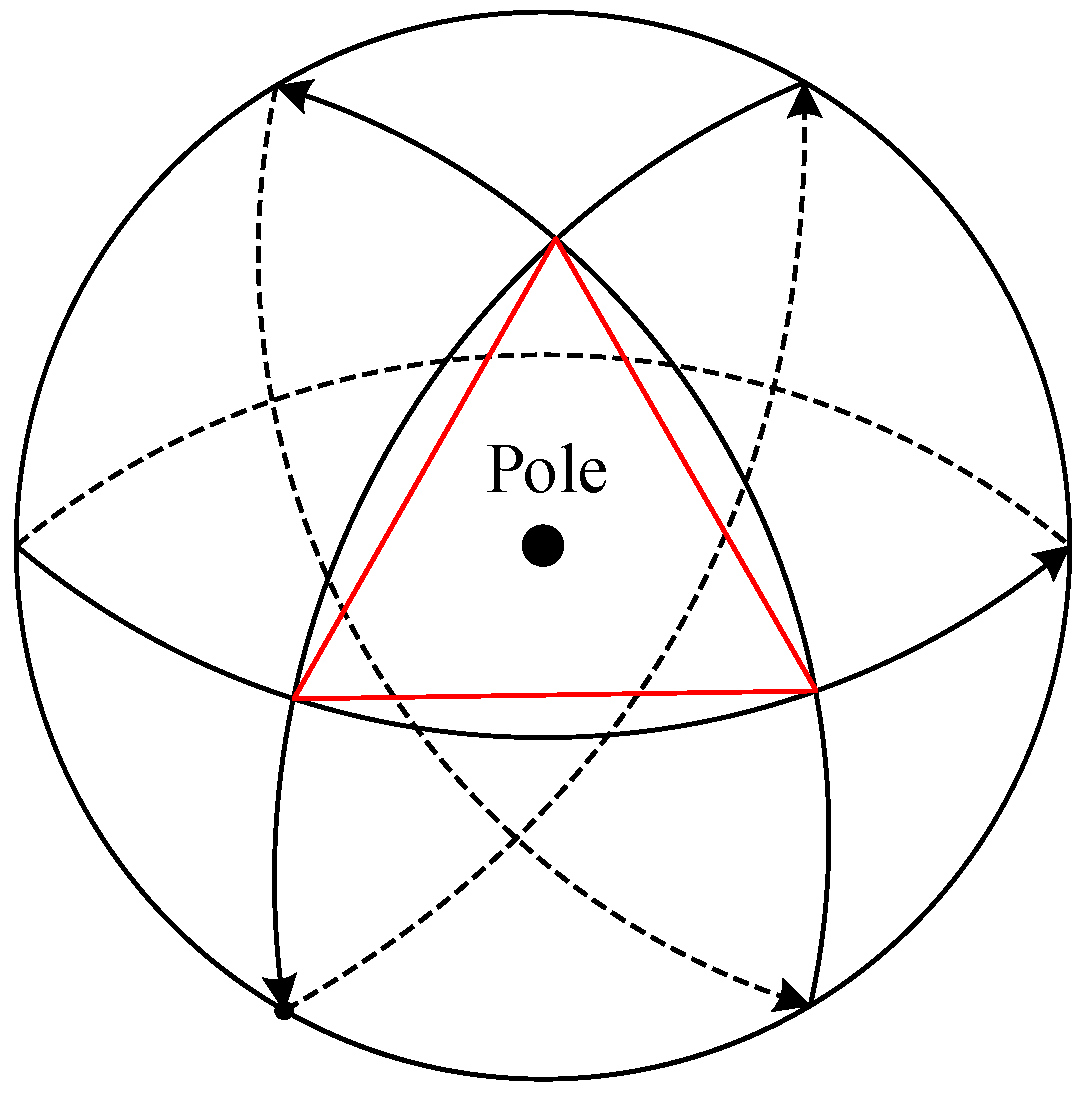
3.1. Walker-Delta Constellation Configuration
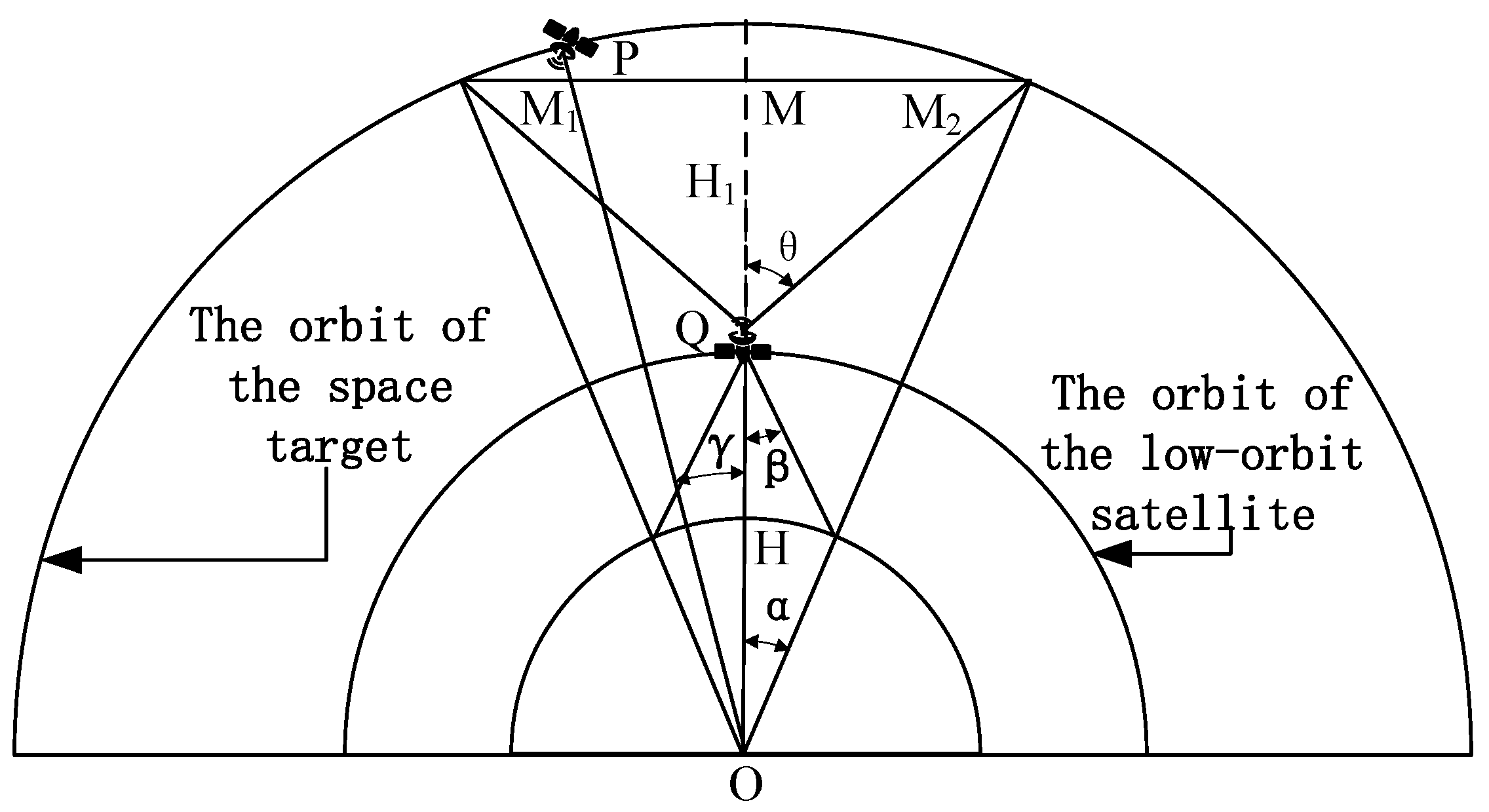
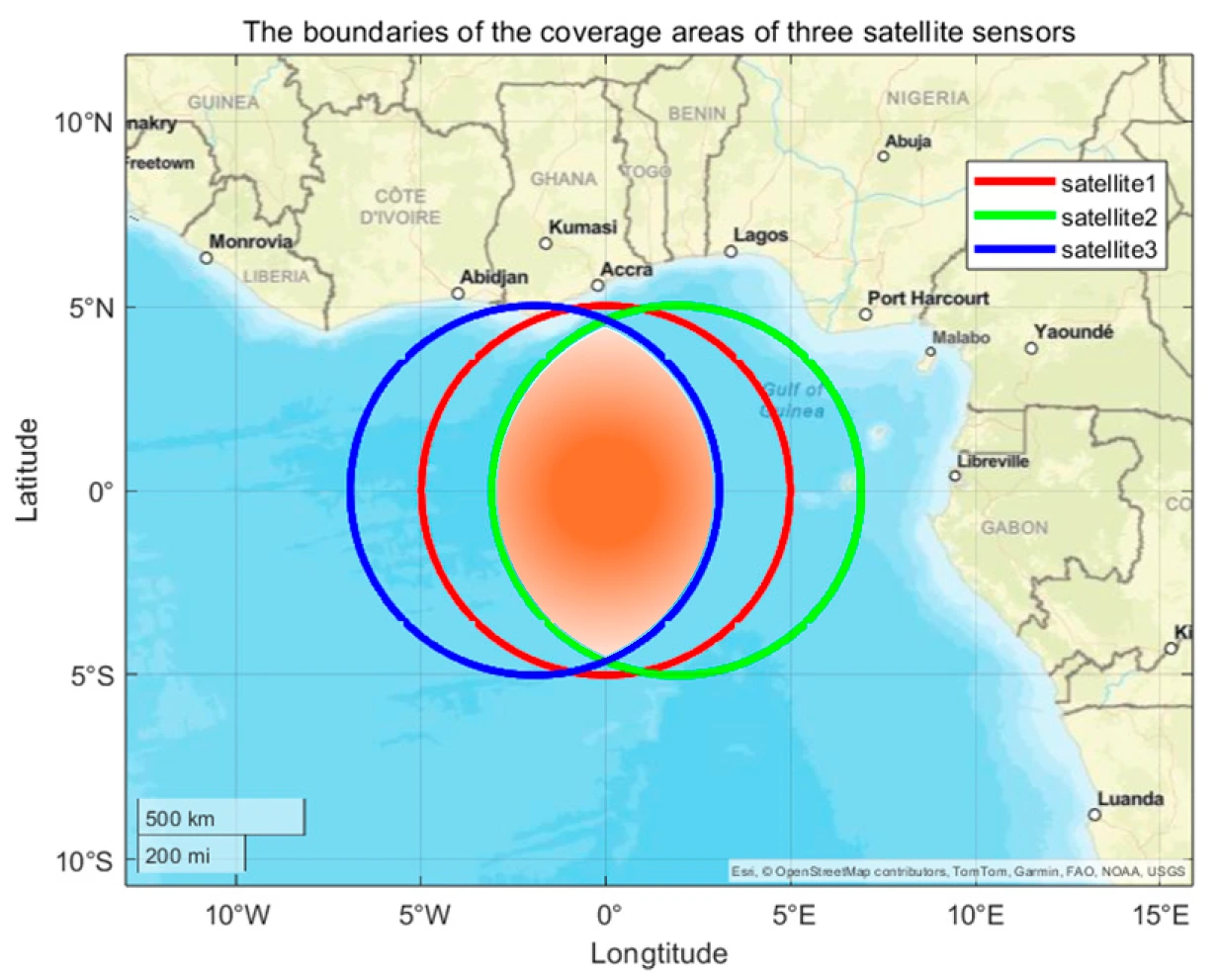
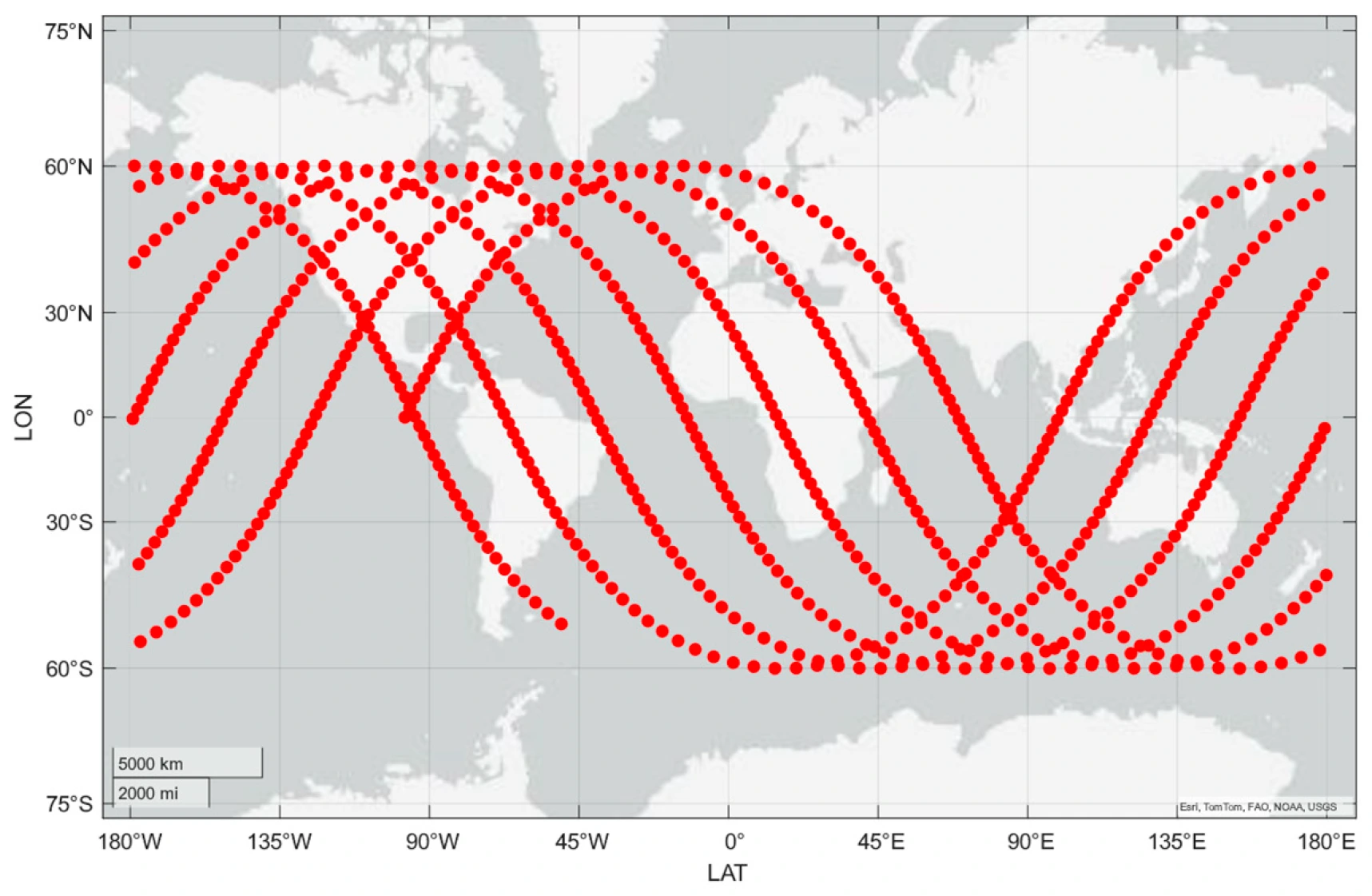
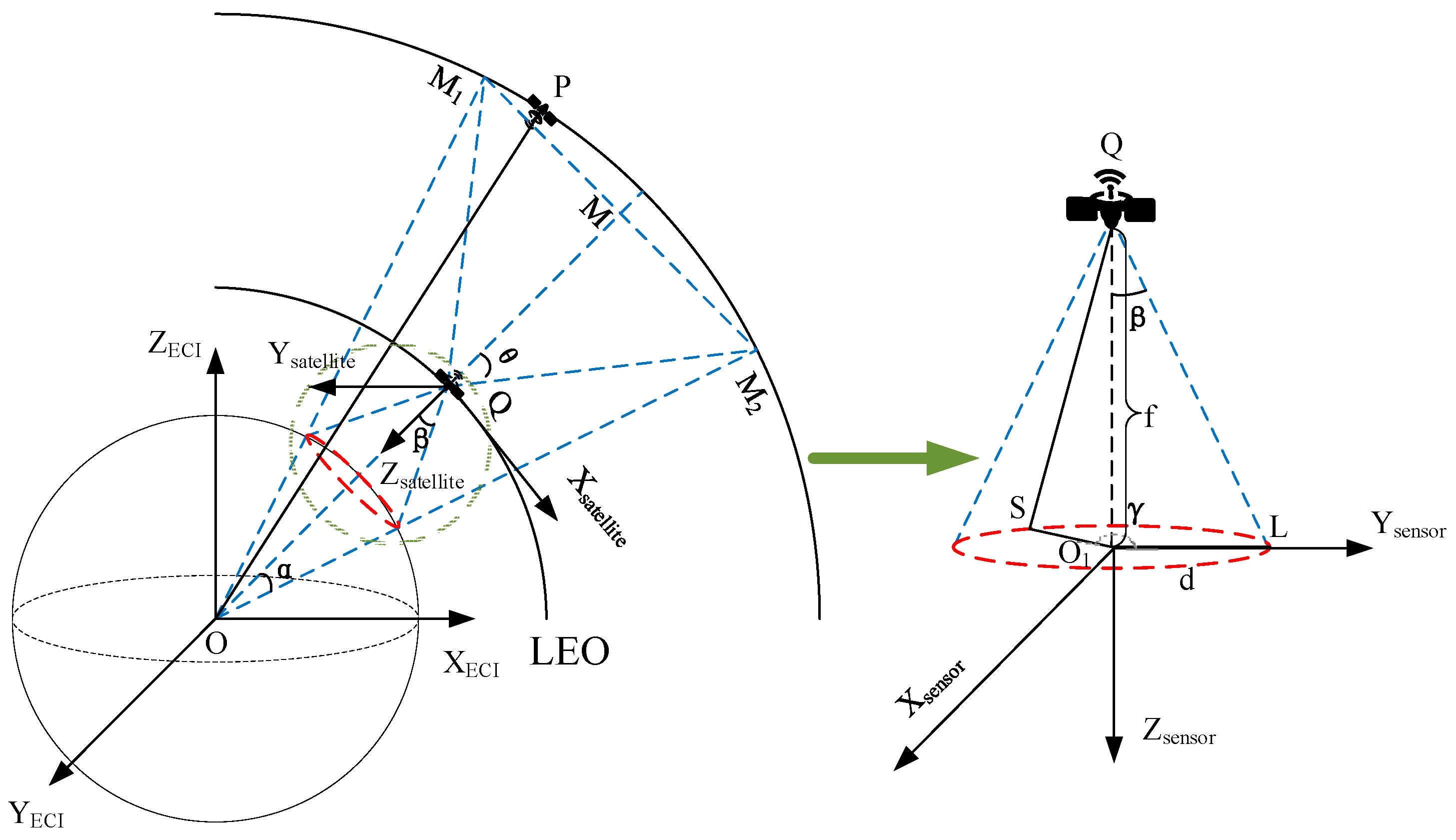
3.2. Coverage Modeling and Optimization of Walker-Delta Constellation for Space Targets


4. Simulation Experiments and Result Analysis
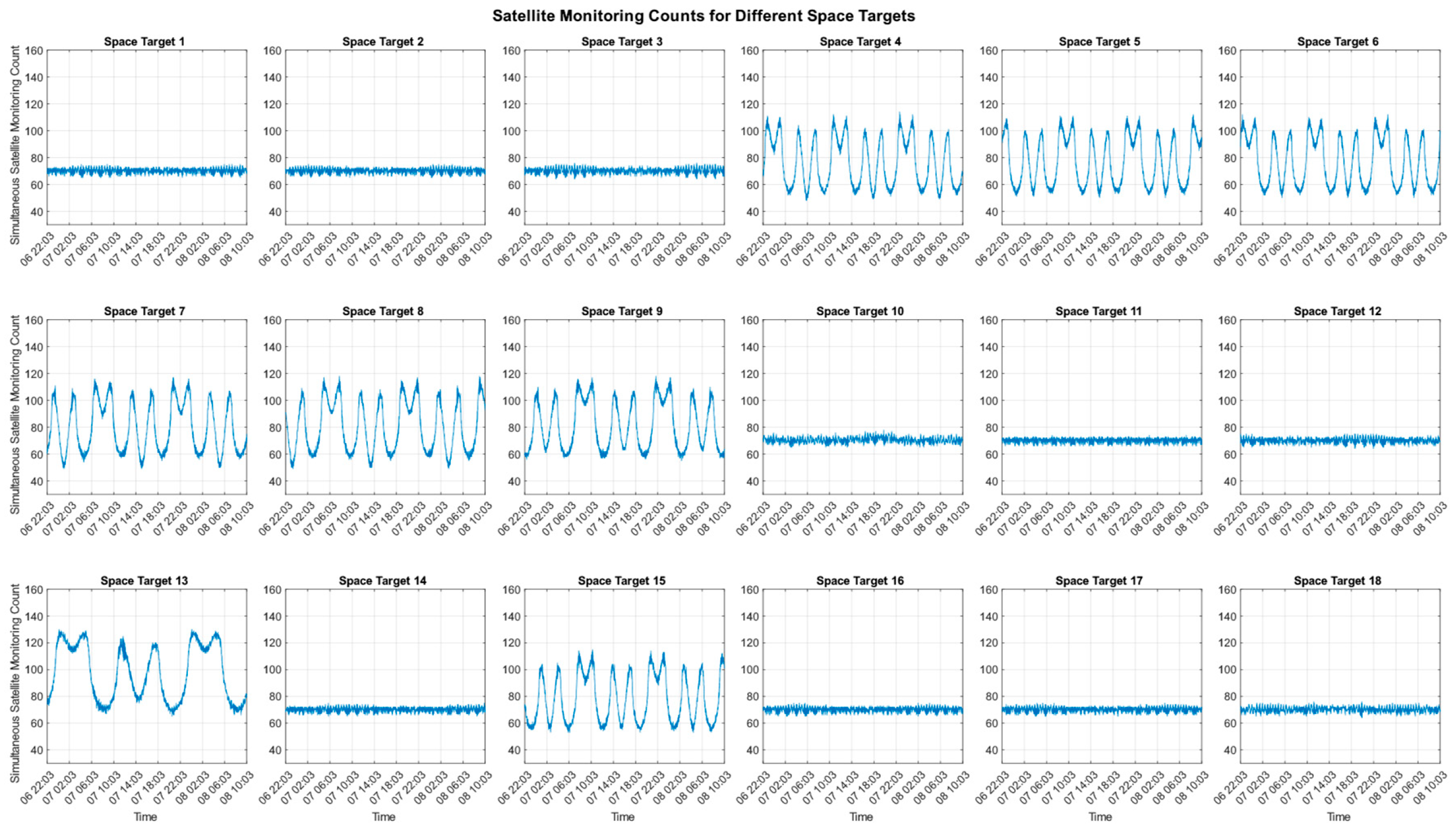
4.1. Simulation Experiments
4.2. Comparative Performance Analysis
5. Conclusions
- (1)
- Transitioning to a multi-objective optimization framework to explicitly trade-off satellite count against other critical metrics like cost and coverage robustness, particularly to mitigate performance degradation from potential satellite failures;
- (2)
- Incorporating higher-fidelity models, including realistic sensor pointing strategies, Earth obscuration, and advanced orbital perturbations beyond the effect, to improve simulation accuracy;
- (3)
- Further validating the scalability of the approach on even larger target sets and more diverse orbital regimes.
Author Contributions
Funding
Data Availability Statement
Conflicts of Interest
References
- Heiner, K. Space Debris: Models and Risk Analysis; Springer: Berlin/Heidelberg, Germany, 2006. [Google Scholar]
- Bombardelli, C.; Alessi, E.; Rossi, A.; Valsecchi, G. Environmental effect of space debris repositioning. Adv. Space Res. 2017, 60, 28–37. [Google Scholar] [CrossRef]
- Jah, M. Space Surveillance, Tracking, and Information Fusion for Space Domain Awareness; NATO STO-EN-SCI-292: Brussels, Belgium, 2016. [Google Scholar]
- Cowardin, H. Orbital Debris Quarterly News, August 2023. In Orbital Debris Quarterly News; NASA: Washington, DC, USA, 2023; Volume 27. [Google Scholar]
- Flohrer, T.; Krag, H. Space surveillance and tracking in ESA’s SSA programme. In Proceedings of the 7th European Conference on Space Debris, Darmstadt, Germany, 17–21 April 2017. [Google Scholar]
- Du, J.; Chen, J.; Li, B.; Sang, J. Tentative design of SBSS constellations for LEO debris catalog maintenance. Acta Astronaut. 2019, 155, 379–388. [Google Scholar] [CrossRef]
- Catron, K.M.; Wang, H.; Hu, G.; Shen, M.M.; Abate-Shen, C. Comparison of MSX-1 and MSX-2 suggests a molecular basis for functional redundancy. Mech. Dev. 1996, 55, 185–199. [Google Scholar] [CrossRef]
- Wang, J.-l.; Wang, R.; Zhang, L.; Chen, X.; Chen, W.; Guo, J.-t.; Cai, S. On-orbit application research and imaging simulation analysis of GSSAP satellite. Infrared Laser Eng. 2023, 52, 20220759. [Google Scholar]
- Flohrer, T.; Peltonen, J.; Kramer, A.; Eronen, T.; Kuusela, J.; Riihonen, E.; Schildknecht, T.; Stöveken, E.; Valtonen, E.; Wokke, F. Space-based optical observations of space debris. In Proceedings of the 4th European Conference on Space Debris, Darmstadt, Germany, 18–20 April 2005; p. 165. [Google Scholar]
- Popowicz, A.; Pigulski, A.; Bernacki, K.; Kuschnig, R.; Pablo, H.; Ramiaramanantsoa, T.; Zocłońska, E.; Baade, D.; Handler, G.; Moffat, A. BRITE Constellation: Data processing and photometry. Astron. Astrophys. 2017, 605, A26. [Google Scholar] [CrossRef]
- Wansaseub, K.; Sleesongsom, S.; Panagant, N.; Pholdee, N.; Bureerat, S. Surrogate-assisted reliability optimisation of an aircraft wing with static and dynamic aeroelastic constraints. Int. J. Aeronaut. Space Sci. 2020, 21, 723–732. [Google Scholar] [CrossRef]
- Huo, D.; Chen, J.; Zhang, H.; Shi, Y.; Wang, T. Intelligent prediction for digging load of hydraulic excavators based on RBF neural network. Measurement 2023, 206, 112210. [Google Scholar] [CrossRef]
- Aughey, R.J. Applications of GPS technologies to field sports. Int. J. Sports Physiol. Perform. 2011, 6, 295–310. [Google Scholar] [CrossRef]
- Fenech, H.; Tomatis, A.; Amos, S.; Soumpholphakdy, V.; Serrano Merino, J.L. Eutelsat HTS systems. Int. J. Satell. Commun. Netw. 2016, 34, 503–521. [Google Scholar] [CrossRef]
- Mckay, M.D.; Beckam, R.J.; Conover, W.J. A Comparison of Three Methods for Selecting Values of Input Variables in the Analysis of Output from a Computer Code. Technometrics 2000, 42, 55–61. [Google Scholar] [CrossRef]
- Buhmann, M.D. Radial basis functions. Acta Numer. 2000, 9, 1–38. [Google Scholar] [CrossRef]
- Hardy, R.L. Multiquadric equations of topography and other irregular surfaces. J. Geophys. Res. 1971, 76, 1905–1915. [Google Scholar] [CrossRef]
- Franke, R. Scattered data interpolation: Tests of some methods. Math. Comput. 1982, 38, 181–200. [Google Scholar]
- Bhosekar, A.; Ierapetritou, M. Advances in surrogate based modeling, feasibility analysis, and optimization: A review. Comput. Chem. Eng. 2018, 108, 250–267. [Google Scholar] [CrossRef]
- Yang, Z.; Qiu, H.; Gao, L.; Cai, X.; Jiang, C.; Chen, L. A surrogate-assisted particle swarm optimization algorithm based on efficient global optimization for expensive black-box problems. Eng. Optim. 2019, 51, 549–566. [Google Scholar] [CrossRef]
- Chung, I.-B.; Park, D.; Choi, D.-H. Surrogate-based global optimization using an adaptive switching infill sampling criterion for expensive black-box functions. Struct. Multidiscip. Optim. 2018, 57, 1443–1459. [Google Scholar] [CrossRef]
- Koziel, S.; Leifsson, L. Surrogate-based aerodynamic shape optimization by variable-resolution models. AIAA J. 2013, 51, 94–106. [Google Scholar] [CrossRef]
- Chen, X.; Du, W.; Qian, F. Multi-objective differential evolution with ranking-based mutation operator and its application in chemical process optimization. Chemom. Intell. Lab. Syst. 2014, 136, 85–96. [Google Scholar] [CrossRef]
- Ozcanan, S.; Atahan, A.O. RBF surrogate model and EN1317 collision safety-based optimization of two guardrails. Struct. Multidiscip. Optim. 2019, 60, 343–362. [Google Scholar] [CrossRef]
- Ji, Y.; Yang, Z.; Ran, J.; Li, H. Multi-objective parameter optimization of turbine impeller based on RBF neural network and NSGA-II genetic algorithm. Energy Rep. 2021, 7, 584–593. [Google Scholar] [CrossRef]
- Li, G.; Zhang, Q.; Lin, Q.; Gao, W. A three-level radial basis function method for expensive optimization. IEEE Trans. Cybern. 2021, 52, 5720–5731. [Google Scholar] [CrossRef]
- Barrueco, J.; Montalban, J.; Iradier, E.; Angueira, P. Constellation design for future communication systems: A comprehensive survey. IEEE Access 2021, 9, 89778–89797. [Google Scholar] [CrossRef]
- Cornara, S.; Beech, T.W.; Belló-Mora, M.; Janin, G. Satellite constellation mission analysis and design. Acta Astronaut. 2001, 48, 681–691. [Google Scholar] [CrossRef]
- Tan, C.; Xu, Y.; Luo, R.; Li, Y.; Yuan, C. Low Earth orbit constellation design using a multi-objective genetic algorithm for GNSS reflectometry missions. Adv. Space Res. 2023, 71, 2357–2369. [Google Scholar] [CrossRef]
- Guo, J.; Yang, L.; Chen, Q.; Yu, S.; Chen, X.; Zhao, Y. Design of a low earth orbit satellite constellation network for air traffic surveillance. J. Navig. 2020, 73, 1263–1283. [Google Scholar] [CrossRef]
- Pineau, D.; Felicetti, L. Design of an optical system for a Multi-CubeSats debris surveillance mission. Acta Astronaut. 2023, 210, 535–546. [Google Scholar] [CrossRef]
- Jia, Y.; Bian, L.; Cao, Y.; Meng, Y.; Zhang, L. Design and analysis of Beidou global integrity system based on LEO augmentation. In China Satellite Navigation Conference; Springer: Singapore, 2020; pp. 624–633. [Google Scholar]
- Li, Z.; Guo, J.; Qin, T.; Wang, J.; Cui, Z.; Han, P.; Bao, Q.; Li, X.; Meng, F.; Qi, B. Integrated modeling and analysis of the microvibration effects on the line-of-sight stability for the space laser communication terminal. Opt. Eng. 2024, 63, 024110. [Google Scholar] [CrossRef]
- Lee, D.; Hwang, S.S. Enhanced Real-Time Onboard Orbit Determination of LEO Satellites Using GPS Navigation Solutions with Signal Transit Time Correction. Aerospace 2025, 12, 508. [Google Scholar] [CrossRef]
- Liu, J.; Gu, D.; Ju, B.; Yao, J.; Duan, X.; Yi, D. Basic performance of BeiDou-2 navigation satellite system used in LEO satellites precise orbit determination. Chin. J. Aeronaut. 2014, 27, 1251–1258. [Google Scholar] [CrossRef]
- Bai, S.; Zhang, Y.; Jiang, Y.; Chen, Y. Coverage Analysis for Elliptical-Orbit Satellites Based on 2-D Map. IEEE Trans. Aerosp. Electron. Syst. 2023, 59, 4223–4239. [Google Scholar] [CrossRef]
- CELESTRAK. Available online: https://celestrak.org/ (accessed on 13 October 2025).
- Holland, J.H. Genetic algorithms. Sci. Am. 1992, 267, 66–73. [Google Scholar] [CrossRef]
- Kennedy, J.; Eberhart, R. Particle swarm optimization. In Proceedings of the ICNN’95-International Conference on Neural Networks, Perth, WA, Australia, 27 November–1 December 1995; pp. 1942–1948. [Google Scholar]
- Van Laarhoven, P.J.; Aarts, E.H. Simulated annealing. In Simulated Annealing: Theory and Applications; Springer: Berlin/Heidelberg, Germany, 1987; pp. 7–15. [Google Scholar]



| Name | Functions |
|---|---|
| Linear kernel (L) | |
| cubic kernel (C) | |
| Gaussian kernel (G) | |
| thin plate spline (TPS) | |
| inverse multi-quadratic (IMQ) | |
| multi-quadratic (MQ) |
| Space Target ID | Name | Inclination (deg) | RAAN (deg) | Eccentricity | Argument of Perigee (deg) | Mean Anomaly (deg) | Mean Motion (revs/Day) | Period (min) |
|---|---|---|---|---|---|---|---|---|
| 1 | EUTELSAT 16A | 0.0678 | 351.3364 | 0.0005387 | 357.3541 | 158.1451 | 1.00269386 | 1436.12 |
| 2 | EUTELSAT 70B | 0.0648 | 350.7462 | 0.0001979 | 319.93 | 228.3344 | 1.00271178 | 1436 |
| 3 | EUTELSAT 117 WEST B | 0.024 | 44.4502 | 0.0000218 | 25.6736 | 155.7676 | 1.00272794 | 1435.95 |
| 4 | GPS BIIF-6 (PRN 06) | 56.6723 | 349.7068 | 0.0036121 | 319.3852 | 40.3619 | 2.00549727 | 719.02 |
| 5 | GPS BIIF-11 (PRN 10) | 56.6206 | 48.9012 | 0.0103023 | 228.4981 | 130.6164 | 2.00566591 | 718.89 |
| 6 | GPS BIII-2 (PRN 18) | 55.8075 | 349.7134 | 0.004901 | 194.2197 | 337.1341 | 2.0056035 | 718.92 |
| 7 | GSAT0101 (GALILEO-PFM) | 57.0700 | 348.8230 | 0.0000633 | 290.9854 | 69.0628 | 1.70475794 | 844.93 |
| 8 | GSAT0102 (GALILEO-FM2) | 57.0712 | 248.8411 | 0.0002662 | 299.6035 | 60.9798 | 1.70475993 | 844.93 |
| 9 | GSAT0103 (GALILEO-FM3) | 55.6437 | 108.7709 | 0.0001776 | 287.3194 | 72.7354 | 1.70473654 | 844.94 |
| 10 | NIMIQ 2 | 8.8435 | 59.5490 | 0.0005659 | 135.9684 | 128.4306 | 1.00273223 | 1435.94 |
| 11 | ANIK F2 | 2.6141 | 82.9068 | 0.0003850 | 57.7548 | 162.3337 | 1.00271890 | 1436.01 |
| 12 | ANIK F1R | 3.6457 | 79.7701 | 0.0002424 | 83.6063 | 162.7743 | 1.00272310 | 1435.99 |
| 13 | BEIDOU-2 IGSO-1 (C06) | 54.2764 | 165.3028 | 0.0051118 | 217.1117 | 319.3386 | 1.00297170 | 1435.47 |
| 14 | BEIDOU-2 G4 (C04) | 3.0005 | 70.1475 | 0.0008824 | 172.4990 | 350.8934 | 1.00271008 | 1436.01 |
| 15 | BEIDOU-3S M2S (C58) | 55.0991 | 310.9254 | 0.0012766 | 257.0462 | 102.8770 | 1.86229224 | 773.31 |
| 16 | AMC-11 | 0.0454 | 23.4587 | 0.0002904 | 164.2061 | 133.5880 | 1.00272251 | 1435.99 |
| 17 | AMC-15 | 0.0448 | 23.3643 | 0.0002295 | 176.0826 | 129.5923 | 1.00271780 | 1436.01 |
| 18 | NSS-10 | 5.8010 | 73.5669 | 0.0002830 | 121.7559 | 32.0485 | 1.00270927 | 1436.01 |
| Parameter Name | Parameter Value |
|---|---|
| Orbital Altitude (km) | 560.9 |
| Argument of Latitude (deg) | 312.8125 |
| Inclination (deg) | 51.0938 |
| Phase Factor | 12 |
| Number of Satellites per Plane | 13 |
| Number of Orbital Planes RAAN (deg) | 16 205.3125 |
| Algorithm | Computational Time (hh:mm) |
|---|---|
| Genetic Algorithm (GA) | 25:29 |
| Particle Swarm Optimization (PSO) | 21:01 |
| Simulated Annealing (SA) | 16:11 |
| RBF Surrogate Model | 03:44 |
| Number of Tagets | 12-h Simulation (hh:mm) | 36-h Simulation (hh:mm) |
|---|---|---|
| 12 | 01:04 | 03:44 |
| 15 | 01:19 | 04:27 |
| 18 | 01:32 | 04:58 |
Disclaimer/Publisher’s Note: The statements, opinions and data contained in all publications are solely those of the individual author(s) and contributor(s) and not of MDPI and/or the editor(s). MDPI and/or the editor(s) disclaim responsibility for any injury to people or property resulting from any ideas, methods, instructions or products referred to in the content. |
© 2025 by the authors. Licensee MDPI, Basel, Switzerland. This article is an open access article distributed under the terms and conditions of the Creative Commons Attribution (CC BY) license (https://creativecommons.org/licenses/by/4.0/).
Share and Cite
Fu, Y.; Xu, Z.; Fan, Y.; Yi, L.; Ma, Z.; Li, Y.; Fang, S. Optimization of a Walker Constellation Using an RBF Surrogate Model for Space Target Awareness. Aerospace 2025, 12, 933. https://doi.org/10.3390/aerospace12100933
Fu Y, Xu Z, Fan Y, Yi L, Ma Z, Li Y, Fang S. Optimization of a Walker Constellation Using an RBF Surrogate Model for Space Target Awareness. Aerospace. 2025; 12(10):933. https://doi.org/10.3390/aerospace12100933
Chicago/Turabian StyleFu, You, Zhaojing Xu, Youchen Fan, Liu Yi, Zhao Ma, Yuhai Li, and Shengliang Fang. 2025. "Optimization of a Walker Constellation Using an RBF Surrogate Model for Space Target Awareness" Aerospace 12, no. 10: 933. https://doi.org/10.3390/aerospace12100933
APA StyleFu, Y., Xu, Z., Fan, Y., Yi, L., Ma, Z., Li, Y., & Fang, S. (2025). Optimization of a Walker Constellation Using an RBF Surrogate Model for Space Target Awareness. Aerospace, 12(10), 933. https://doi.org/10.3390/aerospace12100933