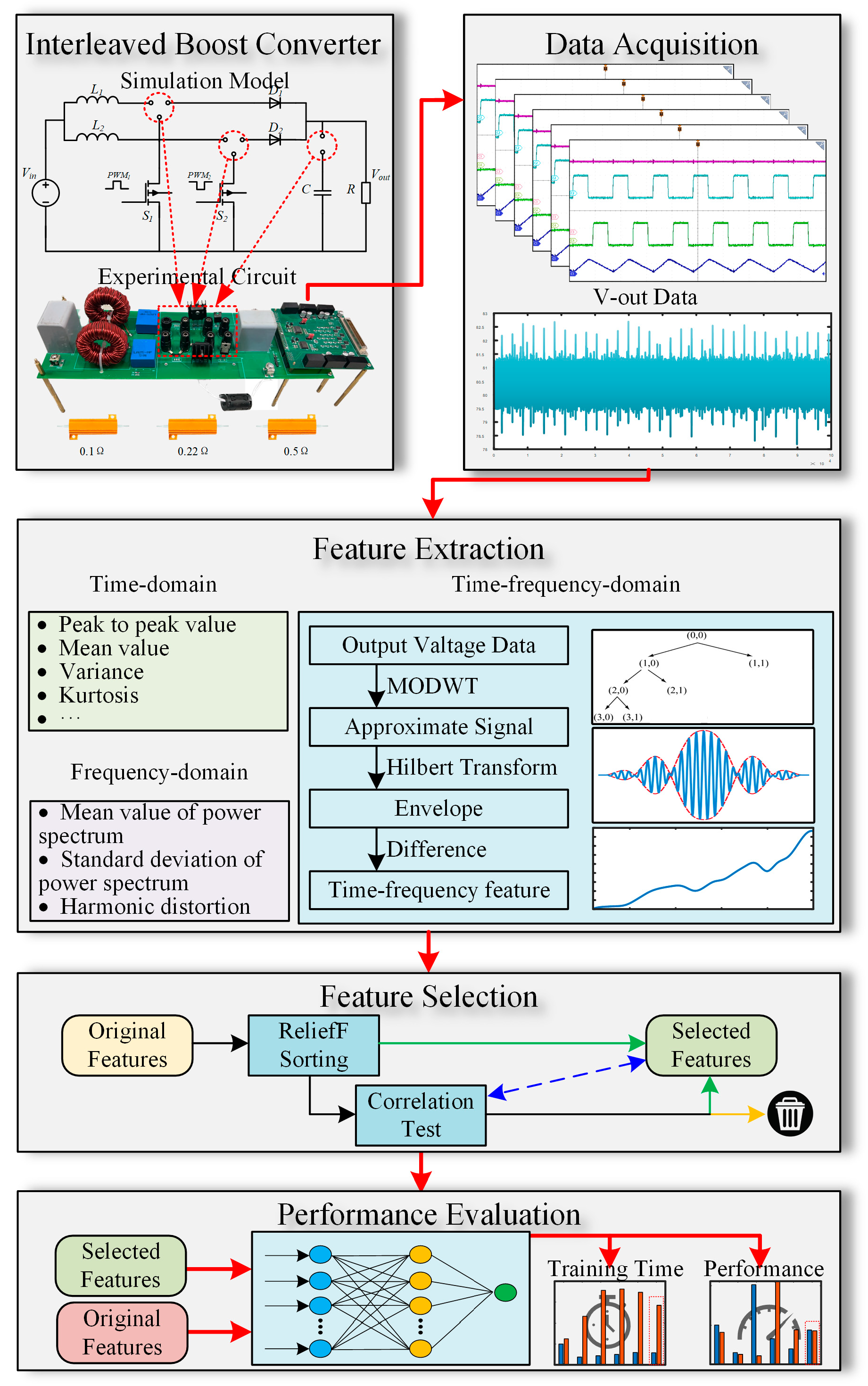

A Data-Driven Feature Extraction Process of Interleaved DC/DC Converter Due to the Degradation of the Capacitor in the Aircraft Electrical System




Abstract
Share and Cite
Zhang, C.; Gao, P.; Huang, M.; Liu, W.; Li, W.; Zhang, X. A Data-Driven Feature Extraction Process of Interleaved DC/DC Converter Due to the Degradation of the Capacitor in the Aircraft Electrical System. Aerospace 2024, 11, 1027. https://doi.org/10.3390/aerospace11121027
Zhang C, Gao P, Huang M, Liu W, Li W, Zhang X. A Data-Driven Feature Extraction Process of Interleaved DC/DC Converter Due to the Degradation of the Capacitor in the Aircraft Electrical System. Aerospace. 2024; 11(12):1027. https://doi.org/10.3390/aerospace11121027
Chicago/Turabian StyleZhang, Chenguang, Pengfei Gao, Ming Huang, Wenjie Liu, Weilin Li, and Xiaobin Zhang. 2024. "A Data-Driven Feature Extraction Process of Interleaved DC/DC Converter Due to the Degradation of the Capacitor in the Aircraft Electrical System" Aerospace 11, no. 12: 1027. https://doi.org/10.3390/aerospace11121027
APA StyleZhang, C., Gao, P., Huang, M., Liu, W., Li, W., & Zhang, X. (2024). A Data-Driven Feature Extraction Process of Interleaved DC/DC Converter Due to the Degradation of the Capacitor in the Aircraft Electrical System. Aerospace, 11(12), 1027. https://doi.org/10.3390/aerospace11121027