Review

Intensification of Extreme and Compound Hazards in Urban Areas Under Climate Change in Iran: A Scoping Review


by
Niloofar Mohammadi
1 and
Raoof Mostafazadeh
2,*
1
Department of Climatology, Faculty of Geographical Sciences, Kharazmi University, Tehran 1571914911, Iran
2
Department of Natural Resources, Faculty of Agriculture and Natural Resources, University of Mohaghegh Ardabili, Ardabil 5619911367, Iran
*
Author to whom correspondence should be addressed.
Climate 2026, 14(6), 126; https://doi.org/10.3390/cli14060126 (registering DOI)
Submission received: 3 April 2026 / Revised: 5 June 2026 / Accepted: 10 June 2026 / Published: 13 June 2026

Abstract

Human-induced climate change has rendered urban areas highly vulnerable to extreme events such as heatwaves, droughts, and floods. This study conducts a scoping review of extreme and compound climate hazards in Iranian urban areas under global warming conditions. Mapping the available literature, 92 authoritative scientific works published between 1999 and 2025 were analyzed. The review synthesizes evidence on the spatiotemporal patterns of heatwaves, drought, torrential rainfall, sea-level rise, and compound hazards across Iran. The results indicate that central, northwestern, eastern, and southern Iran experience the highest heatwave intensity and frequency, with short-duration heatwaves being more common than prolonged ones. Western Iran faces a high risk of torrential rainfall, but urbanization amplifies flood consequences by expanding impervious surfaces and accelerating surface runoff. Coastal areas show high vulnerability to compound flooding due to sea-level rise and storms. The review further reveals that Iran is experiencing hydroclimate whiplash (abrupt transitions between drought and flood) driven by global warming. The study concludes by presenting management suggestions and future research directions for integrated compound hazard management in Iran.

1. Introduction

1.1. Climate Change and Global Warming

Among the gases released by human activities, carbon dioxide (CO2) accounts for the largest share by volume [1]. It is considered a pollutant due to its heat-absorbing capacity and role in the greenhouse effect, ocean acidification, and other biospheric impacts [2]. Methane and nitrous oxide are other major heat-absorbing gases, with climatic effects dependent on spectral interactions and atmospheric lifetimes [3]. Most CO2 emissions come from fossil fuel combustion, while livestock farming and chemical fertilizers are primary sources of methane and nitrous oxide, respectively [4]. These pollutants affect Earth’s radiative balance and atmospheric composition in unprecedented ways [5]. Despite complexities, it is unequivocal that global warming results from human activity, with credible estimates dating back over a century. A substantial proportion of the warmest years since 1880 have occurred after 2010. While uncertainties remain about climate sensitivity and the timing of changes, the fundamental physical processes are well established [3]. Even modest global warming has brought severe consequences [6]. Since the late nineteenth century, temperatures have risen by more than 1 °C, with projected increases of 1.5 °C to 4.5 °C by century’s end depending on emission pathways [3,7].
Several national-scale studies have quantified the warming trend across Iran using long-term observational data, as summarized below. Eblaghian et al. [8] analyzed 37 synoptic stations (1961–2010) and found a significant warming trend of about 1.5 °C over 50 years in most stations (e.g., Mashhad, Zahedan, Yazd, Abadan, Tabriz), while precipitation and relative humidity decreased, particularly in the northwest and west. Beyranvand et al. [9] used daily temperature data from 663 stations (1962–2011) and showed that heatwaves intensified in 65.8% of Iran’s area (with 85% showing an increasing trend), while cold wave severity decreased in 48.5% of the country. Mianabadi and Davary [10] compared two periods (1961–1990 and 1991–2020) and found that annual average temperature increased in all stations, while precipitation decreased in most stations, with a higher probability of extreme hot events relative to cold periods. Asadi et al. [11] analyzed 120 synoptic stations over 30 years (1993–2022) and detected a significant warming trend of 0.053 °C per year (p < 0.05), with the highest increases at Bostan and Qorveh stations. These studies confirm a significant warming trend across Iran over the past 50 years, with an average increase of about 1.5 °C, intensified heatwaves, and reduced cold wave severity, consistent with global warming projections.

1.2. Extreme Events and Their Significance

Global warming significantly impacts extreme weather events, phenomena at the tails of probability distributions with destructive consequences [12]. Numerous studies have consistently demonstrated that global warming influences the intensity, frequency, duration, and spatial extent of extreme weather events worldwide [13]. This includes a higher likelihood of unprecedented extremes when climatic variables exceed historical thresholds, with these effects being further amplified in urban areas due to heat islands, land use changes, and high infrastructure density [14,15,16,17,18,19]. According to the U.S. National Climate Assessment, the number and severity of weather-related natural disasters (such as major storms, heatwaves, floods, droughts, and heavy precipitation) have increased in the United States over the past 50 years [20]. Human-induced greenhouse gas increases have led to a global rise in temperature, resulting in fewer cold days and nights and more warm days and nights since 1950 across most land areas (especially North America, Europe, Australia, and large parts of Asia), although regional trends vary in Africa and South America [21,22,23]. Consequently, the frequency and duration of heatwaves have increased worldwide since the mid-20th century [17].
In Iran, the most relevant types of extreme events include intense and prolonged heatwaves, flash floods and extreme precipitation, severe multi-year droughts, and compound hot-dry events. A record-breaking extreme event occurred in March 2019 when a powerful atmospheric river caused unprecedented flooding across Iran, affecting 26 out of 31 provinces, killing 76 people, and causing an estimated $2.5 billion in damages [24]. On 28 July 2022, an unprecedented flash flood struck Imamzadeh Davood in northern Tehran following a rainfall with an average intensity of 79.8 mm/h, claiming at least 23 lives [25]. Regarding heatwaves, a recent study documented that the average number of heatwaves in Iran has increased by 60% compared to the start of the study period, now reaching 18 events per year [26].

1.3. Defining Compound Hazards

Weather phenomena, even when not statistically classified as extreme events, may lead to extreme conditions or consequences by crossing a critical threshold in social, ecological, or physical systems, or through their simultaneous occurrence with other phenomena [27]. Certain extreme events (such as droughts and floods) can arise from the aggregation of weather phenomena that are not individually extreme, yet their combination gives rise to an extreme condition, known as a compound hazard [17,28]. In climate science, compound events can include: (a) two or more extreme events occurring simultaneously or in succession; (b) a combination of extreme events with underlying conditions that amplify their impacts; or (c) a combination of events that are not themselves extreme but, when combined, lead to an extreme event or impact [29,30]. For example, the 28 July 2022, flood in Imamzadeh Davood, Iran [31], or a weather system such as a tropical cyclone (depending on the timing and location of landfall) can produce extreme consequences even if the intensity of that particular cyclone is not extreme compared to others. A notable example of a compound hazard in Iran is the simultaneous occurrence of severe heatwaves and prolonged meteorological droughts, which together exacerbate water scarcity, increase wildfire risk, and intensify heat stress on urban populations. Asadi-RahimBeygi et al. [32] projected a significant rise in both drought frequency and heatwave events across the country within the near-term forecast period (2023–2028), with high-risk compound hazard areas expanding to cover over 36% of Iran’s territory, particularly in western and southern Zagros and eastern regions [32].
It is important to note, however, that not all extreme events necessarily lead to severe outcomes. Furthermore, changes in extreme events can be directly linked to shifts in climatic averages, as future mean conditions for some variables may lie at the tails of current typical conditions. Consequently, defining weather and climate extremes is inherently complex, and assessing climate change in relation to extreme impacts and disasters requires a multidimensional approach [17].

1.4. Vulnerability of Urban Areas

From an urban perspective, climate change within the Anthropocene (the era characterized by humanity’s profound influence on the Earth) represents a serious threat to the planet, marked by significant impacts of human activity on natural systems [33,34]. These changes have particularly led to increased occurrences of urban flooding, drought, and wildfires [35,36]. Rising global temperatures, shifting precipitation patterns, and extreme weather events have generated considerable concern. Climate change intensifies the hydrological cycle and changes the amount of evaporation and transpiration and the pattern of precipitation [37]. Urban areas, owing to their high population density and extensive development, are especially vulnerable to these changes. Flooding ranks among the most destructive natural hazards, inflicting more severe damage on the economic and social fabric of communities than many other disasters [38,39]. Modern urbanization, through landscape transformation and the expansion of large cities, has exposed these areas to heightened flood risk driven by climate change. Rapid urban growth and land-use change disrupt natural hydrological processes, reduce permeable surfaces, and increase surface runoff. As a result, urban areas are now more susceptible to flooding, a vulnerability compounded by the intensification of climate-related extreme weather events. The relationship between climate change, flooding, and drought constitutes a complex interplay of multiple factors that mutually influence and amplify one another [40,41]. Factors such as urban expansion, shifting land-use patterns, and inadequate stormwater management infrastructure further complicate this intricate relationship [42].
It is essential to distinguish between atmospheric processes that generate precipitation and land surface processes that control runoff and flooding. Urbanization worsens flooding by creating impervious surfaces that speed up runoff during heavy rain.

1.5. Background of Extreme Weather Event Research

The historical trajectory of extreme weather event research reveals significant evolution over recent decades, progressing from early observational analyses to sophisticated modeling frameworks and causal attribution [43]. Initial research emerged primarily in North America, driven by concerns over agricultural and infrastructural losses, while subsequent advancements expanded to Europe and eventually achieved global scope, embracing interdisciplinary approaches [44]. Systematic documentation of extreme weather events in climatology began in the 1950s in the United States, when the U.S. Weather Bureau (now the National Weather Service) started analyzing severe storms, floods, and droughts that departed from climatic norms [44,45]. These efforts were among the first to quantify extreme weather events using historical data, focusing on their frequency and impacts in regions such as the U.S. Great Plains [46]. According to the Fifth Assessment Report of the Intergovernmental Panel on Climate Change, cold extremes have declined since 1950, while warm temperature extremes and heavy precipitation events have increased [47]. By the 1980s, such studies had matured into comprehensive climatological assessments, exemplified by the National Center for Environmental Information (NCEI) evaluations of U.S. extreme events from 1980 to 2003, which established a foundation for long-term trend analysis [48,49]. The concept of compound events was first introduced in Canada during the 1970s by Hewitt and Burton, who examined how multiple atmospheric factors (e.g., lightning, hail, high winds) could simultaneously exceed damaging thresholds [50]. In Europe, particularly the UK, research in the 1980s–1990s focused on the combination of river levels and coastal waves, developing statistical models for detection [51]. A pivotal milestone occurred in 2012 with the publication of the IPCC’s Special Report, which formally defined compound events and emphasized the necessity of interdisciplinary approaches [52]. This report, developed by an international team of researchers from Switzerland, the United States, Australia, and elsewhere, catalyzed a research revolution in the subsequent decade. Zscheischler et al. [53] provided a comprehensive definition later adopted in the Sixth Assessment Report of the IPCC [54], indicating the global significance of compound event impacts. Today, extreme and compound event research has become a global enterprise, originating in the United States and Canada and expanding to Europe, Asia (particularly China), and South America [55]. Mansouri Daneshvar [47] documented divergent regional trends in extreme events and characterizes climate challenges and offers adaptation strategies. Compelling evidence shows subtropical regions expanding into temperate areas, yet global averages mask regional complexities. Emerging evidence also shows global warming alters extreme wind patterns, with significant changes in maximum wind speeds across Iran [56,57].
A growing body of international research shows how climate change is intensifying extreme weather events and reshaping their interactions across different regions. Samantray and Gouda [58] analyzed 72 years of Indian rainfall data, result rising daily intensity from Himalayan cloudbursts to urban flooding, indicating the need for high-resolution local modeling. Complementing such observational work, advances in extreme event attribution have opened new pathways for adaptation; Zhang et al. [59] demonstrated that linking specific weather events to climate change enables stakeholders to better assess current risks and design more cost-effective, equitable adaptation strategies, while Noy et al. [60] emphasized how combining attribution science with socio-economic data can translate climate impacts into actionable indications. Beyond rainfall and attribution, Kumar et al. [61] stressed the role of soil and watershed-level measures in building resilience against greenhouse gas-driven warming. Meanwhile, shifts in flood and drought dynamics are becoming increasingly evident: Xiong and Yang [62] noted that while heavy rainfall-driven floods are increasing globally, snow-dominated floods are declining, and future projections point toward more concurrent flood-drought events, underscoring the need to prepare for abrupt hydrological transitions. Similar patterns are emerging in East Africa, where Taye and Dyer [63] observed that frequent swings between droughts and floods have become more common, with climate change amplifying both the intensity and duration of extremes while local conditions remain critical in shaping outcomes. At the compound event level, Wang et al. [64] found that drought and heatwave combinations have risen sharply since 1990, with heatwaves playing the dominant role, a trend they attribute primarily to human-induced climate change, particularly in dryland regions.
Nevertheless, most international studies still examine hazards in isolation, and large-scale model outputs often mask localized dynamics, a limitation particularly problematic in urban settings. In Iran, climate-related research has largely focused on temperature and precipitation trends (1990s–2000s), with extreme event detection studies gradually emerging after 2010, yet most investigations have addressed individual hazards in isolation without considering their interactions or cascading effects. Most of these studies are limited to local or regional scales, and a systematic, nationwide synthesis of extreme and compound events is still lacking. The phenomenon of hydroclimate whiplash (abrupt transitions between drought and flood) has only recently been recognized in Iran, but no comprehensive review has specifically addressed it. To the best of our knowledge, no previous review has yet simultaneously analyzed heatwaves, drought, torrential rainfall, sea-level rise, and compound hazards in Iranian urban areas under a changing climate. Accordingly, this scoping review attempts to fill this gap by synthesizing fragmented evidence and identifying broad spatiotemporal patterns of interacting extremes, while also presenting hydroclimate whiplash as an emerging yet underexplored threat in Iran.

1.6. Scope and Objectives

Iran is situated in a region characterized by high climatic diversity yet marked sensitivity to climate change, with mounting evidence indicating a significant increase in the frequency and intensity of extreme events (including heatwaves, droughts, and floods) over recent decades [32]. Rapid urbanization in Iran, coupled with unplanned development and infrastructure that remains poorly adapted to emerging climatic conditions, has substantially heightened the vulnerability of cities to these hazards [65]. Despite the existence of scattered studies addressing individual climate hazards, a conspicuous research gap remains: the absence of a comprehensive investigation that simultaneously examines extreme and compound hazards through an integrated approach via a systematic literature review. Moreover, the emergence of the hydroclimate whiplash phenomenon in recent years (characterized by abrupt transitions between drought and flood conditions) has further shown the need for an integrated perspective on compound hazards.
This scoping review covers the peer-reviewed scientific literature published between 1999 and 2025. The specific objectives of this study are as follows: (a) To synthesize evidence on the spatiotemporal patterns of heatwaves, drought, torrential rainfall, sea-level rise, and compound hazards across Iranian urban areas. (b) To elucidate the influence of global warming on the intensification of extreme and compound climate hazards in Iran, with particular emphasis on hydroclimate whiplash. (c) To identify knowledge gaps and provide integrated management recommendations for compound hazard risk reduction in Iran’s rapidly urbanizing regions. Accordingly, this scoping review is guided by the following primary research question: What are the spatiotemporal patterns and trends of extreme and compound hydro-climatic hazards (heatwaves, drought, torrential rainfall, sea-level rise) in Iranian urban areas under climate change, and how does global warming influence their intensification? Secondary questions include: Which regions of Iran are most affected by each type of hazard? Is there evidence of increasing compound events (e.g., concurrent heatwave and drought) or hydroclimate whiplash? And what are the reported management strategies to reduce vulnerability?

2. Materials and Methods

This study presents a scoping review of extreme and compound climate hazards in Iranian urban areas. The review follows the PRISMA-ScR (Preferred Reporting Items for Systematic Reviews and Meta-Analyses extension for Scoping Reviews) guidelines to ensure transparent and reproducible reporting [66,67]. This is a qualitative scoping review employing thematic coding and narrative synthesis. While no meta-analysis was performed due to heterogeneity of study designs and indicators, descriptive quantitative summaries (e.g., distribution of studies by period, region, hazard type, and methodology) are provided to contextualize the evidence base.

2.1. Literature Search Strategy

A comprehensive literature search was conducted using Google Scholar and Semantic Scholar databases for peer-reviewed articles published between 1999 and 2025 in either English or Persian [68]. Most of the retrieved articles were originally indexed in major databases such as Web of Science and Scopus, ensuring the quality and relevance of the included studies. During the revision process, we further supplemented the search by cross-referencing and incorporated several additional recent and relevant papers to strengthen the synthesis. The search strategy employed the following keywords and their combinations: “heatwaves”, “urban heat island”, “drought”, “torrential rainfall”, “flood”, “extreme precipitation”, “sea-level rise”, “compound hazards”, “climate change”, and “Iran”. The complete search string was constructed by combining keywords with Boolean operators: ((heatwave OR “heat wave” OR “urban heat island”) AND (drought OR “torrential rainfall” OR “extreme precipitation” OR “sea-level rise” OR “compound hazard” OR “compound event” OR “flood”) AND (“climate change” OR “global warming”) AND (Iran OR Iranian)). The search was restricted to peer-reviewed articles published between 1999 and 2025.

2.2. Study Selection and Screening

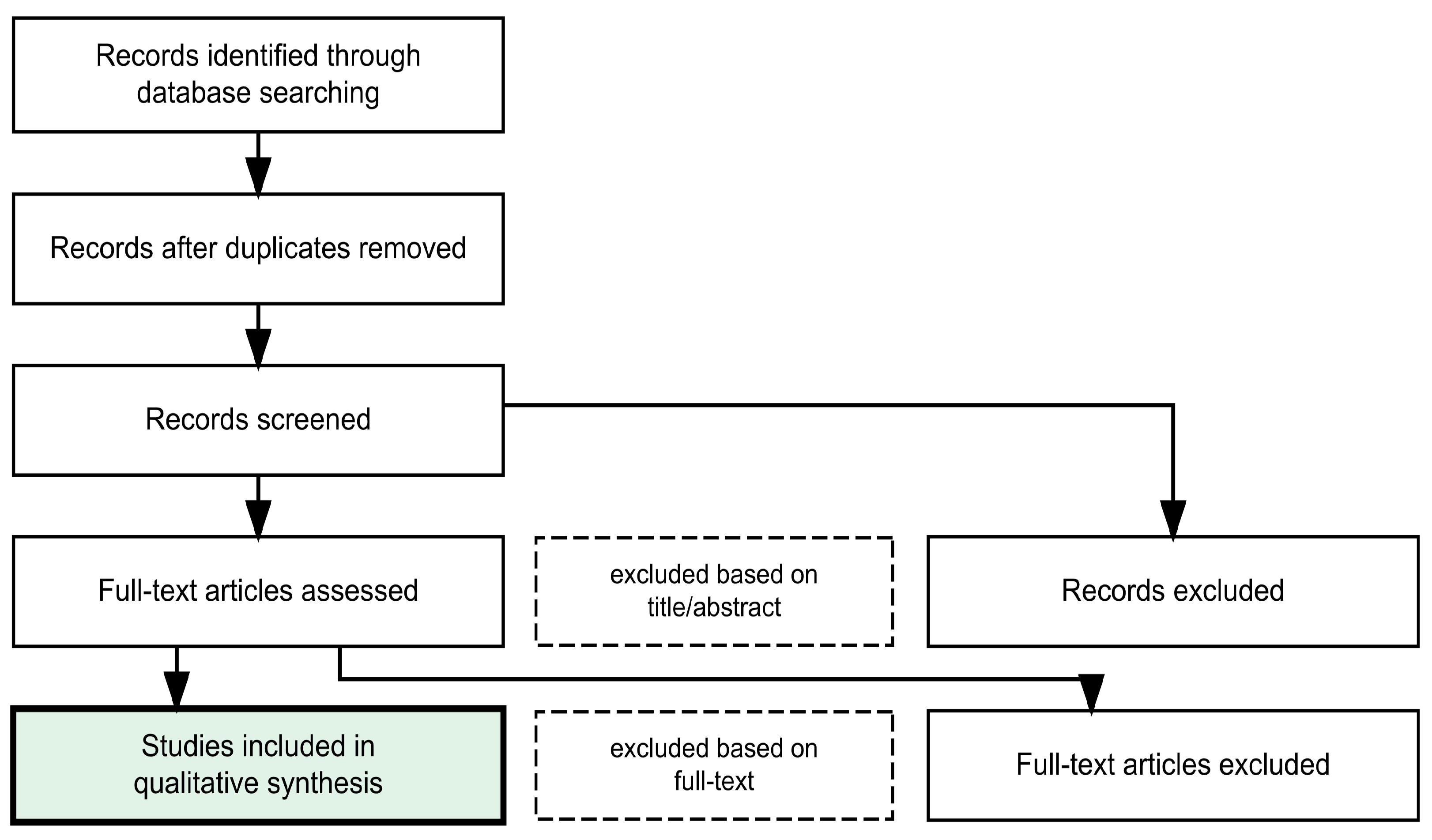
The initial search yielded 3032 records. After removing duplicate entries (n = 448), 2584 articles were screened based on their titles and abstracts. Studies were considered eligible if they addressed extreme or compound climate hazards (including heatwaves, drought, extreme precipitation, sea-level rise, and compound flooding) within Iran, with a direct focus on or clear implications for urban areas. Given that hydro-climatic extremes and compound events transcend administrative boundaries, we also included studies conducted at provincial, regional (e.g., western Iran, Zagros), and coastal scales when their results were relevant to urban vulnerability (e.g., flood risk in downstream cities, heatwave exposure in population centers). Articles focusing solely on non-urban scales (e.g., remote rural areas, uninhabited zones) with no stated relevance to urban settings were excluded, as were articles lacking relevance to Iran or dealing with unrelated hazards [68,69]. This screening process resulted in the exclusion of 2492 articles. The remaining 92 full-text articles were assessed for eligibility and included in the final synthesis. In line with scoping review methodology, no formal quality appraisal or risk-of-bias assessment was performed, as the aim is to map the breadth of evidence rather than evaluate its quality.

2.3. Data Extraction and Thematic Synthesis

Data extracted from the included sources were organized and synthesized using thematic coding, a qualitative scoping synthesis approach. A basic consideration was applied to each included study regarding clarity of objectives, methodological transparency, and direct relevance to Iranian urban climate hazards. Given the heterogeneity of study designs, indicators, and spatial scales, a meta-analysis was not feasible. Instead, the extracted results were grouped into recurring themes (e.g., heatwave trends, drought patterns, flood drivers, compound events, and management strategies) and narratively synthesized to identify consistent patterns, research gaps, and emerging phenomena such as hydroclimate whiplash. Descriptive quantitative summaries of the 92 included studies by geographic region, hazard type, and methodological approach are provided in Table 1. These percentages are approximate qualitative estimates based on the authors’ synthesis, not a formal bibliometric count. The PRISMA-ScR flow diagram (Figure 1) illustrates the step-by-step screening and selection process.
A qualitative summary of the 92 included studies by publication period, geographic region, hazard type, and methodological approach is presented in Table 1.
The approximate percentages are based on a qualitative assessment of the studied articles and are intended to provide a general overview of the literature. A precise bibliometric count was not performed due to the scoping synthesis nature of this review.

3. Results and Discussion

3.1. Temperature Extremes and Heatwaves

A summary of the key literature on hydro-climatic extremes and urban climate in Iran is presented in Table 2.
According to Table 2, a consistent warming and drying trend is observed across Iran, with temperature increases of up to +2 °C and significant precipitation declines. Extreme events are intensifying, including a 60% rise in heatwave frequency (now 18 per year) and widespread drying affecting 87% of the country, particularly severe in the west and northwest. Urbanization amplifies local climate changes, notably through non stationarity in temperature extremes, which leads to considerable under or over estimation of return periods in many cities. Future projections under different SSP scenarios indicate that lower emissions increase dry days but produce intense rainfall bursts, whereas higher emissions reduce dry days but greatly increase very heavy precipitation events.
Temperature forms a fundamental climatic element that is a key contributor in shaping the weather patterns of any region [78]. Consequently, its examination across various spatial and temporal scales forms a substantial component of climatological research [79]. Today, in light of greenhouse gas emissions and anthropogenic global warming, the importance of temperature analysis has become increasingly pronounced [80]. Heatwaves, in particular, owing to their rarity and the lack of adaptation among human societies and ecosystems, cause substantial damage [81,82]. The increasing frequency of heatwaves worldwide in recent years represents a prominent manifestation of climatic variability and extreme weather events, resulting in considerable financial, human, and environmental losses [83,84]. Extremely high or low temperatures are recognized as risk factors or crises for human populations, with rising mortality associated with the occurrence and expansion of severe heatwaves or cold spells each year [85,86]. The Intergovernmental Panel on Climate Change identifies one of the primary signatures of anthropogenic climate change not in the significant trends of all climatic parameters, but rather in the significant increase in extreme climatic events across various regions of the world [87,88].
According to studies conducted in Iran, short-duration heatwaves occur more frequently, whereas prolonged heatwaves are less common [89]. These phenomena are most frequently observed during late winter and early autumn, periods coinciding with seasonal transitions from cold to warm and vice versa. Notably, despite their lower frequency, prolonged heatwaves affect larger areas of Iran, while short-duration events, though more numerous, are confined to smaller spatial extents. Overall, an increasing trend in heatwaves has been observed, with these events occurring more frequently in recent years [90]. Rising global temperatures, particularly in urban areas where the urban heat island effect further amplifies temperatures, have led to increased frequency, intensity, and duration of heatwaves. This phenomenon has serious implications for human health, energy consumption, and infrastructure performance [91]. For instance, urbanization in Chinese cities has contributed to an approximately 30% increase in severe heat stress in eastern urban areas [14]. Europe has experienced a series of severe heatwaves since the beginning of the twenty-first century. According to the World Health Organization and various national reports, the extreme heatwave of 2003 resulted in approximately 70,000 deaths, primarily in France and Italy [92]. The 2010 heatwave in Russia led to widespread crop failure, numerous wildfires, and approximately 55,000 deaths, many in the city of Moscow. However, since approximately 1950, significant changes have been observed in extreme weather events [93]. Climate change research has clearly demonstrated that these changes are linked to increasing greenhouse gas concentrations in the atmosphere resulting from human activities [94].
Several studies have investigated heatwaves in Iran. Ghavidel et al. [95] demonstrated that, with the intensification of climate change and global warming, the frequency of heatwaves has increased in southern Iran, a region that, due to its proximity to warm areas and location within the global desert belt, is highly susceptible to heatwave occurrence. Maleki Meresht et al. [96] projected that heatwaves in Urmia would exhibit a decreasing trend in mean maximum temperature from late winter to spring and a slight increase in summer, with an overall increasing trend through 2050. Heatwaves were predominantly short-duration, with one-day events being most frequent and showing a slight increase, while two-to-four-day events exhibited a decline. The probability of heatwave occurrence was found to be higher in cold seasons than in warm seasons. Esmaeili Mahmoudabadi et al. [97] reported that short-duration heatwaves are more frequent in Tehran, with autumn exhibiting the highest seasonal frequency. Among the four studied stations (Chitgar, Shemiran, Geophysics, and Mehrabad), the longest heatwave periods were recorded at all four stations, with Shemiran station recording the highest number of heatwave events (890) and Mehrabad station recording the lowest (775). Heatwave trends across all seasons were increasing, reflecting the influence of climate change in weakening temperate systems and facilitating the intrusion of warm southern air masses into the region, a phenomenon that has altered precipitation patterns from snow to rain and reduced snowpack storage in high-altitude areas. Previous studies have projected that heatwaves will continue to increase through the end of the century for Iran and West Asia. Research by Mansouri Daneshvar et al. [47] demonstrated an increasing trend in heatwaves and warm extreme events in central and southern Iran, results consistent with the present review’s conclusion that heatwave frequency and intensity have increased in those same regions, especially in central, eastern, and southern parts of the country.

3.2. Extreme Precipitation and Torrential Flooding

Flooding ranks among the most common and costliest natural disasters, with the population exposed to flood risk steadily increasing. Climate change has heightened the likelihood of flood occurrence in urban areas due to the intensification of torrential rainfall and the reduction in permeable surfaces [98]. While climate change influences the frequency and intensity of torrential rainfall through atmospheric dynamics, urbanization affects only the hydrological response to that rainfall. In other words, cities do not make it rain more; they make the same rain more dangerous by turning permeable soils into concrete and asphalt, thereby increasing runoff volume and peak discharge. Changes in flood frequency carry substantial economic implications: increased flood severity leads to greater economic losses, whereas reduced flood severity may compromise water resource security [99,100]. Even minor shifts in weather conditions can exert profound effects on ecosystems and economies [101]. For instance, slight increases or decreases in annual temperature and precipitation can fundamentally alter flood occurrence patterns [102]. Studies indicate that global mean precipitation has exhibited an increasing trend over recent decades, with this increase observed predominantly in tropical regions, while certain other areas have experienced declining precipitation [103]. Concurrently, shifts in precipitation patterns driven by global warming have led to an increased frequency of torrential rainfall events across many regions [104]. This, combined with the expansion of impervious surfaces (such as asphalt and concrete) in urban areas, has challenged the capacity of urban drainage systems and contributed to an increase in flash floods and urban flooding [105].
According to existing studies, the effects of climate change in Iran by 2040 will introduce new characteristics to the country’s climate. These changes do not imply an increase in normal, well-distributed precipitation; rather, climate models indicate that the country will increasingly experience intense, short-duration torrential rainfall events [98,106]. In East Azerbaijan Province, the highest number of flood events resulting from torrential rainfall has been observed in the western part of the province, with the phenomenon being particularly frequent in the counties of Marand, Shabestar, and Tabriz. Among these, floods recurring over periods exceeding ten days were predominantly concentrated in the counties of Tabriz, Shabestar, Marand, Jolfa, and Sarab [107]. Western Iran is particularly prone to torrential rainfall events [108]; however, the role of urbanization is limited to land surface processes it increases impervious cover and runoff generation, thereby worsening flood impacts without altering rainfall intensity or frequency. During the winters and springs of 2015 and 2016, torrential rainfall events in Iran (particularly in Khuzestan Province) resulted in substantial human and financial losses, with precipitation amounts in western regions significantly exceeding long-term averages [109]. Elevated sea surface temperatures in the Red Sea, Mediterranean Sea, and western Indian Ocean, combined with temperature variations across different regions of Iran, reduced atmospheric pressure, and enhanced moisture transport, contributed to intense convection and torrential rainfall in western Iran and the Zagros region [110].
From a synoptic perspective, the passage of powerful precipitation systems over Iran in March 2019 led to unprecedented flooding and extensive damage in Golestan, Lorestan, Fars, and Khuzestan provinces [111,112]. Synoptic analysis revealed that pressure anomalies and mid-atmospheric height anomalies, coupled with ascending air currents and adequate moisture, created conditions conducive to extreme rainfall events with return periods of 500 years in Gorgan and 29 years in Poldokhtar, while Shiraz experienced a return period of less than two years [113]. This pattern was associated with increased activity of Mediterranean precipitation systems and their passage over Iran [114]. Asadolahi et al. [115] demonstrated that rainfall exceeding 30 mm occurs across all seasons in Iran, with greater spatial coverage in autumn and winter, while in summer such events are confined to less than one percent of the country’s area. Light rainfall is observed only in summer, covering 55% of the country, while the core areas of torrential rainfall in summer are concentrated along the southern Caspian Sea coast; in other seasons, they are concentrated in the west, northwest, southwest, and parts of the northeast.
International studies indicate that across China, from 1950 to 2015, the eastern regions exhibited the highest concentration of torrential rainfall events [116]. A study based on satellite radar data from eastern China to southwestern Japan revealed that the intensity of heavy rainfall increased by approximately 24% between the periods 1998–2008 and 2009–2019, an increase attributed to warming of the East China Sea [117].

3.3. Sea Level Rise and Intense Storms

Approximately 1.2 billion people (about 23% of the world’s population in the 1990s) lived within 100 km of coastlines and below 100 m of sea level, with population densities nearly three times higher than the global average [118,119,120]. This makes coastal zones highly vulnerable to flooding, especially as sea levels rise and storms intensify. Currently, 250 million people are exposed to flood risk, projected to reach 340 million by 2050 [121]. Rising temperatures, sea level rise, tropical cyclone intensification, and increased torrential rainfall exacerbate compound flooding drivers [122,123]. These floods, arising from multiple factors including heavy precipitation, storm surges, and riverine runoff, render coastal areas increasingly vulnerable [124].
Ocean surface warming intensifies tropical cyclones, with the proportion of Categories 4 and 5 cyclones expected to increase [125]. Urbanization along coastlines compounds this risk, with rates exceeding 80% in cities like Shenzhen and Guangzhou. Coastal compound flooding represents a global challenge, threatening urban infrastructure and livelihoods [121].
A New York case study estimated that Sandy-like compound flood probability could increase fivefold by century’s end, with sea level rise playing a dominant role [126]. Tropical cyclones cause billions in annual losses, with storm surges and torrential rainfall threatening coastal and inland communities. Hurricane Sandy caused $64 billion in damages, while Hurricane Harvey resulted in $125 billion in losses [126,127]. In Iran, sea level rise leads to coastal inundation, shoreline erosion, and loss of sensitive ecosystems. Studies in the Persian Gulf reveal significant sea level increases [128,129]. Under RCP8.5, sea level in the Persian Gulf could reach 0.23 m by 2050, with storm surges elevating water levels up to 3.90 m, inundating 16% of low-lying coastal areas [129]. In Bandar Abbas, over 14.8% of urban areas face high or very high compound flood vulnerability [130]. The trends in sea level rise emphasize the need for integrated planning [131,132,133].

3.4. Compound Hazards Analysis

Compound hazards refer to two or more extreme events occurring simultaneously or in succession, with impacts exceeding the sum of their individual effects [53]. Global warming intensifies individual extremes and complicates their interactions, creating catastrophic compound hazards [134]. Urban areas face heightened vulnerability due to asset and population concentration [135]. Urban flooding exemplifies such hazards, arising from concurrent intense rainfall, river overflow, or sea level rise [136]. Research reveals built infrastructure often exacerbates these conditions, while drainage systems and coastal barriers are frequently overlooked in risk modeling [137]. When discussing compound hazards, it is important to recognize that urban development does not modify meteorological drivers (such as rainfall generation), but it significantly alters the catchment’s response. This distinction is critical for accurate hazard attribution: climate change drives the intensification of extreme precipitation, whereas urbanization drives the amplification of flood severity through land cover change and drainage system modifications.
Urban floods inflict substantial damage. Geological, physiographic, and hydrological factors, combined with human activities like vegetation removal and riverbed encroachment, determine flood severity [138,139,140,141]. Unchecked human interventions have significantly contributed to destructive floods in Iran, with climate change further intensifying these hazards [31]. Historical floods in Iran include the 1954 Imamzadeh Davood flood (2000 fatalities), a 2015 debris flow (14 deaths), and the 2022 flash flood exacerbated by obstructed culverts [31,142]. In Tehran’s District 20, compound hazards caused 1.3 times more structural damage than single hazards, with masonry, steel, and reinforced concrete buildings damaged 1.25, 1.26, and 1.5 times more, respectively [143].

3.5. Heatwaves and Drought

The combination of heatwaves with prolonged drought can lead to water shortages, increased wildfire risk, and diminished urban ecosystem functionality [53], consequences particularly severe in hot, arid cities. Heatwaves and drought rank among the most serious global climate hazards. Under global warming, elevated temperatures frequently accompany precipitation deficits, resulting in concurrent hot-dry conditions [144]. Beyond direct damages, such events trigger secondary crises, including hydrological drought, food insecurity, water scarcity, and heightened wildfire risk [145,146]. Climate change has increased both the probability and intensity of extreme heat and drought, with far greater impacts when they occur simultaneously as compound events. Precipitation trends play a dominant role in shaping future compound event occurrence [147].
In urban environments, vulnerability to heat and drought is amplified by the urban heat island effect. Impervious surfaces, building density, and reduced vegetation cover raise urban temperatures several degrees above surrounding areas, prolonging extreme heat [148]. Inefficient urban water management during drought restricts green space irrigation and natural cooling mechanisms [87]. These factors increase heat-related morbidity and mortality while straining infrastructure such as electricity grids and transportation networks [149]. Low-income populations, the elderly, and neighborhoods lacking vegetation cover bear the greatest burden [150]. Consequently, focusing on cities as vulnerability hotspots is paramount.
The World Health Organization promotes early warning systems, cooling centers, and vulnerable group protection to mitigate heat impacts [151]. Complementary interventions (drought-resistant vegetation, green roofs, reflective surfaces, graywater reuse, and rainwater harvesting) can reduce heat and drought impacts in cities [87]. Ultimately, integrated analysis of compound events and equitable urban policies are essential to safeguard vulnerable populations [87,147].
The literature demonstrates that, in addition to the severity of extreme events, Iran is also experiencing hydroclimate whiplash, a phenomenon characterized by abrupt and intense transitions between acute drought and torrential flood conditions over short timescales [152]. This leads to prolonged droughts, followed by the sudden release of moisture in the form of intense precipitation [153]. The increasing frequency of such rapid fluctuations carries serious environmental consequences, including heightened risks of drought, wildfire, and flooding [114]. Since the mid-twentieth century, this phenomenon has increased by 31–66% at sub-seasonal scales and by 8–31% at interannual scales [152]. In Iran, analysis of compound indices reveals a fundamental shift in extreme event behavior, with a reduction in cold extremes and an increase in hot-dry conditions accompanied by severe heat stress in over 80% of the 76 synoptic stations (i.e., more than 60 stations) across the country, particularly in the northwest [154].
Projections through 2028 indicate an increasing risk of compound hazards (especially drought and heatwaves) in western Iran, the southern Zagros region, and the east, with high-risk areas expanding to cover more than 36% of the country’s territory [32,155,156]. Thus, Iran’s climatic conditions, particularly in recent years, are consistent with hydroclimate whiplash, as evidenced by critical reservoir storage levels (e.g., Latian and Lar dams) and the desiccation of Lake Urmia [157].
A cross-study comparison of reported trends for heatwave frequency, drought, and extreme precipitation indices is presented in Table 3.
Table 3 summarizes the main trends and methodologies from selected key studies. Most studies report increasing heatwave frequency and intensity, widespread drying, and rising compound hazard risks, consistent with the overall synthesis of this review.
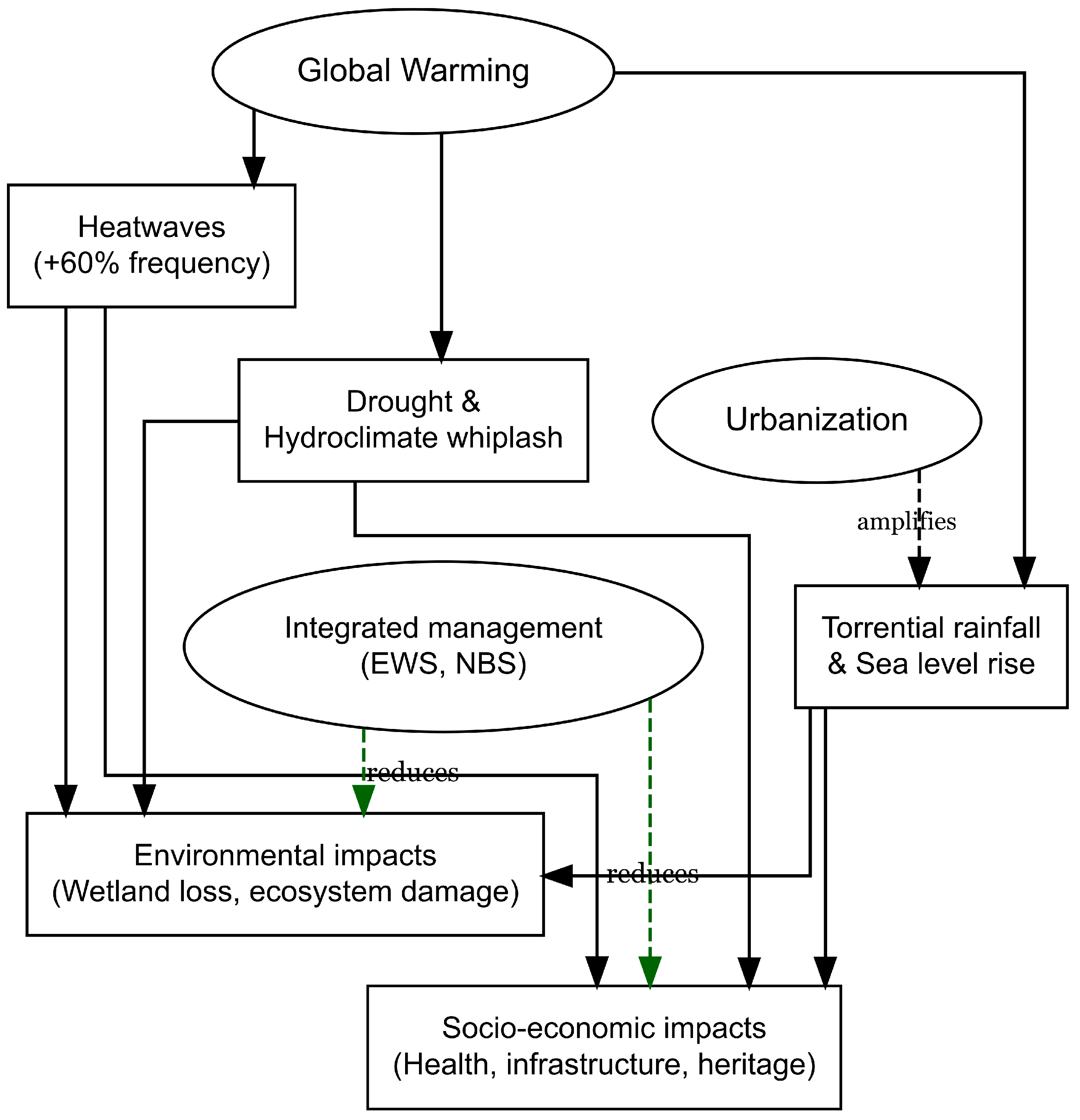
The cascade of hydro-climatic drivers, hazards, and their ultimate impacts on environmental and socio-economic systems is summarized in Figure 2.
Figure 2 illustrates a vertical cascade: global warming and urbanization intensify three major hazard types. Heatwaves increase in frequency (+60%), drought is coupled with abrupt wet-dry transitions (hydroclimate whiplash), and torrential rainfall together with sea-level rise drives flooding. These hazards converge to produce environmental and socio-economic damages, which can be partially reduced through integrated management strategies such as multi-hazard early warning systems and nature-based solutions.

3.6. Management Suggestions

Integrated management of compound hazards, showing multi-hazard early warning systems and the strengthening of urban infrastructure, is essential for reducing vulnerability [158,159]. The development and implementation of such systems using advanced technologies (e.g., remote sensing and artificial intelligence) can significantly improve the prediction of extreme and compound events [160,161]. Revisiting urban physical development patterns (through reducing impervious surfaces, expanding drought-resistant green spaces, and protecting river corridor and drainage way buffers) can play an effective role in mitigating urban hydroclimate whiplash impacts [162,163]. Furthermore, formulating and implementing nature-based solutions (including the restoration of natural riverbeds, development of green infrastructure, and incorporation of permeable surfaces into urban design) can enhance urban resilience to climate hazards [164,165]. Strengthening inter-sectoral coordination among disaster management organizations, the Ministry of Energy, and municipal authorities is a fundamental requirement for implementing evidence-based adaptation measures [166]. Regional-scale studies employing compound hazard analysis approaches and the development of simulation models that capture the simultaneous interaction of multiple hazards (e.g., concurrent heatwave and drought, or flooding from combined precipitation and storm surge) are recommended for long-term climate adaptation planning [53,167]. The impacts of hydro-climatic extremes are not confined to national borders. Similar patterns of heatwave intensification, drought prolongation, and wetland desiccation have been reported in neighboring countries, suggesting the influence of large-scale climatic drivers operating across the region. A comprehensive assessment of these transboundary similarities and differences would require systematic intercomparison of climate indices, land use data, and hydrological records from multiple countries. While the present study focuses on Iran, the results show the need for regional cooperation in monitoring and managing compound hazards, as climatic variability and extreme events share common physical drivers across the Middle East and Central Asia.
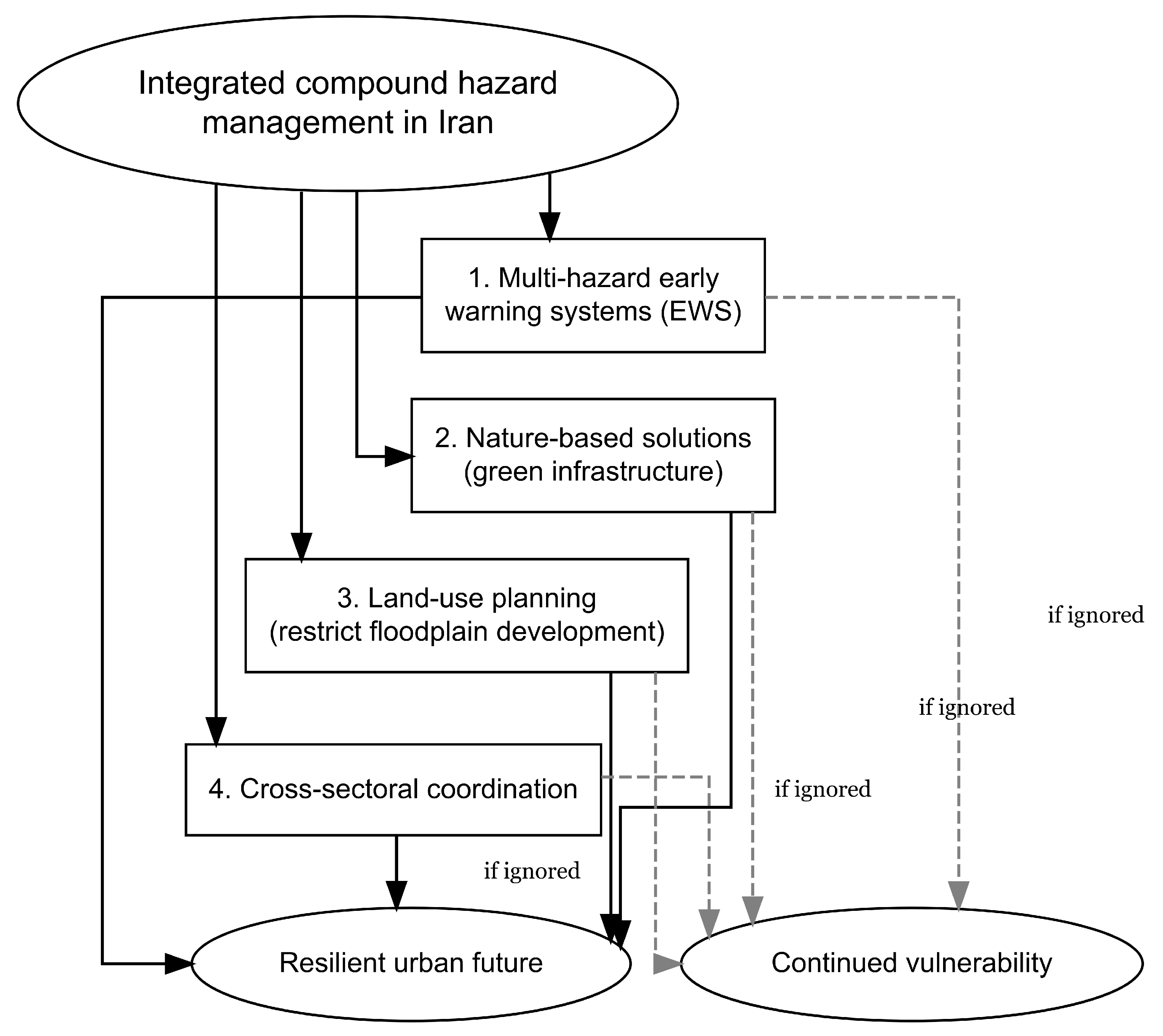
A set of actionable strategies for moving towards integrated compound hazard management, along with their conditional outcomes, is presented in Figure 3.
Figure 3 organizes four recommended management strategies into a vertical tree. Each strategy directly supports the goal of integrated compound hazard management. Successful implementation of all four leads to a resilient urban future characterized by reduced hazard impacts and enhanced adaptive capacity. If any of the strategies are ignored or poorly executed, the outcome shifts toward continued vulnerability, showing the need for a comprehensive and coordinated approach.

3.7. Future Research Directions

Based on the qualitative evidence synthesized in this review, future research should prioritize filling the identified knowledge gaps, including: assessing compound hazard risk at local and urban scales, examining the role of local factors (land use, population density, urban development patterns) in amplifying or mitigating hazards, and developing novel compound indices capable of simultaneously monitoring multiple hazards. Interdisciplinary studies involving collaboration among climatologists, urban planners, and disaster management experts are essential for developing integrated, context-specific solutions. The development of novel compound indices capable of simultaneously monitoring multiple hazards, along with investigations into the interactive effects of climate change and urbanization on extreme hazard patterns across different time horizons, represent key research priorities moving forward. This qualitative synthesis identifies priority regions (Zagros, western Iran, Persian Gulf coast), under-researched hazards (compound events, sea-level rise), and methodological gaps (lack of standardized indices), demonstrating the need for comparative transboundary studies on climatic variability in the Zagros and neighboring mountain ranges (Türkiye, Caucasus, Afghanistan) and wetland degradation (e.g., Lake Urmia, Hamoun) to understand shared drivers and develop joint adaptation strategies.

4. Conclusions

This scoping review of 92 scientific works published between 1999 and 2025 provides a comprehensive synthesis of extreme and compound climate hazards in Iranian urban areas under global warming. The results confirm that Iran is experiencing a significant intensification of heatwaves, droughts, torrential rainfall, sea level rise, and compound events, with clear spatiotemporal patterns.
Regarding heatwaves, the reviewed evidence indicates that central, northwestern, eastern, and southern Iran have the highest frequency and intensity, with short duration heatwaves being more common than prolonged ones. Autumn shows the peak occurrence, and an increasing trend is evident across all seasons. Torrential rainfall and associated flash floods are particularly pronounced in western Iran, where urbanization and reduced permeable surfaces exacerbate the risk. Historical events (e.g., March 2019 floods) demonstrate that synoptic conditions combined with human interventions have led to unprecedented flood damages. Sea level rise and intense storms make coastal areas (especially the Persian Gulf coastline) highly vulnerable to compound flooding, threatening population centers and infrastructure.
A noteworthy result is that Iran is already experiencing hydroclimate whiplash: abrupt, high amplitude transitions between prolonged drought and severe flood conditions. This phenomenon, driven by global warming, has increased in frequency by 31–66% at sub seasonal scales since the mid-20th century. Compound hazards (e.g., concurrent heatwave and drought, or cascading floods after droughts) produce impacts far exceeding the sum of individual events, as evidenced by the 2022 Iran Pakistan floods and the rapid desiccation of Lake Urmia.
The review also identifies major vulnerability drivers in Iranian urban areas: un-planned urban development, impervious surfaces, inadequate drainage, disregard for river corridors, and weak inter sectoral coordination. These factors amplify climate induced risks.
In terms of management and future research, the synthesized literature emphasizes the need for multi hazard early warning systems, nature-based solutions (green infrastructure, permeable surfaces, restoration of natural waterways), and integrated policies that address compound hazards holistically. Future studies should focus on local scale compound risk assessments, the role of artificial intelligence in hazard modeling, and equitable adaptation strategies for vulnerable urban populations.
Overall, this review demonstrates that global warming is not only increasing individual extreme events but also creating complex interactions that challenge conventional single hazard approaches. For Iran, addressing hydroclimate whiplash and compound hazards requires a paradigm shift from reactive disaster response to proactive, integrated risk management. As a scoping review, this study serves three functions: mapping the extent and characteristics of the available evidence, identifying knowledge gaps, and demonstrating management priorities to support future quantitative and policy-oriented studies.

Author Contributions

All authors contributed to the study conception and design. Material preparation, data collection and analysis were performed by authors. The first draft of the manuscript was written by N.M., R.M. and R.M. commented on previous versions of the manuscript. All authors have read and agreed to the published version of the manuscript.

Funding

The authors did not receive support from any organization for the submitted work.

Data Availability Statement

All data generated or analyzed during this study are included in this published article.

Conflicts of Interest

The authors declare that they have no competing or conflict of interests.

References

  1. Anwar, M.N.; Iftikhar, M.; Khush Bakhat, B.; Sohail, N.F.; Baqar, M.; Yasir, A.; Nizami, A.S. Sources of carbon dioxide and environmental issues. In Sustainable Agriculture Reviews 37: Carbon Sequestration Vol. 1 Introduction and Biochemical Methods; Springer International Publishing: Cham, Switzerland, 2020; pp. 13–36. [Google Scholar]
  2. Srivastav, A. Understanding the Warming Process. In The Science and Impact of Climate Change; Springer: Singapore, 2018; pp. 39–78. [Google Scholar]
  3. IPCC. Climate Change 2013: The Physical Science Basis. Contribution of Working Group I to the Fifth Assessment Report of the Intergovernmental Panel on Climate Change; Stocker, T.F., Qin, D., Plattner, G.-K., Tignor, M., Allen, S.K., Boschung, J., Nauels, A., Xia, Y., Bex, V., Midgley, P.M., Eds.; Cambridge University Press: Cambridge, UK; New York, NY, USA, 2013; 1535p. [Google Scholar]
  4. Smith, K.A. The impact of agriculture and other land uses on emissions of methane and nitrous and nitric oxides. Environ. Sci. 2005, 2, 101–108. [Google Scholar] [CrossRef]
  5. Abdullah, A.A. Global effects of atmospheric emissions. NeuroQuantology 2021, 19, 35–42. [Google Scholar] [CrossRef]
  6. Houghton, J. Global Warming: The Complete Briefing; Cambridge University Press: Cambridge, UK, 2009. [Google Scholar]
  7. Robinson, W.A. Climate change and extreme weather: A review focusing on the continental United States. J. Air Waste Manag. Assoc. 2021, 71, 1186–1209. [Google Scholar] [CrossRef]
  8. Eblaghian, A.; Ali, A.A.; Radmanesh, F.; Zarei, H. Trend analysis of temperature, precipitation, and relative humidity changes in Iran. J. Irrig. Drain. Eng. 2019, 42, 197–212. [Google Scholar]
  9. Beyranvand, A.; Doostkamian, M.; Heidari, S.; Goodarzi, M. Analyzing Spatio-Temporal Variations of Extreme Index of heating and cooling waves in Iran. Geogr. Plan. Space Q. J. 2023, 13, 105–121. [Google Scholar]
  10. Mianabadi, A.; Davary, K. Investigation of Changes in the Amount and Distribution of Precipitation and Temperature in Iran and Their Effects on Extreme Events. J. Water Sustain. Dev. 2023, 10, 13–26. [Google Scholar] [CrossRef]
  11. Asadi, E.; Ghorbani, M.A.; Pouyamehr, T.; Allahverdipour, P. Investigating the Effect of Global Warming on the Temperature Changes in Iran. Environ. Int. Dev. 2025, 10, 34–49. [Google Scholar] [CrossRef]
  12. Lee, H.; Calvin, K.; Dasgupta, D.; Krinner, G.; Mukherji, A.; Thorne, P.; Trisos, C.; Romero, J.; Aldunce, P.; Barrett, K.; et al. Climate Change 2023: Synthesis Report. Contribution of Working Groups I, II and III to the Sixth Assessment Report of the Intergovernmental Panel on Climate Change; IPCC: Geneva, Switzerland, 2023. [Google Scholar]
  13. Salinger, M.J. Climate variability and change: Past, present and future–an overview. Clim. Change 2005, 70, 9–29. [Google Scholar] [CrossRef]
  14. Luo, M.; Lau, N.C. Increasing heat stress in urban areas of eastern China: Acceleration by urbanization. Geophys. Res. Lett. 2018, 45, 13060–13069. [Google Scholar] [CrossRef]
  15. Zwiers, F.W.; Alexander, L.V.; Hegerl, G.C.; Knutson, T.R.; Kossin, J.P.; Naveau, P.; Nicholls, N.; Schär, C.; Seneviratne, S.I.; Zhang, X. Climate Extremes: Challenges in Estimating and Understanding Recent Changes in the Frequency and Intensity of Extreme Climate and Weather Events. In Climate Science for Serving Society: Research, Modeling and Prediction Priorities; Springer: Dordrecht, The Netherlands, 2013; pp. 339–389. [Google Scholar]
  16. Boo, K.O.; Kwon, W.T.; Baek, H.J. Change of extreme events of temperature and precipitation over Korea using regional projection of future climate change. Geophys. Res. Lett. 2006, 33, L01701. [Google Scholar] [CrossRef]
  17. Seneviratne, S.; Nicholls, N.; Easterling, D.; Goodess, C.; Kanae, S.; Kossin, J.; Luo, Y.; Marengo, J.; McInnes, K.; Rahimi, M.; et al. Changes in Climate Extremes and Their Impacts on the Natural Physical Environment; Cambridge University Press: Cambridge, UK, 2012. [Google Scholar]
  18. Stott, P. How climate change affects extreme weather events. Science 2016, 352, 1517–1518. [Google Scholar] [CrossRef] [PubMed]
  19. Norouzi, A.; Habibi, H.; Nazari, B.; Noh, S.J.; Seo, D.J.; Zhang, Y. Toward parsimonious modeling of frequency of areal runoff from heavy-to-extreme precipitation in large urban areas under changing conditions: A derived moment approach. Stoch. Environ. Res. Risk Assess. 2019, 33, 1263–1281. [Google Scholar] [CrossRef]
  20. Greenough, G.; McGeehin, M.; Bernard, S.M.; Trtanj, J.; Riad, J.; Engelberg, D. The potential impacts of climate variability and change on health impacts of extreme weather events in the United States. Environ. Health Perspect. 2001, 109, 191. [Google Scholar]
  21. Solomon, S.; Manning, M.; Marquis, M.; Qin, D. Climate Change 2007—The Physical Science Basis. Working Group I Contribution to the Fourth Assessment Report of the IPCC; Cambridge University Press: Cambridge, UK, 2007; Volume 4. [Google Scholar]
  22. Choi, G.; Collins, D.; Ren, G.; Trewin, B.; Baldi, M.; Fukuda, Y.; Afzaal, M.; Pianmana, T.; Gomboluudev, P.; Huong, P.T.T.; et al. Changes in means and extreme events of temperature and precipitation in the Asia-Pacific Network region, 1955–2007. Int. J. Climatol. 2009, 29, 1906–1925. [Google Scholar] [CrossRef]
  23. New, M.; Hewitson, B.; Stephenson, D.B.; Tsiga, A.; Kruger, A.; Manhique, A.; Gomez, B.; Coelho, C.A.; Masisi, D.N.; Kululanga, E.; et al. Evidence of trends in daily climate extremes over southern and west Africa. J. Geophys. Res. Atmos. 2006, 111, D14102. [Google Scholar] [CrossRef]
  24. Dezfuli, A. Rare atmospheric river caused record floods across the Middle East. Bull. Am. Meteorol. Soc. 2020, 101, E394–E400. [Google Scholar] [CrossRef]
  25. Motagh, M.; Akhani, H. The cascading failure of check dam systems during the 28 July 2022 Emamzadeh Davood flood in Iran. Nat. Hazards 2023, 116, 4051–4057. [Google Scholar] [CrossRef]
  26. Rezaee, A.; Goodarzi, M.R.; Etemadfard, H.; Alavizadeh, M. A copula-based framework for assessing heat wave extremes and probability of occurrence in Iran: Implications for climate change. Stoch. Environ. Res. Risk Assess. 2025, 39, 2461–2477. [Google Scholar] [CrossRef]
  27. McPhillips, L.E.; Chang, H.; Chester, M.V.; Depietri, Y.; Friedman, E.; Grimm, N.B.; Kominoski, J.S.; McPhearson, T.; Méndez-Lázaro, P.; Rosi, E.J.; et al. Defining extreme events: A cross-disciplinary review. Earth’s Future 2018, 6, 441–455. [Google Scholar] [CrossRef]
  28. Camps-Valls, G.; Fernández-Torres, M.Á.; Cohrs, K.H.; Höhl, A.; Castelletti, A.; Pacal, A.; Robin, C.; Martinuzzi, F.; Papoutsis, I.; Prapas, I.; et al. Artificial intelligence for modeling and understanding extreme weather and climate events. Nat. Commun. 2025, 16, 1919. [Google Scholar] [CrossRef]
  29. Leonard, M.; Westra, S.; Phatak, A.; Lambert, M.; van den Hurk, B.; McInnes, K.; Risbey, J.; Schuster, S.; Jakob, D.; Stafford-Smith, M. A compound event framework for understanding extreme impacts. Wiley Interdiscip. Rev. Clim. Change 2014, 5, 113–128. [Google Scholar] [CrossRef]
  30. Zscheischler, J.; Martius, O.; Westra, S.; Bevacqua, E.; Raymond, C.; Horton, R.M.; van den Hurk, B.; AghaKouchak, A.; Jézéquel, A.; Mahecha, M.D.; et al. A typology of compound weather and climate events. Nat. Rev. Earth Environ. 2020, 1, 333–347. [Google Scholar] [CrossRef]
  31. Lak, R.; Mohammadi, A.; Darvishikhatooni, J.; Aghaali, E. Flood on 28th July 2022 Imamzadeh Davood; lessons for understanding the flood risk in the north of Tehran. Sci. Q. J. Geosci. 2024, 34, 133. [Google Scholar]
  32. Asadi-RahimBeygi, N.; Mofidi, A.; Zarrin, A.; Dadashi-Roudbari, A. Near-term climate extremes in Iran based on compound hazards analysis. Sci. Rep. 2025, 15, 43843. [Google Scholar] [CrossRef] [PubMed]
  33. Steffen, W.; Grinevald, J.; Crutzen, P.; McNeill, J. The Anthropocene: Conceptual and historical perspectives. Philos. Trans. R. Soc. A 2011, 369, 842–867. [Google Scholar] [CrossRef]
  34. Upreti, G. Climate change and its threat to humanity in the anthropocene. In Ecosociocentrism: The Earth First Paradigm for Sustainable Living; Springer Nature: Cham, Switzerland, 2023; pp. 137–162. [Google Scholar]
  35. Stoa, R.B. Droughts, floods, and wildfires: Paleo perspectives on disaster law in the Anthropocene. Georget. Environ. Law Rev. 2014, 27, 393. [Google Scholar]
  36. Li-An, C.; Billa, L.; Azari, M. Anthropocene climate and landscape change that increases flood disasters. Int. J. Hydrol. 2018, 2, 487–491. [Google Scholar] [CrossRef]
  37. Esgandari, R.; Esmali Ouri, A.; Mostafazadeh, R.; Choobeh, S. Assessment of temporal and spatial variations of precipition climate extreme indexes in the central part of Ardabil province. J. Environ. Sci. Stud. 2024, 9, 8119–8133. [Google Scholar]
  38. Azizi, E.; Mostafazadeh, R.; Hazbavi, Z.; Esmali Ouri, A.; Mirzaie, S.; Huang, G.; Qian, X. Spatial distribution of flood vulnerability index in Ardabil province, Iran. Stoch. Environ. Res. Risk Assess. 2022, 36, 4355–4375. [Google Scholar] [CrossRef]
  39. Mostafazadeh, R.; Nasiri Khiavi, A.; Talebi Khiavi, H. Iso-severity flood hazard patterns in diverse relief and climatic regions to support flood management. Nat. Hazards 2025, 121, 17793–17814. [Google Scholar] [CrossRef]
  40. Bronstert, A. Floods and climate change: Interactions and impacts. Risk Anal. Int. J. 2003, 23, 545–557. [Google Scholar] [CrossRef] [PubMed]
  41. Asgari, E.; Mostafazadeh, R.; Talebi Khiavi, H. Projecting the climate change impact on water yield in a cold mountainous watershed, Ardabil. J. Earth Space Phys. 2025, 50, 165–177. [Google Scholar]
  42. Dharmarathne, G.; Waduge, A.O.; Bogahawaththa, M.; Rathnayake, U.; Meddage, D.P.P. Adapting cities to the surge: A comprehensive review of climate-induced urban flooding. Results Eng. 2024, 22, 102123. [Google Scholar] [CrossRef]
  43. Otto, F.E. Attribution of weather and climate events. Annu. Rev. Environ. Resour. 2017, 42, 627–646. [Google Scholar] [CrossRef]
  44. Easterling, D.R.; Meehl, G.A.; Parmesan, C.; Changnon, S.A.; Karl, T.R.; Mearns, L.O. Climate extremes: Observations, modeling, and impacts. Science 2000, 289, 2068–2074. [Google Scholar] [CrossRef]
  45. Donner, W.; Rodriguez, H.; Brotzge, J.; Diaz, W.R. Historical, technical, and social evolution of US warning systems. In Severe Weather Warnings: An Interdisciplinary Approach; Springer International Publishing: Cham, Switzerland, 2022; pp. 13–36. [Google Scholar]
  46. Basara, J.B.; Maybourn, J.N.; Peirano, C.M.; Tate, J.E.; Brown, P.J.; Hoey, J.D.; Smith, B.R. Drought and associated impacts in the Great Plains of the United States—A review. Int. J. Geosci. 2013, 4, 72–81. [Google Scholar] [CrossRef]
  47. Mansouri Daneshvar, M.R.; Ebrahimi, M.; Nejadsoleymani, H. An overview of climate change in Iran: Facts and statistics. Environ. Syst. Res. 2019, 8, 1–10. [Google Scholar] [CrossRef]
  48. Lott, N.; Ross, T. Tracking and Evaluating U.S. Billion Dollar Weather Disasters, 1980–2005; NOAA’s National Climatic Data Center: Asheville, NC, USA, 2005. Available online: https://www.ncdc.noaa.gov/billions/ (accessed on 18 May 2026).
  49. Bell, J.E.; Brown, C.L.; Conlon, K.; Herring, S.; Kunkel, K.E.; Lawrimore, J.; Luber, G.; Schreck, C.; Smith, A.; Uejio, C. Changes in extreme events and the potential impacts on human health. J. Air Waste Manag. Assoc. 2018, 68, 265–287. [Google Scholar] [CrossRef]
  50. Hewitt, K.; Burton, I. The Hazardousness of a Place: A Regional Ecology of Damaging Events; University of Toronto Press: Toronto, ON, Canada, 1971; Available online: https://www.ilankelman.org/miscellany/hewittetal.1971.pdf (accessed on 23 September 2025).
  51. White, C.J. The Use of Joint Probability Analysis to Predict Flood Frequency in Estuaries and Tidal Rivers. Doctoral Dissertation, University of Southampton, Southampton, UK, 2007. [Google Scholar]
  52. IPCC. Managing the Risks of Extreme Events and Disasters to Advance Climate Change Adaptation: Special Report of the Intergovernmental Panel on Climate Change; Cambridge University Press: Cambridge, UK, 2012; Available online: https://www.ipcc.ch/report/srex/ (accessed on 15 May 2026).
  53. Zscheischler, J.; Westra, S.; van den Hurk, B.J.J.M.; Seneviratne, S.I.; Ward, P.J.; Pitman, A.; AghaKouchak, A.; Bresch, D.N.; Leonard, M.; Wahl, T.; et al. Future climate risk from compound events. Nat. Clim. Change 2018, 8, 469–477. [Google Scholar] [CrossRef]
  54. Intergovernmental Panel on Climate Change. Chapter 11: Weather and Climate Extreme Events in a Changing Climate. In Climate Change 2021: The Physical Science Basis. Contribution of Working Group I to the Sixth Assessment Report of the Intergovernmental Panel on Climate Change; Cambridge University Press: Cambridge, UK, 2021; Available online: https://www.ipcc.ch/report/ar6/wg1/downloads/report/IPCC_AR6_WGI_Chapter11.pdf (accessed on 18 May 2026).
  55. Lau, Y.Y.; Yip, T.L.; Dulebenets, M.A.; Tang, Y.M.; Kawasaki, T. A review of historical changes of tropical and extra-tropical cyclones: A comparative analysis of the United States, Europe, and Asia. Int. J. Environ. Res. Public Health 2022, 19, 4499. [Google Scholar] [CrossRef]
  56. Alimohamadian, L.; Mostafazadeh, R. Frequency analysis and trend of maximum wind speed for different return periods in a cold diverse topographical region of Iran. Climate 2025, 13, 138. [Google Scholar] [CrossRef]
  57. Soltani, M.; Laux, P.; Kunstmann, H.; Stan, K.; Sohrabi, M.M.; Molanejad, M.; Sabziparvar, A.A.; Ranjbar SaadatAbadi, A.; Ranjbar, F.; Rousta, I.; et al. Assessment of climate variations in temperature and precipitation extreme events over Iran. Theor. Appl. Climatol. 2016, 126, 775–795. [Google Scholar] [CrossRef]
  58. Samantray, P.; Gouda, K.C. A review on the extreme rainfall studies in India. Nat. Hazards Res. 2024, 4, 347–356. [Google Scholar] [CrossRef]
  59. Zhang, Y.; Ayyub, B.M.; Fung, J.F.; Labe, Z.M. Incorporating extreme event attribution into climate change adaptation for civil infrastructure: Methods, benefits, and research needs. Resilient Cities Struct. 2024, 3, 103–113. [Google Scholar] [CrossRef]
  60. Noy, I.; Stone, D.; Uher, T. Extreme events impact attribution: A state of the art. Cell Rep. Sustain. 2024, 1, 100101. [Google Scholar] [CrossRef]
  61. Kumar, S.; Chatterjee, U.; David Raj, A.; Sooryamol, K.R. Global Warming and Climate Crisis/Extreme Events. In Climate Crisis: Adaptive Approaches and Sustainability; Springer Nature: Cham, Switzerland, 2024; pp. 3–18. [Google Scholar]
  62. Xiong, J.; Yang, Y. Climate change and hydrological extremes. Curr. Clim. Change Rep. 2024, 11, 1. [Google Scholar] [CrossRef]
  63. Taye, M.T.; Dyer, E. Hydrologic extremes in a changing climate: A review of extremes in East Africa. Curr. Clim. Change Rep. 2024, 10, 1–11. [Google Scholar] [CrossRef]
  64. Wang, C.; Li, Z.; Chen, Y.; Ouyang, L.; Zhao, H.; Zhu, J.; Wang, J.; Zhao, Y. Characteristic changes in compound drought and heatwave events under climate change. Atmos. Res. 2024, 305, 107440. [Google Scholar] [CrossRef]
  65. Binesh, N.; Niksokhan, M.H.; Sarang, A.; Rauch, W. Improving sustainability of urban drainage systems for climate change adaptation using best management practices: A case study of Tehran, Iran. Hydrol. Sci. J. 2019, 64, 381–404. [Google Scholar] [CrossRef]
  66. Sarkis-Onofre, R.; Catalá-López, F.; Aromataris, E.; Lockwood, C. How to properly use the PRISMA Statement. Syst. Rev. 2021, 10, 117. [Google Scholar] [CrossRef]
  67. Hannousse, A. Searching relevant papers for software engineering secondary studies: Semantic Scholar coverage and identification role. IET Softw. 2021, 15, 126–146. [Google Scholar] [CrossRef]
  68. Polanin, J.R.; Pigott, T.D.; Espelage, D.L.; Grotpeter, J.K. Best practice guidelines for abstract screening large-evidence systematic reviews and meta-analyses. Res. Synth. Methods 2019, 10, 330–342. [Google Scholar] [CrossRef]
  69. O’Connor, A.M.; Anderson, K.M.; Goodell, C.K.; Sargeant, J.M. Conducting systematic reviews of intervention questions I: Writing the review protocol, formulating the question and searching the literature. Zoonoses Public Health 2014, 61, 28–38. [Google Scholar] [CrossRef]
  70. Sarvari, H. A survey of relationship between urbanization and climate change for major cities in Iran. Arab J. Geosci. 2019, 12, 131. [Google Scholar] [CrossRef]
  71. Emadodin, I.; Taravat, A.; Rajaei, M. Effects of urban sprawl on local climate: A case study, north central Iran. Urban Clim. 2016, 17, 230–247. [Google Scholar] [CrossRef]
  72. Nourani, V.; Najafi, H. Historical changes in hydroclimatic extreme events over Iran. In Climate Impacts on Extreme Weather; Elsevier: Amsterdam, The Netherlands, 2022; pp. 101–115. [Google Scholar]
  73. Malaekeh, S.; Safaie, A.; Shiva, L.; Tabari, H. Spatio-temporal variation of hydro-climatic variables and extreme indices over Iran based on reanalysis data. Stoch. Environ. Res. Risk Assess. 2022, 36, 3725–3752. [Google Scholar] [CrossRef]
  74. Eslamian, S.; Nasehi, N.; Maleki, M. Improvement of Urban Socio-Hydrologic Resilience in Extreme Hydro-Climatic Conditions. In Disaster Risk Reduction for Resilience: Disaster Socio-Hydrological Resilience and Sustainability; Springer International Publishing: Cham, Switzerland, 2023; pp. 25–37. [Google Scholar]
  75. Salarijazi, M.; Ghorbani, K.; Mohammadi, M.; Ahmadianfar, I.; Mohammadrezapour, O.; Naser, M.H.; Yaseen, Z.M. Spatial-temporal estimation of maximum temperature high returns periods for annual time series considering stationary/nonstationary approaches in Iran urban area. Urban Clim. 2023, 49, 101504. [Google Scholar] [CrossRef]
  76. Afsari, R.; Nazari-Sharabian, M.; Hosseini, A.; Karakouzian, M. Projected climate change impacts on the number of dry and very heavy precipitation days by century’s end: A case study of Iran’s metropolises. Water 2024, 16, 2226. [Google Scholar] [CrossRef]
  77. Safaei, V.; Zarrin, A.; Mosaedi, A.; Dadashi-Roudbari, A. Intensifying droughts and their relationship with temperature and precipitation extremes in Iran. Theor. Appl. Climatol. 2025, 156, 465. [Google Scholar] [CrossRef]
  78. Moore, R.D.; Spittlehouse, D.L.; Whitfield, P.H.; Stahl, K. Weather and climate. Compend. For. Hydrol. Geomorphol. Br. Columbia 2010, 1, 47–84. [Google Scholar]
  79. Kirchmeier-Young, M.C.; Wan, H.; Zhang, X.; Seneviratne, S.I. Importance of framing for extreme event attribution: The role of spatial and temporal scales. Earth’s Future 2019, 7, 1192–1204. [Google Scholar] [CrossRef]
  80. Fang, J.; Zhu, J.; Wang, S.; Yue, C.; Shen, H. Global warming, human-induced carbon emissions, and their uncertainties. Sci. China Earth Sci. 2011, 54, 1458–1468. [Google Scholar] [CrossRef]
  81. Meehl, G.A.; Tebaldi, C. More intense, more frequent, and longer lasting heat waves in the 21st century. Science 2004, 305, 994–997. [Google Scholar] [CrossRef]
  82. Doostan, R.; Etemadian, E.; Zarrin, A. Zones of Heat waves in Iran. Clim. Res. 2020, 1399, 17–30. [Google Scholar]
  83. Handmer, J.; Honda, Y.; Kundzewicz, Z.W.; Arnell, N.; Benito, G.; Hatfield, J.; Mohamed, I.F.; Peduzzi, P.; Wu, S.; Sherstyukov, B.; et al. Changes in impacts of climate extremes: Human systems and ecosystems. In Managing the Risks of Extreme Events and Disasters to Advance Climate Change Adaptation Special Report of the Intergovernmental Panel on Climate Change; Cambridge University Press: Cambridge, UK, 2012; pp. 231–290. [Google Scholar]
  84. Roberts, J.L. Climate Change and Heatwaves. In Shaping the Future of Small Islands: Roadmap for Sustainable Development; Springer Nature: Singapore, 2020; pp. 233–248. [Google Scholar]
  85. He, C.; Yin, P.; Liu, Z.; Huang, J.; Chen, Y.; Gao, X.; Xu, Y.; Wang, C.; Cai, W.; Gong, P.; et al. Projections of excess deaths related to cold spells under climate and population change scenarios: A nationwide time series modeling study. Environ. Int. 2023, 178, 108034. [Google Scholar] [CrossRef]
  86. Huynen, M.M.; Martens, P.; Schram, D.; Weijenberg, M.P.; Kunst, A.E. The impact of heat waves and cold spells on mortality rates in the Dutch population. Environ. Health Perspect. 2001, 109, 463. [Google Scholar] [CrossRef]
  87. Seneviratne, S.I.; Zhang, X.; Adnan, M.; Badi, W.; Dereczynski, C.; Luca, A.D.; Ghosh, S.; Iskandar, I.; Kossin, J.; Lewis, S.; et al. Weather and Climate Extreme Events in a Changing Climate. In Climate Change 2021: The Physical Science Basis. Working Group I Contribution to the Sixth Assessment Report of the Intergovernmental Panel on Climate Change; Cambridge University Press: Cambridge, UK, 2021; pp. 1513–1766. [Google Scholar]
  88. Marjanac, S.; Patton, L. Extreme weather event attribution science and climate change litigation: An essential step in the causal chain? J. Energy Nat. Resour. Law 2018, 36, 265–298. [Google Scholar] [CrossRef]
  89. Abbasnia, M.; Tavousi, T.; Khosravi, M.; Toros, H. Spatial-temporal analysis of heat waves in Iran over the last three decades. Nat. Clim. Change 2016, 2, 25–33. [Google Scholar]
  90. Namroodi, M.; Hamidianpour, M.; Poodineh, M. Spatio-temporal analysis of changes in heat and cold waves across Iran over the statistical period 1966–2018. Arab. J. Geosci. 2021, 14, 857. [Google Scholar] [CrossRef]
  91. Kumar, R.; Mishra, V. Decline in surface urban heat island intensity in India during heatwaves. Environ. Res. Commun. 2019, 1, 031001. [Google Scholar] [CrossRef]
  92. World Health Organization. Improving Public Health Responses to Extreme Weather/Heat-Waves: EuroHEAT, Report on a WHO Meeting, Bonn, Germany 22–23 March 2007 (No. EUR/07/5067942); WHO Regional Office for Europe: Copenhagen, Denmark, 2008. [Google Scholar]
  93. Easterling, D.R.; Evans, J.L.; Groisman, P.Y.; Karl, T.R.; Kunkel, K.E.; Ambenje, P. Observed variability and trends in extreme climate events: A brief review. Bull. Am. Meteorol. Soc. 2000, 81, 417–426. [Google Scholar] [CrossRef]
  94. Marx, W.; Haunschild, R.; Bornmann, L. Heat waves: A hot topic in climate change research. Theor. Appl. Climatol. 2021, 146, 781–800. [Google Scholar] [CrossRef]
  95. Ghavidel, Y.; Farajzadeh, M.; Ghahramani, B. The application of extreme value analysis method in heat wave hazard climatology; case study in Mid-Southern Iran. J. Spat. Anal. Environ. Hazarts 2019, 6, 1–17. [Google Scholar] [CrossRef]
  96. Maleki Meresht, R.; Rezaei Banafsheh Daragh, M.; Sobhani, B.; Moradi, M. Simulation and Forecasting of Maximum Temperature and Heat Waves in Urmia City. J. Urban Ecol. Res. 2024, 15, 43–60. [Google Scholar]
  97. Esmaeili Mahmoudabadi, A.; Shamsipour, A.; Mohammadi, H. Identification and analysis of the temporal-spatial trend of heat waves in Tehran. Environ. Manag. Hazards 2025, 12, 65–80. [Google Scholar]
  98. Hejazizadeh, Z.; Akbari, M.; Sasanpour, F.; Hosseini, A.; Mohammadi, N. Investigating the effects of climate change on torrential rains in Tehran province. Water Soil Manag. Model. 2022, 2, 87–105. [Google Scholar]
  99. Arnell, N.W.; Lloyd-Hughes, B. The global-scale impacts of climate change on water resources and flooding under new climate and socio-economic scenarios. Clim. Change 2014, 122, 127–140. [Google Scholar] [CrossRef]
  100. Allaire, M. Socio-economic impacts of flooding: A review of the empirical literature. Water Secur. 2018, 3, 18–26. [Google Scholar] [CrossRef]
  101. Panagoulia, D.; Dimou, G. Sensitivity of flood events to global climate change. J. Hydrol. 1997, 191, 208–222. [Google Scholar] [CrossRef]
  102. Ologunorisa, T.E.; Tersoo, T. The changing rainfall pattern and its implication for flood frequency in Makurdi, Northern Nigeria. J. Appl. Sci. Environ. Manag. 2006, 10, 97–102. [Google Scholar] [CrossRef]
  103. Wasko, C.; Nathan, R.; Stein, L.; O’Shea, D. Evidence of shorter more extreme rainfalls and increased flood variability under climate change. J. Hydrol. 2021, 603, 126994. [Google Scholar] [CrossRef]
  104. Gimechi, S.; Mostafazadeh, R.; Alimohamadian, L. Analysis of extreme precipitation trends and probability distributions across return periods in northwest Iran. Geogr. Časopis/Geogr. J. 2025, 77, 43–55. [Google Scholar] [CrossRef]
  105. Ferdowsi, A.; Piadeh, F.; Behzadian, K.; Mousavi, S.F.; Ehteram, M. Urban water infrastructure: A critical review on climate change impacts and adaptation strategies. Urban Clim. 2024, 58, 102132. [Google Scholar] [CrossRef]
  106. Mohammadi, M.; Akbary, M. Climatological Analysis of Extreme and Widespread Precipitations in Southeast of Iran. Water Soil 2022, 35, 891–907. [Google Scholar] [CrossRef]
  107. Eslahi, M.; Pourasghar, F.; Akbarzadeh, Y.; Omidfar, M.; Mansouri Derakhshan, N.; Shahmary, A. Determining the Areas Most Affected by Flood and Statistical-Synoptic Analysis of Flood Events In East Azerbaijan Province. Nivar 2022, 46, 85–94. [Google Scholar]
  108. Fakour, P.; Ustrnul, Z.; Wypych, A. Risk assessment of extreme precipitation in northwest Iran in the light of changing climate. Int. J. Climatol. 2025, 45, e8854. [Google Scholar] [CrossRef]
  109. Akbari, M.; Neamatollahi, E.; Memarian, H.; Alizadeh Noughani, M. Assessing impacts of floods disaster on soil erosion risk based on the RUSLE-GloSEM approach in western Iran. Nat. Hazards 2023, 117, 1689–1710. [Google Scholar] [CrossRef]
  110. Lashkari, H.; Mohammadi, Z.; Jafari, M. Investigation on dynamical structure and moisture sources of heavy precipitation in south and south-west of Iran. Arab. J. Geosci. 2020, 13, 1140. [Google Scholar] [CrossRef]
  111. Miri, M.; Raziei, T.; Zand, M.; Kousari, M.R. Synoptic aspects of two flash flood-inducing heavy rainfalls in southern Iran during 2019–2020. Nat. Hazards 2023, 115, 2655–2672. [Google Scholar] [CrossRef]
  112. Fazel-Rastgar, F. Extreme weather events related to climate change: Widespread flooding in Iran, March–April 2019. SN Appl. Sci. 2020, 2, 2166. [Google Scholar] [CrossRef]
  113. Moradi, M.; Ranjbar, A. Case study of flood rainfall in March 2019. Nivar 2019, 43, 78–94. [Google Scholar]
  114. Ghasemi, A.R.; Khalili, D. The association between regional and global atmospheric patterns and winter precipitation in Iran. Atmos. Res. 2008, 88, 116–133. [Google Scholar] [CrossRef]
  115. Asadolahi, E.; Akbary, M.; Hejazizadeh, Z. Identification of days with heavy rainfall based on regional thresholding in Iran. J. Geogr. Plan. 2026, 30, 299–310. [Google Scholar]
  116. Manda, A.; Nakamura, H.; Asano, N.; Iizuka, S.; Miyama, T.; Moteki, Q.; Yoshioka, M.K.; Nishii, K.; Miyasaka, T. Impacts of a warming marginal sea on torrential rainfall organized under the Asian summer monsoon. Sci. Rep. 2014, 4, 5741. [Google Scholar] [CrossRef]
  117. Takahashi, H.G.; Fujinami, H. Recent decadal enhancement of meiyu–baiu heavy rainfall over East Asia. Sci. Rep. 2021, 11, 13665. [Google Scholar] [CrossRef] [PubMed]
  118. Torresan, S.; Critto, A.; Dalla Valle, M.; Harvey, N.; Marcomini, A. Assessing coastal vulnerability to climate change: Comparing segmentation at global and regional scales. Sustain. Sci. 2008, 3, 45–65. [Google Scholar] [CrossRef]
  119. Small, C.; Gornitz, V.; Cohen, J.E. Coastal hazards and the global distribution of human population. Environ. Geosci. 2000, 7, 3–12. [Google Scholar] [CrossRef]
  120. Small, C.; Nicholls, R.J. A global analysis of human settlement in coastal zones. J. Coast. Res. 2003, 19, 584–599. [Google Scholar]
  121. Ruan, X.; Sun, H.; Shou, W.; Wang, J. The impact of climate change and urbanization on compound flood risks in coastal areas: A comprehensive review of methods. Appl. Sci. 2024, 14, 10019. [Google Scholar] [CrossRef]
  122. Gori, A.; Lin, N.; Xi, D. Tropical cyclone compound flood hazard assessment: From investigating drivers to quantifying extreme water levels. Earth’s Future 2020, 8, e2020EF001660. [Google Scholar] [CrossRef]
  123. Woodruff, J.D.; Irish, J.L.; Camargo, S.J. Coastal flooding by tropical cyclones and sea-level rise. Nature 2013, 504, 44–52. [Google Scholar] [CrossRef]
  124. Shen, Y.; Morsy, M.M.; Huxley, C.; Tahvildari, N.; Goodall, J.L. Flood risk assessment and increased resilience for coastal urban watersheds under the combined impact of storm tide and heavy rainfall. J. Hydrol. 2019, 579, 124159. [Google Scholar] [CrossRef]
  125. Ali Mohammadi, M.; Pakhireh Zan, M.; Khwarazmi, S. Investigating the Changes in the Nature of Tropical Cyclones Due to Climate Change. Nivar 2022, 46, 28–43. [Google Scholar]
  126. Sarhadi, A.; Rousseau-Rizzi, R.; Mandli, K.; Neal, J.; Wiper, M.P.; Feldmann, M.; Emanuel, K. Climate change contributions to increasing compound flooding risk in New York City. Bull. Am. Meteorol. Soc. 2024, 105, E337–E356. [Google Scholar] [CrossRef]
  127. Hsiao, S.C.; Chiang, W.S.; Jang, J.H.; Wu, H.L.; Lu, W.S.; Chen, W.B.; Wu, Y.T. Flood risk influenced by the compound effect of storm surge and rainfall under climate change for low-lying coastal areas. Sci. Total Environ. 2021, 764, 144439. [Google Scholar] [CrossRef] [PubMed]
  128. Sharif, M.; Attarchi, S. Investigating long-term trends of sea level anomalies in the Persian Gulf and the parameters affecting it using multi-source data. Iran-Water Resour. Res. 2022, 18, 157–179. [Google Scholar]
  129. Irani, M.; Naderi, M.M.; Bavani, A.R.M.; Hassanzadeh, E.; Moftakhari, H. A framework for coastal flood hazard assessment under sea level rise: Application to the Persian Gulf. J. Environ. Manag. 2024, 349, 119502. [Google Scholar] [CrossRef] [PubMed]
  130. Hadipour, V.; Vafaie, F.; Deilami, K. Coastal flooding risk assessment using a GIS-based spatial multi-criteria decision analysis approach. Water 2020, 12, 2379. [Google Scholar] [CrossRef]
  131. Goharnejad, H.; Shamsai, A.; Hosseini, S.A. Vulnerability assessment of southern coastal areas of Iran to sea level rise: Evaluation of climate change impact. Oceanologia 2013, 55, 611–637. [Google Scholar] [CrossRef]
  132. Beni, A.N.; Leduc, G.; Djamali, M.; Sharifi, A.; Marriner, N.; Tachikawa, K.; Rostek, F.; Tjallingii, R.; Lahijani, H.; Arabshahi, M.M.; et al. Postglacial flooding and Holocene climate shifts in the Persian Gulf. J. Quat. Sci. 2024, 39, 592–607. [Google Scholar] [CrossRef]
  133. Najah, A.; Merwe, R.V.D.; Al Shehhi, M.R. Review of tropical cyclones impacting the Western Arabian Sea and Oman. J. Oper. Oceanogr. 2025, 18, 21–39. [Google Scholar] [CrossRef]
  134. Ebi, K.L. Understanding the risks of compound climate events and cascading risks. Dialogues Clim. Change 2025, 2, 33–37. [Google Scholar] [CrossRef]
  135. Dhungana, B.; Liu, W. Urban–Rural exposure to flood hazard and social vulnerability in the conterminous United States. ISPRS Int. J. Geo-Inf. 2024, 13, 339. [Google Scholar] [CrossRef]
  136. Cea, L.; Costabile, P. Flood risk in urban areas: Modelling, management and adaptation to climate change. A review. Hydrology 2022, 9, 50. [Google Scholar] [CrossRef]
  137. Tilloy, A.; Malamud, B.D.; Joly-Laugel, A. A methodology for the spatiotemporal identification of compound hazards: Wind and precipitation extremes in Great Britain (1979–2019). Earth Syst. Dyn. 2022, 13, 993–1020. [Google Scholar] [CrossRef]
  138. Guimarães, É.A.; Silva, V.V.M.; Umbelino, L.F.; Molisani, M.M.; Lugon Júnior, J. Susceptibility to Flooding and Urban Flooding in Small Municipalities: Hydrogeomorphological, Land Use and Land Cover Aspects in a Multi-Criterion Analysis. Rev. De Gestão Soc. E Ambient. 2024, 18, 1–17. [Google Scholar] [CrossRef]
  139. Danegulu, A.; Karki, S.; Bhattarai, P.K.; Pandey, V.P. Characterizing urban flooding in the Kathmandu Valley, Nepal: The influence of urbanization and river encroachment. Nat. Hazards 2024, 120, 10923–10947. [Google Scholar] [CrossRef]
  140. Wahab, B.; Falola, O. The consequences and policy implications of urban encroachment into flood-risk areas: The case of Ibadan. Environ. Hazards 2017, 16, 1–20. [Google Scholar] [CrossRef]
  141. Manawadu, L.; Wijeratne, V.P.I.S. Anthropogenic drivers and impacts of urban flooding-A case study in Lower Kelani River Basin, Colombo Sri Lanka. Int. J. Disaster Risk Reduct. 2021, 57, 102076. [Google Scholar] [CrossRef]
  142. Darabpour, M.R.; Mirkamali, S.A. Government and Crisis Managers Responsibilities in the Light of the Crisis Management Law (Regarding the Flood of Imamzadeh Dawood). Fares Law Res. 2023, 5, e161046. [Google Scholar]
  143. Norouzi Khatiri, K.; Omidvar, B.; Malekmohammadi, B.; Ganjehi, S. Multi-Hazards Risk Analysis of Damage in Urban Residential Areas (Case study: Earthquake and flood hazards in Tehran, Iran). J. Geogr. Environ. Hazards 2013, 2. [Google Scholar] [CrossRef]
  144. Mostafazadeh, R.; Shahabi, M.; Zabihi, M. Analysis of meteorological drought using Triple Diagram Model in the Kurdistan province, Iran. Geogr. Plan. Space 2015, 5, 129–140. [Google Scholar]
  145. Izadifard, H.; Rasinezami, S.; Mostafazadeh, R.; Khavarian, H. Urban Development and the Characteristics of Short and Medium-Term Hydrological Drought in the Samian Watershed of Ardabil Province. J. Geogr. Environ. Stud. 2024, 13, 46–60. [Google Scholar]
  146. Guo, J.; Wang, F.; Wen, Y.; Wang, X.; Hao, Z.; Zheng, H.; Fan, Y.; Shen, C. Rising compound hot-dry extremes engendering more inequality in human exposure risks. npj Nat. Hazards 2025, 2, 66. [Google Scholar] [CrossRef]
  147. Bevacqua, E.; Zappa, G.; Lehner, F.; Zscheischler, J. Precipitation trends determine future occurrences of compound hot–dry events. Nat. Clim. Change 2022, 12, 350–355. [Google Scholar] [CrossRef]
  148. Li, T.; Song, F.; De Cock, A.; De Maeyer, P.; Bao, J.; Yuan, Y.; Naibi, S.; Bao, A.; Ho, L.T.; Goethals, P. Global disparities in rural and urban population exposure to compound drought and heatwave events. npj Clim. Atmos. Sci. 2025, 8, 207. [Google Scholar] [CrossRef]
  149. Watts, N.; Adger, W.N.; Agnolucci, P.; Blackstock, J.; Byass, P.; Cai, W.; Chaytor, S.; Colbourn, T.; Collins, M.; Cooper, A.; et al. Health and climate change: Policy responses to protect public health. Lancet 2015, 386, 1861–1914. [Google Scholar] [CrossRef]
  150. Ahmadi, B.; Ahmadalipour, A.; Tootle, G.; Moradkhani, H. Remote sensing of water use efficiency and terrestrial drought recovery across the contiguous United States. Remote Sens. 2019, 11, 731. [Google Scholar] [CrossRef]
  151. World Health Organization (WHO). Climate Change and Health: Fact Sheet; World Health Organization: Geneva, Switzerland, 2023; Available online: https://www.who.int/news-room/fact-sheets/detail/climate-change-and-health (accessed on 13 May 2026).
  152. Hammond, J.; Anderson, B.; Simeone, C.; Brunner, M.; Muñoz-Castro, E.; Archfield, S.; Magee, E.; Armitage, R. Hydrological whiplash: Highlighting the need for better understanding and quantification of sub-seasonal hydrological extreme transitions. Hydrol. Process. 2025, 39, e70113. [Google Scholar] [CrossRef]
  153. Chen, D.; Norris, J.; Thackeray, C.; Hall, A. Increasing precipitation whiplash in climate change hotspots. Environ. Res. Lett. 2022, 17, 124011. [Google Scholar] [CrossRef]
  154. Fathian, F.; Ghadami, M.; Haghighi, P.; Amini, M.; Naderi, S.; Ghaedi, Z. Assessment of changes in climate extremes of temperature and precipitation over Iran. Theor. Appl. Climatol. 2020, 141, 1119–1133. [Google Scholar] [CrossRef]
  155. Swain, D.L.; Prein, A.F.; Abatzoglou, J.T.; Albano, C.M.; Brunner, M.; Diffenbaugh, N.S.; Singh, D.; Skinner, C.B.; Touma, D. Hydroclimate volatility on a warming Earth. Nat. Rev. Earth Environ. 2025, 6, 35–50. Available online: https://escholarship.org/content/qt14m8f2j7/qt14m8f2j7.pdf (accessed on 8 June 2026). [CrossRef]
  156. Esmaiili, H.; Roshani, A.; Shakiba, A.; Parak, F. Trend analysis of climate compound extreme indices in Iran. J. Geogr. Environ. Hazards 2019, 7, 89–110. [Google Scholar]
  157. Alizadeh-Choobari, O.; Ahmadi-Givi, F.; Mirzaei, N.; Owlad, E. Climate change and anthropogenic impacts on the rapid shrinkage of Lake Urmia. Int. J. Climatol. 2016, 36, 4276–4286. [Google Scholar] [CrossRef]
  158. Rokhideh, M.; Fearnley, C.; Budimir, M. Multi-hazard early warning systems in the Sendai framework for disaster risk reduction: Achievements, gaps, and future directions. Int. J. Disaster Risk Sci. 2025, 16, 103–116. [Google Scholar] [CrossRef]
  159. Hemachandra, K.; Haigh, R.; Amaratunga, D. Enablers for effective multi-hazard early warning system: A literature review. In ICSECM 2019: Proceedings of the 10th International Conference on Structural Engineering and Construction Management; Springer: Singapore, 2020; pp. 399–416. [Google Scholar]
  160. Chovanec, D.; Kollár, B.; Halúsková, B.; Kubás, J.; Pawęska, M.; Ristvej, J. A Component-Based Approach to Early Warning Systems: A Theoretical Model. Appl. Sci. 2025, 15, 3218. [Google Scholar] [CrossRef]
  161. Hlal, M.; Baraka Munyaka, J.C.; Chenal, J.; Azmi, R.; Diop, E.B.; Bounabi, M.; Ebnou Abdem, S.A.; Almouctar, M.A.S.; Adraoui, M. Digital twin technology for urban flood risk management: A systematic review of remote sensing applications and early warning systems. Remote Sens. 2025, 17, 3104. [Google Scholar] [CrossRef]
  162. Kumar, A.; Ekka, P.; Upreti, M.; Shilky; Saikia, P. Urban green spaces for environmental sustainability and climate resilience. In The Palgrave Handbook of Socio-Ecological Resilience in the Face of Climate Change: Contexts from a Developing Country; Springer Nature: Singapore, 2023; pp. 389–409. [Google Scholar]
  163. Alaei, N.; Mohammadzadeh, F.; Mostafazadeh, R.; Talebi Khiavi, H. Assessing spatio-temporal urban green space per capita and its connectivity in a small size city in Northwest Iran. GeoJournal 2024, 89, 148. [Google Scholar] [CrossRef]
  164. Santhanam, H.; Majumdar, R. Permeable pavements as sustainable nature-based solutions for the management of Urban Lake Ecosystems. In Nature-Based Solutions for Resilient Ecosystems and Societies; Springer: Singapore, 2020; pp. 329–345. [Google Scholar]
  165. Mabrouk, M. Toward climate-resilient cities: A review of nature-based solutions for urban flood management. Adv. Sustain. 2025, 5, 28–39. [Google Scholar] [CrossRef]
  166. Meutia, I.F.; Zainal, A.G.; Sujadmiko, B.; Assalam, M.S.; Putri, R.A. Adaptive management in disaster crisis: Role analysis in cross-sector collaboration. Jàmbá-J. Disaster Risk Stud. 2025, 17, 1830. [Google Scholar] [CrossRef]
  167. Sun, H.; Zhang, X.; Ruan, X.; Jiang, H.; Shou, W. Mapping compound flooding risks for urban resilience in coastal zones: A comprehensive methodological review. Remote Sens. 2024, 16, 350. [Google Scholar] [CrossRef]
Figure 1. PRISMA-ScR flow diagram of the study selection process for the scoping review of extreme and compound climate hazards in Iranian urban areas.
Climate 14 00126 g001
Figure 2. Cause-effect cascade of extreme hazards in Iranian urban areas under global warming.
Climate 14 00126 g002
Figure 3. Actionable pathways for integrated compound hazard management in Iran.
Climate 14 00126 g003
Table 1. Qualitative summary of the included studies by geographic region, hazard type, and methodological approach (approximate percentages).
AttributeCategoryApproximate Share (%)
Geographic regionNorthwest (East/West Azerbaijan, Ardabil)Most frequent
West (Kermanshah, Kurdistan, Lorestan, Khuzestan)Most frequent
North (Mazandaran, Gilan, Golestan)Moderate
Center & South (Tehran, Isfahan, Fars, Bushehr, Hormozgan)Moderate
East (Khorasan, Sistan & Baluchestan, Kerman)Less frequent
Hazard typeHeatwaves30–35
Drought30–35
Torrential rainfall & flood15
Sea-level rise5
Compound hazards10–15
Methodological approachTrend analysis (Mann–Kendall, Sen’s slope)40
Climate/hydrological modelling20
Synoptic analysis15
Case study/field study15
Remote sensing & GIS10
Table 2. Summary of the key literature on hydro-climatic extremes and urban climates in Iran.
Author(s) Research Focus/ThemeMain MethodologyKey Results
Sarvari [70]Urbanization (1976–2016) and climate in 7 major Iranian citiesPopulation windows vs. mean T, ULR, precipitationTemperature +2 °C, ULR +11.2 W/m2, rain −21 mm; all strongly linked to pop growth (R2 0.81–0.99)
Emadodin et al. [71]Urban sprawl impact on local climate around Tehran (1975–2015)Landsat images (5-yr intervals) + daily T/precipitation from 8 stationsUnplanned growth changes local climate, especially evaporation in dense east/center
Nourani & Najafi [72]Change in extreme rainfall in western Iran (Tabriz, Kermanshah, 1955–2019)Association rule mining (SST, SOI, NAO vs. monthly max precipitation)Strong ocean-atmosphere links to extremes; clear shifts in patterns over decades
Malaekeh et al. [73]37 hydro-climatic indices across Iran (1986–2015) using reanalysisModified Mann–Kendall, Sen’s slope, wavelet transformTemperature up in all counties; precipitation, runoff down; hot extremes up, cold down
Eslamian et al. [74]Urban resilience to extreme hydro-climate from socio-hydrology viewConceptual review of human-water feedbackHumans part of hydrologic cycle; practical tips to boost urban resilience
Salarijazi et al. [75]Max temperature return periods across 41 Iranian urban areasGAMLSS models for stationarity/nonstationarity83% nonstationary; ignoring it causes up to 2.6 °C under- or 7 °C over-estimation (worst in west/south)
Afsari et al. [76]Future dry days & very heavy precipitation in 6 Iranian metropolises (2025–2100)CMIP6 models under SSP scenariosSSP126 showed more dry days but intense bursts; SSP585 showed fewer dry days but much more very heavy precipitation
Safaei et al. [77]Drought patterns in Iran (1991–2020) and ties to temperature/precipitation extremesSPEI, extreme climate indices, trend analysisWorst droughts in west/northwest (1999–2002); 87% of Iran drying; wetlands turning to barren land
Rezaee et al. [26]Heatwave trends in Iran (1972–2023) and joint probability of extremesDaily ERA5, copula functions (severity, duration, frequency)18 heatwaves/year (+60%); high chance of waves ≥7 days & >1.5 °C above threshold
Table 3. Cross-study comparison of reported trends for heatwave frequency, drought, and extreme precipitation indices in Iran.
Author(s) & YearHazard TypeIndicator(s)Region(s)Reported TrendMethod
Ghavidel et al. [95]HeatwaveFrequencySouthern IranIncreasingExtreme value analysis
Maleki Meresht et al. [96]HeatwaveMean maximum temperatureUrmiaIncreasing (summer slight)Simulation
Esmaeili Mahmoudabadi et al. [97]HeatwaveNumber of eventsTehran (4 stations)Increasing (all seasons)Trend analysis
Mansouri Daneshvar et al. [47]HeatwaveWarm extreme eventsCentral and southern IranIncreasing-
Rezaee et al. [26]HeatwaveFrequency, severity, durationIranIncreasing (+60%)Copula functions (Daily ERA5)
Safaei et al. [77]DroughtSPEIIranDrying (87% of area)SPEI, extreme climate indices, trend analysis
Fathian et al. [154]Climate extremesCompound indices (cold/hot-dry)Iran (76 synoptic stations)Hot-dry increase, cold decreaseMann–Kendall, Sen’s slope
Asadi-RahimBeygi et al. [32]Compound hazardsRisk areasIran (western/southern Zagros, east)Increasing risk (36% territory)Compound hazard analysis
Eblaghian et al. [8]Temperature & precipitationMean temperature, relative humidity37 synoptic stations (e.g., Mashhad, Zahedan, Yazd, Abadan, Tabriz)Warming (1.5 °C), dryingTrend analysis
Beyranvand et al. [9]Heatwaves/cold wavesArea percentageIran (663 stations)Heatwaves intensified in 65.8% of areaDaily temperature data analysis
Nourani & Najafi [72]Extreme rainfallMonthly max precipitationWestern Iran (Tabriz, Kermanshah)Shifts in patternsAssociation rule mining (SST, SOI, NAO)
Disclaimer/Publisher’s Note: The statements, opinions and data contained in all publications are solely those of the individual author(s) and contributor(s) and not of MDPI and/or the editor(s). MDPI and/or the editor(s) disclaim responsibility for any injury to people or property resulting from any ideas, methods, instructions or products referred to in the content.