

Review

Remote Sensing for Irrigation Water Management Under Climate Change: Advances, Challenges, and Future Directions

1
Research and Development in Applied Geosciences Laboratory, GéoTéCa Research Unit, Faculty of Science and Technology of Tangier, Abdelmalek Essaadi University, Tetouan 90063, Morocco
2
Institute for Systems and Robotics (ISR), Insituto Superior Technico, 1049-001 Lisbon, Portugal
3
Laboratory of Physical Chemistry of Materials, Natural Substances and Environment (LAMSE), Faculty of Science and Technology of Tangier, Abdelmalek Essaadi University, Tetouan 90063, Morocco
*
Author to whom correspondence should be addressed.
Climate 2026, 14(6), 124; https://doi.org/10.3390/cli14060124 (registering DOI)
Submission received: 9 April 2026 / Revised: 4 June 2026 / Accepted: 9 June 2026 / Published: 13 June 2026

Highlights

What are the main findings?
  • Remote sensing supports irrigation water management through soil moisture, evapotranspiration, crop growth, and water stress monitoring under climate variability.
  • Recent advances in multi-sensor integration, UAVs, machine learning, and decision support systems are improving climate-resilient irrigation management.
What are the implications of the main findings?
  • Operational adoption still depends on stronger ground validation, better data integration, and more transferable models across regions and production systems.
  • Policy and methodological standardization are needed to translate remote-sensing outputs into practical irrigation efficiency and climate adaptation strategies.

Abstract

Climate change and increasing water scarcity are intensifying pressure on irrigated agriculture, which currently represents 70% of global freshwater withdrawals. Remote sensing technologies have become essential tools for monitoring soil moisture, evapotranspiration, crop growth, and irrigation performance across multiple spatial and temporal levels. This review synthesizes 83 peer-reviewed studies published between 2002 and 2025, focusing on the use of optical, thermal, and microwave sensors to support irrigation water management under climate variability. The analysis highlights progress in multi-sensor integration, UAV-based monitoring, crop and agro-hydrological modeling, and emerging machine learning approaches that enhance irrigation scheduling, soil moisture estimation, and crop water stress detection. Despite these advancements, several methodological challenges persist, including data integration constraints, sensor-specific limitations, model transferability issues, insufficient ground validation, and difficulties in translating remote sensing outputs into operational decision support systems. In addition, structural gaps at the policy level restrict the evaluation of irrigation efficiency and climate resilience. This review aims to clarify current limitations and outline priority research directions to enhance the climate resilience and sustainability of irrigated agricultural systems.

1. Introduction

The world population is continuously increasing, likely to reach 9.7 billion in 2050, which requires an increase in agricultural production by 50% compared to 2013 in order to meet food demand [1,2]. The Food and Agriculture Organization (FAO) reports that agricultural systems are approaching their limits, leading to food scarcity [3]. The expansion of agriculture areas threatens the reliability of irrigation water supplies due to extreme events such as floods, droughts, and global warming. Climate change is projected to affect water availability and irrigation demand differently across regions dur to variations in precipitation and local climatic conditions [4].
Thus, the global food security may continue to be a problem [5,6]. Irrigated agriculture systems are increasingly constrained by competition for limited water resources [7].
Globally, agriculture accounts for approximately 70% of the freshwater withdrawals and up to 80–90% of the total water consumption. Irrigated agriculture at present covers only 20% of the world’s agricultural land but produces 40% of global agriculture production [3,6,8,9]. In regions such as the Mediterranean, aquifers suffer from salinization due to population growth and climate change, which impacts the water availability for irrigation, soil health, and crop yields [10,11]. Effective irrigation management in water-scarce environments depends largely on the ability to understand crop physiological response to water deficits [7]. Additionally, the reuse of treated wastewater and the discharge of pollutants increase the magnitude of the irrigation water quality-related risk [10].
Recent technological innovations have further expanded the possibilities of remote sensing for agricultural management, notably optical remote sensing, thermal remote sensing, and microwave remote sensing [12,13,14]. Monitoring crop production over large spatial extents is crucial for estimating and forecasting [15]. Technological advances in remote sensing platforms such as Sentinels and Landsat, nanosatellites, and unmanned aerial system (UAS), including numerous sensors of spatial, temporal, and spectral capacities, provide enhanced techniques for measuring and monitoring soil moisture and implementing site-specific farming practices [1,16,17,18,19]. The fusion of UAS-based imagery with vegetation indices, land surface characteristics, and crop models is used to monitor and assess the crop water productivity, and estimate ET, providing valuable inputs for managing variable rate irrigation and irrigation scheduling [9,10,19]. Traditional irrigation water management is no longer sufficient to support efficient and sustainable agriculture with the increasing water shortage, thereby leading to the incorporation of automated and intelligent modern management models in order to optimize irrigation water use and improve sustainability [3,11]. However, traditional and community-based irrigation systems remain effective in many agricultural regions worldwide, particularly where local knowledge, social organization, and adaptive water management practices contribute significantly to irrigation efficiency. The scientific community has developed new methods by integrating artificial intelligence, crop models, and remote sensing for monitoring water stress [20,21].
However, current remote sensing approaches still face methodological and operational limitations related to data integration, validation, and sensor performance. Existing studies often focus on specific sensors, modeling techniques, or individual regions in isolation. Limitations related to data integration, model transferability, validation robustness, and operational implementation under climate change continue to pose significant challenges and are not yet resolved [22,23,24]. Furthermore, the translation of remote sensing outputs into coherent, decision support irrigation systems is frequently fragmented.
This review aims to provide an integrated synthesis of remote sensing applications for irrigation water management by explicitly linking technological advances, methodological limitations, and climate change constraints. Unlike previous studies that often address these aspects separately, this work emphasizes their interconnections within an integrated framework. By combining multi-sensor approaches, methodological challenges, and adaptation strategies, this review highlights key gaps related to data integration, model transferability, and operational implementation. This approach contributes to improving the understanding and practical use of remote sensing for climate-resilient irrigation management, thereby clearly distinguishing this review from previous studies that often focus on specific techniques or applications without providing an integrated perspective under climate change conditions.

2. Methodology

The literature search was conducted across major scientific databases, including Web of Science and ScienceDirect, to ensure broad coverage of peer-reviewed research in the fields of remote sensing and agricultural water management. The search focused on English language research and review articles published between 2002 and 2025. The literature selection followed a structured and iterative process based on relevance to the objectives of this review.
Searches were performed using predefined keyword combinations related to remote sensing, irrigation, soil moisture, water management, agriculture, crop production, and monitoring. The initial results were screened based on database relevance ranking, and titles and abstracts were examined to assess their alignment with the objectives of this review. Duplicate records retrieved from multiple databases were manually identified and removed during the screening process. The main databases consulted, publication period, and keyword combinations are summarized in Table 1.
Studies were included if they directly addressed the application of remote sensing techniques for irrigation monitoring, soil moisture, evapotranspiration, or water management optimization in agricultural systems. Articles focusing exclusively on non-agricultural contexts, purely theoretical modeling without the use of remote sensing data, or unrelated environmental applications were excluded.
The study selection process consisted of three main steps: (i) initial identification of relevant studies using predefined keywords, (ii) screening based on titles and abstracts, and (iii) full-text assessment to ensure relevance and consistency with the objectives of this review. When thematic gaps were identified during the review process, additional targeted searches were conducted to ensure comprehensive coverage of emerging methodologies and technological developments. Through this selection and refinement process, a final corpus of 83 studies was established.
To further enhance the thematic analysis, bibliometric mapping was performed using VOSviewer (version 1.6.20), allowing the identification of dominant research clusters and keyword relationships within the selected literature.
A keyword co-occurrence analysis was conducted using VOSviewer. Author keywords were extracted from the final dataset, and the resulting network is presented in Figure 1. A minimum keyword occurrence threshold of 10 was applied to select the most relevant and frequently used terms. This threshold was chosen to reduce noise and improve the readability of the network. In the resulting map, node size reflects keyword frequency, while link thickness represents the strength of co-occurrence between terms.
The generated network comprises 21 keywords grouped into four main thematic clusters. The analysis highlights a central structure organized around key concepts such as “monitoring”, “water stress”, and “soil”, which act as major connecting nodes between different research domains.
The first cluster focuses on irrigation technologies and monitoring approaches, including terms such as “UAV”, “irrigation scheduling”, “machine learning”, and “soil moisture”. The second cluster highlights processes associated with climate variability and change, including “drought”, “climate variability”, and “adaptation strategies”. The third cluster focuses on soil and irrigation dynamics, including “soil”, “deficit irrigation”, and “irrigated agriculture”. The fourth cluster relates to water stress assessment and remote sensing-based indices, including MultiSpectral Instrument (MSI), Equivalent Water Thickness (EWT), and Crop Water Productivity (CWP). These clusters reveal strong interconnections between technological developments, climate constraints, and biophysical processes in irrigation water management studies, highlighting the structural relationships between the main research themes identified in the literature.

3. Applications of Remote Sensing in Agriculture

3.1. Soil Moisture Monitoring

Monitoring soil moisture in agriculture by remote sensing has become essential, especially for accurate results. Microwave-based irrigation mapping using satellite soil moisture tools has attracted attention, since irrigation increases soil moisture and causes changes in radar backscatter signals [25]. Daily scale soil moisture monitoring is critical for irrigation scheduling in order to establish precise irrigation application; however, it is difficult to achieve by conventional methods [26]. High temporal resolution observations are essential for irrigation scheduling because evapotranspiration dynamics are strongly influenced by short-term climatic variability [26].
Active and passive microwave remote sensing data combined with other instruments such as Advanced Microwave Scanning Radiometer for EOS (AMSR-E), Soil Moisture and Ocean Salinity (SMOS), and Soil Moisture Active Passive (SMAP) can penetrate cloud cover, soil, and vegetation, thus providing high temporal resolution surface soil moisture data applied in irrigation monitoring under diverse weather conditions [27,28].
Several authors demonstrated that both crop phenology and soil moisture are influenced by blue water resources available from surface and groundwater (irrigation) in wheat growing areas [22,29]. Methods for mapping, monitoring, and estimating soil moisture at high resolution in rainfed (green water) and irrigated fields, using for example Sentinel-1 SAR and Optical Trapezoid Model (OPTRAM), have proven effective [22,30]. Studies have shown the accuracy of estimated root-zone soil water depletion provided by Spatial EvapoTranspiration Modeling Interface (SETMI) correlates well with neutron probe volumetric soil water content measurement, enhancing the precision of soil water dynamics monitoring [19]. Researchers confirmed the link between crop coefficient and soil moisture to NDVI with a limited accuracy regarding saturation at leaf area index (LAI) [10].

3.2. Crop Growth Monitoring

Vegetation indices (VIs) derived from optical remote sensing are widely used to monitor crop growth. Indices such as Normalized Difference Vegetation Index (NDVI), Normalized Difference Water Index (NDWI), and Green Index (GI) provide information about irrigated systems where irrigated crops reflect higher greenness and water content than rainfed crops [25]. Beyond NDVI and NDWI, numerous additional vegetation indices have been developed for vegetation characterization and crop monitoring under varying environmental and agricultural conditions.
Remote sensing studies have focused on developing statistical correlations between yield and vegetation indicators; especially, models based on multi-temporal datasets are used to estimate crop yield [31]. The combination of frequent, high-resolution, and multispectral imagery provided by advanced technologies such as UAV, high-resolution satellites, and cloud computing allowed sub-field scale observations of crop growth and phenological changes [32].
The leaf area index (LAI) measures the physical and structural status of the plant canopy and has been established as an ecophysiological indicator of transpiration and photosynthetic activity [33]. High-resolution satellite imagery has enabled the use of NDVI to distinguish between bare soil, partial cover, and full-cover fields [32]. Moreover, identifying and monitoring stressors at field scale are commonly established by satellite vegetation indicators, demonstrating their utility in detecting irrigation non-uniformity [34]. Finally, mapping the location and the extent of croplands is essential for sustainable agriculture water management (AWM) and food production evaluation [22].

3.3. Stress Detection

Water stress is also detected by remote sensing technologies. Irrigated crops are generally greener than rainfed crops, and irrigation often reduces crop water stress and improves productivity [25]. Several studies have indicated the effectiveness of infrared thermometers (IRTs) on detecting crop water stress and monitoring crop canopy temperature [19]. Evaporative stress indices (ESIs) have been employed to assess crop stress and predict yields, often outperforming vegetation indices alone [35].
Sustainable development in irrigation is limited due to soil salinization caused by low precipitation and strong evaporation in irrigation districts and poor drainage systems [29,36]. Soil properties negatively affect water availability when sand or silt contents increase, leading to water stress and decrease in the ET in rice systems [37].
The combined use of vegetation indices has been successfully used to detect spatial and temporal classification of drought severity [33]. Frequent irrigation reduced vegetation water stress and increased chlorophyll levels, resulting in higher near infrared (NIR) reflectance [38]. The combination of shortwave infrared and near-infrared bands is the strongest predictor of water stress [39]. Altogether, these findings highlight the multi-sensor approaches necessary to monitor crop stress effectively across diverse agro-ecosystems. A comparative synthesis of the main remote sensing technologies and their main applications in irrigated agriculture, including their spatial and temporal characteristics, advantages, and operational limitations, is presented in Table 2. However, most studies remain focused on individual variables and lack integrated approaches linking climate variability, crop response, and irrigation management, while the operational implementation of these technologies remains limited due to persistent challenges related to data integration, validation, and scalability.

4. Methodological Limitations

4.1. Data Integration and Modeling Issues

Multiple studies have proven incapable of integrating multi-source datasets effectively, posing restrictions on the robustness of water stress assessments. Irrigation behavior is too complex to represent by statistical or conceptual modeling approaches, attributable to nonlinear and threshold relationships integrated into multi-source data [38]. Additional limitations arise from comparing or integrating heterogeneous approaches. The merging of two datasets (precipitation, ET…) with different resolution can increase uncertainty in the outputs [22]. Improving the estimation of evapotranspiration requires adjustments in the parameters. This reveals the responsiveness of evapotranspiration to physical assumptions [10]. Similarly, the identification of irrigation water bodies is too complex; it is related to many factors. Threshold values vary across sensors and methods; a slight adjustment of the threshold may cause changes in the water body range [29]. Li et al. [40] explained that surface parameters or spectral indices often fail to capture moisture variations at different depths, especially for deeper layers, and may be impacted by other factors, for example, vegetation, soil texture, and surface roughness. Furthermore, the authors indicated that the spatial accuracy of these methods is sometimes low.

4.2. Validation and Ground-Truth Constraints

Limited field measurements and insufficient training data create methodological inaccuracies [38]. Field data scarcity obstructs model validation, consequently leading to methodological uncertainty and an inefficient system of irrigation [34]. Ground-truth data deficiency for calibration limits the accuracy of the models [23]. Integrating various ground truth data that are trained and calibrated is often sparse and non-representative, leading to an inefficient system of irrigation [41]. Satellite imagery suffers from multiple challenges related to cloud cover, spatial resolution, atmospheric interference, and field measurement for model calibration and validation, creating further methodological uncertainty [24].

4.3. Sensor- and Index-Related Methodological Issues

Sensor characteristics pose significant methodological challenges. Optical remote sensing effectiveness declined under weather conditions by cloud cover and rain, which affect the quality and time series used for crop growth monitoring [30,42]. The assessment of soil moisture by microwave sensors is not appropriate for small-scale perimeters due to the reduced spatial detail, especially when compared with optical sensors [30]. Thermal sensors, though, provide a precise measure of evapotranspiration, and are hindered by various limitations, including their constraint on spectral information and spatial resolution [24,41]. Vegetation indices such as Normalized Difference Vegetation Index are prone to saturation in densely vegetated areas; therefore, relying solely on a single VI or model may reduce the accuracy [43]. Beyond these limitations, VI suffers from various methodological constraints; the diminution in ET attributable to the stomatal closure cannot be detected with any indices during periods of water scarcity [41]. Other technical limitations include mixed pixels, long observation periods, coarse spatial and temporal resolutions, and comparing the application of thermal information to spectral information from optical sensors for yield prediction is insufficiently studied [43]. Low spatial and temporal resolution of satellites and their long cycles contribute to missed imagery during key periods [19,41]. In addition, the Modis sensor faces mixed pixels in cases where it is applied on medium- or small-scale production regions due to limited spatial resolution (≥250 m) [23]. Finally, the transferability of a supervised approach calibrated with specific climatology and local data cannot be applied on different regions and years without recalibration [30]. The major methodological limitations associated with optical, thermal, and microwave sensors affect the robustness and transferability of remote sensing applications in irrigated agriculture.

4.4. Stress and Irrigation Assessment Challenges

Methodological limitations also arise from ambiguities in stress detection. Relying solely on spectral indicators cannot identify the underlying cause of the observed stress. Uneven distribution of water across the crop can lead to water stress. However, these phenomena may be caused from other factors, soil conditions, diseases, and terrain variations [34]. Depending only on theoretical irrigation schedules (germination, flowering, ripening…) on irrigation assessments omitting ground-truth observations leads to imprecise results [33]. Irrigation mapping is hampered by precipitation interference, microwave penetration through vegetation cover, and sensitivity to threshold selection, and that reduces detection accuracy [27]. Additionally, irrigation performance may be improved in managed irrigated perimeters and schemes by factors outside the scope of remote sensing, through drivers such as the expansion of data to include socio-economic conditions, water availability, and crop management practices [37].

4.5. Strategic and Policy-Relevant Gaps

Beyond technical and methodological issues, structural gaps persist at the strategic level. The various definitions of irrigation efficiency, as different approaches use different terms, lead to a lack of consensus on irrigation performance [44]. Moreover, there is no standardized methodology to evaluate, quantify, and forecast the effect of diverse water stress scenarios on crop yields, revealing a critical gap in reliable methods to deal with water scarcity [35]. Further, Karthikeyan et al. [6] added that heterogeneous agricultural systems with varying irrigation practices may give rise to uncertainties in the irrigation estimates. The remote sensing methods tend to overestimate irrigated areas, which pose a major challenge for policy-makers [45]. Lastly, Mekonnen et al. [46] highlight that remote sensing data application confronts various challenges, including limited spatial and temporal resolution, susceptibility to atmospheric interference, and the inability to penetrate dense cloud cover.

4.6. Climate Change Constraints and Limitations

Climate change is increasing the frequency and intensity of droughts and extreme heat events, which significantly damage agricultural production systems and reduce crop yields [47,48]. These impacts lead to measurable declines in cereal production, driven by reductions in both harvested areas and productivity, with more severe losses observed in recent drought events [47]. At the same time, rising temperatures and decreasing rainfall contribute to alterations in evapotranspiration potential and reduced evapotranspiration availability, thereby posing water scarcity challenges [48,49]. Thus, water scarcity is expected to be exacerbated at both regional and global scales due to climate change, threating food security and increasing pressure on water resources [50].
Climate change projections reported by the Intergovernmental Panel on Climate Change (IPCC) indicate that increasing temperatures, altered precipitation patterns, and more frequent drought events are expected to intensify pressure on agricultural water resources and irrigation demand in many regions worldwide. Recent climate scenario studies based on Representative Concentration Pathways (RCPs) have also highlighted the increasing vulnerability of crop productivity and water availability under future climatic conditions, particularly in semi-arid agricultural systems. Furthermore, climate model outputs and crop simulation approaches are increasingly used to evaluate future irrigation requirements, water stress conditions, and agricultural adaptation strategies under changing climatic scenarios [51,52,53].
Soil moisture, evapotranspiration, and water availability are affected by climate change across multiple scales, with strong regional variability and increasing agricultural water demand [4]. In this context, remote sensing provides essential observations for monitoring soil moisture by overcoming spatial and temporal limitations of ground-based observations, which lack sufficient coverage for comprehensive Earth system assessments [54]. Remote sensing of soil moisture is fundamental for understanding the interactions between water, energy, and carbon cycles and for assessing sensitivity to climate variability [54].
Climate change-driven water scarcity requires a shift towards improving water productivity in irrigated agriculture [4,55]. Deficit irrigation represents a key strategy to reduce water use while maintaining acceptable yields under limited water conditions [55]. In parallel, integrating green and blue water management is essential to enhance resilience and ensure sustainable agricultural water use under climate change [4].

5. Future Directions

5.1. Technological and Sensor Innovation (RS)

The continuous advancements in remote sensing technologies brought about a significant transformation in the agriculture sector. The sensor technologies after enhancement and miniaturization improved the precision in data capture, spectral range coverage and made field applications more versatile and accessible [56]. Unmanned aerial vehicles (UAVs) equipped with optical, multispectral, hyperspectral, thermal, and Lidar lead to an efficient system of irrigation by indicating crop health, water requirement and soil conditions [43,57,58]. Modern agriculture UAV platforms provide an easy acquisition of high-resolution image data with low cost and overcome the challenges arising from cloud cover, making them reliable instruments for monitoring and managing crops during the crop cycle [45,59]. Beyond UAVs, it is important to point out the technological advances made in remote sensing. Satellite constellations such as RapidEye, Landsat Next, and Sentinel 2 MSI provide robust monitoring and better management of agro-environmental issues by virtue of multi-dimensional high-resolution datasets [60,61,62]. The combination of optical sensor images with radar sensors images enhances detail and accuracy [63].
Beyond innovations in sensing technologies, complementary technologies such as desalinization have been developed to mitigate water scarcity, primarily in semi-arid to arid regions where water availability is a pressing problem [64]. Moreover, crop models simulate the responses of crop growth, yield and water use to climate change, using different projections for future climate under several emission scenarios [65]. Technological developments including the Internet of Things (IoT) and Wireless Sensor Networks (WSNs) have increased crop production, facilitated real-time irrigation prediction and enhanced data availability [66,67]. Digital Twin technology can be also advantageous for irrigation management and scheduling by enabling closed-loop monitoring and control systems for irrigation [68].

5.2. Data Integration and Modeling (RS)

The merging of multi-source data has become essential in order to assess the impact of climate change on crop production. Crop growth models, particularly AquaCrop and the Word Food Studies crop model (WOFOST), are more effective and accurate at simulating crop growth and water productivity [51,69]. Combining crop models with remote sensing, climate models, and CO2 enrichment experiments is the appropriate approach to assess the impact of CC on crop yields and water use [52].
The fusion of data from different satellite time series with high temporal resolution, particularly optical and radar imagery, reduced cloud effect and improved the monitoring of soil moisture [56,70]. Similarly, UAV-based multispectral imagery has been used to estimate crop evapotranspiration and water requirement due to their effectiveness to obtain vegetation indices [57]. Cloud computing platforms provide computational capacity required to handle large-scale multi-sensor data, for example, Google Earth Engine (GEE), Sentinel Hub (SH), Open Data Cube (ODC), System for Earth Observation Data Access, Processing and Analysis for Land Monitoring (SEPAL), pipsCloud, and OpenEO [56,67].
Blockchain technology and cloud computing applied a framework for managing and securing the vast amount of data generated by IoT sensors in irrigation networks. In parallel, the prediction accuracy can be improved through incorporating data assimilation algorithms or machine learning into space–air–ground integrated monitoring systems [2,58]. The integration of datasets of this diverse type helped to overcome the challenges such as noise, errors and data discontinuity, leading to strengthened models. These developments provide more reliable, continuous predictions of water stress, soil moisture distribution, and crop water requirement [68,71].

5.3. Artificial Intelligence and Machine Learning (RS)

Artificial intelligence is a development sector encompassing machine learning (ML), and within it deep learning (DL), which have been applied in remote sensing for advancing precision irrigation and crop monitoring. Multiple machine learning models generate highly accurate crop type maps, particularly support vector machines (SVMs), random forest (RFs), K-means clustering, boosting algorithms, artificial neural networks (ANNs), and convolutional neural networks (CNNs), which optimize irrigation scheduling, classify crop types, and predict soil moisture [60,66,72,73]. Deep learning models increased productivity and reduced water consumption [74] by developing economical soil moisture prediction and future irrigation requirement models, especially the deep Q-network model (LSTM), deep neural network architectures using long short-term memory (LSTM) and Bidirectional LSTM (BiLSTM) [2,68].
Artificial intelligence is capable of providing decision-making and improving irrigation requirements by analyzing and learning from historical data, for example, weather, soil conditions…, thereby improving the performance and efficiency of irrigation management [2]. To illustrate, the deep Q-Network model (LSTM) indicated the optimal timing and quantity of irrigation, showing high potential for irrigation optimization [66,68]. Physics-guided machine learning (PGML) enhanced irrigation decisions and the interpretability of models [66].

5.4. Field Validation (RS)

Despite the progress accomplished in remote sensing, field validation is a fundamental element to ensure the reliability and the robustness of the models. The datasets employed during validation and calibration are independent from each other, commonly collected from different locations, in order to examine the accuracy of predictions [52]. Field experiments are essential with randomized trials and replicate treatments to ensure the reproducibility under different climatic conditions [75].
For example, the simulated and measured data for maize grain are in the same alignment even under severe drought conditions, which confirmed the reliability of the AquaCrop model [51]. Similarly, the ground-based tools provide quick and accurate field level measurements, for example, chlorophyll SPAD meter and LI-COR-2200, when it is combined with remote sensing technologies [64]. The vegetation information, namely Canopy temperature, NDVI, and crop LAI, can be provided with thermal infrared and multispectral UAV imaging, thus realizing the judgment of crop water stress status [58].
Overall, combining remote sensing outputs with in situ information is crucial for enhancing model realism, and improving the accuracy of water stress detection [70].

5.5. Decision Support Applications (RS)

Decision support systems (DSSes) enable managers and decision makers to decide courses of actions by transforming raw data to actionable knowledge for water management. Managing and scheduling the optimum time for irrigation required a promising solution, namely smart irrigation frameworks that integrate Internet of Things, artificial intelligence, and geographic information system (GIS) [57,68]. A variable irrigation decision-making system, specifically, utilizes GIS, RS, and computer technology to establish the optimal irrigation strategies and maximize the crop productivity based on crop growth and available water resources [57].
Deficit irrigation models have also informed irrigation strategies under varying climatic contexts. Economic and trade-off analyses recommend applying 90% of full irrigation in semi-humid regions, while the appropriate deficit level in semi-arid and arid regions is (80% or 60%) in order to maximize the water productivity [75]. Similarly, partial-season irrigation has been identified as a potential management approach, merging full irrigation during early growth cycles with no irrigation during subsequent growth cycles [75]. Integrating remote sensing data with developed algorithms saves between 18% and 30% of water compared to conventional methods and increases productivity, which supports fully autonomous smart irrigation systems [66].
DSSes act as a bridge between data, technology, and practical implementation, thus enhanced both on-farm decision-making and higher-level planning.

5.6. Sustainability, Climate Change, and Policy

The various manifestations of climate change impact in agriculture systems highlight the need for effective adaptation strategies to mitigate associated risks [76,77,78]. Thus, water management strategies are indispensable to address climate change. Adaptation measures such as implementing deficit irrigation, optimization of irrigation scheduling, and adopting drought-resistant crop varieties have been adopted as advantageous pathways to improve water productivity under increasing climatic stress [68,75,79,80].
Policy frameworks taken by farmers and decision-makers enhance the climate resilience of agricultural producers and ensure long-term climate resilience. Constructive and well-planned policy initiatives are needed to reduce future losses by planning and preparing for potential climate hazards [81]. Policymakers can support technical related assistance, access to credit and climate information, and financial support, while also reinforcing early warning systems [82,83]. In Africa, enabling climate change adaptation planning requires information on the efficiency of farmers’ current measures to moderate harm and exploit beneficial opportunities [53].
At the same time, it is vital to ensure inclusivity and equity for all the smallholder farmers, women, and rural communities in the deployment of smart irrigation and remote sensing tools [2]. However, conventional satellite platforms may not always provide sufficient spatial detail for monitoring irrigation practices in fragmented smallholder agricultural systems [23,30]. From a sustainability perspective, remote sensing technologies and integration of machine learning models contribute to optimizing agriculture production by ensuring food security and enhancing water use efficiency [61,70].
Despite the significant progress achieved in remote sensing applications in agriculture, current research remains fragmented, typically addressing soil moisture monitoring, evapotranspiration, and crop stress detection as isolated components rather than as interconnected processes. This approach limits the understanding of the interactions between climate variability, water availability, and irrigation management. Furthermore, previous reviews emphasize technological advancement without sufficiently addressing methodological limitations, data integration challenges, and operational constraints under climate change conditions. In this context, this review advances the field by critically linking technological progress, methodological limitations, and climate-related challenges, while identifying key gaps related to model transferability, multi-source data integration, and the translation of remote sensing outputs into operational irrigation decision-making.

6. Conclusions

Agriculture is facing escalating pressure from population growth, climate change, and intensifying competition for fresh water resources. In this context, satellite-based information plays an important role in supporting data-driven irrigation management and water resource planning under increasing water demand and climate variability. Global food demand is expected to rise substantially by midcentury, requiring major gains in agricultural productivity under increasing water scarcity and more frequent drought extremes. Remote sensing now plays a central role in the observation of soil moisture conditions, crop growth, water stress, and irrigation practices across multiple spatial and temporal scales and has significantly improved the understanding of water use in agricultural systems. The diversification of satellite- and platform-based approaches highlights the importance of remote sensing in supporting more informed and efficient water management strategies.
Remote sensing approaches contribute to irrigation and crop monitoring. Optical data and vegetation indices such as NDVI and NDWI are fundamental for assessing crop vigor, phenology, and water status, while thermal data provide information on evapotranspiration and canopy temperature linked to plant stress. Microwave and SAR-based techniques provide valuable information on soil moisture and irrigation patterns, particularly under cloudy conditions, highlighting the importance of multi-sensor approaches for capturing the complexity of agricultural water processes. Recent advances in satellite missions, along with complementary platforms such as UAVs and emerging hyperspectral systems, have further improved spatial, temporal, and spectral capabilities for agricultural monitoring. The integrated use of these approaches enhances the characterization of crop water interactions and supports the monitoring of evapotranspiration, water productivity, and irrigation performance.
Nevertheless, important methodological and operational challenges persist. Uncertainties related to data integration, sensor limitations, and soil–plant–atmosphere interactions affect the accuracy of remote sensing datasets. Limited field validation and inconsistencies in irrigation detection further constrain the operational use of remote sensing, particularly in heterogeneous and smallholder agriculture systems. At the strategic level, the absence of standardized frameworks and policy-oriented indicators limits the effective translation of monitoring results into decision-making.
Future progress in agriculture water monitoring will depend on strengthened integration of multi-source remote sensing data with crop and agro-hydrological models, supported by robust ground validation. Recent advances in machine learning and deep learning have contributed to addressing some of these challenges by improving the processing of large, multi-source remote sensing datasets and supporting the development of data-driven decision support frameworks. When combined with remote sensing indicators and physically based models, these approaches enhance irrigation scheduling, water stress detection, and predictive capabilities. Overall, remote sensing constitutes a robust foundation for improving irrigation management and promoting sustainable and climate-resilient agriculture systems. This review contributes to bridging the gap between remote sensing research and its operational application in climate-resilient irrigation management.

Author Contributions

Conceptualization, H.B. and O.E.K.; methodology, H.R., H.B. and O.E.K.; writing—original draft preparation, H.R. and E.K.C.; writing—review and editing, H.R., E.M.A. and H.E.A. All authors have read and agreed to the published version of the manuscript.

Funding

This research received no external funding.

Data Availability Statement

No new data were created or analyzed in this study.

Acknowledgments

The authors acknowledge the support of their institution: Faculty of Science and Technology of Tangier/Abdelmalek Essaadi University, Tetouan, Morocco and Institute for Systems and Robotics (ISR), Insituto Superior Technico, Lisbon, Portugal.

Conflicts of Interest

The authors declare no conflicts of interest.

References

  1. Weiss, M.; Jacob, F.; Duveiller, G. Remote Sensing for Agricultural Applications: A Meta-Review. Remote Sens. Environ. 2019, 236, 111402. [Google Scholar] [CrossRef]
  2. Wanyama, J.; Nakawuka, P.; Bwambale, E.; Kiraga, S.; Kiggundu, N.; Barasa, B.; Katimbo, A. Evaluation of Land Suitability for Surface Irrigation under Changing Climate in a Tropical Setting of Uganda, East Africa. Agric. Syst. 2024, 217, 103937. [Google Scholar] [CrossRef]
  3. Gao, H.; Zhangzhong, L.; Zheng, W.; Chen, G. How Can Agricultural Water Production Be Promoted? a Review on Machine Learning for Irrigation. J. Clean. Prod. 2023, 414, 137687. [Google Scholar] [CrossRef]
  4. Rockström, J.; Falkenmark, M.; Karlberg, L.; Hoff, H.; Rost, S.; Gerten, D. Future Water Availability for Global Food Production: The Potential of Green Water for Increasing Resilience to Global Change. Water Resour. Res. 2009, 45, W00A12. [Google Scholar] [CrossRef]
  5. Ihuoma, S.O.; Madramootoo, C.A. Recent Advances in Crop Water Stress Detection. Comput. Electron. Agric. 2017, 141, 267–275. [Google Scholar] [CrossRef]
  6. Karthikeyan, L.; Chawla, I.; Mishra, A.K. A Review of Remote Sensing Applications in Agriculture for Food Security: Crop Growth and Yield, Irrigation, and Crop Losses. J. Hydrol. 2020, 586, 124905. [Google Scholar] [CrossRef]
  7. Fereres, E.; González-Dugo, V. Chapter 6—Improving Productivity to Face Water Scarcity in Irrigated Agriculture. In Crop Physiology; Sadras, V., Calderini, D., Eds.; Academic Press: San Diego, CA, USA, 2009; pp. 122–143. ISBN 978-0-12-374431-9. [Google Scholar]
  8. Ambast, S.; Keshari, A.K.; Gosain, A. Satellite Remote Sensing to Support Management of Irrigation Systems: Concepts and Approaches. Irrig. Drain. J. Int. Comm. Irrig. Drain. 2002, 51, 25–39. [Google Scholar] [CrossRef]
  9. Ezenne, G.I.; Jupp, L.; Mantel, S.K.; Tanner, J.L. Current and Potential Capabilities of UAS for Crop Water Productivity in Precision Agriculture. Agric. Water Manag. 2019, 218, 158–164. [Google Scholar] [CrossRef]
  10. Elfarkh, J.; Simonneaux, V.; Jarlan, L.; Ezzahar, J.; Boulet, G.; Chakir, A.; Er-Raki, S. Evapotranspiration Estimates in a Traditional Irrigated Area in Semi-Arid Mediterranean. Comparison of Four Remote Sensing-Based Models. Agric. Water Manag. 2022, 270, 107728. [Google Scholar] [CrossRef]
  11. El Bilali, A.; Taleb, A. State-of-the Art-on Irrigation Water Quality Management Using Data-Driven Methods: Practical Application, Limitations, and Prospective Directions. Phys. Chem. Earth Parts A/B/C 2024, 136, 103794. [Google Scholar] [CrossRef]
  12. Bandi, S.R.; M, A.; G, M.L.; S, M. Microwave Remote Sensing Scope and Challenges in Image Interpretation—A Review. Scope J. 2023, 13, 958–966. [Google Scholar]
  13. Akash, M.; Mohan Kumar, P.; Bhaskar, P.; Deepthi, P.R.; Sukhdev, A. Review of Estimation of Soil Moisture Using Active Microwave Remote Sensing Technique. Remote Sens. Appl. Soc. Environ. 2024, 33, 101118. [Google Scholar] [CrossRef]
  14. Li, Z.; Fan, C.; Zhao, Y.; Jin, X.; Casa, R.; Huang, W.; Song, X.; Blasch, G.; Yang, G.; Taylor, J.; et al. Remote Sensing of Quality Traits in Cereal and Arable Production Systems: A Review. Crop J. 2024, 12, 45–57. [Google Scholar] [CrossRef]
  15. Mandal, D.; Kumar, V.; Ratha, D.; Dey, S.; Bhattacharya, A.; Lopez-Sanchez, J.M.; McNairn, H.; Rao, Y.S. Dual Polarimetric Radar Vegetation Index for Crop Growth Monitoring Using Sentinel-1 SAR Data. Remote Sens. Environ. 2020, 247, 111954. [Google Scholar] [CrossRef]
  16. Kganyago, M.; Adjorlolo, C.; Mhangara, P.; Tsoeleng, L. Optical Remote Sensing of Crop Biophysical and Biochemical Parameters: An Overview of Advances in Sensor Technologies and Machine Learning Algorithms for Precision Agriculture. Comput. Electron. Agric. 2024, 218, 108730. [Google Scholar] [CrossRef]
  17. Wang, L.; Qu, J.J. Satellite Remote Sensing Applications for Surface Soil Moisture Monitoring: A Review. Front. Earth Sci. China 2009, 3, 237–247. [Google Scholar] [CrossRef]
  18. Khanal, S.; Fulton, J.; Shearer, S. An Overview of Current and Potential Applications of Thermal Remote Sensing in Precision Agriculture. Comput. Electron. Agric. 2017, 139, 22–32. [Google Scholar] [CrossRef]
  19. Maguire, M.S.; Neale, C.M.U.; Woldt, W.E.; Heeren, D.M. Managing Spatial Irrigation Using Remote-Sensing-Based Evapotranspiration and Soil Water Adaptive Control Model. Agric. Water Manag. 2022, 272, 107838. [Google Scholar] [CrossRef]
  20. Ahmad, U.; Alvino, A.; Marino, S. A Review of Crop Water Stress Assessment Using Remote Sensing. Remote Sens. 2021, 13, 4155. [Google Scholar] [CrossRef]
  21. Fernández, J.E. Plant-Based Sensing to Monitor Water Stress: Applicability to Commercial Orchards. Agric. Water Manag. 2014, 142, 99–109. [Google Scholar] [CrossRef]
  22. Owusu, A.; Kagone, S.; Leh, M.; Velpuri, N.M.; Gumma, M.K.; Ghansah, B.; Thilina-Prabhath, P.; Akpoti, K.; Mekonnen, K.; Tinonetsana, P.; et al. A Framework for Disaggregating Remote-Sensing Cropland into Rainfed and Irrigated Classes at Continental Scale. Int. J. Appl. Earth Obs. Geoinf. 2024, 126, 103607. [Google Scholar] [CrossRef]
  23. Parreiras, T.C.; Bolfe, É.L.; Mendes Pereira, P.R.; Matheus De Souza, A.; Alves, V.F. Applications, Challenges and Perspectives for Monitoring Agricultural Dynamics in the Brazilian Savanna with Multispectral Remote Sensing. Remote Sens. Appl. Soc. Environ. 2025, 37, 101448. [Google Scholar] [CrossRef]
  24. Allu, A.R.; Mesapam, S. Impact of Remote Sensing Data Fusion on Agriculture Applications: A Review. Eur. J. Agron. 2025, 164, 127478. [Google Scholar] [CrossRef]
  25. Zhang, L.; Zhang, K.; Zhu, X.; Chen, H.; Wang, W. Integrating Remote Sensing, Irrigation Suitability and Statistical Data for Irrigated Cropland Mapping over Mainland China. J. Hydrol. 2022, 613, 128413. [Google Scholar] [CrossRef]
  26. Roy, A.; Murtugudde, R.; Narvekar, P.; Sahai, A.K.; Ghosh, S. Remote Sensing and Climate Services Improve Irrigation Water Management at Farm Scale in Western-Central India. Sci. Total Environ. 2023, 879, 163003. [Google Scholar] [CrossRef]
  27. Fu, D.; Jin, X.; Jin, Y.; Mao, X. Extraction of Grassland Irrigation Information in Arid Regions Based on Multi-Source Remote Sensing Data. Agric. Water Manag. 2024, 302, 109010. [Google Scholar] [CrossRef]
  28. Jafarbiglu, H.; Pourreza, A. A Comprehensive Review of Remote Sensing Platforms, Sensors, and Applications in Nut Crops. Comput. Electron. Agric. 2022, 197, 106844. [Google Scholar] [CrossRef]
  29. Li, H.; Miao, Q.; Shi, H.; Li, X.; Zhang, S.; Zhang, F.; Bu, H.; Wang, P.; Yang, L.; Wang, Y.; et al. Remote Sensing Monitoring of Irrigated Area in the Non-Growth Season and of Water Consumption Analysis in a Large-Scale Irrigation District. Agric. Water Manag. 2024, 303, 109020. [Google Scholar] [CrossRef]
  30. Longo-Minnolo, G.; Consoli, S.; Vanella, D.; Ramírez-Cuesta, J.M.; Greimeister-Pfeil, I.; Neuwirth, M.; Vuolo, F. A Stand-Alone Remote Sensing Approach Based on the Use of the Optical Trapezoid Model for Detecting the Irrigated Areas. Agric. Water Manag. 2022, 274, 107975. [Google Scholar] [CrossRef]
  31. Wang, J.; Gao, X.; Huang, K.; Yuan, Y.; Wang, A.; Dong, L.; Zhao, X. A Remote Sensing-Based Method for High-Resolution Crop Water Footprint Quantification in an Irrigation District with Complex Planting Structure. J. Hydrol. 2023, 617, 129030. [Google Scholar] [CrossRef]
  32. French, A.N.; Sanchez, C.A.; Wirth, T.; Scott, A.; Shields, J.W.; Bautista, E.; Saber, M.N.; Wisniewski, E.; Gohardoust, M.R. Remote Sensing of Evapotranspiration for Irrigated Crops at Yuma, Arizona, USA. Agric. Water Manag. 2023, 290, 108582. [Google Scholar] [CrossRef]
  33. Solgi, S.; Ahmadi, S.H.; Seidel, S.J. Remote Sensing of Canopy Water Status of the Irrigated Winter Wheat Fields and the Paired Anomaly Analyses on the Spectral Vegetation Indices and Grain Yields. Agric. Water Manag. 2023, 280, 108226. [Google Scholar] [CrossRef]
  34. Boninsenha, Í.; Rudnick, D.R.; Mantovani, E.C.; Ribeiro, H.D.Q. Advancing Irrigation Uniformity Monitoring through Remote Sensing: A Deep-Learning Framework for Identifying the Source of Non-Uniformity. Agric. Water Manag. 2025, 310, 109376. [Google Scholar] [CrossRef]
  35. Bellvert, J.; Pamies-Sans, M.; Casadesús, J.; Girona, J. Evaluating the Impact of Drought and Water Restrictions on Agricultural Production in Irrigated Areas through Crop Water Productivity Functions and a Remote Sensing-Based Evapotranspiration Model. Agric. Water Manag. 2025, 309, 109319. [Google Scholar] [CrossRef]
  36. Shaw, S.K.; Sharma, A. Assessment of Groundwater Quality and Suitability for Irrigation Purpose Using Irrigation Indices, Remote Sensing and GIS Approach. Groundw. Sustain. Dev. 2024, 26, 101297. [Google Scholar] [CrossRef]
  37. Sawadogo, A.; Dossou-Yovo, E.R.; Kouadio, L.; Zwart, S.J.; Traoré, F.; Gündoğdu, K.S. Assessing the Biophysical Factors Affecting Irrigation Performance in Rice Cultivation Using Remote Sensing Derived Information. Agric. Water Manag. 2023, 278, 108124. [Google Scholar] [CrossRef]
  38. Wei, S.; Xu, T. An LSTM Approach to Deciphering Irrigation Operations from Remote Sensing and Groundwater Levels Records. Agric. Water Manag. 2025, 308, 109273. [Google Scholar] [CrossRef]
  39. Watt, M.S.; Leonardo, E.M.C.; Estarija, H.J.C.; Massam, P.; de Silva, D.; O’Neill, R.; Lane, D.; McDougal, R.; Buddenbaum, H.; Zarco-Tejada, P.J. Long-Term Effects of Water Stress on Hyperspectral Remote Sensing Indicators in Young Radiata Pine. For. Ecol. Manag. 2021, 502, 119707. [Google Scholar] [CrossRef]
  40. Li, M.; Sun, H.; Zhao, R. A Review of Root Zone Soil Moisture Estimation Methods Based on Remote Sensing. Remote Sens. 2023, 15, 5361. [Google Scholar] [CrossRef]
  41. Mukiibi, A.; Machakaire, A.; Franke, A.; Steyn, J. A Systematic Review of Vegetation Indices for Potato Growth Monitoring and Tuber Yield Prediction from Remote Sensing. Potato Res. 2025, 68, 409–448. [Google Scholar] [CrossRef]
  42. Garcia, A.D.B.; Islam, M.S.; Prudente, V.H.R.; Sanches, I.D.; Cheng, I. Irrigated Rice-Field Mapping in Brazil Using Phenological Stage Information and Optical and Microwave Remote Sensing. Appl. Comput. Geosci. 2025, 25, 100223. [Google Scholar] [CrossRef]
  43. Gade, S.A.; Madolli, M.J.; García-Caparrós, P.; Ullah, H.; Cha-um, S.; Datta, A.; Himanshu, S.K. Advancements in UAV Remote Sensing for Agricultural Yield Estimation: A Systematic Comprehensive Review of Platforms, Sensors, and Data Analytics. Remote Sens. Appl. Soc. Environ. 2025, 37, 101418. [Google Scholar] [CrossRef]
  44. Carthy, B.; Somers, B.; Wyseure, G. Irrigation Performance Assessment, Opportunities with Wireless Sensors and Satellites. Water 2024, 16, 1762. [Google Scholar] [CrossRef]
  45. Nhamo, L.; Magidi, J.; Nyamugama, A.; Clulow, A.D.; Sibanda, M.; Chimonyo, V.G.; Mabhaudhi, T. Prospects of Improving Agricultural and Water Productivity through Unmanned Aerial Vehicles. Agriculture 2020, 10, 256. [Google Scholar] [CrossRef]
  46. Mekonnen, Y.G.; Alamirew, T.; Chukalla, A.D.; Malede, D.A.; Yalew, S.G.; Mengistu, A.F. Remote Sensing in Hydrology: A Systematic Review of Its Applications in the Upper Blue Nile Basin, Ethiopia. HydroResearch 2025, 8, 1–12. [Google Scholar] [CrossRef]
  47. Lesk, C.; Rowhani, P.; Ramankutty, N. Influence of Extreme Weather Disasters on Global Crop Production. Nature 2016, 529, 84–87. [Google Scholar] [CrossRef] [PubMed]
  48. Fader, M.; Shi, S.; von Bloh, W.; Bondeau, A.; Cramer, W. Mediterranean Irrigation under Climate Change: More Efficient Irrigation Needed to Compensate for Increases in Irrigation Water Requirements. Hydrol. Earth Syst. Sci. 2016, 20, 953–973. [Google Scholar] [CrossRef]
  49. Jung, M.; Reichstein, M.; Ciais, P.; Seneviratne, S.I.; Sheffield, J.; Goulden, M.L.; Bonan, G.; Cescatti, A.; Chen, J.; De Jeu, R. Recent Decline in the Global Land Evapotranspiration Trend Due to Limited Moisture Supply. Nature 2010, 467, 951–954. [Google Scholar] [CrossRef]
  50. Schewe, J.; Heinke, J.; Gerten, D.; Haddeland, I.; Arnell, N.W.; Clark, D.B.; Dankers, R.; Eisner, S.; Fekete, B.M.; Colón-González, F.J.; et al. Multimodel Assessment of Water Scarcity under Climate Change. Proc. Natl. Acad. Sci. USA 2014, 111, 3245–3250. [Google Scholar] [CrossRef]
  51. Umesh, B.; Reddy, K.S.; Polisgowdar, B.S.; Maruthi, V.; Satishkumar, U.; Ayyanagoudar, M.S.; Rao, S.; Veeresh, H. Assessment of Climate Change Impact on Maize (Zea mays L.) through Aquacrop Model in Semi-Arid Alfisol of Southern Telangana. Agric. Water Manag. 2022, 274, 107950. [Google Scholar] [CrossRef]
  52. N’guessan, K.J.-Y.; Adahi, B.; Konan-Waidhet, A.-B.; Masayoshi, S.; Assidjo, N.E. Assessment of Climate Change Impact on Water Requirement and Rice Productivity. Rice Sci. 2023, 30, 276–293. [Google Scholar] [CrossRef]
  53. Magesa, B.A.; Mohan, G.; Matsuda, H.; Melts, I.; Kefi, M.; Fukushi, K. Understanding the Farmers’ Choices and Adoption of Adaptation Strategies, and Plans to Climate Change Impact in Africa: A Systematic Review. Clim. Serv. 2023, 30, 100362. [Google Scholar] [CrossRef]
  54. Dorigo, W.; Wagner, W.; Albergel, C.; Albrecht, F.; Balsamo, G.; Brocca, L.; Chung, D.; Ertl, M.; Forkel, M.; Gruber, A. ESA CCI Soil Moisture for Improved Earth System Understanding: State-of-the Art and Future Directions. Remote Sens. Environ. 2017, 203, 185–215. [Google Scholar] [CrossRef]
  55. Fereres, E.; Soriano, M.A. Deficit Irrigation for Reducing Agricultural Water Use. J. Exp. Bot. 2007, 58, 147–159. [Google Scholar] [CrossRef] [PubMed]
  56. Karmakar, P.; Teng, S.W.; Murshed, M.; Pang, S.; Li, Y.; Lin, H. Crop Monitoring by Multimodal Remote Sensing: A Review. Remote Sens. Appl. Soc. Environ. 2024, 33, 101093. [Google Scholar] [CrossRef]
  57. Yadav, M.; Vashisht, B.B.; Vullaganti, N.; Kumar, P.; Jalota, S.K.; Kumar, A.; Kaushik, P. UAV-Enabled Approaches for Irrigation Scheduling and Water Body Characterization. Agric. Water Manag. 2024, 304, 109091. [Google Scholar] [CrossRef]
  58. Dong, H.; Dong, J.; Sun, S.; Bai, T.; Zhao, D.; Yin, Y.; Shen, X.; Wang, Y.; Zhang, Z.; Wang, Y. Crop Water Stress Detection Based on UAV Remote Sensing Systems. Agric. Water Manag. 2024, 303, 109059. [Google Scholar] [CrossRef]
  59. Alvino, A.; Marino, S. Remote Sensing for Irrigation of Horticultural Crops. Horticulturae 2017, 3, 40. [Google Scholar] [CrossRef]
  60. Ozdogan, M.; Yang, Y.; Allez, G.; Cervantes, C. Remote Sensing of Irrigated Agriculture: Opportunities and Challenges. Remote Sens. 2010, 2, 2274–2304. [Google Scholar] [CrossRef]
  61. Sibanda, M.; Bacela, E. A Systematic Review the of Literature on Remote Sensing Tomato Crops Productivity. Phys. Chem. Earth Parts A/B/C 2024, 136, 103759. [Google Scholar] [CrossRef]
  62. Smigaj, M.; Agarwal, A.; Bartholomeus, H.; Decuyper, M.; Elsherif, A.; de Jonge, A.; Kooistra, L. Thermal Infrared Remote Sensing of Stress Responses in Forest Environments: A Review of Developments, Challenges, and Opportunities. Curr. For. Rep. 2024, 10, 56–76. [Google Scholar] [CrossRef]
  63. Chatrabhuj; Meshram, K.; Mishra, U.; Omar, P.J. Integration of Remote Sensing Data and GIS Technologies in River Management System. Discov. Geosci. 2024, 2, 67. [Google Scholar] [CrossRef]
  64. Zolghadr-Asli, B.; McIntyre, N.; Djordjevic, S.; Farmani, R.; Pagliero, L. The Sustainability of Desalination as a Remedy to the Water Crisis in the Agriculture Sector: An Analysis from the Climate-Water-Energy-Food Nexus Perspective. Agric. Water Manag. 2023, 286, 108407. [Google Scholar] [CrossRef]
  65. Marteau-Bazouni, M.; Jeuffroy, M.-H.; Guilpart, N. Grain Legume Response to Future Climate and Adaptation Strategies in Europe: A Review of Simulation Studies. Eur. J. Agron. 2024, 153, 127056. [Google Scholar] [CrossRef]
  66. Umutoni, L.; Samadi, V. Application of Machine Learning Approaches in Supporting Irrigation Decision Making: A Review. Agric. Water Manag. 2024, 294, 108710. [Google Scholar] [CrossRef]
  67. Sishodia, R.P.; Ray, R.L.; Singh, S.K. Applications of Remote Sensing in Precision Agriculture: A Review. Remote Sens. 2020, 12, 3136. [Google Scholar] [CrossRef]
  68. Bounajra, A.; Guemmat, K.E.; Mansouri, K.; Akef, F. Towards Efficient Irrigation Management at Field Scale Using New Technologies: A Systematic Literature Review. Agric. Water Manag. 2024, 295, 108758. [Google Scholar] [CrossRef]
  69. Xinlong, L.; Tan, J.; Wang, X.; Han, G.; Qian, Z.; Li, H.; Wang, L.; Niu, G. Responses of Spring Wheat Yield and Growth Period to Different Future Climate Change Models in the Yellow River Irrigation Area Based on CMIP6 and WOFOST Models. Agric. For. Meteorol. 2024, 353, 110071. [Google Scholar] [CrossRef]
  70. Conrad, C.; Usman, M.; Morper-Busch, L.; Schönbrodt-Stitt, S. Remote Sensing-Based Assessments of Land Use, Soil and Vegetation Status, Crop Production and Water Use in Irrigation Systems of the Aral Sea Basin. A Review. Water Secur. 2020, 11, 100078. [Google Scholar] [CrossRef]
  71. Tolomio, M.; Casa, R. Dynamic Crop Models and Remote Sensing Irrigation Decision Support Systems: A Review of Water Stress Concepts for Improved Estimation of Water Requirements. Remote Sens. 2020, 12, 3945. [Google Scholar] [CrossRef]
  72. Agnès, B.; Arvor, D.; Bellon, B.; Betbeder, J.; De Abelleyra, D.; Ferraz, R.P.D.; Lebourgeois, V.; Lelong, C.; Simões, M.; Verón, S.R. Remote Sensing and Cropping Practices: A Review. Remote Sens. 2018, 10, 99. [Google Scholar]
  73. Aierken, N.; Yang, B.; Li, Y.; Jiang, P.; Pan, G.; Li, S. A Review of Unmanned Aerial Vehicle Based Remote Sensing and Machine Learning for Cotton Crop Growth Monitoring. Comput. Electron. Agric. 2024, 227, 109601. [Google Scholar] [CrossRef]
  74. Koech, R.; Langat, P. Improving Irrigation Water Use Efficiency: A Review of Advances, Challenges and Opportunities in the Australian Context. Water 2018, 10, 1771. [Google Scholar] [CrossRef]
  75. Li, M.; Zhang, Y.; Ma, C.; Sun, H.; Ren, W.; Wang, X. Maximizing the Water Productivity and Economic Returns of Alfalfa by Deficit Irrigation in China: A Meta-Analysis. Agric. Water Manag. 2023, 287, 108454. [Google Scholar] [CrossRef]
  76. Awuni, S.; Adarkwah, F.; Ofori, B.D.; Purwestri, R.C.; Huertas Bernal, D.C.; Hajek, M. Managing the Challenges of Climate Change Mitigation and Adaptation Strategies in Ghana. Heliyon 2023, 9, e15491. [Google Scholar] [CrossRef]
  77. Demem, M.S. Impact and Adaptation of Climate Variability and Change on Small-Holders and Agriculture in Ethiopia: A Review. Heliyon 2023, 9, e18972. [Google Scholar] [CrossRef]
  78. Dawid Mume, I.; Haji Mohammed, J.; Aman Ogeto, M. Impact of Small-Scale Irrigation on the Livelihood and Resilience of Smallholder Farmers against Climate Change Stresses: Evidence from Kersa District, Eastern Oromia, Ethiopia. Heliyon 2023, 9, e18976. [Google Scholar] [CrossRef]
  79. Chengot, R.; Zylberman, R.; Momblanch, A.; Salazar, O.V.; Hess, T.; Knox, J.W.; Rey, D. Evaluating the Impacts of Agricultural Development and Climate Change on the Water-Energy Nexus in Santa Elena (Ecuador). Environ. Sci. Policy 2024, 152, 103656. [Google Scholar] [CrossRef]
  80. Kelly, T.D.; Foster, T.; Schultz, D.M. Assessing the Value of Adapting Irrigation Strategies within the Season. Agric. Water Manag. 2023, 275, 107986. [Google Scholar] [CrossRef]
  81. Ward, F.A. Enhancing Climate Resilience of Irrigated Agriculture: A Review. J. Environ. Manag. 2022, 302, 114032. [Google Scholar] [CrossRef] [PubMed]
  82. Mohamed Shaffril, H.A.; Abu Samah, A.; Samsuddin, S.F.; Ahmad, N.; Tangang, F.; Ahmad Sidique, S.F.; Abdul Rahman, H.; Burhan, N.A.S.; Arif Shah, J.; Amiera Khalid, N. Diversification of Agriculture Practices as a Response to Climate Change Impacts among Farmers in Low-Income Countries: A Systematic Literature Review. Clim. Serv. 2024, 35, 100508. [Google Scholar] [CrossRef]
  83. Sinore, T.; Wang, F. Impact of Climate Change on Agriculture and Adaptation Strategies in Ethiopia: A Meta-Analysis. Heliyon 2024, 10, e26103. [Google Scholar] [CrossRef] [PubMed]
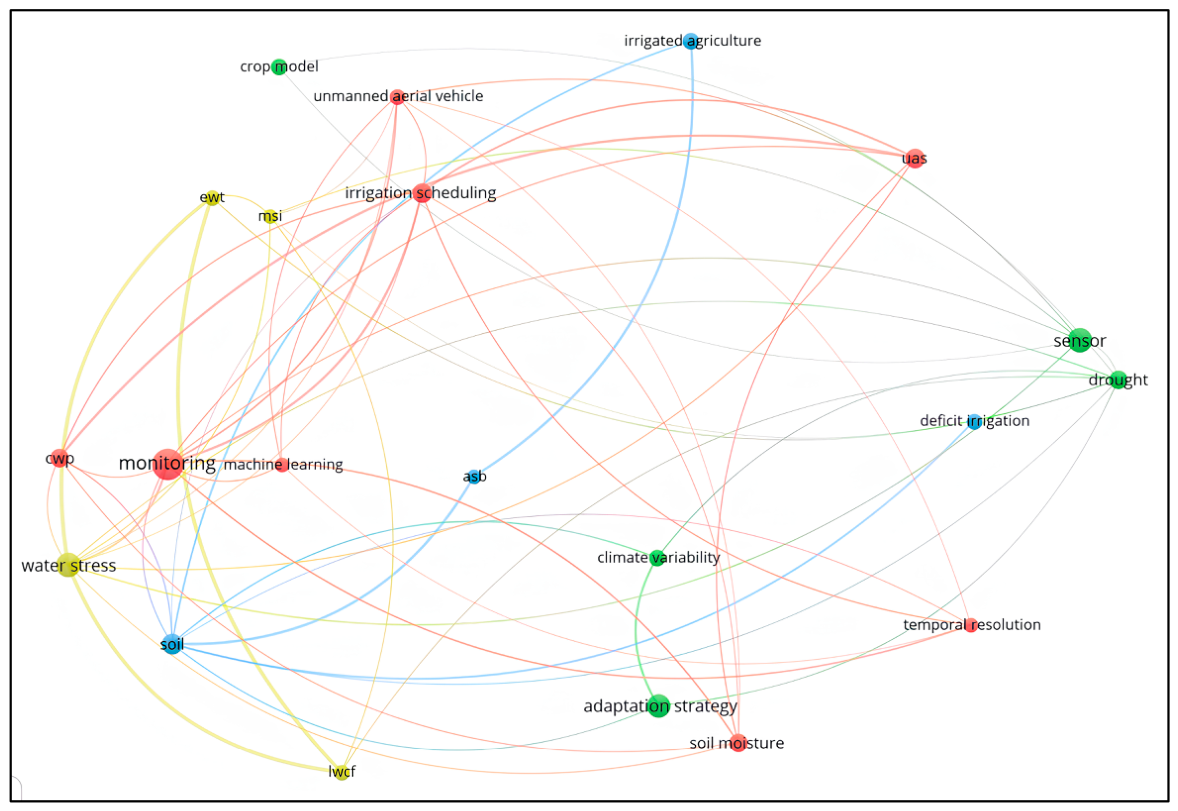
Figure 1. Keyword co-occurrence network of publications on remote sensing applications for irrigation and agricultural water management. Different colors represent distinct thematic clusters identified by the VOSviewer clustering algorithm. Node size reflects keyword occurrence frequency, while link thickness indicates the strength of co-occurrence relationships.
Climate 14 00124 g001
Table 1. Literature search strategy across selected databases (2002–2025).
PlatformsYearsKeywords
ScienceDirect2002–2025“remote sensing” and “irrigation” and “climate change” and “soil moisture” and “agriculture” and “water management” and “crop” and “crop production” and “monitoring”
Web of Science2002–2025“remote sensing” and “irrigation” and “monitoring”
Table 2. Comparative synthesis of major remote sensing approaches used in irrigated agriculture.
Remote Sensing ApproachMain Sensors/PlatformsSpatial ResolutionTemporal ResolutionMain ApplicationsAdvantagesOperational Limitations/Challenges
Optical remote sensingSentinel-2 MSI, Landsat, UAV multispectral imageryModerate to highModerate to high depending on revisit cycleCrop growth monitoring, vegetation status, phenology, irrigation mappingStrong vegetation characterization, wide use of vegetation indices (NDVI, NDWI, SAVI, EVI, GNDVI)Sensitive to cloud cover and atmospheric conditions; vegetation index saturation under dense canopies; limited discrimination between stress factors
Thermal remote sensingThermal infrared sensors, UAV thermal camerasModerateModerateEvapotranspiration estimation, canopy temperature, crop water stress detectionEffective for water stress and ET assessmentLimited spectral information; spatial resolution constraints; sensitivity to environmental conditions
Microwave remote sensingSAR, AMSR-E, SMOS, SMAPModerate to coarseHighSoil moisture monitoring, irrigation detectionAbility to penetrate clouds and vegetation; effective under diverse weather conditionsReduced spatial detail for small-scale agriculture; sensitivity to vegetation cover, roughness, and precipitation
UAV-based remote sensingMultispectral, hyperspectral, thermal UAV systemsVery highFlexible/high-frequencyPrecision irrigation, crop monitoring, stress detectionHigh spatial detail; sub-field monitoring; flexible acquisitionLimited scalability; operational costs; data processing complexity
Multi-sensor integrationOptical + thermal + microwave data fusionVariableImproved through data fusionIntegrated irrigation management, water productivity monitoringImproved accuracy and continuity of observationsData integration complexity; uncertainty due to heterogeneous datasets
Machine learning and AI approachesRF, SVM, CNN, LSTM, BiLSTMDepends on input datasetsDepends on data availabilityIrrigation scheduling, soil moisture prediction, crop classificationImproved prediction capability; automation potentialTransferability issues; dependence on training data and field validation
Crop and agro-hydrological modelsAquaCrop, WOFOST, DSS platformsField to regional scaleSeasonal to long-termCrop growth simulation, water productivity, climate adaptationScenario simulation and irrigation planning supportRequire calibration, validation, and reliable climatic/agronomic datasets
Disclaimer/Publisher’s Note: The statements, opinions and data contained in all publications are solely those of the individual author(s) and contributor(s) and not of MDPI and/or the editor(s). MDPI and/or the editor(s) disclaim responsibility for any injury to people or property resulting from any ideas, methods, instructions or products referred to in the content.



