1. Introduction
Drought is one of the most damaging climate hazards, affecting water supply, agriculture, ecosystems, energy systems, and wildfire risk. As climate change alters temperature, precipitation, and evaporative demand, there is a growing need for consistent methods to evaluate drought risk across regions and emissions pathways. Although many drought indices have been developed, their diversity can make global comparison difficult. This study develops and applies a global framework for assessing drought risk under climate change using the self-calibrating Palmer Drought Severity Index, or scPDSI.
Return periods are central to drought planning because infrastructure, water management systems, and agricultural systems are often designed for events of a specified rarity. Many of these systems have planning horizons of several decades. As a result, drought estimates based only on historical frequency may no longer provide reliable guidance for future conditions. Water utilities, agricultural planners, and regional authorities increasingly require drought-risk estimates that account for nonstationary climate conditions. This need is especially clear in regions where long-duration droughts are becoming more common.
Recent drought events illustrate how regional drought risk is changing in different ways. In the western United States, including the desert Southwest and Phoenix, droughts have become longer and more variable [
1]. The region has experienced its most severe multi-decadal drought in at least 1200 years [
2]. In the Pacific Northwest, including the region around Portland, snow droughts driven by warm temperatures and low snowpack are projected to become more common. The 2015 snow drought has been described as an early example of conditions expected by mid-century [
3]. Madison, Wisconsin follows a different pattern. The region has become wetter on average, but hydroclimatic variability has increased, allowing episodic short droughts to persist. These contrasting examples show why a consistent return-period framework is needed across diverse climate regimes and emissions scenarios.
This study focuses on meteorological drought defined as a deficit in precipitation relative to historical norms. Meteorological drought can be directly derived from atmospheric and climate model (i.e., CMIP6) precipitation fields without the need for additional transformations required for agricultural or hydrological drought metrics. This choice emphasizes physical drought drivers while supporting broad geographic applicability.
While meteorological drought is often defined solely as a precipitation deficit, this study adopts a broader definition using the scPDSI [
4,
5]. This allows us to represent drought as a climate-driven water balance anomaly that accounts for the thermodynamic influence of temperature on evapotranspiration, bridging meteorological and agricultural drought concepts. This approach is particularly relevant for capturing the ’hot drought’ dynamics expected under climate change. scPDSI is well-suited for capturing long-term drought variability and persistence. Its formulation integrates temperature and precipitation over extended periods and enhances spatial comparability across diverse climates, making it particularly appropriate for global-scale assessments. Other indices, including SPEI-12, are also widely used. However, the most suitable index and timescale depend on the drought type, so scPDSI and SPEI should not be treated as freely interchangeable [
6]. The global-scale assessment found scPDSI to be especially suitable for agricultural drought. This matches the persistent, water-balance-driven droughts examined here. Our results should therefore remain broadly consistent when using a comparable water-balance index and an appropriate accumulation timescale. Moreover, scPDSI has demonstrated strong correlation with root-zone soil moisture, further supporting its utility for assessing deeper, more persistent drought conditions [
7].
Our global drought risk model leverages climate projections from the CMIP6 ensemble, spanning key SSP scenarios such as SSP1-2.6, SSP2-4.5 and SSP5-8.5, to quantify future drought trajectories and drivers. While temperature projections in CMIP6 are relatively robust, precipitation estimates remain more uncertain—an important consideration given the central role of temperature in driving evapotranspiration and soil moisture dynamics. This study introduces a methodological alternative to strictly scenario-driven approaches, aiming to support globally relevant drought risk assessments under climate change.
Projecting future drought from global climate models has advanced substantially, but current risk assessments still face several limitations. CMIP6 multi-model studies generally agree that drought severity and duration increase under high-emission scenarios, especially when drought indices account for evapotranspiration [
8,
9]. However, several issues limit the direct use of these projections for planning.
First, index choice strongly affects the estimated drought signal. Precipitation-only measures, such as the Standardized Precipitation Index, or SPI, do not account for the rising atmospheric water demand associated with warming. As a result, they may underestimate future drying compared with scPDSI and SPEI, which include potential evapotranspiration [
10,
11].
Second, inter-model disagreement remains a major source of uncertainty. This is especially true for precipitation, where CMIP6 models often diverge in both magnitude and spatial pattern. Model uncertainty is especially important in the early decades of the projection period, while scenario uncertainty becomes more dominant toward the end of the century [
12,
13]. This uncertainty makes it difficult to translate ensemble projections into local risk estimates that can support planning decisions.
Third, many global drought studies focus on changes in mean drought conditions or anomalies at fixed future horizons. These metrics are useful, but they do not fully describe the recurrence of rare, high-impact drought events. Such events are often the most relevant for infrastructure design, water-resource planning, and agricultural risk management. As a result, drought-duration return periods remain poorly characterized at the global scale.
Recent reviews highlight the urgent need for better drought prediction and modeling tools, as well as risk assessments that include future climate scenarios [
14]. In response, we argue for probabilistic drought-risk frameworks that use a consistent index, propagate uncertainty, and produce return-period estimates that can be compared across emissions scenarios. We address these needs by combining a stochastic weather generator with extreme-value analysis to estimate spatially explicit drought-duration return periods. The framework remains consistent across SSP scenarios and provides a probabilistic complement to fully dynamical climate model ensembles.
2. Materials and Methods
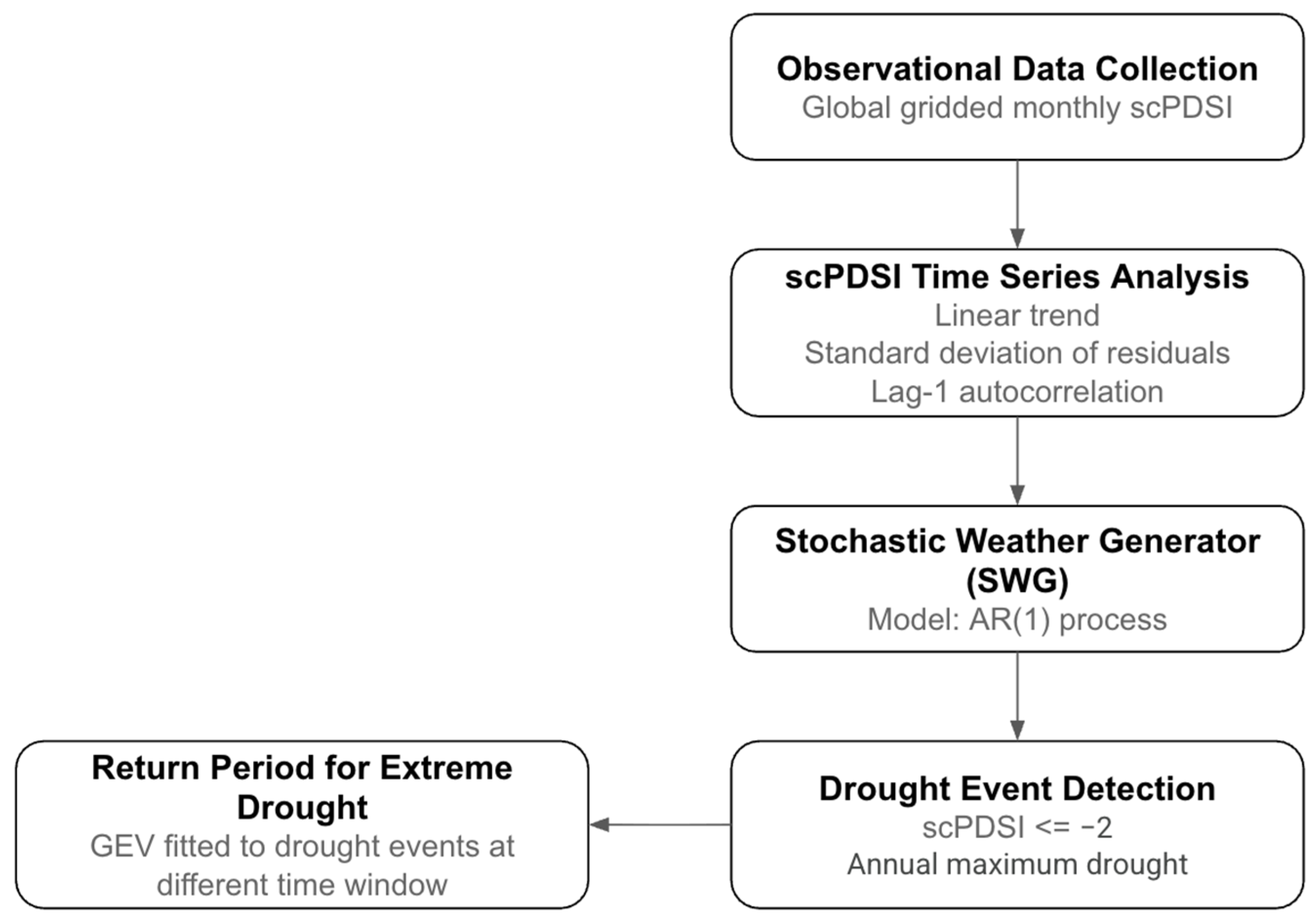
We developed a probabilistic drought risk assessment framework (
Figure 1) integrating observational data, time series analysis, and synthetic simulation under a “Stationary Variability Baseline”.
2.1. Observational Data and Drought Index Calculation
We used the global monthly self-calibrating Palmer Drought Severity Index, or scPDSI, dataset developed by Dai [
7]. The dataset provides a historical record on a 2.5° × 2.5° grid. To maintain consistent data quality across regions with different instrumentation histories, we limited the baseline analysis to 1950–2018 [
15].
2.2. Stochastic Weather Generator Design and Implementation
Observed records are too short to estimate low-probability, high-impact events, such as 100-year drought durations, with high confidence. We therefore used a stochastic weather generator, or SWG, to simulate 1000 synthetic time series for each grid cell.
The SWG represents scPDSI as a red-noise process. It preserves three statistical features of the local observational record:
Linear Trend: Reflecting the historical directional shift.
Variance: The standard deviation of residuals.
Persistence: The lag-1 autocorrelation.
The SWG uses a stationary variability baseline. It extends the observed variance and autocorrelation forward in time, while superimposing them on the observed linear trend. Climate change may alter internal variability, including ENSO amplitude, precipitation intermittency, and other modes of hydroclimatic variability. However, by holding variability constant, this framework isolates the risk signal associated with the mean-state shift and historical persistence. It therefore provides a baseline estimate of drought risk before additional dynamical uncertainties are introduced.
2.3. Drought Event Detection and Statistical Significance Testing
We defined extreme drought events using the behavior of scPDSI, rather than broader hydrological or agricultural definitions. An extreme drought event occurs when monthly scPDSI is less than or equal to −2.0. This threshold is commonly associated with moderate-to-severe drought conditions.
We used an initiation-attribution method to calculate drought duration and avoid artifacts caused by multi-year events. Drought duration is defined as the number of consecutive months with scPDSI ≤ −2.0. Standard Extreme Value Theory, or EVT, assumes independent and identically distributed observations. Treating a single continuous multi-year drought as separate annual events would violate this assumption and inflate event frequency.
To avoid this problem, we applied two rules: (1) The full duration of a continuous drought episode is assigned to the calendar year in which the sequence initiated. (2) Subsequent calendar years that fall within the same continuous drought episode are assigned a duration of zero for the purpose of annual maxima extraction.
We tested the robustness of the statistical framework by evaluating temporal autocorrelation. We used the Durbin-Watson, or DW, statistic to assess serial dependence in the monthly scPDSI time series. DW values close to zero indicate strong positive autocorrelation. Across the monthly records, DW values were consistently near zero, showing strong persistence in the data. This result supports the use of an AR(1) structure in the SWG.
We estimated drought return periods using the Generalized Extreme Value, or GEV, distribution. The GEV parameters, including location, μ, scale, σ, and shape, ξ, were estimated using L-moments. Drought duration is discrete because it is measured in months, and it also has a physical upper bound. However, the large synthetic sample, with 21,000 annual maximum values per grid cell, produced a smooth upper-tail distribution. This supported the use of GEV for estimating rare drought durations.
We compared the GEV distribution with several alternatives, including Pearson Type III, Log-Normal, Gamma, and Weibull distributions. The GEV provided the strongest overall fit, especially in the far-right tail, where rare and severe droughts occur. The other distributions tended to underestimate upper-tail risk.
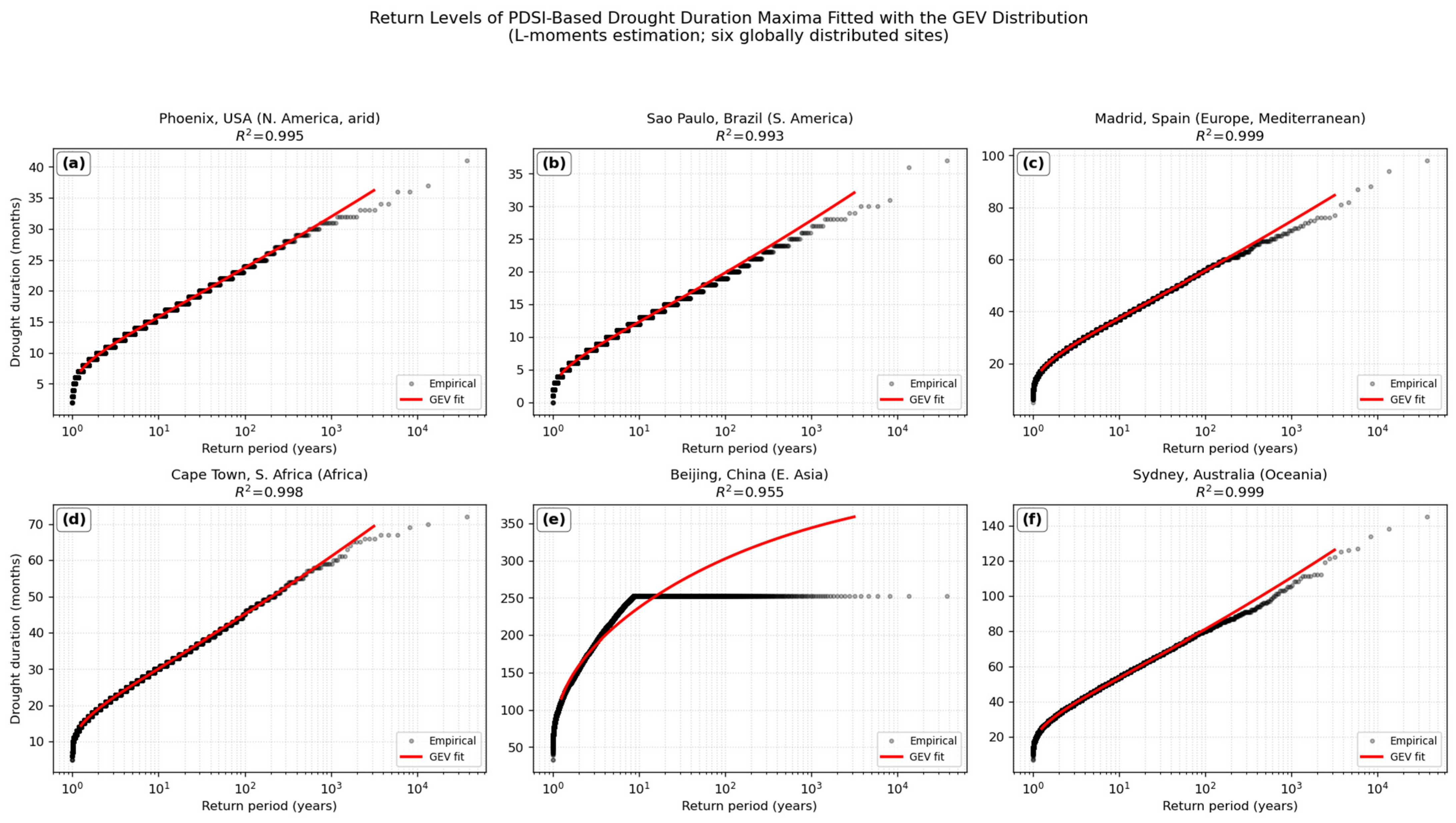
Diagnostic plots confirmed the suitability of the GEV model across six representative global sites. The GEV produced very high coefficients of determination, including R
2 = 0.999 for Madrid and Sydney, R
2 = 0.998 for Cape Town, R
2 = 0.995 for Phoenix, and R
2 = 0.993 for São Paulo (
Figure 2). Beijing showed more complex behavior, with saturation at long return periods, but the GEV still captured a wider range of upper-tail risk than the alternative models, with R
2 = 0.955 (
Figure 2). Lighter-tailed models, such as Weibull and Gamma, flattened too early and failed to represent the most extreme drought durations.
The GEV distributions fitted in this step were derived from synthetic time series generated under the high-emissions scenario, SSP5-8.5. This scenario represents the upper-bound, or worst-case, trajectory for drought evolution. The return periods estimated under SSP5-8.5 serve as the reference values, denoted as
RPt, SSP5-8.5, for the scaling procedures described in
Section 2.4 and
Section 2.5. In those sections, drought risk under lower-emission scenarios, including SSP1-2.6 and SSP2-4.5, is estimated by scaling down from the high-emission baseline according to regional warming levels.
Return period analysis was conducted for three time windows under the SSP5-8.5 baseline:
Current period: 2015–2035.
Future period: 2045–2065.
Far-future period: 2080–2100.
2.4. Calculating Return Periods for Alternative Climate Scenarios
To approximate return levels under lower-emissions scenarios (e.g., SSP2-4.5), we apply a temperature scaling factor that assumes the magnitude of the change in drought extremes is proportional to regional warming.
This assumption is supported by the observational record. For each land grid cell, we regressed the duration of individual historical drought events, defined as scPDSI ≤ −2.0, against the maximum temperature reached during each event over 1950–2018. The analysis included only grid cells with at least five drought events. The results, shown in
Supplementary Figure S3, indicate that event-maximum temperature explains a meaningful share of the variance in drought duration across much of the global land surface. The relationship is especially strong in many mid- and high-latitude regions.
We use temperature, rather than precipitation, as the basis for scenario scaling because temperature provides a more robust climate-change signal. CMIP6 models agree more strongly on regional warming than on regional precipitation change [
9,
16,
17]. This contrast is clear even in regional hotspots such as the Mediterranean, where projected warming is robust but precipitation projections remain uncertain [
18]. Precipitation projections remain more spatially variable and show greater inter-model spread. A temperature-based scaling framework therefore provides a more stable basis for estimating changes in drought duration across emissions pathways.
The SSP5-8.5 trajectory provides the reference baseline for this scaling procedure. This high-emission pathway spans the warming levels reached later under lower-emission scenarios, including the SSP2-4.5 mid-century window from 2045 to 2065 and the SSP1-2.6 far-future window from 2080 to 2100. Because drought-duration response scales with warming and shows broadly similar spatial structure across scenarios, the well-sampled SSP5-8.5 simulations provide a consistent reference from which lower-emission drought risks can be estimated using regional warming ratios.
For each grid cell (or region), time window
t (e.g., 2055 or 2090), and target scenario
ssp, we define
where
is the scaling factor for future time t and scenario .
and represent the mean daily maximum near-surface air temperatures (tasmax) for the future and baseline periods, respectively.
is the change in mean daily maximum near-surface air temperature (tasmax) between the future and baseline periods, equal to .
If the warming in the target scenario exceeds the high-emissions scenario (ΔTssp > ΔTssp5-8.5), the scaling factor is capped at 1. If the temperature changes have opposite signs, the factor is set to 0.
Our decision to scale future drought risk using regional temperature rather than precipitation was driven by the comparative robustness of these signals in CMIP6 projections. While precipitation is a primary driver of meteorological drought, CMIP6 ensembles exhibit substantial inter-model disagreement and high uncertainty regarding future precipitation patterns, particularly at regional scales [
9]. In contrast, temperature projections show high signal-to-noise ratios and strong inter-model consensus. Based on these robust temperature trajectories, we anchor our risk assessment in a more reliable component of the future climate signal. This approach avoids propagating the high uncertainty of precipitation forecasts into the risk scaling, effectively providing a projection of drought risk driven by the ’thermodynamic penalty’ of warming, which serves as a high-confidence baseline for future hazard assessment.
Daily maximum near-surface air temperature (tasmax) data were obtained from seven CMIP6 models that provided outputs across all three scenarios: CMCC-ESM2, CNRM-CM6-1, CNRM-ESM2-1, INM-CM4-8, INM-CM5-0, MIROC-ES2L, and GISS-E2-1-G (
https://cmip6-pds.s3.amazonaws.com/index.html#CMIP6/) (accessed on 6 January 2025).
2.5. Final Return Period Calculation
We apply the scaling factor to the change in return periods projected under the high-emissions scenario. The adjusted return period is calculated as:
where
RPt,ssp is the estimated return period at time t under the target scenario (e.g., SSP1-2.6).
RPbase,t is the baseline return period.
For 2055, baseline is from 2015 to 2035, derived from high-resolution SSP5-8.5 current climate data.
For 2090, baseline is the computed 2055 return period derived from high-resolution SSP5-8.5 (effectively using 2045–2065).
RPt,ssp5-8.5 is the return period under the high-emissions scenario.
The term (RPt,ssp5-8.5 − RPbase,t) represents the shift in drought frequency driven by high-emission warming, which is then scaled by SF.
The final return period, RPt,ssp, is calculated by adjusting the baseline return period by a scaled fraction of the projected change under the worst-case scenario. This method ensures that the scaled return period is internally consistent and respects the physical constraint that lower-emission scenarios should project less extreme drought intensification than the high-emission scenario.
3. Results
3.1. Comparing Projected Drought Trends in Different Regions
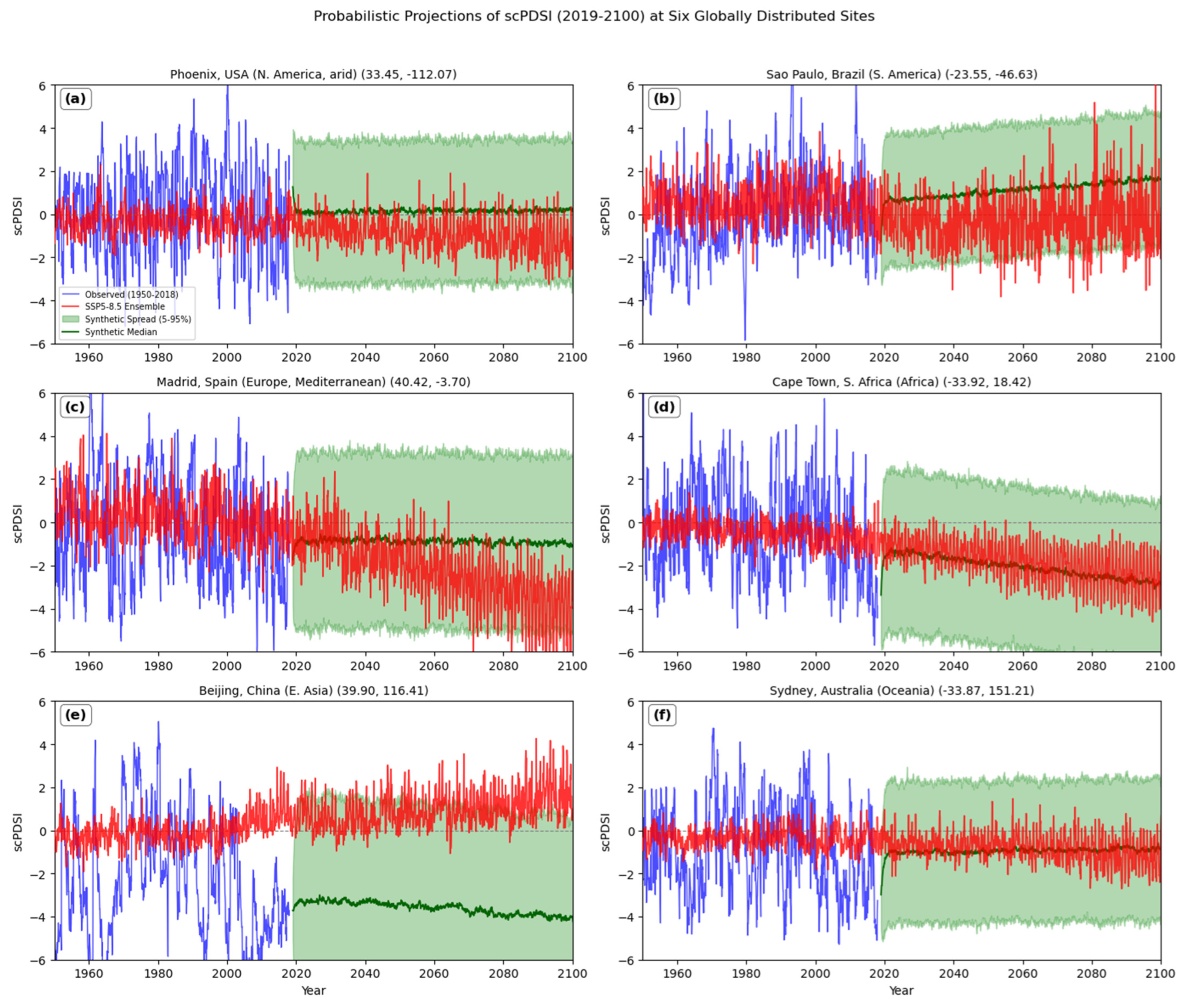
We evaluated projected drought trends across six representative locations to assess how the stochastic simulations vary across distinct hydroclimatic settings. The selected sites were Phoenix, USA, representing an arid climate; São Paulo, Brazil, representing a humid subtropical climate; Madrid, Spain, representing a Mediterranean climate; Cape Town, South Africa, representing a Mediterranean to semi-arid climate; Beijing, China, representing a monsoon-influenced climate; and Sydney, Australia, representing a temperate climate. This site selection allowed us to test the robustness of the method across a broad range of climatic regimes.
Figure 3 shows projected scPDSI trajectories through 2100. The green shaded envelope represents the 5th to 95th percentile range from 1000 synthetic simulations. This range shows the expected spread in drought conditions if the historical trend, variance, and persistence remain stationary. The dark green line shows the median synthetic trajectory, which extends the historical trend forward in time. The width of the envelope captures the stochastic variability expected from internal climate fluctuations.
We compared these synthetic projections with the CMIP6 SSP5-8.5 ensemble mean, shown by the red line. The comparison reveals clear regional differences. In Cape Town, South Africa, both the synthetic median and the SSP5-8.5 ensemble mean show a strong drying trajectory, with scPDSI values moving below zero through the twenty-first century. Similar agreement occurs in Phoenix, São Paulo, Madrid, and Sydney. In these locations, the SSP5-8.5 ensemble mean generally falls within the 5th to 95th percentile range of the synthetic simulations. This indicates that a trend-preserving stochastic framework can reproduce the broad direction and magnitude of drought change projected by the dynamical model ensemble under high emissions.
Beijing, China, shows a different pattern. The synthetic simulations project continued drying, with the median trajectory reaching approximately −4 scPDSI by the end of the century. In contrast, the CMIP6 SSP5-8.5 ensemble mean indicates a shift toward wetter conditions, with scPDSI values rising above zero. This divergence suggests that the stochastic framework does not fully capture nonlinear regional processes that affect the East Asian monsoon system. These processes may include monsoon circulation changes, aerosol-driven effects, and land–atmosphere feedbacks represented in dynamical climate models.
The Beijing case highlights an important limitation of the stationary stochastic approach. The method performs best when the historical trend and dynamical model projections have the same direction of change. In regions where future climate behavior may involve regime shifts or nonlinear feedback, the method may miss important physical responses. As a result, the synthetic framework is most useful as a baseline risk tool, rather than a full substitute for process-based climate model projections.
3.2. Statistical Validation of the Stochastic Weather Generator
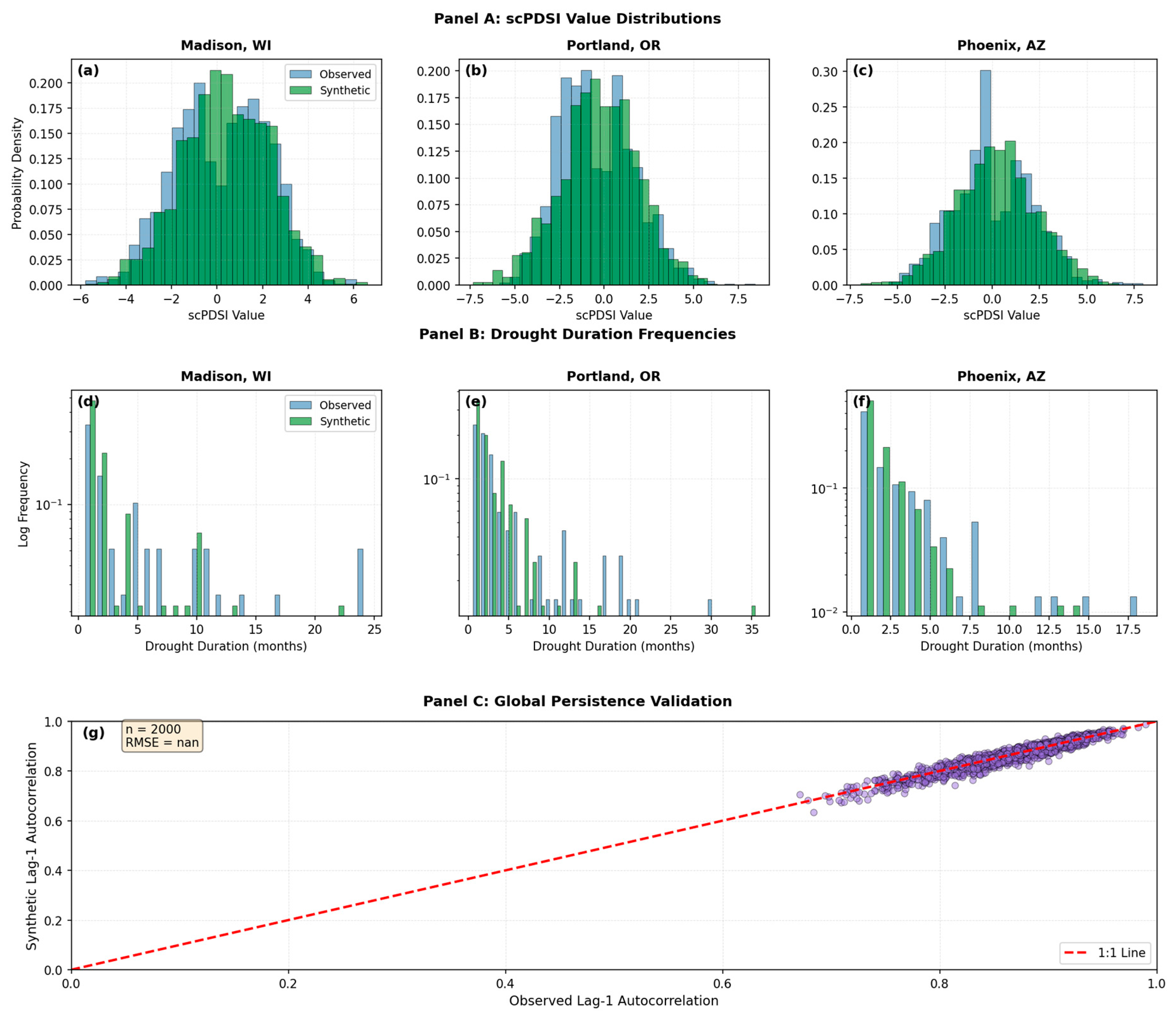
We evaluated the performance of the stochastic weather generator, or SWG, by comparing synthetic scPDSI time series with observed records. The validation focused on three statistical properties: the distribution of scPDSI values, the frequency distribution of drought durations, and temporal persistence.
Figure 4 summarizes the validation results. Panel A compares the empirical distributions of observed and synthetic scPDSI values. The synthetic distributions, shown by the green histograms, closely match the observed distributions, shown by the blue histograms, across all three validation sites. The SWG captures both the central tendency and the spread of the observed records.
Panel B compares the frequency of drought events by duration. The synthetic series closely reproduces the observed decay rates on a logarithmic scale. Small differences occur for the longest droughts in Portland, especially for events lasting more than 20 months. However, the overall agreement indicates that the SWG captures the probability structure of multi-month and multi-year drought events.
Panel C evaluates temporal persistence. We compared lag-1 autocorrelation coefficients from observed and synthetic records across 2000 randomly selected grid cells. The relationship is nearly linear along the 1:1 line, with an RMSE of 0.015. This result shows that the SWG preserves the observed persistence structure with high accuracy.
Overall, the validation results show that the SWG reproduces the key statistical properties of observed scPDSI records. This supports its use for probabilistic drought risk analysis, including estimation of low-probability, high-impact drought durations.
3.3. Sensitivity of Future Projections to Historical Trend Baselines
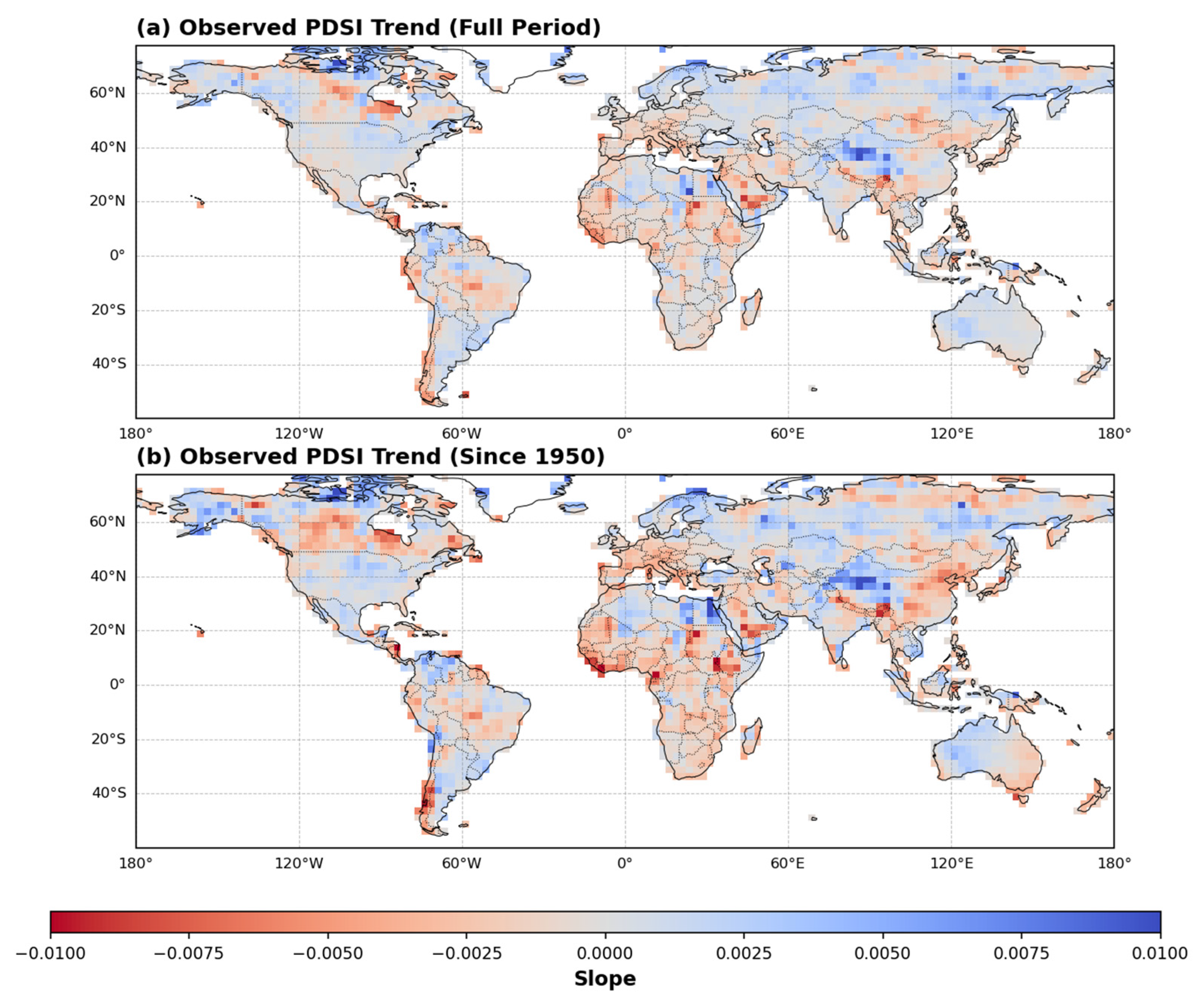
The influence of the baseline period on projection accuracy was examined by calculating linear trends in observed scPDSI using two reference periods: (i) the full observational record (as early as 1850 in some regions) through 2018 and (ii) the modern 1950–2018 baseline.
The 1950–2018 trend map (
Figure 5b) shows stronger and more consistent drying signals across many regions, particularly at high latitudes. In contrast, trends derived from the full record (
Figure 5a) exhibit weaker and more spatially variable drying patterns.
These differences indicate that the choice of baseline period affects the trend signal used in the synthetic projections. The modern baseline better reflects the period of stronger anthropogenic forcing and provides a more consistent basis for estimating future drought trajectories. For this reason, the 1950–2018 period was used as the primary baseline for the SWG projections.
3.4. Autocorrelation-Adjusted Significance Testing of Drought Anomalies Across Global Regions
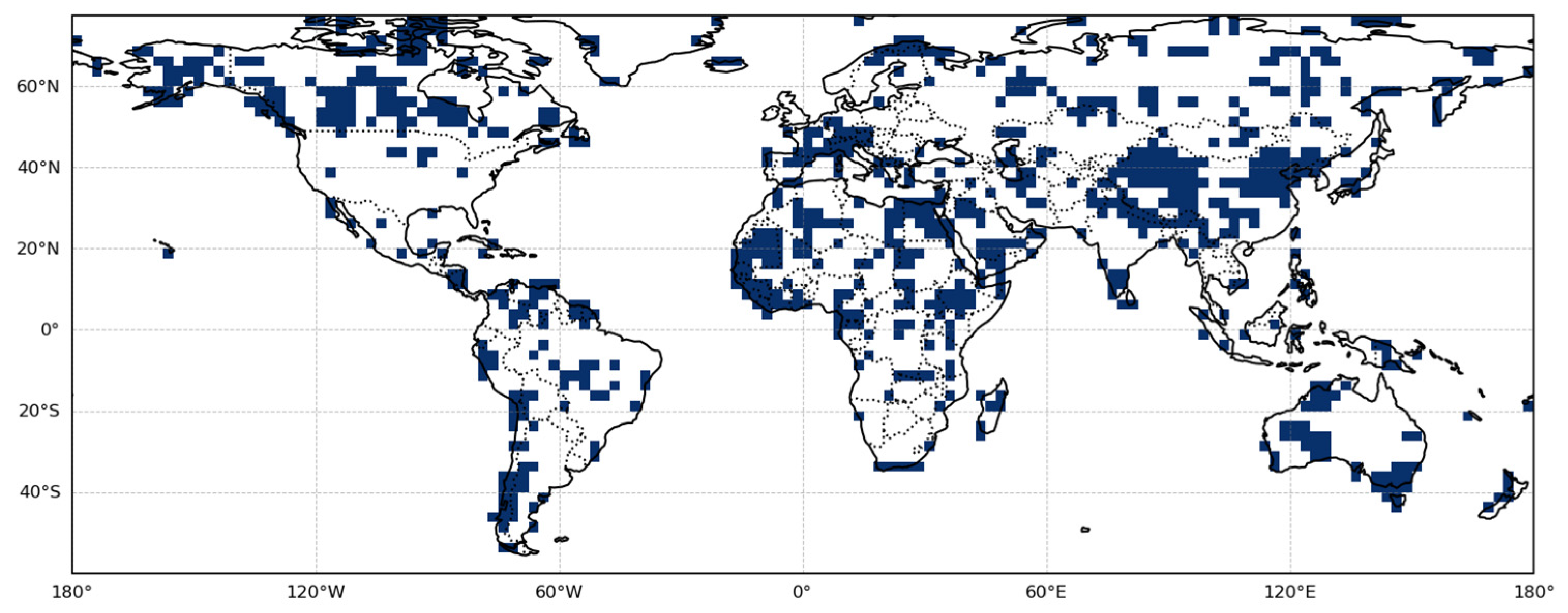
The spatial distribution of autocorrelation-adjusted significance tests shows clear regional contrasts, as shown in
Figure 6. In Canada and China, more than two-thirds of monitored basins recorded
for at least two drought metrics. This indicates that observed drought anomalies in these regions were more extreme than expected from the synthetic ensembles after accounting for temporal persistence.
Here, denotes the -value from the statistical significance test. It represents the probability of obtaining drought anomalies at least as extreme as those observed, assuming that the null model of natural variability is correct. A -value below 0.05 indicates that the observed anomaly is unlikely under the synthetic variability baseline. It suggests a statistically significant departure from expected natural variability.
In contrast, basins in the continental United States and interior Australia generally showed drought behavior consistent with the 5th to 95th percentile range of the stochastic simulations. This suggests that recent drought anomalies in these regions remain within the estimated envelope of natural variability when temporal persistence is included.
These findings are consistent with prior global analyses. Van der Schrier et al. [
19] similarly found that the leading global drying-trend mode explains less than 9% of total scPDSI variability. This suggests that statistically robust long-term trends are spatially limited once interannual variability and persistence are considered. The agreement between our results and previous work supports the need to account for temporal autocorrelation when evaluating drought significance. Without this adjustment, significance tests may overstate the evidence for drought trends in climate systems dominated by persistence.
3.5. Scenario Scaling Using Temperature-Based Factors
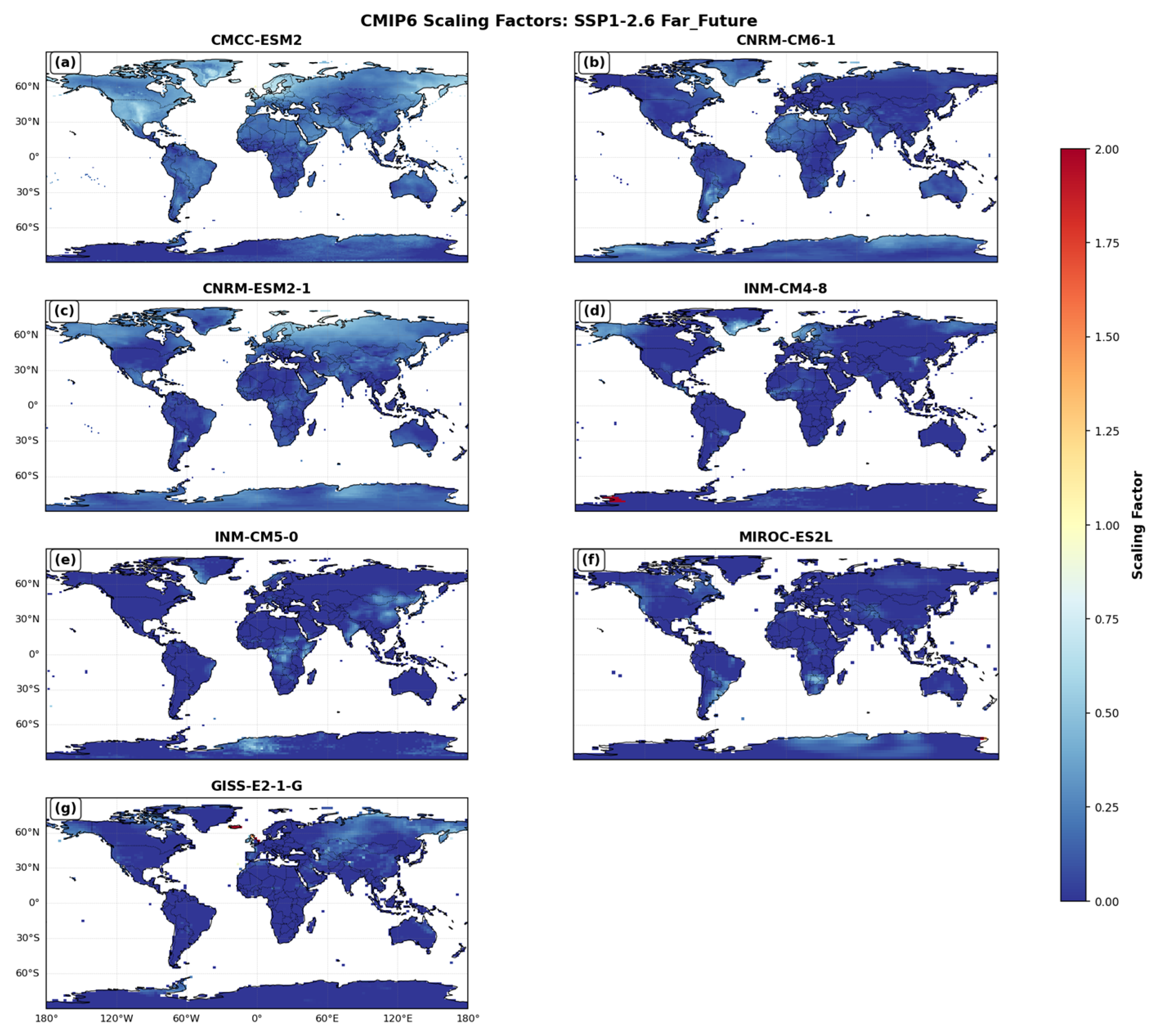
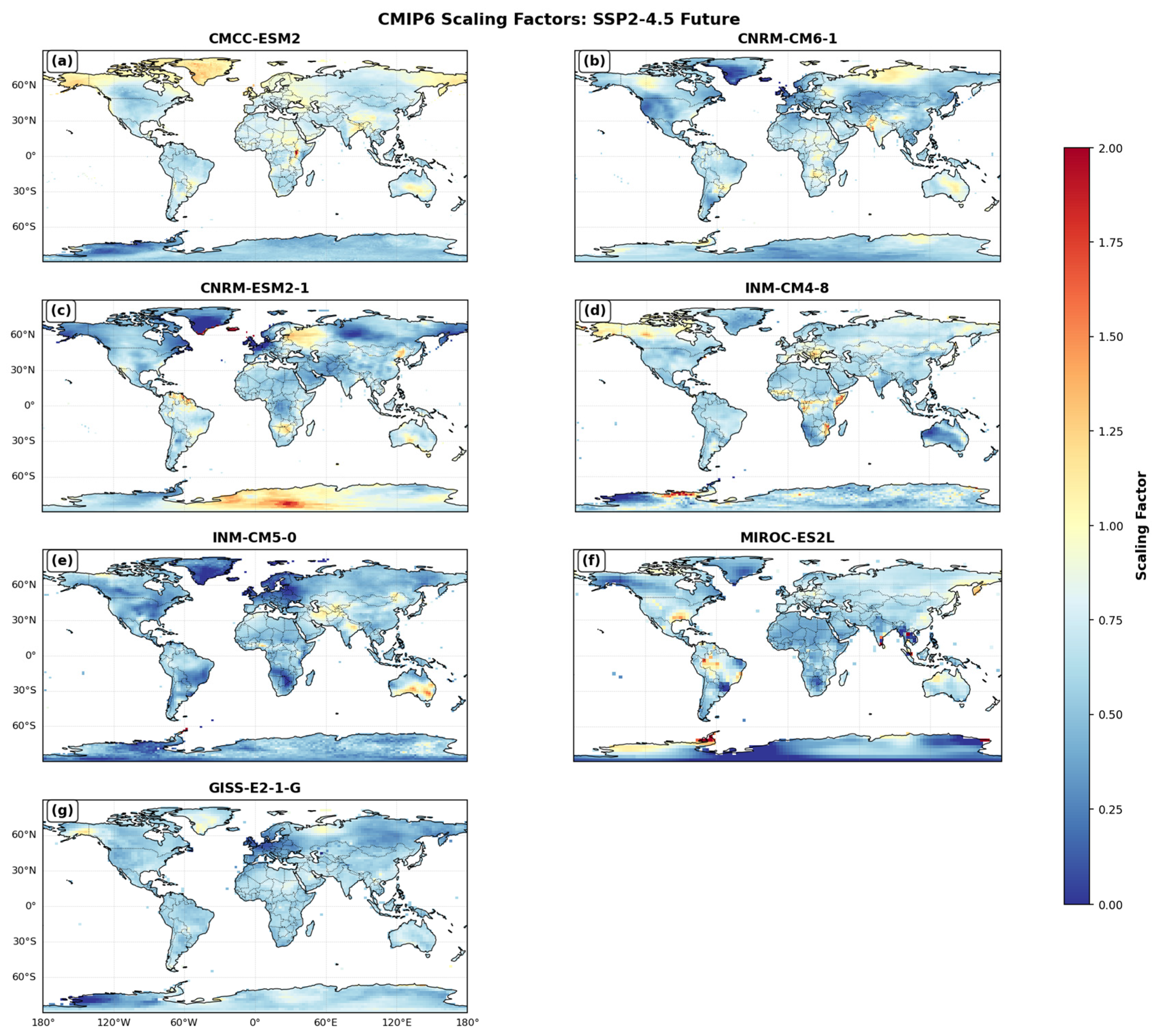
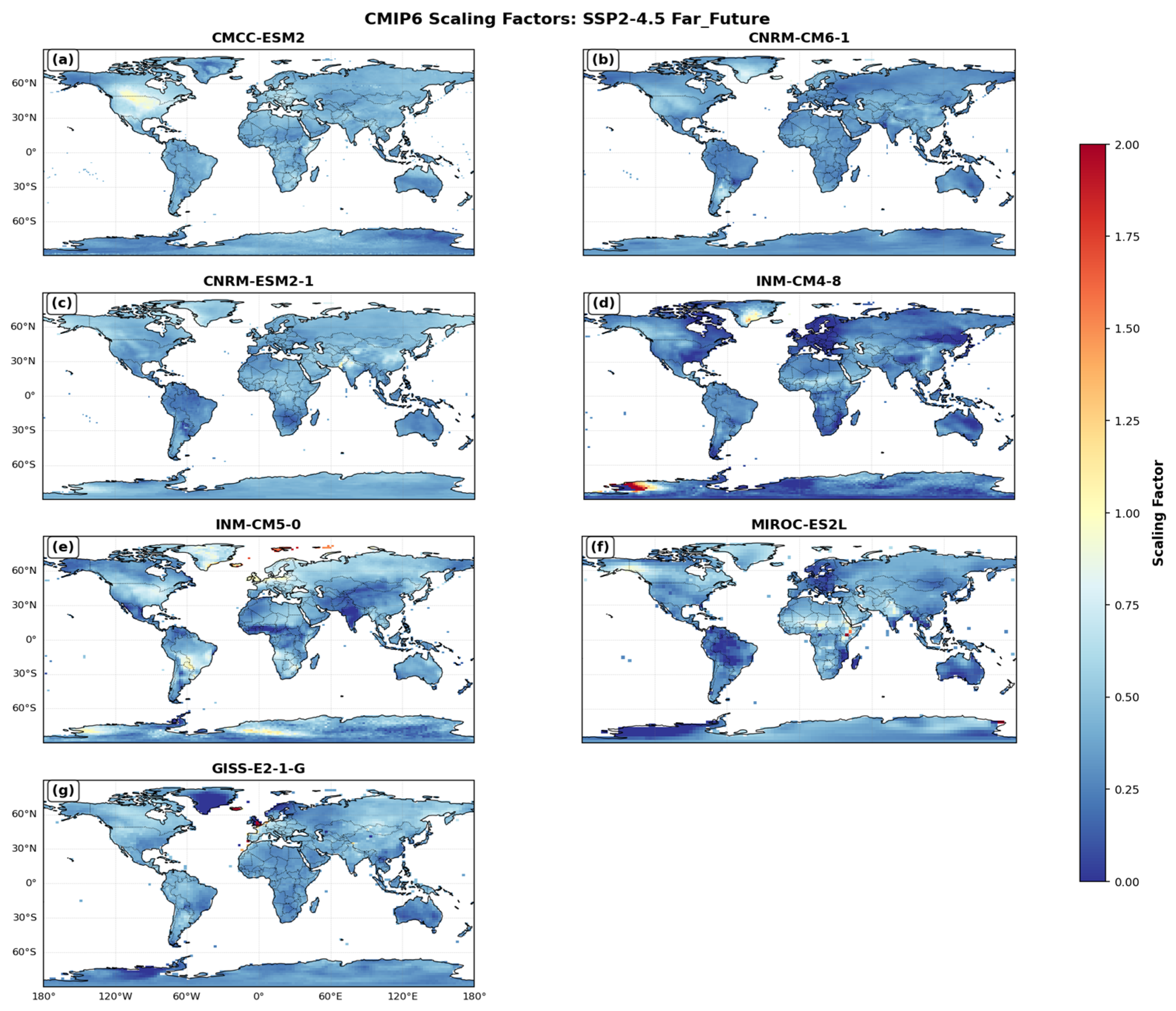
We applied temperature-based scaling factors to estimate return periods under lower-emission scenarios, including SSP1-2.6 and SSP2-4.5. This approach scales the high-emission SSP5-8.5 drought risk estimates according to regional temperature projections from seven CMIP6 models. The results show a consistent reduction in the frequency of extreme drought events under lower-emission pathways relative to the SSP5-8.5 baseline.
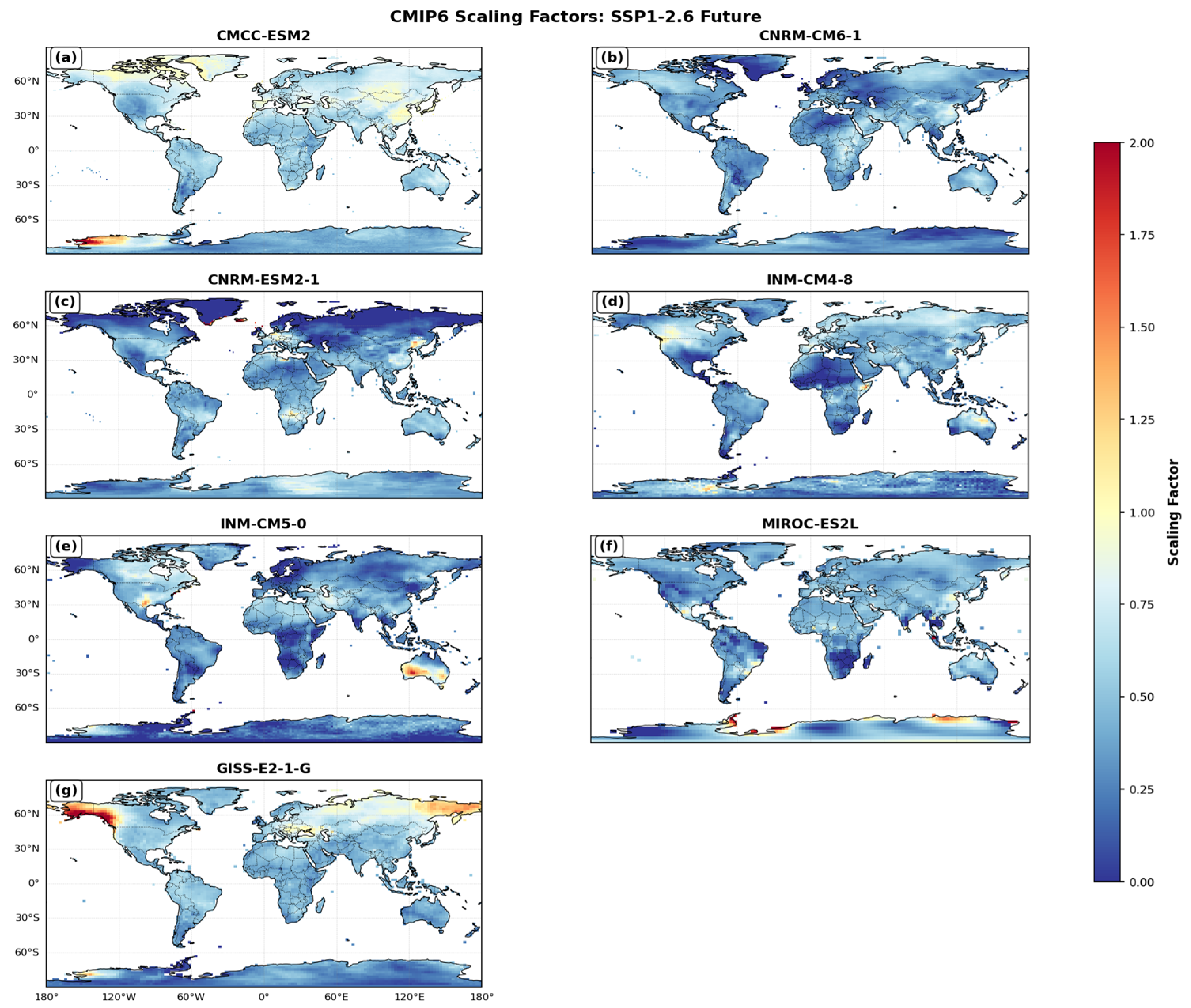
The spatial distribution of the scaling factors, shown in
Figure 7,
Figure 8,
Figure 9 and
Figure 10, reveals substantial regional and model-level variation in climate sensitivity. Under SSP1-2.6, most regions show low scaling factors by 2080–2100, generally below 0.4. This indicates that drought risk remains strongly reduced relative to the high-emission baseline. This pattern is especially evident in models such as CMCC-ESM2 and INM-CM5-0, which produce weaker warming signals and therefore lower scaled drought risk.
Under SSP2-4.5, scaling factors increase across many regions. The increase is most pronounced at high latitudes, including parts of North America and Eurasia. In models such as CNRM-ESM2-1 and GISS-E2-1-G, scaling factors in these regions reach approximately 0.5 to 0.7. These values indicate moderate but persistent warming, which continues to increase thermodynamic drought risk even under an intermediate emissions pathway.
The models also show clear differences in regional sensitivity. INM-CM4-8 produces relatively muted scaling factors across most regions, suggesting lower drought-risk amplification under both lower-emission scenarios. In contrast, MIROC-ES2L shows stronger sensitivity in several regions, especially the Amazon and Southern Africa. These differences likely reflect model-specific representations of land–atmosphere coupling, evapotranspiration, soil moisture feedbacks, and regional temperature responses.
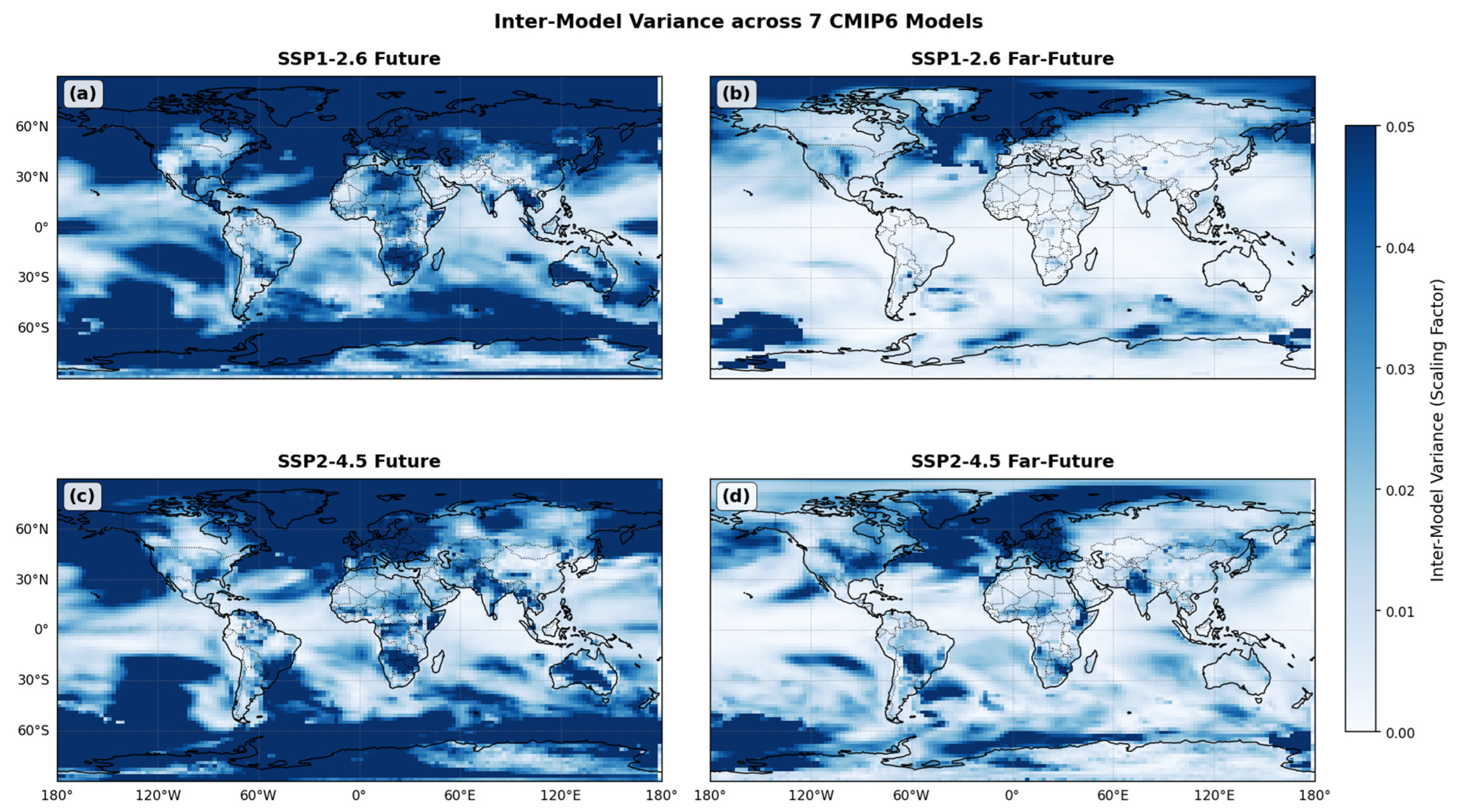
Analysis of the variance in scaling factors, shown in
Figure 11, indicates that inter-model disagreement is strongest during the mid-century period from 2045 to 2065. This divergence likely reflects differences in transient climate response under rapid greenhouse gas forcing. It may also reflect model-specific differences in regional feedbacks, land–atmosphere coupling, and evapotranspiration responses.
By the late twenty-first century, from 2080 to 2100, the projections show greater agreement in many regions, especially under SSP2-4.5. This pattern suggests partial convergence as warming trajectories become more stable under the intermediate-emissions pathway. However, regional differences remain, indicating that model structure continues to influence the magnitude of scaled drought risk.
These results support the use of temperature-based scenario scaling as a spatially explicit method for estimating drought risk under lower-emission pathways. The approach translates the SSP5-8.5 high-emission risk baseline into lower-emission risk estimates and provides a clear way to quantify the mitigation benefits associated with SSP1-2.6 and SSP2-4.5.
3.6. Post-Processing for Model Saturation
Under high-emission conditions, especially SSP5-8.5, we identified a statistical artifact in hyper-arid regions. We refer to this artifact as index saturation, or the “flip” phenomenon. In these grid cells, projected scPDSI remains below the −2.0 drought threshold for near-continuous periods. Because the drought-event definition requires a return to non-drought conditions to separate one event from the next, these persistent drought states can reduce the number of discrete events. This can produce a misleading decline in estimated drought risk, even as aridity increases.
To maintain physical consistency, we applied a post-processing consistency check. For any grid cell where the far-future period, 2080–2100, showed lower drought risk than the mid-century period, 2045–2065, despite increased warming, the far-future return-period values were clamped to the mid-century estimate. This adjustment prevents an artificial decrease in risk caused by event-count saturation. It also ensures that the final risk metrics remain consistent with the progression of aridification under continued warming.
3.7. Spatial Evolution of Extreme Drought Duration
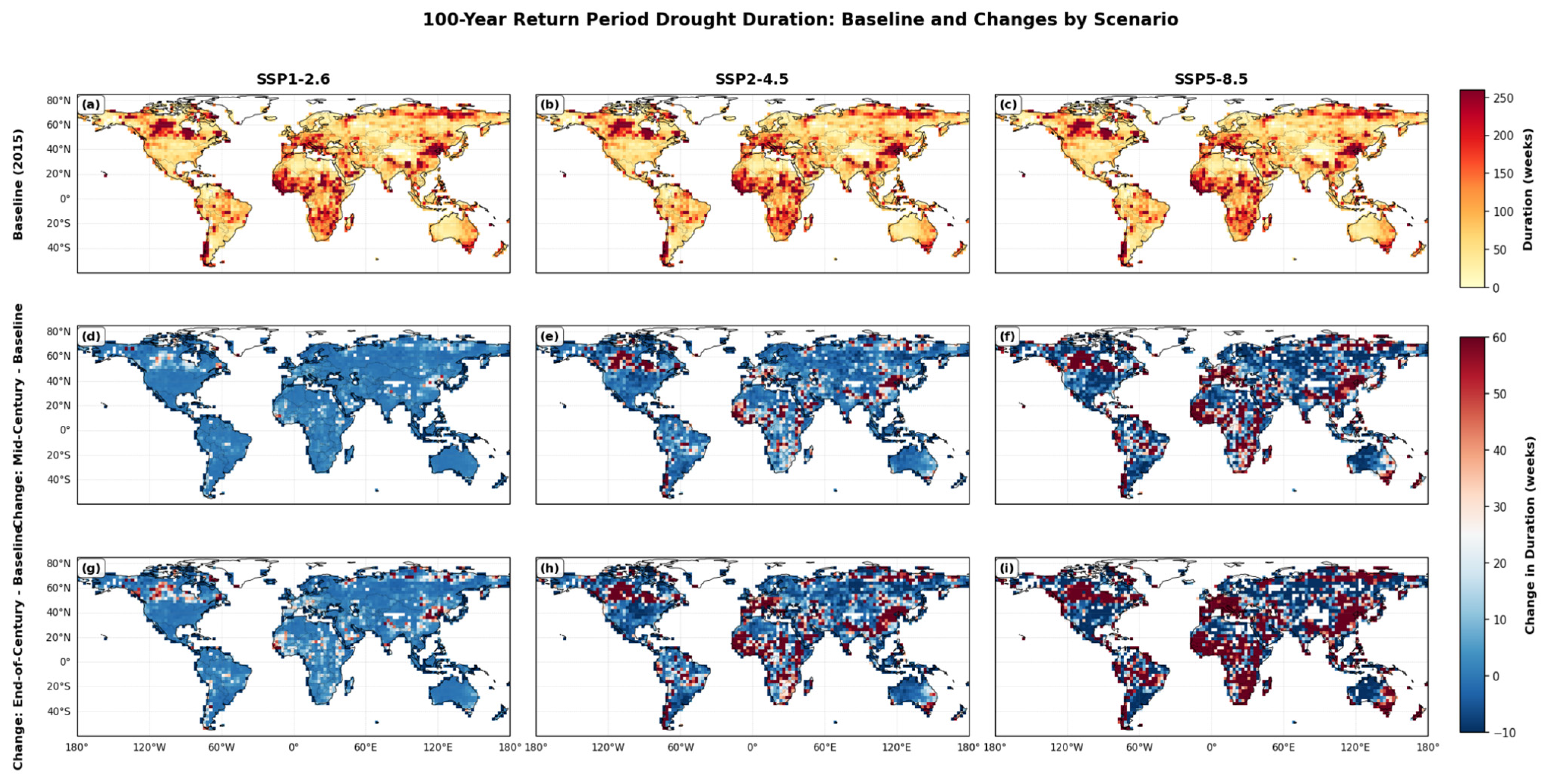
Figure 12 shows the spatial distribution of 100-year drought duration and its sensitivity to emissions pathways. The figure compares baseline conditions around 2015 with projected changes for mid-century, centered on 2055, and end-of-century, centered on 2090. The corresponding patterns for the more frequent 20-year return period are shown in
Supplementary Figure S2. These results show the same qualitative divergence among emissions scenarios, confirming that the projected pathway dependence is not limited to the rarest drought events.
The baseline maps, shown in Panels a–c, establish the current spatial pattern of extreme drought risk. During the baseline period, several regions already show high 100-year drought durations exceeding 40 weeks. These hotspots include the Amazon Basin, Southern Africa, the Mediterranean, and parts of Western Australia. Their high baseline values indicate existing vulnerability to prolonged meteorological drought, even under present-day climate conditions.
By mid-century, shown in Panels d–f, the emission pathways begin to diverge. The difference maps show increases in drought duration in red and decreases in blue. Under SSP1-2.6, shown in Panel d, the spatial pattern is mixed. Some areas, including parts of the Amazon and North Africa, show modest increases in duration. Other regions, including parts of the high latitudes and Asia, show decreases, suggesting partial stabilization of extreme drought risk under strong mitigation.
Under SSP5-8.5, shown in Panel f, the mid-century signal is more coherent and more severe. Large positive anomalies appear across the Amazon, Central America, and Southern Europe. In these regions, 100-year drought durations increase by roughly 15 to 25 weeks. This pattern is consistent with intensification of drought risk under continued warming and supports the broader “dry gets drier” response seen in several vulnerable regions.
By the end of the century, shown in Panels g–i, the contrast between mitigation and high-emission pathways becomes more pronounced. Under SSP1-2.6, shown in Panel g, many regions across North America, Eurasia, and Australia show negative anomalies. This indicates that 100-year drought durations may stabilize or decrease relative to the baseline under a low-warming pathway.
SSP2-4.5, shown in Panel h, produces an intermediate pattern. Major hotspots, including the Amazon and Mediterranean, continue to show increases in extreme drought duration, while other regions show limited change. This suggests that moderate mitigation reduces the scale of drought intensification but does not fully prevent regional risk growth.
SSP5-8.5, shown in Panel i, shows the strongest escalation in risk. Large areas of South America, Africa, and Southern Europe are dominated by strong positive anomalies. In many of these regions, 100-year drought durations increase by more than 30 weeks. These results indicate that, under unmitigated warming, extreme drought events are projected to persist for much longer portions of the year. The pattern is consistent with enhanced atmospheric evaporative demand and the thermodynamic amplification of drought under high warming.
While the ensemble mean provides a coherent global estimate of future drought risk, structural differences among CMIP6 models introduce regional uncertainty.
Supplementary Figure S1 illustrates this uncertainty for 100-year drought duration under the moderate-emission SSP2-4.5 scenario in 2090.
The ensemble mean projection, shown in Panel a, reinforces the spatial patterns identified in the main results. High-risk hotspots appear in the Amazon Basin, Southern Africa, the Mediterranean, and parts of Central Asia. In these regions, 100-year drought events are projected to exceed 40 to 50 weeks in duration. These areas consistently emerge as the most vulnerable to thermodynamic drying across the model suite.
Panel b shows the standard deviation across the CMIP6 model ensemble. This map highlights regions of stronger model agreement and regions of larger model spread. In many high-latitude regions and parts of North America, the standard deviation remains relatively low, generally below 5 weeks. This suggests stronger inter-model agreement on the magnitude of future changes in extreme drought duration.
In contrast, higher uncertainty appears in the Amazon Basin, West Africa, and parts of Western Europe, where the standard deviation exceeds 15 weeks in some areas. This spread likely reflects differences in model representations of land–atmosphere feedbacks, including evapotranspiration responses, soil moisture memory, and regional circulation changes under warming.
The Amazon Basin shows especially high uncertainty. This indicates that, although the ensemble mean points toward increased drought duration, the magnitude of that increase is sensitive to model structure. The result reinforces the need to interpret regional projections using both the ensemble mean and the inter-model spread.
4. Discussion
This study develops a global framework for estimating meteorological drought return periods by combining observed climate records, stochastic simulations, and CMIP6 projections. The use of scPDSI with a stochastic weather generator allows the analysis to preserve observed internal variability while estimating future drought risk under different warming pathways.
4.1. Global Drought Risk Patterns and Mitigation Implications
The results show a clear global pattern of drought-risk intensification under high emissions. Under SSP5-8.5, extreme droughts become longer and more frequent, especially in the Amazon Basin, Southern Africa, and the Mediterranean. These regions show strong increases in 100-year drought duration by the end of the century.
This pattern is consistent with prior work showing that future drought risk is driven not only by precipitation change, but also by rising potential evapotranspiration, or PET. Higher temperatures increase atmospheric evaporative demand. This strengthens moisture stress even in regions where precipitation changes are uncertain.
The contrast between emissions pathways is large and nonlinear. Under SSP5-8.5, drought risk increased sharply by the late twenty-first century. Under SSP1-2.6, many regions show stabilization or partial reversal of drying trends. This indicates that mitigation can substantially reduce the frequency and duration of extreme drought events. Lower warming limits atmospheric moisture demand and reduces the probability of long-duration drought.
4.2. Methodological Divergence: Stochastic vs. Dynamic Projections
The comparison between stationary stochastic projections and CMIP6 dynamical projections helps identify where future drought risk is driven mainly by historical persistence and where it depends on changing physical processes. In regions such as Phoenix, Arizona, where historical drying trends are strong and persistent, the stochastic projections align closely with CMIP6 projections. This suggests that trend-preserving stochastic simulations can capture much of the projected drought-risk signal in regions with stable drying trajectories.
However, larger differences occur in regions where future climate dynamics diverge from historical trends. For example, in Madison, Wisconsin, the stochastic framework projects continued wetting based on the observed historical trend, while CMIP6 ensembles project drying. This divergence shows the limits of extrapolating past trends when future land–atmosphere feedbacks, circulation shifts, or precipitation regimes change.
By preserving observed linear trends, variance, and autocorrelation, the stochastic framework captures the tail risks embedded in the current climate record. This approach is useful for estimating how historical persistence and mean-state shifts affect the upper tail of drought duration. However, the stationarity assumption limits its ability to represent nonlinear regime shifts, changing precipitation variability, or novel land-surface feedback. As a result, the framework should be interpreted as a baseline estimate of thermodynamic drought risk, not as a replacement for process-based climate models.
4.3. Physical Representativeness and Index Sensitivity
This framework estimates the risk of extreme scPDSI anomalies, rather than drought in a broad, multi-sectoral sense. The target variable is defined as scPDSI ≤ −2.0 because this threshold represents moderate-to-severe moisture stress and captures climate-driven water-balance anomalies.
Meteorological drought is often defined using precipitation deficits alone. In contrast, scPDSI includes the effect of temperature on evapotranspiration. It therefore captures hot-drought dynamics, where warming increases atmospheric moisture demand and intensifies drought stress even when precipitation changes are modest or uncertain.
Recent studies support the use of scPDSI for this purpose. Liu et al. [
6] showed that scPDSI and the Standardized Precipitation Evapotranspiration Index, or SPEI, are not freely interchangeable. The appropriate index and timescale depend on the drought type, and scPDSI was found to be especially well suited to characterizing agricultural drought at the global scale. Dai et al. [
7] also showed strong relationships between PDSI-based metrics and root-zone soil moisture. For this reason, the return periods estimated here should be interpreted as projections of atmospheric moisture stress. They are relevant to ecological desiccation, agricultural stress, and wildfire risk, but they should not be treated as direct estimates of surface water supply or runoff availability.
The validity of the projections depends on the physical representativeness of scPDSI. The index has known limitations in global applications, especially in very dry or cold regions. These limitations matter most where the water-balance assumptions behind scPDSI become less stable or where the index approaches saturation.
The decision to scale return periods using regional temperature changes, rather than precipitation changes, reflects the stronger robustness of CMIP6 temperature projections. Precipitation projections often show larger inter-model spread and lower signal-to-noise ratios. Temperature projections are more spatially coherent and more directly tied to thermodynamic increases in evaporative demand. By anchoring the scaling factors in regional temperature, the analysis isolates one of the more certain components of future drought risk while avoiding direct propagation of the larger uncertainty associated with precipitation projections.
4.4. Methodological Limitations and Future Research
First, index saturation occurs in some hyper-arid regions under SSP5-8.5. In these locations, scPDSI remains below the drought threshold for near-continuous periods. Once drought becomes a semi-permanent state, counting discrete drought events becomes less meaningful. This suggests that event-based drought definitions may need to be adapted for regions that undergo severe aridification.
Second, the stochastic framework preserves present-day variance and autocorrelation but does not allow these properties to evolve through time. Future climate change may alter persistence, blocking patterns, precipitation intermittency, or modes of internal variability. These changes could affect drought duration and return periods. Future work should develop hybrid approaches that allow variability and persistence to evolve with warming while retaining the probabilistic strengths of stochastic simulation.
Third, this study focuses on scPDSI. Additional drought indices would help separate thermodynamic moisture stress from hydrological drought impacts. Future studies should compare scPDSI-based return periods with indices based on soil moisture, runoff, groundwater, and streamflow. A multi-index framework would provide a more complete view of drought risk across ecological, agricultural, and water-resource systems.
5. Conclusions
This study presents a computationally efficient and observationally grounded framework for estimating global meteorological drought return periods. By combining historical scPDSI records, stochastic simulation, and CMIP6 temperature-based scenario scaling, the framework produces spatially explicit estimates of extreme drought duration that remain internally consistent across emissions pathways.
The results show three main findings. First, high-emission futures produce strong spatial polarization in drought risk, with major increases in extreme drought duration across the Amazon Basin, Southern Africa, the Mediterranean, and other vulnerable regions. Second, mitigation pathways substantially reduce drought-risk intensification. Under SSP1-2.6, many regions show stabilization or partial reversal of projected drought-duration increases relative to the high-emission baseline. Third, temporal autocorrelation plays a central role in drought-risk assessment. Accounting for persistence reduces the likelihood of overstating the statistical significance of observed drought trends.
The framework offers a useful complement to fully dynamical climate model simulations. It preserves observed persistence and variability while isolating the contribution of warming-driven atmospheric moisture demand. This makes it suitable for probabilistic risk assessment, especially where decision-makers need spatially explicit estimates of rare drought events.
At the same time, the results should be interpreted within the limits of the scPDSI-based approach. The framework estimates atmospheric moisture stress rather than all forms of drought. Future work should validate these projections with additional drought indicators, including soil moisture, runoff, groundwater, and streamflow. A multi-index approach would strengthen global drought assessments and improve their relevance for agricultural, ecological, and water-resource planning.