
Article

Validation of ERA5 and ERA5-Land ECMWF Reanalysis on the Mountainous Coast of Northeastern Brazil

by
Kécia M. R. Silva
1,2,*,
Helber B. Gomes
1,
Robson B. dos Passos
3,
Ismael G. F. de Freitas
4,
Fabrício D. dos S. Silva
1,
Maria C. L. da Silva
1,
Dirceu L. Herdies
2 and
Henrique M. J. Barbosa
5,*
1
Institute of Atmospheric Sciences, Federal University of Alagoa, Maceió 57072-900, Brazil
2
Center for Weather Forecasting and Climate Studies, National Institute for Space Research, São José dos Campos 12227-010, Brazil
3
Department of Natural Resources, Federal University of Itajuba, Itajubá 37500-903, Brazil
4
Center for Technology and Natural Resources, Federal University of Campina Grande, Campina Grande 58429-900, Brazil
5
Department of Physics, University of Maryland Baltimore County, College Park, MD 20742, USA
*
Authors to whom correspondence should be addressed.
Climate 2026, 14(5), 98; https://doi.org/10.3390/cli14050098
Submission received: 17 March 2026 / Revised: 23 April 2026 / Accepted: 28 April 2026 / Published: 1 May 2026

Abstract

Reanalysis datasets provide gridded, high-frequency estimates of atmospheric variables that are essential for studying weather and climate, particularly in regions with sparse observational networks. Despite their widespread use, the quality of reanalysis products remains insufficiently validated in tropical regions, particularly in areas with complex terrain. In this study, we evaluate the performance of surface-level temperature and atmospheric pressure fields from ERA5 and ERA5-Land in the state of Alagoas, northeastern Brazil. The analysis is based on a 12-year comparison (2008–2019) with observational data from the National Institute of Meteorology (INMET). Prior to validation, altitude corrections were applied to minimize elevation-induced biases in the reanalysis fields. Performance was assessed using statistical metrics. Both reanalyses showed strong agreement with observations, with average correlations exceeding 0.91 for temperature and pressure. ERA5 temperature biases ranged from −0.2 °C to 0.3 °C, and those for ERA5-Land from −0.6 °C to −0.3 °C, with RMSE around 1.6 °C. Pressure biases were initially larger (−20 hPa to +6 hPa in ERA5), but were reduced to below 0.5 hPa at key reference stations after correction. Diurnal and seasonal cycle analyses confirmed the datasets’ ability to reproduce temporal variability, though both reanalyses tended to overestimate minimum temperatures and underestimate maximum temperatures. Further investigation is needed to identify the origin of anomalous temperature jumps in ERA5’s diurnal cycle, which seem unrelated to the assimilation cycles. Overall, the results highlight the robust performance of ERA5 and ERA5-Land in representing surface atmospheric conditions in tropical coastal regions, while also emphasizing the continued need for regional validation and preprocessing before application in high-resolution or short-term studies.

1. Introduction

Data assimilation systems enable the creation of historical datasets of global meteorological fields, featuring continuous time series and homogeneous spatial coverage. These datasets are essential for analyzing climate change and developing climate scenarios [1]. With the increasing use of reanalysis, quality control and performance evaluation of these datasets have been continuously improved [2,3]. As a result of this evaluation effort, new techniques have been proposed to allow better representation of convection, atmospheric circulation, surface heterogeneity, and other aspects, aiming to achieve a more realistic and refined physical model [4,5,6]. These advances are crucial for accurately simulating ecological, energy, hydrological, and climate change processes [7,8,9,10,11,12].
Although several high-resolution reanalysis datasets are currently available, systematic evaluations rigorously addressing the quality and representativeness of these products remain scarce [13]. The literature highlights that various factors may compromise the fidelity of modeled atmospheric fields, such as the irregular distribution of assimilated observations, limitations in the physical parameterizations of models, and the effects of complex topography [8,10,14,15].
The accuracy of atmospheric fields generated by reanalyses strongly depends on the quality of observations and their consistency with the physical schemes implemented in the models, which reinforces the importance of detailed evaluations and the adoption of strategies for identifying and correcting biases [16,17]. Topographic correction, for instance, is often a necessary preprocessing step in the validation of modeled temperature and pressure fields, and the approaches used for such corrections can be broadly categorized as: (i) statistical, (ii) physics-based, and (iii) machine learning.
Among statistical approaches, Wakjira et al. (2023) [18] applied quantile mapping to adjust the mean and variance of ERA5-Land 2-m temperature in Ethiopia, aligning its cumulative distribution with that of observed data from 154 meteorological stations over 1981–2010. Their approach significantly reduced the mean absolute errors for daily maximum and minimum temperatures by up to 1.1 °C and decreased the monthly climatology biases by 19 to 64%. These results demonstrate the potential of statistical corrections to test the agreement between reanalysis and observations adequately.
Physics-based methods, particularly for topographic correction, are commonly used. Cosgrove et al. (2003) [16] discusses the importance of topographic adjustments for the North American Land Data Assimilation System (NLDAS). To produce accurate fields, NLDAS makes adjustments to the ingested surface pressure, 2-m temperature, humidity, and incident longwave radiation that account for the altitude difference in the forcing dataset. Zhao et al. (2008) [19] classified the Chinese territory into three elevation bands and applied an adiabatic lapse rate adjustment to correct the surface temperature from National Centers for Environmental Prediction (NCEP)/National Center for Atmospheric Research (NCAR) and ERA-40 reanalysis. While their approach improved surface temperature accuracy in mountainous regions, its effectiveness varied seasonally and, in some cases, even worsened the biases. Similarly, Sam-Khaniani and Mohammadi (2023) [20] corrected for the elevation differences between ERA5-Land and 202 Iranian meteorological stations, applying hypsometric and lapse rate corrections. Results indicated significant improvements in Mean Error (ME) and Root Mean Square Error (RMSE) for pressure (reduction of 96% and 66%, respectively), while improvements for temperature were more modest (reductions of 68% in ME and 13% in RMSE).
Other studies have begun exploring machine learning approaches. For example, Mao et al. (2025) [21] utilized GNSS-based estimates of the Zenith Tropospheric Delay (ZTD) and proposed a lapse-rate correction based on the GPT-3 model to enhance the retrieval of temperature and pressure profiles. Their method achieved RMSE reductions of up to 61% for temperature and 70% for pressure relative to the reference model. Moreover, they noted a significant impact on the retrieval of precipitable water vapor, especially for large height differences between the NCEP reanalysis and the GNSS sites. Their work highlights how machine learning and physically informed models can enhance the representation of atmospheric fields, especially in topographically complex regions. It is worth noting that while these reanalysis products, such as NCEP and ERA5, are global-scale datasets, their evaluation and application at regional scales remain essential to assess their local performance and limitations.
In Brazil, a few studies have evaluated the performance of European Centre for Medium-Range Weather Forecasts (ECMWF) model outputs and reanalysis products. Moraes et al. (2012) [22] assessed 10-day forecasts of precipitation and air temperature from the ECMWF deterministic model in São Paulo state, finding satisfactory spatial agreement with interpolated station data, at least for agricultural applications. Aparecido et al. (2020) [23] evaluated monthly ERA-Interim reanalysis for air temperature and precipitation in Paraná state, using seasonal and regional stratification and applying the data in climatological water balance models. While temperature showed good agreement with observations, precipitation was poorly represented, with large underestimations and low accuracy in several regions. Kawohl (2019) [24] compared ERA5, ERA5-Land, and IMERGF precipitation in Germany and Brazil, testing elevation-based corrections. Results showed that, in Brazil, altitude corrections for precipitation had mixed effects, improving bias at some stations but worsening it at others. Also, reanalysis precipitation generally underperformed relative to satellite estimates. In contrast, Rozante et al. (2022) [6] developed a hybrid temperature product (SAMeT) that combined ERA5 reanalysis with observed maximum and minimum 2-m temperatures and statistically computed lapse rates derived from a 40-year ERA5 time series and digital elevation data. SAMeT outperformed both ERA5 and standard lapse-rate corrections in cross-validation tests across South America, demonstrating the value of hybrid approaches in bias correction.
Despite these efforts, a systematic validation of ERA5 and ERA5-Land temperature and pressure fields in tropical coastal regions with complex terrain, such as the state of Alagoas, remains absent in the literature. Such areas present unique challenges for reanalysis validation due to sharp elevation gradients and sparse observational coverage, underscoring the need for detailed assessments tailored to these environments.
In this study, the fifth-generation ERA5/ECMWF reanalysis and its higher-resolution surface version, ERA5-Land, are validated for the state of Alagoas, in Northeast Brazil (NEB), focusing on surface temperature and pressure variables. The state of Alagoas has a diverse topography, comprising a flat coastal strip and an interior region with irregular terrain that reaches an altitude of 1144 m. Thus, we start (i) by applying a topographic correction aimed at adjusting ERA5 and ERA5-Land reanalysis data to the actual altitude of observational stations from the National Institute of Meteorology (INMET). Next, (ii) a systematic validation of these reanalyses is performed, enabling the identification of systematic biases at hourly, diurnal, and seasonal scales, and providing a robust assessment of the modeled fields’ capacity to reproduce observed conditions. This article is organized as follows: Section 2 presents the data and methodology; Section 3 discusses the impact of topographic corrections and reanalysis validation; the results are analyzed in Section 4 and summarized in Section 5.

2. Data and Methods

2.1. Study Area and Data

The state of Alagoas, located in the Northeast region of Brazil, occupies a coastal strip of approximately 220 km along the Atlantic Ocean, between latitudes 8.81° S and 10.50° S and longitudes 35.15° W and 38.23° W. The region’s climate is mainly characterized by irregular precipitation patterns and low seasonal variability in solar radiation and air temperature [25]. Along the coast, air temperatures range between 23 °C and 28 °C. In the interior, prolonged dry periods predominate, accompanied by caatinga vegetation, a semi-arid tropical biome similar to a savanna. In these areas, temperatures fluctuate between 17 °C and 33 °C, with minimal variation throughout the year.
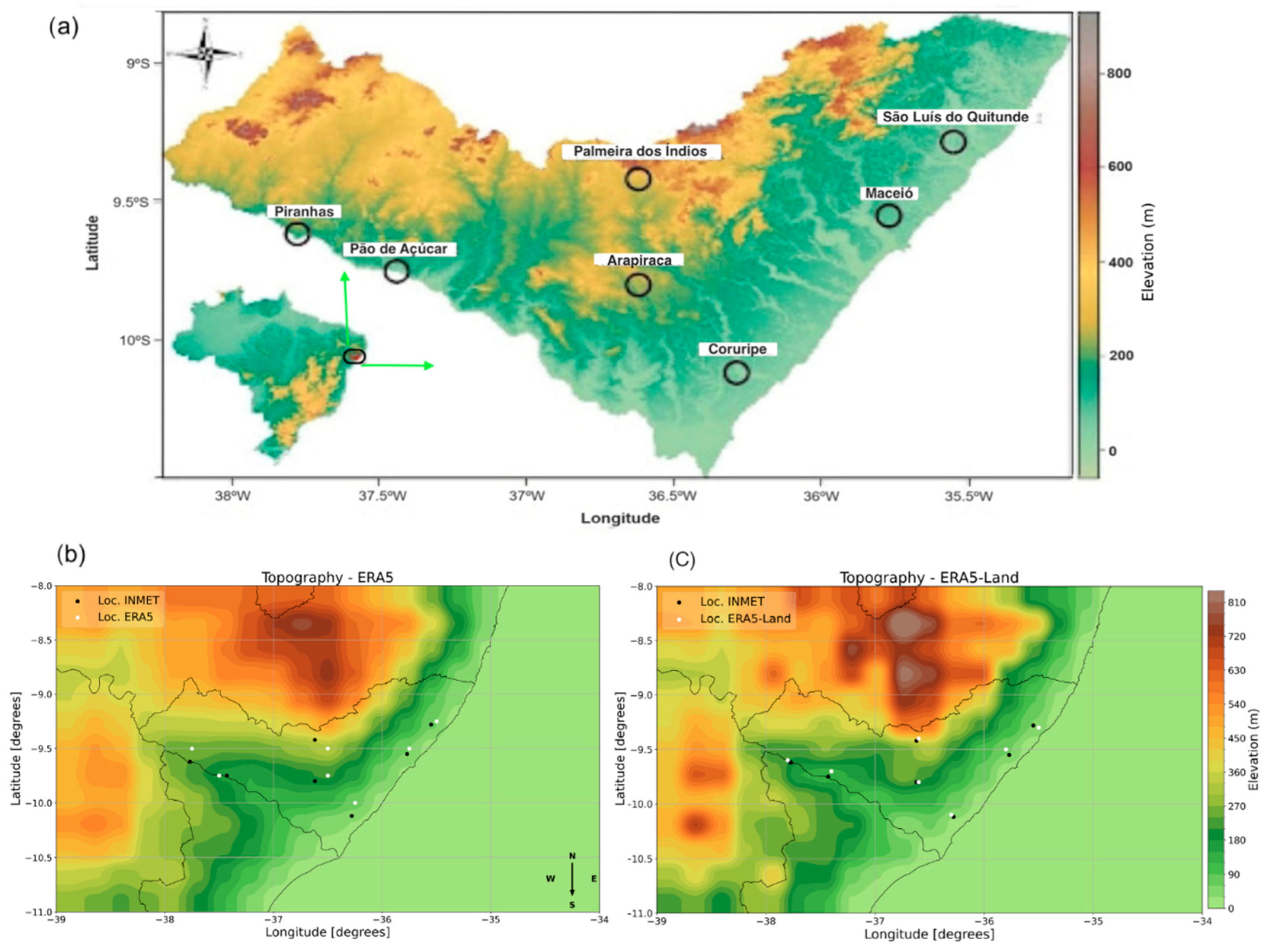
The state’s morphology consists mainly of sandy plateaus, typical formations in Northeast Brazil, with some mountain ranges. The highest point in the state reaches 1144 m, located on the southern slope of the Borborema Plateau in the north-central region, while the average altitude is 213 m. Figure 1a shows the hypsometric map based on data from NASA’s Shuttle Radar Topography Mission (SRTM) [26], highlighting part of the Borborema Plateau in the north-central region. The irregular terrain makes the topographic representation in the reanalyses relatively complex, which can result in significant biases in atmospheric data [4]. Figure 1b and Figure 1c show, respectively, the topography of the ERA5 [27,28] and ERA5-Land [9] reanalysis datasets, as well as the location of the INMET meteorological stations used in this study.

2.2. INMET

To validate the reanalysis dataset, surface atmospheric pressure and 2-m air temperature measurements from all seven Automatic Weather Stations (EMA) operated by the National Institute of Meteorology (INMET) in Brazil (shown in Figure 1) were used. The stations are named after the cities where they are located: Palmeira dos Indios (PI, 278 m), Arapiraca (ARA, 237 m), Piranhas (PIR, 187 m), Maceió (MCZ, 84 m), Coruripe (COR, 82 m), Pão de Açúcar (PA, 20 m), and São Luıs do Quitunde (SLQ, 14 m). Each of these weather stations has a physical base installed in a reserved area measuring 14 m by 18 m, enclosed by metal fencing and positioned away from buildings and trees. The data are provided at an hourly temporal resolution, derived from integrated measurements taken every minute, based on the average of 12 samples recorded every 5 s by each meteorological sensor. The dataset spans 12 years, from 2008 to 2019.
The dataset spans 12 years, from 2008 to 2019, representing the longest period of consistent and simultaneous hourly records available across all seven stations. Although shorter than the 30-year climatological standard normal recommended by the World Meteorological Organization (WMO), this period satisfies the WMO definition of a period average (at least ten years) and is considered sufficient for reanalysis validation purposes.

2.3. ECMWF

We use surface data from ERA5 and ERA5-Land (hereinafter referred to as ERA5L) [9], extracted for the exact locations of the seven INMET observation stations in the study region.
The European reanalysis, ERA5 [27,28], is the latest generation of atmospheric reanalyses produced by ECMWF, replacing the ERA-Interim dataset as of 2016. Compared to ERA-Interim, the new ECMWF data assimilation has significantly improved horizontal resolution, from 80 km to 31 km (0.25° grid), as well as enhanced vertical resolution, increasing from 60 to 137 pressure levels, and a higher temporal frequency, from 6-hourly to hourly data. ERA5 provides atmospheric parameter data from 1940 to the present [2].
ERA5L is a land surface reanalysis derived from ERA5, featuring refined spatial resolution (9 km) and enhanced representation of land processes. It is a rerun of the land surface scheme forced by ERA5 fields, allowing for a more detailed simulation of the surface energy and moisture budgets. Its key innovations include dynamic downscaling and improvements in physical processes related to surface runoff and snow insulation. Moreover, ERA5L utilizes the HTESSEL (Hydrology Tiled ECMWF Scheme for Surface Exchanges over Land) surface model, which improves the representation of energy and moisture exchanges between the surface and the atmosphere. Additionally, it incorporates observational data assimilation from global networks such as the Global Historical Climatology Network (GHCN) and SNOTEL, enabling better characterization of soil conditions, particularly in regions with complex terrain. ERA5L has an hourly resolution, and data is available from 1950 to the present.

2.4. Validation

To ensure a consistent comparison of reanalysis fields and surface observations, the altitude differences between both were first corrected, ranging from −22 m to +178 m (see Table 1 and Figure 1). These corrections are based on the adiabatic lapse rate for temperature and the hydrostatic equation for atmospheric pressure.
Thus, assuming an environmental lapse rate Γ = 0.0065   K m 1 , the equation to find the corrected temperature T c o r r from a model temperature T m o d e l at a grid point with an altitude difference of Δz is
T c o r r = T m o d e l ( Δ Z Γ ) = T m o d e l + Δ T ,
In turn, the equation to find the corrected pressure P_corr, assuming hydrostatic balance, is
P c o r r = P m o d e l + ρ g Δ Z = P m o d e l + Δ P ,
where g is the acceleration due to gravity, and the air density ρ is calculated using the ideal gas equation and the corrected temperature T c o r r . The details of these procedures are described in Cosgrove et al. (2003) [16] and are widely adopted in reanalysis validation studies and atmospheric model performance evaluations [16,21,29,30,31].
To assess the performance of the ERA5 and ERA5L reanalyses in the study region, time series of pressure and temperature were extracted for the grid point nearest to the location of each station. Both observations and reanalysis time series comprise hourly data from January 2008 to December 2019. Using INMET data as a reference, the systematic bias (BIAS), the mean squared error (MSE), the root mean square error (RMSE), and the Pearson correlation coefficient (r) [32] were computed. The BIAS indicates whether the reanalysis overestimates or underestimates the observed data, while the RMSE quantifies the dispersion of errors, reflecting the accuracy of the simulations. The Pearson correlation coefficient measures the strength and direction of the linear relationship between the reanalysis data and station observations. These statistics are computed for both corrected and uncorrected data.

3. Results

3.1. Statistics

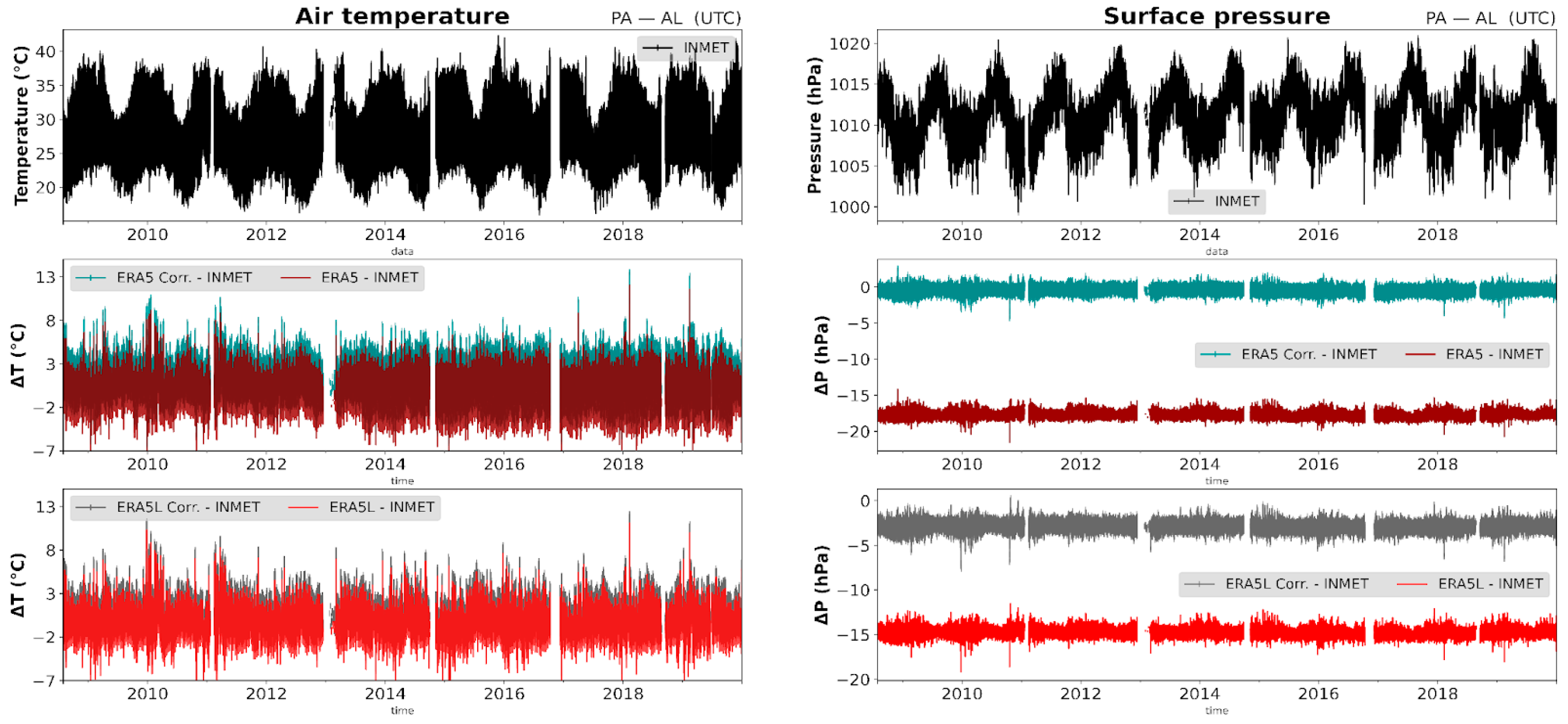
Table 1 provides an overview of the statistical validation performed for all stations, while Figure 2 illustrates the analysis for the PA station, which has the greatest altitude differences to ERA5 and ERA5L. Focusing on near-surface temperature (2 m), the altitude corrections applied to ERA5 resulted in a significant reduction in bias at the three stations located at higher elevations (PI, ARA, PIR). In contrast, no notable changes were observed at the intermediate-altitude stations (MCZ, COR), while a considerable increase in bias was recorded at the sea-level stations (PA, SLQ). This pattern, however, was not evident in the ERA5-Land temperature data, where the impact of the corrections was less pronounced. Overall, when considering the average across all stations, there was a slight increase in temperature bias for ERA5, while ERA5-Land exhibited a more statistically significant reduction.
Regarding surface pressure, the altitude correction effectively mitigated the ERA5 bias, and the overall mean bias decreased from −5.9 hPa to 0.2 hPa. The exception was the COR station, where a slight increase was observed. However, it has a high number of outliers and inconsistencies in the time series, suggesting potential technical failures or uncertainties whose origins remain unclear. For ERA5-Land, the correction effects were more heterogeneous: some stations showed a reduction (ARA, PIR, PA, SLQ), while others showed an increase (PI, MCZ, COR). Nevertheless, the substantial decrease observed at stations like PA contributed to a reduction in the mean bias from −4.5 hPa to −1.2 hPa.
The RMSE and Pearson correlation are also shown in Table 1. For pressure, all coefficients exceed 0.99, while for temperature, values range from a minimum of 0.88 at SLQ to a maximum of 0.96 at PA. We investigated whether these differences were associated with station altitude, the altitude discrepancy between the reanalysis and the station, proximity to the coast, or vegetation type; however, no clear relationship was identified. For pressure, the reduction in RMSE scaled with the decrease in bias, while for temperature, the changes in bias barely affected the RMSE. This occurs for both ERA5 and ERA5L and indicates residual random errors in temperature of approximately ±1.5 °C, which are larger than the remaining biases. For pressure, the residual random errors are about ±0.3 hPa, and are less significant than the remaining biases.

3.2. Validation of Diurnal, Monthly, and Seasonal Cycles

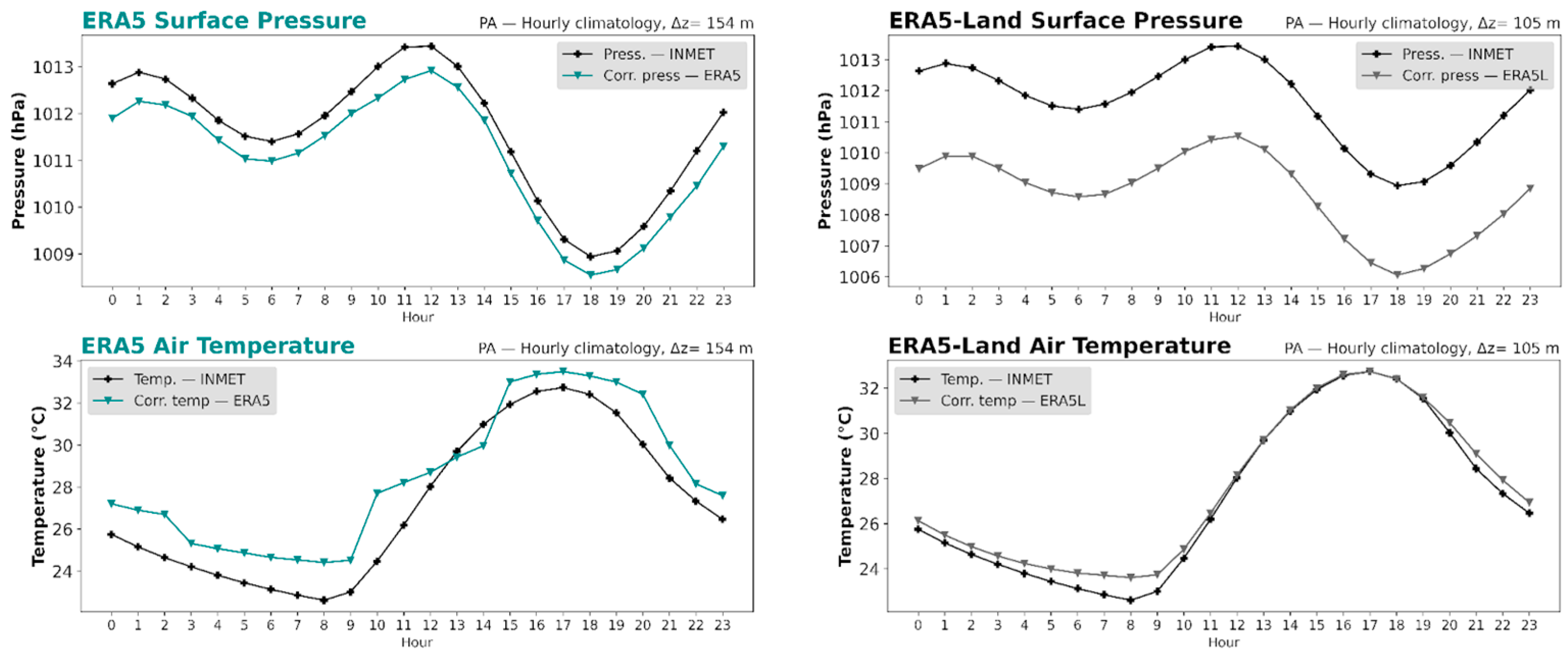
We analyzed how well ERA5 and ERA5L represent the diurnal and monthly cycles, as well as the seasonality of the diurnal cycle for temperature and pressure. Figure 3 illustrates the diurnal cycle at the PA station, based on the corrected ERA5 and ERA5L reanalyses, which is representative of what we observed in all stations.
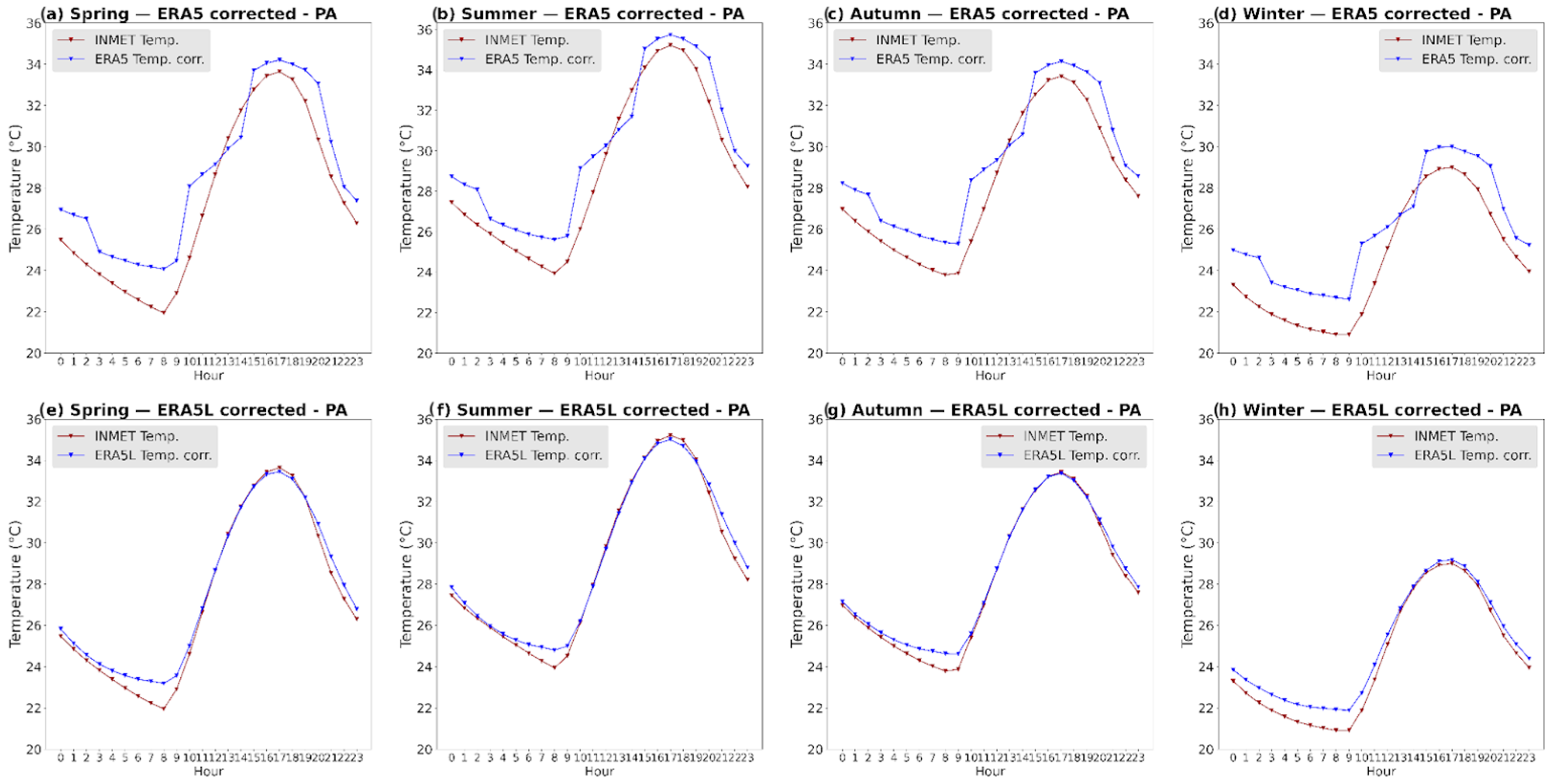
Regarding pressure, there is a constant offset between the observed and reanalysis diurnal cycles, indicating that the remaining bias (see Table 1) remains constant throughout the day for both ERA5 and ERA5L. For temperature, however, the results reveal anomalous jumps in ERA5, which are also recurrent at other analyzed stations. These jumps occur at specific times, namely 2 UTC, 9 UTC, 14 UTC, and 20 UTC, suggesting a possible influence of the ERA5 data assimilation cycle; however, the irregular time intervals between these jumps, which are not 6 h, indicate otherwise. Even ignoring the jumps, the figure shows that the ERA5 temperature does not closely follow the observations. At night (3 to 9 UTC) and in the morning (10 to 14 UTC), the ERA temperature varies linearly with time, while the observations show the typical “sinusoidal” pattern. In contrast, ERA5L does not exhibit any temperature jumps, but the remaining biases are not constant throughout the day. The pattern for all stations is similar to that shown for the PA station in Figure 3: minimal bias in the early afternoon (17 UTC) and maximum just before sunrise (8 UTC). Hence, a tendency for overestimating the minimum temperature observed at nighttime.
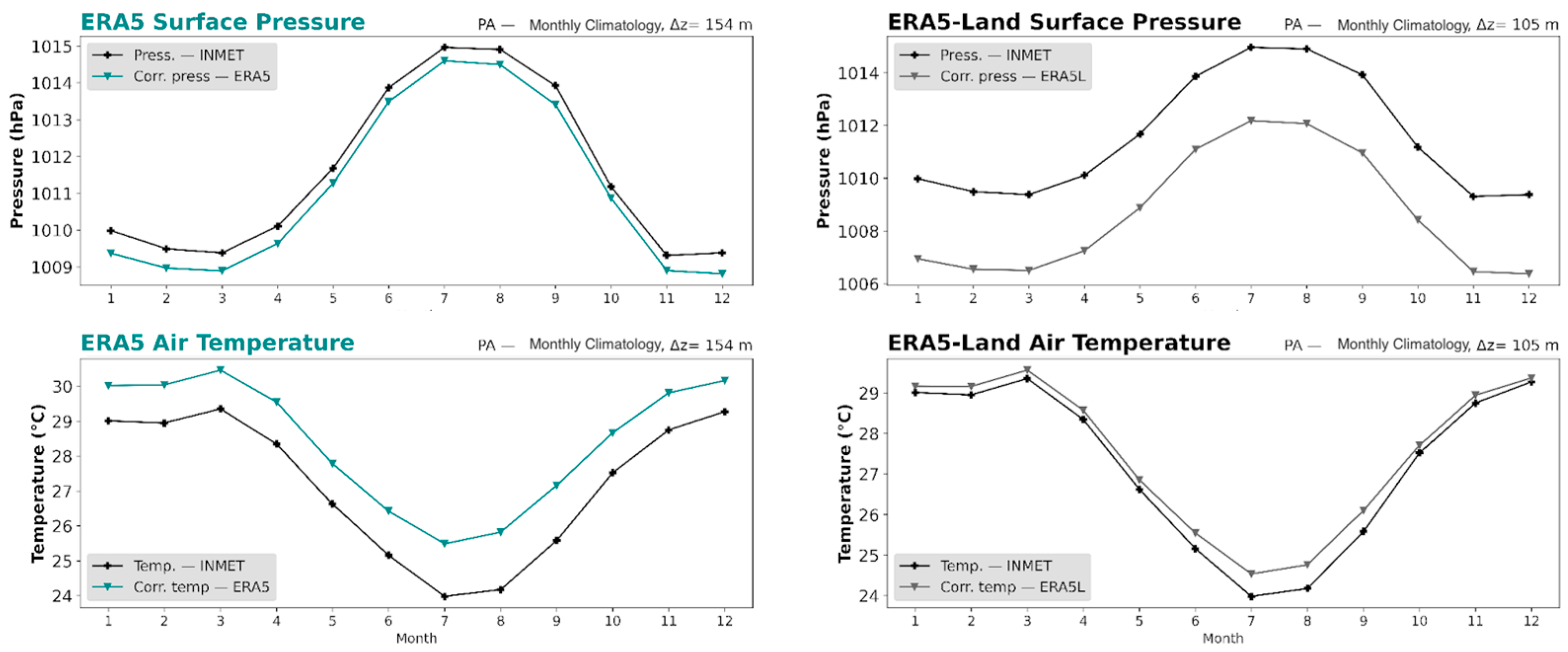
A similar analysis is shown in Figure 4, but for the monthly climatology at the PA station. For pressure, a constant offset is observed again, for both ERA5 and ERA5L, indicating that the remaining biases do not vary seasonally. This systematic error likely reflects an unresolved difference in surface elevation, which we will discuss in the next section. In terms of temperature, there is a slight variation in the differences between reanalysis and observations throughout the seasonal cycle, with larger biases in the austral winter (July) and smaller biases in the austral summer (January). It is also noted that the temperature jumps are smoothed out and do not appear in the monthly timescale. Consequently, users relying on daily or monthly ERA5 data may not detect this issue in the diurnal cycle, even though it might affect daily and monthly mean values.
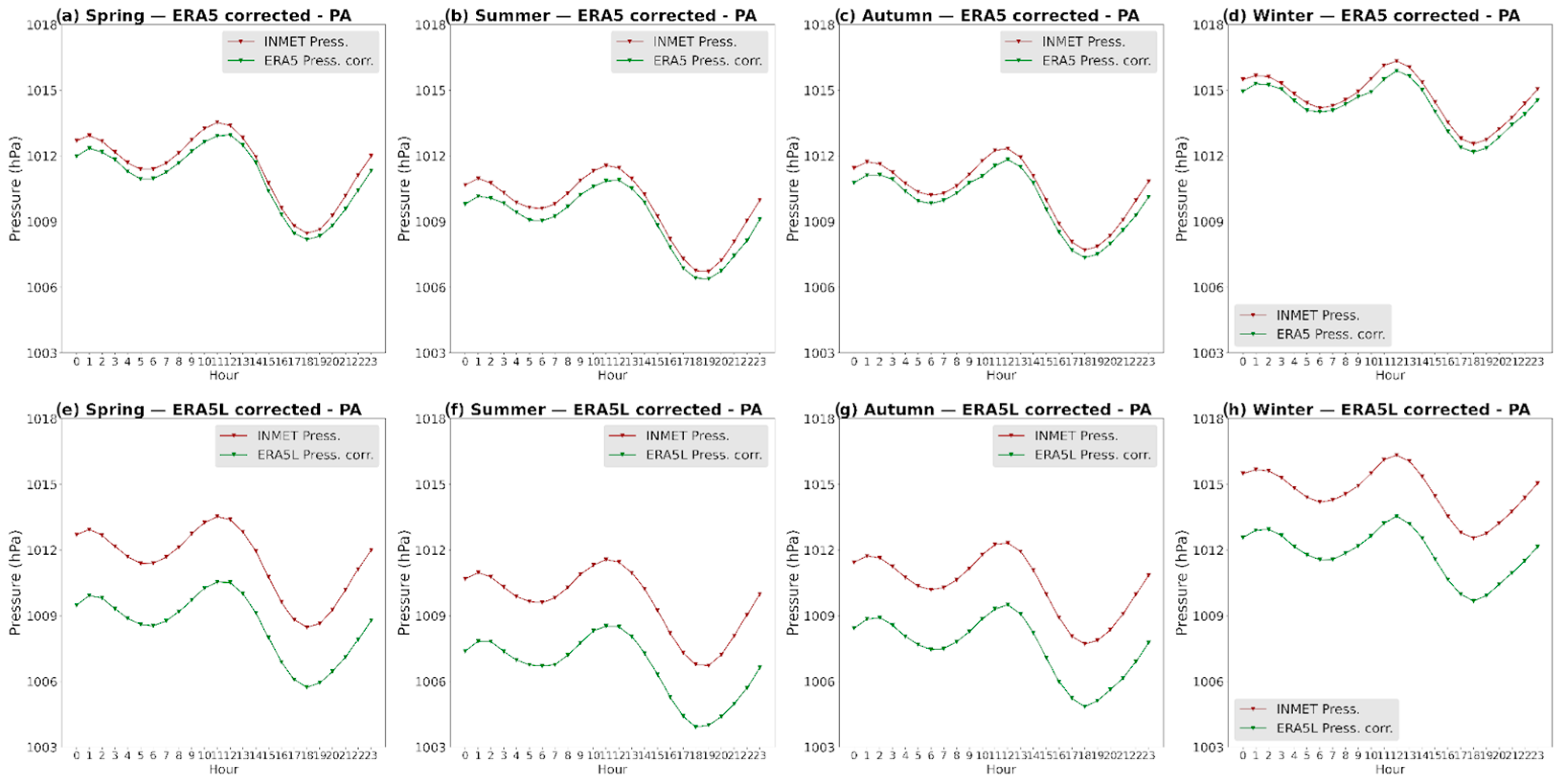
Next, we examined the seasonality of the diurnal cycle of temperature and pressure. Figure 5 and Figure 6 depict the diurnal cycle for each austral season: spring (SON), summer (DJF), autumn (MAM), and winter (JJA). Regarding temperature (Figure 5), the abrupt 243 variations in ERA5 are observed throughout the year in the PA station, similar to all other stations. Additionally, the amplitude of these oscillations decreases from a maximum in the spring to a minimum in the winter. ERA5L nighttime warm bias in temperature persists throughout the seasons, but it is stronger in winter. For all seasons, the most significant discrepancy occurs just before sunrise, when the ERA5L is about 1 °C warmer. On the other hand, nothing remarkable is noted for pressure (Figure 6). The remaining biases are constant throughout the day in all seasons. As previously mentioned, this seems to indicate uncorrected differences in elevation.

4. Discussion

The previous section presented a comparison between the ERA5 and ERA5L reanalyses and observations from seven automatic surface stations in the Alagoas region, Brazil, with the aim of validating the performance of these reanalyses. There are significant altitude differences between the stations’ altitudes and how topography is represented by the models, even for the high-resolution ERA5L reanalysis. For our study region, these range from +178 m to −22 m for ERA5 and from +105 m to −16 m for ERA5L (Table 1). Large positive (model higher than station) and negative (station higher than model) differences are known to occur in regions with complex topography [29], and correcting for these differences is essential to ensure that reanalysis fields can be compared fairly to atmospheric observations [6,16,19].
The altitude correction reduced the pressure RMSE by 87% for ERA5 and 28% for ERA5L on average, while no significant changes were observed for the temperature RMSE (Table 1). There are residual random errors for both temperature (±1.5 °C) and pressure (±0.3 hPa), which could indicate model shortcomings in representing the local variability of pressure and temperature. However, we note that these are similar to the inherent uncertainty of the meteorological observations. For context, Zhang and Li (2025) [33], in a global-scale assessment using nearly 10,000 in situ stations, reported temperature RMSEs ranging from 2.5 to 3.5 °C and pressure RMSEs between 3.9 and 4.3 hPa for ERA5. The residual errors found in the present study are therefore considerably lower than the global average, suggesting that the altitude correction applied here was effective in reducing the largest sources of error.
The altitude correction also reduced the pressure BIAS by 97% for ERA5 and 73% for ERA5L on average (Table 1). However, the diurnal and seasonal analysis revealed that the remaining biases are constant throughout the day and seasons (Figure 6), thus indicating a systematic error. We suspect that a residual bias arises from a mismatch between the surface topography represented in the ECMWF model’s native spectral grid and the topography associated with the regularly gridded output [27,33]. The surface pressure is determined using the spectral representation of orography; so, if it is later interpolated to the regular grid without any adjustments, our correction may not fully account for the altitude difference between models and stations. This is consistent with the findings of Soci et al. (2024) [34], who identified a systematic temperature bias in ERA5 related to the discrepancy between the altitude of observation stations and their represented altitude in the model, estimating a global average temperature bias of up to 0.3 °C attributable to this effect. Future studies may be able to reduce this bias by using model-level data on the native grid.
For temperature, the altitude correction produced inconsistent changes. On average, the bias increased from −0.2 to 0.3 °C in ERA5 and decreased from −0.6 to −0.3 °C in ERA5L. Sam-Khaniani and Mohammadi (2023) [20] also reported an increase in bias after altitude corrections for 10% of the 202 stations analyzed in Iran. Similarly, Zhao et al. (2008) [19] reported that the effectiveness of their corrections varied seasonally and, in some cases, even worsened the temperature biases in mountainous regions of China.
In general terms, our results indicate that the corrected ERA5 and ERA5L reproduced the diurnal and seasonal cycles of surface pressure and temperature. The diurnal cycle of temperature shows a minimum before sunrise, and a maximum at 14h local time. The correlation coefficient between both reanalysis and observations is above 0.9 for all but one station. The largest discrepancies were found for the minimum temperature, just before sunrise, with ERA5 and ERA5L overestimating the observations. This agrees with the analysis of Rozante et al. (2022) [6] for South America, who found that ERA5 tends to overestimate the minimum temperatures and underestimate the maximum temperatures. At the global scale, Lopes et al. (2024) [35] corroborated this pattern over a 40-year period (1980–2019), attributing it to a limitation of the ECMWF model in reproducing the amplitude of the diurnal temperature cycle. These authors also associated larger errors with regions of complex topography, such as the western United States, which is analogous to the study region of the present work. At the regional scale, Ferreira et al. (2026) [36] validated ERA5 and ERA5-Land for daily maximum and minimum temperatures in the semiarid Northeast Brazil, a region geographically close to Alagoas, and found that ERA5 consistently outperformed ERA5-Land for maximum temperature (RMSE < 1.5 °C; ρ > 0.90), while ERA5-Land showed greater accuracy for minimum temperature at specific stations, suggesting that model selection for minimum temperature should consider the local spatial context. These authors also found that ERA5 more accurately represents milder temperatures in coastal cities and more pronounced thermal events in remote and elevated areas, a pattern consistent with the altitude-related differences identified in the present study.
At the seasonal timescale, both reanalyses tend to overestimate the minimum temperatures during winter, which was not observed in other regions of Brazil [22,23]. It is noted, however, that these two studies utilized the ECMWF analysis and the ECMWF ERA-Interim datasets, respectively, rather than ERA5.
Lastly, recurring anomalous jumps were identified throughout the diurnal cycle of ERA5 temperature in all seasons. These are only detectable at the hourly timescale and, hence, were not noticed in other studies in Brazil [6,22,23]. Discontinuities can arise at the transition between two assimilation cycles in the 4D-Var scheme used in ERA5 (12 h windows starting at 9 and 21 UTC) (ECMWF, 2021). However, these don’t match the problematic times we identified (02 to 03 UTC, 09 to 10 UTC, 14 to 15 UTC, and 20 to 21 UTC), which correspond to forecast steps 5 to 6, 0 to 1, 5 to 6, and 11 to 12 h, respectively. Further investigation, beyond the scope of this study, is needed to identify the origin of this error in the ERA5 dataset.
Despite the promising results obtained in this study, some limitations should be acknowledged. The analysis was restricted to temperature and atmospheric pressure, and future studies should consider extending the validation to other meteorological variables, such as wind speed, relative humidity, and precipitation. Expanding the spatial coverage to neighboring states or the broader Northeast Brazil region would provide a more comprehensive evaluation of ERA5 and ERA5-Land performance.
Additionally, the validation presented here is based on the extraction of the nearest grid point for each station, which is a standard approach but may introduce representativeness errors in coastal and complex terrain regions. Among these, elevation differences are typically dominant and are mitigated by the altitude correction applied in this study. However, residual representativeness errors, for example due to horizontal mismatches and surface characteristics, may still contribute to some of the remaining observed biases. Future work could assess the sensitivity of the results to alternative sampling strategies, such as bilinear interpolation or elevation-aware interpolation methods. Furthermore, Lopes et al. (2024) [35] showed that ERA5 errors have decreased from the 1980s to the 2010s, largely attributed to the increased use of satellite data in the assimilation system. This is consistent with Soci et al., (2024) [34], who showed that the quality of ERA5 improves progressively over time as the number of assimilated observations increases from approximately 17,000 per day in 1940 to 25 million per day in 2022, with implications for the reliability of the reanalysis in data-sparse regions such as Northeast Brazil. Future studies covering longer time periods could therefore assess whether a similar improvement is observed in the Alagoas region.

5. Conclusions

Reanalyses are widely used to study atmospheric phenomena, from weather to climate scales. Validating these datasets against observational measurements under different conditions and in various regions is of utmost importance to our scientific community. In this study, the performances of ECMWF’s ERA5 and ERA5L reanalyses were assessed through statistical validation using air temperature and atmospheric pressure data from meteorological stations in the state of Alagoas, Brazil, a tropical coastal region with steep topography. To minimize the effects of altitude discrepancies between the model and observation sites, corrections were applied before comparing the modeled temperature and pressure fields with observations.
  • Accounting for elevation differences between model grids and observation sites is essential for proper evaluation of atmospheric pressure, while its impact on temperature is more variable.
  • The agreement between corrected reanalysis products and in situ observations is comparable to observational uncertainty, indicating that residual errors are largely random rather than systematic.
  • After the appropriate corrections, both ERA5 and ERA5-Land reproduce observed surface temperature and pressure with high fidelity, demonstrating their suitability for representing atmospheric conditions in regions with complex terrain.
The analysis of diurnal and seasonal cycles further reinforced the ability of the corrected datasets to reproduce the temporal variability of meteorological variables. However, systematic anomalous jumps in temperature were detected in the diurnal cycle of ERA5, which cannot be readily associated with the data assimilation cycles. Although these errors are smoothed in monthly climatologies, they may still impact short-term analyses or applications sensitive to hourly variations. Further investigation is needed to identify the source of these errors accurately.
In conclusion, although ERA5 and ERA5L reanalyses demonstrate overall good performance in representing the atmospheric conditions of northeastern Brazil, prior adjustments and validation remain essential steps to ensure the suitability of these datasets for specific research and operational applications.

Author Contributions

Conceptualization, H.B.G., H.M.J.B. and K.M.R.S.; methodology, H.B.G., H.M.J.B., K.M.R.S. and R.B.d.P.; investigation, K.M.R.S., H.B.G., H.M.J.B. and R.B.d.P.; data curation, I.G.F.d.F., F.D.d.S.S. and M.C.L.d.S.; software, K.M.R.S., R.B.d.P. and H.M.J.B.; writing—original draft preparation, K.M.R.S.; writing; review and editing, H.B.G. and H.M.J.B.; supervision, D.L.H., H.M.J.B. and H.B.G. All authors have read and agreed to the published version of the manuscript.

Funding

This research received no external funding.

Institutional Review Board Statement

Not applicable.

Informed Consent Statement

Not applicable.

Data Availability Statement

The station data used in this study can be obtained from the National Institute of Meteorology (INMET) website in Brazil: https://portal.inmet.gov.br/ (accessed on 5 November 2020). ERA5 and ERA5-Land data were downloaded through the Copernicus Climate Change Service (C3S)/Climate Data Store (CDS) at https://cds.climate.copernicus.eu/datasets (accessed on 17 March 2026).

Acknowledgments

K.M.R.S. acknowledges the support by the Coordenação de Aperfeiçoamento de Pessoal de Nível Superior—Brasil (CAPES)—Finance Code 001.

Conflicts of Interest

The authors declare no conflicts of interest.

Abbreviations

C3SCopernicus Climate Change Service
CDSClimate Data Store
ECMWFEuropean Centre for Medium-Range Weather Forecasts
EMAEstação Meteorológica Automática (Automatic Weather Station)
ERA5Fifth Generation ECMWF Reanalysis
ERA5LERA5-Land
GHCNGlobal Historical Climatology Network
GNSSGlobal Navigation Satellite System
HTESSELHydrology Tiled ECMWF Scheme for Surface Exchanges over Land
INMETInstituto Nacional de Meteorologia (National Institute of Meteorology)
MEMean Error
MSEMean Squared Error
NCARNational Center for Atmospheric Research
NCEPNational Centers for Environmental Prediction
NEBNortheast Brazil
NLDASNorth American Land Data Assimilation System
RMSERoot Mean Square Error
SAMeTSouth America Merged Temperature
SNOTELSnow Telemetry Network
SRTMShuttle Radar Topography Mission
WMOWorld Meteorological Organization
ZTDZenith Tropospheric Delay
4D-VarFour-Dimensional Variational Data Assimilation

References

  1. Gao, L.; Bernhardt, M.; Schulz, K.; Chen, X. Elevation correction of ERA-Interim temperature data in the Tibetan Plateau. Int. J. Climatol. 2017, 37, 3540–3552. [Google Scholar] [CrossRef]
  2. Dee, D.P.; Uppala, S.M.; Simmons, A.J.; Berrisford, P.; Poli, P.; Kobayashi, S.; Andrae, U.; Balmaseda, M.; Balsamo, G.; Bauer, P.; et al. The ERA-Interim reanalysis: Configuration and performance of the data assimilation system. Q. J. R. Meteorol. Soc. 2011, 137, 553–597. [Google Scholar] [CrossRef]
  3. Cao, B.; Gruber, S.; Zheng, D.; Li, X. The ERA5-Land soil temperature bias in permafrost regions. Cryosphere 2020, 14, 2581–2595. [Google Scholar] [CrossRef]
  4. Dodson, R.; Marks, D. Daily air temperature interpolated at high spatial resolution over a large mountainous region. Clim. Res. 1997, 8, 1–20. [Google Scholar] [CrossRef]
  5. Gao, L.; Bernhardt, M.; Schulz, K. Elevation correction of ERA-Interim temperature data in complex terrain. Hydrol. Earth Syst. Sci. 2012, 16, 4661–4673. [Google Scholar] [CrossRef]
  6. Rozante, J.R.; Ramirez, E.; Fernandes, A.D.A. A newly developed South American mapping of temperature with estimated lapse rate corrections. Int. J. Climatol. 2022, 42, 2135–2152. [Google Scholar] [CrossRef]
  7. Boulard, D.; Castel, T.; Camberlin, P.; Sergent, A.S.; Bréda, N.; Badeau, V.; Rossi, A.; Pohl, B. Capability of a regional climate model to simulate climate variables requested for water balance computation: A case study over northeastern France. Clim. Dyn. 2016, 46, 2689–2716. [Google Scholar] [CrossRef]
  8. Dutra, E.; Muñoz-Sabater, J.; Boussetta, S.; Komori, T.; Hirahara, S.; Balsamo, G. Environmental lapse rate for high-resolution land surface downscaling: An application to ERA5. Earth Space Sci. 2020, 7, e2019EA000984. [Google Scholar] [CrossRef]
  9. Muñoz-Sabater, J.; Dutra, E.; Agustí-Panareda, A.; Albergel, C.; Arduini, G.; Balsamo, G.; Boussetta, S.; Choulga, M.; Harrigan, S.; Hersbach, H.; et al. ERA5-Land: A state-of-the-art global reanalysis dataset for land applications. Earth Syst. Sci. Data 2021, 13, 4349–4383. [Google Scholar] [CrossRef]
  10. Velikou, K.; Lazoglou, G.; Tolika, K.; Anagnostopoulou, C. Reliability of the ERA5 in replicating mean and extreme temperatures across Europe. Water 2022, 14, 543. [Google Scholar] [CrossRef]
  11. Pelosi, A.; Terribile, F.; D’Urso, G.; Chirico, G.B. Comparison of ERA5-Land and UERRA MESCAN-SURFEX reanalysis data with spatially interpolated weather observations for the regional assessment of reference evapotranspiration. Water 2020, 12, 1669. [Google Scholar] [CrossRef]
  12. Malardel, S.; Wedi, N.P. How does subgrid-scale parametrization influence nonlinear spectral energy fluxes in global NWP models? J. Geophys. Res. Atmos. 2016, 121, 5395–5410. [Google Scholar] [CrossRef]
  13. Behnke, R.; Vavrus, S.; Allstadt, A.; Albright, T.; Thogmartin, W.E.; Radeloff, V.C. Evaluation of downscaled, gridded climate data for the conterminous United States. Ecol. Appl. 2016, 26, 1338–1351. [Google Scholar] [CrossRef] [PubMed]
  14. Sheridan, P.; Smith, S.; Brown, A.; Vosper, S. A simple height-based correction for temperature downscaling in complex terrain. Meteorol. Appl. 2010, 17, 329–339. [Google Scholar] [CrossRef]
  15. Mitchell, K.E.; Lohmann, D.; Houser, P.R.; Wood, E.F.; Schaake, J.C.; Robock, A.; Cosgrove, B.A.; Sheffield, J.; Duan, Q.; Luo, L.; et al. The multi-institution North American Land Data Assimilation System (NLDAS): Utilizing multiple GCIP products and partners in a continental distributed hydrological modeling system. J. Geophys. Res. Atmos. 2004, 109, D07S90. [Google Scholar] [CrossRef]
  16. Cosgrove, B.A.; Lohmann, D.; Mitchell, K.E.; Houser, P.R.; Wood, E.F.; Schaake, J.C.; Robock, A.; Marshall, C.; Sheffield, J.; Duan, Q.; et al. Real-time and retrospective forcing in the North American Land Data Assimilation System (NLDAS) project. J. Geophys. Res. Atmos. 2003, 108, 8842. [Google Scholar] [CrossRef]
  17. de Goncalves, L.G.G.; Shuttleworth, W.J.; Vila, D.; Larroza, E.; Bottino, M.J.; Herdies, D.L.; Aravequia, J.A.; De Mattos, J.G.; Toll, D.L.; Rodell, M.; et al. The South American Land Data Assimilation System (SALDAS) 5-yr retrospective atmospheric forcing datasets. J. Hydrometeorol. 2009, 10, 999–1010. [Google Scholar] [CrossRef]
  18. Wakjira, M.T.; Peleg, N.; Burlando, P.; Molnar, P. Gridded daily 2-m air temperature dataset for Ethiopia derived by debiasing and downscaling ERA5-Land for the period 1981–2010. Data Brief 2023, 46, 108844. [Google Scholar] [CrossRef]
  19. Zhao, T.; Guo, W.; Fu, C. Calibrating and evaluating reanalysis surface temperature error by topographic correction. J. Clim. 2008, 21, 1440–1446. [Google Scholar] [CrossRef]
  20. Sam-Khaniani, A.; Mohammadi, A. Investigating the effect of height difference correction between reanalysis grid points and observation stations on the accuracy of ERA5 2m temperature and pressure data. Iran. J. Geophys. 2023, 18, 29–45. [Google Scholar] [CrossRef]
  21. Mao, J.; Hu, D.; Li, R.; Wu, C.; Cui, T. Enhancing GNSS tropospheric delay corrections through an innovative lapse rate grid and adiabatic modelling. Adv. Space Res. 2025, 75, 2696–2710. [Google Scholar] [CrossRef]
  22. Moraes, R.A.; Rocha, J.V.; de Souza Rolim, G.; Lamparelli, R.A.C.; Martins, M.M. Avaliação dos dados decendiais de precipitação e temperatura máxima e mínima do ar simulados pelo modelo ECMWF para o estado de São Paulo. Irriga 2012, 17, 97–407. [Google Scholar]
  23. Aparecido, L.E.d.O.; Rolim, G.d.S.; Moraes, J.R.d.S.C.d.; Torsoni, G.B.; Meneses, K.C.d.; Costa, C.T.S. Accuracy of ECMWF ERA-Interim reanalysis and its application in the estimation of the water deficiency in Paraná, Brazil. Rev. Bras. Meteorol. 2020, 34, 515–528. [Google Scholar] [CrossRef]
  24. Kawohl, T.O. Evaluation of ERA5, ERA5-Land, and IMERG-F Precipitation with a Particular Focus on Elevation-Dependent Variations. Ph.D. Thesis, Staats- und Universitätsbibliothek Hamburg Carl von Ossietzky, Hamburg, Germany, 2019. [Google Scholar]
  25. Barros, A.H.C.; Araujo Filho, J.C.d.; Silva, A.B.d.; Santiago, G.A.C.F. Climatologia do Estado de Alagoas; Boletim de Pesquisa e Desenvolvimento 211; Embrapa Solos: Recife, Brazil, 2012; Available online: http://www.infoteca.cnptia.embrapa.br/infoteca/handle/doc/950797 (accessed on 4 July 2025).
  26. Farr, T.G.; Kobrick, M. Shuttle Radar Topography Mission produces a wealth of data. Eos Trans. Am. Geophys. Union 2000, 81, 583–585. [Google Scholar] [CrossRef]
  27. Hersbach, H.; Bell, B.; Berrisford, P.; Hirahara, S.; Horányi, A.; Muñoz-Sabater, J.; Thépaut, J.N. The ERA5 global reanalysis. Q. J. R. Meteorol. Soc. 2020, 146, 1999–2049. [Google Scholar] [CrossRef]
  28. Höhlein, K.; Hewson, T.; Westermann, R. Topographic visualization of near-surface temperatures for improved lapse rate estimation. arXiv 2024, arXiv:2406.11894. [Google Scholar] [CrossRef]
  29. Qin, Y.; Ren, G.; Wu, L.; Zhang, P. The relationship between elevation-dependent warming and long-term trend of surface air temperature lapse rate. Atmos. Res. 2024, 307, 107478. [Google Scholar] [CrossRef]
  30. Zhang, Z.; Bamber, J.; Igneczi, A. Temporal and spatial changes in the environmental lapse rate distribution over the Arctic. Environ. Res. Lett. 2024, 19, 084047. [Google Scholar] [CrossRef]
  31. Willmott, C.J.; Matsuura, K. Advantages of the mean absolute error (MAE) over the root mean square error (RMSE) in assessing average model performance. Clim. Res. 2005, 30, 79–82. [Google Scholar] [CrossRef]
  32. ERA5: Fifth Generation of ECMWF Atmospheric Reanalyses of the Global Climate—Copernicus Climate Change Service (C3S) Climate Data Store Documentation. Available online: https://confluence.ecmwf.int/display/CKB/ERA5%3A+data+documentation (accessed on 4 July 2025).
  33. Zhang, Q.; Li, J. Multi-scale assessment of ERA5 hourly pressure-level data on a global scale with in-situ observations. Theor. Appl. Climatol. 2025, 156, 575. [Google Scholar] [CrossRef]
  34. Soci, C.; Hersbach, H.; Simmons, A.; Poli, P.; Bell, B.; Berrisford, P.; Horányi, A.; Muñoz-Sabater, J.; Nicolas, J.; Radu, R.; et al. The ERA5 global reanalysis from 1940 to 2022. Q. J. R. Meteorol. Soc. 2024, 150, 4014–4048. [Google Scholar] [CrossRef]
  35. Lopes, F.M.; Dutra, E.; Boussetta, S. Evaluation of daily temperature extremes in the ECMWF operational weather forecasts and ERA5 reanalysis. Atmosphere 2024, 15, 93. [Google Scholar] [CrossRef]
  36. Ferreira, L.S.; Alcantara, C.R.; Santiago, D.B.; Silva, L.K.A. Validation of ERA5 and ERA5-Land reanalysis data for maximum and minimum temperatures in the Brazilian semiarid region. Theor. Appl. Climatol. 2026, 157, 198. [Google Scholar] [CrossRef]
Figure 1. (a) Hypsometric map and distribution of Automatic Meteorological Stations (EMA- INMET) in Alagoas, with spatial resolution of 1 arc-second (approximately 30 m). Atlantic Ocean on the eastern side. (b) Topography of ERA5 (left, 0.25°, ≈31 km) and (c) ERA5L (right, 0.1°, ≈9 km). The black dots represent the location of INMET observation stations, while the white dots indicate the nearest grid points from the ERA5 (left) and ERA5-Land (right) reanalyses corresponding to these stations.
Climate 14 00098 g001
Figure 2. Time series of Temperature (°C) and Pressure (hPa) from observations (top) and the differences from the ERA5 reanalysis ((middle), ∆z = 153.6 m) and ERA5L reanalysis ((bottom), ∆z = 105.1 m) for the Pão de Açúcar (PA) station.
Climate 14 00098 g002
Figure 3. Diurnal cycle of temperature (°C) and surface pressure (hPa) for the Pão de Açúcar (PA) station, comparing the model (ERA5 and ERA5L) with observations (INMET).
Climate 14 00098 g003
Figure 4. Monthly climatologies of temperature (°C) and surface pressure (hPa) for the Pão de Açúcar (PA) station, comparing the model (ERA5 and ERA5L) with observations (INMET).
Climate 14 00098 g004
Figure 5. Seasonality of the diurnal cycle of temperature (°C) for the Pão de Açúcar (PA) station, comparing the model (ERA5 and ERA5L) with observations (INMET). From left to right, the seasons for the austral hemisphere are: spring (SON), summer (DJF), autumn (MAM), and winter (JJA).
Climate 14 00098 g005
Figure 6. Seasonality of the diurnal cycle of surface atmospheric pressure (hPa) for the Pão de Açúcar (PA) station, comparing the model (ERA5 and ERA5L) with observations (INMET). From left to right, the seasons for the austral hemisphere are: spring (SON), summer (DJF), autumn (MAM), and winter (JJA).
Climate 14 00098 g006
Table 1. General statistical chart for the temperature and pressure variables compared to INMET observation data, with equal temporal resolution. Some differences were observed only from the 10th decimal place and, therefore, are not visible in the table. Also included is the altitude difference (∆z = Z m o d e l   Z s t a t i o n ) between the reanalysis grid points and the INMET surface meteorological stations.
Station (Z)DatasetT (°C)P (hPa) Δ z E R A 5 Δ z E R A 5 L
PearsonRMSEBIASPearsonRMSEBIAS
PI (278 m)ERA50.951.3−0.50.995.0−5.041 m87 m
ERA5 corr0.951.2−0.10.990.5−0.4
ERA5-Land0.961.5−1.00.994.3−4.2
ERA5-Land corr0.961.2−0.20.995.55.5
ARA (237 m)ERA50.921.50.50.996.46.4−19 m−13 m
ERA5 corr0.921.50.30.994.34.3
ERA5-Land0.941.30.040.998.38.3
ERA5-Land corr0.941.3−0.10.996.86.8
PIR (187 m)ERA50.932.0−1.40.9820.4−20.4178 m19 m
ERA5 corr0.931.50.40.990.8−0.8
ERA5-Land0.972.0−1.70.9916.2−16.2
ERA5-Land corr0.971.9−1.50.9914.0−14.0
MCZ (84 m)ERA50.911.30.10.991.81.8−22 m4 m
ERA5 corr0.911.3−0.10.990.8−0.7
ERA5-Land0.901.4−0.10.991.51.5
ERA5-Land corr0.901.4−0.10.992.01.9
COR (82 m)ERA50.801.9−0.30.990.3−0.1−3 m−16 m
ERA5 corr0.801.9−0.40.990.5−0.4
ERA5-Land0.822.0−0.80.990.40.2
ERA5-Land corr0.822.1−1.00.991.6−1.6
PA (20 m)ERA50.951.4−0.30.9917.7−17.7154 m105 m
ERA5 corr0.951.91.20.990.6−0.5
ERA5-Land0.961.4−0.70.9914.8−14.8
ERA5-Land corr0.961.20.30.992.9−2.9
SLQ (14 m)ERA50.891.90.30.996.4−6.452 m17 m
ERA5 corr0.892.00.80.990.4−0.4
ERA5-Land0.911.6−0.010.996.3−6.2
ERA5-Land corr0.911.60.20.994.4−4.4
AverageERA50.911.6−0.20.998.3−5.954.4329
ERA5 corr0.911.60.30.991.10.2
ERA5-Land0.921.6−0.60.997.4−4.5
ERA5-Land corr0.921.5−0.30.995.3−1.2
Disclaimer/Publisher’s Note: The statements, opinions and data contained in all publications are solely those of the individual author(s) and contributor(s) and not of MDPI and/or the editor(s). MDPI and/or the editor(s) disclaim responsibility for any injury to people or property resulting from any ideas, methods, instructions or products referred to in the content.