Article

Impact-Based Analysis of Weather-Related Hazards in Greece (2000–2025): Insights from the High-Impact Weather Events Database (HIWE-DB)


by
Katerina Papagiannaki
*,
Vassiliki Kotroni
and
Konstantinos Lagouvardos
Institute for Environmental Research and Sustainable Development, National Observatory of Athens, Penteli, 15236 Athens, Greece
*
Author to whom correspondence should be addressed.
Climate 2026, 14(5), 105; https://doi.org/10.3390/cli14050105
Submission received: 1 April 2026 / Revised: 7 May 2026 / Accepted: 12 May 2026 / Published: 13 May 2026
(This article belongs to the Section Weather, Events and Impacts)

Abstract

Weather-related hazards cause significant societal impacts, yet systematic long-term analyses linking these events to all levels of impact severity remain limited. This study investigates weather-related events and their associated impacts in Greece (2000–2025) using the High-Impact Weather Events Database (HIWE-DB). The HIWE-DB records 626 events, corresponding to 1871 localized records and includes 269 confirmed fatalities. Flood-related hazards are dominant, followed by windstorms, while one-third of all events involve multiple hazardous phenomena. A multilevel analysis, independently assessing weather intensity (W) and impact severity (I), reveals a statistically significant annual increase in the total number of events, driven mainly by low- to moderate-impact events (I1-I2), alongside an increase in high-intensity events (W3). While the most severe events (I3) show high annual variability, they exhibit a 38% increase in the second half of the study period compared to the first. Spatially, societal impacts are predominantly concentrated in major metropolitan areas, whereas the highest per capita fatality rates occur in specific regions, such as West Attica. The findings demonstrate how the independent indicators of intensity and severity contribute to understanding the link between weather hazards and societal exposure, providing an empirical basis for evidence-based risk assessment and impact-based early warnings.

1. Introduction

Weather- and climate-related hazards continue to cause significant societal impacts across Europe, including fatalities, injuries, infrastructure damage, and disruptions to transportation and critical services. The assessed economic losses from extreme events have increased in recent years, and 2021–2024 ranked among the top five years for annual economic losses during 1980–2024 [1]. The impacts often result from compound and multi-hazard situations, in which a single event may involve several hazardous phenomena, or when several distinct hazardous events occur in close sequence in space and/or time, leading to enhanced impacts [2,3].
To address the complexity of these multi-hazard situations, over the past decade, there has been a growing emphasis in international and European policy frameworks on the need to systematically document weather and climate-related hazards and their impacts. As highlighted by joint initiatives by organizations such as the UNDRR and the WMO, the effective recording of these data also requires monitoring of compound and cascading risks [4] (UNDRR 2025). In the same context, the Sendai Framework for Disaster Risk Reduction underscores that tracking disaster losses is not merely about counting past damage, but a critical mechanism for understanding systemic risk, managing cascading impacts, and monitoring progress toward risk-reduction targets [5].
In line with these global objectives, the European climate adaptation policy framework further highlights the significance of evaluating policy effectiveness in managing disaster risks [6]. Very recent global assessments confirm the rising socio-economic impacts of weather-related hazards and the crucial role of such data analyses in supporting risk-informed development and resilience planning [7]. Such impact data are therefore fundamental to translating policy goals into practice. Beyond serving as simple records, they enable the identification of temporal trends and spatial patterns, particularly in areas with recurring impacts. Furthermore, they allow for a deeper analysis of how hazardous phenomena interact with exposure and vulnerability to shape observed societal outcomes [8,9].
To support such analyses, disaster databases have gradually evolved from simple records of damaging events into organized datasets that document both hazardous incidents and their impacts. These databases are increasingly valuable for studying the timing and location of weather- and climate-related effects [1,10,11], enabling comparisons across countries and extended timescales. Global datasets, notably the Emergency Events Database (EM-DAT), maintained by the Centre for Research on the Epidemiology of Disasters (CRED) at UCLouvain, offer long-term, multi-hazard data and are central to international disaster accounting [12]. Other global loss databases include NatCatSERVICE, developed by Munich Re, and the sigma database maintained by Swiss Re Institute, primarily designed for the insurance and reinsurance industries, which use their own reporting standards and loss classifications. Global disaster databases, however, use inclusion thresholds, such as minimum numbers of fatalities, affected people, or damage level, which means that many events with societal impacts at the national or local level are excluded. This highlights a broader challenge identified in relevant studies, which note that ad hoc or threshold-based inventories often fail to capture the full cumulative burden of climate-related loss and damage [13]. Evidence from Europe shows that a significant portion of societal impacts, including fatalities, damage, and disruptions, stems from numerous low-severity events rather than solely from rare catastrophic disasters, underscoring the limitations of threshold-based reporting in analyzing cumulative risk [14,15].
In addition to these large-scale efforts, various localized impact databases have been developed to support detailed and high-resolution assessments of weather-related impacts, including triggering conditions, spatial patterns, and vulnerability features. These datasets enable analyses that are not possible with global disaster compilations alone, especially for events below disaster thresholds [16,17,18,19]. However, many of these datasets remain hazard-specific, e.g., focusing on floods, and do not fully capture impacts across different hazards.
Recently, the demand for multi-hazard impact datasets beyond disaster events has become more apparent. Several initiatives have emerged following this approach. The South American Meteorological Hazards and their Impacts (SAMHI) database, for example, systematically records high-impact weather events across the target area and hazard types, connecting meteorological phenomena such as storms, strong winds, hail, lightning, and rainfall-induced flooding with their documented societal impacts [20]. Similarly, research in the Andes and the SAARC region [21,22] has focused on documenting the impacts of weather across various phenomena and climatic settings. Recent evaluations of global disaster records reinforce the critical need for such regional and national approaches. Specifically, it has been demonstrated that the occurrence and the resulting loss and damage of multi-hazard events may be underestimated and misunderstood, primarily due to limitations in how disaster data are collected, stored, and analyzed [23].
In this context, Greece is a particularly relevant case for analyzing multi-hazard weather events and their societal impacts. Located in the Eastern Mediterranean, a well-known climate change hotspot, the country’s complex topography and extensive coastline contribute to a high frequency of various hazardous phenomena [24]. This combination of frequent events and different hazard types underscores the importance of consistent national-scale monitoring of weather-related impacts. Consistent with the methodological limitations identified earlier, while many studies focus on the impacts of individual hazards [25], extreme events [26], or broader climate-related risks [27], long-term analyses using consistent records linking weather-related events to documented societal impacts remain relatively scarce. Furthermore, despite the clear need to monitor these events thoroughly, there is a research gap in systematically linking the occurrence of multi-hazard events to all levels of impact severity, rather than focusing solely on major disasters. To fill these gaps, the METEO Unit of the Institute for Environmental Research and Sustainable Development at the National Observatory of Athens (IERSD/NOA) created and maintains the High-Impact Weather Events Database (HIWE-DB), first introduced by Papagiannaki et al. (2013) [28]. Unlike global disaster databases that rely on disaster thresholds, HIWE-DB consistently records weather-related events and the consequent societal impacts at the national level, including low-severity events.
Since its introduction, HIWE-DB has been continuously expanded and used in a wide range of scientific studies, technical reports, and operational analyses, including long-term impact statistics and event-based assessments for public communication and risk awareness [29,30,31]. Building on the ongoing development of the HIWE-DB, this study offers a comprehensive impact-based analysis of weather-related events in Greece from 2000 to 2025. The main contribution of this project is the use of the database’s detailed information to investigate the evolution and spatial distribution of hazardous weather conditions in combination with the magnitude of the negative societal impacts they cause. The study analyzes a wide range of hazardous phenomena both individually and as multi-hazard events and their consequences, highlighting the importance of the latter. The evaluation of the events is based on two independent indicators of weather intensity and impact severity at two distinct spatial scales, enabling multilevel analysis of the data and the assessment of risk and cumulative impacts at the local level. Implications of vulnerability characteristics, risk exposure, and individual behaviors that enhance human vulnerability are discussed.

2. Materials and Methods

2.1. The HIWE-DB: Background and Scope

Since its initial publication, the HIWE-DB has been continuously updated and expanded, mainly by increasing the level of detail in the spatial attribution of tangible and direct impacts and by extending the classification of both weather intensity and impact severity to the local-event level, thereby enabling more refined multi-scale analyses. The present study builds on this updated version of the database, covering the period 2000–2025. A simplified open-access version of the database is publicly available through the METEO platform of the National Observatory of Athens, including (i) an indexed catalog of events (https://meteo.gr/weather_cases.cfm, accessed on 1 May 2026) and (ii) an interactive spatial interface allowing event exploration by hazard type and affected area (https://www.meteo.gr/weatherEvents.cfm, accessed on 1 May 2026). These online interfaces provide access to recorded events and impact summaries. The full HIWE-DB dataset is available from the corresponding author upon reasonable request.

2.2. Database Structure and Relational Design

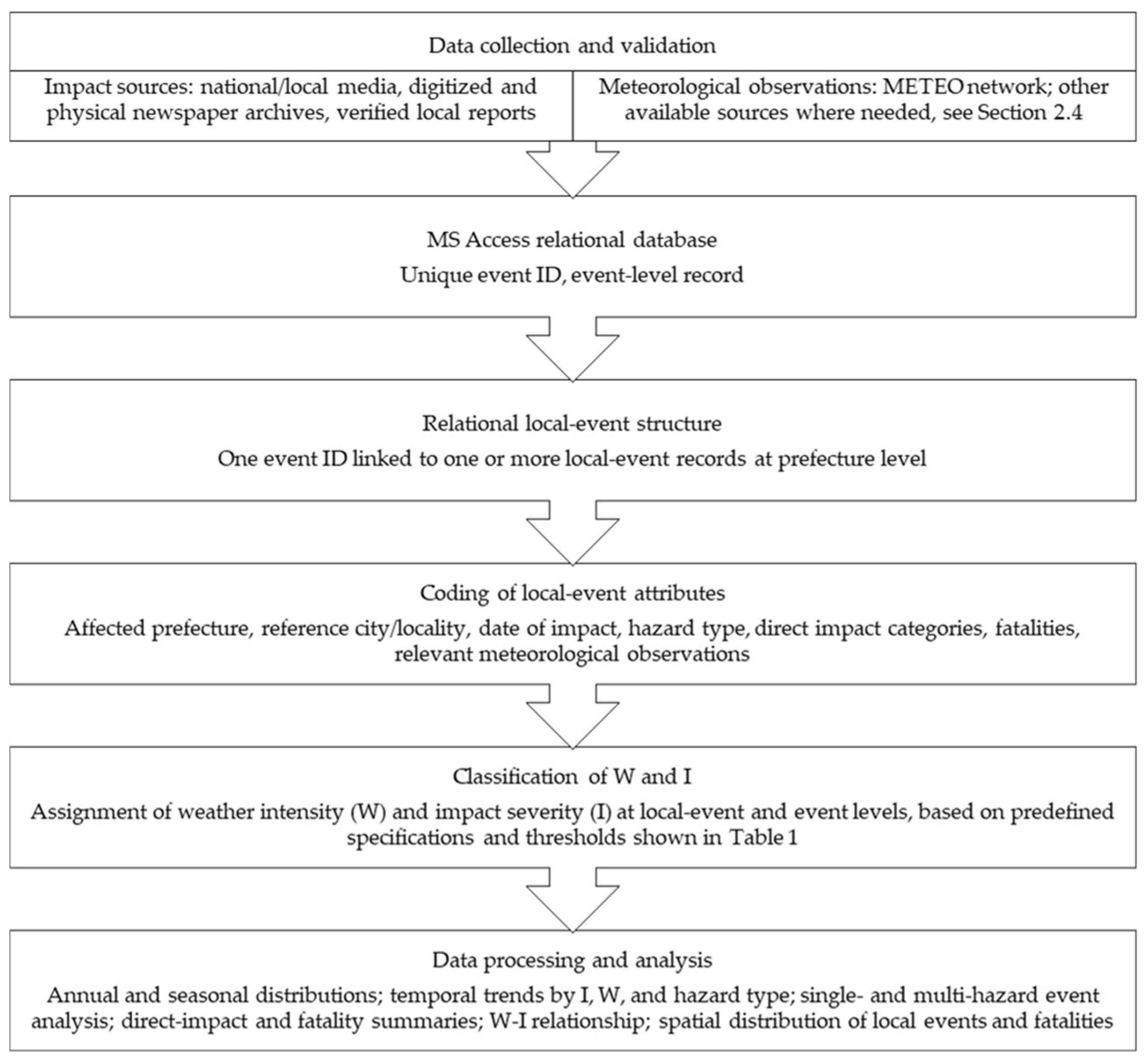
The HIWE-DB is a relational database in which each weather event is represented by a unique event record, linked to multiple local events via a common identifier. This structure shows that a single meteorological event can affect multiple areas and produce multiple hazardous phenomena. The relational setup enables analysis at multiple spatial levels, including national, prefectural, and local levels, and supports comparisons across hazard types, weather intensity, and impact severity. To clarify the overall technical workflow of the manuscript, Figure 1 summarizes the main data-processing steps followed in the HIWE-DB, from data collection and validation to database structuring, classification, and analysis.

2.3. Definition of Weather Events and Local Events

A weather event is defined as a specific meteorological incident with documented direct societal impacts that occurs within a certain time period. However, the impacts of a single event are often uneven across different areas. Therefore, each weather event is broken down into one or more local events, which serve as the primary analytical units in the database. A local event is the occurrence of a specified hazardous phenomenon within a particular prefecture (Nomenclature of Territorial Units for Statistics-NUTS 3) and is characterized by the affected prefecture, a reference city (the most impacted), the hazardous phenomenon, documented tangible and direct impacts, and relevant meteorological observations. The hazardous phenomena included in the HIWE-DB are rainfall-induced floods and flash floods, windstorms, tornadoes, hailstorms, snow and frost events, and lightning events that cause fatalities or severe infrastructure damage. In line with internationally adopted hazard classifications [32], flash floods are defined as short-duration, high-intensity rainfall events, typically associated with rapid runoff and urban or small-catchment flooding. In contrast, floods are driven by prolonged precipitation and river overflows, primarily affecting rural or peri-riverine areas. The classification of these events integrates rainfall thresholds described in Section 2.5 with documented impact reports; when the flood type is not immediately clear, expert judgment is used to assess rainfall duration, intensity, and local conditions (e.g., exposure and topography) that led to adverse impact. Landslides and debris flows are not classified as primary hazards but are recorded as impacts when triggered by weather-related events. Although severe heatwaves are recorded in HIWE-DB, they are excluded from the current statistical analysis due to significant uncertainty regarding the completeness and timing of associated impacts, such as mortality and health effects, which are often not reported or are delayed and poorly documented compared to other hazard types [33].

2.4. Meteorological Observations and Impact Documentation

Meteorological observations assigned to each local event are mainly obtained from the operational meteorological station network operated by the METEO unit of the National Observatory of Athens, which has grown significantly over time and now includes more than 600 stations across Greece [34]. For earlier years (before 2010), when station coverage was more limited, additional sources were used when available, such as established amateur meteorological networks and, in a few cases, national sources, i.e., the Hellenic Meteorological Service stations. Impact information is gathered through consistent monitoring of national and local media sources. All impact entries are cross-verified against multiple independent sources before validation and addition to the database. For early years with less online reporting, digitized and physical newspaper archives and verified local observer reports are also utilized to maximize completeness. Only tangible and direct societal impacts are recorded in the HIWE-DB using predefined impact categories. These include impacts on people (e.g., fatalities along with their exact number and cause, people trapped), the built environment and infrastructure (e.g., buildings, transport networks, electricity, water, and communication infrastructure and services), economic activities (e.g., commerce, industry, tourism), public services, and cultural assets (e.g., schools, monuments, and sites), as well as emergency response actions like evacuations. Events involving solely agricultural damages are not included, as agricultural damage constitutes a separate impact domain with very high event counts and sector-specific vulnerability and reporting practices [35,36]. Including these records would likely mask the signals of other societal impacts due to their high frequency, whereas their assessment requires a different methodological approach to account for the specific sensitivities of crops and livestock. However, damage to agricultural infrastructure, such as the destruction of greenhouses or specialized farming equipment, is recorded under the broader infrastructure impacts category, as it represents a direct, tangible loss of capital assets. Indirect impacts and cascading effects are not explicitly represented as separate variables in the current framework.

2.5. Classification of Weather Intensity and Impact Severity

Weather intensity (W) and impact severity (I) are rated on a three-level ordinal scale (1–3) based on predefined criteria applied at both the local-event and event levels (Table 1). These meteorological thresholds were established during the initial development of the database [28] and align with regionally validated criteria used in Mediterranean-wide flood research and climatological studies [37,38]. By categorizing intensity into these broad ranges, the framework effectively mitigates potential uncertainties arising from limited spatial coverage, particularly in earlier years when station proximity to impact locations was lower and ensures the longitudinal consistency and comparability of the results across the 26-year study period.
At the local-event level, impact severity indicates the severity of direct impacts within a single prefecture, while weather intensity depends on representative meteorological observations relevant to the specific hazardous phenomenon. At the event level, classifications summarize the overall characteristics of all related local events. Impact severity also considers the spatial extent of impacts, whereas weather intensity reflects the highest observed intensity among associated local events.

2.6. Temporal Attribution, Updates, and Data Completeness

For each local event, the exact initial date when direct impacts were first reported in the prefecture is recorded, supporting alignment between event evolution and the onset of local impacts within the event-based structure. While observational and reporting constraints were inherently higher in the early 2000s, the dataset’s longitudinal consistency is ensured through a multi-source validation process. For the pre-2010 period, the use of diverse information sources, including digitized and physical newspaper archives and national records, effectively mitigates the reporting bias typically associated with the transition to digital media. Consequently, the likelihood of under-reporting is considered negligible for I3 events, low for I2, and medium for I1, particularly during the early 2000s. Weather intensity (W) classification was available for approximately 88% of local events, reflecting the increasing spatial coverage of the meteorological station network during the 26 years. The remaining cases correspond to instances in which representative station observations were unavailable. Analyses involving W for local events were performed using the subset with available classification.

2.7. Statistical Analyses

Statistical analyses were performed at both the event and local-event levels for the period 2000–2025. Descriptive statistics examined the temporal and spatial distribution of events by hazardous phenomenon, impact severity (I), and weather intensity (W). Annual and seasonal totals were calculated to evaluate temporal variability, and 5-year moving averages (MAs) were used when appropriate. Seasonal analysis follows the standard meteorological classification for the Northern Hemisphere, where winter runs from December to February, spring from March to May, summer from June to August, and autumn from September to November. The non-parametric Mann–Kendall test was applied to identify statistically significant increasing or decreasing temporal trends, because it does not require normality assumptions and is robust to outliers, making it suitable for environmental time series and event-based data. Relationships between W and I at the local-event level were assessed using Spearman’s rank correlation coefficient (ρ), due to the ordinal nature of both variables. Statistical significance was set at p < 0.05 for all tests. All analyses were conducted using STATA software v18.

3. Results

3.1. Descriptive Overview of Recorded Events (2000–2025)

From 2000 to 2025, a total of 626 weather-related events were recorded in the HIWE-DB, representing 1871 local events. The number of local events per event ranges from 1 to 28, with a mean of 3.0 (SD = 3.0) and a median of 2.0, indicating that most events affect one or two prefectures, but a smaller number of widespread events significantly increase overall variability. Event durations are generally short. Most events (69.2%) lasted only one day, 19.2% lasted two days, and 7.0% lasted three days. Only 4.6% extended beyond three days. The average duration was 1.5 days (SD = 1.0), with a maximum of eight days.
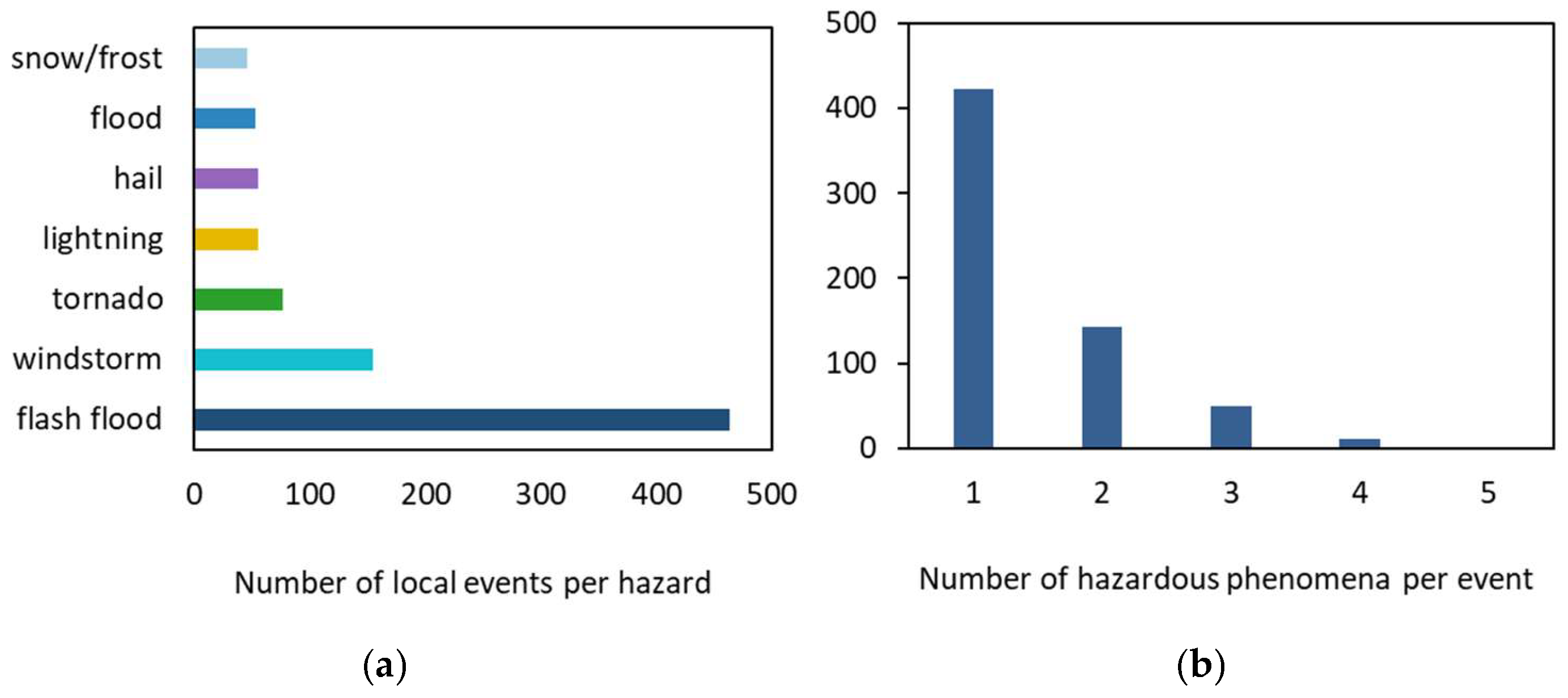
Overall, flood-related events are the most prevalent hazard category in the database (Figure 2a). A total of 516 events were associated with either flash floods and/or floods. Of these, 463 involved flash floods, 53 involved floods, and 32 experienced both phenomena within the same event. Other hazards include 155 windstorms, 76 tornadoes, 55 hailstorms, 55 lightning events, and 46 snow/frost events. About 32.4% of all events (203) involved multiple hazards, meaning that nearly one-third of recorded events include more than one hazard type (Figure 2b).
At the event level, impact severity is relatively evenly distributed. A total of 194 events (31.0%) were classified as I1, 237 (37.9%) as I2, and 195 (31.2%) as I3. Weather intensity exhibits a different structure, with 121 events (19.3%) classified as W1, 197 (31.5%) as W2, and 308 (49.2%) as W3. Nearly half of the recorded events were therefore associated with high meteorological intensity conditions. Among W3 events, 130 (42.2%) were also classified as I3, indicating that the highest impact severity does not consistently coincide with high weather intensity at the event level.
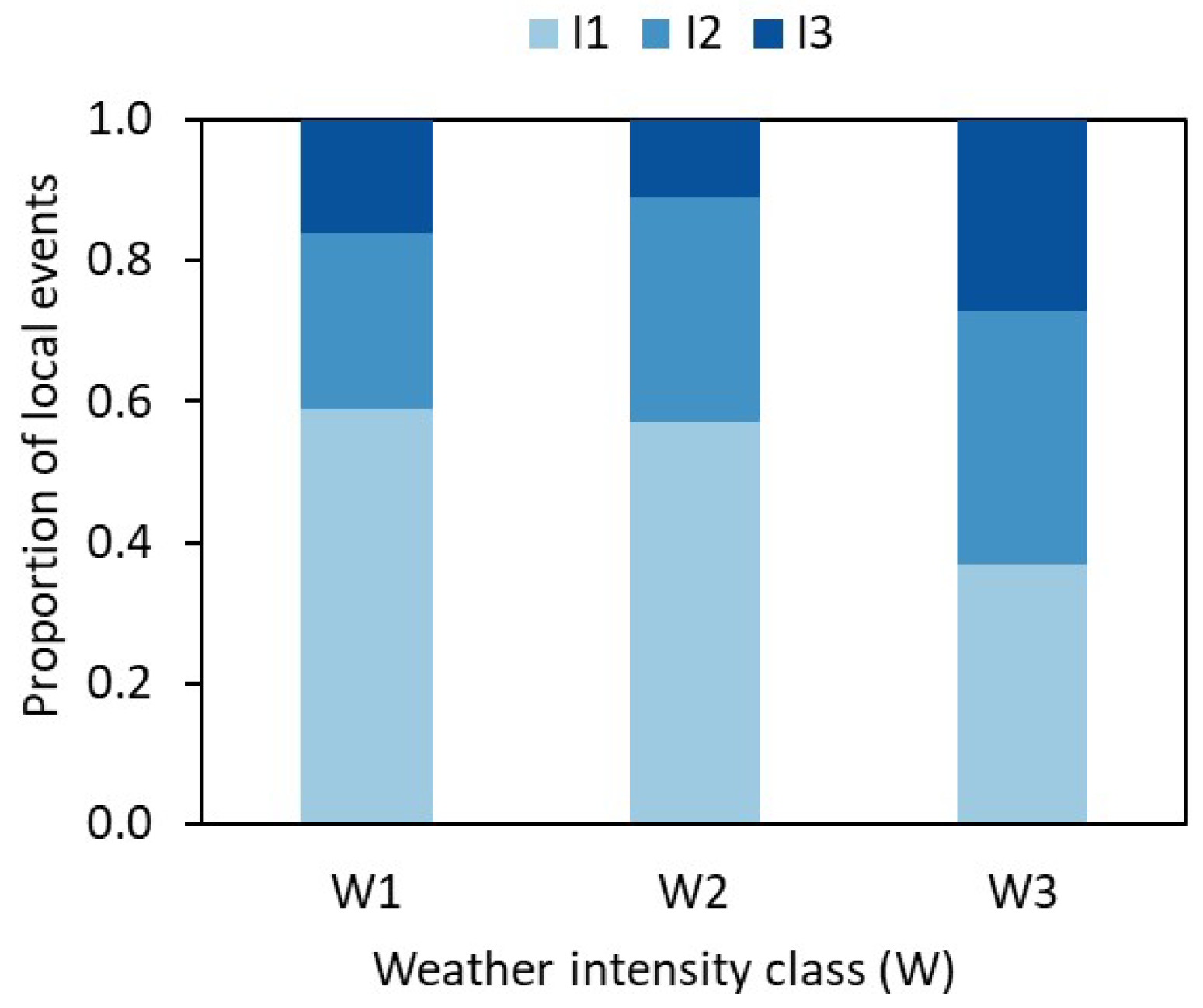
At the local-event level, the distribution of impact severity within each weather intensity class is shown in Figure 3, based on the subset of local events for which local meteorological information is available (88% of the total). While W1 and W2 classes are dominated by I1 local events, the share of I3 local events increases under W3 conditions. The relatively high share of I3 within W1 is partly due to the inclusion rule for lightning events, which are classified as W1 but are recorded only when associated with human loss and widespread severe direct impacts. To assess the influence of this rule on the W-I distribution, a sensitivity analysis was performed by excluding local lightning events. The share of I3 cases within W1 decreased from 16.4% to 10.0%, but the overall pattern remained unchanged, with I1 still dominating W1 and W2 and the highest share of I3 observed under W3 conditions.

3.2. Temporal Evolution of Events and Hazard Characteristics (2000–2025)

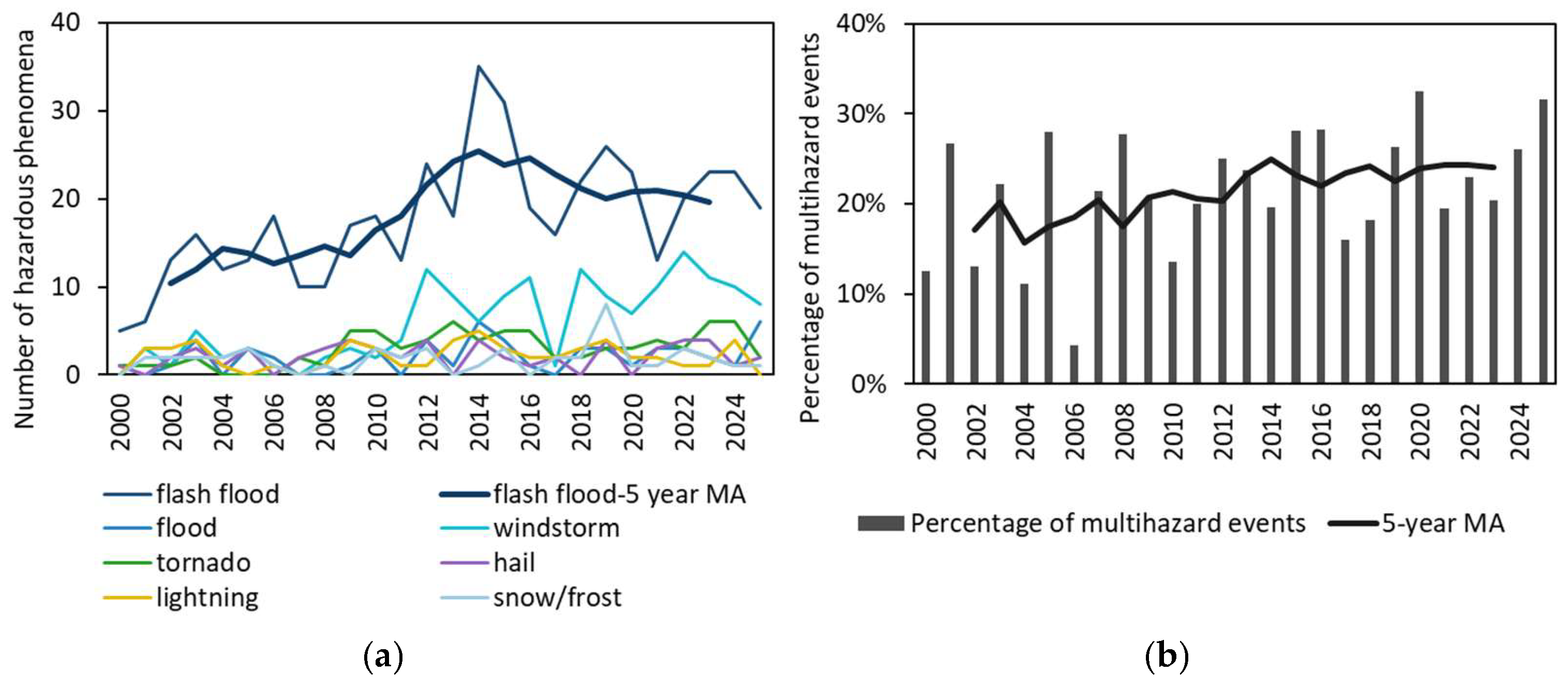
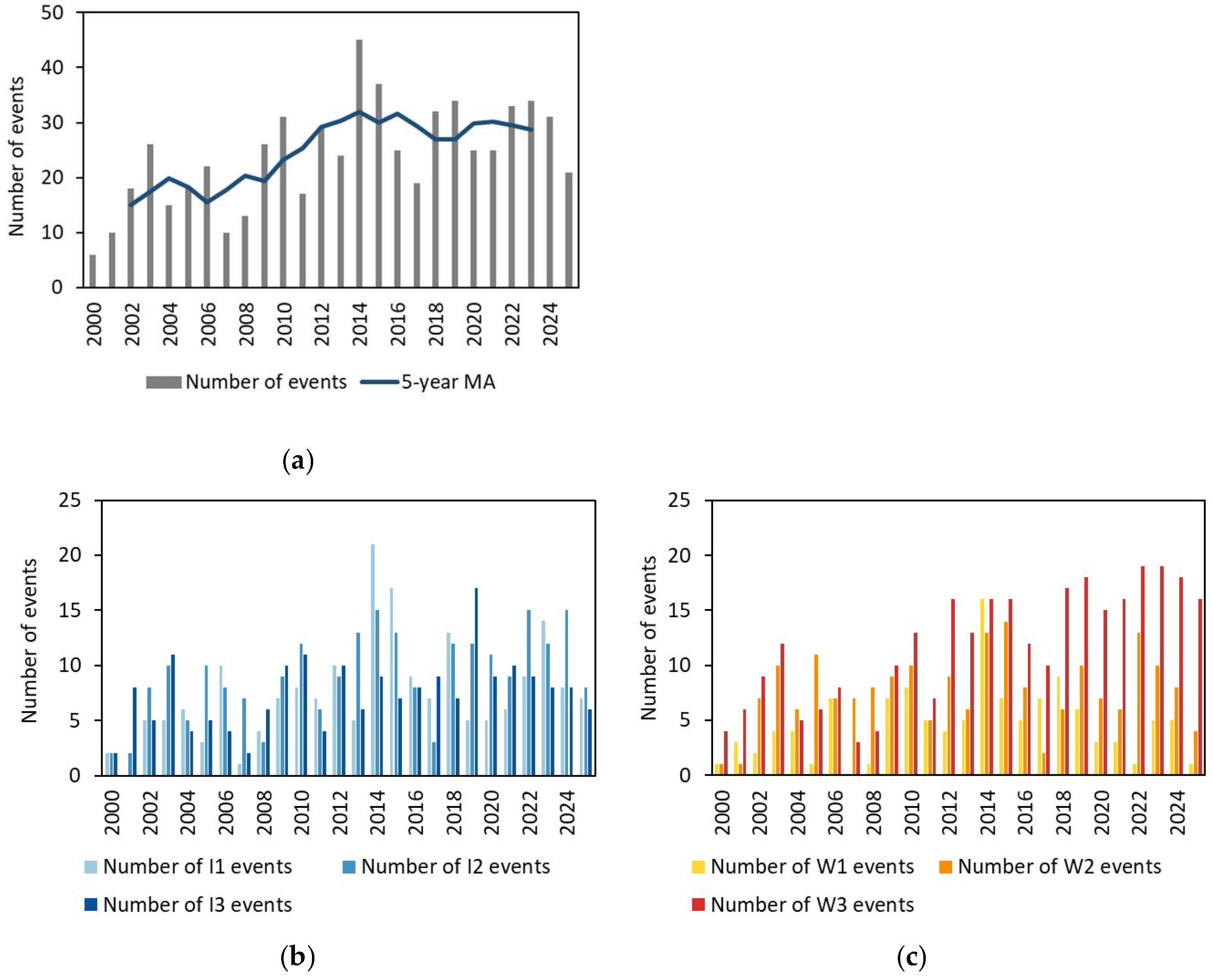
The annual number of recorded events shows significant year-to-year variability, ranging from 6 in 2000 to 45 in 2014 (Figure 4a). A statistically significant increasing trend is observed over the entire study period (Kendall’s τ = 0.44, p = 0.002). The 5-year moving average (MA) reveals a steady increase from the early 2000s to the mid-2010s, followed by consistently high levels in recent years. When events are disaggregated by impact severity (Figure 4b), statistically significant increasing trends are observed for I1 (τ = 0.37, p = 0.010) and I2 events (τ = 0.40, p = 0.006). No statistically significant trend is detected for I3 events (τ = 0.26, p = 0.079). However, in absolute numbers, the total count of I3 events rose from 82 during 2000–2012 to 113 during 2013–2025 (a 38% increase), with several of the highest annual counts occurring in the latter half of the study period. Weather intensity classes show different patterns (Figure 4c). A strong, statistically significant increase is observed for W3 events (τ = 0.64, p < 0.001), while no significant trends are found for W1 (τ = 0.13, p = 0.372) or W2 (τ = 0.13, p = 0.374). Annual W3 counts surpass 15 events in many years after 2012, whereas such levels are uncommon before 2010.
The annual occurrence of hazardous events (where each event type is counted only once per event; Figure 5a) shows statistically significant increasing trends for flash floods (τ = 0.50, p = 0.001), windstorms (τ = 0.53, p < 0.001), and tornadoes (τ = 0.42, p = 0.005). The 5-year moving average for flash floods shows a clear rise after 2010, with consistently higher values in the last decade than in the early 2000s. Due to its high frequency, this hazard was specifically selected for moving-average analysis, as it ensures more reliable trend visualization. No statistically significant trends are found for floods, hail, lightning, or snow/frost (τ ranging from 0.04 to 0.23; all p-values > 0.05), likely due to their lower frequency and irregular year-to-year variability [39].
The proportion of multi-hazard events (i.e., events involving more than one hazardous phenomenon) ranges from 4% to 32% annually (Figure 5b). Although it does not show a statistically significant trend (τ = 0.24, p = 0.088), the 5-year MA indicates higher proportions in several recent years compared to the early part of the record, with values often exceeding 20% after 2014.

3.3. Seasonal Distribution of Events and Hazardous Phenomena

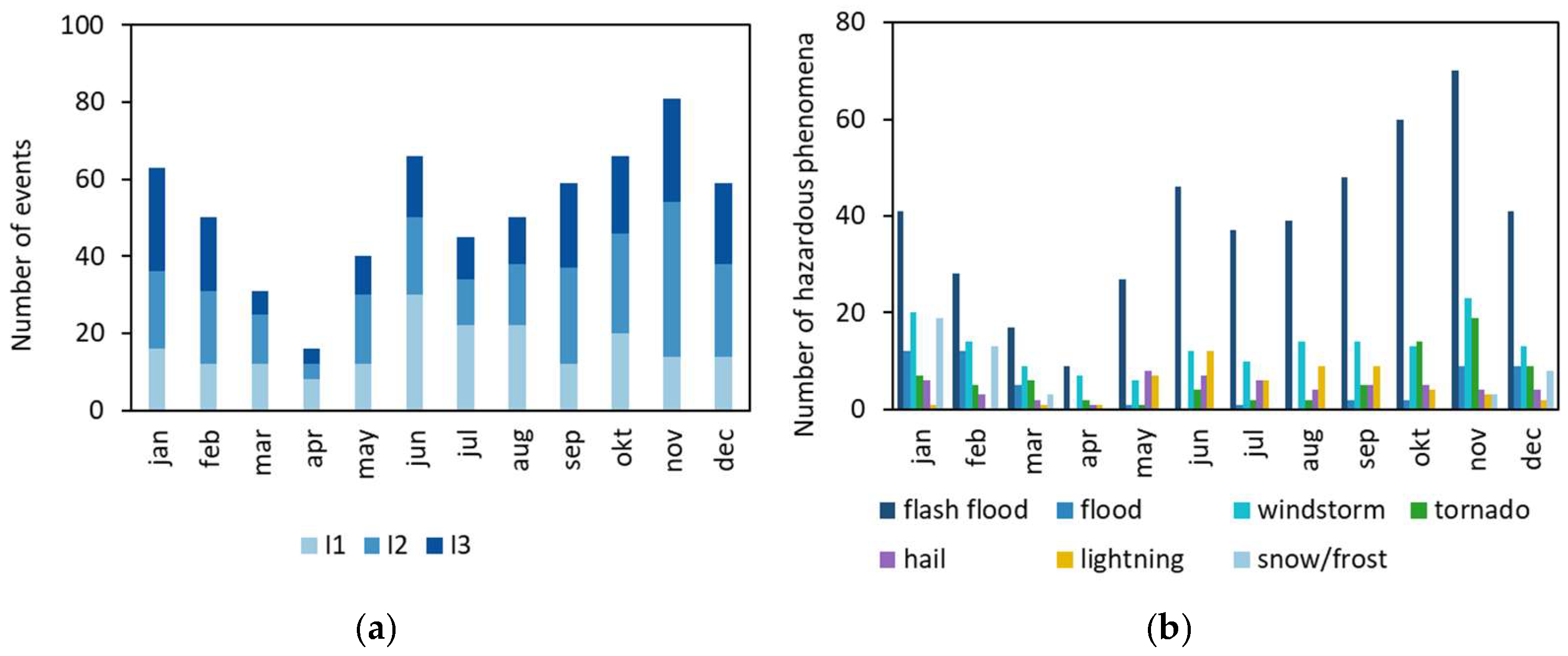
Monthly totals show a clear seasonal pattern (Figure 6a), with event occurrences peaking in late autumn and early winter. November is the most active month, followed by October, June, and January, while spring months, particularly April, are the quietest. When disaggregated by impact severity, high-severity (I3) events are more prevalent during late autumn and winter; in contrast, summer months are characterized primarily by I1 and I2 events.
When hazardous phenomena are analyzed at the event level (each hazard counted once per event; Figure 6b), flash floods tend to occur mostly during autumn, but they also appear frequently in summer. Floods are less frequent and mainly occur during winter and late autumn. Windstorms and tornadoes show clear peaks in autumn, while hail and lightning are more common from late spring through summer. Snow and frost events are almost exclusively confined to winter.

3.4. Direct Impacts

3.4.1. Fatalities

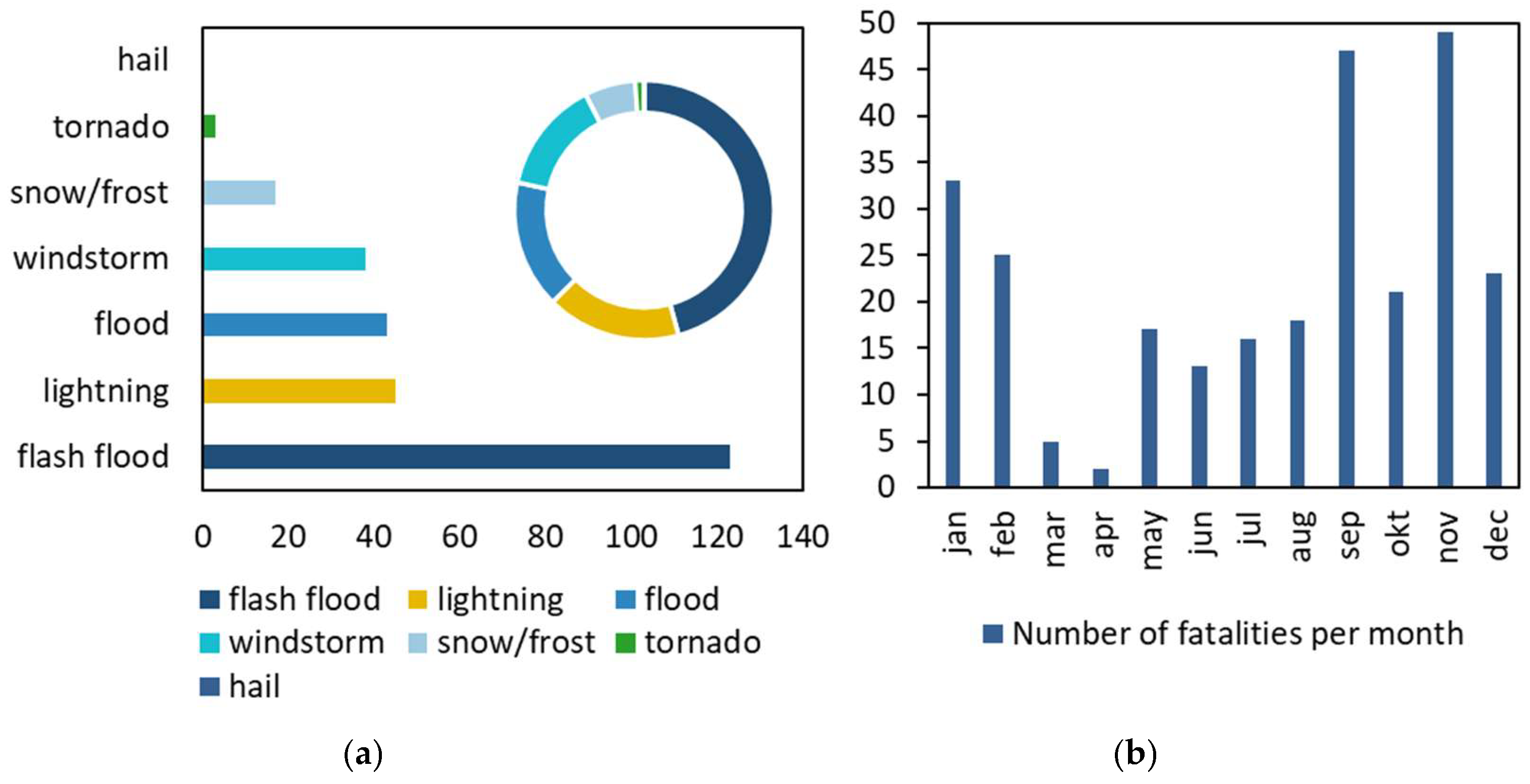
During 2000–2025, a total of 269 confirmed fatalities were recorded, corresponding to an average of 10 deaths per year. Annual totals vary substantially, with no statistically significant trend (τ = 0.19, p = 0.20). The mean annual toll increases from 8 fatalities per year in 2000–2012 to 13 per year in 2013–2025. Fatalities are unevenly distributed across hazards (Figure 7a). Flash floods account for approximately 46% of all deaths, followed by lightning (17%), floods (16%), and windstorms (14%). Snow/frost events contribute about 6%, tornadoes about 1%, while no fatalities are recorded for hail events.
The number of fatalities per fatal event ranges from 1 to 24, with a mean of 2.0 (SD = 2.7). Overall, 22% of all events resulted in at least one fatality, and 70% of I3 events involved confirmed deaths. Seasonally, fatalities are concentrated in autumn and winter (Figure 7b). The highest monthly totals occur in November and September, followed by January and February, while spring months record minimal losses. This distribution aligns with the seasonal concentration of flash floods during the wet period, whereas lightning-related fatalities occur mainly from late spring to summer.

3.4.2. Other Direct Impacts

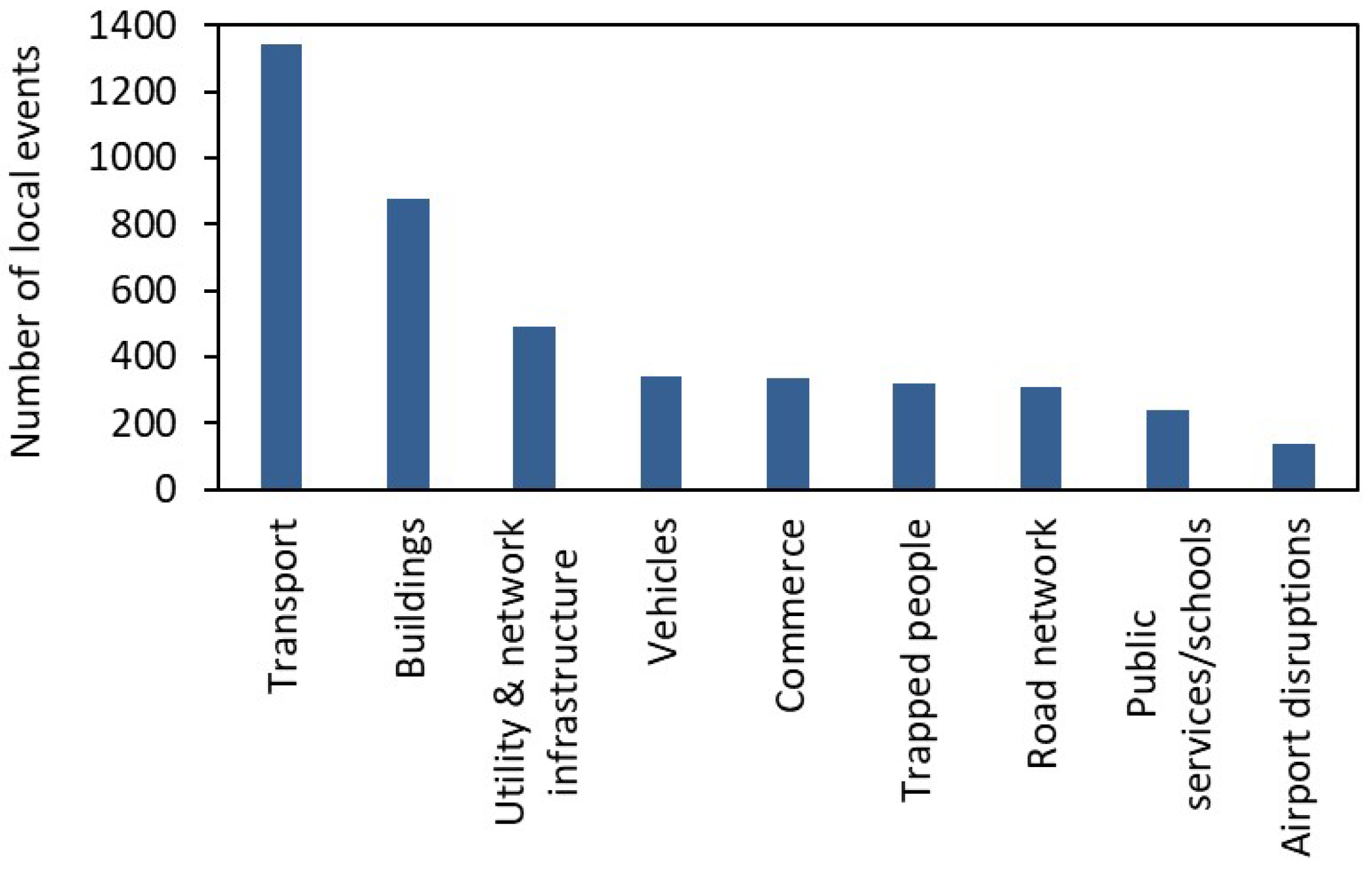
Reported direct impacts, recorded through media monitoring and coded per local event, provide an indicative representation of the types of consequences associated with hazardous weather events. Across the 1871 local events, transport disruption is the most frequently reported impact, occurring approximately at 72% of local events (Figure 8). Impacts on buildings are reported in about 47% of cases, followed by damage to utility and network infrastructure (including electricity grid, water supply and telecommunication systems, 26%), vehicles (18%), commerce (18%), trapped people (17%), and road network damage (17%). Public services and schools are affected in 13% of local events. Landslides and debris flows, recorded as associated geomorphic processes, are treated jointly and are reported in approximately 17% of local events.
These impact categories specifically refer to direct effects. For instance, impacts on buildings primarily involve flooded basements and ground floors, or structural damage, while in the case of a hailstorm, they include damage to roofing and external equipment such as solar panels. Similarly, road network impacts refer to physical damage to the infrastructure (e.g., erosion or structural damage to the road surface), whereas transport disruption refers to the functional interruption of traffic and connectivity, regardless of whether physical damage to the road occurred. It should be noted that while these categories indicate the occurrence of an impact type, they do not capture its magnitude or economic extent. When disaggregated by hazard (Table 2), distinct impact profiles emerge. Flash-flood local events are most frequently associated with transport disruption and building impacts. Windstorms show a stronger association with damage to “Utility and network infrastructure”. Tornadoes cause frequent building damage, whereas hail events primarily cause vehicle damage. Snow/frost events are dominated by transport disruption and impacts on public services. Lightning is excluded from Table 2 because its impact in the HIWE-DB primarily focuses on fatalities, and severe infrastructure damage rarely meets the database’s inclusion criteria.

3.5. Spatial Distribution of Local Events and Fatalities

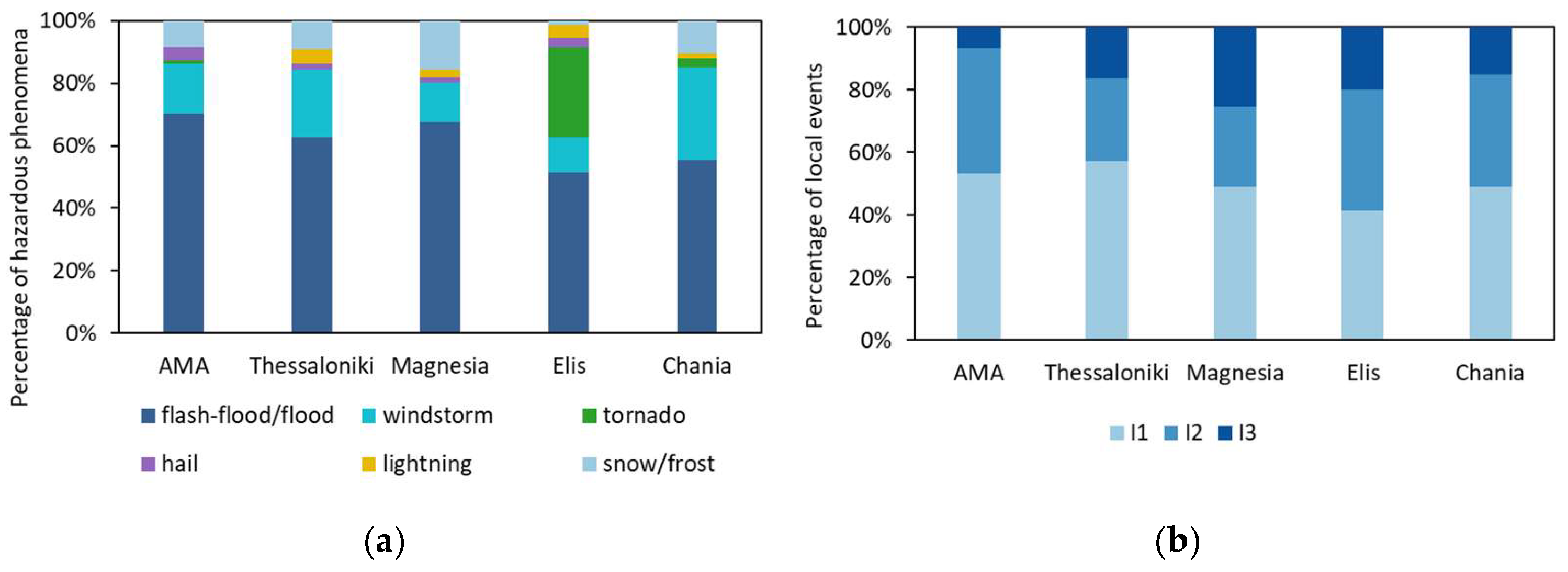
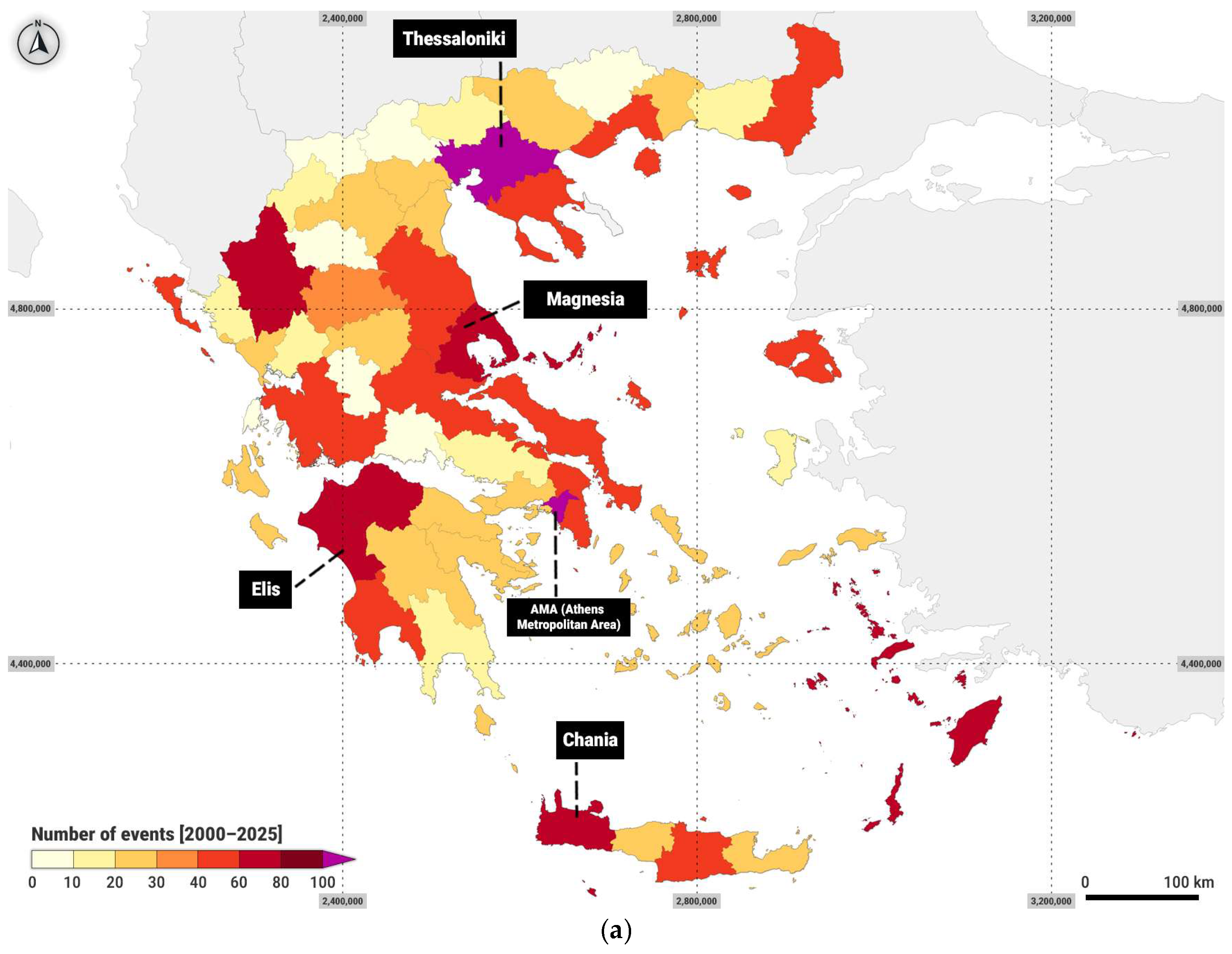
Spatial analyses are conducted using a harmonized set of 54 spatial units corresponding to Greece’s former prefectures. This spatial framework provides a consistent level of geographic aggregation for the 2000–2025 study period. In Attica, the analysis distinguishes the Athens Metropolitan Area (AMA), which aggregates Central, North, South, and West Athens, from East Attica, West Attica, and Piraeus & Islands. Across spatial units, the total number of local events ranges from 5 to 118, with a mean of 34.7 (SD = 24.1) (Figure 9a), indicating substantial spatial variability. The highest totals are recorded in the AMA (118) and Thessaloniki (110), followed by Magnesia (71), Elis (70), and Chania (67). These five spatial units form the upper segment of the spatial distribution and are examined in greater detail (Figure 10). Flood-related phenomena dominate in the AMA and Thessaloniki, while Elis presents a comparatively strong tornado component, and Chania combines flood-related events with windstorm activity (Figure 10a). Across these areas, I1 and I2 classes account for the majority of local events, whereas I3 cases represent a smaller but spatially variable share (Figure 10b). To account for differences in population size across spatial units, local event totals were also analyzed relative to population using prefecture-level data from the 2011 Hellenic Population Census (mid-period reference). When expressed per 1000 residents, local event rates range from 0.04 to 0.89, with a mean of 0.28. With this adjustment, the pattern of the five areas with the highest absolute totals changes substantially. The AMA records 0.04 local events per 1000 residents, which is the lowest rate among all spatial units and well below the national mean. Thessaloniki records 0.10, also below the mean. In contrast, Magnesia (0.35), Elis (0.44), and Chania (0.43) all have rates above the mean. Across all spatial units, the highest normalized values are observed in Samos (0.89), Kefalonia (0.64), Zakynthos (0.61), Corfu (0.53), and Chalkidiki (0.51).
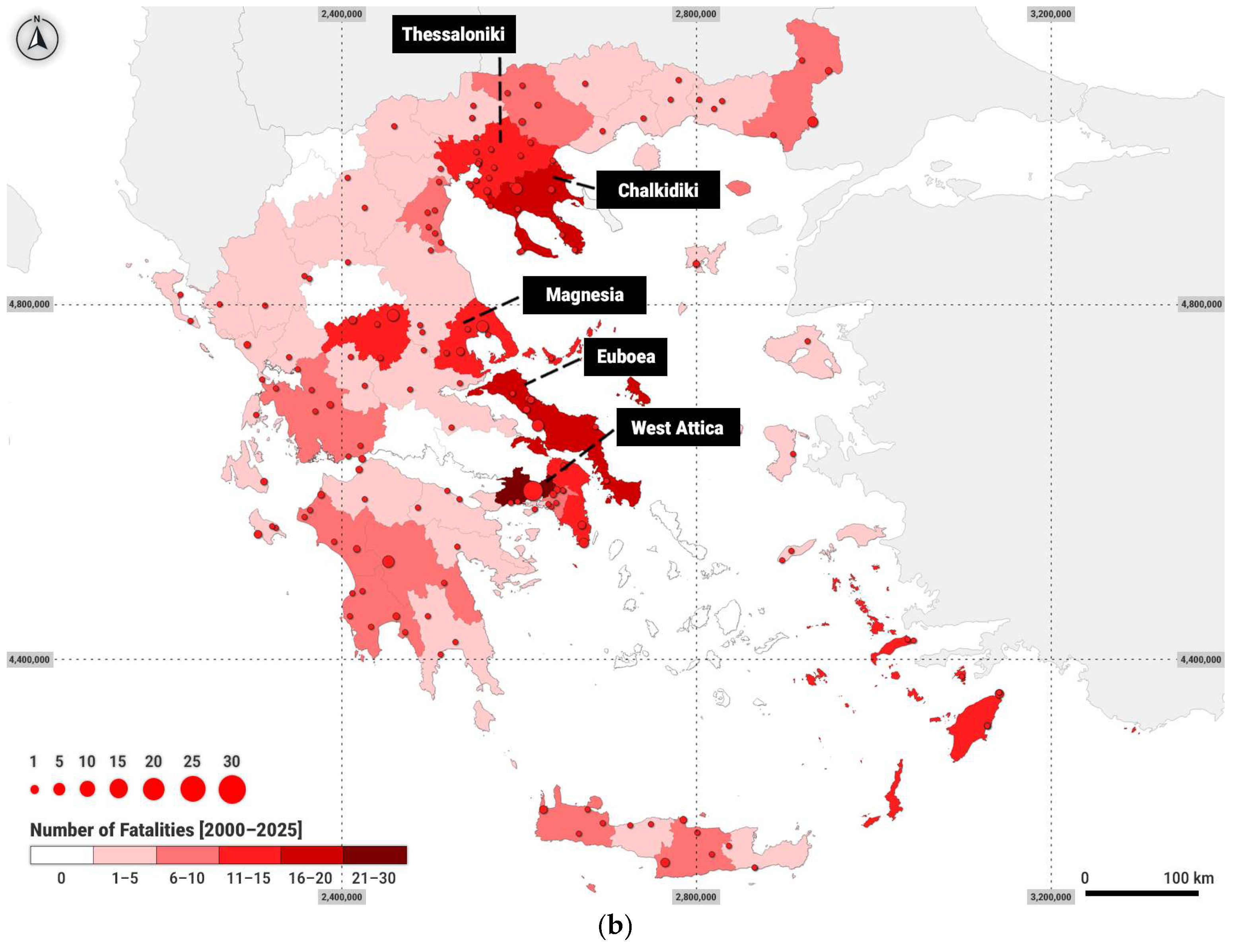
Fatalities display a different spatial structure (Figure 9b). Across spatial units, confirmed deaths range from 0 to 26, with a mean of 5.0 (SD = 5.3). West Attica records the highest number of fatalities (26), followed by Chalkidiki and Euboea (16 each), Magnesia (15), and Thessaloniki (14). In contrast, the AMA, despite having the highest number of local events, records 6 fatalities. When fatalities are expressed per 1000 residents, values range from 0.00 to 0.16, with a mean of 0.04. West Attica (0.16) and Chalkidiki (0.15) remain with the highest values, both well above the mean. Other spatial units above the mean include Zakynthos (0.12), Karditsa (0.11), and Arcadia (0.10). Conversely, some spatial units with relatively high fatality totals display lower normalized values. For example, Thessaloniki records 0.01 fatalities per 1000 residents, while the AMA records an even lower rate.

4. Discussion

This study presents a comprehensive impact-based analysis of weather-related events in Greece for the period 2000–2025, leveraging an evolved version of the HIWE-DB framework to link event records with their spatial manifestations at the local level. The database documents 626 events corresponding to 1871 local events (i.e., occurrences of a hazardous phenomenon affecting a specific prefecture). By linking hazardous phenomena to tangible, direct impacts, the database allows for the documentation of weather-related societal impacts, supporting the analysis of losses and damages at multiple spatial scales. It provides a substantial contribution to risk assessment and response capabilities, as it falls into the category of reliable, timely, and high-quality data collection, which is essential for addressing weather and climate challenges [40]. Such evidence is particularly relevant in the Mediterranean region, which faces multiple weather- and climate-related risks [8,41], while gaps in relevant knowledge remain a significant barrier to adaptation planning [42,43]. Since HIWE-DB is not limited to recording only extreme events, it is of particular value for analyses of the societal impacts of events that fall outside the scope of disaster-threshold databases [5,13,14].
The scientific significance of the advanced HIWE-DB extends beyond merely extending the study period. It lies in its ability to independently assess weather intensity (W) and impact severity (I) at two distinct analytical scales. Event-level analysis provides evidence of long-term temporal trends, revealing significant increases in hazardous phenomena such as flash floods and windstorms, multi-hazard events, high-intensity weather events, and low- to moderate-impact events. In parallel, the local event-level analysis (NUTS 3) provides the spatial resolution needed for the analytical identification of hot spots and the careful investigation of the relationship between hazard magnitude and societal consequences. Especially regarding fatalities, their recording at a very local level provides a high-resolution assessment of the risk to human life. The multilevel analysis highlights that while severe weather remains a critical risk factor, the magnitude of the resulting impacts is co-shaped by local exposure and vulnerability factors [9,17]. Furthermore, this multifaceted approach provides empirical support for impact-based hazard warnings at the local level, thereby contributing to contemporary efforts to protect societies [44]. Impact-based and impact-oriented datasets, such as the HIWE-DB, are seen as extremely useful in shifting early warning systems from simply stating what a hazard is (risk-focused) to explaining what the hazard will do (impact-focused) [45].
The results show a clear upward shift in the number of recorded events over time. This increase is statistically associated with low- to moderate-impact events (I1 and I2). While we acknowledge limitations in the recording of these events during the early 2000s, these are methodologically mitigated through exhaustive archival research and multi-source validation (Section 2.6), and we do consider them to undermine the overall trends. This conviction is also associated with the observed temporal variability and with their expected increase in light of the rising frequency of climate-related hazards in recent decades, especially in the Mediterranean region [43]. The most severe events (I3) show greater variability yet still exhibit a 38% increase in the second half of the study period compared to the first half. The higher annual variability of the I3 trend is largely due to the strict criteria for attributing events to this category, which include only very severe, spatially or temporally extensive impacts, such as those affecting infrastructure and causing fatalities. Because these events are rarer and depend on extreme weather in vulnerable areas, e.g., due to socio-demographic characteristics or a high concentration of critical service networks, their annual frequency varies significantly. As the analysis pointed out, even the most intense weather events (W3) do not always lead to severe impacts. This result shows that impact severity does not increase uniformly with weather intensity. Higher weather intensity is associated with a greater share of severe impacts, but impact severity also depends on the affected setting, including exposure of people, infrastructure, and services. This supports the use of independent W and I indicators, as severe impacts cannot be inferred from meteorological intensity alone. This interpretation is consistent with the disaster risk literature, which recognizes impacts as the outcome of interactions among hazard characteristics, exposure, and vulnerability [13,46,47].
According to the results, flood-related hazards, particularly flash floods, account for the majority of recorded hazards in Greece. This pattern reflects the impact of short-duration, high-intensity rainfall events, typical of Mediterranean convective storms, which often cause rapid runoff and local flooding in high-exposure areas, such as urban areas or small catchments [18,48]. Flash floods also account for the largest share of deaths in the database, highlighting the population’s extreme vulnerability to this hazard. Beyond rainfall-induced events, the significant increase in windstorms and tornadoes suggests that the country’s risk profile is expanding to a broader range of hazards. The multi-hazard analysis results also show that the overall risk is not limited to a single phenomenon but stems from interactions between various atmospheric processes and diverse socio-economic conditions. Contemporary studies at the international level increasingly highlight the importance of a more comprehensive understanding of multi-hazard risk for risk management policy and research, taking into account the multidimensional determinants of risk, including the interrelated roles of hazards, vulnerability, and human actions [49].
The need for a multifaceted analysis of weather events is further highlighted by the fact that approximately one-third of all recorded events in the HIWE-DB involve more than one hazard. While these phenomena may occur in different geographic areas during the same event, their frequent co-occurrence suggests that the conditions that create adverse impacts often involve interacting or parallel processes. This aligns with broader disaster risk frameworks that recognize complex or interacting hazards as important drivers of societal impacts [50,51]. In the HIWE-DB context, the coexistence of heavy rainfall, strong winds, and hail, for example, increases pressure on infrastructure and emergency response, reflecting a multi-hazard vulnerability that simple single-hazard assessments may overlook. From an operational perspective, the results highlight that addressing weather hazards to mitigate impacts benefits from a multi-hazard monitoring framework that systematically captures their combined manifestations.
Seasonal analysis reveals that the timing of hazards and impacts is closely linked, with both the total number of events and high-severity cases (I3) peaking in autumn and early winter. This pattern reflects the seasonal cycle of rainfall-driven hazards in Greece and the Mediterranean region, particularly floods and flash floods. In contrast, lightning-related fatalities are concentrated between late spring and summer, a period characterized by frequent thunderstorms [52,53] and increased outdoor exposure, including tourism-related activities [54].
The variety of recorded impacts demonstrates the different ways in which weather affects social functions. The high frequency of transport disruptions suggests that mobility is particularly sensitive to even moderate weather conditions that do not necessarily cause permanent damage. This confirms that urban environments can be easily paralyzed by frequent disruptions to the transport network, which also affects services overall, a phenomenon that, although not always catastrophic, significantly reduces the efficiency of the city [55]. The importance of these disruptions is also highlighted by recent global assessments, which identify infrastructure and service disruptions as major components of disaster losses [7]. Alongside these operational issues, impacts such as damage to the road network or disruptions to social service networks occur when severe weather conditions affect the physical integrity of the built environment. This sensitivity is often associated with the age and maintenance of infrastructure, which can increase vulnerability to natural hazards over time [56]. This distinction shows that HIWE-DB effectively captures both the direct damage and immediate operational disruptions that characterize weather-related events in complex systems.
The spatial distribution of impacts suggests that population and asset concentration are critical risk factors. The high number of incidents in metropolitan areas such as Athens and Thessaloniki is mainly due to high population density and infrastructure. In these large urban centres, exposure is often dynamic and can increase significantly during peak hours, when even minor weather events can cause widespread disruptions to transport and travel [57]. On the other hand, the higher per capita incidence rates in less populated prefectures suggest that local conditions play a decisive role. In these areas, for example, high reliance on specific main transport routes can make local communities more vulnerable to disruptions. As noted in major climate impact assessment studies [58], areas where access relies on a limited number of major roads are at particular risk, as even a single local event can temporarily disrupt connectivity, leading to disproportionate impacts relative to the local population.
This discrepancy between the total number of impacts and the actual severity of consequences across the country’s prefectures leads to a closer examination of the human factor and patterns of fatalities. For example, the highest number of fatalities occurs in West Attica, a pattern mainly due to the catastrophic flash flood in Mandra in 2017. Even when fatalities are adjusted for population size, West Attica, as well as Halkidiki in northern Greece, remain among the regions with the highest rates. On the other hand, the results show that regions with the highest number of damaging events do not always correspond to those with the most fatalities. Beyond environmental and land-use factors [25,59], this discrepancy highlights the crucial role of individual behaviors during hazardous events. Studies in Europe and Greece show that flood fatalities are often associated with specific behavioral responses, such as individuals’ risk-taking to enter floodwaters, which significantly increases individual exposure at the local level [60,61].
HIWE-DB offers additional in-depth capabilities for studying various aspects of the high-resolution characteristics of hazardous weather events and their impacts that were not included in the present analysis. As described in the Materials and Methods (Section 2.4), each event is supported by a detailed report that aggregates information from media sources, names the affected cities, villages, and locations, and specifies the types of damage sustained. Systematic coding and data extraction from these reports enable the geographic identification of the specific locations where the impacts occurred. For example, work is already underway to exploit this capability to directly link local rainfall intensity to its consequences, intending to define local rainfall thresholds and provide an empirical basis for understanding risk at a detailed level. Regarding the weaknesses of the HIWE-DB, while it systematically records direct societal impacts, indirect and cascading impacts have not yet been explicitly codified. Capturing these processes remains a key challenge for future development, especially as recent extreme events in Greece demonstrate how single or complex hazards can trigger cascading impacts on interconnected systems, such as water infrastructure, ecosystems, and public services [26].

5. Conclusions

In conclusion, this long-term analysis shows that documented weather-related impacts in Greece have persisted and increased over the 2000–2025 period. The increase in recorded events is mainly reflected in low- to moderate-impact cases, while the most severe impacts show high variability but are more numerous in the second half of the study period. The relationship between weather intensity and impact severity shows that severe outcomes are closely linked to local vulnerability, the exposure of people and assets, and the specific conditions under which each event occurs. Furthermore, the high frequency of multi-hazard events identified in the HIWE-DB underscores that risk management cannot be based solely on single-phenomenon assessments, as interactions between hazards, such as wind and rain, can exacerbate outcomes.
The HIWE-DB provides a consistent framework for monitoring hazard occurrence and impact severity across multiple spatial and temporal scales. By demonstrating that even non-extreme weather events can lead to significant societal disruption, this study highlights that effective disaster risk reduction must look beyond hazard intensity alone. Such datasets are essential for assessing the effectiveness of meteorological forecasts and for supporting the transition to impact-based forecasting and early-warning approaches [62]. Furthermore, the publicly accessible interfaces of the database (Materials and Methods, Section 2.1) facilitate the exploration of open data by researchers, institutions, and the public, encouraging further scientific work on risk–impact relationships. Beyond the national context, the HIWE-DB contributes to the systematic documentation of weather-related impacts in the Mediterranean, improving the empirical basis for risk assessment and adaptation planning in alignment with global frameworks [7,50].

Author Contributions

Conceptualization, all authors; methodology, K.P.; software, K.P.; validation, K.P. and K.L.; formal analysis, K.P.; investigation, K.P. and V.K.; data curation, K.L.; writing—original draft preparation, K.P.; writing—review and editing, all authors; visualization, K.P. and K.L.; All authors have read and agreed to the published version of the manuscript.

Funding

This research received no external funding.

Data Availability Statement

A simplified, yet highly informative, open-access version of the HIWE-DB, including an indexed catalog and an interactive spatial interface, is publicly available through the METEO platform of the National Observatory of Athens at https://meteo.gr/weather_cases.cfm, accessed on 1 May 2026 and https://www.meteo.gr/weatherEvents.cfm, accessed on 1 May 2026. The full dataset presented in this study is available on request from the corresponding author due to intellectual property rights and their ongoing use as a core analytical tool in funded research projects.

Acknowledgments

The authors would like to thank Giorgos Kyros, for his contribution to map development and Christos Petropoulos for his invaluable assistance with data collection during the early years of the study period. During the preparation of this manuscript, the authors used Grammarly (Premium version) for English language editing and grammatical refinement. The authors have reviewed and edited the output and take full responsibility for the content of this publication.

Conflicts of Interest

The authors declare no conflicts of interest.

References

  1. EEA. Economic Losses from Weather- and Climate-Related Extremes in Europe. 2024. Available online: https://www.eea.europa.eu/en/analysis/indicators/economic-losses-from-climate-related (accessed on 2 March 2026).
  2. Zscheischler, J.; Lehner, F. Attributing compound events to anthropogenic climate change. Bull. Am. Meteorol. Soc. 2022, 103, E936–E953. [Google Scholar] [CrossRef]
  3. Raymond, C.; Horton, R.M.; Zscheischler, J.; Martius, O.; AghaKouchak, A.; Balch, J.; Bowen, S.G.; Camargo, S.J.; Hess, J.; Kornhuber, K.; et al. Understanding and managing connected extreme events. Nat. Clim. Change 2020, 10, 611–621. [Google Scholar] [CrossRef]
  4. United Nations Office for Disaster Risk Reduction (UNDRR). DELTA Resilience: Disaster and Hazardous Events, Losses and Damages Tracking and Analysis; United Nations Office for Disaster Risk Reduction: Geneva, Switzerland, 2025; Available online: https://www.undrr.org/building-risk-knowledge/disaster-losses-and-damages-tracking-system-delta-resilience (accessed on 24 April 2026).
  5. UNDRR. Sendai Framework for Disaster Risk Reduction 2015–2030; United Nations Office for Disaster Risk Reduction: Geneva, Switzerland, 2015; Available online: https://www.undrr.org/publication/sendai-framework-disaster-risk-reduction-2015-2030 (accessed on 25 April 2026).
  6. European Commission. Forging a Climate-Resilient Europe—The New EU Strategy on Adaptation to Climate Change; COM(2021) 82 final; European Commission: Brussels, Belgium, 2021; Available online: https://climate.ec.europa.eu/eu-action/adaptation-and-resilience-climate-change/eu-adaptation-strategy_en (accessed on 2 March 2026).
  7. United Nations Development Programme; World Meteorological Organization. Mapping the Impact and Informing Economic Resilience: An Analysis of Post-Disaster Needs Assessment; UNDP: Geneva, Switzerland, 2025. [Google Scholar]
  8. Khodayar, S.; Kushta, J.; Catto, J.L.; Dafis, S.; Davolio, S.; Ferrarin, C.; Flaounas, E.; Groenemeijer, P.; Hatzaki, M.; Hochman, A.; et al. Mediterranean cyclones in a changing climate: A review on their socio-economic impacts. Rev. Geophys. 2025, 63, e2024RG000853. [Google Scholar] [CrossRef]
  9. Merz, B.; Blöschl, G.; Vorogushyn, S.; Dottori, F.; Aerts, J.C.J.H.; Bates, P.; Bertola, M.; Kemter, M.; Kreibich, H.; Lall, U.; et al. Causes, impacts and patterns of disastrous river floods. Nat. Rev. Earth Environ. 2021, 2, 592–609. [Google Scholar] [CrossRef]
  10. Paprotny, D.; Tilloy, A.; Treu, S.; Buch, A.; Vousdoukas, M.I.; Feyen, L.; Kreibich, H.; Merz, B.; Frieler, K.; Mengel, M. Attribution of flood impacts shows strong benefits of adaptation in Europe since 1950. Sci. Adv. 2025, 11, eadt7068. [Google Scholar] [CrossRef]
  11. Ríos Díaz, F.; Marin-Ferrer, M. Loss Database Architecture for Disaster Risk Management; Publications Office of the European Union: Luxembourg, 2018. [Google Scholar] [CrossRef]
  12. Delforge, D.; Wathelet, V.; Below, R.; Sofia, C.L.; Tonnelier, M.; Van Loenhout, J.A.F.; Speybroeck, N. EM-DAT: The emergency events database. Int. J. Disaster Risk Reduct. 2025, 124, 105509. [Google Scholar] [CrossRef]
  13. Clarke, B.; Otto, F.; Stuart-Smith, R.; Harrington, L. Inventories of extreme weather events and impacts: Implications for loss and damage from and adaptation to climate extremes. Clim. Risk Manag. 2021, 32, 100285. [Google Scholar] [CrossRef]
  14. Papagiannaki, K.; Petrucci, O.; Diakakis, M.; Kotroni, V.; Aceto, L.; Bianchi, C.; Brázdil, R.; Grimalt-Gelabert, M.; Inbar, M.; Kahraman, A.; et al. Developing a large-scale dataset of flood fatalities for territories in the Euro-Mediterranean region, FFEM-DB. Sci. Data 2022, 9, 166. [Google Scholar] [CrossRef]
  15. Hoeppe, P. Trends in weather related disasters—Consequences for insurers and society. Weather Clim. Extrem. 2016, 11, 70–79. [Google Scholar] [CrossRef]
  16. Kreibich, H.; Van Loon, A.F.; Schröter, K.; Ward, P.J.; Mazzoleni, M.; Sairam, N.; Abeshu, G.W.; Agafonova, S.; AghaKouchak, A.; Aksoy, H.; et al. The challenge of unprecedented floods and droughts in risk management. Nature 2022, 608, 80–86. [Google Scholar] [CrossRef]
  17. Llasat-Botija, M.; Llasat, M.C.; Marinelli, D.; Marcos, R.; Guzzon, C.; Díaz, A. FLOODGAMA: The new INUNGAMA. Beyond a flood events database for Catalonia. In Proceedings of the EGU General Assembly 2024, Vienna, Austria, 14–19 April 2024. [Google Scholar] [CrossRef]
  18. Llasat, M.C. Floods evolution in the Mediterranean region in a context of climate and environmental change. Cuad. Investig. Geogr. 2021, 47, 13–32. [Google Scholar] [CrossRef]
  19. Llasat, M.C.; Llasat-Botija, M.; Petrucci, O.; Pasqua, A.A.; Rosselló, J.; Vinet, F.; Boissier, L. Towards a database on societal impact of Mediterranean floods within the framework of the HYMEX project. Nat. Hazards Earth Syst. Sci. 2013, 13, 1337–1350. [Google Scholar] [CrossRef]
  20. Salio, P.; Bechis, H.; Ribeiro, B.Z.; de Lima Nascimento, E.; Galligani, V.; Garcia, F.; Alvarenga, L.; de los Milagros Alvarezs Imaz, M.; Baissac, D.M.; Barle, M.F.; et al. Toward a South American high-impact weather reports database. Bull. Am. Meteorol. Soc. 2024, 105, E1204–E1217. [Google Scholar] [CrossRef]
  21. Poveda, G.; Espinoza, J.C.; Zuluaga, M.D.; Solman, S.A.; Garreaud, R.; van Oevelen, P.J. High impact weather events in the Andes. Front. Earth Sci. 2020, 8, 162. [Google Scholar] [CrossRef]
  22. Ray, K.; Mohapatra, M.; Bandyopadhyay, B.K.; Rathore, L.S. (Eds.) High-Impact Weather Events over the SAARC Region; Springer: Cham, Switzerland, 2015. [Google Scholar] [CrossRef]
  23. Jäger, W.S.; de Ruiter, M.C.; Tiggeloven, T.; Ward, P.J. What can we learn about multi-hazard impacts from global disaster records? Nat. Hazards Earth Syst. Sci. 2025, 25, 2751–2769. [Google Scholar] [CrossRef]
  24. Kotroni, V.; Bezes, A.; Dafis, S.; Founda, D.; Galanaki, E.; Giannaros, C.; Giannaros, T.; Karagiannidis, A.; Koletsis, I.; Kyros, G.; et al. Long-term statistical analysis of severe weather and climate events in Greece. Atmosphere 2025, 16, 105. [Google Scholar] [CrossRef]
  25. Papagiannaki, K.; Kotroni, V.; Lagouvardos, K.; Diakakis, M.; Kyriakou, P. Rainfall patterns and their association with flood fatalities across diverse Euro-Mediterranean regions over 41 years. npj Nat. Hazards 2025, 2, 39. [Google Scholar] [CrossRef]
  26. Diakakis, M.; Andriopoulos, P.; Sarantopoulou, A.; Kapris, I.; Filis, C.; Konsolaki, A.; Vassilakis, E.; Nastos, P. Impacts of extreme storms in surface water resources, systems, and infrastructure—Evidence from Storm Daniel (2023) in Greece. GeoHazards 2026, 7, 14. [Google Scholar] [CrossRef]
  27. Koulelis, P.P.; Proutsos, N.; Solomou, A.D.; Avramidou, E.V.; Malliarou, E.; Athanasiou, M.; Xanthopoulos, G.; Petrakis, P.V. Effects of climate change on Greek forests: A review. Atmosphere 2023, 14, 1155. [Google Scholar] [CrossRef]
  28. Papagiannaki, K.; Lagouvardos, K.; Kotroni, V. A database of high-impact weather events in Greece: A descriptive impact analysis for the period 2001–2011. Nat. Hazards Earth Syst. Sci. 2013, 13, 727–736. [Google Scholar] [CrossRef]
  29. Diakakis, M.; Papagiannaki, K.; Fouskaris, M. The occurrence of catastrophic multiple-fatality flash floods in the Eastern Mediterranean region. Water 2023, 15, 119. [Google Scholar] [CrossRef]
  30. Petrucci, O.; Papagiannaki, K.; Aceto, L.; Boissier, L.; Kotroni, V.; Grimalt, M.; Llasat, M.C.; Llasat-Botija, M.; Rosselló, J.; Pasqua, A.A.; et al. MEFF: The database of Mediterranean flood fatalities (1980 to 2015). J. Flood Risk Manag. 2019, 12, e12461. [Google Scholar] [CrossRef]
  31. Kreibich, H.; Sivapalan, M.; AghaKouchak, A.; Addor, N.; Aksoy, H.; Arheimer, B.; Arnbjerg-Nielsen, K.; Vail-Castro, C.; Cudennec, C.; Madruga de Brito, M.; et al. Panta Rhei: A decade of progress in research on change in hydrology and society. Hydrol. Sci. J. 2025, 70, 1210–1236. [Google Scholar] [CrossRef]
  32. Disaster Risk Reduction Terminology. Available online: https://www.undrr.org/drr-glossary/terminology (accessed on 2 March 2026).
  33. Giannaros, C.; Economou, T.; Parliari, D.; Galanaki, E.; Kotroni, V.; Lagouvardos, K.; Matzarakis, A. A thermo-physiologically consistent approach for studying the heat-health nexus with hierarchical generalized additive modelling: Application in the Athens urban area (Greece). Urban Clim. 2024, 58, 102206. [Google Scholar] [CrossRef]
  34. Lagouvardos, K.; Kotroni, V.; Bezes, A.; Koletsis, I.; Kopania, T.; Lykoudis, S.; Mazarakis, N.; Papagiannaki, K.; Vougioukas, S. The automatic weather stations network of the National Observatory of Athens: Operation and database. Geosci. Data J. 2017, 4, 4–16. [Google Scholar] [CrossRef]
  35. Food and Agriculture Organization. The Impact of Disasters on Agriculture and Food Security 2023—Avoiding and Reducing Losses Through Investment in Resilience; FAO: Rome, Italy, 2023. [Google Scholar] [CrossRef]
  36. Manescu, A.C.; Barna, F.M.; Regep, H.D.; Manescu, C.M.; Cerba, C. The Impact of Extreme Weather Events on Agricultural Insurance in Europe. Agriculture 2025, 15, 995. [Google Scholar] [CrossRef]
  37. Amaro, J.; Gaya, M.; Aran, M.; Llasat, M.C. Preliminary results of the Social Impact Research Group of MEDEX: The request database (2000–2002) of two Meteorological Services. Nat. Hazards Earth Syst. Sci. 2010, 10, 2643–2652. [Google Scholar] [CrossRef]
  38. Insua-Costa, D.; Lemus-Cánovas, M.; Miguez-Macho, G.; Llasat, M.C. Climatology and ranking of hazardous precipitation events in the western Mediterranean area. Atmos. Res. 2021, 255, 105521. [Google Scholar] [CrossRef]
  39. Frei, C.; Schär, C. Detection probability of trends in rare events: Theory and application to heavy precipitation in the Alpine region. J. Clim. 2001, 14, 1568–1584. [Google Scholar] [CrossRef]
  40. Haque, M.; Pervin, M.; Sultana, S.; Huq, S. Towards establishing a national mechanism to address losses and damages: A case study from Bangladesh. In Loss and Damage from Climate Change; Mechler, R., Bouwer, L., Schinko, T., Surminski, S., Linnerooth-Bayer, J., Eds.; Springer: Cham, Switzerland, 2019. [Google Scholar] [CrossRef]
  41. Michaelides, S.; Karacostas, T.; Sánchez, J.L.; Retalis, A.; Pytharoulis, I.; Homar, V.; Romero, R.; Zanis, P.; Giannakopoulos, C.; Bühl, J.; et al. Reviews and perspectives of high impact atmospheric processes in the Mediterranean. Atmos. Res. 2018, 208, 4–44. [Google Scholar] [CrossRef]
  42. IPCC. Climate Change 2023: Synthesis Report; Core Writing Team, Lee, H., Romero, J., Eds.; IPCC: Geneva, Switzerland, 2023. [Google Scholar] [CrossRef]
  43. Ali, E.; Cramer, W.; Carnicer, J.; Georgopoulou, E.; Hilmi, N.J.M.; Le Cozannet, G.; Lionello, P. Cross-chapter paper 3: Mediterranean region. In Climate Change 2022: Impacts, Adaptation and Vulnerability. Contribution of Working Group II to the Sixth Assessment Report of the Intergovernmental Panel on Climate Change; Pörtner, H.-O., Roberts, D.C., Tignor, M., Poloczanska, E.S., Mintenbeck, K., Alegría, A., Craig, M., Langsdorf, S., Löschke, S., Möller, V., et al., Eds.; Cambridge University Press: Cambridge, UK; New York, NY, USA, 2022; pp. 2233–2272. [Google Scholar] [CrossRef]
  44. Lumbroso, D.; White, C.J.; Brown, E.; Kolusu, S.R. Rethinking impact-based forecasts and warnings (IbFW) for multi-risks. npj Nat. Hazards 2025, 2, 105. [Google Scholar] [CrossRef]
  45. Potter, S.H.; Kox, T.; Mills, B.; Taylor, A.; Robbins, J.; Cerrudo, C.; Wyatt, F.; Harrison, S.; Golding, B.; Lang, W.; et al. Research gaps and challenges for impact-based forecasts and warnings: Results of international workshops for high impact weather in 2022. Int. J. Disaster Risk Reduct. 2025, 118, 105234. [Google Scholar] [CrossRef]
  46. Birkmann, J.; von Teichman, K. Integrating disaster risk reduction and climate change adaptation: Key challenges—Scales, knowledge, and norms. Sustain. Sci. 2010, 5, 171–184. [Google Scholar] [CrossRef]
  47. Cardona, O.-D.; van Aalst, M.K.; Birkmann, J.; Fordham, M.; Mc Gregor, G.; Rosa, P.; Pulwarty, R.S.; Schipper, E.L.F.; Sinh, B.T.; Décamps, H.; et al. Determinants of risk: Exposure and vulnerability. In Managing the Risks of Extreme Events and Disasters to Advance Climate Change Adaptation: Special Report of the Intergovernmental Panel on Climate Change; Field, C.B., Barros, V., Stocker, T.F., Dahe, Q., Eds.; Cambridge University Press: Cambridge, UK, 2012; pp. 65–108. [Google Scholar]
  48. Ropero, R.F.; Flores, M.J.; Rumí, R. Flash floods in Mediterranean catchments: A meta-model decision support system based on Bayesian networks. Environ. Ecol. Stat. 2024, 31, 27–56. [Google Scholar] [CrossRef]
  49. Rokhideh, M. Rethinking disaster risk: The shift towards multi-hazard and systemic risk approaches in research and policy. In Oxford Research Encyclopedia of Natural Hazard Science; Benouar, D., Ed.; Oxford Academic: New York, NY, USA, 2025. [Google Scholar] [CrossRef]
  50. IPCC. Climate Change 2022: Impacts, Adaptation and Vulnerability. Contribution of Working Group II to the Sixth Assessment Report of the Intergovernmental Panel on Climate Change; Pörtner, H.-O., Roberts, D.C., Tignor, M., Poloczanska, E.S., Mintenbeck, K., Alegría, A., Craig, M., Langsdorf, S., Löschke, S., Möller, V., et al., Eds.; Cambridge University Press: Cambridge, UK; New York, NY, USA, 2022. [Google Scholar] [CrossRef]
  51. IPCC. IPCC Special Report on the Ocean and Cryosphere in a Changing Climate; Pörtner, H.-O., Roberts, D.C., Masson-Delmotte, V., Zhai, P., Tignor, M., Poloczanska, E., Mintenbeck, K., Alegría, A., Nicolai, M., Okem, A., et al., Eds.; Cambridge University Press: Cambridge, UK; New York, NY, USA, 2019. [Google Scholar] [CrossRef]
  52. Kotroni, V.; Lagouvardos, K. Lightning in the Mediterranean and its relation with sea-surface temperature. Environ. Res. Lett. 2016, 11, 034006. [Google Scholar] [CrossRef]
  53. Galanaki, E.; Lagouvardos, K.; Kotroni, V.; Flaounas, E.; Argiriou, A. Thunderstorm climatology in the Mediterranean using cloud-to-ground lightning observations. Atmos. Res. 2018, 207, 136–144. [Google Scholar] [CrossRef]
  54. Koutras, K.; Pitsikalis, M.; Tsolou, E.; Selimi, G.; Anagnostopoulou, E.A.; Peppas, G. Lightning-related fatalities and damages in Greece: A statistical analysis (2020–2024). In Proceedings of the 2025 IEEE International Conference on Environment and Electrical Engineering and 2025 IEEE Industrial and Commercial Power Systems Europe (EEEIC/I&CPS Europe), Chania, Greece, 15–18 July 2025; pp. 1–6. [Google Scholar] [CrossRef]
  55. Wu, J.; Zhang, C. The role of temperature and rainfall in traffic congestion: Evidence from 98 Chinese cities. Weather Clim. Soc. 2024, 16, 481–495. [Google Scholar] [CrossRef]
  56. McNabb, T.; Charters, F.J.; Challies, E.; Dionisio, R. Unlocking urban blue-green infrastructure: An inter-disciplinary literature review analysing co-benefits and synergies between bio-physical and socio-cultural outcomes. Blue-Green Syst. 2024, 6, 217–231. [Google Scholar] [CrossRef]
  57. Touloumidis, D.; Madas, M.; Zeimpekis, V.; Ayfantopoulou, G. Weather-Related Disruptions in Transportation and Logistics: A Systematic Literature Review and a Policy Implementation Roadmap. Logistics 2025, 9, 32. [Google Scholar] [CrossRef]
  58. EPA. Climate Impacts on Transportation; United States Environmental Protection Agency: Washington, DC, USA, 2017. Available online: https://19january2017snapshot.epa.gov/climate-impacts/climate-impacts-transportation_.html (accessed on 25 April 2026).
  59. Tellman, B.; Sullivan, J.A.; Kuhn, C.; Kettner, A.J.; Doyle, C.S.; Brakenridge, G.R.; Erickson, T.A.; Slayback, D.A. Satellite imaging reveals increased proportion of population exposed to floods. Nature 2021, 596, 80–86. [Google Scholar] [CrossRef] [PubMed]
  60. Diakakis, M.; Papagiannaki, K. Characteristics of indoor flood fatalities: Evidence from Greece. Sustainability 2021, 13, 8612. [Google Scholar] [CrossRef]
  61. Petrucci, O.; Aceto, L.; Bianchi, C.; Bigot, V.; Brázdil, R.; Pereira, S.; Kahraman, A.; Kiliç, Ö.; Kotroni, V.; Llasat, M.C.; et al. Flood fatalities in Europe, 1980–2018: Variability, features and lessons to learn. Water 2019, 11, 1682. [Google Scholar] [CrossRef]
  62. Potter, S.H.; Kreft, P.V.; Milojev, P.; Noble, C.; Montz, B.; Dhellemmes, A.; Woods, R.J.; Gauden-Ing, S. The influence of impact-based severe weather warnings on risk perceptions and intended protective actions. Int. J. Disaster Risk Reduct. 2018, 30, 34–43. [Google Scholar] [CrossRef]
Figure 1. Overall technical workflow of the HIWE-DB data processing and analysis.
Climate 14 00105 g001
Figure 2. Distribution of (a) local events by hazardous phenomenon; (b) events by number of hazardous phenomena (2000–2025).
Climate 14 00105 g002
Figure 3. Distribution of local events by impact severity (I) within each weather intensity class (W).
Climate 14 00105 g003
Figure 4. Annual number of recorded events (a) in total with its 5-year moving average (MA); (b) by impact severity class (I); (c) by weather intensity class (W), for 2000–2025.
Climate 14 00105 g004
Figure 5. (a) Annual count of each hazardous phenomenon, recorded once per event, including a 5-year moving average (MA) for flash floods; and (b) annual percentage of multi-hazard events (>1 hazardous phenomenon per event), with its 5-year moving average (MA).
Climate 14 00105 g005
Figure 6. Monthly number of (a) events by impact severity class (I), and (b) hazardous phenomena, counted once per event.
Climate 14 00105 g006
Figure 7. Distribution of fatalities by (a) hazardous phenomenon, including an inset chart with the percentage contribution of each phenomenon to the total, and (b) by month, 2000–2025.
Climate 14 00105 g007
Figure 8. Frequency of reported direct impacts and associated consequences across local events during 2000–2025.
Climate 14 00105 g008
Figure 9. Spatial distribution of (a) total recorded local events and (b) confirmed fatalities (circles indicate specific locations) across spatial units (former prefectures) (2000–2025). The five most affected units are labeled.
Climate 14 00105 g009aClimate 14 00105 g009b
Figure 10. Relative distribution (%) within the five spatial units with the highest number of local events of (a) hazardous phenomena (share of local events by hazard type) and (b) impact severity classes (I1–I3) at the local level, 2000–2025.
Climate 14 00105 g010
Table 1. Criteria of the three categories of impact severity (I) and weather intensity (W) used in the HIWE database.
A. Impact Severity (I)
LevelI1—LowI2—ModerateI3—High
Local-event levelMinor disruptions and light damage (e.g., in transportation, telecommunications/electricity networks, buildings, and infrastructure) within the affected prefectureSerious damage and large-scale disruption within the affected prefectureHuman losses, and/or widespread disruptions/damages that continue to affect the prefecture after the end of the weather event
Event levelMinor disruptions and light damage (in transportation, telecommunications/electricity networks, buildings, and infrastructure), which affect one specific prefecture and are restored within the weather event durationSerious damage and large-scale disruption within the affected prefecture, which affects 2–4 different prefectures or 1 of the most populated cities of the country (>100.000 residents)Human losses, and/or widespread disruptions/damages that continue to affect after the end of the weather event, in an area of at least 5 prefectures of the country
B. Weather Intensity (W)
LevelW1—LowW2—ModerateW3—High
Local-event levelRainfall < 60 mm/24 h or <15 mm/1 h; wind gust < 70 km/h; lightningRainfall 60–100 mm/24 h or 15–25 mm/1 h; wind gust 70–100 km/h; Tmin −5 to −10 °C; Tmax 40–42 °C; hailstormRainfall > 100 mm/24 h or >25 mm/1 h; wind gust > 100 km/h; Tmin < −10 °C; Tmax > 42 °C; tornado; heavy snowfall
Event levelBased on the highest W observed among associated local eventsBased on the highest W observed among associated local eventsBased on the highest W observed among associated local events
Note: Lightning is classified as W1, acknowledging that its impact is often localized and lacks a standardized meteorological intensity scale (such as wind speed or precipitation depth); hailstorms are classified as W2 due to their association with strong convective activity but lack consistent quantitative thresholds throughout the study period; heatwaves are included in the database framework but are excluded from this analysis due to high uncertainty in capturing their direct impacts.
Table 2. Most frequently reported direct impacts by hazardous phenomenon.
HazardTop Reported Impacts (% Within Hazard Local Events) 1
Flash floodTransport (81%), Buildings (61%), Trapped People (22%)
FloodTransport (81%), Road network (46%), Buildings (47%)
WindstormTransport (52%), Utility & network infrastructure (41%), Buildings (34%)
TornadoBuildings (62%), Transport (42%), Vehicles (32%)
HailVehicles (42%), Buildings (24%)
Snow/frostTransport (85%), Public services/schools (36%), Utility & network infrastructure (29%)
1 Percentages refer to the proportion of local events of each hazard in which the impact was recorded.
Disclaimer/Publisher’s Note: The statements, opinions and data contained in all publications are solely those of the individual author(s) and contributor(s) and not of MDPI and/or the editor(s). MDPI and/or the editor(s) disclaim responsibility for any injury to people or property resulting from any ideas, methods, instructions or products referred to in the content.