Article

The (Un)Disrupted Place: Investigating Urban Coastal Transformation Through a Place-Attachment Lens for Resilience


by
Rizkiana Sidqiyatul Hamdani
1,2,*,
Sudharto Prawata Hadi
1,3,
Iwan Rudiarto
4,
Alfrida Ista Anindya
2 and
Afrizal Maarif
2
1
Doctoral Program on Environmental Science, Universitas Diponegoro, Semarang 50281, Indonesia
2
World Resources Institute Indonesia, Jakarta 12170, Indonesia
3
Department of Business Administration, Faculty of Social and Political Science, Universitas Diponegoro, Semarang 50275, Indonesia
4
Department of Urban and Regional Planning, Faculty of Engineering, Universitas Diponegoro, Semarang 50275, Indonesia
*
Author to whom correspondence should be addressed.
Climate 2026, 14(5), 103; https://doi.org/10.3390/cli14050103
Submission received: 2 March 2026 / Revised: 23 April 2026 / Accepted: 25 April 2026 / Published: 13 May 2026
(This article belongs to the Special Issue Climate Adaptation and Mitigation in the Urban Environment)

Abstract

Slow-onset hazards are intensifying coastal land transformation, yet their socio-environmental implications remain insufficiently understood. The coastal area of Semarang-Demak, Indonesia, represents a critical case due to long-term land subsidence, recurrent tidal flooding, and extensive coastal development interventions. In response to this gap, this study integrates open-access Earth observation with place-attachment perspectives to investigate how urban coastal transformation is materially produced and socially experienced. Multi-temporal Landsat imagery from 1994 to 2024 was processed in Google Earth Engine using the Modified Normalized Difference Water Index (MNDWI), complemented by the Normalized Difference Vegetation Index (NDVI) and the Normalized Difference Built-up Index (NDBI). The results show spatially uneven coastal land transformation, with 13.02 km2 of the study area indicating increased MNDWI values (to-water transformation), while 11.75 km2 experienced to-land transformation associated with declining MNDWI values. Further analysis using NDVI and NDBI suggests that part of the to-land transformation reflects anthropogenic built-area expansion, as indicated by areas where NDBI differences exceed NDVI differences. Empirical field observations and interview data contextualize these spatial findings by revealing contrasting yet persistent place attachment across reclamation-influenced areas and communities exposed to erosion and flooding. Building on these findings, the study proposes the notion of the (un)disrupted place to explain how disruption, efforts for resilience and continuity coexist unevenly across coastal space. This study advances a socio-environmental understanding of coastal land transformation and highlights the need for more equitable and multidisciplinary approaches to coastal governance and resilience planning.

1. Introduction

Coastal cities experiencing slow-onset environmental hazards are under increasing threat of climate change-induced coastal catastrophes. Coastal land is prone to more severe tidal flooding as sea levels continue to rise [1,2,3], and it might be further complicated by the lowering of the upper soil layer [4]. Ignoring these slow-onset changes could, in the long term, result in retreat and permanent coastal land loss [5]. On the other hand, coastal areas have increasingly become densely populated [6] due to numerous strategic, value-generating, and rapidly growing activities such as industry, commerce, logistics, housing, and transportation [7,8]. Alongside their economic value, these activities are negatively impacting coastal areas, including exposure to coastal disasters [1,9], threats to groundwater availability [10], and fisheries degradation [11]. In consequence, a population of more than one billion individuals living in the low-lying coastal city is prone to such complex hazards [12]. In addition, Global South cities were reported to experience rapid urban developments but at the same time, enduring challenging governance and resource capabilities in dealing with such complexity [12,13].
The coastal area is therefore prone to experiencing overwhelming change or place disruption [14,15,16]. Place disruption is caused by the negative impacts of the slow-onset hazards on vibrant urban life [17,18], to urban macro-level economic sustainability [19], and also disrupting the everyday lives of coastal communities [20,21,22]. Place disruption in a coastal city context could also be caused by the large-scale coastal protection infrastructure, and in some cases, inevitably required [12,15,16,23] but followed by unintended consequences for wider communities [15].
Failure to manage this disruption could threaten people’s place attachment and might result in neglected urban areas. Place disruption in a coastal city could also disrupt coastal residents’ social–emotional attachment to a place [15,16]. For instance, loss of coastal area that indicates a loss of resource sustainability, as well as coastal reclamation, threatens the livelihoods of the residents who depend on natural resources [24,25]. In addition, eroded coastal areas also imply losses of cultural and historical heritage [16,26] as well as declining property values [27]. Continuous pressures in coastal areas might further translate into increased living and maintenance costs [28,29,30,31,32]. In the long run, these conditions might influence coastal emigration, particularly among those with the financial capacity to relocate to safer, non-coastal areas [33,34].
Coastal land transformation serves as an integrative socio-environmental indicator for understanding both physical coastal risk and lived place disruption. Beyond its role as a geomorphological indicator of erosion and accretion processes [35], it also reflects broader socio-environmental transformations driven by climate change, land subsidence, reclamation, and urban development [36]. Coastal studies have long treated such transformations as an important basis for coastal monitoring and management [35], while recent resilience scholarship highlights their relevance for identifying flood exposure, infrastructure vulnerability, and long-term adaptation needs [37]. From a place-based perspective, investigating coastal land transformation is an important lens for understanding such transformations as an important basis for coastal monitoring and management [16]. Taken together, these perspectives suggest that coastal transformation is not only a biophysical process, but also a socially meaningful one with implications for resilience planning.
However, the integration of these perspectives remains limited. Recent research has made important advances in the use of high-resolution imagery, detection techniques, and cloud-based analytical platforms for coastal monitoring [38,39,40,41]. While these developments are crucial for evidence-based coastal management, they often provide limited insight into how long-term physical transformation is experienced in social and place-based contexts. Conversely, socio-environmental studies, particularly within place-attachment and environmental psychology [15,42,43], have largely focused on individual and community perceptions, with comparatively less attention given to the material transformation of coastal environments and their implications for resilience [44].
This study addresses that gap by integrating long-term coastal land transformation analysis with a place-attachment lens to examine how coastal change is both materially manifested and socially experienced. The proposed novelty in this study does not lie in the standalone use of spectral indices or Google Earth Engine, both of which are already well established, but in their application within an interdisciplinary framework that links spatial evidence of transformation with socio-environmental interpretation and resilience planning. In this study, spatial analysis is used to identify the magnitude and uneven distribution of coastal land transformation, while qualitative inquiry is used to interpret how these transformations are experienced, negotiated, and reflected in challenges to place attachment. Specifically, this study aims to: (a) analyze coastal land transformation; (b) examine the challenges posed to place attachment by such a transformation; and (c) develop recommendations for coastal resilience. By employing publicly accessible data sources and open analytical platforms, this study also offers a scalable and potentially replicable approach for coastal cities facing similar slow-onset environmental challenges, particularly in data- and resource-constrained contexts.

2. Materials and Methods

2.1. Theoretical Framework

The notion of place disruption was initially proposed by Brown and Perkins in 1992 [14]. The term ‘disruption’ was defined as a process of change that is profound and overwhelming for residents. This sense of overwhelm is further explained as requiring significant emotional and cognitive effort to take steps to maintain their way of life in the face of these changes. This concept was also linked to large-scale projects by Agyeman et al. [45] and Devine-Wright and Howes [46], who argued that such projects were often inevitable due to environmental challenges, including climate change.
In the context of coastal cities, these places’ disruption is associated with compounded social and environmental changes. Coastal cities face not only the consequences of coastal dynamics, such as erosion due to changes in ocean currents and sedimentation deficits [16,47], but also coastal adaptation projects such as land reclamation [48,49] and the relocation of impacted communities [23,33,45]. Following these concepts, place disruption in this research means coastal landscape change, which includes land loss and man-made large-scale coastal projects such as reclamation.
Clarke et al. [15] proposed a framework that links spatial disruption, the transformations occurring, with socio-environmental theory, namely place attachment. Significant alterations to coastal areas have the potential to disrupt the cognitive and emotional bonds that individuals have with their place of residence, or place attachment [14,15,16,46,50]. Place attachment, as defined by Brown and Perkins [14] and Clarke et al. [15], is the result of the accumulated experiences of communities living in a particular area. Place attachment is shaped through long-term people–environment relationships and is influenced by social, economic, and environmental processes that vary across contexts [51,52,53,54]. This research focused on two aspects, namely: place dependence and place identity [15]. Place dependence is defined as the phenomenon by which communities develop a reliance on the natural and built resources available in a given place [15,42,50,55]. The concept of place identity signifies the manner in which communities interpret and perceive the memories and values of the places they inhabit [15,16,56].
This study seeks to explore how these dynamics contribute to the formation of urban coastal resilience by building on this place attachment concept. Coastal resilience employed in this study focuses on ensuring that urban systems, specifically the essential activities carried out by communities, governments, and businesses, can endure amidst disturbances [57]. The discussion on bringing place attachment in the coastal resilience context was posited by Clarke et al. [15] and Lambert et al. [16]. They examined the necessity to consider the place attachment of coastal communities to ongoing transformative efforts. Further, they argue that place attachment leverages more proactive coastal resilience planning processes.
This study builds a conceptual discussion upon this theoretical framework by introducing an approach to systematically explore how interdisciplinary research can link the social contexts experienced by communities with the spatial changes occurring, as well as how this integration can be applied to evidence-based planning. Consequently, the utilization of open-source data platforms, in both their capacity as data sources and analytical instruments, is imperative to ensure the transferability of the study’s findings, as highlighted by Pricope and Dalton [58].

2.2. Spatial and Temporal Context

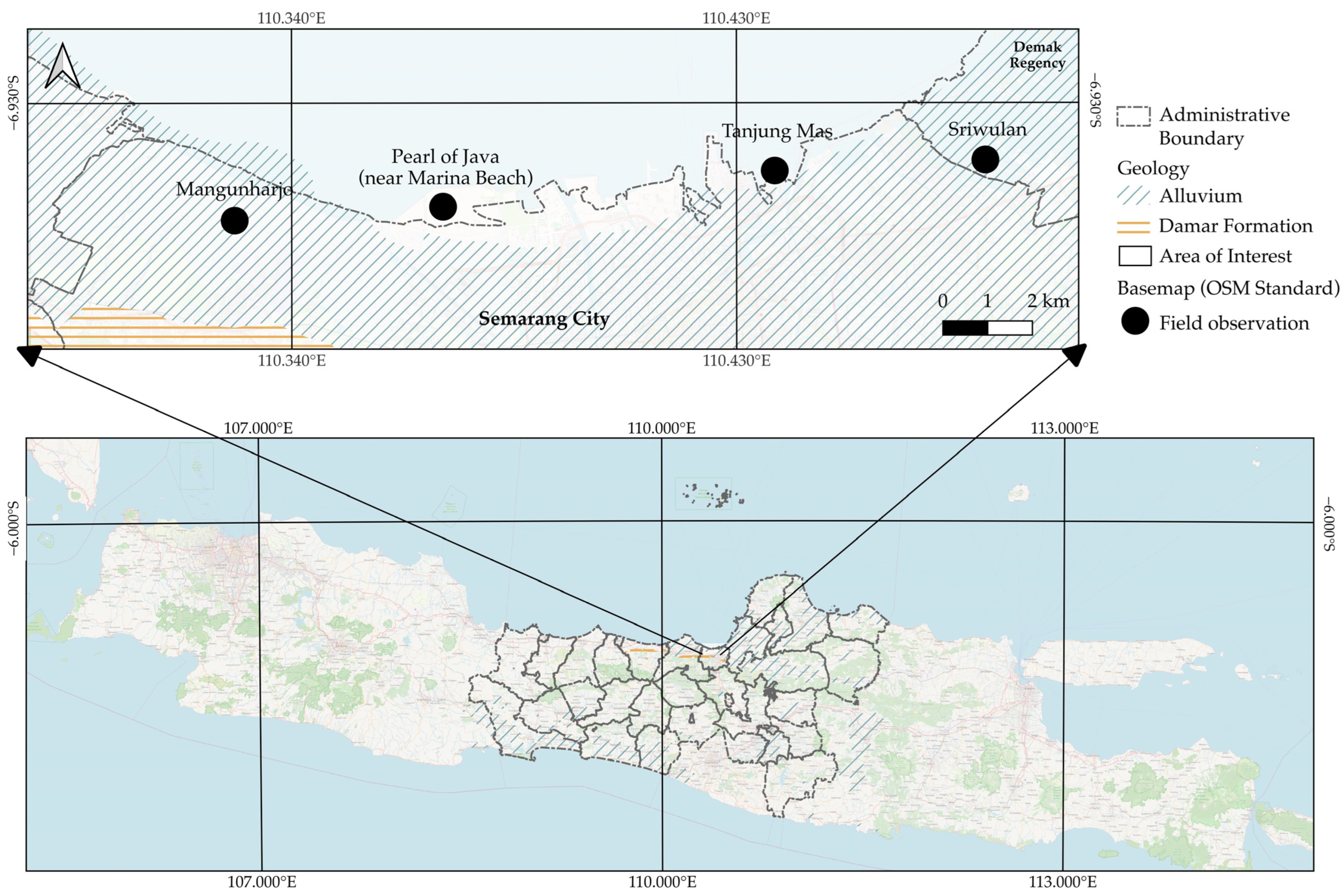
The spatial extent of this study’s area of interest is presented in Table 1. As seen in Figure 1, the area of interest for this study covers parts of Semarang City and Demak Regency, Central Java Province, Indonesia, both of which are located along the northern part of Java Island, directly adjacent to the Java Sea. According to the Center for Geological Survey of the Republic of Indonesia [59], most of the coastal area examined in this study is underlain by alluvial deposits (see Figure 1). This indicates that the analyzed coast is predominantly a low-lying sedimentary coastal plain, composed mainly of clay and sand, rather than a rocky coast. Such geological characteristics are important for understanding the area’s susceptibility to coastal transformation, as unconsolidated sedimentary environments are generally more vulnerable to erosion, inundation, and land subsidence. In the case of Semarang, for instance, these conditions are further compounded by severe subsidence with reported rates ranging from 3 to 13 cm/year [60,61,62].
Considering the theoretical lens of this study, namely place attachment, which emphasizes how coastal transformation is experienced, interpreted, and negotiated by affected communities, this study adopts a retrospective rather than predictive analytical design. Instead of forecasting future shoreline positions, the analysis focuses on long-term coastal land transformation that has already taken place and its socio-environmental implications.
To achieve this objective, the study compares conditions in 1994 and 2024 as two temporal endpoints within a three-decade retrospective frame. This temporal scope was selected based on both the literature on coastal transformation and the local planning context. Previous studies suggest that assessing coastal change requires a multi-decadal perspective [35]. The three-decade analysis by Sutrisno et al. [63] similarly identified intensive coastal transformation alongside broader socio-economic change. In the context of Semarang, the selected period also corresponds to important phases in urban and coastal governance. The year 1994 represents the period prior to decentralization of local government and development, while 2024 marks the end of the current long-term development planning period. In addition, the 1990s marked an early phase in the recognition of land subsidence in Semarang City, including initial, although later discontinued, official monitoring efforts [64]. Taken together, these considerations make the 1994–2024 period appropriate for examining long-term coastal land transformation in relation to both environmental change and socio-political development.

2.3. Research Design

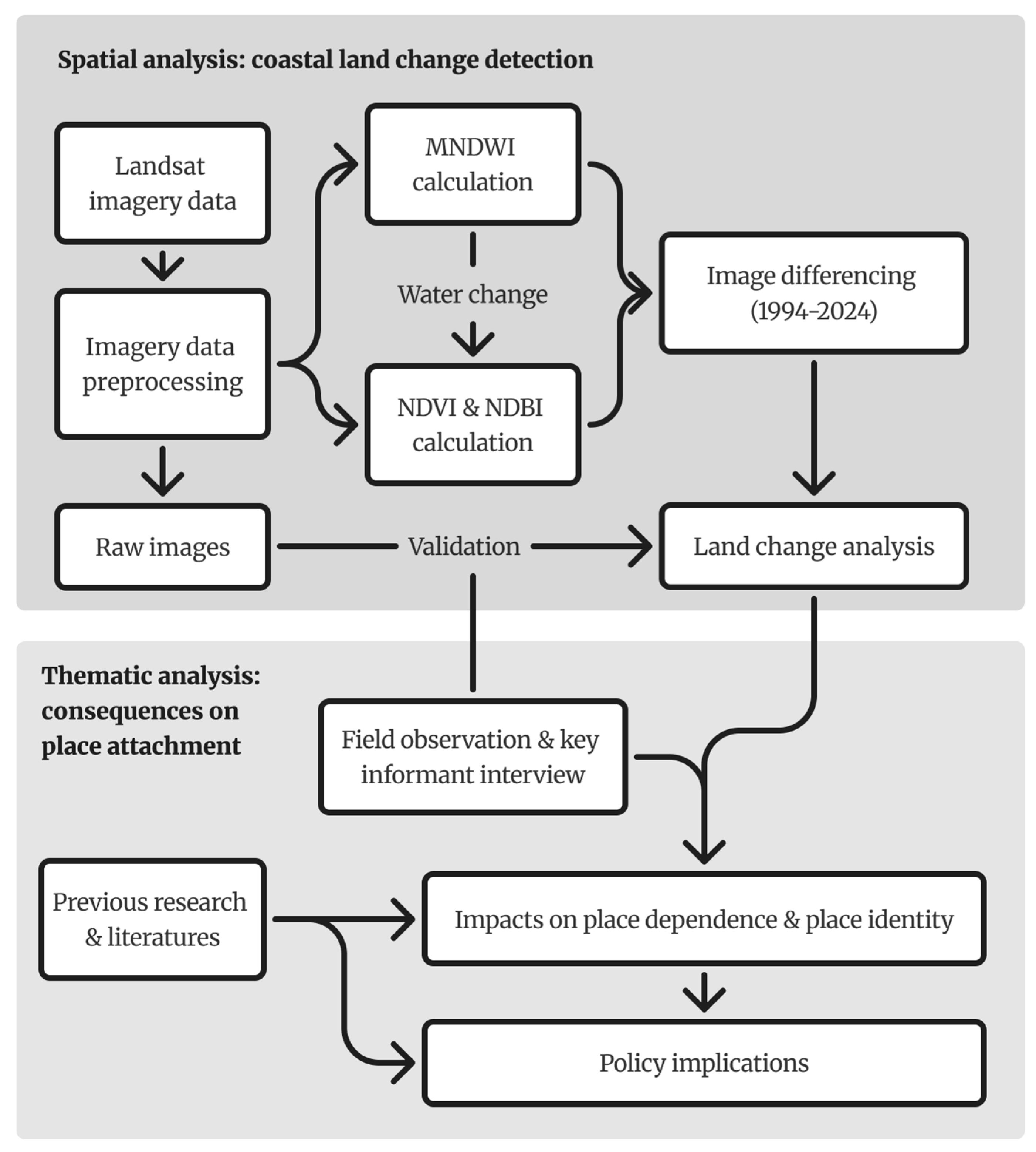
This study utilized a mixed-method research design by combining spatial index calculation with qualitative thematic analysis. Utilizing these approaches is valuable to obtain a comprehensive understanding of the study case [65,66]. The mixed-method design of this research was employed, as seen in Figure 2 below. The overall research design in this research followed the logical process of understanding coastal land change conceptualized by Siddik and Islam [67]. The quantitative spectral-index calculation was observed to provide a rapid assessment in detecting the coastal land transformation as proposed by Sutrisno et al. [37] and Sengupta et al. [68]. The qualitative thematic analysis and data collection were used to assess the land change’s consequences on the perceived place-attachment dimensions, namely place identity and place dependence, following Lambert et al. [16].

2.4. Data Collection

The data collected for this study range from satellite imagery to qualitative data. As seen in Table 2, this study used various publicly accessible data. The satellite imagery used in this study was derived from the Landsat archive, which has provided globally available observations since 1984. Landsat was selected because its consistent multi-decadal record enables comparison across the full 1994–2024 study period, making it particularly suitable for the retrospective analysis adopted in this research. All of these satellite data were obtained from the US Geological Survey, acquired through the image collection function on the cloud-based spatial data analysis platform, Google Earth Engine (e.g., ee.ImageCollection (“LANDSAT/LT05/C02/T1_L2”)) with 30 m pixel. To improve robustness, each target year was represented using a median composite of Landsat imagery from April to September, as the dry season in the appointed year [69], with relatively high image acquisition probability and thereby reducing sensitivity to image-specific conditions and short-term environmental variability. Five images were acquired based on this date filter, with detailed dates as seen in Table 3. Prior to index calculation, those imageries underwent preprocessing, cloud masking, and surface reflectance scaling. Cloud masking was applied using the QA_PIXEL band by excluding fill pixels, dilated cloud, cirrus, cloud, and cloud shadow flags, and by masking radiometrically saturated pixels using QA_RADSAT. An annual composite was developed using the median of the obtained imagery. All spatial data was projected to WGS 84/UTM Zone 49 S (EPSG: 32749). To support this analysis, we also collected secondary data including shoreline delineation from the National Geospatial Information Agency [70].
We collected qualitative data through field observation and key informant interviews. The field observation was conducted in four selected areas, namely Mangunharjo, Tanjung Mas, near Marina Beach (Pearl of Java/PoJ) in Semarang City, and Sriwulan Village in Demak Regency. The pinpoint of the observed sites is shown in Figure 1. We interviewed community representatives from all those sites except the PoJ representatives due to limited access to the site’s developers. We interviewed government and professional informants (e.g., from academia and Non-Governmental Organizations/NGOs) to broaden the perspective of the place-attachment-related challenges due to the coastal land changes. A full list of the key informants is shown in Table 4 below.

2.5. Data Analysis

2.5.1. Spectral-Index Calculation and Validation

To delineate coastal water–land transitions between 1995 and 2025, this study primarily employed the Modified Normalized Difference Water Index (MNDWI) by Xu et al. [73] as the main index for separating water and non-water surfaces. This index was chosen as it is the most suitable index to assess land–water transformation in the urban coastal area, which is dominated by built-up areas [37,73]. Binary interpretation was conducted where each pixel with MNDWI > 0 represents a water body while MNDWI < 0 represents land (non-water area). The transition analysis was constructed by overlaying the 1994 and 2024 MNDWI results to produce four transition classes: persistent land, persistent water, to-land transformation, and to-water transformation. Such land–water differentiation provides an initial insight for the indicative shoreline as the land–water transformation [35]. This analysis proposed a more contextual land transformation process, which could expose the coastal development process or massive abrasion [37,68]. This study does not apply a direct tidal correction; therefore, the detected land-to-water and water-to-land transformation patterns should be interpreted as long-term coastal transformation signals rather than precise shoreline positions at standardized tidal stages.
M N D W I = B G r e e n B S W I R 1 B G r e e n + B S W I R 1
To avoid interpreting transition zones solely from a single index, the Normalized Difference Vegetation Index (NDVI) [74] and the Normalized Difference Built-up Index (NDBI) were incorporated as complementary diagnostic indices [75]. Both indices were chosen as they could portray the coastal land transformation [37,75]. Combining the water index with NDVI and NDBI was also taken by Sengupta et al. [68] to deep-dive into the indicative causes and trajectories of the coastal land transformation. In this research, NDVI and NDBI were used to characterize the spectral properties of transition zones. Mean NDVI and mean NDBI values were calculated for each transition class to evaluate whether water-to-land transitions exhibited vegetated, exposed, or built-surface tendencies. In addition, to-land transformation areas were further subclassified into vegetated land, exposed/built land, and other land-based areas. This multi-index approach strengthened the interpretation of coastal transition processes by allowing the study to distinguish not only whether a surface changed from water to land or vice versa, but also the likely surface character of the emerged land. The spectral-index analysis employed in this study identifies land-to-water and water-to-land transformation, but does not directly distinguish whether such changes result from sediment erosion, inundation, or other interacting coastal processes.
N D V I = B R e d B N I R B R e d + B N I R
N D B I = B S W I R 1 B N I R B S W I R 1 + B N I R
For further comprehension of the land transformation, we also calculate the difference between 1994 and 2024 for each index. This image differencing could help us indicate the direction of the transformation [37]. This is calculated by the following formula.
I d i = I t 1 I t 0
All of this spectral-index analysis was conducted using the Google Earth Engine (GEE) code editor, a cloud computing spatial data analysis platform which was accessed through https://code.earthengine.google.com during the analysis stage of this research (from November 2025 to April 2026) using noncommercial quota for researchers. GEE was selected because it enables efficient processing of multi-temporal satellite imagery and the computation of multiple spectral indices across long time periods. This capacity is particularly important for assessing urban coastal land transformation, where large image archives and repeated observations are needed to capture dynamic environmental change [38] and support coastal management and resilience planning [58,68,76].
The validation process was conducted using the Receiver Operating Characteristics area under curve (ROCAUC) method. This validation was conducted for 50 randomly generated points using QGIS 3.26 in this study’s spatial extent (see Table 1). These points were verified through binary classification of the resulting image from the index calculation with high-resolution imagery interpretation and field surveys [37]. ROC was conducted to check the land-to-water change analysis result [77]. The ROCAUC curve portrays the relationship between True Positive Rate (TPR) and False Positive Rate (FPR). TPR was calculated by comparing the True Positives (TPs) and False Negatives (FNs) as seen in Equation (6), while FPR was calculated by dividing the False Positives (FPs) by the sum of False Positives (FPs) and True Negatives (TNs). The ROCAUC between these two rates was calculated to ensure the accuracy of the index calculation result (see Equation (5)). ROCAUC value ranges from 0 to 1 with values above 0.7 considered acceptable [78]. Further validation was also conducted through key informant interviews and secondary data.
R O C A U C = 0 1 T P R F P R d ( F P R )
T P R = T P s T P s + F N s
F P R = F P s F P s + T N s

2.5.2. Thematic Analysis

The second objective of this paper is to articulate the socio-environmental intricacies that may arise from the dynamics of shoreline change and to contribute to ongoing discussions regarding the future of coastal lives. To address this objective, we adopted a qualitative approach to assess place attachment in affected coastal communities, drawing on Lambert et al. [16]. Social data from field observations and key informant interviews were analyzed using thematic analysis. The coding and interpretation process was guided by the analytical framework introduced in Section 2.1, particularly the dimensions of place dependence and place identity. This approach allowed the study to identify how residents and other actors experience environmental change, interpret disruptions to place, and sustain everyday life under changing coastal conditions. The qualitative findings were then interpreted together with the spectral-index and photomapping results to support an integrated socio-environmental analysis.

3. Results

3.1. Coastal Land–Water Transformation

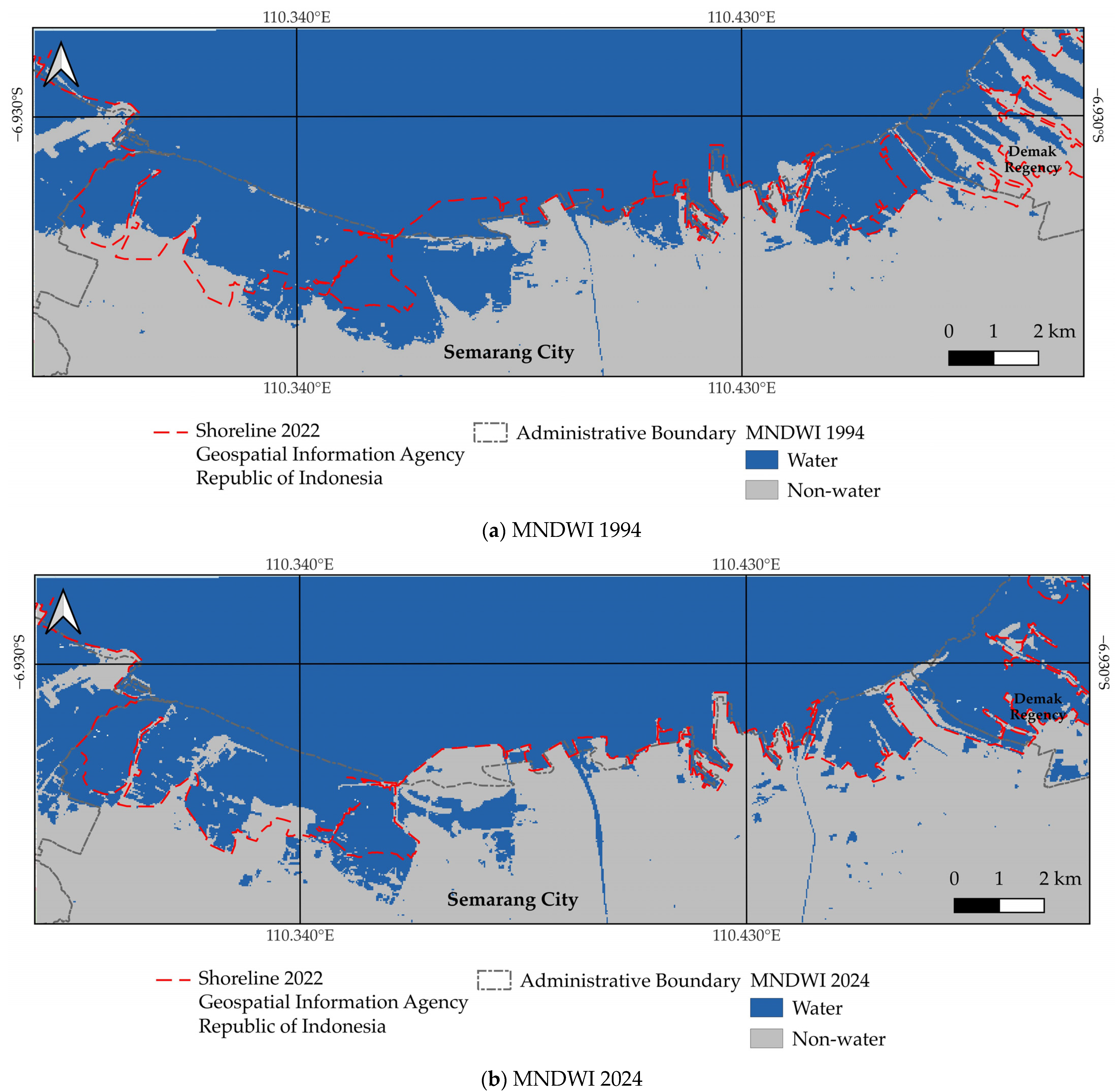
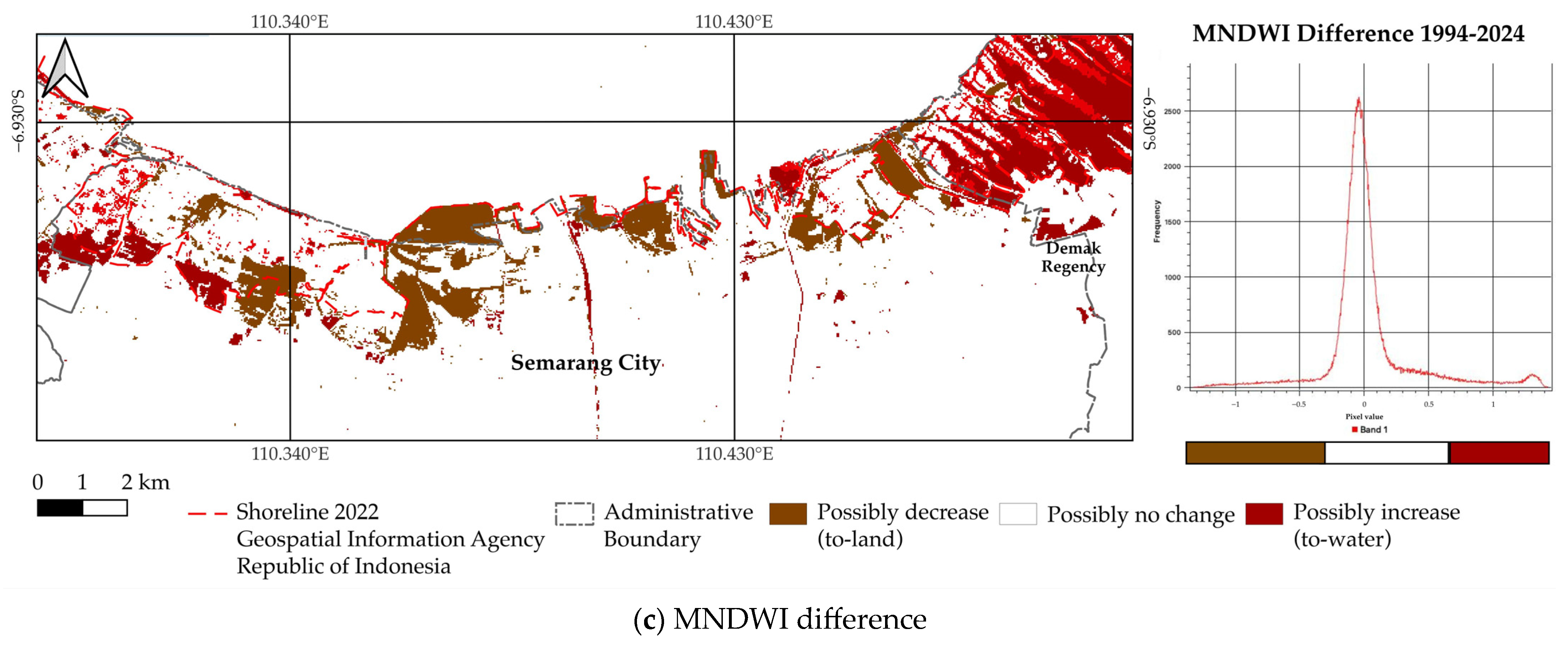
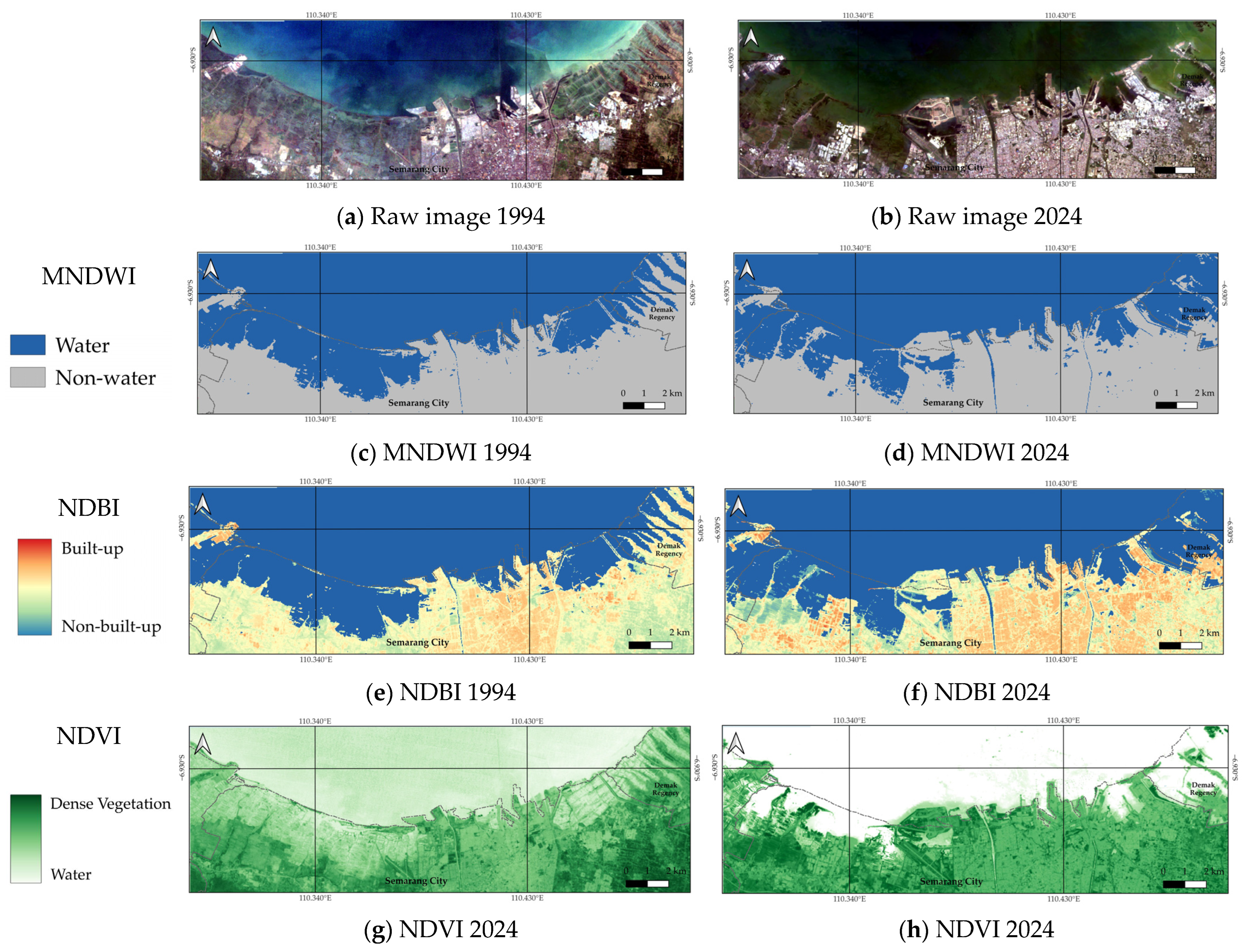
The MNDWI analysis result indicates a land–water transformation in the study area. As demonstrated in Figure 3a and Figure 3b, both the water and non-water areas are susceptible to potential alterations. Difference analysis, as illustrated in Figure 3c, also demonstrates that the direction of these changes is increasing and decreasing. An increase in the MNDWI score is indicative of a transition towards a water area, whilst a decrease in the MNDWI may signal a potential transformation of water into land. The following analysis will deep-dive into understanding these changes.
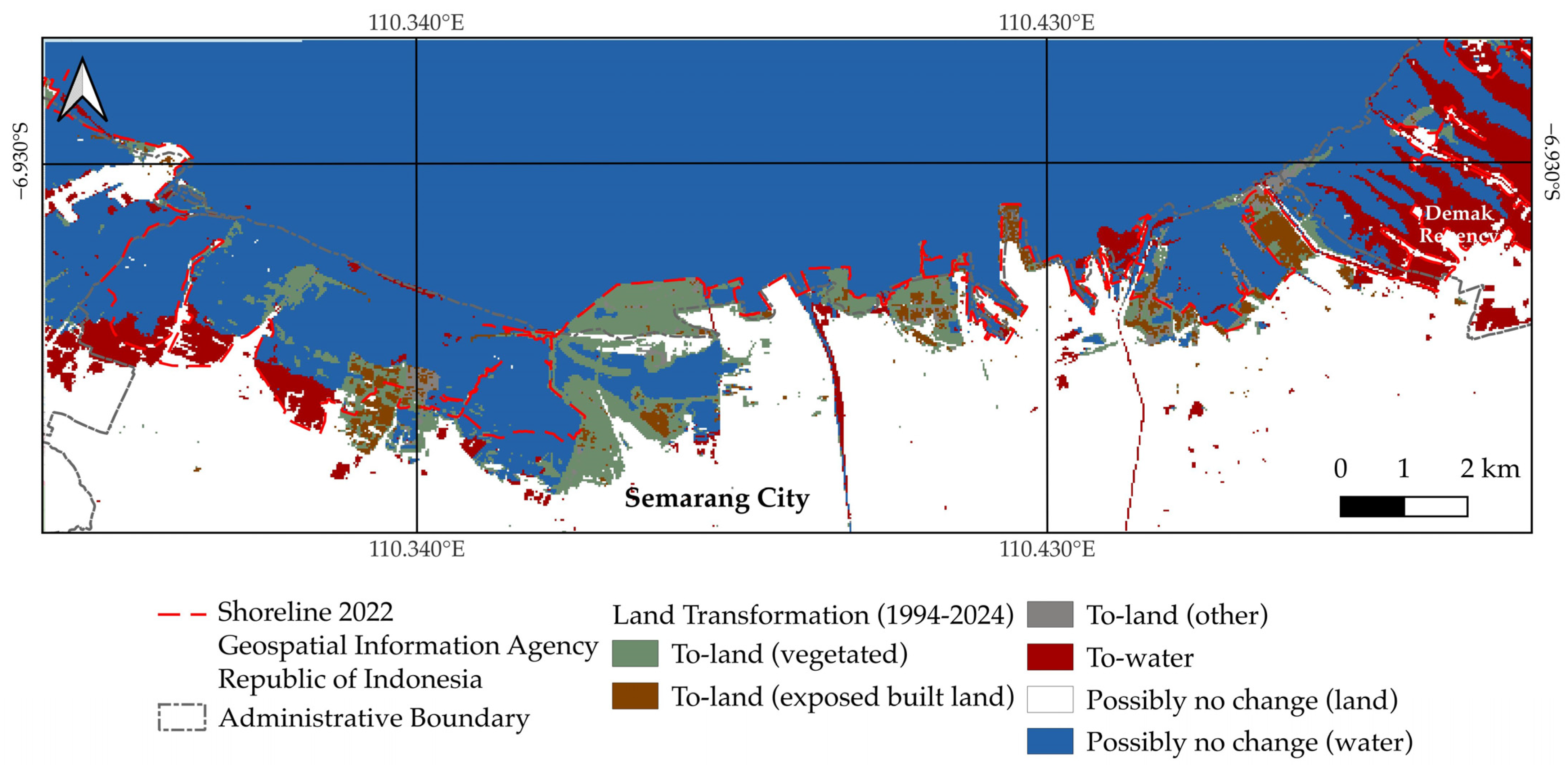
As demonstrated in Figure 4 (red-colored area) and Table 5, a total area of 13.05 km2 within the study area is undergoing a to-water transformation. The mean MNDWI difference score yielded a negative result, indicating a negative trajectory. The mean MNDWI for the specified area in 1994 was −0.3, indicating a non-water area. This was transformed into 0.66 in 2024, indicating changes in the area becoming water. A more profound examination of the NDBI and NDVI scores for this category reveals that the scores are less than zero, thereby indicating that this area is undergoing a transformation into neither a vegetated nor a built-up area.
Notwithstanding the possible land loss, this area also exhibits significant seaward progression or to-land transformation. The present study encompasses an area of 11.75 km2 where this change is occurring, as evidenced by the negative MNDWI mean difference for this classification, which scores lower than 0 (non-water area). A more detailed investigation into the NDBI and NDVI score revealed that the area undergoing this transformation was not exclusively vegetated land (NDVI > NDBI), but also built-up land (NDVI < NDBI). This analysis aligns with findings from Martuti et al. [79].
The validation of this change analysis demonstrates that the obtained ROC (0.935) is considered acceptable (>0.7). The image comparison of this study’s result can be seen in Figure 5 below. Further validation on the present-day condition of several sites will be presented in Section 3.2 and its potential implications, as outlined in Section 3.3. These changes may pose various consequences that should not be overlooked.

3.2. Present-Day Observation on the Changing Land

The field observation portrayed evidence of the present-day coastal environment, which has undergone significant changes. It was evident that there were significant coastal development activities in the area undergoing transformation, indicating the to-land area. A change in both the water and the land was also observed, which introduced further complications for the residents. The critical condition of the to-water transformed area was also evident in the study’s area. These observations reveal not only field validation of the spatial assessment, but also valuable empirical evidence for coastal management.
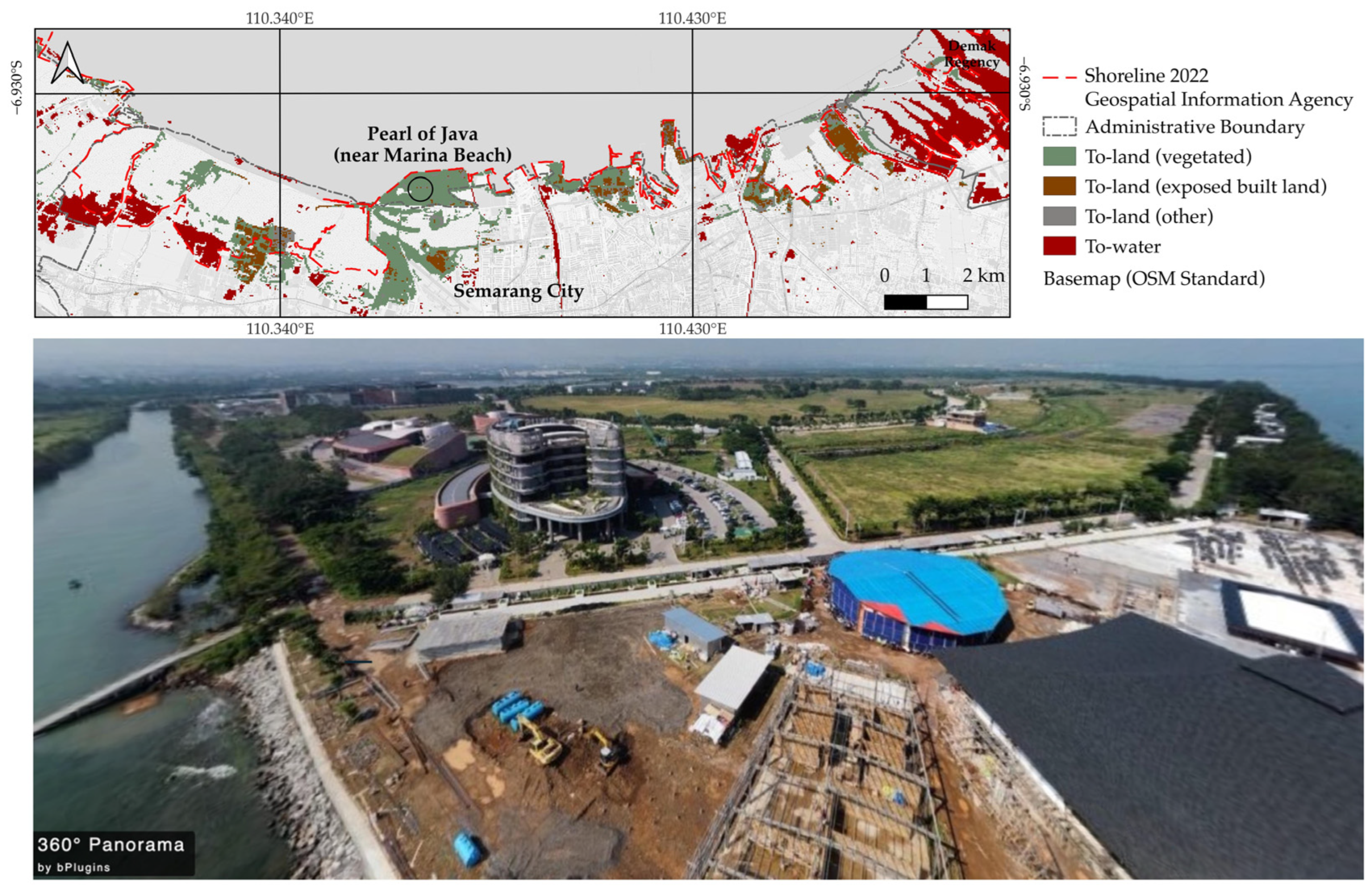
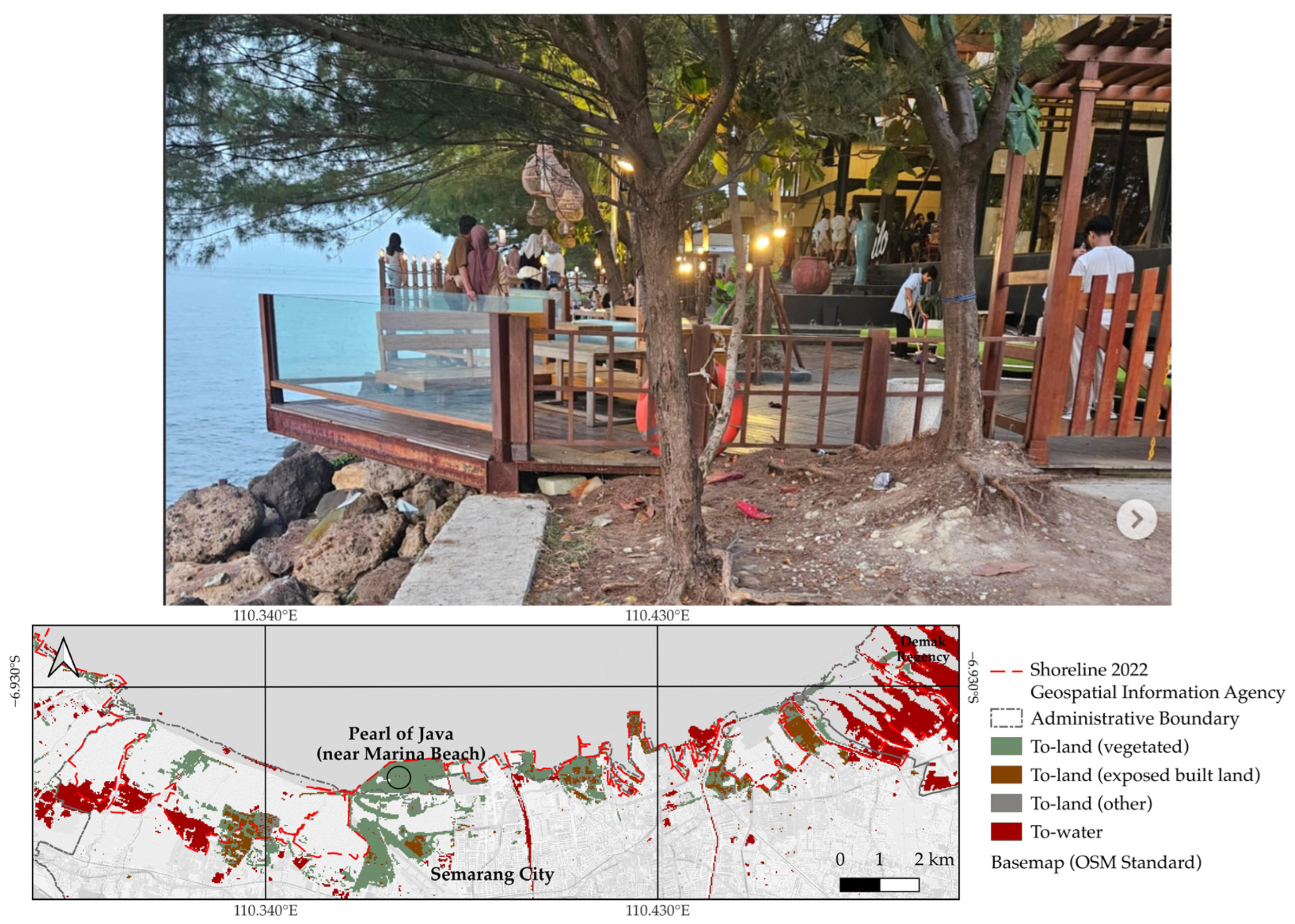
It is evident that a significant degree of land reclamation is underway in the north-central part of Semarang City, as evidenced by the ongoing development in the vicinity of Marina Beach, also known as the Pearl of Java. As demonstrated in Figure 6, the newly constructed area, characterized by unfinished building structures, signifies that this area is still in the process of development. In addition, several other areas in this reclaimed land also seem to be cleared and are prepared for further development in the near future.
Land reclamation in Semarang City has been reported to have taken place since the 1990s [18,80,81,82]. This research provides recent evidence for the progress of this major coastal resilience measure. Not only as an effort to protect the coast of this city, but our field observation also finds that this reclamation project is intended to develop a new commercial and business area. Notwithstanding the ongoing process, a number of commercial areas within the reclaimed land have already been opened. As demonstrated in Figure 7, the observation of a shop during the site visit revealed that the beach is being fenced only for customers rather than for public spaces.
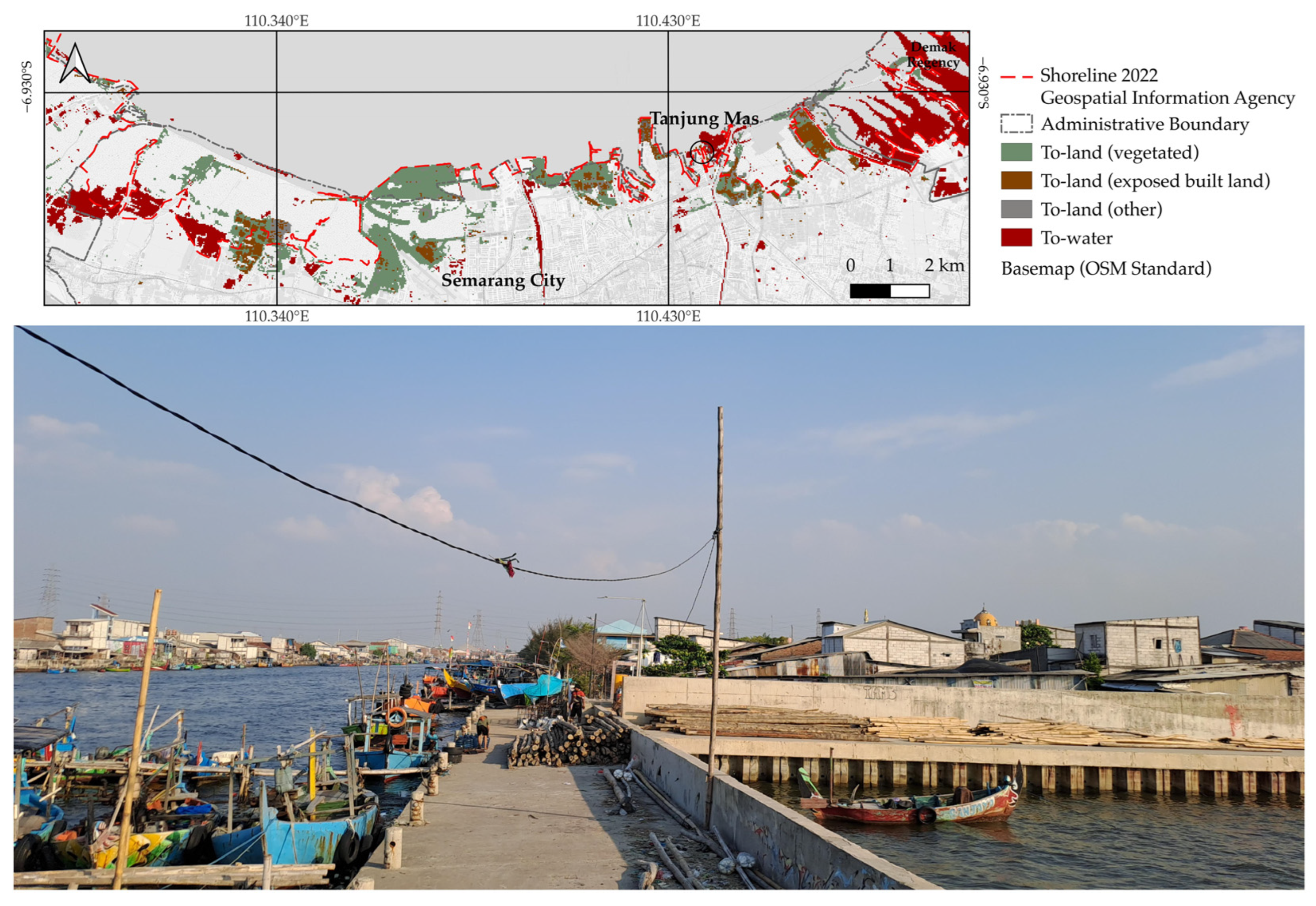
Empirical evidence from one village in Tanjung Mas, namely Tambak Lorok, located in northeastern Semarang, illustrates the challenges of coastal developments. Our spatial analysis indicates that this area has experienced to-land transformation side-by-side with to-water transformation. As seen in Figure 8, the left side of the photograph portrays the to-water transformation while the right side represents the to-land transformation. Despite being included in the city’s reclamation efforts, several areas in this village, particularly those directly adjacent to the sea in the northern part, continue to experience daytime tidal flooding, even in the absence of heavy rainfall [83,84]. Although the frequency and severity of flooding have reportedly decreased, the events persist [83].
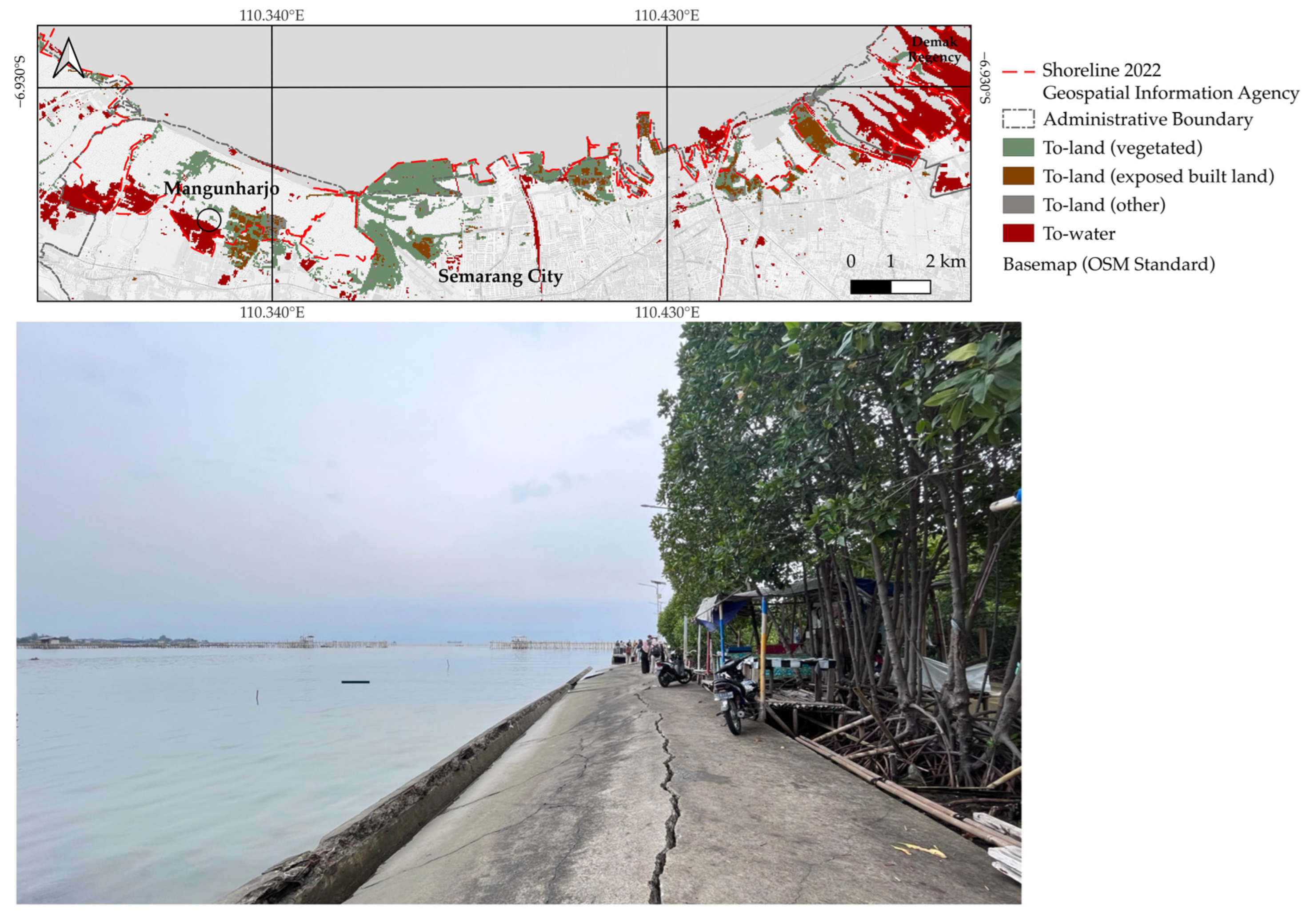
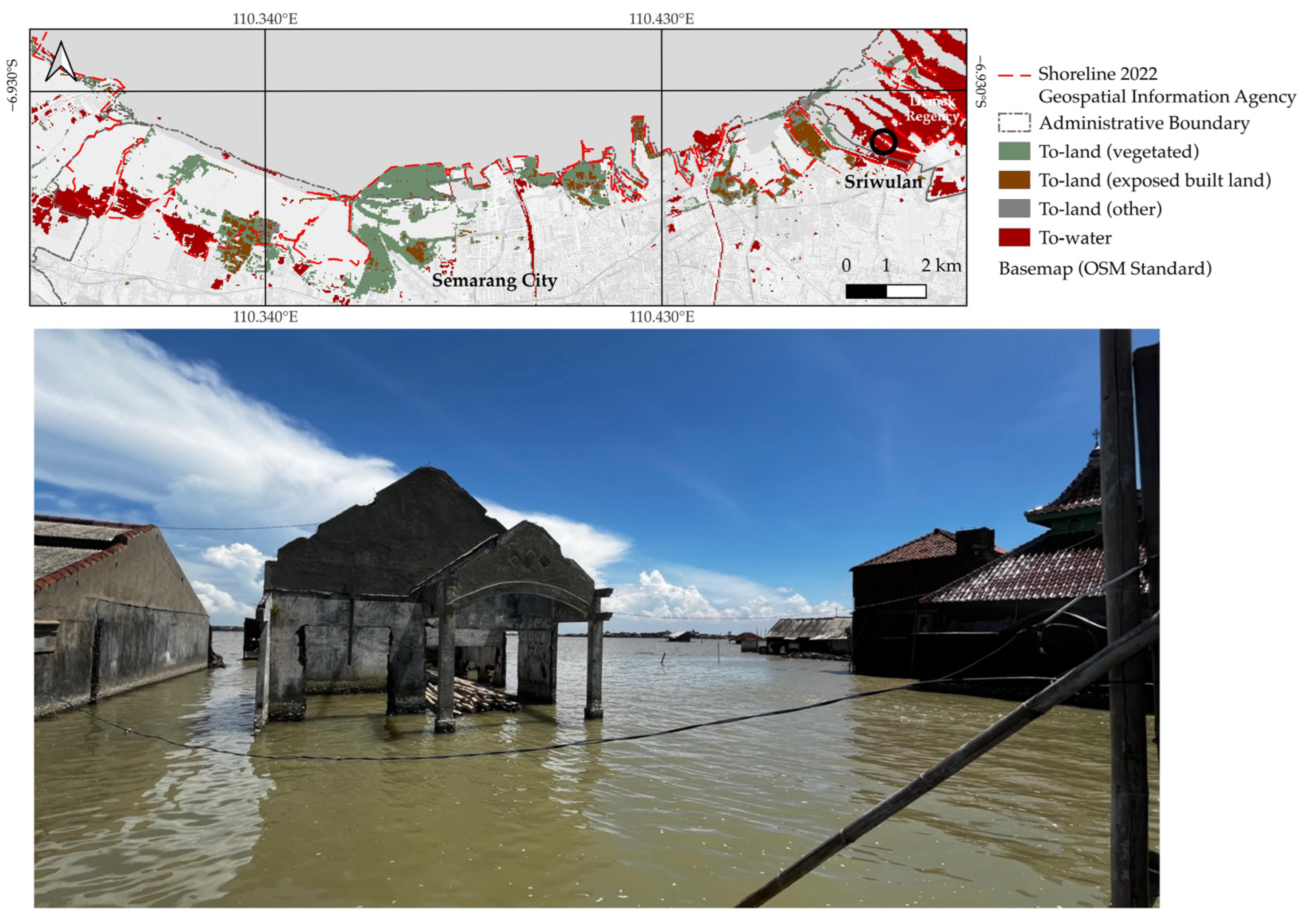
The field observation also provides recent picture evidence of the to-water area in the western and eastern parts of the study area, as assessed in the spatial analysis. As demonstrated in Figure 9 and Figure 10, the water has predominantly taken over. Figure 9, which was captured in Mangunharjo, Semarang City, displays mangroves situated on the right side but in contrast, the image also depicts fissures in the road, which function as a barrier between the terrestrial and aquatic realms. The left side of Figure 9 represents the to-water area. Figure 10 portrays the to-water area in Sriwulan, Demak Regency. This area exhibits a more critical condition, characterized by the permanent inundation of residential structures, resulting in their state of disrepair.
This empirical evidence underscores the significance of a coastal transformation analysis, which is inherently associated with tangible challenges. In the context of to-land transformation, spatial analysis is employed to illustrate the physical changes, while field observation raises questions regarding the beneficiaries of these significant infrastructure endeavors. A further series of enquiries has been conducted in the to-land and to-water area, where the floodings persist despite ongoing reclamation efforts. It is imperative to note that the to-water transformation has resulted in a discernible disruption to the infrastructure and built environment. This prompted further reflection on the potential social complexities that might arise from this situation, a matter that will be addressed in the subsequent section.

3.3. Consequences of Coastal Land Transformation on Community’s Place Attachment

Analysis of the key informant interview results through the lens of place attachment reveals that the coastal land transformation poses disruption to the coastal community’s livelihood while also entailing a means of keeping the vibrant identity of the city. Changing coastal environments pose challenges to a community that depends on the coastal resources, natural or built. On the other hand, residing in such a changing place shapes the community’s resilience. In addition, shaping the future of a coastal city is also a means to protect future life and businesses. Hence, the rootedness towards a place, albeit with any persistent changes that have already occurred, remains to be negotiated and maintained. This section will cover the discussion in two parts, mainly the coastal land transformation and its consequences on the disruption of people’s place dependence, and secondly, how the place identity was shaped along with living and experiencing the changing environment.

3.3.1. Disrupted Place Dependence

Place dependence as a functional rootedness towards a place was observed through key informant interviews. Most mentioned discussion about this issue is related to the inevitable livelihood change due to the coastal land transformation. This puts a double burden on the impacted community. Furthermore, land ownership dependence is also disrupted. This result reflects how coastal landscape change goes beyond physical change, but is also a complex socio-economic challenge for the unevenly impacted communities.
In Bahasa Indonesia, the expression “sudah jatuh tertimpa tangga”, similar to the English phrase “when it rains, it pours”, captures the compounded burdens faced by those who have been in vulnerable situations. This metaphor represents the complex challenges experienced by those whose place dependence is disrupted by the shoreline change. Our key informant, as seen in the following quotes, emphasized that coastal communities affected by to-water land change, particularly those reliant on natural resources, are losing their sources of livelihood due to this environmental problem. This particular disruption to people’s livelihood was reported from the case of land loss in Sayung, Demak. He stated that this coastal land change has been observed by the community since the early 2000s. Almost two decades later, this to-water transformation has disrupted farmers whose rice fields have been permanently eroded. Similarly, land-based farmers in Mangunharjo in the northwestern coastal area of Semarang have also transitioned to aquaculture as agricultural areas become submerged, as our community representative informant said. However, aquaculture itself has not provided a stable income since productivity remains challenged by climate change-induced sea level rise or permanent flooding:
“So, if I’m not mistaken, back then (around 2000s) there was still farming and all that, even along the coast, there were rice fields that could still grow. But if I’m not mistaken, around 2018, that’s when it started, though maybe the exact year needs to be checked again, but as far as I recall, it was around 2018 when, if I’m not mistaken, the sea level rise began, uh, flooding the rice fields. So eventually, productivity was affected.”
(K9)
The capacity to deal with such inevitable changes is unevenly distributed. An interview with a coastal policy advocate highlighted that livelihood transitions due to permanent flooding are a direct consequence that shall be tackled by the impacted communities themselves. Coastal communities with limited capacity, such as those possessing only small boats, could not deal with the need to travel further offshore to increase their productivity as their nearest coasts no longer provide enough resources [85]. In addition, communities that have been living dependent on coastal natural resources might experience difficulties in shifting into land-based businesses. As explicitly stated by our informant (K4) that “[the fishermen], can’t go ashore”. Their skills and resources are all related to aquaculture and fisheries, which are very different from the industries of other land-based businesses.
Furthermore, this situation becomes more complicated as the impacted communities also allocate resources to keep their houses from persistent floodings. Coastal community informants reported that their houses are prone to coastal floodings as well as upstream pluvial floodings, or they mentioned it as “floodings from below and from above” (K1). As seen in the quotation below, communities impacted by the changing coastal landscape are also prone to systemic poverty as they are losing their livelihood and at the same time, have to deal with the cost of renovating their houses, including raising floor levels [20,22,86,87] or relocating to safer areas. Only communities with sufficient economic capacity can alter their place dependence by moving into a new place. In Semarang City, such conditions are evident in residential areas such as Tanah Mas, where higher-income households are more prevalent. Conversely, lower-income households often have limited mobility and remain in flood-prone, subsiding, or in erosion-affected areas [88].
“So, for low-income people, raising the height of their homes sometimes requires a lot of preparation. As a result, they are the ones who bear the brunt of it. This is where the vulnerability to urban poverty lies. In conclusion, this has an impact on the vulnerability to urban poverty.”
(K1)
The disruption towards place dependence was also evident in place ownership. Our interview with one of the house owners whose house has been permanently flooded, as seen in Figure 10, revealed that they chose to keep visiting their place in order to ensure that they still have the right to their house. This intriguing decision was taken particularly due to their belief in the occurrence of reclamation for their area as promised by developers [11]. This perspective was confirmed during an interview with government representatives. They said that the act of immobility to maintain legal ownership of eroded land is also motivated by the expectation that the area may eventually be included in future reclamation projects, potentially transforming water back into land. Such expectations become understandable as the reclamation projects in the Semarang–Demak coastal areas occur massively and consistently and have become one of the most important national projects [89].
Further investigation with the land authority (K6) stated that current regulations have not yet accommodated how to maintain land rights on the disrupted, eroded land. They explained that the rights of the land loss are hard to formally decide as the definitive land area is not clear. They added that “Right to the land could only be regain if only the landowner takes the measure to reclaim it” (K6). In accordance with this result, the current absence of a formal legal framework has indeed become a challenge to the impacted communities’ right to live [90]. Consequently, land compensation cannot be given to owners of land parcels impacted by environmental degradation occurring in coastal areas [90]. Further discussions with municipal land officials revealed the legal complexities surrounding this issue. Although national regulations allow for a form of “goodwill-based” (K6) compensation (dana kerohiman) for environmentally degraded land, this scheme is limited and lacks a clear valuation framework, particularly due to the absence of an officially recognized shoreline change monitoring system capable of verifying land loss. This scheme could also be activated only if a national project or a non-government project is involved. In cases where neither national government initiatives nor private sector investments are present, severely eroded lands effectively fall outside institutional responsibility. Rather than enabling collective, community-based reclamation planning, parties with sufficient capital or planning capabilities to restore these lands often acquire the lands at extremely low prices, only around USD 0.3 to 1 per square meter [85]. This challenging ownership dependence towards the eroded place adds to the discussion on the consequences of coastal land change transformation towards place dependence.
Lastly, such an overwhelming disruption might also have further impacts on one’s well-being. As one of our key informants pointed out, the disruption in such a place represents compounded losses, including loss of property, livelihood, memories, and people.
“Losing one’s sense of belonging and losing one’s place—that’s why it requires a process of adaptation, and there’s a sense of loss involved. Because losing people—losing family, loved ones, homes, and property—and including that sense of place—it all has an impact (to one’s personal psychological well-being).”
(K8)
This thematic analysis provides a comprehensive overview of the challenges associated with coastal land transformation. The impact of the site on the community is multifaceted. This encompasses the predominant economic repercussions of losing one’s means of subsistence, compounded by the necessity to acquire additional financial resources to undertake home renovations or relocations. Evident coastal reclamation has also shaped the perception of impacted communities, instilling within them a sense of hope for inclusion. However, current major reclamation projects appear to have yet to accommodate this hope. The comprehension of such complex challenges is therefore influential in comprehending the coastal land transformation beyond the physical process.

3.3.2. Undisrupted Place Identity

The thematic analysis of place identity is organized into two interrelated discussions. First, it examines how the city seeks to preserve and project a developmental identity through the continuation of large-scale infrastructure and investment-oriented initiatives. Second, it explores how affected coastal communities continue to inhabit, interpret, and sustain everyday life amid ongoing socio-environmental change. Together, these portrayals suggest that place identity is not simply lost when physical and social landscapes are transformed. Rather, identity may persist through different actors and at different scales: at the urban scale, through narratives of growth, ambition, and strategic importance; and at the community scale, through the continuity of lived practices, routines, and local meanings despite disruption. These findings illustrate that transformation does not necessarily entail the disappearance of place identity but may instead involve its reworking under changing environmental and political conditions.
Land reclamation has become a central mechanism through which Semarang’s coastal place identity is reshaped and its urban resilience narrative is materially asserted, marking a transition from an industrial city to a flood-prone and increasingly engineered coastal city. Large-scale reclamation and major coastal protection infrastructures, particularly along the central and eastern part of Semarang, are framed as strategic responses to shoreline retreat and tidal flooding, emphasizing land expansion, coastal defense, and the safeguarding of urban economic functions. As shown in Figure 6, land reclamation projects in Semarang City remain ongoing. These interventions reflect the city’s commitment to resilience as articulated in the Semarang Resilience Strategy [91], demonstrating an institutionalized approach to slow-onset disaster response that is enabled through multi-stakeholder collaboration involving local government, private sector actors, and national-level institutions. The scale, spatial extent, and infrastructural capacity of these projects signal a form of resilience grounded in physical robustness and developmental continuity, consistent with dominant engineering-led adaptation paradigms [18,92].
In contrast, the community, albeit with its limited capacity, reveals a playful way to accept its wicked conditions. Coastal community indicates that place identity is not necessarily erased by environmental disruption but instead reconstituted through everyday practices of living with change. As shown in the quotation below, residents were initially shocked by severe robbing events but gradually became accustomed to them, suggesting a process through which altered environmental conditions are absorbed into the community’s lived sense of place. Rather than signifying indifference, this habituation reflects how place identity can persist under chronic disturbance by adjusting to new realities. The community continues to inhabit the area not because the place remains unchanged, but because its attachment to it is maintained through familiarity, routine, and the social capacity to endure transformation, as previously explored in the place dependence section. In this sense, place identity emerges not from environmental stability, but from the continuity of collective life within an unstable coastal landscape.
“We are like this. At first, we were surprised when there was such a big tidal surge. But over time, since we’ve gotten used to it, people aren’t surprised anymore.”
(K4)
This persistence is further reflected in a playful resilience practice. Coastal landscape changes, which caused several communities to experience persistent floodings, as explored in the field observation results, shaped the playful way to deal with the situation. Persistent flooding is narrated not solely as a crisis, but also as part of the everyday social world in which children play and residents opportunistically catch fish carried by floodwaters. Such practices show that even under degraded conditions, the community continues to produce meanings and ways of living that affirm their belonging to place. The flooded environment, while disruptive, is still socially inhabited, interpreted, and incorporated into local experience. This suggests that place identity in hazard-exposed coastal settlements is sustained through the ability to keep living, interacting, and finding familiarity within changing circumstances. Accordingly, the community’s response illustrates that place identity is not dependent on preserving an untouched environment; rather, it resides in the ongoing negotiation through which residents remain themselves, and remain of that place, despite the profound socio-environmental changes surrounding them.
“[…] Once the water pools up, the kids all bring plastic buckets and nets. They all catch tilapia. Even though the pool is only so big, the fish are already big, especially when the dike breaks, which really stresses out the milkfish pond owners because the fish scatter everywhere. They do catch milkfish, but it’s the community that reaps the harvest.”
(K3)
Taken together, these findings show that place identity in coastal transformation contexts should be understood as dynamic rather than fixed. While the material environment is altered by reclamation, land loss, and recurrent flooding, both institutional and community actors continue to reproduce a particular understanding of what the place is and what it means. For the community, this is reflected not in the absence of hardship, but in the ability to keep living in ways that preserve familiarity, belonging, and social continuity within an increasingly unstable setting. This highlights that place identity can endure through adaptation to change, even when such adaptation takes place under conditions of inequality and environmental stress. Accordingly, the findings suggest that discussions of coastal transformation should pay closer attention not only to physical change, but also to the ways identity is maintained, negotiated, and redefined through everyday life.

4. Discussions

4.1. Changing Coastal Land as a Socio-Environmental Place Disruption

The transformation of coastal land in the study area can be understood as a form of socio-environmental disruption, expressed through uneven patterns of land loss and land gain. Rather than representing a purely geomorphological shift, these changes indicate that coastal transformation is materially reconfiguring the physical landscape while simultaneously reshaping the social conditions through which communities inhabit, use and depend on the coastal environment. The spatial analysis suggests that such changes are not evenly distributed, and therefore their consequences are also unlikely to be evenly experienced. In this sense, the findings highlight that physical disruption in coastal areas should not be interpreted only in terms of physical change, but also in relation to the differentiated socio-environmental consequences that emerge from such a transformation.
The physical disruption identified in this study is broadly consistent with previous research on shoreline dynamics in Semarang’s coastal area. This study specifically focuses on documenting the manifestation of land loss and land gain through spectral-index-based spatial analysis, rather than directly attributing causality to particular geomorphological drivers. Earlier studies have similarly shown that shoreline change in Semarang has long involved both erosion and accretion. Marfai et al. [36], for instance, reported that while severe erosion occurred in several coastal segments between the 1970s and 1990s, accretion became more visible in the early 2000s, particularly in the western coastal area. More recent publications such as Dewi and Bijker [92] further emphasize that Semarang’s coastal transformation cannot be separated from anthropogenic reclamation, which expanded significantly from the 1980s onward in response to increasing demands for housing, industrial land, and urban economic development. In the present study, this interpretation is further supported by complementary NDVI and NDBI analysis, which helps distinguish whether to-land transformation is more strongly associated with vegetation-related change or built-area expansion. In this regard, areas where NDBI differences exceed NDVI differences reinforce the argument that parts of the to-land transformation are closely associated with reclamation-led coastal urbanization.
At the same time, the drivers behind land loss in the study area require more careful investigation. A number of studies have associated land loss in the Semarang–Demak area with ongoing land subsidence, particularly that induced by intensive groundwater extraction and other urban pressures [5,18,60,61,93]. However, present spectral-index analysis identifies land-to-water transformation rather than directly distinguishing between erosional sediment loss, inundation, or other coastal processes. Accordingly, this study does not attribute observed land loss to a single confirmed driver. Instead, the findings are interpreted within the context of a subsiding and highly modified coastal environment, where multiple interacting pressures may contribute to transformation, including land subsidence, recurrent tidal inundation, sediment dynamics, and human intervention. Further research is needed to disentangle the relative influence of these factors, which is also stated by Sarah et al. [93].
Beyond its physical manifestation, the uneven nature of coastal transformation also raises an important question of justice. Uneven spatial patterns of coastal protection and landscape change imply that the benefits of infrastructure intervention are not distributed equally, and that some spaces may be stabilized or enhanced while others remain exposed to environmental deterioration. This finding suggests that coastal protection projects are not only technical responses to hazards, but also political processes that shape who is protected, whose livelihoods are disrupted, and whose place-based needs are prioritized. In the study area, the socio-environmental consequences of physical disruption are evident in relation to community livelihoods and dependence on place, while reclamation appears to create greater opportunities for capital-intensive development than for addressing the needs of affected residents. This supports previous arguments that climate-related and development-induced place change can deepen the burdens experienced by coastal communities [20,21,32,45,46,94]. Therefore, the disruption highlighted in this study should be understood not merely as environmental change, but as a socially differentiated reordering of coastal space with significant implications for equity, belonging, and everyday survival.

4.2. Theoretical Contributions: The (Un)Disrupted Place as a Call for More Multidisciplinary Understanding of Coastal Land Transformation

Building on the preceding discussion, this study proposes the conceptualization of the (un)disrupted place to capture a central paradox in coastal land transformation. Existing discussions of place disruption have largely emphasized loss, and the overwhelming consequences of environmental and infrastructural change for affected residents [14,45,46]. While these dimensions remain highly relevant, the findings of this study suggest that disrupted places are not necessarily rendered socially inactive or functionally abandoned. Instead, environmental degradation and large-scale coastal transformation may coexist with ongoing efforts by different actors to sustain selected functions, meanings, and values of place. Private actors and government continue to “capitalize” on land reclamation to secure economic opportunities and communities strive to maintain everyday life and future aspirations within the limits of their own capacities. In this sense, coastal transformation does not simply produce disrupted places, but places in which disruption and continuity coexist in uneven and contested ways.
This conceptualization extends the place disruption literature by showing that continuity under disruption should not automatically be interpreted as a coherent or equitable form of resilience. Rather, the findings indicate that what appears as resilience may, in practice, reflect a fragmented and uneven adaptation across actors with different levels of power, resources, and decision-making capacity. The coast remains inhabited, utilized, and valued, yet the burden of adjustment is distributed unequally, often requiring already affected communities to accommodate environmental change with limited support. The concept of the (un)disrupted place therefore highlights that coastal land transformation is not only a matter of physical change or emotional loss, but also a political process through which some place functions are preserved, some identities are sustained, and some dependencies are marginalized. This calls for a more multidisciplinary understanding of coastal transformation, one that integrates geomorphological change, infrastructure development, place attachment, and spatial justice within a shared analytical frame.
Furthermore, this study argues that spatial justice should be treated as intrinsic to the theorization of place disruption in coastal settings. The findings suggest that the central question is not only whether a place is disrupted, but also which parts of the place are protected, whose attachment is recognized, and whose dependence becomes expendable in the course of transformation. In the study area, the capacity of state and development actors to undertake reclamation and coastal protection demonstrates that coastal change is actively governed rather than passively experienced. However, the uneven socio-environmental consequences observed in the study area indicate that such capacities are not always directed toward safeguarding the needs of affected communities.
Accordingly, the notion of the (un)disrupted place contributes to ongoing debates on coastal resilience and place disruption by showing that persistence is not necessarily synonymous with stability, justice, or coordinated adaptation. Coastal places may remain socially inhabited, economically valued, and politically maintained even as they undergo profound environmental degradation and uneven social consequences. This conceptualization therefore calls for a more multidisciplinary understanding of coastal land transformation, one that treats geomorphological change, infrastructure development, place attachment, and spatial justice as interconnected rather than separate domains of inquiry. Recognizing this complexity is important not only for advancing theory, but also for informing more grounded and equitable approaches to coastal governance.

4.3. Implications for Coastal Resilience

The conceptualization of the (un)disrupted place also has direct relevance for coastal management towards resilience. If coastal transformation simultaneously disrupts and sustains place in uneven ways, then governance responses must be able to address not only physical coastal change, but also the differentiated social, legal, and political consequences that accompany it. Based on this perspective, this study offers several implications for coastal city resilience management and practices, particularly regarding the need for more systematic and continuous coastal monitoring, stronger legal and compensatory frameworks, more meaningful public participation, and improved cross-boundary governance. Together, these implications underscore that coastal land transformation should not be managed solely as a physical or engineering issue, but as a socio-environmental process with uneven consequences for affected communities.
The dynamic nature of coastal change calls for more systematic and continuous monitoring of shoreline transformation and its associated loss and damage. This study demonstrates that open-source spatial analysis platforms can provide accessible tools for documenting long-term coastal dynamics, including patterns of land loss and land gain. Such accessibility may help government agencies and other stakeholders establish more regular and transparent mechanisms for shoreline monitoring. Moreover, the integration of spatial analysis with socio-environmental assessment, as undertaken in this research, can support a more comprehensive understanding of coastal change and its consequences. This is particularly important in contexts where persistent flooding and land degradation continue despite reclamation and coastal protection efforts, indicating the need to examine their interrelationship with other ongoing pressures such as land subsidence and sea-level rise [68].
The findings highlight the importance of incorporating spatial justice and meaningful participation more centrally into coastal management processes. The uneven consequences of coastal transformation, particularly for livelihood-based place dependence, indicate that affected communities do not experience disruption in the same way or to the same degree. At the same time, the capacity of state and development actors to undertake reclamation and coastal protection suggests that coastal change is actively shaped through policy and investment decisions rather than being merely a passive outcome of environmental processes. This makes it crucial to ensure that affected communities are not treated only as recipients of policy decisions, but as legitimate participants in defining priorities, trade-offs, and future interventions. More meaningful participation is therefore necessary to build a fuller understanding of community struggles, needs, and aspirations, particularly where existing development trajectories may privilege capital-intensive interests over local livelihoods [85].
The disruption arising from both coastal resource degradation and ambiguity over land ownership in areas experiencing land loss signals the need for stronger and more equitable legal frameworks. Where land disappears, becomes inundated, or changes function, affected residents may face uncertainty regarding land rights, compensation, and long-term security. In such situations, deficiencies in land governance risk compounding environmental vulnerability with legal and economic exclusion. More robust evidence on land loss can therefore play an important role in informing fairer compensation mechanisms and more clearly defined procedures for maintaining or adjudicating land rights. Strengthening this regulatory framework is essential to ensure that affected individuals are not exposed to further losses through legal uncertainty, unfair compensation, or the erosion of their entitlements.
The findings point to the need for stronger cross-boundary coordination in coastal governance. Coastal and hydrogeological processes do not operate according to city-level administrative boundaries, and neither do many of the consequences associated with reclamation, shoreline change, land subsidence, and flood risk. Effective governance therefore requires coordination not only across jurisdictions, but also across the stages of planning, implementation, monitoring, and evaluation. Such cross-boundary approaches are essential for addressing the often-overlooked regional consequences of major coastal infrastructure development and for supporting more equitable distribution of knowledge, technical capacity, and financial resources across affected areas. In this sense, improved coastal governance is not only a matter of institutional coordination, but also of ensuring that governance capacity itself is more evenly shared.

5. Conclusions

This study examined urban coastal transformation in Semarang City, Indonesia, by integrating open-access Earth observation with socio-environmental analysis through a place-attachment lens. Using multi-temporal Landsat imagery processed in Google Earth Engine, coastal land transformation between 1994 and 2024 was assessed through MNDWI and further interpreted with NDVI and NDBI. The results reveal sustained and spatially uneven transformation: 13.02 km2 of the study area showed increased MNDWI values and transformation into water, while 11.75 km2 experienced to-land transformation associated with declining MNDWI values. Further analysis suggests that part of the to-land transformation is linked to anthropogenic built-area expansion, as indicated by areas where NDBI differences exceed NDVI differences. These findings show that coastal transformation in the study area is shaped not only by environmental pressures, but also by human intervention and uneven development processes.
Empirical field observations and interview findings contextualized these spatial patterns by showing that coastal transformation is experienced as both material disruption and lived social change. Through the dimensions of place dependence and place identity, the analysis reveals contrasting yet persistent forms of place attachment in both reclamation-influenced areas and communities exposed to erosion and recurrent flooding. In reclamation areas, attachment is reinforced through narratives of continuity, development, and urban significance, while in environmentally degraded areas, residents continue to remain, adapt, and sustain everyday life despite escalating pressures. These findings informed the conceptualization of the (un)disrupted place, which captures how disruption and continuity may coexist within transformed coastal environments. Rather than indicating stable or equitable resilience, such continuity often reflects uneven adaptive capacities, fragmented adjustment, and selective protection across actors and places.
Taken together, the study contributes to a more multidisciplinary understanding of coastal land transformation as a socio-environmental process that is simultaneously physical, political, and affective. It extends discussions of place disruption by showing that transformed coastal areas are not simply lost or abandoned, but may remain inhabited, valued, and contested in unequal ways. The findings also highlight the need for more grounded and equitable coastal governance, including continuous monitoring, clearer legal and compensatory frameworks, meaningful participation, and stronger cross-boundary coordination. In this way, the study demonstrates that understanding slow-onset coastal change requires not only documenting physical transformation, but also examining how people continue to negotiate belonging, dependence, and resilience within disrupted yet enduring places.

Author Contributions

Conceptualization, R.S.H., S.P.H. and I.R.; methodology, R.S.H.; software, R.S.H.; validation, R.S.H., S.P.H. and I.R.; formal analysis, R.S.H.; investigation, R.S.H., A.I.A. and A.M.; resources, R.S.H., A.I.A. and A.M.; data curation, R.S.H.; writing—original draft preparation, R.S.H.; writing—review and editing, R.S.H., S.P.H., I.R., A.I.A. and A.M.; visualization, R.S.H. and A.I.A.; supervision, S.P.H. and I.R.; project administration, R.S.H.; funding acquisition, R.S.H., S.P.H. and I.R. All authors have read and agreed to the published version of the manuscript.

Funding

This research was funded by the Directorate of Research, Technology, and Community Service, under the Directorate General of Higher Education, Research, and Technology, Ministry of Education, Culture, Research, and Technology, Republic of Indonesia. This work was supported by funding number 110/E4.1/AK.04.PT/2021 and Contract Number 642-06/UN7.6.1/PP/2021, along with Addendum Letter Number 20606/UN7.6.1/PP/2022.

Data Availability Statement

The spatial data resulted from the Google Earth Engine code analysis is available upon inquiries to the corresponding author. The dataset spectral-index analysis utilizes the Landsat data, which is available publicly and can be accessed through Google Earth Engine data collection available online: https://developers.google.com/earth-engine/datasets/catalog/landsat (accessed on 20 April 2026).

Acknowledgments

This research would not have been possible without the collaborative efforts of passionate researchers working in Semarang. We extend our appreciation to Eka Handriayana, Bagas Kausan, and the researchers of in Semarang City working tirelessly to raise awareness and support impacted communities to deal with slow-onset coastal challenges. We also gratefully acknowledge Marie Belland, from the University of Amsterdam, whose work provides insights into the volatility of Semarang’s coastal dynamics. We would also like to express our gratitude to the World Resources Institute Indonesia through its Young Scientist Incubation Programme which facilitated the collaboration in assessing coastal challenges. Our appreciation is further extended to GeoAccess Indonesia and Yabes Butar-butar for providing courses, materials and tutorials that facilitated Google Earth Engine-based data collection and analysis. Collaborative data collection, critical discussions, and reflections with these young researchers have been invaluable throughout the process of conducting and writing this research. We would also like to express our deepest gratitude to the peer-reviewers of this manuscript, whose invaluable support has led to significant improvements in the document. During the preparation of this manuscript/study, the author(s) used DeepL Write with Individual license (https://www.deepl.com/en/write last accessed on 20 April 2026) for the purposes of enhancing the grammatical structure, clarity, and fluency of the manuscript. The authors have reviewed and edited the output and take full responsibility for the content of this publication.

Conflicts of Interest

The authors declare no conflicts of interest.

References

  1. Abidin, H.Z.; Andreas, H.; Gumilar, I.; Wibowo, I.R.R. On Correlation between Urban Development, Land Subsidence and Flooding Phenomena in Jakarta. In Changes in Flood Risk and Perception in Catchments and Cities, IAHS Symposium HS01, 26th General Assembly of the International Union of Geodesy and Geophysics, Prague, Czech Republic, 22 June–2 July 2015; Rogger, M., Aksoy, H., Kooy, M., Schumann, A., Toth, E., Chen, Y., Estupina, V.B., Blöschl, G., Eds.; Copernicus Publications: Göttingen, Germany, 2015; Volume 370, pp. 15–20. [Google Scholar]
  2. Johnston, J.; Cassalho, F.; Miesse, T.; Ferreira, C.M. Projecting the Effects of Land Subsidence and Sea Level Rise on Storm Surge Flooding in Coastal North Carolina. Sci. Rep. 2021, 11, 21679. [Google Scholar] [CrossRef]
  3. Rodolfo, K.S.; Siringan, F.P. Global Sea-Level Rise Is Recognised, but Flooding from Anthropogenic Land Subsidence Is Ignored around Northern Manila Bay, Philippines. Disasters 2006, 30, 118–139. [Google Scholar] [CrossRef]
  4. Pipkin, B.; Trent, D.; Hazlett, R.; Bierman, P. Subsidence and Collapse. In Geology and The Environment; Cengage Learnings: Mason, OH, USA, 2008. [Google Scholar]
  5. Prasetyo, Y.; Bashit, N.; Sasmito, B.; Setianingsih, W. Impact of Land Subsidence and Sea Level Rise Influence Shoreline Change in the Coastal Area of Demak. In IOP Conference Series: Earth and Environmental Science; IOP Publishing: Bristol, UK, 2019; Volume 280, p. 012006. [Google Scholar]
  6. Esteban, M.; Takagi, H.; Onuki, M.; Chadwick, C.; Shibayama, T.; Jamero, M.L.; Fatma, D.; Mikami, T.; Valenzuela, P.; Crichton, R. Adaptation to Sea Level Rise in Densely Populated Coastal Areas: Learning from Examples of Land Subsidence in Japan, Indonesia and the Philippines. In APAC 2019—Proceedings of the 10th International Conference on Asian and Pacific Coasts, 2019, Hanoi, Vietnam; Trung Viet, N., Xiping, D., Thanh Tung, T., Eds.; Springer: Singapore, 2020; pp. 1185–1192. [Google Scholar]
  7. Dewi, R.S.; Handayani, W.; Pratama, I.P.; De Vries, W.T.; Rudiarto, I.; Artiningsih, A. Assessing Flood Vulnerability from Rapid Urban Growth: A Case of Central Java, Indonesia. Chin. J. Urban Environ. Stud. 2023, 11, 2350020. [Google Scholar] [CrossRef]
  8. Rudiarto, I.; Handayani, W.; Wijaya, H.B.; Insani, T.D. Land Resource Availability and Climate Change Disasters in the Rural Coastal of Central Java, Indonesia. In IOP Conference Series: Earth and Environmental Science; IOP Publishing: Bristol, UK, 2018; Volume 202, p. 012029. [Google Scholar]
  9. Rudiarto, I.; Handayani, W.; Setyono, J.S. A Regional Perspective on Urbanization and Climate-Related Disasters in the Northern Coastal Region of Central Java, Indonesia. Land 2018, 7, 34. [Google Scholar] [CrossRef]
  10. Beek, W.; Letitre, B.; Hadiyanto, H.; Sudarno, S. Alternatives to Groundwater Abstraction as a Measure to Stop Land Subsidence: A Case Study of Semarang, Indonesia. In E3S Web of Conference; EDP Sciences: Les Ulis Cedex A, France, 2019; Volume 125, p. 01003. [Google Scholar]
  11. Belland, M.; Kausan, B.Y.; Kooy, M.; Zwarteveen, M. Seeing like a Pond: Amphibious Stories of Coastal Subsidence in Central Java. Geoforum 2025, 161, 104248. [Google Scholar] [CrossRef]
  12. Dodman, D.; Hayward, B.; Castán Broto, V.; Chow, W.; Chu, E.; Dawson, R.; Khirfan, L.; McPherson, T.; Prakash, A.; Zheng, Y.; et al. 2022: Cities, Settlements and Key Infrastructure. In Climate Change 2022: Impacts, Adaptation and Vulnerability; Pörtner, H.-O., Roberts, D.C., Tignor, M., Poloczanska, E.S., Mintenbeck, K., Alegria, A., Craig, M., Langsdorf, S., Löschke, S., Möller, V., et al., Eds.; Cambridge University Press: Cambridge, UK; New York, NY, USA, 2022. [Google Scholar]
  13. IPCC. Climate Change 2023: Synthesis Report; Contribution of Working Groups I, II and III to the Sixth Assessment Report of the Intergovernmental Panel on Climate Change; Intergovernmental Panel on Climate Change: Geneva, Switzerland, 2023. [Google Scholar]
  14. Brown, B.B.; Perkins, D.D. Disruptions in Place Attachment. In Place Attachment; Altman, I., Low, S.M., Eds.; Springer: Boston, MA, USA, 1992; pp. 279–304. [Google Scholar]
  15. Clarke, D.; Murphy, C.; Lorenzoni, I. Place Attachment, Disruption and Transformative Adaptation. J. Environ. Psychol. 2018, 55, 81–89. [Google Scholar] [CrossRef]
  16. Lambert, C.E.; Holley, J.R.; McComas, K.A.; Snider, N.P.; Tucker, G.K. Eroding Land and Erasing Place: A Qualitative Study of Place Attachment, Risk Perception, and Coastal Land Loss in Southern Louisiana. Sustainability 2021, 13, 6269. [Google Scholar] [CrossRef]
  17. Azeriansyah, R.; Prasetyo, Y.; Yuwono, B.D. Land Subsidence Monitoring in Semarang and Demak Coastal Areas 2016-2017 Using Persistent Scatterer Interferometric Synthetic Aperture Radar. In IOP Conference Series: Earth and Environmental Science; IOP Publishing: Bristol, UK, 2019; Volume 313, p. 012040. [Google Scholar]
  18. Marfai, M.A.; King, L.; Sartohadi, J.; Sudrajat, S.; Budiani, S.R.; Yulianto, F. The Impact of Tidal Flooding on a Coastal Community in Semarang, Indonesia. Environmentalist 2008, 28, 237–248. [Google Scholar] [CrossRef]
  19. Hu, B.; Zhou, J.; Xu, S.; Chen, Z.; Wang, J.; Wang, D.; Wang, L.; Guo, J.; Meng, W. Assessment of Hazards and Economic Losses Induced by Land Subsidence in Tianjin Binhai New Area from 2011 to 2020 Based on Scenario Analysis. Nat. Hazards 2013, 66, 873–886. [Google Scholar] [CrossRef]
  20. Beune, A. The Sinking Men: What Kind of (Sustainable) Policy Implementations Are There Available Which Seek to Improve the Quality of the Living Environment in Areas Affected by Land Subsidence. Bachelor’s Thesis, Radboud University, Nijmegen, The Netherlands, 2019. [Google Scholar]
  21. Hadi, S.P. In Search for Sustainable Coastal Management: A Case Study of Semarang, Indonesia. In Proceedings of the IOP Conference Series: Earth and Environmental Science; IOP Publishing: Bristol, UK, 2017; Volume 55, p. 012054. [Google Scholar]
  22. Saputra, E.; Spit, T.; Zoomers, A. Living in a Bottomless Pit: Households’ Responses to Land Subsidence, an Example from Indonesia. J. Environ. Prot. 2019, 10, 1–21. [Google Scholar] [CrossRef][Green Version]
  23. Ballesteros, C.; Lincke, D.; Nicholls, R.J.; Heslop, J.; Hinkel, J.; Malagón-Santos, V.; Slangen, A.B.A. Migration, Land Loss and Costs to 2100 Due to Coastal Flooding under the IPCC AR6 Sea-Level Rise Scenarios and Plausible Adaptation Choices. Front. Mar. Sci. 2025, 12, 1505633. [Google Scholar] [CrossRef]
  24. Kokorsch, M.; Kongsager, R.; Lie, L.B.; Baron, N.; Eriksson, K. Years Matter: The Role of Memory and Place Attachment in Remote Nordic Areas Facing Natural Hazards. Reg. Environ. Change 2025, 25, 2. [Google Scholar] [CrossRef]
  25. Miller, F.; Ha, T.T.P.; Da, H.V.; Thuy, N.T.T.; Ngo, B.H. Double Displacement—Interactions between Resettlement, Environmental Change and Migration. Geoforum 2022, 129, 13–27. [Google Scholar] [CrossRef]
  26. Yuliati, D.; Susilowati, E. The Outstanding Value of a Cultural Heritage: The Old City of Semarang as the Center for Global Trade in Java, Indonesia in the 18th–20th Centuries. In Proceedings of the E3S Web of Conferences; Isnanto, R., Hadiyanto, Warsito, B., Eds.; EDP Sciences: Les Ulis Cedex A, France, 2023; Volume 448, p. 01018. [Google Scholar]
  27. Utami, W.; Wibowo, Y.A.; Permadi, F.B. The Impact of Tidal Flooding on Decreasing Land Values in the Areas of Tugu District, Semarang City. J. Ilmu Lingkung. 2021, 19, 10–20. [Google Scholar] [CrossRef]
  28. Abidin, H.Z.; Andreas, H.; Gumilar, I.; Sidiq, T.P.; Gamal, M. Environmental Impacts of Land Subsidence in Urban Areas of Indonesia. In Proceedings of the From the Wisdom of the Ages to the Challenges of the Modern World; FIG Working Week: Sofia, Bulgaria, 2015. [Google Scholar]
  29. Hartawan, F.; Wahyudi, S.I. The Real Operational Cost for Managing Semarang River Polder Drainage System. In IOP Conference Series: Materials Science and Engineering; IOP Publishing: Bristol, UK, 2020; Volume 930, p. 012074. [Google Scholar]
  30. Kuehn, F.; Albiol, D.; Cooksley, G.; Duro, J.; Granda, J.; Haas, S.; Hoffmann-Rothe, A.; Murdohardono, D. Detection of Land Subsidence in Semarang, Indonesia, Using Stable Points Network (SPN) Technique. Environ. Earth Sci. 2010, 60, 909–921. [Google Scholar] [CrossRef]
  31. Wade, C.M.; Cobourn, K.M.; Amacher, G.S.; Hester, E.T. Policy Targeting to Reduce Economic Damages From Land Subsidence. Water Resour. Res. 2018, 54, 4401–4416. [Google Scholar] [CrossRef]
  32. Hamdani, R.S.; Hadi, S.P.; Rudiarto, I. Housing Challenges in Sinking Coastal City: Rethinking Urban Housing in Subsidence Area for a More Resilient Community. In IOP Conference Series: Earth and Environmental Science; IOP Publishing: Bristol, UK, 2022; Volume 1007, p. 012017. [Google Scholar]
  33. Bittle, J. The Great Displacement: Climate Change and The Next American Migration; Simon & Schuster: New York, NY, USA; London, UK; Toronto, ON, Canada; Sydney, Australia; New Delhi, India, 2024. [Google Scholar]
  34. Buchori, I.; Pramitasari, A.; Sugiri, A.; Maryono, M.; Basuki, Y.; Sejati, A.W. Adaptation to Coastal Flooding and Inundation: Mitigations and Migration Pattern in Semarang City, Indonesia. Ocean Coast. Manag. 2018, 163, 445–455. [Google Scholar] [CrossRef]
  35. Boak, E.H.; Turner, I.L. Shoreline Definition and Detection: A Review. J. Coast. Res. 2005, 214, 688–703. [Google Scholar] [CrossRef]
  36. Marfai, M.A.; Almohammad, H.; Dey, S.; Susanto, B.; King, L. Coastal Dynamic and Shoreline Mapping: Multi-Sources Spatial Data Analysis in Semarang Indonesia. Environ. Monit. Assess. 2008, 142, 297–308. [Google Scholar] [CrossRef] [PubMed]
  37. Sutrisno, D.; Dimyati, R.D.; Shofiyati, R.; Prihanto, Y.; Hidayat, J.T.; Darmawan, M.; Agus, S.B.; Helmi, M.; Sadmono, H.; Anggraini, N. Rapid Evaluation of Coastal Sinking and Management Issues in Sayung, Central Java, Indonesia. Geosciences 2025, 15, 455. [Google Scholar] [CrossRef]
  38. Mao, Y.; Harris, D.L.; Xie, Z.; Phinn, S. Efficient Measurement of Large-Scale Decadal Shoreline Change with Increased Accuracy in Tide-Dominated Coastal Environments with Google Earth Engine. ISPRS J. Photogramm. Remote Sens. 2021, 181, 385–399. [Google Scholar] [CrossRef]
  39. Muskananfola, M.R.; Supriharyono; Febrianto, S. Spatio-Temporal Analysis of Shoreline Change along the Coast of Sayung Demak, Indonesia Using Digital Shoreline Analysis System. Reg. Stud. Mar. Sci. 2020, 34, 101060. [Google Scholar] [CrossRef]
  40. Pamungkas, S. Deteksi Perubahan Garis Pantai Kota Semarang dengan Digital Shoreline Analysis System (DSAS). Bachelor’s Thesis, Universitas Gadjah Mada, Yogyakarta, Indonesia, 2024. [Google Scholar]
  41. Hamdani, R.S.; Hadi, S.P.; Rudiarto, I. Progress or Regress? A Systematic Review on Two Decades of Monitoring and Addressing Land Subsidence Hazards in Semarang City. Sustainability 2021, 13, 13755. [Google Scholar] [CrossRef]
  42. Stancu, A.; Ariccio, S.; De Dominicis, S.; Cancellieri, U.G.; Petruccelli, I.; Ilin, C.; Bonaiuto, M. The Better the Bond, the Better We Cope. The Effects of Place Attachment Intensity and Place Attachment Styles on the Link between Perception of Risk and Emotional and Behavioral Coping. Int. J. Disaster Risk Reduct. 2020, 51, 101771. [Google Scholar] [CrossRef]
  43. Dubois, B.B.; Lacasse, K.; Ley, A.J. What’s Water Got to Do with It? Place-Related Symbolic Meanings Alter Residents’ Perceived Effects of Coastal Infrastructure. Ecopsychology 2021, 13, 123–132. [Google Scholar] [CrossRef]
  44. Li, X. Incorporating Place Attachment in Spatial Planning: A Literature Review. In Transformationsprozesse in Stadt und Land: Erkenntnisse, Strategien und Zukunftsperspektiven; Finger, A., Heilen, L., Badelt, O., Mai, N., Dahmen, K., Seegers, R., Seewald, E., Snieg, F., Wiemer, L., Eds.; Verlag der ARL—Akademie für Raumentwicklung in der Leibniz-Gemeinschaft: Hannover, Germany, 2024; pp. 74–89. [Google Scholar]
  45. Agyeman, J.; Devine-Wright, P.; Prange, J. Close to the Edge, down by the River? Joining up Managed Retreat and Place Attachment in a Climate Changed World. Environ. Plan. Econ. Space 2009, 41, 509–513. [Google Scholar] [CrossRef]
  46. Devine-Wright, P.; Howes, Y. Disruption to Place Attachment and the Protection of Restorative Environments: A Wind Energy Case Study. J. Environ. Psychol. 2010, 30, 271–280. [Google Scholar] [CrossRef]
  47. van der Meulen, M.J.; van der Spek, A.J.F.; de Lange, G.; Gruijters, S.H.L.L.; van Gessel, S.F.; Nguyen, B.-L.; Maljers, D.; Schokker, J.; Mulder, J.P.M.; van der Krogt, R.A.A. Regional Sediment Deficits in the Dutch Lowlands: Implications for Long-Term Land-Use Options. J. Soils Sediments 2007, 7, 9–16. [Google Scholar] [CrossRef]
  48. Hayashi, T.; Miyakoshi, A. Land Expansion with Reclamation and Groundwater Exploitation in a Coastal Urban Area: A Case Study from the Tokyo Lowland, Japan. In Proceedings of the From Headwaters to the Ocean: Hydrological Changes and Watershed Management—Proceedings of the International Conference on Hydrological Changes and Management from Headwaters to the Ocean, HYDROCH; CRC Press: Boca Raton, FL, USA, 2009; pp. 553–558. [Google Scholar]
  49. Hidayatno, A.; Dinianyadharani, A.K.; Sutrisno, A. Scenario Analysis of the Jakarta Coastal Defence Strategy: Sustainable Indicators Impact Assessment. Int. J. Innov. Sustain. Dev. 2017, 11, 37–52. [Google Scholar] [CrossRef]
  50. Gibbons, S.; Ruddell, E.J. The Effect of Goal Orientation and Place Dependence on Select Goal Interferences among Winter Backcountry Users. Leis. Sci. 1995, 17, 171–183. [Google Scholar] [CrossRef]
  51. Creighton, J.H.; Blatner, K.A.; Carroll, M. People, Place, and Politics: The Role of Place Attachment and Conflict in Forest Communities. West. J. Appl. For. 2008, 23, 232–235. [Google Scholar] [CrossRef]
  52. Hummon, D.M. Community Attachment: Local Sentiment and Sense of Place. In Place Attachment; Altman, I., Low, S.M., Eds.; Human Behaviour and Environment: Advances in Theory and Research; Springer: Boston, MA, USA, 1992; pp. 253–278. [Google Scholar] [CrossRef]
  53. Manzo, L.C.; Devine-Wright, P. Place Attachment. In Environmental Psychology; Steg, L., Groot, J.I.M.D., Eds.; John Wiley & Sons, Ltd.: Sussex, UK, 2019; pp. 136–143. [Google Scholar]
  54. Riley, R.B. Attachment to the Ordinary Landscape. In Place Attachment; Altman, I., Low, S.M., Eds.; Human Behaviour and Environment: Advances in Theory and Research; Springer: Boston, MA, USA, 1992; pp. 13–32. [Google Scholar] [CrossRef]
  55. Scannell, L.; Gifford, R. The Relations between Natural and Civic Place Attachment and Pro-Environmental Behavior. J. Environ. Psychol. 2010, 30, 289–297. [Google Scholar] [CrossRef]
  56. Proshansky, H.M. The City and Self-Identity. Environ. Behav. 1978, 10, 147–169. [Google Scholar] [CrossRef]
  57. Masselink, G.; Lazarus, E. Defining Coastal Resilience. Water 2019, 11, 2587. [Google Scholar] [CrossRef]
  58. Pricope, N.G.; Dalton, E.G. Mapping Coastal Resilience: Precision Insights for Green Infrastructure Suitability. J. Environ. Manag. 2025, 376, 124511. [Google Scholar] [CrossRef]
  59. Pusat Survei Geologi. Peta Geologi Lembar Magelang dan Semarang, Jawa. 1996. Available online: https://geologi.esdm.go.id/geomap/pages/preview/peta-geologi-lembar-banjarnegara-dan-pekalongan-jawa (accessed on 24 April 2026).
  60. Lo, W.; Purnomo, S.N.; Dewanto, B.G.; Sarah, D.; Sumiyanto. Integration of Numerical Models and InSAR Techniques to Assess Land Subsidence Due to Excessive Groundwater Abstraction in the Coastal and Lowland Regions of Semarang City. Water 2022, 14, 201. [Google Scholar] [CrossRef]
  61. Wu, P.; Wei, M.; D’Hondt, S. Subsidence in Coastal Cities Throughout the World Observed by InSAR. Geophys. Res. Lett. 2022, 49, 7. [Google Scholar] [CrossRef]
  62. Yananto, A.; Yulianto, F.; Wibowo, M.; Rahili, N.; Husada Fadjar Perdana, D.; Wiguna, E.A.; Prabowo, Y.; Iswari, M.Y.; Ma’rufatin, A.; Fachrudin, I. Integration Sentinel-1 SAR Data and Machine Learning for Land Subsidence in-Depth Analysis in the North Coast of Central Java, Indonesia. Earth Sci. Inform. 2024, 17, 4707–4738. [Google Scholar] [CrossRef]
  63. Wicaksono, A.; Wicaksono, P. Geometric Accuracy Assessment for Shoreline Derived from NDWI, MNDWI, and AWEI Transformation on Various Coastal Physical Typology in Jepara Regency Using Landsat 8 OLI Imagery in 2018. Geoplan. J. Geomat. Plan. 2019, 6, 55–72. [Google Scholar] [CrossRef]
  64. Marfai, M.A.; King, L. Monitoring Land Subsidence in Semarang, Indonesia. Environ. Geol. 2007, 53, 651–659. [Google Scholar] [CrossRef]
  65. Tashakkori, A.; Teddlie, C.; O’Cathain, A. Assessing the Quality of Mixed Methods Research: Toward a Comprehensive Framework. In Sage Handbook of Mixed Methods in Social & Behavioral Research; SAGE Publications, Inc.: Thousand Oaks, CA, USA, 2015; pp. 531–556. [Google Scholar] [CrossRef]
  66. Hadi, S.P. Metode Penelitian Lingkungan Bidang Sosial, 2nd ed.; Undip Press: Semarang, Indonesia, 2017. [Google Scholar]
  67. Siddik, M.A.; Islam, A.R.M.T. Review of Coastal Land Transformation: Factors, Impacts, Adaptation Strategies, and Future Scopes. Geogr. Sustain. 2024, 5, 167–178. [Google Scholar] [CrossRef]
  68. Sengupta, D.; Chen, R.; Meadows, M.E.; Choi, Y.R.; Banerjee, A.; Zilong, X. Mapping Trajectories of Coastal Land Reclamation in Nine Deltaic Megacities Using Google Earth Engine. Remote Sens. 2019, 11, 2621. [Google Scholar] [CrossRef]
  69. Yang, Y.; Li, P. Scene- and Pixel-Level Analysis of Landsat Cloud Coverage and Image Acquisition Probability in South and Southeast Asia. Int. J. Appl. Earth Obs. Geoinf. 2023, 123, 103477. [Google Scholar] [CrossRef]
  70. Badan Informasi Geospasial. Geodatabase Garis Pantai Skala 1:25.000 Seluruh Indonesia 2022. 2022. Available online: https://geoservices.big.go.id/portal/home/item.html?id=2e108871cd2743d593da4c086ad57aa4 (accessed on 24 April 2026).
  71. Copernicus Land Monitoring Service. Copernicus Land Monitoring Service Helpdesk Land Cover 2015–2019 (Raster 100 m), Global, Annual—Version 3. 2015. Available online: https://doi.org/10.2909/c6377c6e-76cc-4d03-8330-628a03693042 (accessed on 24 April 2026).
  72. Dinas Energi dan Sumber Daya Mineral Provinsi Jawa Tengah. Hasil Monitoring Patok Titik Pantau Periode 2011–2017 Daerah Semarang Tahun 2017; Pemerintah Provinsi Jawa Tengah: Semarang, Indonesia, 2017. [Google Scholar]
  73. Xu, H. Modification of Normalised Difference Water Index (NDWI) to Enhance Open Water Features in Remotely Sensed Imagery. Int. J. Remote Sens. 2006, 27, 3025–3033. [Google Scholar] [CrossRef]
  74. Purevdorj, T.S.; Tateishi, R.; Ishiyama, T.; Honda, Y. Relationships between Percent Vegetation Cover and Vegetation Indices. Int. J. Remote Sens. 1998, 19, 3519–3535. [Google Scholar] [CrossRef]
  75. Sultana, N.; Al Mahmud, A. Environmental Impact of Coastal Land Development: A Case Study of National Special Economic Zone, Bangladesh. Environ. Monit. Assess. 2025, 197, 1341. [Google Scholar] [CrossRef] [PubMed]
  76. Najafi, Z.; Pourghasemi, H.R.; Ghanbarian, G.; Fallah Shamsi, S.R. Land-Subsidence Susceptibility Zonation Using Remote Sensing, GIS, and Probability Models in a Google Earth Engine Platform. Environ. Earth Sci. 2020, 79, 491. [Google Scholar] [CrossRef]
  77. Pontius, R.G.; Schneider, L.C. Land-Cover Change Model Validation by an ROC Method for the Ipswich Watershed, Massachusetts, USA. Agric. Ecosyst. Environ. 2001, 85, 239–248. [Google Scholar] [CrossRef]
  78. Gudiyangada Nachappa, T.; Tavakkoli Piralilou, S.; Gholamnia, K.; Ghorbanzadeh, O.; Rahmati, O.; Blaschke, T. Flood Susceptibility Mapping with Machine Learning, Multi-Criteria Decision Analysis and Ensemble Using Dempster Shafer Theory. J. Hydrol. 2020, 590, 125275. [Google Scholar] [CrossRef]
  79. Martuti, N.K.T.; Pribadi, R.; Dewi, N.K.; Sidiq, W.A.B.N.; Nugraha, S.B. The Dynamics of Coastline and Mangrove Ecosystems in Coastal Area of Mangkang Kulon Subdistrict, Semarang. In IOP Conference Series: Earth and Environmental Science; IOP Publishing: Bristol, UK, 2020; Volume 550, p. 012011. [Google Scholar]
  80. Rahmawati, N.; Marfai, M.A. Salinity Pattern in Semarang Coastal City: An Overview. Indones. J. Geosci. 2013, 8, 107–118. [Google Scholar] [CrossRef]
  81. Soedarsono; Marfai, M.A. Monitoring the Change of Land Subsidence in the Nothern of Semarandue to Change of Landuse on Alluvial Plain. Analele Univ. Din Oradea—Ser. Geogr. 2012, 2, 54–65. [Google Scholar]
  82. Sejati, A.W.; Buchori, I. A GIS Model for Predicting Disaster Prone Areas Affected by Global Sea-Level Rise: A Case Study of Semarang City. In Vulnerable Regions and Disaster Management Proceedings of the ICRD; Universitas Diponegoro: Semarang, Indonesia, 2010; pp. 5–12. [Google Scholar]
  83. Anindya, A.I.; Maarif, A.; Hamdani, R.S. Cerita Perubahan di Kampung Pesisir Tambak Lorok, Semarang. WRI Indonesia. 3 February 2026. Available online: https://wri-indonesia.org/id/wawasan/cerita-perubahan-di-kampung-pesisir-tambak-lorok-semarang-0 (accessed on 24 April 2026).
  84. Maarif, A.; Anindya, A.I.; Hamdani, R.S. Melintas di Atas Air: Dampak Banjir Rob Terhadap Sektor Transportasi dan Strategi Adaptasi di Kota Semarang; World Resources Institute Indonesia: Jakarta, Indonesia, 2026. [Google Scholar]
  85. Kausan, B.Y.; Belland, M.; Handriana, E.; Hamdani, R.S. Semarang Lemahe Ambles: Membangun Pengetahuan Sosial Dari Pengalaman Sehari-Hari Warga Tentang Amblesan Tanah Di Pesisir Semarang; Mata Kata Inspirasi: Bantul, Indonesia, 2025. [Google Scholar]
  86. Ludya, S.F.; Gumilar, I.; Abidin, H.Z. Estimasi Kerugian Ekonomi Pada Bangunan Akibat Penurunan Muka Tanah Dengan Menggunakan RASOR (Rapid Analysis and Spatialisation of Risk) Di Cekungan Bandung. Indones. J. Geospat. 2016, 5, 40–51. [Google Scholar]
  87. Sarah, D.; Satriyo, N.A.; Mulyono, A.; Soebowo, E. Kajian Awal Estimasi Kerugian Fisik Akibat Amblesan Tanah Di Kota Semarang. In Proceedings of the Prosiding Pemaparan Hasil Penelitian Pusat Penelitian Geoteknologi LIPI Tahun 2014 “Peran Penelitian Geoteknologi untuk Menunjang Pembangunan Berkelanjutan di Indonesia”; Pusat Penelitian Geoteknologi Lembaga Ilmu Pengetahuan Indonesia (LIPI): Bandung, Indonesia, 2014; pp. 37–45. [Google Scholar]
  88. Amin, C.; Sukamdi. Rijanta Modeling (Im) Mobility: The Decision to Stay in Disaster Prone Area Amongs Fishermen Community in Semarang. In Proceedings of the E3S Web of Conferences; EDP Sciences: Les Ulis Cedex A, France, 2019; Volume 76, p. 03012. [Google Scholar]
  89. Hadi, S.P.; Anggoro, S.; Purnaweni, H.; Yuliastuti, N.; Ekopriyono, A.; Hamdani, R.S. Assessing the Giant Sea Wall for Sustainable Coastal Development: Case Study of Semarang City, Indonesia. Aquac. Aquar. Conserv. Legis. 2020, 13, 3674–3682. [Google Scholar]
  90. Hamdani, R.S. Optimalisasi Rencana Tata Ruang dalam Mengendalikan Laju Penurunan Permukaan Tanah: Studi Wilayah Pesisir Kota Semarang. Master’s Thesis, Universitas Diponegoro, Semarang, Indonesia, 2021. [Google Scholar]
  91. Semarang City Government Resilient Semarang: Moving Together Towards a Resilient Semarang, 1st ed.; Semarang City Government: Semarang, Indonesia, 2016.
  92. Dewi, R.S.; Bijker, W. Dynamics of Shoreline Changes in the Coastal Region of Sayung, Indonesia. Egypt. J. Remote Sens. Space Sci. 2020, 23, 181–193. [Google Scholar] [CrossRef]
  93. Sarah, D.; Hutasoit, L.M.; Delinom, R.M.; Sadisun, I.A. Natural Compaction of Semarang-Demak Alluvial Plain and Its Relationship to the Present Land Subsidence. Indones. J. Geosci. 2020, 7, 273–289. [Google Scholar] [CrossRef]
  94. Saputra, E. Land Subsidence As A Sleeping Disaster Case Studies from Indonesia. Doctoral Dissertation, Utrecht University, Utrecht, The Netherlands, 2020. [Google Scholar]
Figure 1. Study location in reference to Central Java Province in Java Island, Indonesia.
Climate 14 00103 g001
Figure 2. Research workflow for integrating spatial and thematic analysis.
Climate 14 00103 g002
Figure 3. Binary interpretation of the MNDWI analysis result from 1994 (a) and 2024 (b) as well as the difference analysis result 1994–2024 (c).
Climate 14 00103 g003aClimate 14 00103 g003b
Figure 4. Land transformation analysis resulting from MNDWI, NDBI, and NDVI index change interpretation between 1994 and 2024.
Climate 14 00103 g004
Figure 5. Image visual comparison consisting of all analysis results from the raw image 1994 (a), raw image 2024 (b), MNDWI 1994 (c), MNDWI 2024 (d), NDBI 1994 (e), NDVI 2024 (f), NDVI 1994 (g), and NDVI 2024 (h).
Climate 14 00103 g005
Figure 6. Photo of the to-land transformation in the Pearl of Java (near Marina Beach in north-central Semarang), taken by Wicaksono and published publicly on the Pearl of Java’s official website [34,79] accessed on 26 January 2026.
Climate 14 00103 g006
Figure 7. Photo of the fenced beach in to-land transformation area in Pearl of Java taken by Sudharto P Hadi in August 2025.
Climate 14 00103 g007
Figure 8. A portrait of the side-by-side to-land and to-water transformation in Tambaklorok, Tanjung Mas (in north-eastern Semarang), taken by Alfrida Anindya in 2025 [83].
Climate 14 00103 g008
Figure 9. Photo of the to-water transformation area in Mangunharjo (northwestern Semarang), taken by Rizkiana S Hamdani in 2023.
Climate 14 00103 g009
Figure 10. Photo of the to-water area in Sriwulan, Demak Regency, taken by Rizkiana S Hamdani in 2024.
Climate 14 00103 g010
Table 1. Spatial extent of the study area in Google Earth Engine’s geometry feature.
BoundaryEast LongitudeSouth Latitude
Top-left110.287−6.912
Bottom-left110.287−6.995
Top-right110.515−6.912
Bottom-right110.515−6.995
Table 2. Collected data based on analysis aspects, year, and sources.
DataAspectYear *Source
Landsat ImageryLand transformation1994 and 2024US Geological Survey provided in Google Earth Engine data catalog
(Landsat 5: https://developers.google.com/earth-engine/datasets/catalog/LANDSAT_LT05_C02_T1_L2; Landsat 7: https://developers.google.com/earth-engine/datasets/catalog/LANDSAT_LE07_C02_T2_L2 accessed on 24 April 2026)
Present-day coastal photographLand transformation2024Field Observation
ShorelineLand transformation2022Center for Marine and Coastal Mapping—National Geospatial Information Agency, Republic of Indonesia [70]
Land coverIndicative drivers2015Copernicus Land Monitoring Services [71]
Land subsidenceIndicative drivers2011–2017Energy and Mineral Resources Agency of Central Java Province [72]
Present-day perceived place identityPlace attachment2024Key Informant Interview
Present-day perceived place dependence challengesPlace attachment2024Key Informant Interview
* Differences in year of data were due to time constraints and data availability challenges.
Table 3. Landsat data acquisition dates from 1994 to 2024.
1994
(Landsat 5)
2024
(Landsat 9)
3 May 199429 May 2024
4 June 199416 July 2024
20 June 199417 August 2024
6 July 19942 September 2024
24 September 199418 September 2024
Table 4. Key informants and their field of expertise.
CodeCategoryDescription of Expertise
K1CommunityMangkang Wetan, Semarang City Community Representatives
K2CommunitySriwulan, Demak Regency Residents
K3CommunityNorth Semarang Community Representatives
K4CommunitySemarang City GEDSI Activists
K5GovernmentGEDSI, Urban planning, Climate Change, Public Policy
K6GovernmentLand Management, Public Policy, Community Engagement
K7Academic/NGOPublic Health, Disaster Risk Management, Policy Advocacy
K8Professional/NGOCommunity Development, Psychology, Place Attachment, Policy Advocacy
K9Academic/NGODisaster Risk Management, Human Geography
K10NGOClimate change, Disaster Risk Management, Policy advocacy
Table 5. Land transformation index result for MNDWI, NDBI, and NDVI between 1994 and 2024.
Land TransformationArea (km2)Area (%)Mean MNDWI DifferenceMean NDBI
Difference
Mean NDVI
Difference
To-water13.95036.03%0.9574−0.0709−0.5903
To-land11.75495.08%−0.66200.23560.3721
To-land (vegetated)7.87813.41%−0.69540.16440.4880
To-land (exposed built land)2.56681.11%−0.60980.42530.1163
To-land (other)1.31000.57%−0.56300.29190.1766
No Change (Land)112.227348.51%−0.04840.0591−0.0136
No Change (Water)93.406240.38%0.07910.4294−0.1760
Disclaimer/Publisher’s Note: The statements, opinions and data contained in all publications are solely those of the individual author(s) and contributor(s) and not of MDPI and/or the editor(s). MDPI and/or the editor(s) disclaim responsibility for any injury to people or property resulting from any ideas, methods, instructions or products referred to in the content.