Article

Historical Trend and Future Projection of Extreme Seasonal Precipitation over Ethiopia, East Africa


1
Water and Land Resource Center, Addis Ababa, Ethiopia
2
School of Civil and Environmental Engineering, Addis Ababa University, Addis Ababa, Ethiopia
3
School of Engineering, Newcastle University, Newcastle Upon Tyne NE1 7RU, UK
4
International Water Management Institute, Addis Ababa, Ethiopia
5
College of Agriculture, Food and Natural Resources, Prairie View A&M University, Prairie View, TX 77446, USA
6
Department of Natural Resource Management, College of Agriculture and Environmental Science, Bahir Dar University, Bahir Dar, Ethiopia
7
Center for Food Security Studies, College of Developmental Studies, Addis Ababa University, Addis Ababa, Ethiopia
8
Institute of Water, Environment and Climate Research, Addis Ababa University, Addis Ababa, Ethiopia
9
Institute Landscape, Ecology and Resource Management, Justus-Liebig University, Giessen, Germany
*
Author to whom correspondence should be addressed.
Climate 2026, 14(4), 88; https://doi.org/10.3390/cli14040088
Submission received: 9 March 2026 / Revised: 16 April 2026 / Accepted: 17 April 2026 / Published: 21 April 2026

Highlights

What are the main findings?
  • Historical analysis (1981–2010) shows mostly non-significant increasing trends in JJAS extreme rainfall indices and predominantly decreasing trends during FMAM across Ethiopia.
  • Future projections indicate intensified extreme precipitation, with northern and central regions, particularly Tekeze and Awash basins, shifting toward more unimodal rainfall regimes, while high-rainfall areas in the northwest, west, and southwest (Abay, Baro Akobo, and Omo Gibe basins and RVLB) are expected to experience increases in both seasonal extremes and flood risk.
What are the implications of the main findings?
  • Despite substantial model uncertainty, these changes have important implications for agriculture, water resource management, hydropower generation, and climate adaptation planning.

Abstract

East Africa is highly vulnerable to climate change due to limited adaptive capacity and strong reliance on rain-fed agriculture. Ethiopia, in particular, experiences recurrent socio-economic losses from droughts and floods. This study presents a national-scale assessment of observed (1981–2010) and projected (2041–2100) changes in extreme seasonal precipitation across Ethiopia using ten ETCCDIs. High-resolution Enhancing National Climate Services (ENACTS) observations and bias-corrected outputs from a selected ensemble of CMIP6 models under SSP2-4.5 and SSP5-8.5 scenarios are used to assess historically trends and future extreme precipitation, respectively. Historical trends show increases in extreme precipitation during the Kiremt (JJAS) season, particularly over the northwestern, western, and southwestern highlands; however, most of these increases are not statistically significant. In contrast, the Belg (FMAM) season exhibits widespread declines, which are also largely not statistically significant. Future projections suggest increases in total precipitation (PRCPTOT), heavy (R10) and very heavy rainfall days (R20), very wet days (R95p) and extremely wet days (R95p), and rainfall intensity (SDII) over northwestern, western, southwestern, and parts of northeastern Ethiopia during JJAS. During FMAM, PRCPTOT is projected to increase in the northern and northwestern regions, while decreases are expected in the northeastern and southeastern regions. The Awash and Tekeze basins emerge as key hotspots of change, indicating potential seasonal shifts and an increased likelihood of extreme weather in these regions. Despite inter-model uncertainty, the results highlight the need for flexible, uncertainty-informed adaptation strategies to enhance climate resilience in Ethiopia.

1. Introduction

Climate change is intensifying hydrological extremes worldwide, leading to an increased frequency and severity of extreme precipitation events [1]. Extreme precipitation events typically cause more severe and immediate societal impacts than gradual shifts in mean climate [2,3]. East Africa is particularly vulnerable among global regions due to its high exposure to climate risks and low coping capacity. This vulnerability primarily resulting from widespread dependence on rain-fed agriculture, as well as limited financial and institutional resources [4,5]. Extreme weather events in East Africa result in significant losses, livelihood disruption, and property destruction. These events cost tens to hundreds of millions of dollars annually [6,7].
Over the past four decades, Ethiopia has experienced a marked increase in the frequency and severity of both large-scale droughts and destructive floods [8,9]. These events have caused extensive economic damage, displaced millions of people, and undermined food security. Recognizing these increasing risks, the Government of Ethiopia is currently implementing the National Adaptation Plan (NAP-ETH) as part of its broader Climate-Resilient Green Economy (CRGE) strategy to mitigate the impacts of climate change, including extreme events, and to foster economic growth [10]. Thus, it is crucial to provide information on historical trends and expected future changes in precipitation extremes that can be used by governments for planning and designing appropriate adaptation strategies over the country.
General Circulation Models (GCMs) serve as the primary tools for generating future climate projections and developing adaptation strategies at both global and regional scales to mitigate these effects [11,12]. Previous generations of models, particularly those from the Coupled Model Intercomparison Project Phase 5 (CMIP5) and earlier, have been extensively applied over Africa including Ethiopia [11,12,13,14]. For instance, ref. [14] projected significant increases in warm temperature extremes and annual precipitation over the Nairobi region, with an exacerbation of flooding events under both RCP4.5 and RCP8.5 scenarios. However, these models are often limited by substantial systematic biases when simulating Africa’s complex climatology, including Ethiopia, where diverse topography and large-scale teleconnections play a significant role [15,16]. Recently, a new set of coordinated climate experiments has been conducted as part of phase 6 of the Coupled Model Intercomparison Project (CMIP6). These experiments offer higher spatial resolution, incorporate new physical processes, feature improved parameterization schemes, and include larger ensemble sizes compared to CMIP5 [17,18]. CMIP6 uses the new scenarios, named Shared Socioeconomic Pathways (SSP), which are combined with the Representative Concentration Pathways (RCP) of CMIP5 [17].
Although several recent studies have examined changes in mean rainfall over Ethiopia using CMIP6 models [19,20,21,22,23,24], there remains a lack of information on national-level projections of precipitation extremes under the new CMIP6 scenarios. Existing studies typically focuses on mean climate, specific river basins, or earlier model generations. This leaves a critical gap in understanding extremes that directly affect disaster risk and agricultural resilience. Thus, this study differs from previous research in the following key aspects: First, the study uses high-resolution gridded observational data from Enhancing National Climate Services (ENACTS), specifically developed for Ethiopia, to analyze historical trends at a spatial resolution of 4 km. Second, it directly builds on the authors’ earlier paper [25,26], which evaluated 45 CMIP6 model performance but presents entirely new analyses of observed historical trends and future projections for extreme precipitation indices. Third, the study employs a model selection and ensemble approach, using only the highest-performing CMIP6 models for Ethiopia’s main (JJAS) and short (FMAM) rainy seasons, thereby enhancing the reliability of future projections. Fourth, it links national-scale analyses of extreme precipitation to future adaptation challenges across different seasons and river basins. Finally, by aligning the projection timeline (starting 2041) with Ethiopia’s strategic planning horizons (e.g., the “Pathway to Prosperity” 2021–2030 and beyond), the study delivers policy-relevant insights aimed at fostering uncertainty-aware adaptation in critical sectors such as water resources, agriculture, and disaster preparedness.
To address the existing gap in the previous study, this research aims to examine the spatial and temporal variability of extreme precipitation in Ethiopia over the recent decades (1981–2010) and the next several decades (2041–2100). Thus, the objectives of this study are: (1) to characterize the spatial and temporal patterns of historical trends in extreme seasonal precipitation across Ethiopia for the period 1981–2010, using a high-resolution, nationally calibrated dataset; and (2) to provide the first detailed national-scale projections of 10 extremes indices for the mid-century (2050s: 2041–2070) and late-century periods (2080s: 2071–2100) under the intermediate (SSP2-4.5) and high-emission (SSP5-8.5) scenarios, using a performance-weighted ensemble of bias-corrected CMIP6 models.
The findings of this study hold substantial scientific, practical, and policy relevance for Ethiopia and the broader East African region. From a scientific perspective, by integrating high-resolution ENACTS observational data, and updated CMIP6 models, the study advances understanding of the spatiotemporal variability of historically climate and future climate extremes. This contributes to the existing body of knowledge on climate modeling, and extreme event analysis, in regions with complex topography and heterogeneous rainfall patterns. From a practical standpoint, the study addresses critical information gaps for water resource management, agriculture, energy, and disaster risk reduction. By assessing the future climate extremes such as droughts, and floods in the country and basins, the study provides actionable information for country and basin-specific adaptation strategies. These insights can guide the design and implementation of climate-resilient infrastructure, water allocation strategies, and early warning systems, enhancing the capacity of local and national institutions to respond effectively to climate-induced hazards. Policy-wise, the study supports Ethiopia’s national development and climate adaptation initiatives, including the Climate Resilient Green Economy (CRGE) strategy, and the National Adaptation Plan (NAP-ETH). By providing reliable projections of climate extremes, the research offers evidence-based guidance for formulating policies that integrate climate risk management into national and regional planning. The findings also have broader relevance for East African countries facing similar climate vulnerabilities, offering insights into how robust modeling and ensemble approaches can inform adaptation strategies and enhance resilience to climate variability and change.
By linking historical observations with future climate projections, the research enables a better understanding of evolving climate dynamics and their potential impacts on socio-economic systems, ecosystems, and water security. Overall, the study’s findings have the potential to inform scientific research, policy development, resource management, and long-term climate adaptation planning, making it highly significant for Ethiopia and the East African region. The significance of this research lies not only in advancing scientific understanding of climate model performance in complex topographic regions but also in generating information for policy and planning to support climate resilient development, disaster risk reduction, and sustainable water and agricultural management.

2. Data and Methodology

2.1. Study Area

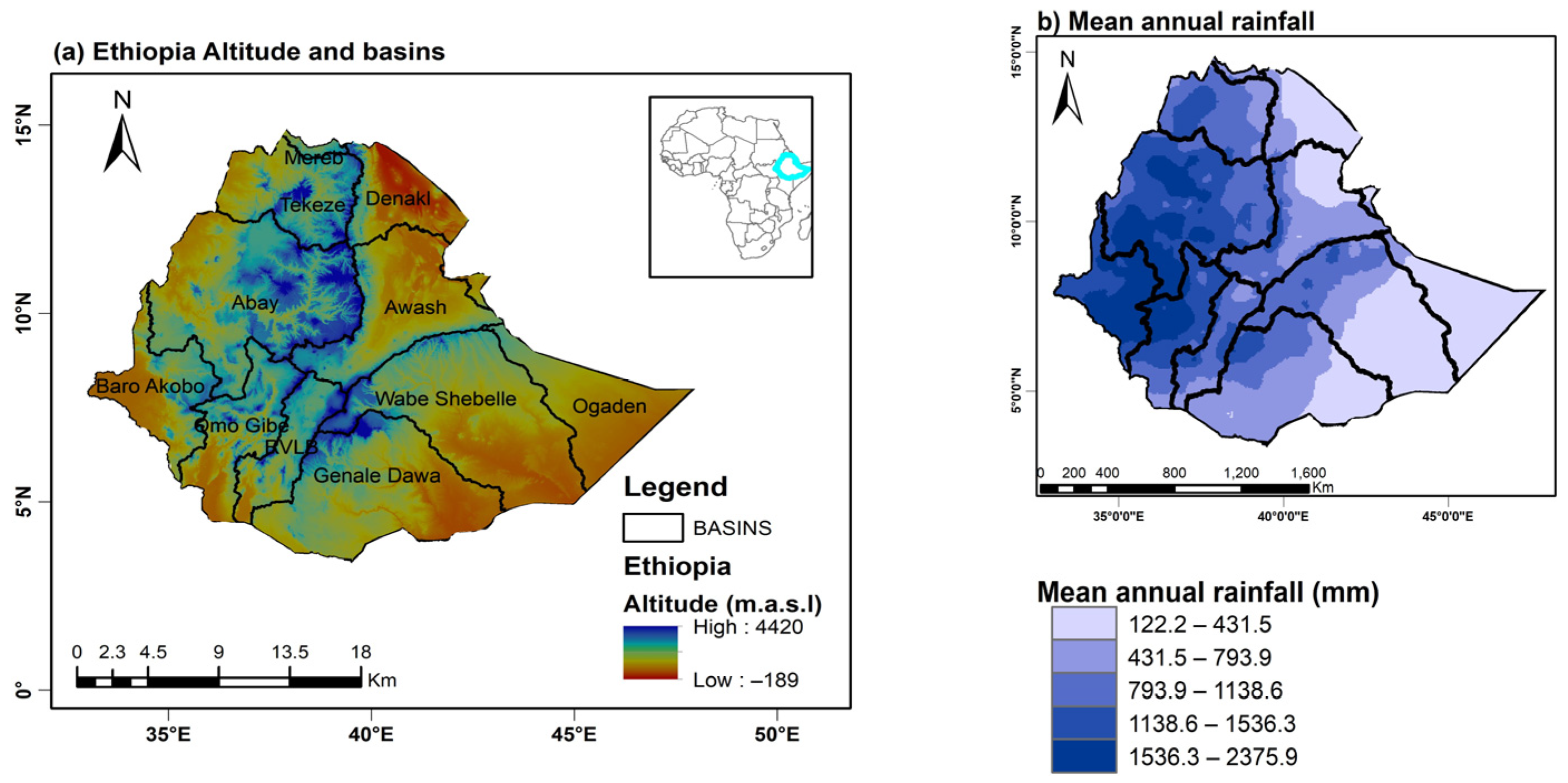
Ethiopia is a topographically and climatically diverse nation situated in the Horn of Africa, approximately between latitudes of 3° N and 15° N and longitudes of 33° E and 48° E (Figure 1a). The country’s landscape is dominated by a massive central highland complex, the Ethiopian Plateau, which is bisected by the Great Rift Valley. Elevations range from below sea level in the Danakil Depression to over 4500 m at the peak of Ras Dashen. This dramatic topography exerts a fundamental control on the country’s climate and hydrology, creating stark contrasts over relatively short distances. Ethiopia has 12 major river basins that are vital to the country’s water resources and play a key role in its economy, agriculture, and hydropower generation. These river basins vary in size, water volume, and geographical location, influencing the distribution of water resources across the country [27].
Precipitation distribution is highly heterogeneous, both spatially and temporally [28,29]. The highland regions (>1500 m a.s.l.) in the central, northwest, and southwestern parts of the country are known for receiving high rainfall and experiencing high humidity, whereas the lowland areas in the northeast, east, and southeast (<1500 m a.s.l.) receive lower rainfall and have a semiarid to arid agro-ecology. Ethiopia’s annual rainfall pattern is divided into three main seasons [30]. The primary rainy season, Kiremt, spans from June to September and accounts for 50–80% of the country’s total annual rainfall. The short rainy season, Belg, occurs from February to May, less rainfall in the central, northern, and southern regions. The Bega season, from October to December, is typically dry (October–January) [30,31,32].

2.2. Data

Reliable daily precipitation data are scarce in Ethiopia because of the sparse and often discontinuous station network. To overcome this limitation, we used the Enhancing National Climate Services (ENACTS) rainfall product at 4 km × 4 km resolution for the historical period 1981–2010. The ENACTS dataset is a hybrid combination of observed station data from Ethiopia’s national network, managed by the National Meteorological Agency (NMA), and satellite data estimates from the US National Aeronautics and Space Administration (NASA) and the European Organization for the Exploitation of Meteorological Satellites (EUMETSAT) [33]. Satellite data were calibrated and validated using ground-based measurements to improve accuracy. The combined/hybrid dataset improves the quality of Ethiopia’s national observations [34]. Furthermore, it contains no missing data. In this study, the ENACTS dataset, with a spatial resolution of 0.0375° × 0.0375°, used to derive observed precipitation extreme indices to analyze historical trends and assess potential future climate change. The daily precipitation ENACTS gridded dataset spanning from 1981 to 2010 was obtained from the Ethiopian Meteorological Institute (EMI).
The study used General Circulation Model (GCM) datasets from the CMIP6 project to assess changes in climate extremes. No single model consistently outperforms others across all precipitation characteristics and seasons, underscoring the importance of performance-based, multi-index model selection frameworks when developing reliable future projections [35]. A subset of CMIP6 models was selected because not all models perform equally well in representing regional climate characteristics, particularly extreme precipitation over Ethiopia. Including all available models can introduce systematic biases, such as the well-known dry bias, without necessarily improving predictive skill. By contrast, selecting models based on objective performance criteria ensures that projections are derived from models capable of realistically reproducing observed seasonal rainfall and extreme events. This approach reduces uncertainty, enhances physical consistency, and yields more reliable and impact-relevant projections, particularly for drought and flood assessment [26,27,36,37,38]. The selection was informed by comprehensive skill assessments conducted over Ethiopia, including our own prior evaluation of 45 CMIP6 models [26,27], as well as other recent regional studies [16,36,37,38]. These studies systematically assessed model performance in reproducing spatially and temporal observed precipitation characteristics using spatially comparison and multiple statistical metrics, such as Taylor skill core, Taylor diagram, correlation, root mean square error (RMSE), and bias. Each model was ranked according to its performance across these metrics, and an overall performance score was derived to identify the best-performing models. Models that consistently demonstrated higher skill were selected as top-performing models for subsequent analysis. Additionally, those models have medium and low-resolution models which has higher performance compared to high resolution [25,26,36,38]. The performance of the CMIP6 models in representing the spatial pattern of extreme precipitation indices is largely independent of horizontal resolution over the study area. Consequently, simply increasing the model’s horizontal resolution may not be sufficient to reduce the biases, partly because high-resolution global models remain unable to resolve convective processes in the tropics, including East Africa [36,38]. Based on these evaluations, models that consistently demonstrated superior skill across the considered metrics were identified as top-performing and selected for use in this study (Table 1). This approach ensures that the selected models have been rigorously tested for their ability to represent regional hydroclimatic conditions.
We prioritized model realizations from the commonly available ‘r1i1p1f1’ variant (representing realization 1, initialization 1, physics version 1, and forcing 1). This study uses the SSP2-4.5 and SSP5-8.5 scenarios to assess future climate impacts in Ethiopia. SSP2-4.5 represents a mid-range pathway with gradual economic growth and moderate climate policy progress, aligning with Ethiopia’s near-term planning context. SSP5-8.5 represents a high-emissions worst-case pathway, enabling assessment of extreme climate outcomes—including intensified warming and increased extremes—critical for stress-testing Ethiopia’s agriculture-dependent economy. Together, these scenarios bracket moderate to severe future conditions, reduce uncertainty, support risk-informed adaptation planning, and ensure comparability with regional and global studies. In this study, we used 1981–2010 as the base period and two future time frames: the 2050s (2041–2070) and the 2080s (2071–2100). The historical period of 1981–2010 was selected because it aligns with the availability of high-resolution observational datasets (ENACTS) and represents a standard 30-year climatological baseline commonly used in climate studies, facilitating comparability with previous research in Ethiopia and the broader East African region. The future periods of 2041–2070 and 2071–2100 were chosen to represent the mid- and late-21st century, respectively. These time windows are widely used in CMIP6 studies to capture both near-term and long-term climate projections, allowing for robust assessment of temporal trends and potential impacts. Additionally, they provide relevant information for policy and adaptation planning, as the mid-century period aligns with medium-term development strategies and the late-century period informs long-term climate risk management. All model data for future projections for the mid-century (2041–2070) and late-century (2071–2100) periods were downloaded from the Earth System Grid Federation (ESGF) nodes.

2.3. Methodology

2.3.1. Ensemble Mean of CMIP6 Models (EnseMean)

Recent evaluations have identified persistent systematic errors in the outputs of most CMIP6 simulations across Ethiopia [25,26,38]. To enhance the reliability of future projections, a statistical bias correction technique was applied. In this study, a Quantile Mapping (QM) approach was adopted to improve the representation of observed precipitation distributions, while acknowledging potential limitations in trend preservation. QM was selected because it effectively adjusts the distribution of modeled precipitation to match observed extremes, enhancing the spatial and temporal representation of extreme events compared with other bias-correction methods [39]. However, the approach has some limitations, including potential impacts on the tails of the distribution. These considerations clarify the rationale for using QM and its implications for interpreting projections of extreme precipitation.
Although statistically downscaled and bias-corrected CMIP6 products are available (e.g., CMIP6-BCSD or NASA NEX-GDDP), this study opted to use the original CMIP6 model outputs at their native resolution for several reasons. First, this work builds on our previous studies [25,26], which evaluated the performance of 45 CMIP6 models, while extending the analysis to observed historical trends and future projections of extreme precipitation indices. Using raw model outputs allows for a more direct assessment of model performance and the uncertainties inherent in the CMIP6 ensemble prior to any post-processing. Second, bias-correction methods can potentially distort the physical consistency between climate variables (e.g., temperature and precipitation extremes) and may affect the representation of large-scale climate drivers [40,41]. Finally, although the selected models exhibited biases, these were addressed using a quantile mapping approach against the high-quality ENACTS observational dataset that is specifically generated for Ethiopia. This region-specific bias correction improves model performance in a manner that is more appropriate than corrections based on global datasets.
Following bias correction, a critical step was the construction of a representative ensemble for projection. Different studies indicate that ensembles composed only the best-performing models generally produce more skillful and reliable projections than full ensembles, which may be unduly influenced by poorly performing models [42,43,44]. This is particularly true for regions with complex climatology like Ethiopia.
Therefore, we generated an Ensemble Mean (EnseMean) by averaging the bias-corrected outputs from the subset of models identified as top-performers for JJAS and FMAM seasons (Table 1). This targeted ensembling approach aims to amplify the robust climate change signal while minimizing the noise from internal climate variability and residual model errors, thereby providing a more credible estimate of future changes [43,44]. The performance of both the raw and bias-corrected ensembles was quantitatively evaluated using the Taylor Skill Score (TSS). This comprehensive metric integrates the pattern correlation coefficient (PCC), root mean square error (RMSE), and standard deviation (SD) [45]. PCC and TSS were calculated using Equations (1) and (2).
T S S = 4 ( 1 + P C C ) 2 ( σ M σ O + σ O σ M ) 2 + ( 1 + P C C o )
P C C = i = 1 n ( O i O ¯ ) ( M i M ¯ ) ( σ O σ M )
where PCC denotes the pattern correlation coefficient between the observational dataset and the model outputs; σM and σO represent the standard deviations of the model and the observational dataset, respectively; n represents the number of observations; and PCC0 is the maximum attainable correlation coefficient, set to 1. M and O are model and observational datasets, respectively. A TSS value closer to 1 indicates better agreement between the simulation and the observational dataset.

2.3.2. Historical and Future Projections of Seasonal Extreme Precipitation

This study employs ten extreme indices obtained from the Expert Team on Climate Change Detection and Indices (ETCCDIs) to investigate patterns, trends, and future projections of extreme precipitation in Ethiopia. The indices used in this study are defined in Table 2.
All indices were computed separately for each grid cell and for the JJAS (Kiremt) and FMAM (Belg) seasons. Calculations were performed using the RClimDex (v1.1) software. To facilitate direct comparison between the coarse-scale GCM outputs and the finer ENACTS data, all gridded datasets (both observed and modeled) were regridded to a common resolution of 1° × 1° using bilinear interpolation prior to index calculation and analysis [36].
The analysis assessed the spatial distribution and statistical significance of trends using ten ETCCDIs for both historical and future periods for the JJAS and FMAM seasons. Specifically, the historical analysis is based on ENACTS observational data, while future projections are derived from the bias-corrected CMIP6 ensemble mean. Trends were detected using the non-parametric Mann–Kendall (MK) test, which is robust against non-normal data distributions and outliers. The magnitude of the trend was estimated using Sen’s slope estimator [47]. Both tests were implemented at the 5% significance level using the “trend” package in R (R version 4.3.3) [48]. Results are summarized using box-and-whisker plots.
The projected relative changes in the precipitation extreme indices (ETCCDIindices) are calculated based on the relative changes in the calculated ETCCDIs for the projected periods (ETCCDIproj) compared to the baseline period (ETCCDIbase) for each season (Equation (3)).
E T C C D I i n d i c e s = ( E T C C D I p r o j E T C C D I b a s e E T C C D I b a s e ) 100

3. Results

3.1. Historical Trends in Extreme Precipitation

3.1.1. Spatial Patterns of Extreme Precipitation During JJAS (Kiremt)

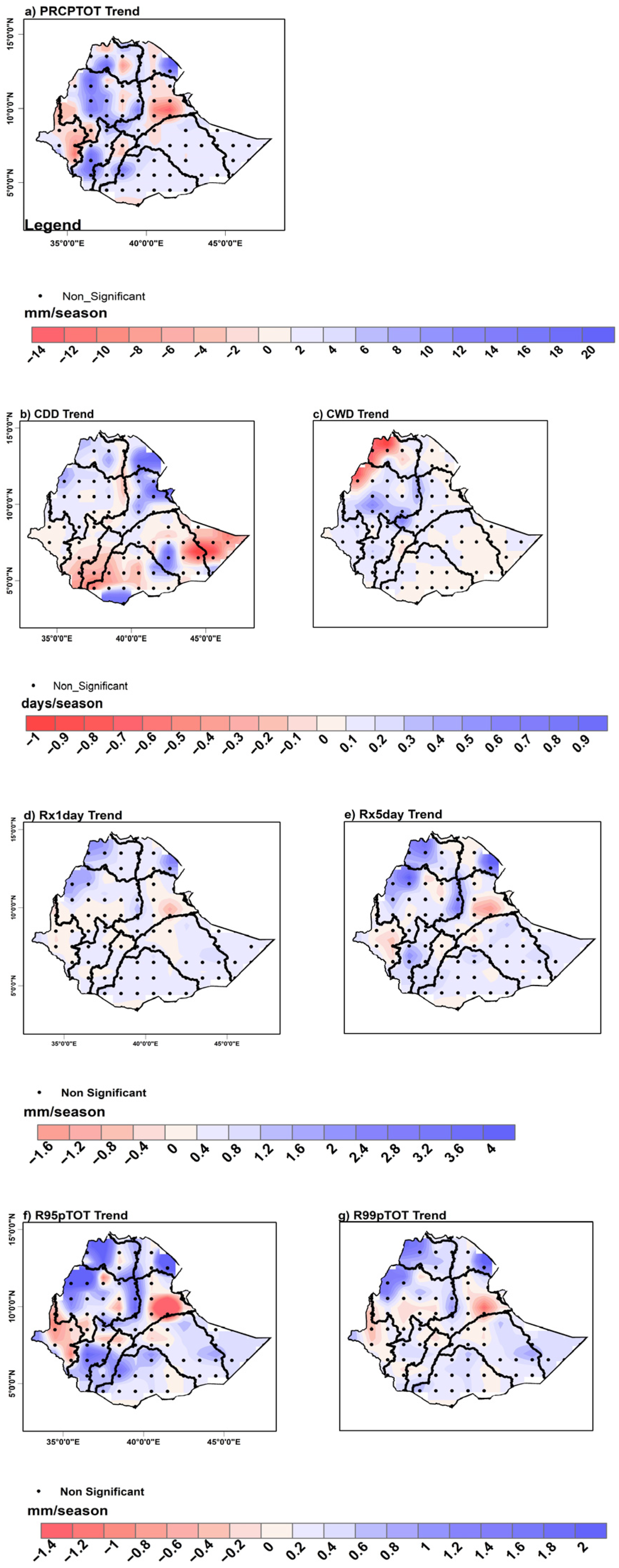
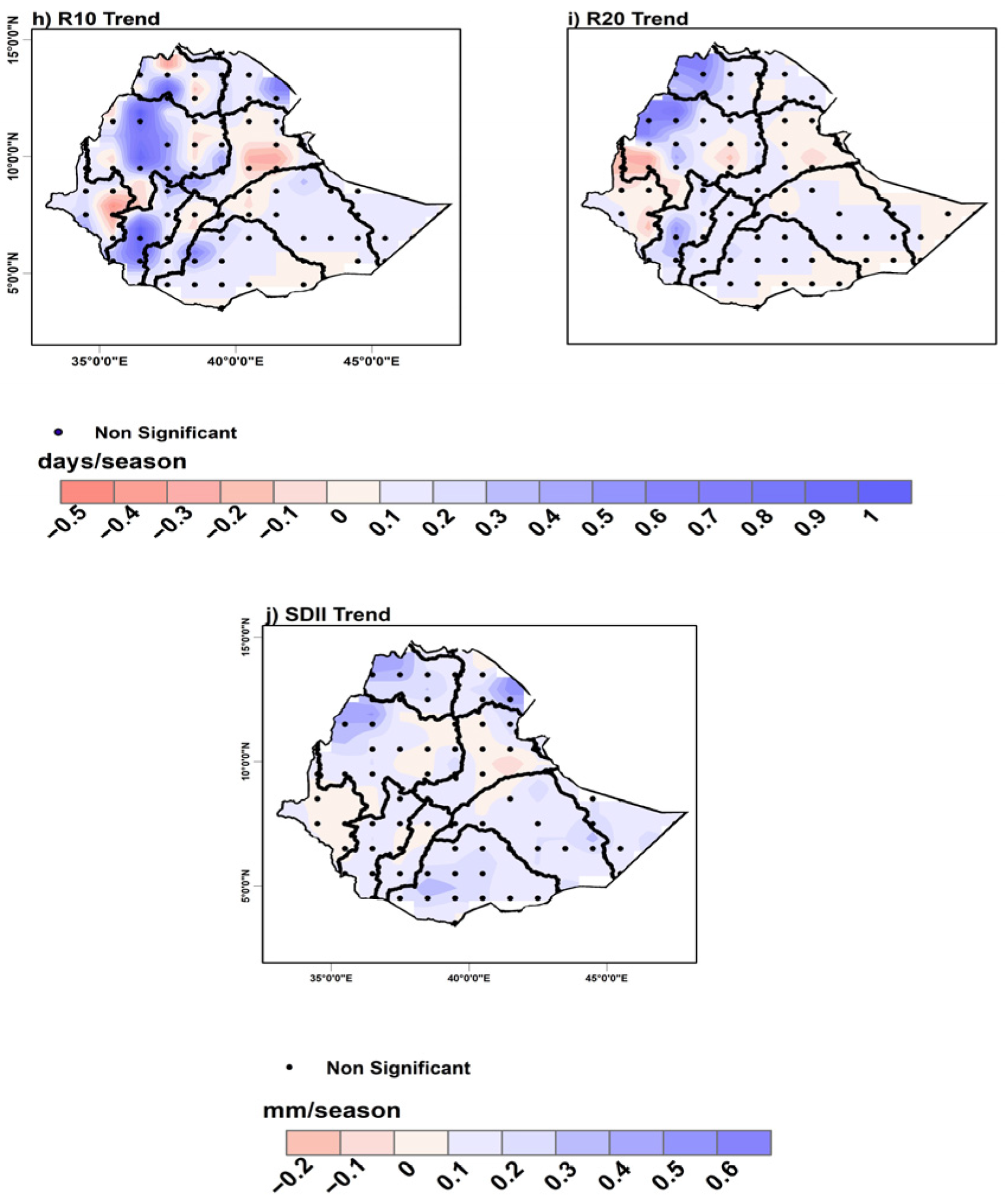
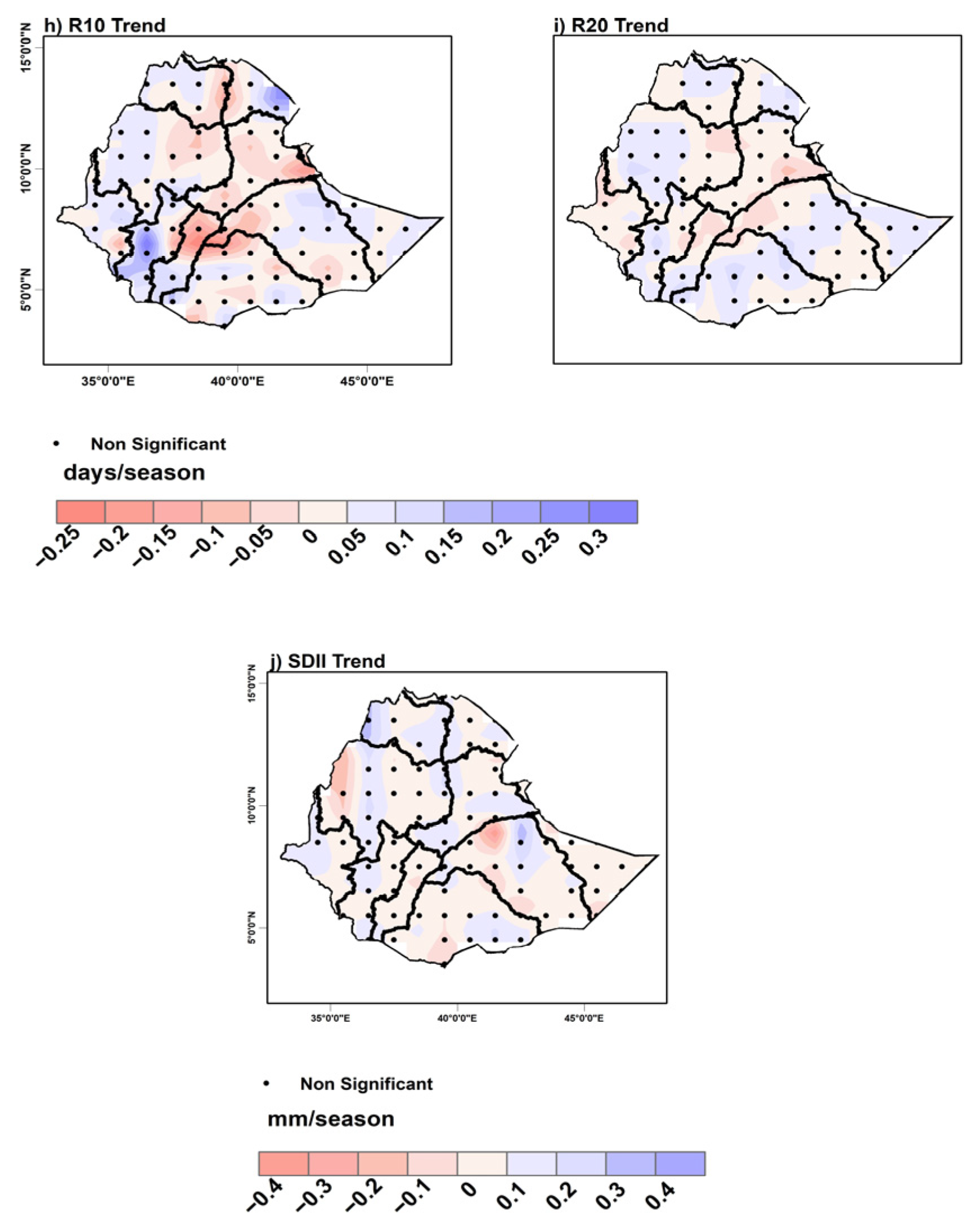
Figure 2 presents the spatial distribution of trends in the ten ETCCDIs during the JJAS season using ENACTS dataset. Stippling shows trends that are not significant at the 5% significance level (Figure 2). During JJAS, a non-significant increasing trend in PRCPTOT (Figure 2a) is found in most parts of the country. PRCPTOT shows an increasing trend in most parts of the country (Figure 2a); though, these trends are not statistically significant. Relatively larger increases (up to +48 mm per season per year) are observed in the northwestern and southwestern highlands, particularly in the Abay and Omo Gibe basins. A notable exception occurs in parts of western and northeastern Ethiopia, including the middle and lower Awash Basin, where a decreasing trend in PRCPTOT is observed. During the JJAS season, CDD trends show considerable spatial heterogeneity, with both increasing and decreasing patterns observed across the study area (Figure 2b). An increasing trend in CDD is observed over large areas of the north, northwest, northeast, and central parts of the country, specifically most parts of Abay, Tekeze, Awash, and Dankali basins during the JJAS. On the other hand, most parts of the east, south and southwest part of the country (Omo Gibe, Rift Valley Lake Basin (RVLB), Ogaden, and Genale Dawa basins) experience more decreasing trend in CDD (up to 1 days/season) compared to other basins during the JJAS season. In contrast, CWD shows a generally increasing trend, particularly in high-rainfall regions of the northwest, west, and southwest (Figure 2c); however, these trends are not statistically significant. In contrast, a decreasing trend in CWD is observed in low rainfall receiving areas, such as the east, southeast, and south lowlands parts of the country near the Kenya and Somalia border. Both Rx1day (Figure 2d) and Rx5day (Figure 2e) show an increasing trend during the JJAS season, with rises of up to 2 and 4 days, respectively, across most of the country.
Similarly, an increasing trend in R95pTOT (Figure 2f) and R99pTOT (Figure 2g) is observed across large parts of the north, northwest, south, east, southeast, and southwest (Tekeze, Abay, Wabi Shebelle, Ogaden, Genale Dawa, and Omo Gibe basins) during JJAS season; however, these trends are not statistically significant. Both the R10 (Figure 2h) and R20 (Figure 2i) indices show a general tendency toward increasing trends over much of the country, particularly in the north, northwest, northeast, and southwest, including Tekeze, Abay, and Omo Gibe basins and RVLB during the JJAS season; however, these trends are not statistically significant. During the JJAS season, the SDII exhibits an increasing trend of up to 0.6 mm across most of the study area (Figure 2j), except in western and parts of northeastern Ethiopia. Nevertheless, these increases are not statistically significant.

3.1.2. Spatial Patterns of Extreme Precipitation During FMAM (Belg)

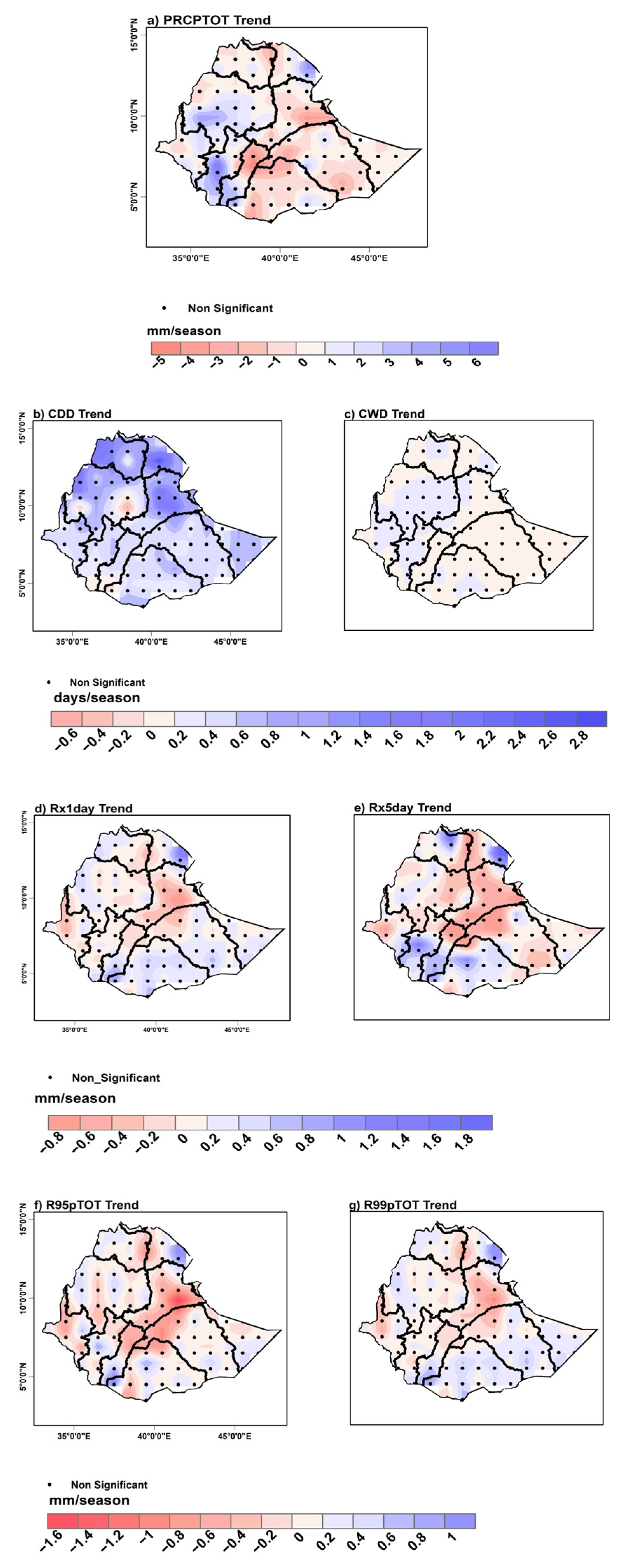
Figure 3 illustrates the seasonal trends in 10 extreme indices during the FMAM period using ENACTS dataset. Trends that are not statistically significant are indicated in the figure. In contrast to JJAS, the FMAM season is characterized predominantly by decreasing trends, although these trends are also not statistically significant. PRCPTOT (Figure 3a) reveals a decrease trend across extensive areas of the north, east, southeast, south, northeast, and central high while increases are observed only in parts of the northwestern and southwestern highlands. During the FMAM season, CDD (Figure 3b) exhibits an increasing trend over more than 90% of the country, whereas CWD (Figure 3c) shows a widespread decrease. During the FMAM season, Rx1day (Figure 3d) and Rx5day (Figure 3e) exhibit a tendency toward decreasing trend in the northeastern parts of the country, particularly over the Awash basin; however, these trends are not statistically significant. R95pTOT (Figure 3f) exhibits a more widespread decrease than R99pTOT (Figure 3g) during the FMAM season. While R95pTOT exhibits decreasing trends of up to 0.4 mm in the Wabi Shebelle, Genale Dawa, Omo Gibe, and Ogaden basins (Figure 3f), R99pTOT shows increasing trends of up to 0.6 mm in those same regions (Figure 3g). A decreasing trend in the R10 (Figure 3h) and R20 (Figure 3i) is observed across most areas; however, these trends are not statistically significant. The decrease in R10 appears to be more spatially extensive than that of R20. Overall, the Awash basin exhibits a decreasing trend in both R10 and R20 during the FMAM season. During the FMAM season, SDII exhibits a general tendency toward decreasing trend, ranging from 0 to –0.4 mm (Figure 3j); however, these trends are not statistically significant. In contrast, an increasing trend in SDII is observed in the Genale Dawa and Baro Akob basins during the same season, though these trends are also non-significant.

3.2. Future Projections of Extreme Precipitation

3.2.1. Performance Evaluation of Bias-Corrected Top-Ranking Models

Supplementary Figures S1 and S2 show the Taylor Skill Scores for the raw and bias-corrected outputs of the top-ranking models for the JJAS and FMAM seasons, respectively. The bias correction consistently improved TSS values across all models and indices, although the magnitude of improvement varied. Metrics representing extreme rainfall intensity and amount (e.g., R95P, R99P, Rx1day, Rx5day) show particularly notable improvements in models such as GFDL-ESM4, MPI-ESM1-2-HAM, and HadGEM3-GC31-MM. Improvements for CDD and SDII are generally more modest. Overall, quantile mapping bias correction substantially improved the ability of the models to reproduce the observed spatial patterns of precipitation extremes in both the JJAS (Figure S1) and FMAM (Figure S2) seasons, with enhancements ranging from 5% to 12%.

3.2.2. Projected Changes in Extreme Precipitation During the Main Rainy Season (JJAS)

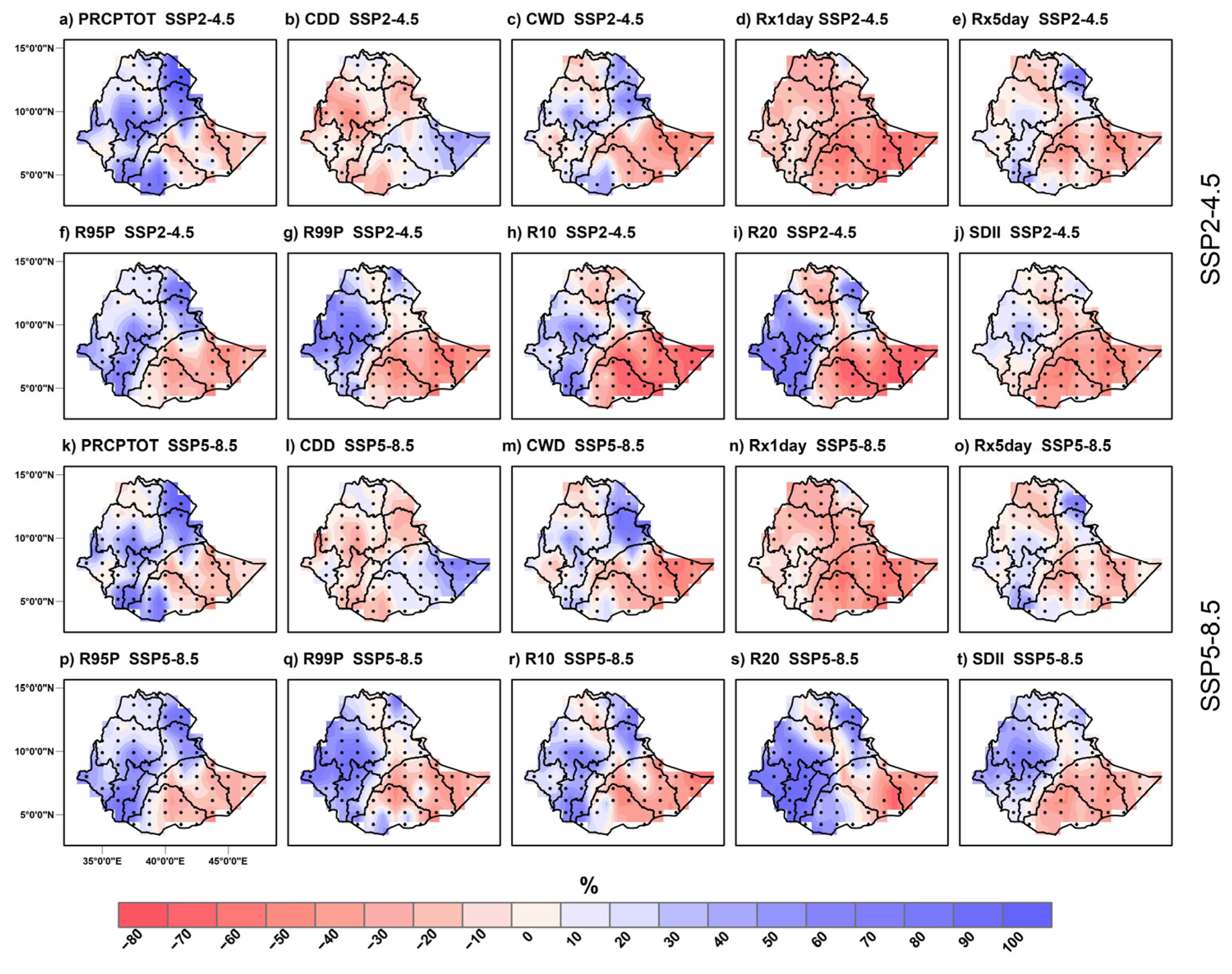
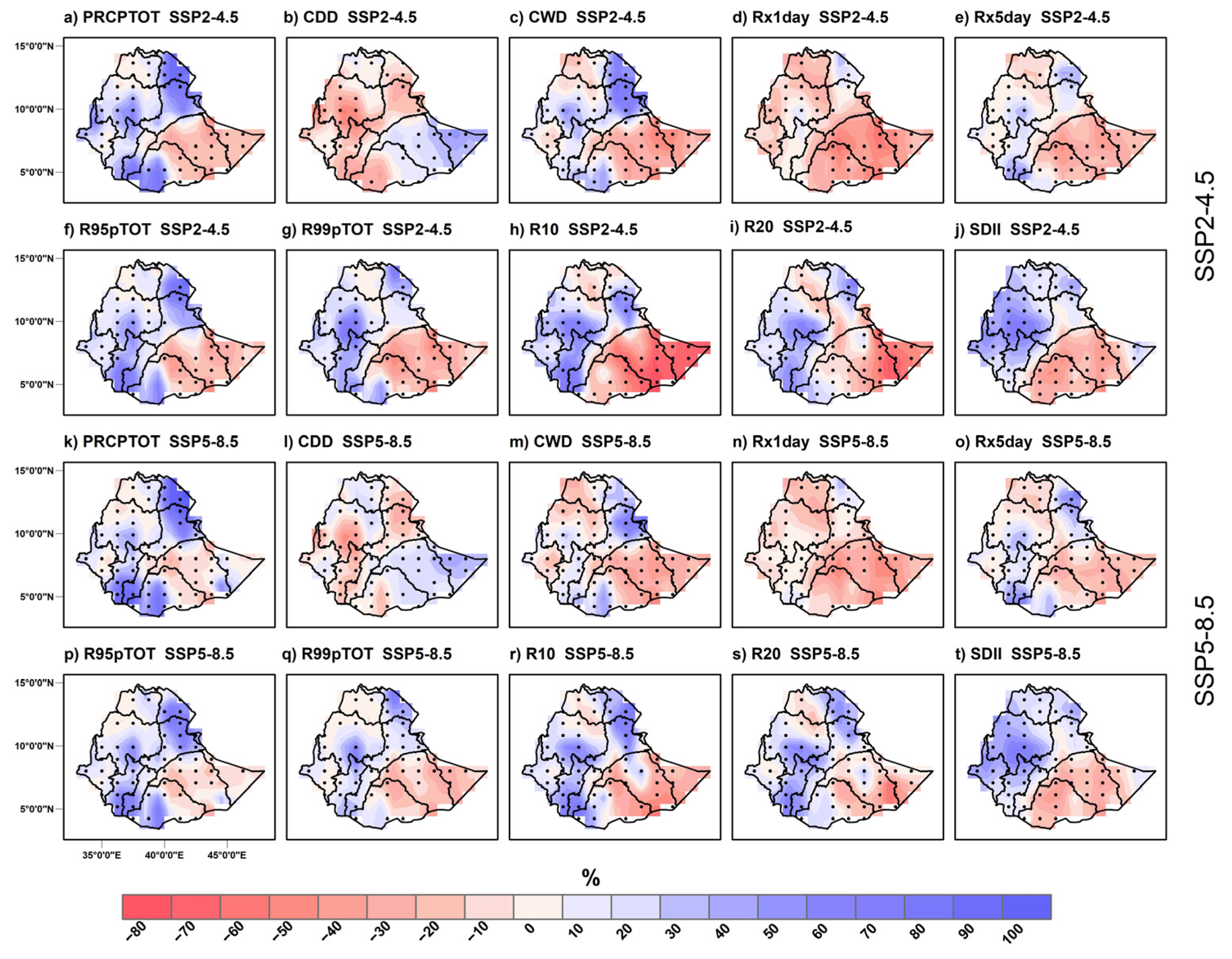
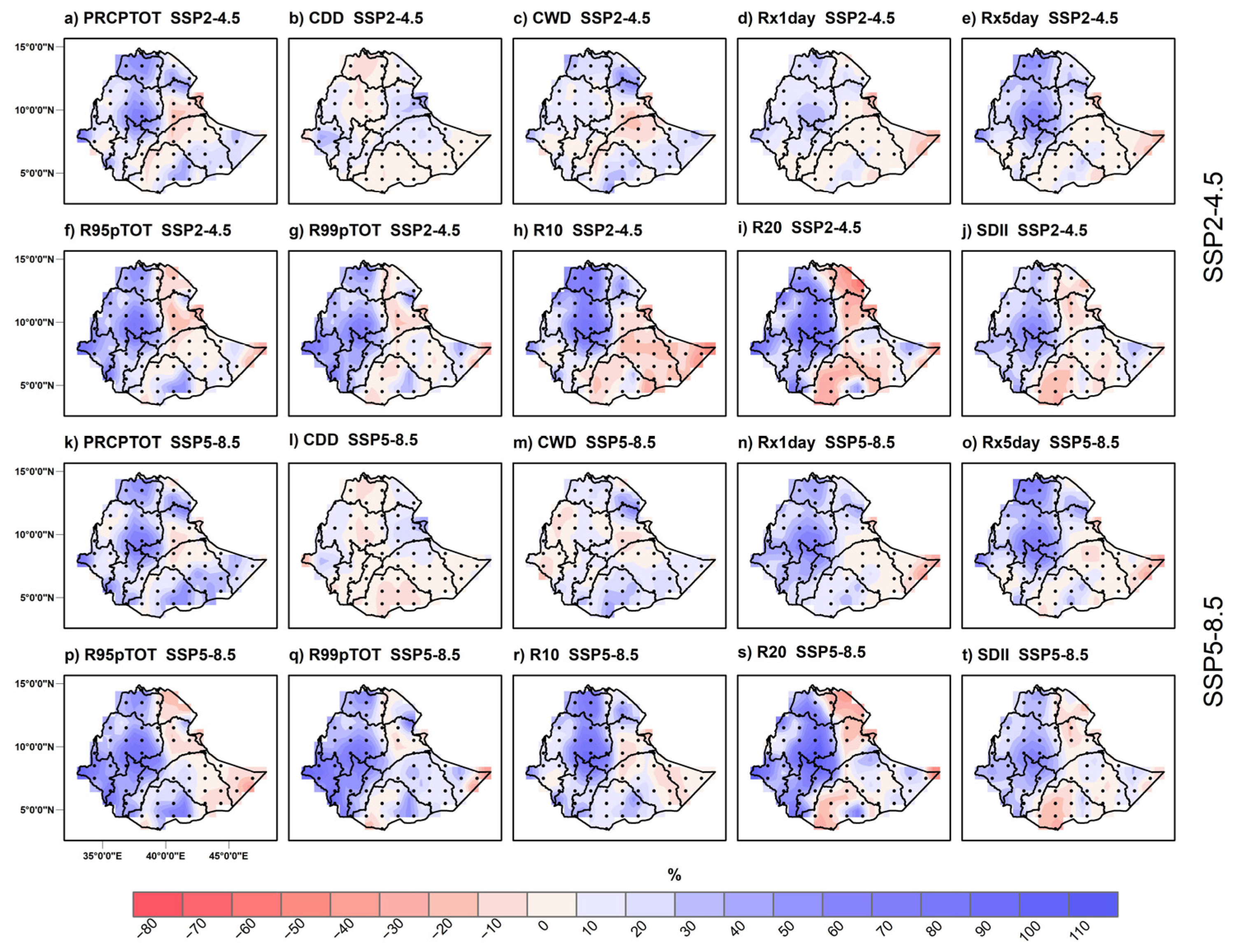
Figure 4a–t and Figure 5a–t illustrates the projected spatial distribution of extreme precipitation during the JJAS season under SSP2-4.5 and SSP5-8.5 for 2050s and 2080s, respectively, relative to 1981–2010. Projected spatial patterns of extreme precipitation for JJAS under SSP2-4.5 and SSP5-8.5 for the 2050s and 2080s reveal substantial regional variability across Ethiopia. Under SSP2-4.5, PRCPTOT is projected to increase by up to 70% by the 2050s in the northwest, west, southwest, and parts of the northeast, including the Tekeze, Abay, Baro Akobo, Awash, Danakil, Rift Valley Lakes, and Omo Gibe basins (Figure 4a). However, statistically significant increases are observed only in the Baro Akobo, Rift Valley Lakes, and Omo Gibe basins. Historically arid areas such as the Danakil and lower Awash basins are also projected to experience increases in PRCPTOT that are not statistically significant in both future periods and under both scenarios. In contrast, consistent declines are projected across the eastern and southeastern lowlands, including the Wabi Shebelle and Ogaden basins. This pattern of decline extends to some northern areas, particularly the Tekeze basin, under SSP5-8.5 by the 2050s (Figure 4k), and under both scenarios by the 2080s (Figure 5a,k). In both scenarios, CDD is projected to decrease across most parts of Ethiopia; nevertheless, these changes are not statistically significant during the 2050s (Figure 4b,l) or the 2080s (Figure 5b,l). Under SSP2-4.5, reductions are most pronounced in the northern, northwestern, western, southwestern, and northeastern regions by both the 2050s (Figure 4b) and 2080s (Figure 5b). Conversely, CDD is projected to increase consistently across the eastern parts of the country, particularly in the Ogaden basin, during both periods and under both scenarios. CWD, on the other hand, is projected to increase across more than 60% of the country; however, these changes are not statistically significant in the 2050s (Figure 4c) and 2080s (Figure 5c) under SSP2-4.5 and in the 2050s (Figure 4m) under SSP5-8.5. The majority of the northwest, northeast, and central parts of the country, particularly the Abay, Awash, and Danakil basins, are projected to experience an increase in CWD during the 2050s and 2080s under both the SSP2-4.5 and SSP5-8.5 scenarios (Figure 4c,m and Figure 5c,m). On the contrary, CWD is projected to decrease across most eastern and southeastern regions of the country, particularly in the Wabi Shebelle and Ogaden basins.
Projections indicate that Rx1day decreases across more than 90% of Ethiopia during both the 2050s and 2080s under all scenarios (Figure 4d,n and Figure 5d,n); however, these changes are not statistically significant. Reductions in Rx5day are mainly in the northern, southern, southeastern, and eastern regions while increases are observed in the Danakil, Omo Gibe, and Abay basins during both periods (Figure 4e,o and Figure 5e,o). However, statistically significant increases are observed only in the Rift Valley Lakes in projection of Rx1day and Rx5day in both the 2050s and 2080s under all scenarios. R95pTOT exhibits broader and more consistent increases than R99pTOT, rising across more than 85% of Ethiopia during the 2050s under both scenarios (Figure 4f,p). This pattern continues into the 2080s under SSP2-4.5 (Figure 5f), while under SSP5-8.5, the increases expand further into the southeastern and eastern regions (Figure 5p). R99pTOT is projected to increase primarily in the northwest, west, southwest, and northeast during the 2050s under both scenarios (Figure 4g,q), and under SSP2-4.5 in the 2080s (Figure 5g). Under SSP5-8.5, the increases extend into the southern and central regions by the 2080s (Figure 5q); however, these changes are not statistically significant. Both R10 (Figure 4h,r and Figure 5h,r) and R20 (Figure 4i,s and Figure 5i,s) show projected increases across the northwest, west, southwest, and northeast, with R20 exhibiting a more extensive spatial growth. In contrast, both indices are projected to decrease in the eastern and southeastern parts of the country. Under SSP2-4.5, SDII is projected to decrease across the south, southeast, and east by the 2050s (Figure 4j). This declining change is particularly consistent for the southern and southeastern regions, most notably within the Genale Dawa and Wabi Shebelle basins, across both scenarios and future timeframes. In contrast, SDII is projected to increase by 10–30% in the northwest, west, and southwest under SSP5-8.5 by the 2050s (Figure 4t). This increase is expected to continue across these regions under both scenarios by the 2080s (Figure 5j,t).

3.2.3. Projected Changes in Extreme Precipitation During the Short Rainy Season (FMAM)

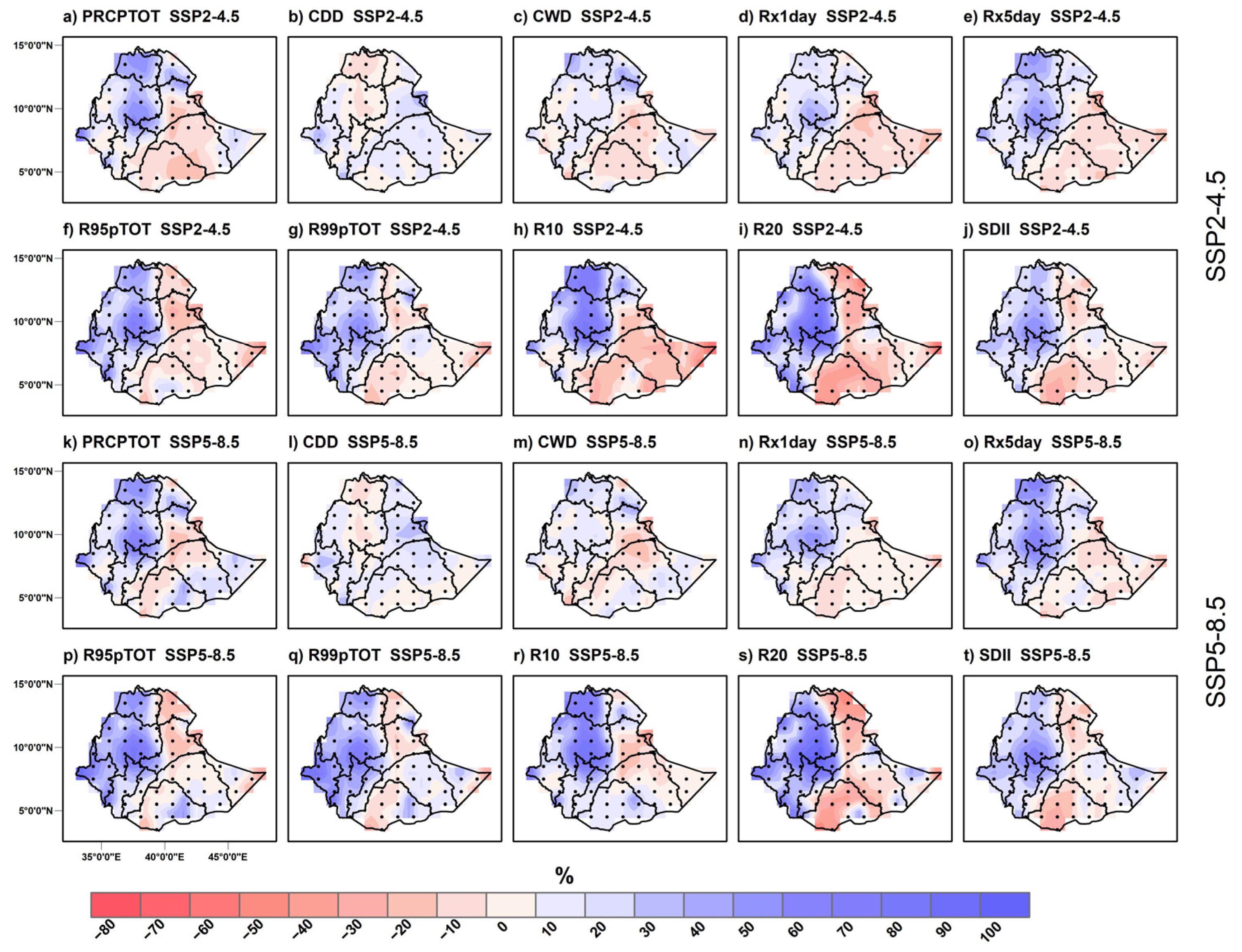
Projected spatial patterns of extreme precipitation during the FMAM season for the 2050s and 2080s under SSP2-4.5 and SSP5-8.5 show substantial regional variability across Ethiopia (Figure 6 and Figure 7). PRCPTOT is projected to increase across the northern, northwestern, western, and eastern regions, particularly within the Tekeze, Abay, Baro Akobo, Omo Gibe, and Ogaden basins during the 2050s (Figure 6a,k); however, these changes are statistically significant only in the Omo Gibe basin. This pattern continues under both scenarios in the 2080s (Figure 7a,k), with SSP5-8.5 driving an expansion of the increase to most of the country; however, these changes remain statistically insignificant. The strongest increases (exceeding 30%) are projected in the north and northwest, specifically the Tekeze and Abay basins. In contrast, most of the Awash basin is projected to experience decreases of more than 10%. Projections for CDD and CWD reveal a distinct regional pattern. CDD is projected to increase by up to 10% in the west, southwest, and northeast, including the Baro Akobo, RVLB, Awash, and Ogaden basins, during both the 2050s (Figure 6b,l) and 2080s (Figure 7b,l). Conversely, slight declines in CDD are expected across northern regions, particularly the Tekeze Basin, under all scenarios and time periods; by the 2080s, these decreases extend into the Genale Dawa, Ogaden, and parts of the Abay basins. In contrast, CWD shows increases of about 20% in the north, northwest, south, east, and northeast during the 2050s under SSP2-4.5 (Figure 6c), especially in the Tekeze, Abay, Wabi Shebelle, Danakil, and lower Awash basins. This increasing trend expands into the south, southeast, and east under SSP5-8.5 (Figure 6m) and persists into the 2080s (Figure 7c). However, slight declines (0–10%) in CWD are projected for parts of the northwest, west, and central regions, including the Abay and Baro Akobo basins, during the 2080s under SSP5-8.5 (Figure 7m). Overall, the Tekeze and Abay basins are projected to experience a combined trend of decreasing CDD and increasing CWD; however, these changes are not statistically significant.
Both Rx1day and Rx5day are projected to increase across the north, northwest, west, southwest, and central regions, especially in the Tekeze, Abay, Baro Akobo, and Omo Gibe basins and RVLB during the 2050s (Figure 6d,n,e,o) and 2080s (Figure 7d,n,e,o) under both scenarios. However, statistically significant increases are seen only in the Baro Akobo, Omo Gibe, and Rift Valley Lakes basins. In contrast, consistent decreases are projected for the southeast and east, particularly in the Wabi Shebelle and Ogaden basins. Projections for the R95pTOT and R99pTOT show increases of up to 60% across the northern, northwestern, western, and southwestern regions. This trend is most prominent in the Tekeze, Abay, Baro Akobo, and Omo Gibe basins from the 2050s through the 2080s under both scenarios (Figure 6f,p,g,q and Figure 7f,p,g,q). Conversely, reductions in these indices are projected primarily for the northeast and central parts of the country. Both R10 and R20 are projected to increase across northern and northwestern Ethiopia, including the Tekeze and Abay basins, during the 2050s and 2080s (Figure 6h,r,i,s and Figure 7h,r,i,s). Conversely, declines are projected in the south and southeast, particularly in the Genale Dawa, Wabi Shebelle, and central Awash basins, with reductions in R10 expanding into the Ogaden Basin by the 2080s. SDII is projected to increase by 0–40% across the north, northwest, west, and southwest, including the Tekeze, Abay, Baro Akobo, Omo Gibe, RVLB, and Ogaden basins, during the 2050s and 2080s under both scenarios (Figure 6j,t and Figure 7j,t). In contrast, decreases are projected in the south and northeast, particularly in the Genale and Awash basins.

3.2.4. Temporal Variations in Extreme Precipitation for EnseMean

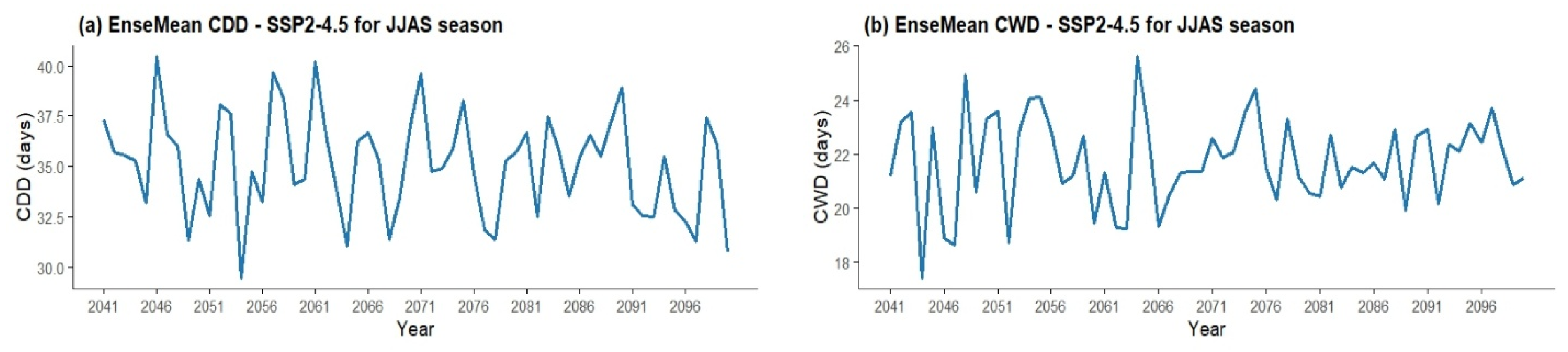
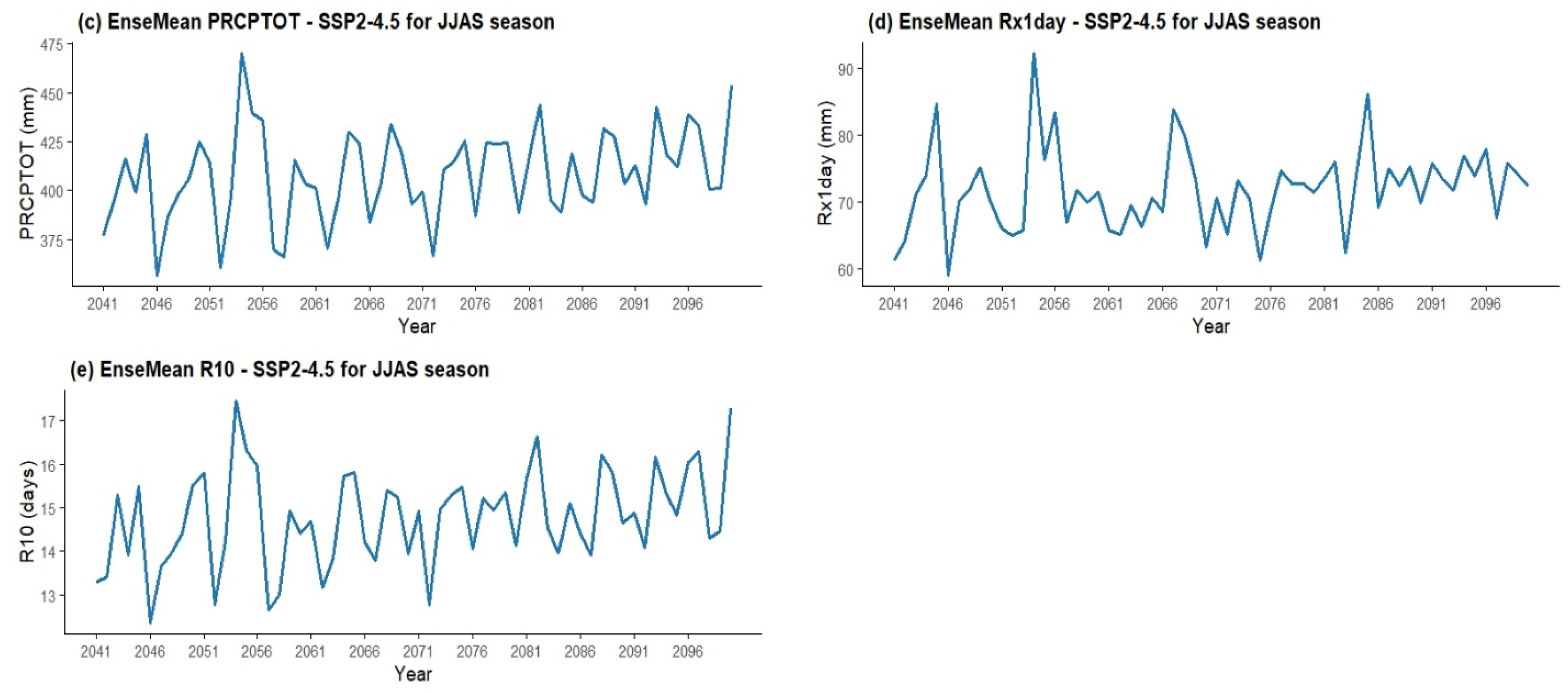
Figure 8a–e present CDD, CWD, PRCPTOT, Rx1day, and R10 for the JJAS season under the SSP2-4.5 scenario for the period 2041–2100. The projected EnseMean of CDD for the JJAS season under the SSP2-4.5 scenario exhibits considerable interannual variability over the 2041–2100 period, ranging from 29.5 to 40.4 days (mean = 35.1 ± 2.5 days) (Figure 8a). A weak negative linear trend of −0.026 days per year is identified. Decadal averages remain relatively stable, with a slight decline from 35.6 days in the 2050s to 33.4 days in the 2080s. Similarly, the EnseMean of CWD shows pronounced interannual variability throughout the same period (Figure 8b). Values generally fluctuate between approximately 18 and 24 days. During the early decades (2040s–2050s), variability is relatively high, with several peaks approaching 24 days. In the mid-century period, CWD temporarily decreases to around 19–21 days but continues to exhibit strong oscillations. Toward the late century (2080s–2090s), values remain within a comparable range, with occasional moderate increases but no sustained long-term trend. The EnseMean PRCPTOT during JJAS under SSP2-4.5 also exhibits strong interannual variability, accompanied by a weak increasing trend toward the end of the century (Figure 8c). PRCPTOT fluctuate substantially across the projection period, with occasional higher peaks in later decades.
Projected Rx1day values range from 60 mm to 92 mm over 2041–2100 (Figure 8d). The minimum value (60 mm) occurs in 2044, while the maximum (92 mm) is recorded in 2050. Between 2041 and 2070, Rx1day fluctuates widely within this range, with notable peaks in 2043 (85 mm), 2046 (80 mm), and 2050 (92 mm). From 2071 to 2095, values stabilize within a narrower range of approximately 70–78 mm, although occasional higher values, such as 85 mm in 2080, are observed. Overall, Rx1day continues to exhibit interannual variability, with indications of a reduced upper bound after 2080. The R10 varies between 13.0 and 17.5 days during the projection period (Figure 8e). The minimum value (13.0 days) occurs in 2046 and 2056, while the maximum (17.5 days) is recorded in 2054 and 2100. From 2041 to 2070, R10 fluctuates within this range, whereas during 2071–2100 it remains predominantly between 13.0 and 16.5 days, with occasional peaks reaching 17.5 days. Overall, the R10 series exhibits moderate interannual variability, with no consistent long-term increase or decrease over the 2041–2100 period.
Supplementary Figure S3a–e presents CDD, CWD, PRCPTOT, Rx1day, and R10 for the JJAS season under the SSP5-8.5 scenario for the period 2041–2100. Under the SSP5-8.5 scenario, the EnseMean CDD during the JJAS season over the study area is projected to fluctuate between approximately 27 and 42 days from 2041 to 2100. The time series exhibits high interannual variability with no clear monotonic trend, although a slight overall decline is visible towards the end of the century, reaching around 27 days by 2099. Peak values exceeding 40 days occur around 2070 and in the early 2050s (Figure S3a). Under the SSP5-8.5 scenario, the EnseMean CWD during the JJAS season is projected to range between approximately 17 and 28 days from 2041 to 2100. The time series shows a general declining trend with high interannual variability. CWD starts at around 28 days in 2041 and fluctuates downward, reaching its lowest values near 17 days around 2077 and 2090, before a slight recovery towards the end of the century (Figure S3b). Under the SSP5-8.5 scenario, the EnseMean PRCPTOT during the JJAS season is projected to fluctuate between approximately 370 mm and 550 mm from 2041 to 2100. The time series shows a sharp initial decline from ~550 mm in 2041 to around 370 mm in the early 2050s, followed by high interannual variability with no strong long-term trend. PRCPTOT values generally remain between 380 and 480 mm after 2060, with occasional peaks near 500 mm in 2076 (Figure S3c). Under the SSP5-8.5 scenario, the EnseMean Rx1day during the JJAS season is projected to fluctuate between approximately 17 mm and 24 mm from 2041 to 2100. After an initial decline in the early 2040s, values generally oscillate between 18 and 22 mm, with notable peaks exceeding 23 mm around 2070 and towards the end of the century (2098–2100) (Figure S3d). Under the SSP5-8.5 scenario, the EnseMean R10 during the JJAS season is projected to range between approximately 13 and 20 days from 2041 to 2100. It starts high at around 20 days in 2041, followed by a general decline with fluctuations, reaching minimum values near 13 days in several years (e.g., mid-2040s and late 2080s), before a slight increase towards the end of the century (Figure S3e).
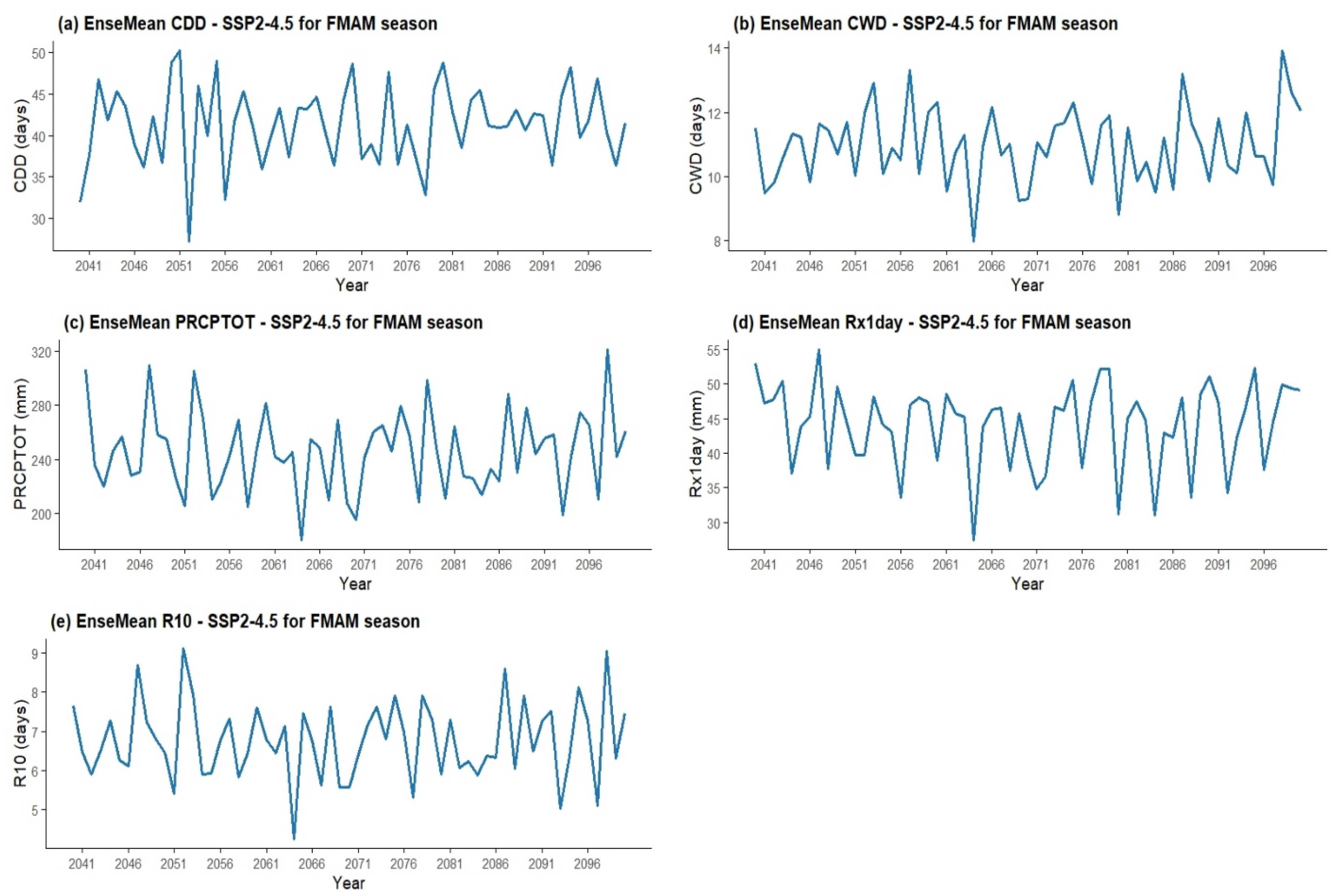
Figure 9a–e presents CDD, CWD, PRCPTOT, Rx1day, and R10 for the FMAM season under the SSP2-4.5 scenario for the period 2041–2100. The EnseMean CDD during the FMAM season under the SSP2-4.5 scenario exhibits pronounced interannual variability over 2041–2100 (Figure 9a). Projected CDD values range from approximately 28 to 50 days, with no clear long-term monotonic trend. Several distinct peaks (>45 days) occur in the mid-2040s, early 2050s, early 2070s, and late 2080s, while marked minima are observed around 2052 and in the late 2070s. The EnseMean of CWD also shows strong interannual variability, fluctuating between approximately 8 and 14 days (Figure 9b). Although no consistent long-term trend is evident, a noticeable increase occurs after 2095, with values approaching 14 days by 2100. The EnseMean PRCPTOT during FMAM demonstrates substantial interannual variability throughout the projection period (Figure 9c). PRCPTOT range from about 180 to 330 mm, with pronounced peaks around 2045, 2055, 2070, and 2085, as well as a sharp increase toward 2100. These fluctuations are interspersed with notable troughs, indicating high variability in seasonal rainfall. Projected Rx1day also exhibits considerable interannual variability (Figure 9d), ranging from approximately 28 to 55 mm. Distinct peaks occur in the mid-2040s, late 2070s, and early 2090s, while a pronounced minimum is observed around 2065. Similarly, the EnseMean R10 shows marked variability over 2041–2100 (Figure 9e), with values ranging from approximately 4.5 to 9.2 days. R10 remains predominantly within 6–8 days for most of the period but includes intermittent peaks exceeding 8–9 days (notably in the early 2050s, late 2080s, and near 2097) and a sharp minimum of about 4.5 days around 2065.
Supplementary Figure S4a–e presents CDD, CWD, PRCPTOT, Rx1day, and R10 for the FMAM season under the SSP5-8.5 scenario for the period 2041–2100. Under the SSP5-8.5 scenario, the EnseMean CDD during the FMAM season is projected to range between approximately 32 and 65 days from 2041 to 2100. CDD starts high (~62 days) in 2041, fluctuates markedly throughout the period, and shows a tendency toward lower values in the late 2080s before rising again near the end of the century (Figure S4a). EnseMean CWD during the FMAM season is projected to fluctuate between approximately 7 and 14 days from 2041 to 2100. The time series shows high interannual variability without a clear long-term trend. CWD start around 12 days in 2041, decrease to a minimum near 7 days in the early 2040s, and thereafter fluctuate mainly between 9 and 13 days for the rest of the century (Figure S4b). EnseMean PRCPTOT during the FMAM season is projected to fluctuate between approximately 150 mm and 300 mm from 2041 to 2100. PRCPTOT start around 280 mm in 2041, drop sharply in the early years, and thereafter oscillate mainly between 170 mm and 290 mm, with frequent peaks exceeding 270 mm after 2070 (Figure S4c). Rx1day increases slightly over time with strong interannual variability, rising from ~45 mm in the 2040s to ~55–60 mm by the end of the century, with occasional peaks near ~70 mm (Figure S4d). EnseMean R10 during FMAM under SSP5-8.5 (2041–2100) varies between approximately 4 and 9 days, showing strong interannual variability with frequent peaks near 8–9 days and minima around 4–5 days, with no clear long-term trend (Figure S4e).

3.2.5. Model Trend and Uncertainty in Extreme Rainfall Indices Under SSP Scenarios

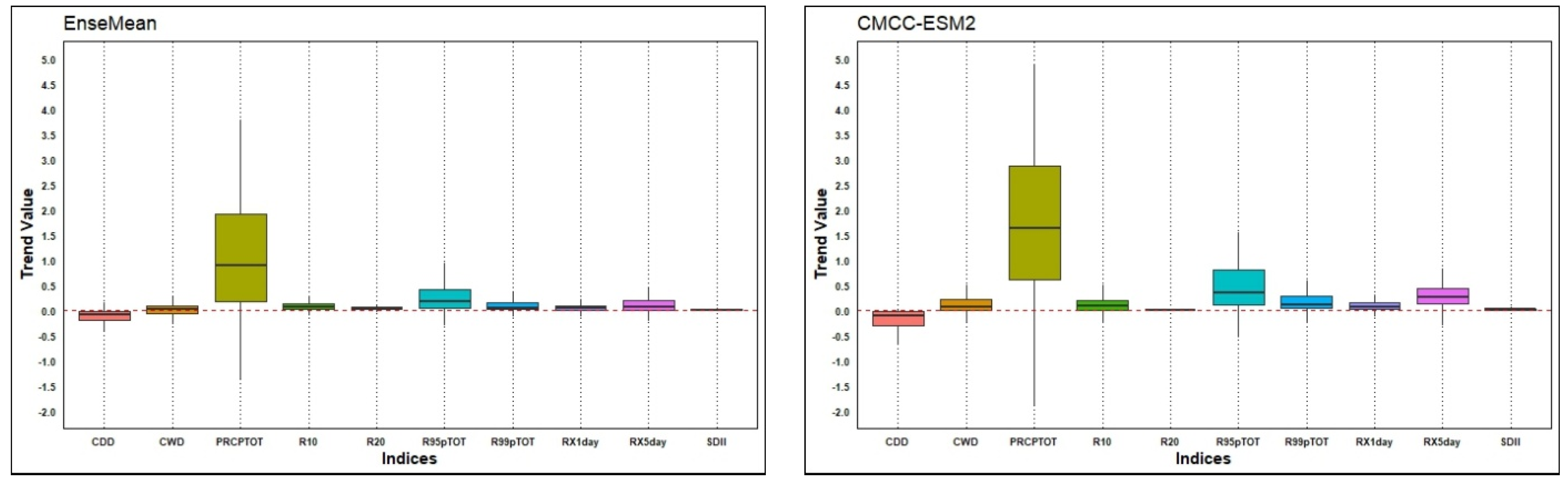
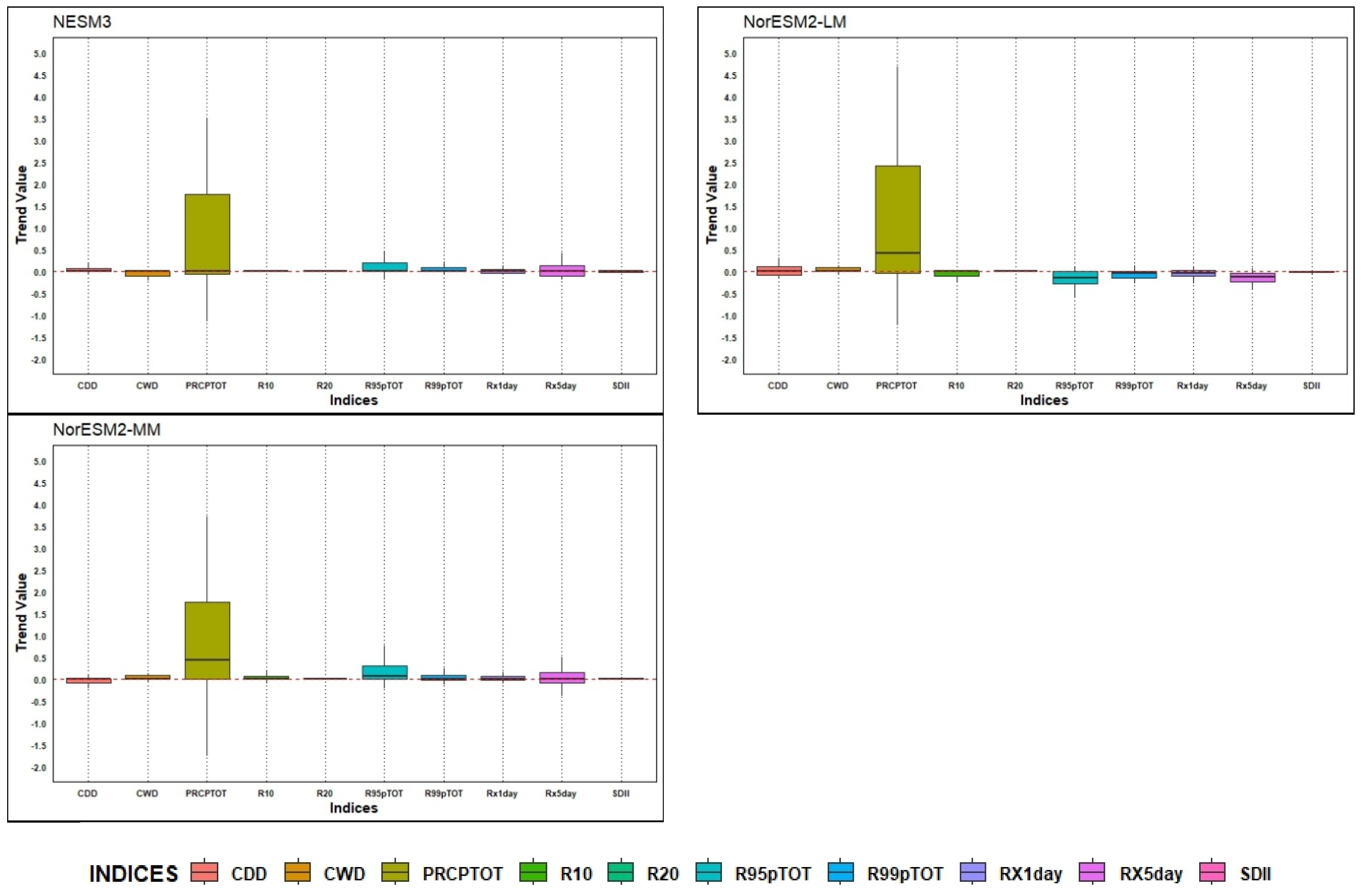
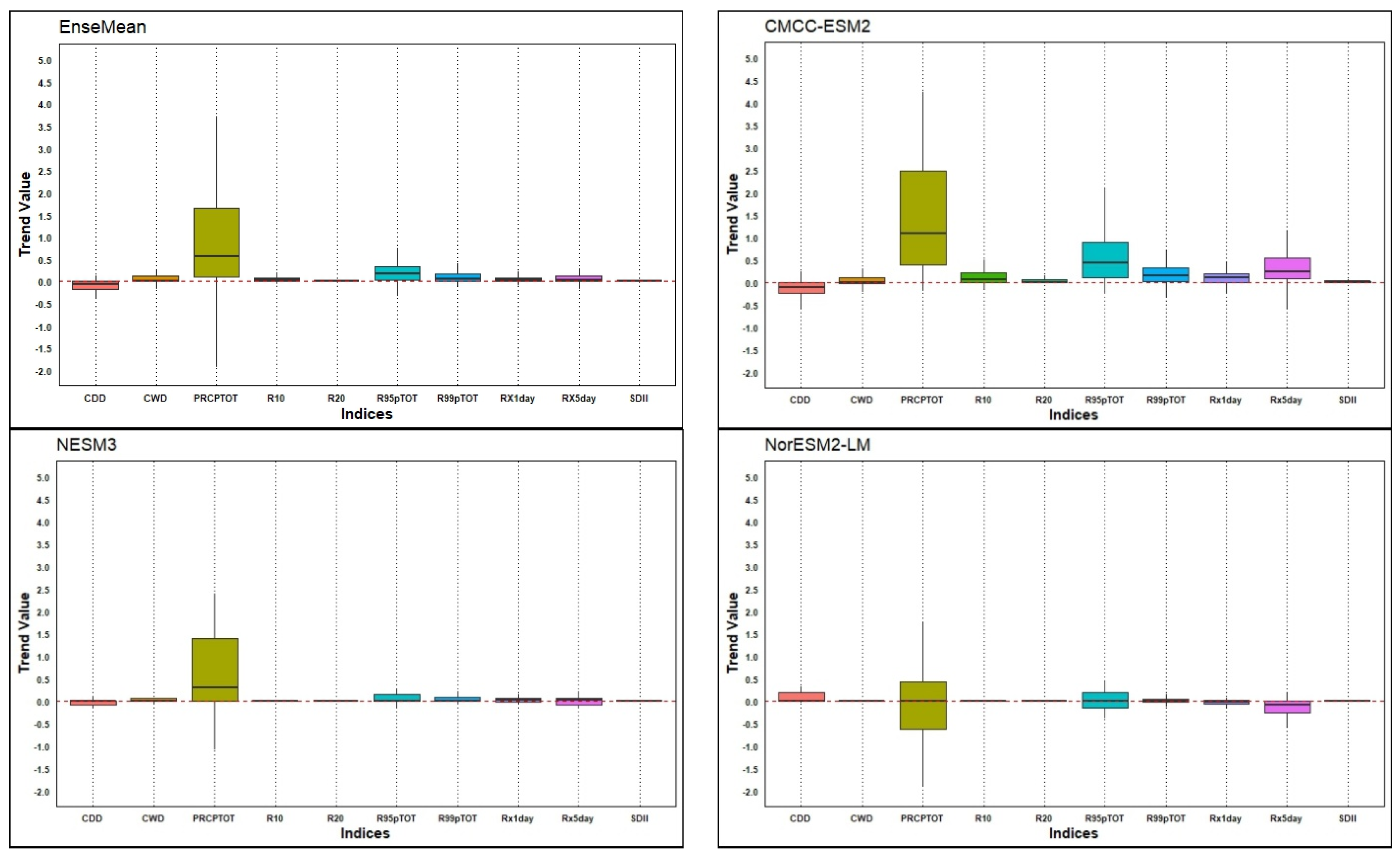
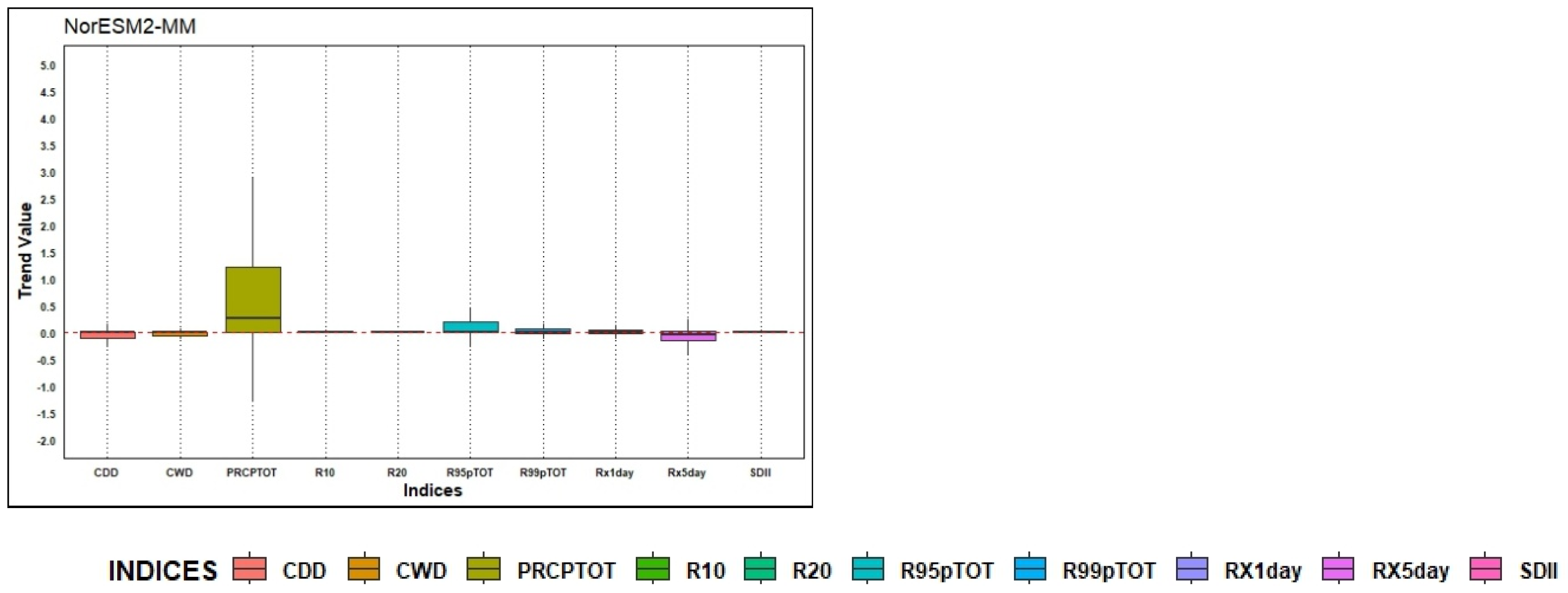
Figure 10 and Figure 11 and Supplementary Figures S5 and S6 display box-and-whisker plots of the JJAS seasonal trends derived from the ensemble mean and the individual top-performing models for the 2050s and 2080s under both scenarios, respectively. Figure 10 illustrates projected trends in JJAS extreme rainfall indices for the 2050s under SSP2-4.5 and SSP5-8.5 based on the EnseMean and the top-performing models. Under SSP2-4.5 for the 2050s, the EnseMean indicates a decreasing trend in CDD and increasing trends in CWD, PRCPTOT, and most heavy-rainfall indices. Several models, particularly CMCC-ESM2, NorESM2-MM, and NESM3, generally support these patterns, though NorESM2-LM frequently diverges by projecting increasing trend in CDD or declines in other indices. R10 shows mixed signals, while R20 shows no meaningful trend. High-intensity indices (R95pTOT and R99pTOT) generally show increasing trends, with stronger increases observed in R95pTOT. Rx1day and Rx5day also exhibit increasing trends, with CMCC-ESM2 projecting the strongest increase in Rx5day. Similar patterns persist into the 2080s under SSP2-4.5 (Figure 11). The ensemble mean (EnseMean) projects decreasing trends in CDD and increasing trends in CWD and PRCPTOT. Heavy-rainfall indices continue to increase, particularly R95pTOT, while trends in R10 and R20 remain weak or insignificant. Rx1day and Rx5day increase in the EnseMean, although some models, particularly NorESM2-LM and NorESM2-MM, show weaker or negative trends for Rx5day. Although most grid cells exhibit decreasing trends in Rx1day and Rx5day, a few locations with relatively larger increases, such as those seen in the CMCC-ESM2 models, can dominate the spatial average, resulting in an overall increase in the EnseMean.
Under the SSP5-8.5 scenario for the 2050s, the EnseMean projects a slight declining trend in CDD, accompanied by increases in CWD, PRCPTOT, R95pTOT and R99pTOT (Supplementary Figure S5). NESM3 and CMCC-ESM2 show the largest CWD increases, while NorESM2-LM exhibits the greatest rise in CDD. R10 exhibits only a minor increasing trend in a few models, while R20 remains relatively stable. All models show a consistent increasing trend in R95pTOT, with most also projecting rises in R99pTOT. Both Rx1day and Rx5day show an increasing trend in the Ensemble Mean, with the most pronounced increases again produced by CMCC-ESM2 and NESM3. For the 2080s under SSP5-8.5, the EnseMean and a majority of models project a decreasing trend in CDD alongside increasing trends in CWD and PRCPTOT, with NESM3 showing the strongest rise in PRCPTOT (Supplementary Figure S6). R95pTOT and R99pTOT generally continue their upward trend across models, though the magnitude varies. Rx5day shows a stronger increasing trend than Rx1day in nearly all models. Notably, SDII remains stable across all scenarios and time periods.
Supplementary Figures S7–S10 display box-and-whisker plots of the FMAM seasonal trends derived from the ensemble mean and the individual top-performing models for the 2050s and 2080s under SSP2-4.5 and SSP5-8.5 scenarios. Across both scenarios and future periods (2050s and 2080s), most individual models show trend directions broadly consistent with those of the EnseMean. Although differences remain in the magnitude of projected changes, the overall agreement among models indicates that the EnseMean provides a relatively robust representation of future JJAS and FMAM extreme rainfall indices.

4. Discussion

Understanding both historical and future patterns of extreme precipitation is crucial for climate adaptation in Ethiopia, where rainfall variability strongly influences water resources, agriculture, and ecosystem stability. Historical analysis (1981–2010) indicates a general tendency toward increasing trend for most JJAS indices across all rainfall regimes, whereas the FMAM season exhibits predominantly decreasing tendencies nationwide. However, these trends are not statistically significant. Despite previous declines during the FMAM season, projections indicate a more pronounced increase in PRCPTOT during FMAM than during JJAS across all timeframes and both scenarios in the north and northwest regions of Ethiopia. In these areas, the CWD is projected to increase and the CDD to decrease during FMAM. Overall, these patterns suggest a potential seasonal shift, with more rainfall occurring during FMAM than JJAS in the north and northwest, particularly in the Tekeze basin. Additionally, the northeastern and central regions of the country, particularly the Awash Basin, are expected to experience increases in PRCPTOT and CWD during the JJAS season. In contrast, a decrease in PRCPTOT and CWD is projected during FMAM season, which aligns with the historical pattern of decreasing on PRCPTOT and CWD during this period. However, the rainfall pattern in the Awash basin is bimodal, with the main rainy season occurring from July to September (JAS) while small rains occur between March and May [49]. The anticipated reduction in FMAM rainfall, coupled with the projected increase in JJAS precipitation, suggests a potential shift from a bimodal to a more unimodal rainfall regime. Overall, these potential seasonal shifts in north and northeast of the country, particularly in the Tekeze and the Awash basin, could have far-reaching implications. For agriculture, changes in rainfall timing and intensity may affect planting and harvesting cycles, crop yields, and food security. For water resource management, altered hydrological regimes could influence reservoir operations, irrigation planning, and flood risk. Additionally, ecosystem dynamics, including vegetation patterns and water availability for biodiversity, may also be affected. Proactive adaptation strategies will be crucial for managing the socio-economic and environmental impacts of these emerging rainfall trends.
On the other hand, high-rainfall areas in the northwest, west, and southwest (Abay, Baro Akobo, and Omo Gibe basins and RVLB) are projected to experience increases in extreme indices (PRCPTOT, CWD, R10, R20, R95pTOT, R99pTOT, and SDII) in both JJAS and FMAM. This contrasts with historical trends, in which these regions showed increasing indices during JJAS but declining indices during FMAM. The projected rise in extreme rainfall events raises concerns about flooding, soil degradation, and agricultural losses. However, the hydropower sector, particularly Grand Ethiopian Renaissance Dam (GERD), Gibe II, and Gibe III, may benefit from increased water availability, reinforcing the need for strategic water management and infrastructure investments to mitigate risks while capitalizing on opportunities. Furthermore, projections indicate substantial increases in extreme precipitation indices for the arid Danakil basin during the JJAS season of the 2050s and 2080s. While this could temporarily improve water availability for pastoralist communities, it also heightens flood risks, threatening infrastructure, crops, and livelihoods. Developing flood control measures and early warning systems will be crucial to mitigate these impacts.
The top-performing models and their ensemble mean (EnseMean) under both the SSP2-4.5 and SSP5-8.5 scenarios reveal substantial uncertainty in future precipitation projections over the study region. Individual models frequently produce divergent trends, and even the ensemble mean and best-performing models often disagree. This spread is particularly large for total annual precipitation (PRCPTOT), which ranges from approximately −20% to +70% change. In addition to the widely recognized sources of uncertainty in climate projections, such as variations in GCM structures and emission scenarios, regional analyses in East Africa encounter further challenges. These include the choice of re-gridding and interpolation techniques, the selection of observational reference datasets for model evaluation and bias correction, and the specific methods used for statistical downscaling [18,22]. Such uncertainties significantly complicate adaptation planning. They highlight the urgent need for flexible, robust, and scenario-responsive strategies in water resource management, disaster risk reduction, and agricultural planning. Furthermore, ensembling top-performing models generally enhances projection reliability by reducing random errors and improving the simulation of observed extreme events, particularly following bias correction. However, this approach can also mask important structural differences among models and may underestimate the full range of future uncertainty, especially when models share common biases [25,26,44].
Overall, climate projections suggest an increase in extreme rainfall events during JJAS. Despite historical declines, future projections indicate rising FMAM precipitation across most of Ethiopia. Ethiopia’s rainfall pattern is predominantly bimodal, but climate change could alter these latitudinal gradients, reshaping precipitation regimes across the continent [50]. Such changes align with broader patterns of shifting rainfall regimes across Africa identified in earlier research and may substantially influence agricultural productivity and hydrological systems. In Ethiopia, such shifts could affect rainy season timing, distribution, frequency, impacting water resources, agriculture, and ecosystem dynamics. Reference [51] identified a latitudinal shift in precipitation patterns across Africa, in which rainfall regimes transition from bimodal to unimodal with increasing latitude. The projected increases in extreme precipitation identified in this study align with findings from previous studies on East Africa, including Ethiopia, based on CMIP5 and RCMs [52,53,54], as well as more recent studies using CMIP6 [1,20,21,22,55,56]. Future precipitation events, especially in western, eastern, and central Africa, are expected to become more intense due to projected positive shifts [56]. This pattern known as the East African Climate Paradox highlights the complex interplay among climate dynamics, aerosol forcing, seasonality shifts, and natural variability [57,58]. Possible reasons for this discrepancy include anthropogenic aerosol emissions, uncertainties in global climate models (GCMs), shifts in rainfall seasonality, and natural variability [59,60]. FMAM rainfall, influenced by cyclonic activity and North Atlantic sea surface temperature anomalies, may also be affected by climate change, particularly due to warming patterns in the Indian and Pacific Oceans [5]. The El Niño-Southern Oscillation (ENSO) remains a key driver of rainfall variability in Ethiopia, alongside local climatic factors such as diverse physiographic features [61,62,63,64].

5. Conclusions

Considering Ethiopia’s heavy reliance on rainfall for livelihoods and productivity and its vulnerability to the adverse effects of droughts and floods, understanding extreme precipitation trends and projections is essential for effective resource management and planning. Although historical trends show declines in many extreme rainfall indices, projections indicate an increase in PRCPTOT during the FMAM season across most regions in the coming decades. An increase in projection of extreme indices (PRCPTOT, CWD, Rx1day, Rx5day, R95pTOT, R99pTOT, R10 and R20) is observed during FMAM in the north and northwest, even though declining historical trends are observed in the above-mentioned areas. On the other hand, JJAS in the northwest, west, and southwest showed increases in R95pTOT, R99pTOT, R10, and R20, underscoring the need for region-specific strategies to manage water resources, mitigate flood risks, and adapt agricultural practices. Projected seasonal shifts in key basins, including the Tekeze, Awash, and Ogaden, present significant challenges for regions that depend on predictable rainfall timing for agriculture, water allocation, and pastoralism. Any alteration in the seasonal distribution of precipitation could impact planting schedules, crop growth cycles, and the reliability of water supplies, thereby posing risks to local livelihoods and overall economic stability. Moreover, the projected increase in extreme rainfall across Ethiopia particularly in the northwest, west, and southwest, presents both opportunities and challenges. While enhanced rainfall offers potential benefits such as improved water availability for agriculture and hydroelectric power generation, the risks associated with extreme weather events, especially flooding, are a serious concern. These contrasting outcomes highlight the critical need for adaptation strategies that are tailored to each region’s specific vulnerabilities and opportunities.
Policymakers and development partners must integrate these projections into agricultural planning, infrastructure design, and disaster risk management to safeguard communities and enhance climate resilience against the anticipated changes in precipitation patterns. Preparing for both water shortages and excess rainfall will be essential as climate variability intensifies. Incorporating climate information into long-term planning will help ensure sustainable development and reduce the impacts of climate-related hazards on Ethiopia’s economy and food security. Overall, this study provides tailored, actionable climate information for Ethiopian policymakers, water managers, farmers, and disaster risk planners. It supports preparation for rising flood and drought risks, informs infrastructure investment decisions, adjust agricultural practices, and helps protect lives and livelihoods. However, uncertainty in future precipitation projections remains a major challenge, as demonstrated by the spread in results from top-performing models and the ensemble mean (EseMean) under SSP2-4.5 and SSP5-8.5 scenarios. The findings emphasize the importance of developing adaptive, flexible strategies that can effectively respond to a range of potential climate outcomes, rather than depending on any single projection. Recognizing and incorporating uncertainty into climate policy and planning are therefore essential for building long-term resilience.

Supplementary Materials

The following supporting information can be downloaded at: https://www.mdpi.com/article/10.3390/cli14040088/s1, Figure S1. Comparison of raw and bias-corrected outputs for the top-ranking models in simulating extreme precipitation indices during JJAS season; Figure S2. Comparison of raw and bias-corrected outputs for the top-ranking models in simulating extreme precipitation indices during FMAM season; Figure S3. Time series EnseMean of CDD (days), CWD (days), PRCPTOT (mm), Rxday (mm) and R10 (days) during the JJAS season under the SSP5-8.5 scenario for the period 2040 to 2100. The solid blue line represents the annual ensemble values; Figure S4. Time series EnseMean of CDD (days), CWD (days), PRCPTOT (mm), Rxday (mm) and R10 (days) during the FMAM season under the SSP5-8.5 scenario for the period 2040 to 2100. The solid blue line represents the annual ensemble values; Figure S5. Box-and-whisker plots of trends for the EnseMean and top-performing models in simulating extreme precipitation indices: (CDD (days), CWD (days), PRCPTOT (mm), R10 (days), R20 (days), R95pTOT (mm), R99pTOT (mm), Rx1day (mm), Rx5day, and SDII (mm)) for JJAS season for the 2050s under SSP585 scenario. Box-and-whisker plots of trends for the EnseMean in simulating extreme precipitation indices: (CDD (days), CWD (days), PRCPTOT (mm), R10 (days), R20 (days), R95pTOT (mm), R99pTOT (mm), Rx1day (mm), Rx5day, and SDII (mm)) for JJAS season for the 2050s under SSP585 scenario. The boxes indicate the interquartile range, spanning the 25th to 75th percentiles. The median value is indicated by the thick colored line within each box. The whiskers represent the total intermodel range; Figure S6. Box-and-whisker plots of trends for the EnseMean and top-performing models in simulating extreme precipitation indices: (CDD (days), CWD (days), PRCPTOT (mm), R10 (days), R20 (days), R95pTOT (mm), R99pTOT (mm), Rx1day (mm), Rx5day (mm), and SDII (mm)) for JJAS season for the 2080s under SSP585 scenarios. The boxes indicate the interquartile range, spanning the 25th to 75th percentiles. The median value is indicated by the thick colored line within each box. The whiskers represent the total intermodel range; Figure S7. Box-and-whisker plots of trends for the EnseMean and top-performing models in simulating extreme precipitation indices (CDD (days), CWD (days), MEAN (mm), PRCPTOT (mm), R10 (days), R20 (days), R95Ptot (mm), R99Ptot (mm), Rx1day (mm), Rx5day (mm), SDII (mm)) for FMAM season for the 2050s under SSP245 scenario. The boxes represent the interquartile range (spanning the 25th to 75th percentiles), with the thick black line inside each box indicating the median. The whiskers show total intermodel range; Figure S8. Box-and-whisker plots of trends for the EnseMean and top-performing models in simulating extreme precipitation indices (CDD (days), CWD (days), MEAN (mm), PRCPTOT (mm), R10 (days), R20 (days), R95Ptot (mm), R99Ptot (mm), Rx1day (mm), Rx5day (mm), SDII (mm)) for FMAM season for the 2080s under SSP245 scenario. The boxes represent the interquartile range (spanning the 25th to 75th percentiles), with the thick black line inside each box indicating the median. The whiskers show total intermodel range; Figure S9. Box-and-whisker plots of trends for the EnseMean in simulating extreme precipitation indices (CDD (days), CWD (days), MEAN (mm), PRCPTOT (mm), R10 (days), R20 (days), R95Ptot (mm), R99Ptot (mm), Rx1day (mm), Rx5day (mm), SDII (mm)) for FMAM season for the 2050s under SSP585 scenario. The boxes represent the interquartile range (spanning the 25th to 75th percentiles), with the thick black line inside each box indicating the median. The whiskers show total intermodel range; Figure S10. Box-and-whisker plots of trends for the EnseMean in simulating extreme precipitation indices (CDD (days), CWD (days), MEAN (mm), PRCPTOT (mm), R10 (days), R20 (days), R95Ptot (mm), R99Ptot (mm), Rx1day (mm), Rx5day (mm), SDII (mm)) for FMAM season for the 2080s under SSP585 scenario. The boxes represent the interquartile range (spanning the 25th to 75th percentiles), with the thick black line inside each box indicating the median. The whiskers show total intermodel range.

Author Contributions

D.B.: Methodology, Formal Analysis, Visualization, Software, Validation, Writing—Original Draft, and Writing—Review and Editing. T.A.: Supervision, Methodology, Visualization, and Writing—Review and Editing. G.O.: Visualization and Writing—Review and Editing. C.L.W., A.H., T.G.T., S.G., A.B. and G.Z.: Writing—Review and Editing. All authors have reviewed and approved the final version of the manuscript. All authors have read and agreed to the published version of the manuscript.

Funding

This research was supported by the Water Security and Sustainable Development Hub, funded by UK Research and Innovation’s Global Challenges Research Fund (GCRF), grant number ES/S008179/1.

Data Availability Statement

The datasets generated and/or analyzed during the current study are available from the corresponding author upon reasonable request.

Acknowledgments

The authors gratefully acknowledge the Water and Land Resource Center for providing a conducive working environment, as well as structural and technological support essential for conducting this research. We also extend our gratitude to the data centers, including the World Climate Research Programme and contributing institutions, for making their data publicly available. Special thanks go to Ethiopia’s National Meteorological Institute (NMI) for providing the gridded observational dataset (ENACTS).

Conflicts of Interest

The authors declare no conflicts of interest.

References

  1. IPCC. Climate Change: Mitigation of climate change. In Contribution of Working Group III to the Sixth Assessment Report of the Intergovernmental Panel on Climate Change; Shukla, P.R., Skea, J., Slade, R., Al Khourdajie, A., van Diemen, R., McCollum, D., Pathak, M., Some, S., Vyas, P., Fradera, R., et al., Eds.; Cambridge University Press: Cambridge, UK; New York, NY, USA, 2022. [Google Scholar] [CrossRef]
  2. Peterson, T.C.; Manton, M.J. Monitoring changes in climate extremes: A tale of international collaboration. Bull. Am. Meteorol. Soc. 2008, 89, 1266–1271. [Google Scholar] [CrossRef]
  3. Tierney, J.E.; Ummenhofer, C.C.; Demenocal, P.B. Past and future rainfall in the Horn of Africa. Sci. Adv. 2015, 1, e1500682. [Google Scholar] [CrossRef] [PubMed]
  4. Omondi, P.; Awange, J.; Forootan, E.; Ogallo, L.A.; Barakiza, R.; Girmaw, G.B.; Fesseha, I.; Kululetera, V.; Kilembe, C.; Mbati, M.M. Changes in temperature and precipitation extremes over the Greater Horn of Africa region from 1961 to 2010. Int. J. Climatol. 2014, 34, 1262–1277. [Google Scholar] [CrossRef]
  5. Endris, H.S.; Omondi, P.; Jain, S.; Lennard, C.; Hewitson, B.; Chang’a, L.; Awange, J.L.; Dosio, A.; Ketiem, P.; Nikulin, G.; et al. Assessment of the performance of CORDEX regional climate models in simulating East African rainfall. J. Clim. 2013, 26, 8453–8475. [Google Scholar] [CrossRef]
  6. Lyon, B.; DeWitt, D. A recent and abrupt decline in the East African long rains. Geophys. Res. Lett. 2012, 39, L02702. [Google Scholar] [CrossRef]
  7. Opiyo, F.; Wasonga, O.; Nyangito, M.; Schilling, J.; Munang, R. Drought adaptation and coping strategies among the Turkana pastoralists of norther n Kenya. Int. J. Disaster Risk Sci. 2015, 6, b295–b309. [Google Scholar] [CrossRef]
  8. Viste, E.; Korecha, D.; Sorteberg, A. Recent drought and precipitation tendencies in Ethiopia. Theor. Appl. Climatol. 2013, 112, 535–551. [Google Scholar] [CrossRef]
  9. Maidment, R.I.; Allan, R.P.; Black, E. Recent observed and simulated changes in precipitation over Africa. Geophys. Res. Lett. 2015, 42, 8155–8164. [Google Scholar] [CrossRef]
  10. Federal Democratic Republic of Ethiopia (FDRE). Ethiopia’s Climate Resilient Green Economy National Adaptation Plan (NAP-ETH); Ministry of Environment, Forest and Climate Change: Addis Ababa, Ethiopia, 2019. [Google Scholar]
  11. Daba, M.H.; You, S. Assessment of climate change impacts on river flow regimes in the upstream of Awash Basin, Ethiopia: Based on IPCC fifth assessment report (AR5) climate change scenarios. Hydrology 2020, 7, 98. [Google Scholar] [CrossRef]
  12. Orkodjo, T.P.; Kranjac-Berisavijevic, G.; Abagale, F.K. Impact of climate change on future precipitation amounts, seasonal distribution, and streamflow in the Omo-Gibe basin, Ethiopia. Heliyon 2022, 8, e09711. [Google Scholar] [CrossRef]
  13. Musie, M.; Momblanch, A.; Sen, S. Exploring future global change-induced water imbalances in the Central Rift Valley Basin, Ethiopia. Clim. Change 2021, 164, 47. [Google Scholar] [CrossRef]
  14. Han, T.; Wang, H.; Sun, J. Projected changes in temperature and precipitation extremes over the Silk Road Economic Belt regions by the Coupled Model Intercomparison Project Phase 5 multi-model ensembles. Int. J. Climatol. 2018, 38, 4077–4091. [Google Scholar] [CrossRef]
  15. Jury, M.R. Statistical evaluation of CMIP5 climate change model simulations for the Ethiopian highlands. Int. J. Climatol. 2015, 35, 37–44. [Google Scholar] [CrossRef]
  16. Dyer, E.; Washington, R.; Teferi Taye, M. Evaluating the CMIP5 ensemble in Ethiopia: Creating a reduced ensemble for rainfall and temperature in Northwest Ethiopia and the Awash basin. Int. J. Climatol. 2020, 40, 2964–2985. [Google Scholar] [CrossRef]
  17. Eyring, V.; Bony, S.; Meehl, G.A.; Senior, C.A.; Stevens, B.; Stouffer, R.J.; Taylor, K.E. Overview of the Coupled Model Intercomparison Project Phase 6 (CMIP6) experimental design and organization. Geosci. Model. Dev. 2016, 9, 1937–1958. [Google Scholar] [CrossRef]
  18. Kim, Y.H.; Min, S.K.; Zhang, X.; Sillmann, J.; Sandstad, M. Evaluation of the CMIP6 multi-model ensemble for climate extreme indices. Weather Clim. Extrem. 2020, 29, 100269. [Google Scholar] [CrossRef]
  19. Belay, B.; Amha, Y.; Ambaw, G.; Demissie, T.; Solomon, D. Climate Risk Management for Agricultural Extension: Processes, Experiences, and Lessons Learnt from Ethiopia. 2024. Available online: https://hdl.handle.net/10568/148724 (accessed on 15 July 2025).
  20. Gebresellase, S.H.; Wu, Z.; Xu, H.; Muhammad, W.I. Evaluation and selection of CMIP6 climate models in Upper Awash Basin (UBA), Ethiopia: Evaluation and selection of CMIP6 climate models in Upper Awash Basin (UBA), Ethiopia. Theor. Appl. Climatol. 2022, 149, 1521–1547. [Google Scholar] [CrossRef]
  21. Feyissa, T.A.; Demissie, T.A.; Saathoff, F.; Gebissa, A. Evaluation of general circulation models CMIP6 performance and future climate change over the omo river basin, Ethiopia. Sustainability 2023, 15, 6507. [Google Scholar] [CrossRef]
  22. Gebrechorkos, S.H.; Taye, M.T.; Birhanu, B.; Solomon, D.; Demissie, T. Future changes in climate and hydroclimate extremes in East Africa. Earth’s Future 2023, 11, e2022EF003011. [Google Scholar] [CrossRef]
  23. Fetene, Z.A.; Zaitchik, B.F.; Zeleke, T.T.; Yeshita, B.D.; Vashisht, A. Coupled Model Intercomparison Project phase 5 and 6 representation of peak and end of rainy season over Upper Blue Nile basin. Int. J. Climatol. 2022, 42, 8489–8508. [Google Scholar] [CrossRef]
  24. Rettie, F.M.; Gayler, S.; Weber, T.K.D.; Tesfaye, K.; Streck, T. High-resolution CMIP6 climate projections for Ethiopia using the gridded statistical downscaling method. Sci. Data 2023, 10, 442. [Google Scholar] [CrossRef] [PubMed]
  25. Berhanu, D.; Alamirew, T.; Taye, M.T.; Tibebe, D.; Gebrehiwot, S.; Zeleke, G. Evaluation of CMIP6 models in reproducing observed rainfall over Ethiopia. J. Water Clim. Change 2023, 14, 2583–2605. [Google Scholar] [CrossRef]
  26. Berhanu, D.; Alamirew, T.; Bewket, W.; Tarkegn, T.G.; Zeleke, G.; Haileslassie, A.; O’Donnell, G.; Walsh, C.L.; Gebrehiwot, S. Evaluation of CMIP6 models in simulating seasonal extreme precipitation over Ethiopia. Weather. Clim. Extrem. 2025, 47, 100752. [Google Scholar] [CrossRef]
  27. Berhanu, B.; Seleshi, Y.; Melesse, A.M. Surface Water and Groundwater Resources of Ethiopia: Potentials and Challenges of Water Resources Development. In Nile River Basin: Ecohydrological Challenges, Climate Change and Hydropolitics; Melesse, A.M., Abtew, W., Setegn, S.G., Eds.; Springer International Publishing: Cham, Switzerland, 2014; pp. 97–117. [Google Scholar] [CrossRef]
  28. Gummadi, S.; Rao, K.P.C.; Seid, J.; Legesse, G.; Kadiyala, M.D.M.; Takele, R.; Amede, T.; Whitbread, A. Spatio-temporal variability and trends of precipitation and extreme rainfall events in Ethiopia in 1980–2010. Theor. Appl. Climatol. 2018, 134, 1315–1328. 8. [Google Scholar] [CrossRef]
  29. Van den Hende, C.; Van Schaeybroeck, B.; Nyssen, J.; Van Vooren, S.; Van Ginderachter, M.; Termonia, P. Analysis of rain-shadows in the Ethiopian Mountains using climatological model data. Clim. Dyn. 2021, 56, 1663–1679. [Google Scholar] [CrossRef]
  30. Diro, G.T.; Toniazzo, T.; Shaffrey, L. Ethiopian Rainfall in Climate Models; Springer: Dordrecht, The Netherlands, 2011; pp. 51–69. [Google Scholar] [CrossRef]
  31. Gizaw, M.S.; Biftu, G.F.; Gan, T.Y.; Moges, S.A.; Koivusalo, H. Potential impact of climate change on streamflow of major Ethiopian rivers. Clim. Change 2017, 143, 371–383. [Google Scholar] [CrossRef]
  32. Zegeye, H. Climate change in Ethiopia: Impacts, mitigation and adaptation. Int. J. Res. Environ. Stud. 2018, 5, 18–35. [Google Scholar] [CrossRef]
  33. Dinku, T.; Block, P.; Sharoff, J.; Hailemariam, K.; Osgood, D.; del Corral, J.; Cousin, R.; Thomson, M.C. Bridging critical gaps in climate services and applications in africa. Earth Perspect. 2014, 1, 15. [Google Scholar] [CrossRef]
  34. Dinku, T. Challenges with availability and quality of climate data in Africa. In Extreme Hydrology and Climate Variability; Elsevier: Amsterdam, The Netherlands, 2019. [Google Scholar] [CrossRef]
  35. Gupta, R.; Chembolu, V. Projecting Socio-Economic Exposure due to Future Hydro-Meteorological Extremes in Large Transboundary River Basin under Global Warming Targets. Water Resour. Manag. 2025, 39, 2093–2110. [Google Scholar] [CrossRef]
  36. Ayugi, B.; Zhihong, J.; Zhu, H.; Ngoma, H.; Babaousmail, H.; Rizwan, K.; Dike, V. Comparison of CMIP6 and CMIP5 models in simulating mean and extreme precipitation over East Africa. Int. J. Climatol. 2021, 41, 6474–6496. [Google Scholar] [CrossRef]
  37. Alaminie, A.A.; Tilahun, S.A.; Legesse, S.A.; Zimale, F.A.; Tarkegn, G.B.; Jury, M.R. Evaluation of Past and Future Climate Trends under CMIP6 Scenarios for the UBNB (Abay), Ethiopia. Water 2021, 13, 2110. [Google Scholar] [CrossRef]
  38. Akinsanola, A.A.; Ongoma, V.; Kooperman, G.J. Evaluation of CMIP6 models in simulating the statistics of extreme precipitation over Eastern Africa. Atmos. Res. 2021, 254, 105509. [Google Scholar] [CrossRef]
  39. Gudmundsson, L.; Bremnes, J.B.; Haugen, J.E.; Engen-Skaugen, T. Downscaling RCM precipitation to the station scale using statistical transformations–a comparison of methods. Hydrol. Earth Syst. Sci. 2012, 16, 3383–3390. [Google Scholar] [CrossRef]
  40. Akinsanola, A.A.; Zhou, W. Projections of West African summer monsoon rainfall extremes from two CORDEX models. Clim. Dyn. 2019, 52, 2017–2028. [Google Scholar] [CrossRef]
  41. Pour, S.H.; Shahid, S.; Chung, E.-S.; Wang, X.-J. Model output statistics downscaling using support vector machine for the projection of spatial and temporal changes in rainfall of Bangladesh. Atmos. Res. 2018, 213, 149–162. [Google Scholar] [CrossRef]
  42. Iqbal, Z.; Shahid, S.; Ahmed, K.; Ismail, T.; Khan, N.; Virk, Z.T.; Johar, W. Evaluation of global climate models for precipitation projection in sub-Himalaya region of Pakistan. Atmos. Res. 2020, 245, 105061. [Google Scholar] [CrossRef]
  43. Yang, B.; Qin, C.; Bräuning, A.; Osborn, T.J.; Trouet, V.; Ljungqvist, F.C.; Esper, J.; Schneider, L.; Grießinger, J.; Büntgen URossi, S. Long-term decrease in Asian monsoon rainfall and abrupt climate change events over the past 6700 years. Proc. Natl. Acad. Sci. USA 2021, 118, e2102007118. [Google Scholar] [CrossRef]
  44. Patel, G.; Das, S.; Das, R. Identification of Best CMIP6 Global Climate Model for Rainfall by Ensemble Implementation of MCDM Methods and Statistical Inference. Water Resour. Manag. 2023, 37, 5147–5170. [Google Scholar] [CrossRef]
  45. Taylor, K.E. Summarizing multiple aspects of model performance in a single diagram. J. Geophys. Res. Atmos. 2001, 106, 7183–7192. [Google Scholar] [CrossRef]
  46. Zhang, X.; Alexander, L.; Hegerl, G.C.; Jones, P.; Tank, A.K.; Peterson, T.C.; Trewin, B.; Zwiers, F.W. Indices for monitoring changes in extremes based on daily temperature and precipitation data. Wiley Interdiscip. Rev. Clim. Change 2011, 2, 851–870. [Google Scholar] [CrossRef]
  47. Şen, Z. Innovative trend analysis methodology. J. Hydrol. Eng. 2012, 17, 1042–1046. [Google Scholar] [CrossRef]
  48. Pohlert, T. The Trend Package. R Package, Version 1.1. 2016. Available online: https://CRAN.R-project.org/package=trend (accessed on 21 August 2025).
  49. Taye, M.T.; Dyer, E.; Hirpa, F.A.; Charles, K. Climate change impact on water resources in the Awash basin, Ethiopia. Water 2018, 10, 1560. [Google Scholar] [CrossRef]
  50. Sian, K.T.C.L.K.; Ayugi, B.O.; Onyutha, C.; Sagero, P.; Ait Brahim, Y. Rainfall variability across Africa. In Climate Change and Rainfall Extremes in Africa; Elsevier: Amsterdam, The Netherlands, 2025; pp. 3–26. [Google Scholar] [CrossRef]
  51. Knoben, W.J.; Woods, R.A.; Freer, J.E. A quantitative hydrological climate classification evaluated with independent streamflow data. Water Resour. Res. 2018, 54, 5088–5109. [Google Scholar] [CrossRef]
  52. Onyutha, C.; Acayo, G.; Nyende, J. Analyses of precipitation and evapotranspiration changes across the Lake Kyoga Basin in east Africa. Water 2020, 12, 1134. [Google Scholar] [CrossRef]
  53. Fotso-Nguemo, T.C.; Diallo, I.; Diakhaté, M.; Vondou, D.A.; Mbaye, M.L.; Haensler, A.; Gaye, A.T.; Tchawoua, C. Projected changes in the seasonal cycle of extreme rainfall events from CORDEX simulations over Central Africa. Clim. Change 2019, 155, 339–357. [Google Scholar] [CrossRef]
  54. Sylla, M.B.; Nikiema, P.M.; Gibba, P.; Kebe, I.; Klutse, N.A.B. Climate change over West Africa: Recent trends and future projections. In Adaptation to Climate Change and Variability in Rural West Africa; Springer: Berlin/Heidelberg, Germany, 2016; pp. 25–40. [Google Scholar] [CrossRef]
  55. Shiferaw, A.; Tadesse, T.; Rowe, C.; Oglesby, R. Precipitation extremes in dynamically downscaled climate scenarios over the greater horn of Africa. Atmosphere 2018, 9, 112. [Google Scholar] [CrossRef]
  56. Balcha, Y.A.; Malcherek, A.; Alamirew, T. Understanding future climate in the upper awash basin (UASB) with selected climate model outputs under CMIP6. Climate 2022, 10, 185. [Google Scholar] [CrossRef]
  57. Bobde, V.; Akinsanola, A.A.; Folorunsho, A.H.; Adebiyi, A.A.; Adeyeri, O.E. Projected regional changes in mean and extreme precipitation over Africa in CMIP6 models. Environ. Res. Lett. 2024, 19, 074009. [Google Scholar] [CrossRef]
  58. Lyon, B.; Vigaud, N. Unraveling East Africa’s climate paradox. In Climate Extremes: Patterns and Mechanisms; American Geophysical Union: Washington, DC, USA, 2017; pp. 265–281. [Google Scholar] [CrossRef]
  59. Nicholson, S.E. Climate and climatic variability of rainfall over eastern Africa. Rev. Geophys. 2017, 55, 590–635. [Google Scholar] [CrossRef]
  60. Rowell, D.P.; Booth, B.B.; Nicholson, S.E.; Good, P. Reconciling past and future rainfall trends over East Africa. J. Clim. 2015, 28, 9768–9788. [Google Scholar] [CrossRef]
  61. Wainwright, C.M.; Marsham, J.H.; Keane, R.J.; Rowell, D.P.; Finney, D.L.; Black, E.; Allan, R.P. ‘Eastern African Paradox’ rainfall decline due to shorter not less intense Long Rains. npj Clim. Atmos. Sci. 2019, 2, 34. [Google Scholar] [CrossRef]
  62. Gitima, G.; Mersha, M. The impacts of El-Niño-Southern Oscillation (ENSO) on agriculture and coping strategies in rural communities of Ethiopia: Systematic review article. Asian J. Geogr. Res. 2020, 3, 56–69. [Google Scholar] [CrossRef]
  63. Palmer, P.I.; Wainwright, C.M.; Dong, B.; Maidment, R.I.; Wheeler, K.G.; Gedney, N.; Hickman, J.E.; Madani, N.; Folwell, S.S.; Abdo, G.; et al. Drivers and impacts of Eastern African rainfall variability. Nat. Rev. Earth Environ. 2023, 4, 254–270. [Google Scholar] [CrossRef]
  64. Zeleke, E.B.; Melesse, A.M.; Zhu, P.; Burgman, R.; Gann, D. Spatial variability and relative influence of seasonal rainfall drivers in Ethiopia. Theor. Appl. Climatol. 2025, 156, 131. [Google Scholar] [CrossRef]
Figure 1. (a) Geographical context of Ethiopia including altitude (m.a.s.l), delineating its 12 major river basins. (b) Spatial distribution of mean annual rainfall across the country. The blue line represents the study area.
Climate 14 00088 g001
Figure 2. Spatial distribution of trends in rainfall extreme indices over Ethiopia during the JJAS season for the period 1981–2010 using ENACTS over the study period. (a) PRCPTOT, (b) CDD, (c) CWD, (d) Rx1day, (e) Rx5day, (f) R95pTOT, (g) R99pTOT, (h) R10, (i) R20, and (j) SDII. The magnitude of trends is estimated using Sen’s slope estimator. Stippling indicates areas where trends are not significant at the 5% level (p > 0.05), based on the Mann–Kendall test.
Climate 14 00088 g002aClimate 14 00088 g002b
Figure 3. Spatial distribution of trends in precipitation extreme indices over Ethiopia during the FMAM season for the period 1981–2010 using ENACTS: (a) PRCPTOT, (b) CDD, (c) CWD, (d) Rx1day, (e) Rx5day, (f) R95pTOT, (g) R99pTOT, (h) R10, (i) R20, and (j) SDII. Stippling indicates areas where trends are not significant at the 5% level (p > 0.05), based on the Mann–Kendall test.
Climate 14 00088 g003aClimate 14 00088 g003b
Figure 4. Projected change in extreme precipitation indices (at) (%), with respect to the reference period (1981–2010), for JJAS in the 2050s under SSP2-4.5 and SSP5-8.5 scenarios. Indices include: CDD (days), CWD (days), PRCPTOT (mm), R10 (days), R20 (days), R95pTOT (mm), R99pTOT (mm), Rx1day (mm), Rx5day (mm), and SDII (mm). Stippling indicates grid points where changes are not statistically significant at the 5% significance level (p > 0.05) according to the Mann–Kendall test.
Climate 14 00088 g004
Figure 5. Projected change in extreme precipitation indices (at) (%), relative to the baseline period (1981–2010), for JJAS in the 2080s under SSP2-4.5 and SSP5-8.5. Indices include: CDD (days), CWD (days), PRCPTOT (mm), R10 (days), R20 (days), R95pTOT (mm), R99pTOT (mm), Rx1day (mm), Rx5day (mm), and SDII (mm). Stippling indicates grid points where changes are not statistically significant at the 5% significance level (p > 0.05) according to the Mann–Kendall test.
Climate 14 00088 g005
Figure 6. Projected change in extreme precipitation indices (at) (%), compared to the reference period (1981–2010), during FMAM for the 2050s under SSP2-4.5 and SSP5-8.5 scenarios. Indices include: CDD (days), CWD (days), PRCPTOT (mm), R10 (days), R20 (days), R95pTOT (mm), R99pTOT (mm), Rx1day (mm), Rx5day (mm), and SDII (mm). Stippling indicates grid points where changes are not statistically significant at the 5% significance level (p > 0.05) according to the Mann–Kendall test.
Climate 14 00088 g006
Figure 7. Projected change in extreme precipitation indices (at) (%), relative to the reference period (1981–2010), for the FMAM season in the 2080s under the SSP2-4.5 and SSP5-8.5 scenarios. Indices include: CDD (days), CWD (days), PRCPTOT (mm), R10 (days), R20 (days), R95pTOT (mm), R99pTOT (mm), Rx1day (mm), Rx5day (mm), and SDII (mm). Stippling indicates grid points where changes are not statistically significant at the 5% significance level (p > 0.05) according to the Mann–Kendall test.
Climate 14 00088 g007
Figure 8. Time series EnseMean of (a) CDD (days), (b) CWD (days), (c) PRCPTOT (mm), (d) Rxday (mm) and (e) R10 (days) during the JJAS season under the SSP2-4.5 scenario for the period 2040 to 2100. The solid blue line represents the annual ensemble values.
Climate 14 00088 g008aClimate 14 00088 g008b
Figure 9. Time series EnseMean of (a) CDD (days), (b) CWD (days), (c) PRCPTOT (mm), (d) Rxday (mm) and (e) R10 (days) during the FMAM season under the SSP2-4.5 scenario for the period 2040 to 2100. The solid blue line represents the annual ensemble values.
Climate 14 00088 g009
Figure 10. Box-and-whisker plots of trends for the EnseMean and top-performing models in simulating extreme precipitation indices: (CDD (days), CWD (days), PRCPTOT (mm), R10 (days), R20 (days), R95pTOT (mm), R99pTOT (mm), Rx1day (mm), Rx5day (mm), and SDII (mm)) for JJAS season for the 2050s under SSP2-4.5 scenario. The boxes indicate the interquartile range, spanning the 25th to 75th percentiles. The median value is indicated by the thick colored line within each box. The whiskers represent the total intermodel range.
Climate 14 00088 g010aClimate 14 00088 g010b
Figure 11. Box-and-whisker plots of trends for the EnseMean and top-performing models in simulating extreme precipitation indices: (CDD (days), CWD (days), PRCPTOT (mm), R10 (days), R20 (days), R95pTOT (mm), R99pTOT (mm), Rx1day (mm), Rx5day (mm), and SDII (mm)) for JJAS season for the 2080s under SSP2-4.5 scenario. The boxes indicate the interquartile range, spanning the 25th to 75th percentiles. The median value is indicated by the thick colored line within each box. The whiskers represent the total intermodel range.
Climate 14 00088 g011aClimate 14 00088 g011b
Table 1. CMIP6 climate models used in this study, including institution, country, and atmospheric horizontal resolution. Models were selected based on their ability to simulate extreme precipitation indices in the JJAS and FMAM seasons when evaluated against the ENACTS dataset.
NoSelected ModelsCountryResolutionsReference
1CESM2-WACCM-FV2USA2.5 × 1.9
2BCC-ESM1-MRChina2.81 × 2.81[26,35,36,37]
3CMCC-ESM2Italy1.3 × 0.9
4E3SM-1-0USA1.0 × 1.0
5GFDL-ESM4USA1.25 × 1.00
6GFDL-CM4USA2.50 × 2.00
7HadGEM3-GC31-MMUSA0.83 × 0.56
8IPSL-CM6A-INCAFrance2.5 × 1.3
9MPI-ESM-1-2-HAMGermany1.9 × 1.9
10NESM3China1.9 × 1.9
12NorESM2-LMNorway2.5 × 1.9
12NorESM2-MMNorway1.25 × 0.94
Table 2. Definitions of the ten extreme precipitation indices used in this study [46].
IndexDescriptionDefinitionUnit
PRCPTOTTotal wet-day precipitation Seasonal total precipitation during wet daysmm/season
SDIISimple daily intensity indexSeasonal precipitation during wet daysmm/days
CDDConsecutive dry daysMaximum number of consecutive days with precipitation <1 mm in seasonDays/season
CWDConsecutive wet days Maximum number of consecutive days with precipitation >1 mm in seasonDays/season
R10Heavy precipitation daysSeasonal number of days with precipitation ≥10 mm Days/season
R20Very heavy precipitation daysSeasonal number of days with precipitation ≥20 mm Days/season
R95pTOTVery wet daysSeasonal total precipitation exceeding the 95th percentilemm/season
R99pTOTExtremely wet days Seasonal total precipitation exceeding the 99th percentilemm/season
Rx5dayMaximum consecutive five-day precipitation Seasonal maximum 5-day precipitation amountmm/season
Rx1dayMaximum one-day precipitationSeasonal maximum 1-day precipitation amountmm/season
Disclaimer/Publisher’s Note: The statements, opinions and data contained in all publications are solely those of the individual author(s) and contributor(s) and not of MDPI and/or the editor(s). MDPI and/or the editor(s) disclaim responsibility for any injury to people or property resulting from any ideas, methods, instructions or products referred to in the content.