Article

Wildfires as Emerging Dominant Arctic and Subarctic Extremes

1
NOAA Pacific Marine Environmental Laboratory, Seattle, WA 98115, USA
2
Cooperative Institute for Climate, Ocean and Ecosystems Studies, University of Washington, Seattle, WA 98105, USA
*
Author to whom correspondence should be addressed.
Climate 2026, 14(3), 65; https://doi.org/10.3390/cli14030065
Submission received: 28 January 2026 / Revised: 27 February 2026 / Accepted: 2 March 2026 / Published: 6 March 2026

Abstract

For the last three summers in Canada (2023–2025), and episodically in Siberia over the previous decade and a half, severe consequences from wildfires represent major ecological and societal impacts: the displacement of inhabitants; destruction of buildings, timber and infrastructure; and far-field air pollution. Wildfire occurrence is increasingly supported every summer by persistent surface warming and widespread atmospheric moisture deficits. The two recent major Canadian fire years in 2023 and 2025 show some contrasts: 2023 was dominated by an early June event with preconditioning, whereas 2025 saw repeated single events spanning June to early August, culminating in a significant late-summer event. Events in both years were associated with North Pacific–North American atmospheric blocking regimes. Over the longer term, 2003–2025, normalized June–September wildfire fraction anomalies in the Canadian sector (45–60° N, 150–60° W) show the post-2023 period as having new, clear, record-breaking fire intensities, highlighting wildfires as emerging dominant Arctic–subarctic extremes. Siberia shows an increase after 2010. Although multiple environmental Arctic–subarctic extremes are ongoing—such as sea-ice loss, storms, and glacial ice loss—the impacts from wildfires represent preeminent, growing societal consequences.

1. Introduction

Extremes are increasingly recognized as a primary measure of Arctic change [1,2]. New extremes are documented by multiple indicators recorded as being beyond previous records. Reports on the ground are an important source of information; records from the Local Environmental Observer (LEO) Network [3] represent a solicited group of observations from local residents, news articles, and topic experts. Temperature extremes, changes in snow and sea ice, shifts in seasonality, permafrost changes, and wildfires are frequently reported. A second data source is a collection undertaken by meteorological services connected to the Arctic [4] (updated). Heatwaves and wildfires, precipitation, and cyclones are reported. Change is not simply binary based on increasing temperature; Arctic temperature change triggers further multiple environmental and societal impacts: wildfires, the melt and drying of permafrost, species migration and ecosystem reorganizations, and increased storm intensity—a polycrisis.
The extended Arctic is particularly vulnerable to wildfire increases as it is a region of boreal forests, extensive peat substrates, and temperatures rising faster than other parts of the planet [5,6]. Western Canada was impacted by major wildfires during the summers of 2023–2025 and Siberia has been impacted episodically since 2010. Wildfires have always been part of the natural cycle. In recent decades, however, their scale, frequency, and intensity have surged. Research from the World Resources Institute (https://doi.org/10.46830/wrirpt.23.00006) shows that fires now destroy more than twice as much tree cover as they did two decades ago. As fires worsen, so do their impacts. As forest fires burn larger areas, they affect more people and impact the global economy. They destroy homes and infrastructure, pollute drinking water and cause billions of dollars in property damage. Dangerous wildfire smoke, extending over large areas, is estimated to cause over 1.5 million deaths each year.
Climate change is a contributor to wildfire increases [7,8]. Northern high-latitude regions have seen increased temperatures at a rate 3–4 greater than the rest of the planet, resulting in longer fire seasons, a greater fire frequency and severity, and larger burned areas in boreal forests. Hotter, drier conditions extend fire seasons and fuel more extreme blazes. Shifting forest dynamics could eventually turn boreal forests from a carbon sink, an area that absorbs more carbon than it emits, into a source of carbon emissions. When forests burn, they release carbon that is stored in the trunks, branches and leaves of trees, and carbon stored in the soil. The expansion of human activities into forested areas is driving the increase in fire activity.
Wildfires pose severe threats to society, the economy, energy sectors, human health, ecosystems and biodiversity [5,6]. Their impacts include extensive local damage and far-field air pollution, among other environmental and societal consequences. Warm-season wildfires are driven by a complex interplay of weather and climate, influenced by natural variability, human factors, and anthropogenic climate change [7,8]. In addition to the availability of combustible vegetation, key contributors include surface warming, wind, a vapor pressure deficit, and atmospheric convection instability. Changes in these factors influence wildfire patterns: their location, frequency, extent, and intensity.

2. Materials and Methods

This study uses the Global Fire Assimilation System (GFAS v1.2) wildfire fraction dataset [9] and key meteorological variables from the ERA5 [10]. The GFAS provides daily fire activity (“wildfire fraction”) at 0.1° resolution, derived from assimilated MODIS fire radiative power. Wildfire fraction is a dimensionless quantity that does not represent burned area; instead, following the GFAS formulation, it quantifies the fraction of a model grid cell for which satellite-based fire detection was possible, primarily reflecting cloud-free observational coverage and the presence of active fires [9]. Luo et al. [11] include a comparison of wildfire fraction with other fire analysis products. Meteorological fields include daily 2 m air temperature and relative humidity deficit from the ERA5 reanalysis. These datasets capture surface and lower-tropospheric conditions relevant for wildfire development. Daily anomalies for each variable are computed using variable-specific climatological baselines, reflecting the availability and characteristics of each dataset. For the meteorological fields, the daily climatology is derived from the standard 1981–2010 reference period. Wildfire fraction anomalies use a 2003–2023 baseline as the GFAS dataset begins in 2003. For every grid point and calendar day, the climatology is calculated as the multi-year mean over the appropriate baseline period, and anomalies are obtained by subtracting this baseline from daily values for each year from 2003 to 2025. These regional daily anomaly time series form the basis for calculating seasonal (JJAS) statistics: normalized wildfire fraction anomalies and their co-variability with atmospheric drivers.

3. Results

3.1. Canadian Wildfire Seasons During the 2023 and 2025 Summers

The 2023 Canadian event is well documented [5,11,12,13]. Authors note the dominance of high-pressure systems, a phase-locked atmospheric planetary wave pattern, the consequent warming through anomalous subsidence, early snowmelt, drought conditions, and east coast US air pollution. Liu et al. [14] noted that global warming contributed 10–20% to the anomalies. During 2025, 6000 Canadian wildfires scorched more than 8.3 million hectares, making it the second-worst fire season in Canada’s history after 2023. Over 65,000 people were evacuated and the fires damaged or destroyed large numbers of homes and critical infrastructure such as water treatment facilities. Smoke from the Canadian wildfires in both 2023 and 2025 created air quality crises across Canada and into the United States, affecting cities from Winnipeg to New York.
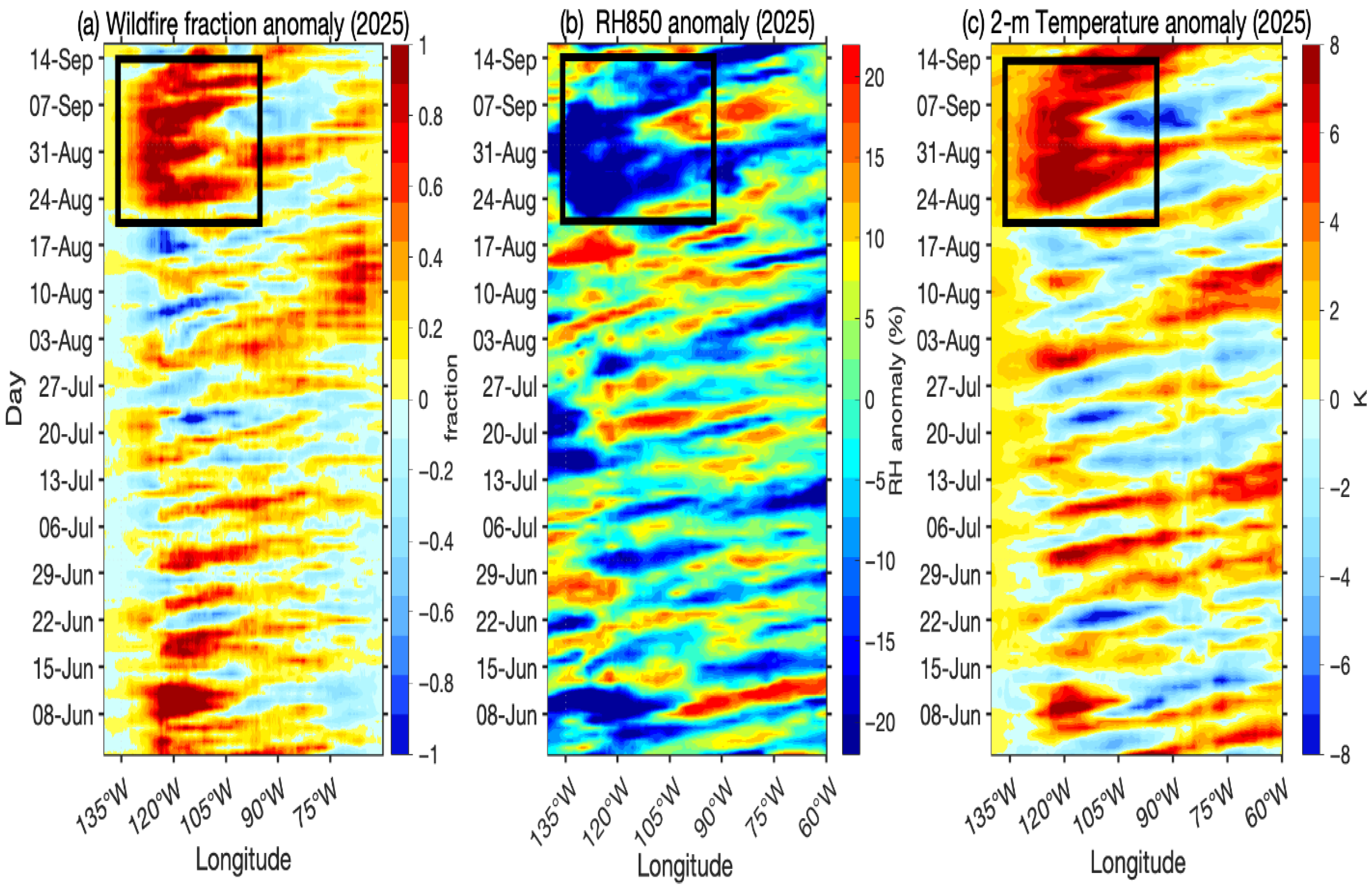
A longitude–time (Hovmöller) plot of wildfire fraction (dimensionless) anomalies for 2025 are shown relative to a 2003–2023 daily climatology (Figure 1a). Wildfire activity is quantified using wildfire fraction, a dimensionless diagnostic derived from assimilated MODIS fire radiative power that reflects the spatial prevalence of active fires rather than cumulative burned area. Although burned area integrates the total surface affected by fire, and is often dominated by a small number of extreme events, wildfire fraction provides a complementary metric suited for diagnosing large-scale fire–atmosphere linkages, particularly when aggregated over broad regions and multiple days. Each panel in Figure 1 shows daily anomalies averaged over 45–60° N. Individual wildfire events (red) were present east of the Canadian west-coastal mountain range (<125° W) during 2025 almost every week from June through early August, with a major event in late August–September. From 18 August to 18 September 2025 there was an intensification of wildfire activity; we use this window for spatial averaging (box). Such wildfire events were associated with drivers of 850 hPa relative humidity deficits (RH850, Figure 1b) and surface air temperature positive anomalies (T2, Figure 1c).
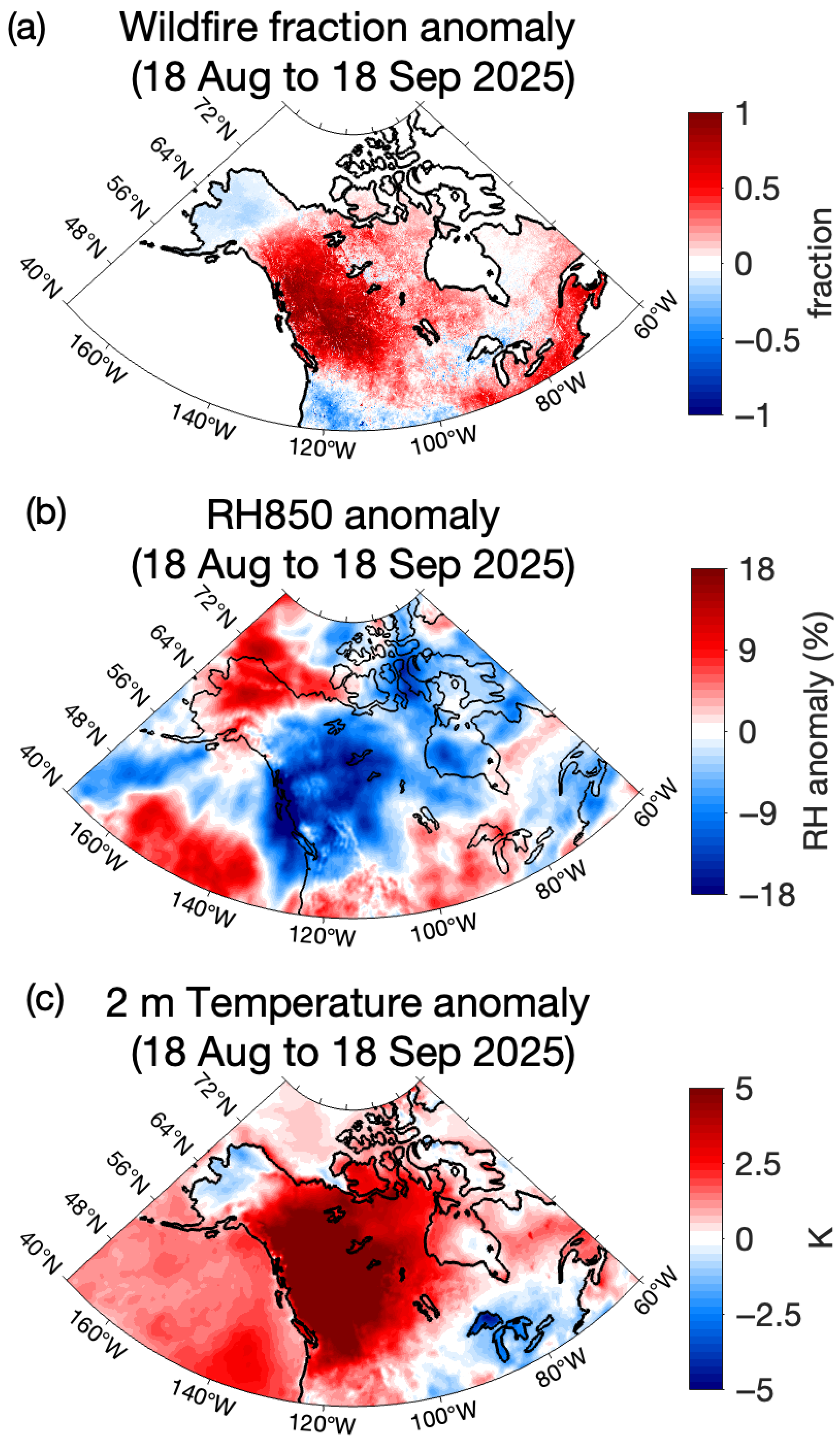
Spatial maps over 18 August–18 September 2025 for wildfire fraction and mean anomalies of RH850 and T2m are shown in Figure 2a–c. Wildfires cover all of western Canada from the Alaskan border south to include the northern US central plains. Fires are contiguous with the region of positive surface temperature anomalies and 850 hPa relative humidity deficits for late August–September. The north–south spatial coverage of wildfires in Figure 2a supports the choice of latitude averaging used for Figure 1.
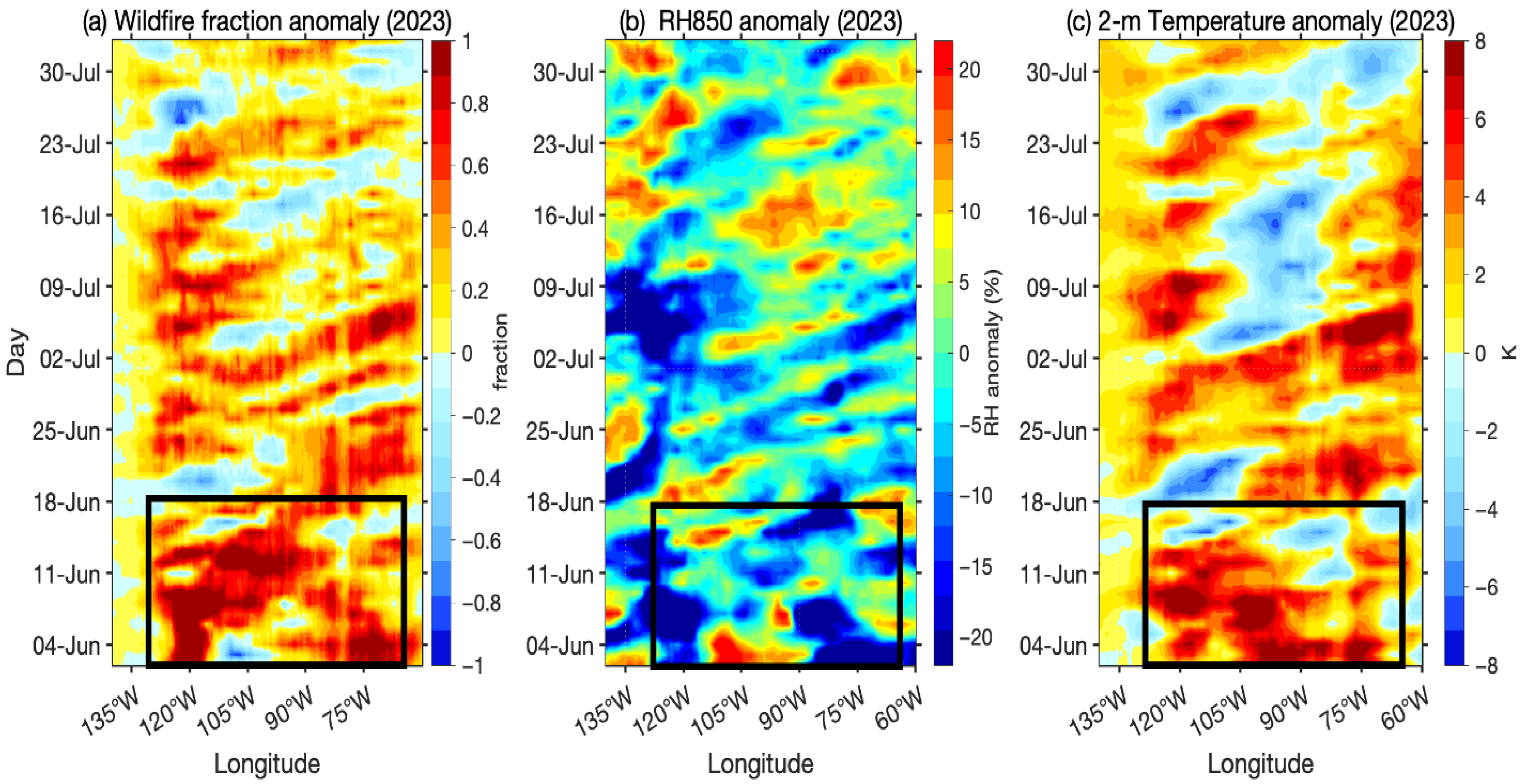
The 2023 events temporally contrast to those of 2025 (Figure 3a–c). The four individual 2023 wildfire events (Figure 3a) are of a longer duration than those of 2025, with the major 2023 events occurring in the early summer of June and July. The largest 2023 event was during June, associated with a persistence in relative humidity deficit (Figure 3b) and surface air temperature anomalies (Figure 3c). Thus, 2023 wildfire activity peaks earlier from early June into mid-summer, and individual events have a longer duration than during 2025. The persistence of wildfire events associated with a dry 2023 summer was partly driven by preconditioning: large decreases in precipitation, snowfall, and soil moisture across western Canada during the winter and spring [11]. Such preconditioning led to widespread and severe 2023 early-summer wildfires. In contrast, 2025 wildfires peaked in late summer in response to the in situ seasonal summer temperature maxima (Figure 1c).

3.2. Linking Canadian Wildfires of 2023 and 2025 Summers to Atmospheric North Pacific Zonal Winds and Blocking Events

Although local winds, and especially gusts, impact wildfires, the main environmental factors that impact fire duration and intensity are heat waves and humidity deficits. Jain and Flannigan [13] and Bui et al. [15] note a relationship between the polar jet stream and extreme wildfire events in North America. Persistent positive anomalies in geopotential heights promote wildfires in western North America [16]. We begin by examining the atmospheric conditions favoring the 2023 and 2025 summer wildfires. As noted from Figure 1a and Figure 3a, 2023 was more of an early-summer season event and 2025 was strongest during late summer.
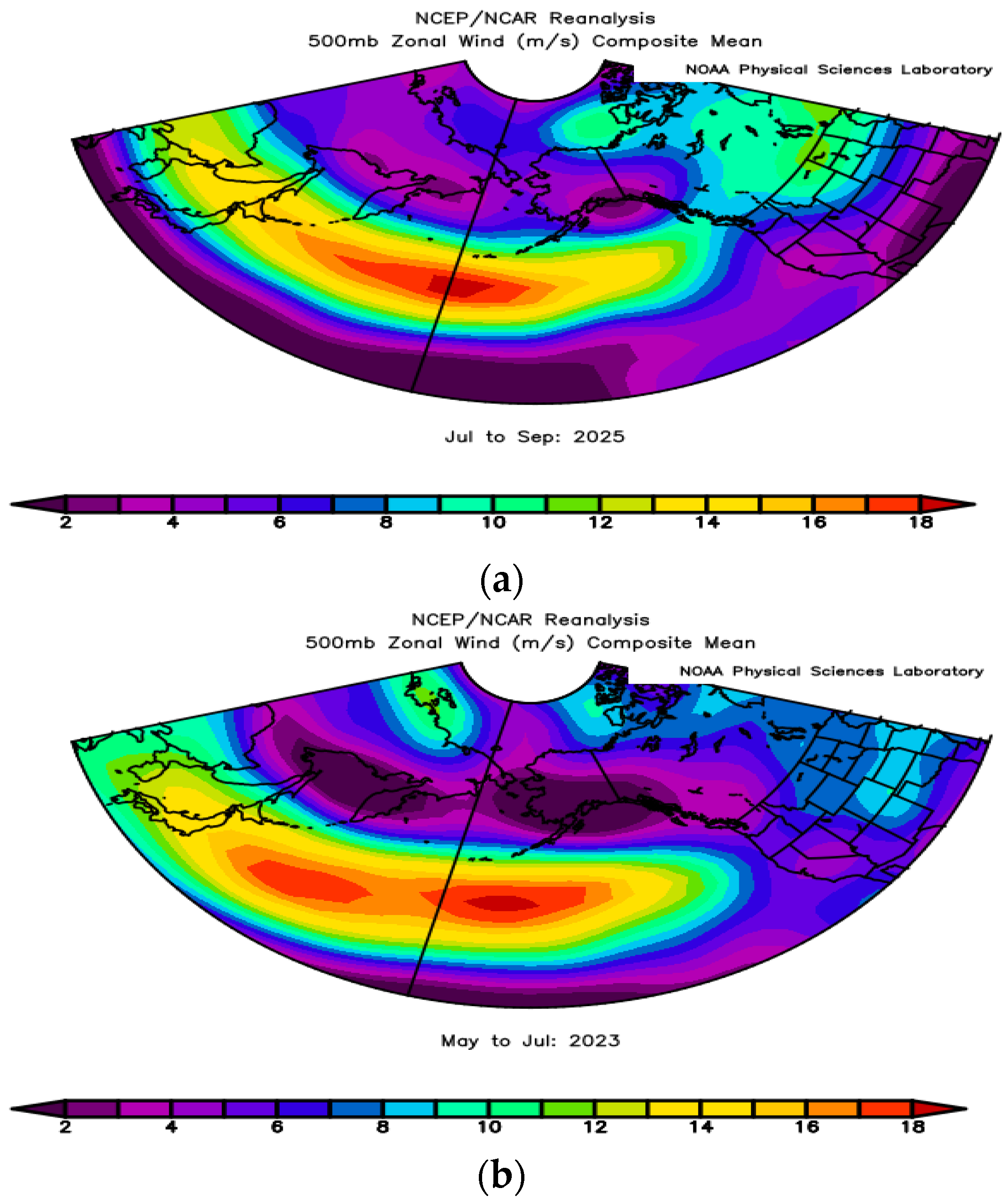
The westerly 500 hPa level zonal winds over the North Pacific mid-high latitudes in the summers of 2023 and 2025 show a similar large-scale pattern with a maximum zonal wind lying south of the Aleutian Islands and minimums over Siberia and Alaska, representing a southern location of the wind jet (Figure 4a,b). Note that Figure 4a for 2025 covers the late-summer period (July–September) and Figure 4b covers an early 2023 summer average (May–July). There are yearly differences. The wind maxima in 2025 extend into British Columbia (Figure 4a), suggesting an active storm track over southern British Columbia, verified by the oscillating time history of wildfires in Figure 1a. In 2023 there was an extensive region of low zonal winds extending from Siberia, across Alaska, and into North America, leading to a nearly continuous atmospheric blocking structure over western Canada (Figure 4b). Luo et al. [11] argue that western Canadian weather in early summer 2023 was influence by hemispheric, atmospheric wave structure and warm ocean temperatures in the central North Pacific Ocean.
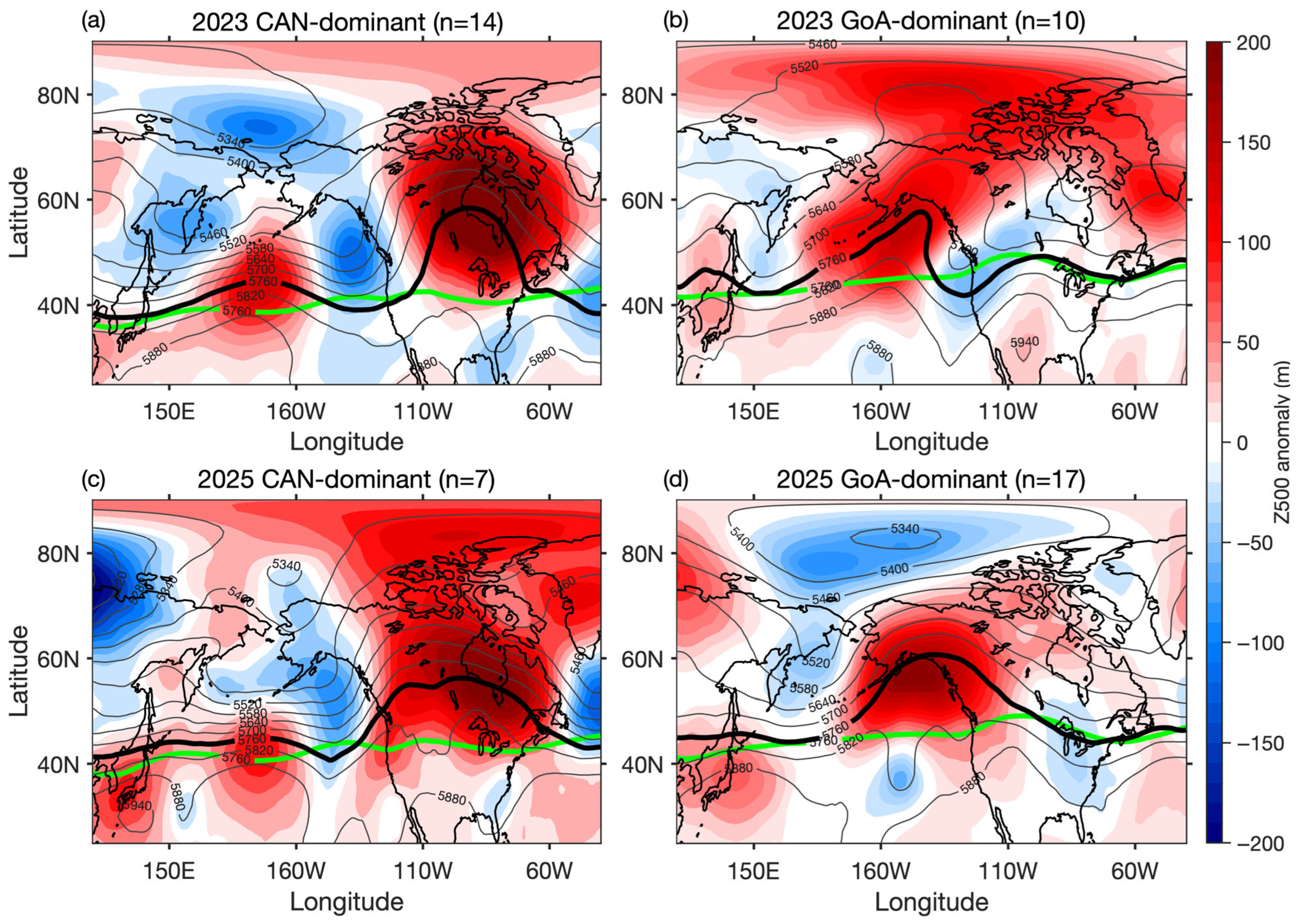
In contrast, 2025 shows a regional blocking structure located in the Gulf of Alaska, upstream of the affected wildfire region. The late August–September event in 2025 resembles the prolonged events during 2023. August 2025 had a strong dome of a high-pressure anomaly over western Canada and a low-pressure anomaly in the region offshore in the southern Gulf of Alaska, giving a dipole atmospheric blocking structure. Warm temperatures (Figure 1c) and subsidence in the high-pressure region increased the duration of the event.
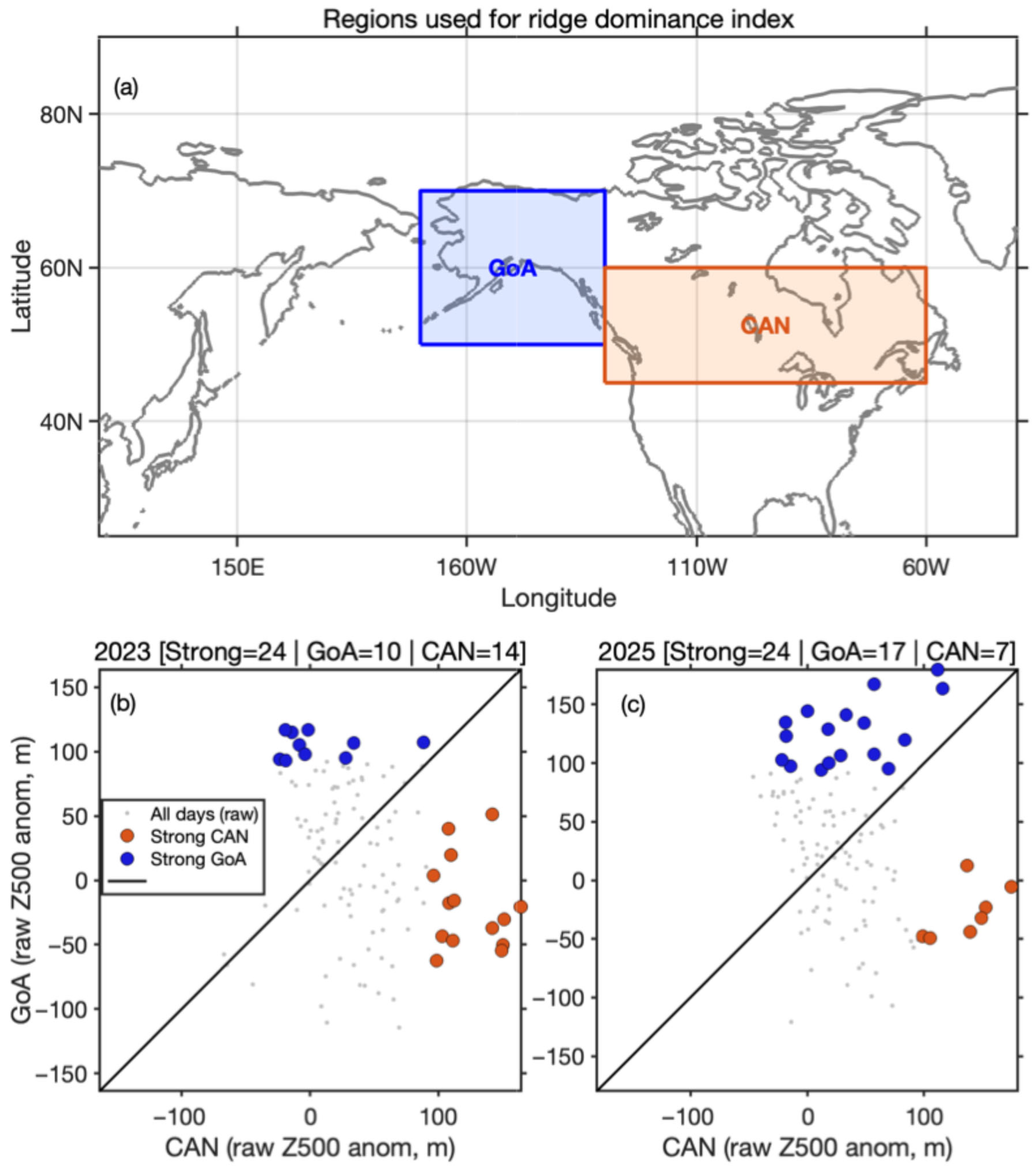
An alternate approach to zonal wind/storm tracks is to directly investigate regional atmospheric ridge dominance regimes (blocking) during the 2023 and 2025 summers. Using ERA5 JJAS 500 hPa geopotential height (Z500) anomalies, one can diagnose dominant ridge configurations over the Gulf of Alaska (GoA) and central North America (CAN) (Figure 5a), based on positive-only ridge strength, with strong days defined as the top 80% of max(GoA+, CAN+) and dominance assigned using a ratio criterion (≥1.1). Data are provided in Table S1 in the Supplementary Materials.
In 2023 strong ridge days are relatively balanced between CAN-dominant (14 days) and GoA-dominant (10 days) events (Figure 6). CAN-dominant days are characterized by large positive CAN anomalies with weak or negative GoA anomalies, indicating in situ ridge amplification over North America. These spatial composites confirm a strong continental ridge centered over CAN with upstream compensation over the North Pacific. GoA-dominant days in 2023 exhibit a broad, high-amplitude ridge over the Gulf of Alaska extending across the North Pacific, consistent with hemispheric-scale long-wave blocking. In contrast, 2025 is strongly skewed toward GoA-dominant conditions, with 17 days versus 7 CAN-dominant days. GoA-dominant events show persistent upstream ridging over the Gulf of Alaska accompanied by downstream troughing with a weak continental ridge expression. CAN-dominant days in 2025 are fewer, weaker, and temporally confined to late September, suggesting a downstream response rather than primary in situ blocking over western Canada as in 2023.
The dates of strong ridge-dominant events reveal additional contrasts in temporal organization. There is temporal clustering of dominant events (Figure 5b,c). In 2023 CAN-dominant days occur in two distinct clusters—early June (1–6 June) and late September (22–28 September)—indicating persistent in situ blocking over North America. GoA-dominant days in 2023 are concentrated in mid-summer (late June to late July), consistent with hemispheric-scale North Pacific blocking episodes. In 2025 GoA-dominant days are frequent and extend from early summer (June) through late August and early September. They form a sequence of upstream blocking events. CAN-dominant days in 2025 are confined to a short late-September window, suggesting that continental ridging primarily followed sustained upstream forcing, rather than developing independently.

3.3. Historical Western Canadian and Siberian Wildfire and Temperature Records

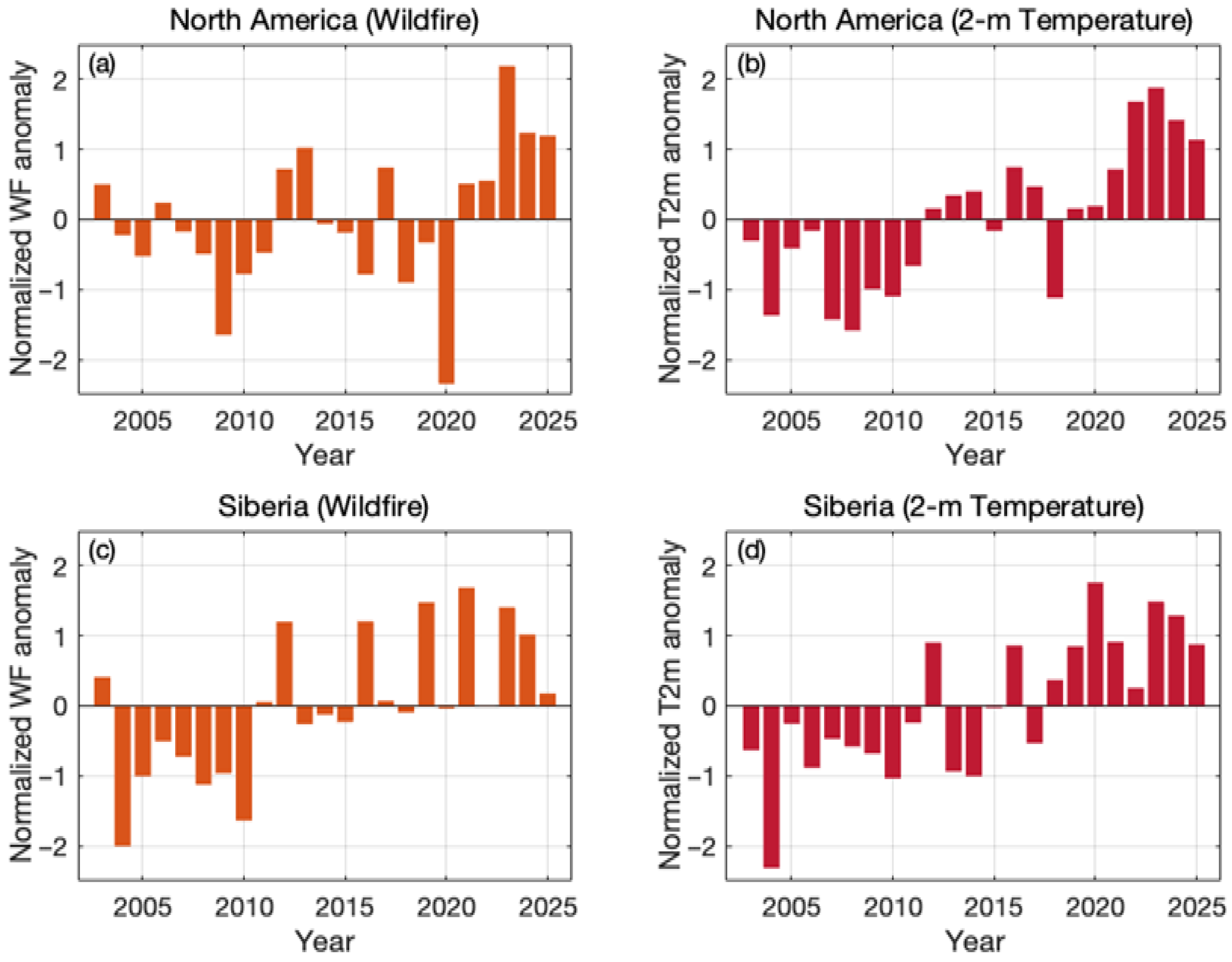
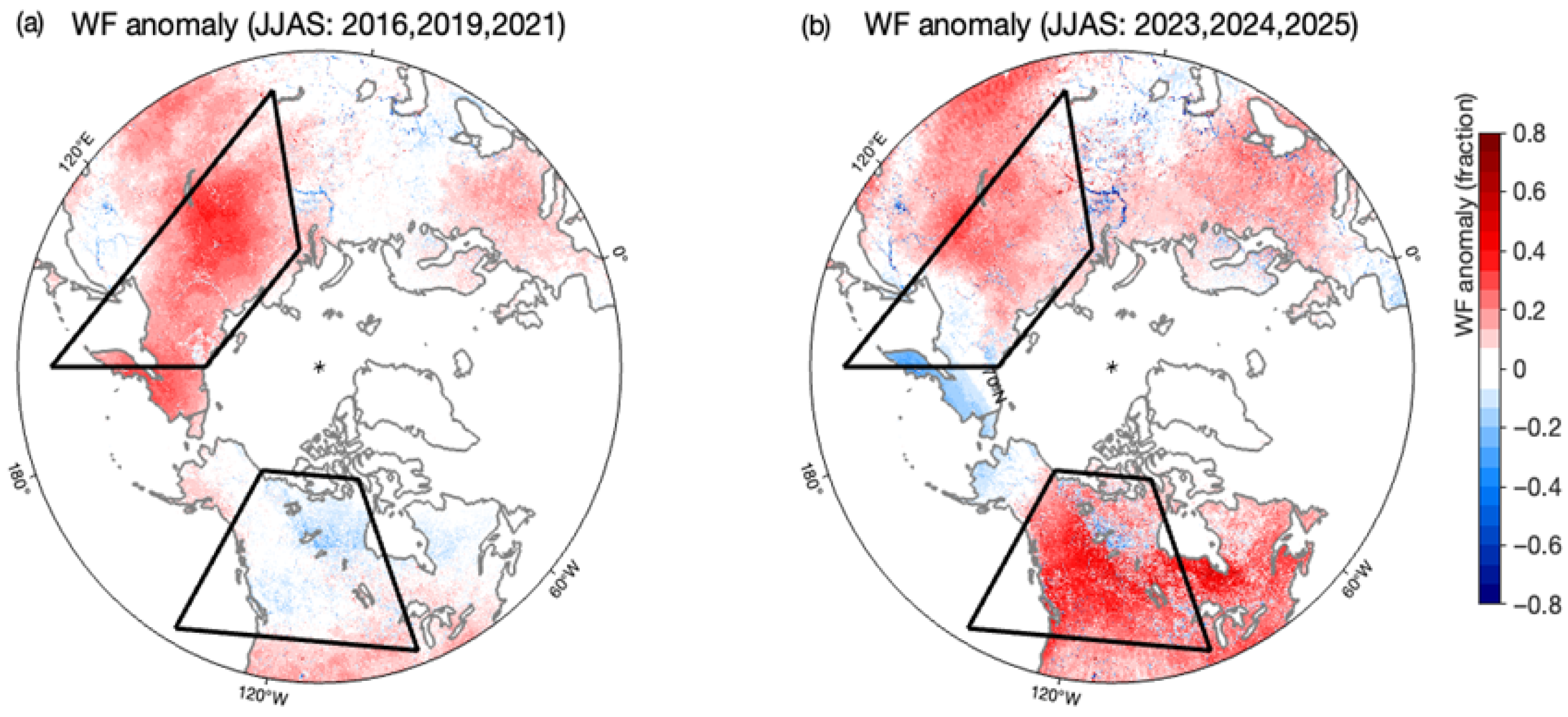
Time series of wildfire occurrence anomalies for western Canada and eastern Siberia are shown in Figure 7a,c. Location domains for Canada and Siberia are shown by the outlines in Figure 8. Wildfire activity is quantified using wildfire fraction. Wildfire fraction provides a metric suited for diagnosing large-scale fire distributions when investigated over broad regions and multiple weeks.
The historical time series of western Canadian wildfires and surface temperatures are shown in Figure 7a,b. These time series have a correlation of (R = 0.76); the increase in wildfire activity closely parallels temperature anomalies, especially after 2020. Such results support that increased regional warming is contributing to heightened wildfire risk, especially through the drying of fuels, earlier snowmelt, and persistent high-pressure ridging [15].
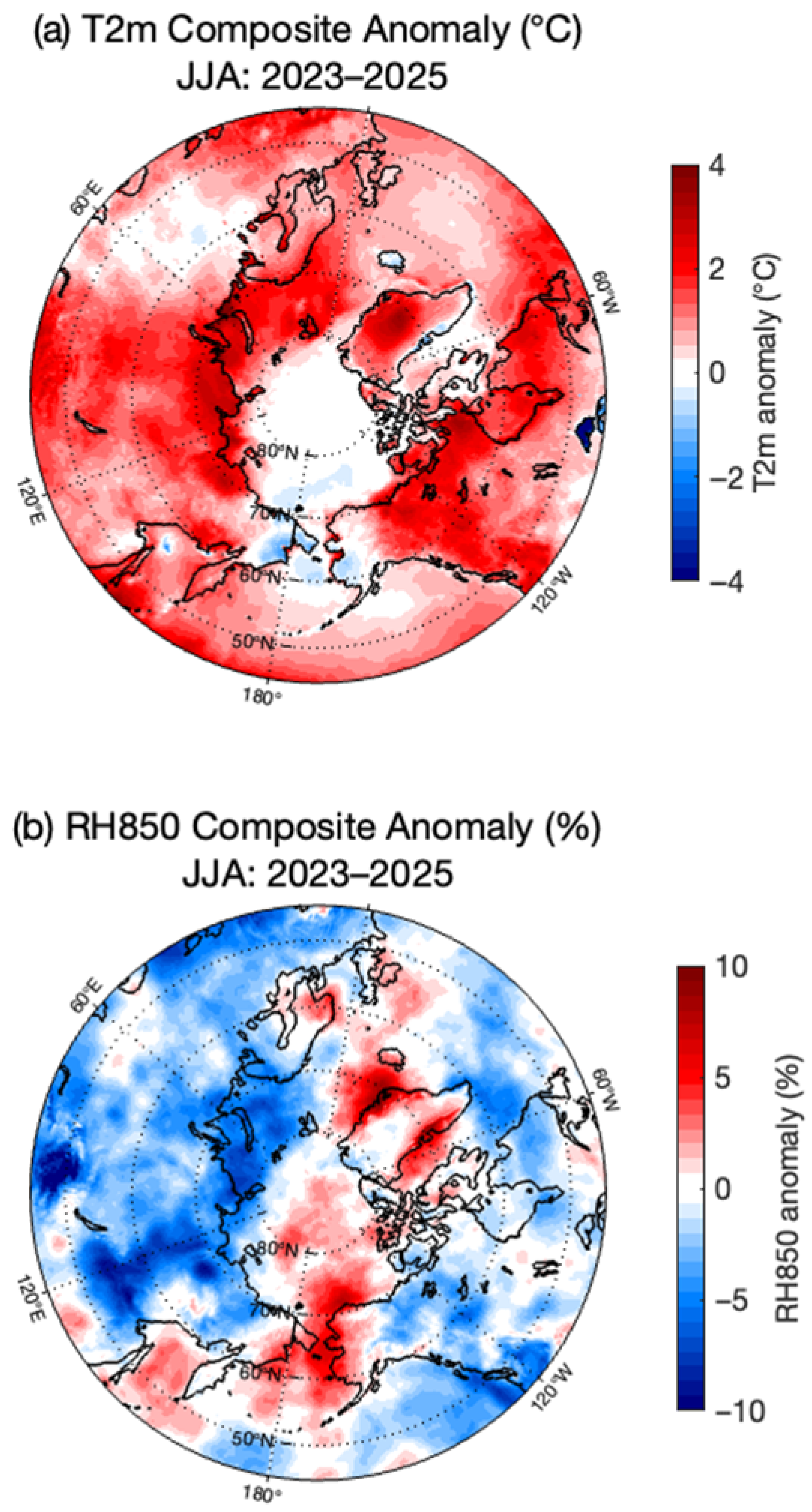
Such wildfire events were associated with drivers of surface air temperature positive anomalies (Figure 7b,d). We note the strong positive shift for Canada starting in 2022. Temperature anomalies for Siberia are mostly negative prior to 2018. As surface air temperature is a leading indicator of wildfire potential, the strong and spatially coherent association between wildfire activity and positive temperature anomalies emerges most clearly in recent periods. This is shown by the spatial distribution of summer wildfire occurrence. Siberian wildfire years, 2016, 2019 and 2021 (Figure 8a), occur before the Canadian wildfire years of 2023, 2024, and 2025 (Figure 8b). Summer spatial plots of surface air temperature anomalies (Figure 9a) for 2023–2025 show positive values over both central Siberia and western Canada. The 850 hPa relative humidity anomaly deficits for summer 2023–2025 extend over all of Eurasia and western Canada from the US border to the Arctic coast (RH850, Figure 9b). Thus, given wildfire events in recent years in both Canada and Siberia, and its co-occurring forcing from summer surface air temperature and relative humidity deficits, we conclude that wildfires represent a major new occurrence representing Arctic extremes. We note that ignition sources, land management, people starting fires, and fuel availability also contribute to wildfire behavior; however, the large-scale coherence of fires and temperature and humidity anomalies highlights the new dominant weather contributions to recent extreme seasons.

4. Discussion and Conclusions

Wildfires pose severe threats to society, the economy, energy sectors, human health, ecosystems and biodiversity. Their impacts include extensive local damage and far-field air pollution, among other environmental and societal consequences. As shown in the text, wildfires during the previous three years represent a new Arctic and subarctic hazard. One can make an argument that along with major storms, wildfires represent one of the major extreme events, based on the displacement of residents and the large spatial extent of hazardous air pollution. Warm-season wildfires over large areas are driven by a complex interplay of weather and climate, influenced by natural variability, human factors, and anthropogenic climate change.
Many Arctic/subarctic extreme events have occurred during the past decade [2,17]. These extremes represent events that surpass previous records. They span multiple indicators, including the loss of sea ice and glacier mass loss, storms, heatwaves, and ecosystem reorganizations such as changes in food webs and poleward species migrations. Canadian wildfires show extremes for three previous years (2023–2025). Siberia shows episodic extreme wildfires occurring during the preceding decade and a half. The environmental forcing drivers of wildfires, namely positive summer temperature anomalies and relative humidity deficits, show strong signals during the last three years (2023–2025) over most of Siberia and western Canada, suggesting that wildfires are a reoccurring future feature. Human influences also contribute to wildfires.
Canada experienced its worst wildfires on record during the summers of 2023 and 2025, marked by large burned areas, impact on residents, and extensive hemispheric smoke pollution. We examined 2025 in detail and compared it with the previous literature on the summer of 2023. The year 2023 was characterized by an early-summer, widespread and long-lasting heat dome and winter and spring preconditioning from snowmelt and a lack of precipitation. The year 2025 had a sequence of atmospheric events. Both years were characterized by warm air temperatures, low humidity, and atmospheric blocking events over western North America and the eastern North Pacific Ocean. The coastal mountains of western Canada contributed to maintaining a dipole atmospheric blocking structure upstream of the affected wildfire areas [15,16]. Our study extends earlier work on the 2023 Canadian wildfires to include a comparison and differences with 2025. Major differences were seasonality and different upstream atmospheric structures over the North Pacific Ocean. Canadian wildfires, and those in Siberia, represent the major new extreme impacts of Arctic/subarctic change.
While climate warming contributes to the long-term increase in summer temperatures and wildfire activity in boreal regions [3,5,6,17], the occurrence, persistence, and extent of wildfires also depend on weather patterns associated with natural variability in atmospheric circulation and human contributions. Wildfires in western North America and Siberia respond to interacting factors across multiple spatial and temporal scales. Recent wildfires represent new, clear, record-breaking fire intensities, highlighting wildfires as an emerging dominant Arctic–subarctic extreme. Impacts from wildfires show preeminent, growing societal consequences.

Supplementary Materials

The following supporting information can be downloaded at: https://www.mdpi.com/article/10.3390/cli14030065/s1, Table S1: Strong Ridge-Dominant Days (JJAS).

Author Contributions

Conceptualization, J.E.O.; Methodology, J.E.O. and V.C.; Software, V.C.; Validation, V.C.; Formal analysis, J.E.O.; Investigation, J.E.O. and M.W.; Resources, J.E.O., Data curation, V.C.; Writing—original draft, J.E.O.; Writing—review & editing, J.E.O., V.C., M.W.; Funding acquisition, J.E.O. All authors have read and agreed to the published version of the manuscript.

Funding

This research was supported by NOAA/GOMO Arctic Research Program.

Data Availability Statement

This study uses the Global Fire Assimilation System (GFAS v1.2) wildfire fraction dataset [10] and key meteorological variables from the ERA5 [11]. Data are accessible through the Copernicus Browser: https://browser.dataspace.copernicus.eu/ (accessed on 14 November 2025).

Acknowledgments

This article is PMEL contribution number 5840. This publication is partially funded by the Cooperative Institute for Climate, Ocean, & Ecosystem Studies (CICOES) under NOAA Cooperative Agreement NA20OAR4320271, Contribution No. 2026-1521.

Conflicts of Interest

The authors declare no conflicts of interest.

Abbreviations

The following abbreviations are used in this manuscript:
ERA5European Centre for Medium-range Weather Forecasts reanalysis, fifth generation
GFASGlobal Fire Assimilation System
JJAJune, July, August
JJASJune, July, August, September
LEOLocal Environmental Observer
MODISModerate Resolution Imaging Spectroradiometer
PDOPacific Decadal Oscillation
RHA850850 hPa relative humidity anomalies
T2mTemperature anomalies at 2 m above surface

References

  1. Overland, J.E.; Benestad, R.E.; Box, J.E.; Walsh, J. Arctic climate extremes. In AMAP Arctic Climate Change Update 2024: Key Trends and Impacts; Arctic Monitoring and Assessment Programme (AMAP): Tromsø, Norway, 2024; pp. 13–21. [Google Scholar] [CrossRef]
  2. Zhang, X.; Vihma, T.; Rinke, A.; Moore, G.W.K.; Tang, H.; Äijälä, C.; DuVivier, A.; Huang, J.; Landrum, L.; Li, C.; et al. Weather and climate extremes in a changing Arctic. Nat. Rev. Earth Environ. 2025, 6, 691–711. [Google Scholar] [CrossRef]
  3. LEO (Local Environmental Observer Network). Available online: https://leonetwork.org (accessed on 22 December 2025).
  4. Benestad, R.; Thoman, R.L.; Cohen, J.; Overland, J.; Hanna, E.; Moore, G.W.K.; Rantanen, M.; Petersen, G.N.; Webster, M. Extreme weather and climate events in 2022. In State of the Climate in 2022; Bulletin of the American Meteorological Society; American Meteorological Society: Boston, MA, USA, 2023; Volume 104, pp. S285–S287. [Google Scholar]
  5. Chen, Z.; Lu, J.; Chang, C.C.; Lubis, S.W.; Leung, R. Projected increase in summer heat-dome-like stationary waves over Northwestern North America. npj Clim. Atmos. Sci. 2023, 6, 194. [Google Scholar] [CrossRef]
  6. Hu, Y.; Yu, X.; Tian, C. Climatic drivers of the Canadian wildfire episode in 2023. Atmos. Ocean. Sci. Lett. 2024, 17, 100483. [Google Scholar] [CrossRef]
  7. Jain, P.; Barber, Q.E.; Taylor, S.W.; Whitman, E.; Acuna, D.C.; Boulanger, Y.; Chavardès, R.D.; Chen, J.; Englefield, P.; Flannigan, M.; et al. Drivers and impacts of the record-breaking 2023 wildfire season in Canada. Nat. Commun. 2024, 15, 6764. [Google Scholar] [CrossRef] [PubMed]
  8. Jones, M.W.; Abatzoglou, J.T.; Veraverbeke, S.; Andela, N.; Lasslop, G.; Forkel, M.; Smith, A.J.P.; Burton, C.; Betts, R.A.; van der Werf, G.R.; et al. Global and regional trends and drivers of fire under climate change. Rev. Geophys. 2022, 60, e2020RG000726. [Google Scholar] [CrossRef]
  9. Wang, X.; Oliver, J.; Swystun, T.; Hanes, C.C.; Erni, S.; Flannigan, M.D. Critical fire weather conditions during active fire spread days in Canada. Sci. Total Environ. 2023, 869, 161831. [Google Scholar] [CrossRef] [PubMed]
  10. Kaiser, J.W.; Heil, A.; Andreae, M.O.; Benedetti, A.; Chubarova, N.; Jones, L.; Morcrette, J.-J.; Razinger, M.; Schultz, M.G.; Suttie, M.; et al. Biomass burning emissions estimated with a global fire assimilation system based on observed fire radiative power. Biogeosciences 2012, 9, 527–554. [Google Scholar] [CrossRef]
  11. Hersbach, H.; Bell, B.; Berrisford, P.; Hirahara, S.; Horányi, A.; Muñoz-Sabater, J.; Nicolas, J.; Peubey, C.; Radu, R.; Schepers, D.; et al. The ERA5 global reanalysis. Q. J. R. Meteorol. Soc. 2020, 146, 1999–2049. [Google Scholar] [CrossRef]
  12. Luo, B.; Xiao, D.; Fu, Q.; Chen, D.; Zhang, Q.; Ge, Y.; Diao, Y. Atmospheric and oceanic drivers behind the 2023 Canadian wildfires. Commun. Earth Environ. 2025, 6, 446. [Google Scholar] [CrossRef]
  13. Lemur, S. News Release: Government of Canada Provides Update on 2025 Wildfires as Support Continues. Available online: https://www.canada.ca/en/public-safety-canada/news/2025/10/government-of-canada-provides-update-on-2025-wildfires-as-support-continues.html (accessed on 14 November 2025).
  14. Jain, P.; Flannigan, M. The relationship between the polar jet stream and extreme wildfire events in North America. J. Clim. 2021, 34, 6247–6265. [Google Scholar] [CrossRef]
  15. Liu, P.; Reed, K.A.; Zhao, M.; Garner, S.T.; Lau, N.-C.; Silvers, L.G.; Colle, B.A. Record-breaking persistent high-pressure systems fueled unprecedented Canadian wildfire disasters in 2023. Environ. Res. Commun. 2025, 7, 041005. [Google Scholar] [CrossRef]
  16. Bui, H.X.; Timmermann, A.; Lee, J.; Maloney, E.D.; Li, Y.; Kim, J.; Shuman, J.; Lee, S.; Wieder, W.R. Summer midlatitude stationary wave patterns synchronize Northern Hemisphere wildfire occurrence. Geophys. Res. Lett. 2022, 49, e2022GL099017. [Google Scholar] [CrossRef]
  17. Hanes, C.C.; Wang, X.; Jain, P.; Parisien, M.-A.; Little, J.M.; Flannigan, M.D. Fire-regime changes in Canada over the last half century. Can. J. For. Res. 2019, 49, 256–269. [Google Scholar] [CrossRef]
Figure 1. Longitude–time Hovmöller diagrams of (a) 2025 wildfire fraction anomaly relative to 2003–2023 period mean, (b) 850 hPa relative humidity anomaly, and (c) 2 m air temperature anomaly during 1 June–18 September 2025. Each panel shows daily anomalies averaged over 45–60° N. The black box marks an active fire period and its associated meteorological conditions.
Climate 14 00065 g001
Figure 2. Spatial patterns of (a) 2025 wildfire fraction anomaly, (b) 850 hPa relative humidity anomaly, and (c) 2 m temperature anomaly averaged over 18 August–18 September 2025.
Climate 14 00065 g002
Figure 3. Longitude–time Hovmöller diagrams of (a) 2023 wildfire fraction anomaly, (b) 850 hPa relative humidity anomaly, and (c) 2 m air temperature anomaly during 1 June–5 August 2023, averaged over 45–60° N. The early-season 2023 fire peak (highlighted box) corresponds to a strong combination of widespread dryness (negative RH anomalies) and unusually warm conditions (positive T2m anomalies). This reflects the well-documented extreme fire environment of summer 2023 in Canada.
Climate 14 00065 g003
Figure 4. (a). U500, the zonal wind component, over the North Pacific averaged for July through September 2025. (b) Similar to (a) but for the average for May through July 2023. Units are m/s.
Climate 14 00065 g004
Figure 5. (a) Regions used to define ridge dominance indices over the Gulf of Alaska (GoA) and central North America (CAN). (b,c) Scatter plots of raw daily Z500 anomalies averaged over the GoA and CAN regions for 2023 and 2025 JJAS seasons. Gray dots show all days, while colored markers denote strong ridge days (top 80%) classified as CAN-dominant (orange) or GoA-dominant (blue).
Climate 14 00065 g005
Figure 6. Composite 500 hPa geopotential height anomalies (shading; m) and absolute 500 hPa geopotential height contours (black) for central North America (CAN)-dominant and Gulf of Alaska (GoA)-dominant ridge events during JJAS 2023 and 2025. Panels show (a) 2023 CAN-dominant, (b) 2023 GoA-dominant, (c) 2025 CAN-dominant, and (d) 2025 GoA-dominant composites; sample sizes (n) are indicated in each panel title. Black contours denote absolute Z500 heights averaged over the strong ridge days in each panel, with identical contour intervals across all panels. The green curve represents the day-matched climatological Z500 field, computed as the 1981–2010 daily climatology averaged over the same strong-day dates, providing a baseline reference for the composite ridge structure.
Climate 14 00065 g006
Figure 7. (a) Time series of summer (JJAS) wildfire fraction anomalies averaged over Canada (outlined in Figure 8b) for 2003–2025. (b) Corresponding JJAS surface air temperature (T2m) anomalies for western Canada. (c) Same as (a), but for Siberia (outlined in Figure 8a). (d) Same as (b), but for Siberia. Wildfire fraction anomalies are calculated relative to the 2003–2023 climatology; temperature anomalies are relative to a 1981–2010 climatology.
Climate 14 00065 g007
Figure 8. (a) Spatial distribution of composite summer wildfire fraction anomalies for selected Siberian wildfire years (2016, 2019, 2021). (b) Spatial distribution of composite summer wildfire fraction anomalies for recent Canadian wildfire years (2023–2025). Outlined regions indicate the domains used for regional averaging in Figure 2. Wildfire fraction represents the spatial prevalence of active fires rather than cumulative burned area.
Climate 14 00065 g008
Figure 9. (a) Summer (JJA) surface air temperature anomalies (T2m) averaged over 2023–2025, relative to the 1991–2020 climatology. (b) Summer (JJA) 850 hPa relative humidity anomalies (RHA850) for 2023–2025, relative to the 1991–2020 climatology.
Climate 14 00065 g009
Disclaimer/Publisher’s Note: The statements, opinions and data contained in all publications are solely those of the individual author(s) and contributor(s) and not of MDPI and/or the editor(s). MDPI and/or the editor(s) disclaim responsibility for any injury to people or property resulting from any ideas, methods, instructions or products referred to in the content.