
Estimated Impacts of Future Environmental Conditions on Water Quality in the Chesapeake Bay Beyond Midcentury


Abstract
1. Introduction
2. Materials and Methods
3. Results
3.1. Watershed Impacts from Future Environmental Conditions Beyond Midcentury
3.2. Tidal Bay Impacts from Future Environmental Conditions Beyond Midcentury
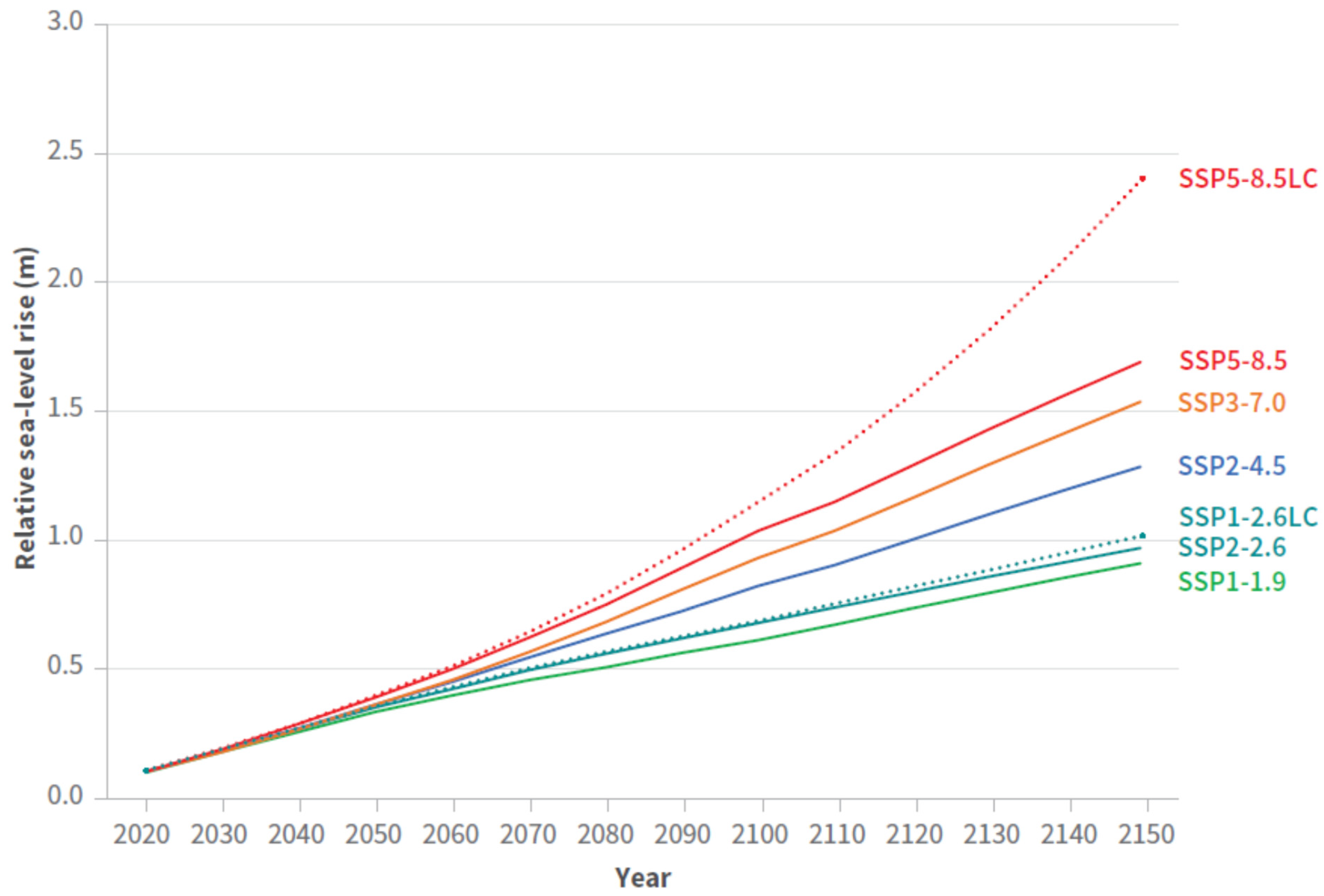
3.3. Overall Influence of Increased Temperature, Flow, Watershed Loads, and Sea Level on Hypoxia
4. Discussion
Long Tails and Uncertainties in the Chesapeake Climate Future
Author Contributions
Funding
Data Availability Statement
Acknowledgments
Conflicts of Interest
Abbreviations
| U.S. | United States |
| EPA | Environmental Protection Agency |
| UM | University of Maryland |
| CMIP5 | Coupled Model Intercomparison Project Phase 5 |
| CMIP6 | Coupled Model Intercomparison Project Phase 6 |
| RCP | Representative Concentration Pathway |
| TMDL | Total Maximum Daily Load |
| CBP | Chesapeake Bay Program |
| CBPO | Chesapeake Bay Program Office |
| JAWRA | Journal of American Water Resources Association |
| DO | Dissolved Oxygen |
| CMAQ | Community Multiscale Air Quality Model |
| CBLCM | Chesapeake Bay Land Change Model |
| WQSTM | Water Quality Sediment Transport Model |
| IPCC | Intergovernmental Panel on Climate Change |
| BCSD | Bias-Correction Spatial Disaggregation |
| GCM | General Circulation Model |
| PT-LOE | Planning Target Level of Effort |
| PRC | Precipitation |
| TAS | Surface Air Temperature |
| TN | Total Nitrogen |
| TP | Total Phosphorus |
| SS | Suspended Sediment |
| PSU | Practical Salinity Unit |
| C | Celsius |
| CH3D-ICM | Chesapeake Bay Estuarine Model (CH3D hydrodynamic and ICM water quality code) |
| GHG | Greenhouse Gas |
| MACA | Multivariate Adaptive Constructed Analogs |
| WIP | Watershed Implementation Plan |
| WIP3 | Phase 3 Watershed Implementation Plan |
| IEA | International Energy Agency |
| SSP | Shared Socioeconomic Pathway |
| CO2 | Carbon Dioxide |
| SLR | Sea Level Rise |
Appendix A


References
- Boynton, W.R.; Garber, J.H.; Summers, R.; Kemp, W.M. Inputs, Transformations, and Transport of Nitrogen and Phosphorus in Chesapeake Bay and Selected Tributaries. Estuaries 1995, 18, 285–314. [Google Scholar] [CrossRef]
- Boynton, W.R.; Kemp, W.M. Estuaries. In Nitrogen in the Marine Environment, 2nd ed.; Capone, D.G., Bronk, D.A., Mulholland, M.R., Carpenter, E.J., Eds.; Elsevier Inc.: Burlington, MA, USA, 2008; pp. 809–866. [Google Scholar]
- USEPA (U.S. Environmental Protection Agency). Chesapeake Bay Total Maximum Daily Load for Nitrogen, Phosphorus and Sediment; U.S. Environmental Protection Agency Chesapeake Bay Program Office: Annapolis, MD, USA, 2010. Available online: https://www.epa.gov/chesapeake-bay-tmdl/chesapeake-bay-tmdl-document (accessed on 12 March 2022).
- Linker, L.C.; Batiuk, R.A.; Shenk, G.W.; Cerco, C.F. Development of the Chesapeake Bay Watershed Total Maximum Daily Load Allocation. J. Am. Water Resour. Assoc. 2013, 49, 986–1006. [Google Scholar] [CrossRef]
- Batiuk, R.A.; Linker, L.C.; Cerco, C.F. Featured Collection: Chesapeake Bay Total Maximum Daily Load Development and Application. J. Am. Water Resour. Assoc. 2013, 49, 981–1224. [Google Scholar] [CrossRef]
- Pyke, C.R.; Najjar, R.G.; Adams, M.B.; Breitburg, D.; Kemp, M.; Hershner, C.; Howarth, R.; Mulholland, M.; Paolisso, M.; Secor, D.; et al. Climate Change and the Chesapeake Bay: State-of-the-Science Review and Recommendations; Chesapeake Bay Program Science and Technical Advisory Committee: Annapolis, MD, USA, 2008; Available online: http://www.chesapeake.org/pubs/Pubs/climchangereport.pdf (accessed on 15 April 2019).
- Najjar, R.; Pyke, C.; Adams, M.; Breitburg, D.; Hershner, C.; Kemp, M.; Howarth, R.; Mulholland, M.; Mulholland, M.; Secor, D.; et al. Potential climate-change impacts on the Chesapeake Bay. Estuar. Coast. Shelf Sci. 2010, 86, 1–20. [Google Scholar]
- Melillo, J.M.; Richmond, T.T.; Yohe, G. (Eds.) Climate Change Impacts in the United States: The Third National Climate Assessment; U.S. Global Change Research Program: Washington, DC, USA, 2014; 841p. Available online: https://www.nrc.gov/docs/ML1412/ML14129A233.pdf (accessed on 2 March 2026). [CrossRef]
- Romero-Lankao, P.; Smith, J.B.; Davidson, D.J.; Diffenbaugh, N.S.; Kinney, P.L.; Kirshen, P.; Kovacs, P.; Ruiz, L.V. North America. In Climate Change 2014: Impacts, Adaptation, and Vulnerability: Part B: Regional Aspects; Barros, V.R., Field, C.B., Dokken, D.J., Mastrandrea, M.D., Mach, K.J., Bilir, T.E., Chatterjee, M., Ebi, K.L., Estrada, Y.O., Genova, R.C., et al., Eds.; Contribution of Working Group II to the Fifth Assessment Report of the Intergovernmental Panel on Climate Change; Cambridge University Press: Cambridge, UK; New York, NY, USA, 2014; pp. 1439–1498. Available online: https://www.ipcc.ch/site/assets/uploads/2018/02/WGIIAR5-Chap26_FINAL.pdf (accessed on 20 December 2021).
- Bhatt, G.; Linker, L.C.; Shenk, G.W.; Bertani, I.; Tian, R.; Rigelman, J.; Hinson, K.; Claggett, P. Water Quality Impacts of Climate Change, Land Use, and Population Growth in the Chesapeake Bay Watershed. J. Am. Water Resour. Assoc. 2023, 59, 1313–1341. [Google Scholar]
- Cornwell, J.C.; Owens, M.S.; Staver, L.W. Nutrient Retention and Release in Eroding Chesapeake Bay Tidal Wetlands. J. Am. Water Resour. Assoc. 2022, 58, 940–957. [Google Scholar] [CrossRef]
- Cerco, C.F.; Tian, R. Impact of wetlands loss and migration, induced by climate change, on Chesapeake Bay DO standards. J. Am. Water Resour. Assoc. 2022, 58, 958–970. [Google Scholar] [CrossRef]
- Irby, I.D.; Friedrichs, M.A.M.; Da, F.; Hinson, K.E. The Competing Impacts of Climate Change and Nutrient Reductions on Dissolved Oxygen in Chesapeake Bay. Biogeosciences 2018, 15, 2649–2668. [Google Scholar] [CrossRef]
- St-Laurent, P.; Friedrichs, M.A.M.; Li, M.; Ni, W. Impacts of Sea Level Rise on Hypoxia in Chesapeake Bay: A Model Intercomparison; Report to Virginia Tech and Chesapeake Bay Program; Virginia Institute of Marine Science, William & Mary: Williamsburg, VA, USA, 2019; 34p, Available online: https://scholarworks.wm.edu/reports/2310/ (accessed on 2 March 2026). [CrossRef]
- Tian, R.; Cerco, C.F.; Bhatt, G.; Linker, L.C.; Shenk, G.W. Mechanisms controlling climate warming impact on the occurrence of hypoxia in Chesapeake Bay. J. Am. Water Resour. Assoc. 2022, 58, 855–875. [Google Scholar] [CrossRef]
- Cai, X.; Shen, J.; Zhang, Y.J.; Qin, Q.; Wang, Z.; Wang, H. Impacts of Sea-Level Rise on Hypoxia and Phytoplankton Production in Chesapeake Bay: Model Prediction and Assessment. J. Am. Water Resour. Assoc. 2021, 58, 922–939. [Google Scholar] [CrossRef]
- Linker, L.C.; Shenk, G.W.; Bhatt, G.; Tian, R.; Cerco, C.F.; Bertani, I. Simulating climate change in a coastal watershed with an integrated suite of airshed, watershed, and estuary models. J. Am. Water Resour. Assoc. 2023, 60, 499–528. [Google Scholar] [CrossRef]
- Bertani, I.; Bhatt, G.; Shenk, G.W.; Linker, L.C. Quantifying the Response of Nitrogen Speciation to Hydrology in the Chesapeake Bay Watershed Using a Multilevel Modeling Approach. J. Am. Water Resour. Assoc. 2022, 58, 792–804. [Google Scholar] [CrossRef]
- Testa, J.M.; Basenback, N.; Shen, C.; Cole, K.; Moore, A.; Hodgkins, C.; Brady, D.C. Modeling Impacts of Nutrient Loading, Warming, and Boundary Exchanges on Hypoxia and Metabolism in a Shallow Estuarine Ecosystem. J. Am. Water Resour. Assoc. 2021, 58, 876–897. [Google Scholar] [CrossRef]
- Basenback, N.; Testa, J.M.; Shen, C. Interactions of warming and altered nutrient load timing on the phenology of oxygen dynamics in Chesapeake Bay. J. Am. Water Resour. Assoc. 2023, 59, 429–445. [Google Scholar] [CrossRef]
- Karl, T.R.; Knight, R.W. Secular trends of precipitation amount, frequency, and intensity in the United States. Bull. Am. Meteorol. Soc. 1998, 79, 231–242. [Google Scholar] [CrossRef]
- Rice, K.C.; Moyer, D.L.; Mills, A.L. Riverine discharges to Chesapeake Bay: Analysis of long-term (1927–2014) records and implications for future flows in the Chesapeake Bay basin. J. Environ. Manag. 2017, 204, 246–254. [Google Scholar] [CrossRef]
- Shenk, G.; Bennett, M.; Boesch, D.; Currey, L.; Friedrichs, M.; Herrmann, M.; Hood, R.; Johnson, T.; Linker, L.; Miller, A.; et al. Chesapeake Bay Program Climate Change Modeling 2.0 Workshop; STAC Publication Number 21-003; STAC: Edgewater, MD, USA, 2021; 35p, Available online: https://www.chesapeake.org/stac/wp-content/uploads/2021/07/Final_STAC-Report-Climate-Change_7.22.2021.pdf (accessed on 27 January 2025).
- Cerco, C.F.; Linker, L.C.; Bhatt, G.; Shenk, G.W. (Eds.) Influence of Climate Change on Chesapeake Bay Water Quality; Journal of American Water Resources Association (JAWRA) Featured Collection; Wiley: Hoboken, NJ, USA, 2022; Available online: https://onlinelibrary.wiley.com/doi/toc/10.1111/(ISSN)1752-1688.chesapeake-bay (accessed on 27 January 2025).
- Gustafsson, B.G.; Schenk, F.; Blenckner, T.; Eilola, K.; Meier, H.E.; Müller-Karulis, B.; Neumann, T.; Ruoho-Airola, T.; Savchuk, O.P.; Zorita, E. Reconstructing the development of Baltic Sea eutrophication 1850–2006. Ambio 2012, 41, 534–548. [Google Scholar] [CrossRef]
- Conley, D.J.; Björck, S.; Bonsdorff, E.; Carstensen, J.; Destouni, G.; Gustafsson, B.G.; Hietanen, S.; Kortekaas, M.; Kuosa, H.; Meier, H.E.M.; et al. Hypoxia-related processes in the Baltic Sea. Environ. Sci. Technol. 2009, 43, 3412–3420. [Google Scholar] [CrossRef]
- Meier, H.E.M.; Andersson, H.C.; Eilola, K.; Gustafsson, B.G.; Kuznetsov, I.; Müller-Karulis, B.; Neumann, T.; Savchuk, O.P. Hypoxia in future climates: A model ensemble study for the Baltic Sea. Geophys. Res. Lett. 2011, 38, L24608. [Google Scholar] [CrossRef]
- Cerco, C.F.; Kim, S.C.; Noel, M.R. The 2010 Chesapeake Bay Eutrophication Model; A Report to the US Environmental Protection Agency and to the US Army Corps of Engineer Baltimore District; US Army Engineer Research and Development Center: Vicksburg, MS, USA, 2010; Available online: http://www.chesapeakebay.net/publications/title/the_2010_chesapeake_bay_eutrophication_model1 (accessed on 1 April 2022).
- Cerco, C.F.; Noel, M.R. The 2002 Chesapeake Bay Eutrophication Model; EPA 903-R-04-004; U.S. Environmental Protection Agency, Chesapeake Bay Program Office: Annapolis, MD, USA, 2004.
- Cerco, C.F.; Noel, M.R. Chesapeake Bay Water Quality and Sediment Transport Model; Chesapeake Bay Program Office December 2019 Final Report; Chesapeake Bay Program Office: Annapolis, MD, USA, 2019; 580p, Available online: https://www.chesapeakebay.net/channel_files/28679/2017_chesapeake_bay_water_quality_and_sediment_transport_model.pdf (accessed on 1 September 2021).
- Dennis, R.L.; Haeuber, R.; Blett, T.; Cosby, J.; Driscoll, C.; Sickles, J.; Johnston, J. Sulfur and Nitrogen Deposition on Ecosystems in the United States. Environ. Manag. J. 2007, 12–17. [Google Scholar]
- Shenk, G.W.; Linker, L.C. Development and Application of the 2010 Chesapeake Bay Watershed Total Maximum Daily Load Model. J. Am. Water Resour. Assoc. 2013, 49, 1042–1056. [Google Scholar] [CrossRef]
- Hood, R.R.; Shenk, G.W.; Dixon, R.L.; Smith, S.M.; Ball, W.P.; Bash, J.O.; Batiuk, R.; Boomer, K.; Brady, D.C.; Cerco, C.; et al. The Chesapeake Bay Program Modeling System: Overview and Recommendations for Future Development. Ecol. Model. 2021, 456, 109635. [Google Scholar] [CrossRef] [PubMed]
- Bureau of Reclamation. Downscaled CMIP3 and CMIP5 Climate Projections: Release of Downscaled CMIP5 Climate Projections, Comparison with Preceding Information, and Summary of User Needs; iv Downscaled CMIP3 and CMIP5 Climate and Hydrology Projections; U.S. Department of the Interior, Bureau of Reclamation, Technical Service Center: Denver, CO, USA, 2013.
- Maurer, E.P.; Brekke, L.; Pruitt, T.; Duffy, P.B. Fine-Resolution Climate Projections Enhance Regional Climate Change Impact Studies. Eos Trans. Am. Geophys. Union 2007, 88, 504. [Google Scholar] [CrossRef]
- Ramirez Villejas, J.; Jarvis, A. Downscaling Global Circulation Model Outputs: The Delta Method Decision and Policy Analysis Working Paper No. 1; International Center for Tropical Agriculture (CIAT): Cali, Colombia, 2010; 18p, Available online: https://ccafs-climate.org/downloads/docs/Downscaling-WP-01.pdf (accessed on 26 August 2021).
- Anandhi, A.; Frei, A.; Pierson, D.C.; Schneiderman, E.M.; Zion, M.S.; Lounsbury, D.; Matonse, A.H. Examination of change factor methodologies for climate change impact assessment. Water Resour. Res. 2011, 47, 3. [Google Scholar] [CrossRef]
- Shenk, G.W.; Bhatt, G.; Tian, R.; Cerco, C.F.; Bertani, I.; Linker, L.C. Modeling Climate Change Effects on Chesapeake Water Quality Standards and Development of 2025 Planning Targets to Address Climate Change; CBPO Publication Number 328-21; Chesapeake Bay Program Office: Annapolis, MD, USA, 2021; 145p, Available online: https://cast-content.chesapeakebay.net/documents/P6ModelDocumentation%2FClimateChangeDocumentation.pdf (accessed on 15 October 2022).
- Abatzoglou, J.T. Development of gridded surface meteorological data for ecological applications and modelling. Int. J. Climatol. 2013, 33, 121–131. [Google Scholar] [CrossRef]
- Hausfather, Z.; Peters, G.P. Emissions–the ‘business as usual’ story is misleading. Nature 2020, 577, 618–620. [Google Scholar] [CrossRef]
- Hausfather, Z.; Peters, G.P. RCP8.5 is a problematic scenario for near-term emissions. Proc. Natl. Acad. Sci. USA 2020, 117, 27791–27792. [Google Scholar] [CrossRef] [PubMed]
- Pielke, R., Jr.; Burgess, M.G.; Ritchie, J. Plausible 2005–2050 emissions scenarios project between 2 and 3 degrees C of warming by 2100. Environ. Res. Lett. 2022, 17, 024027. [Google Scholar] [CrossRef]
- Schwalm, C.R.; Glendon, S.; Duffy, P.B. RCP8.5 tracks cumulative CO2 emissions. Proc. Natl. Acad. Sci. USA 2020, 117, 19656–19657. [Google Scholar] [CrossRef]
- Boesch, D.F.; Baecher, G.B.; Boicourt, W.C.; Cullather, R.I.; Dangendorf, S.; Henderson, G.R.; Kilbourne, H.H.; Kirwan, M.L.; Kopp, R.E.; Land, S.; et al. Sea-Level Rise Projections for Maryland 2023; University of Maryland Center for Environmental Science: Cambridge, MD, USA, 2023; Available online: https://www.umces.edu/sea-level-rise-projections (accessed on 2 March 2026).



| CLIMATE | METHOD | LAND USE | ∆PRC | PRC | ∆TAS | ∆FLOW | FLOW | ∆TN LOAD | TN LOAD | ∆TP LOAD | TP LOAD | ∆SS LOAD | SS LOAD |
|---|---|---|---|---|---|---|---|---|---|---|---|---|---|
| (%) | (cm) | (°C) | (%) | (cm) | (%) | (106 kg) | (%) | (106 kg) | (%) | (109 kg) | |||
| 2025 | Trend | 2025 | 3.1% | 108.9 | 1.12 | 2.4% | 45.8 | 2.7% | 92.7 | 4.3% | 6.35 | 3.8% | 8.75 |
| 2035 | Hybrid | 2025 | 4.2% | 110.1 | 1.46 | 3.7% | 46.4 | 4.7% | 94.5 | 9.1% | 6.64 | 8.4% | 9.14 |
| 2035 | Hybrid | 2035 | 4.2% | 110.1 | 1.46 | 3.9% | 46.5 | 5.0% | 94.8 | 9.7% | 6.68 | 8.7% | 9.17 |
| 2045 | Hybrid | 2025 | 5.2% | 111.1 | 1.81 | 4.5% | 46.8 | 6.5% | 96.1 | 14.9% | 6.99 | 12.4% | 9.49 |
| 2045 | Hybrid | 2045 | 5.2% | 111.1 | 1.81 | 4.8% | 46.9 | 7.1% | 96.6 | 16.7% | 7.10 | 13.3% | 9.55 |
| 2055 | RCP4.5 | 2025 | 6.4% | 112.4 | 2.05 | 6.2% | 47.5 | 10.4% | 99.7 | 24.0% | 7.55 | 18.4% | 9.99 |
| 2055 | RCP4.5 | 2055 | 6.4% | 112.4 | 2.05 | 6.7% | 47.8 | 11.8% | 100.9 | 27.4% | 7.76 | 20.0% | 10.12 |
| 2065 | RCP4.5 | 2055 | 6.4% | 112.4 | 2.27 | 6.2% | 47.5 | 10.6% | 99.9 | 26.0% | 7.68 | 17.7% | 9.92 |
| 2075 | RCP4.5 | 2055 | 7.4% | 113.4 | 2.42 | 7.6% | 48.2 | 16.3% | 105.0 | 43.7% | 8.75 | 26.9% | 10.70 |
| 2085 | RCP4.5 | 2055 | 8.0% | 114.0 | 2.53 | 8.4% | 48.5 | 17.0% | 105.6 | 45.2% | 8.84 | 28.2% | 10.81 |
| 2055 | RCP8.5 | 2055 | 7.9% | 114.0 | 2.93 | 7.5% | 48.1 | 17.3% | 105.9 | 42.1% | 8.65 | 29.4% | 10.91 |
| 2065 | RCP8.5 | 2055 | 9.0% | 115.1 | 3.57 | 8.3% | 48.5 | 21.2% | 109.4 | 56.5% | 9.53 | 36.7% | 11.53 |
| 2075 | RCP8.5 | 2055 | 9.7% | 115.9 | 4.21 | 8.4% | 48.5 | 23.4% | 111.4 | 63.2% | 9.94 | 39.7% | 11.78 |
| 2085 | RCP8.5 | 2055 | 10.1% | 116.3 | 4.77 | 8.9% | 48.8 | 26.6% | 114.3 | 72.4% | 10.50 | 44.7% | 12.20 |
Disclaimer/Publisher’s Note: The statements, opinions and data contained in all publications are solely those of the individual author(s) and contributor(s) and not of MDPI and/or the editor(s). MDPI and/or the editor(s) disclaim responsibility for any injury to people or property resulting from any ideas, methods, instructions or products referred to in the content. |
© 2026 by the authors. Licensee MDPI, Basel, Switzerland. This article is an open access article distributed under the terms and conditions of the Creative Commons Attribution (CC BY) license.
Share and Cite
Linker, L.C.; Bhatt, G.; Tian, R.; Najjar, R. Estimated Impacts of Future Environmental Conditions on Water Quality in the Chesapeake Bay Beyond Midcentury. Climate 2026, 14, 66. https://doi.org/10.3390/cli14030066
Linker LC, Bhatt G, Tian R, Najjar R. Estimated Impacts of Future Environmental Conditions on Water Quality in the Chesapeake Bay Beyond Midcentury. Climate. 2026; 14(3):66. https://doi.org/10.3390/cli14030066
Chicago/Turabian StyleLinker, Lewis C., Gopal Bhatt, Richard Tian, and Raymond Najjar. 2026. "Estimated Impacts of Future Environmental Conditions on Water Quality in the Chesapeake Bay Beyond Midcentury" Climate 14, no. 3: 66. https://doi.org/10.3390/cli14030066
APA StyleLinker, L. C., Bhatt, G., Tian, R., & Najjar, R. (2026). Estimated Impacts of Future Environmental Conditions on Water Quality in the Chesapeake Bay Beyond Midcentury. Climate, 14(3), 66. https://doi.org/10.3390/cli14030066