

Climate Impact of Optimizing ATM and ATC Procedures for Mitigating CO2 and Non-CO2 Emissions



Abstract
1. Introduction
2. Efficient Operation of an Aircraft for Fuel Saving and Emission Reduction
- 1)
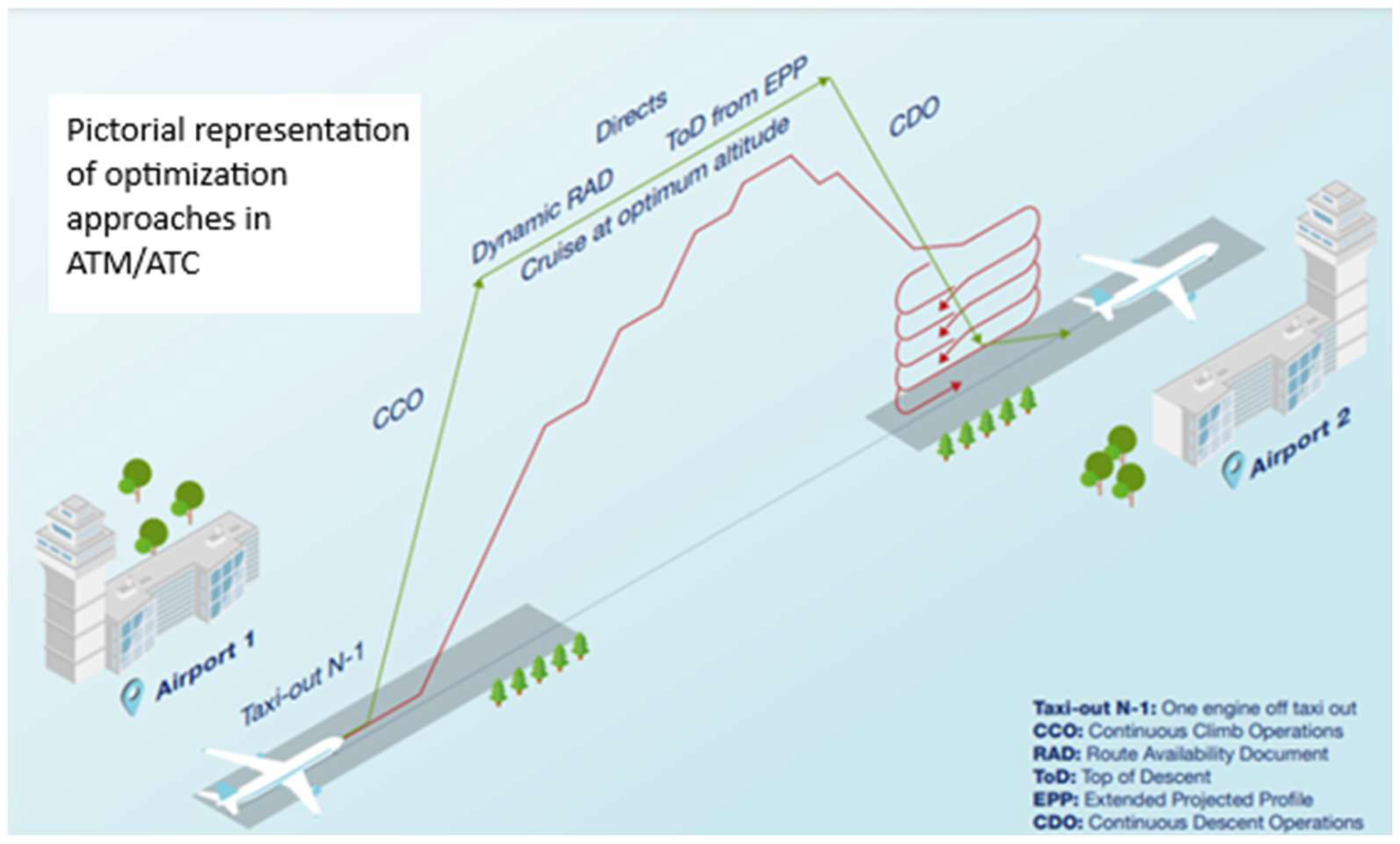
- Taxi on the airport: This is the fuel needed to start the engines and then taxi to the runway. This is the first opportunity to save fuel. Aircraft engines are designed to be efficient in flight, but not during idle time on the ground. Airports and air traffic providers are working on projects to optimize the movements and flow of aircraft on the ground to minimize the time from the gate to take-off.
- 2)
- Take-off and climb to an optimum cruise level: Each and every flight is different. The climb performance of an aircraft depends on the actual weight, the weather conditions and air traffic situation. The crew can calculate the most efficient climb profile with the onboard systems. The cruise altitude or flight level is not primarily the decision of the flight crew. The air traffic controller assigns a certain level, climb rate, and speed based on the capacity of airspace and trajectory of the aircraft.
- 3)
- Cruise flight: With regard to efficiency, the cruise altitude needs to change during the flight. This is the result of burning fuel and losing weight. Fuel is 15–40% of the take-off mass of an aircraft. By burning fuel during cruise, the aircraft becomes lighter and able to climb to higher altitudes, where flight is more efficient. This, in turn, offers the opportunity to burn less fuel. Today, an aircraft climbs in steps. By improving the data transmission between airplanes and air traffic control, the controller can assign the aircraft the most efficient flight level. In addition, the routing could be optimized during the flight. Depending on the air traffic situation, the controller could be looking for a direct routing being assigned to a certain flight; this avoids extra fuel burn.
- 4)
- Descent: The so-called Continuous Descent is the most efficient way for the final phase of the flight. If the crew sets the thrust levers to idle and the aircraft then glides to the airport, fuel is saved, and emissions are reduced. But, in many cases, aircrafts today have to reduce the altitude through several steps (step-down descent) rather than in a continuous way (Continuous Descent Operations, CDO). This results in inefficient-level flying at lower altitudes. The flight management system of the aircraft offers the crew the possibility to calculate the most efficient descent and define a certain point of top of descent for the flight. The air traffic controller then has to check if the traffic situation permits this approach. Consequentially, by jointly optimizing the flightpath, the resulting actual descent profile could be as close as possible to the optimum descent one.
- 5)
- Holdings: One of the most inefficient flight phases in commercial aviation operations are holdings, i.e., the waiting in near-circular flight until a landing slot is available. For example, an A320-family aircraft burns approximately 100 kg of fuel in a four-minute standard holding.
- 6)
- Movement to the parking position and ground power: Similarly to the situation on departure, efficient surface movement guidance after landing helps save fuel. The power supply during the turnaround of the aircraft is another opportunity to save fuel. The aircraft could be powered on the ground either by a connector and electricity from the airport or by running the so-called APU, Auxiliary Power Unit onboard the aircraft, which burns kerosene.
3. Terminal Maneuvering Area (TMA) Approaches to Fuel Saving and Emissions Reduction
4. CO2 and Non-CO2 Emission Modeling
4.1. CO2 Emission Modeling
4.2. Non-CO2 Emission Modeling
5. Emissions Reduction
5.1. Multi-Objective Optimization
5.2. Simulation-Based Evolutionary Optimization
5.3. Air Traffic Flow Management with Emissions Considerations
5.4. Uncertainties in the Optimization of Non-CO2 Effects
6. Metrics for Evaluating Impact
- -
- Radiative Forcing (RF), which indicates the instantaneous change in the net (down minus up) radiative flux (W/m2) due to an atmospheric perturbation. The concept of radiative forcing is central to understanding how an emission perturbs the climate system. A common formulation for CO2 iswhere ΔF is the change in radiative forcing (W/m2), κ is a constant (typically about 5.35 W/m2 for CO2), C is the current concentration, and C0 is the pre-industrial baseline concentration. For non-CO2 agents, adjustments are made to account for rapid atmospheric adjustments (e.g., stratospheric temperature, cloud effects), leading to definitions of adjusted and Effective Radiative Forcing (ERF).
- -
- Global Warming Potential (GWP), which is the integrated radiative forcing over a specified time horizon normalized to the forcing of CO2. GWP is defined over a time horizon τ aswhere is the radiative forcing at time t per unit emission of substance x, and is the corresponding radiative forcing for CO2. Variations on this well-established metric have been developed, including Efficacy-weighted Global Warming Potential (EGWP), which is a modified GWP that incorporates the climate “efficacy” (i.e., the relative effectiveness of a given emission in causing temperature change), and GWP* and Extended GWP*, that aim to better represent the temperature impacts of short-lived climate pollutants.
- -
- Global Temperature change Potential (GTP), which is the change in near-surface temperature at a given future time due to an emission pulse, relative to CO2.
- -
- Average Temperature Response (ATR), referring to the time-averaged temperature change over a defined period following an emission pulse. ATR links the integrated temperature response to a pulse emission. It is often calculated aswhere is the temperature change at time t following the emission pulse and T is the chosen time horizon (e.g., 100 years).
6.1. Optimal Approaches: A Summary
6.2. Future Research
6.2.1. Modeling of Emissions and Climate Effects for New Fuels and Propulsion Systems
6.2.2. Optimization Methodologies Across Scales and Under Uncertainty
6.2.3. Integration of Climate Metrics into ATM Decision-Making and Policy Frameworks
7. Relationship Between ATM/ATC Procedures and Climate Metrics
8. Conclusions
Author Contributions
Funding
Data Availability Statement
Conflicts of Interest
References
- Masiol, M.; Harrison, R.M. Aircraft engine exhaust emissions and other airport-related contributions to ambient air pollution: A review. Atmos. Environ. 2014, 95, 409–455. [Google Scholar] [CrossRef]
- Errico, A.; Di Vito, V. Performance-based navigation (PBN) with continuous descent operations (CDO) for efficient approach over highly protected zones. In Proceedings of the 24th Saint Petersburg International Conference on Integrated Navigation Systems (ICINS), St. Petersburg, Russia, 29–31 May 2017; pp. 1–8. [Google Scholar]
- Lee, D.; Pitari, G.; Grewe, V.; Gierens, K.; Penner, J.; Petzold, A.; Prather, M.; Schumann, U.; Bais, A.; Berntsen, T.; et al. Transport impacts on atmosphere and climate: Aviation. Atmos. Environ. 2010, 44, 4678–4734. [Google Scholar] [CrossRef]
- Kinsey, J.S. Characterization of Emissions from Commercial Aircraft Engines During the Aircraft Particle Emissions eXperiment (APEX) 1 to 3; Office of Research and Development, US Environmental Protection Agency: Washington, DC, USA, 2009.
- Kinsey, J.S.; Dong, Y.; Williams, D.C.; Logan, R. Physical characterization of the fine particle emissions from commercial aircraft engines during the Aircraft Particle Emissions eXperiment (APEX) 1–3. Atmos. Environ. 2010, 44, 2147–2156. [Google Scholar] [CrossRef]
- Kinsey, J.S.; Hays, M.D.; Dong, Y.; Williams, D.C.; Logan, R. Chemical characterization of the fine particle emissions from commercial aircraft engines during the Aircraft Particle Emissions eXperiment (APEX) 1 to 3. Environ. Sci. Technol. 2011, 45, 3415–3421. [Google Scholar] [CrossRef]
- Mazaheri, M.; Johnson, G.R.; Morawska, L. An inventory of particle and gaseous emissions from large aircraft thrust engine operations at an airport. Atmos. Environ. 2011, 45, 3500–3507. [Google Scholar] [CrossRef]
- Hudda, N.; Simon, M.C.; Zamore, W.; Brugge, D.; Durant, J.L. Aviation emissions impact ambient ultrafine particle concentrations in the greater Boston area. Environ. Sci. Technol. 2016, 50, 8514–8521. [Google Scholar] [CrossRef]
- Anderson, B.E.; Chen, G.; Blake, D.R. Hydrocarbon emissions from a modern commercial airliner. Atmos. Environ. 2006, 40, 3601–3612. [Google Scholar] [CrossRef]
- Bond, T.C.; Streets, D.G.; Yarber, K.F.; Nelson, S.M.; Woo, J.H.; Klimont, Z. A technology-based global inventory of black and organic carbon emissions from combustion. J. Geophys. Res. Atmos. 2004, 109, D14. [Google Scholar] [CrossRef]
- Timko, M.T.; Albo, S.E.; Onasch, T.B.; Fortner, E.C.; Yu, Z.; Miake-Lye, R.C.; Canagaratna, M.R.; Ng, N.L.; Worsnop, D.R. Composition and sources of the organic particle emissions from aircraft engines. Aerosol Sci. Technol. 2014, 48, 61–73. [Google Scholar] [CrossRef]
- Ungeheuer, F.; Caudillo, L.; Ditas, F.; Simon, M.; van Pinxteren, D.; Kılıç, D.; Rose, D.; Jacobi, S.; Kürten, A.; Curtius, J.; et al. Nucleation of jet engine oil vapours is a large source of aviation-related ultrafine particles. Commun. Earth Environ. 2022, 3, 319. [Google Scholar] [CrossRef]
- Yang, X.; Cheng, S.; Lang, J.; Xu, R.; Lv, Z. Characterization of aircraft emissions and air quality impacts of an international airport. J. Environ. Sci. 2018, 72, 198–207. [Google Scholar] [CrossRef] [PubMed]
- AIRBUS Advertisement Material on ALBATROSS Project. Available online: https://www.sesarju.eu/projects/ALBATROSS (accessed on 1 December 2025).
- Clarke, J.P.; Ho, N.T.; Ren, L.; Brown, J.A.; Elmer, K.R.; Zou, K.; Hunting, C.; McGregor, D.L.; Shivashankare, B.N.; Tong, K.O.; et al. Continuous Descent Approach: Design and Flight Test for Louisville International Airport. J. Aircr. 2004, 41, 1054–1066. [Google Scholar] [CrossRef]
- Clarke, J.P.; Brooks, J.; Nagle, G.; Scacchioli, A.; White, W.; Liu, S.R. Optimized Profile Descent Arrivals at Los Angeles International Airport. J. Aircr. 2013, 50, 360–369. [Google Scholar] [CrossRef]
- Delahaye, D.; Puechmorel, S.; Tsiotras, P.; Feron, E. Mathematical Models for Aircraft Trajectory Design—A Survey. Lect. Notes Electr. Eng. 2014, 3, 205–247. [Google Scholar]
- Errico, A.; Di Vito, V.; Parente, C.; Petruzzi, G. Algorithms for Automatic Elaboration of Optimized Trajectories for Continuous Descent Operations. Int. J. Innov. Res. Sci. Eng. Technol. 2017, 6. [Google Scholar] [CrossRef]
- ICAO. Rules of Air; International Civil Aviation Organisation: Montreal, QC, Canada, 2005. [Google Scholar]
- ICAO. DOC 9613—Performance-Based Navigation Manual, 3rd ed.; International Civil Aviation Organisation: Montréal, QC, Canada, 2012. [Google Scholar]
- EUROCONTROL. Continuous Descent Approach—Implementation Guidance Information. May 2008. Available online: www.eurocontrol.int/environment (accessed on 11 December 2025).
- ICAO. Doc 4444—PANS-ATM, Procedures for Navigation Services and Air Traffic Management, 16th ed.; International Civil Aviation Organisation: Montreal, QC, Canada, 2016. [Google Scholar]
- ICAO. DOC 9905—Required Navigation Performance Authorization Required (RNP AR) Procedure Design Manual, 1st ed.; International Civil Aviation Organisation: Montreal, QC, Canada, 2009. [Google Scholar]
- Errico, A.; Di Vito, V. Algorithms and system for curved and continuous descent trajectories improving fuel efficiency in TMA. In Proceedings of the 31st Congress of the International Council of Aeronautical Sciences (ICAS 2018), Belo Horizonte, Brazil, 9–14 September 2018. [Google Scholar]
- ICAO. DOC 9931/AN/476—Continuous Descent Operations Manual, 1st ed.; International Civil Aviation Organisation: Montreal, QC, Canada, 2010. [Google Scholar]
- Errico, A.; Di Vito, V. Study of Point Merge technique for efficient Continuous Descent Operations in TMA. IFAC-PapersOnLine 2018, 51, 193–199. [Google Scholar] [CrossRef]
- Favennec, B.; Hoffman, E.; Trzmiel, A.; Vergne, F.; Zeghal, K. The Point Merge Arrival Flow Integration Technique: Towards More Complex Environments and Advanced Continuous Descent. In Proceedings of the 9th AIAA Aviation Technology, Integration and Operations Conference (ATIO), Hilton Head, SC, USA, 21–23 September 2009. [Google Scholar]
- EUROCONTROL Experimental Centre (EEC). Point Merge Integration of Arrival Flows Enabling Extensive RNAV Application and Continuous Descent. Version 2.0. July 2010. Available online: https://www.eurocontrol.int/sites/default/files/2019-06/point-merge-osed-v2.0-2010_1.pdf (accessed on 10 December 2025).
- User Manual for the Base of Aircraft Data (BADA) Revision 3.11, Eurocontrol Experimental Centre (EEC) Technical/Scientific Report No. 13/04/16-01, Brétigny-sur-Orge, France. 2013. Available online: https://www.google.com/url?sa=t&source=web&rct=j&opi=89978449&url=https://www.eurocontrol.int/archive_download/all/node/9690&ved=2ahUKEwie8tz1jpySAxVA5gIHHQ1JI-IQFnoECBgQAQ&usg=AOvVaw0Qgkt_TidbI6UaJNVJes6C (accessed on 21 December 2025).
- ICAO Aircraft Engine Emissions Databank. Available online: http://easa.europa.eu/node/15672 (accessed on 15 December 2025).
- ICAO. Annex 16 to the Convention on International Civil Aviation—Environmental Protection—Volume II: Aircraft Engine Emissions; The International Civil Aviation Organization (ICAO): Montreal, QC, Canada, 2008. [Google Scholar]
- Wulff, A.; Hourmouziadis, J. Technology review of aero engine pollutant emissions. Aerosp. Sci. Technol. 1997, 1, 557–572. [Google Scholar] [CrossRef]
- Gardi, A.; Sabatini, R.; Kistan, T.; Lim, Y.; Ramasamy, S. 4-Dimensional trajectory functionalities for air traffic management systems. In Proceedings of the Integrated Communication, Navigation and Surveillance Conference (ICNS 2015), Herndon, VA, USA, 21–23 April 2015. [Google Scholar] [CrossRef]
- Hupe, J.; Ferrier, B.; Thrasher, T.; Mustapha, C.; Dickson, N.; Tanaka, T.; González, R.K.; Benjamin, R.; Djibo, B.; Fleming, G.G.; et al. ICAO Environmental Report 2013: Destination Green—Aviation and Climate Change; ICAO Environmental Branch: Montreal, QC, Canada, 2013. [Google Scholar]
- Martin, R.L.; Oncina, C.H.; Zeeben, P.J. Appendix D. Boeing Method 2 Fuel Flow Methodology Description—Presentation to CAEP Working Group III Certification Subgroup. In Scheduled Civil Aircraft Emission Inventories for 1992: Database Development and Analysis—NASA Contractor Report 4700; Baughcum, S.L., Tritz, T.G., Henderson, S.C., Pickett, D.C., Eds.; NASA Langley Research Center: Hampton, VA, USA, 1996. [Google Scholar]
- Dubois, D.; Paynter, G.C. “Fuel flow Method 2” for Estimating Aircraft Emissions, SAE Technical Paper 2006-01-1987; SAE International: Warrendale, PA, USA, 2006. [Google Scholar] [CrossRef]
- Ruijgrok, G.J.J.; van Paassen, D.M. Elements of Aircraft Pollution, 3rd ed.; VSSD: Delft, The Netherlands, 2012. [Google Scholar]
- Celis, C.; Sethi, V.; Zammit-Mangion, D.; Singh, R.; Pilidis, P. Theoretical optimal trajectories for reducing the environmental impact of commercial aircraft operations. J. Aerosp. Technol. Manag. 2014, 6, 29–42. [Google Scholar] [CrossRef]
- Schmidt, E. Die Entstehung von Eisnebel aus den Auspuffgasen von Flugmotoren; Verlag R. Oldenbourg: München, Germany, 1941; Volume 44, pp. 1–15. [Google Scholar]
- Appleman, H. The formation of exhaust condensation trails by jet aircraft. Bull. Am. Meteorol. Soc. 1953, 34, 14–20. [Google Scholar] [CrossRef]
- Schumann, U. On conditions for contrail formation from aircraft exhausts. Meteorol. Z. 1996, 5, 4–23. [Google Scholar] [CrossRef]
- Paoli, R.; Shariff, K. Contrail modeling and simulation. Annu. Rev. Fluid Mech. 2016, 48, 393–427. [Google Scholar] [CrossRef]
- Yin, F.; Grewe, V.; Gierens, K. Impact of hybrid electric aircraft on contrail coverage. Aerospace 2020, 7, 147. [Google Scholar] [CrossRef]
- ICAO (International Civil Aviation Organization). Environmental Protection (Annex 16). In Aircraft Engine Emission, International Standards and Recommended Practices; ICAO: Montreal, QC, Canada, 2008; Volume 2, ISBN 978-92-9231-123-0. [Google Scholar]
- Iribarne, J.V.; Godson, W.L. (Eds.) Atmospheric Thermodynamics; Springer Science & Business Media: Berlin/Heidelberg, Germany, 1981; Volume 6. [Google Scholar]
- Pruppacher, H.R.; Klett, J.D. Microphysics of Clouds and Precipitation: Reprinted 1980; Springer Science & Business Media: Berlin/Heidelberg, Germany, 2012. [Google Scholar]
- Lee, D.S.; Fahey, D.W.; Forster, P.M.; Newton, P.J.; Wit, R.C.N.; Lim, L.L.; Owen, B.; Sausen, R. Aviation and global climate change in the 21th century. Atmos. Environ. 2009, 43, 3520–3537. [Google Scholar] [CrossRef]
- Haywood, J.M.; Allan, R.P.; Bornemann, J.; Forster, P.M.; Francis, P.N.; Milton, S.; Rädel, G.; Rap, A.; Shine, K.P.; Thorpe, R. A case study of the radiative forcing of persistent contrails evolving into contrail-induced cirrus. J. Geophys. Res. Atmos. 2009, 114, D24201. [Google Scholar] [CrossRef]
- Unterstrasser, S.; Gierens, K.; Sölch, I.; Lainer, M. Numerical simulations of homogeneously nucleated natural cirrus and contrail-cirrus. Part 1: How different are they? Meteorol. Z. 2017, 26, 621–642. [Google Scholar] [CrossRef]
- Unterstrasser, S.; Gierens, K.; Sölch, I.; Wirth, M. Numerical simulations of homogeneously nucleated natural cirrus and contrail-cirrus. Part 2: Interaction on local scale. Meteorol. Z. 2017, 26, 643–661. [Google Scholar] [CrossRef]
- Sölch, I.; Kärcher, B. Process-oriented large-eddy simulations of a midlatitude cirrus cloud system based on observations. Q. J. Roy. Meteorol. Soc. 2011, 137, 374–393. [Google Scholar] [CrossRef]
- Kärcher, B. Formation and radiative forcing of contrail cirrus. Nat. Commun. 2018, 9, 1824. [Google Scholar] [CrossRef] [PubMed]
- Schumann, U. Formation, properties and climatic effects of contrails. Comptes Rendus Phys. 2005, 6, 549–565. [Google Scholar] [CrossRef]
- Penin, G. Formation of Contrails; TU Delft: Delft, The Netherlands, 2012. [Google Scholar]
- Pellegrini, A.; Di Sanzo, P.; Bevilacqua, B.; Duca, G.; Pascarella, D.; Palumbo, R.; Ramos, J.J.; Piera, M.A.; Gigante, G. Simulation-based evolutionary optimization of air traffic management. IEEE Access 2020, 8, 161551–161570. [Google Scholar] [CrossRef]
- Hamdan, S.; Cheaitou, A.; Jouini, O.; Jemai, Z.; Alsyouf, I.; Bettayeb, M. An environmental air traffic flow management model. In Proceedings of the 2019 8th International Conference on Modeling Simulation and Applied Optimization (ICMSAO), Manama, Bahrain, 15–17 April 2019; pp. 1–5. [Google Scholar]
- Ponater, M.; Marquart, S.; Sausen, R. Contrails in a comprehensive global climate model: Parameterization and radiative forcing results. J. Geophys. Res. Atmos. 2002, 107, ACL2-1–ACL2-15. [Google Scholar] [CrossRef]
- Detwiler, A.G.; Jackson, A. Contrail formation and propulsion efficiency. J. Aircr. 2002, 39, 638–644. [Google Scholar] [CrossRef]
- Schrader, M.L. Calculations of aircraft contrail formation critical temperatures. J. Appl. Meteorol. 1997, 36, 1725–1728. [Google Scholar] [CrossRef]
- Sorensen, J.A.; Morello, S.A.; Erzberger, H. Application of trajectory optimization principles to minimize aircraft operating costs. In Proceedings of the 18th IEEE Conference on Decision and Control, Fort Lauderdale, FL, USA, 12–14 December 1979; Volume 1, pp. 415–421. [Google Scholar]
- Camilleri, W.; Chircop, K.; Zammit-Mangion, D.; Sabatini, R.; Sethi, V. Design and validation of a detailed aircraft performance model for trajectory optimization. In Proceedings of the AIAA Modeling and Simulation Technologies Conference, Minneapolis, MN, USA, 13–16 August 2012. [Google Scholar]
- Gu, W.; Navaratne, R.; Quaglia, D.; Yu, Y.; Madani, I.; Sethi, V.; Jia, H.; Chircop, K.; Sabatini, R.; Zammit-Mangion, D. Towards the development of a multi-disciplinary flight trajectory optimization tool—GATAC. In Proceedings of the ASME Turbo Expo 2012, Copenhagen, Denmark, 11–15 June 2012. [Google Scholar]
- Sammut, M.; Zammit-Mangion, D.; Sabatini, R. Optimization of fuel consumption in climb trajectories using genetic algorithm techniques. In Proceedings of the AIAA Guidance, Navigation, and Control Conference, Minneapolis, MN, USA, 13–16 August 2012. [Google Scholar]
- Tsotskas, C.; Kipouros, T.; Savill, M. Biobjective optimisation of preliminary aircraft trajectories. In Proceedings of the 7th International Conference on Evolutionary Multi-Criterion Optimization, Sheffield, UK, 19–22 March 2013. [Google Scholar]
- Rao, A.V. Survey of Numerical Methods for Optimal Control. Adv. Astronaut. Sci. 2010, 135, 497–528. [Google Scholar]
- Zolata, H.; Celis, C.; Sethi, V.; Singh, R.; Zammit-Mangion, D. A multi-criteria simulation framework for civil aircraft trajectory optimization. In Proceedings of the ASME International Mechanical Engineering Congress and Exposition 2010 (IMECE2010), Vancouver, BC, Canada, 12–18 November 2010; pp. 95–105. [Google Scholar] [CrossRef]
- Fichter, C.; Marquart, S.; Sausen, R.; Lee, D.S. The impact of cruise altitude on contrails and related radiative forcing. Meteorol. Z. 2005, 14, 563–572. [Google Scholar] [CrossRef]
- Sridhar, B.; Ng, H.; Chen, N. Aircraft trajectory optimization and contrails avoidance in the presence of winds. J. Guid. Control Dyn. 2011, 34, 1577–1584. [Google Scholar] [CrossRef]
- Chen, N.Y.; Sridhar, B.; Ng, H.K. Contrail reduction strategies using different weather resources. In Proceedings of the AIAA Guidance, Navigation, and Control Conference 2011 (GNC2011), Portland, OR, USA, 8–11 August 2011. [Google Scholar] [CrossRef][Green Version]
- Deuber, O.; Sigrun, M.; Robert, S.; Michael, P.; Ling, L. A physical metric-based framework for evaluating the climate trade-off between CO2 and contrails—The case of lowering aircraft flight trajectories. Environ. Sci. Policy 2013, 25, 176–185. [Google Scholar] [CrossRef]
- Lim, Y.; Gardi, A.; Sabatini, R. Modelling and evaluation of aircraft contrails for 4-dimensional trajectory optimisation. SAE Int. J. Aerosp. 2015, 8, 248–259. [Google Scholar] [CrossRef]
- Lim, Y.; Gardi, A.; Marino, M.; Sabatini, R. Modelling and evaluation of persistent contrail formation regions for offline and online strategic flight trajectory planning. In Proceedings of the International Symposium on Sustainable Aviation (ISSA2015), Istanbul, Turkey, 31 May–3 June 2015. [Google Scholar]
- Shindell, D.T.; Faluvegi, G.S. The net climate impact of coal-fired power plant emissions. Atmos. Chem. Phys. 2010, 10, 3247–3260. [Google Scholar] [CrossRef]
- Teoh, R.; Schumann, U.; Majumdar, A.; Stettler, M.E. Mitigating the climate forcing of aircraft contrails by small-scale diversions and technology adoption. Environ. Sci. Technol. 2020, 54, 2941–2950. [Google Scholar] [CrossRef]
- Jabali, O.; Van Woensel, T.; De Kok, A.G. Analysis of travel times and CO2 emissions in time-dependent vehicle routing. Prod. Oper. Manag. 2012, 21, 1060–1074. [Google Scholar] [CrossRef]
- Niklaß, M.; Grewe, V.; Gollnick, V.; Dahlmann, K. Concept of climate-charged airspaces: A potential policy instrument for internalizing aviation’s climate impact of non-CO2 effects. Clim. Policy 2021, 21, 1066–1085. [Google Scholar] [CrossRef]
- Dahlmann, K.; Grewe, V.; Matthes, S.; Yamashita, H. Climate assessment of single flights: Deduction of route specific equivalent CO2 emissions. Int. J. Sustain. Transp. 2023, 17, 29–40. [Google Scholar] [CrossRef]
- Undavalli, V.; Olatunde, O.B.G.; Boylu, R.; Wei, C.; Haeker, J.; Hamilton, J.; Khandelwal, B. Recent advancements in sustainable aviation fuels. Prog. Aerosp. Sci. 2023, 136, 100876. [Google Scholar] [CrossRef]
- Watson, M.J.; Machado, P.G.; Da Silva, A.V.; Saltar, Y.; Ribeiro, C.O.; Nascimento, C.A.O.D.; Dowling, A.W. Sustainable aviation fuel technologies, costs, emissions, policies, and markets: A critical review. J. Clean. Prod. 2024, 449, 141472. [Google Scholar] [CrossRef]
- Klimczyk, W.; Jasiński, R.; Niklas, J.; Siedlecki, M.; Ziółkowski, A. Sustainable aviation fuels: A comprehensive review of production pathways, environmental impacts, lifecycle assessment, and certification frameworks. Energies 2025, 18, 3705. [Google Scholar] [CrossRef]
- Adler, E.J.; Martins, J.R. Hydrogen-powered aircraft: Fundamental concepts, key technologies, and environmental impacts. Prog. Aerosp. Sci. 2023, 141, 100922. [Google Scholar] [CrossRef]
- Ebrahimi, A.; Rolt, A.; Jafari, S.; Anton, J.H. A review on liquid hydrogen fuel systems in aircraft applications for gas turbine engines. Int. J. Hydrog. Energy 2024, 91, 88–105. [Google Scholar] [CrossRef]
- Simorgh, A.; Soler, M.; González-Arribas, D.; Linke, F.; Lührs, B.; Meuser, M.M.; Dietmüller, S.; Matthes, S.; Yamashita, H.; Yin, F.; et al. Robust 4D climate-optimal flight planning in structured airspace using parallelized simulation on GPUs: ROOST V1.0. Geosci. Model Dev. 2023, 16, 3723–3748. [Google Scholar] [CrossRef]
- Gierens, K.M.; Lim, L.; Eleftheratos, K. A review of various strategies for contrail avoidance. Open Atmos. Sci. J. 2008, 2, 1–7. [Google Scholar] [CrossRef]
- Grewe, V.; Frömming, C.; Matthes, S.; Brinkop, S.; Ponater, M.; Dietmüller, S.; Jöckel, P.; Garny, H.; Tsati, E.; Dahlmann, K.; et al. Aircraft routing with minimal climate impact: The REACT4C climate cost function modelling approach (V1.0). Geosci. Model Dev. 2014, 7, 175–201. [Google Scholar] [CrossRef]
- van Manen, J.; Grewe, V. Algorithmic climate change functions for the use in eco-efficient flight planning. Transp. Res. Part D Transp. Environ. 2019, 67, 388–405. [Google Scholar] [CrossRef]
- Matthes, S.; Grewe, V.; Dahlmann, K.; Frömming, C.; Irvine, E.; Lim, L.; Linke, F.; Lührs, B.; Owen, B.; Shine, K.; et al. A concept for multi-criteria environmental assessment of aircraft trajectories. Aerospace 2017, 4, 42. [Google Scholar] [CrossRef]
- Matthes, S.; Dietmüller, S.; Dahlmann, K.; Frömming, C.; Yamashita, H.; Grewe, V.; Yin, F.; Castino, F. Algorithmic climate change functions (aCCFs) V1.0A: Consolidation of the approach and note for usage. Geosci. Model Dev. Discuss. 2023. in submitted. [Google Scholar]
- Yamashita, H.; Yin, F.; Grewe, V.; Jöckel, P.; Matthes, S.; Kern, B.; Dahlmann, K.; Frömming, C. Newly developed aircraft routing options for air traffic simulation in the chemistry–climate model EMAC 2.53: AirTraf 2.0. Geosci. Model Dev. 2020, 13, 4869–4890. [Google Scholar] [CrossRef]
- Campbell, S.; Neogi, N.; Bragg, M. An optimal strategy for persistent contrail avoidance. In Proceedings of the AIAA Guidance, Navigation and Control Conference and Exhibit, Honolulu, Hawaii, 18–21 August 2008. [Google Scholar]
- Lührs, B.; Linke, F.; Matthes, S.; Grewe, V.; Yin, F. Climate impact mitigation potential of European air traffic in a weather situation with strong contrail formation. Aerospace 2021, 8, 50. [Google Scholar] [CrossRef]
- Hartjes, S.; Hendriks, T.; Visser, D. Contrail mitigation through 3D aircraft trajectory optimization. In Proceedings of the 16th AIAA Aviation Technology, Integration, and Operations Conference, Washington, DC, USA, 13–17 June 2016; p. 3908. [Google Scholar]
- Vitali, A.; Battipede, M.; Lerro, A. Multi-Objective and Multi-Phase 4D Trajectory Optimization for Climate Mitigation-Oriented Flight Planning. Aerospace 2021, 8, 395. [Google Scholar] [CrossRef]
- Simorgh, A.; Soler, M.; González-Arribas, D.; Matthes, S.; Grewe, V.; Dietmüller, S.; Baumann, S.; Yamashita, H.; Yin, F.; Castino, F.; et al. A Comprehensive Survey on Climate Optimal Aircraft Trajectory Planning. Aerospace 2022, 9, 146. [Google Scholar] [CrossRef]
- WMO. Guidelines on Ensemble Prediction Systems and Forecasting; Svoboda, M., Hayes, M., Wood, D.A., Eds.; World Meteorological Organization Weather Climate and Water: Geneva, Switzerland; WMO: Geneva, Switzerland, 2012; p. 1091. ISBN 978-92-63-11091-6. [Google Scholar]
- AMS-Council. Enhancing weather information with probability forecasts. Bull. Am. Meteorol. Soc. 2008, 89, 1049–1053. [Google Scholar]
- Bauer, P.; Thorpe, A.; Brunet, G. The quiet revolution of numerical weather prediction. Nature 2015, 525, 47–55. [Google Scholar] [CrossRef]
- Morante, D.; Sanjurjo Rivo, M.; Soler, M. A Survey on Low-Thrust Trajectory Optimization Approaches. Aerospace 2021, 8, 88. [Google Scholar] [CrossRef]
- Kirk, D.E. Optimal Control Theory: An Introduction; Courier Corporation: Chelmsford, MA, USA, 2004. [Google Scholar]
- González Arribas, D. Robust Aircraft Trajectory Optimization Under Meteorological Uncertainty. Ph.D. Dissertation, Universidad Carlos III de Madrid, Madrid, Spain, July 2019. [Google Scholar]


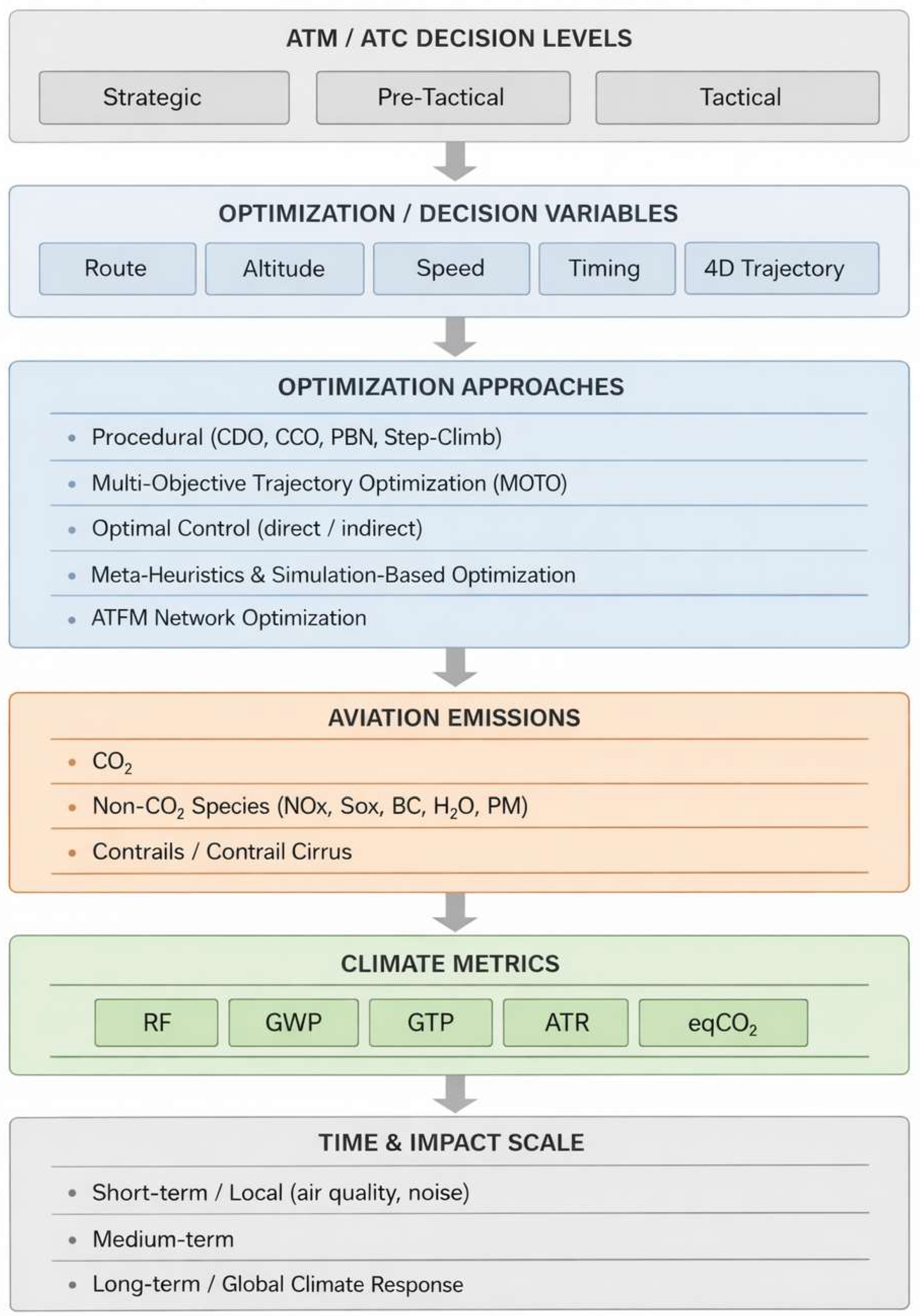
| Decision Level and Operational Purpose | Time Horizon | Suited Climate Metrics | Justification |
|---|---|---|---|
| Strategic planning, policy evaluation, technology assessment | Multi-decadal to centennial | CO2-equivalent, time-integrated metrics (e.g., GWP, ATR) | These metrics integrate radiative effects over long time horizons and express impacts relative to CO2, making them appropriate for assessing cumulative climate consequences, comparing mitigation strategies, and supporting regulatory or economic policy instruments. Short-lived variability is intentionally averaged out in favor of long-term climate relevance. |
| Pre-tactical ATM planning and scenario analysis | Seasonal to annual | Combined use of CO2-based metrics and simplified non-CO2 indicators | At this level, decisions rely on forecasted traffic and meteorological conditions and aim to balance cumulative emissions with expected non-CO2 effects, without requiring instantaneous resolution of atmospheric variability. |
| Tactical and real-time ATM/ATC operations (trajectory management, contrail mitigation) | Hours/days | Short-term or instantaneous metrics (e.g., RF, aCCF-based indicators) | These metrics explicitly capture the strong spatial and temporal variability of short-lived non-CO2 effects, particularly contrail-related forcing, and can be directly coupled with meteorological forecasts and real-time trajectory optimization. Their sensitivity to atmospheric conditions makes them unsuitable for long-term policy but essential for operational decision making. |
| Decision Level | Time Horizon | Description |
|---|---|---|
| Strategic | Before the flight (months/weeks/days) | Airlines and ANSPs (Air National Service Provides) develop network-wide flight plans, capacity assessments, and sustainability policies with broad environmental targets but limited operational precision. |
| Pre-tactical | Before the flight (hours) | The detailed flight planning is elaborated, integrating weather forecasts, confirmed traffic demand, and dynamic rerouting, in order to have confirmed flight plans before take-off that are deconflicted “a priori”. In this phase, trajectory optimization is carried out in order to achieve as many environmental benefits as possible. |
| Tactical | Real-time during the flight | ATC manages the traffic separation and ensure appropriate sector capacity and safety, allowing minimal trajectory flexibility, focusing on procedural efficiency (CDO/CCO) and immediate conflict resolution (to prevent loss of separation and collision risks). The safety of flights (i.e., maintaining traffic separation) is critical and of primary importance in this phase, whereas environmental optimization is still possible under limited flexibility but is not the main objective. |
| Optimization Variable | Description |
|---|---|
| Route | The optimization variable is the track (lateral) reference of the aircraft. It is used for lateral path optimization, mainly via Performance Based Navigation (PBN) and direct routing. It can be used for contrail avoidance maneuvers and is applicable across all ATM/ATC levels. Even if it is most impactful strategically, it can also be considered in future contrail avoidance management at tactical level, provided that the real-time lateral contrail avoidance maneuver has been cleared in advance by ATC. |
| Altitude | The optimization variable is the altitude (longitudinal) reference of the aircraft. It is used for cruise altitude optimization and step-climbs. It can be used for contrail avoidance, both at pre-tactical and tactical (provided that the real-time longitudinal contrail avoidance maneuver has been cleared in advance by ATC) levels. It critically affects non-CO2 climate impacts, because of the modification of emissions release altitude. |
| Speed | The optimization variable is the speed (True Air Speed (TAS), Indicated Air Speed (IAS), Calibrated Air Speed (CAS)) reference of the aircraft. It is used for profile adjustments for arrival sequencing and fuel efficiency, with tactical flexibility in approach and landing phases. It mainly influences NOx emission indices, because of the modification of the throttle settings, leading to different emissions from the engine operation. |
| Timing | The optimization variable is the timing of the different flight phases (departure, arrival, sequencing, holding if any) for the aircraft. It can be used for slot allocation, holding minimization, climate-sensitive regions avoidance. It can be exploited at all ATM/ATC decision levels, and its primary benefits can encompass fuel burn reduction (CO2 emissions reduction) and contrail sensitive conditions/regions avoidance (non-CO2 climate impact). |
| Overall 4D trajectory optimization | Full 4D (3D + time) trajectory optimization combining all the above variables. It can be used to maximize the benefits above indicated, primarily at pre-tactical level, because of the required computational burden. However, research efforts are needed to enable the 4D trajectory optimization at tactical level (real-time during the flight), in order to implement future 4D-contract based trajectory management with wide trajectory negotiation possibilities during flight. |
| Climate Metrics | Description |
|---|---|
| Radiative Forcing (RF) | The metric refers to current climate impact in terms of perturbation [W/m2] and is relevant at tactical (and also pre-tactical) level for fuel burn assessments. |
| Global Warming Potential (GWP) | The metric refers to time-integrated forcing over 20 to 100 years’ time horizons and is relevant at strategic level (or even before, at policy decision making level) for comparisons of CO2 vs. non-CO2 impacts. |
| Global Temperature Potential (GTP) | The metric refers to the future temperature response and is relevant at strategic level for long-term strategic planning emphasizing final resulting climate impact outcomes. |
| Average Temperature Response (ATR) | The metric refers to the time-averaged temperature change and is relevant mainly at pre-tactical level, for non-CO2 optimization (contrail avoidance, thanks to the availability of reliable weather forecasts some hours before the flight). |
| Unified CO2-equivalent metric (eqCO2) | The metric refers to a conversion of the different impacts into a unified equivalent CO2 emissions level, in order to facilitate comparisons among different technologies. It can be used across all ATM/ATC decision levels to support decision making. |
| Optimization Approach | ATM Level | Primary Variables | Climate Metrics | Key Applications |
|---|---|---|---|---|
| CDO/CCDA | Tactical Pre-tactical | Altitude Speed Route | RF eqCO2 | Fuel consumption and noise reduction in TMA |
| CCO | Tactical Pre-tactical | Altitude Speed | RF eqCO2 | Departure optimization |
| PBN/RNP-AR | Strategic Pre-tactical | Route | RF eqCO2 | Terminal procedure design |
| Step-Climb | Pre-tactical Tactical | Altitude | RF eqCO2 | Cruise efficiency |
| MOTO | Pre-tactical | 4D (i.e., all variables) | GWP GTP ATR eqCO2 | Multi-objective balancing |
| Contrail Avoidance | Pre-tactical Tactical | Altitude Route Timing | GWP20 ATR20 eqCO2 | Climate-sensitive regions |
| ATFM emissions | Strategic Pre-tactical | Timing Route | eqCO2 GWP | Network flow Optimization |
| Arrival Merging | Tactical | Route Timing | RF eqCO2 | TMA capacity Enhancement |
Disclaimer/Publisher’s Note: The statements, opinions and data contained in all publications are solely those of the individual author(s) and contributor(s) and not of MDPI and/or the editor(s). MDPI and/or the editor(s) disclaim responsibility for any injury to people or property resulting from any ideas, methods, instructions or products referred to in the content. |
© 2026 by the authors. Licensee MDPI, Basel, Switzerland. This article is an open access article distributed under the terms and conditions of the Creative Commons Attribution (CC BY) license.
Share and Cite
Bianco, D.; Montaquila, R.V.; Di Vito, V. Climate Impact of Optimizing ATM and ATC Procedures for Mitigating CO2 and Non-CO2 Emissions. Climate 2026, 14, 40. https://doi.org/10.3390/cli14020040
Bianco D, Montaquila RV, Di Vito V. Climate Impact of Optimizing ATM and ATC Procedures for Mitigating CO2 and Non-CO2 Emissions. Climate. 2026; 14(2):40. https://doi.org/10.3390/cli14020040
Chicago/Turabian StyleBianco, Davide, Roberto Valentino Montaquila, and Vittorio Di Vito. 2026. "Climate Impact of Optimizing ATM and ATC Procedures for Mitigating CO2 and Non-CO2 Emissions" Climate 14, no. 2: 40. https://doi.org/10.3390/cli14020040
APA StyleBianco, D., Montaquila, R. V., & Di Vito, V. (2026). Climate Impact of Optimizing ATM and ATC Procedures for Mitigating CO2 and Non-CO2 Emissions. Climate, 14(2), 40. https://doi.org/10.3390/cli14020040