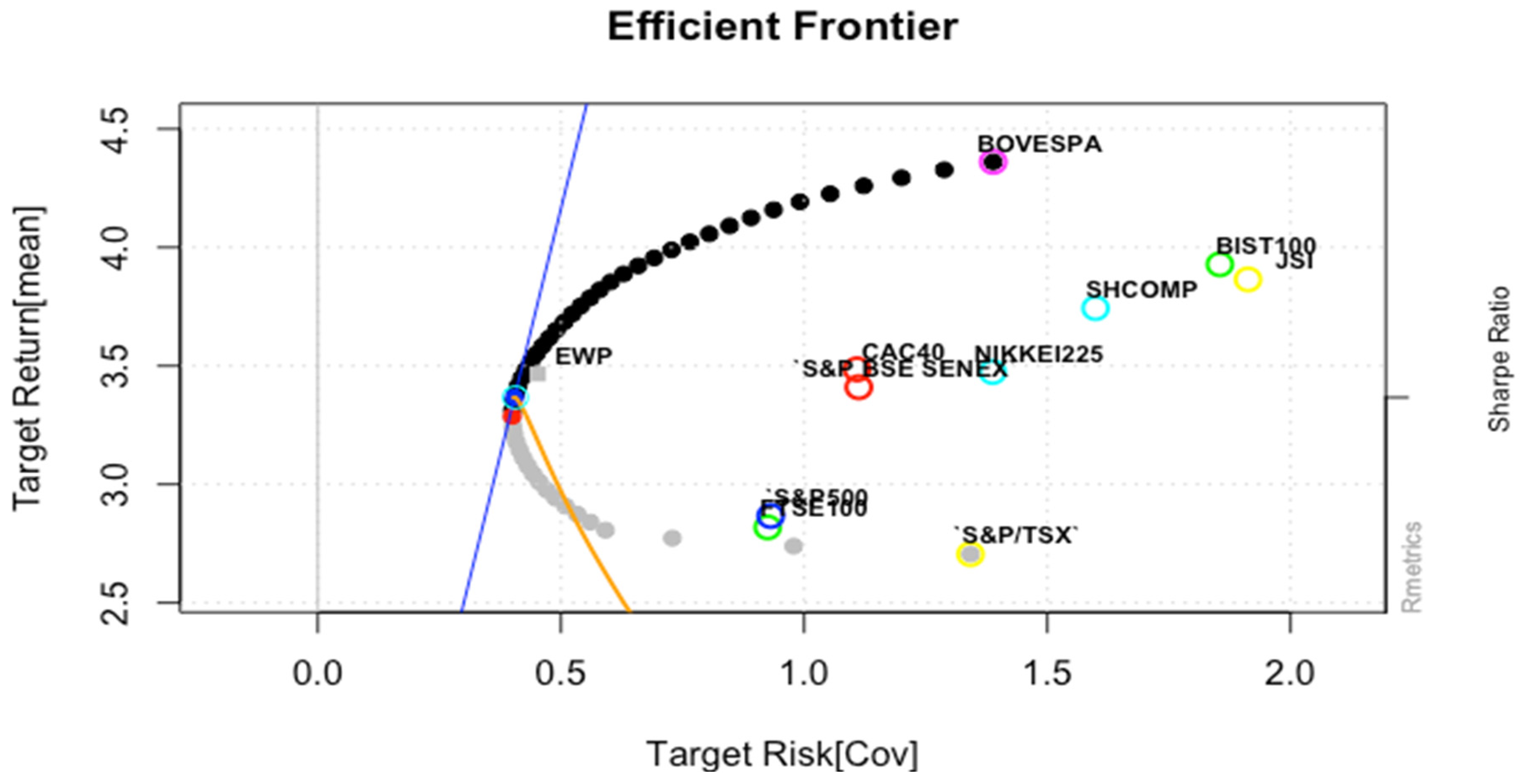

Navigating Extreme Market Fluctuations: Asset Allocation Strategies in Developed vs. Emerging Economies

Abstract
1. Introduction
2. Methodology
3. Data and Empirical Results
3.1. Data
3.2. Portfolio Selection and Construction
3.2.1. The Mean-Variance GPD Portfolio
3.2.2. The Mean-Variance GEV Distribution Portfolio
4. Conclusions
Funding
Institutional Review Board Statement
Informed Consent Statement
Data Availability Statement
Acknowledgments
Conflicts of Interest
Appendix A

| CAC 40 | S&P/TSX | FTSE 100 | NIKKIE 225 | S&P 500 | BOVESPA | SHCOMP | S&P BSE SENEX | JSI | BIST 100 | |
|---|---|---|---|---|---|---|---|---|---|---|
| ar1 | 0.157 (17.23) | 1.270 (6.04) | 0.233 (13.56) | −0.773 (−3.55) | 2.276 (101.9) | 1.285 (13.41) | 0.994 (405.3) | −0.544 (−3.91) | 1.050 (1044) | 1.349 (16.94) |
| ar2 | 1.012 (31.55) | −0.645 (−4.4) | −0.250 (−9.9) | −0.341 (−2.02) | −2.426 (−44.2) | −0.823 (−4.59) | −0.983 (12) | −0.216 (−3830) | −0.897 (−9.39) | |
| ar3 | 0.275 (6.18) | - | 0.263 (5.40) | 1.375 (21.41) | 0.104 (265) | |||||
| ar4 | −0.859 (−88.08) | - | −0.947 (−201) | −0.279 (−9.182) | - | 0.986 (−2046) | ||||
| ar5 | - | - | - | |||||||
| ma1 | −1.242 (−5.58) | −0.226 (−710) | 0.749 (3.44) | −2.316 (−605) | −1.28 (−13.15) | −0.983 (−837) | 0.610 (4.64) | −0.986 (−2316) | −1.329 (−14.54) | |
| −0.169 (−59.27) | ||||||||||
| ma2 | −1.039 (−33.73) | 0.144 (1297) | ||||||||
| 0.593 (3.78) | 0.250 (4754) | - | 2.487 (129) | 0.799 (4.29) | 0.867 (7.86) | |||||
| ma3 | −0.886 (−8.01) | - | −0.279 (−217) | - | −1.401 (−423) | - | −0.11 (−2815) | |||
| ma4 | 0.886 (−538.5) | - | 0.942 (9623) | - | 0.245 (22.02) | - | 0.502 (2014) | |||
| ma5 | - | - | 0.041 (3.72) | - |
| 1 | Other figures can be obtained on request. |
References
- Bajeux-Besnainou, I., Portait, R., & Tergny, G. (2013). Optimal portfolio allocations with tracking error volatility and stochastic hedging constraints. Quantitative Finance, 13(10), 1599–1612. [Google Scholar] [CrossRef]
- Bartram, S. M., & Bodnar, G. M. (2012). Crossing the lines: The conditional relation between exchange rate exposure and stock returns in emerging and developed markets. Journal of International Money and Finance, 31(4), 766–792. [Google Scholar] [CrossRef]
- Baur, D. G. (2012). Financial contagion and the real economy. Journal of Banking & Finance, 36(10), 2680–2692. [Google Scholar] [CrossRef]
- Bedoui, R., Benkraiem, R., Guesmi, K., & Kedidi, I. (2023). Portfolio optimization through hybrid deep learning and genetic algorithms vine Copula-GARCH-EVT-CVaR model. Technological Forecasting and Social Change, 197, 122887. [Google Scholar] [CrossRef]
- Bhowmik, R., Debnath, G. C., Debnath, N. C., & Wang, S. (2022). Emerging stock market reactions to shocks during various crisis periods. PLoS ONE, 17(9), e0272450. [Google Scholar] [CrossRef]
- Bonga-Bonga, L. (2018). Uncovering equity market contagion among BRICS countries: An application of the multivariate GARCH model. The Quarterly Review of Economics and Finance, 67, 36–44. [Google Scholar] [CrossRef]
- Bonga-Bonga, L., & Montshioa, K. (2024). Navigating extreme market fluctuations: Asset allocation strategies in developed vs. emerging economies (MPRA working paper no. 119910). University Library of Munich.
- Boubaker, S., Jouini, J., & Lahiani, A. (2016). Financial contagion between the US and selected developed and emerging countries: The case of the subprime crisis. The Quarterly Review of Economics and Finance, 61, 14–28. [Google Scholar] [CrossRef]
- Briec, W., Kerstens, K., & Jokung, O. (2007). Mean-variance-skewness Portfolio Performance gauging: A general shortage function and dual approach. Management Science, 53(1), 135–149. [Google Scholar] [CrossRef]
- Cepoi, C. O. (2020). Asymmetric dependence between stock market returns and news during COVID-19 financial turmoil. Finance Research Letters, 36, 101658. [Google Scholar] [CrossRef]
- Cevik, E. I., Kirci-Cevik, N., & Dibooglu, S. (2016). Global liquidity and financial stress: Evidence from major emerging economies. Emerging Markets Finance and Trade, 52(12), 2790–2807. [Google Scholar] [CrossRef]
- Corsetti, G., Pesenti, P., & Roubini, N. (1999). Paper tigers? A model of the Asian crisis. European Economic Review, 43(7), 1211–1236. [Google Scholar] [CrossRef]
- Forbes, K. J., & Rigobon, R. (2002). No contagion, only interdependence: Measuring stock market comovements. The Journal of Finance, 57(5), 2223–2261. [Google Scholar] [CrossRef]
- Gilli, M., & Këllezi, E. (2006). An application of extreme value theory for measuring financial risk. Computational Economics, 27(2), 207–228. [Google Scholar] [CrossRef]
- Gurdgiev, C., & Petrovskiy, A. (2023). Hedging and safe haven assets dynamics in developed and developing markets: Are different markets that much different? International Review of Financial Analysis, 92, 103059. [Google Scholar] [CrossRef]
- Junior, L. S., & Franca, I. D. P. (2012). Correlation of financial markets in times of crisis. Physica: A Statistical Mechanics and its Applications, 391(1–2), 187–208. [Google Scholar]
- Kshatriya, S., & Prasanna, P. K. (2018). Genetic algorithm-based portfolio optimization with higher moments in global stock markets. Journal of Risk, 20(4), 1–26. [Google Scholar] [CrossRef]
- Lin, P. C., & Ko, P. C. (2009). Portfolio value-at-risk forecasting with GA-based extreme value theory. Expert Systems with Applications, 36(2), 2503–2512. [Google Scholar] [CrossRef]
- Longin, F., & Solnik, B. (2001). Extreme correlation of international equity markets. The Journal of Finance, 56(2), 649–676. [Google Scholar] [CrossRef]
- Mainik, G., Mitov, G., & Rüschendorf, L. (2015). Portfolio optimization for heavy-tailed assets: Extreme risk index vs. Markowitz. Journal of Empirical Finance, 32, 115–134. [Google Scholar] [CrossRef]
- McNeil, A., & Frey, R. (2000). Estimation of tail-related risk measures for heteroscedastic financial time series: An extreme value approach. Journal of Empirical Finance, 7(3–4), 271–300. [Google Scholar] [CrossRef]
- Min, H. G., McDonald, J. A., & Shin, S. O. (2016). What makes a safe haven? Equity and currency returns for six OECD countries during the financial crisis. Annals of Economics and Finance, 17(2), 365–402. [Google Scholar]
- Mlachila, M., & Sanya, S. (2016). Post-crisis bank behavior: Lessons from Mercosur. International Journal of Emerging Markets, 11(4), 584–606. [Google Scholar] [CrossRef]
- Mondello, E. (2023). Optimal portfolio. In Applied fundamentals in finance: Portfolio management and investments (pp. 145–185). Springer Fachmedien. [Google Scholar]
- Naqvi, B., Mirza, N., Naqvi, W. A., & Rizvi, S. K. A. (2017). Portfolio optimisation with higher moments of risk at the Pakistan Stock Exchange. Economic Research-Ekonomska Istraživanja, 30(1), 1594–1610. [Google Scholar] [CrossRef]
- Omoshoro-Jones, O. S., & Bonga-Bonga, L. (2020). The emergence of regional business cycle in Africa—A reality or myth? A Bayesian dynamic factor model analysis. The World Economy, 43(1), 239–273. [Google Scholar] [CrossRef]
- Roni, B., Abbas, G., & Wang, S. (2018). Return and volatility spillovers effects: Study of Asian emerging stock markets. Journal of Systems Science and Information, 6(2), 97–119. [Google Scholar] [CrossRef]
- Tachibana, M. (2022). Safe haven assets for international stock markets: A regime-switching factor copula approach. Research in International Business and Finance, 60, 101591. [Google Scholar] [CrossRef]
- Tarrazo, M., & Úbeda, R. (2012). Minimum-variance versus tangent portfolios—A note. Journal of Asset Management, 13, 186–195. [Google Scholar] [CrossRef]
- Younis, I., Yousaf, I., Shah, W. U., & Longsheng, C. (2023). Risk transmission between equity market of China and its trading partners: New evidence from various financial crises. International Journal of Emerging Markets, 20(3), 1063–1096. [Google Scholar] [CrossRef]

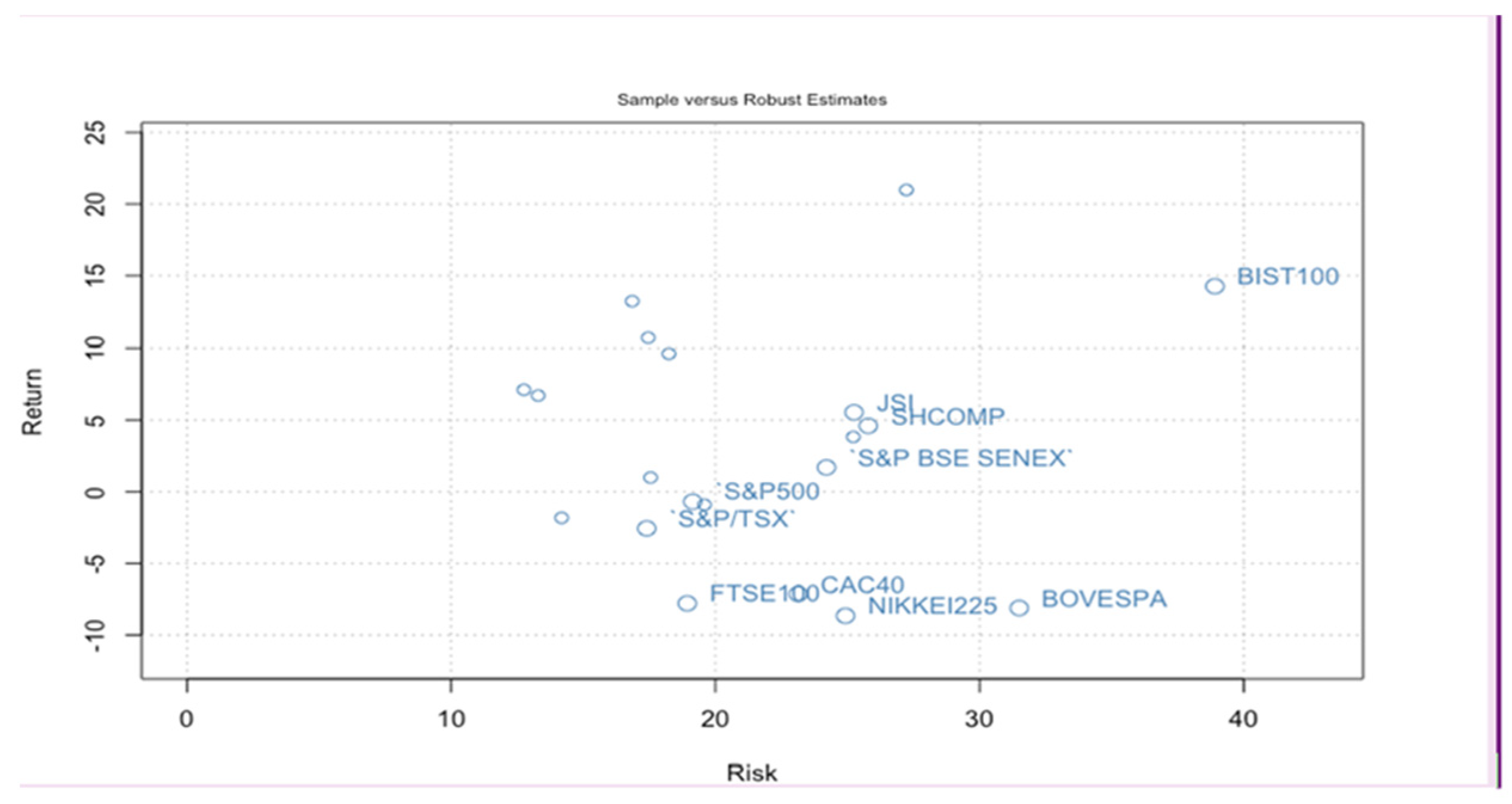


| Stock Market | Mean | Standard Deviation | Skewness | Kurtosis |
|---|---|---|---|---|
| Developed Markets Indices | ||||
| CAC 40 | −0.03 | 1.46 | −0.29 | 3.57 |
| S&P/TSX | −0.01 | 1.1 | −0.55 | 8.18 |
| FTSE 100 | −0.03 | 1.19 | −0.42 | 4.89 |
| NIKKEI 225 | −0.03 | 1.57 | −0.44 | 5.88 |
| S&P 500 | 0.00 | 1.21 | −0.53 | 5.4 |
| Emerging Markets Indices | ||||
| BOVESPA | −0.03 | 1.98 | −0.65 | 5.79 |
| SCHOMP | 0.02 | 1.62 | −0.29 | 5.08 |
| S&P BSE SENSEX | 0.01 | 1.52 | −0.44 | 4.69 |
| JSE | 0.02 | 1.59 | −0.25 | 7.83 |
| BIST 100 | 0.06 | 2.45 | −0.21 | 7.7 |
| Generalized Pareto Distributions | ||
|---|---|---|
| Portfolio | Optimal Portfolio Weights | Tangent Portfolio Weights |
| Developed Markets | ||
| CAC 40 | 0.1233 | 0.1311 |
| S&P/TSX | 0.0844 | 0.0676 |
| FTSE 100 | 0.1865 | 0.1585 |
| NIKKEI 225 | 0.0836 | 0.0879 |
| S&P 500 | 0.1858 | 0.1614 |
| Emerging Markets | ||
| BOVESPA | 0.0783 | 0.1366 |
| SHOMP | 0.0586 | 0.0745 |
| S&P BSE SENEX | 0.1185 | 0.1243 |
| JSE | 0.0402 | 0.0551 |
| BIST 100 | 0.0407 | 0.0589 |
| Expected Return ( | 3.2873 | 3.3670 |
| Risk () | −2.6836 | −2.7534 |
| Sharpe Ratio | 2.0280 | 2.077 |
| Sortino Ratio (MAR = 0) | 3.1330 | 3.209 |
| Mean-Variance GPD | ||
|---|---|---|
| Portfolio | Optimal Portfolio Weights | Tangent Portfolio Weights |
| Developed Markets | ||
| CAC 40 | 0.1873 | 0.2168 |
| S&P/TSX | 0.1304 | 0.1165 |
| FTSE 100 | 0.2792 | 0.2596 |
| NIKKEI 225 | 0.1252 | 0.1433 |
| S&P 500 | 0.2779 | 0.2637 |
| Expected Return ( | 3.024 | 3.056 |
| Risk () | −2.349 | −2.379 |
| Sharpe Ratio | 2.288 | 2.313 |
| Sortino Ratio (MAR = 0) | 3.363 | 3.400 |
| Mean-Variance | ||
|---|---|---|
| Portfolio | Optimal Portfolio Weights | Tangent Portfolio Weights |
| Emerging markets | ||
| BOVESPA | 0.2275 | 0.2626 |
| SHCOMP | 0.1699 | 0.1670 |
| S&P BSE SENEX | 0.3554 | 0.3166 |
| JSE | 0.1186 | 0.1207 |
| BIST 100 | 0.1286 | 0.1332 |
| Expected Return () | 3.8037 | 3.8393 |
| Risk () | −2.8993 | −2.9306 |
| Sharpe Ratio | 2.3362 | 2.2942 |
| Sortino Ratio (MAR = 0) | 3.5265 | 3.4633 |
| Stock Market Index | Optimal Portfolio Weight | Tangent Portfolio Weight |
|---|---|---|
| Developed Markets Indices | ||
| CAC 40 | 0.1449 | 0.1478 |
| S&P/TSX | 0.117 | 0.0919 |
| FTSE 100 | 0.1863 | 0.1566 |
| NIKKEI 225 | 0.1041 | 0.1191 |
| S&P 500 | 0.1508 | 0.1311 |
| Emerging Markets Indices | ||
| BOVESPA | 0.0644 | 0.0907 |
| S&P BSE SENEX | 0.0789 | 0.0789 |
| IPC | 0.0729 | 0.0782 |
| JSI | 0.0518 | 0.0581 |
| BIST 100 | 0.029 | 0.0757 |
| Expected Return (E[R]) | 2.449 | 2.5445 |
| Risk (CVaR) | −1.6088 | −1.6814 |
| Sharpe Ratio | 1.5827 | 1.6447 |
| Sortino Ratio (MAR = 0) | 2.3923 | 2.4855 |
| Mean Variance | ||
|---|---|---|
| Portfolio | Optimal Portfolio Weights | Tangent Portfolio Weights |
| Developed Markets Indices | ||
| CAC 40 | 0.216 | 0.238 |
| S&P/TSX | 0.171 | 0.149 |
| FTSE 100 | 0.281 | 0.256 |
| NIKKEI 225 | 0.166 | 0.201 |
| S&P 500 | 0.165 | 0.153 |
| Expected Return ( | 2.327 | 2.3640 |
| Risk () | −1.2791 | −1.2946 |
| Sharpe Ratio | 1759 | 1.787 |
| Sortino Ratio (MAR = 0) | 2.585 | 2.627 |
| Portfolio | Optimal Portfolio Weight | Tangent Portfolio Weight |
|---|---|---|
| Emerging Markets Indices | ||
| BOVESPA | 0.214 | 0.2551 |
| S&P BSE SENEX | 0.2639 | 0.2219 |
| IPC | 0.2359 | 0.2144 |
| JSI | 0.1877 | 0.1737 |
| BIST 100 | 0.0984 | 0.1349 |
| Expected Return (E[R]) | 2.921 | 3.014 |
| Risk (CVaR) | −1.6059 | −1.659 |
| Sharpe Ratio | 1.8386 | 1.8919 |
| Sortino Ratio (MAR = 0) | 2.7775 | 2.8577 |
Disclaimer/Publisher’s Note: The statements, opinions and data contained in all publications are solely those of the individual author(s) and contributor(s) and not of MDPI and/or the editor(s). MDPI and/or the editor(s) disclaim responsibility for any injury to people or property resulting from any ideas, methods, instructions or products referred to in the content. |
© 2026 by the author. Licensee MDPI, Basel, Switzerland. This article is an open access article distributed under the terms and conditions of the Creative Commons Attribution (CC BY) license.
Share and Cite
Bonga-Bonga, L. Navigating Extreme Market Fluctuations: Asset Allocation Strategies in Developed vs. Emerging Economies. Econometrics 2026, 14, 16. https://doi.org/10.3390/econometrics14010016
Bonga-Bonga L. Navigating Extreme Market Fluctuations: Asset Allocation Strategies in Developed vs. Emerging Economies. Econometrics. 2026; 14(1):16. https://doi.org/10.3390/econometrics14010016
Chicago/Turabian StyleBonga-Bonga, Lumengo. 2026. "Navigating Extreme Market Fluctuations: Asset Allocation Strategies in Developed vs. Emerging Economies" Econometrics 14, no. 1: 16. https://doi.org/10.3390/econometrics14010016
APA StyleBonga-Bonga, L. (2026). Navigating Extreme Market Fluctuations: Asset Allocation Strategies in Developed vs. Emerging Economies. Econometrics, 14(1), 16. https://doi.org/10.3390/econometrics14010016