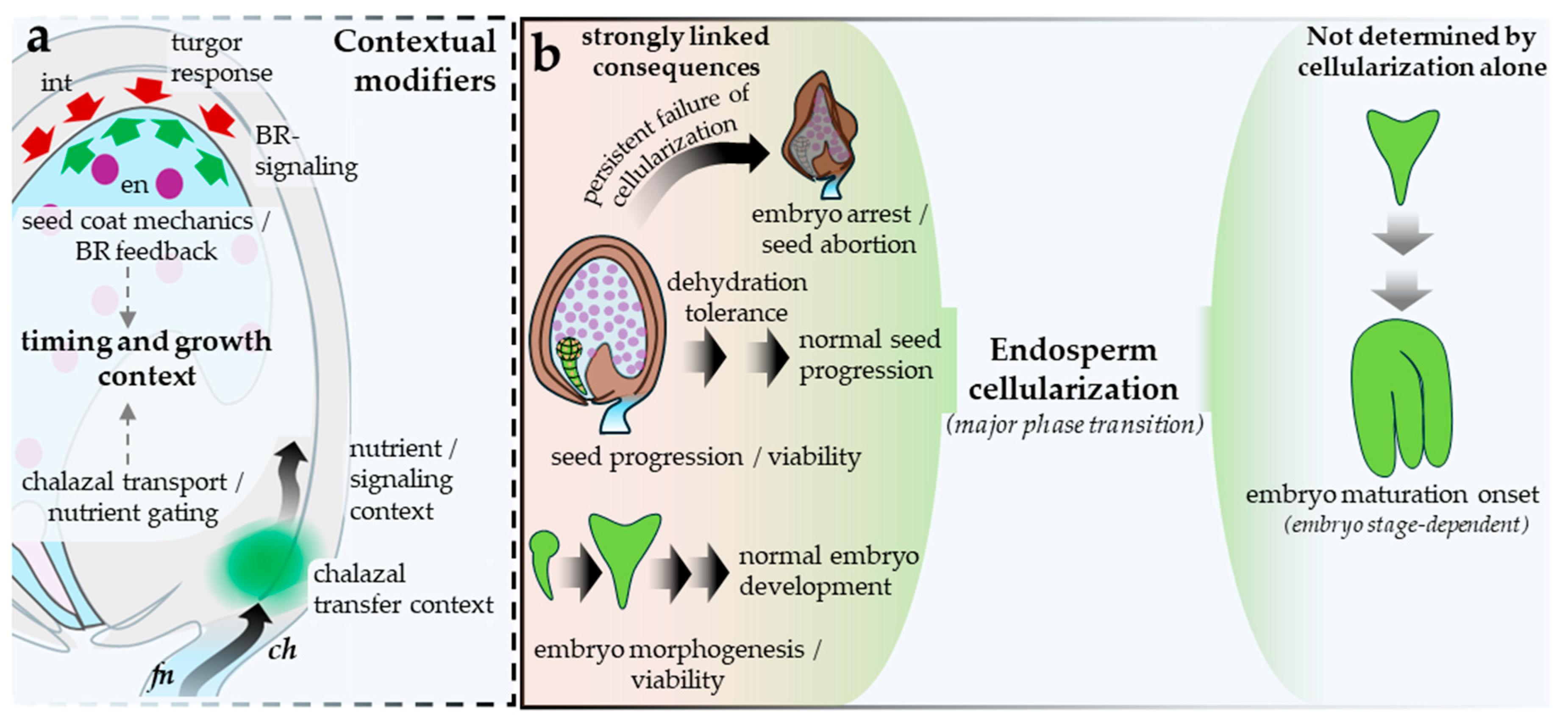
From the MMC Specification to Endosperm Cellularization in Arabidopsis: A Developmental-Handover Framework for Seed Initiation


Abstract
1. Introduction
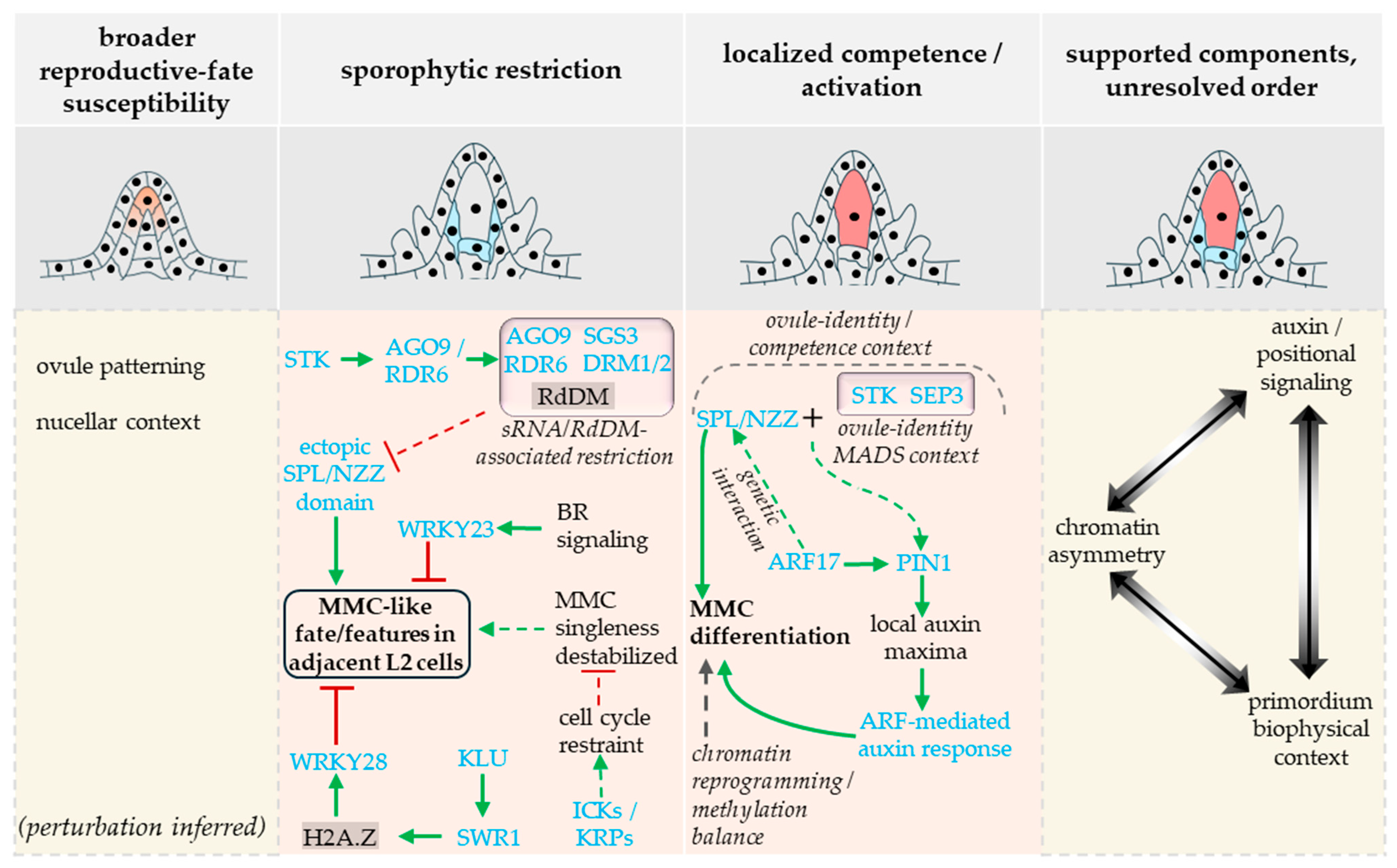
2. Restricting Reproductive Fate: How MMC Singleness Emerges
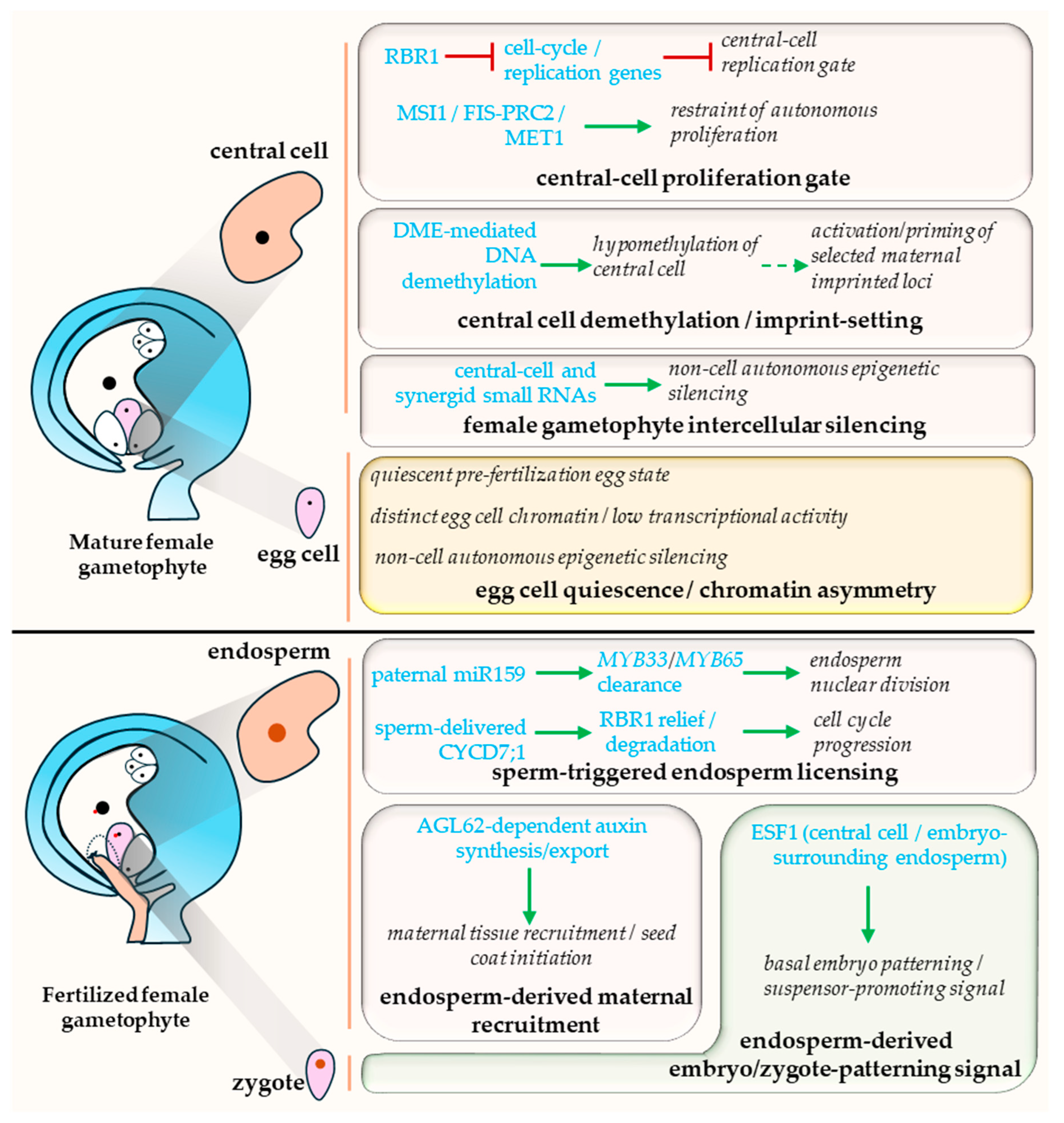
3. Gametophytic Poise After Meiosis: Asymmetric Conditioning and Pre-Fertilization Restraint
3.1. Active Cell Cycle Restraint and Its Release Potential
3.2. Molecular Asymmetry and Central-Cell-Biased Imprint-Setting
3.3. Residual Communication Within the Mature Female Gametophyte
4. Fertilization as Licensing Event for Seed Initiation: Release of Central-Cell Restraint and Downstream Recruitment of Maternal Tissues
4.1. Direct Release of Central-Cell Restraint
4.2. Endosperm-Autonomous Program
4.3. Maternal Recruitment
4.4. Embryo-Endosperm Coordination
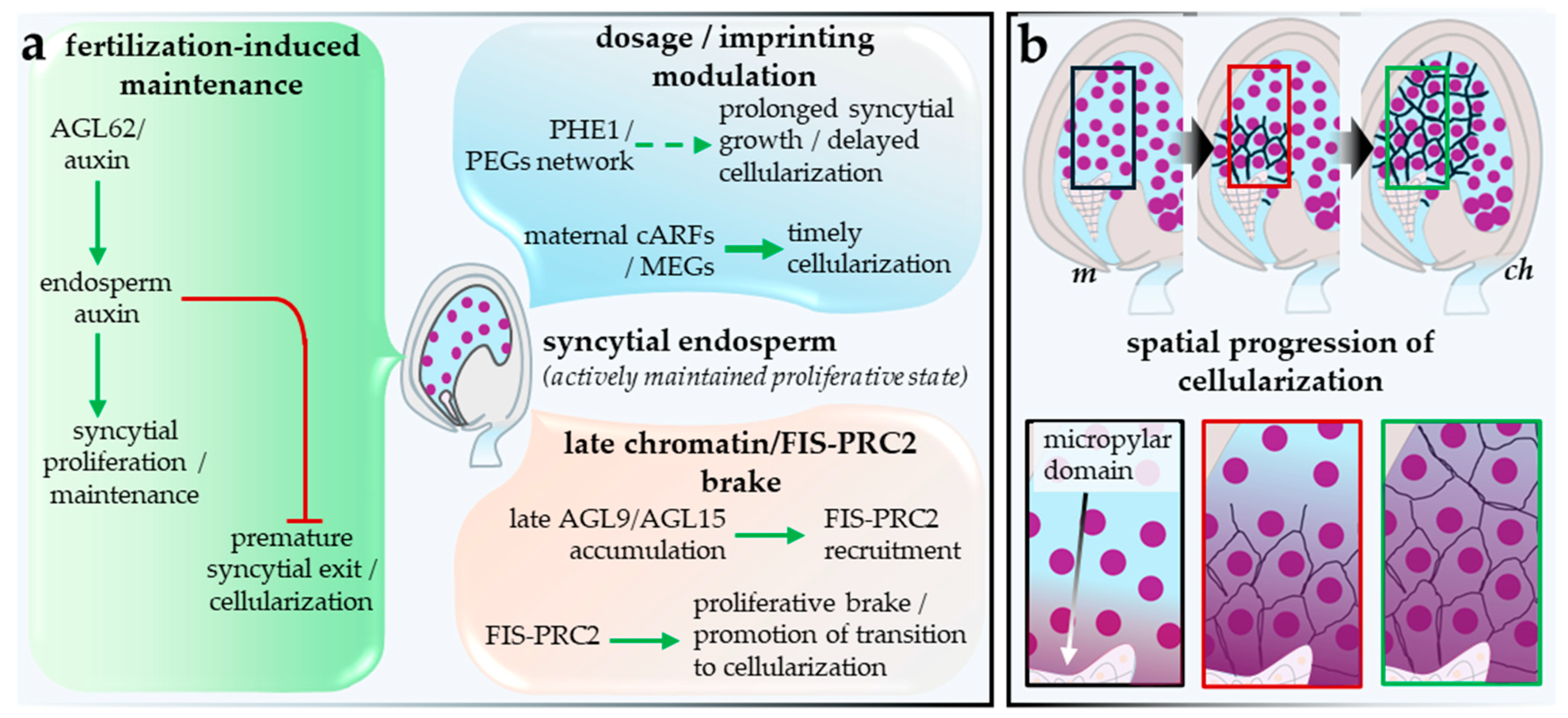
5. From Syncytial Endosperm Maintenance to Cellularization: Maintenance, Exit Logic, and Developmental Consequences
6. How Far Does the Arabidopsis-Centered Handover Model Generalize?

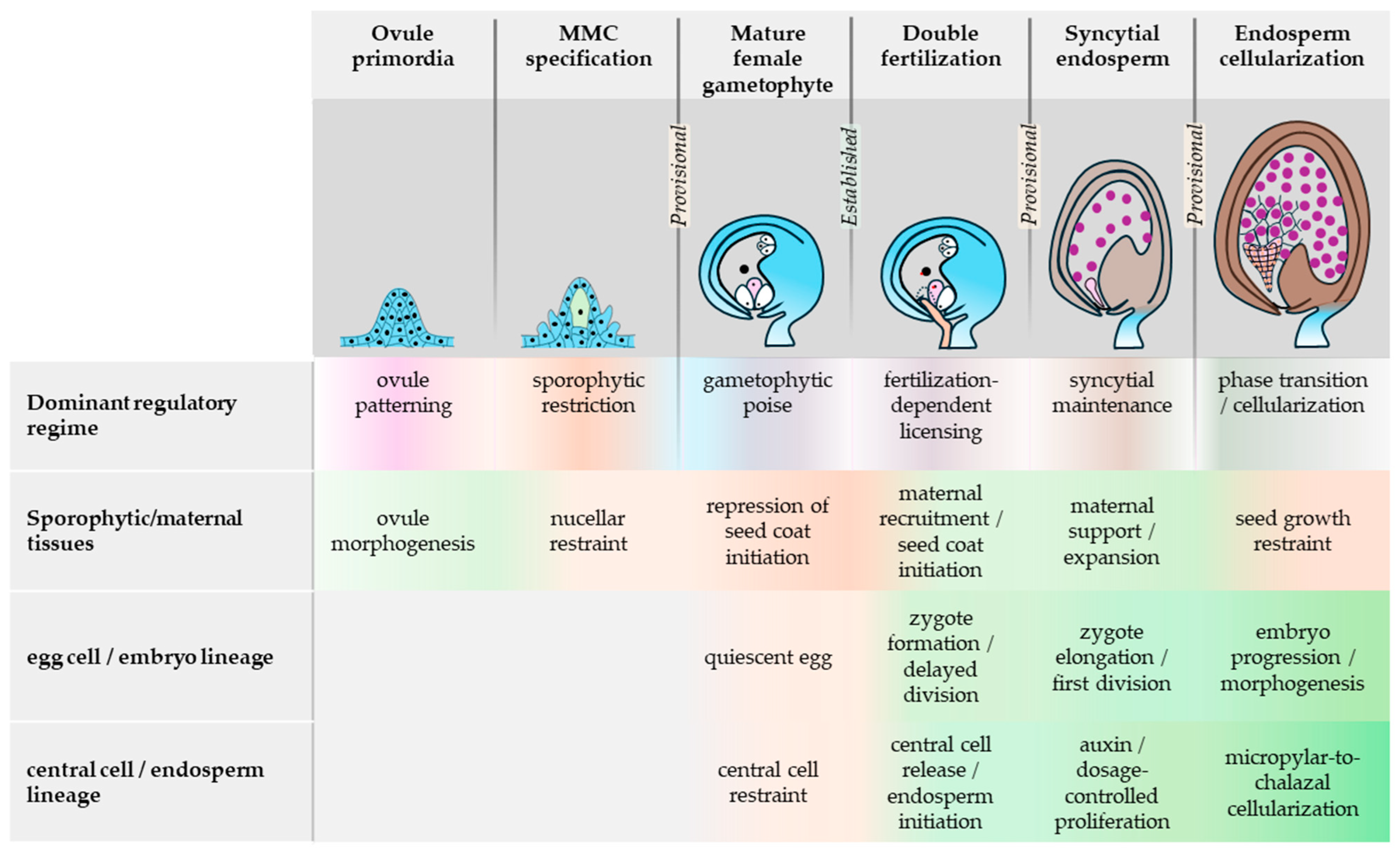
| Boundary Assessed | Classification | Criteria Assessment (C1–C4) | Evidence-Calibrated Synthesis Statement | Representative Primary Anchors (Arabidopsis Emphasis) | Evidence Grade and Main Limiting Condition |
|---|---|---|---|---|---|
| MMC specification → mature female gametophyte (composite pre-fertilization span) | Provisional (composite assessment case; not event-centered) | C1 yes: An ovule-context control logic of sporophytic restriction, together with localized competence around MMC selection, is identifiable. C2 partial: An ensuing mature female-gametophytic poise state is identifiable, but emergence of that state as the new principal organizer across the intervening pre-fertilization span is not boundary-localized. C3 yes: Detectable first-order consequences of traversing this broader pre-fertilization span are present in the ensuing interval, which is organized as an unequal, actively restrained mature female gametophyte. C4 yes (contextual/synthesis-level): Overlap between earlier MMC-centered restriction/selection logic and later gametophytic conditioning is supported mainly at the synthesis level, with only limited study-level anchors rather than a single direct boundary-localized demonstration. | Arabidopsis supports MMC singleness and mature female-gametophytic poise as biologically real states within one broader pre-fertilization span. The ensuing poise state and its detectable downstream asymmetries are clear, but the dominant shift in control linking MMC restriction to that later interval is not yet directly resolved across meiosis and early gametophytic differentiation. For this reason, the boundary remains provisional, and overlap across the span is best treated as contextual and synthesis-level rather than as a single boundary-localized proof. | C1 prior logic: Olmedo-Monfil et al. [4]; Rodriguez-Leal et al. [20]; Mendes et al. [3]; Zhao et al. [18]; Cao et al. [21] C2 ensuing poise state (partial): Jullien et al. [30]; Pillot et al. [34]; Park et al. [38]; Voichek et al. [31] C3 detectable ensuing-interval consequences: Jullien et al. [30]; Pillot et al. [34]; Park et al. [38]; Voichek et al. [31] C4 overlap (contextual/synthesis-level): Mendes et al. [3]; Pillot et al. [34]; synthesis across the full pre-fertilization evidence base | Strong for MMC singleness and mature female-gametophytic poise when considered separately; moderate for treating the intervening pre-fertilization span as a single assessed handover unit. Main limit: C2 remains only partially resolved, because the dominant control shift linking MMC restriction to later female-gametophytic poise is not yet localized as a single boundary-level transfer, while overlap is supported mainly contextually rather than by one direct anchor. |
| Mature female gametophyte → double fertilization | Established handover | C1 yes: A prior control logic of pre-fertilization central-cell restraint and gamete asymmetry is directly supported. C2 yes: Fertilization-dependent release of central-cell restraint and initiation of endosperm development become the dominant organizer of progression. C3 yes: Crossing this boundary has detectable first-order consequences in the ensuing interval, including endosperm initiation and early maternal recruitment outputs. C4 yes: Pre-fertilization asymmetry overlaps with early post-fertilization lineage-specific and imprint-related behavior rather than being erased at the boundary. | The clearest Arabidopsis handover occurs when fertilization relieves central-cell restraint and fertilization-dependent endosperm initiation becomes the dominant organizer of early seed progression. This is a boundary-localized shift in control, even though the internal ordering among paternal cargos, central-cell-autonomous release, and earliest downstream relays remains incompletely resolved. | C1 prior control logic: Ebel et al. [28]; Jullien et al. [30]; Sornay et al. [33]; Pillot et al. [34] C2 new organizer: Zhao et al. [45]; Simonini et al. [12]; Figueiredo et al. [46]; Guo et al. [7] C3 detectable ensuing consequences: Roszak and Kohler [11]; Figueiredo et al. [6]; Xu et al. [47] C4 overlap: Jullien et al. [30]; Pillot et al. [34]; Figueiredo et al. [6] | Strong. Main limit: the internal ordering among paternal cargos, central-cell-autonomous release, and earliest downstream relays remains incompletely resolved, but this does not overturn the established boundary-level classification. |
| Double fertilization → syncytial endosperm | Provisional handover (overlap-heavy) | C1 yes: the prior control logic of fertilization-dependent licensing and endosperm initiation is identifiable. C2 partial: a maintained syncytial program clearly emerges, but its onset is not cleanly separable from the established licensing transition. C3 partial: crossing into the ensuing interval has detectable first-order consequences, including sustained syncytial proliferation and dosage-sensitive elaboration of maintenance, but these remain too continuous with the licensing logic to support a distinct second handover. C4 yes: paternal inputs, maternal recruitment, and early syncytial maintenance logic overlap substantially across this boundary. | Arabidopsis strongly supports an actively maintained syncytial program after fertilization. This row is retained as a conservative assessment case, but the onset of that maintained interval remains too overlapped with fertilization-dependent licensing to justify a second equally independent established handover. Detectable consequences in the ensuing interval are present, but they are not discretely separable enough from the licensing transition to elevate this boundary beyond provisional status. | C1 prior control logic: Zhao et al. [45]; Simonini et al. [12]; Figueiredo et al. [46] C2 ensuing maintained program: Kang et al. [49]; Figueiredo et al. [46]; Guo et al. [7] C3 detectable ensuing consequences (partial): Batista et al. [50]; Kradolfer et al. [51]; Butel et al. [53] C4 overlap: Roszak and Kohler [11]; Figueiredo et al. [6]; Xu et al. [47] | Strong for the existence of an actively maintained syncytial program; Moderate for treating its onset as a distinct handover. Main limit: the same AGL62/auxin-centered logic spans initiation and early maintenance, so criterion C2 is not cleanly separable from the preceding established handover. |
| Syncytial endosperm → endosperm cellularization | Provisional handover | C1 yes: The maintained syncytial control logic and its major sustaining inputs are identifiable. C2 partial: Exit to cellularization is clear, but no single dominant organizer of the transition is fully resolved. C3 partial: Crossing this boundary has detectable first-order consequences, including spatially patterned cellularization and immediate changes in seed progression. C4 yes: Auxin-linked maintenance, dosage-sensitive control, and late chromatin inputs overlap substantially across exit. | Arabidopsis supports a real developmental transition out of syncytial proliferation, but the boundary remains provisional because cellularization appears to arise from convergence of attenuated maintenance, dosage-sensitive regulation, late chromatin braking, and spatial execution rather than from one fully resolved trigger hierarchy. | C1 prior control logic: Kang et al. [49]; Figueiredo et al. [46]; Guo et al. [7] C2 integrated exit logic: Wolff et al. [52]; Batista et al. [50]; Butel et al. [53]; Zhang et al. [55] C3 detectable ensuing consequences: Hehenberger et al. [15]; Xu et al. [59] C4 overlap: Weinhofer et al. [54]; Moreno-Romero et al. [39]; Zhang et al. [55] | Strong for patterned cellularization and its developmental importance; Moderate for integrated exit logic. Main limit: criterion C2 is not yet met cleanly because no single dominant organizer of the exit transition has been resolved. |
7. Outstanding Questions and Future Directions for a Restraint-to-Release Model
8. Conclusions
Supplementary Materials
Author Contributions
Funding
Data Availability Statement
Conflicts of Interest
References
- Cavalleri, A.; Astori, C.; Manrique, S.; Bruzzaniti, G.; Smaczniak, C.; Mizzotti, C.; Ruiu, A.; Spano, M.; Movilli, A.; Gregis, V.; et al. SPOROCYTELESS/NOZZLE cooperates with MADS-domain transcription factors to regulate an auxin-dependent network controlling Megaspore-Mother-Cell differentiation. Nat. Commun. 2025, 17, 683. [Google Scholar] [CrossRef]
- Huang, J.; Zhao, L.; Malik, S.; Gentile, B.R.; Xiong, V.; Arazi, T.; Owen, H.A.; Friml, J.; Zhao, D. Specification of female germline by microRNA orchestrated auxin signaling in Arabidopsis. Nat. Commun. 2022, 13, 6960. [Google Scholar] [CrossRef] [PubMed]
- Mendes, M.A.; Petrella, R.; Cucinotta, M.; Vignati, E.; Gatti, S.; Pinto, S.C.; Bird, D.C.; Gregis, V.; Dickinson, H.; Tucker, M.R.; et al. The RNA-dependent DNA methylation pathway is required to restrict SPOROCYTELESS/NOZZLE expression to specify a single female germ cell precursor in Arabidopsis. Development 2020, 147, dev194274. [Google Scholar] [CrossRef]
- Olmedo-Monfil, V.; Duran-Figueroa, N.; Arteaga-Vazquez, M.; Demesa-Arevalo, E.; Autran, D.; Grimanelli, D.; Slotkin, R.K.; Martienssen, R.A.; Vielle-Calzada, J.P. Control of female gamete formation by a small RNA pathway in Arabidopsis. Nature 2010, 464, 628–632. [Google Scholar] [CrossRef]
- Schmidt, A.; Wuest, S.E.; Vijverberg, K.; Baroux, C.; Kleen, D.; Grossniklaus, U. Transcriptome analysis of the Arabidopsis megaspore mother cell uncovers the importance of RNA helicases for plant germline development. PLoS Biol. 2011, 9, e1001155. [Google Scholar] [CrossRef]
- Figueiredo, D.D.; Batista, R.A.; Roszak, P.J.; Hennig, L.; Kohler, C. Auxin production in the endosperm drives seed coat development in Arabidopsis. eLife 2016, 5, e20542. [Google Scholar] [CrossRef] [PubMed]
- Guo, L.; Luo, X.; Li, M.; Joldersma, D.; Plunkert, M.; Liu, Z. Mechanism of fertilization-induced auxin synthesis in the endosperm for seed and fruit development. Nat. Commun. 2022, 13, 3985. [Google Scholar] [CrossRef]
- Lima, R.B.; Pankaj, R.; Ehlert, S.T.; Finger, P.; Frohlich, A.; Bayle, V.; Landrein, B.; Sampathkumar, A.; Figueiredo, D.D. Seed coat-derived brassinosteroid signaling regulates endosperm development. Nat. Commun. 2024, 15, 9352. [Google Scholar] [CrossRef] [PubMed]
- Liu, X.; Nakajima, K.P.; Adhikari, P.B.; Wu, X.; Zhu, S.; Okada, K.; Kagenishi, T.; Kurotani, K.I.; Ishida, T.; Nakamura, M.; et al. Fertilization-dependent phloem end gate regulates seed size. Curr. Biol. 2025, 35, 2049–2063.e2043. [Google Scholar] [CrossRef]
- Nowack, M.K.; Grini, P.E.; Jakoby, M.J.; Lafos, M.; Koncz, C.; Schnittger, A. A positive signal from the fertilization of the egg cell sets off endosperm proliferation in angiosperm embryogenesis. Nat. Genet. 2006, 38, 63–67. [Google Scholar] [CrossRef]
- Roszak, P.; Kohler, C. Polycomb group proteins are required to couple seed coat initiation to fertilization. Proc. Natl. Acad. Sci. USA 2011, 108, 20826–20831. [Google Scholar] [CrossRef]
- Simonini, S.; Bencivenga, S.; Grossniklaus, U. A paternal signal induces endosperm proliferation upon fertilization in Arabidopsis. Science 2024, 383, 646–653. [Google Scholar] [CrossRef]
- Becraft, P.W.; Gutierrez-Marcos, J. Endosperm development: Dynamic processes and cellular innovations underlying sibling altruism. Wiley Interdiscip. Rev. Dev. Biol. 2012, 1, 579–593. [Google Scholar] [CrossRef]
- Floyd, S.K.; Friedman, W.E. Evolution of endosperm developmental patterns among basal flowering plants. Int. J. Plant Sci. 2000, 161, S57–S81. [Google Scholar] [CrossRef]
- Hehenberger, E.; Kradolfer, D.; Kohler, C. Endosperm cellularization defines an important developmental transition for embryo development. Development 2012, 139, 2031–2039. [Google Scholar] [CrossRef]
- Shamrov, I.I. Endosperm development traits in a comparative analysis of endospermogenesis and embryogenesis in angiosperms. Dokl. Biol. Sci. 2022, 506, 239–255. [Google Scholar] [CrossRef] [PubMed]
- Jiang, T.; Li, L.; Hu, Q.; Kuang, X.; Zhang, L.; Zeng, W.; Miki, D.; Zheng, B. The DNA methylation-demethylation balance prevents development of multiple megaspore mother cells in Arabidopsis. Plant Cell 2025, 37, koaf023. [Google Scholar] [CrossRef]
- Zhao, L.; Cai, H.; Su, Z.; Wang, L.; Huang, X.; Zhang, M.; Chen, P.; Dai, X.; Zhao, H.; Palanivelu, R.; et al. KLU suppresses megasporocyte cell fate through SWR1-mediated activation of WRKY28 expression in Arabidopsis. Proc. Natl. Acad. Sci. USA 2018, 115, E526–E535. [Google Scholar] [CrossRef] [PubMed]
- Hernandez-Lagana, E.; Mosca, G.; Mendocilla-Sato, E.; Pires, N.; Frey, A.; Giraldo-Fonseca, A.; Michaud, C.; Grossniklaus, U.; Hamant, O.; Godin, C.; et al. Organ geometry channels reproductive cell fate in the Arabidopsis ovule primordium. eLife 2021, 10, e66031. [Google Scholar] [CrossRef]
- Rodriguez-Leal, D.; Leon-Martinez, G.; Abad-Vivero, U.; Vielle-Calzada, J.P. Natural variation in epigenetic pathways affects the specification of female gamete precursors in Arabidopsis. Plant Cell 2015, 27, 1034–1045. [Google Scholar] [CrossRef]
- Cao, L.; Wang, S.; Venglat, P.; Zhao, L.; Cheng, Y.; Ye, S.; Qin, Y.; Datla, R.; Zhou, Y.; Wang, H. Arabidopsis ICK/KRP cyclin-dependent kinase inhibitors function to ensure the formation of one megaspore mother cell and one functional megaspore per ovule. PLoS Genet. 2018, 14, e1007230. [Google Scholar] [CrossRef]
- Su, Z.; Wang, N.; Hou, Z.; Li, B.; Li, D.; Liu, Y.; Cai, H.; Qin, Y.; Chen, X. Regulation of female germline specification via small RNA mobility in Arabidopsis. Plant Cell 2020, 32, 2842–2854. [Google Scholar] [CrossRef]
- Singh, M.; Goel, S.; Meeley, R.B.; Dantec, C.; Parrinello, H.; Michaud, C.; Leblanc, O.; Grimanelli, D. Production of viable gametes without meiosis in maize deficient for an ARGONAUTE protein. Plant Cell 2011, 23, 443–458. [Google Scholar] [CrossRef] [PubMed]
- Cai, H.; Liu, L.; Huang, Y.; Zhu, W.; Qi, J.; Xi, X.; Aslam, M.; Dresselhaus, T.; Qin, Y. Brassinosteroid signaling regulates female germline specification in Arabidopsis. Curr. Biol. 2022, 32, 1102–1114.e1105. [Google Scholar] [CrossRef]
- Cai, H.; Huang, Y.; Liu, L.; Zhang, M.; Chai, M.; Xi, X.; Aslam, M.; Wang, L.; Ma, S.; Su, H.; et al. Signaling by the EPFL-ERECTA family coordinates female germline specification through the BZR1 family in Arabidopsis. Plant Cell 2023, 35, 1455–1473. [Google Scholar] [CrossRef]
- She, W.; Grimanelli, D.; Rutowicz, K.; Whitehead, M.W.J.; Puzio, M.; Kotliński, M.; Jerzmanowski, A.; Baroux, C. Chromatin reprogramming during the somatic-to-reproductive cell fate transition in plants. Development 2013, 140, 4008–4019. [Google Scholar] [CrossRef] [PubMed]
- Wei, B.; Zhang, J.; Pang, C.; Yu, H.; Guo, D.; Jiang, H.; Ding, M.; Chen, Z.; Tao, Q.; Gu, H.; et al. The molecular mechanism of sporocyteless/nozzle in controlling Arabidopsis ovule development. Cell Res. 2015, 25, 121–134. [Google Scholar] [CrossRef]
- Ebel, C.; Mariconti, L.; Gruissem, W. Plant retinoblastoma homologues control nuclear proliferation in the female gametophyte. Nature 2004, 429, 776–780. [Google Scholar] [CrossRef] [PubMed]
- Johnston, A.J.; Matveeva, E.; Kirioukhova, O.; Grossniklaus, U.; Gruissem, W. A dynamic reciprocal RBR-PRC2 regulatory circuit controls Arabidopsis gametophyte development. Curr. Biol. 2008, 18, 1680–1686. [Google Scholar] [CrossRef]
- Jullien, P.E.; Mosquna, A.; Ingouff, M.; Sakata, T.; Ohad, N.; Berger, F. Retinoblastoma and its binding partner MSI1 control imprinting in Arabidopsis. PLoS Biol. 2008, 6, e194. [Google Scholar] [CrossRef]
- Voichek, Y.; Hurieva, B.; Michaud, C.; Schmücker, A.; Vergara, Z.; Desvoyes, B.; Gutierrez, C.; Nizhynska, V.; Jaegle, B.; Borg, M.; et al. Cell cycle status of male and female gametes during Arabidopsis reproduction. Plant Physiol. 2024, 194, 412–421. [Google Scholar] [CrossRef]
- Weimer, A.K.; Matos, J.L.; Sharma, N.; Patell, F.; Murray, J.A.H.; Dewitte, W.; Bergmann, D.C. Lineage- and stage-specific expressed CYCD7;1 coordinates the single symmetric division that creates stomatal guard cells. Development 2018, 145, dev160671. [Google Scholar] [CrossRef]
- Sornay, E.; Forzani, C.; Forero-Vargas, M.; Dewitte, W.; Murray, J.A. Activation of CYCD7;1 in the central cell and early endosperm overcomes cell-cycle arrest in the Arabidopsis female gametophyte, and promotes early endosperm and embryo development. Plant J. 2015, 84, 41–55. [Google Scholar] [CrossRef]
- Pillot, M.; Baroux, C.; Vazquez, M.A.; Autran, D.; Leblanc, O.; Vielle-Calzada, J.P.; Grossniklaus, U.; Grimanelli, D. Embryo and endosperm inherit distinct chromatin and transcriptional states from the female gametes in Arabidopsis. Plant Cell 2010, 22, 307–320. [Google Scholar] [CrossRef] [PubMed]
- Ingouff, M.; Hamamura, Y.; Gourgues, M.; Higashiyama, T.; Berger, F. Distinct dynamics of HISTONE3 variants between the two fertilization products in plants. Curr. Biol. 2007, 17, 1032–1037. [Google Scholar] [CrossRef] [PubMed]
- Choi, Y.; Gehring, M.; Johnson, L.; Hannon, M.; Harada, J.J.; Goldberg, R.B.; Jacobsen, S.E.; Fischer, R.L. DEMETER, a DNA glycosylase domain protein, is required for endosperm gene imprinting and seed viability in Arabidopsis. Cell 2002, 110, 33–42. [Google Scholar] [CrossRef] [PubMed]
- Park, J.S.; Frost, J.M.; Park, K.; Ohr, H.; Park, G.T.; Kim, S.; Eom, H.; Lee, I.; Brooks, J.S.; Fischer, R.L.; et al. Control of DEMETER DNA demethylase gene transcription in male and female gamete companion cells in Arabidopsis thaliana. Proc. Natl. Acad. Sci. USA 2017, 114, 2078–2083. [Google Scholar] [CrossRef]
- Park, K.; Kim, M.Y.; Vickers, M.; Park, J.-S.; Hyun, Y.; Okamoto, T.; Zilberman, D.; Fischer, R.L.; Feng, X.; Choi, Y.; et al. DNA demethylation is initiated in the central cells of Arabidopsis and rice. Proc. Natl. Acad. Sci. USA 2016, 113, 15138–15143. [Google Scholar] [CrossRef]
- Moreno-Romero, J.; Jiang, H.; Santos-Gonzalez, J.; Kohler, C. Parental epigenetic asymmetry of PRC2-mediated histone modifications in the Arabidopsis endosperm. EMBO J. 2016, 35, 1298–1311. [Google Scholar] [CrossRef]
- Borg, M.; Jacob, Y.; Susaki, D.; LeBlanc, C.; Buendía, D.; Axelsson, E.; Kawashima, T.; Voigt, P.; Boavida, L.; Becker, J.; et al. Targeted reprogramming of H3K27me3 resets epigenetic memory in plant paternal chromatin. Nat. Cell Biol. 2020, 22, 621–629. [Google Scholar] [CrossRef]
- Schroder, J.A.; Bonnet, D.M.V.; Jullien, P.E. Non-cell-autonomous small RNA silencing in Arabidopsis female gametes. Curr. Biol. 2023, 33, 183–188 e183. [Google Scholar] [CrossRef] [PubMed]
- Kasahara, R.D.; Notaguchi, M.; Nagahara, S.; Suzuki, T.; Susaki, D.; Honma, Y.; Maruyama, D.; Higashiyama, T. Pollen tube contents initiate ovule enlargement and enhance seed coat development without fertilization. Sci. Adv. 2016, 2, e1600554. [Google Scholar] [CrossRef] [PubMed]
- Liu, X.; Adhikari, P.B.; Kasahara, R.D. Pollen tube contents from failed fertilization contribute to seed coat initiation in Arabidopsis. F1000Res 2019, 8, 348. [Google Scholar] [CrossRef]
- Xiong, H.; Wang, W.; Sun, M.X. Endosperm development is an autonomously programmed process independent of embryogenesis. Plant Cell 2021, 33, 1151–1160. [Google Scholar] [CrossRef]
- Zhao, Y.; Wang, S.; Wu, W.; Li, L.; Jiang, T.; Zheng, B. Clearance of maternal barriers by paternal miR159 to initiate endosperm nuclear division in Arabidopsis. Nat. Commun. 2018, 9, 5011. [Google Scholar] [CrossRef]
- Figueiredo, D.D.; Batista, R.A.; Roszak, P.J.; Kohler, C. Auxin production couples endosperm development to fertilization. Nat. Plants 2015, 1, 15184. [Google Scholar] [CrossRef] [PubMed]
- Xu, W.; Fiume, E.; Coen, O.; Pechoux, C.; Lepiniec, L.; Magnani, E. Endosperm and nucellus develop antagonistically in Arabidopsis seeds. Plant Cell 2016, 28, 1343–1360. [Google Scholar] [CrossRef]
- Costa, L.M.; Marshall, E.; Tesfaye, M.; Silverstein, K.A.; Mori, M.; Umetsu, Y.; Otterbach, S.L.; Papareddy, R.; Dickinson, H.G.; Boutiller, K.; et al. Central cell-derived peptides regulate early embryo patterning in flowering plants. Science 2014, 344, 168–172. [Google Scholar] [CrossRef]
- Kang, I.-H.; Steffen, J.G.; Portereiko, M.F.; Lloyd, A.; Drews, G.N. The AGL62 MADS domain protein regulates cellularization during endosperm development in Arabidopsis. Plant Cell 2008, 20, 635–647. [Google Scholar] [CrossRef]
- Batista, R.A.; Moreno-Romero, J.; Qiu, Y.; van Boven, J.; Santos-Gonzalez, J.; Figueiredo, D.D.; Kohler, C. The MADS-box transcription factor PHERES1 controls imprinting in the endosperm by binding to domesticated transposons. eLife 2019, 8, e50541. [Google Scholar] [CrossRef]
- Kradolfer, D.; Hennig, L.; Kohler, C. Increased maternal genome dosage bypasses the requirement of the FIS polycomb repressive complex 2 in Arabidopsis seed development. PLoS Genet. 2013, 9, e1003163. [Google Scholar] [CrossRef]
- Wolff, P.; Jiang, H.; Wang, G.; Santos-González, J.; Köhler, C. Paternally expressed imprinted genes establish postzygotic hybridization barriers in Arabidopsis thaliana. eLife 2015, 4, e10074. [Google Scholar] [CrossRef] [PubMed]
- Butel, N.; Qiu, Y.; Xu, W.; Santos-Gonzalez, J.; Kohler, C. Parental conflict driven regulation of endosperm cellularization by a family of Auxin Response Factors. Nat. Plants 2024, 10, 1018–1026. [Google Scholar] [CrossRef]
- Weinhofer, I.; Hehenberger, E.; Roszak, P.; Hennig, L.; Kohler, C. H3K27me3 profiling of the endosperm implies exclusion of polycomb group protein targeting by DNA methylation. PLoS Genet. 2010, 6, e1001152. [Google Scholar] [CrossRef]
- Zhang, S.; Mohanty, D.; Muzaffar, A.; Ni, M. Two MADS-box proteins, AGL9 and AGL15, recruit the FIS-PRC2 complex to trigger the phase transition from endosperm proliferation to embryo development in Arabidopsis. Mol. Plant 2024, 17, 1110–1128. [Google Scholar] [CrossRef]
- Beauzamy, L.; Fourquin, C.; Dubrulle, N.; Boursiac, Y.; Boudaoud, A.; Ingram, G. Endosperm turgor pressure decreases during early Arabidopsis seed development. Development 2016, 143, 3295–3299. [Google Scholar] [CrossRef]
- Creff, A.; Ali, O.; Bied, C.; Bayle, V.; Ingram, G.; Landrein, B. Evidence that endosperm turgor pressure both promotes and restricts seed growth and size. Nat. Commun. 2023, 14, 67. [Google Scholar] [CrossRef]
- O’Neill, J.P.; Colon, K.T.; Jenik, P.D. The onset of embryo maturation in Arabidopsis is determined by its developmental stage and does not depend on endosperm cellularization. Plant J. 2019, 99, 286–301. [Google Scholar] [CrossRef] [PubMed]
- Xu, W.; Sato, H.; Bente, H.; Santos-González, J.; Köhler, C. Endosperm cellularization failure induces a dehydration-stress response leading to embryo arrest. Plant Cell 2022, 35, 874–888. [Google Scholar] [CrossRef]
- Song, J.; Xie, X.; Chen, C.; Shu, J.; Thapa, R.K.; Nguyen, V.; Bian, S.; Kohalmi, S.E.; Marsolais, F.; Zou, J.; et al. LEAFY COTYLEDON1 expression in the endosperm enables embryo maturation in Arabidopsis. Nat. Commun. 2021, 12, 3963. [Google Scholar] [CrossRef] [PubMed]
- Simonini, S.; Bemer, M.; Bencivenga, S.; Gagliardini, V.; Pires, N.D.; Desvoyes, B.; van der Graaff, E.; Gutierrez, C.; Grossniklaus, U. The Polycomb group protein MEDEA controls cell proliferation and embryonic patterning in Arabidopsis. Dev. Cell 2021, 56, 1945–1960 e1947. [Google Scholar] [CrossRef] [PubMed]
- Khouider, S.; Gehring, M. Parental dialectic: Epigenetic conversations in endosperm. Curr. Opin. Plant Biol. 2024, 81, 102591. [Google Scholar] [CrossRef] [PubMed]
- Liu, J.; Wu, M.-W.; Liu, C.-M. Cereal endosperms: Development and storage product accumulation. Annu. Rev. Plant Biol. 2022, 73, 255–291. [Google Scholar] [CrossRef]
- Cheng, X.; Pan, M.; Zhou, Y.; Niu, B.; Chen, C. The maternally expressed polycomb group gene OsEMF2a is essential for endosperm cellularization and imprinting in rice. Plant Commun. 2021, 2, 100092. [Google Scholar] [CrossRef] [PubMed]
- Tonosaki, K.; Sekine, D.; Ohnishi, T.; Ono, A.; Furuumi, H.; Kurata, N.; Kinoshita, T. Overcoming the species hybridization barrier by ploidy manipulation in the genus Oryza. Plant J. 2018, 93, 534–544. [Google Scholar] [CrossRef]
- Tonosaki, K.; Ono, A.; Kunisada, M.; Nishino, M.; Nagata, H.; Sakamoto, S.; Kijima, S.T.; Furuumi, H.; Nonomura, K.-I.; Sato, Y.; et al. Mutation of the imprinted gene OsEMF2a induces autonomous endosperm development and delayed cellularization in rice. Plant Cell 2020, 33, 85–103. [Google Scholar] [CrossRef]
- Rebernig, C.A.; Lafon-Placette, C.; Hatorangan, M.R.; Slotte, T.; Köhler, C. Non-reciprocal interspecies hybridization barriers in the capsella genus are established in the endosperm. PLoS Genet. 2015, 11, e1005295. [Google Scholar] [CrossRef]
- Oneal, E.; Willis, J.H.; Franks, R.G. Disruption of endosperm development is a major cause of hybrid seed inviability between Mimulus guttatus and Mimulus nudatus. New Phytol. 2016, 210, 1107–1120. [Google Scholar] [CrossRef]
- Roth, M.; Florez-Rueda, A.M.; Städler, T. Differences in effective ploidy drive genome-wide endosperm expression polarization and seed failure in wild tomato hybrids. Genetics 2019, 212, 141–152. [Google Scholar] [CrossRef]
- Chen, C.; Li, T.; Zhu, S.; Liu, Z.; Shi, Z.; Zheng, X.; Chen, R.; Huang, J.; Shen, Y.; Luo, S.; et al. Characterization of imprinted genes in rice reveals conservation of regulation and imprinting with other plant species. Plant Physiol. 2018, 177, 1754–1771. [Google Scholar] [CrossRef]
- Dziasek, K.; Santos-González, J.; Wang, K.; Qiu, Y.; Zhu, J.; Rigola, D.; Nijbroek, K.; Köhler, C. Dosage-sensitive maternal siRNAs determine hybridization success in Capsella. Nat. Plants 2024, 10, 1969–1983. [Google Scholar] [CrossRef] [PubMed]
- Higgins, K.; Nyabashi, V.; Anderson, S. Conservation of imprinted expression across genotypes is correlated with consistency of imprinting across endosperm development in maize. G3 Genes Genomes Genet. 2025, 15, jkaf028. [Google Scholar] [CrossRef]
- Pal, A.K.; Gandhivel, V.H.-S.; Nambiar, A.B.; Shivaprasad, P.V. Upstream regulator of genomic imprinting in rice endosperm is a small RNA-associated chromatin remodeler. Nat. Commun. 2024, 15, 7807. [Google Scholar] [CrossRef] [PubMed]
- Doll, N.M.; Ingram, G.C. Embryo–endosperm interactions. Annu. Rev. Plant Biol. 2022, 73, 293–321. [Google Scholar] [CrossRef]
- Doll, N.M.; Just, J.; Brunaud, V.; Caïus, J.; Grimault, A.; Depège-Fargeix, N.; Esteban, E.; Pasha, A.; Provart, N.J.; Ingram, G.C.; et al. Transcriptomics at maize embryo/endosperm interfaces identifies a transcriptionally distinct endosperm subdomain adjacent to the embryo scutellum. Plant Cell 2020, 32, 833–852. [Google Scholar] [CrossRef]
- Lu, X.; Chen, D.; Shu, D.; Zhang, Z.; Wang, W.; Klukas, C.; Chen, L.-l.; Fan, Y.; Chen, M.; Zhang, C. The differential transcription network between embryo and endosperm in the early developing maize seed. Plant Physiol. 2013, 162, 440–455. [Google Scholar] [CrossRef]
- Dresselhaus, T.; Doughty, J. Regulation of fertilization and early seed development. Biochem. Soc. Trans. 2014, 42, 309–312. [Google Scholar] [CrossRef]
- Povilus, R.A.; Gehring, M. Maternal-filial transfer structures in endosperm: A nexus of nutritional dynamics and seed development. Curr. Opin. Plant Biol. 2022, 65, 102121. [Google Scholar] [CrossRef] [PubMed]


| Reviewed Transition/Roadmap Step | Dominant Interval-Level Control Logic | Main Emphasis in the Manuscript | Principal Tissues/Compartments | Handover Status in This Review |
|---|---|---|---|---|
| Ovule primordia → MMC specification | Ovule patterning/sporophytic restriction | Primordium context and restriction of supernumerary MMC-like fate. | Ovule primordium, nucellus, sporophytic tissues | Context lead-in (setup for later boundary analysis) |
| MMC specification → mature female gametophyte | Composite pre-fertilization trajectory: MMC restriction to female-gametophytic poise | MMC singleness and later mature female-gametophytic poise are treated as the linked ends of one broad pre-fertilization assessment unit, rather than as a single clean boundary-localized transfer. | MMC, developing female gametophyte, egg cell, central cell | Provisional composite assessment unit (not event-centered; the ensuing poise state is clear, but the dominant control shift across the intervening pre-fertilization span remains incompletely boundary-localized) |
| Mature female gametophyte → double fertilization | Fertilization-dependent licensing | Boundary-localized release of central-cell restraint and initiation of endosperm development. | Central cell/endosperm, egg/zygote, maternal interface | Established (clearest boundary-localized release handover) |
| Double fertilization → syncytial endosperm | Syncytial maintenance (overlap-heavy ensuing interval) | Emergence of an actively maintained syncytial interval after fertilization-dependent licensing. | Syncytial endosperm, maternal tissues, zygote/embryo | Provisional (strongly supported ensuing interval; onset remains strongly overlapped with the preceding licensing transition) |
| Syncytial endosperm → endosperm cellularization | Cellularization exit logic/phase transition | Regulated exit from the syncytial state with dosage-sensitive modulation, late chromatin braking, and spatial execution. | Endosperm, embryo, maternal tissues | Provisional (major transition; exit is real, but no single principal organizer or trigger order is fully resolved) |
Disclaimer/Publisher’s Note: The statements, opinions and data contained in all publications are solely those of the individual author(s) and contributor(s) and not of MDPI and/or the editor(s). MDPI and/or the editor(s) disclaim responsibility for any injury to people or property resulting from any ideas, methods, instructions or products referred to in the content. |
© 2026 by the authors. Licensee MDPI, Basel, Switzerland. This article is an open access article distributed under the terms and conditions of the Creative Commons Attribution (CC BY) license.
Share and Cite
Adhikari, P.B.; Kasahara, R.D. From the MMC Specification to Endosperm Cellularization in Arabidopsis: A Developmental-Handover Framework for Seed Initiation. Plants 2026, 15, 1410. https://doi.org/10.3390/plants15091410
Adhikari PB, Kasahara RD. From the MMC Specification to Endosperm Cellularization in Arabidopsis: A Developmental-Handover Framework for Seed Initiation. Plants. 2026; 15(9):1410. https://doi.org/10.3390/plants15091410
Chicago/Turabian StyleAdhikari, Prakash Babu, and Ryushiro Dora Kasahara. 2026. "From the MMC Specification to Endosperm Cellularization in Arabidopsis: A Developmental-Handover Framework for Seed Initiation" Plants 15, no. 9: 1410. https://doi.org/10.3390/plants15091410
APA StyleAdhikari, P. B., & Kasahara, R. D. (2026). From the MMC Specification to Endosperm Cellularization in Arabidopsis: A Developmental-Handover Framework for Seed Initiation. Plants, 15(9), 1410. https://doi.org/10.3390/plants15091410