1. Introduction
Drosophila species are significant pests impacting both domestic and industrial sectors [
1].
Drosophila melanogaster, an African-originated species also known as the fruit fly or vinegar fly, is globally recognized as a cost-effective model organism; beyond its foundational role in genetics, it serves as a critical model for studying toxicology as well as infectious and neurodegenerative diseases [
1,
2]. In agricultural contexts,
D. melanogaster primarily affects damaged or decaying fruit; furthermore, this species acts as a key vector for sour rot in grapevines. Adults transmit the “
Drosophila complex”, a pathogenic consortium including
Kloeckera apiculata,
Saccharomycopsis vini, and
Acetobacter spp., among others. The adults lay eggs on fruit pulp and the larvae prevent the healing of wounds due to their movement, which favors the penetration of microorganisms [
3].
Similarly, species such as
D. suzukii cause devastating agricultural damage due to their ability to oviposit on healthy fruit using a serrated ovipositor. This morphological feature differentiates it from
D. melanogaster and allows it to bore into undamaged fruit [
4], making it a major threat to the industry. Global data from the USA, Italy, Brazil, Chile, and Switzerland indicate that
Drosophila-related losses account for 20% of affected crops and the financial burden is particularly severe for berries and cherries, with estimated damages ranging from
$421.5 to
$511.3 million USD for these crops alone [
5]. To mitigate these impacts, chemical control has been systematically utilized as the primary strategy, employing active ingredients such as acetamiprid and thiacloprid, as well as organophosphates (malathion, phosmet) and pyrethroids (zeta-cypermethrin, bifenthrin) [
6]. However, many of these treatments have become a problem for the export market, as harvested fruit may exceed the maximum residue limits (MRLs) established by importing countries [
7]. This issue, coupled with the emergence of resistance mechanisms and adverse effects on non-target species, emphasizes the urgent search for novel control strategies [
8].
Among the various alternatives, EOs are a promising option, having shown efficacy across different developmental stages of
Drosophila spp. [
9,
10,
11]. The chemical diversity of EOs provides multiple mechanisms of action; however, the predominant pathways involve the inhibition of either AChE or gamma-aminobutyric acid (GABA) receptors [
10]. Oregano and thyme EOs stand out for their insecticidal activity, particularly due to the presence of carvacrol, a naturally occurring terpene that exhibits toxicity to insects through the GABAergic system, as well as through the inhibition of AChE, but also via glutathione-S-transferase, carboxylesterase, α-amylase, and lipase, among other mechanisms [
12,
13,
14].
Notably, AChE is a highly conserved molecular target across the
Drosophila genus, exhibiting high sequence homology between
D. melanogaster and
D. suzukii, which justifies the use of the former as a reliable toxicological model [
15]. Bioinsecticides derived from EOs are promising alternatives due to their natural origin and biodegradability, minimizing environmental persistence. Furthermore, their lipophilic nature facilitates permeation through insect membranes, potentially enhancing efficacy [
10]. To address challenges regarding low stability and high volatility of EOs, nanoemulsions have been proposed. Nanoencapsulation can optimize pest control by providing a controlled release of bioactive components, boosting biological activity and extending shelf life [
16].
The genus
Haplopappus comprises a diverse group of South American species that are widely recognized in ethnomedicine as “Bailahuén”. Several species in this genus possess a distinctive resinous coating that acts as a defensive antimicrobial barrier and a physical adhesive trap against pests [
17,
18].
Haplopappus foliosus, a Chilean endemic medicinal shrub, has demonstrated significant insecticidal potential; for instance, its EO has been evaluated as a botanical fumigant against
Musca domestica, exhibiting a median lethal concentration of 4.43 mg/dm
3 of air [
19]. This potent bioactivity highlights the potential of
H. foliosus for developing sustainable pest management strategies. Despite these promising attributes, the development of nanoscale delivery systems for
H. foliosus metabolites and their specific interactions with the
Drosophila cholinergic system remain unexplored.
Given the need for sustainable alternatives and the phytochemical potential of
H. foliosus, this study focused on evaluating its effect on
D. melanogaster, which is a versatile model for insecticide toxicology [
20]. The main objective of this research was to evaluate the insecticidal activity of
H. foliosus EO, its nanoemulsion and its major components against
D. melanogaster larvae. Additionally, the inhibitory capacity of these treatments on AChE was determined, integrating in silico molecular docking analysis to elucidate the interactions at the molecular level and provide insights into their potential application in postharvest protection.
3. Discussion
The chemical composition of
H. foliosus EO has been previously documented, yet our findings reveal significant qualitative and quantitative variations compared to the report by Urzúa et al. (2010) [
19]. While the authors have identified limonene (28.0%) and epi-bicyclosesquiphellandrene (9.84%) as the primary constituents [
19], these compounds were absent in our EO. Furthermore, although 4-terpineol was identified in both studies, it emerged as the major component in our oil (27.27%), contrasting with the 6.36% reported previously. The differences in the relative presence of different metabolites may be due to environmental factors such as the pressures of the xerophytic coastal biome. In the same context, Villagra et al. (2021) analyzed the differences in the secondary metabolites of
H. foliosus when its branches were affected by gall-induced insects [
30]. The authors demonstrated that the composition changes when the plant is parasitized, with an increased proportion of monoterpenes such as limonene. The expression of other monoterpene like
p-cymene, α-thujene and γ-terpinene and the oxygenated monoterpene 4-terpineol was mostly found in the healthy apical branches of
H. foliosus. The aforementioned studies do not report the presence of α-bisabolol, nor has it been reported in research on extracts or resinous exudates of
H. foliosus [
31,
32,
33,
34,
35]. Therefore, this would be the first description of the presence of α-bisabolol in
H. foliosus, which is important considering its widespread use as a dermatological ingredient due to its anti-inflammatory, anti-irritant, antibacterial and non-allergenic properties [
36]. Standardizing the chemical profile of the EO remains a challenge due to environmental variability. Further research is required to map the chemotype distribution of
H. foliosus across seasonal cycles in order to ensure a standardized supply for replication.
According to the results shown in
Table 2, the
H. foliosus nanoemulsion achieved an optimal particle size, as these typically have a maximum size of 200 nm [
21]. However, a value of 2.10 nm is exceptionally small when compared to other EO nanoemulsions reported in the literature. For instance, studies on
Citrus medica reached minimum droplet sizes of 73 nm [
37], while other formulations using non-ionic surfactants like Tween 80 or Span 80 reported average sizes of 222 nm for sage oil and 32 nm for
Syzygium aromaticum [
38,
39]. Sizes approaching the 10 nm range have typically been reserved for isolated compounds [
40] or formulations characterized by the use of co-stabilizers such as saponins [
41]. In some authors’ definitions, a particle size of 2.10 nm, as achieved by the
H. foliosus nanoemulsion, would fall into the microemulsion category. However, it is a term that has become unpopular because particle size alone is not a reliable criterion for discriminating between micro and nanoemulsions and has been applied with little rigor [
42,
43], since, as mentioned, microemulsions are thermodynamically stable formulations that form spontaneously.
This exceptional particle size not only positions the formulation within nanotechnology standards but is also complemented by a highly controlled size distribution. The PDI serves as a critical indicator of formulation uniformity, a PDI below 0.300 typically suggests a narrow and stable distribution of the oil within the aqueous phase [
23]. The
H. foliosus nanoemulsion exhibited a PDI of 0.200, reflecting a highly homogeneous system. This is significant because, in excessively heterogeneous systems, droplet aggregation often leads to physical instability, such as creaming or phase separation. Furthermore, the inclusion of medium- or long-chain triglycerides, such as the olive oil used in this formulation, enhances stability by mitigating Ostwald ripening which is recognized as the primary instability mechanism in EO nanoemulsions [
44,
45].
While these structural components ensure physical integrity, the surface electronic properties of the droplets also play a defining role in the system’s behavior. The electrical properties of a nanoemulsion are usually characterized by the ZP, which varies from −60 to +60 mV depending on the emulsifier’s nature; higher values of the zeta potential contribute to greater stability, as they prevent flocculation [
45]. Although the zeta potential of the
H. foliosus nanoemulsion does not reach ±30 mV value (used to indicate moderate stability of the colloidal system) and is closer to neutrality [
46], no flocculation phenomena were observed. This suggests that the system stability is primarily governed by steric stabilization provided by the used non-ionic surfactants rather than electrostatic repulsion [
47].
In larvicidal assays, nanoencapsulation yielded significant improvements in insecticidal activity, this superiority suggests a synergistic effect between the constituents of the EO that is enhanced by the release system, which protects them from degradation, thus optimizing their bioavailability of the active components. Such increased efficacy is likely driven by the small particle size, which facilitates superior cuticle penetration in the larvae and ensures a more uniform distribution within the culture medium [
48]. In this context, the nanoemulsion serves as a protective matrix for volatile bioactive agents, such as 4-terpineol, preventing premature degradation and maximizing their insecticidal effect.
The biological activity observed for this compound is consistent with findings by Huang et al. (2022), who also demonstrated that 4-terpineol exerts a multi-targeted mechanism of action [
49]. This molecule effectively modulates several key enzymes, notably inhibiting AChE and GST, while also altering catalase and Na+/K+-ATPase levels [
49,
50]. Furthermore, recent research has indicated that 4-terpineol can disrupt biological processes associated with oxidative stress [
51], broadening its profile as a potent biological control agent. While 4-terpineol is a promising candidate for pest management due to its low environmental persistence and minimal residual hazard [
52], its inherent volatility remains a challenge. Consequently, the nanoencapsulation of the 4-terpineol-rich oil presented in this study offers an effective strategy to overcome these limitations, maximizing its insecticidal potential while minimizing the need for excessive applications.
For α-bisabolol, previous research has addressed the insecticidal activity of EOs with a high content of this sesquiterpene, like
Vanillosmopsis pohlii EO, demonstrating efficacy against fruit pests such as whiteflies (
Bemisia argentifolii) [
53]. The larvicidal effect of this molecule against
Aedes aegypti has been the subject of evaluation [
54]; however, the bioactivity of the substance is typically enhanced when it is part of an EO rather than when it acts alone [
44]. Moreover, studies on α-bisabolol have classified it as a penetration enhancer in transdermal delivery and it has been categorized as a safe substance to be used in formulations [
36,
55]; however, its low water solubility significantly limits its pharmaceutical and biotechnological applications [
56], a challenge that nanoformulation seeks to address. Additionally, it can be inferred that other metabolites present in the oil, such as carvacrol, linalool,
p-cymene, eugenol, and caryophyllene, would enhance the overall insecticidal action of the extract. Although these constituents are present in minor proportions, they act synergistically by modulating multiple neurotoxic targets, primarily through the inhibition of the AChE enzyme and the facilitation of cuticular penetration in the insect—phenomena extensively documented in the literature for complex terpenoid mixtures [
57,
58,
59].
The multiple mechanisms of action are fundamental from an agronomic perspective, as the use of natural mixtures could significantly delay the development of resistance in
D. melanogaster populations compared to conventional single-component treatments, which exert acute selective pressure on a single biological target. In contrast, when evaluating efficacy against established standards, malathion (M+) exhibited the highest insecticidal activity (LC
50 = 0.11 µg/mL). This difference in potency—approximately three orders of magnitude relative to the crude essential oil—is consistent with the nature of malathion as a highly specialized organophosphate designed for the irreversible inhibition of AChE [
60]. Thus, while the
H. foliosus EO offers a strategic advantage due to its complexity and lower risk of resistance, the synthetic standard represents the upper limit of optimized biological potency.
Following the demonstration of the insecticidal efficacy of
H. foliosus EO, its nanoemulsion, and its primary constituents, we sought to elucidate the underlying mechanism of action. Inhibition of the enzyme AChE was selected as the target of study, due to its critical role in nerve impulse transmission in the central nervous system of insects. The inhibition of AChE leads to the synaptic accumulation of acetylcholine, resulting in cholinergic overstimulation, paralysis, and ultimately death. As conventional insecticides, such as organophosphates and carbamates, target this enzyme [
61], this assay provides insight into whether the observed activity is mediated by cholinergic dysfunction.
The results obtained in the AChE inhibition assays shown in
Table 5 confirm the activity of carvacrol as a positive control (55.93 ± 0.6 µg/mL), which is consistent with previous literature. For instance, Jukić et al. (2007) determined the median inhibitory concentration of carvacrol to be 63 µg/mL [
62], whereas Muñoz (2024) reported it to be 40 µg/mL [
63]. Carvacrol stands out as a potent control agent for various pests due to its ability to inhibit GST activity, suppress cytochrome P450 enzymes, and interfere with microRNA and AChE activity [
64]. Furthermore, 4-terpineol exhibited an IC
50 of 77.13 ± 1.3 µg/mL. This molecule ability to inhibit the AChE enzyme has been documented in other biological models, including adults of the rice weevil [
65] and
Plutella xylostella, the latter showing a significant decrease in enzymatic activity following fumigation with this terpene [
49]. Additionally, α-bisabolol contributes to the overall anticholinesterase effect and has been shown to reversibly inhibit the α-nicotinic acetylcholine receptor. Notably, increasing acetylcholine concentrations does not reverse this inhibition, suggesting a non-competitive mechanism [
66].
The EO proved to be more effective than the nanoemulsion at inhibiting AChE, unlike its performance against larvae. This discrepancy between efficacy in an in vivo assay versus enzymatic assays has been previously reported in the literature. Studies with EO nanoemulsions of basil, cumin, marjoram and chamomile showed enhanced toxicity on the insect
Aphis craccivora; however, this effect was not replicated in enzymatic assays, where the free EOs showed greater activity [
67]. A similar phenomenon has been observed with
Mentha spicata EO and its major constituent, carvone (81.8%); while its nanoemulsion exhibits superior potency in aphid bioassays, its AChE inhibitory activity is notably lower than that of the free compound [
68]. These findings lead us to believe that although the nanoemulsion optimizes the delivery and bioavailability of the active ingredient in the larvae, under in vitro enzymatic assay conditions, the encapsulation may restrict contact with the active site of the enzyme, where ironically, the protection afforded by the nanoemulsion limits the immediate availability of the oil. Although the in vitro enzymatic assays showed lower AChE inhibition for the nanoformulation, these results must be interpreted within the complex context of in vivo larval toxicity. It is important to state that AChE inhibition is likely one of several contributing mechanisms to larval mortality. The superior performance of the nanoemulsion in larvae suggests a synergistic effect driven by enhanced delivery and bioavailability [
16]. Furthermore, under in vivo conditions, larvae are exposed to the formulation through multiple pathways, including ingestion and direct cuticular contact, which are not captured in static enzymatic assays. The nanoemulsion matrix also plays a critical role in the release kinetics by preventing the premature volatilization and degradation of volatile bioactive agents such as 4-terpineol and the formulation maximizes its long-term insecticidal efficacy.
In silico tests on the physicochemical properties of the constituents of
H. foliosus EO (
Table 6) confirm its low solubility in water. This characteristic represents a critical technological challenge for the application of EOs as insecticides, since the active principles must be efficiently dispersed or solubilized in aqueous media for their use in the field. For a botanically derived product to be commercially viable in agriculture, it is imperative that it overcomes this limitation and maintains its structural integrity without degrading during storage. In this context, the developed nanoemulsion has been shown to overcome this barrier, exhibiting superior physical and chemical stability, as detailed in the results of
Table 2 and
Table 3. On the other hand, the predictive toxicological analysis (
Table 7) reveals a significant comparative advantage, as the estimated toxicity of the positive control carvacrol was higher than that predicted for the major components of
H. foliosus. In this context, the in silico predictions suggest a favorable preliminary human safety profile, with the major compounds falling within GHS toxicity classes 4 and 5. These results indicate a potentially lower acute toxicity risk for applicators and consumers compared with carvacrol. However, these findings should be interpreted as an initial computational approximation and do not replace dedicated experimental toxicological and ecotoxicological assessments, particularly with respect to non-target organisms. Overall, these results suggest that the analyzed compounds exhibit favorable in silico ADME profiles and generally low predicted toxicity, although compound-specific differences may be relevant for subsequent biological evaluations.
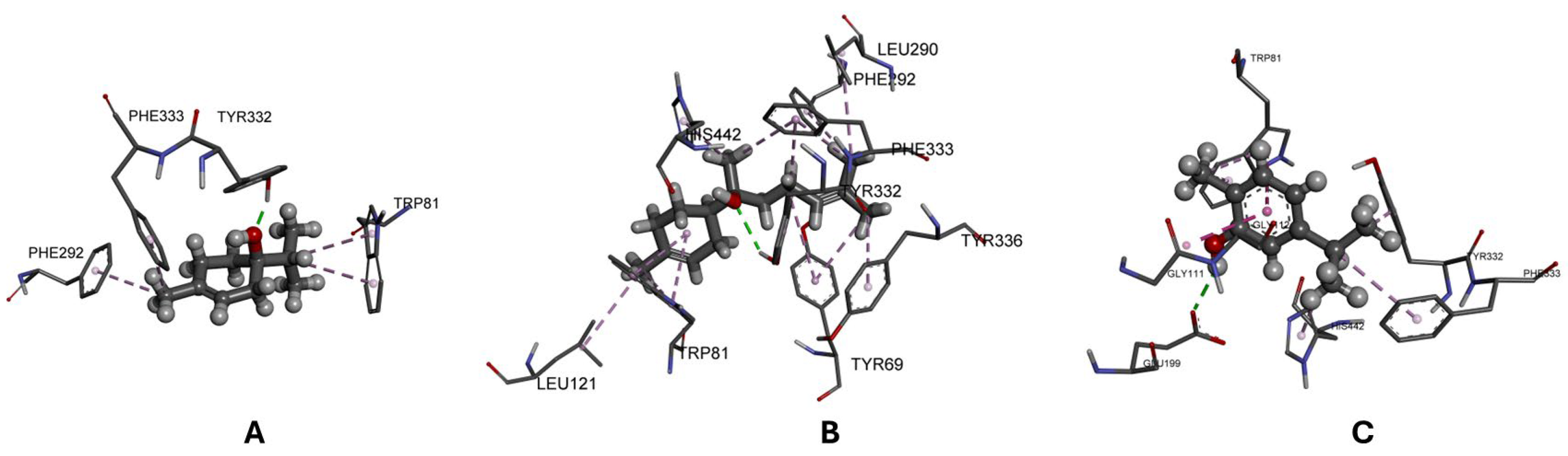
The molecular docking studies conducted and shown in
Table 8 indicated that 4-terpineol and α-bisabolol exhibit the most favorable binding affinities toward
Dm-AChE, stabilizing the complexes primarily through a combination of hydrogen bonds and hydrophobic interactions with conserved aromatic residues within the active site. This interaction pattern is consistent with recent reports describing the ability of oxygenated monoterpenes and sesquiterpenes to interact effectively with AChE and modulate its biological activity [
69]. Likewise, the recurrence of key residues in the formed complexes agrees with current studies highlighting their relevance in the stabilization of inhibitors of this enzyme [
70], whereas the lower affinities observed for carvacrol may be attributed to a less favorable structural fit within the catalytic pocket, as described for other terpenoid compounds [
71]. Nevertheless, as molecular docking constitutes a theoretical and essentially static approach that does not explicitly account for dynamic, entropic, or biological environment effects, the obtained results should be interpreted as exploratory evidence aimed at rationalizing affinity trends rather than as a definitive quantitative measure of biological activity.
Having gathered all this new evidence, we are inclined to suggest that while
D. melanogaster serves as a valid toxicological model, these findings have significant implications for managing economically relevant pests such as
D. suzukii. The high degree of conservation in AChE sequences and neurophysiological pathways within the
Drosophila genus [
15] suggests that the bioinsecticidal effects observed here could be translated to target species that affect global fruit production. However, further validation tests using bioassays involving
D. suzukii or other agricultural pests, in which the
H. foliosus nanoformulation is sprayed onto crops, are needed to verify its effectiveness in environments that simulate field conditions, including phytotoxicity studies to ensure crop safety, and toxicity studies to confirm the safety of the EO for humans and other non-target organisms.



 ,
,