Effect of EDTA and Zero-Valent Iron Nanoparticles on Phytoremediation Capacity of Cistanthe grandiflora
 , ,
, ,
Abstract
1. Introduction
2. Materials and Methods
2.1. nZVI Synthesis Procedure
2.2. Plant and Tailings
- ○
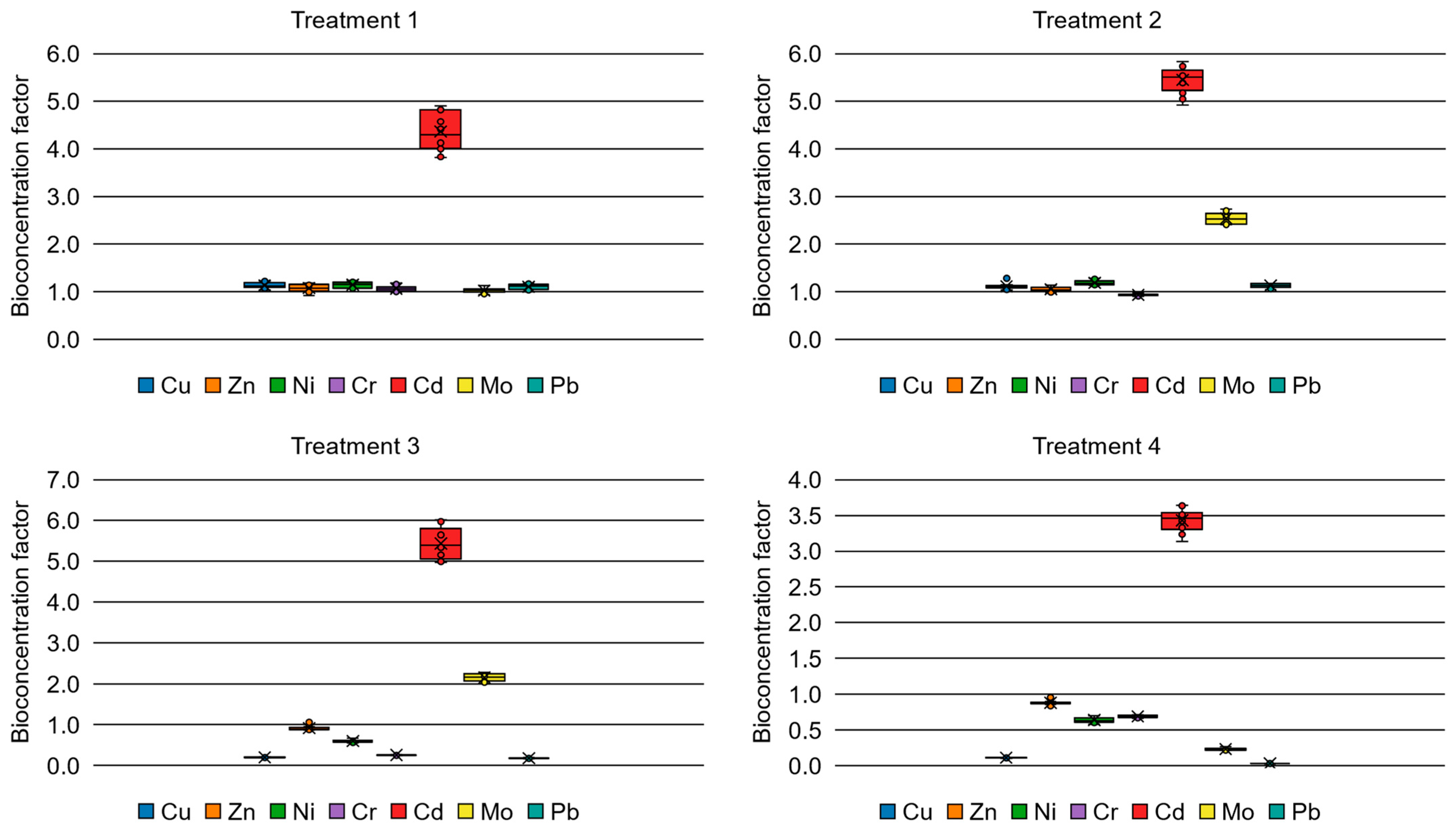
- Treatment 1: 300 mg of EDTA per kg of dry substrate.
- ○
- Treatment 2: 600 mg of EDTA per kg of dry substrate.
- ○
- Treatment 3: 500 mg nZVI per kg of dry substrate.
- ○
- Treatment 4: Substrate consisting only of tailings and leaf mold, without the addition of nZVI or chelating agents.
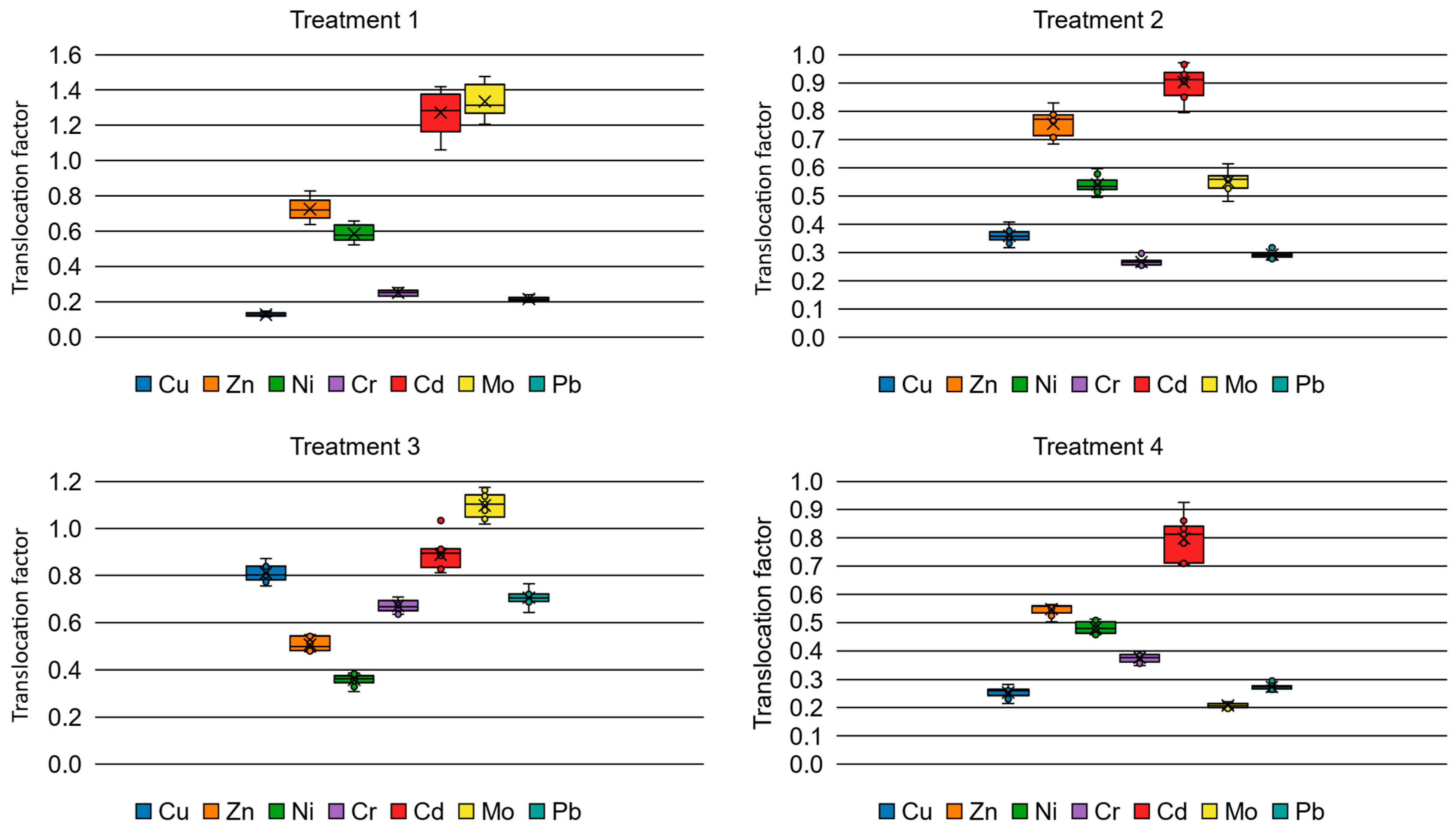
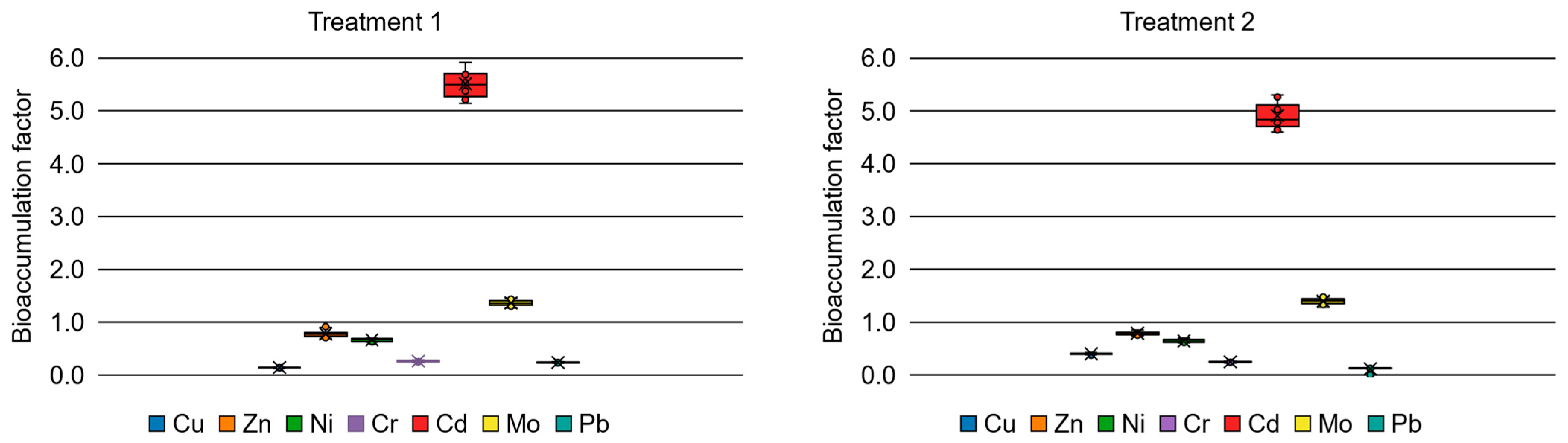
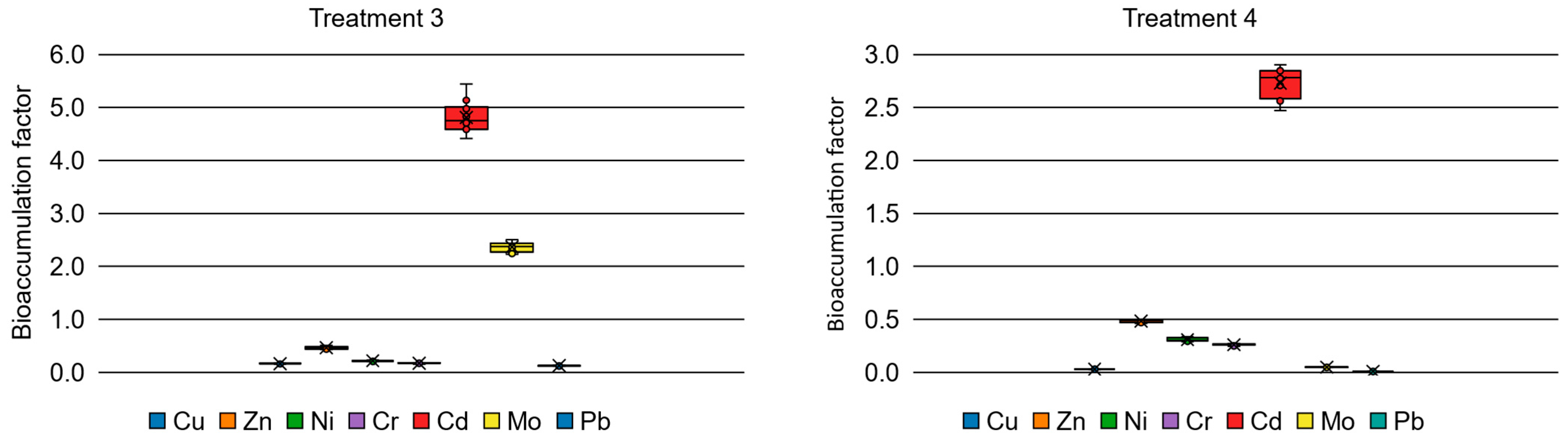
2.3. Phytoremediation Factors and Removal Efficiency
3. Results
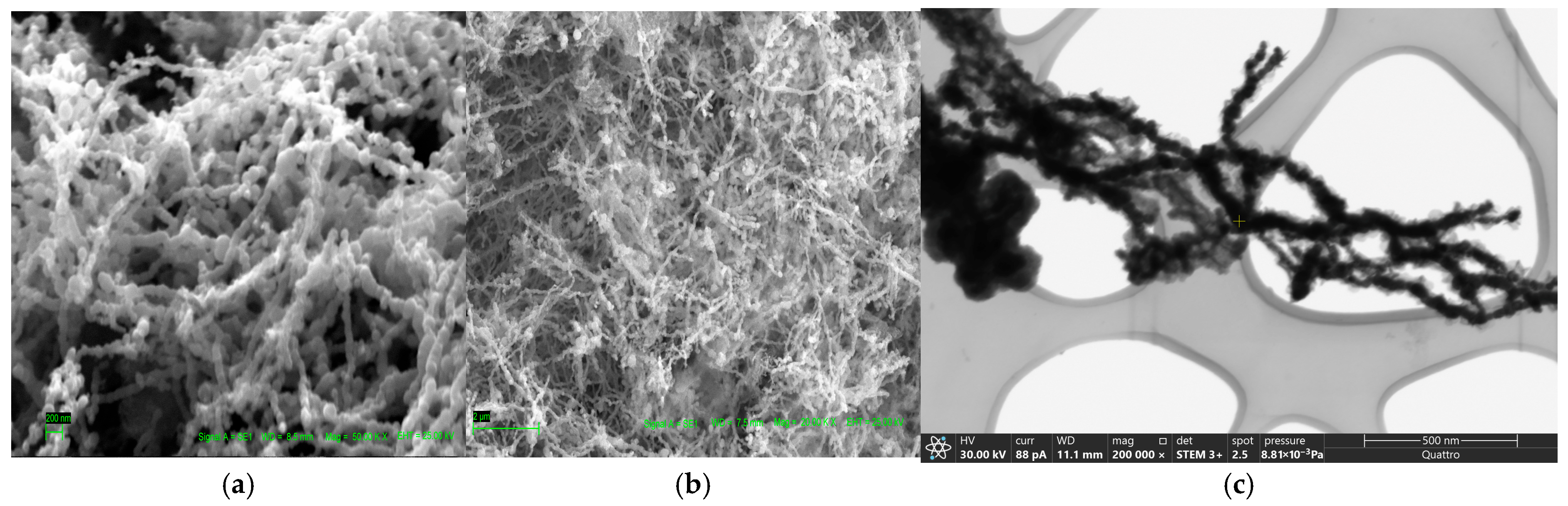
3.1. nZVI Characterization
3.2. Tailing Characterization
4. Discussion
5. Conclusions
Author Contributions
Funding
Data Availability Statement
Acknowledgments
Conflicts of Interest
References
- Shukla, A.; Srivastava, S. Emerging aspects of bioremediation of arsenic. In Green Technologies and Environmental Sustainability; Singh, R., Kumar, S., Eds.; Springer: New Delhi, India, 2017; pp. 395–407. [Google Scholar] [CrossRef] [Scilit]
- Shukla, A.; Srivastava, S. Chapter 8—A Review of Phytoremediation Prospects for Arsenic Contaminated Water and Soil. In Phytomanagement of Polluted Sites. Market Opportunities Sustainable Phytoremediation; Elsevier: Amsterdam, The Netherlands, 2019; pp. 243–254. [Google Scholar] [CrossRef] [Scilit]
- Srivastav, A.; Yadav, K.K.; Yadav, S.; Gupta, N.; Singh, J.; Katiyar, R.; Kumar, V. Nano-phytoremediation of Pollutants from Contaminated Soil Environment: Current Scenario and Future Prospects. In Phytoremediation; Springer: Cham, Switzerland, 2019; pp. 383–401. [Google Scholar] [CrossRef] [Scilit]
- Nagajyoti, P.C.; Lee, K.D.; Sreekanth, T.V.M. Heavy metals, occurrence and toxicity for plants: A review. Environ. Chem. Lett. 2010, 8, 199–216. [Google Scholar] [CrossRef] [Scilit]
- Cunningham, S.D.; Ow, D.W. Promises and prospects of phytoremediation. Plant Physiol. 1996, 110, 715–719. [Google Scholar] [CrossRef] [Scilit]
- Yan, A.; Wang, Y.; Ngin Tan, S.; Lokman Mohd Yusof, M.; Ghosh, S.; Chen, Z. Phytoremediation: A promising approach for revegetation of heavy metal-polluted land. Front. Plant Sci. 2020, 11, 359. [Google Scholar] [CrossRef] [Scilit] [PubMed]
- Wei, Z.; Van Le, Q.; Peng, W.; Yang, Y.; Yang, H.; Gu, H.; Shiung Lam, S.; Sonne, C. A review of phytoremediation of contaminants in air, water and soil. J. Hazard. Mater. 2021, 403, 123658. [Google Scholar] [CrossRef] [Scilit]
- Kafle, A.; Timilsina, A.; Gautam, A.; Adhikari, K.; Bhattarai, A.; Aryal, N. Phytoremediation: Mechanism, plant selection and enhancement by natural and synthetic agents. Environ. Adv. 2022, 8, 123658. [Google Scholar] [CrossRef] [Scilit]
- Nedjimi, B. Phytoremediation: A sustainable environmental technology for heavy metals decontamination. SN Appl. Sci. 2021, 3, 286. [Google Scholar] [CrossRef] [Scilit]
- Islam, M.; Saxena, N.; Sharma, D. Phytoremediation as a green and sustainable promising method for heavy metal contamination: A review. RSC Sustain. 2024, 2, 1269–1288. [Google Scholar] [CrossRef] [Scilit]
- Krämer, U.; Pickering, I.J.; Prince, R.C.; Raskin, I.; Salt, D.E. Subcellular localization and speciation of nickel in hyperaccumulator and non-accumulator Thlaspis Species. Plant Physiol. 2000, 122, 1334–1354. [Google Scholar] [CrossRef] [Scilit] [PubMed]
- Baker, A.J.M.; Reeves, R.D.; Hajar, A.S.M. Heavy metal accumulation and tolerance in British populations of the metallophyte Thlaspi caerulescens J. & C. Presl (Brassicaceae). New Phytol. 1994, 127, 61–68. [Google Scholar] [CrossRef] [Scilit]
- Wu, Q.; Wang, S.; Thangavel, P.; Li, Q.; Zheng, H.; Bai, J.; Qiu, R. Phytostabilization potential of Jatropha curcas L. in polymetallic acid mine tailings. Int. J. Phytoremediation 2011, 13, 788–804. [Google Scholar] [CrossRef] [Scilit]
- Mishra, T.; Chandra Pandey, V. Phytoremediation of Red Mud Deposits Through Natural Succession, Chapter 16. In Phytomanagement of Polluted Sites; Elsevier: Amsterdam, The Netherlands, 2019; pp. 409–424. [Google Scholar] [CrossRef] [Scilit]
- Zhang, W.; Cai, Y.; Tu, C.; Ma, L.Q. Arsenic speciation and distribution in an arsenic hyperaccumulating plant. Sci. Total Environ. 2002, 300, 167–177. [Google Scholar] [CrossRef] [Scilit]
- Pepper, I.L.; Zerzghi, H.G.; Bengson, S.A.; Iker, B.C.; Banerjee, M.J.; Brooks, J.P. Bacterial populations within copper mine tailings: Long-term effects of amendment with class A biosolids. J. Appl. Microbiol. 2012, 113, 569–577. [Google Scholar] [CrossRef] [Scilit]
- Young, I.; Renault, S.; Markham, J. Low levels organic amendments improve fertility and plant cover on non-acid generating gold mine tailings. Ecol. Eng. 2015, 74, 250–257. [Google Scholar] [CrossRef] [Scilit]
- Alcántara, H.J.P.; Doronila, A.I.; Nicolas, M.; Ebbs, S.D.; Kolev, S.D. Growth of selected plant species in biosolids-amended mine tailings. Miner. Eng. 2015, 80, 25–32. [Google Scholar] [CrossRef] [Scilit]
- Puga, A.P.; Abreu, C.A.; Melo, L.C.A.; Paz-Ferreiro, J.; Beesley, L. Cadmium, lead, and zinc mobility and plant uptake in a mine soil amended with sugarcane straw biochar. Environ. Sci. Pollut. Res. 2015, 22, 17606–17614. [Google Scholar] [CrossRef] [Scilit] [PubMed]
- Zeng, G.; Wu, H.; Liang, J.; Guo, S.; Huang, I.; Xu, P.; Liu, Y.; Yuan, Y.; He, X.; He, Y. Efficiency of biochar and compost (or composting) combined amendments for reducing Cd, Cu, Zn and Pb bioavailability, mobility and ecological risk in wetland soil. RSC Adv. 2015, 5, 34541–34548. [Google Scholar] [CrossRef] [Scilit]
- Gomes, M.P. Nanophytoremediation: Advancing phytoremediation efficiency through nanotechnology integration. Discov. Plants 2025, 2, 8. [Google Scholar] [CrossRef] [Scilit]
- Tan, H.W.; Ling, Y.L.; Lim, S.; Chong, W.C. A state-of-the-art of phytoremediation approach for sustainable management of heavy metals recovery. Environ. Technol. Innov. 2023, 30, 103043. [Google Scholar] [CrossRef] [Scilit]
- Wang, M.; Zheng, X.; Tafa Oba, B.; Lin, Y.; Shen, C.; Huang, X.; Yang, F.; Xiao, Q.; Ding, Y. Innovations in nanomaterials for remediation of heavy metal−polluted soil: Advances, mechanistic insights, and future prospects. Nano Mater. Sci. 2025, 8, 11–35. [Google Scholar] [CrossRef] [Scilit]
- Němeček, J.; Lhotský, O.; Cajthaml, T. Nanoscale zero-valent iron application for in situ reduction of hexavalent chromium and its effects on indigenous microorganism populations. Sci. Total Environ. 2014, 485–486, 739–747. [Google Scholar] [CrossRef] [Scilit]
- Wang, Y.; Fang, Z.; Kang, Y.; Tsang, E.P. Immobilization and phytotoxicity of chromium in contaminated soil remediated by CMC-stabilized nZVI. J. Hazard. Mater. 2014, 275, 230–237. [Google Scholar] [CrossRef] [Scilit]
- Gil-Díaz, M.; Alonso, J.; Rodríguez-Valdés, E.; Gallego, J.R.; Lobo, M.C. Comparing different commercial zero valent iron nanoparticles to immobilize As and Hg in brownfield soil. Sci. Total Environ. 2017, 584–585, 1324–1332. [Google Scholar] [CrossRef] [Scilit] [PubMed]
- Sibiya, M.P.; Mahlangu, T.P.; Tetteh, E.K.; Rathilal, S. Review on advancing heavy metals removal: The use of iron oxide nanoparticles and microalgae-based adsorbents. Clean. Chem. Eng. 2025, 11, 100137. [Google Scholar] [CrossRef] [Scilit]
- Nagime, P.V.; Chandak, V.S. Role of Nanoparticles in Improving Soil Structure. In Handbook of Nanotechnology in Agriculture; Husen, A., Ed.; Springer: Singapore, 2025. [Google Scholar] [CrossRef] [Scilit]
- Wu, H.; Li, S.; He, Y.; Zhou, B.; Zeng, G.; Huang, Y.; Sun, D. Phytotoxicity of Zero-Valent Iron-Based Nanomaterials in Mung Beans: Seed Germination and Seedling Growth Experiments. Toxics 2025, 13, 250. [Google Scholar] [CrossRef] [Scilit]
- Cheng, P.; Zhang, S.; Wang, Q.; Feng, X.; Zhang, S.; Sun, Y.; Wang, F. Contribution of Nano-Zero-Valent Iron and Arbuscular Mycorrhizal Fungi to Phytoremediation of Heavy Metal-Contaminated Soil. Nanomaterials 2021, 11, 1264. [Google Scholar] [CrossRef] [Scilit] [PubMed]
- Gong, X.; Huang, D.; Liu, Y.; Zeng, G.; Wang, R.; Wan, J.; Zhang, C.; Cheng, M.; Qin, X.; Xue, W. Stabilized Nanoscale Zerovalent Iron Mediated Cadmium Accumulation and Oxidative Damage of Boehmeria nivea (L.) Gaudich Cultivated in Cadmium Contaminated Sediments. Environ. Sci. Technol. 2017, 51, 11308–11316. [Google Scholar] [CrossRef] [Scilit] [PubMed]
- Huang, D.; Qin, X.; Peng, Z.; Liu, Y.; Gong, X.; Zeng, G.; Huang, C.; Cheng, M.; Xue, W.; Wang, X.; et al. Nanoscale zero-valent iron assisted phytoremediation of Pb in sediment: Impacts on metal accumulation and antioxidative system of Lolium perenne. Ecotoxicol. Environ. Saf. 2018, 153, 229–237. [Google Scholar] [CrossRef] [Scilit]
- Mokarram-Kashtiban, S.; Hosseini, S.M.; Kouchaksaraei, M.T.; Younesi, H. The impact of nanoparticles zero-valent iron (nZVI) and rhizosphere microorganisms on the phytoremediation ability of white willow and its response. Environ. Sci. Pollut. Res. 2019, 26, 10776–10789. [Google Scholar] [CrossRef] [Scilit]
- Evangelou, M.W.H.; Bauer, U.; Ebel, M.; Schaeffer, A. The influence of EDS and EDTA on the uptake of heavy metals of Cd and Cu from soil with tobacco Nicotiana tabacum. Chemosphere 2007, 68, 345–353. [Google Scholar] [CrossRef] [Scilit]
- Guo, J.; Lv, X.; Jia, H.; Hua, L.; Ren, X.; Muhammad, H.; Wei, T.; Ding, Y. Effects of EDTA and plant growth-promoting rhizobacteria on plant growth and heavy metal uptake of hyperaccumulator Sedum alfredii Hance. J. Environ. Sci. 2020, 88, 361–369. [Google Scholar] [CrossRef] [Scilit]
- Rathika, R.; Srinivasan, P.; Alkahtani, J.; Al-Humaid, L.A.; Alwahibi, M.S.; Mythili, R.; Selvankumar, T. Influence of biochar and EDTA on enhanced phytoremediation of lead-contaminated soil by Brassica juncea. Chemosphere 2020, 271, 129513. [Google Scholar] [CrossRef] [Scilit]
- Tiwari, M.; Tripathy, D.B. Soil Contaminants and Their Removal through Surfactant-Enhanced Soil Remediation: A Comprehensive Review. Sustainability 2023, 15, 13161. [Google Scholar] [CrossRef] [Scilit]
- Shahid, M.; Austruy, A.; Echevarria, G.; Arshad, M.; Sanaullah, M.; Aslam, M.; Nadeem, M.; Nasim, W.; Dumat, C. EDTA-Enhanced Phytoremediation of Heavy Metals: A Review. Soil Sediment Contam. Int. J. 2014, 23, 389–416. [Google Scholar] [CrossRef] [Scilit]
- Anning, A.K.; Akoto, R. Assisted phytoremediation of heavy metal contaminated soil from a mined site with Typha latifolia and Chrysopogon zizanioides. Ecotoxicol. Environ. Saf. 2018, 148, 97–104. [Google Scholar] [CrossRef] [Scilit] [PubMed]
- Lazo, P.; Lazo, A. Assessment of Native and Endemic Chilean Plants for Removal of Cu, Mo and Pb from Mine Tailings. Minerals 2020, 10, 1020. [Google Scholar] [CrossRef] [Scilit]
- Lazo, A.; Lazo, P.; Urtubia, A.; Lobos, M.G.; Hansen, H.K.; Gutiérrez, C. An Assessment of the Metal Removal Capability of Endemic Chilean Species. Int. J. Environ. Res. Public Health 2022, 19, 3583. [Google Scholar] [CrossRef] [Scilit] [PubMed]
- Ba, V.N.; Thien, B.N.; Phuong, H.T.; Loan, T.T.H.; Anh, T.T. Bioconcentration and translocation of elements from soil to vegetables and associated health risk. J. Food Compos. Anal. 2024, 132, 106296. [Google Scholar] [CrossRef] [Scilit]
- Sabir, M.; Baltrėnaitė-Gedienė, E.; Ditta, A.; Ullah, H.; Kanwal, A.; Ullah, S.; Faraj, T.K. Bioaccumulation of Heavy Metals in a Soil–Plant System from an Open Dumpsite and the Associated Health Risks through Multiple Routes. Sustainability 2022, 14, 13223. [Google Scholar] [CrossRef] [Scilit]
- Ruiz-Torres, C.A.; Araujo-Martinez, R.F.; Martinez-Castanon, G.A.; Morales-Sanchez, J.E.; Guajardo-Pacheco, J.M.; Gonzalez-Hernandez, J.; Lee, T.-J.; Shin, H.-S.; Hwang, Y.; Ruiz, F. Preparation of air stable nanoscale zero valent iron functionalized by ethylene glycol without inert condition. Chem. Eng. J. 2018, 336, 112–122. [Google Scholar] [CrossRef] [Scilit]
- Ruiz-Torres, C.A.; Araujo-Martínez, R.F.; Martínez-Castañón, G.A.; Morales-Sánchez, E.; Lee, T.-J.; Shin, H.-S.; Hwang, Y.; Hurtado-Macias, A.; Ruíz, F. A cost-effective method to prepare size-controlled nanoscale zero-valent iron for nitrate reduction. Environ. Eng. Res. 2019, 24, 463–473. [Google Scholar] [CrossRef] [Scilit]
- Yuvakkumar, R.; Elango, V.; Rajendran, V. Influence of nanosilica powder on the growth of maize crop (Zea Mays L.). Int. J. Green Nanotechnol. Biomed. 2011, 3, 180–190. [Google Scholar] [CrossRef] [Scilit]
- Jiang, D.; Hu, X.; Wang, R.; Yin, D. Oxidation of nanoscale zerovalent iron under sufficient and limited dissolved oxygen: Influences on aggregation behaviors. Chemosphere 2015, 122, 8–13. [Google Scholar] [CrossRef] [Scilit] [PubMed]
- Sun, Y.; Zhou, Q.; Wang, L.; Liu, W. The influence of different growth stages and dosage of EDTA on Cd uptake and accumulation in Cd-hyperaccumulator (Solanum nigrum L.). Bull. Environ. Contam. Toxicol. 2009, 82, 348–353. [Google Scholar] [CrossRef] [Scilit] [PubMed]
- Kamal, M.A.; Perveen, K.; Khan, F.; Sayyed, R.Z.; Hock, O.G.; Bhatt, S.C.; Singh, J.; Qamar, M. Effect of different levels of EDTA on phytoextraction of heavy metal and growth of Brassica juncea L. Front. Microbiol. 2023, 14, 1228117. [Google Scholar] [CrossRef] [Scilit] [PubMed]
- Komárek, M. Perspectives of soil nanoremediation: The case of nano zerovalent iron and metal(loid) contaminants. npj Mater. Sustain. 2024, 2, 8. [Google Scholar] [CrossRef] [Scilit]
- Ashraf, S.; Ali, Q.; Zahir, Z.A.; Ashraf, S.; Asghar, H.N. Phytoremediation: Environmentally sustainable way for reclamation of heavy metal polluted soils. Ecotoxicol. Environ. Saf. 2019, 174, 714–727. [Google Scholar] [CrossRef] [Scilit]
- Wang, L.; Ji, B.; Hu, Y.; Liu, R.; Sun, W. A review on in situ phytoremediation of mine tailings. Chemosphere 2017, 184, 594–600. [Google Scholar] [CrossRef] [Scilit]
- Hasan, M.M.; Uddin, M.N.; Ara-Sharmeen, I.; Alharby, H.F.; Alzahrani, Y.; Hakeem, K.R.; Zhang, L. Assisting phytoremediation of heavy metals using chemical amendments. Plants 2019, 8, 295. [Google Scholar] [CrossRef] [Scilit]



| Parameter | Unit | Concentration in mg·kg−1 |
|---|---|---|
| Cu | mg·kg−1 | 4513.01 ± 91.14 |
| Zn | mg·kg−1 | 1147.56 ± 31.54 |
| Ni | mg·kg−1 | 91.77 ± 5.61 |
| Cr | mg·kg−1 | 214.17 ± 7.72 |
| Cd | mg·kg−1 | 7.56 ± 0.38 |
| Mo | mg·kg−1 | 68.34 ± 2.45 |
| Pb | mg·kg−1 | 674.27 ± 8.56 |
| Specific gravity | - | 2.83 ± 0.33 |
| pH | - | 7.50 ± 0.20 |
| Solid concentration | Weight % | 87.00 ± 1.2 |
| Granulometry d50 | μm | 0.05 ± 0.002 |
| Electric conductivity | dS·m−1 at 25 °C | 34.24 ± 0.15 |
| Calcium percentage as CaO | % w/w | 9.55 ± 0.32 |
| Magnesium percentage as MgO | % w/w | 5.10 ± 0.17 |
| Manganese percentage as MnO | % w/w | 0.25 ± 0.01 |
| Sodium percentage as Na2O | % w/w | 2.41 ± 0.07 |
| Potassium percentage as K2O | % w/w | 2.10 ± 0.09 |
| Phosphorus percentage as P2O5 | % w/w | 0.17 ± 0.03 |
| mg·kg−1 Dry Substrate | Cu | Zn | Ni | Cr | Cd | Mo | Pb |
|---|---|---|---|---|---|---|---|
| Treatment 1 aerial | 536.3 ± 27.2 c | 741.9 ± 36.3 a | 22.2 ± 0.9 a | 29.6 ± 1.4 b | 20.9 ± 2.9 a | 30.1 ± 1.2 b | 140.6 ± 3.9 b |
| Treatment 1 roots | 4246.4 ± 211.5 a | 1025.9 ± 49.1 a | 38.1 ± 1.9 a | 118.5 ± 5.1 a | 15.9 ± 1.2 b | 22.6 ± 1.1 c | 652.6 ±32.2 a |
| Treatment 2 aerial | 1475.8 ± 55.0 a | 769.7 ± 37.3 a | 21.0 ±0.9 a | 28.5 ± 1.3 b | 18.8 ± 0.9 ab | 30.2 ± 1.3 b | 195.0 ± 8.1 a |
| Treatment 2 roots | 4116.6 ± 202.4 a | 1021.1 ± 49.3 a | 39.0 ± 1.5 a | 107.0 ± 5.2 a | 20.8 ± 1.0 a | 54.9 ± 2.3 a | 665.8 ± 25.7 a |
| Treatment 3 aerial | 636.8 ± 21.3 b | 409.1 ± 15.8 c | 7.1 ± 0.3 c | 20.9 ± 1.0 c | 17.3 ± 0.7 b | 52.2 ± 1.7 a | 73.7 ± 42.5 c |
| Treatment 3 roots | 786.3 ± 23.8 b | 808.5 ± 28.4 c | 19.8 ± 1.0 c | 31.2 ± 1.2 b | 19.5 ± 0.7 a | 47.6 ± 1.7 b | 104.6 ± 5.1 d |
| Treatment 4 aerial | 119.8 ± 4.5 d | 512.0 ± 4.1 b | 16.5 ± 0.5 b | 43.3 ± 1.8 a | 14.9 ± 0.8 c | 1.5 ± 0.2 c | 5.1 ± 0.2 d |
| Treatment 4 roots | 470.8 ± 18.1 c | 929.1 ± 25.9 b | 35.1 ± 3.8 b | 114.1 ± 3.3 a | 18.7 ± 0.8 a | 7.7 ± 0.3 d | 18.4 ± 3.1 c |
| mg·kg−1 Dry Substrate | Cu | Zn | Ni | Cr | Cd | Mo | Pb |
|---|---|---|---|---|---|---|---|
| Treatment 1 | 3758.0 ± 85.7 c | 954.0 ± 52.6 b | 33.3 ± 0.7 b | 111.5 ± 3.1 c | 3.6 ± 0.1 b | 22.0 ± 0.4 b | 590.8 ± 7.5 b |
| Treatment 2 | 3700.4 ± 40.3 c | 972.6 ± 15.6 b | 32.9 ± 0.4 b | 114.6 ± 4.6 c | 3.8 ± 0.1 b | 21.6 ± 0.4 b | 591.0 ± 1.5 b |
| Treatment 3 | 3963.2 ± 41.3 b | 887.6 ± 29.2 c | 33.0 ± 0.6 b | 122.4 ± 0.7 b | 5.5 ± 0.2 a | 22.1 ± 0.5 b | 590.7 ± 15.6 b |
| Treatment 4 | 4173.7 ± 37.8 a | 1059.0 ± 18.3 a | 54.6 ± 2.7 a | 165.9 ± 4.5 a | 5.5 ± 0.1 a | 32.5 ± 1.5 a | 610.0 ± 1.4 a |
Disclaimer/Publisher’s Note: The statements, opinions and data contained in all publications are solely those of the individual author(s) and contributor(s) and not of MDPI and/or the editor(s). MDPI and/or the editor(s) disclaim responsibility for any injury to people or property resulting from any ideas, methods, instructions or products referred to in the content. |
© 2026 by the authors. Licensee MDPI, Basel, Switzerland. This article is an open access article distributed under the terms and conditions of the Creative Commons Attribution (CC BY) license.
Share and Cite
Lazo, A.; Lazo, P.; Hansen, H.K.; Zambra, A.; Pérez, W.; Solano, A. Effect of EDTA and Zero-Valent Iron Nanoparticles on Phytoremediation Capacity of Cistanthe grandiflora. Plants 2026, 15, 1183. https://doi.org/10.3390/plants15081183
Lazo A, Lazo P, Hansen HK, Zambra A, Pérez W, Solano A. Effect of EDTA and Zero-Valent Iron Nanoparticles on Phytoremediation Capacity of Cistanthe grandiflora. Plants. 2026; 15(8):1183. https://doi.org/10.3390/plants15081183
Chicago/Turabian StyleLazo, Andrea, Pamela Lazo, Henrik K. Hansen, Alejandro Zambra, Waldo Pérez, and Arnold Solano. 2026. "Effect of EDTA and Zero-Valent Iron Nanoparticles on Phytoremediation Capacity of Cistanthe grandiflora" Plants 15, no. 8: 1183. https://doi.org/10.3390/plants15081183
APA StyleLazo, A., Lazo, P., Hansen, H. K., Zambra, A., Pérez, W., & Solano, A. (2026). Effect of EDTA and Zero-Valent Iron Nanoparticles on Phytoremediation Capacity of Cistanthe grandiflora. Plants, 15(8), 1183. https://doi.org/10.3390/plants15081183