


Abstract
The genus Scutellaria (Lamiaceae) is a phytochemically rich and medicinally important group of plants. Scutellaria species have been characterized by biologically active flavonoids such as baicalin, baicalein, and wogonin. In the present study, the essential oils of S. angustifolia, S. baicalensis, S. barbata, and S. lateriflora, cultivated in eastern Oregon, were obtained by means of hydrodistillation and analyzed using gas chromatographic methods. We hypothesize that the essential oils have compositions that may play a role in the traditional uses and biological activities of the genus. The major components in S. angustifolia essential oils were germacrene D (32.5–58.3%), (E)-β-caryophyllene (4.9–29.2%), and β-bourbonene (2.8–9.4%). Scutellaria barbata essential oil was dominated by 1-octen-3-ol (59.9%), with lower concentrations of linalool (9.5%) and (2E)-hexenal (5.1%). The major components in the essential oil of S. lateriflora were 1-octen-3-ol (28.3%), acetophenone (24.8%), benzaldehyde (7.5%), limonene (6.0%), (E)-benzalacetone (5.9%), and β-phellandrene (5.1%). The major components of the essential oil of S. baicalensis were 1-octen-3-ol (22.3%), (E)-β-caryophyllene (22.3%), and germacrene D (28.3%). This study demonstrates that Scutellaria can be cultivated in eastern Oregon. Additionally, S. angustifolia essential oil has been characterized for the first time.
1. Introduction
The genus Scutellaria L. (Lamiaceae) comprises around 470 species of herbaceous plants found throughout the world [1]. The genus is chemically rich and therapeutically useful, largely due to flavonoid components [2,3]. Scutellaria baicalensis Georgi, in particular, has been investigated for anti-inflammatory, antioxidant, cytotoxic, neuroprotective, antimicrobial, and immunomodulatory effects, which have been attributed to flavones such as baicalin, baicalein, wogonin, and their glycosides [4,5,6]. In this work, we investigate whether important Scutellaria species can be cultivated in eastern Oregon. In addition, we hypothesize that the Scutellaria species synthesize volatile compounds that yield essential oils with compositions that may play a role in the traditional uses and biological activities of the genus. The purpose of this study is to examine the essential oil compositions of Scutellaria that have been successfully cultivated in eastern Oregon, which could highlight their potential utility as herbal medicines.
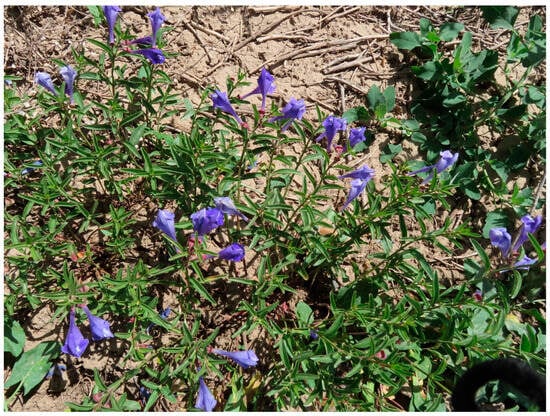
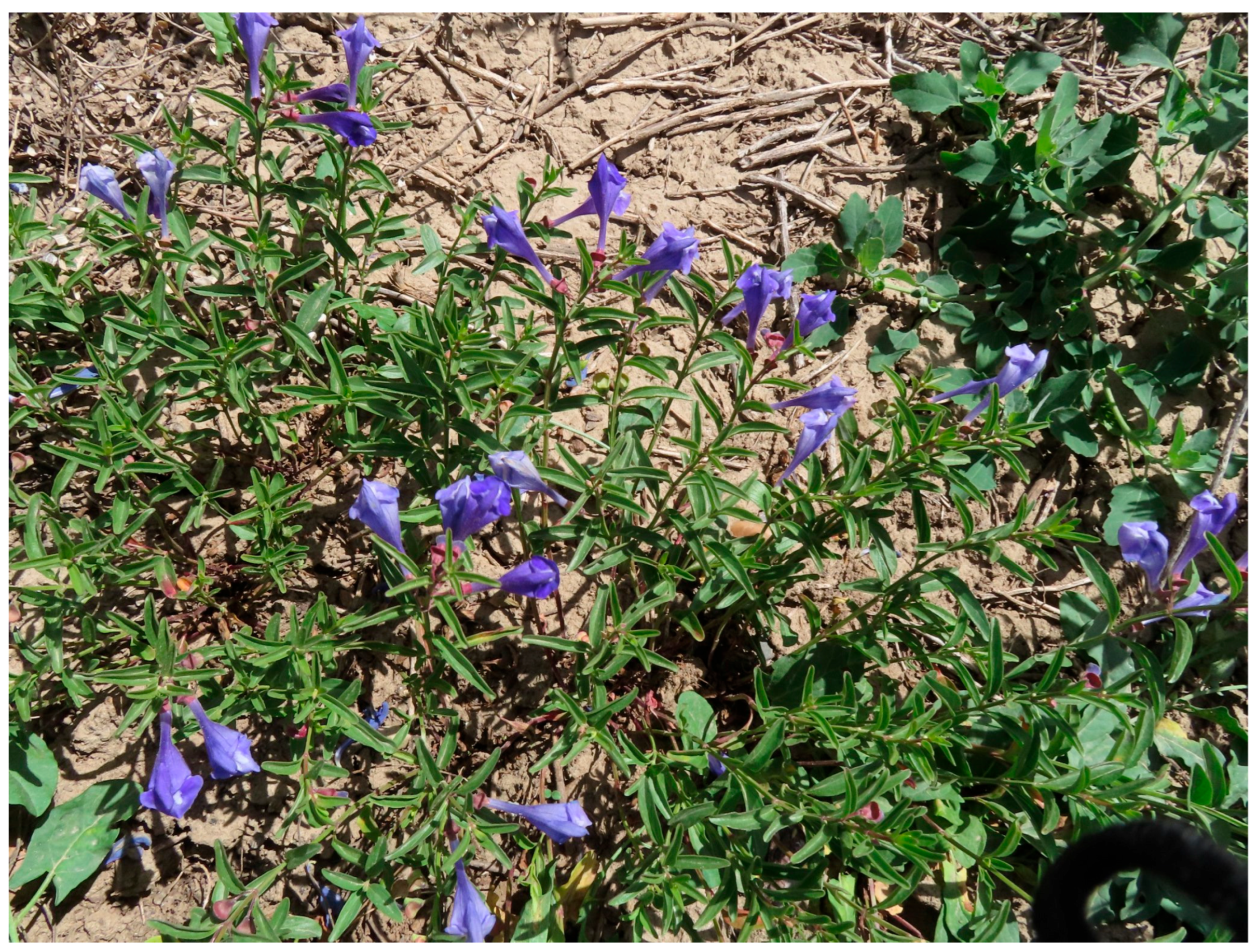
Scutellaria angustifolia Pursh (narrowleaf skullcap, Lamiaceae) is native to western North America, including eastern Washington, eastern Oregon, Nevada, and Idaho [1,7,8]. The plant is perennial with single stems or stems branched near the bottom with stolons proliferating laterally underground; the leaves are gray–green, 5–45 mm long; the flowers are blue with a tube around 25 mm long [9] (Figure 1). There have apparently been no publications on the phytochemistry of this species.
Figure 1.
Photograph of Scutellaria angustifolia Pursh cultivated in Ontario, OR, USA.
Scutellaria baicalensis Georgi (Baikal skullcap, Lamiaceae) is a perennial rhizomatous herb native to east Asia, including China, Japan, Korea, Mongolia, and eastern Siberia [1,10]. The plant has a prominent history in Traditional Chinese Medicine (TCM) and is rich in flavonoids and other polyphenolic compounds, which have been extensively reviewed [4,5,6,11,12,13]. In addition, analyses of the essential oil from the aerial parts [14,15] and headspace volatiles from the flowers [16] of S. baicalensis have been reported.
Scutellaria barbata D. Don (barbed skullcap, Lamiaceae) is native to East Asia, principally southern China and the Korean Peninsula, but the plant is also reported in Taiwan, Japan, Laos, Myanmar, Thailand, and Vietnam [1,17]. Ethnobotanically, the plant is used in TCM and has shown hepatoprotective and anticancer properties [18]. The plant is a rich source of flavonoids [19,20,21] and diterpenoids [22,23,24,25,26,27], as well as antitumor polysaccharides [28,29]. The phytochemistry and pharmacology of S. barbata have been reviewed [30,31,32]. The essential oil compositions of S. barbata from Hubei, China [33], Hunan, China [34], and cultivated in south Alabama [14] have been reported.
Scutellaria lateriflora L. (blue skullcap, Lamiaceae) is indigenous to and widely distributed throughout North America. The plant has been a part of Native American (Cherokee) traditional medicine [35,36] as well as modern herbal medicine as a nervine and sedative [37,38]. The phytochemical profile of S. lateriflora shows the plant to be composed largely of flavonoids [39,40,41,42], diterpenoids [43], and amino acids [40]. The essential oil of S. lateriflora, cultivated in south Alabama, has been reported [14].
The four Scutellaria species in this study exhibit discernable morphological differences, which are summarized in Table 1.
Table 1.
Morphological differences between the four Scutellaria species cultivated in Ontario, Oregon.
2. Results
The S. angustifolia essential oils were obtained by means of hydrodistillation in yields of 5.40–9.17% as colorless, pale-yellow, or yellow oils. The S. angustifolia essential oils were dominated by sesquiterpene hydrocarbons (70.9–86.2%) with germacrene D (32.5–58.3%), (E)-β-caryophyllene (4.9–29.2%), and β-bourbonene (2.8–9.4%) as the major components (Table 2). The complete compositions are provided in Supplementary Table S1.
Table 2.
Major chemical components of Scutellaria angustifolia essential oils cultivated in Ontario, Oregon.
The essential oil compositions (major components) of S. baicalensis, S. barbata, and S. lateriflora are compiled in Table 3. The colorless essential oil of S. baicalensis was obtained in 6.70% yield and was rich in germacrene D (28.3%), 1-octen-3-ol (22.3%), and (E)-β-caryophyllene (22.3%). Scutellaria barbata essential oil was dominated by 1-octen-3-ol (59.9%) with lower concentrations of linalool (9.5%) and (2E)-hexenal (5.1%). The major components in the essential oil of S. lateriflora were 1-octen-3-ol (28.3%), acetophenone (24.8%), benzaldehyde (7.5%), limonene (6.0%), (E)-benzalacetone (5.9%), and β-phellandrene (5.1%). The complete compositions are provided in Supplementary Table S2.
Table 3.
Major chemical components of Scutellaria baicalensis, Scutellaria barbata, and Scutellaria lateriflora essential oils cultivated in Ontario, Oregon.
3. Discussion
The essential oil of S. baicalensis in this study was dominated by 1-octen-3-ol (22.3%), (E)-β-caryophyllene (22.3%), and germacrene D (28.3%), which were also major components in S. baicalensis cultivated in south Alabama (6.1%, 11.6%, and 39.3%, respectively) [14]. In contrast, however, the south Alabama sample also had high concentrations of thymol (7.5%) and carvacrol (9.3%), which were not detected in the sample from eastern Oregon. The essential oil from the aerial parts of S. baicalensis collected from Tangshan, China, was also rich in (E)-β-caryophyllene (15.2%), and germacrene D (5.4%), as well as caryophyllene oxide (13.9%) and eugenol (18.4%); 1-octen-3-ol was not reported, however [15]. Eugenol was not observed in the cultivated sample from south Alabama but was a minor component (0.6%) in the sample from eastern Oregon in this study. A headspace volatile analysis of S. baicalensis flowers showed the floral volatiles to be dominated by sesquiterpene hydrocarbons, particularly (E)-β-caryophyllene (22.3–41.5%) and germacrene D (12.4–27.5%), but carvacrol, thymol, or 1-octen-3-ol were not reported [16]. The root essential oil of S. baicalensis was reported, but the constituents were not quantified [49]. Based on the gas chromatogram, the root oil had acetophenone, (E)-4-phenyl-2-butanone, palmitic acid, and oleic acid as major components; (E)-β-caryophyllene was detected, but in low concentration; and neither carvacrol nor thymol were detected. The current study adds to our knowledge of S. baicalensis phytochemistry, illustrating the variation in chemical composition.
(E)-β-Caryophyllene is well known for various biological activities. The compound has shown cytotoxic activity against several tumor-derived cell lines [50,51,52,53], antibacterial activity against several Gram-positive strains [50,52,53,54,55], and antifungal activity against Candida albicans [56]. (E)-β-Caryophyllene has also shown analgesic and anti-inflammatory activities [57,58,59,60,61]. Germacrene D has also demonstrated cytotoxicity against human tumor cell lines [50,62], antibacterial activity against Gram-positive organisms [55], and antifungal activity against Aspergillus niger [50]. Germacrene D has also exhibited immunomodulatory activity [63]. Thus, these sesquiterpene major components may contribute to the reported health benefits of S. baicalensis.
There is variation in the essential oil compositions of S. barbata, depending on the collection site (Table 4). The S. barbata essential oil from eastern Oregon was dominated by 1-octen-3-ol, which is a major component of essential oils from China and Alabama. Linalool was also found in all samples of S. barbata essential oil. Palmitic acid was abundant in essential oils from Hunan, China, and south Alabama, but was not observed in the sample from this study (eastern Oregon). Several factors may be responsible for variations in the chemical composition of essential oils within a species [64,65,66,67,68]. These include genetic factors [69,70,71], abiotic environmental characteristics of the collection sites [72,73], seasonality/phenology [74], and biotic factors such as herbivory [75,76] or fungal infection [77], as well as differences in processing methods. Interestingly, 1-octen-3-ol functions primarily as a volatile chemoattractant. The compound has been shown to be an attractant for hematophagous arthropods, including mosquitoes (Aedes aegypti, Aedes albopictus, Culex quinquefasciatus) [78,79], the tsetse fly Glossina morsitans morsitans [80], and the tick Amblyomma americanum [81].
Table 4.
Comparison of major essential oil components of Scutellaria barbata.
The S. lateriflora essential oil composition in this study is qualitatively similar to the sample cultivated in south Alabama [14]. Both samples had high concentrations of 1-octen-3-ol (28.3% and 27.5%, respectively). While the concentration of acetophenone was high in the eastern Oregon sample (24.8%), it was lower in the south Alabama sample (3.6%). (E)-Benzalacetone concentrations were similar between the eastern Oregon and south Alabama samples (5.9% and 4.7%, respectively). Likewise, (E)-β-caryophyllene concentrations (3.9% and 8.8%, respectively) and benzaldehyde concentrations (7.5% and 2.0%, respectively) were comparable. The south Alabama sample had a high concentration of phytol (14.8%), but it was not observed in the eastern Oregon sample. Conversely, limonene (6.0% in the eastern Oregon sample) was not observed in the south Alabama sample.
To our knowledge, there have been no previous reports on the cultivation or essential oil composition of S. angustifolia. The essential oils in this study show the plant to be rich in sesquiterpene hydrocarbons, especially germacrene D (43.0 ± 7.7%), (E)-β-caryophyllene (15.0 ± 7.1%), and β-bourbonene (4.6 ± 1.7%), but relatively low in 1-octen-3-ol (2.3 ± 1.9%). Thus, S. angustifolia essential oil is similar in composition to S. baicalensis.
4. Materials and Methods
4.1. Plant Material
Plant materials of Scutellaria angustifolia were based on our original collections in nature from 12 distinct locations in western Idaho and eastern Oregon (Clinton and Candace Shock, Scientific Ecological Services, Ontario, OR, USA, 44.016225° N, 116.990308° W, 668 m elevation). The collection details are summarized in Table 5. Collections number 2 and 3 were Scutellaria angustifolia ssp. micrantha and the other ten collections were Scutellaria angustifolia ssp. angustifolia. The S. angustifolia samples were identified in the field by Clinton C. Shock. Pressed samples of the field specimens were verified by Richard Olmstead, Burke Museum Herbarium Curator (University of Washington). The collections were made by taking shallow stolons from the bases of 15 to 30 plants at each collection site. The collected stolons were grown into mature plants, and their stolons were subsequently used to establish field plots.
Table 5.
Collection details for Scutellaria angustifolia samples collected in eastern Oregon and western Idaho.
Planting materials for Scutellaria baicalensis, S. barbata, and S. lateriflora were selected and increased from plants previously selected in Ontario by Scientific Ecological Services. Plant selections were based on observed productivity and vigor. Scutellaria baicalensis and S. barbata transplants for the current study were grown from seed while S. lateriflora transplants were grown from stolons and seed.
Plants of all four Scutellaria species for the current study were planted in silt loam soil in Ontario, Oregon, by Scientific Ecological Services, Ontario, OR, USA. The field for planting had been disked, rototilled, and bedded into plots 3 m wide and 45 or 90 m long. Each plot consisted of four 75-cm beds. Drip tape was shanked into the soil at 10 cm depth in every bed. The drip tape (Dripnet PC, Netafim, Fresno, CA, USA) had emitters spaced 30 cm apart and an emitter flow rate of 1.9 L/h at 69 kPa. Transplants were planted at 30 cm spacing down each bed. Areas for each of the 12 Scutellaria angustifolia selections were established in the two 90-m plots and the other three species were planted separately in three 45-m plots. No preplant fertilizer was applied.
Plants were irrigated with drip irrigation 1 or 2 times per week for 6 h. During the first two weeks, plants received 2 irrigations per week and only 1 irrigation per week during most of the rest of the growing season. The crop was fertilized through the drip irrigation system, twice with 12 kg/ha of N as urea ammonium nitrate and once with 0.07 kg/ha of Fe as iron EDDTA.
Aerial parts of all plants were harvested at full bloom in 2025. The top 10 cm of flowering branches of Scutellaria angustifolia selections were clipped on 25 May or 29 May; samples #11 and #12 were recollected on 8 August. The top 30 cm of the flowering branches of Scutellaria baicalensis, S. barbata, and S. lateriflora were trimmed on 15 July, 29 May, and 15 July, respectively. Trimmed flowering branches were immediately frozen.
4.2. Hydrodistillation
For each Scutellaria plant sample, the fresh/frozen aerial parts were chopped and hydrodistilled using a Likens–Nickerson apparatus [82,83,84] for 4 h with continuous extraction of the distillate with dichloromethane to give the essential oils (Table 6). The plant material was added to a 1000-mL flask along with enough distilled water to cover the plant material. The dichloromethane (20 mL) was added to the receiving flask. The dichloromethane was evaporated using a stream of dry air to give the essential oils.
Table 6.
Hydrodistillation details for Scutellaria samples cultivated in Ontario, OR.
4.3. Gas Chromatographic Analysis
The Scutellaria essential oils were analyzed by means of gas chromatography—mass spectrometry (GC-MS) and gas chromatography with flame ionization detection (GC-FID) as reported previously [85]. Instrument details are provided in Supplementary Table S3. Retention index values were calculated using the arithmetic formula of van den Dool and Kratz [44]. Essential oil components were identified through comparison of their retention index values (within 10 RI units) and their mass spectral fragmentation (> 80% MS match) with those reported in the databases of Adams [45], Satyal [46], Mondello [47], and NIST20 [48]. Percentages of the essential oil components were calculated based on peak integration without standardization.
5. Conclusions
Based on this study, Scutellaria species (S. angustifolia, S. baicalensis, S. barbata, and S. lateriflora) can be successfully cultivated in eastern Oregon. The essential oils of S. angustifolia and S. baicalensis are rich in sesquiterpene hydrocarbons, particularly germacrene D and (E)-β-caryophyllene. The essential oil compositions of S. baicalensis and S. barbata show wide variation depending on geographical location, which highlight the potential importance of environmental factors in essential oil profiles, although genetic differences in the plant materials cannot be ruled out. Additional studies on S. baicalensis and S. barbata from other geographical locations are needed to verify the variability of essential oil compositions. Major sesquiterpene components such as germacrene D and (E)-β-caryophyllene are known to exhibit cytotoxic, antibacterial, antifungal, analgesic, and anti-inflammatory activities, which likely contribute to the therapeutic benefits of Scutellaria species. This study provides the first report on the essential oil composition of S. angustifolia, expanding our understanding of the phytochemistry of the Scutellaria genus. Nevertheless, there are numerous unstudied and understudied Scutellaria species that should be examined to define the phytochemistry of this genus. In addition, further studies of the volatile chemical profiles of cultivated Scutellaria, repeated annually over several seasons, should be carried out.
Supplementary Materials
The following supporting information can be downloaded at https://www.mdpi.com/article/10.3390/plants15071075/s1. Table S1. Chemical compositions of Scutellaria angustifolia essential oils cultivated in Ontario, Oregon, Table S2. Chemical compositions of Scutellaria baicalensis, Scutellaria barbata, and Scutellaria lateriflora essential oils cultivated in Ontario, Oregon, Table S3. Instrument details for the gas chromatographic analyses of Scutellaria species cultivated in Ontario, Oregon.
Author Contributions
Conceptualization, C.C.S. and W.N.S.; methodology, C.C.S., W.N.S., and P.S.; software, P.S.; validation, W.N.S.; formal analysis, A.P., P.S., and W.N.S.; investigation, C.C.S., A.P., P.S., and W.N.S.; resources, C.C.S., P.S. and W.N.S.; data curation, W.N.S.; writing—original draft preparation, W.N.S.; writing—review and editing, C.C.S., A.P., P.S., and W.N.S.; project administration, W.N.S. All authors have read and agreed to the published version of the manuscript.
Funding
This research received no external funding.
Data Availability Statement
All data are available in this report. Additional information is available from the corresponding author upon reasonable request.
Acknowledgments
This work was carried out as part of the activities of the Aromatic Plant Research Center (APRC, https://aromaticplant.org/).
Conflicts of Interest
The authors declare no conflicts of interest.
References
- World Flora Online. An Online Flora of All Known Plants. Available online: https://www.worldfloraonline.org/ (accessed on 24 November 2025).
- Li, C.; Lin, G.; Zuo, Z. Pharmacological Effects and Pharmacokinetics Properties of Radix scutellariae and Its Bioactive Flavones. Biopharm. Drug Dispos. 2011, 32, 427–445. [Google Scholar] [CrossRef] [Scilit] [PubMed]
- Shah, M.; Mubin, S.; ul Hassan, S.S.; Tagde, P.; Ullah, O.; Rahman, M.H.; Al-Harrasi, A.; Ur Rehman, N.; Murad, W. Phytochemical Profiling and Bio-Potentiality of Genus Scutellaria: Biomedical Approach. Biomolecules 2022, 12, 936. [Google Scholar] [CrossRef] [Scilit] [PubMed]
- Zhao, T.; Tang, H.; Xie, L.; Zheng, Y.; Ma, Z.; Sun, Q.; Li, X. Scutellaria baicalensis Georgi. (Lamiaceae): A Review of Its Traditional Uses, Botany, Phytochemistry, Pharmacology and Toxicology. J. Pharm. Pharmacol. 2019, 71, 1353–1369. [Google Scholar] [CrossRef] [Scilit]
- Ming, X.; Yin, M.; Liyan, W. Antibacterial and Anti-Inflammatory Potential of Chinese Medicinal Herbs: Lonicerae flos, Lonicerae Japonicae flos, Scutellaria baicalensis Georgi, and Forsythia suspensa. Nat. Prod. Commun. 2022, 17, 1934578X221136673. [Google Scholar] [CrossRef] [Scilit]
- Liu, Y.; Gao, Z.; Zhao, Y.; Kong, L.; Ji, X.; Wu, J.; Gao, Z. Exploring Bioactive Constituents and Pharmacological Effects of Scutellaria baicalensis Georgi: A Review. Nat. Prod. Commun. 2024, 19, 1934578X241266692. [Google Scholar] [CrossRef] [Scilit]
- Kartesz, J.T. The Biota of North America Program (BONAP). Available online: https://bonap.net/MapGallery/County/Scutellaria angustifolia.png (accessed on 24 November 2025).
- Olmstead, R.G. Biological and Historical Factors Influencing Genetic Diversity in the Scutellaria angustifolia Complex (Labiatae). Evolution 1990, 44, 54–70. [Google Scholar] [CrossRef] [Scilit]
- Turner, M.; Gustafson, P. Wildflowers of the Pacific Northwest; Timber Press, Inc.: Portland, OR, USA, 2006; ISBN 978-0-88192-745-0. [Google Scholar]
- eFloras.org. Scutellaria baicalensis Georgi. Available online: http://www.efloras.org/florataxon.aspx?flora_id=2&taxon_id=200020285 (accessed on 24 November 2025).
- Zhao, Q.; Chen, X.Y.; Martin, C. Scutellaria baicalensis, the Golden Herb from the Garden of Chinese Medicinal Plants. Sci. Bull. 2016, 61, 1391–1398. [Google Scholar] [CrossRef] [Scilit]
- Wang, Z.-L.; Wang, S.; Kuang, Y.; Hu, Z.-M.; Qiao, X.; Ye, M. A Comprehensive Review on Phytochemistry, Pharmacology, and Flavonoid Biosynthesis of Scutellaria baicalensis. Pharm. Biol. 2018, 56, 465–484. [Google Scholar] [CrossRef] [Scilit]
- Song, J.-W.; Long, J.-Y.; Xie, L.; Zhang, L.-L.; Xie, Q.-X.; Chen, H.-J.; Deng, M.; Li, X.-F. Applications, Phytochemistry, Pharmacological Effects, Pharmacokinetics, Toxicity of Scutellaria baicalensis Georgi. and Its Probably Potential Therapeutic Effects on COVID-19: A Review. Chin. Med. 2020, 15, 102. [Google Scholar] [CrossRef] [Scilit]
- Lawson, S.K.; Satyal, P.; Setzer, W.N. Phytochemical Analysis of the Essential Oils from Aerial Parts of Four Scutellaria “Skullcap” Species Cultivated in South Alabama: Scutellaria baicalensis Georgi, S. Barbata D. Don, S. Incana Biehler, and S. Lateriflora L. Nat. Prod. Commun. 2021, 16, 1934578x211025930. [Google Scholar] [CrossRef] [Scilit]
- Wang, X.-D.; Shi, S.-L.; Ma, Y.-Z. Determination of Essential Oil from Scutellaria baicalensis Georgi (Lamiaceae) by GC-MS, and Assessment of Its Insecticidal Properties. Trop. J. Pharm. Res. 2022, 21, 1249–1254. [Google Scholar] [CrossRef] [Scilit]
- Takeoka, G.R.; Rodriguez, D.M.; Dao, L.; Patterson, R. Headspace Volatiles of Scutellaria baicalensis Georgi Flowers. J. Essent. Oil-Bearing Plants 2009, 12, 435–442. [Google Scholar] [CrossRef] [Scilit]
- eFloras.org. Scutellaria barbata D. Don. Available online: http://www.efloras.org/florataxon.aspx?flora_id=2&taxon_id=200020287 (accessed on 24 November 2025).
- Tao, G.; Balunas, M.J. Current Therapeutic Role and Medicinal Potential of Scutellaria barbata in Traditional Chinese Medicine and Western Research. J. Ethnopharmacol. 2016, 182, 170–180. [Google Scholar] [CrossRef] [Scilit]
- Wang, P.; Geng, X.; Pi, G.; Shi, R.; Yuan, Z.; Wang, C. Preparative Separation of Four Individual Flavonoids in Scutellaria barbata D. Don Based on High Selectivity Polymeric Adsorbents with Different Polarities. J. Chromatogr. B 2010, 878, 3375–3381. [Google Scholar] [CrossRef] [Scilit]
- Gong, T.; Wang, C.-F.; Yuan, J.-R.; Li, Y.; Gu, J.-F.; Zhao, B.-J.; Zhang, L.; Jia, X.-B.; Feng, L.; Liu, S.-L. Inhibition of Tumor Growth and Immunomodulatory Effects of Flavonoids and Scutebarbatines of Scutellaria barbata D. Don in Lewis-Bearing C57BL/6 Mice. Evid.-Based Complement. Altern. Med. 2015, 2015, 630760. [Google Scholar] [CrossRef] [Scilit]
- Yang, Y.-C.; Wang, C.-S.; Wei, M.-C. Separation and Quantification of Bioactive Flavonoids from Scutellaria barbata Using a Green Procedure. Food Bioprod. Process. 2019, 118, 77–90. [Google Scholar] [CrossRef] [Scilit]
- Dai, S.-J.; Tao, J.-Y.; Liu, K.; Jiang, Y.-T.; Shen, L. Neo-Clerodane Diterpenoids from Scutellaria barbata with Cytotoxic Activities. Phytochemistry 2006, 67, 1326–1330. [Google Scholar] [CrossRef] [Scilit]
- Dai, S.-J.; Sun, J.-Y.; Ren, Y.; Liu, K.; Shen, L. Bioactive ent-Clerodane Diterpenoids from Scutellaria barbata. Planta Med. 2007, 73, 1217–1220. [Google Scholar] [CrossRef] [Scilit] [PubMed]
- Zhu, F.; Di, Y.-T.; Liu, L.-L.; Zhang, Q.; Fang, X.; Yang, T.-Q.; Hao, X.-J.; He, H.-P. Cytotoxic Neoclerodane Diterpenoids from Scutellaria barbata. J. Nat. Prod. 2010, 73, 233–236. [Google Scholar] [CrossRef] [Scilit]
- Yuan, Q.-Q.; Song, W.-B.; Wang, W.-Q.; Xuan, L.-J. Scubatines A–F, New Cytotoxic Neo-Clerodane Diterpenoids from Scutellaria barbata D. Don. Fitoterapia 2017, 119, 40–44. [Google Scholar] [CrossRef] [Scilit]
- Yang, G.-C.; Liang, C.; Li, S.-G.; Liu, M.; Jia, M.-J.; Xu, X.-N.; Wang, X.-B.; Hua, H.-M.; Sun, L.-X. Neoclerodane Diterpenoids from Aerial Parts of Scutellaria barbata. Phytochem. Lett. 2017, 19, 1–6. [Google Scholar] [CrossRef] [Scilit]
- Li, S.T.; Xu, D.; Jia, J.; Zou, W.; Liu, J.Y.; Wang, Y.; Zhang, K.; Zheng, X.; Ma, Y.-Y.; Zhang, X.; et al. Structure and Anti-Inflammatory Activity of Neo-Clerodane Diterpenoids from Scutellaria barbata. Phytochemistry 2023, 213, 113771. [Google Scholar] [CrossRef] [Scilit]
- Yang, X.; Yang, Y.; Tang, S.; Tang, H.; Yang, G.; Xu, Q.; Wu, J. Anti-Tumor Effect of Polysaccharides from Scutellaria barbata D. Don on the 95-D Xenograft Model via Inhibition of the C-Met Pathway. J. Pharmacol. Sci. 2014, 125, 255–263. [Google Scholar] [CrossRef] [Scilit]
- Sun, P.; Sun, D.; Wang, X. Effects of Scutellaria barbata Polysaccharide on the Proliferation, Apoptosis and EMT of Human Colon Cancer HT29 Cells. Carbohydr. Polym. 2017, 167, 90–96. [Google Scholar] [CrossRef] [Scilit] [PubMed]
- Wang, T.-S.; Wang, S.-Q.; Xiao, D.-L. A Review of Phytochemistry and Antitumor Activity of a Valuable Medicinal Species: Scutellaria barbata. J. Med. Plants Res. 2012, 6, 4259–4275. [Google Scholar] [CrossRef] [Scilit]
- Chen, Q.; Rahman, K.; Wang, S.-J.; Zhou, S.; Zhang, H. Scutellaria barbata: A Review of Chemical Constituents, Pharmacological Activities and Clinical Application. Curr. Pharm. Des. 2020, 26, 160–175. [Google Scholar] [CrossRef] [Scilit] [PubMed]
- Sun, J.; Cao, Y.; Liu, Q.; Zhou, Z.; Xu, Y.; Liu, C. Chemical Constituents, Anti-Tumor Mechanisms, and Clinical Application: A Comprehensive Review on Scutellaria barbata. Molecules 2024, 29, 4143. [Google Scholar] [CrossRef] [Scilit]
- Yu, J.; Lei, J.; Yu, H.; Cai, X.; Zou, G. Chemical Composition and Antimicrobial Activity of the Essential Oil of Scutellaria barbata. Phytochemistry 2004, 65, 881–884. [Google Scholar] [CrossRef] [Scilit]
- Pan, R.; Guo, F.; Lu, H.; Feng, W.; Liang, Y. Development of the Chromatographic Fingerprint of Scutellaria barbata D. Don by GC-MS Combined with Chemometrics Methods. J. Pharm. Biomed. Anal. 2011, 55, 391–396. [Google Scholar] [CrossRef] [Scilit]
- Hamel, P.B.; Chiltoskey, M.U. Cherokee Plants and Their Uses—A 400 Year History; Herald Publishing Company: Sylva, NC, USA, 1975. [Google Scholar]
- Setzer, W.N. The Phytochemistry of Cherokee Aromatic Medicinal Plants. Medicines 2018, 5, 121. [Google Scholar] [CrossRef] [Scilit]
- Brock, C.; Whitehouse, J.; Tewfik, I.; Towell, T. The Use of Scutellaria lateriflora: A Pilot Survey amongst Herbal Medicine Practitioners. J. Herb. Med. 2012, 2, 34–41. [Google Scholar] [CrossRef] [Scilit]
- Sherman, S.H.; Joshee, N. Current Status of Research on the Medicinal Plant American Skullcap (Scutellaria lateriflora): A Review. J. Med. Act. Plants 2022, 11, 22–38. [Google Scholar]
- Gafner, S.; Bergeron, C.; Batcha, L.L.; Reich, J.; Arnason, J.T.; Burdette, J.E.; Pezzuto, J.M.; Angerhofer, C.K. Inhibition of [3H]-LSD Binding to 5-HT7 Receptors by Flavonoids from Scutellaria lateriflora. J. Nat. Prod. 2003, 66, 535–537. [Google Scholar] [CrossRef] [Scilit]
- Awad, R.; Arnason, J.T.; Trudeau, V.; Bergeron, C.; Budzinski, J.W.; Foster, B.C.; Merali, Z. Phytochemical and Biological Analysis of Skullcap (Scutellaria lateriflora L.): A Medicinal Plant with Anxiolytic Properties. Phytomedicine 2003, 10, 640–649. [Google Scholar] [CrossRef] [Scilit] [PubMed]
- Bergeron, C.; Gafner, S.; Clausen, E.; Carrier, D.J. Comparison of the Chemical Composition of Extracts from Scutellaria lateriflora Using Accelerated Solvent Extraction and Supercritical Fluid Extraction versus Standard Hot Water or 70% Ethanol Extraction. J. Agric. Food Chem. 2005, 53, 3076–3080. [Google Scholar] [CrossRef] [Scilit]
- Zhang, Z.; Lian, X.Y.; Li, S.; Stringer, J.L. Characterization of Chemical Ingredients and Anticonvulsant Activity of American Skullcap (Scutellaria lateriflora). Phytomedicine 2009, 16, 485–493. [Google Scholar] [CrossRef] [Scilit]
- Bruno, M.; Cruciata, M.; Bondi, M.L.; Piozzi, F.; de la Torre, M.; Rodgriguez, B.; Servettaz, O. Neo-Clerodane Diterpenoids from Scutellaria lateriflora. Phytochemistry 1998, 48, 687–691. [Google Scholar] [CrossRef] [Scilit]
- van den Dool, H.; Kratz, P.D. A Generalization of the Retention Index System Including Linear Temperature Programmed Gas-Liquid Partition Chromatography. J. Chromatogr. A 1963, 11, 463–471. [Google Scholar] [CrossRef] [Scilit]
- Adams, R.P. Identification of Essential Oil Components by Gas Chromatography/Mass Spectrometry, 4th ed.; Allured Publishing: Carol Stream, IL, USA, 2007; ISBN 978-1-932633-21-4. [Google Scholar]
- Satyal, P. Development of GC-MS Database of Essential Oil Components by the Analysis of Natural Essential Oils and Synthetic Compounds and Discovery of Biologically Active Novel Chemotypes in Essential Oils. Ph.D. Dissertation, University of Alabama in Huntsville, Huntsville, AL, USA, 2015. [Google Scholar]
- Mondello, L. FFNSC 3; Shimadzu Scientific Instruments: Columbia, MD, USA, 2016. [Google Scholar]
- NIST20; National Institute of Standards and Technology: Gaithersburg, MD, USA, 2020.
- Fukuhara, K.; Fujimori, T.; Shigematsu, H.; Ohnishi, A. Essential Oil of Scutellaria baicalensis G. Agric. Biol. Chem. 1987, 51, 1449–1451. [Google Scholar] [CrossRef] [Scilit]
- Schmidt, J.M.; Noletto, J.A.; Vogler, B.; Setzer, W.N. Abaco Bush Medicine: Chemical Composition of the Essential Oils of Four Aromatic Medicinal Plants from Abaco Island, Bahamas. J. Herbs Spices Med. Plants 2006, 12, 43–65. [Google Scholar] [CrossRef] [Scilit]
- da Silva, S.L.; Figueiredo, P.M.; Yano, T. Cytotoxic Evaluation of Essential Oil from Zanthoxylum rhoifolium Lam. Leaves. Acta Amaz. 2007, 37, 281–286. [Google Scholar] [CrossRef] [Scilit]
- Dahham, S.S.; Tabana, Y.M.; Iqbal, M.A.; Ahamed, M.B.K.; Ezzat, M.O.; Majid, A.S.A.; Majid, A.M.S.A. The Anticancer, Antioxidant and Antimicrobial Properties of the Sesquiterpene β-Caryophyllene from the Essential Oil of Aquilaria crassna. Molecules 2015, 20, 11808–11829. [Google Scholar] [CrossRef] [Scilit]
- Su, Y.-C.; Ho, C.-L. Composition of the Leaf Essential Oil of Phoebe formosana from Taiwan and Its in Vitro Cytotoxic, Antibacterial, and Antifungal Activities. Nat. Prod. Commun. 2016, 11, 845–848. [Google Scholar] [CrossRef] [Scilit]
- Schmidt, E.; Bail, S.; Friedl, S.M.; Jirovetz, L.; Buchbauer, G.; Wanner, J.; Denkova, Z.; Slavchev, A.; Stoyanova, A.; Geissler, M. Antimicrobial Activities of Single Aroma Compounds. Nat. Prod. Commun. 2010, 5, 1365–1368. [Google Scholar] [CrossRef] [Scilit] [PubMed]
- Rather, M.A.; Dar, B.A.; Dar, M.Y.; Wani, B.A.; Shah, W.A.; Bhat, B.A.; Ganai, B.A.; Bhat, K.A.; Anand, R.; Qurishi, M.A. Chemical Composition, Antioxidant and Antibacterial Activities of the Leaf Essential Oil of Juglans regia L. and Its Constituents. Phytomedicine 2012, 19, 1185–1190. [Google Scholar] [CrossRef] [Scilit]
- Pacheco-Hernández, Y.; Sánchez-Hernández, G.R.; Reyes-Cervantes, E.; Romero-Arenas, O.; Pérez-Xochipa, I.; Villa-Ruano, N. Chemical Variation and Pharmacological Properties of Dyssodia decipiens Essential Oil. Chem. Biodivers. 2020, 17, e2000487. [Google Scholar] [CrossRef] [Scilit]
- Tambe, Y.; Tsujiuchi, H.; Honda, G.; Ikeshiro, Y.; Tanaka, S. Gastric Cytoprotection of the Non-Steroidal Anti-Inflammatory Sesquiterpene, β-Caryophyllene. Planta Med. 1996, 62, 469–470. [Google Scholar] [CrossRef] [Scilit]
- Fernandes, E.S.; Passos, G.F.; Medeiros, R.; da Cunha, F.M.; Ferreira, J.; Campos, M.M.; Pianowski, L.F.; Calixto, J.B. Anti-Inflammatory Effects of Compounds Alpha-Humulene and (−)-trans-Caryophyllene Isolated from the Essential Oil of Cordia verbenacea. Eur. J. Pharmacol. 2007, 569, 228–236. [Google Scholar] [CrossRef] [Scilit] [PubMed]
- Bakir, B.; Him, A.; Özbek, H.; Düz, E.; Tütüncü, M. Investigation of the Anti-Inflammatory and Analgesic Activities of β-Caryophyllene. Int. J. Essent. Oil Ther. 2008, 2, 41–44. [Google Scholar]
- Klauke, A.; Racz, I.; Pradier, B.; Markert, A.; Zimmer, A.M.; Gertsch, J.; Zimmer, A. The Cannabinoid CB2 Receptor-Selective Phytocannabinoid β-Caryophyllene Exerts Analgesic Effects in Mouse Models of Inflammatory and Neuropathic Pain. Eur. Neuropsychopharmacol. 2014, 24, 608–620. [Google Scholar] [CrossRef] [Scilit]
- Ceccarelli, I.; Fiorenzani, P.; Pessina, F.; Pinassi, J.; Aglianò, M.; Miragliotta, V.; Aloisi, A.M. The CB2 Agonist β-Caryophyllene in Male and Female Rats Exposed to a Model of Persistent Inflammatory Pain. Front. Neurosci. 2020, 14, 850. [Google Scholar] [CrossRef] [Scilit]
- Badalamenti, N.; Ilardi, V.; Bruno, M.; Maggi, F.; Quassinti, L.; Bramucci, M. Cladanthus scariosus Essential Oil and Its Principal Constituents with Cytotoxic Effects on Human Tumor Cell Lines. Plants 2024, 13, 1555. [Google Scholar] [CrossRef] [Scilit]
- Dosoky, N.S.; Kirpotina, L.N.; Schepetkin, I.A.; Khlebnikov, A.I.; Lisonbee, B.L.; Black, J.L.; Woolf, H.; Thurgood, T.L.; Graf, B.L.; Satyal, P.; et al. Volatile Composition, Antimicrobial Activity, and in Vitro Innate Immunomodulatory Activity of Echinacea purpurea (L.) Moench Essential Oils. Molecules 2023, 28, 7330. [Google Scholar] [CrossRef] [Scilit]
- Sangwan, N.S.; Farooqi, A.H.A.; Shabih, F.; Sangwan, R.S. Regulation of Essential Oil Production in Plants. Plant Growth Regul. 2001, 34, 3–21. [Google Scholar] [CrossRef] [Scilit]
- Barra, A. Factors Affecting Chemical Variability of Essential Oils: A Review of Recent Developments. Nat. Prod. Commun. 2009, 4, 1147–1154. [Google Scholar] [CrossRef] [Scilit]
- Moore, B.D.; Andrew, R.L.; Külheim, C.; Foley, W.J. Explaining Intraspecific Diversity in Plant Secondary Metabolites in an Ecological Context. New Phytol. 2014, 201, 733–750. [Google Scholar] [CrossRef] [Scilit] [PubMed]
- Etri, K.; Pluhár, Z. Exploring Chemical Variability in the Essential Oils of the Thymus Genus. Plants 2024, 4, 1375. [Google Scholar] [CrossRef] [Scilit]
- Hassiotis, C.N.; Vlachonasios, K.E. How Biological and Environmental Factors Affect the Quality of Lavender Essential Oils. Physiologia 2025, 5, 11. [Google Scholar] [CrossRef] [Scilit]
- Vieira, R.F.; Grayer, J.; Paton, A.; Simon, J.E. Genetic Diversity of Ocimum gratissimum L. Based on Volatile Oil Constituents, Flavonoids and RAPD Markers. Biochem. Syst. Ecol. 2001, 29, 287–304. [Google Scholar] [CrossRef] [Scilit] [PubMed]
- Xavier, J.K.A.M.; Baia, T.G.C.; Alegria, O.V.C.; Figueiredo, P.L.B.; Carneiro, A.R.; Moreira, E.C.d.O.; Maia, J.G.S.; Setzer, W.N.; da Silva, J.K.R. Essential Oil Chemotypes and Genetic Variability of Cinnamomum verum Leaf Samples Commercialized and Cultivated in the Amazon. Molecules 2022, 27, 7337. [Google Scholar] [CrossRef] [Scilit]
- Çelik, C.; Tuğlu, Ü.; Telci, İ.; Karakurt, Y.; Özek, T.; Özek, G. Determination of Gene Expression of Some Essential Oil Components and Some Genes Responsible for the Synthesis of These Components in Mentha Species Harvested in Different Phenological Periods. Acta Physiol. Plant. 2025, 47, 68. [Google Scholar] [CrossRef] [Scilit]
- Lakušić, D.V.; Ristić, M.S.; Slavkovska, V.N.; Šinžar-Sekulić, J.B.; Lakušić, B.S. Environment-Related Variations of the Composition of the Essential Oils of Rosemary (Rosmarinus officinalis L.) in the Balkan Penninsula. Chem. Biodivers. 2012, 9, 1286–1302. [Google Scholar] [CrossRef] [Scilit] [PubMed]
- Mansinhos, I.; Gonçalves, S.; Rodríguez-Solana, R.; Moreno-Rojas, J.M.; Romano, A. Environmental Factors Related to Climate Change Alter the Chemical Composition and Biological Activity of Lavandula viridis L’Hér Essential Oil. Agriculture 2024, 14, 1067. [Google Scholar] [CrossRef] [Scilit]
- de Sousa Peixoto Barros, L.; de Nazaré Santos da Cruz, E.; de Araújo Guimarães, B.; Setzer, W.N.; Veras Mourão, R.H.; do Rosário da Silva, J.K.; Silva da Costa, J.; Baia Figueiredo, P.L. Chemometric Analysis of the Seasonal Variation in the Essential Oil Composition and Antioxidant Activity of a New Geraniol Chemotype of Lippia alba (Mill.) N.E.Br. ex Britton & P. Wilson from the Brazilian Amazon. Biochem. Syst. Ecol. 2022, 105, 104503. [Google Scholar] [CrossRef] [Scilit]
- Palermo, T.B.; Cappellari, L.d.R.; Palermo, J.S.; Giordano, W.; Banchio, E. Simultaneous Impact of Rhizobacteria Inoculation and Leaf-Chewing Insect Herbivory on Essential Oil Production and VOC Emissions in Ocimum basilicum. Plants 2024, 13, 932. [Google Scholar] [CrossRef] [Scilit] [PubMed]
- de Brito-Machado, D.; Ramos, Y.J.; Defaveri, A.C.A.e.; de Queiroz, G.A.; Guimarães, E.F.; de Lima Moreira, D. Volatile Chemical Variation of Essential Oils and Their Correlation with Insects, Phenology, Ontogeny and Microclimate: Piper mollicomum Kunth, a Case of Study. Plants 2022, 11, 3535. [Google Scholar] [CrossRef] [Scilit]
- Giannoulis, K.D.; Evangelopoulos, V.; Gougoulias, N.; Wogiatzi, E. Could Bio-Stimulators Affect Flower, Essential Oil Yield, and Its Composition in Organic Lavender (Lavandula angustifolia) Cultivation? Ind. Crop. Prod. 2020, 154, 112611. [Google Scholar] [CrossRef] [Scilit]
- Grant, A.J.; Dickens, J.C. Functional Characterization of the Octenol Receptor Neuron on the Maxillary Palps of the Yellow Fever Mosquito, Aedes aegypti. PLoS ONE 2011, 6, e21785. [Google Scholar] [CrossRef] [Scilit]
- Cilek, J.E.; Ikediobi, C.O.; Hallmon, C.F.; Johnson, R.; Okungbowa, O.; Onyeozili, E.N.; Khalil, L.M.; Ayuk-Takem, L.; Latinwo, L.M.; Bernier, U.R. Evaluation of Several Novel Alkynols, Alkenols, and Selected Host Odor Blends as Attractants to Female Aedes albopictus and Culex quinquefasciatus. J. Am. Mosq. Control Assoc. 2012, 28, 199–205. [Google Scholar] [CrossRef] [Scilit]
- Vale, G.A.; Hall, D.R. The Role of 1-Octen-3-Ol, Acetone and Carbon Dioxide in the Attraction of Tsetse Flies, Glossina spp. (Diptera: Glossinidae), to Ox Odour. Bull. Entomol. Res. 1985, 75, 209–218. [Google Scholar] [CrossRef] [Scilit]
- Carr, A.L.; Roe, R.M.; Arellano, C.; Sonenshine, D.E.; Schal, C.; Apperson, C.S. Responses of Amblyomma americanum and Dermacentor variabilis to Odorants That Attract Haematophagous Insects. Med. Vet. Entomol. 2013, 27, 86–95. [Google Scholar] [CrossRef] [Scilit]
- Likens, S.T.; Nickerson, G.B. Detection of Certain Hop Oil Constituents in Brewing Products. Proc. Annu. Meet. Am. Soc. Brew. Chem. 1964, 22, 5–13. [Google Scholar] [CrossRef] [Scilit]
- Augusto, F.; Leite e Lopes, A.; Zini, C.A. Sampling and Sample Preparation for Analysis of Aromas and Fragrances. Trends Anal. Chem. 2003, 22, 160–169. [Google Scholar] [CrossRef] [Scilit]
- Au-Yeung, C.Y.; MacLeod, A.J. A Comparison of the Efficiency of the Likens and Nickerson Extractor for Aqueous, Lipid/Aqueous, and Lipid Samples. J. Agric. Food Chem. 1981, 29, 502–505. [Google Scholar] [CrossRef] [Scilit]
- Satyal, P.; Dosoky, N.S.; Poudel, A.; Swor, K.; Setzer, W.N. Chemical Composition of the Aerial Parts Essential Oil of Chrysothamnus viscidiflorus from Southwestern Idaho. J. Essent. Oil Plant Compos. 2023, 1, 115–121. [Google Scholar] [CrossRef] [Scilit]

Disclaimer/Publisher’s Note: The statements, opinions and data contained in all publications are solely those of the individual author(s) and contributor(s) and not of MDPI and/or the editor(s). MDPI and/or the editor(s) disclaim responsibility for any injury to people or property resulting from any ideas, methods, instructions or products referred to in the content. |
© 2026 by the authors. Licensee MDPI, Basel, Switzerland. This article is an open access article distributed under the terms and conditions of the Creative Commons Attribution (CC BY) license.