Temporal Variation in the Essential Oil Production of Piper aduncum L.: Influence of Circadian Rhythms and Insights into Dillapiole Production Dynamics
 ,
,  , and
, and
Abstract
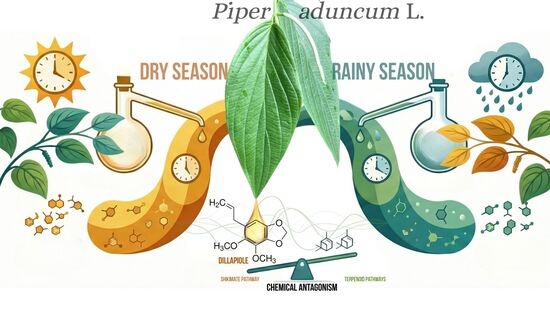
1. Introduction
2. Results
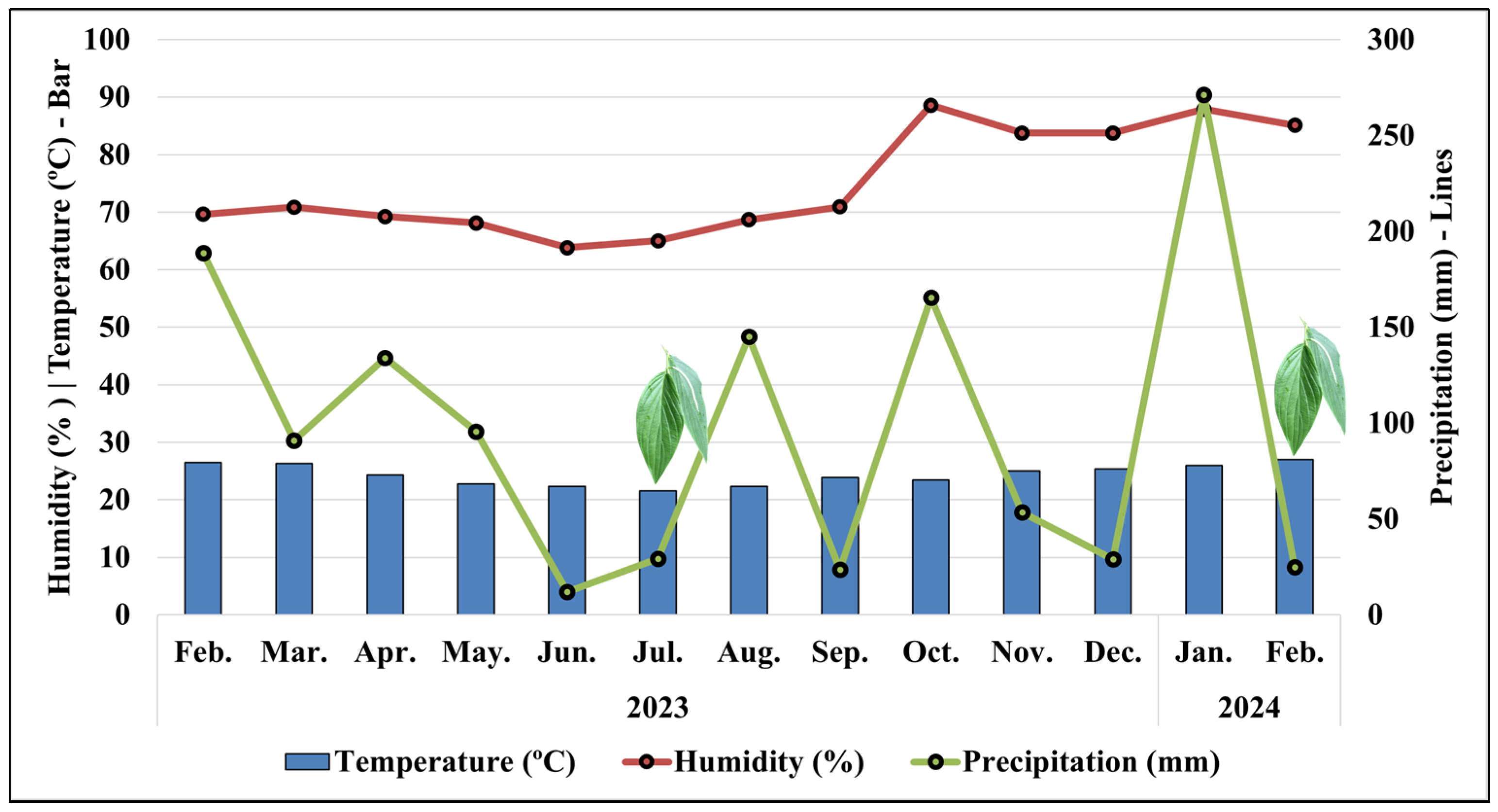
2.1. Climatic Variables and Essential Oil Yield
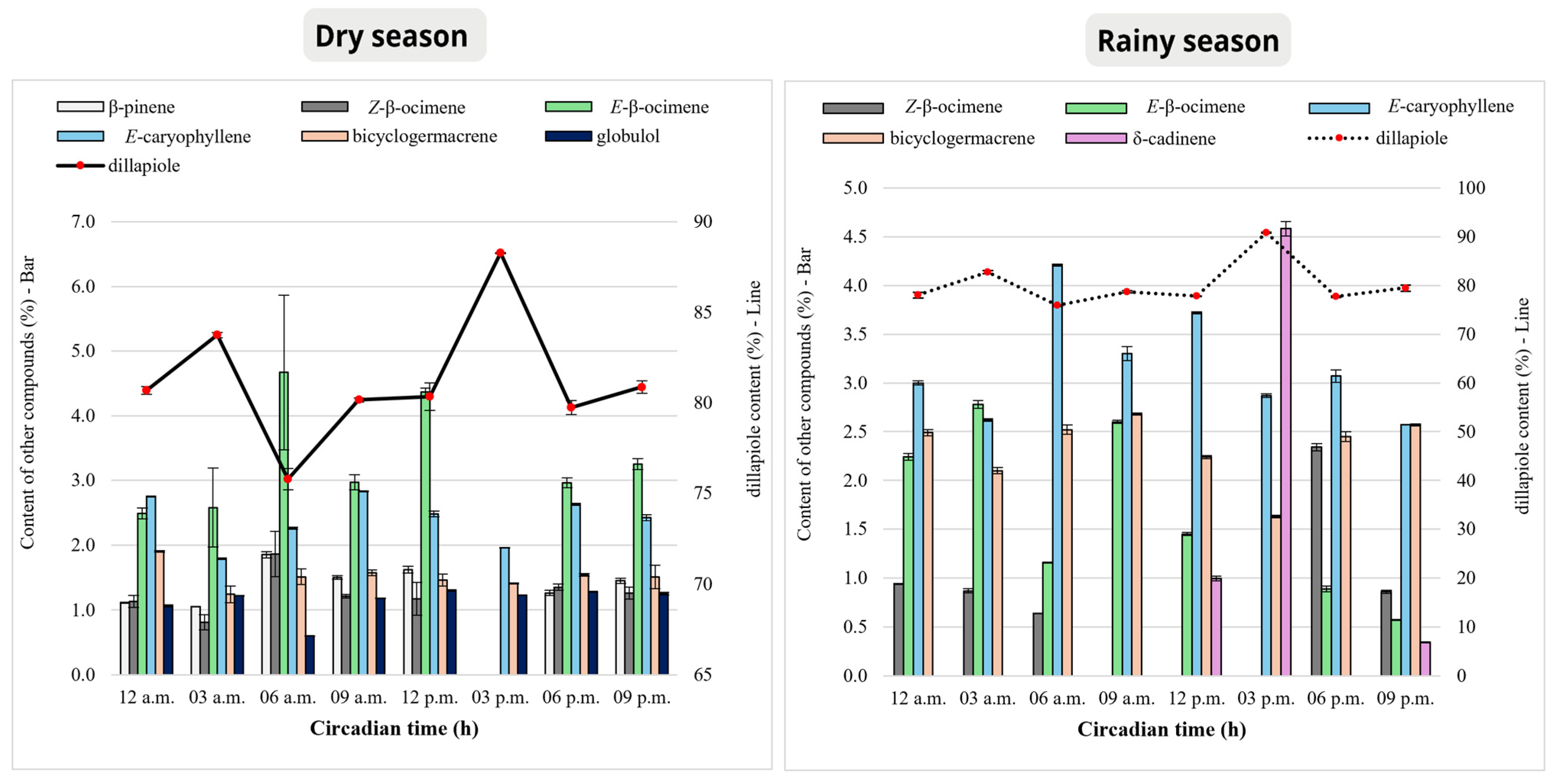
2.2. Variation of the Volatile Compounds over the Circadian Cycle
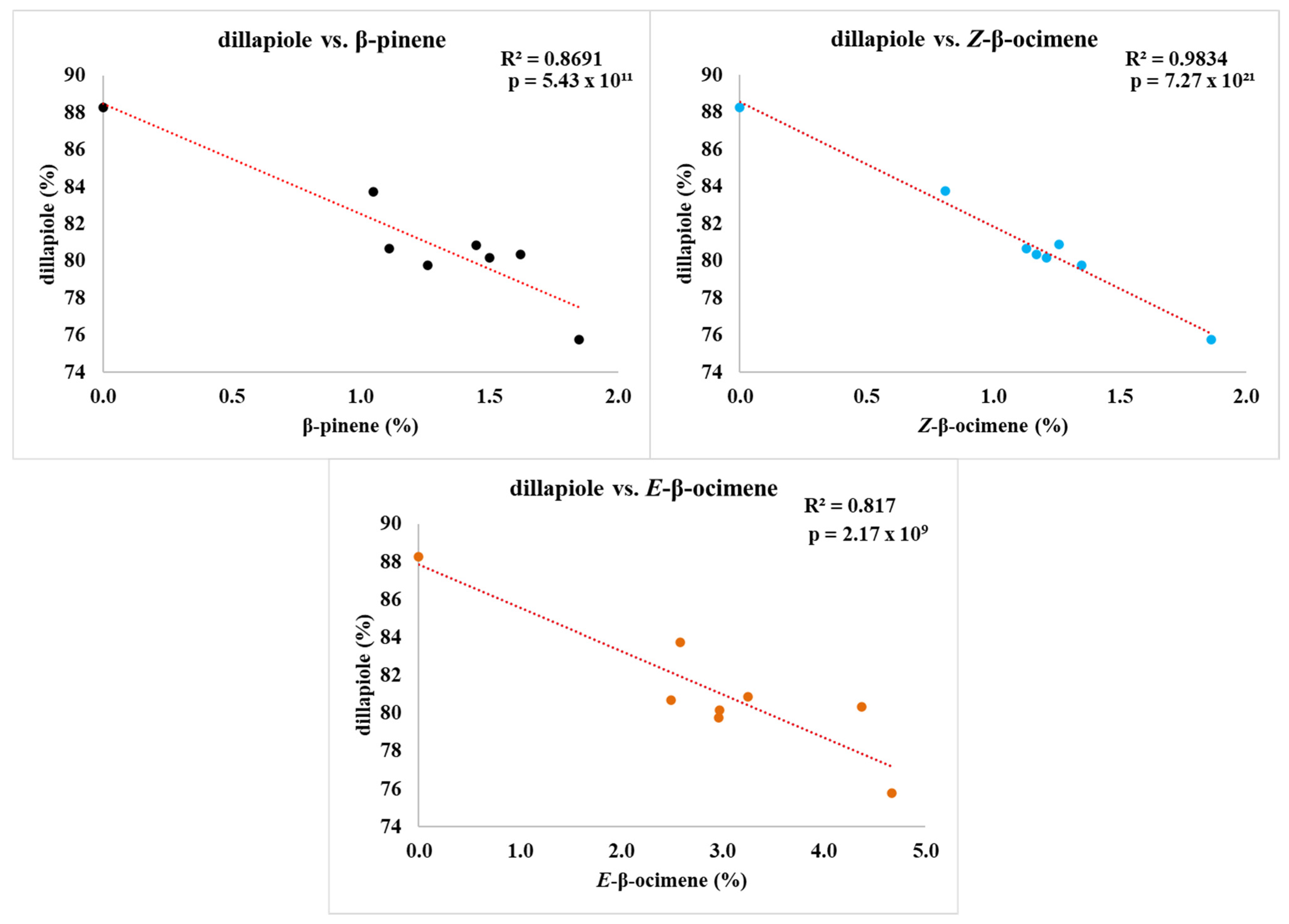
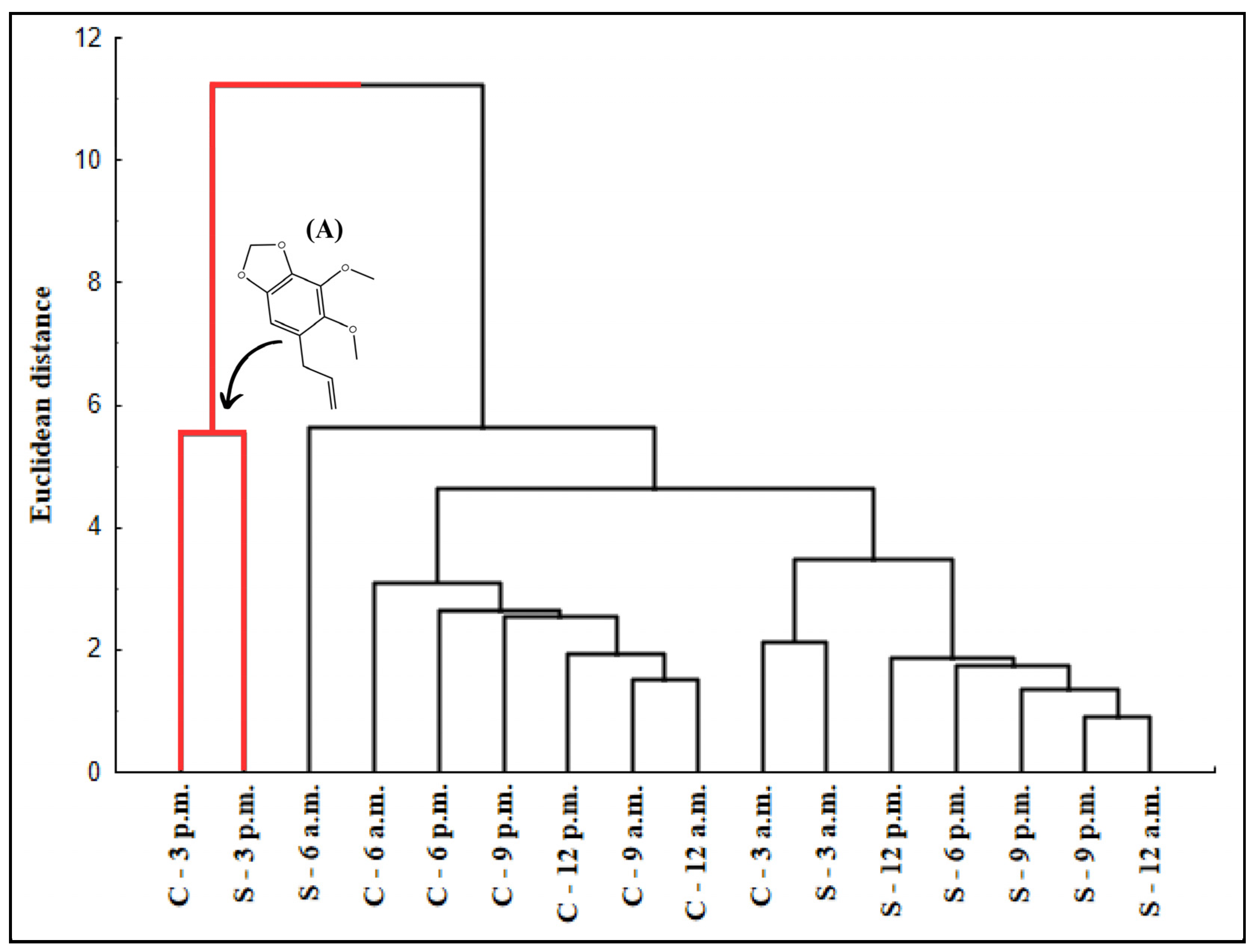
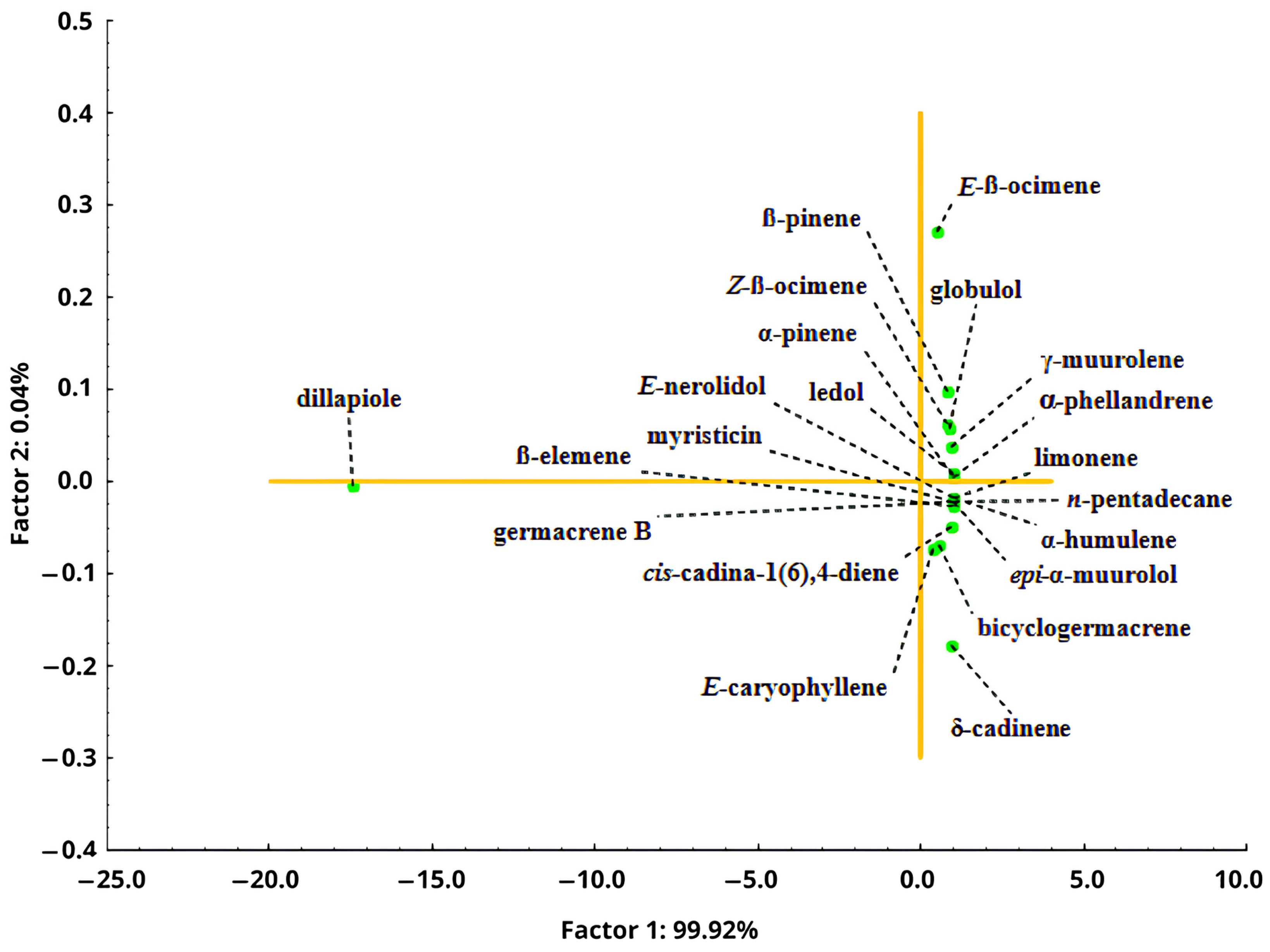
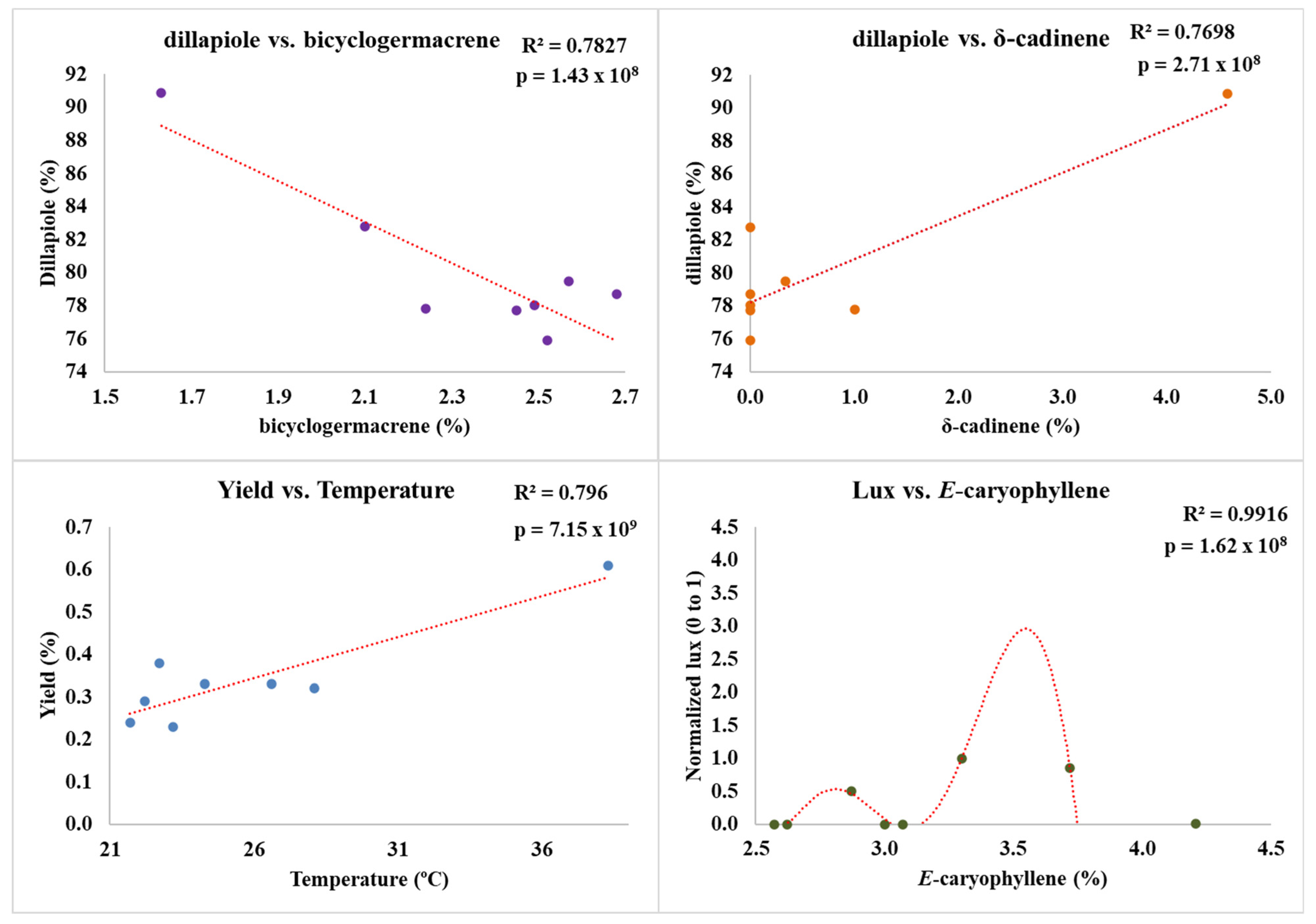
2.3. Correlations and Statistical Analyses
3. Discussion
3.1. Climatic Variables During Leaf Sampling
3.2. Variation in Volatile Compounds and Essential Oil Yield
3.3. Correlations Among Essential Oil Constituents, Yield, and Abiotic Factors
4. Materials and Methods
4.1. Origin and History of the Specimen
4.2. Harvesting and Extraction of the Essential Oils
4.3. Qualitative and Quantitative Analysis of the Essential Oils
4.4. Equipment for Environmental Measures
4.5. Statistical Treatment and Data Processing
5. Conclusions
Supplementary Materials
Author Contributions
Funding
Data Availability Statement
Acknowledgments
Conflicts of Interest
References
- The Angiosperm Phylogeny Group; Chase, M.W.; Christenhusz, M.J.M.; Fay, M.F.; Byng, J.W.; Judd, W.S.; Soltis, D.E.; Mabberley, D.J.; Sennikov, A.N.; Soltis, P.S.; et al. An update of the Angiosperm Phylogeny Group classification for the orders and families of flowering plants: APG IV. Bot. J. Linn. Soc. 2016, 181, 1–20. [Google Scholar] [CrossRef]
- Guimarães, E.F.; Medeiros, E.V.S.S.; Queiroz, G.A. Piper in Flora e Funga do Brasil. Jardim Botânico do Rio de Janeiro. 2025. Available online: https://floradobrasil.jbrj.gov.br/FB12735 (accessed on 15 January 2026).
- Jaramillo, M.A.; Manos, P.S. Phylogeny and patterns of floral diversity in the genus Piper (Piperaceae). Am. J. Bot. 2001, 88, 706–716. [Google Scholar] [CrossRef]
- Greig, N. Regeneration mode in neotropical Piper: Habitat and species comparisons. Ecology 1993, 74, 2125–2135. [Google Scholar] [CrossRef]
- Bourdy, G.; DeWalt, S.J.; De Michel, L.C.; Roca, A.; Deharo, E.; Muñoz, V.; Balderrama, L.; Quenevo, C.; Gimenez, A. Medicinal plant uses of the Tacana, an Amazonian Bolivian ethnic group. J. Ethnopharmacol. 2000, 70, 87–109. [Google Scholar] [CrossRef]
- Luna, A.V.; Fagundes, T.D.S.F.; Ramos, Y.J.; Araújo, M.H.; Muzitano, M.F.; Calixto, S.D.; Moreira, D.L. UHPLC-HRMS/MS chemical fingerprinting of the bioactive partition from cultivated Piper aduncum L. Molecules 2024, 29, 1690. [Google Scholar] [CrossRef]
- Maia, J.G.S.; Zohhbi, M.D.G.B.; Andrade, E.H.A.; Santos, A.S.; Silva, M.H.L.; Luz, A.I.R.; Bastos, C.N. Constituents of the essential oil of Piper aduncum L. growing wild in the Amazon region. Flavour Fragr. J. 1998, 13, 269–272. [Google Scholar] [CrossRef]
- Orjala, J.; Erdelmeier, C.A.J.; Wright, A.D.; Rali, T.; Sticher, O. Five new prenylated p-hydroxybenzoic acid derivatives with antimicrobial and molluscicidal activity from Piper aduncum leaves. Planta Medica 1993, 59, 546–551. [Google Scholar] [CrossRef]
- Morais, V.P.; Cabral, F.V.; Fernandes, C.C.; Miranda, M.L.D. Brief review on Piper aduncum L., its bioactive metabolites and its potential to develop bioproducts. Braz. Arch. Biol. Technol. 2023, 66, e23220314. [Google Scholar] [CrossRef]
- Durofil, A.; Radice, M.; Blanco-Salas, J.; Ruiz-Téllez, T. Piper aduncum essential oil: A promising insecticide, acaricide and antiparasitic. A review. Parasite 2021, 28, 40. [Google Scholar] [CrossRef]
- Assunção, J.A.S.; Marcelino, D.S.; Felisberto, J.R.S.; Guimarães, E.F.; Queiroz, G.A.; Ramos, Y.J.; Moreira, D.L. Effects of postharvest UV-C irradiation on essential oils from leaves of Piper aduncum L. for industrial and medicinal use. Ind. Crops Prod. 2023, 203, 117216. [Google Scholar] [CrossRef]
- Miura, P.T.; Jonsson, C.M.; Queiroz, S.C.D.N.D.; Chagas, E.C.; Chaves, F.C.M.; Reyes, F.G.R. Ecological risk assessment of Piper aduncum essential oil in non-target organisms. Acta Amaz. 2021, 51, 71–78. [Google Scholar] [CrossRef]
- Salehi, B.; Zakaria, Z.A.; Gyawali, R.; Ibrahim, S.A.; Rajkovic, J.; Shinwari, Z.K.; Setzer, W.N. Piper species: A comprehensive review on their phytochemistry, biological activities and applications. Molecules 2019, 24, 1364. [Google Scholar] [CrossRef]
- Chaves, T.P. Variação Sazonal na Produção de Metabólitos Secundários e na Atividade Antimicrobiana de Espécies Vegetais do Semiárido Brasileiro. Master’s Thesis, Universidade Estadual da Paraíba, Campina Grande, Brazil, 2012. Available online: http://tede.bc.uepb.edu.br/tede/jspui/handle/tede/1879 (accessed on 3 October 2025).
- Ramos, Y.J.; Costa-Oliveira, C.D.; Candido-Fonseca, I.; Queiroz, G.A.D.; Guimarães, E.F.; Defaveri, A.C.A.E.; Moreira, D.D.L. Advanced chemophenetic analysis of essential oil from leaves of Piper gaudichaudianum Kunth using a new reduction-oxidation index to explore seasonal and circadian rhythms. Plants 2021, 10, 2116. [Google Scholar] [CrossRef]
- Ribeiro, S.M.; Bonilla, O.H.; Lucena, E.M.P. Influência da sazonalidade e do ciclo circadiano no rendimento e composição química dos óleos essenciais de Croton spp. da Caatinga. Iheringia Série Botânica 2018, 73, 31–38. [Google Scholar] [CrossRef]
- Ramos, Y.J.; Gouvêa-Silva, J.G.; Machado, D.B.; Felisberto, J.S.; Pereira, R.C.; Sadgrove, N.J.; Moreira, D.D.L. Chemophenetic and chemodiversity approaches: New insights on modern study of plant secondary metabolite diversity at different spatiotemporal and organizational scales. Rev. Bras. Farmacogn. 2023, 33, 49–72. [Google Scholar] [CrossRef]
- Morandim, A.A.; Bergamo, D.C.B.; Kato, M.J.; Cavalheiro, A.J.; Bolzani, V.S.; Furlan, M. Circadian rhythm of antifungal prenylated chromene in leaves of Piper aduncum. Phytochem. Anal. 2005, 16, 282–286. [Google Scholar] [CrossRef]
- Jucker, T.; Hardwick, S.R.; Both, S.; Elias, D.M.O.; Ewers, R.M.; Milodowski, D.T.; Swinfield, T.; Coomes, D.A. Canopy structure and topography jointly constrain the microclimate of human-modified tropical landscapes. Glob. Change Biol. 2018, 24, 5243–5258. [Google Scholar] [CrossRef] [PubMed]
- De Frenne, P.; Zellweger, F.; Rodríguez-Sánchez, F.; Scheffers, B.R.; Hylander, K.; Luoto, M.; Vellend, M.; Verheyen, K.; Lenoir, J. Global buffering of temperatures under forest canopies. Nat. Ecol. Evol. 2019, 3, 744–749. [Google Scholar] [CrossRef] [PubMed]
- Zellweger, F.; De Frenne, P.; Lenoir, J.; Vangansbeke, P.; Verheyen, K.; Bernhardt-Römermann, M.; Baeten, L.; Hédl, R.; Berki, I.; Brunet, J.; et al. Forest microclimate dynamics drive plant responses to warming. Science 2020, 368, 772–775. [Google Scholar] [CrossRef]
- Gasparetto, A.; Cruz, A.B.; Wagner, T.M.; Bonomini, T.J.; Correa, R.; Malheiros, A. Seasonal variation in the chemical composition, antimicrobial and mutagenic potential of essential oils from Piper cernuum. Ind. Crops Prod. 2017, 95, 256–263. [Google Scholar] [CrossRef]
- Schindler, B.; Heinzmann, B.M. Piper gaudichaudianum Kunth: Seasonal characterization of the essential oil chemical composition of leaves and reproductive organs. Braz. Arch. Biol. Technol. 2017, 60, e17160441. [Google Scholar] [CrossRef]
- Ramos, Y.J.; Machado, D.B.; Queiroz, G.A.; Guimarães, E.F.; Defaveri, A.C.A.; Moreira, D.L. Chemical composition of the essential oils of circadian rhythm and of different vegetative parts from Piper mollicomum Kunth, a medicinal plant from Brazil. Biochem. Syst. Ecol. 2020, 92, 104116. [Google Scholar] [CrossRef]
- Ferreira, G.K.S.; Margalho, J.F.; Almeida, L.Q.; Anjos, T.O.; Cascaes, M.M.; Nascimento, L.D.; Aguiar Andrade, E.H. Avaliação sazonal e circadiana do óleo essencial das folhas de Piper divaricatum G. Mey. (Piperaceae). Braz. J. Dev. 2020, 6, 41356–41369. [Google Scholar] [CrossRef]
- Vasconcelos, L.C.; Bergamim, A.D.S.; Martins, G.S.; Mariano, G.F.; Mendes, L.A.; Carrijo, T.T.; Praça-Fontes, M.M. Influence of seasonal variation on the chemical composition of Piper amalago essential oils and their phytocytogenotoxic activity in model plants and weeds. Bragantia 2024, 83, e20240090. [Google Scholar] [CrossRef]
- Fazolin, M.; Monteiro, A.F.M.; Bizzo, H.R.; Gama, P.E.; Viana, L.D.O.; Lima, M.E.C.D. Insecticidal activity of Piper aduncum oil: Variation in dillapiole content and chemical and toxicological stability during storage. Acta Amaz. 2022, 52, 179–188. [Google Scholar] [CrossRef]
- Salazar, L.C.; Ortiz-Reyes, A.; Rosero, D.M.; Lobo-Echeverri, T. Dillapiole in Piper holtonii as an inhibitor of the symbiotic fungus Leucoagaricus gongylophorus of leaf-cutting ants. J. Chem. Ecol. 2020, 46, 668–674. [Google Scholar] [CrossRef]
- Vizcaíno-Páez, S.; Pineda, R.; García, C.; Gil, J.; Durango, D. Metabolism and antifungal activity of saffrole, dillapiole, and derivatives against Botryodiplodia theobromae and Colletotrichum acutatum. Boletín Latinoam. Caribe Plantas Med. Aromáticas 2016, 15, 1–17. [Google Scholar]
- Açıkgöz, M.A.; Ay, E.B.; Aygün, A.; Kara, Ş.M. Light-mediated biosynthesis of phenylpropanoid metabolites in cell suspension cultures of Turkish yarrow (Achillea gypsicola Hub. Mor.). Kahramanmaraş Sütçü İmam Üniversitesi Tarım Ve Doğa Derg. 2022, 25, 1234–1242. [Google Scholar] [CrossRef]
- Pant, P.; Pandey, S.; Dall’Acqua, S. The influence of environmental conditions on secondary metabolites in medicinal plants: A literature review. Chem. Biodivers. 2021, 18, e2100345. [Google Scholar] [CrossRef] [PubMed]
- Yang, L.; Wen, K.S.; Ruan, X.; Zhao, Y.X.; Wei, F.; Wang, Q. Response of plant secondary metabolites to environmental factors. Molecules 2018, 23, 762. [Google Scholar] [CrossRef]
- Carvalho, I.S.; Cavaco, T.; Carvalho, L.M.; Duque, P. Effect of photoperiod on flavonoid pathway activity in sweet potato (Ipomoea batatas (L.) Lam.) leaves. Food Chem. 2010, 118, 384–390. [Google Scholar] [CrossRef]
- Di Ferdinando, M.; Brunetti, C.; Fini, A.; Tattini, M. Flavonoids as antioxidants in plants under abiotic stresses. In Abiotic Stress Responses in Plants: Metabolism, Productivity and Sustainability; Springer: New York, NY, USA, 2012; pp. 159–179. [Google Scholar] [CrossRef]
- Akula, R.; Ravishankar, G.A. Influence of abiotic stress signals on secondary metabolites in plants. Plant Signal. Behav. 2011, 6, 1720–1731. [Google Scholar] [CrossRef]
- Ashraf, M.A.; Iqbal, M.; Rasheed, R.; Hussain, I.; Riaz, M.; Arif, M.S. Environmental stress and secondary metabolites in plants: An overview. In Plant Metabolites and Regulation under Environmental Stress; Elsevier: Amsterdam, The Netherlands, 2018; pp. 153–167. [Google Scholar] [CrossRef]
- Pereira, A.C.R.L.; Oliveira, J.V.; Gondim Junior, M.G.C.; Câmara, C.A.G.D. Atividade inseticida de óleos essenciais e fixos sobre Callosobruchus maculatus (Fabr., 1775) em grãos de caupi (Vigna unguiculata (L.) Walp.). Ciência E Agrotecnologia 2008, 32, 717–724. [Google Scholar] [CrossRef]
- Carneiro, S.B.; Kreutz, T.; Limberger, R.P.; Teixeira, H.F.; Veiga Júnior, V.F.; Koester, L.S. Piper aduncum essential oil rich in dillapiole: Development of hydrogel-thickened nanoemulsion and nanostructured lipid carrier intended for skin delivery. Pharmaceutics 2022, 14, 2525. [Google Scholar] [CrossRef]
- Majolo, C.; Monteiro, P.C.; Nascimento, A.V.P.; Chaves, F.C.M.; Gama, P.E.; Bizzo, H.R.; Chagas, E.C. Essential oils from five Brazilian Piper species as antimicrobials against strains of Aeromonas hydrophila. J. Essent. Oil Bear. Plants 2019, 22, 746–761. [Google Scholar] [CrossRef]
- Pereira Filho, A.A.; Vale, V.F.; Monteiro, C.M.O.; Barrozo, M.M.; Stanton, M.A.; Yamaguchi, L.F.; Araújo, R.N. Effects of Piper aduncum essential oil and its main component dillapiole on detoxifying enzymes and acetylcholinesterase activity of Amblyomma sculptum. Int. J. Mol. Sci. 2024, 25, 5420. [Google Scholar] [CrossRef] [PubMed]
- Corpes, R.; Monteiro, L.; Andrade, E.H.; Maia, J.G.; Menezes, I.; Setzer, W.N.; Silva, J.K. Comparison of volatile profile and antioxidant activity of Piper divaricatum G. Meyer using cuttings and cell tissue. J. Braz. Chem. Soc. 2019, 30, 2291–2298. [Google Scholar] [CrossRef]
- Dudareva, N.; Klempien, A.; Muhlemann, J.K.; Kaplan, I. Biosynthesis, function and metabolic engineering of plant volatile organic compounds. New Phytol. 2013, 198, 16–32. [Google Scholar] [CrossRef]
- Maeda, H.; Dudareva, N. The shikimate pathway and aromatic amino acid biosynthesis in plants. Annu. Rev. Plant Biol. 2012, 63, 73–105. [Google Scholar] [CrossRef]
- Pichersky, E.; Gershenzon, J. The formation and function of plant volatiles: Perfumes for pollinator attraction and defense. Curr. Opin. Plant Biol. 2002, 5, 237–243. [Google Scholar] [CrossRef]
- Mattana, R.S.; Vieira, M.A.R.; Marchese, J.A.; Ming, L.C.; Marques, M.O.M. Shade level effects on yield and chemical composition of the leaf essential oil of Pothomorphe umbellata (L.) Miq. Sci. Agric. 2010, 67, 414–418. [Google Scholar] [CrossRef]
- Ramos, Y.J. Estudos Quimiofenético e Farmacognóstico de Piper gaudichaudianum Kunth e Piper multinodum C. DC. (Piperaceae). Ph.D. Thesis, Universidade do Estado do Rio de Janeiro, Rio de Janeiro, Brazil, 2021. Available online: http://www.bdtd.uerj.br/handle/1/20323 (accessed on 3 October 2025).
- Assunção, J.A.S.; Machado, D.B.; Felisberto, J.S.; Chaves, D.S.A.; Campos, D.R.; Cid, Y.P.; Sadgrove, N.J.; Ramos, Y.J.; Moreira, D.L. Insecticidal activity of essential oils from Piper aduncum against Ctenocephalides felis felis: A promising approach for flea control. Rev. Bras. Parasitol. Veterinária 2024, 33, e007624. [Google Scholar] [CrossRef]
- Ramos, Y.J. Identificação de Possíveis Quimiotipos de Piper aduncum L. e Piper mollicomum Kunth (Piperaceae) Com Base no Estudo dos Componentes Químicos de Óleos Essenciais. Master’s Thesis, Universidade do Estado do Rio de Janeiro, Rio de Janeiro, Brazil, 2018. Available online: http://www.bdtd.uerj.br/handle/1/17559 (accessed on 3 October 2025).
- Nor, F.A.M.; Syucri, Y. Medicinal uses, phytochemistry, and pharmacological properties of Piper aduncum L. Sains Malays. 2020, 49, 1829–1851. [Google Scholar] [CrossRef]
- Dao, T.P.; Tran, T.H.; Nhan, N.P.T.; Quyen, N.T.C.; Tien, L.X.; Anh, T.T.; Linh, H.T.K. Optimization of essential oil yield from Vietnamese green pepper (Piper nigrum) using hydrodistillation. IOP Conf. Ser. Mater. Sci. Eng. 2020, 736, 022039. [Google Scholar] [CrossRef]
- Felisberto, J.S.; Ramos, Y.J.; Queiroz, G.A.; Guimarães, E.F.; Marques, A.E.M.; Moreira, D.L. Piper rivinoides Kunth: A medicinal plant that preserves bioactive chemical substances in its essential oil throughout the seasons. J. Med. Plants Res. 2022, 16, 258–268. [Google Scholar] [CrossRef]
- Ghareeb, Y.E.; Soliman, S.S.; Ismail, T.A.; Hassan, M.A.; Abdelkader, M.A.; Abdel Latef, A.A.H.; Hassanin, A.A. Improvement of German chamomile (Matricaria recutita L.) for mechanical harvesting, high flower yield and essential oil content using physical and chemical mutagenesis. Plants 2022, 11, 2940. [Google Scholar] [CrossRef] [PubMed]
- Monzote, L.; Scull, R.; Cos, P.; Setzer, W.N. Essential oil from Piper aduncum: Chemical analysis, antimicrobial assessment, and literature review. Medicines 2017, 4, 49. [Google Scholar] [CrossRef]
- Oliveira, G.L.; Moreira, D.D.L.; Mendes, A.D.R.; Guimarães, E.F.; Figueiredo, L.S.; Kaplan, M.A.C.; Martins, E.R. Growth study and essential oil analysis of Piper aduncum from two sites of Cerrado biome of Minas Gerais State, Brazil. Rev. Bras. Farmacogn. 2013, 23, 743–753. [Google Scholar] [CrossRef]
- Bizzo, H.R.; Brilhante, N.S.; Nolvachai, Y.; Marriott, P.J. Use and abuse of retention indices in gas chromatography. J. Chromatogr. A 2023, 1708, 464376. [Google Scholar] [CrossRef]
- Van den Dool, H.; Kratz, P.D. A generalization of the retention index system including linear temperature programmed gas-liquid partition chromatography. J. Chromatogr. 1963, 11, 463–471. [Google Scholar] [CrossRef]
- Adams, R.P. Identification of Essential Oil Components by Gas Chromatography/Mass Spectrometry, 5th ed.; Texensis Publishing: Gruver, TX, USA, 2017. [Google Scholar]
- Sadgrove, N.J.; Jones, G.L. Cytogeography of essential oil chemotypes of Eremophila longifolia F. Muell. (Scrophulariaceae). Phytochemistry 2014, 105, 43–51. [Google Scholar] [CrossRef] [PubMed]
- Sá, S.D.; Fiuza, T.S.; Borges, L.L.; Ferreira, H.D.; Tresvenzol, L.M.; Ferri, P.H.; Paula, J.R. Chemical composition and seasonal variability of the essential oils of leaves and morphological analysis of Hyptis carpinifolia. Rev. Bras. De Farmacogn. 2016, 26, 688–693. [Google Scholar] [CrossRef]
- Jannuzzi, H.; Mattos, J.K.A.; Vieira, R.F.; Silva, D.B.; Bizzo, H.R.; Gracindo, L.A. Avaliação agronômica e identificação de quimiotipos de erva cidreira no Distrito Federal. Hortic. Bras. 2010, 28, 412–417. [Google Scholar] [CrossRef]






| Compounds * | LRIlit | LRIcalc | Relative Peak Area (%) ± SD | |||||||
|---|---|---|---|---|---|---|---|---|---|---|
| Dry Season (July) | ||||||||||
| 12:00 a.m. | 03:00 a.m. | 06:00 a.m. | 09:00 a.m. | 12:00 p.m. | 3:00 p.m. | 6:00 p.m. | 9:00 p.m. | |||
| α-pinene | 932 | 942 | - | 0.09 ± 0.01 | 0.73 ± 0.05 | - | 0.11 ± 0.05 | - | 0.15 ± 0.04 | 0.52 ± 0.04 |
| β-pinene | 974 | 982 | 1.11 ± 0.01 e | 1.05 ± 0.02 ab | 1.85 ± 0.09 d | 1.50 ± 0.03 f | 1.62 ± 0.34 a | - b | 1.26 ± 0.02 a | 1.45 ± 0.02 c |
| α-phellandrene | 1002 | 1006 | - | 0.07 ± 0.04 | 0.54 ± 0.02 | - | 0.56 ± 0.11 | - | 0.43 ± 0.00 | 0.06 ± 0.00 |
| limonene | 1024 | 1027 | - | - | - | - | - | - | 1.03 ± 0.22 | - |
| Z-β-ocimene | 1032 | 1032 | 1.13 ± 0.09 ab | 0.81 ± 0.12 a | 1.86 ± 0.35 d | 1.21 ± 0.03 ab | 1.17 ± 0.25 ab | - c | 1.35 ± 0.05 ab | 1.26 ± 0.09 ab |
| E-β-ocimene | 1044 | 1043 | 2.49 ± 0.08 a | 2.58 ± 0.61 a | 4.67 ± 1.19 c | 2.97 ± 0.12 ab | 4.37 ± 0.06 bc | - d | 2.96 ± 0.08 a | 3.25 ± 0.09 ab |
| MW207 | - | 1367 | - | - | - | - | - | - | 0.07 ± 0.00 | - |
| β-elemene | 1389 | 1388 | - | - | - | - | - | - | 0.10 ± 0.01 | - |
| E-caryophyllene | 1417 | 1416 | 2.75 ± 0.01 f | 1.79 ± 0.01 b | 2.26 ± 0.02 d | 2.83 ± 0.01 g | 2.48 ± 0.04 a | 1.96 ± 0.01 c | 2.63 ± 0.02 e | 2.42 ± 0.05 a |
| α-humulene | 1452 | 1451 | - | - | - | - | - | - | 0.49 ± 0.01 | 0.42 ± 0.01 |
| γ-muurolene | 1478 | 1476 | 0.89 ± 0.01 | 0.55 ± 0.01 | 0.79 ± 0.07 | 0.96 ± 0.02 | 0.80 ± 0.03 | 0.74 ± 0.01 | 0.83 ± 0.01 | 0.61 ± 0.01 |
| bicyclogermacrene | 1500 | 1490 | 1.90 ± 0.01 c | 1.24 ± 0.13 b | 1.51 ± 0.12 a | 1.57 ± 0.05 a | 1.46 ± 0.09 ab | 1.41 ± 0.01 ab | 1.54 ± 0.02 a | 1.51 ± 0.18 a |
| n-pentadecane | 1500 | 1496 | - | - | - | - | - | - | 0.21 ± 0.00 | 0.19 ± 0.00 |
| γ-cadinene | 1513 | 1510 | 0.52 ± 0.03 | 0.71 ± 0.02 | - | - | 0.64 ± 0.03 | 0.79 ± 0.01 | 0.64 ± 0.01 | 0.52 ± 0.01 |
| myristicin | 1517 | 1513 | - | - | - | - | - | - | 0.40 ± 0.00 | - |
| germacrene B | 1559 | 1549 | - | - | - | - | - | - | 0.50 ± 0.00 | - |
| E-nerolidol | 1561 | 1555 | - | - | - | - | - | - | 0.26 ± 0.01 | 0.52 ± 0.01 |
| MW222 | - | 1567 | - | 0.35 ± 0.04 | - | - | - | - | 0.14 ± 0.01 | 0.29 ± 0.00 |
| MW206 | - | 1572 | - | - | - | - | - | - | 0.22 ± 0.01 | - |
| globulol | 1590 | 1584 | 1.06 ± 0.02 d | 1.22 ± 0.01 a | 1.24 ± 0.00 a | 1.18 ± 0.01 e | 1.30 ± 0.01 c | 1.23 ± 0.00 a | 1.28 ± 0.01 bc | 1.25 ± 0.02 e |
| ledol | 1602 | 1594 | - | - | - | - | - | - | 0.16 ± 0.00 | - |
| dillapiole | 1620 | 1610 | 80.68 ± 0.21 a | 83.74 ± 0.14 c | 75.78 ± 0.60 a | 80.16 ± 0.11 a | 80.35 ± 0.76 a | 88.27 ± 0.03 d | 79.75 ± 0.39 a | 80.87 ± 0.36 a |
| epi-α-muurolol | 1640 | 1643 | - | - | - | - | - | - | 0.19 ± 0.00 | 0.20 ± 0.01 |
| Non-oxygenated monoterpenes | 4.72 | 4.60 | 9.65 | 5.68 | 6.47 | - | 7.18 | 6.55 | ||
| Oxygenated monoterpenes | - | - | - | - | - | - | - | - | ||
| Non-oxygenated sesquiterpenes | 6.05 | 4.28 | 4.56 | 5.36 | 5.38 | 4.91 | 6.23 | 5.15 | ||
| Oxygenated sesquiterpenes | 1.06 | 1.22 | 1.84 | 1.18 | 1.30 | 1.23 | 1.90 | 1.98 | ||
| Arylpropanoids | 80.68 | 83.74 | 75.78 | 80.16 | 80.35 | 88.27 | 80.15 | 80.87 | ||
| Other compounds | - | 0.35 | - | - | - | - | 0.63 | 0.81 | ||
| Number of identified compounds | 09 | 11 | 11 | 08 | 11 | 06 | 20 | 15 | ||
| Total identified (%) | 92.52 | 94.19 | 91.84 | 92.39 | 94.84 | 94.40 | 96.59 | 95.37 | ||
| Essential oil Yield (%) | 0.71 ± 0.04 a | 0.24 ± 0.01 b | 0.47 ± 0.01 c | 0.54 ± 0.02 d | 0.49 ± 0.01 e | 0.73 ± 0.01 a | 0.59 ± 0.02 f | 0.69 ± 0.01 g | ||
| Compounds * | LRIlit | LRIcalc | Relative Peak Area (%) ± SD | |||||||
|---|---|---|---|---|---|---|---|---|---|---|
| Rainy Season (February) | ||||||||||
| 12:00 a.m. | 03:00 a.m. | 06:00 a.m. | 09:00 a.m. | 12:00 p.m. | 3:00 p.m. | 6:00 p.m. | 9:00 p.m. | |||
| β-pinene | 974 | 983 | 0.78 ± 0.01 | 0.63 ± 0.02 | 0.83 ± 0.02 | - | - | - | - | 0.90 ± 0.00 |
| Z-β-ocimene | 1032 | 1036 | 0.94 ± 0.01 a | 0.87 ± 0.02 b | 0.64 ± 0.00 c | - d | - d | - d | 2.34 ± 0.04 e | 0.86 ± 0.02 b |
| E-β-ocimene | 1044 | 1046 | 2.24 ± 0.04 a | 2.78 ± 0.04 b | 1.16 ± 0.01 c | 2.60 ± 0.02 d | 1.45 ± 0.02 e | - f | 0.89 ± 0.03 g | 0.57 ± 0.01 h |
| MW429 | - | 1322 | 0.54 ± 0.01 | 0.51 ± 0.00 | 0.65 ± 0.03 | - | 1.03 ± 0.01 | - | 0.51 ± 0.07 | 0.23 ± 0.00 |
| E-caryophyllene | 1417 | 1420 | 3.00 ± 0.02 a | 2.62 ± 0.02 b | 4.21 ± 0.01 c | 3.30 ± 0.07 d | 3.72 ± 0.01 e | 2.87 ± 0.02 f | 3.07 ± 0.06 b | 2.57 ± 0.00 b |
| MW141 | - | 1448 | - | - | - | - | - | - | - | 0.15 ± 0.00 |
| cis-cadina-1(6).4-diene | 1476 | 1461 | 0.58 ± 0.01 | 0.29 ± 0.04 | 0.41 ± 0.01 | 0.32 ± 0.05 | 0.72 ± 0.01 | - | 0.28 ± 0.07 | 0.30 ± 0.01 |
| bicyclogermacrene | 1500 | 1492 | 2.49 ± 0.03 a | 2.10 ± 0.03 d | 2.52 ± 0.05 ab | 2.68 ± 0.01 f | 2.24 ± 0.02 e | 1.63 ± 0.01 c | 2.45 ± 0.05 a | 2.57 ± 0.01 b |
| MW503 | - | 1502 | 0.85 ± 0.02 | 0.19 ± 0.01 | 0.28 ± 0.00 | 0.85 ± 0.17 | 0.29 ± 0.01 | - | 0.20 ± 0.01 | 0.17 ± 0.02 |
| γ-cadinene | 1513 | 1511 | - | - | 0.54 ± 0.00 | - | - | - | - | 0.33 ± 0.03 |
| δ-cadinene | 1522 | 1520 | - a | - a | - a | - a | 1.00 ± 0.02 b | 4.58 ± 0.07 c | - a | 0.34 ± 0.01 d |
| aromadendrene | 1425 | 1439 | - | - | - | - | - | 0.04 ± 0.02 | - | - |
| MW204 | - | 1586 | 0.82 ± 0.01 | 0.48 ± 0.01 | 0.76 ± 0.01 | 0.46 ± 0.02 | 0.77 ± 0.01 | - | 0.53 ± 0.01 | 0.58 ± 0.00 |
| dillapiole | 1620 | 1618 | 78.03 ± 0.50 ab | 82.77 ± 0.29 f | 75.90 ± 0.16 e | 78.69 ± 0.19 cd | 77.80 ± 0.03 ab | 90.86 ± 0.09 g | 77.71 ± 0.13 a | 79.50 ± 0.64 d |
| MW401 | - | 1673 | - | 0.60 ± 0.02 | 0.74 ± 0.00 | 0.39 ± 0.00 | 0.77 ± 0.01 | - | 1.05 ± 0.01 | 1.07 ± 0.01 |
| Non-oxygenated monoterpenes | 3.96 | 4.28 | 2.63 | 2.60 | 1.45 | - | 3.74 | 2.33 | ||
| Oxygenated monoterpenes | - | - | - | - | - | - | - | - | ||
| Non-oxygenated sesquiterpenes | 6.07 | 5.01 | 5.16 | 6.30 | 7.68 | 9.12 | 5.80 | 6.11 | ||
| Oxygenated sesquiterpenes | - | - | - | - | - | - | - | - | ||
| Arylpropanoids | 78.03 | 82.77 | 75.90 | 78.69 | 77.80 | 90.86 | 77.71 | 79.50 | ||
| Other compounds | 2.21 | 1.78 | 2.43 | 1.70 | 2.86 | - | 2.29 | 2.20 | ||
| Number of identified compounds | 07 | 07 | 08 | 05 | 06 | 05 | 06 | 09 | ||
| Total identified (%) | 90.25 | 93.85 | 88.64 | 89.29 | 89.78 | 99.98 | 89.02 | 90.14 | ||
| Essential oil Yield (%) | 0.33 ± 0.01 a | 0.23 ± 0.03 b | 0.38 ± 0.01 c | 0.33 ± 0.02 a | 0.61 ± 0.03 d | 0.32 ± 0.04 a | 0.29 ± 0.02 e | 0.24 ± 0.01 b | ||
| Dry season | Correlations: Compounds vs. Compounds | |||||||||
| β-pinene | limonene | Z-β-ocimene | E-β-ocimene | E-caryophyllene | bicyclogermacrene | globulol | ledol | dillapiole | ||
| β-pinene | 1.000 | |||||||||
| limonene | 0.022 | 1.000 | ||||||||
| Z-β-ocimene | 0.942 | 0.191 | 1.000 | |||||||
| E-β-ocimene | 0.973 | 0.014 | 0.908 | 1.000 | ||||||
| E-caryophyllene | 0.469 | 0.263 | 0.495 | 0.341 | 1.000 | |||||
| bicyclogermacrene | 0.167 | 0.049 | 0.305 | 0.080 | 0.781 | 1.000 | ||||
| globulol | −0.384 | 0.246 | −0.545 | −0.404 | 0.040 | −0.211 | 1.000 | |||
| ledol | 0.452 | −0.014 | 0.610 | 0.508 | −0.110 | −0.010 | −0.925 | 1.000 | ||
| dillapiole | −0.932 | −0.163 | −0.992 | −0.904 | −0.533 | −0.356 | 0.586 | −0.638 | 1.000 | |
| Correlations: Compounds vs. Environmental variables | ||||||||||
| β-pinene | limonene | Z-β-ocimene | E-β-ocimene | E-caryophyllene | bicyclogermacrene | globulol | ledol | dillapiole | ||
| Temperature | −0.402 | 0.307 | −0.535 | −0.408 | 0.102 | −0.233 | 0.732 | −0.630 | 0.504 | |
| Humidity | 0.035 | −0.477 | −0.207 | −0.031 | 0.000 | −0.107 | 0.558 | −0.678 | 0.268 | |
| Lux | −0.384 | −0.249 | −0.532 | −0.399 | 0.045 | −0.164 | 0.296 | −0.293 | 0.455 | |
| Rainy season | Correlations: Compounds vs. Compounds | ||||||
| Z-β-ocimene | E-β-ocimene | E-caryophyllene | bicyclogermacrene | δ-cadinene | dillapiole | ||
| Z-β-ocimene | 1.000 | ||||||
| E-β-ocimene | −0.076 | 1.000 | |||||
| E-caryophyllene | −0.236 | 0.000 | 1.000 | ||||
| bicyclogermacrene | 0.286 | 0.381 | 0.261 | 1.000 | |||
| δ-cadinene | −0.447 * | −0.630 * | −0.165 | −0.858 * | 1.000 | ||
| dillapiole | −0.336 | −0.368 | −0.514 | −0.885 * | 0.877 * | 1.000 | |
| Correlations: Compounds vs. Environmental variables | |||||||
| Z-β-ocimeno | E-β-ocimeno | E-caryophyllene | bicyclogermacrene | δ-cadineno | dillapiole | ||
| Temperature | −0.603 * | −0.014 | 0.352 | −0.315 | 0.346 | 0.083 | |
| Humidity | 0.488 * | 0.348 | −0.161 | 0.498 * | −0.585 * | −0.302 | |
| Lux | −0.523 * | 0.036 * | 0.883 * | 0.353 | −0.186 | −0.477 * | |
| Correlations: Chemical classes vs. Environmental variables | |||||||
| Non-oxygenated monoterpenes | Non-oxygenated sesquiterpenes | Arilpropanoids | Other compounds | ||||
| Temperature | −0.531 * | 0.501 * | 0.083 | 0.095 | |||
| Humidity | 0.725 * | −0.620 * | −0.302 | 0.098 | |||
| Lux | −0.529 * | 0.403 * | 0.125 | −0.154 | |||
| Temperature | Humidity | Lux | |||||
| Yield | 0.892 * | −0.764 * | 0.581 * | ||||
| Correlations: Compounds vs. Compounds | |||||||
| Rainy season | |||||||
| Z-β-ocimene | E-β-ocimene | E-caryophyllene | bicyclogermacrene | δ-cadinene | dillapiole | ||
| Dry season | β-pinene | 0.126 | 0.348 | 0.566 * | 0.835 * | −0.825 * | −0.937 * |
| limonene | 0.845 * | −0.231 | −0.072 | 0.137 | −0.188 | −0.208 | |
| Z-β-ocimene | 0.341 | 0.231 | 0.579 * | 0.860 * | −0.829 * | −0.954 * | |
| E-β-ocimene | 0.109 | 0.270 | 0.640 * | 0.699 * | −0.744 * | −0.899 * | |
| E-oaryophyllene | 0.159 | 0.191 | 0.227 | 0.746 * | −0.455 * | −0.640 * | |
| bicyclogermacrene | 0.157 | 0.112 | 0.123 | 0.506 * | −0.267 | −0.429 * | |
| globulol | 0.056 | −0.037 | −0.671 * | −0.281 | 0.238 | 0.364 | |
| ledol | 0.076 | −0.153 | 0.749 * | 0.240 | −0.214 | −0.393 | |
| dillapiole | −0.276 | −0.231 | −0.664 * | −0.843 * | 0.787 * | 0.953 * | |
Disclaimer/Publisher’s Note: The statements, opinions and data contained in all publications are solely those of the individual author(s) and contributor(s) and not of MDPI and/or the editor(s). MDPI and/or the editor(s) disclaim responsibility for any injury to people or property resulting from any ideas, methods, instructions or products referred to in the content. |
© 2026 by the authors. Licensee MDPI, Basel, Switzerland. This article is an open access article distributed under the terms and conditions of the Creative Commons Attribution (CC BY) license.
Share and Cite
Assunção, J.A.S.; Oliveira, C.G.; Felisberto, J.S.; Machado, D.B.; Ramos, Y.J.; Moreira, D.d.L. Temporal Variation in the Essential Oil Production of Piper aduncum L.: Influence of Circadian Rhythms and Insights into Dillapiole Production Dynamics. Plants 2026, 15, 976. https://doi.org/10.3390/plants15060976
Assunção JAS, Oliveira CG, Felisberto JS, Machado DB, Ramos YJ, Moreira DdL. Temporal Variation in the Essential Oil Production of Piper aduncum L.: Influence of Circadian Rhythms and Insights into Dillapiole Production Dynamics. Plants. 2026; 15(6):976. https://doi.org/10.3390/plants15060976
Chicago/Turabian StyleAssunção, Jeferson A. S., Camila G. Oliveira, Jessica S. Felisberto, Daniel B. Machado, Ygor Jesse Ramos, and Davyson de Lima Moreira. 2026. "Temporal Variation in the Essential Oil Production of Piper aduncum L.: Influence of Circadian Rhythms and Insights into Dillapiole Production Dynamics" Plants 15, no. 6: 976. https://doi.org/10.3390/plants15060976
APA StyleAssunção, J. A. S., Oliveira, C. G., Felisberto, J. S., Machado, D. B., Ramos, Y. J., & Moreira, D. d. L. (2026). Temporal Variation in the Essential Oil Production of Piper aduncum L.: Influence of Circadian Rhythms and Insights into Dillapiole Production Dynamics. Plants, 15(6), 976. https://doi.org/10.3390/plants15060976