Reproductive Success Beyond Pollinators: Microhabitat Effects and Pollen Dynamics in Epipactis bugacensis, a Traditionally Obligately Autogamous Orchid

 , ,
, ,
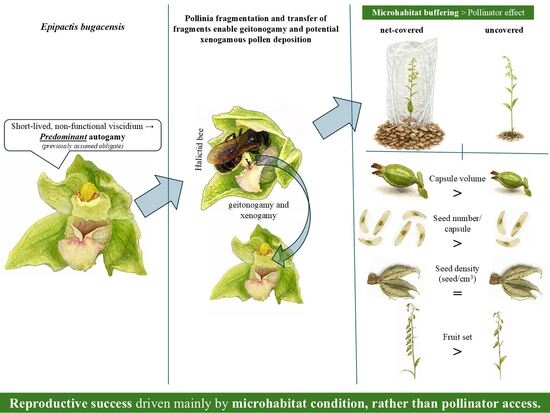
Abstract
1. Introduction
2. Results
2.1. Flower Visitor Observations
2.2. Changes in Different Sexual Propagation Traits in Covered and Uncovered E. bugacensis Individuals
2.2.1. Effect of Net Covering on Fruit Set at the Jászfényszaru (JF) Site

2.2.2. Effect of Net Covering on Reproductive Success Traits of E. bugacensis Across Four Treatments (JF Covered, JF Uncovered, Harkakötöny (HK) Covered, HK Uncovered)
Capsule Volume

Seed Number

Seed Density
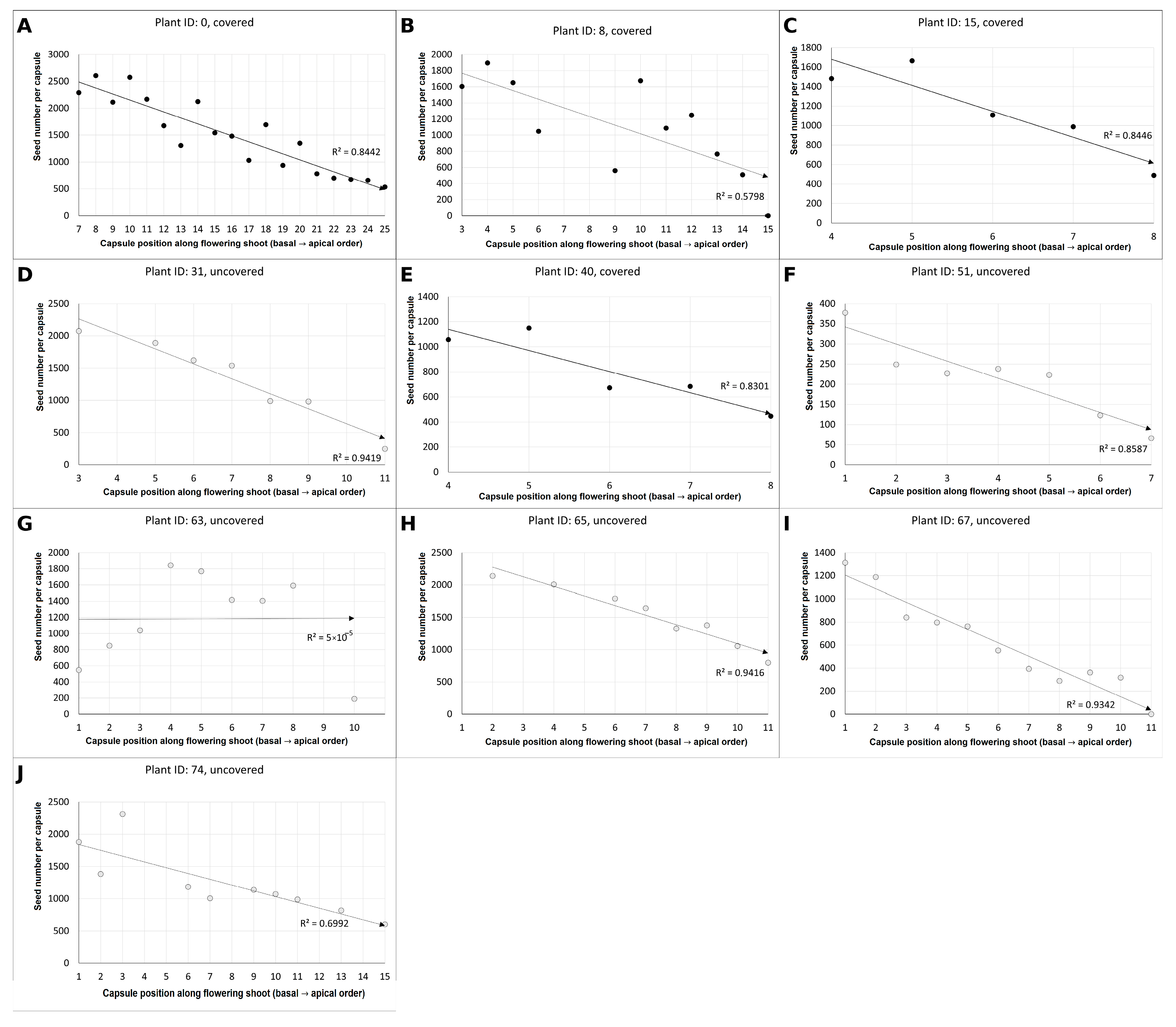
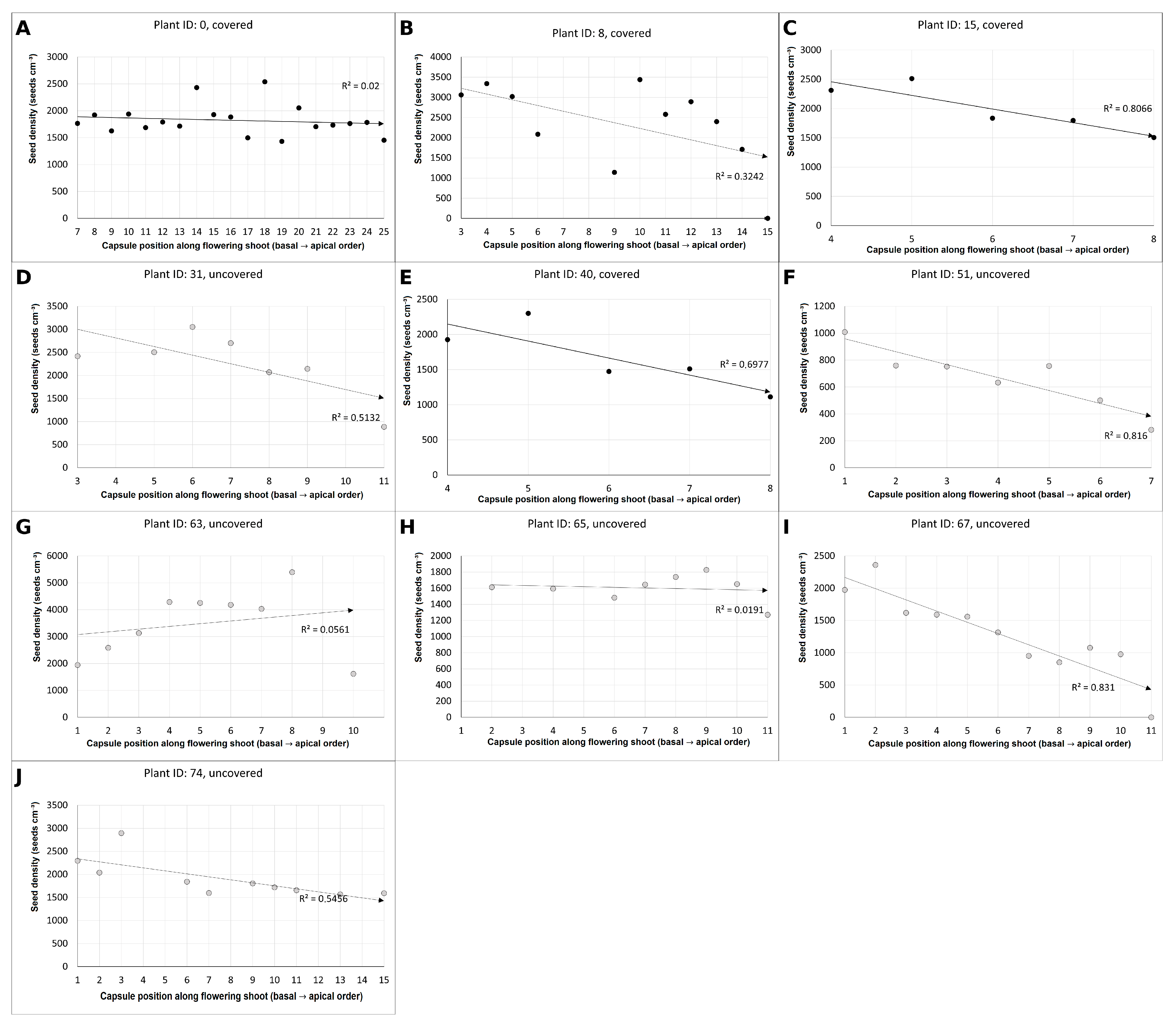
2.2.3. Changes in Reproductive Success Traits from the Basal to the Apical Capsules in Covered and Uncovered E. bugacensis Individuals at the JF Site
Seed Number
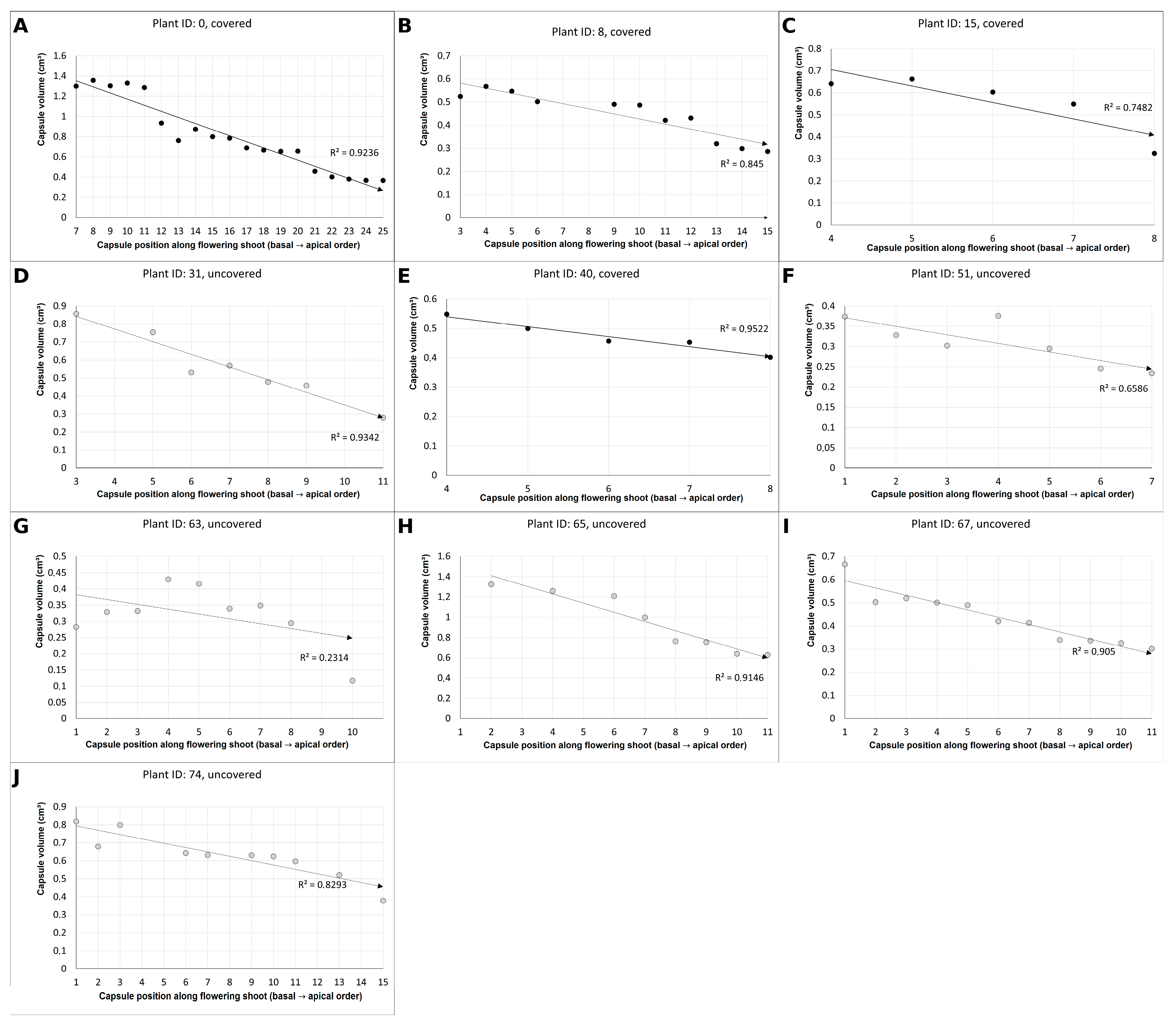
Capsule Volume
Seed Density
2.3. Mortality Outcomes
3. Discussion
3.1. Evaluating the Role of Flower Visitors in Pollination
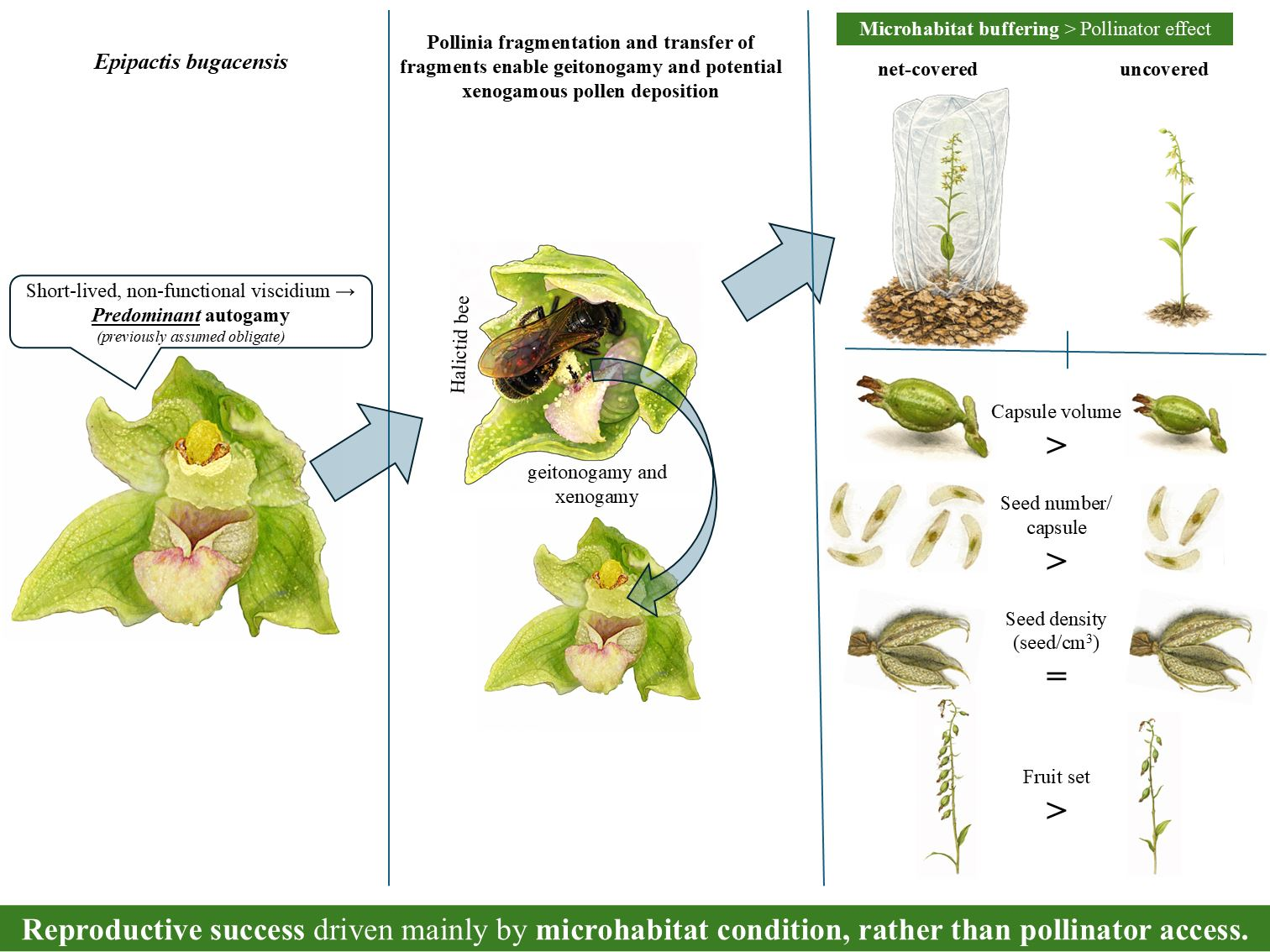
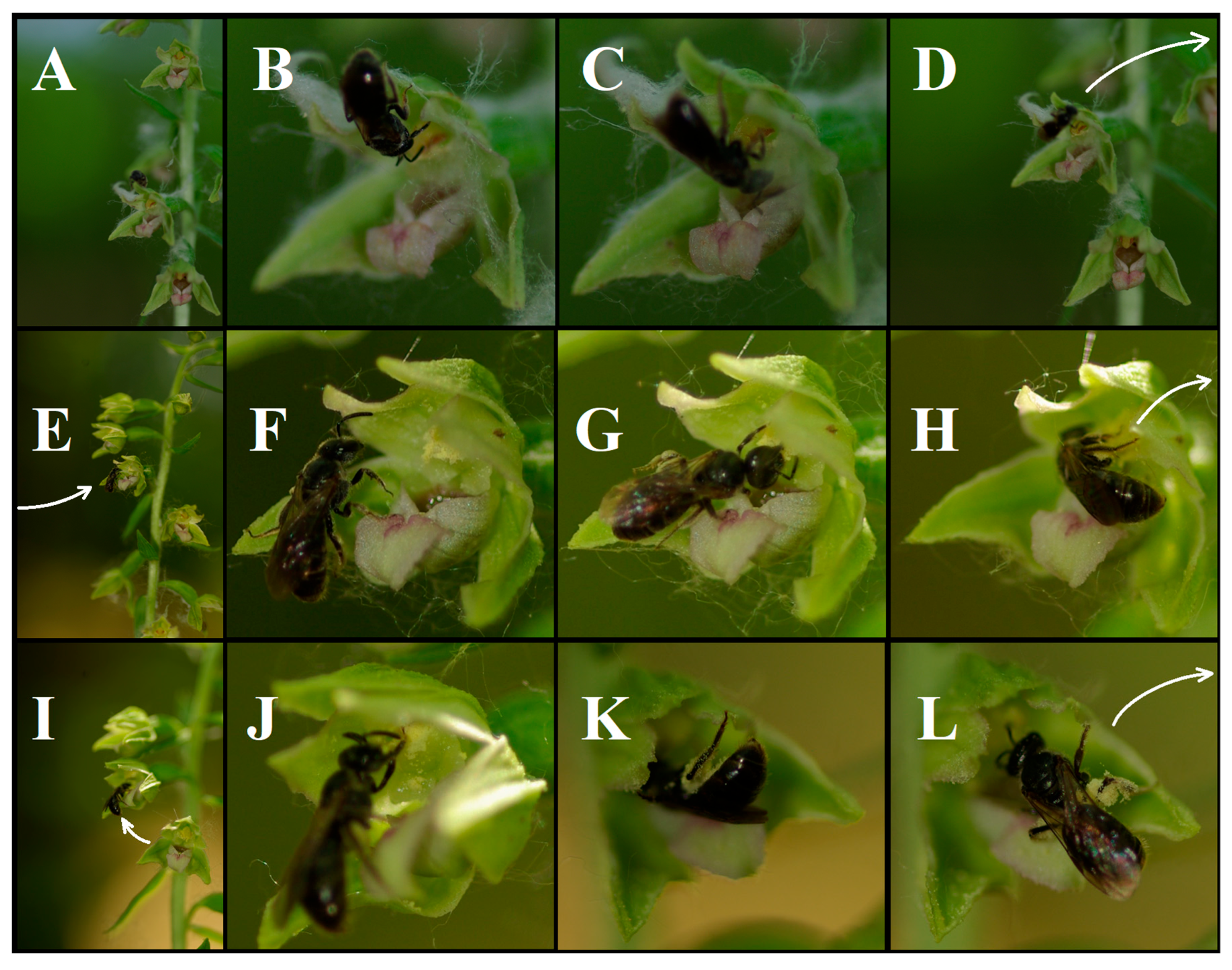
- During the observation period, E. bugacensis functioned as a pollen flower for the visiting sweat bee;
- Fragmentation of the pollinium by the visiting sweat bee facilitates autogamous pollen deposition in the flowers;
- Transferring pollinium fragments to pollen-carrying hairs and transporting them in this manner can potentially enable geitonogamy and xenogamy;
3.2. Changes in Different Sexual Propagation Traits in Covered and Uncovered E. bugacensis Individuals
3.2.1. Effect of Net Covering on Fruit Set at the JF Site
3.2.2. Interpretation of the Reproductive Trait Differences
3.2.3. Spatial Patterns of Reproductive Traits Along the Flowering Shoot
3.3. Interpretation of Mortality Differences
3.4. Limitations of Our Results
3.4.1. Completeness of Exclusion
3.4.2. Theoretical Effectiveness of Excluding Flying Insects
3.4.3. Theoretical Effectiveness of Excluding Non-Flying Insects
4. Materials and Methods
4.1. Species Overview
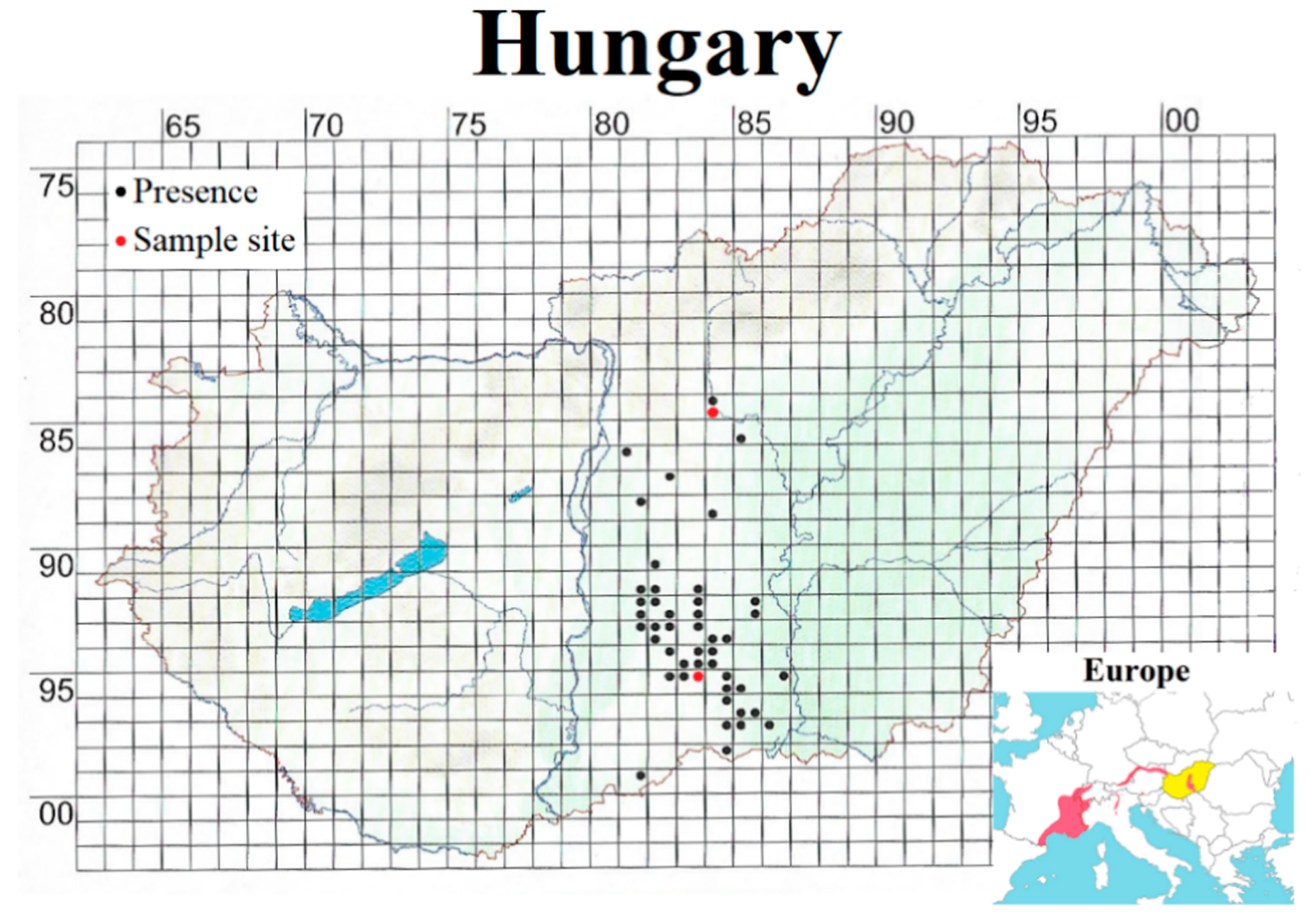
4.2. Study Sites

4.3. Field Methods
4.3.1. Observation of Visitors
4.3.2. Assessment of Pollinator Dependence of Fruit and Seed Set
Field Experiments
4.3.3. Data Preparation
4.3.4. Statistical Analysis
Fertilization Success
Analysis of Correlations Between Capsule Position and Reproductive Traits
Mortality Analysis
5. Conclusions
Author Contributions
Funding
Data Availability Statement
Acknowledgments
Conflicts of Interest
Abbreviations
| JF | Jászfényszaru (town) |
| HK | Harkakötöny (village) |
| E. | Epipactis |
References
- Darwin, C.R. On the Various Contrivances by Which British and Foreign Orchids Are Fertilised by Insects, and on the Good Effects of Intercrossing; John Murray: London, UK, 1862. [Google Scholar]
- Tremblay, R.L. Chapter 2 The Evolution of Pollination in Orchids. In Orchid Biology; Springer: Dordrecht, The Netherlands, 2004; pp. 95–120. [Google Scholar]
- Ackerman, J.D.; Phillips, R.D.; Tremblay, R.L.; Karremans, A.; Reiter, N.; Peter, C.; Bogarín, D.; Pérez-Escobar, Ó.A.; Liu, H. Beyond the Various Contrivances by Which Orchids Are Pollinated: Global Patterns in Orchid Pollination Biology. Bot. J. Linn. Soc. 2023, 202, 295–324. [Google Scholar] [CrossRef] [Scilit]
- Micheneau, C.; Johnson, S.; Fay, M. Orchid Pollination: From Darwin to the Present Day. Bot. J. Linn. Soc. 2009, 161, 1–19. [Google Scholar] [CrossRef] [Scilit]
- Jersáková, J.; Johnson, S.D.; Kindlmann, P. Mechanisms and Evolution of Deceptive Pollination in Orchids. Biol. Rev. 2006, 81, 219–235. [Google Scholar] [CrossRef] [Scilit]
- Cingel, N.A. An Atlas of Orchid Pollination: European Orchids; A.A. Balkema: Rotterdam, The Netherlands; Brookfield, VT, USA, 1995. [Google Scholar]
- Perkins, J.; Hayashi, T.; Peakall, R.; Flematti, G.R.; Bohman, B. The Volatile Chemistry of Orchid Pollination. Nat. Prod. Rep. 2023, 40, 819–839. [Google Scholar] [CrossRef] [Scilit]
- Claessens, J.; Kleynen, J. (Eds.) The Flower of the European Orchid: Form and Function; Jean Claessens & Jacques Kleynen: Geulle, The Netherlands, 2011; ISBN 978-90-90-25556-9. [Google Scholar]
- Pérez-Escobar, O.A.; Bogarín, D.; Przelomska, N.A.S.; Ackerman, J.D.; Balbuena, J.A.; Bellot, S.; Bühlmann, R.P.; Cabrera, B.; Cano, J.A.; Charitonidou, M.; et al. The Origin and Speciation of Orchids. New Phytol. 2024, 242, 700–716. [Google Scholar] [CrossRef] [Scilit]
- Zhang, G.; Liu, K.; Li, Z.; Lohaus, R.; Hsiao, Y.; Niu, S.; Wang, J.; Lin, Y.; Xu, Q.; Chen, L.; et al. The Apostasia Genome and the Evolution of Orchids. Nature 2017, 549, 379–383. [Google Scholar] [CrossRef] [Scilit]
- Givnish, T.; Spalink, D.; Ames, M.; Lyon, S.; Hunter, S.; Zuluaga, A.; Iles, W.; Clements, M.; Arroyo, M.; Leebens-Mack, J.; et al. Orchid Phylogenomics and Multiple Drivers of Their Extraordinary Diversification. Proc. R. Soc. B Biol. Sci. 2015, 282, 20151553. [Google Scholar] [CrossRef] [Scilit]
- Johnson, S.D.; Harder, L.D. The Economy of Pollen Dispersal in Flowering Plants. Proc. R. Soc. B Biol. Sci. 2023, 290, 20231148. [Google Scholar] [CrossRef] [Scilit]
- Thielen, M.; Voigt, D.; Gallenmüller, F.; Speck, T.; Gorb, S. “Push and Pull”: Biomechanics of the Pollination Apparatus of Oncidium spp. Front. Mech. Eng. 2021, 6, 635694. [Google Scholar] [CrossRef] [Scilit]
- Purgina, C.; Grímsson, F.; Weber, M.; Ulrich, S. Pollen Dispersal Units of Selected Orchidoideae and Their Morphological, Ultrastructural, and Chemical Features. Rev. Palaeobot. Palynol. 2024, 331, 105211. [Google Scholar] [CrossRef] [Scilit]
- Purgina, C.; Ulrich, S.; Weber, M.; Grímsson, F. Morphological and Ultrastructural Features of Selected Epidendroideae Pollen Dispersal Units and New Insights into Their Chemical Nature. Plants 2024, 13, 1114. [Google Scholar] [CrossRef] [Scilit]
- Suetsugu, K.; Tetsu, S.; Hiraiwa, M.; Tsutsumi, T. Thrips Partially Contribute to Pollination of an Orchid with Granular Pollinia. Bull. Ecol. Soc. Am. 2019, 100, 1–5. [Google Scholar] [CrossRef] [Scilit]
- Haydak, M.H. Honey Bee Nutrition. Annu. Rev. Entomol. 1970, 15, 143–156. [Google Scholar] [CrossRef] [Scilit]
- Roulston, T.H.; Cane, J.H.; Buchmann, S.L. What Governs Protein Content of Pollen: Pollinator Preferences, Pollen–Pistil Interactions, or Phylogeny? Ecol. Monogr. 2000, 70, 617–643. [Google Scholar]
- Molnár, V.A. Magyarország Orchideáinak Atlasza/Atlas der Orchideen Ungarns; Kossuth Kiadó: Budapest, Hungary, 2011; 504p, ISBN 978-963-09-6694-8. [Google Scholar]
- Kocyan, A.; Endress, P.K. Floral Structure and Development of Apostasia and Neuwiedia (Apostasioideae) and Their Relationships to Other Orchidaceae. Int. J. Plant Sci. 2001, 162, 847–867. [Google Scholar] [CrossRef] [Scilit]
- Zheng, C.-C.; Luo, Y.-B.; Gao, Y.-D.; Bernhardt, P.; Li, S.-Q.; Xu, B.; Gao, X.-F. Cypripedium Wardii (Orchidaceae) Employs Pseudopollen with Both Reward and Deception to Attract Both Flies and Bees as Pollinators. bioRxiv 2021. [Google Scholar] [CrossRef] [Scilit]
- Suetsugu, K.; Yamamoto, T. Bee Pollination in the Shadows: The Role of Pseudopollen and Agamospermy in the Mycoheterotrophic Orchid Gastrodia elata. Plants People Planet 2024, 6, 1167–1179. [Google Scholar] [CrossRef] [Scilit]
- Kowalkowska, A.K.; Kostelecka, J.; Bohdanowicz, J.; Kapusta, M.; Rojek, J. Studies on Floral Nectary, Tepals’ Structure, and Gynostemium Morphology of Epipactis Palustris (L.) Crantz (Orchidaceae). Protoplasma 2015, 252, 321–333. [Google Scholar] [CrossRef] [Scilit]
- Kowalkowska, A.K.; Pawłowicz, M.; Guzanek, P.; Krawczyńska, A.T. Floral Nectary and Osmophore of Epipactis Helleborine (L.) Crantz (Orchidaceae). Protoplasma 2018, 255, 1811–1825. [Google Scholar] [CrossRef] [Scilit]
- Ehlers, B.K.; Pedersen, H.A. Genetic Variation in Three Species of Epipactis (Orchidaceae): Geographic Scale and Evolutionary Inferences. Biol. J. Linn. Soc. 2000, 69, 411–430. [Google Scholar] [CrossRef]
- Evans, A.; Jacquemyn, H. Impact of Mating System on Range Size and Niche Breadth in Epipactis (Orchidaceae). Ann. Bot. 2020, 126, 1203–1214. [Google Scholar] [CrossRef] [Scilit] [PubMed]
- Sramkó, G.; Paun, O.; Brandrud, M.K.; Laczkó, L.; Molnár, A.V.; Bateman, R.M. Iterative Allogamy–Autogamy Transitions Drive Actual and Incipient Speciation during the Ongoing Evolutionary Radiation within the Orchid Genus Epipactis (Orchidaceae. Ann. Bot. 2019, 124, 481–497. [Google Scholar] [CrossRef] [Scilit]
- Bateman, R.M. Implications of Next-Generation Sequencing for the Systematics and Evolution of the Terrestrial Orchid Genus Epipactis, with Particular Reference to the British Isles. Kew Bull. 2020, 75, 4. [Google Scholar] [CrossRef] [Scilit]
- GBIF Secretariat. Epipactis Zinn. In GBIF Backbone Taxonomy; Checklist Dataset; GBIF Secretariat: Copenhagen, Denmark, 2023; Available online: https://doi.org/10.15468/39omei (accessed on 1 December 2025). [CrossRef] [Scilit]
- Anghelescu, N.; Balogh, M.; Balogh, L.; Kigyóssy, N.; Georgescu, M.; Petra, S.; Toma, F.; Peticilă, A. Epipactis Bucegensis—A Separate Autogamous Species within the E. Helleborine Alliance. Plants 2023, 12, 1761. [Google Scholar] [CrossRef] [Scilit] [PubMed]
- Plants of the World Online. Epipactis bugacensis Robatsch. In Plants of the World Online; Royal Botanic Gardens, Kew: Richmond, UK, 2025. [Google Scholar]
- Plants of the World Online. Epipactis dunensis (T. Stephenson & T.A. Stephenson) Godfery. In Plants of the World Online; Royal Botanic Gardens, Kew: Richmond, UK, 2025. [Google Scholar]
- Claessens, J.; Kleynen, J. Many Ways to Get Happy: Pollination Modes of European Epipactis Species. Orchid Dig. 2016, 80, 142–150. [Google Scholar]
- Tałałaj, I.; Brzosko, E. Selfing Potential in Epipactis Palustris. Plant Syst. Evol. 2008, 276, 21–29. [Google Scholar] [CrossRef] [Scilit]
- Jakubska-Busse, A.; Kadej, M. The Pollination of Epipactis Zinn, 1757 (Orchidaceae) Species in Central Europe—The Significance of Chemical Attractants, Floral Morphology and Concomitant Insects. Acta-Soc. Bot. Pol. 2011, 80, 49–57. [Google Scholar] [CrossRef] [Scilit]
- Robatsch, K. Epipactis bugacensis K. Robatsch, spec. nova—Eine neue Epipactis-Art aus Ungarn. Berichte Arbeitskreises Heim. Orchid. 1990, 7, 12–15. [Google Scholar]
- Robatsch, K. Epipactis nordeniorum K. Robatsch, spec. nova—Eine neue Epipactis-Art aus der Steiermark. Mitteilungen Abt. Für Bot. Am. Landesmus. Joanneum Graz 1991, 20, 31–35. [Google Scholar]
- Robatsch, K. Epipactis voethii K. Robatsch, spec. nova—Eine neue Epipactis-Art aus Niederösterreich. Berichte Arbeitskreises Heim. Orchid. 1993, 10, 52–56. [Google Scholar]
- Robatsch, K. Beiträge zur Kenntnis der europäischen Epipactis-Arten (Orchidaceae) und zur Evolution der Autogamie bei europäischen und asiatischen Gattungen der Neottioideae. J. Eur. Orchids 1995, 27, 125–177. [Google Scholar]
- Batoušek, P. Epipactis moravica Batoušek, spec. nova. J. Eur. Orchids 2004, 36, 673–689. [Google Scholar]
- Attila, M.V.; Robatsch, K. Epipactis tallosii-eine neue Art der Epipactis-hellebornine-Gruppe aus Ungarn. Berichte Arbeitskreises Heim. Orchid. 1997, 14, 81–86. [Google Scholar]
- Molnár, A.V.; Robatsch, K. Epipactis mecsekensis A. J. Eur. Orchids 1997, 29, 671–676. [Google Scholar]
- Nilsson, L.A. Pollination ecology of Epipactis palustris Orchidaceae. Bot. Not. 1978, 131, 355–368. [Google Scholar]
- Brantjes, N.B. Ant, Bee and Fly Pollination in Epipactis Palustris (L.) Crantz (Orchidaceae). Acta Bot. Neerl. 1981, 30, 59–68. [Google Scholar] [CrossRef] [Scilit]
- Jakubska, A.; Prządo, D.; Steininger, M.; Anioł-Kwiatkowska, J.; Kadej, M. Why Do Pollinators Become “Sluggish”? Nectar Chemical Constituents from Epipactis Helleborine (L.) Crantz (Orchidaceae). Appl. Ecol. Environ. Res. 2005, 3, 29–38. [Google Scholar] [CrossRef] [Scilit]
- Jakubska, A.; Kadej, M.; Prządo, D.; Steininger, M. How Do Orchids Lure Pollinators? Nectar Chemical Composition of Epipactis Helleborine s.l. (Orchidaceae, Neottieae) and Its Influence on Insects Reactions in Field Conditions. Pesticides 2005, 4, 175–180. [Google Scholar]
- Jakubska-Busse, A.; Kadej, M. Pollination Ecology of Marsh Helleborine Epipactis Palustris (L.) Crantz on the Polish Side of the Orlickie Mts. (Central Sudety Mts). Environ. Chang. Biol. Assess. IV 2008, 186, 247–252. [Google Scholar]
- Gnatiuk, A.; Gaponenko, M.; Honchar, H.; Gaponenko, A. Diversity of Epipactis Palustris (L.) Crantz (Orchidaceae) Pollinators and Visitors in Conditions of Kyiv City (Ukraine). Hacquetia 2023, 22, 247–262. [Google Scholar] [CrossRef] [Scilit]
- Rewicz, A.; Jaskuła, R.; Rewicz, T.; Tończyk, G. Pollinator diversity and reproductive success of Epipactis helleborine (L.) Crantz (Orchidaceae) in anthropogenic and natural habitats. PeerJ 2017, 5, e3159. [Google Scholar] [CrossRef] [Scilit] [PubMed]
- Ivri, Y.; Dafni, A. The Pollination Ecology of Epipactis Consimilis Don (Orchidaceae) in Israel. New Phytol. 1977, 79, 173–177. [Google Scholar] [CrossRef] [Scilit]
- Pedersen, H.; Srimuang, K.; Bänziger, H.; Watthana, S. Pollination-System Diversity in Epipactis (Orchidaceae): New Insights from Studies of E. Flava in Thailand. Plant Syst. Evol. 2018, 304, 895–909. [Google Scholar] [CrossRef] [Scilit]
- Suetsugu, K. Delayed Autonomous Self-Pollination in Two Japanese Varieties of Epipactis Helleborine (Orchidaceae). Bot. J. Linn. Soc. 2013, 173, 733–743. [Google Scholar] [CrossRef] [Scilit]
- Jacquemyn, H.; Brys, R.; Hutchings, M.J. Biological Flora of the British Isles: Epipactis palustris. J. Ecol. 2014, 102, 1341–1355. [Google Scholar] [CrossRef] [Scilit]
- Jakubska-Busse, A.; Czeluśniak, I.; Kobyłka, M.; Hojniak, M. Why Does an Obligate Autogamous Orchid Produce Insect Attractants in Nectar?—A Case Study on Epipactis Albensis (Orchidaceae). BMC Plant Biol. 2022, 22, 196. [Google Scholar] [CrossRef] [Scilit] [PubMed]
- Wright, G.A.; Nicolson, S.W.; Shafir, S. Nutritional Physiology and Ecology of Honey Bees. Annu. Rev. Entomol. 2018, 63, 327–344. [Google Scholar] [CrossRef] [Scilit] [PubMed]
- Vaudo, A.D.; Tooker, J.F.; Grozinger, C.M.; Patch, H.M. Bee Nutrition and Floral Resource Restoration. Curr. Opin. Insect Sci. 2015, 10, 133–141. [Google Scholar] [CrossRef] [Scilit]
- Stein, D.S.; Debinski, D.M.; Pleasants, J.M.; Toth, A.L. Evaluating Native Bee Communities and Nutrition in Managed Grasslands. Environ. Entomol. 2020, 49, 717–725. [Google Scholar] [CrossRef] [Scilit]
- Mayr, A.V.; Keller, A.; Peters, M.K.; Grimmer, G.; Krischke, B.; Geyer, M.; Schmitt, T.; Steffan-Dewenter, I. Cryptic Species and Hidden Ecological Interactions of Halictine Bees along an Elevational Gradient. Ecol. Evol. 2021, 11, 7700–7712. [Google Scholar] [CrossRef] [Scilit]
- Crone, M.K.; Biddinger, D.J.; Grozinger, C.M. Wild Bee Nutritional Ecology: Integrative Strategies to Assess Foraging Preferences and Nutritional Requirements. Front. Sustain. Food Syst. 2022, 6, 847003. [Google Scholar] [CrossRef] [Scilit]
- Molnár, V.A.; Csábi, M. Magyarország Orchideái: = Orchids of Hungary; Debreceni Egyetem Természettudományi és Technológiai Kar Növénytani Tanszék: Debrecen, Hungary, 2021; ISBN 978-963-490-247-8. [Google Scholar]
- Jin, X.-H.; Ren, Z.-X.; Xu, S.-Z.; Wang, H.; Li, D.-Z.; Li, Z.-Y. The Evolution of Floral Deception in Epipactis Veratrifolia (Orchidaceae): From Indirect Defense to Pollination. BMC Plant Biol. 2014, 14, 63. [Google Scholar] [CrossRef] [Scilit] [PubMed]
- Stokl, J.; Brodmann, J.; Dafni, A.; Ayasse, M.; Hansson, B.S. Smells like Aphids: Orchid Flowers Mimic Aphid Alarm Pheromones to Attract Hoverflies for Pollination. Proc. R. Soc. 2011, 278, 1216–1222. [Google Scholar] [CrossRef] [Scilit] [PubMed]
- Sugiura, N. Pollination of the Orchid Epipactis Thunbergii by Syrphid Flies (Diptera: Syrphidae). Ecol. Res. 1996, 11, 249–255. [Google Scholar] [CrossRef] [Scilit]
- Raguso, R.A. Don’t Forget the Flies: Dipteran Diversity and Its Consequences for Floral Ecology and Evolution. Appl. Entomol. Zool. 2020, 55, 1–7. [Google Scholar] [CrossRef] [Scilit]
- Das, S.; Das, A. Ants Are More than Just Curious Bystanders to Some Flowers—They Act as Significant Pollinators. Front. Insect Sci. 2023, 3, 1145761. [Google Scholar] [CrossRef] [Scilit] [PubMed]
- Gila, J.G.; Aróstegui, J.B. First Report on the Pollination of Neotinea Maculata (Orchidaceae) by Minor Worker Ants of the Temnothorax Exilis Group (Hymenoptera: Formicidae). Mediterr. Bot. 2021, 42, e71171. [Google Scholar] [CrossRef] [Scilit]
- Beattie, A.J.; Turnbull, C.; Knox, R.B.; Williams, E.G. Ant Inhibition of Pollen Function: A Possible Reason Why Ant Pollination Is Rare. Am. J. Bot. 1984, 71, 421–426. [Google Scholar] [CrossRef] [Scilit]
- Knauer, A.C.; Bakhtiari, M.; Schiestl, F.P. Crab Spiders Impact Floral-Signal Evolution Indirectly through Removal of Florivores. Nat. Commun. 2018, 9, 1367. [Google Scholar] [CrossRef] [Scilit]
- Sakagami, K.; Funamoto, D.; Sugiura, S. Nocturnal Ambush Predators and Their Potential Impact on Flower-visiting Moths. Ecology 2021, 102, e03482. [Google Scholar] [CrossRef] [Scilit]
- Benvenuti, S. Wildflowers-Pollinator-Crab Spider Predator Food-Web as Indicator of the Agroecosystem Biodiversity. Ecol. Indic. 2022, 143, 109272. [Google Scholar] [CrossRef] [Scilit]
- Brechbühl, R.; Kropf, C.; Bacher, S. Impact of Flower-Dwelling Crab Spiders on Plant-Pollinator Mutualisms. Basic Appl. Ecol. 2010, 11, 76–82. [Google Scholar] [CrossRef] [Scilit]
- Gonçalves-Souza, T.; Omena, P.M.; Souza, J.C.; Romero, G.Q. Trait-Mediated Effects on Flowers: Artificial Spiders Deceive Pollinators and Decrease Plant Fitness. Ecology 2008, 89, 2407–2413. [Google Scholar] [CrossRef] [Scilit] [PubMed]
- Heiling, A.M.; Herberstein, M.E.; Chittka, L. Crab-Spiders Manipulate Flower Signals. Nature 2003, 421, 334. [Google Scholar] [CrossRef] [Scilit]
- Louda, S.M. Inflorescence Spiders: A Cost/Benefit Analysis for the Host Plant, Haplopappus Venetus Blake (Asteraceae). Oecologia 1982, 55, 185–191. [Google Scholar] [CrossRef] [Scilit]
- De Oliveira Dias, K.P.; Stefani, V. Spider–Plant Interaction: The Role of Extrafloral Nectaries in Spider Attraction and Their Influence on Plant Herbivory and Reproduction. Plants 2024, 13, 368. [Google Scholar] [CrossRef] [Scilit]
- Vasconcellos-Neto, J.; Messas, Y.F.; Da Silva Souza, H.; Villanueva-Bonila, G.A.; Romero, G.Q. Spider–Plant Interactions: An Ecological Approach. In Behaviour and Ecology of Spiders; Viera, C., Gonzaga, M.O., Eds.; Springer International Publishing: Cham, Switzerland, 2017; pp. 165–214. ISBN 978-3-319-65716-5. [Google Scholar]
- Vuković, M.; Jurić, S.; Maslov Bandić, L.; Levaj, B.; Fu, D.-Q.; Jemrić, T. Sustainable Food Production: Innovative Netting Concepts and Their Mode of Action on Fruit Crops. Sustainability 2022, 14, 9264. [Google Scholar] [CrossRef] [Scilit]
- Mahmood, A.; Hu, Y.; Tanny, J.; Asante, E.A. Effects of Shading and Insect-Proof Screens on Crop Microclimate and Production: A Review of Recent Advances. Sci. Hortic. 2018, 241, 241–251. [Google Scholar] [CrossRef] [Scilit]
- Mditshwa, A.; Magwaza, L.S.; Tesfay, S.Z. Shade Netting on Subtropical Fruit: Effect on Environmental Conditions, Tree Physiology and Fruit Quality. Sci. Hortic. 2019, 256, 108556. [Google Scholar] [CrossRef] [Scilit]
- Manja, K.; Aoun, M. The Use of Nets for Tree Fruit Crops and Their Impact on the Production: A Review. Sci. Hortic. 2019, 246, 110–122. [Google Scholar] [CrossRef] [Scilit]
- Yeung, E. A Perspective on Orchid Seed and Protocorm Development. Bot. Stud. 2017, 58, 33. [Google Scholar] [CrossRef] [Scilit] [PubMed]
- Perner, H.; Zhou, R.; Perner, W.; Jiang, H.; Lee, Y.-I. Cypripedium Subtropicum Embryo Development and Cytokinin Requirements for Asymbiotic Germination. Bot. Stud. 2022, 63, 28. [Google Scholar] [CrossRef] [Scilit]
- Brundrett, M.C. A Comprehensive Study of Orchid Seed Production Relative to Pollination Traits, Plant Density and Climate in an Urban Reserve in Western Australia. Diversity 2019, 11, 123. [Google Scholar] [CrossRef] [Scilit]
- Vallius, E. Position-dependent Reproductive Success of Flowers in Dactylorhiza Maculata (Orchidaceae). Funct. Ecol. 2000, 14, 573–579. [Google Scholar] [CrossRef]
- Diggle, P.K. Architectural Effects and the Interpretation of Patterns of Fruit and Seed Development. Annu. Rev. Ecol. Syst. 1995, 26, 531–552. [Google Scholar] [CrossRef]
- Bell, T.J.; Bowles, M.L.; Zettler, L.W.; Pollack, C.A.; Ibberson, J.E. Environmental and Management Effects on Demographic Processes in the U.S. Threatened Platanthera Leucophaea (Nutt.) Lindl. (Orchidaceae). Plants 2021, 10, 1308. [Google Scholar] [CrossRef] [Scilit]
- Shefferson, R.P.; Jacquemyn, H.; Kull, T.; Hutchings, M.J. The Demography of Terrestrial Orchids: Life History, Population Dynamics and Conservation. Bot. J. Linn. Soc. 2020, 192, 315–332. [Google Scholar] [CrossRef] [Scilit]
- Djordjević, V.; Tsiftsis, S. The Role of Ecological Factors in Distribution and Abundance of Terrestrial Orchids. In Orchids Phytochemistry, Biology and Horticulture; Merillon, J.-M., Kodja, H., Eds.; Reference Series in Phytochemistry; Springer International Publishing: Cham, Switzerland, 2020; pp. 1–71. ISBN 978-3-030-11257-8. [Google Scholar]
- Pica, A.; Vela, D.; Magrini, S. Forest Orchids under Future Climate Scenarios: Habitat Suitability Modelling to Inform Conservation Strategies. Plants 2024, 13, 1810. [Google Scholar] [CrossRef] [Scilit]
- Kaur, J.; Phillips, C.; Sharma, J. Host Population Size Is Linked to Orchid Mycorrhizal Fungal Communities in Roots and Soil, Which Are Shaped by Microenvironment. Mycorrhiza 2021, 31, 17–30. [Google Scholar] [CrossRef] [Scilit]
- Li, T.; Wu, S.; Yang, W.; Selosse, M.-A.; Gao, J. How Mycorrhizal Associations Influence Orchid Distribution and Population Dynamics. Front. Plant Sci. 2021, 12, 647114. [Google Scholar] [CrossRef] [Scilit]
- AHO-Bayern Epipactis Bugacensis. Available online: https://www.aho-bayern.de/epipactis/ep_buga.html (accessed on 1 December 2025).
- Ambrózy, P.; Konkolyné, B.Z. Magyarország Kistájainak Katasztere; Dövényi, Z., Ed.; 2., átd. és bőv. kiadás.; MTA Földrajztudományi Kutatóintézet: Budapest, Hungary, 2010; ISBN 978-963-9545-29-8. [Google Scholar]
- Ehrendorfer, F.; Hamann, U. Vorschläge Zu Einer Floristischen Kartierung von Mitteleuropa (Proposals for a Floristic Mapping of Central Europe). Berichte Dtsch. Bot. Ges. 1965, 78, 35–50. [Google Scholar]
- Proctor, H.C.; Harder, L.D. Pollen Load, Capsule Weight, and Seed Production in Three Orchid Species. Can. J. Bot. 1994, 72, 249–255. [Google Scholar] [CrossRef] [Scilit]
- Sonkoly, J.; Vojtkó, A.E.; Tökölyi, J.; Török, P.; Sramkó, G.; Illyés, Z.; Molnár, V.A. Higher Seed Number Compensates for Lower Fruit Set in Deceptive Orchids. J. Ecol. 2016, 104, 343–351. [Google Scholar] [CrossRef] [Scilit]
- Mussadiq, Z.; Laszlo, B.; Helyes, L.; Gyuricza, C. Evaluation and Comparison of Open Source Program Solutions for Automatic Seed Counting on Digital Images. Comput. Electron. Agric. 2015, 117, 194–199. [Google Scholar] [CrossRef] [Scilit]
- Pride, L.; Agehara, S. Useful Image-Based Techniques for Manual and Automatic Counting Using ImageJ for Horticultural Research. EDIS 2021, 2021, HS1405. [Google Scholar] [CrossRef] [Scilit]
- Németh, P.; Tóth-Naár, Z.; Husti-Béres, K.; Singh, M.K.; Baranyai, Z. Challenges in the field of plant growth and development in Hungary—Evaluation and alternatives. Növénytermelés 2010, 59, 597–660. [Google Scholar]
- Kabato, W.; Hailegnaw, N.; Mutum, L.; Molnar, Z. Managing Soil Health for Climate Resilience and Crop Productivity in a Changing Environment. Sci. Total Environ. 2025, 1000, 180460. [Google Scholar] [CrossRef] [Scilit] [PubMed]
- Magyar, L.; Zsebő, S.; Molnár, Z.; Amtmann, P.; Kovács, A.; Dunai, É.; Czúcz, B.; Fehér, J.; Pinke, G. First Step from an Arable Weed to a Honey Crop: Breaking Seed Dormancy of Stachys Annua. Acta Agrobot. 2025, 78, 1–10. [Google Scholar] [CrossRef] [Scilit]
- Lócsi, M.; Németh, A.G.L.; Pinke, G. A Szöszös, a Pannon És a Takarmány Bükköny (Vicia Villosa, V. Pannonica, V. Sativa), Valamint a Bíbor- És Az Alexandriai Here (Trifolium Incarnatum, T. Alexandrinum) Termesztésbe Vonásának Története Magyarországon. Bot. Közlemények 2025, 112, 61–86. [Google Scholar] [CrossRef] [Scilit]
- Brzosko, E.; Bajguz, A.; Burzyńska, J.; Chmur, M. Does Reproductive Success in Natural and Anthropogenic Populations of Generalist Epipactis Helleborine Depend on Flower Morphology and Nectar Composition? Int. J. Mol. Sci. 2023, 24, 4276. [Google Scholar] [CrossRef] [Scilit]
- Brzosko, E.; Bajguz, A.; Burzyńska, J.; Chmur, M. Nectar Chemistry or Flower Morphology—What Is More Important for the Reproductive Success of Generalist Orchid Epipactis Palustris in Natural and Anthropogenic Populations? Int. J. Mol. Sci. 2021, 22, 12164. [Google Scholar] [CrossRef] [Scilit] [PubMed]
- Seale, M. Shoot Dominance Relationships Lead to Robust Reproductive Outputs. Plant Physiol. 2021, 186, 1750–1751. [Google Scholar] [CrossRef] [Scilit] [PubMed]
- Marja, R.; Török, E.; Pinke, G.; Koltai, G.; Déri, H.; Horel, J.; Zajácz, E.; Tscharntke, T.; Frank, T.; Batáry, P. Pollinator Benefits of Small-scale Landscapes Depend Also on Semi-natural Habitat. J. Appl. Ecol. 2025, 62, 2249–2260. [Google Scholar] [CrossRef] [Scilit]
- Štípková, Z.; Kindlmann, P. Factors Determining the Distribution of Orchids—A Review with Examples from the Czech Republic. Eur. J. Environ. Sci. 2021, 11, 21–30. [Google Scholar] [CrossRef] [Scilit]
- Hartmann, L.J.; Metz, J. Long-Term Data Indicates Positive Effects of Habitat Size and Ambiguous Climate Effects on Population Growth of the Endangered Wetland Orchid Dactylorhiza majalis. Glob. Ecol. Conserv. 2023, 44, e02483. [Google Scholar] [CrossRef] [Scilit]
- Jakubska-Busse, A.; Tsiftsis, S.; Śliwiński, M.; Křenová, Z.; Djordjević, V.; Steiu, C.; Kolanowska, M.; Efimov, P.; Hennigs, S.; Lustyk, P.; et al. How to Protect Natural Habitats of Rare Terrestrial Orchids Effectively: A Comparative Case Study of Cypripedium Calceolus in Different Geographical Regions of Europe. Plants 2021, 10, 404. [Google Scholar] [CrossRef] [Scilit]
- Kolanowska, M.; Jakubska-Busse, A. Is the Lady’s-Slipper Orchid (Cypripedium Calceolus) Likely to Shortly Become Extinct in Europe?—Insights Based on Ecological Niche Modelling. PLoS ONE 2020, 15, e0228420. [Google Scholar] [CrossRef] [Scilit]
- Kovács-Hostyánszki, A.; Földesi, R.; Mózes, E.; Szirák, Á.; Fischer, J.; Hanspach, J.; Báldi, A. Conservation of Pollinators in Traditional Agricultural Landscapes—New Challenges in Transylvania (Romania) Posed by EU Accession and Recommendations for Future Research. PLoS ONE 2016, 11, e0151650. [Google Scholar] [CrossRef] [Scilit]
- Gazzea, E.; Gobbo, D.; Mei, M.; Paniccia, D.; Trotta, G.; Boscutti, F.; Marini, L. Restoration of Forests Supports the Conservation of Pollinators in Intensively Managed Agricultural Landscapes. Biol. Conserv. 2025, 302, 111008. [Google Scholar] [CrossRef] [Scilit]
- Bihaly, Á.D.; Piross, I.S.; Pellaton, R.; Szigeti, V.; Somay, L.; Vajna, F.; Soltész, Z.; Báldi, A.; Sárospataki, M.; Kovács-Hostyánszki, A. Landscape-Wide Floral Resource Deficit Enhances the Importance of Diverse Wildflower Plantings for Pollinators in Farmlands. Agric. Ecosyst. Environ. 2024, 367, 108984. [Google Scholar] [CrossRef] [Scilit]



| Taxon | Date(s) | Time | Weather | Floral Contact | Behavior | Evidence |
|---|---|---|---|---|---|---|
| Halictidae | 4 June 2018 | 10:00–12:00 | Sunny, 26–27 °C | Sepals, petals, hypochil, gynostemium, pollinia | Pollinium shredding. Collection and transport of its fragments. | Photo + Field diary |
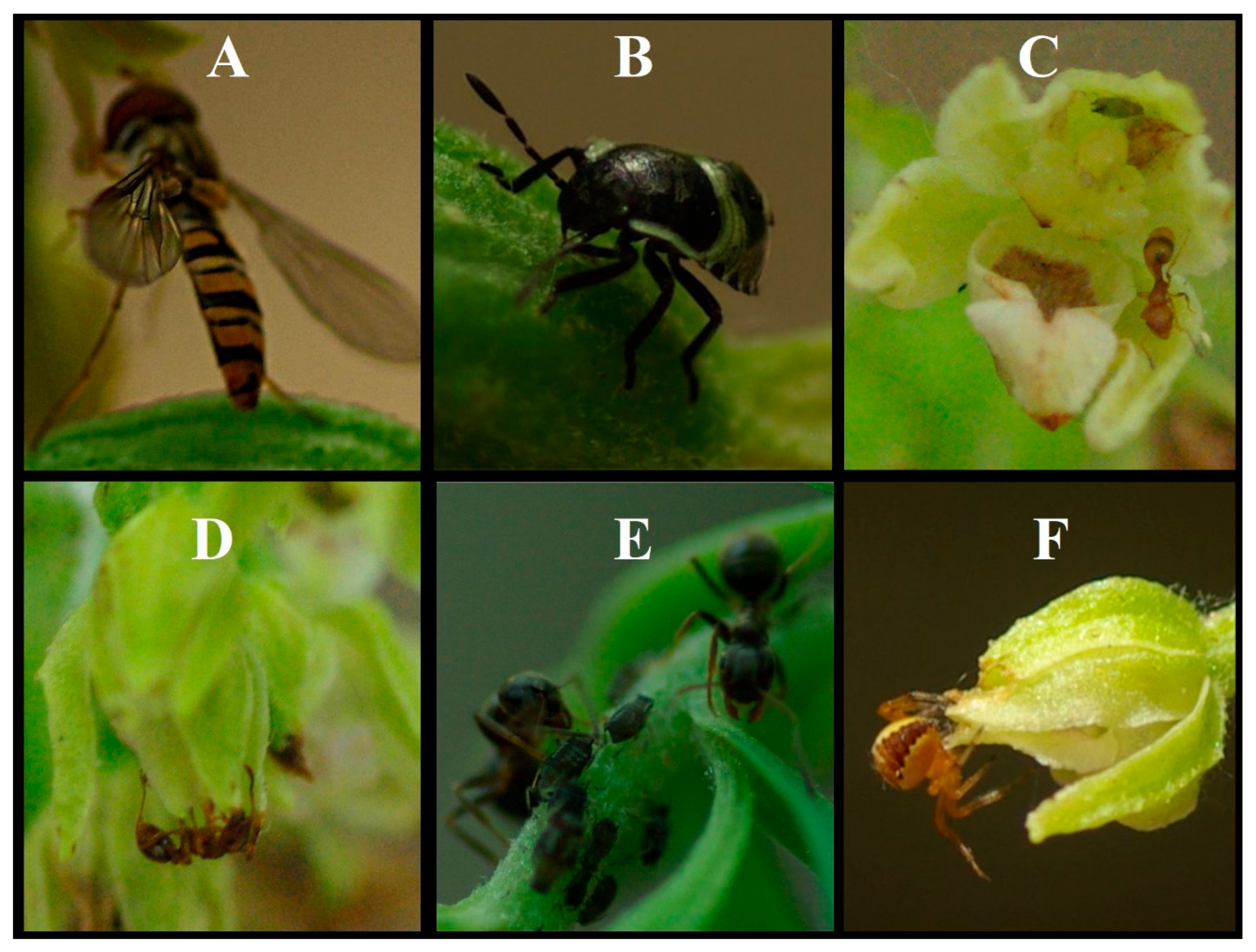
| Culicidae | 4 June 2018 | 10:00–12:00 | Sunny, 26–27 °C | Lip only | Nectar probing, no reproductive contact | Field diary |
| Platycheirus splendidus | 19 June 2019 | 08:00–12:00 | Semi-cloudy, 27–30 °C | No | Hovering, repeated inspections only | Capture + Field diary |
| Syrphidae (cf. Platycheirus splendidus) | 24 June 2019 | 14:00–18:30 | Sunny, 28–30 °C | No | Hovering, repeated inspections only | Field diary |
| Syrphidae (cf. Episyrphus balteatus) | 4 June 2018 | 10:00–12:00 | Sunny, 26–27 °C | No | Hovering, repeated inspections only | Photo + Field diary |
| Episyrphus balteatus | 23 June 2022 | 10:00–12:00 | Sunny, 28–30 °C | Sepal peaks only | Brief landings, no contact with the gynostemium | Photo + Field diary |
| Pentatomidae | 20 June 2019; 23 June 2022 | 10:00–13:30 | Sunny/SC, 27–30 °C | No | Resting; capsule feeding | Photo + Collection + Field diary |
| Aphididae | 3 July 2019; 12 June 2022 | 08:00–18:00 | PC/S, 25–30 °C | Petal surfaces only | Colonies on budding shoots | Photo + Field diary |
| Temnothorax unifasciatus | 27 June 2019; 3 July 2019 | 08:00–14:00 | PC/MC, 25–30 °C | Sepals, petals, hypochil, gynostemium, pollinia | Intensive searching in the flower | Photo + Collection + Field diary |
| Myrmica sp. | 20 June 2020 | 10:00–13:30 | Semi-cloudy, 27–30 °C | Sepals, petals, hypochil, gynostemium, pollinia | Intensive searching in the flower | Photo + Field diary |
| Lasius sp. | 12 June 2022 | 16:00–18:00 | Sunny, 28–30 °C | No | Aphid tending on budding stem | Photo + Field diary |
| Araneae | 29 June 2019 | 11:00–14:00 | Sunny, 28–30 °C | Sepal peaks only | Web construction | Field diary |
| Araneus diadematus | 23 June 2022 | 10:00–12:00 | Sunny, 28–30 °C | Sepal peaks only | Web construction | Photo + Field diary |
| Treatment | Dead Individual (%) | Alive Individual (%) | Total Individual (%) |
|---|---|---|---|
| Covered | 5 (45.5%) | 6 (54.5%) | 11 (100%) |
| Uncovered | 69 (75.8%) | 22 (24.2%) | 91 (100%) |
Disclaimer/Publisher’s Note: The statements, opinions and data contained in all publications are solely those of the individual author(s) and contributor(s) and not of MDPI and/or the editor(s). MDPI and/or the editor(s) disclaim responsibility for any injury to people or property resulting from any ideas, methods, instructions or products referred to in the content. |
© 2026 by the authors. Licensee MDPI, Basel, Switzerland. This article is an open access article distributed under the terms and conditions of the Creative Commons Attribution (CC BY) license.
Share and Cite
Nagy, J.G.; Morzsányi, A.; Molnár, A.; Somogyi, I.; Molnár, M.; Sárospataki, M.; Lőrinczi, G.; Nagy, K.; Gilián, L.D. Reproductive Success Beyond Pollinators: Microhabitat Effects and Pollen Dynamics in Epipactis bugacensis, a Traditionally Obligately Autogamous Orchid. Plants 2026, 15, 709. https://doi.org/10.3390/plants15050709
Nagy JG, Morzsányi A, Molnár A, Somogyi I, Molnár M, Sárospataki M, Lőrinczi G, Nagy K, Gilián LD. Reproductive Success Beyond Pollinators: Microhabitat Effects and Pollen Dynamics in Epipactis bugacensis, a Traditionally Obligately Autogamous Orchid. Plants. 2026; 15(5):709. https://doi.org/10.3390/plants15050709
Chicago/Turabian StyleNagy, János György, Anna Morzsányi, Adrián Molnár, István Somogyi, Melinda Molnár, Miklós Sárospataki, Gábor Lőrinczi, Kamilla Nagy, and Lilla Diána Gilián. 2026. "Reproductive Success Beyond Pollinators: Microhabitat Effects and Pollen Dynamics in Epipactis bugacensis, a Traditionally Obligately Autogamous Orchid" Plants 15, no. 5: 709. https://doi.org/10.3390/plants15050709
APA StyleNagy, J. G., Morzsányi, A., Molnár, A., Somogyi, I., Molnár, M., Sárospataki, M., Lőrinczi, G., Nagy, K., & Gilián, L. D. (2026). Reproductive Success Beyond Pollinators: Microhabitat Effects and Pollen Dynamics in Epipactis bugacensis, a Traditionally Obligately Autogamous Orchid. Plants, 15(5), 709. https://doi.org/10.3390/plants15050709