


Abstract
Eugenia (Myrtaceae) is a highly diverse genus of fruit trees native to the Amazon with remarkable potential for food, nutritional, and biotechnological applications. This review synthesizes the current knowledge on morphofunctional traits, ecological strategies, and genetic resources that make several Eugenia species promising candidates for domestication and cultivation. Its main attributes include shrubby growth habits, racemose inflorescences, nutrient-rich fruits with few seeds, recalcitrant yet viable propagules, and wide distribution across the Americas. Their molecular and phytochemical diversity suggests applications in food systems, pharmaceuticals, and bioindustries. However, key challenges persist, such as irregular fruiting, postharvest perishability, limited germplasm conservation in degraded areas, prospecting biotechnological applications such as antioxidants, and insufficient genomic characterization. By addressing these gaps, Eugenia domestication could contribute to food security, sustainable agriculture, and the bioeconomy of remote Amazonian regions, thereby positioning this genus as a strategic resource in the face of biodiversity loss.
1. Introduction
The contrast between the vast diversity of Amazonian fruit trees and the high prevalence of malnutrition affecting approximately five million people in 2021 [1] highlights the urgency of strengthening food security and sovereignty through scientific knowledge accessible to local communities. For over 11 millennia, native plants have been central to traditional medicinal, nutritional, and cultural practices [2], yet many are now facing extinction because of rapid climate change, often without scientific documentation [3]. Therefore, advancing research on cultivation, germination, genetic resources, and biochemical potential is essential for the development of novel plant-based bioproducts [4]. This demand converges with a global trend toward greater consumption of plant-based foods, particularly fruits and vegetables, owing to their health-promoting benefits beyond nutrition [5].
The Myrtaceae family, which stands out in Brazil as a biodiverse group of angiosperms and is the third largest in endemism, produces fleshy fruits such as Surinam cherry and guava [6]. In the Brazilian Amazon, there are approximately 265 representatives organized into 13 genera; however, few studies systematized them in terms of botany, technology, use, and agronomy [7]. The genus Eugenia owns approximately 1100 species identified in the Neotropics and approximately 380 species in Brazil, of which 300 are endemic [8,9]. In addition, a considerable number of representatives have intraspecific variations that allow for domestication and prospecting for new foods, and cosmetics to combat ailments such as obesity [10].
Studies on the possibility of cultivating and generating bioproducts based on the fruits and vegetative organs of species of Eugenia have been conducted in recent decades, contributing to the bioprospecting of some fruit species [11]. For the establishment of crops of any species and management itself, it is important to have information accessible to farmers regarding the mobilization of primary reserves during germination [12], which is a challenge for the knowledge of the physiology of poorly bioprospected representatives of the genus Eugenia occurring in the Brazilian Amazon. In addition to the production of fruit for food and food supplements [6,13], the essential oils and extracts present in the leaves and twigs are among the potential species from the group that have already been studied in the Amazon and which justify cultivation [14,15] and the relationship with biological activities manifested in the form of anti-inflammatory, antimicrobial, antioxidant, cytotoxic, anticancer [16,17] and hypoglycemic activities [18].
Still focusing on essential oils, Costa et al. (2020) [16] and Jeronimo et al. (2021) [15] point out that the species studied in the Brazilian Amazon until those years were Eugenia biflora (L.) DC. (1828), Eugenia egensis DC. (1828), Eugenia flavescens DC. (1828), Eugenia patrisii Vahl. (1798), Eugenia polystachya Rich. (1792), Eugenia protenta McVaugh (1969), Eugenia punicifolia (Kunth) DC. (1828) and Eugenia stipitata McVaugh (1956), comprising eight species with the potential for generating crops and biotechnology, which are addressed in this review.
Considering that the genus Eugenia can be used in intercropped and agroforestry systems, especially under forestry restoration conditions, and that the implementation of this system can offer an alternative means of circumventing Amazonian food insecurity, it is important to understand the biological characteristics of these species and their current state of research. Considering that the genus Eugenia can be used in intercropped and agroforestry systems, particularly under forest restoration conditions, and that these systems may offer alternative pathways to mitigate Amazonian food insecurity, a clear understanding of the biological characteristics and current research status of this species is essential. Thus, a comprehensive and integrative synthesis that bridges ecological distribution, morphofunctional and physiological traits, and documented biotechnological and agronomic applications of Amazonian Eugenia species remains lacking. Addressing this gap is particularly relevant given their potential contributions to food security, income generation, and ecosystem recovery. In this review, we aimed to provide an integrative and application-oriented synthesis of current scientific knowledge on Eugenia species (Myrtaceae) occurring in the Brazilian Amazon. Specifically, we compiled and critically analyzed information on species distribution and ecology, domestication status, morphofunctional traits, genetic resources, chemical composition, and documented biotechnological and agronomic applications. By adopting this comparative and integrative framework, this review identifies key knowledge gaps and highlights the functional attributes that are directly relevant to crop development, sustainable production systems, and forest restoration strategies in the Amazon.
2. Domestication and Ecological Traits
Eugenia stipitata has at least two subspecies related to geographical isolation by rivers in the western Amazon: E. stipitata subsp. stipitata and E. stipitata subsp. sororia. However, the fruits of the latter subspecies showed a particular pattern among the representatives of the Eugenia genus: a high number of seeds (6–15), and a mesocarp diameter of 8–10 cm [19]. Consequently, this subspecies is the type cultivated in home gardens, which has shown potential for forestry cultivation in recent times [20], suggesting that the possible origin of this subspecies is domestication.
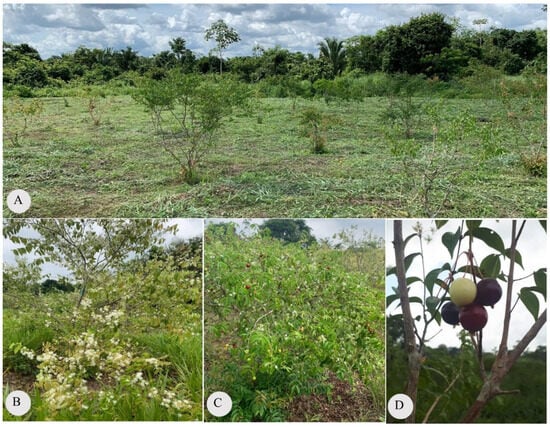
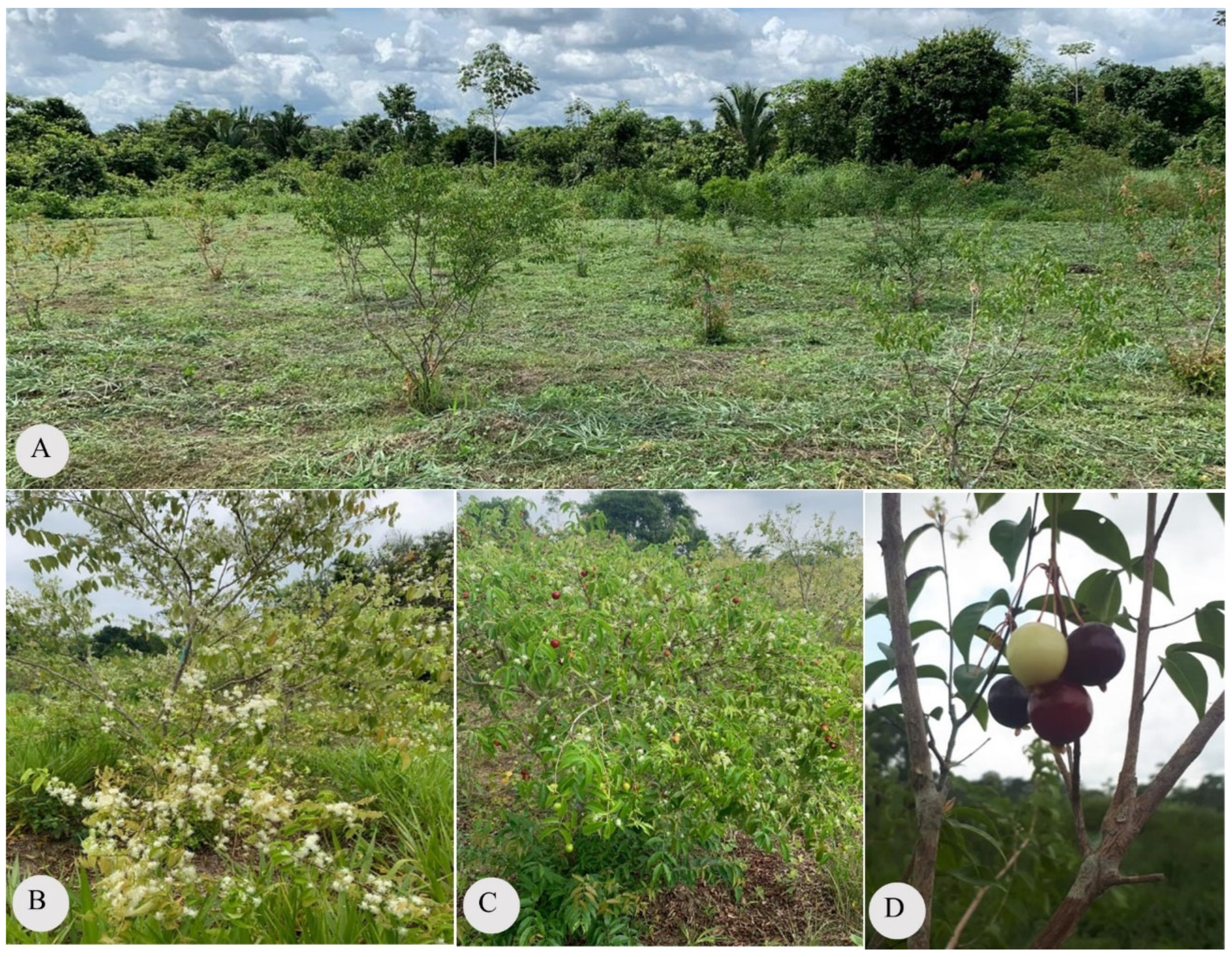
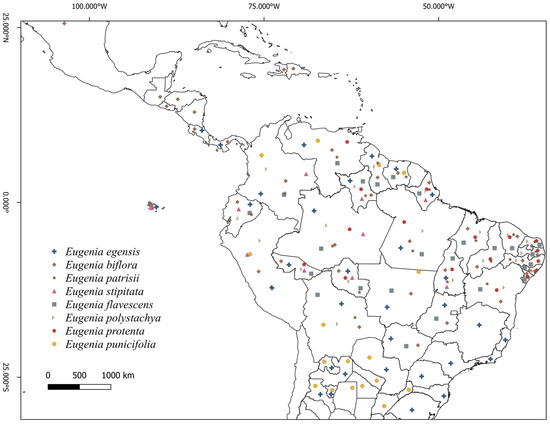
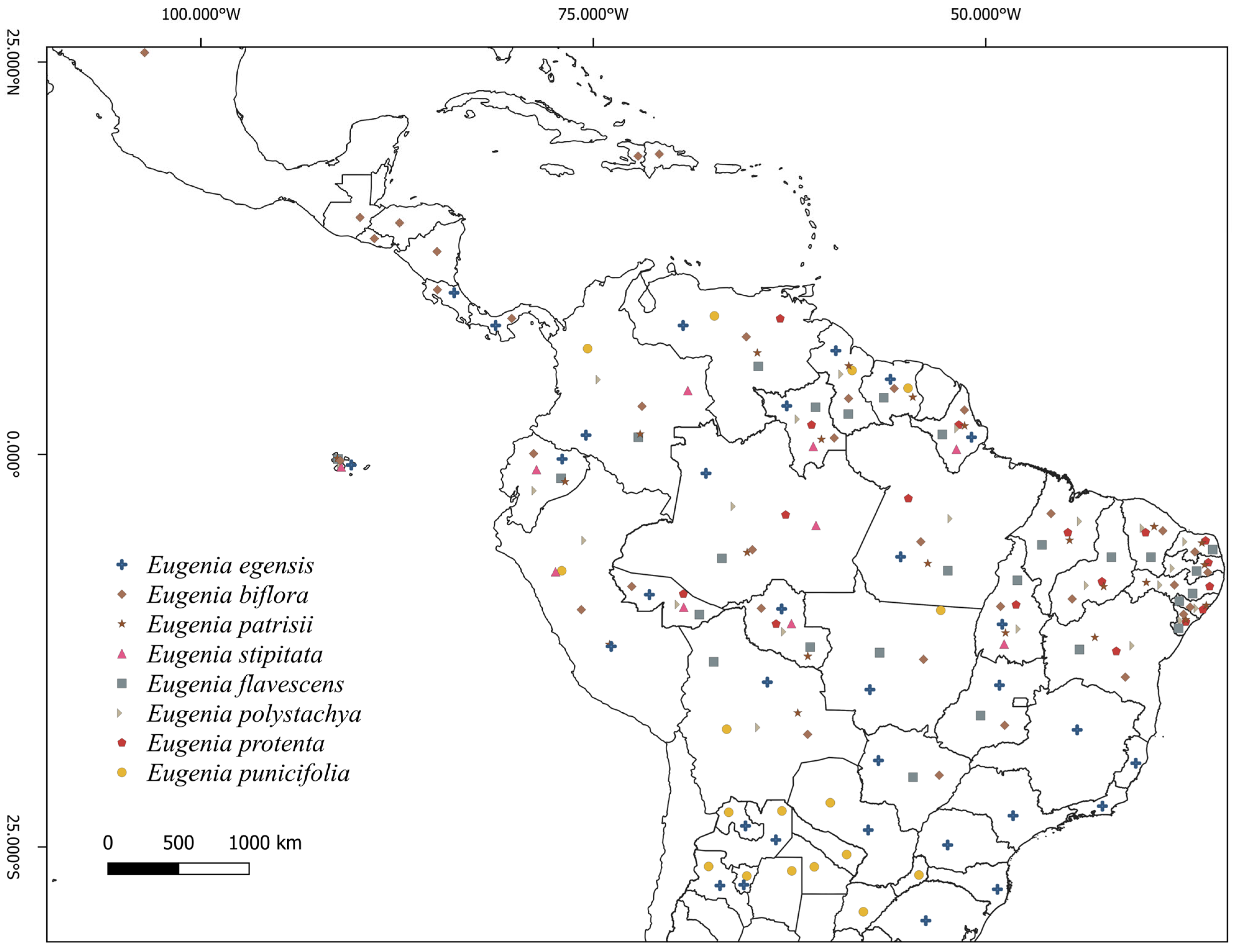
Eugenia patrisii, under cultivation conditions, also demonstrates the existence of intraspecific variations called phenotypes [11] (Figure 1). The main distinctions pointed out by the authors were also related to biomass accumulation, quantity of propagule production, and maturity of fruit production (Figure 1B–D). For E. biflora, E. egensis, E. flavescens, E. polystachya, and E. protenta, no studies have suggested variations in propagation structures or domestic selection. In terms of geographical distribution, the species is exclusively American and scattered throughout North, Central, and South America (Figure 2). The species Eugenia flavescens, E. patrisii, E. polystachya, E. protenta and E. stipitata occur exclusively in the Amazon ecosystem [9]. E. biflora and E. egensis are the most widely distributed in the Americas from north to south. E. punicifolia is found in the Amazon, Caatinga, Cerrado, and Atlantic rainforests [8].
Figure 1.
Illustrative photographs of Eugenia patrisii cultivation in the city of Marabá (Pará-Brazil), in the year 2024. (A) General view of the arrangement of individuals; (B) Flowering plant during the harvest period; (C) Individuals with fruit at different stages of ripeness; (D) Fruit at different stages of ripeness.
Figure 2.
Map of the geographical distribution of Eugenia species on the American continent. Eugenia biflora, E. egensis, E. flavescens, E. patrisii, E. polystachya, E. protenta, E. punicifolia and E. stipitata. Based on Govaerts (2023) [9].
Ecological Traits
Exposure to high solar radiation inhibits the growth and development of the vegetative body and phenology of Eugenia stipita and E. punicifolia when cultivated [21]. A solution for maintaining crops of these species is to plant them in a shading system, wood, or forest, which reduces the incidence of light on the specimens.
The leaves’ extracts were tested and used as allelopathic biological agents for the germination and initial growth of Lactuca sativa L. and Solanum lycopersicum L. seedlings [14]. The chemical similarity between the compounds in the species of the genus was proven; however, the variation in concentrations allowed the establishment of different levels of damage to the infected species. The fruits of E. stipitata are the main hosts for fly species and are also used for mating and oviposition [22].
Pollination syndromes in Eugenia are predominantly caused by bees belonging to the Apidae family [23]. E. stipitata has been recorded in Apis mellifera, Eulaema mocsaryi, E. bombiformis, Melipona lateralis, Megalopta sp., and Melipona pseudocentris [24]. The other clades discussed did not include studies on gamete exchange, which is extremely important for characterizing their potential for establishing crops. Therefore, the fruit dispersal syndrome of Eugenia punicifolia may be caused by more than one species of terrestrial birds from the Tinamidae family [23]. In E. egensis and E. flavescens, the distance from the mother plant is mediated by monkeys from different groups, and E. patrisii, dispersal is mediated by birds and rodents; however, the specific species involved remain unclear [25]. However, according to these authors, there is a clear gap in information regarding the animals that carry out the dispersal syndrome of Eugenia fruits in northern South America.
In Eugenia punicifolia, the insect species identified as pollinators were Apis mellifera, Melipona quadrifasciata anthidioides, Trigona spinipes, and Partamona sp., although the species can also self-pollinate with a lower frequency of fruit formation, compromising the breeding system [26]. Apparently, in representatives of the Myrtaceae family, xenogamy is the most efficient reproductive strategy for fruit generation, thus interactions with insects stand out from others as a pollination syndrome [27].
Recently, studies have indicated a striking characteristic that contradicts the apparent morphological homogeneity of Eugenia, floral heterochrony, which consists of subtly different stages in the ontogeny and evolution of species and sections [26]. In this study, we analyzed samples of Eugenia flavescens, E. punicifolia and E. stipitata and 17 other species, pointing out subtle particularities.
The domestication potential of Eugenia species lies in the interplay between their ecological traits and human selection pressures. Variations in fruiting cycles, pollination syndromes, and dispersal strategies not only shape species’ adaptation but also define their suitability for cultivation under agroforestry systems. Recognizing these ecological patterns in parallel with domestication history can guide targeted breeding strategies, particularly for identifying species with greater resilience to environmental fluctuations and higher potential for consistent yields. Together, these ecological and domestication-related aspects provide an environmental and management context in which the morphofunctional traits of Amazonian Eugenia species are expressed and interpreted, serving as a foundation for the following section.
3. Morphofunctional Traits
Building upon the ecological and domestication context outlined above, this section focuses on the morphofunctional traits of Eugenia species, emphasizing structural and physiological attributes directly related to reproduction, germination, and plant performance.
3.1. Botany
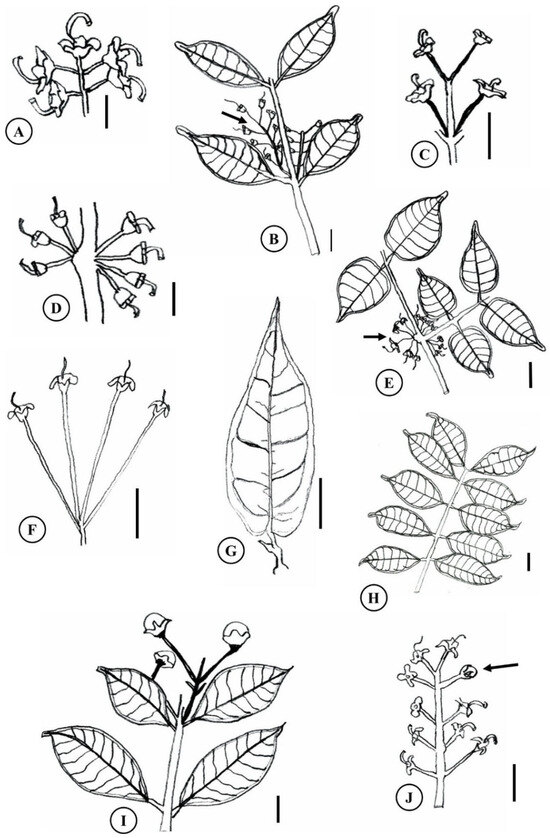
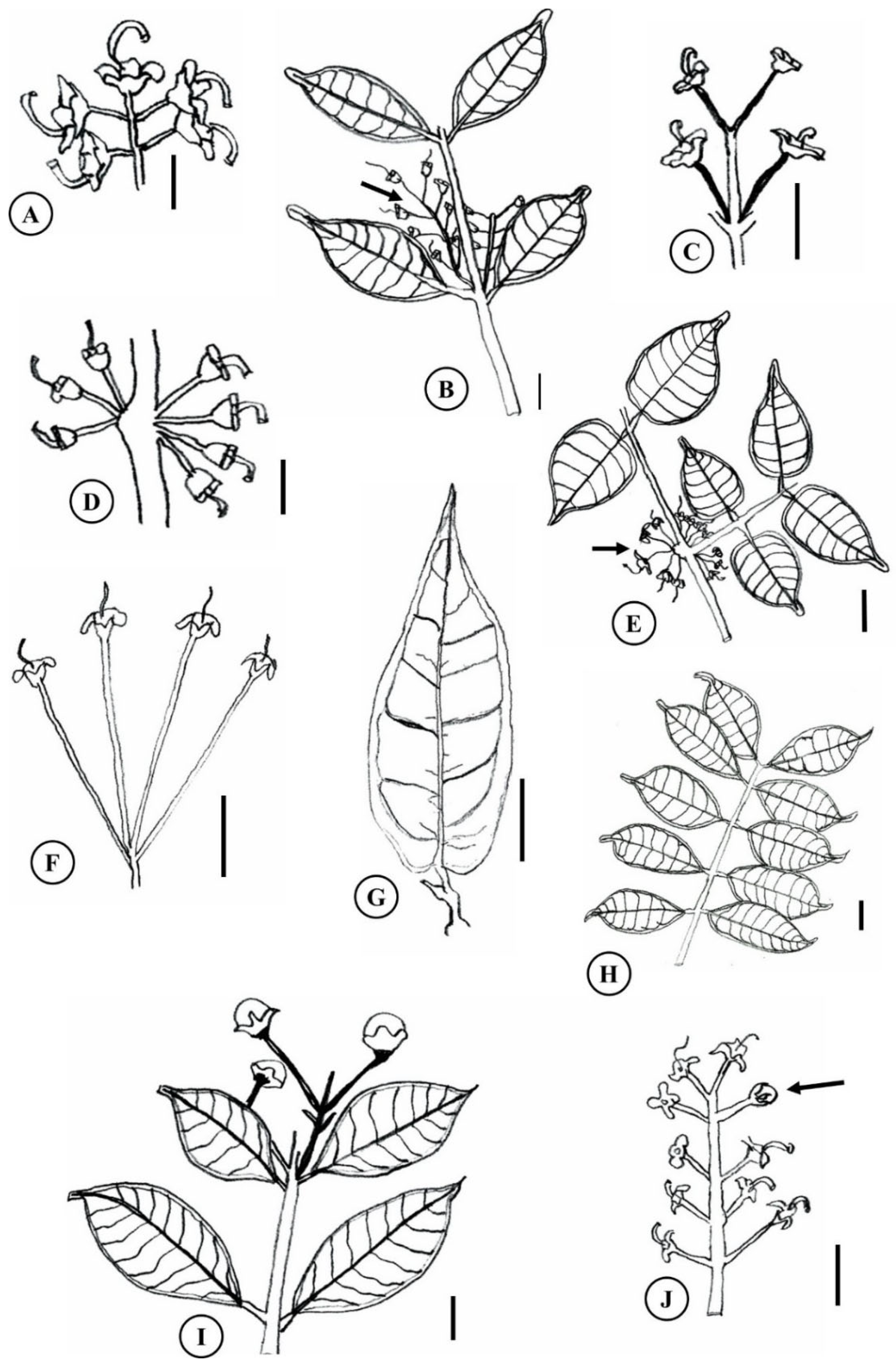
Although morphological standardization of some Eugenia sections remains unclear, key clades include Pseudeugenia Mazine & Faria, Racemosa O. Berg, and Umbellatae sensu, according to Mazine et al. (2014) [27]. The first is characterized by flowers with filiform, deciduous bracteoles and large, edible fruits, such as E. patrisii and E. stipitata [28]. The second features flowers in raceme or panicle inflorescences, with axes coinciding with elongated pedicels, as observed in E. biflora (Figure 3A) and E. polystachya [29]. Finally, Umbellatae encompasses single flowers or those in racemes, fascicles, or glomerules, with pedicels wider than the floral whorls, such as E. egensis, E. flavescens, E. protenta, and E. punicifolia (Figure 3C,D) [28]. According to Mazine et al. (2014) [27], the inflorescence structure in Eugenia varies subtly within and between species, posing challenges to clade delimitation.
Figure 3.
Morphology of Amazonian Eugenia. (A) inflorescence with fertilized flowers of E. biflora; (B) leaf branch of E. egensis, with opposite axillary inflorescence (arrow); (C) inflorescence of E. punicifolia with fertilized flowers; (D) inflorescence with fertilized flowers of E. flavescens; (E) leaf branch of E. protenta with axillary fertilized flowers (arrow); (F,G) inflorescence with fertilized flowers and leaf of E. patrisii; (H) E. stipitata leaf branch; (I,J) E. polystachya leaf branch with inflorescence in axillary flower buds and inflorescence with fertilized flowers and flower buds (arrow). Scale 1 cm. Based on Govaerts (2023) [9].
Herbarium records of properly identified botanical samples from the Amazon and Brazil reveal varying numbers of specimens, reflecting distribution patterns and collection efforts over the past two centuries: E. biflora (449), E. egensis (400), E. flavescens (394), E. patrisii (376), E. polystachya (75), E. protenta (40), E. punicifolia (4375), and E. stipitata (39) [8]. E. stipitata is one of the best-known species among Amazonian populations, yet it has the fewest records [20]. No germplasm banks for these species exist in the Amazon or South America, underscoring challenges in accessing genetic material.
3.2. Morphoanatomy
Eugenia species occurring in the Brazilian Amazon exhibit habits ranging from shrubby to arboreal, depending on environmental conditions such as light availability or competition [30,31]. In non-forest vegetation, E. biflora, E. flavescens, E. patrisii, E. polystachya, E. punicifolia, and E. stipitata typically grow as shrubs, whereas E. egensis and E. protenta are trees [32].
Trunks feature a rhytidome that peels off in juxtaposed plates of varying textures, releasing easily detachable bran upon touch. Leaves are simple, opposite (Figure 3B,E,G,H), papery to fibrous in texture, with prominent brochidodromous venation on both surfaces. Leaf blades vary from oval to elliptical–lanceolate and host conspicuous translucent glands (Figure 3B,E,G,H) [32].
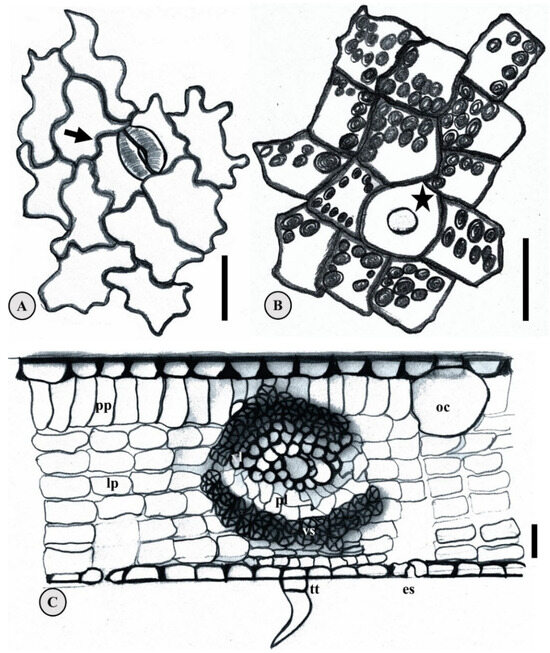
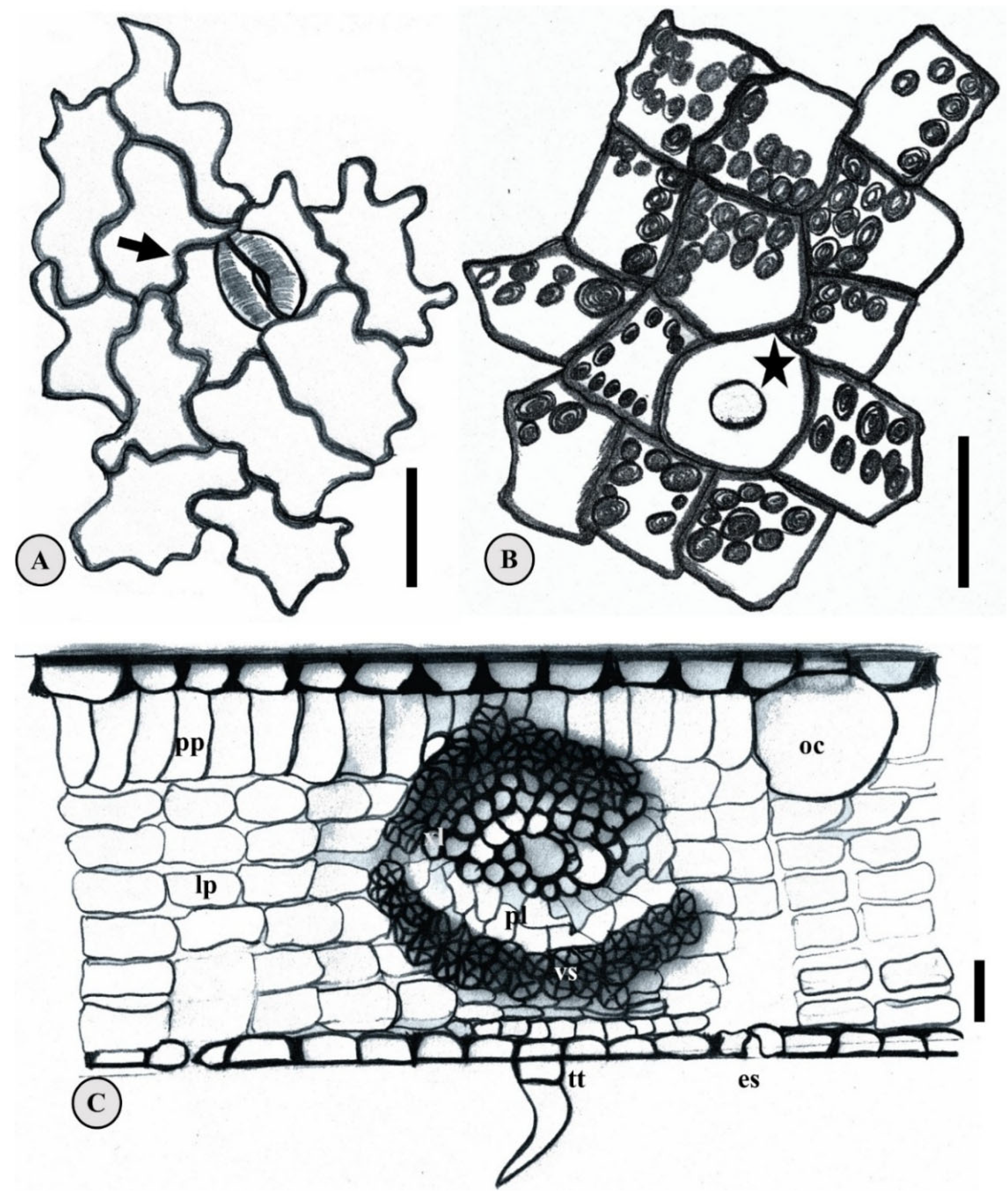
Leaf anatomy may elucidate the phylogenetic origins of four species, including E. biflora, E. flavescens, and E. patrisii [33]. Key characters include sinuosity in the parietal walls of epidermal cells on both adaxial and abaxial surfaces (Figure 4A), thick leaf cuticle, unicellular tector trichomes (Figure 4C), hypostomatic leaves (Figure 4A,C), paracytic (Figure 4A) and anomocytic stomata, lipid-containing secretory cavities (Figure 4C), idioblasts secreting phenolic compounds, and collateral vascular bundles (Figure 4C). Jorge et al. (2000) [34] analyzed leaf morphology in three Amazonian Myrtaceae species, including E. punicifolia. The main traits highlighted were obovate-to-elliptical leaf blade shape, undulate parietal walls of epidermal cells, one to two layers of palisade parenchyma, oil cavities, striated cuticle, bicollateral central vascular bundle, hypostomatic leaves, and anomocytic stomata.
Figure 4.
Anatomical structures of Eugenia patrisii. (A) Abaxial leaf epidermis, showing a paracytic stomatal complex (arrow); (B) amyliferous parenchyma of the seed cotyledon indicating an oil cell (star); (C) Transection cross of the leaf mesophyll showing collateral vascular bundler. es. Estomata; lp. Lacunar parenchyma; oc. Oil cavity; pl. phloem; pp. palisade parenchyma; tt. tector trichomes vs. vascular sheath. Scale 10 µm. Based on Alvarez and Silva (2012) [33].
Morphoanatomy of the mature E. stipitata seed was described to elucidate species of germination [35]. The propagule is starchy and pachychalazal, featuring an undifferentiated eugenoid embryo axis. The seed coat comprises three tissue types: reserve parenchyma with starch and oil glands on the cotyledons (Figure 4B), juxtaposed exotesta, mesotesta with loose sclerenchyma and vascular bundles, and endotesta with lax sclerenchymatous cells. Anatomical descriptions of E. egensis, E. polystachya, and E. protenta seeds remain unavailable, highlighting a research gap.
3.3. Flowers
Flowers of Amazonian Eugenia species occur singly or in axillary/terminal inflorescences of raceme or fascicle types (Figure 1) [30]. They bear deciduous bracts and bracteoles that may persist in post-anthesis [9]. Flowers are pedunculate with open calyces, four sepals, four petals, and bi- or tri-locular ovaries [8] (Figure 3). They are actinomorphic, dichlamydial, and dialipetalous (Figure 3), with numerous stamens in the androecium. Inflorescence details are summarized in Table 1.
Table 1.
Description of the morphology of Eugenia flowers occurring in the Brazilian Amazon.
3.4. Fruits
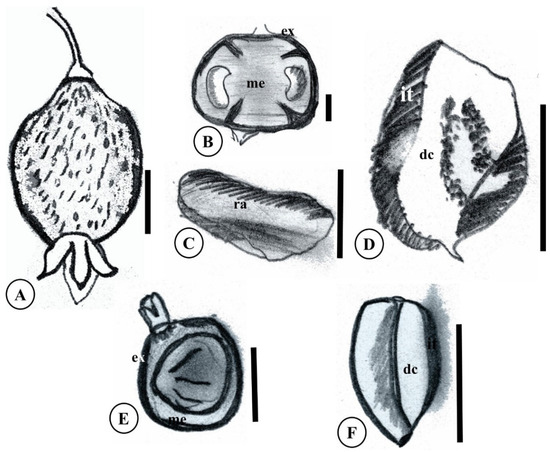
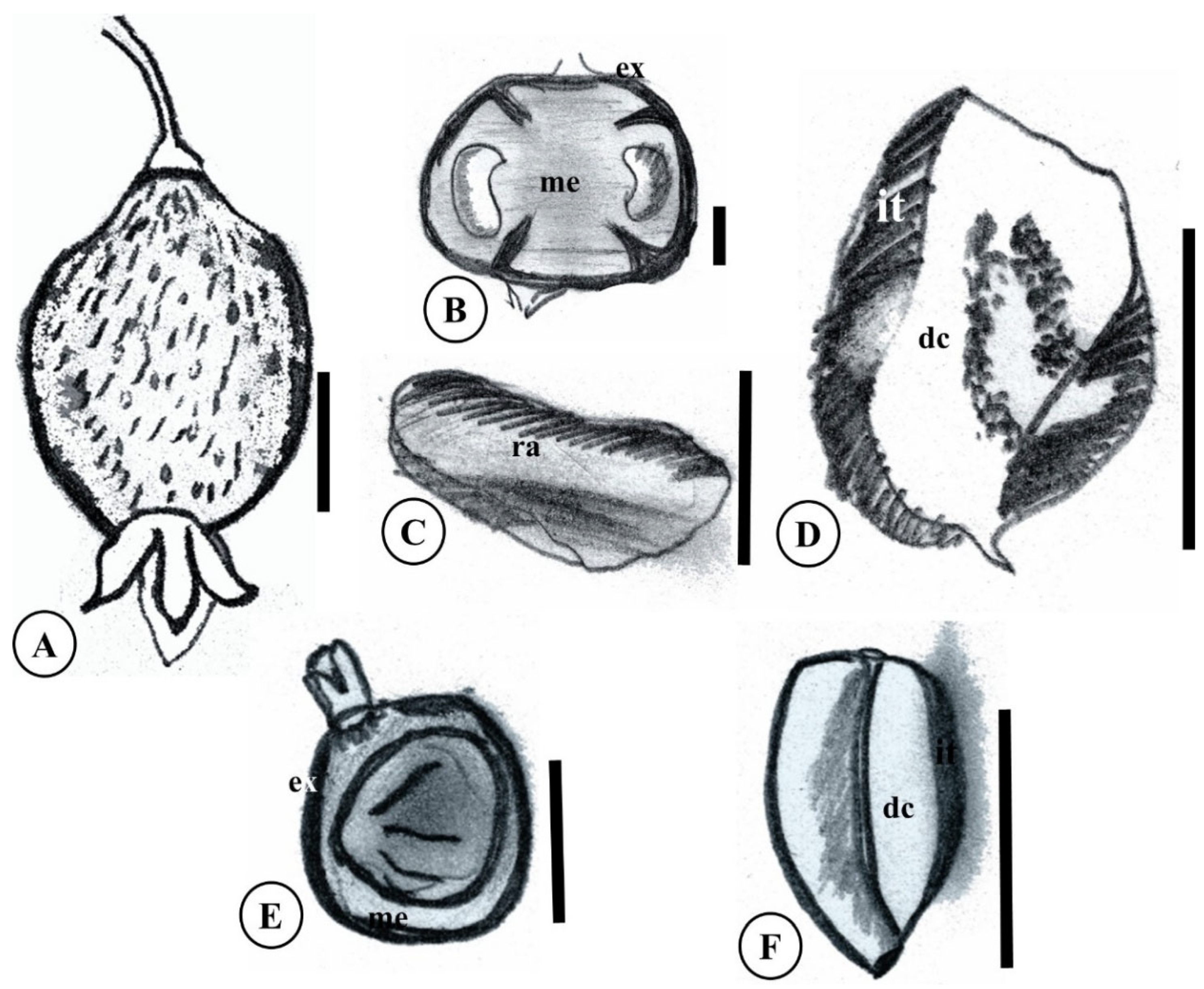
Fruits of Eugenia species occurring in the Brazilian Amazon are bacaceous, varying in morphology, size, color, consistency, and dehiscence, often with a crown of persistent calyx lobes (Figure 1D and Figure 5A) [30]. Exocarps of these species are typically dark-colored, likely due to high anthocyanin, flavonoid, and polyphenol contents [38]. The mesocarp is generally juicy and acidic, with a rancid, aromatic odor characteristic of Myrtaceae (myrtle scent) [13] (Figure 5B). Acidity gradients exist among the reviewed species, with E. stipitata being the least palatable for fresh consumption. Despite the absence of anatomical or developmental studies on Amazonian Eugenia fruits, secretory glands typical of Myrtaceae leaves (e.g., in E. biflora; Figure 5A), which produce terpenes including volatile essential oils, are likely responsible for fruit aroma [39]. For cultivation aimed at fruit production, all species may be climacteric, showing limited post-harvest modifications in palatability; fruits require rapid consumption, drying, or refrigeration after detachment from the parent plant, as observed in E. stipitata [40].
Figure 5.
Fruits and seeds of Eugenia amazonica. (A) Fruit of E. biflora showing glands on the exocarp; (B) Fruit of E. stipitata showing seeds; (C,D) seed of E. stipitata in external and internal morphology; (E) Fruit of E. patrisii, showing a single seed; (F) Seed of E. patrisii, in section. dc. Dense cotyledon; ex. Exocarp; it. Integument; me. Mesocarp; ra. Raphe. Scale 1 cm. Based on Anjos and Ferraz (1999) [41] and Souza et al. (1999) [32].
Regarding consumption, the exocarp and mesocarp constitute the edible pulp, while the endocarp adheres to the seed, as observed in E. patrisii (Figure 5E) and described by Araújo et al. (2021) [13] for E. stipitata (Figure 5B). Pulp taste is sour, ranging from bitter to sweet, with a distinctive myrtle aroma even when ripe [6,42]. Fruit characteristics are summarized in Table 2. Fruits listed in Table 2 are typically globose and, except for E. stipitata, contain no more than five seeds.
Table 2.
Description and components of the Eugenia fruits occurring in the Brazilian Amazon.
Regarding biometrics, Ferreira (1992) [43] characterized total weight, peel and pulp weight, average fruit diameter and length, seed number, and seed weight for E. stipitata, noting value oscillations. For E. patrisii, Pacheco et al. (2021) [11] quantified fruits produced per individual and average fruit mass under cultivation. Physicochemical and calorimetric profiling of E. stipitata fruits revealed infraspecific variation [44]. According to these authors, fruit dimensions, weights, soluble solids, pH, peel and flesh color, chromaticity, and luminosity diverged significantly among 33 samples from distinct geographical origins in the Brazilian Amazon.
3.5. Seeds
Myrtaceae seeds are distinctive and inform tribal and generic classifications, including Eugenia, which feature dense, conferruminate cotyledons without a distinct embryonic axis (Figure 5D,F) [19]. Morphological studies of Amazonian species have focused on E. stipitata, with its monoembryonic, recalcitrant, pseudomonocotyledonous seeds (Figure 5D) [35,41,45]. Seeds exhibit distinct integument, micropyle, raphe, and hilum, characteristic of the campylotropous type with slightly curved embryos (Figure 5D) [35,46]. Integument of coloration varies among individuals of the same species, but shapes are consistent, as in E. patrisii and E. stipitata (Figure 5D,F).
Seed anatomy of E. egensis, E. flavescens, and E. punicifolia reveals unitegmic coats in the first two—pachychalazal, exalbuminous, with single eugenoid embryos and thick, fleshy ripe cotyledons [46]. The authors used morphology, cell wall traits, and exomesotestal fibers to inform phylogeny. A single, vibrio-shaped eugenoid embryo is common in Brazilian Eugenia species, with separate or fused (conferruminate) cotyledons and a slightly protruding or included hypocotyl–radicle axis (Figure 5D,F) [47]. In E. stipitata, cotyledons are fused, with an indistinct hypocotyl–radicle axis evident only as a subtle prominence [35]; fused cotyledons also occur in E. protenta [8]. E. patrisii embryos share this composition (Figure 6).
Nuc Ludghadha and Proença (1996) [23] identified gaps in Eugenia embryonic development knowledge, partly due to recalcitrant seeds’ resistance to anatomical processing, hindering ontogenetic visualization. Selective pressures on eugenoid embryos favor nutrient reserves for viable seedlings. In these exalbuminous Eugenia seeds, cotyledons serve as the primary storage site, rich in amyliferous tissue (Figure 5D,F) [35,46]. Schizogenous secretory cavities containing essential oils may also occur, as observed in E. patrisii cotyledons [23] (Figure 4B).
E. stipitata seeds are desiccation-sensitive yet resistant to mechanical damage, enabling meristematic tissue regeneration [41]. This cellular totipotency likely relates to hormonal regulation, maturity, humidity, and temperature [48,49]. Amorim et al. (2020) [50] position E. stipitata as a model for neotropical Myrtaceae seed physiology. Evolutionarily, its totipotency may link to polyembryony (a group apomorphy) [48], high seed counts per fruit in other Eugenia species, and/or dispersal strategies [23].
3.6. Germination and Propagation
Eugenia species exhibit seed peculiarities that directly influence germination and seedling/sapling viability, including, as detailed previously, tissue regeneration and embryonic totipotency from mass reduction or fragmentation, hypogeal cryptocotyledonous germination [49,50], pre-maximum fruit maturity for germination readiness [51], dissection tolerance [52] and germination at temperatures up to 35 °C [53]. Under controlled conditions, E. stipitata achieved a germination percentage (TG) of 62% ± 16.4; fragmentation into two poles increased this to 94% ± 4.18 via regeneration. Mean germination time (MGT) was 119.6 ± 14.13 days, and germination speed index (GSI) was 0.008 ± 0.0011 seeds day−1 [48]. For this species, seed dimensions (length × width × thickness) averaged 1.06 × 0.88 × 0.62 cm, with fresh and dry weights of 0.49 g and 0.17 g, respectively [41]. Water content was 62%, with germination initiating ~50 days post-sowing. E. patrisii showed MGT of 13.4 ± 1.8 to 17.8 ± 0.3 days, germination percentages of 12.5 ± 7.7 to 100 ± 0.0%, MVG of 0.1 ± 0.0, and dimensions (length × width × thickness) ranging from 0.28 ± 0.3/0.41 ± 1.8/0.29 ± 0.6 to 0.9 ± 0.7/1.4 ± 1.1/0.95 ± 1.0 cm [54].
Figure 6.
Stages of germination in Eugenia patrisii. (A) meristematic growth of the hypocotyl–root axis; (B) protrusion of the radicle; (C) growth of the primary root; (D) emergence of the epicotyl; (E) elongation of the root and epicotyl, and differentiation of the plumule and cataphylls; (F) distension of the opposite eophylls; (G) formation of the seedling. eo. Eophylls; ep. Epicotyl; lf. Leaf; pl. Plumule; rd. Radicle; rz. Primary root; st. Stem. Scale 1 cm. Based on Santos et al. (2025) [54].
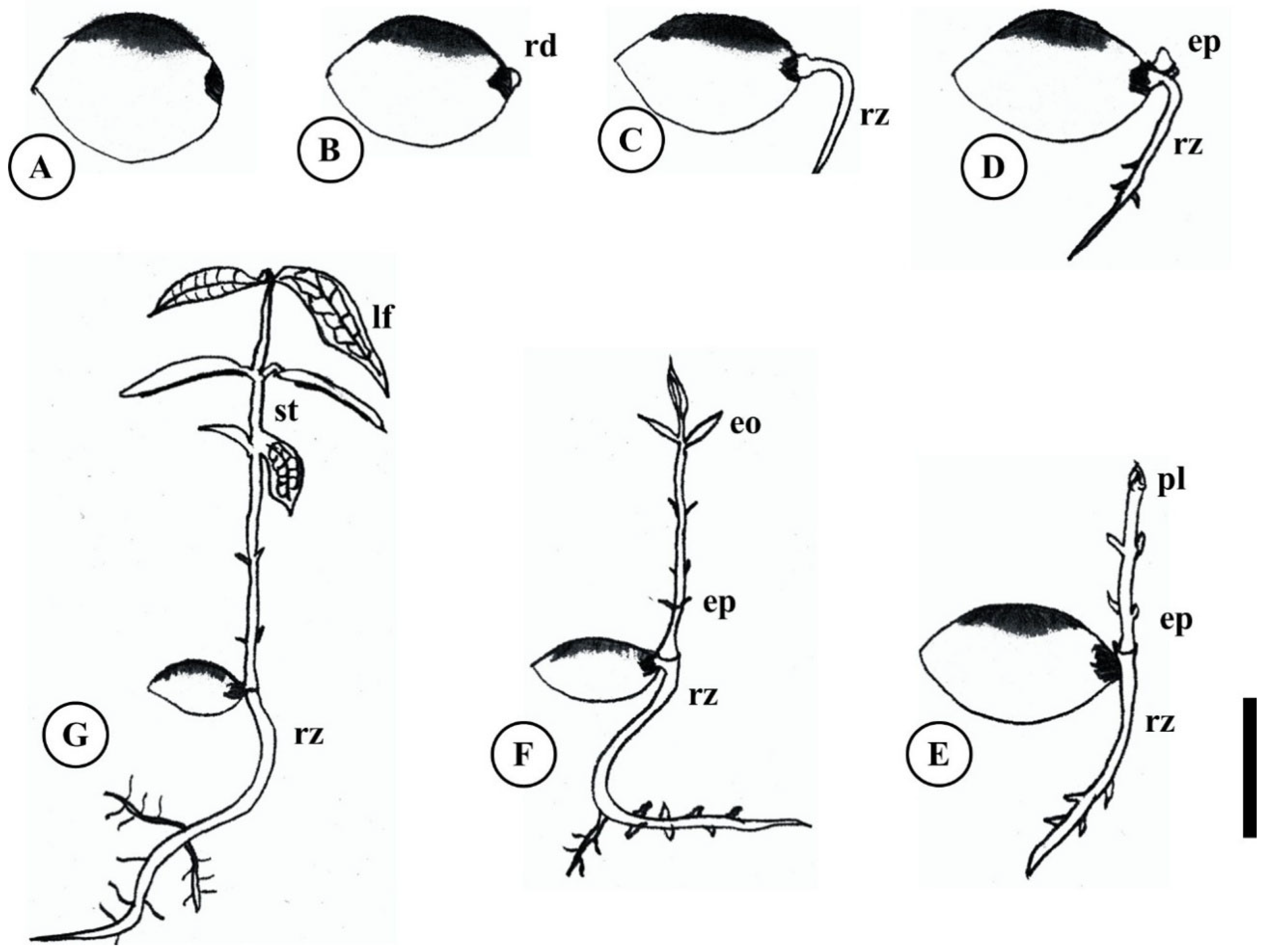
Germination stages in E. stipitata comprised six phases: (1) meristematic growth of the hypocotyl–root axis; (2) radicle protrusion; (3) primary root growth; (4) epicotyl emergence; (5) root and epicotyl elongation; and (6) seedling formation [41]. In E. patrisii, the final two phases showed distinctions, subdividing into (5.2) plumule and cataphyll differentiation; and (6.1) opposite eophyll distension (Figure 6) [54]. Studies over the past two decades on genus representatives indicate sustained germination percentages under adverse conditions, such as those from tropical climate change (drought, high humidity, temperature fluctuations, and reduced substrate diversity) [50].
E. stipitata exhibits desiccation intolerance but enters dormancy under water stress [48]. Mendes and Mendonça (2012) [55] characterized pre-germination treatments, influencing viable seedling production, including leaching, partial integument removal, and fractionation. Seeds remained viable up to 50 days submerged; integument suppression reduced germination time from 91 to 48 days; seed division neither prevented nor altered germination rates. Germination data for E. biflora, E. egensis, E. flavescens, E. polystachya, E. protenta, and E. punicifolia remain unavailable, necessitating further studies.
Morphological and anatomical traits, such as secretory cavities, seed recalcitrance, and regenerative totipotency, extend beyond diagnostics; they directly impact propagation of success and postharvest handling. Integrated with biochemical and physiological data, these features reveal adaptive strategies exploitable for domestication. For example, E. stipitata seed totipotency, coupled with rich reserve metabolism, offers dual potential for genetic conservation and bioactive compound extraction, underscoring the need to align morphofunctional insights with crop development objectives.
4. Genetic Resources
Some Amazonian Myrtaceae occur in vivo gene banks within traditional crops, such as Myrciaria dúbia [56] and Eugenia stipitata [44]. However, in vitro, germplasm banks are lacking. These could facilitate genetic characterization, infraspecific variation detection, and propagation of crop-adapted genotypes. Considerable genotypic information for Eugenia species derives from fruit physicochemical profiles, as established for E. stipitata and E. patrisii [11,44]. Nonetheless, no studies document nuclear or plastidial DNA polymorphism, hindering genetic improvement patterns. Few characterizations exist for Brazilian Myrtaceae nuclear and plastid genomes, which could elucidate inter- and intraspecific divergences at molecular (chemical polymorphism) or phenotypic levels (e.g., coloration), culminating in extract and essential oil bioactivities [57,58].
Wang and Ding (2023) [59], showed that Eucalyptus phenology, a Myrtaceae genus with annual cycles, is regulated by nuclear genes such as AtFT (Arabidopsis T floral locus stimulator), PtFT1 (Populus T floral locus stimulator), and ELFY (floral meristem regulator), manipulable to advance/delay flowering, fruiting and growth. No equivalent studies exist for Eugenia, though similar gene roles in life-cycle phenology are plausible.
For genetic improvement of fruiting Amazonian Eugenia, targeting seasonal/continuous yields and rational cropping—molecular data are scarce, relying on chloroplast DNA for interspecific divergence [60]. Given their wide Amazonian distribution, genetic, edaphic, and microclimatic variations likely influence nutrition, fruit production, and chemical composition.
Eugenia genetic resources remain underexplored, with limited molecular data impeding superior genotype identification. Linking intraspecific variation to fruit quality, oil composition, or ecological performance could yield selection markers. Integrating genomics, metabolomics, and phenomics would support holistic approaches for situ conservation and targeted breeding. Advancing molecular characterization is thus essential to convert biodiversity into agronomic value.
Myrtaceae have advanced omics understanding in plants. Syzygium and Melaleuca leaf essential oils feature 25 metabolites (e.g., butanal, cyclopentanol, nonanal, octanal) as species markers, dominated by ketones and aryl-aldehydes, potentially applicable to Eugenia [61]. In Syzygium, eugenol biosynthesis genomics revealed 116 phenylpropanoid genes (PAL, C4H, 4CL, HCT, C3H, CSE, COMT, CCoAOMT, F5H, CCR, CAD) across seven chromosomes [62].
Metabolomically, Myrtaceae intraspecific varieties differ in primary/secondary constituents, such as seed reserve mobilization during germination or leaf essential oils [63,64]. In E. patrisii seeds, starch and soluble carbohydrates (glucose, fructose, sucrose) degrade rapidly from germination onset in phenotype Ph6, but slowly initially then accelerating in Ph2/Ph3 [64]. In Psidium guajava, leaf volatile oils vary in β-caryophyllene (Caxcana: 16.46%; S-56: 23.6%); in silico/molecular docking links these to interactions with CB2, PPARα, BAX, BCL2, and AKT1 proteins, relevant to inflammation in neurodegenerative diseases [63].
Eugenol and β-caryophyllene, bioactive volatiles in reviewed Amazonian Eugenia, lack metabolomic or biosynthetic studies [16]. Filling these gaps could reveal genetic resources for a variety of selection and pharmacognosy.
5. Chemical Composition
Myrtaceae fruits typically exhibit high water and carbohydrate contents, with lower protein and lipid levels [65]. Nutritionally, they provide diverse organic/inorganic compounds, including minerals, carbohydrates, and lipids [39]. Characteristic aromas from leaves and twigs signal essential oils with potential bioactivities [66], while red–yellow fruit coloration suggests antioxidant properties [6].
Essential oil and leaf/twig extract compositions have been studied for all species: Eugenia biflora [67], E. egensis [68], E. flavescens [69], E. patrisii [14], E. polystachya [68], E. protenta [70], E. punicifolia [71] and E. stipitata [15]. Fruit and seed chemical profiles are available only for E. patrisii [72], and E. punicifolia [6,13].
Eugenia stipitata fruit pulp and seeds contain diverse minerals: macronutrients (calcium, chlorine, sulfur, phosphorus, magnesium, potassium, sodium) and micronutrients (copper, chromium, iron, manganese, nickel, zinc) [13,73]. Similar profiles occur in E. patrisii [72].
Table 3 summarizes element concentrations in ripe fruits and seeds. Data on molecular forms and concentrations are lacking for other Amazonian fruit trees. Compared to E. patrisii pulp, E. stipitata shows higher mineral values (Table 3).
Table 3.
List of minerals and their respective concentrations in fruits and seeds of Eugenia stipitata and E. patrisii (mg·100·g−1·dw). According to Leterme et al. (2006) [73], Araújo et al. (2021) [13] and Aguiar (1996) [72].
Protein content in Eugenia fruits must account for colorimetric variation during fruit maturation and propagule ripening, which is evolutionarily linked to dispersal [25,74]. Ripening involves cell wall breakdown, energy reserve mobilization, secondary metabolite production (some volatile), and color changes [44,75]. Although this review covers eight fruiting species, protein quantification exists only for E. stipitata (5.31% to 11.82% in 100 mg pulp, irrespective of ripe fruit color) and E. patrisii (12.7–17.5 g 100 g−1) [13,42,64].
Carbohydrate data are available only for E. stipitata, E. patrisii, and E. punicifolia, key to fleshy fruit maturation as primary propagule energy reserves [75]. E. stipitata pulp averaged 6.17 ± n.d. across six studies and 18.51 ± 0.20% dw [13]; seeds contained 58.57 ± 2.32% dw [76]. For E. patrisii, Aguiar (1996) [72] reported 6.22 mg carbohydrates per 100 mg dry pulp, while Santos et al. (2026) [64] quantified 76.6–79.3 g 100 g−1. Seed data are absent, but morphology/anatomy confirms exalbuminous seeds with cotyledonary reserves. Specific saccharides in E. stipitata fruits included (mg g−1 dw): glucose (7.49 ± 0.26), fructose (17.58 ± 0.80), sucrose (39.01 ± 2.94), maltose (2.03 ± 0.21), 1-kestose (0.27 ± 0.03), and maltotetraose (1.63 ± 0.09) [13]. In E. punicifolia, Ramos et al. (2019) [77] identified α-glucose, β-glucose, and sucrose in pulp and seeds.
5.1. Specialized Metabolites
Studies on Eugenia volatile composition reveal extensive chemical diversity, dominated by terpenes [78]. Alongside structural variety, Eugenia compounds are noted for metabolite pharmacological properties [13], including analgesic, anti-inflammatory, antimicrobial, antioxidant, and cytotoxic effects [79].
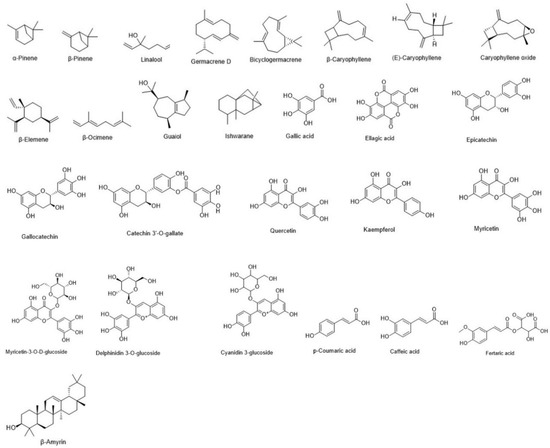
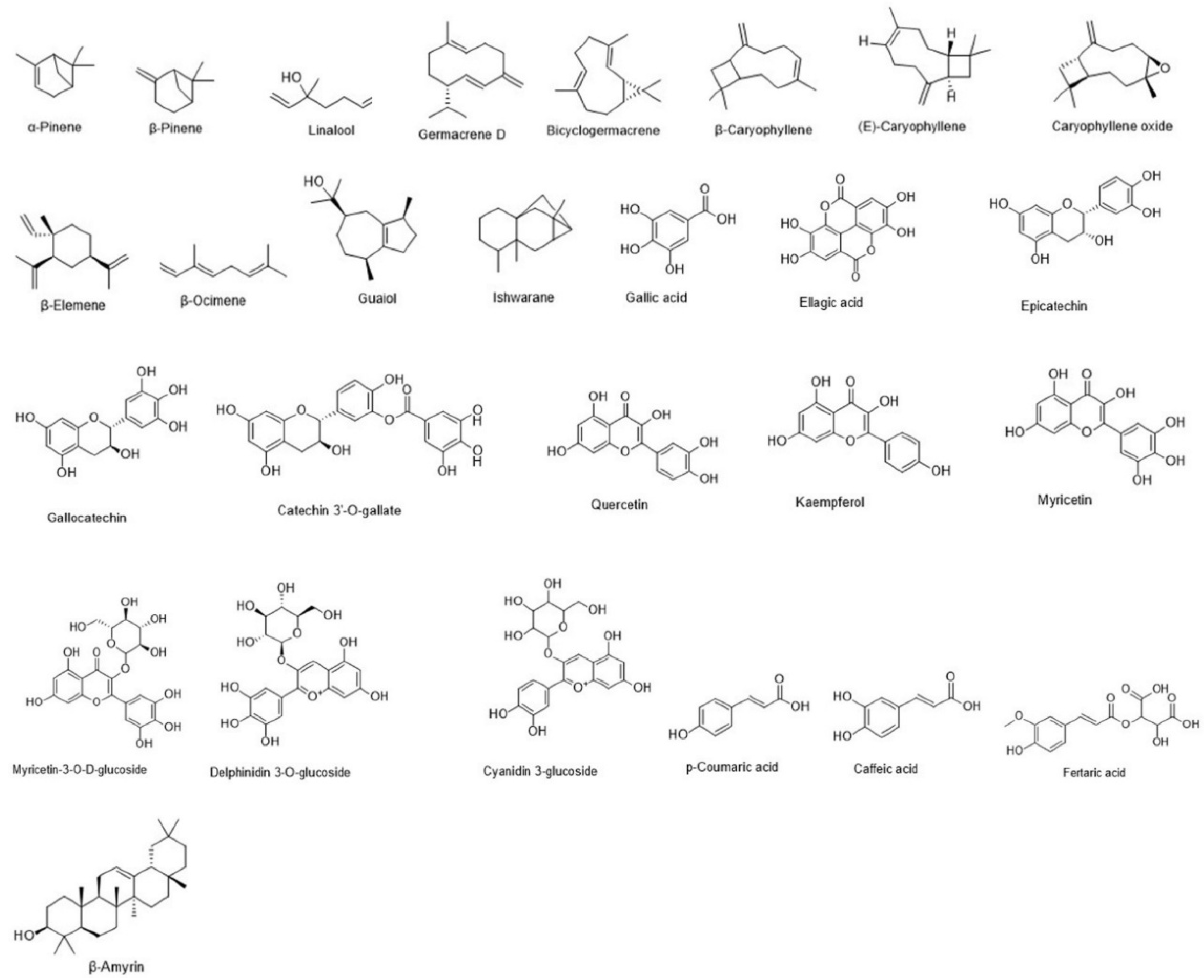
Key Eugenia monoterpenes include α-pinene and β-pinene (Figure 7), prominent in Amazonian E. biflora and E. stipitata. Pereira et al. (2010) [80] analyzed Myrtaceae leaf essential oils, reporting >27% each for α- and β-pinene in E. biflora. In E. stipitata, these peaked in fruits: ~17.5% α-pinene in pulp and 15.2% β-pinene in fruits [80]. Linalool (Figure 7) is another abundant monoterpene. Oliveira et al. (2005) [81] first identified it in E. punicifolia leaf essential oil, where it comprised 61.2% of the total.
Figure 7.
Chemical structure of the major metabolites volatile and non-volatile described for the Eugenia Amazonian. Based on Costa et al. 2020 [16].
Most volatile compounds in Eugenia belong to sesquiterpenes (hydrocarbons and oxygenated derivatives) [68]. Common Amazonian sesquiterpenes include germacrene D (Figure 7), a precursor to various hydrocarbons, detected in six species: E. patrisii (15.6%), E. polystachya (18.4%) [68], E. protenta (15.6%) [70], E. puncifolia (5.3%), E. flavescens (14.9%) [80], and E. stiptata (11.9–38.3%) [15,82]. Its derivative, bicyclogermacrene (Figure 7), predominates E. flavescens (11.72%), followed by E. patrisii (10%) and E. punicifolia (9.8%).
Caryophyllenes, β-caryophyllene, (E)-caryophyllene, caryophyllene oxide (Figure 7), are also widespread. β-Caryophyllene occurs in E. biflora [67], E. egensis [68], E. patrisii [15], E. puncifolia [80], and E. stiptata [83]. (E)-Caryophyllene appears in leaf essential oils of E. patrisii [84], E. puncifolia [14], and E. stiptata [83]. Other volatiles distributed across Amazonian Eugenia include β-elemene (Figure 7): E. patrisii (16.9%) [15], E. protenta (16.9%) [70], and E. puncifolia (25.12%) [14]; while δ-cadinene was found in E. flavescens (5.7%) [80], E. puncifolia (6%) [71] and E. stiptata (12.6%) [82]. β-ocimene (Figure 7) 6.14% [13] and guaiol (Figure 7) 13.77% [17] have been described only in E. stiptata species. Ishwarane (Figure 7) is unique to E. polystachya among Amazonian species [68].
5.2. Non-Volatile Compounds
Gallic acid (Figure 7), essential for tannin synthesis, is prevalent in Amazonian Eugenia, extracted from E. flavescens leaves [69], E. punicifolia [85], E. protenta trunks [86], and E. stipitata [13]. Other prominent polyphenols include syringic and ellagic acids (Figure 7), common in dicotyledons: syringic acid in E. punicifolia leaves/fruits [6,87]; ellagic acid in E. biflora leaves [18].
Flavonoid diversity is notable. Catechin and derivatives (e.g., epicatechin, gallocatechin, catechin-3-O-gallate; Figure 7) occur in E. flavescens leaves/fruits [69], E. punicifolia [18], and E. stipitata [13]. Rutin is abundant in E. flavescens [69] and E. punicifolia [88] leaves. Quercetin (Figure 7) appears in leaves of E. biflora [18], E. flavescens [69], E. punicifolia [85,88], E. stipitata [39], and E. protenta trunks [86]. Kaempferol (Figure 7) is reported in E. punicifolia (leaves/fruits), E. flavescens (leaves), and E. stipitata (fruits) [6,16]. Myricetin (Figure 7) and derivatives (e.g., myricetin-3-O-β-D-glucoside) occur in E. stipitata [39], E. punicifolia [18], E. protenta [86], and E. biflora [18]. Anthocyanins like delphinidin-3-O-glycoside and cyanidin-3-O-glycoside (Figure 7) were characterized in E. punicifolia fruits [6].
Organic acids, p-coumaric and caffeic occur in E. punicifolia fruits; fertaric acid (Figure 7) in E. stipitata fruit extracts [13]. In native E. protenta, key terpenes are β-amyrin, sitosterol, and ursolic acid (Figure 7) [86]. Eugenia’s rich chemical profiles offer bioindustrial potential.
Eugenia’s chemical diversity, from essential oils to phenolics, underscores bioindustrial promise. These data gain significance when linked to ecological roles and genetic variability. Flavonoid/anthocyanin profiles confer nutritional/pharmacological value and may mark stress tolerance. Integrating phytochemicals with morphofunctional/genetic data can guide breeding for resilient, high-value genotypes.
6. Biotechnological Potential
Volatile compounds from Eugenia fruits, seeds, leaves, and twigs, spanning chemical diversity, have undergone laboratory testing with implications for food, pharmaceutical, cosmetology, and other production lines. E. stipitata fruit juice successfully supplemented industrialized apple juice [42]. Its phenolic, flavonoid, and antioxidant richness enhances beverage palatability and nutritional diversity [6].
Sales and Souza (2021) [89] produced Catharina Sour-style craft beer, Souza et al. (2022) [90] wine and Souza et al. (2022) [91] fermented milk drinks at varying concentrations. Neri-Numa et al. (2013) [39] demonstrated pulp compounds’ inhibitory potential against oxidation, mutagenicity, and tumors, it was expanding species utility. E. stipitata’s protein/mineral content suggests applications in protein/mineral supplements. E. punicifolia fruits lycopene supports candies, effervescent, or supplement tablets.
Predominant classes—phenolics (polyphenols, flavonoids and anthocyanins), organic acids, terpenes—abound across leaves, trunks, fruits (peel, pulp, seeds), yielding bioactive extracts [13,85,87]. Antioxidant properties, linked to phenolics, predominate [92]. In addition, several bioactive organic acids of great biotechnological interest have already been identified in the Amazonian Eugenia species. Biotechnologically relevant organic acids like malic and vanillic, acidifiers/flavor/aroma enhancers, occur in Amazonian Eugenia [93,94].
E. punicifolia pulp exhibits in vitro anti-glycation/antioxidant activity tied to phenolics, plus high ascorbic acid, lycopene, and carotenoids [77]. Despite fruit-tree vocation, leaf/branch volatile/extract bioactivity studies prevail [6]. Most species show potential for drugs, cosmetics, supplements, flavorings, herbicides/fungicides, akin to Myrciaria dubia. E. flavescens leaf extracts phytotoxically inhibited invasive Mimosa pudica and Senna obtusifolia germination/hypocotyl–radicle growth (92.1%, 63%; 74–75%, respectively) [69], attributed to gallic acid, quercetin, myricetin—suggesting degradable, soil-safe herbicides.
Silva et al. (2017) [68] confirmed in vitro antioxidant activity in leaf/twig oils of E. egensis, E. flavescens, E. patrisii, and E. polystachya cytotoxicity against colon cancer (E. egensis excelled in antioxidants; E. polystachya in cytotoxicity). E. stipitata leaf oil combated Listeria monocytogenes in vitro, rivaling tetracycline [83], indicating natural antibiotic biomolecules. E. punicifolia leaf extract allelopathically affected Lactuca sativa, Solanum lycopersicum, and Allium cepa germination time/root growth [95]; it inhibited α-amylase, α-glucosidase, xanthine oxidase (carbohydrate absorption-related) [96], with moderate antitumor activity (melanoma, breast, kidney, lung, ovary, colon, leukemia) [97].
E. punicifolia volatiles/extracts show diverse applicability (herbicide, hypoglycemic, antitumor). Further studies could elucidate potential. Like E. punicifolia, traditionally hypoglycemic E. biflora leaf extract exhibited in vivo antidiabetic effects in rodents via α-amylase/α-glucosidase inhibition and anti-glycation; moderate catechin intake induces hypoglycemia, though excess is cytotoxic [18].
This review synthesizes botanical, resource, and chemical traits of Eugenia species, affirming pharmacological, agronomic, and bioindustrial potential. Large-scale cultivation is essential to maximize benefits.
Eugenia’s biotechnological uses (food supplements, antimicrobials, herbicides) highlight research translation. Bridging lab data with scalable cultivation, via ecological/genetic integration, will identify optimal genotypes/varieties. This positions Eugenia as a model for Amazonian bioeconomy.
7. Sustainable Uses and Planting Aspects
Among reviewed species, cultivation data are scarce, as they remain classified as Non-Conventional Food Plants (PANCs). Similarly, information on harvesting, postharvest treatments, storage, transportation, and distribution is limited.
7.1. Phenology
Phenological data for reviewed species is scarce; only Eugenia stipitata has a complete description [20]. Flowering occurs year-round but peaks during the Amazon dry season (August–December), with perennial fruiting intensified in the Amazonian summer. E. patrisii flowers exclusively in the dry period (August–December), yielding contemporaneous fruiting and crop production (Figure 1) [11]. Both species exhibit irregular propagule production among cultivated individuals [11,20]. In E. stipitata, flower buds develop into open flowers within 15 days, lasting ~24 h [20]. Flowers emit sweet aromas at opening (attributed to aromatic terpenes), commencing at 4 A.M.—indicative of nocturnal pollination [98].
No floral biology studies exist for Amazonian E. punicifolia, but Silva and Pinheiro (2007) [99] described southeastern Brazilian sandbank populations: annual flowering (July–November), fruiting ~1 month later, viability ~24 h, opening ~5:30 A.M. with sweet scent. For E. biflora, Amorim and Almeida Jr. (2021) [7] reported to reside in a forest, it was flowering (August–January) and fruiting to February; E. flavescens fruits in July; E. polystachya flowers in January; E. protenta flowers in August, fruits in October.
Southern/southeastern Brazilian E. egensis exhibits flowering (June–October) and fruiting (August–December) [37]. Collectively, flowering/fruiting peaks in the latter half of the year, aligning with the Amazon rainy season, supporting annual harvest scheduling.
7.2. Planting Systems
Incipient Eugenia domestication in the Amazon yields fluctuating fruit quantity, quality, diameter, and palatability [11,20]. Lacking formal protocols, non-native techniques necessitate soil correction, yielding substandard fruit. Cultivated E. patrisii averaged 359 ± 33 fruits plant−1 (2017–2020) in uncorrected/unfertilized Amazonian red–yellow clay loam [11], rising to 1317 ± 88 with cattle manure fertilization.
Cultivated E. stipitata matrices produced up to 400 fruits plant−1 in peak seasons and ≥200 in off-peak, oscillations linked to rainfall [20]. Gressler et al. (2006) [25] noted understory Myrtaceae ripen ≤20 fruits simultaneously, constrained by light/nutrients. Ferreira (1992) [43] quantified E. stipitata seed number/weight, pericarp diameter/weight over five years; Pacheco et al. (2021) [11] assessed E. patrisii height, diameter, dry mass, Dickson quality index, fruit number/mass under cultivation.
Spacing data exist only for E. patrisii (1.5 m2 plant−1; 4 m inter-individual) [11]. Shrubby E. biflora, E. flavescens, E. polystachya, E. punicifolia, and E. stipitata likely require similar areas. Undomesticated, E. stipitata/E. patrisii fruit intermittently (September–January), necessitating multiple small harvests [11,20]. E. patrisii aerial dry mass increased 409 ± 71 g plant−1 (2017–2020) in uncorrected/unfertilized clay loam; data absent for others.
Photosynthetic performance, pigments, relative water content, leaf area/specific leaf area, and limiting nutrients—key for domestication, seedling selection, planting—remain unstudied. Inter-/intraspecific fruit color variation complicates maturity/harvest assessment [25], though, Bohry et al. (2019) [44] validated colorimetric/physicochemical markers for E. stipitata genotyping.
Pest data are limited; Souza-Adaime et al. (2017) [74] documented E. stipitata orchard infestation by fruit flies (Bactrocera carambolae, Anastrepha obliqua, A. fraterculus, A. striata [Tephritidae]; Neosilba bela, N. zadolicha, N. glaberrima, N. pseudozadolicha [Lonchaeidae]). Infestations targeted ripe/unripe fruits (ripe preferred), enabling herbivory, oviposition, larval development, and pupation.
Sustainable Eugenia use demands integrated approaches blending ecological adaptability, genetic diversity, and phytochemical value. Agroforestry with selected genotypes could bolster climate resilience and community economies. Linking cultivation to genetic/biochemical data transitions experimental systems to scalable solutions for food security, conservation, and innovation.
7.3. Soil and Climate Modeling
Despite their heterogeneity, Amazonian soils are predominantly characterized by low concentrations of phosphorus and potassium, as well as calcium and magnesium cations, and high concentrations of silicon, aluminum cations and oxides; in some cases, iron and manganese are also present. These soils are slightly acidic and contain organic carbon [100]. Furthermore, tropical soils in direct contact with large volumes of water collections, featuring alluvial or colluvial sediments, tend to be of recent Quaternary origin and still undergoing weathering [101]. This is coupled with the dependence of one-sixth of Amazonian forest species on flooding regimes for flowering and fruiting [102].
The climate in tropical and subtropical ecosystems, mostly accompanied by temperatures around 25 °C, also drives the selection of species capable of germination, growth, and development in these environments, that is limits to plasticity in photosynthetic generation, gas exchange, and resource uptake, as exemplified by representatives of the Myrtaceae family in the genera Myrcia and Campomanesia [103].
Under cultivation conditions, Eugenia patrisii exhibited a direct relationship between soil organic enrichment and the production of larger and more numerous fruits compared to unfertilized controls, indicating that yields in common Amazonian planting areas would require soil amendments [11]. However, in floodplain areas, soils show higher concentrations of phosphorus and nitrogen [102], while retaining the Amazonian climate in which wild specimens evolved.
The cultivation of herbaceous species and small-stature plants, akin to fruiting Eugenia shrubs, has demonstrated efficiency and productivity in flood-prone areas in Brazil [104], North Africa [105], India [106], and Southeast Asia [107]. Thus, Eugenia cultivation may be feasible in other tropical and subtropical ecosystems worldwide.
8. Conclusions and Future Perspectives
Fruit trees of the genus Eugenia are cultivated in Brazil and exhibit morphological, ecological, biochemical, agronomic and genetic traits that favor the domestication and development of high-value bioproducts. These characteristics increase the status of unconventional food plants to potential inputs for diverse economic sectors. To unlock this potential, further research is required to address the gaps in seed biology, germination, ecological strategies, phenology, chemical composition, and biological activity, thereby adding both commercial and scientific value. Expanding in vivo and in vitro germplasm banks, coupled with modern cultivation technologies and seedling production systems, is essential for adapting to and harnessing the genetic diversity of the eight Amazonian species.
The scarcity of information and records on these species hinders advances in new studies and even compromises diversity conservation. Thus, establishing collections emerges as a pathway for maintenance and progress toward Amazonian domestication.
Restoring degraded Amazonian landscapes remains a pressing challenge amidst urban expansion, pastures, and monocultures. Incorporating resilient Eugenia species into reforestation and agroforestry systems could strengthen ecological recovery while generating socioeconomic benefits. Ultimately, in the context of biodiversity loss and concentrated food production, these species hold promise not only as future genetic resources, but also as emerging crops with potential acceptance in consumer markets and long-term contributions to food security and sustainability.
Author Contributions
Conceptualization, P.P.d.S., J.C.d.C., K.C.P.d.C. and J.F.d.C.G.; methodology, P.P.d.S.; formal analysis, P.P.d.S., J.C.d.C., J.P.L.A., E.V.G. and J.F.d.C.G.; investigation, P.P.d.S. and A.d.A.P.; data curation, P.P.d.S., J.C.d.C., K.C.P.d.C. and J.F.d.C.G.; writing—original draft preparation, P.P.d.S., F.A.d.S.R., J.C.d.C. and J.F.d.C.G.; writing—review and editing, P.P.d.S., J.C.d.C., K.C.P.d.C., F.A.d.S.R., H.H.F.K., J.P.L.A., A.V.F., J.P.L.A. and J.F.d.C.G.; supervision, J.C.d.C., K.C.P.d.C. and J.F.d.C.G.; funding acquisition, J.F.d.C.G. All authors have read and agreed to the published version of the manuscript.
Funding
Amazonas Research Foundation (FAPEAM, POSGRAD UEA 2022–2023) and National Council for Scientific and Technological Development (CNPq, 308493/2022-2 to JFCG).
Data Availability Statement
The original contributions presented in this study are included in the article. Further inquiries can be directed to the corresponding authors.
Acknowledgments
The authors are grateful to the National Institute for Amazonian Research (Laboratory of Plant Physiology and Biochemistry, MCTI-INPA) and our thanks also go to Fundação de Amparo à Pesquisa do Estado do Amazonas (FAPEAM), and Pedro P. dos Santos acknowledges the Bionorte Postgraduate Program (UEA-INPA) for the opportunity to pursue a doctorate.
Conflicts of Interest
The authors declare no conflicts of interest.
References
- FAO; FIDA; OPS; UNICEF. Panorama Regional de Seguridad Alimentaria y Nutricional: Hacia Una Mejor Asequibilidad de Las Dietas Saludables; FAO, FIDA, OPS, PMA, UNICEF: Santiago de Chile, Chile, 2023. [Google Scholar]
- Clement, C.R.; Casas, A.; Parra-Rondinel, F.A.; Levis, C.; Peroni, N.; Hanazaki, N.; Cortés-Zárraga, L.; Rangel-Landa, S.; Alves, R.P.; Ferreira, M.J.; et al. Disentangling Domestication from Food Production Systems in the Neotropics. Quaternary 2021, 4, 4. [Google Scholar] [CrossRef] [Scilit]
- Bachman, S.P.; Brown, M.J.M.; Leão, T.C.C.; Nic Lughadha, E.; Walker, B.E. Extinction Risk Predictions for the World’s Flowering Plants to Support Their Conservation. New Phytol. 2024, 242, 797–808. [Google Scholar] [CrossRef] [Scilit] [PubMed]
- Kramer, Y.V.; Clement, C.R.; de Carvalho, J.C.; Fernandes, A.V.; da Silva, C.V.A.; Koolen, H.H.F.; Aguiar, J.P.L.; Nunes-Nesi, A.; Ramos, M.V.; Araújo, W.L.; et al. Understanding the Technical-Scientific Gaps of Underutilized Tropical Species: The Case of Bactris gasipaes Kunth. Plants 2023, 12, 337. [Google Scholar] [CrossRef] [Scilit] [PubMed]
- Borsoi, F.T.; Arruda, H.S.; Reguengo, L.M.; Neri Numa, I.A.; Pastore, G.M. Understanding the Gastrointestinal Behavior of Phytochemicals and Antioxidants from Araçá-Boi (Eugenia stipitata—McVaugh) Extract: An in Vitro and in Silico Approach. Food Chem. 2025, 483, 144254. [Google Scholar] [CrossRef] [Scilit]
- Braga, E.C.D.O.; Pacheco, S.; Santiago, M.C.P.D.A.; Godoy, R.L.D.O.; Jesus, M.S.C.D.; Martins, V.D.C.; Souza, M.D.C.; Porte, A.; Borguini, R.G. Bioactive Compounds of Eugenia punicifolia Fruits: A Rich Source of Lycopene. Braz. J. Food Technol. 2023, 26, e2022130. [Google Scholar] [CrossRef] [Scilit]
- Amorim, G.D.S.; Almeida, E.B. De A Família Myrtaceae nas Restingas da Ilha do Maranhão, Brasil. Iheringia Ser. Bot. 2021, 76, e2021008. [Google Scholar] [CrossRef] [Scilit]
- Reflora, H.V. Flora e Fungo Brasil—Reflora. Available online: https://floradobrasil.jbrj.gov.br/consulta/#CondicaoTaxonCP (accessed on 28 August 2025).
- Govaerts, R. The World Checklist of Vascular Plants (WCVP). Royal Botanic Gardens, Kew. Checklist Dataset, 2023. Available online: https://checklistbuilder.science.kew.org/reportbuilder.do (accessed on 28 August 2025).
- Donado-Pestana, C.M.; Moura, M.H.C.; de Araujo, R.L.; de Lima Santiago, G.; de Moraes Barros, H.R.; Genovese, M.I. Polyphenols from Brazilian Native Myrtaceae Fruits and their Potential Health Benefits against Obesity and Its Associated Complications. Curr. Opin. Food Sci. 2018, 19, 42–49. [Google Scholar] [CrossRef] [Scilit]
- Pacheco, A.D.A.; dos Reis, A.A.; dos Santos, P.P.; Filho, D.G.D.F.; do Prado, A.F. Análise do Cultivo Experimental de Ubaia (Eugenia patrisii Vahl.-Myrtaceae): Uma Frutífera Nativa da Amazônia. Braz. Appl. Sci. Rev. 2021, 5, 86–99. [Google Scholar] [CrossRef] [Scilit]
- de Carvalho, J.C.; de Carvalho Gonçalves, J.F.; Fernandes, A.V.; da Costa, K.C.P.; de Lima E Borges, E.E.; Araújo, W.L.; Nunes-Nesi, A.; Ramos, M.V.; Rathinasabapathi, B. Reserve Mobilization and the Role of Primary Metabolites during the Germination and Initial Seedling Growth of Rubber Tree Genotypes. Acta Physiol. Plant. 2022, 44, 80. [Google Scholar] [CrossRef] [Scilit]
- de Araújo, F.F.; de Paulo Farias, D.; Neri-Numa, I.A.; Dias-Audibert, F.L.; Delafiori, J.; de Souza, F.G.; Catharino, R.R.; do Sacramento, C.K.; Pastore, G.M. Chemical Characterization of Eugenia stipitata: A Native Fruit from the Amazon Rich in Nutrients and Source of Bioactive Compounds. Food Res. Int. 2021, 139, 109904. [Google Scholar] [CrossRef] [Scilit]
- Franco, C.D.J.P.; Ferreira, O.O.; Antônio Barbosa de Moraes, Â.; Varela, E.L.P.; Do Nascimento, L.D.; Percário, S.; de Oliveira, M.S.; Andrade, E.H.D.A. Chemical Composition and Antioxidant Activity of Essential Oils from Eugenia patrisii Vahl, E. punicifolia (Gunth) DC., and Myrcia tomentosa (Aubl.) DC., Leaf of Family Myrtaceae. Molecules 2021, 26, 3292. [Google Scholar] [CrossRef] [Scilit] [PubMed]
- Jerônimo, L.B.; da Costa, J.S.; Pinto, L.C.; Montenegro, R.C.; Setzer, W.N.; Mourão, R.H.V.; da Silva, J.K.R.; Maia, J.G.S.; Figueiredo, P.L.B. Antioxidant and Cytotoxic Activities of Myrtaceae Essential Oils Rich in Terpenoids from Brazil. Nat. Prod. Commun. 2021, 16, 1934578X21996156. [Google Scholar] [CrossRef] [Scilit]
- da Costa, J.S.; da Cruz, E.D.N.S.; Setzer, W.N.; da Silva, J.K.D.R.; Maia, J.G.S.; Figueiredo, P.L.B. Essentials Oils from Brazilian Eugenia and Syzygium Species and Their Biological Activities. Biomolecules 2020, 10, 1155. [Google Scholar] [CrossRef] [Scilit] [PubMed]
- Costa, W.K.; de Oliveira, A.M.; da Silva Santos, I.B.; Silva, V.B.G.; da Silva, E.K.C.; de Oliveira Alves, J.V.; da Silva, A.P.S.A.; de Menezes Lima, V.L.; dos Santos Correia, M.T.; da Silva, M.V. Antibacterial Mechanism of Eugenia stipitata McVaugh Essential Oil and synergistic Effect against Staphylococcus aureus. S. Afr. J. Bot. 2022, 147, 724–730. [Google Scholar] [CrossRef] [Scilit]
- Oliveira, E.S.C.; Acho, L.D.R.; da Silva, B.J.P.; Morales-Gamba, R.D.; Pontes, F.L.D.; do Rosário, A.S.; Bezerra, J.D.A.; Campos, F.R.; Barcellos, J.F.M.; Lima, E.S.; et al. Hypoglycemic Effect and Toxicity of the Dry Extract of Eugenia biflora (L.) DC. Leaves. J. Ethnopharmacol. 2022, 293, 115276. [Google Scholar] [CrossRef] [Scilit]
- McVaugh, R. Tropical American Myrtacea: Notes on Generic Concepts and Descriptions of Previously Unrecognized Species; Fieldiana; Botany; Chicago Natural History Museum: Chicago, IL, USA, 1956; Volume 29. [Google Scholar]
- Falcão, M.D.A.; Galvão, R.D.M.S.; Clement, C.R.; Ferreira, S.A.D.N.; Sampaio, S.D.G. Fenologia e Produtividade do Araçá-Boi (Eugenia stipitata, Myrtaceae) Na Amazônia Central. Acta Amazon. 2000, 30, 9–21. [Google Scholar] [CrossRef] [Scilit]
- Fernández-Trujillo, J.P.; Hernández, M.S.; Carrillo, M.; Barrera, J. Arazá (Eugenia stipitata McVaugh). In Postharvest Biology and Technology of Tropical and Subtropical Fruits; Elsevier: Amsterdam, The Netherlands, 2011; pp. 98–117. [Google Scholar]
- Ronchi-Teles, B.; Neliton, E.; Silva, N.M.D. Flutuação Populacional de Espécies de Anastrepha schiner (Diptera: Tephritidae) na Região de Manaus, AM. Neotrop. Entomol. 2005, 34, 478. [Google Scholar] [CrossRef] [Scilit]
- Nic Lughadha, E.; Proença, C. A Survey of the Reproductive Biology of the Myrtoideae (Myrtaceae). Ann. MO Bot. Gard. 1996, 83, 480–503. [Google Scholar] [CrossRef] [Scilit]
- Fischer, G.; Parra-Coronado, A.; Hernández, M.S.; Balaguera-López, H.E. Effect of Preharvest Conditions on the Quality of Important Myrtaceae Fruits in Colombia. A Review. Rev. Colomb. Cienc. Hortic. 2024, 18, e18019. [Google Scholar] [CrossRef]
- Gressler, E.; Pizo, M.A. Polinização e Dispersão de Sementes em Myrtaceae Do Brasil. Rev. Bras. Bot. 2006, 29, 509–530. [Google Scholar] [CrossRef] [Scilit]
- Vasconcelos, T.N.C.; Lucas, E.J.; Faria, J.E.Q.; Prenner, G. Floral Heterochrony Promotes Flexibility of Reproductive Strategies in the Morphologically Homogeneous genus Eugenia (Myrtaceae). Ann. Bot. 2018, 121, 161–174. [Google Scholar] [CrossRef] [Scilit] [PubMed]
- Mazine, F.F.; Souza, V.C.; Sobral, M.; Forest, F.; Lucas, E. A Preliminary Phylogenetic Analysis of Eugenia (Myrtaceae: Myrteae), with a Focus on Neotropical species. Kew Bull. 2014, 69, 9497. [Google Scholar] [CrossRef] [Scilit]
- Mazine, F.F.; Faria, J.E.Q.; Giaretta, A.; Vasconcelos, T.; Forest, F.; Lucas, E. Phylogeny and Biogeography of the Hyper-Diverse Genus Eugenia (Myrtaceae: Myrteae), with Emphasis on E. Sect. Umbellatae, the Most Unmanageable Clade. Taxon 2018, 67, 752–769. [Google Scholar] [CrossRef] [Scilit]
- Mazine, F.F.; Souza, V.C. Three New Species of Eugenia Sect. Racemosae (Myrtaceae) from the Cerrados of the State of Mato Grosso, Brazil. Braz. J. Bot. 2010, 33, 285–290. [Google Scholar] [CrossRef] [Scilit]
- Trindade, J.R.; Do Rosário, A.S.; Dos Santos, J.U.M. Flora of the Canga of the Serra Dos Carajás, Pará, Brazil: Myrtaceae. Rodriguesia 2018, 69, 1259–1277. [Google Scholar] [CrossRef] [Scilit]
- Oliveira, H.R.; Staggemeier, V.G.; Quintino Faria, J.E.; de Oliveira, G.; Diniz-Filho, J.A.F. Geographical Ecology and Conservation of Eugenia L. (Myrtaceae) in the Brazilian Cerrado: Past, Present and Future. Austral Ecol. 2019, 44, 95–104. [Google Scholar] [CrossRef] [Scilit]
- de Souza, M.A.D.; Kawasaki, M.L.; Holst, B.K. Myrtaceae. In Flora da Reserva Ducke—Guia de Identificação das Plantas Vasculares de Uma Floresta de Terra-Firme na Amazônia Central; INPA: Manaus, Brazil, 1999; pp. 417–437. [Google Scholar]
- Alvarez, A.D.S.; Silva, R.J.F. Anatomia Foliar de Espécies de Eugenia L. (Myrtaceae) Oriundas da Restinga de Algodoal/Maiandeua-Pará. INSULA Rev. Bot. 2012, 41, 83–94. [Google Scholar] [CrossRef] [Scilit]
- Jorge, L.I.F.; Aguiar, J.P.L.; Silva, M.D.L.P. Anatomia Foliar de Pedra-Hume-Caá (Myrcia sphaerocarpa, Myrcia guianensis, Eugenia punicifolia—Myrtaceae). Acta Amazon. 2000, 1, 49–57. [Google Scholar] [CrossRef] [Scilit]
- Mendes, A.M.D.S.; Mendonça, M.S. Análise Anatômica e Histoquímica de Sementes Maduras de Eugenia stipitata spp. sororia McVaugh (Araçá-Boi)—Myrtaceae. Braz. J. Dev. 2020, 6, 77510–77522. [Google Scholar] [CrossRef] [Scilit]
- Rosário, A.S.D.; Secco, R.D.S.; Amaral, D.D.D.; Santos, J.U.M.D.; Bastos, M.D.N.D.C. Flórula Fanerogâmica Das Restingas do Pará. Ilhas de Algodoal e Maiadeua—2. Myrtaceae A. L. de Jussieu. Bol. Mus. Para. Emílio Goeldi—Ciências Nat. 2005, 1, 31–48. [Google Scholar]
- Romagnolo, M.B.; de Souza, M.C. O Gênero Eugenia L. (Myrtaceae) na Planície de Alagável do Alto Rio Paraná, Estados de Mato Grosso Do Sul e Paraná, Brasil. Acta Bot. Bras. 2006, 20, 529–548. [Google Scholar] [CrossRef] [Scilit]
- Silveira, R.M.; Carvalho, A.F.U.; Bünger, M.D.O.; Costa, I.R. da Diversidade da Composição Química dos Óleos Essenciais de Eugenia—Myrtaceae: Uma Revisão. Braz. J. Dev. 2021, 7, 33276–33303. [Google Scholar] [CrossRef] [Scilit]
- Neri-Numa, I.A.; Carvalho-Silva, L.B.; Morales, J.P.; Malta, L.G.; Muramoto, M.T.; Ferreira, J.E.M.; de Carvalho, J.E.; Ruiz, A.L.T.G.; Maróstica Junior, M.R.; Pastore, G.M. Evaluation of the Antioxidant, Antiproliferative and Antimutagenic Potential of Araçá-Boi Fruit (Eugenia stipitata McVaugh—Myrtaceae) of the Brazilian Amazon Forest. Food Res. Int. 2013, 50, 70–76. [Google Scholar] [CrossRef] [Scilit]
- de Souza, R.S.; e Silva, S.S.; Loss, R.A.; Souza, R.D.S.; Guedes, S.F. Avaliação Físico-Química Do Fruto Araçá-Boi (Eugenia stipitata MacVaugh) Cultivado na Mesorregião Do Sudoeste Mato-Grossense. Rev. Destaques Acad. 2018, 10, 1948. [Google Scholar] [CrossRef] [Scilit]
- dos Anjos, A.M.G.; Ferraz, I.D.K. Morfologia, Germinação e Teor de Água Das Sementes de Araçá-Boi (Eugenia stiptata ssp. sororia). Acta Amazon. 1999, 29, 337–348. [Google Scholar] [CrossRef] [Scilit]
- Baldini, T.F.; Neri-Numa, I.A.; Do Sacramento, C.K.; Schmiele, M.; Bolini, H.M.A.; Pastore, G.M.; Bicas, J.L. Elaboration and Characterization of Apple Nectars Supplemented with Araçá-Boi (Eugenia stipitata MacVaugh—Myrtaceae). Beverages 2017, 3, 59. [Google Scholar] [CrossRef] [Scilit]
- Ferreira, S.A.D.N. Biometria de Frutos de Araçá-Boi (Eugenia stipitata McVaugh). Acta Amazon. 1992, 22, 295–302. [Google Scholar] [CrossRef] [Scilit]
- Bohry, D.; Berilli, A.P.C.G.; Berilli, S.D.S.; de Almeida, R.F.; Zooca, A.A.F. Caracterização e Divergência Genética Do Araçá-Boi Com Base em Características Físico-Químicas e Colorimétricas de Frutos. Rev. Ciências Agrárias 2019, 62, 1–8. [Google Scholar] [CrossRef] [Scilit]
- Flores, E.M.; Rivera, D.I. Criptocotilia en Algunas Dicotiledoneas Tropicales. Brenesia 1989, 32, 19–26. [Google Scholar]
- Sbais, P.G.; Machado, N.C.; Valdemarin, K.S.; Thadeo, M.; Mazine, F.F.; Mourão, K.S.M. The Anatomy of the Seed-Coat Includes Diagnostic Characters in the Subtribe Eugeniinae (Myrteae, Myrtaceae). Front. Plant Sci. 2022, 13, 981884. [Google Scholar] [CrossRef] [Scilit]
- Teixeira, C.C.; Barbedo, C.J. The Development of Seedlings from Fragments of Monoembryonic Seeds as an Important Survival Strategy for Eugenia (Myrtaceae) Tree Species. Trees 2012, 26, 1069–1077. [Google Scholar] [CrossRef] [Scilit]
- Calvi, G.P.; Anjos, A.M.G.; Kranner, I.; Pritchard, H.W.; Ferraz, I.D.K. Exceptional Flooding Tolerance in the Totipotent Recalcitrant Seeds of Eugenia stipitata. Seed Sci. Res. 2017, 27, 121–130. [Google Scholar] [CrossRef] [Scilit]
- Alonso, C.R.; Ribeiro, M.I.; Guardia, M.C.; Barbedo, C.J. Regeneration of Roots and Shoots as a Propagation Strategy in Eugenia candolleana DC. (Myrtaceae) Seeds. J. Seed Sci. 2024, 46, e202446003. [Google Scholar] [CrossRef] [Scilit]
- Amorim, I.P.; Silva, J.P.N.; Barbedo, C.J. As Sementes de Eugenia spp. (Myrtaceae) e Seus Novos Conceitos Sobre Propagação. Hoehnea 2020, 47, e292020. [Google Scholar] [CrossRef] [Scilit]
- Delgado, L.F.; Barbedo, C.J. Regeneração de Raízes e Plântulas de Sementes de Eugenia spp. (Myrtaceae) de Diferentes Estádios de Maturação. Hoehnea 2020, 47, e042020. [Google Scholar] [CrossRef] [Scilit]
- de Almeida Garcia Rodrigues, G.; da Silva, D.; Ribeiro, M.I.; Loaiza-Loaiza, O.A.; Alcantara, S.; Komatsu, R.A.; Barbedo, C.J.; Steiner, N. What Affects the Desiccation Tolerance Threshold of Brazilian Eugenia (Myrtaceae) Seeds? J. Plant Res. 2022, 135, 579–591. [Google Scholar] [CrossRef] [Scilit]
- Lamarca, E.V.; e Silva, C.V.; Barbedo, C.J. Limites Térmicos Para a Germinação em Função da Origem de sementes de Espécies de Eugenia (Myrtaceae) Nativas do Brasil. Acta Bot. Bras. 2011, 25, 293–300. [Google Scholar] [CrossRef] [Scilit]
- dos Santos, P.P.; de Carvalho, J.C.; Gonçalves, E.V.; da Costa, K.C.P.; Fernandes, A.V.; de Andrade Pacheco, A.; dos Reis, A.A.; Gonçalves, K.D.; Santos, A.S.; Cavalcanti, J.H.F.; et al. Morphoanatomical and Physiological Indicators Revealed Distinct Intraspecific Phenotypes of Eugenia patrisii (Myrtaceae) during Germination and Post-Germination. Aust. J. Crop Sci. 2025, 19, 658–670. [Google Scholar] [CrossRef] [Scilit]
- Mendes, A.M.D.S.; Mendonça, M.S. Tratamentos Pré-Germinativos Em Sementes de Araçá-Boi (Eugenia stipitata). Rev. Bras. Frutic. 2012, 34, 921–929. [Google Scholar] [CrossRef] [Scilit]
- Ribeiro, O.D.; do Nascimento, W.M.O.; Cruz, F.J.R.; Gurgel, E.S.C. Seed Anatomy and Histochemistry of Myrciaria dubia (Kunth) McVaugh, an Amazonian Myrtaceace. Flora 2021, 280. [Google Scholar] [CrossRef] [Scilit]
- da Cruz, E.S.; Dantas, A.C.V.L.; do Carmo, C.D.; Bastos, L.P. Molecular Characterization of Jaboticaba Tree Genotypes Located in the Municipalities of Recôncavo of Bahia. Rev. Bras. Frutic. 2016, 38, e-510. [Google Scholar] [CrossRef] [Scilit]
- Carvalho, L.R.; Nunes, R.; Sobreiro, M.B.; Dias, R.O.; Corvalán, L.C.J.; Braga-Ferreira, R.S.; Targueta, C.P.; Telles, M.P.C. The Complete Chloroplast Genome Sequence of Eugenia klotzschiana O. Berg Unveils the Evolutionary Dynamics in Plastomes of Myrteae DC. Tribe (Myrtaceae). Gene 2023, 876, 147488. [Google Scholar] [CrossRef] [Scilit] [PubMed]
- Wang, J.; Ding, J. Molecular Mechanisms of Flowering Phenology in Trees. For. Res. 2023, 3, 2. [Google Scholar] [CrossRef] [Scilit] [PubMed]
- Giaretta, A.; Murphy, B.; Maurin, O.; Mazine, F.F.; Sano, P.; Lucas, E. Phylogenetic Relationships Within the Hyper-Diverse Genus Eugenia (Myrtaceae: Myrteae) based on Target Enrichment Sequencing. Front. Plant Sci. 2022, 12, 759460. [Google Scholar] [CrossRef] [Scilit]
- Manickavasagam, G.; San, P.W.C.; Gorji, S.G.; Sungthong, B.; Keong, Y.Y.; Fitzgerald, M.; Dewi, F.R.P.; Lim, V. Unbiased Metabolomics of Volatile Secondary Metabolites in Essential Oils Originated from Myrtaceae Species. Chem. Afr. 2024, 7, 3067–3075. [Google Scholar] [CrossRef] [Scilit]
- Ouadi, S.; Sierro, N.; Goepfert, S.; Bovet, L.; Glauser, G.; Vallat, A.; Peitsch, M.C.; Kessler, F.; Ivanov, N.V. The Clove (Syzygium aromaticum) Genome Provides Insights into the Eugenol Biosynthesis Pathway. Commun. Biol. 2022, 5, 684. [Google Scholar] [CrossRef] [Scilit]
- Valdivia-Padilla, A.V.; Sharma, A.; Zegbe, J.A.; Morales-Domínguez, J.F. Metabolomic Characterization and Bioinformatic Studies of Bioactive Compounds in Two Varieties of Psidium guajava L. Leaf by GC–MS Analysis. Int. J. Mol. Sci. 2025, 26, 2530. [Google Scholar] [CrossRef] [Scilit]
- dos Santos, P.P.; Gonçalves, E.V.; de Carvalho, J.C.; da Costa, K.C.P.; Pacheco, A.D.A.; Viana, C.D.S.; Aguiar, J.P.L.; Fernandes, A.V.; Martins, A.O.; Araújo, W.L.; et al. Fruit Nutritional Composition and Seed Reserve Mobilization as Tools for Phenotypic Selection in Eugenia patrisii (Myrtaceae). Foods 2026, 15, 188. [Google Scholar] [CrossRef] [Scilit]
- Pizo, M.A.; Oliveira, P.S. The Use of Fruits and Seeds by Ants in the Atlantic Forest of Southeast Brazil. Biotropica 2000, 32, 851–861. [Google Scholar] [CrossRef] [Scilit]
- Frutuoso, A.E.; do Nascimento, N.T.; de Lemos, T.L.G.; Coelho, E.L.; Teixeira, D.M.A. Essential Oils Applied in Food: A Review. Rev. Bras. Pesqui. Aliment. 2014, 4, 69. [Google Scholar] [CrossRef] [Scilit]
- Figueiredo, P.L.B.; Fernandes, H.A.; da Silva, A.R.C.; Alves, N.S.F.; Setzer, W.N.; da Silva, J.K.R.; Maia, J.G.S. Variability in the Chemical Composition of Eugenia biflora Essential Oils from the Brazilian Amazon. Nat. Prod. Commun. 2019, 14, 1934578x19892439. [Google Scholar] [CrossRef] [Scilit]
- Da Silva, J.K.R.; Andrade, E.H.A.; Barreto, L.H.; Da Silva, N.C.F.; Ribeiro, A.F.; Montenegro, R.C.; Maia, J.G.S. Chemical Composition of Four Essential Oils of Eugenia from the Brazilian Amazon and Their Cytotoxic and Antioxidant Activity. Medicines 2017, 4, 51. [Google Scholar] [CrossRef] [Scilit] [PubMed]
- Cantanhede Filho, A.J.; Santos, L.S.; Guilhon, G.M.S.P.; Zoghbi, M.D.G.B.; Ports, P.S.; Rodrigues, I.C.S. Triterpenoides, Fenólicos e Efeito Fitotóxico das Folhas de Eugenia flavescens DC (Myrtaceae). Quim. Nova 2017, 40, 252–259. [Google Scholar] [CrossRef] [Scilit]
- Zoghbi, M.G.B.; Guilhon, G.M.S.P.; Sarges, F.N.; Pereira, R.A.; Oliveira, J. Chemical Variability of the Volatiles from the Leaves of Eugenia protenta McVaugh (Myrtaceae) Growing Wild in the North of Brazil. Biochem. Syst. Ecol. 2011, 39, 660–665. [Google Scholar] [CrossRef] [Scilit]
- Fernandes, Y.M.L.; Matos, J.V.S.; Lima, C.A.; Tardini, A.M.; Viera, F.A.P.; Maia, J.G.S.; Monteiro, O.S.; Longato, G.B.; Rocha, C.Q. Essential Oils Obtained from Aerial Eugenia punicifolia Parts: Chemical Composition and Antiproliferative Potential Evidenced through Cell Cycle Arrest. J. Braz. Chem. Soc. 2021, 32, 1381–1390. [Google Scholar] [CrossRef] [Scilit]
- Aguiar, J.P.L. Tabela de Composição de Alimentos da Amazônia. Acta Amazon. 1996, 26, 121–126. [Google Scholar] [CrossRef] [Scilit]
- Leterme, P.; Buldgen, A.; Estrada, F.; Londoño, A.M. Mineral Content of Tropical Fruits and Unconventional Foods of the Andes and the Rain Forest of Colombia. Food Chem. 2006, 95, 644–652. [Google Scholar] [CrossRef] [Scilit]
- de Souza-Adaime, M.S.M.; de Jesus-Barros, C.R.; Deus, E.G.; Strikis, P.C.; Adaime, R. Eugenia stipitata McVaugh (Myrtaceae): Food Resource for frugivorous Lies in the State of Amapá, Brazil. Biotemas 2017, 30, 129–133. [Google Scholar] [CrossRef] [Scilit]
- Fenn, M.A.; Giovannoni, J.J. Phytohormones in Fruit Development and Maturation. Plant J. 2021, 105, 446–458. [Google Scholar] [CrossRef] [Scilit]
- Tavares, F.J.C.; Alves, R.E.; Lucena, E.M.P.D. Compilação de Dados da Composição Nutricional dos Frutos de Seis Espécies de Myrtaceae Nativas do Brasil Conforme a Metodologia FAO/INFOODS. Braz. J. Dev. 2020, 6, 63712–63728. [Google Scholar] [CrossRef] [Scilit]
- Ramos, A.S.; Mar, J.M.; da Silva, L.S.; Acho, L.D.R.; Silva, B.J.P.; Lima, E.S.; Campelo, P.H.; Sanches, E.A.; Bezerra, J.A.; Chaves, F.C.M.; et al. Pedra-Ume Caá Fruit: An Amazon Cherry Rich in Phenolic Compounds with Antiglycant and Antioxidant Properties. Food Res. Int. 2019, 123, 674–683. [Google Scholar] [CrossRef] [Scilit]
- Keszei, A.; Brubaker, C.L.; Foley, W.J. A Molecular Perspective on Terpene Variation in Australian Myrtaceae. Aust. J. Bot. 2008, 56, 197–213. [Google Scholar] [CrossRef] [Scilit]
- Queiroz, J.M.G.; Suzuki, M.C.M.; Motta, A.P.R.; Nogueira, J.M.R.; Carvalho, E.M. Aspectos Populares e Científicos Do Uso de Espécies de Eugenia Como Fitoterápico. Rev. Fitos 2015, 9, 87–100. [Google Scholar] [CrossRef] [Scilit]
- Pereira, R.A.; Zoghbi, M.D.G.B.; Bastos, M.D.N.D.C. Essential Oils of Twelve Species of Myrtaceae Growing Wild in the Sandbank of the Resex Maracanã, State of Pará, Brazil. J. Essent. Oil Bear. Plants 2010, 13, 440–450. [Google Scholar] [CrossRef] [Scilit]
- de Oliveira, R.N.; Dias, I.J.M.; Câmara, C.A.G. Estudo Comparativo do Óleo Essencial de Eugenia punicifolia (HBK) DC. de Diferentes Localidades de Pernambuco. Rev. Bras. Farmacogn. 2005, 15, 39–43. [Google Scholar] [CrossRef] [Scilit]
- Franco, M.R.B.; Shibamoto, T. Volatile Composition of Some Brazilian Fruits: Umbu-Caja (Spondias citherea), Camu-Camu (Myrciaria dubia), Araça-Boi (Eugenia stipitata), and Cupuaçu (Theobroma grandiflorum). J. Agric. Food Chem. 2000, 48, 1263–1265. [Google Scholar] [CrossRef] [Scilit]
- Medeiros, J.R.; Medeiros, N.; Medeiros, H.; Davin, L.B.; Lewis, N.G. Composition of the Bioactive Essential Oils from the Leaves of Eugenia stipitata McVaugh ssp. sororia from the Azores. J. Essent. Oil Res. 2003, 15, 293–295. [Google Scholar] [CrossRef] [Scilit]
- da Cruz, E.D.N.S.; Peixoto, L.D.S.; da Costa, J.S.; Mourão, R.H.V.; do Nascimento, W.M.O.; Maia, J.G.S.; Setzer, W.N.; da Silva, J.K.; Figueiredo, P.L.B. Seasonal Variability of a Caryophyllane Chemotype Essential Oil of Eugenia patrisii Vahl Occurring in the Brazilian Amazon. Molecules 2022, 27, 2417. [Google Scholar] [CrossRef] [Scilit]
- Oliveira, E.S.C.; Pontes, F.L.D.; Acho, L.D.R.; da Silva, B.J.P.; do Rosário, A.S.; Chaves, F.C.M.; Campos, F.R.; Bezerra, J.D.A.; Lima, E.S.; Machado, M.B. NMR and Multivariate Methods: Identification of Chemical Markers in Extracts of Pedra-Ume-Caá and Their Antiglycation, Antioxidant, and Enzymatic Inhibition Activities. Phytochem. Anal. 2024, 35, 552–566. [Google Scholar] [CrossRef] [Scilit]
- Sarges, F.N.; Cascaes, M.M.; Moraes, L.S.; Guilhon, G.M.S.P.; Silva, E.O.; Zoghbi, M.D.G.B.; Andrade, E.H.A.; Rodrigues, A.P.D.; Costa, B.F.; Figueiredo, R.N.M. Chemical Characterisation of the Constituents of Eugenia protenta McVaugh and Leishmanicidal Activity of Dimethylxanthoxylin. Nat. Prod. Res. 2019, 33, 879–883. [Google Scholar] [CrossRef] [Scilit]
- Costa, M.F.; Jesus, T.I.; Lopes, B.R.P.; Angolini, C.F.F.; Montagnolli, A.; Gomes, L.D.P.; Pereira, G.S.; Ruiz, A.L.T.G.; Carvalho, J.E.; Eberlin, M.N.; et al. Eugenia aurata and Eugenia punicifolia HBK Inhibit Inflammatory Response by Reducing Neutrophil Adhesion, Degranulation and NET Release. BMC Complement. Altern. Med. 2016, 16, 403. [Google Scholar] [CrossRef] [Scilit] [PubMed]
- Basting, R.T.; Nishijima, C.M.; Lopes, J.A.; Santos, R.C.; Lucena Périco, L.; Laufer, S.; Bauer, S.; Costa, M.F.; Santos, L.C.; Rocha, L.R.M.; et al. Antinociceptive, Anti-Inflammatory and Gastroprotective Effects of a Hydroalcoholic Extract from the Leaves of Eugenia punicifolia (Kunth) DC. in Rodents. J. Ethnopharmacol. 2014, 157, 257–267. [Google Scholar] [CrossRef] [Scilit] [PubMed]
- da Silva Sales, L.; de Souza, P.G. Produção de Cerveja do Estilo Catharina Sour Com Araçá-Boi (Eugenia stipitata McVaugh). Braz. J. Dev. 2021, 7, 1599–1613. [Google Scholar] [CrossRef] [Scilit]
- Souza, P.L.L.; Ramos, A.S.; Dos Santos, A.D.C.; Boeira, L.S.; Bezerra, J.D.A.; Machado, M.B. Evaluation of Sensory and Antioxidant Properties of Araçá-Boi Wines as an Effect of Yeast Type, Must Filtration and Fermentation Temperature. Chem. Pap. 2022, 76, 3531–3540. [Google Scholar] [CrossRef] [Scilit]
- de Souza, P.G.; Castro, M.S.D.e.; Pantoja, L.; Maeda, R.N.; Marinho, H.A. Avaliação Da Qualidade Físico-Química de Bebidas Lácteas Sabor de Araçá-Boi (Eugenia stipitata). Braz. J. Sci. 2022, 1, 59–64. [Google Scholar] [CrossRef] [Scilit]
- Barreta, C.; Bramorski, A.; Knecht, H.; Faqueti, L.G.; Lubschinski, T.L.; Dalmarco, E.M.; Caon, T.; de Freitas, R.A.; Meyre-Silva, C. Anti-Inflammatory and Antioxidant Activity of Eugenial D from Eugenia astringens. Rev. Bras. Farmacogn. 2024, 34, 1185–1190. [Google Scholar] [CrossRef] [Scilit]
- Chi, Z.; Wang, Z.-P.; Wang, G.-Y.; Khan, I.; Chi, Z.-M. Microbial Biosynthesis and Secretion of L-Malic Acid and Its Applications. Crit. Rev. Biotechnol. 2016, 36, 99–107. [Google Scholar] [CrossRef] [Scilit]
- Sharma, N.; Tiwari, N.; Vyas, M.; Khurana, N.; Muthuraman, A.; Utreja, P. An Overview of Therapeutic Effects of Vanillic Acid. Plant Arch. 2020, 20, 3053–3059. [Google Scholar]
- Imatomi, M.; Novaes, P.; Cristina, S.; Gualtieri, S. Interspecific Variation in the Allelopathic Potential of the Family Myrtaceae. Acta Bot. Bras. 2012, 27, 54–61. [Google Scholar] [CrossRef] [Scilit]
- Galeno, D.M.L.; Carvalho, R.P.; De Araújo Boleti, A.P.; Lima, A.S.; De Almeida, P.D.O.; Pacheco, C.C.; De Souza, T.P.; Lima, E.S. Extract from Eugenia punicifolia Is an Antioxidant and Inhibits Enzymes Related to Metabolic Syndrome. Appl. Biochem. Biotechnol. 2014, 172, 311–324. [Google Scholar] [CrossRef] [Scilit]
- dos Santos, C.; de Melo, N.C.; Ruiz, A.L.T.G.; Floglio, M.A. Antiproliferative Activity from Five Myrtaceae Essential Oils. Res. Soc. Dev. 2023, 12, e14612340536. [Google Scholar] [CrossRef] [Scilit]
- Cordeiro, G.D.; Fernandes dos Santos, I.G.; da Silva, C.I.; Schlindwein, C.; Alves-dos-Santos, I.; Dötterl, S. Nocturnal Floral Scent Profiles of Myrtaceae Fruit Crops. Phytochemistry 2019, 162, 193–198. [Google Scholar] [CrossRef] [Scilit] [PubMed]
- da Silva, A.L.G.; Pinheiro, M.C.B. Biologia Floral e da Polinização de Quatro Espécies de Eugenia L. (Myrtaceae). Acta Bot. Bras. 2007, 21, 235–247. [Google Scholar] [CrossRef] [Scilit]
- Souza, E.S.D.; Fernandes, A.R.; De Souza Braz, A.M.; Oliveira, F.J.D.; Alleoni, L.R.F.; Campos, M.C.C. Physical, Chemical, and Mineralogical Attributes of a Representative Group of Soils from the Eastern Amazon Region in Brazil. SOIL 2018, 4, 195–212. [Google Scholar] [CrossRef] [Scilit]
- Aiba, S.-I.; Kitayama, K. Light and Nutrient Limitations for Tree Growth on Young versus Old Soils in a Bornean Tropical Montane Forest. J. Plant Res. 2020, 133, 665–679. [Google Scholar] [CrossRef] [Scilit]
- Householder, J.E.; Wittmann, F.; Schöngart, J.; Piedade, M.T.F.; Junk, W.J.; Latrubesse, E.M.; Quaresma, A.C.; Demarchi, L.O.; de SLobo, G.; de Aguiar, D.P.P.; et al. One Sixth of Amazonian Tree Diversity Is Dependent on River Floodplains. Nat. Ecol. Evol. 2024, 8, 901–911. [Google Scholar] [CrossRef] [Scilit]
- de Aguiar, J.T.; Higuchi, P.; da Silva, A.C. Climatic Niche Determines the Geographic Distribution of Myrtaceae Species in Brazilian Subtropical Atlantic Forest. Rev. Arvore 2021, 45, e4501. [Google Scholar] [CrossRef] [Scilit]
- Fageria, N.; Wander, A.; Silva, S. Rice (Oryza Sativa) Cultivation in Brazil. Indian J. Agron. 2014, 59, 350–358. [Google Scholar] [CrossRef]
- Daudu, C.K.; Ugbaje, E.M.; Oyinlola, E.Y.; Tarfa, B.D.; Yakubu, A.A.; Amapu, I.Y.; Wortmann, C.S. Lowland Rice Nutrient Responses for the Guinea and Sudan Savannas of Nigeria. Agron. J. 2018, 110, 1079–1088. [Google Scholar] [CrossRef] [Scilit]
- Duary, B.; Mishra, M.M.; Dash, R.; Teja, K.C. Weed Management in Lowland Rice. Indian J. Weed Sci. 2015, 47, 224–232. [Google Scholar]
- Antara, M.; Pellokila, M.R.; Mulyo, J.H. Effect of Socio-Economic on Farmers’ Decisions in Using Lowland Rice Production Inputs in Indonesia. Int. J. Sustain. Dev. Plan. 2022, 17, 235–242. [Google Scholar] [CrossRef] [Scilit]

Disclaimer/Publisher’s Note: The statements, opinions and data contained in all publications are solely those of the individual author(s) and contributor(s) and not of MDPI and/or the editor(s). MDPI and/or the editor(s) disclaim responsibility for any injury to people or property resulting from any ideas, methods, instructions or products referred to in the content. |
© 2026 by the authors. Licensee MDPI, Basel, Switzerland. This article is an open access article distributed under the terms and conditions of the Creative Commons Attribution (CC BY) license.