2. Results and Discussion
1. Stigmatodactylus antennatus Schuit., Saputra & Wanma,
spec. nov. Type: Indonesia, West Papua Province, Arfak Mountains, Testega District, 17 October 2023,
A. Schuiteman,
R. Saputra,
A. Mofu,
I. Farwas,
C. Yokbari,
and L. Jennings 23-277 (holotype MAN; isotypes BO, K).
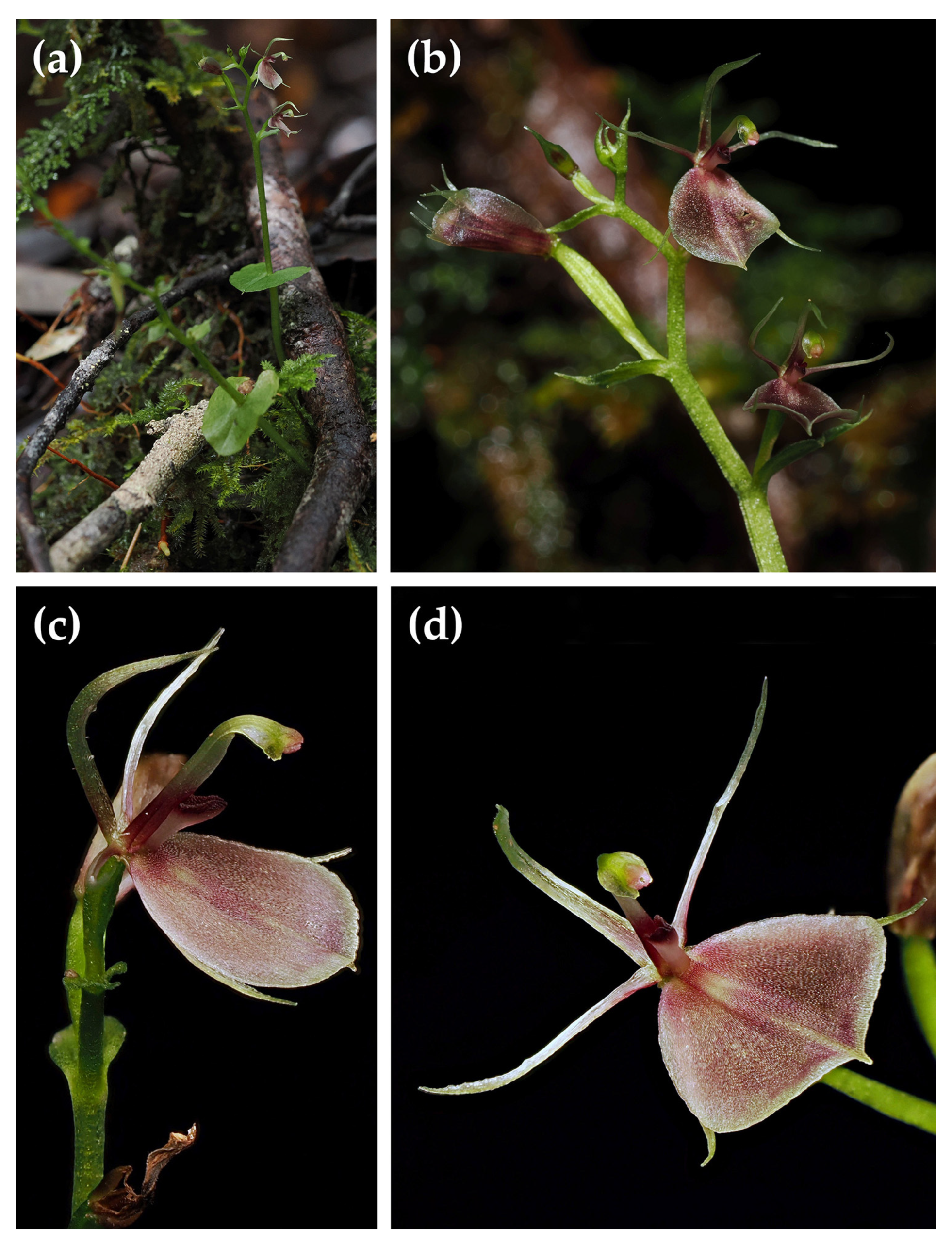
Figure 1 and
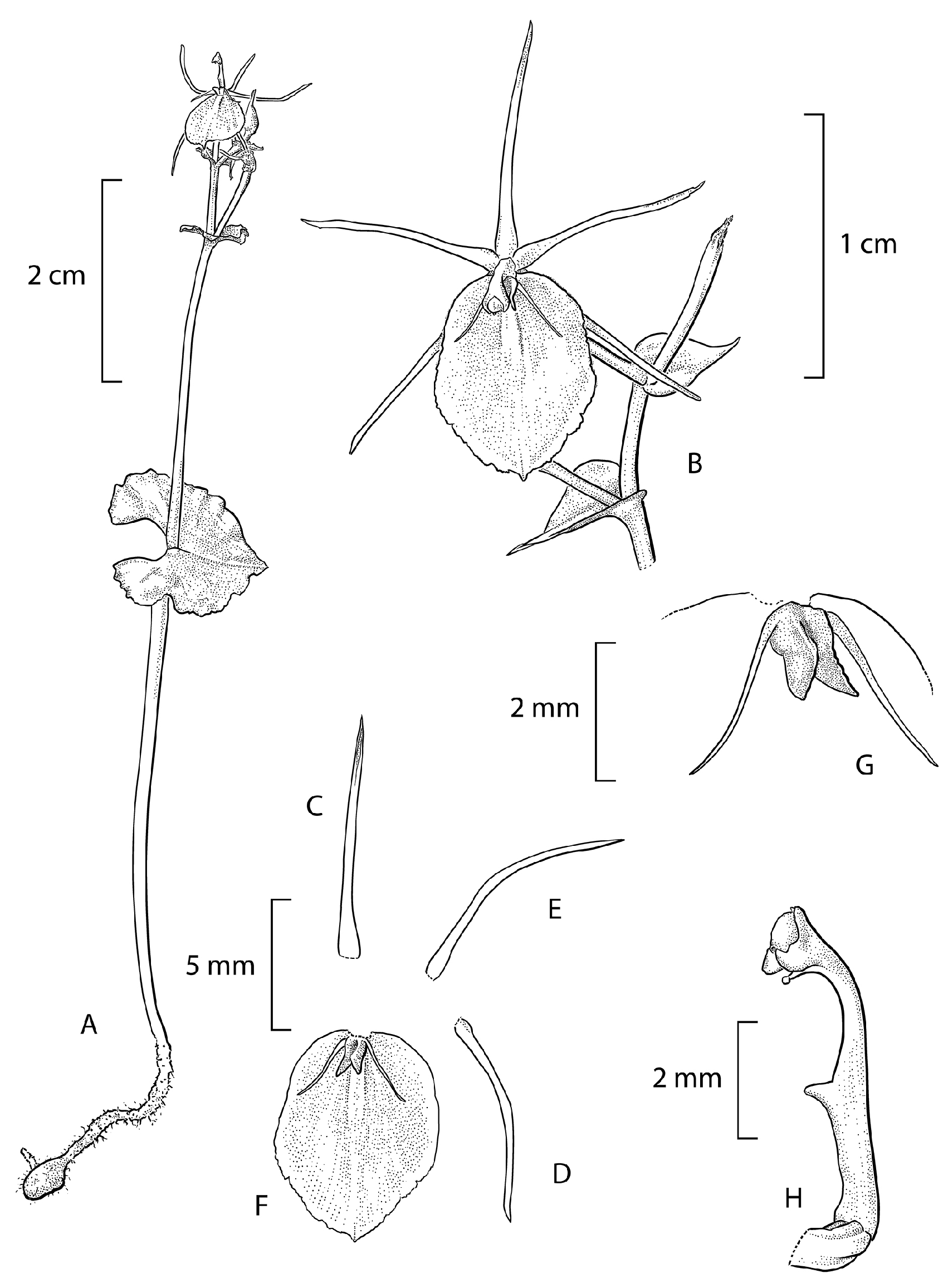
Figure 2.
Diagnosis: Differs from all known species of Stigmatodactylus in the 2-winged apex of the labellar callus and in the presence of a long, slender antenna on either side of the callus.
Description: Small, tuberous herb. Tuber oblongoid, c. 3–5 mm long. Roots few. Roots and tuber covered with long, partly branching trichomes. Sometimes with a stolon forming at the base of the inflorescence on the adaxial side of the leaf. Stem 1-leaved, 5–6 cm long from apex of tuber to base of leaf, 1.3 mm diam., the basal c. 2 cm covered with scattered and partly branching trichomes, possibly functioning like roots, otherwise glabrous and without scale leaves or articulations. Leaf bright green, horizontally spreading, cordate to reniform, with rounded basal lobes, 1.1–1.6 × 0.6–2.4 cm, margins undulate, apex truncate to abruptly acute-acuminate; veins anastomosing at their apex just below the leaf margin. Inflorescence erect, 3–6.7 cm long, glabrous; peduncle not articulated, without peduncle-scales, 2–3 cm long; rachis laxly 3–6-flowered, glabrous, zig-zag, 1–3.7 cm long. Floral bracts foliaceous, green, broadly ovate to semi-orbicular, acute-acuminate, decreasing in size from the lowest flower upwards, the lowest bract c. 3–6 × 6.5 mm. Pedicel-with-ovary green, terete, slightly clavate, glabrous, 7.9 mm long. Flowers opening widely, one or two at a time; sepals and petals whitish-hyaline, reddish maroon at the very base, lip reddish maroon with a whitish-hyaline margin, callus pinkish white, the edges deep maroon; column greenish yellow, apical wings edged purple; anther cream colour. Sepals and petals glabrous, arranged in a 5-pointed star. Dorsal sepal and lateral sepals similar, narrowly linear, slightly concave lengthwise, with incurved margins, 9 × 0.3 mm in natural position, subcaudate-acuminate. Petals similar to the sepals but slightly wider, with incurved margins, 9.4 × 0.6 mm in natural position, sometimes with one or two small teeth in the apical part. Lip elliptic-ovate, entire, 8 × 6.2 mm, margins minutely ciliate, in apical half irregularly shallowly dentate, apex acute, mucronate, basal callus cup-shaped, adnate to the lip, 0.9 × 0.3 mm, 1.2 mm high in lateral view, just above the base, laterally on either side, with a very slender, linear-subulate, outwards-curving antenna 2.8 mm long, in front with a pair of vertical, laterally flattened, triangular, divergent wings 0.7 mm long, upper margin of the wings minutely crenulate. Column slender, erect, incurved at the apex, bilaterally flattened, 5.5 mm long; at 2.5 mm above the base just below the stigma with a porrect, triangular-digitate, 0.5 mm long appendage; at the apex with two semi-orbicular, downwards-pointing, 0.6 mm long wings; rostellum beak-like, 0.5 mm long, terminating in a semi-liquid, subspherical viscidium. Anther cucullate, suborbicular, 0.7 mm long and wide. Pollinia not seen. Fruit pedicellate, as long as the pedicel, oblongoid, c. 5.5 mm long, sharply 6-ribbed.
Additional material studied: Indonesia, West Papua Province, Arfak Mountains, Testega District, 9 November 2024, A. Schuiteman, R. Saputra, J. Wanma et al. (leg. A. Trias-Blasi) 24-102(MAN).
Distribution: Indonesian New Guinea, Bird’s Head Peninsula, Arfak Mountains, endemic.
Habitat and Ecology: Terrestrial between moss and leaf litter in fairly open montane forest. Elevation 1200–1250 m. Flowering October to November.
2.Stigmatodactylus gibbsiae (Kores) Kores, Novon 2(3): 212 (1992) (as ‘
gibbsae’).
Acianthus gibbsiae Kores,
Lindleyana 6: 166 (1991) (as ‘
gibbsae’).
Pantlingia gibbsiae (Kores) Schuit.,
Blumea 39: 236 (1994). Type: Indonesia, West Papua Province, Arfak Mountains, Anggi Gida Lake (“Woman Lake” in [
10]), c. 2100 m, December 1913,
L. S. Gibbs 5891 (holotype BM!).
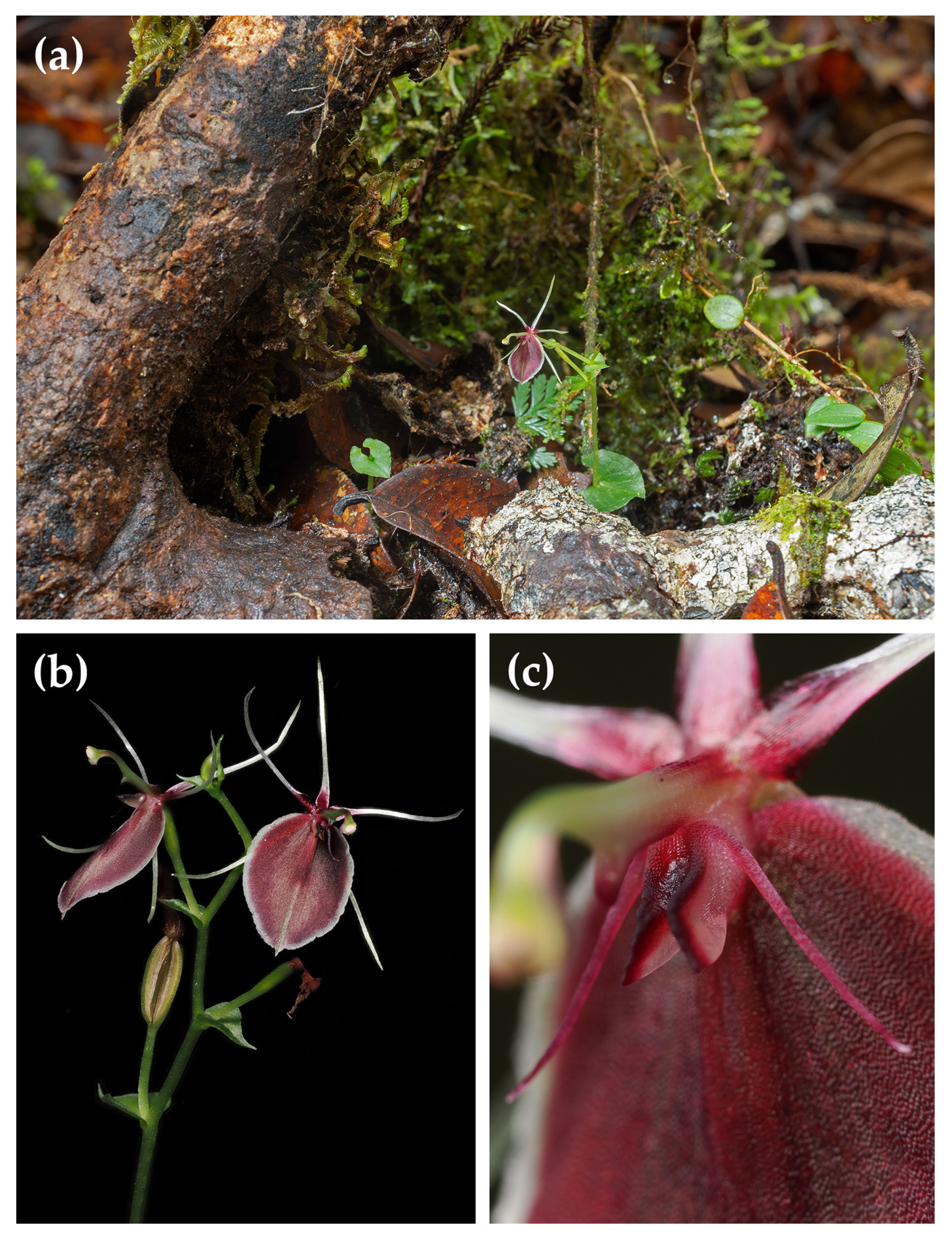
Figure 3.
Additional material studied: Indonesia, West Papua Province, Arfak Mountains, Testega District, c. 1080 m, 9 June 2025, R. Saputra, A. Mofu, and Zainal 301 (MAN).
Distribution: Indonesian New Guinea, Bird’s Head Peninsula, Arfak Mountains, endemic.
Habitat and Ecology: Terrestrial in montane forest. Elevation 1080–2100 m. Flowering June and December.
Notes: The type material of
Stigmatodactylus gibbsiae, preserved at the Natural History Museum in London (BM), is poor, as the inflorescences either carry small flower buds or fruits. Only a few sepals or petals and a more-or-less damaged column are still attached to the fruits. There is no labellum visible. This material was deemed insufficient for description by J. J. Smith [
7], who added the note “fruits only” to the specimen label, but was nevertheless used by Kores [
8] to produce a detailed description and a line drawing. The collector, Lilian Gibbs, wrote: “On the north-east side [of Anggi Gida Lake], creeping under the bracken, the fine
Pterostylis papuana var.
arfakensis, from cream to brown-pink in colour,
Liparis lacus a small plant with brown labellum and green petals, and a minute brown
Stigmatodactylus sp. past flowering, grew on the forest edge” [
9]. Since the flower colour could still be recorded, it appears that the flowers had withered but were not entirely desiccated.
The material that Kores dissected could not be found, except for what appeared to be a fruit with attached column. This was reduced to a transparent film sticking to a piece of paper, and one of us (AS) was unable to discern any morphological details on it. It is possible that Kores used ammonia to soften and reconstitute the material that he analysed, as he describes this method in one of his papers [
4]. Unfortunately, material softened in this way must be stored in alcohol. It cannot be dried again, as most of the tissue will have been dissolved. We suspect that the ‘film’ that we observed comprised the remains of a fruit that had been treated with ammonia and was subsequently dried. The more delicate flower parts may have disintegrated upon drying.
It is unlikely that Kores had adequate flowering material at his disposal, otherwise J.J. Smith, who was a meticulous observer, would surely have used it to describe this species. We consider it plausible that Kores found some floral remains on a fruit and perhaps also examined a flower bud and prepared and illustrated a reconstruction. In the process, he could have been misled by the unusual characters of the species that we assume to be S. gibbsiae. These unusual characters are the following:
The lip callus is free from the lip surface and is raised and pressed against the ventral side of the column, making it seem as if the lip is ecallose.
The column has no appendage.
As the callus is pressed against the column (but not adnate to it), it resembles and appears to replace the appendage that many other species of Stigmatodactylus have in this position (which also suggests that this appendage has a function in those species that possess one).
An examination of the type material of
S. gibbsiae in its current state did not enable us to reach an unequivocal conclusion as to many of its characters. The largest of the two remaining flower buds is only 3.8 mm long, and an attempt to dissect it would be destructive. There are three columns left on the fruits, but two of these are clearly damaged. One of the columns appears to be intact, and no appendage can be discerned on it. The shape of the labellar callus in our specimens agrees with that described by Kores [
8], except that Kores illustrates this as lying on the lip surface along with an additional appendage on the column. In Kores’s illustration, the columnar appendage is unusually large and points obliquely upwards. The column with appendage thus produces almost the same lateral profile as the column with appressed callus in our specimens, and we believe that this is what Kores illustrated. The flower colour of our specimens, which were collected about 50 km W of the type locality, agrees with that recorded for
S. gibbsiae. It is unclear where the detailed colour notes provided by Kores [
8] come from (“outer perianth segments pale green, labellum brownish maroon”) because the annotation by Gibbs just states “flowers brown”. Kores also describes the colours of the vegetative parts, which are not mentioned at all by Gibbs, and which cannot be discerned from the uniformly brownish specimens.
Key to the species of Stigmatodactylus in New Guinea
1a. Lip callus consisting of a central crest flanked with several teeth … 2.
1b. Lip callus cymbiform or cup-shaped, not flanked with teeth, with or without two antennae … 3.
2a. Plant with tuber. Lip broadly elliptical, bluish green with maroon spots at the base or pale green, 7–9-veined …
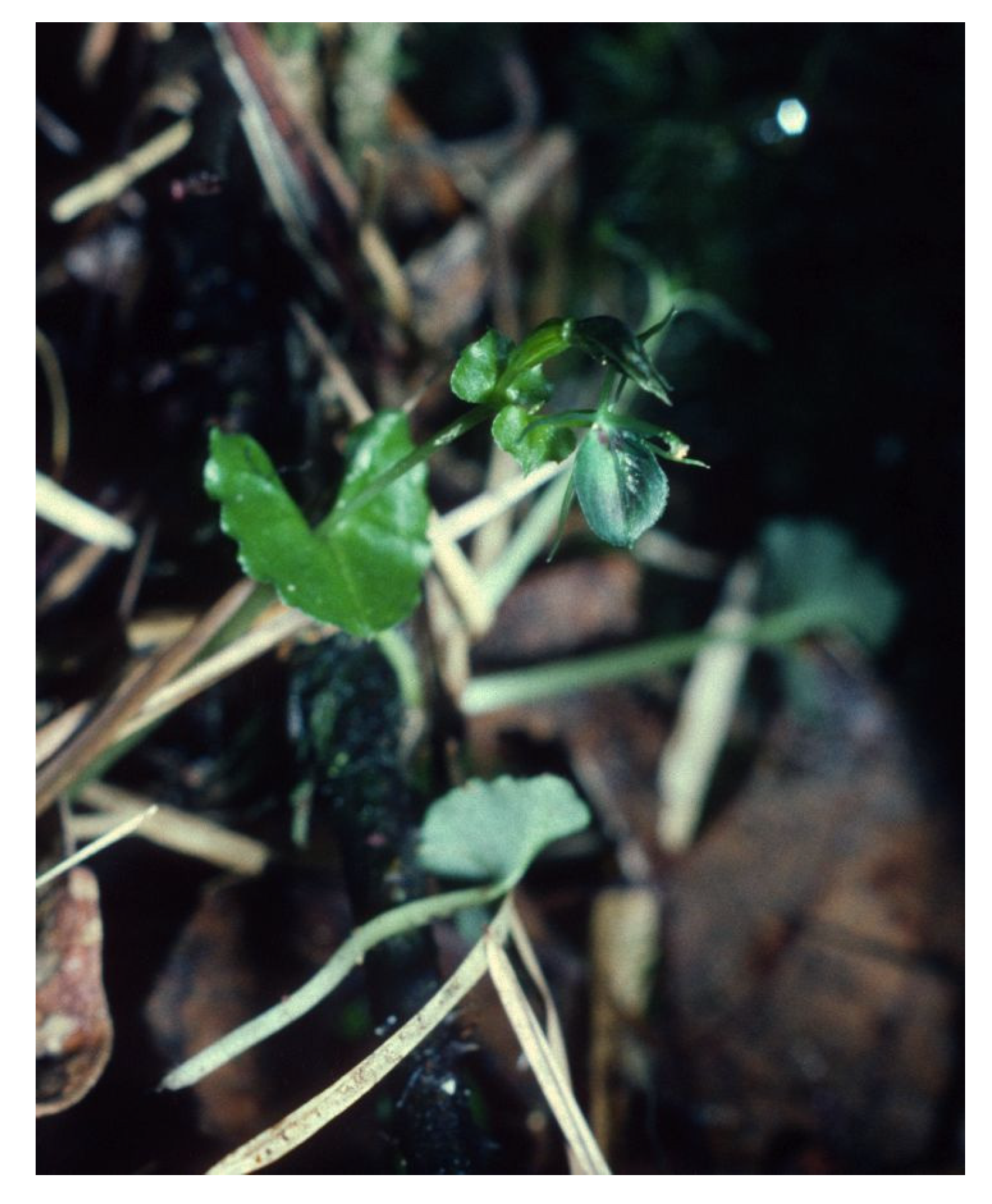
S. croftianus (Kores) Kores [
Figure 4].
2b. Plant without tuber. Lip obovate, dark purple with green markings, 15–17-veined …
S. variegatus (Kores) Kores. Note: Key characters for the most part according to Kores [
8]. The specimens illustrated as
S. variegatus in Jones ([
1], Figure 22.1) have the leaf characters of
S. croftianus but lack a tuber and vary considerably in the details of the lip callus. They look intermediate between
S. variegatus and S.
croftianus in number of veins on the lip, suggesting that the two may not be distinct.
3a. Lip callus on either side with a long, subulate-filiform antenna, callus apex with two laterally flattened, triangular, vertical wings … S. antennatus Schuit., Saputra & Wanma.
3b. Lip callus without antennae, apex without wings … S. gibbsiae (Kores) Kores.