Antinociceptive Effect and HPLC Profile of Lyophilized Chicory and Oregano Decoction
 , , , and
Abstract
1. Introduction
2. Results and Discussion
2.1. HPLC Analysis
2.2. Acetic Acid-Induced Writhing Method
3. Materials and Methods
3.1. Plant Material
3.2. Extraction
3.3. HPLC Analysis
3.4. Acetic Acid-Induced Writhing Method
4. Conclusions
Supplementary Materials
Author Contributions
Funding
Data Availability Statement
Acknowledgments
Conflicts of Interest
Abbreviation
| LCOD | Lyophilized decoction of the oregano and chicory |
References
- Zahradnik, H.P.; Hanjalic-Beck, A.; Groth, K. Nonsteroidal anti-inflammatory drugs and hormonal contraceptives for pain relief from dysmenorrhea: A review. Contraception 2010, 81, 185–196. [Google Scholar] [CrossRef]
- Iacovides, S.; Avidon, I.; Baker, F.C. What we know about primary dysmenorrhea today: A critical review. Hum. Reprod. Update 2015, 21, 762–778. [Google Scholar] [CrossRef] [PubMed]
- Pezzani, R.; Vitalini, S.; Iriti, M. Bioactivities of Origanum vulgare L.: An update. Phytochem. Rev. 2017, 16, 1253–1268. [Google Scholar] [CrossRef]
- Moloudi, M.R.; Hassanzadeh, K.; Abdi, M.; Zandi, F.; Rahimi, K.; Izadpanah, E. Hepatoprotective effect of the hydroalcoholic extract of Cichorium intybus L. in a rat model of obstructive cholestasis. Arab. J. Gastroenterol. 2021, 22, 34–39. [Google Scholar] [CrossRef]
- Rizvi, W.; Fayazuddin, M.; Shariq, S.; Singh, O.; Moin, S.; Akhtar, K.; Kumar, A. Anti-inflammatory activity of roots of Cichorium intybus L. due to its inhibitory effect on various cytokines and antioxidant activity. Anc. Sci. Life 2014, 34, 44–49. [Google Scholar] [CrossRef]
- Birsa, M.L.; Sârbu, L.G. Health benefits of key constituents in Cichorium intybus L. Nutrients 2023, 15, 1322. [Google Scholar] [CrossRef] [PubMed]
- Ignat, M.V.; Coldea, T.E.; Salanță, L.C.; Mudura, E. Plants of the spontaneous flora with beneficial action in the management of diabetes, hepatic disorders, and cardiovascular disease. Plants 2021, 10, 216. [Google Scholar] [CrossRef] [PubMed]
- Janda, K.; Gutowska, I.; Geszke-Moritz, M.; Jakubczyk, K. The common chicory (Cichorium intybus L.) as a source of extracts with health-promoting properties—A review. Molecules 2021, 26, 1814. [Google Scholar] [CrossRef]
- Duda, Ł.; Kłosiński, K.K.; Budryn, G.; Jaśkiewicz, A.; Kołat, D.; Kałuzińska-Kołat, Ż.; Pasieka, Z.W. Medicinal use of chicory (Cichorium intybus L.). Sci. Pharm. 2024, 92, 31. [Google Scholar] [CrossRef]
- Al-Snafi, A.E. Medical importance of Cichorium intybus L.—A review. IOSR J. Pharm. 2016, 6, 41–56. [Google Scholar]
- Mulabagal, V.; Wang, H.; Ngouajio, M.; Nair, M.G. Characterization and quantification of health beneficial anthocyanins in leaf chicory (Cichorium intybus L.) varieties. Eur. Food Res. Technol. 2009, 230, 47–53. [Google Scholar] [CrossRef]
- Panagiotidou, C.; Bouloumpasi, E.; Irakli, M.; Chatzopoulou, P. Characterization of natural bioactive compounds from Greek oregano (Origanum vulgare L. subsp. hirtum) accessions subjected to advanced extraction techniques. Plants 2024, 13, 3087. [Google Scholar] [CrossRef]
- Betlej, I.; Żurek, N.; Cebulak, T.; Kapusta, I.; Balawejder, M.; Kiełtyka-Dadasiewicz, A.; Jaworski, S.; Lange, A.; Kutwin, M.; Krochmal-Marczak, B.; et al. Evaluation of chemical profile and biological properties of extracts of different Origanum vulgare L. cultivars growing in Poland. Int. J. Mol. Sci. 2024, 25, 9417. [Google Scholar] [CrossRef]
- Kurin, E.; Dokupilová, K.; Kostovčíková, E.; Slobodníková, L.; Drobná, E.; Čičová, I.; Brindza Lachová, V.; Sabová, J.; Gál, P.; Nagy, M.; et al. Bioactive potential of Origanum vulgare L. rhizomes: Phenolic composition, antioxidant, antibacterial, and cytotoxicity profiles. Food Sci. Nutr. 2026, 14, e71413. [Google Scholar] [CrossRef]
- Balaž, F.; Bojić, A.; Arapović, K.; Petrović, A.T.; Grujić-Letić, N.; Gligorić, E.; Teofilović, B. Innovative green extraction of phenolic compounds from chicory (Cichorium intybus L.) using natural deep eutectic solvents. Period. Polytech. Chem. Eng. 2025, 69, 537–544. [Google Scholar] [CrossRef]
- Al-haliem, S.M.; Mohammed, M.J.; Abedelmaksoud, T.G.; Hesarinejad, M.A.; Baioumy, A.A. Chicory (Cichorium intybus L.) leaves extract: Phenolic composition, antibacterial activity, and antioxidant capacity assessment. Food Sci. Nutr. 2025, 13, e70550. [Google Scholar] [CrossRef] [PubMed]
- Pyrzynska, K. Ferulic Acid—A Brief Review of Its Extraction, Bioavailability and Biological Activity. Separations 2024, 11, 204. [Google Scholar] [CrossRef]
- Spiridon, I.; Colceru, S.; Anghel, N.; Teaca, C.A.; Bodirlau, R.; Armatu, A. Antioxidant capacity and total phenolic contents of oregano (Origanum vulgare), lavender (Lavandula angustifolia) and lemon balm (Melissa officinalis) from Romania. Nat. Prod. Res. 2011, 25, 1657–1661. [Google Scholar] [CrossRef]
- Vallverdú-Queralt, A.; Regueiro, J.; Martínez-Huélamo, M.; Alvarenga, J.F.; Leal, L.N.; Lamuela-Raventos, R.M. A comprehensive study on the phenolic profile of widely used culinary herbs and spices: Rosemary, thyme, oregano, cinnamon, cumin and bay. Food Chem. 2014, 154, 299–307. [Google Scholar] [CrossRef]
- Martins, N.; Barros, L.; Santos-Buelga, C.; Henriques, M.; Silva, S.; Ferreira, I.C. Decoction, infusion and hydroalcoholic extract of Origanum vulgare L.: Different performances regarding bioactivity and phenolic compounds. Food Chem. 2014, 158, 73–80. [Google Scholar] [CrossRef]
- Aljumayi, H. Antioxidant activities of chicory (Cichorium intybus L.) and purslane (Portulaca oleracea L.) leaves powder and their applications for preservation of cupcakes. Ital. J. Food Sci. 2025, 37, 345–365. [Google Scholar] [CrossRef]
- Parra, C.; Muñoz, P.; Bustos, L.; Parra, F.; Simirgiotis, M.J.; Escobar, H. UHPLC-DAD characterization of Origanum vulgare L. from Atacama Desert Andean region and antioxidant, antibacterial and enzyme inhibition activities. Molecules 2021, 26, 2100. [Google Scholar] [CrossRef]
- Radusiene, J.; Ivanauskas, L.; Janulis, V.; Jakštas, V. Composition and variability of phenolic compounds in Origanum vulgare from Lithuania. Biologija 2008, 54, 45–49. [Google Scholar] [CrossRef]
- Gonçalves, S.; Moreira, E.; Grosso, C.; Andrade, P.B.; Valentão, P.; Romano, A. Phenolic profile, antioxidant activity and enzyme inhibitory activities of extracts from aromatic plants used in Mediterranean diet. J. Food Sci. Technol. 2017, 54, 219–227. [Google Scholar] [CrossRef]
- Epure, A.; Pârvu, A.E.E.; Vlase, L.; Benedec, D.; Hanganu, D.; Gheldiu, A.M.; Toma, V.A.; Oniga, I. Phytochemical profile, antioxidant, cardioprotective and nephroprotective activity of Romanian chicory extract. Plants 2020, 10, 64. [Google Scholar] [CrossRef]
- Carazzone, C.; Mascherpa, D.; Gazzani, G.; Papetti, A. Identification of phenolic constituents in red chicory salads (Cichorium intybus) by high-performance liquid chromatography with diode array detection and electrospray ionisation tandem mass spectrometry. Food Chem. 2013, 138, 1062–1071. [Google Scholar] [CrossRef]
- Kaşık, M.; Eken, H.; Arslan, R.; Bektas, N. Peripheral analgesic effect and possible mechanisms of ferulic acid. Mersin Üniversitesi Tıp Fakültesi Lokman Hekim Tıp Tarihi Ve Folk. Tıp Derg. 2019, 9, 385–392. [Google Scholar] [CrossRef]
- Boonyarikpunchai, W.; Sukrong, S.; Towiwat, P. Antinociceptive and anti-inflammatory effects of rosmarinic acid isolated from Thunbergia laurifolia Lindl. Pharmacol. Biochem. Behav. 2014, 124, 67–73. [Google Scholar] [CrossRef] [PubMed]
- Lende, A.B.; Kshirsagar, A.D.; Deshpande, A.D.; Muley, M.M.; Patil, R.R.; Bafna, P.A.; Naik, S.R. Anti-inflammatory and analgesic activity of protocatechuic acid in rats and mice. Inflammopharmacology 2011, 19, 255–263. [Google Scholar] [CrossRef] [PubMed]



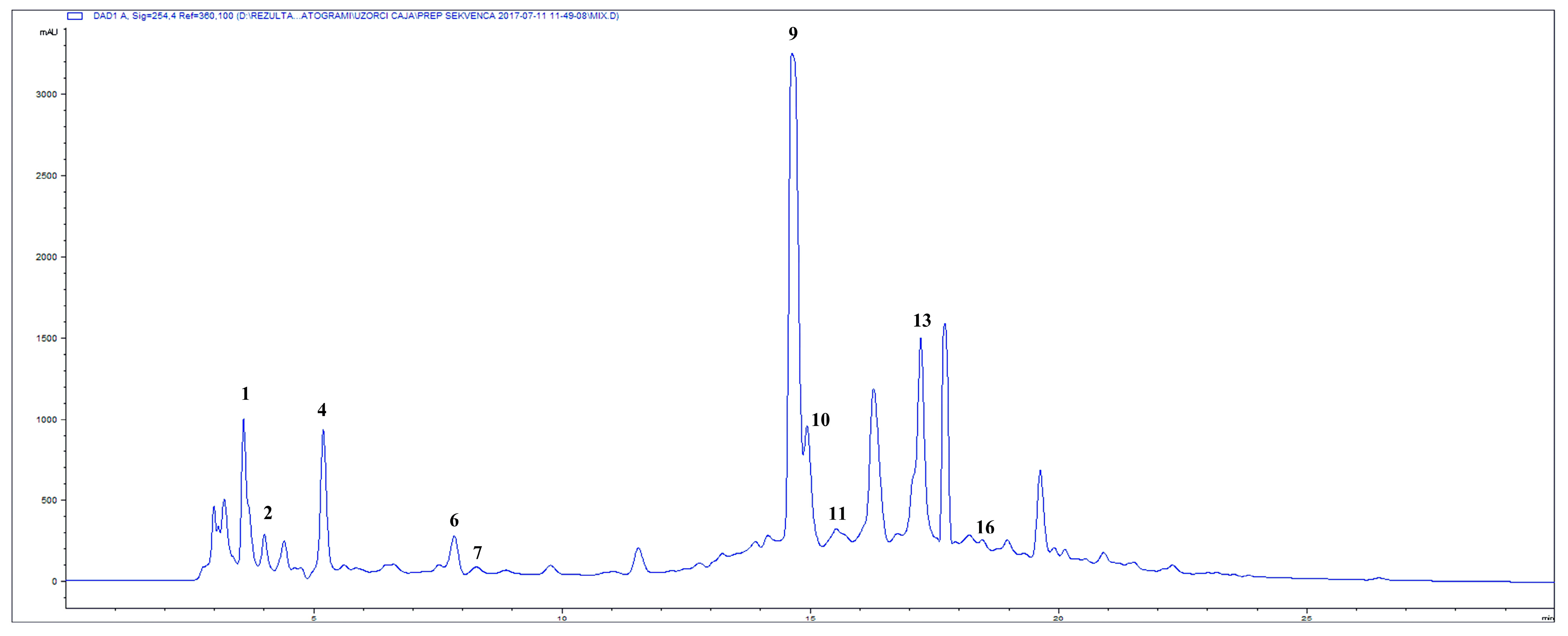
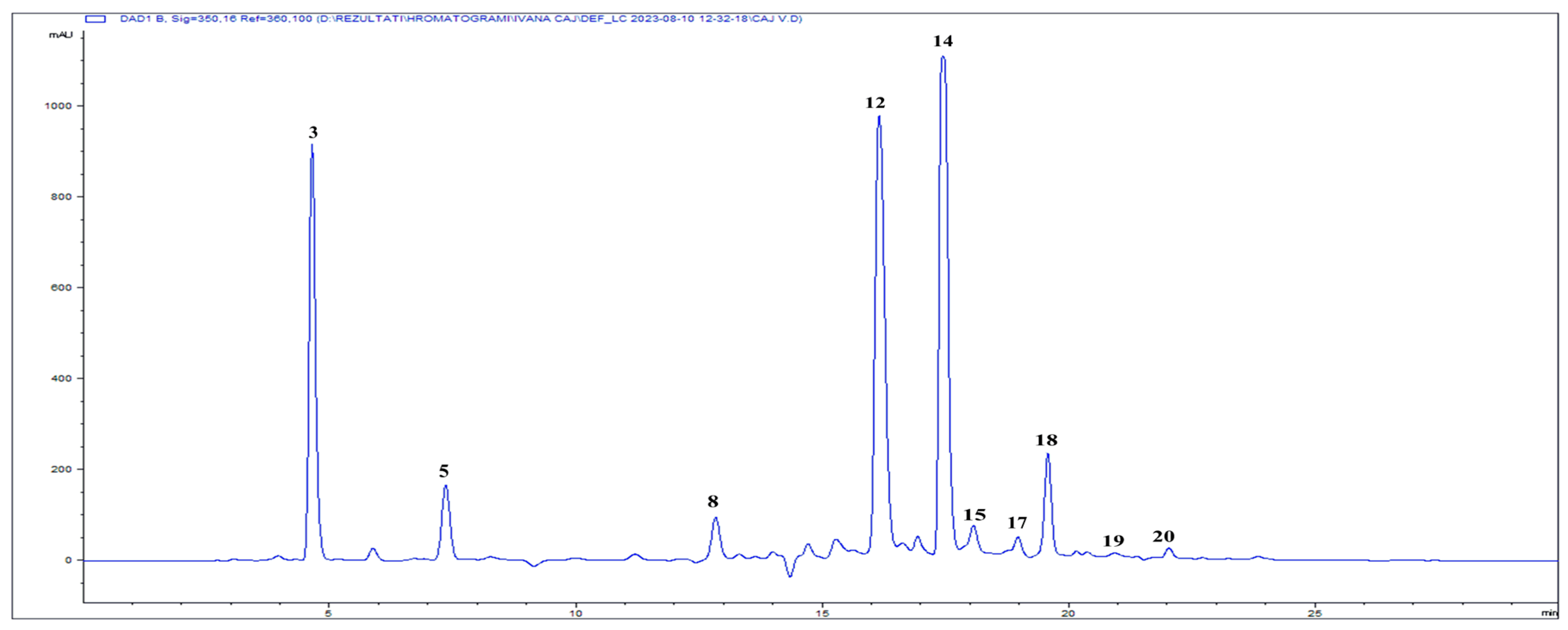
| N | Rt | λmax | Class | Compound | LCOD (mg/g) ± SD |
|---|---|---|---|---|---|
| 1 | 3.58 | 230, 252, 293 | F | Epigallocatechin | 23.86 ± 0.95 |
| 2 | 3.99 | 228, 255, 290 | F | Catechin | 12.42 ± 0.50 |
| 3 | 4.64 | 235, 290, 343 | A | Caftaric acid * | 60.96 ± 1.80 |
| 4 | 5.18 | 227, 260, 298 | A | Protocatechuic acid * | 7.78 ± 0.31 |
| 5 | 7.35 | 234, 295, 343 | A | Caftaric acid derivative * | 13.55 ± 0.54 |
| 6 | 7.82 | 226, 255 | F | Epicatechin | 15.41 ± 0.62 |
| 7 | 8.26 | 230, 255, 295, 350 | A | Caffeic acid derivative * | 7.66 ± 0.30 |
| 8 | 12.83 | 238, 298, 332 | A | Chicoric acid | 29.55 ± 1.18 |
| 9 | 14.62 | 230, 263, 297 | A | Ferulic acid | 205.19 ± 4.10 |
| 10 | 14.92 | 232, 263, 293 | A | Ferulic acid derivative * | 10.24 ± 0.41 |
| 11 | 15.51 | 234, 289, 329 | A | Chicoric acid derivative * | 11.60 ± 0.46 |
| 12 | 16.14 | 255, 267, 347 | F | Hyperoside * | 79.42 ± 2.38 |
| 13 | 17.21 | 235, 255, 285, 310 | A | Lithospermic acid | 49.85 ± 1.99 |
| 14 | 17.44 | 234, 287, 328 | A | Rosmarinic acid | 81.55 ± 2.45 |
| 15 | 18.06 | 238, 265, 341 | F | Apigenin-C-hexoside * | 14.76 ± 0.59 |
| 16 | 18.45 | 225, 260, 340 | F | Kaempferol-glycoside derivative * | 1.44 ± 0.11 |
| 17 | 18.96 | 225, 255, 360 | F | Rutin | 9.96 ± 0.40 |
| 18 | 19.57 | 230, 256, 348 | F | Kaempferol-3-O-glucoside * | 19.68 ± 0.79 |
| 19 | 20.92 | 242, 334 | F | Quercetin derivative * | 3.10 ± 0.19 |
| 20 | 22.02 | 227, 254, 348 | F | Luteolin * | 5.41 ± 0.27 |
| Total | 663.39 |
| Treatment | Number of Writhings | Inhibition (%) |
|---|---|---|
| Acetic acid (10 mL/kg) | 20.67 ± 1.75 | - |
| Diclofenac sodium (10 mg/kg) | 4.00 ± 0.89 | 80.65 |
| LCOD 5 (5 mg/kg) | 6.33 ± 2.42 | 69.37 |
| LCOD 15 (15 mg/kg) | 0.33 ± 0.51 | 98.40 * |
| LCOD 30 (30 mg/kg) | 0.16 ± 0.41 | 99.23 * |
| Rosmarinic acid 50 (50 mg/kg) | 10.67 ± 1.03 | 48.38 |
| Rosmarinic acid 100 (100 mg/kg) | 6.67 ± 0.82 | 67.73 |
Disclaimer/Publisher’s Note: The statements, opinions and data contained in all publications are solely those of the individual author(s) and contributor(s) and not of MDPI and/or the editor(s). MDPI and/or the editor(s) disclaim responsibility for any injury to people or property resulting from any ideas, methods, instructions or products referred to in the content. |
© 2026 by the authors. Licensee MDPI, Basel, Switzerland. This article is an open access article distributed under the terms and conditions of the Creative Commons Attribution (CC BY) license.
Share and Cite
Zlatanović Đaić, I.; Dimitrijević, I.; Ilić, S.; Mitić Ivković, K.; Stojiljković, N.; Stojanović, G. Antinociceptive Effect and HPLC Profile of Lyophilized Chicory and Oregano Decoction. Plants 2026, 15, 527. https://doi.org/10.3390/plants15040527
Zlatanović Đaić I, Dimitrijević I, Ilić S, Mitić Ivković K, Stojiljković N, Stojanović G. Antinociceptive Effect and HPLC Profile of Lyophilized Chicory and Oregano Decoction. Plants. 2026; 15(4):527. https://doi.org/10.3390/plants15040527
Chicago/Turabian StyleZlatanović Đaić, Ivana, Ivana Dimitrijević, Sonja Ilić, Katarina Mitić Ivković, Nenad Stojiljković, and Gordana Stojanović. 2026. "Antinociceptive Effect and HPLC Profile of Lyophilized Chicory and Oregano Decoction" Plants 15, no. 4: 527. https://doi.org/10.3390/plants15040527
APA StyleZlatanović Đaić, I., Dimitrijević, I., Ilić, S., Mitić Ivković, K., Stojiljković, N., & Stojanović, G. (2026). Antinociceptive Effect and HPLC Profile of Lyophilized Chicory and Oregano Decoction. Plants, 15(4), 527. https://doi.org/10.3390/plants15040527