Phytochemistry and Allelopathic Properties of Invasive Heracleum sosnowskyi Aqueous Extracts Against Lettuce (Lactuca sativa L.), Perennial Ryegrass (Lolium perenne L.), Timothy (Phleum pratense L.) and White Clover (Trifolium repens L.)


Abstract
1. Introduction
2. Results
2.1. Chemical Composition of Volatile Organic Compounds (VOCs) in Heracleum sosnowskyi Extracts
2.2. Chemical Composition of Heracleum sosnowskyi Aqueous Extracts Revealed Using the HPLC/DAD/TOF Technique
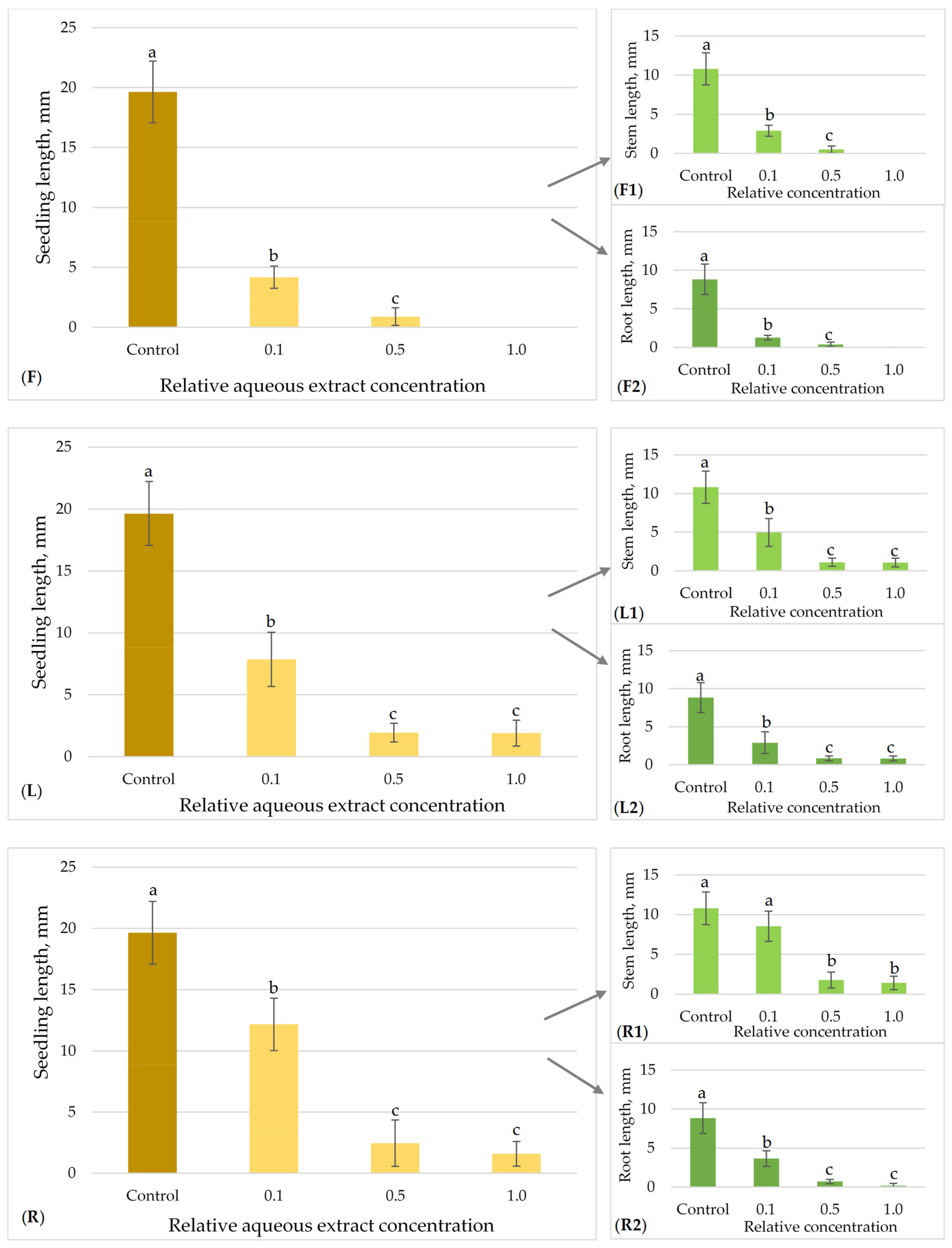
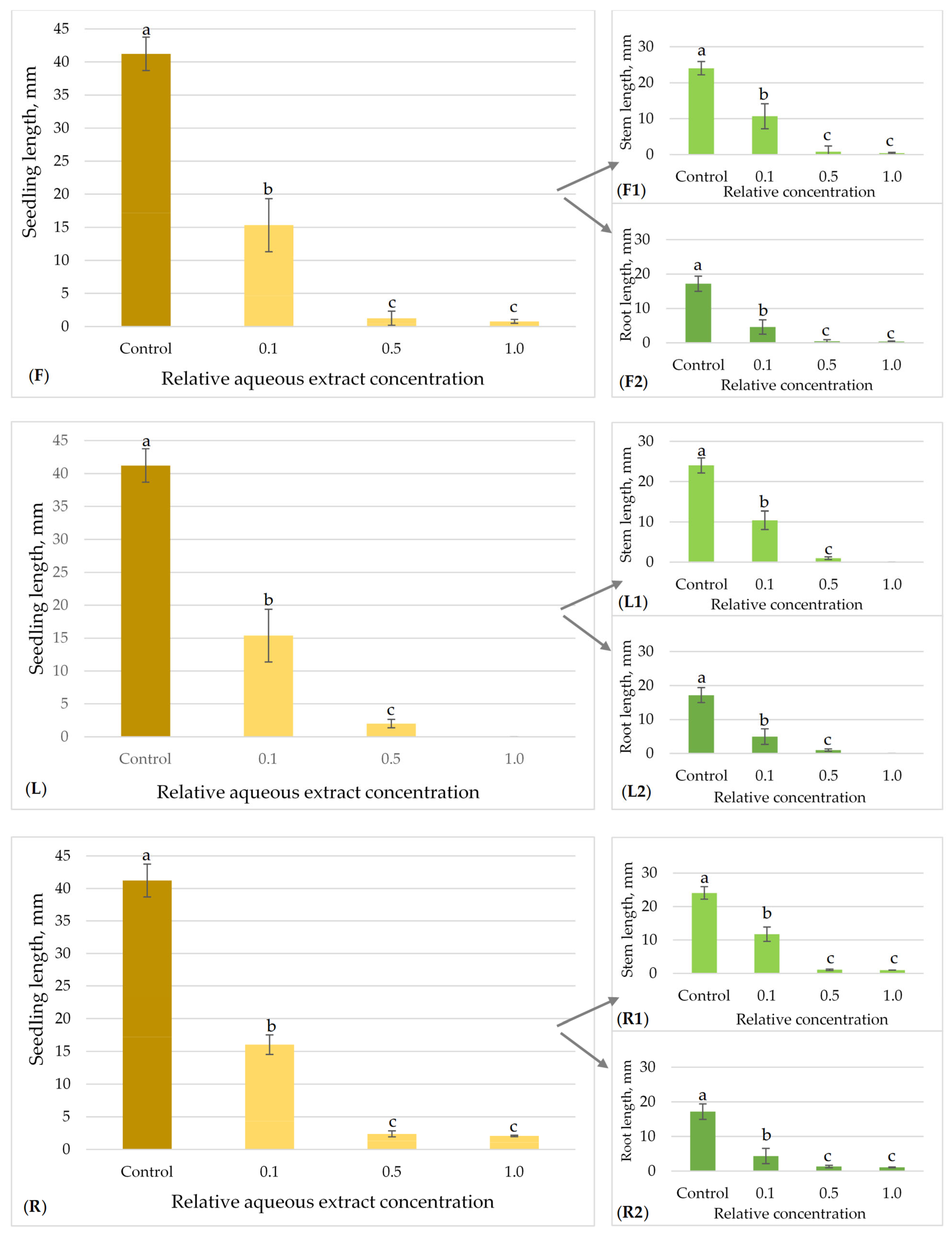
2.3. Allelopathic Effects of Heracleum sosnowskyi Aqueous Extracts on Different Plant Seeds
3. Discussion
4. Materials and Methods
4.1. Plant Material
4.2. Preparation of H. sosnowskyi Aqueous Extracts for HPLC/DAD/TOF Analysis and Allelopathic Tests
4.3. Preparation of H. sosnowskyi Extracts for Analysis of Volatile Organic Compounds (VOCs)
4.4. GC-MS Analysis
4.5. HPLC-DAD-MS (TOF) Analysis
4.6. Seed Germination Bioassay
4.7. Statistical Data Analyses
5. Conclusions
Supplementary Materials
Author Contributions
Funding
Data Availability Statement
Conflicts of Interest
Abbreviations
| GC/MS | Gas Chromatography/Mass Spectrometry |
| HPLC/DAD/TOF | High Performance Liquid Chromatography/Diode Array Detection/Time-of-Flight-Mass Spectrometry |
| VOC | Volatile Organic Compounds |
| GR | Germination Rate |
| VI | Vigor index |
References
- World Flora Online. WFO Plant List. Available online: https://www.worldfloraonline.org (accessed on 25 August 2025).
- Plants of the World Online. Kew, Royal Botanical Gardens. Available online: https://powo.science.kew.org (accessed on 25 August 2025).
- Jahodová, Š.; Fröberg, L.; Pyšek, P.; Geltman, D.; Trybush, S.; Karp, A. Taxonomy, identification, genetic relationships and distribution of large Heracleum species in Europe. In Ecology and Management of Giant Hogweed (Heracleum mantegazzianum); Pyšek, P., Cock, M.J.W., Nentwig, W., Ravn, H.P., Eds.; CAB International: Wallingford, UK, 2007; pp. 1–19. [Google Scholar] [CrossRef]
- Jakubowicz, O.; Żaba, C.; Nowak, G.; Jarmuda, S.; Żaba, R.; Marcinkowski, J.T. Heracleum Sosnowskyi Manden. Ann. Agric. Environ. Med. 2012, 19, 327–328. [Google Scholar] [PubMed]
- Jahodová, Š.; Trybush, S.; Pyšek, P.; Wade, M.; Karp, A. Invasive species of Heracleum in Europe: An insight into genetic relationships and invasion history. Divers. Distrib. 2007, 13, 99–114. [Google Scholar] [CrossRef]
- Booy, O.; Cock, M.; Eckstein, L.; Hansen, S.O.; Hattendorf, J.; Hüls, J.; Jahodová, Š.; Krinke, L.; Moravcová, L.; Müllerová, J.; et al. The Giant Hogweed Best Practice Manual. Guidelines for the Management and Control of an Invasive Weed in Europe; Nielsen, C., Ravn, H.P., Nentwig, W., Wade, P.M., Eds.; Forest & Landscape Denmark: Hørsholm, Denmark, 2005; pp. 4–43. [Google Scholar]
- Global Biodiversity Information Facility (GBIF). Available online: https://www.gbif.org/occurrence/map?taxon_key=3642949&occurrence_status=present (accessed on 8 September 2025).
- Sužiedelytė Visockienė, J.; Tumelienė, E.; Malienė, V. Identification of Heracleum sosnowskyi-invaded land using earth remote sensing data. Sustainability 2020, 12, 759. [Google Scholar] [CrossRef]
- Gubar, L.; Koniakin, S. Populations of Heracleum sosnowskyi and H. mantegazzianum (Apiaceae) in Kyiv (Ukraine). Folia Oecolog. 2021, 48, 215–228. [Google Scholar] [CrossRef]
- Goncharenko, I.; Koniakin, S.; Leshcheniuk, O. Giant hogweeds (Heracleum mantegazzianum and H. sosnowskyi) in Ukraine: Distribution, ecological and coenotical features. Folia Oecolog. 2024, 51, 93–107. [Google Scholar] [CrossRef]
- Baležentienė, L.; Bartkevičius, E. Heracleum sosnowskyi (Apiaceae) spread and phytotoxicity. In Proceedings of the Sixth International Scientific Conference, Rural Development 2013: Innovations and Sustainability, A. Stulginskis University, Akademija, Kaunas District, Lithuania, 28–29 November 2013; pp. 187–190. Available online: https://portalcris.vdu.lt/server/api/core/bitstreams/e9a94ba8-135a-46de-8ac9-bacaf19f7bfe/content (accessed on 10 January 2026).
- Baležentienė, L.; Bartkevičius, E. Invasion of Heracleum sosnowskyi (Apiaceae) at habitat scale in Lithuania. J. Food Agric. Environ. 2013, 11, 1370–1375. Available online: https://hdl.handle.net/20.500.12259/86280 (accessed on 10 January 2026).
- Baležentienė, L.; Stankevičienė, A.; Snieškienė, V. Heracleum sosnovskyi (Apiaceae) seed productivity and establishment in different habitats of central Lithuania. Ekologija 2014, 59, 123–133. [Google Scholar] [CrossRef]
- Moravcová, L.; Gudžinskas, Z.; Pyšek, P.; Pergl, J.; Perglová, I. Seed Ecology of Heracleum mantegazzianum and H. sosnowskyi, Two Invasive Species with Different Distributions in Europe. In Ecology and Management of Giant Hogweed (Heracleum mantegazzianum); Pyšek, P., Cock, M.J.W., Nentwig, W., Ravn, H.P., Eds.; CAB International: Wallingford, UK, 2007; pp. 157–169. [Google Scholar]
- Grzędzicka, E. Impact of invasive weeds on the diversity and dissimilarity of bird communities in forested areas. Diversity 2022, 14, 229. [Google Scholar] [CrossRef]
- Grzędzicka, E. Invasion of the Giant Hogweed and the Sosnowsky’s Hogweed as a Multidisciplinary Problem with Unknown Future—A Review. Earth 2022, 3, 287–312. [Google Scholar] [CrossRef]
- Kalisz, S.; Kivlin, S.N.; Bialic-Murphy, L. Allelopathy is pervasive in invasive plants. Biol. Invasions 2021, 23, 367–371. [Google Scholar] [CrossRef]
- Renčo, M.; Kornobis, F.; Domaradzki, K.; Jakubska-Busse, A.; Jurová, J.; Homolová, Z. How does an invasive Heracleum sosnowskyi affect soil nematode communities in natural conditions? Nematology 2019, 21, 71–89. [Google Scholar] [CrossRef]
- Renčo, M.; Baležentienė, L. An analysis of soil-free-living and plant-parasitic nematode communities in three habitats invaded by Heracleum sosnowskyi in central Lithuania. Biol. Invasions 2015, 17, 1025–1039. [Google Scholar] [CrossRef]
- Macías, F.A.; Durán, A.G.; Molinillo, J.M.G. Allelopathy: The chemical language of plants. Prog. Chem. Org. Nat. Prod. 2020, 112, 1–84. [Google Scholar] [CrossRef]
- Čerevková, A.; Sarabeev, V.; Renčo, M. Dataset on soil nematode abundance and composition from invaded and non-invaded grassland and forest ecosystems in Europe. Data Brief 2024, 57, 111098. [Google Scholar] [CrossRef]
- Shakhmatov, E.G.; Atukmaev, K.V.; Makarova, E.N. Structural characteristics of pectic polysaccharides and arabinogalactan proteins from Heracleum sosnowskyi Manden. Carbohydr. Polym. 2016, 136, 1358–1369. [Google Scholar] [CrossRef]
- Makarova, E.N.; Shakhmatov, E.G.; Belyy, V.A. Structural characteristics of oxalate-soluble polysaccharides of Sosnowsky’s hogweed (Heracleum sosnowskyi Manden). Carbohydr. Polym. 2016, 153, 66–77. [Google Scholar] [CrossRef]
- Vickackaite, V.; Pilaityte, K.; Poskus, V. Extraction, isolation, and purification of furanocoumarins from invasive Heracleum sosnowskyi. Separations 2025, 12, 175. [Google Scholar] [CrossRef]
- Synowiec, A.; Kalemba, D. Composition and herbicidal effect of Heracleum sosnowskyi essential oil. Open Life Sci. 2015, 10, 425–432. [Google Scholar] [CrossRef]
- Politowicz, J.; Gębarowska, E.; Proćków, J.; Pietr, S.; Szumny, A. Antimicrobial activity of essential oil and furanocoumarin fraction of three Heracleum species. Acta Pol. Pharm. 2017, 74, 723–728. Available online: https://ptfarm.pl/download/?file=File%2FActa_Poloniae%2F2017%2F2%2F723.pdf (accessed on 10 January 2026).
- Gordina, E.N.; Kuznetsov, S.P.; Golovchenko, V.V.; Zlobin, A.A. Preliminary structural characteristic of polysaccharides extracted from the callus tissue of Sosnowskyi’s Hogweed (Heracleum Sosnowskyi Manden) stem by aqueous ammonium oxalate. Russ. J. Bioorg. Chem. 2019, 45, 522–527. Available online: https://api.semanticscholar.org/CorpusID:210671633 (accessed on 10 January 2026).
- Gordina, E.N.; Zlobin, A.A.; Martinson, E.A.; Litvinets, S.G. Pectic polysaccharides of callus tissue of the stem of Heracleum sosnowskyi Manden. Theor. Appl. Ecol. 2019, 1, 41–46. [Google Scholar] [CrossRef]
- Jakubska-Busse, A.; Śliwiński, M.; Kobyłka, M. Identification of bioactive components of essential oils in Heracleum sosnowskyi and Heracleum mantegazzianum (Apiaceae). Arch. Biol. Sci. 2013, 65, 877–883. [Google Scholar] [CrossRef]
- Imanly, H.A.; Serkerov, S.V. Investigation of component composition of roots and fruits Heracleum sosnowskyi Manden. Azerbaijan Pharm. Pharmacother. J. 2016, 16, 24–26. Available online: https://www.researchgate.net/publication/311270839_Investigation_of_component_composition_of_roots_and_fruits_Heracleum_Sosnowskyi_Manden (accessed on 10 January 2026).
- Mishyna, M.; Laman, N.; Prokhorov, V.; Fujii, Y. Angelicin as the principal allelochemical in Heracleum sosnowskyi fruit. Nat. Prod. Commun. 2015, 10, 767–770. [Google Scholar] [CrossRef]
- Weryszko-Chmielewska, E.; Chwil, M. Localisation of furanocoumarins in the tissues and on the surface of shoots of Heracleum sosnowskyi. Botany 2017, 95, 1015–1098. [Google Scholar] [CrossRef]
- Del Rio, J.A.; Diaz, L.; Garcia-Bernal, D.; Blanquer, M.; Ortuno, A.; Correal, E.; Moraleda, J.M. Chapter 5—Furanocumarins: Biomolecules of Therapeutic Interest; University of Murcia: Murcia, Spain, 2014. [Google Scholar]
- Rysiak, A.; Dresler, S.; Hanaka, A.; Hawrylak-Nowak, B.; Strzemski, M.; Kováčik, J.; Sowa, I.; Latalski, M.; Wójciak, M. High temperature alters secondary metabolites and photosynthetic efficiency in Heracleum sosnowskyi. Int. J. Mol. Sci. 2021, 22, 4756. [Google Scholar] [CrossRef]
- Mahendra, C.K.; Tan, L.T.H.; Lee, W.L.; Yap, W.H.; Pusparajah, P.; Low, L.E.; Tang, S.Y.; Chan, K.G.; Lee, L.H.; Goh, B.H. Angelicin—A furocoumarin compound with vast biological potential. Front. Pharmacol. 2020, 11, 366. [Google Scholar] [CrossRef]
- Bronikowska, J.; Szliszka, E.; Jaworska, D.; Czuba, Z.P.; Krol, W. The coumarin psoralidin enhances anticancer effect of tumor necrosis factor-related apoptosis-inducing ligand (TRAIL). Molecules 2012, 17, 6449–6464. [Google Scholar] [CrossRef]
- Kulikov, O.A.; Ageev, V.P.; Brodovskaya, E.P.; Shlyapkina, V.I.; Petrov, P.S.; Zharkov, M.N.; Yakobson, D.E.; Maev, I.V.; Sukhorukov, G.B.; Pyataev, N.A. Evaluation of photocytotoxicity liposomal form of furanocoumarins Sosnowsky’s hogweed. Chem.-Biol. Interact. 2022, 357, 109880. [Google Scholar] [CrossRef]
- Rassabina, A.E.; Fedorov, M.V. Analysis of the toxicological profile of Heracleum sosnowskyi Manden. metabolites using in silico methods. Plants 2025, 14, 3253. [Google Scholar] [CrossRef]
- Council of the European Union. List of Invasive Alien Species of Union Concern. Available online: http://ec.europa.eu/environment/nature/pdf/IAS_brochure_species.pdf (accessed on 27 August 2025).
- Gudžinskas, Z.; Petrulaitis, L.; Uogintas, D.; Vaitonis, G.; Balčiauskas, L.; Rakauskas, V.; Arbačiauskas, K.; Butkus, R.; Karalius, S.; Janulaitienė, L.; et al. Invasive and Alien Species in Lithuania; Gudžinskas, Z., Rašomavičius, V., Eds.; Nature Research Centre: Vilnius, Lithuania, 2023; pp. 50–51. ISBN 978-609-8255-32-4. [Google Scholar]
- Stojanović, V.; Petrović, S.; Kovačević, J.; Stojanović, D.; Bjedo, I. Heracleum sosnowskyi Manden. (Apiaceae): A new invasive species in the flora of Serbia. Glas. Šumar. fak. 2017, 116, 215–220. [Google Scholar] [CrossRef]
- Koryznienė, D.; Jurkonienė, S.; Žalnierius, T.; Gavelienė, V.; Jankovska-Bortkevič, E.; Bareikienė, N.; Būda, V. Heracleum sosnowskyi seed development under the effect of exogenous application of GA3. PeerJ 2019, 7, e6906. [Google Scholar] [CrossRef] [PubMed]
- Žalnierius, T.; Šveikauskas, V.; Aphalo, P.J.; Gavelienė, V.; Būda, V.; Jurkonienė, S. Gibberellic Acid (GA3) applied to flowering Heracleum sosnowskyi decreases seed viability even if seed development is not inhibited. Plants 2022, 11, 314. [Google Scholar] [CrossRef]
- Žalnierius, T.; Laibakojis, D.; Rapalytė, S.; Būdienė, J.; Jurkonienė, S. HsGA20ox1, HsGA3ox1, and HsGA2ox1 are involved in endogenous gibberellin regulation within Heracleum sosnowskyi ovaries after gibberellin A3 treatment. Int. J. Mol. Sci. 2025, 26, 4480. [Google Scholar] [CrossRef]
- Słowiński, K.; Grygierzec, B.; Wajs-Bonikowska, A.; Baran, A.; Tabor, S.; Waligórski, P.; Rys, M.; Bocianowski, J.; Synowiec, A. Biochemistry of microwave controlled Heracleum sosnowskyi (Manden.) roots with an ecotoxicological aspect. Sci. Rep. 2024, 14, 14260. [Google Scholar] [CrossRef] [PubMed]
- Purmalis, O.; Klavins, L.; Niedrite, E.; Mezulis, M.; Klavins, M. Invasive plants as a source of polyphenols with high radical scavenging activity. Plants 2025, 14, 467. [Google Scholar] [CrossRef]
- Hpoo, M.K.; Mishyna, M.; Prokhorov, V.; Arie, T.; Takano, A.; Oikawa, Y.; Fujii, Y. Potential of octanol and octanal from Heracleum sosnowskyi fruits for the control of Fusarium oxysporum f. sp. lycopersici. Sustainability 2020, 12, 9334. [Google Scholar] [CrossRef]
- Osipova, E.S.; Gladkov, E.A. Heracleum Sosnowskyi Manden. as a source of valuable chemicals (elimination with utility). Chem. Methodol. 2024, 8, 944–956. [Google Scholar] [CrossRef]
- Paramonova, K.; Chaloupková, V.; Ivanova, T.A. Invasive Heracleum sosnowskyi as a potential feedstock for biorefineries: A review. Ind. Crops Prod. 2024, 216, 118754. [Google Scholar] [CrossRef]
- Baležentienė, L. Inhibitory effects of invasive Heracleum sosnowskyi on rapeseed and ryegrass germination. Allelopathy J. 2012, 31, 197–208. [Google Scholar]
- Baležentienė, L. Immediate allelopathic effect of two invasive Heracleum species on acceptor-germination. Acta Biol. Univ. Daugavp. 2015, 15, 17–26. [Google Scholar] [CrossRef]
- Mishyna, M.; Pham, V.T.T.; Fujii, Y. Evaluation of allelopathic activity of Heracleum sosnowskyi Manden fruits. Allelopath. J. 2017, 42, 169–178. [Google Scholar] [CrossRef]
- Borska, E.; Kviesis, J.; Ramata-Stunda, A.; Nikolajeva, V.; Ansone-Bertina, L.; Boroduskis, M.; Klavins, M. Bioactive lipids and allelopathic potential of the invasive plant Heracleum sosnowskyi: Insights into its fatty acid composition, antimicrobial and cytotoxic effects. Front. Pharmacol. 2025, 16, 1582694. [Google Scholar] [CrossRef]
- Betekhtina, A.A.; Ronzhina, D.A.; Ivanova, L.A.; Malygin, M.V.; Ivanov, L.A. Relative growth rate and its components in invasive species Heracleum sosnowskyi and congeneric native species H. sibiricum. Russ. J. Biol. Invasions 2019, 10, 5–11. [Google Scholar] [CrossRef]
- Malinauskaitė, R. Common oat grayn germination in aqueous extracts of Heracleum sosnowskyi leaves. Optim. Ornament. Garden Plant Assort. Technol. Environ. 2020, 11, 46–51. [Google Scholar]
- Bahadori, M.B.; Dinparast, L.; Zengin, G. The genus Heracleum: A comprehensive review on its phytochemistry, pharmacology, and ethnobotanical values as a useful herb. Compr. Rev. Food Sci. Food Saf. 2016, 15. [Google Scholar] [CrossRef] [PubMed]
- Kose, T.I.; Yardimci, G.B.; Kirci, D.; Polat, D.C.; Demirci, B.; Eryilmaz, M.; Kilic, C.S. Bioactivities and chemotaxonomy of four Heracleum species: A comparative study across plant parts. Pharmaceuticals 2025, 18, 576. [Google Scholar] [CrossRef] [PubMed]
- Segneanu, A.E.; Vlase, G.; Vlase, T.; Bejenaru, L.E.; Mogoşanu, G.D.; Buema, G.; Herea, D.D.; Ciocîlteu, M.V.; Bejenaru, C. Insight into Romanian wild-grown Heracleum sphondylium: Development of a new phytocarrier based on silver nanoparticles with antioxidant, antimicrobial and cytotoxicity potential. Antibiotics 2024, 13, 911. [Google Scholar] [CrossRef] [PubMed]
- Inoue, A.; Taniguchi, M.; Shibano, M.; Wang, N.-H.; Baba, K. Chemical studies on the root of Heracleum candicans Wall. (Part 3). J. Nat. Med. 2010, 64, 175–181. [Google Scholar] [CrossRef]
- Nakamori, T.; Taniguchi, M.; Shibano, M.; Wang, N.-H.; Baba, K. Chemical studies on the root of Heracleum candicans Wall. J. Nat. Med. 2008, 62, 403–412. [Google Scholar] [CrossRef]
- Gao, Y.; Liu, Y.; Wang, Z.-G.; Zhang, H.-L. Chemical constituents of Heracleum dissectum and their cytotoxic activity. Phytochem. Lett. 2014, 10, 276–280. [Google Scholar] [CrossRef]
- Dincel, D.; Hatipŏglu, S.D.; Gören, A.C.; Topçu, G. Anticholinesterase furocoumarins from Heracleum platytaenium, a species endemic to the Ida Mountains. Turk. J. Chem. 2013, 37, 675–683. [Google Scholar] [CrossRef]
- Glowniak, K.; Mroczek, T.; Zabza, A.; Cierpicki, T. Isolation and structure elucidation of 5, 7–disubstituted simple coumarins in the fruits of Heracleum mantegazzianum. Pharm. Biol. 2000, 38, 308–312. [Google Scholar] [CrossRef] [PubMed]
- Taniguchi, M.; Yokota, O.; Shibano, M.; Wang, N.-H.; Baba, K. Four coumarins from Heracleum yunngningense. Chem. Pharm. Bull. 2005, 53, 701–704. [Google Scholar] [CrossRef] [PubMed]
- Ageev, V.P.; Shlyapkina, V.I.; Kulikov, O.A.; Zaborovskiy, A.V.; Tararina, L.A. Qualitative and quantitative analysis of the main psoralen derivatives in the juice of Sosnowsky’s hogweed. Farmaciya (Pharmacy) 2022, 71, 10–17. [Google Scholar] [CrossRef]
- Wille, W.; Thiele, J.; Walker, E.A.; Kollmann, J. Limited evidence for allelopathic effects of giant hogweed on germination of native herbs. Seed Sci. Res. 2013, 23, 157–162. [Google Scholar] [CrossRef]
- Shtratnikova, V.Y.; Bogdanov, V.P.; Schelkunov, M.I.; Klepikova, A.V.; Kulbachnaya, M.A.; Obukhova, E.N.; Ptitsyna, E.V.; Ezhova, M.A.; Penin, A.A.; Logacheva, M.D. Furanocoumarins in two European species of Heracleum: Transcriptomic and metabolomic study. BMC Plant Biol. 2025, 25, 1091. [Google Scholar] [CrossRef]
- Gurina, N.S.; Lukashov, R.I.; Kotovich, A.V. Pharmacological properties and component composition of Heracleum sosnowski Manden. Med. J. 2023, 1, 14–22. [Google Scholar] [CrossRef]



| No. | Compound | RI | Flowers | Leaves | Roots |
|---|---|---|---|---|---|
| 1. | Isopsoralen (2H-Furo[2,3-h]chromen-2-one; Furo(2,3-h)coumarin) (syn. Angelecin) | 1810 | 55.4 ± 4.3 | 47.3 ± 3.1 | 9.1 ± 2.0 |
| 2. | Ficusin (7H-Furo[3,2-g][1]benzopyran-7-one; Furo[4′,5′:6,7]coumarin; 7H-Furo[3,2-g]chromen-7-one) (syn. Psoralen) | 1842 | 3.6 ± 1.0 | 5.3 ± 1.7 | 1.9 ± 0.8 |
| 3. | Isobergapten (2H-Furo[2,3-h]-1-benzopyran-2-one, 5-methoxy; 5-Methoxy-2H-furo[2,3-H]chromen-2-one) | 2016 | 1.7 ± 0.4 | 0.1 ± 0.1 | 8.0 ± 2.2 |
| 4. | Methoxsalen (7H-Furo[3,2-g][1]benzopyran-7-one; 9-Methoxy-7H-furo[3,2-g]chromen-7-one) (syn. Ammoidin; Meladinin; Meloxine; Oxsoralen; Xanthotoxin) | 2032 | 14.7 ± 4.3 | 30.1 ± 5.8 | 3.7 ± 0.9 |
| 5. | Bergapten (7H-Furo[3,2-g][1]benzopyran-7-one, 4-methoxy; 5-Methoxypsoralen) (syn. Bergaptan; Heraclin) | 2056 | 6.6 ± 2.5 | 11.2 ± 3.3 | 12.4 ± 3.3 |
| 6. | Pimpinellin (5,6-Dimethoxy-2H-furo[2,3-H]chromen-2-one; 2H-Furo[2,3-h]-1-benzopyran-2-one, 5,6-dimethoxy) | 2118 | 13.8 ± 4.0 | 0.2 ± 0.1 | 44.9 ± 5.1 |
| 7. | Isopimpinellin (7H-Furo[3,2-g][1]benzopyran-7-one, 4,9-dimethoxy; 4,9-Dimethoxy-7H-furo[3,2-g]chromen-7-one) (syn. 5,8-Dimethoxypsoralen; 5,8-Dimethoxy-6,7- furanocoumarin) | 2248 | 1.2 ± 0.3 | 2.9 ± 0.0 | 14.9 ± 1.7 |
| No. | Compound | Formula | Molecular Weight | m/z ESI+ (Da) | m/z ESI− (Da) |
|---|---|---|---|---|---|
| Acids | |||||
| 1. | Glutaric acid L,F,R | C5H8O4 | 132.11 | 132.100 | |
| 2. | p-Anisic (4-Methoxybenzoic) acid F | C8H8O3 | 152.15 | 151.004 | |
| 3. | Suberic (Octanedioic) acid F | C8H14O4 | 174.19 | 173.083 | |
| 4. | Quinic acid L,F | C7H12O6 | 192.17 | 191.020 | |
| 5. | Phenyloctanoic acid F | C14H20O2 | 220.31 | 221.049 | |
| 6. | Linolenic acid (9,12,15-Octadecatrienoic) acid L,F,R | C18H30O2 | 278.45 | 279.157 | |
| 7. | Oleic (cis-9-Octadecenoic) acid F | C18H34O2 | 282.47 | 281.124 | |
| 8. | Chlorogenic (caffeoylquinic) acid L,R | C16H18O9 | 354.31 | 355.099 | 353.086 |
| 9. | 3-O-Feruloylquinic acid L | C17H20O9 | 368.31 | 367.101 | |
| 10. | Isochlorogenic (3,4-dicaffeoylquinic) acid L,R | C25H24O12 | 516.45 | 515.139 | |
| 11. | Chrysophanic acid (Chrysophanol; 1,8-Dihydroxy-3-methylanthraquinone) R | C15H10O4 | 254.24 | 253.143 | |
| 12. | Gelseminic (Chrysatropic) acid R (Scopoletin; 7-Hydroxy-6-methoxy-2H-chromen-2-one) | C10H8O4 | 192.16 | 191.018 | |
| 13. | Indole-3-acetyl-L-aspartic acid (Indoleacetylaspartate) F | C14H14N2O5 | 290.27 | 289.034 | |
| Esters | |||||
| 14. | Isoamyl butyrate L,F | C9H18O2 | 158.24 | 158.995 | |
| 15. | Hexyl hexanoate L | C12H24O2 | 200.32 | 199.097 | |
| Terpenoids | |||||
| 16–19. | Monoterpenes (Limonene, Ocimene, Terpinene or Terpinolene) L | C10H16 | 136.24 | 135.030 | 135.019 |
| 20. | Germacrene D L,F | C15H24 | 204.35 | 205.095 | |
| 21. | Neophytadiene F | C20H38 | 278.52 | 279.036 | 277.033 |
| Flavonoids | |||||
| 22. | Quercetin 7,3,4-trimethyl ether L,F,R | C18H16O7 | 344.3 | 343.035 | |
| 23. | Astragalin (Kaempferol 3-O-glucoside) L,F | C21H20O11 | 448.38 | 449.105 | 447.091 |
| 24. | Baicalin (7-D-Glucuronic acid-5,6-dihydroxyflavone) R | C21H18O11 | 446.36 | 447.120 | |
| 25. | Nicotiflorin (Kaempferol-3-O-rutinoside) L,F | C27H30O15 | 594.50 | 595.159 | 593.148 |
| 26. | Rutin (Quercetin-3-O-rutinoside) L,F | C27H30O16 | 610.52 | 611.155 | 609.145 |
| Furano-derivatives | |||||
| 27. | Coumaran L,F,R | C8H8O | 120.15 | 121.050 | |
| 28. | 5,6,7,7a-Tetrahydro-4,4,7a-trimethyl-2(4h)-benzofuran L,F,R | C11H18O | 166.26 | 166.085 | 165.055 |
| 29. | Isopsoralen L,F,R | C11H6O3 | 186.16 | 187.038 | |
| 30. | Ficusin L,F,R | C11H6O3 | 186.16 | 187.098 | |
| 31. | Methoxsalen F,R | C12H8O4 | 216.19 | 217.046 | |
| 32. 33. | Bergapten/Isobergapten L,F,R | C12H8O4 | 216.19 | 217.002 | |
| 34. 35. | Pimpinellin/Isopimpinellin L,F,R | C13H10O5 | 246.21 | 247.058 | |
| 35. | Imperatorin F,R | C16H14O4 | 270.28 | 271.225 | |
| 37. | L-Arabinofuranose L | C5H10O5 | 150.13 | 149.109 | |
| 38. | Bakuchicin (Furo[2,3-f]chromen-7-one; 7H-Furo(2,3-f)(1)benzopyran-7-one) R | C11H6O3 | 186.16 | 187.037 | |
| 39. | Hermandiol ((8S)-8-(1,2-dihydroxypropan-2-yl)-8,9-dihydrofuro[2,3-h]chromen-2-one) R | C14H14O5 | 262.26 | 263.058 | |
| 40. | Byakangelicol (9-[[(2R)-3,3-dimethyloxiran-2-yl]methoxy]-4-methoxyfuro[3,2-g]chromen-7-one) F | C17H16O6 | 316.30 | 315.071 | |
| 41. | Apterin F | C20H24O10 | 424.40 | 423.067 | |
| 42. | Candinol A R | C21H16O6 | 364.35 | 365.133 | |
| 43. | Candinol C R | C32H32O12 | 608.60 | 607.102 | |
| 44. | Candibirin F R | C34H34O11 | 618.64 | 617.187 | |
| Coumarins | |||||
| 45. | Limettin (5,7-Dimethoxycoumarin) F | C11H10O4 | 206.19 | 205.050 | |
| 46. | Umbelliferone (7-Hydroxycoumarin; 7-Hydroxy-2H-chromen-2-one) F,R | C9H6O3 | 162.14 | 161.024 | |
| 47. | Yunngnin A R | C12H10O6 | 250.05 | 248.956 | |
| 48. | Yunngnin B R | C11H8O5 | 220.04 | 221.048 |
Disclaimer/Publisher’s Note: The statements, opinions and data contained in all publications are solely those of the individual author(s) and contributor(s) and not of MDPI and/or the editor(s). MDPI and/or the editor(s) disclaim responsibility for any injury to people or property resulting from any ideas, methods, instructions or products referred to in the content. |
© 2026 by the authors. Licensee MDPI, Basel, Switzerland. This article is an open access article distributed under the terms and conditions of the Creative Commons Attribution (CC BY) license.
Share and Cite
Judžentienė, A.; Kundrotaitė, A.; Charkova, T.; Nedveckytė, I. Phytochemistry and Allelopathic Properties of Invasive Heracleum sosnowskyi Aqueous Extracts Against Lettuce (Lactuca sativa L.), Perennial Ryegrass (Lolium perenne L.), Timothy (Phleum pratense L.) and White Clover (Trifolium repens L.). Plants 2026, 15, 346. https://doi.org/10.3390/plants15030346
Judžentienė A, Kundrotaitė A, Charkova T, Nedveckytė I. Phytochemistry and Allelopathic Properties of Invasive Heracleum sosnowskyi Aqueous Extracts Against Lettuce (Lactuca sativa L.), Perennial Ryegrass (Lolium perenne L.), Timothy (Phleum pratense L.) and White Clover (Trifolium repens L.). Plants. 2026; 15(3):346. https://doi.org/10.3390/plants15030346
Chicago/Turabian StyleJudžentienė, Asta, Aistė Kundrotaitė, Tatjana Charkova, and Irena Nedveckytė. 2026. "Phytochemistry and Allelopathic Properties of Invasive Heracleum sosnowskyi Aqueous Extracts Against Lettuce (Lactuca sativa L.), Perennial Ryegrass (Lolium perenne L.), Timothy (Phleum pratense L.) and White Clover (Trifolium repens L.)" Plants 15, no. 3: 346. https://doi.org/10.3390/plants15030346
APA StyleJudžentienė, A., Kundrotaitė, A., Charkova, T., & Nedveckytė, I. (2026). Phytochemistry and Allelopathic Properties of Invasive Heracleum sosnowskyi Aqueous Extracts Against Lettuce (Lactuca sativa L.), Perennial Ryegrass (Lolium perenne L.), Timothy (Phleum pratense L.) and White Clover (Trifolium repens L.). Plants, 15(3), 346. https://doi.org/10.3390/plants15030346